Forming Wrap Around Contact with Self-aligned Backside Contact
Abstract
One or more systems, devices, and/or methods of fabrication provided herein relate to reduced resistance between contacts and source/drain epis. According to one embodiment, a semiconductor device can comprise a source/drain region comprising a top portion, a sidewall portion and a bottom portion, a dielectric bar located adjacent to the source/drain region, and a contact in direct contact with the top portion, the sidewall portion and the bottom portion of the source/drain region and with the dielectric bar.
Claims (13)
1 . A semiconductor device comprising: a source/drain region comprising a top portion, a first sidewall portion, a second sidewall portion, and a bottom portion; a dielectric bar in contact with the second sidewall portion of the source/drain region; and a contact in direct contact with the top portion, the first sidewall portion and the bottom portion of the source/drain region and with the dielectric bar.
8 . A semiconductor device comprising: a source/drain region located at a boundary between a first FET and a second FET and in contact with a dielectric bar on one side; and a contact that surrounds the source/drain region on at least three sides.
Show 11 dependent claims
2 . The semiconductor device of claim 1 , further comprising a first FET and a second FET, wherein the dielectric bar is located between the first FET and the second FET.
3 . The semiconductor device of claim 1 , wherein the dielectric bar comprises a first portion above the source/drain region and a second portion below the source/drain region.
4 . The semiconductor device of claim 3 , wherein the contact is in direct contact with the first portion of the dielectric bar and the second portion of the dielectric bar.
5 . The semiconductor device of claim 1 , further comprising a backside power delivery network coupled to a bottom portion of the contact, wherein the contact comprises an asymmetric extension towards the second sidewall portion.
6 . The semiconductor device of claim 2 , wherein the dielectric bar isolates a first gate region of the first FET and a second gate region of the second FET.
7 . The semiconductor device of claim 2 , wherein the first FET comprises a first type of FET and the second FET comprises a second type of FET.
9 . The semiconductor device of claim 8 , wherein the source/drain region is isolated by a dielectric bar.
10 . The semiconductor device of claim 9 , further comprising a contact cut over the contact.
11 . The semiconductor device of claim 10 , wherein the contact cut partially overlaps with the dielectric bar.
12 . The semiconductor device of claim 8 , wherein the first FET comprises a first type of FET and the second FET comprises a second type of FET.
13 . The semiconductor device of claim 8 , further comprising a backside power delivery network coupled to the contact.
Full Description
Show full text →
BACKGROUND
The subject disclosure relates to backside contacts for buried power rails, and more specifically, to backside contacts that wrap around a source/drain epi.
SUMMARY
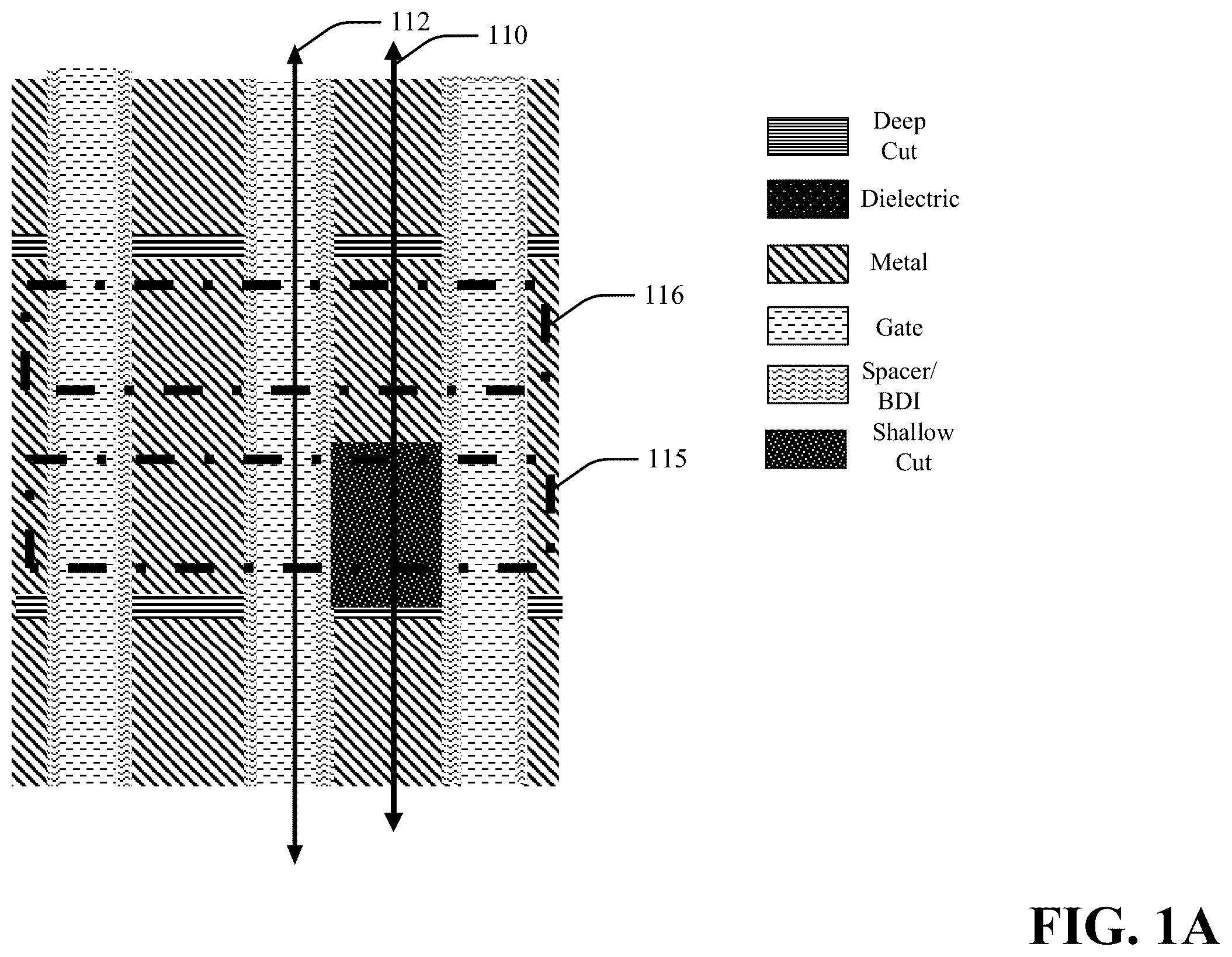
The following presents a summary to provide a basic understanding of one or more embodiments of the invention. This summary is not intended to identify key or critical elements, or delineate any scope of the particular embodiments or any scope of the claims. Its sole purpose is to present concepts in a simplified form as a prelude to the more detailed description that is presented later. According to an embodiment, a semiconductor device can comprise a source/drain region comprising a top portion, a sidewall portion and a bottom portion, a dielectric bar located adjacent to the source/drain region, and a contact in direct contact with the top portion, the sidewall portion and the bottom portion of the source/drain and with the dielectric bar. According to another embodiment, a method for fabricating a semiconductor device, by a fabrication system, can comprise forming, by the fabrication system, a source/drain region comprising a top portion, a sidewall portion and a bottom portion, depositing, by the fabrication system, a dielectric bar located adjacent to the source/drain region, and forming, by the fabrication system, a contact in direct contact with the top portion, the sidewall portion and the bottom portion of the source/drain region and with the dielectric bar. According to another embodiment, a semiconductor device can comprise a source/drain region located at a boundary between a first FET and a second FET, and a contact that surrounds the source/drain region on at least three sides. DESCRIPTION OF THE DRAWINGS A illustrates a top-down view of an example, non-limiting, semiconductor device in accordance with one or more embodiments described herein. B and 1 C illustrate various cross-sections of an example, non-limiting semiconductor device in accordance with one or more embodiments described herein. A illustrates a top-down view of an example, non-limiting, starting substrate for production of a semiconductor device in accordance with one or more embodiments described herein. B illustrates a cross-section of an example, non-limiting, starting substrate for production of a semiconductor device in accordance with one or more embodiments described herein. A illustrates a top-down view of an example, non-limiting, second stage of production of a semiconductor device in accordance with one or more embodiments described herein. B illustrates a cross-section of an example, non-limiting, second stage of production of a semiconductor device in accordance with one or more embodiments described herein. A illustrates a top-down view of an example, non-limiting third stage of production of a semiconductor device in accordance with one or more embodiments described herein. B illustrates a cross-section of an example, non-limiting third stage of production of a semiconductor device in accordance with one or more embodiments described herein. A illustrates a top-down view of a fourth stage of production of a semiconductor device in accordance with one or more embodiments described herein. B illustrates a cross-section view of a fourth stage of production of a semiconductor device in accordance with one or more embodiments described herein. A illustrates a top-down view of an example, non-limiting, fifth stage of production of a semiconductor device, in accordance with one or more embodiments described herein. B, 6 C and 6 D illustrate various cross-sections of a fifth stage of production of a semiconductor device, in accordance with one or more embodiments described herein. A, 7 B and 7 C illustrate various cross-sections of a sixth stage of production of a semiconductor device, in accordance with one or more embodiments described herein. A illustrates a top-down view of an example, non-limiting, seventh stage of production of a semiconductor device, in accordance with one or more embodiments described herein. B, 8 C and 8 D illustrate various cross-sections of a seventh stage of production of a semiconductor device, in accordance with one or more embodiments described herein. A illustrates a top-down view of an example, non-limiting, eight stage of production of a semiconductor device, in accordance with one or more embodiments described herein. B, 9 C and 9 D illustrate various cross-sections of an eighth stage of production of a semiconductor device, in accordance with one or more embodiments described herein. A illustrates a top-down view of an example, non-limiting, ninth stage of production of a semiconductor device, in accordance with one or more embodiments described herein. B, 10 C and 10 D illustrate various cross-sections of a ninth stage of production of a semiconductor device, in accordance with one or more embodiments described herein. A illustrates a top-down view of an example, non-limiting, tenth stage of production of a semiconductor device, in accordance with one or more embodiments described herein. B, 11 C and 11 D illustrate various cross-sections of a tenth stage of production of a semiconductor device, in accordance with one or more embodiments described herein. A illustrates a top-down view of an example, non-limiting, eleventh stage of production of a semiconductor device, in accordance with one or more embodiments described herein. B, 12 C and 12 D illustrate various cross-sections of an eleventh stage of production of a semiconductor device, in accordance with one or more embodiments described herein. A illustrates a top-down view of an example, non-limiting, twelfth stage of production of a semiconductor device, in accordance with one or more embodiments described herein. B, 13 C and 13 D illustrate various cross-sections of a twelfth stage of production of a semiconductor device, in accordance with one or more embodiments described herein. A, 14 B and 14 C illustrate various cross-sections of a thirteenth stage of production of a semiconductor device, in accordance with one or more embodiments described herein. A illustrates a top-down view of an example, non-limiting, fourteenth stage of production of a semiconductor device, in accordance with one or more embodiments described herein. B, 15 C and 15 D illustrate various cross-sections of a fourteenth stage of production of a semiconductor device, in accordance with one or more embodiments described herein. A illustrates a top-down view of an example, non-limiting, fifteenth stage of production of a semiconductor device, in accordance with one or more embodiments described herein. B, 16 C and 16 D illustrate various cross-sections of a fifteenth stage of production of a semiconductor device, in accordance with one or more embodiments described herein. A illustrates a top-down view of an example, non-limiting, sixteenth stage of production of a semiconductor device, in accordance with one or more embodiments described herein. B, 17 C and 17 D illustrate various cross-sections of a sixteenth stage of production of a semiconductor device, in accordance with one or more embodiments described herein. A, 18 B and 18 C illustrate various cross-sections of a seventeenth stage of production of a semiconductor device, in accordance with one or more embodiments described herein. A illustrates a top-down view of an example, non-limiting, eighteenth stage of production of a semiconductor device in accordance with one or more embodiments described herein. B, 19 C and 19 D illustrate various cross-sections of an eighteenth stage of production of a semiconductor device, in accordance with one or more embodiments described herein. A illustrates a top-down view of an example, non-limiting, nineteenth stage of production of a semiconductor device, in accordance with one or more embodiments described herein. B, 20 C and 20 D illustrate various cross-sections of a nineteenth stage of production of a semiconductor device, in accordance with one or more embodiments described herein. A illustrates a top-down view of an example, non-limiting, twentieth stage of production of a semiconductor device, in accordance with one or more embodiments described herein. B, 21 C and 21 D illustrate various cross-sections of a twentieth stage of production of a semiconductor device, in accordance with one or more embodiments described herein. A illustrates a top-down view of an example, non-limiting further stage of production of a semiconductor device in accordance with one or more embodiments described herein. B, 22 C and 22 D illustrate various cross-sections of a twenty-first stage of production of a semiconductor device in accordance with one or more embodiments described herein. A, 23 B and 23 C illustrate various cross-sections of a twenty-second stage of production of a semiconductor device in accordance with one or more embodiments described herein. A, 24 B and 24 C illustrate various cross-sections of a twenty-third stage of production of a semiconductor device in accordance with one or more embodiments described herein. A, 25 B and 25 C illustrate various cross-sections of a twenty-fourth stage of production of a semiconductor device in accordance with one or more embodiments described herein. A, 26 B and 26 C illustrate various cross-sections of a twenty-fifth stage of production of a semiconductor device in accordance with one or more embodiments described herein. A, 27 B and 27 C illustrate various cross-sections of a twenty-fifth stage of production of a semiconductor device in accordance with one or more embodiments described herein. A, 28 B and 28 C illustrate various cross-sections of a twenty-sixth stage of production of a semiconductor device in accordance with one or more embodiments described herein. A, 29 B and 29 C illustrate various cross-sections of a twenty-seventh stage of production of a semiconductor device in accordance with one or more embodiments described herein. illustrates a flow diagram of an example, non-limiting method of fabrication, by a fabrication system, of a semiconductor device in accordance with one or more embodiments described herein.
DETAILED DESCRIPTION
The following detailed description is merely illustrative and is not intended to limit embodiments and/or application or uses of embodiments. Furthermore, there is no intention to be bound by any expressed or implied information presented in the preceding Background or Summary sections, or in the Detailed Description section. Backside contacts enable operation of buried power rails in semiconductor devices. Buried power rails represent an opportunity for increases in decoupling capacitances in semiconductor devices, which in turn reduce power supply noise. However, existing backside contacts exhibit high resistance due to limited surface area between the backside contact and the source/drain region. Often, a high temperature annealing process would be used to increase the surface area of a semiconductor contact. As backside contacts are formed after a top back end of line formation (BEOL), this prevents the use of high temperature annealing. Accordingly, existing semiconductors with buried power rails exhibit high resistance between the backside contact and the source/drain region, thereby decreasing device performance. In view of the aforementioned problems with current backside contacts, the described subject matter illustrates semiconductor devices and methods of fabrication capable of decreasing contact resistance between backside contacts and source/drain epis, thereby increasing semiconductor device performance. For example, as described in greater detail below, a semiconductor device can comprise a source/drain region comprising a top portion, a sidewall portion and a bottom portion, a dielectric bar adjacent to the source/drain region, and a contact in direct contact with the top portion, the sidewall portion and the bottom portion of the source/drain region and with the dielectric bar. By having the contact wrap around the source/drain region, resistance between the contact and the source/drain region is decreased due to the increase in surface area between the contact and the source/drain region. In a further embodiment, the semiconductor device can comprise a first field-effect transistor (FET) and a second FET, wherein the dielectric bar is located between the first FET and the second FET and wherein the source/drain region is located within the first FET. In a further embodiment, the first FET can comprise a first type of FET and the second FET can comprise a second type of FET. For example, the first FET can comprise a p-channel FET (PFET) and the second FET can comprise an n-channel FET (NFET). In an alternative example, the first FET can comprise an NFET and the second FET can comprise a PFET. One or more embodiments are now described with reference to the drawings, where like referenced numerals are used to refer to like elements throughout. In the following description, for purposes of explanation, numerous specific details are set forth in order to provide a more thorough understanding of the one or more embodiments. It is evident, however, in various cases, that the one or more embodiments can be practiced without these specific details. A illustrates a top-down view of a semiconductor device in accordance with one or more embodiments described herein. As shown, the semiconductor device comprises an NFET region 116 and a PFET region 115 . A further comprises lines 110 and 112 utilized for illustration of cross-sections described below. B illustrates a cross-section along line 110 of A . As shown, B illustrates a source/drain epi 101 of PFET 115 , source/drain epi 104 of NFET 116 , and dielectric bar 102 , wherein dielectric bar is located between PFET 115 and NFET 116 and isolates source/drain epi 101 from source/drain epi 104 . Accordingly, source/drain epi 101 is located at the boundary between PFET 115 and NFET 116 . In an embodiment, dielectric bar can comprise SiN, SiCO, SiOCN, or another suitable dielectric insulation material. B further comprises contact 103 . As shown, contact 103 wraps around source/drain epi 101 and is in contact with an upper portion, a sidewall portion and a bottom portion of source/drain epi 101 . Furthermore, contact 103 is in contact with a portion of dielectric bar 102 that extends above source/drain epi 101 and a portion of dielectric bar 102 that extends below source/drain epi 101 . Contact 103 can also overlap with the bottom of dielectric bar 102 as shown at point 140 . In an embodiment, contact 103 can comprise a metal such as aluminum, nickel, chromium, gold, germanium, copper, silver, titanium, tungsten, platinum, tantalum or another suitable metal. Contact 103 is further coupled to backside power rail 106 , which is coupled to backside power delivery network 105 . Accordingly, contact 103 facilitates electrical coupling between source/drain epi 101 and backside power delivery network 105 . It should be appreciated that as contact 103 wraps around source/drain epi 101 , there is increased surface area between contact 103 and source/drain epi 101 , relative to other designs, thereby reducing resistance between contact 103 and source/drain epi 101 . C illustrates a cross-section along line 112 . As shown, dielectric bar 102 can divide the gate region into first gate region 120 corresponding to PFET 115 and a second gate region corresponding to NFET 116 . A illustrates a top-down view of an example, non-limiting starting substrate for production of a semiconductor device in accordance with one or more embodiments described herein. As shown, A illustrates region 220 where a first PFET will be formed and region 230 where a first NFET will be formed. A further comprises lines 211 , 212 and 213 utilized to illustrate cross-sections below. B illustrates a cross-section along line 212 of A . As shown, B illustrates a silicon substrate 201 , an etch stop layer 202 , an SiGe55 layer, one or more SiGe30 layers, and one or more silicon layers 204 . It should be appreciated that while B comprises three layers of SiGe55 and three layers of silicon, use of any number of layers is envisioned. Furthermore, one or more hardmask pillars are located on top of silicon layer 204 , indicating where FETs will be formed in the substrate. For example, pillar 206 is above region 220 of A and pillar 207 is above region 230 of A . In an embodiment, the hardmask can comprise materials such as silicon dioxide, silicon carbide, titanium nitride, tantalum nitride, or another suitable material. A illustrates a top-down view of an example, non-limiting second stage of production of a semiconductor device in accordance with one or more embodiments described herein. As shown by A , a spacer material has been deposited on the sidewalls of the hardmask pillars, and channels cut between the spacers, as will be shown in more detail below. A further comprises lines 311 , 312 and 313 utilized to illustrate cross-sections below. B illustrates a cross-section along line 312 of A . As shown by B , shallow trench isolation channels 302 and 304 and dielectric bar channel 303 can be patterned in the substrate. In an embodiment, an etching process can be utilized that does not impact the hardmask or spacer line 301 , allowing for regions covered by the hardmask to be protected during etching. A illustrates a top-down view of an example, non-limiting third stage of production of a semiconductor device in accordance with one or more embodiments described herein. As shown by A , a dielectric bar 401 can be deposited within dielectric bar channel 303 . In an embodiment, dielectric bar 401 can be formed by an atomic layer deposition process, or another suitable chemical vapor deposition process, and an isotropic etch back. A further comprises lines 411 , 412 and 413 utilized to illustrate cross-sections below. B illustrates a cross-section along line 412 of A . As shown, dielectric bar 401 has been deposited in dielectric bar channel 303 . A illustrates a top-down view of a fourth stage of production of a semiconductor device in accordance with one or more embodiments described herein. As shown by A , the hardmask pillars have been removed and shallow trench isolation (STI) regions 501 and 502 have been formed within shallow trench isolation channels 302 and 304 respectively. A further comprises lines 511 , 512 and 513 utilized to illustrate cross-sections below. B illustrates a cross-section along line 512 of A . As shown, hardmask pillars 206 and 207 have been removed, and the top portion of dielectric bar 401 is exposed. Further, STI regions 501 and 502 have been formed. In an embodiment, STI regions 501 and 502 can comprise a dielectric material such as silicon dioxide or another suitable dielectric. A illustrates a top-down view of an example, non-limiting, fifth stage of production of a semiconductor device, in accordance with one or more embodiments described herein. As shown by A , one or more dummy gates, such as dummy gate 601 can be patterned across the substrate and a hardmask 602 can be patterned on top of the dummy gate 601 . A further comprises lines 611 , 612 and 613 utilized to illustrate cross-sections below. B, 6 C and 6 D illustrate various cross-sections of a fifth stage of production of a semiconductor device, in accordance with one or more embodiments described herein. B illustrates a cross-section along line 612 of A . As shown, dummy gate 601 has been patterned across the substrate with hardmask 602 patterned on top. In an embodiment, dummy gate 601 can comprise a material such as polysilicon, or another suitable material. C illustrates a cross-section along line 611 of A . As shown, no dummy gate is patterned over this portion of the semiconductor device. D illustrates a cross-section along line 613 of A . As shown, dummy gates 620 , 601 and 630 have been patterned across the semiconductor device. A, 7 B and 7 C illustrate various cross-sections of a sixth stage of production of a semiconductor device, in accordance with one or more embodiments described herein. A illustrates a cross-section along line 612 of A , B illustrates a cross-section along line 611 of A , and C illustrates a cross-section along line 613 of A . As shown by A, 7 B and 7 C SiGe55 layer 203 can be removed from the semiconductor device. A illustrates a top-down view of an example, non-limiting, seventh stage of production of a semiconductor device, in accordance with one or more embodiments described herein. As shown by A , a spacer material 802 can be deposited on the sidewalls of dummy gate 620 , 601 and 630 . Additionally, as described in greater detail below, a bottom dielectric isolation (BDI) can be deposited in the areas vacated by the removal of SiGe55 layer 203 . A further comprises lines 811 , 812 and 813 utilized to illustrate cross-sections below. B, 8 C and 8 D illustrate various cross-sections of a seventh stage of production of a semiconductor device, in accordance with one or more embodiments described herein. B illustrates a cross-section along line 811 of A . C illustrates a cross-section along line 812 of A . As shown, BDI layer 801 has been deposited in the regions vacated by SiGe55 layer 203 . Further, BDI layer 801 can extend up the sidewalls of channels 804 and 805 . D illustrates a cross-section along line 813 of A . As shown, spacer material 802 can be deposited along the sidewalls of the dummy gates. In an embodiment, BDI layer 801 and spacer material 802 can comprise the same material, such as a dielectric insulation material. A illustrates a top-down view of an example, non-limiting, eighth stage of production of a semiconductor device, in accordance with one or more embodiments described herein. As shown by A , an etching process can remove silicon layers 204 and SiGe30 layers 205 from regions of the semiconductor device not covered by the hardmask to expose BDI layer 801 . A further comprises lines 911 , 912 and 913 utilized to illustrate cross-sections below. B, 9 C and 9 D illustrate various cross-sections of an eighth stage of production of a semiconductor device, in accordance with one or more embodiments described herein. B illustrates a cross-section along line 912 of A . As shown, hardmask 602 protects the regions below during the etching process. C illustrates a cross-section along line 911 of A . As shown, since C is not covered by hardmask 602 , the layers of silicon and SiGe30 can be removed by an etching process to expose BDI layer 801 . D illustrates a cross-section along line 913 of A . As shown, portions of the silicon and SiGe30 layers not covered by hardmask 602 have been removed. Further, inner spacer 901 can be patterned on sidewall portion of the SiGe30 layers. A illustrates a top-down view of an example, non-limiting, ninth stage of production of a semiconductor device, in accordance with one or more embodiments described herein. As shown by A , an organic planarization layer (OPL) 1001 can be deposited on the semiconductor device and a channel 1002 can be patterned through OPL 1001 . A further comprises lines 1011 , 1012 and 1013 utilized to illustrate cross-sections below. B, 10 C and 10 D illustrate various cross-sections of a ninth stage of production of a semiconductor device, in accordance with one or more embodiments described herein. B illustrates a cross-section along line 1012 of A . C illustrates a cross-section along line 1011 of A . As shown by C , channel 1002 has been patterned through OPL 1001 . In an embodiment, a portion of dielectric bar 401 can be exposed by channel 1002 . D illustrates a cross-section along line 1013 of A . As shown, channel 1002 is patterned through OPL 1001 . A illustrates a top-down view of an example, non-limiting, tenth stage of production of a semiconductor device, in accordance with one or more embodiments described herein. As shown by A , a contact place holder 1101 can be deposited within channel 1002 . In an embodiment, contact place holder 1101 can comprise a material such as TiOx, AlOx, SiC, or another suitable dielectric material. A further comprises lines 1111 , 1112 and 1113 utilized to illustrate cross-sections below. B, 11 C and 11 D illustrate various cross-sections of a tenth stage of production of a semiconductor device, in accordance with one or more embodiments described herein. B illustrates a cross-section along line 1112 of A . C illustrates a cross-section along line 1111 of A . D illustrates a cross-section along line 1113 of A . As shown by C and 11 D , contact place holder 1101 can be deposited in a bottom portion of channel 1002 . A illustrates a top-down view of an example, non-limiting, eleventh stage of production of a semiconductor device, in accordance with one or more embodiments described herein. As shown by A , OPL 1001 can be removed and source/drain epis 1201 , 1202 , 1203 and 1204 can be patterned. In an embodiment, source/drain epis 1201 and 1202 can be utilized for PFETs and source/drain epis 1203 and 1204 can be utilized for NFETs. A further comprises lines 1211 , 1212 and 1213 utilized to illustrate cross-sections below. B, 12 C and 12 D illustrate various cross-sections of an eleventh stage of production of a semiconductor device, in accordance with one or more embodiments described herein. B illustrates a cross-section along line 1212 of A . C illustrates a cross-section alone line 1211 of A . As shown, source/drain epis 1201 , 1202 , 1203 and 1204 have been patterned. As shown, source/drain epi 1201 is located adjacent to dielectric bar 401 and on top of the contact place holder. D illustrates a cross-section along line 1213 of A . As shown by D , source/drain epis 1201 and 1202 have been formed, wherein source/drain epi 1201 is located on top of the contact place holder. A illustrates a top-down view of an example, non-limiting, twelfth stage of production of a semiconductor device, in accordance with one or more embodiments described herein. As shown by A , a second OPL layer 1301 can be deposited between, dummy gates 620 , 601 and 630 . A further comprises lines 1311 , 1312 and 1313 utilized to illustrate cross-sections below. B, 13 C and 13 D illustrate various cross-sections of a twelfth stage of production of a semiconductor device, in accordance with one or more embodiments described herein. B illustrates a cross-section along line 1312 , C illustrates a cross-section along line 1311 , and D illustrates a cross-section along line 1313 . As shown by B, 13 C and 13 D , second OPL layer 1301 can be deposited on the semiconductor device between dummy gates 620 , 601 and 630 . A, 14 B and 14 C illustrate various cross-sections of a thirteenth stage of production of a semiconductor device, in accordance with one or more embodiments described herein. A illustrates a cross-section along line 1312 , B illustrates a cross-section along line 1311 , and C illustrates a cross-section along line 1313 . As shown by C , spacer material 802 can be recessed to expose the sides of hardmask 602 . A illustrates a top-down view of an example, non-limiting, fourteenth stage of production of a semiconductor device, in accordance with one or more embodiments described herein. As shown by A , a second spacer 1501 can be deposited on the sidewalls of the exposed portions of hardmask 602 . In an embodiment, second spacer 1501 can comprise materials such as AlN, AlOx, SiC, or another suitable material. A further comprises lines 1511 , 1512 and 1513 utilized to illustrate cross-sections below. B, 15 C and 15 D illustrate various cross-sections of a fourteenth stage of production of a semiconductor device, in accordance with one or more embodiments described herein. B illustrates a cross-section along line 1512 , C illustrates a cross-section along line 1511 , and D illustrates a cross-section along line 1513 . As shown by D , second spacer 1501 has been deposited on the sidewalls of hardmask 602 . A illustrates a top-down view of an example, non-limiting, fifteenth stage of production of a semiconductor device, in accordance with one or more embodiments described herein. As shown, second OPL layer 1301 can be removed to facilitate removal of a portion of BDI layer 801 . A further comprises lines 1611 , 1612 and 1613 utilized to illustrate cross-sections below. B, 16 C and 16 D illustrate various cross-sections of a fifteenth stage of production of a semiconductor device, in accordance with one or more embodiments described herein. B illustrates a cross-section along line 1612 , C illustrates a cross-section along line 1611 , and D illustrates a cross-section along line 1613 . As shown by C , the portions of BDI layer 801 along the side walls of source/drain epis 1201 , 1202 , 1203 and 1204 can be removed. A illustrates a top-down view of an example, non-limiting, sixteenth stage of production of a semiconductor device, in accordance with one or more embodiments described herein. As shown an intermediate layer dielectric (ILD) 1701 can be deposited between dummy gates 620 , 601 and 630 . In an embodiment, ILD 1701 can comprise SiO 2 or another suitable dielectric material. A further comprises lines 1711 , 1712 and 1713 utilized to illustrate cross-sections below. B, 17 C and 17 D illustrate various cross-sections of a sixteenth stage of production of a semiconductor device, in accordance with one or more embodiments described herein. B illustrates a cross-section along line 1712 , C illustrates a cross-section along line 1711 , and D illustrates a cross-section along line 1713 . As shown by C and 17 D , a liner 1702 can be deposited prior to deposition of ILD 1701 . In an embodiment, liner 1702 can comprise a material such as SiN. In an embodiment, ILD 1701 can serve as a protective layer during later fabrication steps and liner 1702 can serve as an etch-stop layer for removal of ILD 1701 . A, 18 B and 18 C illustrate various cross-sections of a seventeenth stage of production of a semiconductor device, in accordance with one or more embodiments described herein. A illustrates a cross-section along line 1712 , B illustrates a cross-section along line 1711 , and C illustrates a cross-section along line 1713 . As shown by A , hardmask 602 , dummy gates 620 , 601 and 630 and SiGe30 layers can be removed and replace by a metallization process to form gates 1801 , 1802 and 1803 . Gate cuts 1805 and 1806 can be patterned above STI regions 501 and 502 . A second hardmask 1810 can then be patterned on top of the gates 1801 , 1802 and 1803 . As shown by B , ILD 1701 can protect portions of the semiconductor device during gate formation. A illustrates a top-down view of an example, non-limiting, eighteenth stage of production of a semiconductor device in accordance with one or more embodiments described herein. As shown by A , ILD 1701 and liner 1702 can be removed after formation of gates 1801 , 1802 and 1803 using an etching or other suitable process. For example, liner 1702 can serve as an etch-stop layer during removal of ILD 1701 , and then can be removed. A further comprises lines 1911 , 1912 and 1913 utilized to illustrate cross-sections below. B, 19 C and 19 D illustrate various cross-sections of an eighteenth stage of production of a semiconductor device, in accordance with one or more embodiments described herein. B illustrates a cross-section along line 1912 , C illustrates a cross-section along line 1911 , and D illustrates a cross-section along line 1913 . As shown, ILD 1701 and liner 1702 can be removed after formation of gates 1801 , 1802 and 1803 . A illustrates a top-down view of an example, non-limiting, nineteenth stage of production of a semiconductor device, in accordance with one or more embodiments described herein. As shown by A , a metal layer 2001 can be deposited between gates 1801 , 1802 and 1803 . As will be described in greater detail below in further production stages, metal layer 2001 can be further formed to produce one or more contacts. In an embodiment, metal layer 2001 can comprise materials such as, but not limited to, aluminum, nickel, chromium, gold, germanium, copper, silver, titanium, tungsten, platinum, tantalum or another suitable metal. A further comprises lines 2011 , 2012 and 2013 utilized to illustrate cross-sections below. B, 20 C and 20 D illustrate various cross-sections of a nineteenth stage of production of a semiconductor device, in accordance with one or more embodiments described herein. B illustrates a cross-section along line 2012 , C illustrates a cross-section along line 2011 , and D illustrates a cross-section along line 2013 . As shown, metal layer 2001 can be deposited onto source/drain epis 1201 , 1202 , 1203 and 1204 , and will facilitate production of contacts in further stages of production. A illustrates a top-down view of an example, non-limiting, twentieth stage of production of a semiconductor device, in accordance with one or more embodiments described herein. As shown, metal layer 2001 can be divided to form two or more metal contacts by deep contact cuts 2101 and 2102 and by shallow contact cut 2103 . A further comprises lines 2111 , 2112 and 2113 utilized to illustrate cross-sections below. B, 21 C and 21 D illustrate various cross-sections of a twentieth stage of production of a semiconductor device, in accordance with one or more embodiments described herein. B illustrates a cross-section along line 2112 , C illustrates a cross-section along line 2111 , and D illustrates a cross-section along line 2113 . As shown, deep contact cuts 2101 and 2102 and shallow contact cut 2103 divide metal layer 2001 into contact 2122 , 2121 , 2120 and 2123 , wherein each contact is in direct contact with a single source/drain epi. As shown, shallow contact cut 2103 can partially overlap with dielectric bar 401 . A illustrates a top-down view of an example, non-limiting further stage of production of a semiconductor device in accordance with one or more embodiments described herein. As shown, one or more vias, such as vias 2201 , 2202 , 2203 , 2204 and 2205 can be patterned and ILD 2206 can be deposited on top of the device. A further comprises lines 2211 , 2212 and 2213 utilized to illustrate cross-sections below. B, 22 C and 22 D illustrate various cross-sections of a twenty-first stage of production of a semiconductor device in accordance with one or more embodiments described herein. B illustrates a cross-section along line 2212 , C illustrates a cross-section along line 2211 , and D illustrates a cross-section along line 2213 . As shown, vias 2201 , 2202 , 2203 , 2204 and 2205 can be patterned and ILD 2206 can be deposited on top of the device. A, 23 B and 23 C illustrate various cross-sections of a twenty-second stage of production of a semiconductor device in accordance with one or more embodiments described herein. A illustrates a cross-section along line 2212 , B illustrates a cross-section along line 2211 , and C illustrates a cross-section along line 2213 . As shown, a back end of line formation (BEOL) 2301 can be formed to connect to vias 2201 , 2202 , 2203 , 2204 and 2205 and a carrier wafer 2302 can be formed to enable the semiconductor device to be flipped onto carrier wafer 2302 in further stages of production. A, 24 B and 24 C illustrate various cross-sections of a twenty-third stage of production of a semiconductor device in accordance with one or more embodiments described herein. A illustrates a cross-section along line 2212 , B illustrates a cross-section along line 2211 , and C illustrates a cross-section along line 2213 . As shown, substrate 201 and etch stop layer 202 can be removed to expose the bottom of the semiconductor device. A, 25 B and 25 C illustrate various cross-sections of a twenty-fourth stage of production of a semiconductor device in accordance with one or more embodiments described herein. A illustrates a cross-section along line 2212 , B illustrates a cross-section along line 2211 , and C illustrates a cross-section along line 2213 . As shown, a backside ILD layer 2501 can be deposited, and a chemical-mechanical polishing (CMP) process can be utilized to expose the bottom of contact place holder 1101 . A, 26 B and 26 C illustrate various cross-sections of a twenty-fifth stage of production of a semiconductor device in accordance with one or more embodiments described herein. A illustrates a cross-section along line 2212 , B illustrates a cross-section along line 2211 , and C illustrates a cross-section along line 2213 . As shown, contact place holder 1101 can be removed via and etching processes to form channel 2601 . A, 27 B and 27 C illustrate various cross-sections of a twenty-fifth stage of production of a semiconductor device in accordance with one or more embodiments described herein. A illustrates a cross-section along line 2212 , B illustrates a cross-section along line 2211 , and C illustrates a cross-section along line 2213 . As shown, channel 2601 can be widened to an asymmetric shape to expose a portion 2701 of contact 2120 and BDI layer 801 . A, 28 B and 28 C illustrate various cross-sections of a twenty-sixth stage of production of a semiconductor device in accordance with one or more embodiments described herein. A illustrates a cross-section along line 2212 , B illustrates a cross-section along line 2211 , and C illustrates a cross-section along line 2213 . As shown, additional metal can be deposited in channel 2601 to expand contact 2120 . As shown by B , contact 2120 now wraps around source/drain epi 1201 and is in contact with a top portion, a sidewall portion and a bottom portion of source/drain epi 1201 . Furthermore, as shown, contact 2101 now comprises an asymmetric shape that extends towards source/drain epi 1201 and dielectric bar 401 . Due to contact 2101 wrapping around source/drain epi 1201 , contact 2101 and source/drain epi share a large amount of surface area, and resistance between source/drain epi 1201 and contact 2101 is reduced when compared to other designs. A, 29 B and 29 C illustrate various cross-sections of a twenty-seventh stage of production of a semiconductor device in accordance with one or more embodiments described herein. A illustrates a cross-section along line 2212 , B illustrates a cross-section along line 2211 , and C illustrates a cross-section along line 2213 . As shown, buried power rail 2901 and backside power delivery network 2902 can be formed on the bottom of the device. Accordingly, power can be supplied to source/drain epi 1201 via backside power delivery network 2902 , buried power rail 2901 and contact 2101 . illustrates a flow diagram of an example, non-limiting method of fabrication 3000 , by a fabrication system, of a semiconductor device in accordance with one or more embodiments described herein. At 3002 , method 3000 can comprise, forming, by the fabrication system, a first FET and a second FET. For example, a nanosheet fabrication system can form a PFET and an NFET connected by one or more gates. At 3004 , method 3000 can comprise forming, by the fabrication system, a source/drain region comprising a top portion, a sidewall portion and a bottom portion. In an embodiment, the source/drain region can be located within the first FET or the second FET. At 3006 , method 3000 can comprise depositing, by the fabrication system, a dielectric bar adjacent to the source/drain region. For example, the dielectric bar can isolate the first FET from the second FET. At 3008 , method 3000 can comprise forming, by the fabrication system, a contact in direct contact with the top portion, the bottom portion, and the sidewall portion of the source/drain region and the dielectric bar. An advantage of such methods, devices and/or systems is that they enabled semiconductor devices with increased performance. For example, having the contact wrap around a source/drain epi, surface area between the source/drain epi and the contact is increased, thereby decreasing resistance between the contact and the source/drain epi and improving performance of the semiconductor device.
Figures (20)
Citations
This patent cites (22)
- US9570395
- US10586765
- US10636739
- US10700207
- US10734224
- US11133254
- US11289606
- US11450665
- US2020/0105671
- US2021/0111115
- US2021/0134721
- US2021/0202385
- US2021/0305252
- US2021/0305381
- US2021/0336019
- US2021/0351303
- US2021/0376071
- US2021/0376093
- US2021/0399099
- US2022/0223698
- US2023/0275124
- US2022015926