Semiconductor Structure and Circuit Structure
Abstract
A semiconductor structure and a manufacturing method thereof are provided. The semiconductor structure includes a redistribution structure, conductive joints, conductive terminals, a circuit substrate, and an insulating encapsulation. The redistribution structure includes a first side and a second side opposite to the first side, wherein trenches are located on the second side of the redistribution structure and extend to an edge of the second side of the redistribution structure. The conductive joints are disposed over the first side of the redistribution structure. The conductive terminals are disposed over the second side of the redistribution structure. The circuit substrate electrically coupled to the redistribution structure through the conductive joints. The insulating encapsulation is disposed on the first side of the redistribution structure to cover the circuit substrate.
Claims (20)
1. A semiconductor structure, comprising: a redistribution structure comprising a bottom surface, a top surface opposite to the bottom surface, and a sidewall located between the top surface and the bottom surface, wherein gas release trenches are extending along the top surface of the redistribution structure and extend to the sidewall of the redistribution structure; conductive joints disposed on the bottom surface of the redistribution structure; conductive terminals disposed over the top surface of the redistribution structure; a circuit substrate electrically coupled to the redistribution structure through the conductive joints; and an insulating encapsulation disposed on the bottom surface of the redistribution structure to cover the circuit substrate.
9. A circuit structure, comprising: a redistribution structure comprising a first side, a second side opposite to the first side, and a side surface located between the first side and the second side, wherein gas release trenches are extending along the second side of the redistribution structure, wherein two ends of each of the gas release trenches are connected with the side surface of the redistribution structure; conductive joints disposed on the first side of the redistribution structure; conductive terminals disposed over the second side of the redistribution structure; a circuit substrate electrically connected to the conductive joints; and an insulating encapsulation disposed on the first side of the redistribution structure to cover the circuit substrate.
16. A circuit structure, comprising: a redistribution structure comprising a first side, a second side opposite to the first side, and a side surface located between the first side and the second side, wherein gas release channels are located on the second side of the redistribution structure; conductive joints disposed on the first side of the redistribution structure; conductive terminals disposed over the second side of the redistribution structure, wherein the gas release channels are extending from the side surface of the redistribution structure to between the conductive terminals; and a circuit substrate electrically connected to the conductive joints.
Show 17 dependent claims
2. The semiconductor structure of claim 1 , wherein the redistribution structure comprises: a first dielectric layer located at the bottom surface of the redistribution structure; a first conductive pattern embedded in the first dielectric layer, wherein the first conductive pattern is substantially flush with the first dielectric layer, and the conductive joints are in contact with the first conductive pattern; an N-th dielectric layer located at the top surface of the redistribution structure; and an N-th conductive pattern disposed under the N-th dielectric layer, wherein the conductive terminals are electrically connected with the N-th conductive pattern through vias in the N-th dielectric layer.
3. The semiconductor structure of claim 2 , wherein the first conductive pattern comprises a first under-bump metallization (UBM) pattern, and the conductive joints are in contact with the first UBM pattern.
4. The semiconductor structure of claim 3 , further comprises: a second UBM pattern disposed in the vias in the N-th dielectric layer, the N-th conductive pattern being stacked over and electrically coupled to the first UBM pattern of the redistribution structure and away from the circuit substrate.
5. The semiconductor structure of claim 1 , wherein a depth of the gas release trenches is in a range from 5 μm to 50 μm.
6. The semiconductor structure of claim 1 , wherein a width of the conductive terminals is less than a width of the conductive joints.
7. The semiconductor structure of claim 1 , wherein two ends of each of the gas release trenches are connected with the sidewall of the redistribution structure.
8. The semiconductor structure of claim 1 , wherein the redistribution structure comprises the gas release trenches extending along different directions.
10. The circuit structure of claim 9 , wherein the redistribution structure comprises: a first dielectric layer located at the first side of the redistribution structure; a first conductive pattern embedded in the first dielectric layer, wherein the conductive joints are in contact with the first conductive pattern; an N-th dielectric layer located at the second side of the redistribution structure; and an N-th conductive pattern embedded in the N-th dielectric layer, wherein the conductive terminals are electrically connected with the N-th conductive pattern, and wherein a portion of the N-th conductive pattern is surrounded by the gas release trenches.
11. The circuit structure of claim 10 , wherein the first conductive pattern comprises a first under-bump metallization (UBM) pattern, and the conductive joints are in contact with the first UBM pattern.
12. The circuit structure of claim 11 , further comprises: a second UBM pattern disposed in vias in the N-th dielectric layer, wherein the N-th conductive pattern is stacked over and electrically coupled to the first UBM pattern of the redistribution structure and away from the circuit substrate.
13. The circuit structure of claim 9 , wherein a depth of the gas release trenches is in a range from 5 μm to 50 μm.
14. The circuit structure of claim 9 , wherein a width of the conductive terminals is less than a width of the conductive joints.
15. The circuit structure of claim 9 , wherein the redistribution structure comprises the gas release trenches extending along different directions.
17. The circuit structure of claim 16 , wherein a depth of the gas release channels is in a range from 5 μm to 50 μm.
18. The circuit structure of claim 16 , wherein a width of the conductive terminals is less than a width of the conductive joints.
19. The circuit structure of claim 16 , wherein two ends of each of the gas release channels are connected with the side surface of the redistribution structure.
20. The circuit structure of claim 16 , wherein the redistribution structure comprises the gas release channels extending along different directions.
Full Description
Show full text →
CROSS-REFERENCE TO RELATED APPLICATION
This is a divisional application of and claims the priority benefit of a prior application Ser. No. 17/351,253, filed on Jun. 18, 2021, which is now allowed. The entirety of the above-mentioned patent application is hereby incorporated by reference herein and made a part of this specification.
BACKGROUND
The semiconductor industry has experienced rapid growth due to continuous improvements in the integration density of a variety of electronic components (e.g., transistors, diodes, resistors, capacitors, etc.). For the most part, this improvement in integration density has come from repeated reductions in minimum feature size, which allows more components to be integrated into a given area. As the demand for miniaturization, higher speed and greater bandwidth, as well as lower power consumption and latency has grown recently, there has grown a need for smaller and more creative packaging techniques of semiconductor dies.
BRIEF DESCRIPTION OF THE DRAWINGS
Aspects of the present disclosure are best understood from the following detailed description when read with the accompanying figures. It is noted that, in accordance with the standard practice in the industry, various features are not drawn to scale. In fact, the dimensions of the various features may be arbitrarily increased or reduced for clarity of discussion.
A- 1 I are schematic cross-sectional views of various stages of manufacturing a semiconductor structure in accordance with some embodiments.
A- 2 I are schematic top views corresponding to A- 1 I in accordance with some embodiments.
A is a schematic top view of a redistribution structure in accordance with some embodiments.
B is a schematic cross-section view corresponding to A in accordance with some embodiments.
is a schematic cross-section view of a redistribution structure in accordance with some embodiments.
is a schematic top view of a redistribution structure in accordance with some embodiments.
is a schematic top view of a redistribution structure in accordance with some embodiments.
DETAILED DESCRIPTION
The following disclosure provides many different embodiments, or examples, for implementing different features of the provided subject matter. Specific examples of components and arrangements are described below to simplify the present disclosure. These are, of course, merely examples and are not intended to be limiting. For example, the formation of a first feature over or on a second feature in the description that follows may include embodiments in which the first and second features are formed in direct contact, and may also include embodiments in which additional features may be formed between the first and second features, such that the first and second features may not be in direct contact. In addition, the present disclosure may repeat reference numerals and/or letters in the various examples. This repetition is for the purpose of simplicity and clarity and does not in itself dictate a relationship between the various embodiments and/or configurations discussed.
Further, spatially relative terms, such as “beneath,” “below,” “lower,” “above,” “upper” and the like, may be used herein for ease of description to describe one element or feature's relationship to another element(s) or feature(s) as illustrated in the figures. The spatially relative terms are intended to encompass different orientations of the device in use or operation in addition to the orientation depicted in the figures. The apparatus may be otherwise oriented (rotated 90 degrees or at other orientations) and the spatially relative descriptors used herein may likewise be interpreted accordingly.
Other features and processes may also be included. For example, testing structures may be included to aid in the verification testing of the 3D packaging or 3DIC devices. The testing structures may include, for example, test pads formed in a redistribution layer or on a substrate that allows the testing of the 3D packaging or 3DIC, the use of probes and/or probe cards, and the like. The verification testing may be performed on intermediate structures as well as the final structure. Additionally, the structures and methods disclosed herein may be used in conjunction with testing methodologies that incorporate intermediate verification of known good dies to increase the yield and decrease costs.
A- 1 I are schematic cross-sectional views of various stages of manufacturing a semiconductor structure in accordance with some embodiments, and A- 2 I are schematic top views corresponding to A- 1 I in accordance with some embodiments.
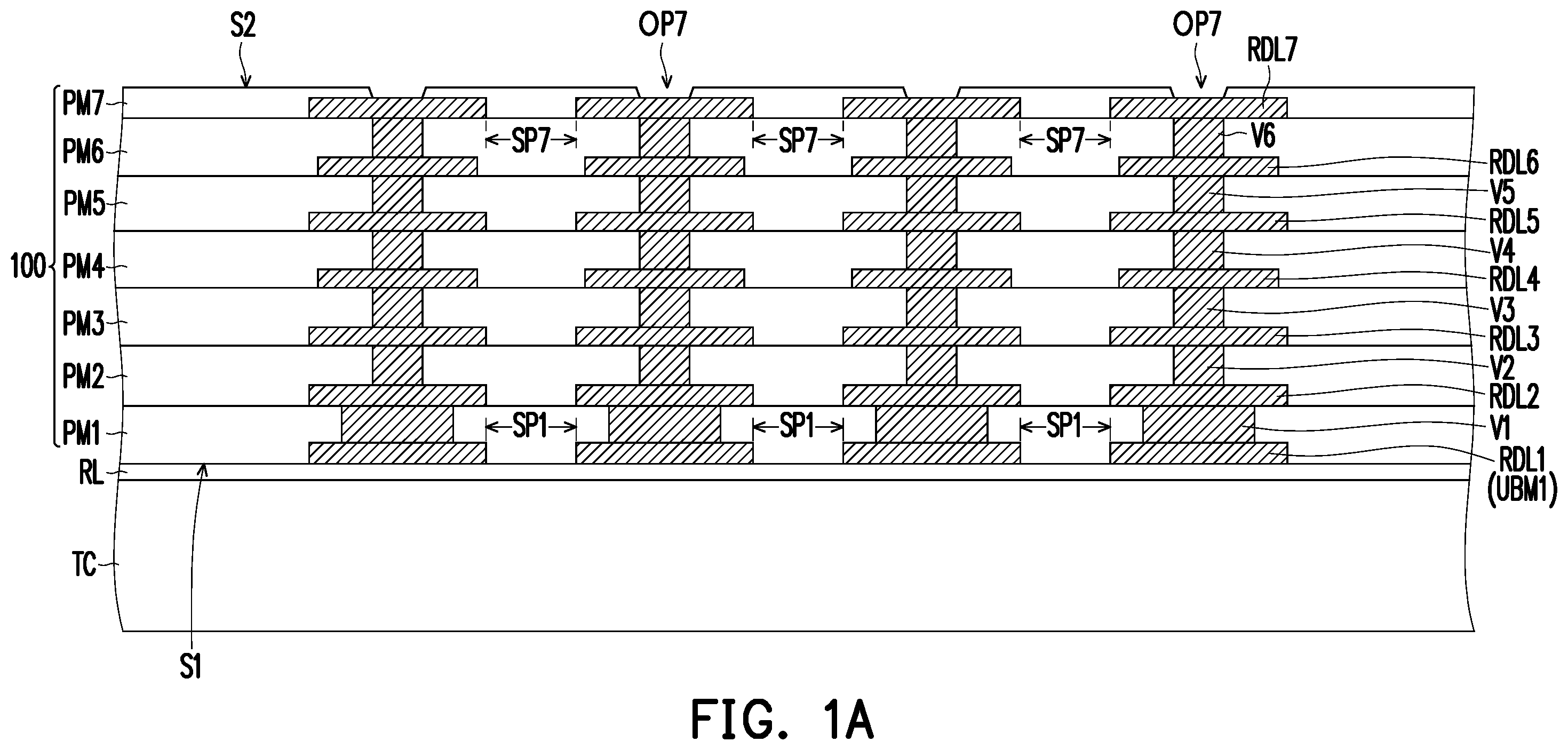
Referring to A and 2 A , a redistribution structure 100 including dielectric layers and redistribution layers is formed over a temporary carrier TC. For example, a material of the temporary carrier TC includes glass, silicon, metal, ceramic, combinations thereof, multi-layers thereof, and/or the like. In some embodiments, the temporary carrier TC is provided in a wafer form. Alternatively, the temporary carrier TC may have a rectangular shape or other suitable shape. The temporary carrier TC may be planar to accommodate the formation of features subsequently formed thereon. In some embodiments, the temporary carrier TC is provided with a release layer RL to facilitate a subsequent de-bonding of the temporary carrier TC. The release layer RL may include a layer of light-to-heat-conversion (LTHC) release coating and a layer of associated adhesive. Other suitable release material (e.g., pressure sensitive adhesives, radiation curable adhesives, combinations of these, etc.), which may be removed along with the temporary carrier TC from the overlying structures that will be formed in subsequent steps, may be used. Alternatively, the release layer RL is omitted.
The redistribution structure 100 includes a first side S 1 and a second side S 2 opposite to the first side S 1 . The first side S 1 of the redistribution structure 100 is facing the temporary carrier TC. For example, the first side S 1 of the redistribution structure 100 is in contact with the release layer RL.
In some embodiments, the redistribution structure 100 includes the first to seventh dielectric layers PM 1 ˜PM 7 stacked over the carrier C, the first to seventh conductive patterns RDL 1 ˜RDL 7 , and the first to seventh conductive vias V 1 ˜V 6 . The first to seventh conductive patterns RDL 1 ˜RDL 7 and the first to seventh conductive vias V 1 ˜V 6 respectively embedded in the dielectric layers PM 1 ˜PM 7 . For example, the dielectric layers PM 1 ˜PM 7 may include polybenzoxazole (PBO), polyimide (PI), benzocyclobutene (BCB), prepreg, Ajinomoto build-up film (ABF), an oxide (e.g., silicon oxide), a nitride (e.g., silicon nitride), a photosensitive polymer material, a combination thereof, and/or the like. In some embodiments, the dielectric layers PM 1 ˜PM 7 may include resin mixed with filler. For example, the material of the first to seventh conductive patterns RDL 1 ˜RDL 7 and the first to seventh conductive vias V 1 ˜V 6 may include copper or other suitable metallic materials.
In some embodiments, the first conductive pattern RDL 1 may be formed over the temporary carrier TC. The first conductive pattern RDL 1 may be or may include a first under-bump metallization (UBM) pattern UBM 1 for the subsequently formed element landing thereon. In a top-down view, the first UBM pattern UBM 1 may be formed in a desired shape, such as a circular, oval, square, rectangular, or polygonal shape, although any desired shape may alternatively be formed.
In some embodiments, after forming the first conductive pattern RDL 1 , a first conductive via V 1 is formed on the first conductive pattern RDL 1 . The material of the first conductive via V 1 may be similar to the first conductive pattern RDL 1 . In some embodiments, the first conductive pattern RDL 1 and the first conductive via V 1 are collectively viewed as a redistribution layer at the first level of the redistribution structure 100 .
In some embodiments, after forming the first conductive via V 1 , a first dielectric layer PM 1 is formed over the temporary carrier TC to cover the first conductive pattern RDL 1 and the first conductive via V 1 . For example, a dielectric material is formed on the release layer RL by a process such as lamination, spin-coating, CVD, a combination thereof, etc. The dielectric material is optionally planarized, such as by a chemical mechanical polish (CMP) or a mechanical grinding, to form the first dielectric layer PM 1 . In some embodiments, the first conductive vias V 1 includes substantially vertical sidewalls relative to the top surface of the underlying first conductive pattern RDL 1 .
Continue to A , a second conductive pattern RDL 2 , second conductive vias V 2 , and a second dielectric layer PM 2 are then formed on the first conductive vias V 1 and the first dielectric layer PM 1 . The second conductive pattern RDL 2 and the second conductive vias V 2 are collectively viewed as a redistribution layer at the second level to provide additional routing. The second conductive pattern RDL 2 , the second conductive vias V 2 , and the second dielectric layer PM 2 are formed using the processes similar to the formation of the first conductive pattern RDL 1 , the first conductive vias V 1 , and the second dielectric layer PM 2 . In some embodiments, the second conductive pattern RDL 2 is form on the first conductive vias V 1 and may extend from the top surface of the first conductive vias V 1 to the top surface of the first dielectric layer PM 1 . The second conductive vias V 2 are form on the second conductive pattern RDL 2 . The materials of the second conductive pattern RDL 2 and the second conductive vias V 2 may be similar to those of the first conductive pattern RDL 1 and the first conductive vias V 1 . Subsequently, the second dielectric layer PM 2 is formed on the first dielectric layer PM 1 to cover the second conductive vias V 2 and the second conductive pattern RDL 2 using the processes similar to the formation of the first dielectric layer PM 1 . The material of the second dielectric layer PM 2 may be similar to or different from the first dielectric layer PM 1 depending on product and process requirements.
In some alternative embodiments, the first dielectric layer PM 1 having openings is formed over the temporary carrier TC, and then the first conductive vias V 1 may be formed on the first conductive pattern RDL 1 within the openings of the first dielectric layer PM 1 . In some embodiments, the first conductive vias V 1 includes inclined sidewalls relative to the top surface of the underlying first conductive pattern RDL 1 . The second conductive pattern RDL 2 and the first conductive vias V 1 may be formed during the same step. Under this scenario, the planarization process may be omitted, and there is no visible interface between the second conductive pattern RDL 2 and the underlying first conductive vias V 1 .
Still referring to A , additional conductive patterns (e.g., RDL 3 , RDL 4 , RDL 5 , RDL 6 , and RDL 7 ), conductive vias (e.g., V 3 , V 4 , V 5 , and V 6 ), and dielectric layers (e.g., PM 3 , PM 4 , PM 5 , PM 6 , and PM 7 ) may be formed over the second conductive vias V 2 and the second dielectric layer PM 2 to provide additional routing. The dielectric layers and the redistribution layers may be alternately formed, and may be formed using processes and materials similar to those used for the underlying dielectric layer or the redistribution layers. The steps of forming the conductive patterns, the conductive vias, and the dielectric layers may be repeated to form the redistribution structure 100 . It is noted that the redistribution structure 100 shown in A is merely an example and number of dielectric layers and redistribution layers can be adjusted according to needs. It is also noted that the arrangement of the conductive vias V 1 -V 6 shown in A is merely an example, and the conductive vias V 1 -V 6 may be fully staggered or partially staggered in the cross-sectional view.
In some embodiments, the bottommost conductive via (e.g., the first conductive via V 1 ) may have a critical dimension greater than the critical dimension of the topmost conductive via (e.g., the sixth conductive via V 6 ). In some embodiments, the redistribution structure 100 is a fan-out structure. The redistribution layers in the redistribution structure 100 may be fan-out from the topmost level (e.g., RDL 7 ) to the bottommost level (e.g., RDL 1 ).
For example, the spacing SP 1 of the first conductive pattern RDL 1 at the bottommost level of the redistribution structure 100 is greater than the spacing SP 7 of the seventh conductive pattern RDL 7 at the topmost level of the redistribution structure 100 . For example, the spacing SP 1 of the first conductive pattern RDL 1 is in a range of about 30 μm and about 1000 μm. The spacing SP 7 of the seventh conductive pattern RDL 7 at the topmost level of the redistribution structure 100 may range from about 0.1 μm to about 30 μm.
In some embodiments, at least the topmost dielectric layer (e.g., the seventh dielectric layer PM 7 ) is formed differently from the underlying dielectric layer (e.g., the sixth dielectric layers PM 6 ) or any other dielectric layer below the topmost dielectric layer. For example, the topmost dielectric layer (e.g., the seventh dielectric layer PM 7 ) is formed of a polymer material such as PBO, PI, or the like, and the dielectric layers below the topmost dielectric layer may be formed of a different material, such as by being formed of an ABF or a prepreg material. In some embodiments, the topmost dielectric layer (e.g., the seventh dielectric layer PM 7 ) has a thickness different from the underlying dielectric layer (e.g., the sixth dielectric layers PM 6 ). However, any combination of materials and thicknesses may be utilized.
Still referring to A and with reference to A , in some embodiments, the topmost dielectric layer (e.g., the seventh dielectric layer PM 7 ) is a patterned dielectric layer including openings OP 7 . That is, the second side S 2 of the redistribution structure 100 has the openings OP 7 . At least a portion of the underlying conductive pattern (e.g., the seventh conductive pattern RDL 7 ) is exposed by the openings OP 7 for further electrical connection.
The first dielectric layer PM 1 and the first conductive pattern RDL 1 are located at the first side S 1 of the redistribution structure 100 , wherein the first conductive pattern RDL 1 is substantially flush with the first dielectric layer PM 1 . The first side S 1 of the redistribution structure 100 includes a bottom surface of the bottommost conductive pattern (e.g., the first conductive pattern RDL 1 ) and a bottom surface of the bottommost dielectric layer (e.g., the first dielectric layer PM 1 ).
An N-th dielectric layer (e.g., the seventh conductive pattern RDL 7 ) and an N-th conductive pattern (e.g., the seventh conductive pattern RDL 7 ) disposed under the N-th dielectric layer (e.g., the seventh conductive pattern RDL 7 ) are located at the second side S 2 of the redistribution structure 100 . The second side S 2 of the redistribution structure 100 includes a top surface of the topmost conductive pattern (e.g., the seventh conductive pattern RDL 7 ) exposed by the openings OP 7 and a top surface of the topmost dielectric layer (e.g., the seventh dielectric layer PM 7 ).
Referring to B and 2 B , one or more cutting processes are used to form trenches TR 1 , TR 2 and pre-cut grooves PC 1 , PC 2 on the second side S 2 of the redistribution structure 100 . Portions of the redistribution structure 100 including dielectric materials are removed in the cutting processes. For example, portions of the topmost dielectric layer (e.g., the seventh dielectric layer PM 7 ) are removed to form the trenches TR 1 , TR 2 and the pre-cut grooves PC 1 , PC 2 . In some embodiments, other dielectric layer (e.g., the fifth dielectric layer PM 5 , the sixth dielectric layer PM 6 , or other dielectric layer) may also be partially removed in the cutting processes. In other words, the trenches TR 1 , TR 2 and/or the pre-cut grooves PC 1 , PC 2 may extend from the topmost dielectric layer into the underlying dielectric layer(s). In some embodiments, not only dielectric materials but also conductive materials may be removed in the cutting processes. The cutting processes can use laser cutting, laser micro-jet cutting, bevel cutting, blade sawing, or the like. The pre-cut grooves PC 1 , PC 2 and the trenches TR 1 , TR 2 may be formed by the cutting processes similar to each other or the cutting processes different from each other.
In the embodiment, the trenches TR 1 , TR 2 and the pre-cut grooves PC 1 , PC 2 are formed by the processes different form the formation of the openings OP 7 , but the disclosure is not limited thereto. In other embodiments, the trenches TR 1 , TR 2 and/or the pre-cut grooves PC 1 , PC 2 are formed by the formation process (e.g., etching process or the like) of the openings OP 7 . That is, the trenches TR 1 , TR 2 and/or the pre-cut grooves PC 1 , PC 2 may be formed together with the openings OP 7 .
In a top-down view, the pre-cut grooves PC 1 are extending along a first direction D 1 which is angled with the extending direction (e.g., a second direction D 2 ) of the pre-cut grooves PC 2 . In some embodiments, the first direction D 1 is perpendicular to the second direction D 2 , but the disclosure is not limited thereto. In the embodiment, the cutting process forming the pre-cut grooves PC 1 , PC 2 is also referred to a pre-cutting process defining a cutting region of a singulation process. For example, in a top-down view, circuit regions CR of the redistribution structure 100 are defined by the pre-cut grooves PC 1 , PC 2 and arranged in an array over the temporary carrier TC. In other words, each of the circuit regions CR is surrounded by the pre-cut grooves PC 1 , PC 2 . The openings OP 7 of the topmost dielectric layer (e.g., the seventh dielectric layer PM 7 ) may be distributed within the circuit regions CR. In some embodiments, each of the circuit regions CR may be similarly sized and shaped, although in other embodiments the circuit regions CR may have different sizes and shapes.
The trenches TR 1 and the trenches TR 2 are extending along different directions. The trenches TR 1 are extending along the first direction D 1 which is angled with the extending direction (e.g., a second direction D 2 ) of the trenches TR 2 , but the disclosure is not limited thereto. In the embodiment, the trenches TR 1 are parallel with the pre-cut grooves PC 1 , and the trenches TR 2 are parallel with the pre-cut grooves PC 2 . In other embodiments, the trenches TR 1 are angled with the pre-cut grooves PC 1 , PC 2 , and the trenches TR 2 are also angled with the pre-cut grooves PC 1 , PC 2 .
The trenches TR 1 , TR 2 are used as a gas channel during a subsequent heating process. The trenches TR 1 , TR 2 extend to an edge of the second side S 2 of the redistribution structure 100 so that the gas generated during the subsequent heating process can flow along the trenches TR 1 , TR 2 and be released from the edge of the redistribution structure 100 . In some embodiments, two ends of each of the trenches TR 1 , TR 2 are connected with the edge of the second side S 2 of the redistribution structure 100 .
In some embodiments, a width W 1 of each of the pre-cut grooves PC 1 , PC 2 is larger than or equal to a width W 2 of each of the trenches TR 1 , TR 2 . In some embodiments, width W 1 of each of the pre-cut grooves PC 1 , PC 2 is in a range from 1 μm to 10000 μm. In some embodiments, width W 2 of each of the trenches TR 1 , TR 2 is in a range from 1 μm to 10000 μm. In some embodiments, a depth DP 1 of each of the pre-cut grooves PC 1 , PC 2 is larger than or equal to a depth DP 2 of each of the trenches TR 1 , TR 2 . In some embodiments, depth DP 1 of each of the pre-cut grooves PC 1 , PC 2 is in a range from 5 μm to 50 μm. In some embodiments, depth DP 2 of each of the trenches TR 1 , TR 2 is in a range from 5 μm to 50 μm.
In B , each of the trenches TR 1 , TR 2 and the pre-cut grooves PC 1 , PC 2 includes substantially vertical sidewalls relative to the top surface of the topmost dielectric layer (e.g., the seventh dielectric layer PM 7 ), but the disclosure is not limited thereto. In other embodiments, each of the trenches TR 1 , TR 2 and the pre-cut grooves PC 1 , PC 2 includes inclined sidewalls relative to the top surface of the topmost dielectric layer (e.g., the seventh dielectric layer PM 7 ).
Referring to C and 2 C , a second UBM pattern UBM 2 and conductive terminals 110 may be sequentially formed over the second side S 2 of the redistribution structure 100 and in the openings OP 7 of the topmost dielectric layer (e.g., the seventh dielectric layer PM 7 ) for further electrical connection. The second UBM pattern UBM 2 may be a single layer or may include a plurality of layers conformally formed in the openings OP 7 and on the topmost dielectric layer (e.g., the seventh dielectric layer PM 7 ). In some embodiments, the second UBM pattern UBM 2 has a recessed top surface UBMt corresponding to each of the openings OP 7 . For example, the second UBM pattern UBM 2 includes multiple layers of conductive materials, such as a layer of titanium, a layer of copper, and a layer of nickel. In such embodiments, the layer of titanium is conformally formed on the topmost dielectric layer (e.g., the seventh dielectric layer PM 7 ) to be in physical and electrical contact with the conductive pattern (e.g., the seventh conductive pattern RDL 7 ) exposed by the openings OP 7 of the topmost dielectric layer (e.g., the seventh dielectric layer PM 7 ), and then the layer of copper and the layer of nickel are sequentially formed on the layer of titanium. In some embodiments, the second UBM pattern UBM 2 includes an arrangement of titanium/titanium tungsten/copper, an arrangement of copper/nickel/gold, or other materials or layers of material. Each layer of the second UBM pattern UBM 2 may be formed by such as plating sputtering, evaporation, or other suitable deposition process depending upon the desired materials. After deposition of the desired layers, lithography and etching processes may be performed to form the second UBM pattern UBM 2 in a desired shape. For example, the shape of the second UBM pattern UBM 2 may be circular, oval, square, rectangular, polygon, etc.
In some embodiments, the conductive terminals 110 are formed on the second UBM pattern UBM 2 . For example, a pitch 110 P of the adjacent conductive terminals 110 is less than 130 μm. In some embodiments, the pitch 110 P of the adjacent conductive terminals 110 is less than 10 μm. It is noted that the pitches of the conductive terminals 110 may be adjusted depending on I/O connectors of a semiconductor device (e.g., the semiconductor device 500 shown in ) that is to be mounted thereon. The conductive terminals 110 may be or may include solder balls, ball grid array (BGA) connectors, metal pillars, controlled collapse chip connection (C4) bumps, micro bumps, electroless nickel-electroless palladium-immersion gold (ENEPIG) formed bumps, or the like. For example, the conductive terminals 110 are formed by such as plating, ball placement, evaporation, printing, etc. In some embodiments, the conductive terminals 110 includes solder bump formed by landing solder balls on the recessed top surface UBMt of the second UBM pattern UBM 2 , and then reflowing the solder material. In some embodiments, the respective conductive terminal 110 includes a lead-free pre-solder layer, Sn—Ag, or solder material including alloys of tin, lead, nickel, bismuth, silver, copper, combinations thereof, or the like. In some embodiments, the conductive terminals 110 are formed by plating a solder layer with lithography process followed by reflowing process to reshape the solder layer into the desired bump shapes. In some embodiments, the reflow process is omitted. Alternatively, the second UBM pattern UBM 2 is omitted, and the conductive terminals 110 are in physical and electrical contact with the underlying conductive pattern (e.g., the seventh conductive pattern RDL 7 ).
In some embodiments, a distance DS 2 between the conductive terminal 110 and the trenches TR 1 , TR 2 is smaller than a distance DS 1 between the conductive terminal 110 and the pre-cut grooves PC 1 , PC 2 . The distance DS 2 can be defined as the shortest distance between the conductive terminal 110 and an adjacent trench TR 1 or an adjacent trench TR 2 . The distance DS 1 can be defined as the shortest distance between the conductive terminal 110 and an adjacent pre-cut grooves PC 1 or an adjacent pre-cut grooves PC 2 . For example, the distance DS 1 is in a range from 1 μm to 10000 μm, the distance DS 2 is in a range from 1 μm to 10000 μm.
Referring to D and 2 D and also with reference to C , the temporary carrier TC may be de-bonded from the redistribution structure 100 , and the redistribution structure 100 may be disposed on a tape frame TP. In some embodiments, the temporary carrier TC and the release layer RL are physically separated and removed from the redistribution structure 100 , so that the first dielectric layer PM 1 and the first conductive pattern RDL 1 (i.e. the first UBM pattern UBM 1 ) are exposed for further processing. In some embodiments, the first side S 1 of the redistribution structure 100 is facing away the tape frame TP, and the first dielectric layer PM 1 and the first conductive pattern RDL 1 are exposed. In some embodiments, an exposed surface Ps 2 of the first dielectric layer PM 1 and an exposed surface Rs 2 of the first conductive pattern RDL 1 are substantially leveled. The first conductive pattern RDL 1 (i.e. the first UBM pattern UBM 1 ) exposed by the first dielectric layer PM 1 may be formed in a desired shape, such as a circular, oval, square, rectangular, or polygonal shape, although any desired shape may alternatively be formed.
The temporary carrier TC may be removed from the redistribution structure 100 by a thermal process, a mechanical peel-off process, a grinding process, an etching process, combinations of these, and may include additional cleaning process. In some embodiments, suitable energy source, e.g., UV light, UV laser, etc., is applied to weaken the bonds of the release layer RL, so that the temporary carrier TC may be separated from the remaining structure. Next, the resulting structure may be flipped over, and the conductive terminals 110 may be attached to the tape frame TP. The topmost dielectric layer (e.g., the seventh dielectric layer PM 7 ) may face the tape frame TP. In some embodiments, the topmost dielectric layer (e.g., the seventh dielectric layer PM 7 ) is in physical contact with the tape frame TP. Alternatively, the topmost dielectric layer (e.g., the seventh dielectric layer PM 7 ) is spatially separated from the tape frame TP. In some embodiments, the step of attaching the structure to the tape frame TP is performed prior to the step of de-bonding the temporary carrier.
In some embodiments, the trenches TR 1 , TR 2 and the pre-cut grooves PC 1 , PC 2 face the tape frame TP. The trenches TR 1 , TR 2 provide gas channels from the edge E of the redistribution layer 110 to the center region of the second side S 2 of the redistribution layer 110 overlapping with the tape frame TP.
Referring to E and 2 E , a conductive material layer CM may be formed on the first conductive pattern RDL 1 (i.e. the first UBM pattern UBM 1 ) of the redistribution structure 100 . In some embodiments, the conductive material layer CM is formed by printing, dispensing, or other suitable deposition techniques. For example, a stencil having apertures (not shown) is placed over the redistribution structure 100 , where the apertures of the stencil may be aligned to the exposed surface Rs 2 of the first conductive pattern RDL 1 . The apertures may be circular in shape, although through-holes in other stencils may have any shape, such as, oval, rectangular, and the like. After the stencil is placed, a conductive material may be then applied on the stencil and into the through holes of the stencil. In some embodiments, the conductive material is conductive paste including metal particles mixed with an adhesive. For example, the solder paste is utilized. Next, the stencil is removed, and the conductive material left on the exposed surface Rs 2 of the first conductive pattern RDL 1 forms the conductive material layer CM.
In some embodiments, the conductive material layer CM is solder flux applied to the first conductive pattern RDL 1 . The flux may serve primarily to aid the flow of the solder, such that the subsequently formed solder balls may make good contact with the first conductive pattern RDL 1 . The solder flux may be applied through brushing, spraying, printing, or the like. In some embodiments, the conductive material layer CM is formed on the first conductive pattern RDL 1 (i.e. the first UBM pattern UBM 1 ) within each of the circuit regions CR as shown in E . It is noted that the shape of the conductive material layer CM shown in E and 2 E is merely an example and construes no limitation in the disclosure.
After disposing the conductive material layer CM on the first conductive pattern RDL 1 , a pre-baking process may be performed to reduce moisture, thereby the delamination problem of a subsequent soldering process can be prevented. In some embodiments, gas G 1 may be generated from the redistribution structure 100 and/or the tape frame TP during the pre-baking process. For example, organic materials in the redistribution structure 100 and/or the tape frame TP may release the gas G 1 during the pre-baking process. The gas G 1 is released through the trenches TR 1 , TR 2 so that the gas G 1 is not easy to accumulate between the redistribution structure 100 and the tape frame TP, thereby a dismount problem between the redistribution structure 100 and the tape frame TP can be prevented. In some embodiments, the gas G 1 may include moisture, volatile gas, vaporized organic materials, or the like. In some embodiments, since the dismount problem is more likely to occur at the location of the conductive terminal 110 , the trenches TR 1 , TR 2 are designed to be adjacent to the conductive terminal 110 so as to better improve the dismount problem.
Referring to F and 2 F , circuit substrates 120 are disposed over and coupled to the redistribution structure 100 . For example, the circuit substrates 120 are placed into contact with the conductive material layer CM on the first conductive pattern RDL 1 (i.e. the first UBM pattern UBM 1 ), and then a high temperature process, such as reflow or thermal compression bonding, may be performed to melt the conductive material layer CM on the first conductive pattern RDL 1 and/or the solder connectors (not shown) on the circuit substrate 120 . The melted solder layer may thus join the circuit substrates 120 and the redistribution structure 100 together. In some embodiments, reflowed regions formed by melting the solder layer are referred to as conductive joints 129 . The conductive joints 129 may be referred to as solder joints in accordance with some embodiments. The conductive joints 129 are formed on the first side S 1 of the redistribution structure 100 and in contact with the first conductive pattern RDL 1 . The circuit substrates 120 and the redistribution structure 100 are coupled through the conductive joints 129 . In some embodiments, the critical dimension of adjacent conductive terminals 110 is less than the critical dimension of adjacent conductive joints 129 . The pitch of adjacent conductive terminals 110 is less than the pitch 129 P of adjacent conductive joints 129 . For example, the pitch 129 P of the adjacent conductive joints 129 ranges from about 100 μm to about 1000 μm.
In some embodiments, gas G 2 may be generated from the redistribution structure 100 and/or the tape frame TP during heating the conductive material layer CM to form the conductive joints 129 . For example, organic materials in the redistribution structure 100 and/or the tape frame TP may release the gas G 2 during the heating process. The gas G 2 is released through the trenches TR 1 , TR 2 so as to prevent a dismount problem between the redistribution structure 100 and the tape frame TP. In some embodiments, the gas G 2 may include moisture, volatile gas, vaporized organic materials, or the like. In some embodiments, the gas G 2 includes materials similar to or different from the gas G 1 .
At least one of the circuit substrate 120 is arranged within the respective circuit region CR as shown in F . In some embodiments, multiple circuit substrates 120 are disposed within the respective circuit region CR. It is noted that the size and the number of the circuit substrate 120 may be adjusted depending on product requirements and should construe no limitation in the disclosure. In some embodiments, the respective circuit substrate 120 includes a core layer 122 , a first build-up layer 123 and a second build-up layer 124 disposed on two opposing sides of the core layer 122 . In some embodiments, the core layer 122 includes a core dielectric layer 1221 , a first core conductive layer 1222 and a second core conductive layer 1223 disposed on two opposing sides of the core dielectric layer 1221 . The core dielectric layer 1221 may be or may include prepreg (e.g., containing epoxy, resin, and/or glass fiber), PI, a combination thereof, or the like. However, other dielectric materials may also be used. The materials of the first core conductive layer 1222 and the second core conductive layer 1223 may include copper, gold, tungsten, aluminum, silver, gold, a combination thereof, or the like. In some embodiments, the first core conductive layer 1222 and the second core conductive layer 1223 are copper foils coated or plated on the opposite sides of the core dielectric layer 1222 . In some embodiments, a plurality of conductive through holes 1224 penetrating through the core layer 122 provide electrical paths between the electrical circuits located on the opposite sides of the core layer 122 . The first build-up layer 1231 may be physically and electrically connected to the second build-up layer 1232 through the conductive through holes 1224 .
In some embodiments, the first build-up layer 123 includes a plurality of first dielectric layers 1231 and a plurality of first conductive patterns 1232 alternately stacked over the first side of the core layer 122 . The second build-up layer 124 may include a plurality of second dielectric layers 1241 and a plurality of second conductive patterns 1242 alternately stacked over the second side of the core layer 122 . The via portions of the first conductive patterns 1232 and the via portions of the second conductive patterns 1242 may be tapered toward the core layer 122 . Although only two layers of conductive patterns and two layers of dielectric layers are illustrated for each of the first build-up layer 123 and the second build-up layer 124 , the scope of the disclosure is not limited thereto. The materials of the first and second dielectric layers 1231 and 1241 may be or may include prepreg, PI, PBO, BCB, silicon nitride, silicon oxide, phosphosilicate glass (PSG), borosilicate glass (BSG), boron-doped phosphosilicate glass (BPSG), a combination thereof, or the like. In some embodiments, the materials of the first and second conductive patterns 1232 and 1242 may be or may include metal, such as aluminum, titanium, copper, nickel, tungsten, and/or alloys thereof.
In some embodiments, the circuit substrate 120 includes a first mask layer 125 disposed on the outermost one of the first dielectric layer 1231 to cover the first conductive patterns 1232 , and a second mask layer 126 disposed on the outermost one of the second dielectric layer 1241 to cover the second conductive patterns 1242 . The second mask layer 126 may include a plurality of openings that partially expose the outermost one of the second conductive pattern 1242 . In some embodiments, the first mask layer 125 may also include openings (not shown) that partially expose the outermost one of the first conductive pattern 1232 for further electrical connection. In some embodiments, the materials of the first and second mask layers 125 and 126 may be or may include a chemical composition of silica, barium sulfate and epoxy resin, and/or the like. The first and second mask layers 125 and 126 may serve as solder masks and may be selected to prevent short, corrosion or contamination of the circuit pattern and protect circuits of the circuit substrate 120 from external impacts and chemicals. In some embodiments, the conductive joints 129 are disposed in the openings of the second mask layer 126 to be in physical and electrical contact with the second conductive pattern 1242 . Alternatively, the first mask layer 125 and/or the second mask layer 126 may be omitted.
In some embodiments, the circuit substrate 120 may be or may include a printed circuit board (PCB) such as a laminate substrate formed as a stack of multiple thin layers (or laminates) of a polymer material such as bismaleimide triazine (BT), FR-4, ABF, or the like. However, any other suitable substrate, such as a silicon interposer, a silicon substrate, organic substrate, a ceramic substrate, or the like, may also be utilized, and all such redistributive substrates that provide support and connectivity to the redistribution structure 100 are fully intended to be included within the scope of the embodiments.
Referring to G and 2 G , a flowable encapsulation material 130 is applied onto the first side S 1 of the redistribution structure 100 to cover the circuit substrate 120 . In some embodiments, the flowable insulating encapsulation 130 covers the sidewalls 120 s and the top surfaces 120 t of the circuit substrate 120 , but the disclosure is not limited thereto. In other embodiments, the flowable insulating encapsulation 130 may partially cover the sidewalls 120 s of the circuit substrate 120 and not cover the top surfaces 120 t of the circuit substrate 120 .
The flowable encapsulation material 130 may flow into the space G between the redistribution structure 100 and the circuit substrate 120 . In some embodiment, additional guiding patterns (not shown) are formed on the redistribution structure 100 , and the flowable encapsulation material 130 may flow into the space G through guidance of the guiding patterns. The material of the flowable encapsulation material 130 may be or may include a molding compound, an epoxy, a resin, a dispensed molding underfill (DMUF), or a combination thereof, or the like. The flowable encapsulation material 130 may be dispensed using such as a molding process (e.g., a transfer molding process), an injection process, a combination thereof, or the like. In some embodiments, a molding chase MC may be disposed over blank areas of the redistribution structure 100 , wherein no circuit region CR is arranged in the blank areas. The circuit substrates 120 are accommodated in the space defined by the molding chase MC, then the flowable encapsulation material 130 may be injected into the space of the molding chase MC and spread to mold the circuit substrates 120 and the conductive joints 129 . Alternatively, in other embodiments, the blank areas are not covered by the molding chase MC, and the flowable encapsulation material 130 covers the circuit substrates 120 and also spreads in the blank areas.
Referring to H and 2 H and also with reference to G , the flowable encapsulation material 130 may be cured such that a cured insulating encapsulation is formed on the redistribution structure 100 to laterally encapsulate the circuit substrate 120 and the conductive joints 129 . After the curing, the molding chase MC may be removed, and the cured insulating encapsulation is formed on the redistribution structure 100 to encapsulate the circuit substrates 120 and the conductive joints 129 . In some embodiments, a planarization process (e.g., CMP, grinding, etching, combinations of these, etc.) is performed to level the cured insulating encapsulation and the circuit substrates 120 . The top surface 130 t of the cured insulating encapsulation is substantially leveled with the top surfaces 120 t of the circuit substrates 120 . In other embodiments, the planarization process is omitted. The top surfaces 120 t of the circuit substrates 120 may not be covered by the flowable encapsulation material 130 , so that the cured insulating encapsulation exposes the top surfaces 120 t of the circuit substrates 120 without the planarization process.
A singulation process is performed to singulate the encapsulated structure into a plurality of semiconductor structures 10 . The singulation process may be performed, by a mechanical sawing process, a laser cutting process, a laser micro-jet cutting process, or the like, to cut through and/or remove materials of the cured insulating encapsulation and the the redistribution structure 100 , such that an insulating encapsulation 130 ′ and a redistribution structure 100 ′ are formed. The dicing tool may cut along the cutting lines SL to separate the circuit regions CR so as to form the semiconductor structures 10 . The cutting lines SL are overlapping with the pre-cut grooves PC 1 , PC 2 , thereby preventing the delamination of the redistribution structure 100 ′ during the singulation process. In other words, the singulation process is performed on the redistribution structure 100 and the cured insulating encapsulation along the pre-cut grooves CR 1 , CR 2 . In some embodiments, the cured insulating encapsulation and the underlying redistribution structure 100 ′ are cut through to form substantially coterminous sidewalls 10 s of the semiconductor structure 10 .
Referring to I and 2 I and also with reference to H , after the singulation process, the semiconductor structures 10 are separated from the tape frame TP and then placed on a tray cassette TS. The semiconductor structures 10 on the tray cassette TS may await to transfer to the next station or may ship to customers. As shown in I , the respective semiconductor structure 10 includes the redistribution structure 100 ′, the circuit substrate 120 disposed on a first side S 1 of the redistribution structure 100 ′, the conductive terminals 110 distributed on a second side S 2 of the redistribution structure 100 ′ opposite to the first side S 1 , the insulating encapsulation 130 ′ disposed on the first side S 1 of the redistribution structure 100 ′ to at least laterally cover the circuit substrate 120 . The circuit substrate 120 is electrically connected to the redistribution structure 100 ′ through the conductive joints 129 , and the conductive joints 129 are formed on the first conductive pattern RDL 1 (i.e. the first UBM pattern UBM 1 ). The conductive terminals 110 may be electrically coupled to the circuit substrate 120 through the redistribution structure 100 ′.
In some embodiments, trenches TR 1 , TR 2 are located on the second side S 2 of the redistribution structure 100 ′ and extend to an edge E′ of the semiconductor structure 10 . In some embodiments, since the gas G 1 and the gas G 2 (see E to F ) generated during heating process can release through the trenches TR 1 , TR 2 , the dismount problem between the redistribution structure 100 ′ and the tape frame TP can be prevented.
A is a schematic top view of a redistribution structure in accordance with some embodiments. B is a schematic cross-section view corresponding to A in accordance with some embodiments. Unless specified otherwise, the materials and the formation methods of the components described herein are essentially the same as the like components, which are denoted by like reference numerals shown in A- 2 I .
Referring to A and 3 B , in this embodiment, the trenches TR 1 are also formed between the pre-cut grooves CR 1 and the conductive terminals 110 . Similarly, the trenches TR 2 are also formed between the pre-cut grooves CR 2 and the conductive terminals 110 .
After providing the structure shown in A and 3 B , processes described in D- 2 I are proceed to manufacture the singulated semiconductor structures.
In this embodiments, trenches TR 1 , TR 2 are used to release gas generated during heating processes, so as to prevent the dismount problem between the redistribution structure and the tape frame.
is a schematic cross-section view of a redistribution structure in accordance with some embodiments. Unless specified otherwise, the materials and the formation methods of the components described herein are essentially the same as the like components, which are denoted by like reference numerals shown in A- 2 I .
Referring to , in this embodiment, a width W 1 of each of the pre-cut grooves PC 1 (PC 2 ) is substantially equal to a width W 2 of each of the trenches TR 1 (TR 2 ), and a depth DP 1 of each of the pre-cut grooves PC 1 (PC 2 ) is substantially equal to a depth DP 2 of each of the trenches TR 1 (TR 2 ). In this embodiment, the pre-cut grooves PC 1 (PC 2 ) and the trenches TR 1 (TR 2 ) may be formed by the same cutting process.
After providing the structure shown in , processes described in D- 2 I are proceed to manufacture the singulated semiconductor structures.
In this embodiments, trenches TR 1 , TR 2 are used to release gas generated during heating processes, so as to prevent the dismount problem between the redistribution structure and the tape frame.
is a schematic top view of a redistribution structure in accordance with some embodiments. Unless specified otherwise, the materials and the formation methods of the components described herein are essentially the same as the like components, which are denoted by like reference numerals shown in A- 2 I .
Referring to , in this embodiment, the pre-cut grooves PC 1 are extending along the first direction D 1 which is angled with the extending direction (e.g., a second direction D 2 ) of the pre-cut grooves PC 2 . In some embodiments, the first direction D 1 is perpendicular to the second direction D 2 , but the disclosure is not limited thereto.
The trenches TR 1 are extending along a third direction D 3 which is angled with the extending direction (e.g., the first direction D 1 ) of the pre-cut grooves PC 1 and the extending direction (e.g., the second direction D 2 ) of the pre-cut grooves PC 2 . In this embodiment, all of the trenches TR 1 are extending along the same extending direction (e.g., the third direction D 3 ).
After providing the structure shown in , processes described in D- 2 I are proceed to manufacture the singulated semiconductor structures.
In this embodiments, trenches TR 1 are used to release gas generated during heating processes, so as to prevent the dismount problem between the redistribution structure and the tape frame.
is a schematic top view of a redistribution structure in accordance with some embodiments. Unless specified otherwise, the materials and the formation methods of the components described herein are essentially the same as the like components, which are denoted by like reference numerals shown in A- 2 I .
Referring to , in this embodiment, the pre-cut grooves PC 1 are extending along the first direction D 1 which is angled with the extending direction (e.g., a second direction D 2 ) of the pre-cut grooves PC 2 . In some embodiments, the first direction D 1 is perpendicular to the second direction D 2 , but the disclosure is not limited thereto.
The trenches TR 1 and the trenches TR 2 are extending along different directions. The trenches TR 1 are extending along a third direction D 3 which is angled with the extending direction (e.g., the first direction D 1 ) of the pre-cut grooves PC 1 and the extending direction (e.g., the second direction D 2 ) of the pre-cut grooves PC 2 . The trenches TR 2 are extending along a fourth direction D 4 which is angled with the extending direction (e.g., the first direction D 1 ) of the pre-cut grooves PC 1 and the extending direction (e.g., the second direction D 2 ) of the pre-cut grooves PC 2 . The third direction D 3 is not parallel with the fourth direction D 4 .
After providing the structure shown in , processes described in D- 2 I are proceed to manufacture the singulated semiconductor structures.
In this embodiments, trenches TR 1 , TR 2 are used to release gas generated during heating processes, so as to prevent the dismount problem between the redistribution structure and the tape frame.
In accordance with some embodiments of the disclosure, a semiconductor structure includes a redistribution structure, conductive joints, conductive terminals, a circuit substrate, and an insulating encapsulation. The redistribution structure includes a first side and a second side opposite to the first side, wherein trenches are located on the second side of the redistribution structure and extend to an edge of the second side of the redistribution structure. The conductive joints are disposed over the first side of the redistribution structure. The conductive terminals are disposed over the second side of the redistribution structure. The circuit substrate electrically coupled to the redistribution structure through the conductive joints. The insulating encapsulation is disposed on the first side of the redistribution structure to cover the circuit substrate.
In accordance with some other embodiments of the disclosure, a manufacturing method of a semiconductor structure including the followings is provided. A redistribution structure having a first side and a second side opposite to the first side is formed. Trenches and pre-cut grooves are formed on the second side of the redistribution structure. Conductive terminals are formed on the second side of the redistribution structure. Conductive joints are formed on the first side of the redistribution structure. Circuit substrates are coupled to the redistribution structure through the conductive joints. An insulating encapsulation is formed on the redistribution structure to cover the circuit substrates. A singulation process is performed on the redistribution structure and the insulating encapsulation along the pre-cut grooves.
In accordance with some other embodiments of the disclosure, a manufacturing method of a semiconductor structure including the followings is provided. A redistribution structure is formed on a temporary carrier, wherein the redistribution structure having a first side facing the temporary carrier and a second side opposite to the first side. Trenches are formed on the second side of the redistribution structure on the temporary carrier. Circuit substrates are coupled to the first side of the redistribution structure, wherein at least one of the circuit substrates is disposed within circuit regions of the redistribution structure. A conductive material layer between the circuit substrates and the redistribution structure is heated. A gas is released through the trenches. An insulating encapsulation is formed on the first side of the redistribution structure to cover the circuit substrates.
The foregoing outlines features of several embodiments so that those skilled in the art may better understand the aspects of the present disclosure. Those skilled in the art should appreciate that they may readily use the present disclosure as a basis for designing or modifying other processes and structures for carrying out the same purposes and/or achieving the same advantages of the embodiments introduced herein. Those skilled in the art should also realize that such equivalent constructions do not depart from the spirit and scope of the present disclosure, and that they may make various changes, substitutions, and alterations herein without departing from the spirit and scope of the present disclosure.
Figures (20)
Citations
This patent cites (10)
- US8993380
- US9281254
- US9299649
- US9372206
- US9425126
- US9443783
- US9461018
- US9496189
- US9666502
- US9735131