Package Including Multiple Semiconductor Devices
Abstract
In a general aspect, an apparatus can include an inner package including a first silicon carbide die having a die gate conductor coupled to a common gate conductor, and a second silicon carbide die having a die gate conductor coupled to the common gate conductor. The apparatus can include an outer package including a substrate coupled to the common gate conductor, and a clip coupled to the inner package and coupled to the substrate.
Claims (20)
1. An apparatus, comprising: a package including: a common gate conductor, a first semiconductor die having a die gate conductor, and a second semiconductor die having a die gate conductor; a first conductive path, including a first wirebond, between the common gate conductor and the die gate conductor of the first semiconductor die; and a second conductive path, including a second wirebond, between the common gate conductor and the die gate conductor of the second semiconductor die.
11. An apparatus, comprising: a first package including a gate metal runner; a second package disposed in the first package and including: a first silicon carbide die having a gate conductor, and a second silicon carbide die having a gate conductor; a first conductive path, including a first wirebond, between the gate metal runner and the gate conductor of the first silicon carbide die; and a second conductive path, including a second wirebond, between the gate metal runner and the gate conductor of the second silicon carbide die.
Show 18 dependent claims
2. The apparatus of claim 1 , wherein the first conductive path has a length substantially equal to a length of the second conductive path.
3. The apparatus of claim 1 , further comprising: a third wirebond between the first semiconductor die and the second semiconductor die.
4. The apparatus of claim 3 , further comprising: a substrate, the common gate conductor being included in the substrate; and a fourth wirebond between the second semiconductor die and the substrate.
5. The apparatus of claim 1 , wherein the first semiconductor die and the second semiconductor die are aligned along a same plane and are electrically coupled to a leadframe, the common gate conductor being included in the leadframe.
6. The apparatus of claim 1 , wherein the die gate conductor of the first semiconductor die is oriented with respect to the common gate conductor so that a length of the first conductive path is minimized.
7. The apparatus of claim 1 , wherein the first semiconductor die and the second semiconductor die are aligned along a same plane, the first semiconductor die having an edge parallel to an edge of the second semiconductor die.
8. The apparatus of claim 1 , wherein the first semiconductor die and the second semiconductor die are aligned along a same plane, the first semiconductor die having an edge non-parallel to an edge of the second semiconductor die.
9. The apparatus of claim 1 , further comprising: a plurality of semiconductor die including the first semiconductor die, the second semiconductor die, and a third semiconductor die having a die gate conductor, the common gate conductor being centered between the die gate conductors of the plurality of semiconductor die.
10. The apparatus of claim 1 , wherein the first semiconductor die and the second semiconductor die are aligned along a same plane, the apparatus further comprising: a diode aligned along the same plane, the first semiconductor die and the second semiconductor die being disposed between the diode and the common gate conductor.
12. The apparatus of claim 11 , wherein the first conductive path has a length substantially equal to a length of the second conductive path.
13. The apparatus of claim 11 , further comprising: a third wirebond between the first silicon carbide die and the second silicon carbide die.
14. The apparatus of claim 13 , further comprising: a substrate, the gate conductor being included in the substrate; and a fourth wirebond between the second silicon carbide die and the substrate.
15. The apparatus of claim 11 , wherein the first silicon carbide die and the second silicon carbide die are aligned along a same plane and are electrically coupled to a leadframe, the gate metal runner being electrically coupled to the leadframe.
16. The apparatus of claim 11 , wherein the gate conductor of the first silicon carbide die is oriented with respect to the gate metal runner so that a length of the first conductive path is minimized.
17. The apparatus of claim 11 , wherein the first silicon carbide die and the second silicon carbide die are aligned along a same plane, the first silicon carbide die having an edge parallel to an edge of the second silicon carbide die.
18. The apparatus of claim 11 , wherein the first silicon carbide die and the second silicon carbide die are aligned along a same plane, the first silicon carbide die having an edge non-parallel to and non-orthogonal to an edge of the second silicon carbide die.
19. The apparatus of claim 11 , further comprising: a plurality of silicon carbide die including the first silicon carbide die, the second silicon carbide die, and a third silicon carbide die having a gate conductor, a leadframe, the first silicon carbide die, the second silicon carbide die, and the third silicon carbide die are electrically coupled to a leadframe, the gate metal runner being electrically coupled to the leadframe using a via, the via being centered between the die gate conductors of the plurality of silicon carbide die.
20. The apparatus of claim 11 , wherein the first silicon carbide die and the second silicon carbide die are aligned along a same plane, the apparatus further comprising: a diode aligned along the same plane, the first silicon carbide die and the second silicon carbide die being disposed between the diode and the gate conductor.
Full Description
Show full text →
RELATED APPLICATIONS
This application is a continuation of U.S. application Ser. No. 17/248,541, filed on Jan. 28, 2021, which is a continuation of U.S. application Ser. No. 16/429,366 (Now U.S. Pat. No. 10,910,297), filed on Jun. 3, 2019, which is a divisional of U.S. application Ser. No. 15/789,254 (Now U.S. Pat. No. 10,319,670), filed on Oct. 20, 2017, all of which are incorporated by reference herein in their entireties.
TECHNICAL FIELD
This description relates to a package including a semiconductor device.
BACKGROUND
As the world of electronics moves towards smaller sizes, higher efficiency, and lower cost, integration techniques are in great demand for making smaller, more intelligent and more efficient products, in a variety of spaces including the power management space. The highest performance devices, such as power devices, are often manufactured discretely as opposed to being integrated in an integrated circuit (IC) process. The cost of producing such discrete devices can be a fraction of those produced using such complex processes because the mask layers used in discrete devices are generally a fraction (e.g., one half, one third) of the number of those used in more complex IC processes. Many known approaches have used, for example, leadframe packages and copper clips to achieve integration, but the shortcomings of such packages have been higher cost, inferior thermal performance, higher inductance, larger size and generally a lower level of integration. Thus, a need exists for systems, methods, and apparatus to address the shortfalls of present technology and to provide other new and innovative features.
SUMMARY
In a general aspect, an apparatus can include an inner package including a first silicon carbide die having a die gate conductor coupled to a common gate conductor, and a second silicon carbide die having a die gate conductor coupled to the common gate conductor. The apparatus can include an outer package including a substrate coupled to the common gate conductor, and a clip coupled to the inner package and coupled to the substrate.
BRIEF DESCRIPTION OF THE DRAWINGS
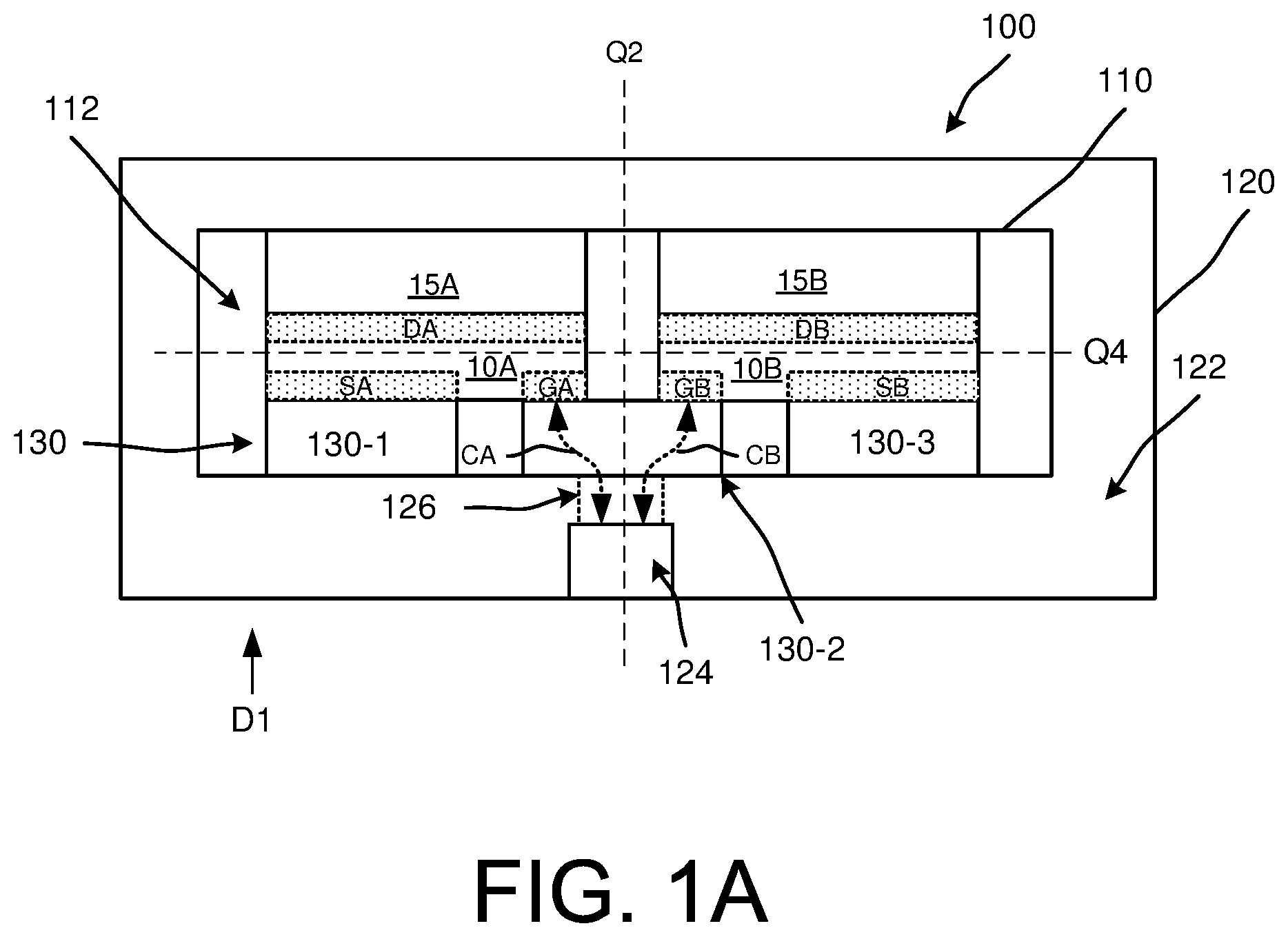
A is a diagram that illustrates a side cross-sectional view of a module including a package disposed within a package.
B is a bottom view of the module shown in A .
A through 2 D are diagrams that illustrate various plan views of components of an inner package.
E is a diagram that illustrates a plan view of the components shown in A through 2 D in a composite stack.
A through 3 D are diagrams that illustrate various plan views of components of a variation of an inner package.
E is a diagram that illustrates a plan view of the components shown in A through 3 D in a composite stack.
A through 4 L are diagrams that illustrate various plan views of components of a variation of an inner package.
A is a diagram that illustrates a plan view of components of an inner package.
B is a diagram that illustrates a plan view of variation of the components of the inner package shown in A .
C is a diagram that illustrates a plan view of variation of the components of the inner package shown in A .
D is a diagram that illustrates a plan view of variation of the components of the inner package shown in B .
E is a diagram that illustrates a plan view of variation of the components of the inner package shown in B .
are diagrams that illustrate side cross-sectional views of components of module including a package disposed within a package.
A through 9 D illustrates a method of manufacturing at least a portion of the inner packages described herein.
A through 10 D illustrates a variation of the method of manufacturing shown in A through 9 D .
illustrates a method of manufacturing an inner package included within a module.
is a diagram that illustrates a circuit configuration that can be implemented using the modules described herein.
A through 13 D are diagrams that illustrate various views of a module.
A and 14 B are diagrams that illustrate various views of a variation of the module.
A through 15 G are diagrams that illustrate various views and components of a module.
A through 16 D are diagrams that illustrate various views of a variation of the module shown and described in connection with A through 15 G .
A through 17 E are diagrams that illustrate various views of a variation of the module shown and described in connection with A through 16 D .
A and 18 B are diagrams that illustrate solid perspective views of the module described in connection with at least A through 17 E .
A through 19 D are diagrams that illustrate a method of manufacturing the devices described herein.
DETAILED DESCRIPTION
In some implementations, a module can include multiple semiconductor die (e.g., silicon carbide (SiC) semiconductor die, insulated-gate bipolar transistors (IGBTs), metal-oxide-semiconductor field effect transistor (MOSFET) die), and the module can be configured so that the multiple semiconductor die included in the module can be switched at approximately the same time. Specifically, the leadframe, electrical connections, and/or orientation of the semiconductor die can be configured so that the switching of the semiconductor die can be robust even at relatively high frequencies. In some implementations, the semiconductor die can be, or can include, silicon carbide semiconductor die. In some implementations, the module can be a dual cool module with a first substrate on the first side of the multiple semiconductor die and a second substrate on a second side of the multiple semiconductor die.
The modules described herein can be used in applications with high voltages (e.g., higher than 600 V), high current densities (e.g., between 100 A to 800 A (e.g., 400 A)), and high switching frequencies (e.g., greater than 1 kHz). Silicon carbide die can be particularly advantageous for use in the high voltage applications given the bandgap voltages of silicon carbide devices. Because of the current densities, the sizes of a single die to handle the current densities may be very large. Given the high cost and relatively low yield of single large die (especially in the case of silicon carbide die), using multiple die may be desirable, and in some cases, necessary. As mentioned above, the leadframe, electrical connections, and/or orientation of the semiconductor die can be configured so that the switching of the silicon carbide die can be robust even at relatively high frequencies.
In some implementations, the modules described herein can be, or can include, multichip common gate/source down low profile package. In some implementations, the modules described an assembly process that enables the creation of, for example, a flexible and low cost SiC wireless power module assembly.
The modules, and assembly methodologies described herein (e.g., with individual die and/or spacers), can be less complex than known assembly methodologies. The modules, and assembly methodologies described herein, can have desirable tilt control, high yield and/or desirable stress/reliability compared with known assembly methodologies. In some implementations, the modules described herein can be compatible with a sintering process (e.g., a silver sintering process) where interfaces between components (e.g., between a leadframe and a semiconductor die) are formed using a sintered material and process (which can be included in a bonding layer).
The module can be included in a variety of applications including, for example, high power device applications (e.g., high power applications greater than 600 V (especially when using silicon carbide die), high power applications greater than 400 V (e.g., when using silicon die)). In some implementations, the module can be included in a variety of applications including, for example, automotive applications (e.g., automotive high power module (AHPM), electrical vehicles, hybrid electrical vehicles), computer applications, industrial equipment, on-board charging applications, inverter applications, and/or so forth.
A is a diagram that illustrates a side cross-sectional view of module 100 including a package 110 (e.g., an inner package, sub-module) disposed within a package 120 (e.g., outer package). The cross-section is cut along line Q 1 shown in B . B is a bottom view of the module viewed along the direction D 1 shown in A . The elements included in the inner package 110 and the outer package 120 have been simplified for description purposes. Although illustrated as including a single inner package, in some implementations, the module 100 can include multiple inner packages. Accordingly, the outer package 120 can include more than one inner package (e.g., inner package 110 ).
As shown in A , the inner package 110 includes semiconductor die 10 A, 10 B. The semiconductor die 10 A, 10 B are each coupled to (e.g., electrically coupled to, directly coupled to, communicatively coupled to) a leadframe 130 . Spacers 15 A, 15 B are, respectively, coupled to the semiconductor die 10 A, 10 B. Accordingly, each of the semiconductor die 10 A, 10 B are disposed between the spacers 15 A, 15 B, and the leadframe 130 . The semiconductor die 10 A, 10 B are aligned along the same plane Q 4 .
Although the inner package 110 is illustrated and described as including only two semiconductor die, the inner package 110 can include more than two semiconductor die (e.g., 3 semiconductor die, 3 semiconductor die, 8 semiconductor die, 16 semiconductor die, etc.). In some implementations, the semiconductor die can be, or can include, silicon carbide semiconductor die (can be referred to as silicon carbide die). The silicon carbide die can be high power devices (e.g., greater than 600 V (e.g., 1200 V)) that are configured to switch at high frequencies (e.g., greater than 1 kHz, 10 kHz range, 100 kHz, 1 MHz). More examples of modules (and packages) including more than two semiconductor die are described below.
The leadframe 130 includes leadframe portions 130 - 1 through 130 - 2 . The leadframe portion 130 - 1 is coupled to a source SA of the semiconductor die 10 A and the leadframe portion 130 - 3 is coupled to a source SB of the semiconductor die 10 B. The leadframe portion 130 - 2 is coupled to a gate GA of the semiconductor die 10 A and a gate GB (also can be referred to as a die gate conductor (e.g., die gate input conductor)) of the semiconductor die 10 B. Accordingly, the semiconductor die 10 A and the semiconductor die 10 B are electrically coupled to the same leadframe portion 130 - 2 . The gate GA of the semiconductor die 10 A and gate GB of the semiconductor die 10 B can be switched (e.g., driven, triggered) via the same signal through the leadframe portion 130 - 2 . The leadframe portion 130 - 2 can be referred to as a common gate conductor (e.g., common gate input conductor) because both of the gates GA, GB are coupled to the leadframe portion 130 - 2 .
The outer package 120 includes a gate runner 124 that is electrically coupled to the leadframe portion 130 - 2 using a via 126 . Accordingly, the semiconductor die 10 A and the semiconductor die 10 B are electrically coupled to through the gate runner 124 and the via 126 , which is coupled to the leadframe portion 130 - 2 . The gate GA of the semiconductor die 10 A and gate GB of the semiconductor die 10 B can be switched via the same signal through the gate runner 124 . Moreover, the semiconductor die 10 A, 10 B can be connected in parallel and switched in parallel. The gate runner 124 and via 126 are illustrated with a dashed line because one or more of the elements may not be in the same plane as the cut shown in A (or other cuts shown herein).
In some implementations, the gate runner 124 can be included in a metal layer. In some implementations, the gate runner 124 can be included in a metal layer within a substrate (not shown). In some implementations, the gate runner 124 being conductively coupled to the common gate conductor CG and entirely included in outer package 120 .
The inner package 110 (and the elements thereof) and the outer package 120 (and the elements thereof) are defined so that the semiconductor die 10 A and the semiconductor die 10 B can be switched simultaneously (e.g., substantially simultaneously). Specifically, the orientation of the semiconductor die 10 A, 10 B, the leadframe portion 130 - 2 , the via 126 , and the gate runner 124 can be defined so that the semiconductor die 10 A, 10 B can be switched simultaneously. The simultaneous switching can be performed within a time period (e.g., within a few microseconds (e.g., within a microsecond)) that can be significantly shorter than a period of a switching frequency. For example, the switching of the semiconductor die 10 A, 10 B (or more than two die in some implementations) included in the module 100 can be performed substantially simultaneously within a time period that is significantly shorter (e.g., at least 2 times shorter, 10 time shorter) than a period of the switching frequency.
As shown in A , a length of a conductive path CA between the gate GA of the semiconductor die 10 A is the same as a length of a conductive path CB the gate GB of the semiconductor die 10 B. The conductive path CA traverses both the leadframe portion 130 - 2 and the via 126 . The conductive path CA extends from a surface (e.g., a bottom surface as oriented in A ) of the gate GA and a surface (e.g., a top surface as oriented in A ) of the gate runner 124 . The conductive path CB is configured in a fashion that mirrors the conductive path CA.
The gate runner 124 , as shown in A by the dashed line Q 2 , is centered between the gates GA, GB. A first portion of the gate runner 124 is disposed below the gate GA and a second portion of the gate runner 124 is disposed below the gate GB.
As shown in A , both of the semiconductor die 10 A, 10 B are oriented in the same direction. Specifically, the gates GA, GB and the sources SA, SB of the semiconductor die 10 A, 10 B, respectively, are facing in a downward direction and are coupled to the leadframe 130 . The gates GA, GB and the sources SA, SB are on a bottom side of the respective semiconductor die 10 A, 10 B.
Drains DA, DB of the respective semiconductor die 10 A, 10 B are facing in an upward direction are on a top side of the respective semiconductor die 10 A, 10 B. The drains DA, DB are coupled to conductive spacers 15 A, 15 B. One or more of the spacers 15 A, 15 B can be exposed through a top surface of a molding 112 of the inner package 110 . In some implementations (although not shown), one or more of the spacers 15 A, 15 B can be exposed so that one or more components of the outer package 120 can be conductively coupled to one or more of the spacers 15 A, 15 B. Many embodiments of this application are discussed in terms of a molding 112 , but in some implementations, any type of insulator can be used such as an epoxy, a molding, a potting, and/or so forth.
In some implementations, the spacers 15 A, 15 B can be implemented as a single spacer or as more than two spacers. In some implementations, the number of spacers can be less than or more than the number of semiconductor die. In some implementations, the spacer can include copper or can include a copper material. In some implementations, the spacer can be or can include copper molybdenum.
Although not shown, in some implementations, the inner package 110 can exclude a spacer. In such implementations, a top side of one or more of the semiconductor die 10 A, 10 B (or a conductive layer coupled to one or more of the semiconductor die 10 A, 10 B) can be exposed through the molding 112 .
In some implementations, a clip (not shown) can be disposed within the inner package 110 . In such implementations, a first portion of (e.g., a bottom surface of) a clip can be coupled to the top surface of one or more of the semiconductor die 10 A, 10 B. A second portion of the clip can be exposed through a bottom surface of the inner package 110 . More details regarding such an implementation are described in connection with .
As shown in A , the semiconductor die 10 A, 10 B and the spacers 15 A, 15 B are at least partially encapsulated within the molding 112 of the inner package 110 . In this implementation, the inner package 110 is entirely encapsulated within the molding 122 of the outer package 120 .
As shown in B by the dashed line Q 3 , the gate runner 124 is centered between the gates GA, GB. Specifically, a distance between the gate GA (e.g., an inner edge facing the dashed line Q 3 ) and the dashed line Q 3 is the same as a distance between the gate GB (e.g., an inner edge facing the dashed line Q 3 ) and the dashed line Q 3 . A side of the semiconductor die 10 A including the gate GA is facing (e.g., directly facing, without an intervening portion of semiconductor die) a side of the semiconductor die 10 B including the gate GB.
The sources SA, SB of the respective semiconductor die 10 A, 10 B are further away from the gate runner 124 than the gates GB, GA. Specifically, the sources SA, SB of the semiconductor die 10 A, 10 B are on the far side of the respective semiconductor die 10 A, 10 B (relative to the gates GA, GB) as shown in B .
The semiconductor die 10 A, 10 B can be, or can include, a high-side transistor or a low-side transistor. For example, both of the semiconductor die 10 A, 10 B can be a high-side transistor.
In some implementations, the module 100 described herein can be compatible with a sintering process (e.g., a silver sintering process) where interfaces between components (e.g., between the leadframe 130 and the semiconductor die 10 A, 10 B) are formed using a sintered material and process. In some implementations, sintered interfaces, which can involve the coalescing of a solid material under heat and high pressure, can be desirable with the high junctions temperatures associated with silicon carbide die. Sintered interfaces can have desirable thermal performance, reliability, and/or temperature coefficients (relative to, for example, a soldered and re-flowed interface).
The package-in-package configuration shown in A can be particularly compatible with sintered interfaces. Specifically, the package-in-package configuration shown in A can result in interfaces within the inner package 110 (e.g., interfaces between semiconductor die 10 A, 10 B and spacers 15 A, 15 B, interfaces between semiconductor die 10 A, 10 B and leadframe portions 130 ) that can be isolated (e.g., separated) during processing from the interfaces formed within the outer package 120 (e.g., interfaces between leadframe portions 130 and via 126 , interfaces between via 126 and gate runner 124 ). Accordingly, the module 100 can have desirable tilt control, high yield and/or desirable stress/reliability. The package-in-package configuration has advantages over a single package stack that can include multiple stacked interfaces (e.g., more than five stacked interfaces) between a stack of components that may also be formed using a solder and reflow process.
In some implementations, the conductive portions illustrated as part of the leadframe 130 can be disposed outside of the inner package 110 . In some implementations, the conductive portions illustrated as part of the leadframe 130 can be included in a substrate (not shown in A or 1 B ).
In some implementations, a diode device (e.g., a diode semiconductor device) can be included in the inner package 110 in addition to the semiconductor die 10 A, 10 B. The diode devices can be included in the module 100 in situations where a body diode included in a transistor device of the semiconductor die 10 A, 10 B is not sufficient for a particular circuit application. In some implementations, the module 100 can include multiple diode devices. In some implementations, the module 100 can include a 1:1 ratio of diode devices and transistor devices. In some implementations, the module 100 can include more or less than a 1:1 (e.g., 1:2, 2:1) ratio of diode devices and transistor devices.
Although not shown in A or 1 B , the module 100 can include multiple substrates. For example, in some implementations, the module 100 can be a dual cool module with a first substrate (not shown) on the first side of (e.g., above) the semiconductor die 10 A, 10 B (and inner package 110 ) and a second substrate (not shown) on a second side of (e.g., below) the semiconductor die 10 A, 10 B (and inner package 110 ). More details related to multiple substrates are described in connection with at least some of the figures below.
A through 2 D are diagrams that illustrate various plan views of components (e.g., layers) of an inner package. E is a diagram that illustrates a plan view of the components shown in A through 2 D in a composite stack. In these figures, some of the components are shown as being transparent so that the elements can be viewed. The components of the composite stack are ordered as descried in connection with, for example, A and 1 B . The views illustrate a layout (e.g., a pattern) of the components of the inner package. A through 2 E are directed to a four (4) semiconductor die (e.g., MOSFETs) configuration where gate-side edges of the semiconductor die are in a diamond-shaped layout (can be referred to as a diamond configuration). In some views, only some portions are labeled for a subset of the semiconductor die.
A illustrates a plan view of a footprint 202 (in dashed lines) that roughly corresponds with a shape of a leadframe 230 (shown in B ). In some implementations, the footprint 202 can correspond with a shape of a layout within a metal (e.g., copper) included on a directed bonded metal substrate (e.g., a directed bonded copper (DBC) substrate). The footprint 202 can be a bottom-side footprint of the inner package after molding. The footprint 202 can correspond with areas of the stack that may include sintered surfaces.
B illustrates a plan view of a leadframe 230 with half-etch areas. As shown in A and 2 B , the leadframe 230 (and footprint 202 ) includes gate protrusions. An example of one such gate protrusion is gate protrusion 231 A. Each of the gate protrusions can be configured to be coupled to a gate of a semiconductor die (shown in C ). The gate protrusion 231 A can be, or can include, a gate contact. The protrusions extend from a common gate conductor CG (also can be referred to as a central gate contact). In this implementation, the common gate conductor CG has a square shape. The leadframe 230 also includes a source portion 232 A configured to be coupled to a source of a semiconductor die.
C illustrates a layout of semiconductor die (collectively referred to as semiconductor die 20 ) to be coupled to the leadframe 230 . As shown in C , for example, a semiconductor die 20 A is aligned at an angle (e.g., orthogonal) with respect to the semiconductor die 20 B, which is adjacent to semiconductor die 20 A. The alignment is based on dashed lines R 1 and R 2 from source S to gate G of each of the respective semiconductor die 20 A, 20 B. In this implementation, the semiconductor die 20 A is aligned orthogonal to semiconductor die 20 B. Accordingly, an edge EA of the semiconductor die 20 A is non-parallel to an edge EB of the semiconductor die 20 B, which is adjacent to semiconductor die 20 A. The edge EA of the semiconductor die 20 A, however, has edges that are parallel to and/or aligned with semiconductor die 20 C. In some implementations (not shown), the edge EA of the semiconductor die 20 A can be non-parallel to and non-orthogonal to the edge EB of the semiconductor die 20 B. The semiconductor die 20 are aligned along (or disposed within) the same plane.
The gate G of the semiconductor die 20 A is configured to be coupled to the gate protrusion 231 A of the leadframe 230 . The source S of the semiconductor die 20 A is configured to be coupled to the source portion 232 A of the leadframe 230 . In this implementation, the gates G of each of the semiconductor die 20 (e.g., semiconductor die 20 A, semiconductor die 20 B) are facing toward a center portion C of the semiconductor die 20 so that they can be coupled to the common gate conductor CG.
In this implementation, the semiconductor die 20 A is mirrored about the longitudinal axis J 1 (e.g., longitudinal axis bisecting) of the common gate conductor CG with semiconductor die 20 C. Likewise, the semiconductor die 20 B is mirrored about the longitudinal axis J 1 of the common gate conductor CG with semiconductor die 20 D.
D is a diagram that illustrates portions 250 included in a top surface above the semiconductor die shown in C . In some implementations, the portions 250 shown in D can be drain contacts or spacers. As shown in D , the portions 250 have protrusions or tabs facing away from the center portion.
As shown in E , the gates are coupled to the common gate conductor CG via the gate protrusions (e.g., gate protrusion 231 A). A via, or other metal layer, may be coupled to common gate conductor CG so that the semiconductor die 20 can be triggered to switch simultaneously (e.g., substantially simultaneously). The lengths of conductive paths between the gates G of each of the semiconductor die 20 and the common input conductor CG (e.g., a center of the common input conductor CG) can be the same. The lengths of conductive paths between the gates G of each of the semiconductor die 20 and a conductor (e.g., a via, a runner) contacting the common gate conductor CG and through which the semiconductor die 20 can be switched can be the same. The common gate conductor CG is centered between the die gate conductors G of the semiconductor die 20 . In some implementations, the die gate conductor G of at least one semiconductor die 20 is oriented with respect to the common gate conductor CG so that a length of a conductive path between the die gate conductor G and the common gate conductor CG is minimized.
A through 3 D are diagrams that illustrate various plan views of components (e.g., layers) of a variation of an inner package. E is a diagram that illustrates a plan view of the components shown in A through 3 D in a composite stack. The labels in A through 3 E are the same as those in A through 2 E because the elements are the same, but the layout (e.g., a pattern) of the components of the inner package are different. Accordingly, some of the features described above in connection with A through 2 E are not repeated in connection with A through 3 E . In the configuration shown in A through 3 E , gate-side edges of the semiconductor die are in a parallel or rectangular layout (can be referred to as a rectangular configuration). The rectangular layout can include a square layout.
A illustrates a plan view of a footprint 202 (in dashed lines) that roughly corresponds with a shape of a leadframe 230 (shown in B ).
B illustrates a plan view of a leadframe 230 with half-etch areas. As shown in A and 3 B , the leadframe 230 (and footprint 202 ) includes gate protrusions (e.g., gate protrusion 231 A) and source portions (e.g., source portion 232 A). Each of the gate protrusions can be configured to be coupled to a gate of a semiconductor die (shown in C ). The protrusions extend from a common gate conductor CG. In this implementation, the common gate conductor CG has a rectangular shape or an elongate shape. In this implementation, the common gate conductor CG can be a runner that is disposed between a pairs of adjacent semiconductor die. In this implementation, the common gate conductor CG can be a runner that separates the package into two halves. The common gate conductor CG in this implementation has a contact area 235 (e.g., protrusions) that are included in a center portion of the semiconductor die.
C illustrates a layout of semiconductor die (collectively referred to as semiconductor die 20 ) to be coupled to the leadframe 230 . As shown in C , for example, a semiconductor die 20 A is aligned parallel to the semiconductor die 20 B, which is adjacent to semiconductor die 20 A. The alignment is based on dashed lines R 1 and R 2 from source S to gate G of each of the respective semiconductor die 20 A, 20 B. In this implementation, an edge EA of the semiconductor die 20 A is parallel to an edge EB of the semiconductor die 20 B, which is adjacent to semiconductor die 20 A. The edge EA of the semiconductor die 20 A has edges that are parallel to and/or aligned with semiconductor die 20 C (on an opposite side of the package). The semiconductor die 20 A is mirrored about the longitudinal axis J 1 (e.g., longitudinal axis bisecting) the common gate conductor CG with semiconductor die 20 C. Likewise, the semiconductor die 20 B is mirrored about the longitudinal axis J 1 of the common gate conductor CG with semiconductor die 20 D.
D is a diagram that illustrates portions 250 included in a top surface above the semiconductor die shown in C .
As shown in E , the gates are coupled to the common gate conductor CG via the gate protrusions (e.g., gate protrusion 231 A). A via, or other metal layer, may be coupled to the contact area 235 of the common gate conductor CG so that the semiconductor die 20 can be triggered to switch simultaneously (e.g., substantially simultaneously). The lengths of conductive paths between the gates G of each of the semiconductor die 20 and the common input conductor CG (e.g., a center line of the common input conductor CG) can be the same. The lengths of conductive paths between the gates G of each of the semiconductor die 20 and the contact area 235 of the common input conductor CG (e.g., a center of the common input conductor CG) can be the same. In this implementation, the gates G of each of the semiconductor die 20 (e.g., semiconductor die 20 A, semiconductor die 20 B) are facing toward the common gate conductor CG of the semiconductor die 20 so that they can be coupled to the common gate conductor CG.
A through 4 L are diagrams that illustrate various plan views of components (e.g., layers) of a variation of an inner package. A through 4 L are directed to a four (4) semiconductor die (e.g., MOSFETs) configuration where the semiconductor die 20 are arranged in a U-shape configuration.
A illustrates a plan view of a footprint 202 (shown in dashed line) of one side (e.g., a gate G and source S side) of a inner package and B illustrates a plan view of a footprint 203 (shown in dashed line) of another side (e.g., a drain side) of the inner package. The footprint 202 shown in A can generally correspond with a leadframe 230 (shown in, for example, F ). The source S portions and the gate G portions of the footprint are labeled. A perspective view of the footprint 202 , which corresponds with a bottom side of a leadframe 230 is shown in L .
The footprint 203 shown in B can generally corresponds with clips 290 A, 290 B shown in, for example, C . The footprint 203 corresponds with drain D portions. D illustrates the clips 290 A, 290 B included in a clip gang (e.g., clip pair) while in a reel. Half-etch portions 292 of the clips 290 A, 290 B are noted in C and 4 D .
E through 4 I are diagrams in a unit array (e.g., 2×2 unit array) that illustrate various plan views of components (e.g., layers) of the variation of the inner package associated with A through 4 D . E illustrates a leadframe 230 with half-etch areas 237 and inter-unit (e.g., inter-cell) tie bars 234 . A perspective view of a top side of the leadframe 230 (a singulated leadframe) with half-etch areas 237 is shown in K . Hidden tie bars 238 (e.g., will be encapsulated within a molding) and exposed tie bars 239 (e.g., will be exposed through a molding) are also shown in K . The hidden tire bars 238 are disposed in a plane that is lower than a plane along which the exposed tie bars 239 are disposed. Half-etched die attach pad (DAP) locks 236 are shown in L .
E and 4 K illustrate a common gate conductor CG. The gate G contacts associated with the common gate conductor CG in this implementation are oriented along a U-shape shown with a combination dashed and dotted line with double arrows labeled as μl. E and 4 K illustrate the locations and orientations of the source S contacts and gate G contacts for the semiconductor die 20 (shown in G as semiconductor die 20 A through 20 D) with respect to the common gate conductor CG.
F illustrates a bonding layer 232 (only some portions are labeled) through which the semiconductor die 20 (e.g., the gates G and sources S of the semiconductor die 20 ) can be coupled to the leadframe 230 . The bonding layer 232 can include, for example, a solder, a material that can be sintered, and/or so forth.
G illustrates the semiconductor die 20 coupled to the leadframe 230 via the bonding layer 232 . The semiconductor die 20 are aligned so that the gates G of the semiconductor die 20 are disposed between the sources S of the semiconductor die 20 and the common gate conductor CG.
Because of the shape of the common gate conductor CG, the semiconductor die 20 A is aligned so that the gate G and the source S of the semiconductor die 20 A are aligned along a line Y 1 that is orthogonal to a line Y 2 along which the gate G and the source S of the semiconductor die 20 B is aligned. The gate G and the source S of the semiconductor die 20 A are aligned (along line Y 2 ) parallel to the gate G and the source S of the semiconductor die 20 C (which are aligned along line Y 3 ). The semiconductor die 20 D is aligned so that the gate G and the source S of the semiconductor die 20 D are aligned along a line Y 4 that is orthogonal to the line Y 3 along which the gate G and the source S of the semiconductor die 20 C is aligned.
The semiconductor die 20 A is flipped (e.g., mirrored) relative to the semiconductor die 20 C (about axis J 1 ). Specifically, the gates G of the semiconductor die 20 A, 20 C are adjacent to (e.g., proximal to) the common gate conductor CG. The sources S of the semiconductor die 20 A, 20 C are disposed distal to the common gate conductor CG.
H illustrates a bonding layer 233 (only some portions are labeled) through which the semiconductor die 20 (e.g., the drains D of the semiconductor die 20 ) can be coupled to clips 290 A, 290 B (shown in I ). The bonding layer 233 can include, for example, a solder, a material that can be sintered, and/or so forth. I illustrates that the clips 290 A, 290 B are mirrored about the line J 1 . The clip 290 A is coupled to a pair of the semiconductor die 20 C, 20 D. The clip 290 B is coupled to a pair of the semiconductor die 20 A, 20 B.
J is a diagram that illustrates the layers of a single semiconductor die corresponding with the layers described in connection with A through 4 I, 4 K, and 4 L .
A is a diagram that illustrates a plan view of components (e.g., layers) of an inner package. The layout of an inner portion 412 of the inner package is substantially the same as the diamond-shaped layout of the components shown in, for example, E . The inner package includes semiconductor die 40 coupled to a leadframe 430 . The inner package has a footprint 402 (in dashed lines) that roughly corresponds with a shape of the leadframe 430 .
In this implementation, diode devices 460 are electrically coupled to the semiconductor die 40 . In this implementation, a pair of diode devices 460 are electrically coupled (e.g., electrically coupled via the leadframe portion 430 - 1 ) to a pair of the semiconductor die 40 on one side (e.g., right side of a common gate conductor CG) of the inner portion 412 . The configuration shown in A includes diode devices 460 disposed outside of (e.g., along a perimeter around) the inner portion 412 of the inner package. The semiconductor die 40 are disposed between the pair of diode devices 460 and the common gate conductor CG. The diode devices 460 and the semiconductor die 40 are disposed within (e.g., aligned along) the same plane.
B is a diagram that illustrates a plan view of variation of the components (e.g., layers) of the inner package shown in A . In this implementation, one of the diode devices 460 is electrically coupled (e.g., electrically coupled via the leadframe portion 430 - 2 ) to one of the semiconductor die 40 .
C is a diagram that illustrates a plan view of variation of the components (e.g., layers) of the inner package shown in A . This implementation includes a spacer 470 coupled to a portion of the leadframe 430 - 4 . At least a portion of the diodes 460 and at least a portion of the semiconductor die 40 are disposed between the common gate conductor CG and the spacer 470 .
D is a diagram that illustrates a plan view of variation of the components (e.g., layers) of the inner package shown in B . This implementation includes the spacer 470 coupled to a portion of the leadframe 430 - 4 as shown in C .
E is a diagram that illustrates a plan view of variation of the components (e.g., layers) of the inner package shown in B . In this implementation, two diodes are associated with each semiconductor die 40 . This implementation is based on the U-shape configuration. This implementation also includes clips 490 A, 490 B.
As describe above, the diode devices can be included in the inner packages shown and described in A through 5 D in situations, for example, where body diodes included in transistor devices of the semiconductor die are not sufficient for a particular circuit application. Although shown as diamond configuration in A through 5 D , the semiconductor die can be defined in the rectangular configuration or the U-shaped configuration. In some implementations, the inner packages can include a 1:1 ratio of diode devices and transistor devices. In some implementations, the inner packages can include more or less than a 1:1 (e.g., 1:2, 2:1) ratio of diode devices and transistor devices.
are diagrams that illustrate side cross-sectional views of components of module 100 including a package 110 (e.g., an inner package, sub-module) disposed within a package 120 (e.g., outer package). Many of the elements are labeled the same as shown in A . can include any configuration (e.g., rectangular, U-shape, diamond) of semiconductor die.
As shown in , the inner package 110 is coupled to a substrate 780 . The substrate 780 is a directed bonded metal substrate (e.g., a directed bonded copper (DBC) substrate). The substrate 780 can include, for example, one or more metal layers and one or more dielectric layers. In some implementations, the substrate 780 can include a dielectric disposed between a first conductor and a second conductor in a direct bonded copper (DBC) substrate. In this implementation, the substrate 780 includes a metal layer 780 A, a dielectric 780 B and a metal layer 780 C. One or more of the metal layers 780 A, 780 C can be patterned as shown in A, 3 A .
The inner package 110 is coupled to the substrate 780 . Specifically, the inner package 110 can be coupled to the metal layer 780 A of the substrate 780 via the bonding layer 792 . The bonding layer 792 can be, or can include, a sintered layer, a soldered layer, and/or so forth.
As shown in , a top side of the inner package 110 is coupled to the substrate 780 via a clip 790 (e.g., portion 793 of the clip). Specifically, in this implementation, the inner package 110 is coupled to the metal layer 780 A of the substrate 780 via the clip 790 . The clip 790 (e.g., portion 794 of the clip 790 ) is coupled to the top side of the inner package 110 via bonding layer 791 , which can be, or can include, a sintered layer, a soldered layer, and/or so forth.
As shown in , leads 795 extend outside of (e.g., are exposed outside of) the outer package 120 . The leads 795 are electrically coupled to the inner package 110 and/or the clip 790 via the substrate 780 (e.g., the metal layer 780 A of the substrate 780 ).
Although not shown in , an additional substrate can be included in the module 100 . Specifically, an additional substrate, which can be the same or different from the substrate 780 , can be coupled to a top side (e.g., portion 794 ) of, for example, the clip 790 . Such implementations can be referred to dual-side cooled implementations because the dual substrates can enable top-side and bottom-side cooling. Such an implementation is shown in .
In the diagram shown in , module 100 is a dual-side cooled implementation. Specifically, the substrate 780 (first substrate) is on a bottom side of the module 100 and the substrate 785 is on a top side of the module 100 . In this implementation, the substrate 785 does not include metal layers and includes only a dielectric layer. In some implementations, the substrate 785 can include one or more metal layers.
In this implementation, the dielectric 780 B of the substrate 780 includes openings 7800 through which a fluid can be moved to facilitate cooling. The substrate 785 also includes such openings 7850 . In some implementations, openings may be included in only one of the substrates (e.g., substrate 785 or substrate 780 ). In some implementations, openings may be excluded from both of the substrates 780 , 785 .
In the implementation shown in , the clip 790 has a different shape than the slip 790 shown in . Specifically, the clip 790 shown in has a shape that increases (e.g., maximizes) contact with the substrate 785 . Specifically, the clip 790 has a first portion (e.g., portion 794 (top portion)) that extends along the bottom surface of the substrate 785 , and a second portion (e.g., portion 793 (vertical portion)) extends from the clip down (and orthogonally aligned to the first portion) to the substrate 780 .
Although not shown in or 7 , the clip 790 can be included in the inner package 110 in some implementations. In such implementations, the bottom surface of portion 794 of the clip 790 can be coupled to the top surfaces of the semiconductor die 15 A, 15 B using, for example, the bonding layer 791 . Also, in such implementations, a portion (e.g., a bottom surface of portion 793 ) of the clip 790 can be exposed through the bottom surface of the inner package 110 so that the clip 790 can be coupled to, for example, the substrate 780 . In implementations where the clip 790 is included in the inner package 110 , one or more of the spacers 15 A, 15 B can be excluded. In some implementations where the clip 790 is included in the inner package 110 , one or more of the spacers 15 A, 15 B can be disposed within the inner package 110 and coupled to a top side of portion 794 of the clip 790 .
illustrates a variation of the module 100 that is a dual-side cooled implementation. As shown in , the module 100 includes a substrate 787 (e.g., a T-clad) coupled to a top side of the inner package 110 via bonding layer 791 . The substrate 787 can include, for example, one or more metal layers and one or more dielectric layers. In some implementations, the substrate 787 can include a dielectric disposed between a first conductor and a second conductor in a direct bonded copper (DBC) substrate. In this implementation, the substrate 780 includes a metal layer 787 A, a dielectric 787 B and a metal layer 787 C. One or more of the metal layers 787 A, 787 C can be patterned. The substrate 787 has a longer length T 1 than a length T 3 of the substrate 780 . The substrate 787 has a greater thickness T 2 than a thickness T 4 of the substrate 780 .
In some implementations, one or more of the metal layers in one or more of the substrates described herein (e.g., in ) can have a different thickness than one or more of the other metal layers (within the same substrate or a different substrate). In some implementations, one or more dielectric layers in one or more of the substrates described herein (e.g., in ) can have a different thickness than one or more of the other dielectric layers (within the same substrate or a different substrate).
A through 9 D illustrates a method of manufacturing at least a portion of the inner packages (e.g., inner package 110 ) described herein. As shown in A , a conductive metal layer 930 (e.g., on a substrate, stamped as a leadframe) can be defined (e.g., formed). The conductive metal layer 930 can include a common gate conductor CG.
Semiconductor die 30 can be electrically coupled to the conductive metal layer 930 . In some implementations, the semiconductor die 30 can be coupled in a flip chip configuration (with source and gate down (e.g., coupled to the conductive metal layer 930 )). The gates of the semiconductor die 30 can be coupled to the common gate conductor CG, and the sources of the semiconductor die 30 can be coupled to other portions of the conductive metal layer 930 . The conductive metal layer 930 and the semiconductor die 30 can be configured so that the distance (e.g., conductive path) from a terminal (e.g., common terminal) used to switch the semiconductor die 30 via the conductive metal layer 930 can be the same.
As shown in C , a conductive metal layer 940 (e.g., a thick copper layer lead, a sintered layer, a spacer, a T-clad) (illustrated with a dashed line and as a transparent layer) can be coupled to the drains of the semiconductor die 30 (e.g., on a top side of the semiconductor die). Substrates are not illustrated in this implementation.
As shown in D , a molding 912 (illustrated with dotted and dashed line, and as a transparent layer) can be used to encapsulate the components (e.g., semiconductor die 30 , conductive metal layer 930 , conductive metal layer 940 ). In some implementations at least some portions of the common gate conductor CG and/or conductive metal layer 940 can be exposed (e.g., exposed via grinding) through the molding 912 .
A through 10 D illustrates a variation of the method of manufacturing shown in A through 9 D . In this variation, a conductive metal layer configured as spacers 950 (e.g., conductive spacers) are coupled to the drains (e.g., top portions) of the semiconductor die 30 . In some implementations at least some portions of the common gate conductor CG and/or spacers 950 can be exposed (e.g., exposed via grinding) through the molding 912 .
The manufacturing methods shown in A through 10 D are implemented using a rectangular configuration (shown in, for example, A through 3 E ), however, a diamond configuration (shown in, for example, A through 2 E and 5 A through 5 D ) or a U-shape configuration (shown in, for example, A through 4 L and 5 E ) can be implemented as well.
illustrates a method of manufacturing an inner package included within a module. As shown in , a first conductive metal layer including a common gate conductor is formed (block S 1100 ). In some implementations, the first conductive metal layer can be included within a substrate (e.g., can be included in a patterned metal layer of the substrate). In some implementations, the first conductive metal layer can be a leadframe.
Multiple semiconductor die are coupled to the common gate conductor of the first conductive metal layer (block S 1110 ). The multiple semiconductor die can include silicon carbide die. The multiple semiconductor die can include IGBTs. In some implementations, the multiple semiconductor die can be in a diamond configuration or layout with respect to the common gate conductor of the conductive metal layer. In some implementations, the multiple semiconductor die can be in a U-shape configuration or layout with respect to the common gate conductor of the conductive metal layer. In some implementations, the multiple semiconductor die can be in a rectangular configuration or layout with respect to the common gate conductor of the conductive metal layer. In some implementations, the gates of the multiple semiconductor die can be coupled to the common gate conductor with the same conductive path lengths as described herein.
A second conductive metal layer is coupled to the multiple semiconductor die (block S 1120 ). In some implementations, the second conductive metal layer can be a spacer.
The first conductive metal layer, the semiconductor die, and the second conductive metal layer are at least partially encapsulated within an insulator (block S 1130 ). In some implementations, the insulator can include a molding, an epoxy, a potting, and/or so forth. In some implementations, at least a portion of the second conductive metal layer can be exposed through the molding. In some implementations, at least a portion of the second conductive metal layer can be coupled to a substrate and/or a clip. In some implementations, a conductor can be exposed through the molding and in contact with the common gate conductor so that the multiple semiconductor die can be switched via the common gate conductor.
In some implementations, at least one or more of the components included within the module including the inner package are coupled via a sintered material. In some implementations, one or more diodes can be included within the inner package of the module.
is a diagram that illustrates a circuit 1200 configuration that can be implemented using the modules (and packages) described herein. As shown in , the circuit includes a high-side device (e.g., P-type Device (Device P)) and a low-side device (e.g., an N-type Device (Device N)). The source S, drain D, and gate G of each of the devices is labeled in . The high-side terminal (H-term), the low-side terminal (L-term), and the output terminal Out are shown in . The circuit 1200 is in an inverter configuration without the output Out. Each of the devices (e.g., Device P, Device N) can be defined within an inner package.
The circuit 1200 shown in can be implemented, for example, in the modules shown in A through 19 D . The terminals (e.g., leads) of the circuit 1200 are labeled in many of these configurations. The side of the device associated with the low-side terminal can be referred to as a low side of the device, and the side of the device associated with the high-side terminal can be referred to as a high side of the device.
A through 13 D are diagrams that illustrate various views of a module 1300 . As shown in the plan view A , a P-type device includes multiple semiconductor die 30 P coupled to a substrate 1380 using clips 1390 P (e.g., one clip per pair of semiconductor die), and an N-type device includes multiple semiconductor die 30 N coupled to a substrate 1380 using clips 1390 N (e.g., one clip per pair of semiconductor die). In this implementation, the drains of the semiconductor die 30 P, 30 N are coupled to the substrate via the clips 1390 P, 1390 N. The side view B is viewed along direction N 1 of A , and the side view C is viewed along direction P 1 of A . D is viewed along direction B 1 . The semiconductor die 30 P (gates of the semiconductor die 30 P) are switched via wirebonds coupled to a common gate conductor CG-P. The semiconductor die 30 N (gates of the semiconductor die 30 N) are switched via wirebonds coupled to a common gate conductor CG-N.
A and 14 B are diagrams that illustrate various views of a variation of the module 1300 . In this implementation, the clips 1390 P and 1390 N are replaced with wirebonds.
A through 17 E are diagrams that illustrate various view of modules including an inner package (e.g., inner package 110 , the inner package shown in any of, for example, A through 5 D ) disposed within an outer package (e.g., outer package 120 , the outer package shown in any of, for example, through 8 ). The modules disclosed in these embodiments exclude wirebonds. In other words, the modules are wireless modules. A sintered material, solder, and/or so forth (which can be included in a bonding layer) can be used to couple any pair of the components (e.g., clip, semiconductor die, spacer, inner package, substrate, etc.). Although A through 17 E are illustrated with semiconductor die in a diamond configuration, the rectangular or U-shape configuration can be implemented as well.
A through 15 C are diagrams that illustrate various views of a module 1500 . As shown in the plan view A , an inner package 1510 P of a P-type device includes multiple semiconductor die 50 P coupled to a substrate 1580 using a clip 1590 P (e.g., one clip per the multiple semiconductor die), and an inner package 1510 N of an N-type device includes multiple semiconductor die 50 N coupled to a substrate 1580 using a clip 1590 N (e.g., one clip per the multiple semiconductor die). In this implementation, the drains of the semiconductor die 50 P, 50 N are coupled, respectively, to the substrate via the clips 1590 P, 1590 N. The side view B is viewed along direction N 1 of A , and the side view C is viewed along direction P 1 of A .
In this implementation, the multiple semiconductor die 50 P are included in the inner package 1510 P where the semiconductor die 50 P are in a diamond configuration. The semiconductor die 50 P (gates of the semiconductor die 50 P) are switched via a common gate conductor CG-P.
The multiple semiconductor die 50 N are also included in the inner package 1510 N where the semiconductor die 50 N are in a diamond configuration. The semiconductor die 50 N (gates of the semiconductor die 50 N) are switched via a common gate conductor CG-N.
D is a diagram that illustrates a metal layer pattern 1580 A of the substrate 1580 A. E is a diagram that illustrates a layout of the inner packages 1510 P, 1510 N on the metal layer pattern 1580 A of the substrate 1580 A.
F and 15 G are diagrams that illustrate side and plan views, respectively, of the clip 1590 P (coupled to the inner package 1510 P). Although not shown, the clip 1590 N (coupled to inner package 1510 N) can have the same shape as the clip 1590 P. The clip 1590 P include a portion 1593 P that corresponds approximately with a thickness of the semiconductor die 50 P.
As shown in A , the inner package 1510 N is offset (e.g., shifted) within a plane relative to the inner package 1510 P. Also, the clip 1590 P is oriented in a direction that is flipped relative to the clip 1590 N.
In this implementation, a single substrate 1580 is coupled to both inner packages 1510 N, 1510 P. Although not shown, in some implementations, separate substrates can be coupled to each of the inner packages.
A through 16 D are diagrams that illustrate various views of a variation of the module 1500 shown in A through 15 G . The module 1500 shown in these figures can be a dual-side cooling implementation that also includes the clips 1590 N, 1590 P. Elements described in connection with A through 15 G are not repeated in connection with this variation.
As shown in A through 16 C , a substrate 1583 is disposed on a side (e.g., top side) of the module 1500 opposite the substrate 1580 (on the bottom side). The substrate 1583 can be referred to as a top substrate and the substrate 1580 can be referred to as a bottom substrate. As shown in C , for example, a spacer 1520 P is disposed between the substrate 1583 and the clip 1590 P. Accordingly, a vertical stack (from top to bottom along the dashed line U 1 ) can include the substrate 1583 , the spacer 1520 P, the clip 1590 P, the inner package 1510 P, and the substrate 1580 . A vertical stack (from top to bottom along the dashed line U 2 ) can include the substrate 1583 , the clip 1590 P, and the substrate 1580 . The low side of the device is similarly configured.
D illustrates a patterned surface of a metal layer 1583 A of the substrate 1583 in contact with the spacers 1520 N, 1520 P coupled respectively to the inner packages 1510 N, 1510 P. Markings to align the metal layer 1583 A with the contact locations of the inner packages 1510 N, 1510 P and spacers 1520 N, 1520 P are illustrated by the angled corners (4 markings per inner package). In this implementation, a single substrate 1583 is coupled to the top side of both inner packages 1510 N, 1510 P. Although not shown, in some implementations, separate substrates can be coupled to each of the inner packages in lieu of the single substrate 1583 .
A through 17 E are diagrams that illustrate various views of a variation of the module 1500 shown in A through 16 D . The module 1500 shown in these figures can be a dual-side cooling implementation that excludes the clips 1590 N, 1590 P. Elements described in connection with A through 16 D are not repeated in connection with this variation.
As shown in C , for example, the spacer 1520 P is disposed between the substrate 1583 and the inner package 1510 P. Also, a spacer 1522 P is disposed between the spacer 1520 P and the substrate 1580 . Accordingly, a vertical stack (from top to bottom along the dashed line S 1 ) can include the substrate 1583 , the spacer 1520 P, the inner package 1510 P, and the substrate 1580 . A vertical stack (from top to bottom along the dashed line S 2 ) can include the substrate 1583 , the spacer 1520 P, the spacer 1521 P, and the substrate 1580 . The spacer 1520 P can be referred to as a top spacer and the spacer 1521 P can be referred to as a bottom spacer. The low side of the device is similarly configured.
D illustrates a patterned surface of a metal layer 1583 A of the substrate 1583 in contact with the spacers 1520 N, 1520 P (which are larger in surface area than the spacers shown in A through 16 D ) coupled respectively to the inner packages 1510 N, 1510 P. Markings to align the metal layer 1583 A with the contact locations of the inner packages 1510 N, 1510 P and spacers 1520 N, 1520 P are illustrated by the angled corners (4 markings per inner package). The plan views of the spacers 1520 P and 1521 P are shown in E .
In this implementation, a single substrate 1583 is coupled to the top side of both inner packages 1510 N, 1510 P. Although not shown, in some implementations, separate substrates can be coupled to each of the inner packages in lieu of the single substrate 1583 .
A and 18 B are diagrams that illustrate solid perspective views of the module 1500 described in connection with at least A through 17 E .
A through 19 D are diagrams that illustrate a method of manufacturing the devices described herein. Not all of the elements are labeled in each view. As shown in A , in this implementation, a leadframe structure can include common gate conductors CG-P, CG-N. The common gate conductors CG-P, CG-N can be included in a metal layer of a substrate, or can be included in the inner packages 1510 N, 1510 P. B illustrates the inner packages 1510 N, 1510 P and spacers 1521 N, 1521 P included in the module 1500 . C illustrates the spacers 1520 N, 1520 P coupled to the inner packages 1510 N, 1510 P and the spacers 1521 N, 1521 P. D illustrates the substrate 1583 coupled to the spacers 1520 N, 1520 P. Encapsulation within a molding layer is not shown in these figures. Although A through 19 D are illustrated with semiconductor die in a diamond configuration, the rectangular or U-shape configuration can be implemented as well.
It will be understood that, in the foregoing description, when an element, such as a layer, a region, a substrate, or component is referred to as being on, connected to, electrically connected to, coupled to, or electrically coupled to another element, it may be directly on, connected or coupled to the other element, or one or more intervening elements may be present. In contrast, when an element is referred to as being directly on, directly connected to or directly coupled to another element or layer, there are no intervening elements or layers present. Although the terms directly on, directly connected to, or directly coupled to may not be used throughout the detailed description, elements that are shown as being directly on, directly connected or directly coupled can be referred to as such. The claims of the application, if any, may be amended to recite exemplary relationships described in the specification or shown in the figures.
As used in this specification, a singular form may, unless definitely indicating a particular case in terms of the context, include a plural form. Spatially relative terms (e.g., over, above, upper, under, beneath, below, lower, and so forth) are intended to encompass different orientations of the device in use or operation in addition to the orientation depicted in the figures. In some implementations, the relative terms above and below can, respectively, include vertically above and vertically below. In some implementations, the term adjacent can include laterally adjacent to or horizontally adjacent to.
Implementations of the various techniques described herein may be implemented in (e.g., included in) digital electronic circuitry, or in computer hardware, firmware, software, or in combinations of them. Portions of methods also may be performed by, and an apparatus may be implemented as, special purpose logic circuitry, e.g., an FPGA (field programmable gate array) or an ASIC (application specific integrated circuit).
Implementations may be implemented in a computing system that includes a back end component, e.g., as a data server, or that includes a middleware component, e.g., an application server, or that includes a front end component, e.g., a client computer having a graphical user interface or a Web browser through which a user can interact with an implementation, or any combination of such back end, middleware, or front end components. Components may be interconnected by any form or medium of digital data communication, e.g., a communication network. Examples of communication networks include a local area network (LAN) and a wide area network (WAN), e.g., the Internet.
Some implementations may be implemented using various semiconductor processing and/or packaging techniques. Some implementations may be implemented using various types of semiconductor processing techniques associated with semiconductor substrates including, but not limited to, for example, Silicon (Si), Galium Arsenide (GaAs), Galium Nitride (GaN), Silicon Carbide (SiC) and/or so forth.
While certain features of the described implementations have been illustrated as described herein, many modifications, substitutions, changes and equivalents will now occur to those skilled in the art. It is, therefore, to be understood that the appended claims are intended to cover all such modifications and changes as fall within the scope of the implementations. It should be understood that they have been presented by way of example only, not limitation, and various changes in form and details may be made. Any portion of the apparatus and/or methods described herein may be combined in any combination, except mutually exclusive combinations. The implementations described herein can include various combinations and/or sub-combinations of the functions, components and/or features of the different implementations described.
Figures (20)
Citations
This patent cites (34)
- US5543740
- US6323549
- US7047637
- US7068097
- US7227198
- US7301235
- US7425757
- US7492043
- US7675148
- US7736397
- US8198139
- US8604611
- US8921986
- US8963303
- US10319670
- US11756857
- US11871580
- US20060065923
- US20080023807
- US20090218666
- US20100065954
- US20110260314
- US20120049902
- US20130099364
- US20130161801
- US20140252579
- US20160247751
- US20190122970
- US20190206993
- US20190355633
- US20210313284
- US20210375856
- US104716173
- US105051895