Wide Channel Semiconductor Device
Abstract
A semiconductor device includes a plurality of isolation structures, wherein each isolation structure of the plurality of isolation structures is spaced from an adjacent isolation structure of the plurality of isolation structures in a first direction. The semiconductor device further includes a gate structure. The gate structure includes a top surface; a first sidewall angled at a non-perpendicular angle with respect to the top surface; and a second sidewall angled with respect to the top surface. The gate structure further includes a first horizontal surface extending between the first sidewall and the second sidewall, wherein the first horizontal surface is parallel to the top surface, and a dimension of the gate structure in a second direction, perpendicular to the first direction, is less than a dimension of each of the plurality of isolation structures in the second direction.
Claims (20)
1. A semiconductor device comprising: a plurality of isolation structures, wherein each isolation structure of the plurality of isolation structures is spaced from an adjacent isolation structure of the plurality of isolation structures in a first direction; and a gate structure comprising: a top surface; a first sidewall angled at a non-perpendicular angle with respect to the top surface; a second sidewall angled with respect to the top surface; and a first horizontal surface extending between the first sidewall and the second sidewall, wherein the first horizontal surface is parallel to the top surface, and a dimension of the gate structure in a second direction, perpendicular to the first direction, is less than a dimension of each of the plurality of isolation structures in the second direction.
10. A semiconductor device comprising: a reset transistor configured to receive a power voltage; a transfer gate electrically connected to the reset transistor; a photodiode electrically connected between the transfer gate and a ground; a source follower having a gate electrically connected to the reset transistor and the transfer gate; a selection transistor electrically connected to the source follower; and a current source electrically connected between the selection transistor and the ground, wherein at least one of the reset transistor, the transfer gate, the source follower, or the selection transistor comprises: a plurality of isolation structures, wherein each isolation structure of the plurality of isolation structures is spaced from an adjacent isolation structure of the plurality of isolation structures in a first direction; and a gate structure comprising: a top surface; a first sidewall angled at a non-perpendicular angle with respect to the top surface; a second sidewall angled with respect to the top surface; and
19. A semiconductor device comprising: a plurality of isolation structures, wherein each isolation structure of the plurality of isolation structures is spaced from an adjacent isolation structure of the plurality of isolation structures in a first direction; and a transistor, wherein the transistor comprises: a gate structure comprising: a top surface; a first sidewall angled at a non-perpendicular angle with respect to the top surface; a second sidewall angled with respect to the top surface; and a first horizontal surface extending between the first sidewall and the second sidewall, wherein the first horizontal surface is parallel to the top surface, and a dimension of the gate structure in a second direction, perpendicular to the first direction, is less than a dimension of each of the plurality of isolation structures in the second direction, and a plurality of source/drain (S/D) regions, wherein a first S/D region of the plurality of S/D regions is spaced from a second S/D region of the plurality of S/D regions in the second direction.
Show 17 dependent claims
2. The semiconductor device of claim 1 , wherein the first sidewall extends along a sidewall of a first isolation structure of the plurality of isolation structures.
3. The semiconductor device of claim 1 , wherein a first isolation structure of the plurality of isolation structures is between the top surface and the first horizontal surface.
4. The semiconductor device of claim 1 , wherein the gate structure further comprises: a first extension between a first isolation structure of the plurality of isolation structures and a second isolation structure of the plurality of isolation structures; and a second extension between the first isolation structure and a third isolation structure of the plurality of isolation structures.
5. The semiconductor device of claim 4 , further comprising a channel defined by the gate structure.
6. The semiconductor device of claim 5 , wherein an effective length of the channel is equal to the dimension of the gate structure in the second direction.
7. The semiconductor device of claim 5 , wherein an effective width of the channel is equal to a sum of a height of the first sidewall, a height of the second sidewall, a width of the first horizontal surface, a width of the first extension, and a width of the second extension.
8. The semiconductor device of claim 4 , wherein the top surface directly contacts both the first extension and the second extension.
9. The semiconductor device of claim 1 , wherein the top surface extends over each of the plurality of isolation structures.
11. The semiconductor device of claim 10 , wherein the reset transistor, the transfer gate and the photodiode are electrically connected in series.
12. The semiconductor device of claim 10 , wherein the source follower, the selection transistor and the current source are electrically connected in series.
13. The semiconductor device of claim 10 , wherein a source/drain (S/D) of the source follower is electrically connected to the power voltage.
14. The semiconductor device of claim 10 , wherein a gate of the source follower is selectively electrically connected to the power voltage.
15. The semiconductor device of claim 10 , wherein the gate structure further comprises: a first extension between a first isolation structure of the plurality of isolation structures and a second isolation structure of the plurality of isolation structures; and a second extension between the first isolation structure and a third isolation structure of the plurality of isolation structures.
16. The semiconductor device of claim 15 , further comprising a channel defined by the gate structure.
17. The semiconductor device of claim 16 , wherein an effective length of the channel is equal to the dimension of the gate structure in the second direction.
18. The semiconductor device of claim 16 , wherein an effective width of the channel is equal to a sum of a height of the first sidewall, a height of the second sidewall, a width of the first horizontal surface, a width of the first extension, and a width of the second extension.
20. The semiconductor device of claim 19 , wherein a first isolation structure of the plurality of isolation structures is between the first S/D region and the second S/D region.
Full Description
Show full text →
PRIORITY APPLICATION
This application is a continuation of U.S. application Ser. No. 16/790,386, filed Feb. 13, 2020, which is a divisional application of U.S. application Ser. No. 15/591,689, filed May 10, 2017, now U.S. Pat. No. 10,566,361, issued Feb. 18, 2020, which claims priority to Provisional U.S. Application No. 62/434,297, filed Dec. 14, 2016, the entire contents of which are incorporated herein by reference.
BACKGROUND
Integrated circuits commonly include field effect transistors (FETs), in which a source region and a drain region are separated by a channel. A number of properties of a FET are determined by channel geometry, including channel width. Channel geometry is defined in part by the structure of a gate used to control current flow in the channel.
Properties of a FET affect the properties of the integrated circuit that includes the FET. For example, image sensors that include FETs as reset transistors, transfer gates, selection transistors, or source followers have properties that are affected by the gate structures of the corresponding FETs.
BRIEF DESCRIPTION OF THE DRAWINGS
Aspects of the present disclosure are best understood from the following detailed description when read with the accompanying figures. It is noted that, in accordance with the standard practice in the industry, various features are not drawn to scale. In fact, the dimensions of the various features may be arbitrarily increased or reduced for clarity of discussion.
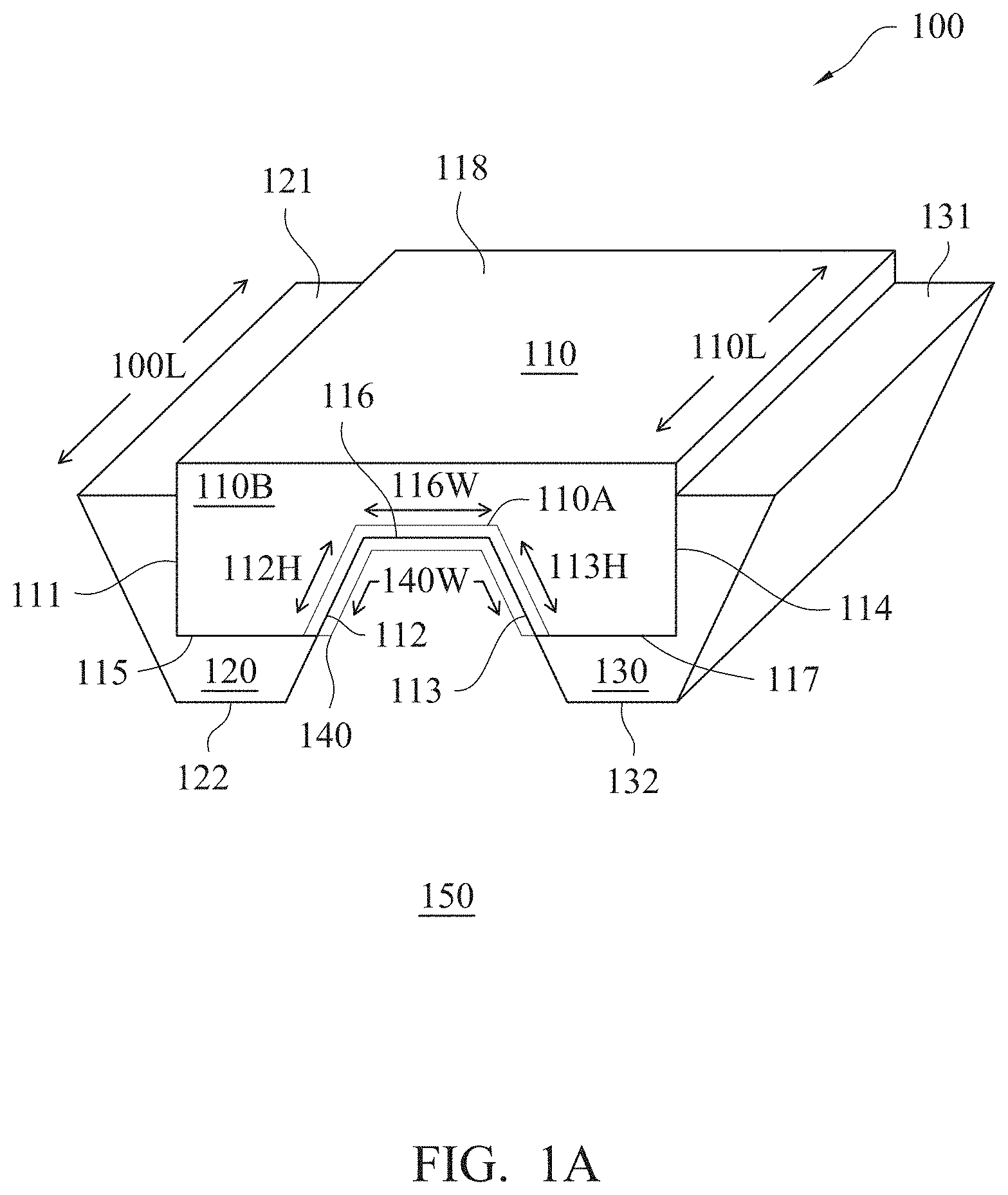
A and 1 B are diagrams of a gate structure, in accordance with some embodiments.
A and 2 B are diagrams of a gate structure, in accordance with some embodiments.
A and 3 B are diagrams of a gate structure, in accordance with some embodiments.
is a schematic diagram of an image sensor circuit, in accordance with some embodiments.
is a flowchart of a method of forming a gate structure, in accordance with some embodiments.
DETAILED DESCRIPTION
The following disclosure provides many different embodiments, or examples, for implementing different features of the provided subject matter. Specific examples of components, values, operations, materials, arrangements, or the like, are described below to simplify the present disclosure. These are, of course, merely examples and are not intended to be limiting. Other components, values, operations, materials, arrangements, or the like, are contemplated. For example, the formation of a first feature over or on a second feature in the description that follows may include embodiments in which the first and second features are formed in direct contact, and may also include embodiments in which additional features may be formed between the first and second features, such that the first and second features may not be in direct contact. In addition, the present disclosure may repeat reference numerals and/or letters in the various examples. This repetition is for the purpose of simplicity and clarity and does not in itself dictate a relationship between the various embodiments and/or configurations discussed.
Further, spatially relative terms, such as “beneath,” “below,” “lower,” “above,” “upper” and the like, may be used herein for ease of description to describe one element or feature's relationship to another element(s) or feature(s) as illustrated in the figures. The spatially relative terms are intended to encompass different orientations of the device in use or operation in addition to the orientation depicted in the figures. The apparatus may be otherwise oriented (rotated 90 degrees or at other orientations) and the spatially relative descriptors used herein may likewise be interpreted accordingly.
In various embodiments, a gate structure is formed in a substrate by etching at least a portion of an isolation structure to expose at least one sidewall of the substrate. In various embodiments, a gate formed in the etched isolation structure includes at least one sidewall along the sidewall of the substrate and at least one horizontal surface such that an effective channel width defined by the gate structure includes a height of the sidewall and a width of the horizontal surface.
A and 1 B are diagrams of a gate structure 100 , in accordance with some embodiments. A is a diagram based on a perspective view of gate structure 100 , and B is a diagram based on a top view of gate structure 100 . In addition to gate structure 100 , A depicts a channel 140 in a substrate 150 , and B depicts source/drain regions 160 .
Gate structure 100 includes a gate 110 , an isolation structure 120 , and an isolation structure 130 . A first portion of gate 110 (not labeled) is positioned adjacent to isolation structure 120 , a second portion of gate 110 (not labeled) is positioned adjacent to isolation structure 130 , and a third portion of gate 110 (not labeled) extends between the first and second portions and over substrate 150 . In some embodiments, gate structure 100 does not include isolation structure 130 , and gate 110 does not include the second portion adjacent to isolation structure 130 . In some embodiments, gate structure 100 includes isolation structure 130 , and gate 110 does not includes the second portion adjacent to isolation structure 130 .
Gate 110 is a region that includes an insulation layer 110 A and a gate electrode 110 B. Insulation layer 110 A is a layer that includes one or more layers of materials capable of electrically insulating gate electrode 110 B from substrate 150 and capacitively coupling gate electrode 110 B and substrate 150 . In various embodiments, insulation layer 110 A includes one or more of silicon dioxide (SiO 2 ), a high-K dielectric, a protection layer, an insulator film, stacked/multi-insulator films, or other suitable material.
In some embodiments, insulation layer 110 A includes a single insulation layer. In some embodiments, insulation layer 110 A includes a plurality of insulation layers.
Gate electrode 110 B is a region that includes one or more materials capable of storing an electric charge. In various embodiments, gate electrode 110 B includes one or more electrically conductive materials, non-limiting examples of which include polysilicon, aluminum (Al) or other metals, indium-tin-oxide (ITO), or other suitable materials. In some embodiments, gate electrode 110 B includes one or more work-function metal layers.
Isolation structures 120 and 130 are regions of one or more materials capable of electrically isolating adjacent regions of substrate 150 from each other. In various embodiments, isolation structures 120 and 130 include an oxide such as SiO 2 , a semiconductor material, or other suitable material. In some embodiments, one or both of isolation structures 120 or 130 is a shallow trench isolation (STI) structure.
Substrate 150 is a structure that includes one or more materials capable of forming the basis of one or more integrated circuits. In various embodiments, substrate 150 includes one or more of a semiconductor material such as silicon or germanium, a compound semiconductor material such as gallium arsenide, indium arsenide, indium phosphide, or silicon carbide, or other suitable material.
Source/drain regions 160 are regions of substrate 150 that are capable of controlled electrical conduction. In various embodiments, one or more of source/drain regions 160 includes one or more of a doped semiconductor material such as silicon or germanium, a compound semiconductor material such as gallium arsenide, indium arsenide, indium phosphide, or silicon carbide, or other suitable material. In some embodiments, one or more of source/drain regions 160 includes a same semiconductor material as substrate 150 . In some embodiments, one or more of source/drain regions 160 includes a semiconductor material different from a semiconductor material included in substrate 150 .
Referring to A , gate 110 includes sidewalls 111 - 114 and horizontal surfaces 115 - 118 in addition to insulation layer 110 A and gate electrode 110 B. Isolation structure 120 includes a top surface 121 and a bottom surface 122 , and isolation structure 130 includes a top surface 131 and a bottom surface 132 .
Sidewall 111 is adjacent to isolation structure 120 . In the embodiment depicted in A , sidewall 111 extends above top surface 121 . In some embodiments, sidewall 111 ends at top surface 121 and gate 110 has an additional sidewall (not shown) that is not aligned with sidewall 111 and extends above top surface 121 . In some embodiments in which sidewall 111 ends at top surface 121 , gate 110 extends over isolation structure 120 , and a bottom edge of an additional sidewall of gate 110 is adjacent to top surface 121 . In some embodiments in which sidewall 111 ends at top surface 121 , gate 110 is set back from isolation structure 120 , and a bottom edge of an additional sidewall is separated from top surface 121 by an additional horizontal surface of gate 110 (not shown).
Horizontal surface 115 is adjacent to a bottom edge (not labeled) of sidewall 111 and extends horizontally to a bottom edge (not labeled) of sidewall 112 . In the embodiment depicted in A , horizontal surface 115 is between top surface 121 and bottom surface 122 such that a portion of isolation structure 120 is between horizontal surface 115 and bottom surface 122 . In some embodiments, horizontal surface 115 is coplanar with bottom surface 122 such that the bottom edge of sidewall 111 is adjacent to bottom surface 122 .
Sidewall 112 extends from horizontal surface 115 to horizontal surface 116 along substrate 150 for a height 112 H. Horizontal surface 116 extends horizontally from a top edge (not labeled) of sidewall 112 to a top edge (not labeled) of sidewall 113 along substrate 150 for a width 116 W. Sidewall 113 extends from horizontal surface 116 to horizontal surface 117 along substrate 150 for a height 113 H. In some embodiments, height 113 H is equal to height 112 H. In some embodiments, height 113 H is longer than height 112 H. In some embodiments, height 112 H is longer than height 113 H.
Horizontal surface 117 extends from a bottom edge (not labeled) of sidewall 113 to a bottom edge (not labeled) of sidewall 114 . In the embodiment depicted in A , horizontal surface 117 is between top surface 131 and bottom surface 132 such that a portion of isolation structure 130 is between horizontal surface 117 and bottom surface 132 . In some embodiments, horizontal surface 117 is coplanar with bottom surface 132 such that the bottom edge of sidewall 114 is adjacent to bottom surface 132 .
Sidewall 114 is adjacent to isolation structure 130 . In the embodiment depicted in A , sidewall 114 extends above top surface 131 . In some embodiments, sidewall 114 ends at top surface 131 and gate 110 has an additional sidewall (not shown) that is not aligned with sidewall 114 and extends above top surface 131 . In some embodiments in which sidewall 114 ends at top surface 131 , gate 110 extends over isolation structure 130 , and a bottom edge of an additional sidewall of gate 110 is adjacent to top surface 131 . In some embodiments in which sidewall 114 ends at top surface 131 , gate 110 is set back from isolation structure 130 , and a bottom edge of an additional sidewall is separated from top surface 131 by an additional horizontal surface of gate 110 (not shown).
Horizontal surface 118 is positioned above horizontal surface 116 and defines a top surface of gate 110 . In the embodiments depicted in A , horizontal surface 118 extends from a top edge (not labeled) of sidewall 111 to a top edge (not labeled) of sidewall 114 . In some embodiments, gate 110 has one or more additional sidewalls (not shown) that extend above top surface 121 and/or top surface 131 , and horizontal surface 118 is adjacent to one or more top edges of the one or more additional sidewalls.
In the embodiment depicted in A , insulation layer 110 A extends along sidewall 112 , horizontal surface 116 , and sidewall 113 . In some embodiments, insulation layer 110 A also extends at least partially along one or more of sidewall 111 , horizontal surface 115 , horizontal surface 117 , or sidewall 114 .
In some embodiments in which insulation layer 110 A includes multiple insulation layers, the multiple layers provide protection against cracking at locations at which a sidewall such as sidewall 112 is adjacent to a horizontal surface such as horizontal surface 116 .
Referring to A and 1 B , gate 110 has a length 110 L, and each of isolation structures 120 and 130 has a length 100 L. In some embodiments, length 110 L is equal to length 100 L. In some embodiments, length 110 L is longer than length 100 L. In some embodiments, length 110 L is shorter than length 100 L.
Source/drain regions 160 are positioned at each end of gate 110 along the direction corresponding to length 100 L.
Gate structure 100 thereby defines channel 140 having a length determined by length 110 L and an effective width 140 W determined by the portion or portions of gate 110 at which gate electrode 110 B is capable of being capacitively coupled with substrate 150 through insulation layer 110 A.
In the embodiment depicted in A and 1 B , gate electrode 110 B is capable of being capacitively coupled with substrate 150 through insulation layer 110 A along sidewall 112 , horizontal surface 116 , and sidewall 113 , so gate structure 100 defines channel 140 having effective channel width 140 W equal to the sum of heights 112 H and 113 H, and width 116 W.
Because effective channel width 140 W includes heights 112 H and 113 H, effective channel width 140 W is larger than effective channel widths of similarly sized gate structures in other approaches that do not include sidewalls 112 and 113 , for example approaches that include only horizontal surfaces to determine effective channel widths.
By defining a large effective channel width 140 W relative to similarly sized structures without at least one of heights 112 H or 113 H, gate structure 100 enables FET operation in which device speed and signal-to-noise ratio are increased, thereby improving performance of FETs and FET circuits. As a non-limiting example, an image sensor circuit having one or more of a reset transistor, a transfer gate, a source follower, or a selection transistor that includes gate structure 100 has improved speed and signal-to-noise ratio properties compared to an image sensor circuit having transistors with gate structures defining effective channel widths narrower than those defined by gate structure 100 .
A and 2 B are diagrams of a gate structure 200 , in accordance with some embodiments. A is a diagram based on a perspective view of gate structure 200 , and B is a diagram based on a top view of gate structure 200 . In addition to gate structure 200 , A depicts substrate 150 , and B depicts source/drain regions 160 , each described above with respect to gate structure 100 and A and 1 B . In addition to gate structure 200 , A depicts a channel 240 in substrate 150 .
Gate structure 200 includes a gate 210 , isolation structures 120 and 130 , described above with respect to gate structure 100 , and an isolation structure 250 . Gate 110 includes three lower portions positioned adjacent to isolation structures 120 , 130 , and 250 , respectively, and upper portions that extend between the lower portions over substrate 150 .
Gate 210 includes an insulation layer 210 A and a gate electrode 210 B, similar to insulation layer 110 A and gate electrode 110 B, respectively, described above with respect to gate 110 .
In addition to the features described above with respect to gate 110 , gate 210 includes a sidewall 211 extending a height 211 H along substrate 150 , a sidewall 212 extending a height 212 H along substrate 150 , a horizontal surface 213 extending a width 213 W from a bottom edge (not labeled) of sidewall 211 to a bottom edge (not labeled) of sidewall 212 , and a horizontal surface 214 extending a width 214 W along substrate 150 from a top edge (not labeled) of sidewall 212 to a top edge (not labeled) of sidewall 113 .
In the embodiment depicted in A and 2 B , horizontal surface 213 extends along isolation structure 250 . In some embodiments, gate structure 200 does not include isolation structure 250 and horizontal surface 213 extends along substrate 150 for the distance 213 W.
Horizontal surface 218 is positioned above horizontal surfaces 116 and 214 and defines a top surface of gate 210 .
Referring to B , gate 210 has a length 210 L, and each of isolation structures 120 , 130 , and 250 has a length 200 L. In some embodiments, length 210 L is equal to length 200 L. In some embodiments, length 210 L is longer than length 200 L. In some embodiments, length 210 L is shorter than length 200 L.
Gate structure 200 thereby defines channel 240 having a length determined by length 210 L and an effective width 240 W determined by the portion or portions of gate 210 at which gate electrode 210 B is capable of being capacitively coupled with substrate 150 through insulation layer 210 A.
In the embodiment depicted in A and 2 B , gate electrode 210 B is capable of being capacitively coupled with substrate 150 through insulation layer 210 A along sidewalls 112 , 211 , 212 , and 113 , and horizontal surfaces 116 and 214 , so gate structure 200 defines channel 240 having effective channel width 240 W equal to the sum of heights 112 H, 211 H, 212 H, and 113 H, and widths 116 W, and 214 W.
Because effective channel width 240 W includes heights 112 H, 211 H, 212 H, and 113 H, effective channel width 240 W is larger than effective channel widths of similarly sized gate structures in other approaches that do not include sidewalls 112 , 211 , 212 , and 113 , for example approaches that include only horizontal surfaces to determine effective channel widths.
In some embodiments in which gate structure 200 does not include isolation structure 250 , i.e., horizontal surface 213 is coplanar with a bottom surface of isolation structure 250 , effective gate width 240 W also includes width 213 W.
In the embodiments depicted in A and 2 B , gate structure 200 includes a single set of sidewalls 211 and 212 positioned between sidewalls 112 and 113 . In some embodiments, gate structure 200 includes one or more sets of sidewalls (not shown) in addition to sidewalls 211 and 212 positioned between sidewalls 112 and 113 such that effective gate width 240 W includes heights by which the additional sets of sidewalls extend along substrate 150 . In some embodiments, additional sets of sidewalls are associated with additional isolation structures (not shown) similar to isolation structure 250 .
By defining a relatively large effective channel width 240 W, gate structure 200 is capable of providing the benefits described above for gate structure 100 with respect to improved speed and signal-to-noise ratio properties compared to gate structures defining relatively smaller effective channel widths.
A and 3 B are diagrams of a gate structure 300 , in accordance with some embodiments. A is a diagram based on a perspective view of gate structure 300 , and B is a diagram based on a top view of gate structure 300 . In addition to gate structure 300 , A depicts substrate 150 , and B depicts source/drain regions 160 , each described above with respect to gate structure 100 and A and 1 B . In addition to gate structure 300 , A depicts a channel 340 in substrate 150 .
Gate structure 300 includes a gate 310 and isolation structures 320 , 330 A, 330 B, and 350 . A depicts isolation structure 330 B both in relation to the overall arrangement of gate structure 300 and as a separate inset.
Gate 310 includes a lower portion (not labeled) positioned adjacent to and between isolation structures 330 A and 330 B and an upper portion (not labeled) that extends over substrate 150 from isolation structure 320 to isolation structure 350 .
Isolation structure 330 A includes a top surface 331 A and a bottom surface 332 A, and isolation structure 330 B includes a top surface 331 A and a bottom surface 332 B.
Gate 310 includes an insulation layer 310 A and a gate electrode 310 B, similar to insulation layer 110 A and gate electrode 110 B, respectively, described above with respect to gate 110 .
Referring to A , gate 310 includes sidewalls 311 - 314 and horizontal surfaces 315 - 317 . Horizontal surface 315 extends along substrate 150 from a top edge of isolation structure 320 to a top edge (not labeled) of sidewall 311 for a width 315 W. In some embodiments, horizontal surface 315 is coplanar with top surfaces 331 A and 331 B.
Sidewall 311 extends along substrate 150 from horizontal surface 315 to horizontal surface 316 for a height 311 H.
Horizontal surface 316 extends along substrate 150 from a bottom edge (not labeled) of sidewall 311 to a bottom edge (not labeled) of sidewall 312 for a width 316 W. In some embodiments, horizontal surface 316 is coplanar with bottom surfaces 332 A and 332 B.
Sidewall 312 extends along substrate 150 from horizontal surface 316 to horizontal surface 317 for a height 312 H.
Horizontal surface 317 extends along substrate 150 from a top edge (not labeled) of sidewall 312 to a top edge of isolation structure 350 for a width 317 W. In some embodiments, horizontal surface 317 is coplanar with top surfaces 331 A and 331 B.
Sidewall 313 is adjacent to horizontal surface 316 and isolation structure 330 A, and both adjacent to and perpendicular to sidewalls 311 and 312 . Sidewall 314 is adjacent to horizontal surface 316 and isolation structure 330 B, and both adjacent to and perpendicular to sidewalls 311 and 312 .
In some embodiments, gate structure 300 does not include one or both of isolation structures 320 or 350 , and one or both of widths 315 W or 317 W is the respective distance that horizontal surface 315 or 317 otherwise extends along substrate 150 .
A horizontal surface 318 is positioned above horizontal surface 316 and defines a top surface of gate 310 .
Referring to B , gate 310 has a length 310 L, and each of isolation structures 320 and 350 has a length 300 L. In some embodiments, length 310 L is equal to length 300 L. In some embodiments, length 310 L is longer than length 300 L. In some embodiments, length 310 L is shorter than length 300 L.
In some embodiments in which length 310 L is shorter than length 300 L, isolation structures 330 A and 330 B are positioned to have outer sidewalls separated by length 300 L. In some embodiments in which length 310 L is longer than or equal to length 300 L, gate structure 300 does not include isolation structures 330 A and 330 B, and each of sidewalls 313 and 314 is adjacent to a corresponding sidewall of substrate 150 .
Gate structure 300 thereby defines a channel 340 having a length determined by length 310 L and an effective width 340 W determined by the portion or portions of gate 310 at which gate electrode 310 B is capable of being capacitively coupled with substrate 150 through insulation layer 310 A.
In the embodiment depicted in A and 3 B , gate electrode 310 B is capable of being capacitively coupled with substrate 150 through insulation layer 310 A along sidewalls 311 and 312 and horizontal surfaces 315 - 317 , so gate structure 300 defines a channel (not shown) having an effective channel width equal to the sum of heights 311 H and 312 H, and widths 315 W, 316 W, and 317 W.
Because the effective channel width defined by gate structure 300 includes heights 311 H and 312 H, the effective channel width is larger than effective channel widths of similarly sized gate structures in other approaches that do not include sidewalls 311 and 312 , for example approaches that include only horizontal surfaces to determine effective channel widths.
In the embodiments depicted in A and 3 B , gate structure 300 includes a single set of sidewalls 311 - 314 positioned in substrate 150 . In some embodiments, gate structure 300 includes one or more sets of sidewalls (not shown) in addition to sidewalls 311 - 314 positioned in substrate 150 such that the effective gate width includes heights by which the additional sets of sidewalls extend along substrate 150 . In some embodiments, additional sets of sidewalls are associated with additional isolation structures (not shown) similar to isolation structures 330 A and 330 B.
By defining a large effective channel width relative to similarly sized structures without at least one of heights 311 H or 312 H, gate structure 300 is capable of providing the benefits described above for gate structure 100 with respect to improved speed and signal-to-noise ratio properties.
is a schematic diagram of an image sensor circuit 400 , in accordance with some embodiments. Image sensor circuit 400 includes a first power node VDD and a second power node GND. A reset transistor RST, transfer gate TG, and photodiode PD are configured in series between first power node VDD and second power node GND. A source follower SF, selection transistor SEL, and current source IB are also configured in series between first power node VDD and second power node GND.
Reset transistor RST is configured to receive signal VRST, transfer gate TG is configured to receive signal VT, and selection transistor SEL is configured to receive signal VSEL. Photodiode PD is configured to generate a signal based on a detected light input (not shown). Current source IB is configured to generate a current IBIAS.
A gate of source follower SF is configured to receive a voltage VSF generated between reset transistor RST and transfer gate TG in response to the signal generated by photodiode PD. Image sensor circuit 400 is thereby configured to output a signal VOUT representative of the light input detected by photodiode PD, and responsive to signals VRST, VT, and VSEL.
At least one of reset transistor RST, transfer gate TG, source follower SF, or selection transistor SEL is a FET including one of gate structures 100 , 200 , or 300 , described above with respect to A and 1 B, 2 A and 2 B , or 3 A and 3 B, respectively.
By including a transistor with a gate structure defining a large effective channel width relative to similarly sized structures without at least one of heights 112 H, 113 H, 211 H, 212 H, 311 H, or 312 H, image sensor circuit 400 is capable of operating with improved speed and signal-to-noise ratio properties.
is a flowchart of a method 500 of forming a gate structure in a substrate, in accordance with one or more embodiments. Method 500 is implemented to manufacture a gate structure such as gate structures 100 , 200 , and 300 , discussed above with respect to A and 1 B, 2 A and 2 B, and 3 A and 3 B , respectively.
In some embodiments, method 500 is part of forming a transistor of an image sensor circuit. In some embodiments, method 500 is part of forming one or more of reset transistor RST, transfer gate TG, source follower SF, or selection transistor SEL of image sensor circuit 400 , described above with respect to .
The sequence in which the operations of method 500 are depicted in is for illustration only; the operations of method 500 are capable of being executed in sequences that differ from that depicted in . In some embodiments, operations in addition to those depicted in are performed before, between, and/or after the operations depicted in .
At operation 510 , in some embodiments, a mask defining a gate region is formed. The gate region overlaps at least a portion of a first isolation structure. In some embodiments, the first isolation structure is isolation structure 120 , described above with respect to gate structures 100 and 200 and A- 2 B . In some embodiments, the first isolation structure is an isolation structure corresponding to isolation structures 330 A and 330 B, described above with respect to gate structure 300 and A and 3 B .
In some embodiments, the gate region overlaps at least a portion of a second isolation structure. In some embodiments, the second isolation structure is isolation structure 130 , described above with respect to gate structures 100 and 200 and A- 2 B . In some embodiments, the second isolation structure is isolation structure 320 , described above with respect to gate structure 300 and A- 3 B .
In some embodiments, the gate region overlaps at least a portion of a third isolation structure. In some embodiments, the third isolation structure is isolation structure 250 , described above with respect to gate structures 100 and 200 and A- 2 B . In some embodiments, the third isolation structure is isolation structure 340 , described above with respect to gate structure 300 and A- 3 B .
At operation 520 , a portion of the first isolation structure is etched to expose a first sidewall of the substrate. The exposed portion of the first sidewall is adjacent to a horizontal surface of the substrate.
In some embodiments, etching the portion of the first isolation structure includes exposing a portion of the first sidewall and leaving a portion of the first sidewall unexposed. In some embodiments, etching the portion of the first isolation structure includes exposing an entirety of the first sidewall.
In some embodiments, etching the portion of the first isolation structure includes etching a portion of isolation structure 120 to expose a first sidewall of substrate 150 , described above with respect to gate structures 100 and 200 and A- 2 B .
In some embodiments, etching the portion of the first isolation structure includes etching a center portion of the first isolation structure to divide the first isolation structure into a first section separate from a second section. In some embodiments, etching the portion of the first isolation structure includes etching a center portion of the first isolation structure to form isolation structures 330 A and 330 B, described above with respect to gate structure 300 and A and 3 B .
In some embodiments, etching the portion of the first isolation structure includes etching an entirety of the first isolation structure to form a recess corresponding to sidewalls 311 - 314 and horizontal surface 316 , described above with respect to gate structure 300 and A and 3 B .
At operation 530 , in some embodiments, a portion of a second isolation structure is etched to expose a second sidewall of the substrate adjacent to the horizontal surface of the substrate. In some embodiments, etching the portion of the second isolation structure includes etching a portion of isolation structure 130 , described above with respect to gate structure 100 and A and 1 B .
In some embodiments, etching the portion of the second isolation structure includes exposing a portion of a second sidewall and a portion of a third sidewall and leaving portions of the second sidewall and the third sidewall unexposed. In some embodiments, etching the portion of the second isolation structure includes exposing an entirety of a second sidewall and an entirety of a third sidewall. In some embodiments, etching the portion of the second isolation structure includes etching a portion of isolation structure 250 , described above with respect to gate structure 200 and A and 2 B .
At operation 540 , in some embodiments, a third isolation structure is etched to expose a third and/or fourth sidewall of the substrate. In some embodiments, etching the portion of the third isolation structure includes etching a portion of isolation structure 130 , described above with respect to gate structure 200 and A and 2 B .
At operation 550 , an insulation layer is deposited on the first sidewall of the substrate and on the adjacent horizontal surface of the substrate. In some embodiments, depositing the insulation layer includes depositing multiple insulator films.
In some embodiments, depositing the insulation layer includes depositing the insulation layer on the second sidewall. In some embodiments, depositing the insulation layer includes depositing the insulation layer on a third sidewall, a fourth sidewall, and a second horizontal surface of the substrate between the third sidewall and the fourth sidewall.
In some embodiments, depositing the insulation layer includes forming insulation layer 110 A, described above with respect to gate structure 100 and A and 1 B . In some embodiments, depositing the insulation layer includes forming insulation layer 210 A, described above with respect to gate structure 200 and A and 2 B . In some embodiments, depositing the insulation layer includes forming insulation layer 310 A, described above with respect to gate structure 300 and A and 3 B .
At operation 560 , a gate electrode is formed on the deposited insulation layer. In some embodiments, forming the gate electrode includes forming gate electrode 110 B, described above with respect to gate structure 100 and A and 1 B . In some embodiments, forming the gate electrode includes forming gate electrode 210 B, described above with respect to gate structure 200 and A and 2 B . In some embodiments, forming the gate electrode includes forming gate electrode 310 B, described above with respect to gate structure 300 and A and 3 B .
The operations of method 500 enable manufacture of a gate structure defining a large effective channel width relative to similarly sized structures without at least one height component, such as heights 112 H, 113 H, 211 H, 212 H, 311 H, or 312 H, thereby enabling FET operation in which device speed and signal-to-noise ratio are increased, thereby improving performance of FETs and FET circuits. As a non-limiting example, an image sensor circuit having one or more of a reset transistor, a transfer gate, a source follower, or a selection transistor including a gate structure formed using method 500 has improved speed and signal-to-noise ratio properties compared to an image sensor circuit having transistors formed using methods for manufacturing gate structures defining effective channel widths without at least one height component, such as heights 112 H, 113 H, 211 H, 212 H, 311 H, or 312 H.
An aspect of this description relates to a semiconductor device. The semiconductor device includes a plurality of isolation structures, wherein each isolation structure of the plurality of isolation structures is spaced from an adjacent isolation structure of the plurality of isolation structures in a first direction. The semiconductor device further includes a gate structure. The gate structure includes a top surface; a first sidewall angled at a non-perpendicular angle with respect to the top surface; and a second sidewall angled with respect to the top surface. The gate structure further includes a first horizontal surface extending between the first sidewall and the second sidewall, wherein the first horizontal surface is parallel to the top surface, and a dimension of the gate structure in a second direction, perpendicular to the first direction, is less than a dimension of each of the plurality of isolation structures in the second direction. In some embodiments, the first sidewall extends along a sidewall of a first isolation structure of the plurality of isolation structures. In some embodiments, a first isolation structure of the plurality of isolation structures is between the top surface and the first horizontal surface. In some embodiments, the gate structure further includes a first extension between a first isolation structure of the plurality of isolation structures and a second isolation structure of the plurality of isolation structures; and a second extension between the first isolation structure and a third isolation structure of the plurality of isolation structures. In some embodiments, the semiconductor device further includes a channel defined by the gate structure. In some embodiments, an effective length of the channel is equal to the dimension of the gate structure in the second direction. In some embodiments, an effective width of the channel is equal to a sum of a height of the first sidewall, a height of the second sidewall, a width of the first horizontal surface, a width of the first extension, and a width of the second extension. In some embodiments, the top surface directly contacts both the first extension and the second extension. In some embodiments, the top surface extends over each of the plurality of isolation structures.
An aspect of this description relates to a semiconductor device. The semiconductor device includes a reset transistor configured to receive a power voltage; a transfer gate electrically connected to the reset transistor; and a photodiode electrically connected between the transfer gate and a ground. The semiconductor device further includes a source follower having a gate electrically connected to the reset transistor and the transfer gate; a selection transistor electrically connected to the source follower; and a current source electrically connected between the selection transistor and the ground. At least one of the reset transistor, the transfer gate, the source follower, or the selection transistor includes a plurality of isolation structures, wherein each isolation structure of the plurality of isolation structures is spaced from an adjacent isolation structure of the plurality of isolation structures in a first direction; and a gate structure. The gate structure includes a top surface; a first sidewall angled at a non-perpendicular angle with respect to the top surface; a second sidewall angled with respect to the top surface. The gate structure further includes a first horizontal surface extending between the first sidewall and the second sidewall, wherein the first horizontal surface is parallel to the top surface, and a dimension of the gate structure in a second direction, perpendicular to the first direction, is less than a dimension of each of the plurality of isolation structures in the second direction. In some embodiments, the reset transistor, the transfer gate and the photodiode are electrically connected in series. In some embodiments, the source follower, the selection transistor and the current source are electrically connected in series. In some embodiments, a source/drain (S/D) of the source follower is electrically connected to the power voltage. In some embodiments, a gate of the source follower is selectively electrically connected to the power voltage. In some embodiments, the gate structure further includes a first extension between a first isolation structure of the plurality of isolation structures and a second isolation structure of the plurality of isolation structures; and a second extension between the first isolation structure and a third isolation structure of the plurality of isolation structures. In some embodiments, the semiconductor device further includes a channel defined by the gate structure. In some embodiments, an effective length of the channel is equal to the dimension of the gate structure in the second direction. In some embodiments, an effective width of the channel is equal to a sum of a height of the first sidewall, a height of the second sidewall, a width of the first horizontal surface, a width of the first extension, and a width of the second extension.
An aspect of this description relates to a semiconductor device. The semiconductor device includes a plurality of isolation structures, wherein each isolation structure of the plurality of isolation structures is spaced from an adjacent isolation structure of the plurality of isolation structures in a first direction. The semiconductor device further includes a transistor. The transistor includes a gate structure. The gate structure includes a top surface; a first sidewall angled at a non-perpendicular angle with respect to the top surface; and a second sidewall angled with respect to the top surface. The gate structure further includes a first horizontal surface extending between the first sidewall and the second sidewall, wherein the first horizontal surface is parallel to the top surface, and a dimension of the gate structure in a second direction, perpendicular to the first direction, is less than a dimension of each of the plurality of isolation structures in the second direction. The transistor further includes a plurality of source/drain (S/D) regions, wherein a first S/D region of the plurality of S/D regions is spaced from a second S/D region of the plurality of S/D regions in the second direction. In some embodiments, a first isolation structure of the plurality of isolation structures is between the first S/D region and the second S/D region.
The foregoing outlines features of several embodiments so that those skilled in the art may better understand the aspects of the present disclosure. Those skilled in the art should appreciate that they may readily use the present disclosure as a basis for designing or modifying other processes and structures for carrying out the same purposes and/or achieving the same advantages of the embodiments introduced herein. Those skilled in the art should also realize that such equivalent constructions do not depart from the spirit and scope of the present disclosure, and that they may make various changes, substitutions, and alterations herein without departing from the spirit and scope of the present disclosure.
Figures (8)
Citations
This patent cites (4)
- US6596599
- US20070069293
- US20120168766
- US102315109