Abstract
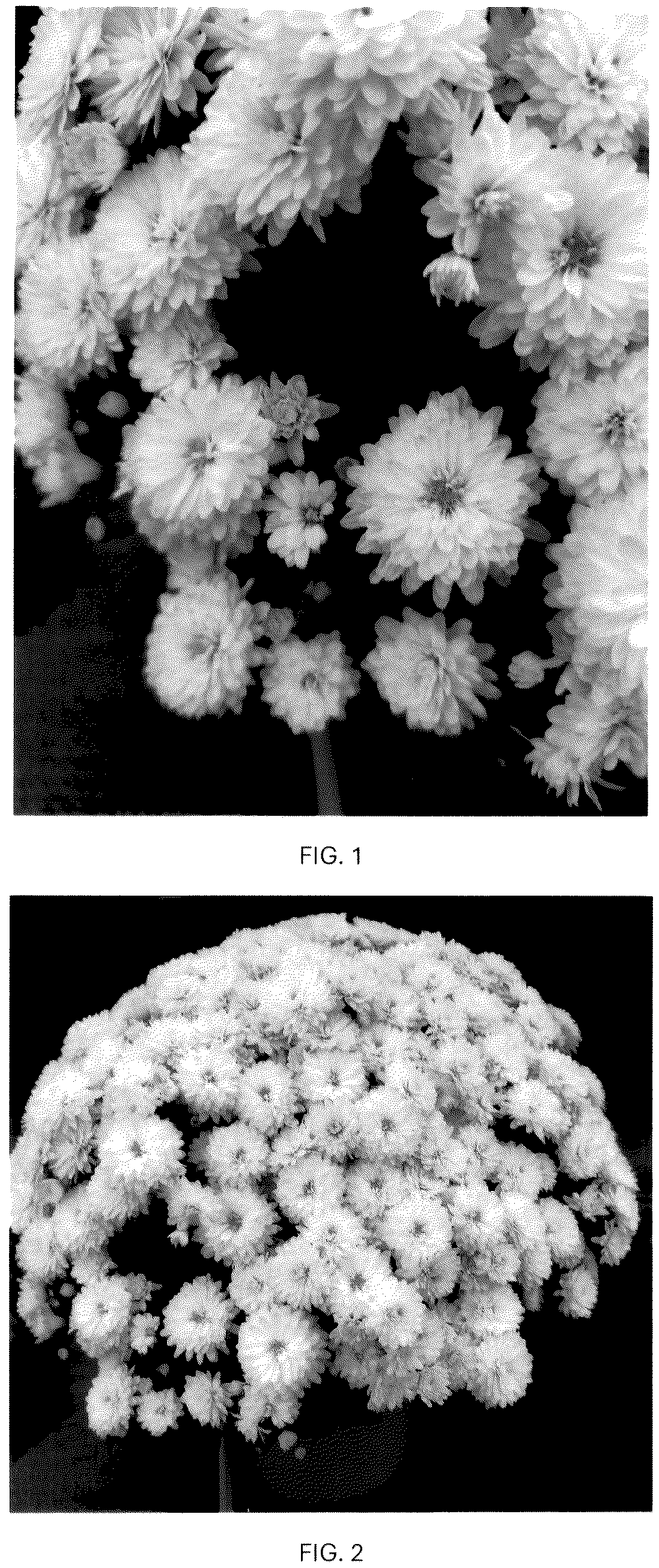
A new garden type Chrysanthemum plant named ‘CIFZ0115’ particularly distinguished by its medium size plant with round plant habit, medium size decorative flowers with white flower color and a natural season response in mid to late October.
Claims (1)
1 . A new and distinct variety of Chrysanthemum plant named ‘CIFZ 0115 ’ substantially as illustrated and described herein.
Full Description
Show full text →
Latin name of the genus and species of the plant claimed: Chrysanthemum x morifolium. Varietal denomination: ‘CIFZ0115’.
BACKGROUND
OF THE NEW PLANT The present invention comprises a new Chrysanthemum, botanically known as Chrysanthemum x morifolium, and hereinafter referred to by the variety name ‘CIFZ0115’. ‘CIFZ0115’ is a product of a planned breeding program. The new cultivar has a medium size plant with round plant habit, medium size decorative flowers with white flower color, and a natural season response in mid to late October. ‘CIFZ0115’ originated from a cross made in March 2019 in Enkhuizen, The Netherlands. Seeds were sown in June 2020 in Alva, Florida and ‘CIFZ0115’ was selected from the resulting population on Nov. 25, 2020 in Alva, Florida. The female parent was ‘Aramis White’, U.S. Plant Pat. No. 27,795. TABLE 1 Characteristics of the female parent, compared to ‘CIFZ0115’: ‘Aramis White’, U.S. Plant Pat. ‘CIFZ0115’ No. 27,795 Blackcloth response: 0.5 week faster 0.5 week slower Flower size: Smaller Larger The male parent was an unpatented proprietary seedling ‘13-M435’, yellow duplex. TABLE 2 Characteristics of the male parent, compared to ‘CIFZ0115’: ‘CIFZ0115’ ‘13-M435’ Blackcloth response: 0.5 week faster 0.5 week slower Flower color: White Yellow Disc floret number: Less disc florets More disc florets Plant size: Smaller Larger The first act of asexual reproduction of ‘CIFZ0115’ was accomplished when vegetative cuttings were propagated from the initial selection in January 2021 in Alva, Florida. BRIEF
SUMMARY
OF INVENTION Horticultural examination of plants grown from cuttings of the plant initiated in January 2021 and continuing thereafter, has demonstrated that the combination of characteristics as herein disclosed for ‘CIFZ0115’ are firmly fixed and are retained through successive generations of asexual reproduction. ‘CIFZ0115’ has not been observed under all possible environmental conditions. The phenotype may vary significantly with variations in environment such as temperature, light intensity and day length. A Plant Breeder's Right for this cultivar has not yet been applied for. ‘CIFZ0115’ has not been made publicly available prior to the effective filing date of this application, notwithstanding any disclosure that may have been made less than one year prior to the effective filing date of this application by the inventor or another who obtained ‘CIFZ0115’ directly from the inventor. The following traits have been repeatedly observed and are determined to be basic characteristics of the new variety. The combination of these characteristics distinguishes this Chrysanthemum as a new and distinct variety. BRIEF DESCRIPTION OF THE PHOTOGRAPHS The accompanying photographic drawings show typical flower and foliage characteristics of ‘CIFZ0115’ with colors being as true as possible with illustrations of this type. The photographic drawing shows in a close view of flowers of the new variety and in a flowering plant from an indoor trial. The aforementioned photographs: , as well as , were taken on Sep. 2, 2024 both showing a plant from the same blackcloth outdoor trial in Andijk, The Netherlands. These plants were about 13 weeks of age. One rooted cutting per pot had been planted in a 19 cm pot, not pinched in week 23, 2024 and black clothed from week 29. Plants started flowering the end of August 2024. The measurements were taken in Andijk, The Netherlands, in September 2024 on plants from the same outdoor blackcloth trial. DETAILED BOTANICAL DESCRIPTION Color references are made to The Royal Horticultural Society Colour Chart (R.H.S.) 2001. TABLE 3 DIFFERENCES BETWEEN THE NEW VARIETY ‘CIFZ0115’ AND ‘CIFZ0094’: ‘CIFZ0094’, U.S. Plant Pat. ‘CIFZ0115’ No. 34,630 Natural response: 0.5 week slower 0.5 week faster Plant size: Less width Wider/larger Plant habit: Rounder More width Flowering uniformity: More uniform Less Uniform DIFFERENCES BETWEEN THE NEW VARIETY ‘CIFZ0115’ AND ‘Zanmulpine’: TABLE 4 ‘Zanmulpine’, U.S. Plant Pat. ‘CIFZ0115’ No. 30,154 Plant size: Smaller Larger Flower longevity: Lasts longer Flowers brown faster Plant: Form, growth and habit .—Herbaceous garden-type, stems upright and outwardly spreading, free branching. Plant height ( above soil ).—20 cm. Plant height ( inflorescence included ).—24 cm. Plant width.— 35 cm. Roots: Number of days to initiate roots .—About 4 days at about 22° C. Number of days to produce a rooted cutting.— 14-16 days at 22° C. Type .—Fine, fibrous, free branching. Color .—RHS N155B. Foliage: Arrangement .—Alternate. Immature leaf, color upper surface .—RHS 137B. Immature leaf, color lower surface .—RHS 137C. Mature leaf, color, upper surface .—RHS 137A. Mature leaf, color lower surface .—RHS 137B. Length.— 4.0 cm. Width.— 2.5 cm. Shape .—Ovate, with distinct lobes. Base shape .—Shortly Attenuate. Apex shape .—Apiculate. Margin.— 5 lobed. Number of margin indentations.— 9-10. Depth of margin indentations.— 2-4 mm. Leaf length terminal lobe relative to total leaf length.— 1:3. Leaf depth lower lateral sinus.— 0.8 cm. Texture, upper surface .—Bifid hairs. Texture, lower surface .—Bifid hairs. Color of veins, upper surface .—RHS 138B. Color of veins, lower surface .—RHS 138B. Pattern of veining .—Palmate. Petiole color .—RHS 138B. Petiole length.— 0.4 cm. Petiole orientation .—Moderately upwards. Diameter.— 0.2 cm. Texture .—Bifid hairs. Presence of stipules .—No. Stem: Quantity of main branches per plant.— 11-13. Color of stem .—RHS 138B. Length of stem.— 9-10 cm. Diameter.— 0.3 cm. Length of internodes.— 0.5-2.5 cm. Texture .—Bifid hairs. Color of peduncle .—RHS 138B. Length of peduncle.— 2.0-4.0 cm. Peduncle diameter.— 0.2 cm. Texture .—Bifid hairs. Inflorescence: Type .—Compositae, solitary, decorative inflorescences borne terminally above foliage, ligulate ray florets arranged in whorls on a capitulum giving a semi-double to double flower. Quantity of short days to flowering ( response time ).—Approximately 7.5 weeks. Quantity of inflorescences per plant .—About 270 with some small buds developing. Lastingness of individual blooms on the plant .—About five weeks from first color. Fragrance .—Slightly spicy. Bud (when showing color): Color .—RHS 155A. Length.— 0.6 cm. Width.— 0.9 cm. Shape .—Oblate. Immature inflorescence (at moment of opening): Diameter.— 1.8 cm. Color of ray florets, upper surface .—RHS 155A. Color of ray florets, lower surface .—RHS 155A. Mature inflorescence: Diameter.— 3.5 cm. Depth.— 1.4 cm. Total diameter of disc.— 0.4 cm. Receptacle color .—RHS 138A. Receptacle height.— 0.3 cm. Receptacle diameter.— 1.0 cm. Length of corolla tube.— 0.2 cm. Ray florets: Average quantity of florets.— 160. Number of whorls per inflorescence.— 12-13. Color of florets, upper surface .—RHS 155A. Color lower surface .—RHS 15A. Length.— 1.6 cm. Width/diameter.— 0.5 cm. Shape .—Oblong. Apex shape .—Dentate. Base shape .—Strongly concave to tubular. Margin .—Entire. Small incisions may be present at tip. Margin: type of rolling .—Flat. Texture, upper surface .—Papillate. Lower surface .—Papillate. Ribs present .—Yes. Number of keels.— 2. Profile at widest point .—Flat. Longitudinal axis shape .—Straight. Corolla tube shape .—Circular. Disc florets: Number of disc florets.— 0-30. Width.— 0.1 cm. Length.— 0.3 cm. Colour .—Base RHS 4D, top RHS 6A. Inflorescence (at moment of senescence): Color of ray florets, upper surface .—RHS 155A. Color of ray florets, lower surface .—RHS 155A. Phyllaries: Quantity.— 25. Color, upper surface .—RHS 138A. Color, lower surface .—RHS 138B. Length.— 0.3 cm. Width.— 0.1 cm. Shape .—Ensiform. Apex shape .—Acute. Base .—Fused. Margins .—Entire. Texture, upper surface .—Glabrous. Texture, lower surface .—Canescent. Reproductive organs: Pistil .—One. Length.— 0.4 cm. Style color .—RHS 1D. Style length.— 0.3 cm. Stigma color .—RHS 14A. Stigma shape .—Bi-parted. Ovary color .—RHS 145C. Ovary length.— 0.2 cm. Ovary width.— 0.1 cm. Androecium: Stamens.— 1, found on only disc florets. Color of filaments .—RHS 157D. Length filaments.— 0.2 cm. Anther color .—RHS 12C. Anther length.— 0.2 cm. Anther shape .—Oval to club shaped. Color of pollen .—RHS 12A. Fertility/seed set .—Has not been determined to date. Disease/pest resistance .—Has not been determined to date. Hardiness .—Has not been determined to date.