Abstract
A new Dianthus plant named ‘KLEDG24696’ particularly distinguished by double, round flowers, and petals with a reddish-purple color, is disclosed.
Claims (1)
1 . A new and distinct variety of Dianthus plant named ‘KLEDG 24696’ as illustrated and described herein.
Full Description
Show full text →
Genus and species: Dianthus cultivar. Variety denomination: ‘KLEDG24696’.
BACKGROUND
OF THE NEW PLANT The present invention comprises a new and distinct variety of Dianthus , botanically known as Dianthus cultivar and hereinafter referred to by the variety name ‘KLEDG24696’. ‘KLEDG24696’ originated from a whole plant mutation of ‘KLEDG12163’ (U.S. Plant Pat. No. 24,707) identified in June 2022 in Stuttgart, Germany. In June 2020, ‘KLEDG24696’ was first vegetatively propagated by vegetative cuttings in Stuttgart, Germany. ‘KLEDG24696’ was found to reproduce true to type in successive generations of asexual propagation in Stuttgart, Germany via vegetative cuttings.
SUMMARY
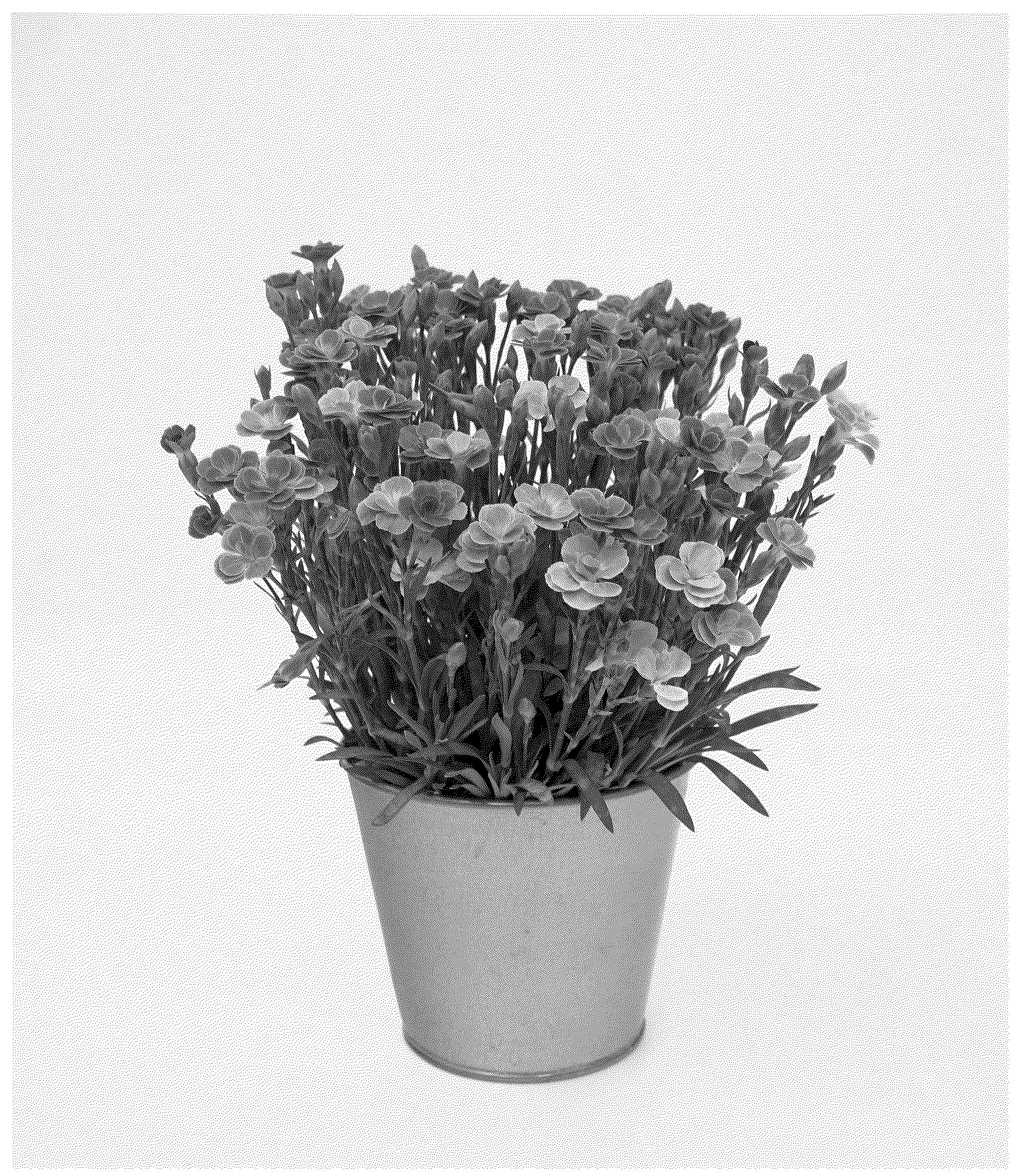
The following are the most outstanding and distinguishing characteristics of ‘KLEDG24696’ when grown under normal horticultural practices in Stuttgart, Germany. 1. Double, round flowers; 2. Petals with a reddish-purple color. DESCRIPTION OF THE PHOTOGRAPH This new Dianthus plant is illustrated by the accompanying photograph of a 7-month-old plant taken in May 2024 and grown in a greenhouse in Stuttgart, Germany. The colors shown are as true as can be reasonably obtained by conventional photographic procedures. The photograph is a whole plant photo of ‘KLEDG24696’ and shows the foliage, buds, and flowers. DESCRIPTION The following detailed descriptions set forth the distinctive characteristics of ‘KLEDG24696’. The data which define these characteristics were collected from asexual reproductions carried out in Stuttgart, Germany. Data was collected in May 2024 from 7-month-old plants grown in a greenhouse. Color references are to The R.H.S. Colour Chart of The Royal Horticultural Society of London (R.H.S.), 5 th edition (2007). Classification: Family .—Caryophyllaceae. Botanical.—Dianthus cultivar. Designation .—‘KLEDG24696’. Type .—Pot carnation. Parentage: Mutation parent.—Dianthus ‘KLEDG12163’ (U.S. Plant Pat. No. 24,707). Plant: Propagation type .—Vegetative cuttings via stem. Type of plant .—Perennial. Time to produce a rooted young plant.— 14 to 21 days. Root description .—Fine roots, young roots are RHS 161D, mature roots are RHS 199C. Rooting habit shape .—Lanceolate. Plant form .—Upright. Plant height.— 15 cm to 17 cm. Plant diameter or spread.— 22 cm to 25 cm. Lateral branches/stems: Shape of the branch in cross - section .—Slightly angular. Hollowness of the branch .—Absent. Length.— 7 cm to 10 cm. Diameter.— 4 cm to 7 cm. Internode length.— 2 cm to 3 cm. Internode quantity per branch.— 3 to 5. Number of internodes per branch/stem.— 3 to 5. Node length.— 0.2 cm to 0.4 cm. Node diameter.— 0.2 cm to 0.4 cm. Texture .—Smooth. Color .—RHS 146B. Flower clustering on the lateral branch .—None. Foliage: Arrangement .—Opposite. Length.— 4 cm to 5 cm. Width.— 0.3 cm to 0.5 cm. Shape .—Lanceolate. Apex .—Acute. Base .—Obtuse. Margin .—Entire. Texture ( both upper and lower surfaces ).—Smooth. Cross - section of the leaf .—Moderately concave. Curvature of the leaf .—Absent. Glaucosity of the leaf .—Weak. Leaf color ( both immature and mature ).—Immature: Upper surface: RHS 138A. Lower surface: RHS 137A. Mature: Upper surface: RHS 138A. Lower surface: RHS 137A. Venation pattern .—Absent. Spiny ciliation of leaf margin .—Absent. Flowers: Flower type and habit .—Double, round. Fragrance .—Present. Position of the flowers compared to the foliage of the plant .—Moderately above. Profile of both the upper and lower part in the lateral view .—Upper part flat convex, lower part flat. Diameter of the flower.— 2.0 to 2.3 cm. Natural flowering season .—Spring to autumn. Number of flowers per spray.— 3 to 5. Flower longevity on the plant.— 14 to 18 days. Buds: Length.— 0.5 cm to 1.5 cm. Diameter.— 0.3 cm to 0.4 cm. Shape .—Elliptic. Color .—RHS 138A. Extrusion of the styles at the bud stage .—Absent. Corolla: Quantity of petals and arrangement.— 7 to 13 arranged in several whorls. Corolla height.— 0.8 cm to 1.5 cm. Petal length.— 1.8 cm to 2.5 cm. Petal width.— 1.0 cm to 1.5 cm. Petal shape .—Spoon-shaped. Petal apex .—Obtuse. Petal base .—Acute. Petal margin .—Serrated. Depth of petal margin .—Shallow. Petal texture ( both upper and lower surfaces ).—Smooth. Petal color .—Immature: Upper surface: RHS 74A. Lower surface: RHS 75A. Mature: Upper surface: RHS 74D, with whitish pink coloration on the petal margin, whitish pink coloration at the petal base, and small petal flush as the petal color fades. Lower surface: RHS 75B. Macule .—Absent. Petal margin serration .—Medium. Calyx: Quantity of sepals and arrangement .—Composed of 5 sepals. Longitudinal axis of the lobes of the calyx .—Straight. Shape .—Campanulate. Calyx height.— 0.8 cm to 1.5 cm. Calyx diameter ( at the apex ).—0.4 cm to 0.6 cm. Sepal texture ( both upper and lower surfaces ).—Smooth. Sepal color .—Upper surface: RHS 137A. Lower surface: RHS 137D. Position of the outer lobes of the epicalyx in relation to the calyx .—Adpressed and free. Apex shape of the outer lobes of the epicalyx .—Acute. Tip length of the outer lobes of the epicalyx.— 0.2 cm. Apex shape of the inner lobes of the epicalyx .—Short acuminate. Tip length of the inner lobes of the epicalyx.— 0.1 cm. Pedicel: Average length.— 2.0 to 3.0 cm. Texture .—Smooth. Color .—RHS 146B. Peduncles: Length.— 5 cm to 8 cm. Diameter.— 0.2 cm. Strength .—Moderate. Texture .—Smooth. Color .—RHS 146B. Reproductive organs: Stamens .—Quantity per flower: About 10. Filament length: 0.5 cm to 0.8 cm. Filament color: RHS 157B. Anther length: 0.1 cm. Anther diameter: 0.05 cm. Anther color: RHS 155B. Pollen amount: None observed. Pistils .—Not observed. Seeds: None observed to May 2024. Disease and insect resistance: No particular disease or insect resistance observed. COMPARISON OF ‘KLEDG24696’ WITH PARENTAL LINE AND KNOWN VARIETY ‘KLEDG24696’ is distinguished from the parent as described in Table 1. TABLE 1 Comparison with Parental Line Trait or characteristic ‘KLEDG24696’ ‘KLEDG12163’ Main flower color RHS 74A RHS 75B Secondary flower None RHS 71A color ‘KLEDG24696’ can be compared to the commercial Dianthus variety ‘KLEDG18274’ (U.S. Plant Pat. No. 30,672). Differences between the varieties are described in Table 2. TABLE 2 Comparison with Similar Variety Trait or characteristic ‘KLEDG24696’ ‘KLEDG18274’ Main color RHS 74A RHS 72C Color pattern Single color Macule
Figures (1)
Citations
This patent cites (3)
- USPP24707
- USPP27989
- USPP30672