Chrysanthemum Plant Named ‘CIDZ0122’
Abstract
A new Chrysanthemum plant named ‘CIDZ0122’ particularly distinguished by its medium-large sized purple daisy-type inflorescences, strong and uniform plant habit, and a flowering response time of seven weeks.
Claims (1)
1. A new and distinct variety of Chrysanthemum plant named ‘CIDZ0122’ substantially as illustrated and described herein.
Full Description
Show full text →
Latin name of the genus and species of the plant claimed: Chrysanthemum x morifolium.
Varietal denomination: ‘CIDZ0122’.
BACKGROUND OF THE NEW PLANT
The present invention comprises a new Chrysanthemum , botanically known as Chrysanthemum x morifolium , and hereinafter referred to by the variety name ‘CIDZ0122’.
‘CIDZ0122’ is a product of a planned breeding program. The new cultivar has medium-large sized purple daisy-type inflorescences, strong and uniform plant habit, and a flowering response time of seven weeks.
‘CIDZ0122’ originated from a hybridization made in November 2017 in a greenhouse in Enkhuizen, The Netherlands. The female parent was the unpatented, proprietary breeding line designated as ‘B7017’, having dark pink daisy-type inflorescences, a larger flower size and more vigorous plant habit when compared to ‘CIDZ0122’.
The male parent of ‘CIDZ0122’ was the unpatented, proprietary breeding line designated as ‘B8448’, having dark red daisy-type inflorescences, compact growth habit and slower flowering response than ‘CIDZ0122’.
The seed was sown in July 2018 and the resulting plants were grown out of doors under shade structure in Alva, Florida. ‘CIDZ0122’ was selected as one flowering plant within the progeny of the stated cross in December 2018.
The first act of asexual reproduction of ‘CIDZ0122’ was accomplished when vegetative stem cuttings were propagated from the initial selection in March 2019 in Alva, Florida.
BRIEF SUMMARY OF INVENTION
Horticultural examination of plants grown from cuttings of the plant initiated in March 2019 and continuing thereafter, has demonstrated that the combination of characteristics as herein disclosed for ‘CIDZ0122’ are firmly fixed and are retained through successive generations of asexual reproduction.
‘CIDZ0122’ has not been observed under all possible environmental conditions. The phenotype may vary significantly with variations in environment such as temperature, light intensity, and day length.
‘CIDZ0122’ has not been made publicly available more than one year prior to the filing of this application.
The following traits have been repeatedly observed and are determined to be basic characteristics of the new variety. The combination of these characteristics distinguishes this Chrysanthemum as a new and distinct variety.
BRIEF DESCRIPTION OF THE PHOTOGRAPHS
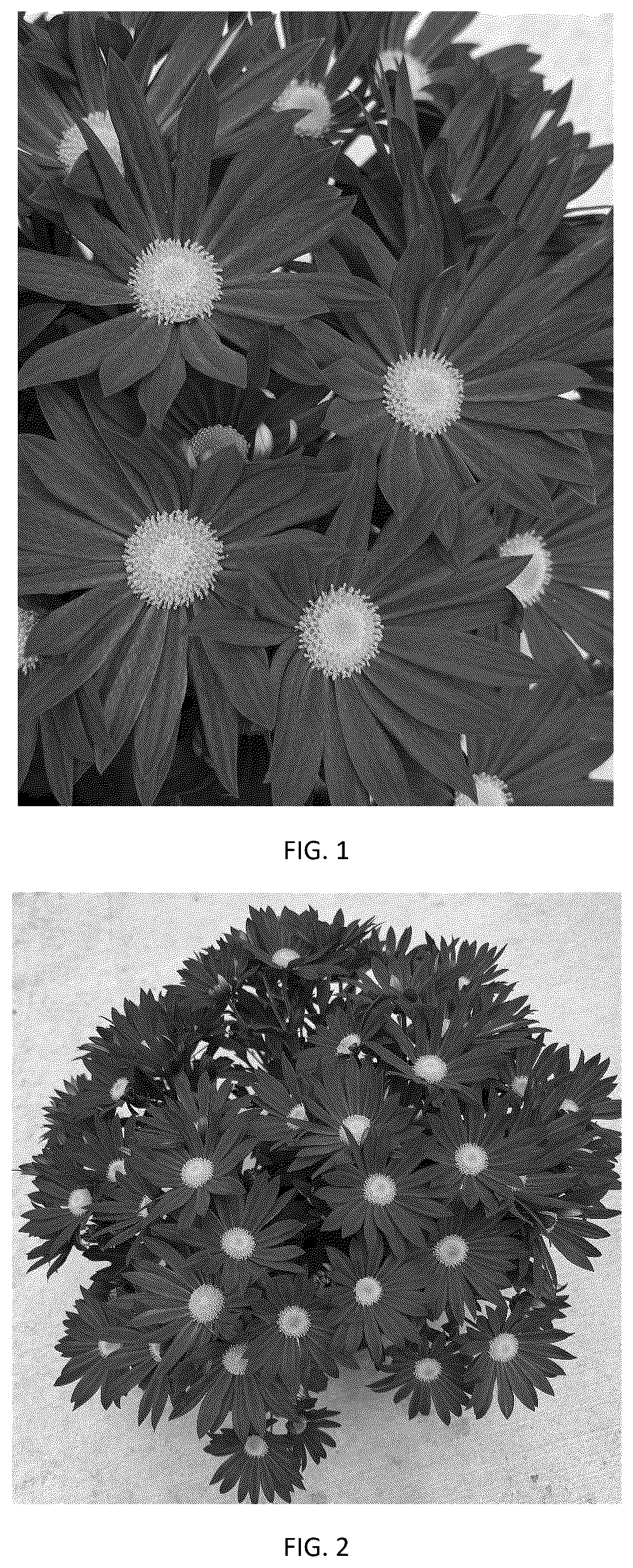
The accompanying photographic drawings show typical flower and foliage characteristics of ‘CIDZ0122’ with colors being as true as possible with an illustration of this type. The photographic drawings, taken in Gilroy, California in May 2025, show in a close-up view of the inflorescence of the new variety and in a whole flowering plant.
DETAILED BOTANICAL DESCRIPTION
The plant descriptions and measurements were taken indoors in Gilroy, California in May 2025 on about 11-week-old plants. Unrooted cuttings had been planted, 4 plants per pot, in 6 inch pots in February 2025. The plants were pinched and moved to short days in March 2025 to induce flowering.
Color references are made to The Royal Horticultural Society Colour Chart (R.H.S.) 2001.
TABLE 1
DIFFERENCES BETWEEN THE NEW VARIETY
‘CIDZ0122’ AND A MOST SIMILAR VARIETY:
‘Yorockport’, U.S. Plant
‘CIDZ0122’ Pat. No. 17,475
Flower size: About 1 cm larger About 1 cm smaller
Foliage size: More narrow Wider
Flowering response: 6-7 days faster 6-7 days slower
• Plant:
•
• Form, growth and habit .—Herbaceous pot-type, stems upright to moderately angled, freely branching, strong and medium growth habit. • Plant height.— 18.0 cm. • Plant height ( inflorescence included ).—24.0 cm. • Plant width.— 41.0 cm. • Roots:
•
• Number of days to initiate roots.— 4 days at about 22 degrees C. • Number of days to produce a rooted cutting.— 10-12 days at 22 degrees C. • Type .—Fine, fibrous, free branching. • Color .—RHS N155B but whiter. • Foliage:
•
• Arrangement .—Alternate. • Immature, leaf color, upper surface .—RHS 138A. • Lower surface .—RHS 139C. • Mature, leaf color, upper surface .—RHS 139A. • Lower surface .—RHS 138A. • Length.— 5.2-6.5 cm. • Width.— 4.5-5.8 cm. • Shape .—Ovate. • Base shape .—Attenuate. • Apex shape .—Mucronulate. • Margin .—Palmately lobed; irregularly incised, somewhat serrate. • Texture, upper surface .—Puberlulent. • Lower surface .—Puberlulent. • Color of veins, upper surface .—RHS 139D. • Color of veins, lower surface .—RHS 138A. • Pattern of veining .—Palmate. • Petiole color .—RHS 139A. • Length.— 1.8-3.0 cm. • Diameter.— 0.3-0.5 cm. • Texture .—Puberlulent. • Stem:
•
• Quantity of main branches per plant.— 4-5. • Color of stem .—RHS 138B. • Length of stem.— 10.5-13.0 cm. • Diameter.— 0.45-0.6 cm. • Length of internodes.— 0.8-1.7 cm. • Texture .—Puberlulent. • Color of peduncle .—RHS 138A. • Length of peduncle.— 4.6-9.2 cm. • Peduncle diameter.— 0.3 cm. • Texture .—Puberlulent. • Inflorescence:
•
• Type .—Compositae type, single-type inflorescences borne terminally above foliage, ray florets arranged acropetally on a capitulum. • Quantity of short days to flowering ( response time ).—7 weeks. • Natural season flowering .—Not determined for this variety. • Quantity of inflorescences per plant.— 22-27. • Lastingness of individual blooms on the plant.— 4 weeks. • Fragrance .—Slightly spicy. • Bud (just when opening/showing color):
•
• Color .—Closest to RHS 72A and RHS 155B. • Length.— 1.0 cm. • Width.— 1.1 cm. • Shape .—Oblate. • Immature inflorescence:
•
• Diameter.— 6.8 cm. • Color of ray florets, upper surface .—Closest to RHS 64A. • Lower surface .—RHS 186D. • Mature inflorescence:
•
• Diameter.— 8.8-10.0 cm. • Depth.— 2.8 cm. • Total diameter of disc.— 1.9 cm. • Receptacle color .—RHS 145B. • Receptacle height.— 0.4 cm. • Receptacle diameter.— 0.6 cm. • Ray florets:
•
• Average quantity of florets.— 21. • Color of florets, upper surface .—Closest to RHS 64A overlain with RHS 72A. • Lower surface .—RHS 186D and RHS 72B. • Length.— 3.6-4.7 cm. • Width.— 0.9-1.1 cm. • Shape .—Elliptical. • Apex shape .—Acute. • Margin .—Entire. • Texture, upper surface .—Papillose. • Lower surface .—Papillose. • Disc florets:
•
• Average quantity of florets.— 191. • Color of florets .—RHS 1D. • Length.— 0.6 cm. • Width.— 0.1 cm. • Shape .—Tubular, elongated. • Apex shape .—Acute, 5 pointed. • Phyllaries:
•
• Quantity .—Average 20. • Color, upper surface .—RHS 139B. • Lower surface .—RHS 139B. • Length.— 0.6-0.7 cm. • Width.— 0.3 cm. • Shape .—Lanceolate. • Apex shape .—Acute. • Base .—Fused. • Margins .—Entire; slightly papery. • Texture, upper surface .—Glabrous. • Lower surface .—Puberlulent. • Reproductive organs:
•
• Pistil.— 1, found on both types of florets. • Length.— 0.6 cm. • Style color .—RHS 150D. • Style length.— 0.5 cm. • Stigma color .—RHS 4B. • Stigma shape .—Bi-parted. • Ovary color .—RHS 155C but more translucent. • Stamens.— 4, found on only on the disc florets. • Color of filaments .—RHS 155C. • Length filaments.— 0.2 cm. • Anther color .—RHS 12A. • Anther length.— 0.15 cm. • Anther shape .—Oval. • Color of pollen .—RHS 13A. • Pollen amount .—Moderate. • Fertility/seed set .—Good pollen viability and seed set. • Disease/pest resistance .—Has not been observed to date.