Sansevieria Plant Named ‘CANDLELIGHT’
Abstract
A new and distinct cultivar of Sansevieria aubrytiana plant named ‘CANDLELIGHT’ particularly characterized by its variegated foliage with different irregular bands of light and dark, green and yellow color in the backside of the leaf blade. Supported in a rosette; 60-80 cm plant height; erect plant habit, moderate drought tolerance with low need for water and resistant to anthracnose ( Colletotrichum sansevieriae ) disease.
Claims (1)
1. A new and distinct Sansevieria plant named ‘CANDLELIGHT’, substantially as illustrated, and described herein.
Full Description
Show full text →
Latin name of the genus and species of the claimed plant: Sansevieria aubrytiana.
Variety denomination:
BACKGROUND OF THE INVENTION
The present invention relates to a new and distinct cultivar of Sansevieria plant, botanically known as Sansevieria aubrytiana , of the family Asparagaceae, hereinafter referred to by the cultivar name ‘CANDLELIGHT’.
Sansevieria is a monocotyledonous flowering plant which can be produced in either hard-leafed or soft-leafed varieties for interior use as a house plant or outdoors ornamental plant.
The new Sansevieria ‘CANDLELIGHT’, originated from a naturally occurring mutation of the Sansevieria ‘Lauren’ (U.S. Plant Pat. No. 29,489 P2). The new Sansevieria ‘CANDLELIGHT’ was discovered and selected by the inventor, Marvin Gonzalez Villegas, as a single sprouting rare, mutation in a ‘Lauren’ plantation in a controlled environment in Monterrey, San Carlos, Alajuela Province, Costa Rica.
Asexual reproduction of the new Sansevieria cultivar by vegetative cuttings was first performed in July 2019 in Monterrey, San Carlos, Alajuela Province, Costa Rica, and has demonstrated that the combination of characteristics as herein disclosed for the new cultivar are firmly fixed and retained through successive generations of asexual reproduction. The new cultivar reproduces true to type.
BRIEF SUMMARY OF THE INVENTION
The following traits have been repeatedly observed and are determined to be unique characteristics of ‘CANDLELIGHT’, which in combination distinguish this Sansevieria as a new and distinct cultivar:
•
• 1. Variegated foliage with different green tones on the irregular bands and light and dark, green and yellow colored irregular bands in the backside of the leaf blade. • 2. Wide and lanceolate leaves, 60-80 cm and supported in a rosette disposition. • 3. 60-80 cm plant height. • 4. Plant habit: Erect. • 5. Needs little water and is moderately drought tolerant.
The new variety ‘CANDLELIGHT’ presents an average of 4-5 leaves per plant when it reaches its maturity (between 6-10 months). The new variety has an erect growth habit, and the entire plant can reach a height between 60-75 cm. The leaves are narrow, 5-6 cm (average measured at the widest part of the mature leaf) and lanceolate with a soft waxy texture. The plant has a cylindrical shape.
The new variety is moderately drought tolerant, adapts to conditions of light and shade, and shows resistance to anthracnose ( Colletotrichum sansevieria ) disease.
Plants of the new Sansevieria ‘CANDLELIGHT’ differ from plants of the parental cultivar, ‘Lauren’ (U.S. Plant Pat. No. 29,489 P2) in the characteristics described in Table 1.
TABLE 1
Comparison with Parental Varieties
Comparison
Parent Plant
‘Lauren’ ‘Yellowstone’
Charac- New Cultivar (U.S. Plant Pat. (U.S. Plant Pat.
teristic ‘CANDLELIGHT’ No. 29,489 P2) No. 31,361 P2)
Plant Less vigor More vigor Less vigor (less
Vigor (less leaves). (more leaves). leaves).
Color Variegated leaves Variegated leaves Variegated leaves
with different (different green with different
irregular bands and tones on green tones on
light and dark, the irregular the irregular
green and yellow bands). bands and light
colored irregular green tones on
bands in the the stripes along
backside of the the margins.
leaf blade.
Shape Wide and Wide and Wide and
lanceolate leaves lanceolate leaves lanceolate leaves
in a rosette. in a rosette. in a rosette.
Texture Smooth-textured Smooth-textured Smooth-textured
of leaves, sharp, leaves. leaves, smooth
leaves slightly sinuate margins.
margins.
Of the many commercial cultivars known to the present inventor, the most similar in comparison to the new Sansevieria ‘CANDLELIGHT’ is its parent, Sansevieria ‘Lauren’ (U.S. Plant Pat. No. 29,489 P2) in the characteristics described in Table 1.
BRIEF DESCRIPTION OF THE PHOTOGRAPHS
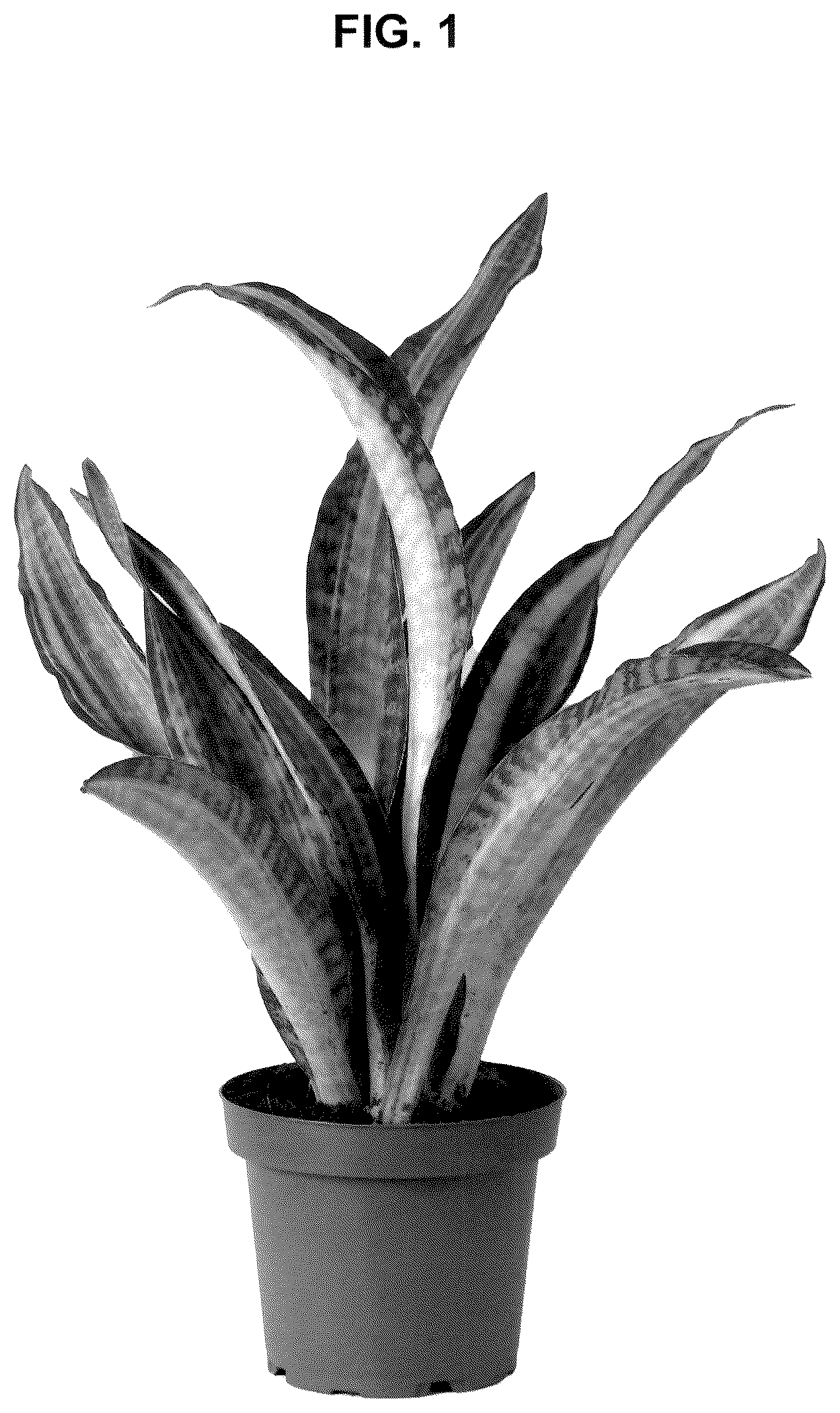
The accompanying photographs illustrate the overall appearance of the new Sansevieria cultivar ‘CANDLELIGHT’ showing the colors as true as is reasonably possible with colored reproductions of this type. Colors in the photographs may differ slightly from the color value cited in the detailed botanical description which accurately describe the color of ‘CANDLELIGHT’.
—Shows a side view of a six-month old plant of Sansevieria ‘CANDLELIGHT’ in a 26 cm diameter pot.
—Shows a pot down view of a typical six-month-old plant of Sansevieria ‘CANDLELIGHT’.
—Shows a close-up view of the typical leaves of Sansevieria ‘CANDLELIGHT’ from a six-month old plant (upper side—A, under side—B).
DETAILED BOTANICAL DESCRIPTION
The new Sansevieria ‘CANDLELIGHT’ has not been observed under all possible environmental conditions. The phenotype of the new cultivar may vary with variations in environment such as temperature, light intensity, and day length without any change in the genotype of the plant.
The photographs, together with the following observations, measurements and values describe the new Sansevieria cultivar ‘CANDLELIGHT’ as grown in open field conditions in Monterrey, San Carlos, Alajuela province, Costa Rica, which closely approximate those generally used in commercial practice. ‘CANDLELIGHT’ was grown in tropical lowlands in Costa Rica with day lengths of 12 to 13 hours and ambient temperature to 85 degrees. The level of relative humidity was 80%. No supplementary artificial light is necessary.
This crop does not require constant fertilization, to increase production per area about 200 kg ha−1 N, 150 kg ha−1 of P and 100 kg-ha K are required, the production is closely related with soil conditions in which they are grown.
Color references are made to The Royal Horticultural Society Colour Chart (R.H.S. 2018), except where general colors of ordinary significance are used. The photographs and descriptions were taken during the rainy season in Monterrey, San Carlos, Alajuela province, Costa Rica, with outdoor day temperatures of 24.5° C. during the day and 18° C. at night. The age of the plants described is 8 months.
• Classification:
•
• Botanical.—Sansevieria aubryitiana. • Variety denomination .—‘CANDLELIGHT’. • Parentage: Sansevieria aubryitiana ‘Lauren’ (U.S. Plant Pat. No. 29,489 P2). • Optimal growth conditions:
•
• Light intensities .—High adaptability to outdoor or indoor conditions. • Temperature .—Day: 24° C. to 32° C. Night: 18° C. to 23° C. • Temperature tolerance .—Tolerant to a low temperature of about 12° C. and tolerant to a high temperature of about 35° C. • Fertilization.— 200, 150 and 100 kg ha −1 of N, P and K. • Growth regulators .—Not necessary. • Propagation:
•
• Type .—Vegetative, by rooted cuttings. • Rooting habit and description .—Rhizomes, with short roots. • Time to initiate roots .—About 12 to 22 days at 20-25° C. • Time to produce a rooted cutting .—About 15 to 22 days at 20-22° C. • Plant:
•
• General appearance and form.— • Height .—About 75 cm when grown in ground. about 60 cm when grown in a 26 cm size container. • Spread .—About 15 cm when grown in ground. About 12 cm when grown in 26 cm size container. • Form .—Monocot; leaf bases arranged in a rosette around growth point. • Shape .—Cylindrical. • Growth rate and habit .—About 2 cm per week; upright. • Fragrance .—None. • Stem .—Modified (rhizome and foliage) — Length: About 12 cm when grown in ground. About 8 cm when grown in 21 cm size container. Diameter: About 3.0 cm to 4.0 cm. Shape: round. Texture: rough. Color: RHS 4D. Strength: Strong and durable. Internode length: About 0.6 mm to 0.8 mm. • Foliage:
•
• Quantity .—About 5-7 leaves. • Arrangement and attachment .—Single, alternate; leaf bases arranged in a rosette around growth point. • Leaf length .—About 30 cm. • Leaf width .—About 9 cm. • Overall shape of leaf .—Lanceolate. • Apex shape .—Acute, triangular. • Base shape .—Plane. • Margin .—Sharp, slightly sinuate. • Texture .—Upper Surface: smooth and waxy texture. Under Surface: smooth and waxy texture. • Pubescence .—Upper Surface: none. Lower Surface: none. • Color of mature leaf .—Upper Surface: RHS 150 A (vertical striations) and RHS 141 A (along the margins). Lower Surface: RHS 150 A (vertical striations) and RHS 141 A (along the margins). • Color of immature leaf .—Upper Surface: RHS 150 A (vertical striations) and RHS 141 A (along the margins). Lower Surface: RHS 150 A (vertical striations) and RHS 141 A (along the margins). • Venation .—Pattern: longitudinal/parallel leaf shape. Color: none. • Leaf fragrance .—None. • Inflorescence description:
•
• Arrangement and type .—Inflorescence. • Orientation at opening .—Outward orientation regarding the spile. • Quantity .—Per Plant with at least one open flower: About 60 at 2 weeks. • Inflorescence size .—Length: About 35 cm. Diameter: About 1.2 cm. • Flower size .—Length: About 6 cm. Diameter: About 0.5 cm. Depth: About 0.5 cm. • Fragrance .—None. • Bud.— • Rate of opening .—About 7 to 8 days, according to weather. • Shape .—Ovoid. • Length .—About 2 cm. • Diameter .—About 1 cm. • Color .—Apex: RHS 149 B. Base: RHS 142 B. • Texture ( both surfaces ).—Smooth. • Reproductive organs:
•
• Androecium .—Stamen: Number: 6 per flower. Length: About 1.2 mm. Color: RHS 150 D. Anther: Length: About 4 mm. Width: About 1 mm. Color: RHS 150 D. Filament: Length: About 1.3 mm. Color: RHS 150 D. Pollen: Amount: moderate. Color: RHS 150D. • Gynoecium .—Pistil: Number: One per flower. Length: About 1.5 mm. Stigma: Length: About 0.5 mm. Width: About 1 mm. Color: RHS 150 D. Style: Length: About 20 mm. Color: RHS 150 D. Ovary: Length: About 5 mm. Width: About 4 mm. Color: RHS 143 A. • Weather resistance: Moderately Drought Tolerant. • Disease/pest resistance: High resistance to anthracnose ( Colletotrichum sansevierae ). • Disease/pest susceptibility: Not observed so far.
Figures (3)
Citations
This patent cites (2)
- USPP29489
- USPP31361