Abstract
A new and distinct x Aristeria plant named ‘OVROCKS17’ which is characterized by thin lanceolate foliage, with a transparent greyed-green mucronate tip, grown in a compact basal rosette with secondary shoots with greyed-green, serrate to dentate margins. Greyed-green to yellow-green foliage that is moderately to densely covered with greyed-green protuberances, and greyed-green spines on the top one-third of the midrib on the abaxial surface. The new variety has shown to be uniform and stable in the resulting generations from asexual propagation.
Claims (1)
1. A new and distinct variety of x Aristeria plant named ‘OVROCKS17’, substantially as described and illustrated herein.
Full Description
Show full text →
Latin name of the genus and species: The Latin name of the genus and species of the novel variety disclosed herein is x Aristeria nowotnyi. Variety denomination:
The inventive variety of x Aristeria disclosed herein has been given the variety denomination ‘OVROCKS17’.
CROSS REFERENCE TO RELATED APPLICATIONS
This application claims priority to the Community Plant Variety Rights application number 2024/2739, filed on Nov. 22, 2024, which is herein incorporated by reference.
BACKGROUND OF THE INVENTION
Parentage: ‘OVROCKS17’ is a seedling selection resulting from the controlled pollination of an unnamed Gasteria hybrid plant (unpatented), the seed parent, with an unnamed Aristaloe aristata plant (unpatented), the pollen parent. The crossing was made by the inventor in 2018 at a commercial greenhouse in Bleiswijk, the Netherlands. In early 2019, one seedling from said cross was observed to exhibit unique foliage and growth characteristics when compared to the parent plants and all other progenies. After confirming the stability of the unique characteristics first observed, the new plant was selected for commercialization and given the name, ‘OVROCKS17’.
Asexual Reproduction: ‘OVROCKS17’ was first asexually propagated by leaf cuttings in the summer of 2019 at a greenhouse in Bleiswijk, The Netherlands. Through subsequent generations, the unique features of this cultivar are stable and reproduced true to type.
SUMMARY OF THE INVENTION
The cultivar ‘OVROCKS17’ has not been observed under all possible environmental conditions. The phenotype may vary somewhat with variations in environment such as temperature, day length, and light intensity, without, however, any variance in genotype. The following traits have been repeatedly observed and are determined to be the unique characteristics of ‘OVROCKS17’. These characteristics in combination distinguish ‘OVROCKS17’ as a new and distinct x Aristeria cultivar:
•
• 1. ‘OVROCKS17’ exhibits thin lanceolate foliage, with a transparent greyed-green mucronate tip; and • 2. ‘OVROCKS17’ exhibits a compact basal rosette growth habit with secondary rosettes eventually developing at the base of the primary rosette; and • 3. ‘OVROCKS17’ exhibits greyed-green to yellow-green foliage that is moderately to densely covered with greyed-green protuberances that are randomly arranged on the adaxial leaf surface; and • 4. ‘OVROCKS17’ exhibits succulent foliage that is densely covered with greyed- green protuberances that are irregularly arranged in transverse horizontal rows on the abaxial leaf surface along with spines on the top one-third of the midrib; and • 5. ‘OVROCKS17’ exhibits finely serrate to dentate margins with greyed-green teeth.
BRIEF DESCRIPTION OF THE FIGURES
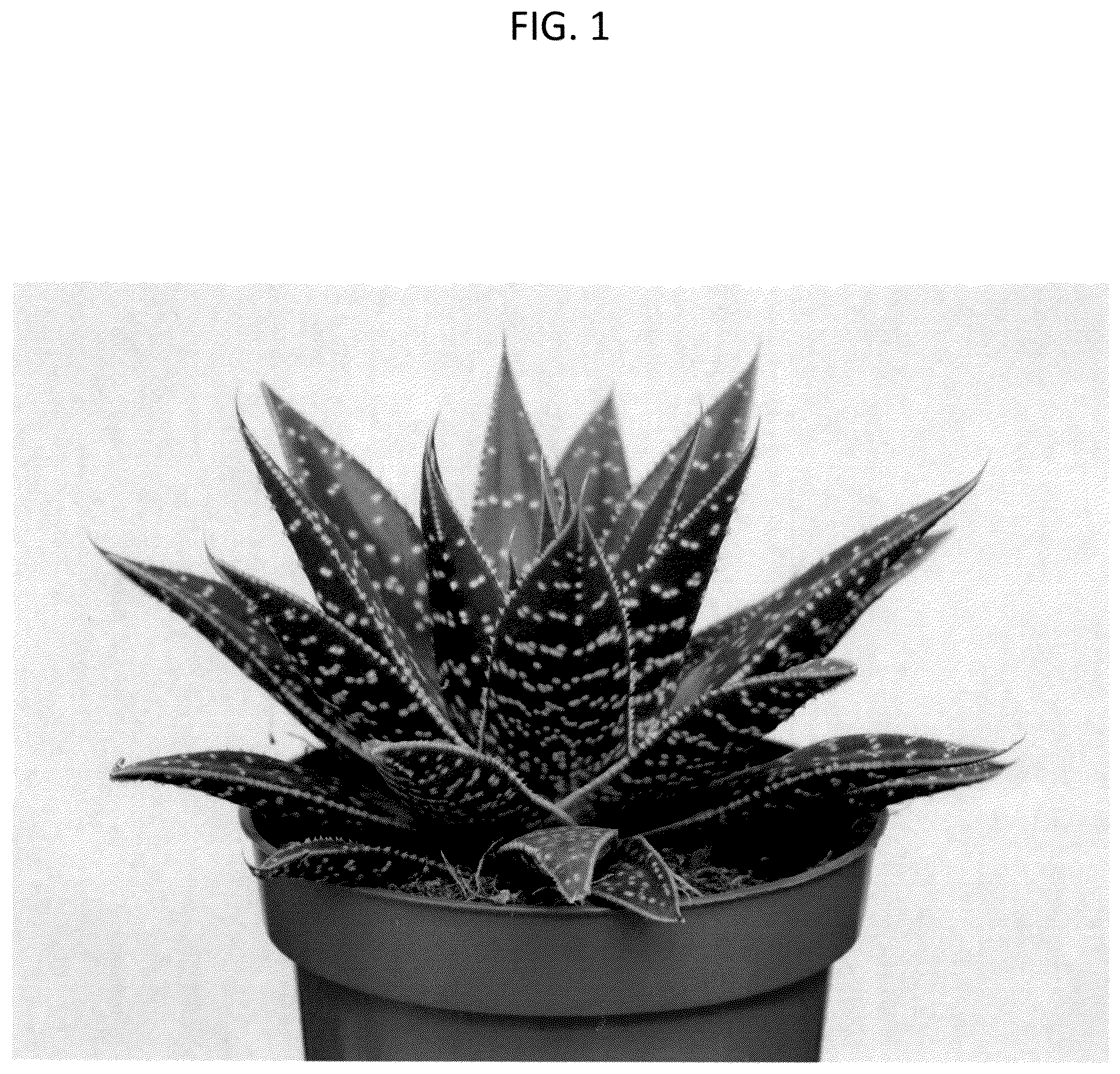
illustrates, as nearly true as it is reasonably possible to make the same in color photographs of this type, an exemplary plant of ‘OVROCKS17’ grown in a commercial greenhouse in Bleiswijk, the Netherlands. This plant is approximately 36-month-old, shown planted in a 12 cm container.
illustrates, as nearly true as it is reasonably possible to make the same in color photographs of this type, the typical foliage arrangement of ‘OVROCKS17’.
illustrates, as nearly true as it is reasonably possible to make the same in color photographs of this type, the adaxial surface of the mature foliage ‘OVROCKS17’.
illustrates, as nearly true as it is reasonably possible to make the same in color photographs of this type, the abaxial surface of the mature foliage ‘OVROCKS17’.
BOTANICAL DESCRIPTION OF THE PLANT
The following observations and measurements made in November of 2024 describe averages from a sample set of six specimens of 36-month-old ‘OVROCKS17’ plants grown in 12 cm nursery containers at a commercial greenhouse in Bleiswijk, the Netherlands. Plants were produced using conventional greenhouse production protocols for x Aristeria which consisted of minimal overhead irrigation and fertilizer applications. No pest or disease control measures were utilized in production. No photoperiodic treatments or artificial light was given to the plants.
Those skilled in the art will appreciate that certain characteristics will vary with older or, conversely, with younger plants. ‘OVROCKS17’ has not been observed under all possible environmental conditions. Where dimensions, sizes, colors and other characteristics are given, it is to be understood that such characteristics are approximations or averages set forth as accurately as practicable. The phenotype of the variety may differ from the descriptions set forth herein with variations in environmental, climatic and cultural conditions. Color notations are based on The Royal Horticultural Society Colour Chart , The Royal Horticultural Society, London, Sixth Edition.
A botanical description of ‘OVROCKS17’ and a comparison with the parent plants and closest known comparator is provided below.
• Plant description:
•
• Growth habit .—Succulent perennial with foliage growing in a compact basal rosette; as plants age, secondary rosettes develop at the base of the primary rosette. • Plant form .—Globular. • Height from soil level to top of foliar plane.— 9.5 cm. • Plant spread .—Average of 17.0 cm. • Propagation .—Type — Leaf cuttings. Time to initiate rooting — Approximately 5 weeks at an approximate temperature of 21 degrees Celsius. Crop time — Approximately 1 year to produce a marketable plant in a 9 cm container. • Disease and pest resistance or susceptibility .—Neither resistance nor susceptibility to typical x Aristeria pests and diseases has been observed. • Environmental tolerances .—Adapt to, at least, USDA Zones 10 to 12 and temperatures as high as 40 degrees Celsius; moderate tolerance to rain yet drought tolerant once established; high tolerance to wind. • Root system:
•
• General .—Fine, well-branched fibrous roots. • Stems:
•
• Branching habit .—No stems or branches; leaves arranged in a basal rosette. • Foliage:
•
• Arrangement .—Spirally arranged in a basal rosette. • Division .—Simple. • Attachment .—Sessile. • Quantity .—Approximately 36 leaves per rosette. • Shape .—Lanceolate, succulent leaves. • Dimensions.— 8.7 cm long, 2.8 cm wide, and 0.9 cm thick. • Aspect .—Very slightly concave. • Attitude .—Foliage is held upright at and near the center of the rosette and becomes progressively more relaxed towards the outer whorls of foliage, at an average angle of 40 degrees from horizontal; lamina is very slightly curled downward with the distal portion at and near the apex being slightly curled upward at a 60 degrees from the lamina. • Apex .—Narrow acute, with a soft mucronate tip. • Base .—Broad cuneate. • Margin .—Finely serrate to dentate; teeth have an average length of 0.8 cm and are colored greyed-green, nearest to RHS 192C and 192D. Margins are not undulated or lobed. • Pubescence and texture of the adaxial surface .—Coriaceous, and moderately covered with small, round protuberances that are irregularly arranged on the leaf surface; protuberances are approximately 0.1 cm in diameter and gradually become more raised distally from the point of attachment ultimately becoming 0.3 mm in height. • Pubescence and texture of the abaxial surface .—Coriaceous, and densely covered with small, round protuberances that are irregularly arranged on the leaf surface in transverse longitudinal rows; protuberances are approximately 0.15 mm in diameter and gradually become more raised distally from the point of attachment ultimately becoming 0.3 mm in height; prominent greyed-green, nearest to RHS 193B, protuberances along the top one-third of the midrib appear to be 0.5 mm. • Luster of the adaxial surface .—Slightly glossy. • Luster of the abaxial surface .—Slightly glossy. • Color .—Juvenile foliage, adaxial surface — Green, nearest to RHS NN137C, and fading to yellow-green towards the base, nearest to RHS 152D; the mucronate tip of the lamina is transparent greyed-green, nearest to 193A. Protuberances are colored greyed-green, nearest to RHS 193B. Juvenile foliage, abaxial surface — Green, nearest to RHS NN137C, and fading to yellow-green towards the base, nearest to RHS 151A; the mucronate tip of the lamina is transparent greyed-green, nearest to 193A. Protuberances are colored greyed-green, nearest to RHS 192A. Mature foliage, adaxial surface — In between a mixture of greyed-green and yellow-green, nearest to a blend of RHS 147A and N189A, and fading to greyed-green towards the base, nearest to RHS 191B; the mucronate tip of the lamina is transparent greyed-green, nearest to RHS 192B. Protuberances are colored greyed-green, nearest to RHS 193B. Mature foliage, abaxial surface — In between a mixture of greyed-green and yellow-green, nearest to a blend of RHS 147A and N189A and fading green towards the base, nearest to RHS 143A; the mucronate tip of the lamina is transparent greyed-green, nearest to RHS 192B. Protuberances are colored greyed-green, nearest to RHS 192A. • Venation .—Pattern — No venation is visible. Color, adaxial surface — No venation is visible. Color, abaxial surface — No venation is visible. • Petiole .—No petiole; leaves are sessile. • Inflorescence: No flowering has been observed to date.
COMPARISONS WITH THE PARENT PLANTS
Plants of the new cultivar ‘OVROCKS17’ differ from the seed parent, an unnamed Gasteria hybrid plant (not patented), in the following characteristics described in Table 1 below.
TABLE 1
Comparison Between ‘OVROCKS17’ and The Seed Parent.
Characteristic ‘OVROCKS17’ The Seed Parent
Abundance of More abundant than the Less abundant than
foliage. seed parent, on average ‘OVROCKS17’.
36 leaves.
Foliage Foliage is more concave Foliage is less concave
aspect and and arranged in a more than ‘OVROCKS17’,
arrangement. upright position, closer arranged in a relaxed,
to vertical, than the seed near horizonal position.
parent.
Foliage shape. Thin lanceolate foliage Thicker and broader
with narrow acute apices lanceolate succulent
and a mucronate tip. foliage than
‘OVROCKS17’ with
obtuse apices.
Plants of the new cultivar ‘OVROCKS17’ differ from the pollen parent, an unnamed Aristaloe aristata plant (not patented), in the following characteristics described in Table 2 below.
TABLE 2
Comparison Between ‘OVROCKS17’ and The Pollen Parent.
Characteristic ‘OVROCKS17’ The Pollen Parent
General Greyed-green to Lighter shade of green
coloration of the yellow-green foliage. than ‘OVROCKS17’.
mature foliage.
Foliage shape Lanceolate succulent Lanceolate succulent
and abundance. foliage that is thicker foliage that is thinner
and broader than than ‘OVROCKS17’.
the pollen parent.
Abundance and Less leaves that rest More leaves in a tighter
attitude of more relaxed than compact basal rosette
foliage. the pollen parent. than ‘OVROCKS17’.
COMPARISONS WITH THE CLOSEST KNOWN COMPARATOR
Plants of the new cultivar ‘OVROCKS17’ differ from the closest known commercial comparator, the Gasteria plant called ‘D Blue Moon’ (Community Plant Variety Rights application number 2023/1913) in the following characteristics described in Table 3 below.
TABLE 3
Comparison Between ‘OVROCKS17’ and ‘D Blue Moon’
Characteristic ‘OVROCKS17’ ‘D BLUE MOON’
General Lanceolate succulent Ovate succulent foliage
thickness of foliage that is thinner that is thicker on
foliage. on average than average than
‘D Blue Moon’. ‘OVROCKS17’.
Leaf margins. ‘OVROCKS17’ has ‘D Blue Moon’ has less
an abundance of prominent, smaller,
prominent greyed- serrate margins
green finely serrate when compared to
to dentate teeth which ‘OVROCKS17’.
are evenly distributed
along the leaf margins.
Abundance of 36 leaves per rosette More leaves per rosette
secondary with less secondary with more secondary
basal rosettes. basal rosettes than basal rosettes than
‘D Blue Moon’. ‘OVROCKS17’.
Prominence Less prominent than More prominent than
of leaf ‘D Blue Moon’. ‘OVROCKS17’.
protuberances.