Abstract
A display apparatus including a first thin-film transistor (TFT) including a first semiconductor layer including a silicon semiconductor; a second TFT including a second semiconductor layer including an oxide semiconductor; a first shielding layer configured to overlap the first TFT and positioned between a substrate and the first TFT; and a second shielding layer configured to overlap the second TFT and positioned between the substrate and the second TFT.
Claims (20)
1 . A display apparatus comprising a first pixel and a second pixel in display area, each of the first pixel and the second pixel comprising: a driving transistor comprising a first semiconductor layer comprising a silicon and a first gate electrode; a first switching transistor comprising a second semiconductor layer comprising a silicon and a second gate electrode; a second switching transistor comprising a third semiconductor layer comprising an oxide and a third gate electrode; a first capacitor comprising a first electrode and a second electrode; a first shielding layer overlapping the driving transistor, the first shielding layer interposed between a substrate and the first semiconductor layer; and a second shielding layer overlapping the second switching transistor, the second shielding layer interposed between the substrate and the third semiconductor layer, wherein the first electrode of the first capacitor is a part of a scan line connected to the second gate electrode, and the second electrode of the first capacitor is a part of the third semiconductor layer.
12 . A display apparatus comprising a first pixel and a second pixel in display area, each of the first pixel and the second pixel comprising: a driving transistor comprising a first semiconductor layer comprising silicon and a first gate electrode; a first switching transistor comprising a second semiconductor layer comprising an oxide and a second gate electrode; a first shielding layer overlapping the driving transistor, the first shielding layer interposed between a substrate and the first semiconductor layer; a second shielding layer overlapping the first switching transistor, the second shielding layer interposed between the substrate and the second semiconductor layer; a second connecting electrode on the second gate electrode and connected to the first semiconductor layer and the second semiconductor layer; and a first connecting electrode on the second gate electrode and connected to the first gate electrode and the second semiconductor layer, wherein a part of the first connection electrode overlaps the first shielding layer in a plan view, and the second shielding layer of the first pixel and the second shielding layer of the second pixel are one body.
17 . A display apparatus comprising a first pixel and a second pixel in display area, each of the first pixel and the second pixel comprising: a driving transistor comprising a first semiconductor layer comprising a silicon and a first gate electrode; a first switching transistor comprising a second semiconductor layer comprising an oxide and a second gate electrode; a second switching transistor comprising a third semiconductor layer comprising a silicon and a third gate electrode; a first shielding layer overlapping the driving transistor, the first shielding layer interposed between a substrate and the first semiconductor layer; a second shielding layer overlapping the first switching transistor, the second shielding layer interposed between the substrate and the second semiconductor layer; and a control line connected to the third gate electrode of the second switching transistor, wherein the control line overlaps the first shielding layers of the first pixel and the second pixel.
Show 17 dependent claims
2 . The display apparatus of claim 1 , further comprising a first connecting electrode connected to the first gate electrode and the third semiconductor layer in each of the first pixel and the second pixel.
3 . The display apparatus of claim 2 , wherein at least one of the first electrode and the second electrode of the first capacitor overlaps the first connecting electrode.
4 . The display apparatus of claim 2 , wherein the first capacitor overlaps the second shielding layer.
5 . The display apparatus of claim 1 , wherein the second shielding layer of the first pixel and the second shielding layer of the second pixel are one body.
6 . The display apparatus of claim 1 , wherein a same voltage is applied to the third gate electrode and the second shielding layer.
7 . The display apparatus of claim 1 , further comprising a second connecting electrode connected to the first semiconductor layer and the third semiconductor layer in each of the first pixel and the second pixel.
8 . The display apparatus of claim 7 , further comprising a third switching transistor comprising a fourth semiconductor layer comprising a silicon and a fourth gate electrode.
9 . The display apparatus of claim 8 , further comprising a control line connected to the fourth gate electrode of the third switching transistor, the control line overlaps the first shielding layer.
10 . The display apparatus of claim 1 , further comprising a power line overlapping first shielding layers and second shielding layers of the first pixel and the second pixel.
11 . The display apparatus of claim 1 , wherein the scan line and the second gate electrode are one body.
13 . The display apparatus of claim 12 , further comprising a power line overlapping first shielding layers and second shielding layers of the first pixel and the second pixel.
14 . The display apparatus of claim 12 , wherein each of the first pixel and the second pixel further comprises a capacitor overlapping the driving transistor.
15 . The display apparatus of claim 14 , wherein the capacitor comprises a first electrode and a second electrode, and the second electrode of the capacitor and the second shielding layer are disposed on the same layer.
16 . The display apparatus of claim 14 , wherein a layer on which the first shielding layer is disposed and a layer on which the second shielding layer is disposed are different from each other.
18 . The display apparatus of claim 17 , wherein a same voltage is applied to the second gate electrode and the second shielding layer.
19 . The display apparatus of claim 17 , wherein the control line and the third gate electrode are one body.
20 . The display apparatus of claim 19 , further comprising a third switching transistor comprising a fourth semiconductor layer comprising a silicon and a fourth gate electrode, wherein the second semiconductor layer and the fourth semiconductor layer are one body.
Full Description
Show full text →
CROSS-REFERENCE TO RELATED APPLICATION
This is a continuation application of U.S. patent application Ser. No. 18/138,870, filed Apr. 25, 2023, now U.S. Pat. No. 12,048,208, which issued Jul. 23, 2024, the disclosure of which is incorporated herein by reference in its entirety. U.S. patent application Ser. No. 18/138,870 is a continuation application of U.S. patent application Ser. No. 17/199,890, filed Mar. 12, 2021, now U.S. Pat. No. 11,659,738, which issued May 23, 2023, the disclosure of which is incorporated herein by reference in its entirety. U.S. patent application Ser. No. 17/199,890 is a continuation application of U.S. patent application Ser. No. 16/365,757, filed Mar. 27, 2019, now U.S. Pat. No. 10,978,538, which issued Apr. 13, 2021, the disclosure of which is incorporated herein by reference in its entirety. U.S. patent application Ser. No. 16/365,757 claims priority to and benefits of Korean Patent Application No. 10-2018-0107379 under 35 U.S.C. § 119, filed Sep. 7, 2018, in the Korean Intellectual Property Office, the entire contents of which are incorporated herein by reference.
BACKGROUND
Field
Exemplary embodiments of the invention relate generally to a display apparatus.
Discussion of the Background
Display apparatuses, such as organic light-emitting display apparatuses, liquid crystal display (LCD) apparatuses, and the like, include an array substrate including a thin-film transistor (TFT), a capacitor, and a plurality of wirings. The array substrate includes fine patterns, such TFTs, capacitors, and wirings, and such a display apparatus is driven by complicated connections between the TFT, the capacitor, and the wirings.
As demand for display apparatuses having compact sizes and high resolution has increased, demand for efficient space arrangement between the TFT, the capacitor, and the wirings of the display apparatus, a connection structure thereof, a driving method, and quality improvement of a realized image is also increasing.
The above information disclosed in this Background section is only for understanding of the background of the inventive concepts, and, therefore, it may contain information that does not constitute prior art.
SUMMARY
Devices constructed according to exemplary implementations of the invention disclose a display apparatus including a transistor with an improved characteristics.
Additional features of the inventive concepts will be set forth in the description which follows, and in part will be apparent from the description, or may be learned by practice of the inventive concepts.
According to one or more embodiments, a display apparatus includes: a first thin-film transistor (TFT) (e.g., T 1 discussed with reference to drawings) including a first semiconductor layer including a silicon semiconductor; a second TFT (e.g., T 3 discussed with reference to drawings) including a second semiconductor layer including an oxide semiconductor, one end of the second semiconductor layer being connected to one end of the first semiconductor layer of the first TFT and the other end of the second semiconductor layer being connected to a gate electrode of the first TFT; a first shielding layer configured to overlap the first TFT, the first shielding layer interposed between a substrate and the first TFT; and a second shielding layer configured to overlap the second TFT, the first shielding layer interposed between the substrate and the second TFT.
The first shielding layer and the second shielding layer may be positioned on the same layer.
The first shielding layer and the second shielding layer may be positioned on different layers.
The second shielding layer may be positioned on the same layer as the first semiconductor layer.
The second shielding layer may be positioned on the same layer as a gate electrode of the first TFT.
The display apparatus may further include a capacitor overlapping the first TFT, wherein the second shielding layer may be positioned on the same layer as one electrode of the capacitor.
The display apparatus may further include a capacitor overlapping the second shielding layer and positioned between the second shielding layer and the second TFT.
One electrode of the capacitor may be positioned on the same layer as one of the first semiconductor layer of the first TFT and a gate electrode of the first TFT overlapping a channel region of the first semiconductor layer.
The display apparatus may further include at least one of: a first touch sensor overlapping the first TFT; and a second touch sensor overlapping the second shielding layer and positioned between the second shielding layer and the substrate.
The first shielding layer may be electrically connected to a power line for applying a power voltage.
The first shielding layer may be electrically connected to a power line for applying an initialization voltage.
The first shielding layer may be electrically connected to the first semiconductor layer.
The first shielding layer may be electrically connected to a gate electrode of the first TFT.
The second shielding layer may be electrically connected to a power line for applying an initialization voltage.
The second shielding layer may be electrically connected to the gate electrode of the second TFT.
The first TFT may be a driving transistor, and the second TFT may be a switching transistor.
The first TFT may be a switching transistor, and the second TFT may be a driving transistor.
According to one or more embodiments, a display apparatus includes: a first thin-film transistor (TFT) including a first semiconductor layer including a silicon semiconductor; a second TFT including a second semiconductor layer including an oxide semiconductor; a capacitor overlapping the first TFT; a first shielding layer overlapping the first TFT, the first shielding layer interposed between a substrate and the first TFT; and a second shielding layer overlapping the second TFT, the second shielding layer interposed between the substrate and the second TFT.
The same voltage may be applied to the first shielding layer and the second shielding layer.
Different voltages may be applied to the first shielding layer and the second shielding layer.
It is to be understood that both the foregoing general description and the following detailed description are exemplary and explanatory and are intended to provide further explanation of the invention as claimed.
BRIEF DESCRIPTION OF THE DRAWINGS
The accompanying drawings, which are included to provide a further understanding of the invention and are incorporated in and constitute a part of this specification, illustrate exemplary embodiments of the invention, and together with the description serve to explain the inventive concepts.
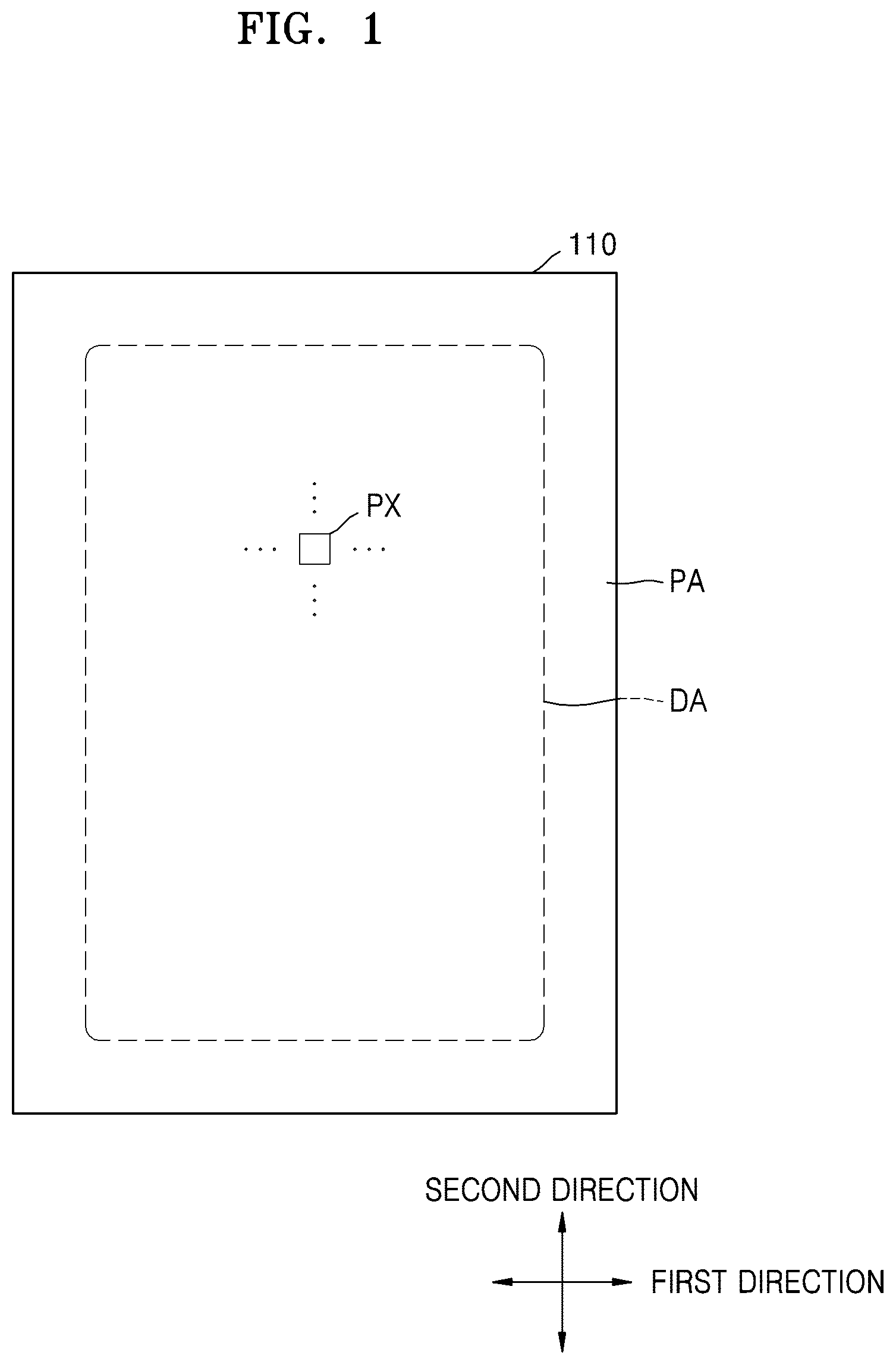
is a plan view schematically illustrating a display apparatus according to an exemplary embodiment.
A, 2 B, 2 C, and 2 D are cross-sectional views illustrating a pixel structure constructed according to an exemplary embodiment.
A, 3 B, and 3 C are cross-sectional views illustrating a pixel structure constructed according to another exemplary embodiment.
A, 4 B, and 4 C are cross-sectional views illustrating a pixel structure constructed according to another exemplary embodiment.
is a cross-sectional view illustrating a pixel structure constructed according to another exemplary embodiment.
A, 6 B, and 6 C are cross-sectional views illustrating a pixel structure constructed according to another exemplary embodiment.
is an equivalent circuit diagram of pixels illustrated in according to an exemplary embodiment.
is a view schematically illustrating a pixel arrangement according to an exemplary embodiment.
is a layout view schematically illustrating transistors and capacitors of pixels illustrated in , according to an exemplary embodiment.
is a cross-sectional view taken along sectional lines I-I′ and II-II′ of ;
is a layout view schematically illustrating transistors and capacitors of pixels illustrated in , according to another exemplary embodiment.
is a cross-sectional view taken along sectional lines III-III′ and IV-IV′ of .
is a layout view schematically illustrating transistors and capacitors of pixels illustrated in , according to another exemplary embodiment.
is a cross-sectional view taken along sectional lines V-V′ and VI-VI′ of .
DETAILED DESCRIPTION
In the following description, for the purposes of explanation, numerous specific details are set forth in order to provide a thorough understanding of various exemplary embodiments or implementations of the invention. As used herein “embodiments” and “implementations” are interchangeable words that are non-limiting examples of devices or methods employing one or more of the inventive concepts disclosed herein. It is apparent, however, that various exemplary embodiments may be practiced without these specific details or with one or more equivalent arrangements. In other instances, well-known structures and devices are shown in block diagram form in order to avoid unnecessarily obscuring various exemplary embodiments. Further, various exemplary embodiments may be different, but do not have to be exclusive. For example, specific shapes, configurations, and characteristics of an exemplary embodiment may be used or implemented in another exemplary embodiment without departing from the inventive concepts.
Unless otherwise specified, the illustrated exemplary embodiments are to be understood as providing exemplary features of varying detail of some ways in which the inventive concepts may be implemented in practice. Therefore, unless otherwise specified, the features, components, modules, layers, films, panels, regions, and/or aspects, etc. (hereinafter individually or collectively referred to as “elements”), of the various embodiments may be otherwise combined, separated, interchanged, and/or rearranged without departing from the inventive concepts.
The use of cross-hatching and/or shading in the accompanying drawings is generally provided to clarify boundaries between adjacent elements. As such, neither the presence nor the absence of cross-hatching or shading conveys or indicates any preference or requirement for particular materials, material properties, dimensions, proportions, commonalities between illustrated elements, and/or any other characteristic, attribute, property, etc., of the elements, unless specified. Further, in the accompanying drawings, the size and relative sizes of elements may be exaggerated for clarity and/or descriptive purposes. When an exemplary embodiment may be implemented differently, a specific process order may be performed differently from the described order. For example, two consecutively described processes may be performed substantially at the same time or performed in an order opposite to the described order. Also, like reference numerals denote like elements.
When an element, such as a layer, is referred to as being “on,” “connected to,” or “coupled to” another element or layer, it may be directly on, connected to, or coupled to the other element or layer or intervening elements or layers may be present. When, however, an element or layer is referred to as being “directly on,” “directly connected to,” or “directly coupled to” another element or layer, there are no intervening elements or layers present. To this end, the term “connected” may refer to physical, electrical, and/or fluid connection, with or without intervening elements. For the purposes of this disclosure, “at least one of X, Y, and Z” and “at least one selected from the group consisting of X, Y, and Z” may be construed as X only, Y only, Z only, or any combination of two or more of X, Y, and Z, such as, for instance, XYZ, XYY, YZ, and ZZ. As used herein, the term “and/or” includes any and all combinations of one or more of the associated listed items.
Although the terms “first,” “second,” etc. may be used herein to describe various types of elements, these elements should not be limited by these terms. These terms are used to distinguish one element from another element. Thus, a first element discussed below could be termed a second element without departing from the teachings of the disclosure.
Spatially relative terms, such as “beneath,” “below,” “under,” “lower,” “above,” “upper,” “over,” “higher,” “side” (e.g., as in “sidewall”), and the like, may be used herein for descriptive purposes, and, thereby, to describe one elements relationship to another element(s) as illustrated in the drawings. Spatially relative terms are intended to encompass different orientations of an apparatus in use, operation, and/or manufacture in addition to the orientation depicted in the drawings. For example, if the apparatus in the drawings is turned over, elements described as “below” or “beneath” other elements or features would then be oriented “above” the other elements or features. Thus, the exemplary term “below” can encompass both an orientation of above and below. Furthermore, the apparatus may be otherwise oriented (e.g., rotated 90 degrees or at other orientations), and, as such, the spatially relative descriptors used herein interpreted accordingly.
The terminology used herein is for the purpose of describing particular embodiments and is not intended to be limiting. As used herein, the singular forms, “a,” “an,” and “the” are intended to include the plural forms as well, unless the context clearly indicates otherwise. Moreover, the terms “comprises,” “comprising,” “includes,” and/or “including,” when used in this specification, specify the presence of stated features, integers, steps, operations, elements, components, and/or groups thereof, but do not preclude the presence or addition of one or more other features, integers, steps, operations, elements, components, and/or groups thereof. It is also noted that, as used herein, the terms “substantially,” “about,” and other similar terms, are used as terms of approximation and not as terms of degree, and, as such, are utilized to account for inherent deviations in measured, calculated, and/or provided values that would be recognized by one of ordinary skill in the art.
Various exemplary embodiments are described herein with reference to sectional and/or exploded illustrations that are schematic illustrations of idealized exemplary embodiments and/or intermediate structures. As such, variations from the shapes of the illustrations as a result, for example, of manufacturing techniques and/or tolerances, are to be expected. Thus, exemplary embodiments disclosed herein should not necessarily be construed as limited to the particular illustrated shapes of regions, but are to include deviations in shapes that result from, for instance, manufacturing. In this manner, regions illustrated in the drawings may be schematic in nature and the shapes of these regions may not reflect actual shapes of regions of a device and, as such, are not necessarily intended to be limiting.
As is customary in the field, some exemplary embodiments are described and illustrated in the accompanying drawings in terms of functional blocks, units, and/or modules. Those skilled in the art will appreciate that these blocks, units, and/or modules are physically implemented by electronic (or optical) circuits, such as logic circuits, discrete components, microprocessors, hard-wired circuits, memory elements, wiring connections, and the like, which may be formed using semiconductor-based fabrication techniques or other manufacturing technologies. In the case of the blocks, units, and/or modules being implemented by microprocessors or other similar hardware, they may be programmed and controlled using software (e.g., microcode) to perform various functions discussed herein and may optionally be driven by firmware and/or software. It is also contemplated that each block, unit, and/or module may be implemented by dedicated hardware, or as a combination of dedicated hardware to perform some functions and a processor (e.g., one or more programmed microprocessors and associated circuitry) to perform other functions. Also, each block, unit, and/or module of some exemplary embodiments may be physically separated into two or more interacting and discrete blocks, units, and/or modules without departing from the scope of the inventive concepts. Further, the blocks, units, and/or modules of some exemplary embodiments may be physically combined into more complex blocks, units, and/or modules without departing from the scope of the inventive concepts.
Unless otherwise defined, all terms (including technical and scientific terms) used herein have the same meaning as commonly understood by one of ordinary skill in the art to which this disclosure is a part. Terms, such as those defined in commonly used dictionaries, should be interpreted as having a meaning that is consistent with their meaning in the context of the relevant art and should not be interpreted in an idealized or overly formal sense, unless expressly so defined herein.
is a plan view schematically illustrating a display apparatus according to an exemplary embodiment.
Pixels PX including various display devices, such as organic light-emitting devices (OLEDs), may be positioned in a first direction and a second direction in a display area DA of a substrate 110 . The pixels PX may include a display device and a pixel circuit for driving the display device. Various wirings and driving circuits, i.e., a scan driver, a multiplexer (MUX), and a data driver for transmitting electrical signals to the display area DA may be positioned in a peripheral area PA of the substrate 110 .
The pixel circuit and a driving circuit may be implemented using a plurality of thin-film transistors (TFTs) and formed above the substrate 110 . The plurality of TFTs may be implemented with an oxide semiconductor TFT or a silicon (Si) semiconductor TFT according to a semiconductor material for forming an active layer. Proper types of TFTs that satisfy required criteria, such as a leakage current, a switching speed, a drive strength, and uniformity, may be used in the pixel circuit and the driving circuit so that display performance may be enhanced.
In the display apparatus according to embodiments, at least two types of TFTs may be formed above the substrate 110 . At least two types of TFTs include a silicon (Si) semiconductor TFT having a semiconductor layer including a Si material and an oxide semiconductor TFT having a semiconductor layer including an oxide. The Si semiconductor TFT may be a low temperature poly-silicon (LTPS) TFT, an amorphous silicon (a-si) TFT, or a polycrystalline silicon (p-si) TFT.
Because the Si material has relatively high electron mobility and thus has low-energy power consumption and excellent reliability, the Si semiconductor TFT may be applied to a driving TFT of the pixel circuit and a TFT of the driving circuit.
The oxide semiconductor material has a lower off-current than that of the Si material. Thus, the oxide semiconductor TFT may be applied to a switching TFT that has a short on-time and maintains a long off-time. Also, because the off-current is small and the size of an auxiliary capacity may be reduced, the oxide semiconductor TFT is suitable for a high-resolution display apparatus.
In the display apparatus according to one or more embodiments, different types of TFTs, such as an oxide semiconductor TFT (hereinafter, referred to as an ‘oxide TFT’) and a silicon semiconductor TFT (hereinafter, referred to as a ‘Si TFT’), may be applied to the pixel circuit and the driving circuit. In one or more embodiments, the oxide TFT may be a n-channel TFT, i.e., a n-channel metal oxide semiconductor (NMOS) TFT, and the Si TFT may be a p-channel or n-channel TFT, i.e., a p-channel metal oxide semiconductor (PMOS) TFT or an NMOS TFT.
In the display apparatus according to various embodiments, different types of silicon TFTs and oxide TFTs are positioned above the same substrate so that an optimum function may be provided.
A, 2 B, 2 C, and 2 D are cross-sectional views illustrating a pixel structure constructed according to an exemplary embodiment. A, 2 B, 2 C, and 2 D illustrate embodiments in which positions of second shielding layers are different from each other. Hereinafter, the exemplary embodiments will be described based on A , and in B through 2 D , a redundant description of A will be omitted.
Referring to A , a pixel PX 1 according to an exemplary embodiment may include a first transistor M 1 , a second transistor M 2 , and a capacitor Cst, which are positioned above the substrate 110 . A top surface of the substrate 110 may be defined by the first direction (see ) and the second direction (see ).
The first transistor M 1 and the second transistor M 2 may be positioned on different layers. The second transistor M 2 may be positioned on an upper layer of the first transistor M 1 . The capacitor Cst may overlap the first transistor M 1 . The first transistor M 1 may be a Si TFT. The second transistor M 2 may be an oxide TFT.
The first transistor M 1 may include a first semiconductor layer 21 , a first gate electrode 22 , a first source electrode 23 , and a first drain electrode 24 . The second transistor M 2 may include a second semiconductor layer 31 , a second gate electrode 32 , a second source electrode 33 , and a second drain electrode 34 . The capacitor Cst may include a first electrode 41 and a second electrode 43 .
A first shielding layer 120 may be positioned between the first transistor M 1 and the substrate 110 , and a second shielding layer 130 a may be positioned between the second transistor M 2 and the substrate 110 . The first shielding layer 120 may be positioned to overlap the first transistor M 1 , and the second shielding layer 130 a may be positioned to overlap the second transistor M 2 .
Charge may be induced to the substrate 110 due to light introduced from the outside and a variation of voltages applied to circuit devices, which may affect a semiconductor layer of a TFT. Thus, characteristics of the TFT, such as a threshold voltage, are changed so that an afterimage may occur and/or luminous uniformity may be lowered.
In an exemplary embodiment, each of the first and second shielding layers 120 and 130 a may be positioned between the substrate 110 , the first transistor M 1 , and the second transistor M 2 , and an appropriate voltage is applied to each of the first and second shielding layers 120 and 130 a according to a semiconductor type and a channel type of a transistor so that the first transistor M 1 and the second transistor M 2 are not affected by external light and an electric potential of the substrate 110 and transistor characteristics may be enhanced.
A buffer layer 10 may be positioned on the substrate 110 , and the first transistor M 1 , the second transistor M 2 , and the capacitor Cst may be positioned on the buffer layer 10 .
The first shielding layer 120 in a region corresponding to the first transistor M 1 and the second shielding layer 130 a in a region corresponding to the second transistor M 2 may be positioned on the buffer layer 10 .
Each of the first shielding layer 120 and the second shielding layer 130 a may include metal and may have a single layer or multi-layer structure. For example, the first shielding layer 120 and the second shielding layer 130 a may have a single layer structure including molybdenum (Mo). In another exemplary embodiment, the first shielding layer 120 and the second shielding layer 130 a may have a three-layer structure including a first layer including titanium (Ti), a second layer including aluminum (Al), and a third layer including Ti, which are sequentially positioned on the buffer layer 10 .
A first insulating layer 11 may be positioned on the first shielding layer 120 and the second shielding layer 130 a . The first semiconductor layer 21 of the first transistor M 1 may be positioned on the first insulating layer 11 . The first semiconductor layer 21 may include polysilicon.
A second insulating layer 12 may be positioned on the first semiconductor layer 21 . A first gate electrode 22 may be positioned on the second insulating layer 12 . The first gate electrode 22 may function as the first electrode 41 of the capacitor Cst. A third insulating layer 13 may be positioned on the first gate electrode 22 . The second electrode 43 of the capacitor Cst may be positioned on the third insulating layer 13 . A fourth insulating layer 14 may be positioned on the second electrode 43 of the capacitor Cst.
The second semiconductor layer 31 of the second transistor M 2 may be positioned on the fourth insulating layer 14 . The second semiconductor layer 31 may include an oxide semiconductor. The oxide semiconductor may include a metal oxide, such as zinc (Zn), indium (In), gallium (Ga), tin (Sn), and Ti, or a mixture of metal, such as Zn, In, Ga, Sn, Ti, and oxides thereof. For example, the oxide semiconductor may be formed of a Zn-oxide-based material, for example, a Zn oxide, an In—Zn oxide, or a Ga—In—Zn oxide. In some exemplary embodiments, the oxide semiconductor may be an In—Ga—Zn—O (IGZO) semiconductor in which metals, such as In and Ga, are contained in ZnO.
A fifth insulating layer 15 may be positioned on the second semiconductor layer 31 . The second gate electrode 32 may be positioned on the fifth insulating layer 15 . A sixth insulating layer 16 may be positioned on the second gate electrode 32 .
The first source electrode 23 and the first drain electrode 24 of the first transistor M 1 and the second source electrode 33 and the second drain electrode 34 of the second transistor M 2 may be positioned on the sixth insulating layer 16 .
A seventh insulating layer 17 may be positioned above the first transistor M 1 and the second transistor M 2 . A conductive layer 140 may be positioned on the seventh insulating layer 17 . The conductive layer 140 may be a connecting electrode for electrically connecting one electrode among the plurality of transistors and the capacitor Cst of the pixel PX including the first transistor M 1 and the second transistor M 2 to a pixel electrode PE. An eighth insulating layer 18 may be positioned on the conductive layer 140 . The pixel electrode PE may be positioned on the eighth insulating layer 18 . A ninth insulating layer 19 may be positioned at edges of the pixel electrode PE. The pixel electrode PE may be electrically connected to the conductive layer 140 .
In a pixel PX 2 illustrated in B , the second shielding layer 130 b is formed on the same layer as the first semiconductor layer 21 of the first transistor M 1 . The first semiconductor layer 21 and the second shielding layer 130 b of the first transistor M 1 may be positioned on the first insulating layer 11 . The first semiconductor layer 21 may include polysilicon.
The first shielding layer 120 may include metal and have a single layer or multi-layer structure. The second shielding layer 130 b may be formed of the same material as that of the first semiconductor layer 21 and may include polysilicon. The second insulating layer 12 may be positioned on the first semiconductor layer 21 and the second shielding layer 130 b.
In a pixel PX 3 illustrated in C , the second shielding layer 130 c is formed on the same layer as the first gate electrode 22 of the first transistor M 1 . The first gate electrode 22 and the second shielding layer 130 c of the first transistor M 1 may be positioned on the second insulating layer 12 .
The first shielding layer 120 may include metal and may have a single layer or multi-layer structure. The second shielding layer 130 c may include the same material as that of the first gate electrode 22 . The third insulating layer 13 may be positioned on the first gate electrode 22 and the second shielding layer 130 c.
In a pixel PX 4 illustrated in D , the second shielding layer 130 d is formed on the same layer as the second electrode 43 of the capacitor Cst. The second electrode 43 of the capacitor Cst and the second shielding layer 130 d may be positioned on the third insulating layer 13 .
The first shielding layer 120 may include metal and may have a single layer or multi-layer structure. The second shielding layer 130 d may include the same material as that of the second electrode 43 . The fourth insulating layer 14 may be positioned on the second electrode 43 and the second shielding layer 130 d.
Each of the first shielding layer 120 and the second shielding layers 130 a , 130 b , 130 c , and 130 d illustrated in A, 2 B, 2 C, and 2 D may be electrically connected to different conductive layers so that different voltages may be applied to the first shielding layer 120 and the second shielding layers 130 a , 130 b , 130 c , and 130 d from the conductive layers. The conductive layers may be electrodes of the circuit devices within the pixel PX, or wirings for applying signal or voltage to the pixel PX.
In an exemplary embodiment, the first transistor M 1 illustrated in A, 2 B, 2 C, and 2 D may be a p-channel transistor, and the second transistor M 2 illustrated in A, 2 B, 2 C, and 2 D may be an n-channel transistor. In this case, the first shielding layer 120 may be electrically connected to a power line electrically connected to a positive (+) constant voltage source or a power line electrically connected to a negative (−) constant voltage source. Each of the second shielding layers 130 a , 130 b , 130 c , and 130 d may be electrically connected to the second gate electrode 32 of the second transistor M 2 or the power line electrically connected to the negative (−) constant voltage source.
In another exemplary embodiment, the first transistor M 1 illustrated in A, 2 B, 2 C, and 2 D may be an n-channel transistor, and the second transistor M 2 illustrated in A, 2 B, 2 C, and 2 D may be an n-channel transistor. In this case, the first shielding layer 120 may be electrically connected to the first gate electrode 22 or the first source electrode 23 of the first transistor M 1 or the power line electrically connected to the negative (−) constant voltage source. Each of the second shielding layers 130 a , 130 b , 130 c , and 130 d may be electrically connected to the second gate electrode 32 of the second transistor M 2 or the power line electrically connected to the negative (−) constant voltage source.
In another exemplary embodiment, the first shielding layer 120 and the second shielding layers 130 a , 130 b , 130 c , and 130 d illustrated in A, 2 B, 2 C, and 2 D may also be electrically floated.
When the same voltage is applied to the first shielding layer 120 and the second shielding layers 130 a , 130 b , 130 c and 130 d illustrated in A, 2 B, 2 C, and 2 D or the first shielding layer 120 and the second shielding layers 130 a , 130 b , 130 c and 130 d illustrated in A, 2 B, 2 C, and 2 D are electrically floated, the first shielding layer 120 and the second shielding layers 130 a , 130 b , 130 c , and 130 d may be electrically connected to each other. At this time, the first shielding layer 120 and the second shielding layer 130 a may not be separated from each other but may be integrally formed.
A, 3 B, and 3 C are cross-sectional views illustrating a pixel structure constructed according to another exemplary embodiment. Pixels illustrated in A, 3 B , and 3 C are different from the pixel PX 1 illustrated in A due to a capacitor C configured to further improve optical characteristics of the second transistor M 2 and provided below the second transistor M 2 . Hereinafter, a redundant description of A will be omitted, and differences thereof will be described.
In a pixel PX 5 illustrated in A , a first capacitor C 1 may be provided between the second transistor M 2 and the second shielding layer 130 a . The first capacitor C 1 may include a lower electrode 181 and an upper electrode 182 . The lower electrode 181 may be positioned on the first insulating layer 11 , and the upper electrode 182 may be positioned on the second insulating layer 12 . The lower electrode 181 may include the same material as a material for forming the first semiconductor layer 21 of the first transistor M 1 . The upper electrode 182 may include the same material as a material for forming the first gate electrode 22 of the first transistor M 1 .
The upper electrode 182 of the first capacitor C 1 may be electrically connected to the second shielding layer 130 a , and the lower electrode 181 of the first capacitor C 1 may be electrically floated. In another exemplary embodiment, both of the upper electrode 182 and the lower electrode 181 of the first capacitor C 1 may be electrically floated.
In a pixel PX 6 illustrated in B , a second capacitor C 2 may be provided between the second transistor M 2 and the second shielding layer 130 a . The second capacitor C 2 may include a lower electrode 183 and an upper electrode 184 . The lower electrode 183 may be positioned on the first insulating layer 11 , and the upper electrode 184 may be positioned on the third insulating layer 13 . The lower electrode 183 may include the same material as a material for forming the first semiconductor layer 21 of the first transistor M 1 . The upper electrode 184 may include the same material as a material for forming the second electrode 43 of the capacitor Cst.
The upper electrode 184 of the second capacitor C 2 may be electrically connected to the second shielding layer 130 a , and the lower electrode 183 of the second capacitor C 2 may be electrically floated. In another exemplary embodiment, both of the upper electrode 184 and the lower electrode 183 of the second capacitor C 2 may be electrically floated.
In a pixel PX 7 illustrated in C , a third capacitor C 3 may be provided between the second transistor M 2 and the second shielding layer 130 a . The third capacitor C 3 may include a lower electrode 185 and an upper electrode 186 . The lower electrode 185 may be positioned on the second insulating layer 12 , and the upper electrode 186 may be positioned on the third insulating layer 13 . The lower electrode 185 may include the same material as a material for forming the first gate electrode 22 of the first transistor M 1 . The upper electrode 186 may include the same material as a material for forming the second electrode 43 of the capacitor Cst.
The upper electrode 186 of the third capacitor C 3 may be electrically connected to the second shielding layer 130 a , and the lower electrode 185 of the third capacitor C 3 may be electrically floated. In another exemplary embodiment, both of the upper electrode 186 and the lower electrode 185 of the third capacitor C 3 may be electrically floated.
A, 4 B, and 4 C are cross-sectional views illustrating a pixel structure constructed according to an exemplary embodiment. In pixels illustrated in A, 4 B, and 4 C , a touch sensor TS is provided below the second transistor M 2 . Hereinafter, a redundant description of A will be omitted, and differences thereof will be described.
In pixels PX 8 , PX 9 , and PX 10 illustrated in A, 4 B, and 4 C , the touch sensor TS may be positioned below the second transistor M 2 . The touch sensor TS may include a first touch electrode TE 1 and a second touch electrode TE 2 , which are positioned above the buffer layer 10 and apart from each other. The first touch electrode TE 1 and the second touch electrode TE 2 may include the same material as a material for forming the first shielding layer 120 below the first transistor M 1 . Each of the first touch electrode TE 1 and the second touch electrode TE 2 may be one of a transmission electrode and a reception electrode.
Referring to A , a second shielding layer 130 b may be positioned on the touch sensor TS. That is, the second shielding layer 130 b may be positioned between the touch sensor TS and the second transistor M 2 . The second shielding layer 130 b may be positioned on the first insulating layer 11 and formed of the same material as a material forming the first semiconductor layer 21 of the first transistor M 1 .
Referring to B , a second shielding layer 130 c may be positioned on the touch sensor TS. That is, the second shielding layer 130 c may be positioned between the touch sensor TS and the second transistor M 2 . The second shielding layer 130 c may be positioned on the second insulating layer 12 and formed of the same material as a material for forming the first gate electrode 22 of the first transistor M 1 .
Referring to C , a second shielding layer 130 d may be positioned on the touch sensor TS. That is, the second shielding layer 130 d may be positioned between the touch sensor TS and the second transistor M 2 . The second shielding layer 130 d may be positioned on the third insulating layer 13 and formed of the same material as a material for forming the second electrode 43 of the capacitor Cst.
is a cross-sectional view illustrating a pixel structure constructed according to an exemplary embodiment. In a pixel illustrated in , the touch sensor TS is provided above the first transistor M 1 . Hereinafter, a redundant description of A will be omitted, and differences thereof will be described.
In a pixel PX 11 illustrated in , a first touch electrode TE 1 may be positioned above the fifth insulating layer 15 , and a sixth insulating layer 16 may be positioned above the first touch electrode TE 1 , and a second touch electrode TE 2 may be positioned above the second insulating layer 16 . Each of the first touch electrode TE 1 and the second touch electrode TE 2 may be one of a transmission electrode and a reception electrode.
A, 6 B, and 6 C are cross-sectional views illustrating a pixel structure constructed according to another exemplary embodiment. In A, 6 B, and 6 C , a first touch sensor TS 1 is provided below the second transistor M 2 , and a second touch sensor TS 2 is provided above the first transistor M 1 .
Referring to A , in a pixel PX 12 , a first shielding layer 120 may be provided below the first transistor M 1 , and a second shielding layer 130 b may be provided below the second transistor M 2 . The second touch sensor TS 2 may be provided below the second shielding layer 130 b . The second touch sensor TS 2 includes a first touch electrode TE 21 and a second touch electrode TE 22 , which are positioned above the buffer layer 10 and apart from each other, and may be positioned on the same layer as the first shielding layer 120 . The first touch sensor TS 1 may be provided above the first transistor M 1 . The first touch sensor TS 1 may include the first touch electrode TE 11 above the fifth insulating layer 15 and the second touch electrode TE 12 above the sixth insulating layer 16 .
Referring to B , in a pixel PX 13 , the first shielding layer 120 may be provided below the first transistor M 1 , and the second shielding layer 130 c may be provided below the second transistor M 2 . The second touch sensor TS 2 may be provided below the second shielding layer 130 c . The second touch sensor TS 2 may include the first touch electrode TE 21 and the second touch electrode TE 22 , which are positioned above the buffer layer 10 and apart from each other, and may be positioned on the same layer as the first shielding layer 120 . The first touch sensor TS 1 may be provided above the first transistor M 1 . The first touch sensor TS 1 may include the first touch electrode TE 11 above the fifth insulating layer 15 and the second touch electrode TE 12 above the sixth insulating layer 16 .
Referring to C , in a pixel PX 14 , the first shielding layer 120 may be provided below the first transistor M 1 , and the second shielding layer 130 d may be provided below the second transistor M 2 . The second touch sensor TS 2 may be provided below the second shielding layer 130 d . The second touch sensor TS 2 may include the first touch electrode TE 21 and the second touch electrode TE 22 , which are positioned above the buffer layer 10 and apart from each other, and may be positioned on the same layer as the first shielding layer 120 . The first touch sensor TS 1 may be provided above the first transistor M 1 . The first touch sensor TS 1 may include the first touch electrode TE 11 above the fifth insulating layer 15 and the second touch electrode TE 12 above the sixth insulating layer 16 .
is an equivalent circuit diagram of the pixels illustrated in according to an exemplary embodiment.
Referring to , a pixel PX includes a display device and a pixel circuit for driving the display device by receiving signals from a plurality of wirings. Hereinafter, a pixel PX having an OLED as the display device will be described as an exemplary embodiment.
In , a first scan line 131 , a light-emitting control line 133 , a second scan line 151 , a third scan line 153 , and a data line 171 , an initialization voltage line 141 , and a power voltage line 161 are provided in each pixel PX. However, the exemplary embodiments are not limited thereto. In another exemplary embodiment, at least one of the first scan line 131 , the light-emitting control line 133 , the second scan line 151 , the third scan line 153 , and the data line 171 , the initialization voltage line 141 and the power voltage line 161 may be shared in adjacent pixels.
In an exemplary embodiment, different types of TFTs illustrated in A, 2 B, 2 C, 2 D, 3 A, 3 B, 3 C, 4 A, 4 B, 4 C, 5 , 6 A, 6 B, and 6 C may be applied so that the performance of the pixel PX may be optimized. For example, a driving transistor, for example, T 1 may be formed with a silicon transistor, for example, an NMOS silicon transistor or a PMOS silicon transistor, and switching transistors, such as the other transistors, for example, T 2 , T 3 , T 4 , T 5 , T 6 , and T 7 may be formed with oxide transistors, for example, NMOS oxide transistors, or a combination of NMOS and/or PMOS silicon transistors and NMOS oxide transistors. In another example, the driving transistor, for example, T 1 may be formed with an NMOS oxide transistor, and the other transistors, for example, T 2 , T 3 , T 4 , T 5 , T 6 , and T 7 may be formed with silicon transistors or NMOS and/or PMOS silicon and NMOS oxide transistors.
In , a third transistor T 3 and a fourth transistor T 4 among a plurality of first through seventh transistors T 1 , T 2 , T 3 , T 4 , T 5 , T 6 , and T 7 are NMOS oxide transistors, and the other transistors are PMOS silicon transistors.
The signal lines includes the first scan line 131 for transmitting a first scan signal GWP, the second scan line 151 for transmitting a second scan signal GWN, the third scan line 153 for transmitting a third scan signal GI, the light-emitting control line 133 for transmitting a light-emitting control signal EM, and the data line 171 for transmitting a data signal DATA while intersecting with the first scan line 131 .
The power voltage line 161 transmits a first power voltage ELVDD to the first transistor T 1 , and the initialization voltage line 141 transmits an initialization voltage VINT for initializing the first transistor T 1 and the pixel electrode to the pixel PX.
The pixel circuit of the pixel PX may include a plurality of transistors T 1 through T 7 and the capacitor Cst. The first electrodes E 11 , E 21 , E 31 , E 41 , E 51 , E 61 , and E 71 and the second electrodes E 12 , E 22 , E 32 , E 42 , E 52 , E 62 , and E 72 of may be source electrodes (source regions) or drain electrodes (drain regions) according to the type of transistors (p-type or n-type) and/or operating conditions. The first through seventh transistors T 1 , T 2 , T 3 , T 4 , T 5 , T 6 , and T 7 may be implemented with TFTs.
The first transistor T 1 includes a gate electrode G 1 connected to a first electrode Cst 1 of the capacitor Cst, the first electrode E 11 connected to the power voltage line 161 via the fifth transistor T 5 , and the second electrode E 12 electrically connected to the pixel electrode of the OLED via the sixth transistor T 6 . The first transistor T 1 serves as a driving transistor, receives the data signal DATA according to a switching operation of the second transistor T 2 and supplies a current to the OLED.
The second transistor T 2 includes a gate electrode G 2 connected to the first scan line 131 , the first electrode E 21 connected to the data line 171 , and the second electrode E 22 connected to the first electrode E 11 of the first transistor T 1 . The second transistor T 2 is turned on according to a second scan signal GWP transmitted via the first scan line 131 and performs a switching operation of transmitting the data signal DATA transmitted from the data line 171 to the first electrode E 11 of the first transistor T 1 .
The third transistor T 3 includes a gate electrode G 3 connected to the second scan line 151 , the first electrode E 31 connected to the second electrode E 12 of the first transistor T 1 , the first electrode Cst 1 of the capacitor Cst, the second electrode E 42 of the fourth transistor T 4 , and the second electrode E 32 connected to the gate electrode G 1 of the first transistor T 1 . The first electrode E 31 is connected to the pixel electrode of the OLED via the sixth transistor T 6 . The third transistor T 3 is turned on according to the second scan signal GWN transmitted via the second scan line 151 and diode-connects the first transistor T 1 .
The fourth transistor T 4 includes a gate electrode G 4 connected to the third scan line 153 , the first electrode E 41 connected to the initialization voltage line 141 , the first electrode Cst 1 of the capacitor Cst, the second electrode E 32 of the third transistor T 3 , and the second electrode E 42 connected to the gate electrode G 1 of the first transistor T 1 . The fourth transistor T 4 is turned on according to a third scan signal G 1 transmitted via the third scan line 153 and transmits the initialization voltage VINT to the gate electrode G 1 of the first transistor T 1 , thereby initializing a gate voltage of the first transistor T 1 .
The fifth transistor T 5 includes a gate electrode G 5 connected to the light-emitting control line 133 , the first electrode E 51 connected to the power voltage line 161 , and the second electrode E 52 connected to the first electrode E 11 of the first transistor T 1 and the second electrode E 22 of the second transistor T 2 .
The sixth transistor T 6 includes a gate electrode G 6 connected to the light-emitting control line 133 , the first electrode E 61 connected to the second electrode E 12 of the first transistor T 1 and the first electrode E 31 of the third transistor T 3 , and the second electrode E 62 connected to the pixel electrode of the OLED.
The fifth transistor T 5 and the sixth transistor T 6 are simultaneously turned on according to the light-emitting control signal EM transmitted via the light-emitting control line 133 so that a current flows through the OLED.
The seventh transistor T 7 includes a gate electrode G 7 connected to the first scan line 131 , the first electrode E 71 connected to the second electrode E 62 of the sixth transistor T 6 and the pixel electrode of the OLED, and the second electrode E 72 connected to the initialization voltage line 141 . The seventh transistor T 7 is turned on according to the third scan signal GWP transmitted via the first scan line 131 so that a voltage of the pixel electrode of the OLED is initialized.
The capacitor Cst includes the first electrode Cst 1 connected to the gate electrode G 1 of the first transistor T 1 and a second electrode Cst 2 connected to the power voltage line 161 . The first electrode Cst 1 of the capacitor Cst is connected to the second electrode E 32 of the third transistor T 3 and the second electrode E 42 of the fourth transistor T 4 .
The OLED includes the pixel electrode and a common electrode facing the pixel electrode, and a second power voltage ELVSS may be applied to the common electrode of the OLED. The OLED receives the current from the first transistor T 1 and emits light, thereby displaying an image.
is a view schematically illustrating a pixel arrangement according to an exemplary embodiment.
A pixel PX (k,p) in a k-row and a p-column, a pixel PX (k,p+1) in the k-row and a (p+1)-column, a pixel PX (k,p+2) in the k-row and a (p+2)-column, a pixel PX (k+1,p) in a (k+1)-row and a p-column, a pixel PX (k+1,p+1) in the (k+1)-row and a (p+1)-column, and a pixel PX (k+1,p+1) in the (k+1)-row and the (p+1)-column are shown in . Here, k and p are odd numbers.
Referring to , a pixel circuit of a pixel PX connected to a scan line SLk in an odd row in each column and a pixel circuit of a pixel PX connected to a scan line SLk+1 in an even row in each column may have bilateral symmetric structure. For example, right and left arrangements of first through seventh transistors T 1 , T 2 , T 3 , T 4 , T 5 , T 6 , and T 7 of the pixel PX (k,p) and the pixel PX (k+1,p) are opposite to each other, and right and left arrangements of first through seventh transistors T 1 , T 2 , T 3 , T 4 , T 5 , T 6 , and T 7 of the pixel PX (k,p+1) and the pixel PX (k+1,p+1) are opposite to each other. However, the connection relationship between the first through seventh transistors T 1 , T 2 , T 3 , T 4 , T 5 , T 6 , and T 7 and the capacitor Cst is the same.
Also, pixel circuits of a pair of pixels PX arranged in the same row in adjacent columns may have bilateral symmetry. For example, right and left arrangements of the first through seventh transistors T 1 , T 2 , T 3 , T 4 , T 5 , T 6 , and T 7 of the pixel PX (k,p) and the pixel PX (k,p+1) are opposite to each other, and right and left arrangements of the first through seventh transistors T 1 , T 2 , T 3 , T 4 , T 5 , T 6 , and T 7 of the pixel PX (k+1,p+1) and the pixel PX (k+1,p+2) are opposite to each other. However, the connection relationship between the first through seventh transistors T 1 , T 2 , T 3 , T 4 , T 5 , T 6 , and T 7 and the capacitor Cst is the same. A pair of pixels PX arranged in the same row in adjacent columns may share an initialization voltage line VL.
A first data line DL 1 and a second data line DL 2 may be apart from each other in each column. A pair of first data lines DL 1 and a pair of second data lines DL 2 may be adjacent to each other between two adjacent columns. Two data lines DL 1 and DL 2 in each column includes a first data line DL 1 connected to the pixel PX in an odd row and a second data line DL 2 connected to the pixel PX in an even row. That is, the pixel PX in the odd row is connected to the first data line DL 1 , and the pixel PX in the even row is connected to the second data line DL 2 .
is a layout view schematically illustrating transistors and capacitors of pixels illustrated in , according to an exemplary embodiment. is a cross-sectional view taken along sectional lines I-I′ and II-II′ of .
In , a pair of pixels PX arranged in the same row in adjacent columns are shown. The pair of pixels PX have a bilateral symmetry structure, and positions where the pair of pixels PX are in contact with the initialization voltage line 141 , are the same (overlap each other). In , the second shielding layer 130 a is an island type in each pixel PX. That is, the second shielding layer 130 a of the left pixel PX and the second shielding layer 130 a of the right pixel PX are separated from each other. Hereinafter, the left pixel PX in the drawing will be described, and of course, this applies to a right pixel PX.
A pixel PX of the display apparatus according to an exemplary embodiment may include a plurality of wirings extending in a first direction and a plurality of wirings extending in a second direction that intersects with the first direction. The first scan line 131 , the second scan line 151 , the third scan line 153 , the light-emitting control line 133 , and the initialization voltage line 141 extend in the first direction. A data line (not shown) and the power voltage line 161 extend in the second direction.
Also, the pixel PX may include first through seventh transistors T 1 , T 2 , T 3 , T 4 , T 5 , T 6 , and T 7 and a capacitor Cst. Each of the first through seventh transistors T 1 , T 2 , T 3 , T 4 , T 5 , T 6 , and T 7 may include a semiconductor layer including a source region, a drain region, and a channel region between the source region and the drain region, and a gate electrode insulated from the semiconductor layer at a position corresponding to the channel region.
In the current embodiment, the first transistor T 1 , the second transistor T 2 , the fifth transistor T 5 , the sixth transistor T 6 , and the seventh transistor T 7 may be silicon TFTs and p-channel transistors. The third transistor T 3 and the fourth transistor T 4 may be oxide TFTs and n-channel transistors.
Each of a first electrode and a second electrode of a transistor illustrated in may be a source electrode (source region) or a drain electrode (drain region).
The buffer layer 10 is positioned above the substrate 110 , and the first shielding layer 120 and the second shielding layer 130 a are positioned on the buffer layer 10 .
The substrate 110 may include a glass material, a ceramic material, a metal material, a plastic material, or a flexible or bendable material. The substrate 110 may have a single layer or multi-layer structure of the above-described materials, and when the substrate 110 has a multi-layer structure, the substrate 110 may further include an inorganic layer. In some exemplary embodiments, the substrate 110 may have a structure of organic/inorganic/organic materials.
The buffer layer 10 may include an oxide layer, such as a silicon oxide (SiOx) and/or a nitride layer, such as silicon nitride (SiNx). The buffer layer 10 may be omitted.
The first shielding layer 120 may be positioned to overlap at least the first transistor T 1 , and the second shielding layer 130 a may be positioned to overlap at least the third transistor T 3 and the fourth transistor T 4 .
The first shielding layer 120 may be electrically connected to the power voltage line 161 electrically connected to the positive (+) constant voltage source via a contact hole CH 1 that perforates the first, second, third, fourth, fifth, and sixth insulating layers 11 to 16 . The second shielding layer 130 a may be electrically connected to the initialization voltage line 141 electrically connected to the negative (−) constant voltage source via a contact hole CH 2 that perforates the first, second, and third insulating layers 11 to 13 .
The first shielding layer 120 and the second shielding layer 130 a may include metal and have a single layer or multi-layer structure. For example, the first shielding layer 120 and the second shielding layer 130 a may have a single layer structure including Mo. In another exemplary embodiment, the first shielding layer 120 and the second shielding layer 130 a may have a three-layer structure including a first layer including Ti, a second layer including A 1 , and a third layer including Ti, which are sequentially positioned above the buffer layer 10 .
The first insulating layer 11 may be positioned above the first shielding layer 120 and the second shielding layer 130 a , and semiconductor layers of the first transistor T 1 , the second transistor T 2 , the fifth transistor T 5 , the sixth transistor T 6 , and the seventh transistor T 7 are positioned above the first insulating layer 11 .
The first insulating layer 11 may include an inorganic material including an oxide or nitride. For example, the first insulating layer 11 may include a silicon oxide (SiO 2 ), a silicon nitride (SiNx), a silicon oxynitride (SiON), an aluminum oxide (Al 2 O 3 ), a titanium oxide (TiO 2 ), a tantalum oxide (Ta 2 O 5 ), a hafnium oxide (HfO 2 ) or a zinc oxide (ZnO 2 ).
The semiconductor layers of the first transistor T 1 , the second transistor T 2 , the fifth transistor T 5 , the sixth transistor T 6 , and the seventh transistor T 7 may be positioned on the same layer and include the same material. For example, the semiconductor layers may include polycrystalline silicon.
The semiconductor layers of the first transistor T 1 , the second transistor T 2 , the fifth transistor T 5 , and the sixth transistor T 6 may be connected to one another and bent in various forms. The semiconductor layer of the seventh transistor T 7 may be connected to the semiconductor layer of the sixth transistor T 6 in the previous row.
Each of the semiconductor layers of the first transistor T 1 , the second transistor T 2 , the fifth transistor T 5 , the sixth transistor T 6 , and the seventh transistor T 7 may include a channel region, a source region, and a drain region at both sides of the channel region. First doping in the channel region and secondary doping in the source region and the drain region in which a gate electrode is used as a mask, may be performed. In an exemplary embodiment, first doping may be omitted.
The second insulating layer 12 may be positioned above the semiconductor layers of the first transistor T 1 , the second transistor T 2 , the fifth transistor T 5 , the sixth transistor T 6 , and the seventh transistor T 7 , and gate electrodes G 1 , G 2 , G 5 , G 6 , and G 7 of the first transistor T 1 , the second transistor T 2 , the fifth transistor T 5 , the sixth transistor T 6 , and the seventh transistor T 7 may be positioned above the second insulating layer 12 . The first scan line 131 and the light-emitting control line 133 may be formed of the same material as a material for forming the first transistor T 1 , the second transistor T 2 , the fifth transistor T 5 , the sixth transistor T 6 , and the seventh transistor T 7 , and the first scan line 131 and the light-emitting control line 133 may extend in the first direction.
The second insulating layer 12 may include an inorganic material including an oxide or nitride. For example, the second insulating layer 12 may include a silicon oxide (SiO 2 ), a silicon nitride (SiNx), a silicon oxynitride (SiON), an aluminum oxide (Al 2 O 3 ), a titanium oxide (TiO 2 ), a tantalum oxide (Ta 2 O 5 ), a hafnium oxide (HfO 2 ), or a zinc oxide (ZnO 2 ).
The gate electrodes G 1 , G 2 , and G 5 , G 6 , and G 7 may include Mo, copper (Cu), and Ti and have a single layer or multi-layer structure.
The semiconductor layer (A 1 , see ) of the first transistor T 1 includes the first electrode E 11 , the second electrode E 12 , and a channel region therebetween. The gate electrode G 1 of the first transistor T 1 overlaps the channel region in a plane. The semiconductor layer A 1 of the first transistor T 1 has a curve so that the channel region may be formed long and thus a driving range of a gate voltage applied to the gate electrode G 1 of the first transistor T 1 may be enlarged. Various embodiments of the shape of the semiconductor layer A 1 of the first transistor T 1 , such as ‘⊏’, ‘ ’, ‘S’, ‘M’, and ‘W’-shapes are possible. The gate electrode G 1 of the first transistor T 1 is of an island type and overlaps the channel region of the first transistor T 1 . The second insulating layer 12 is between the gate electrode G 1 of the first transistor T 1 and the semiconductor layer A 1 of the first transistor T 1 .
The gate electrode G 1 of the first transistor T 1 is electrically connected to the second electrode E 32 of the third transistor T 3 and the second electrode E 42 of the fourth transistor T 4 via a connecting electrode 162 . The connecting electrode 162 is provided on the sixth insulating layer 16 and may be in contact with each of the gate electrode G 1 of the first transistor T 1 , the second electrode E 32 of the third transistor T 3 , and the second electrode E 42 of the fourth transistor T 4 via contact holes that perforate at least the sixth insulating layer 16 .
A semiconductor layer of the second transistor T 2 includes a first electrode E 21 , a second electrode E 22 , and a channel region therebetween. The gate electrode G 2 of the second transistor T 2 overlaps the channel region in a plane and is formed by a portion of the first scan line 131 . The first electrode E 21 of the second transistor T 2 is electrically connected to a data line (not shown) via a connecting electrode 163 . The connecting electrode 163 may be provided on the sixth insulating layer 16 and may be in contact with the first electrode E 21 of the second transistor T 2 via a contact hole that perforates at least the sixth insulating layer 16 . The data line may be formed above the seventh insulating layer 17 on the connecting electrode 163 . The data line may be in contact with the connecting electrode 163 via a contact hole of the seventh insulating layer 17 . The second electrode E 22 of the second transistor T 2 is connected to the first electrode E 11 of the first transistor T 1 .
A semiconductor layer of the fifth transistor T 5 includes a first electrode E 51 , a second electrode E 52 , and a channel region therebetween. The gate electrode G 5 of the fifth transistor T 5 overlaps the channel region in the plane and is formed by a portion of the light-emitting control line 133 . The first electrode E 51 of the fifth transistor T 5 is electrically connected to the power voltage line 161 via a contact hole that perforates at least the sixth insulating layer 16 . The power voltage line 161 may be provided above the sixth insulating layer 16 . The second electrode E 52 of the fifth transistor T 5 is connected to the first electrode E 11 of the first transistor T 1 .
A semiconductor layer of the sixth transistor T 6 includes a first electrode E 61 , a second electrode E 62 , and a channel region therebetween. The gate electrode G 6 of the sixth transistor T 6 overlaps the channel region in the plane and is formed by a portion of the light-emitting control line 133 . The first electrode E 61 of the sixth transistor T 6 is connected to the second electrode E 12 of the first transistor T 1 . The first electrode E 61 of the sixth transistor T 6 is electrically connected to the first electrode E 31 of the third transistor T 3 via the connecting electrode 164 . The connecting electrode 164 may be provided on the sixth insulating layer 16 and may be in contact with the first electrode E 31 of the third transistor T 3 via a contact hole that perforates at least the sixth insulating layer 16 . The first electrode E 31 of the third transistor T 3 is provided on the fourth insulating layer 14 . The second electrode E 62 of the sixth transistor T 6 is electrically connected to the pixel electrode PE of the OLED via the connecting electrode 165 . The connecting electrode 165 may be provided on the sixth insulating layer 16 and may be in contact with the second electrode 62 of the sixth transistor T 6 via a contact hole that perforates at least the sixth insulating layer 16 .
A semiconductor layer of the seventh transistor T 7 includes a first electrode E 71 , a second electrode E 72 , and a channel region therebetween. The gate electrode G 7 of the seventh transistor T 7 overlaps the channel region in the plane and is formed by a portion of the first scan line 131 . The second electrode E 72 of the seventh transistor T 7 is electrically connected to the first electrode E 41 of the fourth transistor T 4 and the initialization voltage line 141 via the connecting electrode 166 . The connecting electrode 166 may be provided on the sixth insulating layer 16 and may be in contact with each of the first electrode E 41 of the fourth transistor T 4 , the second electrode E 72 of the seventh transistor T 7 , and the initialization voltage line 141 via contact holes that perforate at least the sixth insulating layer 16 . The first electrode E 71 of the seventh transistor T 7 is connected to the second electrode E 62 of the sixth transistor T 6 in the previous row.
The third insulating layer 13 is positioned above gate electrodes G 1 , G 2 , and G 5 , G 6 , and G 7 of the first transistor T 1 , the second transistor T 2 , the fifth transistor T 5 , the sixth transistor T 6 , and the sixth transistor T 7 . A second electrode Cst 2 of the capacitor Cst is positioned above the third insulating layer 13 . The initialization voltage line 141 positioned on the same layer as the upper electrode Cst 2 of the capacitor Cst and formed of the same material as a material for forming the upper electrode Cst 2 of the capacitor Cst extends in the first direction.
The third insulating layer 13 may include an inorganic material including the above-described oxide or nitride. The second electrode Cst 2 of the capacitor Cst may include Mo, Cu, and Ti and may have a single layer or multi-layer structure.
The capacitor Cst overlaps the first transistor T 1 . The capacitor Cst includes a first electrode Cst 1 and a second electrode Cst 2 . The first electrode Cst 1 of the capacitor Cst is a gate electrode G 1 of the first transistor T 1 . That is, it will be understood that the first electrode Cst 1 of the capacitor Cst and the gate electrode G 1 of the first transistor T 1 may be formed as one body. The first electrode Cst 1 of the capacitor Cst is separated from an adjacent pixel, has a rectangular shape, and is positioned on the same layer as the first scan line 131 and the light-emitting control line 133 using the same material as a material for forming the first scan line 131 and the light-emitting control line 133 . The second electrode Cst 2 of the capacitor Cst covers the whole of the first electrode Cst 1 in a state in which the third insulating layer 13 is located between the first electrode Cst 1 and the second electrode Cst 2 , and overlaps the first electrode Cst 1 . In this case, the third insulating layer 13 serves as a dielectric layer of the capacitor Cst. The second electrode Cst 2 of the capacitor Cst may include an opening SOP. The opening SOP is formed by removing a portion of the second electrode Cst 2 at a position corresponding to a contact hole for exposing a portion of the first electrode Cst 1 and may have a closed curve shape. The connecting electrode 162 may be connected to the first electrode Cst 1 via a contact hole located in the opening SOP. The second electrode Cst 2 may be connected to the power voltage line 161 via the contact hole that perforates at least the sixth insulating layer 16 .
Transistors T 3 and T 4 including an oxide semiconductor may be positioned above the transistors T 1 , T 2 , T 5 , T 6 , and T 7 including a silicon semiconductor and the capacitor Cst.
A fourth insulating layer 14 is positioned above the second electrode Cst 2 of the capacitor Cst. The semiconductor layer (A 3 , see ) of the third transistor T 3 and the semiconductor layer (A 4 , see ) of the fourth transistor T 4 are positioned above the fourth insulating layer 14 . The semiconductor layer A 3 of the third transistor T 3 and the semiconductor layer A 4 of the fourth transistor T 4 are positioned on the same layer and include the same material. For example, the semiconductor layer may include an oxide semiconductor.
The fourth insulating layer 14 may include an inorganic material including the above-described oxide or nitride.
The semiconductor layer A 3 of the third transistor T 3 and the semiconductor layer A 4 of the fourth transistor T 4 may include a channel region and a source region and a drain region at both sides of the channel region. In an example, the source region and the drain region may be regions in which a carrier concentration is improved by plasma treatment. The source region and the drain region may be formed by adjusting the carrier concentration of the oxide semiconductor and making the oxide semiconductor conductive. For example, the source region and the drain region may be formed by increasing the carrier concentration through plasma treatment using a hydrogen (H)-based gas, a fluorine (F)-based gas, or a combination thereof in the oxide semiconductor.
Gate electrodes G 3 and G 4 of the third transistor T 3 and the fourth transistor T 4 are positioned on the semiconductor layer A 3 of the third transistor T 3 and the semiconductor layer A 4 of the fourth transistor T 4 . The fifth insulating layer 15 is positioned between the semiconductor layer A 3 and the gate electrode G 3 of the third transistor T 3 and between the semiconductor layer A 4 and the gate electrode G 4 of the fourth transistor T 4 .
The gate electrodes G 3 and G 4 include Mo, Cu, and Ti and may have a single layer or multi-layer structure.
In the drawings, the fifth insulating layer 15 is positioned on the entire surface of the substrate. However, the fifth insulating layer 15 may be an insulating pattern patterned to correspond to the gate electrodes G 3 and G 4 . For example, the fifth insulating layer 15 may be formed with the insulating pattern using the same mask process as that of the gate electrodes G 3 and G 4 . The fifth insulating layer 15 may include an inorganic material including the above-described oxide or nitride.
A second scan line 151 and a third scan line 153 that are positioned on the same layer as the gate electrodes G 3 and G 4 of the third transistor T 3 and the fourth transistor T 4 using the same material, extends in the first direction.
The third transistor T 3 includes a semiconductor layer A 3 including an oxide semiconductor and a gate electrode G 3 . The semiconductor layer A 3 includes a first electrode E 31 , a second electrode E 32 , and a channel region therebetween. The gate electrode G 3 of the third transistor T 3 overlaps the channel region in the plane and is formed by a portion of the second scan line 151 . The first electrode E 31 of the third transistor T 3 is electrically connected to the first electrode E 61 of the sixth transistor T 6 via the connecting electrode 164 . The second electrode E 32 of the third transistor T 3 may be bridge-connected to the gate electrode G 1 of the first transistor T 1 via the connecting electrode 162 .
The fourth transistor T 4 includes a semiconductor layer A 4 including an oxide semiconductor and a gate electrode G 4 . The semiconductor layer A 4 includes a first electrode E 41 , a second electrode E 42 , and a channel region therebetween. The gate electrode G 4 of the fourth transistor T 4 overlaps the channel region in the plane and is formed by a portion of the third scan line 153 . The first electrode E 41 of the fourth transistor T 4 may be in contact with the initialization voltage line 141 via a contact hole. The second electrode E 42 of the fourth transistor T 4 may be bridge-connected to the gate electrode G 1 of the first transistor T 1 via the connecting electrode 162 .
A boost capacitor Cb may be formed in a region in which the second electrode E 32 of the third transistor T 3 and the second electrode E 42 of the fourth transistor T 4 overlap the first scan line 131 . The boost capacitor Cb includes a first electrode Cb 1 that includes at least a portion of the first scan line 131 , protrudes from the first scan line 131 and has a predetermined area, and a second electrode Cb 2 that extends from the second electrode E 32 of the third transistor T 3 and the second electrode E 42 of the fourth transistor T 4 and overlaps the first electrode Cb 1 . The second electrode Cb 2 may include an oxide semiconductor. The second electrode Cb 2 may be electrically connected to the gate electrode G 1 of the first transistor T 1 via the connecting electrode 162 . The boost capacitor Cb may compensate for kick-back of the third transistor T 3 and may increase a voltage of the gate electrode G 1 of the first transistor T 1 .
A sixth insulating layer 16 may be positioned above the transistors T 3 and T 4 including an oxide semiconductor, and the power voltage line 161 and connecting electrodes ( 162 , 163 , 164 , 165 , and 166 ) may be positioned on the sixth insulating layer 16 . The sixth insulating layer 16 may include an inorganic material including the above-described oxide or nitride.
The power voltage line 161 and the connecting electrodes 162 , 163 , 164 , 165 , and 166 may be formed of materials having high conductivity, such as metal, a conductive oxide, and the like. For example, the power voltage line 161 and the connecting electrodes 162 , 163 , 164 , 165 , and 166 may have a single layer or multi-layer structure including Al, Cu, and Ti. In some exemplary embodiments, the power voltage line 161 and the connecting electrodes 162 , 163 , 164 , 165 , and 166 may be provided with a triple layer of Ti/Al/Ti, which are sequentially positioned.
A seventh insulating layer 17 may be positioned on the power voltage line 161 and the connecting electrodes 162 , 163 , 164 , 165 , and 166 , and a data line and a conductive layer may be positioned on the seventh insulating layer 17 . The data line may extend in the second direction. The data line may be positioned at the left or right of the pixel PX. The data line may be positioned at the left or right of the first transistor T 1 . The data line may be a first data line DL 1 or second data line DL 2 . A via hole for exposing a portion of the connecting electrode 165 may be formed in the seventh insulating layer 17 . The conductive layer may be in contact with the connecting electrode 165 through a via hole.
The seventh insulating layer 17 may include an organic material, such as acryl, benzocyclobutene (BCB), polyimide or hexamethyldisiloxane (HMDSO). In another exemplary embodiment, the seventh insulating layer 17 may include the above-described inorganic material.
The data line and the conductive layer may be formed of materials having high conductivity, such as metal, a conductive oxide, and the like. For example, the data line and the conductive layer may have a single layer or multi-layer structure including Al, Cu, and Ti.
An eighth insulating layer 18 may be positioned on the data line and the conductive layer. A via hole for exposing a portion of the conductive layer may be formed in the eighth insulating layer 18 .
The eighth insulating layer 18 may include an organic material, such as acryl, BCB, polyimide or HMDSO. In another exemplary embodiment, the eighth insulating layer 18 may include the above-described inorganic material. The eighth insulating layer 18 serves as a protective layer for covering the transistors T 1 , T 2 , T 3 , T 4 , T 5 , T 6 , and T 7 and is formed so that a top surface of the eighth insulating layer 18 is planarized. The eighth insulating layer 18 may have a single layer or multi-layer structure.
The OLED may be located above the eighth insulating layer 18 . The OLED may include a pixel electrode PE, a counter electrode CE facing the pixel electrode PE, and an intermediate layer IL between the pixel electrode PE and the counter electrode CE. A ninth insulating layer 19 is positioned on the eighth insulating layer 18 and covers edges of the pixel electrode PE. The ninth insulating layer 19 has an opening for exposing a portion of the pixel electrode PE, thereby defining pixels.
The pixel electrode PE of the OLED may be in contact with the conductive layer electrically connected to the connecting electrode 165 through a via hole. The pixel electrode PE may be a reflective layer including a reflection conductive material, such as silver (Ag), magnesium (Mg), Al, platinum (Pt), lead (Pd), gold (Au), nickel (Ni), neodymium (Nd), iridium (Ir), chrome (Cr), and a compound thereof. In an exemplary embodiment, the pixel electrode PE may be a transparent conductive layer including at least one transparent conductive oxide selected from the group consisting of an indium tin oxide (ITO), an indium zinc oxide (IZO), a zinc oxide (ZnO), an indium oxide (In 2 O 3 ), an indium gallium oxide (IGO), and an aluminum zinc oxide (AZO). In an exemplary embodiment, the pixel electrode PE may have a stack structure of the reflective layer and the transparent conductive layer.
The ninth insulating layer 19 may include an organic material, such as acryl, BCB, polyimide or HMDSO.
The intermediate layer IL of the OLED includes at least an emissive layer (EML) and may further include one or more functional layers selected from the group consisting of a hole injection layer (HIL), a hole transport layer (HTL), an electron transport layer (ETL), and an electron injection layer (EIL). The EML may be a red EML, green EML or blue EML. In another exemplary embodiment, the EML may have a multi-layer structure in which the red EML, the green EML, and the blue EML are stacked, so as to emit white light, or a single layer structure including a red light-emitting material, a green light-emitting material, and a blue light-emitting material.
The counter electrode CE of the OLED may be formed of various conductive materials. For example, the counter electrode CE may include a semitransparent reflective layer including at least one selected from the group consisting of lithium (Li), calcium (Ca), fluorine lithium (LiF), Al, Mg, and Ag, or a light-transmitting metal oxide, such as ITO, IZO and ZnO and may include a single layer or a plurality of layers.
A thin-film encapsulation layer (not shown) may be positioned on the OLED. The thin-film encapsulation layer may cover a display area DA and may extend to an outside of the display area DA. The thin-film encapsulation layer may include an inorganic encapsulation layer formed of at least one inorganic material and an organic encapsulation layer formed of at least one organic material. In some exemplary embodiments, the thin-film encapsulation layer may have a stack structure of a first inorganic encapsulation layer/an organic encapsulation layer/a second inorganic encapsulation layer.
Also, a spacer for preventing or reducing mask stamping may be further positioned on the ninth insulating layer 19 , and various functional layers, such as a polarization layer for reducing external light reflection, a black matrix, a color filter, and/or a touch screen layer including a touch electrode, may be provided on the thin-film encapsulation layer.
is a layout view schematically illustrating transistors and capacitors of pixels illustrated in , according to another exemplary embodiment. is a cross-sectional view taken along sectional lines III-III′ and IV-IV′ of .
A pixel PX of a display apparatus illustrated in is different from the pixel PX of the display apparatus illustrated in in that a second shielding layer 130 a below the third transistor T 3 and the fourth transistor T 4 is electrically connected to a second scan line 151 via a contact hole CH 3 that perforates first, second, third, fourth, and fifth insulating layers 11 , 12 , 13 , 14 , and 15 . A portion of the second scan line 151 functions as a gate electrode G 3 of the third transistor T 3 . Thus, the same voltage as a voltage applied to the gate electrode G 3 of the third transistor T 3 is applied to the second shielding layer 130 a . In , the second shielding layer 130 a of the left pixel PX and the second shielding layer 130 a of the right pixel PX are connected to each other as one body. That is, the left pixel PX and the right pixel PX may share the second shielding layer 130 a . And thus the second shielding layer 130 a may be connected to the second scan line 151 via one contact hole CH 3 of one of the left pixel PX and the right pixel PX.
In another exemplary embodiment, the second shielding layer 130 a may be electrically connected to the third scan line 153 via a contact hole that perforates the first, second, third, fourth, and fifth insulating layers 11 , 12 , 13 , 14 , and 15 . A portion of the third scan line 153 functions as a gate electrode G 4 of the fourth transistor T 4 . Thus, the same voltage as a voltage applied to the gate electrode G 4 of the fourth transistor T 4 is applied to the second shielding layer 130 a.
is a layout view schematically illustrating transistors and capacitors of pixels illustrated in , according to another exemplary embodiment. is a cross-sectional view taken along sectional lines V-V′ and VI-VI′ of .
A pixel PX of a display apparatus illustrated in is different from the pixel PX of the display apparatus illustrated in in that a second shielding layer 130 d below the third transistor T 3 and the fourth transistor T 4 is positioned on the same layer as the second electrode Cst 2 of the capacitor Cst and is electrically connected to the second scan line 151 via a contact hole CH 4 that perforates the third through fifth insulating layers 13 , 14 , and 15 . The second shielding layer 130 d may include the same material as a material for forming the second electrode Cst 2 of the capacitor Cst. A portion of the second scan line 151 functions as the gate electrode G 3 of the third transistor T 3 . Thus, the same voltage as a voltage applied to the gate electrode G 3 of the third transistor T 3 is applied to the second shielding layer 130 d . In , the second shielding layer 130 d of the left pixel PX and the second shielding layer 130 d of the right pixel PX are connected to each other as one body. That is, the left pixel PX and the right pixel PX may share the second shielding layer 130 d . And thus the second shielding layer 130 d may be connected to the second scan line 151 via one contact hole CH 4 of one of the left pixel PX and the right pixel PX.
In another exemplary embodiment, the second shielding layer 130 d may be positioned on the same layer as the second electrode Cst 2 of the capacitor Cst and may be electrically connected to the third scan line 153 via a contact hole CH 4 that perforates third through fifth insulating layers 13 , 14 , and 15 . A portion of the third scan line 153 functions as the gate electrode G 4 of the fourth transistor T 4 . Thus, the same voltage as a voltage applied to the gate electrode G 4 of the fourth transistor T 4 is applied to the second shielding layer 130 d.
In an exemplary embodiment, the second shielding layer may be positioned on the same layer as the semiconductor layer A 1 of the first transistor T 1 and may be electrically connected to the initialization voltage line 141 via a contact hole that perforates the second and third insulating layers 12 and 13 . In another exemplary embodiment, the second shielding layer may be positioned on the same layer as the semiconductor layer A 1 of the first transistor T 1 and may be electrically connected to the second scan line 151 or the third scan line 153 via a contact hole that perforates the second through fifth insulating layers 12 , 13 , 14 , and 15 .
Also, in another exemplary embodiment, a capacitor may be positioned, as illustrated in A, 3 B, 3 C, and 3 D , or a touch sensor may be positioned, as illustrated in A, 4 B, and 4 C in consideration of positions with other wirings, below the second shielding layer. Of course, a touch sensor may be positioned on the first shielding layer, as illustrated in .
In one or more embodiments, at least one silicon thin-film transistor employing a silicon semiconductor having excellent reliability as a semiconductor layer, and at least one oxide thin-film transistor employing an oxide semiconductor having a low leakage current as a semiconductor layer are used together so that a display apparatus having high reliability and low power consumption may be provided.
Furthermore, in one or more embodiments, a voltage applied to a shielding layer below a transistor is controlled according to a channel type of a transistor and a semiconductor type so that optical characteristics of the transistor may be maintained and/or enhanced and thus a high-quality image may be provided.
The display apparatus according to one or more embodiments has been described as a display apparatus including an organic light-emitting device (OLED) as a display device for convenience. However, the exemplary embodiments are not limited thereto, and the display apparatus according to one or more embodiments may be applied to various types of display apparatuses, such as a liquid crystal display (LCD) apparatus, an electrophoresis display apparatus, an inorganic EL display apparatus, and the like.
The display apparatus according to an exemplary embodiment may be applied to a portable terminal, such as a tablet PC, a smartphone, a personal digital assistant (PDA), a portable multimedia player (PMP), a game device, and a portable terminal, such as a wrist-type watch. The display apparatus is not limited to the portable terminal but may be used in large electronic equipment, such as television (TV) or external advertising board, a personal computer (PC), a notebook, a car navigation unit, and small and medium electronic equipment, such as a camera. Embodiments are not limited to the above-described embodiments but may be employed in other electronic device without departing from the concepts of the present disclosure.
According to one or more exemplary embodiments, a display apparatus may include a transistor having improved characteristics, thereby preventing or reducing deterioration in quality of an image which may be caused from employing different types of transistors.
Although certain exemplary embodiments and implementations have been described herein, other embodiments and modifications will be apparent from this description. Accordingly, the inventive concepts are not limited to such embodiments, but rather to the broader scope of the appended claims and various obvious modifications and equivalent arrangements as would be apparent to a person of ordinary skill in the art.
Figures (20)
Citations
This patent cites (28)
- US9397124
- US9881986
- US10083990
- US10381426
- US11271061
- US2013/0026929
- US2015/0137101
- US2015/0187750
- US2015/0187959
- US2016/0005803
- US2016/0064421
- US2017/0117343
- US2017/0162115
- US2017/0338252
- US2018/0033849
- US2018/0122835
- US2018/0151125
- US2018/0197474
- US2018/0277661
- US3264408
- US2013-50697
- US20150075687
- US10-2015-0101415
- US20150101409
- US10-2016-0027907
- US10-2017-0064128
- US10-2017-0129508
- US10-2018-0072440