Configuration Handling for Subsequent Layer 1 or Layer 2 Triggered Mobility in Dual Connectivity
Abstract
A first candidate secondary base station receives, from a master base station, a secondary node modification request message comprising a first identifier of a first candidate primary secondary cell group cell (PSCell), of the first candidate secondary base station, for a first layer 1 or layer 2 triggered mobility (LTM) associated with a first PSCell change to the first candidate PSCell for a wireless device, a second identifier of a second candidate PSCell for a second LTM associated with a second PSCell change to the second candidate PSCell for the wireless device, wherein the second LTM is initiated by the first candidate secondary base station, a first LTM configuration identifier indicating a first configuration of the first LTM to the first candidate PSCell, and a second LTM configuration identifier indicating a second configuration of the second LTM to the second candidate PSCell.
Claims (20)
1 . A method comprising: receiving, by a first candidate secondary base station from a master base station, a secondary node modification request message comprising: a first identifier of a first candidate primary secondary cell group cell (PSCell), of the first candidate secondary base station, for a first layer 1 or layer 2 triggered mobility (LTM) associated with a first PSCell change to the first candidate PSCell for a wireless device; a second identifier of a second candidate PSCell for a second LTM associated with a second PSCell change to the second candidate PSCell for the wireless device, wherein the second LTM is initiated by the first candidate secondary base station; a first LTM configuration identifier indicating a first configuration of the first LTM to the first candidate PSCell; and a second LTM configuration identifier indicating a second configuration of the second LTM to the second candidate PSCell; receiving, from the master base station, a secondary node reconfiguration complete message indicating completion of the first LTM of the wireless device to the first PSCell; and sending, to the wireless device, an LTM cell switch command medium access control control element (MAC CE) indicating a cell switch associated with the second LTM to the second candidate PSCell, wherein the LTM cell switch command MAC CE comprises a value based on the second LTM configuration identifier.
8 . A first candidate secondary base station comprising one or more processors and memory storing instructions that, when executed by the one or more processors, cause the first candidate secondary base station to: receive, from a master base station, a secondary node modification request message comprising: a first identifier of a first candidate primary secondary cell group cell (PSCell), of the first candidate secondary base station, for a first layer 1 or layer 2 triggered mobility (LTM) associated with a first PSCell change to the first candidate PSCell for a wireless device; a second identifier of a second candidate PSCell for a second LTM associated with a second PSCell change to the second candidate PSCell for the wireless device, wherein the second LTM is initiated by the first candidate secondary base station; a first LTM configuration identifier indicating a first configuration of the first LTM to the first candidate PSCell; and a second LTM configuration identifier indicating a second configuration of the second LTM to the second candidate PSCell; receive, from the master base station, a secondary node reconfiguration complete message indicating completion of the first LTM of the wireless device to the first PSCell; and send, to the wireless device, an LTM cell switch command medium access control control element (MAC CE) indicating a cell switch associated with the second LTM to the second candidate PSCell, wherein the LTM cell switch command MAC CE comprises a value based on the second LTM configuration identifier.
15 . A wireless device comprising one or more processors and memory storing instructions that, when executed by the one or more processors, cause the wireless device to: receive, from a master base station, one or more radio resource control (RRC) reconfiguration messages, comprising: a first layer 1 or layer 2 triggered mobility (LTM) configuration identifier indicating a first configuration of a first LTM to a first candidate PSCell, of a first candidate secondary base station; and a second LTM configuration identifier indicating a second configuration of a second LTM to a second candidate PSCell of a second candidate secondary base station, wherein the second LTM of the wireless device is initiated by the first candidate secondary base station that receives the second LTM configuration identifier from the master base station; receive, from a source secondary base station, a first LTM cell switch command medium access control control element (MAC CE) indicating a first cell switch associated with the first LTM to the first candidate PSCell, wherein the first LTM cell switch command MAC CE comprises a first value based on first LTM configuration identifier; transmit, to the master base station, a first RRC reconfiguration complete message indicating completion of the first LTM to the first candidate PSCell; receive, from the first candidate secondary base station, a second LTM cell switch command MAC CE indicating a second cell switch associated with the second LTM to the second candidate PSCell, wherein the second LTM cell switch command MAC CE comprises a second value based on the second LTM configuration identifier; and transmit, to the master base station, a second RRC reconfiguration complete message indicating completion of the second LTM to the second candidate PSCell.
Show 17 dependent claims
2 . The method of claim 1 , wherein the second LTM is a subsequent LTM of the first LTM.
3 . The method of claim 1 , wherein the second candidate PSCell is a PSCell of a second candidate secondary base station.
4 . The method of claim 3 , wherein the master base station sends, to the second candidate secondary base station, a secondary node addition request message indicating an LTM.
5 . The method of claim 4 , wherein the master base station receives, from the second candidate secondary base station, a secondary node addition request acknowledge message comprising the second identifier of the second candidate PSCell.
6 . The method of claim 1 , wherein the first candidate secondary base station receives, from the master base station, a secondary node addition request message indicating one or more of the first LTM or the second LTM.
7 . The method of claim 6 , wherein the first candidate secondary base station sends, to the master base station, a secondary node addition request acknowledge message comprising the first identifier of the first candidate PSCell.
9 . The first candidate secondary base station of claim 8 , wherein the second LTM is a subsequent LTM of the first LTM.
10 . The first candidate secondary base station of claim 8 , wherein the second candidate PSCell is a PSCell of a second candidate secondary base station.
11 . The first candidate secondary base station of claim 10 , wherein the master base station sends, to the second candidate secondary base station, a secondary node addition request message indicating an LTM.
12 . The first candidate secondary base station of claim 11 , wherein the master base station receives, from the second candidate secondary base station, a secondary node addition request acknowledge message comprising the second identifier of the second candidate PSCell.
13 . The first candidate secondary base station of claim 8 , wherein the first candidate secondary base station receives, from the master base station, a secondary node addition request message indicating one or more of the first LTM or the second LTM.
14 . The first candidate secondary base station of claim 13 , wherein the first candidate secondary base station sends, to the master base station, a secondary node addition request acknowledge message comprising the first identifier of the first candidate PSCell.
16 . The wireless device of claim 15 , wherein the second LTM is a subsequent LTM of the first LTM.
17 . The wireless device of claim 15 , wherein the master base station sends, to the second candidate secondary base station, a secondary node addition request message indicating an LTM.
18 . The wireless device of claim 17 , wherein the master base station receives, from the second candidate secondary base station, a secondary node addition request acknowledge message comprising the second identifier of the second candidate PSCell.
19 . The wireless device of claim 15 , wherein the first candidate secondary base station receives, from the master base station, a secondary node addition request message indicating one or more of the first LTM or the second LTM.
20 . The wireless device of claim 19 , wherein the first candidate secondary base station sends, to the master base station, a secondary node addition request acknowledge message comprising the first identifier of the first candidate PSCell.
Full Description
Show full text →
CROSS-REFERENCE TO RELATED APPLICATIONS
This application claims the benefit of U.S. Provisional Application No. 63/644,323, filed May 8, 2024, which is hereby incorporated by reference in its entirety.
BRIEF DESCRIPTION OF THE DRAWINGS
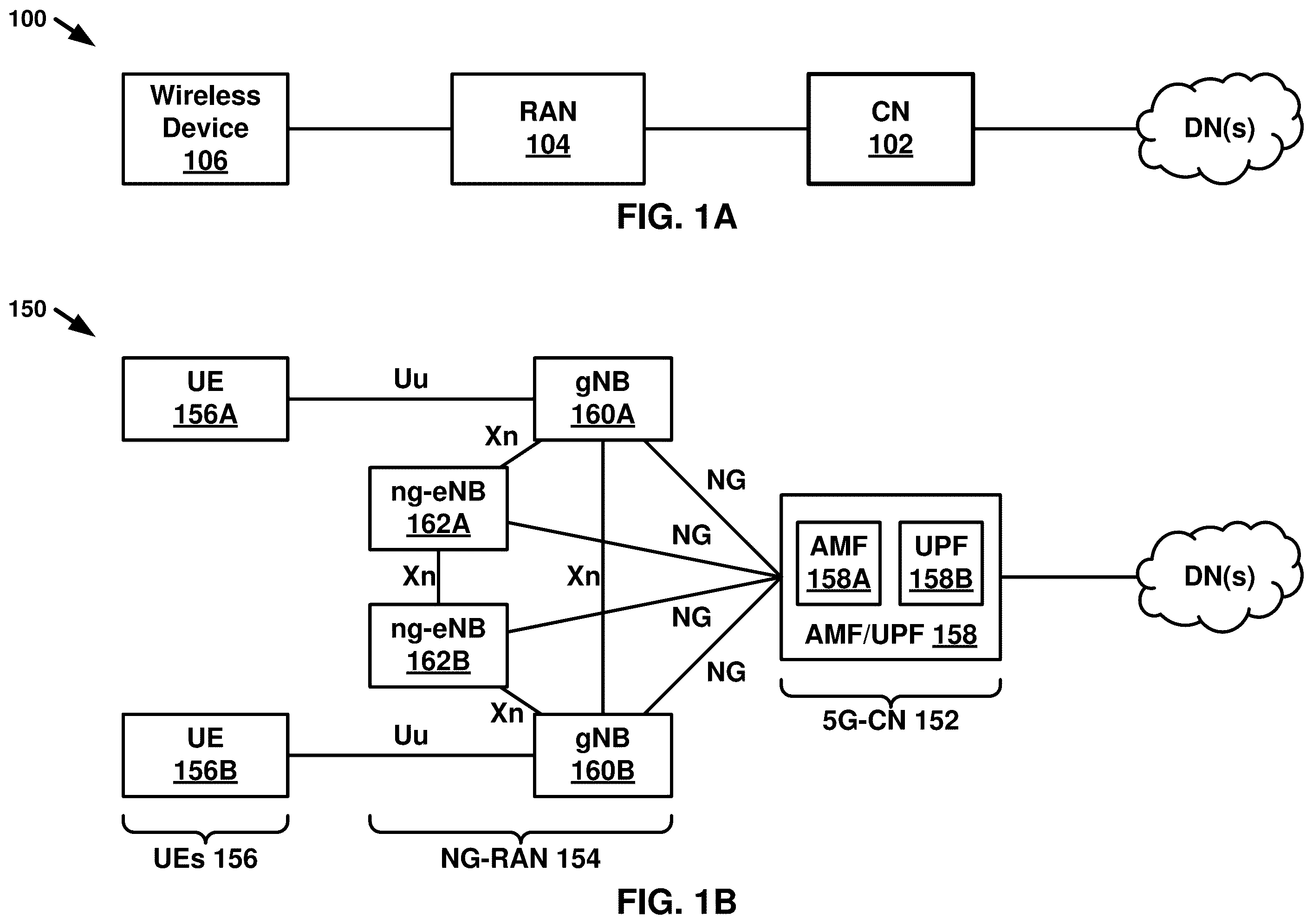
Examples of several of the various embodiments of the present disclosure are described herein with reference to the drawings. A and B illustrate example mobile communication networks in which embodiments of the present disclosure may be implemented. A and B respectively illustrate a New Radio (NR) user plane and control plane protocol stack. illustrates an example of services provided between protocol layers of the NR user plane protocol stack of A . A illustrates an example downlink data flow through the NR user plane protocol stack of A . B illustrates an example format of a MAC subheader in a MAC PDU. A and B respectively illustrate a mapping between logical channels, transport channels, and physical channels for the downlink and uplink. is an example diagram showing RRC state transitions of a UE. illustrates an example configuration of an NR frame into which OFDM symbols are grouped. illustrates an example configuration of a slot in the time and frequency domain for an NR carrier. illustrates an example of bandwidth adaptation using three configured BWPs for an NR carrier. A illustrates three carrier aggregation configurations with two component carriers. B illustrates an example of how aggregated cells may be configured into one or more PUCCH groups. A illustrates an example of an SS/PBCH block structure and location. B illustrates an example of CSI-RSs that are mapped in the time and frequency domains. A and B respectively illustrate examples of three downlink and uplink beam management procedures. A , B , and C respectively illustrate a four-step contention-based random access procedure, a two-step contention-free random access procedure, and another two-step random access procedure. A illustrates an example of CORESET configurations for a bandwidth part. B illustrates an example of a CCE-to-REG mapping for DCI transmission on a CORESET and PDCCH processing. illustrates an example of a wireless device in communication with a base station. A , B , C , and D illustrate example structures for uplink and downlink transmission. A illustrates an aspect of an example embodiment according to the present disclosure. B illustrates an aspect of an example embodiment according to the present disclosure. illustrates an aspect of an example embodiment according to the present disclosure. illustrates an aspect of an example embodiment according to the present disclosure. illustrates an aspect of an example embodiment according to the present disclosure. illustrates an aspect of an example embodiment according to the present disclosure. illustrates an aspect of an example embodiment according to the present disclosure. illustrates an aspect of an example embodiment according to the present disclosure. illustrates an aspect of an example embodiment according to the present disclosure. illustrates an aspect of an example embodiment according to the present disclosure. illustrates an aspect of an example embodiment according to the present disclosure. illustrates an aspect of an example embodiment according to the present disclosure. illustrates an aspect of an example embodiment according to the present disclosure. illustrates an aspect of an example embodiment according to the present disclosure. illustrates an aspect of an example embodiment according to the present disclosure. illustrates an aspect of an example embodiment according to the present disclosure. illustrates an aspect of an example embodiment according to the present disclosure. illustrates an aspect of an example embodiment according to the present disclosure. illustrates an aspect of an example embodiment according to the present disclosure.
DETAILED DESCRIPTION
In the present disclosure, various embodiments are presented as examples of how the disclosed techniques may be implemented and/or how the disclosed techniques may be practiced in environments and scenarios. It will be apparent to persons skilled in the relevant art that various changes in form and detail can be made therein without departing from the scope. In fact, after reading the description, it will be apparent to one skilled in the relevant art how to implement alternative embodiments. The present embodiments should not be limited by any of the described exemplary embodiments. The embodiments of the present disclosure will be described with reference to the accompanying drawings. Limitations, features, and/or elements from the disclosed example embodiments may be combined to create further embodiments within the scope of the disclosure. Any figures which highlight the functionality and advantages, are presented for example purposes only. The disclosed architecture is sufficiently flexible and configurable, such that it may be utilized in ways other than that shown. For example, the actions listed in any flowchart may be re-ordered or only optionally used in some embodiments. Embodiments may be configured to operate as needed. The disclosed mechanism may be performed when certain criteria are met, for example, in a wireless device, a base station, a radio environment, a network, a combination of the above, and/or the like. Example criteria may be based, at least in part, on for example, wireless device or network node configurations, traffic load, initial system set up, packet sizes, traffic characteristics, a combination of the above, and/or the like. When the one or more criteria are met, various example embodiments may be applied. Therefore, it may be possible to implement example embodiments that selectively implement disclosed protocols. A base station may communicate with a mix of wireless devices. Wireless devices and/or base stations may support multiple technologies, and/or multiple releases of the same technology. Wireless devices may have some specific capability(ies) depending on wireless device category and/or capability(ies). When this disclosure refers to a base station communicating with a plurality of wireless devices, this disclosure may refer to a subset of the total wireless devices in a coverage area. This disclosure may refer to, for example, a plurality of wireless devices of a given LTE or 5G release with a given capability and in a given sector of the base station. The plurality of wireless devices in this disclosure may refer to a selected plurality of wireless devices, and/or a subset of total wireless devices in a coverage area which perform according to disclosed methods, and/or the like. There may be a plurality of base stations or a plurality of wireless devices in a coverage area that may not comply with the disclosed methods, for example, those wireless devices or base stations may perform based on older releases of LTE or 5G technology. In this disclosure, “a” and “an” and similar phrases are to be interpreted as “at least one” and “one or more.” Similarly, any term that ends with the suffix “(s)” is to be interpreted as “at least one” and “one or more.” In this disclosure, the term “may” is to be interpreted as “may, for example.” In other words, the term “may” is indicative that the phrase following the term “may” is an example of one of a multitude of suitable possibilities that may, or may not, be employed by one or more of the various embodiments. The terms “comprises” and “consists of”, as used herein, enumerate one or more components of the element being described. The term “comprises” is interchangeable with “includes” and does not exclude unenumerated components from being included in the element being described. By contrast, “consists of” provides a complete enumeration of the one or more components of the element being described. The term “based on”, as used herein, should be interpreted as “based at least in part on” rather than, for example, “based solely on”. The term “and/or” as used herein represents any possible combination of enumerated elements. For example, “A, B, and/or C” may represent A; B; C; A and B; A and C; B and C; or A, B, and C. If A and B are sets and every element of A is an element of B, A is called a subset of B. In this specification, only non-empty sets and subsets are considered. For example, possible subsets of B={cell 1 , cell 2 } are: {cell 1 }, {cell 2 }, and {cell 1 , cell 2 }. The phrase “based on” (or equally “based at least on”) is indicative that the phrase following the term “based on” is an example of one of a multitude of suitable possibilities that may, or may not, be employed to one or more of the various embodiments. The phrase “in response to” (or equally “in response at least to”) is indicative that the phrase following the phrase “in response to” is an example of one of a multitude of suitable possibilities that may, or may not, be employed to one or more of the various embodiments. The phrase “depending on” (or equally “depending at least to”) is indicative that the phrase following the phrase “depending on” is an example of one of a multitude of suitable possibilities that may, or may not, be employed to one or more of the various embodiments. The phrase “employing/using” (or equally “employing/using at least”) is indicative that the phrase following the phrase “employing/using” is an example of one of a multitude of suitable possibilities that may, or may not, be employed to one or more of the various embodiments. The term configured may relate to the capacity of a device whether the device is in an operational or non-operational state. Configured may refer to specific settings in a device that affect or implement the operational characteristics of the device whether the device is in an operational or non-operational state. In other words, the hardware, software, firmware, registers, memory values, and/or the like may be “configured” within a device, whether the device is in an operational or nonoperational state, to provide the device with specific characteristics. Terms such as “a control message to cause in a device” may mean that a control message has parameters that may be used to configure specific characteristics or may be used to implement certain actions in the device, whether the device is in an operational or non-operational state. In this disclosure, parameters (or equally called, fields, or Information elements: IEs) may comprise one or more information objects, and an information object may comprise one or more other objects. For example, if parameter (IE) N comprises parameter (IE) M, and parameter (IE) M comprises parameter (IE) K, and parameter (IE) K comprises parameter (information element) J. Then, for example, N comprises K, and N comprises J. In an example embodiment, when one or more messages comprise a plurality of parameters, it implies that a parameter in the plurality of parameters is in at least one of the one or more messages, but does not have to be in each of the one or more messages. Many features presented are described as being optional through the use of “may” or the use of parentheses. For the sake of brevity and legibility, the present disclosure does not explicitly recite each and every permutation that may be obtained by choosing from the set of optional features. The present disclosure is to be interpreted as explicitly disclosing all such permutations. For example, a system described as having three optional features may be embodied in seven ways, namely with just one of the three possible features, with any two of the three possible features or with three of the three possible features. Many of the elements described in the disclosed embodiments may be implemented as modules. A module is defined here as an element that performs a defined function and has a defined interface to other elements. The modules described in this disclosure may be implemented in hardware, software in combination with hardware, firmware, wetware (e.g. hardware with a biological element) or a combination thereof, which may be behaviorally equivalent. For example, modules may be implemented as a software routine written in a computer language configured to be executed by a hardware machine (such as C, C++, Fortran, Java, Basic, MATLAB or the like) or a modeling/simulation program such as Simulink, Stateflow, GNU Octave, or LabVIEWMathScript. It may be possible to implement modules using physical hardware that incorporates discrete or programmable analog, digital and/or quantum hardware. Examples of programmable hardware comprise: computers, microcontrollers, microprocessors, application-specific integrated circuits (ASICs); field programmable gate arrays (FPGAs); and complex programmable logic devices (CPLDs). Computers, microcontrollers and microprocessors are programmed using languages such as assembly, C, C++ or the like. FPGAs, ASICs and CPLDs are often programmed using hardware description languages (HDL) such as VHSIC hardware description language (VHDL) or Verilog that configure connections between internal hardware modules with lesser functionality on a programmable device. The mentioned technologies are often used in combination to achieve the result of a functional module. A illustrates an example of a mobile communication network 100 in which embodiments of the present disclosure may be implemented. The mobile communication network 100 may be, for example, a public land mobile network (PLMN) run by a network operator. As illustrated in A , the mobile communication network 100 includes a core network (CN) 102 , a radio access network (RAN) 104 , and a wireless device 106 . The CN 102 may provide the wireless device 106 with an interface to one or more data networks (DNs), such as public DNS (e.g., the Internet), private DNs, and/or intra-operator DNs. As part of the interface functionality, the CN 102 may set up end-to-end connections between the wireless device 106 and the one or more DNs, authenticate the wireless device 106 , and provide charging functionality. The RAN 104 may connect the CN 102 to the wireless device 106 through radio communications over an air interface. As part of the radio communications, the RAN 104 may provide scheduling, radio resource management, and retransmission protocols. The communication direction from the RAN 104 to the wireless device 106 over the air interface is known as the downlink and the communication direction from the wireless device 106 to the RAN 104 over the air interface is known as the uplink. Downlink transmissions may be separated from uplink transmissions using frequency division duplexing (FDD), time-division duplexing (TDD), and/or some combination of the two duplexing techniques. The term wireless device may be used throughout this disclosure to refer to and encompass any mobile device or fixed (non-mobile) device for which wireless communication is needed or usable. For example, a wireless device may be a telephone, smart phone, tablet, computer, laptop, sensor, meter, wearable device, Internet of Things (IoT) device, vehicle roadside unit (RSU), relay node, automobile, and/or any combination thereof. The term wireless device encompasses other terminology, including user equipment (UE), user terminal (UT), access terminal (AT), mobile station, handset, wireless transmit and receive unit (WTRU), and/or wireless communication device. The RAN 104 may include one or more base stations (not shown). The term base station may be used throughout this disclosure to refer to and encompass a Node B (associated with UMTS and/or 3G standards), an Evolved Node B (eNB, associated with E-UTRA and/or 4G standards), a remote radio head (RRH), a baseband processing unit coupled to one or more RRHs, a repeater node or relay node used to extend the coverage area of a donor node, a Next Generation Evolved Node B (ng-eNB), a Generation Node B (gNB, associated with NR and/or 5G standards), an access point (AP, associated with, for example, Wi-Fi or any other suitable wireless communication standard), and/or any combination thereof. A base station may comprise at least one gNB Central Unit (gNB-CU) and at least one a gNB Distributed Unit (gNB-DU). A base station included in the RAN 104 may include one or more sets of antennas for communicating with the wireless device 106 over the air interface. For example, one or more of the base stations may include three sets of antennas to respectively control three cells (or sectors). The size of a cell may be determined by a range at which a receiver (e.g., a base station receiver) can successfully receive the transmissions from a transmitter (e.g., a wireless device transmitter) operating in the cell. Together, the cells of the base stations may provide radio coverage to the wireless device 106 over a wide geographic area to support wireless device mobility. In addition to three-sector sites, other implementations of base stations are possible. For example, one or more of the base stations in the RAN 104 may be implemented as a sectored site with more or less than three sectors. One or more of the base stations in the RAN 104 may be implemented as an access point, as a baseband processing unit coupled to several remote radio heads (RRHs), and/or as a repeater or relay node used to extend the coverage area of a donor node. A baseband processing unit coupled to RRHs may be part of a centralized or cloud RAN architecture, where the baseband processing unit may be either centralized in a pool of baseband processing units or virtualized. A repeater node may amplify and rebroadcast a radio signal received from a donor node. A relay node may perform the same/similar functions as a repeater node but may decode the radio signal received from the donor node to remove noise before amplifying and rebroadcasting the radio signal. The RAN 104 may be deployed as a homogenous network of macrocell base stations that have similar antenna patterns and similar high-level transmit powers. The RAN 104 may be deployed as a heterogeneous network. In heterogeneous networks, small cell base stations may be used to provide small coverage areas, for example, coverage areas that overlap with the comparatively larger coverage areas provided by macrocell base stations. The small coverage areas may be provided in areas with high data traffic (or so-called “hotspots”) or in areas with weak macrocell coverage. Examples of small cell base stations include, in order of decreasing coverage area, microcell base stations, picocell base stations, and femtocell base stations or home base stations. The Third-Generation Partnership Project (3GPP) was formed in 1998 to provide global standardization of specifications for mobile communication networks similar to the mobile communication network 100 in A . To date, 3GPP has produced specifications for three generations of mobile networks: a third generation (3G) network known as Universal Mobile Telecommunications System (UMTS), a fourth generation (4G) network known as Long-Term Evolution (LTE), and a fifth generation (5G) network known as 5G System (5GS). Embodiments of the present disclosure are described with reference to the RAN of a 3GPP 5G network, referred to as next-generation RAN (NG-RAN). Embodiments may be applicable to RANs of other mobile communication networks, such as the RAN 104 in A , the RANs of earlier 3G and 4G networks, and those of future networks yet to be specified (e.g., a 3GPP 6G network). NG-RAN implements 5G radio access technology known as New Radio (NR) and may be provisioned to implement 4G radio access technology or other radio access technologies, including non-3GPP radio access technologies. B illustrates another example mobile communication network 150 in which embodiments of the present disclosure may be implemented. Mobile communication network 150 may be, for example, a PLMN run by a network operator. As illustrated in B , mobile communication network 150 includes a 5G core network (5G-CN) 152 , an NG-RAN 154 , and UEs 156 A and 156 B (collectively UEs 156 ). These components may be implemented and operate in the same or similar manner as corresponding components described with respect to A . The 5G-CN 152 provides the UEs 156 with an interface to one or more DNs, such as public DNS (e.g., the Internet), private DNs, and/or intra-operator DNs. As part of the interface functionality, the 5G-CN 152 may set up end-to-end connections between the UEs 156 and the one or more DNs, authenticate the UEs 156 , and provide charging functionality. Compared to the CN of a 3GPP 4G network, the basis of the 5G-CN 152 may be a service-based architecture. This means that the architecture of the nodes making up the 5G-CN 152 may be defined as network functions that offer services via interfaces to other network functions. The network functions of the 5G-CN 152 may be implemented in several ways, including as network elements on dedicated or shared hardware, as software instances running on dedicated or shared hardware, or as virtualized functions instantiated on a platform (e.g., a cloud-based platform). As illustrated in B , the 5G-CN 152 includes an Access and Mobility Management Function (AMF) 158 A and a User Plane Function (UPF) 158 B, which are shown as one component AMF/UPF 158 in B for ease of illustration. The UPF 158 B may serve as a gateway between the NG-RAN 154 and the one or more DNs. The UPF 158 B may perform functions such as packet routing and forwarding, packet inspection and user plane policy rule enforcement, traffic usage reporting, uplink classification to support routing of traffic flows to the one or more DNS, quality of service (QOS) handling for the user plane (e.g., packet filtering, gating, uplink/downlink rate enforcement, and uplink traffic verification), downlink packet buffering, and downlink data notification triggering. The UPF 158 B may serve as an anchor point for intra-/inter-Radio Access Technology (RAT) mobility, an external protocol (or packet) data unit (PDU) session point of interconnect to the one or more DNs, and/or a branching point to support a multi-homed PDU session. The UEs 156 may be configured to receive services through a PDU session, which is a logical connection between a UE and a DN. The AMF 158 A may perform functions such as Non-Access Stratum (NAS) signaling termination, NAS signaling security, Access Stratum (AS) security control, inter-CN node signaling for mobility between 3GPP access networks, idle mode UE reachability (e.g., control and execution of paging retransmission), registration area management, intra-system and inter-system mobility support, access authentication, access authorization including checking of roaming rights, mobility management control (subscription and policies), network slicing support, and/or session management function (SMF) selection. NAS may refer to the functionality operating between a CN and a UE, and AS may refer to the functionality operating between the UE and a RAN. The 5G-CN 152 may include one or more additional network functions that are not shown in B for the sake of clarity. For example, the 5G-CN 152 may include one or more of a Session Management Function (SMF), an NR Repository Function (NRF), a Policy Control Function (PCF), a Network Exposure Function (NEF), a Unified Data Management (UDM), an Application Function (AF), and/or an Authentication Server Function (AUSF). The NG-RAN 154 may connect the 5G-CN 152 to the UEs 156 through radio communications over the air interface. The NG-RAN 154 may include one or more gNBs, illustrated as gNB 160 A and gNB 160 B (collectively gNBs 160 ) and/or one or more ng-eNBs, illustrated as ng-eNB 162 A and ng-eNB 162 B (collectively ng-eNBs 162 ). The gNBs 160 and ng-eNBs 162 may be more generically referred to as base stations. The gNBs 160 and ng-eNBs 162 may include one or more sets of antennas for communicating with the UEs 156 over an air interface. For example, one or more of the gNBs 160 and/or one or more of the ng-eNBs 162 may include three sets of antennas to respectively control three cells (or sectors). Together, the cells of the gNBs 160 and the ng-eNBs 162 may provide radio coverage to the UEs 156 over a wide geographic area to support UE mobility. As shown in B , the gNBs 160 and/or the ng-eNBs 162 may be connected to the 5G-CN 152 by means of an NG interface and to other base stations by an Xn interface. The NG and Xn interfaces may be established using direct physical connections and/or indirect connections over an underlying transport network, such as an internet protocol (IP) transport network. The gNBs 160 and/or the ng-eNBs 162 may be connected to the UEs 156 by means of a Uu interface. For example, as illustrated in B , gNB 160 A may be connected to the UE 156 A by means of a Uu interface. The NG, Xn, and Uu interfaces are associated with a protocol stack. The protocol stacks associated with the interfaces may be used by the network elements in B to exchange data and signaling messages and may include two planes: a user plane and a control plane. The user plane may handle data of interest to a user. The control plane may handle signaling messages of interest to the network elements. The gNBs 160 and/or the ng-eNBs 162 may be connected to one or more AMF/UPF functions of the 5G-CN 152 , such as the AMF/UPF 158 , by means of one or more NG interfaces. For example, the gNB 160 A may be connected to the UPF 158 B of the AMF/UPF 158 by means of an NG-User plane (NG-U) interface. The NG-U interface may provide delivery (e.g., non-guaranteed delivery) of user plane PDUs between the gNB 160 A and the UPF 158 B. The gNB 160 A may be connected to the AMF 158 A by means of an NG-Control plane (NG-C) interface. The NG-C interface may provide, for example, NG interface management, UE context management, UE mobility management, transport of NAS messages, paging, PDU session management, and configuration transfer and/or warning message transmission. The gNBs 160 may provide NR user plane and control plane protocol terminations towards the UEs 156 over the Uu interface. For example, the gNB 160 A may provide NR user plane and control plane protocol terminations toward the UE 156 A over a Uu interface associated with a first protocol stack. The ng-eNBs 162 may provide Evolved UMTS Terrestrial Radio Access (E-UTRA) user plane and control plane protocol terminations towards the UEs 156 over a Uu interface, where E-UTRA refers to the 3GPP 4G radio-access technology. For example, the ng-eNB 162 B may provide E-UTRA user plane and control plane protocol terminations towards the UE 156 B over a Uu interface associated with a second protocol stack. The 5G-CN 152 was described as being configured to handle NR and 4G radio accesses. It will be appreciated by one of ordinary skill in the art that it may be possible for NR to connect to a 4G core network in a mode known as “non-standalone operation.” In non-standalone operation, a 4G core network is used to provide (or at least support) control-plane functionality (e.g., initial access, mobility, and paging). Although only one AMF/UPF 158 is shown in B , one gNB or ng-eNB may be connected to multiple AMF/UPF nodes to provide redundancy and/or to load share across the multiple AMF/UPF nodes. As discussed, an interface (e.g., Uu, Xn, and NG interfaces) between the network elements in B may be associated with a protocol stack that the network elements use to exchange data and signaling messages. A protocol stack may include two planes: a user plane and a control plane. The user plane may handle data of interest to a user, and the control plane may handle signaling messages of interest to the network elements. A and B respectively illustrate examples of NR user plane and NR control plane protocol stacks for the Uu interface that lies between a UE 210 and a gNB 220 . The protocol stacks illustrated in A and B may be the same or similar to those used for the Uu interface between, for example, the UE 156 A and the gNB 160 A shown in B . A illustrates a NR user plane protocol stack comprising five layers implemented in the UE 210 and the gNB 220 . At the bottom of the protocol stack, physical layers (PHYs) 211 and 221 may provide transport services to the higher layers of the protocol stack and may correspond to layer 1 of the Open Systems Interconnection (OSI) model. The next four protocols above PHYs 211 and 221 comprise media access control layers (MACs) 212 and 222 , radio link control layers (RLCs) 213 and 223 , packet data convergence protocol layers (PDCPs) 214 and 224 , and service data application protocol layers (SDAPs) 215 and 225 . Together, these four protocols may make up layer 2, or the data link layer, of the OSI model. illustrates an example of services provided between protocol layers of the NR user plane protocol stack. Starting from the top of A and , the SDAPs 215 and 225 may perform QoS flow handling. The UE 210 may receive services through a PDU session, which may be a logical connection between the UE 210 and a DN. The PDU session may have one or more QoS flows. A UPF of a CN (e.g., the UPF 158 B) may map IP packets to the one or more QoS flows of the PDU session based on QoS requirements (e.g., in terms of delay, data rate, and/or error rate). The SDAPs 215 and 225 may perform mapping/de-mapping between the one or more QoS flows and one or more data radio bearers. The mapping/de-mapping between the QoS flows and the data radio bearers may be determined by the SDAP 225 at the gNB 220 . The SDAP 215 at the UE 210 may be informed of the mapping between the QoS flows and the data radio bearers through reflective mapping or control signaling received from the gNB 220 . For reflective mapping, the SDAP 225 at the gNB 220 may mark the downlink packets with a QoS flow indicator (QFI), which may be observed by the SDAP 215 at the UE 210 to determine the mapping/de-mapping between the QoS flows and the data radio bearers. The PDCPs 214 and 224 may perform header compression/decompression to reduce the amount of data that needs to be transmitted over the air interface, ciphering/deciphering to prevent unauthorized decoding of data transmitted over the air interface, and integrity protection (to ensure control messages originate from intended sources. The PDCPs 214 and 224 may perform retransmissions of undelivered packets, in-sequence delivery and reordering of packets, and removal of packets received in duplicate due to, for example, an intra-gNB handover. The PDCPs 214 and 224 may perform packet duplication to improve the likelihood of the packet being received and, at the receiver, remove any duplicate packets. Packet duplication may be useful for services that require high reliability. Although not shown in , PDCPs 214 and 224 may perform mapping/de-mapping between a split radio bearer and RLC channels in a dual connectivity scenario. Dual connectivity is a technique that allows a UE to connect to two cells or, more generally, two cell groups: a master cell group (MCG) and a secondary cell group (SCG). A split bearer is when a single radio bearer, such as one of the radio bearers provided by the PDCPs 214 and 224 as a service to the SDAPs 215 and 225 , is handled by cell groups in dual connectivity. The PDCPs 214 and 224 may map/de-map the split radio bearer between RLC channels belonging to cell groups. The RLCs 213 and 223 may perform segmentation, retransmission through Automatic Repeat Request (ARQ), and removal of duplicate data units received from MACs 212 and 222 , respectively. The RLCs 213 and 223 may support three transmission modes: transparent mode (TM); unacknowledged mode (UM); and acknowledged mode (AM). Based on the transmission mode an RLC is operating, the RLC may perform one or more of the noted functions. The RLC configuration may be per logical channel with no dependency on numerologies and/or Transmission Time Interval (TTI) durations. As shown in , the RLCs 213 and 223 may provide RLC channels as a service to PDCPs 214 and 224 , respectively. The MACs 212 and 222 may perform multiplexing/demultiplexing of logical channels and/or mapping between logical channels and transport channels. The multiplexing/demultiplexing may include multiplexing/demultiplexing of data units, belonging to the one or more logical channels, into/from Transport Blocks (TBs) delivered to/from the PHYs 211 and 221 . The MAC 222 may be configured to perform scheduling, scheduling information reporting, and priority handling between UEs by means of dynamic scheduling. Scheduling may be performed in the gNB 220 (at the MAC 222 ) for downlink and uplink. The MACs 212 and 222 may be configured to perform error correction through Hybrid Automatic Repeat Request (HARQ) (e.g., one HARQ entity per carrier in case of Carrier Aggregation (CA)), priority handling between logical channels of the UE 210 by means of logical channel prioritization, and/or padding. The MACs 212 and 222 may support one or more numerologies and/or transmission timings. In an example, mapping restrictions in a logical channel prioritization may control which numerology and/or transmission timing a logical channel may use. As shown in , the MACs 212 and 222 may provide logical channels as a service to the RLCs 213 and 223 . The PHYs 211 and 221 may perform mapping of transport channels to physical channels and digital and analog signal processing functions for sending and receiving information over the air interface. These digital and analog signal processing functions may include, for example, coding/decoding and modulation/demodulation. The PHYs 211 and 221 may perform multi-antenna mapping. As shown in , the PHYs 211 and 221 may provide one or more transport channels as a service to the MACs 212 and 222 . A illustrates an example downlink data flow through the NR user plane protocol stack. A illustrates a downlink data flow of three IP packets (n, n+1, and m) through the NR user plane protocol stack to generate two TBs at the gNB 220 . An uplink data flow through the NR user plane protocol stack may be similar to the downlink data flow depicted in A . The downlink data flow of A begins when SDAP 225 receives the three IP packets from one or more QoS flows and maps the three packets to radio bearers. In A , the SDAP 225 maps IP packets n and n+1 to a first radio bearer 402 and maps IP packet m to a second radio bearer 404 . An SDAP header (labeled with an “H” in A ) is added to an IP packet. The data unit from/to a higher protocol layer is referred to as a service data unit (SDU) of the lower protocol layer and the data unit to/from a lower protocol layer is referred to as a protocol data unit (PDU) of the higher protocol layer. As shown in A , the data unit from the SDAP 225 is an SDU of lower protocol layer PDCP 224 and is a PDU of the SDAP 225 . The remaining protocol layers in A may perform their associated functionality (e.g., with respect to ), add corresponding headers, and forward their respective outputs to the next lower layer. For example, the PDCP 224 may perform IP-header compression and ciphering and forward its output to the RLC 223 . The RLC 223 may optionally perform segmentation (e.g., as shown for IP packet m in A ) and forward its output to the MAC 222 . The MAC 222 may multiplex a number of RLC PDUs and may attach a MAC subheader to an RLC PDU to form a transport block. In NR, the MAC subheaders may be distributed across the MAC PDU, as illustrated in A . In LTE, the MAC subheaders may be entirely located at the beginning of the MAC PDU. The NR MAC PDU structure may reduce processing time and associated latency because the MAC PDU subheaders may be computed before the full MAC PDU is assembled. B illustrates an example format of a MAC subheader in a MAC PDU. The MAC subheader includes: an SDU length field for indicating the length (e.g., in bytes) of the MAC SDU to which the MAC subheader corresponds; a logical channel identifier (LCID) field for identifying the logical channel from which the MAC SDU originated to aid in the demultiplexing process; a flag (F) for indicating the size of the SDU length field; and a reserved bit (R) field for future use. B further illustrates MAC control elements (CEs) inserted into the MAC PDU by a MAC, such as MAC 223 or MAC 222 . For example, B illustrates two MAC CEs inserted into the MAC PDU. MAC CEs may be inserted at the beginning of a MAC PDU for downlink transmissions (as shown in B ) and at the end of a MAC PDU for uplink transmissions. MAC CEs may be used for in-band control signaling. Example MAC CEs include: scheduling-related MAC CEs, such as buffer status reports and power headroom reports; activation/deactivation MAC CEs, such as those for activation/deactivation of PDCP duplication detection, channel state information (CSI) reporting, sounding reference signal (SRS) transmission, and prior configured components; discontinuous reception (DRX) related MAC CEs; timing advance MAC CEs; and random access related MAC CEs. A MAC CE may be preceded by a MAC subheader with a similar format as described for MAC SDUs and may be identified with a reserved value in the LCID field that indicates the type of control information included in the MAC CE. Before describing the NR control plane protocol stack, logical channels, transport channels, and physical channels are first described as well as a mapping between the channel types. One or more of the channels may be used to carry out functions associated with the NR control plane protocol stack described later below. A and B illustrate, for downlink and uplink respectively, a mapping between logical channels, transport channels, and physical channels. Information is passed through channels between the RLC, the MAC, and the PHY of the NR protocol stack. A logical channel may be used between the RLC and the MAC and may be classified as a control channel that carries control and configuration information in the NR control plane or as a traffic channel that carries data in the NR user plane. A logical channel may be classified as a dedicated logical channel that is dedicated to a specific UE or as a common logical channel that may be used by more than one UE. A logical channel may also be defined by the type of information it carries. The set of logical channels defined by NR include, for example: a paging control channel (PCCH) for carrying paging messages used to page a UE whose location is not known to the network on a cell level; a broadcast control channel (BCCH) for carrying system information messages in the form of a master information block (MIB) and several system information blocks (SIBs), wherein the system information messages may be used by the UEs to obtain information about how a cell is configured and how to operate within the cell; a common control channel (CCCH) for carrying control messages together with random access; a dedicated control channel (DCCH) for carrying control messages to/from a specific the UE to configure the UE; and a dedicated traffic channel (DTCH) for carrying user data to/from a specific the UE. Transport channels are used between the MAC and PHY layers and may be defined by how the information they carry is transmitted over the air interface. The set of transport channels defined by NR include, for example: a paging channel (PCH) for carrying paging messages that originated from the PCCH; a broadcast channel (BCH) for carrying the MIB from the BCCH; a downlink shared channel (DL-SCH) for carrying downlink data and signaling messages, including the SIBs from the BCCH; an uplink shared channel (UL-SCH) for carrying uplink data and signaling messages; and a random access channel (RACH) for allowing a UE to contact the network without any prior scheduling. The PHY may use physical channels to pass information between processing levels of the PHY. A physical channel may have an associated set of time-frequency resources for carrying the information of one or more transport channels. The PHY may generate control information to support the low-level operation of the PHY and provide the control information to the lower levels of the PHY via physical control channels, known as L1/L2 control channels. The set of physical channels and physical control channels defined by NR include, for example: a physical broadcast channel (PBCH) for carrying the MIB from the BCH; a physical downlink shared channel (PDSCH) for carrying downlink data and signaling messages from the DL-SCH, as well as paging messages from the PCH; a physical downlink control channel (PDCCH) for carrying downlink control information (DCI), which may include downlink scheduling commands, uplink scheduling grants, and uplink power control commands; a physical uplink shared channel (PUSCH) for carrying uplink data and signaling messages from the UL-SCH and in some instances uplink control information (UCI) as described below; a physical uplink control channel (PUCCH) for carrying UCI, which may include HARQ acknowledgments, channel quality indicators (CQI), pre-coding matrix indicators (PMI), rank indicators (RI), and scheduling requests (SR); and a physical random access channel (PRACH) for random access. Similar to the physical control channels, the physical layer generates physical signals to support the low-level operation of the physical layer. As shown in A and B , the physical layer signals defined by NR include: primary synchronization signals (PSS), secondary synchronization signals (SSS), channel state information reference signals (CSI-RS), demodulation reference signals (DMRS), sounding reference signals (SRS), and phase-tracking reference signals (PT-RS). These physical layer signals will be described in greater detail below. B illustrates an example NR control plane protocol stack. As shown in B , the NR control plane protocol stack may use the same/similar first four protocol layers as the example NR user plane protocol stack. These four protocol layers include the PHYs 211 and 221 , the MACs 212 and 222 , the RLCs 213 and 223 , and the PDCPs 214 and 224 . Instead of having the SDAPs 215 and 225 at the top of the stack as in the NR user plane protocol stack, the NR control plane stack has radio resource controls (RRCs) 216 and 226 and NAS protocols 217 and 237 at the top of the NR control plane protocol stack. The NAS protocols 217 and 237 may provide control plane functionality between the UE 210 and the AMF 230 (e.g., the AMF 158 A) or, more generally, between the UE 210 and the CN. The NAS protocols 217 and 237 may provide control plane functionality between the UE 210 and the AMF 230 via signaling messages, referred to as NAS messages. There is no direct path between the UE 210 and the AMF 230 through which the NAS messages can be transported. The NAS messages may be transported using the AS of the Uu and NG interfaces. NAS protocols 217 and 237 may provide control plane functionality such as authentication, security, connection setup, mobility management, and session management. The RRCs 216 and 226 may provide control plane functionality between the UE 210 and the gNB 220 or, more generally, between the UE 210 and the RAN. The RRCs 216 and 226 may provide control plane functionality between the UE 210 and the gNB 220 via signaling messages, referred to as RRC messages. RRC messages may be transmitted between the UE 210 and the RAN using signaling radio bearers and the same/similar PDCP, RLC, MAC, and PHY protocol layers. The MAC may multiplex control-plane and user-plane data into the same transport block (TB). The RRCs 216 and 226 may provide control plane functionality such as: broadcast of system information related to AS and NAS; paging initiated by the CN or the RAN; establishment, maintenance and release of an RRC connection between the UE 210 and the RAN; security functions including key management; establishment, configuration, maintenance and release of signaling radio bearers and data radio bearers; mobility functions; QoS management functions; the UE measurement reporting and control of the reporting; detection of and recovery from radio link failure (RLF); and/or NAS message transfer. As part of establishing an RRC connection, RRCs 216 and 226 may establish an RRC context, which may involve configuring parameters for communication between the UE 210 and the RAN. is an example diagram showing RRC state transitions of a UE. The UE may be the same or similar to the wireless device 106 depicted in A , the UE 210 depicted in A and B , or any other wireless device described in the present disclosure. As illustrated in , a UE may be in at least one of three RRC states: RRC connected 602 (e.g., RRC_CONNECTED), RRC idle 604 (e.g., RRC_IDLE), and RRC inactive 606 (e.g., RRC_INACTIVE). In RRC connected 602 , the UE has an established RRC context and may have at least one RRC connection with a base station. The base station may be similar to one of the one or more base stations included in the RAN 104 depicted in A , one of the gNBs 160 or ng-eNBs 162 depicted in B , the gNB 220 depicted in A and B , or any other base station described in the present disclosure. The base station with which the UE is connected may have the RRC context for the UE. The RRC context, referred to as the UE context, may comprise parameters for communication between the UE and the base station. These parameters may include, for example: one or more AS contexts; one or more radio link configuration parameters; bearer configuration information (e.g., relating to a data radio bearer, signaling radio bearer, logical channel, QoS flow, and/or PDU session); security information; and/or PHY, MAC, RLC, PDCP, and/or SDAP layer configuration information. While in RRC connected 602 , mobility of the UE may be managed by the RAN (e.g., the RAN 104 or the NG-RAN 154 ). The UE may measure the signal levels (e.g., reference signal levels) from a serving cell and neighboring cells and report these measurements to the base station currently serving the UE. The UE's serving base station may request a handover to a cell of one of the neighboring base stations based on the reported measurements. The RRC state may transition from RRC connected 602 to RRC idle 604 through a connection release procedure 608 or to RRC inactive 606 through a connection inactivation procedure 610 . In RRC idle 604 , an RRC context may not be established for the UE. In RRC idle 604 , the UE may not have an RRC connection with the base station. While in RRC idle 604 , the UE may be in a sleep state for the majority of the time (e.g., to conserve battery power). The UE may wake up periodically (e.g., once in every discontinuous reception cycle) to monitor for paging messages from the RAN. Mobility of the UE may be managed by the UE through a procedure known as cell reselection. The RRC state may transition from RRC idle 604 to RRC connected 602 through a connection establishment procedure 612 , which may involve a random access procedure as discussed in greater detail below. In RRC inactive 606 , the RRC context previously established is maintained in the UE and the base station. This allows for a fast transition to RRC connected 602 with reduced signaling overhead as compared to the transition from RRC idle 604 to RRC connected 602 . While in RRC inactive 606 , the UE may be in a sleep state and mobility of the UE may be managed by the UE through cell reselection. The RRC state may transition from RRC inactive 606 to RRC connected 602 through a connection resume procedure 614 or to RRC idle 604 though a connection release procedure 616 that may be the same as or similar to connection release procedure 608 . An RRC state may be associated with a mobility management mechanism. In RRC idle 604 and RRC inactive 606 , mobility is managed by the UE through cell reselection. The purpose of mobility management in RRC idle 604 and RRC inactive 606 is to allow the network to be able to notify the UE of an event via a paging message without having to broadcast the paging message over the entire mobile communications network. The mobility management mechanism used in RRC idle 604 and RRC inactive 606 may allow the network to track the UE on a cell-group level so that the paging message may be broadcast over the cells of the cell group that the UE currently resides within instead of the entire mobile communication network. The mobility management mechanisms for RRC idle 604 and RRC inactive 606 track the UE on a cell-group level. They may do so using different granularities of grouping. For example, there may be three levels of cell-grouping granularity: individual cells; cells within a RAN area identified by a RAN area identifier (RAI); and cells within a group of RAN areas, referred to as a tracking area and identified by a tracking area identifier (TAI). Tracking areas may be used to track the UE at the CN level. The CN (e.g., the CN 102 or the 5G-CN 152 ) may provide the UE with a list of TAIs associated with a UE registration area. If the UE moves, through cell reselection, to a cell associated with a TAI not included in the list of TAIs associated with the UE registration area, the UE may perform a registration update with the CN to allow the CN to update the UE's location and provide the UE with a new the UE registration area. RAN areas may be used to track the UE at the RAN level. For a UE in RRC inactive 606 state, the UE may be assigned a RAN notification area. A RAN notification area may comprise one or more cell identities, a list of RAIs, or a list of TAIs. In an example, a base station may belong to one or more RAN notification areas. In an example, a cell may belong to one or more RAN notification areas. If the UE moves, through cell reselection, to a cell not included in the RAN notification area assigned to the UE, the UE may perform a notification area update with the RAN to update the UE's RAN notification area. A base station storing an RRC context for a UE or a last serving base station of the UE may be referred to as an anchor base station. An anchor base station may maintain an RRC context for the UE at least during a period of time that the UE stays in a RAN notification area of the anchor base station and/or during a period of time that the UE stays in RRC inactive 606 . A gNB, such as gNBs 160 in B , may be split into two parts: a central unit (gNB-CU), and one or more distributed units (gNB-DU). A gNB-CU may be coupled to one or more gNB-DUs using an F1 interface. The gNB-CU may comprise the RRC, the PDCP, and the SDAP. A gNB-DU may comprise the RLC, the MAC, and the PHY. In NR, the physical signals and physical channels (discussed with respect to A and B ) may be mapped onto orthogonal frequency divisional multiplexing (OFDM) symbols. OFDM is a multicarrier communication scheme that transmits data over F orthogonal subcarriers (or tones). Before transmission, the data may be mapped to a series of complex symbols (e.g., M-quadrature amplitude modulation (M-QAM) or M-phase shift keying (M-PSK) symbols), referred to as source symbols, and divided into F parallel symbol streams. The F parallel symbol streams may be treated as though they are in the frequency domain and used as inputs to an Inverse Fast Fourier Transform (IFFT) block that transforms them into the time domain. The IFFT block may take in F source symbols at a time, one from each of the F parallel symbol streams, and use each source symbol to modulate the amplitude and phase of one of F sinusoidal basis functions that correspond to the F orthogonal subcarriers. The output of the IFFT block may be F time-domain samples that represent the summation of the F orthogonal subcarriers. The F time-domain samples may form a single OFDM symbol. After some processing (e.g., addition of a cyclic prefix) and up-conversion, an OFDM symbol provided by the IFFT block may be transmitted over the air interface on a carrier frequency. The F parallel symbol streams may be mixed using an FFT block before being processed by the IFFT block. This operation produces Discrete Fourier Transform (DFT)-precoded OFDM symbols and may be used by UEs in the uplink to reduce the peak to average power ratio (PAPR). Inverse processing may be performed on the OFDM symbol at a receiver using an FFT block to recover the data mapped to the source symbols. illustrates an example configuration of an NR frame into which OFDM symbols are grouped. An NR frame may be identified by a system frame number (SFN). The SFN may repeat with a period of 1024 frames. As illustrated, one NR frame may be 10 milliseconds (ms) in duration and may include 10 subframes that are 1 ms in duration. A subframe may be divided into slots that include, for example, 14 OFDM symbols per slot. The duration of a slot may depend on the numerology used for the OFDM symbols of the slot. In NR, a flexible numerology is supported to accommodate different cell deployments (e.g., cells with carrier frequencies below 1 GHZ up to cells with carrier frequencies in the mm-wave range). A numerology may be defined in terms of subcarrier spacing and cyclic prefix duration. For a numerology in NR, subcarrier spacings may be scaled up by powers of two from a baseline subcarrier spacing of 15 kHz, and cyclic prefix durations may be scaled down by powers of two from a baseline cyclic prefix duration of 4.7 us. For example, NR defines numerologies with the following subcarrier spacing/cyclic prefix duration combinations: 15 kHz/4.7 μs; 30 kHz/2.3 μs; 60 KHz/1.2 μs; 120 KHz/0.59 μs; and 240 kHz/0.29 μs. A slot may have a fixed number of OFDM symbols (e.g., 14 OFDM symbols). A numerology with a higher subcarrier spacing has a shorter slot duration and, correspondingly, more slots per subframe. illustrates this numerology-dependent slot duration and slots-per-subframe transmission structure (the numerology with a subcarrier spacing of 240 KHz is not shown in for ease of illustration). A subframe in NR may be used as a numerology-independent time reference, while a slot may be used as the unit upon which uplink and downlink transmissions are scheduled. To support low latency, scheduling in NR may be decoupled from the slot duration and start at any OFDM symbol and last for as many symbols as needed for a transmission. These partial slot transmissions may be referred to as mini-slot or subslot transmissions. illustrates an example configuration of a slot in the time and frequency domain for an NR carrier. The slot includes resource elements (REs) and resource blocks (RBs). An RE is the smallest physical resource in NR. An RE spans one OFDM symbol in the time domain by one subcarrier in the frequency domain as shown in . An RB spans twelve consecutive REs in the frequency domain as shown in . An NR carrier may be limited to a width of 275 RBs or 275×12=3300 subcarriers. Such a limitation, if used, may limit the NR carrier to 50, 100, 200, and 400 MHz for subcarrier spacings of 15, 30, 60, and 120 kHz, respectively, where the 400 MHZ bandwidth may be set based on a 400 MHz per carrier bandwidth limit. illustrates a single numerology being used across the entire bandwidth of the NR carrier. In other example configurations, multiple numerologies may be supported on the same carrier. NR may support wide carrier bandwidths (e.g., up to 400 MHz for a subcarrier spacing of 120 kHz). Not all UEs may be able to receive the full carrier bandwidth (e.g., due to hardware limitations). Also, receiving the full carrier bandwidth may be prohibitive in terms of UE power consumption. In an example, to reduce power consumption and/or for other purposes, a UE may adapt the size of the UE's receive bandwidth based on the amount of traffic the UE is scheduled to receive. This is referred to as bandwidth adaptation. NR defines bandwidth parts (BWPs) to support UEs not capable of receiving the full carrier bandwidth and to support bandwidth adaptation. In an example, a BWP may be defined by a subset of contiguous RBs on a carrier. A UE may be configured (e.g., via RRC layer) with one or more downlink BWPs and one or more uplink BWPs per serving cell (e.g., up to four downlink BWPs and up to four uplink BWPs per serving cell). At a given time, one or more of the configured BWPs for a serving cell may be active. These one or more BWPs may be referred to as active BWPs of the serving cell. When a serving cell is configured with a secondary uplink carrier, the serving cell may have one or more first active BWPs in the uplink carrier and one or more second active BWPs in the secondary uplink carrier. For unpaired spectra, a downlink BWP from a set of configured downlink BWPs may be linked with an uplink BWP from a set of configured uplink BWPs if a downlink BWP index of the downlink BWP and an uplink BWP index of the uplink BWP are the same. For unpaired spectra, a UE may expect that a center frequency for a downlink BWP is the same as a center frequency for an uplink BWP. For a downlink BWP in a set of configured downlink BWPs on a primary cell (PCell), a base station may configure a UE with one or more control resource sets (CORESETs) for at least one search space. A search space is a set of locations in the time and frequency domains where the UE may find control information. The search space may be a UE-specific search space or a common search space (potentially usable by a plurality of UEs). For example, a base station may configure a UE with a common search space, on a PCell or on a primary secondary cell (PSCell), in an active downlink BWP. For an uplink BWP in a set of configured uplink BWPs, a BS may configure a UE with one or more resource sets for one or more PUCCH transmissions. A UE may receive downlink receptions (e.g., PDCCH or PDSCH) in a downlink BWP according to a configured numerology (e.g., subcarrier spacing and cyclic prefix duration) for the downlink BWP. The UE may transmit uplink transmissions (e.g., PUCCH or PUSCH) in an uplink BWP according to a configured numerology (e.g., subcarrier spacing and cyclic prefix length for the uplink BWP). One or more BWP indicator fields may be provided in Downlink Control Information (DCI). A value of a BWP indicator field may indicate which BWP in a set of configured BWPs is an active downlink BWP for one or more downlink receptions. The value of the one or more BWP indicator fields may indicate an active uplink BWP for one or more uplink transmissions. A base station may semi-statically configure a UE with a default downlink BWP within a set of configured downlink BWPs associated with a PCell. If the base station does not provide the default downlink BWP to the UE, the default downlink BWP may be an initial active downlink BWP. The UE may determine which BWP is the initial active downlink BWP based on a CORESET configuration obtained using the PBCH. A base station may configure a UE with a BWP inactivity timer value for a PCell. The UE may start or restart a BWP inactivity timer at any appropriate time. For example, the UE may start or restart the BWP inactivity timer (a) when the UE detects a DCI indicating an active downlink BWP other than a default downlink BWP for a paired spectra operation; or (b) when a UE detects a DCI indicating an active downlink BWP or active uplink BWP other than a default downlink BWP or uplink BWP for an unpaired spectra operation. If the UE does not detect DCI during an interval of time (e.g., 1 ms or 0.5 ms), the UE may run the BWP inactivity timer toward expiration (for example, increment from zero to the BWP inactivity timer value, or decrement from the BWP inactivity timer value to zero). When the BWP inactivity timer expires, the UE may switch from the active downlink BWP to the default downlink BWP. In an example, a base station may semi-statically configure a UE with one or more BWPs. A UE may switch an active BWP from a first BWP to a second BWP in response to receiving a DCI indicating the second BWP as an active BWP and/or in response to an expiry of the BWP inactivity timer (e.g., if the second BWP is the default BWP). Downlink and uplink BWP switching (where BWP switching refers to switching from a currently active BWP to a not currently active BWP) may be performed independently in paired spectra. In unpaired spectra, downlink and uplink BWP switching may be performed simultaneously. Switching between configured BWPs may occur based on RRC signaling, DCI, expiration of a BWP inactivity timer, and/or an initiation of random access. illustrates an example of bandwidth adaptation using three configured BWPs for an NR carrier. A UE configured with the three BWPs may switch from one BWP to another BWP at a switching point. In the example illustrated in , the BWPs include: a BWP 902 with a bandwidth of 40 MHz and a subcarrier spacing of 15 kHz; a BWP 904 with a bandwidth of 10 MHz and a subcarrier spacing of 15 kHz; and a BWP 906 with a bandwidth of 20 MHz and a subcarrier spacing of 60 KHz. The BWP 902 may be an initial active BWP, and the BWP 904 may be a default BWP. The UE may switch between BWPs at switching points. In the example of , the UE may switch from the BWP 902 to the BWP 904 at a switching point 908 . The switching at the switching point 908 may occur for any suitable reason, for example, in response to an expiry of a BWP inactivity timer (indicating switching to the default BWP) and/or in response to receiving a DCI indicating BWP 904 as the active BWP. The UE may switch at a switching point 910 from active BWP 904 to BWP 906 in response to receiving a DCI indicating BWP 906 as the active BWP. The UE may switch at a switching point 912 from active BWP 906 to BWP 904 in response to an expiry of a BWP inactivity timer and/or in response to receiving a DCI indicating BWP 904 as the active BWP. The UE may switch at a switching point 914 from active BWP 904 to BWP 902 in response to receiving a DCI indicating BWP 902 as the active BWP. If a UE is configured for a secondary cell with a default downlink BWP in a set of configured downlink BWPs and a timer value, UE procedures for switching BWPs on a secondary cell may be the same/similar as those on a primary cell. For example, the UE may use the timer value and the default downlink BWP for the secondary cell in the same/similar manner as the UE would use these values for a primary cell. To provide for greater data rates, two or more carriers can be aggregated and simultaneously transmitted to/from the same UE using carrier aggregation (CA). The aggregated carriers in CA may be referred to as component carriers (CCs). When CA is used, there are a number of serving cells for the UE, one for a CC. The CCs may have three configurations in the frequency domain. A illustrates the three CA configurations with two CCs. In the intraband, contiguous configuration 1002 , the two CCs are aggregated in the same frequency band (frequency band A) and are located directly adjacent to each other within the frequency band. In the intraband, non-contiguous configuration 1004 , the two CCs are aggregated in the same frequency band (frequency band A) and are separated in the frequency band by a gap. In the interband configuration 1006 , the two CCs are located in frequency bands (frequency band A and frequency band B). In an example, up to 32 CCs may be aggregated. The aggregated CCs may have the same or different bandwidths, subcarrier spacing, and/or duplexing schemes (TDD or FDD). A serving cell for a UE using CA may have a downlink CC. For FDD, one or more uplink CCs may be optionally configured for a serving cell. The ability to aggregate more downlink carriers than uplink carriers may be useful, for example, when the UE has more data traffic in the downlink than in the uplink. When CA is used, one of the aggregated cells for a UE may be referred to as a primary cell (PCell). The PCell may be the serving cell that the UE initially connects to at RRC connection establishment, reestablishment, and/or handover. The PCell may provide the UE with NAS mobility information and the security input. UEs may have different PCells. In the downlink, the carrier corresponding to the PCell may be referred to as the downlink primary CC (DL PCC). In the uplink, the carrier corresponding to the PCell may be referred to as the uplink primary CC (UL PCC). The other aggregated cells for the UE may be referred to as secondary cells (SCells). In an example, the SCells may be configured after the PCell is configured for the UE. For example, an SCell may be configured through an RRC Connection Reconfiguration procedure. In the downlink, the carrier corresponding to an SCell may be referred to as a downlink secondary CC (DL SCC). In the uplink, the carrier corresponding to the SCell may be referred to as the uplink secondary CC (UL SCC). Configured SCells for a UE may be activated and deactivated based on, for example, traffic and channel conditions. Deactivation of an SCell may mean that PDCCH and PDSCH reception on the SCell is stopped and PUSCH, SRS, and CQI transmissions on the SCell are stopped. Configured SCells may be activated and deactivated using a MAC CE with respect to B . For example, a MAC CE may use a bitmap (e.g., one bit per SCell) to indicate which SCells (e.g., in a subset of configured SCells) for the UE are activated or deactivated. Configured SCells may be deactivated in response to an expiration of an SCell deactivation timer (e.g., one SCell deactivation timer per SCell). Downlink control information, such as scheduling assignments and scheduling grants, for a cell may be transmitted on the cell corresponding to the assignments and grants, which is known as self-scheduling. The DCI for the cell may be transmitted on another cell, which is known as cross-carrier scheduling. Uplink control information (e.g., HARQ acknowledgments and channel state feedback, such as CQI, PMI, and/or RI) for aggregated cells may be transmitted on the PUCCH of the PCell. For a larger number of aggregated downlink CCs, the PUCCH of the PCell may become overloaded. Cells may be divided into multiple PUCCH groups. B illustrates an example of how aggregated cells may be configured into one or more PUCCH groups. A PUCCH group 1010 and a PUCCH group 1050 may include one or more downlink CCs, respectively. In the example of B , the PUCCH group 1010 includes three downlink CCs: a PCell 1011 , an SCell 1012 , and an SCell 1013 . The PUCCH group 1050 includes three downlink CCs in the present example: a PCell 1051 , an SCell 1052 , and an SCell 1053 . One or more uplink CCs may be configured as a PCell 1021 , an SCell 1022 , and an SCell 1023 . One or more other uplink CCs may be configured as a primary SCell (PSCell) 1061 , an SCell 1062 , and an SCell 1063 . Uplink control information (UCI) related to the downlink CCs of the PUCCH group 1010 , shown as UCI 1031 , UCI 1032 , and UCI 1033 , may be transmitted in the uplink of the PCell 1021 . Uplink control information (UCI) related to the downlink CCs of the PUCCH group 1050 , shown as UCI 1071 , UCI 1072 , and UCI 1073 , may be transmitted in the uplink of the PSCell 1061 . In an example, if the aggregated cells depicted in B were not divided into the PUCCH group 1010 and the PUCCH group 1050 , a single uplink PCell to transmit UCI relating to the downlink CCs, and the PCell may become overloaded. By dividing transmissions of UCI between the PCell 1021 and the PSCell 1061 , overloading may be prevented. A cell, comprising a downlink carrier and optionally an uplink carrier, may be assigned with a physical cell ID and a cell index. The physical cell ID or the cell index may identify a downlink carrier and/or an uplink carrier of the cell, for example, depending on the context in which the physical cell ID is used. A physical cell ID may be determined using a synchronization signal transmitted on a downlink component carrier. A cell index may be determined using RRC messages. In the disclosure, a physical cell ID may be referred to as a carrier ID, and a cell index may be referred to as a carrier index. For example, when the disclosure refers to a first physical cell ID for a first downlink carrier, the disclosure may mean the first physical cell ID is for a cell comprising the first downlink carrier. The same/similar concept may apply to, for example, a carrier activation. When the disclosure indicates that a first carrier is activated, the specification may mean that a cell comprising the first carrier is activated. In CA, a multi-carrier nature of a PHY may be exposed to a MAC. In an example, a HARQ entity may operate on a serving cell. A transport block may be generated per assignment/grant per serving cell. A transport block and potential HARQ retransmissions of the transport block may be mapped to a serving cell. In the downlink, a base station may transmit (e.g., unicast, multicast, and/or broadcast) one or more Reference Signals (RSs) to a UE (e.g., PSS, SSS, CSI-RS, DMRS, and/or PT-RS, as shown in A ). In the uplink, the UE may transmit one or more RSs to the base station (e.g., DMRS, PT-RS, and/or SRS, as shown in B ). The PSS and the SSS may be transmitted by the base station and used by the UE to synchronize the UE to the base station. The PSS and the SSS may be provided in a synchronization signal (SS)/physical broadcast channel (PBCH) block that includes the PSS, the SSS, and the PBCH. The base station may periodically transmit a burst of SS/PBCH blocks. A illustrates an example of an SS/PBCH block's structure and location. A burst of SS/PBCH blocks may include one or more SS/PBCH blocks (e.g., 4 SS/PBCH blocks, as shown in A ). Bursts may be transmitted periodically (e.g., every 2 frames or 20 ms). A burst may be restricted to a half-frame (e.g., a first half-frame having a duration of 5 ms). It will be understood that A is an example, and that these parameters (number of SS/PBCH blocks per burst, periodicity of bursts, position of burst within the frame) may be configured based on, for example: a carrier frequency of a cell in which the SS/PBCH block is transmitted; a numerology or subcarrier spacing of the cell; a configuration by the network (e.g., using RRC signaling); or any other suitable factor. In an example, the UE may assume a subcarrier spacing for the SS/PBCH block based on the carrier frequency being monitored, unless the radio network configured the UE to assume a different subcarrier spacing. The SS/PBCH block may span one or more OFDM symbols in the time domain (e.g., 4 OFDM symbols, as shown in the example of A ) and may span one or more subcarriers in the frequency domain (e.g., 240 contiguous subcarriers). The PSS, the SSS, and the PBCH may have a common center frequency. The PSS may be transmitted first and may span, for example, 1 OFDM symbol and 127 subcarriers. The SSS may be transmitted after the PSS (e.g., two symbols later) and may span 1 OFDM symbol and 127 subcarriers. The PBCH may be transmitted after the PSS (e.g., across the next 3 OFDM symbols) and may span 240 subcarriers. The location of the SS/PBCH block in the time and frequency domains may not be known to the UE (e.g., if the UE is searching for the cell). To find and select the cell, the UE may monitor a carrier for the PSS. For example, the UE may monitor a frequency location within the carrier. If the PSS is not found after a certain duration (e.g., 20 ms), the UE may search for the PSS at a different frequency location within the carrier, as indicated by a synchronization raster. If the PSS is found at a location in the time and frequency domains, the UE may determine, based on a known structure of the SS/PBCH block, the locations of the SSS and the PBCH, respectively. The SS/PBCH block may be a cell-defining SS block (CD-SSB). In an example, a primary cell may be associated with a CD-SSB. The CD-SSB may be located on a synchronization raster. In an example, a cell selection/search and/or reselection may be based on the CD-SSB. The SS/PBCH block may be used by the UE to determine one or more parameters of the cell. For example, the UE may determine a physical cell identifier (PCI) of the cell based on the sequences of the PSS and the SSS, respectively. The UE may determine a location of a frame boundary of the cell based on the location of the SS/PBCH block. For example, the SS/PBCH block may indicate that it has been transmitted in accordance with a transmission pattern, wherein a SS/PBCH block in the transmission pattern is a known distance from the frame boundary. The PBCH may use a QPSK modulation and may use forward error correction (FEC). The FEC may use polar coding. One or more symbols spanned by the PBCH may carry one or more DMRSs for demodulation of the PBCH. The PBCH may include an indication of a current system frame number (SFN) of the cell and/or a SS/PBCH block timing index. These parameters may facilitate time synchronization of the UE to the base station. The PBCH may include a master information block (MIB) used to provide the UE with one or more parameters. The MIB may be used by the UE to locate remaining minimum system information (RMSI) associated with the cell. The RMSI may include a System Information Block Type 1 (SIB1). The SIB1 may contain information needed by the UE to access the cell. The UE may use one or more parameters of the MIB to monitor PDCCH, which may be used to schedule PDSCH. The PDSCH may include the SIB1. The SIB1 may be decoded using parameters provided in the MIB. The PBCH may indicate an absence of SIB1. Based on the PBCH indicating the absence of SIB1, the UE may be pointed to a frequency. The UE may search for an SS/PBCH block at the frequency to which the UE is pointed. The UE may assume that one or more SS/PBCH blocks transmitted with a same SS/PBCH block index are quasi co-located (QCLed) (e.g., having the same/similar Doppler spread, Doppler shift, average gain, average delay, and/or spatial Rx parameters). The UE may not assume QCL for SS/PBCH block transmissions having different SS/PBCH block indices. SS/PBCH blocks (e.g., those within a half-frame) may be transmitted in spatial directions (e.g., using different beams that span a coverage area of the cell). In an example, a first SS/PBCH block may be transmitted in a first spatial direction using a first beam, and a second SS/PBCH block may be transmitted in a second spatial direction using a second beam. In an example, within a frequency span of a carrier, a base station may transmit a plurality of SS/PBCH blocks. In an example, a first PCI of a first SS/PBCH block of the plurality of SS/PBCH blocks may be different from a second PCI of a second SS/PBCH block of the plurality of SS/PBCH blocks. The PCIs of SS/PBCH blocks transmitted in different frequency locations may be different or the same. The CSI-RS may be transmitted by the base station and used by the UE to acquire channel state information (CSI). The base station may configure the UE with one or more CSI-RSs for channel estimation or any other suitable purpose. The base station may configure a UE with one or more of the same/similar CSI-RSs. The UE may measure the one or more CSI-RSs. The UE may estimate a downlink channel state and/or generate a CSI report based on the measuring of the one or more downlink CSI-RSs. The UE may provide the CSI report to the base station. The base station may use feedback provided by the UE (e.g., the estimated downlink channel state) to perform link adaptation. The base station may semi-statically configure the UE with one or more CSI-RS resource sets. A CSI-RS resource may be associated with a location in the time and frequency domains and a periodicity. The base station may selectively activate and/or deactivate a CSI-RS resource. The base station may indicate to the UE that a CSI-RS resource in the CSI-RS resource set is activated and/or deactivated. The base station may configure the UE to report CSI measurements. The base station may configure the UE to provide CSI reports periodically, aperiodically, or semi-persistently. For periodic CSI reporting, the UE may be configured with a timing and/or periodicity of a plurality of CSI reports. For aperiodic CSI reporting, the base station may request a CSI report. For example, the base station may command the UE to measure a configured CSI-RS resource and provide a CSI report relating to the measurements. For semi-persistent CSI reporting, the base station may configure the UE to transmit periodically, and selectively activate or deactivate the periodic reporting. The base station may configure the UE with a CSI-RS resource set and CSI reports using RRC signaling. The CSI-RS configuration may comprise one or more parameters indicating, for example, up to 32 antenna ports. The UE may be configured to employ the same OFDM symbols for a downlink CSI-RS and a control resource set (CORESET) when the downlink CSI-RS and CORESET are spatially QCLed and resource elements associated with the downlink CSI-RS are outside of the physical resource blocks (PRBs) configured for the CORESET. The UE may be configured to employ the same OFDM symbols for downlink CSI-RS and SS/PBCH blocks when the downlink CSI-RS and SS/PBCH blocks are spatially QCLed and resource elements associated with the downlink CSI-RS are outside of PRBs configured for the SS/PBCH blocks. Downlink DMRSs may be transmitted by a base station and used by a UE for channel estimation. For example, the downlink DMRS may be used for coherent demodulation of one or more downlink physical channels (e.g., PDSCH). An NR network may support one or more variable and/or configurable DMRS patterns for data demodulation. At least one downlink DMRS configuration may support a front-loaded DMRS pattern. A front-loaded DMRS may be mapped over one or more OFDM symbols (e.g., one or two adjacent OFDM symbols). A base station may semi-statically configure the UE with a number (e.g. a maximum number) of front-loaded DMRS symbols for PDSCH. A DMRS configuration may support one or more DMRS ports. For example, for single user-MIMO, a DMRS configuration may support up to eight orthogonal downlink DMRS ports per UE. For multiuser-MIMO, a DMRS configuration may support up to 4 orthogonal downlink DMRS ports per UE. A radio network may support (e.g., at least for CP-OFDM) a common DMRS structure for downlink and uplink, wherein a DMRS location, a DMRS pattern, and/or a scrambling sequence may be the same or different. The base station may transmit a downlink DMRS and a corresponding PDSCH using the same precoding matrix. The UE may use the one or more downlink DMRSs for coherent demodulation/channel estimation of the PDSCH. In an example, a transmitter (e.g., a base station) may use a precoder matrices for a part of a transmission bandwidth. For example, the transmitter may use a first precoder matrix for a first bandwidth and a second precoder matrix for a second bandwidth. The first precoder matrix and the second precoder matrix may be different based on the first bandwidth being different from the second bandwidth. The UE may assume that a same precoding matrix is used across a set of PRBs. The set of PRBs may be denoted as a precoding resource block group (PRG). A PDSCH may comprise one or more layers. The UE may assume that at least one symbol with DMRS is present on a layer of the one or more layers of the PDSCH. A higher layer may configure up to 3 DMRSs for the PDSCH. Downlink PT-RS may be transmitted by a base station and used by a UE for phase-noise compensation. Whether a downlink PT-RS is present or not may depend on an RRC configuration. The presence and/or pattern of the downlink PT-RS may be configured on a UE-specific basis using a combination of RRC signaling and/or an association with one or more parameters employed for other purposes (e.g., modulation and coding scheme (MCS), which may be indicated by DCI. When configured, a dynamic presence of a downlink PT-RS may be associated with one or more DCI parameters comprising at least MCS. An NR network may support a plurality of PT-RS densities defined in the time and/or frequency domains. When present, a frequency domain density may be associated with at least one configuration of a scheduled bandwidth. The UE may assume a same precoding for a DMRS port and a PT-RS port. A number of PT-RS ports may be fewer than a number of DMRS ports in a scheduled resource. Downlink PT-RS may be confined in the scheduled time/frequency duration for the UE. Downlink PT-RS may be transmitted on symbols to facilitate phase tracking at the receiver. The UE may transmit an uplink DMRS to a base station for channel estimation. For example, the base station may use the uplink DMRS for coherent demodulation of one or more uplink physical channels. For example, the UE may transmit an uplink DMRS with a PUSCH and/or a PUCCH. The uplink DM-RS may span a range of frequencies that is similar to a range of frequencies associated with the corresponding physical channel. The base station may configure the UE with one or more uplink DMRS configurations. At least one DMRS configuration may support a front-loaded DMRS pattern. The front-loaded DMRS may be mapped over one or more OFDM symbols (e.g., one or two adjacent OFDM symbols). One or more uplink DMRSs may be configured to transmit at one or more symbols of a PUSCH and/or a PUCCH. The base station may semi-statically configure the UE with a number (e.g. maximum number) of front-loaded DMRS symbols for the PUSCH and/or the PUCCH, which the UE may use to schedule a single-symbol DMRS and/or a double-symbol DMRS. An NR network may support (e.g., for cyclic prefix orthogonal frequency division multiplexing (CP-OFDM) a common DMRS structure for downlink and uplink, wherein a DMRS location, a DMRS pattern, and/or a scrambling sequence for the DMRS may be the same or different. A PUSCH may comprise one or more layers, and the UE may transmit at least one symbol with DMRS present on a layer of the one or more layers of the PUSCH. In an example, a higher layer may configure up to three DMRSs for the PUSCH. Uplink PT-RS (which may be used by a base station for phase tracking and/or phase-noise compensation) may or may not be present depending on an RRC configuration of the UE. The presence and/or pattern of uplink PT-RS may be configured on a UE-specific basis by a combination of RRC signaling and/or one or more parameters employed for other purposes (e.g., Modulation and Coding Scheme (MCS)), which may be indicated by DCI. When configured, a dynamic presence of uplink PT-RS may be associated with one or more DCI parameters comprising at least MCS. A radio network may support a plurality of uplink PT-RS densities defined in time/frequency domain. When present, a frequency domain density may be associated with at least one configuration of a scheduled bandwidth. The UE may assume a same precoding for a DMRS port and a PT-RS port. A number of PT-RS ports may be fewer than a number of DMRS ports in a scheduled resource. For example, uplink PT-RS may be confined in the scheduled time/frequency duration for the UE. SRS may be transmitted by a UE to a base station for channel state estimation to support uplink channel dependent scheduling and/or link adaptation. SRS transmitted by the UE may allow a base station to estimate an uplink channel state at one or more frequencies. A scheduler at the base station may employ the estimated uplink channel state to assign one or more resource blocks for an uplink PUSCH transmission from the UE. The base station may semi-statically configure the UE with one or more SRS resource sets. For an SRS resource set, the base station may configure the UE with one or more SRS resources. An SRS resource set applicability may be configured by a higher layer (e.g., RRC) parameter. For example, when a higher layer parameter indicates beam management, an SRS resource in an SRS resource set of the one or more SRS resource sets (e.g., with the same/similar time domain behavior, periodic, aperiodic, and/or the like) may be transmitted at a time instant (e.g., simultaneously). The UE may transmit one or more SRS resources in SRS resource sets. An NR network may support aperiodic, periodic and/or semi-persistent SRS transmissions. The UE may transmit SRS resources based on one or more trigger types, wherein the one or more trigger types may comprise higher layer signaling (e.g., RRC) and/or one or more DCI formats. In an example, at least one DCI format may be employed for the UE to select at least one of one or more configured SRS resource sets. An SRS trigger type 0 may refer to an SRS triggered based on a higher layer signaling. An SRS trigger type 1 may refer to an SRS triggered based on one or more DCI formats. In an example, when PUSCH and SRS are transmitted in a same slot, the UE may be configured to transmit SRS after a transmission of a PUSCH and a corresponding uplink DMRS. The base station may semi-statically configure the UE with one or more SRS configuration parameters indicating at least one of following: a SRS resource configuration identifier; a number of SRS ports; time domain behavior of an SRS resource configuration (e.g., an indication of periodic, semi-persistent, or aperiodic SRS); slot, mini-slot, and/or subframe level periodicity; offset for a periodic and/or an aperiodic SRS resource; a number of OFDM symbols in an SRS resource; a starting OFDM symbol of an SRS resource; an SRS bandwidth; a frequency hopping bandwidth; a cyclic shift; and/or an SRS sequence ID. An antenna port is defined such that the channel over which a symbol on the antenna port is conveyed can be inferred from the channel over which another symbol on the same antenna port is conveyed. If a first symbol and a second symbol are transmitted on the same antenna port, the receiver may infer the channel (e.g., fading gain, multipath delay, and/or the like) for conveying the second symbol on the antenna port, from the channel for conveying the first symbol on the antenna port. A first antenna port and a second antenna port may be referred to as quasi co-located (QCLed) if one or more large-scale properties of the channel over which a first symbol on the first antenna port is conveyed may be inferred from the channel over which a second symbol on a second antenna port is conveyed. The one or more large-scale properties may comprise at least one of: a delay spread; a Doppler spread; a Doppler shift; an average gain; an average delay; and/or spatial Receiving (Rx) parameters. Channels that use beamforming require beam management. Beam management may comprise beam measurement, beam selection, and beam indication. A beam may be associated with one or more reference signals. For example, a beam may be identified by one or more beamformed reference signals. The UE may perform downlink beam measurement based on downlink reference signals (e.g., a channel state information reference signal (CSI-RS)) and generate a beam measurement report. The UE may perform the downlink beam measurement procedure after an RRC connection is set up with a base station. B illustrates an example of channel state information reference signals (CSI-RSs) that are mapped in the time and frequency domains. A square shown in B may span a resource block (RB) within a bandwidth of a cell. A base station may transmit one or more RRC messages comprising CSI-RS resource configuration parameters indicating one or more CSI-RSs. One or more of the following parameters may be configured by higher layer signaling (e.g., RRC and/or MAC signaling) for a CSI-RS resource configuration: a CSI-RS resource configuration identity, a number of CSI-RS ports, a CSI-RS configuration (e.g., symbol and resource element (RE) locations in a subframe), a CSI-RS subframe configuration (e.g., subframe location, offset, and periodicity in a radio frame), a CSI-RS power parameter, a CSI-RS sequence parameter, a code division multiplexing (CDM) type parameter, a frequency density, a transmission comb, quasi co-location (QCL) parameters (e.g., QCL-scramblingidentity, crs-portscount, mbsfn-subframeconfiglist, csi-rs-configZPid, qcl-csi-rs-configNZPid), and/or other radio resource parameters. The three beams illustrated in B may be configured for a UE in a UE-specific configuration. Three beams are illustrated in B (beam # 1 , beam # 2 , and beam # 3 ), more or fewer beams may be configured. Beam # 1 may be allocated with CSI-RS 1101 that may be transmitted in one or more subcarriers in an RB of a first symbol. Beam # 2 may be allocated with CSI-RS 1102 that may be transmitted in one or more subcarriers in an RB of a second symbol. Beam # 3 may be allocated with CSI-RS 1103 that may be transmitted in one or more subcarriers in an RB of a third symbol. By using frequency division multiplexing (FDM), a base station may use other subcarriers in a same RB (for example, those that are not used to transmit CSI-RS 1101 ) to transmit another CSI-RS associated with a beam for another UE. By using time domain multiplexing (TDM), beams used for the UE may be configured such that beams for the UE use symbols from beams of other UEs. CSI-RSs such as those illustrated in B (e.g., CSI-RS 1101 , 1102 , 1103 ) may be transmitted by the base station and used by the UE for one or more measurements. For example, the UE may measure a reference signal received power (RSRP) of configured CSI-RS resources. The base station may configure the UE with a reporting configuration and the UE may report the RSRP measurements to a network (for example, via one or more base stations) based on the reporting configuration. In an example, the base station may determine, based on the reported measurement results, one or more transmission configuration indication (TCI) states comprising a number of reference signals. In an example, the base station may indicate one or more TCI states to the UE (e.g., via RRC signaling, a MAC CE, and/or a DCI). The UE may receive a downlink transmission with a receive (Rx) beam determined based on the one or more TCI states. In an example, the UE may or may not have a capability of beam correspondence. If the UE has the capability of beam correspondence, the UE may determine a spatial domain filter of a transmit (Tx) beam based on a spatial domain filter of the corresponding Rx beam. If the UE does not have the capability of beam correspondence, the UE may perform an uplink beam selection procedure to determine the spatial domain filter of the Tx beam. The UE may perform the uplink beam selection procedure based on one or more sounding reference signal (SRS) resources configured to the UE by the base station. The base station may select and indicate uplink beams for the UE based on measurements of the one or more SRS resources transmitted by the UE. In a beam management procedure, a UE may assess (e.g., measure) a channel quality of one or more beam pair links, a beam pair link comprising a transmitting beam transmitted by a base station and a receiving beam received by the UE. Based on the assessment, the UE may transmit a beam measurement report indicating one or more beam pair quality parameters comprising, e.g., one or more beam identifications (e.g., a beam index, a reference signal index, or the like), RSRP, a precoding matrix indicator (PMI), a channel quality indicator (CQI), and/or a rank indicator (RI). A illustrates examples of three downlink beam management procedures: P 1 , P 2 , and P 3 . Procedure P 1 may enable a UE measurement on transmit (Tx) beams of a transmission reception point (TRP) (or multiple TRPs), e.g., to support a selection of one or more base station Tx beams and/or UE Rx beams (shown as ovals in the top row and bottom row, respectively, of P 1 ). Beamforming at a TRP may comprise a Tx beam sweep for a set of beams (shown, in the top rows of P 1 and P 2 , as ovals rotated in a counterclockwise direction indicated by the dashed arrow). Beamforming at a UE may comprise an Rx beam sweep for a set of beams (shown, in the bottom rows of P 1 and P 3 , as ovals rotated in a clockwise direction indicated by the dashed arrow). Procedure P 2 may be used to enable a UE measurement on Tx beams of a TRP (shown, in the top row of P 2 , as ovals rotated in a counterclockwise direction indicated by the dashed arrow). The UE and/or the base station may perform procedure P 2 using a smaller set of beams than is used in procedure P 1 , or using narrower beams than the beams used in procedure P 1 . This may be referred to as beam refinement. The UE may perform procedure P 3 for Rx beam determination by using the same Tx beam at the base station and sweeping an Rx beam at the UE. B illustrates examples of three uplink beam management procedures: U 1 , U 2 , and U 3 . Procedure U 1 may be used to enable a base station to perform a measurement on Tx beams of a UE, e.g., to support a selection of one or more UE Tx beams and/or base station Rx beams (shown as ovals in the top row and bottom row, respectively, of U 1 ). Beamforming at the UE may include, e.g., a Tx beam sweep from a set of beams (shown in the bottom rows of U 1 and U 3 as ovals rotated in a clockwise direction indicated by the dashed arrow). Beamforming at the base station may include, e.g., an Rx beam sweep from a set of beams (shown, in the top rows of U 1 and U 2 , as ovals rotated in a counterclockwise direction indicated by the dashed arrow). Procedure U 2 may be used to enable the base station to adjust its Rx beam when the UE uses a fixed Tx beam. The UE and/or the base station may perform procedure U 2 using a smaller set of beams than is used in procedure P 1 , or using narrower beams than the beams used in procedure P 1 . This may be referred to as beam refinement The UE may perform procedure U 3 to adjust its Tx beam when the base station uses a fixed Rx beam. A UE may initiate a beam failure recovery (BFR) procedure based on detecting a beam failure. The UE may transmit a BFR request (e.g., a preamble, a UCI, an SR, a MAC CE, and/or the like) based on the initiating of the BFR procedure. The UE may detect the beam failure based on a determination that a quality of beam pair link(s) of an associated control channel is unsatisfactory (e.g., having an error rate higher than an error rate threshold, a received signal power lower than a received signal power threshold, an expiration of a timer, and/or the like). The UE may measure a quality of a beam pair link using one or more reference signals (RSs) comprising one or more SS/PBCH blocks, one or more CSI-RS resources, and/or one or more demodulation reference signals (DMRSs). A quality of the beam pair link may be based on one or more of a block error rate (BLER), an RSRP value, a signal to interference plus noise ratio (SINR) value, a reference signal received quality (RSRQ) value, and/or a CSI value measured on RS resources. The base station may indicate that an RS resource is quasi co-located (QCLed) with one or more DM-RSs of a channel (e.g., a control channel, a shared data channel, and/or the like). The RS resource and the one or more DMRSs of the channel may be QCLed when the channel characteristics (e.g., Doppler shift, Doppler spread, average delay, delay spread, spatial Rx parameter, fading, and/or the like) from a transmission via the RS resource to the UE are similar or the same as the channel characteristics from a transmission via the channel to the UE. A network (e.g., a gNB and/or an ng-eNB of a network) and/or the UE may initiate a random access procedure. A UE in an RRC_IDLE state and/or an RRC_INACTIVE state may initiate the random access procedure to request a connection setup to a network. The UE may initiate the random access procedure from an RRC_CONNECTED state. The UE may initiate the random access procedure to request uplink resources (e.g., for uplink transmission of an SR when there is no PUCCH resource available) and/or acquire uplink timing (e.g., when uplink synchronization status is non-synchronized). The UE may initiate the random access procedure to request one or more system information blocks (SIBs) (e.g., other system information such as SIB2, SIB3, and/or the like). The UE may initiate the random access procedure for a beam failure recovery request. A network may initiate a random access procedure for a handover and/or for establishing time alignment for an SCell addition. A illustrates a four-step contention-based random access procedure. Prior to initiation of the procedure, a base station may transmit a configuration message 1310 to the UE. The procedure illustrated in A comprises transmission of four messages: a Msg 1 1311 , a Msg 2 1312 , a Msg 3 1313 , and a Msg 4 1314 . The Msg 1 1311 may include and/or be referred to as a preamble (or a random access preamble). The Msg 2 1312 may include and/or be referred to as a random access response (RAR). The configuration message 1310 may be transmitted, for example, using one or more RRC messages. The one or more RRC messages may indicate one or more random access channel (RACH) parameters to the UE. The one or more RACH parameters may comprise at least one of following: general parameters for one or more random access procedures (e.g., RACH-configGeneral); cell-specific parameters (e.g., RACH-ConfigCommon); and/or dedicated parameters (e.g., RACH-configDedicated). The base station may broadcast or multicast the one or more RRC messages to one or more UEs. The one or more RRC messages may be UE-specific (e.g., dedicated RRC messages transmitted to a UE in an RRC_CONNECTED state and/or in an RRC_INACTIVE state). The UE may determine, based on the one or more RACH parameters, a time-frequency resource and/or an uplink transmit power for transmission of the Msg 1 1311 and/or the Msg 3 1313 . Based on the one or more RACH parameters, the UE may determine a reception timing and a downlink channel for receiving the Msg 2 1312 and the Msg 4 1314 . The one or more RACH parameters provided in the configuration message 1310 may indicate one or more Physical RACH (PRACH) occasions available for transmission of the Msg 1 1311 . The one or more PRACH occasions may be predefined. The one or more RACH parameters may indicate one or more available sets of one or more PRACH occasions (e.g., prach-Configindex). The one or more RACH parameters may indicate an association between (a) one or more PRACH occasions and (b) one or more reference signals. The one or more RACH parameters may indicate an association between (a) one or more preambles and (b) one or more reference signals. The one or more reference signals may be SS/PBCH blocks and/or CSI-RSs. For example, the one or more RACH parameters may indicate a number of SS/PBCH blocks mapped to a PRACH occasion and/or a number of preambles mapped to a SS/PBCH blocks. The one or more RACH parameters provided in the configuration message 1310 may be used to determine an uplink transmit power of Msg 1 1311 and/or Msg 3 1313 . For example, the one or more RACH parameters may indicate a reference power for a preamble transmission (e.g., a received target power and/or an initial power of the preamble transmission). There may be one or more power offsets indicated by the one or more RACH parameters. For example, the one or more RACH parameters may indicate: a power ramping step; a power offset between SSB and CSI-RS; a power offset between transmissions of the Msg 1 1311 and the Msg 3 1313 ; and/or a power offset value between preamble groups. The one or more RACH parameters may indicate one or more thresholds based on which the UE may determine at least one reference signal (e.g., an SSB and/or CSI-RS) and/or an uplink carrier (e.g., a normal uplink (NUL) carrier and/or a supplemental uplink (SUL) carrier). The Msg 1 1311 may include one or more preamble transmissions (e.g., a preamble transmission and one or more preamble retransmissions). An RRC message may be used to configure one or more preamble groups (e.g., group A and/or group B). A preamble group may comprise one or more preambles. The UE may determine the preamble group based on a pathloss measurement and/or a size of the Msg 3 1313 . The UE may measure an RSRP of one or more reference signals (e.g., SSBs and/or CSI-RSs) and determine at least one reference signal having an RSRP above an RSRP threshold (e.g., rsrp-ThresholdSSB and/or rsrp-ThresholdCSI-RS). The UE may select at least one preamble associated with the one or more reference signals and/or a selected preamble group, for example, if the association between the one or more preambles and the at least one reference signal is configured by an RRC message. The UE may determine the preamble based on the one or more RACH parameters provided in the configuration message 1310 . For example, the UE may determine the preamble based on a pathloss measurement, an RSRP measurement, and/or a size of the Msg 3 1313 . As another example, the one or more RACH parameters may indicate: a preamble format; a maximum number of preamble transmissions; and/or one or more thresholds for determining one or more preamble groups (e.g., group A and group B). A base station may use the one or more RACH parameters to configure the UE with an association between one or more preambles and one or more reference signals (e.g., SSBs and/or CSI-RSs). If the association is configured, the UE may determine the preamble to include in Msg 1 1311 based on the association. The Msg 1 1311 may be transmitted to the base station via one or more PRACH occasions. The UE may use one or more reference signals (e.g., SSBs and/or CSI-RSs) for selection of the preamble and for determining of the PRACH occasion. One or more RACH parameters (e.g., ra-ssb-OccasionMskIndex and/or ra-OccasionList) may indicate an association between the PRACH occasions and the one or more reference signals. The UE may perform a preamble retransmission if no response is received following a preamble transmission. The UE may increase an uplink transmit power for the preamble retransmission. The UE may select an initial preamble transmit power based on a pathloss measurement and/or a target received preamble power configured by the network. The UE may determine to retransmit a preamble and may ramp up the uplink transmit power. The UE may receive one or more RACH parameters (e.g., PREAMBLE_POWER_RAMPING_STEP) indicating a ramping step for the preamble retransmission. The ramping step may be an amount of incremental increase in uplink transmit power for a retransmission. The UE may ramp up the uplink transmit power if the UE determines a reference signal (e.g., SSB and/or CSI-RS) that is the same as a previous preamble transmission. The UE may count a number of preamble transmissions and/or retransmissions (e.g., PREAMBLE_TRANSMISSION_COUNTER). The UE may determine that a random access procedure completed unsuccessfully, for example, if the number of preamble transmissions exceeds a threshold configured by the one or more RACH parameters (e.g., preambleTransMax). The Msg 2 1312 received by the UE may include an RAR. In some scenarios, the Msg 2 1312 may include multiple RARs corresponding to multiple UEs. The Msg 2 1312 may be received after or in response to the transmitting of the Msg 1 1311 . The Msg 2 1312 may be scheduled on the DL-SCH and indicated on a PDCCH using a random access RNTI (RA-RNTI). The Msg 2 1312 may indicate that the Msg 1 1311 was received by the base station. The Msg 2 1312 may include a time-alignment command that may be used by the UE to adjust the UE's transmission timing, a scheduling grant for transmission of the Msg 3 1313 , and/or a Temporary Cell RNTI (TC-RNTI). After transmitting a preamble, the UE may start a time window (e.g., ra-ResponseWindow) to monitor a PDCCH for the Msg 2 1312 . The UE may determine when to start the time window based on a PRACH occasion that the UE uses to transmit the preamble. For example, the UE may start the time window one or more symbols after a last symbol of the preamble (e.g., at a first PDCCH occasion from an end of a preamble transmission). The one or more symbols may be determined based on a numerology. The PDCCH may be in a common search space (e.g., a Type1-PDCCH common search space) configured by an RRC message. The UE may identify the RAR based on a Radio Network Temporary Identifier (RNTI). RNTIs may be used depending on one or more events initiating the random access procedure. The UE may use random access RNTI (RA-RNTI). The RA-RNTI may be associated with PRACH occasions in which the UE transmits a preamble. For example, the UE may determine the RA-RNTI based on: an OFDM symbol index; a slot index; a frequency domain index; and/or a UL carrier indicator of the PRACH occasions. An example of RA-RNTI may be as follows: RA-RNTI=1+s_id+14×t_id+14×80×f_id+14×80×8×ul_carrier_id, where s_id may be an index of a first OFDM symbol of the PRACH occasion (e.g., 0≤s_id<14), t_id may be an index of a first slot of the PRACH occasion in a system frame (e.g., 0≤t_id<80), f_id may be an index of the PRACH occasion in the frequency domain (e.g., 0≤f_id<8), and ul_carrier_id may be a UL carrier used for a preamble transmission (e.g., 0 for an NUL carrier, and 1 for an SUL carrier). The UE may transmit the Msg 3 1313 in response to a successful reception of the Msg 2 1312 (e.g., using resources identified in the Msg 2 1312 ). The Msg 3 1313 may be used for contention resolution in, for example, the contention-based random access procedure illustrated in A . In some scenarios, a plurality of UEs may transmit a same preamble to a base station and the base station may provide an RAR that corresponds to a UE. Collisions may occur if the plurality of UEs interpret the RAR as corresponding to themselves. Contention resolution (e.g., using the Msg 3 1313 and the Msg 4 1314 ) may be used to increase the likelihood that the UE does not incorrectly use an identity of another the UE. To perform contention resolution, the UE may include a device identifier in the Msg 3 1313 (e.g., a C-RNTI if assigned, a TC-RNTI included in the Msg 2 1312 , and/or any other suitable identifier). The Msg 4 1314 may be received after or in response to the transmitting of the Msg 3 1313 . If a C-RNTI was included in the Msg 3 1313 , the base station will address the UE on the PDCCH using the C-RNTI. If the UE's unique C-RNTI is detected on the PDCCH, the random access procedure is determined to be successfully completed. If a TC-RNTI is included in the Msg 3 1313 (e.g., if the UE is in an RRC_IDLE state or not otherwise connected to the base station), Msg 4 1314 will be received using a DL-SCH associated with the TC-RNTI. If a MAC PDU is successfully decoded and a MAC PDU comprises the UE contention resolution identity MAC CE that matches or otherwise corresponds with the CCCH SDU sent (e.g., transmitted) in Msg 3 1313 , the UE may determine that the contention resolution is successful and/or the UE may determine that the random access procedure is successfully completed. The UE may be configured with a supplementary uplink (SUL) carrier and a normal uplink (NUL) carrier. An initial access (e.g., random access procedure) may be supported in an uplink carrier. For example, a base station may configure the UE with two separate RACH configurations: one for an SUL carrier and the other for an NUL carrier. For random access in a cell configured with an SUL carrier, the network may indicate which carrier to use (NUL or SUL). The UE may determine the SUL carrier, for example, if a measured quality of one or more reference signals is lower than a broadcast threshold. Uplink transmissions of the random access procedure (e.g., the Msg 1 1311 and/or the Msg 3 1313 ) may remain on the selected carrier. The UE may switch an uplink carrier during the random access procedure (e.g., between the Msg 1 1311 and the Msg 3 1313 ) in one or more cases. For example, the UE may determine and/or switch an uplink carrier for the Msg 1 1311 and/or the Msg 3 1313 based on a channel clear assessment (e.g., a listen-before-talk). B illustrates a two-step contention-free random access procedure. Similar to the four-step contention-based random access procedure illustrated in A , a base station may, prior to initiation of the procedure, transmit a configuration message 1320 to the UE. The configuration message 1320 may be analogous in some respects to the configuration message 1310 . The procedure illustrated in B comprises transmission of two messages: a Msg 1 1321 and a Msg 2 1322 . The Msg 1 1321 and the Msg 2 1322 may be analogous in some respects to the Msg 1 1311 and a Msg 2 1312 illustrated in A , respectively. As will be understood from A and 13 B , the contention-free random access procedure may not include messages analogous to the Msg 3 1313 and/or the Msg 4 1314 . The contention-free random access procedure illustrated in B may be initiated for a beam failure recovery, other SI request, SCell addition, and/or handover. For example, a base station may indicate or assign to the UE the preamble to be used for the Msg 1 1321 . The UE may receive, from the base station via PDCCH and/or RRC, an indication of a preamble (e.g., ra-PreambleIndex). After transmitting a preamble, the UE may start a time window (e.g., ra-Response Window) to monitor a PDCCH for the RAR. In the event of a beam failure recovery request, the base station may configure the UE with a separate time window and/or a separate PDCCH in a search space indicated by an RRC message (e.g., recoverySearchSpaceId). The UE may monitor for a PDCCH transmission addressed to a Cell RNTI (C-RNTI) on the search space. In the contention-free random access procedure illustrated in B , the UE may determine that a random access procedure successfully completes after or in response to transmission of Msg 1 1321 and reception of a corresponding Msg 2 1322 . The UE may determine that a random access procedure successfully completes, for example, if a PDCCH transmission is addressed to a C-RNTI. The UE may determine that a random access procedure successfully completes, for example, if the UE receives an RAR comprising a preamble identifier corresponding to a preamble transmitted by the UE and/or the RAR comprises a MAC sub-PDU with the preamble identifier. The UE may determine the response as an indication of an acknowledgement for an SI request. C illustrates another two-step random access procedure. Similar to the random access procedures illustrated in A and 13 B , a base station may, prior to initiation of the procedure, transmit a configuration message 1330 to the UE. The configuration message 1330 may be analogous in some respects to the configuration message 1310 and/or the configuration message 1320 . The procedure illustrated in C comprises transmission of two messages: a Msg A 1331 and a Msg B 1332 . Msg A 1331 may be transmitted in an uplink transmission by the UE. Msg A 1331 may comprise one or more transmissions of a preamble 1341 and/or one or more transmissions of a transport block 1342 . The transport block 1342 may comprise contents that are similar and/or equivalent to the contents of the Msg 3 1313 illustrated in A . The transport block 1342 may comprise UCI (e.g., an SR, a HARQ ACK/NACK, and/or the like). The UE may receive the Msg B 1332 after or in response to transmitting the Msg A 1331 . The Msg B 1332 may comprise contents that are similar and/or equivalent to the contents of the Msg 2 1312 (e.g., an RAR) illustrated in A and 13 B and/or the Msg 4 1314 illustrated in A . The UE may initiate the two-step random access procedure in C for licensed spectrum and/or unlicensed spectrum. The UE may determine, based on one or more factors, whether to initiate the two-step random access procedure. The one or more factors may be: a radio access technology in use (e.g., LTE, NR, and/or the like); whether the UE has valid TA or not; a cell size; the UE's RRC state; a type of spectrum (e.g., licensed vs. unlicensed); and/or any other suitable factors. The UE may determine, based on two-step RACH parameters included in the configuration message 1330 , a radio resource and/or an uplink transmit power for the preamble 1341 and/or the transport block 1342 included in the Msg A 1331 . The RACH parameters may indicate a modulation and coding schemes (MCS), a time-frequency resource, and/or a power control for the preamble 1341 and/or the transport block 1342 . A time-frequency resource for transmission of the preamble 1341 (e.g., a PRACH) and a time-frequency resource for transmission of the transport block 1342 (e.g., a PUSCH) may be multiplexed using FDM, TDM, and/or CDM. The RACH parameters may enable the UE to determine a reception timing and a downlink channel for monitoring for and/or receiving Msg B 1332 . The transport block 1342 may comprise data (e.g., delay-sensitive data), an identifier of the UE, security information, and/or device information (e.g., an International Mobile Subscriber Identity (IMSI). The base station may transmit the Msg B 1332 as a response to the Msg A 1331 . The Msg B 1332 may comprise at least one of following: a preamble identifier; a timing advance command; a power control command; an uplink grant (e.g., a radio resource assignment and/or an MCS); a UE identifier for contention resolution; and/or an RNTI (e.g., a C-RNTI or a TC-RNTI). The UE may determine that the two-step random access procedure is successfully completed if: a preamble identifier in the Msg B 1332 is matched to a preamble transmitted by the UE; and/or the identifier of the UE in Msg B 1332 is matched to the identifier of the UE in the Msg A 1331 (e.g., the transport block 1342 ). A UE and a base station may exchange control signaling. The control signaling may be referred to as L1/L2 control signaling and may originate from the PHY layer (e.g., layer 1) and/or the MAC layer (e.g., layer 2). The control signaling may comprise downlink control signaling transmitted from the base station to the UE and/or uplink control signaling transmitted from the UE to the base station. The downlink control signaling may comprise: a downlink scheduling assignment; an uplink scheduling grant indicating uplink radio resources and/or a transport format; a slot format information; a preemption indication; a power control command; and/or any other suitable signaling. The UE may receive the downlink control signaling in a payload transmitted by the base station on a physical downlink control channel (PDCCH). The payload transmitted on the PDCCH may be referred to as downlink control information (DCI). In some scenarios, the PDCCH may be a group common PDCCH (GC-PDCCH) that is common to a group of UEs. A base station may attach one or more cyclic redundancy check (CRC) parity bits to a DCI in order to facilitate detection of transmission errors. When the DCI is intended for a UE (or a group of the UEs), the base station may scramble the CRC parity bits with an identifier of the UE (or an identifier of the group of the UEs). Scrambling the CRC parity bits with the identifier may comprise Modulo-2 addition (or an exclusive OR operation) of the identifier value and the CRC parity bits. The identifier may comprise a 16-bit value of a radio network temporary identifier (RNTI). DCIs may be used for different purposes. A purpose may be indicated by the type of RNTI used to scramble the CRC parity bits. For example, a DCI having CRC parity bits scrambled with a paging RNTI (P-RNTI) may indicate paging information and/or a system information change notification. The P-RNTI may be predefined as “FFFE” in hexadecimal. A DCI having CRC parity bits scrambled with a system information RNTI (SI-RNTI) may indicate a broadcast transmission of the system information. The SI-RNTI may be predefined as “FFFF” in hexadecimal. A DCI having CRC parity bits scrambled with a random access RNTI (RA-RNTI) may indicate a random access response (RAR). A DCI having CRC parity bits scrambled with a cell RNTI (C-RNTI) may indicate a dynamically scheduled unicast transmission and/or a triggering of PDCCH-ordered random access. A DCI having CRC parity bits scrambled with a temporary cell RNTI (TC-RNTI) may indicate a contention resolution (e.g., a Msg 3 analogous to the Msg 3 1313 illustrated in A ). Other RNTIs configured to the UE by a base station may comprise a Configured Scheduling RNTI (CS-RNTI), a Transmit Power Control-PUCCH RNTI (TPC-PUCCH-RNTI), a Transmit Power Control-PUSCH RNTI (TPC-PUSCH-RNTI), a Transmit Power Control-SRS RNTI (TPC-SRS-RNTI), an Interruption RNTI (INT-RNTI), a Slot Format Indication RNTI (SFI-RNTI), a Semi-Persistent CSI RNTI (SP-CSI-RNTI), a Modulation and Coding Scheme Cell RNTI (MCS-C-RNTI), and/or the like. Depending on the purpose and/or content of a DCI, the base station may transmit the DCIs with one or more DCI formats. For example, DCI format 0_0 may be used for scheduling of PUSCH in a cell. DCI format 0_0 may be a fallback DCI format (e.g., with compact DCI payloads). DCI format 0_1 may be used for scheduling of PUSCH in a cell (e.g., with more DCI payloads than DCI format 0_0). DCI format 1_0 may be used for scheduling of PDSCH in a cell. DCI format 1_0 may be a fallback DCI format (e.g., with compact DCI payloads). DCI format 1_1 may be used for scheduling of PDSCH in a cell (e.g., with more DCI payloads than DCI format 1_0). DCI format 2_0 may be used for providing a slot format indication to a group of UEs. DCI format 2_1 may be used for notifying a group of UEs of a physical resource block and/or OFDM symbol where the UE may assume no transmission is intended to the UE. DCI format 2_2 may be used for transmission of a transmit power control (TPC) command for PUCCH or PUSCH. DCI format 2_3 may be used for transmission of a group of TPC commands for SRS transmissions by one or more UEs. DCI format(s) for new functions may be defined in future releases. DCI formats may have different DCI sizes, or may share the same DCI size. After scrambling a DCI with a RNTI, the base station may process the DCI with channel coding (e.g., polar coding), rate matching, scrambling and/or QPSK modulation. A base station may map the coded and modulated DCI on resource elements used and/or configured for a PDCCH. Based on a payload size of the DCI and/or a coverage of the base station, the base station may transmit the DCI via a PDCCH occupying a number of contiguous control channel elements (CCEs). The number of the contiguous CCEs (referred to as aggregation level) may be 1, 2, 4, 8, 16, and/or any other suitable number. A CCE may comprise a number (e.g., 6) of resource-element groups (REGs). A REG may comprise a resource block in an OFDM symbol. The mapping of the coded and modulated DCI on the resource elements may be based on mapping of CCEs and REGs (e.g., CCE-to-REG mapping). A illustrates an example of CORESET configurations for a bandwidth part. The base station may transmit a DCI via a PDCCH on one or more control resource sets (CORESETs). A CORESET may comprise a time-frequency resource in which the UE tries to decode a DCI using one or more search spaces. The base station may configure a CORESET in the time-frequency domain. In the example of A , a first CORESET 1401 and a second CORESET 1402 occur at the first symbol in a slot. The first CORESET 1401 overlaps with the second CORESET 1402 in the frequency domain. A third CORESET 1403 occurs at a third symbol in the slot. A fourth CORESET 1404 occurs at the seventh symbol in the slot. CORESETs may have a different number of resource blocks in frequency domain. B illustrates an example of a CCE-to-REG mapping for DCI transmission on a CORESET and PDCCH processing. The CCE-to-REG mapping may be an interleaved mapping (e.g., for the purpose of providing frequency diversity) or a non-interleaved mapping (e.g., for the purposes of facilitating interference coordination and/or frequency-selective transmission of control channels). The base station may perform different or same CCE-to-REG mapping on different CORESETs. A CORESET may be associated with a CCE-to-REG mapping by RRC configuration. A CORESET may be configured with an antenna port quasi co-location (QCL) parameter. The antenna port QCL parameter may indicate QCL information of a demodulation reference signal (DMRS) for PDCCH reception in the CORESET. The base station may transmit, to the UE, RRC messages comprising configuration parameters of one or more CORESETs and one or more search space sets. The configuration parameters may indicate an association between a search space set and a CORESET. A search space set may comprise a set of PDCCH candidates formed by CCEs at a given aggregation level. The configuration parameters may indicate: a number of PDCCH candidates to be monitored per aggregation level; a PDCCH monitoring periodicity and a PDCCH monitoring pattern; one or more DCI formats to be monitored by the UE; and/or whether a search space set is a common search space set or a UE-specific search space set. A set of CCEs in the common search space set may be predefined and known to the UE. A set of CCEs in the UE-specific search space set may be configured based on the UE's identity (e.g., C-RNTI). As shown in B , the UE may determine a time-frequency resource for a CORESET based on RRC messages. The UE may determine a CCE-to-REG mapping (e.g., interleaved or non-interleaved, and/or mapping parameters) for the CORESET based on configuration parameters of the CORESET. The UE may determine a number (e.g., at most 10) of search space sets configured on the CORESET based on the RRC messages. The UE may monitor a set of PDCCH candidates according to configuration parameters of a search space set. The UE may monitor a set of PDCCH candidates in one or more CORESETs for detecting one or more DCIs. Monitoring may comprise decoding one or more PDCCH candidates of the set of the PDCCH candidates according to the monitored DCI formats. Monitoring may comprise decoding a DCI content of one or more PDCCH candidates with possible (or configured) PDCCH locations, possible (or configured) PDCCH formats (e.g., number of CCEs, number of PDCCH candidates in common search spaces, and/or number of PDCCH candidates in the UE-specific search spaces) and possible (or configured) DCI formats. The decoding may be referred to as blind decoding. The UE may determine a DCI as valid for the UE, in response to CRC checking (e.g., scrambled bits for CRC parity bits of the DCI matching a RNTI value). The UE may process information contained in the DCI (e.g., a scheduling assignment, an uplink grant, power control, a slot format indication, a downlink preemption, and/or the like). The UE may transmit uplink control signaling (e.g., uplink control information (UCI) to a base station. The uplink control signaling may comprise hybrid automatic repeat request (HARQ) acknowledgements for received DL-SCH transport blocks. The UE may transmit the HARQ acknowledgements after receiving a DL-SCH transport block. Uplink control signaling may comprise channel state information (CSI) indicating channel quality of a physical downlink channel. The UE may transmit the CSI to the base station. The base station, based on the received CSI, may determine transmission format parameters (e.g., comprising multi-antenna and beamforming schemes) for a downlink transmission. Uplink control signaling may comprise scheduling requests (SR). The UE may transmit an SR indicating that uplink data is available for transmission to the base station. The UE may transmit a UCI (e.g., HARQ acknowledgements (HARQ-ACK), CSI report, SR, and the like) via a physical uplink control channel (PUCCH) or a physical uplink shared channel (PUSCH). The UE may transmit the uplink control signaling via a PUCCH using one of several PUCCH formats. There may be five PUCCH formats and the UE may determine a PUCCH format based on a size of the UCI (e.g., a number of uplink symbols of UCI transmission and a number of UCI bits). PUCCH format 0 may have a length of one or two OFDM symbols and may include two or fewer bits. The UE may transmit UCI in a PUCCH resource using PUCCH format 0 if the transmission is over one or two symbols and the number of HARQ-ACK information bits with positive or negative SR (HARQ-ACK/SR bits) is one or two. PUCCH format 1 may occupy a number between four and fourteen OFDM symbols and may include two or fewer bits. The UE may use PUCCH format 1 if the transmission is four or more symbols and the number of HARQ-ACK/SR bits is one or two. PUCCH format 2 may occupy one or two OFDM symbols and may include more than two bits. The UE may use PUCCH format 2 if the transmission is over one or two symbols and the number of UCI bits is two or more. PUCCH format 3 may occupy a number between four and fourteen OFDM symbols and may include more than two bits. The UE may use PUCCH format 3 if the transmission is four or more symbols, the number of UCI bits is two or more and PUCCH resource does not include an orthogonal cover code. PUCCH format 4 may occupy a number between four and fourteen OFDM symbols and may include more than two bits. The UE may use PUCCH format 4 if the transmission is four or more symbols, the number of UCI bits is two or more and the PUCCH resource includes an orthogonal cover code. The base station may transmit configuration parameters to the UE for a plurality of PUCCH resource sets using, for example, an RRC message. The plurality of PUCCH resource sets (e.g., up to four sets) may be configured on an uplink BWP of a cell. A PUCCH resource set may be configured with a PUCCH resource set index, a plurality of PUCCH resources with a PUCCH resource being identified by a PUCCH resource identifier (e.g., pucch-Resourceid), and/or a number (e.g. a maximum number) of UCI information bits the UE may transmit using one of the plurality of PUCCH resources in the PUCCH resource set. When configured with a plurality of PUCCH resource sets, the UE may select one of the plurality of PUCCH resource sets based on a total bit length of the UCI information bits (e.g., HARQ-ACK, SR, and/or CSI). If the total bit length of UCI information bits is two or fewer, the UE may select a first PUCCH resource set having a PUCCH resource set index equal to “0”. If the total bit length of UCI information bits is greater than two and less than or equal to a first configured value, the UE may select a second PUCCH resource set having a PUCCH resource set index equal to “1”. If the total bit length of UCI information bits is greater than the first configured value and less than or equal to a second configured value, the UE may select a third PUCCH resource set having a PUCCH resource set index equal to “2”. If the total bit length of UCI information bits is greater than the second configured value and less than or equal to a third value (e.g., 1406), the UE may select a fourth PUCCH resource set having a PUCCH resource set index equal to “3”. After determining a PUCCH resource set from a plurality of PUCCH resource sets, the UE may determine a PUCCH resource from the PUCCH resource set for UCI (HARQ-ACK, CSI, and/or SR) transmission. The UE may determine the PUCCH resource based on a PUCCH resource indicator in a DCI (e.g., with a DCI format 1_0 or DCI for 1_1) received on a PDCCH. A three-bit PUCCH resource indicator in the DCI may indicate one of eight PUCCH resources in the PUCCH resource set. Based on the PUCCH resource indicator, the UE may transmit the UCI (HARQ-ACK, CSI and/or SR) using a PUCCH resource indicated by the PUCCH resource indicator in the DCI. illustrates an example of a wireless device 1502 in communication with a base station 1504 in accordance with embodiments of the present disclosure. The wireless device 1502 and base station 1504 may be part of a mobile communication network, such as the mobile communication network 100 illustrated in A , the mobile communication network 150 illustrated in B , or any other communication network. Only one wireless device 1502 and one base station 1504 are illustrated in , but it will be understood that a mobile communication network may include more than one UE and/or more than one base station, with the same or similar configuration as those shown in . The base station 1504 may connect the wireless device 1502 to a core network (not shown) through radio communications over the air interface (or radio interface) 1506 . The communication direction from the base station 1504 to the wireless device 1502 over the air interface 1506 is known as the downlink, and the communication direction from the wireless device 1502 to the base station 1504 over the air interface is known as the uplink. Downlink transmissions may be separated from uplink transmissions using FDD, TDD, and/or some combination of the two duplexing techniques. In the downlink, data to be sent to the wireless device 1502 from the base station 1504 may be provided to the processing system 1508 of the base station 1504 . The data may be provided to the processing system 1508 by, for example, a core network. In the uplink, data to be sent to the base station 1504 from the wireless device 1502 may be provided to the processing system 1518 of the wireless device 1502 . The processing system 1508 and the processing system 1518 may implement layer 3 and layer 2 OSI functionality to process the data for transmission. Layer 2 may include an SDAP layer, a PDCP layer, an RLC layer, and a MAC layer, for example, with respect to A , B , , and A . Layer 3 may include an RRC layer as with respect to B . After being processed by processing system 1508 , the data to be sent to the wireless device 1502 may be provided to a transmission processing system 1510 of base station 1504 . Similarly, after being processed by the processing system 1518 , the data to be sent to base station 1504 may be provided to a transmission processing system 1520 of the wireless device 1502 . The transmission processing system 1510 and the transmission processing system 1520 may implement layer 1 OSI functionality. Layer 1 may include a PHY layer with respect to A , B , , and A . For transmit processing, the PHY layer may perform, for example, forward error correction coding of transport channels, interleaving, rate matching, mapping of transport channels to physical channels, modulation of physical channel, multiple-input multiple-output (MIMO) or multi-antenna processing, and/or the like. At the base station 1504 , a reception processing system 1512 may receive the uplink transmission from the wireless device 1502 . At the wireless device 1502 , a reception processing system 1522 may receive the downlink transmission from base station 1504 . The reception processing system 1512 and the reception processing system 1522 may implement layer 1 OSI functionality. Layer 1 may include a PHY layer with respect to A , B , , and A . For receive processing, the PHY layer may perform, for example, error detection, forward error correction decoding, deinterleaving, demapping of transport channels to physical channels, demodulation of physical channels, MIMO or multi-antenna processing, and/or the like. As shown in , a wireless device 1502 and the base station 1504 may include multiple antennas. The multiple antennas may be used to perform one or more MIMO or multi-antenna techniques, such as spatial multiplexing (e.g., single-user MIMO or multi-user MIMO), transmit/receive diversity, and/or beamforming. In other examples, the wireless device 1502 and/or the base station 1504 may have a single antenna. The processing system 1508 and the processing system 1518 maybe associated with a memory 1514 and a memory 1524 , respectively. Memory 1514 and memory 1524 (e.g., one or more non-transitory computer readable mediums) may store computer program instructions or code that may be executed by the processing system 1508 and/or the processing system 1518 to carry out one or more of the functionalities discussed in the present application. Although not shown in , the transmission processing system 1510 , the transmission processing system 1520 , the reception processing system 1512 , and/or the reception processing system 1522 may be coupled to a memory (e.g., one or more non-transitory computer readable mediums) storing computer program instructions or code that may be executed to carry out one or more of their respective functionalities. The processing system 1508 and/or the processing system 1518 may comprise one or more controllers and/or one or more processors. The one or more controllers and/or one or more processors may comprise, for example, a general-purpose processor, a digital signal processor (DSP), a microcontroller, an application specific integrated circuit (ASIC), a field programmable gate array (FPGA) and/or other programmable logic device, discrete gate and/or transistor logic, discrete hardware components, an on-board unit, or any combination thereof. The processing system 1508 and/or the processing system 1518 may perform at least one of signal coding/processing, data processing, power control, input/output processing, and/or any other functionality that may enable the wireless device 1502 and the base station 1504 to operate in a wireless environment. The processing system 1508 and/or the processing system 1518 may be connected to one or more peripherals 1516 and one or more peripherals 1526 , respectively. The one or more peripherals 1516 and the one or more peripherals 1526 may include software and/or hardware that provide features and/or functionalities, for example, a speaker, a microphone, a keypad, a display, a touchpad, a power source, a satellite transceiver, a universal serial bus (USB) port, a hands-free headset, a frequency modulated (FM) radio unit, a media player, an Internet browser, an electronic control unit (e.g., for a motor vehicle), and/or one or more sensors (e.g., an accelerometer, a gyroscope, a temperature sensor, a radar sensor, a lidar sensor, an ultrasonic sensor, a light sensor, a camera, and/or the like). The processing system 1508 and/or the processing system 1518 may receive user input data from and/or provide user output data to the one or more peripherals 1516 and/or the one or more peripherals 1526 . The processing system 1518 in the wireless device 1502 may receive power from a power source and/or may be configured to distribute the power to the other components in the wireless device 1502 . The power source may comprise one or more sources of power, for example, a battery, a solar cell, a fuel cell, or any combination thereof. The processing system 1508 and/or the processing system 1518 may be connected to a GPS chipset 1517 and a GPS chipset 1527 , respectively. The GPS chipset 1517 and the GPS chipset 1527 may be configured to provide geographic location information of the wireless device 1502 and the base station 1504 , respectively. A illustrates an example structure for uplink transmission. A baseband signal representing a physical uplink shared channel may perform one or more functions. The one or more functions may comprise at least one of: scrambling; modulation of scrambled bits to generate complex-valued symbols; mapping of the complex-valued modulation symbols onto one or several transmission layers; transform precoding to generate complex-valued symbols; precoding of the complex-valued symbols; mapping of precoded complex-valued symbols to resource elements; generation of complex-valued time-domain Single Carrier-Frequency Division Multiple Access (SC-FDMA) or CP-OFDM signal for an antenna port; and/or the like. In an example, when transform precoding is enabled, a SC-FDMA signal for uplink transmission may be generated. In an example, when transform precoding is not enabled, a CP-OFDM signal for uplink transmission may be generated by A . These functions are illustrated as examples and it is anticipated that other mechanisms may be implemented in various embodiments. B illustrates an example structure for modulation and up-conversion of a baseband signal to a carrier frequency. The baseband signal may be a complex-valued SC-FDMA or CP-OFDM baseband signal for an antenna port and/or a complex-valued Physical Random Access Channel (PRACH) baseband signal. Filtering may be employed prior to transmission. C illustrates an example structure for downlink transmissions. A baseband signal representing a physical downlink channel may perform one or more functions. The one or more functions may comprise: scrambling of coded bits in a codeword to be transmitted on a physical channel; modulation of scrambled bits to generate complex-valued modulation symbols; mapping of the complex-valued modulation symbols onto one or several transmission layers; precoding of the complex-valued modulation symbols on a layer for transmission on the antenna ports; mapping of complex-valued modulation symbols for an antenna port to resource elements; generation of complex-valued time-domain OFDM signal for an antenna port; and/or the like. These functions are illustrated as examples and it is anticipated that other mechanisms may be implemented in various embodiments. D illustrates another example structure for modulation and up-conversion of a baseband signal to a carrier frequency. The baseband signal may be a complex-valued OFDM baseband signal for an antenna port. Filtering may be employed prior to transmission. A wireless device may receive from a base station one or more messages (e.g. RRC messages) comprising configuration parameters of a plurality of cells (e.g. primary cell, secondary cell). The wireless device may communicate with at least one base station (e.g. two or more base stations in dual connectivity) via the plurality of cells. The one or more messages (e.g. as a part of the configuration parameters) may comprise parameters of physical, MAC, RLC, PCDP, SDAP, RRC layers for configuring the wireless device. For example, the configuration parameters may comprise parameters for configuring physical and MAC layer channels, bearers, etc. For example, the configuration parameters may comprise parameters indicating values of timers for physical, MAC, RLC, PCDP, SDAP, RRC layers, and/or communication channels. A timer may begin running once it is started and continue running until it is stopped or until it expires. A timer may be started if it is not running or restarted if it is running. A timer may be associated with a value (e.g. the timer may be started or restarted from a value or may be started from zero and expire once it reaches the value). The duration of a timer may not be updated until the timer is stopped or expires (e.g., due to BWP switching). A timer may be used to measure a time period/window for a process. When the specification refers to an implementation and procedure related to one or more timers, it will be understood that there are multiple ways to implement the one or more timers. For example, it will be understood that one or more of the multiple ways to implement a timer may be used to measure a time period/window for the procedure. For example, a random access response window timer may be used for measuring a window of time for receiving a random access response. In an example, instead of starting and expiry (or expiration) of a random access response window timer, the time difference between two time stamps may be used. When a timer is restarted, a process for measurement of time window may be restarted. Other example implementations may be provided to restart a measurement of a time window. illustrates an example as per an aspect of an embodiment of the present disclosure. A and B show packet flows employing a multi connectivity (e.g. dual connectivity, multi connectivity, tight interworking, and/or the like). A is an example diagram of a protocol structure of a wireless device 170 (e.g. UE) with CA and/or multi connectivity as per an aspect of an embodiment. B is an example diagram of a protocol structure of multiple base stations with CA and/or multi connectivity as per an aspect of an embodiment. The multiple base stations may comprise a master node, MN 1730 (e.g. a master node, a master base station, a master gNB, a master eNB, and/or the like) and a secondary node, SN 1750 (e.g. a secondary node, a secondary base station, a secondary gNB, a secondary eNB, and/or the like). A master node 1730 and a secondary node 1750 may co-work to communicate with wireless device 170 . When multi connectivity is configured for a wireless device 170 (e.g., via an RRC reconfiguration message), the wireless device 170 , which may support multiple reception/transmission functions in an RRC connected state, may be configured to utilize radio resources provided by multiple schedulers of a multiple base stations. Multiple base stations may be inter-connected via a non-ideal or ideal backhaul (e.g. Xn interface, X2 interface, and/or the like). A base station involved in multi connectivity for a certain wireless device may perform at least one of two different roles: a base station may either act as a master base station or as a secondary base station. In multi connectivity, a wireless device may be connected to one master base station and one or more secondary base stations. In an example, a master base station (e.g. the MN 1730 ) may provide a master cell group (MCG) comprising a primary cell and/or one or more secondary cells for a wireless device (e.g. the wireless device 170 ). A secondary base station (e.g. the SN 1750 ) may provide a secondary cell group (SCG) comprising a primary secondary cell (PSCell) and/or one or more secondary cells for a wireless device (e.g. the wireless device 170 ). In multi connectivity, a radio protocol architecture that a bearer employs may depend on how a bearer is setup. In an example, three different type of bearer setup options may be supported: an MCG bearer, an SCG bearer, and/or a split bearer. A wireless device may receive/transmit packets of an MCG bearer via one or more cells of the MCG, and/or may receive/transmits packets of an SCG bearer via one or more cells of an SCG. Multi-connectivity may also be described as having at least one bearer configured to use radio resources provided by the secondary base station. Multi-connectivity may or may not be configured/implemented in some of the example embodiments. In an example, a wireless device (e.g. Wireless Device 170 ) may transmit and/or receive: packets of an MCG bearer via an SDAP layer (e.g. SDAP 1710 ), a PDCP layer (e.g. NR PDCP 1711 ), an RLC layer (e.g. MN RLC 1714 ), and a MAC layer (e.g. MN MAC 1718 ); packets of a split bearer via an SDAP layer (e.g. SDAP 1710 ), a PDCP layer (e.g. NR PDCP 1712 ), one of a master or secondary RLC layer (e.g. MN RLC 1715 , SN RLC 1716 ), and one of a master or secondary MAC layer (e.g. MN MAC 1718 , SN MAC 1719 ); and/or packets of an SCG bearer via an SDAP layer (e.g. SDAP 1710 ), a PDCP layer (e.g. NR PDCP 1713 ), an RLC layer (e.g. SN RLC 1717 ), and a MAC layer (e.g. MN MAC 1719 ). In an example, a master base station (e.g. MN 1730 ) and/or a secondary base station (e.g. SN 1750 ) may transmit/receive: packets of an MCG bearer via a master or secondary node SDAP layer (e.g. SDAP 1720 , SDAP 1740 ), a master or secondary node PDCP layer (e.g. NR PDCP 1721 , NR PDCP 1742 ), a master node RLC layer (e.g. MN RLC 1724 , MN RLC 1725 ), and a master node MAC layer (e.g. MN MAC 1728 ); packets of an SCG bearer via a master or secondary node SDAP layer (e.g. SDAP 1720 , SDAP 1740 ), a master or secondary node PDCP layer (e.g. NR PDCP 1722 , NR PDCP 1743 ), a secondary node RLC layer (e.g. SN RLC 1746 , SN RLC 1747 ), and a secondary node MAC layer (e.g. SN MAC 1748 ); packets of a split bearer via a master or secondary node SDAP layer (e.g. SDAP 1720 , SDAP 1740 ), a master or secondary node PDCP layer (e.g. NR PDCP 1723 , NR PDCP 1741 ), a master or secondary node RLC layer (e.g. MN RLC 1726 , SN RLC 1744 , SN RLC 1745 , MN RLC 1727 ), and a master or secondary node MAC layer (e.g. MN MAC 1728 , SN MAC 1748 ). In multi connectivity, a wireless device may configure multiple MAC entities: one MAC entity (e.g. MN MAC 1718 ) for a master base station, and other MAC entities (e.g. SN MAC 1719 ) for a secondary base station. In multi-connectivity, a configured set of serving cells for a wireless device may comprise two subsets: an MCG comprising serving cells of a master base station, and SCGs comprising serving cells of a secondary base station. For an SCG, one or more of following configurations may be applied: at least one cell of an SCG has a configured UL CC and at least one cell of a SCG, named as primary secondary cell (PSCell, PCell of SCG, or sometimes called PCell), is configured with PUCCH resources; when an SCG is configured, there may be at least one SCG bearer or one Split bearer; upon detection of a physical layer problem or a random access problem on a PSCell, or a number of NR RLC retransmissions has been reached associated with the SCG, or upon detection of an access problem on a PSCell during a SCG addition or a SCG change: an RRC connection re-establishment procedure may not be triggered, UL transmissions towards cells of an SCG may be stopped, a master base station may be informed by a wireless device of a SCG failure type, for split bearer, a DL data transfer over a master base station may be maintained; an NR RLC acknowledged mode (AM) bearer may be configured for a split bearer; PCell and/or PSCell may not be de-activated; PSCell may be changed with a SCG change procedure (e.g. with security key change and a RACH procedure); and/or a bearer type change between a split bearer and a SCG bearer or simultaneous configuration of a SCG and a split bearer may or may not supported. With respect to interaction between a master base station and a secondary base stations for multi-connectivity, one or more of the following may be applied: a master base station and/or a secondary base station may maintain RRM measurement configurations of a wireless device; a master base station may (e.g. based on received measurement reports, traffic conditions, and/or bearer types) may decide to request a secondary base station to provide additional resources (e.g. serving cells) for a wireless device; upon receiving a request from a master base station, a secondary base station may create/modify a container that may result in configuration of additional serving cells for a wireless device (or decide that the secondary base station has no resource available to do so); for a UE capability coordination, a master base station may provide (a part of) an AS configuration and UE capabilities to a secondary base station; a master base station and a secondary base station may exchange information about a UE configuration by employing of RRC containers (inter-node messages) carried via Xn messages; a secondary base station may initiate a reconfiguration of the secondary base station existing serving cells (e.g. PUCCH towards the secondary base station); a secondary base station may decide which cell is a PSCell within a SCG; a master base station may or may not change content of RRC configurations provided by a secondary base station; in case of a SCG addition and/or a SCG SCell addition, a master base station may provide recent (or the latest) measurement results for SCG cell(s); a master base station and secondary base stations may receive information of SFN and/or subframe offset of each other from OAM and/or via an Xn interface, (e.g. for a purpose of DRX alignment and/or identification of a measurement gap). In an example, when adding a new SCG SCell, dedicated RRC signaling may be used for sending required system information of a cell as for CA, except for a SFN acquired from a MIB of a PSCell of a SCG. illustrates an example as per an aspect of an embodiment of the present disclosure. In , a secondary node (SN; e.g., secondary base station, secondary gNB/eNB, etc.) addition procedure may be initiated by a master node (MN; e.g., master base station, master gNB/eNB, etc.) and/or may be used to establish a UE context at the SN to provide resources from the SN to the UE (e.g., wireless device). For bearers requiring SCG radio resources, an SN addition procedure may be used to add at least an initial SCG serving cell of the SCG. An SN addition procedure may be used to configure an SN terminated MCG bearer. An MN may decide to request a target SN to allocate resources for one or more specific PDU Sessions/QoS Flows, indicating QoS Flows characteristics (e.g., QoS Flow Level QoS parameters, PDU session level TNL address information, and PDU session level Network Slice info, etc.). For bearers requiring SCG radio resources, an MN may indicate requested SCG configuration information, comprising UE capabilities and/or UE capability coordination results. An MN may provide measurement results for an SN to choose and/or configure SCG cell(s). An MN may request an SN to allocate radio resources for split SRB operation. An MN may provide security information of a UE to an SN (e.g., even if no SN terminated bearers are setup) to enable SRB3 to be setup based on SN decision. For MN terminated bearer options that require Xn-U resources between an MN and an SN, an MN may provide Xn-U uplink (UL) tunnel (TNL) address information. For SN terminated bearers, an MN may provide a list of available DRB IDs. An S-NG-RAN node (e.g., SN) may store this information and/or use it when establishing SN terminated bearers. An SN may reject the request. For SN terminated bearer options that require Xn-U resources between an MN and an SN, the MN may provide a list of QoS flows per PDU Sessions for which SCG resources may be requested to be setup upon which the SN may decide how to map QoS flows to DRB. For split bearers, an MCG and/or an SCG resources may be requested of an amount that QoS for a respective QoS Flow is guaranteed by a sum of resources provided by the MCG and the SCG together, or more. For MN terminated split bearers, an MN decision may be reflected by QoS Flow parameters signaled to an SN, which may differ from QoS Flow parameters received via an NG interface. For a specific QoS flow, an MN may request a direct establishment of an SCG and/or split bearers, e.g., without first having to establish MCG bearers. It may be allowed that QoS flows are mapped to SN terminated bearers (e.g., there is no QoS flow mapped to an MN terminated bearer). If an RRM entity of an SN is able to admit a resource request from an MN, the SN may allocate respective radio resources and/or respective transport network resources (e.g., dependent on bearer type options). For bearers requiring SCG radio resources, an SN may trigger UE Random Access so that synchronization of an SN radio resource configuration is performed. An SN may decide for a PSCell and/or other SCG SCells. An SN may provide an SCG radio resource configuration to an MN within an SN RRC configuration message contained in an SN Addition Request Acknowledge message. In case of bearer options that require Xn-U resources between an MN and an SN, the SN may provide Xn-U TNL address information for a respective DRB, Xn-U UL TNL address information for SN terminated bearers, Xn-U DL TNL address information for MN terminated bearers, and/or the like. For SN terminated bearers, an SN may provide NG-U DL TNL address information for a respective PDU Session and security algorithm. If SCG radio resources have been requested, an SCG radio resource configuration may be provided. In case of MN terminated bearers, transmission of user plane data may take place. In case of SN terminated bearers, data forwarding and/or an SN Status Transfer may take place. For MN terminated bearers for which PDCP duplication with CA is configured in NR SCG side, an MN may allocate up to 4 separate Xn-U bearers and an SN may provide a logical channel ID for primary or split secondary path to the MN. For SN terminated bearers for which PDCP duplication with CA is configured in NR MCG side, an SN may allocate up to 4 separate Xn-U bearers and/or an MN may provide a logical channel ID for primary or split secondary path to the SN via an additional MN-initiated SN modification procedure. For SN terminated bearers using MCG resources, an MN may provide Xn-U DL TNL address information in an Xn-U Address Indication message. An MN may send an MN RRC reconfiguration message to a UE including an SN RRC configuration message (e.g., without modifying it). A UE may apply new configurations and/or reply to an MN with an MN RRC reconfiguration complete message, which may comprise an SN RRC response message for SN, if needed. In case that a UE is unable to comply with (part of) configurations included in an MN RRC reconfiguration message, the UE may perform a reconfiguration failure procedure. An MN may inform an SN that a UE has completed a reconfiguration procedure successfully via an SN Reconfiguration Complete message, which may comprise an SN RRC response message, if received from the UE. If configured with bearers requiring SCG radio resources, a UE may perform synchronization towards a PSCell configured by an SN. The order that a UE sends an MN RRC reconfiguration complete message and/or performs a Random Access (RA) procedure towards a SCG may not be fixed. A successful RA procedure towards an SCG may not be required for a successful completion of an RRC Connection Reconfiguration procedure. If a PDCP termination point is changed to an SN for bearers using RLC AM, and/or when RRC full configuration is not used, an MN may send an SN Status Transfer. For SN terminated bearers and/or QoS flows moved from an MN, dependent on characteristics of a respective bearer and/or QoS flow, the MN may take actions to reduce service interruption due to activation of MR-DC (Data forwarding). If applicable, an update of an UP path towards a 5GC may be performed via a PDU Session Path Update procedure. illustrates an example as per an aspect of an embodiment of the present disclosure. illustrates the measurement model of a UE in RRC connected state. Layer 1 filtering may be internal layer 1 filtering of the inputs measured at point A. Exact filtering is left to UE implementation e.g., how the measurements may be executed in the physical layer by an implementation (inputs A and Layer 1 filtering). The A is measurements (beam specific samples) internal to the physical layer. A 1 is measurements (e.g., beam specific measurements) reported by layer 1 to layer 3 after layer 1 filtering. Layer 1 filtering may introduce a certain level of measurement averaging. How and when the UE exactly performs the required measurements may be implementation specific to the point that the output at B fulfils the defined minimum performance requirements. In an example of , The B is a measurement (e.g., cell quality) derived from beam-specific measurements reported to layer 3 after beam consolidation/selection. The beam consolidation/selection is beam specific measurements which are consolidated to derive cell quality. The configuration of this module is provided by RRC signalling. Reporting period at B may equal one measurement period at A 1 . In an example of , Layer 3 filtering for cell quality may be filtering performed on the measurements provided at point B. The configuration of the layer 3 filters may be provided by an RRC signalling. Filtering reporting period at C in may equal one measurement period at B. Layer 3 filtering for cell quality and related parameters used may not introduce any delay in the sample availability between B and C. Measurement at point C, C 1 is the input used in the event evaluation. The C is a measurement after processing in the layer 3 filter. The reporting rate is identical to the reporting rate at point B. This measurement is used as input for one or more evaluation of reporting criteria. Evaluation of reporting criteria may check whether actual measurement reporting is necessary at point D. The D is measurement report information (message) sent on the radio interface. The evaluation may be based on more than one flow of measurements at reference point C e.g., to compare between different measurements. This may be illustrated by input C and C 1 . The UE evaluates the reporting criteria at least every time a new measurement result is reported at point C, C 1 . The configuration may be provided by RRC signalling (UE measurements). In an example of , L3 Beam filtering and related parameters used may not introduce any delay in the sample availability between E and F. L3 Beam filtering is filtering performed on the measurements (e.g., beam specific measurements) provided at point A 1 . The configuration of the beam filters may be provided by RRC signalling. The L3 beam filtering may provide K beams. The K beams may correspond to the measurements on SSB, or CSI-RS resources configured for L3 mobility by a base station (e.g., gNB) and detected by UE at L1. Filtering reporting period at E may equal one measurement period at A 1 . E is a measurement (e.g., beam-specific measurement) after processing in the beam filter. The reporting rate may be identical to the reporting rate at point A 1 . This measurement is used as input for selecting the X measurements to be reported. Beam Selection for beam reporting may select the X measurements from the measurements provided at point E. The configuration of this module may be provided by RRC signalling. The F is beam measurement information included in measurement report (sent) on the radio interface. Measurement reports may be characterized by the following: Measurement reports include the measurement identity of the associated measurement configuration that triggered the reporting; Cell and beam measurement quantities to be included in measurement reports are configured by the network; The number of non-serving cells to be reported can be limited through configuration by the network; Cells belonging to a blacklist or exclude-list configured by the network are not used in event evaluation and reporting, and conversely when a whitelist is configured by the network, only the cells belonging to the whitelist or allow-list are used in event evaluation and reporting; Beam measurements to be included in measurement reports are configured by the network (beam identifier only, measurement result and beam identifier, or no beam reporting). Intra-frequency neighbour (cell) measurements and inter-frequency neighbour (cell) measurements may be defined as follows: SSB based intra-frequency measurement where a measurement is defined as an SSB based intra-frequency measurement provided the center frequency of the SSB of the serving cell and the center frequency of the SSB of the neighbour cell are the same, and the subcarrier spacing of the two SSBs is also the same; SSB based inter-frequency measurement where a measurement is defined as an SSB based inter-frequency measurement provided the center frequency of the SSB of the serving cell and the center frequency of the SSB of the neighbour cell are different, or the subcarrier spacing of the two SSBs is different; CSI-RS based intra-frequency measurement; and CSI-RS based inter-frequency measurement where a measurement is defined as a CSI-RS based inter-frequency measurement if it is not a CSI-RS based intra-frequency measurement. The CSI-RS based intra-frequency measurement is a measurement is defined as a CSI-RS based intra-frequency measurement provided that: the subcarrier spacing of CSI-RS resources on the neighbour cell configured for measurement is the same as the SCS of CSI-RS resources on the serving cell indicated for measurement; For 60 KHz subcarrier spacing, the CP type of CSI-RS resources on the neighbour cell configured for measurement is the same as the CP type of CSI-RS resources on the serving cell indicated for measurement; and the center frequency of CSI-RS resources on the neighbour cell configured for measurement is the same as the center frequency of CSI-RS resource on the serving cell indicated for measurement. For SSB based measurements, one measurement object may correspond to one SSB and the wireless device considers different SSBs as different cells. Whether a measurement is non-gap-assisted or gap-assisted depends on the capability of a wireless device, the active BWP of the wireless device and the current operating frequency. For SSB based inter-frequency measurement, if the measurement gap requirement information is reported by the wireless device, a measurement gap configuration may be provided according to the information. Otherwise, a measurement gap configuration is provided in the following cases: if the wireless device only supports per-wireless device measurement gaps; If the wireless device supports per-FR measurement gaps and any of the serving cells are in the same frequency range of the measurement object. For SSB based intra-frequency measurement, if the measurement gap requirement information is reported by the wireless device, a measurement gap configuration may be provided according to the information. Otherwise, a measurement gap configuration is always provided in the following case: Other than the initial BWP, if any of the wireless device configured BWPs do not contain the frequency domain resources of the SSB associated to the initial DL BWP. In non-gap-assisted scenarios, a wireless device may carry out such measurements without measurement gaps. In gap-assisted scenarios, a wireless device may not be assumed to be able to carry out such measurements without measurement gaps. illustrates an example as per an aspect of an embodiment of the present disclosure. illustrates an example of a layer 3 (L3) handover procedure. a wireless device may transmit a measurement report to the base station. The source base station may make decision to hand off the wireless device to a target base station. The decision may be based on a measurement report, load balancing requirement, issue with the source, among others gNB etc. The source base station may issue a handover request message to the target base station passing necessary information to prepare the HO at the target side (wireless device/UE X2/Xn signalling context reference at source base station, wireless device/UE S1 EPC signalling context reference, target cell ID, KeNB*/KgNB*, RRC context including the identity (e.g., Cell-radio network temporary identifier, C-RNTI) of the wireless device in the source base station, AS-configuration, radio (access) bearer context and physical layer ID of the source cell+short MAC-I for possible RLF recovery). The radio (access) bearer context may include necessary radio network layer (RNL) and transport network layer (TNL) addressing information, and QoS profiles of the E-RABs. The information may further comprise at least RRM-configuration including wireless device inactive time. The AS-configuration may comprise antenna Info and DL carrier frequency, the current QoS flow to DRB mapping rules applied to the wireless device, the SIB1 from the source base station, the wireless device capabilities for different RATs and PDU session related information. The AS-configuration may further comprise the wireless device reported measurement information including beam-related information. The PDU session related information may include the slice information and QoS flow level QoS profile(s). The source base station may also request a DAPS handover for one or more DRBs In an example of , admission Control may be performed by the target base station dependent on the received radio (access) bearer QoS information to increase the likelihood of a successful HO, if the resources can be granted by target base station. The target base station may configure the required resources according to the received radio (access) bearer QoS information and reserves a C-RNTI and optionally a RACH preamble. The AS-configuration to be used in the target cell may either be specified independently (e.g., an “establishment”) or as a delta compared to the AS-configuration used in the source cell (e.g., a “reconfiguration”). The target base station may prepare HO with L1/L2 and send the handover request acknowledge to the source base station. The handover request acknowledge message may include a transparent container to be sent to the wireless device as an RRC message to perform the handover. The container includes a new C-RNTI, target base station security algorithm identifiers for the selected security algorithms, may include a dedicated RACH preamble, and possibly some other parameters e.g., access parameters, SIBs, etc. For RACH-less HO (e.g., if RACH-less HO is configured), the container includes timing adjustment indication and optionally a preallocated uplink grant. The handover request acknowledge message may also include RNL/TNL information for the forwarding tunnels, if necessary. In an example of , the target base station may generate the RRC message to perform the handover. The RRC message may be an RRC reconfiguration message including information for HO (e.g., the mobility control info or reconfiguration sync), to be sent by the source base station towards the wireless device. The source base station may perform the necessary integrity protection and ciphering of the message. In an example of , the source base station may trigger the Uu handover by sending an RRC reconfiguration message to the wireless device, containing the information required to access the target cell: at least the target cell ID, the new C-RNTI, the target base station security algorithm identifiers for the selected security algorithms. The RRC reconfiguration may be able to include a set of dedicated RACH resources, the association between RACH resources and SSB(s), the association between RACH resources and wireless device-specific CSI-RS configuration(s), common RACH resources, and system information of the target cell, etc. In an example of , the wireless device may receive the RRC reconfiguration message with necessary parameters (e.g., new C-RNTI, target base station security algorithm identifiers, and optionally dedicated RACH preamble, target base station SIBs, etc.) and be commanded by the source base station to perform the HO. For RACH-less HO (e.g., if RACH-less HO) is configured, the RRC reconfiguration may include timing adjustment indication and optionally preallocated uplink grant for accessing the target base station. If preallocated uplink grant is not included, the wireless device may monitor PDCCH of the target base station to receive an uplink grant. The wireless device may not need to delay the handover execution for delivering the HARQ/ARQ responses to source base station. In an example of , for no RACH-less HO, (e.g., if RACH-less HO is not configured), after receiving the RRC reconfiguration message including the information for HO (e.g., mobility control info or reconfiguration sync) wireless device may perform synchronization to target base station and accesses the target cell via RACH, following a contention-free procedure if a dedicated RACH preamble was indicated in the information for HO, or following a contention-based procedure if no dedicated preamble was indicated. wireless device may derive target base station specific keys and configures the selected security algorithms to be used in the target cell. For no RACH-less HO, (e.g., if RACH-less HO is not configured), the target base station may respond with UL allocation and timing advance. For no RACH-less HO, (e.g., if RACH-less HO is not configured), if the wireless device has successfully accessed the target cell, the wireless device may send the RRC reconfiguration complete message (C-RNTI) to confirm the handover, along with an uplink BSR (buffer status report), and/or UL data, whenever possible, to the target base station, which indicates that the handover procedure is completed for the wireless device. The target base station may verify the C-RNTI sent in the RRC reconfiguration complete message. The target base station may be able to now begin sending data to the wireless device. In an example of , for RACH-less HO (e.g., if RACH-less HO is configured), the wireless device may perform synchronization to target base station. wireless device derives target base station specific keys and configures the selected security algorithms to be used in the target cell. For RACH-less HO (e.g., if RACH-less HO is configured), if the wireless device did not get the periodic pre-allocated uplink grant in the RRC reconfiguration message including the information for HO (e.g., mobility control info or reconfiguration sync), the wireless device may receive uplink grant via the PDCCH of the target cell. The wireless device may use the first available uplink grant after synchronization to the target cell. For RACH-less HO (e.g., if RACH-less HO is configured), after the wireless device has received uplink grant, the wireless device may send the RRC reconfiguration complete message (C-RNTI) to confirm the handover, along with an uplink BSR, and/or UL data, whenever possible, to the target base station. The target base station may verify the C-RNTI sent in the RRC reconfiguration complete message. The target base station may be able to now begin sending data to the wireless device. The handover procedure may be completed for the wireless device when the wireless device receives the wireless device contention resolution identity MAC control element from the target base station. In an example of , the RRM configuration may include both beam measurement information (for layer 3 mobility) associated to SSB(s) and CSI-RS(s) for the reported cell(s) if both types of measurements are available. The RRM measurement information may include the beam measurement for the listed cells that belong to the target base station. The common RACH configuration for beams in the target cell may be only associated to the SSB(s). The network may be able to have dedicated RACH configurations associated to the SSB(s) and/or have dedicated RACH configurations associated to CSI-RS(s) within a cell. The target base station can only include one of the following RACH configurations in the handover command to enable the wireless device to access the target cell: common RACH configuration; common RACH configuration+dedicated RACH configuration associated with SSB; common RACH configuration+Dedicated RACH configuration associated with CSI-RS. The dedicated RACH configuration may allocate RACH resource(s) together with a quality threshold to use them. When dedicated RACH resources are provided, they may be prioritized by the wireless device and the wireless device may not switch to contention-based RACH resources as long as the quality threshold of those dedicated resources is met. The order to access the dedicated RACH resources may be up to wireless device implementation. In an example, a wireless device may transmit to a base station an RACH-less HO capability indication which indicates whether the wireless device supports RACH-less handover. Based on the RACH-less HO capability indication, a base station may determine to configure/transmit a configuration for RACH-less HO (RACH skip configuration). In an example, for network-controlled mobility in RRC connected state (e.g., L3 handover), the PCell may be changed using an RRC connection reconfiguration message (e.g., RRCReconfiguration) including reconfigurationWithSync (in NR specifications) or mobilityControlInfo in LTE specifications (handover). The SCell(s) may be changed using the RRC connection reconfiguration message either with or without the reconfigurationWithSync or mobilityControlInfo. The network may trigger the HO procedure e.g., based on radio conditions, load, QoS, UE category, and/or the like. The RRC connection reconfiguration message may be implemented based on examples which will be described later in and . As shown in , the network may configure the wireless device to perform measurement reporting (possibly including the configuration of measurement gaps). The measurement reporting is a layer 3 reporting, different from layer 1 CSI reporting. The wireless device may transmit one or more measurement reports to the source base station (or source PCell). In an example, the network may initiate HO blindly, for example without having received measurement reports from the wireless device. Before sending the HO message to the wireless device, the source base station may prepare one or more target cells. The source base station may select a target PCell. As shown in , based on the one or more measurement reports from the wireless device, the source base station may provide the target base station with a list of best cells on each frequency for which measurement information is available, for example, in order of decreasing RSRP values. The source base station may also include available measurement information for the cells provided in the list. The target base station may decide which cells are configured for use after HO, which may include cells other than the ones indicated by the source base station. In an example, as shown in , the source base station may transmit a HO request to the target base station. The target base station may response with a HO message. In an example, in the HO message, the target base station may indicate access stratum configuration to be used in the target cell(s) for the wireless device. In an example, the source base station may transparently (for example, does not alter values/content) forward the HO message/information received from the target base station to the wireless device. In the HO message, RACH resource configuration may be configured for the wireless device to access a cell in the target base station. When appropriate, the source base station may initiate data forwarding for (a subset of) the dedicated radio bearers. As shown in , after receiving the HO message, the wireless device may start a HO timer (e.g., T304) with an initial timer value. The HO timer may be configured in the HO message. Based on the HO message, the wireless device may apply the RRC parameters of a target PCell and/or a cell group (MCG/SCG) associated with the target PCell of the target base station and perform downlink synchronization to the target base station. After or in response to performing downlink synchronization (e.g., searching a suitable/detectable SSB from candidate SSBs configured on the target base station) to the target base station, the wireless device may initiate a random access (e.g., contention-free, or contention-based, based on examples of A , B and/or C ) procedure attempting to access the target base station at the available RACH occasion according to a RACH resource selection, where the available RACH occasion may be configured in the RACH resource configuration (e.g., based on example embodiments of which will be described later). When allocating a dedicated preamble for the random access in the target base station, RAN may ensure the preamble is available from the first RACH occasion the wireless device may use. In an example, the wireless device may activate the uplink BWP configured with firstActiveUplinkBWP-id and the downlink BWP configured with firstActiveDownlinkBWP-id on the target PCell upon performing HO to the target PCell. In an example, the wireless device, after applying the RRC parameters of a target PCell and/or completing the downlink synchronization with the target PCell, may perform UL synchronization by conducting RACH procedure, e.g., based on example embodiments described above with respect to A , B and/or C . The performing UL synchronization may comprise transmitting a preamble via an active uplink BWP (e.g., a BWP configured as firstActiveUplinkBWP-id as shown in ) of uplink BWPs of the target PCell, monitoring PDCCH on an active downlink BWP (e.g., a BWP configured as firstActiveDownlinkBWP-id as shown in ) for receiving a RAR comprising a TA which is used for PUSCH/PUCCH transmission via the target PCell, receiving the RAR and/or obtaining the TA. After completing the UL synchronization, the wireless device obtains the TA to be used for PUSCH/PUCCH transmission via the target PCell. The wireless device, by using the TA to adjust uplink transmission timing, transmits PUSCH/PUCCH via the target PCell. The adjusting uplink transmission timing may comprise advancing or delay the transmissions by an amount indicated by a value of the TA, e.g., to ensure the uplink signals received at the target PCell are aligned (in time domain) with uplink signals transmitted from other wireless devices. In an example, the wireless device may release RRC configuration parameters of the source PCell and an MCG/SCG associated with the source PCell. In this specification, a HO triggered by receiving a RRC reconfiguration message (e.g., RRCReconfiguration) comprising the HO command/message (e.g., by including reconfigurationWithSync (in NR specifications) or mobilityControlInfo in LTE specifications (handover) is referred to as a normal HO, an unconditional HO, which is contrast with a conditional HO (CHO). In an example, as shown in , the wireless device may transmit a preamble to the target base station via a RACH resource. The RACH resource may be selected from a plurality of RACH resources (e.g., configured in rach-ConfigDedicated IE as shown in and ) based on SSBs/CSI-RSs measurements of the target base station. The wireless device may select a (best) SSB/CSI-RS of the configured SSBs/CSI-RSs of the target base station. The wireless device may select a SSB/CSI-RS, from the configured SSBs/CSI-RSs of the target base station, with a RSRP value greater than a RSRP threshold configured for the RA procedure. The wireless device then determines a RACH occasion (e.g., time domain resources, etc.) associated with the selected SSB/CSI-RS and determines the preamble associated with the selected SSB/CSI-RS. In an example, the target base station may receive the preamble transmitted from the wireless device. The target base station may transmit a random access response (RAR) to the wireless device, where the RAR comprises the preamble transmitted by the wireless device. The RAR may further comprise a TAC to be used for uplink transmission via the target PCell. In response to receiving the RAR comprising the preamble, the wireless device may complete the random access procedure. In response to completing the random access procedure, the wireless device may stop the HO timer (T304). The wireless device may transmit an RRC reconfiguration complete message to the target base station, after completing the random access procedure, or before completing the random access procedure. The wireless device, after completing the random access procedure towards the target base station, may apply first parts of CQI reporting configuration, SR configuration and SRS configuration that do not require the wireless device to know a system frame number (SFN) of the target base station. The wireless device, after completing the random access procedure towards the target PCell, may apply second parts of measurement and radio resource configuration that require the wireless device to know the SFN of the target base station (e.g., measurement gaps, periodic CQI reporting, SR configuration, SRS configuration), upon acquiring the SFN of the target base station. In an example, based on HO procedure (e.g., as shown in ), for network energy saving purpose, a base station may instruct each wireless device in a source cell to perform a 4-step or 2-step RACH-based (contention free) HO to a neighbor cell. After the wireless devices complete the HO procedure to neighbor cells, the base station may turn off (RF parts and BBUs, etc.) for energy saving. illustrates an example as per an aspect of an embodiment of the present disclosure. shows an example of RRC message for handover (HO). In the example of , a base station may transmit, and/or a wireless device may receive, a RRC reconfiguration message (e.g., RRCReconfiguration-IEs) indicating an RRC connection modification. It may convey information for measurement configuration, mobility control, radio resource configuration (including RBs, MAC main configuration and physical channel configuration) and AS security configuration. The RRC reconfiguration message may comprise a configuration of a master cell group (masterCellGroup). The master cell group may be associated with a SpCell (SpCellConfig). When the SpCellConfig comprises a reconfiguration with Sync (reconfigurationWithSync), the wireless device determines that the SpCell is a target PCell for the HO. The reconfiguration with sync (reconfigurationWithSync) may comprise cell common parameters (spCellConfigCommon) of the target PCell, a RNTI (newUE-Identity) identifying the wireless device in the target PCell, a value of T304, a dedicated RACH resource (rach-ConfigDedicated), etc. In an example, a dedicated RACH resource may comprise one or more RACH occasions, one or more SSBs, one or more CSI-RSs, one or more RA preamble indexes, etc. illustrates an example as per an aspect of an embodiment of the present disclosure. shows an example of RRC messages for RACH resource configuration for HO procedure. As shown in , the reconfigurationWithSync IE comprises a dedicated RACH resource indicated by a rach-ConfigDedicated IE. As shown in , a rach-ConfigDedicated IE comprises a contention free RA resource indicated by a cfra IE. The cfra IE comprises a plurality of occasions indicated by a rach-ConfigGeneric IE, a ssb-perRACH-Occasion IE, a plurality of resources associated with SSB (indicated by a ssb IE) or CSI-RS (indicated by a csirs IE). The ssb-perRACH-Occasion IE indicates a number of SSBs per RACH occasion. The rach-ConfigGeneric IE indicates configuration of CFRA occasions. The wireless device ignores preambleReceivedTargetPower, preambleTransMax, powerRampingStep, ra-ResponseWindow signaled within this field and use the corresponding values provided in RACH-ConfigCommon. As shown in , when the plurality of resources for the CFRA configured in the reconfigurationWithSync IE are associated with SSBs, the resources (resources IE) comprise the ssb IE. The ssb IE comprises a list of CFRA SSB resources (ssb-ResourceList) and an indication of PRACH occasion mask index (ra-ssb-OccasionMaskIndex). Each of the list of CFRA SSB resources comprises a SSB index, a RA preamble index and etc. The ra-ssb-Occasion MaskIndex indicates a PRACH mask index for RA resource selection. The mask is valid for all SSB resources signaled in ssb-ResourceList. A shown in , when the plurality of resources for the CFRA configured in the reconfigurationWithSync IE are associated with CSI-RSs, the resources (resources IE) comprise the csirs IE. The csirs IE comprises a list of CFRA CSI-RS resources (csirs-ResourceList) and a RSRP threshold (rsrp-ThresholdCSI-RS). Each of the list of CFRA CSI-RS resources comprises a CSI-RS index, a list of RA occasions (ra-OccasionList), a RA preamble index and etc. In an example, executing the HO triggered by receiving a RRC reconfiguration message comprising a reconfigurationWithSync IE may introduce HO latency (e.g., too-late HO), e.g., when a wireless device is moving in a network deployed with multiple small cells (e.g., with hundreds of meters of cell coverage of a cell). An improved HO mechanism, based on measurement event triggering, is proposed to reduce the HO latency as shown in . Multi-radio dual connectivity (MR-DC or DC) is dual connectivity between E-UTRA (e.g., eNB, LTE base station) and NR nodes (e.g., gNB, NR base station), or between two NR nodes. SpCell is a primary cell of a master cell group (MCG) or a primary cell of secondary cell group (SCG). PCell is SpCell of a master cell group. PSCell is SpCell of a secondary cell group. Master cell group (MCG) may be in MR-DC, a group of serving cells associated with master node, comprising of SpCell (PCell) and optionally one or more SCells. Master node (MN) may be in DC, a radio access node (e.g., base station) that provides a control plane connection to a core network. The MN may be a master eNB, a master ng-eNB or a master gNB. Secondary cell group (SCG) may be in MR-DC, a group of serving cells associated with the secondary Node, comprising of the SpCell (PSCell) and optionally one or more SCells. Secondary node may be in MR-DC, a radio access node, with no control plane connection to the core network, providing additional resources to a wireless device. It may be an en-gNB, a secondary ng-eNB or a secondary gNB. Conditional PSCell addition is a PSCell addition procedure that is executed only when PSCell addition condition(s) are met. Conditional PSCell change: a PSCell change procedure that is executed only when PSCell execution condition(s) are met. A conditional handover (CHO) may be defined as a handover (e.g., layer 3 handover) that is executed by a wireless device when one or more handover execution conditions are met. The wireless device may start evaluating the execution condition(s) upon receiving the CHO configuration, and stops evaluating the execution condition(s) once a handover is executed. The following principles may apply to CHO: the CHO configuration may contain the configuration of CHO candidate cell(s) generated by candidate gNB(s) and execution condition(s) generated by a source gNB. An execution condition may consist of one or two trigger condition(s) (CHO events, e.g., A3/A5). Only single reference signal (RS) type may be supported and at most two different trigger quantities (e.g., RSRP and RSRQ, RSRP and SINR, etc.) may be able to be configured simultaneously for the evaluation of CHO execution condition of a single candidate cell. Before any CHO execution condition is satisfied, upon reception of HO command (without CHO configuration), a wireless device may execute a HO procedure, (e.g., regardless of any previously received CHO configuration). While executing CHO, (e.g., from the time when a wireless device starts synchronization with target cell), the wireless device may not monitor source cell. For example, CHO procedure (e.g., intra-AMF/UPF CHO procedure) may be as follow. The UE context within a source base station may contain information regarding roaming and access restrictions which were provided either at connection establishment or at the last tracking area (TA) update. The source base station may configure the wireless device a measurement procedure and the wireless device may report according to the measurement configuration. The source base station may decide to use CHO. The source base station may request CHO for one or more candidate cells belonging to one or more candidate base stations. A CHO request message is sent for each candidate cell. Admission control may be performed by a target base station. Slice-aware admission control may be performed if the slice information is sent to the target base station. If the PDU sessions are associated with non-supported slices the target base station may reject such PDU sessions. In an example of the CHO procedure, the candidate base station(s) may send CHO response (HO request acknowledge) including configuration of CHO candidate cell(s) to the source base station. The CHO response message may be sent for each candidate cell. The source base station may send an RRC reconfiguration message to the wireless device, containing the configuration of CHO candidate cell(s) and CHO execution condition(s). CHO configuration of candidate cells may be able to be followed by other reconfiguration from the source base station. In an example of the CHO procedure, the wireless device may send an RRC reconfiguration complete message to the source base station. If early data forwarding is applied, the source base station may send the early status transfer message to the target base station(s) of the candidate cell(s). The wireless device may maintain connection with the source base station after receiving CHO configuration and starts evaluating the CHO execution conditions for the candidate cell(s). If at least one CHO candidate cell satisfies the corresponding CHO execution condition, the wireless device may detach from the source base station, apply the stored corresponding configuration for that selected candidate cell, synchronize to that candidate cell and completes the RRC handover procedure by sending RRC reconfiguration complete message to the target base station. The wireless device may release stored CHO configurations after successful completion of RRC handover procedure. The target base station may send the handover success message to the source base station to inform that the wireless device has successfully accessed the target cell. The source base station may send the SN (PDCP sequence number) status transfer message. Late data forwarding may be initiated as soon as the source base station receives the handover success message. The source base station may send the handover cancel message toward the other signalling connections or other candidate target base stations, if any, to cancel CHO for the wireless device. Conditional Handover (CHO) may be characterized by a configured execution condition that determines when/whether the corresponding HO command is executed. A base station may send a CHO configuration. A wireless device may start evaluating the execution condition(s) for CHO candidate cells upon receiving the CHO configuration. The wireless device may execute the HO command once the condition(s) is met for a CHO candidate cell. The wireless device may stop evaluating the execution condition for other candidate cells during the CHO execution. The CHO configuration may contain the configuration of CHO candidate cell(s) generated by candidate target base stations and execution condition(s) generated by a source base station. The execution condition may consist of measurement event like A 3 and A 5 . At most two different execution quantities (e.g., RSRP and RSRQ, RSRP and SINR, etc.) can be configured simultaneously for the evaluation of CHO execution condition of a single candidate cell. The wireless device may maintain connection with source base station until the wireless device is met with the CHO execution condition for CHO candidate cell(s). A reception of normal HO command (without conditional component) overrides any configured CHO configuration. After source base station sending CHO command to wireless device, the network may be allowed to change a source base station configuration. The network may add, modify and release a configured CHO configuration using RRC message (i.e., until the wireless device starts executing CHO to a candidate cell). While executing CHO, the wireless device may not monitor source cell. illustrates an example as per an aspect of an embodiment of the present disclosure. illustrates example of a conditional handover procedure. A source base station may decide a conditional handover based on measurement report from a wireless device. The source base station may send a CHO request message to CHO target base station candidates. Based on receiving the CHO request message, the target base station may send a CHO response message including a CHO configuration. Based on receiving the CHO response message, the source base station may send an RRC reconfiguration message containing the CHO configuration of candidate cells to the wireless device. Based on receiving the RRC reconfiguration message, the wireless device may send an RRC reconfiguration complete message to the source base station. The wireless device may start evaluating CHO execution conditions for candidate cells in the CHO configuration while maintaining connection with source base station. Based on at least one CHO candidate cell satisfying the corresponding CHO execution condition, the wireless device may detach from the source base station, apply the stored configuration of the selected candidate cell and synchronize to the candidate cell. Based the synchronization, the wireless device may complete the handover procedure by sending an RRC reconfiguration complete message to the target base station via the candidate cell. A base station may send a CHO configuration. Based on receiving the CHO configuration, the wireless device may execute the HO command once the condition(s) is met for a CHO candidate cell. The wireless device may detect a radio link failure (RLF) in the source base station (e.g., a primary cell (PCell). Based on detecting the radio link failure, the wireless device may perform a cell selection procedure. Based on the cell selection procedure, the wireless device may select a cell. Based on the selected cell being a CHO candidate, then the wireless device may perform CHO execution to the selected cell. Otherwise, the wireless device may perform an RRC connection reestablishment procedure. Based on legacy handover failure or failure to access a CHO candidate cell, the wireless device may perform a cell selection procedure. Based on the selected cell being a CHO candidate cell, the wireless device may perform CHO execution. Otherwise, the wireless device may perform an RRC connection reestablishment procedure. In an example, as shown in , the network (e.g., a base station, a source base station) may configure the wireless device to perform measurement reporting (possibly including the configuration of measurement gaps) for a plurality of neighbor cells (e.g., cells from a candidate target base station 1 , a candidate target base station 2 , etc.). The measurement reporting is a layer 3 reporting, different from layer 1 CSI reporting. The wireless device may transmit one or more measurement reports to the source base station (or source PCell). As shown in , based on the one or more measurement reports from the wireless device, the source base station may provide the target base station with a list of best cells on each frequency for which measurement information is available, for example, in order of decreasing RSRP. The source base station may also include available measurement information for the cells provided in the list. The target base station may decide which cells are configured for use after the CHO, which may include cells other than the ones indicated by the source base station. In an example, as shown in , the source base station may transmit a HO request to the target base station. The target base station may response with a HO message. In an example, in the HO message, the target base station may indicate access stratum configuration (e.g., RRC configurations of the target cells) to be used in the target cell(s) for the wireless device. In an example, the source base station may transparently (for example, does not alter values/content) forward the handover (e.g., contained in RRC reconfiguration messages of the target base station) message/information received from the target base station to the wireless device. In an example, the source base station may configure a CHO procedure different from a normal HO procedure (e.g., as shown in , and/or ), by comprising a conditional reconfiguration message (e.g., conditionalReconfiguration IE in RRC reconfiguration message, which will be described later in ). The conditional reconfiguration message may comprise a list of candidate target PCells, each candidate target PCell being associated with dedicated RACH resources for the RA procedure in case a CHO is executed to the candidate target PCell. A CHO execution condition (or RRC reconfiguration condition) is also configured for each of the candidate target PCells, etc. In an example, a CHO execution condition may comprise a measurement event A 3 where a candidate target PCell becomes amount of offset better than the current PCell (e.g., the PCell of the source base station), a measurement event A 4 where a candidate target PCell becomes better than absolute threshold configured in the RRC reconfiguration message, a measurement event A 5 where the current PCell becomes worse than a first absolute threshold and a candidate target PCell becomes better than a second absolute threshold, etc. In the example of , the wireless device, according to the received RRC reconfiguration messages comprising parameters of a CHO procedure, may evaluate the (RRC) reconfiguration conditions for the list of candidate target PCells and/or the current/source PCell. The wireless device may measure RSRP/RSRQ of SSBs/CSI-RSs of each candidate target PCell of the list of candidate target PCells. Different from the normal HO procedure, the wireless device does not execute the HO to the target PCell in response to receiving the RRC reconfiguration messages comprising the parameters of the CHO procedure. The wireless device may execute the HO to a target PCell for the CHO only when the (RRC) reconfiguration condition(s) of the target PCell are met (or satisfied). Otherwise, the wireless device may keep evaluating the reconfiguration conditions for the list of the candidate target PCells, e.g., until an expiry of a HO timer, or receiving a RRC reconfiguration indicating an abort of the CHO procedure. In the example of , in response to a reconfiguration condition of a first candidate target PCell (e.g., PCell 1 ) being met or satisfied, the wireless device may execute the CHO procedure towards the first candidate target PCell. The wireless device may select on of multiple candidate target PCells by its implementation when the multiple candidate target PCells have reconfiguration conditions satisfied or met. In an example, executing the CHO procedure towards the first candidate target PCell is same as or similar to executing the HO procedure. By executing the CHO procedure, the wireless device may release RRC configuration parameters of the source PCell and the MCG associated with the source PCell, apply the RRC configuration parameters of the PCell 1 , reset MAC, perform cell group configuration for the received MCG comprised in the RRC reconfiguration message of the PCell 1 , and/or perform RA procedure to the PCell 1 , etc. In an example, the MCG of the RRC reconfiguration message of the PCell 1 may be associated with a SpCell (SpCellConfig) on the target base station 1 . When the sPCellConfig comprises a reconfiguration with Sync (reconfigurationWithSync), the wireless device determines that the SpCell is a target PCell (PCell 1 ) for the HO. The reconfiguration with sync (reconfigurationWithSync) may comprise cell common parameters (spCellConfigCommon) of the target PCell, a RNTI (newUE-Identity) identifying the wireless device in the target PCell, a value of T304, a dedicated RACH resource (rach-ConfigDedicated), etc. In an example, a dedicated RACH resource may comprise one or more RACH occasions, one or more SSBs, one or more CSI-RSs, one or more RA preamble indexes, etc. In an example, the wireless device may perform cell group configuration for the received master cell group comprised in the RRC reconfiguration message of the PCell 1 on the target base station 1 according to the example described above with respect to . illustrates an example as per an aspect of an embodiment of the present disclosure. illustrates an example of RRC message for CHO. a base station may transmit, and/or a wireless device may receive, a RRC reconfiguration message (e.g., RRCReconfiguration-V1610-IEs) indicating an RRC connection modification. The RRC reconfiguration message may be comprised in a (parent) RRC reconfiguration message (e.g., RRCReconfiguration-IEs) as shown in , where the (parent) RRC reconfiguration message may comprise (L3 beam/cell) measurement configuration (e.g., measConfig IE). In the example of , the RRC reconfiguration message (e.g., RRCReconfiguration-V1610-IEs) may comprise a conditional reconfiguration IE (conditionalReconfiguration IE). The conditional reconfiguration IE may comprise a list of conditional reconfigurations (condReconfigToAddModList). Each conditional reconfiguration corresponds to a respective candidate target cell (PCell) of a list of candidate target cells. For each conditional reconfiguration of the list of conditional reconfigurations, the base station may indicate one or more measurement events (condExecutionCond) for triggering the CHO on the candidate target PCell, a RRC reconfiguration message (condRRCReconfig) of a candidate target cell (PCell) which is received by the source base station from the target base station via X2/Xn interface. The RRC reconfiguration message of the candidate target cell may be implemented based on example embodiments described above with respect to and/or . In an example, the RRC reconfiguration message may comprise a configuration of a master cell group (masterCellGroup) for the target base station. The master cell group may be associated with a SpCell (SpCellConfig). When the sPCellConfig comprises a reconfiguration with Sync (reconfigurationWithSync), the SpCell is a target PCell for executing the CHO. The reconfiguration with sync (reconfigurationWithSync) may comprise cell common parameters (spCellConfigCommon) of the target PCell, a RNTI (newUE-Identity) identifying the wireless device in the target PCell, a value of T304, a dedicated RACH resource (rach-ConfigDedicated), etc. In an example, a dedicated RACH resource may comprise one or more RACH occasions, one or more SSBs, one or more CSI-RSs, one or more RA preamble indexes, etc. In the example of , a measurement event (condExecutionCond) for triggering the CHO on the candidate target PCell is an execution condition that needs to be fulfilled (at the wireless device) in order to trigger the execution of a conditional reconfiguration for CHO. The indication of the measurement event may point to a measurement ID (MeasId) which identifies a measurement configuration of a plurality of measurement configurations (e.g., comprised in measConfig IE) configured by the source base station. The measurement configuration may be associated with a measurement event (or a conditional event) of a plurality of measurements. A conditional event may comprise a conditional event A 3 , conditional event A 4 , and/or conditional event A 5 , etc. A conditional event A 3 is that a candidate target PCell becomes amount of offset better than the current PCell (e.g., the PCell of the source base station). A conditional event A 4 is that a candidate target PCell becomes better than an absolute threshold configured in the RRC reconfiguration message. A conditional event A 5 is that the current PCell becomes worse than a first absolute threshold and a candidate target PCell becomes better than a second absolute threshold, etc. In an example, executing CHO by the wireless device's decision based on evaluating reconfiguration conditions (long-term and/or layer 3 beam/cell measurements against one or more configured thresholds) on a plurality of candidate target cells may cause load unbalanced on cells, and/or lead to CHO failure in case that the target cell changes its configuration (e.g., for network energy saving) during the CHO condition evaluation, etc. In an example, a layer 1 signaling may comprise a DCI transmitted via a PDCCH. A layer 2 signaling may comprise a MAC CE scheduled by a DCI. Layer 1/2 signaling is different from Layer 3 signaling, for HO/CHO, which comprises RRC reconfiguration message. In the example embodiment(s) of present disclosure, an L1/L2 triggered mobility (LTM) may refer to a handover or cell switch (e.g., from a current serving cell to a target cell) that a wireless device initiates, triggers, execute, performs, e.g., in response to receiving an L1 control signaling (e.g., DCI) and/or an L2 control signaling (e.g., MAC CE) according to example embodiments in the present disclosure. The current serving cell may be PCell or PSCell. For example, the LTM may refer to an L1 control signaling and/or an L2 control signaling that initiates and/or triggers a handover or cell switch (e.g., from a current serving cell to a target cell). In the present disclosure and/or other literatures, the LTM may be referred to as one or more different names. For example, LTM may be referred to as and/or interchangeable with L1/L2 inter-cell mobility, L1/L2 signaling based handover, L1/L2 based handover, lower layer mobility (LLM) and/or the like. The L1/L2 signaling that triggers the L1/L2 triggered mobility may comprise at least one of layer 1 (e.g., Physical layer) signal (e.g., DCI and/or UCI) and/or a layer 2 (e.g., MAC layer) signal (e.g., MAC CE and/or MAC subheader). The LTM may refer to and/or comprise a procedure that the wireless device receives, from a network (e.g., a serving cell or a serving base station), at least two signals (e.g., at least two control signals/messages). The at least two signals may comprise an L3 signaling (e.g., an RRC message and/or SIB) comprising configuration parameters of the LTM. For example, the configuration parameters may be semi-statically (pre-) configured for the LTM. The at least two signals may comprise the L1/L2 signaling that triggers (e.g., performs and/or initiates) the LTM. For example, in the present disclosure, handover may be referred to as and/or interchangeable with cell switch, LTM and/or the like, e.g., if the handover is initiated and/or triggered by an L1 control signaling (e.g., DCI) and/or an L2 control signaling (e.g., MAC CE). In an example, a wireless device may receive, from a network (e.g., a serving cell, a serving base station, a serving DU, and/or a serving CU), one or more messages (e.g., RRC message and/or SIB) comprising parameters used for the L1/L2 triggered mobility. For example, the wireless device may receive, via a source cell (e.g., current serving cell) of the network, the one or more messages. The one or more messages may comprise one or more configurations for LTM. For example, the one or more configuration for LTM may comprise parameters used for the LTM. For example, each of the one or more configurations may be associated with a respective (candidate) target cell to which the wireless device initiates, executes, triggers, and/or performs an LTM. For example, a configuration (that is associated with a respective target cell) of the one or more configuration for LTM may comprise configuration parameters of LTM to the respective target cell. For example, each of the configuration parameters comprise: an identifier of the respective target cell; the configuration to be applied when the wireless device access the target cell; and/or an indication indicating that the corresponding to the configuration parameters is triggered (or initiated) by the L1/L2 signaling. After or in response to receiving the one or more messages, the wireless device may monitor downlink transmission occasions (e.g., PDCCH and/or PDSCH) of the source cell. The wireless device may receive the L1/L2 signaling (e.g., cell switch command) via the downlink transmission occasions. For example, the L1/L2 signaling may comprise a DCI with a particular format that the wireless device detects/receives via the downlink transmission occasion (e.g., PDCCH). For example, the DCI may be addressed to a particular RNTI with which that the wireless device monitors a PDCCH (of a serving cell and/or source cell). For example, the L1/L2 signaling may comprise an MAC CE that the wireless device receives, decodes, and/or parses from a PDSCH that is scheduled by a DCI (or a PDCCH) that the wireless device receives via downlink transmission occasion(s). The L1/L2 signaling may comprise an indication indicating one of the one or more configurations for LTM that are configured and/or indicated by the one or more messages (e.g., RRC message and/or SIB) that the wireless device receives. For example, the indication indicating a first configuration of the one or more configurations for LTM. The indication may comprise an identifier of the first configuration. For example, the indication may be a configuration ID of the first configuration. The indication may comprise an identifier of a target cell respective to the first configuration. The wireless device may perform and/or execute, in response to receiving the L1/L2 signaling, the LTM (e.g., cell switch) to the target cell using configuration parameters of the first configuration. The L1/L2 signaling (e.g., cell switch command) may comprise an indication indicating a first target cell that is one of (candidate) target cell(s) for LTM. For example, each of the one or more configurations for the LTM that the wireless device receives according to the example embodiments is associated with a respective target cell. For example, the first target cell is a target cell of LTM that a first configuration of the one or more configurations indicates. For example, the indication may comprise an identifier or an index of the first target cell. For example, the L1/L2 signaling indicating the first target cell may indicate that the wireless device initiates, executes, triggers, and/or performs, e.g., in response to receiving the L1/L2 signaling, the LTM to the first target cell using configuration parameters associated with the first target cell. the indication indicating the first target cell may comprise an indication indicating a configuration associated with the first target cell. For example, the indication may comprise an indication indicating a configuration ID of the configuration associated with the first target cell that the wireless device uses for the LTM to the first target cell. A network (e.g., base station, DU, and/or CU) may determine to perform (e.g., trigger and/or initiate) LTM, e.g., after or in response to transmitting the one or more LTM configurations (e.g., may be referred to as one or more configurations for LTM in the present disclosure) to the wireless device. For example, the network may determine when to transmit, to the wireless device, the L1/L2 signaling to perform (e.g., trigger and/or initiate) LTM, e.g., after or in response to transmitting the one or more LTM configurations to the wireless device. The wireless device may transmit, for the network to determine to perform the LTM, a report comprising one or more measurements (e.g., L1 measurement and/or L3 measurement) of radio channel(s) over which the wireless device receives one or more reference signals from the network. The network may determine to perform (e.g., trigger and/or initiate) the LTM based on the report comprising the one or more measurements. For example, the network may determine, based on the one or more measurements, which cell, among one or more cells configured for the LTM (e.g., as potential target cells for L1/L2 triggered mobility), is a target cell of the LTM. The network may indicate the target cell by transmitting, to the wireless device, the L1/L2 signaling that comprises one or more indications indicating the target cell and/or a trigger (e.g., perform and/or initiate) the LTM to the target cell. For example, the network may determine, based on the one or more measurements, when to transmit, to the wireless device, the indication of the L1/L2 signaling to trigger (e.g., perform and/or initiate) the LTM to the target cell. The LTM can be applied for a PCell change and/or for a PSCell change. The report that a wireless device transmits to the network may comprise L1 measurement. The L1 measurement may refer to a measurement report generated by a layer 1 (physical layer) and/or transmitted via physical channel(s) (e.g., B ). The physical channel(s) may comprise a PUCCH and/or PUSCH. For example, the wireless device may transmit the L1 measurement via PUSCH by piggybacking the PUCCH (e.g., comprising the L1 measurement) onto the PUSCH. For example, the report may comprise L3 measurement. The L3 measurement may refer to a measurement report generated by a layer 3 (RRC layer) and/or transmitted via logical channel(s) (e.g., B ). For example, the logical channel(s) may comprise CCCH and/or DCCH. The wireless device may multiplex the L3 measurement into an MAC PDU and transmit the MAC PDU as a TB via the PUSCH. The network may transmit one or more LTM configurations for the L1/L2 triggered mobility for the L1 measurement. The one or more messages (e.g., a LTM configuration of the one or more LTM configurations) may comprise one or more resource configurations (e.g., CSI-ResourceConfig IE) of one or more reference signals and/or one or more report configurations (e.g., CSI-ReportConfig IE). The one or more resource configurations and/or the one or more report configurations are for the L1 measurement of the L1/L2 triggered mobility. The one or more resource configurations may indicate the radio resource configuration parameters based on which the wireless device receives the one or more reference signals. The one or more report configurations may indicate parameter(s) and/or value(s) to be contained in the report comprising L1 measurement. Each of the one or more report configurations may be associated with at least one (e.g., downlink) reference signal indicated by the one or more resource configurations. For example, a first reporting configuration of the one or more report configurations may comprise an identifier of at least one reference signal indicated by the one or more resource configurations. The wireless device may transmit a report comprising a measured quantity of the at least one reference signal, e.g., if the report is generated based on the first reporting configuration and/or if the first reporting configuration comprises the identifier of at least one reference signal. Each of the one or more report configurations may be associated with a respective uplink resource (e.g., PUCCH and/or PUSCH). For example, the wireless device may transmit the report via the uplink resource associated with the first reporting configuration, e.g., if the report is generated based on the first reporting configuration. Each (e.g., CSI-ResourceConfig IE) of the one or more resource configurations may be associated with one or more (e.g., downlink) reference signals. For example, a first resource configuration of the one or more resource configurations may comprise radio resource configuration parameters of the one or more reference signals. The radio resource configuration parameters may indicate a set of downlink resources on which the wireless device performs measurements (e.g., receives the set of reference signals) in order to determine the quantity or quantities to be reported. For example, the radio resource configuration parameters may comprise an identifier of each of the one or more reference signals, a type (e.g., CSI-RS, SSB, DM-RS, and/or PT-RS) of each of the one or more reference signals, a transmission type (e.g., periodic, aperiodic, and/or semi-persistent) of each of the one or more reference signals, a sequence ID of each of the one or more reference signals, power control parameter(s) of each of the one or more reference signals, and/or time and frequency resource(s) via which the wireless device receives each of the one or more reference signals. Each of the one or more reference signals indicated by the one or more resource configurations may be associated with a respective cell. The cell associated with (e.g., respective to) a reference signal of the one or more reference signals may be one of cells configured by the network. For example, the cell associated with (e.g., respective to) the reference signal may be a serving cell (e.g., PCell, PSCell, SCell, SPCell). For example, the cell associated with (e.g., respective to) the reference signal may be a non-serving cell (e.g., referred to as one or more SSBs (e.g., or TRP) configured with a serving cell and/or configured with different PCI than PCI of the serving cell). For example, the cell associated with (e.g., respective to) the reference signal may be a cell configured as one of target cell(s) of L1/L2 triggered mobility. For example, the cell associated with (e.g., respective to) the reference signal may be a neighbor cell configured as measurement configurations for L3 measurement. Each (e.g., CSI-ReportConfig IE) of the one or more report configurations may indicates: a specific quantity or a set of quantities to be contained in the report; downlink resource(s) (e.g., where the wireless device receives the one or more reference signals) on which the wireless device performs measurements (e.g., receives the set of reference signals) in order to determine the quantity or quantities to be reported; How the actual reporting is to be carried out, for example, when the reporting is to be done and what uplink physical channel to use for the reporting. In an example, a report configuration of the one or more report configurations may indicate a set of (e.g., downlink) reference signals or a set of (e.g., downlink) resources on which the wireless device performs measurements (e.g., receives the set of reference signals) in order for the wireless device to determine the quantity or quantities to be reported. This is done by associating the report configuration with one or more reference signals (e.g., NZP-CSI-RSResourceSet) to be used for the wireless device to measure channel characteristics. For example, a report configuration may comprise an identifier (e.g., set ID) of a set of one or more reference signals. The one or more resource configurations may comprise the identifier and its corresponding set of one or more reference signals. Each of the one or more reference signals may comprise one or more CSI-RSs, one or more SSBs, one or more PT-RSs, and/or any combination thereof. For example, the set of one or more reference signals may comprise any combination of one or more CSI-RSs, the one or more SSBs, one or more PT-RSs. In an example, a report configuration of the one or more report configurations may indicate a quantity or set of quantities that the wireless device (e.g., is supposed to) reports/contains in the report. For example, a quantity or set of quantities may be referred to as channel-state information (CSI). The set of quantities may comprise at least any combination of channel-quality indicator (CQI), rank indicator (RI), and precoder-matrix indicator (PMI). The report configuration may indicate reporting of received signal strength, e.g., referred to as reference-signal received power (RSRP), received signal quality, e.g., referred to as reference-signal received quality (RSRQ), and/or signal to interference and noise ratio (SINR). The RSRP and/or RSRQ for the L1 measurement may be referred to as L1-RSRP and/or L1-RSRQ, respectively, e.g., reflecting the fact that the reporting does not include the more long-term (“layer 3”) filtering applied for the higher-layer RSRP reporting. In an example, a report configuration of the one or more report configurations may indicate when and how the wireless device transmit the report. The transmission of the report by the wireless device may be periodic (e.g., referred to as periodic reporting), semi-persistent (e.g., referred to as semi-persistent reporting), and/or aperiodic (e.g., referred to as aperiodic reporting). For the periodic reporting, the report configuration may indicate a periodicity of the periodic reporting. For example, the wireless device may transmit the report periodically (e.g., perform the periodic reporting) via PUCCH. For example, the report configuration may comprise information about a periodically available PUCCH resource to be used for the periodic reporting. In the case of semi-persistent reporting, the wireless device may be configured with periodically occurring reporting instances in the same way as for periodic reporting with activation and/or deactivation mechanism. For example, the wireless device may activate (e.g., start) or deactivate (e.g., stop or suspend) the semi-persistent reporting in response to receiving a control signal (e.g., DCI and/or MAC CE) indicating the activation or deactivation. The wireless device may transmit the report semi-persistently (e.g., perform the semi-persistent reporting). For example, the report configuration may comprise information about a periodically available PUCCH resource to be used for the semi-persistent reporting. The wireless device may transmit the report semi-persistently (e.g., perform the semi-persistent reporting) via semi-persistently allocated PUSCH resource(s). In an example, the wireless device may receive, from a network (e.g., a serving cell, a service base station, a serving DU, and/or a serving CU), one or more messages (e.g., RRC message and/or SIB). The one or more messages may comprise one or more LTM configurations for the L1/L2 triggered mobility (e.g., L1/L2 triggered mobility). The one or more messages may comprise configuration parameters used for L1 measurement of the L1/L2 triggered mobility. The configuration parameters may comprise one or more resource configurations (e.g., CSI-ResourceConfig IE) and/or of one or more report configurations (e.g., CSI-ReportConfig IE) that are used for the L1 measurement. The wireless device may start, perform, or initiate the L1 measurement according to the configuration parameters of: one or more resource configurations (e.g., CSI-ResourceConfig IE); and/or of one or more report configurations (e.g., CSI-ReportConfig IE), e.g., after or in response to receiving the configuration parameters. For example, the wireless device determines (or measures) CQI, RI, PMI, RSRP, RSRQ, and/or SINR of (or using) one or more reference signals (e.g., CSI-RSs, SSBs, PT-RSs) configured by the one or more resource configurations. The wireless device may generate a report comprising the L1 measurement. The wireless device may determine the contents and/or parameter value(s) contained in the report or the L1 measurement according to a report configuration, of the one or more report configurations, that triggers the transmission of the report. The wireless device may transmit the report to the network. The wireless device may receive, after or in response to transmitting the report, L1/L2 signaling that triggers (or initiates) the L1/L2 triggered mobility using one of the one or more LTM configurations. illustrates an example as per an aspect of an embodiment of the present disclosure. illustrates an example of L1/L2 triggered mobility. a wireless device may transmit and/or send to a (serving) base station (and/or a network), a measurement report (e.g., L3 measurement report) comprising one or more measurements of one or more cells. The (serving) base station may determine to configure LTM to the wireless device. The (serving) base station may determine at least one of the one or more cells as a candidate target cell for LTM. The (serving) base station upon receiving the measurement report may transmit to the wireless device an RRC reconfiguration message including the configuration of a candidate target cell for LTM. based on receiving the RRC reconfiguration message, the wireless device may store the configuration of the candidate target cell for LTM and send an RRC reconfiguration complete message to a DU of the (serving) base station. In the present disclosure, a target cell may refer to a cell to which a wireless device may perform, initiate, trigger, execute a handover or a cell switch, wherein the handover or the cell switch may comprise any type of handover or cell switch referred in the present disclosure, e.g., L3 handover, CHO, LTM, an LTM based on an early TA procedure. In the present disclosure, the candidate target cell may refer to a cell indicated in a LTM configuration, e.g., as a (e.g., potential) target cell to which the wireless device performs the LTM or a cell switch in response to receiving the L1/L2 signal of the LTM. For example, the wireless device may receive a plurality of LTM configurations. Each of the plurality of LTM configurations may comprise an indication and/or identifier of a respective candidate target cell. A candidate target cell may remain as a candidate of the target cell of the LTM (e.g., may not be a target cell) until the L1/L2 signal of the LTM indicates the target cell. For example, none of candidate target cells indicated by the plurality of the LTM configuration becomes a target cell, e.g., if the wireless device doesn't receive the L1/L2 signal of the LTM. For example, (e.g., only) one of candidate target cells indicated by the plurality of the LTM configuration may become a target cell, e.g., if the wireless device receives the L1/L2 signal, of the LTM, that indicate the candidate target cell as a cell to which the wireless device performs the LTM or a cell switch in response to receiving the L1/L2 signal of the LTM. In an example of , the wireless device may transmit L1 measurement report to the base station. Based on the L1 measurement report, the base station may determine cell switch using LTM. the base station may transmit to the wireless device a L1/L2 signaling (e.g., cell switch command) indicating the determining the cell switch using LTM. The L1/L2 signaling may indicate a target cell of the candidate target cell and/or a configuration, associated with the target cell, among the configuration(s) for LTM. Based on receiving the L1/L2 signaling, the wireless device may switch serving cell (e.g., PCell or PSCell) to the target cell (e.g., may indicate and/or determine the target cell as a (e.g., new serving cell). The wireless device may perform synchronization with the target cell. The synchronization may comprise uplink synchronization and/or downlink synchronization. The wireless device may perform a random access procedure for (e.g., to acquire) the uplink synchronization. For example, the wireless device may determine a downlink timing advance value and/or an uplink timing advance value from the uplink synchronization and/or the downlink synchronization. The wireless device may use the downlink timing advance value to adjust reception timing of a downlink transmission from the target cell. The wireless device may use the uplink timing advance value to adjust transmission timing of an uplink transmission to the target cell. L1/L2 based inter-cell mobility (e.g., LTM) may comprise at least one of three phases: preparation, execution, and completion. For the preparation phase, the base station central unit (CU) may take decision (e.g., based on L3 measurements from the wireless device (UE)) to configure mobility parameters to the wireless device and base station distributed unit(s) (DU(s) for target candidate cell(s) in advance. For the execution phase, the base station distributed unit may receive L1 measurements from a wireless device and triggers change of cell directly to the wireless device. for the completion phase, path switch toward the new cell may take place. illustrates an example as per an aspect of an embodiment of the present disclosure. illustrates example of intra-DU LTM. The intra-DU LTM may refer to a handover or cell switch using LTM from a source cell of a DU to a target cell of the same DU. For example, A serving DU in may comprise a source cell (e.g., current serving cell or PCell or PSCell) of a wireless device and/or a target cell of the LTM. The wireless device may send, to a CU via a serving DU, a measurement report including one or more measurements of one or more cells, which may become candidate target cell(s) for LTM. A serving DU, of a serving base station, may receive, from the wireless device, the measurement report and/or may include the received measurement report in an UL RRC message transfer message to a CU of the serving base station. The serving DU may send, to the CU, the UL RRC message transfer message comprising the measurement report (e.g., to convey the received measurement report). The CU may determine to initiate LTM configuration. The CU may send a UE context request (e.g., UE context setup/modification request in ) message to the serving DU, indicating a request for the serving DU to configure the wireless device with the LTM. the UE context request message may comprise candidate target cell(s) (e.g., to be set up or configured for LTM). If the serving DU accepts the request for configuring LTM for the wireless device upon reception of the UE context request message (e.g., UE context setup/modification request in ), the serving DU may send a UE context response message (e.g., UE context setup/modification response in ), to the CU, including lower layer configuration of the candidate target cell(s) for LTM. the serving DU generates the lower layer configuration. For example, the lower layer may comprise physical layer and/or MAC layer and/or RLC layer. In an example of , the serving DU may have identified one or more cells, as (e.g., preferred cell(s) of) candidate target cell(s) for the LTM and correspondingly may send the one or more cells, e.g., as a suggestion, to the CU. This may be realized by the serving DU initiating a UE context setup/modification procedure. The CU may take the one or more cells under consideration to determine the target cell(s) of the LTM. In an example of , upon reception of the UE context setup/modification response message the CU may transmit to the serving DU one or more messages. The one or more messages may comprise an RRC reconfiguration to be transmitted to the wireless device, the one or more messages may comprise a DL RRC message transfer message and/or UE context modification request message. the one or more messages may indicate one or more candidate target cells for LTM. the RRC reconfiguration message may comprise the LTM configuration, the LTM configuration may comprise a configuration for the (accepted) candidate target cell configured for LTM. the configuration may comprise the lower layer configuration and an upper layer configuration, the upper layer may comprise an RRC layer and/or SDAP layer and/or an PDCP layer. The CU generates the upper layer configuration (e.g., based on receiving the UE context setup/modification message from the DU). The serving DU may transmit to the UE the RRC reconfiguration message for configuring the one or more candidate target cells for LTM. The wireless device may send an RRC reconfiguration complete message to the serving DU, e.g., in repose to and/or as a response to the reception of the RRC reconfiguration message. The serving DU may encapsulate the RRC reconfiguration message in the UL RRC message transfer message. The serving DU may send the UL RRC message transfer message (e.g., comprising the RRC reconfiguration message) to the CU. The CU may receive, from the serving DU, the UL RRC message transfer message and may determine (e.g., consider) the wireless device to be configured with LTM, e.g., based on the UL RRC message transfer message. In an example of , the wireless device may transmit L1 measurement report (e.g., L1 measurements in ) to the serving DU of the base station. For example, the LTM configuration in the RRC reconfiguration that the wireless device receives may comprise configuration parameters of the L1 measurement report. The configuration parameters may comprise one or more resource configurations (e.g., CSI-ResourceConfig IE) and/or one or more report configurations (e.g., CSI-ReportConfig IE). The wireless device may perform and/or start the L1 measurement based on the configuration parameters of the L1 measurement report. Based on the L1 measurement report, the serving DU may determine (e.g., LTM decision in ) to execute LTM (e.g., a handover and/or a cell switch) to a target cell using LTM. For example, the serving DU may comprise a (e.g., current) service cell and a target cell of the LTM. The serving DU of the base station may transmit to the wireless device a L1/L2 signaling (e.g., LTM cell switch command) indicating the determining the LTM (e.g., the handover and/or the cell switch) to the target cell using the LTM. The serving DU transmitting the L1/L2 signaling to the wireless device may transmit to the CU a message (e.g., LTM trigger in ) that may indicate the transmitting the L1/L2 signaling to the wireless device. The message may indicate an identity or identifier (ID) of the target cell. The L1/L2 signaling may indicate a target cell and/or a configuration (e.g., and/or configuration parameters to be used by the wireless device for the LTM to the target cell), associated with the target cell, among the configuration for LTM. The serving DU may receive, from the CU, a response to the message. The response may be a UE context modification confirmation message (e.g., a UE context modification confirm in ). Based on receiving the L1/L2 signaling, the wireless device may switch serving cell to the target cell. The wireless device may perform synchronization with the target cell. the synchronization may comprise uplink synchronization and/or downlink synchronization, the wireless device may perform a random access procedure for the uplink synchronization. Based on the synchronization being successfully completed, the wireless device may transmit uplink packet via the target cell and/or receive downlink packet via the target cell. the serving DU may detects access, of the wireless device, (to the target cell). (e.g., based on successful access of the wireless device,) the base station (e.g., the serving DU or the CU) may release the source cell's resources and/or prepared cell (e.g., the candidate target cell(s), the target cell)'s resources. illustrates an example as per an aspect of an embodiment of the present disclosure. illustrates example of inter-DU L1/L2 triggered mobility. The inter-DU LTM may refer to a handover or cell switch using LTM from a source cell of a first DU to a target cell of a second DU (e.g., different from the first DU). For example, A serving DU in may comprise a source cell (e.g., current serving cell or PCell or PSCell) of a wireless device. a candidate DU in may comprise a target cell of the wireless device for the LTM. For the inter-DU LTM, the serving DU and the candidate DU may communicate to each other, e.g., via one or more CUs to coordinate (e.g., determine) an LTM for the wireless device. For example, if the serving DU and the candidate DU are associated with a same CU, the serving DU and the candidate DU may communicate to each other via the same CU according to example embodiments in the present disclosure. For example, the serving DU and the candidate DU are associated with different CUs. For example, the serving DU and the candidate DU are respectively associated with a serving CU and a candidate CU. In this case, the serving DU and the candidate DU may communicate to their respective CUs. The CUs may communicate to each other, e.g., to coordinate (e.g., determine) an LTM from the source cell of the serving DU to the target cell of the candidate DU for the wireless device. In an example of , a wireless device may send a measurement report (e.g., L3 measurement report and/or L1 measurement report) including one or more measurements of one or more cells, which may become candidate target cells for LTM. A serving DU, of a serving base station, which receives the measurement report may include the measurement report in an UL RRC message transfer message to a CU of the serving base station. The serving DU may send the UL RRC message transfer message to the CU, e.g., to convey the received measurement report to the CU. The CU may determine to initiate LTM configuration. The CU may send a UE context setup/modification request message to a candidate DU, e.g., to create/modify a UE context of the wireless device and/or indicate a request to the candidate DU to configure the wireless device with LTM. the UE context request message may comprise candidate target cell(s) (e.g., to be set up or configured for LTM). If the candidate DU accepts the request for configuring LTM for the wireless device upon reception of the UE context setup/modification request message, the candidate DU may send a UE context setup/modification response message, to the CU, comprising lower layer configuration of a candidate target cell associated with the candidate DU for the LTM. the candidate DU generates the lower layer configuration. For example, the lower layer may comprise physical layer and/or MAC layer and/or RLC layer. The CU may send a UE context request (e.g., UE context modification request in ) message to the serving DU, indicating the candidate target cells for LTM. Upon reception of the UE context response message (e.g., UE context modification response in ), the CU may transmit to the serving DU one or more messages. The one or more messages may comprise an RRC reconfiguration to be transmitted to the wireless device, the one or more messages may comprise a DL RRC message transfer message and/or UE context modification request message. the one or more messages may indicate one or more candidate target cells for LTM. For example, the RRC reconfiguration may comprise one or more LTM configurations, the LTM configuration may comprise a configuration for the (accepted) candidate target cell configured for LTM. the configuration may comprise the lower layer configuration and an upper layer configuration, the upper layer may comprise an RRC layer and/or SDAP layer and/or an PDCP layer. The CU generates the upper layer configuration (e.g., based on receiving the UE context setup/modification message from the DU). Each LTM configuration of the one or more LTM configurations may be associated with a respective target cell (e.g., candidate cell) and/or may comprise a respective LTM configuration parameters used by the wireless device for (or during) an LTM to the respective target cell. The serving DU may transmit to the wireless device the RRC reconfiguration message for configuring the one or more LTM candidates. The wireless device may send an RRC reconfiguration complete message to the serving DU. The serving DU may encapsulate the RRC reconfiguration complete message in the UL RRC message transfer message and send the UL RRC message transfer message to the CU. The CU may receive the message and determine (e.g., consider) the wireless device configured with LTM. In an example of , the wireless device may transmit L1 measurement report (e.g., L1 measurements in ) to the serving DU of the base station. Based on the L1 measurement report, the serving DU may determine to execute LTM (e.g., a handover and/or a cell switch) using LTM. The serving DU of the base station may transmit to the wireless device a L1/L2 signaling (e.g., LTM cell switch command in ) indicating the determining the LTM. the serving DU may trigger the execution by transmitting the L1/L2 signal (e.g., LTM cell switch command) to the UE. The serving DU may inform the CU of the serving cell switch. the serving DU may request information from a candidate before triggering LTM cell switch command to the UE. The information may comprise resource (e.g., RACH resource and/or PUSCH resource) for access, of the wireless device, to the target cell. The serving DU transmitting the L1/L2 signaling to the wireless device may transmit to the CU a message (e.g., LTM trigger in ) indicating the transmitting the L1/L2 signaling to the wireless device. The message may indicate an identity and/or identifier (ID) of the target cell. The L1/L2 signaling may indicate a target cell of the candidate target cell and/or a configuration, associated with the target cell, among the configuration for LTM. Based on receiving the L1/L2 signaling, the wireless device may switch serving cell to the target cell. The wireless device may perform synchronization with the target cell. the synchronization may comprise uplink synchronization and/or downlink synchronization, the wireless device may perform a random access procedure for the uplink synchronization. based on the synchronization being successfully completed, the wireless device may transmit uplink packet via the target cell and/or receive downlink packet via the target cell. the candidate DU may receive a signal for uplink synchronization (e.g., preamble) and/or uplink packet via the target cell. the candidate DU may detects access, of the wireless device, (to the target cell). Based on the receiving, the candidate DU may transmit to the CU a message indicating that the wireless device successfully accesses to the target cell of the candidate DU. (e.g., based on successful access of the wireless device) the base station (e.g., the serving DU or the CU or the candidate DU) may release the source cell's resources and/or prepared cell (e.g., the candidate target cell(s), the target cell)'s resources. The LTM configuration in the present disclosure, e.g., in , , and/or , may use an RRC reconfiguration message structure of an RRC reconfiguration message, as shown in and/or . For example, an RRC reconfiguration message transmitted by a base station may comprise one or more RRC reconfiguration messages. Each RRC reconfiguration message of the one or more RRC reconfiguration messages may be associated with a respective LTM configuration. For example, each RRC reconfiguration message of the one or more RRC reconfiguration messages comprises a respective LTM configuration. The LTM configuration in the present disclosure, e.g., in , , and/or , may use a cell group configuration IE structure, as shown in and/or . For example, an RRC reconfiguration message transmitted by a base station may comprise one or more cell group configuration IEs. Each cell group configuration IE of the one or more cell group configuration IEs may be associated with a respective LTM configuration. For example, each cell group configuration IE of the one or more cell group configuration IEs comprises a respective LTM configuration. In present disclosure, a LTM configuration may comprise a LTM candidate configuration associated with a candidate cell. For example, the LTM configuration may comprise a LTM parameter (e.g., LTM candidate information element, IE) associated with a candidate cell for LTM. the LTM parameter (e.g., each of the LTM parameter) may comprise a identifier of a candidate cell (e.g., physical cell identifier), a LTM candidate configuration associated with the candidate cell and an identifier of the LTM candidate configuration (e.g., LTM candidate identifier, LTM configuration identifier). the identifier of the LTM candidate configuration is associated with the candidate cell. the LTM candidate configuration may comprise a cell group configuration of the candidate cell or the first RRC reconfiguration message comprising the cell group configuration of the candidate cell. In present disclosure, the LTM candidate configuration may further comprise a SSB configuration for LTM (e.g., LTM SSB configuration). the SSB configuration may indicate a configuration SS/PBCH blocks to be used for L1 measurements. The L1 measurements may be configured with CSI reporting configuration for LTM (e.g., LTM CSI reporting configuration). the SS/PBCH blocks may be for TCI states configured in the LTM candidate configuration, the LTM candidate configuration may comprise a field indicating a list of one or more TCI states for LTM. the one or more TCI states may comprise a uplink TCI state and/or a downlink TCI state. In present disclosure, an LTM configuration identifier may refer to an identifier of a LTM candidate configuration. An LTM configuration identifier may be interchangeable with an identifier of a LTM candidate configuration, a LTM candidate identifier, a LTM candidate configuration identifier and/or like. A LTM configuration identifier of a candidate cell may be an identifier of a LTM candidate configuration of the candidate cell. illustrates an example as per an aspect of an embodiment of the present disclosure. illustrates an example wherein a service of a wireless device (e.g., UE in ) is provided by a master base station (BS 1 ) and a secondary base station (BS 2 ) (e.g., in a dual connectivity scenario). BS 1 may provide one or more services to the wireless device. To improve the provision of the service, the network may use radio resources of BS 2 . For example, BS 1 may configure the wireless device and/or BS 2 for dual connectivity. The service may be provided via radio resources of both the master base station and the secondary base station. The radio resources may be physical layer radio resources. The radio resources may be associated with one or more PDU sessions, one or more bearers (e.g., radio bearers, data radio bearers (DRBs), and/or one or more QoS flows. In an example, BS 1 may provide the service via master cell group (MCG) bearers, MCG split bearers and/SCG split bearers; and BS 2 may provide the service via secondary cell group (SCG) bearers, MCG split bearers and/SCG split bearers. also shows two potential target secondary base stations (BS 3 , BS 4 ). In existing technologies, the wireless device, served by BS 1 and BS 2 in a dual connectivity scenario, may be moving as shown in . The primary secondary cell group cell (PSCell) of the wireless device may be switched from BS 2 to BS 3 , and then from BS 3 to BS 4 . For example, with lower layer signaling (e.g., L1/L2 triggered mobility (LTM)), the wireless device may perform the PSCell change/switch from BS 2 to BS 3 . As time goes by, BS 3 may trigger a subsequent PSCell change/switch for the wireless device. However, BS 3 may not be able to send to the wireless device a cell switch command with a LTM configuration identifier of the target PSCell in BS 4 since the LTM configuration identifier is not assigned by BS 3 . Thus, the LTM-based subsequent PSCell change/switch may fail. In addition, BS 3 may send to the wireless device a cell switch command with a cell identifier of the target PSCell in BS 4 . Thus, the wireless device later may suffer from risk of attack from malicious users since attackers may identify the cell via the identifier of cell in cell switch command. The implementation of the existing technologies may have delay for recovering from the subsequent PSCell switch failure. The existing technologies may waste radio resources of base stations or may decrease the service quality and/or user experience of the wireless device. Embodiments of the present disclosure are related to an approach for solving the problems described above. These and other features of the present disclosure are described further below. In an example embodiment, a master base station (e.g., BS 1 ) sends to a first candidate secondary base station (e.g., BS 3 ), a message comprising a second LTM configuration identifier. In another example embodiment, a master base station (e.g., BS 1 ) may send, to a first candidate secondary base station (e.g., BS 3 ), a message comprising: a first identifier of a first candidate PSCell of the first candidate secondary base station (BS 3 ), for a first LTM associated with a first PSCell change of a wireless device; a second identifier of a second candidate PSCell for a second LTM associated with a second PSCell change of the wireless device; a first LTM configuration identifier of the first LTM associated with the first PSCell change to the first candidate PSCell; and a second LTM configuration identifier of the second LTM associated with the second PSCell change to the second candidate PSCell. Thus, the candidate secondary base station (e.g., BS 3 ) may use the second LTM configuration identifier to send the cell switch command for the second LTM, i.e., the subsequent LTM. The subsequent LTM may be successful instead of triggering a failure procedure. The wireless device may also avoid suffering from risk of attack since cell identifier is not used. Example embodiments of the present disclosure solve the problems described above. Example embodiments may smooth the subsequent PSCell change/switch without delay and increase the efficiency of radio resources of base stations. Example embodiments may reduce the risk of attack for the wireless device. Example embodiments may improve user experience of the wireless device. In the present disclosure, a master base station may be referred to as and/or interchangeable with a master node (MN), a base station and/or like. In the present disclosure, a secondary base station may be referred to as and/or interchangeable with a secondary node (SN) and/or like. In the present disclosure, a master node (SN) may be interchangeable with master cell group (MCG) and/or like. In the present disclosure, a secondary node (SN) may be interchangeable with secondary cell group (SCG) and/or like. In the present disclosure, configuration may be referred to as and/or interchangeable with configuration parameter and/or the like. In the present disclosure, keeping may be referred to as and/or interchangeable with retaining, maintaining, suspending, storing and/or the like. In the present disclosure, before performing/executing a handover (e.g., LTM) to a cell may be referred to as and/or interchangeable with before performing/executing a handover (e.g., LTM) to a cell, before receiving a L1/L2 signal indicating cell switch (or LTM or handover) to a cell and/or the like. In the present disclosure, LTM may comprise early TA acquisition (ETA). For example, LTM procedure may comprise ETA procedure. In an example, time alignment (TA). In the present disclosure, cell switch may comprise a PSCell switch; a handover; a layer 3 handover; a conditional handover; a layer 1 or layer 2 triggered mobility (LTM); a conditional LTM; a conditional PSCell switch; an LTM-based conditional PSCell switch. The LTM-based conditional PSCell switch may comprise LTM conditional PSCell switch based on a layer 1 condition; LTM conditional PSCell switch based on a layer 2 condition. Serving cell: For a UE in RRC_CONNECTED not configured with carrier aggregation (CA)/dual connectivity (DC) there may be only one serving cell comprising of the primary cell. For a UE in RRC_CONNECTED configured with CA/DC the term ‘serving cells’ may be used to denote the set of cells comprising of the Special Cell(s) and all secondary cells. Secondary cell (SCell): for a UE configured with CA, a cell providing additional radio resources on top of Special Cell. Secondary cell group (SCG): for a UE configured with dual connectivity, the subset of serving cells comprising of the PSCell and zero or more secondary cells. Special cell: For Dual Connectivity operation the term Special Cell refers to the PCell of the MCG or the PSCell of the SCG, otherwise the term Special Cell may refer to the PCell. Primary SCG Cell (PSCell): For dual connectivity operation, the SCG cell in which the UE perform random access when performing the Reconfiguration with Sync procedure. Primary Cell (PCell): The master cell group (MCG) cell, operating on the primary frequency, in which the UE either perform the initial connection establishment procedure or initiate the connection re-establishment procedure. In the present disclosure, “at least one of one or more enumerated elements” may comprise any combination of the one or more enumerated elements. For example, at least one of A, B or C may comprise: A and B; B and C; and A, B and C. “at least one of one and more enumerated elements” may be referred to as and/or interchangeable with “at least one of one or more enumerated elements”. For example, “at least one of A, B and C” may be referred to as and/or interchangeable with “at least one of A, B or C” In present disclosure, a parameter be referred to as and/or interchangeable with IE, information element and/or like. illustrates an example as per an aspect of an embodiment of the present disclosure. illustrates four base stations (e.g., a master base station (BS 1 ), a source or serving secondary base station (BS 2 ), a first candidate or target secondary base stations (BS 3 ), a second candidate or target secondary base stations (BS 4 ) and a wireless device (UE in ). Example embodiments of the present disclosure solve the problems described above. Example embodiments may smooth the subsequent PSCell change/switch without delay and increase the efficiency of radio resources of base stations. Example embodiments may reduce the risk of attack for the wireless device. Example embodiments may improve user experience of the wireless device. Initially, BS 1 may provide one or more services to the wireless device. Later, BS 1 may configure the wireless device and/or BS 2 for dual connectivity as shown in B and . Dual connectivity may enable the network to provide the service using radio resources of BS 2 . In an example, based on dual connectivity being configured, the service may be provided via radio resources of BS 1 and radio resources of BS 2 (e.g., a first portion of the service is provided by BS 1 and a second portion is provided by BS 2 ). In an example, based on dual connectivity being configured, the service may be provided via radio resources of BS 2 (e.g., BS 1 does not provide the service). In an example, BS 1 or BS 2 may receive one or more radio measurement reports from the wireless device, directly or indirectly. The one or more radio measurement reports received from the wireless device may comprise RSRPs, RSRQs, and/or SINRs of one or more cells of the master base station (BS 1 ). The radio measurement report received from the wireless device may comprise RSRPs, RSRQs, and/or SINRs of one or more cells of the source secondary base station (BS 2 ). The radio measurement report received from the wireless device may comprise RSRPs, RSRQs, and/or SINRs of one or more cells of the target secondary base stations (BS 3 ). The radio measurement report received from the wireless device may comprise RSRPs, RSRQs, and/or SINRs of one or more cells of the target secondary base stations (BS 4 ). Based on the radio measurement report received from the wireless device, the master base station (BS 1 ) or the source secondary base station (BS 2 ) may determine to initiate/configure a first L1/L2 triggered mobility (LTM) associated with a first PSCell change of the wireless device from BS 2 to BS 3 . The first PSCell change may be from a source/serving PSCell of BS 2 to a first target/candidate PSCell of BS 3 . Based on the radio measurement report received from the wireless device, the master base station (BS 1 ) or the source secondary base station (BS 2 ) may determine to initiate/configure a second LTM associated with a second PSCell change from BS 3 to BS 4 for the wireless device. The second LTM is a subsequent LTM of the first LTM. The second PSCell change is a subsequent PSCell change of the first PSCell change. The subsequent PSCell change may be from the first target/candidate PSCell of BS 3 to a second target/candidate PSCell of BS 4 . In an example, the second target/candidate PSCell is a second target/candidate PSCell of BS 3 . In an example, as shown in , BS 2 (the source secondary base station) may allocate a first LTM configuration identifier. The first LTM configuration identifier is for the first LTM associated with the first PSCell change to the first target/candidate PSCell. In an example, as shown in , BS 2 (the source secondary base station) may allocate a second LTM configuration identifier. The second LTM configuration identifier may be for the second LTM associated with the second PSCell change. The second PSCell change may be from the first target/candidate PSCell of BS 3 to the second target/candidate PSCell of BS 4 . The second LTM configuration identifier may comprise a subsequent LTM configuration identifier. For example, the first LTM configuration identifier may comprise a first identifier of a first LTM candidate configuration, a first LTM candidate identifier, a first LTM candidate configuration identifier. The first LTM configuration identifier may be to identify a first LTM configuration associated with the first PSCell change from BS 2 to BS 3 . The first LTM configuration identifier may be an integer ranging from 1 to 8. For example, the second LTM configuration identifier may comprise a second identifier of a second LTM candidate configuration, a second LTM candidate identifier, a second LTM candidate configuration identifier. The second LTM configuration identifier may be to identify a second LTM configuration associated with the second PSCell change from BS 3 to BS 4 . The second LTM configuration identifier may be an integer ranging from 1 to 8. In an example, as shown in , based on the allocating, BS 2 may send to BS 1 one or more messages. For example, the one or more messages may comprise a secondary node modification request acknowledge message, and/or the like. The one or more messages may be, for example, a single message. It may be understood that the message may have any suitable name. In an example, the one or more messages may comprise at least one of: an identifier (e.g., MeNB UE X2AP ID, SgNB UE X2AP ID) of the wireless device within eNB or gNB; an identifier (e.g., M-NG-RAN node UE XnAP ID, S-NG-RAN node UE XnAP ID) of the wireless device within master NG-RAN node (e.g., BS 1 ) or secondary NG-RAN node (e.g., BS 2 , BS 3 ); and/or the like. In an example, the one or more messages may comprise at least one of: the first LTM configuration identifier of the first LTM associated with the first PSCell change to the first target/candidate PSCell, the first identifier of the first target/candidate PSCell. In an example, the one or more messages may further comprise at least one of: the second identifier of the second target/candidate PSCell, the second LTM configuration identifier of the second LTM associated with the second PSCell change, the identifier of the first target/candidate secondary base station. In an example, as shown in , based on the one or more messages received from BS 2 , BS 1 may send to BS3 second one or more messages. For example, the second one or more messages may comprise a secondary node modification request message, and/or the like. The second one or more messages may be, for example, a single message. It may be understood that the message may have any suitable name. In an example, the second one or more messages may comprise at least one of: an identifier (e.g., MeNB UE X2AP ID, SgNB UE X2AP ID) of the wireless device within eNB or gNB; an identifier (e.g., M-NG-RAN node UE XnAP ID, S-NG-RAN node UE XnAP ID) of the wireless device within master NG-RAN node (e.g., BS 1 ) or secondary NG-RAN node (e.g., BS 2 , BS 3 ); and/or the like. In an example, the second one or more messages may comprise the first identifier of the first target/candidate PSCell, the first LTM configuration identifier for the first LTM associated with the first PSCell change to the first target/candidate PSCell. In an example, the second one or more messages may further comprise the second identifier of the second target/candidate PSCell, the second LTM configuration identifier for the second LTM associated with the second PSCell change. In an example, the second LTM is a subsequent LTM of the first LTM. The second PSCell change is a subsequent PSCell change of the first PSCell change. The subsequent PSCell change may be from the first target/candidate PSCell of BS 3 to a second target/candidate PSCell of BS 4 . Example embodiments of the present disclosure solve the problems described above. Example embodiments may smooth the subsequent PSCell change/switch without delay and increase the efficiency of radio resources of base stations. Example embodiments may reduce the risk of attack for the wireless device. Example embodiments may improve user experience of the wireless device. In present disclosure, an LTM configuration identifier may refer to an identifier of a LTM candidate configuration. An LTM configuration identifier may be interchangeable with an identifier of a LTM candidate configuration, a LTM candidate identifier, a LTM candidate configuration identifier and/or like. An LTM configuration identifier of a candidate cell may be an identifier of a LTM candidate configuration of the candidate cell. , and depict example embodiments of the present disclosure. , and illustrate four base stations (e.g., a master base station (BS 1 ), a source or serving secondary base station (BS 2 ), a first candidate or target secondary base stations (BS 3 ), a second candidate or target secondary base stations (BS 4 )) and a wireless device (UE in , and ). Example embodiments of the present disclosure solve the problems described above. Example embodiments may smooth the subsequent PSCell change/switch without delay and increase the efficiency of radio resources of base stations. Example embodiments may reduce the risk of attack for the wireless device. Example embodiments may improve user experience of the wireless device. Initially, BS 1 may provide one or more services to the wireless device. Later, BS 1 may configure the wireless device and/or BS 2 for dual connectivity as shown in B and . Dual connectivity may enable the network to provide the service using radio resources of BS 2 . In an example, based on dual connectivity being configured, the service may be provided via radio resources of BS 1 and radio resources of BS 2 (e.g., a first portion of the service is provided by BS 1 and a second portion is provided by BS 2 ). In an example, based on dual connectivity being configured, the service may be provided via radio resources of BS 2 (e.g., BS 1 does not provide the service). In an example, BS 1 or BS 2 may receive one or more radio measurement reports from the wireless device, directly or indirectly. The one or more radio measurement reports received from the wireless device may comprise RSRPs, RSRQs, and/or SINRs of one or more cells of the master base station (BS 1 ). The radio measurement report received from the wireless device may comprise RSRPs, RSRQs, and/or SINRs of one or more cells of the source secondary base station (BS 2 ). The radio measurement report received from the wireless device may comprise RSRPs, RSRQs, and/or SINRs of one or more cells of the target secondary base stations (BS 3 ). The radio measurement report received from the wireless device may comprise RSRPs, RSRQs, and/or SINRs of one or more cells of the target secondary base stations (BS 4 ). Based on the radio measurement report received from the wireless device, the master base station (BS 1 ) or the source secondary base station (BS 2 ) may determine to initiate/configure a first L1/L2 triggered mobility (LTM) associated with a first PSCell change of the wireless device from BS 2 to BS 3 . The first PSCell change may be from a source/serving PSCell of BS 2 to a first target/candidate PSCell of BS 3 . Based on the radio measurement report received from the wireless device, the master base station (BS 1 ) or the source secondary base station (BS 2 ) may determine to initiate/configure a second LTM associated with a second PSCell change from BS 3 to BS 4 for the wireless device. The second LTM is a subsequent LTM of the first LTM. The second PSCell change is a subsequent PSCell change of the first PSCell change. The subsequent PSCell change may be from the first target/candidate PSCell of BS 3 to a second target/candidate PSCell of BS 4 . In an example, the second target/candidate PSCell is a second target/candidate PSCell of BS 3 . Based on the determining above, BS 1 may send, to BS 3 , a message. For example, as shown in , the message may comprise a secondary node addition request message, a secondary node modification request message, and/or the like. The message may be, for example, a single message. It may be understood that the message may have any suitable name. In an example, the message may indicate the first LTM associated with the first PSCell change from BS 2 to BS 3 for the wireless device. In an example, the message may comprise an indication of the first LTM associated with the first PSCell change. In an example, BS 1 may receive from BS 3 , a response message of the message. For example, as shown in , the response message may comprise a secondary node addition request acknowledge message, a secondary node modification request acknowledge message, and/or the like. The response message may be, for example, a single message. It may be understood that the response message may have any suitable name. In an example, the response message may comprise a first identifier of the first target/candidate PSCell of BS 3 . In an example, the first identifier of the first target/candidate PSCell comprises a NR cell global identifier. The NR cell global identifier comprises a PLMN identifier and a NR cell identifier. Based on the determining above, BS 1 may send, to BS 4 , a message. For example, as shown in , the message may comprise a secondary node addition request message, a secondary node modification request message, and/or the like. The message may be, for example, a single message. It may be understood that the message may have any suitable name. In an example, the message may indicate the second LTM associated with the second PSCell change from BS 3 to BS 4 for the wireless device. In an example, the message may comprise an indication of the second LTM associated with the second PSCell change. In an example, BS 1 may receive from BS 4 , a response message of the message. For example, as shown in , the response message may comprise a secondary node addition request acknowledge message, a secondary node modification request acknowledge message, and/or the like. The response message may be, for example, a single message. It may be understood that the response message may have any suitable name. In an example, the response message may comprise a second identifier of the second target/candidate PSCell of BS 4 . In an example, the second identifier of the second target/candidate PSCell comprises a NR cell global identifier. The NR cell global identifier comprises a PLMN identifier and a NR cell identifier. In an example, as shown in , based on the response message received from BS 3 and the response message received from BS 4 , BS 1 may send to BS 2 (i.e., the source secondary base station) first one or more messages. For example, the first one or more messages may comprise a secondary node modification request message, and/or the like. The first one or more messages may be, for example, a single message. It may be understood that the message may have any suitable name. In an example, the first one or more messages may comprise at least one of: an identifier (e.g., MeNB UE X2AP ID, SgNB UE X2AP ID) of the wireless device within eNB or gNB; an identifier (e.g., M-NG-RAN node UE XnAP ID, S-NG-RAN node UE XnAP ID) of the wireless device within master NG-RAN node (e.g., BS 1 ) or secondary NG-RAN node (e.g., BS 2 , BS 3 ); and/or the like. In an example, the first one or more messages may comprise: the first identifier of the first target/candidate PSCell; and a first identifier of the first target/candidate secondary base station (e.g., BS 3 ). In an example, the first one or more messages may comprise: the second identifier of the second target/candidate PSCell; and a second identifier of the second target/candidate secondary base station (e.g., BS 4 ). In an example, as shown in , based on the first one or more messages, BS 2 (the source secondary base station) may allocate a first LTM configuration identifier. The first LTM configuration identifier is for the first LTM associated with the first PSCell change to the first target/candidate PSCell. In an example, as shown in , based on the first one or more messages, BS 2 (the source secondary base station) may allocate a second LTM configuration identifier. The second LTM configuration identifier may be for the second LTM associated with the second PSCell change. The second PSCell change may be from the first target/candidate PSCell of BS 3 to the second target/candidate PSCell of BS 4 . The second LTM configuration identifier may comprise a subsequent LTM configuration identifier. For example, the first LTM configuration identifier may comprise a first identifier of a first LTM candidate configuration, a first LTM candidate identifier, a first LTM candidate configuration identifier. The first LTM configuration identifier may be to identify a first LTM configuration associated with the first PSCell change from BS 2 to BS 3 . The first LTM configuration identifier may be an integer ranging from 1 to 8. For example, the second LTM configuration identifier may comprise a second identifier of a second LTM candidate configuration, a second LTM candidate identifier, a second LTM candidate configuration identifier. The second LTM configuration identifier may be to identify a second LTM configuration associated with the second PSCell change from BS 3 to BS 4 . The second LTM configuration identifier may be an integer ranging from 1 to 8. In an example, as shown in , based on the allocating, BS 2 may send to BS 1 one or more response messages in response to the first one or more messages. For example, the one or more response messages may comprise a secondary node modification request acknowledge message, and/or the like. The one or more response messages may be, for example, a single message. It may be understood that the message may have any suitable name. In an example, the one or more response messages may comprise at least one of: an identifier (e.g., MeNB UE X2AP ID, SgNB UE X2AP ID) of the wireless device within eNB or gNB; an identifier (e.g., M-NG-RAN node UE XnAP ID, S-NG-RAN node UE XnAP ID) of the wireless device within master NG-RAN node (e.g., BS 1 ) or secondary NG-RAN node (e.g., BS 2 , BS 3 ); and/or the like. In an example, the one or more response messages may comprise at least one of: the first LTM configuration identifier of the first LTM associated with the first PSCell change to the first target/candidate PSCell, the first identifier of the first target/candidate PSCell. In an example, the one or more response messages may further comprise at least one of: the second identifier of the second target/candidate PSCell, the second LTM configuration identifier of the second LTM associated with the second PSCell change, the identifier of the first target/candidate secondary base station. In an example, as shown in , based on the one or more response messages received from BS 2 , BS 1 may send to BS3 second one or more messages. For example, the second one or more messages may comprise a secondary node modification request message, and/or the like. The second one or more messages may be, for example, a single message. It may be understood that the message may have any suitable name. In an example, the second one or more messages may comprise at least one of: an identifier (e.g., MeNB UE X2AP ID, SgNB UE X2AP ID) of the wireless device within eNB or gNB; an identifier (e.g., M-NG-RAN node UE XnAP ID, S-NG-RAN node UE XnAP ID) of the wireless device within master NG-RAN node (e.g., BS 1 ) or secondary NG-RAN node (e.g., BS 2 , BS 3 ); and/or the like. In an example, the second one or more messages may comprise the first identifier of the first target/candidate PSCell, the first LTM configuration identifier for the first LTM associated with the first PSCell change to the first target/candidate PSCell. In an example, the second one or more messages may further comprise the second identifier of the second target/candidate PSCell, the second LTM configuration identifier for the second LTM associated with the second PSCell change. In an example, the second LTM is a subsequent LTM of the first LTM. The second PSCell change is a subsequent PSCell change of the first PSCell change. The subsequent PSCell change may be from the first target/candidate PSCell of BS 3 to a second target/candidate PSCell of BS 4 . In an example, as shown in , based on the second one or more messages, BS 3 may determine a first LTM configuration for the first LTM associated with the first PSCell change. The first LTM configuration may comprise: the first LTM configuration identifier; the first identifier of the first target/candidate PSCell; configuration parameters of a layer 1 measurement report for the first LTM; configuration parameters of TCI state configuration for the first LTM; configuration parameters of RACH/PRACH configuration for the first LTM; and/or the like. In an example, the configuration parameters of TCI state configuration for the first LTM may comprise a parameter indicating one or more uplink TCI state (e.g., a list of uplink TCI states) and/or a second parameter indicating one or more downlink TCI state (e.g., a list of downlink TCI states). The parameter may indicate a group of one or more TCI states configurations which includes QCL-relationships between a downlink reference signal (DL RS) in one RS set and/or the PDSCH DM-RS ports. The second parameter may indicate a group of one or more TCI states configurations which includes QCL-relationships between a downlink reference signal (DL RS) in one RS set and/or the PDSCH DM-RS ports. For example, each of the parameter may be associated with a respective TCI state of the one or more uplink TCI states. Each of the parameter may indicate a group of one or more TCI states configurations which includes QCL-relationships between a downlink reference signal (DL RS) in one RS set and/or the PDSCH DM-RS ports. Each of the second parameter may be associated with a respective TCI state of the one or more downlink TCI states. Each of the second parameter may indicate a group of one or more TCI states configurations which includes QCL-relationships between a downlink reference signal (DL RS) in one RS set and/or the PDSCH DM-RS ports. Each TCI state may be associated with one or more resource (e.g., SSB or CSI-RS) of one of the one or more candidate PSCells of BS 3 . In an example, the configuration parameters of RACH/PRACH configuration for the first LTM may comprise a type, of one or more types, of ETA of the wireless device. For example, the type of the ETA may enable the serving BS to identity the type of the ETA of the wireless device and/or perform an ETA procedure of the type. For example, the one or more types of the ETA may comprise at least one of: a first type (e.g., ‘no RAR’), a second type (e.g., ‘RAR’) or a third type (e.g., ‘UE based TA measurement’). For example, the serving BS may transmit to the wireless device a signal indicating a TA value of one of the one or more candidate PSCells of BS 3 . The signal may be the 1st L1/L2 signal (e.g., LTM cell switch command) for the first type or a RA response for the second type. The serving BS may transmit to the wireless device a reference signal for the third type (e.g., ‘UE based TA measurement’). In an example, the third type of ETA may comprise at least one of: an identifier of one of the one or more candidate PSCells of BS 3 ; an identifier of measured SSB; corresponding measured occasions; or downlink Tx timing difference between a serving cell and the candidate cell. The corresponding measured occasions may be associated with the measured SSB. In an example, the wireless device may initiate or perform or trigger the third type (e.g., UE based TA measurement) of ETA based on receiving the LTM cell switch command or receiving a signal to activate the third type of ETA. The signal may be different from the LTM cell switch command. In an example, configuration parameters of the layer 1 measurement report for the first LTM may comprise at least one of: one or more resource configurations (e.g., CSI-ResourceConfig IE); and/or of one or more report configurations (e.g., CSI-ReportConfig IE), e.g., after or in response to receiving the configuration parameters. For example, the wireless device determines (or measures) CQI, RI, PMI, RSRP, RSRQ, and/or SINR of (or using) one or more reference signals (e.g., CSI-RSs, SSBs, PT-RSs) configured by the one or more resource configurations. In an example, as shown in , based on the determining, BS 3 may send to BS 1 one or more response messages in response to the second one or more messages. For example, the one or more response messages may comprise a secondary node modification request acknowledge message, and/or the like. The one or more response messages may be, for example, a single message. It may be understood that the message may have any suitable name. In an example, the one or more response messages, in response to the second one or more messages, may comprise the first LTM configuration for the first LTM associated with the first PSCell change. In an example, as shown in , based on the one or more response messages received from BS 2 , BS 1 may send to BS 4 third one or more messages. For example, the third one or more messages may comprise a secondary node modification request message, and/or the like. The third one or more messages may be, for example, a single message. It may be understood that the message may have any suitable name. In an example, the third one or more messages may comprise at least one of: an identifier (e.g., MeNB UE X2AP ID, SgNB UE X2AP ID) of the wireless device within eNB or gNB; an identifier (e.g., M-NG-RAN node UE XnAP ID, S-NG-RAN node UE XnAP ID) of the wireless device within master NG-RAN node (e.g., BS 1 ) or secondary NG-RAN node (e.g., BS 2 , BS 4 ); and/or the like. In an example, the third one or more messages may comprise the second identifier of the second target/candidate PSCell, the second LTM configuration identifier for the second LTM associated with the second PSCell change. In an example, the second LTM is a subsequent LTM of the first LTM. The second PSCell change is a subsequent PSCell change of the first PSCell change. The subsequent PSCell change may be from the first target/candidate PSCell of BS 3 to the second target/candidate PSCell of BS 4 . In an example, as shown in , based on the third one or more messages, BS 4 may determine a second LTM configuration for the second LTM associated with the second PSCell change. The second LTM configuration may comprise: the second LTM configuration identifier; the second identifier of the second target/candidate PSCell; configuration parameters of a layer 1 measurement report for the second LTM; configuration parameters of TCI state configuration for the second LTM; configuration parameters of RACH/PRACH configuration for the second LTM; and/or the like. In an example, the configuration parameters of TCI state configuration for the second LTM may comprise a parameter indicating one or more uplink TCI state (e.g., a list of uplink TCI states) and/or a second parameter indicating one or more downlink TCI state (e.g., a list of downlink TCI states). The parameter may indicate a group of one or more TCI states configurations which includes QCL-relationships between a downlink reference signal (DL RS) in one RS set and/or the PDSCH DM-RS ports. The second parameter may indicate a group of one or more TCI states configurations which includes QCL-relationships between a downlink reference signal (DL RS) in one RS set and/or the PDSCH DM-RS ports. For example, each of the parameter may be associated with a respective TCI state of the one or more uplink TCI states. Each of the parameter may indicate a group of one or more TCI states configurations which includes QCL-relationships between a downlink reference signal (DL RS) in one RS set and/or the PDSCH DM-RS ports. Each of the second parameter may be associated with a respective TCI state of the one or more downlink TCI states. Each of the second parameter may indicate a group of one or more TCI states configurations which includes QCL-relationships between a downlink reference signal (DL RS) in one RS set and/or the PDSCH DM-RS ports. Each TCI state may be associated with one or more resource (e.g., SSB or CSI-RS) of one of the one or more candidate PSCells of BS 3 . In an example, the configuration parameters of RACH/PRACH configuration for the second LTM may comprise a type, of one or more types, of ETA of the wireless device. For example, the type of the ETA may enable the serving BS to identity the type of the ETA of the wireless device and/or perform an ETA procedure of the type. For example, the one or more types of the ETA may comprise at least one of: a first type (e.g., ‘no RAR’), a second type (e.g., ‘RAR’) or a third type (e.g., ‘UE based TA measurement’). For example, the serving BS may transmit to the wireless device a signal indicating a TA value of one of the one or more candidate PSCells of BS 3 . The signal may be the 1st L1/L2 signal (e.g., LTM cell switch command) for the first type or a RA response for the second type. The serving BS may transmit to the wireless device a reference signal for the third type (e.g., ‘UE based TA measurement’). In an example, the third type of ETA may comprise at least one of: an identifier of one of the one or more candidate PSCells of BS 3 ; an identifier of measured SSB; corresponding measured occasions; or downlink Tx timing difference between a serving cell and the candidate cell. The corresponding measured occasions may be associated with the measured SSB. In an example, the wireless device may initiate or perform or trigger the third type (e.g., UE based TA measurement) of ETA based on receiving the LTM cell switch command or receiving a signal to activate the third type of ETA. The signal may be different from the LTM cell switch command. In an example, configuration parameters of the layer 1 measurement report for the second LTM may comprise at least one of: one or more resource configurations (e.g., CSI-ResourceConfig IE); and/or of one or more report configurations (e.g., CSI-ReportConfig IE), e.g., after or in response to receiving the configuration parameters. For example, the wireless device determines (or measures) CQI, RI, PMI, RSRP, RSRQ, and/or SINR of (or using) one or more reference signals (e.g., CSI-RSs, SSBs, PT-RSs) configured by the one or more resource configurations. In an example, as shown in , based on the determining, BS 4 may send to BS 1 one or more response messages in response to the third one or more messages. For example, the one or more response messages may comprise a secondary node modification request acknowledge message, and/or the like. The one or more response messages may be, for example, a single message. It may be understood that the message may have any suitable name. In an example, the one or more response messages, in response to the third one or more messages, may comprise the second LTM configuration for the second LTM associated with the second PSCell change. In an example, as shown in , based on the one or more response messages received from BS 3 (in response to the second one or more messages) and the one or more response messages (in response to the third one or more messages) received from BS 4 , BS 1 may send to the wireless device a radio resource control (RRC) reconfiguration message. In an example, the RRC reconfiguration message may comprise the first LTM configuration for the first LTM associated with the first PSCell change. The first PSCell change may be from the source/serving PSCell of BS 2 to the first target/candidate PSCell of BS 3 . In an example, the RRC reconfiguration message may comprise the second LTM configuration for the second LTM associated with the second PSCell change. In an example, the second LTM is a subsequent LTM of the first LTM. The second PSCell change is a subsequent PSCell change of the first PSCell change. The subsequent PSCell change may be from the first target/candidate PSCell of BS 3 to the second target/candidate PSCell of BS 4 . In an example, the wireless device may store the first LTM configuration and the second LTM configuration. In an example, the wireless device does not receive another RRC reconfiguration between the first LTM and the second LTM In an example, as shown in , based on the configuration parameters of the layer 1 measurement report for the first LTM, the wireless device may start, perform, or initiate layer 1 measurement. In an example, the wireless device may generate a first lower layer measurement report (e.g., L1 measurement report). The wireless device may determine the contents and/or parameter value(s) contained in the first lower layer measurement report or the L1 measurement report according to a report configuration, of the one or more report configurations, that triggers the transmission of the report. The report may comprise one of more measurement results of: CQI, RI, PMI, RSRP, RSRQ, and/or SINR of (or using) the one or more reference signals (e.g., CSI-RSs, SSBs, PT-RSs) configured by the one or more resource configurations. In an example, as shown in , the wireless device may transmit the first lower layer measurement report (e.g., L1 measurement report) to BS 2 . Based on the first lower layer measurement report (e.g., L1 measurement report), the lower layer functions (L1/L2) of BS 2 may determine to execute the first LTM associated with the first PSCell change from BS 2 to BS 3 . In an example, as shown in , based on the determining above, BS 2 may send to the wireless device, after or in response to receiving the first lower layer measurement report, an L1/L2 signaling for the first LTM. The L1/L2 signaling may comprise a first LTM cell switch command medium access control control element (MAC CE). The first LTM cell switch command MAC CE may indicate a cell switch associated with the first LTM to the first candidate PSCell. The first LTM cell switch command MAC CE may indicate the first LTM configuration identifier. The first LTM cell switch command MAC CE may comprise the first LTM configuration identifier minus 1. In an example, as shown in , the wireless device may perform the first LTM based on the first LTM cell switch command MAC CE above. In an example, as shown in , the wireless device may send a first RRC reconfiguration complete message to BS 1 indicating the completing of the first LTM associated with the first PSCell change/switch from BS 2 to BS 3 . The first RRC reconfiguration complete message may comprise the first LTM configuration identifier. In an example, as shown in , based on the first RRC reconfiguration complete message, BS 1 may send to BS 3 a first secondary node reconfiguration complete message comprising the first RRC reconfiguration complete message. The first RRC reconfiguration complete message comprises the first LTM configuration identifier. The wireless device may complete the first LTM associated with the first PSCell change. From now on, BS 1 and BS 3 will provide the services of the data packets for the wireless device. In an example, as shown in , with time going based on the configuration parameters of the layer 1 measurement report for the second LTM, the wireless device may start, perform, or initiate another layer 1 measurement. In an example, the wireless device may generate a second lower layer measurement report (e.g., L1 measurement report). The wireless device may determine the contents and/or parameter value(s) contained in the second lower layer measurement report or the L1 measurement report according to a report configuration, of the one or more report configurations, that triggers the transmission of the report. The report may comprise one of more measurement results of: CQI, RI, PMI, RSRP, RSRQ, and/or SINR of (or using) the one or more reference signals (e.g., CSI-RSs, SSBs, PT-RSs) configured by the one or more resource configurations. In an example, as shown in , the wireless device may transmit the second lower layer measurement report (e.g., L1 measurement report) to BS 3 . Based on the second lower layer measurement report (e.g., L1 measurement report), the lower layer functions (L1/L2) of BS 3 may determine to execute the second LTM associated with the second PSCell change from BS 3 to BS 4 . In an example, as shown in , based on the determining above, BS 3 may send to the wireless device, after or in response to receiving the second lower layer measurement report, an L1/L2 signaling for the second LTM. The L1/L2 signaling may comprise a second LTM cell switch command MAC CE. The second LTM cell switch command MAC CE may indicate a cell switch associated with the second LTM to the second target/candidate PSCell. The second LTM cell switch command MAC CE may indicate the second LTM configuration identifier of the second LTM. The second LTM cell switch command MAC CE may comprise the second LTM configuration identifier minus 1. In an example, as shown in , the wireless device may perform the second LTM associated with the second PSCell change based on the second LTM cell switch command MAC CE above. In an example, as shown in , the wireless device may send a second RRC reconfiguration complete message to BS 1 indicating the completing of the second LTM associated with the second PSCell change/switch from BS 3 to BS 4 . The second RRC reconfiguration complete message may comprise the second LTM configuration identifier. The second RRC reconfiguration complete message may comprise the second LTM configuration identifier minus 1. In an example, as shown in , based on the second RRC reconfiguration complete message, BS 1 may send to BS 4 a second secondary node reconfiguration complete message comprising the second RRC reconfiguration complete message. The second RRC reconfiguration complete message comprises the second LTM configuration identifier. The second RRC reconfiguration complete message may comprise the second LTM configuration identifier minus 1. The wireless device may complete the second LTM associated with the second PSCell change. From now on, BS 1 and BS 4 will provide the services of the data packets for the wireless device. Example embodiments of the present disclosure solve the problems described above. Example embodiments may smooth the subsequent PSCell change/switch without delay and increase the efficiency of radio resources of base stations. Example embodiments may reduce the risk of attack for the wireless device. Example embodiments may improve user experience of the wireless device. and depict example embodiments of the present disclosure. and illustrate four base stations (e.g., a master base station (BS 1 ), a source or serving secondary base station (BS 2 ), a first candidate or target secondary base stations (BS 3 ), a second candidate or target secondary base stations (BS 4 ) and a wireless device (UE in and ). Example embodiments of the present disclosure solve the problems described above. Example embodiments may smooth the subsequent PSCell change/switch without delay and increase the efficiency of radio resources of base stations. Example embodiments may reduce the risk of attack for the wireless device. Example embodiments may improve user experience of the wireless device. Initially, as shown in , BS 1 may provide one or more services to the wireless device. Later, BS 1 may configure the wireless device and/or BS 2 for dual connectivity as shown in B and . Dual connectivity may enable the network to provide the service using radio resources of BS 2 . In an example, based on dual connectivity being configured, the service may be provided via radio resources of BS 1 and radio resources of BS 2 (e.g., a first portion of the service is provided by BS 1 and a second portion is provided by BS 2 ). In an example, based on dual connectivity being configured, the service may be provided via radio resources of BS 2 (e.g., BS 1 does not provide the service). In an example, BS 1 or BS 2 may receive one or more radio measurement reports from the wireless device, directly or indirectly. The one or more radio measurement reports received from the wireless device may comprise RSRPs, RSRQs, and/or SINRs of one or more cells of the master base station (BS 1 ). The radio measurement report received from the wireless device may comprise RSRPs, RSRQs, and/or SINRs of one or more cells of the source secondary base station (BS 2 ). The radio measurement report received from the wireless device may comprise RSRPs, RSRQs, and/or SINRs of one or more cells of the target secondary base stations (BS 3 ). The radio measurement report received from the wireless device may comprise RSRPs, RSRQs, and/or SINRs of one or more cells of the target secondary base stations (BS 4 ). Based on the radio measurement report received from the wireless device, the master base station (BS 1 ) may determine to initiate/configure a first L1/L2 triggered mobility (LTM) associated with a first PSCell change of the wireless device from BS 2 to BS 3 . The first PSCell change may be from a source/serving PSCell of BS 2 to a first target/candidate PSCell of BS 3 . Based on the radio measurement report received from the wireless device, the master base station (BS 1 ) may determine to initiate/configure a second LTM associated with a second PSCell change from BS 3 to BS 4 for the wireless device. The second LTM is a subsequent LTM of the first LTM. The second PSCell change is a subsequent PSCell change of the first PSCell change. The subsequent PSCell change may be from the first target/candidate PSCell of BS 3 to a second target/candidate PSCell of BS 4 . In an example, the second target/candidate PSCell is a second target/candidate PSCell of BS 3 . In an example, as shown in , BS 1 may send to BS 2 (i.e., the source secondary base station) first one or more messages. For example, the first one or more messages may comprise a secondary node modification request message, and/or the like. The first one or more messages may be, for example, a single message. It may be understood that the message may have any suitable name. In an example, the first one or more messages may comprise at least one of: an identifier (e.g., MeNB UE X2AP ID, SgNB UE X2AP ID) of the wireless device within eNB or gNB; an identifier (e.g., M-NG-RAN node UE XnAP ID, S-NG-RAN node UE XnAP ID) of the wireless device within master NG-RAN node (e.g., BS 1 ) or secondary NG-RAN node (e.g., BS 2 , BS 3 ); and/or the like. In an example, the first one or more messages may comprise: a first identifier of the first target/candidate PSCell; and a first identifier of the first target/candidate secondary base station (e.g., BS 3 ). In an example, the first identifier of the first target/candidate PSCell comprises a NR cell global identifier. The NR cell global identifier comprises a PLMN identifier and a NR cell identifier. In an example, the first one or more messages may comprise: a second identifier of the second target/candidate PSCell; and a second identifier of the second target/candidate secondary base station (e.g., BS 4 ). In an example, the second identifier of the second target/candidate PSCell comprises a NR cell global identifier. The NR cell global identifier comprises a PLMN identifier and a NR cell identifier. In an example, the first one or more messages may comprise a subsequent LTM indicator. The subsequent LTM indicator may indicate the second LTM. In an example, as shown in , based on the first one or more messages, BS 2 (the source secondary base station) may allocate a first LTM configuration identifier. The first LTM configuration identifier is for the first LTM associated with the first PSCell change to the first target/candidate PSCell. In an example, as shown in , based on the first one or more messages, BS 2 (the source secondary base station) may allocate a second LTM configuration identifier. The second LTM configuration identifier may be for the second LTM associated with the second PSCell change. The second PSCell change may be from the first target/candidate PSCell of BS 3 to the second target/candidate PSCell of BS 4 . The second LTM configuration identifier may comprise a subsequent LTM configuration identifier. For example, the first LTM configuration identifier may comprise a first identifier of a first LTM candidate configuration, a first LTM candidate identifier, a first LTM candidate configuration identifier. The first LTM configuration identifier may be to identify a first LTM configuration associated with the first PSCell change from BS 2 to BS 3 . The first LTM configuration identifier may be an integer ranging from 1 to 8. For example, the second LTM configuration identifier may comprise a second identifier of a second LTM candidate configuration, a second LTM candidate identifier, a second LTM candidate configuration identifier. The second LTM configuration identifier may be to identify a second LTM configuration associated with the second PSCell change from BS 3 to BS 4 . The second LTM configuration identifier may be an integer ranging from 1 to 8. In an example, as shown in , based on the allocating, BS 2 may send to BS 1 one or more response messages in response to the first one or more messages. For example, the one or more response messages may comprise a secondary node modification request acknowledge message, and/or the like. The one or more response messages may be, for example, a single message. It may be understood that the message may have any suitable name. In an example, the one or more response messages may comprise at least one of: an identifier (e.g., MeNB UE X2AP ID, SgNB UE X2AP ID) of the wireless device within eNB or gNB; an identifier (e.g., M-NG-RAN node UE XnAP ID, S-NG-RAN node UE XnAP ID) of the wireless device within master NG-RAN node (e.g., BS 1 ) or secondary NG-RAN node (e.g., BS 2 , BS 3 ); and/or the like. In an example, the one or more response messages may comprise at least one of: the first LTM configuration identifier of the first LTM associated with the first PSCell change to the first target/candidate PSCell, the first identifier of the first target/candidate PSCell. In an example, the one or more response messages may further comprise at least one of: the second identifier of the second target/candidate PSCell, the second LTM configuration identifier of the second LTM associated with the second PSCell change, the identifier of the first target/candidate secondary base station. In an example, as shown in , based on the one or more response messages received from BS 2 , BS 1 may send to BS3 second one or more messages. For example, the second one or more messages may comprise a secondary node addition request message, a secondary node modification request message, and/or the like. The second one or more messages may be, for example, a single message. It may be understood that the message may have any suitable name. In an example, the second one or more messages may comprise at least one of: an identifier (e.g., MeNB UE X2AP ID, SgNB UE X2AP ID) of the wireless device within eNB or gNB; an identifier (e.g., M-NG-RAN node UE XnAP ID, S-NG-RAN node UE XnAP ID) of the wireless device within master NG-RAN node (e.g., BS 1 ) or secondary NG-RAN node (e.g., BS 2 , BS 3 ); and/or the like. In an example, the second one or more messages may comprise the first identifier of the first target/candidate PSCell, the first LTM configuration identifier for the first LTM associated with the first PSCell change to the first target/candidate PSCell. In an example, the second one or more messages may further comprise the second identifier of the second target/candidate PSCell, the second LTM configuration identifier for the second LTM associated with the second PSCell change. In an example, the second LTM is a subsequent LTM of the first LTM. The second PSCell change is a subsequent PSCell change of the first PSCell change. The subsequent PSCell change may be from the first target/candidate PSCell of BS 3 to a second target/candidate PSCell of BS 4 . In an example, as shown in , based on the second one or more messages, BS 3 may determine a first LTM configuration for the first LTM associated with the first PSCell change. The first LTM configuration may comprise: the first LTM configuration identifier; the first identifier of the first target/candidate PSCell; configuration parameters of a layer 1 measurement report for the first LTM; configuration parameters of TCI state configuration for the first LTM; configuration parameters of RACH/PRACH configuration for the first LTM; and/or the like. In an example, the configuration parameters of TCI state configuration for the first LTM may comprise a parameter indicating one or more uplink TCI state (e.g., a list of uplink TCI states) and/or a second parameter indicating one or more downlink TCI state (e.g., a list of downlink TCI states). The parameter may indicate a group of one or more TCI states configurations which includes QCL-relationships between a downlink reference signal (DL RS) in one RS set and/or the PDSCH DM-RS ports. The second parameter may indicate a group of one or more TCI states configurations which includes QCL-relationships between a downlink reference signal (DL RS) in one RS set and/or the PDSCH DM-RS ports. For example, each of the parameter may be associated with a respective TCI state of the one or more uplink TCI states. Each of the parameter may indicate a group of one or more TCI states configurations which includes QCL-relationships between a downlink reference signal (DL RS) in one RS set and/or the PDSCH DM-RS ports. Each of the second parameter may be associated with a respective TCI state of the one or more downlink TCI states. Each of the second parameter may indicate a group of one or more TCI states configurations which includes QCL-relationships between a downlink reference signal (DL RS) in one RS set and/or the PDSCH DM-RS ports. Each TCI state may be associated with one or more resource (e.g., SSB or CSI-RS) of one of the one or more candidate PSCells of BS 3 . In an example, the configuration parameters of RACH/PRACH configuration for the first LTM may comprise a type, of one or more types, of ETA of the wireless device. For example, the type of the ETA may enable the serving BS to identity the type of the ETA of the wireless device and/or perform an ETA procedure of the type. For example, the one or more types of the ETA may comprise at least one of: a first type (e.g., ‘no RAR’), a second type (e.g., ‘RAR’) or a third type (e.g., ‘UE based TA measurement’). For example, the serving BS may transmit to the wireless device a signal indicating a TA value of one of the one or more candidate PSCells of BS 3 . The signal may be the 1st L1/L2 signal (e.g., LTM cell switch command) for the first type or a RA response for the second type. The serving BS may transmit to the wireless device a reference signal for the third type (e.g., ‘UE based TA measurement’). In an example, the third type of ETA may comprise at least one of: an identifier of one of the one or more candidate PSCells of BS 3 ; an identifier of measured SSB; corresponding measured occasions; or downlink Tx timing difference between a serving cell and the candidate cell. The corresponding measured occasions may be associated with the measured SSB. In an example, the wireless device may initiate or perform or trigger the third type (e.g., UE based TA measurement) of ETA based on receiving the LTM cell switch command or receiving a signal to activate the third type of ETA. The signal may be different from the LTM cell switch command. In an example, configuration parameters of the layer 1 measurement report for the first LTM may comprise at least one of: one or more resource configurations (e.g., CSI-ResourceConfig IE); and/or of one or more report configurations (e.g., CSI-ReportConfig IE), e.g., after or in response to receiving the configuration parameters. For example, the wireless device determines (or measures) CQI, RI, PMI, RSRP, RSRQ, and/or SINR of (or using) one or more reference signals (e.g., CSI-RSs, SSBs, PT-RSs) configured by the one or more resource configurations. In an example, as shown in , based on the determining, BS 3 may send to BS 1 one or more response messages in response to the second one or more messages. For example, the one or more response messages may comprise: a secondary node addition request acknowledge message, a secondary node modification request acknowledge message, and/or the like. The one or more response messages may be, for example, a single message. It may be understood that the message may have any suitable name. In an example, the one or more response messages, in response to the second one or more messages, may comprise the first LTM configuration for the first LTM associated with the first PSCell change. In an example, as shown in , based on the one or more response messages received from BS 2 , BS 1 may send to BS 4 third one or more messages. For example, the third one or more messages may comprise: a secondary node addition request message, a secondary node modification request message, and/or the like. The third one or more messages may be, for example, a single message. It may be understood that the message may have any suitable name. In an example, the third one or more messages may comprise at least one of: an identifier (e.g., MeNB UE X2AP ID, SgNB UE X2AP ID) of the wireless device within eNB or gNB; an identifier (e.g., M-NG-RAN node UE XnAP ID, S-NG-RAN node UE XnAP ID) of the wireless device within master NG-RAN node (e.g., BS 1 ) or secondary NG-RAN node (e.g., BS 2 , BS 4 ); and/or the like. In an example, the third one or more messages may comprise the second identifier of the second target/candidate PSCell, the second LTM configuration identifier for the second LTM associated with the second PSCell change. In an example, the second LTM is a subsequent LTM of the first LTM. The second PSCell change is a subsequent PSCell change of the first PSCell change. The subsequent PSCell change may be from the first target/candidate PSCell of BS 3 to the second target/candidate PSCell of BS 4 . In an example, as shown in , based on the third one or more messages, BS 4 may determine a second LTM configuration for the second LTM associated with the second PSCell change. The second LTM configuration may comprise: the second LTM configuration identifier; the second identifier of the second target/candidate PSCell; configuration parameters of a layer 1 measurement report for the second LTM; configuration parameters of TCI state configuration for the second LTM; configuration parameters of RACH/PRACH configuration for the second LTM; and/or the like. In an example, the configuration parameters of TCI state configuration for the second LTM may comprise a parameter indicating one or more uplink TCI state (e.g., a list of uplink TCI states) and/or a second parameter indicating one or more downlink TCI state (e.g., a list of downlink TCI states). The parameter may indicate a group of one or more TCI states configurations which includes QCL-relationships between a downlink reference signal (DL RS) in one RS set and/or the PDSCH DM-RS ports. The second parameter may indicate a group of one or more TCI states configurations which includes QCL-relationships between a downlink reference signal (DL RS) in one RS set and/or the PDSCH DM-RS ports. For example, each of the parameter may be associated with a respective TCI state of the one or more uplink TCI states. Each of the parameter may indicate a group of one or more TCI states configurations which includes QCL-relationships between a downlink reference signal (DL RS) in one RS set and/or the PDSCH DM-RS ports. Each of the second parameter may be associated with a respective TCI state of the one or more downlink TCI states. Each of the second parameter may indicate a group of one or more TCI states configurations which includes QCL-relationships between a downlink reference signal (DL RS) in one RS set and/or the PDSCH DM-RS ports. Each TCI state may be associated with one or more resource (e.g., SSB or CSI-RS) of one of the one or more candidate PSCells of BS 3 . In an example, the configuration parameters of RACH/PRACH configuration for the second LTM may comprise a type, of one or more types, of ETA of the wireless device. For example, the type of the ETA may enable the serving BS to identity the type of the ETA of the wireless device and/or perform an ETA procedure of the type. For example, the one or more types of the ETA may comprise at least one of: a first type (e.g., ‘no RAR’), a second type (e.g., ‘RAR’) or a third type (e.g., ‘UE based TA measurement’). For example, the serving BS may transmit to the wireless device a signal indicating a TA value of one of the one or more candidate PSCells of BS 3 . The signal may be the 1st L1/L2 signal (e.g., LTM cell switch command) for the first type or a RA response for the second type. The serving BS may transmit to the wireless device a reference signal for the third type (e.g., ‘UE based TA measurement’). In an example, the third type of ETA may comprise at least one of: an identifier of one of the one or more candidate PSCells of BS 3 ; an identifier of measured SSB; corresponding measured occasions; or downlink Tx timing difference between a serving cell and the candidate cell. The corresponding measured occasions may be associated with the measured SSB. In an example, the wireless device may initiate or perform or trigger the third type (e.g., UE based TA measurement) of ETA based on receiving the LTM cell switch command or receiving a signal to activate the third type of ETA. The signal may be different from the LTM cell switch command. In an example, configuration parameters of the layer 1 measurement report for the second LTM may comprise at least one of: one or more resource configurations (e.g., CSI-ResourceConfig IE); and/or of one or more report configurations (e.g., CSI-ReportConfig IE), e.g., after or in response to receiving the configuration parameters. For example, the wireless device determines (or measures) CQI, RI, PMI, RSRP, RSRQ, and/or SINR of (or using) one or more reference signals (e.g., CSI-RSs, SSBs, PT-RSs) configured by the one or more resource configurations. In an example, as shown in , based on the determining, BS 4 may send to BS 1 one or more response messages in response to the third one or more messages. For example, the one or more response messages may comprise: a secondary node addition request acknowledge message, a secondary node modification request acknowledge message, and/or the like. The one or more response messages may be, for example, a single message. It may be understood that the message may have any suitable name. In an example, the one or more response messages, in response to the third one or more messages, may comprise the second LTM configuration for the second LTM associated with the second PSCell change. In an example, as shown in , based on the one or more response messages received from BS 3 (in response to the second one or more messages) and the one or more response messages (in response to the third one or more messages) received from BS 4 , BS 1 may send to the wireless device a radio resource control (RRC) reconfiguration message. In an example, the RRC reconfiguration message may comprise the first LTM configuration for the first LTM associated with the first PSCell change. The first PSCell change may be from the source/serving PSCell of BS 2 to the first target/candidate PSCell of BS 3 . In an example, the RRC reconfiguration message may comprise the second LTM configuration for the second LTM associated with the second PSCell change. In an example, the second LTM is a subsequent LTM of the first LTM. The second PSCell change is a subsequent PSCell change of the first PSCell change. The subsequent PSCell change may be from the first target/candidate PSCell of BS 3 to the second target/candidate PSCell of BS 4 . In an example, the wireless device may store the first LTM configuration and the second LTM configuration. In an example, the wireless device does not receive another RRC reconfiguration between the first LTM and the second LTM In an example, as shown in , based on the configuration parameters of the layer 1 measurement report for the first LTM, the wireless device may start, perform, or initiate layer 1 measurement. In an example, the wireless device may generate a first lower layer measurement report (e.g., L1 measurement report). The wireless device may determine the contents and/or parameter value(s) contained in the first lower layer measurement report or the L1 measurement report according to a report configuration, of the one or more report configurations, that triggers the transmission of the report. The report may comprise one of more measurement results of: CQI, RI, PMI, RSRP, RSRQ, and/or SINR of (or using) the one or more reference signals (e.g., CSI-RSs, SSBs, PT-RSs) configured by the one or more resource configurations. In an example, as shown in , the wireless device may transmit the first lower layer measurement report (e.g., L1 measurement report) to BS 2 . Based on the first lower layer measurement report (e.g., L1 measurement report), the lower layer functions (L1/L2) of BS 2 may determine to execute the first LTM associated with the first PSCell change from BS 2 to BS 3 . In an example, as shown in , based on the determining above, BS 2 may send to the wireless device, after or in response to receiving the first lower layer measurement report, an L1/L2 signaling for the first LTM. The L1/L2 signaling may comprise a first LTM cell switch command medium access control control element (MAC CE). The first LTM cell switch command MAC CE may indicate a cell switch associated with the first LTM to the first candidate PSCell. The first LTM cell switch command MAC CE may indicate the first LTM configuration identifier. The first LTM cell switch command MAC CE may comprise the first LTM configuration identifier minus 1. In an example, as shown in , the wireless device may perform the first LTM based on the first LTM cell switch command MAC CE above. In an example, as shown in , the wireless device may send a first RRC reconfiguration complete message to BS 1 indicating the completing of the first LTM associated with the first PSCell change/switch from BS 2 to BS 3 . The first RRC reconfiguration complete message may comprise the first LTM configuration identifier. In an example, as shown in , based on the first RRC reconfiguration complete message, BS 1 may send to BS 3 a first secondary node reconfiguration complete message comprising the first RRC reconfiguration complete message. The first RRC reconfiguration complete message comprises the first LTM configuration identifier. The wireless device may complete the first LTM associated with the first PSCell change. From now on, BS 1 and BS 3 will provide the services of the data packets for the wireless device. In an example, as shown in , with time going based on the configuration parameters of the layer 1 measurement report for the second LTM, the wireless device may start, perform, or initiate another layer 1 measurement. In an example, the wireless device may generate a second lower layer measurement report (e.g., L1 measurement report). The wireless device may determine the contents and/or parameter value(s) contained in the second lower layer measurement report or the L1 measurement report according to a report configuration, of the one or more report configurations, that triggers the transmission of the report. The report may comprise one of more measurement results of: CQI, RI, PMI, RSRP, RSRQ, and/or SINR of (or using) the one or more reference signals (e.g., CSI-RSs, SSBs, PT-RSs) configured by the one or more resource configurations. In an example, as shown in , the wireless device may transmit the second lower layer measurement report (e.g., L1 measurement report) to BS 3 . Based on the second lower layer measurement report (e.g., L1 measurement report), the lower layer functions (L1/L2) of BS 3 may determine to execute the second LTM associated with the second PSCell change from BS 3 to BS 4 . In an example, as shown in , based on the determining above, BS 3 may send to the wireless device, after or in response to receiving the second lower layer measurement report, an L1/L2 signaling for the second LTM. The L1/L2 signaling may comprise a second LTM cell switch command MAC CE. The second LTM cell switch command MAC CE may indicate a cell switch associated with the second LTM to the second target/candidate PSCell. The second LTM cell switch command MAC CE may indicate the second LTM configuration identifier of the second LTM. The second LTM cell switch command MAC CE may comprise the second LTM configuration identifier minus 1. In an example, as shown in , the wireless device may perform the second LTM associated with the second PSCell change based on the second LTM cell switch command MAC CE above. In an example, as shown in , the wireless device may send a second RRC reconfiguration complete message to BS 1 indicating the completing of the second LTM associated with the second PSCell change/switch from BS 3 to BS 4 . The second RRC reconfiguration complete message may comprise the second LTM configuration identifier. The second RRC reconfiguration complete message may comprise the second LTM configuration identifier minus 1. In an example, as shown in , based on the second RRC reconfiguration complete message, BS 1 may send to BS 4 a second secondary node reconfiguration complete message comprising the second RRC reconfiguration complete message. The second RRC reconfiguration complete message comprises the second LTM configuration identifier. The second RRC reconfiguration complete message may comprise the second LTM configuration identifier minus 1. The wireless device may complete the second LTM associated with the second PSCell change. From now on, BS 1 and BS 4 will provide the services of the data packets for the wireless device. Example embodiments of the present disclosure solve the problems described above. Example embodiments may smooth the subsequent PSCell change/switch without delay and increase the efficiency of radio resources of base stations. Example embodiments may reduce the risk of attack for the wireless device. Example embodiments may improve user experience of the wireless device. and depict example embodiments of the present disclosure. and illustrate four base stations (e.g., a master base station (BS 1 ), a source or serving secondary base station (BS 2 ), a first candidate or target secondary base stations (BS 3 ), a second candidate or target secondary base stations (BS 4 ) and a wireless device (UE in and ). Example embodiments of the present disclosure solve the problems described above. Example embodiments may smooth the subsequent PSCell change/switch without delay and increase the efficiency of radio resources of base stations. Example embodiments may reduce the risk of attack for the wireless device. Example embodiments may improve user experience of the wireless device. Initially, as shown in , BS 1 may provide one or more services to the wireless device. Later, BS 1 may configure the wireless device and/or BS 2 for dual connectivity as shown in B and . Dual connectivity may enable the network to provide the service using radio resources of BS 2 . In an example, based on dual connectivity being configured, the service may be provided via radio resources of BS 1 and radio resources of BS 2 (e.g., a first portion of the service is provided by BS 1 and a second portion is provided by BS 2 ). In an example, based on dual connectivity being configured, the service may be provided via radio resources of BS 2 (e.g., BS 1 does not provide the service). In an example, BS 1 or BS 2 may receive one or more radio measurement reports from the wireless device, directly or indirectly. The one or more radio measurement reports received from the wireless device may comprise RSRPs, RSRQs, and/or SINRs of one or more cells of the master base station (BS 1 ). The radio measurement report received from the wireless device may comprise RSRPs, RSRQs, and/or SINRs of one or more cells of the source secondary base station (BS 2 ). The radio measurement report received from the wireless device may comprise RSRPs, RSRQs, and/or SINRs of one or more cells of the target secondary base stations (BS 3 ). The radio measurement report received from the wireless device may comprise RSRPs, RSRQs, and/or SINRs of one or more cells of the target secondary base stations (BS 4 ). Based on the radio measurement report received from the wireless device, the source secondary base station (BS 2 ) may determine to initiate/configure a first L1/L2 triggered mobility (LTM) associated with a first PSCell change of the wireless device from BS 2 to BS 3 . The first PSCell change may be from a source/serving PSCell of BS 2 to a first target/candidate PSCell of BS 3 . Based on the radio measurement report received from the wireless device, the source secondary base station (BS 2 ) may determine to initiate/configure a second LTM associated with a second PSCell change from BS 3 to BS 4 for the wireless device. The second LTM is a subsequent LTM of the first LTM. The second PSCell change is a subsequent PSCell change of the first PSCell change. The subsequent PSCell change may be from the first target/candidate PSCell of BS 3 to a second target/candidate PSCell of BS 4 . In an example, the second target/candidate PSCell is a second target/candidate PSCell of BS 3 . In an example, as shown in , BS 2 (the source secondary base station) may allocate a first LTM configuration identifier. The first LTM configuration identifier is for the first LTM associated with the first PSCell change to the first target/candidate PSCell. In an example, as shown in , BS 2 (the source secondary base station) may allocate a second LTM configuration identifier. The second LTM configuration identifier may be for the second LTM associated with the second PSCell change. The second PSCell change may be from the first target/candidate PSCell of BS 3 to the second target/candidate PSCell of BS 4 . The second LTM configuration identifier may comprise a subsequent LTM configuration identifier. For example, the first LTM configuration identifier may comprise a first identifier of a first LTM candidate configuration, a first LTM candidate identifier, a first LTM candidate configuration identifier. The first LTM configuration identifier may be to identify a first LTM configuration associated with the first PSCell change from BS 2 to BS 3 . The first LTM configuration identifier may be an integer ranging from 1 to 8. For example, the second LTM configuration identifier may comprise a second identifier of a second LTM candidate configuration, a second LTM candidate identifier, a second LTM candidate configuration identifier. The second LTM configuration identifier may be to identify a second LTM configuration associated with the second PSCell change from BS 3 to BS 4 . The second LTM configuration identifier may be an integer ranging from 1 to 8. In an example, as shown in , based on the allocating, BS 2 may send to BS 1 one or more messages. For example, the one or more messages may comprise: a secondary node change required message, a secondary node modification required message, and/or the like. The one or more messages may be, for example, a single message. It may be understood that the message may have any suitable name. In an example, the one or more messages may comprise at least one of: an identifier (e.g., MeNB UE X2AP ID, SgNB UE X2AP ID) of the wireless device within eNB or gNB; an identifier (e.g., M-NG-RAN node UE XnAP ID, S-NG-RAN node UE XnAP ID) of the wireless device within master NG-RAN node (e.g., BS 1 ) or secondary NG-RAN node (e.g., BS 2 , BS 3 ); and/or the like. In an example, the one or more messages may comprise at least one of: the first LTM configuration identifier of the first LTM associated with the first PSCell change to the first target/candidate PSCell, the first identifier of the first target/candidate PSCell. In an example, the first identifier of the first target/candidate PSCell comprises a NR cell global identifier. The NR cell global identifier comprises a PLMN identifier and a NR cell identifier. In an example, the one or more messages may further comprise at least one of: the second identifier of the second target/candidate PSCell, the second LTM configuration identifier of the second LTM associated with the second PSCell change, the identifier of the first target/candidate secondary base station. In an example, the second identifier of the second target/candidate PSCell comprises a NR cell global identifier. The NR cell global identifier comprises a PLMN identifier and a NR cell identifier. In an example, the one or more messages may comprise a subsequent LTM indicator. The subsequent LTM indicator may indicate the second LTM. In an example, as shown in , based on the one or more messages received from BS 2 , BS 1 may send to BS3 second one or more messages. For example, the second one or more messages may comprise a secondary node addition request message, a secondary node modification request message, and/or the like. The second one or more messages may be, for example, a single message. It may be understood that the message may have any suitable name. In an example, the second one or more messages may comprise at least one of: an identifier (e.g., MeNB UE X2AP ID, SgNB UE X2AP ID) of the wireless device within eNB or gNB; an identifier (e.g., M-NG-RAN node UE XnAP ID, S-NG-RAN node UE XnAP ID) of the wireless device within master NG-RAN node (e.g., BS 1 ) or secondary NG-RAN node (e.g., BS 2 , BS 3 ); and/or the like. In an example, the second one or more messages may comprise the first identifier of the first target/candidate PSCell, the first LTM configuration identifier for the first LTM associated with the first PSCell change to the first target/candidate PSCell. In an example, the second one or more messages may further comprise the second identifier of the second target/candidate PSCell, the second LTM configuration identifier for the second LTM associated with the second PSCell change. In an example, the second LTM is a subsequent LTM of the first LTM. The second PSCell change is a subsequent PSCell change of the first PSCell change. The subsequent PSCell change may be from the first target/candidate PSCell of BS 3 to a second target/candidate PSCell of BS 4 . In an example, as shown in , based on the second one or more messages, BS 3 may determine a first LTM configuration for the first LTM associated with the first PSCell change. The first LTM configuration may comprise: the first LTM configuration identifier; the first identifier of the first target/candidate PSCell; configuration parameters of a layer 1 measurement report for the first LTM; configuration parameters of TCI state configuration for the first LTM; configuration parameters of RACH/PRACH configuration for the first LTM; and/or the like. In an example, the configuration parameters of TCI state configuration for the first LTM may comprise a parameter indicating one or more uplink TCI state (e.g., a list of uplink TCI states) and/or a second parameter indicating one or more downlink TCI state (e.g., a list of downlink TCI states). The parameter may indicate a group of one or more TCI states configurations which includes QCL-relationships between a downlink reference signal (DL RS) in one RS set and/or the PDSCH DM-RS ports. The second parameter may indicate a group of one or more TCI states configurations which includes QCL-relationships between a downlink reference signal (DL RS) in one RS set and/or the PDSCH DM-RS ports. For example, each of the parameter may be associated with a respective TCI state of the one or more uplink TCI states. Each of the parameter may indicate a group of one or more TCI states configurations which includes QCL-relationships between a downlink reference signal (DL RS) in one RS set and/or the PDSCH DM-RS ports. Each of the second parameter may be associated with a respective TCI state of the one or more downlink TCI states. Each of the second parameter may indicate a group of one or more TCI states configurations which includes QCL-relationships between a downlink reference signal (DL RS) in one RS set and/or the PDSCH DM-RS ports. Each TCI state may be associated with one or more resource (e.g., SSB or CSI-RS) of one of the one or more candidate PSCells of BS 3 . In an example, the configuration parameters of RACH/PRACH configuration for the first LTM may comprise a type, of one or more types, of ETA of the wireless device. For example, the type of the ETA may enable the serving BS to identity the type of the ETA of the wireless device and/or perform an ETA procedure of the type. For example, the one or more types of the ETA may comprise at least one of: a first type (e.g., ‘no RAR’), a second type (e.g., ‘RAR’) or a third type (e.g., ‘UE based TA measurement’). For example, the serving BS may transmit to the wireless device a signal indicating a TA value of one of the one or more candidate PSCells of BS 3 . The signal may be the 1st L1/L2 signal (e.g., LTM cell switch command) for the first type or a RA response for the second type. The serving BS may transmit to the wireless device a reference signal for the third type (e.g., ‘UE based TA measurement’). In an example, the third type of ETA may comprise at least one of: an identifier of one of the one or more candidate PSCells of BS 3 ; an identifier of measured SSB; corresponding measured occasions; or downlink Tx timing difference between a serving cell and the candidate cell. The corresponding measured occasions may be associated with the measured SSB. In an example, the wireless device may initiate or perform or trigger the third type (e.g., UE based TA measurement) of ETA based on receiving the LTM cell switch command or receiving a signal to activate the third type of ETA. The signal may be different from the LTM cell switch command. In an example, configuration parameters of the layer 1 measurement report for the first LTM may comprise at least one of: one or more resource configurations (e.g., CSI-ResourceConfig IE); and/or of one or more report configurations (e.g., CSI-ReportConfig IE), e.g., after or in response to receiving the configuration parameters. For example, the wireless device determines (or measures) CQI, RI, PMI, RSRP, RSRQ, and/or SINR of (or using) one or more reference signals (e.g., CSI-RSs, SSBs, PT-RSs) configured by the one or more resource configurations. In an example, as shown in , based on the determining, BS 3 may send to BS 1 one or more response messages in response to the second one or more messages. For example, the one or more response messages may comprise: a secondary node addition request acknowledge message, a secondary node modification request acknowledge message, and/or the like. The one or more response messages may be, for example, a single message. It may be understood that the message may have any suitable name. In an example, the one or more response messages, in response to the second one or more messages, may comprise the first LTM configuration for the first LTM associated with the first PSCell change. In an example, as shown in , based on the one or more response messages received from BS 2 , BS 1 may send to BS 4 third one or more messages. For example, the third one or more messages may comprise: a secondary node addition request message, a secondary node modification request message, and/or the like. The third one or more messages may be, for example, a single message. It may be understood that the message may have any suitable name. In an example, the third one or more messages may comprise at least one of: an identifier (e.g., MeNB UE X2AP ID, SgNB UE X2AP ID) of the wireless device within eNB or gNB; an identifier (e.g., M-NG-RAN node UE XnAP ID, S-NG-RAN node UE XnAP ID) of the wireless device within master NG-RAN node (e.g., BS 1 ) or secondary NG-RAN node (e.g., BS 2 , BS 4 ); and/or the like. In an example, the third one or more messages may comprise the second identifier of the second target/candidate PSCell, the second LTM configuration identifier for the second LTM associated with the second PSCell change. In an example, the second LTM is a subsequent LTM of the first LTM. The second PSCell change is a subsequent PSCell change of the first PSCell change. The subsequent PSCell change may be from the first target/candidate PSCell of BS 3 to the second target/candidate PSCell of BS 4 . In an example, as shown in , based on the third one or more messages, BS 4 may determine a second LTM configuration for the second LTM associated with the second PSCell change. The second LTM configuration may comprise: the second LTM configuration identifier; the second identifier of the second target/candidate PSCell; configuration parameters of a layer 1 measurement report for the second LTM; configuration parameters of TCI state configuration for the second LTM; configuration parameters of RACH/PRACH configuration for the second LTM; and/or the like. In an example, the configuration parameters of TCI state configuration for the second LTM may comprise a parameter indicating one or more uplink TCI state (e.g., a list of uplink TCI states) and/or a second parameter indicating one or more downlink TCI state (e.g., a list of downlink TCI states). The parameter may indicate a group of one or more TCI states configurations which includes QCL-relationships between a downlink reference signal (DL RS) in one RS set and/or the PDSCH DM-RS ports. The second parameter may indicate a group of one or more TCI states configurations which includes QCL-relationships between a downlink reference signal (DL RS) in one RS set and/or the PDSCH DM-RS ports. For example, each of the parameter may be associated with a respective TCI state of the one or more uplink TCI states. Each of the parameter may indicate a group of one or more TCI states configurations which includes QCL-relationships between a downlink reference signal (DL RS) in one RS set and/or the PDSCH DM-RS ports. Each of the second parameter may be associated with a respective TCI state of the one or more downlink TCI states. Each of the second parameter may indicate a group of one or more TCI states configurations which includes QCL-relationships between a downlink reference signal (DL RS) in one RS set and/or the PDSCH DM-RS ports. Each TCI state may be associated with one or more resource (e.g., SSB or CSI-RS) of one of the one or more candidate PSCells of BS 3 . In an example, the configuration parameters of RACH/PRACH configuration for the second LTM may comprise a type, of one or more types, of ETA of the wireless device. For example, the type of the ETA may enable the serving BS to identity the type of the ETA of the wireless device and/or perform an ETA procedure of the type. For example, the one or more types of the ETA may comprise at least one of: a first type (e.g., ‘no RAR’), a second type (e.g., ‘RAR’) or a third type (e.g., ‘UE based TA measurement’). For example, the serving BS may transmit to the wireless device a signal indicating a TA value of one of the one or more candidate PSCells of BS 3 . The signal may be the 1st L1/L2 signal (e.g., LTM cell switch command) for the first type or a RA response for the second type. The serving BS may transmit to the wireless device a reference signal for the third type (e.g., ‘UE based TA measurement’). In an example, the third type of ETA may comprise at least one of: an identifier of one of the one or more candidate PSCells of BS 3 ; an identifier of measured SSB; corresponding measured occasions; or downlink Tx timing difference between a serving cell and the candidate cell. The corresponding measured occasions may be associated with the measured SSB. In an example, the wireless device may initiate or perform or trigger the third type (e.g., UE based TA measurement) of ETA based on receiving the LTM cell switch command or receiving a signal to activate the third type of ETA. The signal may be different from the LTM cell switch command. In an example, configuration parameters of the layer 1 measurement report for the second LTM may comprise at least one of: one or more resource configurations (e.g., CSI-ResourceConfig IE); and/or of one or more report configurations (e.g., CSI-ReportConfig IE), e.g., after or in response to receiving the configuration parameters. For example, the wireless device determines (or measures) CQI, RI, PMI, RSRP, RSRQ, and/or SINR of (or using) one or more reference signals (e.g., CSI-RSs, SSBs, PT-RSs) configured by the one or more resource configurations. In an example, as shown in , based on the determining, BS 4 may send to BS 1 one or more response messages in response to the third one or more messages. For example, the one or more response messages may comprise: a secondary node addition request acknowledge message, a secondary node modification request acknowledge message, and/or the like. The one or more response messages may be, for example, a single message. It may be understood that the message may have any suitable name. In an example, the one or more response messages, in response to the third one or more messages, may comprise the second LTM configuration for the second LTM associated with the second PSCell change. In an example, as shown in , based on the one or more response messages received from BS 3 (in response to the second one or more messages) and the one or more response messages (in response to the third one or more messages) received from BS 4 , BS 1 may send to the wireless device a radio resource control (RRC) reconfiguration message. In an example, the RRC reconfiguration message may comprise the first LTM configuration for the first LTM associated with the first PSCell change. The first PSCell change may be from the source/serving PSCell of BS 2 to the first target/candidate PSCell of BS 3 . In an example, the RRC reconfiguration message may comprise the second LTM configuration for the second LTM associated with the second PSCell change. In an example, the second LTM is a subsequent LTM of the first LTM. The second PSCell change is a subsequent PSCell change of the first PSCell change. The subsequent PSCell change may be from the first target/candidate PSCell of BS 3 to the second target/candidate PSCell of BS 4 . In an example, the wireless device may store the first LTM configuration and the second LTM configuration. In an example, the wireless device does not receive another RRC reconfiguration between the first LTM and the second LTM In an example, as shown in , based on the configuration parameters of the layer 1 measurement report for the first LTM, the wireless device may start, perform, or initiate layer 1 measurement. In an example, the wireless device may generate a first lower layer measurement report (e.g., L1 measurement report). The wireless device may determine the contents and/or parameter value(s) contained in the first lower layer measurement report or the L1 measurement report according to a report configuration, of the one or more report configurations, that triggers the transmission of the report. The report may comprise one of more measurement results of: CQI, RI, PMI, RSRP, RSRQ, and/or SINR of (or using) the one or more reference signals (e.g., CSI-RSs, SSBs, PT-RSs) configured by the one or more resource configurations. In an example, as shown in , the wireless device may transmit the first lower layer measurement report (e.g., L1 measurement report) to BS 2 . Based on the first lower layer measurement report (e.g., L1 measurement report), the lower layer functions (L1/L2) of BS 2 may determine to execute the first LTM associated with the first PSCell change from BS 2 to BS 3 . In an example, as shown in , based on the determining above, BS 2 may send to the wireless device, after or in response to receiving the first lower layer measurement report, an L1/L2 signaling for the first LTM. The L1/L2 signaling may comprise a first LTM cell switch command medium access control control element (MAC CE). The first LTM cell switch command MAC CE may indicate a cell switch associated with the first LTM to the first candidate PSCell. The first LTM cell switch command MAC CE may indicate the first LTM configuration identifier. The first LTM cell switch command MAC CE may comprise the first LTM configuration identifier minus 1. In an example, as shown in , the wireless device may perform the first LTM based on the first LTM cell switch command MAC CE above. In an example, as shown in , the wireless device may send a first RRC reconfiguration complete message to BS 1 indicating the completing of the first LTM associated with the first PSCell change/switch from BS 2 to BS 3 . The first RRC reconfiguration complete message may comprise the first LTM configuration identifier. In an example, as shown in , based on the first RRC reconfiguration complete message, BS 1 may send to BS 3 a first secondary node reconfiguration complete message comprising the first RRC reconfiguration complete message. The first RRC reconfiguration complete message comprises the first LTM configuration identifier. The wireless device may complete the first LTM associated with the first PSCell change. From now on, BS 1 and BS 3 will provide the services of the data packets for the wireless device. In an example, as shown in , with time going based on the configuration parameters of the layer 1 measurement report for the second LTM, the wireless device may start, perform, or initiate another layer 1 measurement. In an example, the wireless device may generate a second lower layer measurement report (e.g., L1 measurement report). The wireless device may determine the contents and/or parameter value(s) contained in the second lower layer measurement report or the L1 measurement report according to a report configuration, of the one or more report configurations, that triggers the transmission of the report. The report may comprise one of more measurement results of: CQI, RI, PMI, RSRP, RSRQ, and/or SINR of (or using) the one or more reference signals (e.g., CSI-RSs, SSBs, PT-RSs) configured by the one or more resource configurations. In an example, as shown in , the wireless device may transmit the second lower layer measurement report (e.g., L1 measurement report) to BS 3 . Based on the second lower layer measurement report (e.g., L1 measurement report), the lower layer functions (L1/L2) of BS 3 may determine to execute the second LTM associated with the second PSCell change from BS 3 to BS 4 . In an example, as shown in , based on the determining above, BS 3 may send to the wireless device, after or in response to receiving the second lower layer measurement report, an L1/L2 signaling for the second LTM. The L1/L2 signaling may comprise a second LTM cell switch command MAC CE. The second LTM cell switch command MAC CE may indicate a cell switch associated with the second LTM to the second target/candidate PSCell. The second LTM cell switch command MAC CE may indicate the second LTM configuration identifier of the second LTM. The second LTM cell switch command MAC CE may comprise the second LTM configuration identifier minus 1. In an example, as shown in , the wireless device may perform the second LTM associated with the second PSCell change based on the second LTM cell switch command MAC CE above. In an example, as shown in , the wireless device may send a second RRC reconfiguration complete message to BS 1 indicating the completing of the second LTM associated with the second PSCell change/switch from BS 3 to BS 4 . The second RRC reconfiguration complete message may comprise the second LTM configuration identifier. The second RRC reconfiguration complete message may comprise the second LTM configuration identifier minus 1. In an example, as shown in , based on the second RRC reconfiguration complete message, BS 1 may send to BS 4 a second secondary node reconfiguration complete message comprising the second RRC reconfiguration complete message. The second RRC reconfiguration complete message comprises the second LTM configuration identifier. The second RRC reconfiguration complete message may comprise the second LTM configuration identifier minus 1. The wireless device may complete the second LTM associated with the second PSCell change. From now on, BS 1 and BS 4 will provide the services of the data packets for the wireless device. Example embodiments of the present disclosure solve the problems described above. Example embodiments may smooth the subsequent PSCell change/switch without delay and increase the efficiency of radio resources of base stations. Example embodiments may reduce the risk of attack for the wireless device. Example embodiments may improve user experience of the wireless device. illustrates an example as per an aspect of an embodiment of the present disclosure. In an example embodiment, as shown in , a first candidate secondary base station (e.g., BS 3 ) may receive, from a master base station (e.g., BS 1 ), a message comprising: a first identifier of a first candidate primary secondary cell group cell (PSCell), of the first candidate secondary base station, for a first layer 1 or layer 2 triggered mobility (LTM) associated with a first PSCell change of a wireless device; a second identifier of a second candidate PSCell for a second LTM associated with a second PSCell change of the wireless device; a first LTM configuration identifier of the first LTM associated with the first PSCell change to the first candidate PSCell; and a second LTM configuration identifier of the second LTM associated with the second PSCell change to the second candidate PSCell. Example embodiments of the present disclosure solve the problems described above. Example embodiments may smooth the subsequent PSCell change/switch without delay and increase the efficiency of radio resources of base stations. Example embodiments may reduce the risk of attack for the wireless device. Example embodiments may improve user experience of the wireless device. In an example, as shown in , , , , and , a first candidate secondary base station (e.g., BS 3 ) may receive from a master base station, a secondary node modification request message comprising: a first identifier of a first candidate primary secondary cell group cell (PSCell), of the first candidate secondary base station, for a first layer 1 or layer 2 triggered mobility (LTM) associated with a first PSCell change of a wireless device; a second identifier of a second candidate PSCell for a second LTM associated with a second PSCell change of the wireless device; a first LTM configuration identifier of the first LTM associated with the first PSCell change to the first candidate PSCell; and a second LTM configuration identifier of the second LTM associated with the second PSCell change to the second candidate PSCell. In an example, the first candidate secondary base station may receive from the master base station, a secondary node reconfiguration complete message completing the first LTM of the wireless device to the first PSCell. In an example, the first candidate secondary base station may send, to the wireless device, a LTM cell switch command medium access control control element (MAC CE) indicating: a cell switch associated with the second LTM to the second candidate PSCell; and the second LTM configuration identifier of the second LTM. In an example, the second LTM may be a subsequent LTM of the first LTM. In an example, the second candidate PSCell may be a PSCell of the candidate secondary base station (e.g., BS 3 ). In an example, the second candidate PSCell may be a PSCell of a second candidate secondary base station (e.g., BS 4 ). In an example, as shown in , , , , and , the master base station may send, to the first candidate secondary base station (e.g., BS 3 ), a secondary node addition request message indicating a LTM (or subsequent LTM). In an example, the master base station may send, to the second candidate secondary base station (e.g., BS 4 ), a secondary node addition request message indicating a LTM (or subsequent LTM). In an example, the master base station may receive, from the first candidate secondary base station (e.g., BS 3 ), a secondary node addition request acknowledge message comprising the first identifier of the first candidate PSCell. In an example, the master base station may receive, from the second candidate secondary base station (e.g., BS 4 ), a secondary node addition request acknowledge message comprising the second identifier of the second candidate PSCell. In an example, as shown in , , , , and , the master base station may send to a source secondary base station, a first message (a secondary node modification request), comprising: the first identifier of the first candidate PSCell; and an identifier of the candidate secondary base station (e.g., BS 3 ). In an example, the master base station may send to the source secondary base station, the first message (a secondary node modification request), further comprising: the second identifier of the second candidate PSCell; and an identifier of the second candidate secondary base station (e.g., BS 4 ). In an example, as shown in , , , , and , the master base station may receive from the source secondary base station, a second message (a secondary node modification request acknowledge message) in response to the first message, comprising: the first LTM configuration identifier of the first LTM associated with the first PSCell change to the first candidate PSCell; and the first identifier of the first candidate PSCell. In an example, as shown in , , , , and , the master base station may receive from the source secondary base station, the second message (a secondary node modification request acknowledge message) in response to the first message, further comprising: the second identifier of the second candidate PSCell; the second LTM configuration identifier of the second LTM associated with the second PSCell change to the second candidate PSCell; the identifier of the first candidate secondary base station. In an example, the master base station may send the secondary node modification request message to the first candidate secondary base station based on the identifier of the first candidate secondary base station of the second message (claim 12 ). In an example, the first LTM may be a LTM from the serving PSCell of the source secondary base station (e.g., BS 2 ) to the first candidate PSCell. In an example, the second LTM may be a subsequent LTM from the first candidate PSCell to the second candidate PSCell. In an example, the first LTM configuration identifier may comprise a first LTM candidate identifier used to identify the first LTM configuration. In an example, the second LTM configuration identifier may comprise a second LTM candidate identifier used to identify the second LTM configuration. In an example, as shown in , , , , and , the master base station may receive, from the first candidate secondary base station (e.g., BS 3 ), a secondary node modification request acknowledge message, in response of the secondary node modification request message, comprising a first LTM configuration for the first LTM, wherein the first LTM configuration comprises: the identifier of the first candidate PSCell; and the first LTM configuration identifier. In an example, the master base station may send, to the second candidate secondary base station (e.g., BS 4 ), a second secondary node modification request message, comprising: the identifier of the second candidate PSCell; and the second LTM configuration identifier. In an example, the master base station may receive, from the second candidate secondary base station (e.g., BS 4 ), a second secondary node modification request acknowledge message, in response of the second secondary node modification request message, comprising a second LTM configuration for the second LTM, wherein the second LTM configuration comprises: the identifier of the second candidate PSCell; and the second LTM configuration identifier. In an example, the master base station may send to the wireless device a radio resource control (RRC) reconfiguration message comprising: the first LTM configuration for the first LTM; and the second LTM configuration for the second LTM. In an example, the master base station does not send to the wireless device a second RRC reconfiguration message between the first LTM and the second LTM. In an example, the source secondary base station (e.g., BS 2 ) may send a first LTM cell switch command MAC CE indicating: a cell switch associated with the first LTM to the first candidate PSCell; and the first LTM configuration identifier. In an example, the master base station may receive from the wireless device the RRC reconfiguration complete message comprising the first LTM configuration identifier. In an example, the first candidate secondary base station (e.g., BS 3 ) may receive the secondary node reconfiguration complete message comprising the RRC reconfiguration complete message. In an example, as shown in , , , , and , the master base station may receive from the wireless device a second RRC reconfiguration complete message comprising the second LTM configuration identifier. In an example, the second candidate secondary base station (e.g., BS 4 ) may receive a second secondary node reconfiguration complete message comprising the second RRC reconfiguration complete message. In an example, the source secondary base station may receive a first lower layer measurement report from the wireless device. In an example, the first candidate secondary base station may receive a second lower layer measurement report from the wireless device. In an example, the first LTM configuration may further comprise: configuration parameters of the first layer 1 measurement report for the first LTM; configuration parameters of TCI state configuration for the first LTM; or configuration parameters of RACH/PRACH configuration for the first LTM. In an example, the second LTM configuration may further comprise: configuration parameters of the second layer 1 measurement report for the second LTM; configuration parameters of TCI state configuration for the second LTM; or configuration parameters of RACH/PRACH configuration for the second LTM. In an example, the first identifier of the first candidate PSCell comprises a NR cell global identifier comprising: a PLMN identifier; and a NR cell identifier. In an example, the first LTM configuration identifier may comprise an integer ranging from 1 to 8. In an example, the second identifier of the second candidate PSCell may comprise a NR cell global identifier comprising: a PLMN identifier; and a NR cell identifier. In an example, the second LTM configuration identifier may comprise an integer ranging from 1 to 8. In an example, the second LTM configuration identifier may comprise a subsequent LTM configuration identifier.
Figures (20)
Citations
This patent cites (11)
- US2020/0029389
- US2020/0205042
- US2021/0258852
- US2022/0256411
- US2023/0209425
- US2023/0262541
- US2024/0147317
- US2025/0056351
- US2025/0106705
- US2025/0254585
- US2024073946