Sampling Circuit and Operating Method of the Same
Abstract
A sampling circuit includes a linearization circuit connected to a first input terminal for receiving a first input signal and a second input terminal for receiving a second input signal, a first switch connected between the first input terminal and the linearization circuit, a second switch connected between the first input terminal and the linearization circuit, a third switch connected between the second input terminal and the linearization circuit, a fourth switch connected between the second input terminal and the linearization circuit, a first capacitor connected between the linearization circuit and a first output terminal for outputting a first sampled signal, and a second capacitor connected between the linearization circuit and a second output terminal for outputting a second sampled signal.
Claims (20)
1 . A sampling circuit comprising: a linearization circuit connected to a first input terminal for receiving a first input signal and a second input terminal for receiving a second input signal; a first switch connected between the first input terminal and the linearization circuit; a second switch connected between the first input terminal and the linearization circuit; a third switch connected between the second input terminal and the linearization circuit; a fourth switch connected between the second input terminal and the linearization circuit; a first capacitor connected between the linearization circuit and a first output terminal for outputting a first sampled signal; and a second capacitor connected between the linearization circuit and a second output terminal for outputting a second sampled signal.
10 . An analog-to-digital converter comprising: a sampling circuit configured to receive an input signal, which is an analog signal, and output a sampled signal at regular time intervals; a front-end circuit configured to receive the sampled signal, process the sampled signal, and output a processed signal; and a back-end circuit configured to receive the processed signal and convert the processed signal to an output signal, which is a digital signal, and output the digital signal, wherein the input signal comprises a first input signal and a second input signal, and wherein the sampling circuit comprises: a linearization circuit connected to a first input terminal for receiving the first input signal and a second input terminal for receiving the second input signal; a first switch connected between the first input terminal and the linearization circuit; a second switch connected between the first input terminal and the linearization circuit; a third switch connected between the second input terminal and the linearization circuit; a fourth switch connected between the second input terminal and the linearization circuit; a first capacitor connected between the linearization circuit and a first output terminal for outputting a first sampled signal; and a second capacitor connected between the linearization circuit and a second output terminal for outputting a second sampled signal.
19 . A receiver comprising a sampling circuit configured to receive an input signal, which is an analog signal, and output a sampled signal at regular time intervals, wherein the sampling circuit comprises: a linearization circuit connected to a first input terminal for receiving a first input signal and a second input terminal for receiving a second input signal; a first switch connected between the first input terminal and the linearization circuit; a second switch connected between the first input terminal and the linearization circuit; a third switch connected between the second input terminal and the linearization circuit; a fourth switch connected between the second input terminal and the linearization circuit; a first capacitor connected between the linearization circuit and a first output terminal for outputting a first sampled signal; and a second capacitor connected between the linearization circuit and a second output terminal for outputting a second sampled signal.
Show 17 dependent claims
2 . The sampling circuit of claim 1 , wherein the first switch is connected between a seventh node and a fifth node, the second switch is connected between the seventh node and a third node, the third switch is connected between an eighth node and a fourth node, the fourth switch is connected between the eighth node and a sixth node, the first input terminal is connected to the seventh node, the second input terminal is connected to the eighth node, the first capacitor is connected between a first node and the first output terminal, the second capacitor is connected between a second node and the second output terminal, and the linearization circuit comprises: a fifth switch connected between the seventh node and the fourth node; a sixth switch connected between the seventh node and the sixth node; a seventh switch connected between the eighth node and the fifth node; an eighth switch connected between the eighth node and the third node; a ninth switch connected between the fifth node and the first node; a tenth switch connected between the third node and the second node; an eleventh switch connected between the fourth node and the second node; and a twelfth switch connected between the sixth node and the second node.
3 . The sampling circuit of claim 2 , wherein the second switch, the third switch, the sixth switch, the seventh switch, the tenth switch, and the eleventh switch are configured to turn off when the first switch, the fourth switch, the fifth switch, the eighth switch, the ninth switch, and the twelfth switch are turned on.
4 . The sampling circuit of claim 2 , wherein, when the first switch, the fifth switch, and the ninth switch are turned on and the third switch and the eleventh switch are turned off, a level of a voltage at the first node and a level of a voltage at the fourth node are identical to each other.
5 . The sampling circuit of claim 2 , wherein, when the fourth switch, the twelfth switch, and the eighth switch are turned on and the tenth switch and the second switch are turned off, a level of a voltage at the second node and a level of a voltage at the third node are identical to each other.
6 . The sampling circuit of claim 2 , wherein the first switch, the fourth switch, the fifth switch, the eighth switch, the ninth switch, and the twelfth switch are configured to turn off when the second switch, the third switch, the sixth switch, the seventh switch, the tenth switch, and the eleventh switch are turned on.
7 . The sampling circuit of claim 2 , wherein, when the third switch, the seventh switch, and the eleventh switch are turned on and the first switch and the ninth switch are turned off, a level of a voltage at the first node and a level of a voltage at the fifth node are identical to each other.
8 . The sampling circuit of claim 2 , wherein, when the second switch, the sixth switch, and the tenth switch are turned on and the twelfth switch and the fourth switch are turned off, a level of a voltage at the second node and a level of a voltage at the sixth node are identical to each other.
9 . The sampling circuit of claim 2 , wherein the first input signal and the second input signal constitute a differential signal pair.
11 . The analog-to-digital converter of claim 10 , wherein: the first switch is connected between a seventh node and a fifth node, the second switch is connected between the seventh node and a third node, the third switch is connected between an eighth node and a fourth node, the fourth switch is connected between the eighth node and a sixth node, the first input terminal is connected to the seventh node, the second input terminal is connected to the eighth node, the first capacitor is connected between a first node and the first output terminal, the second capacitor is connected between a second node and the second output terminal, and the linearization circuit comprises: a fifth switch connected between the seventh node and the fourth node; a sixth switch connected between the seventh node and the sixth node; a seventh switch connected between the eighth node and the fifth node; an eighth switch connected between the eighth node and the third node; a ninth switch connected between the fifth node and the first node; a tenth switch connected between the third node and the second node; an eleventh switch connected between the fourth node and the second node; and a twelfth switch connected between the sixth node and the second node.
12 . The analog-to-digital converter of claim 11 , wherein the second switch, the third switch, the sixth switch, the seventh switch, the tenth switch, and the eleventh switch are configured to turn off when the first switch, the fourth switch, the fifth switch, the eighth switch, the ninth switch, and the twelfth switch are turned on.
13 . The analog-to-digital converter of claim 11 , wherein, when the first switch, the fifth switch, and the ninth switch are turned on and the third switch and the eleventh switch are turned off, a level of a voltage at the first node and a level of a voltage at the fourth node are identical to each other.
14 . The analog-to-digital converter of claim 11 , wherein, when the fourth switch, the twelfth switch, and the eighth switch are turned on and the tenth switch and the second switch are turned off, a level of a voltage at the second node and a level of a voltage at the third node are identical to each other.
15 . The analog-to-digital converter of claim 11 , wherein the first switch, the fourth switch, the fifth switch, the eighth switch, the ninth switch, and the twelfth switch are configured to turn off when the second switch, the third switch, the sixth switch, the seventh switch, the tenth switch, and the eleventh switch are turned on.
16 . The analog-to-digital converter of claim 11 , wherein, when the third switch, the seventh switch, and the eleventh switch are turned on and the first switch and the ninth switch are turned off, a level of a voltage at the first node and a level of a voltage at the fifth node are identical to each other.
17 . The analog-to-digital converter of claim 11 , wherein, when the second switch, the sixth switch, and the tenth switch are turned on and the twelfth switch and the fourth switch are turned off, a level of a voltage at the second node and a level of a voltage at the sixth node are identical to each other.
18 . The analog-to-digital converter of claim 11 , wherein the first input signal and the second input signal constitute a differential signal pair.
20 . The receiver of claim 19 , wherein: the first switch is connected between a seventh node and a fifth node, the second switch is connected between the seventh node and a third node, the third switch is connected between an eighth node and a fourth node, the fourth switch is connected between the eighth node and a sixth node, the first input terminal is connected to the seventh node, the second input terminal is connected to the eighth node, the first capacitor is connected between a first node and the first output terminal, the second capacitor is connected between a second node and the second output terminal, and the linearization circuit comprises: a fifth switch connected between the seventh node and the fourth node; a sixth switch connected between the seventh node and the sixth node; a seventh switch connected between the eighth node and the fifth node; an eighth switch connected between the eighth node and the third node; a ninth switch connected between the fifth node and the first node; a tenth switch connected between the third node and the second node; an eleventh switch connected between the fourth node and the second node; and a twelfth switch connected between the sixth node and the second node.
Full Description
Show full text →
CROSS-REFERENCE TO RELATED APPLICATIONS
This application is based on and claims priority under 35 U.S.C. § 119 to Korean Patent Application No. 10-2023-0090671, filed on Jul. 12, 2023, and to Korean Application No. 10-2023-0119280, filed on Sep. 7, 2023, in the Korean Intellectual Property Office, the disclosures of each of which being incorporated by reference herein in their entireties.
BACKGROUND
Apparatuses and devices consistent with the present disclosure relate to a sampling circuit, and more particularly, to a sampling circuit included in an analog-to-digital converter and an operating method of the sampling circuit. Analog-to-digital converters may be used in a variety of applications, and, in particular, an analog-to-digital converter used in high-speed communication, a signal analyzer, etc. may have a high sampling rate. However, as the sampling speed increases, the analog-to-digital converter becomes more affected by a process, a temperature and a voltage.
SUMMARY
It is an aspect to provide a linearization circuit that improves the linearity between an input and an output of a sampling circuit and a method of operating the same. According to an aspect of one or more embodiments, there is provided a sampling circuit comprising a linearization circuit connected to a first input terminal for receiving a first input signal and a second input terminal for receiving a second input signal; a first switch connected between the first input terminal and the linearization circuit; a second switch connected between the first input terminal and the linearization circuit; a third switch connected between the second input terminal and the linearization circuit; a fourth switch connected between the second input terminal and the linearization circuit; a first capacitor connected between the linearization circuit and a first output terminal for outputting a first sampled signal; and a second capacitor connected between the linearization circuit and a second output terminal for outputting a second sampled signal. According to another aspect of one or more embodiments, there is provided an analog-to-digital converter comprising a sampling circuit configured to receive an input signal, which is an analog signal, and output a sampled signal at regular time intervals; a front-end circuit configured to receive the sampled signal, process the sampled signal, and output a processed signal; and a back-end circuit configured to receive the processed signal and convert the processed signal to an output signal, which is a digital signal, and output the digital signal. The input signal comprises a first input signal and a second input signal. The sampling circuit comprises a linearization circuit connected to a first input terminal for receiving the first input signal and a second input terminal for receiving the second input signal; a first switch connected between the first input terminal and the linearization circuit; a second switch connected between the first input terminal and the linearization circuit; a third switch connected between the second input terminal and the linearization circuit; a fourth switch connected between the second input terminal and the linearization circuit; a first capacitor connected between the linearization circuit and a first output terminal for outputting a first sampled signal; and a second capacitor connected between the linearization circuit and a second output terminal for outputting a second sampled signal. According to yet another aspect of one or more embodiments, there is provided a receiver comprising a sampling circuit configured to receive an input signal, which is an analog signal, and output a sampled signal at regular time intervals. The sampling circuit comprises a linearization circuit connected to a first input terminal for receiving a first input signal and a second input terminal for receiving a second input signal; a first switch connected between the first input terminal and the linearization circuit; a second switch connected between the first input terminal and the linearization circuit; a third switch connected between the second input terminal and the linearization circuit; a fourth switch connected between the second input terminal and the linearization circuit; a first capacitor connected between the linearization circuit and a first output terminal for outputting a first sampled signal; and a second capacitor connected between the linearization circuit and a second output terminal for outputting a second sampled signal.
BRIEF DESCRIPTION OF THE DRAWINGS
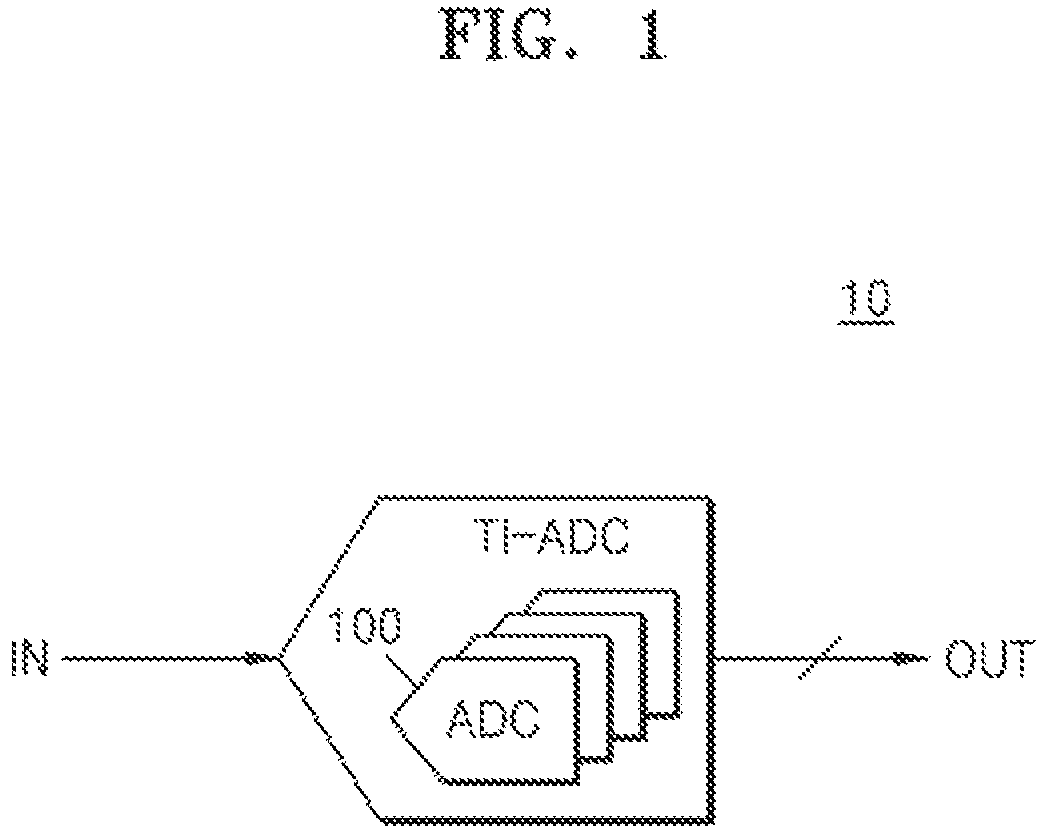
Various embodiments will be more clearly understood from the following detailed description taken in conjunction with the accompanying drawings, in which: is a block diagram of an analog-to-digital converter (ADC) according to an embodiment; is a block diagram showing one ADC from among a plurality of ADCs included in a time-interleaved ADC (TI-ADC), according to an embodiment; A is a block diagram showing an equivalent circuit of a sampling circuit, according to an embodiment; B shows an equivalent circuit of a first phase sampling circuit, according to an embodiment; C shows an equivalent circuit of a second phase sampling circuit, according to an embodiment; is a block diagram showing a sampling circuit according to an embodiment; is an equivalent circuit diagram of a sampling circuit including a linearization circuit, according to an embodiment; A shows an equivalent circuit of a first phase sampling circuit, according to an embodiment; B is a diagram for describing an equivalent circuit of a first phase sampling circuit, according to an embodiment; C is a diagram for describing an equivalent circuit of a first phase sampling circuit, according to an embodiment; C shows an equivalent circuit of a first phase sampling circuit, according to an embodiment; D is a diagram for describing an equivalent circuit of a first phase sampling circuit, according to an embodiment; E is a diagram for describing an equivalent circuit of a first phase sampling circuit, according to an embodiment; F is a diagram for describing an equivalent circuit of a first phase sampling circuit, according to an embodiment; A shows an equivalent circuit of a second phase sampling circuit, according to an embodiment; B is a diagram for describing an equivalent circuit of a second phase sampling circuit, according to an embodiment; C is a diagram for describing an equivalent circuit of a second phase sampling circuit, according to an embodiment; D shows an equivalent circuit of a second phase sampling circuit, according to an embodiment; E is a diagram for describing an equivalent circuit of a second phase sampling circuit, according to an embodiment; F is a diagram for describing an equivalent circuit of a second phase sampling circuit, according to an embodiment; and is a block diagram of a communication device according to an embodiment.
DETAILED DESCRIPTION
To achieve a high sampling rate in an analog-to-digital converter, a time-interleaved analog-to-digital converter (ADC) may include a plurality of analog-to-digital converters that receive an input in common, and the plurality of analog-to-digital converters may sample the input at different time points. However, the plurality of ADC in the time-interleaved ADC are affected by an input common-mode voltage. is a block diagram of an analog-to-digital converter (ADC) according to an embodiment. Referring to , the ADC may be implemented as a time-interleaved analog-to-digital converter (TI-ADC) 10 . However, embodiments are not limited thereto, and in some embodiments, the analog-to-digital converter may be implemented as any device that converts analog signals into digital signals. According to an embodiment, the TI-ADC 10 may generate an output signal OUT, which is a digital signal, by converting an input signal IN, which is an analog signal. In other words, the TI-ADC 10 may receive the input signal IN needing digital conversion and generate the output signal OUT by converting the input signal IN. As shown in , the TI-ADC 10 may include a plurality of ADCs 100 . The plurality of ADCs 100 may commonly (or time-divisionally) receive the input signal IN and may each output a digital signal corresponding to the magnitude of the input signal IN. Each of the plurality of ADCs 100 may be synchronized to a clock signal, and a plurality of clock signals supplied to the ADCs 100 may have different phases from each other. Therefore, the TI-ADC 10 may have a high sampling rate. Although shows a single input signal IN, embodiments are not limited thereto. In some embodiments, the TI-ADC 10 may receive two input signals including a first input signal INP and a second input signal INN, wherein the first input signal INP and the second input signal INN may be in the form of a differential signal pair (see, e.g., A- 7 F described below). According to the TI-ADC 10 , linearity deterioration due to a leakage current may be reduced by using a sampling circuit that samples without being affected by the leakage current. Detailed descriptions thereof will be given later with reference to the drawings. is a block diagram showing one ADC from among a plurality of ADCs included in a TI-ADC, according to an embodiment. Referring to , the operation of any one ADC 100 from among the plurality of ADCs included in the TI-ADC 10 will be described. Referring to , the ADC 100 may include a sampling circuit 110 , a front-end circuit 120 , and a back-end circuit 130 . The sampling circuit 110 may receive the input signal IN, which is an analog signal, and output a sampled signal SAM_IN at regular time intervals. The sampling circuit 110 may provide the sampled signal SAM_IN to the front-end circuit 120 . For example, a clock signal CK may be supplied to the sampling circuit 110 , and the input signal IN may be sampled at rising edges of the clock signal CK. The interval between rising edges adjacent to each other (i.e., time t) may become the sampling period of the sampling circuit 110 , and the sampling frequency may be 1/t. According to some embodiments, the input signal may be sampled at falling edges of the clock signal CK. The front-end circuit 120 may receive the sampled signal SAM_IN, process the sampled signal SAM_IN, and output a processed signal PRO_IN. Here, the front-end circuit 120 may include circuits, e.g., an amplifier, a filter, or a mixer, for processing the sampled signal SAM_IN. The front-end circuit 120 may provide the processed signal PRO_IN to the back-end circuit 130 . The back-end circuit 130 may receive the processed signal PRO_IN and output the output signal OUT, which is a digital signal, by converting the processed signal PRO_IN. A is a block diagram showing an equivalent circuit of a sampling circuit, according to an embodiment. B shows an equivalent circuit of a first phase sampling circuit, according to an embodiment. C shows an equivalent circuit of a second phase sampling circuit, according to an embodiment. Referring to A , a sampling circuit 110 a according to an embodiment will be described first. The sampling circuit 110 a according to an embodiment may receive input signals INP and INN, which are a differential signal pair, as input values and output sampled signals SAM_INP and SAM_INN as output values. The sampling circuit 110 a according to an embodiment may include a plurality of switches, e.g., a first switch S 31 , a second switch S 32 , a third switch S 33 , and a fourth switch S 34 , and a plurality of capacitors, e.g., a first capacitor C 31 and a second capacitor C 32 . Referring to A , the first switch S 31 may be connected between a terminal for applying the first input signal INP, and a first node N 31 . The second switch S 32 may be connected between the terminal that applies the first input signal INP, and a second node N 32 . The third switch S 33 may be connected between a terminal for applying the second input signal INN, and the first node N 31 . The fourth switch S 34 may be connected between the terminal for applying the second input signal INN, and the second node N 32 . The first capacitor C 31 may be connected between a terminal for outputting a first sampled signal SAM_INP, and the first node N 31 . The second capacitor C 32 may be connected between a terminal for outputting a second sampled signal SAM_INN, and the second node N 32 . In some embodiments, the first switch S 31 and the fourth switch S 34 may be turned on or turned off at the same timing according to a clock signal. In some embodiments, the second switch S 32 and the third switch S 33 may be turned on or turned off at the same timing according to a clock signal. In some embodiments, the first switch S 31 and the fourth switch S 34 may be turned on or turned off complementarily with respect to the second switch S 32 and the third switch S 33 based on a clock signal. For example, when the first switch S 31 and the fourth switch S 34 are turned on, the second switch S 32 and the third switch S 33 may be turned off. Conversely, when the first switch S 31 and the fourth switch S 34 are turned off, the second switch S 32 and the third switch S 33 may be turned on. Hereinafter, a case in which the first switch S 31 and the fourth switch S 34 are turned on and the second switch S 32 and the third switch S 33 are turned off will be referred to as a first phase, and a case in which the first switch S 31 and the fourth switch S 34 are turned off and the second switch S 32 and the third switch S 33 are turned on will be referred to as a second phase for convenience of description. The first to fourth switches S 31 to S 34 may have an on-resistance when turned on and have an off-resistance when turned off. For example, each switch may be implemented with a transistor, where the on-resistance refers to a resistance value between a drain terminal and a source terminal when the transistor is turned on, and the off-resistance refers to a resistance value between the drain terminal and the source terminal when the transistor is turned off. The description will be given under an assumption that the first to fourth switches S 31 to S 34 all have the same on-resistance RON and the same off-resistance ROFF. B is an equivalent circuit diagram showing the sampling circuit 110 a of the first phase by using the on-resistance and the off-resistance of switches. C is an equivalent circuit diagram showing the sampling circuit 110 a of the second phase by using the on-resistance and the off-resistance of switches. Referring to B , the level of a voltage applied to the first node N 31 of the first phase is ROFF RON + ROFF ( INP - INN ) , ( V ) and the level of a voltage applied to the second node N 32 of the first phase is ROFF RON + ROFF ( INN - INP ) . ( V ) Here, INP denotes the voltage level of the first input signal INP, and INN denotes the voltage level of the second input signal INN. Since ROFF is significantly greater than RON, the level of the voltage applied to the first node N 31 of the first phase may be approximated as INP-INN (V), and the level of the voltage applied to the second node N 32 of the first phase may be approximated as INN-INP (V). The first capacitor C 31 may output the first sampled signal SAM_INP of the first phase based on the INP-INN (V), which is the level of the voltage applied to the first node N 31 of the first phase. The second capacitor C 32 may output the second sampled signal SAM_INN of the first phase based on the INN-INP (V), which is the level of the voltage applied to the second node N 32 of the first phase. The first sampled signal SAM_INP and the second sampled signal SAM_INN may be a differential signal pair. Referring to C , the level of a voltage applied to the first node N 31 of the second phase may be ROFF RON + ROFF ( INN - INP ) , ( V ) and the level of a voltage applied to the second node N 32 of the second phase may be ROFF RON + ROFF ( INP - INN ) . ( V ) Here, INP denotes the voltage level of the first input signal INP, and INN denotes the voltage level of the second input signal INN. Since ROFF is significantly greater than RON, the level of the voltage applied to the first node N 31 of the second phase may be approximated as INN-INP (V), and the level of the voltage applied to the second node N 32 of the second phase may be approximated as INP-INN (V). The first capacitor C 31 may output the first sampled signal SAM_INP of the second phase based on the level of the voltage applied to the first node N 31 of the second phase. The first capacitor C 31 may output the second sampled signal SAM_INN of the second phase based on the level of the voltage applied to the first node N 31 of the second phase. The first sampled signal SAM_INP and the second sampled signal SAM_INN may be a differential signal pair. In other words, when ROFF is significantly greater than RON, the sampling circuit 110 a may output sampled signals SAM_INP and SAM_INN based on voltages (e.g., INP-INN (V) and INN-INP (V)) applied to the first node N 31 and the second node N 32 , and thus the linearity between the magnitude of an input signal and the magnitude of an output signal may be maintained. However, due to a high-temperature environment or the need for high-speed implementation, the magnitude of ROFF may be reduced more significantly as compared to RON. In this case, that is, when ROFF is not significantly greater than RON, the sampling circuit 110 a needs to output the sampled signals SAM_INP and SAM_INN based on the voltages ( e . g . , ROFF RON + ROFF ( INP - INN ) and ( V ) ROFF RON + ROFF ( INN - INP ) ) ( V ) applied to the first node N 31 and the second node N 32 , and thus the linearity between the magnitude of an input signal and the magnitude of an output signal may be deteriorated. Even when RON is reduced due to a high-temperature environment or the need for high-speed design, the sampling circuit 110 according to an embodiment may maintain the linearity between the magnitude of an input signal and the magnitude of an output signal by using a linearization circuit (linearization circuit 200 of ). Hereinafter, a sampling circuit 110 b including a linearization circuit (the linearization circuit 200 of ) will be described. is a block diagram showing a sampling circuit according to an embodiment. The sampling circuit 110 b according to an embodiment may receive input signals INP and INN, which are a differential signal pair, as input values and output sampled signals SAM_INP and SAM_INN as output values. The sampling circuit 110 b according to an embodiment may further include the linearization circuit 200 . In other words, the sampling circuit 110 b according to an embodiment may include a plurality of switches, e.g., a first switch S 41 , a second switch S 42 , a third switch S 43 , and a fourth switch S 44 , a plurality of capacitors, e.g., a first capacitor C 41 and a second capacitor C 42 , and the linearization circuit 200 . Referring to , the first switch S 41 may be connected between a terminal for applying the first input signal INP, and the linearization circuit 200 . The second switch S 42 may be connected between the terminal that applies the first input signal INP, and the linearization circuit 200 . The third switch S 43 may be connected between a terminal for applying the second input signal INN, and the linearization circuit 200 . The fourth switch S 44 may be connected between the terminal for applying the second input signal INN, and the linearization circuit 200 . The linearization circuit 200 may be connected to the terminal for applying the first input signal INP and the terminal for applying the second input signal INN. The first capacitor C 41 may be connected between a terminal for outputting the first sampled signal SAM_INP, and the linearization circuit 200 . The second capacitor C 42 may be connected between a terminal for outputting the second sampled signal SAM_INN, and the linearization circuit 200 . Since the linearization circuit 200 is connected to the terminal for applying the first input signal INP and the terminal for applying the second input signal INN, linearity deterioration due to a leakage current may be reduced. Detailed descriptions thereof will be given later with reference to the drawings below. is an equivalent circuit diagram of a sampling circuit including a linearization circuit, according to an embodiment. is a diagram showing the sampling circuit 110 b according to an embodiment of the linearization circuit 200 of and includes an equivalent circuit of the linearization circuit 200 . The sampling circuit 110 b may include the first to fourth switches S 41 to S 44 , the first and second capacitors C 41 and C 42 , and the linearization circuit 200 . The linearization circuit 200 may include a fifth switch S 51 , a sixth switch S 52 , a seventh switch S 53 , an eighth switch S 54 , a ninth switch S 55 , a tenth switch S 56 , an eleventh switch S 57 , and a twelfth switch S 58 . Referring to , a terminal for inputting the first input signal INP may be connected to a seventh node N 57 . A terminal for inputting the second input signal INN may be connected to an eighth node N 58 . The first switch S 41 may be connected between the seventh node N 57 and a fifth node N 55 . The second switch S 42 may be connected between the seventh node N 57 and a third node N 53 . The third switch S 43 may be connected between the eighth node N 58 and a fourth node N 54 . The fourth switch S 44 may be connected between the eighth node N 58 and a sixth node N 56 . The fifth switch S 51 may be connected between the seventh node N 57 and the fourth node N 54 . The sixth switch S 52 may be connected between the seventh node N 57 and the sixth node N 56 . The seventh switch S 53 may be connected between the eighth node N 58 and the fifth node N 55 . The eighth switch S 54 may be connected between the eighth node N 58 and the third node N 53 . The ninth switch S 55 may be connected between the fifth node N 55 and a first node N 51 . The tenth switch S 56 may be connected between the third node N 53 and a second node N 52 . The eleventh switch S 57 may be connected between the fourth node N 54 and the first node N 51 . The twelfth switch S 58 may be connected between the sixth node N 56 and the second node N 52 . The first capacitor C 41 may be connected between the first node N 51 and a terminal for outputting the first sampled signal SAM_INP. The second capacitor C 42 may be connected between the second node N 52 and a terminal for outputting the second sampled signal SAM_INN. In some embodiments, the first switch S 41 , the fourth switch S 44 , the fifth switch S 51 , the eighth switch S 54 , the ninth switch S 55 , and the twelfth switch S 58 may be turned on or turned off at the same timing according to a clock signal. In some embodiments, the second switch S 42 , the third switch S 43 , the sixth switch S 52 , the seventh switch S 53 , the tenth switch S 56 , and the eleventh switch S 57 may be turned on or turned off at the same timing according to a clock signal. In some embodiments, the first switch S 41 , the fourth switch S 44 , the fifth switch S 51 , the eighth switch S 54 , the ninth switch S 55 , and the twelfth switch S 58 may be turned on or turned off complementarily with respect to the second switch S 42 , the third switch S 43 , the sixth switch S 52 , the seventh switch S 53 , the tenth switch S 56 , and the eleventh switch S 57 , based on a clock signal. For example, when the first switch S 41 , the fourth switch S 44 , the fifth switch S 51 , the eighth switch S 54 , the ninth switch S 55 , and the twelfth switch S 58 are turned on, the second switch S 42 , the third switch S 43 , the sixth switch S 52 , the seventh switch S 53 , the tenth switch S 56 , and the eleventh switch S 57 may be turned off. Conversely, when the first switch S 41 , the fourth switch S 44 , the fifth switch S 51 , the eighth switch S 54 , the ninth switch S 55 , and the twelfth switch S 58 are turned off, the second switch S 42 , the third switch S 43 , the sixth switch S 52 , the seventh switch S 53 , the tenth switch S 56 , and the eleventh switch S 57 may be turned on. Hereinafter, a case in which the first switch S 41 , the fourth switch S 44 , the fifth switch S 51 , the eighth switch S 54 , the ninth switch S 55 , and the twelfth switch S 58 are turned on and the second switch S 42 , the third switch S 43 , the sixth switch S 52 , the seventh switch S 53 , the tenth switch S 56 , and the eleventh switch S 57 are turned off will be referred to as a first phase, whereas a case in which the first switch S 41 , the fourth switch S 44 , the fifth switch S 51 , the eighth switch S 54 , the ninth switch S 55 , and the twelfth switch S 58 are turned off and the second switch S 42 , the third switch S 43 , the sixth switch S 52 , the seventh switch S 53 , the tenth switch S 56 , and the eleventh switch S 57 are turned on will be referred to as a second phase. For example, may be an equivalent circuit diagram of the sampling circuit 110 b that performs the first phase of the sampling operation. In some embodiments, the first to fourth switches S 41 to S 44 and the fifth to twelfth switches S 51 to S 58 may have an on-resistance when turned on and an off-resistance when turned off. For example, each switch may be implemented with a transistor, where the on-resistance refers to a resistance value between a drain terminal and a source terminal when the transistor is turned on, and the off-resistance refers to a resistance value between the drain terminal and the source terminal when the transistor is turned off. The description will be given under an assumption that the first to fourth switches S 41 to S 44 and the fifth to twelfth switches S 51 to S 58 all have the same on-resistance. A shows an equivalent circuit of a first phase sampling circuit, according to an embodiment. B is a diagram for describing an equivalent circuit of a first phase sampling circuit, according to an embodiment. C is a diagram for describing an equivalent circuit of a first phase sampling circuit, according to an embodiment. C shows an equivalent circuit of a first phase sampling circuit, according to an embodiment. D is a diagram for describing an equivalent circuit of a first phase sampling circuit, according to an embodiment. E is a diagram for describing an equivalent circuit of a first phase sampling circuit, according to an embodiment. F is a diagram for describing an equivalent circuit of a first phase sampling circuit, according to an embodiment. A is an equivalent circuit diagram showing the sampling circuit 110 b of the first phase by using the on-resistance and the off-resistance of switches. In the first phase, the first switch S 41 , the fourth switch S 44 , the fifth switch S 51 , the eighth switch S 54 , the ninth switch S 55 , and the twelfth switch S 58 may be turned on, the second switch S 42 , the third switch S 43 , the sixth switch S 52 , the seventh switch S 53 , the tenth switch S 56 , and the eleventh switch S 57 may be turned off. The first to fourth switches S 41 to S 44 and the fifth to twelfth switches S 51 to S 58 may have the same on-resistance RON. The second switch S 42 and the third switch S 43 may have a first off-resistance ROFF 1 , the tenth switch S 56 and the eleventh switch S 57 may have a second off-resistance ROFF 2 , and the sixth switch S 52 and the seventh switch S 53 may have a third off-resistance ROFF 3 . The first capacitor C 41 may output the first sampled signal SAM_INP of the first phase based on the level of the voltage applied to the first node N 51 of the first phase. The second capacitor C 42 may output the second sampled signal SAM_INN of the first phase based on the level of the voltage applied to the second node N 52 of the first phase. According to some embodiments, in the first phase, by making the level of the voltage applied to the first node N 51 and the level of the voltage applied to the fourth node N 54 identical to each other, the linearity between the magnitude of the voltage of the input signals INP and INN and magnitude of the voltage of the first sampled signal SAM_INP, which is an output signal, may be improved. According to some embodiments, in the first phase, by making the level of the voltage applied to the third node N 53 and the level of the voltage applied to the second node N 52 identical to each other, the linearity between the magnitude of the voltage of the input signals INP and INN and magnitude of the voltage of the second sampled signal SAM_INN, which is an output signal, may be improved. The first node N 51 will be described in detail with reference to A, 6 B , and 6 C, and the second node N 52 will be described in detail with reference to D, 6 E , and 6 F. Referring to A , paths related to the level of the voltage applied to the first node N 51 and the level of the voltage applied to the fourth node N 54 are a path A-B-C interconnecting a terminal for applying the first input signal INP, the seventh node N 57 , the fifth node N 55 , the first node N 51 , the fourth node N 54 , the eighth node N 58 , and a terminal for applying the second input signal INN and a path D interconnecting the seventh node N 57 and the fourth node N 54 . First, referring to B , the path A-B-C will be described. Referring to B , the path A-B-C may include a path A interconnecting the terminal for applying the first input signal INP, the seventh node N 57 , the first switch S 41 having the on-resistance RON, the fifth node N 55 , the ninth switch S 55 having the on-resistance RON, and the first node N 51 ; a path B interconnecting the first node N 51 and the eleventh switch S 57 having the second off-resistance ROFF 2 ; and a path C interconnecting the eleventh switch S 57 having the second off-resistance ROFF 2 , the fourth node N 54 , the third switch S 43 having the first off-resistance ROFF 1 , and the terminal for applying the second input signal INN. When the path D is not considered, the level of a voltage applied to the first node N 51 may be ROFF 2 + ROFF 1 2 RON + ROFF 1 + ROFF 2 ( INP - INN ) . ( V ) Here, INP denotes the voltage level of the first input signal INP, INN denotes the voltage level of the second input signal INN, ROFF 2 denotes the off-resistance value of the eleventh switch S 57 , ROFF 1 denotes the off-resistance value of the third switch S 43 , and RON denotes the on-resistance value of the first switch S 41 and the ninth switch S 55 . In other words, the first capacitor C 41 may output the first sampled signal SAM_INP of the first phase based on the ROFF 2 + ROFF 1 2 RON + ROFF 1 + ROFF 2 ( INP - INN ) , ( V ) which is the level of the voltage applied to the first node N 51 of the first phase. Referring to C , the path A-B-C and the path D are shown. The path D may be a path interconnecting the terminal for applying the first input signal INP, the seventh node N 57 , the fifth switch S 51 having the on-resistance RON, and the fourth node N 54 . Since ROFF 2 is significantly greater than RON, the fifth switch S 51 having the on-resistance RON may serve as a short switch to equalize the level of voltages applied to both ends of the eleventh switch S 57 . In other words, as the level of voltages applied to the both ends of the eleventh switch S 57 become identical to each other, the second off-resistance ROFF 2 , which is the off-resistance of the eleventh switch S 57 , may become very large. As the second off-resistance ROFF 2 of the eleventh switch S 57 becomes very large, ROFF 2 + ROFF 1 2 RON + ROFF 1 + ROFF 2 ( INP - INN ) , ( V ) which is the level of the voltage applied to the first node N 51 of the first phase, may be approximated as INP-INN (V). In other words, the path D is a new leakage path of a leakage current, and, even when the on-resistance RON of switches becomes small, the second off-resistance ROFF 2 of the eleventh switch S 57 may become very large due to the fifth switch S 51 , which is a short switch. Therefore, the first capacitor C 41 may output the first sampled signal SAM_INP of the first phase based on INP-INN (V), which is the level of the voltage applied to the first node N 51 of the first phase, regardless the on-resistance RON of switches. Referring to D , paths related to the level of the voltage applied to the second node N 52 and the level of the voltage applied to the third node N 53 are a path E-F-G interconnecting the eighth node N 58 , the sixth node N 56 , the second node N 52 , the third node N 53 , and the seventh node N 57 and a path H interconnecting the eighth node N 58 and the third node N 53 . First, referring to E , the path E-F-G will be described. Referring to E , the path E-F-G may include a path E interconnecting the terminal for applying the second input signal INN, the eighth node N 58 , the fourth switch S 44 having the on-resistance RON, the sixth node N 56 , the twelfth switch S 58 having the on-resistance RON, and the second node N 52 , a path F interconnecting the second node N 52 and the tenth switch S 56 having the second off-resistance ROFF 2 , and a path G interconnecting the tenth switch S 56 having the second off-resistance ROFF 2 , the third node N 53 , the second switch S 42 having the first off-resistance ROFF 1 , and the terminal for applying the first input signal INP. When the path H is not considered, the level of a voltage applied to the second node N 52 may be ROFF 2 + ROFF 1 2 RON + ROFF 1 + ROFF 2 ( INN - INP ) . ( V ) Here, INP denotes the voltage level of the first input signal INP, INN denotes the voltage level of the second input signal INN, ROFF 2 denotes the off-resistance value of the tenth switch S 56 , ROFF 1 denotes the off-resistance value of the second switch S 42 , and RON denotes the on-resistance value of the fourth switch S 44 and the twelfth switch S 58 . The second capacitor C 42 may output the second sampled signal SAM_INN of the first phase based on the ROFF 2 + ROFF 1 2 RON + ROFF 1 + ROFF 2 ( INN - INP ) , ( V ) which is the level of the voltage applied to the second node N 52 of the first phase. Referring to f , the path E-F-G and the path H are shown. The path H may interconnect the terminal for applying the second input signal INN, the eighth node N 58 , the eighth switch S 54 having the on-resistance RON, and the third node N 53 . Since ROFF 2 is significantly greater than RON, the eighth switch S 54 having the on-resistance RON may serve as a short switch to equalize the level of voltages applied to both ends of the tenth switch S 56 . In other words, as the level of voltages applied to the both ends of the tenth switch S 56 become identical to each other, the second off-resistance ROFF 2 , which is the off-resistance of the tenth switch S 56 , may become very large. As the second off-resistance ROFF 2 of the tenth switch S 56 becomes very large, ROFF 2 + ROFF 1 2 RON + ROFF 1 + ROFF 2 ( INN - INP ) . ( V ) which is the level of the voltage applied to the second node N 52 of the first phase, may be approximated as INN-INP (V). In other words, the path H is a new leakage path of a leakage current, and, even when the on-resistance RON of switches becomes small, the second off-resistance ROFF 2 of the tenth switch S 56 may become very large due to the eighth switch S 54 , which is a short switch. Therefore, the second capacitor C 42 may output the second sampled signal SAM_INN of the first phase based on INN-INP (V), which is the level of the voltage applied to the second node N 52 of the first phase, regardless the on-resistance RON of switches. Therefore, in the first phase, the sampling circuit 110 according to an embodiment may maintain the linearity by using the linearization circuit (the linearization circuit 200 of ) even when the on-resistance RON of switches has become small due to a high-temperature environment or the need for high-speed design. A shows an equivalent circuit of a second phase sampling circuit, according to an embodiment. B is a diagram for describing an equivalent circuit of a second phase sampling circuit, according to an embodiment. C is a diagram for describing an equivalent circuit of a second phase sampling circuit, according to an embodiment. D shows an equivalent circuit of a second phase sampling circuit, according to an embodiment. E is a diagram for describing an equivalent circuit of a second phase sampling circuit, according to an embodiment. F is a diagram for describing an equivalent circuit of a second phase sampling circuit, according to an embodiment. A is an equivalent circuit diagram showing the sampling circuit 110 b of the second phase by using the on-resistance and the off-resistance of switches. In the second phase, the first switch S 41 , the fourth switch S 44 , the fifth switch S 51 , the eighth switch S 54 , the ninth switch S 55 , and the twelfth switch S 58 may be turned off, the second switch S 42 , the third switch S 43 , the sixth switch S 52 , the seventh switch S 53 , the tenth switch S 56 , and the eleventh switch S 57 may be turned on. The switches S 41 to S 44 and S 51 to S 58 may have the same on-resistance RON, the first switch S 41 and the fourth switch S 44 may have the first off-resistance ROFF 1 , the ninth switch S 55 and the twelfth switch S 58 may have the second off-resistance ROFF 2 , and the fifth switch S 51 and the eighth switch S 54 may have the third off-resistance ROFF 3 . In the second phase, the first capacitor C 41 may output the first sampled signal SAM_INP based on the level of the voltage applied to the first node N 51 . In the second phase, the second capacitor C 42 may output the second sampled signal SAM_INN of the second phase based on the level of the voltage applied to the second node N 52 . According to some embodiments, in the second phase, by making the level of the voltage applied to the first node N 51 and the level of the voltage applied to the fifth node N 55 identical to each other, the linearity between the magnitude of the voltage of the input signals INP and INN and magnitude of the voltage of the first sampled signal SAM_INP, which is an output signal, may be improved. According to some embodiments, by making the level of the voltage applied to the second node N 52 and the level of the voltage applied to the sixth node N 56 identical to each other, the linearity between the magnitude of the voltage of the input signals INP and INN and magnitude of the voltage of the second sampled signal SAM_INN, which is an output signal, may be improved. The first node N 51 will be described in detail with reference to A, 7 B , and 7 C, and the second node N 52 will be described in detail with reference to D, 7 E , and 7 F. Referring to A , paths related to the level of the voltage applied to the first node N 51 and the level of the voltage applied to the fifth node N 55 are a path I-J-K interconnecting the terminal for applying the second input signal INN, the eighth node N 58 , the fourth node N 54 , the first node N 51 , the fifth node N 55 , the eighth node N 58 , and the terminal for applying the first input signal INP and a path L interconnecting the eighth node N 58 and the fifth node N 55 . First, referring to B , the path I-J-K will be described. Referring to B , the path I-J-K may include a path I interconnecting the terminal for applying the second input signal INN, the eighth node N 58 , the third switch S 43 having the on-resistance RON, the fourth node N 54 , the eleventh switch S 57 having the on-resistance RON, and the first node N 51 , a path J interconnecting the first node N 51 and the ninth switch S 55 having the second off-resistance ROFF 2 , and a path K interconnecting the ninth switch S 55 having the second off-resistance ROFF 2 , the fifth node N 55 , the first switch S 41 having the first off-resistance ROFF 1 , and the terminal for applying the first input signal INP. When the path L is not considered, the level of a voltage applied to the first node node N 51 may be ROFF 2 + ROFF 1 2 RON + ROFF 1 + ROFF 2 ( INN - INP ) . ( V ) Here, INP denotes the voltage level of the first input signal INP, INN denotes the voltage level of the second input signal INN, ROFF 2 denotes the off-resistance value of the ninth switch S 55 , ROFF 1 denotes the off-resistance value of the first switch S 41 , and RON denotes the on-resistance value of the third switch S 43 and the eleventh switch S 57 . In other words, the first capacitor C 41 may output the first sampled signal SAM_INP of the second phase based on the ROFF 2 + ROFF 1 2 RON + ROFF 1 + ROFF 2 ( INN - INP ) , ( V ) which is the level of the voltage applied to the first node N 51 of the second phase. Referring to C , the path I-J-K and the path L are shown. The path L may interconnect the terminal for applying the second input signal INN, the eighth node N 58 , the seventh switch S 53 having the on-resistance RON, and the fifth node N 55 . Since ROFF 2 is significantly greater than RON, the seventh switch S 53 having the on-resistance RON may serve as a short switch to equalize the level of voltages applied to both ends of the ninth switch S 55 . In other words, as the level of voltages applied to the both ends of the ninth switch S 55 become identical to each other, the second off-resistance ROFF 2 , which is the off-resistance of the ninth switch S 55 , may become very large. As the second off-resistance ROFF 2 of the ninth switch S 55 becomes very large, ROFF 2 + ROFF 1 2 RON + ROFF 1 + ROFF 2 ( INN - INP ) , ( V ) which is the level of the voltage applied to the first node N 51 of the second phase, may be approximated as INN-INP (V). In other words, the path L is a new leakage path of a leakage current, and, even when the on-resistance RON of switches becomes small, the second off-resistance ROFF 2 of the ninth switch S 55 may become very large due to the seventh switch S 53 , which is a short switch. Therefore, the first capacitor C 41 may output the first sampled signal SAM_INP of the second phase based on INN-INP (V), which is the level of the voltage applied to the first node N 51 of the second phase, regardless the on-resistance RON of switches. Referring to D , paths related to the level of the voltage applied to the second node N 52 and the level of the voltage applied to the sixth node N 56 are a path M-N-O interconnecting the terminal for applying the first input signal INP, the seventh node N 57 , the third node N 53 , the second node N 52 , the sixth node N 56 , and the eighth node N 58 and a path P interconnecting the seventh node N 57 and the sixth node N 56 . First, referring to E , the path M-N-O will be described. Referring to E , the path M-N-O may include a path M interconnecting the terminal for applying the first input signal INP, the seventh node N 57 , the second switch S 42 having the on-resistance RON, the third node N 53 , and the tenth switch S 56 having the on-resistance RON, a path N interconnecting the tenth switch S 56 having the on-resistance RON and the seventh node N 57 , and a path O interconnecting the second node N 52 , the twelfth switch S 58 having the second off-resistance ROFF 2 , the sixth node N 56 , the fourth switch S 44 having the first off-resistance ROFF 1 , and the terminal for applying the second input signal INN. When the path O is not considered, the level of a voltage applied to the second node N 52 may be ROFF 2 + ROFF 1 2 RON + ROFF 1 + ROFF 2 ( INP - INN ) . ( V ) Here, INP denotes the voltage level of the first input signal INP, INN denotes the voltage level of the second input signal INN, ROFF 2 denotes the off-resistance value of the twelfth switch S 58 , ROFF 1 denotes the off-resistance value of the fourth switch S 44 , and RON denotes the on-resistance value of the second switch S 42 and the tenth switch S 56 . The second capacitor C 42 may output the second sampled signal SAM_INN of the first phase based on the ROFF 2 + ROFF 1 2 RON + ROFF 1 + ROFF 2 ( INP - INN ) , ( V ) which is the level of the voltage applied to the second node N 52 of the second phase. Referring to F , the path M-N-O and the path P are shown. The path P may interconnect the terminal for applying the first input signal INP, the seventh node N 57 , the sixth switch S 52 having the on-resistance RON, and the sixth node N 56 . Since ROFF 2 is significantly greater than RON, the sixth switch S 52 having the on-resistance RON may serve as a short switch to equalize the level of voltages applied to both ends of the twelfth switch S 58 . In other words, as the level of voltages applied to the both ends of the twelfth switch S 58 become identical to each other, the second off-resistance ROFF 2 , which is the off-resistance of the twelfth switch S 58 , may become very large. As the second off-resistance ROFF 2 of the twelfth switch S 58 becomes very large, ROFF 2 + ROFF 1 2 RON + ROFF 1 + ROFF 2 ( INP - INN ) , ( V ) which is the level of the voltage applied to the second node N 52 of the second phase, may be approximated as INP-INN (V). In other words, the path P is a new leakage path of a leakage current, and, even when the on-resistance RON of switches becomes small, the second off-resistance ROFF 2 of the twelfth switch S 58 may become very large due to the sixth switch S 52 , which is a short switch. Therefore, the second capacitor C 42 may output the second sampled signal SAM_INN of the second phase based on INP-INN (V), which is the level of the voltage applied to the second node N 52 of the second phase, regardless the on-resistance RON of switches. Therefore, in the second phase, the sampling circuit 110 b according to an embodiment may maintain the linearity by using the linearization circuit (the linearization circuit 200 of ) even when the on-resistance RON of switches has become small due to a high-temperature environment or the need for high-speed design. In the first phase of the sampling circuit 110 b according to an embodiment, the fifth switch S 51 and the eighth switch S 54 may be implemented as short switches, and, in the second phase of the sampling circuit 110 b , the seventh switch S 53 and the sixth switch S 52 may be implemented as short switches. Therefore, even when the on-resistance RON of switches has become small due to a high-temperature environment or the need for high-speed design. the linearity between the magnitude of an input signal and the magnitude of the output signal in the sampling circuit 110 b may be maintained. is a block diagram showing a communication device 1000 according to an embodiment. According to some embodiments, the TI-ADC 10 described above may be used to process signals received by the communication device 1000 . The communication device 1000 may refer to any device that communicates with another communication device through a communication channel CH. For example, in some embodiments, the communication device 1000 may be a portable device, such as a laptop computer, a mobile phone, and a wearable device, or a component included in the portable device. In some embodiments, the communication device 1000 may be a stationary device, such as a desktop computer, a server, and a kiosk, or a component included in the stationary device. In some embodiments, the communication device 1000 may be used as a component of a means of transportation such as a car or a ship. According to some embodiments, the communication channel CH may include a wired channel, and the communication device 1000 may perform communication by based on any wired communication, e.g., optical communication, Ethernet, peripheral component interconnect (PCI), PCI express (PCIe), universal serial bus (USB), serial ATA (SATA), etc. According to some embodiments, the communication channel CH may include a wireless channel, and the communication device 1000 may perform communication based on any wireless communication, e.g., wireless local area network (WLAN), Bluetooth, long-term evolution (LTE), 5th generation (5G), etc. As shown in , the communication device 1000 may include a transmitter 1220 , a receiver 1240 , and processing circuitry 1260 . When the communication channel CH includes a wireless channel, the communication device 1000 may further include at least one antenna. The at least one antenna may be connected to the transmitter 1220 and the receiver 1240 . According to some embodiments, the transmitter 1220 and the receiver 1240 may be implemented as a single component and may be collectively referred to as a transceiver. The transmitter 1220 may receive transmission data TXD from the processing circuitry 1260 and output a transmission signal TX to the communication channel CH based on the transmission data TXD. As shown in , the transmitter 1220 may include a transmitting side front-end circuit 1220 _ 1 and a digital-to-analog converter (DAC) 1220 _ 2 . The DAC 1220 _ 2 may convert the transmission data TXD received from the processing circuitry 1260 into an analog signal, and the transmitting side front-end circuit 1220 _ 1 may generate the transmission signal TX by processing the analog signal. The transmitting side front-end circuit 1220 _ 1 may include circuits for processing analog signals, such as an amplifier, a filter, or a mixer. The receiver 1240 may receive a reception signal RX from the communication channel CH and provide reception data RXD to the processing circuitry 1260 based on the reception signal RX. As shown in , the receiver 1240 may include an ADC. The ADC may process the reception signal RX and may include circuits for processing the reception signal RX, e.g., an amplifier, a filter, or a mixer. The analog-to-digital converter may generate the reception data RXD by converting signals received from the sampling circuit described above. For high-speed communication, in some embodiments, the ADC may be the TI-ADC 10 including a plurality of sub-ADCs. According to some embodiments, the sampling circuit may include switches implemented as short switches, and thus, even when the on-resistance RON of the switches has become small due to a high-temperature environment or the need for high-speed design, the linearity between the magnitude of an output signal and the magnitude of an input signal may be maintained at the sampling circuit. The processing circuitry 1260 may generate the transmission data TXD based on information to be transmitted to another communication device through the communication channel CH in a transmission mode and provide the transmission data TXD to the transmitter 1220 . The processing circuitry 1260 may receive the reception data RXD from the transmitter 1220 in a reception mode and obtain information transmitted by another communication device through the communication channel CH by processing the reception data RXD. The processing circuitry 1260 may include programmable components, components providing fixed functionality, and/or reconfigurable components. While various embodiments have been particularly shown and described with reference to the drawings, it will be understood that various changes in form and details may be made therein without departing from the spirit and scope of the following claims.
Figures (20)
Citations
This patent cites (11)
- US5703589
- US6204787
- US6956514
- US8049555
- US8368453
- US2025/0141460
- US111756379
- US113746483
- US2000-132989
- US2009-27281
- US2015-159513