Switch Device and Operation Method Thereof
Abstract
A switch device and an operation method thereof are provided. The switch device is disposed on a motherboard, and the motherboard is suitable for connecting to a graphics card. The switch device includes a control module and a switch module. The control module receives a first signal and a second signal and generates a first control signal and a second control signal according to the first signal and the second signal. The switch module is connected to a first pin, a second pin, a third pin, and the control module. The switch device receives the first control signal and the second control signal, and switches a connection among the first pin, the second pin, and the third pin according to the first control signal and the second control signal. The first pin and the second pin are suitable for connecting to the graphics card.
Claims (20)
1 . A switch device, disposed on a motherboard, wherein the motherboard is suitable for connecting to a graphics card, and the switch device comprises: a control module, configured to receive a first signal and a second signal and generate a first control signal and a second control signal according to the first signal and the second signal; and a switch module, connected to a first pin, a second pin, a third pin, and the control module, wherein the switch module is configured to receive the first control signal and the second control signal, and to connect the first pin and the third pin, to connect the second pin and the third pin, to disconnect a connection of the first pin and the third pin, and to disconnect a connection of the second pin and the third pin according to the first control signal and the second control signal; and wherein the first pin and the second pin are suitable for connecting to the graphics card.
12 . An operation method of a switch device, wherein the switch device is disposed on a motherboard, the motherboard is suitable to connect to a graphics card, and the operation method of the switch device comprises: using a control module to receive a first signal and a second signal and to generate a first control signal and a second control signal according to the first signal and the second signal; using a switch module to connect to a first pin, a second pin, a third pin, and the control module, wherein the first pin and the second pin are suitable to connect to the graphics card; using the switch module to receive the first control signal and the second control signal; and using the switch module to connect the first pin and the third pin, to connect the second pin and the third pin, to disconnect a connection of the first pin and the third pin, and to disconnect a connection of the second pin and the third pin according to the first control signal and the second control signal.
Show 18 dependent claims
2 . The switch device as claimed in claim 1 , wherein the first pin is a twelfth pin of a peripheral component interconnect express (PCIE) slot, the second pin is a seventeenth pin of the PCIE slot, the third pin is a clock signal control pin, the first signal is generated by the first pin, and the second signal is a bus reset signal.
3 . The switch device as claimed in claim 1 , wherein the switch module comprises: a first switch unit, having a first terminal, a second terminal and a control terminal, wherein the first terminal of the first switch unit is connected to the third pin, the second terminal of the first switch unit is connected to the second pin, and the control terminal of the first switch unit is configured to receive the second control signal; and a second switch unit, having a first terminal, a second terminal and a control terminal, wherein the first terminal of the second switch unit is connected to the first pin, the second terminal of the second switch unit is connected to the third pin, and the control terminal of the second switch unit is configured to receive the first control signal.
4 . The switch device as claimed in claim 1 , wherein the control module comprises: a first NAND gate, having a first input terminal, a second input terminal, and an output terminal, wherein the first input terminal of the first NAND gate is configured to receive the first signal, and the output terminal of the first NAND gate is configured to generate the first control signal; and a second NAND gate, having a first input terminal, a second input terminal, and an output terminal, wherein the first input terminal of the second NAND gate is configured to receive the second signal, the second input terminal of the second NAND gate is connected to the output terminal of the first NAND gate, and the output terminal of the second NAND gate is connected to the second input terminal of the first NAND gate and configured to generate the second control signal.
5 . The switch device as claimed in claim 1 , wherein in response to a type of the graphics card being PCIE 3.0 and the motherboard not being operated, the first signal and the second signal are a low logic level, the first control signal and the second control signal are a high logic level, and wherein the switch module connects the second pin and the third pin, and connects the first pin and the third pin.
6 . The switch device as claimed in claim 1 , wherein in response to a type of the graphics card being PCIE 3 . 0 and the motherboard being operated, the first signal is a low logic level, the second signal is a low logic level or a high logic level, the first control signal is a low logic level, the second control signal is a high logic level, and wherein the switch module connects the second pin and the third pin, and disconnects a connection of the first pin and the third pin.
7 . The switch device as claimed in claim 1 , wherein in response to a type of the graphics card being PCIE 4 . 0 and the motherboard not being operated, the first signal and the second signal are a low logic level, the first control signal and the second control signal are a high logic level, and wherein the switch module connects the second pin and the third pin, and connects the first pin and the third pin.
8 . The switch device as claimed in claim 1 , wherein in response to a type of the graphics card being PCIE 4.0, the motherboard being operated, and a clock request not being enabled, the first signal is a high logic level, the second signal is a low logic level, the first control signal is a low logic level, the second control signal is a high logic level, and wherein the switch module connects the second pin and the third pin, and disconnects a connection of the first pin and the third pin.
9 . The switch device as claimed in claim 1 , wherein in response to a type of the graphics card being PCIE 4.0, the motherboard being operated, and a clock request being enabled, the first signal and the second signal are a low logic level, the first control signal and the second control signal are a high logic level, and wherein the switch module connects the second pin and the third pin, and connects the first pin and the third pin.
10 . The switch device as claimed in claim 1 , wherein in response to a type of the graphics card being PCIE 4.0, the motherboard being operated, and a clock signal of the motherboard being stable, the first signal is a low logic level, the second signal is a high logic level, the first control signal is a high logic level, the second control signal is a low logic level, and wherein the switch module connects the first pin and the third pin, and disconnects a connection of the second pin and the third pin.
11 . The switch device as claimed in claim 1 , wherein in response to a type of the graphics card being PCIE 4.0, the motherboard being operated, and a clock request being disabled or enabled, the first signal and the second signal are a high logic level, the first control signal is a high logic level, the second control signal is a low logic level, and wherein the switch module connects the first pin and the third pin, and disconnects a connection of the second pin and the third pin.
13 . The operation method of the switch device as claimed in claim 12 , wherein the first pin is a twelfth pin of a peripheral component interconnect express (PCIE) slot, the second pin is a seventeenth pin of the PCIE slot, the third pin is a clock signal control pin, the first signal is generated by the first pin, and the second signal is a bus reset signal.
14 . The operation method of the switch device as claimed in claim 12 , wherein in response to a type of the graphics card being PCIE 3.0 and the motherboard not being operated, the first signal and the second signal are a low logic level, the first control signal and the second control signal are a high logic level, and wherein the switch module connects the second pin and the third pin, and connects the first pin and the third pin.
15 . The operation method of the switch device as claimed in claim 12 , wherein in response to a type of the graphics card being PCIE 3.0 and the motherboard being operated, the first signal is a low logic level, the second signal is a low logic level or a high logic level, the first control signal is a low logic level, the second control signal is a high logic level, and wherein the switch module connects the second pin and the third pin, and disconnects a connection of the first pin and the third pin.
16 . The operation method of the switch device as claimed in claim 12 , wherein in response to a type of the graphics card being PCIE 4.0 and the motherboard not being operated, the first signal and the second signal are a low logic level, the first control signal and the second control signal are a high logic level, and wherein the switch module connects the second pin and the third pin, and connects the first pin and the third pin.
17 . The operation method of the switch device as claimed in claim 12 , wherein in response to a type of the graphics card being PCIE 4.0, the motherboard being operated, and a clock request not being enabled, the first signal is a high logic level, the second signal is a low logic level, the first control signal is a low logic level, the second control signal is a high logic level, and wherein the switch module connects the second pin and the third pin, and disconnects a connection of the first pin and the third pin.
18 . The operation method of the switch device as claimed in claim 12 , wherein in response to a type of the graphics card being PCIE 4.0, the motherboard being operated, and a clock request being enabled, the first signal and the second signal are a low logic level, the first control signal and the second control signal are a high logic level, and wherein the switch module connects the second pin and the third pin, and connects the first pin and the third pin.
19 . The operation method of the switch device as claimed in claim 12 , wherein in response to a type of the graphics card being PCIE 4.0, the motherboard being operated, and a clock signal of the motherboard being stable, the first signal is a low logic level, the second signal is a high logic level, the first control signal is a high logic level, the second control signal is a low logic level, and wherein the switch module connects the first pin and the third pin, and disconnects a connection of the second pin and the third pin.
20 . The operation method of the switch device as claimed in claim 12 , wherein in response to a type of the graphics card being PCIE 4.0, the motherboard being operated, and a clock request being disabled or enabled, the first signal and the second signal are a high logic level, the first control signal is a high logic level, the second control signal is a low logic level, and wherein the switch module connects the first pin and the third pin, and disconnects a connection of the second pin and the third pin.
Full Description
Show full text →
CROSS REFERENCE TO RELATED APPLICATIONS
This application claims priority of Taiwan Patent Application No. 113108248, filed on Mar. 7, 2024, the entirety of which is incorporated by reference herein.
BACKGROUND OF THE INVENTION
Field of the Invention An embodiment of the present invention relates to a switch device, and in particular it relates to a switch device and operation method thereof. Description of the Related Art Generally, different types of graphics cards may have different designs. For example, a particular function may be assigned to different pins in different types of graphics cards. Since the function defined by a pin of a graphics card can be changed, however, different types of graphics cards may not be used on the same motherboard, causing inconvenience in use. Therefore, how to allow different types of graphics cards to operate normally on the same motherboard has become one of the important problems to be solved. BRIEF
SUMMARY OF THE INVENTION
An embodiment of the present invention provides a switch device and an operation method thereof, so that different types of display cards may be operated normally on the same motherboard, thereby reducing the complexity of the design and increasing the convenience of use. An embodiment of the present invention provides a switch device, which is disposed on a motherboard, and the motherboard is suitable for connecting to a graphics card. The switch device includes a control module and a switch module. The control module is configured to receive a first signal and a second signal and generate a first control signal and a second control signal according to the first signal and the second signal. The switch module is connected to a first pin, a second pin, a third pin, and the control module. The switch module is configured to receive the first control signal and the second control signal, and switch a connection among the first pin, the second pin, and the third pin according to the first control signal and the second control signal. The first pin and the second pin are suitable for connecting to the graphics card. In addition, an embodiment of the present invention provides an operation method of a switch device. The switch device is disposed on a motherboard, and the motherboard is suitable for connecting to a graphics card. The operation method of the switch device includes the following steps. A control module is used to receive a first signal and a second signal and generate a first control signal and a second control signal according to the first signal and the second signal. A switch module is sued to connect to a first pin, a second pin, a third pin, and the control module. The switch module is used to receive the first control signal and the second control signal. The switch module is used to switch a connection among the first pin, the second pin, and the third pin according to the first control signal and the second control signal. The first pin and the second pin are suitable for connecting to the graphics card. According to the switch device and the operation method thereof disclosed by the embodiment of the present invention, the control module generates the first control signal and the second control signal according to the first signal and the second signal, and the switch module switches the connection among the first pin, the second pin, and the third pin according to the first control signal and the second control signal, wherein the first pin and the second pin are suitable for connecting to the graphics card. Therefore, the different types of display cards may be operated normally on the same motherboard, thereby reducing the complexity of the design and increasing the convenience of use.
BRIEF DESCRIPTION OF THE DRAWINGS
The present invention can be more fully understood by reading the subsequent detailed description and examples with references made to the accompanying drawings, wherein: is a schematic view of a switch device according to an embodiment of the present invention; is a schematic view of a switch module according to an embodiment of the present invention; is a schematic view of a control module according to an embodiment of the present invention; is a schematic view of a control module according to an embodiment of the present invention; is a flowchart of an operation method of a switch device according to an embodiment of the present invention; is a schematic view of a switch device according to an embodiment of the present invention; and is a flowchart of an operation method of a switch device according to an embodiment of the present invention.
DETAILED DESCRIPTION
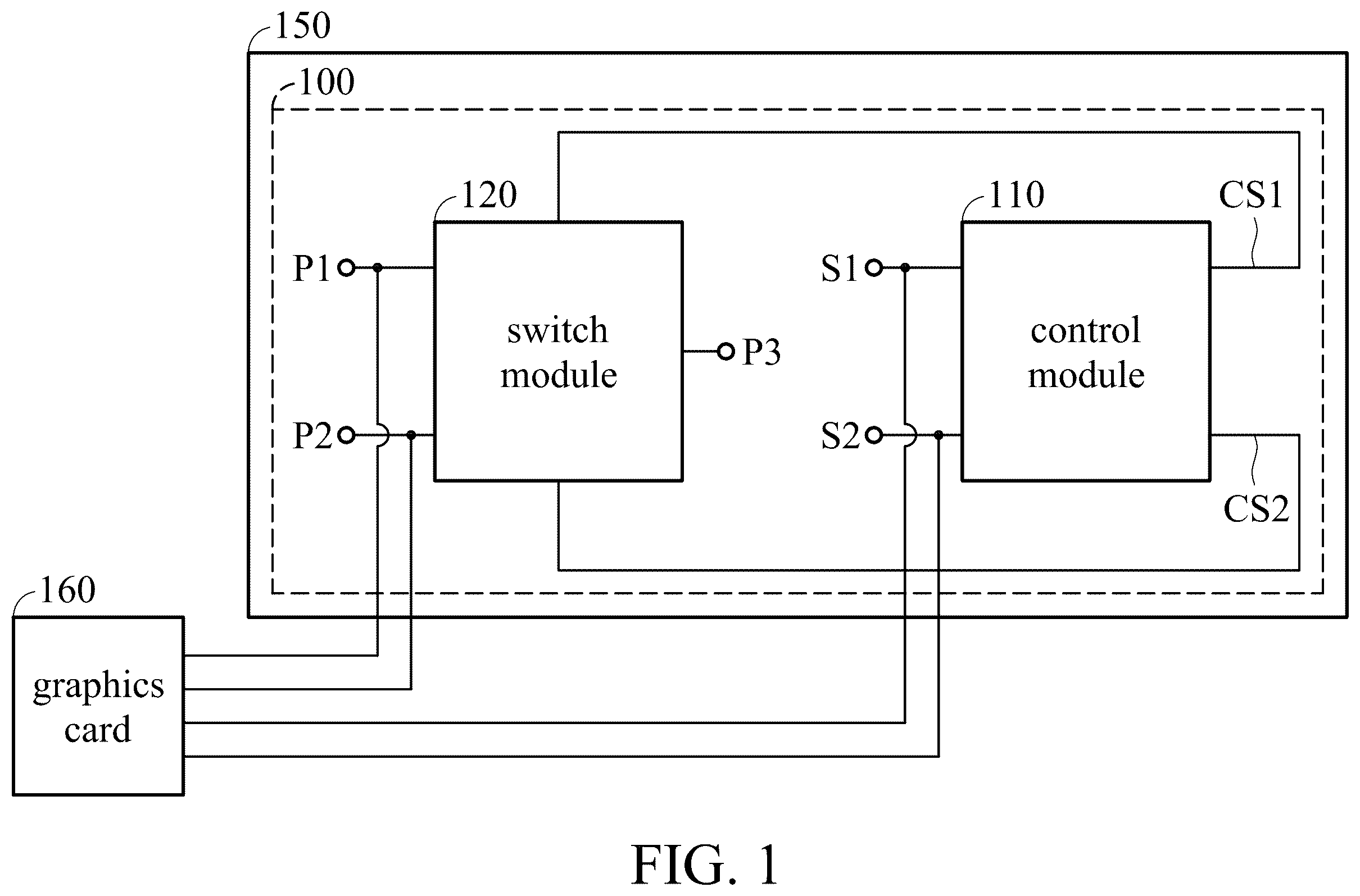
OF THE INVENTION The following description is of the contemplated mode of carrying out the present invention. This description is made for the purpose of illustrating the general principles of the present invention and should not be taken in a limiting sense. The scope of the present invention is determined by reference to the appended claims. The present invention will be described with respect to particular embodiments and with reference to certain drawings, but the present invention is not limited thereto and is only limited by the claims. It will be further understood that the terms “comprises,” “comprising,” “includes” and/or “including,” when used herein, specify the presence of stated features, integers, steps, operations, elements, and/or components, but do not preclude the presence or addition of one or more other features, integers, steps, operations, elements, components, and/or groups thereof. Use of ordinal terms such as “first”, “second”, “third”, etc., in the claims to modify a claim component does not by itself connote any priority, precedence, or order of one claim component over another or the temporal order in which acts of a method are performed, but are used merely as labels to distinguish one claim component having a certain name from another component having the same name (but for use of the ordinal term) to distinguish the claim components. In each of the following embodiments, the same reference number represents the same or similar element or component. is a schematic view of a switch device according to an embodiment of the present invention. In the embodiment, the switch device 100 may be disposed on a motherboard 150 , and the motherboard 150 is suitable for connecting to a graphics card 160 . Please refer to . The switch device 100 may include a control device 110 and a switch module 120 . The control module 110 may receive a first signal S 1 and a second signal S 2 , and may generate a first control signal CS 1 and a second control signal CS 2 according to the first signal S 1 and the second signal S 2 . In some embodiments, the first pin P 1 is, for example, the twelfth pin of a peripheral component interconnect express (PCIE) slot; the second pin P 2 is, for example, the seventeenth pin of the PCIE slot; the third pin P 3 is, for example, the clock signal control pin; the first signal S 1 is generated by, for example, the first pin P 1 ; and the second signal S 2 is, for example a BUS reset signal or a signal of the eleventh pin of the A side of the gold finger of the PCIE slot. In addition, the second pin P 2 may be connected to a graphics processing unit (GPU) of the graphics card. Furthermore, the third pin P 3 may be connected to a central processing unit (CPU) or a platform controller hub (PCH) on the motherboard 150 . The switch module 120 may be connected to the first pin P 1 , the second pin P 2 , the third pin P 3 , and the control module 110 . The switch module 120 may receive the first control signal CS 1 and the second control signal CS 2 , and may switch a connection among the first pin P 1 , the second pin P 2 , and the third pin P 3 according to the first control signal CS 1 and the second control signal CS 2 . That is, the switch module 120 may connect the first pin Pl and the third pin P 3 , may connect the second pin P 2 and the third pin P 3 , may disconnect a connection of the first pin P 1 and the third pin P 3 , and may disconnect a connection of the second pin P 2 and the third pin P 3 according to the first control signal CS 1 and the second control signal CS 2 . In addition, the above first pin P 1 and the above second pin P 2 are suitable for connecting to the graphics card 160 . In some embodiments, after the graphics card 160 is connected to the motherboard 150 , when the type of the graphics card 160 is PCIE 3.0 and the motherboard 150 does not operate, in response to the type of the graphics card 160 being PCIE 3.0 and the motherboard 150 not being operated, the first signal S 1 and the second signal S 2 may be a low logic level, the first control signal CS 1 and the second control signal CS 2 may be a high logic level, and the switch module 120 may connect the second pin P 2 and the third pin P 3 , and may connect the first pin P 1 and the third pin P 3 . In addition, when the graphics card 160 is connected to the motherboard 150 , in response to the graphics card 160 being connected to the motherboard 150 , the logic level of the second pin P 2 may be set to a low logic level. Furthermore, when the graphics card 160 and the motherboard 150 do not operate, in response to the graphics card 160 and the motherboard 150 not being operated, the logic level of the first pin P 1 may be a low logic level. In some embodiments, after the graphics card 160 is connected to the motherboard 150 , when the type of the graphics card 160 is PCIE 3.0 and the motherboard 150 is operated, in response to the type of the graphics card 160 being PCIE 3.0 and the motherboard 150 being operated, the first signal S 1 may be a low logic level, the second signal S 2 may be a low logic level or a high logic level, the first control signal CS 1 may be a low logic level, the second control signal CS 2 may be a high logic level and the switch module 120 may connect the second pin P 2 and the third pin P 3 , and may disconnect a connection of the first pin P 1 and the third pin P 3 . In addition, when the graphics card 160 is connected to the motherboard 150 , in response the graphics card 160 being connected to the motherboard 150 , the logic level of the second pin P 2 may be set to a low logic level. Furthermore, when the motherboard 150 is operated, in response to the motherboard 150 being operated, the logic level of the first pin P 1 may be pulled up to a high logic level. At this time, regardless of whether the second signal S 2 is a logic level or a high logic level, the second control signal CS 2 maintains a high logic level, so that the second pin P 2 and the third pin P 3 are connected. Then, the low logic level of the second pin P 2 may be transmitted to the third pin P 3 , so that the central processing unit or the platform path controller on the motherboard 150 generate a clock signal to the graphics card 160 , and then the graphics card 160 of PCIE 3.0 may normally operate. In some embodiments, after the graphics card 160 is connected to the motherboard 150 , when the type of the graphics card 160 is PCIE 4.0 and the motherboard 150 do not operate, in response to the type of the graphics card 160 being PCIE 4.0 and the motherboard 150 being not operated, the first signal S 1 and the second signal S 2 may be a low logic level, the first control signal CS 1 and the second control signal CS 2 may be a high logic level, and the switch module 120 may connect the second pin P 2 and the third pin P 3 , and may connect the first pin P 1 and the third pin P 3 . In addition, when the graphics card 160 is connected to the motherboard 150 , in response to the graphics card 160 being connected to the motherboard 150 , the logic level of the second pin P 2 may be set to a low logic level. Furthermore, when the graphics card 160 and the motherboard 150 do not operate, in response to the graphics card 160 and the motherboard 150 not bring operated, the logic level of the first pin P 1 may be a low logic level. In some embodiments, after the graphics card 160 is connected to the motherboard 150 , when the type of the graphics card 160 is PCIE 4.0, the motherboard 150 is operated and a clock request is not enabled, in response to the type of the graphics card 160 being PCIE 4.0, the motherboard 150 being operated and the clock request being not enabled, the first signal S 1 may be a high logic level, the second signal S 2 may be a low logic level, the first control signal CS 1 may be a low logic level, the second control signal CS 2 may be a high logic level, and the switch module 120 may connect the second pin P 2 and the third pin P 3 , and may disconnect a connection of the first pin P 1 and the third pin P 3 . That is, when the graphics card 160 does not operate, and the clock request is not enabled, the graphics card 160 may set the logic level of the first pin P 1 to a high logic level. In addition, when the graphics card 160 is connected to the motherboard 150 , in response to the graphics card 160 being connected to the motherboard 150 , the logic level of the second pin P 2 may be set to a low logic level, and the low logic level of the second pin P 2 may be transmitted to the third pin P 3 , so that the central processing unit or the platform path controller on the motherboard 150 generate a clock signal. At this time, since the graphics card 160 does not operate, the clock signal generated by the central processing unit or the platform path controller does not affect the functions of the motherboard 150 and the graphics card 160 . In some embodiments, after the graphics card 160 is connected to the motherboard 150 , when the type of the graphics card 160 is PCIE 4.0, the motherboard 150 is operated and a clock request is enabled, in response to the type of the graphics card 160 being PCIE 4.0, the motherboard 150 being operated, and the clock request being enabled, the first signal S 1 and the second signal S 2 may be a low logic level, the first control signal CS 1 and the second control signal CS 2 may be a high logic level, and the switch module 120 may connect the second pin P 2 and the third pin P 3 , and may connect the first pin P 1 and the third pin P 3 . That is, when the graphics card 160 is operated and the clock request is enabled, the graphics card 160 may set the logic level of the first pin P 1 to a low logic level. At this time, the low logic level of the first pin P 1 may be transmitted to the third pin P 3 , so that the central processing unit or the platform path controller on the motherboard 150 generates a clock signal to the graphics card 160 , and then the graphics card 160 of PCIE 4.0 may normally operate. Although the second pin P 2 and the third pin P 3 are connected, and the first pin P 1 and the third pin P 3 are connected, the logic levels of the first pin P 1 and the second pin P 2 are a low logic level, so the functions of the motherboard 150 and the graphics card 160 are not affected. In some embodiments, after the graphics card 160 is connected to the motherboard 150 , when the type of the graphics card 160 is PCIE 4.0, the motherboard 150 is operated, and a clock signal of the motherboard 150 is stable, in response to the type of the graphics card 160 being PCIE 4.0, the motherboard 150 being operated, and the clock signal of the motherboard 150 being stable, the first signal S 1 may be a low logic level, the second signal S 2 may be a high logic level, the first control signal CS 1 may be a high logic level, the second control signal CS 2 may be a low logic level, and the switch module 120 may connect the first pin P 1 and the third pin P 3 , and may disconnect a connection of the second pin P 2 and the third pin P 3 . That is, when the clock signal of the motherboard 150 is stable, in response to the clock signal of the motherboard 150 being stable, the second signal S 2 may be converted form a low logic level to a high logic level, and the second control signal CS 2 may be converted from a high logic level to a low logic level, so that the switch module 120 disconnects the connection of the second pin P 2 and the third pin P 3 , and the first pin P 1 and the third pin P 3 maintain to be connected. Therefore, two-way communication between the motherboard 150 and the graphics card 160 may be maintained. In some embodiments, after the graphics card 160 is connected to the motherboard 150 , when the type of the graphics card 160 is PCIE 4.0, the motherboard 150 is operated, and a clock request is disabled or enabled, in response to the type of the graphics card 160 being PCIE 4.0, the motherboard 150 being operated, and the clock request being disabled or enabled, the first signal S 1 and the second signal S 2 may be a high logic level, the first control signal CS 1 may be a high logic level, the second control signal CS 2 may be a low logic level, and the switch module 120 may connect the first pin P 1 and the third pin P 3 , and may disconnect a connection of the second pin P 2 and the third pin P 3 . In the embodiment, when the motherboard 150 or the graphics card 160 needs to turn off the function of generating the clock signal, in response to the motherboard 150 or the graphics card 160 being needed to turn off the function of generating the clock signal, the motherboard 150 or the graphics card 160 may disable the clock request. That is, the motherboard 150 may set the logic level of the third pin P 3 to a high logic level or the graphics card 160 may set the logic level of the first pin P 1 to a high logic level, so that the central processing unit or the platform path controller on the motherboard 150 stops generating the clock signal. Therefore, the effect of power saving may be achieved. In addition, after turning off the clock signal, when the motherboard 150 or the graphics card 160 needs to turn on the function of generating the clock signal, in response to the motherboard 150 or the graphics card 160 being needed to turn on the function of generating the clock signal, the motherboard 150 or the graphics card 160 may enable the clock request. That is, the motherboard 150 may set the logic level of the third pin P 3 to a low logic level or the graphics card 160 may set the logic level of the first pin P 1 to a low logic level, so that the central processing unit or the platform path controller on the motherboard 150 generates the clock signal. In some embodiments, when the motherboard 150 is turned off or enters a sleep state (such a power state “S 3 ”), in response to the motherboard 150 being turned off or entering the sleep state, the second signal S 2 may be converted from a high logic level to a low logic level. At this time, the logic level of the first pin P 1 (the first signal S 1 ) is a low logic level, so that the first control signal CS 1 and the second control signal CS 2 are a high logic level, and the switch module 120 may connect the second pin P 2 and the third pin P 3 , and may connect the first pin P 1 and the third pin P 3 . Since the logic levels of the first pin Pl and the second pin P 2 are a low logic level, the logic level of the third pin P 3 is also fixed to a low logic level. On the other hand, when the motherboard 150 is turned off or enters the sleep state (such as the power state “S 3 ”), in response to the motherboard 150 being turned off or entering the sleep state, the graphics card 160 may convert the logic level of the first pin P 1 from a low logic level to a high logic level. Then, the logic level of the first pin P 1 may change from a high logic level to a low logic level since the motherboard 150 is turned off (power drop in the power state “S 0 ”). At this time, the second signal S 2 may be converted from a high logic level to a low logic level, so that the switch module 120 connects the second pin P 2 and the third pin P 3 , and the logic level of the third pin P 3 may be fixed to a low logic level. In addition, the switch module 120 may convert the connection of the first pin P 1 and the third pin P 3 to the disconnection of the first pin P 1 and the third pin P 3 , and then convert to the connection of the first pin P 1 and the third pin P 3 . Since the second pin P 2 and the third pin P 3 are connected, the logic level of the third pin P 3 may maintain a low logic level, which is the same as the state when the motherboard 150 is just about to be turned on, and does not affect the functions of the motherboard 150 and the graphics card 160 . That is, when the power is turned off, in response to the power being turned off, the logic level of the first pin P 1 (the first signal S 1 ) and the second signal S 2 may change, but they may be a low logic level finally. In some embodiments, when the motherboard 150 does not normally operate, i.e., the motherboard 150 hung on, the second signal S 2 may maintain a low logic level and may not change. Since the motherboard 150 does not normally operate, the second control signal CS 2 generated by the control module 110 may continue to be a high logic level, so that the switch module 120 connects the second pin P 2 and the third pin P 3 . Then, the low logic level of the second pin P 2 may be transmitted to the third pin P 3 , so that the central processing unit or the platform path controller on the motherboard 150 continues generating the clock signal. In some embodiments, during the boot process of the motherboard 150 , the graphics card 160 needs to double reset the PCIE bus. At this time, the first signal S 1 received by the control module 110 may maintain a low logic level, the second signal S 2 received by the control module 110 may be converted from a high logic level to a low logic level and then to a high logic level, and the second control signal CS 2 generated by the control module 110 may be converted from a low logic level to a high logic level and then to a low logic level, so that the switch module 120 switches the connection of the second pin P 2 and the third pin P 3 from the disconnection of the second pin P 2 and the third P 3 to the connection of the second pin P 2 and the third pin P 3 , and then to the disconnection of the second pin P 2 and the third pin P 3 . Although the switch module 120 may connect the second pin P 2 and the third pin P 3 , because the switch module 120 has connected the first pin P 1 and the third pin P 3 , and the logic levels of the first pin P 1 and the third pin P 3 maintain a low logic level, which does not affect the functions of the motherboard 150 and the graphics card 160 . Therefore, through the operation of the switch device 100 according to the embodiment of the present invention, the display cards 160 with different types (PCIE 3.0 or PCIE 4.0) may normally operate, thereby saving the complexity of design and increasing the convenience of use. is a schematic view of a switch module according to an embodiment of the present invention. Please refer to . The switch module 120 may include a first switch unit 210 and a second switch unit 220 . The first switch unit 210 may have a first terminal, a second terminal, and a control terminal. The first terminal of the first switch unit 210 is connected to the third pin P 3 . The second terminal of the first switch unit 210 is connected to the second pin P 2 . The control terminal of the first switch unit 210 receives the second control signal CS 2 . Furthermore, the first switch unit 210 includes a first transistor Tl and a first diode D 1 . The first transistor T 1 has a first terminal, a second terminal, and a control terminal. The first terminal of the first transistor T 1 is connected to the first terminal of the first switch unit 210 . The second terminal of the first transistor T 1 is connected to the second terminal of the first switch unit 210 . The control terminal of the first transistor T 1 is connected to the control terminal of the first switch unit 210 . The first diode D 1 has a first terminal (such as a cathode terminal) and a second terminal (such as an anode terminal). The first terminal of the first diode D 1 is connected to the first terminal of the first transistor T 1 . The second terminal of the first diode D 1 is connected to the second terminal of the first transistor T 1 . The second switch unit 220 has a first terminal, a second terminal, and a control terminal. The first terminal of the second switch unit 220 is connected to the first pin P 1 . The second terminal of the second switch unit 220 is connected to the third pin P 3 . The control terminal of the second switch unit 220 receives the second control signal CS 2 . Furthermore, the second switch unit 220 includes a second transistor T 2 and a second diode D 2 . The second transistor T 2 has a first terminal, a second terminal, and a control terminal. The first terminal of the second transistor T 2 is connected to the first terminal of the second switch unit 220 . The second terminal of the second transistor T 2 is connected to the second terminal of the second switch unit 220 . The control terminal of the second transistor T 2 is connected to the control terminal of the second switch unit 220 . The second diode D 2 has a first terminal (such as a cathode terminal) and a second terminal (such as an anode terminal). The first terminal of the second diode D 2 is connected to the first terminal of the second transistor T 2 . The second terminal of the second diode D 2 is connected to the second terminal of the second transistor T 2 . In the embodiment, the first transistor T 1 and the second transistor T 2 are, for example, an N-type transistor, wherein the first terminals of the first transistor T 1 and the second transistor T 2 are, for example, a drain terminal of the N-type transistor, the second terminals of the first transistor T 1 and the second transistor T 2 are, for example, a source terminal of the N-type transistor, and the control terminals of the first transistor T 1 and the second transistor T 2 are, for example, a gate terminal of the N-type transistor, but the embodiment of the present invention is not limited thereto. In some embodiments, the first transistor T 1 and the second transistor T 2 may be a P-type transistor or another suitable transistor. is a schematic view of a control module according to an embodiment of the present invention. Please refer to . The control module 110 may include a first NAND gate 310 and a second NAND gate 320 . The first NAND gate 310 has a first input terminal, a second input terminal, and an output terminal. The first input terminal of the first NAND gate 310 receives the first signal S 1 . The output terminal of the first NAND gate 310 generates the first control signal CS 1 . The second NAND gate 320 has a first input terminal, a second input terminal, and an output terminal. The first input terminal of the second NAND gate 320 receives the second signal S 2 . The second input terminal of the second NAND gate 320 is connected to the output terminal of the first NAND gate 310 . The output terminal of the second NAND gate 320 is connected to the second input terminal of the first NAND gate 310 and generates the second control signal CS 2 . is a schematic view of a control module according to an embodiment of the present invention. Please refer to . The control module 110 may include a first resistor R 1 , a third switch unit 410 , a fourth switch unit 420 , a second resistor R 2 , a fifth switch unit 430 and a sixth switch unit 440 . The first resistor R 1 has a first terminal and a second terminal. The first terminal of the first resistor R 1 is connected to a voltage V 1 (such as a system voltage). The second terminal of the first resistor R 1 generate the first control signal CS 1 . The third switch unit 410 may have a first terminal, a second terminal, and a control terminal. The first terminal of the third switch unit 410 is connected to the second terminal of the resistor R 1 . The control terminal of the third switch unit 410 receives the first signal S 1 . Furthermore, the third switch unit 410 includes a third transistor T 3 and a third diode D 3 . The third transistor T 3 has a first terminal, a second terminal, and a control terminal. The first terminal of the third transistor T 3 is connected to the first terminal of the third switch unit 410 . The second terminal of the third transistor T 3 is connected to the second terminal of the third switch unit 410 . The control terminal of the third transistor T 3 is connected to the control terminal of the third switch unit 410 . The third diode D 3 has a first terminal (such as a cathode terminal) and a second terminal (such as an anode terminal). The first terminal of the third diode D 3 is connected to the first terminal of the third transistor T 3 . The second terminal of the third diode D 3 is connected to the second terminal of the third transistor T 3 . The fourth switch unit 420 may have a first terminal, a second terminal, and a control terminal. The first terminal of the fourth switch unit 420 is connected to the second terminal of the third switch unit 410 . The second terminal of the fourth switch unit 420 is connected to a ground terminal GND. Furthermore, the fourth switch unit 420 includes a fourth transistor T 4 and a fourth diode D 4 . The fourth transistor T 4 has a first terminal, a second terminal, and a control terminal. The first terminal of the fourth transistor T 4 is connected to first terminal of the fourth switch unit 420 . The second terminal of the fourth transistor T 4 is connected to the second terminal of the fourth switch unit 420 . The control terminal of the fourth transistor T 4 is connected to the control terminal of the fourth switch unit 420 . The fourth diode D 4 has a first terminal (such as a cathode terminal) and a second terminal (such as an anode terminal). The first terminal of the fourth diode D 4 is connected to the first terminal of the fourth transistor T 4 . The second terminal of the fourth diode D 4 is connected to the second terminal of the fourth transistor T 4 . The second resistor R 2 has a first terminal and a second terminal. The first terminal of the resistor R 2 is connected to the voltage V 1 (such as the system voltage). The second terminal of the second resistor R 1 is connected to the control terminal of the fourth switch unit 420 and generates the second control signal CS 2 . The fifth switch unit 430 may have a first terminal, a second terminal, and a control terminal. The first terminal of the fifth switch unit 430 is connected to the second terminal of the second resistor R 2 . The control terminal of the fifth switch unit 430 is connected to the second transistor of the first resistor R 1 . Furthermore, the fifth switch unit 430 includes a fifth transistor T 5 and a fifth diode D 5 . The fifth transistor T 5 has a first terminal, a second terminal, and a control terminal. The first terminal of the fifth transistor T 5 is connected to the first terminal of the fifth switch unit 430 . The second terminal of the fifth transistor T 5 is connected to the second terminal of the fifth switch unit 430 . The control terminal of the fifth transistor T 5 is connected to the control terminal of the fifth switch unit 430 . The fifth diode D 5 has a first terminal (such as a cathode terminal) and a second terminal (such as an anode terminal). The first terminal of the fifth diode D 5 is connected to the first terminal of the fifth transistor T 5 . The second terminal of the fifth diode D 5 is connected to the second terminal of the fifth transistor T 5 . The sixth switch unit 440 may have a first terminal, a second terminal, and a control terminal. The first terminal of the sixth switch unit 440 is connected to the second terminal of the fifth switch unit 430 . The second terminal of the sixth switch unit 440 is connected to the ground terminal GND. The control terminal of the sixth switch unit 440 receives the second signal S 2 . Furthermore, the sixth switch unit 440 includes a sixth transistor T 6 and a sixth diode D 6 . The sixth transistor T 6 has a first terminal, a second terminal, and a control terminal. The first terminal of the sixth transistor T 6 is connected to the first terminal of the sixth switch unit 440 . The second terminal of the sixth transistor T 6 is connected to the second terminal of the sixth switch unit 440 . The control terminal of the sixth transistor T 6 is connected to the control terminal of the sixth switch unit 440 . The sixth diode D 6 has a first terminal (such as a cathode terminal) and the second terminal (such as an anode terminal). The first terminal of the sixth diode D 6 is connected to the first terminal of the sixth transistor T 6 . The second terminal of the sixth diode D 6 is connected to the second terminal of the sixth transistor T 6 . In the embodiment, the third transistor T 3 , the fourth transistor T 4 , the fifth transistor T 5 , and the sixth transistor T 6 are, for example, an N-type transistor, wherein the first terminals of the third transistor T 3 , the fourth transistor T 4 , the fifth transistor T 5 , and the sixth transistor T 6 are, for example, a drain terminal of the N-type transistor, the second terminals of the third transistor T 3 , the fourth transistor T 4 , the fifth transistor T 5 , and the sixth transistor T 6 are, for example, a source terminal of the N-type transistor, and the control terminals of the third transistor T 3 , the fourth transistor T 4 , the fifth transistor T 5 , and the sixth transistor T 6 are, for example, a gate terminal of the N-type transistor, but the embodiment of the present invention is not limited thereto. In some embodiments, the third transistor T 3 , the fourth transistor T 4 , the fifth transistor T 5 , and the sixth transistor T 6 may be a P-type transistor or another suitable transistor. is a flowchart of an operation method of a switch device according to an embodiment of the present invention. In step S 502 , the method involves using a control module to receive a first signal and a second signal and generate a first control signal and a second control signal according to the first signal and the second signal. In step S 504 , the method involves using a switch module to connect to a first pin, a second pin, a third pin, and the control module, wherein the first pin and the second pin are suitable for connecting to the graphics card. In step S 506 , the method involves using the switch module to receive the first control signal and the second control signal. In step S 508 , the method involves using the switch module to switch a connection among the first pin, the second pin, and the third pin according to the first control signal and the second control signal. In some embodiments, the first pin is, for example, the twelfth pin of a PCIE slot; the second pin is, the seventeenth pin of the PCIE slot, the third pin is, for example, a clock signal control pin, the first signal is generated by, for example, the first pin, and the second signal is, for example, a bus reset signal. is a schematic view of a switch device according to an embodiment of the present invention. In the embodiment, the switch device 600 may be disposed on a motherboard 150 , and the motherboard 150 is suitable for connecting to a graphics card 160 . Please refer to . The switch device 600 may include a control module 610 and a switch module 120 . In the embodiment, the switch module 120 in is the same as or similar to the switch module 120 in and . Accordingly, the switch module 120 in may refer to the description of the embodiment of and , and the description is not repeated herein. In addition, the first pin P 1 , the second pin P 2 , the third pin P 3 , the first signal S 1 and the second signal S 2 in are the same as or similar to the first pin P 1 , the second pin P 2 , the third pin P 3 , the first signal S 1 and the second signal S 2 in . Accordingly, the first pin P 1 , the second pin P 2 , the third pin P 3 , the first signal S 1 and the second signal S 2 in may refer to the description of the embodiment of , and the description is not repeated herein. Furthermore, the control module 610 may be a micro control unit (MCU) or a microprocessor, but the embodiment of the present invention is not limited thereto. Firstly, the motherboard 150 is powered on and enters a basic input output system power on self-test (BIOS POST). Then, the control module 610 may determine whether the graphics card data does not exist or whether there is an event that the casing is opened. In the embodiment, the graphics card data is stored in a storage module (not shown), wherein the storage module may be a non-volatile random access memory (NVRAM) of the basic input output system, but the embodiment of the present invention is not limited thereto. When the control module 610 determines that the graphics card data does not exist or there is an event that the casing is opened, in response to the graphics card data not being existed or there being an event that the casing is opened, the control module 610 may read the device identifier (device ID) of the graphics card 160 or the first signal S 1 (such as the signal of an eleventh pin of the B side of the gold finger of the PCIE slot), so as to determine the type of the graphics card 160 . That is, in some embodiments, the control module 610 may read the device identifier of the graphics card 160 , and may determine the type of the graphics card 160 is PCIE 4.0 (or a device after PCIe4.0) or PCIe3.0 (or a device before PCIe3.0) according to the device identifier. In some embodiments, the control module 610 may read the first signal S 1 , and may determine the type of the graphics card 160 according to the logic of the first signal S 1 . For example, when the logic of the first signal S 1 is a low logic level, in response to the logic of the first signal S 1 being a low logic level, the control module 610 may determine that the type of the graphics card 160 is PCIe4.0 or the device after PCIe4.0. When the logic of the first signal S 1 is a high logic level, in response to the logic of the first signal S 1 being a high logic level, the control module 610 may determine that the type of the graphics card 160 is PCIe3.0 or the device before PCIe3.0. Then, the control module 610 may store the type of the graphics card 160 , and may set the first control signal CS 1 and the second control signal CS 2 according to the type of the graphics card 160 . For example, when the control module 610 determines that the type of the graphics card 160 is PCIe4.0 or the device after PCIe4.0, in response to the type of the graphics card 160 being PCIe4.0 or the device after PCIe4.0, the control module 610 may set the first control signal CS 1 to a high logic level and set the second control signal CS 2 to a low logic level, so that the switch module 120 connects the first pin P 1 and the third pin P 3 , and disconnects a connection of the second pin P 2 and the third pin P 3 . When the control module 610 determines that the type of the graphics card 160 is PCIe3.0 or the device before PCIe3.0, in response to the type of the graphics card 160 being PCIe3.0 or the device before PCIe3.0, the control module 610 may set the first control signal CS 1 to a low logic level and set the second control signal CS 2 to a high logic level, so that the switch module 120 connects the second pin P 2 and the third pin P 3 , and disconnects a connection of the first pin P 1 and the third pin P 3 . In addition, when the control module 610 determines that the graphics card data is existed or there is no event that the casing is opened, in response to the graphics card data being existed or there being no event that the casing is opened, the control module 610 may read the graphics card data. Then, the control module 610 may determine the type of the graphics card 160 according to the graphics card data, and may set the first control signal CS 1 and the second control signal CS 2 according to the type of the graphics card 160 . is a flowchart of an operation method of a switch device according to an embodiment of the present invention. In step S 702 , the method involves the motherboard being powered on and entering a basic input output system power on self-test. In step S 704 , the method involves using the control module to determine whether the graphics card data does not exist or whether there is an event that the casing is opened. When determining that the graphics card data does not exist or there is an event that the casing is opened, the method performs step S 706 . In step S 706 , the method involves in response to the graphics card data not being existed or there being an event that the casing is opened, reading the device identifier of the graphics card or the first signal, so as to determine the type of the graphics card. In step S 708 , the method involves using the control module to store the type of the graphics card, and setting the first control signal and the second control signal according to the type of the graphics card. When determining that the graphics card data is existed or there is no event that the casing is opened, the method performs step S 710 . In step S 710 , the method involves in response to the graphics card data being existed or there being no event that the casing is opened, determining the type of the graphics card according to the graphics card data, and setting the first control signal and the second control signal according to the type of the graphics card. In step S 712 , the method involves using the switch module to connect to the first pin, the second pin, the third pin, and the control module, wherein the first pin and the second pin are suitable for connecting to the graphics card. In step S 714 , the method involves using the switch module to receive the first control signal and the second control signal. In step S 716 , the method involves using the switch module to switch the connection among the first pin, the second pin, and the third pin according to the first control signal and the second control signal. In step S 718 , the method involves completing the basic input output system power on self-test and the motherboard being powered on successfully. It should be noted that the order of the steps of and is only for illustrative purposes, and is not intended to limit the order of the steps of the present invention. The user may change the order of the steps above to meet specific requirements. The flowcharts described above may add additional steps or use fewer steps without departing from the spirit and scope of the present invention. In summary, according to the switch device and the operation method thereof disclosed by the embodiment of the present invention, the control module generates the first control signal and the second control signal according to the first signal and the second signal, and the switch module switches the connection among the first pin, the second pin, and the third pin according to the first control signal and the second control signal, wherein the first pin and the second pin are suitable for connecting to the graphics card. Therefore, the different types of display cards may be operated normally on the same motherboard, thereby reducing the complexity of the design and increasing the convenience of use. While the present invention has been described by way of example and in terms of the preferred embodiments, it should be understood that the present invention is not limited to the disclosed embodiments. On the contrary, it is intended to cover various modifications and similar arrangements (as would be apparent to those skilled in the art). Therefore, the scope of the appended claims should be accorded the broadest interpretation so as to encompass all such modifications and similar arrangements.
Figures (7)
Citations
This patent cites (8)
- US2007/0214371
- US2016/0147690
- US2023/0280803
- US2023/0386554
- US106100329
- US111338453
- US201800955
- US202336552