Load Bank System and Method Thereof to Generate Large Number of Discrete Loading Steps
Abstract
The present invention relates generally to Load Banks for testing generators and electric power sources and more particularly the present invention discloses a load bank system circuit topology and method thereof, to generate large number of discrete loading steps. The system and method thereof employs at least five switches RL 1 , RL 2 , RL 3 , RL 4 , RL 5 , at least five resistors R 1 , R 2 , R 3 , R 4 , R 5 , the R 3 a special tap resistor having at least one tap movable along the length of the resistor R 3 and divide the resistor into parts, at least two terminals, terminal T 5 , terminal T 6 for connecting the load bank to a power source under test, to generate a large number of loading steps having minimum number of duplicate loading steps, minimum number of high power difference loading steps, high maximum to minimum load ratio and lowest value average resolution of the loading step.
Claims (29)
1 . A load bank system for generating large number of loading steps, the load bank system comprising: at least five switches RL 1 , RL 2 , RL 3 , RL 4 , RL 5 , at least five resistors R 1 , R 2 , R 3 , R 4 , R 5 , the R 3 a special tap resistor having at least one tap movable along the length of the resistor R 3 and divide the resistor into parts, at least two terminals, terminal T 5 , terminal T 6 for connecting the load bank to a power source under test, wherein a pole terminal of the RL 1 is electrically coupled to a first terminal of the resistor R 1 and to a NC (Normally Closed) terminal of the RL 2 ; a NC terminal of the RL 1 is left open; a NO (Normally Open) terminal of the RL 1 is electrically coupled to the terminal T 5 of the load bank; a pole terminal of the RL 2 is electrically coupled to a first terminal of the resistor R 2 ; a first terminal of the resistor R 3 is electrically coupled to the T 5 terminal of load bank; a second terminal of the resistor R 3 is electrically coupled to a pole terminal of the RL 3 ; the Tap of R 3 is moved to a desired location on the resistor R 3 and is fixed to divide the resistor R 3 in parts; the Tap is electrically coupled to a NO terminal of RL 2 and a NO terminal of RL 4 ; a pole terminal of RL 4 is electrically coupled to a first terminal of R 4 ; a second terminal of R 4 is electrically coupled to a pole terminal of RL 5 ; a first terminal of R 5 is electrically coupled to a pole terminal of RL 5 ; a NO terminal of RL 5 is electrically coupled to the terminal T 5 of load bank; a NC terminal of RL 5 is left open; a second terminal of R 1 , a second terminal of R 2 and a second terminal of R 5 are electrically coupled to the terminal T 6 of the load bank; and a NO terminal of RL 3 and a NC terminal of RL 4 is electrically coupled to the terminal T 6 .
17 . A method comprising: providing, a load bank system for generating large number of loading steps having at least five switches RL 1 , RL 2 , RL 3 , RL 4 , RL 5 , at least five resistors R 1 , R 2 , R 3 , R 4 , R 5 , the R 3 a special tap resistor having at least one tap movable along the length of the resistor R 3 and divide the resistor into parts, at least two terminals, terminal T 5 , terminal T 6 for connecting the load bank to a power source under test, wherein a pole terminal of the RL 1 is electrically coupled to a first terminal of the resistor R 1 and to a NC (Normally Closed) terminal of the RL 2 ; a NC terminal of the RL 1 is left open; a NO (Normally Open) terminal of the RL 1 is electrically coupled to the terminal T 5 of the load bank; a pole terminal of the RL 2 is electrically coupled to a first terminal of the resistor R 2 ; a first terminal of the resistor R 3 is electrically coupled to the T 5 terminal of load bank; a second terminal of the resistor R 3 is electrically coupled to a pole terminal of the RL 3 ; the Tap of R 3 is moved to a desired location on the resistor R 3 and is fixed to divide the resistor R 3 in parts; the Tap is electrically coupled to a NO terminal of RL 2 and a NO terminal of RL 4 ; a pole terminal of RL 4 is electrically coupled to a first terminal of R 4 ; a second terminal of R 4 is electrically coupled to a pole terminal of RL 5 ; a first terminal of R 5 is electrically coupled to a pole terminal of RL 5 ; a NO terminal of RL 5 is electrically coupled to the terminal T 5 of load bank; a NC terminal of RL 5 is left open; a second terminal of R 1 , a second terminal of R 2 and a second terminal of R 5 are electrically coupled to the terminal T 6 of the load bank; a NO terminal of RL 3 and a NC terminal of RL 4 are electrically coupled to the terminal T 6 ; connecting, the load bank system/circuit to a power source under test through the two terminals, terminal T 5 , and terminal T 6 ; operating, the plurality of switches in possible combination to generate the plurality of loading steps.
Show 27 dependent claims
2 . The system as claimed in claim 1 wherein the system is configured to provide at least one combination of the plurality of switches to generate load bank off condition (zero load step).
3 . The system as claimed in claim 1 , wherein the resistor R 3 is a special resistor having at least one tap, the tap moved to the desired location on the resistor R 3 and fixed, dividing the resistor R 3 into a plurality of sections.
4 . The system as claimed in the claim 1 wherein the desired location of the tap on the resistor R 3 is determined as the splitting spot on the resistor R 3 splitting the resistor R 3 into the plurality of sections such that maximum number of discrete steps are generated, minimum number of duplicate loading steps are generated and minimum number of high power difference loading steps are generated.
5 . The system as claimed in claim 4 wherein a loading step is considered as high power difference loading step when difference in the effective power of the previous loading step and the loading step under consideration is greater than 50% of the base resistance power value of the load bank.
6 . The system as claimed in claim 1 , wherein the load value of the resistor R 3 is always the base resistance power value of the load bank.
7 . The system as claimed in claim 1 , wherein the resistor R 3 having one tap, is divided by the tap into two sections, the section of resistor between the first terminal of R 3 and tap is R 3 A and section of resistor between tap and second terminal of R 3 is R 3 B.
8 . The system as claimed in claim 1 wherein the system is configured to have one tap at the tap resistor R 3 to provide at least 31 loading steps including at least 27 unique value loading steps, not more than 4 repetitive value loading steps and excluding at least one zero load (load bank off condition) step.
9 . The system as claimed in claim 1 wherein the system is configured to have more than one tap at the tap resistor R 3 and an additional switch RL 6 , the RL 6 being single pole double throw (SPDT) switch or rotary switch (RSW), to increase the number of loading steps provided by the system, more than 32 loading steps including at least one zero load (load bank off condition) step.
10 . The system as claimed in claim 1 wherein the plurality of switches are operated in possible combination to generate the plurality of loading steps.
11 . The system as claimed in claim 1 wherein the resistor R 3 of the system is a tap resistor having one or more taps or a potentiometer.
12 . The system as claimed in claim 1 wherein the system is configured to generate large number of loading steps when the resistors used for the load bank system are single value resistors (all resistors with identical values) or the resistors used for the load bank system are multi value resistors (resistors with at least two different values).
13 . The system as claimed in claim 1 wherein the plurality of switches are relays, or single pole double throw (SPDT) switches, or contactors or SPDT solid state switches or any other similar devices.
14 . The system as claimed in claim 1 wherein the system is configured to provide high maximum to minimum load ratio and lowest value average resolution of the loading step.
15 . The plurality of load bank systems as claimed in claim 1 can be cascaded to provide very high number of loading steps.
16 . The system as claimed in claim 1 wherein the system is connected as star connected load bank or delta connected load bank for using in 3 phase application.
18 . The method as claimed in claim 17 wherein the method provides at least one combination of the plurality of switches to generate load bank off condition (zero load step).
19 . The method as claimed in claim 17 , wherein the resistor R 3 have at least one tap, the tap moved to the desired location on the resistor R 3 and fixed, dividing the resistor R 3 into a plurality of sections.
20 . The method as claimed in the claim 17 wherein the desired location of the tap on the resistor R 3 is determined as the splitting spot on the resistor R 3 splitting the resistor R 3 in to the plurality of sections such that maximum number of discrete steps are generated, minimum number of duplicate loading steps are generated and minimum number of high power difference loading steps are generated.
21 . The method as claimed in claim 17 wherein a loading step is considered as high power difference loading step when difference in the effective power of the previous loading step and the loading step under consideration is greater than 50% of the base resistance power value of the load bank.
22 . The method as claimed in claim 17 , wherein the load value of the resistor R 3 is always the base resistance power value of the load bank.
23 . The method as claimed in claim 17 wherein the tap resistor R 3 have one tap to provide at least 31 loading steps including at least 27 unique value loading steps, not more than 4 repetitive value loading steps and excluding at least one zero load (load bank off condition) step.
24 . The method as claimed in claim 17 wherein the resistor R 3 have more than one tap and an additional switch RL 6 , the RL 6 being single pole double throw (SPDT) switch or rotary switch (RSW), to increase the number of loading steps provided by the system, more than 32 loading steps including at least one zero load (load bank off condition) step.
25 . The method as claimed in claim 17 wherein the plurality of switches are operated in possible combination to generate the plurality of loading steps.
26 . The method as claimed in claim 17 wherein the resistor R 3 is a tap resistor having one or more taps or a potentiometer.
27 . The method as claimed in claim 17 generates large number of loading steps when the resistors used for the load bank system are single value resistors (all resistors with identical values) or the resistors used for the load bank system are multi value resistors (resistors with at least two different values).
28 . The method as claimed in claim 17 wherein the plurality of switches are relays, or single pole double throw (SPDT) switches, or contactors or SPDT solid state switches or any other similar devices.
29 . The method as claimed in claim 17 provides high maximum to minimum load ratio and lowest value average resolution of the loading step.
Full Description
Show full text →
This application is a national phase of International Application No. PCT/IN2022/050811 filed Sep. 12, 2022, which claims priority to India application No. 202121052822 filed Nov. 17, 2021, the entire disclosures of which are hereby incorporated by reference. FIELD OF INVENTION This invention relates generally to Load Banks for testing generators and electric power sources and more particularly to a load bank system circuit topology and method thereof, to generate large number of discrete loading steps.
BACKGROUND
OF INVENTION A Load Bank is a device which develops an electrical load, applies the load to an electrical power source and converts or dissipates the resultant power output of the source. A Load Bank is intended to accurately mimic the operational or “real” load which a power source will see in actual application. Load banks are mainly resistive networks used to dissipate the electrical energy. For example, diesel generators are used in critical applications in airports and nuclear installations. These Stand-by electrical power sources such as diesel generators etc. are not put to use continuously. They take over only during disruption in the main power supply, and hence may remain continuously unused for a long period of time. They may be designed for a particular power rating, but it is important to guarantee their functioning in real life situations which might involve different types of power supply disturbances such as—Transients, Interruptions, Sag/Under-voltage, Swell/Over-voltage, Waveform distortion, Voltage fluctuation or Frequency variations. These generators have to be frequently tested at rated full load condition, to verify that generators are working properly. It has been found that, if a diesel generator always runs on light loads, then, due to wet stacking (unburnt fuel or carbon), diesel engine fuel consumption goes up and engine life reduces. To avoid wet stacking, it is necessary to operate generators at rated full load at regular intervals. For this purpose, load shedding type load banks are used. Newly installed power supply systems in buildings have to be tested for their designed power handling capability. Here too, load banks are employed. In all such applications, the load bank should be capable of generating large number of discrete loading steps. Larger number of discrete steps allow accurate loading of power source under test. Also, the loading steps need to be sufficiently small such that damage to the power source engine due to block loading does not occur. It is known in the art to provide a load bank with resistor coil assemblies connected and controlled through switching network in different configurations. The Cannon U.S. Pat. No. 4,445,047, describes a portable load bank for loading the generator, having set of low resistance coils. A switching network is provided for loading a three phase generator at three discrete load levels. The switching network comprising three silicon controlled rectifiers for controlling three phase load. The generator is loaded at three discrete levels by controlling the duty cycle, with full load level being at full duty cycle basis. This patent also describes alternative embodiment for testing dc generator. It has three groups of coils controlled by three switches. Here the three switches are provided by a common rotary switch. By closing the first switch first set of coils are energized. The load on the generator may then be increased by the closure of second switch placing the second group coils are on line. Finally, the third switch may also be closed causing current also to flow through the third group of resistance coils. However, the art discloses loading of the generator at three discrete levels but fails to provide any teachings towards large number of loading step generating configuration of the coils and switches. It is known in the art to provide a load bank with variable resistance with cooling mechanism. The Tierney U.S. Pat. No. 5,565,716, describes Variable resistance Liquid cooled Load Bank. A load bank is constructed using tubes made from electrically conductive material. Electrically conductive clamps are positioned to electrically connect tubes. The positioning of each clamp is adjustable along the length of the connected tubes. A combination of the clamps and the tubes form an electrically resistive current-carrying circuit that serves as the load for a power source while the cooling fluid serves to dissipate the heat generated in the load. In this design, the circuit needs to be turned OFF, whenever the value of load resistance has to be changed. It is also known in the art to provide load simulator systems which are capable of loading the power sources. The Carl W. Kellenbenz U.S. Pat. No. 4,042,830 describes Solid-state programmable dynamic load simulator. The power source is loaded using five loads. First load being any resistive load providing a continuously variable power load to the source. Remaining four banks provide pulsating loads. These are controlled through electronic power switches using Thyristors. In the example given, first load is continuously variable over the range of 0 to 15 kW. The other four loads had values set at 1 kW, 2 kW, 4 kW, and 8 kW for each of the four switches respectively. In order to generate 7 kW as an example, loads 1 kW, 2 kW and 4 kW are turned ON using the power switches. Similarly to generate 11 kW, loads 1 kW, 2 kW and 8 kW are turned ON. Thus any load value from 1 kW to 15 kW can be generated, by controlling the switches. Further in the art the Kesafumi Matsumoto, Atsugi (JP) U.S. Pat. No. 8,108,162 B2 describes the determination of load bank resistors by dividing a total maximum power capacity of the resistor bank group sequentially based on binary system and arranging the results in an order from a higher priority to a lower priority of the power capacity corresponding to (½), (¼) up to (1/(2n−1)). For example, for a load bank of maximum capacity of 2000 kW, and for n=7 switches, the values based on the binary system are, 1000 kW (½), 500 kW (¼), 250 kW (⅛), 125 kW ( 1/16), 62.5 kW ( 1/32), 31.25 kW ( 1/64), 15.625 kW ( 1/128). The least count for this system is given by (15.625/2000)×100=0.78125%. Therefore, using this load bank, load levels from 15.625 kW up to 2000 kW could be generated with a resolution of 15.625 kW or 0.78125%. Total number of steps generated by this load bank are 127=(1+2+4+8+16+32+64). The illustrates prior art block diagram of resistor banks of a load calculation control apparatus by Matsumoto. It mainly consists of eight ON/OFF switches (CL), and eight load resistors (α 1 to α 8 ). Further, in the art the US 2011/0025059 A1 describes Controllable switch. Controllable Switch may be implemented as one or more IGBTs, one or more thyristors, one or more contactors etc. Using these switches load dump circuits are implemented. Examples of a DC load dump circuit, AC star connected load dump circuit and AC delta connected load dump circuits are given. It is also known in the art to provide testing solutions for testing emergency power supply system. The US 2012/0110386 A1 discloses an automatically varying load bank to suit a particular legislated criteria, such as defined by an applicable regulation such as NFPA 99 or 110. Using variable loads can avoid or reduce wet-stacking of the engine, for example, by allowing the load to be sized in accordance with the engine's nameplate rating. The load bank is controlled using automatic transfer switch. As shown in a load bank topology was published by Vijay Deshpande, the inventor of the present invention in the Electronic Design magazine (Jul. 21, 2020). It consists of four switches SW 1 , SW 2 , J 1 and J 2 . Switch SW 1 is simple ON/OFF switch, remaining three switches are single pole double throw (SPDT) type switches. Also uses five resistors Ra, Rb, Rc, Rd and Re. The topology generates twelve discrete load power steps with maximum load power to minimum load power ratio of the value 8. The prior art describes determination of load bank resistors based on binary. In such a case, rating of one of the load bank resistors is half of the total power rating of load bank. For load bank with 5 or more switches, this resistor becomes very large. Thus constraints on the power ratings of the loading resistors arises. Using single value resistor, with prior art load bank circuit topology/network, one can generate only as many steps as the number of switches used. However, none of the existing art provides a load bank system where a large number of loading steps are generated when the resistors used for the load bank system are multi value resistors (resistors with at least two different values) or even when the resistors used for the load bank system are single value resistors (all resistors with identical values). In addition generating minimum number of duplicate loading steps and generating minimum number of high power difference loading steps is necessary. Further, none of the existing art provides a load bank system having high maximum to minimum load ratio and lowest value average resolution of the loading step. Accordingly, it is seen that a need remains for the provision of a portable, relatively lightweight, compact load bank that may generate a large number of loading steps when the resistors used for the load bank system are all single value resistors (resistors with identical values, which is also the base resistance power) or when the resistors used for the load bank system are multi value resistors (resistors with at least two different power values), the large number of loading steps having minimum number of duplicate loading steps, minimum number of high power difference loading steps, high maximum to minimum load ratio and lowest value average resolution of the loading step. Objects of the Present Invention An object of the present invention is to provide an improved load bank topology for generating large number of loading steps, without any constraints on the power ratings of the loading resistors. Another object of the invention is to generate large number of loading steps for a load bank which uses all resistors with identical values. Such load banks are very cost effective and easy to maintain. Yet another object of the invention is to generate large number of discrete loading steps having minimum number of duplicate loading steps, and minimum number of high power difference loading steps. Also, another object of the invention is to generate large number of discrete loading steps having high maximum to minimum load ratio and lowest value average resolution of the loading step.
SUMMARY OF THE INVENTION
It is an object of the present invention to provide an improved load bank topology for generating large number of loading steps, without any constraints on the power ratings of the loading resistors. In accomplishing the above and other objects, there has been provided, in accordance with an embodiment of the present invention, a load bank system circuit topology and method thereof, to generate large number of discrete loading steps. The system and method thereof employs at least five switches RL 1 , RL 2 , RL 3 , RL 4 , RL 5 , at least five resistors R 1 , R 2 , R 3 , R 4 , R 5 , the R 3 a special tap resistor having at least one tap movable along the length of the resistor R 3 and divide the resistor into parts, at least two terminals, terminal T 5 , terminal T 6 for connecting the load bank to a power source under test, to generate a large number of loading steps. The system and method there of the present invention generate a large number of loading steps when the resistors used for the load bank system are all single value resistors (resistors with identical values, which is also the base resistance power) or when the resistors used for the load bank system are multi value resistors (resistors with at least two different power values), the large number of loading steps having minimum number of duplicate loading steps, minimum number of high power difference loading steps, high maximum to minimum load ratio and lowest value average resolution of the loading step. According to one of the implementation of the system and method there of the present invention, a load bank with single value resistors is a preferred embodiment. The load bank system is constituted through a circuit topology in which a pole terminal of the RL 1 is electrically coupled to a first terminal of the resistor R 1 and to a NC (Normally Closed) terminal of the RL 2 , a NC terminal of the RL 1 is left open and a NO (Normally Open) terminal of the RL 1 is electrically coupled to the terminal T 5 of the load bank. Further, a pole terminal of the RL 2 is electrically coupled to a first terminal of the resistor R 2 . According to the load bank system circuit of the present invention a first terminal of the resistor R 3 is electrically coupled to the T 5 terminal of load bank, a second terminal of the resistor R 3 is electrically coupled to a pole terminal of the RL 3 , the Tap of R 3 is moved to a desired location on the resistor R 3 and is fixed to divide the resistor R 3 in parts, and the Tap is electrically coupled to a NO terminal of RL 2 and a NO terminal of RL 4 . Further, a pole terminal of RL 4 is electrically coupled to a first terminal of R 4 , a second terminal of R 4 is electrically coupled to a pole terminal of RL 5 . Further, in the load bank system circuit of the present invention a first terminal of R 5 is electrically coupled to a pole terminal of RL 5 , a NO terminal of RL 5 is electrically coupled to the terminal T 5 of load bank, and a NC terminal of RL 5 is left open. Consecutively, a second terminal of R 1 , a second terminal of R 2 and a second terminal of R 5 are electrically coupled to the terminal T 6 of the load bank, and a NO terminal of RL 3 and a NC terminal of RL 4 are electrically coupled to the terminal T 6 . According to one of the embodiment of the present invention a method for a load bank system for generating large number of loading steps includes providing, a load bank system for generating large number of loading steps having at least five switches RL 1 , RL 2 , RL 3 , RL 4 , RL 5 , at least five resistors R 1 , R 2 , R 3 , R 4 , R 5 , the R 3 a special tap resistor having at least one tap movable along the length of the resistor R 3 and divide the resistor into parts, at least two terminals, terminal T 5 , terminal T 6 for connecting the load bank to a power source under test. Further, the method includes connecting, the load bank system to a power source under test through the two terminals, terminal T 5 , and terminal T 6 . Further, the method includes operating, the plurality of switches in possible combination to generate the plurality of loading steps. The relay switches of the load bank system can be operated through control mechanism.
BRIEF DESCRIPTION OF THE DRAWINGS
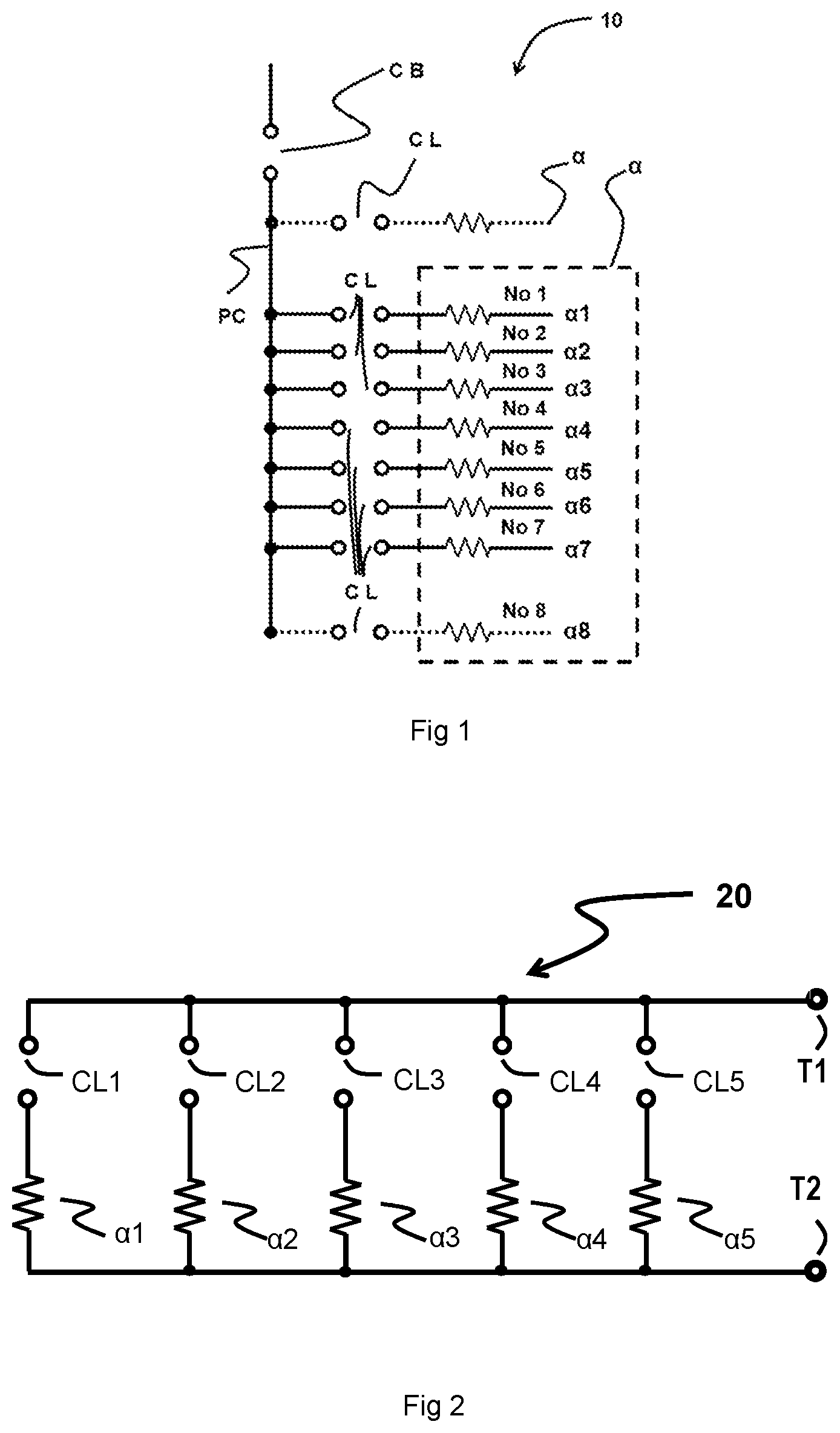
The embodiments can be better understood with reference to the following drawings and description. The components in the figures are not necessarily to scale, the emphasis instead being placed upon illustrating the principles of the embodiments. Moreover, the figures, like reference numerals designate corresponding parts throughout the different views. Reference will be made to embodiments of the invention, examples of which may be illustrated in the accompanying figures. These figures are intended to be illustrative, not limiting. Although the invention is generally described in the context of these embodiments, it should be understood that it is not intended to limit the scope of the invention to these particular embodiments. The above and other objects, features, and advantages of the present invention will be more clearly understood from the following detailed description taken in conjunction with the accompanying drawings, in which: (Prior Art) is reproduction of prior art block diagram of resistor banks of a load calculation control apparatus by Matsumoto. (Prior Art) illustrates prior art circuit diagram of resistor banks of a load calculation control apparatus of , redrawn for 5 switches and 5 loads. (Prior Art) Shows prior art resistor load bank topology which uses 4 switches and 5 resistors. (Reproduced from Electronic Design magazine) schematically illustrates a load bank system circuit diagram/topology for generating large number of loading steps in accordance with the present invention. illustrates a plot of power loading steps generated by the load bank system circuit/topology in accordance with the present invention. schematically illustrates an alternate embodiment of the load bank system circuit/topology with resistor having two taps and one additional relay. schematically illustrates an alternate embodiment of the improved load bank system circuit/topology with resistor having three taps and a rotary switch. schematically illustrates an alternate embodiment of the improved load bank system circuit/topology with a potentiometer. shows cascading of two load banks of the present invention for generating very large number of loading steps. shows the plot of power loading steps generated by the cascaded load bank shown in . Shows the Star connected three phase load bank made using the load bank system circuit/topology of the present invention. Shows the Delta connected three phase load bank made using the load bank system circuit/topology of the present invention. is a table that depicts various combinations of R 3 A and R 3 B tried for load bank system of Sr. No. 1 of table 4. and combined is a table that depicts detailed analysis for the load bank system circuit/topology of Sr. No. 12 (16 kW) of Table 4.
DETAILED DESCRIPTION
OF THE INVENTION The foregoing objects of the present invention are accomplished and the problems and shortcomings associated with the prior art, techniques and approaches are overcome by the present invention as described below in the preferred embodiments. The present invention is a load bank system circuit topology and method thereof, to generate large number of discrete loading steps. In the following description, for the purpose of explanation, specific details are set forth in order to provide an understanding of the present invention. It will be apparent, however, to one skilled in the art that the present invention may be practiced without these details. One skilled in the art will recognize that embodiments of the present invention, some of which are described below, may be incorporated into a number of systems. The various embodiments of the present invention provide a load bank system circuit topology and method thereof, to generate large number of discrete loading steps. Furthermore, connections between components and/or modules within the figures are not intended to be limited to direct connections. Rather, these components and modules may be modified, re-formatted or otherwise changed by intermediary components and modules. The systems/device and methods described herein are explained using examples with specific details for better understanding. However, the disclosed embodiments can be worked on by a person skilled in the art without the use of these specific details. Throughout this application, references in the present invention to “one embodiment” or “an embodiment” mean that a particular feature, structure, characteristic, or function described in connection with the embodiment is included in at least one embodiment of the invention. The appearances of the phrase “in one embodiment” in various places in the specification are not necessarily all referring to the same embodiment. Embodiments of the present invention include various steps, which will be described below. The steps may be performed by hardware components or may be embodied in machine-executable instructions, which may be used to cause a general-purpose or special purpose processor programmed with the instructions to perform the steps. Alternatively, steps may be performed by a combination of hardware, software, firmware and/or by human operators. If the specification states a component or feature “may′ can”, “could”, or “might” be included or have a characteristic, that particular component or feature is not required to be included or have the characteristic. As used in the description herein and throughout the claims that follow, the meaning of “a, an,” and “the” includes plural reference unless the context clearly dictates otherwise. Also, as used in the description herein, the meaning of “in” includes “in” and “on” unless the context clearly dictates otherwise. Exemplary embodiments will now be described more fully hereinafter with reference to the accompanying drawings, in which exemplary embodiments are shown. This invention may, however, be embodied in many different forms and should not be construed as limited to the embodiments set forth herein. These embodiments are provided so that this invention will be thorough and complete and will fully convey the scope of the invention to those of ordinary skill in the art. Moreover, all statements herein reciting embodiments of the invention, as well as specific examples thereof, are intended to encompass both structural and functional equivalents thereof. Additionally, it is intended that such equivalents include both currently known equivalents as well as equivalents developed in the future (i.e., any elements developed that perform the same function, regardless of structure). Hereinafter, embodiments will be described in detail. For clarity of the description, known constructions and functions will be omitted. Parts of the description may be presented in terms of operations performed by an Electrical/Electronic system, using terms such as load, link, ground, fault, switch and the like, consistent with the manner commonly employed by those skilled in the art to convey the substance of their work to others skilled in the art. As is well understood by those skilled in the art, these quantities take the form of electrical, magnetic signals capable of being stored, transferred, combined, and otherwise manipulated through mechanical and electrical components of the electronic/electrical systems. While embodiments of the present invention have been illustrated and described, it will be clear that the invention is not limited to these embodiments only. Numerous modifications, changes, variations, substitutions, and equivalents will be apparent to those skilled in the art, without departing from the spirit and scope of the invention, as described in the claim. The present invention provides a load bank system circuit topology and method thereof, to generate large number of discrete loading steps. The system and method there of employs at least five switches RL 1 , RL 2 , RL 3 , RL 4 , RL 5 , at least five resistors R 1 , R 2 , R 3 , R 4 , R 5 , the R 3 a special tap resistor having at least one tap movable along the length of the resistor R 3 and divide the resistor into parts, at least two terminals, terminal T 5 , terminal T 6 for connecting the load bank to a power source under test, to generate a large number of loading steps. The system and method there of the present invention generate a large number of loading steps when the resistors used for the load bank system are all single value resistors (resistors with identical values, which is also the base resistance power) or when the resistors used for the load bank system are multi value resistors (resistors with at least two different power values), the large number of loading steps having minimum number of duplicate loading steps, minimum number of high power difference loading steps, high maximum to minimum load ratio and lowest value average resolution of the loading step. According to one of the implementation of the system and method there of the present invention, a load bank with single value resistors is a preferred embodiment. Further, according to one of the implementation of the system and method there of the present invention the load bank power can be lower than the base resistance power i.e. the load bank can generate loading power which is smaller than the base resistance power. Referring now to , there is reproduced a prior art block diagram of resistor banks of a load calculation control apparatus ( 10 ) by Matsumoto. It mainly consists of eight ON/OFF switches (CL), and eight load resistors (α 1 to α 8 ). Further, referring to , in , circuit diagram of prior art resistor bank of has been redrawn. This Prior Art circuit diagram ( 20 ) consists of five switches (CL 1 to CL 5 ) and five load resistors (α 1 to α 5 ). First terminal of switches CL 1 , CL 2 , CL 3 , CL 4 and CL 5 are connected to the load bank terminal T 1 . The second terminals of switches CL 1 , CL 2 , CL 3 , CL 4 and CL 5 are connected to the first terminals of load resistors α 1 , α 2 , α 3 , α 4 , and α 5 . The second terminals of load resistors α 1 , α 2 , α 3 , α 4 , and α 5 are connected to the load bank terminal T 2 . The Table 1 shows the examples of load value calculations for prior art resistor bank ( 20 ). TABLE 1 Load Load Load Load Load Load MAX/ No of MAX Av. Missing Sr. α1 α2 α3 α4 α5 α T1T2 MIN Steps Reso Reso Step No (kW) (kW) (kW) (kW) (kW) (kW) Ratio (Nos) (kW) (kW) (kW) 1 1 1 1 1 1 5 5 5 1 1.00 2 1 1 1 1 2 6 6 6 1 1.00 3 1 1 1 2 2 7 7 7 1 1.00 4 1 1 2 2 2 8 8 8 1 1.00 5 1 2 2 2 2 9 9 9 1 1.00 6 1 1 2 2 4 10 10 10 1 1.00 7 1 2 2 2 4 11 11 11 1 1.00 8 1 1 2 4 4 12 12 12 1 1.00 9 1 2 2 4 4 13 13 13 1 1.00 10 1 1 2 2 8 14 14 13 2 1.08 7 11 1 2 4 4 4 15 15 15 1 1.00 12 1 1 2 4 8 16 18 16 1 1.00 13 1 2 2 4 8 17 17 17 1 1.00 14 1 1 4 4 8 18 18 17 2 1.06 3 15 1 2 4 4 8 19 19 19 1 1.00 16 1 1 2 8 8 20 20 19 2 1.05 5 17 1 2 4 8 18 31 31 31 1 1.00 In Table 1, example calculations are given for load values generated for the circuit diagram of prior art resistor bank. In column 2, 3, 4, 5 and 6, selected power ratings for load resistors α 1 , α 2 , α 3 , α 4 , and α 5 are entered. Column 7 captures the maximum load power α T1T2 which is generated when all 5 switches CL 1 to CL 5 are turned ON. Intermediate load power values in steps of 1 kW are generated by setting switches CL 1 to CL 5 in ON or OFF state. Serial No. 1 of the Table 1 is the simplest case, in which all five load resistors (α 1 to α 5 ) are having same power rating of 1 kW each. Referring to , if switch CL 1 is turned ON, the load value α T1T2 at terminals T 1 -T 2 will be 1 kW. If two switches CL 1 and CL 2 are turned ON, then the load power α T1T2 will be 2 kW and so on. Thus for this example, one get 5 steps of 1 kW each. The ratio of Maximum load power to Minimum load power is 5. The resolution in this case is 1 kW. There are no missing steps. Now considering the serial no 10 of the Table 1, having total load of 14 kW. It consists of loads α 1 =1, α 2 =1, α 3 =2, α 4 =2, α 5 =8. This combination can generate following power loading steps: 1, (CL 1 ON) 2, (CL 3 ON) 3=(1+2), (CL 1 and CL 3 ON) 4=(2+2), (CL 3 and CL 4 ON) 5=(1+2+2), (CL 1 , CL 3 and CL 4 ON) 6=(1+1+2+2), (CL 1 , CL 2 , CL 3 and CL 4 ON) 7 (Missing step), 8, (CL 5 ON) 9=(1+8), (CL 1 and CL 5 ON) 10=(2+8), (CL 3 and CL 5 ON) 11=(1+2+8), (CL 1 , CL 3 , CL 5 ON) 12=(2+2+8), (CL 3 , CL 4 , CL 5 ON) 13=(1+2+2+8), (CL 1 , CL 3 , CL 4 , CL 5 ON) 14=(1+1+2+2+8). (All CLs ON) In the above example, 7 kW step cannot be generated (missing step). The MAX/MIN ratio is 14, and number of steps is 13. Therefore the Max resolution is 2 kW and average resolution is 1.08 kW. For serial nos. 14 and 16 of the Table 1 also, there is one missing step. For remaining all rows, all load values are generated in steps of 1 kW. In Table 1, Combinations beyond 16 kW are not considered as there are missing steps. The last serial no 17, is a special case. This is the combination which uses the binary values of 1, 2, 4, 8 and 16 as described by Matsumoto. It provides 31 steps (2 5 −1) without any missing step. Table 1, provides few example calculations. Many more combinations are possible which are not covered in Table 1. Referring to , the shows a prior art resistor load bank topology ( 50 ). This topology was published in Electronic Design magazine (Jul. 21 2020). It consists of four switches SW 1 , SW 2 , J 1 and J 2 . Switch SW 1 is simple ON/OFF switch, remaining three switches are single pole double throw (SPDT) type switches. Also uses five resistors Ra, Rb, Rc, Rd and Re. Table 2 gives equations and calculations for the prior art load bank topology ( 50 ). Table 2, columns 2, 3, 4 and 5 show the ON/OFF status of switches. Column 6 gives the equations for equivalent resistance (R T3T4 ) at load bank terminals T 3 and T 4 . Column 7 gives the multiplication/division factors to calculate the R T3T4 for the values of resistors as given below: Ra=Rb=Rc=Rd =Re= R= 1000 Ω Column 8 gives values of R T3T4 for the respective switch combinations. In the last column, load power values (P T3T4 ) have been calculated for voltage level of V=1000 Volts. P T 3 T 4 = V * V / R T 3 T 4 = ( 1000 * 1000 ) / R T 3 T 4 W In terms of kW the equation becomes P T 3 T 4 = ( 1000 / R T 3 T 4 ) kW At 1000 V, power rating of 1000Ω resistors is 1 kW each. From the table 2 it is observed that, this topology provides 12 load power steps. The ratio of Maximum power to Minimum power is =4/0.5=8 TABLE 2 Res Load Sr Equations for Equivalent R T3T4 P T3T4 No SW1 J1 J2 SW2 Resistance at T3-T4 Factor (Ω) (kW) 1 OFF ON OFF OFF Rc + Re R/0.5 2000 0.50 2 OFF OFF OFF OFF Rc + {(Rb + Rd) ∥ Re} R/0.6 1667 0.60 3 OFF OFF ON OFF Rc + {Rd ∥ Re} R × 1.5 1500 0.67 4 OFF ON OFF ON Re R/1 1000 1.00 5 OFF OFF OFF ON Re ∥ (Rb + Rd) R/1.5 666.7 1.50 6 ON OFF OFF OFF Ra ∥ {Rc + (Re ∥ (Rb + Rd))} R/1.6 625 1.60 7 ON OFF ON OFF Ra ∥ {Rc + (Rd ∥ Re)} R × 0.6 600 1.67 8 OFF OFF ON ON Rd ∥ Re R/2 500 2.00 9 ON ON OFF OFF (Ra ∥ Rb) ∥ (Rc + Re) R/2.5 400 2.50 10 ON ON ON OFF (Ra ∥ Rb) ∥ {Rc + (Rd ∥ Re)} R × 0.375 375 2.67 11 ON ON OFF ON Ra ∥ Rb ∥ Re R/3 333.3 3.00 12 ON ON ON ON Ra ∥ Rb ∥ Rd ∥ Re R/4 250 4.00 The present invention provides a load bank system circuit topology and method thereof, to generate large number of discrete loading steps. According to one of the embodiment of the present invention, a load bank system for generating large number of discrete loading steps, comprises at least five switches RL 1 , RL 2 , RL 3 , RL 4 , RL 5 , at least five resistors R 1 , R 2 , R 3 , R 4 , R 5 , the R 3 a special tap resistor having at least one tap movable along the length of the resistor R 3 and divide the resistor into parts, at least two terminals, terminal T 5 , terminal T 6 for connecting the load bank to a power source under test. The load bank system is constituted through a circuit topology in which a pole terminal of the RL 1 is electrically coupled to a first terminal of the resistor R 1 and to a NC (Normally Closed) terminal of the RL 2 , a NC terminal of the RL 1 is left open and a NO (Normally Open) terminal of the RL 1 is electrically coupled to the terminal T 5 of the load bank. Further, a pole terminal of the RL 2 is electrically coupled to a first terminal of the resistor R 2 . According to the load bank system circuit of the present invention a first terminal of the resistor R 3 is electrically coupled to the T 5 terminal of load bank, a second terminal of the resistor R 3 is electrically coupled to a pole terminal of the RL 3 , the Tap of R 3 is moved to a desired location on the resistor R 3 and is fixed to divide the resistor R 3 in parts, and the Tap is electrically coupled to a NO terminal of RL 2 and a NO terminal of RL 4 . Further, a pole terminal of RL 4 is electrically coupled to a first terminal of R 4 , a second terminal of R 4 is electrically coupled to a pole terminal of RL 5 . Further, in the load bank system circuit of the present invention a first terminal of R 5 is electrically coupled to a pole terminal of RL 5 , a NO terminal of RL 5 is electrically coupled to the terminal T 5 of load bank, and a NC terminal of RL 5 is left open. Consecutively, a second terminal of R 1 , a second terminal of R 2 and a second terminal of R 5 are electrically coupled to the terminal T 6 of the load bank, and a NO terminal of RL 3 and a NC terminal of RL 4 are electrically coupled to the terminal T 6 . The relay switches of the load bank system can be operated through control mechanism. The control mechanism for operating the relay switches of the load bank system can be custom designed control mechanism or control mechanism that is presently known in the art. According to one of the embodiment of the present invention, a load bank system for generating large number of discrete loading steps is constituted to provide at least one operative combination of the plurality of switches that generates load bank off condition (zero load step). In an implementation according to one of the embodiment the resistor R 3 is a special resistor having at least one tap. The tap of the resistor R 3 is moved to the desired location on the resistor R 3 and is fixed, thus dividing the resistor R 3 into a plurality of sections. The desired location of the tap on the resistor R 3 is determined as the splitting spot on the resistor R 3 splitting the resistor R 3 in to the plurality of sections such that upon operating the plurality of switches through various combinations, the load bank system generates maximum number of discrete loading steps, minimum number of duplicate loading steps and generates minimum number of high power difference loading steps. The power rating of the resistor R 3 is always the base resistance power value of the load bank, for example the 1 kW. Further, in an implementation a loading step is considered as high power difference loading step when difference in the effective power of the previous loading step and the loading step under consideration is greater than 50% of the base resistance power value of the load bank, for example 500 W. Here the values of 1 kW and 500 W are given as exemplary values. However, any other values can be selected as base resistance power value. The resistor R 3 having one tap, is divided by the tap into two sections, the section of resistor between the first terminal of R 3 and tap is R 3 A and section of resistor between tap and second terminal of R 3 is R 3 B. The resistor R 3 of the system can be a tap resistor having one or more taps or a potentiometer. In an implementation according to one of the embodiment the load bank system have one tap at the tap resistor R 3 to provide excluding at least one zero load (load bank off condition) step, at least 31 loading steps including at least 27 unique value loading steps, and not more than 4 repetitive value loading steps, thus in total 32 loading steps. These numbers are for system with all identical resistors. For system with at least two different resistor values, the number of unique value loading steps increases and repetitive value loading steps reduces. According to one another embodiment of the present invention, the system is constituted and configured to have more than one tap at the tap resistor R 3 and an additional switch RL 6 , the RL 6 being single pole double throw (SPDT) switch or rotary switch (RSW), to increase the number of loading steps provided by the system, more than 32 loading steps including at least one zero load (load bank off condition) step. In an implementation according to one of the embodiment the plurality of switches of the load bank system are operated in possible combination to generate the plurality of loading steps. Upon operating the plurality of switches through various combinations, the load bank system generates large number of loading steps when the resistors used for the load bank system are single value resistors (all resistors with identical values) as well as the resistors used for the load bank system are multi value resistors (resistors with at least two different values). The plurality of switches can be relays, or single pole double throw (SPDT) switches, or contactors or SPDT solid state switches or any other similar devices. The load bank system is constituted and configured to provide high maximum to minimum load ratio and lowest value average resolution of the loading step. The plurality of load bank systems can be cascaded to provide very high number of loading steps. The plurality of load bank systems can be connected as star connected load bank or delta connected load bank for using in 3 phase application. According to one of the embodiment of the present invention a method for a load bank system for generating large number of loading steps includes providing, a load bank system for generating large number of loading steps having at least five switches RL 1 , RL 2 , RL 3 , RL 4 , RL 5 , at least five resistors R 1 , R 2 , R 3 , R 4 , R 5 , the R 3 a special tap resistor having at least one tap movable along the length of the resistor R 3 and divide the resistor into parts, at least two terminals, terminal T 5 , terminal T 6 for connecting the load bank to a power source under test. The step of providing, a load bank system for generating large number of loading steps includes electrically coupling a pole terminal of the RL 1 to a first terminal of the resistor R 1 and to a NC (Normally Closed) terminal of the RL 2 , leaving open a NC terminal of the RL 1 , and electrically coupling a NO (Normally Open) terminal of the RL 1 to the terminal T 5 of the load bank. The step of providing, a load bank system for generating large number of loading steps includes electrically coupling a pole terminal of the RL 2 to a first terminal of the resistor R 2 . The step of providing, a load bank system for generating large number of loading steps includes electrically coupling a first terminal of the resistor R 3 to the T 5 terminal of load bank, electrically coupling a second terminal of the resistor R 3 to a pole terminal of the RL 3 , moving the Tap of R 3 to a desired location on the resistor R 3 and fixing it to divide the resistor R 3 in parts/sections, electrically coupling the Tap to a NO terminal of RL 2 and a NO terminal of RL 4 . The step of providing, a load bank system for generating large number of loading steps further includes electrically coupling a pole terminal of RL 4 to a first terminal of R 4 and electrically coupling a second terminal of R 4 to a pole terminal of RL 5 . Further, the step of providing, a load bank system for generating large number of loading steps includes electrically coupling a first terminal of R 5 to a pole terminal of RL 5 , electrically coupling a NO terminal of RL 5 to the terminal T 5 of load bank, and leaving open a NC terminal of RL 5 . Consecutively, the step of providing, a load bank system for generating large number of loading steps includes electrically coupling a second terminal of R 1 , a second terminal of R 2 and a second terminal of R 5 to the terminal T 6 of the load bank and electrically coupling a NO terminal of RL 3 and a NC terminal of RL 4 to the terminal T 6 . Further, the method for a load bank system for generating large number of loading steps includes connecting, the load bank system to a power source under test through the two terminals, terminal T 5 , and terminal T 6 . Further, the method for a load bank system for generating large number of loading steps includes operating, the plurality of switches in possible combination to generate the plurality of loading steps. The relay switches of the load bank system can be operated through control mechanism. The control mechanism for operating the relay switches of the load bank system can be custom designed control mechanism or control mechanism that is presently known in the art. According to one of the embodiment of the present invention, a method for load bank system for generating large number of loading steps provides at least one operative combination of the plurality of switches that generates load bank off condition (zero load step). In an implementation according to one of the embodiment of the present invention the method includes moving at least one tap that resistor R 3 has, to the desired location on the resistor R 3 and fixing it, dividing the resistor R 3 into a plurality of sections. The method includes determining the desired location of the tap on the resistor R 3 as the splitting spot on the resistor R 3 splitting the resistor R 3 in to the plurality of sections such that maximum number of discrete loading steps, minimum number of duplicate loading steps are generated and minimum number of high power difference loading steps are generated. The method includes considering a loading step as high power difference loading step when difference in the effective power of the previous loading step and the loading step under consideration is greater than 50% of the base resistance power value of the load bank. The method includes always having the load value of the resistor R 3 as the base resistance power value of the load bank, in a preferred example the 1 kW. In an implementation according to one of the embodiments of the present invention the method includes the tap resistor R 3 having one tap to provide at least 31 loading steps including at least 27 unique value loading steps, not more than 4 repetitive value loading steps and excluding at least one zero load (load bank off condition) step. These numbers are for system with all identical resistors. For system with at least two different resistor values, the number of unique value loading steps increase and repetitive value loading steps reduce. In one another implementation according to one of the embodiments of the present invention the method includes the resistor R 3 having more than one tap and an additional switch RL 6 , the RL 6 being single pole double throw (SPDT) switch or rotary switch (RSW), to increase the number of loading steps provided by the system, more than 32 loading steps including at least one zero load (load bank off condition) step. The method further includes the resistor R 3 as a tap resistor having one or more taps or a potentiometer. The method further includes operating the plurality of switches in possible combination to generate the plurality of loading steps. The method includes generating upon operating the plurality of switches through various combinations large number of loading steps when the resistors used for the load bank system are single value resistors (all resistors with identical values) or the resistors used for the load bank system are multi value resistors (resistors with at least two different values). The method further includes the plurality of switches as relays, or single pole double throw (SPDT) switches, or contactors or SPDT solid state switches or any other similar devices. In an implementation according to one of the embodiments of the present invention the method includes providing high maximum to minimum load ratio and lowest value average resolution of the loading step. Referring to , the schematically illustrates a load bank system circuit diagram/topology ( 100 ) for generating large number of loading steps according to the present invention. The load bank system circuit diagram/topology ( 100 ) comprises at least five resistors R 1 , R 2 , R 3 , R 4 , R 5 , the R 3 a special tap resistor having at least one tap movable along the length of the resistor R 3 and divide the resistor into parts, at least two terminals, terminal T 5 , terminal T 6 for connecting the load bank to a power source under test and at least five switches such as SPDT relay switches (herein after referred as relays) RL 1 , RL 2 , RL 3 , RL 4 and RL 5 . Alternatively, in place of these relays, SPDT switches, Contactors or SPDT solid state switches or any other similar devices can also be used. In an implementation, according to one of the embodiment of the present invention the load bank system circuit/topology ( 100 ) is constituted and configured to generate large number of loading steps through construction as illustrated in and described herewith. As illustrated in the , the pole terminal of RL 1 is connected to the first terminal of resistor R 1 and also to the NC (Normally Closed) terminal of RL 2 . The NC terminal of RL 1 has been left open. The NO (Normally Open) terminal of RL 1 is connected to the terminal T 5 of the load bank. Further, the pole terminal of RL 2 is connected to the first terminal of resistor R 2 . The first terminal of R 3 is connected to the T 5 terminal of load bank. The second terminal of R 3 is connected to pole terminal of relay RL 3 . The resistor R 3 is a special resistor. It has a tapping (Tap) which can be moved along the length of the resistor. The Tap is moved to the desired location on the resistor and then it is fixed. Tap divides the resistor R 3 in two parts. The section of resistor between first terminal of R 3 and Tap is labeled as R 3 A. The section of resistor between Tap and second terminal of R 3 is labeled as R 3 B. The total value of resistor R 3 remain unaltered even with having at least one tap. There is no change in the resistance value of R 3 , which is given by the following equation: R 3 = R 3 A + R 3 B Thus the Tap is used to change the ratio R 3 A/R 3 B. The desired location of the tap on the resistor R 3 is determined as the splitting spot on the resistor R 3 splitting the resistor R 3 in to the plurality of sections such that minimum number of duplicate loading steps are generated and minimum number of high power difference loading steps are generated. For a given design of load bank, once the Tap location is fixed, it remains fixed throughout the life of the load bank so that large number of discrete loading steps having minimum number of duplicate loading steps, minimum number of high power difference loading steps, high maximum to minimum load ratio and lowest value average resolution of the loading step is attended. Further, Tap is connected to NO terminals of RL 2 and RL 4 . The pole terminal of RL 4 is connected to first terminal of R 4 . The second terminal of R 4 is connected to pole terminal of RL 5 . In addition, the first terminal of R 5 is connected to the pole terminal of RL 5 . The NO terminal of RL 5 is connected to the terminal T 5 of load bank. The NC terminal of RL 5 has been left open. Lastly, the second terminals of R 1 , R 2 and R 5 are connected to terminal T 6 of the load bank. The NO terminal of RL 3 and NC terminal of RL 4 are also connected to terminal T 6 . Terminals T 5 and T 6 are used for connecting the load bank to the power source under test. The relay switches of the load bank system can be operated through control mechanism (not shown in the or any other diagram). The control mechanism for operating the relay switches of the load bank system can be custom designed control mechanism or control mechanism that is presently known in the art. Table 3 gives the equations for equivalent resistance at load bank terminals T 5 and T 6 derived through electrical network analysis for load bank system ( 100 ) of the present invention illustrated in . TABLE 3 Sr. No RL1 RL2 RL3 RL4 RL5 Eq Resistance at T5 & T6 (R T5T6 ) 1 OFF OFF OFF OFF OFF OPEN 2 OFF OFF OFF ON OFF R4 + R3A + R5 3 OFF ON OFF OFF OFF R3A + R2 4 OFF ON OFF ON OFF R3A + {R2 ∥ (R4 + R5)} 5 OFF OFF OFF ON ON R5 6 ON ON OFF OFF OFF R1 ∥ {R3A + R2} 7 ON ON OFF ON OFF R1 ∥ {R3A + (R2 ∥ (R4 + R5))} 8 OFF ON OFF ON ON R5 ∥ {R2 + (R4 ∥ R3A)} 9 OFF OFF OFF OFF ON R4 ∥ R5 10 ON OFF OFF OFF OFF R1 ∥ R2 11 ON OFF OFF ON OFF (R1 ∥ R2) ∥ (R4 + R3A + R5) 12 OFF ON OFF OFF ON R4 ∥ R5 ∥ (R2 + R3A) 13 ON ON OFF ON ON R1 ∥ R5 ∥ {R2 + (R4 ∥ R3A)} 14 ON OFF OFF ON ON R1 ∥ R2 ∥ R5 15 ON ON OFF OFF ON R1 ∥ R4 ∥ R5 ∥ (R2 + R3A) 16 ON OFF OFF OFF ON R1 ∥ R2 ∥ R4 ∥ R5 17 OFF OFF ON ON OFF R3A + {R3B ∥ (R4 + R5)} 18 OFF ON ON OFF OFF R3A + (R2 ∥ R3B) 19 OFF ON ON ON OFF R3A + {(R2 ∥ R3B) ∥ (R4 + R5)} 20 OFF OFF ON ON ON R5 ∥ {(R4 ∥ R3A) + R3B} 21 ON ON ON OFF OFF R1 ∥ {(R2 ∥ R3B) + R3A} 22 ON ON ON ON OFF R1 ∥ {R3A + ((R2 ∥ R3B) ∥ (R4 + R5))} 23 OFF ON ON ON ON R5 ∥ {(R2 ∥ R3B) + (R4 ∥ R3A)} 24 OFF OFF ON OFF ON R4 ∥ R5 ∥ (R3A + R3B) 25 ON OFF ON OFF OFF R1 ∥ R2 ∥ (R3A + R3B) 26 ON OFF ON ON OFF R1 ∥ R2 ∥ {R3A + (R3B ∥ (R4 + R5))} 27 OFF ON ON OFF ON R4 ∥ R5 ∥ {R3A + (R2 ∥ R3B)} 28 ON ON ON ON ON R1 ∥ R5 ∥ {(R2 ∥ R3B) + (R4 ∥ R3A)} 29 ON OFF ON ON ON R1 ∥ R2 ∥ R5 ∥ {R3B + (R4 ∥ R3A)} 30 ON ON ON OFF ON R1 ∥ R4 ∥ R5 ∥ {R3A + (R2 ∥ R3B)} 31 ON OFF ON OFF ON R1 ∥ R2 ∥ R4 ∥ R5 ∥ (R3A + R3B) 32 OFF OFF ON OFF OFF R3A + R3B According to implementation of one of the embodiment of the present invention Table 3 gives the equations for an equivalent resistance at load bank terminals T 5 and T 6 for various combinations of condition status of the plurality of relay switch such as RL 1 , RL 2 , RL 3 , RL 4 and RL 5 . In columns 2, 3, 4, 5 and 6 the ON/OFF status of relays RL 1 , RL 2 , RL 3 , RL 4 and RL 5 respectively is given. According to the implementation for five relays there are 32 combinations. The Seventh column gives the equations for calculating the equivalent resistance R T5T6 . Notation “∥” indicates the parallel combination of resistors. For example, (R 1 ∥R 2 ) indicates that R 1 is in parallel with R 2 . The expression for equivalent resistance is: ( R 1 R 2 ) = ( R 1 × R 2 ) / ( R 1 + R 2 ) For an exemplary analysis of the equivalent resistance at load bank terminals T 5 and T 6 in various combinations of condition status of the plurality of relay switch such as RL 1 , RL 2 , RL 3 , RL 4 and RL 5 consider Sr. No 1 of table 3, where all relays are in OFF condition (not energized). In this case, the pole terminal of all the relays are connected to the NC terminal. (This is the condition shown in ). All the resistors are open and the terminals T 5 and T 6 are open and the load power is zero. This is the off condition for the load bank. Now Considering Sr. No. 3 of table 3, where RL 2 is ON and remaining relays are OFF. According to the load bank system circuit/topology illustrated in , in the condition depicted in Sr. No. 3, where RL 2 is ON and remaining relays are OFF, the terminal T 5 is connected to R 3 . Then, the R 3 from its Tap through NO contact of RL 2 is connected to R 2 . Hence the equivalent resistance is given by R T 5 T 6 = ( R 3 A + R 2 ) Further, for another exemplary analysis, consider Sr. No. 9 of table 3, where RL 5 is ON, remaining all relays are OFF. Looking at , it is seen that, resistances R 4 and R 5 are in parallel i.e. (R 4 ∥R 5 ). This parallel combination appears across terminals T 5 and T 6 . R T 5 T 6 = ( R 4 R 5 ) = ( R 4 × R 5 ) / ( R 4 + R 5 ) On similar lines, all the equations have been derived. As explained earlier, for Voltage V=1000 volts, power in kW can be calculated as follows: P T 5 T 6 = ( 1000 / R T 5 T 6 ) kW Table 4 shows the detailed calculations for the load bank system circuit/topology ( 100 ) illustrated in according to implementation of one of the embodiment of the present invention. The base value for Table 4 is 1 kW. The resistance R 3 is maintained at base value. TABLE 4 Load Load Load Load Load Load MAX/ No of MAX Av. Missing Sr. 1 2 3 4 5 P T5T6 MIN Steps Reso Reso Step No (kW) (kW) (kW) (kW) (kW) (kW) Ratio (Nos) (kW) (kW) (kW) 1 1 1 0.7 + 0.3 1 1 5 13.5 27 0.60 0.19 2 1 1 0.8 + 0.2 1 2 6 13.8 29 0.53 0.21 3 1 2 0.1 + 0.9 1 2 7 11.2 29 0.63 0.24 4 2 2 0.8 + 0.2 1 2 8 18.4 30 0.94 0.27 5 2 2 0.8 + 0.2 2 2 9 16.2 29 1.00 0.31 6 1 4 0.275 + 0.725 2 2 10 12.7 30 1.00 0.33 7 2 4 0.2 + 0.8 2 2 11 13.2 30 1.00 0.37 8 1 2 0.2 + 0.8 4 4 12 12.0 29 1.00 0.41 9 4 4 0.17 + 0.83 2 2 13 15.2 29 1.00 0.45 10 1 4 0.1 + 0.9 4 4 14 14.0 30 1.03 0.47 11 4 4 0.115 + 0.885 2 4 15 15.0 31 1.02 0.48 12 4 8 0.09 + 0.910 2 1 16 25.4 30 1.28 0.53 7 & 10 13 4 4 0.1 + 0.9 4 4 17 17.0 29 1.83 0.59 15 14 1 6 0.05 + 0.95 4 6 18 18.0 31 1.61 0.58 2, 4, 9 15 2 4 0.14 + 0.86 8 4 19 19.0 31 1.57 0.61 11, 14, 16 16 1 6 0.09 + 0.91 4 8 20 20.0 31 1.71 0.65 2, 3, 11, 14, 18 Table 4 shows the detailed calculations for the load bank system circuit/topology ( 100 ) where each of the Sr. No. of the table represent a load bank system having defined load values. Columns 2, 3, 4, 5 and 6 provides the load values Load 1 , Load 2 , Load 3 , Load 4 and Load 5 in kW. These load values are defined by the resistance values of R 1 , R 2 , R 3 , R 4 and R 5 respectively. The load values have been calculated for voltage V of 1000 volts. Following table, Table 5 shows the load value and the actual value of resistance, alternatively resistor values vs resistor power ratings at 1000 V: TABLE 5 Resistance (Ω) 1000 500 250 166.6 125 Load (kW) at 1000 V 1 2 4 6 8 Column 7 of the table 4 shows the total load P TST6 available at terminals T 5 and T 6 . For exemplary analysis, consider load bank system represented at Sr. No. 1 of table 4. In this example, loads Load 1 to Load 5 are of 1 kW rating i.e. 1000Ω each. The Tap on resistor R 3 has been fixed so as to get R 3 A=700Ω, and R 3 B=300Ω. These values have been arrived after trying out different combinations of R 3 A and R 3 B for load bank system of Sr. No. 1 of table 4. The combination which gives maximum number of discrete steps, minimum number of duplicate loading steps, and minimum number of high power difference loading steps, is selected. The Table 6 reproduced as depicts various combinations of R 3 A and R 3 B tried for load bank system of Sr. No. 1 of table 4. In the Table 6 the duplicate steps are highlighted in grey, the high power difference loading steps are highlighted in black with white font. As depicted in the table 6 the combination of values R 3 A=700Ω, and R 3 B=300Ω for load bank system of Sr. No. 1 of table 4 provides maximum discrete steps i.e. 27 discrete steps with only one high power difference loading step, minimum duplicate loading steps i.e. 04 duplicate steps, excluding the off condition for the load bank. Being this the best scenario, the Tap on resistor R 3 has been fixed so as to get R 3 A=700Ω, and R 3 B=300Ω. The values in Table 4, for all rows have been finalized after several trials. Even though 31 values are generated for R T5T6 as there are 31 equations (Table 3), some values get duplicated. The trials are run to find out which combination for (R 3 A+R 3 B), generates least number of duplicate values. The number of steps captured in Table 4, are after subtracting the duplicates from 31. The MAX/MIN ratio for load bank system of Sr. No. 1 of table 4, is 13.5. The maximum load is 5 kW. Hence the minimum load is given by: Load MIN=5/13.5=0.37 kW The average resolution in this example of load bank system of Sr. No. 1 of table 4 is 0.19. However, there are few jumps which are bigger. Hence, the biggest jump has been captured in MAX resolution column. Here it is 0.6 kW. The shows plot of R T5T6 for this example. From Table 4, it is observed that, in the range 5 kW to 15 kW, the topology produces large number of steps, good average resolution and no missing steps. However, 16 kW onwards, there are few missing steps. A comparison of prior art load calculation control apparatus ( 20 ) with load bank system ( 100 ) of the present invention is given below in Table 7. The Sr. Nos. 1 of Table 1 and load bank system of Sr. No. 1 of Table 4 are considered for this comparison. TABLE 7 MIN MAX MAX/ No of MAX Av FIG. Table Sr Load Load MIN Steps Reso Reso No No No (kW) (kW) Ratio (Nos) (kW) (kW) 2 1 1 1.00 5.00 5.00 5 1.00 1.00 4 4 1 0.37 5.00 13.50 27 0.60 0.19 From the above table, it is very clear that the load bank system circuit/topology ( 100 ) of the present invention provides significant improvement over the prior art, for all the parameters captured in the above table. Plot of P TST6 is given in . Further, the load bank having same resistor values (R 1 to R 5 ) offers additional advantages. It is easier to design, and is more cost effective. Also, from maintenance point of view, the number of spares required are less. This aspect becomes more significant for three phase load banks. In an implementation according to an alternative embodiment of the present invention, two taps (Tap 1 and Tap 2 ) on resistor R 3 has been used and an extra sixth relay switch RL 6 has been included to the load bank system circuit/topology to overcome the issue of missing steps encountered in the load bank system of Sr. Nos. 12 to 15 of the Table 4. The illustrates load bank system circuit/topology ( 110 ) that additionally includes two taps (Tap 1 and Tap 2 ) on resistor R 3 and an extra sixth relay switch RL 6 . As illustrated in a pole terminal of RL 6 is connected to the NO terminals of RL 2 and RL 4 . A NO terminal of RL 6 is connected to Tap 1 . A NC terminal of RL 6 is connected to Tap 2 . When RL 6 is energized, Tap 1 is selected. For this condition, one set of Load values P T7T8 are obtained. Similarly, when RL 6 is turned OFF, another set of Load values for P T7T8 are obtained. Hence along with switching RL 1 to RL 5 relays, RL 6 is also switched ON or OFF, to get more number of steps. The exemplary detailed analysis for the load bank system circuit/topology ( 110 ) of Sr. No. 12 (16 kW) of Table 4 is depicted in Table 8 attached as . Referring to the table 8 the first three columns shows values with RL 6 ON, the next three columns shows values with RL 6 OFF and the remaining four columns shows the combination of both the tables. The duplicate values are highlight in grey and the high power difference loading steps are highlighted in black with white font. Further, Table 9 provides detailed calculations for load bank system having two taps design ( 110 ) as illustrated in . In this case, due to one extra relay, total of 63 steps are obtained excluding the load bank off condition (zero load) step. The number of steps captured in Table 9 are after the subtracting the duplicated values. Thus, better average resolution is obtained and the missing steps are eliminated. TABLE 9 Load Load RL6_ON RL6_OFF Load Load Load MAX/ No of MAX Av. Missing Sr. 1 2 Load3 Load3 4 5 P T7T8 MIN Steps Res. Res. Step No (kW) (kW) (kW) (kW) (kW) (kW) (kW) Ratio (Nos) (kW) (kW) (kW) 12 4 8 0.09 + 0.910 0.15 + 0.85 2 1 16 26.4 52 1 0.31 13 4 4 0.1 + 0.9 0.325 + 0.675 4 4 17 17 50 1.03 0.34 14 1 6 0.05 + 0.95 0.15 + 0.85 4 6 18 18 53 1.00 0.34 15 2 4 0.32 + 0.68 0.85 + 0.915 8 4 19 19 52 1.00 0.37 16 1 6 0.05 + 0.95 0.185 + 0.815 4 8 20 18.7 53 1.25 0.38 19.00 illustrates a load bank system circuit/topology ( 120 ) according to another alternate embodiment of the present invention for getting more loading steps and better resolution. In this embodiment, as illustrated in the resistor R 3 has 3 taps, i.e. Tap 1 , Tap 2 and Tap 3 . The tap selection is done by using a rotary switch RSW. A pole terminal of RSW is connected to the NO terminals of RL 2 and RL 4 . The Tap 1 is connected to first terminal of RSW. The Tap 2 is connected to second terminal of RSW. The Tap 3 is connected to third terminal of RSW. illustrates a load bank system circuit/topology ( 130 ) according to another embodiment of the present invention for getting more loading steps and better resolution. In this embodiment, as illustrated in , a potentiometer (R 3 _POT) has been used in place of tapped resistor R 3 ( 130 ). By adjusting the R 3 _POT, it is possible to get desired value of loading step for the given combination of relays RL 1 to RL 5 . Table 10 provides equations for tap voltage and relay current calculations. TABLE 10 SrNo Vtap Equations Current RL1 Current RL2 Current RL3 Current RL4 Current RL5 1 Vab (No current) 0.0 0.0 0.0 0.0 0.0 2 Vab * (R4 + R5)/(R3A + R4 + R5) 0.0 0.0 0.0 Vab/(R3A + R4 + R5) 0.0 3 Vab * R2/(R2 + R3A) 0.0 Vtap/R2 0.0 0.0 0.0 4 Vab * (R2 ∥ (R4 + R5))/ 0.0 Vtap/R2 0.0 Vtap/(R4 + R5) 0.0 (R3A + (R2 ∥ (R4 + R5))) 5 Vab (No current) 0.0 0.0 0.0 0.0 Vab/R5 6 Vab * R2/(R2 + R3A) Vab/R1 Vtap/R2 0.0 0.0 0.0 7 Vab * (R2 ∥ (R4 + R5))/ Vab/R1 Vtap/R2 0.0 Vtap/(R4 + R5) 0.0 (R3A + (R2 ∥ (R4 + R5))) 8 Vab * R2/((R3A ∥ R4) + R2) 0.0 Vtap/R2 0.0 (Vab − Vtap)/R4 Vab/R5 9 Vab (No current) 0.0 0.0 0.0 Vab/R4 Vab/(R4 ∥ R5) 10 Vab (No current) Vab/(R1 ∥ R2) Vab/R2 0.0 0.0 0.0 11 Vab * (R4 + R5)/(R3A + R4 + R5) Vab/(R1 ∥ R2) 0.0 0.0 Vab/(R3A + R4 + R5)) 0.0 12 Vab * R2/(R2 + R3A) 0.0 Vtap/R2 0.0 Vab/R4 Vab/(R4 ∥ R5) 13 Vab * R2/((R3A ∥ R4) + R2) Vab/R1 Vtap/R2 0.0 0.0 Vab/R5 14 Vab (No current) Vab/(R1 ∥ R2) Vab/R2 0.0 0.0 Vab/R5 15 Vab * R2/(R2 + R3A) Vab/R1 Vtap/R2 0.0 Vab/(R4) Vab/(R4 ∥ R5) 16 Vab Vab/(R1 ∥ R2) Vab/R2 0.0 Vab/R4 Vab/(R4 ∥ R5) 17 Vab * (R3B ∥ (R4 + R5))/ 0.0 0.0 Vtap/R3B (Vab − Vtap)/R4 0.0 (R3A + (R3B ∥ (R4 + R5))) 18 Vab * (R2 ∥ R3B)/(R3A + (R2 ∥ R3B)) 0.0 Vtap/R2 Vtap/R3B 0.0 0.0 19 Vab * (R2 ∥ R3B ∥ (R4 + R5))/ 0.0 Vtap/R2 Vtap/R3B Vtap/(R4 + R5) 0.0 (R3A + (R2 ∥ R3B ∥ (R4 + R5))) 20 Vab * R3B/(R3B + (R3A ∥ R4) 0.0 0.0 Vtap/R3B (Vab − Vtap)/R4 Vab/R5 21 Vab * (R2 ∥ R3B)/(R3A + (R2 ∥ R3B)) Vab/R1 Vtap/R2 Vtap/R3B 0.0 0.0 22 Vab * (R2 ∥ R3B ∥ (R4 + R5))/ Vab/R1 Vtap/R2 Vtap/R3B Vab/R4 Vab/(R4 ∥ R5) (R3A + (R2 ∥ R3B ∥ (R4 + R5))) 23 Vab * (R2 ∥ R3B)/ 0.0 Vtap/R2 Vtap/R3B (Vab − Vtap)/R4 (Vab/R5) + ((R3A ∥ R4) + (R2 ∥ R3B)) ((Vab − Vtap)/R4) 24 Vab * R3B/(R3A + R3B) 0.0 0.0 Vtap/R3B Vab/R4 Vab/(R4 ∥ R5) 25 Vab * R3B/(R3A + R3B) Vab/(R1 ∥ R2) Vab/R2 Vtap/R3B 0.0 0.0 26 Vab * (R3B ∥ (R4 + R5))/ Vab/(R1 ∥ R2) Vab/R2 Vtap/R3B Vtap/(R4 + R5) 0.0 (R3A + (R3B ∥ (R4 + R5))) 27 Vab * (R2 ∥ R3B)/(R3A + (R2 ∥ R3B)) 0.0 Vtap/R2 Vtap/R3B Vab/R4 Vab/(R4 ∥ R5) 28 Vab * (R2 ∥ R3B)/ Vab/R1 Vtap/R2 Vtap/R3B (Vab − Vtap)/R4 (Vab/R5) + ((R3A ∥ R4) + (R2 ∥ R3B)) ((Vab − Vtap)/R4) 29 Vab * R3B/(R3B + (R3A ∥ R4) Vab/(R1 ∥ R2) Vab/R2 Vtap/R3B (Vab − Vtap)/R4 (Vab/R5) + ((Vab − Vtap)/R4) 30 Vab * (R2 ∥ R3B)/(R3A + (R2 ∥ R3B)) Vab/R1 Vtap/R2 Vtap/R3B Vab/R4 Vab/(R4 ∥ R5) 31 Vab * R3B/(R3A + R3B) Vab/(R1 ∥ R2) Vab/R2 Vtap/R3B Vab/R4 Vab/(R4 ∥ R5) 32 Vab * R3B/(R3A + R3B) 0.0 0.0 Vtap/R3B 0.0 0.0 The Table 10 provides analysis and equations for tap voltage and relay current calculations. For the analysis here the Table 3 also is referred. As depicted in Table 10, second column shows the equations for calculating the voltage Vtap at Tap point. (See ). Using Vtap values, it is possible to calculate the current flowing through each of the relays RL 1 to RL 5 . Columns 3, 4, 5, 6 and 7 provide the equations for current through RL 1 to RL 5 respectively. The relay status shown in Table 3 maps with the rows in Table 10. Table 11 shows the comparison of maximum current flowing through the Switches CL 1 to CL 5 of prior art ( 20 ) and current flowing through relays RL 1 to RL 5 of load bank system circuit/topology ( 100 ) of the present invention. TABLE 11 Total CL1 CL2 CL3 CL4 CL5 RL1 RL2 RL3 RL4 RL5 Load Current Current Current Current Current Current Current Current Current Current (kW) (A) (A) (A) (A) (A) (A) (A) (A) (A) (A) 5 1 1 1 1 1 2 1 1.4 1 2 6 1 1 1 1 2 2 1 1.55 1 3 7 1 1 1 2 2 3 2 1.01 1 4.2 8 1 1 2 2 2 4 2 1.55 1 3 9 1 2 2 2 2 4 2 1.97 2 4 10 1 1 2 2 4 5 4 1.11 2 4 11 1 2 2 2 4 6 4 1.06 2 4.14 12 1 1 2 4 4 3 2 1.1 4 8 13 1 2 2 4 4 8 4 1.05 2 4.34 14 1 1 2 2 8 5 4 1.03 4 8.17 15 1 2 4 4 4 8 4 1.02 2 6.82 16 1 1 2 4 8 12 8 1.01 3.03 5.55 17 1 2 2 4 8 8 4 1.03 4 8 18 1 1 4 4 8 7 6 1.01 4 10.54 19 1 2 4 4 8 6 4 1.08 8 12 20 1 1 2 8 8 7 6 1.02 4 12 32 1 2 4 8 16 shows cascading of two load banks. Load Bank 1 is of 6 kW rating. Load Bank 2 is of 20 kW rating. The Table 12 provides load bank system details used for cascading as illustrated in . TABLE 12 Load Load Load Load Load Bank Load MAX MAX/ No of AV Bank 1 2 3 4 5 Load P T13T14 MIN Load MIN Steps Reso No (kW) (kW) (kW) (kW) (kW) (kW) (kW) Load kW Ratio Nos (kW) 1 1 2 0.575 + 0.425 1 1 6 26 0.388 26 67.01 780 0.033 2 1 6 0.09 + 0.91 4 8 20 By cascading these two banks, it is possible to generate very large number of steps. Total number of steps are calculated as follows: 1) No of steps of Bank 1 when Bank 2 is OFF=31 2) No of steps of Bank 2 when Bank 1 is OFF=31 3) No of steps when Bank 1 and Bank 2 are active=31*31=961 4) Total Number of steps=1023 It is observed that, out of 1023 steps, some steps will have duplicate values. After subtracting these duplicate values, we get 780 unique steps. The illustrates a plot of P T13T14 for the cascade of two load bank systems of the present invention as illustrated in . Further, the load bank system circuit/topology can be used for 3 phase applications. shows star connected load bank. shows delta connected load bank. It should be noted that the description merely illustrates the principles of the present invention. It will thus be appreciated that those skilled in the art will be able to devise various arrangements that, although not explicitly described herein, embody the principles of the present invention. Furthermore, all examples recited herein are principally intended expressly to be only for explanatory purposes to help the reader in understanding the principles of the invention and the concepts contributed by the inventor(s) to furthering the art and are to be construed as being without limitation to such specifically recited examples and conditions. Moreover, all statements herein reciting principles, aspects, and embodiments of the invention, as well as specific examples thereof, are intended to encompass equivalents thereof.
Figures (10)
Citations
This patent cites (10)
- US4042830
- US4445047
- US5565716
- US8108162
- US2005/0134248
- US2009/0234600
- US2011/0025059
- US2012/0110386
- US2015/0054483
- US2017/0315184