Method for Forming a Semiconductor Structure Having a Porous Semiconductor Layer in RF Devices
Abstract
A semiconductor structure includes a substrate having a first dielectric constant, a porous semiconductor layer situated over the substrate, and a crystalline epitaxial layer situated over the porous semiconductor layer. A first semiconductor device is situated in the crystalline epitaxial layer. The porous semiconductor layer has a second dielectric constant that is substantially less than the first dielectric constant such that the porous semiconductor layer reduces signal leakage from the first semiconductor device. The semiconductor structure can include a second semiconductor device situated in the crystalline epitaxial layer, and an electrical isolation region separating the first and second semiconductor devices.
Claims (20)
1. A method for manufacturing a semiconductor structure comprising: forming a single-layer crystalline epitaxial layer directly over a non-sacrificial porous semiconductor layer, said non-sacrificial porous semiconductor layer being situated over a substrate; forming an electrical isolation region terminating partway through said non-sacrificial porous semiconductor layer; forming a first semiconductor device in said single-layer crystalline epitaxial layer; completing said manufacturing of said semiconductor structure such that said non-sacrificial porous semiconductor layer and said substrate remain in said semiconductor structure upon said completing; said substrate having a first dielectric constant, and said non-sacrificial porous semiconductor layer having a second dielectric constant that is substantially less than said first dielectric constant such that said non-sacrificial porous semiconductor layer reduces signal leakage from said first semiconductor device.
9. A method for manufacturing a semiconductor structure comprising: forming a non-sacrificial porous silicon layer over a substrate; forming a single-layer crystalline epitaxial layer directly over said non-sacrificial porous silicon layer; forming an electrical isolation region terminating partway through said non-sacrificial porous silicon layer; forming first and second transistors in said single-layer crystalline epitaxial layer, wherein said electrical isolation region separates said first and second transistors; completing said manufacturing of said semiconductor structure such that said non-sacrificial porous silicon layer and said substrate remain in said semiconductor structure upon said completing.
14. A method for manufacturing a semiconductor structure comprising: forming a non-sacrificial porous semiconductor layer over a substrate, said non-sacrificial porous semiconductor layer having a higher resistivity than said substrate; forming a single-layer crystalline epitaxial layer directly over said non-sacrificial porous semiconductor layer; forming an electrical isolation region terminating partway through said non-sacrificial porous semiconductor layer; forming a first semiconductor device in said single-layer crystalline epitaxial layer; completing said manufacturing of said semiconductor structure such that said non-sacrificial porous semiconductor layer and said substrate remain in said semiconductor structure upon said completing.
Show 17 dependent claims
2. The method of claim 1 , further comprising annealing said non-sacrificial porous semiconductor layer prior to said forming said single-layer crystalline epitaxial layer.
3. The method of claim 1 , wherein said electrical isolation region extends through said single-layer crystalline epitaxial layer.
4. The method of claim 1 , wherein said forming said electrical isolation region comprises etching into said non-sacrificial porous semiconductor layer.
5. The method of claim 1 , further comprising forming a second semiconductor device in said single-layer crystalline epitaxial layer, wherein said electrical isolation region separates said first and second semiconductor devices.
6. The method of claim 1 , wherein said non-sacrificial porous semiconductor layer is porous silicon.
7. The method of claim 1 , wherein said first semiconductor device is a transistor, and a depth of a source/drain junction of said transistor is substantially less than a thickness of said single-layer crystalline epitaxial layer, such that said source/drain junction is not in contact with said non-sacrificial porous semiconductor layer.
8. The method of claim 1 , wherein said first semiconductor device is a transistor, and a depth of a source/drain junction of said transistor is substantially equal to a thickness of said single-layer crystalline epitaxial layer, such that said source/drain junction is in contact with said non-sacrificial porous semiconductor layer.
10. The method of claim 9 , wherein said forming said electrical isolation region comprises etching into said non-sacrificial porous silicon layer.
11. The method of claim 9 , wherein said electrical isolation region extends through said single-layer crystalline epitaxial layer.
12. The method of claim 9 , wherein a depth of a source/drain junction of said first transistor is substantially less than a thickness of said single-layer crystalline epitaxial layer, such that said source/drain junction is not in contact with said non-sacrificial porous silicon layer.
13. The method of claim 9 , wherein a depth of a source/drain junction of said first transistor is substantially equal to a thickness of single-layer crystalline epitaxial layer, such that said source/drain junction is in contact with said non-sacrificial porous silicon layer.
15. The method of claim 14 , wherein said substrate comprises a first semiconductor material, and said non-sacrificial porous semiconductor layer comprises said first semiconductor material.
16. The method of claim 14 , wherein said substrate comprises a first semiconductor material, and said non-sacrificial porous semiconductor layer comprises a second semiconductor material.
17. The method of claim 14 , further comprising forming a second semiconductor device in said single-layer crystalline epitaxial layer, wherein said electrical isolation region separates said first and second semiconductor devices.
18. The method of claim 17 , wherein said forming said electrical isolation region comprises etching into said non-sacrificial porous semiconductor layer.
19. The method of claim 17 , wherein said non-sacrificial porous semiconductor layer is porous silicon.
20. The method of claim 14 , wherein said first semiconductor device is a transistor, and a depth of a source/drain junction of said transistor is substantially less than a thickness of said single-layer crystalline epitaxial layer, such that said source/drain junction is not in contact with said non-sacrificial porous semiconductor layer.
Full Description
Show full text →
This is a divisional of and claims the benefit of and priority to parent application Ser. No. 16/597,779 filed on Oct. 9, 2019. The content of the above-identified parent application is hereby incorporated fully by reference into the present divisional application.
BACKGROUND
Semiconductor-on-insulator (SOI) structures are commonly employed to realize radio frequency (RF) designs where low signal leakage is required. These SOI structures use a buried oxide (BOX) under a top device layer in which RF circuit components, such as transistors and/or passive components, are fabricated.
As known in the art, a handle wafer functioning as a substrate under the BOX results in some signal leakage. In one approach, a high resistivity silicon is used for the handle wafer in order to improve isolation and reduce signal loss. However, the relatively high dielectric constant of silicon (k=11.7) results in significant capacitive loading of RF SOI devices. In another approach, a trap-rich layer is formed between the handle wafer and the BOX in order to minimize parasitic surface conduction effects that would adversely affect RF devices in the top device layer. However, this approach requires costly and/or specialized fabrication techniques.
Thus, there is need in the art for efficiently and effectively fabricating RF devices with reduced signal leakage at low cost while overcoming the disadvantages and deficiencies of the previously known approaches.
SUMMARY
The present disclosure is directed to a semiconductor structure having porous semiconductor layer for RF devices, substantially as shown in and/or described in connection with at least one of the figures, and as set forth in the claims.
BRIEF DESCRIPTION OF THE DRAWINGS
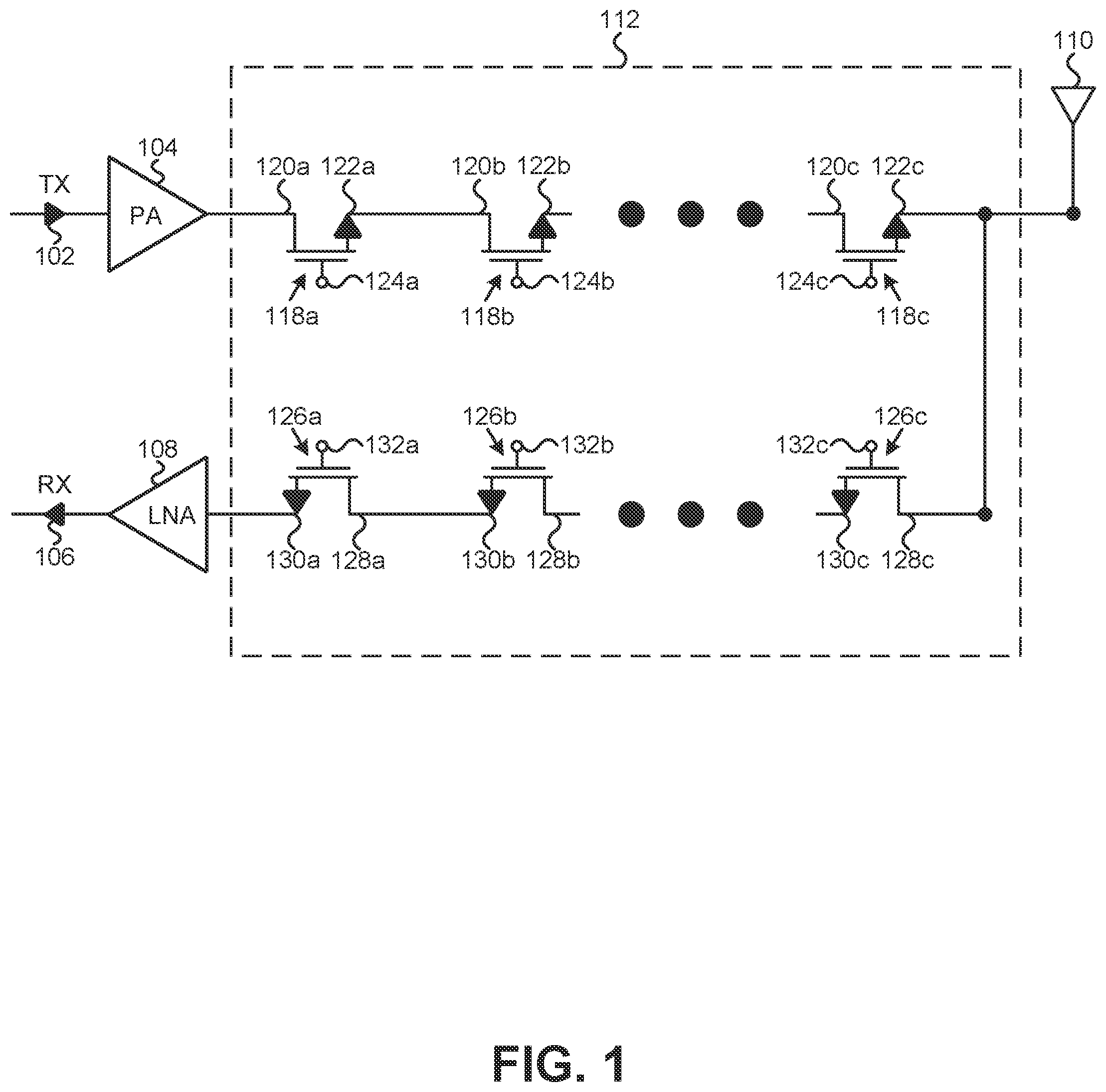
illustrates a portion of a transceiver including a radio frequency (RF) switch employing stacked transistors according to one implementation of the present application.
illustrates a portion of a flowchart of an exemplary method for manufacturing a semiconductor structure according to one implementation of the present application.
A illustrates a cross-sectional view of a portion of a semiconductor structure processed in accordance with action 240 in the flowchart of according to one implementation of the present application.
B illustrates a cross-sectional view of a portion of a semiconductor structure processed in accordance with action 242 in the flowchart of according to one implementation of the present application
C illustrates a cross-sectional view of a portion of a semiconductor structure processed in accordance with action 244 in the flowchart of according to one implementation of the present application
D illustrates a cross-sectional view of a portion of a semiconductor structure processed in accordance with action 246 in the flowchart of according to one implementation of the present application.
E illustrates a cross-sectional view of a portion of a semiconductor structure processed in accordance with actions 248 a and 248 b in the flowchart of according to one implementation of the present application.
F illustrates a cross-sectional view of a portion of a semiconductor structure processed in accordance with actions 248 a and 248 b in the flowchart of according to one implementation of the present application.
DETAILED DESCRIPTION
The following description contains specific information pertaining to implementations in the present disclosure. The drawings in the present application and their accompanying detailed description are directed to merely exemplary implementations. Unless noted otherwise, like or corresponding elements among the figures may be indicated by like or corresponding reference numerals. Moreover, the drawings and illustrations in the present application are generally not to scale, and are not intended to correspond to actual relative dimensions.
illustrates a portion of a transceiver including a radio frequency (RF) switch employing stacked transistors according to one implementation of the present application. The transceiver in includes transmit input 102 , power amplifier (PA) 104 , receive output 106 , low-noise amplifier (LNA) 108 , antenna 110 , and radio frequency (RF) switch 112 .
RF switch 112 is situated between PA 104 and antenna 110 . PA 104 amplifies RF signals transmitted from transmit input 102 . In one implementation, transmit input 102 can be coupled to a mixer (not shown in ), or to another input source. The output of PA 104 is coupled to one end of RF switch 112 . A matching network (not shown in ) can be coupled between PA 104 and RF switch 112 . Another end of RF switch 112 is coupled to antenna 110 . Antenna 110 can transmit amplified RF signals. In one implementation, RF switch 112 can be coupled to an antenna array, rather than a single antenna 110 .
RF switch 112 is also situated between LNA 108 and antenna 110 . Antenna 110 also receives RF signals. Antenna 110 is coupled to one end of RF switch 112 . Another end of RF switch 112 is coupled to the input of LNA 108 . LNA 108 amplifies RF signals received from RF switch 112 . A matching network (not shown in Figure can be coupled between RF switch 112 and LNA 108 , Receive output 106 receives amplified RF signals from LNA 108 . In one implementation, receive output 106 can be coupled to a mixer (not shown in ), or to another output source.
RF switch 112 includes two stacks of transistors. The first stack includes transistors 118 a , 118 b , and 118 c . Drain 120 a of transistor 118 a is coupled to the output of PA 104 . Source 122 a of transistor 118 a is coupled to drain 120 b of transistor 118 b . Source 122 b of transistor 118 b can be coupled to the drain of additional transistors, and ultimately coupled to drain 120 c of transistor 118 c . Source 122 c of transistor 118 c is coupled to antenna 110 . Gates 124 a , 124 b , and 124 c of transistors 118 a , 118 b , and 118 c respectively can be coupled to a controller or a pulse generator (not shown) for switching transistors 118 a , 118 b , and 118 c between ON and OFF states.
The second stack includes transistors 126 a , 126 b , and 126 c . Source 130 a of transistor 126 a is coupled to the input of LNA 108 . Drain 128 a of transistor 126 a is coupled to source 130 b of transistor 126 b . Drain 128 b of transistor 126 b can be coupled to the drain of additional transistors, and ultimately coupled to drain source 130 c of transistor 126 c . Drain 128 c of transistor 126 c is coupled to antenna 110 . Gates 132 a , 132 b , and 132 c of transistors 126 a , 126 b , and 126 c respectively can be coupled to a controller or a pulse generator (not shown) for switching transistors 126 a , 126 b , and 126 c between ON and OFF states.
In the example of , RF switch 112 switches the transceiver in between receive and transmit modes. When transistors 118 a , 118 b , and 118 c are in OFF states, and transistors 126 a , 126 b , and 126 c are in ON states, the transceiver is in receive mode. Transistors 126 a , 126 b , and 126 c serve as a receive path for RF signals received by antenna 110 to pass to LNA 108 and to receive output 106 . When transistors 118 a , 118 b , and 118 c are in ON states, and transistors 126 a , 126 b , and 126 c are in OFF states, the transceiver is in transmit mode. Transistors 118 a , 118 b , and 118 c serve as a transmit path for RF signals transmitted from transmit input 102 and PA 104 to pass to antenna 110 . In various implementations, RF switch 112 can include more stacks of transistors and/or more amplifiers. In various implementations, RF switch 112 can switch the transceiver between two transmit modes corresponding to different frequencies, or between two receive modes corresponding to different frequencies.
In the present implementation, transistors 118 a , 118 b , 118 c , 126 a , 126 b , and 126 c are N-type field effect transistors (NFETs). In various implementations, transistors 118 a , 118 b , 118 c , 126 a , 126 b , and 126 c can be P-type FEB (PFETs), junction FETs (JFETs), or any other type of transistor. By stacking transistors 118 a , 118 b , 118 c , 126 a , 126 b , and 126 c as shown in , the overall OFF state power and voltage handling capability for RF switch 112 can be increased. For example, if only transistors 118 a and 126 a were used, RF switch 112 may have an OFF state voltage handling capability of five volts (5 V). If eight transistors were used in each stack, RF switch 112 may have an OFF state voltage handling capability of forty volts (40 V). In various implementations, RF switch 112 can have more or fewer stacked transistors than shown in .
As described below, in conventional semiconductor structures, signals can leak from RF switch 112 , for example, to ground or to other devices. This signal leakage is particularly problematic when transistors 118 a , 118 b , 118 c , 126 a , 126 b , and 126 c are in OFF states, and when dealing with higher frequency signals, such as RF signals. According to the present application, RF switch 112 can be utilized in a semiconductors structure that reduces signal leakage. It is noted that, although the present application focuses on RF signals, the signals pray have frequencies other than RF frequencies.
illustrates a portion of a flowchart of an exemplary method for manufacturing a semiconductor structure according to one implementation of the present application. Structures shown in A through 3 E illustrate the results of performing actions 240 through 248 b shown in the flowchart of . For example, A shows a semiconductor structure after performing action 240 in , B shows a semiconductor structure after performing action 242 in , and so forth.
Actions 240 through 248 b shown in the flowchart of are sufficient to describe one implementation of the present inventive concepts. Other implementations of the present inventive concepts may utilize actions different from those shown in the flowchart of . Certain details and features have been left out of the flowchart of that are apparent to a person of ordinary skill in the art. For example, an action may consist of one or more sub-actions or may involve specialized equipment or materials, as known in the art. Moreover, some actions, such as masking and cleaning actions, are omitted so as not to distract from the illustrated actions.
A illustrates a cross-sectional view of a portion of a semiconductor structure processed in accordance with action 240 in the flowchart of according to one implementation of the present application. As shown A , according to action 240 , semiconductor structure 340 including porous semiconductor layer 354 situated over substrate 352 is formed. In the present implementation, substrate 352 is a bulk silicon substrate. For example, substrate 352 can be a P-type bulk silicon substrate having a thickness of approximately seven hundred microns (700 μm). In various implementations, substrate 352 may be any other type of substrate.
Porous semiconductor layer 354 situated over substrate 352 is a semiconductor layer having voids, or pores, therein, Within porous semiconductor layer 354 , the pores can have any orientation, branching, fill, or other morphological characteristic known in the art. Porous semiconductor layer 354 can be formed by using a top-down technique, where portions of substrate 352 are removed to generate pores. For example, porous semiconductor layer 354 can be formed by electrochemical etching using hydrofluoric acid (HF). Alternatively, porous semiconductor layer 354 can also be formed by stain etching, photoetching, or any other top-down technique known in the art. Porous semiconductor layer 354 can also be formed by using a bottom-up technique, where deposition results in a semiconductor layer having empty spaces. For example, porous semiconductor layer 354 can be formed by low-temperature high-density plasma (HDP) deposition. Alternatively, porous semiconductor layer 354 can also be formed by plasma hydrogenation of an amorphous layer, laser ablation, or any other bottom-up technique known in the art. In the present implementation, porous semiconductor layer 354 is a porous silicon layer, and has a thickness from approximately ten microns (10 μm) to approximately fifty microns (50 μm). In various implementations, porous semiconductor layer 354 may be any other type of porous semiconductor layer.
B illustrates a cross-sectional view of a portion of a semiconductor structure processed in accordance with action 242 in the flowchart of according to one implementation of the present application. In semiconductor structure 342 , porous semiconductor layer 354 is annealed. For example, porous semiconductor layer 354 can be annealed in argon (Ar) or hydrogen (H 2 ) at atmospheric pressure from a temperature of approximately seven hundred degrees Celsius (700° C.) to a temperature of approximately eleven hundred degrees Celsius (1100° C.) for approximately ten minutes (10 min). Any other annealing technique known in the art can be utilized, such as techniques utilizing different temperatures, durations, and/or pressures. The annealing shown in B reorganizes the pores in porous semiconductor layer 354 into larger cavities, while closing and smoothing surface 356 of porous semiconductor layer 354 . The annealed porous semiconductor layer 354 serves as a template layer for growth of a crystalline epitaxial layer in a subsequent action.
C illustrates a cross-sectional view of a portion of a semiconductor structure processed in accordance with action 244 in the flowchart of according to one implementation of the present application. In semiconductor structure 344 , crystalline epitaxial layer 358 is formed over porous semiconductor layer 354 . Crystalline epitaxial layer 358 is a thin layer of single-crystal material situated over porous semiconductor layer 354 . In one implementation, crystalline epitaxial layer 358 is formed by chemical vapor deposition (CVD). In various implementations, crystalline epitaxial layer 358 can be formed by any other epitaxy technique known the art. In the present implementation, crystalline epitaxial layer 358 is a silicon epitaxial layer, and has thickness T 1 from approximately five hundred angstroms (500 Å) to approximately two thousand angstroms (2000 Å). In various implementations, crystalline epitaxial layer 358 may be any other type of crystalline epitaxial layer. In various implementations, more than one crystalline epitaxial layer 358 can be formed. Crystalline epitaxial layer 358 serves as device region for formation of semiconductor devices in subsequent actions.
D illustrates a cross-sectional view of a portion of a semiconductor structure processed in accordance with optional action 246 in the flowchart of according to one implementation of the present application. In semiconductor structure 346 of D , electrical isolation region 360 is formed at least in crystalline epitaxial layer 358 (shown in C ). In particular, in the example of D , electrical isolation region 360 extends through crystalline epitaxial layer 358 and into porous semiconductor layer 354 .
Electrical isolation region 360 can be formed by etching through crystalline epitaxial layer 358 and into porous semiconductor layer 354 , then depositing an electrically insulating material. In the present implementation, electrical isolation region 360 is also planarized with the top surface of crystalline epitaxial layer 358 , for example, by using chemical machine polishing (CMP). Electrical isolation region 360 can comprise, for example, silicon dioxide (SiO 2 ).
In the present implementation, depth D 1 of electrical isolation region 360 is greater than thickness T 1 of crystalline epitaxial layer 358 . Accordingly, electrical isolation region 360 separates crystalline epitaxial layer 358 of C into two crystalline epitaxial layers 358 a and 358 b . In one implementation, depth D 1 of electrical isolation region 360 can be substantially equal to thickness T 1 . In another implementation, depth D 1 of electrical isolation region 360 can be less than thickness T 1 , such that electrical isolation region 360 extends into crystalline epitaxial layer 358 but not into porous semiconductor layer 354 . In various implementations, locally oxidized silicon (LOCOS) can be used instead of or in addition to electrical isolation region 360 .
Crystalline epitaxial layers 358 a and 358 b can also be implanted with a dopant. For example, crystalline epitaxial layers 358 a and 358 b can be implanted with boron or other appropriate P-type dopant. In another example, one or both of crystalline epitaxial layers 358 a and 358 b can be implanted with phosphorus or other appropriate N-type dopant. One or more masks can be utilized to define portions of crystalline epitaxial layers 358 a and 358 b that will be implanted with dopants. In one implementation, crystalline epitaxial layers 358 a and 358 b are implanted with a dopant after forming electrical isolation region 360 . In another implementation, crystalline epitaxial layer 358 in C can be implanted with dopants before forming electrical isolation region 360 . In this implementation, electrical isolation region 360 can be formed in a uniform implant region, between two implant regions having different types or concentrations, and/or where two implant regions overlap.
As described below, electrical isolation region 360 reduces signal interference across crystalline epitaxial layers 358 a and 358 b . Electrical isolation region 360 is considered optional in that semiconductor structures according to the present application can be formed without electrical isolation region 360 .
E illustrates a cross-sectional view of a portion of a semiconductor structure processed in accordance with actions 248 a and 248 b in the flowchart of according to one implementation of the present application. In semiconductor structure 348 of E , semiconductor devices 318 a , 318 b , and 318 c are formed in crystalline epitaxial layer 358 a . Similarly, semiconductor device 304 is formed in crystalline epitaxial layer 358 b . Electrical isolation region 360 separates semiconductor device 304 from semiconductor devices 318 a , 318 b , and 318 c.
In the present implementation, semiconductor devices 318 a , 318 b , and 318 c are transistors. Semiconductor devices 318 a , 318 b , and 318 c in E may generally correspond to transistors 118 a , 118 b , and 118 c (or transistors 126 a , 126 b , and 126 c ) utilized in RF switch 112 in . Semiconductor device 318 a includes source/drain junctions 321 a and 321 b , gate 324 a , lightly doped regions 362 a , gate oxide 364 a , and spacers 366 a . Semiconductor device 318 b includes source/drain junctions 321 b and 321 c , gate 324 b , lightly doped regions 362 b , gate oxide 364 b , and spacers 366 b . Semiconductor device 318 c includes source/drain junctions 321 c and 321 d , gate 324 c , lightly doped regions 362 c , gate oxide 364 c , and spacers 366 c . Source/drain junction 321 b is shared by semiconductor devices 318 a and 318 b ; source/drain junction 321 c is shared by semiconductor devices 318 b and 318 c.
In the present implementation, semiconductor device 304 is also a transistor. Semiconductor device 304 in E can be utilized in an amplifier, such as PA 104 (or LNA 108 ) in . Semiconductor device 304 includes source/drain junctions 321 e and 321 f , gate 324 d , lightly doped regions 362 d , gate oxide 364 d , and spacers 366 d . In one implementation, semiconductor device 304 can be utilized as part of a logic circuit. Semiconductor device 304 is considered optional in that semiconductor structures according to the present application can be formed without semiconductor device 304 .
Gates 324 a , 324 b , 324 e , and 324 d can comprise, for example, polycrystalline silicon (polySi). Source/drain junctions 321 a , 321 b , 321 c , 321 d , 321 e , and 321 f can be implanted with a dopant of a different type than their corresponding crystalline epitaxial layer 358 a or 358 b . Lightly doped regions 362 a , 362 b , 362 c , and 362 d can be implanted with a dopant of the same type as their adjacent source/drain junction, but having a lower concentration. Gate oxides 364 a , 364 b , 364 c , and 364 d can comprise, for example, silicon dioxide (SiO 2 ). Spacers 366 a , 366 b , 366 c , and 366 d can comprise, for example, silicon nitride (SiN).
In the present implementation, depth D 2 of source/drain junctions 321 a , 321 b , 321 c , 321 d , 321 e , and 321 f is substantially less than thickness T 1 of crystalline epitaxial layers 358 a and 358 b , such that source/drain junctions 321 a , 321 b , 321 c , 321 d , 321 e , and 321 f are not in contact with porous semiconductor layer 354 . In one implementation, source/drain junctions 321 a , 321 b , 321 c , and 321 d are implanted with an N-type dopant (or a P-type dopant in some implementations) in one action, and source/drain junctions 321 e and 321 f are implanted with an N-type dopant (or a P-type dopant in some implementations) another separate action. In one implementation, source/drain junctions 321 a , 321 b , 321 c , 321 d , 321 e , and 321 f are implanted with an N-type dopant (or a P-type dopant in some implementations) concurrently in a single action. In various implementations, silicide can be situated over source/drain junctions 321 a , 321 b , 321 c , and 321 d and/or gates 324 a , 324 b , and 324 c . In various implementations, semiconductor structure 348 can include more or fewer semiconductor devices in crystalline epitaxial layer 358 a . In various implementations, crystalline epitaxial layers 358 a and 358 b can include diodes, or types of semiconductor devices instead of or in addition to transistors.
Because semiconductor structure 348 includes porous semiconductor layer 354 (for example, a porous silicon layer), semiconductor structure 348 reduces signal leakage (for example, RF signal leakage) from semiconductor devices 318 a , 318 b , 318 c , and 304 to ground. Further, porous semiconductor layer 354 (for example, a porous silicon layer) reduces signal interference (for example, RF signal interference) between the different devices built in crystalline epitaxial layers 358 a and 358 b . Pores in porous semiconductor layer 354 decrease its effective dielectric constant and increase its resistivity. In semiconductor structure 348 in E , porous semiconductor layer 354 has a dielectric constant substantially less than the dielectric constant of substrate 352 . For example, when substrate 352 is a bulk silicon substrate having a dielectric constant of approximately 11.7, porous semiconductor layer 354 has a dielectric constant significantly less than 11.7. In particular, porous semiconductor layer 354 can have a dielectric constant from approximately 2.0 to approximately 4.0. The improved RF isolation that results from the low dielectric constant is especially advantageous for RF switching applications as it reduces signal distortion (i.e. improves linearity). It also results in a more uniform voltage distribution across the OFF state FET stack, increasing its power handling capability.
In semiconductor structure 348 in E , utilizing porous semiconductor layer 354 , with its low dielectric constant, reduces parasitic capacitance between crystalline epitaxial layer 358 a and substrate 352 . Accordingly, RF signals are less likely to leak from semiconductor devices 318 a , 318 b , and 318 c in crystalline epitaxial layer 358 a to substrate 352 . For example, in one implementation, semiconductor devices 318 a , 318 b , and 318 c are transistors utilized to maintain RF switch 112 (shown in ) in an OFF state, and substrate 352 functions as a ground. In their OFF states, transistors 318 a , 318 b , and 318 c create a high resistance path along source/drain junctions 321 a , 321 b , 321 c , and 321 d , while the RF signals would have been subject to adverse impact of parasitic capacitances with substrate 352 if porous semiconductor layer 354 were not utilized. In other words, the RF signals could easily leak from semiconductor devices 318 a , 318 b , and 318 c to ground, increasing OFF state parasitic capacitance and negatively impacting the performance of semiconductor structure 348 . Where semiconductor devices 318 a , 318 b , and 318 c are transistors utilized to maintain RF switch 112 (shown in ) in an ON state, RF signal leakage, absent porous semiconductor layer 354 , could also result in a higher insertion loss.
Because semiconductor structure 348 includes porous semiconductor layer 354 in combination with electrical isolation region 360 , semiconductor structure 348 also reduces signal interference from semiconductor devices 318 a , 318 b , 318 c to semiconductor device 304 , and vice versa. If porous semiconductor layer 354 and electrical isolation region 360 were not utilized, signals (for example RF signals) from semiconductor device 304 could propagate through crystalline epitaxial layers 358 b and 358 a and/or substrate 352 , and interfere with semiconductor devices 318 a , 318 b , 318 c and generate additional undesirable noise in semiconductor devices 318 a , 318 b , 318 c . Where semiconductor device 304 is a transistor utilized in PA 104 (shown in ), these consequences could be amplified. Together, the low dielectric constant of porous semiconductor layer 354 and electrical insulation of electrical isolation region 360 reduce signal leakage and interference through crystalline epitaxial layers 358 a and 358 b and/or substrate 352 . The leakage and interference are especially reduced where depth D 1 of electrical isolation region 360 is equal to or greater than thickness T 1 of crystalline epitaxial layers 358 a and 358 b.
Semiconductor structure 348 in E can achieve this reduced signal leakage without using costly materials for substrate 352 , such as quartz or sapphire, and also without requiring costly and/or specialized fabrication techniques used to create trap-rich silicon-on-insulator (SOI) structures, such as smart cut techniques. As described above porous semiconductor layer 354 (for example, a porous silicon layer) can have a dielectric constant from approximately 2.0 to approximately 4.0, comparable to a buried oxide (BOX) in an SOI structure having a dielectric constant of approximately 3.7. Porous semiconductor layer 354 (for example, a porous silicon layer) can be situated over bulk semiconductor substrate 352 (for example, a bulk silicon substrate), and included in semiconductor structure 348 by various fabrication techniques. Thereafter, as discussed above, porous semiconductor layer 354 can be annealed and serve as a high-quality template for growth of crystalline epitaxial layer 358 (shown in C ), in which semiconductor devices 318 a , 318 b , 318 c , and 304 are formed. Further, shallow source/drain junctions 321 a , 321 b , 321 c , and 321 d improve performance of semiconductor devices 318 a , 318 b , and 318 c by reducing junction capacitances.
F illustrates a cross-sectional view of a portion of a semiconductor structure processed in accordance with actions 248 a and 248 b in the flowchart of according to cone implementation of the present application. Semiconductor structure 348 of F represents an alternative implementation to semiconductor structure 348 of E . Semiconductor structure 348 of F is similar to semiconductor structure 348 of E , except that, in semiconductor structure 348 of F , depth D 3 of source/drain junctions 321 a , 321 b , 321 c , 321 d , 321 e , and 321 f is substantially equal to thickness T 1 of crystalline epitaxial layers 358 a and 358 b , such that source/drain junctions 321 a , 321 b , 321 c , 321 d , 321 e , and 321 f are in contact with porous semiconductor layer 354 . Compared to semiconductor structure 348 of E , deeper source/drain junctions 321 e and 321 f in semiconductor structure 348 of F improve performance of semiconductor device 304 by improving high current and high voltage handling. Other than the differences described above, semiconductor structure 348 of F may have any implementations and advantages described above with respect to semiconductor structure 348 of E .
From the above description it is manifest that various techniques can be used for implementing the concepts described in the present application without departing from the scope of those concepts. Moreover, while the concepts have been described with specific reference to certain implementations, a person of ordinary skill in the art would recognize that changes can be made in form and detail without departing from the scope of those concepts. As such, the described implementations are to be considered in all respects as illustrative and not restrictive. It should also be understood that the present application is not limited to the particular implementations described above, but many rearrangements, modifications, and substitutions are possible without departing from the scope of the present disclosure.
Figures (8)
Citations
This patent cites (13)
- US6376285
- US7420201
- US2001/0050397
- US2004/0048437
- US2005/0121707
- US2007/0164358
- US2007/0170433
- US2009/0117720
- US2009/0212341
- US2016/0190302
- US2018/0068886
- US2019/0148570
- US2019/0181218