Semiconductor Device Having Fin Structures with Unequal Channel Heights and Manufacturing Method Thereof
Abstract
In a method of manufacturing a semiconductor device, a fin structure protruding from a first isolation insulating layer is formed. A second isolation insulating layer made of different material than the first isolation insulating layer is formed so that a first upper portion of the fin structure is exposed. A dummy gate structure is formed over the exposed first upper portion of the first fin structure. The second isolation insulating layer is etched by using the dummy gate structure as an etching mask. The dummy gate structure is removed so that a gate space is formed. The second isolation insulating layer is etched in the gate space so that a second upper portion of the fin structure is exposed from the first isolation insulating layer. A gate dielectric layer and a gate electrode layer are formed over the exposed second portion of the fin structure.
Claims (20)
1. A method of manufacturing a semiconductor device, the method comprising: lithographically patterning a substrate to form a first fin structure and a second fin structure comprising portions of the substrate remaining after patterning the substrate; forming a dummy gate structure; forming a step structure in which the first fin structure is disposed in a first region and the second fin structure is disposed in a second region, wherein a bottom portion of a source/drain region of the first fin structure is embedded in a first isolation insulating layer, a middle portion of the source/drain region of the first fin structure is embedded in a second isolation insulating layer disposed over the first isolation insulating layer and an upper portion of the source/drain region of the first fin structure is exposed, and a bottom portion of a source/drain region of the second fin structure is embedded in the first insulating layer and a middle portion and an upper portion of the source/drain region of the second fin structure are exposed; and forming a first epitaxial layer over the exposed top portion of the source/drain region of the first fin structure, and a second epitaxial layer over the exposed middle and top portions of the source/drain region of the second fin structure, wherein the step structure is formed after the dummy gate structure is formed.
8. A method of manufacturing a semiconductor device, the method comprising: forming a step structure in which a first fin structure is disposed in a first region and a second fin structure is disposed in a second region, wherein a bottom portion of a source/drain region of the first fin structure is embedded in a first isolation insulating layer, a middle portion of the source/drain region of the first fin structure is embedded in a second isolation insulating layer disposed over the first isolation insulating layer and an upper portion of the source/drain region of the first fin structure is exposed, and a bottom portion of a source/drain region of the second fin structure is embedded in the first insulating layer and a middle portion and an upper portion of the source/drain region of the second fin structure are exposed; forming a first epitaxial layer over the exposed top portion of the source/drain region of the first fin structure, and a second epitaxial layer over the exposed middle and top portions of the source/drain region of the second fin structure; forming an interlayer dielectric (ILD) layer over the first and second epitaxial layers; forming a first opening in the ILD layer in the first region to expose the first epitaxial layer disposed over the top portion of the first fin structure, and a second opening in the ILD layer in the second region to expose a part of the second epitaxial layer disposed over the top portion of the second fin structure; and forming a first conductive contact in the first opening and a second conductive contact in the second opening.
16. A method of manufacturing a semiconductor device, the method comprising: forming a step structure in which a first fin structure is disposed in a first region and a second fin structure is disposed in a second region, wherein a bottom portion of a source/drain region of the first fin structure is embedded in a first isolation insulating layer, a middle portion of the source/drain region of the first fin structure is embedded in a second isolation insulating layer disposed over the first isolation insulating layer and an upper portion of the source/drain region of the first fin structure is exposed, and a bottom portion of a source/drain region of the second fin structure is embedded in the first insulating layer and a middle portion and an upper portion of the source/drain region of the second fin structure are exposed; forming a first epitaxial layer over the exposed top portion of the source/drain region of the first fin structure, and a second epitaxial layer over the exposed middle and top portions of the source/drain region of the second fin structure; forming an interlayer dielectric (ILD) layer over the first and second epitaxial layers; forming a first opening in the ILD layer in the first region to expose the first epitaxial layer, and a second opening in the ILD layer in the second region to expose a part of the second epitaxial layer; and forming a first conductive contact in the first opening and a second conductive contact in the second opening, wherein a depth of the first opening is equal to or smaller than a depth of the second opening.
Show 17 dependent claims
2. The method of claim 1 , wherein the second isolation insulating layer is made of at least one of SiCO and SiCON.
3. The method of claim 2 , wherein the first isolation insulating layer is made of silicon oxide.
4. The method of claim 1 , wherein a bottom of the first epitaxial layer contacts the second isolation insulating layer, and a bottom of the second epitaxial layer contacts the first isolation insulating layer.
5. The method of claim 1 , wherein a height h 1 of the exposed top portion of the first fin structure from the second isolation insulating layer and a height h 2 of the exposed middle and top portions of the second fin structure from the first isolation insulating layer satisfy 1.5≤h 2 /h 1 ≤5.0.
6. The method of claim 1 , wherein forming the dummy gate structure further comprises: forming a first dummy gate structure over a channel region of the first fin structure; and forming a second dummy gate structure over a channel region of the second fin structure.
7. The method of claim 6 , wherein a bottom of the first dummy gate structure contacts the second isolation insulating layer, and a bottom of the second dummy gate structure contacts the first isolation insulating layer.
9. The method of claim 8 , wherein the second isolation insulating layer is made of SiCO.
10. The method of claim 9 , wherein the first isolation insulating layer is made of silicon oxide.
11. The method of claim 8 , wherein a bottom of the first epitaxial layer contacts the second isolation insulating layer, and a bottom of the second epitaxial layer contacts the first isolation insulating layer.
12. The method of claim 8 , wherein a height h 1 of the exposed top portion of the first fin structure from the second isolation insulating layer and a height h 2 of the exposed middle and top portions of the second fin structure from the first isolation insulating layer satisfy 1.5≤h 2 /h 1 ≤3.0.
13. The method of claim 8 , further comprising forming a dummy gate structure including a first dummy gate structure over a channel region of the first fin structure and a second dummy gate structure over a channel region of the second fin structure.
14. The method of claim 13 , wherein the dummy gate structure is formed after the step structure is formed.
15. The method of claim 8 , wherein the first opening and the second opening are formed as one continuous opening.
17. The method of claim 16 , wherein after the second opening is formed, a part of the ILD layer covers the second epitaxial layer.
18. The method of claim 16 , wherein the first opening and the second opening are separated from each other.
19. The method of claim 6 , wherein forming the step structure further comprises: forming the first isolation insulating layer over the first fin structure and the second fin structure; forming the second isolation insulating layer over the first isolation insulating layer; forming the dummy gate structure after formation of the first isolation insulating layer and the second isolation insulating layer; and etching the first isolation insulating layer in the second region to form the step structure.
20. The method of claim 19 , wherein etching the first isolation insulating layer in the second region further comprises: forming a cover layer over the first region such that the cover layer covers the first dummy gate structure; and etching the first isolation insulating layer in portions of the second region that are exposed outside the cover layer and the second dummy gate structure.
Full Description
Show full text →
RELATED APPLICATIONS
This application is a continuation of application Ser. No. 16/585,683 filed on Sep. 27, 2019, which is a divisional of application Ser. No. 15/707,682 filed on Sep. 18, 2017, now U.S. Pat. No. 10,679,988, the entire contents of each of which are incorporated by reference.
TECHNICAL FIELD
The disclosure relates to a semiconductor integrated circuit, and more particularly to a semiconductor device having fin field effect transistors and their manufacturing process.
BACKGROUND
As the semiconductor industry has progressed into nanometer technology process nodes in pursuit of higher device density, higher performance, and lower costs, challenges from both fabrication and design issues have resulted in the development of three-dimensional designs, such as a multi-gate field effect transistor (FET), including a fin FET (FinFET) and a gate-all-around (GAA) FET. In a FinFET, a gate electrode layer is adjacent to three side surfaces of a channel region with a gate dielectric layer interposed therebetween. Because the gate structure surrounds (wraps) the fin on three surfaces, the transistor essentially has three gates controlling the current through the fin or channel region. The current driving capacity of the FinFET is generally determined by a number of the fins, a fin width and a fin height at the channel region.
BRIEF DESCRIPTION OF THE DRAWINGS
The present disclosure is best understood from the following detailed description when read with the accompanying figures. It is emphasized that, in accordance with the standard practice in the industry, various features are not drawn to scale and are used for illustration purposes only. In fact, the dimensions of the various features may be arbitrarily increased or reduced for clarity of discussion.
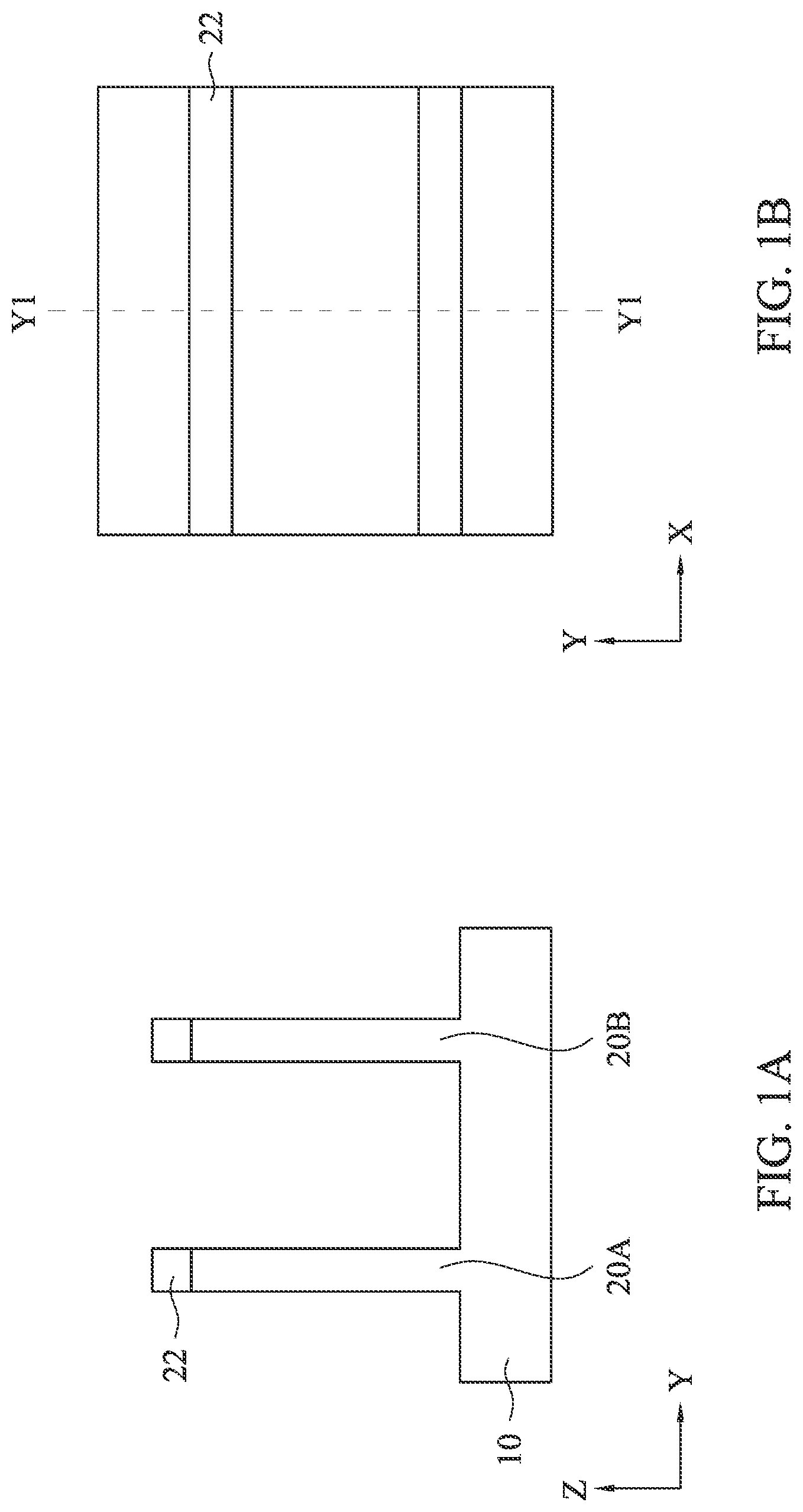
A and 1 B show one of the various stages of sequential processes for manufacturing a semiconductor device having FinFETs with different fin channel heights according to an embodiment of the present disclosure.
A and 2 B show one of the various stages of sequential processes for manufacturing a semiconductor device having FinFETs with different fin channel heights according to an embodiment of the present disclosure.
A and 3 B show one of the various stages of sequential processes for manufacturing a semiconductor device having FinFETs with different fin channel heights according to an embodiment of the present disclosure.
A and 4 B show one of the various stages of sequential processes for manufacturing a semiconductor device having FinFETs with different fin channel heights according to an embodiment of the present disclosure.
A and 5 B show one of the various stages of sequential processes for manufacturing a semiconductor device having FinFETs with different fin channel heights according to an embodiment of the present disclosure.
A and 6 B show one of the various stages of sequential processes for manufacturing a semiconductor device having FinFETs with different fin channel heights according to an embodiment of the present disclosure.
A and 7 B show one of the various stages of sequential processes for manufacturing a semiconductor device having FinFETs with different fin channel heights according to an embodiment of the present disclosure.
A and 8 B show one of the various stages of sequential processes for manufacturing a semiconductor device having FinFETs with different fin channel heights according to an embodiment of the present disclosure.
A and 9 B show one of the various stages of sequential processes for manufacturing a semiconductor device having FinFETs with different fin channel heights according to an embodiment of the present disclosure.
A, 10 B and 10 C show one of the various stages of sequential processes for manufacturing a semiconductor device having FinFETs with different fin channel heights according to an embodiment of the present disclosure.
A and 11 B show one of the various stages of sequential processes for manufacturing a semiconductor device having FinFETs with different fin channel heights according to an embodiment of the present disclosure.
A and 12 B show one of the various stages of sequential processes for manufacturing a semiconductor device having FinFETs with different fin channel heights according to an embodiment of the present disclosure.
A and 13 B show one of the various stages of sequential processes for manufacturing a semiconductor device having FinFETs with different fin channel heights according to an embodiment of the present disclosure.
A and 14 B show one of the various stages of sequential processes for manufacturing a semiconductor device having FinFETs with different fin channel heights according to an embodiment of the present disclosure.
A and 15 B show one of the various stages of sequential processes for manufacturing a semiconductor device having FinFETs with different fin channel heights according to an embodiment of the present disclosure.
A and 16 B show one of the various stages of sequential processes for manufacturing a semiconductor device having FinFETs with different fin channel heights according to an embodiment of the present disclosure.
A and 17 B show one of the various stages of sequential processes for manufacturing a semiconductor device having FinFETs with different fin channel heights according to an embodiment of the present disclosure.
A and 18 B show one of the various stages of sequential processes for manufacturing a semiconductor device having FinFETs with different fin channel heights according to an embodiment of the present disclosure.
A, 19 B and 19 C show one of the various stages of sequential processes for manufacturing a semiconductor device having FinFETs with different fin channel heights according to an embodiment of the present disclosure.
A and 20 B show one of the various stages of sequential processes for manufacturing a semiconductor device having FinFETs with different fin channel heights according to an embodiment of the present disclosure.
A, 21 B, 21 C and 21 D show one of the various stages of sequential processes for manufacturing a semiconductor device having FinFETs with different fin channel heights according to an embodiment of the present disclosure.
A and 22 B show one of the various stages of sequential processes for manufacturing a semiconductor device having FinFETs with different fin channel heights according to another embodiment of the present disclosure.
A and 23 B show one of the various stages of sequential processes for manufacturing a semiconductor device having FinFETs with different fin channel heights according to another embodiment of the present disclosure.
A and 24 B show one of the various stages of sequential processes for manufacturing a semiconductor device having FinFETs with different fin channel heights according to another embodiment of the present disclosure.
A and 25 B show one of the various stages of sequential processes for manufacturing a semiconductor device having FinFETs with different fin channel heights according to another embodiment of the present disclosure.
A and 26 B show one of the various stages of sequential processes for manufacturing a semiconductor device having FinFETs with different fin channel heights according to another embodiment of the present disclosure.
A and 27 B show one of the various stages of sequential processes for manufacturing a semiconductor device having FinFETs with different fin channel heights according to another embodiment of the present disclosure.
A and 28 B show one of the various stages of sequential processes for manufacturing a semiconductor device having FinFETs with different fin channel heights according to another embodiment of the present disclosure.
A and 29 B show an SRAM having FinFETs with different fin channel heights according to an embodiment of the present disclosure.
shows an SRAM having FinFETs with different fin channel heights according to another embodiment of the present disclosure.
DETAILED DESCRIPTION
It is to be understood that the following disclosure provides many different embodiments, or examples, for implementing different features of the invention. Specific embodiments or examples of components and arrangements are described below to simplify the present disclosure. These are, of course, merely examples and are not intended to be limiting. For example, dimensions of elements are not limited to the disclosed range or values, but may depend upon process conditions and/or desired properties of the device. Moreover, the formation of a first feature over or on a second feature in the description that follows may include embodiments in which the first and second features are formed in direct contact, and may also include embodiments in which additional features may be formed interposing the first and second features, such that the first and second features may not be in direct contact. Various features may be arbitrarily drawn in different scales for simplicity and clarity.
Further, spatially relative terms, such as “beneath,” “below,” “lower,” “above,” “upper” and the like, may be used herein for ease of description to describe one element or feature's relationship to another element(s) or feature(s) as illustrated in the figures. The spatially relative terms are intended to encompass different orientations of the device in use or operation in addition to the orientation depicted in the figures. The apparatus may be otherwise oriented (rotated 90 degrees or at other orientations) and the spatially relative descriptors used herein may likewise be interpreted accordingly. In addition, the term “made of” may mean either “comprising” or “consisting of.”
FinFETs generally include multiple fins to obtain a sufficient drive current. As the size of the semiconductor chip decreases, the number of the fins also decreases and, eventually the number of fins is one. With one fin structure in a FinFET, one possible way to increase the drive current is to increase a fin channel height (height of the channel region of the fin structure).
In a logic circuit, some transistors drive a large capacitive load, and others drive a small load. Transistors that drive a large load require a high drive strength (driving current I eff ) to meet speed requirements, as the speed ˜I eff /C load V dd , where C load is a capacitance of the load and V dd is power supply voltage. For a FinFET, when a load to be driven by a FinFET is low, an energy-delay-product will increase as the fin height increases, while when the load is high, the energy-delay-product decreases as the fin height increases.
Accordingly, the present disclosure provides a semiconductor device, such as a logic circuit and a static random access memory (SRAM) having multiple FinFETs with different fin channel heights for different driving characteristics. The semiconductor device according to the present embodiments can improve tradeoff between the speed and the power consumption by utilizing low fins for FinFETs that drive a small load, and tall fins for FinFETs that drive a large load.
D show sequential processes for manufacturing a semiconductor device having FinFETs with different fin channel heights according to an embodiment of the present disclosure. It is understood that additional operations can be provided before, during, and after processes shown by D , and some of the operations described below can be replaced or eliminated, for additional embodiments of the method. The order of the operations/processes may be interchangeable. In D , the “A” figures ( A, 2 A , . . . ) show cross sectional views along the Y direction, the “B” figures ( B, 2 B , . . . ) show plan views (top views) and the “C” figures ( C , etc.) show cross sectional views along the Y direction.
A and 1 B show one of the various stages of sequential processes for manufacturing a semiconductor device having FinFETs with different fin channel heights according to an embodiment of the present disclosure. A is a cross sectional view corresponding to line Y 1 -Y 1 of B .
As shown in A and 1 B , fin structures 20 A and 20 B are formed over a substrate 10 . In one embodiment, substrate 10 includes a single crystalline semiconductor layer on at least its surface portion. The substrate 10 may comprise a single crystalline semiconductor material such as, but not limited to Si, Ge, SiGe, GaAs, InSb, GaP, GaSb, InAlAs, InGaAs, GaSbP, GaAsSb and InP. In this embodiment, the substrate 10 is made of Si.
The substrate 10 may include in its surface region, one or more buffer layers (not shown). The buffer layers can serve to gradually change the lattice constant from that of the substrate to that of the source/drain regions. The buffer layers may be formed from epitaxially grown single crystalline semiconductor materials such as, but not limited to Si, Ge, GeSn, SiGe, GaAs, InSb, GaP, GaSb, InAlAs, InGaAs, GaSbP, GaAsSb, GaN, GaP, and InP. In a particular embodiment, the substrate 10 comprises silicon germanium (SiGe) buffer layers epitaxially grown on the silicon substrate 10 . The germanium concentration of the SiGe buffer layers may increase from 30 atomic % germanium for the bottom-most buffer layer to 70 atomic % germanium for the top-most buffer layer. The substrate 10 may include various regions that have been suitably doped with impurities (e.g., p-type or n-type conductivity).
The fin structures 20 A, 20 B may be patterned by any suitable method. For example, the fin structures may be patterned using one or more photolithography processes, including double-patterning or multi-patterning processes. Generally, double-patterning or multi-patterning processes combine photolithography and self-aligned processes, allowing patterns to be created that have, for example, pitches smaller than what is otherwise obtainable using a single, direct photolithography process. For example, in one embodiment, a dummy layer is formed over a substrate and patterned using a photolithography process. Spacers are formed alongside the patterned dummy layer using a self-aligned process. The dummy layer is then removed, and the remaining spacers may then be used to pattern the fins.
In other embodiments, the fin structures can be patterned by using a hard mask pattern 22 as an etching mask. In some embodiments, the hard mask pattern 22 includes a first mask layer and a second mask layer disposed on the first mask layer. The first mask layer is a pad oxide layer made of a silicon oxide, which can be formed by a thermal oxidation. The second mask layer is made of a silicon nitride (SiN), which is formed by chemical vapor deposition (CVD), including low pressure CVD (LPCVD) and plasma enhanced CVD (PECVD), physical vapor deposition (PVD), atomic layer deposition (ALD), or other suitable process. The deposited hard mask layer is patterned into a hard mask pattern 22 by using patterning operations including photo-lithography and etching. Then, the substrate 10 is patterned by using the hard mask pattern into fin structures 20 A and 20 B, both extending in the X direction. In A and 1 B , two fin structures 20 A and 20 B are arranged in the Y direction. But the number of the fin structures is not limited to, and may three or more. In some embodiments, one or more dummy fin structures are formed on both sides of the fin structures to improve pattern fidelity in the patterning operations.
The width of the upper portion of the fin structure along the Y direction is in a range from about 5 nm to about 40 nm in some embodiments, and is in a range from about 10 nm to about 20 nm in other embodiments. The height along the Z direction of the fin structure is in a range from about 100 nm to about 200 nm in some embodiments.
A and 2 B show one of the various stages of sequential processes for manufacturing a semiconductor device having FinFETs with different fin channel heights according to an embodiment of the present disclosure. A is a cross sectional view corresponding to line Y 1 -Y 1 of B .
After the fin structures 20 A and 20 B are formed, a first insulating material layer 29 including one or more layers of insulating material is formed over the substrate 10 so that the fin structures 20 A and 20 B are fully embedded in the first insulating material layer 29 . The insulating material for the first insulating material layer 29 may include silicon oxide, silicon nitride, silicon oxynitride (SiON), SiCN, fluorine-doped silicate glass (FSG), or a low-K dielectric material, formed by LPCVD (low pressure chemical vapor deposition), plasma-CVD or flowable CVD or any other suitable film formation methods. In some embodiments, the first insulating material layer 29 is made of silicon oxide. An anneal operation may be performed after the formation of the first insulating material layer 29 . Then, a planarization operation, such as a chemical mechanical polishing (CMP) method and/or an etch-back method, is performed such that the hard mask patterns 22 are removed and upper surfaces of the fin structures 20 A and 20 B are exposed from the first insulating material layer 29 as shown in A .
In some embodiments, one or more fin liner layers 25 are formed over the fin structures before forming the first insulating material layer 29 . The fin liner layer 25 may be made of SiN or a silicon nitride-based material (e.g., SiON or SiCN).
A and 3 B show one of the various stages of sequential processes for manufacturing a semiconductor device having FinFETs with different fin channel heights according to an embodiment of the present disclosure. A is a cross sectional view corresponding to line Y 1 -Y 1 of B .
Then, as shown in A , the first insulating material layer 29 is recessed to form a first isolation insulating layer 30 so that the upper portions of the fin structures 20 A and 20 B are exposed. With this operation, the fin structures 20 A and 20 B are electrically separated from each other by the first isolation insulating layer 30 , which is also called a shallow trench isolation (STI). After the recess etching, the height h 1 of the exposed fin structures is in a range from about 50 nm to about 100 nm in some embodiments, and is in a range from about 60 nm to about 80 nm in other embodiments.
A and 4 B show one of the various stages of sequential processes for manufacturing a semiconductor device having FinFETs with different fin channel heights according to an embodiment of the present disclosure. A is a cross sectional view corresponding to line Y 1 -Y 1 of B .
Further, a second insulating material layer 34 including one or more layers of insulating material is formed over the first isolation insulating layer 30 so that the fin structures 20 A and 20 B are fully embedded in the second insulating material layer 34 , as shown in A . The insulating material for the second insulating material layer 34 is different from that of the first isolation insulating layer, and may include silicon oxide, silicon nitride, silicon oxynitride (SiON), SiOCN, SiOC, SiCN, fluorine-doped silicate glass (FSG), or a low-k dielectric material, formed by LPCVD (low pressure chemical vapor deposition), plasma-CVD, atomic layer deposition (ALD) or flowable CVD, or any other suitable film formation methods. In some embodiments, the second insulating material layer 34 includes SiOC or SiOCN. An anneal operation may be performed after the formation of the second insulating material layer 34 . Then, a planarization operation, such as a chemical mechanical polishing (CMP) method and/or an etch-back method, is performed such that the upper surfaces of the fin structures 20 A and 20 B are exposed from the second insulating material layer 34 as shown in A .
A and 5 B show one of the various stages of sequential processes for manufacturing a semiconductor device having FinFETs with different fin channel heights according to an embodiment of the present disclosure. A is a cross sectional view corresponding to line Y 1 -Y 1 of B .
Then, as shown in A , the second insulating material layer 34 is recessed to form a second isolation insulating layer 35 so that the upper portions of the fin structures 20 A and 20 B are exposed. After the recess etching, the height h 2 of the exposed fin structures is smaller than h 1 and is in a range from about 15 nm to about 50 nm in some embodiments, and is in a range from about 20 nm to about 40 nm in other embodiments. In some embodiments, h 1 /h 2 is in a range from about 1.5 to about 5.0, and is in a range from about 1.5 to about 3.0 in other embodiments.
A and 6 B show one of the various stages of sequential processes for manufacturing a semiconductor device having FinFETs with different fin channel heights according to an embodiment of the present disclosure. A is a cross sectional view corresponding to line Y 2 -Y 2 of B .
After the second isolation insulating layer 35 is formed, a dummy gate structure 40 is formed, as shown in A and 6 B . The dummy gate structure 40 includes a dummy gate dielectric layer and a dummy gate electrode layer. The dummy gate dielectric layer includes one or more layers of insulating material, such as a silicon oxide-based material. In one embodiment, silicon oxide formed by CVD is used. The thickness of the dummy gate dielectric layer is in a range from about 1 nm to about 5 nm in some embodiments.
The dummy gate structure 40 is formed by first blanket depositing the dummy gate dielectric layer over the exposed fin structures 20 A and 20 B and the upper surface of the second isolation insulating layer 35 . A dummy gate electrode layer is then blanket deposited on the dummy gate dielectric layer, such that the fin structures are fully embedded in the dummy gate electrode layer. The dummy gate electrode layer includes silicon such as polycrystalline silicon (polysilicon) or amorphous silicon. In some embodiments, the dummy gate electrode layer is made of polysilicon. The thickness of the dummy gate electrode layer is in a range from about 100 nm to about 200 nm in some embodiments. In some embodiments, the dummy gate electrode layer is subjected to a planarization operation. The dummy gate dielectric layer and the dummy gate electrode layer are deposited using CVD, including LPCVD and PECVD, PVD, ALD, or other suitable process. Subsequently, a mask layer is formed over the dummy gate electrode layer. The mask layer can be a resist pattern or a hard mask pattern.
Next, a patterning operation is performed on the mask layer and dummy gate electrode layer is patterned into the dummy gate structures 40 , as shown in A and 6 B . By patterning the dummy gate structures, the upper portions of the fin structures 20 A and 20 B, which are to be source/drain regions, are partially exposed on opposite sides of the dummy gate structures, as shown in B . In this disclosure, a source and a drain are interchangeably used and the structures thereof are substantially the same. In B , two dummy gate structures 40 are formed on two fin structures 20 A and 20 B, respectively, and one dummy gate structure 40 is formed over two fin structures 20 A and 20 B. However, the layout is not limited to B .
The width of the dummy gate structures 40 in the Y direction is in a range from about 5 nm to about 30 nm in some embodiments, and is in a range from about 7 nm to about 15 nm in other embodiments. A pitch of the dummy gate structures is in a range from about 10 nm to about 50 nm in some embodiments, and is in a range from about 15 nm to about 40 nm in other embodiments.
A and 7 B show one of the various stages of sequential processes for manufacturing a semiconductor device having FinFETs with different fin channel heights according to an embodiment of the present disclosure. A is a cross sectional view corresponding to line Y 2 -Y 2 of B .
After the dummy gate structures 40 are formed, a blanket layer of an insulating material for sidewall spacers 42 is conformally formed by using CVD or other suitable methods. The blanket layer is deposited in a conformal manner so that it is formed to have substantially equal thicknesses on vertical surfaces, such as the sidewalls, horizontal surfaces, and the top of the dummy gate structures. In some embodiments, the blanket layer is deposited to a thickness in a range from about 2 nm to about 20 nm. In one embodiment, the insulating material of the blanket layer is different from the materials of the first isolation insulating layer and the second isolation insulating layer, and is made of a silicon nitride-based material, such as SiN, SiON, SiOCN or SiCN and combinations thereof. In some embodiments, the blanket layer (sidewall spacers 42 ) is made of SiN. The sidewall spacers 42 are formed on opposite sidewalls of the dummy gate structures 40 , by anisotropic etching, as shown in A and 7 B .
A and 8 B show one of the various stages of sequential processes for manufacturing a semiconductor device having FinFETs with different fin channel heights according to an embodiment of the present disclosure. A is a cross sectional view corresponding to line Y 2 -Y 2 of B .
After the sidewall spacers 42 are formed, the area around the fin structure 20 A, which will subsequently be a FinFET with a shorter fin channel height (a shorter FinFET), is covered by a cover layer 45 , as shown in A and 8 B . In some embodiments, the cover layer 45 is a photo resist pattern.
A and 9 B show one of the various stages of sequential processes for manufacturing a semiconductor device having FinFETs with different fin channel heights according to an embodiment of the present disclosure. A is a cross sectional view corresponding to line Y 2 -Y 2 of B .
By using the cover layer 45 and the dummy gate structure 40 with the sidewall spacer 42 as etching masks, the second isolation insulating layer 35 is etched as shown in A . Since the second isolation insulating layer 35 is made of a different material than the first isolation insulating layer 30 and the sidewall spacers 42 , the second isolation insulating layer 35 can be selectively etched, and the etching substantially stops at the first isolation insulating layer 30 . After the etching, the second isolation insulating layer 35 A remains under the cover layer 45 and the second isolation insulating layer 35 B remains under the dummy gate structure in an area around the fin structure 20 B, which will subsequently be a FinFET with a taller fin channel height (a tall FinFET).
A- 10 C show one of the various stages of sequential processes for manufacturing a semiconductor device having FinFETs with different fin channel heights according to an embodiment of the present disclosure. A is a cross sectional view corresponding to line Y 2 -Y 2 of B and C is a cross sectional view corresponding to line Y 1 -Y 1 of B .
After the etching of the second isolation insulating layer 35 , the cover layer 45 is removed, as shown in A- 10 C . As shown in C , the source/drain regions of the fin structures 20 A and 20 B are exposed, and the source/drain regions of the fin structure 20 A has a height h 4 smaller than a height h 3 of the source/drain regions of the fin structure 20 B. The height h 3 is substantially equal to the height h 1 and the height h 4 is substantially equal to the height h 2 . In some embodiments, h 3 /h 4 is in a range from about 1.5 to about 5.0, and is in a range from about 1.5 to about 3.0 in other embodiments.
As shown in C , the FinFET having a shorter fin channel height (shorter FinFET) has a stacked isolation insulating layer (first 30 and second 35 A isolation insulating layers) and the FinFET having a taller fin channel height (taller FinFET) has the first isolation insulating layer 30 without the second isolation insulating layer 35 .
A and 11 B show one of the various stages of sequential processes for manufacturing a semiconductor device having FinFETs with different fin channel heights according to an embodiment of the present disclosure. A is a cross sectional view corresponding to line Y 1 -Y 1 of B .
As shown in A and 11 B , source/drain (S/D) epitaxial layers 50 A and 50 B are formed over the exposed fin structures 20 A and 20 B, respectively. The S/D epitaxial layers 50 A and 50 B include one or more layers of Si, SiP, SiC and/or SiCP for an n-channel FET or SiGe, SiGeB and/or Ge for a p-channel FET. Group III-V semiconductor material can be used as the S/D epitaxial layers. The S/D layers 50 A and 50 B are selectively formed on the exposed fin structures (semiconductor layers) by an epitaxial growth method using CVD, ALD, molecular beam epitaxy (MBE) or other suitable methods.
A and 12 B show one of the various stages of sequential processes for manufacturing a semiconductor device having FinFETs with different fin channel heights according to an embodiment of the present disclosure. A is a cross sectional view corresponding to line Y 2 -Y 2 of B .
Subsequently, an interlayer dielectric (ILD) layer 60 is formed, as shown in A and 12 B . The materials for the ILD layer 60 include compounds comprising Si, O, C and/or H, such as silicon oxide, SiCOH and SiOC. Organic materials, such as polymers, may be used for the ILD layer 60 . After the ILD layer 60 is formed, a planarization operation, such as CMP, is performed, so that the top portions of the dummy gate electrode layers of the dummy gate structures 40 are exposed.
A and 13 B show one of the various stages of sequential processes for manufacturing a semiconductor device having FinFETs with different fin channel heights according to an embodiment of the present disclosure. A is a cross sectional view corresponding to line Y 2 -Y 2 of B .
Next, as shown in A and 13 B , the dummy gate structures 40 are removed, thereby forming gate spaces 62 A and 62 B, in which the upper portions of the fin structures 20 A and 20 B are exposed, respectively. The sidewall spacers 42 are not removed.
The ILD layer 60 protects the S/D epitaxial layers 50 A and 50 B during the removal of the dummy gate structures 40 . The dummy gate structures can be removed using plasma dry etching and/or wet etching. When the dummy gate electrode layer is polysilicon and the ILD layer 60 is silicon oxide, a wet etchant such as a TMAH solution can be used to selectively remove the dummy gate electrode layer. The dummy gate dielectric layer is thereafter removed using plasma dry etching and/or wet etching.
A and 14 B show one of the various stages of sequential processes for manufacturing a semiconductor device having FinFETs with different fin channel heights according to an embodiment of the present disclosure. A is a cross sectional view corresponding to line Y 2 -Y 2 of B .
The area around the fin structure 20 A, which will subsequently be the FinFET with a shorter fin channel height (shorter FinFET), is covered by a cover layer 65 , as shown in A and 14 B . The cover layer 65 is a photo resist pattern in some embodiments.
A and 15 B show one of the various stages of sequential processes for manufacturing a semiconductor device having FinFETs with different fin channel heights according to an embodiment of the present disclosure. A is a cross sectional view corresponding to line Y 2 -Y 2 of B .
Then, the second isolation insulating layer 35 B in the area around the fin structure 20 B, which will subsequently be the FinFET with a taller fin channel height (taller FinFET), is etched down to the upper surface of the first isolation insulating layer 30 . Since the second isolation insulating layer 35 B is made of a different material than the first isolation insulating layer 30 , the etching substantially stops at the surface of the first isolation insulating layer 30 . Further, the second isolation insulating layer 35 B is made of a different material than the sidewall spacers 42 and the ILD layer 60 , the second isolation layer 35 B can be selectively etched.
A and 16 B show one of the various stages of sequential processes for manufacturing a semiconductor device having FinFETs with different fin channel heights according to an embodiment of the present disclosure. A is a cross sectional view corresponding to line Y 2 -Y 2 of B .
After the second isolation insulating layer 35 B is etched, the cover layer 65 is removed, as shown in A and 16 B .
A and 17 B show one of the various stages of sequential processes for manufacturing a semiconductor device having FinFETs with different fin channel heights according to an embodiment of the present disclosure. A is a cross sectional view corresponding to line Y 2 -Y 2 of B .
After the cover layer 65 is removed, a gate dielectric layer 70 is formed over the exposed fin structures (channel regions) and the surrounding areas, as shown in A and 17 B . In certain embodiments, the gate dielectric layer 70 includes one or more layers of a dielectric material, such as silicon oxide, silicon nitride, or high-k dielectric material, other suitable dielectric material, and/or combinations thereof. Examples of high-k dielectric material include HfO 2 , HfSiO, HfSiON, HfTaO, HfTiO, HfZrO, zirconium oxide, aluminum oxide, titanium oxide, hafnium dioxide-alumina (HfO 2 —Al 2 O 3 ) alloy, other suitable high-k dielectric materials, and/or combinations thereof. In some embodiments, the gate dielectric layer 70 includes an interfacial layer formed between the channel layers and the dielectric material.
The gate dielectric layer 70 may be formed by CVD, ALD or any suitable method. In one embodiment, the gate dielectric layer 70 is formed using a highly conformal deposition process such as ALD in order to ensure the formation of a gate dielectric layer having a uniform thickness around each channel layers. The thickness of the gate dielectric layer 70 is in a range from about 1 nm to about 6 nm in one embodiment.
A and 18 B show one of the various stages of sequential processes for manufacturing a semiconductor device having FinFETs with different fin channel heights according to an embodiment of the present disclosure. A is a cross sectional view corresponding to line Y 2 -Y 2 of B .
Subsequently, a gate electrode layer 75 is formed on the gate dielectric layer 70 . The gate electrode layer 75 includes one or more layers of conductive material, such as polysilicon, aluminum, copper, titanium, tantalum, tungsten, cobalt, molybdenum, tantalum nitride, nickel silicide, cobalt silicide, TiN, WN, TiAl, TiAlN, TaCN, TaC, TaSiN, metal alloys, other suitable materials, and/or combinations thereof.
The gate electrode layer 75 may be formed by CVD, ALD, electro-plating, or other suitable method. The gate dielectric layer and the electrode layer are also deposited over the upper surface of the ILD layer 60 . The gate dielectric layer and the gate electrode layer formed over the ILD layer 60 are then planarized by using, for example, CMP, until the top surface of the ILD layer 60 is revealed, as shown in A .
In certain embodiments of the present disclosure, one or more work function adjustment layers (not shown) are interposed between the gate dielectric layer 70 and the gate electrode layer 75 . The work function adjustment layers are made of a conductive material such as a single layer of TiN, TaN, TaAlC, TiC, TaC, Co, Al, TiAl, HfTi, TiSi, TaSi or TiAlC, or a multilayer of two or more of these materials. For the n-channel FET, one or more of TaN, TaAlC, TiN, TiC, Co, TiAl, HfTi, TiSi and TaSi is used as the work function adjustment layer, and for the p-channel FET, one or more of TiAlC, Al, TiAl, TaN, TaAlC, TiN, TiC and Co is used as the work function adjustment layer. The work function adjustment layer may be formed by ALD, PVD, CVD, e-beam evaporation, or other suitable process. Further, the work function adjustment layer may be formed separately for the n-channel FET and the p-channel FET which may use different metal layers.
A- 19 C show one of the various stages of sequential processes for manufacturing a semiconductor device having FinFETs with different fin channel heights according to an embodiment of the present disclosure. A is a cross sectional view corresponding to line Y 3 -Y 3 of B and C is a cross sectional view corresponding to line Y 1 -Y 1 .
After the metal gate structures are formed, the ILD layer 60 is partially etched (patterned) by using lithography and etching operations, to form contact openings 66 A, 66 B and 66 C, in which the source/drain regions 50 A and/or 50 B are exposed, as shown in A- 19 C . In some embodiments, as shown in C , a large contact opening 66 C is formed to expose two source/drain regions 50 A and 50 B. The contact opening etching for the area around the fin structure 20 A substantially stops at the surface of the second isolation insulating layer 35 A.
A and 20 B show one of the various stages of sequential processes for manufacturing a semiconductor device having FinFETs with different fin channel heights according to an embodiment of the present disclosure. A is a cross sectional view corresponding to line Y 3 -Y 3 of B .
In the foregoing contact opening etching, the ILD layer 60 at the area around the fin structure 20 B is over-etched, in some embodiments, to expose substantially the entire part of the source/drain epitaxial layer 50 B. Only a bottom part of the source/drain epitaxial layer 50 B remains embedded in the ILD layer 60 . The embedded amount is about 5 nm to about 20 nm in some embodiments.
A- 21 D show one of the various stages of sequential processes for manufacturing a semiconductor device having FinFETs with different fin channel heights according to an embodiment of the present disclosure. A is a cross sectional view corresponding to line Y 3 -Y 3 of B , C is a cross sectional view corresponding to line Y 2 -Y 2 of B , and D is a cross sectional view corresponding to line Y 1 -Y 1 of B .
In the contact openings, a conductive material is formed. The conductive material is formed in and over the contact openings and then a planarization operation, such as a CMP operation, is performed to form contacts 80 A, 80 B and 80 C, as shown in A, 21 B and 21 D . The conductive material includes one or more layers of Co, Ni, W, Ti, Ta, Cu, Al, TiN and TaN, or any other suitable material. In some embodiments, a silicide layer is formed over the S/D epitaxial layers 50 A and 50 B before forming the conductive material. The silicide layer includes one or more of WSi, CoSi, NiSi, TiSi, MoSi and TaSi.
As shown in C , the shorter FinFET formed by the fin structure 20 A has a shorter fin channel height than the taller FinFET formed by the fin structure 20 B. The fin channel height CH 1 of the taller FinFETs is measured from the interface between the gate dielectric layer 70 and the first isolation insulating layer 30 (i.e., the upper surface of the first isolation insulating layer 30 ) to the top of the fin structure 20 B, and the fin channel height CH 2 of the shorter FinFET is measured from the interface between the gate dielectric layer 70 and the second isolation insulating layer 35 A (i.e., the upper surface of the second isolation insulating layer 35 A) to the top of the fin structure 20 A. The fin channel height of the taller FinFET is 1.5 to 3 times the fin channel height of the shorter FinFET in some embodiments.
The taller FinFET includes lower sidewall spacers formed by a part of the second isolation insulating layer 35 B disposed over opposing side faces of the gate electrode layer 75 B, and upper sidewall spacers 42 vertically disposed on the lower sidewall spacers 35 B. The shorter FinFET includes only sidewall spacers 42 disposed over opposing side faces of the gate electrode layer 75 A, and does not have sidewall spacers formed by a part of the second isolation insulating layer 35 . A top of the fin structure 20 A and a top of the fin structure 20 B are located at substantially the same height (the difference is less than about 1.0 nm). Further, in some embodiments, a width of the fin structure 20 A is substantially equal to a width of the fin structure 20 B (the difference is less than about 0.5 nm), and in other embodiments, the width of the fin structure 20 A is greater or smaller than the width of the fin structure 20 B.
It is understood that the FinFETs undergo further CMOS processes to form various features such as contacts/vias, interconnect metal layers, dielectric layers, passivation layers, etc.
A- 25 B show sequential processes for manufacturing a semiconductor device having FinFETs with different fin channel heights according to another embodiment of the present disclosure. It is understood that additional operations can be provided before, during, and after processes shown by A- 25 B , and some of the operations described below can be replaced or eliminated, for additional embodiments of the method. The order of the operations/processes may be interchangeable. Material, configuration, dimensions and/or processes the same as or similar to the foregoing embodiments described with respect to A- 22 D may be employed in the following embodiments, and detailed explanation thereof may be omitted. In A- 25 B , the “A” figures ( A, 23 A , . . . ) show cross sectional views along the Y direction corresponding to Y 2 -Y 2 of the “B” figures ( B, 23 B , . . . ) showing plan views (top views).
After the structure of A and 4 B are formed, by using lithography and etching operations, the second isolation insulating layer 35 is partially etched in the area for the taller FinFET, as shown in A and 22 B . Etching of the second isolation insulating layer 35 can substantially stop at the first isolation insulating layer 30 .
Similar to A and 6 B , after the second isolation insulating layer 35 is etched, a dummy gate structure 40 is formed, as shown in A and 23 B .
Then, similar to A and 7 B , the sidewall spacers 42 are formed on opposite sidewalls of the dummy gate structures 40 , as shown in A and 24 B .
Subsequently, the ILD layer 60 is formed, the dummy gate electrode layers 40 are removed, and then the metal gate structures are formed, as shown in A and 25 B . In this embodiment, the taller FinFET has sidewall spacers 42 continuously formed in the vertical direction.
A- 28 B show sequential processes for manufacturing a semiconductor device having FinFETs with different fin channel heights according to another embodiment of the present disclosure. It is understood that additional operations can be provided before, during, and after processes shown by A- 28 B , and some of the operations described below can be replaced or eliminated, for additional embodiments of the method. The order of the operations/processes may be interchangeable. Material, configuration, dimensions and/or processes the same as or similar to the foregoing embodiments described with respect to A- 25 B may be employed in the following embodiments, and detailed explanation thereof may be omitted. In A- 28 B , the “A” figures ( A, 27 A , . . . ) show cross sectional views along the Y direction corresponding to Y 3 -Y 3 of the “B” figures ( B, 27 B , . . . ) showing plan views (top views).
In this embodiment, unlike A and 11 B , source/drain epitaxial layers are not formed at this stage of the manufacturing operation after the second isolation insulating layer is etched. After the metal gate structures are formed, the contact opening 66 A and 66 B are formed as shown in A and 26 B .
Then, as shown in A and 27 B , the exposed fin structures 20 A and 20 B are recessed down at or below the upper surface of the second isolation insulating layer 35 A or the first isolation insulating layer 30 .
Next, epitaxial layers 55 A and 55 B are formed over the recessed fin structures 20 A and 20 B, and then conductive contact layers 80 A, 80 B and 80 C are formed as shown in A and 28 B . The epitaxial layers 55 A and 55 B include one or more layers of Si, SiP, SiC and/or SiCP for an n-channel FET or SiGe, SiGeB and/or Ge for a p-channel FET. Group III-V semiconductor material can be used as the S/D epitaxial layers.
A and 29 B show a semiconductor device (SRAM) having FinFETs with different fin channel heights according to an embodiment of the present disclosure. shows a semiconductor device (SRAM) having FinFETs with different fin channel heights according to another embodiment of the present disclosure. Material, configuration, dimensions and/or processes the same as or similar to the foregoing embodiments described with respect to A- 27 B may be employed in the following embodiments, and detailed explanation thereof may be omitted.
As shown in A , a static random access memory (SRAM) cell includes a first pull-up transistor PU 1 , a first pull-down transistor PD 1 , and a first pass-gate transistor PG 1 . Drain electrodes of the first pull-up transistor PU 1 , the first pull-down transistor PD 1 , and the first pass-gate transistor PG 1 are electrically connected at a first data storage node. The SRAM cell further includes a second pull-up transistor PU 2 , a second pull-down transistor PD 2 , and a second pass-gate transistor PG 2 . Drain electrodes of the second pull-up transistor PU 2 , the second pull-down transistor PD 2 , and the second pass-gate transistor PG 2 are electrically connected at a second data storage node. Gate electrode layers of the second pull-up transistor PU 2 and the second pull-down transistor PD 2 are electrically connected to the drain electrodes of the first pull-down transistor PD 1 , the first pass-gate transistor PG 1 and the first pull-up transistor PU 1 through the first data storage node. Gate electrode layers of the first pull-up transistor PU 1 and the first pull-down transistor PD 1 are electrically connected to the drain electrodes of the second pull-down transistor PD 2 , the second pass-gate transistor PG 2 and the second pull-up transistor PU 2 through the second data storage node. Source electrodes of the first and second pull-up transistors PU 1 and PU 2 are connected to a first power supply node (e.g., Vdd), while source electrodes of the first and second pull-down transistors PD 1 and PD 2 are connected to a second power supply node (e.g., Vss). According to some embodiments, in the SRAM cell, the first and second pass-gate transistors PG 1 and PG 2 and the first and second pull-down transistors PD 1 and PD 2 are N-type transistors, and the first and second pull-up transistors PU 1 and PU 2 are P-type transistors.
In the present embodiments, all of the transistors in the SRAM cell are formed by a FinFET, respectively.
In an embodiment of the present disclosure, the pull-down transistors PD 1 and PD 2 are formed by a taller FinFET, respectively, while the rest of transistors are formed by a shorter FinFET, respectively. B shows a cross section corresponding to the area surrounded by a broken line of A . In the cross section, a first isolation insulating layer 130 are formed over a substrate 110 and a second isolation insulating layer 135 is partially disposed over the first isolation insulating layer, similar to the embodiments of A- 28 B . Fin structures 120 having portions with different channel height (exposed portions) are disposed along the X direction, and metal gate structures 175 are disposed over the fin structures 120 and extend in the Y direction. The epitaxial layer 180 is also formed over the fin structures 120 . In the taller FinFETs (PD 1 , PD 2 ), the metal gate structures are sandwiched by lower sidewall spacers and upper sidewall spacers similar to the embodiments of A- 21 D and 26 A- 28 B . In , the areas 131 show portions where the second isolation insulating layer is etched for the taller FinFETs.
Similarly, in , in addition to the pull-down transistors PD 1 and PD 2 , pass-gate transistors PG 1 and PG 2 are formed by a taller FinFET, respectively. The areas 132 show portions where the second isolation insulating layer is etched for the taller FinFETs.
By selectively using taller FinFETs and shorter FinFETs, it is possible to improve performance of an SRAM device.
The various embodiments or examples described herein offer several advantages over the existing art. For example, in the present disclosure, selectively using a taller FinFET and a shorter FinFET, it is possible to improve performance, for example, speed and power consumption, of a semiconductor device. Further, by utilizing a second isolation insulating layer made of a different material than a first isolation insulating layer and sidewall spacers of a dummy gate structure, it is possible to fabricate the taller FinFET and shorter FinFET without process difficulties.
It will be understood that not all advantages have been necessarily discussed herein, no particular advantage is required for all embodiments or examples, and other embodiments or examples may offer different advantages.
In accordance with one aspect of the present disclosure, in a method of manufacturing a semiconductor device, a fin structure protruding from a first isolation insulating layer disposed over a substrate is formed. A second isolation insulating layer made of different material than the first isolation insulating layer is formed so that a first upper portion of the fin structure is exposed. A dummy gate structure is formed over the exposed first upper portion of the first fin structure. The second isolation insulating layer is etched by using the dummy gate structure as an etching mask. The dummy gate structure is removed so that a gate space is formed. The second isolation insulating layer is etched in the gate space so that a second upper portion of the fin structure is exposed from the first isolation insulating layer. A gate dielectric layer is formed over the exposed second portion of the fin structure, and a gate electrode layer over the gate dielectric layer is formed. In one or more of the foregoing or following embodiments, the second isolation insulating layer is made of at least one of SiCO and SiCON. In one or more of the foregoing or following embodiments, a height of the second upper portion is 1.5 to 3 times a height of the first upper portion. In one or more of the foregoing or following embodiments, after the dummy gate structure is formed, sidewall spacers are formed on opposing sides of the dummy gate structure, and the sidewall spacers are made of different material than the first and second isolation insulating layers. In one or more of the foregoing or following embodiments, side faces of the gate electrode layer are covered by the sidewall spacers and the second isolation insulating layer via the gate dielectric layer. In one or more of the foregoing or following embodiments, after the second isolation insulating layer is etched by using the dummy gate structure as an etching mask, a portion of the fin structure to be a source region or a drain region is exposed. In one or more of the foregoing or following embodiments, in the method, an epitaxial layer is formed over the exposed portion of the fin structure, and a first interlayer dielectric layer is formed over the epitaxial layer. In one or more of the foregoing or following embodiments, in the method, an upper portion of the first interlayer dielectric layer is etched, thereby forming a contact opening in which an upper part of the epitaxial layer is exposed, and a conductive material is formed in the contact opening.
In accordance with another aspect of the present disclosure, in a method of manufacturing a semiconductor device, a first fin structure and a second fin structure are formed, both of which protrude from a first isolation insulating layer disposed over a substrate. A second isolation insulating layer made of different material than the first isolation insulating layer is formed so that a first upper portion of the first fin structure and a first upper portion of the second fin structure are exposed. A first dummy gate structure is formed over the exposed first upper portion of the first fin structure and a second dummy gate structure is formed over the exposed first upper portion of the second fin structure. The second isolation insulating layer is etched by using the first dummy gate structure as an etching mask, while the second dummy gate structure and a surrounding area are covered by a first cover layer. The first dummy gate structure is removed so that a first gate space is formed and the second dummy gate structure is removed so that a second gate space is formed. The second isolation insulating layer is etched in the first gate space so that a second upper portion of the first fin structure is exposed from the first isolation insulating layer, while the second gate opening and a surrounding area are covered by a second cover layer. A gate dielectric layer is formed over the exposed second portion of the first fin structure and an upper portion of the second fin structure. A first gate electrode layer is formed on the gate dielectric layer over the first fin structure, and a second gate electrode layer is formed on the gate dielectric layer over the second fin structure. In one or more of the foregoing or following embodiments, the first cover layer is a photoresist pattern and removed after the second isolation insulating layer is etched by using the first dummy gate structure as an etching mask, and the second cover layer is a photo resist pattern and removed after the second isolation insulating layer is etched in the first gate space. In one or more of the foregoing or following embodiments, the second isolation insulating layer is made of at least one of SiCO and SiCON. In one or more of the foregoing or following embodiments, the first fin structure is for a first fin field effect transistor (FinFET) and the second fin structure is for a second FinFET, and a height of a fin channel of the first FinFET is 1.5 to 3 times a height of a fin channel of the second FinFET. In one or more of the foregoing or following embodiments, after the first and second dummy gate structures are formed, first sidewall spacers are formed on opposing sides of the first dummy gate structure and second sidewall spacers are formed on opposing sides of the second dummy gate structure, and the first and second sidewall spacers are made of different material than the first and second isolation insulating layers. In one or more of the foregoing or following embodiments, side faces of the first gate electrode layer are covered by the first sidewall spacers and the second isolation insulating layer via the gate dielectric layer, and side faces of the second gate electrode layer are covered by the second sidewall spacers via the gate dielectric layer but not covered by the second isolation insulating layer. In one or more of the foregoing or following embodiments, after the second isolation insulating layer is etched by using the first dummy gate structure as an etching mask, a portion of the first fin structure to be a source region or a drain region is exposed, and a portion of the second fin structure to be a source region or a drain region is exposed. In one or more of the foregoing or following embodiments, in the method, a first epitaxial layer is formed over the exposed portions of the first fin structure and a second epitaxial layer is formed over the exposed portions of the second fin structure, and a first interlayer dielectric layer is formed over the first and second epitaxial layers. In one or more of the foregoing or following embodiments, in the method, an upper portion of the first interlayer dielectric layer is etched, thereby forming a first contact opening in which an upper part of the first epitaxial layer is exposed and forming a second contact opening in which an upper part of the second epitaxial layer is exposed. A portion of the first interlayer dielectric layer is further etched in the first contact opening, thereby exposing a lower portion of the first epitaxial layer. A first conductive material is formed in the first contact opening to cover the lower portion of the first epitaxial layer and a second conductive material is formed in the second contact opening.
According to another aspect of the present disclosure, in a method of manufacturing a semiconductor device, a first fin structure is formed in a first region and a second fin structure is formed in a second region, both of which protrude from a first isolation insulating layer disposed over a substrate. A second isolation insulating layer made of different material than the first isolation insulating layer is formed so that a first upper portion of the first fin structure and a first upper portion having source/drain region of the second fin structure are exposed. The second isolation insulating layer is etched in the first region to exposed source/drain regions of the first fin structure, while covering the second region. A first epitaxial layer is formed over the exposed source/drain regions of the first fin structure, and a second epitaxial layer is formed over the source/drain regions of the first upper portion of the second fin structure. In one or more of the foregoing or following embodiments, the first fin structure is for a first fin field effect transistor (FinFET) and the second fin structure is for a second FinFET, and a height of the source/drain region of the first FinFET is 1.5 to 3 times a height of the source/drain region of the second FinFET. In one or more of the foregoing or following embodiments, the second isolation insulating layer is made of SiCO.
In accordance with one aspect of the present disclosure, a semiconductor device includes a fin structure protruding from an isolation insulating layer provided over a substrate, a gate dielectric layer disposed over a channel region of the fin structure, a gate electrode layer disposed over the gate dielectric layer, and sidewall spacers disposed over opposing side faces of the gate electrode layer. The sidewall spacers includes lower sidewall spacers and upper sidewall spacers vertically disposed on the lower sidewall spacers, and the lower sidewall spacers are made of a different insulating material than the isolation insulating layer. In one or more of the foregoing or following embodiments, the lower sidewall spacers are made of a different insulating material than the upper sidewall spacer layers. In one or more of the foregoing or following embodiments, the isolation insulating layer is made of a different insulating material than the upper sidewall spacer layers. In one or more of the foregoing or following embodiments, the lower sidewall spacers are made of at least one of SiCO and SiCON. In one or more of the foregoing or following embodiments, the gate dielectric layer is disposed between the sidewall spacers and the gate electrode layer.
In accordance with another aspect of the present disclosure, a semiconductor device includes a first fin field effect transistor (FinFET), and a second FinFET. A fin channel height of the first FinFET is greater than a fin channel height of the second FinFET. In one or more of the foregoing or following embodiments, the first FinFET includes a first fin structure protruding from a first isolation insulating layer provided over a substrate, a first gate dielectric layer disposed over a first channel region of the fin structure, and a first gate electrode layer disposed over the gate dielectric layer. The second FinFET includes a second fin structure protruding from a second isolation insulating layer disposed over the isolation insulating layer, a second gate dielectric layer disposed over a second channel region of the fin structure, and a second gate electrode layer disposed over the gate dielectric layer. The fin channel height of the first FinFET is measured from an interface between the first gate dielectric layer and the first isolation insulating layer, and the fin channel height of the second FinFET is measured from an interface between the second gate dielectric layer and the second isolation insulating layer. In one or more of the foregoing or following embodiments, the first FinFET further includes first sidewall spacers disposed over opposing side faces of the gate electrode layer, the first sidewall spacers including lower sidewall spacers and upper sidewall spacers vertically disposed on the lower sidewall spacers. The second FinFET further includes second sidewall spacers disposed over opposing side faces of the gate electrode layer. The second sidewall spacers are made of a same material as the upper sidewall spacers, and the second FinFET includes no lower sidewall spacers vertically disposed. In one or more of the foregoing or following embodiments, the lower sidewall spacers are made of a different insulating material than the first isolation insulating layer, and the lower sidewall spacers are made of a same material as the second isolation insulating layer. In one or more of the foregoing or following embodiments, the lower sidewall spacers and the second isolation insulating layer are made of at least one of SiCO and SiCON. In one or more of the foregoing or following embodiments, the upper sidewall spacers and the second sidewall spacers are made at least one of SiN and SiON. In one or more of the foregoing or following embodiments, a top of the first fin structure and a top of the second fin structure are located at a same height. In one or more of the foregoing or following embodiments, a width of the first fin structure is equal to a width of the second fin structure. In one or more of the foregoing or following embodiments, the first gate dielectric layer is disposed between the lower and upper sidewall spacers and the first gate electrode layer. In one or more of the foregoing or following embodiments, the first FinFET further includes a first source/drain epitaxial layer disposed on a source/drain region of the first fin structure. The second FinFET further includes a second source/drain epitaxial layer disposed on a source/drain region of the second fin structure. The second isolation insulating layer is disposed between the second source/drain epitaxial layer and the first isolation insulating layer along a vertical direction. In one or more of the foregoing or following embodiments, the first source/drain epitaxial layer is in contact with the first isolation insulating layer, and the second source/drain epitaxial layer is in contact with the second isolation insulating layer. In one or more of the foregoing or following embodiments, the fin channel height of the first FinFET is 1.5 to 3 times the fin channel height of the second FinFET.
In accordance with another aspect of the present disclosure, a semiconductor static random access memory (SRAM) includes a first pass-gate transistor, a second pass-gate transistor, a first pull-up transistor, a second pull-up transistor, a first pull-down transistor and a second pull-down transistor, each of which is formed by a fin field effect transistor. A fin channel height of the FinFET of the first and second pull-down transistors is greater than at least one of a fin channel height of the FinFET of the first and second pass-gate transistors and a fin channel height of the FinFET of the first and second pull-up transistors. In one or more of the foregoing or following embodiments, the SRAM further includes a first isolation insulating layer and a second isolation insulating layer disposed over a part of the first isolation insulating layer. The first and second pull-down transistors are disposed at an area where no second isolation insulating layer is disposed, and the first and second pull-up transistors are disposed at an area where the second isolation insulating layer is disposed over the first isolation insulating layer. In one or more of the foregoing or following embodiments, the first and second pass-gate transistors are disposed at the area where the second isolation insulating layer is disposed over the first isolation insulating layer.
The foregoing outlines features of several embodiments or examples so that those skilled in the art may better understand the aspects of the present disclosure. Those skilled in the art should appreciate that they may readily use the present disclosure as a basis for designing or modifying other processes and structures for carrying out the same purposes and/or achieving the same advantages of the embodiments or examples introduced herein. Those skilled in the art should also realize that such equivalent constructions do not depart from the spirit and scope of the present disclosure, and that they may make various changes, substitutions, and alterations herein without departing from the spirit and scope of the present disclosure.
Figures (20)
Citations
This patent cites (38)
- US7442596
- US9209247
- US9236267
- US9412817
- US9412828
- US9472618
- US9502265
- US9520482
- US9536738
- US9576814
- US9608116
- US9911833
- US10163704
- US10269927
- US2014/0239355
- US2015/0091100
- US2015/0187634
- US2015/0287743
- US2016/0181384
- US2016/0293737
- US2016/0314965
- US2016/0365345
- US2017/0025313
- US2017/0110554
- US2017/0133486
- US2017/0140924
- US2017/0141106
- US2017/0141220
- US2018/0076093
- US2018/0278025
- US105047564
- US106030814
- US106684042
- US106684144
- US100578818
- US10-2017-0078514
- US201732936
- US2017052604