SOT MRAM Structure and Fabricating Method of the Same
Abstract
An SOT MRAM structure includes a word line. A second source/drain doping region and a fourth source/drain doping region are disposed at the same side of the word line. A first conductive line contacts the second source/drain doping region. A second conductive line contacts the fourth source/drain doping region. The second conductive line includes a third metal pad. A memory element contacts an end of the first conductive line. A second SOT element covers and contacts a top surface of the memory element. The third metal pad covers and contacts part of the top surface of the second SOT element.
Claims (11)
1. A spin orbit torque (SOT) MRAM structure, comprising: a word line; a first source/drain doping region and a second source/drain doping region respectively disposed at two sides of the word line, wherein the two sides are opposed to each other; a third source/drain doping region and a fourth source/drain doping region respectively disposed at the two sides of the word line; a first conductive line contacting the second source/drain doping region; a first bit line electrically connecting to the first source/drain doping region; a second conductive line contacting the fourth source/drain doping region, wherein the second conductive line comprises a third metal pad; a second bit line electrically connecting to the third source/drain doping region; a memory element contacting an end of the first conductive line, wherein the memory element comprises a magnetic tunneling junction (MTJ) and a bottom electrode; a second SOT element covering on the memory element and contacting the memory element, wherein the third metal pad covers and contacts part of a top surface of the second SOT element; and a source line covering and contacting part of the top surface of the second SOT element.
Show 10 dependent claims
2. The SOT MRAM structure of claim 1 , wherein the first conductive line is formed by a plug, a first metal pad, a first plug and a second metal pad stacked from bottom to top.
3. The SOT MRAM structure of claim 2 , wherein the bottom electrode of the memory element contacts the second metal pad.
4. The SOT MRAM structure of claim 1 , wherein the second conductive line is formed by a plug, a first metal pad, a first plug, a second metal pad, a second plug and the third metal pad stacked from bottom to top.
5. The SOT MRAM structure of claim 1 , wherein the first bit line is a read bit line and the second bit line is a write bit line.
6. The SOT MRAM structure of claim 5 , wherein a plug, a first metal pad and a first plug are disposed below the first bit line from bottom to top, the plug contacts the first source/drain doping region, and the first plug contacts the first bit line.
7. The SOT MRAM structure of claim 5 , wherein a plug is disposed below the second bit line, an end of the plug contacts the third source/drain doping region and another end of the plug contacts the second bit line.
8. The SOT MRAM structure of claim 1 , wherein the memory element further comprising a first SOT element and a conductive layer, the memory element is formed by the bottom electrode, the MTJ, the first SOT element, the conductive layer stacked from bottom to top.
9. The SOT MRAM structure of claim 1 , wherein the third metal pad contacts an end of the second SOT element, and the third metal pad extends from the end to part of the top surface of the second SOT element.
10. The SOT MRAM structure of claim 1 , wherein the first source/drain doping region, the second source/drain doping region and the word line which is sandwiched between the first source/drain doping region and the second source/drain doping region together form a first transistor.
11. The SOT MRAM structure of claim 1 , wherein the third source/drain doping region, the fourth source/drain doping region and the word line which is sandwiched between the third source/drain doping region and the fourth source/drain doping region together form a second transistor.
Full Description
Show full text →
BACKGROUND OF THE INVENTION
1. Field of the Invention
The present invention relates to a spin orbit torque (SOT) MRAM structure, and more particularly to an SOT MRAM structure which has a third metal pad connects to and contacts an SOT element.
2. Description of the Prior Art
Many modern day electronic devices contain electronic memory configured to store data. Electronic memory may be volatile memory or non-volatile memory. Volatile memory stores data only while it is powered, while non-volatile memory is able to store data when power is removed. MRAM is one promising candidate for next generation non-volatile memory technology. An MRAM cell includes a magnetic tunnel junction (MTJ) unit having a variable resistance, located between two electrodes disposed within back-end-of-the-line (BEOL) metallization layers.
An MTJ unit generally includes a layered structure comprising a reference layer, a free layer and a dielectric barrier in between. The reference layer of magnetic material has a magnetic vector that always points in the same direction. The magnetic vector of the free layer is free, but is determined by the physical dimensions of the element. The magnetic vector of the free layer points in either of two directions: parallel or anti-parallel with the magnetization direction of the pinned layer.
However, the conventional MRAM still has some problems. For example, the fabricating steps of the interlayer connections for MRAM need to be simplified.
SUMMARY OF THE INVENTION
In view of this, the present invention provides an SOT MRAM structure which has a third metal pad directly contacts an SOT element to decrease the number of plugs, and the fabricating process can be simplified.
According to a preferred embodiment of the present invention, an SOT MRAM structure includes a word line. A first source/drain doping region and a second source/drain doping region are respectively disposed at two sides of the word line, wherein the two sides are opposed to each other. A third source/drain doping region and a fourth source/drain doping region are respectively disposed at the two sides of the word line. A first conductive line contacts the second source/drain doping region. A first bit line electrically connects to the first source/drain doping region. A second conductive line contacts the fourth source/drain doping region, wherein the second conductive line includes a third metal pad. A second bit line electrically connects to the third source/drain doping region. A memory element contacts an end of the first conductive line, wherein the memory element includes a magnetic tunneling junction (MTJ) and a bottom electrode. A second SOT element covers on the memory element and contacts the memory element, wherein the third metal pad covers and contacts part of a top surface of the second SOT element. A source line covers and contacts part of the top surface of the second SOT element.
These and other objectives of the present invention will no doubt become obvious to those of ordinary skill in the art after reading the following detailed description of the preferred embodiment that is illustrated in the various figures and drawings.
BRIEF DESCRIPTION OF THE DRAWINGS
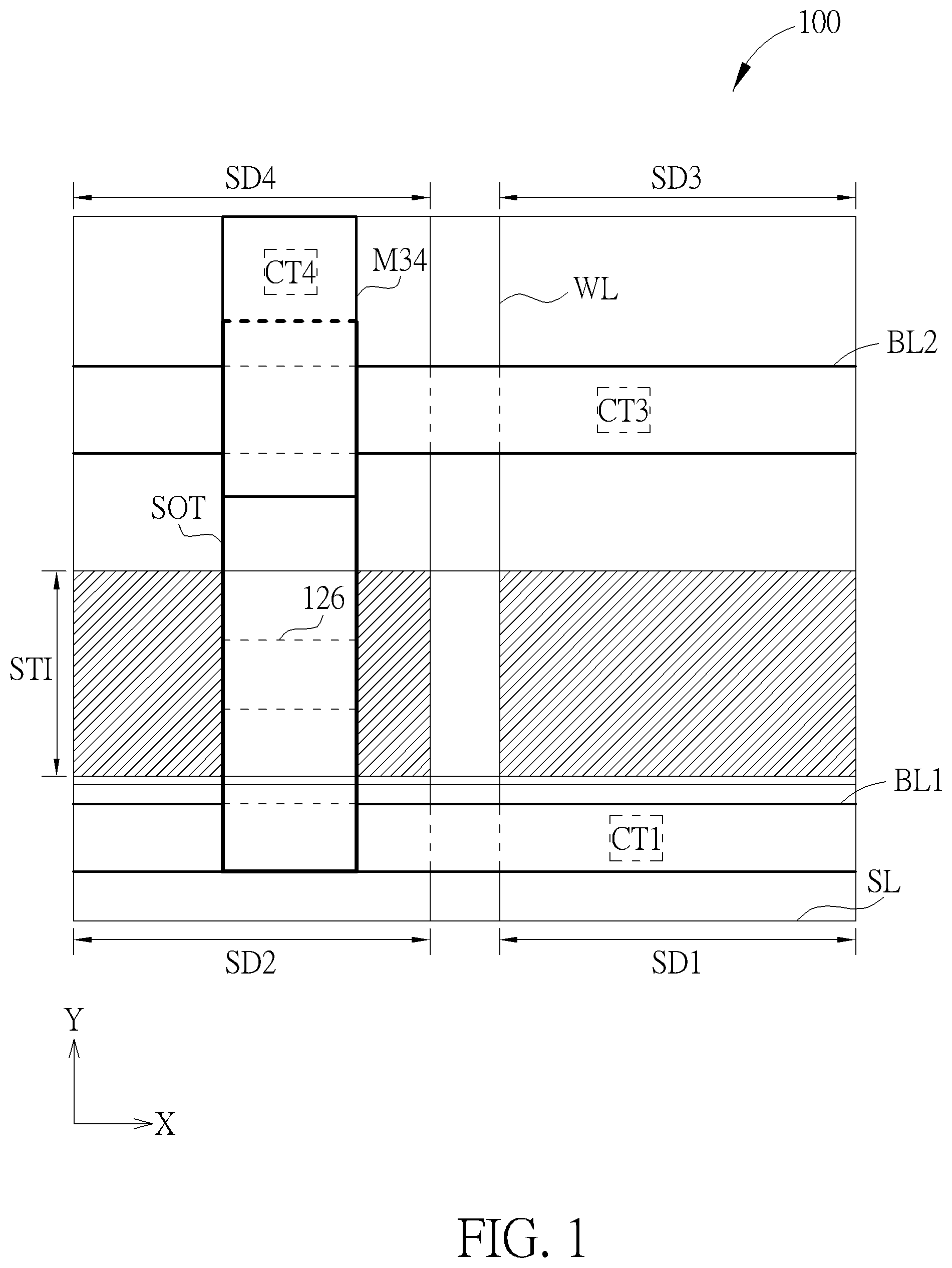
depicts a top view of a spin orbit torque (SOT) MRAM structure according to a first preferred embodiment of the present invention.
depicts an SOT MRAM structure schematically according to a first preferred embodiment of the present invention.
depicts a top view of an SOT MRAM structure according to a second preferred embodiment of the present invention.
depicts a top view of an SOT MRAM structure according to a third preferred embodiment of the present invention.
to depict a fabricating method of an SOT MRAM structure according to a preferred embodiment of the present invention, wherein:
depicts a fabricating stage following ;
depicts a fabricating stage following ;
depicts a fabricating stage following ; and
depicts a fabricating stage following .
depicts an SOT MRAM structure according to an example of the present invention.
DETAILED DESCRIPTION
depicts a top view of a spin orbit torque (SOT) MRAM structure according to a first preferred embodiment of the present invention. depicts an SOT MRAM structure schematically according to a first preferred embodiment of the present invention.
As shown in and , an SOT MRAM structure 100 includes a substrate 10 . A shallow trench isolation STI is embedded within the substrate 10 . The substrate 10 which adjacent to the shallow trench isolation STI is defined as an active region. A word line WL covers the substrate 10 . The word line WL extends along a first direction Y. A first source/drain doping region SD 1 and a second source/drain doping region SD 2 are respectively disposed within two active regions which are at two opposed sides of the word line WL. A third source/drain doping region SD 3 and a fourth source/drain doping region SD 4 are respectively disposed within other two active regions which are at two opposed sides of the word line WL.
Please refer to . A first conductive line L 1 contacts the second source/drain doping region SD 2 . A second conductive line L 2 contacts the fourth source/drain doping region SD 4 . The first conductive line L 1 is formed by a plug CT 2 , a first metal pad M 12 , a first plug V 12 and a second metal pad M 22 stacked from bottom to top. The plug CT 2 contacts the second source/drain doping region SD 2 . A memory element 12 contacts an end of the first conductive line L 1 . That is, the memory element 12 contacts the second metal pad M 22 of the first conductive line L 1 . In details, the memory element 12 is formed by a bottom electrode 12 a , a magnetic tunneling junction (MTJ), a first SOT element 12 c , a conductive layer 12 d stacked from bottom to top. The bottom electrode 12 a contacts the second metal pad M 22 . The bottom electrode 12 a contacts the second metal pad M 22 . A spacer 14 is disposed on the sidewall of the MTJ 12 b , the sidewall of the first SOT element 12 c and the sidewall of the conductive layer 12 d . Moreover, the width of the MTJ 12 b , the width of the first SOT element 12 c and the width of the conductive layer 12 d are the same. A second SOT element SOT covers on the memory element 12 and contacts the memory element 12 . The width of the second SOT element SOT is greater than the width of the MTJ 12 b . The end of the second SOT element SOT is aligned with the end of the spacer 14 .
The second conductive line L 2 contacts the fourth source/drain doping region SD 4 . The second conductive line L 2 is formed by a plug CT 4 , a first metal pad M 14 , a first plug V 14 , a second metal pad M 24 , a second plug V 2 and the third metal pad M 3 stacked from bottom to top. It is noteworthy that the third metal pad M 3 covers and contacts part of the top surface of the second SOT element SOT. In details, the third metal pad M 3 contacts an end of the second SOT element SOT, and the third metal pad M 3 extends from the end of the second SOT element SOT to part of the top surface of the second SOT element SOT. In this way, the bottom surface of the third metal pad M 3 forms a corner. Furthermore, a source line SL covers and contacts the other part of the top surface of the second SOT element SOT. The top surface of the second SOT element SOT which is not covered by the third metal pad M 3 and the source line SL is covered and contacted by a protective layer 16 .
As shown in and , a first bit line BL 1 electrically connects to the first source/drain doping region SD 1 . A contact plug CT 1 , a first metal pad M 11 and a first plug V 11 are disposed from bottom to top below the first bit line BL 1 . The contact plug CT 1 contacts the first source/drain doping region SD 1 . The first plug V 11 contacts the first bit line BL 1 . As shown in , by taking the word line WL as a center line, the first bit line BL 1 , the contact plug CT 1 , the first metal pad M 11 and the first plug V 11 are disposed at one side of the word line WL, and the first conductive line L 1 is disposed at another side of the word line WL. The word line WL and the first conductive line L 1 are respectively at different cross sections. The first bit line BL 1 , and the plugs and the metal pads below the first bit line BL 1 are at different cross sections from the first conductive line L 1 . The second bit line BL 2 , and the plugs and the metal pads below the second bit line BL 2 are also at different cross sections from the first conductive line L 1 . However, in order to see whether plugs, metal pads, and bit lines are made of the same metal layer or not, and to locate the respective positions of the first bit line BL 1 , the second bit line BL 2 , the first conductive line L 1 and the second conductive line L 2 ; therefore, the word line WL, the first bit line BL 1 , the second bit line BL 2 , the plugs and the metal pads are all shown in even they are at different cross sections.
Similarly, the second bit line BL 2 electrically connects to the third source/drain doping region SD 3 . A plug CT 3 is disposed below the second bit line BL 2 . The plug CT 3 contacts the third source/drain doping region SD 3 . By taking the word line WL as a center line, the second bit line BL 2 and the plug CT 3 are at the same side of the word line WL, and the second conductive line L 2 is at the other side of the word line WL in . That is, the second bit line BL 2 , the plug CT 3 , the plug CT 1 , the first metal pad M 11 , the first plug V 11 and the first bit line BL 1 are at the same side of the word line WL. The first conductive line L 1 , the second conductive line L 2 , the memory element 12 are at the same side of the word line WL.
The first bit line BL 1 serves as a read bit line, and the second bit line serves as a write bit line. The first source/drain doping region SD 1 , the second source/drain doping region SD 2 and the word line WL which is sandwiched between the first source/drain doping region SD 1 and the second source/drain doping region together SD 2 form a first transistor T 1 . The third source/drain doping region SD 3 , the fourth source/drain doping region SD 4 and the word line WL which is sandwiched between the third source/drain doping region SD 3 and the fourth source/drain doping region SD 4 together form a second transistor T 2 . Please refer to . The first bit line BL 1 , the second bit line BL 2 and the source line SL are all along a second direction X. The second direction X is perpendicular to the first direction Y.
During writing programming, signal is input from the source line SL, passes the second SOT element SOT, enters the second conductive line L 2 by the contact between the third metal pad M 3 and the second SOT element SOT, then enters the second transistor T 2 and reaches the second bit line BL 2 . In this way, the torque of the MTJ 12 b can be flipped over. During reading programming, signal is input from the source line SL, passes the second SOT element SOT, enters the memory element 12 vertically, passes the first transistor T 1 and reaches the first bit line BL 1 .
Moreover, the plug CT 1 , the plug CT 2 , the plug CT 3 and the plug CT 4 are manufactured at the same stage, and the plug CT 1 , the plug CT 2 , the plug CT 3 and the plug CT 4 respectively has a top surface aligned with one another. The first metal pad M 11 , the first metal pad M 12 , the first metal pad M 14 and the second bit line BL 2 are manufactured at the same stage, and the first metal pad M 11 , the first metal pad M 12 , the first metal pad M 14 and the second bit line BL 2 respectively has a top surface aligned with one another. The first plug V 11 , the first plug V 12 , the first plug V 14 are manufactured at the same stage, and the first plug V 11 , the first plug V 12 , the first plug V 14 respectively has a top surface aligned with one another. The second metal pad M 22 , the second metal pad M 24 and the first bit line BL 1 are manufactured at the same stage, and the second metal pad M 22 , the second metal pad M 24 and the first bit line BL 1 respectively has a top surface aligned with one another. The third metal pad M 3 and the source line SL are manufactured at the same stage, and the third metal pad M 3 and the source line SL respectively has a top surface aligned with one another.
The first SOT element 12 c and the second SOT element SOT may respectively include tungsten, platinum, tantalum or titanium nitride. The protective layer 16 may be silicon nitride or silicon carbide nitride. The spacer 14 may be silicon oxide or silicon nitride. The bottom electrode 12 a , all the plugs and metal pads in the present invention are all made of metal.
depicts a top view of an SOT MRAM structure according to a second preferred embodiment of the present invention. depicts a top view of an SOT MRAM structure according to a third preferred embodiment of the present invention, wherein elements which are substantially the same as those in the embodiment of are denoted by the same reference numerals; an accompanying explanation is therefore omitted.
The difference between the SOT MRAM structure 200 in and the SOT MRAM structure 100 in is that the third metal pad M 3 on the top surface of the second SOT element SOT extends to overlap the memory element 12 in . On the contrary, the third metal pad M 3 in does not overlaps the memory element 12 . Other devices in are the same as those in , and the description are therefore omitted. The difference between the SOT MRAM structure 300 in and the SOT MRAM structure 100 in is that along the third direction Z in , the entire third metal pad M 3 is higher than the second SOT element SOT. In , along the third direction Z, there is part of the third metal pad M 3 which is lower than the second SOT element SOT. The third direction Z is perpendicular to the top surface of the substrate 10 . Other devices in are the same as those in , and the description are therefore omitted.
to depict a fabricating method of an SOT MRAM structure according to a preferred embodiment of the present invention, wherein elements which are substantially the same as those in the first preferred embodiment are denoted by the same reference numerals; an accompanying explanation is therefore omitted. As shown in , a substrate 10 is provided. A shallow trench isolation STI is embedded within the substrate 10 . A second source/drain doping region SD 2 and a fourth source/drain doping region SD 4 are respectively embedded within the substrate 10 which is at two side of the shallow trench isolation STI. A dielectric layer 18 covers the substrate 10 . A plug CT 2 , a first metal pad M 12 , a first plug V 12 and a second metal pad M 22 are stacked from bottom to top. The plug CT 2 contacts the second source/drain doping region SD 2 . A memory element 12 contacts the second metal pad M 22 . The memory element 12 includes a bottom electrode 12 a , an MTJ, a first SOT element 12 c , a conductive layer 12 d stacked from bottom to top. A spacer material layer 14 a is disposed at a sidewall of the memory element 12 and extends along the first direction Y. A plug CT 4 , a first metal pad M 14 , a first plug V 14 , a second metal pad M 24 are stacked from bottom to top. The plug CT 4 contacts the fourth source/drain doping region SD 4 . An SOT material layer SOTa covers and contacts the memory element 12 . A protective material layer 16 a covers and contacts the SOT material layer SOTa.
As shown in , the protective material layer 16 a , the SOT material layer SOTa and the spacer material layer 14 a are etched to define the position of a second SOT element SOT. During the etching of the protective material layer 16 a , the SOT material layer SOTa and the spacer material layer 14 a , part of the dielectric layer 18 is also removed to form two recesses 20 . The SOT material layer SOTa which is etched becomes the second SOT element SOT. The spacer material layer 14 a which is etched becomes a spacer 14 . The protective material layer 16 a which is etched becomes a protective layer 16 .
As shown in , a dielectric layer 22 is formed to fill in the recesses 20 . As shown in , the dielectric layers 18 / 22 and the protective layer 16 are etched to form a contact hole 24 , a recess 26 a and a recess 26 b . The second metal pad M 24 is exposed through the contact hole 24 . Part of the second SOT element SOT is exposed through the recess 26 a and the recess 26 b . The fabricating stage of the contact hole 24 , the recess 26 a and the recess 26 b can be a dual damascene process. As shown in , a metal layer fills in the contact hole 24 , the recess 26 a and the recess 26 b to form a second plug V 2 , a third metal pad M 3 and the source line SL.
depicts an SOT MRAM structure according to an example of the present invention, wherein elements which are substantially the same as those in the first preferred embodiment of are denoted by the same reference numerals; an accompanying explanation is therefore omitted.
As shown in and , the SOT MRAM structure 100 utilizes the third metal pad M 3 and the source line SL to directly contact the second SOT element SOT. However, as for the SOT MRAM structure in , numerous third plugs V 31 /V 32 /V 33 are disposed on the second SOT element SOT and the third metal pad M 3 . Then, a fourth metal pad M 4 is needed to be formed to connect the third plugs V 31 /V 32 . Therefore, the SOT MRAM structure 100 in simplifies the fabricating process of metal interlayer connections.
Moreover, as shown in , the second SOT element SOT is disposed on the memory element 12 . As shown in and , the memory element 12 is formed before the second SOT element SOT. The fabricating process of the memory element 12 includes an etching process. If the second SOT element SOT is disposed below the memory element 12 , the top surface of the second SOT element SOT will be damaged during the etching process for the memory element 12 . However, the second SOT element SOT of the present invention is disposed on the memory element 12 . In this way, the top surface of the second SOT element SOT can be prevented from damaged.
Those skilled in the art will readily observe that numerous modifications and alterations of the device and method may be made while retaining the teachings of the invention. Accordingly, the above disclosure should be construed as limited only by the metes and bounds of the appended claims.
Figures (6)
Citations
This patent cites (2)
- US9620188
- US2022/0285609