Filter Circuit and Multilayered Filter Device
Abstract
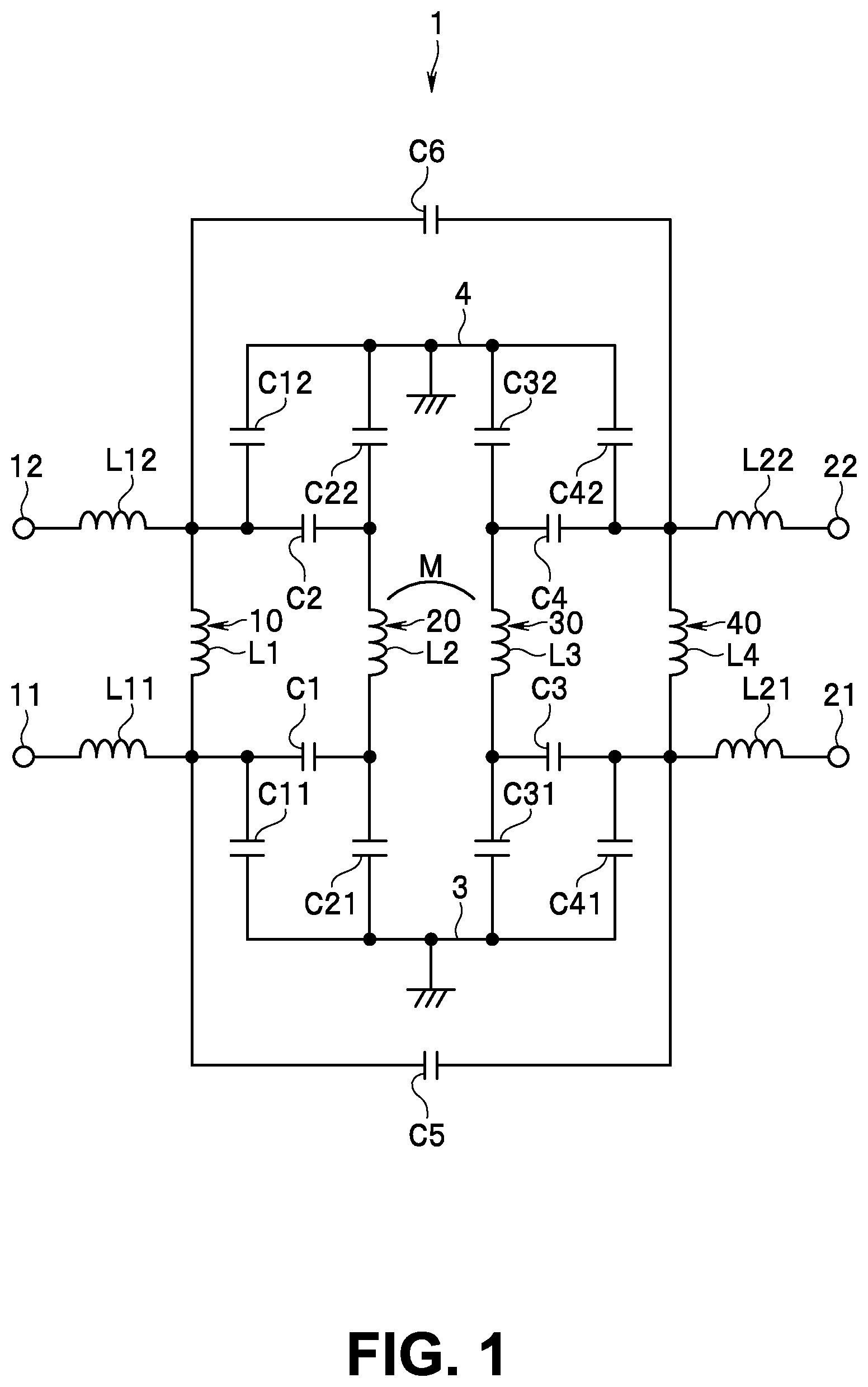
A filter circuit includes a pair of balanced input ports, a pair of balanced output ports, and first and second resonators provided in parallel between the pair of balanced input ports and the pair of balanced output ports in a circuit configuration, the first and second resonators being magnetically coupled to each other. Between the first resonator and the second resonator, a capacitor is present but no inductor is present in the circuit configuration.
Claims (20)
1. A filter circuit comprising: a pair of balanced input ports; a pair of balanced output ports; a first resonator and a second resonator provided in parallel between the pair of balanced input ports and the pair of balanced output ports in a circuit configuration, the first resonator and the second resonator being magnetically coupled to each other; and a third resonator provided in parallel to the first resonator, between the pair of balanced input ports and the first resonator in the circuit configuration,
8. A multilayered filter device comprising: a pair of balanced input terminals; a pair of balanced output terminals; a first resonator and a second resonator provided in parallel between the pair of balanced input terminals and the pair of balanced output terminals in a circuit configuration, the first resonator and the second resonator being magnetically coupled to each other; a third resonator provided in parallel to the first resonator between the pair of balanced input terminals and the first resonator in the circuit configuration; and a stack for integrating the pair of balanced input terminals, the pair of balanced output terminals, the first resonator, the second resonator, and the third resonator, the stack including a plurality of dielectric layers stacked together, wherein the first resonator includes a first inductor wound around a first axis, the second resonator includes a second inductor wound around a second axis, and an opening of the first inductor and an opening of the second inductor face each other.
Show 18 dependent claims
2. The filter circuit according to claim 1 , further comprising: a first capacitor provided in a path connecting one end of the first resonator and one end of the second resonator; and a second capacitor provided in a path connecting another end of the first resonator and another end of the second resonator.
3. The filter circuit according to claim 1 , further comprising a fourth resonator provided in parallel to the second resonator, between the pair of balanced output ports and the second resonator in the circuit configuration.
4. The filter circuit according to claim 1 , further comprising two input inductors electrically connected to the pair of balanced input ports.
5. The filter circuit according to claim 1 , further comprising two output inductors electrically connected to the pair of balanced output ports.
6. The filter circuit according to claim 1 , wherein the filter circuit has the circuit configuration in which a part including the pair of balanced input ports and the first resonator in the circuit configuration and a part including the pair of balanced output ports and the second resonator in the circuit configuration are configured to be symmetrical with respect to a center between the first resonator and the second resonator.
7. The filter circuit according to claim 1 , wherein the filter circuit has the circuit configuration in which a part including one port of the pair of balanced input ports and one port of the pair of balanced output ports in the circuit configuration and a part including another port of the pair of balanced input ports and another port of the pair of balanced output ports in the circuit configuration are configured to be symmetrical with respect to the first resonator and the second resonator.
9. The multilayered filter device according to claim 8 , wherein each of the first inductor and the second inductor includes a first through hole line, a second through hole line, and a conductor layer connecting the first through hole line and the second through hole line, and each of the first through hole line and the second through hole line is formed with two or more through holes being connected in series.
10. The multilayered filter device according to claim 8 , wherein the third resonator includes a third inductor wound around a third axis, and an opening of the third inductor does not overlap the opening of the first inductor when seen in a direction parallel to the third axis.
11. The multilayered filter device according to claim 8 , further comprising a fourth resonator provided in parallel to the second resonator, between the pair of balanced output terminals and the second resonator in the circuit configuration.
12. The multilayered filter device according to claim 11 , wherein the fourth resonator includes a fourth inductor wound around a fourth axis, and an opening of the fourth inductor does not overlap the opening of the second inductor when seen in a direction parallel to the fourth axis.
13. The multilayered filter device according to claim 8 , further comprising two input inductors electrically connected to the pair of balanced input terminals.
14. The multilayered filter device according to claim 13 , wherein each of the two input inductors is wound around an axis extending in a direction different from a direction of the first axis.
15. The multilayered filter device according to claim 13 , wherein the two input inductors are wound around axes extending in directions different from each other.
16. The multilayered filter device according to claim 8 , further comprising two output inductors electrically connected to the pair of balanced output terminals.
17. The multilayered filter device according to claim 16 , wherein each of the two output inductors is wound around an axis extending in a direction different from a direction of the second axis.
18. The multilayered filter device according to claim 16 , wherein the two output inductors are wound around axes extending in directions different from each other.
19. The multilayered filter device according to claim 8 , wherein a shape and an arrangement of a plurality of conductors constituting a part including the pair of balanced input terminals and the first resonator in the stack are symmetrical with a shape and an arrangement of a plurality of conductors constituting a part including the pair of balanced output terminals and the second resonator in the stack, with respect to a first imaginary plane passing between the first inductor and the second inductor and being parallel to a stacking direction of the plurality of dielectric layers.
20. The multilayered filter device according to claim 8 , wherein a shape and an arrangement of a plurality of conductors constituting a part including one terminal of the pair of balanced input terminals and one terminal of the pair of balanced output terminals in the stack are symmetrical with a shape and an arrangement of a plurality of conductors constituting a part including another terminal of the pair of balanced input terminals and another terminal of the pair of balanced output terminals in the stack, with respect to a second imaginary plane crossing the first inductor and the second inductor and being parallel to a stacking direction of the plurality of dielectric layers.
Full Description
Show full text →
CROSS REFERENCE TO RELATED APPLICATIONS
This application claims the benefit of Japanese Priority Patent Application No. 2022-015577 filed on Feb. 3, 2022, the entire contents of which are incorporated herein by reference.
BACKGROUND OF THE INVENTION
1. Field of the Invention
The present invention relates to a balanced filter circuit and a multilayered filter device including the balanced filter circuit.
2. Description of the Related Art
One of electronic components used in a communication apparatus is a band-pass filter including a plurality of resonators. Each of the plurality of resonators includes, for example, an inductor and a capacitor. As the band-pass filter, a balanced band-pass filter including a pair of balanced output ports is known. The balanced band-pass filter includes a band-pass filter including one unbalanced input port and a band-pass filter including a pair of balanced input ports.
JP 2002-374139 A discloses a balanced LC filter including a pair of balanced input terminals and a pair of balanced output terminals. In the balanced LC filter, two LC resonators are electrically connected to each other via a pair of coupling coils.
In general, the balanced band-pass filter such as the balanced LC filter disclosed in JP 2002-374139 A has a symmetrical circuit configuration. Thus, in the balanced band-pass filter, the number of elements tends to increase, which makes it difficult to downsize the band-pass filter.
The above problem applies generally to balanced filter circuits, not only to the balanced band-pass filters.
SUMMARY OF THE INVENTION
An object of the present invention is to provide a balanced filter circuit that can be downsized, and a balanced multilayered filter device that can be downsized.
A filter circuit according to the present invention includes a pair of balanced input ports, a pair of balanced output ports, and a first resonator and a second resonator provided in parallel between the pair of balanced input ports and the pair of balanced output ports in a circuit configuration, the first resonator and the second resonator being magnetically coupled to each other. Between the first resonator and the second resonator, a capacitor is present but no inductor is present in the circuit configuration.
The filter circuit according to the present invention may further include a first capacitor provided in a path connecting one end of the first resonator and one end of the second resonator, and a second capacitor provided in a path connecting another end of the first resonator and another end of the second resonator.
The filter circuit according to the present invention may further include a third resonator provided in parallel to the first resonator, between the pair of balanced input ports and the first resonator in the circuit configuration.
The filter circuit according to the present invention may further include a fourth resonator provided in parallel to the second resonator, between the pair of balanced output ports and the second resonator in the circuit configuration.
The filter circuit according to the present invention may further include two input inductors electrically connected to the pair of balanced input ports.
The filter circuit according to the present invention may further include two output inductors electrically connected to the pair of balanced output ports.
The filter circuit according to the present invention may have the circuit configuration in which a part including the pair of balanced input ports and the first resonator in the circuit configuration and a part including the pair of balanced output ports and the second resonator in the circuit configuration are configured to be symmetrical with respect to a center between the first resonator and the second resonator.
The filter circuit according to the present invention may have the circuit configuration in which a part including one port of the pair of balanced input ports and one port of the pair of balanced output ports in the circuit configuration and a part including another port of the pair of balanced input ports and another port of the pair of balanced output ports in the circuit configuration are configured to be symmetrical with respect to the first resonator and the second resonator.
A multilayered filter device according to the present invention includes a pair of balanced input terminals, a pair of balanced output terminals, a first resonator and a second resonator provided in parallel between the pair of balanced input terminals and the pair of balanced output terminals in a circuit configuration, the first resonator and the second resonator being magnetically coupled to each other, and a stack for integrating the pair of balanced input terminals, the pair of balanced output terminals, and the first resonator and the second resonator, the stack including a plurality of dielectric layers stacked together. The first resonator includes a first inductor wound around a first axis. The second resonator includes a second inductor wound around a second axis. An opening of the first inductor and an opening of the second inductor face each other.
In the multilayered filter device according to the present invention, each of the first inductor and the second inductor may include a first through hole line, a second through hole line, and a conductor layer connecting the first through hole line and the second through hole line. Each of the first through hole line and the second through hole line may be formed with two or more through holes being connected in series.
The multilayered filter device according to the present invention may further include a third resonator provided in parallel to the first resonator, between the pair of balanced input terminals and the first resonator in the circuit configuration. The third resonator may include a third inductor wound around a third axis. An opening of the third inductor may not overlap the opening of the first inductor when seen in a direction parallel to the third axis.
The multilayered filter device according to the present invention may further include a fourth resonator provided in parallel to the second resonator, between the pair of balanced output terminals and the second resonator in the circuit configuration. The fourth resonator may include a fourth inductor wound around a fourth axis. An opening of the fourth inductor may not overlap the opening of the second inductor when seen in a direction parallel to the fourth axis.
The multilayered filter device according to the present invention may further include two input inductors electrically connected to the pair of balanced input terminals. Each of the two input inductors may be wound around an axis extending in a direction different from a direction of the first axis. The two input inductors may be wound around axes extending in directions different from each other.
The multilayered filter device according to the present invention may further include two output inductors electrically connected to the pair of balanced output terminals. Each of the two output inductors may be wound around an axis extending in a direction different from a direction of the second axis. The two output inductors may be wound around axes extending in directions different from each other.
In the multilayered filter device according to the present invention, a shape and an arrangement of a plurality of conductors constituting a part including the pair of balanced input terminals and the first resonator in the stack may be symmetrical with a shape and an arrangement of a plurality of conductors constituting a part including the pair of balanced output terminals and the second resonator in the stack, with respect to a first imaginary plane passing between the first inductor and the second inductor and being parallel to a stacking direction of the plurality of dielectric layers.
In the multilayered filter device according to the present invention, a shape and an arrangement of a plurality of conductors constituting a part including one terminal of the pair of balanced input terminals and one terminal of the pair of balanced output terminals in the stack may be symmetrical with a shape and an arrangement of a plurality of conductors constituting a part including another terminal of the pair of balanced input terminals and another terminal of the pair of balanced output terminals in the stack with respect to a second imaginary plane crossing the first inductor and the second inductor and being parallel to a stacking direction of the plurality of dielectric layers.
In the filter circuit according to the present invention, between the first resonator and the second resonator, a capacitor is present but no inductor is present in the circuit configuration. With this, according to the present invention, the balanced filter circuit that can be downsized can be implemented.
In the multilayered filter device according to the present invention, an opening of the first inductor and an opening of the second inductor face each other. With this, according to the present invention, the balanced multilayered filter device that can be downsized can be implemented.
Other and further objects, features and advantages of the present invention will appear more fully from the following description.
BRIEF DESCRIPTION OF THE DRAWINGS
is a circuit diagram showing a circuit configuration of a filter circuit according to an embodiment of the present invention.
is a perspective view showing an external appearance of a multilayered filter device according to the embodiment of the present invention.
A to C are explanatory diagrams showing respective patterned surfaces of first to third dielectric layers of a stack of the multilayered filter device according to the embodiment of the present invention.
A to C are explanatory diagrams showing respective patterned surfaces of fourth to sixth dielectric layers of the stack of the multilayered filter device according to the embodiment of the present invention.
A to C are explanatory diagrams showing respective patterned surfaces of seventh to ninth dielectric layers of the stack of the multilayered filter device according to the embodiment of the present invention.
A is an explanatory diagram showing respective patterned surfaces of tenth to sixteenth dielectric layers of the stack of the multilayered filter device according to the embodiment of the present invention.
B is an explanatory diagram showing a patterned surface of a seventeenth dielectric layer of the stack of the multilayered filter device according to the embodiment of the present invention.
C is an explanatory diagram showing a patterned surface of an eighteenth dielectric layer of the stack of the multilayered filter device according to the embodiment of the present invention.
A is an explanatory diagram showing respective patterned surfaces of nineteenth to twenty-sixth dielectric layers of the stack of the multilayered filter device according to the embodiment of the present invention.
B is an explanatory diagram showing a patterned surface of a twenty-seventh dielectric layer of the stack of the multilayered filter device according to the embodiment of the present invention.
is a perspective view showing an internal structure of the stack of the multilayered filter device according to the embodiment of the present invention.
is a perspective view showing first and second inductors of the multilayered filter device according to the embodiment of the present invention.
is a perspective view showing third and fourth inductors of the multilayered filter device according to the embodiment of the present invention.
is a perspective view showing input inductors and output inductors of the multilayered filter device according to the embodiment of the present invention.
is an explanatory diagram for describing first and second imaginary planes according to the embodiment of the present invention.
is a characteristic chart showing an example of pass attenuation characteristics and return attenuation characteristics of the multilayered filter device according to the embodiment of the present invention.
is a characteristic chart showing an example of amplitude balance characteristics of the multilayered filter device according to the embodiment of the present invention.
is a characteristic chart showing an example of phase balance characteristics of the multilayered filter device according to the embodiment of the present invention.
DETAILED DESCRIPTION OF THE PREFERRED EMBODIMENTS
An embodiment of the present invention will be described below in detail with reference to the drawings. First, with reference to , a configuration of a filter circuit 1 according to an embodiment of the present invention will be described. is a circuit diagram showing a circuit configuration of the filter circuit 1 . The filter circuit 1 is configured to function as a balanced band-pass filter that selectively allows a balanced signal of a frequency in a predetermined passband to pass.
The filter circuit 1 according to the present embodiment includes a pair of balanced input ports 11 and 12 , a pair of balanced output ports 21 and 22 , and a resonator 10 , a resonator 20 , a resonator 30 , and a resonator 40 provided between the pair of balanced input ports 11 and 12 and the pair of balanced output ports 21 and 22 in the circuit configuration. The resonators 10 , 20 , 30 , and 40 may each be a half wavelength resonator. Note that, in the present application, the expression “in the (a) circuit configuration” is used not to indicate a layout in a physical configuration but to indicate a layout in a circuit diagram.
In the filter circuit 1 , a first balanced element signal is input to the balanced input port 11 , and a second balanced element signal is input to the balanced input port 12 . The first balanced element signal and the second balanced element signal constitute a balanced input signal. In the filter circuit 1 , a third balanced element signal is output from the balanced output port 21 , and a fourth balanced element signal is output from the balanced output port 22 . The third balanced element signal and the fourth balanced element signal constitute a balanced output signal.
The resonators 20 and 30 are provided in parallel between the pair of balanced input ports 11 and 12 and the pair of balanced output ports 21 and 22 in the circuit configuration. The resonators 20 and 30 are magnetically coupled to each other. In , a curve denoted by a symbol M represents magnetic coupling between the resonators 20 and 30 . The resonator 20 corresponds to a “first resonator” in the present invention. The resonator 30 corresponds to a “second resonator” in the present invention.
As shown in , between the resonator 20 and the resonator 30 , capacitors are present but no inductors are present in the circuit configuration. In the present embodiment in particular, the filter circuit 1 further includes two capacitors C 21 and C 31 provided in a path 3 connecting one end of the resonator 20 and one end of the resonator 30 , and two capacitors C 22 and C 32 provided in a path 4 connecting the other end of the resonator 20 and the other end of the resonator 30 . Each of the paths 3 and 4 is connected to the ground.
The resonator 10 is provided in parallel to the resonator 20 between the pair of balanced input ports 11 and 12 and the resonator 20 in the circuit configuration. The resonator 10 corresponds to a “third resonator” in the present invention.
The resonator 40 is provided in parallel to the resonator 30 between the pair of balanced output ports 21 and 22 and the resonator 30 in the circuit configuration. The resonator 40 corresponds to a “fourth resonator” in the present invention.
The filter circuit 1 further includes two input inductors L 11 and L 12 electrically connected to the pair of balanced input ports 11 and 12 , and two output inductors L 21 and L 22 electrically connected to the pair of balanced output ports 21 and 22 . The two input inductors L 11 and L 12 are provided between the pair of balanced input ports 11 and 12 and the resonator 10 in the circuit configuration. The two output inductors L 21 and L 22 are provided between the pair of balanced output ports 21 and 22 and the resonator 40 in the circuit configuration.
The filter circuit 1 further includes capacitors C 1 , C 2 , C 3 , C 4 , C 5 , C 6 , C 11 , C 12 , C 41 , and C 42 .
With reference to , a connection relationship between a plurality of components constituting the filter circuit 1 will be described below in detail. The resonator 10 includes an inductor L 1 . One end of the input inductor L 11 is connected to one end of the inductor L 1 . One end of the input inductor L 12 is connected to the other end of the inductor L 1 . The other end of the input inductor L 11 is connected to the balanced input port 11 . The other end of the input inductor L 12 is connected to the balanced input port 12 .
One end of the capacitor C 11 is connected to one end of the inductor L 1 . One end of the capacitor C 12 is connected to the other end of the inductor L 1 . The other end of each of the capacitors C 11 and C 12 is connected to the ground.
The resonator 20 includes an inductor L 2 . One end of the capacitor C 21 is connected to one end of the inductor L 2 . One end of the capacitor C 22 is connected to the other end of the inductor L 2 . The other end of each of the capacitors C 21 and C 22 is connected to the ground.
One end of the capacitor C 1 is connected to one end of each of the inductor L 1 and the input inductor L 11 . The other end of the capacitor C 1 is connected to one end of the inductor L 2 . One end of the capacitor C 2 is connected to the other end of the inductor L 1 and one end of the input inductor L 12 . The other end of the capacitor C 2 is connected to the other end of the inductor L 2 .
The resonator 30 includes an inductor L 3 . One end of the capacitor C 31 is connected to one end of the inductor L 3 . One end of the capacitor C 32 is connected to the other end of the inductor L 3 . The other end of each of the capacitors C 31 and C 32 is connected to the ground.
The resonator 40 includes an inductor L 4 . One end of the output inductor L 21 is connected to one end of the inductor L 4 . One end of the output inductor L 22 is connected to the other end of the inductor L 4 . The other end of the output inductor L 21 is connected to the balanced output port 21 . The other end of the output inductor L 22 is connected to the balanced output port 22 .
One end of the capacitor C 41 is connected to one end of the inductor L 4 . One end of the capacitor C 42 is connected to the other end of the inductor L 4 . The other end of each of the capacitors C 41 and C 42 is connected to the ground.
One end of the capacitor C 3 is connected to one end of the inductor L 3 . The other end of the capacitor C 3 is connected to one end of each of the inductor L 4 and the output inductor L 21 . One end of the capacitor C 4 is connected to the other end of the inductor L 3 . The other end of the capacitor C 4 is connected to the other end of the inductor L 4 and one end of the output inductor L 22 .
One end of the capacitor C 5 is connected to one end of each of the inductor L 1 and the input inductor L 11 . The other end of the capacitor C 5 is connected to one end of each of the inductor L 4 and the output inductor L 21 . One end of the capacitor C 6 is connected to the other end of the inductor L 1 and one end of the input inductor L 12 . The other end of the capacitor C 6 is connected to the other end of the inductor L 4 and one end of the output inductor L 22 .
Here, of the filter circuit 1 , in the circuit configuration, a part including the pair of balanced input ports 11 and 12 , the resonator 10 (inductor L 1 ), the resonator 20 (inductor L 2 ), the input inductors L 11 and L 12 , and the capacitors C 1 , C 2 , C 11 , C 12 , C 21 , and C 22 is referred to as a first part. Of the filter circuit 1 , in the circuit configuration, a part including the pair of balanced output ports 21 and 22 , the resonator 30 (inductor L 3 ), the resonator 40 (inductor L 4 ), the output inductors L 21 and L 22 , and the capacitors C 3 , C 4 , C 31 , C 32 , C 41 , and C 42 is referred to as a second part. The filter circuit 1 has a circuit configuration in which the first part and the second part are configured to be symmetrical with respect to the center between the resonator 20 (inductor L 2 ) and the resonator 30 (inductor L 3 ). In other words, in the filter circuit 1 , in the circuit configuration, the plurality of inductors and the plurality of capacitors included in the first part and the plurality of inductors and the plurality of capacitors included in the second part are arranged to be symmetrical with respect to the center between the resonator 20 (inductor L 2 ) and the resonator 30 (inductor L 3 ).
Of the filter circuit 1 , in the circuit configuration, a part including the balanced input port 11 , the balanced output port 21 , the input inductor L 11 , the output inductor L 21 , and the capacitors C 1 , C 3 , C 5 , C 11 , C 21 , C 31 , and C 41 is referred to as a third part. Of the filter circuit 1 , in the circuit configuration, a part including the balanced input port 12 , the balanced output port 22 , the input inductor L 12 , the output inductor L 22 , and the capacitors C 2 , C 4 , C 6 , C 12 , C 22 , C 32 , and C 42 is referred to as a fourth part. The filter circuit 1 has a circuit configuration in which the third part and the fourth part are configured to be symmetrical with respect to the resonator 20 (inductor L 2 ) and the resonator 30 (inductor L 3 ). In other words, in the filter circuit 1 , in the circuit configuration, the plurality of inductors and the plurality of capacitors included in the third part and the plurality of inductors and the plurality of capacitors included in the fourth part are arranged to be symmetrical with respect to the resonator 20 (inductor L 2 ) and the resonator 30 (inductor L 3 ).
Next, with reference to , a configuration of a multilayered filter device (hereinafter simply referred to as a filter device) 2 according to the present embodiment will be described. is a perspective view showing an external appearance of the filter device 2 . The filter device 2 is a balanced filter device including the balanced filter circuit 1 .
The filter device 2 includes the components of the filter circuit 1 described with reference to , and a stack 50 for integrating the components of the filter circuit 1 . The stack 50 includes a plurality of dielectric layers stacked together and a plurality of conductor layers and a plurality of through holes formed in the plurality of dielectric layers.
The stack 50 has a bottom surface 50 A and a top surface 50 B located at both ends in a stacking direction T of the plurality of dielectric layers, and four side surfaces 50 C to 50 F connecting the bottom surface 50 A and the top surface 50 B. The side surfaces 50 C and 50 D are opposite to each other. The side surfaces 50 E and 50 F are opposite to each other. The side surfaces 50 C to 50 F. are perpendicular to the top surface 50 B and the bottom surface 50 A.
Here, an X direction, a Y direction, and a Z direction are defined as shown in . The X direction, the Y direction, and the Z direction are orthogonal to one another. In the present embodiment, a direction parallel to the stacking direction T is defined as the Z direction. A direction opposite to the X direction is defined as a −X direction, a direction opposite to the Y direction is defined as a −Y direction, and a direction opposite to the Z direction is defined as a −Z direction.
As shown in , the bottom surface 50 A is located at the end of the stack 50 in the −Z direction. The top surface 50 B is located at the end of the stack 50 in the Z direction. The shape of each of the bottom surface 50 A and the top surface 50 B is a rectangular shape that is long in the X direction. The side surface 50 C is located at the end of the stack 50 in the −X direction. The side surface 50 D is located at the end of the stack 50 in the X direction. The side surface 50 E is located at the end of the stack 50 in the −Y direction. The side surface 50 F is located at the end of the stack 50 in the Y direction.
The filter device 2 further includes terminals 111 , 112 , 113 , 114 , 115 , and 116 . Each of the terminals 111 to 113 is arranged to extend from the top surface 50 B to the bottom surface 50 A via the side surface 50 E. The terminals 111 to 113 are arranged in this order in the X direction. Each of the terminals 114 to 116 is arranged to extend from the top surface 50 B to the bottom surface 50 A via the side surface 50 F. The terminals 114 to 116 are arranged in this order in the −X direction.
Of the terminal 111 to 116 , two terminals are a pair of balanced input terminals corresponding to the pair of balanced input ports 11 and 12 , and other two terminals are a pair of balanced output terminals corresponding to the pair of balanced output ports 21 and 22 . In the present embodiment, the terminals 111 and 116 may be the pair of balanced input terminals, or the terminals 113 and 114 may be the pair of balanced input terminals. When the terminals 111 and 116 are the pair of balanced input terminals, the terminals 113 and 114 may be the pair of balanced output terminals. When the terminals 113 and 114 are the pair of balanced input terminals, the terminals 111 and 116 may be the pair of balanced output terminals.
The following description will be given by taking an example of a case in which the terminals 111 and 116 are the pair of balanced input terminals, and the terminals 113 and 114 are the pair of balanced output terminals. In the following description, the terminals 111 and 116 are also respectively referred to as balanced input terminals 111 and 116 , and the terminals 113 and 114 are also respectively referred to as balanced output terminals 113 and 114 . The filter device 2 includes the pair of balanced input terminals 111 and 116 and the pair of balanced output terminals 113 and 114 .
The balanced input terminal 111 corresponds to the balanced input port 11 , and the balanced input terminal 116 corresponds to the balanced input port 12 . The balanced output terminal 113 corresponds to the balanced output port 21 , and the output terminal 114 corresponds to the balanced output port 22 . Each of the terminals 112 and 115 is connected to the ground.
Next, with reference to A to B , an example of the plurality of dielectric layers and the plurality of conductor layers constituting the stack 50 will be described. In the present example, the stack 50 includes twenty-seven dielectric layers stacked together. The twenty-seven dielectric layers are hereinafter referred to as first to twenty-seventh dielectric layers in the order from bottom to top. The first to twenty-seventh dielectric layers are denoted by reference numerals 51 to 77 , respectively.
A shows a patterned surface of the first dielectric layer 51 . A part of each of the terminal 111 to 116 is formed on the patterned surface of the dielectric layer 51 .
B shows a patterned surface of the second dielectric layer 52 . A conductor layer 521 is formed on the patterned surface of the dielectric layer 52 . The conductor layer 521 is connected to the terminals 112 and 115 (see ).
C shows a patterned surface of the third dielectric layer 53 . Conductor layers 531 , 532 , 533 , 534 , 535 , and 536 are formed on the patterned surface of the dielectric layer 53 . Through holes 53 T 1 , 53 T 2 , 53 T 3 , and 53 T 4 are formed in the dielectric layer 53 . The through holes 53 T 1 to 53 T 4 are connected to the conductor layers 531 to 534 , respectively.
A shows a patterned surface of the fourth dielectric layer 54 . Conductor layers 541 , 542 , 543 , and 544 are formed on the patterned surface of the dielectric layer 54 . Through holes 54 T 1 , 54 T 2 , 54 T 3 , 54 T 4 , 54 T 5 , 54 T 6 , 54 T 7 , and 54 T 8 are formed in the dielectric layer 54 . The through holes 53 T 1 to 53 T 4 formed in the dielectric layer 53 are connected to the through holes 54 T 1 to 54 T 4 , respectively. The through holes 54 T 5 to 54 T 8 are connected to the conductor layers 541 to 544 , respectively.
B shows a patterned surface of the fifth dielectric layer 55 . A conductor layer 551 is formed on the patterned surface of the dielectric layer 55 . The conductor layer 551 is connected to the terminals 112 and 115 (see ). Through holes 55 T 1 , 55 T 2 , 55 T 3 , 55 T 4 , 55 T 5 , 55 T 6 , 55 T 7 , and 55 T 8 are formed in the dielectric layer 55 . The through holes 54 T 1 to 54 T 8 formed in the dielectric layer 54 are connected to the through holes 55 T 1 to 55 T 8 , respectively.
C shows a patterned surface of the sixth dielectric layer 56 . Through holes 56 T 1 , 56 T 2 , 56 T 3 , 56 T 4 , 56 T 5 , 56 T 6 , 56 T 7 , and 56 T 8 are formed in the dielectric layer 56 . The through holes 55 T 1 to 55 T 8 formed in the dielectric layer 55 are connected to the through holes 56 T 1 to 56 T 8 , respectively.
A shows a patterned surface of the seventh dielectric layer 57 . Inductor conductor layers 571 and 572 are formed on the patterned surface of the dielectric layer 57 . Each of the conductor layers 571 and 572 has a first end and a second end opposite to each other. The through hole 56 T 5 formed in the dielectric layer 56 is connected to a portion of the conductor layer 571 near the first end thereof. The through hole 56 T 6 formed in the dielectric layer 56 is connected to a portion of the conductor layer 571 near the second end thereof. The through hole 56 T 7 formed in the dielectric layer 56 is connected to a portion of the conductor layer 572 near the first end thereof. The through hole 56 T 8 formed in the dielectric layer 56 is connected to a portion of the conductor layer 572 near the second end thereof.
Through holes 57 T 1 , 57 T 2 , 57 T 3 , 57 T 4 , 57 T 5 , 57 T 6 , 57 T 7 , and 57 T 8 are formed in the dielectric layer 57 . The through holes 56 T 1 to 56 T 4 formed in the dielectric layer 56 are connected to the through holes 57 T 1 to 57 T 4 , respectively. The through hole 57 T 5 is connected to a portion which is between the first end and the second end of the conductor layer 571 and closer to the first end than to the second end. The through hole 57 T 6 is connected to a portion which is between the first end and the second end of the conductor layer 571 and closer to the second end than to the first end. The through hole 57 T 7 is connected to a portion which is between the first end and the second end of the conductor layer 572 and closer to the first end than to the second end. The through hole 57 T 8 is connected to a portion which is between the first end and the second end of the conductor layer 572 and closer to the second end than to the first end.
B shows a patterned surface of the eighth dielectric layer 58 . Conductor layers 581 , 582 , 583 , and 584 are formed on the patterned surface of the dielectric layer 58 . Through holes 58 T 1 , 58 T 2 , 58 T 3 , 58 T 4 , 58 T 5 , 58 T 6 , 58 T 7 , and 58 T 8 are formed in the dielectric layer 58 . The through holes 57 T 1 to 57 T 4 formed in the dielectric layer 57 are connected to the through holes 58 T 1 to 58 T 4 , respectively. The through hole 57 T 5 formed in the dielectric layer 57 and the through hole 58 T 5 are connected to the conductor layer 581 . The through hole 57 T 6 formed in the dielectric layer 57 and the through hole 58 T 6 are connected to the conductor layer 582 . The through hole 57 T 7 formed in the dielectric layer 57 and the through hole 58 T 7 are connected to the conductor layer 583 . The through hole 57 T 8 formed in the dielectric layer 57 and the through hole 58 T 8 are connected to the conductor layer 584 .
C shows a patterned surface of the ninth dielectric layer 59 . Conductor layers 591 , 592 , 593 , and 594 are formed on the patterned surface of the dielectric layer 59 . The conductor layer 591 is connected to the balanced input terminal 111 (see ). The conductor layer 592 is connected to the balanced input terminal 116 (see ). The conductor layer 593 is connected to the balanced output terminal 113 (see ). The conductor layer 594 is connected to the balanced output terminal 114 (see ).
Through holes 59 T 1 , 59 T 2 , 59 T 3 , 59 T 4 , 59 T 5 , 59 T 6 , 59 T 7 , 59 T 8 , 59 T 9 , 59 T 10 , 59 T 11 , and 59 T 12 are formed in the dielectric layer 59 . The through holes 58 T 1 to 58 T 8 formed in the dielectric layer 58 are connected to the through holes 59 T 1 to 59 T 8 , respectively. The through holes 59 T 9 to 59 T 12 are connected to the conductor layers 591 to 594 , respectively.
A shows a patterned surface of each of the tenth to sixteenth dielectric layers 60 to 66 . Through holes 60 T 1 , 60 T 2 , 60 T 3 , 60 T 4 , 60 T 5 , 60 T 6 , 60 T 7 , 60 T 8 , 60 T 9 , 60 T 10 , 60 T 11 , and 60 T 12 are formed in each of the dielectric layers 60 to 66 . The through holes 59 T 1 to 59 T 12 formed in the dielectric layer 59 are connected to the through holes 60 T 1 to 60 T 12 formed in the dielectric layer 60 , respectively. In the dielectric layers 60 to 66 , vertically adjacent through holes denoted by the same reference numerals are connected to each other.
B shows a patterned surface of the seventeenth dielectric layer 67 . Inductor conductor layers 671 , 672 , 673 , 674 , 675 , and 676 are formed on the patterned surface of the dielectric layer 67 . Each of the conductor layers 671 to 676 has a first end and a second end opposite to each other.
Through holes 67 T 1 , 67 T 2 , 67 T 3 , 67 T 4 , 67 T 5 , 67 T 6 , 67 T 7 , 67 T 8 , 67 T 9 , 67 T 10 , 67 T 11 , and 67 T 12 are formed in the dielectric layer 67 . The through hole 60 T 1 formed in the dielectric layer 66 and the through hole 67 T 1 are connected to a portion of the conductor layer 675 near the first end thereof. The through hole 60 T 2 formed in the dielectric layer 66 and the through hole 67 T 2 are connected to a portion of the conductor layer 675 near the second end thereof. The through hole 60 T 3 formed in the dielectric layer 66 and the through hole 67 T 3 are connected to a portion of the conductor layer 676 near the first end thereof. The through hole 60 T 4 formed in the dielectric layer 66 and the through hole 67 T 4 are connected to a portion of the conductor layer 676 near the second end thereof.
The through hole 60 T 5 formed in the dielectric layer 66 and the through hole 67 T 5 are connected to a portion of the conductor layer 671 near the first end thereof. The through hole 60 T 9 formed in the dielectric layer 66 and the through hole 67 T 9 are connected to a portion of the conductor layer 671 near the second end thereof. The through hole 60 T 6 formed in the dielectric layer 66 and the through hole 67 T 6 are connected to a portion of the conductor layer 672 near the first end thereof. The through hole 60 T 10 formed in the dielectric layer 66 and the through hole 67 T 10 are connected to a portion of the conductor layer 672 near the second end thereof.
The through hole 60 T 7 formed in the dielectric layer 66 and the through hole 67 T 7 are connected to a portion of the conductor layer 673 near the first end thereof. The through hole 60 T 11 formed in the dielectric layer 66 and the through hole 67 T 11 are connected to a portion of the conductor layer 673 near the second end thereof. The through hole 60 T 8 formed in the dielectric layer 66 and the through hole 67 T 8 are connected to a portion of the conductor layer 674 near the first end thereof. The through hole 60 T 12 formed in the dielectric layer 66 and the through hole 67 T 12 are connected to a portion of the conductor layer 674 near the second end thereof.
C shows a patterned surface of the eighteenth dielectric layer 68 . Inductor conductor layers 681 , 682 , 683 , 684 , 685 , and 686 are formed on the patterned surface of the dielectric layer 68 . Each of the conductor layers 681 to 686 has a first end and a second end opposite to each other. The through hole 67 T 1 formed in the dielectric layer 67 is connected to a portion of the conductor layer 685 near the first end thereof. The through hole 67 T 2 formed in the dielectric layer 67 is connected to a portion of the conductor layer 685 near the second end thereof. The through hole 67 T 3 formed in the dielectric layer 67 is connected to a portion of the conductor layer 686 near the first end thereof. The through hole 67 T 4 formed in the dielectric layer 67 is connected to a portion of the conductor layer 686 near the second end thereof.
The through hole 67 T 5 formed in the dielectric layer 67 is connected to a portion of the conductor layer 681 near the first end thereof. The through hole 67 T 9 formed in the dielectric layer 67 is connected to a portion of the conductor layer 681 near the second end thereof. The through hole 67 T 6 formed in the dielectric layer 67 is connected to a portion of the conductor layer 682 near the first end thereof. The through hole 67 T 10 formed in the dielectric layer 67 is connected to a portion of the conductor layer 682 near the second end thereof.
The through hole 67 T 7 formed in the dielectric layer 67 is connected to a portion of the conductor layer 683 near the first end thereof. The through hole 67 T 11 formed in the dielectric layer 67 is connected to a portion of the conductor layer 683 near the second end thereof. The through hole 67 T 8 formed in the dielectric layer 67 is connected to a portion of the conductor layer 684 near the first end thereof. The through hole 67 T 12 formed in the dielectric layer 67 is connected to a portion of the conductor layer 684 near the second end thereof.
A shows a patterned surface of each of the nineteenth to twenty-sixth dielectric layers 69 to 76 . Neither conductor layers nor through holes are formed in the dielectric layers 69 to 76 .
B shows a patterned surface of the twenty-seventh dielectric layer 77 . A mark 771 formed of a conductor layer is formed on the patterned surface of the dielectric layer 77 .
The stack 50 shown in is formed by stacking the first to twenty-seventh dielectric layers 51 to 77 such that the patterned surface of the first dielectric layer 51 serves as the bottom surface 50 A of the stack 50 and the surface of the twenty-seventh dielectric layer 77 opposite to the patterned surface thereof serves as the top surface 50 B of the stack 50 .
shows an internal structure of the stack 50 formed by stacking the first to twenty-seventh dielectric layers 51 to 77 . As shown in , in the internal structure of the stack 50 , the plurality of conductor layers and the plurality of through holes shown in A to C are stacked. Note that the mark 771 is omitted in .
Correspondences between the components of the filter circuit 1 shown in and the internal components of the stack 50 shown in A to C will be described below. The inductor L 1 of the resonator 10 is formed of the inductor conductor layer 571 shown in A .
The inductor L 2 of the resonator 20 is formed of the inductor conductor layers 675 and 685 shown in B and C and through holes nT 1 and nT 2 shown in C to B . Note that, regarding the reference numerals to denote the through holes, n is an integer from 53 to 60, or 67.
The inductor L 3 of the resonator 30 is formed of the inductor conductor layers 676 and 686 shown in B and C and through holes nT 3 and nT 4 shown in C to B .
The inductor L 4 of the resonator 40 is formed of the inductor conductor layer 572 shown in A .
The input inductor L 11 is formed of the inductor conductor layers 671 and 681 shown in B and C and through holes kT 5 and mT 9 shown in B to B . Note that, regarding the reference numerals to denote the through holes, k is an integer from 58 to 60, or 67, and m is 59, 60, or 67.
The input inductor L 12 is formed of the inductor conductor layers 672 and 682 shown in B and C , and through holes kT 6 and mT 10 shown in B to B.
The output inductor L 21 is formed of the inductor conductor layers 673 and 683 shown in B and C , and through holes kT 7 and mT 11 shown in B to B .
The output inductor L 22 is formed of the inductor conductor layers 674 and 684 shown in B and C , and through holes kT 8 and mT 12 shown in B to B .
The capacitor C 1 is formed of the conductor layers 531 and 541 and the dielectric layer 53 between these conductor layers shown in C and A . The capacitor C 2 is formed of the conductor layers 532 and 542 and the dielectric layer 53 between these conductor layers shown in C and A . The capacitor C 3 is formed of the conductor layers 533 and 543 and the dielectric layer 53 between these conductor layers shown in C and A . The capacitor C 4 is formed of the conductor layers 534 and 544 and the dielectric layer 53 between these conductor layers shown in C and A .
The capacitor C 5 is formed of the conductor layers 535 , 541 , and 543 and the dielectric layer 53 between these conductor layers shown in C and A . The capacitor C 6 is formed of the conductor layers 536 , 542 , and 544 and the dielectric layer 53 between these conductor layers shown in C and A .
The capacitor C 11 is formed of the conductor layers 541 and 551 and the dielectric layer 54 between these conductor layers shown in A and B . The capacitor C 12 is formed of the conductor layers 542 and 551 and the dielectric layer 54 between these conductor layers shown in A and B .
The capacitor C 21 is formed of the conductor layers 521 and 531 and the dielectric layer 52 between these conductor layers shown in B and C . The capacitor C 22 is formed of the conductor layers 521 and 532 and the dielectric layer 52 between these conductor layers shown in B and C .
The capacitor C 31 is formed of the conductor layers 521 and 533 and the dielectric layer 52 between these conductor layers shown in B and C . The capacitor C 32 is formed of the conductor layers 521 and 534 and the dielectric layer 52 between these conductor layers shown in B and C .
The capacitor C 41 is formed of the conductor layers 543 and 551 and the dielectric layer 54 between these conductor layers shown in A and B . The capacitor C 42 is formed of the conductor layers 544 and 551 and the dielectric layer 54 between these conductor layers shown in A and B .
Next, with reference to and to , structural features of the filter device 2 according to the present embodiment will be described. is a perspective view showing the inductors L 2 and L 3 . is a perspective view showing the inductors L 1 and L 4 . is a perspective view showing the input inductors L 11 and L 12 and the output inductors L 21 and L 22 .
First, the inductors L 2 and L 3 will be described. As shown in and , the inductors L 2 and L 3 are arrayed in a long-side direction of the bottom surface 50 A or the top surface 50 B, in other words, a direction parallel to the X direction. The inductor L 2 is arranged at a position closer to the side surface 50 C than to the side surface 50 D. The inductor L 3 is arranged at a position closer to the side surface 50 D than to the side surface 50 C.
The inductor L 2 is wound around an axis A 2 . The inductor L 3 is wound around an axis A 3 . Each of the axes A 2 and A 3 extends in a direction orthogonal to the stacking direction T. In the present embodiment in particular, each of the axes A 2 and A 3 extends in a direction parallel to the X direction. In , for the sake of convenience, the axis A 2 and the axis A 3 are depicted with straight lines different from each other. However, the axes A 2 and A 3 may be one axis.
As shown in and , an opening of the inductor L 2 and an opening of the inductor L 3 face each other. In other words, the opening of the inductor L 2 and the opening of the inductor L 3 overlap each other when seen in the X direction. Accordingly, in the present embodiment, magnetic coupling between the inductors L 2 and L 3 is stronger than when the opening of the inductor L 2 and the opening of the inductor L 3 do not overlap each other.
The inductor L 2 corresponds to a “first inductor” in the present invention. The inductor L 3 corresponds to a “second inductor” in the present invention.
Here, a structure formed with two or more through holes being connected in series is referred to as a through hole line. The inductor L 2 includes a first through hole line L 2 a , a second through hole line L 2 b , and the conductor layers 675 and 685 connecting the first through hole line L 2 a and the second through hole line L 2 b . The first through hole line L 2 a is formed with the plurality of through holes nT 1 being connected in series. The second through hole line L 2 b is formed with the plurality of through holes nT 2 being connected in series. Note that, as described above, n is an integer from 53 to 60, or 67.
Each of the conductor layers 675 and 685 extends in a short-side direction of the bottom surface 50 A or the top surface 50 B, in other words, a direction parallel to the Y direction. The first through hole line L 2 a and the second through hole line L 2 b are arrayed in the direction parallel to the Y direction. The opening of the inductor L 2 is a region surrounded by the first through hole line L 2 a , the second through hole line L 2 b , and the conductor layer 675 .
The inductor L 3 includes a first through hole line L 3 a , a second through hole line L 3 b , and the conductor layers 676 and 686 connecting the first through hole line L 3 a and the second through hole line L 3 b . The first through hole line L 3 a is formed with the plurality of through holes nT 3 being connected in series. The second through hole line L 3 b is formed with the plurality of through holes nT 4 being connected in series.
Each of the conductor layers 676 and 686 extends in a short-side direction of the bottom surface 50 A and the top surface 50 B, in other words, a direction parallel to the Y direction. The first through hole line L 3 a and the second through hole line L 3 b are arrayed in the direction parallel to the Y direction. The opening of the inductor L 3 is a region surrounded by the first through hole line L 3 a , the second through hole line L 3 b , and the conductor layer 676 .
Next, the inductors L 1 and L 4 will be described. The inductor L 1 is arranged at a position between the inductor L 2 and the side surface 50 C (see and ). The inductor L 4 is arranged at a position between the inductor L 3 and the side surface 50 D (see and ). As shown in , the inductor L 1 is wound around an axis A 1 . The inductor L 4 is wound around an axis A 4 . In the present embodiment in particular, each of the axes A 1 and A 4 extends in a direction parallel to the stacking direction T.
The inductor L 1 corresponds to a “third inductor” in the present invention. The inductor L 4 corresponds to a “fourth inductor” in the present invention.
The opening of the inductor L 1 is a region surrounded by the conductor layer 571 . The opening of the inductor L 1 does not overlap the opening of the inductor L 2 when seen in a direction parallel to the axis A 1 , in other words, the Z direction. Accordingly, in the present embodiment, magnetic coupling between the inductors L 1 and L 2 is weaker than when the opening of the inductor L 1 faces the opening of the inductor L 2 .
The opening of the inductor L 4 is a region surrounded by the conductor layer 572 . The opening of the inductor L 4 does not overlap the opening of the inductor L 3 when seen in a direction parallel to the axis A 4 , in other words, the Z direction. Accordingly, in the present embodiment, magnetic coupling between the inductors L 3 and L 4 is weaker than when the opening of the inductor L 4 faces the opening of the inductor L 3 .
Next, the input inductors L 11 and L 12 will be described. Each of the input inductors L 11 and L 12 is arranged at a position between the inductor L 2 and the side surface 50 C and between the inductor L 1 and the top surface 50 B (see and ). The input inductor L 11 is arranged at a position closer to the side surface 50 E than to the side surface 50 F. The input inductor L 12 is arranged at a position closer to the side surface 50 F than to the side surface 50 E.
As shown in , each of the input inductors L 11 and L 12 is wound around an axis in a direction different from a direction of the axis A 2 shown in . Accordingly, in the present embodiment, magnetic coupling between the input inductor L 11 and the inductor L 2 is weaker than when the input inductor L 11 is wound around an axis in the same direction as that of the axis A 2 (direction parallel to the X direction) and the opening of the input inductor L 11 faces the opening of the inductor L 2 . Similarly, magnetic coupling between the input inductor L 12 and the inductor L 2 is weaker than when the input inductor L 12 is wound around an axis in the same direction as that of the axis A 2 (direction parallel to the X direction) and the opening of the input inductor L 12 faces the opening of the inductor L 2 .
Each of the input inductors L 11 and L 12 is wound around an axis in a direction different from a direction of the axis A 1 shown in . Accordingly, in the present embodiment, magnetic coupling between the input inductor L 11 and the inductor L 1 is weaker than when the input inductor L 11 is wound around an axis in the same direction as that of the axis A 1 (direction parallel to the stacking direction T) and the opening of the input inductor L 11 faces the opening of the inductor L 1 . Similarly, magnetic coupling between the input inductor L 12 and the inductor L 1 is weaker than when the input inductor L 12 is wound around an axis in the same direction as that of the axis A 1 (direction parallel to the stacking direction T) and the opening of the input inductor L 12 faces the opening of the inductor L 1 .
The input inductors L 11 and L 12 are wound around the axes extending in directions different from each other. Accordingly, in the present embodiment, magnetic coupling between the input inductors L 11 and L 12 is weaker than when the input inductors L 11 and L 12 are wound around axes extending in the same direction and the opening of the input inductor L 11 and the opening of the input inductor L 12 face each other. In the present embodiment in particular, the input inductor L 11 is wound around an axis A 11 extending in a direction parallel to a direction inclined from the X direction toward the −Y direction. The input inductor L 12 is wound around an axis A 12 extending in a direction parallel to a direction inclined from the X direction toward the Y direction. Each of the axes A 11 and A 12 extends in a direction orthogonal to the stacking direction T.
The input inductor L 11 includes a first through hole line Lila, a second through hole line L 11 b , and the conductor layers 671 and 681 connecting the first through hole line L 11 a and the second through hole line L 11 b . The first through hole line L 11 a is formed with the plurality of through holes kT 5 being connected in series. The second through hole line L 11 b is formed with the plurality of through holes mT 9 being connected in series. Note that, as described above, k is an integer from 58 to 60, or 67, and m is 59, 60, or 67.
Each of the conductor layers 671 and 681 extends in a first direction parallel to a direction inclined from the X direction toward the Y direction. The first through hole line L 11 a and the second through hole line L 11 b are arrayed in the first direction. The opening of the input inductor L 11 is a region surrounded by the first through hole line Lila, the second through hole line L 11 b , and the conductor layer 671 .
The input inductor L 12 includes a first through hole line L 12 a , a second through hole line L 12 b , and the conductor layers 672 and 682 connecting the first through hole line L 12 a and the second through hole line L 12 b . The first through hole line L 12 a is formed with the plurality of through holes kT 6 being connected in series. The second through hole line L 12 b is formed with the plurality of through holes mT 10 being connected in series.
Each of the conductor layers 672 and 682 extends in a second direction parallel to a direction inclined from the X direction toward the −Y direction. The first through hole line L 12 a and the second through hole line L 12 b are arrayed in the second direction. The opening of the input inductor L 12 is a region surrounded by the first through hole line L 12 a , the second through hole line L 12 b , and the conductor layer 671 .
Next, the output inductors L 21 and L 22 will be described. Each of the output inductors L 21 and L 22 are arranged at a position between the inductor L 3 and the side surface 50 D and between the inductor L 4 and the top surface 50 B (see and ). The output inductor L 21 is arranged at a position closer to the side surface 50 E than to the side surface 50 F. The output inductor L 22 is arranged at a position closer to the side surface 50 F than to the side surface 50 E.
As shown in , each of the output inductors L 21 and L 22 is wound around an axis in a direction different from a direction of the axis A 3 shown in . Accordingly, in the present embodiment, magnetic coupling between the output inductor L 21 and the inductor L 3 is weaker than when the output inductor L 21 is wound around an axis in the same direction as that of the axis A 3 (direction parallel to the X direction) and the opening of the output inductor L 21 faces the opening of the inductor L 3 . Similarly, magnetic coupling between the output inductor L 22 and the inductor L 3 is weaker than when the output inductor L 22 is wound around an axis in the same direction as that of the axis A 3 (direction parallel to the X direction) and the opening of the output inductor L 22 faces the opening of the inductor L 3 .
Each of the output inductors L 21 and L 22 is wound around an axis in a direction different from a direction of the axis A 4 shown in . Accordingly, in the present embodiment, magnetic coupling between the output inductor L 21 and the inductor L 4 is weaker than when the output inductor L 21 is wound around an axis in the same direction as that of the axis A 4 (direction parallel to the stacking direction T) and the opening of the output inductor L 21 faces the opening of the inductor L 4 . Similarly, magnetic coupling between the output inductor L 22 and the inductor L 4 is weaker than when the output inductor L 22 is wound around an axis in the same direction as that of the axis A 4 (direction parallel to the stacking direction T) and the opening of the output inductor L 22 faces the opening of the inductor L 4 .
The output inductors L 21 and L 22 are wound around axes extending in directions different from each other. Accordingly, in the present embodiment, magnetic coupling between the output inductors L 21 and L 22 is weaker than when the output inductors L 21 and L 22 are wound around axes extending in the same direction and the opening of the output inductor L 21 and the opening of the output inductor L 22 face each other. In the present embodiment in particular, the output inductor L 21 is wound around an axis A 21 extending in a direction parallel to a direction inclined from the −X direction toward the −Y direction. The output inductor L 22 is wound around an axis A 22 extending in a direction parallel to a direction inclined from the −X direction toward the Y direction. Each of the axes A 21 and A 22 extends in a direction orthogonal to the stacking direction T.
The output inductor L 21 includes a first through hole line L 21 a , a second through hole line L 21 b , and the conductor layers 673 and 683 connecting the first through hole line L 21 a and the second through hole line L 21 b . The first through hole line L 21 a is formed with the plurality of through holes kT 7 being connected in series. The second through hole line L 21 b is formed with the plurality of through holes mT 11 being connected in series.
Each of the conductor layers 673 and 683 extends in a third direction parallel to a direction inclined from the −X direction toward the Y direction. The first through hole line L 21 a and the second through hole line L 21 b are arrayed in the third direction. The opening of the output inductor L 21 is a region surrounded by the first through hole line L 21 a , the second through hole line L 21 b , and the conductor layer 673 .
The output inductor L 22 includes a first through hole line L 22 a , a second through hole line L 22 b , and the conductor layers 674 and 684 connecting the first through hole line L 22 a and the second through hole line L 22 b . The first through hole line L 22 a is formed with the plurality of through holes kT 8 being connected in series. The second through hole line L 22 b is formed with the plurality of through holes mT 12 being connected in series.
Each of the conductor layers 674 and 684 extends in a fourth direction parallel to a direction inclined from the −X direction toward the −Y direction. The first through hole line L 22 a and the second through hole line L 22 b are arrayed in the fourth direction. The opening of the output inductor L 22 is a region surrounded by the first through hole line L 22 a , the second through hole line L 22 b , and the conductor layer 674 .
Here, a first imaginary plane PL 1 passing between the inductor L 2 and the inductor L 3 and being parallel to the stacking direction T of the plurality of dielectric layers and a second imaginary plane PL 2 crossing the inductors L 2 and L 3 and being parallel to the stacking direction T of the plurality of dielectric layers are assumed. is an explanatory diagram for describing the first and second imaginary planes PL 1 and PL 2 . Note that, in , for the sake of better understanding, the first imaginary plane PL 1 is hatched.
In the present embodiment in particular, the first imaginary plane PL 1 is a YZ plane perpendicular to each of the bottom surface 50 A and the top surface 50 B. The first imaginary plane PL 1 crosses the stack 50 at the center of the stack 50 in the long-side direction (direction parallel to the X direction) of the bottom surface 50 A or the top surface 50 B.
In the present embodiment in particular, the second imaginary plane PL 2 is an XZ plane perpendicular to each of the bottom surface 50 A and the top surface 50 B. The second imaginary plane PL 2 crosses the stack 50 at the center of the stack 50 in the short-side direction (direction parallel to the Y direction) of the bottom surface 50 A or the top surface 50 B.
In the stack 50 except the dielectric layers 69 to 77 , a plurality of conductors (a plurality of conductor layers and a plurality of through holes) constituting a part including the pair of balanced input terminals 111 and 116 , the resonator 10 (inductor L 1 ), the resonator 20 (inductor L 2 ), the input inductors L 11 and L 12 , and the capacitors C 1 , C 2 , C 11 , C 12 , C 21 , and C 22 are referred to as a plurality of first conductors. In the stack 50 except the dielectric layers 69 to 77 , a plurality of conductors (a plurality of conductor layers and a plurality of through holes) constituting a part including the pair of balanced output terminals 113 and 114 , the resonator 30 (inductor L 3 ), the resonator 40 (inductor L 4 ), the output inductors L 21 and L 22 , and the capacitors C 3 , C 4 , C 31 , C 32 , C 41 , and C 42 are referred to as a plurality of second conductors. The shape and the arrangement of the plurality of first conductors are symmetrical with the shape and the arrangement of the plurality of second conductors, with respect to the first imaginary plane PL 1 .
In the present embodiment in particular, the shapes and the arrangements of the plurality of conductors in each of a pair of the inductors L 1 and L 4 and a pair of the inductors L 2 and L 3 are symmetrical with respect to the first imaginary plane PL 1 . The shapes and the arrangements of the plurality of conductors in each of a pair of the input inductor L 11 and the output inductor L 21 and a pair of the input inductor L 12 and the output inductor L 22 are symmetrical with respect to the first imaginary plane PL 1 . The shapes and the arrangements of the plurality of conductors in each of a pair of the capacitors C 1 and C 3 , a pair of the capacitors C 2 and C 4 , a pair of the capacitors C 11 and C 41 , a pair of the capacitors C 12 and C 42 , a pair of the capacitors C 21 and C 31 , and a pair of the capacitors C 22 and C 32 are symmetrical with respect to the first imaginary plane PL 1 . The capacitors C 5 and C 6 have a symmetrical shape with respect to the first imaginary plane PL 1 .
In the stack 50 except the dielectric layers 69 to 77 , a plurality of conductors (a plurality of conductor layers and a plurality of through holes) constituting a part including the balanced input terminal 111 , the balanced output terminal 113 , the input inductor L 11 , the output inductor L 21 , and the capacitors C 1 , C 3 , C 5 , C 11 , C 21 , C 31 , and C 41 are referred to as a plurality of third conductors. In the stack 50 except the dielectric layers 69 to 77 , a plurality of conductors (a plurality of conductor layers and a plurality of through holes) constituting a part including the balanced input terminal 116 , the balanced output terminal 114 , the input inductor L 12 , the output inductor L 22 , and the capacitors C 2 , C 4 , C 6 , C 12 , C 22 , C 32 , and C 42 are referred to as a plurality of fourth conductors. The shape and the arrangement of the plurality of third conductors are symmetrical with the shape and the arrangement of the plurality of fourth conductors, with respect to the second imaginary plane PL 2 .
In the present embodiment in particular, the shapes and the arrangements of the plurality of conductors in each of a pair of the input inductors L 11 and L 12 and a pair of the output inductors L 21 and L 22 are symmetrical with respect to the second imaginary plane PL 2 . The shapes and the arrangements of the plurality of conductors in each of a pair of the capacitors C 1 and C 2 , a pair of the capacitors C 3 and C 4 , a pair of the capacitors C 5 and C 6 , a pair of the capacitors C 11 and C 12 , a pair of the capacitors C 21 and C 22 , a pair of the capacitors C 31 and C 32 , and a pair of the capacitors C 41 and C 42 are symmetrical with respect to the second imaginary plane PL 2 . The inductors L 1 to L 4 have a symmetrical shape with respect to the second imaginary plane PL 2 .
Next, working and effects of the filter circuit 1 according to the present embodiment and the filter device 2 according to the present embodiment will be described. The filter circuit 1 according to the present embodiment is a balanced band-pass filter. Thus, if the resonator 20 and the resonator 30 are to be coupled to each other with inductors, two inductors are needed. In contrast, in the present embodiment, the resonator 20 and the resonator 30 are magnetically coupled to each other without using inductors. With this, according to the present embodiment, the filter circuit 1 can be downsized.
Through a comparison with the same wavelength, in general, two capacitors connected to both ends of a half-resonator have an effect of reducing the length of the half-resonator. In the present embodiment, the two capacitors C 21 and C 31 are provided in the path 3 connecting one end of the resonator 20 and one end of the resonator 30 , and the two capacitors C 22 and C 32 are provided in the path 4 connecting the other end of the resonator 20 and the other end of the resonator 30 . With this, according to the present embodiment, the length of each of the resonators 20 and 30 can be reduced, and as a result, the filter circuit 1 can be downsized.
In the filter device 2 according to the present embodiment, the opening of the inductor L 2 of the resonator 20 and the opening of the inductor L 3 of the resonator 30 face each other. With this, according to the present embodiment, the magnetic coupling between the resonator 20 (inductor L 2 ) and the resonator 30 (inductor L 3 ) can be strengthened without using inductors. In other words, according to the present embodiment, no inductors need to be provided between the inductor L 2 and the inductor L 3 , and therefore the filter device 2 can be downsized.
In the present embodiment, the opening of the inductor L 1 of the resonator 10 close to the pair of balanced input terminals 111 and 116 in the circuit configuration does not face the opening of the inductor L 4 of the resonator 40 close to the pair of balanced output terminals 113 and 114 in the circuit configuration. With this, according to the present embodiment, the magnetic coupling between the inductors L 1 and L 4 can be weakened, and as a result, capacitance of each of the capacitors C 1 to C 4 can be reduced. With this, according to the present embodiment, the number of the plurality of conductor layers constituting the capacitors C 1 to C 4 can be reduced, and the plurality of conductor layers can be downsized. With this, according to the present embodiment, the filter device 2 can be downsized.
Next, other effects of the present embodiment will be described. As described above, in the present embodiment, the magnetic coupling between the inductors L 1 and L 4 can be weakened. With this, according to the present embodiment, in a frequency band lower than a passband of the filter circuit 1 (filter device 2 ), an absolute value of pass attenuation can be increased.
In the present embodiment, the opening of the inductor L 1 does not overlap the opening of the inductor L 2 , and the opening of the inductor L 4 does not overlap the opening of the inductor L 3 . With this, according to the present embodiment, obstruction in the magnetic coupling between the inductors L 2 and L 3 and weakening of the magnetic coupling between the inductors L 2 and L 3 due to the inductors L 1 and L 4 can be prevented.
Next, an example of characteristics of the filter device 2 according to the present embodiment will be described. Here, an example of characteristics of the filter device 2 when the passband of the filter device 2 is designed to include a frequency band of 3.3 GHz to 3.9 GHz will be described. is a characteristic chart showing an example of pass attenuation characteristics and return attenuation characteristics of the filter device 2 . In , the horizontal axis represents frequency, and the vertical axis represents attenuation. In , a curve denoted by a reference numeral 91 represents the pass attenuation characteristics of the filter device 2 . A curve denoted by a reference numeral 93 represents the return attenuation characteristics in the pair of balanced input terminals 111 and 116 .
shows an example of amplitude balance characteristics of the filter device 2 . Here, the amplitude balance characteristics of the filter device 2 are shown using a difference of amplitudes of two balanced element signals output from the terminals 113 and 114 when balanced signals are input to the terminals 111 and 116 and a difference of amplitudes of two balanced element signals output from the terminals 111 and 116 when balanced signals are input to the terminals 113 and 114 . The difference of amplitudes of two balanced element signals is hereinafter referred to as an amplitude difference. The amplitude difference when balanced signals are input to the terminals 111 and 116 is shown using a positive value on the condition that the amplitude of the balanced element signal output from the terminal 113 is larger than the amplitude of the balanced element signal output from the terminal 114 , and in a case opposite to the above, the amplitude difference is shown using a negative value. Similarly, the amplitude difference when balanced signals are input to the terminals 113 and 114 is shown using a positive value on the condition that the amplitude of the balanced element signal output from the terminal 111 is larger than the amplitude of the balanced element signal output from the terminal 116 , and in a case opposite to the above, the amplitude difference is shown using a negative value.
In , the horizontal axis represents frequency, and the vertical axis represents amplitude difference. In , the reference numeral 93 represents the amplitude difference when balanced signals are input to the terminals 111 and 116 , and the reference numeral 94 represents the amplitude difference when balanced signals are input to the terminals 113 and 114 . With the amplitude difference being represented by m (dB), a value of m is preferably −1.0 or more and not more than 1.0. As shown in , the filter device 2 has an m value of −1.0 or more and not more than 1.0 in the foregoing frequency band.
shows an example of phase balance characteristics of the filter device 2 . Here, the phase balance characteristics of the filter device 2 are shown using a difference of phases of two balanced element signals output from the terminals 113 and 114 when balanced signals are input to the terminals 111 and 116 and a difference of phases of two balanced element signals output from the terminals 111 and 116 when balanced signals are input to the terminals 113 and 114 . The difference of phases of two balanced element signals is hereinafter referred to as a phase difference. The phase difference when balanced signals are input to the terminals 111 and 116 represents a degree of advance of the balanced element signal output from the terminal 113 with respect to the phase of the balanced element signal output from the terminal 114 . Similarly, the phase difference when balanced signals are input to the terminals 113 and 114 represents a degree of advance of the balanced element signal output from the terminal 111 with respect to the phase of the balanced element signal output from the terminal 116 .
In , the horizontal axis represents frequency, and the vertical axis represents phase difference. In , the reference numeral 95 represents the phase difference when balanced signals are input to the terminals 111 and 116 , and the reference numeral 96 represents the phase difference when balanced signals are input to the terminals 113 and 114 . Note that, in , the phase difference represented by the reference numeral 95 and the phase difference represented by the reference numeral 96 mostly overlap. With the amplitude difference being represented by p (deg), a value of p is preferably 170 or more and not more than 190. As shown in , the filter device 2 has a p value of 170 or more and not more than 190 in the foregoing frequency band.
Based on and , it can be understood that the filter device 2 functions as a balanced band-pass filter also when the pair of balanced output terminals 113 and 114 is used as a pair of balanced input terminals.
Note that the present invention is not limited to the foregoing embodiment, and various modifications can be made thereto. For example, the resonators 10 and 40 need not be provided. Alternatively, in addition to the resonators 10 , 20 , 30 , and 40 , a plurality of resonators may be provided. At least one of the pair of the input inductors L 11 and L 12 and the pair of the output inductors L 21 and L 22 need not be provided.
The inductors L 2 and L 3 , the input inductors L 11 and L 12 , and the output inductors L 21 and L 22 may each be formed of inductor conductor layers wound around an axis parallel to the stacking direction T. The inductors L 1 and L 4 may each be formed of two through hole lines and conductor layer(s) connecting the two through hole lines.
The filter circuit of the present invention may be a balanced filter, other than a band-pass filter, which includes two resonators corresponding to the resonators 20 and 30 . In the filter, between the two resonators, capacitors are present but no inductors are present in the circuit configuration. Similarly, the filter device of the present invention may be a balanced filter device, other than a band-pass filter, which includes two inductors corresponding to the inductors L 2 and L 3 . In the filter device, openings of the two inductors face each other.
Obviously, many modifications and variations of the present invention are possible in the light of the above teachings. Thus, it is to be understood that, within the scope of the appended claims and equivalents thereof, the invention may be practiced in other embodiments than the foregoing most preferable embodiment.
Figures (15)
Citations
This patent cites (3)
- US11476822
- US2004/0248542
- US2002-374139