Abstract
The new variety of grapevine ‘SUGRA70’ is characterized by the production of a large-sized, dark red violet and obtuse ovate berry with an early season ripening date. The berries of ‘SUGRA70’ are moderately firm and very juicy.
Claims (1)
1. A new and distinct variety of grapevine plant named ‘SUGRA70’ as-herein illustrated and described herein.
Full Description
Show full text →
Latin name of the genus and species claimed: Vitis vinifera.
Variety denomination: ‘SUGRA70’.
CROSS-REFERENCE TO RELATED APPLICATIONS
This application claims the benefit of Peruvian Application No. 539-2024/DIN, filed on Mar. 22, 2024, which is incorporated by reference herein in its entirety.
BACKGROUND AND SUMMARY
This application relates to the discovery and asexual propagation of a new and distinct variety of grapevine, ‘SUGRA70’, as herein described and illustrated. The new variety was first selected as breeder number ‘GR819R’ by Terry A. Bacon and Terrence J. Frett in Wasco, Kern County, California in July 2018. The variety was originated by controlled hybridization.
The new variety ‘SUGRA70’ is characterized by the production of a large-sized, dark red violet and obtuse ovate berry with an early season ripening date. The berries of ‘SUGRA70’ are moderately firm and very juicy.
The seed parent is ‘GR338B’ (unpatented) and the pollen parent is ‘GR202B’ (unpatented). The parent varieties were first crossed in April 2014. The date of first sowing is March 2019, and the date of first flowering is April 2020.
The new variety ‘SUGRA70’ was first asexually propagated in December 2020 in Wasco, Kern County, California, by Terry A. Bacon and Terrence J. Frett using hardwood cuttings.
The fruit of the new variety ‘SUGRA70’ is distinguished from its seed parent ‘GR338B’ (unpatented) in that while both have rudimentary seed traces, the new variety ‘SUGRA70’ has a dark red violet berry with an obtuse ovate berry shape compared to a black berry with a broad elliptic berry shape for ‘GR338B’. Additionally, the new variety ‘SUGRA70’ has a larger berry weight at 11 g with a cluster weight of 750 g compared to a berry weight of 8.5 g and a cluster weight of 500 g for ‘GR338B’.
The new variety ‘SUGRA70’ is distinguished from its pollen parent ‘GR202B’ (unpatented) in that while both have rudimentary seed traces, the new variety ‘SUGRA70’ has an obtuse ovate berry shape compared to a broad elliptic berry shape for ‘GR202B’. Additionally, the new variety ‘SUGRA70’ has a dark red violet colored berry compared to the black berry color for ‘GR202B’.
The fruit of the new variety ‘SUGRA70’ has rudimentary seed traces like ‘Sheegene-12’ (U.S. Plant Pat. No. 20,252), but the berries of the new variety ‘SUGRA70’ have an obtuse ovate shape compared to the ovate berry shape of ‘Sheegene-12’. Additionally, the berries of the new variety ‘SUGRA70’ begin ripening about July 24 compared to August 1 for ‘Sheegene-12’.
The fruit of the new variety ‘SUGRA70’ has rudimentary seed traces and green berries like ‘Summer Royal’ (unpatented), but the berries of the new variety ‘SUGRA70’ have an obtuse ovate shape compared to the globose berry shape of ‘Summer Royal’. Additionally, the new variety ‘SUGRA70’ has a larger berry weight at 11 g and cluster weight at 750 g, compared to a berry weight of 5.7 g and cluster weight of 550 g for ‘Summer Royal’.
The new variety ‘SUGRA70’ has obtuse ovate shaped berries like ‘Sugrasixteen’ (U.S. Plant Pat. No. 11,749), but the berries of the new variety ‘SUGRA70’ are dark red violet colored compared to the black colored berries of ‘Sugrasixteen’. Additionally, the new variety ‘SUGRA70 ’ has a larger berry weight at 11 g compared to 3.4 g for ‘Sugrasixteen’.
The new ‘SUGRA70’ variety has been shown to maintain its distinguishing characteristics through successive asexual propagations by, for example, cuttings and grafting.
Variations of the usual magnitude from the characteristics described herein may occur with changes in any of a variety of factors such as growing conditions, irrigation, fertilization, pruning, management and climatic variation.
BRIEF DESCRIPTION OF THE DRAWING
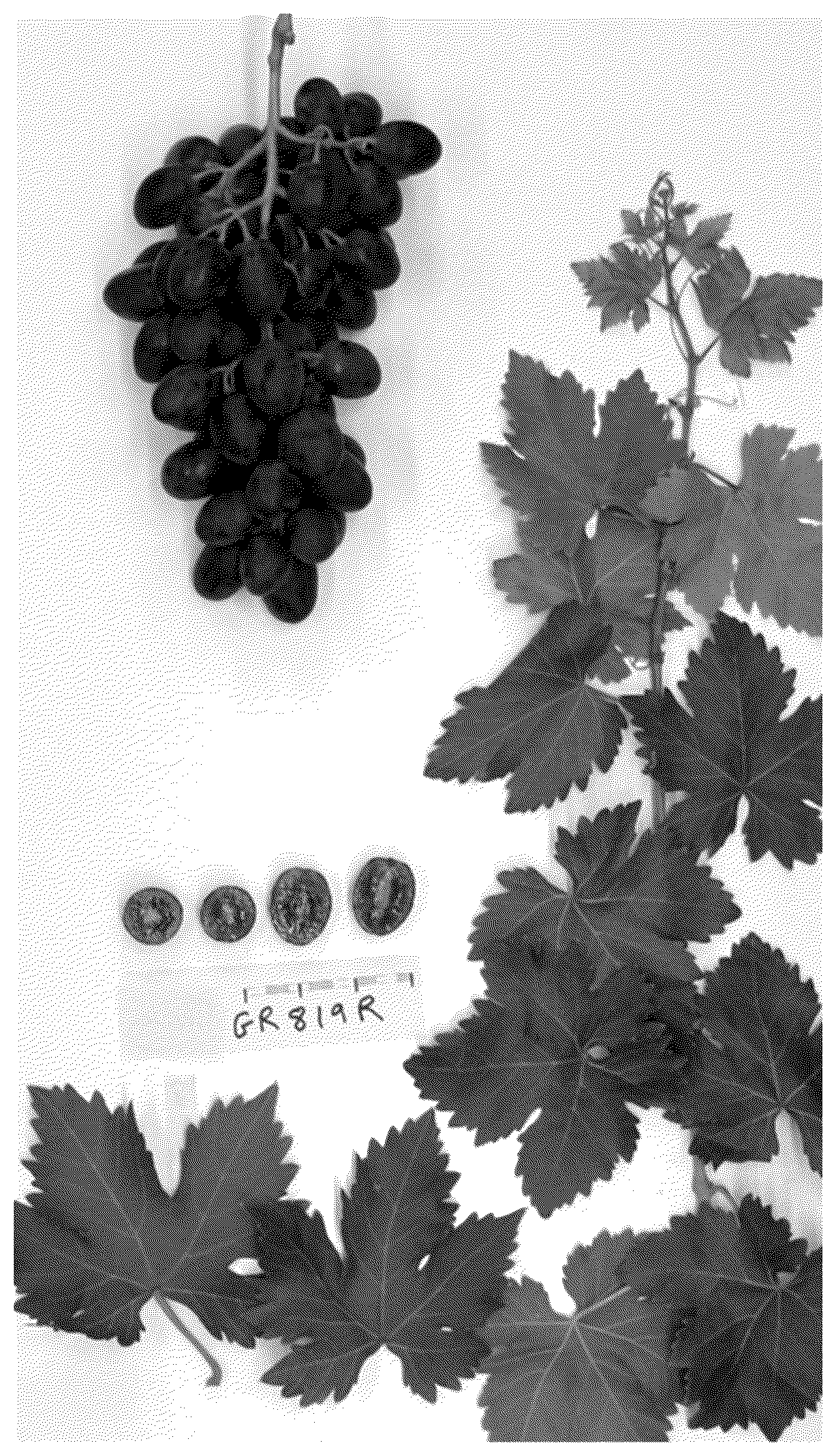
The accompanying color photographic illustration taken from a 4-year-old plant shows typical specimens of the foliage and fruit of the present new grape variety ‘SUGRA70’. The illustration shows the upper and lower surfaces of the leaves and exterior and sectional views of the fruit. The photographic illustration was taken shortly after the fruit was picked and the colors are as nearly true as is reasonably possible in a color representation of this type.
DETAILED DESCRIPTION
Throughout this specification, color names beginning with a small letter signify that the name of that color, as used in common speech, is aptly descriptive. Color names beginning with a capital letter designate values based upon The R.H.S. Colour Chart, published by The Royal Horticultural Society, London, England, sixth edition, 2015.
Many of the descriptive values in this specification are based on and conform to those set forth by the International Board for Plant Genetic Resources Institute Grape Descriptors ( Vitis spp.) of 1983 and/or 1997, which was developed in collaboration with the Office International de la Vigne et du Vin (OIV) and the International Union for the Protection of New Varieties of Plants (UPOV).
The descriptive matter which follows pertains to four-year-old ‘SUGRA70’ plants grown in the vicinity of Wasco, Kern County, California during 2022, and is believed to apply to plants of the variety grown under similar conditions of soil and climate elsewhere.
VINE
• General: (Measurements taken on a four-year-old plant).
•
• Vine size .—Large. Height: Approximately 2.0 m. Width: Approximately 2.5 m. • Vigor .—Vigorous. • Density of foliage .—Dense. • Productivity .—Very productive. • Crop load .—Approximately 30 kg per vine after thinning. • Own root .—Yes. • Training method .—Typically canned pruned, leaving six canes. • Resistance .—Neither resistance nor susceptibility to particular diseases or pests has been observed in this variety. • Trunk:
•
• Shape .—Stocky. • Diameter .—Approximately 6 cm (at 30 cm above the soil line). • Straps .—Short. • Surface texture .—Medium shaggy. • Inner and Outer bark color .—Inner bark about Medium Greyed-Orange 166C and weathering to about Dark Greyed-Green 197B in the outer bark.
SHOOTS
• Young shoot:
•
• Form of tip .—Wide open. • Intensity of anthocyanin coloration of tip .—Medium. • Density of prostrate hairs on tip .—Absent or very sparse. • Density of erect hairs on tip .—Absent or very sparse. • Color .—About Medium Green 143A. • Woody shoot (observations made in the middle third of shoot):
•
• Attitude before tying .—Semi-drooping. • Growth of axillary shoots .—Medium, about 18 cm in length. • Internode length .—Very short, approximately 40 mm. • Width at node .—Approximately 10 mm. • Cross section .—Circular. • Surface texture .—Striate. • Main color .—About Medium Greyed-Orange 166D. • Color of dorsal side of internode .—About Medium Greyed-Orange 166D. • Color of ventral side of internode .—About Medium Greyed-Orange 166D. • Color of dorsal side of node .—About Medium Greyed-Orange 166B and Medium Greyed-Orange 166D. • Color of ventral side of node .—About Medium Greyed-Orange 166B and Medium Greyed-Orange 166D. • Density of erect hairs on nodes .—Absent. • Density of erect hairs on internodes .—Absent or Very Sparse. • Density of prostrate hairs on internodes .—Absent or Very Sparse. • Density of prostrate hairs on nodes .—Absent or Very Sparse. • Tendrils:
•
• Distribution on the shoot at full flowering .—Discontinuous. • Thickness .—Approximately 2 mm. • Color .—About Light Green 141D in mid-summer. • Form .—Bifurcated. • Number of consecutive tendrils .—Up to 2. • Length of tendril .—Short, approximately 12 cm.
LEAVES
• Young leaves:
•
• Color of upper surface of first 4 distal unfolded leaves .—About Medium Yellow-Green 144A. • Average intensity of anthocyanin coloration of six distal leaves prior to flowering .—Present, about 80 percent of the leaf blade is a mixture of Strong Yellow Green 144A and Moderate Reddish Brown 166B. • Density of prostrate hairs between veins at lower surface of 4 th distal unfolded leaf .—Absent or very sparse. • Density of erect hairs between veins at lower surface of 4 th distal unfolded leaf .—Absent or very sparse. • Density of prostrate hairs on veins at lower surface of 4 th distal unfolded leaf .—Absent or very sparse. • Density of erect hairs on veins at lower surface of 4 th distal unfolded leaf .—Absent or very sparse. • Mature leaves (observations made on leaves in the middle third of the shoot):
•
• Size .—Medium. • Average length .—Approximately 9 cm. • Average width .—Approximately 12 cm. • Shape of blade .—Pentagonal. • Number of lobes .—Approximately 5. • Mature leaf profile .—Undulate. • Blistering surface of blade upper surface .—Absent or very weak. • Leaf blade tip .—In the plane of the leaf. • Undulation of margin .—Slightly undulating. • Thickness .—Average-typical of Vitis vinifera species. • Overall shape of teeth .—Mixture of both sides straight and both sides convex. • Length of teeth .—Medium, ranging from about 5 mm to 10 mm. • Ratio length/width of teeth .—Very small, nearly 1:1. • General shape of petiole sinus lobes .—Half open. • Tooth at petiole sinus .—Absent. • Petiole sinus limited by veins .—Absent. • Shape of upper lateral sinus lobes .—Closed. • Depth of upper lateral sinuses .—Medium, approximately 3 cm to 4 cm. • Density of prostrate hairs between veins on lower surface of blade .—Absent to very sparse. • Density of erect hairs between veins on lower surface of blade .—Absent to very sparse. • Density of prostrate hairs on main veins on lower surface of blade .—Absent to very sparse. • Density of erect hairs on main veins on lower surface of blade .—Absent to very sparse. • Density of prostrate hairs on main veins on upper surface of blade .—Absent to very sparse. • Autumn coloration of leaves .—Usually about Dark Green 138A becoming about Medium Grey-Brown 199C. • Upper leaf surface:
•
• Color .—About Dark Green 139A. • Surface texture .—Smooth. • Surface appearance .—Dull. • Anthocyanin coloration of main veins .—Absent or very sparse. • Lower leaf surface:
•
• Color .—About Dark Green 139B. • Surface texture .—Smooth. • Surface appearance .—Dull. • Anthocyanin coloration of main veins .—Absent or very sparse. • Petiole:
•
• Length of petiole .—Approximately 5 cm. • Diameter .—Approximately 3 mm. • Length of petiole compared to middle vein .—Slightly shorter, 5 cm for the petiole compared to 9 cm for middle vein. • Density of prostrate hairs on petiole .—Absent. • Density of erect hairs on petiole .—Absent. • Color .—About Dark Yellow-Green 147B. • Buds:
•
• Shape .—Conical. • Size .—Medium, approximately 3 mm wide×4 mm long. • Position .—Slightly held out. • Bud fruitfulness .—Basal, mostly fruitful. • Time of bud burst .—Early, approximately March 12th for the southern San Joaquin Valley region of California.
FLOWERS
• General:
•
• Flower type .—Fully developed stamen and fully developed gynoecium. • Position of first flowering node .—Usually 5th node of current season growth. • Number of inflorescences per shoot .—Usually 1 per shoot. • Cross section .—Circular. • Skin color ( without bloom ).—About Dark Violet Blue N92A. • Flesh color .—About Dark Green N138C becoming Medium Red-Purple 59C as becomes overripe. • Anthocyanin color of flesh .—Absent or very weak. • Bloom ( cuticular wax ).—Medium, typical of most commercial Vitis vinifera. • Pedicel length .—Approximately 13 mm. • Pedicel thickness .—Medium, approximately 1.8 mm. • Berry separation from pedicel .—Moderately easy. • Seed traces .—Rudimentary. • Berry firmness .—Moderately firm. • Flesh juiciness .—Very juicy. • Flesh texture .—Firm and meaty. • Particular flavor .—Fruity. • Refractometer test .—About 22 Brix. • Juice ph .—About 3.56. • Titratable acidity .—About 0.53%. • Brix:acid ratio .—Approximately 41.5. • Skin:
•
• Skin thickness .—Medium, about 175 μm. • Skin texture .—Smooth. • Skin reticulation .—Absent. • Skin tenacity .—Tenacious to flesh. • Skin tendency to crack .—Rare. • Skin sensitivity to sunburn .—None.