Abstract
A new variety of strawberry plant named ‘HOB-R490’ that has high hardness of fruit body, with the fruit having a medium size and a light red core.
Claims (1)
1. A new and distinct variety of strawberry plant named ‘HOB-R490’, substantially as described and illustrated herein.
Full Description
Show full text →
Common name: Strawberry.
Botanical classification: Fragaria x ananassa Duchesne ex Rozier.
Variety denomination: ‘HOB-R490’.
CROSS-REFERENCE TO PRIOR APPLICATION
This application follows Japanese plant variety rights application No. 37438 filed May 24, 2024, the entire content of which is incorporated by reference herein.
BACKGROUND OF THE NEW VARIETY
The present invention relates to a new and distinct variety of strawberry, Fragaria x ananassa Duchesne ex Rozier, which has been given the variety denomination ‘HOB-R490’.
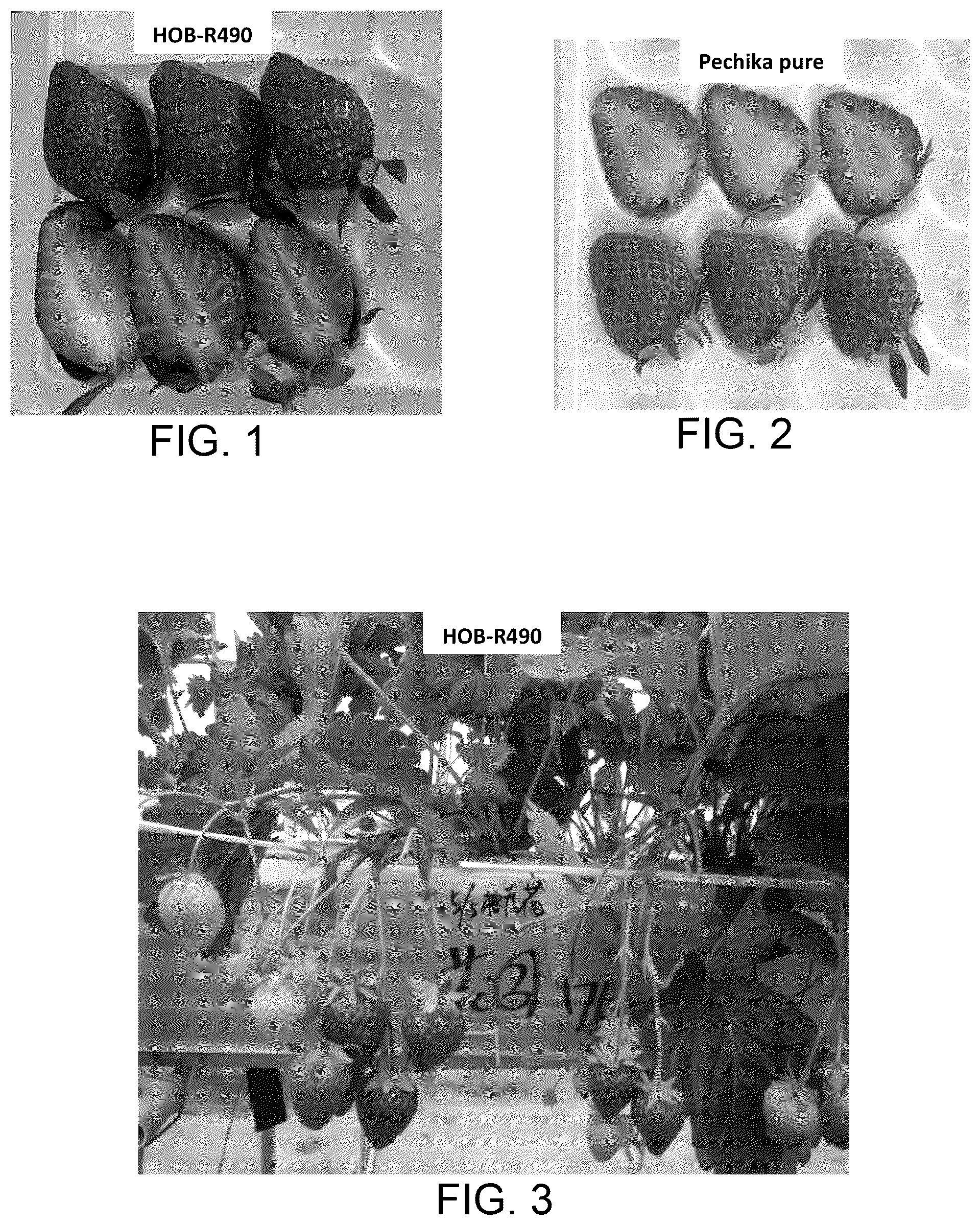
The variety is distinguished by its high hardness of fruit body, with the fruit having achenes positioned deep below the surface and a light red core, that distinguish it notably from its female parent ‘Pechika Pure’ (fruit having achenes positioned shallow below the surface and a yellowish pink (RHS 33C) core).
ORIGIN OF THE VARIETY
The parent varieties are ‘R392-43’ (male parent) (not patented in the U.S.) and ‘Pechika pure’ (female parent) (not patented in the U.S.).
The variety was asexually reproduced by runners in Higashikagura-cho, Kamikawa-gun, Hokkaido, Japan.
In March 2021, the male variety ‘R392-43’ and female variety ‘Pechika pure’ were crossed in a greenhouse in Higashikagura-cho, Kamikawa-gun, Hokkaido, Japan.
In 2021, the resulting seedlings were sown and raised.
In 2022, the raised seedlings were planted and grown in a test field located in Higashikagura-cho, Kamikawa-gun, Hokkaido, Japan, and two individuals with superior characteristics were selected.
In 2023, the test was carried out again, and ‘HOB-R490’ was selected for its high hardness of fruit body and its taste.
On May 24, 2024, an application for plant variety rights No. 37438 was filed for the present variety in the Japanese Plant Variety Protection Office of the Ministry of Agriculture, Forestry and Fisheries (MAFF), Japan.
Cultivation of the variety does not require special conditions or treatments.
Proper planting time is from the end of March to the beginning of April.
Flowering time is from the middle of May.
Harvesting time is from the end of June to the end of November.
The variety is currently mainly intended for fruit production.
SUMMARY OF THE VARIETY
The variety is distinguished by its high hardness of fruit body and rich taste with strong sweetness and acidity, with the fruit having a light red (RHS 40C) core, that distinguish it notably from its female parent ‘Pechika Pure’ (fruit having a yellowish pink (RHS 33C) core). The variety is also distinguished by its upright plant growth habit and cylindrical fruit shape, which distinguish it notably from its male parent ‘R392-43’ (semi-upright plant growth habit and conical fruit shape).
A comparison table with the male parent ‘R392-43’ is as follows (evaluation based on averages).
TABLE 1
HOB-R490 R392-43
Plant: growth habit upright semi-upright
Fruit: shape rhombic conical
A comparison table with the female parent ‘Pechika Pure’ is as follows (evaluation based on averages).
TABLE 2
HOB-R490 Pechika Pure
Color of core Light red yellowish red
(RHS 40C) (RHS 33C)
A comparison table with comparative variety ‘378-104’ is as follows (evaluation based on averages).
TABLE 3
HOB-R490 378-104
Plant: growth habit upright semi-upright
Fruit: cavity absent or small medium
BRIEF DESCRIPTION OF THE DRAWINGS
In the accompanying drawings, which are as nearly true as is reasonable possible to make in a color illustration of this type:
is a color photograph showing the whole fruit of ‘HOB-R490’ at the top and a cross-section of the fruit of ‘HOB-R490’ at the bottom;
is a color photograph showing cross-sections of the fruit of ‘Pechika Pure’ at the top and the whole fruit of ‘HOB-R490’ at the bottom;
is a color photograph showing the plant, leaves, and fruit of ‘HOB-R490’;
is a color photograph showing the plant, leaves, and fruit of ‘HOB-R490’;
is a color photograph showing the flower of ‘HOB-R490’;
is a color photograph showing the leaf of ‘HOB-R490’.
Due to chemical and/or digital development, processing and printing, the plants or portions of plants depicted in the photographs may or may not be precisely accurate, when compared to the actual botanical specimens.
DETAILED DESCRIPTION OF THE INVENTION
The botanical description and the photographs are of the ‘HOB-R490’ plants evaluated in 2023, including for the comparison with the female parent ‘Pechika Pure’. Values as provided are averages.
The plants shown on the photographs were grown in Higashikagura-cho, Kamikawa-gun, Hokkaido, Japan. The plant is a 5-year grown plant.
Colors are given according to the RHS (Royal Horticultural Society) Colour Chart (Fourth Ed., 2001).
BOTANICAL DESCRIPTION
TABLE 4
Characteristics States/Values
1 Plant
1.1 Plant growth habit upright
1.2 Density of foliage medium to dense
1.3 Vigor medium to strong
1.4 Number of axillary bud few
1.5 Position of inflorescence in same level
relation to foliage
1.6 Number of stolons medium to few
1.7 Stolon average length 25 cm
1.8 Stolon surface texture rough
1.9 Stolon color strong yellow green
(RHS 142A)
2 Leaf
2.1 Leaf size medium to large (length:
31.3 cm 2 (length 25 cm,
width 31 cm)
2.2 Color of upper side dark green (RHS146A)
2.3 Color of lower side brilliant yellowish green
(RHS 134C)
2.4 Glossiness weak
2.5 Blistering strong
2.6 Variegation absent
2.7 Terminal leaflet: size large (223 cm 2 ) (length
17 cm, width 14 cm)
2.8 Shape of base acute
2.9 Margin serrate to crenate
2.10 Shape in cross section concave
3 Stem
3.1 Petiole length medium to short (20.3 cm)
3.2 Petiole color strong yellowish green
(RHS 134B)
3.3 Attitude of hairs slightly outwards
3.4 Anthocyanin coloration absent or very weak
3.5 Peduncle: length short (9.0 cm)
3.6 Peduncle: color strong yellowish green
(RHS 134B)
3.7 Pedicel: attitude of hairs horizontal
3.8 Stipule: length 2.0 cm
4 Flower
4.1 Flower diameter medium to large (3.5 cm)
4.2 Number of petals 7 per flower
4.3 Arrangement of petals free
4.4 Stamen present
4.5 Petal: color of upper side white (RHS N155D)
4.6 Petal: color of lower side white (RHS NN155D)
4.7 Petal: shape rounded
5 Fruit
5.1 Fruit size medium (31.8 g) (height
5.0 cm, diameter 4.0 cm)
5.2 Shape rhombic
5.3 Shape at apex end acute or flattened
5.4 Shape at calyx end flattened
5.5 Color red (RHS 41A)
5.6 Color of achenes vivid purplish red (RHS
N57A)
5.7 Evenness of color even or very slightly
5.8 Evenness of surface slightly uneven
5.9 Neck absent
5.10 Position of calyx attachment level with fruit
5.11 Calyx: diameter 6.0 cm
5.12 Calyx: sepal number 13
5.13 Calyx: color designation dark yellowish green
(RHS N134A)
5.14 Attitude of sepals upwards
5.15 Firmness firm
5.16 Color of flesh light red (RHS N34B)
5.17 Color of core light red (RHS 40C)
5.18 Cavity absent or small
6 Fruit ripening
6.1 Time of beginning of medium to late (May 30)
flowering
6.2 Time of beginning of June 19
fruit ripening
6.3 Type of bearing day neutral
6.4 Soluble solids content medium to high (Brix = 9)
6.5 Acidity high (0.79%)
Other features of the plant are as follows:
• Plant hardiness zone of the plant: adapted to summer in cooler areas of Japan; has excellent heat resistance but poor cold resistance. In cold weather, the plants are dwarfed and the progress of fruit coloration is slow. • Pest and disease resistance: Normal resistance was observed for pests and diseases in Higashikagura-cho, Kamikawa-gun, Hokkaido, Japan.