Abstract
A new variety of Citrus sp. plant named ‘Mikanken10’ that has dense spines on the tree, leaf blade with emargination at tip, fruit with flattened general shape of distal part, and no navel opening.
Claims (1)
1. A new and distinct variety of Citrus sp. plant named ‘Mikanken10’, substantially as described and illustrated herein.
Full Description
Show full text →
Common name: Mandarin.
Botanical classification: Citrus sp.
Variety denomination: ‘Mikanken10’.
BACKGROUND OF THE NEW VARIETY
The present invention relates to a new and distinct variety of Mandarin, Citrus sp., which has been given the variety denomination ‘Mikanken10’.
ORIGIN OF THE VARIETY
The parent varieties are ‘ARIAKE’ (male parent) (patented in the US as U.S. Plant Pat. No. 9,235) and ‘NANKO’ (female parent) (not patented in the U.S.), respectively.
The variety was developed and propagated in Uwajima, Ehime, Japan.
The variety was reproduced asexually by vegetative reproduction by top grafting one-year-old scions on rootstocks, in Uwajima, Ehime, Japan. The rootstock used was ‘MIYAGAWAWASE’ (not patented) as an interstock grafted onto Poncirus trifoliata (trifoliate orange).
In 1993, crossing the parent varieties and collecting seeds to be grown in the next year.
In 1994 and 1995, seeds were planted and grown.
In 1996, scions were grafted on top of root stock.
In 1998, the first fruit was harvested.
In 2003, lines were primarily selected.
In 2009, plants were secondary selected.
From 2010 to 2022 there were growing tests for their performance.
In 2023, breeding was completed with DUS status confirmed (distinct, uniform, and stable), whereby it was confirmed that the instant tree reproduces true to type in successive generations of asexual reproduction, and the variety was named ‘Mikanken10’.
Cultivation of variety does not require special conditions or treatments.
The variety is currently mainly intended for fruit production.
SUMMARY OF THE VARIETY
This new mandarin plant ‘Mikanken10’ has dense spines on the tree, leaf blade with emargination at tip, fruit with flattened general shape of distal part, that distinguish it notably from its male parent ‘ARIAKE’, and no navel opening, that distinguish it notably from its female parent ‘NANKO’.
Also, ‘Mikanken10’ has no depression at the distal end of the fruit and no polyembryony of seeds, that distinguishes it notably from comparative variety ‘SEINANNOHIKARI’ (not patented in the U.S.).
In addition, the fruit of ‘Mikanken10’ has the following characteristics: The fruit size is approximately 200 g, the predominant color of the fruit surface is vivid orange, the rind thickness is thin, the strength of the segment walls is weak, the fruit has no seeds, in early December, the total soluble solids (Brix) of juice is about 15 degrees and the juice acidity is medium, and the time of maturity of the fruit is in early to mid-December.
Table 1 shows a comparison between the instant variety ‘Mikanken10’ and Male parent variety ‘ARIAKE’ and Female parent variety ‘NANKO’, as follows (average evaluation):
TABLE 1
Comparison between ‘Mikanken10’ and ‘ARIAKE’ and ‘NANKO’
Female
Male parent parent Present
variety variety variety
‘ARIAKE’ ‘NANKO’ ‘Mikanken10’
No. Characteristics States States States
3 Tree: density Absent or Intermediate Dense
of spine Sparse
15 Leaf blade: Absent Absent Present
emargination
at tip
41 Fruit: general Slightly Slightly Flattened
shape of distal rounded rounded
part
48 Fruit: presence Absent Always Absent
of navel present
opening
Table 2 shows a comparison between the instant variety ‘Mikanken10’ and comparative variety ‘SEINANNNOHIKARI’, as follows (average evaluation):
TABLE 2
Comparison between ‘Mikanken10’ and ‘SEINANNOHIKARI’
Comparative Present
variety variety
‘SEINANNOHIKARI’ ‘Mikanken10’
No. Characteristics States States
15 Leaf blade: Absent Present
emargination at
tip
42 Fruit: presence Present Absent
of depression at
distal end
91 Seed: poly- Present Absent
embryony
BRIEF DESCRIPTION OF THE DRAWINGS
In the accompanying drawings, which are as nearly true as is reasonable possible to make in a color illustration of this type:
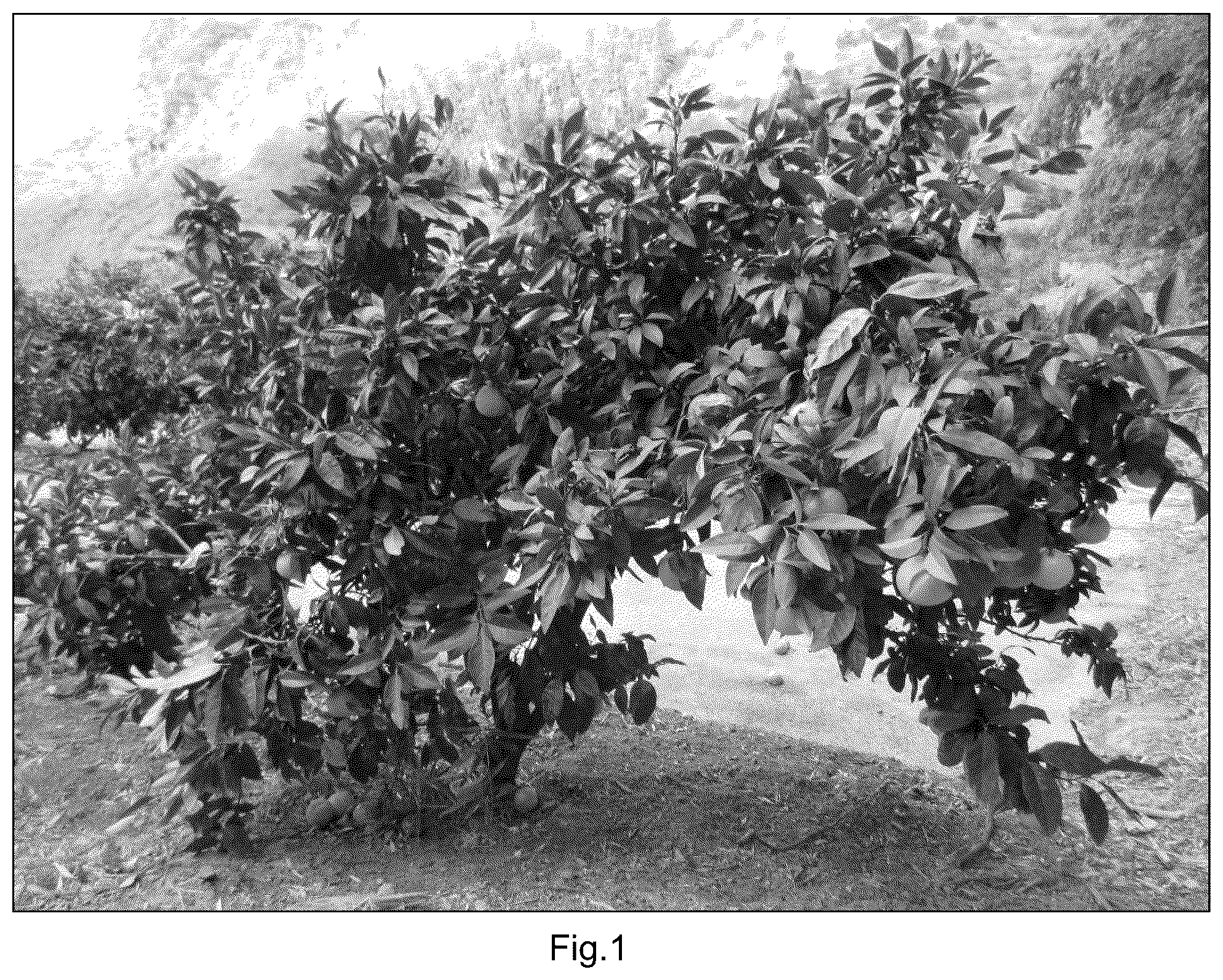
is a color photograph showing a general view of an illustrative mandarin tree of the variety named ‘Mikanken10’ bearing fruits.
is a color photograph showing flowers of ‘Mikanken10’.
is a color photograph showing upper surfaces of leaves of ‘Mikanken10’.
is a color photograph showing whole fruits (distal end, side view and stalk end), and transverse section and longitudinal section of fruits of ‘Mikanken10’.
is a color photograph showing whole fruits (distal end, side view and stalk end), and transverse section and longitudinal section of fruits of ‘Mikanken10’ and ‘NANKO’, which is indicating difference of fruit: navel opening.
is a color photograph showing whole fruits (distal end, side view and stalk end), and transverse section and longitudinal section of fruits of ‘Mikanken10’ and ‘ARIAKE’, which is indicating difference of general shape of distal part.
is a color photograph showing upper surfaces of leaves of ‘Mikanken10’ and ‘SEINANNOHIKARI’, which is indicating difference of leaf: emargination at tip.
Due to chemical and/or digital development, processing and printing, the plants or portions of plants depicted in the photographs may or may not be precisely accurate when compared to the actual botanical specimens.
DETAILED DESCRIPTION OF THE INVENTION
Table 3 shows the botanical description of the ‘Mikanken10’ plants evaluated in 2023. The values as provided are averages. The ages of the trees evaluated was 15 years after grafted on top of rootstock, and the location of the trees evaluated was in Uwajima, Ehime, Japan.
Colors are given according to the J.H.S. (Japan Horticultural Society) Color Chart.
BOTANICAL DESCRIPTION
TABLE 3
Botanical description of ‘Mikanken10’
No. Characteristics States Values
1. Ploidy Diploid
2. Tree: growth habit Spreading
3. Tree: average height 2.1 m
4. Tree: average spread 3.0 m
5. Trunk: average dia- 6.8 cm
meter at 10 cm above
the grafted area
6. Trunk: surface texture rough
7. Trunk: bark color Dark 3107 (JHS
yellow- Color Chart)
green
8. Branches: average 11.3 cm
length
9. Branches: surface smooth
texture
10. Branches: bark color Dark 3508 (JHS
yellow- Color Chart)
green
11. Tree: density of Dense 33.3%
spines (number of
thorns per total
number of leaf-
bearing nodes,
multiplied by 100)
12. Length of spines 0.4 cm
13. Spine: color Dark 3508 (JHS
yellow- Color Chart)
green
14. Leaf blade: length Long 10.1 cm
(apical leaflet in
case of compound
leaf)
15. Leaf blade: width Medium 4.2 cm
(apical leaflet in
case of compound
leaf)
16. Leaf blade: ratio Medium 2.4
length/width (apical
leaflet in case of
compound leaf)
17. Leaf blade: shape Inter-
in cross section mediate
(apical leaflet in
case of compound
leaf)
18. Leaf blade: twisting Absent or
Weak
19. Leaf blade: blistering Absent or
Weak
20. Leaf blade: color: Dark 3509 (JHS
upper surface yellow- Color Chart)
green
21. Leaf blade: un- Absent or
dulation of margin Weak
22. Leaf blade: incisions Absent
of margin
23. Leaf blade: shape of Acute
apex
24. Leaf blade: emargin- Present
ation at tip
25. Petiole: length Medium 1.6 cm
26. Petiole: color Deep 3507 (JHS
yellow- Color Chart)
green
27. Petiole: presence of Present
wings
28. Varieties with petiole Narrow 2.9 mm
wings present only:
petiole: width of wings
29. Petiole wings: color Dark 3509 (JHS
yellow- Color Chart)
green
30. Flower: diameter of 0.8 cm
Calyx
31. Flower: length of petal Medium 15.8 mm
32. Flower: width of petal Very Broad 7.0 mm
33. Flower: ratio length/ 2.3
width of petal
34. Flower: length of 9.0 mm
stamens
35. Blooming period Early May
36. Fragrance Present
37. Flower bud: color Yellowish 2502 (JHS
white Color Chart)
38. Sepals: number per 5
flower
39. Sepals: length 0.25 cm
40. Sepals: width 0.78 cm
41 Petal: shape Spindle-
shaped
42. Petal: color (upper Yellowish 2502 (JHS
surface) white Color Chart)
43. Petal: apex shape Acute
44. Petal: base shape Round
45. Anther: color Bright 2204 (JHS
reddish Color Chart)
yellow
46. Style: length 5.0 mm
47. infructescence: Present
clustering of fruits
48. Fruit: length 6.2 cm
49. Fruit: diameter 7.4 cm
50. Fruit: ratio length/ 1.19
diameter
51. Fruit: position of At Middle
broadest part
52. Fruit: shape in trans- Circular
verse section
53. Fruit: general shape of Flattened
proximal part (excluding
neck, collar and
depression at stalk end)
54. Fruit: presence of neck Absent
55. Fruit: presence of Absent
depression at stalk end
56. Fruit: presence of con- Absent
striction at stalk end
57. Fruit: number of radial Absent or 2
grooves at stalk end few
58. Fruit: length of radial 7.2 mm
grooves at stalk end
59. Fruit: presence of collar Absent
60. Fruit: abscission layer Absent
between floral disc weekly
and fruit developed
61. Fruit: general shape of Flattened
distal part (excluding
nipple, bulging of navel
and depression at distal
end)
62. Fruit: presence of Absent
depression at distal end
63. Fruit: presence of areola Incomplete
64. Fruit: type of areola Smooth
65. Fruit: diameter of areola 3.0 cm
66. Fruit: diameter of stylar 3.0 mm
scar
67. Fruit: persistence of None
style
68. Fruit: presence of navel Absent
opening
69. Fruit: presence of radial Absent
grooves at distal end
70. Fruit surface: pre- Vivid 1605 (JHS
dominant color(s) orange Color Chart)
71. Fruit surface: glossiness Medium
72. Fruit surface: roughness Medium
73. Fruit surface: size of oil All more or
glands less the
same size
74. Fruit surface: size of Medium
larger oil glands
75. Fruit surface: con- Medium
spicuousness of larger
oil glands
76. Fruit surface: presence Pitting
of pitting and pebbling absent,
on oil glands Pebbling
present
77. Fruit: varieties with fruit Medium
surface: pebbling on oil
glands only: surface:
density of pebbling
78. Fruit: varieties with Medium
fruit surface: pebbling
on oil glands only:
surface: degree of
pebbling
79. Fruit: rind thickness Thin 2.5 mm
80. Fruit: rind adherence of Weak to
flesh medium
81. Fruit: rind: strength Medium
82. Fruit: rind: oiliness Dry
83. Fruit: rind conspicuous- Absent or
ness of oil glands on weakly
inner surface conspicuous
84. Fruit: color of albedo Pale yellow 2503 (JHS
Color Chart)
85. Fruit: density of albedo Medium
86. Fruit: amount of albedo Small
adhering to flesh
(strand excluded)
87. Fruit: presence of Present
albedo strands
88. Fruit: amount of Medium
albedo strands
89. Fruit: main color Strong 1606 (JHS
of flesh orange Color Chart)
90. Fruit: filling of core Medium
91. Fruit: diameter of core Very small 8.2 mm
92. Fruit: presence of Absent or
rudimentary segments very weak
93. Fruit: number of well- 13
developed segments
94. Fruit: coherence of Medium
adjacent segment walls
95. Fruit: strength of Weak
segment walls
96. Fruit: length of juice 6.5 mm
vesicles
97. Fruit: thickness of 2.6 mm
juice vesicles
98. Fruit; conspicuous- High
ness of juice vesicle
walls
99. Fruit; coherence of Medium
juice vesicles
100. Fruit: presence of Absent or
navel (viewed very rare
internally)
101. Fruit: juiciness High
102. Fruit: juice: total High 14.9 (Brix)
soluble solids
103. Fruit: juice: acidity Medium 1.00
104. Fruit: strength of fiber Weak
105. Fruit: number of Absent or 0.7
seeds (open pollinated) very few
106. Seed: polyembryony Absent
107. Seed: length 9.6 mm
108. Seed: width 7.2 mm
109. Seed: surface Wrinkled
110. Seed: varieties with Medium
seed surface: wrinkled
only: seed: prominence
of wrinkled
111. Seed: external color Whitish
112. Seed: color of inner Light brown
seed coat
113. Plant: time of Very early December
maturity of fruit for to early
consumption
114. Plant: fruit: Present
parthenocarpy
115. Plant: fruit harvest November
period
Other features of the plant are as follows:
• Disease and pest resistance: Not observed to date. • Tree hardiness: USDA Hardiness Zone 9a-9b (until −3° C.). • Shipping quality, storage life, and productivity (weight/plant): Under investigation to date. Market use is as a Citrus fruit for eating raw.