Abstract
A new variety of apple tree ‘BENITSURUGI’ that has columnar tree type, bearing on spurs only, thick to very thick shoot thickness, short internode length, long leaf blade length, long petiole length, short to medium fruit stalk length, medium size and short to medium height fruit with fully open locules.
Claims (1)
1. A new and distinct variety of apple tree named ‘BENITSURUGI’, substantially as described and illustrated herein.
Full Description
Show full text →
Common name: Apple.
Botanical classification: Malus domestica (Suclow) Borkh.
Variety denomination: ‘BENITSURUGI’.
CROSS-REFERENCE TO RELATED APPLICATION
This application claims priority of Japanese plant variety rights application No. 37015 filed Aug. 31, 2023, the entire content of which is incorporated by reference herein.
BACKGROUND OF THE NEW VARIETY
The present invention relates to a new and distinct variety of apple tree, Malus domestica (Suclow) Borkh, which has been given the variety denomination ‘BENITSURUGI’.
ORIGIN OF THE VARIETY
The parent varieties are ‘5-12786’ (male parent) (not patented) and ‘SANSA’ (female parent) (U.S. Plant Pat. No. 6,519), respectively.
The variety was developed and propagated at the Morioka Research Station, Institute of Fruit Tree and Tea Science, National Agriculture and Food Research Organization (NARO), in Morioka, Iwate, Japan.
The variety was reproduced asexually by vegetative reproduction by grafting one-year-old cuttings on rootstocks.
In 2005, crossing the parent varieties and collecting seeds.
In 2006, columnar type's seedlings are selected by SCAR682 DNA marker from growing seedlings.
In 2007, they were grafted on JM1 root stock.
In 2008, they were transplanted at breeding field. And selected individual plant.
In 2015, the instant plant was selected as a promising breeding line and provisionally named ‘Morioka 74’.
In 2016, growing test for local adaptability were started under confidentiality conditions at 16 public testing stations in Japan.
On Aug. 31, 2023, an application for plant variety rights No. 37015 was filed for the present variety in the Japanese Plant Variety Protection Office of the Ministry of Agriculture, Forestry and Fisheries (MAFF), Japan.
Cultivation of the variety does not require special conditions or treatments.
The variety is currently mainly intended for fruit production (table use).
SUMMARY OF THE VARIETY
The present variety is distinguished by columnar tree type, bearing on spurs only, thick to very thick shoot thickness, short internode length, long leaf blade length, long petiole length, short to medium fruit stalk length, medium size and short to medium height fruit with fully open locules, that distinguish it, notably from its male parent ‘5-12786’ (medium extent of anthocyanin overcolor of young fruit, late harvest time) and female parent ‘SANSA’ (ramified tree type, medium shoot thickness, medium internode length, early harvest time), as well as from reference varieties ‘SENSHU’ (ramified tree type, bearing on spurs and long shoots, thin to medium shoot thickness, medium internode length, medium leaf blade length, short to medium petiole length, fruit with moderately open locules) and ‘SHINANO SWEET’ (ramified tree type, bearing on spurs and long shoots, thin to medium shoot thickness, medium internode length, short to medium leaf blade length, short to medium petiole length, medium to long fruit stalk length, large size and tall height fruit).
A comparison with the male parent ‘5-12786’ is as follows (evaluation based on averages):
TABLE 1
Male parent Present variety
‘5-12786’ ‘BENITSURUGI’
No. Characteristics States States
34 Young fruit: extent medium absent or very
of anthocyanin small to small
overcolor
101 Time of harvest late medium
A comparison with the female parent ‘SANSA’ is as follows (evaluation based on averages):
TABLE 2
Female parent Present variety
‘SANSA’ ‘BENITSURUGI’
No. Characteristics States States
2 Tree: type ramified columnar
9 One-year-old shoot: medium thick to very
thickness thick
10 One-year-old shoot: medium short
length of internode
101 Time of harvest early medium
A comparison with the reference varieties ‘SENSHU’ and ‘SHINANO SWEET’ is as follows (evaluation based on averages):
TABLE 3
Reference
Reference variety Present
variety ‘SHINANO variety
‘SENSHU’ SWEET’ ‘BENITSURUGI’
No. Characteristics States States States
2 Tree: type ramified ramified columnar
6 Tree: type of on spurs and on spurs and on spurs only
bearing long shoots long shoots
9 One-year-old thin to thin to thick to very
shoot: thickness medium medium thick
10 One-year-old medium medium short
shoot: length
of internode
15 Leaf blade: medium short to long
length medium
16 Leaf blade: narrow to narrow to medium to
width medium medium broad
22 Petiole: length short to short to long
medium medium
23 Petiole: extent medium small
of anthocyanin
coloration
from base
30 Flower: light pink dark pink
predominant
color at
balloon stage
34 Young fruit: large absent or very
extent of
anthocyanin small to small
overcolor
61 Fruit: size large medium
62 Fruit: height tall short to medium
86 Fruit: length medium medium to short to medium
of stalk long
98 Fruit: aperture moderately fully open
of locules (in open
transverse
section)
101 Time of medium to medium
harvest late
BRIEF DESCRIPTION OF THE DRAWINGS
In the accompanying drawings, which are as nearly true as is reasonable possible to make in a color illustration of this type:
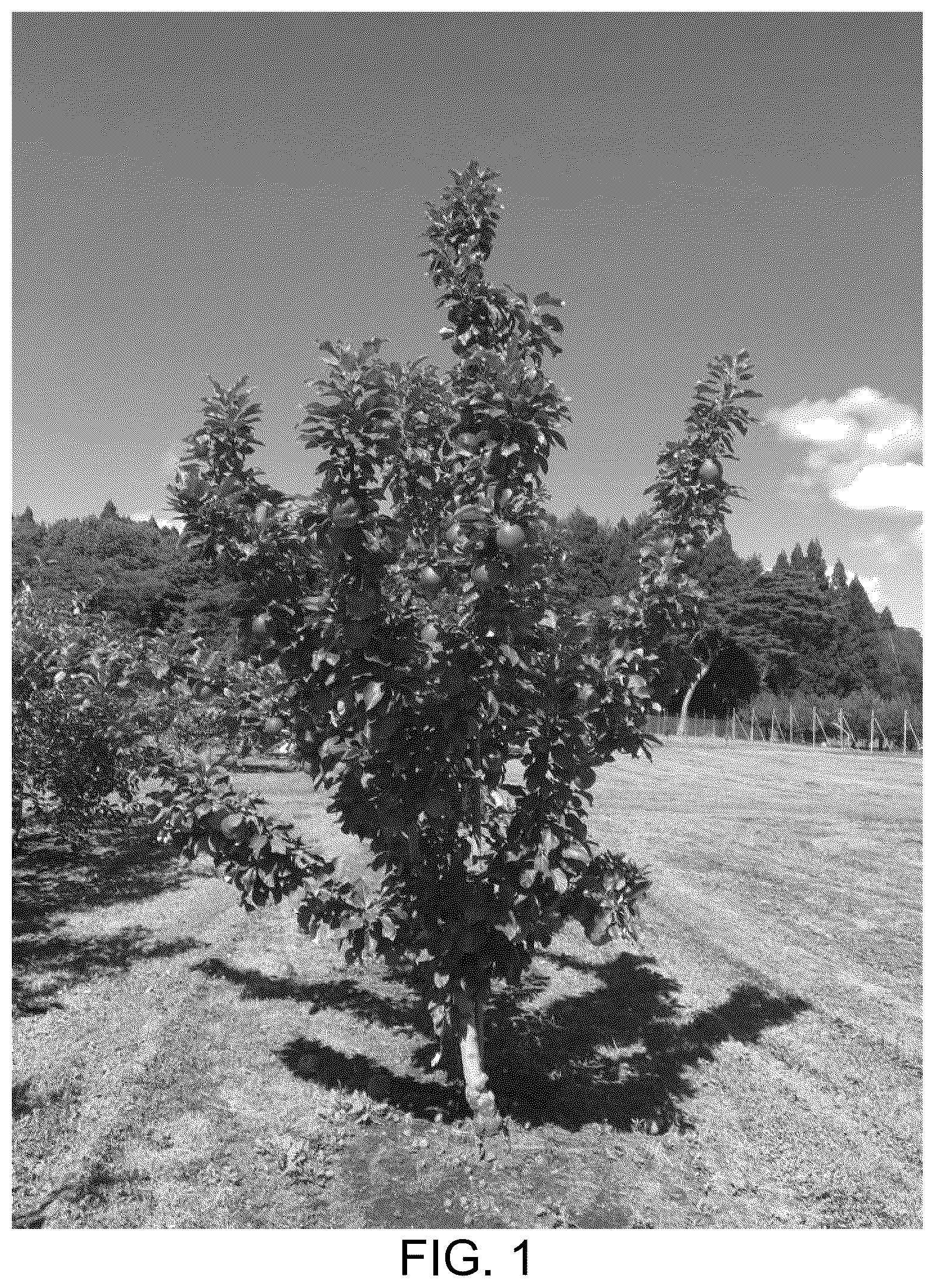
is a color photograph showing a general view of the apple tree named ‘BENITSURUGI’ at harvest time.
is a color photograph showing a flower of ‘BENITSURUGI’.
is a color photograph showing detached upper surface petals, pistils, flowering stalk including calyx and detached stamens of the flower of ‘BENITSURUGI’.
is a color photograph showing fruits of ‘BENITSURUGI’.
is a color photograph showing cross sections of fruits of ‘BENITSURUGI’.
A is a color photograph showing the tree type of reference variety ‘SHINANO SWEET’.
B is a color photograph showing the tree type of reference variety ‘SENSHU’.
C is a color photograph showing the tree type of the present variety ‘BENITSURUGI’.
is a color photograph showing one year old shoot of ‘BENITSURUGI’ (top), in comparison with ‘SENSHU’ (middle) and ‘SHINANO SWEET’ (bottom).
is a color photograph showing leaves of ‘BENITSURUGI’ (center), in comparison with ‘SHINANO SWEET’ (left) and ‘SENSHU’ (right).
A is a color photograph showing the petiole: extent of anthocyanin coloration from base of ‘BENITSURUGI’ (bottom), in comparison with ‘SHINANO SWEET’ (top).
B is a color photograph showing a more detailed view of the petiole: extent of anthocyanin coloration from base of ‘BENITSURUGI’ (bottom), in comparison with ‘SHINANO SWEET’ (top).
is a color photograph showing the flower bud of ‘BENITSURUGI’ (left), in comparison with ‘SHINANO SWEET’ (right).
is a color photograph showing the young fruit of ‘BENITSURUGI’ (left), in comparison with ‘SENSHU’ (right).
is a color photograph showing the fruit of ‘BENITSURUGI’ (center), in comparison with ‘SHINANO SWEET’ (top) and ‘SENSHU’ (bottom).
is a color photograph showing another view of the fruit of ‘BENITSURUGI’ (center), in comparison with ‘SENSHU’ (left) and ‘SHINANO SWEET’ (right).
is a color photograph showing the underside of fruit of ‘BENITSURUGI’ (middle), in comparison with ‘SHINANO SWEET’ (top) and ‘SENSHU’ (bottom).
is a color photograph showing the fruit stalk of ‘BENITSURUGI’ (center), in comparison with ‘SENSHU’ (left) and ‘SHINANO SWEET’ (right).
is a color photograph showing the fruit shape of core of ‘BENITSURUGI’ (middle), in comparison with ‘SHINANO SWEET’ (top) and ‘SENSHU’ (bottom).
is a color photograph showing the aperture of locules in transverse section of the fruit of ‘BENITSURUGI’ (right), in comparison with ‘SENSHU’ (left).
is a color photograph showing a general view of the fruit of ‘BENITSURUGI’.
Due to chemical and/or digital development, processing and printing, the plants or portions of plants depicted in the photographs may or may not be precisely accurate, when compared to the actual botanical specimens.
DETAILED DESCRIPTION OF THE INVENTION
The botanical description and the photographs are of the ‘BENITSURUGI’ plants evaluated from 2020 to 2022 (including for the comparison with the reference plants ‘SENSHU’ and ‘SHINANO SWEET’. The age of the plants shown on the photographs and evaluated was 8 years, 5 months on Oct. 2, 2020. Values as provided are averages.
The plants shown on the photographs were grown at Morioka, Iwate, Japan.
The dates each photograph was taken are as follows:
•
• , 18 : Oct. 2, 2020, • , 3 : May 11, 2020 • , 5 : Oct. 9, 2020 • A, 6 B, 6 C : Sep. 29, 2022 • : Dec. 23, 2022 • , 12 , 16 : Dec. 15, 2022 • A, 9 B : Aug. 24, 2020 • : May 10, 2021 • : Jun. 21, 2021 • , 14 , 15 , 17 : Dec. 1, 2021
Colors are given according to The R.H.S. (Royal Horticultural Society) Colour Chart, Sixth Edition, 2015.
BOTANICAL DESCRIPTION
TABLE 4
No. Characteristics States Values
1 Tree: vigor medium
2 Tree: type columnar
3 Tree: average height 3.2 m
4 Tree: average spread 1.2 m
5 Tree: habit not
applicable
6 Tree: type of bearing on spurs only
7 Tree: trunk color medium brown 166B
8 Tree: bark surface texture smooth-medium
9 One-year-old shoot: thickness thick to very 8.2 mm
thick
10 One-year-old shoot: length short 1.2 cm
of internode
11 One-year-old shoot: color medium brown 200A
on sunny side (dark
brown)
12 One-year-old shoot: strong
pubescence
(on distal half of shoot)
13 One-year-old shoot: number many
of lenticels
14 Leaf blade: attitude in outwards
relation to shoot
15 Leaf blade: length long 11.5 cm
16 Leaf blade: width medium to 6.6 cm
broad
17 Leaf blade: ratio length/ medium to 1.7
width large
18 Leaf blade: intensity of green dark green 139A
color (upper surface)
19 Leaf blade: intensity of green light green 142C
color (lower surface)
20 Leaf blade: incisions of serrate type 2
margin (upper half) (crenate to
serrate)
21 Leaf blade: pubescence on medium
lower side
22 Petiole: length long 4.6 cm
23 Petiole: extent of small 22.50%
anthocyanin
coloration from base
24 Petiole: color light green 145C
25 Leaf stipule: length 11.0 mm
26 Leaf stipule: width 2.5 mm
27 Leaf stipule: shape long round
28 Leaf stipule: color medium green 143B
29 Flowers: average number 5 flowers per
per spur cluster
30 Flower: predominant color purplish pink N74C
at balloon stage
31 Flower: diameter with petals small to 4.8 cm
pressed into horizontal medium
position
32 Flower: arrangement of petals overlapping
33 Flower: position of stigmas same level
relative to anthers
34 Young fruit: extent of absent or very 10.70%
anthocyanin overcolor small to small
35 Sepal: length 8.6 mm
36 Sepal: width 5.0 mm
37 Sepal: shape deltoid
38 Sepal: surface texture smooth with
medium
pubescence
39 Sepal: color light green 141D
40 Pedicel: length 16.3 mm
41 Pedicel: width 2.1 mm
42 Pedicel: surface texture smooth with
medium
pubescence
43 Pedicel: color medium 146D
brown green
44 Reproductive organs: number 20
of stamens per flower
45 Reproductive organs: number 5
of styles per flower
46 Reproductive organs: length 8.4 mm
of stamen
47 Reproductive organs: length 2.7 mm
of anther
48 Reproductive organs: length 6.2 mm
of style
49 Reproductive organs: color white 155A
of filament
50 Reproductive organs: color light yellow 5D
of anther
51 Reproductive organs: color light green 145B
of style
52 Reproductive organs: color light green 144D
of stigma
53 Reproductive organs: color light green 145B
of ovary
54 Seed: number per fruit 8.6
55 Seed: number per fruit cell 1.6
56 Seed: length 8.3 mm
57 Seed width 4.8 mm
58 Seed: depth 3.3 mm
59 Seed: shape obtuse
60 Seed: color (with RHS dark brown 187A
number)
61 Fruit: size medium 311.5 g
62 Fruit: height short to 8 cm
medium
63 Fruit: diameter medium 9.1 cm
64 Fruit: ratio height/diameter medium 0.88
65 Fruit: general shape globose
66 Fruit: ribbing absent or weak
67 Fruit: crowning at calyx end absent or weak
68 Fruit: size of eye very small to
small
69 Fruit: length of sepal short to
medium
70 Fruit: bloom of skin absent or weak
71 Fruit: greasiness of skin absent or weak
72 Fruit: surface texture of skin smooth
73 Fruit: ground color yellow green 150C
(yellow
green)
74 Fruit: relative area of large 87.7%
over color
75 Fruit: hue of over red 187B
color-with bloom (dark
removed purple
red)
76 Fruit: intensity of over color dark
77 Fruit: pattern of over color solid flush with
weakly defined
stripes
78 Fruit: width of stripes narrow to
medium
79 Fruit: intensity of stripes weak to medium
80 Fruit: area of russet around absent or small
stalk attachment
81 Fruit: area of russet on cheeks absent or small
82 Fruit: area of russet around absent or small
eye basin
83 Fruit: number of lenticels medium
84 Fruit: size of lenticels small to medium
85 Fruit: scarfskin very small to
small
86 Fruit: length of stalk short to medium 1.8 cm
87 Fruit: thickness of stalk thin to medium 3.1 mm
88 Fruit: depth of stalk cavity shallow medium 2.2 cm
89 Fruit: width of stalk cavity narrow medium 4 cm
90 Fruit: depth of eye basin medium 1.2 cm
91 Fruit: width of eye basin medium 3.4 cm
92 Fruit: firmness of flesh medium 15 lbs
93 Fruit: color of flesh cream 8D (light
yellow)
94 Fruit: sweetness of flesh medium 13.5 %
95 Fruit: acidity of flesh low 0.36 g/
100 ml
96 Fruit: water-core of flesh absent or very
slight
97 Fruit: shape of core flat round
98 Fruit: aperture of locules fully open
(in transverse section)
99 Pollination requirements flowers are self-
incompatible, S
genotype is S3S5
and requires
pollination by
another S
genotype diploid
apple
100 Time of beginning of early to medium May 9
flowering
101 Time of harvest medium October 2
102 Shipping quality moderate
103 Storage life 6-11 days
at room
temperature, 1
month at
refrigerated
temperature
104 Market use fresh, juice,
multiple use
105 Productivity (weight/plant) 22.5
kg/tree
(average
for 7-8
year-old
tree)
106 Resistance to: strong
Alternaria blotch
Other features of the plant are as follows:
•
• Disease resistance: Resistance to Alternaria blotch ( Alternaria alternata ) was observed. The new variety has the same susceptibility to Blotch ( Diplocarpon mali ), Powdery mildew ( Podosphaera leucotricha ) and Scab ( Venturia inaequalis ) as existing cultivars.
Figures (11)
Citations
This patent cites (1)
- USPP6519