Calibrachoa Plant Named ‘WNCALSBDBLGF26’
Abstract
A new and distinct Calibrachoa plant named ‘WNCALSBDBLGF26’, characterized by its compact, upright to outwardly spreading and mounding to trailing plant habit; moderately vigorous growth habit; freely branching habit; dense and bushy appearance; early and freely flowering habit; double-type flowers with petals and petaloids that are initially pale yellow in color and become purplish red with subsequent development; and excellent container and garden performance.
Claims (1)
1. A new and distinct Calibrachoa plant named ‘WNCALSBDBLGF26’ as herein illustrated and described.
Full Description
Show full text →
Botanical designation: Calibrachoa sp.
Cultivar denomination: ‘WNCALSBDBLGF26’.
BACKGROUND OF THE INVENTION
The present invention relates to a new and distinct cultivar of Calibrachoa plant, botanically known as Calibrachoa sp. and hereinafter referred to by the name ‘WNCALSBDBLGF26’.
The new Calibrachoa plant is a product of a planned breeding program conducted by the Inventor in Higashiomi, Shiga, Japan and Mustang Ridge, Texas. The objective of the breeding program is to create new compact, uniform, freely-branching and freely-flowering Calibrachoa plants with attractive double-type flowers and good container and garden performance.
The new Calibrachoa plant originated from a cross-pollination conducted by the Inventor in Higashiomi, Shiga, Japan on May 1, 2020 of Calibrachoa sp. ‘USCAL83901’, not patented, as the female, or seed, parent with Calibrachoa sp. ‘Weschachapisoi’, not patented, as the male, or pollen, parent. The new Calibrachoa plant was discovered and selected by the Inventor as a single flowering plant within the progeny of the stated cross-pollination in a controlled greenhouse environment in Mustang Ridge, Texas on Oct. 12, 2021.
Asexual reproduction of the new Calibrachoa plant by vegetative terminal cuttings in a controlled greenhouse environment in Mustang Ridge, Texas since Oct. 25, 2021 has shown that the unique features of this new Calibrachoa plant are stable and reproduced true to type in successive generations.
SUMMARY OF THE INVENTION
Plants of the new Calibrachoa have not been observed under all possible combinations of environmental conditions and cultural practices. The phenotype may vary somewhat with variations in environmental conditions such as temperature and light intensity without, however, any variance in genotype.
The following traits have been repeatedly observed and are determined to be the unique characteristics of ‘WNCALSBDBLGF26’. These characteristics in combination distinguish ‘WNCALSBDBLGF26’ as a new and distinct Calibrachoa plant:
•
• 1. Compact, upright to outwardly spreading and mounding to trailing plant habit. • 2. Moderately vigorous growth habit. • 3. Freely branching habit; dense and bushy appearance. • 4. Early and freely flowering habit. • 5. Double-type flowers with petals and petaloids that are initially pale yellow in color and become purplish red with subsequent development. • 6. Excellent container and garden performance.
Plants of the new Calibrachoa differ primarily from plants of the female parent, ‘USCAL83901’, in the following characteristics:
•
• 1. Plants of the new Calibrachoa are more freely flowering than plants of ‘USCAL83901’. • 2. Flower petals and petaloids of plants of the new Calibrachoa are initially pale yellow in color and become purplish red with subsequent development whereas flower petals and petaloids of plants of ‘USCAL83901’ are dark red in color.
Plants of the new Calibrachoa differ primarily from plants of the male parent, ‘Weschachapisoi’, in the following characteristics:
•
• 1. Plants of the new Calibrachoa are more freely flowering than plants of ‘Weschachapisoi’. • 2. Flowers of plants of the new Calibrachoa are double-types whereas flowers of plants of ‘Weschachapisoi’ are single-types. • 3. Flower petals and petaloids of plants of the new Calibrachoa are initially pale yellow in color and become purplish red with subsequent development whereas flower petals and petaloids of plants of ‘Weschachapisoi’ are white and pink in color.
Plants of the new Calibrachoa can be compared to plants of the Calibrachoa sp. ‘USCAL51505’, disclosed in U.S. Plant Pat. No. 30,803. In side-by-side comparisons, plants of the new Calibrachoa differ primarily from plants of ‘USCAL51505’ in the following characteristics:
•
• 1. Plants of the new Calibrachoa are not as vigorous as plants of ‘USCAL51505’. • 2. Flower petals and petaloids of plants of the new Calibrachoa are initially pale yellow in color and become purplish red with subsequent development whereas flower petals and petaloids of plants of ‘USCAL51505’ are pale yellow in color.
BRIEF DESCRIPTION OF THE PHOTOGRAPHS
The accompanying colored photographs illustrate the overall appearance of the new Calibrachoa plant showing the colors as true as it is reasonably possible to obtain in colored reproductions of this type. Colors in the photographs may differ slightly from the color values cited in the detailed botanical description which accurately describe the colors of the new Calibrachoa plant.
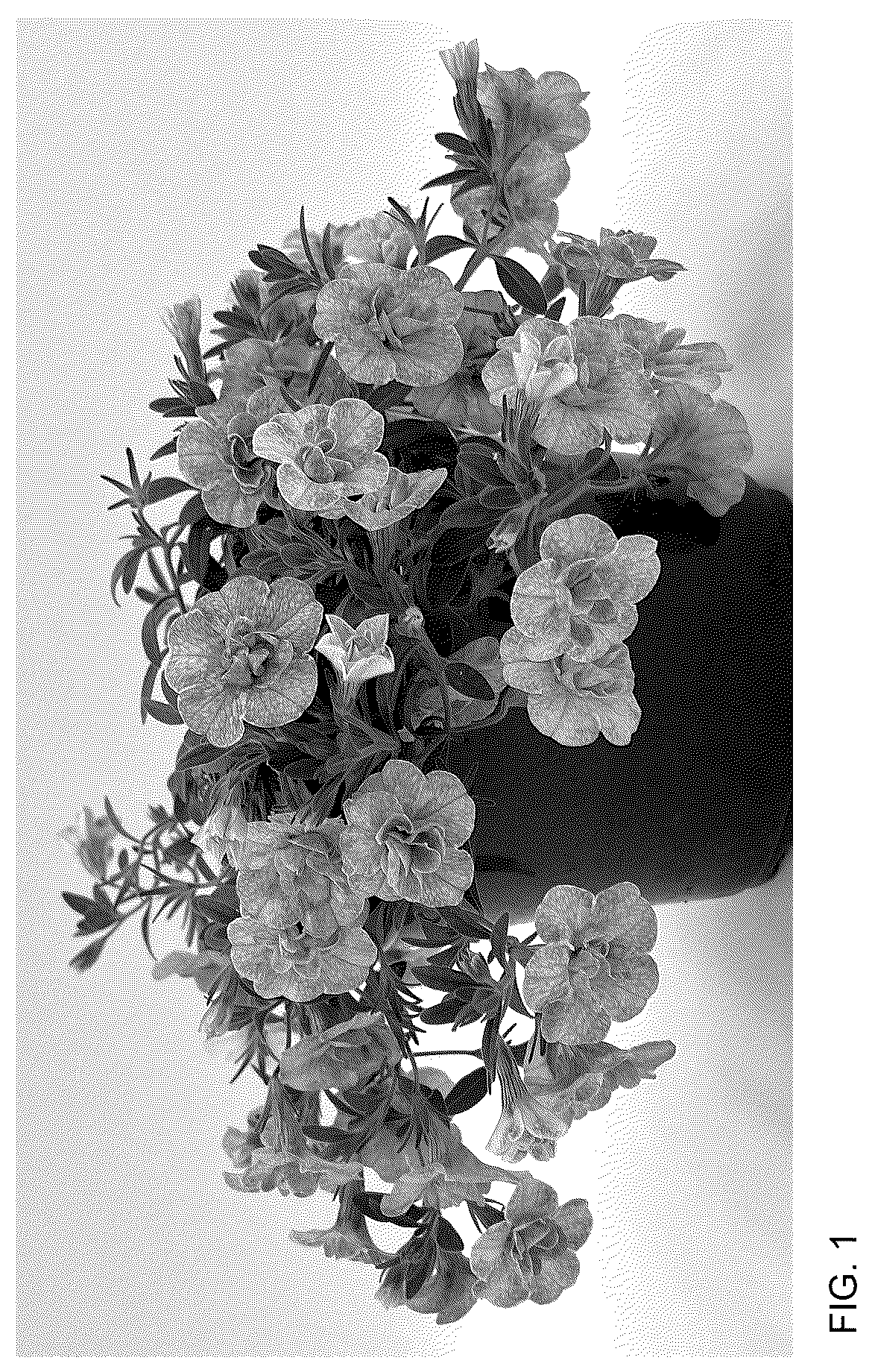
The photograph on the first sheet ( ) is a side perspective view of a typical flowering plant of ‘WNCALSBDBLGF26’ grown in a container.
The photograph on the second sheet ( ) is a close-up view of a typical developing flower of ‘WNCALSBDBLGF26’.
DETAILED BOTANICAL DESCRIPTION
The aforementioned photographs and following observations and measurements describe plants grown during the late summer to early autumn in 813 ml containers in a glass-covered greenhouse in Loudon, New Hampshire and under cultural practices typical of commercial Calibrachoa production. During the production of the plants, day temperatures ranged from 18° C. to 20° C. and night temperatures ranged from 16° C. to 18° C. Plants were pinched one time and were eight weeks from planting rooted young plants when the photographs and description were taken. In the following description, color references are made to The Royal Horticultural Society Colour Chart, 2015 Edition, except where general terms of ordinary dictionary significance are used.
• Botanical classification: Calibrachoa sp. ‘WNCALSBDBLGF26’. • Parentage:
•
• Female, or seed, parent.—Calibrachoa sp. ‘USCAL83901’, not patented. • Male, or pollen, parent.—Calibrachoa sp. ‘Weschachapisoi’, not patented. • Propagation:
•
• Type .—By vegetative terminal cuttings. • Time to initiate roots, summer .—About five to seven days at ambient temperatures about 28° C. • Time to initiate roots, winter .—About seven to ten days at ambient temperatures about 20° C. • Time to produce a rooted plant, summer .—About four to five weeks at ambient temperatures about 28° C. • Time to produce a rooted plant, winter .—About five to six weeks at ambient temperatures about 20° C. • Root description .—Fine, fibrous; typically white in color, actual color of the roots is dependent on substrate composition, water quality, fertilizer type and formulation, substrate temperature and physiological age of roots. • Rooting habit .—Freely branching; medium density. • Plant description:
•
• Plant and growth habit .—Compact, upright to outwardly spreading and mounding to eventually trailing plant habit; freely branching habit with about seven to nine primary lateral branches with secondary laterals developing potentially at every node, dense and bushy plant form; pinching enhances development of lateral branches; moderately vigorous growth habit and moderate growth rate. • Plant height .—About 8 cm to 10 cm. • Plant diameter .—About 35 cm by 37 cm. • Lateral branch description:
•
• Length .—About 15 to 18 cm. • Diameter .—About 2 mm. • Internode length .—About 1.7 cm to 1.9 cm. • Strength .—Moderately strong, flexible and sturdy; wiry. • Aspect .—Initially upright to horizontal to eventually trailing and decumbent. • Texture and luster .—Densely pubescent; pubescence, minute; matte to slightly glossy. • Color, developing and developed .—Close to 144A. • Leaf description:
•
• Arrangement .—Alternate, simple. • Length .—About 2.2 cm to 2.4 cm. • Width .—About 8 mm to 10 mm. • Shape .—Narrowly elliptic to oblanceolate. • Apex .—Broadly acute. • Base .—Attenuate. • Margin .—Entire. • Texture and luster, upper and lower surfaces .—Moderately pubescent; pubescence, minute; matte to slightly glossy. • Venation pattern .—Pinnate; arcuate. • Color .—Developing leaves, upper surface: Close to 146A. Developing leaves, lower surface: Close to 146A to 146B. Fully expanded leaves, upper surface: Close to between NN137A and 147A; midvein, close to 146A and lateral venation, close to between NN137A and 147A. Fully expanded leaves, lower surface: Close to 146A; venation, close to 146A. • Petioles .—Length: About 4 mm. Diameter: About 1 mm. Strength: Moderately strong, flexible. Texture and luster, upper and lower surfaces: Moderately pubescent; pubescence, minute; matte to slightly glossy. Color, upper and lower surfaces: Close to 146A. • Flower description:
•
• Flower type and flowering habit .—Double-type flowers arising from leaf axils; freely flowering habit with typically about 45 to 55 flowers and flower buds developing per plant at one time; flowers face upright to mostly outwardly. • Fragrance .—None detected. • Natural flowering season .—Depending on temperature, plants of the new Calibrachoa begin flowering about five to seven weeks after planting; plants flower continuously from the spring though the summer until frost in New Hampshire. • Flower longevity .—Depending on temperature, flowers last about one to two weeks; flowers persistent. • Flower buds, before showing petal color .—Length: About 1 cm. Diameter: About 5 mm. Shape: Oblanceolate. Texture and luster: Moderately pubescent; pubescence, minute; matte. Color: Close to 146A. • Flower diameter .—About 3.5 cm to 3.75 cm. • Flower length ( height ).—About 2 cm to 2.5 cm. • Flower tube length .—About 1.75 cm. • Flower tube diameter, proximally .—About 2 mm to 2.5 mm. • Corolla .—Arrangement: Five petals in a single whorl with five to occasionally six petaloids in one to two whorls. Petal lobe length: About 1.2 cm to 1.4 cm. Petal lobe width: About 1.5 cm to 1.7 cm. Petaloid lobe length (largest petaloids): About 1.2 cm to 1.4 cm. Petaloid lobe width (largest petaloids): About 1.4 cm to 1.6 cm. Petal and petaloid lobe shape: Fan-shaped with cordate tendencies. Petal and petaloid lobe apex: Emarginate. Petal and petaloid lobe margin: Entire; slightly undulate. Petal and petaloid lobe texture and luster, upper surface: Smooth, glabrous; velvety; matte. Petal and petaloid lobe texture and luster, lower surface: Smooth, glabrous; slightly glossy. Tube texture and luster: Moderately pubescent; matte. Color, petals and petaloids: When opening, upper surface: Close to 8C to 8D. When opening, lower surface: Close to 8D. Fully opened, upper surface: Close to 8C to 8D and 58A; midvein, close to 144A and lateral venation, close to 58A; with subsequent development, color becoming mostly 58A. Fully opened, lower surface: Close to 8D and 58B; midvein, close to 144A and lateral venation, close to 58B; with subsequent development, color becoming mostly 58B. Throat: Close to 12A; venation, close to 146A. Tube: Close to 154D; venation, close to 144A. • Calyx .—Arrangement: One star-shaped calyx tube with five sepals fused towards the base and arranged in a single whorl; sepals flaring outwardly and reflexing towards the apex. Length: About 1 cm to 1.25 cm. Diameter: About 1.1 cm. Sepal length: About 1 cm to 1.25 cm. Sepal width: About 2 mm. Sepal shape: Narrowly lanceolate to acicular. Sepal apex: Acute. Sepal margin: Entire. Sepal texture and luster, upper and lower surfaces: Moderately pubescent; pubescence, minute; matte. Sepal color, upper and lower surfaces: Close to 146A. • Peduncles .—Length: About 1.6 cm to 1.9 cm. Diameter: About 1 mm. Angle: About 45° to 90° from stem axis. Strength: Moderately strong, flexible; wiry. Texture and luster: Moderately pubescent; pubescence, minute; matte. Color: Close to 144A. • Reproductive organs .—Stamens: No stamens observed, all fully transformed into petaloids. Pistils: Quantity: One per flower. Pistil length: About 9 mm to 11 mm. Style length: About 7 mm to 8 mm. Style color: Close to 146B to 146C. Stigma diameter: About 1 mm. Stigma shape: Round. Stigma color: Close to 146A to 146B. Ovary color: Close to 144A. • Seeds and fruits .—To date, seed and fruit development have not been observed on plants of the new Calibrachoa. • Garden performance: Plants of the new Petunia have been observed to have excellent garden performance and have been observed to tolerate rain, wind and temperatures ranging from about 1° C. to about 35° C. • Pathogen & pest resistance: To date, plants of the new Calibrachoa have not been observed to be resistant to pathogens and pests common to Calibrachoa plants.