Abstract
A new and distinct variety of Cannabis sativa designated ‘PTC8506V’ as herein described and illustrated, characterized by elevated levels of THCV.
Claims (1)
1. A new and distinct variety of Cannabis sativa designated ‘PTC8506V’ as herein described and illustrated.
Full Description
Show full text →
Genus/species: Cannabis sativa.
Variety denomination: ‘PTC8506V’.
BACKGROUND
Cannabis plants contain over a hundred known cannabinoids, which bind to endogenous endocannabinoid receptors. Varinolic cannabinoids, as known as varins, are a type of cannabinoid compounds having three carbon atoms in their alkyl side chain instead of the five carbon atom alkyl side chains more commonly associated with cannabinoids. Two such varins are tetrahydrocannabivarin (THCV) and cannabidivarin (CBDV), which are homologues of tetrahydrocannabinol (THC) and cannabidiol (CBD), respectively. Each varin has a unique pharmacological profile and distinct molecular targets.
THCV and CBDV have potential benefits across a broad set of applications. Cannabis plants or extracts with high THCV levels, for example, can be used as an agent for anticonvulsant activity, obesity-associated glucose intolerance, appetite suppression, anxiety management for PTSD, diabetic neuropathy, and major neuropathic and pain related pathologies. Another THCV application is that of an appetite suppressing compound. CBDV has been shown to have anti-epileptic and anticonvulsant activity.
Research and development as well as the sale of varin products has been limited due to low commonly occurring levels of varins in Cannabis flower. The ability to produce Cannabis with high varin levels will create a platform for a new Cannabinoid category with differentiated, high margin products in both medical and recreational markets. The present application solves these problems by providing a novel Cannabis plant having high THCV, which is referred to by the variety name ‘PTC8506V’.
SUMMARY
The new variety of Cannabis sativa was created by sourcing Cannabis plants that produce THCV and THC. Crosses were conducted to elevate further THCV, THC and/or other varins. All breeding, cultivation, and chemotype analyses were conducted in Hillsboro, Oregon. ‘PTC8506V’ resulted from the cross of a high THC pollen receiver plant (‘21GAQ-1271’, unpatented) and a high THCV pollen donor plant (‘21VLP5-1-102’, unpatented). ‘21GAQ-1271’ is a clonal variety with a THC content of 22.2%, and a THCV content below the limit of detection (LOD). ‘21GAQ-1271’ has greenish-purple flowers with heavy trichome coverage, moderate density, and strong aroma. ‘21GAQ-1271’ has an upright plant growth habit with moderately long internodes and matures in 8-9 weeks. ‘21VLP5-1-102’ had a THC content of 1.2%, and THCV content of 5.66%. ‘21VLP5-1-102’ flowers are greenish-purple with low trichome coverage, very low density, and moderately weak aroma. ‘21VLP5-1-102’ has a moderately wide plant growth habit with very long internodes and matures in 10-12 weeks. A clone of ‘21VLP5-1-102’ was crossed onto a clone of ‘21GAQ-1271’ in 2021. 32 of the resulting F1 seed were sown. ‘PTC8506V’ was discovered and selected as a single plant from this F1 seed and was subsequently propagated clonally in Hillsboro, OR. ‘PTC8506V’ was asexually reproduced by apical and sub-apical semi-herbaceous stem cuttings in Hillsboro, Oregon for eight cycles. Asexual reproduction has demonstrated that ‘PTC8506V’ reproduces true to type with all of the characteristics, as herein described, and firmly fixed and retained through successive generations of asexual propagation.
The new variety is named ‘PTC8506V’ and is characterized as having elevated levels of THCV. In comparison to its parents, ‘PTC8506V’ has higher THCV (relative to either parent), and higher THC relative to the pollen donor plant. ‘PTC8506V’ can additionally be distinguished from either parent at least based on the characteristics provided in Table 1.
TABLE 1
Comparison to Parent Varieties.
Trichome Aroma Aroma Growth Inter- Maturity
Variety Coverage Strength Type Habit node Time
‘21GAQ- Heavy Strong Sweet Upright Moder- 8-9
1271’ cookies, ately weeks
earth, long
garlic
‘21VLP5-1- Low Moder- Grass, Moder- Long 10-12
102’ ately earth, ately weeks
weak citrus wide
‘PTC8506V’ Moderate Moder- Pine, Upright Moder- 8-10
ately earth, ately weeks
strong fuel, long
and a
slight
fruiti-
ness
BRIEF DESCRIPTION OF THE PHOTOGRAPH
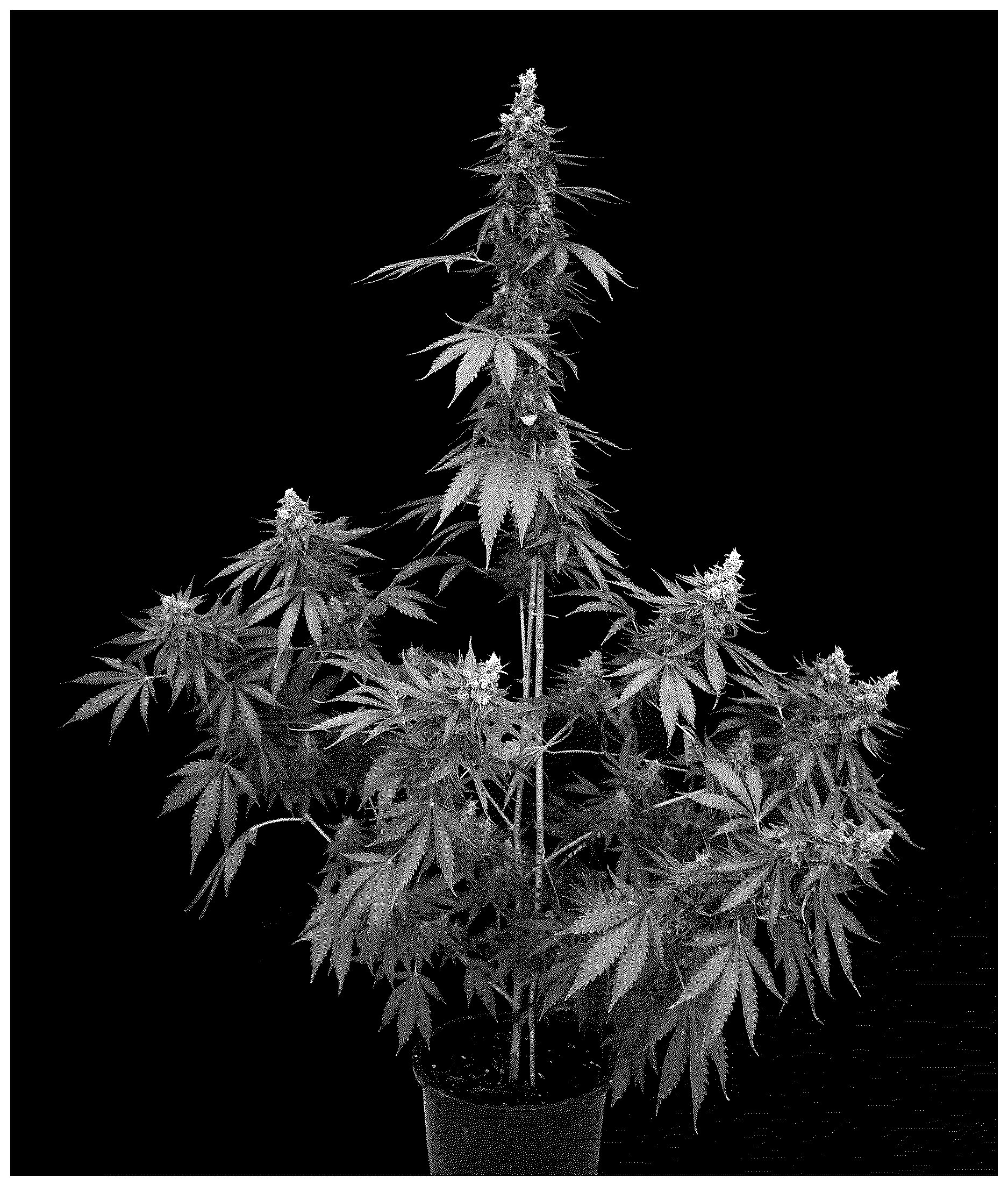
is a photograph of a flowering plant of ‘PTC8506V’ that is approximately 83 days old, growing in Hillsboro, Oregon.
DETAILED BOTANICAL DESCRIPTION
The following is a detailed description of the new Cannabis variety ‘PTC8506V’. Unless otherwise indicated, all color designations provided herein are hex color codes.
All breeding, cultivation, and chemotype analyses were conducted in Hillsboro, Oregon.
Cannabis plants having elevated THCV or THC levels were sourced and obtained, and crosses were conducted to produce new varieties to further elevate THCV and THC levels. The plants were crossed to produce new varieties having elevated THCV and THC levels. Plant variety ‘PTC8506V’ was selected and asexually reproduced.
Table 2 describes the general characteristics of ‘PTC8506V’ at 55 days after lighting was changed to 12 hours on/12 hours off.
TABLE 2
Plant life forms An herbaceous plant (herb)
Plant growth habit An upright, tap-rooted annual
plant, forming fibrous
roots when
asexually propagated
Plant origin A controlled cross between
pollen acceptor
(‘21GAQ-1271’) and pollen donor
plant (‘21VLP5-1-102).
Plant propagation Asexually propagated by apical
and sub-apical semi-
herbaceous stem cuttings
Propagation Ease Easy
Plant shape Simple erect
Height 117 cm to 121 cm
Width 87 cm to 101 cm
Time to harvest 10-12 weeks
Resistance to pests or diseases Unknown
GMO? No
Table 3 describes the leaf/foliage of ‘PCT8506V’. Color codes are hex color codes.
TABLE 3
Leaf Arrangement Alternate
Leaflet Type Palmately compound
Leaflet Structure Serrated margins, lightly acicular
to lanceolate leaflets,
tapering to an acuminate apex
Leaflet Margins Jaggedly serrate with each tooth
apex angled toward
leaflet apex
Leaf hairs Present on both upper and
lower surfaces
Leaf length with petiole at 18.5 cm to 23 cm
maturity
Petiole length at maturity 6 cm to 9.5 cm
Petiole diameter at maturity 1.9 mm to 2.5 mm
Petiole color #6B4247
Anthocyanin color and intensity #F9CCC5. Medium intensity
in Petioles in vegetative stage;
stronger in flowering stage
Stipule length at maturity 6.2 mm to 6.8 mm
Stipule shape Linear with slight curvaceous
growth
Stipule color #3C4D03
No. of leaflets 3 to 7
Middle largest (longest) leaflet 12 cm to 17.5 cm
length
Middle largest (longest) leaflet 2.5 cm to 3.1 cm
width
Middle largest (longest) leaflet 3.8 to 4.8
length/width ratio
No. teeth of middle leaflet 28 to 34
Leaf (upper side-adaxial) color #35530A
Leaf (lower side-abaxial) color #35530A
Leaf glossiness Matte
Vein/midrib shape Obliquely continuous
throughout leaflet
Vein/midrib color #E6DAA6
Aroma Earthy notes of pine, fuel, and
a slight fruitiness
Table 4 describes the stem of ‘PTC8506V’.
TABLE 4
Stem shape Hollow, ribbed, texture
Stem length 117 cm to 121 cm
Stem strength Strong and upright
Stem diameter at base 13.6 mm to 14.5 mm
Stem color #373E02
Depth of main stem ribs/grooves Shallow
Internode length 3 cm to 9.5 cm
Table 5 describes the inflorescence of ‘PTC8506V’.
TABLE 5
Inflorescence type Elongated compound cymes
Flowering (blooming) habit Natural flowering season is
Autumn in Hillsboro, Oregon.
Proportion of female plants 100% pistillate
Inflorescence position Terminal and axillary
Number of inflorescences 100 to 150
produced per plant
Flower arrangement Cymose
Length of inflorescences 3 cm to 3.8 cm
Numbers of flowers per plant Hundreds to thousands flowers per
plant, multitudinous, congested
with high concentrations on
bushier wide inflorescence
Flower shape Urceolate
Flower (individual pistillate) 5.1 mm to 5.3 mm
length
Flower (individual pistillate) 2 mm
depth
Flower (compound cyme) 5.5 cm to 8 cm
diameter
Corolla No defined corolla
Corolla color N/A
Bract shape Urceolate
Bract color #4B5D16
Typical bract numbers 3 to 200 bracts per inflorescence.
Bract length 3 mm to 5mm
Bract width 2.3 mm to 2.7 mm
Bract apex and base description Bracts have a rounded base and
caudate apex.
Bract Texture Bract texture is smooth and
covered with sticky trichomes.
Bracteole number, shape, length, Bracteoles are not present
width, apex, margin, base
descriptors, texture, and color
Calyx shape No defined calyx
Calyx color N/A
Pistil number per flower One
Pistil color Pistil consists of the stigma, style,
and ovary and cannot be
given a single color.
Stigma shape Acute
Number of stigmas per flower Two
Stigma length 4.6 mm to 6.5 mm
Stigma color #373E02
Trichome shape Capitate-stalked glandular
Trichome color #F1E7E2
Terminal inflorescence shape Oblong
Terminal inflorescence color #B7E1A1
Terminal inflorescence length 12.5 cm to 14 cm
Terminal inflorescence width 5 cm to 6.5 cm
Pedicel Absent
Peduncle length 6.8 mm
Peduncle diameter 4.1 mm
Peduncle texture Lightly ribbed
Peduncle color #9BB53C
Staminate shape No staminate flowers produced
naturally; however, male
flower (staminate) can be
induced with stress or ethylene-
blocking compounds
Sepal color N/A
Pollen description N/A
Petal description Apetalous
Table 6 describes other characteristics of ‘PTC8506V’
TABLE 6
Time period and condition 8 to 10 weeks
of flowering/blooming
Proportion of hermaphrodite Lower (<5%) in clones
plants
Hardiness of plant Hardy to tolerate of warm
and dry conditions
without showing stress.
Not tolerant to soil
oversaturated with water
for long periods
Chemical analyses were conducted using High Performance Liquid Chromatography to detect the cannabinoids described herein. Table 7 describes a chemotype analysis of ‘PTC8506V’, which was chemotyped by taking a sample from the main cola at day 56 after initiation of the 12:12 light cycle, which initiates flowering. Trichomes were 70% cloudy and 5% amber, indicative of full maturity at sampling.
TABLE 7
Cannabinoid and other chemicals % wt
Total THC 4.613
Total THCV 11.067
Total CBG 0.047
Total CBD <LOD
Total CBC <LOD
Total CBGV <LOD
Total CBDV <LOD
alpha-Pinene 0.057
Camphene 0.011
beta-Myrcene 1.557
beta-Pinene 0.098
delta-3-Carene <LOQ
alpha-terpinene <LOQ
D-Limonene 0.211
beta-Ocimene 0.275
p-Cymene <LOQ
Eucalyptol <LOQ
gamma-Terpinene <LOQ
Terpinolene <LOQ
Linalool 0.003
Isopulegol <LOQ
Geraniol <LOQ
beta-Caryophyllene 0.05
alpha-Humulene 0.0227
Nerolidol 1 <LOQ
Nerolidol 2 0.011
Guaiol <LOQ
Caryophyllene Oxide 0.011
alpha-Bisabolol 0.026
Total Terpenes 2.315