Strawberry Plant Named ‘drisstrawonehundredten’
Abstract
A new and distinct variety of strawberry plant named ‘DrisStrawOneHundredTen’, particularly selected for its open plant habit, large fruit, sustained production, and fruit quality, is disclosed.
Claims (1)
1. A new and distinct variety of strawberry plant named ‘DrisStrawOneHundredTen’ as shown and described herein.
Full Description
Show full text →
Latin name:
Botanical classification: Fragaria x ananassa.
Varietal denomination: The varietal denomination of the claimed variety of strawberry plant is ‘DrisStrawOneHundredTen’.
BACKGROUND OF THE INVENTION
Cultivated strawberry is a hybrid species of the genus Fragaria that is grown worldwide for its fruit. Modern strawberry was first bred in Brittany, France, in the 18 th century by crossing Fragaria virginiana with Fragaria chiloensis . Strawberry fruit is an aggregate accessory fruit, with the fleshy part of the fruit being derived from the receptacle that holds the ovaries.
Strawberry varieties vary widely in color, size, shape, flavor, season of ripening, degree of fertility, and susceptibility to disease. Certain varieties vary in foliage, and some vary in the relative development of their reproductive organs. Typically, strawberry flowers appear hermaphroditic in structure, but function as either male or female. Generally, commercial production of strawberry plants involves propagation from runners and distribution as either plugs or bare root plants. Cultivation is either perennial or annual plasticulture. During the off season, strawberries can also be produced in greenhouses.
Strawberry fruit is widely appreciated for its characteristic bright red color, aroma, juicy texture, and sweetness. Strawberry fruit is a popular fruit that is generally consumed either fresh or in prepared foods, such as preserves and baked goods.
Strawberry is an important and valuable fruit crop. Accordingly, there is a need for new varieties of strawberry plants. In particular, there is a need for improved varieties of strawberry plant that are stable, high yielding, and agronomically sound.
SUMMARY OF THE INVENTION
In order to meet these needs, the present invention is directed to an improved variety of strawberry plant. In particular, the invention relates to a new and distinct variety of strawberry plant ( Fragaria x ananassa ), which has been denominated as ‘DrisStrawOneHundredTen’.
Strawberry plant variety ‘DrisStrawOneHundredTen’ originated from a controlled cross between the female parent ‘DrisStrawNinetySix’ (U.S. Plant Pat. No. 34,775) and the proprietary strawberry male parent ‘DW142.130’ (unpatented). Progeny plants from this cross, including ‘DrisStrawOneHundredTen’, were asexually propagated via stolons in Shasta County, California in May 2018. Strawberry plant variety ‘DrisStrawOneHundredTen’ was later specifically identified and selected in Monterey County, California in April 2019.
‘DrisStrawOneHundredTen’ was subsequently asexually propagated via stolons, and has undergone testing at test plots in Monterey County, California for five years (2019 to 2024). The present variety has been found to be stable and reproduce true to type through successive asexual propagations via stolons and tissue culture.
‘DrisStrawOneHundredTen’ was particularly selected for its open plant habit, large fruit, sustained production, and fruit quality.
DESCRIPTION OF THE DRAWINGS
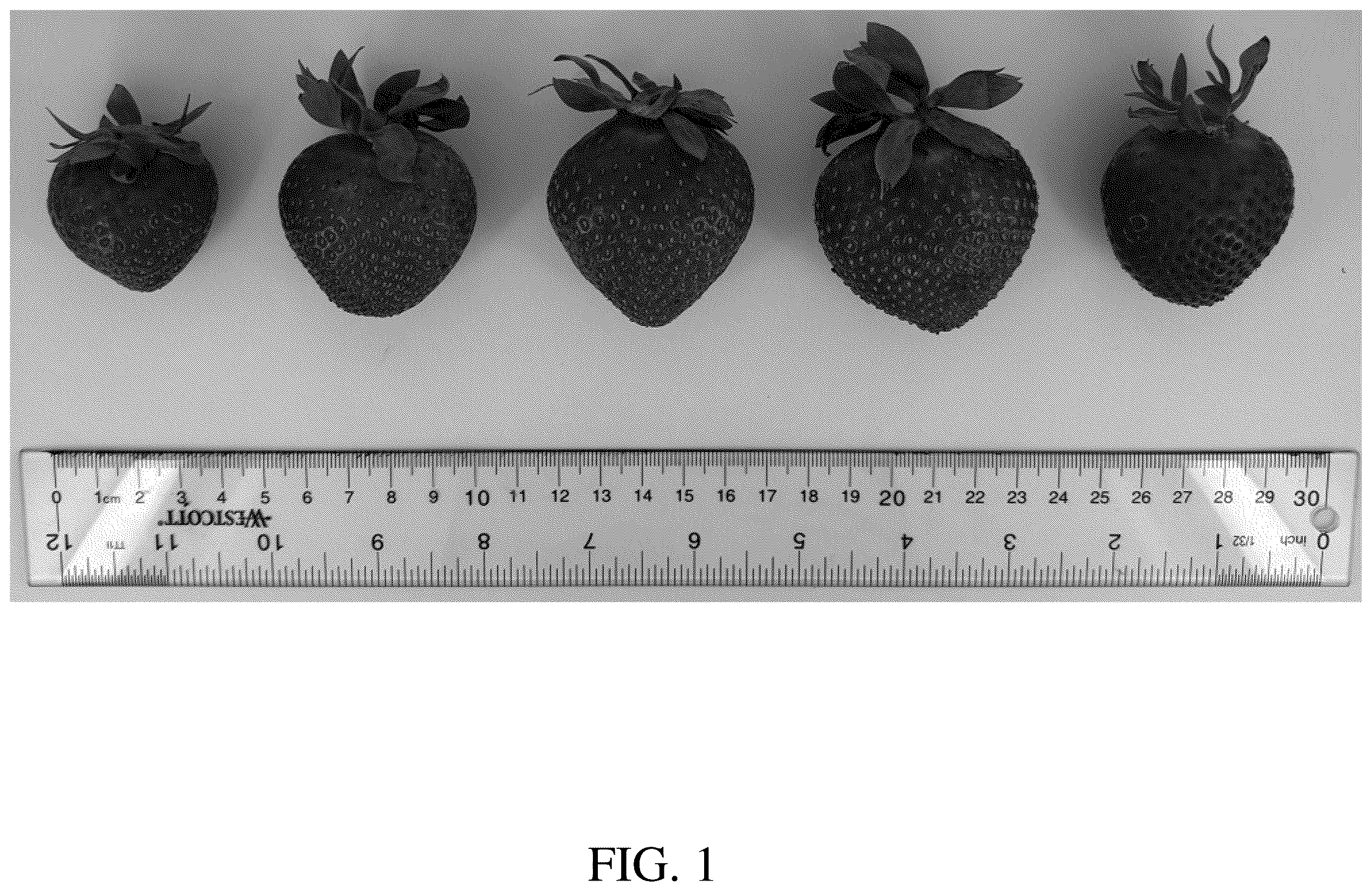
This new strawberry plant is illustrated by the accompanying photographs. The colors shown are as true as can be reasonably obtained by conventional photographic procedures. Unless otherwise indicated, the photographs are of plants that are approximately 10 months old.
illustrates whole fruit of variety ‘DrisStrawOneHundredTen’.
illustrates longitudinal sections of fruit of variety ‘DrisStrawOneHundredTen’.
illustrates the upper surface (top row) and lower surface (bottom row) of flowers of variety ‘DrisStrawOneHundredTen’.
illustrates leaves of variety ‘DrisStrawOneHundredTen’.
illustrates wholes plants of variety ‘DrisStrawOneHundredTen’.
DETAILED BOTANICAL DESCRIPTION
The following detailed descriptions set forth the distinctive characteristics of ‘DrisStrawOneHundredTen’. The data which define these characteristics is based on observations taken in Monterey County, California from 2019 to 2024. This description is in accordance with UPOV terminology. Color designations, color descriptions, and other phenotypical descriptions may deviate from the stated values and descriptions depending upon variation in environmental, seasonal, climatic, and cultural conditions.
‘DrisStrawOneHundredTen’ has not been observed under all possible environmental conditions. The botanical description of ‘DrisStrawOneHundredTen’ was taken from plants that were approximately ten months old. The indicated values represent averages calculated from measurements of several plants. Color references are primarily to The R.H.S. Colour Chart of The Royal Horticultural Society of London (R.H.S.) (2015 edition). Descriptive terminology follows the Plant Identification Terminology, An Illustrated Glossary, 2 nd edition by James G. Harris and Melinda Woolf Harris, unless where otherwise defined.
• Classification:
•
• Species.—Fragaria x ananassa. • Common name .—Strawberry. • Denomination .—‘DrisStrawOneHundredTen’. • Parentage:
•
• Female parent .—‘DrisStrawNinetySix’ (U.S. Plant Pat. No. 34,775). • Male parent .—Proprietary strawberry plant ‘DW142.130’ (unpatented). • Plant:
•
• Height.— 25 cm. • Width.— 42 cm. • Height/width ratio.— 0.60. • Number of crowns per plant.— 7.3. • Growth habit .—Semi-upright. • Density of foliage .—Medium. • Vigor .—Medium. • Stolon:
•
• Diameter ( at bract ).—3.2 mm. • Overall color .—RHS 144A (Yellow green). • Anthocyanin coloration .—Weak. • Density of pubescence .—Medium. • Fruiting truss:
•
• Length ( from crown to base of terminal flower or fruit ).—24.8 cm. • Diameter ( at base of truss ).—0.32 cm. • Number of berries per truss.— 3.8. • Attitude at first picking .—Semi-erect. • Color ( at base of truss ).—RHS 144B (Yellow green). • Leaf:
•
• Number of leaflets .—Three only. • Color of leaf upper surface .—RHS 137A (Moderate olive green). • Color of leaf lower surface .—RHS 147B (Moderate yellow green). • Blistering .—Absent or weak. • Glossiness .—Medium. • Variegation .—Absent. • Terminal leaflet .—Length: 7 cm. Width: 6.2 cm. Length/width ratio: 1.13. Number of teeth per terminal leaflet: 16.8. Overall shape: Orbicular. Shape of base: Obtuse. Shape of apex: Rounded. Margin: Serrate to crenate. Margin profile: Flat (level with the leaflet blade). Shape in cross section: Concave. • Petiole .—Length: 218.5 mm. Diameter: 2.57 mm. Overall color: RHS 145B (Light yellow green). Pubescence: Medium. Attitude of hairs: Horizontal. Bract frequency (number present on each petiole): 0.1. • Petiolule .—Length: 4.9 mm. Diameter: 1.63 mm. Color: RHS 145B (Light yellow green). • Stipule .—Length: 34.9 mm. Width: 8.3 mm. Stipule color: RHS 144C (Strong yellow green). Anthocyanin coloration: Weak. Anthocyanin color: RHS N66B (Vivid purplish pink). Pubescence: Absent or very sparse. • Inflorescence:
•
• Number of flowers per plant.— 5.3. • Position of inflorescence in relation to foliage .—Above foliage. • Flowering interval .—Early February to late October. • Pedicel .—Attitude of hairs: Upwards. • Flower .—Flower diameter (petal tip to petal tip on non-flattened flower): 25.1 mm. Arrangement of petals: Overlapping. Size of calyx in relation to corolla: Larger. Receptacle color: RHS 154A (Vivid yellow green). Stamen: Present. Anther color: RHS 17C (Vivid yellow). • Petal .—Length: 10.6 mm. Width: 11 mm. Length/width ratio: 0.96. Number of petals per flower: 6.1. Color of upper surface: RHS NN155C (White). Color of lower surface: RHS NN155C (White). Overall shape: Orbicular. Shape of apex: Rounded. Margin: Entire. Shape of base: Concavo-convex. • Calyx .—Diameter (sepal tip to sepal tip, measured on back of flower): 34.6 mm. • Sepal .—Length: 12.7 mm. Width: 5.9 mm. Number of sepals per flower: 12. Overall shape: Elliptical. Margin: Entire. • Fruit:
•
• Fruit size .—Length: 41 mm. Width: 39.8 mm. Length/width ratio: 1.03. • Fruit hollow .—Length: 12 mm. Width: 7.5 mm. Length/width ratio: 1.6. • Shape .—Cordate. • Difference in shape of terminal and other fruits .—None or very slight. • Fruit color .—RHS 46B (Strong red). • Evenness of color .—Even or very slightly uneven. • Glossiness .—Medium. • Evenness of surface .—Even or very slightly uneven. • Width of band without achenes .—Absent or very narrow. • Position of achenes .—Level with surface. • Position of calyx attachment .—Inserted. • Attitude of sepals .—Outwards. • Diameter of calyx in relation to diameter of fruit .—Same size. • Adherence of calyx .—Strong. • Firmness .—Medium firm. • Color of flesh ( excluding core ).—RHS 42B (Strong reddish orange). • Evenness of flesh color .—Uneven. • Distribution of flesh color .—Marginal and central. • Color of core .—RHS NN155A (Yellowish white). • Sweetness/soluble solids ( in °Brix ).—9.3. • Titratable acidity (% as citric acid ).—0.77%. • Individual fruit weight.— 26.6 g/fruit. • Achenes .—Number of achenes per fruit: 296. Weight: 0.0006 g/achene. Color of upper (sunward) side: RHS 46B (Strong red). Color of lower (shaded) side: RHS 153B (Strong greenish yellow). • Fruiting .—Harvest interval: Mid-March to early November. Type of bearing: Day neutral. Productivity: 83,130 kg to 106,397 kg of fruit per hectare per season from 5- to 12-month-old plants when grown in Monterey County, California. • Resistance to abiotic stress, pests, and diseases:
•
• Drought .—Susceptible. • Powdery mildew ( Podosphaera macularis ).—Moderately resistant. • Anthracnose crown rot ( Colletotrichum acutatum ).—Susceptible. • Fusarium wilt race 1 ( Fusarium oxysporum ).—Resistant. • Phytophthora crown wilt ( Phytophthora cactorum ).—Susceptible.
COMPARISON WITH PARENTAL AND REFERENCE VARIETIES
‘DrisStrawOneHundredTen’ differs from the female parent and reference variety ‘DrisStrawNinetySix’ (U.S. Plant Pat. No. 34,775) in that ‘DrisStrawOneHundredTen’ has absent or weak leaf blistering, cordate fruit shape, medium fruit firmness, day neutral type of bearing, and the position of inflorescence is above the foliage, whereas ‘DrisStrawNinetySix’ has medium leaf blistering, conical fruit shape, firm fruit firmness, partially remontant type of bearing, and the position of inflorescence is beneath the foliage. Further, ‘DrisStrawOneHundredTen’ has a more open plant habit, more irregular fruit shapes, an earlier ramp up in production, and exhibits a tendency for the foliage to redden later in the season as compared to ‘DrisStrawNinetySix’.
‘DrisStrawOneHundredTen’ differs from the male parent proprietary strawberry plant ‘DW142.130’ (unpatented) in that ‘DrisStrawOneHundredTen’ has larger fruit size, more compact plant size, higher yield potential, more irregular fruit shapes, and exhibits a tendency for the foliage to redden later in the season as compared to ‘DW142.130’.
‘DrisStrawOneHundredTen’ differs from the reference variety ‘DrisStrawFortyFour’ (U.S. Plant Pat. No. 26,801) in that ‘DrisStrawOneHundredTen’ has medium plant vigor, obtuse shape of terminal leaflet base, overlapping arrangement of petals, cordate fruit shape, and the size of calyx is larger in relation to the corolla, whereas ‘DrisStrawFortyFour’ has very strong plant vigor, rounded shape of terminal leaflet base, free arrangement of petals, conical fruit shape, and the size of calyx is the same size in relation to the corolla.
Figures (5)
Citations
This patent cites (171)
- USPP1745
- USPP3981
- USPP4487
- USPP4538
- USPP5262
- USPP5265
- USPP5266
- USPP5300
- USPP5840
- USPP6191
- USPP6231
- USPP6578
- USPP6579
- USPP7024
- USPP7172
- USPP7522
- USPP7614
- USPP7615
- USPP8086
- USPP8205
- USPP8649
- USPP8661
- USPP8708
- USPP8745
- USPP9130
- USPP9909
- USPP10221
- USPP10534
- USPP10642
- USPP11035
- USPP11277
- USPP11279
- USPP11522
- USPP11548
- USPP11554
- USPP11639
- USPP12186
- USPP12436
- USPP12577
- USPP12817
- USPP12899
- USPP13386
- USPP13469
- USPP14005
- USPP14062
- USPP14109
- USPP14771
- USPP15145
- USPP15308
- USPP15375
- USPP15435
- USPP15596
- USPP15731
- USPP15752
- USPP16070
- USPP16238
- USPP16241
- USPP16298
- USPP16299
- USPP16475
- USPP16558
- USPP18000
- USPP18040
- USPP18041
- USPP18458
- USPP18575
- USPP18878
- USPP19240
- USPP19673
- USPP19767
- USPP20248
- USPP20363
- USPP20701
- USPP20731
- USPP20733
- USPP20735
- USPP20775
- USPP20922
- USPP21538
- USPP21559
- USPP21762
- USPP22040
- USPP22218
- USPP22247
- USPP23107
- USPP23148
- USPP23377
- USPP23378
- USPP23382
- USPP23383
- USPP23400
- USPP23401
- USPP23459
- USPP23506
- USPP23517
- USPP24096
- USPP24317
- USPP24333
- USPP24395
- USPP24533
- USPP24745
- USPP25408
- USPP25437
- USPP25698
- USPP25699
- USPP25747
- USPP25866
- USPP26800
- USPP26801
- USPP26802
- USPP27442
- USPP27645
- USPP27682
- USPP27711
- USPP27813
- USPP29289
- USPP29728
- USPP29729
- USPP29730
- USPP29731
- USPP29747
- USPP29748
- USPP29749
- USPP30775
- USPP30789
- USPP30818
- USPP30851
- USPP30936
- USPP31083
- USPP31233
- USPP31527
- USPP31655
- USPP31703
- USPP31827
- USPP31896
- USPP31935
- USPP32079
- USPP32080
- USPP32271
- USPP32305
- USPP32498
- USPP32499
- USPP32500
- USPP32801
- USPP32814
- USPP32824
- USPP33070
- USPP33090
- USPP33283
- USPP33513
- USPP33737
- USPP33738
- USPP34072
- USPP34212
- USPP34241
- USPP34273
- USPP34274
- USPP34440
- USPP34441
- USPP34659
- USPP34751
- USPP34775
- USPP34776
- USPP34777
- USPP34916
- USPP35092
- USPP35093
- USPP35158
- USPP35909
- US2003/0079263
- US2013/0276182