Claims (27)
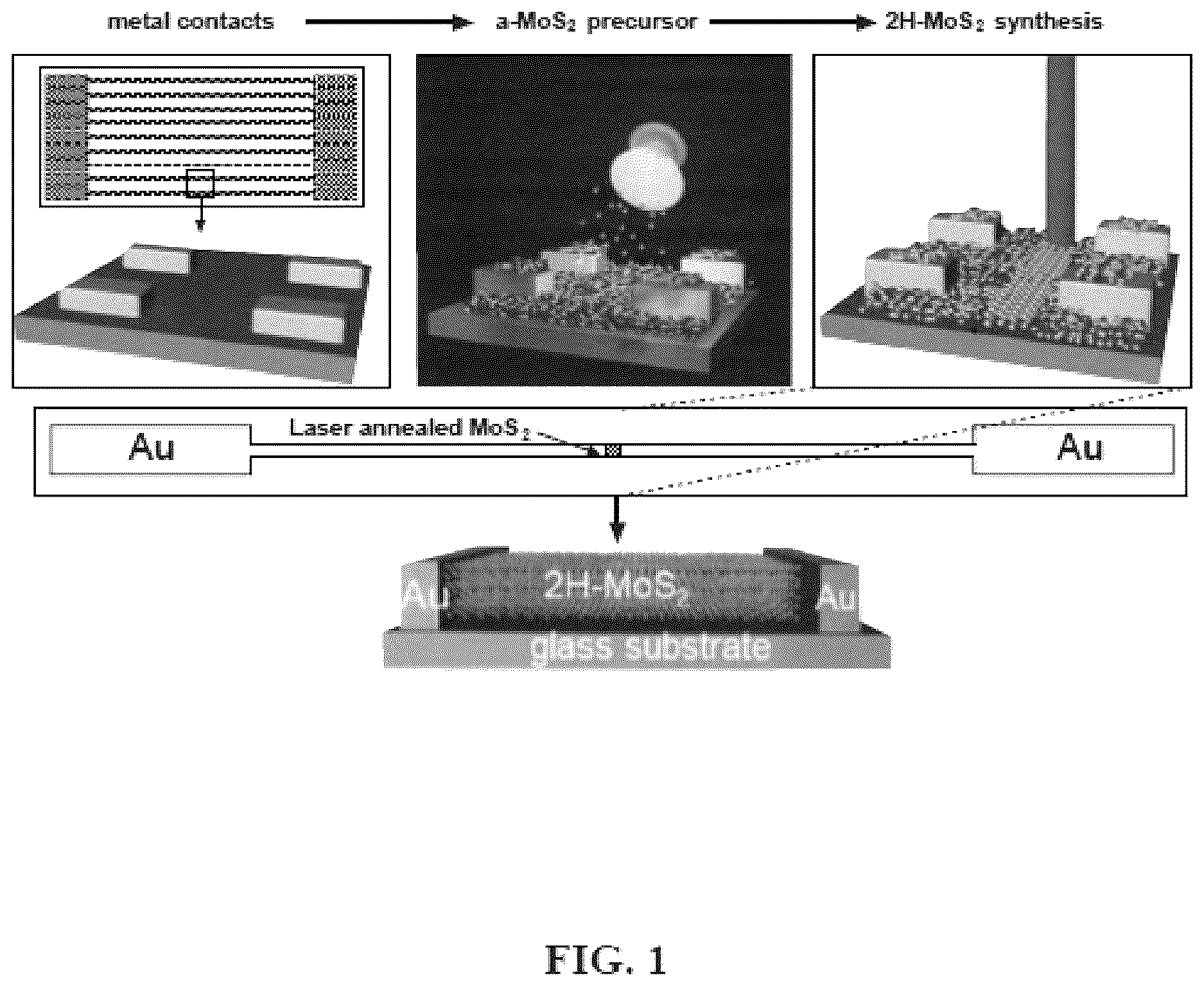
1 . A process of making a sensor, said process comprising; a) applying one or more coatings of electrically conductive material to a substrate, which substrate has a first side and a second side, said one or more coatings of electrically conductive material being applied to at least the first side of said substrate; b) removing a portion of said electrically conductive material to form a pattern of electrically conductive material electrodes on said substrate; c) applying one or more chemical coatings in the form of a continuous film over said patterned electrical conductive material to form a coated substrate, wherein said patterned electrical conductive material comprises a material selected from the group consisting of: poly(3,4-ethylenedioxythiophene), poly(3,4-ethylenedioxythiophene) polystyrene sulfonate, poly(pyrrole), polycarbazoles, polyindoles, polyazepines, Cr, Mo, Ti, Sc, Ni, V, Hf, W, Nb, Au, Ag, Cu, and Pt, and mixtures thereof, and said one or more chemical coatings disposed over said one or more coatings of patterned electrical conductive material each independently comprise a transition metal and an element selected from the group consisting of: hydrogen, carbon, nitrogen, oxygen, sulfur, selenium, phosphorous, and mixtures thereof, wherein said one or more chemical coatings each independently comprising at least one of an amorphous, nanocrystalline, microcrystalline or crystalline region; d) pattern illumination-based annealing said coated substrate, said pattern illumination-based annealing comprising using one or more lasers and/or lamps to achieve at least one of a chemical change or a change in crystallization in at least a portion of at least one of said one or more chemical coatings on at least one side of said substrate; and e) attaching one or more types of functional molecules and/or one or more complexes comprising one or more types of functional molecules and one or more target molecules to at least a portion of said pattern illumination-based anneal coated substrate, said one or types of functional molecules being attached by: (i) attaching said one or more functional molecules and/or one or more complexes to an annealed portion on the surface of said pattern illumination-based anneal coated substrate at vacancies in the surface of the chemical coating that create bonding sites for said functional molecules; and/or (ii) bonding a peptide to said pattern illumination-based anneal coated substrate and attaching said one or more functional molecules to said peptide.
Show 26 dependent claims
2 . A process of making a sensor according to claim 1 wherein said one or more functional molecules are biomaterials that are selected from the group consisting of: peptides, nanozymes, proteins, lipids, carbohydrates and lectins, nucleic acids, and mixtures thereof.
3 . A process of making a sensor according to claim 2 wherein said biomaterial's attachment to said pattern illumination-based anneal coated substrate comprises at least one of a covalent bond, electrostatic bond, or a covalent and electrostatic bond.
4 . A process of making a sensor according to claim 2 wherein said attaching said biomaterials to said pattern illumination-based anneal coated substrate comprises contacting said at least a portion of said pattern illumination-based anneal coated substrate and said one or more types of biomaterials.
5 . A process of making a sensor according to claim 1 wherein: at least one of said one or more chemical coatings comprises, prior to said annealing, two or more regions that are amorphous, nanocrystalline, microcrystalline or crystalline with the proviso that at least two of said regions are not identical with respect to being amorphous, nanocrystalline, microcrystalline or crystalline and said laser or lamp forms on, within or on and within said at least one of said one or more chemical coatings: (i) at least two electronic elements selected from a conductor, semiconductor and an insulator; (ii) two or more different conductors having at least one of the following: different electrical properties or different optical properties; (iii) two or more different semiconductors having at least one of the following: different electrical properties or different optical properties; or (iv) two or more different insulators having at least one of the following: different electrical properties or different optical properties; said process being performed under one of the following conditions: vacuum of less 100 torr, air or under a fluid blanket other than air; and said pattern illumination-based annealing results in at least one of a chemical change or a change in crystallization, or the removal of at least a portion of at least one of said one or more chemical coatings and resulting in an electrical component, an optical component or a combined electrical and optical component being formed on, within or on and within at least a portion of said pattern illumination-based annealed one or more chemical coatings.
6 . The process of claim 1 further comprising performing steps a) to e) on the second side of said substrate as well.
7 . The process of claim 1 wherein said transition metal is selected from the group consisting of molybdenum, tungsten, niobium, tantalum, vanadium, titanium, chromium, iron, rhodium, hafnium, rhenium and mixtures thereof.
8 . A process according to claim 1 wherein said one or types of functional molecules are primarily attached to said pattern illumination-based anneal coated substrate by bonding a peptide to said pattern illumination-based anneal coated substrate and attaching said one or more functional molecules to said peptide.
9 . The process of claim 5 wherein, said electrical and/or optical component is selected from the group consisting of an inductor, a capacitor, a resistor, a diode, a a trace, a battery, an optical filter, a chemical sensor, a biological sensor and a solar cell.
10 . The process of claim 1 wherein said pattern illumination-based annealing in step d) further comprises removal of at least a portion of said chemical coating on at least one side of said substrate, and each of said one or more chemical coatings have an area and a thickness and said removal of said at least a portion of said one or more chemical coating occurs, said removal comprising at least one of: a.) laser ablation removal of from about 0.1% to about 99.9% of at least one of said one or more chemical coatings' area; or b.) laser ablation removal of at least 85% of at least one of said chemical coatings' thickness; or laser ablation removal of about 85% to about 99% of at least one of said chemical coatings' thickness.
11 . The process of claim 1 , said process being a roll process wherein said coated chemically substrate is a rolled coated chemically substrate that is unrolled at least in part, said unrolled chemical coating portion of said coated substrate being at least in part pattern illumination-based annealed.
12 . The process of claim 1 wherein said substrate of said coated substrate is selected from glass, polymer and mixtures thereof.
13 . The process of claim 1 wherein at least a portion of said coated substrate's pattern illumination-based annealed chemical coating is further treated by at least one of the following processes: a.) two or more pattern illumination-based annealings; b.) plasma treatment comprising exposing said at least a portion of said coated substrate's pattern illumination-based annealed chemical coating to an ionized gas derived from the group consisting of He, Ne, Ar, Kr, Xe, H 2 , O 2 , SF 6 , CF 4 , N 2 and mixtures thereof; c.) ion beam irradiation comprising exposing said at least a portion of said coated substrate's pattern illumination-based annealed chemical coating to an ion beam, said ion beam comprising an ionized gas derived from the group consisting of He, Ne, Ar, Kr, Xe, H 2 , O 2 , SF 6 , CF 4 , N 2 and mixtures thereof; d.) electron beam illumination comprising at least a portion of said coated substrate's pattern illumination-based annealed chemical coating to an electron dose of from about 10 2 electrons/nm 2 to about 10 25 electrons/nm 2 ; e.) thermal annealing said at least a portion of said coated substrate's pattern illumination-based annealed chemical coating, said at least a portion of said coated substrate's pattern illumination-based annealed chemical coating's thermal annealing treatment temperature being from about 250° C. to about 1,500° C.; f.) chemically etching said at least a portion of said coated substrate's pattern illumination-based annealed chemical coating comprising contacting said at least a portion of said coated substrate's pattern illumination-based annealed chemical coating with an etching composition; g.) electro-chemically treating said at least a portion of said coated substrate's pattern illumination-based annealed chemical coating by contacting said at least a portion of said coated substrate's pattern illumination-based annealed chemical coating with a chemical composition comprising an electrolyte and subjecting said contacted at least a portion of said coated substrate's pattern illumination-based annealed chemical coating and said chemical composition comprising an electrolyte to an electrical current; h.) surface physical modification of at least a portion of said coated substrate's pattern illumination-based annealed chemical coating.
14 . The process of claim 1 wherein each target is independently a chemical target or a biological target.
15 . The process of claim 1 wherein said step c) of applying one or more chemical coatings in the form of a continuous film over said patterned electrical conductive material to form a coated substrate comprises applying said one or more chemical coatings using a chemical or physical vapor deposition process.
16 . The process of claim 1 wherein said pattern illumination-based annealing results in a change in the molecular composition in a region of at least one of said materials that results in an electrical component, an optical component or a combined electrical and optical component being formed on, within or on and within said material.
17 . The process of claim 16 wherein the transition metal is Mo, and the element is oxygen, and the process forms different oxide phases MoO 2 and MoO 3 on, within, or on and within said material.
18 . The process of claim 7 wherein said transition metal is selected from the group consisting of: niobium, tantalum, vanadium, titanium, chromium, iron, rhodium, hafnium, rhenium, and mixtures thereof.
19 . The process of claim 1 wherein at least a portion of said coated substrate's pattern illumination-based annealed chemical coating is further treated by at least one of the following processes: a) plasma treatment comprising exposing said at least a portion of said coated substrate's pattern illumination-based annealed chemical coating to an ionized gas derived from the group consisting of He, Ne, Ar, Kr, Xe, H 2 , O 2 , SF 6 , CF 4 , N 2 and mixtures thereof; b) ion beam irradiation comprising exposing said at least a portion of said coated substrate's pattern illumination-based annealed chemical coating to an ion beam, said ion beam comprising an ionized gas derived from the group consisting of He, Ne, Ar, Kr, Xe, H 2 , O 2 , SF 6 , CF 4 , N 2 and mixtures thereof; c) electron beam illumination comprising at least a portion of said coated substrate's pattern illumination-based annealed chemical coating to an electron dose of from about 10 2 electrons/nm 2 to about 10 25 electrons/nm 2 d) chemically etching said at least a portion of said coated substrate's pattern illumination-based annealed chemical coating comprising contacting said at least a portion of said coated substrate's pattern illumination-based annealed chemical coating with an etching composition; e) electro-chemically treating said at least a portion of said coated substrate's pattern illumination-based annealed chemical coating by contacting said at least a portion of said coated substrate's pattern illumination-based annealed chemical coating with a chemical composition comprising an electrolyte and subjecting said contacted at least a portion of said coated substrate's pattern illumination-based annealed chemical coating and said chemical composition comprising an electrolyte to an electrical current; and f) surface physical modification of at least a portion of said coated substrate's pattern illumination-based annealed chemical coating.
20 . A process of making a sensor according to claim 1 wherein said one or more functional molecules are biomaterials that are selected from the group consisting of: peptides, nanozymes, lipids, carbohydrates and lectins, nucleic acids, and mixtures thereof.
21 . A process of making a sensor according to claim 2 wherein said biomaterial's attachment to said pattern illumination-based anneal coated substrate comprises an electrostatic bond.
22 . The process of claim 1 wherein said one or more types of functional molecules comprise a 12-mer peptide having SEQ. ID 1.
23 . The process of claim 1 wherein said one or more types of functional molecules comprise a peptide having SEQ. ID 2 that is functionalized with two leucine amino acids for detecting cardiac troponin (cTnl).
24 . The process of claim 1 wherein said one or more types of functional molecules comprise a peptide having SEQ. ID 3 to bind to alanine aminotransferase.
25 . The process of claim 1 wherein said one or more types of functional molecules comprise at least one of the following: 1) the peptide having SEQ. ID 4 for detecting HIV1 protease; 2) the peptide having SEQ ID 5 for detecting trypsin; 3) the peptide having SEQ. ID 6 for detection of Caspase 3; or 4) the peptide having SEQ. ID 7 for detection of MMP-7.
26 . The process of claim 1 wherein said one or more types of functional molecules comprise proteins selected from the group consisting of: antibodies, antibody fragments, antibody mimics, single domain antibodies, enzymes, and mixtures thereof, wherein the process comprises using at least one of the following: 1) antibodies and antibody fragments to bind to surface proteins on viruses, said viruses including SARS-Co V2 and Influenza A; 2) antibodies and antibody fragments to bind to bacteria, including Streptococcus pyogenes; 3) antibodies and antibody fragments to bind to human hormones; 4) antibodies and antibody fragments to bind to proteins native to the human body, including cardiac troponin; 5) antibodies and antibody fragments to bind to substances foreign to the human body, including THC (tetrahydrocannabinol) and narcotics; 6) the angiotensin-converting enzyme 2 (ACE2) to bind to spike proteins of the SARS-Co V and SARS-Co V2 viruses.
27 . The process of claim 1 wherein said one or more target molecules comprise: proteins, lipids, and carbohydrates, target molecules include aromatics, aromatic halogens, halocarbon, polar aprotics, volatile organic compounds, hazardous gases, for example, arsenic, radon, nitrogen dioxide, carbon monoxide, carbon dioxide, carbon disulfide, ammonia, napthalene, isoprene, terpenes, methanol, benzyl chloride, hexachloro-1,3-butadiene, tribomomethane, and 1,4-dioxane.
Full Description
No description text available for this patent.
Figures (15)
Citations
This patent cites (21)
- US3138743
- US5515241
- US5526280
- US10429381
- US10770483
- US10875339
- US11469351
- US12123845
- US2006/0246632
- US2012/0043546
- US2018/0308692
- US2020/0090933
- US2021/0299781
- US2021/0299789
- US2021/0301381
- US2021/0325380
- US2022/0140147
- US2022/0270891
- US2023/0045818
- US2023/0148461
- US2023/0152309