Connector Connecting an Electric Wire to a Substrate
Abstract
A connector includes a first insulator having a recess portion, a second insulator having a protrusion portion, and a contact, the contact including a mounting portion mounted on a substrate, a first retained portion retained by the first insulator, a second retained portion retained by the second insulator, a deformable joint portion, and a connection portion connected to a conductive portion of the substrate, the first retained portion including a recessed bent portion accommodated in the recess portion, the first insulator and the second insulator being fitted to each other such that a conductor portion of an electric wire is sandwiched between the recessed bent portion of the first retained portion and the protrusion portion of the second insulator, the conductor portion of the electric wire making contact with the recessed bent portion to be electrically connected to the conductive portion of the substrate via the contact.
Claims (11)
1 . A connector connecting a conductor portion of an electric wire to a conductive portion exposed on a surface of a substrate, the connector comprising: a first insulator disposed on the surface of the substrate and having a recess portion; a second insulator disposed to be able to be fitted to the first insulator and having a protrusion portion corresponding to the recess portion; and a contact having conductivity and retained by both the first insulator and the second insulator, the contact including: a mounting portion situated at one end of the contact and mounted on the substrate; a first retained portion situated to be adjacent to the mounting portion and retained by the first insulator; a second retained portion situated at the other end of the contact and retained by the second insulator; a joint portion joining together the first retained portion and the second retained portion and being deformable; and a connection portion electrically connected to the conductive portion of the substrate, wherein the first retained portion includes a recessed bent portion that is accommodated in the recess portion and extends along an inner surface of the recess portion, the first insulator and the second insulator are fitted to each other such that the conductor portion of the electric wire is sandwiched between the recessed bent portion of the contact and the protrusion portion of the second insulator, and the conductor portion of the electric wire makes contact with the recessed bent portion between the recess portion and the protrusion portion, whereby the conductor portion of the electric wire is electrically connected to the conductive portion of the substrate via the contact.
Show 10 dependent claims
2 . The connector according to claim 1 , wherein the conductor portion of the electric wire and the recessed bent portion of the contact make contact with each other with a predetermined contact pressure between an inner lateral surface of the recess portion and an outer lateral surface of the protrusion portion.
3 . The connector according to claim 1 , wherein the joint portion of the contact is curved in a U-shape in a fitting state where the first insulator is fitted with the second insulator.
4 . The connector according to claim 3 , wherein the joint portion has an inspection hole that penetrates the contact in a thickness direction of the contact and allows visual check of a tip of the conductor portion of the electric wire.
5 . The connector according to claim 1 , wherein the first insulator includes a projection portion projecting toward the surface of the substrate, a depression is formed at the surface of the substrate, and the first insulator is disposed on the surface of the substrate with the projection portion being accommodated in the depression.
6 . The connector according to claim 1 , wherein the second retained portion of the contact includes a protruding bent portion extending along an outer surface of the protrusion portion, and the conductor portion of the electric wire is sandwiched between the recessed bent portion and the protruding bent portion of the contact and makes contact with both the recessed bent portion and the protruding bent portion.
7 . The connector according to claim 1 , wherein the connection portion is disposed in the joint portion.
8 . The connector according to claim 1 , wherein the contact is formed in the first insulator and the second insulator by insert molding.
9 . The connector according to claim 1 , comprising a plurality of the contacts aligned in a predetermined alignment direction and each retained by both the first insulator and the second insulator, wherein the conductor portions of a plurality of the electric wires are electrically connected to a plurality of the conductive portions of the substrate via the plurality of the contacts.
10 . The connector according to claim 9 , comprising a lock mechanism used to maintain a fitting state between the first insulator and the second insulator.
11 . The connector according to claim 10 , wherein the lock mechanism is composed of a locking portion disposed in the first insulator and a locked portion disposed in the second insulator.
Full Description
Show full text →
BACKGROUND OF THE INVENTION
The present invention relates to a connector, particularly to a connector connecting a conductor portion of an electric wire to a conductive portion exposed on a surface of a substrate.
In recent years, attention has been drawn to so-called smart clothes that can obtain user's biological data such as the heart rate and the body temperature only by being worn by the user. Such smart clothes have an electrode disposed at a measurement site and constituted of a flexible conductor, and when a wearable device serving as a measurement device is electrically connected to the electrode, biological data can be transmitted to the wearable device.
The electrode and the wearable device can be interconnected by, for instance, use of a connector connected to the flexible conductor.
However, when the wearable device is situated away from the measurement site, it is necessary to provide an electric circuit connecting the electrode disposed at the measurement site to the place where the connector is attached, and if such an electric circuit is formed from a flexible conductor, this causes higher electric resistance and higher cost.
To connect an electrode constituted of a flexible conductor to a wearable device by use of an electric wire that has low electric resistance and is inexpensive, it has been desired to develop a small-sized connector connecting the electric wire to the flexible conductor disposed on a garment.
For instance, JP 2007-214087 A discloses a connector shown in as a connector used for connecting an electric wire to a flexible conductor. This connector includes a first connector 2 connected to an end of a substrate 1 and a second connector 4 attached to tips of electric wires 3, and the electric wires 3 can be connected to a flexible conductor of the substrate 1 by fitting the second connector 4 to the first connector 2.
However, the first connector 2 and the second connector 4 that are separately attached to the end of the substrate 1 and the tips of the electric wires 3 need to be fitted to each other in order to connect the electric wires 3 to the flexible conductor of the substrate 1, and this causes a larger size of a device; and there is a separatable connection portion between the first connector 2 and the second connector 4, which impairs the reliability of electric connection.
SUMMARY OF THE INVENTION
The present invention has been made to overcome the conventional problems as above and aims at providing a connector that can have a small size while reliably connecting a conductor portion of an electric wire to a conductive portion exposed on a surface of a substrate.
A connector according to the present invention is one connecting a conductor portion of an electric wire to a conductive portion exposed on a surface of a substrate, the connector comprising:
•
• a first insulator disposed on the surface of the substrate and having a recess portion; • a second insulator disposed to be able to be fitted to the first insulator and having a protrusion portion corresponding to the recess portion; and • a contact having conductivity and retained by both the first insulator and the second insulator, • the contact including:
• a mounting portion situated at one end of the contact and mounted on the substrate; • a first retained portion situated to be adjacent to the mounting portion and retained by the first insulator; • a second retained portion situated at the other end of the contact and retained by the second insulator; • a joint portion joining together the first retained portion and the second retained portion and being deformable; and • a connection portion electrically connected to the conductive portion of the substrate, • wherein the first retained portion includes a recessed bent portion that is accommodated in the recess portion and extends along an inner surface of the recess portion, • the first insulator and the second insulator are fitted to each other such that the conductor portion of the electric wire is sandwiched between the recessed bent portion of the contact and the protrusion portion of the second insulator, and • the conductor portion of the electric wire makes contact with the recessed bent portion between the recess portion and the protrusion portion, whereby the conductor portion of the electric wire is electrically connected to the conductive portion of the substrate via the contact.
BRIEF DESCRIPTION OF THE DRAWINGS
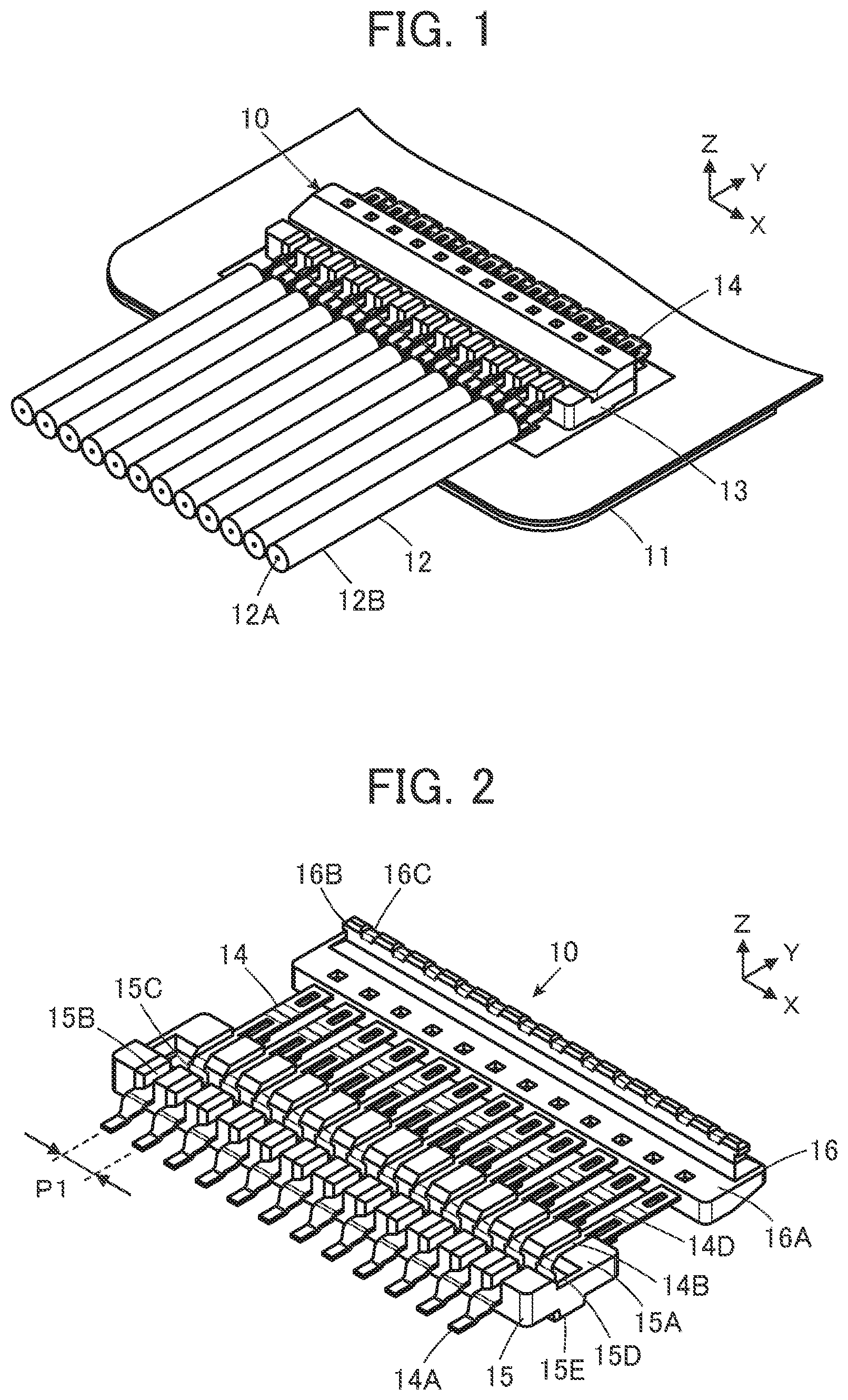
is a perspective view showing a connector according to Embodiment 1 which is mounted on a substrate and to which a plurality of coated electric wires are connected.
is a perspective view showing the connector according to Embodiment 1 with a first insulator and a second insulator being developed.
is a plan view showing the connector according to Embodiment 1 with the first insulator and the second insulator being developed.
is a bottom view showing the connector according to Embodiment 1 with the first insulator and the second insulator being developed.
is a front view showing the connector according to Embodiment 1 with the first insulator and the second insulator being developed.
is a side view showing the connector according to Embodiment 1 with the first insulator and the second insulator being developed.
is a perspective view showing a contact used in the connector according to Embodiment 1.
is a side view showing the contact used in the connector according to Embodiment 1.
is a perspective view showing the connector according to Embodiment 1 before being assembled.
is a perspective view showing the substrate.
is a perspective view showing the connector according to Embodiment 1 mounted on the substrate.
is a perspective view showing the connector according to Embodiment 1 which is mounted on the substrate and in which the plurality of coated electric wires are disposed.
is a partial front view showing the connector according to Embodiment 1 which is mounted on the substrate and in which a conductor portion of a coated electric wire is inserted.
is a partial, cross-sectional side view showing the connector according to Embodiment 1 immediately before being assembled.
is a partial plan view showing the connector according to Embodiment 1 immediately before being assembled.
is a partial, cross-sectional side view showing the connector according to Embodiment 1 after being assembled.
is a partial plan view showing the connector according to Embodiment 1 after being assembled.
is a partial, cross-sectional front view showing the connector according to Embodiment 1 after being assembled.
is a partial perspective view showing a connector according to Embodiment 2 with a first insulator and a second insulator being developed.
is a partial, cross-sectional side view showing the connector according to Embodiment 2 after being assembled.
is a perspective view showing a conventional connector.
DETAILED DESCRIPTION OF THE INVENTION
Embodiments of the present invention are described below based on the accompanying drawings.
Embodiment 1
shows a connector 10 according to Embodiment 1. The connector 10 is used for connecting a plurality of coated electric wires 12 to a substrate 11 and includes a housing 13 made of an insulating resin material and a plurality of contacts 14 retained by the housing 13 .
The substrate 11 is constituted of a sheet type conductive member, and the connector 10 is mounted on a surface of the substrate 11 .
The coated electric wires 12 are aligned in a predetermined alignment direction and each extend in a direction perpendicular to the alignment direction in parallel to the surface of the substrate 11 . Each coated electric wire 12 has a structure in which the outer periphery of a conductor portion 12 A is covered with an insulating coating portion 12 B. With the use of the connector 10 according to Embodiment 1, the conductor portions 12 A of the plurality of coated electric wires 12 are electrically connected to a plurality of conductive portions to be described later of the substrate 11 . The conductor portion 12 A of the coated electric wire 12 may be either a so-called solid wire constituted of one conductor or a so-called stranded wire constituted of plural conductors being stranded.
The housing 13 extends along the alignment direction of the coated electric wires 12 .
For convenience, the substrate 11 is defined as extending along an XY plane, the alignment direction of the coated electric wires 12 is referred to as “X direction,” the direction in which each coated electric wire 12 extends toward the housing 13 is referred to as “+Y direction,” and the direction perpendicular to an XY plane is referred to as “Z direction.”
As shown in to 6 , the housing 13 is composed of a first insulator 15 and a second insulator 16 each of which extends in the X direction and which are separate from each other. The contacts 14 extending in the Y direction and aligned in the X direction with an alignment pitch P 1 are retained by the first insulator 15 and the second insulator 16 , and the first insulator 15 and the second insulator 16 are joined together via the contacts 14 with distance from each other in the Y direction.
The first insulator 15 has a first flat surface 15 A facing the +Z direction and extending in an XY plane. The first flat surface 15 A is provided with a plurality of electric wire insertion grooves 15 B aligned in the X direction to correspond to the contacts 14 and each traversing the first insulator 15 in the Y direction, and each electric wire insertion groove 15 B is provided at its intermediate portion with a recess portion 15 C recessed from the bottom of the electric wire insertion groove 15 B toward the −Z direction. The recess portions 15 C of the electric wire insertion grooves 15 B are joined together in the X direction to form a fitting groove 15 D extending in the X direction over the entire X directional width of the first insulator 15 .
The bottom surface, facing the −Z direction, of the first insulator 15 is provided with a projection portion 15 E extending in the X direction over the entire X directional width of the first insulator 15 and projecting in the −Z direction.
The second insulator 16 has a second flat surface 16 A facing the +Z direction and extending in an XY plane in the state where the contacts 14 each linearly extend in the Y direction such that the first and second insulators 15 and 16 are developed, as shown in to 6 . The second flat surface 16 A is provided with a fitting portion 16 B extending in the X direction over the entire X directional width of the second insulator 16 and projecting in the +Z direction, and the fitting portion 16 B is provided with a plurality of protrusion portions 16 C aligned in the X direction to correspond to the contacts 14 and to be accommodated in the corresponding recess portions 15 C of the first insulator 15 .
The first insulator 15 and the second insulator 16 are configured such that, by deforming the contacts 14 to insert the fitting portion 16 B of the second insulator 16 into the fitting groove 15 D of the first insulator 15 , the first insulator 15 and the second insulator 16 are fitted to each other and the second flat surface 16 A makes contact with the first flat surface 15 A.
As shown in , the contact 14 is formed from a band shaped metal sheet substantially extending in the Y direction and having conductivity. A mounting portion 14 A to be mounted on the substrate 11 is disposed at the −Y directional end of the contact 14 , and a first retained portion 14 B to be retained by the first insulator 15 is disposed on the +Y direction side of the mounting portion 14 A to be adjacent to the mounting portion 14 A. A second retained portion 14 C to be retained by the second insulator 16 is disposed at the +Y directional end of the contact 14 , and a joint portion 14 D joining together the first retained portion 14 B and the second retained portion 14 C is disposed between the first retained portion 14 B and the second retained portion 14 C.
The first retained portion 14 B is provided at its intermediate portion with a recessed bent portion 14 E that is bent to be dented in the −Z direction.
The joint portion 14 D is formed to be deformable so as to be curved in the thickness direction of the contact 14 ; when the connector 10 is assembled, the joint portion 14 D is deformed into a U-shape opening toward the −Y direction such that the second retained portion 14 C is situated on the +Z direction side of the first retained portion 14 B.
The joint portion 14 D is provided at its intermediate portion with a connection portion 14 F and an inspection hole 14 G. The connection portion 14 F is formed to project in the −Z direction by lancing the metal plate constituting the contact 14 , and the inspection hole 14 G is situated on the +Y direction side of the connection portion 14 F and penetrates the metal plate constituting the contact 14 in the thickness direction of the contact 14 .
As shown in , the mounting portion 14 A and the connection portion 14 F extend in an XY plane in the same Z directional position, and the bottom of the recessed bent portion 14 E is situated on the −Z direction side with respect to the Z directional position of the mounting portion 14 A and the connection portion 14 F. When the first retained portion 14 B of the contact 14 is retained by the first insulator 15 , the bottom of the recessed bent portion 14 E is disposed within the projection portion 15 E of the first insulator 15 .
The connector 10 having the thus-configured contacts 14 and the first and second insulators 15 and 16 that are integrally formed is fabricated by, for instance, insert molding.
As shown in , the mounting portions 14 A situated at the −Y directional ends of the contacts 14 are exposed from the first insulator 15 to project in the −Y direction, and the second retained portions 14 C situated at the +Y directional ends of the contacts 14 are embedded in the second insulator 16 such that the second retained portions 14 C are not visible from the outside. The joint portions 14 D of the contacts 14 are exposed between the first insulator 15 and the second insulator 16 , and middle portions, in the X direction, of the first retained portions 14 B are exposed in the corresponding electric wire insertion grooves 15 B of the first insulator 15 .
Although not shown in , the recessed bent portions 14 E of the contacts 14 are accommodated in the recess portions 15 C formed in the intermediate portions of the electric wire insertion grooves 15 B such that the inner surfaces of the recessed bent portions 14 E are exposed.
In insert molding, it is necessary to inject resin with the +Y directional ends of the contacts 14 to be embedded in the second insulator 16 being held from the top and bottom by use of holding pins or other means in a molding die, so that a plurality of insertion holes 16 D corresponding to the contacts 14 are formed in the second insulator 16 as a trace of removal of such holding pins or the like after molding as shown in .
As shown in , the joint portions 14 D of the contacts 14 are deformed into a U-shape and folded back toward the −Y direction while the second insulator 16 is brought up toward the +Z direction with respect to the first insulator 15 , thereby having the connector 10 in a pre-assembly state where the second flat surface 16 A of the second insulator 16 obliquely faces the first flat surface 15 A of the first insulator 15 .
shows the substrate 11 on which the connector 10 is to be mounted. The substrate 11 is, for instance, constituted of a sheet type conductive member having a multilayer structure in which a plurality of wiring layers each formed from a conductor and a plurality of insulating layers are laminated, and a connector mounting region 11 A of rectangular shape is formed on a surface of the substrate 11 on the +Z direction side. The connector mounting region 11 A is formed by peeling off, in a rectangular shape, an insulating layer 11 B disposed at the surface of the substrate 11 on the +Z direction side, and a depression 11 C extending in the X direction is formed in a central portion of the connector mounting region 11 A. More specifically, the depression 11 C is formed from a through-hole penetrating the substrate 11 in the Z direction.
The depression 11 C has a size allowing the projection portion 15 E projecting in the −Z direction from the bottom surface of the first insulator 15 to fit therein.
The inside of the connector mounting region 11 A is provided with a plurality of conductive portions 11 D aligned in the X direction on the +Y direction side of the depression 11 C to correspond to the contacts 14 of the connector 10 . The conductive portions 11 D are formed from part of one wiring layer of the substrate 11 and connected to a plurality of wiring portions (not shown) covered with the insulating layer 11 B.
Meanwhile, a plurality of fixing portions 11 E aligned in the X direction to correspond to the contacts 14 of the connector 10 are formed on the −Y direction side of the depression 11 C in the connector mounting region 11 A. While the fixing portions 11 E can be formed from part of one wiring layer of the substrate 11 as with the conductive portions 11 D, the fixing portions 11 E are disposed only in the connector mounting region 11 A without being connected to a plurality of wiring portions (not shown).
The conductive portions 11 D and the fixing portions 11 E are separately aligned in the X direction with the same pitch as the alignment pitch P 1 of the contacts 14 . The distance between the depression 11 C and the conductive portions 11 D in the Y direction is substantially the same as the distance between the projection portion 15 E of the first insulator 15 and the connection portions 14 F of the contacts 14 of the connector 10 in the Y direction, and the distance between the depression 11 C and the fixing portions 11 E in the Y direction is substantially the same as the distance between the projection portion 15 E of the first insulator 15 and the mounting portions 14 A of the contacts 14 of the connector 10 in the Y direction.
Accordingly, when the projection portion 15 E of the first insulator 15 of the connector 10 is fitted in the depression 11 C of the substrate 11 as shown in , the connection portions 14 F of the contacts 14 are situated on the conductive portions 11 D of the substrate 11 , and the mounting portions 14 A of the contacts 14 are situated on the fixing portions 11 E of the substrate 11 .
In this state, the connection portions 14 F and the mounting portions 14 A of the contacts 14 are respectively connected to the conductive portions 11 D and the fixing portions 11 E of the substrate 11 by soldering or other methods, whereby the connector 10 is mounted on the substrate 11 .
When the connector 10 is assembled, first, the coated electric wires 12 are aligned in the X direction, and the conductor portions 12 A drawn from the coated electric wires 12 are inserted into the first insulator 15 of the connector 10 from the −Y direction, as shown in .
At this time, each conductor portion 12 A is inserted into the corresponding electric wire insertion groove 15 B of the first insulator 15 as shown in . Since the first retained portion 14 B of the contact 14 is exposed in the electric wire insertion groove 15 B, the conductor portion 12 A is disposed on a surface of the first retained portion 14 B of the contact 14 as shown in . The conductor portion 12 A is inserted into the electric wire insertion groove 15 B until the +Y directional end of the conductor portion 12 A protrudes on the +Y direction side of the first insulator 15 and reaches a position near the connection portion 14 F of the contact 14 on the +Z direction side of the contact 14 .
The inspection hole 14 G formed in the joint portion 14 D of the contact 14 is situated on the +Z direction side of the connection portion 14 F in the connector 10 in the pre-assembly state where the joint portion 14 D of the contact 14 is deformed in a U-shape such that the second flat surface 16 A of the second insulator 16 obliquely faces the first flat surface 15 A of the first insulator 15 . Thus, it is possible to visually check the +Y directional end of the conductor portion 12 A through the inspection hole 14 G from the +Z direction side of the connector 10 , as shown in . In other words, an operator carrying out the connecting operation of the coated electric wires 12 can visually check that the +Y directional ends of the conductor portions 12 A protrude on the +Y direction side of the first insulator 15 by a predetermined length through the inspection holes 14 G of the contacts 14 .
When the insertion length of the conductor portion 12 A of the coated electric wire 12 is excessively small with respect to the electric wire insertion groove 15 B of the first insulator 15 , the reliability of electric connection between the conductor portion 12 A and the contact 14 may decrease; when the insertion length of the conductor portion 12 A is excessively large, one conductor portion 12 A may be short-circuited with a contact 14 corresponding to an adjacent conductor portion 12 A. Thus, the reliability of connection of the coated electric wires 12 can be improved by checking the +Y directional ends of the conductor portions 12 A inserted up to the proper positions.
Next, the second insulator 16 is pressed against the first insulator 15 in the −Z direction and thereby fitted to the first insulator 15 as shown in . At this time, the second flat surface 16 A of the second insulator 16 makes contact with the first flat surface 15 A of the first insulator 15 , and a middle portion of the conductor portion 12 A inserted in the electric wire insertion groove 15 B of the first insulator 15 is pushed into the recessed bent portion 14 E of the contact 14 accommodated in the corresponding recess portion 15 C of the first insulator 15 by the protrusion portion 16 C of the second insulator 16 .
Thus, the assembling operation of the connector 10 is completed.
In the connector 10 thus assembled, the conductor portion 12 A of the coated electric wire 12 and the recessed bent portion 14 E of the contact 14 make contact with each other in the Y direction with a predetermined contact pressure between the inner lateral surface of the recess portion 15 C and the outer lateral surface of the protrusion portion 16 C, so that the conductor portion 12 A is electrically connected to the recessed bent portion 14 E of the contact 14 . In addition, since the connection portion 14 F of the contact 14 is connected to the corresponding conductive portion 11 D of the substrate 11 , the conductor portion 12 A of the coated electric wire 12 is electrically connected to the conductive portion 11 D of the substrate 11 via the contact 14 .
It should be noted that the conductor portion 12 A of the coated electric wire 12 is pushed into the recessed bent portion 14 E of the contact 14 and thereby bent along the inner surface of the recessed bent portion 14 E; accordingly, the +Y directional end of the conductor portion 12 A is retracted in the −Y direction and accommodated within the electric wire insertion groove 15 B of the first insulator 15 . Thus, in the state where the second insulator 16 is fitted with the first insulator 15 , an operator cannot visually recognize the +Y directional end of the conductor portion 12 A even when looking in the inspection hole 14 G of the contact 14 from the +Z direction, as shown in . That is, the operator can confirm that the conductor portions 12 A have been properly pushed in the recessed bent portions 14 E of the contacts 14 and electrically connected to the contacts 14 based on the fact that the +Y directional ends of the conductor portions 12 A are not seen through the inspection holes 14 G of the contacts 14 .
In addition, as shown in , a locking portion 15 F projecting toward the middle of the first insulator 15 in the X direction is formed at each of the +X directional end and the −X directional end of the first insulator 15 , and likewise, a locked portion 16 E corresponding to the locking portion 15 F of the first insulator 15 is formed at each of the +X directional end and the −X directional end of the second insulator 16 . The locking portions 15 F and the locked portions 16 E interfere with each other, thereby maintaining the fitting state between the first insulator 15 and the second insulator 16 .
The recessed bent portion 14 E of the contact 14 has a sufficient length in the Z direction such that the bottom of the recessed bent portion 14 E is situated on the −Z direction side with respect to the mounting portion 14 A and the connection portion 14 F, and owing to this configuration, the contact area can be ensured between the inner lateral surface of the recessed bent portion 14 E and the conductor portion 12 A that make contact in the Y direction, thus making it possible to electrically connect the conductor portion 12 A to the contact 14 with high reliability.
Furthermore, as shown in , the bottom of the recessed bent portion 14 E of the contact 14 is disposed inside the projection portion 15 E of the first insulator 15 , and the projection portion 15 E is inserted in the depression 11 C of the substrate 11 ; therefore, the connector 10 with a small thickness can be obtained despite the recessed bent portion 14 E having a sufficient length in the Z direction.
Embodiment 2
While the second retained portions 14 C formed at the +Y directional ends of the contacts 14 are embedded in the second insulator 16 in Embodiment 1 above, the invention is not limited thereto.
shows a connector 20 according to Embodiment 2. The connector 20 is configured to use a contact 24 in place of the contact 14 in the connector 10 of Embodiment 1. Specifically, the first insulator 15 and the second insulator 16 are joined together by a plurality of contacts 24 with distance.
The contact 24 is formed from a band shaped metal sheet having conductivity as with the contact 14 shown in and includes a mounting portion 24 A disposed at the −Y directional end of the contact 24 , a first retained portion 24 B situated on the +Y direction side of the mounting portion 24 A to be adjacent to the mounting portion 24 A and retained by the first insulator 15 , and a joint portion 24 D situated on the +Y direction side of the first retained portion 24 B to be adjacent to the first retained portion 24 B and exposed. In addition, a recessed bent portion 24 E is formed at an intermediate portion of the first retained portion 24 B, and a connection portion 24 F is formed at an intermediate portion of the joint portion 24 D. The mounting portion 24 A, the first retained portion 24 B, the joint portion 24 D, the recessed bent portion 24 E, and the connection portion 24 F have the same structures as those of the mounting portion 14 A, the first retained portion 14 B, the joint portion 14 D, the recessed bent portion 14 E, and the connection portion 14 F of the contact 14 in the connector 10 of Embodiment 1.
As shown in , the contact 24 further includes a second retained portion 24 C joined to the joint portion 24 D and retained by the second insulator 16 , and the second retained portion 24 C includes a protruding bent portion 24 H extending along the outer surface of the protrusion portion 16 C of the second insulator 16 and exposed.
Accordingly, when the second insulator 16 is fitted to the first insulator 15 to assemble the connector 20 , a middle portion of the conductor portion 12 A inserted in the electric wire insertion groove 15 B of the first insulator 15 is pushed into the recessed bent portion 24 E of the contact 24 accommodated in the recess portion 15 C of the first insulator 15 by the protrusion portion 16 C of the second insulator 16 on which the protruding bent portion 24 H of the contact 24 is exposed. The conductor portion 12 A of the coated electric wire 12 is sandwiched between the recessed bent portion 24 E and the protruding bent portion 24 H of the contact 24 to make contact with both the recessed bent portion 24 E and the protruding bent portion 24 H with a predetermined contact pressure. This improves the reliability of electric connection between the conductor portion 12 A and the contact 24 , thus increasing the reliability of connection of the coated electric wires 12 .
While the inner lateral surface of the recessed bent portion 14 E, 24 E of the contact 14 , 24 makes contact with the conductor portion 12 A of the coated electric wire 12 with a predetermined contact pressure in the Y direction in Embodiments 1 and 2 above, the recessed bent portion 14 E, 24 E may have a spring property that presses the conductor portion 12 A in the Y direction.
While the connector 10 , 20 is formed by insert molding in Embodiments 1 and 2, the connector 10 , 20 may be formed by, for instance, press-fitting the contacts 14 , 24 such that the contacts 14 , 24 are retained by both the first insulator 15 and the second insulator 16 .
In Embodiments 1 and 2, the substrate 11 is constituted of a sheet type conductive member, and either a flexible substrate or a rigid substrate may be used as the substrate 11 . Furthermore, the substrate 11 is not limited to a sheet type conductive member as long as it has the connector mounting region 11 A used for mounting the connector 10 , 20 .
While the depression 11 C of the substrate 11 is formed from a through-hole penetrating the substrate 11 in the Z direction in Embodiments 1 and 2, the depression 11 C may be constituted of a recess formed at the surface of the substrate 11 on the +Z direction side without penetrating the substrate 11 when the substrate 11 has a sufficient thickness.
While the connector 10 of Embodiment 1 and the connector 20 of Embodiment 2 are configured such that the plurality of coated electric wires 12 are connected to the substrate 11 , the invention is not limited thereto, and a connector may be configured such that a single coated electric wire 12 is connected to the substrate 11 in the same manner.
While the coated electric wire 12 is used as an electric wire connected to the substrate 11 , an electric wire constituted only of the conductor portion 12 A whose outer periphery is not covered with the insulating coating portion 12 B may be connected to the substrate 11 .
Figures (9)
Citations
This patent cites (5)
- US4352535
- US6217374
- US2002/0160642
- US2007/0087607
- US2007-214087