Writer Having Laterally Decoupled Pole Sections
Abstract
An apparatus, in accordance with one aspect of the present invention, includes a writer, having a first write pole having a pole tip extending from a media facing side of the first write pole, and a second write pole having a pole tip extending from a media facing side of the second write pole. A nonmagnetic write gap is positioned between the pole tips of the write poles. A high moment layer is positioned between the write gap and the pole tip of the second write pole. The high moment layer has a higher magnetic moment than a magnetic moment of the pole tip of the second write pole. The high moment layer is segmented into at least two portions by one or more decoupling spacers positioned between adjacent ones of the portions. Another aspect includes an apparatus with an array of such writers.
Claims (20)
1 . An apparatus, comprising: a writer, having: a first write pole having a pole tip extending from a media facing side of the first write pole; a second write pole having a pole tip extending from a media facing side of the second write pole; a nonmagnetic write gap between the pole tips of the write poles; and a high moment layer between the write gap and the pole tip of the second write pole, the high moment layer having a higher magnetic moment than a magnetic moment of the pole tip of the second write pole, the high moment layer being segmented into at least two portions by one or more decoupling spacers positioned between adjacent ones of the portions, wherein a first of the portions has a width along a tape facing surface thereof and parallel to the write gap that is less than a width of a second of the portions.
15 . An apparatus, comprising: a writer, having: a first write pole having a pole tip extending from a media facing side of the first write pole; a second write pole having a pole tip extending from a media facing side of the second write pole; a nonmagnetic write gap between the pole tips of the write poles; and a high moment layer between the write gap and the pole tip of the second write pole, the high moment layer having a higher magnetic moment than a magnetic moment of the pole tip of the second write pole, the high moment layer being segmented into at least two portions by one or more decoupling spacers positioned between adjacent ones of the portions, wherein the one or more decoupling spacers are formed from a material that is not a ferromagnet.
16 . An apparatus, comprising: an array of writers, each writer having: a first write pole having a pole tip extending from a media facing side of the first write pole; a second write pole having a pole tip extending from a media facing side of the second write pole; a nonmagnetic write gap between the pole tips of the write poles; and a high moment layer between the write gap and the pole tip of the second write pole, the high moment layer having a higher magnetic moment than a magnetic moment of the pole tip of the second write pole, the high moment layer being segmented into at least two portions by one or more decoupling spacers positioned between adjacent ones of the portions, wherein a first of the portions has a width along a tape facing surface thereof and parallel to the write gap that is less than a width of a second of the portions.
Show 17 dependent claims
2 . An apparatus as recited in claim 1 , wherein the high moment layer has exactly two portions.
3 . An apparatus as recited in claim 1 , wherein the width of the first of the portions is about 3 μm or less.
4 . An apparatus as recited in claim 1 , wherein the high moment layer has at least three portions.
5 . An apparatus as recited in claim 1 , wherein the high moment layer has at least five portions.
6 . An apparatus as recited in claim 1 , wherein a width of each of the one or more decoupling spacers along a tape facing surface thereof and parallel to the write gap is at least about 50 nm.
7 . An apparatus as recited in claim 1 , wherein a total width of the high moment layer is greater than about 7.5 μm.
8 . An apparatus as recited in claim 1 , wherein the second write pole is comprised of a yoke portion and the pole tip, wherein the high moment layer does not extend along the yoke portion.
9 . An apparatus as recited in claim 1 , comprising a second high moment layer between the write gap and the pole tip of the first write pole, the second high moment layer having a higher magnetic moment than a magnetic moment of the pole tip of the first write pole.
10 . An apparatus as recited in claim 9 , wherein the second high moment layer is segmented into at least two portions by one or more decoupling spacers positioned between adjacent ones of the portions.
11 . An apparatus as recited in claim 1 , wherein the first write pole is a lower write pole, wherein the second write pole is formed above the first write pole.
12 . An apparatus as recited in claim 1 , wherein the second write pole is a lower write pole, wherein the first write pole is formed above the second write pole.
13 . An apparatus as recited in claim 1 , further comprising: a drive mechanism for passing a magnetic medium over the writer; and a controller electrically coupled to the writer.
14 . An apparatus as recited in claim 13 , wherein the drive mechanism is configured to pass the magnetic medium over the write poles in a direction whereby the second write pole is a trailing pole.
17 . An apparatus as recited in claim 16 , wherein a width of each of the one or more decoupling spacers along a tape facing surface thereof and parallel to the write gap is at least about 50 nm.
18 . An apparatus as recited in claim 16 , further comprising: a drive mechanism for passing a magnetic medium over the writers; and a controller electrically coupled to the writers.
19 . An apparatus as recited in claim 16 , wherein the one or more decoupling spacers are formed from a material that is not a ferromagnet.
20 . An apparatus as recited in claim 16 , wherein the high moment layer has at least three portions.
Full Description
Show full text →
BACKGROUND
The present invention relates to data storage systems, and more particularly, this invention relates to apparatuses having improved writer configurations.
In magnetic storage systems, magnetic transducers read data from and write data onto magnetic recording media. Data is written on the magnetic recording media by moving a magnetic recording transducer to a position over the media where the data is to be stored. The magnetic recording transducer then generates a magnetic field, which encodes the data into the magnetic media. Data is read from the media by similarly positioning the magnetic read transducer and then sensing the magnetic field of the magnetic media. Read and write operations may be independently synchronized with the movement of the media to ensure that the data can be read from and written to the desired location on the media.
An important and continuing goal in the data storage industry is that of increasing the density of data stored on a medium. For tape storage systems, that goal has led to increasing the track and linear bit density on recording tape, and decreasing the thickness of the magnetic tape medium. However, the development of small footprint, higher performance tape drive systems has created various challenges ranging from the design of tape head assemblies for use in such systems to dealing with tape dimensional instability.
In a tape drive system, the drive moves the magnetic tape over the surface of the tape head at high speed. Usually the tape head is designed to minimize the spacing between the head and the tape. The spacing between the magnetic head and the magnetic tape is crucial and so goals in these systems are to have the recording gaps of the transducers, which are the source of the magnetic recording flux in near contact with the tape to effect writing sharp transitions, and to have the read elements in near contact with the tape to provide effective coupling of the magnetic field from the tape to the read elements.
In a tape drive system, the drive moves the magnetic tape over the surface of the tape head at high speed. Usually the tape head is designed to minimize the spacing between the head and the tape. The spacing between the magnetic head and the magnetic tape is crucial and so goals in these systems are to have the recording gaps of the transducers, which are the source of the magnetic recording flux in near contact with the tape to effect writing sharp transitions, and to have the read elements in near contact with the tape to provide effective coupling of the magnetic field from the tape to the read elements.
The quantity of data stored on a magnetic tape may be expanded by increasing the number of data tracks across the tape. More tracks are made possible by reducing feature sizes of the readers and writers, such as by using thin-film fabrication techniques and magnetoresistive (MR) sensors. However, for various reasons, the feature sizes of readers and writers cannot be arbitrarily reduced, and so factors such as tape skew, lateral tape motion (e.g., perpendicular to the direction of tape travel), transients and tape lateral expansion and contraction must be balanced with reader/writer sizes that provide acceptable written tracks and readback signals.
One particular problem limiting areal density is misregistration caused by tape lateral expansion and contraction, commonly referred to as poor tape dimensional stability (TDS), or more properly, tape dimensional instability (TDI).
Tape lateral contraction and expansion is a well-known phenomenon that occurs due to a plethora of effects, including absorption of water, thermal expansion and contraction, etc. Tape width can vary by up to about 0.1% due to TDS/TDI.
When the dimensions of the tape change, various issues arise. During writing, the likelihood of overwriting shingled tracks increases. Overwritten data is often unrecoverable. Likewise, where the width of the tape has changed since the desired data was written, the readers may no longer be positioned over the tracks to be read, increasing reading errors. The extent of misregistration is particularly prevalent toward outer ends of the reader array.
More permanent changes in media lateral dimensions may also occur, such as long-term media “creep” (also known in the art as “aging”), which tends to occur over time when a tape is wound around a hub of a tape cartridge. Long-term media creep is particularly problematic when dealing with tape dimensional stability issues, as the two ends of the tape exhibit creep in different ways. The inner wraps of tape positioned closest to the cartridge hub tend to expand laterally over time due to the compressive stresses exerted thereon by the wraps of tape wound around them. Wraps positioned toward the outer diameter of the spool of tape are under less compressive stress, but are under higher tensile stresses, which tends to cause lateral contraction of the tape, i.e., the tape becomes narrower over time. Accordingly, the ends of the tape tend to exhibit oppositely-oriented lateral dimensional changes. It follows that shingled track pitch changes over time due to creep, and to different extents (non-uniformly) along the length of the tape.
Thus, while the width of the transducer array is essentially fixed (absent tilting or other mechanism to adjust the transducer spacing presented to tape), the spacing of the data tracks on the tape will vary as the tape expands and contracts. Ideally, the sensor width would be as wide as the data track being read; this would provide the best signal. However, sensor widths cannot be made as wide as the data tracks, because the sensors would read adjacent tracks upon expansion or contraction of the tape and/or due to lateral misregistration between tape and head. Accordingly, readers are currently designed with sensor widths that are substantially smaller than the data track width. The reader track width is typically selected to accommodate the worst-case scenarios, e.g., the designer takes into account maximum expansion/contraction and lateral misregistration when determining reader track width so that each sensor is over a given track at any time.
One approach to compensating for TDS involves dynamically tilting the magnetic head to adjust the transducer pitch presented to tape to meet the current track pitch. However, this leads to a problem that is related to read verify while writing, which requires the trailing read transducers to remain in the envelope of the just-written tracks as they are being written. Read and write arrays are offset when the heads are assembled to set the read transducers nominally in line with the writers for the target static tilt angle. However, small corrections to the tilt to accommodate dimensional changes of the tape require using wider-than-otherwise-needed write poles to ensure the readers stay within the read-while-write envelope. Wider writers in turn create write head design issues such as poor edge writing performance, etc., and independently results in reduced achievable tape areal capacity due to space used by the last un-shingled track written in each sub-databand. This can create as much as 10-25% capacity reduction.
What is needed is a solution to the foregoing problems, thereby enabling future areal density growth.
SUMMARY
An apparatus, in accordance with one aspect of the present invention, includes a writer, having a first write pole having a pole tip extending from a media facing side of the first write pole, and a second write pole having a pole tip extending from a media facing side of the second write pole. A nonmagnetic write gap is positioned between the pole tips of the write poles. A high moment layer is positioned between the write gap and the pole tip of the second write pole. The high moment layer has a higher magnetic moment than a magnetic moment of the pole tip of the second write pole. The high moment layer is segmented into at least two portions by one or more decoupling spacers positioned between adjacent ones of the portions.
An apparatus, in accordance with another aspect of the present invention, includes an array of writers. Each writer has a first write pole having a pole tip extending from a media facing side of the first write pole, and a second write pole having a pole tip extending from a media facing side of the second write pole. A nonmagnetic write gap is positioned between the pole tips of the write poles. A high moment layer is positioned between the write gap and the pole tip of the second write pole. The high moment layer has a higher magnetic moment than a magnetic moment of the pole tip of the second write pole. The high moment layer is segmented into at least two portions by one or more decoupling spacers positioned between adjacent ones of the portions.
Any of these aspects may be implemented in a magnetic data storage system such as a tape drive system, hard disk drive system, etc., which may include a magnetic head, a drive mechanism for passing a magnetic medium (e.g., recording tape or hard disk) over the magnetic head, and a controller electrically coupled to the magnetic head.
Other aspects and corresponding approaches of the present invention will become apparent from the following detailed description, which, when taken in conjunction with the drawings, illustrate by way of example the principles of the invention.
BRIEF DESCRIPTION OF THE DRAWINGS
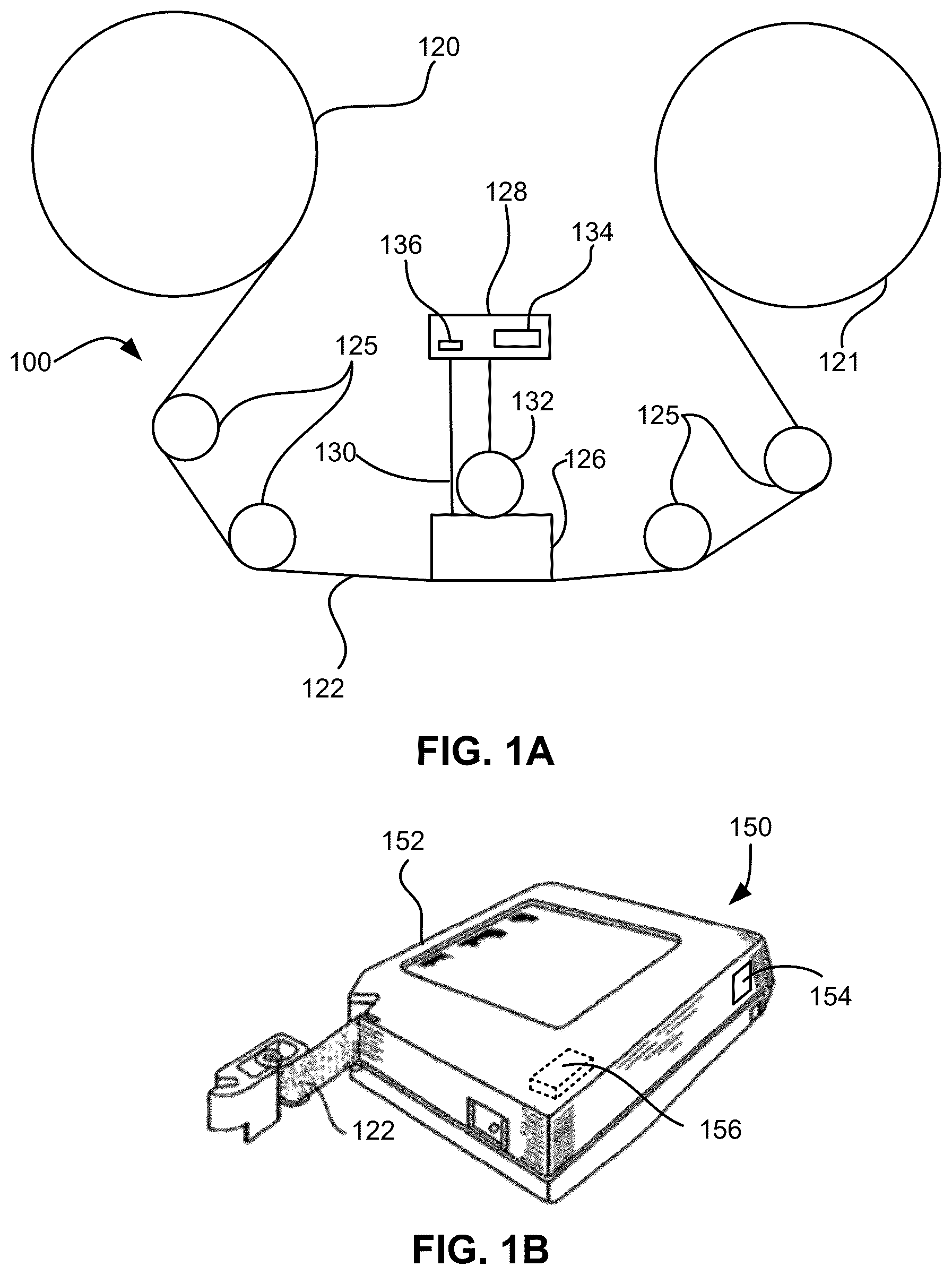
A is a schematic diagram of a simplified tape drive system according to one aspect of the present invention.
B is a schematic diagram of a tape cartridge according to one aspect of the present invention.
A illustrates a side view of a flat-lapped, bi-directional, two-module magnetic tape head according to one aspect of the present invention.
B is a tape bearing surface view taken from Line 2 B of A .
C is a detailed view taken from Circle 2 C of B .
D is a detailed view of a partial tape bearing surface of a pair of modules.
is a partial tape bearing surface view of a magnetic head having a write-read-write configuration.
is a partial tape bearing surface view of a magnetic head having a read-write-read configuration.
is a side view of a magnetic tape head with three modules according to one approach where the modules all generally lie along about parallel planes.
is a side view of a magnetic tape head with three modules in a tangent (angled) configuration.
is a side view of a magnetic tape head with three modules in an overwrap configuration.
A- 8 C are schematics depicting the principles of tape tenting.
is a representational diagram of files and indexes stored on a magnetic tape according to one aspect of the present invention.
A is a media facing side view of a writer array according to one aspect of the present invention.
B is a partial cross-sectional view of a writer of A taken along line 10 B- 10 B of A .
A is a media facing side view of a writer according to one aspect of the present invention.
B is a partial cross-sectional view of the writer in A taken along line 11 B- 11 B of A .
A is a media facing side view of a writer according to one aspect of the present invention.
B is a partial cross-sectional view of the writer in A taken along line 12 B- 12 B of A .
C is a media facing side view of a writer according to one aspect of the present invention.
D is a partial cross-sectional view of the writer in C taken along line 12 D- 12 D of C .
E is a media facing side view of a writer according to one aspect of the present invention.
F is a partial cross-sectional view of the writer in E taken along line 12 F- 12 F of E .
G is a media facing side view of a writer according to one aspect of the present invention.
H is a partial cross-sectional view of the writer in G taken along line 12 H- 12 H of G .
A is a media facing side view of a writer according to one aspect of the present invention.
B is a partial cross-sectional view of the writer in A taken along line 13 B- 13 B of A .
A- 14 C illustrate the effect of tape lateral expansion and contraction.
A- 15 C illustrate rotation of a magnetic head to compensate for the effect of tape lateral expansion and contraction.
is a depiction of a writer having high moment layers adjacent a write gap, in accordance with one aspect of the present invention.
is a depiction of an apparatus having a writer with a segmented high moment layer adjacent a write gap, in accordance with one aspect of the present invention.
is a depiction of an apparatus having a writer with a segmented high moment layer adjacent a write gap, in accordance with one aspect of the present invention.
is a depiction of an apparatus having a writer with a segmented high moment layer adjacent a write gap, in accordance with one aspect of the present invention.
is a depiction of an apparatus having a writer with a segmented high moment layer adjacent a write gap, in accordance with one aspect of the present invention.
is a depiction of an apparatus having a writer with two segmented high moment layers adjacent a write gap, in accordance with one aspect of the present invention.
is a depiction of an apparatus having a writer with two segmented high moment layers adjacent a write gap, in accordance with one aspect of the present invention.
is a depiction of an apparatus having a writer with a segmented high moment layer adjacent a write gap, in accordance with one aspect of the present invention.
is a chart of readback SNR performance vs. position along a written data track, in accordance with one aspect of the present invention.
DETAILED DESCRIPTION
The following description is made for the purpose of illustrating the general principles of the present invention and is not meant to limit the inventive concepts claimed herein. Further, particular features described herein can be used in combination with other described features in each of the various possible combinations and permutations.
Unless otherwise specifically defined herein, all terms are to be given their broadest possible interpretation including meanings implied from the specification as well as meanings understood by those skilled in the art and/or as defined in dictionaries, treatises, etc.
It must also be noted that, as used in the specification and the appended claims, the singular forms “a,” “an” and “the” include plural referents unless otherwise specified.
The following description discloses several variations of magnetic storage systems, in accordance with various aspects of the present invention, the systems having improved performance when writing to magnetic media with relatively wider writers (also referred to as “write transducers”), as well as operation and/or component parts of such systems. Segmented thin film layers of high moment materials may be implemented as described in the different approaches below in order to achieve the improvements discovered by the inventors. Thus, various approaches included herein may be able to achieve improved writing to high coercivity tape media while maintaining sharper transitions on the tape media than would otherwise be achievable using wider writers needed for enabling read while write verification when writing using a tilted transducer array, e.g., as will be described in further detail below.
In one general approach, an apparatus includes a writer, having a first write pole having a pole tip extending from a media facing side of the first write pole, and a second write pole having a pole tip extending from a media facing side of the second write pole. A nonmagnetic write gap is positioned between the pole tips of the write poles. A high moment layer is positioned between the write gap and the pole tip of the second write pole. The high moment layer has a higher magnetic moment than a magnetic moment of the pole tip of the second write pole. The high moment layer is segmented into at least two portions by one or more decoupling spacers positioned between adjacent ones of the portions.
When the high moment layer is formed as a single, continuous slab, magnetization in the high moment layer has a strong predilection to remain parallel to the write gap due to shape anisotropy associated with the large thickness-to-width aspect ratio of the high moment layer. By segmenting the high moment layer into portions, the magnetism in the discrete portions is no longer directly coupled to one another, thereby allowing the magnetic moment within the narrower portion to rotate more freely under the influence of the field from the coils. Said another way, the magnetic moment within the narrower portion is more easily torqued perpendicular to the write gap and parallel to the direction of media travel thereacross. This locally improves the linearity of the response of the writer being driven.
Track density scaling is currently the main driver of tape capacity scaling and is expected to remain so for the foreseeable future. By enhancing write performance at the edge of wide writers, various aspects of the present invention defer pinch-off of the usable track as the track pitch is further scaled down, thereby enabling future track density operating points for drives, especially those utilizing tilt-based TDS compensation.
In one approach, a first of the portions has a width along a tape facing surface thereof and parallel to the write gap that is less than a width of a second of the portions. By placing the narrower first portion of the high moment layer near the edge of the writer that writes the portion of the data track that remains after shingling, the resulting written data track exhibits higher readback SNR and a squarer track edge shape compared to that section of the data track written with a relatively wider second portion of the high moment layer.
Preferably, the width of the first portion is less than about 3 μm, preferably less than about 2.5 μm. This dimensional range allows the magnetic moment within the first portion to rotate more freely.
In one approach, the high moment layer has exactly two portions. This configuration may be easier to build than other configurations.
In another approach, the high moment layer has at least three portions. This configuration allows for more decoupling of the magnetics within the high moment layer. Moreover, a bidirectional writer may have two narrower portions flanking a wider portion.
In yet another approach, the high moment layer has at least five portions. This configuration allows for even more decoupling of the magnetics within the high moment layer.
In one approach, the one or more decoupling spacers are formed from a material that is not a ferromagnet. The nonmagnetic nature of the decoupling spacer(s) breaks direct magnetic coupling between the portions of the high moment layer adjacent thereto.
In one approach, a width of each of the one or more decoupling spacers along a tape facing surface thereof and parallel to the write gap is at least about 50 nm to thereby provide the magnetic decoupling effect.
In one approach, a total end-to-end width of the high moment layer is greater than about 7.5 μm. This feature improves read while write verification by providing a wide enough written track that the trailing readers can remain substantially above the just-written tracks, even though the head is tilted to compensate for TDS changes. The inventors proceeded contrary to conventional wisdom with this feature, because a wider writer width reduces the number of data tracks that may be written on tape.
In one approach, the second write pole is comprised of a yoke portion and the pole tip, wherein the high moment layer does not extend along the yoke portion to thereby focus magnetic flux nearest the media facing surface.
In one approach, a second high moment layer between the write gap and the pole tip of the first write pole, the second high moment layer having a higher magnetic moment than a magnetic moment of the pole tip of the first write pole. This dual-high moment layer design exhibits improved writing characteristics.
In one approach, the second high moment layer is segmented into at least two portions by one or more decoupling spacers positioned between adjacent ones of the portions. For a bidirectional writer, the narrower portions of the respective high moment layers may be positioned to write the respective critical edge of the data tracks, thereby imparting the foregoing advantages in both writing directions.
In one approach, the first write pole is a lower write pole, and the second write pole is formed above the first write pole. In another approach, the second write pole is a lower write pole, and the first write pole is formed above the second write pole.
In one approach, the apparatus further comprises a drive mechanism for passing a magnetic medium over the writer, and a controller electrically coupled to the writer. This configuration is particularly useful for magnetic tape recording.
In one approach, the drive mechanism is configured to pass the magnetic medium over the write poles in a direction whereby the second write pole is the trailing pole.
In another general aspect of the present invention, an apparatus includes an array of writers, each writer having any of the configurations set forth above. By segmenting the high moment layer into portions, the magnetism in the discrete portions is no longer directly coupled to one another, thereby allowing the magnetic moment within the narrower portion to rotate more freely under the influence of the field from the coils. Said another way, the magnetic moment within the narrower portion is more easily torqued toward parallel to the direction of media travel thereacross. This locally improves the linearity of the response of the writer being driven.
In one approach, a first of the portions has a width along a tape facing surface thereof and parallel to the write gap that is less than a width of a second of the portions. By placing the narrower first portion of the high moment layer near the edge of the writer that writes the portion of the data track that remains after shingling, the resulting written data track exhibits higher readback SNR and a squarer track edge shape compared to that section of the data track written with a relatively wider second portion of the high moment layer.
In one approach, a width of each of the one or more decoupling spacers along a tape facing surface thereof and parallel to the write gap is at least about 50 nm to thereby provide the magnetic decoupling effect. Note that some indirect magnetic coupling may occur across the decoupling spacer, but no direct magnetic coupling is present due to the lack of physical contact or continuity between the sections of the high moment layer. Preferably, the widths of the decoupling spacers is in a range of about 50 nm to about 300 nm, or in any subrange therebetween.
In one approach, the apparatus further comprises a drive mechanism for passing a magnetic medium over the writers, and a controller electrically coupled to the writers. This configuration is particularly useful for magnetic tape recording.
More details about these and other aspects of the present invention are provided below.
Magnetic Recording Environment, With Tape Drive as Exemplary
A illustrates a simplified tape drive 100 of a tape-based data storage system, which may be employed in the context of the present invention. While one specific implementation of a tape drive is shown in A , it should be noted that the approaches described herein may be implemented in the context of any type of tape drive system.
As shown, a tape supply cartridge 120 and a take-up reel 121 are provided to support a tape 122 . One or more of the reels may form part of a removable cartridge and are not necessarily part of the drive 100 . The tape drive, such as that illustrated in A , may further include drive motor(s) to drive the tape supply cartridge 120 and the take-up reel 121 to move the tape 122 over a tape head 126 of any type. Such head may include an array of readers (also referred to as “read transducers”), writers, or both.
Guides 125 guide the tape 122 across the tape head 126 . Such tape head 126 is in turn coupled to a controller 128 via a cable 130 . The controller 128 , may be or include a processor and/or any logic for controlling any subsystem of the drive 100 . For example, the controller 128 typically controls head functions such as servo following, data writing, data reading, etc. The controller 128 may include at least one servo channel and at least one data channel, each of which include data flow processing logic configured to process and/or store information to be written to and/or read from the tape 122 . The controller 128 may operate under logic known in the art, as well as any logic disclosed herein, and thus may be considered as a processor for any of the descriptions of tape drives included herein, in various approaches. The controller 128 may be coupled to a memory 136 of any known type, which may store instructions executable by the controller 128 . Moreover, the controller 128 may be configured and/or programmable to perform or control some or all of the methodology presented herein. Thus, the controller 128 may be considered to be configured to perform various operations by way of logic programmed into one or more chips, modules, and/or blocks; software, firmware, and/or other instructions being available to one or more processors; etc., and combinations thereof.
The cable 130 may include read/write circuits to transmit data to the head 126 to be recorded on the tape 122 and to receive data read by the head 126 from the tape 122 . An actuator 132 controls position of the head 126 relative to the tape 122 .
An interface 134 may also be provided for communication between the tape drive 100 and a host (internal or external) to send and receive the data and for controlling the operation of the tape drive 100 and communicating the status of the tape drive 100 to the host, all as will be understood by those of skill in the art.
B illustrates an exemplary tape cartridge 150 according to one aspect of the present invention. Such tape cartridge 150 may be used with a system such as that shown in A . As shown, the tape cartridge 150 includes a housing 152 , a tape 122 in the housing 152 , and a nonvolatile memory 156 coupled to the housing 152 . In some approaches, the nonvolatile memory 156 may be embedded inside the housing 152 , as shown in B . In more approaches, the nonvolatile memory 156 may be attached to the inside or outside of the housing 152 without modification of the housing 152 . For example, the nonvolatile memory may be embedded in a self-adhesive label 154 . In one preferred approach, the nonvolatile memory 156 may be a Flash memory device, read only memory (ROM) device, etc., embedded into or coupled to the inside or outside of the tape cartridge 150 . The nonvolatile memory is accessible by the tape drive and the tape operating software (the driver software), and/or another device.
By way of example, A illustrates a side view of a flat-lapped, bi-directional, two-module magnetic tape head 200 which may be implemented in the context of the present invention. As shown, the head includes a pair of bases 202 , each equipped with a module 204 , and fixed at a small angle α with respect to each other. The bases may be “U-beams” that are adhesively coupled together. Each module 204 includes a substrate 204 A and a closure 204 B with a thin film portion, commonly referred to as a “gap” in which the readers and/or writers 206 are formed. In use, a tape 208 is moved over the modules 204 along a media (tape) bearing surface 209 in the manner shown for reading and writing data on the tape 208 using the readers and writers. The wrap angle θ of the tape 208 at edges going onto and exiting the flat media support surfaces 209 are usually between about 0.1 degree and about 3 degrees.
The substrates 204 A are typically constructed of a wear resistant material, such as a ceramic. The closures 204 B may be made of the same or similar ceramic as the substrates 204 A.
The readers and writers may be arranged in a piggyback or merged configuration. An illustrative piggybacked configuration comprises a (magnetically inductive) writer transducer on top of (or below) a (magnetically shielded) reader transducer (e.g., a magnetoresistive reader, etc.), wherein the poles of the writer and the shields of the reader are generally separated. An illustrative merged configuration comprises one reader shield in the same physical layer as one writer pole (hence, “merged”). The readers and writers may also be arranged in an interleaved configuration. Alternatively, each array of channels may be readers or writers only. Any of these arrays may contain one or more servo track readers for reading servo data on the medium.
B illustrates the tape bearing surface 209 of one of the modules 204 taken from Line 2 B of A . A representative tape 208 is shown in dashed lines. The module 204 is preferably long enough to be able to support the tape as the head steps between data bands.
In this example, the tape 208 includes 4 to 32 data bands, e.g., with 16 data bands and 17 servo tracks 210 , as shown in B on a one-half inch wide tape 208 . The data bands are defined between servo tracks 210 . Each data band may include a number of data tracks, for example 1024 data tracks (not shown). During read/write operations, the readers and/or writers 206 are positioned to specific track positions within one of the data bands. Outer readers, sometimes called servo readers, read the servo tracks 210 . The servo signals are in turn used to keep the readers and/or writers 206 aligned with a particular set of tracks during the read/write operations.
C depicts a plurality of readers and/or writers 206 formed in a gap 218 on the module 204 in Circle 2 C of B . As shown, the array of readers and writers 206 includes, for example, 16 writers 214 , 16 readers 216 and two servo readers 212 , though the number of elements may vary. Illustrative approaches include 8, 16, 32, 40, and 64 active readers and/or writers 206 per array, and alternatively interleaved designs having odd numbers of reader or writers such as 17, 25, 33, etc. An illustrative approach includes 32 readers per array and/or 32 writers per array, where the actual number of transducer elements could be greater, e.g., 33, 34, etc. This allows the tape to travel more slowly, thereby reducing speed-induced tracking and mechanical difficulties and/or execute fewer “wraps” to fill or read the tape. While the readers and writers may be arranged in a piggyback configuration as shown in C , the readers 216 and writers 214 may also be arranged in an interleaved configuration. Alternatively, each array of readers and/or writers 206 may be readers or writers only, and the arrays may contain one or more servo readers 212 . As noted by considering A and 2 B- 2 C together, each module 204 may include a complementary set of readers and/or writers 206 for such things as bi-directional reading and writing, read-while-write capability, backward compatibility, etc.
D shows a partial tape bearing surface view of complementary modules of a magnetic tape head 200 according to one approach. In this approach, each module has a plurality of read/write (R/W) pairs in a piggyback configuration formed on a common substrate 204 A and an optional electrically insulative layer 236 . The writers, exemplified by the write transducer 214 and the readers, exemplified by the read transducer 216 , are aligned parallel to an intended direction of travel of a tape medium thereacross to form an R/W pair, exemplified by the R/W pair 222 . Note that the intended direction of tape travel is sometimes referred to herein as the direction of tape travel, and such terms may be used interchangeably. Such direction of tape travel may be inferred from the design of the system, e.g., by examining the guides; observing the actual direction of tape travel relative to the reference point; etc. Moreover, in a system operable for bi-direction reading and/or writing, the direction of tape travel in both directions is typically parallel and thus both directions may be considered equivalent to each other.
Several R/W pairs 222 may be present, such as 8, 16, 32 pairs, etc. The R/W pairs 222 as shown are linearly aligned in a direction generally perpendicular to a direction of tape travel thereacross. However, the pairs may also be aligned diagonally, etc. Servo readers 212 are positioned on the outside of the array of R/W pairs, the function of which is well known.
Generally, the magnetic tape medium moves in either a forward or reverse direction as indicated by arrow 220 . The magnetic tape medium and head assembly 200 operate in a transducing relationship in the manner well-known in the art. The piggybacked magnetoresistance (MR) head assembly 200 includes two thin-film modules 224 and 226 of generally identical construction.
Modules 224 and 226 are joined together with a space present between closures 204 B thereof (partially shown) to form a single physical unit to provide read-while-write capability by activating the writer of the leading module and reader of the trailing module aligned with the writer of the leading module parallel to the direction of tape travel relative thereto. When a module 224 , 226 of a piggyback head 200 is constructed, layers are formed in the gap 218 created above an electrically conductive substrate 204 A (partially shown), e.g., of AlTiC, in generally the following order for the R/W pairs 222 : an insulating layer 236 , a first shield 232 typically of an iron alloy such as NiFe (−), cobalt zirconium tantalum (CZT) or Al—Fe—Si (Sendust), a sensor 234 for sensing a data track on a magnetic medium, a second shield 238 typically of a nickel-iron alloy (e.g., ˜80/20 at % NiFe, also known as permalloy), first and second writer pole tips 228 , 230 , and a coil (not shown). The sensor may be of any known type, including those based on MR, GMR, AMR, tunneling magnetoresistance (TMR), etc.
The first and second writer poles 228 , 230 may be fabricated from high magnetic moment materials such as ˜45/55 NiFe. Note that these materials are provided by way of example only, and other materials may be used. Additional layers such as insulation between the shields and/or pole tips and an insulation layer surrounding the sensor may be present. Illustrative materials for the insulation include alumina and other oxides, insulative polymers, etc.
The configuration of the tape head 126 according to one approach includes multiple modules, preferably three or more. In a write-read-write (W-R-W) head, outer modules for writing flank one or more inner modules for reading. Referring to , depicting a W-R-W configuration, the outer modules 252 , 256 each include one or more arrays of writers 260 . The inner module 254 of includes one or more arrays of readers 258 in a similar configuration. Variations of a multi-module head include a R-W-R head ( ), a R-R-W head, a W-W-R head, etc. In yet other variations, one or more of the modules may have read/write pairs of transducers. Moreover, more than three modules may be present. In further approaches, two outer modules may flank two or more inner modules, e.g., in a W-R-R-W, a R-W-W-R arrangement, etc. For simplicity, a W-R-W head is used primarily herein to exemplify approaches of the present invention. One skilled in the art apprised with the teachings herein will appreciate how permutations of the present invention would apply to configurations other than a W-R-W configuration.
illustrates a magnetic head 126 according to one aspect of the present invention that includes first, second and third modules 302 , 304 , 306 each having a tape bearing surface 308 , 310 , 312 respectively, which may be flat, contoured, etc. Note that while the term “tape bearing surface” appears to imply that the surface facing the tape 315 is in physical contact with the tape bearing surface, this is not necessarily the case. Rather, only a portion of the tape may be in contact with the tape bearing surface, constantly or intermittently, with other portions of the tape riding (or “flying”) above the tape bearing surface on a layer of air, sometimes referred to as an “air bearing”. The first module 302 will be referred to as the “leading” module as it is the first module encountered by the tape in a three module design for tape moving in the indicated direction. The third module 306 will be referred to as the “trailing” module. The trailing module follows the middle module and is the last module seen by the tape in a three module design. The leading and trailing modules 302 , 306 are referred to collectively as outer modules. Also note that the outer modules 302 , 306 will alternate as leading modules, depending on the direction of travel of the tape 315 .
In one approach, the tape bearing surfaces 308 , 310 , 312 of the first, second and third modules 302 , 304 , 306 lie on about parallel planes (which is meant to include parallel and nearly parallel planes, e.g., between parallel and tangential as in ), and the tape bearing surface 310 of the second module 304 is above the tape bearing surfaces 308 , 312 of the first and third modules 302 , 306 . As described below, this has the effect of creating the desired wrap angle α 2 of the tape relative to the tape bearing surface 310 of the second module 304 .
Where the tape bearing surfaces 308 , 310 , 312 lie along parallel or nearly parallel yet offset planes, intuitively, the tape should peel off of the tape bearing surface 308 of the leading module 302 . However, the vacuum created by the skiving edge 318 of the leading module 302 has been found by experimentation to be sufficient to keep the tape adhered to the tape bearing surface 308 of the leading module 302 . The trailing edge 320 of the leading module 302 (the end from which the tape leaves the leading module 302 ) is the approximate reference point which defines the wrap angle α 2 over the tape bearing surface 310 of the second module 304 . The tape stays in close proximity to the tape bearing surface until close to the trailing edge 320 of the leading module 302 . Accordingly, read and/or write elements 322 may be located near the trailing edges of the outer modules 302 , 306 . These approaches are particularly adapted for write-read-write applications.
A benefit of this and other approaches described herein is that, because the outer modules 302 , 306 are fixed at a determined offset from the second module 304 , the inner wrap angle α 2 is fixed when the modules 302 , 304 , 306 are coupled together or are otherwise fixed into a head. The inner wrap angle α 2 is approximately tan −1 (δ/W) where δ is the height difference between the planes of the tape bearing surfaces 308 , 310 and W is the width between the opposing ends of the tape bearing surfaces 308 , 310 . An illustrative inner wrap angle α 2 is in a range of about 0.3° to about 1.1°, though can be any angle required by the design.
Beneficially, the inner wrap angle α 2 on the side of the module 304 receiving the tape (leading edge) will be larger than the inner wrap angle α 3 on the trailing edge, as the tape 315 rides above the trailing module 306 . This difference is generally beneficial as a smaller α 3 tends to oppose what has heretofore been a steeper exiting effective wrap angle.
Note that the tape bearing surfaces 308 , 312 of the outer modules 302 , 306 are positioned to achieve a negative wrap angle at the trailing edge 320 of the leading module 302 . This is generally beneficial in helping to reduce friction due to contact with the trailing edge 320 , provided that proper consideration is given to the location of the crowbar region that forms in the tape where it peels off the head. This negative wrap angle also reduces flutter and scrubbing damage to the elements on the leading module 302 . Further, at the trailing module 306 , the tape 315 flies over the tape bearing surface 312 so there is virtually no wear on the elements when tape is moving in this direction. Particularly, the tape 315 entrains air and so will not significantly ride on the tape bearing surface 312 of the third module 306 (some contact may occur). This is permissible, because the leading module 302 is writing while the trailing module 306 is idle.
Writing and reading functions are performed by different modules at any given time. In one approach, the second module 304 includes a plurality of data and optional servo readers 331 and no writers. The first and third modules 302 , 306 include a plurality of writers 322 and no data readers, with the exception that the outer modules 302 , 306 may include optional servo readers. The servo readers may be used to position the head during reading and/or writing operations. The servo reader(s) on each module are typically located towards the end of the array of readers or writers.
By having only readers or side by side writers and servo readers in the gap between the substrate and closure, the gap length can be substantially reduced. Typical heads have piggybacked readers and writers, where the writer is formed above each reader. A typical gap is 20-35 microns. However, irregularities on the tape may tend to droop into the gap and create gap erosion. Thus, the smaller the gap is the better. The smaller gap enabled herein exhibits fewer wear related problems.
In some approaches, the second module 304 has a closure, while the first and third modules 302 , 306 do not have a closure. Where there is no closure, preferably a hard coating is added to the module. One preferred coating is diamond-like carbon (DLC).
In the approach shown in , the first, second, and third modules 302 , 304 , 306 each have a closure 332 , 334 , 336 , which extends the tape bearing surface of the associated module, thereby effectively positioning the read/write elements away from the edge of the tape bearing surface. The closure 332 on the second module 304 can be a ceramic closure of a type typically found on tape heads. The closures 334 , 336 of the first and third modules 302 , 306 , however, may be shorter than the closure 332 of the second module 304 as measured parallel to a direction of tape travel over the respective module. This enables positioning the modules closer together. One way to produce shorter closures 334 , 336 is to lap the standard ceramic closures of the second module 304 an additional amount. Another way is to plate or deposit thin film closures above the elements during thin film processing. For example, a thin film closure of a hard material such as Sendust or nickel-iron alloy (e.g., 45/55) can be formed on the module.
With reduced-thickness ceramic or thin film closures 334 , 336 or no closures on the outer modules 302 , 306 , the write-to-read gap spacing can be reduced to less than about 1 mm, e.g., about 0.75 mm, or 50% less than commonly-used linear tape-open (LTO) tape head spacing. The open space between the modules 302 , 304 , 306 can still be set to approximately 0.5 to 0.6 mm, which in some approaches is ideal for stabilizing tape motion over the second module 304 .
Depending on tape tension and stiffness, it may be desirable to angle the tape bearing surfaces of the outer modules relative to the tape bearing surface of the second module. illustrates an approach where the modules 302 , 304 , 306 are in a tangent or nearly tangent (angled) configuration. Particularly, the tape bearing surfaces of the outer modules 302 , 306 are about parallel to the tape at the desired wrap angle α 2 of the second module 304 . In other words, the planes of the tape bearing surfaces 308 , 312 of the outer modules 302 , 306 are oriented at about the desired wrap angle α 2 of the tape 315 relative to the second module 304 . The tape will also pop off of the trailing module 306 in this approach, thereby reducing wear on the elements in the trailing module 306 . These approaches are particularly useful for write-read-write applications. Additional aspects of these approaches are similar to those given above.
Typically, the tape wrap angles may be set about midway between the approaches shown in .
illustrates an approach where the modules 302 , 304 , 306 are in an overwrap configuration. Particularly, the tape bearing surfaces 308 , 312 of the outer modules 302 , 306 are angled slightly more than the tape 315 when set at the desired wrap angle α 2 relative to the second module 304 . In this approach, the tape does not pop off of the trailing module, allowing it to be used for writing or reading. Accordingly, the leading and middle modules can both perform reading and/or writing functions while the trailing module can read any just-written data. Thus, these approaches are preferred for write-read-write, read-write-read, and write-write-read applications. In the latter approaches, closures should be wider than the tape canopies for ensuring read capability. The wider closures may require a wider gap-to-gap separation. Therefore, a preferred approach has a write-read-write configuration, which may use shortened closures that thus allow closer gap-to-gap separation.
Additional aspects of the variants shown in are similar to those given above.
A 32 channel version of a multi-module head 126 may use cables 350 having leads on the same or smaller pitch as current 16 channel piggyback LTO modules, or alternatively the connections on the module may be organ-keyboarded for a 50% reduction in cable span. Over-under, writing pair unshielded cables may be used for the writers, which may have integrated servo readers.
The outer wrap angles α 1 may be set in the drive, such as by guides of any type known in the art, such as adjustable rollers, slides, etc. or alternatively by outriggers, which are integral to the head. For example, rollers having an offset axis may be used to set the wrap angles. The offset axis creates an orbital arc of rotation, allowing precise alignment of the wrap angle α 1 .
To assemble any of the components described in the approaches above, conventional u-beam assembly can be used. Accordingly, the mass of the resultant head may be maintained or even reduced relative to heads of previous generations. In other approaches, the modules may be constructed as a unitary body. Those skilled in the art, armed with the present teachings, will appreciate that other known methods of manufacturing such heads may be adapted for use in constructing such heads. Moreover, unless otherwise specified, processes and materials of types known in the art may be adapted for use in various approaches in conformance with the teachings herein, as would become apparent to one skilled in the art upon reading the present disclosure.
As a tape is run over a module, it is preferred that the tape passes sufficiently close to magnetic transducers on the module such that reading and/or writing is efficiently performed, e.g., with a low error rate. According to some approaches, tape tenting may be used to ensure the tape passes sufficiently close to the portion of the module having the magnetic transducers. To better understand this process, A- 8 C illustrate the principles of tape tenting. A shows a module 800 having an upper tape bearing surface 802 extending between opposite edges 804 , 806 . A stationary tape 808 is shown wrapping around the edges 804 , 806 . As shown, the bending stiffness of the tape 808 lifts the tape off of the tape bearing surface 802 . Tape tension tends to flatten the tape profile, as shown in A . Where tape tension is minimal, the curvature of the tape is more parabolic than shown.
B depicts the tape 808 in motion. The leading edge, i.e., the first edge the tape encounters when moving, may serve to skive air from the tape, thereby creating a subambient air pressure between the tape 808 and the tape bearing surface 802 . In B , the leading edge is the left edge and the right edge is the trailing edge when the tape is moving left to right. As a result, atmospheric pressure above the tape urges the tape toward the tape bearing surface 802 , thereby creating tape tenting proximate each of the edges. The tape bending stiffness resists the effect of the atmospheric pressure, thereby causing the tape tenting proximate both the leading and trailing edges. Modeling predicts that the two tents are very similar in shape.
C depicts how the subambient pressure urges the tape 808 toward the tape bearing surface 802 even when a trailing guide 810 is positioned above the plane of the tape bearing surface.
It follows that tape tenting may be used to direct the path of a tape as it passes over a module. As previously mentioned, tape tenting may be used to ensure the tape passes sufficiently close to the portion of the module having the magnetic transducers, preferably such that reading and/or writing is efficiently performed, e.g., with a low error rate.
Magnetic tapes may be stored in tape cartridges that are, in turn, stored at storage slots or the like inside a data storage library. The tape cartridges may be stored in the library such that they are accessible for physical retrieval. In addition to magnetic tapes and tape cartridges, data storage libraries may include data storage drives that store data to, and/or retrieve data from, the magnetic tapes. Moreover, tape libraries and the components included therein may implement a file system which enables access to tape and data stored on the tape.
File systems may be used to control how data is stored in, and retrieved from, memory. Thus, a file system may include the processes and data structures that an operating system uses to keep track of files in memory, e.g., the way the files are organized in memory. Linear Tape File System (LTFS) is an exemplary format of a file system that may be implemented in a given library in order to enables access to compliant tapes. It should be appreciated that various approaches herein can be implemented with a wide range of file system formats, including for example IBM Spectrum Archive Library Edition (LTFS LE). However, to provide a context, and solely to assist the reader, some of the approaches below may be described with reference to LTFS which is a type of file system format. This has been done by way of example only, and should not be deemed limiting on the invention defined in the claims.
A tape cartridge may be “loaded” by inserting the cartridge into the tape drive, and the tape cartridge may be “unloaded” by removing the tape cartridge from the tape drive. Once loaded in a tape drive, the tape in the cartridge may be “threaded” through the drive by physically pulling the tape (the magnetic recording portion) from the tape cartridge, and passing it above a magnetic head of a tape drive. Furthermore, the tape may be attached on a take-up reel (e.g., see 121 of A above) to move the tape over the magnetic head.
Once threaded in the tape drive, the tape in the cartridge may be “mounted” by reading metadata on a tape and bringing the tape into a state where the LTFS is able to use the tape as a constituent component of a file system. Moreover, in order to “unmount” a tape, metadata is preferably first written on the tape (e.g., as an index), after which the tape may be removed from the state where the LTFS is allowed to use the tape as a constituent component of a file system. Finally, to “unthread” the tape, the tape is unattached from the take-up reel and is physically placed back into the inside of a tape cartridge again. The cartridge may remain loaded in the tape drive even after the tape has been unthreaded, e.g., waiting for another read and/or write request. However, in other instances, the tape cartridge may be unloaded from the tape drive upon the tape being unthreaded, e.g., as described above.
Magnetic tape is a sequential access medium. Thus, new data is written to the tape by appending the data at the end of previously written data. It follows that when data is recorded in a tape having only one partition, metadata (e.g., allocation information) is continuously appended to an end of the previously written data as it frequently updates and is accordingly rewritten to tape. As a result, the rearmost information is read when a tape is first mounted in order to access the most recent copy of the metadata corresponding to the tape. However, this introduces a considerable amount of delay in the process of mounting a given tape.
To overcome this delay caused by single partition tape mediums, the LTFS format includes a tape that is divided into two partitions, which include an index partition and a data partition. The index partition may be configured to record metadata (meta information), e.g., such as file allocation information (Index), while the data partition may be configured to record the body of the data, e.g., the data itself.
Looking to , a magnetic tape 900 having an index partition 902 and a data partition 904 is illustrated according to one aspect of the present invention. As shown, data files and indexes are stored on the tape. The LTFS format allows for index information to be recorded in the index partition 902 at the beginning of tape 906 , as would be appreciated by one skilled in the art upon reading the present description.
As index information is updated, it preferably overwrites the previous version of the index information, thereby allowing the currently updated index information to be accessible at the beginning of tape in the index partition. According to the specific example illustrated in , a most recent version of metadata Index 3 is recorded in the index partition 902 at the beginning of the tape 906 . Conversely, all three version of metadata Index 1, Index 2, Index 3 as well as data File A, File B, File C, File D are recorded in the data partition 904 of the tape. Although Index 1 and Index 2 are old (e.g., outdated) indexes, because information is written to tape by appending it to the end of the previously written data as described above, these old indexes Index 1, Index 2 remain stored on the tape 900 in the data partition 904 without being overwritten.
The metadata may be updated in the index partition 902 and/or the data partition 904 differently depending on the desired approach. According to some approaches, the metadata of the index partition 902 may be updated in response to the tape being unmounted, e.g., such that the index may be read from the index partition when that tape is mounted again. The metadata may also be written in the data partition 902 so the tape may be mounted using the metadata recorded in the data partition 902 , e.g., as a backup option.
According to one example, which is no way intended to limit the invention, LTFS LE may be used to provide the functionality of writing an index in the data partition when a user explicitly instructs the system to do so, or at a time designated by a predetermined period which may be set by the user, e.g., such that data loss in the event of sudden power stoppage can be mitigated.
High Moment Layer on Pole Tips for Magnetic Recording
As previously mentioned, an important and continuing goal in the data storage industry is that of increasing the density of data stored on a medium. For tape storage systems, that goal has led to increasing the track and linear bit density on recording tape, and decreasing the thickness of the magnetic tape medium. However, the development of small footprint, higher performance tape drive systems has created various problems in the design of a tape head assembly for use in such systems. For instance, write poles in conventional magnetic tape heads may saturate when attempting to write to magnetic media having high coercivity.
Single track hard disk drive (HDD) heads attempt to overcome this issue by including transducers in which the entire pole tip is comprised of a high moment alloy. However, this configuration is not compatible magnetic tape recording, as it is difficult to control magnetic properties of high moment films on sloped portions of the magnetic tape transducer structure, in addition to increasing the susceptibility to corrosion during machining fabrication of the plurality of transducers included on a given tape head. Furthermore, conventional high moment write heads, which are designed to write to thin film HDD media, are not able to efficiently write to relatively thick (particulate) magnetic tape media coating, which may require higher write field gradients.
In sharp contrast to the foregoing shortcomings, various approaches described herein address issues conventionally associated with implementing multichannel tape heads for writing to high coercivity media in the attempt to increase the achievable areal density thereof. Some of the approaches herein implement a thin film layer of a high moment material, e.g., as will be described in further detail below. This may allow for improved writing to a high coercivity tape media while maintaining sharper transitions on the tape media than conventionally achievable.
Looking to A- 10 B , an apparatus 1000 is depicted in accordance with one approach. As an option, the present apparatus 1000 may be implemented in conjunction with features from any other approach listed herein, such as those described with reference to the other FIGS., such as A- 8 C . However, such apparatus 1000 and others presented herein may be used in various applications and/or in permutations which may or may not be specifically described in the illustrative approaches listed herein. Further, the apparatus 1000 presented herein may be used in any desired environment. Thus A- 10 B (and the other FIGS.) may be deemed to include any possible permutation. It should also be noted that unless otherwise specified, the various layers in this and other approaches may be formed using conventional processes and/or materials, preferably having high magnetic permeability and low corrosion susceptibility.
As shown in A , apparatus 1000 includes a plurality of writers 1002 positioned in an array 1004 on a module 1006 . The number of writers 1002 included in the array 1004 may vary depending on the desired approach. For instance, the array 1004 may include 16 writers 1002 in some approaches, while in other approaches, the array 1004 may include 32, 64, or more writers 1002 . Furthermore, it should be noted that although only writers 1002 are included on module 1006 in the present approach, other types of transducers may be included on the same module as the writers in other approaches, e.g., see servo readers 212 and readers 216 of C- 2 D .
Referring still to A- 10 B , each of the writers 1002 includes a first (e.g., lower) write pole 1008 and a second (e.g., upper) write pole 1010 . According to the present description, “lower” and “upper” may refer to a position of each of the write poles with respect to each other along a deposition direction of the writer 1002 , which is parallel to the intended direction of tape travel 1050 . As alluded to above, the deposition direction may typically be oriented such that the first write pole 1008 is a lower write pole while the second write pole 1010 is an upper write pole formed above the first write pole 1008 for each of the writers 1002 in the array 1004 . However, in other approaches the second write pole 1010 may be a lower write pole while the first write pole 1008 is an upper write pole formed above the second write pole 1010 for each of the writers 1002 in the array 1004 .
Similarly, the intended direction of tape travel at a given point in time and/or the relative orientation of the first and second write poles 1008 , 1010 may also determine which of the first and second write poles 1008 , 1010 is the trailing pole. For instance, a drive mechanism (e.g., see A ) may be configured to pass a magnetic medium (magnetic tape) over the first and second write poles 1008 , 1010 in a direction such that each of the second write poles 1010 of the writers 1002 in the array 1004 are trailing write poles. Alternatively, a drive mechanism (e.g., see A ) may be configured to pass a magnetic medium (magnetic tape) over the first and second write poles 1008 , 1010 in a direction such that each of the first write poles 1008 of the writers 1002 in the array 1004 are trailing write poles. The writer 1102 may be used for unidirectional writing such that the first write pole 1008 is leading, and the second write pole 1010 is trailing. In this approach, a high moment layer 1022 is positioned proximate to the write gap 1020 on the second write pole 1010 , thereby improving write performance for the writers 1002 , e.g., which will be described in further detail below. It should also be noted that in some approaches, one or more writers of an array may include a high moment layer that is coupled only to (e.g., formed on) the pole tip 1012 of the first write pole 1008 , e.g., according to any of the approaches described herein.
Looking specifically to the partial cross-sectional view in B of one of the writers 1002 taken along line 10 B- 10 B of A , the first write pole 1008 includes a pole tip 1012 which extends back from a media facing side 1014 of the first write pole 1008 . Moreover, the second write pole 1010 also includes a respective pole tip 1016 which extends back from a media facing side 1018 of the second write pole 1010 toward a yoke portion 1017 thereof, the yoke portion 1017 including the curved portion of the second write pole 1010 , as would be appreciated by one skilled in the art after reading the present description. Cross-sections of a write coil 1024 are also shown. It should be noted that although B only shows a partial cross-sectional view of one of the writers 1002 , any of the layers, portions, components, etc., shown in B and/or the descriptions thereof may be incorporated in any one or more of the other writers 1002 included along the array 1004 in apparatus 1000 .
A nonmagnetic write gap 1020 is additionally included between the pole tips 1012 , 1016 of the first and second write poles 1008 , 1010 respectively. In some approaches the write gap 1020 may be electrically conductive, e.g., rather than an electrically insulating write gap as typically implemented in conventional structures. It follows that the write gap 1020 may include a nonmagnetic metal in some approaches. As described below, a trimming process may be implemented to shape some of the writers included herein. By including an electrically conductive nonmagnetic metal write gap 1020 , a more uniform trimming processes may be achieved for the various layers of the writer 1002 , as would be appreciated by one skilled in the art after reading the present description. Moreover, implementing a nonmagnetic metal write gap 1020 may help minimize write gap erosion caused by the media being run thereover.
The high moment layer 1022 is positioned between the write gap 1020 and the pole tip 1016 of the second write pole 1010 . According to preferred approaches, the high moment layer 1022 may be implemented as a thin film seed layer, as would be appreciated by one skilled in the art after reading the present description. Moreover, the high moment layer 1022 may be formed using any desired process, e.g., sputtering, ion-beam deposition, etc.
The high moment layer 1022 preferably includes a higher magnetic moment in the bulk material thereof than a magnetic moment of the pole tip 1016 of the second write pole 1010 . The high moment layer 1022 preferably includes an alloy of iron and one or more of cobalt, nickel, aluminum and platinum. Exemplary high moment materials include cobalt-iron-nickel alloys; high concentration iron-nickel alloys, e.g., such as 78% iron-22% nickel; etc. However, in some approaches the high moment layer 1022 may include other metals therein. Accordingly, the high moment layer 1022 has a higher saturation magnetization than the remainder of the pole tip 1016 , thereby allowing the high moment layer 1022 to focus flux emitted from and/or absorbed by the second write pole 1010 more effectively than conventional write poles. As mentioned above, in some approaches, the writer 1102 is used for unidirectional writing such that the first write pole 1008 is leading, and the second write pole 1010 is trailing. As a result, flux may be delivered to the pole tip 1016 of the second write pole 1010 such that the flux is concentrated by the high moment material 1022 to emerge from the writer 1002 to write data to a magnetic medium by setting the magnetic transitions thereon. Moreover, the high moment material 1022 is able to focus a greater amount of flux than a conventional write pole before becoming saturated, thereby allowing the writer 1002 to more efficiently write data to magnetic media (e.g., magnetic tape) having a high coercivity while also achieving a fine granularity. Thus, implementing the high moment material 1022 as described in the present approach is able to improve the write performance of the writers 1002 , as for example, when the second write pole 1010 is trailing.
The inventors were surprised to discover that the deposition thickness t of the high moment layer 1022 has an influence on the effectiveness of the second write pole 1010 . More specifically, the inventors surprisingly discovered that as the deposition thickness t of the high moment layer 1022 increased beyond a certain thickness, it became less effective in focusing flux and thereby did not improve the performance of the second write pole 1010 . In view of the inventors' surprising discovery, it is preferred that the deposition thickness t of the high moment layer 1022 is in a range of about 50 nm to about 400 nm, more preferably in a range of about 50 nm to about 200 nm. Again, as the deposition thickness t of the high moment layer 1022 increased above the upper bounds of these ranges, the effectiveness of the high moment layer 1022 is reduced, thereby resulting in no improvement in performance of the apparatus 1000 as a whole. It follows that the inventors also discovered that a high moment layer 1022 having a deposition thickness t in the above ranges is able to focus flux emitted from and/or absorbed by the second write pole 1010 even more effectively than a write pole having a pole tip that is fully constructed from a high moment material. Without wishing to be bound by any particular theory, the reduction in the effectiveness of the high moment layer 1022 corresponding to an increase in the deposition thickness thereof may be at least partially attributed to the lower magnetic permeability of the high moment material of the high moment layer 1022 , e.g., compared to the magnetic permeability of typical write pole material such as 45/55 NiFe.
With continued reference to B , the placement of the high moment layer 1022 along the second write pole 1010 also influences the effectiveness of the second write pole 1010 . As shown in B , the high moment layer 1022 does not extend along the yoke portion 1017 . Attempts were made to line the yoke portion 1017 in addition to the pole tip 1016 with the high moment layer 1022 , but such approaches surprisingly did not work as well as those having a high moment layer 1022 extending solely along the pole tip 1016 , e.g., as shown in B . While not wishing to be bound by any particular theory, it is believed that it is more difficult to preserve the magnetic properties of high moment materials when forming one or more of the high moment materials on a sloped surface, for example having a slope angle of greater than 3 degrees. Thus, the high moment layer 1022 is preferably not included along the curved yoke portion 1017 . However, it should be noted that high moment material may be implemented differently than as shown in the present approach, as will soon become apparent.
Looking to A- 11 B , a writer 1102 is depicted in accordance with one approach. As an option, the present writer 1102 may be implemented in conjunction with features from any other approach listed herein, such as those described with reference to the other FIGS., such as A- 10 B . Specifically, A- 11 B illustrate variations of the approach of A- 10 B depicting several exemplary configurations within a writer 1102 . Accordingly, various components of A- 11 B have common numbering with those of A- 10 B .
Note that such writer 1102 and others presented herein may be used in various applications and/or in permutations which may or may not be specifically described in the illustrative approaches listed herein. Further, the writer 1102 presented herein may be used in any desired environment. Thus A- 11 B (and the other FIGS.) may be deemed to include any possible permutation. It should also be noted that unless otherwise specified, the various layers in this and other approaches may be formed using conventional processes and/or materials, preferably having high magnetic permeability and low corrosion susceptibility.
As shown in A- 11 B , the pole tip 1012 of the first write pole 1008 includes a pedestal 1104 that extends from the dashed line 1105 toward the write gap. During fabrication of the writer 1102 (e.g., at the wafer level), the surface of the pedestal 1104 facing the write gap 1020 may be trimmed using any desired process, such as etching, milling (e.g., ion milling), etc. to form a trimmed portion having lateral edges. Accordingly, the trimmed portion of the pedestal 1104 , positioned at the distal end of the pedestal 1104 , may have a smaller width w 1 relative to the width of the first write pole 1008 and any untrimmed portion of the pedestal 1104 . By trimming the pedestal 1104 of the first write pole 1008 , the fringing field created by the writer 1102 may be controlled (e.g., reduced), thereby desirably reducing the extent of erase bands.
As shown in the present approach, a width w 1 of the pedestal 1104 may extend in a cross track direction 1052 (which is perpendicular to the intended direction of tape travel 1050 ) for a distance which is about equal to a width w 2 of the pole tip 1016 of the second write pole 1010 measured in the cross track direction 1052 . However, the width w 1 of the trimmed portion of the pedestal 1104 may vary depending on the type and/or duration of the trimming process implemented to form the trimmed portion of the pedestal 1104 , e.g., depending on the desired approach.
As mentioned above, more than one writer 1102 may be implemented in an array on a module, e.g., as shown in C- 2 D and/or A . The number of writers 1102 included in the array may vary depending on the desired approach. For instance, the array may include 16 of the writers 1102 in some approaches, while in other approaches, the array may include 32, 33 or more of the writers 1102 . Furthermore, it should be noted that other types of transducers may be included on the same module as the writer 1102 in other approaches, e.g., see servo readers 212 and readers 216 of C- 2 D .
Referring again to A- 11 B , as described above, writer 1102 may be used for unidirectional writing, particularly where the high moment layer 1022 is only positioned on one side of the write gap 1020 . Again, in this approach, the intended direction of tape travel may be directed such that the second write pole 1010 and high moment layer 1022 are trailing compared to the first write pole 1008 , which is leading. However, some approaches may include a second high moment layer on an opposite side of the write gap 1020 as high moment layer 1022 thereby enabling bi-directional recording, as will soon become apparent.
Looking to A- 12 H , several writers 1202 , 1222 , 1242 , 1262 are depicted in accordance with several approaches. As an option, any one of the writers 1202 , 1222 , 1242 , 1262 may be implemented in conjunction with features from any other approach listed herein, such as those described with reference to the other FIGS., such as A- 10 B . Specifically, A- 12 H illustrate variations of the approach of A- 10 B depicting several exemplary configurations within several writers 1202 , 1222 , 1242 , 1262 . Accordingly, various components of A- 12 H have common numbering with those of A- 10 B .
However, such writers 1202 , 1222 , 1242 , 1262 and others presented herein may be used in various applications and/or in permutations which may or may not be specifically described in the illustrative approaches listed herein. Further, the writers 1202 , 1222 , 1242 , 1262 presented herein may be used in any desired environment. Thus A- 12 H (and the other FIGS.) may be deemed to include any possible permutation. It should also be noted that unless otherwise specified, the various layers in these and other approaches may be formed using conventional processes and/or materials, preferably having high magnetic permeability and low corrosion susceptibility.
As shown in A- 12 B , in addition to high moment layer 1022 , a second high moment layer 1204 is included between the write gap 1020 and the pole tip 1012 of the first write pole 1008 . According to preferred approaches, the second high moment layer 1204 may be implemented as a thin film layer, and may be formed using any desired process, e.g., plating, sputtering, ion-beam deposition, etc.
According to the present approach, a width w 3 of the second high moment layer 1204 extends along the pole tip 1012 of the first write pole 1008 in a cross track direction 1052 for a distance greater than a width w 2 of the pole tip 1016 of the second write pole 1010 measured in the same cross track direction 1052 . In some approaches, the second high moment layer 1204 may be deposited (e.g., full film) on a write gap-facing surface of the pole tip 1012 of the first write pole 1008 . It follows that the width w 3 of the second high moment layer 1204 may extend about as wide as the pole tip 1012 of the first write pole 1008 .
Although the high moment layer 1022 and the second high moment layer 1204 may not have equal (the same) deposition thicknesses, e.g., resulting from being formed by different processes, the inventors made a surprising discovery that the deposition thickness of a high moment layer (e.g., 1022 , 1204 ) has an influence on the effectiveness of the respective write pole. More specifically, the inventors surprisingly discovered that as the deposition thickness of a high moment layer increased beyond a certain thickness, it became less effective in focusing flux and thereby does not improve the performance of the respective write pole. Thus, a deposition thickness of the high moment layer 1022 and/or the second high moment layer 1204 is preferably in a range of about 50 nm to about 400 nm, more preferably in a range of about 75 nm to about 200 nm. However, in some approaches the second high moment layer 1204 may have a thickness that is thicker than the above ranges due to limitations of the formation process (e.g., plating) of the second high moment layer 1204 . Although the thickness of the second high moment layer 1204 may be greater than the preferred ranges, improvements to the one or more writers and the module on which they are positioned may be achieved by simply including the second high moment layer 1204 to produce a symmetrical write gap.
The second high moment layer 1204 preferably has a higher magnetic moment in the bulk material thereof than a magnetic moment of the pole tip 1012 of the first write pole 1008 . The second high moment layer 1204 may include one or more of the same materials as high moment layer 1022 , but may have a different composition in some approaches. It follows that the second high moment layer 1204 preferably includes an alloy of iron and one or more of cobalt, nickel, aluminum and platinum. However, in some approaches the second high moment layer 1204 may include other metals therein. Accordingly, the second high moment layer 1204 has a higher saturation magnetization than the remainder of the pole tip 1012 , thereby allowing the second high moment layer 1204 to focus flux emitted from and/or absorbed by the first write pole 1008 more effectively than conventional write poles.
By implementing the second high moment layer 1204 , the writer 1202 no longer has an asymmetrical write gap, e.g., as seen in A- 11 B . Rather, a high moment layer is positioned on either side of the write gap 1020 , thereby achieving improved write performance regardless of which one of the first or second write poles 1008 , 1010 are trailing, as dependent upon the given direction of tape travel. As a result, flux may be delivered to either pole tip 1012 , 1016 of the write poles 1008 , 1010 where the flux is concentrated by the respective high moment material 1022 , 1204 to emerge from the writer 1202 to write data to a magnetic medium. Moreover, the high moment materials 1022 , 1204 are each able to focus a greater amount of flux than a conventional write pole before becoming saturated, thereby allowing the writer 1202 to efficiently write data to magnetic media (e.g., magnetic tape) having a high coercivity while also achieving a fine granularity. Moreover, the symmetrical write gap 1020 allows for the aforementioned improvements to be achieved for either intended direction of tape travel 1050 .
In some approaches, the writer configuration illustrated in A- 12 B may be processed by trimming a write gap-facing side of the second high moment layer 1204 , thereby resulting in the writer configuration illustrated in C- 12 D . As shown, the second high moment layer 1204 has a trimmed portion that extends toward the write gap 1020 . The trimming performed on the second high moment layer 1204 may be performed during fabrication of the writer 1202 , by etching, milling (e.g., ion milling), etc., the surface of the first write pole 1008 facing the write gap 1020 . As mentioned above, by trimming the second high moment layer 1204 to form the trimmed portion of the second high moment layer 1204 , the fringing field created by the writer 1202 may be controlled (e.g., reduced), thereby desirably reducing the extent of erase bands. The inventors found that the fringing field is smaller and symmetrical when both pole tips contain the same material.
The width w 3 of the second high moment layer 1204 at the widest portion thereof may still extend along the pole tip 1012 of the first write pole 1008 in a cross track direction 1052 for a distance greater than a width w 2 of the pole tip 1016 of the second write pole 1010 measured in the same direction. However, a width w 4 of the trimmed portion of the second high moment layer 1204 may extend in a cross track direction 1052 for a distance which is about equal to a width w 2 of the pole tip 1016 of the second write pole 1010 . In other approaches, the width w 4 and/or w 3 of either portion of the second high moment layer 1204 may vary depending on the type and/or duration of the trimming process implemented to form the trimmed portion of the second high moment layer 1204 , e.g., depending on the desired approach.
It should be noted that the configuration illustrated in C- 12 D may be formed by implementing different processes. For example, the non-trimmed portion of the second high moment layer 1204 (having the wider width w 3 ) may be deposited across the entire pole, while the trimmed portion of the second high moment layer 1204 (having the narrower width w 4 ) may be formed by masking and depositing (e.g., sputtering).
Although the high moment layer 1022 and the second high moment layer 1204 may not have equal (the same) deposition thicknesses, it is preferred that the respective thicknesses thereof are in a range of about 50 nm to about 400 nm, more preferably in a range of about 75 nm to about 200 nm, e.g., in view of the surprising results discovered by the inventors as described above. Looking to the side of the writer 1202 opposite a media facing surface 1014 thereof, a portion of the second high moment layer 1204 may be thinner than a deposition thickness of the portion of the second high moment layer 1204 adjacent the media facing surface 1014 of the writer 1202 .
Accordingly, the portion of the second high moment layer 1204 adjacent the side of the writer 1202 opposite the media facing surface 1014 may be in a range of about 50 nm to about 400 nm, more preferably in a range of about 75 nm to about 200 nm, but may be higher or lower depending on the desired approach.
In some approaches, the writer configuration illustrated in C- 12 D may be processed by etching, milling (e.g., ion milling), etc., the non-trimmed portion of the second high moment layer 1204 (having the wider width w 3 ), thereby resulting in the writer configuration illustrated in the writer 1242 of E- 12 F .
As shown in E- 12 F , the second high moment layer 1204 of writer 1242 has been processed (e.g., etched) such that only the trimmed portion thereof remains. In other words, the second high moment layer 1204 may be processed such that portions of the second high moment layer 1204 no longer remain along the write gap-facing surface of the pole tip 1012 of the first write pole 1008 . The portion of the second high moment layer 1204 that still remains may extend along the pole tip 1012 of the first write pole 1008 for a distance that is about equal to the width of the pole tip 1016 of the second write pole 1010 measured in the same direction. It follows that the second high moment layer 1204 may be processed in some approaches without affecting the width of the trimmed portion thereof.
In still other approaches, the writer configuration illustrated in E- 12 F may be processed by etching, milling (e.g., ion milling), etc., the non-trimmed portion of the first write pole 1008 , thereby resulting in the writer configuration illustrated in the writer 1262 of G- 12 H .
As shown in G- 12 H , the processing (e.g., trimming) is preferably performed on the write gap-facing surface of the first write pole 1008 . The trimming of the pole tip 1012 of the first pole 1008 may create a portion 1264 that extends from the first pole 1008 toward the write gap 1020 . A width w 5 of the portion extends in a cross track direction 1052 for a distance about equal to a width w 2 of the pole tip 1016 of the second write pole 1010 measured in the same cross track direction 1052 .
In preferred approaches, the second high moment layer 1204 may still extend along the pole tip 1012 of the first write pole 1008 for a distance that is about equal to the width w 2 of the pole tip 1016 of the second write pole 1010 , as well as width w 5 , measured in the same cross track direction 1052 .
It follows that various approaches included herein are able to improve performance when writing to high coercivity media. The inventors were able to achieve surprising results by implementing thin film layers of high moment materials as described in the different configurations above, thereby increasing the achievable areal density of magnetic tape beyond what was conventionally possible. This improvement is realized particularly when writing to magnetic media having high coercivity, e.g., such as BaFe media having perpendicular magnetic orientation. Thus, various approaches included herein are able to achieve improved writing to high coercivity tape media while maintaining sharper transitions on the tape media than conventionally achievable.
A- 13 B depict an apparatus 1300 in accordance with one approach. As an option, the present apparatus 1300 may be implemented in conjunction with features from any other approach listed herein, such as those described with reference to the other FIGS., such as A- 8 C . However, such apparatus 1300 and others presented herein may be used in various applications and/or in permutations which may or may not be specifically described in the illustrative approaches listed herein. Further, the apparatus 1300 presented herein may be used in any desired environment. Thus A- 13 B (and the other FIGS.) may be deemed to include any possible permutation. It should also be noted that unless otherwise specified, the various layers in this and other approaches may be formed using conventional processes and/or materials, preferably having high magnetic permeability and low corrosion susceptibility.
Apparatus 1300 is similar to writer 1262 of H , and accordingly has common numbering therewith. Apparatus 1300 includes a high moment layer 1204 between the write gap 1020 and the pole tip 1012 of the first write pole 1008 . However, a high moment layer is not present between the write gap 1020 and the pole tip 1016 of the second write pole 1010 .
Tape Dimensional Stability (TDS) Effects and Compensation
As noted above, tape lateral expansion and contraction creates various issues that, unless compensated for, limit further gains in areal density on magnetic recording media, especially magnetic recording tape.
A- 14 C represent the effect of TDS, namely tape lateral expansion and contraction, on reader position relative to the tape. A shows a head 1400 relative to the tape 1402 , where the tape has a nominal width. As shown, the readers 1404 are aligned with the data tracks 1406 on the tape 1402 . B shows the effect of tape lateral contraction. As shown, the outermost readers 1408 are positioned along the outer edges of the outer data tracks. C shows the effect of tape lateral expansion. As shown, the outermost readers 1408 are positioned along the inner edges of the outer data tracks. Because all of the readers 1404 have the same width, the readback signal level from each reader will normally be the same.
In various approaches, tape lateral expansion and contraction is compensated for by tilting the longitudinal axis of the array of transducers relative to the tape, e.g., away from a nominal tilt angle, thereby selectively altering the effective pitch of the transducers in the array relative to the tape. Note that the array of transducers may also be laterally moved as part of the compensation process, e.g., to improve alignment.
In a preferred approach, lateral expansion and contraction is compensated for by azimuthally positioning the head at a static nominal angle and then making small angular adjustments from the nominal angle to keep the transducer span aligned with tracks on the tape. This solution is represented in A- 15 C . A shows the head 1500 relative to the tape 1502 , where the tape has a nominal width. As shown, the readers 1504 are aligned with the data tracks 1506 on the tape 1502 and the head is rotated by a nominal tilt angle θ nom . B shows the head 1500 rotated by an angle greater than θ nom to compensate for tape lateral contraction. C shows the head 1400 rotated by an angle less than θ nom to compensate for tape lateral expansion.
A nominal tilt angle θ nom of between greater than 0 degrees and about 15 degrees from a line perpendicular to the longitudinal axis of the tape may be generally used, noting that the selected nominal tilt angle may be readily selected by one skilled in the art based on factors such as the tape drive in which implemented, the characteristics of the magnetic tape, etc. The nominal tilt angle may be based on any predefined conditions, e.g., based on predefined ideal conditions, based on a stored value reflecting the track pitch when particular tracks of interest were written to, based on a stored value reflecting the track pitch when the tape was last used, etc.
When tape contraction is detected, more tilting may be applied to increase the angle of the array of transducers relative to the line perpendicular to the longitudinal axis of the tape to thereby reduce the effective pitch of the transducers relative to the tape. When expansion is detected, less tilting may be applied to thereby increase the effective pitch of the transducers relative to the tape. Such tilting is preferably effected by rotating the array, but pivoting may also be employed in some approaches.
Sensor widths of the readers are preferably designed to be substantially smaller than the data track width. In preferred approaches, the sensor track width is selected to accommodate the worst-case scenarios, e.g., the designer takes into account maximum expansion/contraction and lateral misregistration when determining sensor width so that each sensor is over a given track at any time.
In some approaches, the longitudinal axes of the arrays of readers and writers are parallel, and are tilted together. In other approaches, the longitudinal axes of the arrays of readers and writers are not parallel.
The extent of tape lateral expansion or contraction may be detected in any conventional manner. In one approach, the extent of expansion or contraction is calculated by determining the present spacing of servo tracks flanking the data tracks of interest (e.g., average pitch of the servo tracks, average distance therebetween, etc.), and comparing that spacing to a predefined value. The predefined value may be any suitable value, such as a design servo track pitch for the tape and/or according to a format, a value stored when the tape was last used or written to, etc. The present spacing of the servo tracks may be computed based on the relative positions of the servo tracks as determined by a servo processing portion of the drive.
The drive may have one or more actuators configured to adjust a tilt angle of the transducers relative to the magnetic tape in response to a determined state of lateral expansion of the tape. A second actuator may provide positioning of the modules for track following using the servo pattern. A third actuator may provide positioning of the modules across the various data bands on the tape. The actuators may be of conventional design. For example, one or more of the actuators may include a piezo actuator, voice coil actuator, worm screw actuator, etc. Moreover, any of the actuators may provide more than one type of actuation, e.g., skew following, lateral positioning for track following and/or tilting for TDS correction.
Segmented Pole Sections
Various issues were discovered by the inventors when attempting to implement tilting for compensating for TDS changes in accordance with the various approaches noted above. For example, for a head designed for read while write data verification, the leading array of writers and the trailing array of readers are typically fixed relative to one another. Accordingly, tilting the array of readers to compensate for changes in TDS also tilts the trailing readers, which may be on a different module, and thus are far from the writers. Because the line through the read elements and the line through the write elements are at different offsets with respect to the center of the rotational axis for tilt, the read and write elements will be shifted differently with a change in the tilt angle. If the written tracks are not wide enough, the tilting can cause the trailing readers to become misaligned with the just-written tracks, effectively disabling read while write verification.
To overcome the aforementioned problem, writers with wider trailing pole tips are used in various aspects of the present invention, thereby enabling the writing of wider tracks that allow for more generous positioning of the trailing readers during tilting to compensate for TDS changes.
Conventional track shingling, in which a wider track is written over a portion of a previously-written track, may be used to improve track density.
The widths of the currently-written tracks are preferably sufficient to allow effective readback by the trailing readers being used for read while write verification, across the entire range of writer array tilting allowed by the drive for TDS compensation. The determination of the width of the writer may be made by the designer, and is related to the range of tilt angles and the achievable alignment of the read and write elements in the direction of the width of the tape, e.g., using trigonometry.
Preferably, the width of the trailing writer pole tips in various aspects of the present invention are greater than about 6 μm, in other approaches, greater than about 7.5 μm, and in some aspects greater than about 9 μm.
Such wider writers, however, were found to perform less well, and less repeatably, than narrower but otherwise identical writers, particularly at the edges used for writing and shingling down the remanent data track. Said another way, the quality of the writing across the width of the writer was found to be degraded, even along the critical edge which remains after shingling. While not wishing to be bound by any particular theory, it is presently believed that the loss in signal to noise ratio (SNR) performance and deteriorated repeatability is largely due to the increased shape anisotropy in the layers of high-moment pole material adjacent to the write gap (referred to herein as a high moment layer), which itself results from the larger width-to-thickness aspect ratio of the high moment layer.
Various aspects of the present invention enable compensation for TDS changes via tilting, and overcome the foregoing problems, by providing one or more writers with laterally decoupled pole sections. This new apparatus solves the aforementioned problems by enabling more accurate placement of tracks regardless of TDS compensation via tilting, using a relatively wider writer to enable read while write verification, and also ensuring that the critical track edge that remains after shingling is sharp, thereby enabling higher track density and growth in cartridge capacity. This latter benefit is achieved by segmenting a high moment layer into discrete portions via one or more decoupling spacers separating said portions.
depicts a writer 1600 having high moment layers 1602 , 1604 adjacent a write gap 1606 . As shown in , without a decoupling spacer, the magnetization 1608 in the high moment layer has a strong predilection to remain parallel to the Y axis due to shape anisotropy associated with the large thickness-to-width aspect ratio of the high moment layer 1602 .
However, with one or more decoupling spacers, e.g., as shown in the following FIGS., the magnetization in the decoupled, narrower high moment layer volume is more easily torqued toward parallel to X. This locally improves the linearity of the response of the writer to being driven.
depicts an apparatus 1700 , in accordance with one aspect of the present invention. As an option, the present apparatus 1700 may be implemented in conjunction with features from any other approach listed herein, such as those described with reference to the other FIGS. Of course, however, such apparatus 1700 and others presented herein may be used in various applications and/or in permutations which may or may not be specifically described in the illustrative aspects listed herein. Further, the apparatus 1700 presented herein may be used in any desired environment.
Specifically, as shown in , a writer 1702 has a first write pole 1704 having a pole tip 1706 extending from a media facing side 1708 of the first write pole. A second write pole 1710 has a pole tip 1712 extending from a media facing side 1714 of the second write pole. Preferably, the first write pole is the leading write pole and the second write pole is the trailing write pole during writing. A nonmagnetic write gap 1716 is positioned between the pole tips of the write poles.
A high moment layer 1718 is positioned between the write gap and the pole tip of the second write pole. The high moment layer has a higher magnetic moment than a magnetic moment of the pole tip of the second write pole. The high moment layer may have any combination of the general characteristics described herein, e.g., thickness, overall width, height (into the page), composition, etc., as described above. See e.g., A- 13 B and related description for examples of high moment layers and exemplary characteristics thereof, any of which may be implemented in various approaches.
The high moment layer is segmented into at least two portions 1720 , 1722 by one or more decoupling spacers 1724 positioned between adjacent ones of the portions. By segmenting the high moment layer into portions, the magnetism (depicted by arrows over the high moment layer) in the discrete portions is no longer directly coupled to one another, thereby allowing the magnetic moment within the narrower portion to rotate more freely under the influence of the field from the write coils (not shown, see, e.g., 1024 of A- 13 B ). The field is represented by the larger arrows representing an illustrative direction of flux. Said another way, the magnetic moment within the narrower portion 1720 is more easily torqued toward parallel to the direction of media travel thereacross. This locally improves the linearity of the response of the writer being driven. Note also that the direction of flux may be upward and/or reversible in other approaches.
With continued reference to , the high moment layer 1718 has exactly two portions 1720 , 1722 .
The first portion 1720 has a width W along its tape facing surface thereof and parallel to the write gap that is less than the width of the second portion 1722 . By placing the narrower first portion of the high moment layer near the edge of the writer that writes the portion of the data track that remains after shingling, the resulting written data track exhibits higher readback SNR and a squarer track edge shape compared to that section of the data track written with a relatively wider second portion of the high moment layer.
In some approaches, the width W of the first portion 1720 is about 3 μm or less, and preferably less than about 2.5 μm. Preferably, the width W of the first portion 1720 is at least about 500 nm.
depicts a variation of the apparatus 1700 . As an option, the present apparatus 1700 may be implemented in conjunction with features from any other approach listed herein, such as those described with reference to the other FIGS. Of course, however, such apparatus 1700 and others presented herein may be used in various applications and/or in permutations which may or may not be specifically described in the illustrative aspects listed herein. Further, the apparatus 1700 presented herein may be used in any desired environment.
As shown in , the narrower portion 1720 of the high moment layer 1718 is positioned on the right side of the writer 1702 .
In some approaches, the high moment layer 1718 has more than two portions, e.g., three portions, four portions, five portions, six portions, or more.
An exemplary apparatus 1700 having three portions is shown by way of example in . As an option, the present apparatus 1700 may be implemented in conjunction with features from any other approach listed herein, such as those described with reference to the other FIGS. Of course, however, such apparatus 1700 and others presented herein may be used in various applications and/or in permutations which may or may not be specifically described in the illustrative aspects listed herein. Further, the apparatus 1700 presented herein may be used in any desired environment.
As shown in , the narrower portions 1720 , 1902 of the high moment layer 1718 are positioned toward outer edges of the writer 1702 , and flank a central portion 1722 .
An exemplary apparatus 1700 having five portions 1720 , 1722 , 2002 , 2004 , 2006 is shown by way of example in . As an option, the present apparatus 1700 may be implemented in conjunction with features from any other approach listed herein, such as those described with reference to the other FIGS. Of course, however, such apparatus 1700 and others presented herein may be used in various applications and/or in permutations which may or may not be specifically described in the illustrative aspects listed herein. Further, the apparatus 1700 presented herein may be used in any desired environment.
In various approaches, the one or more decoupling spacers are formed of a dielectric or low-permeability material, such as alumina, over a separation distance d sufficient to substantially attenuate dipole-dipole interaction between the adjacent segments (in effect, decoupling them).
In one approach, the one or more decoupling spacers are preferably formed from a material that is not a ferromagnet, e.g., of any known type. Exemplary nonmagnetic materials include alumina, iridium, photoresist, etc. The nonmagnetic nature of the decoupling spacer breaks any direct (contact-based) magnetic coupling between the portions of the high moment layer adjacent thereto.
Referring again to , the width d of the decoupling spacer(s) along a tape facing surface thereof and parallel to the write gap 1716 is preferably at least about 50 nm to thereby provide the magnetic decoupling effect. Note that some indirect magnetic coupling may occur across the decoupling spacer, but no direct magnetic coupling is present due to the lack of physical contact or continuity between the sections of the high moment layer. Preferably, the width of each decoupling spacer 1724 is in a range of about 50 nm to about 300 nm. In some approaches, the width of each decoupling spacer 1724 is in a range of about 90 nm to about 300 nm, and in yet further approaches, is in a range of about 100 nm to about 200 nm.
As mentioned above, it is preferred that the track written by the writer is larger than those of recent generations, to enable read-while-write verification for apparatuses that use tilt-based TDS compensation. In one exemplary approach, the total end-to-end width of the high moment layer is greater than about 7.5 μm, and preferably greater than about 9 μm. This feature improves read while write verification by providing a wide enough written track that the trailing readers can remain substantially above the just-written tracks, even though the head is tilted to compensate for TDS changes. The inventors proceeded contrary to conventional wisdom with this feature, because a wider writer width reduces the number of data tracks that may be written on tape.
In some approaches, the second write pole 1710 is comprised of a yoke portion and the pole tip, and the high moment layer does not extend along the yoke portion.
Referring again to , some approaches include a second high moment layer 1730 positioned between the write gap 1716 and the pole tip of the first write pole 1704 , the second high moment layer having a higher magnetic moment than a magnetic moment of the pole tip of the first write pole. This dual-high moment layer design exhibits improved writing characteristics. Note, however, that some approaches do not include two high moment layers.
The second high moment layer may be segmented into at least two portions by one or more decoupling spacers positioned between adjacent ones of the portions.
depicts a variation of the apparatus 1700 in which the second high moment layer 1730 is segmented. As an option, the present apparatus 1700 may be implemented in conjunction with features from any other approach listed herein, such as those described with reference to the other FIGS. Of course, however, such apparatus 1700 and others presented herein may be used in various applications and/or in permutations which may or may not be specifically described in the illustrative aspects listed herein. Further, the apparatus 1700 presented herein may be used in any desired environment.
As shown, the second high moment layer 1730 is segmented into two portions via a decoupling spacer 1724 . The apparatus 1700 depicted is useful as a bidirectional writer, where the narrower portions of the respective high moment layers may be positioned to write the respective critical edge of the data tracks, thereby imparting the foregoing advantages in both writing directions.
depicts a variation of the apparatus 1700 in which both the first high moment layer 1718 and the second high moment layer 1730 are segmented via decoupling spacers 1724 . As an option, the present apparatus 1700 may be implemented in conjunction with features from any other approach listed herein, such as those described with reference to the other FIGS. Of course, however, such apparatus 1700 and others presented herein may be used in various applications and/or in permutations which may or may not be specifically described in the illustrative aspects listed herein. Further, the apparatus 1700 presented herein may be used in any desired environment.
depicts a variation of the apparatus 1700 in which the first high moment layer 1718 is not segmented, but the second high moment layer 1730 is segmented. Moreover, as shown, in any approach described herein, the second high moment layer 1730 may have more than two portions separated by decoupling spacers 1724 . As an option, the present apparatus 1700 may be implemented in conjunction with features from any other approach listed herein, such as those described with reference to the other FIGS. Of course, however, such apparatus 1700 and others presented herein may be used in various applications and/or in permutations which may or may not be specifically described in the illustrative aspects listed herein. Further, the apparatus 1700 presented herein may be used in any desired environment.
In some approaches, the first write pole is a lower write pole, and the second write pole is formed above the first write pole. In other approaches, the second write pole is a lower write pole, wherein the first write pole is formed above the second write pole.
In some approaches, the apparatus may include an array of writers having segmented high moment layers, e.g., as described herein. In preferred approaches, the array of writers is on a magnetic head, e.g., as described elsewhere herein. The magnetic head may include multiple arrays of readers, e.g., in a W-R-W configuration, a R-W-R configuration, etc.
Any of the apparatuses of may include a drive mechanism for passing a magnetic medium over the writers, and a controller electrically coupled to the writers. Preferably, the drive mechanism is configured to pass the magnetic medium over the write poles in a direction whereby the second write pole is the trailing pole.
Fabrication of Segmented High Moment Layers
The high moment layer(s) described herein may be formed in any manner that would become apparent to one skilled in the art after reading the present disclosure.
Planar microfabrication techniques may be used, in some approaches, as a basis to fabricate writers. The decoupling spacer decoupling the sections can be created by some combination of modifying steps of the microfabrication sequence and inserting additional steps into the sequence. For example, a lithography mask may be modified to pattern the shape of the spacer, and a thin-film deposition step of the low-permeability material of which the decoupling spacer is made can be added.
In one exemplary approach, conventional photolithographic masking is used to form the decoupling spacer(s). Thereafter, the photoresist is removed, leaving the decoupling spacer(s). The high moment material is formed adjacent the decoupling spacer(s), e.g., via plating, sputtering, etc. followed by an optional planarization step.
In another exemplary approach, the high moment layer is formed full film. A mask is formed above the high moment layer, with location(s) for the decoupling spacer(s) remaining exposed. The exposed location(s) of the high moment layer is/are etched away and the decoupling spacer(s) is formed therein via conventional technique.
EXPERIMENTAL
is a chart 2400 of readback SNR performance vs. position along a written data track. The chart depicts the results of modeling for a writer configured like the writer of . As shown, the narrower edge section of the high moment layer produces higher readback SNR and squarer track edge shape compared to the wider section, thereby providing a significant performance enhancement.
The shoulder on the right side of the chart is rounded off. This is generally inconsequential, because the track edge corresponding to the right side of the chart is overwritten during shingling. The critical edge of the data track, corresponding to the left side of the chart, exhibits sharper transitions, and thus higher readback SNR, as well as squarer track edges.
Note also the dip in SNR performance due to the finite width d of the decoupling spacer. The writer may produce essentially no field at this location. The width d of the decoupling spacer is preferably wide enough to provide sufficient decoupling of the portions of the high moment layer adjacent thereto, but narrow enough to avoid creating an unwritten (essentially unmodified or insufficiently modified) stripe in the data track during writing.
This process of shifting and/or tilting of the head to realign the transducers with the skewed data tracks is effective when only one module is used (one row of elements). However, magnetic tape systems generally have two or more modules, each containing a row of transducers, where the additional rows of transducers allow for read verify during the write process. One difficulty in implementing this scheme in a head having multiple arrays, such as for the head in , 2 C and 3 - 7 , is that though one array of transducers may be properly aligned with the tracks, the other arrays of transducers may not. Conventional products having more than one module implement a bonding process to fix the modules relative to each other. Currently, this bonding process creates a single movable sub assembly that is attached to a track following actuator typically actuated by a voice coil system. In other words, when the lateral orientation is changed for two or more modules that are fixed relative to each other, it is not possible to keep all elements on track since the other rows of elements will move as well.
It will be clear that the various features of the foregoing systems and/or methodologies may be combined in any way, creating a plurality of combinations from the descriptions presented above.
The inventive concepts disclosed herein have been presented by way of example to illustrate the myriad features thereof in a plurality of illustrative scenarios, approaches, and/or implementations. It should be appreciated that the concepts generally disclosed are to be considered as modular, and may be implemented in any combination, permutation, or synthesis thereof. In addition, any modification, alteration, or equivalent of the presently disclosed features, functions, and concepts that would be appreciated by a person having ordinary skill in the art upon reading the instant descriptions should also be considered within the scope of this disclosure.
While various aspects have been described above, it should be understood that they have been presented by way of example only, and not limitation. Thus, the breadth and scope of an approach of the present invention should not be limited by any of the above-described exemplary approaches, but should be defined only in accordance with the following claims and their equivalents.
Figures (20)
Citations
This patent cites (172)
- US5021906
- US5055951
- US5450257
- US5636088
- US5828533
- US5831801
- US5982592
- US6108167
- US6132892
- US6151193
- US6188532
- US6222698
- US6236525
- US6246552
- US6296955
- US6317290
- US6330123
- US6417990
- US6456460
- US6545837
- US6611399
- US6690535
- US6700729
- US6721138
- US6724572
- US6751042
- US6757128
- US6771456
- US6778357
- US6781784
- US7023658
- US7054097
- US7068473
- US7110210
- US7153366
- US7187515
- US7239465
- US7248433
- US7301724
- US7307809
- US7310204
- US7342738
- US7359160
- US7369359
- US7391587
- US7393066
- US7414811
- US7474495
- US7480117
- US7486464
- US7505221
- US7522377
- US7529060
- US7570450
- US7576952
- US7602579
- US7675710
- US7684150
- US7688545
- US7724465
- US7738212
- US7764460
- US7766236
- US7782564
- US7787203
- US7889454
- US8054576
- US8089716
- US8094402
- US8144424
- US8179634
- US8184394
- US8228633
- US8254058
- US8310778
- US8355222
- US8400738
- US8432635
- US8724250
- US8724259
- US8760802
- US8773810
- US8780486
- US8797682
- US8804270
- US8861316
- US9019651
- US9171563
- US9177580
- US9183878
- US9251825
- US9300284
- US9443539
- US9536548
- US9633681
- US9653114
- US9892751
- US9947354
- US10121498
- US10199060
- US10283147
- US10297275
- US10332554
- US10354679
- US10395682
- US10529363
- US10650848
- US10984823
- US11373676
- US11783857
- US2002/0163752
- US2003/0095353
- US2003/0202278
- US2003/0227702
- US2004/0027716
- US2004/0109261
- US2004/0120070
- US2004/0246621
- US2005/0134989
- US2005/0259364
- US2006/0103968
- US2006/0126212
- US2007/0047142
- US2007/0047146
- US2007/0285831
- US2008/0030886
- US2008/0137235
- US2008/0158720
- US2008/0186610
- US2008/0218891
- US2008/0239559
- US2008/0278852
- US2008/0291566
- US2009/0073603
- US2009/0109566
- US2009/0213493
- US2010/0067139
- US2010/0177436
- US2010/0214688
- US2010/0328817
- US2011/0141604
- US2011/0199701
- US2011/0199703
- US2012/0188665
- US2012/0206832
- US2014/0016226
- US2014/0063645
- US2014/0327983
- US2014/0327987
- US2015/0043101
- US2015/0062741
- US2015/0062742
- US2015/0170691
- US2015/0279396
- US2016/0019921
- US2016/0180868
- US2017/0372735
- US2018/0122412
- US2018/0247663
- US2018/0247668
- US2018/0286436
- US2018/0366147
- US2019/0180773
- US2019/0180774
- US2019/0180775
- US2019/0180779
- US2022/0180897
- US9950834
- US2005057554
- US2004102538
- US2010044784
- US2011112181