Display Substrate and Display Panel
Abstract
A display substrate and a display panel are provided, the display substrate includes a first gate driver circuit and a second gate driver circuit that are respectively arranged on a first side and a second side of a display region opposite to each other; the first gate driver circuit includes a plurality of first shift register units arranged in a first direction, each first shift register unit includes a first thin film transistor including a first active layer, the first active layer includes a metal oxide semiconductor material; the second gate driver circuit includes a plurality of second shift register units arranged in the first direction, each second shift register unit includes a second thin film transistor having the same function as the first thin film transistor, and the second thin film transistor includes a second active layer, the second active layer includes a metal oxide semiconductor material.
Claims (19)
1 . A display substrate, comprising: a base substrate, and a first gate driver circuit and a second gate driver circuit that are on the base substrate, wherein the display substrate comprises a display region, and the first gate driver circuit and the second gate driver circuit are respectively on a first side of the display region and a second side of the display region that are opposite to each other; the first gate driver circuit comprises a plurality of first shift register units arranged in a first direction, each of the plurality of first shift register units comprises a first thin film transistor having a first function in the first gate driver circuit, the first thin film transistor comprises a first active layer, and the first active layer comprises a metal oxide semiconductor material; the second gate driver circuit comprises a plurality of second shift register units arranged in the first direction, each of the plurality of second shift register units comprises a second thin film transistor having a same function as the first thin film transistor, and the second thin film transistor comprises a second active layer, and the second active layer comprises a metal oxide semiconductor material; the display region comprises a plurality of sub-pixels, each of the plurality of sub-pixels comprises a pixel driving circuit, and the pixel driving circuit comprises a third thin film transistor; the third thin film transistor comprises a third active layer, wherein the third active layer comprises a plurality of metal oxide semiconductor layers that are stacked, and a material of a metal oxide semiconductor layer close to a gate electrode of the third thin film transistor is amorphous IGZO, and in the amorphous IGZO, In:Ga:Zn is 1:1:1 or 4:2:3; an average threshold voltage of a plurality of first thin film transistors of the plurality of first shift register units is V th1 , and an average threshold voltage of a plurality of second thin film transistors of the plurality of second shift register units is V th2 , then V th1 >V th2 .
Show 18 dependent claims
2 . The display substrate according to claim 1 , wherein an average turn-on current of the first thin film transistor of at least one first shift register unit of the plurality of first shift register units is I on1 , and an average turn-on current of the second thin film transistor of at least one second shift register unit of the plurality of second shift register units is I on2 , and I on1 >I on2 .
3 . The display substrate according to claim 2 , wherein the first thin film transistor and the second thin film transistor are output transistors playing a function of outputting signals, or input transistors playing a function of inputting signals, or reset transistors.
4 . The display substrate according to claim 3 , wherein the display region further comprises scanning lines connected with the plurality of sub-pixels, and the first thin film transistor and the second thin film transistor are the output transistors playing the function of outputting signals, and are configured to provide gate scanning signals to the scanning lines connected with the plurality of sub-pixels; the scanning lines extend along a second direction, and the second direction is substantially perpendicular to the first direction; the first side and the second side are opposite to each other in the second direction.
5 . The display substrate according to claim 4 , wherein I on1 −I on2 <I on2 ×20%.
6 . The display substrate according to claim 4 , wherein the second side has a first region, a second region and a third region that are sequentially arranged along the first direction, an average turn-on current of a plurality of second thin film transistors in the first region is I on21 , an average turn-on current of a plurality of second thin film transistors in the second region is I on22 , and an average turn-on current of a plurality of the second thin film transistors in the third region is I on23 , I on21 >I on22 , and I on23 >I on22 .
7 . The display substrate according to claim 4 , wherein in a case where gate voltages Vg of a plurality of first thin film transistors are in a range of 10V-20V, turn-on currents of the plurality of first thin film transistors and a plurality of second thin film transistors are all greater than 1200 μA.
8 . The display substrate according to claim 4 , wherein in a case where gate voltages Vg of a plurality of first thin film transistors are in a range of 10V-20V, a maximum value of turn-on currents of the plurality of first thin film transistors is I on1MAX , a minimum value of the turn-on currents of the plurality of first thin film transistors is I on1MIN , and I on1MAX −I on1MIN ≤1000 μA; in a case where gate voltages Vg of a plurality of second thin film transistors are in a range of 10V-20V, a maximum value of turn-on currents of the plurality of second thin film transistors is I on2MAX , and a minimum value of the turn-on currents of the plurality of second thin film transistors is I on2MIN , and I on2MAX −I on2MIN ≤1000 μA.
9 . The display substrate according to claim 4 , wherein turn-on currents of a plurality of first thin film transistors of the plurality of first shift register units and a plurality of second thin film transistors of the plurality of second shift register units have a maximum value of I onMAX and a minimum value of I onMIN , it is defined that 3δ 1 =(I onMAX −I onMIN )/(I onMAX +I onMIN ), then 3δ 1 =50˜700.
10 . The display substrate according to claim 3 , wherein both the first thin film transistor and the second thin film transistor are reset transistors, and gate electrodes of the reset transistors are respectively connected to a reset control signal terminal.
11 . The display substrate according to claim 10 , wherein I on1 −I on2 <I on2 ×30%.
12 . The display substrate according to claim 10 , wherein turn-on currents of a plurality of first thin film transistors of the plurality of first shift register units and a plurality of second thin film transistors of the plurality of second shift register units have a maximum value of I onMAX , and a minimum value of I onMIN , it is defined that 3δ 1 =(I onMAX −I onMIN )/(I onMAX +I onMIN ), then 3δ 1 =50˜700.
13 . The display substrate according to claim 1 , wherein V th1 −V th2 <|V th2 |×30%.
14 . The display substrate according to claim 1 , wherein in a case where a source-drain input voltage of each of the plurality of first thin film transistors is Vd, Vd=10V-20V and a turn-on current of each of the plurality of first thin film transistors is Id, Id=10 −8 A, | V th1 |<2 V, |V th2 |<2 V.
15 . The display substrate according to claim 14 , wherein a maximum value of threshold voltages of the plurality of first thin film transistors is V th1MAX , a minimum value of the threshold voltages of the plurality of first thin film transistors is V th1MIN , and V th1MAX −V th1MIN ≤2V; a maximum value of threshold voltages of the plurality of second thin film transistors is V th2MAX , a minimum value of the threshold voltages of the plurality of second thin film transistors is V th2MIN , and V th2MAX −V th2MIN ≤2V.
16 . The display substrate according to claim 1 , wherein threshold voltages of the plurality of first thin film transistors of the plurality of first shift register units and the plurality of second thin film transistors of the plurality of second shift register units have a maximum value of V thMAX and a minimum value of V thMIN , it is defined that 3δ 2 =(V thMAX −V thMIN )/(V thMAX +V thMIN ), then 3δ 2 =0.1˜2.5.
17 . The display substrate according to claim 1 , wherein the third active layer, the first active layer and the second active layer are in a same layer.
18 . The display substrate according to claim 1 , wherein a material of a metal oxide semiconductor layer away from the gate electrode of the third thin film transistor is crystalline IGZO, and in the crystalline IGZO, In:Ga:Zn is 4:2:3 or 1:3:6.
19 . A display panel, comprising a display substrate and an opposite substrate that are opposite to each other, and a liquid crystal layer between the display substrate and the opposite substrate, wherein the display substrate is the display substrate according to claim 1 .
Full Description
Show full text →
This application is a continuation application of American patent application Ser. No. 17/908,359 filed on Aug. 31, 2022, which is a national phase of International Application No. PCT/CN2021/115683 filed on Aug. 31, 2021, the entire disclosure of which is incorporated herein by reference as part of the present application.
TECHNICAL FIELD
Embodiments of the present disclosure relate to a display substrate and a display panel.
BACKGROUND
With the gradual development of display technology and manufacturing technology, large-size display devices are gradually applied in various aspects of life to meet people's increasing visual needs. For example, for the display panel having a size of 50-inch or more, or even 100-inch or more, the display uniformity of the display panel is an important indicator to evaluate the display effect of the display panel. In the production process of the display panel, the display uniformity affects key indicators such as product performance and yield.
SUMMARY
At least one embodiment of the present disclosure provides a display substrate, the display substrate comprises a base substrate, and a first gate driver circuit and a second gate driver circuit that are on the base substrate, the display substrate comprises a display region, and the first gate driver circuit and the second gate driver circuit are respectively on a first side of the display region and a second side of the display region that are opposite to each other; the first gate driver circuit comprises a plurality of first shift register units arranged in a first direction, each of the plurality of first shift register units comprises a first thin film transistor having a first function in the first gate driver circuit, the first thin film transistor comprises a first active layer, and the first active layer comprises a metal oxide semiconductor material; the second gate driver circuit comprises a plurality of second shift register units arranged in the first direction, each of the plurality of second shift register units comprises a second thin film transistor having a same function as the first thin film transistor, and the second thin film transistor comprises a second active layer, and the second active layer comprises a metal oxide semiconductor material; an average turn-on current of the first thin film transistor of at least one first shift register unit of the plurality of first shift register units is I on1 , and an average turn-on current of the second thin film transistor of at least one second shift register unit of the plurality of second shift register units is I on2 , and I on1 >I on2 .
For example, in the display substrate provided by at least one embodiment of the present disclosure, the first thin film transistor and the second thin film transistor are output transistors playing a function of outputting signals, or input transistors playing a function of inputting signals, or reset transistors.
For example, in the display substrate provided by at least one embodiment of the present disclosure, the display region comprises a plurality of sub-pixels and scanning lines connected with the plurality of sub-pixels, and the first thin film transistor and the second thin film transistor are the output transistors playing the function of outputting signals, and are configured to provide gate scanning signals to the scanning lines connected with the plurality of sub-pixels.
For example, in the display substrate provided by at least one embodiment of the present disclosure, the scanning lines extend along a second direction, and the second direction is substantially perpendicular to the first direction; the first side and the second side are opposite to each other in the second direction.
For example, in the display substrate provided by at least one embodiment of the present disclosure, I on1 −I on2 <I on2 ×20%.
For example, in the display substrate provided by at least one embodiment of the present disclosure, I on1 −I on2 <I on2 ×10%.
For example, in the display substrate provided by at least one embodiment of the present disclosure, the second side has a first region, a second region and a third region that are sequentially arranged along the first direction, an average turn-on current of a plurality of second thin film transistors in the first region is I on21 , an average turn-on current of a plurality of second thin film transistors in the second region is I on22 , and an average turn-on current of a plurality of the second thin film transistors in the third region is I on23 , I on21 >I on22 , and I on23 >I on22 .
For example, in the display substrate provided by at least one embodiment of the present disclosure, in a case where gate voltages Vg of a plurality of first thin film transistors are in a range of 10V-20V, turn-on currents of the plurality of first thin film transistors and a plurality of second thin film transistors are all greater than 1200 μA.
For example, in the display substrate provided by at least one embodiment of the present disclosure, in a case where gate voltages Vg of a plurality of first thin film transistors are in a range of 10V-20V, a maximum value of turn-on currents of the plurality of first thin film transistors is I on1MAX , a minimum value of the turn-on currents of the plurality of first thin film transistors is I on1MIN , and I on1MAX −I on1MIN ≤1000 μA; in a case where gate voltages Vg of a plurality of second thin film transistors are in a range of 10V-20V, a maximum value of turn-on currents of the plurality of second thin film transistors is I on2MAX , and a minimum value of the turn-on currents of the plurality of second thin film transistors is I on2MIN , and I on2MAX −I on2MIN ≤1000 μA.
For example, in the display substrate provided by at least one embodiment of the present disclosure, turn-on currents of a plurality of first thin film transistors of the plurality of first shift register units and a plurality of second thin film transistors of the plurality of second shift register units have a maximum value of I onMAX and a minimum value of I onMIN , it is defined that 3δ 1 =(I onMAX −I onMIN )/(I onMAX +I onMIN ), then 3δ 1 =50˜700.
For example, in the display substrate provided by at least one embodiment of the present disclosure, both the first thin film transistor and the second thin film transistor are reset transistors, and gate electrodes of the reset transistors are respectively connected to a reset control signal terminal.
For example, in the display substrate provided by at least one embodiment of the present disclosure, I on1 −I on2 <I on2 ×30%.
For example, in the display substrate provided by at least one embodiment of the present disclosure, I on1 −I on2 <I on2 ×20%.
For example, in the display substrate provided by at least one embodiment of the present disclosure, turn-on currents of a plurality of first thin film transistors of the plurality of first shift register units and a plurality of second thin film transistors of the plurality of second shift register units have a maximum value of I onMAX , and a minimum value of I onMIN , it is defined that 3δ 1 =(I onMAX −I onMIN )/(I onMAX +I onMIN ), then 3δ 1 =50˜700.
For example, in the display substrate provided by at least one embodiment of the present disclosure, an average threshold voltage of a plurality of first thin film transistors of the plurality of first shift register units is V th1 , and an average threshold voltage of a plurality of second thin film transistors of the plurality of second shift register units is V th2 , then V th1 >V th2 .
For example, in the display substrate provided by at least one embodiment of the present disclosure, V th1 −V th2 <|V th2 |×30%.
For example, in the display substrate provided by at least one embodiment of the present disclosure, in a case where a source-drain input voltage of each of the plurality of first thin film transistors is Vd, Vd=10V-20V and a turn-on current of each of the plurality of first thin film transistors is Id, Id=10 −8 A, |V th1 |<2V, |V th2 |<2V.
For example, in the display substrate provided by at least one embodiment of the present disclosure, a maximum value of threshold voltages of the plurality of first thin film transistors is V th1MAX , a minimum value of the threshold voltages of the plurality of first thin film transistors is V th1MIN , and V th1MAX −V th1MIN ≤2V; a maximum value of threshold voltages of the plurality of second thin film transistors is V th2MAX , a minimum value of the threshold voltages of the plurality of second thin film transistors is V th2MIN , and V th2MAX −V th2MIN ≤2V.
For example, in the display substrate provided by at least one embodiment of the present disclosure, threshold voltages of the plurality of first thin film transistors of the plurality of first shift register units and the plurality of second thin film transistors of the plurality of second shift register units have a maximum value of V thMAX and a minimum value of V thMIN , it is defined that 3δ 2 =(V thMAX −V thMIN )/(V thMAX +V thMIN ), then 3δ 2 =0.1˜2.5.
For example, in the display substrate provided by at least one embodiment of the present disclosure, an average lifetime of a plurality of first thin film transistors of the plurality of first shift register units is longer than an average lifetime of a plurality of second thin film transistors of the plurality of second shift register units.
For example, in the display substrate provided by at least one embodiment of the present disclosure, viewed from the base substrate to the first gate driver circuit, the first side is a left side of the display region and the second side is a right side of the display region.
For example, in the display substrate provided by at least one embodiment of the present disclosure, the first active layer and the second active layer are in a same layer.
For example, in the display substrate provided by at least one embodiment of the present disclosure, each of the plurality of sub-pixels comprises a pixel driving circuit, and the pixel driving circuit comprises a third thin film transistor, the third thin film transistor comprises a third active layer, the third active layer is in a same layer as the first active layer and the second active layer, and comprises a plurality of metal oxide semiconductor layers that are stacked, and a material of a metal oxide semiconductor layer close to a gate electrode of the third thin film transistor is amorphous IGZO, in the amorphous IGZO, In:Ga:Zn is 1:1:1 or 4:2:3; a material of a metal oxide semiconductor layer away from the gate electrode of the third thin film transistor is crystalline IGZO, and in the crystalline IGZO, In:Ga:Zn is 4:2:3 or 1:3:6.
For example, in the display substrate provided by at least one embodiment of the present disclosure, a size of the display substrate along the second direction is larger than a size of the display substrate along the first direction.
At least one embodiment of the present disclosure further provides a display panel, the display panel comprises a display substrate and an opposite substrate that are opposite to each other, and a liquid crystal layer between the display substrate and the opposite substrate, the display substrate is the display substrate provided by the embodiments of the present disclosure.
BRIEF DESCRIPTION OF THE DRAWINGS
In order to clearly illustrate the technical solution of the embodiments of the present disclosure, the drawings of the embodiments will be briefly described in the following; it is obvious that the described drawings are only related to some embodiments of the disclosure and thus are not limitative of the present disclosure.
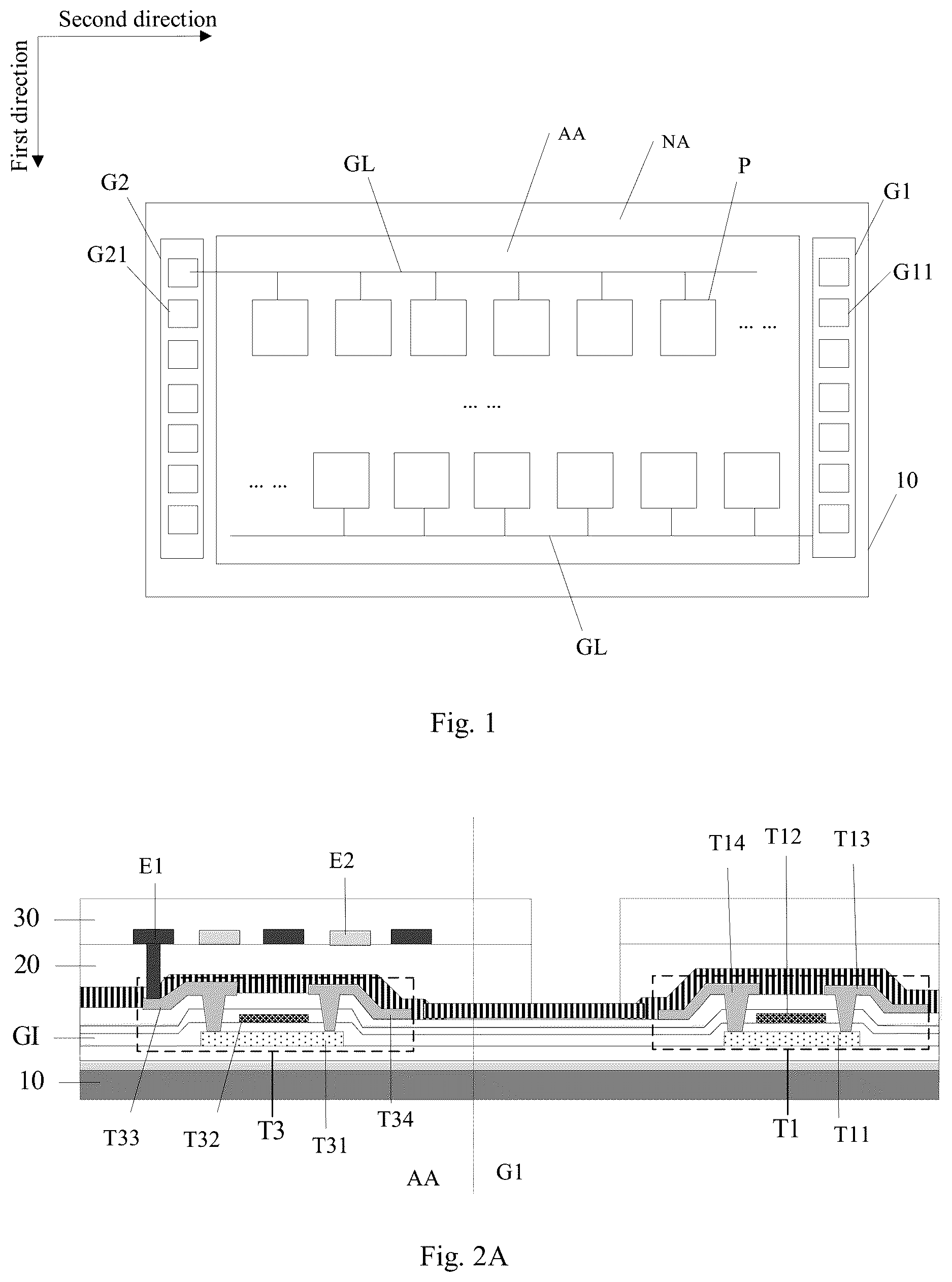
is a schematic planar view of a display substrate provided by at least one embodiment of the present disclosure;
A is a partial cross-sectional schematic diagram of a first thin film transistor and a pixel driving circuit of a sub-pixel closest to the first thin film transistor in a display substrate provided by at least one embodiment of the present disclosure;
B is a partial cross-sectional schematic diagram of a second thin film transistor and a pixel driving circuit of a sub-pixel closest to the second thin film transistor in a display substrate provided by at least one embodiment of the present disclosure;
is a schematic cross-sectional view of active layers of a first thin film transistor, a second thin film transistor and a third thin film transistor in a display substrate provided by at least one embodiment of the present disclosure;
is another schematic planar view of a display substrate provided by at least one embodiment of the present disclosure;
A- 5 D are a plurality of sets of data of turn-on currents of a plurality of first thin film transistors and a plurality of second thin film transistors that serve as output transistors in a display substrate provided by at least one embodiment of the present disclosure;
A- 6 D are a plurality of sets of data of turn-on currents of a plurality of first thin film transistors and a plurality of second thin film transistors that serve as reset transistors in a display substrate provided by at least one embodiment of the present disclosure;
A- 7 D are a plurality of sets of data of threshold voltages of a plurality of first thin film transistors and a plurality of second thin film transistors that serve as output transistors in a display substrate provided by at least one embodiment of the present disclosure;
A- 8 D are a plurality of sets of data of threshold voltages of a plurality of first thin film transistors and a plurality of second thin film transistors that serve as reset transistors in a display substrate provided by at least one embodiment of the present disclosure;
is a circuit diagram of a GOA architecture in a display substrate provided by at least one embodiment of the present disclosure;
is a circuit diagram of a GOA architecture provided by at least one embodiment of the present disclosure; and
is a schematic cross-sectional view of a display panel provided by at least one embodiment of the present disclosure.
DETAILED DESCRIPTION
In order to make objects, technical solutions and advantages of the embodiments of the present disclosure apparent, the technical solutions of the embodiments will be described in a clearly and fully understandable way in connection with the drawings related to the embodiments of the present disclosure. Apparently, the described embodiments are just a part but not all of the embodiments of the present disclosure. Based on the described embodiments herein, those skilled in the art can obtain other embodiment(s), without any inventive work, which should be within the scope of the present disclosure.
Unless otherwise defined, all the technical and scientific terms used herein have the same meanings as commonly understood by one of ordinary skill in the art to which the present disclosure belongs. The terms “first,” “second,” etc., which are used in the description and the claims of the present disclosure, are not intended to indicate any sequence, amount or importance, but distinguish various components. Also, the terms “comprise,” “comprising,” “comprise,” “comprising,” etc., are intended to specify that the elements or the objects stated before these terms encompass the elements or the objects and equivalents thereof listed after these terms, but do not preclude the other elements or objects. The phrases “connect”, “connected”, etc., are not intended to define a physical connection or mechanical connection, but may comprise an electrical connection, directly or indirectly. “On,” “under,” “left,” “right” and the like are only used to indicate relative position relationship, and when the position of the object which is described is changed, the relative position relationship may be changed accordingly.
As mentioned above, for a large-size display panel, the display uniformity of the display panel is an important indicator to evaluate the display effect of the display panel. In the production process of the display panel, it is the direction that the technicians in the art are working hard to form a display device with better display uniformity.
At least one embodiment of the present disclosure provides a display substrate and a display panel, the display substrate comprises a base substrate, and a first gate driver circuit and a second gate driver circuit that are on the base substrate; the display substrate comprises a display region, and the first gate driver circuit and the second gate driver circuit are respectively on a first side of the display region and a second side of the display region that are opposite to each other; the first gate driver circuit comprises a plurality of first shift register units arranged in a first direction, each of the plurality of first shift register units comprises a first thin film transistor having a first function in the first gate driver circuit, the first thin film transistor comprises a first active layer, and the first active layer comprises a metal oxide semiconductor material; the second gate driver circuit comprises a plurality of second shift register units arranged in the first direction, each of the plurality of second shift register units comprises a second thin film transistor having the same function as the first thin film transistor, and the second thin film transistor comprises a second active layer, and the second active layer comprises a metal oxide semiconductor material; an average turn-on current of the first thin film transistor of at least one first shift register unit of the plurality of first shift register units is I on1 , and an average turn-on current of the second thin film transistor of at least one second shift register unit of the plurality of second shift register units is I on2 , and I on1 >I on2 .
The display substrate provided by embodiments of the present disclosure can be used to form LCD (Liquid Crystal Display) products with a larger size (for example, 50-100 inches or more), which adopts the above-mentioned double-sided GOA (Gate on Array) circuit to drive the display process. Metal oxide TFT (Oxide thin film transistor, hereinafter referred to as Oxide-TFT) is used in the double-sided GOA circuit.
The GOA circuit adopting the Oxide-TFT has a higher turn-on current Ion and a lower turn-off current Ioff, and the carrier mobility is 10-100 times that of a thin film transistor adopting a-Si, and therefore the GOA circuit has strong driving ability, and is suitable for large-size, high-resolution and high-frequency driven products.
At present, the display panel using this type of GOA circuit has a problem of poor display. The main reason is that the threshold voltage Vth drift of the internal TFT (for example, the TFT which mainly plays the reset function) of the GOA circuit leads to the failure of the cascade connection, and the GOA circuit cannot work normally.
Under the condition that the process uniformity needs to be improved, the Vth drift of the TFT which mainly plays the reset function is too large, which is easy to cause the GOA circuit failure, resulting in poor display. Improving the uniformity in the manufacturing process of the display panel and improving the Vth drift of the internal TFT of the GOA circuit are the main directions to overcome at present.
Specifically, TFTs with the same function are located in different regions, and the Vth drift severities of the TFTs are different. For example, the Vth drift degrees of the TFTs in the dual-drive GOA located on both the left side and right side of the display panel are different. In addition, the Vth drift degrees of TFTs with different functions in the GOA circuit located on the same side of the display panel are also different.
For example, for the GOA architecture of the 17T1C circuit shown in , M 1 , M 2 , and M 13 are the main reset units, and M 3 is the output transistor, which is helpful for PU bootstrapping. These four transistors are the main transistors. Among them, M 1 is connected to a signal input terminal and is called an input transistor, and M 13 is related to the output signal and can also be called an output transistor. The Vth drift of these four transistors leads to the failure of the cascade relationship, and the GOA circuit cannot work normally. Of course, the drift degrees of M 10 and M 11 are also large.
For the Oxide-TFT in the GOA circuit provided by the embodiments of the present disclosure, in some embodiments, the TFT is a bottom gate structure of back channel etching, the active layer is a single-layer metal oxide semiconductor layer structure or stacked metal oxide semiconductor layers structure, the material of the single-layer metal oxide semiconductor layer structure or the stacked metal oxide semiconductor layers structure is IGZO, and the number ratio of metal atoms in any metal oxide semiconductor layer is 1:1:1, or 4:2:3, or 1:3:6, or other ratios, the IGZO can be mixed with components such as N, F and the like to improve the device performance.
For GOA circuits with other architectures, there may be similar situations as described above, which is not repeated here.
The uniformity of the display substrate provided by the embodiments of the present disclosure is relatively high, and the display defect can be overcome.
The above-mentioned double-sided driving GOA provided by the embodiments of the present disclosure is respectively referred to as the first gate driver circuit and the second gate driver circuit in the description, which are both Oxide-TFT driving circuits.
The display substrate and display panel provided by the embodiments of the present disclosure are explained by the following specific embodiments.
At least one embodiment of the present disclosure provides a display substrate. shows a planar view of the display substrate at a top view angle. As shown in , the display substrate includes a base substrate 10 and a first gate driver circuit G 1 and a second gate driver circuit G 2 that are arranged on the base substrate 10 . The display substrate includes a display region AA, the display region AA includes a plurality of sub-pixels P arranged in an array. The first gate driver circuit G 1 and the second gate driver circuit G 2 are respectively arranged on the first side and the second side of the display region AA which are opposite to each other. The gate driver circuits being on the left and right sides of the display region AA is illustrated in .
For example, as shown in , the display substrate further includes a peripheral region NA surrounding the display region AA. In this case, the first gate driver circuit G 1 and the second gate driver circuit G 2 are respectively arranged on the first side and the second side of the display region AA, which may be the case that the first gate driving circuit G 1 and the second gate driving circuit G 2 are respectively arranged in the peripheral region NA at the first side and the second side of the display region AA that are opposite to each other, as shown in . Or, in other examples, at least a part of the first gate driver circuit G 1 and the second gate driver circuit G 2 may be disposed in the display region AA, and disposed on the first side and the second side that are opposite to each other in the display region AA. The embodiments of the present disclosure do not limit the specific positions of the first gate driver circuit G 1 and the second gate driver circuit G 2 .
For example, as shown in , the first gate driver circuit G 1 includes a plurality of first shift register units G 11 arranged in a first direction (shown as the column direction of pixels in ), and each of the plurality of first shift register units G 11 includes a first thin film transistor T 1 . For example, A shows a schematic cross-sectional view of the first thin film transistor T 1 and a partial schematic cross-sectional view of a pixel driving circuit of the sub-pixel P closest to the first thin film transistor T 1 (in LCD products, the pixel driving circuit can be understood as a circuit such as a switch transistor). As shown in A , the first thin film transistor T 1 includes a first active layer T 11 , and the first active layer T 11 includes a metal oxide semiconductor material, such as at least one metal element selected from a group consisting of In, Zn, Ga, Sn, Pr, and so on. For example, in some embodiments, the metal oxide semiconductor material may be a ZnO-based material doped with rare earth elements, IIIB-group elements, Sn, In, N, F or other elements, or an In 2 O 3 -based material doped with rare earth elements, IIIB-group elements, Sn, In, N, F or other elements. A typical target or active layer component include IGZO, ITZO, IGZTO, Ln-IZO, etc., and the proportions of metals in these materials are also different, which is not described here. Among them, Ln-IZO is a material in which lanthanide metal is doped into IZO, and lanthanide metal is a part of rare earth metal, which is an IB-group element.
For example, the pixel driving circuit of the sub-pixel P located in the display region AA includes a third thin film transistor T 3 , and the third thin film transistor T 3 includes a third active layer T 31 . For example, in some examples, the third active layer T 31 is arranged in the same layer as the first active layer T 11 .
It should be noted that, in the embodiments of the present disclosure, the term “in the same layer” means that two functional layers or structural layers are in the same layer and formed of the same material in the hierarchical structure of the display substrate, that is, in the manufacturing process of the display substrate, the two functional layers or structural layers can be formed by the same material layer, and the required patterns and structures can be formed by the same patterning process. Therefore, the manufacturing process of the display substrate can be simplified.
That is, in the embodiments of the present disclosure, the Oxide-TFT thin film transistors in the regions where the display region AA and the GOA circuit are located are formed by one process, and the materials of the active layers in these two regions are the same.
For example, in some embodiments, the first active layer T 11 , the second active layer T 21 , and the third active layer T 31 all include a plurality of metal oxide semiconductor layers that are stacked. For example, shows a schematic cross-sectional view of a plurality of metal oxide semiconductor layers that are stacked. In some embodiments, as shown in , the metal oxide semiconductor layer A 1 close to the gate electrode of the third thin film transistor T 3 may adopt amorphous IGZO, and in the amorphous IGZO, In:Ga:Zn is 1:1:1 or 4:2:3; the metal oxide semiconductor layer A 3 away from the gate electrode of the third thin film transistor T 3 may adopt crystalline IGZO, and in the crystalline IGZO, In:Ga:Zn is 4:2:3 or 1:3:6.
It should be noted that shows two stacked metal oxide semiconductor layers as an example, and in other examples, the number of the metal oxide semiconductor layers may be three or four, or more.
For example, as shown in , the second gate driver circuit G 2 includes a plurality of second shift register units G 21 arranged in a first direction (such as the column direction of pixels), and each of the second shift register units G 21 includes a second thin film transistor T 2 having the same function as the first thin film transistor T 1 . For example, the first shift register unit G 11 and the second shift register unit G 21 have basically the same circuit structure. In the first shift register unit G 11 and the second shift register unit G 21 , the first thin film transistor T 1 and the second thin film transistor T 2 are basically at the same position, have basically the same circuit connection relationship and are used to realize the same function.
For example, B shows a schematic cross-sectional view of the second thin film transistor T 2 and a partial schematic cross-sectional view of a pixel driving circuit of the sub-pixel P closest to the second thin film transistor T 2 . As shown in B , the second thin film transistor T 2 includes a second active layer T 21 , and the second active layer T 21 includes a metal oxide semiconductor material. For example, the first active layer T 11 and the second active layer T 21 are arranged in the same layer, for example, the first active layer T 11 , the second active layer T 21 and the third active layer T 31 are all arranged in the same layer, so that the manufacturing process of the display substrate can be simplified.
In the field of LCD, the bottom gate back channel etching structure (referred to as bottom gate BCE structure for short) with simpler process procedure is widely used. The above-mentioned A and 2 B are only used to illustrate the relationship between the active layers of the Oxide-TFTs and the TFTs in the region where the GOA circuit is located and the display region AA, and are not used to limit the case that the TFTs only use the top gate structure in the LCD technical field. For example, the average turn-on current of the plurality of first thin film transistors T 1 of the plurality of first shift register units G 11 is I on1 , the average turn-on current of the plurality of second thin film transistors of the plurality of second shift register units G 21 is I on2 , and I on1 >I on2 .
It should be noted that in the embodiments of the present disclosure, the turn-on current of a thin film transistor refers to I DS .
For example, I on =I DS =W/L*A/(dε(Vgs−Vth−Vds/2)Vds, in which d represents the thickness of the gate insulation layer (i.e., the insulation layer GI between the gate electrode and the active layer), ε represents the dielectric constant of the gate insulation layer, I DS represents the current between the source electrode and the drain electrode, W/L represents the width-to-length ratio of the channel of the thin film transistor, and A represents a fixed constant, A=με 0 , that is, A equals to the carrier mobility of the channel multiplied by co, Vgs represents the voltage between the gate electrode and the source electrode, Vth represents the threshold voltage, and Vds represents the voltage between the source electrode and the drain electrode.
For example, in some embodiments, the first thin film transistor T 1 and the second thin film transistor T 2 are output transistors playing a function of outputting signals, or input transistors playing a function of inputting signals, or reset transistors, which will be described in detail later.
For example, in some embodiments, as shown in , the display region AA further includes scanning lines GL connected to a plurality of sub-pixels P. For example, the first thin film transistor T 1 and the second thin film transistor T 2 are output transistors configured to be directly or indirectly electrically connected to the scanning lines GL to provide gate scanning signals to the plurality of sub-pixels P.
For example, in some embodiments, as shown in , the scanning lines GL extend in a second direction (the horizontal direction shown in ), the second direction is substantially perpendicular to the first direction, and the first side and the second side are opposite to each other in the second direction.
For example, in some embodiments, I on1 −I on2 <I on2 ×20%, that is, the average turn-on current of the plurality of first thin film transistors on the first side does not exceed 20% of the average turn-on current of the second thin film transistors on the second side compared with the average turn-on current of the plurality of second thin film transistors on the second side. Such current uniformity can solve the problem of abnormal display caused by the characteristic difference of the TFTs.
For example, in some embodiments, I on1 −I on2 <I on2 ×10%. Such current uniformity can solve the problem of abnormal display caused by the characteristic difference of the TFTs.
For example, shows another schematic planar view of the display substrate provided by the embodiments of the present disclosure. As shown in , in some embodiments, the second side has a first region R 1 , a second region R 2 , and a third region R 3 arranged in sequence along the first direction, and the average turn-on current of the plurality of second thin film transistors T 2 located in the first region R 1 is I on21 , the average turn-on current of the plurality of second thin film transistors T 2 located in the second region R 2 is I on22 , the average turn-on current of the plurality of second thin film transistors T 2 located in the third region R 3 is I on23 , I on2 1 >I on22 , and I on23 >I on22 . Therefore, the average turn-on current of the plurality of second thin film transistors T 2 located in the middle region are smaller than the average turn-on current of the plurality of second thin film transistors T 2 located at the upper side of the middle region and the average turn-on current of the plurality of second thin film transistors T 2 located at the lower side of the middle region. This design can improve the display effect of the display substrate, that is, improve the viewing effect of the viewer.
For example, in some examples, the plurality of first thin film transistors T 1 located on the first side may also have the above design, which is not repeated here.
For example, as shown in A , the first thin film transistor T 1 includes a first active layer T 11 , a first gate electrode T 12 , a first source-drain electrode T 13 , and a second source-drain electrode T 14 . As shown in B , the second thin film transistor T 2 includes a second active layer T 21 , a second gate electrode T 22 , a third source-drain electrode T 23 , and a fourth source-drain electrode T 24 . The third thin film transistor T 3 includes a third active layer T 31 , a third gate electrode T 32 , a fifth source-drain electrode T 33 and a sixth source-drain electrode T 34 . For example, the first thin film transistor T 1 , the second thin film transistor T 2 , and the third thin film transistor T 3 are arranged in the same layer, that is, the corresponding layers in the first thin film transistor T 1 , the second thin film transistor T 2 , and the third thin film transistor T 3 are all arranged in the same layer, thereby simplifying the manufacturing process of the display substrate.
It should be noted that one of the first source-drain electrode and the second source-drain electrode of each TFT is the source electrode and the other is the drain electrode, which are symmetrical in structure, so they may be interchanged in implementation.
For example, in some embodiments, in the case where gate voltages Vg of the plurality of first thin film transistors T 1 are in a range of 10V-20V, such as 15V, the turn-on currents of the plurality of first thin film transistors T 1 and the turn-on currents of the plurality of second thin film transistors T 2 are both greater than 1200 μA.
For example, in some embodiments, in the case where gate voltages Vg of the plurality of first thin film transistors T 1 are in a range of 10V-20V, for example, 15V, the maximum value of the turn-on currents of the plurality of first thin film transistors T 1 is I on1MAX , the minimum value of the turn-on currents of the plurality of first thin film transistors T 1 is I on1MIN , and I on1MAX −I on1MIN ≤1000 μA; in the case where gate voltages Vg of the plurality of second thin film transistors T 2 are in a range of 10V-20V, for example, 15V, the maximum value of the turn-on currents of the plurality of second thin film transistors T 2 is I on2MAX , the minimum value of the turn-on currents of the plurality of second thin film transistors T 2 is I on2MIN , and I on2MAX −I on2MIN ≤1000 μA.
All the above designs are helpful to improve the display uniformity of the display substrate and the visual effect of the viewer.
For example, in some embodiments, the turn-on currents of the plurality of first thin film transistors T 1 of the plurality of first shift register units G 11 and the plurality of second thin film transistors T 2 of the plurality of second shift register units G 21 have the maximum value of I onMAX and have the minimum value of I onMIN , it is defined that 3δ 1 =(I onMAX −I onMIN )/(I onMAX +I onMIN ), then 3δ 1 =50˜700.
In the embodiments of the present disclosure, 3δ 1 can be used to evaluate the overall uniformity of the display substrate, and in the case where 3δ 1 =50˜700, the display substrate has a good display effect, which can meet the visual needs of viewers.
For example, A- 5 D show the data of the turn-on currents of a plurality of first thin film transistors T 1 and a plurality of second thin film transistors T 2 that serve as output transistors under multiple tests. Corresponding to the orientation of , A- 5 D show the data of the turn-on currents of the first thin film transistors T 1 and the second thin film transistors T 1 at various positions. The data is measured in the case where the gate voltages Vg of the plurality of first thin film transistors T 1 are 15V and the gate voltages Vg of the plurality of second thin film transistors T 2 are 15V, and the unit of the data is microamperes (μA), Avg represents the average of the turn-on currents of the plurality of first thin film transistors T 1 and the plurality of second thin film transistors T 2 . It can be seen that each display substrate has the above design, and in this case, the display substrate has a better display effect, which can meet the visual needs of viewers.
For example, in other embodiments, both the first thin film transistor T 1 and the second thin film transistor T 2 are reset transistors, and the gate electrode of the reset transistor is connected to a reset control signal terminal, which will be described in detail later.
For example, in this embodiment, I on1 −I on2 <I on2 ×30%. For example, I on1 −I on2 <I on2 ×20%. On the one hand, the above design can satisfy the display uniformity of the display substrate, and on the other hand, it can simplify the manufacturing process and improve the production yield.
For example, in this embodiment, the turn-on currents of the plurality of first thin film transistors T 1 of the plurality of first shift register units G 11 and the plurality of second thin film transistors T 2 of the plurality of second shift register units G 21 have the maximum value of I onMAX , and have the minimum value of I onMIN , it is defined that 3δ 1 =(I onMAX −I onMIN )/(I onMAX +I onMIN ), then 3δ 1 =50˜700.
For example, A- 6 D show the data of the turn-on currents of a plurality of first thin film transistors T 1 and a plurality of second thin film transistors T 1 that serve as reset transistors under multiple tests. Corresponding to the orientation of , A- 6 D show the data of the turn-on currents of the plurality of first thin film transistors T 1 and the plurality of second thin film transistors T 2 at various positions. The data is measured in the case where the gate voltages Vg of the plurality of first thin film transistors T 1 are 15V and the gate voltages Vg of the plurality of second thin film transistors T 2 are 15V, and the unit of the data is microamperes (μA), Avg represents the average of the turn-on currents of the plurality of first thin film transistors T 1 and the plurality of second thin film transistors T 2 . It can be seen that each display substrate has the above design, and in this case, the display substrate has a better display effect, which can meet the visual needs of viewers.
For example, in some embodiments, the average threshold voltage of the plurality of first thin film transistors T 1 of the plurality of first shift register units G 11 is V th1 , and the average threshold voltage of the plurality of second thin film transistors T 2 of the plurality of second shift register units G 21 is V th2 , and then V th1 >V th2 .
It should be noted that in the embodiments of the present disclosure, the threshold voltage refers to the turn-on voltage of the thin film transistor.
For example, in some embodiments, V th1 −V th2 <|V th2 |×30%. That is, the average threshold voltage of the plurality of first thin film transistors on the first side is larger than, within the range of 30%, the average threshold voltage of the plurality of second thin film transistors on the second side. For example, in some examples, V th1 −V th2 <|V th2 |×20%. On the one hand, the above design can satisfy the display uniformity of the display substrate, and on the other hand, it can simplify the manufacturing process and improve the production yield.
For example, in some embodiments, a source-drain input voltage of each of the plurality of first thin film transistors is Vd, Vd=10V-20V, and the turn-on current of each of the plurality of first thin film transistors is Id, Id=10 −8 A, |V th1 |<2V, |V th2 |<2V.
For example, in some embodiments, the maximum value of the threshold voltages of the plurality of first thin film transistors T 1 is V th1MAX , the minimum value of the threshold voltages of the plurality of first thin film transistors T 1 is V th1MIN , and V th1MAX −V th1MIN ≤2V; the maximum value of the threshold voltages of the plurality of second thin film transistors T 2 is V th2MAX , the minimum value of threshold voltages of the plurality of second thin film transistors is V th2MIN , and V th2MAX −V th2MIN ≤2V.
For example, in some embodiments, threshold voltages of the plurality of first thin film transistors T 1 of the plurality of first shift register units G 11 and the plurality of second thin film transistors T 2 of the plurality of second shift register units G 21 have the maximum value of V thMA and the minimum value of V thMIN , it is defined that 3δ 2 =(V thMAX −V thMIN )/(V thMAX +V thMIN ), and then 3δ 2 =0.1˜2.5.
For example, A- 7 D show the data of the threshold voltages of a plurality of first thin film transistors T 1 and a plurality of second thin film transistors T 2 that serve as output transistors under multiple tests. Corresponding to the orientation of , A- 7 D show the data of the threshold voltages of the first thin film transistors T 1 and the second thin film transistors T 2 at various positions, these data are tested under the case where the source-drain electrode input voltages Vd of the plurality of first thin film transistors T 1 are in a range of 10V-20V, for example, 15.1V, and the turn-on currents Id of the plurality of first thin film transistors T 1 are equal to 10 −8 A, and the source-drain electrode input voltages Vd of the plurality of second thin film transistors T 2 are in a range of 10V-20V, for example, 15.1V, and the turn-on currents Id of the plurality of second thin film transistors T 2 are equal to 10 −8 A, the unit of the data is volt (V), Avg represents the average value of threshold voltages of the plurality of first thin film transistors T 1 and the plurality of second thin film transistors T 2 . It can be seen that each display substrate has the above design, and in this case, the display substrate has a better display effect.
For example, A- 8 D show the data of the threshold voltages of a plurality of first thin film transistors T 1 and a plurality of second thin film transistors T 2 as reset transistors under multiple tests. Corresponding to the orientation of , A- 8 D show the data of the threshold voltages of the first thin film transistor T 1 and the second thin film transistor T 2 at various positions, these data are tested under the case where the source-drain electrode input voltages Vd of the plurality of first thin film transistors T 1 are in a range of 10V-20V, for example, 15.1V, and the turn-on currents Id of the plurality of first thin film transistors T 1 are equal to 10 −8 A, and the source-drain electrode input voltages Vd of the plurality of second thin film transistors T 2 are in a range of 10V-20V, for example, 15.1V, and the turn-on currents Id of the plurality of second thin film transistors T 2 are equal to 10 −8 A, the unit of the data is volt (V), Avg represents the average value of threshold voltages of the plurality of first thin film transistors T 1 and the plurality of second thin film transistors T 2 . It can be seen that each display substrate has the above design, and in this case, the display substrate has a better display effect.
For example, in some embodiments, the average lifetime of the plurality of first thin film transistors T 1 of the plurality of first shift register units G 11 is longer than the average lifetime of the plurality of second thin film transistors T 2 of the plurality of second shift register units G 21 .
For example, in some embodiments, viewed from the base substrate 10 to the first gate driver circuit G 1 , that is, in the direction of the display substrate itself, the first side is the left side of the display region AA and the second side is the right side of the display region AA. Or, viewed in the direction where the viewer faces the display substrate, that is, when the display substrate displays images, the viewer faces the display substrate, in this case, the first side is the right side of the display region AA, and the second side is the left side of the display region AA, as shown in .
For example, in some embodiments, as shown in , the size of the display substrate in the second direction is larger than the size of the display substrate in the first direction. That is, when the viewer views the display substrate, the size of the display substrate in the horizontal direction is larger than the size of the display substrate in the vertical direction.
For example, shows an exemplary circuit diagram of one first shift register unit in the display substrate provided by the embodiments of the present disclosure, and the second shift register unit has the same circuit structure as the first shift register unit, for example. In this case, the thin film transistors with the same functions in the first shift register unit and the second shift register unit are basically located at the same positions in the circuits respectively, and have the same circuit connection relationship, so as to realize the same functions.
For example, as shown in , in some examples, the first shift register unit G 11 includes an input sub-circuit 101 , a first output sub-circuit 102 , a second output sub-circuit 103 , a reset sub-circuit 104 and a monitor sub-circuit 105 . The input sub-circuit 101 is configured to response to the input signal, and pre-charge the pull-up node PU by the input signal; the pull-up node PU is the connection node between the input sub-circuit 101 , the first output sub-circuit 102 , the second output sub-circuit 103 and the reset sub-circuit 104 ; the first output sub-circuit 102 is configured to respond to the potential of the pull-up node PU, and output the clock signal through the first output terminal Output 1 ; the second output sub-circuit 103 is configured to respond to the potential of the pull-up node PU, and outputs a synchronization signal output by the first output terminal Output 1 through the second output terminal Output 2 ; the reset sub-circuit 104 is configured to respond to the reset signal, and reset the potential of the pull-up node PU through the second power supply voltage; the monitor sub-circuit 104 is configured to monitor the second output terminal Output 2 and output the monitoring result through the third output terminal Output 3 .
Therefore, in the shift register unit described above, the first output sub-circuit 102 can output a GOA signal, such as the clock signal, through the first output terminal Output 1 , the second output sub-circuit 103 can output the synchronization signal output by the first output terminal Output 1 through the second output terminal Output 2 , and the monitor sub-circuit 104 can monitor the second output terminal Output 2 , and output the monitoring result through the third output terminal Output 3 at the same time, so that the GOA signal output by the second output terminal Output 2 can be monitored, and whether the GOA signal output by the shift register is abnormal or not can be judged, and therefore the real-time monitoring of the GOA signal can be realized, and the working state change of the GOA can be monitored in the process of product reliability, and then the abnormal point of the GOA signal can be detected at the first time.
For example, in some examples, as shown in , the first shift register may further include at least one pull-down control sub-circuit 106 , at least one pull-down sub-circuit 107 , at least one first noise reduction sub-circuit 108 , at least one second noise reduction sub-circuit 109 and at least one third noise reduction sub-circuit 110 . The pull-down sub-circuit 106 is configured to respond to the first power supply voltage, and control the potential of the pull-down node PD through the first power supply voltage; the pull-down node PD is a connection node between the pull-down control sub-circuit 106 and the pull-down sub-circuit 107 ; the pull-down circuit 107 is configured to respond to the potential of the pull-up node PU, and pull down the potential of the pull-down node PD through the second power supply voltage; the first noise reduction sub-circuit 108 is configured to respond to the potential of the pull-down node PD, and reduce the noise of the first output terminal Output 1 through the second power supply voltage; the second noise reduction sub-circuit 109 is configured to respond to the potential of the pull-down node PD, and reduce the noise of the second output terminal Output 2 through the second power supply voltage; the third noise reduction sub-circuit 110 is configured to respond to the potential of the pull-down node PD, and reduce the noise of the pull-up node PU through the second power supply voltage.
For example, in some embodiments, as shown in , the first shift register unit may further include an initialization sub-circuit 111 ; the initialization sub-circuit 111 is configured to respond to the initialization signal, and initialize the potential of the pull-up node PU through the second power supply voltage.
Specifically, as shown in , the input sub-circuit 101 includes a first transistor M 1 (input transistor), the gate electrode and source electrode of the first transistor M 1 are both connected to the input signal terminal Input, and the drain electrode of the first transistor M 1 is connected to the pull-up node PU. The Reset sub-circuit 104 includes a second transistor M 2 (i.e., the above-mentioned reset transistor). The gate electrode of the second transistor M 2 is connected to the reset control signal terminal Reset, the source electrode of the second transistor M 2 is connected to the second power supply voltage terminal VSS, and the drain electrode of the second transistor M 2 is connected to the pull-up node PU. The first output sub-circuit 102 includes a third transistor M 3 (i.e., the above output transistor) and a storage capacitor C. The gate electrode of the third transistor M 3 is connected to the pull-up node PU, the source electrode of the third transistor M 3 is connected to the clock signal terminal CLK, and the drain electrode of the third transistor M 3 is connected to the first output terminal Output 1 ; one end of the storage capacitor C is connected to the pull-up node PU, and the other end is connected to the first output terminal Output 1 . The second output sub-circuit 103 includes a thirteenth transistor M 13 (the thirteenth transistor M 13 is also an output transistor); the gate electrode of the thirteenth transistor M 13 is connected to the pull-up node PU, the source electrode of the thirteenth transistor M 13 is connected to the clock signal terminal CLK, and the drain electrode of the thirteenth transistor M 13 is connected to the second output terminal Output 2 .
To distinguish M 3 from M 13 , M 3 is the first output transistor and M 13 is the second output transistor in the embodiments of the present disclosure.
In the input stage, the signal input terminal Input writes a high-level signal, the first transistor M 1 is turned on, and the high-level signal can pre-charge the pull-up node PU through the first transistor M 1 . In the output stage, the potential of the pull-up node PU is pre-charged and pulled up, and stored in the storage capacitor C. In this stage, the first transistor M 1 is turned off, the storage capacitor C discharges to further raise the potential of the pull-up node PU, and thus the third transistor M 3 and the thirteenth transistor M 13 are both turned on. The first output terminal Output 1 outputs the high-level signal written by the clock signal terminal CLK, while the second output terminal Output 2 outputs the synchronization signal output by the first output terminal Output 1 . In the Reset stage, the reset control signal terminal RESET is written with a high-level signal, the second transistor M 2 is turned on, and the potential of the pull-up node PU is reset by the low power supply voltage written by the second power supply voltage terminal VSS.
For example, the monitor sub-circuit 105 includes a fourth transistor M 4 , the gate electrode and source electrode of the fourth transistor M 4 are both connected to the second output terminal Output 2 , and the drain electrode of the fourth transistor M 4 is connected to the third output terminal Output 3 .
It should be noted that the gate electrode and source electrode of the fourth transistor M 4 are connected to the second output terminal Output 2 , and the drain electrode of the fourth transistor M 4 is connected to the third output terminal Output 3 , in the case where the GOA signal output by the second output terminal Output 2 is a high-level signal, the fourth transistor M 4 can be turned on under the control of the high-level signal, and the high-level signal is output through the third output terminal Output 3 . By comparing the high-level signal output by the third output terminal Output 3 with the reference high-level signal, if the signal output by the third output terminal Output 3 is the same as the reference high-level signal, it means that the GOA signal output by the second output terminal Output 2 is normal; if the signal output by the third output terminal Output 3 is different from the reference high-level signal or no output signal is output from the third output terminal Output 3 , it means that the GOA signal output by the second output terminal Output 2 is abnormal, so that the real-time monitoring of the GOA signal can be realized, and the working state change of the GOA can be monitored in the process of product reliability, and then the abnormal point of the GOA signal can be detected at the first time, thus avoiding AD and other defects.
For example, the pull-down control sub-circuit 106 includes a ninth transistor M 9 and a fifth transistor M 5 . The gate electrode and source electrode of the ninth transistor M 9 are both connected to the first power supply voltage terminal VDD, and the drain electrode of the ninth transistor M 9 is connected to the gate electrode of the fifth transistor M 5 . The gate electrode of the fifth transistor M 5 is connected to the drain electrode of the ninth transistor M 9 , the source electrode of the fifth transistor M 5 is connected to the first power supply voltage terminal VDD, and the drain electrode of the fifth transistor M 5 is connected to the pull-down node PD. The pull-down circuit 107 includes a sixth transistor M 6 and an eighth transistor M 8 . The gate electrode of the sixth transistor M 6 is connected to the pull-up node PU, the source electrode of the sixth transistor M 6 is connected to the pull-down node PD, and the drain electrode of the sixth transistor M 6 is connected to the second power supply voltage terminal VSS. The gate electrode of the eighth transistor M 8 is connected to the pull-up node PU, the source electrode of the eighth transistor M 8 is connected to the drain electrode of the ninth transistor M 9 , and the drain electrode of the eighth transistor M 8 is connected to the second power supply voltage terminal VSS. The first noise reduction sub-circuit 108 includes an eleventh transistor M 11 , the gate electrode of the eleventh transistor M 11 is connected to the pull-down node PD, the source electrode of the eleventh transistor M 11 is connected to the first output terminal Output 1 , and the drain electrode of the eleventh transistor M 11 is connected to the second supply voltage terminal VSS. The second noise reduction sub-circuit 109 includes a twelfth transistor M 12 , the gate electrode of the twelfth transistor M 12 is connected to the pull-down node PD, the source electrode of the twelfth transistor M 12 is connected to the second output terminal Output 2 , and the drain electrode of the twelfth transistor M 12 is connected to the second power supply voltage terminal VSS. The third noise reduction sub-circuit 110 includes a tenth transistor M 10 , the gate electrode of the tenth transistor M 10 is connected to the pull-down node PD, the source electrode of the tenth transistor M 10 is connected to the pull-up node PU; and the drain electrode of the tenth transistor M 10 is connected to the second power supply voltage terminal VSS.
It should be noted that in the example shown in , two pull-down control sub-circuits 106 , two pull-down sub-circuits 107 , two first noise reduction sub-circuits 108 , two second noise reduction sub-circuits 109 and two third noise reduction sub-circuits 110 are taken as examples for illustration. It can be understood that the number of each sub-circuit mentioned above may be one or other, and the implementation principle in this case is the same as the above, and is not repeated here.
For example, in , the fifth transistors in the first one and the second one of the pull-down control sub-circuits 106 are respectively denoted by M 5 and M 5 ′, and the ninth transistors in the first one and the second one of the pull-down control sub-circuits 106 are respectively denoted by M 9 and M 9 ′; the sixth transistors in the first one and the second one of the pull-down circuits 107 are respectively denoted by M 6 and M 6 ′, the eighth transistor M 8 in the first one and the second one of the pull-down circuits 107 are respectively denoted by M 8 and M 8 ′; the eleventh transistors in the first one and the second one of the first noise reduction circuits 108 are respectively denoted by M 11 and M 11 ′; the twelfth transistors M 12 in the first one and the second one of the second noise reduction circuits 109 are respectively denoted by M 12 and M 12 ′; the tenth transistors in the first one and the second one of the third noise reduction circuits 110 are respectively denoted by M 10 and M 10 ′; the first power supply voltage terminals connected to the first one and the second one of the pull-down control sub-circuits 106 are respectively denoted by VDD 1 and VDD 2 . In addition, the first one of the pull-down control sub-circuits 106 and the first one of the pull-down circuits 107 are connected, and the connection node between the first one of the pull-down control sub-circuits 106 and the first one of the pull-down circuits 107 is represented by the pull-down node PD 1 ; the second one of the pull-down control sub-circuits 106 is connected to the second one of the pull-down circuits 107 , and the connection node between the second one of the pull-down control sub-circuits 106 and the second one of the pull-down circuits 107 is represented by the pull-down node PD 2 ; the first one of the first noise reduction circuits 108 is connected to PD 1 , and the second one of the first noise reduction circuits 108 is connected to PD 2 ; the first one of the second noise reduction circuits 109 is connected to PD 1 , and the second one of the second noise reduction circuits 109 is connected to PD 2 ; the first one of the third noise reduction circuits 110 is connected to PD 1 , and the second one of the third noise reduction circuits 110 is connected to PD 2 .
For example, during the scanning process of a frame of image, the first one of the pull-down control sub-circuits 106 , the first one of the pull-down circuits 107 , the first one of the first noise reduction circuits 108 , the first one of the second noise reduction circuits 109 , and the first one of the third noise reduction circuits 110 work, or the second one of the pull-down control sub-circuits 106 , the second one of the first pull-down circuits 107 , the second one of the first noise reduction circuits 108 , and the second one of the second noise reduction circuits 108 work. That is, the number of each of the pull-down control sub-circuit 106 , the first pull-down circuit 107 , the first noise reduction circuit 108 , the second noise reduction circuit 109 , and the third noise reduction circuit 110 may be multiple, and only one of the sub-circuits with the same function works when scanning a frame of image, and at the same time, it can be switched to the other one to work at preset working time, so that the lifetime of the shift register can be prolonged. In the noise reduction stage, because the pull-up node PU is pulled down to a low level potential in the reset stage, and the fifth transistor M 5 and the ninth transistor M 9 are always controlled by the first power supply voltage written by the first power supply voltage terminal VDD 1 , in this case, the potential of the pull-down node PD 1 is a high-level signal, the eleventh transistor M 11 is turned on, and the second power supply voltage written by the second power supply voltage terminal VSS reduces the noise of the output signal of the first output terminal Output 1 through the eleventh transistor M 11 . At the same time, the twelfth transistor M 12 and the tenth transistor M 10 are also turned on, and the second power supply voltage written by the second power supply voltage terminal VSS reduces the noise of the output signal of the second output terminal Output 2 and the noise of the output signal of the pull-up node PU through the twelfth transistor M 12 and the tenth transistor M 10 , respectively.
For example, the initialization sub-circuit 111 includes a seventh transistor M 7 , the gate electrode of the seventh transistor M 7 is connected to the initialization signal terminal STV, the source electrode of the seventh transistor M 7 is connected to the pull-up node PU, and the drain electrode of the seventh transistor M 7 is connected to the second power supply voltage terminal VSS.
It should be noted that when the next frame of display image is displayed, the initialization signal terminal STV writes a high-level signal, and the seventh transistor M 7 is turned on, and the potential of the pull-up node PU is initialized by the low power supply voltage written by the second power supply voltage terminal VSS, so as to prevent the adjacent frames of display image from interfering with each other and affecting the display effect.
It can be understood that the first shift register unit and the second shift register unit provided by the embodiments of the present disclosure may be other circuit structures, such as 17T1C structure, 18T2C structure, 21T1C structure, etc., besides the above-mentioned 19T1C structure. The embodiments of the present disclosure do not limit the specific structures of the first shift register unit and the second shift register unit. For example, in the case where the structures of the first shift register unit and the second shift register unit are the 17T1C structures, compared with the above-mentioned 19T1C structure, the 17T1C structure may not include the ninth transistors M 9 and M 9 ′, but the implementation principle of the 17T1C structure is the same as that of the above-mentioned 19T1C structure shift register unit, and is not repeated here.
At least one embodiment of the present disclosure provides a display panel, and shows a schematic cross-sectional view of the display panel. As shown in , the display panel includes a display substrate 100 and an opposite substrate 200 which are arranged opposite to each other, and a liquid crystal layer 300 sandwiched between the display substrate 100 and the opposite substrate 200 , so that the display panel can be realized as a liquid crystal display panel.
For example, the display substrate 100 is the display substrate provided by the embodiments of the present disclosure. In this case, as shown in A and 2 B , the first planarization layer 20 is disposed on the pixel driving circuits of the plurality of sub-pixels P of the display substrate, and the pixel driving circuit further includes a first driving electrode E 1 and a second driving electrode E 2 disposed on the side of the first planarization layer 150 away from the base substrate 10 . The liquid crystal layer 300 includes a liquid crystal material, and the liquid crystal material can be driven by the first driving electrode E 1 and the second driving electrode E 2 to be in different deflections, so as to achieve different light transmittance to realize display. For example, the first driving electrode E 1 is electrically connected to the pixel driving circuit through the fifth source-drain T 33 of the third thin film transistor T 3 , and the second driving electrode E 2 may be electrically connected to a power supply line (not shown).
For example, in some embodiments, as shown in A and 2 B , the second driving electrode E 2 may be in the same layer as the first driving electrode E 1 and spaced apart from the first driving electrode E 1 ; or, in other examples, the second driving electrode E 2 and the first driving electrode E 1 may be in different layers and spaced apart from each other, as long as the first driving electrode E 1 and the second driving electrode E 2 can drive the liquid crystal material to deflect to achieve different light transmittance. The embodiments of the present disclosure do not limit the specific arrangement of the first driving electrode E 1 and the second driving electrode E 2 .
For example, as shown in A and 2 B , a second planarization layer 20 is further provided on the side of the first driving electrode E 1 away from the base substrate 10 . The first planarization layer 20 and the second planarization layer 30 may be made of an organic insulation material such as polyimide or acrylic resin. For example, the first driving electrode E 1 and the second driving electrode E 2 may be made of aluminum, molybdenum, titanium, copper or other metal materials or an alloy material thereof.
For example, in the embodiments of the present disclosure, the base substrate 10 may be a rigid substrate such as a glass substrate, or a quartz substrate, or a flexible substrate such as polyimide, and each gate electrode may be made of a metal material or an alloy material such as copper (Cu), aluminum (Al), titanium (Ti) and molybdenum (Mo), for example, in a single-layer metal structure or a multi-layer metal structure, such as titanium/aluminum/titanium multi-layer metal structure. Each source electrode and drain electrode may be made of a metal material or an alloy material such as copper (Cu), aluminum (Al), titanium (Ti), molybdenum (Mo), for example, in a single-layer metal structure or a multi-layer metal structure such as titanium/aluminum/titanium multi-layer metal structure. The embodiments of the present disclosure do not specifically limit the material of each structure.
In the embodiments of the present disclosure, each thin film transistor may be a P-type thin film transistor or an N-type thin film transistor, and the structure may be a bottom gate type, a top gate type or a double gate type. The embodiments of the present disclosure do not limit the specific form of each thin film transistor.
For example, the display panel provided by the embodiments of the present disclosure may be other types of display panels such as an organic light emitting diode display panel or a quantum dot display panel, and the embodiments of the present disclosure do not limit the type of the display panel.
The following statements should be noted:
(1) The accompanying drawings involve only the structure(s) in connection with the embodiment(s) of the present disclosure, and other structure(s) can be referred to common design(s).
(2) For the purpose of clarity only, in accompanying drawings for illustrating the embodiment(s) of the present disclosure, the thickness and size of a layer or a structure may be enlarged or narrowed, that is, the drawings are not drawn in a real scale. However, it should be understood that, in the case in which a component such as a layer, film, region, substrate or the like is referred to be “on” or “under” another component, the component may be directly on or under the another component or there may be an intermediate component.
(3) In case of no conflict, the embodiments of the present disclosure and the features in the embodiments can be combined with each other to obtain new embodiments.
What have been described above are only specific implementations of the present disclosure, the protection scope of the present disclosure is not limited thereto, and the protection scope of the present disclosure should be based on the protection scope of the claims.
Figures (11)
Citations
This patent cites (36)
- US6538631
- US6577293
- US11263981
- US11341933
- US11727889
- US12136674
- US2002/0054009
- US2005/0127998
- US2010/0123132
- US2011/0133789
- US2011/0142192
- US2012/0098815
- US2013/0001561
- US2013/0002310
- US2014/0103340
- US2015/0333620
- US2016/0104425
- US2017/0018220
- US2017/0052635
- US2017/0092375
- US2017/0270879
- US2018/0204532
- US2020/0098296
- US2020/0175928
- US2020/0220023
- US2020/0259415
- US2021/0065640
- US2021/0158737
- US2022/0059045
- US2022/0188257
- US2022/0327987
- US2023/0154430
- US2023/0395027
- US113471225
- US1074966
- USWO-2014021150