Method for Comprehensive Performance Evaluation of Students Based on Deep Learning Network
Abstract
The present disclosure provides a student performance evaluation method and system based on artificial intelligence (AI) identification data, and relates to the field of intelligent education. A lightweight network model suitable for student performance evaluation takes the AI identification data as an input and evaluation results as an output. A training data generation algorithm is provided, and multidimensional AI identification data and labels are uniformly processed into training data suitable for the network model through the above algorithm, which can solve the problems that dimensions between any AI identification data and various labels are not uniform, and original data cannot meet training of a multidimensional and cross-time prediction model. A simulated data generation algorithm and a simulated label generation algorithm are provided, and simulated training data is generated using these algorithms in conjunction with the training data generation algorithm.
Claims (5)
1 . A method for comprehensive performance evaluation of students based on a deep learning network model, which is implemented in a system comprising a processor a memory, wherein the memory stores instructions for the processor to perform the following steps: step S 1 , designing the deep learning network model, wherein the deep learning network model is stored in the memory and capable of performing comprehensive performance evaluation of in any time span; step S 2 , generating simulated artificial intelligence (AI) identification data containing the students using a simulated data generation algorithm; step S 3 , generating simulated labels by any amount of simulated AI identification data generated in step S 2 using a simulated label generation algorithm, wherein the simulated labels are used to generate simulated training data, and the simulated training data is used for pre-training of the deep learning network model; step S 4 , processing the simulated AI identification data through a training data generation algorithm using the simulated labels in step S 3 in conjunction with all the simulated AI identification data corresponding to the labels to generate the simulated training data, wherein the simulated training data is stored in a database in the memory; step S 5 , pre-training the deep learning network model designed in step S 1 using the simulated training data generated in step S 4 ; step S 6 , determining real labels of the students, wherein the real labels represent performance evaluation of the students, and the real labels are stored in the database in the memory, and are capable of being modified; step S 7 , obtaining all real labels in the database, and then obtaining all real AI identification data corresponding to each real label in the database; and processing the obtained real AI identification data through the training data generation algorithm to generate final real training data, wherein the final real training data is stored in the database; step S 8 , obtaining the real training data of the database, and training the deep learning network model in step S 1 using the obtained real training data, wherein different real training data is used for the deep learning network model at different stages; when prediction accuracy of the deep learning network model is less than or equal to 70%, the training data generated by the training data generation algorithm is used; and when the prediction accuracy of the deep learning network model is more than 70%, training data generated by a training data generation algorithm with a discard policy is used; and step S 9 , performing comprehensive performance evaluation of the students in any time and space span using the trained deep learning network model;
Show 4 dependent claims
2 . The method for comprehensive performance evaluation of students based on the deep learning network model according to claim 1 , wherein the simulated data generation algorithm in step S 2 comprises the following specific steps: step S 2 . 1 , randomly generating information of n students, marking the student information with different student identities (IDs), wherein the student IDs are recorded as: [ s id 1 ,s id 2 , . . . ,s id i , . . . ,s id n ]; and sid i is a student ID of an i-th student generated by simulation, the student information further comprises gender, college, and name, these basic student information is permanently stored in the database, and these generated students simulate a process of selecting courses, attending classes and generating the AI identification data; step S 2 . 2 , using the student IDs and a random generation algorithm in step S 2 . 1 to give each student a unique property, wherein a set of unique properties of the n students is recorded as [property 1 , property 2 , . . . , property i , . . . , property n ], and property i is a unique property of the i-th student generated by simulation; the unique property of each student represents uniqueness of the simulated student, indicating a learning state of the simulated student, all unique properties obey normal distribution as a whole, and the set of unique properties obtained at the current stage does not have complete randomness and does not obey normal distribution for the time being; step S 2 . 3 , scrambling the set of unique properties in step S 2 . 2 using a random scrambling algorithm to obtain a scrambled set of unique properties [Lproperty 1 , Lproperty 2 , . . . , Lproperty i , . . . , Lproperty n ], wherein the scrambled unique properties are random; step S 2 . 4 , mapping values in the scrambled set of unique properties by a function, such that the scrambled set of unique properties after mapping has a normal distribution characteristic, wherein each Lproperty i in the scrambled set of unique properties is mapped by the function:
3 . The method for comprehensive performance evaluation of students based on the deep learning network model according to claim 1 , wherein the training data generation algorithm in steps S 4 , S 7 , and S 8 comprises the following specific steps: step S 4 . 1 , obtaining all the AI identification data corresponding to the labels in step S 4 : Data=[ a 11 ,a 12 , . . . ,a 1i , . . . ,a 1n ],[a 21 ,a 22 , . . . ,a 2i , . . . ,a 2n ], . . . ,[a m1 ,a m2 , . . . ,a mi , . . . ,a mn ]}; step S 4 . 2 , determining a standard training data length to be S; when m in Data is equal to S, directly matching the data Data with the label as one of the final training data; when m in Data is less than S, calculating A=S/m, rounding down A to obtain A1, and taking a remainder of S to m to obtain B; copying A1−1 copies of random B elements in Data, copying A1+1 copies of remaining m-B elements, and matching the copied Data with the label as one of the final training data; and when m in Data is greater than S, calculating C=m/S, rounding down C to obtain B1, and taking the remainder of m to S to obtain D, summing and averaging the first D connected elements with a length of B1−1 in Data to synthesize an element, summing and averaging m-B connected elements with a length of B in the remaining elements to synthesize an element, and matching Data after synthesis with the label as one of the final training data.
4 . The method for comprehensive performance evaluation of students based on the deep learning network model according to claim 2 , wherein in step S 2 . 2 , a process of using the random generation algorithm to give each student the unique property comprises the following specific steps: step S 2 . 2 . 1 , setting a prime number K greater than n, and dividing each student ID in a student ID set in step S 2 . 1 by K to obtain a set of temper numbers: [sid 1 /K, sid 2 /K, . . . , sid i /K, . . . sid n /K]=[temperNumber 1 , temperNumber 2 , . . . , temperNumber i , . . . , temperNumber n ], wherein temperNumber i is a temper number of the i-th student generated by simulation; step S 2 . 2 . 2 , setting a truncation start bit K and a truncation stop bit J, wherein J>K; and intercepting K-th to J-th bits after a decimal point of each temper number in the set of temper in numbers step S 2 . 2 . 1 obtain a set of truncation numbers to [truncation 1 , truncation 2 , . . . , truncation i , . . . , truncation n ]; and step S 2 . 2 . 3 , dividing each number in the set of truncation numbers in step S 2 . 2 . 2 by 10 J+1-k to obtain the unique property: [truncation 1 /10 J+1-K ,truncation 2 /10 J+1-K , . . . ,truncation i /10 J+1-K , . . . ,truncation n /10 J+1-K ]=[property 1 ,property 2 , . . . ,property i , . . . ,property n ].
5 . The method for comprehensive performance evaluation of students based on the deep learning network model according to claim 2 , wherein step S 2 . 6 comprises the following specific steps: step S 2 . 6 . 1 , randomly generating a number B obeying (0,1) normal distribution; step S 2 . 6 . 2 , obtaining the unique property of the student finalProperty i corresponding to the simulated AI identification data being generated; and if B+finalProperty i , executing step S 2 . 6 . 3 between an interval [0,1], otherwise executing step S 2 . 6 . 1 ; and step S 2 . 6 . 3 , customizing an overall positive state rate of the currently generated simulated AI identification data as V, outputting a positive state if B+finalProperty i is greater than a in the following equation, and outputting a negative state if B+finalProperty i is less than or equal to a in the following equation, wherein the equation in step S 2 . 6 . 3 is
Full Description
Show full text →
CROSS REFERENCE TO RELATED APPLICATION
This patent application claims the benefit and priority of Chinese Patent Application No. 202111054782.3, filed on Sep. 9, 2021, the disclosure of which is incorporated by reference herein in its entirety as part of the present application.
TECHNICAL FIELD
The present disclosure relates to the field of intelligent education, and in particular to a student performance evaluation method and system based on artificial intelligence (AI) identification data.
BACKGROUND ART
With vigorous development and maturity of the artificial intelligence technology, it has been widely used in various scenarios. In classroom scenarios, the artificial intelligence technology is often used to identify emotions, gestures, and sight lines of students. At the current stage, the artificial intelligence technology in the classroom environment is usually single-technical identification, that is, each plays its own identification function, and is also single time-space identification, that is, only a single student at the current stage is identified. Such single-technical and single time-space identification cannot fully utilize the benefits brought by such technology to the field of intelligent education, and there are problems such as waste of resources and redundancy of software and hardware resources.
In order to give full play to the role of various single-dimensional identification technologies to reduce resource waste and redundancy, the present disclosure provides a unified and generalized method to perform multidimensional processing on AI identification data obtained by the single-technical and single time-space dimensions, and then perform comprehensive evaluation and development prediction of the students in multi time-space dimensions.
SUMMARY
The present disclosure aims to solve the problem in the prior art, and particularly provides a student performance evaluation method and system based on AI identification data.
To achieve the above objective of the present disclosure, according to a first aspect of the present disclosure, the present disclosure provides a student performance evaluation method based on AI identification data, including:
•
• step S 1 , designing a deep learning network model, where the deep learning network model is capable of performing comprehensive performance evaluation of students in any time span by using processed AI identification data; • step S 2 , generating simulated AI identification data containing multiple students using a simulated data generation algorithm, where • the simulated AI identification data generated in this step meets multidimensional randomness and multiple dimensions meet normal distribution, and a trend of an overall data value is controllable; • step S 3 , generating simulated labels by any amount of simulated AI identification data generated in step S 2 using a simulated label generation algorithm, where • the simulated labels are used to generate simulated training data, and the simulated training data is used for pre-training of the deep learning network model; • step S 4 , processing the simulated AI identification data through a training data generation algorithm using the simulated labels in step S 3 in conjunction with all the simulated AI identification data corresponding to the labels to generate the simulated training data, where the simulated training data is stored in a database; • step S 5 , pre-training the deep learning network model designed in step S 1 using the simulated training data generated in step S 4 ; • step S 6 , determining real labels of the students, where the real labels represent performance evaluation of the students, and the real labels are stored in the database, and are capable of being modified; • step S 7 , obtaining all real labels in the database, and then obtaining all real AI identification data corresponding to each real label in the database; and • processing the obtained real AI identification data through the training data generation algorithm to generate final real training data, where the real training data may be stored in the database; • step S 8 , obtaining the real training data of the database, and training the deep learning network model in step S 1 using the obtained real training data, where different real training data is used for the deep learning network model at different stages; • when prediction accuracy of the deep learning network model is less than or equal to 70%, the training data generated by the training data generation algorithm is used; and • when the prediction accuracy of the deep learning network model is more than 70%, training data generated by a training data generation algorithm with a discard policy is used; and • step S 9 , after the training of the deep learning network model is mature, performing comprehensive performance evaluation of the students in any time and space span using the trained deep learning network model.
Further, the simulated data generation algorithm in step S 2 may include the following specific steps:
•
• step S 21 , randomly generating information of n students, marking the student information with different student IDs, where the student IDs may be recorded as: [ s id 1 ,s id 2 , . . . ,s id i , . . . ,s id n ]; and • sid i may be a student ID of an i-th student generated by simulation, the student information may further include gender, college, and name, these basic student information may be permanently stored in the database, and these generated students may simulate a process of selecting courses, attending classes and generating the AI identification data; • step S 22 , using the student IDs and a random generation algorithm in step S 21 to give each student a unique property, where a set of unique properties of the n students may be recorded as [property 1 , property 2 , . . . , property i , . . . , property n ], and property i may be a unique property of the i-th student generated by simulation; the unique property of each student may represent uniqueness of the simulated student, indicating that the student is more inclined to show a good learning state or a bad learning state; and the unique property of each student may be approximately random, all unique properties may obey normal distribution as a whole, and the set of unique properties obtained at the current stage may not have complete randomness and may not obey normal distribution for the time being; • step S 23 , scrambling the set of unique properties in step S 22 using a random scrambling algorithm to obtain a scrambled set of unique properties [Lproperty 1 , Lproperty 2 , . . . , Lproperty i , . . . , Lproperty n ], where the scrambled unique properties may be almost completely random; • step S 24 , mapping values in the scrambled set of unique properties by a function, such that the scrambled set of unique properties after mapping has a normal distribution characteristic, where each Lproperty i in the scrambled set of unique properties may be mapped by the function:
f ( Lproperty i ) = { 0.5 - 0.5 G ( Lproperty i - 0.5 ) G ( 0.5 ) - G ( 0 ) , Lproperty i ≤ 0.5 0.5 + 0.5 G ( Lproperty i - 0.5 ) G ( 0.5 ) - G ( 0 ) , Lproperty i > 0.5 , and G ( x ) = 1 2 e - π ( Lproperty i - 0.5 ) 2 4 ,
•
• and the scrambled set of unique properties after mapping may be recorded as a final set of unique properties: [finalProperty 1 ,finalProperty 2 , . . . ,finalProperty i , . . . ,finalProperty n ]; • step S 25 , defining Le courses, where each course may have choice i choices, Le≥i≥0, and each course may have teacher, class time, and course week information; and each student generated in step S 21 may randomly select courses based on these courses; and • step S 26 , sequentially generating the simulated AI identification data from the first course of the first week according to a time sequence.
Further, the simulated label generation algorithm in step S 3 may include the following specific steps:
•
• step S 31 , randomly selecting a course, randomly selecting a student of the course, and randomly generating a time period, where this time period may be within a time period corresponding to the selected course; • step S 32 , according to limitation of the course, the student, and the time period in step S 31 , obtaining a set of simulated AI identification data matching the course, the student, and the time period: T={[a 11 ,a 12 , . . . ,a 1i , . . . ,a 1n ],[a 21 ,a 22 , . . . ,a 2i , . . . ,a 2n ], . . . ,[a m1 ,a m2 , . . . ,a mi , . . . ,a mn ]}, • where • a mi represents i-th simulated AI identification data in a randomly generated m-th time period under the premise of the limitation of the course and the student; • step S 33 , allocating a positive state weight and a negative state weight to each dimension feature, where each dimension feature may define a weight allocation function g i (x), and each weight allocation function may further have a weight W i ; • step S 34 , calculating label values using the set T of simulated AI identification data in step S 32 :
label = ∑ i = 1 m ∑ j = 1 n T [ i ] [ j ] g j ( x ) W j m × ( ∑ i = 1 n W i ) × 100 ;
•
• and • step S 35 , repeating steps S 31 , S 32 , and S 34 to generate the simulated labels until the number of simulated labels reaches an expected value.
Further, the training data generation algorithm in steps S 4 , S 7 , and S 8 may include the following specific steps:
•
• step S 41 , obtaining all the AI identification data corresponding to the labels in step S 4 : Data=[ a 11 ,a 12 , . . . ,a 1i , . . . ,a 1n ],[a 21 ,a 22 , . . . ,a 2i , . . . ,a 2n ], . . . ,[a m1 ,a m2 , . . . ,a mi , . . . ,a mn ]}; • step S 42 , since a standard training data length is determined to be S, executing step S 43 when m in Data is less than S, executing step S 44 when m in Data is greater than S, and if S is equal to m, directly matching the data Data with the label as one of the final training data; • step S 43 , calculating A=S/m, rounding down A to obtain A1, and taking the remainder of S to m to obtain B; and • copying A1-1 copies of random B elements in Data, copying A1+1 copies of remaining m-B elements, and matching the copied Data with the label as one of the final training data; and • step S 44 , calculating C=m/S, rounding down C to obtain B1, and taking the remainder of m to S to obtain D, and • summing and averaging the first D connected elements with a length of B1-1 in Data to synthesize an element, summing and averaging m-B connected elements with a length of B in the remaining elements to synthesize an element, and matching Data after synthesis with the label as one of the final training data.
Further, in step S 22 , a process of using the random generation algorithm to give each student the unique property may include the following specific steps:
•
• step S 221 , customizing a prime number K greater than n, and dividing each student ID in a student ID set in step S 21 by K to obtain a set of temper numbers: [ s id 1 /K,s id 2 /K, . . . ,s id i /K, . . . s id n /K ]=[temperNumber 1 ,temperNumber 2 , . . . ,temperNumber i , . . . ,temperNumber n ], where • temperNumber i may be a temper number of the i-th student generated by simulation; • step S 222 , customizing a truncation start bit K and a truncation stop bit J, where J>K; and intercepting K-th to J-th bits after a decimal point of each temper number in the set of temper numbers in step S 221 to obtain a set of truncation numbers [truncation 1 , truncation 2 , . . . , truncation i , . . . , truncation n ]; and • step S 223 , dividing each number in the set of truncation numbers in step S 222 by 10 J+1-k to obtain the unique property: [truncation 1 /10 J+1-K ,truncation 2 /10 J+1-K , . . . ,truncation i /10 J+1-K , . . . ,truncation n /10 J+1-K ]=[property 1 ,property 2 , . . . ,property i , . . . ,property n ].
Further, in step S 23 , a process of scrambling the set of unique properties in step S 22 using the random scrambling algorithm may include the following steps:
•
• step S 231 , customizing a number of scrambling Y, a random seed X1, a random seed X2, a modulus M1, a modulus M2, a multiplication amount A1, a multiplication amount A2, and a loop mark I=1; • step S 232 , rounding down n×(X1/M1) to obtain P I , and rounding down n×(X2/M2) to obtain Q 1 , where X1=(A1×X1+C1), and X2=(A2×X2+C2); and taking the remainder of X1 using M1 and assigning a remainder result to X1, and taking the remainder of X2 using M2 and assigning a remainder result to X2, where I=I+1; • step S 233 , when I is less than Y, executing S 232 until I is greater than or equal to Y to finally obtain a set of scrambling instructions [P 1 , Q 1 , P 2 , . . . , P i , Q i , . . . , P Y , Q Y ]; and • step S 234 , taking out P i , Q i , 1<<i≤Y from the beginning to the end in pairs each time from the set of scrambling instructions in step S 233 , and then exchanging two properties with subscripts of P i , Q i in the set of unique properties in step S 22 to obtain [Lproperty 1 , Lproperty 2 , . . . , Lproperty i , . . . , Lproperty n ] after all exchanges are completed.
Further, step S 26 may include the following specific steps:
•
• step S 261 , randomly generating a number B obeying (0,1) normal distribution; • step S 262 , obtaining the unique property of the student finalProperty i corresponding to the simulated AI identification data being generated; and • if B+finalProperty i , executing step S 263 between an interval [0,1], otherwise executing step S 261 ; and • step S 263 , customizing an overall positive state rate of the currently generated simulated AI identification data as V, outputting a positive state if B+finalProperty i is greater than a in the following equation, and outputting a negative state if B+finalProperty i is less than or equal to a in the following equation, where • the equation in step S 263 may be
∫ 0 1 ∫ 0 a 1 2 π e - ( x - y ) 2 2 dxdy ∫ 0 1 ∫ 0 1 1 2 π e - ( x - y ) 2 2 dxdy = V ,
•
• and • since a value on a left side of the above equation increases with a, only B+finalProperty i may be replaced with a in the equation during specific determination, and whether the value on the left side of the equation is greater than or less than V may be determined after replacement, the positive state may be output if the value on the left side of the equation is greater than V, and the negative state may be output if the value on the left side of the equation is less than V.
A student performance evaluation system based on AI identification data includes a comprehensive evaluation module, an early warning module, and a potential exploration module.
Based on the student performance evaluation method based on AI identification data according to the above content, the comprehensive evaluation module performs multi time-space performance evaluation of each subject of each student, performs overall performance evaluation of each student, and performs overall performance evaluation of all students.
Based on the student performance evaluation method based on AI identification data according to the above content, the early warning module performs negative performance evaluation of each student, and the system filters out students in a negative state in real time and notifies relevant personnel.
Based on the student performance evaluation method based on AI identification data according to the above content, the potential exploration module explores students having poor performance but excellent grades.
The above solution has the following beneficial effects: the method uses a unified and generalized data processing algorithm to collect and process identification contents with different functions in multi time-space dimensions, and perform comprehensive performance evaluation of students in any time and space span through these processed data. At the same time, a simulated data generation method with multiple random algorithms is provided to provide a large amount of pre-training data for the deep learning network model.
The above technical solution has the following beneficial effects: the system can perform comprehensive performance evaluation of any subject of the students in any time span in real time, and the real-time evaluation can allow the students themselves and teachers and parents to know the comprehensive learning status of the students in time, and make adjustments according to the evaluation contents. The system can detect students who are in a negative state in time, and remind relevant personnel to help them adjust their learning state. The system can also explore gifted students having poor performance in class but excellent grades.
BRIEF DESCRIPTION OF THE DRAWINGS
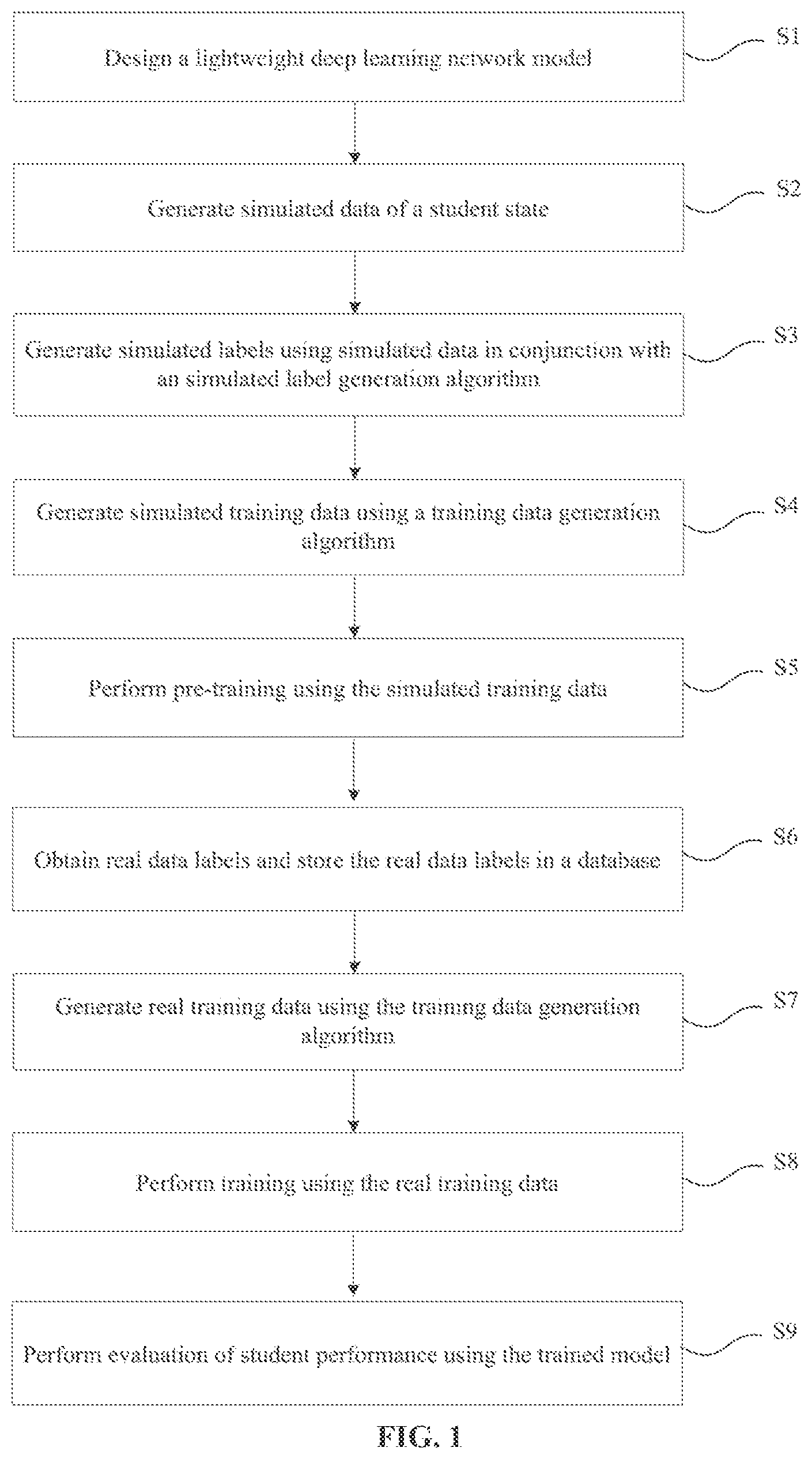
is a schematic flowchart of a student performance evaluation method based on AI identification data in a specific implementation of the present disclosure;
is a schematic diagram of steps of a multidimensional random normal distribution (MRND) simulated data generation algorithm in a specific implementation of the present disclosure; and
is a schematic diagram of steps of an logic export (L-E) simulated label generation algorithm in a specific implementation of the present disclosure.
DETAILED DESCRIPTION OF THE EMBODIMENTS
To make the objectives, technical solutions, and advantages of the present disclosure clearer, the present disclosure will be further described in detail below with reference to specific implementations and the accompanying drawings.
The present disclosure provides a student performance evaluation method based on AI identification data. In a preferred implementation, a schematic flowchart of the method is shown in , and specifically includes the following steps.
Step S 1 , a lightweight deep learning network model is designed. The deep learning network model is capable of performing comprehensive performance evaluation of students in any time span by using processed AI identification data.
In this preferred implementation, the model is designed in a server, and the model will automatically complete processes of pre-training, training, prediction, etc.
Step S 2 , a large number of simulated students and simulated AI identification data corresponding to the simulated students are generated using a MRND simulated data generation algorithm provided herein.
The simulated AI identification data generated in this step meets multidimensional randomness and multiple dimensions meet normal distribution, and a trend of an overall data value is controllable.
Specifically, in this preferred implementation, the simulated AI data meets randomness of course selection of the students, randomness of quality of the students, and randomness of state performance of the students, and meets normal distribution characteristics of overall quality of the students and normal distribution characteristics of state performance of the students.
The purpose of generating the simulated AI identification data is to pre-train the deep learning network model in step S 1 using the simulated data, so as to solve the problem of limited sources of real training data.
Step S 3 , simulated labels are generated by any amount of simulated AI identification data generated in step S 2 using an L-E simulated label generation algorithm provided herein.
The simulated labels are used to generate simulated training data, and the simulated training data is used for pre-training of the deep learning network model.
In this preferred implementation, the simulated labels will be stored in a database together with student IDs, course IDs, and time periods corresponding to the simulated labels. In the subsequent generation of the simulated training data, a limited search will be performed on a database of the AI simulated data according to the student IDs, course IDs, and time periods of the simulated labels to obtain the simulated AI identification data. The obtained simulated AI identification data will be used for the generation of simulated data.
Step S 4 , the AI identification data is processed through an expand and compress (EAC) training data generation algorithm using the simulated labels in step S 3 in conjunction with all the simulated AI identification data corresponding to the labels to generate the simulated training data. The simulated training data is permanently stored in the database.
Step S 5 , the deep learning network model designed in step S 1 is pre-trained using the simulated training data generated in step S 4 .
Step S 6 , real labels are obtained by means of final grades of the students, regular tests, and active performance evaluation of the teacher. The real labels can be added to the database on a specific web page, and the real labels in the database can also be deleted on the web page.
In this preferred implementation, when the real labels are added to the database, a generation program of the real training data will be directly triggered, and when the real labels are deleted, a deletion program to delete the corresponding training data will be triggered. In addition, the system provides a correction function to ensure one-to-one correspondence between the real labels and the real data.
Step S 7 , all real labels in the database are obtained, and then all AI identification data corresponding to each real label is obtained in the database.
The obtained AI identification data is processed through the EAC training data generation algorithm to generate final real training data. The real training data is permanently stored in the database.
Step S 8 , the real training data of the database is obtained, and the deep learning network model in step S 1 is trained using the obtained real training data. Different real training data is used for the deep learning network model at different stages.
When prediction accuracy of the deep learning network model is less than or equal to 70%, the training data generated by an N-EAC normal training data generation algorithm is used.
When the prediction accuracy of the deep learning network model is more than 70%, training data generated by a DP-EAC training data generation algorithm with a discard policy is used.
Step S 9 , after the training of the deep learning network model is mature, comprehensive performance evaluation of the students is performed in any time span using the trained deep learning network model. For example, what is the overall state of a student from the first week to the tenth week, what is the overall state of the student in each course, in which time period is the state performance of the student better, and in which time period is the state performance of the student poor are evaluated.
In a preferred implementation of the present disclosure, as shown in , a process of generating simulated AI identification data for each student using the MRND simulated data generation algorithm provided herein in step S 2 includes the following specific steps.
Step S 21 , n students are randomly generated, marked with different student Ids. The student IDs are recorded as: [sid 1 , sid 2 , . . . , sid i , . . . , sid n ].
sid i is a student ID of an i-th student generated by simulation. In this preferred implementation, the student information further includes gender, college, name, and student IDs, and these basic student information is permanently stored in the database. These generated students simulate a process of selecting courses, attending classes and generating the AI identification data.
Step S 22 , the student IDs and a P-D random generation algorithm provided herein in step S 21 are used to give each student a unique property. A set of unique properties of the n students is recorded as [property 1 , property 2 , . . . , property i , . . . , property n ]. property i is a unique property of the i-th student generated by simulation. The unique property of each student represents uniqueness of the student generated by simulation, indicating that the student is more inclined to show a good learning state or a bad learning state. The unique property of each student is approximately random, and all unique properties obey normal distribution as a whole. The set of unique properties obtained at the current stage does not have complete randomness and does not obey normal distribution for the time being.
Step S 23 , the set of unique properties in step S 22 is scrambled using a B-U random scrambling algorithm to obtain a scrambled set of unique properties [Lproperty 2 , Lproperty 2 , . . . , Lproperty i , . . . , Lproperty n ]. The scrambled unique properties are almost completely random.
Step S 24 , values in the scrambled set of unique properties are mapped by a function, such that the scrambled set of unique properties after mapping has a normal distribution characteristic. Each Lproperty i in the scrambled set of unique properties is mapped by the function:
f ( x ) = { 0.5 - 0.5 G ( x - 0.5 ) G ( 0.5 ) - G ( 0 ) , x ≤ 0.5 0.5 + 0.5 G ( x - 0.5 ) G ( 0.5 ) - G ( 0 ) , x > 0.5 . G ( x ) = 1 2 e - π ( x - 0.5 ) 2 4 .
The scrambled set of unique properties after mapping is recorded as a final set of unique properties: [finalProperty 1 ,finalProperty 2 , . . . ,finalProperty i , . . . ,finalProperty n ].
In this preferred implementation, these unique properties will also be stored in the database in one-to-one correspondence with the corresponding student IDs.
Step S 25 , Le courses are defined. Each course has choice i (Le≥i>0) choices, and each course has teacher, class time, and course week information. Each student generated in step S 21 randomly selects courses based on these courses.
Step S 26 , the simulated AI identification data are sequentially generated from the first course of the first week according to a time sequence.
Specifically, all students who have taken the course are obtained, and the simulated AI identification data is generated for each student using the Final simulated data generation algorithm provided herein.
In this implementation, all subdivision steps of step S 2 are written in the program, which can ensure that the simulated data can be automatically and intelligently generated in the server.
In a preferred implementation of the present disclosure, in step S 22 , a process of using the random generation algorithm to give each student the unique property includes the following specific steps.
Step S 221 , a prime number K greater than n is customized, and each student ID in a student ID set in step S 21 is divided by K to obtain a set of temper numbers: [ s id 1 /K,s id 2 /K, . . . ,s id i /K, . . . sid n /K ]=[temperNumber 1 ,temperNumber 2 , . . . ,temperNumber i , . . . ,temperNumber n ].
temperNumber i is a temper number of the i-th student generated by simulation.
Step S 222 , a truncation start bit K and a truncation stop bit J are customized, and J>K. K-th to J-th bits after a decimal point of each temper number in the set of temper numbers in step S 221 are intercepted to obtain a set of truncation numbers [truncation 1 , truncation 2 , . . . , truncation i , . . . , truncation n ].
Step S 223 , each number in the set of truncation numbers in step S 222 is divided by 10 J+1-k to obtain the unique property: [truncation 1 /10 J+1-K ,truncation 2 /10 J+1-K , . . . ,truncation i /10 J+1-K , . . . ,truncation n /10 J+1-K ]=[property 1 ,property 2 , . . . ,property i , . . . ,property n ].
In a preferred implementation of the present disclosure, in step S 23 , a process of scrambling the set of unique properties in step S 22 using the random scrambling algorithm includes the following specific steps.
Step S 231 , a number of scrambling Y, a random seed X1, a random seed X2, a modulus M1, a modulus M2, a multiplication amount A1, a multiplication amount A2, and a loop mark I=1 are customized.
Step S 232 , n×(X1/M1) is rounded down to obtain P I , and n×(X2/M2) is rounded down to obtain Q I . X1=(A1×X1+C1), and X2=(A2×X2+C2). The remainder of X1 is taken using M1 and a remainder result is assigned to X1, and the remainder of X2 is taken using M2 and a remainder result is assigned to X2. I=I+1.
Step S 233 , when I is less than Y, S 232 is executed until I is greater than or equal to Y. Finally, a set of scrambling instructions [P 1 , Q 1 , P 2 , Q 2 , . . . , P i , Q i , . . . , P Y , Q Y ] is obtained.
Step S 234 , P i , Q i (1<<i≤Y) is taken out from the beginning to the end in pairs each time from the set of scrambling instructions in step S 233 , and then two properties with subscripts of P i , Q i in the set of unique properties in step S 22 are exchanged. [Lproperty 1 , Lproperty 2 , . . . , Lproperty i , . . . , Lproperty n ] is obtained after all exchanges are completed.
In a preferred implementation of the present disclosure, in step S 26 , a process of generating the simulated AI identification data using the Final simulated data generation algorithm provided herein includes the following steps.
Step S 261 , a number B obeying (0,1) normal distribution is randomly generated.
Step S 262 , the unique property of the student finalProperty i corresponding to the simulated AI identification data being generated is obtained.
If B+finalProperty i , step S 263 is executed between an interval [0,1], otherwise step S 261 is executed.
Step S 263 , an overall positive state rate of the currently generated simulated AI identification data is customized as V. A positive state is output if B+finalProperty i is greater than a in the following equation, and a negative state is output if B+finalProperty i is less than or equal to a in the following equation.
The equation in step S 263 is
∫ 0 1 ∫ 0 a 1 2 π e - ( x - y ) 2 2 dxdy ∫ 0 1 ∫ 0 1 1 2 π e - ( x - y ) 2 2 dxdy = V .
Since a value on a left side of the above equation increases with a, only B+finalProperty i is replaced with a in the equation during specific determination, and whether the value on the left side of the equation is greater than or less than V is determined after replacement, the positive state is output if the value on the left side of the equation is greater than V, and the negative state is output if the value on the left side of the equation is less than V.
In a preferred implementation of the present disclosure, as shown in , in step S 3 , a process of generating simulated labels by any amount of simulated AI identification data generated in step S 2 using the L-E simulated label generation algorithm provided herein includes the following steps.
Step S 31 , a course is randomly selected, a student of the course is randomly selected, and a time period is randomly generated. This time period is within a time period corresponding to the selected course.
Step S 32 , according to limitation of the course, the student, and the time period in step S 31 , a set of simulated AI identification data matching the course, the student, and the time period is obtained: T={[a 11 ,a 12 , . . . ,a 1i , . . . ,a 1n ],[a 21 ,a 22 , . . . ,a 2i , . . . ,a 2n ], . . . ,[a m1 ,a m2 , . . . a mi , . . . ,a mn ]}.
Step S 33 , a positive state weight and a negative state weight are allocated to each dimension feature. Each dimension feature defines a weight allocation function g i (x), and each weight allocation function further has a weight W i .
Step S 34 , label values are calculated using the set T of AI identification data in step S 32 :
label = ∑ i = 1 m ∑ j = 1 n T [ i ] [ j ] g j ( x ) W j m × ( ∑ i = 1 n W i ) × 100.
Step S 35 , steps S 31 , S 32 , and S 34 are repeated to generate the simulated labels until the number of simulated labels reaches an expected value.
In a preferred implementation of the present disclosure, in step S 4 , the EAC training data generation algorithm provided herein includes the following steps.
Step S 41 , all the AI identification data corresponding to the labels in step S 4 is obtained: Data={[ a 11 ,a 12 , . . . ,a 1i , . . . ,a 1n ],[a 21 ,a 22 , . . . ,a 2i , . . . ,a 2n ], . . . ,[a i1 ,a i2 , . . . ,a ii , . . . ,a in ], . . . ,[a m1 ,a m2 , . . . ,a mi , . . . ,a mn ]}.
Step S 42 , since a standard training data length is determined to be S, step S 43 is executed when m in Data is less than S, step S 44 is executed when m in Data is greater than S, and if S is equal to m, the data Data is directly matched with the label as one of the final training data.
Step S 43 , A=S/m, A is rounded down to obtain A1, and the remainder of S to m is taken to obtain B.
A1−1 copies of B elements in Data are copied, A1+1 copies of m-B elements are copied. The copied Data is matched with the label as one of the final training data.
Step S 44 , C=m/S, C is rounded down to obtain B1, and the remainder of m to S is taken to obtain D.
The first D connected elements with a length of B1−1 in Data are summed and averaged to synthesize an element, and m-B connected elements with a length of B are summed and averaged to synthesize an element. Data after synthesis is matched with the label as one of the final training data.
The present disclosure further provides a student performance evaluation system based on AI identification data. In a preferred implementation, the system includes but is not limited to a comprehensive evaluation module, an early warning module, and a potential exploration module.
In this preferred implementation, the comprehensive evaluation module is visually displayed on a web page, and relevant personnel with authority can view the overall state of any student in any time period and any course in real time, the comprehensive state of the student in all courses and all time periods, the overall state of all students under a course, and the state of all students under all courses.
In this preferred implementation, based on the student performance evaluation method based on AI identification data, the early warning module performs negative performance evaluation of each student, and the system updates students in a negative state in real time and notifies relevant personnel. Specifically, the relevant personnel can obtain the basic information of the negative students at the first time, and then further understand these negative students in more detail in the comprehensive evaluation module through these basic information, and can guide the students in a negative learning state in time if necessary.
In this preferred implementation, based on the student performance evaluation method based on AI identification data, the potential exploration module explores students having poor performance but excellent grades.