Axial Fuel Stage Injector with Axially Elongated Mixing Chambers, and Combustor and Gt System Including Same
Abstract
An axial fuel stage (AFS) injector includes a mixing member including axially elongated mixing chambers in fluid communication with a combustion liner of a combustor, and fuel injectors in opposing side walls of the mixing chambers. A high-pressure (HP) air injection member defines a set of HP air jets spaced from the inlet of each mixing chamber. A fuel plenum in the mixing member delivers fuel from a fuel source to each set of fuel injectors. Each set of HP air jets directs a HP air from a HP air source and, in some embodiments, to draw a low-pressure (LP) air from a LP air source to direct the LP air with the HP air into the inlet of a respective mixing chamber where fuel is injected. The axially elongated mixing chambers direct the air-fuel mixture into the combustion liner for combustion in a secondary combustion zone thereof.
Claims (20)
1 . An axial fuel stage (AFS) injector for a combustor of a gas turbine (GT) system, the AFS injector comprising: a mixing member including: a first axially elongated mixing chamber, a second axially elongated mixing chamber, and a third axially elongated mixing chamber between the first axially elongated mixing chamber and the second axially elongated mixing chamber, each axially elongated mixing chamber including an inlet and an outlet, wherein each outlet is configured to be in fluid communication with a combustion chamber of the combustor, and a set of fuel injectors defined in opposing side walls of each axially elongated mixing chamber; a high pressure (HP) air injection member defining a sets of HP air jets, each set of HP air jets being configured to direct HP air from a HP air source into the inlet of a respective axially elongated mixing chamber, wherein the sets of HP air jets each include a flared inlet having an outer radius, and the flared inlet of the HP air jets for the first and second axially elongated mixing chambers have a first outer radius larger than a second outer radius of the flared inlet of the HP air jets of the third axially elongated mixing chamber; and a fuel plenum defined in the mixing member, the fuel plenum configured to deliver fuel from a fuel source to each set of fuel injectors.
15 . A combustor for a gas turbine system, the combustor comprising: a combustor body including a combustion liner; and a plurality of axial fuel stage (AFS) injectors directed into the combustion liner, each AFS injector including: a mixing member including: a plurality of axially elongated mixing chambers defined in the mixing member, each axially elongated mixing chamber including an inlet and an outlet, wherein each outlet is configured to be in fluid communication with a combustion chamber of the combustor, and a set of fuel injectors defined in opposing side walls of each axially elongated mixing chamber; a high pressure (HP) air injection member defining a sets of HP air jets, wherein each set of HP air jets is configured to direct HP air from a HP air source into the inlet of a respective axially elongated mixing chamber where fuel is injected by the set of fuel injectors; a filter member upstream of the sets of HP air jets; and a fuel plenum defined in the mixing member, the fuel plenum configured to deliver fuel from a fuel source to each set of fuel injectors.
17 . A gas turbine (GT) system, comprising: a compressor section; a combustion section operatively coupled to the compressor section; and a turbine section operatively coupled to the combustion section, wherein the combustion section includes at least one combustor including: a combustor body including a combustion liner; a head end fuel nozzle assembly at a forward end of the combustor body; a plurality of axial fuel stage (AFS) injectors directed into the combustor body downstream of the head end fuel nozzle assembly, each AFS injector including: a mixing member including: a first axially elongated mixing chamber, a second axially elongated mixing chamber, and a third axially elongated mixing chamber between the first axially elongated mixing chamber and the second axially elongated mixing chamber, each axially elongated mixing chamber including an inlet and an outlet, wherein each outlet is configured to be in fluid communication with a combustion chamber of the combustor, and a set of fuel injectors defined in opposing side walls of each axially elongated mixing chamber; a high pressure (HP) air injection member defining a sets of HP air jets, wherein each set of HP air jets is configured to direct HP air from a HP air source into the inlet of a respective axially elongated mixing chamber where fuel is injected by the set of fuel injectors, and the sets of HP air jets configured to direct the HP air into the inlet of the first and second axially elongated mixing chambers each include a radially inward extending collar having a first side thereof radially farther from the axially elongated mixing chamber than a second, opposite side thereof; and a fuel plenum defined in the mixing member, the fuel plenum configured to deliver fuel from a fuel source to each set of fuel injectors.
Show 17 dependent claims
2 . The AFS injector of claim 1 , wherein the third axially elongated mixing chamber extends radially at a perpendicular angle relative to a circumference of a combustion liner of the combustor, and the first axially elongated mixing chamber and the second axially elongated mixing chamber are angled in opposite circumferential directions relative to the third axially elongated mixing chamber.
3 . The AFS injector of claim 2 , wherein the sets of HP air jets are configured to direct the HP air into a respective axially elongated mixing chamber at an angle identical to the angle of the respective axially elongated mixing chamber.
4 . The AFS injector of claim 2 , wherein a selected set of HP air jets of the sets of HP air jets is configured to direct the HP air into the inlet of the third axially elongated mixing chamber and includes a pair of axially offset rows of HP air jets.
5 . The AFS injector of claim 1 , wherein the sets of HP air jets are configured to direct the HP air into the inlet of the first and second axially elongated mixing chambers, and each HP air jet of the sets of HP air jets includes a radially inward extending collar having a first side thereof radially farther from the axially elongated mixing chamber than a second, opposite side thereof.
6 . The AFS injector of claim 5 , wherein the first side of the collar of the sets of HP air jets configured to direct the HP air into the inlet of the first and second axially elongated mixing chambers each includes an opening defined therein.
7 . The AFS injector of claim 1 , wherein the sets of HP air jets includes a first set of HP air jets configured to direct the HP air into the inlet of the first axially elongated mixing chamber and a second set of HP air jets configured to direct the HP air into the inlet of the second axially elongated mixing chamber; and wherein each of the first set of HP air jets and the second set of HP air jets has a lower number of HP air jets than a third set of HP air jets configured to direct the HP air into the inlet of the third axially elongated mixing chamber.
8 . The AFS injector of claim 1 , wherein an arrangement of the sets of HP air jets configured to direct the HP air into the inlet of the first and second axially elongated mixing chambers are the same, and the arrangement of the set of HP air jets is configured to direct the HP air into the inlet of the third axially elongated mixing chamber is different from the sets of HP air jets configured to direct the HP air into the inlet of the first and second axially elongated mixing chambers.
9 . The AFS injector of claim 1 , wherein the fuel plenum extends within an upstream side wall of each of the plurality of axially elongated mixing chambers, and wherein each set of fuel injectors is closer to the inlet than the outlet of a respective axially elongated mixing chamber of the plurality of axially elongated mixing chambers.
10 . The AFS injector of claim 9 , wherein the opposing side walls of the plurality of axially elongated mixing chambers include a first side wall and an opposing second side wall, and wherein the set of fuel injectors defined in the first side wall is arranged in a different manner than the set of fuel injectors defined in the second side wall for each of the plurality of axially elongated mixing chambers.
11 . The AFS injector of claim 1 , wherein each axially elongated mixing chamber has semi-circular opposing ends.
12 . The AFS injector of claim 1 , wherein the mixing member includes a filter member upstream of the sets of HP air jets.
13 . The AFS injector of claim 1 , wherein the mixing member and the HP air injection member each include at least one mounting element configured to receive a fastener to couple the mixing member and the HP air injection member to a flow sleeve that at least partially surrounds a combustion liner that defines the combustion chamber.
14 . The AFS injector of claim 1 , wherein each set of HP air jets of the sets of HP air jets is configured to draw a low-pressure (LP) air from an LP air source to direct the LP air with the HP air into the inlet of each respective mixing chamber; wherein the HP air source is in direct fluid communication with a compressor discharge of the GT system, and the LP air source is in fluid communication with a cooling passage defined along at least a portion of a combustion liner of the combustor; wherein the cooling passage is downstream of an impingement cooling member that is in direct fluid communication with the compressor discharge of the GT system.
16 . The combustor of claim 15 , wherein the plurality of axially elongated mixing chambers include a first axially elongated mixing chamber, a second axially elongated mixing chamber, and a third axially elongated mixing chamber between the first axially elongated mixing chamber and the second axially elongated mixing chamber.
18 . The GT system of claim 17 , wherein the mixing member includes a filter member upstream of the sets of HP air jets.
19 . The GT system of claim 17 , wherein each axially elongated mixing chamber has semi-circular opposing ends.
20 . The GT system of claim 17 , wherein the mixing member and the HP air injection member each include at least one mounting element configured to receive a fastener to couple the mixing member and the HP air injection member to a flow sleeve that at least partially surrounds a combustion liner that defines the combustion chamber.
Full Description
Show full text →
TECHNICAL FIELD
The disclosure relates generally to turbomachine combustors and, more specifically, to an axial fuel stage (AFS) injector with axially elongated mixing chambers, and a combustor and a gas turbine system including the same.
BACKGROUND
Gas turbine systems include a combustion section including a plurality of combustors in which fuel is combusted to create a flow of combustion gas that is converted to kinetic energy in a downstream turbine section. Current combustors include a head end fuel nozzle assembly for combusting fuel in a primary combustion zone and axial fuel stage (AFS) injectors for combusting fuel in a secondary combustion zone downstream of the primary combustion zone. Portions of an air supply, for example, from a compressor discharge casing, are delivered to the head end fuel nozzle assembly and the AFS injectors in various flow passages. Current AFS injectors present challenges relative to adequately mixing highly reactive fuels, like hydrogen, with air and to achieving desired low exhaust emissions and desired flame holding capability.
BRIEF DESCRIPTION
All aspects, examples and features mentioned below can be combined in any technically possible way.
A first aspect of the disclosure includes an axial fuel stage (AFS) injector for a combustor of a gas turbine (GT) system, the AFS injector comprising: a mixing member including: a plurality of axially elongated mixing chambers defined in the mixing member, each axially elongated mixing chamber including an inlet and an outlet, wherein each outlet is configured to be in fluid communication with a combustion chamber of the combustor, and a set of fuel injectors defined in opposing side walls of each axially elongated mixing chamber; a high pressure (HP) air injection member defining a set of HP air jets spaced from the inlet of each axially elongated mixing chamber; and a fuel plenum defined in the mixing member, the fuel plenum configured to deliver fuel from a fuel source to each set of fuel injectors, wherein each set of HP air jets is configured to direct a HP air from a HP air source into the inlet of a respective mixing chamber where fuel is injected by the set of fuel injectors.
Another aspect of the disclosure includes any of the preceding aspects, and the plurality of axially elongated mixing chambers include a first axially elongated mixing chamber, a second axially elongated mixing chamber, and a third axially elongated mixing chamber between the first axially elongated mixing chamber and the second axially elongated mixing chamber.
Another aspect of the disclosure includes any of the preceding aspects, and the third axially elongated mixing chamber extends radially at a perpendicular angle relative to a circumference of the combustion liner, and the first axially elongated mixing chamber and the second axially elongated mixing chamber are angled in opposite circumferential directions relative to the third axially elongated mixing chamber.
Another aspect of the disclosure includes any of the preceding aspects, and the set of HP air jets spaced from the inlet of each mixing member are configured to direct the HP air into a respective axially elongated mixing chamber at an angle identical to the angle of the respective axially elongated mixing chamber.
Another aspect of the disclosure includes any of the preceding aspects, and the set of HP air jets spaced from the inlet of the third axially elongated mixing chamber includes a pair of axially offset rows of HP air jets.
Another aspect of the disclosure includes any of the preceding aspects, and the sets of HP air jets spaced from the inlet of the first and second axially elongated mixing chambers each include a radially inward extending collar having a first side thereof radially farther from the mixing member than a second, opposite side thereof.
Another aspect of the disclosure includes any of the preceding aspects, and the first side of the collar of the sets of HP air jets spaced from the inlet of the first and second axially elongated mixing chambers each includes an opening defined therein.
Another aspect of the disclosure includes any of the preceding aspects, and the sets of HP air jets spaced from the inlet of the first and second axially elongated mixing chambers each have a lower number of HP air jets than the set of HP air jets spaced from the inlet of the third axially elongated mixing chamber.
Another aspect of the disclosure includes any of the preceding aspects, and the sets of HP air jets each include a flared inlet having an outer radius, and the flared inlet of the HP air jets for the first and second axially elongated mixing chambers have a first outer radius larger than a second outer radius of the flared inlet of the HP air jets of the third axially elongated mixing chamber.
Another aspect of the disclosure includes any of the preceding aspects, and an arrangement of the sets of HP air jets spaced from the inlet of the first and second axially elongated mixing chambers are the same, and the arrangement of the set of HP air jets spaced from the inlet of the third axially elongated mixing chamber is different than the sets of HP air jets spaced from the inlet of the first and second axially elongated mixing chambers.
Another aspect of the disclosure includes any of the preceding aspects, and the fuel plenum extends within an upstream side wall of each of the plurality of axially elongated mixing chambers, and wherein each set of fuel injectors is closer to the inlet than the outlet of a respective axially elongated mixing chamber of the plurality of axially elongated mixing chambers.
Another aspect of the disclosure includes any of the preceding aspects, and the opposing side walls of the first and second axially elongated mixing chambers include a first side wall and an opposing second side wall, and wherein the set of fuel injectors defined in the first side wall is arranged in a different manner than the set of fuel injectors defined in the second side wall for each of the first and second axially elongated mixing chambers.
Another aspect of the disclosure includes any of the preceding aspects, and the sets of fuel injectors in the side wall of the first and second axially elongated mixing chambers are arranged in a different manner in a first side wall thereof than an opposing, second side wall thereof.
Another aspect of the disclosure includes any of the preceding aspects, and each axially elongated mixing chamber has semi-circular opposing ends.
Another aspect of the disclosure includes any of the preceding aspects, and the mixing member includes a filter member upstream of the set of HP air jets.
Another aspect of the disclosure includes any of the preceding aspects, and the mixing member and the HP air injection member each include at least one mounting element configured to receive a fastener to couple the mixing member and the HP air injection member to a flow sleeve that at least partially surrounds a combustion liner that defines the combustion chamber.
Another aspect of the disclosure includes any of the preceding aspects, and each set of HP air jets is configured to draw a low-pressure (LP) air from a LP air source to direct the LP air with the HP air into the inlet of each respective mixing chamber; the HP air source is in direct fluid communication with a compressor discharge of the GT system and the LP air source is in fluid communication with a cooling passage defined along at least a portion of the combustion liner, wherein the cooling passage is downstream of an impingement cooling member that is in direct fluid communication with the compressor discharge of the GT system.
Another aspect of the disclosure includes a combustor for a gas turbine system, the combustor comprising: a combustor body including a combustion liner; and a plurality of axial fuel stage (AFS) injectors directed into the combustion liner, each AFS injector including: a mixing member including: a plurality of axially elongated mixing chambers defined in the mixing member, each axially elongated mixing chamber including an inlet and an outlet, wherein each outlet is configured to be in fluid communication with a combustion chamber of the combustor, and a set of fuel injectors defined in opposing side walls of each axially elongated mixing chamber; a high pressure (HP) air injection member defining a set of HP air jets spaced from the inlet of each axially elongated mixing chamber; and a fuel plenum defined in the mixing member, the fuel plenum configured to deliver fuel from a fuel source to each set of fuel injectors, wherein each set of HP air jets is configured to direct a HP air from a HP air source into the inlet of a respective mixing chamber where the fuel is injected by the set of fuel injectors.
Another aspect of the disclosure includes any of the preceding aspects, and the plurality of axially elongated mixing chambers include a first axially elongated mixing chamber, a second axially elongated mixing chamber, and a third axially elongated mixing chamber between the first axially elongated mixing chamber and the second axially elongated mixing chamber.
Another aspect of the disclosure includes a gas turbine (GT) system, comprising: a compressor section; a combustion section operatively coupled to the compressor section; and a turbine section operatively coupled to the combustion section, wherein the combustion section includes at least one combustor including: a combustor body including a combustion liner; a head end fuel nozzle assembly at a forward end of the combustor body; a plurality of axial fuel stage (AFS) injectors directed into the combustor body downstream of the head end fuel nozzle assembly, each AFS injector including: a mixing member including: a first axially elongated mixing chamber, a second axially elongated mixing chamber, and a third axially elongated mixing chamber between the first axially elongated mixing chamber and the second axially elongated mixing chamber, each axially elongated mixing chamber including an inlet and an outlet, wherein each outlet is configured to be in fluid communication with a combustion chamber of the combustor, and a set of fuel injectors defined in opposing side walls of each axially elongated mixing chamber; a high pressure (HP) air injection member defining a set of HP air jets spaced from the inlet of each axially elongated mixing chamber; and a fuel plenum defined in the mixing member, the fuel plenum configured to deliver fuel from a fuel source to each set of fuel injectors, wherein each set of HP air jets is configured to direct a HP air from a HP air source into the inlet of a respective mixing chamber where fuel is injected by the set of fuel injectors.
Two or more aspects described in this disclosure, including those described in this summary section, may be combined to form implementations not specifically described herein. That is, all embodiments described herein can be combined with each other.
The details of one or more implementations are set forth in the accompanying drawings and the description below. Other features, objects and advantages will be apparent from the description and drawings, and from the claims.
BRIEF DESCRIPTION OF THE DRAWINGS
These and other features of this disclosure will be more readily understood from the following detailed description of the various aspects of the disclosure taken in conjunction with the accompanying drawings that depict various embodiments of the disclosure, in which:
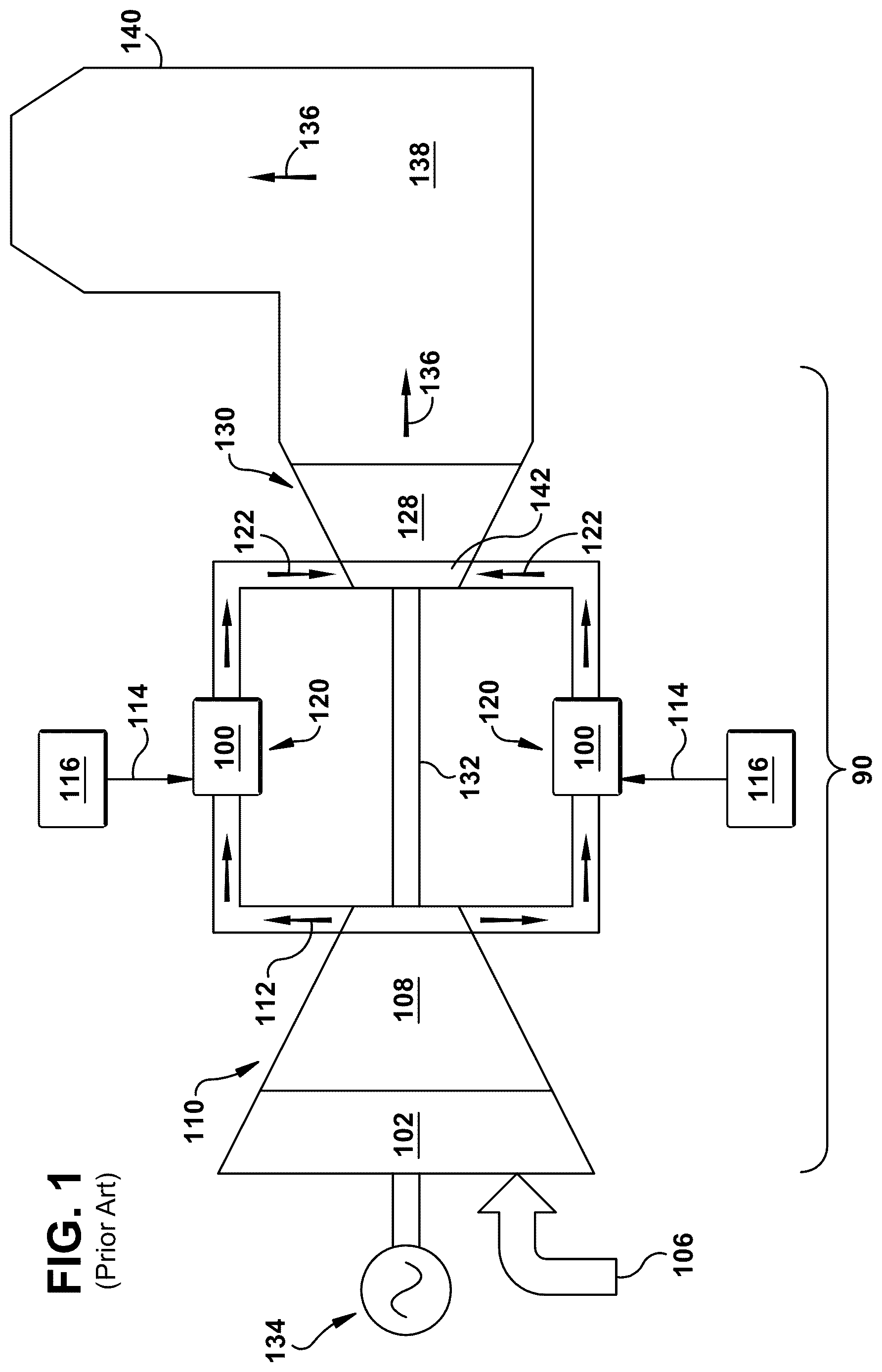
shows a functional block diagram of an illustrative gas turbine system capable of use with a combustor including an axial fuel stage (AFS) injector according to embodiments of the disclosure;
shows a cross-sectional side view of a combustor including an AFS injector according to embodiments of the disclosure;
shows a perspective and partial cross-sectional view of an AFS injector according to embodiments of the disclosure;
shows a cross-sectional view of an AFS injector along view line 4 - 4 in according to embodiments of the disclosure;
shows a cross-sectional view of an AFS injector along view line 5 - 5 in according to embodiments of the disclosure;
A-C show top-down views of a mixing member of an AFS injector according to various embodiments of the disclosure;
D shows a schematic view of opposing side walls of outer mixing chambers of a mixing member of an AFS injector according to embodiments of the disclosure;
E shows a schematic view of opposing side walls of a center mixing chamber of a mixing member of an AFS injector according to embodiments of the disclosure;
shows a top-down view of a high-pressure air injection member of an AFS injector according to embodiments of the disclosure;
A shows an enlarged perspective view of sets of high-pressure air jets in a high-pressure air injection member according to embodiments of the disclosure;
B shows an enlarged cross-sectional view of sets of high-pressure air jets in a high-pressure air injection member according to embodiments of the disclosure;
shows a cross-sectional view of a plurality of parallel, sintered metal layers of a mixing member or a high-pressure air injection member of an AFS injector according to embodiments of the disclosure; and
shows a schematic block diagram of an illustrative additive manufacturing system for additively manufacturing a mixing member and/or a high-pressure air injection member of an AFS injector according to embodiments of the disclosure.
It is noted that the drawings of the disclosure are not necessarily to scale. The drawings are intended to depict only typical aspects of the disclosure and therefore should not be considered as limiting the scope of the disclosure. In the drawings, like numbering represents like elements between the drawings.
DETAILED DESCRIPTION
As an initial matter, in order to clearly describe the current technology, it will become necessary to select certain terminology when referring to and describing relevant machine components within the illustrative application of a turbomachine combustor and axial fuel stage (AFS) injector. When doing this, if possible, common industry terminology will be used and employed in a manner consistent with its accepted meaning. Unless otherwise stated, such terminology should be given a broad interpretation consistent with the context of the present application and the scope of the appended claims. Those of ordinary skill in the art will appreciate that often a particular component may be referred to using several different or overlapping terms. What may be described herein as being a single part may include and be referenced in another context as consisting of multiple components. Alternatively, what may be described herein as including multiple components may be referred to elsewhere as a single part.
In addition, several descriptive terms may be used regularly herein, and it should prove helpful to define these terms at the onset of this section. These terms and their definitions, unless stated otherwise, are as follows. As used herein, “downstream” and “upstream” are terms that indicate a direction relative to the flow of a fluid, such as the working fluid through a combustor of the turbomachine or, for example, the flow of air through the combustor or AFS injector, or coolant through one of the turbomachine's component systems. The term “downstream” corresponds to the direction of flow of the fluid, and the term “upstream” refers to the direction opposite to the flow. The terms “forward” and “aft,” without any further specificity, refer to directions, with “forward” referring to the front or compressor end of the turbomachine or combustor, and “aft” referring to the rearward or turbine end of the turbomachine or combustor.
The term “axial” refers to movement or position parallel to an axis, e.g., an axis of a combustor, a mixing chamber of the AFS injector, or turbomachine. The term “radial” refers to movement or position perpendicular to an axis, e.g., an axis of a combustor or a turbomachine. In cases such as this, if a first component resides closer to the axis than a second component, it will be stated herein that the first component is “radially inward” or “inboard” of the second component. If, on the other hand, the first component resides further from the axis than the second component, it may be stated herein that the first component is “radially outward” or “outboard” of the second component. Finally, the term “circumferential” refers to movement or position around an axis, e.g., a circumferential interior surface of a combustor body or a circumferential interior of casing extending about a combustor. As indicated above and depending on context, it will be appreciated that such terms may be applied in relation to the axis of the combustor or the axis of the turbomachine.
In addition, several descriptive terms may be used regularly herein, as described below. The terms “first,” “second,” and “third,” may be used interchangeably to distinguish one component from another and are not intended to signify location or importance of the individual components.
The terminology used herein is for the purpose of describing particular embodiments only and is not intended to be limiting of the disclosure. As used herein, the singular forms “a,” “an,” and “the” are intended to include the plural forms as well, unless the context clearly indicates otherwise. It will be further understood that the terms “comprises” and/or “comprising,” when used in this specification, specify the presence of stated features, integers, steps, operations, elements, and/or components, but do not preclude the presence or addition of one or more other features, integers, steps, operations, elements, components, and/or groups thereof. “Optional” or “optionally” means that the subsequently described event may or may not occur or that the subsequently described feature may or may not be present and that the description includes instances where the event occurs, or the feature is present and instances where the event does not occur, or the feature is not present.
Where an element or layer is referred to as being “on,” “engaged to,” “connected to,” “coupled to,” or “mounted to” another element or layer, it may be directly on, engaged, connected, coupled, or mounted to the other element or layer, or intervening elements or layers may be present. In contrast, when an element is referred to as being “directly on,” “directly engaged to,” “directly connected to,” or “directly coupled to” another element or layer, there are no intervening elements or layers present. Other words used to describe the relationship between elements should be interpreted in a like fashion (e.g., “between” versus “directly between,” “adjacent” versus “directly adjacent,” etc.). As used herein, the term “and/or” includes any and all combinations of one or more of the associated listed items. The verb forms of “couple” and “mount” may be used interchangeably herein.
Embodiments of the disclosure provide an axial fuel stage (AFS) injector for a combustor, the combustor and a gas turbine (GT) system including the same. The AFS injector includes a mixing member including a plurality of axially elongated mixing chambers in fluid communication with a combustion liner of a combustor, and a set of fuel injectors defined in a side wall of each axially elongated mixing chamber. A high-pressure (HP) air injection member defines a set of HP air jets spaced from an inlet of each axially elongated mixing chamber. A fuel plenum is defined in the mixing member to deliver fuel from a fuel source to each set of fuel injectors. Each set of the HP air jets is configured to direct a HP air from a HP air source and, optionally, to draw a low-pressure (LP) air from a LP air source to direct the LP air with the HP air into the inlet of the respective axially elongated mixing chamber where the fuel is injected by the set of fuel injectors. The axially elongated mixing chambers direct the air-fuel mixture into the combustion liner for combustion in a secondary combustion zone thereof. The AFS injector may be additively manufactured to include a plurality of parallel, sintered metal layers.
In some embodiments, the AFS injector mixes two sources of air, one being high-pressure air, e.g., from a compressor discharge, and the other a low-pressure air, e.g., post-impingement cooling air, to reduce overall system pressure loss and to use air more efficiently in the combustor. The AFS injector can rapidly premix the two air sources with, for example, highly reactive fuels, like hydrogen, to achieve low emissions, e.g., of nitrous oxide (NOx), and an acceptable flame holding capability.
In each embodiment, the AFS injector achieves high mixedness of fuel and air, minimizes flow-pressure loss, and prevents fuel from entering any low velocity air flow zones. Additionally, the AFS injector is packaged in a relatively small geometry, allowing it to be assembled onto the combustion liner of a combustor body, and the combustor body installed into the GT system through the relatively small opening in a compressor discharge casing.
shows a functional block diagram of an illustrative gas turbine (GT) system 90 that may incorporate various embodiments of a combustor 100 and axial fuel stage (AFS) injectors 150 ( ) of the present disclosure. As shown, GT system 90 generally includes an inlet section 102 that may include a series of filters, cooling coils, moisture separators, and/or other devices to purify and otherwise condition a working fluid (e.g., air) 106 entering GT system 90 . Working fluid 106 , i.e., air, flows to a compressor 108 in a compressor section 110 that progressively imparts kinetic energy to working fluid 106 to produce a compressed, high-pressure (HP) air 112 (hereafter “HP air 112 ” or “compressed air 112 ”) at a highly energized state. HP air 112 is typically mixed with a fuel 114 A and/or 114 B from a fuel source 116 to form a combustible mixture within at least one combustor 100 in a combustion section 120 that is operatively coupled to compressor section 110 . The combustible mixture is burned to produce combustion gases 122 having a high temperature and pressure.
Combustion gases 122 flow through a turbine 128 of a turbine section 130 operatively coupled to combustion section 120 to produce work. For example, turbine 128 may be connected to a shaft 132 so that rotation of turbine 128 drives compressor 108 to produce HP air 112 . Alternately, or in addition, shaft 132 may connect turbine 128 to another load, such as a generator 134 for producing electricity. Exhaust gases 136 from turbine 128 flow through an exhaust section 138 that connects turbine 128 to an exhaust stack 140 downstream from turbine 128 . Exhaust section 138 may include, for example, a heat recovery steam generator (not shown) for cleaning and extracting additional heat from exhaust gases 136 before their release to the environment. Where more than one combustor 100 is used, they may be circumferentially spaced around a turbine inlet 142 of turbine 128 .
In one embodiment, GT system 90 may include an engine model commercially available from GE Vernova of Cambridge, MA. The present disclosure is not limited to operability with any one particular GT system and may be implemented in connection with other engines including, for example, any HA, F, B, LM, GT, TM and E-class engine models of GE Vernova, and engine models of other companies. Furthermore, the present disclosure is not limited to implementation with any particular turbomachine, and may be applicable to, for example, steam turbines, jet engines, compressors, turbofans, etc.
A combustor 100 usable within GT system 90 will now be described. shows a cross-sectional side view of combustor 100 positioned within GT system 90 . As will be further described herein, combustor 100 may include one or more axial stage fuel (AFS) injectors 150 according to embodiments of the disclosure.
As shown in , combustor 100 is at least partially surrounded by an outer casing 152 such as a compressor discharge casing and/or a turbine casing. An interior of outer casing 152 is in fluid communication with a compressor discharge 109 of compressor 108 and creates an HP air source 154 . That is, HP air source 154 includes HP air 112 from compressor discharge of compressor 108 . HP source 154 is in direct fluid communication with compressor discharge 109 of GT system 90 . However, HP air source 154 may be any supply of HP air 112 capable of flowing into any variety of openings or flow passages in combustor 100 to cool parts and/or for combustion, i.e., in AFS injectors 150 .
As shown in , combustor 100 for GT system 90 includes a combustor body 160 . Combustor body 160 may be made using any now known or later developed techniques. For example, combustor body 160 may be additively manufactured. Combustor body 160 may include a combustion liner 164 , which may include, for example, a cylindrical portion 166 and a tapered transition portion 168 . Combustion liner 164 may have an axis A, the direction of which may vary slightly depending on axial location within the curved combustion liner 164 . Tapered transition portion 168 is at an aft end (right side as shown in ) of cylindrical portion 166 . As understood in the field, tapered transition portion 168 transitions the hot gas path (HGP) from the circular cross-section of the liner's cylindrical portion 166 to a more arcuate cross-section for mating with turbine inlet 142 of turbine 128 . Combustor 100 may also include an aft frame 170 at an aft end (right side in ) of tapered transition portion 168 .
Combustion liner 164 may contain and convey combustion gases 122 to turbine section 130 ( ). More particularly, combustion liner 164 defines a combustion chamber 172 , i.e., in a hot gas path (HGP), within which combustion occurs. Combustion liner 164 may have tapered transition portion 168 that is separate from cylindrical portion 166 , as in many conventional combustion systems. Alternatively, as shown in , combustion liner 164 may have a unified body (or “unibody”) construction, in which cylindrical portion 166 and tapered transition portion 168 are integrated with one another, i.e., as part of an additively manufactured one-piece member. Thus, any discussion of combustion liner 164 herein is intended to encompass both conventional combustion systems having a separate cylindrical and tapered transition portions and those combustion systems having a unibody liner.
Combustor body 160 also includes an air flow passage 174 defined at least partially by cylindrical portion 166 of combustion liner 164 . As will be described herein, air flow passage 174 is configured to deliver air (e.g., HP air 112 A from HP air source 154 ) to a head end fuel nozzle assembly 176 (hereinafter “head end assembly 176 ” for brevity) of combustor 100 at a forward end (left end in ) of combustion liner 164 . That is, it is sized, shaped and/or arranged to deliver air, such as HP air 112 A from HP air source 154 , to head end assembly 176 of combustor 100 . Air flow passage 174 may be defined wholly within cylindrical portion 166 , or air flow passage 174 may be provided between cylindrical portion 166 and a flow sleeve 177 spaced along at least a portion of an exterior surface of cylindrical portion 166 . Air flow passage 174 has an open end 178 , or air flow opening(s), proximate to head end assembly 176 through which HP air 112 A from HP air source 154 enters. Here, HP air 112 A from HP air source 154 may be pulled directly from compressor discharge, i.e., without any other use of the air other than coincidental convection cooling of combustor body 160 .
An annular partition 179 disposed between cylindrical portion 166 and flow sleeve 177 separates a forward portion of air flow passage 174 from an aft portion of air flow passage 174 . The axial position of annular partition 179 is approximately aligned with a cap assembly 198 , discussed below, such that the forward portion of air flow passage 174 is radially outward of head end assembly 176 (rather than combustion chamber 172 ) and, therefore, requires less cooling. Aftward of annular partition 179 , flow sleeve 177 may include a plurality of impingement holes 192 (as shown in outer sleeve 190 ), which permit HP air 112 B to flow into air flow passage 174 . As a result of passing through impingement holes 192 , HP air 112 B experiences a pressure drop and becomes LP air 182 , which flows through air flow passage 174 toward and/or into AFS injector(s) 150 , as discussed further herein.
Head end assembly 176 generally includes at least one axially extending fuel nozzle 194 that extends downstream from an end cover 196 and a cap assembly 198 , which extends radially and axially within outer casing 152 downstream from end cover 196 and which defines the forward boundary of combustion chamber 172 . Head end assembly 176 may include any now known or later developed axially extending fuel nozzles 194 for delivering first fuel 114 A to a primary combustion zone 202 from axially extending fuel nozzles 194 . In certain embodiments, axially extending fuel nozzle(s) 194 of head end assembly 176 extend at least partially through cap assembly 198 to provide a combustible mixture of fuel 114 A and HP air 112 A to primary combustion zone 202 .
Combustor body 160 also includes an axial fuel stage (AFS) injector opening or seat 180 directed into combustion liner 164 downstream of head end assembly 176 . Opening or seat 180 extends through a wall of combustion liner 164 . One or more AFS injector openings or seats 180 (hereafter “openings 180 ”) can be provided and are configured to have an AFS injector 150 mounted thereto and receive HP air 112 B from HP air source 154 , possibly among other air flow(s) as will be described herein. Each AFS injector opening 180 may include any necessary structure to allow an AFS injector 150 to be mounted thereto, e.g., threaded fasteners, bolt holes, weld area, etc. As illustrated, combustor 100 and combustor body 160 may include a plurality of circumferentially spaced AFS injector openings 180 and corresponding AFS injectors 150 . Any number of AFS injectors 150 can be used.
As will be described, in some embodiments, AFS injector(s) 150 are also configured to receive (draw in) a low-pressure (LP) air 182 from a low-pressure (LP) air source 184 , e.g., cooling passage, and direct it into combustion liner 164 with fuel 114 B. Fuel 114 B may be delivered from fuel source 116 using any form of fuel line(s) 188 . Fuel 114 A, 114 B may be any now known or later developed combustor 100 fuels, such as but not limited to fuel oil, natural gas, hydrogen, and/or blends thereof. Fuels 114 A, 114 B may be the same or different.
In some embodiments, LP air 182 can be delivered to AFS injector(s) 150 in a variety of ways from LP air source 184 . In certain embodiments, LP air 182 originates from HP air source 154 but is used for cooling before use in AFS injector(s) 150 . In one example, combustor body 160 further includes a cooling passage(s) 186 at least partially defined by tapered transition portion 168 that provide LP air source 184 . Cooling passage(s) 186 may also be in fluid communication with other cooling passages (not shown) in combustor 100 , e.g., in an aft frame 170 . In any event, LP air 182 of LP air source 184 may be used for cooling one or more hot parts of combustor 100 . More particularly, LP air 182 of LP air source 184 passes through cooling passage(s) 186 , which as noted may be at least partially defined by tapered transition portion 168 , after being pulled from compressor discharge 109 .
In one example, cooling passage(s) 186 may be formed by a flow sleeve 190 or within tapered transition portion 168 . Where desired, impingement cooling holes 192 may be provided in flow sleeve 190 surrounding tapered transition portion 168 to allow HP air 112 to enter from HP air source 154 and become LP air 182 . In this regard, LP air source 184 includes cooling passage(s) 186 defined along at least a portion of combustion liner 164 , e.g., tapered transition portion 168 . Further, cooling passage(s) 186 may be downstream of an impingement cooling member (portion 168 with impingement cooling holes 192 in outer sleeve thereof or sleeve 190 around portion 168 with holes 192 therein) which is in direct fluid communication with compressor discharge 109 of GT system 90 , i.e., HP air source 154 . It is noted that the hot part(s) may include any part of combustor 100 requiring cooling, and LP air 182 may be directed to enter cooling passage(s) 186 in any manner desired. That is, cooling passage(s) 186 may be defined in or along (other) hot part(s) of combustor 100 other than tapered transition portion 168 , e.g., aft frame 170 . In any event, cooling passage(s) 186 is/are between AFS injector(s) 150 and HP air source 154 with the cooling passage(s) 186 , in some embodiments, being configured to deliver LP air 182 of LP air source 184 to AFS injector(s) 150 . LP air 182 from LP air source 184 may also be referred to herein as a “post-cooling” or “post-impingement air” since it is used to provide significant cooling of parts of combustor 100 .
As noted, combustor 100 includes at least one axial fuel stage (AFS) injector 150 directed into combustor body 160 , i.e., combustion liner 164 . As noted, AFS injector(s) 150 may include a plurality of AFS injectors 150 circumferentially spaced around combustor body 160 . Each AFS injector 150 extends radially through combustion liner 164 downstream from head end assembly 176 , i.e., downstream from axially extending fuel nozzle(s) 194 . As will be further described, AFS injectors 150 are configured to receive HP air 112 B of HP air source 154 and, optionally, to draw in LP air 182 from LP air source 184 . In particular embodiments, LP air 182 of LP air source 184 may be routed to AFS injector(s) 150 , e.g., in cooling passage(s) 186 , to combine with HP air 112 B and second fuel 114 B for combustion in a secondary combustion zone 204 that is downstream from primary combustion zone 202 .
show various views of AFS injector 150 according to embodiments of the disclosure. shows a perspective and partial cross-sectional view of AFS injector 150 ; shows a cross-sectional view along view line 4 - 4 and ; and shows a cross-sectional view along view line 5 - 5 in . AFS injector 150 includes a mixing member 210 and a high pressure (HP) air injection member 212 . Top-down views of mixing members 210 according to various embodiments are shown in A-C , and a top-down view of HP air injection member 212 according to various embodiments is shown in .
Mixing member 210 and HP air injection member 212 are coupled together to form AFS injector 150 . More particularly, as shown in , mixing member 210 and HP air injection member 212 may each include a mounting element 213 configured to receive a fastener 215 (e.g., bolt, weld or other fastener) to couple mixing member 210 and HP air injection member 212 to combustor body 160 , e.g., to AFS injector mounts 274 coupled to outer sleeve 190 . Alternatively, mixing member 210 and HP air injection member 212 may be formed as a single, integrated piece, e.g., by additive manufacturing. Each AFS injector 150 is aligned with, and installed within, a respective opening 180 in combustion liner 164 . Hereafter, HP air injection member 212 is sometimes referred to as “injection member 212 ” for brevity.
As shown in , mixing member 210 includes a plurality of axially elongated mixing chambers 214 defined therein. Mixing member 210 may also be referred to as an injector body. In the example shown, plurality of axially elongated mixing chambers 214 include a first axially elongated mixing chamber 214 A, a second axially elongated mixing chamber 214 B, and a third axially elongated mixing chamber 214 C between first axially elongated mixing chamber 214 A and second axially elongated mixing chamber 214 B. While mixing member 210 is shown with three axially elongated mixing chambers 214 A-C, more than three axially elongated mixing chambers 214 can be provided. As shown in , each axially elongated mixing chamber 214 A-C includes an inlet 216 and an outlet 218 . Each inlet 216 is radially inward of HP air injection member 212 and outlet 218 is configured to be in fluid communication with combustion liner 164 of combustor 100 ( ). More particularly, outlets 218 may be positioned and fixed in opening 180 in combustion liner 164 .
Axially elongated mixing chambers 214 may take a variety of forms. In the example shown in the drawings, each axially elongated mixing chamber 214 A-C of the plurality of axially elongated mixing chambers 214 has a slot shape. More particularly, as shown in , each mixing chamber 214 has generally elongated tube-shaped chamber with opposing elongated side walls 220 , 222 and opposing ends 224 (seen most clearly in A-C ). Mixing chambers 214 are referred to as “axially elongated” because the longitudinal length thereof, e.g., of the slots, may be generally aligned with an axis A of combustion liner 164 . As shown in the top-down view of A , opposing ends 224 may be substantially linear as they transition to respective side walls 220 , 222 , or as shown in B-C , opposing ends 224 may be rounded or semi-circular opposing ends as they transition to respective side walls 220 , 222 . Although not shown, some curvature and/or narrowing from inlet 216 to outlet 118 may be provided in axially extending mixing chambers 214 , where desired.
Referring to , third axially elongated mixing chamber 214 C extends radially at a perpendicular angle relative to a circumference C of combustion liner 164 (right-to-left on page of ). Hence, third axially elongated mixing chamber 214 C extends radially from axis A of combustion liner 164 , i.e., along radial direction R. In contrast, first axially elongated mixing chamber 214 A and second axially elongated mixing chamber 214 B are angled in opposite circumferential directions relative to third axially elongated mixing chamber 214 C. More particularly, first axially elongated mixing chamber 214 A is angled at a first angle α 1 relative to third axially elongated mixing chamber 214 C and second axially elongated mixing chamber 214 B is angled at a second angle α 2 relative to third axially elongated mixing chamber 214 C. First angle α 1 and second angle α 2 may be equal.
Hereafter, first and second axially elongated mixing chambers 214 A-B will be referred to as “mixing chambers” or “outer mixing chambers” 214 A or 214 B as required, and third axially elongated mixing chamber 214 C may be referred to herein as “center mixing chamber 214 C” for brevity. Collectively, the mixing chambers may be referenced as “mixing chambers 214 ”. Outer mixing chambers 214 A-B may also be considered to be angled relative to a radial direction R relative to axis A of combustion liner 164 , i.e., in a circumferential plane, i.e., the plane of the page of . That is, a centerline of outer mixing chambers 214 A-B is not parallel or co-extensive with a radius (R) relative to axis A of combustion liner 164 . In this manner, outer mixing chambers 214 A-B (extending into and out of page of ) may be angled to direct air-fuel mixture 250 exiting therefrom toward axis A of combustion liner 164 . It will be recognized that the angling in a circumferential plane may vary depending on the number of mixing chambers 214 used.
The number and arrangement of mixing chambers 214 may vary, for example, based on the fuel 114 B being used, the size of combustor 100 , among other factors. As shown in A-B , mixing chambers 214 may be arranged with three mixing chambers 214 A-C. C show another example including five mixing chambers 214 A-E. It is emphasized that the scope of the disclosure includes other arrangements not expressly shown. Mixing chambers 214 in C may also include the angling relative to radial direction R as described relative to .
AFS injector 150 also includes a fuel plenum 230 defined in mixing member 210 . In alternative embodiments, although not shown, fuel plenum 230 may be defined in air injection member 212 . Fuel plenum 230 may extend within an upstream portion of side wall 220 , 222 of each of mixing chamber 214 A-C, or at least upstream portions of side walls 220 , 222 of any mixing chamber 214 A-C necessary to supply fuel 114 B to the desired mixing chambers 214 . More particularly, fuel plenum 230 may extend around each mixing chamber 214 to any extent necessary to deliver fuel 114 B where a set of fuel injectors 232 are located. AFS injector 150 may also include an inlet port 234 in fluid communication with fuel plenum 230 and configured to receive fuel 114 B from fuel source 116 ( ). Inlet port 234 of each AFS injector 150 may be fluidly coupled to fuel source 116 by, for example, fuel line(s) 188 ( ) and optionally a distribution plenum (not shown) about combustion liner 164 . In any event, fuel plenum 230 is configured to deliver fuel 114 B from fuel source 116 to each set of fuel injectors 232 . As noted, fuel 114 B may be any now known or later developed combustor 100 fuel such as but not limited to fuel oil, natural gas, etc. Due to the advantages of AFS injector 150 , fuel 114 B may also include highly reactive fuels such as hydrogen. Fuel 114 B may also include blends of fuels such as natural gas and hydrogen.
Mixing member 210 also includes a set of fuel injectors 232 defined in opposing side walls 220 , 222 of each mixing chamber 114 . Each fuel injector 232 is in fluid communication with fuel plenum 230 so that fuel 114 B may be introduced into a respective mixing chamber 114 , i.e., under pressure from fuel source 116 . Fuel injectors 232 may be arranged in any manner to achieve the desired air-fuel mixture 250 . More particularly, fuel injectors 232 in each set are configured to entrain fuel 114 B in HP air flow 244 from injection member 212 to create the desired air-fuel mixture 250 for combustion in combustion liner 164 . The type, number, spacing and size of fuel injectors 232 overall and within a given set may be chosen depending on a wide variety of characteristics of, for example, combustor 100 , HP air 112 B, LP air 182 (when used), and/or fuel 114 B. In terms of fuel 114 B, for example, the characteristic(s) may include but are not limited to: gas type, level of reactivity, viscosity, desired flow rate or volume, pressure, temperature, etc. Similar characteristics of air 112 B, 182 may also be considered.
In certain embodiments, shown in and the schematic view of D , each set 236 of fuel injectors 232 may include a single row of fuel injectors 232 in each of opposing side walls 220 , 222 of a respective mixing chamber 214 . The opposing sets 236 of fuel injectors 232 for a particular mixing chamber 214 may have the same arrangement but are more than likely different in terms of fuel injector 232 spacing, size, number, etc., to cause fuel 114 B ( ) to better mix with HP air flow 244 . The fuel injectors 232 within a given set 236 , and different sets 236 of fuel injectors 232 need not be identical.
For example, as shown in the schematic view of D , first and second axially elongated mixing chambers 214 A, 214 B may include a first side wall 220 and an opposing second side wall 222 , and sets 236 A of fuel injectors 232 A defined in first side wall 220 may be arranged in a different manner than set 236 B of fuel injectors 232 B defined in second side wall 222 for each of outer mixing chambers 214 A, 214 B. For example, the number, size, direction, among other physical features, of fuel injectors 232 may be different in the different side walls 220 , 222 . In terms of number of injectors, in one non-limiting example, set 236 A of fuel injectors 232 A in one side wall 220 may include X number of fuel injectors 232 ; and set 236 B of fuel injectors 232 B in the other side wall 222 may include Y number of fuel injectors 232 . The number X of fuel injectors 232 A in set 236 A in side wall 220 does not equal the number Y of fuel injectors 232 B in set 236 B in side wall 222 . In the example shown, X<Y. In one non-limiting example, fuel injectors 232 for outer mixing chambers 214 A-B may be non-uniformly spaced on one or both side walls 220 , 222 .
In contrast, as shown in the schematic view of E , for center mixing chamber 214 C, the opposing sets 236 D and 236 D of fuel injectors 232 C and 232 D may have different arrangements but are more than likely identical in terms of fuel injector 232 spacing, size, number, etc. For example, as shown in the schematic view of E , center mixing chamber 214 C may include a first side wall 220 and an opposing second side wall 222 , and sets 236 C of fuel injectors 232 C defined in first side wall 220 may be arranged in the same or similar manner to set 236 D of fuel injectors 232 D defined in second side wall 222 . In this example, the same number of fuel injectors 232 are defined in opposing side walls 220 , 222 of center mixing chambers 214 C. In another non-limiting example, fuel injectors 232 for center mixing chamber 214 C may be uniformly spaced on both side walls 220 , 222 .
In other embodiments, shown in , each set of fuel injectors 232 may include a first set 236 E of fuel injectors 232 E spaced axially (relative to an axis of a respective mixing chamber 214 ) from a second set 236 F of fuel injectors 232 F in a respective mixing chamber 214 of the plurality of mixing chambers. More particularly, first set 236 E of fuel injectors 232 E may be spaced a first distance D 1 from outlet 218 of a respective mixing chamber 214 , and second set 236 F of fuel injectors 232 F may be spaced a second distance D 2 , less than distance D 1 , from outlet 218 in the respective mixing chamber 214 of the plurality of mixing chambers. As illustrated, first set 236 E and second set 236 F constitute two rows. Rows of fuel injectors 232 as illustrated in may be used in any mixing chamber 214 . While one set or two axially spaced sets of fuel injectors 232 A-B are shown on each side wall 220 , 222 , in other embodiments, more than two sets of axially distanced fuel injectors are also possible.
Regardless of embodiment, each set of fuel injectors 232 may be closer to inlet 216 than outlet 218 of a respective mixing chamber 214 (e.g., 214 C) of the plurality of mixing chambers. In any event, fuel injector 232 arrangements are configured to maximize mixing of HP air flow 244 , LP air flow 182 (when used), and fuel 114 B ( ). Other arrangements tailored to characteristics of, for example, HP air flow 244 , LP air flow 182 (when used), fuel 114 B, combustor 100 , among other factors, are also possible.
Fuel injectors 232 may take any now known or later developed form of opening for delivering a particular type of fuel 114 B to a respective mixing chamber 114 . For example, fuel injectors 232 may be cylindrical openings or have a narrowing, nozzle cross-sections to distribute fuel 114 B. In addition, fuel injectors 232 may introduce fuel 114 B into a respective mixing chamber 214 in any desired direction. For example, fuel injectors 232 may introduce fuel 114 B into a respective mixing chamber 214 at a perpendicular angle relative to an axis of the respective mixing chamber 214 and/or upstream side wall 222 thereof; at a non-perpendicular angle relative to upstream side wall 222 so as to impart rotation to fuel 114 B; and/or at non-perpendicular angle radially outward or inward relative to an axis of the respective mixing chamber 214 , i.e., toward or away from combustion liner 164 .
Dimensions of mixing chambers 214 can be user defined based on, for example, among many other factors: characteristics of fuel 114 B, HP air 112 B, LP air 182 (when used), and/or combustion liner 164 . As shown in , length L 1 (only shown in in mixing chamber 214 B for clarity) of each mixing chamber 214 A-B from inlet 216 to outlet 218 are generally the same, but a length L 2 of center mixing chamber 214 C may be longer. The dimensions of any part of mixing member 210 (and HP air injection member 212 ) of AFS injectors 150 may be customized to create the desired air-fuel mixture 250 , while maintaining a low profile to facilitate installation of combustor 100 within a respective opening in outer casing 152 .
Referring to B , HP air injection member 212 will now be described. It is noted that injection member 212 may also be referred to as a “top hat.” Injection member 212 has a generally arcuate (e.g., C-shaped) cross-sectional profile, which is configured to surround the radially outward portion of mixing member 210 . The perimeter of injection member 212 may include a flanged edge 217 ( ), which contacts outer sleeve 177 , 190 , when AFS injector 150 is installed. Injection member 212 defines a set 240 of HP air jets 242 for each mixing chamber 214 . Outlets of HP air jets 242 are spaced from respective inlets 216 of each mixing chamber 214 when AFS injector 150 is assembled. There are the same number of sets 240 of HP air jets 242 in injection member 212 as there are number of mixing chambers 214 in a given mixing member 210 . For example, as shown in , commensurate with three mixing chambers 214 A-C in , three sets 240 of HP air jets 242 are shown, i.e., sets 240 A, 240 B, 240 C. Injection member 212 is in fluid communication with HP air source 154 such that HP air 112 B enters and is directed into the AFS injector 150 by sets 240 of HP air jets 242 .
As will be described, in some embodiments, each set 240 of HP air jets 242 is configured to direct HP air 112 B from HP air source 154 and to draw LP air 182 from LP air source 184 to direct LP air 182 with HP air 112 B into inlet 216 of the respective mixing chamber 214 . The collective flow is referenced herein as HP air flow 244 ( )—see arrow(s) extending toward inlet 216 of a respective mixing chamber 214 . Hence, HP air flow 244 may include both HP air 112 B and LP air 182 . It is noted that HP air flow 244 is referenced as a high-pressure flow despite the mixing with LP air 182 because it retains a relatively high pressure, although not as high as HP air 112 B from HP air source 154 , e.g., compressor discharge 109 ( ).
As shown in , injection member 212 may optionally include a filter member 246 upstream of the set of HP air jets 242 . Note, filter member 246 is not shown in for clarity. Filter member 246 may include any now known or later developed filter structure capable of preventing unwanted contaminants from entering AFS injector 150 from HP air source 154 .
A shows an enlarged perspective view of sets 240 A-C of HP air jets 242 , and B shows a cross-sectional view of HP air jets 242 A-C of injection member 212 . As shown in , 7 and 8 A , an arrangement of sets 240 A-B of HP air jets 242 spaced from inlets 216 of outer mixing chambers 214 A-B is the same for sets 240 A and 240 B, while the arrangement of set 240 C of HP air jets 242 spaced from inlet 216 of center mixing chamber 214 C is different than sets 240 A-B of HP air jets 242 spaced from inlet 216 of mixing chamber 214 A-B. The differences in arrangement can take any form such as but not limited to layout, size, shape and/or number of HP air jets 242 in each set 240 . In terms of size of the individual air jets, HP air jets 242 for sets 240 A-B for outer mixing chambers 214 A-B are larger in cross-sectional area than those for set 240 C for center mixing chamber 214 C.
In terms of number, each set 240 of HP air jets 242 may include any number of HP air jets 242 . For example, sets 240 A-B of HP air jets 242 spaced from inlet 216 of outer mixing chambers 214 A-B each have a lower number of HP air jets 242 than set 240 C of HP air jets 242 spaced from inlet 216 of center mixing chamber 214 C. A lower number of HP air jets 242 may be advantageous on outer mixing chambers 214 A-B to reduce any impeding of LP air 182 flow (when used) to center mixing chamber 214 C as it flows into mixing member 210 . In the example shown in , each set 240 A-B of HP air jets 242 for outer mixing chambers 214 A-B includes six (6) HP air jets 242 A-B in single rows. That is, each set 240 A-B includes six (6) HP air jets 242 in a respective row. In contrast, as shown in , set 240 C of HP air jets 242 for center mixing chamber 214 C includes a pair of axially offset rows 248 A-B of HP air jets 242 . For example, set 240 C may include one row 248 B of eleven (11) HP air jets 242 and another row 248 A of ten (10) HP air jets 242 . While particular numbers of HP air jets 242 are shown in each set 240 , any number of HP air jets 242 may be used in each set 240 A-C. In the examples shown, each HP air jet 242 may have an airfoil cross-sectional shape to ease passage of LP air 182 from circumferentially outer sides (left and right sides in A -B) of injection member 212 to mixing chambers 214 , and notably, center mixing chamber 214 C. However, HP air jets 242 may alternatively have cross-sectional shapes such as but not limited to elliptical, elongated openings or slots, or narrowing longitudinal cross-section (nozzle or venturi-like). While particular arrangements for each set are shown in the drawings, other arrangements are also possible.
As shown in B , sets 240 A-B of HP air jets 242 each include a flared inlet 251 having a first outer radius R 1 , and sets 240 C of HP air jets 242 each include a flared inlet 251 have a second outer radius R 2 . First outer radius R 1 is larger than second outer radius R 2 . The different radii ease flow of HP air 112 B into HP air jets 242 based on the desired volume and size of the HP air jets 242 and also reduce pressure loss.
With further regard to HP air jet 242 configurations, and as shown in , 4 and 8 A -B, sets 240 A-B of HP air jets 242 spaced from inlet 216 of mixing chambers 214 A, 214 B each include a radially inward extending collar 252 . Collars 252 have an airfoil cross-sectional shape (similar to HP air jet 242 as shown in ) having a first (leading) side 254 thereof farther from center mixing chamber 214 C than a second, opposite (trailing) side 256 thereof. That is, first sides 254 are circumferentially more distant from center mixing chamber 214 C than second sides 256 , which may be radially over (outward from) side walls 220 , 222 of center mixing chamber 214 C. In some embodiments, first sides 254 present a leading edge of the airfoil cross-section of collars 252 to LP air 182 as it encounters collars 252 , and thus act to ease flow of LP air 182 to at least center mixing chamber 214 C.
As shown in A , first side 254 is radially farther from mixing member 210 than second side 256 . More particularly, first side 254 is radially farther from a radially outer surface of side walls 220 , 222 of mixing chamber 214 A, 214 B, respectively, than second side 256 is from a radially outer surface of side walls 220 , 222 of center mixing member 214 C. With this configuration, collars 252 also direct HP air flow 244 for mixing chambers 214 A-B more directly into mixing chambers 214 A-B to prevent it from blocking LP air 182 flow toward center mixing chamber 214 C. In an optional embodiment, as shown in A , first side 254 of collar 252 of set 240 A-B of HP air jets 242 may each also include an opening 258 defined therein, i.e., in side 254 facing the flow of LP air 182 . Opening 258 can have any desired dimensions and shape, e.g., it can be circular, slot-like (shown) or other shape. In operation, opening 258 slightly changes the path of HP air 112 B passing through collar 252 towards center mixing chamber 214 C, which allows LP air 182 to more easily pass into outer mixing chambers 214 A, 214 B without significant pressure loss. However, HP air 112 B in collar 252 does not exit through opening 258 .
With regard to HP air 112 B intake from HP air source 154 , sets 240 of HP air jets 242 are spaced from inlet 216 of each mixing chamber 214 and are configured to direct HP air flow 244 (see arrows) therefrom including HP air 112 B into a respective mixing chamber 214 . As noted, injection member 212 is in fluid communication with HP air source 154 such that HP air 112 B enters HP air jets 242 . Sets 240 of HP air jets 242 are spaced from inlet 216 of each mixing chamber 214 and are configured to direct HP air 112 B therefrom and, in some embodiments, to draw LP air 182 therein to form HP air flow 244 . HP jets 242 also direct HP air flow 244 into a respective mixing chamber 214 . More particularly, HP jets 242 may direct HP air flow 244 into a respective mixing chamber 214 at an angle identical to angle α 1 , α 2 of the respective mixing chamber 214 relative to axis A of combustion liner 164 . Each HP jet 242 in a set does not necessarily have the angle, e.g., angle α 1 or α 2 , of the respective mixing chamber 214 , but a given set 240 of HP air jets 242 are each angled such that collectively HP air flow 244 , including HP air 112 B and LP air 182 (when used), from the given set has an angle (not labeled for clarity) identical to the angle of the respective mixing chamber 214 relative to axis A of combustion liner 164 . More particularly, as shown in , HP air flow 244 from set 240 A ( ) of HP air jets 242 A has angles α 1 of mixing chamber 214 A; HP air flow 244 from set 240 B ( ) of HP air jets 242 has angle α 2 of mixing chamber 214 B; and HP air flow 244 from set 240 C ( ) of HP air jets 242 has the angle of mixing chamber 214 C (perpendicular to axis A of combustion liner 164 ). Collars 252 may also be angled at the same angles as mixing chambers 214 A-B.
In operation, as shown in , mixing chambers 214 mix HP air flow 244 with fuel 114 B entering from fuel injectors 232 . As noted, each HP air jet 242 is configured to direct HP air flow 244 toward inlet 216 of a respective mixing chamber 214 including HP air 112 B from HP air source 154 . In some embodiments, the HP air jets 242 draw LP air 182 from LP air source 184 therein in the space between HP air jets 242 and mixing member 210 , i.e., creating an ejector for LP air 182 . HP air flow 244 impinges on inlets 216 of mixing chambers 214 , or more accurately, leading edges of mixing chambers 214 , creating vortices and promoting in-plane mixing (plane of upper surface of mixing member 210 ) of HP air 112 B, LP air 182 and fuel 114 B. In one non-limiting example, HP air 112 B may constitute in a range of 45 to 55% of total air flow from HP air 112 B and LP air 182 , and LP air 182 may constitute in a range of 45 to 55% of total air flow from HP air 112 B and LP air 182 . In this manner, AFS injectors 150 using two sources of air reduce overall system pressure loss and more efficiently use air in combustor 100 .
AFS injector 150 , i.e., mixing member 210 and injection member 212 , may be made of any now known or later developed combustion tolerant and oxidation resistant materials. The material may be metal and can be a pure metal or an alloy. AFS injectors 150 may include a metal that is typically used in turbine components such as turbine blades or nozzles and that has a higher temperature and higher oxidation tolerance than materials typically used for combustion hardware. In this case, the material may include a non-reactive metal, e.g., made from a non-explosive or non-conductive powder, such as but not limited to: a cobalt chromium molybdenum (CoCrMo) alloy, stainless steel, an austenite nickel-chromium based alloy such as a nickel-chromium-molybdenum-niobium alloy (NiCrMoNb) (e.g., Inconel 625 or Inconel 718), a nickel-chromium-iron-molybdenum alloy (NiCrFeMo) (e.g., Hastelloy® X available from Haynes International, Inc.), a nickel-chromium-cobalt-molybdenum alloy (NiCrCoMo) (e.g., Haynes 233 or Haynes 282 available from Haynes International, Inc.), or a nickel-chromium-cobalt-titanium alloy (NiCrCoTi) (e.g., GTD 262 developed by General Electric Company). Other possibilities include, for example, René 108, CM 247, Mar M 247, and any precipitation harden-able (PH) nickel alloy.
In certain embodiments, AFS injectors 150 , i.e., mixing member 210 and/or injection member 212 , may be additively manufactured using any now known or later developed technique capable of forming an integral body. Consequently, as shown in , mixing member 210 and/or injection member 212 includes a plurality of parallel, sintered metal layers 270 . shows a schematic/block view of an illustrative computerized metal powder additive manufacturing system 310 (hereinafter ‘AM system 310 ’) for generating AFS injector 150 , i.e., mixing member 210 and/or injection member 212 , of which only a single layer is shown. The teachings of the disclosures will be described relative to building mixing member 210 and/or injection member 212 using multiple melting beam sources 312 , 314 , 316 , 318 , but it is emphasized and will be readily recognized that the teachings of the disclosure are equally applicable to build mixing member 210 and/or injection member 212 using any number of melting beam sources. In this example, AM system 310 is arranged for direct metal laser melting (DMLM). It is understood that the general teachings of the disclosure are equally applicable to other forms of metal powder additive manufacturing such as but not limited to selective laser melting (SLM), and perhaps other forms of additive manufacturing (i.e., other than metal powder applications). The layer of mixing member 210 and/or injection member 212 in build platform 320 is illustrated as a circular element in ; however, it is understood that the additive manufacturing process can be readily adapted to manufacture any shape on build platform 320 .
AM system 310 generally includes an additive manufacturing control system 330 (“control system”) and an AM printer 332 . As will be described, control system 330 executes set of computer-executable instructions or code 334 to generate mixing member 210 and/or injection member 212 using multiple melting beam sources 312 , 314 , 316 , 318 . In the example shown, four melting beam sources may include four lasers. However, the teachings of the disclosures are applicable to any melting beam source, e.g., an electron beam, laser, etc. Control system 330 is shown implemented on computer 336 as computer program code. To this extent, computer 336 is shown including a memory 338 and/or storage system 340 , a processor unit (PU) 344 , an input/output (I/O) interface 346 , and a bus 348 . Further, computer 336 is shown in communication with an external I/O device/resource 350 .
In general, processor unit (PU) 344 executes computer program code 334 that is stored in memory 338 and/or storage system 340 . While executing computer program code 334 , processor unit (PU) 344 can read and/or write data to/from memory 338 , storage system 340 , I/O device 350 and/or AM printer 332 . Bus 348 provides a communication link between each of the components in computer 336 , and I/O device 350 can comprise any device that enables a user to interact with computer 336 (e.g., keyboard, pointing device, display, etc.). Computer 336 is only representative of various possible combinations of hardware and software. For example, processor unit (PU) 344 may comprise a single processing unit or be distributed across one or more processing units in one or more locations, e.g., on a client and server. Similarly, memory 338 and/or storage system 340 may reside at one or more physical locations. Memory 338 and/or storage system 340 can comprise any combination of various types of non-transitory computer readable storage medium including magnetic media, optical media, random access memory (RAM), read only memory (ROM), etc. Computer 336 can comprise any type of computing device such as an industrial controller, a network server, a desktop computer, a laptop, a handheld device, etc.
As noted, AM system 310 and, in particular control system 330 , executes code 334 to generate mixing member 210 and/or injection member 212 . Code 334 can include, among other things, a set of computer-executable instructions 334 S (herein also referred to as ‘code 334 S’) for operating AM printer 332 , and a set of computer-executable instructions 334 O (herein also referred to as ‘code 334 O’) defining mixing member 210 and/or injection member 212 to be physically generated by AM printer 332 . As described herein, additive manufacturing processes begin with a non-transitory computer readable storage medium (e.g., memory 338 , storage system 340 , etc.) storing code 334 . Set of computer-executable instructions 334 S for operating AM printer 332 may include any now known or later developed software code capable of operating AM printer 332 .
The set of computer-executable instructions 334 O defining mixing member 210 and/or injection member 212 may include a precisely defined 3D model of mixing member 210 and/or injection member 212 and can be generated from any of a large variety of well-known computer aided design (CAD) software systems such as AutoCAD®, TurboCAD®, DesignCAD 3D Max, etc. In this regard, code 334 O can include any now known or later developed file format. Furthermore, code 334 O representative of mixing member 210 and/or injection member 212 may be translated between different formats. For example, code 334 O may include Standard Tessellation Language (STL) files which was created for stereolithography CAD programs of 3D Systems, or an additive manufacturing file (AMF), which is an American Society of Mechanical Engineers (ASME) standard that is an extensible markup-language (XML) based format designed to allow any CAD software to describe the shape and composition of any three-dimensional object to be fabricated on any AM printer. Code 334 O representative of mixing member 210 and/or injection member 212 may also be converted into a set of data signals and transmitted, received as a set of data signals and converted to code, stored, etc., as necessary. Code 334 O may be configured according to embodiments of the disclosure to allow for formation of border and internal sections in overlapping field regions, as will be described. In any event, code 334 O may be an input to AM system 310 and may come from a part designer, an intellectual property (IP) provider, a design company, the operator or owner of AM system 310 , or from other sources. In any event, control system 330 executes code 334 S and 334 O, dividing mixing member 210 and/or injection member 212 into a series of thin slices that assembles using AM printer 332 in successive layers of material.
AM printer 332 may include a processing chamber 360 that is sealed to provide a controlled atmosphere for mixing member 210 and/or injection member 212 printing. A build platform 320 , upon which mixing member 210 and/or injection member 212 is/are built, is positioned within processing chamber 360 . A number of melting beam sources 312 , 314 , 316 , 318 are configured to melt layers of metal powder on build platform 320 to generate mixing member 210 and/or injection member 212 . While four melting beam sources 312 , 314 , 316 , 318 are illustrated, it is emphasized that the teachings of the disclosure are applicable to a system employing any number of sources, e.g., 1, 2, 3, or 5 or more. As understood in the field, each melting beam source 312 , 314 , 316 , 318 may have a field including a non-overlapping field region, respectively, in which it can exclusively melt metal powder, and may include at least one overlapping field region in which two or more sources can melt metal powder. In this regard, each melting beam source 312 , 314 , 316 , 318 may generate a melting beam, respectively, that fuses particles for each slice, as defined by code 334 O. For example, in , melting beam source 312 is shown creating a layer of mixing member 210 and/or injection member 212 using melting beam 362 in one region, while melting beam source 314 is shown creating a layer of mixing member 210 and/or injection member 212 using melting beam 362 ′ in another region.
Each melting beam source 312 , 314 , 316 , 318 is calibrated in any now known or later developed manner. That is, each melting beam source 312 , 314 , 316 , 318 has had its laser or electron beam's anticipated position relative to build platform 320 correlated with its actual position in order to provide an individual position correction (not shown) to ensure its individual accuracy. In one embodiment, each of plurality melting beam sources 312 , 314 , 316 , 318 may create melting beams, e.g., 362 , 362 ′, having the same cross-sectional dimensions (e.g., shape and size in operation), power and scan speed.
Continuing with , an applicator (or re-coater blade) 370 may create a thin layer of raw material 372 spread out as the blank canvas from which each successive slice of the final mixing member 210 and/or injection member 212 will be created. Various parts of AM printer 332 may move to accommodate the addition of each new layer, e.g., a build platform 320 may lower and/or chamber 360 and/or applicator 370 may rise after each layer. The process may use different raw materials in the form of fine-grain metal powder, a stock of which may be held in a powder reservoir 368 accessible by applicator 370 .
Processing chamber 360 is filled with an inert gas such as argon or nitrogen and controlled to minimize or eliminate oxygen. Control system 330 is configured to control a flow of a gas mixture 374 within processing chamber 360 from a source of inert gas 376 . In this case, control system 330 may control a pump 380 , and/or a flow valve system 382 for inert gas to control the content of gas mixture 374 . Flow valve system 382 may include one or more computer controllable valves, flow sensors, temperature sensors, pressure sensors, etc., capable of precisely controlling flow of the particular gas. Pump 380 may be provided with or without valve system 382 . Where pump 380 is omitted, inert gas may simply enter a conduit or manifold prior to introduction to processing chamber 360 . Source of inert gas 376 may take the form of any conventional source for the material contained therein, e.g., a tank, reservoir or other source. Any sensors (not shown) required to measure gas mixture 374 may be provided. Gas mixture 374 may be filtered using a filter 386 in a conventional manner.
In operation, build platform 320 with metal powder thereon is provided within processing chamber 360 , and control system 330 controls flow of gas mixture 374 within processing chamber 360 from source of inert gas 376 . Control system 330 also controls AM printer 332 , and in particular, applicator 370 and melting beam sources 312 , 314 , 316 , 318 to sequentially melt layers of metal powder on build platform 320 to generate mixing member 210 and/or injection member 212 according to embodiments of the disclosure. While a particular AM system 310 has been described herein, it is emphasized that the teachings of the disclosure are not limited to any particular additive manufacturing system or method.
Once mixing member 210 and injection member 212 are formed, as shown in , they may be assembled to form AFS injector 150 with other parts of combustor 100 . For example, as shown in , mixing member 210 and/or injection member 212 may be fastened to AFS injector mounts 274 ( ) therefor on combustion liner 164 . More particularly, as noted, mixing member 210 and HP air injection member 212 may each include at least one mounting element 213 configured to receive fastener 215 , e.g., bolt or weld, to couple mixing member 210 and HP air injection member 212 to combustion liner 164 that defines combustion chamber 172 , i.e., to AFS injector mounts 274 of combustion liner 164 .
As shown in , a perimeter of HP injection member 212 rests upon an outward surface of forward flow sleeve 177 or aft flow sleeve 190 , and mixing member 210 extends outwardly from combustion liner 164 within an opening in flow sleeve 177 , 190 . A gap may be defined between an interior surface of HP air injection member 212 and mixing member 210 , thereby permitting the flow of LP air 182 from the opening into the interior of AFS interior 150 . In such embodiments, LP air 182 is entrained with HP air 112 B flowing through HP injection member 212 .
In other embodiments (not shown), use of LP air 182 may be omitted by blocking the flow from LP air source 184 into AFS injector 150 , such that AFS injector 150 is not in fluid communication with LP air source 184 . In such embodiments, mixing member 210 and/or injection member 212 may include an axially extending wall that extends between mixing member 210 and the interior surface of HP injection member 212 . This wall prevents any LP air 282 from entering mixing chamber 214 . More particularly, this wall defines a sealed chamber between mixing member 210 and injection member 212 that prevents any additional (LP) air from entering air-fuel mixture 250 exiting from HP air-fuel injectors 232 . AFS injector 150 , so configured, uses only HP air 112 B for mixing with fuel and does not receive post-impingement air as LP air 182 .
Embodiments of the disclosure may also include combustor 100 for GT system 90 . Combustor 100 includes combustor body 160 including combustion liner 164 . Combustor 100 may also include a plurality of AFS injectors 150 , as described herein, directed into combustion liner 164 . Returning to , combustor 100 generally terminates at a point that is adjacent to a first stage 260 of stationary nozzles 262 of turbine 128 . First stage 260 of stationary nozzles 262 at least partially defines turbine inlet 142 to turbine 128 . Combustor body 160 , i.e., combustion liner 164 , at least partially defines a hot gas path (HGP) for routing combustion gases 122 from primary combustion zone 202 and secondary combustion zone 204 to turbine inlet 142 of turbine 128 during operation of GT system 90 . Due to the small size of AFS injectors 150 , they can be assembled onto combustion liner 164 of combustor body 160 ( ), and combustor body 160 can be installed into GT system 90 in a generally axial direction through the relatively small opening (not shown) in a compressor discharge casing (in casing 152 ).
Embodiments of the disclosure may also include, as shown in , GT system 90 including compressor section 110 , combustion section 120 operatively coupled to compressor section 110 , and turbine section 130 operatively coupled to combustion section 120 . As described herein, combustion section 120 includes at least one combustor 100 including combustor body 160 including combustion liner 164 , and head end fuel nozzle assembly 176 at a forward end of combustor body 160 . Combustor 100 may also include a plurality of AFS injectors 150 , as described herein, directed into combustion body 160 , i.e., into combustion liner 164 , downstream of head end assembly 176 .
The disclosure provides various technical and commercial advantages, examples of which are discussed herein. As described herein, the AFS injector can accept high-pressure air and, optionally, low-pressure air, e.g., post-impingement cooling air, to reduce overall system pressure loss. The AFS injector can rapidly premix the air source(s) with, for example, highly reactive fuels, like hydrogen, to achieve low emissions, e.g., of nitrous oxide (NOx), with acceptable flame holding capability. The AFS injector provides high mixedness of fuel and air, minimizes flow-pressure loss, and prevents fuel from entering any low velocity air flow zones. Additionally, the AFS injector has a relatively small radial height from top to bottom, allowing the AFS injectors to be assembled onto the combustion liner of a combustor body, and the combustor body installed axially into the GT system through the relatively small opening in a compressor discharge casing.
Approximating language, as used herein throughout the specification and claims, may be applied to modify any quantitative representation that could permissibly vary without resulting in a change in the basic function to which it is related. Accordingly, a value modified by a term or terms, such as “about,” “approximately” and “substantially,” are not to be limited to the precise value specified. In at least some instances, the approximating language may correspond to the precision of an instrument for measuring the value. Here and throughout the specification and claims, range limitations may be combined and/or interchanged; such ranges are identified and include all the sub-ranges contained therein unless context or language indicates otherwise. “Approximately” or “about,” as applied to a particular value of a range, applies to both end values and, unless otherwise dependent on the precision of the instrument measuring the value, may indicate +/−10% of the stated value(s).
The corresponding structures, materials, acts, and equivalents of all means or step plus function elements in the claims below are intended to include any structure, material, or act for performing the function in combination with other claimed elements as specifically claimed. The description of the present disclosure has been presented for purposes of illustration and description but is not intended to be exhaustive or limited to the disclosure in the form disclosed. Many modifications and variations will be apparent to those of ordinary skill in the art without departing from the scope and spirit of the disclosure. The embodiments were chosen and described in order to best explain the principles of the disclosure and its practical application and to enable others of ordinary skill in the art to understand the disclosure for envisioning embodiments with various modifications as are suited to the particular use contemplated.
Figures (11)
Citations
This patent cites (10)
- US10851999
- US11067281
- US12188658
- US2017/0370589
- US2018/0187893
- US2018/0328587
- US2019/0072279
- US2021/0199298
- US2021/0404660
- US2022/0099297