Hyaluronidase Variants with Improved Stability and Pharmaceutical Composition Comprising the Same
Abstract
Disclosed are novel PH20 variants or fragments thereof with improved thermal stability and enzymatic activity of human hyaluronidase, which is an enzyme that hydrolyzes hyaluronic acid, and more particularly novel PH20 variants or fragments thereof including one or more amino acid residue substitutions in the variant having the amino acid sequence of SEQ ID NO: 3, wherein one or more amino acid residues at the N-terminus and/or the C-terminus are optionally further deleted.
Claims (32)
1 . A PH20 variant, wherein the amino acid sequence of the PH20 variant is SEQ ID NO: 3 with modifications consisting of: (a) an amino acid residue substitution of: Y357W, M358V, M358R, L362A, W342I, or E343V relative to SEQ ID NO: 3; (b) an N-terminus deletion of amino acid residues M1 to T35, M1 to L36, M1 to N37, M1 to F38, M1 to R39, or M1 to A40 of SEQ ID NO: 3; and (c) a C-terminus deletion, wherein the C-terminus of the PH20 variant ends with an amino acid residue selected from any one of amino acid residues I465 to S490 of SEQ ID NO: 3, and wherein the PH20 variant exhibits higher enzymatic activity compared to mature, wild-type human PH20 under the same conditions.
12 . A PH20 variant comprising the amino acid sequence of SEQ ID NO: 217, 171, or 207.
13 . A PH20 variant comprising the amino acid sequence of SEQ ID NO: 172.
14 . A PH20 variant comprising the amino acid sequence of SEQ ID NO: 198 or 173.
28 . A PH20 variant, wherein the amino acid sequence of the PH20 variant is SEQ ID NO: 3 with modifications consisting essentially of: (a) an amino acid residue substitution of: Y357W, M358V, M358R, L362A, W342I, or E343V relative to SEQ ID NO: 3; (b) an N-terminus deletion of amino acid residues M1 to T35, M1 to L36, M1 to N37, M1 to F38, M1 to R39, or M1 to A40 of SEQ ID NO: 3; and (c) a C-terminus deletion, wherein the C-terminus of the PH20 variant ends with an amino acid residue selected from any one of amino acid residues I465 to S490 of SEQ ID NO: 3, and wherein the PH20 variant exhibits higher enzymatic activity compared to mature, wild-type human PH20 under the same conditions.
Show 27 dependent claims
2 . The PH20 variant of claim 1 , wherein the amino acid residue substitution is Y357W, M358V, or M358R relative to SEQ ID NO: 3.
3 . The PH20 variant of claim 1 , wherein the amino acid residue substitution is L362A.
4 . The PH20 variant of claim 1 , wherein the amino acid residue substitution is W342I or E343V relative to SEQ ID NO: 3.
5 . The PH20 variant of claim 1 , wherein the amino acid sequence of the PH20 variant consists of the amino acid sequence of SEQ ID NO: 217, 171, or 207.
6 . The PH20 variant of claim 1 , wherein the amino acid sequence of the PH20 variant consists of the amino acid sequence of SEQ ID NO: 172.
7 . The PH20 variant of claim 1 , wherein the amino acid sequence of the PH20 variant consists of the amino acid sequence of SEQ ID NO: 198 or 173.
8 . A pharmaceutical composition comprising the PH20 variant of claim 1 , and one or more selected from the group consisting of diluents, excipients, lubricants, wetting agents, sweeteners, aromatics, emulsifiers, suspensions and preservatives.
9 . The pharmaceutical composition of claim 8 , wherein the pharmaceutical composition is formulated for subcutaneous injection.
10 . The pharmaceutical composition of claim 8 , wherein the pharmaceutical composition further comprises a protein drug and is formulated for subcutaneous injection.
11 . The pharmaceutical composition of claim 8 , wherein the pharmaceutical composition further comprises an anti-cancer drug and is formulated for subcutaneous injection.
15 . A pharmaceutical composition comprising the PH20 variant of claim 12 , and one or more selected from the group consisting of diluents, excipients, lubricants, wetting agents, sweeteners, aromatics, emulsifiers, suspensions and preservatives.
16 . The pharmaceutical composition of claim 15 , wherein the pharmaceutical composition is formulated for subcutaneous injection.
17 . The pharmaceutical composition of claim 15 , wherein the pharmaceutical composition further comprises a protein drug for treating a disease and is formulated for subcutaneous injection.
18 . The pharmaceutical composition of claim 15 , wherein the pharmaceutical composition further comprises an anti-cancer drug and is formulated for subcutaneous injection.
19 . A pharmaceutical composition comprising the PH20 variant of claim 13 , and one or more selected from the group consisting of diluents, excipients, lubricants, wetting agents, sweeteners, aromatics, emulsifiers, suspensions and preservatives.
20 . The pharmaceutical composition of claim 19 , wherein the pharmaceutical composition is formulated for subcutaneous injection.
21 . The pharmaceutical composition of claim 19 , wherein the pharmaceutical composition further comprises a protein drug for treating a disease and is formulated for subcutaneous injection.
22 . The pharmaceutical composition of claim 19 , wherein the pharmaceutical composition further comprises an anti-cancer drug and is formulated for subcutaneous injection.
23 . A pharmaceutical composition comprising the PH20 variant of claim 14 , and one or more selected from the group consisting of diluents, excipients, lubricants, wetting agents, sweeteners, aromatics, emulsifiers, suspensions and preservatives.
24 . The pharmaceutical composition of claim 23 , wherein the pharmaceutical composition is formulated for subcutaneous injection.
25 . The pharmaceutical composition of claim 23 , wherein the pharmaceutical composition further comprises a protein drug for treating a disease and is formulated for subcutaneous injection.
26 . The pharmaceutical composition of claim 23 , wherein the pharmaceutical composition further comprises an anti-cancer drug and is formulated for subcutaneous injection.
27 . The PH20 variant of claim 1 , wherein: (b) the N-terminus deletion is a deletion of amino acid residues M1 to N37 of SEQ ID NO: 3, or (c) the C-terminus of the PH20 variant ends at F468.
29 . A pharmaceutical composition comprising the PH20 variant of claim 28 , and one or more selected from the group consisting of diluents, excipients, lubricants, wetting agents, sweeteners, aromatics, emulsifiers, suspensions and preservatives.
30 . The pharmaceutical composition of claim 29 , wherein the pharmaceutical composition is formulated for subcutaneous injection.
31 . The pharmaceutical composition of claim 29 , wherein the pharmaceutical composition further comprises a protein drug for treating a disease and is formulated for subcutaneous injection.
32 . The pharmaceutical composition of claim 29 , wherein the pharmaceutical composition further comprises an anti-cancer drug and is formulated for subcutaneous injection.
Full Description
Show full text →
CROSS-REFERENCE TO RELATED APPLICATIONS
This is a U.S. national phase under 35 USC § 371 of International Patent Application No. PCT/KR2021/000943 filed Jan. 25, 2021, which in turn claims priority under 35 USC § 119 of Korean Patent Application No. 10-2020-0009046 filed Jan. 23, 2020. The disclosures of all such applications are hereby incorporated herein by reference in their respective entireties, for all purposes.
REFERENCE TO SEQUENCE LISTING SUBMITTED VIA EFS-WEB
This application includes an electronically submitted sequence listing in .txt format. The .txt file contains a sequence listing entitled “Q303377_SeqListing ST25.txt” created on Aug. 11, 2025 and is 630,784 bytes in size. The sequence listing contained in this .txt file is part of the specification and is hereby incorporated by reference herein in its entirety.
BACKGROUND OF THE INVENTION
Field of the Invention
The present invention relates to novel human PH20 variants or fragments thereof having increased enzymatic activity and thermal stability compared to human hyaluronidase, which is an enzyme that hydrolyzes hyaluronic acid, and more particularly to PH20 variants or fragments thereof, which include one or more amino acid residue substitutions, deletions and/or insertions in hyaluronidase variants having the amino acid sequence of SEQ ID NO: 3, and optionally in which one or more amino acid residues are deleted from the N-terminus and/or C-terminus, a method for producing the same, and a pharmaceutical composition containing the same.
Description of the Related Art
The human skin is composed of the epidermis, the dermis, and a subcutaneous fat layer, and there are six types of glycosaminoglycans in the skin. These glycosaminoglycans include hyaluronic acid, chondroitin sulfate, dermatan sulfate, heparan sulfate, heparin, and keratin sulfate.
These glycosaminoglycans are composed of repeating disaccharide sugar units. The number of repeating disaccharide sugar units is different among glycosaminoglycans, but ranges from several hundreds to several thousands. Among the glycosaminoglycans, hyaluronic acid is present in the skin more than half of the amount in the body. Hyaluronic acid is synthesized by hyaluronan synthase present in the cell membrane, is present alone without binding to proteoglycans, and is the only glycosaminoglycan having no sulfate group. Other glycosaminoglycans bind to proteoglycans and have a sulfate group. Hyaluronic acid consists of glucuronic acid and N-acetylglucosamine, alternately linked via β-1,4 and β-1,3 bonds, and is composed of about 5,000 repeating units of these disaccharides. It is known that about one-third (5 g) of hyaluronic acid in the human body is degraded every day.
Hyaluronidases are enzymes that degrade hyaluronic acid present in the extracellular matrix. Six hyaluronidase genes are known in humans: Hyal1, Hyal2, Hyal3, Hyal4, HyalPS1, and PH20/SPAM1. Human Hyal1 and Hyal2 are expressed in most tissues. PH20/SPAM1 (hereinafter referred to as PH20) is expressed in the sperm plasma membrane and the acrosomal membrane. However, HyalPS1 is not expressed, because it is a pseudogene. Hyaluronidases are divided, depending on the method by which hyaluronic acid is cleaved, into three types: enzymes (EC 3.2.1.35) that cleave β-1,4 bonds between N-acetylglucosamine and glucuronic acid by the use of H 2 O; enzymes (EC 3.2.1.36) that cleave β-1,3 bonds between N-acetylglucosamine and glucuronic acid by the use of H 2 O; and bacterial hyaluronidases (EC 4.2.99.1) that cleave β-1,4 bonds without using H 2 O.
The catalytic amino acids of Hyal1 are D129 and E131, which hydrolyze hyaluronic acid by substrate-assisted catalysis. Hyal1 exhibits optimum activity at an acidic pH of 3 to 4, and has no enzymatic activity at a pH of 4.5 or higher. In contrast to Hyal1, PH20 exhibits activity throughout a wide pH range of 3 to 8.
Arming et al. identified that the catalytic amino acids of PH20 are D111 and E113 (Arming et al., 1997). Arming et al. designated Leu as the first amino acid of the PH20, from which a signal peptide or the like is removed, and thus the catalytic amino acids of the PH20 containing the signal peptide correspond to D146 and E148, respectively.
Hyaluronidase hydrolyzes hyaluronic acid, thereby reducing the viscosity of hyaluronic acid in the extracellular matrix and increasing the permeability thereof into tissue (skin). The subcutaneous area of the skin has a neutral pH of about 7.0 to 7.5. Thus, among various types of hyaluronidases, PH20 is widely used in clinical practice (Bookbinder et al., 2006). In examples in which PH20 is used in clinical practice, PH20 is used as an eye relaxant and an anesthetic additive in ophthalmic surgery, and is also co-administered with an antibody therapeutic agent which is injected subcutaneously (Bookbinder et al., 2006). In addition, based on the property of hyaluronic acid, which is overexpressed in tumor cells, PH20 is used to hydrolyze hyaluronic acid in the extracellular matrix of tumor cells, thereby increasing the access of an anticancer therapeutic agent to the tumor cells. In addition, it is also used to promote resorption of body fluids and blood, which are excessively present in tissue.
PH20 was first identified in guinea pig sperm by Lathrop et al., and is also known to be expressed in sperm of different species. Human PH20 gene was cloned by Lin et al. and Gmachl et al. Human PH20 has the amino acid sequence of SEQ ID NO: 1, which consists of 509 amino acid residues, and exhibits 60% amino acid identity with guinea pig PH20 gene. Human PH20 enzyme is encoded from the SPAM1 (sperm adhesion molecule-1) gene, and Ser490 of PH20 is present in the form of being bound to glycosylphosphatidylinositol (GPI) on the surface of the sperm plasma membrane and in the acrosomal membrane. Sperm hydrolyzes hyaluronic acid using PH20 when it penetrates oocytes through the hyaluronan-rich cumulus layer of the oocytes. PH20 is present in an amount corresponding to 1% or less of the amount of proteins in sperm, and has six N-glycosylation sites (N82, N166, N235, N254, N368, and N393).
Currently commercially available PH20 is obtained by extraction from the testes of cattle or sheep. Examples thereof include AMPHADASE® (bovine hyaluronidase) and VITRASE® (sheep hyaluronidase).
Bovine testicular hyaluronidase (BTH) is obtained by removing a signal peptide and 56 amino acids on the C-terminal from bovine wild-type PH20 during post-translational modification. BTH is also a glycoprotein, and has a mannose content of 5% and a glucosamine content of 2.2% based on the total components including amino acids. When animal-derived hyaluronidase is repeatedly administered to the human body at a high dose, a neutralizing antibody can be produced. Since animal-derived hyaluronidase contains other biomaterials in addition to PH20, it may cause an allergic reaction when administered to the human body (Bookbinder et al., 2006). In particular, the production and the use of PH20 extracted from cattle can be limited due to concerns of mad cow disease. In order to overcome this problem, studies on the recombinant protein of human PH20 have been conducted.
Recombinant protein of human PH20 has been reported to be expressed in yeast ( P. pastoris ), DS-2 insect cells, and animal cells. The recombinant PH20 proteins produced in insect cells and yeast differ from human PH20 in terms of the pattern of N-glycosylation during post-translational modification.
Hyaluronidases, protein structures of which have been identified are Hyal1 (PDB ID: 2PE4) (Chao et al., 2007) and bee venom hyaluronidase (PDB ID: 1FCQ, 1FCU, 1FCV). Hyal1 is composed of two domains, a catalytic domain and an EGF-like domain. The catalytic domain is in the form of (β/α) 8 in which an alpha-helix and a beta-strand, which characterize the secondary structure of the protein, are each repeated eight times (Chao et al., 2007). The EGF-like domain is completely conserved in variants in which the C-terminus of Hyal1 is spliced differently. The amino acid sequences of Hyal1 and PH20 are 35.1% identical, and the protein structure of PH20 has not yet been found.
A recombinant protein of human PH20 was developed by HALOZYME THERAPEUTIC, INC. and has been sold under the trade name HYLENEX® (Bookbinder et al., 2006; Frost, 2007).
When D146 and E148, which are the catalytic amino acids of PH20, were mutated to asparagine (D146N) and glutamine (E148Q), respectively, there was no enzymatic activity (Arming et al., 1997). In addition, when R246 of PH20 was substituted with glycine, the enzymatic activity was reduced by 90%, and when E319 was substituted with glutamine and R322 was substituted with threonine, the enzymatic activity disappeared. A variant in which 36 amino acids at the C-terminus of PH20 were removed (truncation of amino acids 474-509) exhibited a 75% reduction in enzymatic activity compared to wild-type PH20. This mutant was not secreted extracellularly, but remained in HeLa cells. A mutant in which C-terminal 134 amino acids were removed from PH20 had no enzymatic activity and was not secreted extracellularly. According to Frost et al., the C-terminal 477-483 region of PH20 is essential for soluble expression (Frost, 2007). The activity of full-length PH20 (1-509) or a PH20 variant having a C-terminus truncated at position 467 was merely 10% of a PH20 variant having a C-terminus truncated at one of positions 477 to 483 (Frost, 2007).
Recombinant PH20 is medically used as a carrier to promote subcutaneous delivery of pharmaceuticals, to reduce intraocular pressure in patients with ophthalmic diseases, to delay stenosis after surgery, as a dispersant to improve the activity of chemotherapeutic agents in diseases such as cancer, as an auxiliary therapeutic agent for surgery, and the like.
In particular, in the case of protein drugs, recently, high-dose products with high concentrations ranging from tens of mg to hundreds of mg per 1 mL have been developed, and thus the application of recombinant PH20 as a carrier to promote subcutaneous delivery of such protein drugs is increasing. Such protein drugs may have problems of low physical stability resulting from an increase in viscosity and aggregation of proteins due to the high concentration thereof. In addition, the aggregation of proteins is irreversible, and small amounts of proteins start to aggregate and aggregate form larger clumps (Schon et al., 2015). That is, recombinant PH20 administered in combination undergoes aggregation, thus reducing the stability of protein drugs.
Meanwhile, conventional recombinant PH20 is still insufficient from the aspects of thermal stability and expression level. Therefore, there is great demand in industry for a recombinant hyaluronidase having further improved biological and physico-chemical properties.
REFERENCE
• Arming, S., Strobl, B., Wechselberger, C., and Kreil, G. (1997). In-vitro mutagenesis of PH-20 hyaluronidase from human sperm. Eur. J. Biochem. 247, 810-814. • Bookbinder, L. H., Hofer, A., Haller, M. F., Zepeda, M. L., Keller, G. A., Lim, J. E., Edgington, T. S., Shepard, H. M., Patton, J. S., and Frost, G. I. (2006). A recombinant human enzyme for enhanced interstitial transport of therapeutics. J. Control. Release 114, 230-241. • Chao, K. L., Muthukumar, L., and Herzberg, O. (2007). Structure of human hyaluronidase-1, a hyaluronan hydrolyzing enzyme involved in tumor growth and angiogenesis. Biochemistry 46, 6911-6920. • Frost, G. I. (2007). Recombinant human hyaluronidase (rHuPH20): an enabling platform for subcutaneous drug and fluid administration. Expert Opin. Drug Deliv. 4, 427-440. Schön, A., Clarkson, B. R., Siles, R., Ross, P., Brown, R. K., Freire, E. (2015) Denatured state aggregation parameters derived from concentration dependence of protein stability. Anal. Chem. 488, 45-50 • WO 2020/022791A (2020 Jan. 30.)
SUMMARY OF THE INVENTION
Therefore, the present invention has been made in view of the above problems, and it is one object of the present invention to provide a PH20 variant or fragment thereof which is improved in thermal stability, enzyme activity and expression level, compared to wild-type PH20, preferably mature wild-type PH20.
It is another object of the present invention to provide a composition for treating cancer containing the PH20 variant or fragment thereof and a method of treating cancer using the same.
In accordance with one aspect of the present invention, the above and other objects can be accomplished by the provision of a PH20 variant or fragment thereof comprising one or more amino acid residue substitutions, deletions and/or insertions in a hyaluronidase variant having the amino acid sequence of SEQ ID NO: 3, and in which one or more amino acid residues at the N-terminus or C-terminus are selectively deleted.
In accordance with another aspect of the present invention, there are provided a composition for treating cancer containing the PH20 variant or fragment thereof and a method of treating cancer using the same.
Effects of the Invention
The PH20 variants or fragments thereof according to the present invention have increased protein expression levels and show an increase in protein aggregation temperature of 4-11.5° C. or so when expressed in CHO (EXPICHO™) cells so that they are efficiently produced and are imparted with higher thermal stability compared to the mature wild-type PH20.
Further, as the result of a substrate-gel assay, one of tests to measure the activity of hyaluronidase, the PH20 variants or fragments thereof according to the present invention have improved protein refolding so that they are re-natured faster than the mature wild-type PH20, and the original enzymatic activity is maintained regardless of the C-terminal cleavage position.
Furthermore, the PH20 variants or fragments thereof according to the present invention have low immunogenicity, so that they can be repeatedly administered to the human body.
BRIEF DESCRIPTION OF THE DRAWINGS
The above and other objects, features and other advantages of the present invention will be more clearly understood from the following detailed description taken in conjunction with the accompanying drawings, in which:
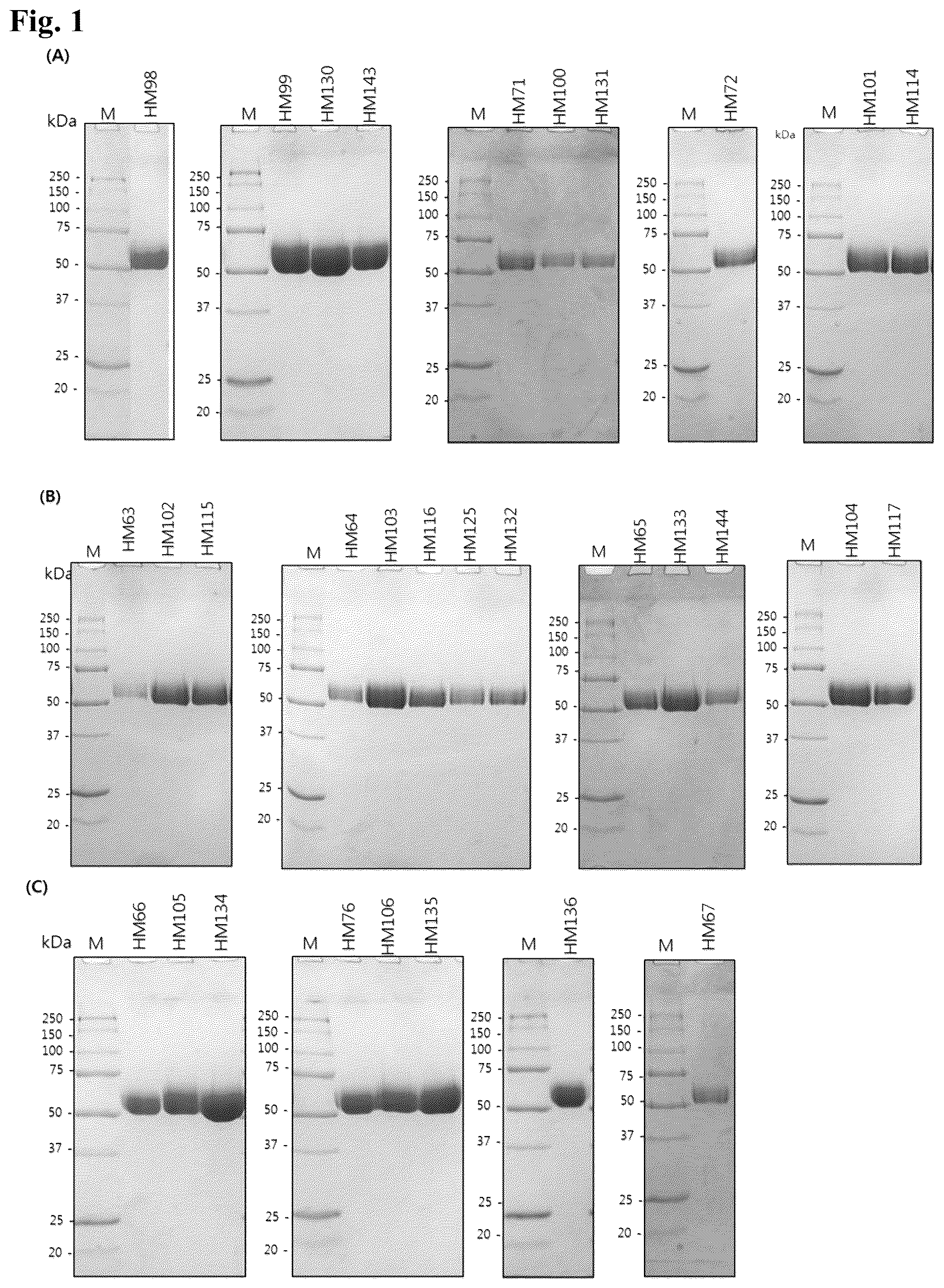
shows the results of SDS-PAGE analysis of various variants based on a PH20 variant having the amino acid sequence of SEQ ID NO: 3. The result of the following SDS-PAGE analysis regarding each variant is obtained by purifying an animal cell culture solution expressing each variant through column chromatography and performing 10% SDS-PAGE analysis on the final purified variant;
More specifically, in part (A) thereof shows the results of SDS-PAGE regarding variants HM98, HM99, HM130, HM143, HM71, HM100, HM131, HM72, HM101, and HM114;
in part (B) thereof shows the results of SDS-PAGE regarding variants HM63, HM102, HM115, HM64, HM103, HM116, HM125, HM132, HM65, HM133, HM144, HM104 and HM117;
in part (C) thereof shows the results of SDS-PAGE gel regarding variants HM66, HM105, HM134, HM76, HM106, HM135, HM136 and HM67;
in part (D) thereof shows the results of SDS-PAGE regarding variants HM82, HM83, HM84, HM85, HM86, HM88, HM89, HM107, HM118, HM90, HM91, HM92, HM93, HM94 and HM95;
in part (E) thereof shows the results of SDS-PAGE regarding variants HM73, HM111, HM121, HM139, HM74, HM112 and HM140;
in part (F) thereof shows the results of SDS-PAGE regarding variants HM75, HM141, HM145, HM70, HM77, HM142, HM78, HM79, HM96, HM146, HM147, HM149 and HM150;
shows the expressions levels of a mature wild-type PH20 and a Hyal2-variant, a Hyal3-variant and a Hyal4-variant in which the region M345 to 1361 of the mature wild-type PH20 was substituted with corresponding sequences of Hyal2, Hyal3 and Hyal4, respectively, wherein Lane CS of SDS-PAGE is a culture medium sample, Lane FT is an unbound impurity in a HisTag column, and Lane E is a HisTag column eluate;
shows the results of SDS-PAGE analysis of various variants based on a PH20 variant having the amino acid sequence of SEQ ID NO: 3. The result of the following SDS-PAGE analysis regarding each variant is obtained by purifying an animal cell culture solution expressing each variant through column chromatography and performing 10% SDS-PAGE analysis on the final purified variant;
in part (A) thereof shows the results of SDS-PAGE regarding variants HM152, HM153, HM154, HM155, HM156, HM157, HM158, HM159, HM160, HM161, HM162, HM163, HM164, HM165, HM166, HM167, HM168 and HM169;
in part (B) thereof shows the results of SDS-PAGE regarding variants HM170, HM171, HM172, HM173, HM174, HM175, HM176, HM177, HM178, HM179, HM180, HM181, HM182, HM183, HM184, HM185 and HM186;
in part (C) thereof shows the results of SDS-PAGE regarding variants HM190, HM191, HM192, HM193, HM194, HM195, HM196, HM197, HM198, HM199, HM203, HM204 and HM205;
in part (D) thereof shows the results of SDS-PAGE regarding variants HM208, HM210, HM211, HM212, HM213, HM214, HM216, HM217, HM218, HM219 and HM220;
in part (E) thereof shows the results of SDS-PAGE regarding variants HM231, HM232, HM233, HM234, HM235, HM243, HM245 and HM246;
in part (F) thereof shows the results of SDS-PAGE regarding variants HM254, HM261, HM262, HM263, HM266, HM268, HM271, HM275, HM276, HM279, HM280, HM287 and HM288; and
shows the results of SDS-PAGE confirming the thermostability of wild-type PH20 (L36-Y482) and variant PH20 (F38-F468) having the amino acid sequence of SEQ ID NO: 3, wherein Lanes A, B, C and D show the results of SDS-PAGE analysis regarding initial wild-type PH20 (Lanes A and C) and the PH20 variant of SEQ ID NO: 3 (Lanes B and D) in a reduced form (Lanes A and B) and a non-reduced form (Lanes C and D), and Lanes E, F, G and H show the results of SDS-PAGE analysis regarding initial wild-type PH20 (Lanes E and G) and variant PH20 of SEQ ID NO: 3 (Lanes F and H) in a reduced form (Lanes E and F) and a non-reduced form (Lanes G and H) after being stored for 7 days at 42° C.
DETAILED DESCRIPTION OF THE INVENTION
Unless defined otherwise, all technical and scientific terms used herein have the same meanings as appreciated by those skilled in the field to which the present invention pertains. In general, the nomenclature used herein is well-known in the art and is ordinarily used.
In the present invention, the position of the amino acid residue of each variant is referred from the amino acid sequence according to SEQ ID NO: 1, when described based on wild-type PH20, and the position of the amino acid residue of each variant is referred from the amino acid sequence according to SEQ ID NO: 3, when described based on the PH20 variant having SEQ ID NO: 3.
The present inventors found through previous research that a hyaluronidase PH20 variant, which includes one or more amino acid residue substitutions in the region corresponding to an alpha-helix region and/or a linker region thereof, preferably an alpha-helix 8 region (S347 to C381) and/or a linker region (A333 to R346) between alpha-helix 7 and alpha-helix 8, in wild-type PH20 having an amino acid sequence of SEQ ID NO: 1, preferably mature wild-type PH20, and optionally in which one or more of the N-terminal and/or C-terminal amino acid residues are selectively cleaved and deleted, exhibits superior efficacy compared to conventional wild-type PH20 or fragments thereof, and filed a patent application regarding this finding (see WO 2020/022791A).
As used herein, the term “mature wild-type PH20” means a protein consisting of amino acid residues L36 to Y482 or L36 to S490 of SEQ ID NO: 1, which lack M1 to T35, which form a signal peptide, and N483 to L509 or A491 to L509, which are not related to the substantial enzymatic function of PH20, in the amino acid sequence of SEQ ID NO: 1 of wild-type PH20.
Specifically, the present inventors found through previous research that, when amino acid sites corresponding to T341 to 1361, which is a part of an alpha-helix 8 region (S347 to C381) and/or a linker region (A333 to R346) between alpha-helix 7 and alpha-helix 8, in wild-type PH20 having an amino acid sequence of SEQ ID NO: 1 is substituted with amino acid residues corresponding to wild-type Hyal1 having the sequence of SEQ ID NO: 2, the expression efficiency and enzymatic activity are improved, and fragments in which a part of the amino acid sequence at the N-terminus and C-terminus is deleted also exhibit superior expression efficiency and high enzymatic activity.
TABLE 1
Amino acid sequence of wild-type PH20 and
wild-type Hyal1
Amino acid sequence of wild-type PH20
(SEQ ID NO: 1)
MGVLKFKHIFFRSFVKSSGVSQIVFTFLLIPCCLTLNFRAPPVIPNVPFL
WAWNAPSEFCLGKFDEPLDMSLFSFIGSPRINATGQGVTIFYVDRLGYYP
YIDSITGVTVNGGIPQKISLQDHLDKAKKDITFYMPVDNLGMAVIDWEEW
RPTWARNWKPKDVYKNRSIELVQQQNVQLSLTEATEKAKQEFEKAGKDFL
VETIKLGKLLRPNHLWGYYLFPDCYNHHYKKPGYNGSCENVEIKRNDDLS
WLWNESTALYPSTYLNTQQSPVAATLYVRNRVREAIRVSKIPDAKSPLPV
FAYTRIVFTDQVLKFLSQDELVYTFGETVALGASGIVIWGTLSIMRSMKS
CLLLDNYMETILNPYIINVTLAAKMCSQVLCQEQGVCIRKNWNSSDYLHL
NPDNFAIQLEKGGKFTVRGKPTLEDLEQFSEKFYCSCYSTLSCKEKADVK
DTDAVDVCIADGVCIDAFLKPPMETEEPQIFYNASPSTLSATMFIVSILF
LIISSVASL
Amino acid sequence of wild-type Hyal1
(SEQ ID NO: 2)
MAAHLLPICALFLTLLDMAQGFRGPLLPNRPFTTVWNANTQWCLERHGVD
VDVSVFDVVANPGQTFRGPDMTIFYSSQLGTYPYYTPTGEPVFGGLPQNA
SLIAHLARTFQDILAAIPAPDFSGLAVIDWEAWRPRWAFNWDTKDIYRQR
SRALVQAQHPDWPAPQVEAVAQDQFQGAARAWMAGTLOLGRALRPRGLWG
FYGFPDCYNYDFLSPNYTGQCPSGIRAQNDQLGWLWGQSRALYPSIYMPA
VLEGTGKSQMYVQHRVAEAFRVAVAAGDPNLPVLPYVQIFYDTTNHFLPL
DELEHSLGESAAQGAAGVVLWVSWENTRTKESCQAIKEYMDTTLGPFILN
VTSGALLCSQALCSGHGRCVRRTSHPKALLLLNPASFSIQLTPGGGPLSL
RGALSLEDQAQMAVEFKCRCYPGWQAPWCERKSMW
As a result of continuous research, the present inventors found that a variant having the sequence of SEQ ID NO: 3, constructed by substituting the amino acid region corresponding to T341 to 1361 of wild-type PH20 having the amino acid sequence of SEQ ID NO: 1 with the corresponding amino acid sequence of wild-type Hyal1 having the sequence of SEQ ID NO: 2, still exhibits excellent expression efficiency and high enzymatic activity, as well as remarkably improved protein aggregation temperature (T agg ), compared to the wild-type PH20, although it includes additional substitutions, deletions and/or insertions of amino acid residues, and further optionally includes deletions of one or more amino acid residues at the N-terminus and/or C-terminus. Based on this finding, the present invention has been completed.
The variant having the sequence of SEQ ID NO: 3 is constructed by substituting 15 amino acid residues, namely, T341S, L342W, S343E, I344N, M345T, S347T, M348K, K349E, L352Q, L353A, L354I, D355K, N356E, E359D and I361T in wild-type PH20 having the amino acid sequence of SEQ ID NO: 1.
In this regard, the PH20 variant or fragment thereof according to the present invention includes substitution, deletion and/or insertion of one or more amino acid residues in the PH20 variant having the amino acid sequence of SEQ ID NO: 3, and optionally includes deletion of one or more amino acid residues at the N-terminus and/or C-terminus.
As described above, the variant having the amino acid sequence of SEQ ID NO: 3 is a variant in which amino acid residues of T341 to 1361 of wild-type PH20 are substituted with corresponding amino acid residues of wild-type Hyal1 (see Table 2). The variant having the amino acid sequence of SEQ ID NO: 3 or a fragment thereof including amino acid residue deletion at the N-terminus and C-terminus was identified as a variant having activity and stability superior to those of wild-type PH20 in previous research.
TABLE 2
Amino acid sequence of PH20 variant in which
amino acid residues at positions T341 to I361
of wild-type PH20 are substituted with cor-
responding amino acid residues of Hyla1
(SEQ ID NO: 3)
MGVLKFKHIFFRSFVKSSGVSQIVFTFLLIPCCLTLNFRAPPVI
PNVPFLWAWNAPSEFCLGKFDEPLDMSLFSFIGSPRINATGQGV
TIFYVDRLGYYPYIDSITGVTVNGGIPQKISLQDHLDKAKKDIT
FYMPVDNLGMAVIDWEEWRPTWARNWKPKDVYKNRSIELVQQQN
VQLSLTEATEKAKQEFEKAGKDFLVETIKLGKLLRPNHLWGYYL
FPDCYNHHYKKPGYNGSCFNVEIKRNDDLSWLWNESTALYPSTY
LNTQQSPVAATLYVRNRVREAIRVSKIPDAKSPLPVFAYTRIVF
TDQVLKFLSQDELVYTFGETVALGASGIVIWG SWENTRTKESCQ
AIKEYMDTT LNPYIINVTLAAKMCSQVLCQEQGVCIRKNWNSSD
YLHLNPDNFAIQLEKGGKFTVRGKPTLEDLEQFSEKFYCSCYST
LSCKEKADVKDTDAVDVCIADGVCIDAFLKPPMETEEPQIFYNA
SPSTLSATMFIVSILFLIISSVASL
Specifically, the PH20 variant or fragment thereof according to the present invention may include one or more mutations, preferably one or more amino acid residue substitutions, deletions and/or insertions in the amino acid sequence of SEQ ID NO: 3, and has a higher protein aggregation temperature (T agg ), which is an index indicating protein stability, than the wild-type PH20. In addition, the PH20 variant according to the present invention does not include the wild-type PH20 of SEQ ID NO: 1.
As used herein, the term “PH20 variant” is intended to include a variant having not only a mutation of one or more amino acid residues, preferably substitution, deletion and/or insertion of one or more amino acid residues in the amino acid sequence of SEQ ID NO: 3, but also deletion of one or more amino acid residues at the N-terminus or C-terminus thereof together with the substitution, deletion and/or insertion of the amino acid residues, and is used with substantially the same meaning as the expression “PH20 variant or fragment thereof”.
Preferably, the PH20 variant according to the present invention includes amino acid residue substitution, insertion, and/or deletion at one or more positions selected from the group consisting of R39, D65 to L68, N82, T84, 1102 to 1105, T132 to Y134, N166, L179 to T182, T185 to K187, V241 to K244, N266 to Q269, P271, V272, K290 to P292, Q311 to K314, G340 to N363, L441, S442, D451 to D453, D461, V463 and D461 to V463 in a variant having the amino acid sequence of SEQ ID NO: 3, and has a higher protein aggregation temperature (T agg ) than that of wild-type PH20.
The PH20 variant according to the present invention may include a mutation at 20 or fewer, preferably 17 or fewer, more preferably 15 or fewer amino acid positions in the amino acid sequence of SEQ ID NO: 3, but is not limited thereto.
More preferably, the PH20 variant or fragment thereof according to the present invention includes at least one amino acid residue substitution selected from the group consisting of R39K, D65A, E66A, P67A, L68A, N82A, T84N, I102A, D103A, S104A, S104N, I105A, I105Q, T132A, T132S, F133A, Y134A, N166A, N166K, L179A, L179S, L179I, L179F, S180T, S180A, L181A, L181M, T182A, T185A, E186A, E186D, K187A, V241A, E242A, I243A, K244A, N266A, T267A, Q268A, Q268D, Q268I, Q268N, Q269A, P271A, V272A, K290A, I291A, I291G, I291L, P292A, P292D, Q311A, V312A, L313A, L313P, L313M, K314A, G340Q, S341H, S341D, S341T, W342I, W342D, W342H, W342L, E343V, E343S, E343Y, E343Q, N344F, N344I, T345E, T345K, T345S, R346M, R346F, R346L, R346T, R346S, R346A, T347Q, T347E, T347V, T347W, T347H, T347S, K348Q, K348F, K348D, K348T, K348E, K348M, E349L, E349W, E349A, S350Q, S350I, S350D, S350T, S350E, S350N, Q352E, Q352G, Q352Y, Q352W, Q352T, A353E, A353Y, A353H, A353K, I354E, I354Q, I354S, I354V, I354A, I354N, I354T, I354R, I354W, I354L, K355Q, K355H, K355D, E356M, E356F, E356I, E356L, E356Q, E356V, E356D, Y357W, Y357F, M358V, M358R, M358Y, M358L, D359K, D359V, D359Y, D359Q, D359T, D359S, D359E, T360Y, T360R, T360L, T360D, T360S, T361M, T361E, T361H, T361L, T361D, T361I, L362A, N363M, N363E, L441A, S442A, D451A, D451S, T452A, T452D, T452H, T452K, T452G, T452P, T452M, T452F, D453A, D461R, D461A, G462A, V463Y and V463A in the variant having the amino acid sequence of SEQ ID NO: 3, but is not limited thereto.
In the present invention, an expression described by a one-letter amino acid residue code together with numbers, such as “S341”, means the amino acid residue at each position in the amino acid sequence of SEQ ID NO: 1 or SEQ ID NO: 3.
For example, “S341” means that the amino acid residue at position 341 in the amino acid sequence of SEQ ID NO: 3 is serine and “S341H” means that serine at position 341 of SEQ ID NO: 3 is substituted with histidine.
The PH20 variant or a fragment thereof according to the present invention is interpreted as including variants or fragments thereof in which an amino acid residue at a specific amino acid residue position is conservatively substituted.
As used herein, the term “conservative substitution” refers to modifications of a PH20 variant that involve the substitution of one or more amino acids with other amino acids having similar biochemical properties that do not result in loss of the biological or biochemical function of the PH20 variant.
The term “conservative amino acid substitution” refers to substitution of the amino acid residue with an amino acid residue having a similar side chain. Families of amino acid residues having similar side chains have been defined and are well known in the art to which the present invention pertains. These families include amino acids with basic side chains (e.g., lysine, arginine and histidine), amino acids with acidic side chains (e.g., aspartic acid and glutamic acid), amino acids with uncharged polar side chains (e.g., asparagine, glutamine, serine, threonine, tyrosine, and cysteine), amino acids with nonpolar side chains (e.g., glycine, alanine, valine, leucine, isoleucine, proline, phenylalanine, methionine, and tryptophan), amino acids with beta-branched side chains (e.g., threonine, valine, and isoleucine), and amino acids with aromatic side chains (e.g., tyrosine, phenylalanine, tryptophan, and histidine).
It is found that the PH20 variant or fragments thereof of the present invention retains the activity thereof despite having conservative amino acid substitutions.
In addition, the PH20 variant or fragment thereof according to the present invention is interpreted to include PH20 variants or fragments thereof having substantially the same function and/or effect as those/that of the PH20 variant or fragment thereof according to the present invention, and having amino acid sequence homology of at least 80% or 85%, preferably at least 90%, more preferably at least 95%, and most preferably at least 99% to the PH20 variant or fragment thereof according to the present invention.
The PH20 variants or fragments thereof according to the present invention have increased expression levels and protein refolding rate, and thereby have higher thermal stability than mature wild-type PH20. Furthermore, the enzymatic activity of the PH20 variants was greater than or similar to that of mature wild-type PH20 despite the increase in thermal stability.
Meanwhile, although the mature wild-type PH20 variant having cleavage at the C-terminal is known to have decreased enzymatic activity, the PH20 variants according to the present invention exhibit similar or increased enzymatic activity and expression efficiency, and high protein aggregation temperatures (T agg ) due to the more rapid protein refolding and thermal stability thereof, although one or more amino acid residues at the C-terminus are cleaved and deleted, and/or 1 to 7, preferably, 1 to 5 amino acid residues at the N-terminus are cleaved and deleted.
Accordingly, the PH20 variant or fragment thereof according to the present invention is characterized in that it includes one or more amino acid mutations, preferably one or more amino acid residue substitutions, deletions and/or insertions in the variant having the amino acid sequence of SEQ ID NO: 3 or the like, and one or more amino acid residues of N-terminus and/or C-terminus are additionally deleted, but is not limited thereto.
In one embodiment, the PH20 variant or fragment thereof according to the present invention may be one in which cleavage occurs before an amino acid residue selected from the group consisting of M1 to P42 from the N-terminus, preferably before an amino acid residue L36, N37, F38, R39, A40, P41, or P42 at the N-terminus, in the amino acid sequence of SEQ ID NO: 3, so that one or more amino acid residues from the N-terminus are deleted, and/or cleavage occurs after an amino acid residue selected from the group consisting of V455 to L509, preferably after an amino acid residue selected from the group consisting of V455 to S490, most preferably after an amino acid residue V455, D456, C458, D461, C464, I465, D466, A467, F468, K470, P471, P472, M473, E474, T475, E476, P478, I480, Y482, A484, P486, T488, or S490 at the C-terminus, so that one or more amino acid residues at the C-terminus are deleted.
The expression “cleavage occurs before an amino acid residue selected from the group consisting of M1 to P42 at the N-terminus” means that a portion of amino acid residues immediately before the selected amino acid residue from among M1 to P42 at the N-terminus is cleaved and deleted. The expression “cleavage occurs before M1” means that no cleavage occurs at the N-terminus.
For example, the expression “cleavage occurs before an amino acid residue L36, N37, F38, R39, A40, P41, or P42” means that all amino acid residues from M1 to T35 immediately before L36, all amino acid residues from M1 to L36 immediately before N37, all amino acid residues from M1 to N37 immediately before F38, all amino acid residues from M1 to F38 immediately before R39, all amino acid residues from M1 to R39 immediately before A40, all amino acid residues from M1 to A40 immediately before P41, or all amino acid residues from M1 to P41 immediately before P42 in the amino acid sequence of SEQ ID NO: 3 according to the present invention are cleaved and removed.
In addition, the expression “cleavage occurs after an amino acid residue selected from the group consisting of V455 to L509 at the C-terminus” means that a portion of amino acid residues immediately before the selected amino acid residue from among M1 to P42 at the N-terminus is cleaved and deleted.
For example, the expression “cleavage occurs after an amino acid residue V455, D456, C458, D461, C464, I465, D466, A467, F468, K470, P471, P472, M473, E474, T475, E476, P478, I480, Y482, A484, P486, T488 or S490 at the C-terminus” means that an amino acid residue after the amino acid residue V455, D456, C458, D461, C464, I465, D466, A467, F468, K470, P471, P472, M473, E474, T475, E476, P478, I480, Y482, A484, P486, T488 or S490 in the amino acid sequence of SEQ ID NO: 3 according to the present invention is cleaved and removed.
Preferably, the novel PH20 variant or fragment thereof according to the present invention is characterized in that it includes an amino acid residue substitution, deletion or insertion at one or more positions in the variant having the amino acid sequence of SEQ ID NO: 3, a truncation before F38 at the N-terminus, and a truncation after F468 at the C-terminus.
More preferably, the novel PH20 variant or fragment thereof according to the present invention may include an amino acid sequence selected from the group consisting of amino acid sequences of SEQ ID NOS: 163 to 316, but is not limited thereto.
The sequences of the substituted or cleaved amino acids in the PH20 variant constructed in the specific embodiment according to the present invention are as shown in Table 6.
In addition, in the present invention, an attempt was made to increase the expression of a recombinant PH20 protein using other signal peptide of proteins highly expressed in animal cells, instead of using the original signal peptide of PH20.
Therefore, in another embodiment, the novel PH20 variant according to the present invention may be one in which the N-terminus further includes a human growth hormone signal peptide having an amino acid sequence MATGSRTSLLLAFGLLCLPWLQEGSA of SEQ ID NO: 4, a human serum albumin signal peptide having an amino acid sequence MKWVTFISLLFLFSSAYS of SEQ ID NO: 5, or a human Hyal1 signal peptide having an amino acid sequence MAAHLLPICALFLTLLDMAQG of SEQ ID NO: 6 as shown in Table 3 below, instead of the signal peptide of wild-type PH20, which consists of M1 to T35, but is not limited thereto.
The expression “instead of the signal peptide of wild-type PH20, which consists of M1 to T35” means the case in which the signal peptide in the amino acid sequence of SEQ ID NO: 3 is partially or completely deleted, and thus does not perform the function thereof. In addition, the expression is meant to include the case in which a portion of the N-terminus is further deleted, for example, the case in which cleavage occurs before the N37, F38, R39, A40, P41 or P42 residue occurs so that an additional deletion of the N-terminus together with the deletion of the signal peptide of wild-type PH20 occurs.
TABLE 3
Signal peptide sequence according to
present invention
SEQ
ID
Amino acid sequence NO.
Human Growth MATGSRTSLLLAFGLLCLPWLQEGSA 4
hormone
Human serum MKWVTFISLLFLFSSAYS 5
albumin
Human Hyal1 MAAHLLPICALFLTLLDMAQG 6
In another aspect, the present invention is directed to a composition for treating cancer containing the novel PH20 variant or fragment thereof according to the present invention and a method for treating cancer using the same.
The cancers or carcinomas that can be treated by the novel PH20 variant or fragment thereof according to the present invention are not particularly limited, but include both solid cancers and blood cancers. The cancer may be selected from the group consisting of skin cancer such as melanoma, liver cancer, hepatocellular carcinoma, gastric cancer, breast cancer, lung cancer, ovarian cancer, bronchial cancer, nasopharyngeal cancer, laryngeal cancer, pancreatic cancer, bladder cancer, colorectal cancer, colon cancer, uterine cervical cancer, brain cancer, prostate cancer, bone cancer, thyroid cancer, parathyroid cancer, renal cancer, esophageal cancer, biliary tract cancer, testis cancer, rectal cancer, head and neck cancer, ureteral cancer, osteosarcoma, neurocytoma, fibrosarcoma, rhabdomyosarcoma, astrocytoma, neuroblastoma and neuroglioma, but is not limited thereto. Preferably, cancers that can be treated by the composition according to the present invention may be selected from the group consisting of colorectal cancer, breast cancer, lung cancer and renal cancer, but are not limited thereto.
The composition of the present invention may be a pharmaceutical composition. The pharmaceutical composition may further include a pharmaceutically acceptable composition. The composition may contain one or more selected from the group consisting of lactose, dextrose, sucrose, sorbitol, mannitol, starch, gum acacia, calcium phosphate, alginate, gelatin, calcium silicate, microcrystalline cellulose, polyvinylpyrrolidone, cellulose, water, syrups, methyl cellulose, methylhydroxybenzoate, propylhydroxybenzoate, talc, magnesium stearate, and mineral oil, which are typically used in the preparation of drugs, but is not limited thereto. In addition, the pharmaceutical composition may further contain one or more selected from the group consisting of diluents, excipients, lubricants, wetting agents, sweeteners, aromatics, emulsifiers, suspensions and preservatives, which are typically used in the preparation of drugs.
The pharmaceutical composition may be administered orally or parenterally. The parenteral administration is carried out by intravenous injection, subcutaneous injection, intramuscular injection, intraperitoneal injection, endothelial administration, topical administration, intranasal administration, intrapulmonary administration, rectal administration, and the like. For oral administration, the active ingredient in the oral composition needs to be formulated into a coated dosage form or into a dosage form that can protect the active ingredient from disintegrating in the stomach, considering that peptides and proteins are digested in the stomach. Alternatively, the present composition may be administered via any device by which the active ingredient can move to the target cell of interest.
The pharmaceutical composition may be formulated in the form of solutions, suspensions, syrups or emulsions in oils or aqueous media, or in the form of extracts, grains, powders, granules, tablets or capsules, and may additionally include dispersing or stabilizing agents for the purpose of formulation.
In particular, the composition for treating cancer according to the present invention may be used in combined therapy with other anticancer drugs.
An anticancer drug that can be used in combined therapy with the novel PH20 variant or fragment thereof according to the present invention is preferably a chemical anticancer drug, an antibody-based anticancer drug, a biological anticancer drug, an RNAi, or a cell therapeutic agent, but is not limited thereto.
Preferably, the anticancer drug that can be used in combined therapy with the novel PH20 variant or fragment thereof according to the present invention is preferably an immuno-oncologic agent, and more preferably an immune checkpoint inhibitor, but is not limited thereto.
In addition, the present invention is directed to a method for treating cancer using the novel PH20 variant or fragment in combination with other anticancer agents, particularly the anticancer agents described above.
In another aspect, the present invention is directed to a nucleic acid encoding the PH20 variant or fragment thereof.
The nucleic acids, as used herein, may be present in cells, in the cell lysate, or in the partially purified or substantially pure form. “Isolated” or “to be substantially pure”, when referring to nucleic acids, refer to those that have been purified and thus separated from other cellular components or other contaminants, e.g., other cellular nucleic acids or proteins, by standard techniques, including alkaline/SDS treatment, CsCl banding, column chromatography, agarose gel electrophoresis, and others well known in the art. The nucleic acids of the present invention may be DNA or RNA.
In still another aspect, the present invention is directed to a recombinant expression vector including the nucleic acid. For expression of the PH20 variant or fragment thereof according to the present invention, a DNA encoding the PH20 variant or fragment thereof can be obtained by standard molecular biology techniques (e.g., PCR amplification or cDNA cloning using a hybridoma that expresses the PH20 variant), and the DNA can be inserted into an expression vector such that it is “operatively linked” to transcriptional and translational control sequences.
As used herein, the term “operatively linked” is intended to mean that a gene encoding the PH20 variant or fragment thereof is ligated into a vector such that transcriptional and translational control sequences serve intended functions thereof of regulating the transcription and translation of the gene encoding the PH20 variant or fragment thereof. The expression vector and expression control sequences are chosen to be compatible with the expression host cell that is used. The genes encoding the PH20 are inserted into the expression vector by standard methods (e.g., ligation of complementary restriction enzyme sites on a fragment of the gene encoding the PH20 variant or fragment thereof and a vector, or blunt-end ligation if no restriction enzyme sites are present).
In addition, the recombinant expression vectors carry regulatory sequences that control the expression of a gene encoding the PH20 variant or fragment thereof in the host cell. The term “regulatory sequence” is intended to include promoters, enhancers and other expression control elements (e.g., polyadenylation signals) that control the transcription or translation of the genes encoding the PH20 variant or fragment thereof. It will be appreciated by those skilled in the art that the design of the expression vector, including the selection of regulatory sequences, may depend on such factors as the choice of the host cell to be transformed, the desired level of expression of the protein, etc.
In yet another aspect, the present invention is directed to a host cell including the nucleic acid or the vector. The host cell according to the present invention is preferably selected from the group consisting of animal cells, plant cells, yeasts, E. coli ., and insect cells, but is not limited thereto.
Specifically, the host cell according to the present invention include prokaryotic cells such as E. coli, Bacillus subtilis, Streptomyces sp., Pseudomonas sp., Proteus mirabilis or Staphylococcus sp., fungi such as Aspergillus sp., yeasts such as Pichia pastoris, Saccharomyces cerevisiae, Schizosaccharomyces sp. and Neurospora crassa , and eukaryotic cells such as lower eukaryotic cells, and higher other eukaryotic cells such as insect cells.
In addition, the host cells that can be used in the present invention may be derived from plants or mammals. Preferably, examples of the host cells include, but are not limited to, monkey kidney cells (COS7), NSO cells, SP2/0, Chinese hamster ovary (CHO) cells, W138, baby hamster kidney (BHK) cells, MDCK, myeloma cells, HuT 78 cells and HEK293 cells. More preferably, CHO cells may be used.
The nucleic acid or the vector is transfected into a host cell. Transfection can be performed using various techniques that are generally used to introduce foreign nucleic acid (DNA or RNA) into prokaryotic or eukaryotic cells, for example, electrophoresis, calcium phosphate precipitation, DEAE-dextran transfection or lipofection. In order to express the PH20 variant or fragment thereof of the present invention, various combinations of recombinant expression vectors and host cells can be employed. The preferred expression vector for eukaryotic cells includes gene expression regulatory sequences derived from, but not limited to, SV40, bovine papillomavirus, adenovirus, adeno-associated virus, cytomegalovirus and retrovirus. Expression vectors that can be used for bacterial hosts include bacterial plasmids such as pET, pRSET, pBluescript, pGEX2T, pUC vectors, col E1, pCR1, pBR322, pMB9 and derivatives thereof, obtained from E. coli ; a plasmid having broad host range, such as RP4; phage DNAs exemplified by various phage lambda derivatives, such as, λgt10, λgt11 and NM989; and other DNA phages, such as M13 and filamentous single-stranded DNA phage. An expression vector available for yeast cells may be a 2-μm plasmid and derivatives thereof. Expression vectors for insect cells include pVL941.
In another aspect, the present invention is directed to a method for producing a PH20 variant or fragment thereof, the method including culturing the host cell and expressing the PH20 variant or fragment thereof according to the present invention.
When a recombinant expression vector capable of expressing the PH20 variant or fragment thereof is introduced into mammalian host cells, the PH20 variant or fragment thereof can be produced by culturing the host cells for a period of time such that the PH20 variant or fragment thereof is expressed in the host cells, preferably a period of time such that the PH20 variant is secreted into the medium during culture of the host cells.
In an alternative embodiment, the expressed PH20 variant or fragment thereof can be isolated and purified from the host cells. Isolation or purification of the PH20 variant or fragment thereof can be performed by conventional isolation/purification methods (e.g., chromatography) that are used for proteins. The chromatography may include a combination of one or more selected from affinity chromatography, ion exchange chromatography, and hydrophobic chromatography, but is not limited thereto. In addition to the chromatography, a combination of filtration, ultrafiltration, salting out, dialysis, and the like may be used.
In order to confirm the industrial applicability of the enzyme, it is necessary to analyze the catalytic reaction rate of the enzyme. Types of enzymatic reactions include an enzyme reaction with an active site with fixed reactivity and an enzyme reaction with several active sites with various reactivity. It is known that the catalytic reaction rate of enzymes having an active site with fixed reactivity, such as hyaluronidase, follows the Michaelis-Menten rate formula.
The Michaelis-Menten's enzyme kinetics is premised on the assumption of an enzymatic reaction as a two-step reaction system including a reversible reaction step in which Complex [ES] of Enzyme (E)-Substrate (S) is formed and an irreversible reaction step in which the ES complex is dissociated to yield Product (P). In this case, k f , k r and k cat are the rate constants of the reaction in each direction (Alan Fersht (1977) Enzyme structure and mechanism).
E + S ⇌ k r k f ES ⟶ k cat E + P
The enzymatic reaction assumes that the process of reacting the enzyme with the substrate to produce the ES complex rapidly reaches equilibrium, or may be considered to be a pseudo-steady state assuming that d[ES]/dt≈0 is satisfied by sufficiently lowering the concentration of the enzyme by performing a reaction that maintains a sufficiently high substrate concentration. Since the rate equations assuming fast equilibrium or pseudo-steady state are derived in the same manner, a pseudo-steady state in which the substrate concentration is initially higher than the enzyme concentration is assumed in most experiments.
When conditions such as “the amount of enzyme is constant before and after the reaction” and “when a chemical reaction reaches chemical equilibrium, the reaction rate at which the product is obtained is equal to the rate at which the product is decomposed again” are used under such an assumption, the reaction rate of the final product may be expressed by the following Michaelis-Menten rate formula. In this case, K M =(k r +k cat /k f , and V max =k cat [E] 0 .
v = d [ P ] dt = V max [ S ] K M + [ S ]
The Lineweaver-Burk equation is used to experimentally analyze the enzyme reaction rate using the Michaelis-Menten rate formula. This equation shows the relationship between the reciprocal 1/V of the experimentally measured reaction rate with the reciprocal 1/[S] of the given substrate concentration in the experiment. Statistical verification that this equation is a linear equation demonstrates that the enzyme reaction is a reaction following Michaelis-Menten's rate formula, and K M and V max can be calculated using this equation.
Enzymes that catalyze a chemical reaction have a transition state after binding to a substrate at an active site, and the activation energy for reaching the transition state having high energy is lowered through multiple bonds with the substrate. The equilibrium constant for reaching this transition state is proportional to k cat /K M . Here, 1/K M is an index that combines the degree to which an enzyme-substrate complex is produced by bonding the enzyme to the substrate with the degree to which the enzyme-substrate complex is maintained without being decomposed, and k cat is the equilibrium constant at which a product is obtained from the enzyme-substrate complex. Therefore, k cat /K M can be said to be an indicator of how much product can be obtained from the substrate and the enzyme, that is, the catalytic efficiency of the enzyme.
The industrial availability of hyaluronidase is proportional to the catalytic efficiency thereof. In particular, when the enzyme is injected subcutaneously along with a polymeric pharmacologically active substance such as a monoclonal antibody, the catalytic efficiency of hyaluronidase plays an important role. In the case where the variant according to the present invention has higher k cat /K M than the wild-type PH20, when the hyaluronidase combined with the polymeric pharmacologically active substance is administered subcutaneously, hyaluronic acid present therein is rapidly decomposed and thus a superior effect of rapidly dispersing the pharmacologically active substance can be obtained. In addition, when the variant according to the present invention has a larger k cat than the wild-type PH20, the maximum reaction rate V max increases at the same enzyme concentration, thereby providing excellent effects of decomposing a greater amount of hyaluronic acid during the same period of time and dispersing the pharmacologically active substance in a wider region.
Therefore, in order to confirm the enzymatic properties of the PH20 variant according to the present invention, the enzyme reaction rate of each variant was analyzed, and V max (maximum enzyme reaction rate), K M (substrate concentration under 50% V max condition), k cat (substrate conversion rate), and k cat /K M (enzyme catalyst efficiency) thereof were compared in Example 4. The results described above demonstrate that the PH20 variant according to the present invention is superior to wild-type PH20.
EXAMPLE
Hereinafter, the present invention will be described in more detail with reference to examples. However, it will be obvious to those skilled in the art that these examples are provided only for illustration of the present invention and should not be construed as limiting the scope of the present invention.
Example 1. Construction of PH20 Variants
For construction of PH20 variants, cDNA (clone ID: hMU002604) of wild-type PH20 was purchased from the Korean Human Gene Bank. Wild-type PH20 encodes amino acids from L36 to S490. The PH20 gene was amplified by polymerase chain reaction (hereinafter referred to as PCR) and inserted into the XhoI and NotI restriction enzyme sites of a pcDNA3.4-TOPO vector. For expression in EXPICHO™ cells, the signal peptide of human growth hormone, human serum hormone or human Hyal1 was used as a signal peptide instead of the original signal peptide of PH20. For protein purification using a HisTrap column, the DNA sequence of a His-tag was located at the 3′-end of the PH20 cDNA. The amino acid substitution of PH20 variants was performed using PCR, and the amino acid substitution was confirmed through DNA sequencing.
The list of primers used in cloning of the PH20 variants are summarized in Table 4 below, and the specific sequences of the primers are summarized in Table 5 below.
TABLE 4
List of primers used in cloning of PH 20
variants according to present invention
Primer
Clone 1 2 3
cB4205 ALB-SP-Xho B4-hy2 SPAM1-6H-not
cB4206 ALB-SP-Xho B4-hy3 SPAM1-6H-not
cB4207 ALB-SP-Xho B4-hy4 SPAM1-6H-not
cB4213-m63 opB4-Xho-hSA op-F468-6H-not —
cB4213-m64 opB4-Xho-hSA op-Q347-m64 op-F468-6H-not
cB4213-m65 op-Xho-hSA-L op-Q348-m65 op-F468-R
cB4213-m66 op-Xho-hSA-L op-Q350-m66 op-F468-R
cB4213-m67 opB4-Xho-hSA op-Q355-m67 op-F468-6H-not
cB4213-m69 op-Xho-hSA-L op-V358-m69 op-F468-6H-not
cB4213-m70 op-Xho-hSA-L op-A362-m70 op-F468-6H-not
cB4213-m71 opB4-Xho-hSA op-V343-m71 op-F468-6H-not
cB4213-m72 opB4-Xho-hSA op-F344-m72 op-F468-6H-not
cB4213-m73 op-Xho-hSA-L op-K359-mega- op-F468-6H-not
NL73
cB4213-m74 op-Xho-hSA-L op-Y360-m74 op-F468-6H-not
cB4213-m75 opB4-Xho-hSA op-M361-m75 op-F468-6H-not
cB4213-m76 opB4-Xho-hSA op-E352-m76 op-F468-6H-not
cB4213-m77 opB4-Xho-hSA op-M363-m77 op-F468-6H-not
cB4213-m78 opB4-Xho-hSA op-N84-m78 op-F468-6H-not
cB4213-m79 opB4-Xho-hSA op-K166-m79 op-F468-6H-not
cB4213-m82 op-Xho-hSA-L op-354E-m82 op-F468-6H-not
cB4213-m83 op-Xho-hSA-L op-354Q-m83 op-F468-6H-not
cB4213-m84 op-Xho-hSA-L op-354S-m84 op-F468-6H-not
cB4213-m85 op-Xho-hSA-L op-354V-m85 op-F468-6H-not
cB4213-m86 op-Xho-hSA-L op-354A-m86 op-F468-6H-not
cB4213-m88 op-Xho-hSA-L op-354N-m88 op-F468-6H-not
cB4213-m89 op-Xho-hSA-L op-354T-m89 op-F468-6H-not
cB4213-m90 op-Xho-hSA-L op-356M-m90 op-F468-6H-not
cB4213-m91 op-Xho-hSA-L op-356F-m91 op-F468-6H-not
cB4213-m92 op-Xho-hSA-L op-356I-m92 op-F468-6H-not
cB4213-m93 op-Xho-hSA-L op-356L-m93 op-F468-6H-not
cB4213-m94 op-Xho-hSA-L op-356Q-m94 op-F468-6H-not
cB4213-m95 op-Xho-hSA-L op-356V-m95 op-F468-6H-not
cB4213-m96 op-Xho-hSA-L op-343V_364M- op-F468-6H-not
m96
cB4213-m97 op-Xho-hSA-L op-340Q-m97 op-F468-6H-not
cB4213-m98 op-Xho-hSA-L op-341H-m98 op-F468-6H-not
cB4213-m99 op-Xho-hSA-L op-342I-m99 op-F468-6H-not
cB4213-m100 op-Xho-hSA-L op-343Y-m100 op-F468-6H-not
cB4213-m101 op-Xho-hSA-L op-345E-m101 op-F468-6H-not
cB4213-m102 op-Xho-hSA-L op-346F-m102 op-F468-6H-not
cB4213-m103 op-Xho-hSA-L op-347E-m103 op-F468-6H-not
cB4213-m104 op-Xho-hSA-L op-349L-m104 op-F468-6H-not
cB4213-m105 op-Xho-hSA-L op-350I-m105 op-F468-6H-not
cB4213-m106 op-Xho-hSA-L op-352G-m106 op-F468-6H-not
cB4213-m107 op-Xho-hSA-L op-354R-m107 op-F468-6H-not
cB4213-m110 op-Xho-hSA-L op-358R-m110 op-F468-6H-not
cB4213-m111 op-Xho-hSA-L op-359V-m111 op-F468-6H-not
cB4213-m112 op-Xho-hSA-L op-360R-m112 op-F468-6H-not
cB4213-m114 op-Xho-hSA-L op-345K-m114 op-F468-6H-not
cB4213-m115 op-Xho-hSA-L op-346L-m115 op-F468-6H-not
cB4213-m116 op-Xho-hSA-L op-347V-m116 op-F468-6H-not
cB4213-m117 op-Xho-hSA-L op-349W-m117 op-F468-6H-not
cB4213-m118 op-Xho-hSA-L op-354W-m118 op-F468-6H-not
cB4213-m121 op-Xho-hSA-L op-359Y-m121 op-F468-6H-not
cB4213-m125 op-Xho-hSA-L op-347W-m125 op-F468-6H-not
cB4213-m126 op-Xho-hSA-L op-357W-m126 op-F468-6H-not
cB4213-m130 op-Xho-hSA-L op-342D-m130 op-F468-6H-not
cB4213-m131 op-Xho-hSA-L op-343Q-m131 op-F468-6H-not
cB4213-m132 op-Xho-hSA-L op-347H-m132 op-F468-6H-not
cB4213-m133 op-Xho-hSA-L op-348F-m133 op-F468-6H-not
cB4213-m134 op-Xho-hSA-L op-350D-m134 op-F468-6H-not
cB4213-m135 op-Xho-hSA-L op-352Y-m135 op-F468-6H-not
cB4213-m136 op-Xho-hSA-L op-353E-m136 op-F468-6H-not
cB4213-m138 op-Xho-hSA-L op-358Y-m138 op-F468-6H-not
cB4213-m139 op-Xho-hSA-L op-359Q-m139 op-F468-6H-not
cB4213-m140 op-Xho-hSA-L op-360L-m140 op-F468-6H-not
cB4213-m141 op-Xho-hSA-L op-361E-m141 op-F468-6H-not
cB4213-m142 op-Xho-hSA-L op-363E-m142 op-F468-6H-not
cB4213-m143 op-Xho-hSA-L op-342H-m143 op-F468-6H-not
cB4213-m144 op-Xho-hSA-L op-348D-m144 op-F468-6H-not
cB4213-m145 op-Xho-hSA-L op-361H-m145 op-F468-6H-not
cB4213-m146 opB4-Xho-hSA Op-R39-m146-R op-F468-6H-not
cB4213-m147 opB4-Xho-hSA Op-A40-m147-R op-F468-6H-not
cB4213-m149 opB4-Xho-hSA op-D456-6H-not —
cB4213-m150 op-Xho-hSA-L op-350Q360R-m150 op-F468-6H-not
cB4213-m152 opB4-Xho-hSA Op-m152-D65A-R op-F468-6H-not
cB4213-m153 opB4-Xho-hSA Op-m153-E66A-R op-F468-6H-not
cB4213-m154 opB4-Xho-hSA Op-m154-P67A-R op-F468-6H-not
cB4213-m155 opB4-Xho-hSA Op-m155-L68A-R op-F468-6H-not
cB4213-m156 op-Xho-hSA-L op-311A-m156 op-F468-6H-not
cB4213-m157 op-Xho-hSA-L op-312A-m157 op-F468-6H-not
cB4213-m158 op-Xho-hSA-L op-313A-m158 op-F468-6H-not
cB4213-m159 op-Xho-hSA-L op-314A-m159 op-F468-6H-not
cB4213-m160 op-Xho-hSA-L N266A-m160 op-F468-6H-not
cB4213-m161 op-Xho-hSA-L T267A-m161 op-F468-6H-not
cB4213-m162 op-Xho-hSA-L Q268A-m162 op-F468-6H-not
cB4213-m163 op-Xho-hSA-L Q269A-m163 op-F468-6H-not
cB4213-m164 op-Xho-hSA-L P271A-m164 op-F468-6H-not
cB4213-m165 op-Xho-hSA-L V272A-m165 op-F468-6H-not
cB4213-m166 opB4-Xho-hSA Op-m166-I102A-R op-F468-6H-not
cB4213-m167 opB4-Xho-hSA Op-m167-D103A-R op-F468-6H-not
cB4213-m168 opB4-Xho-hSA Op-m168-S104A-R op-F468-6H-not
cB4213-m169 opB4-Xho-hSA Op-m169-I105A-R op-F468-6H-not
cB4213-m170 op-Xho-hSA-L op-m170-T132A-R op-F468-6H-not
cB4213-m171 op-Xho-hSA-L op-m171-F133A-R op-F468-6H-not
cB4213-m172 op-Xho-hSA-L op-m172-Y134A-R op-F468-6H-not
cB4213-m173 op-Xho-hSA-L V241A-m173 op-F468-6H-not
cB4213-m174 op-Xho-hSA-L E242A-m174 op-F468-6H-not
cB4213-m175 op-Xho-hSA-L I243A-m175 op-F468-6H-not
cB4213-m176 op-Xho-hSA-L K244A-m176 op-F468-6H-not
cB4213-m177 opB4-Xho-hSA Op-m177-L179A-R op-F468-6H-not
cB4213-m178 opB4-Xho-hSA Op-m178-S180A-R op-F468-6H-not
cB4213-m179 opB4-Xho-hSA Op-m179-L181A-R op-F468-6H-not
cB4213-m180 opB4-Xho-hSA Op-m180-T182A-R op-F468-6H-not
cB4213-m181 opB4-Xho-hSA Op-m181-T185A-R op-F468-6H-not
cB4213-m182 opB4-Xho-hSA Op-m182-E186A-R op-F468-6H-not
cB4213-m183 opB4-Xho-hSA Op-m183-K187A-R op-F468-6H-not
cB4213-m184 op-Xho-hSA-L op-K290A-m184 op-F468-6H-not
cB4213-m185 op-Xho-hSA-L op-I291A-m185 op-F468-6H-not
cB4213-m186 op-Xho-hSA-L op-P292A-m186 op-F468-6H-not
cB4213-m190 op-Xho-hSA-L L441A-m190 op-F468-6H-not
cB4213-m191 op-Xho-hSA-L S442A-m191 op-F468-6H-not
cB4213-m192 opB4-Xho-hSA op-D451A-m192 op-F468-6H-not
cB4213-m193 opB4-Xho-hSA op-T452A-m193 op-F468-6H-not
cB4213-m194 op-Xho-hSA-L op-D453A-m194 op-F468-6H-not
cB4213-m195 op-Xho-hSA-L op-D461A-6H-not op-F468-6H-not
cB4213-m196 op-Xho-hSA-L op-G462A-6H-not op-F468-6H-not
cB4213-m197 op-Xho-hSA-L op-V463A-6H-not op-F468-6H-not
cB4213-m198 op-Xho-hSA-L op-N82A-m198-R op-F468-6H-not
cB4213-m199 op-Xho-hSA-L op-N166A-m199-R op-F468-6H-not
cB4213-m203 op-Xho-hSA-L Op-S104N-m203-R op-F468-6H-not
cB4213-m204 op-Xho-hSA-L Op-I105Q-m204-R op-F468-6H-not
cB4213-m205 op-Xho-hSA-L op-Q268D-m205-F op-F468-6H-not
cB4213-m208 op-Xho-hSA-L op-Q268I-m208-F op-F468-6H-not
cB4213-m210 op-Xho-hSA-L op-291G-m210-F op-F468-6H-not
cB4213-m211 op-Xho-hSA-L op-292D-m211-F op-F468-6H-not
cB4213-m212 op-Xho-hSA-L op-T452D-m212 op-F468-6H-not
cB4213-m213 op-Xho-hSA-L op-T452H-m213 op-F468-6H-not
cB4213-m214 op-Xho-hSA-L op-T452K-m214 op-F468-6H-not
cB4213-m216 op-Xho-hSA-L Op-T452G-m216 op-F468-6H-not
cB4213-m217 op-Xho-hSA-L Op-T452P-m217 op-F468-6H-not
cB4213-m218 op-Xho-hSA-L op-T452M-m218 op-F468-6H-not
cB4213-m219 op-Xho-hSA-L op-T452F-m219 op-F468-6H-not
cB4213-m220 op-Xho-hSA-L op-D461R-6H-not- op-F468-6H-not
m220
cB4213-m231 op-Xho-hSA-L op-V463Y-6H-not- —
m231
cB4213-m232 op-Xho-hSA-L op-S180T-R-m232 op-F468-6H-not
cB4213-m233 op-Xho-hSA-L op-D451S-F-m233 op-F468-6H-not
cB4213-m234 op-Xho-hSA-L op-L313P-m234-F op-F468-6H-not
cB4213-m235 op-Xho-hSA-L op-L313M-m235-F op-F468-6H-not
cB4213-m243 op-Xho-hSA-L op-L179S-m243-R op-F468-6H-not
cB4213-m245 op-Xho-hSA-L op-L179I-m245-R op-F468-6H-not
cB4213-m246 op-Xho-hSA-L op-L179F-m246-R op-F468-6H-not
cB4213-m254 op-Xho-hSA-L FQQ-Mega-m254 op-F468-6H-not
cB4213-m261 op-Xho-hSA-L op-Q268N-m259-m op-F468-6H-not
cB4213-m262 op-Xho-hSA-L B4-124-R op-F468-6H-not
cB4213-m263 op-Xho-hSA-L B4-124-R op-F468-6H-not
cB4213-m266 op-Xho-hSA-L op-L181M, E186D- op-F468-6H-not
m266
cB4213-m268 opB4-Xho-hSA op-Q268A-m268-m op-F468-6H-not
cB4213-m271 opB4-Xho-hSA op-344I, 348M- op-F468-6H-not
m271
cB4213-m275 op-Xho-hSA-L op-DLSS-m275 op-F468-6H-not
cB4213-m276 op-Xho-hSA-L op-DLS-m276 op-F468-6H-not
cB4213-m279 opB4-Xho-hSA Op-K348M-m279 op-F468-6H-not
cB4213-m280 opB4-Xho-hSA Op-N344I K348M- op-F468-6H-not
m280
cB4213-m287 op-Xho-hSA-L Q268A-m162 op-F468-6H-not
cB4213-m288 opB4-Xho-hSA Q268A-m162 op-F468-6H-not
TABLE 5
Primer sequences used for cloning of PH20
variants
SEQ
ID
Primer NO Nucleotide sequence (5′->3′)
B4-hy2 7 ATA TGG GGA ACC CTC AGT ATA ACT ACA AGC ACT GAG
ACC TGC CAA TAT CTG AAG GAT TAC CTG ACC AGA CTG
CTG AAT CCT TAC ATA ATC AAC
B4-hy3 8 ATA TGG GGA ACC CTC AGT ATA TCC AGC AGT GAG GAA
GAA TGC TGG CAT TTG CAC GAT TAC CTG GTA GAC ACA
CTG AAT CCT TAC ATA ATC AAC
B4-hy4 9 ATA TGG GGA ACC CTC AGT ATA ACC GCA TCT AAG GCA
AAC TGC ACA AAA GTA AAA CAA TTC GTC TCC AGT GAT
CTG AAT CCT TAC ATA ATC AAC
ALB-SP-Xho 10 GAA TAT CTC GAG GCC ACC ATG AAG TGG GTT ACA
SPAM1-6H-not 11 CTA ATT GCG GCC GCT CAT TAG TGG TGA TGG TGA TGA
TGG AAG AAA CCA ATT CTG C
op-F468-R 12 AAT TAG GCG GCC GCC TAT TAA AAG GCG TCG ATG CAC
ACG CCA TC
op-F468-6H-not 13 CTC TAA TTG CGG CCG CTC ATT AGT GGT GAT GGT GAT
GAT GAA AGG CGT CGA TGC ACA CGC CAT C
op-Xho-hSA-L 14 AAT TAG AGC TCG AGG CCA CCA TGA AAT GGG TGA CCT
TTA TCT CC
opB4-Xho-hSA 15 CAG ATT CTC GAG GCC ACC ATG AAA TGG G
op-Q347-m64 16 ATC TGG GGC TCC TGG GAG AAC ACC AGG CAG AAG GAG
AGC TGC CAG GCC ATC
op-Q348-m65 17 ATC TGG GGC TCC TGG GAG AAC ACC AGG ACC CAG GAG
AGC TGC CAG GCC ATC AAG
op-Q350-m66 18 AGA ACA CCA GGA CCA AGG AGC AAT GCC AGG CCA TCA
AGG AGT AC
op-Q355-m67 19 AGG AGA GCT GCC AGG CCA TCC AGG AGT ACA TGG ACA
CAA CCC TG
op-V358-m69 20 AGC TGC CAG GCC ATC AAG GAG TAC GTG GAC ACA ACC
CTG AAC CCT TAT ATC
op-A362-m70 21 AGG AGT ACA TGG ACA CAA CCG CGA ACC CTT ATA TCA
TCA ATG
op-V343-m71 22 ATC GTG ATC TGG GGC TCC TGG GTG AAC ACC AGG ACC
AAG GAG AG
op-F344-m72 23 ATC TGG GGC TCC TGG GAG TTC ACC AGG ACC AAG GAG
AGC TG
op-K359-mega- 24 AGC TGC CAG GCC ATC AAG GAG TAC ATG AAA ACA ACC
NL73 CTG AAC CCT TAT ATC
op-Y360-m74 25 ATC AAG GAG TAC ATG GAC TAC ACC CTG AAC CCT TAT
ATC ATC
op-M361-m75 26 ATC AAG GAG TAC ATG GAC ACA ATG CTG AAC CCT TAT
ATC ATC
op-E352-m76 27 ACC AGG ACC AAG GAG AGC TGC GAG GCC ATC AAG GAG
TAC ATG G
op-M363-m77 28 AGT ACA TGG ACA CAA CCC TGA TGC CTT ATA TCA TCA
ATG TGA C
op-N84-m78 29 TAG AAG ATT GTC ACG CCC TGG CCG TTG GCA TTG ATC
CGA GGA GAG C
op-K166-m79 30 TGC ACC AGC TCG ATG GAC CGT TTC TTA TAC ACG TCC
TTA GGC TTC
op-354E-m82 31 ACC AAG GAG AGC TGC CAG GCC GAA AAG GAG TAC ATG
GAC ACA ACC
op-354Q-m83 32 ACC AAG GAG AGC TGC CAG GCC CAA AAG GAG TAC ATG
GAC ACA ACC
op-354S-m84 33 ACC AAG GAG AGC TGC CAG GCC TCT AAG GAG TAC ATG
GAC ACA ACC
op-354V-m85 34 ACC AAG GAG AGC TGC CAG GCC GTC AAG GAG TAC ATG
GAC ACA ACC
op-354A-m86 35 ACC AAG GAG AGC TGC CAG GCC GCG AAG GAG TAC ATG
GAC ACA ACC
op-354N-m88 36 ACC AAG GAG AGC TGC CAG GCC AAC AAG GAG TAC ATG
GAC ACA ACC
op-354T-m89 37 ACC AAG GAG AGC TGC CAG GCC ACC AAG GAG TAC ATG
GAC ACA ACC
op-356M-m90 38 AAG GAG AGC TGC CAG GCC ATC AAG ATG TAC ATG GAC
ACA ACC CTG AAC
op-356F-m91 39 AAG GAG AGC TGC CAG GCC ATC AAG TTC TAC ATG GAC
ACA ACC CTG AAC
op-356I-m92 40 AAG GAG AGC TGC CAG GCC ATC AAG ATA TAC ATG GAC
ACA ACC CTG AAC
op-356L-m93 41 AAG GAG AGC TGC CAG GCC ATC AAG TTG TAC ATG GAC
ACA ACC CTG AAC
op-356Q-m94 42 AAG GAG AGC TGC CAG GCC ATC AAG CAG TAC ATG GAC
ACA ACC CTG AAC
op-356V-m95 43 AAG GAG AGC TGC CAG GCC ATC AAG GTA TAC ATG GAC
ACA ACC CTG AAC
op- 44 ATC GTG ATC TGG GGC TCC TGG GTG AAC ACC AGG ACC
343V_364M- AAG GAG AGC TGC CAG GCC ATC AAG GAG TAC ATG GAC
m96 ACA ATG CTG AAC CCT TAT ATC ATC
op-340Q-m97 45 AGC TAG CGG CAT CGT GAT CTG GCA ATC CTG GGA GAA
CAC CAG GAC C
op-341H-m98 46 AGC GGC ATC GTG ATC TGG GGC CAC TGG GAG AAC ACC
AGG ACC AAG
op-342I-m99 47 AGC GGC ATC GTG ATC TGG GGC TCC ATT GAG AAC ACC
AGG ACC AAG GAG
op-343Y-m100 48 ATC GTG ATC TGG GGC TCC TGG TAT AAC ACC AGG ACC
AAG GAG AG
op-345E-m101 49 ATC GTG ATC TGG GGC TCC TGG GAG AAC GAA AGG ACC
AAG GAG AGC TGC C
op-346F-m102 50 ATC TGG GGC TCC TGG GAG AAC ACC TTC ACC AAG GAG
AGC TGC CAG GC
op-347E-m103 51 ATC TGG GGC TCC TGG GAG AAC ACC AGG GAA AAG GAG
AGC TGC CAG GCC ATC
op-349L-m104 52 ATC TGG GGC TCC TGG GAG AAC ACC AGG ACC AAG TTG
AGC TGC CAG GCC ATC AAG G
op-350I-m105 53 AGA ACA CCA GGA CCA AGG AGA TCT GCC AGG CCA TCA
AGG AG
op-352G-m106 54 ACC AGG ACC AAG GAG AGC TGC GGG GCC ATC AAG GAG
TAC ATG GAC
op-354R-m107 55 ACC AAG GAG AGC TGC CAG GCC AGA AAG GAG TAC ATG
GAC ACA AC
op-358R-m110 56 AGC TGC CAG GCC ATC AAG GAG TAC CGG GAC ACA ACC
CTG AAC CCT TAT ATC
op-359V-m111 57 AGG CCA TCA AGG AGT ACA TGG TCA CAA CCC TGA ACC
CTT ATA TC
op-360R-m112 58 AGG CCA TCA AGG AGT ACA TGG ACA GAA CCC TGA ACC
CTT ATA TCA TC
op-345K-m114 59 ATC TGG GGC TCC TGG GAG AAC AAG AGG ACC AAG GAG
AGC TGC CAG
op-346L-m115 60 ATC TGG GGC TCC TGG GAG AAC ACC CTG ACC AAG GAG
AGC TGC CAG GC
op-347V-m116 61 ATC TGG GGC TCC TGG GAG AAC ACC AGG GTC AAG GAG
AGC TGC CAG GCC ATC
op-349W-m117 62 ATC TGG GGC TCC TGG GAG AAC ACC AGG ACC AAG TGG
AGC TGC CAG GCC ATC AAG GAG
op-354W-m118 63 ACC AAG GAG AGC TGC CAG GCC TGG AAG GAG TAC ATG
GAC ACA AC
op-359Y-m121 64 AGG CCA TCA AGG AGT ACA TGT ACA CAA CCC TGA ACC
CTT ATA TC
op-347W-m125 65 ATC TGG GGC TCC TGG GAG AAC ACC AGG TGG AAG GAG
AGC TGC CAG GCC ATC
op-357W-m126 66 AGC TGC CAG GCC ATC AAG GAG TGG ATG GAC ACA ACC
CTG AAC CC
op-342D-m130 67 AGC GGC ATC GTG ATC TGG GGC TCC GAC GAG AAC ACC
AGG ACC AAG GAG
op-343Q-m131 68 ATC GTG ATC TGG GGC TCC TGG CAG AAC ACC AGG ACC
AAG GAG AGC
op-347H-m132 69 ATC TGG GGC TCC TGG GAG AAC ACC AGG CAC AAG GAG
AGC TGC CAG GCC ATC
op-348F-m133 70 ATC TGG GGC TCC TGG GAG AAC ACC AGG ACC TTC GAG
AGC TGC CAG GCC ATC AAG
op-350D-m134 71 AGA ACA CCA GGA CCA AGG AGG ACT GCC AGG CCA TCA
AGG AGT AC
op-352Y-m135 72 ACC AGG ACC AAG GAG AGC TGC TAC GCC ATC AAG GAG
TAC ATG GAC AC
op-353E-m136 73 AGG ACC AAG GAG AGC TGC CAG GAA ATC AAG GAG TAC
ATG GAC AC
op-358Y-m138 74 AGC TGC CAG GCC ATC AAG GAG TAC TAC GAC ACA ACC
CTG AAC CCT TAT ATC
op-359Q-m139 75 AGG CCA TCA AGG AGT ACA TGC AGA CAA CCC TGA ACC
CTT ATA TC
op-360L-m140 76 AGG CCA TCA AGG AGT ACA TGG ACC TAA CCC TGA ACC
CTT ATA TCA TC
op-361E-m141 77 ATC AAG GAG TAC ATG GAC ACA GAG CTG AAC CCT TAT
ATC ATC AAT G
op-363E-m142 78 AGT ACA TGG ACA CAA CCC TGG AGC CTT ATA TCA TCA
ATG TGA C
op-342H-m143 79 AGC GGC ATC GTG ATC TGG GGC TCC CAT GAG AAC ACC
AGG ACC AAG GAG
op-348D-m144 80 ATC TGG GGC TCC TGG GAG AAC ACC AGG ACC GAC GAG
AGC TGC CAG GCC ATC AAG
op-361H-m145 81 ATC AAG GAG TAC ATG GAC ACA CAC CTG AAC CCT TAT
ATC ATC AAT G
Op-R39-m146- 82 TTT GGA ATC ACA GGA GGA GCC CGA GAG TAT GCG GAG
R CTA AAC AG
Op-A40-m147- 83 TTT GGA ATC ACA GGA GGA GCA GAG TAT GCG GAG CTA
R AAC AG
op-D456-6H- 84 CTC TAA TTG CGG CCG CCT ATT AGT GGT GAT GGT GAT
not GAT GGT CCA CGG CAT CTG TGT CCT TC
op-350Q360R- 85 AGA ACA CCA GGA CCA AGG AGC AGT GCC AGG CCA TCA
m150 AGG AGT ACA TGG ACC GAA CCC TGA ACC CTT ATA TCA TC
Op-m152- 86 TAA AAG AGA ACA GGC TCA TAT CCA GGG GCT CGG CAA
D65A-R ACT TGC CCA GGC AGA ACT C
Op-m153- 87 TAA AAG AGA ACA GGC TCA TAT CCA GGG GCG CGT CAA
E66A-R ACT TGC CCA GGC AGA AC
Op-m154- 88 TAA AAG AGA ACA GGC TCA TAT CCA GGG CCT CGT CAA
P67A-R ACT TGC CCA GGC
Op-m155- 89 TAA AAG AGA ACA GGC TCA TAT CCG CGG GCT CGT CAA
L68A-R ACT TGC CCA G
op-311A-m156 90 ACC AGG ATC GTG TTT ACA GAC GCG GTG CTG AAG TTC
CTG TCC
op-312A-m157 91 AGG ATC GTG TTT ACA GAC CAG GCG CTG AAG TTC CTG
TCC CAG
op-313A-m158 92 ATC GTG TTT ACA GAC CAG GTG GCG AAG TTC CTG TCC
CAG GAT
op-314A-m159 93 ATC GTG TTT ACA GAC CAG GTG CTG GCG TTC CTG TCC
CAG GAT GAG
N266A-m160 94 GCC CTG TAC CCT AGC ATC TAT CTG GCC ACC CAG CAG
AGC CCA GTG GC
T267A-m161 95 CTG TAC CCT AGC ATC TAT CTG AAC GCC CAG CAG AGC
CCA GTG GCC GCT AC
Q268A-m162 96 TAC CCT AGC ATC TAT CTG AAC ACC GCG CAG AGC CCA
GTG GCC GCT ACA CTG
Q269A-m163 97 TAC CCT AGC ATC TAT CTG AAC ACC CAG GCG AGC CCA
GTG GCC GCT ACA CTG TAT G
P271A-m164 98 AGC ATC TAT CTG AAC ACC CAG CAG AGC GCA GTG GCC
GCT ACA CTG TAT GTG AGG
V272A-m165 99 TAT CTG AAC ACC CAG CAG AGC CCA GCG GCC GCT ACA
CTG TAT GTG AGG
Op-m166- 100 TGT CAC TCC GGT GAT AGA ATC GGC ATA TGG ATA GTA
I102A-R GCC CAG TCT G
Op-m167- 101 TCA CTG TCA CTC CGG TGA TAG AAG CGA TAT ATG GAT
D103A-R AGT AGC CCA G
Op-m168- 102 TCC GTT CAC TGT CAC TCC GGT GAT AGC ATC GAT ATA
S104A-R TGG ATA GTA GCC CAG
Op-m169- 103 TCC GTT CAC TGT CAC TCC GGT GGC AGA ATC GAT ATA
I105A-R TGG ATA GTA GC
op-m170- 104 TTG TCC ACT GGC ATG TAG AAG GCG ATG TCC TTC TTA
T132A-R GCC TTA TC
op-m171- 105 TGC CCA GAT TGT CCA CTG GCA TGT AGG CGG TGA TGT
F133A-R CCT TCT TAG CCT TAT C
op-m172- 106 TGC CCA GAT TGT CCA CTG GCA TGG CGA AGG TGA TGT
Y134A-R CCT TCT TAG
V241A-m173 107 AGA TCG TCG TTC CTC TTG ATC TCC GCA TTG AAA CAG
GAG CCG TTG TAG CC
E242A-m174 108 GAC AGA TCG TCG TTC CTC TTG ATC GCC ACA TTG AAA
CAG GAG CCG TTG TAG CC
I243A-m175 109 AGC CAA GAC AGA TCG TCG TTC CTC TTG GCC TCC ACA
TTG AAA CAG GAG CCG TTG
K244A-m176 110 AGC CAA GAC AGA TCG TCG TTC CTC GCG ATC TCC ACA
TTG AAA CAG GAG CCG
Op-m177- 111 TCT GTG GCC TCG GTC AGG CTC GCC TGC ACG TTC TGC
L179A-R TGC TGC AC
Op-m178- 112 TTC TCT GTG GCC TCG GTC AGG GCC AGC TGC ACG TTC
S180A-R TGC TGC TG
Op-m179- 113 TAG CCT TCT CTG TGG CCT CGG TCG CGC TCA GCT GCA
L181A-R CGT TCT GCT G
Op-m180- 114 TTA GCC TTC TCT GTG GCC TCG GCC AGG CTC AGC TGC
T182A-R ACG TTC TG
Op-m181- 115 TCG AAC TCC TGC TTA GCC TTC TCT GCG GCC TCG GTC
T185A-R AGG CTC AGC TG
Op-m182- 116 TCG AAC TCC TGC TTA GCC TTC GCT GTG GCC TCG GTC
E186A-R AGG CTC AG
Op-m183- 117 TTC TCG AAC TCC TGC TTA GCC GCC TCT GTG GCC TCG GTC
K187A-R AGG C
op-K290A- 118 AGA GAG GCT ATC CGC GTG TCT GCG ATC CCC GAC GCC
m184 AAG TCC CCA C
op-I291A-m185 119 AGG CTA TCC GCG TGT CTA AGG CCC CCG ACG CCA AGT
CCC CAC TG
op-P292A- 120 AGG CTA TCC GCG TGT CTA AGA TCG CCG ACG CCA AGT
m186 CCC CAC TGC CC
L441A-m190 121 AGT TTT ACT GCT CTT GTT ATT CCA CCG CGA GCT GTA
AGG AGA AGG CTG ATG
S442A-m191 122 ACT GCT CTT GTT ATT CCA CCC TGG CCT GTA AGG AGA
AGG CTG ATG TG
op-D451A- 123 AAG GAG AAG GCT GAT GTG AAG GCC ACA GAT GCC GTG
m192 GAC GTG TGC
op-T452A- 124 AAG GAG AAG GCT GAT GTG AAG GAC GCA GAT GCC GTG
m193 GAC GTG TGC ATC
op-D453A- 125 AAG GCT GAT GTG AAG GAC ACA GCT GCC GTG GAC GTG
m194 TGC ATC G
op-D461A-6H- 126 ATA TTC GCG GCC GCC TAT TAG TGG TGA TGG TGA TGA
not TGA AAG GCG TCG ATG CAC ACG CCA GCA GCG ATG CAC
ACG TCC ACG
op-G462A-6H- 127 ATA TTC GCG GCC GCC TAT TAG TGG TGA TGG TGA TGA
not TGA AAG GCG TCG ATG CAC ACG GCA TCA GCG ATG CAC
ACG TCC AC
op-V463A-6H- 128 ATA TTC GCG GCC GCC TAT TAG TGG TGA TGG TGA TGA
not TGA AAG GCG TCG ATG CAC GCG CCA TCA GCG ATG CAC
ACG
op-N82A- 129 TGT CAC GCC CTG GCC GGT GGC AGC GAT CCG AGG AGA
m198-R GCC GAT AAA AG
op-N166A- 130 TGC ACC AGC TCG ATG GAC CGA GCC TTA TAC ACG TCC
m199-R TTA GGC TTC
Op-S104N- 131 TTC ACT GTC ACT CCG GTG ATA TTA TCG ATA TAT GGA
m203-R TAG TAG CC
Op-I105Q- 132 TCC GTT CAC TGT CAC TCC GGT CTG AGA ATC GAT ATA
m204-R TGG ATA GTA GC
op-Q268D- 133 ACC CTA GCA TCT ATC TGA ACA CCG ATC AGA GCC CAG
m205-F TGG CCG CTA C
op-Q268I- 134 ACC CTA GCA TCT ATC TGA ACA CCA TCC AGA GCC CAG
m208-F TGG CCG CTA C
op-291G-m210- 135 AGG CTA TCC GCG TGT CTA AGG GCC CCG ACG CCA AGT
F CCC CAC
op-292D-m211- 136 ATC CGC GTG TCT AAG ATC GAC GAC GCC AAG TCC CCA
F CTG C
op-T452D- 137 AGA AGG CTG ATG TGA AGG ACG ACG ATG CCG TGG ACG
m212 TGT G
op-T452H- 138 AGA AGG CTG ATG TGA AGG ACC ACG ATG CCG TGG ACG
m213 TGT G
op-T452K- 139 AGA AGG CTG ATG TGA AGG ACA AAG ATG CCG TGG ACG
m214 TGT G
Op-T452G- 140 AGA AGG CTG ATG TGA AGG ACG GAG ATG CCG TGG ACG
m216 TGT G
Op-T452P- 141 AGA AGG CTG ATG TGA AGG ACC CAG ATG CCG TGG ACG
m217 TGT G
op-T452M- 142 AGA AGG CTG ATG TGA AGG ACA TGG ATG CCG TGG ACG
m218 TGT G
op-T452F-m219 143 AGA AGG CTG ATG TGA AGG ACT TCG ATG CCG TGG ACG
TGT G
op-D461R-6H- 144 CTC TAA TTG CGG CCG CCT ATT AGT GGT GAT GGT GAT
not-m220 GAT GAA AGG CGT CGA TGC ACA CGC CCC TAG CGA TGC
ACA CGT CCA C
op-V463Y-6H- 145 CTC TAA TTG CGG CCG CTC ATT AGT GGT GAT GGT GAT
not-m231 GAT GAA AGG CGT CGA TGC AGT AGC CAT CAG CGA TGC
ACA C
op-S180T-R- 146 TTC TCT GTG GCC TCG GTC AGG GTC AGC TGC ACG TTC
m232 TGC TGC TG
op-D451S-F- 147 AGG AGA AGG CTG ATG TGA AGA GCA CAG ATG CCG TGG
m233 ACG TG
op-L313P- 148 ATC GTG TTT ACA GAC CAG GTG CCG AAG TTC CTG TCC
m234-F CAG GAT GAG
op-L313M- 149 ATC GTG TTT ACA GAC CAG GTG ATG AAG TTC CTG TCC
m235-F CAG GAT GAG
op-L179S- 150 TCT GTG GCC TCG GTC AGG CTC GAC TGC ACG TTC TGC
m243-R TGC TGC AC
op-L179I- 151 TCT GTG GCC TCG GTC AGG CTA ATC TGC ACG TTC TGC
m245-R TGC TGC AC
op-L179F- 152 TCT GTG GCC TCG GTC AGG CTA AAC TGC ACG TTC TGC
m246-R TGC TGC AC
FQQ-Mega- 153 ATC GTG ATC TGG GGC TCC TGG GAG TTC ACC AGG ACC
m254 CAG GAG AGC TGC CAG GCC ATC CAG GAG TAC ATG GAC
ACA ACC CTG AAC
op-Q268N- 154 ACC CTA GCA TCT ATC TGA ACA CCA ACC AGA GCC CAG
m259-m TGG CCG CTA C
B4-124-R 155 GCC CAG GCA GAA CTC GC
op- 156 TCT CGA ACT CCT GCT TAG CCT TAT CTG TGG CCT CGG TCA
L181M, E186D- TGC TCA GCT GCA CGT TCT GCT GC
m266
op-Q268A- 157 ACC CTA GCA TCT ATC TGA ACA CCG CGC AGA GCC CAG
m268-m TGG CCG CTA C
op-344I, 348M- 158 ATC GTG ATC TGG GGC TCC TGG GAG ATC ACC AGG ACC
m271 ATG GAG AGC TGC CAG GCC ATC AAG
op-DLSS-m275 159 AGC GGC ATC GTG ATC TGG GGC GAC CTG TCG ATC TCC
TCG ACC ATG GAG AGC TGC CAG GCC
op-DLS-m276 160 AGC GGC ATC GTG ATC TGG GGC GAC CTG TCG ATC TCC
AGG ACC ATG GAG AGC TGC CAG
Op-K348M- 161 ATC TGG GGC TCC TGG GAG AAC ACC AGG ACC ATG GAG
m279 AGC TGC CAG GCC ATC AAG
Op-N344I 162 ATC GTG ATC TGG GGC TCC TGG GAG ATC ACC AGG ACC
K348M-m280 ATG GAG AGC TGC CAG GCC ATC AAG
After finding a PH20 variant with increased enzymatic activity and thermal stability, the His-tag-free cDNA of the PH20 variant was also constructed.
The PH20 variant was constructed as follows using cDNA of the PH20 variant.
The expression of the variant was performed using the EXPICHO™ expression system. When the cell density of EXPICHO™ cells reached 6×10 6 /mL, a plasmid including the wild-type or variant PH20 cDNA inserted in the pcDNA3.4-TOPO vector was transfected into the EXPICHO™ cells using EXPIFECTAMINE™ CHO reagent. As a cell culture medium, EXPICHO™ expression medium (100 to 500 mL) was used. After transfection, the EXPICHO™ cells were cultured with shaking at 130 rpm for a total of 6 days, during which the cells were cultured at 37° C. for 1 day and were further cultured at a lower temperature of 32° C. for 5 days. After completion of the culture, the cell supernatant was collected by centrifugation at 10,000 rpm for 30 min.
The recombinant proteins of the C-terminal His-tag-attached wild-type PH20 and variant PH20, produced in the EXPICHO™ cells, were purified through three-step column chromatography using an AKTA™ prime system (GE Healthcare Systems), and the three-step column chromatography was performed using a HisTrap HP column-Q Sepharose column-phenyl HP column, and a Q Sepharose column-HisTrap HP column-butyl HP column, respectively, depending on the variant.
The purification using the HisTrap HP column, the Q Sepharose column and the phenyl HP column was performed as follows. For protein purification using the HisTrap column, buffer A (20 mM sodium phosphate, pH 7.5, 0.5 M NaCl) and buffer B (20 mM sodium phosphate, pH 7.5, 0.5 M NaCl, 0.5 M imidazole) were prepared. The protein was bound to the HisTrap column, and the column was flushed with 5 column volumes (CV) of buffer A to remove non-specifically bound proteins. It was confirmed that the conductivity was maintained at a constant level, and then the column was flushed with 5 CV of 20% buffer B to elute the protein. The eluted protein was dialyzed with dialysis buffer (20 mM sodium phosphate, pH 7.5, 50 mM NaCl). For protein purification using the Q Sepharose column, buffer A (20 mM sodium phosphate, pH 7.5) and buffer B (20 mM sodium phosphate, pH 7.5, 0.5 M NaCl) were prepared. The protein was bound to the Q Sepharose column, and the column was flushed with 5 CV of buffer A to remove nonspecifically bound proteins, and then was flushed with 5 CV of buffer B at a concentration gradient of 0 to 100% to elute the protein. For protein purification using the phenyl HP column, buffer A (20 mM sodium phosphate, pH 7.0, 1.5 M (NH 4 ) 2 SO 4 ) and buffer B (20 mM sodium phosphate, pH 7.0) were prepared. The protein was bound to the phenyl column, and the column was flushed with 5 CV of buffer A to remove nonspecifically bound proteins, and then was flushed with 5 CV of buffer B at a concentration gradient of 0 to 100% to elute the protein.
The purification using the Q Sepharose column, the HisTrap HP column and the butyl HP column was performed as follows. For protein purification using the Q Sepharose column, buffer A (20 mM NaPi, 15 mM NaCl, pH 8.0) and buffer B (20 mM NaPi, 500 mM NaCl, pH 8.0) were prepared. To adjust the pH and conductivity of the culture solution to be the same as Buffer A, the pH was titrated to 8 using 1 M Tris buffer, and the conductivity was adjusted to 5 mS/cm or less by adding water (PW) thereto. Then, the culture solution was filtered through a membrane having 0.22-μm pores therein. The protein was bound to the Q Sepharose column, and the column was flushed with 5 CV of buffer A to remove nonspecifically bound proteins and was then flushed with 5 CV of buffer B to elute the target protein. For protein purification using the HisTrap HP column, buffer A (20 mM NaPi, 500 mM NaCl, pH 7.5) and buffer B (20 mM NaPi, 500 mM NaCl, 500 mM Imidazole, pH 7.5) were prepared. The protein sample was bound to the HisTrap HP column, the column was flushed with 10 CV of 7% buffer B to remove non-specifically bound proteins, and the column was then flushed with 3 CV of 40% buffer B to elute the protein. For protein purification using the butyl HP column, buffer A (20 mM NaPi, 1.5 M Ammonium sulfate, pH 7.0) and buffer B (20 mM NaPi, pH 7.0) were prepared. A 3 M ammonium sulfate solution and a protein sample to be loaded onto the column were mixed in a ratio of 1:1 and then the resulting mixture was filtered through a membrane having 0.22-μm pores therein. The protein sample was bound to the butyl HP column, and the column was flushed with 5 CV of buffer A to remove impurities. Then, the target protein was eluted with a linear concentration gradient of 0-100% buffer B, and was dialyzed using a dialysis buffer (20 mM NaPi, 100 mM NaCl, pH 7.0). The variant according to the present invention was purified by the method suggested in the present invention, 10% SDS-PAGE analysis was performed on each purified product, and the results are shown in .
The enzymatic activities of wild-type PH20 and variant PH20 were measured by turbidimetric assay.
The turbidimetric assay is a method of measuring the absorbance in the precipitate that is produced when hyaluronic acid is mixed with albumin (BSA). When hyaluronic acid is hydrolyzed by PH20, the absorbance of the precipitate that is produced upon mixing with albumin decreases. The turbidimetric assay is generally performed as follows. Hyaluronidase PH20 (Sigma) was diluted to 1, 2, 5, 7.5, 10, 15, 20, 30, 50 and 60 units/mL and prepared in each tube. The purified protein sample was dissolved in an enzyme diluent buffer (20 mM Tris-HCl, pH 7.0, 77 mM NaCl, 0.01% (w/v) bovine serum albumin), diluted to 100×, 300×, 600×, 1200× and 2400×, and prepared in respective tubes. In fresh tubes, the hyaluronic acid solution having a concentration of 3 mg/mL was diluted 10-fold to a concentration of 0.3 mg/mL so that the volume in each tube became 180 μL. 60 μL of enzyme was added to and mixed with the diluted hyaluronic acid solution and allowed to react at 37° C. for 45 minutes. After completion of the reaction, 50 μL of the reacted enzyme and 250 μL of acidic albumin solution were added to each well of a 96-well plate and shaken for 10 minutes, and then the absorbance was measured at 600 nm using a spectrophotometer.
Methods of measuring the thermal stability of the protein include a method of measuring the aggregation temperature by dynamic light scattering (DLS), a method of measuring the melting temperature (T m ) in real-time PCR using Sypro-Orange dye, and a method of measuring the enzymatic activity after allowing the protein to stand at a predetermined temperature for a predetermined time, etc. In the method of measuring the aggregation temperature by DLS, the aggregation of molecules is measured using light scattering, and thus the sensitivity is high and the aggregation temperature is generally lower than the melting temperature of the protein. Since each variant is prepared as a solution of the same concentration of 0.2 mg/mL and is then measured, the physical properties of each variant can be compared using the resulting value as the aggregation temperature (Philo, J. S. (2009) Cur. Pharm. Biotech. 10, 359-372).
The amino acid sequences of the PH20 variants constructed by substitution or cleavage of the amino acids from the PH20 variant having the sequence of SEQ ID NO: 3 in the present invention are shown in Table 6 below.
In the present invention, the experiment was conducted on a variant in which six histidines were added for protein purification at the C-terminus in the sequence shown in Table 6. It was found that this addition to the C-terminus did not affect the enzyme activity or protein stability. The variant according to the present invention was named as a combination of HM and serial number, and the variants according to Example 3 were named “Hyal2-variant”, “Hyal3-variant”, and “Hyal4-variant”.
TABLE 6
Amino acid sequences of PH20 variants according to present
invention and substitution/cleavage characteristics thereof
SEQ
ID
Name NO Substitution Sequence
Hya12- 163 15 amino acid residues LNFRAPPVIPNVPFLWAWNAPSEFCLGKF
variant S341T, W342L, E343S, DEPLDMSLFSFIGSPRINATGQGVTIFYVD
N344I, R346T, T347S, RLGYYPYIDSITGVTVNGGIPQKISLQDHL
K348T, S350T, A353Y, DKAKKDITFYMPVDNLGMAVIDWEEWR
I354L, E356D, M358L, PTWARNWKPKDVYKNRSIELVQQQNVQ
D359T and T360R, LSLTEATEKAKQEFEKAGKDFLVETIKLG
T361L are substituted KLLRPNHLWGYYLFPDCYNHHYKKPGY
from SEQ ID NO: 3, NGSCFNVEIKRNDDLSWLWNESTALYPSI
cleavage occurs before YLNTQQSPVAATLYVRNRVREAIRVSKIP
amino acid residue L36 DAKSPLPVFAYTRIVFTDQVLKFLSQDEL
at N-terminus of PH20, VYTFGETVALGASGIVIWG TLSI T TST E T
and cleavage occurs CQ YL K D Y LTR LLNPYIINVTLAAKMCSQ
after amino acid residue VLCQEQGVCIRKNWNSSDYLHLNPDNFA
S490 at C-terminus of IQLEKGGKFTVRGKPTLEDLEQFSEKFYC
PH20. SCYSTLSCKEKADVKDTDAVDVCIADGV
CIDAFLKPPMETEEPQIFYNASPSTLS
Hya13- 164 17 amino acid residues LNFRAPPVIPNVPFLWAWNAPSEFCLGKF
variant S341T, W342L, E343S, DEPLDMSLFSFIGSPRINATGQGVTIFYVD
N344I, T345S, R346S, RLGYYPYIDSITGVTVNGGIPQKISLQDHL
T347S, K348E, S350E, DKAKKDITFYMPVDNLGMAVIDWEEWR
Q352W, A353H, PTWARNWKPKDVYKNRSIELVQQQNVQ
I354L, K355H, E356D, LSLTEATEKAKQEFEKAGKDFLVETIKLG
M358L, D359V and KLLRPNHLWGYYLFPDCYNHHYKKPGY
T360D are substituted NGSCFNVEIKRNDDLSWLWNESTALYPSI
from SEQ ID NO: 3, YLNTQQSPVAATLYVRNRVREAIRVSKIP
cleavage occurs before DAKSPLPVFAYTRIVFTDQVLKFLSQDEL
amino acid residue L36 VYTFGETVALGASGIVIWG TLSISSSE E E C
at N-terminus of PH20, WHLHD Y LVD TLNPYIINVTLAAKMCSQV
and cleavage occurs LCQEQGVCIRKNWNSSDYLHLNPDNFAI
after amino acid residue QLEKGGKFTVRGKPTLEDLEQFSEKFYCS
S490 at C-terminus of CYSTLSCKEKADVKDTDAVDVCIADGVC
PH20. IDAFLKPPMETEEPQIFYNASPSTLS
Hya14- 165 17 amino acid residues LNFRAPPVIPNVPFLWAWNAPSEFCLGKF
variant S341T, W342L, E343S, DEPLDMSLFSFIGSPRINATGQGVTIFYVD
N344I, R346A, T347S, RLGYYPYIDSITGVTVNGGIPQKISLQDHL
E349A, S350N, Q352T, DKAKKDITFYMPVDNLGMAVIDWEEWR
A353K, I354V, E356Q, PTWARNWKPKDVYKNRSIELVQQQNVQ
Y357F, M358V, LSLTEATEKAKQEFEKAGKDFLVETIKLG
D359S, T360S and KLLRPNHLWGYYLFPDCYNHHYKKPGY
T361D are substituted NGSCFNVEIKRNDDLSWLWNESTALYPSI
from SEQ ID NO: 3, YLNTQQSPVAATLYVRNRVREAIRVSKIP
cleavage occurs before DAKSPLPVFAYTRIVFTDQVLKFLSQDEL
amino acid residue L36 VYTFGETVALGASGIVIWG TLSI T AS K AN
at N-terminus of PH20, C TKV K QFVSSD LNPYIINVTLAAKMCSQ
and cleavage occurs VLCQEQGVCIRKNWNSSDYLHLNPDNFA
after amino acid residue IQLEKGGKFTVRGKPTLEDLEQFSEKFYC
S490 at C-terminus of SCYSTLSCKEKADVKDTDAVDVCIADGV
PH20. CIDAFLKPPMETEEPQIFYNASPSTLS
HM63 166 One amino acid residue FRAPPVIPNVPFLWAWNAPSEFCLGKFDE
R346M is substituted PLDMSLFSFIGSPRINATGQGVTIFYVDRL
from SEQ ID NO: 3, GYYPYIDSITGVTVNGGIPQKISLQDHLDK
cleavage occurs before AKKDITFYMPVDNLGMAVIDWEEWRPT
F38 amino acid residue WARNWKPKDVYKNRSIELVQQQNVQLS
at N-terminus of PH20, LTEATEKAKQEFEKAGKDFLVETIKLGKL
and cleavage occurs LRPNHLWGYYLFPDCYNHHYKKPGYNG
after F468 amino acid SCFNVEIKRNDDLSWLWNESTALYPSIYL
residue at C-terminus NTQQSPVAATLYVRNRVREAIRVSKIPDA
of PH20. KSPLPVFAYTRIVFTDQVLKFLSQDELVY
TFGETVALGASGIVIWGSWENT M TKESC
QAIKEYMDTTLNPYIINVTLAAKMCSQVL
CQEQGVCIRKNWNSSDYLHLNPDNFAIQ
LEKGGKFTVRGKPTLEDLEQFSEKFYCSC
YSTLSCKEKADVKDTDAVDVCIADGVCI
DAF
HM64 167 One amino acid FRAPPVIPNVPFLWAWNAPSEFCLGKFDE
residue T347Q is PLDMSLFSFIGSPRINATGQGVTIFYVDRL
substituted from SEQ GYYPYIDSITGVTVNGGIPQKISLQDHLDK
ID NO: 3, cleavage AKKDITFYMPVDNLGMAVIDWEEWRPT
occurs before F38 WARNWKPKDVYKNRSIELVQQQNVQLS
amino acid residue at LTEATEKAKQEFEKAGKDFLVETIKLGKL
N-terminus of PH20, LRPNHLWGYYLFPDCYNHHYKKPGYNG
and cleavage occurs SCFNVEIKRNDDLSWLWNESTALYPSIYL
after F468 amino acid NTQQSPVAATLYVRNRVREAIRVSKIPDA
residue at C-terminus KSPLPVFAYTRIVFTDQVLKFLSQDELVY
of PH20. TFGETVALGASGIVIWGSWENTR Q KESC
QAIKEYMDTTLNPYIINVTLAAKMCSQVL
CQEQGVCIRKNWNSSDYLHLNPDNFAIQ
LEKGGKFTVRGKPTLEDLEQFSEKFYCSC
YSTLSCKEKADVKDTDAVDVCIADGVCI
DAF
HM65 168 One amino acid FRAPPVIPNVPFLWAWNAPSEFCLGKFDE
residue K348Q is PLDMSLFSFIGSPRINATGQGVTIFYVDRL
substituted from SEQ GYYPYIDSITGVTVNGGIPQKISLQDHLDK
ID NO: 3, cleavage AKKDITFYMPVDNLGMAVIDWEEWRPT
occurs before F38 WARNWKPKDVYKNRSIELVQQQNVQLS
amino acid residue at LTEATEKAKQEFEKAGKDFLVETIKLGKL
N-terminus of PH20, LRPNHLWGYYLFPDCYNHHYKKPGYNG
and cleavage occurs SCFNVEIKRNDDLSWLWNESTALYPSIYL
after F468 amino acid NTQQSPVAATLYVRNRVREAIRVSKIPDA
residue at C-terminus KSPLPVFAYTRIVFTDQVLKFLSQDELVY
of PH20. TFGETVALGASGIVIWGSWENTRT Q ESCQ
AIKEYMDTTLNPYIINVTLAAKMCSQVLC
QEQGVCIRKNWNSSDYLHLNPDNFAIQLE
KGGKFTVRGKPTLEDLEQFSEKFYCSCYS
TLSCKEKADVKDTDAVDVCIADGVCIDA
F
HM66 169 One amino acid residue FRAPPVIPNVPFLWAWNAPSEFCLGKFDE
S350Q is substituted PLDMSLFSFIGSPRINATGQGVTIFYVDRL
from SEQ ID NO: 3, GYYPYIDSITGVTVNGGIPQKISLQDHLDK
cleavage occurs before AKKDITFYMPVDNLGMAVIDWEEWRPT
F38 amino acid residue WARNWKPKDVYKNRSIELVQQQNVQLS
at N-terminus of PH20, LTEATEKAKQEFEKAGKDFLVETIKLGKL
and cleavage occurs LRPNHLWGYYLFPDCYNHHYKKPGYNG
after F468 amino acid SCFNVEIKRNDDLSWLWNESTALYPSIYL
residue at C-terminus NTQQSPVAATLYVRNRVREAIRVSKIPDA
of PH20. KSPLPVFAYTRIVFTDQVLKFLSQDELVY
TFGETVALGASGIVIWGSWENTRTKE Q C
QAIKEYMDTTLNPYIINVTLAAKMCSQVL
CQEQGVCIRKNWNSSDYLHLNPDNFAIQ
LEKGGKFTVRGKPTLEDLEQFSEKFYCSC
YSTLSCKEKADVKDTDAVDVCIADGVCI
DAF
HM67 170 One amino acid residue FRAPPVIPNVPFLWAWNAPSEFCLGKFDE
K355Q is substituted PLDMSLFSFIGSPRINATGQGVTIFYVDRL
from SEQ ID NO: 3, GYYPYIDSITGVTVNGGIPQKISLQDHLDK
cleavage occurs before AKKDITFYMPVDNLGMAVIDWEEWRPT
F38 amino acid residue WARNWKPKDVYKNRSIELVQQQNVQLS
at N-terminus of PH20, LTEATEKAKQEFEKAGKDFLVETIKLGKL
and cleavage occurs LRPNHLWGYYLFPDCYNHHYKKPGYNG
after F468 amino acid SCFNVEIKRNDDLSWLWNESTALYPSIYL
residue at C-terminus NTQQSPVAATLYVRNRVREAIRVSKIPDA
of PH20. KSPLPVFAYTRIVFTDQVLKFLSQDELVY
TFGETVALGASGIVIWGSWENTRTKESCQ
AI Q EYMDTTLNPYIINVTLAAKMCSQVLC
QEQGVCIRKNWNSSDYLHLNPDNFAIQLE
KGGKFTVRGKPTLEDLEQFSEKFYCSCYS
TLSCKEKADVKDTDAVDVCIADGVCIDA
F
HM69 171 One amino acid residue FRAPPVIPNVPFLWAWNAPSEFCLGKFDE
M358V is substituted PLDMSLFSFIGSPRINATGQGVTIFYVDRL
from SEQ ID NO: 3, GYYPYIDSITGVTVNGGIPQKISLQDHLDK
cleavage occurs before AKKDITFYMPVDNLGMAVIDWEEWRPT
F38 amino acid residue WARNWKPKDVYKNRSIELVQQQNVQLS
at N-terminus of PH20 LTEATEKAKQEFEKAGKDFLVETIKLGKL
and cleavage occurs LRPNHLWGYYLFPDCYNHHYKKPGYNG
after F468 amino acid SCFNVEIKRNDDLSWLWNESTALYPSIYL
residue at C-terminus NTQQSPVAATLYVRNRVREAIRVSKIPDA
of PH20. KSPLPVFAYTRIVFTDQVLKFLSQDELVY
TFGETVALGASGIVIWGSWENTRTKESCQ
AIKEY V DTTLNPYIINVTLAAKMCSQVLC
QEQGVCIRKNWNSSDYLHLNPDNFAIQLE
KGGKFTVRGKPTLEDLEQFSEKFYCSCYS
TLSCKEKADVKDTDAVDVCIADGVCIDA
F
HM70 172 One amino acid residue FRAPPVIPNVPFLWAWNAPSEFCLGKFDE
L362A is substituted PLDMSLFSFIGSPRINATGQGVTIFYVDRL
from SEQ ID NO: 3, GYYPYIDSITGVTVNGGIPQKISLQDHLDK
cleavage occurs before AKKDITFYMPVDNLGMAVIDWEEWRPT
F38 amino acid residue WARNWKPKDVYKNRSIELVQQQNVQLS
at N-terminus of PH20, LTEATEKAKQEFEKAGKDFLVETIKLGKL
and cleavage occurs LRPNHLWGYYLFPDCYNHHYKKPGYNG
after F468 amino acid SCFNVEIKRNDDLSWLWNESTALYPSIYL
residue at C-terminus NTQQSPVAATLYVRNRVREAIRVSKIPDA
of PH20. KSPLPVFAYTRIVFTDQVLKFLSQDELVY
TFGETVALGASGIVIWGSWENTRTKESCQ
AIKEYMDTT A NPYIINVTLAAKMCSQVLC
QEQGVCIRKNWNSSDYLHLNPDNFAIQLE
KGGKFTVRGKPTLEDLEQFSEKFYCSCYS
TLSCKEKADVKDTDAVDVCIADGVCIDA
F
HM71 173 One amino acid residue FRAPPVIPNVPFLWAWNAPSEFCLGKFDE
E343 V is substituted PLDMSLFSFIGSPRINATGQGVTIFYVDRL
from SEQ ID NO: 3, GYYPYIDSITGVTVNGGIPQKISLQDHLDK
cleavage occurs before AKKDITFYMPVDNLGMAVIDWEEWRPT
F38 amino acid residue WARNWKPKDVYKNRSIELVQQQNVQLS
at N-terminus of PH20, LTEATEKAKQEFEKAGKDFLVETIKLGKL
and cleavage occurs LRPNHLWGYYLFPDCYNHHYKKPGYNG
after F468 amino acid SCFNVEIKRNDDLSWLWNESTALYPSIYL
residue at C-terminus NTQQSPVAATLYVRNRVREAIRVSKIPDA
of PH20. KSPLPVFAYTRIVFTDQVLKFLSQDELVY
TFGETVALGASGIVIWGSW V NTRTKESCQ
AIKEYMDTTLNPYIINVTLAAKMCSQVLC
QEQGVCIRKNWNSSDYLHLNPDNFAIQLE
KGGKFTVRGKPTLEDLEQFSEKFYCSCYS
TLSCKEKADVKDTDAVDVCIADGVCIDA
F
HM72 174 One amino acid residue FRAPPVIPNVPFLWAWNAPSEFCLGKFDE
N344F is substituted PLDMSLFSFIGSPRINATGQGVTIFYVDRL
from SEQ ID NO: 3, GYYPYIDSITGVTVNGGIPQKISLQDHLDK
cleavage occurs before AKKDITFYMPVDNLGMAVIDWEEWRPT
F38 amino acid residue WARNWKPKDVYKNRSIELVQQQNVQLS
at N-terminus of PH20, LTEATEKAKQEFEKAGKDFLVETIKLGKL
and cleavage occurs LRPNHLWGYYLFPDCYNHHYKKPGYNG
after F468 amino acid SCFNVEIKRNDDLSWLWNESTALYPSIYL
residue at C-terminus NTQQSPVAATLYVRNRVREAIRVSKIPDA
of PH20. KSPLPVFAYTRIVFTDQVLKFLSQDELVY
TFGETVALGASGIVIWGSWE F TRTKESCQ
AIKEYMDTTLNPYIINVTLAAKMCSQVLC
QEQGVCIRKNWNSSDYLHLNPDNFAIQLE
KGGKFTVRGKPTLEDLEQFSEKFYCSCYS
TLSCKEKADVKDTDAVDVCIADGVCIDA
F
HM73 175 One amino acid residue FRAPPVIPNVPFLWAWNAPSEFCLGKFDE
D359K is substituted PLDMSLFSFIGSPRINATGQGVTIFYVDRL
from SEQ ID NO: 3, GYYPYIDSITGVTVNGGIPQKISLQDHLDK
cleavage occurs before AKKDITFYMPVDNLGMAVIDWEEWRPT
F38 amino acid residue WARNWKPKDVYKNRSIELVQQQNVQLS
at N-terminus of PH20, LTEATEKAKQEFEKAGKDFLVETIKLGKL
and cleavage occurs LRPNHLWGYYLFPDCYNHHYKKPGYNG
after F468 amino acid SCFNVEIKRNDDLSWLWNESTALYPSIYL
residue at C-terminus NTQQSPVAATLYVRNRVREAIRVSKIPDA
of PH20. KSPLPVFAYTRIVFTDQVLKFLSQDELVY
TFGETVALGASGIVIWGSWENTRTKESCQ
AIKEYM K TTLNPYIINVTLAAKMCSQVLC
QEQGVCIRKNWNSSDYLHLNPDNFAIQLE
KGGKFTVRGKPTLEDLEQFSEKFYCSCYS
TLSCKEKADVKDTDAVDVCIADGVCIDA
F
HM74 176 One amino acid residue FRAPPVIPNVPFLWAWNAPSEFCLGKFDE
T360Y is substituted PLDMSLFSFIGSPRINATGQGVTIFYVDRL
from SEQ ID NO: 3, GYYPYIDSITGVTVNGGIPQKISLQDHLDK
cleavage occurs before AKKDITFYMPVDNLGMAVIDWEEWRPT
F38 amino acid residue WARNWKPKDVYKNRSIELVQQQNVQLS
at N-terminus of PH20, LTEATEKAKQEFEKAGKDFLVETIKLGKL
and cleavage occurs LRPNHLWGYYLFPDCYNHHYKKPGYNG
after F468 amino acid SCFNVEIKRNDDLSWLWNESTALYPSIYL
residue at C-terminus NTQQSPVAATLYVRNRVREAIRVSKIPDA
of PH20. KSPLPVFAYTRIVFTDQVLKFLSQDELVY
TFGETVALGASGIVIWGSWENTRTKESCQ
AIKEYMD Y TLNPYIINVTLAAKMCSQVLC
QEQGVCIRKNWNSSDYLHLNPDNFAIQLE
KGGKFTVRGKPTLEDLEQFSEKFYCSCYS
TLSCKEKADVKDTDAVDVCIADGVCIDA
F
HM75 177 One amino acid residue FRAPPVIPNVPFLWAWNAPSEFCLGKFDE
T361M is substituted PLDMSLFSFIGSPRINATGQGVTIFYVDRL
from SEQ ID NO: 3, GYYPYIDSITGVTVNGGIPQKISLQDHLDK
cleavage occurs before AKKDITFYMPVDNLGMAVIDWEEWRPT
F38 amino acid residue WARNWKPKDVYKNRSIELVQQQNVQLS
at N-terminus of PH20, LTEATEKAKQEFEKAGKDFLVETIKLGKL
and cleavage occurs LRPNHLWGYYLFPDCYNHHYKKPGYNG
after F468 amino acid SCFNVEIKRNDDLSWLWNESTALYPSIYL
residue at C-terminus NTQQSPVAATLYVRNRVREAIRVSKIPDA
of PH20. KSPLPVFAYTRIVFTDQVLKFLSQDELVY
TFGETVALGASGIVIWGSWENTRTKESCQ
AIKEYMDT M LNPYIINVTLAAKMCSQVL
CQEQGVCIRKNWNSSDYLHLNPDNFAIQ
LEKGGKFTVRGKPTLEDLEQFSEKFYCSC
YSTLSCKEKADVKDTDAVDVCIADGVCI
DAF
HM76 178 One amino acid residue FRAPPVIPNVPFLWAWNAPSEFCLGKFDE
Q352E is substituted PLDMSLFSFIGSPRINATGQGVTIFYVDRL
from SEQ ID NO: 3, GYYPYIDSITGVTVNGGIPQKISLQDHLDK
cleavage occurs before AKKDITFYMPVDNLGMAVIDWEEWRPT
F38 amino acid residue WARNWKPKDVYKNRSIELVQQQNVQLS
at N-terminus of PH20, LTEATEKAKQEFEKAGKDFLVETIKLGKL
and cleavage occurs LRPNHLWGYYLFPDCYNHHYKKPGYNG
after F468 amino acid SCFNVEIKRNDDLSWLWNESTALYPSIYL
residue at C-terminus NTQQSPVAATLYVRNRVREAIRVSKIPDA
of PH20. KSPLPVFAYTRIVFTDQVLKFLSQDELVY
TFGETVALGASGIVIWGSWENTRTKESC E
AIKEYMDTTLNPYIINVTLAAKMCSQVLC
QEQGVCIRKNWNSSDYLHLNPDNFAIQLE
KGGKFTVRGKPTLEDLEQFSEKFYCSCYS
TLSCKEKADVKDTDAVDVCIADGVCIDA
F
HM77 179 One amino acid residue FRAPPVIPNVPFLWAWNAPSEFCLGKFDE
N363M is substituted PLDMSLFSFIGSPRINATGQGVTIFYVDRL
from SEQ ID NO: 3, GYYPYIDSITGVTVNGGIPQKISLQDHLDK
cleavage occurs before AKKDITFYMPVDNLGMAVIDWEEWRPT
F38 amino acid residue WARNWKPKDVYKNRSIELVQQQNVQLS
at N-terminus of PH20, LTEATEKAKQEFEKAGKDFLVETIKLGKL
and cleavage occurs LRPNHLWGYYLFPDCYNHHYKKPGYNG
after F468 amino acid SCFNVEIKRNDDLSWLWNESTALYPSIYL
residue at C-terminus NTQQSPVAATLYVRNRVREAIRVSKIPDA
of PH20. KSPLPVFAYTRIVFTDQVLKFLSQDELVY
TFGETVALGASGIVIWGSWENTRTKESCQ
AIKEYMDTTL M PYIINVTLAAKMCSQVL
CQEQGVCIRKNWNSSDYLHLNPDNFAIQ
LEKGGKFTVRGKPTLEDLEQFSEKFYCSC
YSTLSCKEKADVKDTDAVDVCIADGVCI
DAF
HM78 180 One amino acid residue FRAPPVIPNVPFLWAWNAPSEFCLGKFDE
T84N is substituted PLDMSLFSFIGSPRINA N GQGVTIFYVDRL
from SEQ ID NO: 3, GYYPYIDSITGVTVNGGIPQKISLQDHLDK
residue cleavage occurs AKKDITFYMPVDNLGMAVIDWEEWRPT
before F38 amino acid WARNWKPKDVYKNRSIELVQQQNVQLS
at N-terminus of PH20, LTEATEKAKQEFEKAGKDFLVETIKLGKL
and cleavage occurs LRPNHLWGYYLFPDCYNHHYKKPGYNG
after F468 amino acid SCFNVEIKRNDDLSWLWNESTALYPSIYL
residue at C-terminus NTQQSPVAATLYVRNRVREAIRVSKIPDA
of PH20. KSPLPVFAYTRIVFTDQVLKFLSQDELVY
TFGETVALGASGIVIWGSWENTRTKESCQ
AIKEYMDTTLNPYIINVTLAAKMCSQVLC
QEQGVCIRKNWNSSDYLHLNPDNFAIQLE
KGGKFTVRGKPTLEDLEQFSEKFYCSCYS
TLSCKEKADVKDTDAVDVCIADGVCIDA
F
HM79 181 One amino acid residue FRAPPVIPNVPFLWAWNAPSEFCLGKFDE
N166K is substituted PLDMSLFSFIGSPRINATGQGVTIFYVDRL
from SEQ ID NO: 3, GYYPYIDSITGVTVNGGIPQKISLQDHLDK
cleavage occurs before AKKDITFYMPVDNLGMAVIDWEEWRPT
F38 amino acid residue WARNWKPKDVYK K RSIELVQQQNVQLS
at N-terminus of PH20, LTEATEKAKQEFEKAGKDFLVETIKLGKL
and cleavage occurs LRPNHLWGYYLFPDCYNHHYKKPGYNG
after F468 amino acid SCFNVEIKRNDDLSWLWNESTALYPSIYL
residue at C-terminus NTQQSPVAATLYVRNRVREAIRVSKIPDA
of PH20. KSPLPVFAYTRIVFTDQVLKFLSQDELVY
TFGETVALGASGIVIWGSWENTRTKESCQ
AIKEYMDTTLNPYIINVTLAAKMCSQVLC
QEQGVCIRKNWNSSDYLHLNPDNFAIQLE
KGGKFTVRGKPTLEDLEQFSEKFYCSCYS
TLSCKEKADVKDTDAVDVCIADGVCIDA
F
HM82 182 One amino acid residue FRAPPVIPNVPFLWAWNAPSEFCLGKFDE
I354E is substituted PLDMSLFSFIGSPRINATGQGVTIFYVDRL
from SEQ ID NO: 3, GYYPYIDSITGVTVNGGIPQKISLQDHLDK
residue cleavage occurs AKKDITFYMPVDNLGMAVIDWEEWRPT
before F38 amino acid WARNWKPKDVYKNRSIELVQQQNVQLS
at N-terminus of PH20, LTEATEKAKQEFEKAGKDFLVETIKLGKL
and cleavage occurs LRPNHLWGYYLFPDCYNHHYKKPGYNG
after F468 amino acid SCFNVEIKRNDDLSWLWNESTALYPSIYL
residue at C-terminus NTQQSPVAATLYVRNRVREAIRVSKIPDA
of PH20. KSPLPVFAYTRIVFTDQVLKFLSQDELVY
TFGETVALGASGIVIWGSWENTRTKESCQ
A E KEYMDTTLNPYIINVTLAAKMCSQVL
CQEQGVCIRKNWNSSDYLHLNPDNFAIQ
LEKGGKFTVRGKPTLEDLEQFSEKFYCSC
YSTLSCKEKADVKDTDAVDVCIADGVCI
DAF
HM83 183 One amino acid residue FRAPPVIPNVPFLWAWNAPSEFCLGKFDE
I354Q is substituted PLDMSLFSFIGSPRINATGQGVTIFYVDRL
from SEQ ID NO: 3, GYYPYIDSITGVTVNGGIPQKISLQDHLDK
cleavage occurs before AKKDITFYMPVDNLGMAVIDWEEWRPT
F38 amino acid residue WARNWKPKDVYKNRSIELVQQQNVQLS
at N-terminus of PH20, LTEATEKAKQEFEKAGKDFLVETIKLGKL
and cleavage occurs LRPNHLWGYYLFPDCYNHHYKKPGYNG
after F468 amino acid SCFNVEIKRNDDLSWLWNESTALYPSIYL
residue at C-terminus NTQQSPVAATLYVRNRVREAIRVSKIPDA
of PH20. KSPLPVFAYTRIVFTDQVLKFLSQDELVY
TFGETVALGASGIVIWGSWENTRTKESCQ
A Q KEYMDTTLNPYIINVTLAAKMCSQVL
CQEQGVCIRKNWNSSDYLHLNPDNFAIQ
LEKGGKFTVRGKPTLEDLEQFSEKFYCSC
YSTLSCKEKADVKDTDAVDVCIADGVCI
DAF
HM84 184 One amino acid residue FRAPPVIPNVPFLWAWNAPSEFCLGKFDE
I354S is substituted PLDMSLFSFIGSPRINATGQGVTIFYVDRL
from SEQ ID NO: 3, GYYPYIDSITGVTVNGGIPQKISLQDHLDK
cleavage occurs before AKKDITFYMPVDNLGMAVIDWEEWRPT
F38 amino acid residue WARNWKPKDVYKNRSIELVQQQNVQLS
at N-terminus of PH20, LTEATEKAKQEFEKAGKDFLVETIKLGKL
and cleavage occurs LRPNHLWGYYLFPDCYNHHYKKPGYNG
after F468 amino acid SCFNVEIKRNDDLSWLWNESTALYPSIYL
residue at C-terminus NTQQSPVAATLYVRNRVREAIRVSKIPDA
of PH20. KSPLPVFAYTRIVFTDQVLKFLSQDELVY
TFGETVALGASGIVIWGSWENTRTKESCQ
A S KEYMDTTLNPYIINVTLAAKMCSQVL
CQEQGVCIRKNWNSSDYLHLNPDNFAIQ
LEKGGKFTVRGKPTLEDLEQFSEKFYCSC
YSTLSCKEKADVKDTDAVDVCIADGVCI
DAF
HM85 185 One amino acid residue FRAPPVIPNVPFLWAWNAPSEFCLGKFDE
I354V is substituted PLDMSLFSFIGSPRINATGQGVTIFYVDRL
from SEQ ID NO: 3, GYYPYIDSITGVTVNGGIPQKISLQDHLDK
cleavage occurs before AKKDITFYMPVDNLGMAVIDWEEWRPT
F38 amino acid residue WARNWKPKDVYKNRSIELVQQQNVQLS
at N-terminus of PH20, LTEATEKAKQEFEKAGKDFLVETIKLGKL
and cleavage occurs LRPNHLWGYYLFPDCYNHHYKKPGYNG
after F468 amino acid SCFNVEIKRNDDLSWLWNESTALYPSIYL
residue at C-terminus NTQQSPVAATLYVRNRVREAIRVSKIPDA
of PH20. KSPLPVFAYTRIVFTDQVLKFLSQDELVY
TFGETVALGASGIVIWGSWENTRTKESCQ
A V KEYMDTTLNPYIINVTLAAKMCSQVL
CQEQGVCIRKNWNSSDYLHLNPDNFAIQ
LEKGGKFTVRGKPTLEDLEQFSEKFYCSC
YSTLSCKEKADVKDTDAVDVCIADGVCI
DAF
HM86 186 One amino acid residue FRAPPVIPNVPFLWAWNAPSEFCLGKFDE
I354A is substituted PLDMSLFSFIGSPRINATGQGVTIFYVDRL
from SEQ ID NO: 3, GYYPYIDSITGVTVNGGIPQKISLQDHLDK
cleavage occurs before AKKDITFYMPVDNLGMAVIDWEEWRPT
F38 amino acid residue WARNWKPKDVYKNRSIELVQQQNVQLS
at N-terminus of PH20, LTEATEKAKQEFEKAGKDFLVETIKLGKL
and cleavage occurs LRPNHLWGYYLFPDCYNHHYKKPGYNG
after F468 amino acid SCFNVEIKRNDDLSWLWNESTALYPSIYL
residue at C-terminus NTQQSPVAATLYVRNRVREAIRVSKIPDA
of PH20. KSPLPVFAYTRIVFTDQVLKFLSQDELVY
TFGETVALGASGIVIWGSWENTRTKESCQ
A A KEYMDTTLNPYIINVTLAAKMCSQVL
CQEQGVCIRKNWNSSDYLHLNPDNFAIQ
LEKGGKFTVRGKPTLEDLEQFSEKFYCSC
YSTLSCKEKADVKDTDAVDVCIADGVCI
DAF
HM88 187 One amino acid residue FRAPPVIPNVPFLWAWNAPSEFCLGKFDE
I354N is substituted PLDMSLFSFIGSPRINATGQGVTIFYVDRL
from SEQ ID NO: 3, GYYPYIDSITGVTVNGGIPQKISLQDHLDK
cleavage occurs before AKKDITFYMPVDNLGMAVIDWEEWRPT
F38 amino acid residue WARNWKPKDVYKNRSIELVQQQNVQLS
at N-terminus of PH20, LTEATEKAKQEFEKAGKDFLVETIKLGKL
and cleavage occurs LRPNHLWGYYLFPDCYNHHYKKPGYNG
after F468 amino acid SCFNVEIKRNDDLSWLWNESTALYPSIYL
residue at C-terminus NTQQSPVAATLYVRNRVREAIRVSKIPDA
of PH20. KSPLPVFAYTRIVFTDQVLKFLSQDELVY
TFGETVALGASGIVIWGSWENTRTKESCQ
A N KEYMDTTLNPYIINVTLAAKMCSQVL
CQEQGVCIRKNWNSSDYLHLNPDNFAIQ
LEKGGKFTVRGKPTLEDLEQFSEKFYCSC
YSTLSCKEKADVKDTDAVDVCIADGVCI
DAF
HM89 188 One amino acid residue FRAPPVIPNVPFLWAWNAPSEFCLGKFDE
I354T is substituted PLDMSLFSFIGSPRINATGQGVTIFYVDRL
from SEQ ID NO: 3, GYYPYIDSITGVTVNGGIPQKISLQDHLDK
cleavage occurs before AKKDITFYMPVDNLGMAVIDWEEWRPT
F38 amino acid residue WARNWKPKDVYKNRSIELVQQQNVQLS
at N-terminus of PH20, LTEATEKAKQEFEKAGKDFLVETIKLGKL
and cleavage occurs LRPNHLWGYYLFPDCYNHHYKKPGYNG
after F468 amino acid SCFNVEIKRNDDLSWLWNESTALYPSIYL
residue at C-terminus NTQQSPVAATLYVRNRVREAIRVSKIPDA
of PH20. KSPLPVFAYTRIVFTDQVLKFLSQDELVY
TFGETVALGASGIVIWGSWENTRTKESCQ
A T KEYMDTTLNPYIINVTLAAKMCSQVL
CQEQGVCIRKNWNSSDYLHLNPDNFAIQ
LEKGGKFTVRGKPTLEDLEQFSEKFYCSC
YSTLSCKEKADVKDTDAVDVCIADGVCI
DAF
HM90 189 One amino acid residue FRAPPVIPNVPFLWAWNAPSEFCLGKFDE
E356M is substituted PLDMSLFSFIGSPRINATGQGVTIFYVDRL
from SEQ ID NO: 3, GYYPYIDSITGVTVNGGIPQKISLQDHLDK
cleavage occurs before AKKDITFYMPVDNLGMAVIDWEEWRPT
F38 amino acid residue WARNWKPKDVYKNRSIELVQQQNVQLS
at N-terminus of PH20, LTEATEKAKQEFEKAGKDFLVETIKLGKL
and cleavage occurs LRPNHLWGYYLFPDCYNHHYKKPGYNG
after F468 amino acid SCFNVEIKRNDDLSWLWNESTALYPSIYL
residue at C-terminus NTQQSPVAATLYVRNRVREAIRVSKIPDA
of PH20. KSPLPVFAYTRIVFTDQVLKFLSQDELVY
TFGETVALGASGIVIWGSWENTRTKESCQ
AIK M YMDTTLNPYIINVTLAAKMCSQVL
CQEQGVCIRKNWNSSDYLHLNPDNFAIQ
LEKGGKFTVRGKPTLEDLEQFSEKFYCSC
YSTLSCKEKADVKDTDAVDVCIADGVCI
DAF
HM91 190 One amino acid residue FRAPPVIPNVPFLWAWNAPSEFCLGKFDE
E356F is substituted PLDMSLFSFIGSPRINATGQGVTIFYVDRL
from SEQ ID NO: 3, GYYPYIDSITGVTVNGGIPQKISLQDHLDK
cleavage occurs before AKKDITFYMPVDNLGMAVIDWEEWRPT
F38 amino acid residue WARNWKPKDVYKNRSIELVQQQNVQLS
at N-terminus of PH20, LTEATEKAKQEFEKAGKDFLVETIKLGKL
and cleavage occurs LRPNHLWGYYLFPDCYNHHYKKPGYNG
after F468 amino acid SCFNVEIKRNDDLSWLWNESTALYPSIYL
residue at C-terminus NTQQSPVAATLYVRNRVREAIRVSKIPDA
of PH20. KSPLPVFAYTRIVFTDQVLKFLSQDELVY
TFGETVALGASGIVIWGSWENTRTKESCQ
AIK F YMDTTLNPYIINVTLAAKMCSQVLC
QEQGVCIRKNWNSSDYLHLNPDNFAIQLE
KGGKFTVRGKPTLEDLEQFSEKFYCSCYS
TLSCKEKADVKDTDAVDVCIADGVCIDA
F
HM92 191 One amino acid residue FRAPPVIPNVPFLWAWNAPSEFCLGKFDE
E356I is substituted PLDMSLFSFIGSPRINATGQGVTIFYVDRL
from SEQ ID NO: 3, GYYPYIDSITGVTVNGGIPQKISLQDHLDK
cleavage occurs before AKKDITFYMPVDNLGMAVIDWEEWRPT
F38 amino acid residue WARNWKPKDVYKNRSIELVQQQNVQLS
at N-terminus of PH20, LTEATEKAKQEFEKAGKDFLVETIKLGKL
and cleavage occurs LRPNHLWGYYLFPDCYNHHYKKPGYNG
after F468 amino acid SCFNVEIKRNDDLSWLWNESTALYPSIYL
residue at C-terminus NTQQSPVAATLYVRNRVREAIRVSKIPDA
of PH20. KSPLPVFAYTRIVFTDQVLKFLSQDELVY
TFGETVALGASGIVIWGSWENTRTKESCQ
AIK I YMDTTLNPYIINVTLAAKMCSQVLC
QEQGVCIRKNWNSSDYLHLNPDNFAIQLE
KGGKFTVRGKPTLEDLEQFSEKFYCSCYS
TLSCKEKADVKDTDAVDVCIADGVCIDA
F
HM93 192 One amino acid residue FRAPPVIPNVPFLWAWNAPSEFCLGKFDE
E356L is substituted PLDMSLFSFIGSPRINATGQGVTIFYVDRL
from SEQ ID NO: 3, GYYPYIDSITGVTVNGGIPQKISLQDHLDK
cleavage occurs before AKKDITFYMPVDNLGMAVIDWEEWRPT
F38 amino acid residue WARNWKPKDVYKNRSIELVQQQNVQLS
at N-terminus of PH20, LTEATEKAKQEFEKAGKDFLVETIKLGKL
and cleavage occurs LRPNHLWGYYLFPDCYNHHYKKPGYNG
after F468 amino acid SCFNVEIKRNDDLSWLWNESTALYPSIYL
residue at C-terminus NTQQSPVAATLYVRNRVREAIRVSKIPDA
of PH20. KSPLPVFAYTRIVFTDQVLKFLSQDELVY
TFGETVALGASGIVIWGSWENTRTKESCQ
AIK L YMDTTLNPYIINVTLAAKMCSQVLC
QEQGVCIRKNWNSSDYLHLNPDNFAIQLE
KGGKFTVRGKPTLEDLEQFSEKFYCSCYS
TLSCKEKADVKDTDAVDVCIADGVCIDA
F
HM94 193 One amino acid residue FRAPPVIPNVPFLWAWNAPSEFCLGKFDE
E356Q is substituted PLDMSLFSFIGSPRINATGQGVTIFYVDRL
from SEQ ID NO: 3, GYYPYIDSITGVTVNGGIPQKISLQDHLDK
cleavage occurs before AKKDITFYMPVDNLGMAVIDWEEWRPT
F38 amino acid residue WARNWKPKDVYKNRSIELVQQQNVQLS
at N-terminus of PH20, LTEATEKAKQEFEKAGKDFLVETIKLGKL
and cleavage occurs LRPNHLWGYYLFPDCYNHHYKKPGYNG
after F468 amino acid SCFNVEIKRNDDLSWLWNESTALYPSIYL
residue at C-terminus NTQQSPVAATLYVRNRVREAIRVSKIPDA
of PH20. KSPLPVFAYTRIVFTDQVLKFLSQDELVY
TFGETVALGASGIVIWGSWENTRTKESCQ
AIK Q YMDTTLNPYIINVTLAAKMCSQVLC
QEQGVCIRKNWNSSDYLHLNPDNFAIQLE
KGGKFTVRGKPTLEDLEQFSEKFYCSCYS
TLSCKEKADVKDTDAVDVCIADGVCIDA
F
HM95 194 One amino acid residue FRAPPVIPNVPFLWAWNAPSEFCLGKFDE
E356V is substituted PLDMSLFSFIGSPRINATGQGVTIFYVDRL
from SEQ ID NO: 3, GYYPYIDSITGVTVNGGIPQKISLQDHLDK
cleavage occurs before AKKDITFYMPVDNLGMAVIDWEEWRPT
F38 amino acid residue WARNWKPKDVYKNRSIELVQQQNVQLS
at N-terminus of PH20, LTEATEKAKQEFEKAGKDFLVETIKLGKL
and cleavage occurs LRPNHLWGYYLFPDCYNHHYKKPGYNG
after F468 amino acid SCFNVEIKRNDDLSWLWNESTALYPSIYL
residue at C-terminus NTQQSPVAATLYVRNRVREAIRVSKIPDA
of PH20. KSPLPVFAYTRIVFTDQVLKFLSQDELVY
TFGETVALGASGIVIWGSWENTRTKESCQ
AIK V YMDTTLNPYIINVTLAAKMCSQVLC
QEQGVCIRKNWNSSDYLHLNPDNFAIQLE
KGGKFTVRGKPTLEDLEQFSEKFYCSCYS
TLSCKEKADVKDTDAVDVCIADGVCIDA
F
HM96 195 3 amino acid residues FRAPPVIPNVPFLWAWNAPSEFCLGKFDE
N166K, E343V and PLDMSLFSFIGSPRINATGQGVTIFYVDRL
T361M are substituted GYYPYIDSITGVTVNGGIPQKISLQDHLDK
from SEQ ID NO: 3, AKKDITFYMPVDNLGMAVIDWEEWRPT
cleavage occurs before WARNWKPKDVYK K RSIELVQQQNVQLS
F38 amino acid residue LTEATEKAKQEFEKAGKDFLVETIKLGKL
at N-terminus of PH20, LRPNHLWGYYLFPDCYNHHYKKPGYNG
and cleavage occurs SCFNVEIKRNDDLSWLWNESTALYPSIYL
after F468 amino acid NTQQSPVAATLYVRNRVREAIRVSKIPDA
residue at C-terminus KSPLPVFAYTRIVFTDQVLKFLSQDELVY
of PH20. TFGETVALGASGIVIWGSW V NTRTKESCQ
AIKEYMDT M LNPYIINVTLAAKMCSQVL
CQEQGVCIRKNWNSSDYLHLNPDNFAIQ
LEKGGKFTVRGKPTLEDLEQFSEKFYCSC
YSTLSCKEKADVKDTDAVDVCIADGVCI
DAF
HM97 196 One amino acid residue FRAPPVIPNVPFLWAWNAPSEFCLGKFDE
G340Q is substituted PLDMSLFSFIGSPRINATGQGVTIFYVDRL
from SEQ ID NO: 3, GYYPYIDSITGVTVNGGIPQKISLQDHLDK
cleavage occurs before AKKDITFYMPVDNLGMAVIDWEEWRPT
F38 amino acid residue WARNWKPKDVYKNRSIELVQQQNVQLS
at N-terminus of PH20, LTEATEKAKQEFEKAGKDFLVETIKLGKL
and cleavage occurs LRPNHLWGYYLFPDCYNHHYKKPGYNG
after F468 amino acid SCFNVEIKRNDDLSWLWNESTALYPSIYL
residue at C-terminus NTQQSPVAATLYVRNRVREAIRVSKIPDA
of PH20. KSPLPVFAYTRIVFTDQVLKFLSQDELVY
TFGETVALGASGIVIW Q SWENTRTKESCQ
AIKEYMDTTLNPYIINVTLAAKMCSQVLC
QEQGVCIRKNWNSSDYLHLNPDNFAIQLE
KGGKFTVRGKPTLEDLEQFSEKFYCSCYS
TLSCKEKADVKDTDAVDVCIADGVCIDA
F
HM98 197 One amino acid residue FRAPPVIPNVPFLWAWNAPSEFCLGKFDE
S341H is substituted PLDMSLFSFIGSPRINATGQGVTIFYVDRL
from SEQ ID NO: 3, GYYPYIDSITGVTVNGGIPQKISLQDHLDK
cleavage occurs before AKKDITFYMPVDNLGMAVIDWEEWRPT
F38 amino acid residue WARNWKPKDVYKNRSIELVQQQNVQLS
at N-terminus of PH20, LTEATEKAKQEFEKAGKDFLVETIKLGKL
and cleavage occurs LRPNHLWGYYLFPDCYNHHYKKPGYNG
after F468 amino acid SCFNVEIKRNDDLSWLWNESTALYPSIYL
residue at C-terminus NTQQSPVAATLYVRNRVREAIRVSKIPDA
of PH20. KSPLPVFAYTRIVFTDQVLKFLSQDELVY
TFGETVALGASGIVIWG H WENTRTKESC
QAIKEYMDTTLNPYIINVTLAAKMCSQVL
CQEQGVCIRKNWNSSDYLHLNPDNFAIQ
LEKGGKFTVRGKPTLEDLEQFSEKFYCSC
YSTLSCKEKADVKDTDAVDVCIADGVCI
DAF
HM99 198 One amino acid residue FRAPPVIPNVPFLWAWNAPSEFCLGKFDE
W342I is substituted PLDMSLFSFIGSPRINATGQGVTIFYVDRL
from SEQ ID NO: 3, GYYPYIDSITGVTVNGGIPQKISLQDHLDK
cleavage occurs before AKKDITFYMPVDNLGMAVIDWEEWRPT
F38 amino acid residue WARNWKPKDVYKNRSIELVQQQNVQLS
at N-terminus of PH20, LTEATEKAKQEFEKAGKDFLVETIKLGKL
and cleavage occurs LRPNHLWGYYLFPDCYNHHYKKPGYNG
after F468 amino acid SCFNVEIKRNDDLSWLWNESTALYPSIYL
residue at C-terminus NTQQSPVAATLYVRNRVREAIRVSKIPDA
of PH20. KSPLPVFAYTRIVFTDQVLKFLSQDELVY
TFGETVALGASGIVIWGS I ENTRTKESCQ
AIKEYMDTTLNPYIINVTLAAKMCSQVLC
QEQGVCIRKNWNSSDYLHLNPDNFAIQLE
KGGKFTVRGKPTLEDLEQFSEKFYCSCYS
TLSCKEKADVKDTDAVDVCIADGVCIDA
F
HM100 199 One amino acid residue FRAPPVIPNVPFLWAWNAPSEFCLGKFDE
E343Y is substituted PLDMSLFSFIGSPRINATGQGVTIFYVDRL
from SEQ ID NO: 3, GYYPYIDSITGVTVNGGIPQKISLQDHLDK
cleavage occurs before AKKDITFYMPVDNLGMAVIDWEEWRPT
F38 amino acid residue WARNWKPKDVYKNRSIELVQQQNVQLS
at N-terminus of PH20, LTEATEKAKQEFEKAGKDFLVETIKLGKL
and cleavage occurs LRPNHLWGYYLFPDCYNHHYKKPGYNG
after F468 amino acid SCFNVEIKRNDDLSWLWNESTALYPSIYL
residue at C-terminus NTQQSPVAATLYVRNRVREAIRVSKIPDA
of PH20. KSPLPVFAYTRIVFTDQVLKFLSQDELVY
TFGETVALGASGIVIWGSW Y NTRTKESCQ
AIKEYMDTTLNPYIINVTLAAKMCSQVLC
QEQGVCIRKNWNSSDYLHLNPDNFAIQLE
KGGKFTVRGKPTLEDLEQFSEKFYCSCYS
TLSCKEKADVKDTDAVDVCIADGVCIDA
F
HM101 200 One amino acid residue FRAPPVIPNVPFLWAWNAPSEFCLGKFDE
T345E is substituted PLDMSLFSFIGSPRINATGQGVTIFYVDRL
from SEQ ID NO: 3, GYYPYIDSITGVTVNGGIPQKISLQDHLDK
cleavage occurs before AKKDITFYMPVDNLGMAVIDWEEWRPT
F38 amino acid residue WARNWKPKDVYKNRSIELVQQQNVQLS
at N-terminus of PH20, LTEATEKAKQEFEKAGKDFLVETIKLGKL
and cleavage occurs LRPNHLWGYYLFPDCYNHHYKKPGYNG
after F468 amino acid SCFNVEIKRNDDLSWLWNESTALYPSIYL
residue at C-terminus NTQQSPVAATLYVRNRVREAIRVSKIPDA
of PH20. KSPLPVFAYTRIVFTDQVLKFLSQDELVY
TFGETVALGASGIVIWGSWEN E RTKESCQ
AIKEYMDTTLNPYIINVTLAAKMCSQVLC
QEQGVCIRKNWNSSDYLHLNPDNFAIQLE
KGGKFTVRGKPTLEDLEQFSEKFYCSCYS
TLSCKEKADVKDTDAVDVCIADGVCIDA
F
HM102 201 One amino acid residue FRAPPVIPNVPFLWAWNAPSEFCLGKFDE
R346F is substituted PLDMSLFSFIGSPRINATGQGVTIFYVDRL
from SEQ ID NO: 3, GYYPYIDSITGVTVNGGIPQKISLQDHLDK
cleavage occurs before AKKDITFYMPVDNLGMAVIDWEEWRPT
F38 amino acid residue WARNWKPKDVYKNRSIELVQQQNVQLS
at N-terminus of PH20, LTEATEKAKQEFEKAGKDFLVETIKLGKL
and cleavage occurs LRPNHLWGYYLFPDCYNHHYKKPGYNG
after F468 amino acid SCFNVEIKRNDDLSWLWNESTALYPSIYL
residue at C-terminus NTQQSPVAATLYVRNRVREAIRVSKIPDA
of PH20. KSPLPVFAYTRIVFTDQVLKFLSQDELVY
TFGETVALGASGIVIWGSWENT F TKESCQ
AIKEYMDTTLNPYIINVTLAAKMCSQVLC
QEQGVCIRKNWNSSDYLHLNPDNFAIQLE
KGGKFTVRGKPTLEDLEQFSEKFYCSCYS
TLSCKEKADVKDTDAVDVCIADGVCIDA
F
HM103 202 One amino acid residue FRAPPVIPNVPFLWAWNAPSEFCLGKFDE
T347E is substituted PLDMSLFSFIGSPRINATGQGVTIFYVDRL
from SEQ ID NO: 3, GYYPYIDSITGVTVNGGIPQKISLQDHLDK
cleavage occurs before AKKDITFYMPVDNLGMAVIDWEEWRPT
F38 amino acid residue WARNWKPKDVYKNRSIELVQQQNVQLS
at N-terminus of PH20, LTEATEKAKQEFEKAGKDFLVETIKLGKL
and cleavage occurs LRPNHLWGYYLFPDCYNHHYKKPGYNG
after F468 amino acid SCFNVEIKRNDDLSWLWNESTALYPSIYL
residue at C-terminus NTQQSPVAATLYVRNRVREAIRVSKIPDA
of PH20. KSPLPVFAYTRIVFTDQVLKFLSQDELVY
TFGETVALGASGIVIWGSWENTR E KESCQ
AIKEYMDTTLNPYIINVTLAAKMCSQVLC
QEQGVCIRKNWNSSDYLHLNPDNFAIQLE
KGGKFTVRGKPTLEDLEQFSEKFYCSCYS
TLSCKEKADVKDTDAVDVCIADGVCIDA
F
HM104 203 One amino acid FRAPPVIPNVPFLWAWNAPSEFCLGKFDE
residue E349L is PLDMSLFSFIGSPRINATGQGVTIFYVDRL
substituted from SEQ GYYPYIDSITGVTVNGGIPQKISLQDHLDK
ID NO: 3, cleavage AKKDITFYMPVDNLGMAVIDWEEWRPT
occurs before F38 WARNWKPKDVYKNRSIELVQQQNVQLS
amino acid residue at LTEATEKAKQEFEKAGKDFLVETIKLGKL
N-terminus of PH20, LRPNHLWGYYLFPDCYNHHYKKPGYNG
and cleavage occurs SCFNVEIKRNDDLSWLWNESTALYPSIYL
after F468 amino acid NTQQSPVAATLYVRNRVREAIRVSKIPDA
residue at C-terminus KSPLPVFAYTRIVFTDQVLKFLSQDELVY
of PH20. TFGETVALGASGIVIWGSWENTRTK L SCQ
AIKEYMDTTLNPYIINVTLAAKMCSQVLC
QEQGVCIRKNWNSSDYLHLNPDNFAIQLE
KGGKFTVRGKPTLEDLEQFSEKFYCSCYS
TLSCKEKADVKDTDAVDVCIADGVCIDA
F
HM105 204 One amino acid FRAPPVIPNVPFLWAWNAPSEFCLGKFDE
residue S350I is PLDMSLFSFIGSPRINATGQGVTIFYVDRL
substituted from SEQ GYYPYIDSITGVTVNGGIPQKISLQDHLDK
ID NO: 3, cleavage AKKDITFYMPVDNLGMAVIDWEEWRPT
occurs before F38 WARNWKPKDVYKNRSIELVQQQNVQLS
amino acid residue at LTEATEKAKQEFEKAGKDFLVETIKLGKL
N-terminus of PH20, LRPNHLWGYYLFPDCYNHHYKKPGYNG
and cleavage occurs SCFNVEIKRNDDLSWLWNESTALYPSIYL
after F468 amino acid NTQQSPVAATLYVRNRVREAIRVSKIPDA
residue at C-terminus KSPLPVFAYTRIVFTDQVLKFLSQDELVY
of PH20. TFGETVALGASGIVIWGSWENTRTKE I CQ
AIKEYMDTTLNPYIINVTLAAKMCSQVLC
QEQGVCIRKNWNSSDYLHLNPDNFAIQLE
KGGKFTVRGKPTLEDLEQFSEKFYCSCYS
TLSCKEKADVKDTDAVDVCIADGVCIDA
F
HM106 205 One amino acid residue FRAPPVIPNVPFLWAWNAPSEFCLGKFDE
Q352G is substituted PLDMSLFSFIGSPRINATGQGVTIFYVDRL
from SEQ ID NO: 3, GYYPYIDSITGVTVNGGIPQKISLQDHLDK
cleavage occurs before AKKDITFYMPVDNLGMAVIDWEEWRPT
F38 amino acid residue WARNWKPKDVYKNRSIELVQQQNVQLS
at N-terminus of PH20, LTEATEKAKQEFEKAGKDFLVETIKLGKL
and cleavage occurs LRPNHLWGYYLFPDCYNHHYKKPGYNG
after F468 amino acid SCFNVEIKRNDDLSWLWNESTALYPSIYL
residue at C-terminus NTQQSPVAATLYVRNRVREAIRVSKIPDA
of PH20. KSPLPVFAYTRIVFTDQVLKFLSQDELVY
TFGETVALGASGIVIWGSWENTRTKESC G
AIKEYMDTTLNPYIINVTLAAKMCSQVLC
QEQGVCIRKNWNSSDYLHLNPDNFAIQLE
KGGKFTVRGKPTLEDLEQFSEKFYCSCYS
TLSCKEKADVKDTDAVDVCIADGVCIDA
F
HM107 206 One amino acid residue FRAPPVIPNVPFLWAWNAPSEFCLGKFDE
I354R is substituted PLDMSLFSFIGSPRINATGQGVTIFYVDRL
from SEQ ID NO: 3, GYYPYIDSITGVTVNGGIPQKISLQDHLDK
cleavage occurs before AKKDITFYMPVDNLGMAVIDWEEWRPT
F38 amino acid residue WARNWKPKDVYKNRSIELVQQQNVQLS
at N-terminus of PH20, LTEATEKAKQEFEKAGKDFLVETIKLGKL
and cleavage occurs LRPNHLWGYYLFPDCYNHHYKKPGYNG
after F468 amino acid SCFNVEIKRNDDLSWLWNESTALYPSIYL
residue at C-terminus NTQQSPVAATLYVRNRVREAIRVSKIPDA
of PH20. KSPLPVFAYTRIVFTDQVLKFLSQDELVY
TFGETVALGASGIVIWGSWENTRTKESCQ
A R KEYMDTTLNPYIINVTLAAKMCSQVL
CQEQGVCIRKNWNSSDYLHLNPDNFAIQ
LEKGGKFTVRGKPTLEDLEQFSEKFYCSC
YSTLSCKEKADVKDTDAVDVCIADGVCI
DAF
HM110 207 One amino acid residue FRAPPVIPNVPFLWAWNAPSEFCLGKFDE
M358R is substituted PLDMSLFSFIGSPRINATGQGVTIFYVDRL
from SEQ ID NO: 3, GYYPYIDSITGVTVNGGIPQKISLQDHLDK
cleavage occurs before AKKDITFYMPVDNLGMAVIDWEEWRPT
F38 amino acid residue WARNWKPKDVYKNRSIELVQQQNVQLS
at N-terminus of PH20, LTEATEKAKQEFEKAGKDFLVETIKLGKL
and cleavage occurs LRPNHLWGYYLFPDCYNHHYKKPGYNG
after F468 amino acid SCFNVEIKRNDDLSWLWNESTALYPSIYL
residue at C-terminus NTQQSPVAATLYVRNRVREAIRVSKIPDA
of PH20. KSPLPVFAYTRIVFTDQVLKFLSQDELVY
TFGETVALGASGIVIWGSWENTRTKESCQ
AIKEY R DTTLNPYIINVTLAAKMCSQVLC
QEQGVCIRKNWNSSDYLHLNPDNFAIQLE
KGGKFTVRGKPTLEDLEQFSEKFYCSCYS
TLSCKEKADVKDTDAVDVCIADGVCIDA
F
HM111 208 One amino acid residue FRAPPVIPNVPFLWAWNAPSEFCLGKFDE
D359V is substituted PLDMSLFSFIGSPRINATGQGVTIFYVDRL
from SEQ ID NO: 3, GYYPYIDSITGVTVNGGIPQKISLQDHLDK
cleavage occurs before AKKDITFYMPVDNLGMAVIDWEEWRPT
F38 amino acid residue WARNWKPKDVYKNRSIELVQQQNVQLS
at N-terminus of PH20, LTEATEKAKQEFEKAGKDFLVETIKLGKL
and cleavage occurs LRPNHLWGYYLFPDCYNHHYKKPGYNG
after F468 amino acid SCFNVEIKRNDDLSWLWNESTALYPSIYL
residue at C-terminus NTQQSPVAATLYVRNRVREAIRVSKIPDA
of PH20. KSPLPVFAYTRIVFTDQVLKFLSQDELVY
TFGETVALGASGIVIWGSWENTRTKESCQ
AIKEYM V TTLNPYIINVTLAAKMCSQVLC
QEQGVCIRKNWNSSDYLHLNPDNFAIQLE
KGGKFTVRGKPTLEDLEQFSEKFYCSCYS
TLSCKEKADVKDTDAVDVCIADGVCIDA
F
HM112 209 One amino acid residue FRAPPVIPNVPFLWAWNAPSEFCLGKFDE
T360R is substituted PLDMSLFSFIGSPRINATGQGVTIFYVDRL
from SEQ ID NO: 3, GYYPYIDSITGVTVNGGIPQKISLQDHLDK
cleavage occurs before AKKDITFYMPVDNLGMAVIDWEEWRPT
F38 amino acid residue WARNWKPKDVYKNRSIELVQQQNVQLS
at N-terminus of PH20, LTEATEKAKQEFEKAGKDFLVETIKLGKL
and cleavage occurs LRPNHLWGYYLFPDCYNHHYKKPGYNG
after F468 amino acid SCFNVEIKRNDDLSWLWNESTALYPSIYL
residue at C-terminus NTQQSPVAATLYVRNRVREAIRVSKIPDA
of PH20. KSPLPVFAYTRIVFTDQVLKFLSQDELVY
TFGETVALGASGIVIWGSWENTRTKESCQ
AIKEYMD R TLNPYIINVTLAAKMCSQVLC
QEQGVCIRKNWNSSDYLHLNPDNFAIQLE
KGGKFTVRGKPTLEDLEQFSEKFYCSCYS
TLSCKEKADVKDTDAVDVCIADGVCIDA
F
HM114 210 One amino acid residue FRAPPVIPNVPFLWAWNAPSEFCLGKFDE
T345K is substituted PLDMSLFSFIGSPRINATGQGVTIFYVDRL
from SEQ ID NO: 3, GYYPYIDSITGVTVNGGIPQKISLQDHLDK
cleavage occurs before AKKDITFYMPVDNLGMAVIDWEEWRPT
F38 amino acid residue WARNWKPKDVYKNRSIELVQQQNVQLS
at N-terminus of PH20, LTEATEKAKQEFEKAGKDFLVETIKLGKL
and cleavage occurs LRPNHLWGYYLFPDCYNHHYKKPGYNG
after F468 amino acid SCFNVEIKRNDDLSWLWNESTALYPSIYL
residue at C-terminus NTQQSPVAATLYVRNRVREAIRVSKIPDA
of PH20. KSPLPVFAYTRIVFTDQVLKFLSQDELVY
TFGETVALGASGIVIWGSWEN K RTKESC
QAIKEYMDTTLNPYIINVTLAAKMCSQVL
CQEQGVCIRKNWNSSDYLHLNPDNFAIQ
LEKGGKFTVRGKPTLEDLEQFSEKFYCSC
YSTLSCKEKADVKDTDAVDVCIADGVCI
DAF
HM115 211 One amino acid residue FRAPPVIPNVPFLWAWNAPSEFCLGKFDE
R346L is substituted PLDMSLFSFIGSPRINATGQGVTIFYVDRL
from SEQ ID NO: 3, GYYPYIDSITGVTVNGGIPQKISLQDHLDK
cleavage occurs before AKKDITFYMPVDNLGMAVIDWEEWRPT
F38 amino acid residue WARNWKPKDVYKNRSIELVQQQNVQLS
at N-terminus of PH20, LTEATEKAKQEFEKAGKDFLVETIKLGKL
and cleavage occurs LRPNHLWGYYLFPDCYNHHYKKPGYNG
after F468 amino acid SCFNVEIKRNDDLSWLWNESTALYPSIYL
residue at C-terminus NTQQSPVAATLYVRNRVREAIRVSKIPDA
of PH20. KSPLPVFAYTRIVFTDQVLKFLSQDELVY
TFGETVALGASGIVIWGSWENT L TKESCQ
AIKEYMDTTLNPYIINVTLAAKMCSQVLC
QEQGVCIRKNWNSSDYLHLNPDNFAIQLE
KGGKFTVRGKPTLEDLEQFSEKFYCSCYS
TLSCKEKADVKDTDAVDVCIADGVCIDA
F
HM116 212 One amino acid residue FRAPPVIPNVPFLWAWNAPSEFCLGKFDE
T347V is substituted PLDMSLFSFIGSPRINATGQGVTIFYVDRL
from SEQ ID NO: 3, GYYPYIDSITGVTVNGGIPQKISLQDHLDK
cleavage occurs before AKKDITFYMPVDNLGMAVIDWEEWRPT
F38 amino acid residue WARNWKPKDVYKNRSIELVQQQNVQLS
at N-terminus of PH20, LTEATEKAKQEFEKAGKDFLVETIKLGKL
and cleavage occurs LRPNHLWGYYLFPDCYNHHYKKPGYNG
after F468 amino acid SCFNVEIKRNDDLSWLWNESTALYPSIYL
residue at C-terminus NTQQSPVAATLYVRNRVREAIRVSKIPDA
of PH20. KSPLPVFAYTRIVFTDQVLKFLSQDELVY
TFGETVALGASGIVIWGSWENTR V KESCQ
AIKEYMDTTLNPYIINVTLAAKMCSQVLC
QEQGVCIRKNWNSSDYLHLNPDNFAIQLE
KGGKFTVRGKPTLEDLEQFSEKFYCSCYS
TLSCKEKADVKDTDAVDVCIADGVCIDA
F
HM117 213 One amino acid residue FRAPPVIPNVPFLWAWNAPSEFCLGKFDE
E349W is substituted PLDMSLFSFIGSPRINATGQGVTIFYVDRL
from SEQ ID NO: 3, GYYPYIDSITGVTVNGGIPQKISLQDHLDK
cleavage occurs before AKKDITFYMPVDNLGMAVIDWEEWRPT
F38 amino acid residue WARNWKPKDVYKNRSIELVQQQNVQLS
at N-terminus of PH20, LTEATEKAKQEFEKAGKDFLVETIKLGKL
and cleavage occurs LRPNHLWGYYLFPDCYNHHYKKPGYNG
after F468 amino acid SCFNVEIKRNDDLSWLWNESTALYPSIYL
residue at C-terminus NTQQSPVAATLYVRNRVREAIRVSKIPDA
of PH20. KSPLPVFAYTRIVFTDQVLKFLSQDELVY
TFGETVALGASGIVIWGSWENTRTK W SC
QAIKEYMDTTLNPYIINVTLAAKMCSQVL
CQEQGVCIRKNWNSSDYLHLNPDNFAIQ
LEKGGKFTVRGKPTLEDLEQFSEKFYCSC
YSTLSCKEKADVKDTDAVDVCIADGVCI
DAF
HM118 214 One amino acid residue FRAPPVIPNVPFLWAWNAPSEFCLGKFDE
I354W is substituted PLDMSLFSFIGSPRINATGQGVTIFYVDRL
from SEQ ID NO: 3, GYYPYIDSITGVTVNGGIPQKISLQDHLDK
cleavage occurs before AKKDITFYMPVDNLGMAVIDWEEWRPT
F38 amino acid residue WARNWKPKDVYKNRSIELVQQQNVQLS
at N-terminus of PH20, LTEATEKAKQEFEKAGKDFLVETIKLGKL
and cleavage occurs LRPNHLWGYYLFPDCYNHHYKKPGYNG
after F468 amino acid SCFNVEIKRNDDLSWLWNESTALYPSIYL
residue at C-terminus NTQQSPVAATLYVRNRVREAIRVSKIPDA
of PH20. KSPLPVFAYTRIVFTDQVLKFLSQDELVY
TFGETVALGASGIVIWGSWENTRTKESCQ
A W KEYMDTTLNPYIINVTLAAKMCSQVL
CQEQGVCIRKNWNSSDYLHLNPDNFAIQ
LEKGGKFTVRGKPTLEDLEQFSEKFYCSC
YSTLSCKEKADVKDTDAVDVCIADGVCI
DAF
HM121 215 One amino acid residue FRAPPVIPNVPFLWAWNAPSEFCLGKFDE
D359Y is substituted PLDMSLFSFIGSPRINATGQGVTIFYVDRL
from SEQ ID NO: 3, GYYPYIDSITGVTVNGGIPQKISLQDHLDK
cleavage occurs before AKKDITFYMPVDNLGMAVIDWEEWRPT
F38 amino acid residue WARNWKPKDVYKNRSIELVQQQNVQLS
at N-terminus of PH20, LTEATEKAKQEFEKAGKDFLVETIKLGKL
and cleavage occurs LRPNHLWGYYLFPDCYNHHYKKPGYNG
after F468 amino acid SCFNVEIKRNDDLSWLWNESTALYPSIYL
residue at C-terminus NTQQSPVAATLYVRNRVREAIRVSKIPDA
of PH20. KSPLPVFAYTRIVFTDQVLKFLSQDELVY
TFGETVALGASGIVIWGSWENTRTKESCQ
AIKEYM Y TTLNPYIINVTLAAKMCSQVLC
QEQGVCIRKNWNSSDYLHLNPDNFAIQLE
KGGKFTVRGKPTLEDLEQFSEKFYCSCYS
TLSCKEKADVKDTDAVDVCIADGVCIDA
F
HM125 216 One amino acid residue FRAPPVIPNVPFLWAWNAPSEFCLGKFDE
T347W is substituted PLDMSLFSFIGSPRINATGQGVTIFYVDRL
from SEQ ID NO: 3, GYYPYIDSITGVTVNGGIPQKISLQDHLDK
cleavage occurs before AKKDITFYMPVDNLGMAVIDWEEWRPT
F38 amino acid residue WARNWKPKDVYKNRSIELVQQQNVQLS
at N-terminus of PH20, LTEATEKAKQEFEKAGKDFLVETIKLGKL
and cleavage occurs LRPNHLWGYYLFPDCYNHHYKKPGYNG
after F468 amino acid SCFNVEIKRNDDLSWLWNESTALYPSIYL
residue at C-terminus NTQQSPVAATLYVRNRVREAIRVSKIPDA
of PH20. KSPLPVFAYTRIVFTDQVLKFLSQDELVY
TFGETVALGASGIVIWGSWENTR W KESC
QAIKEYMDTTLNPYIINVTLAAKMCSQVL
CQEQGVCIRKNWNSSDYLHLNPDNFAIQ
LEKGGKFTVRGKPTLEDLEQFSEKFYCSC
YSTLSCKEKADVKDTDAVDVCIADGVCI
DAF
HM126 217 One amino acid residue FRAPPVIPNVPFLWAWNAPSEFCLGKFDE
Y357W is substituted PLDMSLFSFIGSPRINATGQGVTIFYVDRL
from SEQ ID NO: 3, GYYPYIDSITGVTVNGGIPQKISLQDHLDK
cleavage occurs before AKKDITFYMPVDNLGMAVIDWEEWRPT
F38 amino acid residue WARNWKPKDVYKNRSIELVQQQNVQLS
at N-terminus of PH20, LTEATEKAKQEFEKAGKDFLVETIKLGKL
and cleavage occurs LRPNHLWGYYLFPDCYNHHYKKPGYNG
after F468 amino acid SCFNVEIKRNDDLSWLWNESTALYPSIYL
residue at C-terminus NTQQSPVAATLYVRNRVREAIRVSKIPDA
of PH20. KSPLPVFAYTRIVFTDQVLKFLSQDELVY
TFGETVALGASGIVIWGSWENTRTKESCQ
AIKE W MDTTLNPYIINVTLAAKMCSQVL
CQEQGVCIRKNWNSSDYLHLNPDNFAIQ
LEKGGKFTVRGKPTLEDLEQFSEKFYCSC
YSTLSCKEKADVKDTDAVDVCIADGVCI
DAF
HM130 218 One amino acid residue FRAPPVIPNVPFLWAWNAPSEFCLGKFDE
W342D is substituted PLDMSLFSFIGSPRINATGQGVTIFYVDRL
from SEQ ID NO: 3, GYYPYIDSITGVTVNGGIPQKISLQDHLDK
cleavage occurs before AKKDITFYMPVDNLGMAVIDWEEWRPT
F38 amino acid residue WARNWKPKDVYKNRSIELVQQQNVQLS
at N-terminus of PH20, LTEATEKAKQEFEKAGKDFLVETIKLGKL
and cleavage occurs LRPNHLWGYYLFPDCYNHHYKKPGYNG
after F468 amino acid SCFNVEIKRNDDLSWLWNESTALYPSIYL
residue at C-terminus NTQQSPVAATLYVRNRVREAIRVSKIPDA
of PH20. KSPLPVFAYTRIVFTDQVLKFLSQDELVY
TFGETVALGASGIVIWGS D ENTRTKESCQ
AIKEYMDTTLNPYIINVTLAAKMCSQVLC
QEQGVCIRKNWNSSDYLHLNPDNFAIQLE
KGGKFTVRGKPTLEDLEQFSEKFYCSCYS
TLSCKEKADVKDTDAVDVCIADGVCIDA
F
HM131 219 One amino acid residue FRAPPVIPNVPFLWAWNAPSEFCLGKFDE
E343Q is substituted PLDMSLFSFIGSPRINATGQGVTIFYVDRL
from SEQ ID NO: 3, GYYPYIDSITGVTVNGGIPQKISLQDHLDK
cleavage occurs before AKKDITFYMPVDNLGMAVIDWEEWRPT
F38 amino acid residue WARNWKPKDVYKNRSIELVQQQNVQLS
at N-terminus of PH20, LTEATEKAKQEFEKAGKDFLVETIKLGKL
and cleavage occurs LRPNHLWGYYLFPDCYNHHYKKPGYNG
after F468 amino acid SCFNVEIKRNDDLSWLWNESTALYPSIYL
residue at C-terminus NTQQSPVAATLYVRNRVREAIRVSKIPDA
of PH20. KSPLPVFAYTRIVFTDQVLKFLSQDELVY
TFGETVALGASGIVIWGSW Q NTRTKESC
QAIKEYMDTTLNPYIINVTLAAKMCSQVL
CQEQGVCIRKNWNSSDYLHLNPDNFAIQ
LEKGGKFTVRGKPTLEDLEQFSEKFYCSC
YSTLSCKEKADVKDTDAVDVCIADGVCI
DAF
HM132 220 One amino acid residue FRAPPVIPNVPFLWAWNAPSEFCLGKFDE
T347H is substituted PLDMSLFSFIGSPRINATGQGVTIFYVDRL
from SEQ ID NO: 3, GYYPYIDSITGVTVNGGIPQKISLQDHLDK
cleavage occurs before AKKDITFYMPVDNLGMAVIDWEEWRPT
F38 amino acid residue WARNWKPKDVYKNRSIELVQQQNVQLS
at N-terminus of PH20, LTEATEKAKQEFEKAGKDFLVETIKLGKL
and cleavage occurs LRPNHLWGYYLFPDCYNHHYKKPGYNG
after F468 amino acid SCFNVEIKRNDDLSWLWNESTALYPSIYL
residue at C-terminus NTQQSPVAATLYVRNRVREAIRVSKIPDA
of PH20. KSPLPVFAYTRIVFTDQVLKFLSQDELVY
TFGETVALGASGIVIWGSWENTR H KESC
QAIKEYMDTTLNPYIINVTLAAKMCSQVL
CQEQGVCIRKNWNSSDYLHLNPDNFAIQ
LEKGGKFTVRGKPTLEDLEQFSEKFYCSC
YSTLSCKEKADVKDTDAVDVCIADGVCI
DAF
HM133 221 One amino acid residue FRAPPVIPNVPFLWAWNAPSEFCLGKFDE
K348F is substituted PLDMSLFSFIGSPRINATGQGVTIFYVDRL
from SEQ ID NO: 3, GYYPYIDSITGVTVNGGIPQKISLQDHLDK
cleavage occurs before AKKDITFYMPVDNLGMAVIDWEEWRPT
F38 amino acid residue WARNWKPKDVYKNRSIELVQQQNVQLS
at N-terminus of PH20, LTEATEKAKQEFEKAGKDFLVETIKLGKL
and cleavage occurs LRPNHLWGYYLFPDCYNHHYKKPGYNG
after F468 amino acid SCFNVEIKRNDDLSWLWNESTALYPSIYL
residue at C-terminus NTQQSPVAATLYVRNRVREAIRVSKIPDA
of PH20. KSPLPVFAYTRIVFTDQVLKFLSQDELVY
TFGETVALGASGIVIWGSWENTRT F ESCQ
AIKEYMDTTLNPYIINVTLAAKMCSQVLC
QEQGVCIRKNWNSSDYLHLNPDNFAIQLE
KGGKFTVRGKPTLEDLEQFSEKFYCSCYS
TLSCKEKADVKDTDAVDVCIADGVCIDA
F
HM134 222 One amino acid residue FRAPPVIPNVPFLWAWNAPSEFCLGKFDE
S350D is substituted PLDMSLFSFIGSPRINATGQGVTIFYVDRL
from SEQ ID NO: 3, GYYPYIDSITGVTVNGGIPQKISLQDHLDK
cleavage occurs before AKKDITFYMPVDNLGMAVIDWEEWRPT
F38 amino acid residue WARNWKPKDVYKNRSIELVQQQNVQLS
at N-terminus of PH20, LTEATEKAKQEFEKAGKDFLVETIKLGKL
and cleavage occurs LRPNHLWGYYLFPDCYNHHYKKPGYNG
after F468 amino acid SCFNVEIKRNDDLSWLWNESTALYPSIYL
residue at C-terminus NTQQSPVAATLYVRNRVREAIRVSKIPDA
of PH20. KSPLPVFAYTRIVFTDQVLKFLSQDELVY
TFGETVALGASGIVIWGSWENTRTKE D C
QAIKEYMDTTLNPYIINVTLAAKMCSQVL
CQEQGVCIRKNWNSSDYLHLNPDNFAIQ
LEKGGKFTVRGKPTLEDLEQFSEKFYCSC
YSTLSCKEKADVKDTDAVDVCIADGVCI
DAF
HM135 223 One amino acid residue FRAPPVIPNVPFLWAWNAPSEFCLGKFDE
Q352Y is substituted PLDMSLFSFIGSPRINATGQGVTIFYVDRL
from SEQ ID NO: 3, GYYPYIDSITGVTVNGGIPQKISLQDHLDK
cleavage occurs before AKKDITFYMPVDNLGMAVIDWEEWRPT
F38 amino acid residue WARNWKPKDVYKNRSIELVQQQNVQLS
at N-terminus of PH20, LTEATEKAKQEFEKAGKDFLVETIKLGKL
and cleavage occurs LRPNHLWGYYLFPDCYNHHYKKPGYNG
after F468 amino acid SCFNVEIKRNDDLSWLWNESTALYPSIYL
residue at C-terminus NTQQSPVAATLYVRNRVREAIRVSKIPDA
of PH20. KSPLPVFAYTRIVFTDQVLKFLSQDELVY
TFGETVALGASGIVIWGSWENTRTKESC Y
AIKEYMDTTLNPYIINVTLAAKMCSQVLC
QEQGVCIRKNWNSSDYLHLNPDNFAIQLE
KGGKFTVRGKPTLEDLEQFSEKFYCSCYS
TLSCKEKADVKDTDAVDVCIADGVCIDA
F
HM136 224 One amino acid residue FRAPPVIPNVPFLWAWNAPSEFCLGKFDE
A353E is substituted PLDMSLFSFIGSPRINATGQGVTIFYVDRL
from SEQ ID NO: 3, GYYPYIDSITGVTVNGGIPQKISLQDHLDK
cleavage occurs before AKKDITFYMPVDNLGMAVIDWEEWRPT
F38 amino acid residue WARNWKPKDVYKNRSIELVQQQNVQLS
at N-terminus of PH20, LTEATEKAKQEFEKAGKDFLVETIKLGKL
and cleavage occurs LRPNHLWGYYLFPDCYNHHYKKPGYNG
after F468 amino acid SCFNVEIKRNDDLSWLWNESTALYPSIYL
residue at C-terminus NTQQSPVAATLYVRNRVREAIRVSKIPDA
of PH20. KSPLPVFAYTRIVFTDQVLKFLSQDELVY
TFGETVALGASGIVIWGSWENTRTKESCQ
E IKEYMDTTLNPYIINVTLAAKMCSQVLC
QEQGVCIRKNWNSSDYLHLNPDNFAIQLE
KGGKFTVRGKPTLEDLEQFSEKFYCSCYS
TLSCKEKADVKDTDAVDVCIADGVCIDA
F
HM138 225 One amino acid residue FRAPPVIPNVPFLWAWNAPSEFCLGKFDE
M358Y is substituted PLDMSLFSFIGSPRINATGQGVTIFYVDRL
from SEQ ID NO: 3, GYYPYIDSITGVTVNGGIPQKISLQDHLDK
cleavage occurs before AKKDITFYMPVDNLGMAVIDWEEWRPT
F38 amino acid residue WARNWKPKDVYKNRSIELVQQQNVQLS
at N-terminus of PH20, LTEATEKAKQEFEKAGKDFLVETIKLGKL
and cleavage occurs LRPNHLWGYYLFPDCYNHHYKKPGYNG
after F468 amino acid SCFNVEIKRNDDLSWLWNESTALYPSIYL
residue at C-terminus NTQQSPVAATLYVRNRVREAIRVSKIPDA
of PH20. KSPLPVFAYTRIVFTDQVLKFLSQDELVY
TFGETVALGASGIVIWGSWENTRTKESCQ
AIKEY Y DTTLNPYIINVTLAAKMCSQVLC
QEQGVCIRKNWNSSDYLHLNPDNFAIQLE
KGGKFTVRGKPTLEDLEQFSEKFYCSCYS
TLSCKEKADVKDTDAVDVCIADGVCIDA
F
HM139 226 One amino acid residue FRAPPVIPNVPFLWAWNAPSEFCLGKFDE
D359Q is substituted PLDMSLFSFIGSPRINATGQGVTIFYVDRL
from SEQ ID NO: 3, GYYPYIDSITGVTVNGGIPQKISLQDHLDK
cleavage occurs before AKKDITFYMPVDNLGMAVIDWEEWRPT
F38 amino acid residue WARNWKPKDVYKNRSIELVQQQNVQLS
at N-terminus of PH20, LTEATEKAKQEFEKAGKDFLVETIKLGKL
and cleavage occurs LRPNHLWGYYLFPDCYNHHYKKPGYNG
after F468 amino acid SCFNVEIKRNDDLSWLWNESTALYPSIYL
residue at C-terminus NTQQSPVAATLYVRNRVREAIRVSKIPDA
of PH20. KSPLPVFAYTRIVFTDQVLKFLSQDELVY
TFGETVALGASGIVIWGSWENTRTKESCQ
AIKEYM Q TTLNPYIINVTLAAKMCSQVLC
QEQGVCIRKNWNSSDYLHLNPDNFAIQLE
KGGKFTVRGKPTLEDLEQFSEKFYCSCYS
TLSCKEKADVKDTDAVDVCIADGVCIDA
F
HM140 227 One amino acid residue FRAPPVIPNVPFLWAWNAPSEFCLGKFDE
T360L is substituted PLDMSLFSFIGSPRINATGQGVTIFYVDRL
from SEQ ID NO: 3, GYYPYIDSITGVTVNGGIPQKISLQDHLDK
cleavage occurs before AKKDITFYMPVDNLGMAVIDWEEWRPT
F38 amino acid residue WARNWKPKDVYKNRSIELVQQQNVQLS
at N-terminus of PH20, LTEATEKAKQEFEKAGKDFLVETIKLGKL
and cleavage occurs LRPNHLWGYYLFPDCYNHHYKKPGYNG
after F468 amino acid SCFNVEIKRNDDLSWLWNESTALYPSIYL
residue at C-terminus NTQQSPVAATLYVRNRVREAIRVSKIPDA
of PH20. KSPLPVFAYTRIVFTDQVLKFLSQDELVY
TFGETVALGASGIVIWGSWENTRTKESCQ
AIKEYMD L TLNPYIINVTLAAKMCSQVLC
QEQGVCIRKNWNSSDYLHLNPDNFAIQLE
KGGKFTVRGKPTLEDLEQFSEKFYCSCYS
TLSCKEKADVKDTDAVDVCIADGVCIDA
F
HM141 228 One amino acid residue FRAPPVIPNVPFLWAWNAPSEFCLGKFDE
T361E is substituted PLDMSLFSFIGSPRINATGQGVTIFYVDRL
from SEQ ID NO: 3, GYYPYIDSITGVTVNGGIPQKISLQDHLDK
cleavage occurs before AKKDITFYMPVDNLGMAVIDWEEWRPT
F38 amino acid residue WARNWKPKDVYKNRSIELVQQQNVQLS
at N-terminus of PH20, LTEATEKAKQEFEKAGKDFLVETIKLGKL
and cleavage occurs LRPNHLWGYYLFPDCYNHHYKKPGYNG
after F468 amino acid SCFNVEIKRNDDLSWLWNESTALYPSIYL
residue at C-terminus NTQQSPVAATLYVRNRVREAIRVSKIPDA
of PH20. KSPLPVFAYTRIVFTDQVLKFLSQDELVY
TFGETVALGASGIVIWGSWENTRTKESCQ
AIKEYMDT E LNPYIINVTLAAKMCSQVLC
QEQGVCIRKNWNSSDYLHLNPDNFAIQLE
KGGKFTVRGKPTLEDLEQFSEKFYCSCYS
TLSCKEKADVKDTDAVDVCIADGVCIDA
F
HM142 229 One amino acid residue FRAPPVIPNVPFLWAWNAPSEFCLGKFDE
N363E is substituted PLDMSLFSFIGSPRINATGQGVTIFYVDRL
from SEQ ID NO: 3, GYYPYIDSITGVTVNGGIPQKISLQDHLDK
cleavage occurs before AKKDITFYMPVDNLGMAVIDWEEWRPT
F38 amino acid residue WARNWKPKDVYKNRSIELVQQQNVQLS
at N-terminus of PH20, LTEATEKAKQEFEKAGKDFLVETIKLGKL
and cleavage occurs LRPNHLWGYYLFPDCYNHHYKKPGYNG
after F468 amino acid SCFNVEIKRNDDLSWLWNESTALYPSIYL
residue at C-terminus NTQQSPVAATLYVRNRVREAIRVSKIPDA
of PH20. KSPLPVFAYTRIVFTDQVLKFLSQDELVY
TFGETVALGASGIVIWGSWENTRTKESCQ
AIKEYMDTTL E PYIINVTLAAKMCSQVLC
QEQGVCIRKNWNSSDYLHLNPDNFAIQLE
KGGKFTVRGKPTLEDLEQFSEKFYCSCYS
TLSCKEKADVKDTDAVDVCIADGVCIDA
F
HM143 230 One amino acid residue FRAPPVIPNVPFLWAWNAPSEFCLGKFDE
W342H is substituted PLDMSLFSFIGSPRINATGQGVTIFYVDRL
from SEQ ID NO: 3, GYYPYIDSITGVTVNGGIPQKISLQDHLDK
cleavage occurs before AKKDITFYMPVDNLGMAVIDWEEWRPT
F38 amino acid residue WARNWKPKDVYKNRSIELVQQQNVQLS
at N-terminus of PH20, LTEATEKAKQEFEKAGKDFLVETIKLGKL
and cleavage occurs LRPNHLWGYYLFPDCYNHHYKKPGYNG
after F468 amino acid SCFNVEIKRNDDLSWLWNESTALYPSIYL
residue at C-terminus NTQQSPVAATLYVRNRVREAIRVSKIPDA
of PH20. KSPLPVFAYTRIVFTDQVLKFLSQDELVY
TFGETVALGASGIVIWGS H ENTRTKESCQ
AIKEYMDTTLNPYIINVTLAAKMCSQVLC
QEQGVCIRKNWNSSDYLHLNPDNFAIQLE
KGGKFTVRGKPTLEDLEQFSEKFYCSCYS
TLSCKEKADVKDTDAVDVCIADGVCIDA
F
HM144 231 One amino acid residue FRAPPVIPNVPFLWAWNAPSEFCLGKFDE
K348D is substituted PLDMSLFSFIGSPRINATGQGVTIFYVDRL
from SEQ ID NO: 3, GYYPYIDSITGVTVNGGIPQKISLQDHLDK
cleavage occurs before AKKDITFYMPVDNLGMAVIDWEEWRPT
F38 amino acid residue WARNWKPKDVYKNRSIELVQQQNVQLS
at N-terminus of PH20, LTEATEKAKQEFEKAGKDFLVETIKLGKL
and cleavage occurs LRPNHLWGYYLFPDCYNHHYKKPGYNG
after F468 amino acid SCFNVEIKRNDDLSWLWNESTALYPSIYL
residue at C-terminus NTQQSPVAATLYVRNRVREAIRVSKIPDA
of PH20. KSPLPVFAYTRIVFTDQVLKFLSQDELVY
TFGETVALGASGIVIWGSWENTRT D ESCQ
AIKEYMDTTLNPYIINVTLAAKMCSQVLC
QEQGVCIRKNWNSSDYLHLNPDNFAIQLE
KGGKFTVRGKPTLEDLEQFSEKFYCSCYS
TLSCKEKADVKDTDAVDVCIADGVCIDA
F
HM145 232 One amino acid residue FRAPPVIPNVPFLWAWNAPSEFCLGKFDE
T361H is substituted PLDMSLFSFIGSPRINATGQGVTIFYVDRL
from SEQ ID NO: 3, GYYPYIDSITGVTVNGGIPQKISLQDHLDK
cleavage occurs before AKKDITFYMPVDNLGMAVIDWEEWRPT
F38 amino acid residue WARNWKPKDVYKNRSIELVQQQNVQLS
at N-terminus of PH20, LTEATEKAKQEFEKAGKDFLVETIKLGKL
and cleavage occurs LRPNHLWGYYLFPDCYNHHYKKPGYNG
after F468 amino acid SCFNVEIKRNDDLSWLWNESTALYPSIYL
residue at C-terminus NTQQSPVAATLYVRNRVREAIRVSKIPDA
of PH20. KSPLPVFAYTRIVFTDQVLKFLSQDELVY
TFGETVALGASGIVIWGSWENTRTKESCQ
AIKEYMDT H LNPYIINVTLAAKMCSQVLC
QEQGVCIRKNWNSSDYLHLNPDNFAIQLE
KGGKFTVRGKPTLEDLEQFSEKFYCSCYS
TLSCKEKADVKDTDAVDVCIADGVCIDA
F
HM146 233 No additional RAPPVIPNVPFLWAWNAPSEFCLGKFDEP
substitution occurs, LDMSLFSFIGSPRINATGQGVTIFYVDRLG
cleavage occurs before YYPYIDSITGVTVNGGIPQKISLQDHLDKA
R39 amino acid residue KKDITFYMPVDNLGMAVIDWEEWRPTW
at N-terminus of PH20, ARNWKPKDVYKNRSIELVQQQNVQLSLT
and cleavage occurs EATEKAKQEFEKAGKDFLVETIKLGKLLR
after F468 amino acid PNHLWGYYLFPDCYNHHYKKPGYNGSC
residue at C-terminus FNVEIKRNDDLSWLWNESTALYPSIYLNT
of PH20. QQSPVAATLYVRNRVREAIRVSKIPDAKS
PLPVFAYTRIVFTDQVLKFLSQDELVYTF
GETVALGASGIVIWGSWENTRTKESCQAI
KEYMDTTLNPYIINVTLAAKMCSQVLCQ
EQGVCIRKNWNSSDYLHLNPDNFAIQLEK
GGKFTVRGKPTLEDLEQFSEKFYCSCYST
LSCKEKADVKDTDAVDVCIADGVCIDAF
HM147 234 No additional APPVIPNVPFLWAWNAPSEFCLGKFDEPL
substitution occurs, DMSLFSFIGSPRINATGQGVTIFYVDRLGY
cleavage occurs before YPYIDSITGVTVNGGIPQKISLQDHLDKAK
A40 amino acid residue KDITFYMPVDNLGMAVIDWEEWRPTWA
at N-terminus of PH20, RNWKPKDVYKNRSIELVQQQNVQLSLTE
and cleavage occurs ATEKAKQEFEKAGKDFLVETIKLGKLLRP
after F468 amino acid NHLWGYYLFPDCYNHHYKKPGYNGSCF
residue at C-terminus NVEIKRNDDLSWLWNESTALYPSIYLNTQ
of PH20. QSPVAATLYVRNRVREAIRVSKIPDAKSP
LPVFAYTRIVFTDQVLKFLSQDELVYTFG
ETVALGASGIVIWGSWENTRTKESCQAIK
EYMDTTLNPYIINVTLAAKMCSQVLCQE
QGVCIRKNWNSSDYLHLNPDNFAIQLEK
GGKFTVRGKPTLEDLEQFSEKFYCSCYST
LSCKEKADVKDTDAVDVCIADGVCIDAF
HM149 235 No additional FRAPPVIPNVPFLWAWNAPSEFCLGKFDE
substitution occurs, PLDMSLFSFIGSPRINATGQGVTIFYVDRL
cleavage occurs before GYYPYIDSITGVTVNGGIPQKISLQDHLDK
F38 amino acid residue AKKDITFYMPVDNLGMAVIDWEEWRPT
at N-terminus of PH20, WARNWKPKDVYKNRSIELVQQQNVQLS
and cleavage occurs LTEATEKAKQEFEKAGKDFLVETIKLGKL
after D456 amino acid LRPNHLWGYYLFPDCYNHHYKKPGYNG
residue at C-terminus SCFNVEIKRNDDLSWLWNESTALYPSIYL
of PH20. NTQQSPVAATLYVRNRVREAIRVSKIPDA
KSPLPVFAYTRIVFTDQVLKFLSQDELVY
TFGETVALGASGIVIWGSWENTRTKESCQ
AIKEYMDTTLNPYIINVTLAAKMCSQVLC
QEQGVCIRKNWNSSDYLHLNPDNFAIQLE
KGGKFTVRGKPTLEDLEQFSEKFYCSCYS
TLSCKEKADVKDTDAVD
HM150 236 2 amino acid residues RAPPVIPNVPFLWAWNAPSEFCLGKFDEP
S350Q and T360R are LDMSLFSFIGSPRINATGQGVTIFYVDRLG
substituted from SEQ YYPYIDSITGVTVNGGIPQKISLQDHLDKA
ID NO: 3, cleavage KKDITFYMPVDNLGMAVIDWEEWRPTW
occurs before R39 ARNWKPKDVYKNRSIELVQQQNVQLSLT
amino acid residue at EATEKAKQEFEKAGKDFLVETIKLGKLLR
N-terminus of PH20, PNHLWGYYLFPDCYNHHYKKPGYNGSC
and cleavage occurs FNVEIKRNDDLSWLWNESTALYPSIYLNT
after F468 amino acid QQSPVAATLYVRNRVREAIRVSKIPDAKS
residue at C-terminus PLPVFAYTRIVFTDQVLKFLSQDELVYTF
of PH20. GETVALGASGIVIWGSWENTRTKE Q CQAI
KEYMD R TLNPYIINVTLAAKMCSQVLCQ
EQGVCIRKNWNSSDYLHLNPDNFAIQLEK
GGKFTVRGKPTLEDLEQFSEKFYCSCYST
LSCKEKADVKDTDAVDVCIADGVCIDAF
HM152 237 One amino acid residue FRAPPVIPNVPFLWAWNAPSEFCLGKF A E
D65A is substituted PLDMSLFSFIGSPRINATGQGVTIFYVDRL
from SEQ ID NO: 3, GYYPYIDSITGVTVNGGIPQKISLQDHLDK
cleavage occurs before AKKDITFYMPVDNLGMAVIDWEEWRPT
F38 amino acid residue WARNWKPKDVYKNRSIELVQQQNVQLS
at N-terminus of PH20, LTEATEKAKQEFEKAGKDFLVETIKLGKL
and cleavage occurs LRPNHLWGYYLFPDCYNHHYKKPGYNG
after F468 amino acid SCFNVEIKRNDDLSWLWNESTALYPSIYL
residue at C-terminus NTQQSPVAATLYVRNRVREAIRVSKIPDA
of PH20. KSPLPVFAYTRIVFTDQVLKFLSQDELVY
TFGETVALGASGIVIWGSWENTRTKESCQ
AIKEYMDTTLNPYIINVTLAAKMCSQVLC
QEQGVCIRKNWNSSDYLHLNPDNFAIQLE
KGGKFTVRGKPTLEDLEQFSEKFYCSCYS
TLSCKEKADVKDTDAVDVCIADGVCIDA
F
HM153 238 One amino acid residue FRAPPVIPNVPFLWAWNAPSEFCLGKFD A
E66A is substituted PLDMSLFSFIGSPRINATGQGVTIFYVDRL
from SEQ ID NO: 3, GYYPYIDSITGVTVNGGIPQKISLQDHLDK
cleavage occurs before AKKDITFYMPVDNLGMAVIDWEEWRPT
F38 amino acid residue WARNWKPKDVYKNRSIELVQQQNVQLS
at N-terminus of PH20, LTEATEKAKQEFEKAGKDFLVETIKLGKL
and cleavage occurs LRPNHLWGYYLFPDCYNHHYKKPGYNG
after F468 amino acid SCFNVEIKRNDDLSWLWNESTALYPSIYL
residue at C-terminus NTQQSPVAATLYVRNRVREAIRVSKIPDA
of PH20. KSPLPVFAYTRIVFTDQVLKFLSQDELVY
TFGETVALGASGIVIWGSWENTRTKESCQ
AIKEYMDTTLNPYIINVTLAAKMCSQVLC
QEQGVCIRKNWNSSDYLHLNPDNFAIQLE
KGGKFTVRGKPTLEDLEQFSEKFYCSCYS
TLSCKEKADVKDTDAVDVCIADGVCIDA
F
HM154 239 One amino acid residue FRAPPVIPNVPFLWAWNAPSEFCLGKFDE
P67A is substituted A LDMSLFSFIGSPRINATGQGVTIFYVDRL
from SEQ ID NO: 3, GYYPYIDSITGVTVNGGIPQKISLQDHLDK
cleavage occurs before AKKDITFYMPVDNLGMAVIDWEEWRPT
F38 amino acid residue WARNWKPKDVYKNRSIELVQQQNVQLS
at N-terminus of PH20, LTEATEKAKQEFEKAGKDFLVETIKLGKL
and cleavage occurs LRPNHLWGYYLFPDCYNHHYKKPGYNG
after F468 amino acid SCFNVEIKRNDDLSWLWNESTALYPSIYL
residue at C-terminus NTQQSPVAATLYVRNRVREAIRVSKIPDA
of PH20. KSPLPVFAYTRIVFTDQVLKFLSQDELVY
TFGETVALGASGIVIWGSWENTRTKESCQ
AIKEYMDTTLNPYIINVTLAAKMCSQVLC
QEQGVCIRKNWNSSDYLHLNPDNFAIQLE
KGGKFTVRGKPTLEDLEQFSEKFYCSCYS
TLSCKEKADVKDTDAVDVCIADGVCIDA
F
HM155 240 One amino acid residue FRAPPVIPNVPFLWAWNAPSEFCLGKFDE
L68A is substituted P A DMSLFSFIGSPRINATGQGVTIFYVDRL
from SEQ ID NO: 3, GYYPYIDSITGVTVNGGIPQKISLQDHLDK
cleavage occurs before AKKDITFYMPVDNLGMAVIDWEEWRPT
F38 amino acid residue WARNWKPKDVYKNRSIELVQQQNVQLS
at N-terminus of PH20, LTEATEKAKQEFEKAGKDFLVETIKLGKL
and cleavage occurs LRPNHLWGYYLFPDCYNHHYKKPGYNG
after F468 amino acid SCFNVEIKRNDDLSWLWNESTALYPSIYL
residue at C-terminus NTQQSPVAATLYVRNRVREAIRVSKIPDA
of PH20. KSPLPVFAYTRIVFTDQVLKFLSQDELVY
TFGETVALGASGIVIWGSWENTRTKESCQ
AIKEYMDTTLNPYIINVTLAAKMCSQVLC
QEQGVCIRKNWNSSDYLHLNPDNFAIQLE
KGGKFTVRGKPTLEDLEQFSEKFYCSCYS
TLSCKEKADVKDTDAVDVCIADGVCIDA
F
HM156 241 One amino acid residue FRAPPVIPNVPFLWAWNAPSEFCLGKFDE
Q311A is substituted PLDMSLFSFIGSPRINATGQGVTIFYVDRL
from SEQ ID NO: 3, GYYPYIDSITGVTVNGGIPQKISLQDHLDK
cleavage occurs before AKKDITFYMPVDNLGMAVIDWEEWRPT
F38 amino acid residue WARNWKPKDVYKNRSIELVQQQNVQLS
at N-terminus of PH20, LTEATEKAKQEFEKAGKDFLVETIKLGKL
and cleavage occurs LRPNHLWGYYLFPDCYNHHYKKPGYNG
after F468 amino acid SCFNVEIKRNDDLSWLWNESTALYPSIYL
residue at C-terminus NTQQSPVAATLYVRNRVREAIRVSKIPDA
of PH20. KSPLPVFAYTRIVFTD A VLKFLSQDELVY
TFGETVALGASGIVIWGSWENTRTKESCQ
AIKEYMDTTLNPYIINVTLAAKMCSQVLC
QEQGVCIRKNWNSSDYLHLNPDNFAIQLE
KGGKFTVRGKPTLEDLEQFSEKFYCSCYS
TLSCKEKADVKDTDAVDVCIADGVCIDA
F
HM157 242 One amino acid residue FRAPPVIPNVPFLWAWNAPSEFCLGKFDE
V312A is substituted PLDMSLFSFIGSPRINATGQGVTIFYVDRL
from SEQ ID NO: 3, GYYPYIDSITGVTVNGGIPQKISLQDHLDK
cleavage occurs before AKKDITFYMPVDNLGMAVIDWEEWRPT
F38 amino acid residue WARNWKPKDVYKNRSIELVQQQNVQLS
at N-terminus of PH20, LTEATEKAKQEFEKAGKDFLVETIKLGKL
and cleavage occurs LRPNHLWGYYLFPDCYNHHYKKPGYNG
after F468 amino acid SCFNVEIKRNDDLSWLWNESTALYPSIYL
residue at C-terminus NTQQSPVAATLYVRNRVREAIRVSKIPDA
of PH20. KSPLPVFAYTRIVFTDQ A LKFLSQDELVY
TFGETVALGASGIVIWGSWENTRTKESCQ
AIKEYMDTTLNPYIINVTLAAKMCSQVLC
QEQGVCIRKNWNSSDYLHLNPDNFAIQLE
KGGKFTVRGKPTLEDLEQFSEKFYCSCYS
TLSCKEKADVKDTDAVDVCIADGVCIDA
F
HM158 243 One amino acid residue FRAPPVIPNVPFLWAWNAPSEFCLGKFDE
L313A is substituted PLDMSLFSFIGSPRINATGQGVTIFYVDRL
from SEQ ID NO: 3, GYYPYIDSITGVTVNGGIPQKISLQDHLDK
cleavage occurs before AKKDITFYMPVDNLGMAVIDWEEWRPT
F38 amino acid residue WARNWKPKDVYKNRSIELVQQQNVQLS
at N-terminus of PH20, LTEATEKAKQEFEKAGKDFLVETIKLGKL
and cleavage occurs LRPNHLWGYYLFPDCYNHHYKKPGYNG
after F468 amino acid SCFNVEIKRNDDLSWLWNESTALYPSIYL
residue at C-terminus NTQQSPVAATLYVRNRVREAIRVSKIPDA
of PH20. KSPLPVFAYTRIVFTDQV A KFLSQDELVY
TFGETVALGASGIVIWGSWENTRTKESCQ
AIKEYMDTTLNPYIINVTLAAKMCSQVLC
QEQGVCIRKNWNSSDYLHLNPDNFAIQLE
KGGKFTVRGKPTLEDLEQFSEKFYCSCYS
TLSCKEKADVKDTDAVDVCIADGVCIDA
F
HM159 244 One amino acid residue FRAPPVIPNVPFLWAWNAPSEFCLGKFDE
K314A is substituted PLDMSLFSFIGSPRINATGQGVTIFYVDRL
from SEQ ID NO: 3, GYYPYIDSITGVTVNGGIPQKISLQDHLDK
cleavage occurs before AKKDITFYMPVDNLGMAVIDWEEWRPT
F38 amino acid residue WARNWKPKDVYKNRSIELVQQQNVQLS
at N-terminus of PH20, LTEATEKAKQEFEKAGKDFLVETIKLGKL
and cleavage occurs LRPNHLWGYYLFPDCYNHHYKKPGYNG
after F468 amino acid SCFNVEIKRNDDLSWLWNESTALYPSIYL
residue at C-terminus NTQQSPVAATLYVRNRVREAIRVSKIPDA
of PH20. KSPLPVFAYTRIVFTDQVL A FLSQDELVY
TFGETVALGASGIVIWGSWENTRTKESCQ
AIKEYMDTTLNPYIINVTLAAKMCSQVLC
QEQGVCIRKNWNSSDYLHLNPDNFAIQLE
KGGKFTVRGKPTLEDLEQFSEKFYCSCYS
TLSCKEKADVKDTDAVDVCIADGVCIDA
F
HM160 245 One amino acid residue FRAPPVIPNVPFLWAWNAPSEFCLGKFDE
N266A is substituted PLDMSLFSFIGSPRINATGQGVTIFYVDRL
from SEQ ID NO: 3, GYYPYIDSITGVTVNGGIPQKISLQDHLDK
cleavage occurs before AKKDITFYMPVDNLGMAVIDWEEWRPT
F38 amino acid residue WARNWKPKDVYKNRSIELVQQQNVQLS
at N-terminus of PH20, LTEATEKAKQEFEKAGKDFLVETIKLGKL
and cleavage occurs LRPNHLWGYYLFPDCYNHHYKKPGYNG
after F468 amino acid SCFNVEIKRNDDLSWLWNESTALYPSIYL
residue at C-terminus A TQQSPVAATLYVRNRVREAIRVSKIPDA
of PH20. KSPLPVFAYTRIVFTDQVLKFLSQDELVY
TFGETVALGASGIVIWGSWENTRTKESCQ
AIKEYMDTTLNPYIINVTLAAKMCSQVLC
QEQGVCIRKNWNSSDYLHLNPDNFAIQLE
KGGKFTVRGKPTLEDLEQFSEKFYCSCYS
TLSCKEKADVKDTDAVDVCIADGVCIDA
F
HM161 246 One amino acid residue FRAPPVIPNVPFLWAWNAPSEFCLGKFDE
T267A is substituted PLDMSLFSFIGSPRINATGQGVTIFYVDRL
from SEQ ID NO: 3, GYYPYIDSITGVTVNGGIPQKISLQDHLDK
cleavage occurs before AKKDITFYMPVDNLGMAVIDWEEWRPT
F38 amino acid residue WARNWKPKDVYKNRSIELVQQQNVQLS
at N-terminus of PH20, LTEATEKAKQEFEKAGKDFLVETIKLGKL
and cleavage occurs LRPNHLWGYYLFPDCYNHHYKKPGYNG
after F468 amino acid SCFNVEIKRNDDLSWLWNESTALYPSIYL
residue at C-terminus N A QQSPVAATLYVRNRVREAIRVSKIPDA
of PH20. KSPLPVFAYTRIVFTDQVLKFLSQDELVY
TFGETVALGASGIVIWGSWENTRTKESCQ
AIKEYMDTTLNPYIINVTLAAKMCSQVLC
QEQGVCIRKNWNSSDYLHLNPDNFAIQLE
KGGKFTVRGKPTLEDLEQFSEKFYCSCYS
TLSCKEKADVKDTDAVDVCIADGVCIDA
F
HM162 247 One amino acid residue FRAPPVIPNVPFLWAWNAPSEFCLGKFDE
Q268A is substituted PLDMSLFSFIGSPRINATGQGVTIFYVDRL
from SEQ ID NO: 3, GYYPYIDSITGVTVNGGIPQKISLQDHLDK
cleavage occurs before AKKDITFYMPVDNLGMAVIDWEEWRPT
F38 amino acid residue WARNWKPKDVYKNRSIELVQQQNVQLS
at N-terminus of PH20, LTEATEKAKQEFEKAGKDFLVETIKLGKL
and cleavage occurs LRPNHLWGYYLFPDCYNHHYKKPGYNG
after F468 amino acid SCFNVEIKRNDDLSWLWNESTALYPSIYL
residue at C-terminus NT A QSPVAATLYVRNRVREAIRVSKIPDA
of PH20. KSPLPVFAYTRIVFTDQVLKFLSQDELVY
TFGETVALGASGIVIWGSWENTRTKESCQ
AIKEYMDTTLNPYIINVTLAAKMCSQVLC
QEQGVCIRKNWNSSDYLHLNPDNFAIQLE
KGGKFTVRGKPTLEDLEQFSEKFYCSCYS
TLSCKEKADVKDTDAVDVCIADGVCIDA
F
HM163 248 One amino acid residue FRAPPVIPNVPFLWAWNAPSEFCLGKFDE
Q269A is substituted PLDMSLFSFIGSPRINATGQGVTIFYVDRL
from SEQ ID NO: 3, GYYPYIDSITGVTVNGGIPQKISLQDHLDK
cleavage occurs before AKKDITFYMPVDNLGMAVIDWEEWRPT
F38 amino acid residue WARNWKPKDVYKNRSIELVQQQNVQLS
at N-terminus of PH20, LTEATEKAKQEFEKAGKDFLVETIKLGKL
and cleavage occurs LRPNHLWGYYLFPDCYNHHYKKPGYNG
after F468 amino acid SCFNVEIKRNDDLSWLWNESTALYPSIYL
residue at C-terminus NTQ A SPVAATLYVRNRVREAIRVSKIPDA
of PH20. KSPLPVFAYTRIVFTDQVLKFLSQDELVY
TFGETVALGASGIVIWGSWENTRTKESCQ
AIKEYMDTTLNPYIINVTLAAKMCSQVLC
QEQGVCIRKNWNSSDYLHLNPDNFAIQLE
KGGKFTVRGKPTLEDLEQFSEKFYCSCYS
TLSCKEKADVKDTDAVDVCIADGVCIDA
F
HM164 249 One amino acid residue FRAPPVIPNVPFLWAWNAPSEFCLGKFDE
P271A is substituted PLDMSLFSFIGSPRINATGQGVTIFYVDRL
from SEQ ID NO: 3, GYYPYIDSITGVTVNGGIPQKISLQDHLDK
cleavage occurs before AKKDITFYMPVDNLGMAVIDWEEWRPT
F38 amino acid residue WARNWKPKDVYKNRSIELVQQQNVQLS
at N-terminus of PH20, LTEATEKAKQEFEKAGKDFLVETIKLGKL
and cleavage occurs LRPNHLWGYYLFPDCYNHHYKKPGYNG
after F468 amino acid SCFNVEIKRNDDLSWLWNESTALYPSIYL
residue at C-terminus NTQQS A VAATLYVRNRVREAIRVSKIPDA
of PH20. KSPLPVFAYTRIVFTDQVLKFLSQDELVY
TFGETVALGASGIVIWGSWENTRTKESCQ
AIKEYMDTTLNPYIINVTLAAKMCSQVLC
QEQGVCIRKNWNSSDYLHLNPDNFAIQLE
KGGKFTVRGKPTLEDLEQFSEKFYCSCYS
TLSCKEKADVKDTDAVDVCIADGVCIDA
F
HM165 250 One amino acid residue FRAPPVIPNVPFLWAWNAPSEFCLGKFDE
V272A is substituted PLDMSLFSFIGSPRINATGQGVTIFYVDRL
from SEQ ID NO: 3, GYYPYIDSITGVTVNGGIPQKISLQDHLDK
cleavage occurs before AKKDITFYMPVDNLGMAVIDWEEWRPT
F38 amino acid residue WARNWKPKDVYKNRSIELVQQQNVQLS
at N-terminus of PH20, LTEATEKAKQEFEKAGKDFLVETIKLGKL
and cleavage occurs LRPNHLWGYYLFPDCYNHHYKKPGYNG
after F468 amino acid SCFNVEIKRNDDLSWLWNESTALYPSIYL
residue at C-terminus NTQQSP A AATLYVRNRVREAIRVSKIPDA
of PH20. KSPLPVFAYTRIVFTDQVLKFLSQDELVY
TFGETVALGASGIVIWGSWENTRTKESCQ
AIKEYMDTTLNPYIINVTLAAKMCSQVLC
QEQGVCIRKNWNSSDYLHLNPDNFAIQLE
KGGKFTVRGKPTLEDLEQFSEKFYCSCYS
TLSCKEKADVKDTDAVDVCIADGVCIDA
F
HM166 251 One amino acid residue FRAPPVIPNVPFLWAWNAPSEFCLGKFDE
I102A is substituted PLDMSLFSFIGSPRINATGQGVTIFYVDRL
from SEQ ID NO: 3, GYYPY A DSITGVTVNGGIPQKISLQDHLD
cleavage occurs before KAKKDITFYMPVDNLGMAVIDWEEWRP
F38 amino acid residue TWARNWKPKDVYKNRSIELVQQQNVQL
at N-terminus of PH20, SLTEATEKAKQEFEKAGKDFLVETIKLGK
and cleavage occurs LLRPNHLWGYYLFPDCYNHHYKKPGYN
after F468 amino acid GSCFNVEIKRNDDLSWLWNESTALYPSIY
residue at C-terminus LNTQQSPVAATLYVRNRVREAIRVSKIPD
of PH20. AKSPLPVFAYTRIVFTDQVLKFLSQDELV
YTFGETVALGASGIVIWGSWENTRTKESC
QAIKEYMDTTLNPYIINVTLAAKMCSQVL
CQEQGVCIRKNWNSSDYLHLNPDNFAIQ
LEKGGKFTVRGKPTLEDLEQFSEKFYCSC
YSTLSCKEKADVKDTDAVDVCIADGVCI
DAF
HM167 252 One amino acid residue FRAPPVIPNVPFLWAWNAPSEFCLGKFDE
D103A is substituted PLDMSLFSFIGSPRINATGQGVTIFYVDRL
from SEQ ID NO: 3, GYYPYI A SITGVTVNGGIPQKISLQDHLDK
cleavage occurs before AKKDITFYMPVDNLGMAVIDWEEWRPT
F38 amino acid residue WARNWKPKDVYKNRSIELVQQQNVQLS
at N-terminus of PH20, LTEATEKAKQEFEKAGKDFLVETIKLGKL
and cleavage occurs LRPNHLWGYYLFPDCYNHHYKKPGYNG
after F468 amino acid SCFNVEIKRNDDLSWLWNESTALYPSIYL
residue at C-terminus NTQQSPVAATLYVRNRVREAIRVSKIPDA
of PH20. KSPLPVFAYTRIVFTDQVLKFLSQDELVY
TFGETVALGASGIVIWGSWENTRTKESCQ
AIKEYMDTTLNPYIINVTLAAKMCSQVLC
QEQGVCIRKNWNSSDYLHLNPDNFAIQLE
KGGKFTVRGKPTLEDLEQFSEKFYCSCYS
TLSCKEKADVKDTDAVDVCIADGVCIDA
F
HM168 253 One amino acid residue FRAPPVIPNVPFLWAWNAPSEFCLGKFDE
S104A is substituted PLDMSLFSFIGSPRINATGQGVTIFYVDRL
from SEQ ID NO: 3, GYYPYID A ITGVTVNGGIPQKISLQDHLD
cleavage occurs before KAKKDITFYMPVDNLGMAVIDWEEWRP
F38 amino acid residue TWARNWKPKDVYKNRSIELVQQQNVQL
at N-terminus of PH20, SLTEATEKAKQEFEKAGKDFLVETIKLGK
and cleavage occurs LLRPNHLWGYYLFPDCYNHHYKKPGYN
after F468 amino acid GSCFNVEIKRNDDLSWLWNESTALYPSIY
residue at C-terminus LNTQQSPVAATLYVRNRVREAIRVSKIPD
of PH20. AKSPLPVFAYTRIVFTDQVLKFLSQDELV
YTFGETVALGASGIVIWGSWENTRTKESC
QAIKEYMDTTLNPYIINVTLAAKMCSQVL
CQEQGVCIRKNWNSSDYLHLNPDNFAIQ
LEKGGKFTVRGKPTLEDLEQFSEKFYCSC
YSTLSCKEKADVKDTDAVDVCIADGVCI
DAF
HM169 254 One amino acid residue FRAPPVIPNVPFLWAWNAPSEFCLGKFDE
I105A is substituted PLDMSLFSFIGSPRINATGQGVTIFYVDRL
from SEQ ID NO: 3, GYYPYIDS A TGVTVNGGIPQKISLQDHLD
cleavage occurs before KAKKDITFYMPVDNLGMAVIDWEEWRP
F38 amino acid residue TWARNWKPKDVYKNRSIELVQQQNVQL
at N-terminus of PH20, SLTEATEKAKQEFEKAGKDFLVETIKLGK
and cleavage occurs LLRPNHLWGYYLFPDCYNHHYKKPGYN
after F468 amino acid GSCFNVEIKRNDDLSWLWNESTALYPSIY
residue at C-terminus LNTQQSPVAATLYVRNRVREAIRVSKIPD
of PH20. AKSPLPVFAYTRIVFTDQVLKFLSQDELV
YTFGETVALGASGIVIWGSWENTRTKESC
QAIKEYMDTTLNPYIINVTLAAKMCSQVL
CQEQGVCIRKNWNSSDYLHLNPDNFAIQ
LEKGGKFTVRGKPTLEDLEQFSEKFYCSC
YSTLSCKEKADVKDTDAVDVCIADGVCI
DAF
HM170 255 One amino acid residue FRAPPVIPNVPFLWAWNAPSEFCLGKFDE
T132A is substituted PLDMSLFSFIGSPRINATGQGVTIFYVDRL
from SEQ ID NO: 3, GYYPYIDSITGVTVNGGIPQKISLQDHLDK
cleavage occurs before AKKDI A FYMPVDNLGMAVIDWEEWRPT
F38 amino acid residue WARNWKPKDVYKNRSIELVQQQNVQLS
at N-terminus of PH20, LTEATEKAKQEFEKAGKDFLVETIKLGKL
and cleavage occurs LRPNHLWGYYLFPDCYNHHYKKPGYNG
after F468 amino acid SCFNVEIKRNDDLSWLWNESTALYPSIYL
residue at C-terminus NTQQSPVAATLYVRNRVREAIRVSKIPDA
of PH20. KSPLPVFAYTRIVFTDQVLKFLSQDELVY
TFGETVALGASGIVIWGSWENTRTKESCQ
AIKEYMDTTLNPYIINVTLAAKMCSQVLC
QEQGVCIRKNWNSSDYLHLNPDNFAIQLE
KGGKFTVRGKPTLEDLEQFSEKFYCSCYS
TLSCKEKADVKDTDAVDVCIADGVCIDA
F
HM171 256 One amino acid residue FRAPPVIPNVPFLWAWNAPSEFCLGKFDE
F133A is substituted PLDMSLFSFIGSPRINATGQGVTIFYVDRL
from SEQ ID NO: 3, GYYPYIDSITGVTVNGGIPQKISLQDHLDK
cleavage occurs before AKKDIT A YMPVDNLGMAVIDWEEWRPT
F38 amino acid residue WARNWKPKDVYKNRSIELVQQQNVQLS
at N-terminus of PH20, LTEATEKAKQEFEKAGKDFLVETIKLGKL
and cleavage occurs LRPNHLWGYYLFPDCYNHHYKKPGYNG
after F468 amino acid SCFNVEIKRNDDLSWLWNESTALYPSIYL
residue at C-terminus NTQQSPVAATLYVRNRVREAIRVSKIPDA
of PH20. KSPLPVFAYTRIVFTDQVLKFLSQDELVY
TFGETVALGASGIVIWGSWENTRTKESCQ
AIKEYMDTTLNPYIINVTLAAKMCSQVLC
QEQGVCIRKNWNSSDYLHLNPDNFAIQLE
KGGKFTVRGKPTLEDLEQFSEKFYCSCYS
TLSCKEKADVKDTDAVDVCIADGVCIDA
F
HM172 257 One amino acid residue FRAPPVIPNVPFLWAWNAPSEFCLGKFDE
Y134A is substituted PLDMSLFSFIGSPRINATGQGVTIFYVDRL
from SEQ ID NO: 3, GYYPYIDSITGVTVNGGIPQKISLQDHLDK
cleavage occurs before AKKDITF A MPVDNLGMAVIDWEEWRPT
F38 amino acid residue WARNWKPKDVYKNRSIELVQQQNVQLS
at N-terminus of PH20, LTEATEKAKQEFEKAGKDFLVETIKLGKL
and cleavage occurs LRPNHLWGYYLFPDCYNHHYKKPGYNG
after F468 amino acid SCFNVEIKRNDDLSWLWNESTALYPSIYL
residue at C-terminus NTQQSPVAATLYVRNRVREAIRVSKIPDA
of PH20. KSPLPVFAYTRIVFTDQVLKFLSQDELVY
TFGETVALGASGIVIWGSWENTRTKESCQ
AIKEYMDTTLNPYIINVTLAAKMCSQVLC
QEQGVCIRKNWNSSDYLHLNPDNFAIQLE
KGGKFTVRGKPTLEDLEQFSEKFYCSCYS
TLSCKEKADVKDTDAVDVCIADGVCIDA
F
HM173 258 One amino acid residue FRAPPVIPNVPFLWAWNAPSEFCLGKFDE
V241A is substituted PLDMSLFSFIGSPRINATGQGVTIFYVDRL
from SEQ ID NO: 3, GYYPYIDSITGVTVNGGIPQKISLQDHLDK
cleavage occurs before AKKDITFYMPVDNLGMAVIDWEEWRPT
F38 amino acid residue WARNWKPKDVYKNRSIELVQQQNVQLS
at N-terminus of PH20, LTEATEKAKQEFEKAGKDFLVETIKLGKL
and cleavage occurs LRPNHLWGYYLFPDCYNHHYKKPGYNG
after F468 amino acid SCFN A EIKRNDDLSWLWNESTALYPSIYL
residue at C-terminus NTQQSPVAATLYVRNRVREAIRVSKIPDA
of PH20. KSPLPVFAYTRIVFTDQVLKFLSQDELVY
TFGETVALGASGIVIWGSWENTRTKESCQ
AIKEYMDTTLNPYIINVTLAAKMCSQVLC
QEQGVCIRKNWNSSDYLHLNPDNFAIQLE
KGGKFTVRGKPTLEDLEQFSEKFYCSCYS
TLSCKEKADVKDTDAVDVCIADGVCIDA
F
HM174 259 One amino acid residue FRAPPVIPNVPFLWAWNAPSEFCLGKFDE
E242A is substituted PLDMSLFSFIGSPRINATGQGVTIFYVDRL
from SEQ ID NO: 3, GYYPYIDSITGVTVNGGIPQKISLQDHLDK
cleavage occurs before AKKDITFYMPVDNLGMAVIDWEEWRPT
F38 amino acid residue WARNWKPKDVYKNRSIELVQQQNVQLS
at N-terminus of PH20, LTEATEKAKQEFEKAGKDFLVETIKLGKL
and cleavage occurs LRPNHLWGYYLFPDCYNHHYKKPGYNG
after F468 amino acid SCFNV A IKRNDDLSWLWNESTALYPSIYL
residue at C-terminus NTQQSPVAATLYVRNRVREAIRVSKIPDA
of PH20. KSPLPVFAYTRIVFTDQVLKFLSQDELVY
TFGETVALGASGIVIWGSWENTRTKESCQ
AIKEYMDTTLNPYIINVTLAAKMCSQVLC
QEQGVCIRKNWNSSDYLHLNPDNFAIQLE
KGGKFTVRGKPTLEDLEQFSEKFYCSCYS
TLSCKEKADVKDTDAVDVCIADGVCIDA
F
HM175 260 One amino acid residue FRAPPVIPNVPFLWAWNAPSEFCLGKFDE
I243 A is substituted PLDMSLFSFIGSPRINATGQGVTIFYVDRL
from SEQ ID NO: 3, GYYPYIDSITGVTVNGGIPQKISLQDHLDK
cleavage occurs before AKKDITFYMPVDNLGMAVIDWEEWRPT
F38 amino acid residue WARNWKPKDVYKNRSIELVQQQNVQLS
at N-terminus of PH20, LTEATEKAKQEFEKAGKDFLVETIKLGKL
and cleavage occurs LRPNHLWGYYLFPDCYNHHYKKPGYNG
after F468 amino acid SCFNVE A KRNDDLSWLWNESTALYPSIY
residue at C-terminus LNTQQSPVAATLYVRNRVREAIRVSKIPD
of PH20. AKSPLPVFAYTRIVFTDQVLKFLSQDELV
YTFGETVALGASGIVIWGSWENTRTKESC
QAIKEYMDTTLNPYIINVTLAAKMCSQVL
CQEQGVCIRKNWNSSDYLHLNPDNFAIQ
LEKGGKFTVRGKPTLEDLEQFSEKFYCSC
YSTLSCKEKADVKDTDAVDVCIADGVCI
DAF
HM176 261 One amino acid residue FRAPPVIPNVPFLWAWNAPSEFCLGKFDE
K244A is substituted PLDMSLFSFIGSPRINATGQGVTIFYVDRL
from SEQ ID NO: 3, GYYPYIDSITGVTVNGGIPQKISLQDHLDK
cleavage occurs before AKKDITFYMPVDNLGMAVIDWEEWRPT
F38 amino acid residue WARNWKPKDVYKNRSIELVQQQNVQLS
at N-terminus of PH20, LTEATEKAKQEFEKAGKDFLVETIKLGKL
and cleavage occurs LRPNHLWGYYLFPDCYNHHYKKPGYNG
after F468 amino acid SCFNVEI A RNDDLSWLWNESTALYPSIYL
residue at C-terminus NTQQSPVAATLYVRNRVREAIRVSKIPDA
of PH20. KSPLPVFAYTRIVFTDQVLKFLSQDELVY
TFGETVALGASGIVIWGSWENTRTKESCQ
AIKEYMDTTLNPYIINVTLAAKMCSQVLC
QEQGVCIRKNWNSSDYLHLNPDNFAIQLE
KGGKFTVRGKPTLEDLEQFSEKFYCSCYS
TLSCKEKADVKDTDAVDVCIADGVCIDA
F
HM177 262 One amino acid residue FRAPPVIPNVPFLWAWNAPSEFCLGKFDE
L179A is substituted PLDMSLFSFIGSPRINATGQGVTIFYVDRL
from SEQ ID NO: 3, GYYPYIDSITGVTVNGGIPQKISLQDHLDK
cleavage occurs before AKKDITFYMPVDNLGMAVIDWEEWRPT
F38 amino acid residue WARNWKPKDVYKNRSIELVQQQNVQ A S
at N-terminus of PH20, LTEATEKAKQEFEKAGKDFLVETIKLGKL
and cleavage occurs LRPNHLWGYYLFPDCYNHHYKKPGYNG
after F468 amino acid SCFNVEIKRNDDLSWLWNESTALYPSIYL
residue at C-terminus NTQQSPVAATLYVRNRVREAIRVSKIPDA
of PH20. KSPLPVFAYTRIVFTDQVLKFLSQDELVY
TFGETVALGASGIVIWGSWENTRTKESCQ
AIKEYMDTTLNPYIINVTLAAKMCSQVLC
QEQGVCIRKNWNSSDYLHLNPDNFAIQLE
KGGKFTVRGKPTLEDLEQFSEKFYCSCYS
TLSCKEKADVKDTDAVDVCIADGVCIDA
F
HM178 263 One amino acid residue FRAPPVIPNVPFLWAWNAPSEFCLGKFDE
S180A is substituted PLDMSLFSFIGSPRINATGQGVTIFYVDRL
from SEQ ID NO: 3, GYYPYIDSITGVTVNGGIPQKISLQDHLDK
cleavage occurs before AKKDITFYMPVDNLGMAVIDWEEWRPT
F38 amino acid residue WARNWKPKDVYKNRSIELVQQQNVQL A
at N-terminus of PH20, LTEATEKAKQEFEKAGKDFLVETIKLGKL
and cleavage occurs LRPNHLWGYYLFPDCYNHHYKKPGYNG
after F468 amino acid SCFNVEIKRNDDLSWLWNESTALYPSIYL
residue at C-terminus NTQQSPVAATLYVRNRVREAIRVSKIPDA
of PH20. KSPLPVFAYTRIVFTDQVLKFLSQDELVY
TFGETVALGASGIVIWGSWENTRTKESCQ
AIKEYMDTTLNPYIINVTLAAKMCSQVLC
QEQGVCIRKNWNSSDYLHLNPDNFAIQLE
KGGKFTVRGKPTLEDLEQFSEKFYCSCYS
TLSCKEKADVKDTDAVDVCIADGVCIDA
F
HM179 264 One amino acid residue FRAPPVIPNVPFLWAWNAPSEFCLGKFDE
L181A is substituted PLDMSLFSFIGSPRINATGQGVTIFYVDRL
from SEQ ID NO: 3, GYYPYIDSITGVTVNGGIPQKISLQDHLDK
cleavage occurs before AKKDITFYMPVDNLGMAVIDWEEWRPT
F38 amino acid residue WARNWKPKDVYKNRSIELVQQQNVQLS
at N-terminus of PH20, A TEATEKAKQEFEKAGKDFLVETIKLGKL
and cleavage occurs LRPNHLWGYYLFPDCYNHHYKKPGYNG
after F468 amino acid SCFNVEIKRNDDLSWLWNESTALYPSIYL
residue at C-terminus NTQQSPVAATLYVRNRVREAIRVSKIPDA
of PH20. KSPLPVFAYTRIVFTDQVLKFLSQDELVY
TFGETVALGASGIVIWGSWENTRTKESCQ
AIKEYMDTTLNPYIINVTLAAKMCSQVLC
QEQGVCIRKNWNSSDYLHLNPDNFAIQLE
KGGKFTVRGKPTLEDLEQFSEKFYCSCYS
TLSCKEKADVKDTDAVDVCIADGVCIDA
F
HM180 265 One amino acid residue FRAPPVIPNVPFLWAWNAPSEFCLGKFDE
T182A is substituted PLDMSLFSFIGSPRINATGQGVTIFYVDRL
from SEQ ID NO: 3, GYYPYIDSITGVTVNGGIPQKISLQDHLDK
cleavage occurs before AKKDITFYMPVDNLGMAVIDWEEWRPT
F38 amino acid residue WARNWKPKDVYKNRSIELVQQQNVQLS
at N-terminus of PH20, L A EATEKAKQEFEKAGKDFLVETIKLGKL
and cleavage occurs LRPNHLWGYYLFPDCYNHHYKKPGYNG
after F468 amino acid SCFNVEIKRNDDLSWLWNESTALYPSIYL
residue at C-terminus NTQQSPVAATLYVRNRVREAIRVSKIPDA
of PH20. KSPLPVFAYTRIVFTDQVLKFLSQDELVY
TFGETVALGASGIVIWGSWENTRTKESCQ
AIKEYMDTTLNPYIINVTLAAKMCSQVLC
QEQGVCIRKNWNSSDYLHLNPDNFAIQLE
KGGKFTVRGKPTLEDLEQFSEKFYCSCYS
TLSCKEKADVKDTDAVDVCIADGVCIDA
F
HM181 266 One amino acid residue FRAPPVIPNVPFLWAWNAPSEFCLGKFDE
T185A is substituted PLDMSLFSFIGSPRINATGQGVTIFYVDRL
from SEQ ID NO: 3, GYYPYIDSITGVTVNGGIPQKISLQDHLDK
cleavage occurs before AKKDITFYMPVDNLGMAVIDWEEWRPT
F38 amino acid residue WARNWKPKDVYKNRSIELVQQQNVQLS
at N-terminus of PH20, LTEA A EKAKQEFEKAGKDFLVETIKLGKL
and cleavage occurs LRPNHLWGYYLFPDCYNHHYKKPGYNG
after F468 amino acid SCFNVEIKRNDDLSWLWNESTALYPSIYL
residue at C-terminus NTQQSPVAATLYVRNRVREAIRVSKIPDA
of PH20. KSPLPVFAYTRIVFTDQVLKFLSQDELVY
TFGETVALGASGIVIWGSWENTRTKESCQ
AIKEYMDTTLNPYIINVTLAAKMCSQVLC
QEQGVCIRKNWNSSDYLHLNPDNFAIQLE
KGGKFTVRGKPTLEDLEQFSEKFYCSCYS
TLSCKEKADVKDTDAVDVCIADGVCIDA
F
HM182 267 One amino acid residue FRAPPVIPNVPFLWAWNAPSEFCLGKFDE
E186A is substituted PLDMSLFSFIGSPRINATGQGVTIFYVDRL
from SEQ ID NO: 3, GYYPYIDSITGVTVNGGIPQKISLQDHLDK
cleavage occurs before AKKDITFYMPVDNLGMAVIDWEEWRPT
F38 amino acid residue WARNWKPKDVYKNRSIELVQQQNVQLS
at N-terminus of PH20, LTEAT A KAKQEFEKAGKDFLVETIKLGKL
and cleavage occurs LRPNHLWGYYLFPDCYNHHYKKPGYNG
after F468 amino acid SCFNVEIKRNDDLSWLWNESTALYPSIYL
residue at C-terminus NTQQSPVAATLYVRNRVREAIRVSKIPDA
of PH20. KSPLPVFAYTRIVFTDQVLKFLSQDELVY
TFGETVALGASGIVIWGSWENTRTKESCQ
AIKEYMDTTLNPYIINVTLAAKMCSQVLC
QEQGVCIRKNWNSSDYLHLNPDNFAIQLE
KGGKFTVRGKPTLEDLEQFSEKFYCSCYS
TLSCKEKADVKDTDAVDVCIADGVCIDA
F
HM183 268 One amino acid residue FRAPPVIPNVPFLWAWNAPSEFCLGKFDE
K187A is substituted PLDMSLFSFIGSPRINATGQGVTIFYVDRL
from SEQ ID NO: 3, GYYPYIDSITGVTVNGGIPQKISLQDHLDK
cleavage occurs before AKKDITFYMPVDNLGMAVIDWEEWRPT
F38 amino acid residue WARNWKPKDVYKNRSIELVQQQNVQLS
at N-terminus of PH20, LTEATE A AKQEFEKAGKDFLVETIKLGKL
and cleavage occurs LRPNHLWGYYLFPDCYNHHYKKPGYNG
after F468 amino acid SCFNVEIKRNDDLSWLWNESTALYPSIYL
residue at C-terminus NTQQSPVAATLYVRNRVREAIRVSKIPDA
of PH20. KSPLPVFAYTRIVFTDQVLKFLSQDELVY
TFGETVALGASGIVIWGSWENTRTKESCQ
AIKEYMDTTLNPYIINVTLAAKMCSQVLC
QEQGVCIRKNWNSSDYLHLNPDNFAIQLE
KGGKFTVRGKPTLEDLEQFSEKFYCSCYS
TLSCKEKADVKDTDAVDVCIADGVCIDA
F
HM184 269 One amino acid residue FRAPPVIPNVPFLWAWNAPSEFCLGKFDE
K290A is substituted PLDMSLFSFIGSPRINATGQGVTIFYVDRL
from SEQ ID NO: 3, GYYPYIDSITGVTVNGGIPQKISLQDHLDK
cleavage occurs before AKKDITFYMPVDNLGMAVIDWEEWRPT
F38 amino acid residue WARNWKPKDVYKNRSIELVQQQNVQLS
at N-terminus of PH20, LTEATEKAKQEFEKAGKDFLVETIKLGKL
and cleavage occurs LRPNHLWGYYLFPDCYNHHYKKPGYNG
after F468 amino acid SCFNVEIKRNDDLSWLWNESTALYPSIYL
residue at C-terminus NTQQSPVAATLYVRNRVREAIRVS A IPDA
of PH20. KSPLPVFAYTRIVFTDQVLKFLSQDELVY
TFGETVALGASGIVIWGSWENTRTKESCQ
AIKEYMDTTLNPYIINVTLAAKMCSQVLC
QEQGVCIRKNWNSSDYLHLNPDNFAIQLE
KGGKFTVRGKPTLEDLEQFSEKFYCSCYS
TLSCKEKADVKDTDAVDVCIADGVCIDA
F
HM185 270 One amino acid residue FRAPPVIPNVPFLWAWNAPSEFCLGKFDE
I291A is substituted PLDMSLFSFIGSPRINATGQGVTIFYVDRL
from SEQ ID NO: 3, GYYPYIDSITGVTVNGGIPQKISLQDHLDK
cleavage occurs before AKKDITFYMPVDNLGMAVIDWEEWRPT
F38 amino acid residue WARNWKPKDVYKNRSIELVQQQNVQLS
at N-terminus of PH20, LTEATEKAKQEFEKAGKDFLVETIKLGKL
and cleavage occurs LRPNHLWGYYLFPDCYNHHYKKPGYNG
after F468 amino acid SCFNVEIKRNDDLSWLWNESTALYPSIYL
residue at C-terminus NTQQSPVAATLYVRNRVREAIRVSK A PD
of PH20. AKSPLPVFAYTRIVFTDQVLKFLSQDELV
YTFGETVALGASGIVIWGSWENTRTKESC
QAIKEYMDTTLNPYIINVTLAAKMCSQVL
CQEQGVCIRKNWNSSDYLHLNPDNFAIQ
LEKGGKFTVRGKPTLEDLEQFSEKFYCSC
YSTLSCKEKADVKDTDAVDVCIADGVCI
DAF
HM186 271 One amino acid residue FRAPPVIPNVPFLWAWNAPSEFCLGKFDE
P292A is substituted PLDMSLFSFIGSPRINATGQGVTIFYVDRL
from SEQ ID NO: 3, GYYPYIDSITGVTVNGGIPQKISLQDHLDK
cleavage occurs before AKKDITFYMPVDNLGMAVIDWEEWRPT
F38 amino acid residue WARNWKPKDVYKNRSIELVQQQNVQLS
at N-terminus of PH20, LTEATEKAKQEFEKAGKDFLVETIKLGKL
and cleavage occurs LRPNHLWGYYLFPDCYNHHYKKPGYNG
after F468 amino acid SCFNVEIKRNDDLSWLWNESTALYPSIYL
residue at C-terminus NTQQSPVAATLYVRNRVREAIRVSKI A DA
of PH20. KSPLPVFAYTRIVFTDQVLKFLSQDELVY
TFGETVALGASGIVIWGSWENTRTKESCQ
AIKEYMDTTLNPYIINVTLAAKMCSQVLC
QEQGVCIRKNWNSSDYLHLNPDNFAIQLE
KGGKFTVRGKPTLEDLEQFSEKFYCSCYS
TLSCKEKADVKDTDAVDVCIADGVCIDA
F
HM190 272 One amino acid residue FRAPPVIPNVPFLWAWNAPSEFCLGKFDE
L441A is substituted PLDMSLFSFIGSPRINATGQGVTIFYVDRL
from SEQ ID NO: 3, GYYPYIDSITGVTVNGGIPQKISLQDHLDK
cleavage occurs before AKKDITFYMPVDNLGMAVIDWEEWRPT
F38 amino acid residue WARNWKPKDVYKNRSIELVQQQNVQLS
at N-terminus of PH20, LTEATEKAKQEFEKAGKDFLVETIKLGKL
and cleavage occurs LRPNHLWGYYLFPDCYNHHYKKPGYNG
after F468 amino acid SCFNVEIKRNDDLSWLWNESTALYPSIYL
residue at C-terminus NTQQSPVAATLYVRNRVREAIRVSKIPDA
of PH20. KSPLPVFAYTRIVFTDQVLKFLSQDELVY
TFGETVALGASGIVIWGSWENTRTKESCQ
AIKEYMDTTLNPYIINVTLAAKMCSQVLC
QEQGVCIRKNWNSSDYLHLNPDNFAIQLE
KGGKFTVRGKPTLEDLEQFSEKFYCSCYS
T A SCKEKADVKDTDAVDVCIADGVCIDA
F
HM191 273 One amino acid residue FRAPPVIPNVPFLWAWNAPSEFCLGKFDE
S442A is substituted PLDMSLFSFIGSPRINATGQGVTIFYVDRL
from SEQ ID NO: 3, GYYPYIDSITGVTVNGGIPQKISLQDHLDK
cleavage occurs before AKKDITFYMPVDNLGMAVIDWEEWRPT
F38 amino acid residue WARNWKPKDVYKNRSIELVQQQNVQLS
at N-terminus of PH20, LTEATEKAKQEFEKAGKDFLVETIKLGKL
and cleavage occurs LRPNHLWGYYLFPDCYNHHYKKPGYNG
after F468 amino acid SCFNVEIKRNDDLSWLWNESTALYPSIYL
residue at C-terminus NTQQSPVAATLYVRNRVREAIRVSKIPDA
of PH20. KSPLPVFAYTRIVFTDQVLKFLSQDELVY
TFGETVALGASGIVIWGSWENTRTKESCQ
AIKEYMDTTLNPYIINVTLAAKMCSQVLC
QEQGVCIRKNWNSSDYLHLNPDNFAIQLE
KGGKFTVRGKPTLEDLEQFSEKFYCSCYS
TL A CKEKADVKDTDAVDVCIADGVCIDA
F
HM192 274 One amino acid residue FRAPPVIPNVPFLWAWNAPSEFCLGKFDE
D451A is substituted PLDMSLFSFIGSPRINATGQGVTIFYVDRL
from SEQ ID NO: 3, GYYPYIDSITGVTVNGGIPQKISLQDHLDK
cleavage occurs before AKKDITFYMPVDNLGMAVIDWEEWRPT
F38 amino acid residue WARNWKPKDVYKNRSIELVQQQNVQLS
at N-terminus of PH20, LTEATEKAKQEFEKAGKDFLVETIKLGKL
and cleavage occurs LRPNHLWGYYLFPDCYNHHYKKPGYNG
after F468 amino acid SCFNVEIKRNDDLSWLWNESTALYPSIYL
residue at C-terminus NTQQSPVAATLYVRNRVREAIRVSKIPDA
of PH20. KSPLPVFAYTRIVFTDQVLKFLSQDELVY
TFGETVALGASGIVIWGSWENTRTKESCQ
AIKEYMDTTLNPYIINVTLAAKMCSQVLC
QEQGVCIRKNWNSSDYLHLNPDNFAIQLE
KGGKFTVRGKPTLEDLEQFSEKFYCSCYS
TLSCKEKADVK A TDAVDVCIADGVCIDA
F
HM193 275 One amino acid residue FRAPPVIPNVPFLWAWNAPSEFCLGKFDE
T452A is substituted PLDMSLFSFIGSPRINATGQGVTIFYVDRL
from SEQ ID NO: 3, GYYPYIDSITGVTVNGGIPQKISLQDHLDK
cleavage occurs before AKKDITFYMPVDNLGMAVIDWEEWRPT
F38 amino acid residue WARNWKPKDVYKNRSIELVQQQNVQLS
at N-terminus of PH20, LTEATEKAKQEFEKAGKDFLVETIKLGKL
and cleavage occurs LRPNHLWGYYLFPDCYNHHYKKPGYNG
after F468 amino acid SCFNVEIKRNDDLSWLWNESTALYPSIYL
residue at C-terminus NTQQSPVAATLYVRNRVREAIRVSKIPDA
of PH20. KSPLPVFAYTRIVFTDQVLKFLSQDELVY
TFGETVALGASGIVIWGSWENTRTKESCQ
AIKEYMDTTLNPYIINVTLAAKMCSQVLC
QEQGVCIRKNWNSSDYLHLNPDNFAIQLE
KGGKFTVRGKPTLEDLEQFSEKFYCSCYS
TLSCKEKADVKD A DAVDVCIADGVCIDA
F
HM194 276 One amino acid residue FRAPPVIPNVPFLWAWNAPSEFCLGKFDE
D453A is substituted PLDMSLFSFIGSPRINATGQGVTIFYVDRL
from SEQ ID NO: 3, GYYPYIDSITGVTVNGGIPQKISLQDHLDK
cleavage occurs before AKKDITFYMPVDNLGMAVIDWEEWRPT
F38 amino acid residue WARNWKPKDVYKNRSIELVQQQNVQLS
at N-terminus of PH20, LTEATEKAKQEFEKAGKDFLVETIKLGKL
and cleavage occurs LRPNHLWGYYLFPDCYNHHYKKPGYNG
after F468 amino acid SCFNVEIKRNDDLSWLWNESTALYPSIYL
residue at C-terminus NTQQSPVAATLYVRNRVREAIRVSKIPDA
of PH20. KSPLPVFAYTRIVFTDQVLKFLSQDELVY
TFGETVALGASGIVIWGSWENTRTKESCQ
AIKEYMDTTLNPYIINVTLAAKMCSQVLC
QEQGVCIRKNWNSSDYLHLNPDNFAIQLE
KGGKFTVRGKPTLEDLEQFSEKFYCSCYS
TLSCKEKADVKDT A AVDVCIADGVCIDA
F
HM195 277 One amino acid residue FRAPPVIPNVPFLWAWNAPSEFCLGKFDE
D461A is substituted PLDMSLFSFIGSPRINATGQGVTIFYVDRL
from SEQ ID NO: 3, GYYPYIDSITGVTVNGGIPQKISLQDHLDK
cleavage occurs before AKKDITFYMPVDNLGMAVIDWEEWRPT
F38 amino acid residue WARNWKPKDVYKNRSIELVQQQNVQLS
at N-terminus of PH20, LTEATEKAKQEFEKAGKDFLVETIKLGKL
and cleavage occurs LRPNHLWGYYLFPDCYNHHYKKPGYNG
after F468 amino acid SCFNVEIKRNDDLSWLWNESTALYPSIYL
residue at C-terminus NTQQSPVAATLYVRNRVREAIRVSKIPDA
of PH20. KSPLPVFAYTRIVFTDQVLKFLSQDELVY
TFGETVALGASGIVIWGSWENTRTKESCQ
AIKEYMDTTLNPYIINVTLAAKMCSQVLC
QEQGVCIRKNWNSSDYLHLNPDNFAIQLE
KGGKFTVRGKPTLEDLEQFSEKFYCSCYS
TLSCKEKADVKDTDAVDVCIA A GVCIDA
F
HM196 278 One amino acid residue FRAPPVIPNVPFLWAWNAPSEFCLGKFDE
G462A is substituted PLDMSLFSFIGSPRINATGQGVTIFYVDRL
from SEQ ID NO: 3, GYYPYIDSITGVTVNGGIPQKISLQDHLDK
cleavage occurs before AKKDITFYMPVDNLGMAVIDWEEWRPT
F38 amino acid residue WARNWKPKDVYKNRSIELVQQQNVQLS
at N-terminus of PH20, LTEATEKAKQEFEKAGKDFLVETIKLGKL
and cleavage occurs LRPNHLWGYYLFPDCYNHHYKKPGYNG
after F468 amino acid SCFNVEIKRNDDLSWLWNESTALYPSIYL
residue at C-terminus NTQQSPVAATLYVRNRVREAIRVSKIPDA
of PH20. KSPLPVFAYTRIVFTDQVLKFLSQDELVY
TFGETVALGASGIVIWGSWENTRTKESCQ
AIKEYMDTTLNPYIINVTLAAKMCSQVLC
QEQGVCIRKNWNSSDYLHLNPDNFAIQLE
KGGKFTVRGKPTLEDLEQFSEKFYCSCYS
TLSCKEKADVKDTDAVDVCIAD A VCIDA
F
HM197 279 One amino acid residue FRAPPVIPNVPFLWAWNAPSEFCLGKFDE
V463A is substituted PLDMSLFSFIGSPRINATGQGVTIFYVDRL
from SEQ ID NO: 3, GYYPYIDSITGVTVNGGIPQKISLQDHLDK
cleavage occurs before AKKDITFYMPVDNLGMAVIDWEEWRPT
F38 amino acid residue WARNWKPKDVYKNRSIELVQQQNVQLS
at N-terminus of PH20, LTEATEKAKQEFEKAGKDFLVETIKLGKL
and cleavage occurs LRPNHLWGYYLFPDCYNHHYKKPGYNG
after F468 amino acid SCFNVEIKRNDDLSWLWNESTALYPSIYL
residue at C-terminus NTQQSPVAATLYVRNRVREAIRVSKIPDA
of PH20. KSPLPVFAYTRIVFTDQVLKFLSQDELVY
TFGETVALGASGIVIWGSWENTRTKESCQ
AIKEYMDTTLNPYIINVTLAAKMCSQVLC
QEQGVCIRKNWNSSDYLHLNPDNFAIQLE
KGGKFTVRGKPTLEDLEQFSEKFYCSCYS
TLSCKEKADVKDTDAVDVCIADG A CIDA
F
HM198 280 One amino acid residue FRAPPVIPNVPFLWAWNAPSEFCLGKFDE
N82A is substituted PLDMSLFSFIGSPRI A ATGQGVTIFYVDRL
from SEQ ID NO: 3, GYYPYIDSITGVTVNGGIPQKISLQDHLDK
cleavage occurs before AKKDITFYMPVDNLGMAVIDWEEWRPT
F38 amino acid residue WARNWKPKDVYKNRSIELVQQQNVQLS
at N-terminus of PH20, LTEATEKAKQEFEKAGKDFLVETIKLGKL
and cleavage occurs LRPNHLWGYYLFPDCYNHHYKKPGYNG
after F468 amino acid SCFNVEIKRNDDLSWLWNESTALYPSIYL
residue at C-terminus NTQQSPVAATLYVRNRVREAIRVSKIPDA
of PH20. KSPLPVFAYTRIVFTDQVLKFLSQDELVY
TFGETVALGASGIVIWGSWENTRTKESCQ
AIKEYMDTTLNPYIINVTLAAKMCSQVLC
QEQGVCIRKNWNSSDYLHLNPDNFAIQLE
KGGKFTVRGKPTLEDLEQFSEKFYCSCYS
TLSCKEKADVKDTDAVDVCIADGVCIDA
F
HM199 281 One amino acid residue FRAPPVIPNVPFLWAWNAPSEFCLGKFDE
N166A is substituted PLDMSLFSFIGSPRINATGQGVTIFYVDRL
from SEQ ID NO: 3, GYYPYIDSITGVTVNGGIPQKISLQDHLDK
cleavage occurs before AKKDITFYMPVDNLGMAVIDWEEWRPT
F38 amino acid residue WARNWKPKDVYK A RSIELVQQQNVQLS
at N-terminus of PH20, LTEATEKAKQEFEKAGKDFLVETIKLGKL
and cleavage occurs LRPNHLWGYYLFPDCYNHHYKKPGYNG
after F468 amino acid SCFNVEIKRNDDLSWLWNESTALYPSIYL
residue at C-terminus NTQQSPVAATLYVRNRVREAIRVSKIPDA
of PH20. KSPLPVFAYTRIVFTDQVLKFLSQDELVY
TFGETVALGASGIVIWGSWENTRTKESCQ
AIKEYMDTTLNPYIINVTLAAKMCSQVLC
QEQGVCIRKNWNSSDYLHLNPDNFAIQLE
KGGKFTVRGKPTLEDLEQFSEKFYCSCYS
TLSCKEKADVKDTDAVDVCIADGVCIDA
F
HM203 282 One amino acid residue FRAPPVIPNVPFLWAWNAPSEFCLGKFDE
S104N is substituted PLDMSLFSFIGSPRINATGQGVTIFYVDRL
from SEQ ID NO: 3, GYYPYID N ITGVTVNGGIPQKISLQDHLD
cleavage occurs before KAKKDITFYMPVDNLGMAVIDWEEWRP
F38 amino acid residue TWARNWKPKDVYKNRSIELVQQQNVQL
at N-terminus of PH20, SLTEATEKAKQEFEKAGKDFLVETIKLGK
and cleavage occurs LLRPNHLWGYYLFPDCYNHHYKKPGYN
after F468 amino acid GSCFNVEIKRNDDLSWLWNESTALYPSIY
residue at C-terminus LNTQQSPVAATLYVRNRVREAIRVSKIPD
of PH20. AKSPLPVFAYTRIVFTDQVLKFLSQDELV
YTFGETVALGASGIVIWGSWENTRTKESC
QAIKEYMDTTLNPYIINVTLAAKMCSQVL
CQEQGVCIRKNWNSSDYLHLNPDNFAIQ
LEKGGKFTVRGKPTLEDLEQFSEKFYCSC
YSTLSCKEKADVKDTDAVDVCIADGVCI
DAF
HM204 283 One amino acid residue FRAPPVIPNVPFLWAWNAPSEFCLGKFDE
I105Q is substituted PLDMSLFSFIGSPRINATGQGVTIFYVDRL
from SEQ ID NO: 3, GYYPYIDS Q TGVTVNGGIPQKISLQDHLD
cleavage occurs before KAKKDITFYMPVDNLGMAVIDWEEWRP
F38 amino acid residue TWARNWKPKDVYKNRSIELVQQQNVQL
at N-terminus of PH20, SLTEATEKAKQEFEKAGKDFLVETIKLGK
and cleavage occurs LLRPNHLWGYYLFPDCYNHHYKKPGYN
after F468 amino acid GSCFNVEIKRNDDLSWLWNESTALYPSIY
residue at C-terminus LNTQQSPVAATLYVRNRVREAIRVSKIPD
of PH20. AKSPLPVFAYTRIVFTDQVLKFLSQDELV
YTFGETVALGASGIVIWGSWENTRTKESC
QAIKEYMDTTLNPYIINVTLAAKMCSQVL
CQEQGVCIRKNWNSSDYLHLNPDNFAIQ
LEKGGKFTVRGKPTLEDLEQFSEKFYCSC
YSTLSCKEKADVKDTDAVDVCIADGVCI
DAF
HM205 284 One amino acid residue FRAPPVIPNVPFLWAWNAPSEFCLGKFDE
Q268D is substituted PLDMSLFSFIGSPRINATGQGVTIFYVDRL
from SEQ ID NO: 3, GYYPYIDSITGVTVNGGIPQKISLQDHLDK
cleavage occurs before AKKDITFYMPVDNLGMAVIDWEEWRPT
F38 amino acid residue WARNWKPKDVYKNRSIELVQQQNVQLS
at N-terminus of PH20, LTEATEKAKQEFEKAGKDFLVETIKLGKL
and cleavage occurs LRPNHLWGYYLFPDCYNHHYKKPGYNG
after F468 amino acid SCFNVEIKRNDDLSWLWNESTALYPSIYL
residue at C-terminus NT D QSPVAATLYVRNRVREAIRVSKIPDA
of PH20. KSPLPVFAYTRIVFTDQVLKFLSQDELVY
TFGETVALGASGIVIWGSWENTRTKESCQ
AIKEYMDTTLNPYIINVTLAAKMCSQVLC
QEQGVCIRKNWNSSDYLHLNPDNFAIQLE
KGGKFTVRGKPTLEDLEQFSEKFYCSCYS
TLSCKEKADVKDTDAVDVCIADGVCIDA
F
HM208 285 One amino acid residue FRAPPVIPNVPFLWAWNAPSEFCLGKFDE
Q268I is substituted PLDMSLFSFIGSPRINATGQGVTIFYVDRL
from SEQ ID NO: 3, GYYPYIDSITGVTVNGGIPQKISLQDHLDK
cleavage occurs before AKKDITFYMPVDNLGMAVIDWEEWRPT
F38 amino acid residue WARNWKPKDVYKNRSIELVQQQNVQLS
at N-terminus of PH20, LTEATEKAKQEFEKAGKDFLVETIKLGKL
and cleavage occurs LRPNHLWGYYLFPDCYNHHYKKPGYNG
after F468 amino acid SCFNVEIKRNDDLSWLWNESTALYPSIYL
residue at C-terminus NT I QSPVAATLYVRNRVREAIRVSKIPDA
of PH20. KSPLPVFAYTRIVFTDQVLKFLSQDELVY
TFGETVALGASGIVIWGSWENTRTKESCQ
AIKEYMDTTLNPYIINVTLAAKMCSQVLC
QEQGVCIRKNWNSSDYLHLNPDNFAIQLE
KGGKFTVRGKPTLEDLEQFSEKFYCSCYS
TLSCKEKADVKDTDAVDVCIADGVCIDA
F
HM210 286 One amino acid residue FRAPPVIPNVPFLWAWNAPSEFCLGKFDE
I291G is substituted PLDMSLFSFIGSPRINATGQGVTIFYVDRL
from SEQ ID NO: 3, GYYPYIDSITGVTVNGGIPQKISLQDHLDK
cleavage occurs before AKKDITFYMPVDNLGMAVIDWEEWRPT
F38 amino acid residue WARNWKPKDVYKNRSIELVQQQNVQLS
at N-terminus of PH20, LTEATEKAKQEFEKAGKDFLVETIKLGKL
and cleavage occurs LRPNHLWGYYLFPDCYNHHYKKPGYNG
after F468 amino acid SCFNVEIKRNDDLSWLWNESTALYPSIYL
residue at C-terminus NTQQSPVAATLYVRNRVREAIRVSK G PD
of PH20. AKSPLPVFAYTRIVFTDQVLKFLSQDELV
YTFGETVALGASGIVIWGSWENTRTKESC
QAIKEYMDTTLNPYIINVTLAAKMCSQVL
CQEQGVCIRKNWNSSDYLHLNPDNFAIQ
LEKGGKFTVRGKPTLEDLEQFSEKFYCSC
YSTLSCKEKADVKDTDAVDVCIADGVCI
DAF
HM211 287 One amino acid residue FRAPPVIPNVPFLWAWNAPSEFCLGKFDE
P292D is substituted PLDMSLFSFIGSPRINATGQGVTIFYVDRL
from SEQ ID NO: 3, GYYPYIDSITGVTVNGGIPQKISLQDHLDK
cleavage occurs before AKKDITFYMPVDNLGMAVIDWEEWRPT
F38 amino acid residue WARNWKPKDVYKNRSIELVQQQNVQLS
at N-terminus of PH20, LTEATEKAKQEFEKAGKDFLVETIKLGKL
and cleavage occurs LRPNHLWGYYLFPDCYNHHYKKPGYNG
after F468 amino acid SCFNVEIKRNDDLSWLWNESTALYPSIYL
residue at C-terminus NTQQSPVAATLYVRNRVREAIRVSKI D DA
of PH20. KSPLPVFAYTRIVFTDQVLKFLSQDELVY
TFGETVALGASGIVIWGSWENTRTKESCQ
AIKEYMDTTLNPYIINVTLAAKMCSQVLC
QEQGVCIRKNWNSSDYLHLNPDNFAIQLE
KGGKFTVRGKPTLEDLEQFSEKFYCSCYS
TLSCKEKADVKDTDAVDVCIADGVCIDA
F
HM212 288 One amino acid residue FRAPPVIPNVPFLWAWNAPSEFCLGKFDE
T452D is substituted PLDMSLFSFIGSPRINATGQGVTIFYVDRL
from SEQ ID NO: 3, GYYPYIDSITGVTVNGGIPQKISLQDHLDK
cleavage occurs before AKKDITFYMPVDNLGMAVIDWEEWRPT
F38 amino acid residue WARNWKPKDVYKNRSIELVQQQNVQLS
at N-terminus of PH20, LTEATEKAKQEFEKAGKDFLVETIKLGKL
and cleavage occurs LRPNHLWGYYLFPDCYNHHYKKPGYNG
after F468 amino acid SCFNVEIKRNDDLSWLWNESTALYPSIYL
residue at C-terminus NTQQSPVAATLYVRNRVREAIRVSKIPDA
of PH20. KSPLPVFAYTRIVFTDQVLKFLSQDELVY
TFGETVALGASGIVIWGSWENTRTKESCQ
AIKEYMDTTLNPYIINVTLAAKMCSQVLC
QEQGVCIRKNWNSSDYLHLNPDNFAIQLE
KGGKFTVRGKPTLEDLEQFSEKFYCSCYS
TLSCKEKADVKD D DAVDVCIADGVCIDA
F
HM213 289 One amino acid residue FRAPPVIPNVPFLWAWNAPSEFCLGKFDE
T452H is substituted PLDMSLFSFIGSPRINATGQGVTIFYVDRL
from SEQ ID NO: 3, GYYPYIDSITGVTVNGGIPQKISLQDHLDK
cleavage occurs before AKKDITFYMPVDNLGMAVIDWEEWRPT
F38 amino acid residue WARNWKPKDVYKNRSIELVQQQNVQLS
at N-terminus of PH20, LTEATEKAKQEFEKAGKDFLVETIKLGKL
and cleavage occurs LRPNHLWGYYLFPDCYNHHYKKPGYNG
after F468 amino acid SCFNVEIKRNDDLSWLWNESTALYPSIYL
residue at C-terminus NTQQSPVAATLYVRNRVREAIRVSKIPDA
of PH20. KSPLPVFAYTRIVFTDQVLKFLSQDELVY
TFGETVALGASGIVIWGSWENTRTKESCQ
AIKEYMDTTLNPYIINVTLAAKMCSQVLC
QEQGVCIRKNWNSSDYLHLNPDNFAIQLE
KGGKFTVRGKPTLEDLEQFSEKFYCSCYS
TLSCKEKADVKD H DAVDVCIADGVCIDA
F
HM214 290 One amino acid residue FRAPPVIPNVPFLWAWNAPSEFCLGKFDE
T452K is substituted PLDMSLFSFIGSPRINATGQGVTIFYVDRL
from SEQ ID NO: 3, GYYPYIDSITGVTVNGGIPQKISLQDHLDK
cleavage occurs before AKKDITFYMPVDNLGMAVIDWEEWRPT
F38 amino acid residue WARNWKPKDVYKNRSIELVQQQNVQLS
at N-terminus of PH20, LTEATEKAKQEFEKAGKDFLVETIKLGKL
and cleavage occurs LRPNHLWGYYLFPDCYNHHYKKPGYNG
after F468 amino acid SCFNVEIKRNDDLSWLWNESTALYPSIYL
residue at C-terminus NTQQSPVAATLYVRNRVREAIRVSKIPDA
of PH20. KSPLPVFAYTRIVFTDQVLKFLSQDELVY
TFGETVALGASGIVIWGSWENTRTKESCQ
AIKEYMDTTLNPYIINVTLAAKMCSQVLC
QEQGVCIRKNWNSSDYLHLNPDNFAIQLE
KGGKFTVRGKPTLEDLEQFSEKFYCSCYS
TLSCKEKADVKD K DAVDVCIADGVCIDA
F
HM216 291 One amino acid residue FRAPPVIPNVPFLWAWNAPSEFCLGKFDE
T452G is substituted PLDMSLFSFIGSPRINATGQGVTIFYVDRL
from SEQ ID NO: 3, GYYPYIDSITGVTVNGGIPQKISLQDHLDK
cleavage occurs before AKKDITFYMPVDNLGMAVIDWEEWRPT
F38 amino acid residue WARNWKPKDVYKNRSIELVQQQNVQLS
at N-terminus of PH20, LTEATEKAKQEFEKAGKDFLVETIKLGKL
and cleavage occurs LRPNHLWGYYLFPDCYNHHYKKPGYNG
after F468 amino acid SCFNVEIKRNDDLSWLWNESTALYPSIYL
residue at C-terminus NTQQSPVAATLYVRNRVREAIRVSKIPDA
of PH20. KSPLPVFAYTRIVFTDQVLKFLSQDELVY
TFGETVALGASGIVIWGSWENTRTKESCQ
AIKEYMDTTLNPYIINVTLAAKMCSQVLC
QEQGVCIRKNWNSSDYLHLNPDNFAIQLE
KGGKFTVRGKPTLEDLEQFSEKFYCSCYS
TLSCKEKADVKD G DAVDVCIADGVCIDA
F
HM217 292 One amino acid residue FRAPPVIPNVPFLWAWNAPSEFCLGKFDE
T452P is substituted PLDMSLFSFIGSPRINATGQGVTIFYVDRL
from SEQ ID NO: 3, GYYPYIDSITGVTVNGGIPQKISLQDHLDK
cleavage occurs before AKKDITFYMPVDNLGMAVIDWEEWRPT
F38 amino acid residue WARNWKPKDVYKNRSIELVQQQNVQLS
at N-terminus of PH20, LTEATEKAKQEFEKAGKDFLVETIKLGKL
and cleavage occurs LRPNHLWGYYLFPDCYNHHYKKPGYNG
after F468 amino acid SCFNVEIKRNDDLSWLWNESTALYPSIYL
residue at C-terminus NTQQSPVAATLYVRNRVREAIRVSKIPDA
of PH20. KSPLPVFAYTRIVFTDQVLKFLSQDELVY
TFGETVALGASGIVIWGSWENTRTKESCQ
AIKEYMDTTLNPYIINVTLAAKMCSQVLC
QEQGVCIRKNWNSSDYLHLNPDNFAIQLE
KGGKFTVRGKPTLEDLEQFSEKFYCSCYS
TLSCKEKADVKD P DAVDVCIADGVCIDA
F
HM218 293 One amino acid residue FRAPPVIPNVPFLWAWNAPSEFCLGKFDE
T452M is substituted PLDMSLFSFIGSPRINATGQGVTIFYVDRL
from SEQ ID NO: 3, GYYPYIDSITGVTVNGGIPQKISLQDHLDK
cleavage occurs before AKKDITFYMPVDNLGMAVIDWEEWRPT
F38 amino acid residue WARNWKPKDVYKNRSIELVQQQNVQLS
at N-terminus of PH20, LTEATEKAKQEFEKAGKDFLVETIKLGKL
and cleavage occurs LRPNHLWGYYLFPDCYNHHYKKPGYNG
after F468 amino acid SCFNVEIKRNDDLSWLWNESTALYPSIYL
residue at C-terminus NTQQSPVAATLYVRNRVREAIRVSKIPDA
of PH20. KSPLPVFAYTRIVFTDQVLKFLSQDELVY
TFGETVALGASGIVIWGSWENTRTKESCQ
AIKEYMDTTLNPYIINVTLAAKMCSQVLC
QEQGVCIRKNWNSSDYLHLNPDNFAIQLE
KGGKFTVRGKPTLEDLEQFSEKFYCSCYS
TLSCKEKADVKD M DAVDVCIADGVCIDA
F
HM219 294 One amino acid residue FRAPPVIPNVPFLWAWNAPSEFCLGKFDE
T452F is substituted PLDMSLFSFIGSPRINATGQGVTIFYVDRL
from SEQ ID NO: 3, GYYPYIDSITGVTVNGGIPQKISLQDHLDK
cleavage occurs before AKKDITFYMPVDNLGMAVIDWEEWRPT
F38 amino acid residue WARNWKPKDVYKNRSIELVQQQNVQLS
at N-terminus of PH20, LTEATEKAKQEFEKAGKDFLVETIKLGKL
and cleavage occurs LRPNHLWGYYLFPDCYNHHYKKPGYNG
after F468 amino acid SCFNVEIKRNDDLSWLWNESTALYPSIYL
residue at C-terminus NTQQSPVAATLYVRNRVREAIRVSKIPDA
of PH20. KSPLPVFAYTRIVFTDQVLKFLSQDELVY
TFGETVALGASGIVIWGSWENTRTKESCQ
AIKEYMDTTLNPYIINVTLAAKMCSQVLC
QEQGVCIRKNWNSSDYLHLNPDNFAIQLE
KGGKFTVRGKPTLEDLEQFSEKFYCSCYS
TLSCKEKADVKD F DAVDVCIADGVCIDA
F
HM220 295 One amino acid residue FRAPPVIPNVPFLWAWNAPSEFCLGKFDE
D461R is substituted PLDMSLFSFIGSPRINATGQGVTIFYVDRL
from SEQ ID NO: 3, GYYPYIDSITGVTVNGGIPQKISLQDHLDK
cleavage occurs before AKKDITFYMPVDNLGMAVIDWEEWRPT
F38 amino acid residue WARNWKPKDVYKNRSIELVQQQNVQLS
at N-terminus of PH20, LTEATEKAKQEFEKAGKDFLVETIKLGKL
and cleavage occurs LRPNHLWGYYLFPDCYNHHYKKPGYNG
after F468 amino acid SCFNVEIKRNDDLSWLWNESTALYPSIYL
residue at C-terminus NTQQSPVAATLYVRNRVREAIRVSKIPDA
of PH20. KSPLPVFAYTRIVFTDQVLKFLSQDELVY
TFGETVALGASGIVIWGSWENTRTKESCQ
AIKEYMDTTLNPYIINVTLAAKMCSQVLC
QEQGVCIRKNWNSSDYLHLNPDNFAIQLE
KGGKFTVRGKPTLEDLEQFSEKFYCSCYS
TLSCKEKADVKDTDAVDVCIA R GVCIDA
F
HM231 296 One amino acid residue FRAPPVIPNVPFLWAWNAPSEFCLGKFDE
V463Y is substituted PLDMSLFSFIGSPRINATGQGVTIFYVDRL
from SEQ ID NO: 3, GYYPYIDSITGVTVNGGIPQKISLQDHLDK
cleavage occurs before AKKDITFYMPVDNLGMAVIDWEEWRPT
F38 amino acid residue WARNWKPKDVYKNRSIELVQQQNVQLS
at N-terminus of PH20, LTEATEKAKQEFEKAGKDFLVETIKLGKL
and cleavage occurs LRPNHLWGYYLFPDCYNHHYKKPGYNG
after F468 amino acid SCFNVEIKRNDDLSWLWNESTALYPSIYL
residue at C-terminus NTQQSPVAATLYVRNRVREAIRVSKIPDA
of PH20. KSPLPVFAYTRIVFTDQVLKFLSQDELVY
TFGETVALGASGIVIWGSWENTRTKESCQ
AIKEYMDTTLNPYIINVTLAAKMCSQVLC
QEQGVCIRKNWNSSDYLHLNPDNFAIQLE
KGGKFTVRGKPTLEDLEQFSEKFYCSCYS
TLSCKEKADVKDTDAVDVCIADG Y CIDA
F
HM232 297 One amino acid residue FRAPPVIPNVPFLWAWNAPSEFCLGKFDE
S180T is substituted PLDMSLFSFIGSPRINATGQGVTIFYVDRL
from SEQ ID NO: 3, GYYPYIDSITGVTVNGGIPQKISLQDHLDK
cleavage occurs before AKKDITFYMPVDNLGMAVIDWEEWRPT
F38 amino acid residue WARNWKPKDVYKNRSIELVQQQNVQL T
at N-terminus of PH20, LTEATEKAKQEFEKAGKDFLVETIKLGKL
and cleavage occurs LRPNHLWGYYLFPDCYNHHYKKPGYNG
after F468 amino acid SCFNVEIKRNDDLSWLWNESTALYPSIYL
residue at C-terminus NTQQSPVAATLYVRNRVREAIRVSKIPDA
of PH20. KSPLPVFAYTRIVFTDQVLKFLSQDELVY
TFGETVALGASGIVIWGSWENTRTKESCQ
AIKEYMDTTLNPYIINVTLAAKMCSQVLC
QEQGVCIRKNWNSSDYLHLNPDNFAIQLE
KGGKFTVRGKPTLEDLEQFSEKFYCSCYS
TLSCKEKADVKDTDAVDVCIADGVCIDA
F
HM233 298 One amino acid residue FRAPPVIPNVPFLWAWNAPSEFCLGKFDE
D451S is substituted PLDMSLFSFIGSPRINATGQGVTIFYVDRL
from SEQ ID NO: 3, GYYPYIDSITGVTVNGGIPQKISLQDHLDK
cleavage occurs before AKKDITFYMPVDNLGMAVIDWEEWRPT
F38 amino acid residue WARNWKPKDVYKNRSIELVQQQNVQLS
at N-terminus of PH20, LTEATEKAKQEFEKAGKDFLVETIKLGKL
and cleavage occurs LRPNHLWGYYLFPDCYNHHYKKPGYNG
after F468 amino acid SCFNVEIKRNDDLSWLWNESTALYPSIYL
residue at C-terminus NTQQSPVAATLYVRNRVREAIRVSKIPDA
of PH20. KSPLPVFAYTRIVFTDQVLKFLSQDELVY
TFGETVALGASGIVIWGSWENTRTKESCQ
AIKEYMDTTLNPYIINVTLAAKMCSQVLC
QEQGVCIRKNWNSSDYLHLNPDNFAIQLE
KGGKFTVRGKPTLEDLEQFSEKFYCSCYS
TLSCKEKADVK S TDAVDVCIADGVCIDAF
HM234 299 One amino acid residue FRAPPVIPNVPFLWAWNAPSEFCLGKFDE
L313P is substituted PLDMSLFSFIGSPRINATGQGVTIFYVDRL
from SEQ ID NO: 3, GYYPYIDSITGVTVNGGIPQKISLQDHLDK
cleavage occurs before AKKDITFYMPVDNLGMAVIDWEEWRPT
F38 amino acid residue WARNWKPKDVYKNRSIELVQQQNVQLS
at N-terminus of PH20, LTEATEKAKQEFEKAGKDFLVETIKLGKL
and cleavage occurs LRPNHLWGYYLFPDCYNHHYKKPGYNG
after F468 amino acid SCFNVEIKRNDDLSWLWNESTALYPSIYL
residue at C-terminus NTQQSPVAATLYVRNRVREAIRVSKIPDA
of PH20. KSPLPVFAYTRIVFTDQV P KFLSQDELVY
TFGETVALGASGIVIWGSWENTRTKESCQ
AIKEYMDTTLNPYIINVTLAAKMCSQVLC
QEQGVCIRKNWNSSDYLHLNPDNFAIQLE
KGGKFTVRGKPTLEDLEQFSEKFYCSCYS
TLSCKEKADVKDTDAVDVCIADGVCIDA
F
HM235 300 One amino acid residue FRAPPVIPNVPFLWAWNAPSEFCLGKFDE
L313M is substituted PLDMSLFSFIGSPRINATGQGVTIFYVDRL
from SEQ ID NO: 3, GYYPYIDSITGVTVNGGIPQKISLQDHLDK
cleavage occurs before AKKDITFYMPVDNLGMAVIDWEEWRPT
F38 amino acid residue WARNWKPKDVYKNRSIELVQQQNVQLS
at N-terminus of PH20, LTEATEKAKQEFEKAGKDFLVETIKLGKL
and cleavage occurs LRPNHLWGYYLFPDCYNHHYKKPGYNG
after F468 amino acid SCFNVEIKRNDDLSWLWNESTALYPSIYL
residue at C-terminus NTQQSPVAATLYVRNRVREAIRVSKIPDA
of PH20. KSPLPVFAYTRIVFTDQV M KFLSQDELVY
TFGETVALGASGIVIWGSWENTRTKESCQ
AIKEYMDTTLNPYIINVTLAAKMCSQVLC
QEQGVCIRKNWNSSDYLHLNPDNFAIQLE
KGGKFTVRGKPTLEDLEQFSEKFYCSCYS
TLSCKEKADVKDTDAVDVCIADGVCIDA
F
HM243 301 One amino acid residue FRAPPVIPNVPFLWAWNAPSEFCLGKFDE
L179S is substituted PLDMSLFSFIGSPRINATGQGVTIFYVDRL
from SEQ ID NO: 3, GYYPYIDSITGVTVNGGIPQKISLQDHLDK
cleavage occurs before AKKDITFYMPVDNLGMAVIDWEEWRPT
F38 amino acid residue WARNWKPKDVYKNRSIELVQQQNVQ S S
at N-terminus of PH20, LTEATEKAKQEFEKAGKDFLVETIKLGKL
and cleavage occurs LRPNHLWGYYLFPDCYNHHYKKPGYNG
after F468 amino acid SCFNVEIKRNDDLSWLWNESTALYPSIYL
residue at C-terminus NTQQSPVAATLYVRNRVREAIRVSKIPDA
of PH20. KSPLPVFAYTRIVFTDQVLKFLSQDELVY
TFGETVALGASGIVIWGSWENTRTKESCQ
AIKEYMDTTLNPYIINVTLAAKMCSQVLC
QEQGVCIRKNWNSSDYLHLNPDNFAIQLE
KGGKFTVRGKPTLEDLEQFSEKFYCSCYS
TLSCKEKADVKDTDAVDVCIADGVCIDA
F
HM245 302 One amino acid residue FRAPPVIPNVPFLWAWNAPSEFCLGKFDE
L179I is substituted PLDMSLFSFIGSPRINATGQGVTIFYVDRL
from SEQ ID NO: 3, GYYPYIDSITGVTVNGGIPQKISLQDHLDK
cleavage occurs before AKKDITFYMPVDNLGMAVIDWEEWRPT
F38 amino acid residue WARNWKPKDVYKNRSIELVQQQNVQ I SL
at N-terminus of PH20, TEATEKAKQEFEKAGKDFLVETIKLGKLL
and cleavage occurs RPNHLWGYYLFPDCYNHHYKKPGYNGS
after F468 amino acid CFNVEIKRNDDLSWLWNESTALYPSIYLN
residue at C-terminus TQQSPVAATLYVRNRVREAIRVSKIPDAK
of PH20. SPLPVFAYTRIVFTDQVLKFLSQDELVYTF
GETVALGASGIVIWGSWENTRTKESCQAI
KEYMDTTLNPYIINVTLAAKMCSQVLCQ
EQGVCIRKNWNSSDYLHLNPDNFAIQLEK
GGKFTVRGKPTLEDLEQFSEKFYCSCYST
LSCKEKADVKDTDAVDVCIADGVCIDAF
HM246 303 One amino acid residue FRAPPVIPNVPFLWAWNAPSEFCLGKFDE
L179F is substituted PLDMSLFSFIGSPRINATGQGVTIFYVDRL
from SEQ ID NO: 3, GYYPYIDSITGVTVNGGIPQKISLQDHLDK
cleavage occurs before AKKDITFYMPVDNLGMAVIDWEEWRPT
F38 amino acid residue WARNWKPKDVYKNRSIELVQQQNVQ F S
at N-terminus of PH20, LTEATEKAKQEFEKAGKDFLVETIKLGKL
and cleavage occurs LRPNHLWGYYLFPDCYNHHYKKPGYNG
after F468 amino acid SCFNVEIKRNDDLSWLWNESTALYPSIYL
residue at C-terminus NTQQSPVAATLYVRNRVREAIRVSKIPDA
of PH20. KSPLPVFAYTRIVFTDQVLKFLSQDELVY
TFGETVALGASGIVIWGSWENTRTKESCQ
AIKEYMDTTLNPYIINVTLAAKMCSQVLC
QEQGVCIRKNWNSSDYLHLNPDNFAIQLE
KGGKFTVRGKPTLEDLEQFSEKFYCSCYS
TLSCKEKADVKDTDAVDVCIADGVCIDA
F
HM254 304 3 amino acid residues FRAPPVIPNVPFLWAWNAPSEFCLGKFDE
N344F, K348Q and PLDMSLFSFIGSPRINATGQGVTIFYVDRL
K355Q are substituted GYYPYIDSITGVTVNGGIPQKISLQDHLDK
from SEQ ID NO: 3, AKKDITFYMPVDNLGMAVIDWEEWRPT
cleavage occurs before WARNWKPKDVYKNRSIELVQQQNVQLS
F38 amino acid residue LTEATEKAKQEFEKAGKDFLVETIKLGKL
at N-terminus of PH20, LRPNHLWGYYLFPDCYNHHYKKPGYNG
and cleavage occurs SCFNVEIKRNDDLSWLWNESTALYPSIYL
after F468 amino acid NTQQSPVAATLYVRNRVREAIRVSKIPDA
residue at C-terminus KSPLPVFAYTRIVFTDQVLKFLSQDELVY
of PH20. TFGETVALGASGIVIWGSWE F TRT Q ESCQ
AI Q EYMDTTLNPYIINVTLAAKMCSQVLC
QEQGVCIRKNWNSSDYLHLNPDNFAIQLE
KGGKFTVRGKPTLEDLEQFSEKFYCSCYS
TLSCKEKADVKDTDAVDVCIADGVCIDA
F
HM261 305 7 amino acid residues FRAPPVIPNVPFLWAWNAPSEFCLGKFDE
T132S, L181A, E186D, PLDMSLFSFIGSPRINATGQGVTIFYVDRL
Q268N, I291L, V312A, GYYPYIDSITGVTVNGGIPQKISLQDHLDK
and T452D are AKKDI S FYMPVDNLGMAVIDWEEWRPT
substituted from SEQ WARNWKPKDVYKNRSIELVQQQNVQLS
ID NO: 3, cleavage A TEAT D KAKQEFEKAGKDFLVETIKLGK
occurs before F38 LLRPNHLWGYYLFPDCYNHHYKKPGYN
amino acid residue at GSCFNVEIKRNDDLSWLWNESTALYPSIY
N-terminus of PH20, LNT N QSPVAATLYVRNRVREAIRVSK L PD
and cleavage occurs AKSPLPVFAYTRIVFTDQ A LKFLSQDELV
after F468 amino acid YTFGETVALGASGIVIWGSWENTRTKESC
residue at C-terminus QAIKEYMDTTLNPYIINVTLAAKMCSQVL
of PH20. CQEQGVCIRKNWNSSDYLHLNPDNFAIQ
LEKGGKFTVRGKPTLEDLEQFSEKFYCSC
YSTLSCKEKADVKD D DAVDVCIADGVCI
DAF
HM262 306 No additional NFRAPPVIPNVPFLWAWNAPSEFCLGKFD
substitution occurs, EPLDMSLFSFIGSPRINATGQGVTIFYVDR
cleavage occurs before LGYYPYIDSITGVTVNGGIPQKISLQDHLD
N37 amino acid residue KAKKDITFYMPVDNLGMAVIDWEEWRP
at N-terminus of PH20, TWARNWKPKDVYKNRSIELVQQQNVQL
and cleavage occurs SLTEATEKAKQEFEKAGKDFLVETIKLGK
after F468 amino acid LLRPNHLWGYYLFPDCYNHHYKKPGYN
residue at C-terminus GSCFNVEIKRNDDLSWLWNESTALYPSIY
of PH20. LNTQQSPVAATLYVRNRVREAIRVSKIPD
AKSPLPVFAYTRIVFTDQVLKFLSQDELV
YTFGETVALGASGIVIWGSWENTRTKESC
QAIKEYMDTTLNPYIINVTLAAKMCSQVL
CQEQGVCIRKNWNSSDYLHLNPDNFAIQ
LEKGGKFTVRGKPTLEDLEQFSEKFYCSC
YSTLSCKEKADVKDTDAVDVCIADGVCI
DAF
HM263 307 No additional LNFRAPPVIPNVPFLWAWNAPSEFCLGKF
substitution occurs, DEPLDMSLFSFIGSPRINATGQGVTIFYVD
cleavage occurs before RLGYYPYIDSITGVTVNGGIPQKISLQDHL
L36 amino acid residue DKAKKDITFYMPVDNLGMAVIDWEEWR
at N-terminus of PH20, PTWARNWKPKDVYKNRSIELVQQQNVQ
and cleavage occurs LSLTEATEKAKQEFEKAGKDFLVETIKLG
after F468 amino acid KLLRPNHLWGYYLFPDCYNHHYKKPGY
residue at C-terminus NGSCFNVEIKRNDDLSWLWNESTALYPSI
of PH20. YLNTQQSPVAATLYVRNRVREAIRVSKIP
DAKSPLPVFAYTRIVFTDQVLKFLSQDEL
VYTFGETVALGASGIVIWGSWENTRTKES
CQAIKEYMDTTLNPYIINVTLAAKMCSQV
LCQEQGVCIRKNWNSSDYLHLNPDNFAI
QLEKGGKFTVRGKPTLEDLEQFSEKFYCS
CYSTLSCKEKADVKDTDAVDVCIADGVC
IDAF
HM266 308 9 amino acid residues F K APPVIPNVPFLWAWNAPSEFCLGKFDE
R39K, I105A, T132S, PLDMSLFSFIGSPRINATGQGVTIFYVDRL
L181M, E186D, I291L, GYYPYIDS A TGVTVNGGIPQKISLQDHLD
Q268A, V312A and KAKKDI S FYMPVDNLGMAVIDWEEWRPT
T452D are substituted WARNWKPKDVYKNRSIELVQQQNVQLS
from SEQ ID NO: 3, M TEAT D KAKQEFEKAGKDFLVETIKLGK
cleavage occurs before LLRPNHLWGYYLFPDCYNHHYKKPGYN
F38 amino acid residue GSCFNVEIKRNDDLSWLWNESTALYPSIY
at N-terminus of PH20, LNT A QSPVAATLYVRNRVREAIRVSK L PD
and cleavage occurs AKSPLPVFAYTRIVFTDQ A LKFLSQDELV
after F468 amino acid YTFGETVALGASGIVIWGSWENTRTKESC
residue at C-terminus QAIKEYMDTTLNPYIINVTLAAKMCSQVL
of PH20. CQEQGVCIRKNWNSSDYLHLNPDNFAIQ
LEKGGKFTVRGKPTLEDLEQFSEKFYCSC
YSTLSCKEKADVKD D DAVDVCIADGVCI
DAF
HM268 309 7 amino acid residues FRAPPVIPNVPFLWAWNAPSEFCLGKFDE
T132A, L181A, PLDMSLFSFIGSPRINATGQGVTIFYVDRL
E186A, Q268A, I291L, GYYPYIDSITGVTVNGGIPQKISLQDHLDK
V312A, and T452D are AKKDI A FYMPVDNLGMAVIDWEEWRPT
substituted from SEQ WARNWKPKDVYKNRSIELVQQQNVQLS
ID NO: 3, cleavage A TEAT A KAKQEFEKAGKDFLVETIKLGK
occurs before F38 LLRPNHLWGYYLFPDCYNHHYKKPGYN
amino acid residue at GSCFNVEIKRNDDLSWLWNESTALYPSIY
N-terminus of PH20, LNT A QSPVAATLYVRNRVREAIRVSK L PD
and cleavage occurs AKSPLPVFAYTRIVFTDQ A LKFLSQDELV
after F468 amino acid YTFGETVALGASGIVIWGSWENTRTKESC
residue at C-terminus QAIKEYMDTTLNPYIINVTLAAKMCSQVL
of PH20. CQEQGVCIRKNWNSSDYLHLNPDNFAIQ
LEKGGKFTVRGKPTLEDLEQFSEKFYCSC
YSTLSCKEKADVKD D DAVDVCIADGVCI
DAF
HM271 310 2 amino acid residues FRAPPVIPNVPFLWAWNAPSEFCLGKFDE
N344I and K348M are PLDMSLFSFIGSPRINATGQGVTIFYVDRL
substituted from SEQ GYYPYIDSITGVTVNGGIPQKISLQDHLDK
ID NO: 3, cleavage AKKDITFYMPVDNLGMAVIDWEEWRPT
occurs before F38 WARNWKPKDVYKNRSIELVQQQNVQLS
amino acid residue at LTEATEKAKQEFEKAGKDFLVETIKLGKL
N-terminus of PH20, LRPNHLWGYYLFPDCYNHHYKKPGYNG
and cleavage occurs SCFNVEIKRNDDLSWLWNESTALYPSIYL
after F468 amino acid NTQQSPVAATLYVRNRVREAIRVSKIPDA
residue at C-terminus KSPLPVFAYTRIVFTDQVLKFLSQDELVY
of PH20. TFGETVALGASGIVIWGSWE I TRT M ESCQ
AIKEYMDTTLNPYIINVTLAAKMCSQVLC
QEQGVCIRKNWNSSDYLHLNPDNFAIQLE
KGGKFTVRGKPTLEDLEQFSEKFYCSCYS
TLSCKEKADVKDTDAVDVCIADGVCIDA
F
HM275 311 10 amino acid residues FRAPPVIPNVPFLWAWNAPSEFCLGKFDE
S341D, W342L, PLDMSLFSFIGSPRINATGQGVTIFYVDRL
E343S, N344I, T345S, GYYPYIDSITGVTVNGGIPQKISLQDHLDK
R346S, K348M, AKKDITFYMPVDNLGMAVIDWEEWRPT
K355D, D359E and WARNWKPKDVYKNRSIELVQQQNVQLS
T361I are substituted LTEATEKAKQEFEKAGKDFLVETIKLGKL
from SEQ ID NO: 3, LRPNHLWGYYLFPDCYNHHYKKPGYNG
cleavage occurs before SCFNVEIKRNDDLSWLWNESTALYPSIYL
F38 amino acid residue NTQQSPVAATLYVRNRVREAIRVSKIPDA
at N-terminus of PH20, KSPLPVFAYTRIVFTDQVLKFLSQDELVY
and cleavage occurs TFGETVALGASGIVIWG DLSISS T M ESCQ
after F468 amino acid AI D EYM E T I LNPYIINVTLAAKMCSQVLC
residue at C-terminus QEQGVCIRKNWNSSDYLHLNPDNFAIQLE
of PH20. KGGKFTVRGKPTLEDLEQFSEKFYCSCYS
TLSCKEKADVKDTDAVDVCIADGVCIDA
F
HM276 312 9 amino acid residues FRAPPVIPNVPFLWAWNAPSEFCLGKFDE
S341D, W342L, PLDMSLFSFIGSPRINATGQGVTIFYVDRL
E343S, N344I, T345S, GYYPYIDSITGVTVNGGIPQKISLQDHLDK
K348M, K355D, AKKDITFYMPVDNLGMAVIDWEEWRPT
D359E, and T361I are WARNWKPKDVYKNRSIELVQQQNVQLS
substituted from SEQ LTEATEKAKQEFEKAGKDFLVETIKLGKL
ID NO: 3, cleavage LRPNHLWGYYLFPDCYNHHYKKPGYNG
occurs before F38 SCFNVEIKRNDDLSWLWNESTALYPSIYL
amino acid residue at NTQQSPVAATLYVRNRVREAIRVSKIPDA
N-terminus of PH20, KSPLPVFAYTRIVFTDQVLKFLSQDELVY
and cleavage occurs TFGETVALGASGIVIWG DLSIS RT M ESCQ
after F468 amino acid AI D EYM E T I LNPYIINVTLAAKMCSQVLC
residue at C-terminus QEQGVCIRKNWNSSDYLHLNPDNFAIQLE
of PH20. KGGKFTVRGKPTLEDLEQFSEKFYCSCYS
TLSCKEKADVKDTDAVDVCIADGVCIDA
F
HM279 313 8 amino acid residues FRAPPVIPNVPFLWAWNAPSEFCLGKFDE
T132S, L181A, E186D, PLDMSLFSFIGSPRINATGQGVTIFYVDRL
Q268N, 1291L, V312A, GYYPYIDSITGVTVNGGIPQKISLQDHLDK
T452D and K348M are AKKDI S FYMPVDNLGMAVIDWEEWRPT
substituted from SEQ WARNWKPKDVYKNRSIELVQQQNVQLS
ID NO: 3, cleavage A TEAT D KAKQEFEKAGKDFLVETIKLGK
occurs before F38 LLRPNHLWGYYLFPDCYNHHYKKPGYN
amino acid residue at GSCFNVEIKRNDDLSWLWNESTALYPSIY
N-terminus of PH20, LNT N QSPVAATLYVRNRVREAIRVSK L PD
and cleavage occurs AKSPLPVFAYTRIVFTDQ A LKFLSQDELV
after F468 amino acid YTFGETVALGASGIVIWGSWENTRT M ES
residue at C-terminus CQAIKEYMDTTLNPYIINVTLAAKMCSQV
of PH20. LCQEQGVCIRKNWNSSDYLHLNPDNFAI
QLEKGGKFTVRGKPTLEDLEQFSEKFYCS
CYSTLSCKEKADVKD D DAVDVCIADGVC
IDAF
HM280 314 9 amino acid residues FRAPPVIPNVPFLWAWNAPSEFCLGKFDE
T132S, L181A, E186D, PLDMSLFSFIGSPRINATGQGVTIFYVDRL
Q268N, I291L, V312A, GYYPYIDSITGVTVNGGIPQKISLQDHLDK
T452D, N344I, and AKKDI S FYMPVDNLGMAVIDWEEWRPT
K348M are substituted WARNWKPKDVYKNRSIELVQQQNVQLS
from SEQ ID NO: 3, A TEAT D KAKQEFEKAGKDFLVETIKLGK
cleavage occurs before LLRPNHLWGYYLFPDCYNHHYKKPGYN
F38 amino acid residue GSCFNVEIKRNDDLSWLWNESTALYPSIY
at N-terminus of PH20, LNT N QSPVAATLYVRNRVREAIRVSK L PD
and cleavage occurs AKSPLPVFAYTRIVFTDQ A LKFLSQDELV
after F468 amino acid YTFGETVALGASGIVIWGSWE I TRT M ESC
residue at C-terminus QAIKEYMDTTLNPYIINVTLAAKMCSQVL
of PH20. CQEQGVCIRKNWNSSDYLHLNPDNFAIQ
LEKGGKFTVRGKPTLEDLEQFSEKFYCSC
YSTLSCKEKADVKD D DAVDVCIADGVCI
DAF
HM287 315 17 amino acid residues FRAPPVIPNVPFLWAWNAPSEFCLGKFDE
T132A, L181A, PLDMSLFSFIGSPRINATGQGVTIFYVDRL
E186A, Q268A, I291L, GYYPYIDSITGVTVNGGIPQKISLQDHLDK
V312A, S341D, AKKDI A FYMPVDNLGMAVIDWEEWRPT
W342L, E343S, N344I, WARNWKPKDVYKNRSIELVQQQNVQLS
T345S, R346S, A TEAT A KAKQEFEKAGKDFLVETIKLGK
K348M, K355D, LLRPNHLWGYYLFPDCYNHHYKKPGYN
D359E, T361I, and GSCFNVEIKRNDDLSWLWNESTALYPSIY
T452D are substituted LNT A QSPVAATLYVRNRVREAIRVSK L PD
from SEQ ID NO: 3, AKSPLPVFAYTRIVFTDQ A LKFLSQDELV
cleavage occurs before YTFGETVALGASGIVIWG DLSISS T M ESC
F38 amino acid residue QAI D EYM E T I LNPYIINVTLAAKMCSQVL
at N-terminus of PH20, CQEQGVCIRKNWNSSDYLHLNPDNFAIQ
and cleavage occurs LEKGGKFTVRGKPTLEDLEQFSEKFYCSC
after F468 amino acid YSTLSCKEKADVKD D DAVDVCIADGVCI
residue at C-terminus DAF
of PH20.
HM288 316 16 amino acid residues FRAPPVIPNVPFLWAWNAPSEFCLGKFDE
T132A, L181A, PLDMSLFSFIGSPRINATGQGVTIFYVDRL
E186A, Q268A, I291L, GYYPYIDSITGVTVNGGIPQKISLQDHLDK
V312A, S341D, AKKDI A FYMPVDNLGMAVIDWEEWRPT
W342L, E343S, N344I, WARNWKPKDVYKNRSIELVQQQNVQLS
T345S, K348M, A TEAT A KAKQEFEKAGKDFLVETIKLGK
K355D, D359E, T361I LLRPNHLWGYYLFPDCYNHHYKKPGYN
and T452D are GSCFNVEIKRNDDLSWLWNESTALYPSIY
substituted from SEQ LNT A QSPVAATLYVRNRVREAIRVSK L PD
ID NO: 3, cleavage AKSPLPVFAYTRIVFTDQ A LKFLSQDELV
occurs before F38 YTFGETVALGASGIVIWG DLSIS RT M ESC
amino acid residue at QAI D EYM E T I LNPYIINVTLAAKMCSQVL
N-terminus of PH20, CQEQGVCIRKNWNSSDYLHLNPDNFAIQ
and cleavage occurs LEKGGKFTVRGKPTLEDLEQFSEKFYCSC
after F468 amino acid YSTLSCKEKADVKD D DAVDVCIADGVCI
residue at C-terminus DAF
of PH20.
Example 2. Characterization of PH20 Variants According to Present Invention
Further study on the structure and function of the protein was conducted through research on variants including the cleavage at the N-terminal and C-terminal based on the amino acid sequence of SEQ ID NO: 3. As a result of the expression amount and activity analysis of the prepared variant, the aggregation temperature is shown in Table 7.
Expression level and specific activity were analyzed by the turbidimetric assay described in Example 1. The results of the assay are shown. At this time, activity in the culture solution exceeding 300 unit/mL was marked as “>LOQ”, and activity after purification exceeding 15 unit/μg was marked as “>LOQ” based on the limit of quantification (LOQ) set for each of the activity in the culture solution and the activity after purification. In the opposite case, the inequality sign was changed. The expression level and limits of quantification (LOQ) of the activity analysis, and test results based thereon are shown in Table 7. The aggregation temperature of wild-type PH20 (L36-Y482) of SEQ ID NO: 1 is 46.5° C., and the aggregation temperature of the PH20 variant (F38-F468) of SEQ ID NO: 3 is 51° C.
TABLE 7
Expression level, specific activity, and aggregation
temperature of PH20 variants according to present invention
Expression Specific
Change from level activity Aggrega-
Sequence ID NO. 3 (LOQ: (LOQ: tion
Amino Acid Start End 300 15 point
Variants substitution from with units/mL) units/μg) (° C.)
HM63 R346M F38 F468 >LOQ >LOQ 52° C.
HM64 T347Q F38 F468 >LOQ >LOQ 50° C.
HM65 K348Q F38 F468 >LOQ >LOQ 51° C.
HM66 S350Q F38 F468 >LOQ >LOQ 56° C.
HM67 K355Q F38 F468 >LOQ >LOQ 50° C.
HM69 M358V F38 F468 >LOQ >LOQ 50° C.
HM70 L362A F38 F468 >LOQ >LOQ 48° C.
HM71 E343V F38 F468 >LOQ >LOQ 50° C.
HM72 N344F F38 F468 >LOQ >LOQ 52° C.
HM73 D359K F38 F468 >LOQ >LOQ 50° C.
HM74 T360Y F38 F468 >LOQ >LOQ 50° C.
HM75 T361M F38 F468 >LOQ >LOQ 49° C.
HM76 Q352E F38 F468 >LOQ >LOQ 52° C.
HM77 N363M F38 F468 >LOQ >LOQ 58° C.
HM78 T84N F38 F468 >LOQ >LOQ 48° C.
HM79 N166K F38 F468 >LOQ >LOQ 49° C.
HM82 I354E F38 F468 >LOQ >LOQ 49° C.
HM83 I354Q F38 F468 >LOQ >LOQ 49° C.
HM84 I354S F38 F468 >LOQ >LOQ 48° C.
HM85 I354V F38 F468 >LOQ >LOQ 51° C.
HM86 I354A F38 F468 >LOQ >LOQ 49° C.
HM88 I354N F38 F468 >LOQ >LOQ 49° C.
HM89 I354T F38 F468 >LOQ >LOQ 49° C.
HM90 E356M F38 F468 >LOQ >LOQ 50° C.
HM91 E356F F38 F468 >LOQ >LOQ 49° C.
HM92 E356I F38 F468 >LOQ >LOQ 49° C.
HM93 E356L F38 F468 >LOQ >LOQ 49° C.
HM94 E356Q F38 F468 >LOQ >LOQ 50° C.
HM95 E356V F38 F468 >LOQ >LOQ 48° C.
HM96 N166K, E343V, F38 F468 >LOQ >LOQ 48° C.
T361M
HM97 G340Q F38 F468 >LOQ >LOQ 50° C.
HM98 S341H F38 F468 >LOQ >LOQ 51° C.
HM99 W342I F38 F468 >LOQ >LOQ 51° C.
HM100 E343Y F38 F468 >LOQ >LOQ 50° C.
HM101 T345E F38 F468 >LOQ >LOQ 51° C.
HM102 R346F F38 F468 >LOQ >LOQ 51° C.
HM103 T347E F38 F468 >LOQ >LOQ 50° C.
HM104 E349L F38 F468 >LOQ >LOQ 50° C.
HM105 S350I F38 F468 >LOQ >LOQ 50° C.
HM106 Q352G F38 F468 >LOQ >LOQ 49° C.
HM107 I354R F38 F468 >LOQ >LOQ 48° C.
HM110 M358R F38 F468 >LOQ >LOQ 48° C.
HM111 D359V F38 F468 >LOQ >LOQ 50° C.
HM112 T360R F38 F468 >LOQ >LOQ 52° C.
HM114 T345K F38 F468 >LOQ >LOQ 50° C.
HM115 R346L F38 F468 >LOQ >LOQ 52° C.
HM116 T347V F38 F468 >LOQ >LOQ 49° C.
HM117 E349W F38 F468 >LOQ >LOQ 49° C.
HM118 I354W F38 F468 >LOQ >LOQ 51° C.
HM121 D359Y F38 F468 >LOQ >LOQ 49° C.
HM125 T347W F38 F468 >LOQ >LOQ 51° C.
HM126 Y357W F38 F468 >LOQ >LOQ 55° C.
HM130 W342D F38 F468 >LOQ >LOQ 51° C.
HM131 E343Q F38 F468 >LOQ >LOQ 50° C.
HM132 T347H F38 F468 >LOQ >LOQ 51° C.
HM133 K348F F38 F468 >LOQ >LOQ 49° C.
HM134 S350D F38 F468 >LOQ >LOQ 54° C.
HM135 Q352Y F38 F468 >LOQ >LOQ 51° C.
HM136 A353E F38 F468 >LOQ >LOQ 49° C.
HM138 M358Y F38 F468 >LOQ >LOQ 48° C.
HM139 D359Q F38 F468 >LOQ >LOQ 50° C.
HM140 T360L F38 F468 >LOQ >LOQ 49° C.
HM141 T361E F38 F468 >LOQ >LOQ 48° C.
HM142 N363E F38 F468 >LOQ >LOQ 50° C.
HM143 W342H F38 F468 >LOQ >LOQ 50° C.
HM144 K348D F38 F468 >LOQ >LOQ 50° C.
HM145 T361H F38 F468 >LOQ >LOQ 49° C.
HM146 — R39 F468 >LOQ >LOQ 52° C.
HM147 — A40 F468 >LOQ >LOQ 53° C.
HM149 — F38 D456 >LOQ >LOQ 54° C.
HM150 S350Q, T360R R39 F468 >LOQ >LOQ 50° C.
HM152 D65A F38 F468 >LOQ >LOQ 51° C
HM153 E66A F38 F468 >LOQ >LOQ 51° C.
HM154 P67A F38 F468 >LOQ >LOQ 50° C.
HM155 L68A F38 F468 >LOQ >LOQ 51° C.
HM156 Q311A F38 F 468 >LOQ >LOQ 50° C.
HM157 V312A F38 F468 >LOQ >LOQ 56° C.
HM158 L313A F38 F468 >LOQ >LOQ 55° C.
HM159 K314A F38 F468 >LOQ >LOQ 49° C.
HM160 N266A F38 F468 >LOQ >LOQ 49° C.
HM161 T267A F38 F468 >LOQ >LOQ 50° C.
HM162 Q268A F38 F468 >LOQ >LOQ 51° C.
HM163 Q269A F38 F468 >LOQ >LOQ 51° C.
HM164 P271A F38 F468 >LOQ >LOQ 51° C.
HM165 V272A F38 F468 >LOQ >LOQ 52° C.
HM166 I102A F38 F468 >LOQ >LOQ 49° C.
HM167 D103A F38 F468 >LOQ >LOQ 53° C.
HM168 S104A F38 F468 >LOQ >LOQ 51° C.
HM169 I105A F38 F468 >LOQ >LOQ 51° C.
HM170 T132A F38 F468 >LOQ >LOQ 51° C.
HM171 F133A F38 F468 >LOQ >LOQ 50° C.
HM172 Y134A F38 F468 >LOQ >LOQ 52° C.
HM173 V241A F38 F468 >LOQ >LOQ 50° C.
HM174 E242A F38 F468 <LOQ >LOQ 55° C.
HM175 I243A F38 F468 >LOQ >LOQ 49° C.
HM176 K244A F38 F468 >LOQ >LOQ 50° C.
HM177 L179A F38 F468 >LOQ >LOQ 54° C.
HM178 S180A F38 F468 >LOQ >LOQ 50° C.
HM179 L181A F38 F468 >LOQ >LOQ 50° C.
HM180 T182A F38 F468 >LOQ >LOQ 50° C.
HM181 T185A F38 F468 >LOQ >LOQ 50° C.
HM182 E186A F38 F468 >LOQ >LOQ 51° C.
HM183 K187A F38 F468 >LOQ >LOQ 50° C.
HM184 K290A F38 F468 >LOQ >LOQ 50° C.
HM185 I291A F38 F468 >LOQ >LOQ 54° C.
HM186 P292A F38 F468 >LOQ >LOQ 52° C.
HM190 L441A F38 F468 >LOQ >LOQ 50° C.
HM191 S442A F38 F468 >LOQ >LOQ 54° C.
HM192 D451A F38 F468 >LOQ >LOQ 54° C.
HM193 T452A F38 F468 >LOQ >LOQ 53° C.
HM194 D453A F38 F468 >LOQ >LOQ 49° C.
HM195 D461A F38 F468 >LOQ >LOQ 49° C.
HM196 G462A F38 F468 >LOQ >LOQ 50° C.
HM197 V463A F38 F468 >LOQ >LOQ 49° C.
HM198 N82A F38 F468 >LOQ >LOQ 49° C.
HM199 N166A F38 F468 >LOQ >LOQ 50° C.
HM203 S104N F38 F468 >LOQ >LOQ 48° C.
HM204 I105Q F38 F468 >LOQ >LOQ 51° C.
HM205 Q268D F38 F468 >LOQ >LOQ 55° C.
HM208 Q268I F38 F468 <LOQ >LOQ 52° C.
HM210 I291G F38 F468 <LOQ >LOQ 55° C.
HM211 P292D F38 F468 <LOQ >LOQ 53° C.
HM212 T452D F38 F468 >LOQ >LOQ 50° C.
HM213 T452H F38 F468 >LOQ >LOQ 50° C.
HM214 T452K F38 F468 >LOQ >LOQ 52° C.
HM216 T452G F38 F468 >LOQ >LOQ 54° C.
HM217 T452P F38 F468 >LOQ >LOQ 52° C.
HM218 T452M F38 F468 >LOQ >LOQ 52° C.
HM219 T452F F38 F468 >LOQ >LOQ 53° C.
HM220 D461R F38 F468 >LOQ >LOQ 48° C.
HM231 V463Y F38 F468 >LOQ >LOQ 51° C.
HM232 S180T F38 F468 >LOQ >LOQ 51° C.
HM233 D451S F38 F468 >LOQ >LOQ 51° C.
HM234 L313P F38 F468 >LOQ >LOQ 49° C.
HM235 L313M F38 F468 >LOQ >LOQ 52° C.
HM243 L179S F38 F468 >LOQ >LOQ 52° C.
HM245 L179I F38 F468 >LOQ >LOQ 48° C.
HM246 L179F F38 F468 >LOQ >LOQ 55° C.
HM254 N344F, K348Q, F38 F468 >LOQ >LOQ 53° C.
K355Q
HM261 T132S, L181A, F38 F468 >LOQ >LOQ 56° C.
E186D, Q268N,
I291L, V312A,
T452D
HM262 — N37 F468 >LOQ >LOQ 50° C.
HM263 — L36 F468 >LOQ >LOQ 49° C.
HM266 R39K, I105A, F38 F468 >LOQ >LOQ 57° C.
T132S, L181M,
E186D, Q268A,
I291L, V312A,
T452D
HM268 T132A, L181A, F38 F468 >LOQ >LOQ 53° C.
E186A, Q268A,
I291L, V312A,
T452D
HM271 N344I, K348M F38 F468 >LOQ >LOQ 51° C.
HM275 S341D, W342L, F38 F468 >LOQ >LOQ 48° C.
E343S, N344I,
T345S, R346S,
K348M, K355D,
D359E, T361I
HM276 S341D, W342L, F38 F468 >LOQ >LOQ 48° C.
E343S, N344I,
T345S, K348M,
K355D, D359E,
T361I
HM279 T132S, L181A, F38 F468 >LOQ >LOQ 56° C.
E186D, Q268N,
I291L, V312A,
K348M, T452D
HM280 T132S, L181A, F38 F468 <LOQ >LOQ 59° C.
E186D, Q268N,
I291L, V312A,
N344I, K348M,
T452D
HM287 T132A, L181A, F38 F468 <LOQ >LOQ 48° C.
E186A, Q268A,
I291L, V312A,
S341D, W342L,
E343S, N344I,
T345S, R346S,
K348M, K355D,
D359E, T361I,
T452D
HM288 T132A, L181A, F38 F468 <LOQ >LOQ 48° C.
E186A, Q268A,
I291L, V312A,
S341D, W342L,
E343S, N344I,
T345S, K348M,
K355D, D359E,
T361I, T452D
As can be seen from Table 7 above, among the variants having the amino acid sequence of SEQ ID NO: 3, a total of 133 types of variants having one amino acid residue substitution, namely, HM63, HM64, HM65, HM66, HM67, HM69, HM70, HM71, HM72, HM73, HM74, HM75, HM76, HM77, HM78, HM79, HM82, HM83, HM84, HM85, HM86, HM88, HM89, HM90, HM91, HM92, HM93, HM94, HM95, HM97, HM98, HM99, HM100, HM101, HM102, HM103, HM104, HM105, HM106, HM107, HM110, HM111, HM112, HM114, HM115, HM116, HM117, HM118, HM121, HM125, HM126, HM130, HM131, HM132, HM133, HM134, HM135, HM136, HM138, HM139, HM140, HM141, HM142, HM143, HM144, HM145, HM152, HM153, HM154, HM155, HM156, HM157, HM158, HM159, HM160, HM161, HM162, HM163, HM164, HM165, HM166, HM167, HM168, HM169, HM170, HM171, HM172, HM173, HM174, HM175, HM176, HM177, HM178, HM179, HM180, HM181, HM182, HM183, HM184, HM185, HM186, HM190, HM191, HM192, HM193, HM194, HM195, HM196, HM197, HM198, HM199, HM203, HM204, HM205, HM208, HM210, HM211, HM212, HM213, HM214, HM216, HM217, HM218, HM219, HM220, HM231, HM232, HM233, HM234, HM235, HM243, HM245 and HM246, were variants that still maintain the activity in the purified fraction obtained after purification and have an aggregation temperature of 48 to 58° C. and thus exhibit excellent thermal stability. Thereamong, a total of 65 types of variants, namely HM63, HM64, HM65, HM66, HM67, HM69, HM70, HM71, HM72, HM73, HM74, HM75, HM76, HM77, HM78, HM79, HM82, HM83, HM84, HM85, HM86, HM88, HM89, HM90, HM91, HM92, HM93, HM94, HM95, HM98, HM99, HM100, HM101, HM102, HM103, HM104, HM105, HM106, HM107, HM110, HM111, HM112, HM114, HM115, HM116, HM117, HM118, HM121, HM125, HM126, HM130, HM131, HM132, HM133, HM134, HM135, HM136, HM138, HM139, HM140, HM141, HM142, HM143, HM144 and HM145, are variants that are mutated at one of substitution sites in the sequence of SEQ ID NO: 3 from PH20, and have an aggregation temperature of 48° C. to 58° C. There among, a total of 68 types of variants, namely HM97, HM152, HM153, HM154, HM155, HM156, HM157, HM158, HM159, HM160, HM161, HM162, HM163, HM164, HM165, HM166, HM167, HM168, HM169, HM170, HM171, HM172, HM173, HM174, HM175, HM176, HM177, HM178, HM179, HM180, HM181, HM182, HM183, HM184, HM185, HM186, HM190, HM191, HM192, HM193, HM194, HM195, HM196, HM197, HM198, HM199, HM203, HM204, HM205, HM208, HM210, HM211, HM212, HM213, HM214, HM216, HM217, HM218, HM219, HM220, HM231, HM232, HM233, HM234, HM235, HM243, HM245 and HM246, are variants that are mutated at one position of sites other than the substitution sites in SEQ ID NO: 3 from PH20, and have an aggregation temperature of 48° C. to 56° C.
As a result, it can be seen that the variant having substitution at one position from SEQ ID NO: 3 has a higher aggregation temperature than that of wild-type PH20 (L36-Y482) of SEQ ID NO: 1, regardless of the substitution position. However, among them, HM174, HM208, HM210 and HM211 were found to have lower activity in the culture solution than 300 unit/mL, which is LOQ, but have higher activity after purification than 15 unit/μg, which is LOQ. In this case, it is considered that the characteristics of the variant itself cannot be accurately analyzed when the activity of the variant is measured only in the culture solution.
In addition, as shown in Table 7 above, among the variants having the amino acid sequence of SEQ ID NO: 3, HM146, HM147, HM149, HM262 and HM263 retain the same mutations as the variant having the amino acid sequence of SEQ ID NO: 3, that is, substitution of amino acid residues, but further include cleavage at the N-terminus and the C-terminus, which means that the expression and activity of proteins in the variants having the amino acid sequence of SEQ ID NO: 3 are not affected by further cleavage at the N-terminus and the C-terminus. These variants have an aggregation temperature of 49° C. to 53° C., which is not very different from that of the variant of SEQ ID NO: 3, which means that the physical properties of the variants were also unaffected by further cleavage at the N-terminus and the C-terminus.
In addition, in the variants having the amino acid sequence of SEQ ID NO: 3, a total of 13 types of variants, namely HM96, HM150, HM254, HM261, HM266, HM268, HM271, HM275, HM276, HM279, HM280, HM287 and HM288, which are variants including one or more amino acid substitutions and cleavages among those listed in Table 7 above, successfully expressed proteins, further retained enzyme activity, and had an aggregation temperature of 48° C. to 59° C. This means that even in the case of such multiple substitutions, the activity and physical properties of proteins were maintained. However, multiple substitutions exhibited unpredictable enzymatic activity and aggregation temperature which are unpredictable only with the combination of characteristics that are obtained in each single substitution constituting the same.
Example 3. Analysis of Activity of Variants Substituted with Sequences of Hyal2, Hyal3, and Hyal4
The amino acid sequences of Hyal2 (TTSTETCQYLKDYLTRL) (SEQ ID NO: 317), Hyal3 (SSSEEECWHLHDYLVDT) (SEQ ID NO: 318), and Hyal4 (TASKANCTKVKQFVSSD) (SEQ ID NO: 319), which are the corresponding parts of hyaluronidases present in humans, other than Hyal1, in place of M345 to 1361 sites in the amino acid sequence of the wild-type PH20 of SEQ ID NO: 1, were introduced into the M345 to 1361 sites to investigate how the stability of proteins changes.
The variants constructed by substituting the M345 to 1361 sites of mature wild-type PH20 (L36-S490) with corresponding sequences of Hyal2, Hyal3, and Hyal4, are referred to as “Hyal2-variant”, “Hyal3-variant” and “Hyal4-variant”, respectively.
The Hyal2-variant, Hyal3-variant and Hyal4-variant were constructed, and then the thermal stability of these variants was analyzed (see ). As a result, the aggregation temperature of the Hyal3-variant measured by DLS was 48° C., which was 1.5° C. higher than 46.5° C., which is the aggregation temperature of the wild-type PH20, which means that the thermal stability was increased.
In addition, in order to confirm whether or not these variants were expressed in EXPICHO™ cell culture, the variants were purified by the same method using a HisTrap column, and the expression levels of proteins were compared by SDS-PAGE analysis. The result showed that the expression level of the Hyal3-variant was the highest, followed by the Hyal2-variant and Hyal4-variant in descending order.
Example 4. Analysis of Thermal Stability of Variants According to Present Invention
SDS-PAGE analysis was performed to confirm the thermal stability of the variants according to the present invention. The purified wild-type PH20 of SEQ ID NO: 1 (L36-Y482) and the purified protein of SEQ ID NO: 3 (F38-F468) of the PH20 variants according to the present invention were stored at 42° C. for 7 days, followed by 10% SDS-PAGE analysis under reducing and non-reducing conditions ( ).
As a result, wild-type PH20 (L36-Y482) was observed to aggregate (Lane G in ), whereas variant PH20 (F38-F468) of SEQ ID NO: 3 did not aggregate (Lane H in ). This difference in aggregation was found to be due to the difference in aggregation temperature between the two proteins. Accordingly, the variant according to the present invention was considered to exhibit higher thermal stability and thus is expected to be widely industrially applicable due to the high aggregation temperature thereof compared to the wild-type PH20.
Example 5. Enzyme Kinetics Analysis of Variants According to Present Invention
In order to analyze the enzyme kinetics of the variants according to the present invention, the enzyme activity was measured by the Morgan-Elson method (Takahashi, T. et al (2003) Anal. Biochem. 322:257-263). The Morgan-Elson method is a colorimetric method that assays red substances (at 545 nm) produced by the reaction of the reducing end of N-acetyl-D-glucosamine (GlcNAc) produced upon hydrolysis of hyaluronic acid by hyaluronidase with para-dimethylaminobenzaldehyde (DMAB), which is an Ehrlich's Reagent. N-acetyl-D-glucosamine (GlcNAc, Sigma) diluted to 0.25, 0.50, 0.75, 1.00 or 1.25 mM in dilution buffer solution (0.1 M NaPi, 0.1 M NaCl, 1.5 mM saccharic acid 1,4-lactone, pH 5.35) was reduced by treatment with tetraborate in each test tube, and then DMAB was added to induce colorimetric reaction. After the reaction, absorbance was measured at 545 nm to create a standard reaction curve for GlcNAc. Hyaluronic acid as a substrate was diluted to 0.54, 0.65, 0.87, 1.23 or 2.17 μM in a dilution buffer solution in each test tube, and hyaluronidase was added thereto, followed by reaction at 37° C. for 5 minutes and heating at 100° C. for 5 minutes to terminate the enzyme reaction. The resultant sample after enzyme reaction was reduced by treatment with tetraborate, and DMAB was added to induce colorimetric reaction. After the reaction, absorbance was measured at 545 nm, and enzyme activity was measured using the standard reaction curve of GlcNAc above. The enzyme kinetics of the wild-type PH20 of SEQ ID NO: 1 and the PH20 variant according to the present invention were analyzed using this method. As a result, the linearity of the Lineweaver-Burk curve was detected, which means that the PH20 variant according to the present invention follows the Michaelis-Menten enzyme kinetics equation.
Table 8 shows V max (maximum enzyme reaction rate), K M (50% substrate concentration), k cat (substrate conversion rate), and k cat /K M (enzyme catalyst efficiency) obtained as the result of analysis of enzyme kinetics regarding wild-type PH20 (L36-Y482) of SEQ ID NO: 1, variant PH20 (F38-F468) of SEQ ID NO: 3, HM261, and HM268. It can be seen that, as the value of K M decreases, the substrate-binding capacity of the enzyme increases, and as the value of k cat increases, the substrate conversion rate of the enzyme increases, so k cat /K M (enzyme catalyst efficiency) of each PH20 variant is higher than that of the wild-type PH20. In addition, the k cat of each of SEQ ID NO: 3, HM261 and HM268 is greater than that of the wild-type PH20 of SEQ ID NO: 1, and thus the substrate conversion rate of the enzyme is larger than that of the wild-type PH20 of SEQ ID NO: 1, so the industrial availability of each PH20 variant is greater than that of the wild-type PH20.
TABLE 8
Results of enzyme kinetics analysis of PH20
variants according to present invention
V max K M k cat
(μM/sec) (μM) (1/sec) k cat / K M
PH20 4.5 ± 0.5 2.0 ± 0.3 30.6 ± 3.0 15.1 ± 1.1
SEQ ID NO: 1
(L36-Y482)
SEQ ID NO: 3 3.7 ± 0.3 1.3 ± 0.0 47.6 ± 3.7 36.8 ± 2.0
(F38-F468)
HM261 5.2 ± 0.5 1.4 ± 0.2 33.9 ± 3.0 23.7 ± 2.2
HM268 2.9 ± 0.5 0.9 ± 0.2 37.1 ± 6.4 40.0 ± 3.4
Figures (6)
Citations
This patent cites (155)
- US5721348
- US5854046
- US7767429
- US8105586
- US8202517
- US8257699
- US8288142
- US8431124
- US8431380
- US8450470
- US8580252
- US8765685
- US8772246
- US8927249
- US9211315
- US9284543
- US9447401
- US9562223
- US9677061
- US9677062
- US10286044
- US10328130
- US10865400
- US10898551
- US10918736
- US11041149
- US11066656
- US11723959
- US12091692
- US12104185
- US2006/0104968
- US2009/0123367
- US2010/0003238
- US2010/0143457
- US2010/0305500
- US2011/0044977
- US2012/0148535
- US2013/0101577
- US2013/0302275
- US2014/0037613
- US2014/0199282
- US2015/0001529
- US2015/0010529
- US2015/0165059
- US2016/0362670
- US2017/0089914
- US2017/0218069
- US2017/0218382
- US2018/0044419
- US2018/0185506
- US2018/0250397
- US2019/0046657
- US2020/0262922
- US2021/0155913
- US2021/0205311
- US2021/0346497
- US2021/0363270
- US2022/0089738
- US2022/0289864
- US2023/0174963
- US2023/0250408
- US2023/0321203
- US2023/0365692
- US2024/0150467
- US027553
- US2013202020
- US101970650
- US102065886
- US102307993
- US103173474
- US104244968
- US104745553
- US105567606
- US110494450
- US111971387
- US2021011944
- US22752
- US2 405 015
- US2662090
- US2 674 487
- US1858926
- US3037529
- US3 045 472
- US2797622
- US3 186 281
- US3130347
- US3636752
- US3785701
- US2573462
- US2009515521
- US2011512844
- US2012511327
- US2015504666
- US2015095423
- US2018052818
- US2020500863
- US2021123202
- US2022066832
- US2022094567
- US7166478
- US202425986
- US202425989
- US2024081274
- US2024081276
- US1020100135291
- US20120094493
- US1020120105426
- US101233457
- US1020130116386
- US101363658
- US1020140021046
- US101493644
- US101546563
- US1020160052812
- US101647932
- US10-2017-0065032
- US101874401
- US1020200017538
- US10-2020-0130451
- US10-2021-0023798
- US10-2022-0069045
- US201534726
- US202140780
- US2004078140
- US2007064437
- US2009065507
- US2009111066
- US2009117085
- US2009128917
- US2010077297
- US2011012637
- US2011029892
- US2011034604
- US2012135408
- US2012174478
- USWO2013102144
- US2015003167
- US2015071366
- US2015/095418
- US2016033555
- US2016061286
- US2017004706
- US2017079150
- US2017131496
- US2018102372
- US2018204368
- US2018183928
- US2018222722
- US2019222435
- US2020022791
- US2020197230
- US2020172621
- US2021150079
- US2022031093
- US2023075506