Methods and Compositions for Cell and Tissue Rejuvenation
Abstract
The present disclosure provides compositions, methods and kits for the rejuvenation of target cells. In some aspects, the compositions, methods and kits comprise mRNAs the promote the expression of TERT and/or TERC.
Claims (19)
1 . A composition comprising: a) at least one first polynucleotide molecule comprising a nucleic acid sequence encoding at least a biologically active exogenous human telomerase reverse transcriptase (TERT) having telomere elongation activity; and b) at least one second polynucleotide molecule comprising a nucleic acid sequence encoding at least a portion of at least one DNA targeting polypeptide, wherein the at least a portion of the at least one DNA targeting polypeptide increases transcription of endogenous human telomerase RNA component (TERC) compared to untreated cells wherein none of the DNA-targeting polypeptides target an endogenous TERT gene, wherein the DNA-targeting polypeptide does not target an endogenous TERT gene, and wherein the combination of a) and b) increases telomere length compared to untreated cells.
Show 18 dependent claims
2 . The composition of claim 1 , wherein the at least one first polynucleotide molecule comprises: i) an mRNA molecule encoding at least a biologically active human TERT having elongation activity; or ii) a plasmid comprising a nucleic acid sequence encoding at least a biologically active human TERT operably linked to at least one promoter to drive detectable expression of the at least one biologically active human TERT.
3 . The composition of claim 1 , wherein the at least one second polynucleotide molecule comprises: i) an mRNA molecule encoding at least a portion of at least one DNA targeting polypeptide; or ii) a plasmid comprising a nucleic acid sequence encoding at least a portion of at least one DNA targeting polypeptide operably linked to at least one promoter to drive detectable expression of the at least one portion of the at least one DNA targeting polypeptide.
4 . The composition of claim 1 , wherein the DNA targeting polypeptide comprises at least one CRISPR-associated protein 9 (Cas9) molecule, at least one Cas9 variant that remains functionally active, or at least one Cas9 ortholog thereof that remains functionally active, at least one Transcription Activator-Like Effector (TALE) molecule, at least one zinc-finger molecule, at least one meganuclease molecule or any combination thereof.
5 . The composition of claim 1 , wherein the DNA targeting polypeptide comprises at least one transactivation molecule.
6 . The composition of claim 1 , wherein when the DNA targeting polypeptide comprises at least one Cas9 molecule, at least one Cas9 variant that remains functionally active, or at least one Cas9 ortholog thereof, the composition further comprises at least one guide RNA (gRNA).
7 . The composition of claim 5 , wherein the transactivation molecule comprises at least one single guide RNA MS2 bacteriophage (sgRNA-MS2) molecule, wherein the at least one sgRNA-MS2 molecule comprises a nucleic acid sequence complementary to a nucleic acid sequence located upstream, within, or downstream of the endogenous TERC gene and at least one MS2 RNA aptamer.
8 . The composition of claim 1 , further comprising: i) a plurality of guide RNA (gRNA) molecules, wherein at least one gRNA in the plurality is complementary to a nucleic acid sequence located upstream, within, or downstream of the endogenous TERC gene; or ii) at least one plasmid comprising at least one nucleic acid sequence encoding at least one gRNA operably linked to at least one promoter to drive detectable expression of the at least one species gRNA.
9 . The composition of claim 1 , wherein the nucleic acid sequence encoding at least a portion of the at least one DNA targeting polypeptide in b) comprises at least one modified mRNA molecule and wherein the at least one DNA targeting polypeptide comprises dCas9 and a VP64-P65-Rta (VPR) molecule; and further comprising: c) a plurality of guide RNA (gRNA) molecules, wherein at least one gRNA is selected from the group consisting of SEQ ID nos. 1-1276.
10 . The composition of claim 1 , further comprising at least one polynucleotide encoding at least one rejuvenating factor.
11 . The composition of claim 1 , wherein the composition is packaged or encoded in at least one viral particle, at least one exosome, at least one microvesicle, at least one liposome, or at least one nanoparticle.
12 . A method of rejuvenating at least one cell, the method comprising contacting the at least one cell in need of rejuvenation with the composition of claim 1 .
13 . A method of treating, reducing the risk of onset of, or preventing a health condition in a subject comprising: a) contacting at least one cell in vitro with the composition of claim 1 ; b) expanding the at least one cell in vitro to produce a plurality of rejuvenated cells; and c) administering a therapeutically effective amount of the plurality of rejuvenated cells to the subject in need of cell therapy and treating, reducing onset of, or preventing the health condition in the subject.
14 . A method for rejuvenating at least one cell in a subject comprising administering to the subject a therapeutically effective amount of the composition of claim 1 .
15 . The composition of claim 1 , further comprising a pharmaceutically acceptable excipient.
16 . A kit comprising the composition of claim 1 , and at least one container.
17 . A method for preparing a composition of claim 1 comprising combining a) and b) into a medium.
18 . The composition of claim 1 , wherein the DNA targeting polypeptide comprises at least one Cas9 molecule, at least one Cas9 variant that remains functionally active, or the at least one Cas9 ortholog molecule thereof that remains functionally active and the at least one Cas9 molecule, the at least one Cas9 variant, or the at least one Cas9 ortholog molecule thereof comprises at least one of eSpCas9 (K855A), eSpCas9 (1.0), eSpCas9 (1.1), SpCas9-HF1 (VP12), HypaCas9, xCas9, SpyFi Cas9, iSpy Cas9, iSpyMac, Cas9 (VQR), Cas9 (EQR), Cas9 (VRER), Cas9 (D11 35E), Cas9 (QQR1), SaCas9 (KKH, Nme1Cas9, Nme2Cas9, Nme3Cas9, Streptococcus pyogenes Cas9 (spCas9), Francisella novicida Cas9 (FnCas9), Staphylococcus aureus Cas9 (SaCas9), Neisseria meningitidis Cas9 (NmCas9; NmeCas9), Streptococcus thermophilus CRISPR1-Cas9 (St1Cas9), Streptococcus thermophilus CRISPR3-Cas9 (St3Cas9), Campylobacter jejuni Cas9 (CjCas9), Acidaminococcus sp. BV3L6 Cpf1 (AsCpf1), Lachnospiraceae bacterium ND2006 Cpf1 (LbCpf1), Streptococcus canis Cas9 (ScCas9), Treponema denticola Cas9 (TdCas9), Streptococcus macacae Cas9 (SmacCas9), Casφ (Cas12j), Francisella tularensis subsp. novicida Cas9, Pasteurella multocida Cas9, Campylobacter lari CF89-12 Cas9, Mycoplasma gallisepticum str. F Cas9, Nitratifractor salsuginis str DSM 16511 Cas9 , Parvibaculum lavamentivorans Cas9, Roseburia intestinalis Cas9, Neisseria cinerea Cas9, Gluconacetobacter diazotrophicus Cas9, Azospirillum B510 Cas9, Sphaerochaeta globus str. Buddy Cas9, Flavobacterium columnare Cas9, Fluviicola taffensis Cas9, Bacteroides coprophilus Cas9, Mycoplasma mobile Cas9, Lactobacillus farciminis Cas9, Streptococcus pasteurianus Cas9, Lactobacillus johnsonii Cas9, Staphylococcus pseudintermedius Cas9, Filifactor alocis Cas9, Legionella pneumophila str. Paris Cas9, Sutterella wadsworthensis Cas9, Corynebacter diphtheriae Cas9 or any combination thereof.
19 . The composition of claim 4 , wherein the DNA targeting polypeptide comprises at least one Cas9 molecule, at least one Cas9 variant, or the at least one Cas9 ortholog molecule thereof and the at least one Cas9 molecule, the at least one Cas9 variant, or the at least one Cas9 ortholog molecule thereof comprises at least one of SpCas9, SaCas9, SpyFi Cas9, Cpf1 and xCas9, or variant or ortholog molecule thereof.
Full Description
Show full text →
RELATED APPLICATIONS
This application is a U.S. National Phase application, filed under 35 U.S.C. § 371, of International Application No. PCT/US2020/050665, filed Sep. 14, 2020, which claims priority to, and the benefit of, U.S. Provisional Application No. 62/899,861, filed Sep. 13, 2019, the contents of each of which are incorporated herein by reference in their entireties.
SEQUENCE LISTING
The instant application contains a Sequence Listing which has been submitted in ASCII format via EFS-Web and is hereby incorporated by reference in its entirety. Said ASCII copy, created on Feb. 18, 2022, is named “UNCO-028_N01_SeqList.txt” and is about 241 KB in size.
BACKGROUND OF THE INVENTION
The shortening of telomeres, repetitive DNA sequences at the ends of linear chromosomes, can lead to cellular senescence, apoptosis, or malignancy. In particular, the shortening of telomeres in cells cultured in vitro is an obstacle to the production of therapeutic cell populations, as shortened telomeres can limit further expansions of the therapeutic cell populations as well as degrade the cells' biological activity, leading to a decrease clinical efficacy. Increasing telomere length in cells can lead to cellular rejuvenation, but can also cause deleterious side-effects such as oncogenic cellular immortalization. Thus, there is a need in the art for compositions, kits and methods directed to effectively and safely increasing the length of telomeres in cells in a controllable way, thereby rejuvenating the cells.
SUMMARY OF THE INVENTION
The present disclosure provides a composition comprising: a) at least one first polynucleotide molecule comprising a nucleic acid sequence encoding at least a portion of telomerase reverse transcriptase (TERT); and b) at least one second polynucleotide molecule comprising a nucleic acid sequence encoding at least a portion of at least one DNA targeting polypeptide, wherein the DNA targeting polypeptide increases transcription of telomerase RNA component (TERC).
The present disclosure provides a composition comprising: a) at least one first polynucleotide molecule comprising a nucleic acid sequence encoding at least a portion of telomerase reverse transcriptase (TERT); and b) at least one DNA targeting polypeptide, wherein the DNA targeting polypeptide increases transcription of telomerase RNA component (TERC).
A first polynucleotide molecule can comprise an mRNA molecule encoding at least a portion of TERT. A first polynucleotide molecule can comprise a plasmid comprising a nucleic acid sequence encoding at least a portion of TERT operably linked to at least one promoter sufficient to drive expression of the at least one portion of TERT.
A second polynucleotide molecule can comprise an mRNA molecule encoding at least a portion of at least one DNA targeting polypeptide. A second polynucleotide molecule can comprise a plasmid comprising a nucleic acid sequence encoding at least a portion of at least one DNA targeting polypeptide operably linked to at least one promoter sufficient to drive expression of the at least one portion of the at least one DNA targeting polypeptide.
A DNA targeting polypeptide can comprise at least one Cas9 molecule, at least one Cas9 variant molecule, at least one Cas9 ortholog molecule or any combination thereof. A Cas9 molecule, a Cas9 variant molecule or a Cas9 ortholog molecule can be nuclease-deficient or nuclease-dead. A Cas9 variant molecule can comprise eSpCas9 (K855A), eSpCas9 (1.0), eSpCas9 (1.1), SpCas9-HF1 (VP12), HypaCas9, xCas9, SpyFi Cas9, iSpy Cas9, iSpyMac, Cas9 (VQR), Cas9 (EQR), Cas9 (VRER), Cas9 (D1135E), Cas9(QQR1), SaCas9 (KKH), Nme1Cas9, Nme2Cas9, Nme3Cas9 or any combination thereof. A Cas9 ortholog molecule can comprise Streptococcus pyogenes Cas9 (spCas9), Francisella novicida Cas9 (FnCas9), Staphylococcus aureus Cas9 (SaCas9), Neisseria meningitidis Cas9 (NmCas9; NmeCas9), Streptococcus thermophilus CRISPR1-Cas9 (St1Cas9), Streptococcus thermophilus CRISPR3-Cas9 (St3Cas9), Campylobacter jejuni Cas9 (CjCas9), Acidaminococcus sp. BV3L6 Cpf1 (AsCpf1), Lachnospiraceae bacterium ND2006 Cpf1 (LbCpf1), Streptococcus canis Cas9 (ScCas9), Treponema denticola Cas9 (TdCas9), Streptococcus macacae Cas9 (SmacCas9), Casφ (Cas12j), Francisella tularensis subsp. novicida Cas9, Pasteurella multocida Cas9 , Campylobacter lari CF89-12 Cas9 , Mycoplasma gallisepticum str. F Cas9 , Nitratifractor salsuginis str DSM 16511 Cas9, Parvibaculum lavamentivorans Cas9, Roseburia intestinalis Cas9, Neisseria cinerea Cas9, Gluconacetobacter diazotrophicus Cas9, Azospirillum B510 Cas9, Sphaerochaeta globus str. Buddy Cas9, Flavobacterium columnare Cas9, Fluviicola taffensis Cas9, Bacteroides coprophilus Cas9, Mycoplasma mobile Cas9, Lactobacillus farciminis Cas9, Streptococcus pasteurianus Cas9, Lactobacillus johnsonii Cas9, Staphylococcus pseudintermedius Cas9, Filifactor alocis Cas9, Legionella pneumophila str. Paris Cas9, Sutterella wadsworthensis Cas9, Corynebacter diphtheriae Cas9 or any combination thereof.
A DNA targeting polypeptide can comprise at least one TALE molecule, at least one zinc-finger molecule, at least one meganuclease molecule or any combination thereof
A DNA targeting polypeptide can comprise at least one transactivation molecule. A transactivation molecule can comprise at least one P65 molecule, at least one Rta molecule, at least one VP16 molecule, at least one VP64 molecule, at least one VP160 molecule, at least one VP64-P65-Rta (VPR) molecule, at least one SunTag peptide, at least one single guide RNA-MS2 (sgRNA-MS2) molecule or any combination thereof. In some aspects, a DNA targeting polypeptide can be a DNA targeting ribonucleoprotein (RNP) complex. A DNA targeting ribonucleoprotein complex can comprise both at least one protein component and at least one nucleic acid component. A DNA targeting polypeptide can comprise at least one guide RNA. A transactivation molecule can comprise at least one single guide RNA-MS2 (sgRNA-MS2) molecule. An sgRNA-MS2 molecule can comprise a nucleic acid sequence complementary to a nucleic acid sequence located upstream, within, or downstream of the endogenous TERC gene and at least about one, or at least about two, or at least about three, or at least about four, or at least about five, or at least about six, or at least about seven, or at least about eight, or at least about nine, or at least about ten MS2 RNA aptamers.
A DNA targeting polypeptide can comprise a dCas9 molecule and a VPR molecule.
A DNA targeting polypeptide can bind upstream of, 5′ to, within, downstream of or 3′ to the endogenous TERC gene.
An mRNA molecule can be a modified mRNA molecule. A modified mRNA molecule can comprise at least one modified ribonucleoside base. A modified ribonucleoside base can comprise a pseudouridine (Ψ) residue, a 5-methylcytidine (m 5 C) residue or any combination thereof. A modified mRNA molecule can comprise at least one modified nucleoside. A modified nucleoside can comprise 5-methylcytidine (m 5 C), 5-methyluridine (m 5 U), N6-methyladenosine (m 6 A), inosine 2′-0-methylated nucleosides or any combination thereof.
Any composition of the present disclosure can further comprise a plurality of guide RNA (gRNA) molecules, wherein at least one gRNA in the plurality is complementary to a nucleic acid sequence located upstream, within, or downstream of the endogenous TERC gene. A plurality of gRNA molecules can comprise at least about one, or at least about two, or at least about three, or at least about four, or at least about five, or at least about six, or at least about seven, or at least about eight, or at least about nine, or at least about ten distinct species of gRNA molecules, wherein each species has a different nucleic acid. Any composition of the present disclosure can further comprise at least one plasmid comprising at least one nucleic acid sequence encoding at least one species of gRNA operably linked to at least one promoter sufficient to drive expression of the at least one species gRNA. A plurality of gRNA molecules can comprise a plurality of single guide RNA (sgRNA) molecules, crRNA:tracrRNA molecules, truncated sgRNA molecules, high fidelity scaffold gRNA molecules or any combination thereof. A guide RNA molecule can be a modified guide RNA (mod gRNA) molecule. A guide RNA molecule can comprise any sequence recited in Table 1 or Table 2.
The present disclosure provides a composition comprising: a) at least one modified mRNA molecule comprising a nucleic acid sequence encoding at least a portion of human telomerase reverse transcriptase (hTERT); b) at least one modified mRNA molecule comprising a nucleic acid sequence encoding at least a portion of at least one DNA targeting polypeptide, wherein the at least one DNA targeting polypeptide comprises dCas9 and a VP64-P65-Rta (VPR) molecule; and c) a plurality of guide RNA (gRNA) molecules, wherein at least one gRNA in the plurality is complementary to a nucleic acid sequence located upstream of the endogenous hTERC gene.
Any composition of the present disclosure can comprise at least one mRNA and/or polynucleotide encoding at least one rejuvenating factor. A rejuvenating factor can comprise telomerase RNA component (TERC), telomerase associated reverse-transcriptase (TERT), protection of telomeres 1 (POT1), insulin-like growth factor 1 (IGF1), WD repeat containing antisense to TP53 (WRAP53), nuclear protein family A, member 3 (NOP3), heterogeneous nuclear ribonucleoprotein A1 (hnRNPA1), shelterin complex subunit and telomerase recruitment factor (ACD/TPP1), TRF-1 interacting ankyrin-related ADP-ribose polymerase (TNKS), telomeric repeat binding factor 1 (TRF-1), telomeric repeat binding factor 2 (TRF-2), TERF1 interacting nuclear factor 2 (TIN2), telomeric repeat binding factor 2 (Rap1), Dyskerin Pseudouridine Synthase 1 (DKC1), ribonucleoprotein NHP2 or any combination thereof.
TERT can be human TERT (hTERT). TERC can be human T ERC (hTERC).
The present disclosure provides a composition comprising at least one viral particle comprising any composition of the present disclosure. A viral particle can be an adeno-associated virus (AAV) particle, adenovirus particle, lentivirus particle, foamy-virus particle, herpes simplex virus (HSV) particle, retrovirus particle, alphavirus particle, flavivirus particle, rhabdovirus particle, measle virus particle, Newcastle disease virus particle, poxvirus particle, picornavirus particle, or any combination thereof. An AAV particle can be an AAV1, AAV2, AAV3, AAV4, AAV5, AAV6, AAV7, AAV8, AAV9, AAV10, AAV11, AAV12, AAV2/1, AAV2/2, AAV2/3, AAV2/4, AAV2/5, AAV2/6, AAV2/7, AAV2/8, AAV2/9, AAV-DJ or AAV-DJ8 particle. A retrovirus particle can be MMSV or MSCV particle. A lentivirus particle can be HIV-1 or HIV-2 particle. An alphavirus particle can be SFV, SIN, VEE, or M1 particle. A flavivirus particle can be Kunjin virus, West Nile virus, or Dengue virus particle.
The present disclosure provides a composition comprising at least one exosome, microvesicle or liposome, wherein the at least one exosome, microvesicle or liposome comprises any composition of the present disclosure. The present disclosure provides a composition comprising least one nanoparticle, wherein the at least one nanoparticle comprises any composition of the present disclosure. A nanoparticle can comprise a liposome, a micelle, a polymer-based nanoparticle, a lipid-polymer based nanoparticle, a metal based nanoparticle, a nanocrystal, a carbon nanotube based nanoparticle or a polymeric micelle.
The present disclosure provides a kit comprising any composition of the present disclosure.
The present disclosure provides a method of rejuvenating at least one cell, the method comprising contacting the at least one cell with any composition or kit of the present disclosure. The preceding method can further comprise expanding the at least one cell contacted with any composition or kit of the present disclosure to produce a plurality of rejuvenated cells.
The present disclosure provides a method of treating and/or preventing a disease in a subject comprising: a) contacting at least one cell with any composition or kit of the present disclosure; b) expanding the at least one cell contacted with any composition or kit of the present disclosure to produce a plurality of rejuvenated cells; and c) administering the plurality of rejuvenated cells to the subject.
The present disclosure provides a method of treating and/or preventing a disease in a subject comprising: a) contacting at least one cell with any composition or kit of the present disclosure; b) expanding the at least one cell contacted with any composition or kit of the present disclosure to produce a plurality of rejuvenated cells; c) culturing the plurality of rejuvenated cells under conditions sufficient to transform the plurality of rejuvenated cells into at least one tissue or organ; and d) administering the at least one tissue or organ to the subject.
The present disclosure provides a method of producing an in vitro tissue or organ comprising: a) contacting at least one cell with any composition or kit of the present disclosure; b) expanding the at least one cell contacted with any composition or kit of the present disclosure to produce a plurality of rejuvenated cells; c) culturing the plurality of rejuvenated cells under conditions sufficient to transform the plurality of rejuvenated cells into at least one tissue or organ.
The present disclosure provides a method of producing a plurality of rejuvenated edited cells comprising: a) contacting a plurality of cells with a gene editing system such that at least one gene in the genome of at least one cell in the plurality is edited, thereby producing at least one edited cell; b) isolating the at least one edited cell; c) contacting the isolated at least one edited cell with any composition or kit of the present disclosure; and d) expanding the at least one cell contacted with any composition or kit of the present disclosure to produce a plurality of rejuvenated edited cell.
The present disclosure provides a method of treating and/or preventing a disease in a subject comprising: a) contacting a plurality of cells with a gene editing system such that at least one gene in the genome of at least one cell in the plurality is edited, thereby producing at least one edited cell; b) isolating the at least one edited cell; c) contacting the isolated at least one edited cell with any composition or kit of the present disclosure; d) expanding the at least one cell contacted with any composition or kit of the present disclosure to produce a plurality of rejuvenated edited cells; and e) administering to the subject the plurality of rejuvenated edited cells.
The present disclosure provides a method of treating epidermolysis bullosa (EB) in a subject comprising: a) contacting a plurality of cells comprising keratinocytes, dermal fibroblasts, mesenchymal stem/stromal cells or any combination thereof with a gene editing system such that at least one gene in the genome of at least one cell in the plurality is edited, thereby producing at least one edited cell; b) isolating the at least one edited cell; c) contacting the isolated at least one edited cell with any composition or kit of the present disclosure; d) expanding the at least one cell contacted with any composition or kit of the present disclosure to produce a plurality of rejuvenated edited cells; and e) administering to the subject the plurality of rejuvenated edited cells.
Expanding the at least one cell can comprise culturing the at least one cell using adjusted Opti-MEM, non-adjusted Opti-MEM, human serum, fetal bovine serum (FBS) or any combination thereof.
Rejuvenating at least one cell comprises can increase the expression of TERC in the at least one cell, increasing the expression of TERT in the at least one cell, increasing the total number of population doublings exhibited by the at least one cell, increasing the length of telomeres in the at least one cell, increasing the mitochondrial DNA copy number in the at least one cell, increasing the amount of mitochondrial DNA in the at least one cell, increasing the number of mitochondria in the at least one cell, increasing the migration activity of the at least one cell, restoring the young-like state of thiol group oxidation levels in proteins in the at least one cell, reducing senescence-associated DNA methylation in the at least one cell or any combination thereof.
An at least one cell can be a fibroblast, a keratinocyte, a mesenchymal stem/stromal cell, a peripheral blood mononuclear cell, a chimeric antigen receptor T cell (CAR-T cell), an endothelial cell, a chondrocyte, a muscle stem cell, a neural stem cell, a hepatocyte, a limbal stem cell, a retinal pigmented epithelial cell, a hematopoietic stem cell, a macrophage, a cardiomyocyte, a pancreatic cell, a β-cell or any combination thereof.
A disease can comprise graft-vs-host diseases (GvHD), autoimmune diseases, epidermolysis bullosa (EB), recessive dystrophic form of EB (RDEB), junctional EB (JEB), EB simplex (EBS), congenital ichthyosis, congenital dyskeratosis, macular degeneration, Parkinson's disease, Alzheimer's disease, aging, Type I and II diabetes, burns, chronic skin wounds, diabetes-associated ulcers/wounds, heart disease, osteoporosis, cancer, connective tissue diseases such as Ehlers-Danlos Syndrome (EDS) or Marfan syndrome, liver diseases, lung diseases, and any combination thereof.
Contacting at least one cell can comprise transfection, transduction, electroporation, nucleofection, at least one cell-penetrating peptide or any combination thereof.
The present disclosure provides a method for rejuvenating at least one cell in a subject comprising administering to the subject at least one therapeutically effective amount of any composition or kit of the present disclosure.
The present disclosure provides a method for rejuvenating at least one subject comprising administering to the subject at least one therapeutically effective amount of any composition or kit of the present disclosure.
A subject can be a mammal. A subject can be a human, a primate, a mouse, a rat, a dog, a cat, a cow, a horse, a goat, a camel, a sheep, a pig or any other mammal. A subject can be a bird.
Any of the above aspects can be combined with any other aspect.
Unless otherwise defined, all technical and scientific terms used herein have the same meaning as commonly understood by one of ordinary skill in the art to which this disclosure belongs. In the Specification, the singular forms also include the plural unless the context clearly dictates otherwise; as examples, the terms “a,” “an,” and “the” are understood to be singular or plural and the term “or” is understood to be inclusive. By way of example, “an element” means one or more element. Throughout the specification the word “comprising,” or variations such as “comprises” or “comprising,” will be understood to imply the inclusion of a stated element, integer or step, or group of elements, integers or steps, but not the exclusion of any other element, integer or step, or group of elements, integers or steps. About can be understood as within 10%, 9%, 8%, 7%, 6%, 5%, 4%, 3%, 2%, 1%, 0.5%, 0.1%, 0.05%, or 0.01% of the stated value. Unless otherwise clear from the context, all numerical values provided herein are modified by the term “about.”
Although methods and materials similar or equivalent to those described herein can be used in the practice or testing of the present disclosure, suitable methods and materials are described below. All publications, patent applications, patents, and other references mentioned herein are incorporated by reference in their entirety. The references cited herein are not admitted to be prior art to the claimed invention. In the case of conflict, the present Specification, including definitions, will control. In addition, the materials, methods, and examples are illustrative only and are not intended to be limiting. Other features and advantages of the disclosure will be apparent from the following detailed description and claim.
BRIEF DESCRIPTION OF THE DRAWINGS
The above and further features will be more clearly appreciated from the following detailed description when taken in conjunction with the accompanying drawings.
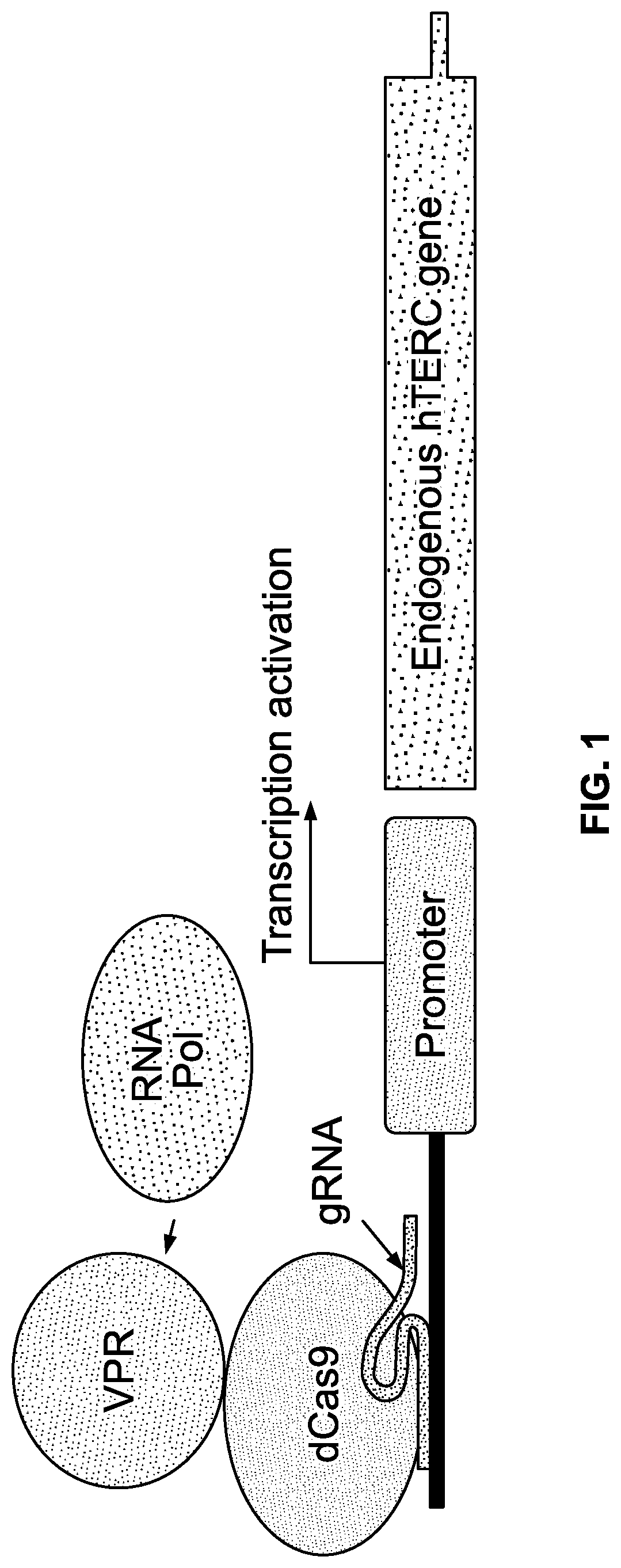
is a schematic of a DNA-targeting molecule of the present disclosure binding upstream of an endogenous hTERC locus. In this non-limiting example, the DNA-targeting molecule comprises dCas9 and a transactivation molecule, wherein the transactivation molecule is a VP64-P65-Rta (VPR) molecule.
is a schematic overview of a treatment method and/or a method of producing an in vitro tissue of the present disclosure
is a schematic overview of a method of producing a plurality of rejuvenated edited cells of the present disclosure.
is a chart showing the hTERC transcript level in various cell types.
is a chart showing the level of human TERC RNA in F50 cells transfected with compositions of the present disclosure.
is a series of charts showing the level of human TERC RNA in HEKn cells (left) and human Mesenchymal Stem/Stromal Cells (hMSCs) (right) transfected with compositions of the present disclosure (+dCas9−VPR+gmix) as compared to non-transfected HEKn cells, non-transfected hMSC cells and F50-derived induced pluripotent stem cells.
is a series of charts showing the level of human TERC RNA in F50 cells (left) and hMSCs (right) transfected with compositions of the present disclosure lacking guide RNA (+dCas9−VPR (no guide)).
is schematic overview of one of the transfection regimes of the present disclosure.
is a chart showing the total population doubling of senescent F50S cells transfected with compositions of the present disclosure.
is a schematic overview of an alternative transfection regime of the present disclosure.
is a schematic overview of another transfection regime of the present disclosure.
is a chart showing the relative telomere length in senescent F50S cells transfected with compositions of the present disclosure (+TERT+dCas9−VPR/gmix) as compared to non-transfected F50S cells and F50-derived induced pluripotent stem cells.
is a chart showing the relative telomere length in F50 cells transfected with compositions of the present disclosure (+hTERT+dCas9−VPR/gmix) as compared to non-transfected F50 cells and F50-derived induced pluripotent stem cells.
is a series of charts showing the relative telomere length in HEKn cells (left) and hMSCs (right) transfected with compositions of the present disclosure (+TERT+dCas9−VPR/gmix) as compared to non-transfected HEKn cells, non-transfected hMSCs and F50-derived induced pluripotent stem cells.
is a series of charts showing the relative amount of mitochondrial DNA in F50 cells (left), HEKn cells (middle) and hMSCs (right) transfected with compositions of the present disclosure (+TERT+dCas9−VPR/gmix) as compared to non-transfected F50 cells, non-transfected HEKn cells and non-transfected hMSCs.
is a gel image of the results of a telomerase activity assay in F50 cells transfected with various compositions of the present disclosure (F50+TERT and F50+TERT+dCas9−VPR/gmix) as well as non-transfected F50 cells and F50-derived induced pluripotent stem cells.
is a series of representative microscopy images of adult human primary fibroblasts expanded from single cells that were not transfected (top two rows) or transfected with compositions of the present disclosure (+hTERT/dCas9−VPR+gRNA; bottom two rows).
is a schematic overview of the transendothelial migration (TEM) assay.
is chart showing the migration activity of hMSCs transfected with compositions of the present disclosure as measured using the TEM assay.
is series chart showing the oxidation level of thiol groups detected in selected proteins in senescent hMSCs transfected with compositions of the present disclosure as compared to non-transfected young low passage and senescent high passage hMSCs.
is a series chart showing the degree of methylation at 9 senescence-associated DNA methylation sites in senescent cells of different types transfected with compositions of the present disclosure as compared to non-transfected young low passage and senescent high passage cells.
DETAILED DESCRIPTION OF THE INVENTION
Telomeres comprise repetitive DNA sequences at the ends of linear chromosomes that, when sufficiently long, allow each chromosome end to form a loop that protects the ends from acting as double-stranded or single-stranded DNA breaks. Telomeres shorten over time, due in part to oxidative damage and incomplete DNA replication, eventually leading to critically short telomeres unable to form the protective loop, exposure of the chromosome ends, chromosome-chromosome fusions, DNA damage responses, and cellular senescence, apoptosis, or malignancy.
The enzyme complex telomerase extends telomeres and comprises two essential components: the telomerase reverse transcriptase (TERT), and an RNA component known as telomerase RNA component (TERC). Other components of the telomerase complex include the proteins TCAB1, Dyskerin, Gar1, Nhp2, Nop 10, and RHAU.
Due to the importance of telomere length maintenance in preventing cellular senescence and apoptosis and resulting cellular dysfunction, genetic mutations of TERT and TERC are linked to fatal inherited diseases of inadequate telomere maintenance, including forms of idiopathic pulmonary fibrosis, dyskeratosis congenita, and aplastic anemia. The effects of premature cellular senescence and apoptosis due to short telomeres in these diseases are devastating in themselves, and may be compounded by increased risk of cancer. Moreover, the shortening of telomeres in cells that are cultured in vitro results is also a major problem in the production of therapeutic cell populations, the creation of in vitro synthetic tissue and tumors and the in vitro creation of non-cancerous somatic cells lines for research and drug testing. Repeated passaging in vitro can lead to senescence and the lack of further expansion ability, and in the case of therapeutic cell populations, a decrease in clinically-relevant biological activity.
Thus, there is a clear need in the art for compositions, kits and methods directed to elongating telomeres in order to rejuvenate cells. Existing approaches directed to increasing the expression of TERT and/or TERC in target cells has relied on the use of integrating viruses to obtain the desired increase in TERT and/or TERC expression. However, these approaches suffer from safety concerns, as the integrating viruses can result in potentially dangerous, permanent genome modifications. Moreover, the sustained overexpression of TERT and/or TERC, and concomitant increases in telomere length, have been linked to cancer cell immortalization, making the integrating virus approach dangerous in a clinical context.
Without wishing to be bound by theory, the compositions, kits and methods of the present disclosure allow for the transient increase in TERT and/or TERC expression for a time period that is long enough to rejuvenate the target cells, but short enough to avoid deleterious and dangerous off-target effects. The use of non-integrating RNA molecules in the present disclosure allows for fine-tuning of the expression levels and stoichiometry of rejuvenating factors in a clinically safe manner.
The compositions, kits and methods of the present disclosure can be used for a variety of different research and clinical applications, including, but not limited to, the production of therapeutic cell populations (e.g. CAR-T cell populations, mesenchymal stem/stromal cell populations), the production of in vitro tissue and organs for subsequent transplantation, research or drug testing, the production of genome-edited cell populations for therapeutic and research applications, the rejuvenation of senescent, aged and disease associated cell lines, etc.
Various compositions, kits and methods of the present disclosure are described in full detail herein.
Rejuvenating Compositions
In some aspects, the present disclosure provides a composition comprising: a) at least one first polynucleotide molecule comprising a nucleic acid sequence encoding at least a portion of telomerase reverse transcriptase (TERT); and b) at least one second polynucleotide molecule comprising a nucleic acid sequence encoding at least a portion of at least one DNA targeting polypeptide, wherein the DNA targeting polypeptide increases transcription of telomerase RNA component (TERC).
In some aspects, the present disclosure provides a composition comprising: a) at least one first polynucleotide molecule comprising a nucleic acid sequence encoding at least a portion of telomerase reverse transcriptase (TERT); and b) at least one DNA targeting polypeptide, wherein the DNA targeting polypeptide increases transcription of telomerase RNA component (TERC).
In some aspects, the at least one first polynucleotide molecule comprising a nucleic acid sequence encoding at least a portion of telomerase reverse transcriptase (TERT) can be an mRNA molecule encoding at least a portion of TERT. In some aspects, the at least one first polynucleotide molecule can be a plasmid comprising a nucleic acid sequence encoding at least a portion of TERT operably linked to at least one promoter sufficient to drive expression of the at least one portion of TERT.
In some aspects, the at least one second polynucleotide molecule comprising a nucleic acid sequence encoding at least a portion of at least one DNA targeting polypeptide can be an mRNA molecule encoding at least a portion of at least one DNA targeting polypeptide. In some aspects, the at least one second polynucleotide molecule can be a plasmid comprising a nucleic acid sequence encoding at least a portion of at least one DNA targeting polypeptide operably linked to at least one promoter sufficient to drive expression of the at least one portion of the at least one DNA targeting polypeptide.
Thus, the present disclosure provides a composition comprising: a) at least one first mRNA molecule encoding at least a portion of telomerase reverse transcriptase (TERT); and b) at least one second mRNA molecule encoding at least a portion of at least one DNA targeting polypeptide, wherein the DNA targeting polypeptide increases transcription of telomerase RNA component (TERC).
The present disclosure also provides a composition comprising: a) at least one plasmid comprising a nucleic acid sequence encoding at least a portion of TERT operably linked to at least one promoter sufficient to drive expression of the at least one portion of TERT; and b) at least one second mRNA molecule encoding at least a portion of at least one DNA targeting polypeptide, wherein the DNA targeting polypeptide increases transcription of telomerase RNA component (TERC).
The present disclosure also provides a composition comprising: a) at least one first mRNA molecule encoding at least a portion of telomerase reverse transcriptase (TERT); and b) at least one plasmid comprising a nucleic acid sequence encoding at least a portion of at least one DNA targeting polypeptide operably linked to at least one promoter sufficient to drive expression of the at least one portion of the at least one DNA targeting polypeptide, wherein the DNA targeting polypeptide increases transcription of telomerase RNA component (TERC).
The present disclosure also provides a composition comprising: a) at least one plasmid comprising a nucleic acid sequence encoding at least a portion of TERT operably linked to at least one promoter sufficient to drive expression of the at least one portion of TERT; and b) at least one plasmid comprising a nucleic acid sequence encoding at least a portion of at least one DNA targeting polypeptide operably linked to at least one promoter sufficient to drive expression of the at least one portion of the at least one DNA targeting polypeptide, wherein the DNA targeting polypeptide increases transcription of telomerase RNA component (TERC).
In some aspects, a DNA targeting polypeptide can comprise at least one Cas9 molecule, at least one Cas9 variant molecule, at least one Cas9 ortholog molecule or any combination thereof.
In some aspects, a Cas9 molecule, a Cas9 variant molecule or a Cas9 ortholog molecule can be nuclease-deficient or nuclease-dead. As used herein, the term “dCas9” is used in its broadest sense to refer to a Cas9 molecule, ortholog and/or variant that is nuclease-deficient or nuclease dead. In a non-limiting example, a Cas9 molecule, a Cas9 variant molecule or a Cas9 ortholog molecule can comprise at least one mutation, deletion or insertion which renders the Cas9 molecule, the Cas9 variant molecule or the Cas9 ortholog molecule nuclease-deficient or nuclease-dead.
In some aspects, a Cas9 variant molecule can comprise eSpCas9 (K855A), eSpCas9 (1.0), eSpCas9 (1.1), SpCas9-HF1 (VP12), HypaCas9, xCas9, SpyFi Cas9, iSpy Cas9, iSpyMac, Cas9 (VQR), Cas9 (EQR), Cas9 (VRER), Cas9 (D1135E), Cas9(QQR1), SaCas9 (KKH), Nme1 Cas9, Nme2Cas9, Nme3Cas9 or any combination thereof.
In some aspects, a Cas9 ortholog molecule can comprise Streptococcus pyogenes Cas9 (spCas9), Francisella novicida Cas9 (FnCas9), Staphylococcus aureus Cas9 (SaCas9), Neisseria meningitidis Cas9 (NmCas9; NmeCas9), Streptococcus thermophilus CRISPR1-Cas9 (St1Cas9), Streptococcus thermophilus CRISPR3-Cas9 (St3Cas9), Campylobacter jejuni Cas9 (CjCas9), Acidaminococcus sp. BV3L6 Cpf1 (AsCpf1), Lachnospiraceae bacterium ND2006 Cpf1 (LbCpf1), Streptococcus canis Cas9 (ScCas9), Treponema denticola Cas9 (TdCas9), Streptococcus macacae Cas9 (SmacCas9), Casφ (Cas12j), Francisella tularensis subsp. novicida Cas9, Pasteurella multocida Cas9, Campylobacter lari CF89-12 Cas9, Mycoplasma gallisepticum str. F Cas9, Nitratifractor salsuginis str DSM 16511 Cas9, Parvibaculum lavamentivorans Cas9, Roseburia intestinalis Cas9, Neisseria cinerea Cas9, Gluconacetobacter diazotrophicus Cas9, Azospirillum B510 Cas9, Sphaerochaeta globus str. Buddy Cas9, Flavobacterium columnare Cas9, Fluviicola taffensis Cas9, Bacteroides coprophilus Cas9, Mycoplasma mobile Cas9, Lactobacillus farciminis Cas9, Streptococcus pasteurianus Cas9, Lactobacillus johnsonii Cas9, Staphylococcus pseudintermedius Cas9, Filifactor alocis Cas9, Legionella pneumophila str. Paris Cas9, Sutterella wadsworthensis Cas9, Corynebacter diphtheriae Cas9 or any combination thereof.
In some aspects, a Cas9 ortholog molecule can comprise a chimeric variant of Streptococcus pyogenes Cas9 (spCas9), Francisella novicida Cas9 (FnCas9), Staphylococcus aureus Cas9 (SaCas9), Neisseria meningitidis Cas9 (NmCas9; NmeCas9), Streptococcus thermophilus CRISPR1-Cas9 (St1Cas9), Streptococcus thermophilus CRISPR3-Cas9 (St3Cas9), Campylobacter jejuni Cas9 (CjCas9), Acidaminococcus sp. BV3L6 Cpf1 (AsCpf1), Lachnospiraceae bacterium ND2006 Cpf1 (LbCpf1), Streptococcus canis Cas9 (ScCas9), Treponema denticola Cas9 (TdCas9), Streptococcus macacae Cas9 (SmacCas9), Casφ (Cas12j), Francisella tularensis subsp. novicida Cas9, Pasteurella multocida Cas9, Campylobacter lari CF89-12 Cas9, Mycoplasma gallisepticum str. F Cas9, Nitratifractor salsuginis str DSM 16511 Cas9, Parvibaculum lavamentivorans Cas9, Roseburia intestinalis Cas9, Neisseria cinerea Cas9, Gluconacetobacter diazotrophicus Cas9, Azospirillum B510 Cas9, Sphaerochaeta globus str. Buddy Cas9, Flavobacterium columnare Cas9, Fluviicola taffensis Cas9, Bacteroides coprophilus Cas9, Mycoplasma mobile Cas9, Lactobacillus farciminis Cas9, Streptococcus pasteurianus Cas9, Lactobacillus johnsonii Cas9, Staphylococcus pseudintermedius Cas9, Filifactor alocis Cas9, Legionella pneumophila str. Paris Cas9, Sutterella wadsworthensis Cas9, Corynebacter diphtheriae Cas9 or any combination thereof.
In some aspects, a DNA targeting polypeptide can comprise at least one TALE molecule, at least one zinc-finger molecule, at least one meganuclease molecule or any combination thereof.
In some aspects, a DNA targeting polypeptide can comprise at least one transactivation molecule. In some aspects, a transactivation molecule is a molecule that binds to transcription factors and/or transcriptional co-regulators that are capable of driving transcription of a target gene.
In some aspects, a transactivation molecule can comprise at least one P65 molecule, at least one Rta molecule, at least one VP16 molecule, at least one VP64 molecule, at least one VP160 molecule, at least one VP64-P65-Rta (VPR) molecule, at least one SunTag peptide, at least one single guide RNA-MS2 (sgRNA-MS2) molecule or any combination thereof.
In some aspects, a DNA targeting polypeptide can be a DNA targeting ribonucleoprotein (RNP) complex. A DNA targeting ribonucleoprotein complex can comprise both at least one protein component and at least one nucleic acid component. The at least one protein component can comprise any of the protein components described herein, including, but not limited to, a transactivation molecule, a Cas9 molecule, a Cas9 variant molecule or a Cas9 ortholog molecule, a TALE molecule, a zinc-finger molecule, a meganuclease molecule or any combination thereof. The at least one nucleic acid component can be a ribonucleic acid component. The at least one nucleic acid component can comprise any of the nucleic acid components described herein, including, but not limited to, a guide RNA molecule, a single guide RNA molecule, a single guide RNA-MS2 (sgRNA-MS2) molecule or any combination thereof.
In some aspects, a DNA targeting polypeptide can further comprise at least one cell-penetrating peptide. A cell-penetrating peptide can comprise at least a portion of an HIV-derived TAT protein, polyarginine, any other cell-penetrating peptide known in the art or any combination thereof.
In some aspects, a DNA targeting polypeptide can comprise at least one guide RNA. In some aspects, a transactivation molecule can comprise at least one single guide RNA-MS2 (sgRNA-MS2) molecule. In some aspects, a sgRNA-MS2 molecule can comprise a nucleic acid sequence complementary to a nucleic acid sequence located upstream, within, or downstream of the endogenous TERC gene and at least about one, or at least about two, or at least about three, or at least about four, or at least about five, or at least about six, or at least about seven, or at least about eight, or at least about nine, or at least about ten MS2 RNA aptamers.
In some aspects, a DNA targeting polypeptide can comprise a dCas9 molecule and a VPR molecule.
In some aspects, a DNA targeting polypeptide can bind upstream of, 5′ to, within, downstream of or 3′ to the endogenous TERC gene, e.g. the endogenous human TERC gene.
In some aspects, an at least one DNA targeting polypeptide can bind at least about 0.1 kilobases (kb), or at least about 0.5 kb, or at least about 1.0 kb, or at least about 1.5 kb, or at least about 2.0 kb, or at least about 2.5 kb, or at least about 3.0 kb, or at least about 3.5 kb, or at least about 4.0 kb, or at least about 4.5 kb, or at least about 5.0 kb, or at least about 5.5 kb, or at least about 6.0 kb, or at least about 6.5 kb, or at least about 7.0 kb, or at least about 7.5 kb, or at least about 8.5 kb, or at least about 9.0 kb, or at least about 9.5 kb, or at least about 10.0 kb, or at least about 15 kb, or at least about 20 kb, or at least about 30 kb, or at least about 40 kb, or at least about 50 kb, or at least about 60 kb, or at least about 15 kb, or at least about 70 kb, or at least about 80 kb, or at least about 90 kb, or at least about 100 kb, or at least about 250 kb, or at least about 500 kb, or at least about 750 kb, or at least about 1000 kb, or at least 5000 kb or at least about 10,000 kb upstream of the endogenous TERC gene, e.g. the endogenous human TERC gene.
In some aspects, an at least one DNA targeting polypeptide can bind at least about 0.1 kilobases (kb), or at least about 0.5 kb, or at least about 1.0 kb, or at least about 1.5 kb, or at least about 2.0 kb, or at least about 2.5 kb, or at least about 3.0 kb, or at least about 3.5 kb, or at least about 4.0 kb, or at least about 4.5 kb, or at least about 5.0 kb, or at least about 5.5 kb, or at least about 6.0 kb, or at least about 6.5 kb, or at least about 7.0 kb, or at least about 7.5 kb, or at least about 8.5 kb, or at least about 9.0 kb, or at least about 9.5 kb, or at least about 10.0 kb, or at least about 15 kb, or at least about 20 kb, or at least about 30 kb, or at least about 40 kb, or at least about 50 kb, or at least about 60 kb, or at least about 15 kb, or at least about 70 kb, or at least about 80 kb, or at least about 90 kb, or at least about 100 kb, or at least about 250 kb, or at least about 500 kb, or at least about 750 kb, or at least about 1000 kb, or at least 5000 kb or at least about 10,000 kb 3′ to the endogenous TERC gene, e.g. the endogenous human TERC gene.
In some aspects, an at least one DNA targeting polypeptide can bind at least about 0.1 kilobases (kb), or at least about 0.5 kb, or at least about 1.0 kb, or at least about 1.5 kb, or at least about 2.0 kb, or at least about 2.5 kb, or at least about 3.0 kb, or at least about 3.5 kb, or at least about 4.0 kb, or at least about 4.5 kb, or at least about 5.0 kb, or at least about 5.5 kb, or at least about 6.0 kb, or at least about 6.5 kb, or at least about 7.0 kb, or at least about 7.5 kb, or at least about 8.5 kb, or at least about 9.0 kb, or at least about 9.5 kb, or at least about 10.0 kb, or at least about 15 kb, or at least about 20 kb, or at least about 30 kb, or at least about 40 kb, or at least about 50 kb, or at least about 60 kb, or at least about 15 kb, or at least about 70 kb, or at least about 80 kb, or at least about 90 kb, or at least about 100 kb, or at least about 250 kb, or at least about 500 kb, or at least about 750 kb, or at least about 1000 kb, or at least 5000 kb or at least about 10,000 kb downstream of the endogenous TERC gene, e.g. the endogenous human TERC gene.
In some aspects, an at least one DNA targeting polypeptide can bind at least about 0.1 kilobases (kb), or at least about 0.5 kb, or at least about 1.0 kb, or at least about 1.5 kb, or at least about 2.0 kb, or at least about 2.5 kb, or at least about 3.0 kb, or at least about 3.5 kb, or at least about 4.0 kb, or at least about 4.5 kb, or at least about 5.0 kb, or at least about 5.5 kb, or at least about 6.0 kb, or at least about 6.5 kb, or at least about 7.0 kb, or at least about 7.5 kb, or at least about 8.5 kb, or at least about 9.0 kb, or at least about 9.5 kb, or at least about 10.0 kb, or at least about 15 kb, or at least about 20 kb, or at least about 30 kb, or at least about 40 kb, or at least about 50 kb, or at least about 60 kb, or at least about 15 kb, or at least about 70 kb, or at least about 80 kb, or at least about 90 kb, or at least about 100 kb, or at least about 250 kb, or at least about 500 kb, or at least about 750 kb, or at least about 1000 kb, or at least 5000 kb or at least about 10,000 kb 5′ to the endogenous TERC gene, e.g. the endogenous human TERC gene.
In some aspects, an mRNA molecule of any composition of the present disclosure can be a modified mRNA molecule.
In some aspects, a modified mRNA molecule can comprise at least one modified ribonucleoside base. A modified ribonucleoside base can comprise a pseudouridine (Ψ) residue, a 5-methylcytidine (m 5 C) residue or any combination thereof.
In some aspects, a modified mRNA molecule can comprise at least one modified nucleoside. A modified nucleoside can comprise 5-methylcytidine (m 5 C), 5-methyluridine (m 5 U), N6-methyladenosine (m 6 A), inosine and 2′-0-methylated nucleosides, in addition to N7-methylguanosine (m 7 G), 2-thiouridine (s 2 U), pseudouridine (ψ), 2′-0-methyl-U, m 1 A (1-methyladenosine); m 2 A (2-methyladenosine); Am (2′-0-methyladenosine); ms 2 m 6 A (2-methylthio-N 6 -methyladenosine); i 6 A (N 6 -isopentenyladenosine); ms 2 i6A (2-methylthio-N 6 isopentenyladenosine); io 6 A (N 6 -(cis-hydroxyisopentenyl)adenosine); ms 2 i 6 A (2-methylthio-N 6 -(cis-hydroxyisopentenyl)adenosine); g 6 A (N 6 -glycinylcarbamoyladenosine); t 6 A (N 6 -threonylcarbamoyladenosine); ms 2 t 6 A (2-methylthio-N 6 -threonyl carbamoyladenosine); m 6 t 6 A (N 6 -methyl-N 6 -threonylcarbamoyladenosine); hn 6 A(N 6 -hydroxynorvalylcarbamoyladenosine); ms 2 hn 6 A (2-methylthio-N 6 -hydroxynorvalyl carbamoyladenosine); Ar(p) (2′-0-ribosyladenosine(phosphate)); I (inosine); m 1 I (1-methylinosine); m 1 Im (1,2′-0-dimethylinosine); m 3 C (3-methylcytidine); Cm (2′-0-methylcytidine); s 2 C (2-thiocytidine); ac 4 C(N 4 -acetylcytidine); f 5 C (5-formylcytidine); m 5 Cm (5,2′-0-dimethylcytidine); ac 4 Cm (N 4 -acetyl-2′-0-methylcytidine); k 2 C (lysidine); m 1 G (1-methylguanosine); m 2 G (N 2 -methylguanosine); m 7 G (7-methylguanosine); Gm (2′-0-methylguanosine); m 2 2 G (N 2 ,N 2 -dimethylguanosine); m 2 Gm (N 2 ,2′-0-dimethylguanosine); m 2 2 Gm (N 2 ,N 2 ,2′-0-trimethylguanosine); Gr(p) (2′-0-ribosylguanosine (phosphate)); yW (wybutosine); o 2 yW (peroxywybutosine); OHyW (hydroxywybutosine); OHyW* (undermodified hydroxywybutosine); imG (wyosine); mimG (methylwyosine); Q (queuosine); oQ (epoxyqueuosine); galQ (galactosyl-queuosine); manQ (mannosyl-queuosine); preQ 0 (7-cyano-7-deazaguanosine); preQ 1 (7-aminomethyl-7-deazaguanosine); G + (archaeosine); D (dihydrouridine); m 5 Um (5,2′-0-dimethyluridine); s 4 U (4-thiouridine); m 5 s 2 U (5-methyl-2-thiouridine); s 2 Um (2-thio-2′-0-methyluridine); acp 3 U (3-(3-amino-3-carboxypropyl)uridine); ho 5 U (5-hydroxyuridine); mo 5 U (5-methoxyuridine); cmo 5 U (uridine 5-oxyacetic acid); mcmo 5 U (uridine 5-oxyacetic acid methyl ester); chm 5 U (5-(carboxyhydroxymethyl)uridine)); mchm 5 U (5-(carboxyhydroxymethyl)uridine methyl ester); mcm 5 U (5-methoxycarbonylmethyluridine); mcm 5 Um (5-methoxycarbonylmethyl-2′-0-methyluridine); mcm 5 s 2 U (5-methoxycarbonylmethyl-2-thiouridine); nm 5 s 2 U (5-aminomethyl-2-thiouridine); mnm 5 U (5-methylaminomethyluridine); mnm 5 s 2 U (5-methylaminomethyl-2-thiouridine); mnm 5 se 2 U (5-methylaminomethyl-2-selenouridine); ncm 5 U (5-carbamoylmethyluridine); ncm 5 Um (5-carbamoylmethyl-2′-0-methyluridine); cmnm 5 U (5-carboxymethylaminomethyluridine); cmnm 5 Um (5-carboxymethylaminomethyl-2′-0-methyluridine); cmnm 5 s 2 U (5-carboxymethylaminomethyl-2-thiouridine); m 6 2 A (N 6 ,N 6 -dimethyladenosine); Im (2′-0-methylinosine); m 4 C(N 4 -methylcytidine); m 4 Cm (N 4 ,2′-0-dimethylcytidine); hm 5 C (5-hydroxymethylcytidine); m 3 U (3-methyluridine); cm 5 U (5-carboxymethyluridine); m 6 Am (N 6 ,2′-0-dimethyladenosine); m 6 2 Am (N 6 ,N 6 ,0-2′-2 7 2 2 2 7 2 2trimethyladenosine); m 2,7 G (N 2 ,7-dimethylguanosine); m 2,2,7 G (N 2 , N 2 ,7-trimethylguanosine); m 3 Um (3,2′-0-dimethyluridine); m 5 D (5-methyldihydrouridine); f 5 Cm (5-formyl-2′-0-methylcytidine); m 1 Gm (1,2′-0-dimethylguanosine); m 1 Am (1,2′-0-dimethyladenosine); τm 5 U (5-taurinomethyluridine); τm 5 s 2 U (5-taurinomethyl-2-thiouridine)); imG-14 (4-demethylwyosine); imG2 (isowyosine); ac 6 A (N 6 -acetyladenosine), or any combination thereof.
In some aspects, an mRNA molecule can be chemically synthesized using methods standard in the art. In some aspects, an mRNA molecule can be chemically synthesized such that the mRNA molecule comprises at least one chemical modification. In some aspects, an mRNA molecule can be produced by in vitro transcription methods standard in the art, including, but not limited to, in vitro transcription using a plasmid template, in vitro transcription using a PCR-based template. In some aspects, in vitro transcription methods can be performed such that the produced mRNA molecules comprise at least one chemical modification.
In some aspects, a purified DNA targeting polypeptide can be produced using methods standard in the art, including, but not limited to, recombinant protein expression and purification in a bacterial, fungal, insect and/or mammalian system, ion-exchange chromatography, affinity chromatography, immunoaffinity chromatography, size exclusion chromatography, and/or other standard protein production/purification methods known in the art.
In some aspects, a purified DNA-targeting ribonucleoprotein (RNP) complex can be produced using methods standard in the art, including, but not limited to recombinant protein expression and purification in a bacterial, fungal, insect and/or mammalian system, in vitro RNA transcription, ion-exchange chromatography, affinity chromatography, immunoaffinity chromatography, size exclusion chromatography, other standard protein production/purification methods known in the art, and/or other standard nucleic acid production/purification methods known in the art. In some aspects, a preassembled RNP complex that comprises both at least one protein component and at least one nucleic acid can be assembled in vivo (i.e. in a bacterial, fungal, insect and/or mammalian recombinant expression system) and co-purified. In some aspects, a RNP complex can be assembled in vitro after the individual purification of the at least one protein component and the at least one nucleic acid component.
In some aspects, any of the compositions of the present disclosure can further comprise a plurality of guide RNA (gRNA) molecules, wherein at least one gRNA in the plurality is complementary to a nucleic acid sequence located upstream, within, or downstream of the endogenous TERC gene. In some aspects, a plurality of gRNA molecules can comprise at least about one, or at least about two, or at least about three, or at least about four, or at least about five, or at least about six, or at least about seven, or at least about eight, or at least about nine, or at least about ten, or at least about 11, or at least about 12, or at least about 13, or at least about 14, or at least about 15, at least about 16, or at least about 17, or about at least 18, or at least about 19, or at least about 20, or at least about 30, or at least about 40, or at least about 50, or at least about 60, or at least about 70, or at least about 80, or at least about 90, or at least about 100, or at least about 500 or at least about 1000 distinct species of gRNA molecules, wherein each species has a different nucleic acid sequence.
In some aspects, any of the compositions of the present disclosure can further comprise at least one plasmid comprising at least one nucleic acid sequence encoding at least one species of gRNA operably linked to at least one promoter sufficient to drive expression of the at least one species gRNA. In some aspects, any of the compositions of the present disclosure can further comprise at least one plasmid comprising at least one nucleic acid sequence encoding least about two, or at least about three, or at least about four, or at least about five, or at least about six, or at least about seven, or at least about eight, or at least about nine, or at least about ten, or at least about 11, or at least about 12, or at least about 13, or at least about 14, or at least about 15, at least about 16, or at least about 17, or about at least 18, or at least about 19, or at least about 20, or at least about 30, or at least about 40, or at least about 50, or at least about 60, or at least about 70, or at least about 80, or at least about 90, or at least about 100, or at least about 500 or at least about 1000 distinct species of gRNA molecules operably linked to at least one promoter sufficient to drive expression of the gRNA species, wherein each species has a different nucleic acid sequence.
In some aspects, a plurality of gRNA molecules can comprise a plurality of single guide RNA (sgRNA) molecules, crRNA:tracrRNA molecules, truncated sgRNA molecules, high fidelity scaffold gRNA molecules or any combination thereof.
In some aspects, a plurality of gRNA molecules can comprise a plurality of single guide RNA (sgRNA) molecules. In some aspects, a sgRNA molecule can comprise a nucleic acid sequence complementary to a nucleic acid sequence located upstream, within, or downstream of the endogenous TERC gene and at least one MS2 RNA aptamer. In some aspects, a sgRNA molecule can comprise at least about two, or at least about three, or at least about four, or at least about five, or at least about six, or at least about seven, or at least about eight, or at least about nine, or at least about ten MS2 RNA aptamers.
In some aspects, a guide RNA molecule of any composition of the present disclosure can be a modified guide RNA (mod gRNA) molecule.
In some aspects, a modified guide RNA can comprise at least one modified ribonucleoside base. A modified ribonucleoside base can comprise a pseudouridine (Ψ) residue, a 5-methylcytidine (m 5 C) residue or any combination thereof.
In some aspects, a modified guide RNA can comprise at least one modified nucleoside. A modified nucleoside can comprise 5-methylcytidine (m 5 C), 5-methyluridine (m 5 U), N6-methyladenosine (m 6 A), inosine and 2′-0-methylated nucleosides, in addition to N7-methylguanosine (m 7 G), 2-thiouridine (s 2 U), pseudouridine (ψ), 2′-0-methyl-U, m 1 A (1-methyladenosine); m 2 A (2-methyladenosine); Am (2′-0-methyladenosine); ms 2 m 6 A (2-methylthio-N 6 -methyladenosine); i 6 A (N 6 -isopentenyladenosine); ms 2 i6A (2-methylthio-N 6 isopentenyladenosine); io 6 A (N 6 -(cis-hydroxyisopentenyl)adenosine); ms 2 i 6 A (2-methylthio-N 6 -(cis-hydroxyisopentenyl)adenosine); g 6 A (N 6 -glycinylcarbamoyladenosine); t 6 A (N 6 -threonylcarbamoyladenosine); ms 2 t 6 A (2-methylthio-N 6 -threonyl carbamoyladenosine); m 6 t 6 A (N 6 -methyl-N 6 -threonylcarbamoyladenosine); hn 6 A(N 6 -hydroxynorvalylcarbamoyladenosine); ms 2 hn 6 A (2-methylthio-N 6 -hydroxynorvalyl carbamoyladenosine); Ar(p) (2′-0-ribosyladenosine(phosphate)); I (inosine); m 1 I (1-methylinosine); m 1 Im (1,2′-0-dimethylinosine); m 3 C (3-methylcytidine); Cm (2′-0-methylcytidine); s 2 C (2-thiocytidine); ac 4 C(N 4 -acetylcytidine); f 5 C (5-formylcytidine); m 5 Cm (5,2′-0-dimethylcytidine); ac 4 Cm (N 4 -acetyl-2′-0-methylcytidine); k 2 C (lysidine); m 1 G (1-methylguanosine); m 2 G (N 2 -methylguanosine); m 7 G (7-methylguanosine); Gm (2′-0-methylguanosine); m 2 2 G (N 2 ,N 2 -dimethylguanosine); m 2 Gm (N 2 ,2′-0-dimethylguanosine); m 2 2 Gm (N 2 ,N 2 ,2′-0-trimethylguanosine); Gr(p) (2′-0-ribosylguanosine (phosphate)); yW (wybutosine); o 2 yW (peroxywybutosine); OHyW (hydroxywybutosine); OHyW* (undermodified hydroxywybutosine); imG (wyosine); mimG (methylwyosine); Q (queuosine); oQ (epoxyqueuosine); galQ (galactosyl-queuosine); manQ (mannosyl-queuosine); preQ 0 (7-cyano-7-deazaguanosine); preQ 1 (7-aminomethyl-7-deazaguanosine); G + (archaeosine); D (dihydrouridine); m 5 Um (5,2′-0-dimethyluridine); s 4 U (4-thiouridine); m 5 s 2 U (5-methyl-2-thiouridine); s 2 Um (2-thio-2′-0-methyluridine); acp 3 U (3-(3-amino-3-carboxypropyl)uridine); ho 5 U (5-hydroxyuridine); mo 5 U (5-methoxyuridine); cmo 5 U (uridine 5-oxyacetic acid); mcmo 5 U (uridine 5-oxyacetic acid methyl ester); chm 5 U (5-(carboxyhydroxymethyl)uridine)); mchm 5 U (5-(carboxyhydroxymethyl)uridine methyl ester); mcm 5 U (5-methoxycarbonylmethyluridine); mcm 5 Um (5-methoxycarbonylmethyl-2′-0-methyluridine); mcm 5 s 2 U (5-methoxycarbonylmethyl-2-thiouridine); nm 5 s 2 U (5-aminomethyl-2-thiouridine); mnm 5 U (5-methylaminomethyluridine); mnm 5 s 2 U (5-methylaminomethyl-2-thiouridine); mnm 5 se 2 U (5-methylaminomethyl-2-selenouridine); ncm 5 U (5-carbamoylmethyluridine); ncm 5 Um (5-carbamoylmethyl-2′-0-methyluridine); cmnm 5 U (5-carboxymethylaminomethyluridine); cmnm 5 Um (5-carboxymethylaminomethyl-2′-0-methyluridine); cmnm 5 s 2 U (5-carboxymethylaminomethyl-2-thiouridine); m 6 2 A (N 6 ,N 6 -dimethyladenosine); Im (2′-0-methylinosine); m 4 C(N 4 -methylcytidine); m 4 Cm (N 4 ,2′-0-dimethylcytidine); hm 5 C (5-hydroxymethylcytidine); m 3 U (3-methyluridine); cm 5 U (5-carboxymethyluridine); m 6 Am (N 6 ,2′-0-dimethyladenosine); m 6 2 Am (N 6 ,N 6 ,0-2′-2 7 2 2 2 7 2 2trimethyladenosine); m 2,7 G (N 2 ,7-dimethylguanosine); m 2,2,7 G (N 2 ,N 2 ,7-trimethylguanosine); m 3 Um (3,2′-0-dimethyluridine); m 5 D (5-methyldihydrouridine); f 5 Cm (5-formyl-2′-0-methylcytidine); m 1 Gm (1,2′-0-dimethylguanosine); m 1 Am (1,2′-0-dimethyladenosine); τm 5 U (5-taurinomethyluridine); τm 5 s 2 U (5-taurinomethyl-2-thiouridine)); imG-14 (4-demethylwyosine); imG2 (isowyosine); ac 6 A (N 6 -acetyladenosine), or any combination thereof.
In some aspects, a guide RNA molecule can comprise any sequence recited in Table 1 or Table 2.
TABLE 1
Guide RNA sequences
Seq Seq ID
Name Sequence NO
1015rev UGUUCAUAAAUUUACUGACA 1
1025forw AAAAAAAUCGUUACAAUUUA 2
1028forw AAAAUCGUUACAAUUUAUGG 3
1037rev UCUUGAUGAGGUAAAAAGAG 4
1038rev GUCUUGAUGAGGUAAAAAGA 5
1039rev UGUCUUGAUGAGGUAAAAAG 6
103rev AAUUUCUCUCCUUUGCAUAU 7
1049rev AGUAGUGCUGUGUCUUGAUG 8
1059rev AGGGGACCUACUUAGGUAAU 9
1066rev CAAUUCCAGGGGACCUACUU 10
106forw ACGGAGCGAGUCCCCGCGCG 11
1073forw UUUUAACCUAUUACCUAAGU 12
1077rev UAUCUGCUAGACAAUUCCAG 13
1078rev GUAUCUGCUAGACAAUUCCA 14
1079rev UGUAUCUGCUAGACAAUUCC 15
1081forw UAUUACCUAAGUAGGUCCCC 16
1098rev UCCCUUUUAUUAGGAAAGAA 17
1107rev GACUGAAUCUCCCUUUUAUU 18
1116forw CGCCUUUCUUUCCUAAUAAA 19
1117forw GCCUUUCUUUCCUAAUAAAA 20
1129rev CUACUACAUUAUUAAUCUUA 21
1139rev CCAGCAACAGUGGACUCUAG 22
1149rev GAGAACAUUACCAGCAACAG 23
114forw GCUAAAUAUCCAAUAUGCAA 24
1159forw CCUCUAGAGUCCACUGUUGC 25
1168rev GCCUCUCCUUGAGCAGAGGA 26
116rev GGUGCACGUCCCACAGCUCA 27
1172rev UCCAGCCUCUCCUUGAGCAG 28
1178forw CUGGUAAUGUUCUCUAAAUA 29
117rev GGGUGCACGUCCCACAGCUC 30
1182forw UUAAAGCCAUCCUCUGCUCA 31
1187forw GCCAUCCUCUGCUCAAGGAG 32
1191forw UCCUCUGCUCAAGGAGAGGC 33
1193rev UUCCACAAAACCAUGCUGAU 34
1197forw GCUCAAGGAGAGGCUGGAGA 35
1203forw AAAUAUUUUUCCUAUCAGCA 36
1207forw AGGCUGGAGAAGGCAUUCUA 37
1211forw UUCCUAUCAGCAUGGUUUUG 38
1213forw GAGAAGGCAUUCUAAGGAGA 39
1214forw AGAAGGCAUUCUAAGGAGAA 40
1215forw GAAGGCAUUCUAAGGAGAAG 41
1216forw AAGGCAUUCUAAGGAGAAGG 42
1220forw CAUUCUAAGGAGAAGGGGGC 43
1221forw AUUCUAAGGAGAAGGGGGCA 44
1221forw CAUGGUUUUGUGGAAAAGUA 45
1225forw UAAGGAGAAGGGGGCAGGGU 46
1232forw AAGGGGGCAGGGUAGGAACU 47
1234rev CAAGACUCUAGACAAGUUCU 48
1241rev GAAUCUUGUCUCGGCUCAGU 49
1242rev AGAAUCUUGUCUCGGCUCAG 50
1250rev ACUACAGCAGAAUCUUGUCU 51
1257forw AGAACUUGUCUAGAGUCUUG 52
126forw CGGCGCGAUUCCCUGAGCUG 53
127forw GGCGCGAUUCCCUGAGCUGU 54
1281rev CUUUGUGAAAAUAGAUUCCC 55
1281rev AGAUCACCUUGAGUAAACUG 56
1283forw CUGCUGUAGUCAGUGCUGCC 57
1284forw UGCUGUAGUCAGUGCUGCCU 58
1295forw AGUAAGCCUCAGUUUACUCA 59
1308rev GUUUUGAUCAUCACAUUUUU 60
1332forw AAAAUGUGAUGAUCAAAACU 61
1335forw UUCUUCUCUUUCUUUUGAGA 62
1341rev CCAGCUCUGGGUGACAGAGU 63
1342rev UCCAGCUCUGGGUGACAGAG 64
1353rev GGACACUGCACUCCAGCUCU 65
1354forw GAAUUAGUGUUCUGUGUCUU 66
1354rev GGGACACUGCACUCCAGCUC 67
1357rev GAAUUCACAGGAAGAUUUUA 68
1358rev GGAAUUCACAGGAAGAUUUU 69
1361forw CCCACUCUGUCACCCAGAGC 70
1369rev ACCUUAAAAAUGGAAUUCAC 71
1374rev GGUUGCAGUGAGCCAAGAUG 72
1375rev AGGUUGCAGUGAGCCAAGAU 73
1376rev GAGGUUGCAGUGAGCCAAGA 74
1379rev CACCUCGACUACCUUAAAAA 75
137rev GCAUGUGUGAGCCGAGUCCU 76
1382forw GGAGUGCAGUGUCCCCAUCU 77
1388forw UCCUGUGAAUUCCAUUUUUA 78
138rev UGCAUGUGUGAGCCGAGUCC 79
1395rev GCUAGAAACCGAGGAGGCAG 80
1397forw UUCCAUUUUUAAGGUAGUCG 81
1401rev AAAAUCGCUAGAAACCGAGG 82
1404rev UAUCCUCUGCAGACCAGACG 83
1404rev GAGAAAAUCGCUAGAAACCG 84
1407forw CACUGCAACCUCUGCCUCCU 85
140forw GAAAUUAAAGAUUUAAAAGC 86
140forw GAGCUGUGGGACGUGCACCC 87
1411forw UAGUCGAGGUGAACCGCGUC 88
1421forw GAACCGCGUCUGGUCUGCAG 89
1431rev UGUAAACCCAGCUACUUGGG 90
1433forw GUCUGCAGAGGAUAGAAAAA 91
1434rev GCCUGUAAACCCAGCUACUU 92
1435rev UGCCUGUAAACCCAGCUACU 93
1436rev AACUAACUUGAGGUAUCAGA 94
1437rev AAACUAACUUGAGGUAUCAG 95
1444forw CUCUCAGCCUCCCAAGUAGC 96
1445forw UCUCAGCCUCCCAAGUAGCU 97
1446rev UUAAAGGUGAAACUAACUUG 98
1453forw UCCCAAGUAGCUGGGUUUAC 99
145rev AUCAUAACAUAGUUUCCUUA 100
1462rev UUACUUCCGACCUUCUUUAA 101
1462rev AAAAAAUCAGCCGGGUAUGG 102
1465rev ACAAAAAAAUCAGCCGGGUA 103
146forw UGGGACGUGCACCCAGGACU 104
1470rev AAAAUACAAAAAAAUCAGCC 105
1471rev GAAAAUACAAAAAAAUCAGC 106
1472forw GUUAGUUUCACCUUUAAAGA 107
1472forw CAGGCACACACCACCAUACC 108
1476forw GUUUCACCUUUAAAGAAGGU 109
1495rev CCCUUCCGCACGUCCGGGAA 110
1500rev CGUUGCCCUUCCGCACGUCC 111
1501rev ACGUUGCCCUUCCGCACGUC 112
1502forw UAAAGACGCAAAGCCUUUCC 113
1502forw UUUUGUAUUUUCAGUAAAGU 114
1503forw UUUGUAUUUUCAGUAAAGUU 115
1507forw UAUUUUCAGUAAAGUUGGGC 116
150forw AUUUAAAAGCAGGAGCCAUA 117
1510forw CAAAGCCUUUCCCGGACGUG 118
1511forw UUCAGUAAAGUUGGGCAGGC 119
1514forw GCCUUUCCCGGACGUGCGGA 120
1514rev CACCUGAGGUCAGGAGUUCG 121
1515forw CCUUUCCCGGACGUGCGGAA 122
1523rev CGGGCGGAUCACCUGAGGUC 123
1524rev UCCAUUUCCGGCCAUGAGGA 124
1528rev AAGUUCCAUUUCCGGCCAUG 125
1528rev AGAAGCGGGCGGAUCACCUG 126
1532forw GGCCUCGAACUCCUGACCUC 127
1533forw AAGGGCAACGUCCUUCCUCA 128
1536rev GGAAAUUAAAGUUCCAUUUC 129
1537forw GCAACGUCCUUCCUCAUGGC 130
1539rev CUUUGGGAGGCAGAAGCGGG 131
1542rev GCACUUUGGGAGGCAGAAGC 132
1543forw UCCUUCCUCAUGGCCGGAAA 133
1543rev AGCACUUUGGGAGGCAGAAG 134
1552rev UGUAAUCCCAGCACUUUGGG 135
1555rev GCCUGUAAUCCCAGCACUUU 136
1556rev CGCCUGUAAUCCCAGCACUU 137
1557rev GCGGGCUGGUUGGGGGGAAC 138
1558rev GGCGGGCUGGUUGGGGGGAA 139
1563rev UCUCGGGCGGGCUGGUUGGG 140
1564rev CUCUCGGGCGGGCUGGUUGG 141
1565forw GCUUCUGCCUCCCAAAGUGC 142
1565rev UCUCUCGGGCGGGCUGGUUG 143
1566forw CUUCUGCCUCCCAAAGUGCU 144
1566rev CUCUCUCGGGCGGGCUGGUU 145
1567rev ACUCUCUCGGGCGGGCUGGU 146
1571rev AGUCACUCUCUCGGGCGGGC 147
1574forw UCCCAAAGUGCUGGGAUUAC 148
1575rev UGAGAGUCACUCUCUCGGGC 149
1576rev GUGAGAGUCACUCUCUCGGG 150
1579rev CUCGUGAGAGUCACUCUCUC 151
1580rev UCUCGUGAGAGUCACUCUCU 152
1583rev GGAUCUUAGUCCCCGCACGG 153
1586rev AAGGGAUCUUAGUCCCCGCA 154
1591forw UACAGGCGUGAGCCACCGUG 155
1592forw ACAGGCGUGAGCCACCGUGC 156
1593forw CAGGCGUGAGCCACCGUGCG 157
1604rev AUUGGCCAAGCUGACUCUCG 158
1604rev GAGUCCCCGCCCUUGCAAAA 159
1605rev GGAGUCCCCGCCCUUGCAAA 160
1614forw GGACUAAGAUCCCUUUUGCA 161
1615forw GACUAAGAUCCCUUUUGCAA 162
1618forw UAAGAUCCCUUUUGCAAGGG 163
1619forw GAGAGCCGCGAGAGUCAGCU 164
1619forw AAGAUCCCUUUUGCAAGGGC 165
1620forw AGAUCCCUUUUGCAAGGGCG 166
1622rev CGGCCGCCGACCGCACGGAU 167
1626rev AUGCACUUGUCUGUAGUUCA 168
1627rev GGGAGCGGCCGCCGACCGCA 169
1632forw GUCAGCUUGGCCAAUCCGUG 170
1636forw GCUUGGCCAAUCCGUGCGGU 171
1639forw UGGCCAAUCCGUGCGGUCGG 172
1642rev GAGUCGGCUUAUAAAGGGAG 173
1647rev CGGGCGAGUCGGCUUAUAAA 174
1648rev CCGGGCGAGUCGGCUUAUAA 175
1658rev CGGUGCGCUGCCGGGCGAGU 176
1665rev GAAGCAAAAGUACCACUAGA 177
1666rev CCGCAACCCGGUGCGCUGCC 178
1667rev UCCGCAACCCGGUGCGCUGC 179
1668forw CCUUUAUAAGCCGACUCGCC 180
1673forw UUUGUUCUUACUCCAUCUAG 181
1678rev CAGGCCCACCCUCCGCAACC 182
1679forw CGACUCGCCCGGCAGCGCAC 183
1680forw GACUCGCCCGGCAGCGCACC 184
1686forw CCCGGCAGCGCACCGGGUUG 185
1689forw GGCAGCGCACCGGGUUGCGG 186
1689rev CACCACAAAUGUUGUAAAUG 187
1690forw GCAGCGCACCGGGUUGCGGA 188
1693forw GCGCACCGGGUUGCGGAGGG 189
1694forw CGCACCGGGUUGCGGAGGGU 190
1697rev AAAUGGCCACCACCCCUCCC 191
1699forw CGGGUUGCGGAGGGUGGGCC 192
1700forw GGGUUGCGGAGGGUGGGCCU 193
1703forw UUGCGGAGGGUGGGCCUGGG 194
1704forw UGCGGAGGGUGGGCCUGGGA 195
1705forw GCGGAGGGUGGGCCUGGGAG 196
1707forw CUCCACAUUUACAACAUUUG 197
1708forw GAGGGUGGGCCUGGGAGGGG 198
170rev UCGGCGUUCCCCCCACCAAC 199
1710forw CACAUUUACAACAUUUGUGG 200
1711forw GGUGGGCCUGGGAGGGGUGG 201
1714rev AGUUAGGGUUAGACAAAAAA 202
1716forw UACAACAUUUGUGGUGGUGC 203
1717forw ACAACAUUUGUGGUGGUGCA 204
1720rev CUGUGGCCAUUCUUGCUUCA 205
1729rev GCCUACGCCCUUCUCAGUUA 206
1730rev CGCCUACGCCCUUCUCAGUU 207
1734forw GCAGGGCCGUGAAGCAAGAA 208
1737rev AGAAAAACAUUCCCAGUCUG 209
1741forw UUGUCUAACCCUAACUGAGA 210
1742forw UGUCUAACCCUAACUGAGAA 211
1745forw AAGCAAGAAUGGCCACAGAC 212
1746forw AGCAAGAAUGGCCACAGACU 213
1748forw ACCCUAACUGAGAAGGGCGU 214
1753rev GCGCGCGGGGAGCAAAAGCA 215
175forw CAUGCAGUUCGCUUUCCUGU 216
1766rev AGCGAGAAAAACAGCGCGCG 217
1767rev CAGCGAGAAAAACAGCGCGC 218
1768rev UCAGCGAGAAAAACAGCGCG 219
178forw GCAGUUCGCUUUCCUGUUGG 220
1798forw UUUUUCUCGCUGACUUUCAG 221
1799forw UUUUCUCGCUGACUUUCAGC 222
179forw CAGUUCGCUUUCCUGUUGGU 223
1802forw UCUCGCUGACUUUCAGCGGG 224
180forw AGUUCGCUUUCCUGUUGGUG 225
1810rev CGGUGGAAGGCGGCAGGCCG 226
1813forw UUCAGCGGGCGGAAAAGCCU 227
1816rev AAUGAACGGUGGAAGGCGGC 228
181forw UUAUGAUGAAUGUGAUAGUU 229
181forw GUUCGCUUUCCUGUUGGUGG 230
1820rev CUAGAAUGAACGGUGGAAGG 231
1823rev GCUCUAGAAUGAACGGUGGA 232
1827rev GUUUGCUCUAGAAUGAACGG 233
182forw UUCGCUUUCCUGUUGGUGGG 234
1830rev UUUGUUUGCUCUAGAAUGAA 235
1866forw AAACAAAAAAUGUCAGCUGC 236
1869rev GGUCCCCGGGAGGGGCGAAC 237
1870rev AGGUCCCCGGGAGGGGCGAA 238
1877rev CCGCCGCAGGUCCCCGGGAG 239
1878rev CCCGCCGCAGGUCCCCGGGA 240
1879rev ACCCGCCGCAGGUCCCCGGG 241
1882rev GCGACCCGCCGCAGGUCCCC 242
1883rev GGCGACCCGCCGCAGGUCCC 243
1884forw GCUGGCCCGUUCGCCCCUCC 244
1885forw CUGGCCCGUUCGCCCCUCCC 245
1886forw UGGCCCGUUCGCCCCUCCCG 246
1890rev CUGGGCAGGCGACCCGCCGC 247
1894forw UCGCCCCUCCCGGGGACCUG 248
1897forw CCCCUCCCGGGGACCUGCGG 249
1898forw CCCUCCCGGGGACCUGCGGC 250
189rev GGGUGACGGAUGCGCACGAU 251
1904rev GCGGGGUUCGGGGGCUGGGC 252
1908rev CCAGGCGGGGUUCGGGGGCU 253
1909rev UCCAGGCGGGGUUCGGGGGC 254
1913rev GGCCUCCAGGCGGGGUUCGG 255
1914rev CGGCCUCCAGGCGGGGUUCG 256
1915rev GCGGCCUCCAGGCGGGGUUC 257
1916rev CGCGGCCUCCAGGCGGGGUU 258
1921rev CCGACCGCGGCCUCCAGGCG 259
1922rev GCCGACCGCGGCCUCCAGGC 260
1923rev GGCCGACCGCGGCCUCCAGG 261
1926rev CCGGGCCGACCGCGGCCUCC 262
1928forw CCCAGCCCCCGAACCCCGCC 263
1931forw AGCCCCCGAACCCCGCCUGG 264
1934rev GAGAAGCCCCGGGCCGACCG 265
1937forw CGAACCCCGCCUGGAGGCCG 266
1941forw CCCCGCCUGGAGGCCGCGGU 267
1944rev GGUGCCUCCGGAGAAGCCCC 268
1945rev GGGUGCCUCCGGAGAAGCCC 269
1946forw CCUGGAGGCCGCGGUCGGCC 270
1947forw CUGGAGGCCGCGGUCGGCCC 271
1948forw UGGAGGCCGCGGUCGGCCCG 272
1956rev GCGGUGGCAGUGGGUGCCUC 273
1957forw CGGUCGGCCCGGGGCUUCUC 274
1960forw UCGGCCCGGGGCUUCUCCGG 275
1965rev CAACUCUUCGCGGUGGCAGU 276
1966rev CCAACUCUUCGCGGUGGCAG 277
1986forw CCACUGCCACCGCGAAGAGU 278
1987forw CACUGCCACCGCGAAGAGUU 279
199forw UUUGGAGAAUAAAUUGAAUG 280
1rev CAGAGCCCAACUCUUCGCGG 281
203forw GAGAAUAAAUUGAAUGAGGA 282
203rev CCAUUGCCGGCGAGGGGUGA 283
206rev AACUGAUCACCAAAUCUCCA 284
207rev UAACUGAUCACCAAAUCUCC 285
209forw AAAUUGAAUGAGGAAGGCCC 286
209rev AAGCCCCCAUUGCCGGCGAG 287
210rev CAAGCCCCCAUUGCCGGCGA 288
211rev ACAAGCCCCCAUUGCCGGCG 289
216rev GGUUCACAAGCCCCCAUUGC 290
217forw UGAGGAAGGCCCUGGAGAUU 291
217forw GCGCAUCCGUCACCCCUCGC 292
223forw CCGUCACCCCUCGCCGGCAA 293
224forw CGUCACCCCUCGCCGGCAAU 294
225forw GUCACCCCUCGCCGGCAAUG 295
226forw UCACCCCUCGCCGGCAAUGG 296
237rev GCCCAGUCAGUCAGGUUUGG 297
238rev GGCCCAGUCAGUCAGGUUUG 298
239rev UGGCCCAGUCAGUCAGGUUU 299
240rev CUGGCCCAGUCAGUCAGGUU 300
243rev AAGACUUGGCACUUUAUAUG 301
245rev GCACACUGGCCCAGUCAGUC 302
255forw AACCCCCAAACCUGACUGAC 303
256forw ACCCCCAAACCUGACUGACU 304
257rev AUAAUCUUGAGUACAAGACU 305
259rev CCUGCCAAUUUGCAGCACAC 306
275forw UGGGCCAGUGUGCUGCAAAU 307
279forw CCAGUGUGCUGCAAAUUGGC 308
287forw UACUCAAGAUUAUAAGCAAU 309
28rev CCUCGCCCCCGAGAGACCCG 310
290forw CAAAUUGGCAGGAGACGUGA 311
295rev UUCAUUUUGGCCGACUUUGG 312
298rev CCAUUCAUUUUGGCCGACUU 313
305forw CGUGAAGGCACCUCCAAAGU 314
308rev GGCUCACUGCCCAUUCAUUU 315
318forw CCAAAGUCGGCCAAAAUGAA 316
319forw CAAAGUCGGCCAAAAUGAAU 317
31forw GAGUUGGGCUCUGUCAGCCG 318
329rev GGAACGGCUCCAGGCAACCC 319
32forw AGUUGGGCUCUGUCAGCCGC 320
330forw AAAAUGAAUGGGCAGUGAGC 321
331forw AAAUGAAUGGGCAGUGAGCC 322
331rev UUUCCCCUUCAUAUCUAAGU 323
332forw AAUGAAUGGGCAGUGAGCCG 324
338rev ACCCACGCAGGAACGGCUCC 325
340forw GGCAGUGAGCCGGGGUUGCC 326
345rev CGGGAGAACCCACGCAGGAA 327
346forw UAGUGCCUACUUAGAUAUGA 328
347forw AGUGCCUACUUAGAUAUGAA 329
348forw GUGCCUACUUAGAUAUGAAG 330
350rev GAAGACGGGAGAACCCACGC 331
356forw UUAGAUAUGAAGGGGAAAGA 332
356forw UGCCUGGAGCCGUUCCUGCG 333
357forw UAGAUAUGAAGGGGAAAGAA 334
357forw GCCUGGAGCCGUUCCUGCGU 335
364rev GGCAACAAAAAGCGGAAGAC 336
365rev AGGCAACAAAAAGCGGAAGA 337
372forw AAGAAGGGUUUGAGAUAAUG 338
372rev CCAUAAAAGGCAACAAAAAG 339
373forw AGAAGGGUUUGAGAUAAUGU 340
385rev AGUUGUAAUACAACCAUAAA 341
388forw AAUGUGGGAUGCUAAGAGAA 342
391forw GUGGGAUGCUAAGAGAAUGG 343
392forw CCGCUUUUUGUUGCCUUUUA 344
40forw UCUGUCAGCCGCGGGUCUCU 345
413rev CUCAACAAAAUCUGCAGAGC 346
41forw CUGUCAGCCGCGGGUCUCUC 347
42forw UGUCAGCCGCGGGUCUCUCG 348
434forw CUGCUCUGCAGAUUUUGUUG 349
439forw UUUAGCAUCUACUCUAUGUA 350
43forw GUCAGCCGCGGGUCUCUCGG 351
448rev GACUGGUCGAGAUCUACCUU 352
449rev GGACUGGUCGAGAUCUACCU 353
452forw UGAGGUUUUUGCUUCUCCCA 354
465rev CCACACCCCGUUGAGGGGAC 355
470rev UUCUCCCACACCCCGUUGAG 356
471rev GUUCUCCCACACCCCGUUGA 357
472forw AGUGCAAUAGUGCUAAAAAC 358
472rev UGUUCUCCCACACCCCGUUG 359
478forw AUCUCGACCAGUCCCCUCAA 360
479forw UCUCGACCAGUCCCCUCAAC 361
480forw CUCGACCAGUCCCCUCAACG 362
485forw CCAGUCCCCUCAACGGGGUG 363
486forw CAGUCCCCUCAACGGGGUGU 364
488rev CCAGGUUGUAAAGUUUUUUA 365
48forw CCGCGGGUCUCUCGGGGGCG 366
49forw CGCGGGUCUCUCGGGGGCGA 367
4rev UGACAGAGCCCAACUCUUCG 368
506rev UUUCUUUCAUAGCAUCUGCC 369
508forw CCGUAAAAAACUUUACAACC 370
530forw GCAGAUGCUAUGAAAGAAAA 371
531forw CAGAUGCUAUGAAAGAAAAA 372
532forw AGAUGCUAUGAAAGAAAAAG 373
536forw GCUAUGAAAGAAAAAGGGGA 374
537forw CUAUGAAAGAAAAAGGGGAU 375
549forw AAGGGGAUGGGAGAGAGAGA 376
54forw GUCUCUCGGGGGCGAGGGCG 377
552forw GGGAUGGGAGAGAGAGAAGG 378
553forw GGAUGGGAGAGAGAGAAGGA 379
561forw UAGAAGAUCUAAAUGAACAU 380
563forw GAGAGAAGGAGGGAGAGAGA 381
568forw AAGGAGGGAGAGAGAUGGAG 382
569forw AGGAGGGAGAGAGAUGGAGA 383
574rev CAUAAACCGAUGACCAUUAA 384
57forw AACAAGCGCUAUGACUAGCA 385
581forw UGGAAAUUGUGUUCCUUUAA 386
588forw UGUGUUCCUUUAAUGGUCAU 387
597rev AAAAAGAAACUUCUAACCUC 388
598forw UUUACUUUUCUUUCAGAUCG 389
601forw UGGUCAUCGGUUUAUGCCAG 390
602rev CUCCGUGGAGUUGUCGCUGU 391
60forw CGGGGGCGAGGGCGAGGUUC 392
617rev AUUCAGUUAGAUAAACUCCG 393
620forw GACCGACAGCGACAACUCCA 394
632rev ACUGCUCAAGGUCAUCGCCA 395
635forw UUUUUUGAAAAAUUAGACCU 396
63rev UCCUCUUCCUGCGGCCUGAA 397
644rev GGGUUAUAUCCUACUGCUCA 398
655forw UGGCGAUGACCUUGAGCAGU 399
663rev CAGUUUUACAUAUAAAUGAC 400
664rev UUGGAACGCUAAGCUUGUGG 401
665rev AUUGGAACGCUAAGCUUGUG 402
666rev UAUUGGAACGCUAAGCUUGU 403
667rev UUAUUGGAACGCUAAGCUUG 404
683rev UAUGCCUAGUGUUCCGUUAU 405
68forw UGACUAGCAAGGUUAAGUGA 406
690forw CAAGCUUAGCGUUCCAAUAA 407
694forw UAUGUAAAACUGCACUAUAC 408
697rev CCGGCCGCGAAUUUUUAUAA 409
699forw CGUUCCAAUAACGGAACACU 410
69forw GGGCGAGGUUCAGGCCUUUC 411
713forw CUGGCCAUUAUAAAAAUUCG 412
714forw ACACUAGGCAUAAUGAAAGA 413
716rev CAGGUAUGAGCCACCGCACC 414
717forw CCAUUAUAAAAAUUCGCGGC 415
718forw CAUUAUAAAAAUUCGCGGCC 416
71rev ACUUUAAGCCUUUCAGUCCC 417
723forw UAAAAAUUCGCGGCCGGGUG 418
726forw AAAUUCGCGGCCGGGUGCGG 419
72rev UCGCUCCGUUCCUCUUCCUG 420
731rev AGGGUUGGGGGUGGGGGGUG 421
735rev UCCCAAAGUGCUGGGAUUAC 422
736rev CUGGGAGGGUUGGGGGUGGG 423
737rev GCUGGGAGGGUUGGGGGUGG 424
738rev GGCUGGGAGGGUUGGGGGUG 425
739rev CGGCUGGGAGGGUUGGGGGU 426
73forw AGCAAGGUUAAGUGAAGGCC 427
740rev CCGGCUGGGAGGGUUGGGGG 428
743rev CUUCGGCCUCCCAAAGUGCU 429
743rev CUGCCGGCUGGGAGGGUUGG 430
744rev GCUUCGGCCUCCCAAAGUGC 431
744rev ACUGCCGGCUGGGAGGGUUG 432
745rev GACUGCCGGCUGGGAGGGUU 433
746rev AGACUGCCGGCUGGGAGGGU 434
74forw GCAAGGUUAAGUGAAGGCCA 435
750rev UGGGAGACUGCCGGCUGGGA 436
751rev GUGGGAGACUGCCGGCUGGG 437
753forw UACCUGUAAUCCCAGCACUU 438
754forw ACCUGUAAUCCCAGCACUUU 439
754rev CUUGUGGGAGACUGCCGGCU 440
755rev UCUUGUGGGAGACUGCCGGC 441
757forw UGUAAUCCCAGCACUUUGGG 442
759rev CAAUUCUUGUGGGAGACUGC 443
760forw CCACCCCCAACCCUCCCAGC 444
760rev CUCAAGUGAUCCACCCGCUU 445
766forw AGCACUUUGGGAGGCCGAAG 446
767forw GCACUUUGGGAGGCCGAAGC 447
769rev AAAUCAGAGCCAAUUCUUGU 448
76forw GUUCAGGCCUUUCAGGCCGC 449
770forw CUUUGGGAGGCCGAAGCGGG 450
770rev GAAAUCAGAGCCAAUUCUUG 451
780forw CGGCAGUCUCCCACAAGAAU 452
783rev CAGGCUGGUCUCGAACGCCA 453
784rev CCAGGCUGGUCUCGAACGCC 454
786forw CGGGUGGAUCACUUGAGCCC 455
792rev CCAUUAGCUUAUUUUCUUAA 456
798rev UUUCACCAUGUUGCCCAGGC 457
802rev GGGGUUUCACCAUGUUGCCC 458
804forw CCUGGCGUUCGAGACCAGCC 459
805forw CUGGCGUUCGAGACCAGCCU 460
812forw CCUUUAAGAAAAUAAGCUAA 461
813forw CGAGACCAGCCUGGGCAACA 462
815rev UUUGUUUCUUUCAACCUAGU 463
816rev GUUUGUUUCUUUCAACCUAG 464
821forw AAAUAAGCUAAUGGCCCACU 465
821rev UGUGUUUUUAGUAGAGACGG 466
822rev UUGUGUUUUUAGUAGAGACG 467
823rev UUUGUGUUUUUAGUAGAGAC 468
824rev UUUUGUGUUUUUAGUAGAGA 469
82forw GCCUUUCAGGCCGCAGGAAG 470
839forw CUAGGUUGAAAGAAACAAAC 471
83forw AGUGAAGGCCAGGGACUGAA 472
842rev GUCGUGAUAAGUGGGCAGAA 473
850rev AUUACCUUGUCGUGAUAAGU 474
851rev AAUUACCUUGUCGUGAUAAG 475
853forw CUAAAAACACAAAAACUAGC 476
854forw UAAAAACACAAAAACUAGCU 477
859forw ACACAAAAACUAGCUGGGCG 478
862forw CAAAAACUAGCUGGGCGUGG 479
866forw AACUAGCUGGGCGUGGUGGC 480
866forw UCUGCCCACUUAUCACGACA 481
871rev UCCUGAGUAGCUGGGAUUAC 482
874rev UUGAAGGUAUGGAUUUGGGA 483
878rev GGAAUUGAAGGUAUGGAUUU 484
879rev UCUCAGCCUCCUGAGUAGCU 485
879rev AGGAAUUGAAGGUAUGGAUU 486
87forw UCAGGCCGCAGGAAGAGGAA 487
880rev GUCUCAGCCUCCUGAGUAGC 488
885rev AUCCUAAGGAAUUGAAGGUA 489
890forw GCCUGUAAUCCCAGCUACUC 490
890rev AGAUGAUCCUAAGGAAUUGA 491
893forw UGUAAUCCCAGCUACUCAGG 492
899rev ACUACCCCCAGAUGAUCCUA 493
903forw AUCCAUACCUUCAAUUCCUU 494
912forw UUCAAUUCCUUAGGAUCAUC 495
913forw UCAAUUCCUUAGGAUCAUCU 496
914forw CAAUUCCUUAGGAUCAUCUG 497
915forw AAUUCCUUAGGAUCAUCUGG 498
919rev CACUGCAACCUCUGCCUCCC 499
920rev UCACUGCAACCUCUGCCUCC 500
921forw ACACGAGAAUCGCUUGAACC 501
922forw CACGAGAAUCGCUUGAACCC 502
924rev CCCCUGGCUGCUCUCUCUCU 503
925forw GAGAAUCGCUUGAACCCGGG 504
931forw CGCUUGAACCCGGGAGGCAG 505
940rev GGCCUUUAUAUACACACCCC 506
942forw UGCCAAGAGAGAGAGCAGCC 507
943forw GCCAAGAGAGAGAGCAGCCA 508
944forw CCAAGAGAGAGAGCAGCCAG 509
944rev GGAGUCUAGUGGCGUGAUCU 510
955rev CCAGGCUGGAUGGAGUCUAG 511
958forw AGCCAGGGGUGUGUAUAUAA 512
961rev CAGGCUAUCACCCUAAAGGU 513
962rev UCAGGCUAUCACCCUAAAGG 514
965rev GCUCUUUCGCCCAGGCUGGA 515
965rev GAUUCAGGCUAUCACCCUAA 516
969rev UCUUGCUCUUUCGCCCAGGC 517
970forw GUAUAUAAAGGCCCACCUUU 518
971forw UAUAUAAAGGCCCACCUUUA 519
973rev GGAGUCUUGCUCUUUCGCCC 520
975forw CCACUAGACUCCAUCCAGCC 521
976forw CACUAGACUCCAUCCAGCCU 522
97rev AGGGAAUCGCGCCGCGCGCG 523
980rev ACUUUCAAUCAUCAGGAUUC 524
987rev ACUUCUGACUUUCAAUCAUC 525
98rev CAGGGAAUCGCGCCGCGCGC 526
994rev AACGAUUUUUUUUUUUGAGA 527
99rev UCAGGGAAUCGCGCCGCGCG 528
TABLE 2
Guide RNA sequences
Seq Seq ID
Name Sequence NO
1420forw GUGAACCGCGUCUGGUCUGCA 529
1591rev GCUGACUCUCGCGGCUCUCGU 530
634forw AACUCCACGGAGUUUAUCUAA 531
640forw ACGGAGUUUAUCUAACUGAAU 532
1688forw CCGGCAGCGCACCGGGUUGCG 533
716forw GGCCAUUAUAAAAAUUCGCGG 534
1608forw AGUGACUCUCACGAGAGCCGC 535
1678forw GCCGACUCGCCCGGCAGCGCA 536
1728rev GGCGCCUACGCCCUUCUCAGU 537
620forw GGACCGACAGCGACAACUCCA 538
1239rev CAGAAUCUUGUCUCGGCUCAG 539
1229rev UCUCGGCUCAGUGGGAUGCGU 540
1584forw CCCCCCAACCAGCCCGCCCGA 541
481rev GGUUGUAAAGUUUUUUACGGA 542
1625rev AAGGGAGCGGCCGCCGACCGC 543
1896forw CGCCCCUCCCGGGGACCUGCG 544
1661rev CGCAACCCGGUGCGCUGCCGG 545
383forw UGAGAUAAUGUGGGAUGCUAA 546
472forw AAGUGCAAUAGUGCUAAAAAC 547
614rev UAUUCAGUUAGAUAAACUCCG 548
1376rev UCACCUCGACUACCUUAAAAA 549
166forw CCAUAAGGAAACUAUGUUAUG 550
409rev AUAGAGUAGAUGCUAAAUGCU 551
1170rev UCUCCAGCCUCUCCUUGAGCA 552
1122rev CUACAUUAUUAAUCUUAAGGA 553
1372forw CUUAGGCCCUAAAAUCUUCCU 554
268rev AAAUUCCUAUUGCUUAUAAUC 555
1836rev GCUGACAUUUUUUGUUUGCUC 556
183forw UAUGAUGAAUGUGAUAGUUUG 557
1260rev CCCAGGCAGCACUGACUACAG 558
1034rev GUCUUGAUGAGGUAAAAAGAG 559
1027forw AAAAAAUCGUUACAAUUUAUG 560
287forw GUACUCAAGAUUAUAAGCAAU 561
101rev UUAAUUUCUCUCCUUUGCAUA 562
1201rev CCUACCCUGCCCCCUUCUCCU 563
1284forw CUGCUGUAGUCAGUGCUGCCU 564
429rev CACUUAGCACAGUACCUUACA 565
355forw ACUUAGAUAUGAAGGGGAAAG 566
661rev UGCAGUUUUACAUAUAAAUGA 567
1703forw GUUGCGGAGGGUGGGCCUGGG 568
1332forw AAAAAUGUGAUGAUCAAAACU 569
1219forw GGCAUUCUAAGGAGAAGGGGG 570
372forw AAAGAAGGGUUUGAGAUAAUG 571
192forw UGUGAUAGUUUGGAGAAUAAA 572
531forw GCAGAUGCUAUGAAAGAAAAA 573
708rev UAUGAGCCACCGCACCCGGCC 574
741rev CGCUUCGGCCUCCCAAAGUGC 575
765forw CCAGCACUUUGGGAGGCCGAA 576
769forw CACUUUGGGAGGCCGAAGCGG 577
820rev UUUUGUGUUUUUAGUAGAGAC 578
877rev UGUCUCAGCCUCCUGAGUAGC 579
886rev CGAUUCUCGUGUCUCAGCCUC 580
905forw CUACUCAGGAGGCUGAGACAC 581
918rev GCUCACUGCAACCUCUGCCUC 582
962rev UGCUCUUUCGCCCAGGCUGGA 583
967rev AGUCUUGCUCUUUCGCCCAGG 584
991rev UAACGAUUUUUUUUUUUGAGA 585
94rev GCCCAACUCUUCGCGGUGGCA 586
302rev CCCCAUUGCCGGCGAGGGGUG 587
997rev AACUACCCCCAGAUGAUCCUA 588
237rev ACUGCAUGUGUGAGCCGAGUC 589
309rev CACAAGCCCCCAUUGCCGGCG 590
579forw GAUCUCGACCAGUCCCCUCAA 591
110forw GAGGCACCCACUGCCACCGCG 592
1082forw GCCCACCUUUAGGGUGAUAGC 593
456forw GUUGCCUGGAGCCGUUCCUGC 594
1391rev AAAAAGCGAUCUUAGAUCACC 595
414forw GCACCUCCAAAGUCGGCCAAA 596
1182forw CUAUUACCUAAGUAGGUCCCC 597
192forw GGCCGCAGGAAGAGGAACGGA 598
875forw UCCCAGCCGGCAGUCUCCCAC 599
1830forw GGUGGUGCAGGGCCGUGAAGC 600
214rev GGGUGCACGUCCCACAGCUCA 601
1724rev CAUGCACUUGUCUGUAGUUCA 602
1070forw GUGUAUAUAAAGGCCCACCUU 603
337rev CUGGCCCAGUCAGUCAGGUUU 604
850rev UUGUGGGAGACUGCCGGCUGG 605
984rev UGAUCCUAAGGAAUUGAAGGU 606
1086rev UGACUUCUGACUUUCAAUCAU 607
843rev AGACUGCCGGCUGGGAGGGUU 608
1014forw UUCAAUUCCUUAGGAUCAUCU 609
1348forw UGAUUUUGCCAAGAACUUGUC 610
1703rev AGGAGUCCCCGCCCUUGCAAA 611
244rev AAAGCGAACUGCAUGUGUGAG 612
945rev UACCUUGUCGUGAUAAGUGGG 613
1847forw AAGCAAGAAUGGCCACAGACU 614
1043forw UUGCCAAGAGAGAGAGCAGCC 615
50rev GGGCCGACCGCGGCCUCCAGG 616
131forw AAGAGUUGGGCUCUGUCAGCC 617
1217forw AGAUACAUUUCUUAGCACUAU 618
1763rev AGAAGCAAAAGUACCACUAGA 619
431forw CAAAAUGAAUGGGCAGUGAGC 620
1322forw GCAUGGUUUUGUGGAAAAGUA 621
972rev AUUGAAGGUAUGGAUUUGGGA 622
629forw UGAGAGAUCAUUUAACAUUUA 623
1003forw AAAUCCAUACCUUCAAUUCCU 624
1244forw UAAGAAAUGUAAAAAAACCUC 625
836rev CGGCUGGGAGGGUUGGGGGUG 626
1462forw UCCCACUCUGUCACCCAGAGC 627
764rev UUAUUGGAACGCUAAGCUUGU 628
829rev GAGGGUUGGGGGUGGGGGGUG 629
1445rev CUGCACUCCAGCUCUGGGUGA 630
755forw CUUGGCGAUGACCUUGAGCAG 631
1436forw UUUCUUCUCUUUCUUUUGAGA 632
1453rev UGGGGACACUGCACUCCAGCU 633
1544forw UUCUCUCAGCCUCCCAAGUAG 634
1570rev CUGAAAAUACAAAAAAAUCAG 635
1621rev GCGGGCGGAUCACCUGAGGUC 636
1638rev CACUUUGGGAGGCAGAAGCGG 637
1666forw CGCUUCUGCCUCCCAAAGUGC 638
In some aspects, a guide RNA molecule can comprise a part of any sequence recited in Table 3 or Table 4. In some aspects, a guide RNA molecule can comprise the first about 20 nucleotides of any sequence recited in Table 3. In some aspects, a guide RNA molecule can comprise the first about 21 nucleotides of any sequence recited in Table 4.
TABLE 3
Guide RNA sequences
Seq Seq ID
Name Sequence NO
1015rev UGUUCAUAAAUUUACUGACAUGG 639
1025forw AAAAAAAUCGUUACAAUUUAUGG 640
1028forw AAAAUCGUUACAAUUUAUGGUGG 641
1037rev UCUUGAUGAGGUAAAAAGAGGGG 642
1038rev GUCUUGAUGAGGUAAAAAGAGGG 643
1039rev UGUCUUGAUGAGGUAAAAAGAGG 644
103rev AAUUUCUCUCCUUUGCAUAUUGG 645
1049rev AGUAGUGCUGUGUCUUGAUGAGG 646
1059rev AGGGGACCUACUUAGGUAAUAGG 647
1066rev CAAUUCCAGGGGACCUACUUAGG 648
106forw ACGGAGCGAGUCCCCGCGCGCGG 649
1073forw UUUUAACCUAUUACCUAAGUAGG 650
1077rev UAUCUGCUAGACAAUUCCAGGGG 651
1078rev GUAUCUGCUAGACAAUUCCAGGG 652
1079rev UGUAUCUGCUAGACAAUUCCAGG 653
1081forw UAUUACCUAAGUAGGUCCCCUGG 654
1098rev UCCCUUUUAUUAGGAAAGAAAGG 655
1107rev GACUGAAUCUCCCUUUUAUUAGG 656
1116forw CGCCUUUCUUUCCUAAUAAAAGG 657
1117forw GCCUUUCUUUCCUAAUAAAAGGG 658
1129rev CUACUACAUUAUUAAUCUUAAGG 659
1139rev CCAGCAACAGUGGACUCUAGAGG 660
1149rev GAGAACAUUACCAGCAACAGUGG 661
114forw GCUAAAUAUCCAAUAUGCAAAGG 662
1159forw CCUCUAGAGUCCACUGUUGCUGG 663
1168rev GCCUCUCCUUGAGCAGAGGAUGG 664
116rev GGUGCACGUCCCACAGCUCAGGG 665
1172rev UCCAGCCUCUCCUUGAGCAGAGG 666
1178forw CUGGUAAUGUUCUCUAAAUAAGG 667
117rev GGGUGCACGUCCCACAGCUCAGG 668
1182forw UUAAAGCCAUCCUCUGCUCAAGG 669
1187forw GCCAUCCUCUGCUCAAGGAGAGG 670
1191forw UCCUCUGCUCAAGGAGAGGCUGG 671
1193rev UUCCACAAAACCAUGCUGAUAGG 672
1197forw GCUCAAGGAGAGGCUGGAGAAGG 673
1203forw AAAUAUUUUUCCUAUCAGCAUGG 674
1207forw AGGCUGGAGAAGGCAUUCUAAGG 675
1211forw UUCCUAUCAGCAUGGUUUUGUGG 676
1213forw GAGAAGGCAUUCUAAGGAGAAGG 677
1214forw AGAAGGCAUUCUAAGGAGAAGGG 678
1215forw GAAGGCAUUCUAAGGAGAAGGGG 679
1216forw AAGGCAUUCUAAGGAGAAGGGGG 680
1220forw CAUUCUAAGGAGAAGGGGGCAGG 681
1221forw AUUCUAAGGAGAAGGGGGCAGGG 682
1221forw CAUGGUUUUGUGGAAAAGUAAGG 683
1225forw UAAGGAGAAGGGGGCAGGGUAGG 684
1232forw AAGGGGGCAGGGUAGGAACUCGG 685
1234rev CAAGACUCUAGACAAGUUCUUGG 686
1241rev GAAUCUUGUCUCGGCUCAGUGGG 687
1242rev AGAAUCUUGUCUCGGCUCAGUGG 688
1250rev ACUACAGCAGAAUCUUGUCUCGG 689
1257forw AGAACUUGUCUAGAGUCUUGAGG 690
126forw CGGCGCGAUUCCCUGAGCUGUGG 691
127forw GGCGCGAUUCCCUGAGCUGUGGG 692
1281rev CUUUGUGAAAAUAGAUUCCCAGG 693
1281rev AGAUCACCUUGAGUAAACUGAGG 694
1283forw CUGCUGUAGUCAGUGCUGCCUGG 695
1284forw UGCUGUAGUCAGUGCUGCCUGGG 696
1295forw AGUAAGCCUCAGUUUACUCAAGG 697
1308rev GUUUUGAUCAUCACAUUUUUUGG 698
1332forw AAAAUGUGAUGAUCAAAACUAGG 699
1335forw UUCUUCUCUUUCUUUUGAGACGG 700
1341rev CCAGCUCUGGGUGACAGAGUGGG 701
1342rev UCCAGCUCUGGGUGACAGAGUGG 702
1353rev GGACACUGCACUCCAGCUCUGGG 703
1354forw GAAUUAGUGUUCUGUGUCUUAGG 704
1354rev GGGACACUGCACUCCAGCUCUGG 705
1357rev GAAUUCACAGGAAGAUUUUAGGG 706
1358rev GGAAUUCACAGGAAGAUUUUAGG 707
1361forw CCCACUCUGUCACCCAGAGCUGG 708
1369rev ACCUUAAAAAUGGAAUUCACAGG 709
1374rev GGUUGCAGUGAGCCAAGAUGGGG 710
1375rev AGGUUGCAGUGAGCCAAGAUGGG 711
1376rev GAGGUUGCAGUGAGCCAAGAUGG 712
1379rev CACCUCGACUACCUUAAAAAUGG 713
137rev GCAUGUGUGAGCCGAGUCCUGGG 714
1382forw GGAGUGCAGUGUCCCCAUCUUGG 715
1388forw UCCUGUGAAUUCCAUUUUUAAGG 716
138rev UGCAUGUGUGAGCCGAGUCCUGG 717
1395rev GCUAGAAACCGAGGAGGCAGAGG 718
1397forw UUCCAUUUUUAAGGUAGUCGAGG 719
1401rev AAAAUCGCUAGAAACCGAGGAGG 720
1404rev UAUCCUCUGCAGACCAGACGCGG 721
1404rev GAGAAAAUCGCUAGAAACCGAGG 722
1407forw CACUGCAACCUCUGCCUCCUCGG 723
140forw GAAAUUAAAGAUUUAAAAGCAGG 724
140forw GAGCUGUGGGACGUGCACCCAGG 725
1411forw UAGUCGAGGUGAACCGCGUCUGG 726
1421forw GAACCGCGUCUGGUCUGCAGAGG 727
1431rev UGUAAACCCAGCUACUUGGGAGG 728
1433forw GUCUGCAGAGGAUAGAAAAAAGG 729
1434rev GCCUGUAAACCCAGCUACUUGGG 730
1435rev UGCCUGUAAACCCAGCUACUUGG 731
1436rev AACUAACUUGAGGUAUCAGAGGG 732
1437rev AAACUAACUUGAGGUAUCAGAGG 733
1444forw CUCUCAGCCUCCCAAGUAGCUGG 734
1445forw UCUCAGCCUCCCAAGUAGCUGGG 735
1446rev UUAAAGGUGAAACUAACUUGAGG 736
1453forw UCCCAAGUAGCUGGGUUUACAGG 737
145rev AUCAUAACAUAGUUUCCUUAUGG 738
1462rev UUACUUCCGACCUUCUUUAAAGG 739
1462rev AAAAAAUCAGCCGGGUAUGGUGG 740
1465rev ACAAAAAAAUCAGCCGGGUAUGG 741
146forw UGGGACGUGCACCCAGGACUCGG 742
1470rev AAAAUACAAAAAAAUCAGCCGGG 743
1471rev GAAAAUACAAAAAAAUCAGCCGG 744
1472forw GUUAGUUUCACCUUUAAAGAAGG 745
1472forw CAGGCACACACCACCAUACCCGG 746
1476forw GUUUCACCUUUAAAGAAGGUCGG 747
1495rev CCCUUCCGCACGUCCGGGAAAGG 748
1500rev CGUUGCCCUUCCGCACGUCCGGG 749
1501rev ACGUUGCCCUUCCGCACGUCCGG 750
1502forw UAAAGACGCAAAGCCUUUCCCGG 751
1502forw UUUUGUAUUUUCAGUAAAGUUGG 752
1503forw UUUGUAUUUUCAGUAAAGUUGGG 753
1507forw UAUUUUCAGUAAAGUUGGGCAGG 754
150forw AUUUAAAAGCAGGAGCCAUAAGG 755
1510forw CAAAGCCUUUCCCGGACGUGCGG 756
1511forw UUCAGUAAAGUUGGGCAGGCUGG 757
1514forw GCCUUUCCCGGACGUGCGGAAGG 758
1514rev CACCUGAGGUCAGGAGUUCGAGG 759
1515forw CCUUUCCCGGACGUGCGGAAGGG 760
1523rev CGGGCGGAUCACCUGAGGUCAGG 761
1524rev UCCAUUUCCGGCCAUGAGGAAGG 762
1528rev AAGUUCCAUUUCCGGCCAUGAGG 763
1528rev AGAAGCGGGCGGAUCACCUGAGG 764
1532forw GGCCUCGAACUCCUGACCUCAGG 765
1533forw AAGGGCAACGUCCUUCCUCAUGG 766
1536rev GGAAAUUAAAGUUCCAUUUCCGG 767
1537forw GCAACGUCCUUCCUCAUGGCCGG 768
1539rev CUUUGGGAGGCAGAAGCGGGCGG 769
1542rev GCACUUUGGGAGGCAGAAGCGGG 770
1543forw UCCUUCCUCAUGGCCGGAAAUGG 771
1543rev AGCACUUUGGGAGGCAGAAGCGG 772
1552rev UGUAAUCCCAGCACUUUGGGAGG 773
1555rev GCCUGUAAUCCCAGCACUUUGGG 774
1556rev CGCCUGUAAUCCCAGCACUUUGG 775
1557rev GCGGGCUGGUUGGGGGGAACGGG 776
1558rev GGCGGGCUGGUUGGGGGGAACGG 777
1563rev UCUCGGGCGGGCUGGUUGGGGGG 778
1564rev CUCUCGGGCGGGCUGGUUGGGGG 779
1565forw GCUUCUGCCUCCCAAAGUGCUGG 780
1565rev UCUCUCGGGCGGGCUGGUUGGGG 781
1566forw CUUCUGCCUCCCAAAGUGCUGGG 782
1566rev CUCUCUCGGGCGGGCUGGUUGGG 783
1567rev ACUCUCUCGGGCGGGCUGGUUGG 784
1571rev AGUCACUCUCUCGGGCGGGCUGG 785
1574forw UCCCAAAGUGCUGGGAUUACAGG 786
1575rev UGAGAGUCACUCUCUCGGGCGGG 787
1576rev GUGAGAGUCACUCUCUCGGGCGG 788
1579rev CUCGUGAGAGUCACUCUCUCGGG 789
1580rev UCUCGUGAGAGUCACUCUCUCGG 790
1583rev GGAUCUUAGUCCCCGCACGGUGG 791
1586rev AAGGGAUCUUAGUCCCCGCACGG 792
1591forw UACAGGCGUGAGCCACCGUGCGG 793
1592forw ACAGGCGUGAGCCACCGUGCGGG 794
1593forw CAGGCGUGAGCCACCGUGCGGGG 795
1604rev AUUGGCCAAGCUGACUCUCGCGG 796
1604rev GAGUCCCCGCCCUUGCAAAAGGG 797
1605rev GGAGUCCCCGCCCUUGCAAAAGG 798
1614forw GGACUAAGAUCCCUUUUGCAAGG 799
1615forw GACUAAGAUCCCUUUUGCAAGGG 800
1618forw UAAGAUCCCUUUUGCAAGGGCGG 801
1619forw GAGAGCCGCGAGAGUCAGCUUGG 802
1619forw AAGAUCCCUUUUGCAAGGGCGGG 803
1620forw AGAUCCCUUUUGCAAGGGCGGGG 804
1622rev CGGCCGCCGACCGCACGGAUUGG 805
1626rev AUGCACUUGUCUGUAGUUCAAGG 806
1627rev GGGAGCGGCCGCCGACCGCACGG 807
1632forw GUCAGCUUGGCCAAUCCGUGCGG 808
1636forw GCUUGGCCAAUCCGUGCGGUCGG 809
1639forw UGGCCAAUCCGUGCGGUCGGCGG 810
1642rev GAGUCGGCUUAUAAAGGGAGCGG 811
1647rev CGGGCGAGUCGGCUUAUAAAGGG 812
1648rev CCGGGCGAGUCGGCUUAUAAAGG 813
1658rev CGGUGCGCUGCCGGGCGAGUCGG 814
1665rev GAAGCAAAAGUACCACUAGAUGG 815
1666rev CCGCAACCCGGUGCGCUGCCGGG 816
1667rev UCCGCAACCCGGUGCGCUGCCGG 817
1668forw CCUUUAUAAGCCGACUCGCCCGG 818
1673forw UUUGUUCUUACUCCAUCUAGUGG 819
1678rev CAGGCCCACCCUCCGCAACCCGG 820
1679forw CGACUCGCCCGGCAGCGCACCGG 821
1680forw GACUCGCCCGGCAGCGCACCGGG 822
1686forw CCCGGCAGCGCACCGGGUUGCGG 823
1689forw GGCAGCGCACCGGGUUGCGGAGG 824
1689rev CACCACAAAUGUUGUAAAUGUGG 825
1690forw GCAGCGCACCGGGUUGCGGAGGG 826
1693forw GCGCACCGGGUUGCGGAGGGUGG 827
1694forw CGCACCGGGUUGCGGAGGGUGGG 828
1697rev AAAUGGCCACCACCCCUCCCAGG 829
1699forw CGGGUUGCGGAGGGUGGGCCUGG 830
1700forw GGGUUGCGGAGGGUGGGCCUGGG 831
1703forw UUGCGGAGGGUGGGCCUGGGAGG 832
1704forw UGCGGAGGGUGGGCCUGGGAGGG 833
1705forw GCGGAGGGUGGGCCUGGGAGGGG 834
1707forw CUCCACAUUUACAACAUUUGUGG 835
1708forw GAGGGUGGGCCUGGGAGGGGUGG 836
170rev UCGGCGUUCCCCCCACCAACAGG 837
1710forw CACAUUUACAACAUUUGUGGUGG 838
1711forw GGUGGGCCUGGGAGGGGUGGUGG 839
1714rev AGUUAGGGUUAGACAAAAAAUGG 840
1716forw UACAACAUUUGUGGUGGUGCAGG 841
1717forw ACAACAUUUGUGGUGGUGCAGGG 842
1720rev CUGUGGCCAUUCUUGCUUCACGG 843
1729rev GCCUACGCCCUUCUCAGUUAGGG 844
1730rev CGCCUACGCCCUUCUCAGUUAGG 845
1734forw GCAGGGCCGUGAAGCAAGAAUGG 846
1737rev AGAAAAACAUUCCCAGUCUGUGG 847
1741forw UUGUCUAACCCUAACUGAGAAGG 848
1742forw UGUCUAACCCUAACUGAGAAGGG 849
1745forw AAGCAAGAAUGGCCACAGACUGG 850
1746forw AGCAAGAAUGGCCACAGACUGGG 851
1748forw ACCCUAACUGAGAAGGGCGUAGG 852
1753rev GCGCGCGGGGAGCAAAAGCACGG 853
175forw CAUGCAGUUCGCUUUCCUGUUGG 854
1766rev AGCGAGAAAAACAGCGCGCGGGG 855
1767rev CAGCGAGAAAAACAGCGCGCGGG 856
1768rev UCAGCGAGAAAAACAGCGCGCGG 857
178forw GCAGUUCGCUUUCCUGUUGGUGG 858
1798forw UUUUUCUCGCUGACUUUCAGCGG 859
1799forw UUUUCUCGCUGACUUUCAGCGGG 860
179forw CAGUUCGCUUUCCUGUUGGUGGG 861
1802forw UCUCGCUGACUUUCAGCGGGCGG 862
180forw AGUUCGCUUUCCUGUUGGUGGGG 863
1810rev CGGUGGAAGGCGGCAGGCCGAGG 864
1813forw UUCAGCGGGCGGAAAAGCCUCGG 865
1816rev AAUGAACGGUGGAAGGCGGCAGG 866
181forw UUAUGAUGAAUGUGAUAGUUUGG 867
181forw GUUCGCUUUCCUGUUGGUGGGGG 868
1820rev CUAGAAUGAACGGUGGAAGGCGG 869
1823rev GCUCUAGAAUGAACGGUGGAAGG 870
1827rev GUUUGCUCUAGAAUGAACGGUGG 871
182forw UUCGCUUUCCUGUUGGUGGGGGG 872
1830rev UUUGUUUGCUCUAGAAUGAACGG 873
1866forw AAACAAAAAAUGUCAGCUGCUGG 874
1869rev GGUCCCCGGGAGGGGCGAACGGG 875
1870rev AGGUCCCCGGGAGGGGCGAACGG 876
1877rev CCGCCGCAGGUCCCCGGGAGGGG 877
1878rev CCCGCCGCAGGUCCCCGGGAGGG 878
1879rev ACCCGCCGCAGGUCCCCGGGAGG 879
1882rev GCGACCCGCCGCAGGUCCCCGGG 880
1883rev GGCGACCCGCCGCAGGUCCCCGG 881
1884forw GCUGGCCCGUUCGCCCCUCCCGG 882
1885forw CUGGCCCGUUCGCCCCUCCCGGG 883
1886forw UGGCCCGUUCGCCCCUCCCGGGG 884
1890rev CUGGGCAGGCGACCCGCCGCAGG 885
1894forw UCGCCCCUCCCGGGGACCUGCGG 886
1897forw CCCCUCCCGGGGACCUGCGGCGG 887
1898forw CCCUCCCGGGGACCUGCGGCGGG 888
189rev GGGUGACGGAUGCGCACGAUCGG 889
1904rev GCGGGGUUCGGGGGCUGGGCAGG 890
1908rev CCAGGCGGGGUUCGGGGGCUGGG 891
1909rev UCCAGGCGGGGUUCGGGGGCUGG 892
1913rev GGCCUCCAGGCGGGGUUCGGGGG 893
1914rev CGGCCUCCAGGCGGGGUUCGGGG 894
1915rev GCGGCCUCCAGGCGGGGUUCGGG 895
1916rev CGCGGCCUCCAGGCGGGGUUCGG 896
1921rev CCGACCGCGGCCUCCAGGCGGGG 897
1922rev GCCGACCGCGGCCUCCAGGCGGG 898
1923rev GGCCGACCGCGGCCUCCAGGCGG 899
1926rev CCGGGCCGACCGCGGCCUCCAGG 900
1928forw CCCAGCCCCCGAACCCCGCCUGG 901
1931forw AGCCCCCGAACCCCGCCUGGAGG 902
1934rev GAGAAGCCCCGGGCCGACCGCGG 903
1937forw CGAACCCCGCCUGGAGGCCGCGG 904
1941forw CCCCGCCUGGAGGCCGCGGUCGG 905
1944rev GGUGCCUCCGGAGAAGCCCCGGG 906
1945rev GGGUGCCUCCGGAGAAGCCCCGG 907
1946forw CCUGGAGGCCGCGGUCGGCCCGG 908
1947forw CUGGAGGCCGCGGUCGGCCCGGG 909
1948forw UGGAGGCCGCGGUCGGCCCGGGG 910
1956rev GCGGUGGCAGUGGGUGCCUCCGG 911
1957forw CGGUCGGCCCGGGGCUUCUCCGG 912
1960forw UCGGCCCGGGGCUUCUCCGGAGG 913
1965rev CAACUCUUCGCGGUGGCAGUGGG 914
1966rev CCAACUCUUCGCGGUGGCAGUGG 915
1986forw CCACUGCCACCGCGAAGAGUUGG 916
1987forw CACUGCCACCGCGAAGAGUUGGG 917
199forw UUUGGAGAAUAAAUUGAAUGAGG 918
1rev CAGAGCCCAACUCUUCGCGGUGG 919
203forw GAGAAUAAAUUGAAUGAGGAAGG 920
203rev CCAUUGCCGGCGAGGGGUGACGG 921
206rev AACUGAUCACCAAAUCUCCAGGG 922
207rev UAACUGAUCACCAAAUCUCCAGG 923
209forw AAAUUGAAUGAGGAAGGCCCUGG 924
209rev AAGCCCCCAUUGCCGGCGAGGGG 925
210rev CAAGCCCCCAUUGCCGGCGAGGG 926
211rev ACAAGCCCCCAUUGCCGGCGAGG 927
216rev GGUUCACAAGCCCCCAUUGCCGG 928
217forw UGAGGAAGGCCCUGGAGAUUUGG 929
217forw GCGCAUCCGUCACCCCUCGCCGG 930
223forw CCGUCACCCCUCGCCGGCAAUGG 931
224forw CGUCACCCCUCGCCGGCAAUGGG 932
225forw GUCACCCCUCGCCGGCAAUGGGG 933
226forw UCACCCCUCGCCGGCAAUGGGGG 934
237rev GCCCAGUCAGUCAGGUUUGGGGG 935
238rev GGCCCAGUCAGUCAGGUUUGGGG 936
239rev UGGCCCAGUCAGUCAGGUUUGGG 937
240rev CUGGCCCAGUCAGUCAGGUUUGG 938
243rev AAGACUUGGCACUUUAUAUGUGG 939
245rev GCACACUGGCCCAGUCAGUCAGG 940
255forw AACCCCCAAACCUGACUGACUGG 941
256forw ACCCCCAAACCUGACUGACUGGG 942
257rev AUAAUCUUGAGUACAAGACUUGG 943
259rev CCUGCCAAUUUGCAGCACACUGG 944
275forw UGGGCCAGUGUGCUGCAAAUUGG 945
279forw CCAGUGUGCUGCAAAUUGGCAGG 946
287forw UACUCAAGAUUAUAAGCAAUAGG 947
28rev CCUCGCCCCCGAGAGACCCGCGG 948
290forw CAAAUUGGCAGGAGACGUGAAGG 949
295rev UUCAUUUUGGCCGACUUUGGAGG 950
298rev CCAUUCAUUUUGGCCGACUUUGG 951
305forw CGUGAAGGCACCUCCAAAGUCGG 952
308rev GGCUCACUGCCCAUUCAUUUUGG 953
318forw CCAAAGUCGGCCAAAAUGAAUGG 954
319forw CAAAGUCGGCCAAAAUGAAUGGG 955
31forw GAGUUGGGCUCUGUCAGCCGCGG 956
329rev GGAACGGCUCCAGGCAACCCCGG 957
32forw AGUUGGGCUCUGUCAGCCGCGGG 958
330forw AAAAUGAAUGGGCAGUGAGCCGG 959
331forw AAAUGAAUGGGCAGUGAGCCGGG 960
331rev UUUCCCCUUCAUAUCUAAGUAGG 961
332forw AAUGAAUGGGCAGUGAGCCGGGG 962
338rev ACCCACGCAGGAACGGCUCCAGG 963
340forw GGCAGUGAGCCGGGGUUGCCUGG 964
345rev CGGGAGAACCCACGCAGGAACGG 965
346forw UAGUGCCUACUUAGAUAUGAAGG 966
347forw AGUGCCUACUUAGAUAUGAAGGG 967
348forw GUGCCUACUUAGAUAUGAAGGGG 968
350rev GAAGACGGGAGAACCCACGCAGG 969
356forw UUAGAUAUGAAGGGGAAAGAAGG 970
356forw UGCCUGGAGCCGUUCCUGCGUGG 971
357forw UAGAUAUGAAGGGGAAAGAAGGG 972
357forw GCCUGGAGCCGUUCCUGCGUGGG 973
364rev GGCAACAAAAAGCGGAAGACGGG 974
365rev AGGCAACAAAAAGCGGAAGACGG 975
372forw AAGAAGGGUUUGAGAUAAUGUGG 976
372rev CCAUAAAAGGCAACAAAAAGCGG 977
373forw AGAAGGGUUUGAGAUAAUGUGGG 978
385rev AGUUGUAAUACAACCAUAAAAGG 979
388forw AAUGUGGGAUGCUAAGAGAAUGG 980
391forw GUGGGAUGCUAAGAGAAUGGUGG 981
392forw CCGCUUUUUGUUGCCUUUUAUGG 982
40forw UCUGUCAGCCGCGGGUCUCUCGG 983
413rev CUCAACAAAAUCUGCAGAGCAGG 984
41forw CUGUCAGCCGCGGGUCUCUCGGG 985
42forw UGUCAGCCGCGGGUCUCUCGGGG 986
434forw CUGCUCUGCAGAUUUUGUUGAGG 987
439forw UUUAGCAUCUACUCUAUGUAAGG 988
43forw GUCAGCCGCGGGUCUCUCGGGGG 989
448rev GACUGGUCGAGAUCUACCUUGGG 990
449rev GGACUGGUCGAGAUCUACCUUGG 991
452forw UGAGGUUUUUGCUUCUCCCAAGG 992
465rev CCACACCCCGUUGAGGGGACUGG 993
470rev UUCUCCCACACCCCGUUGAGGGG 994
471rev GUUCUCCCACACCCCGUUGAGGG 995
472forw AGUGCAAUAGUGCUAAAAACAGG 996
472rev UGUUCUCCCACACCCCGUUGAGG 997
478forw AUCUCGACCAGUCCCCUCAACGG 998
479forw UCUCGACCAGUCCCCUCAACGGG 999
480forw CUCGACCAGUCCCCUCAACGGGG 1000
485forw CCAGUCCCCUCAACGGGGUGUGG 1001
486forw CAGUCCCCUCAACGGGGUGUGGG 1002
488rev CCAGGUUGUAAAGUUUUUUACGG 1003
48forw CCGCGGGUCUCUCGGGGGCGAGG 1004
49forw CGCGGGUCUCUCGGGGGCGAGGG 1005
4rev UGACAGAGCCCAACUCUUCGCGG 1006
506rev UUUCUUUCAUAGCAUCUGCCAGG 1007
508forw CCGUAAAAAACUUUACAACCUGG 1008
530forw GCAGAUGCUAUGAAAGAAAAAGG 1009
531forw CAGAUGCUAUGAAAGAAAAAGGG 1010
532forw AGAUGCUAUGAAAGAAAAAGGGG 1011
536forw GCUAUGAAAGAAAAAGGGGAUGG 1012
537forw CUAUGAAAGAAAAAGGGGAUGGG 1013
549forw AAGGGGAUGGGAGAGAGAGAAGG 1014
54forw GUCUCUCGGGGGCGAGGGCGAGG 1015
552forw GGGAUGGGAGAGAGAGAAGGAGG 1016
553forw GGAUGGGAGAGAGAGAAGGAGGG 1017
561forw UAGAAGAUCUAAAUGAACAUUGG 1018
563forw GAGAGAAGGAGGGAGAGAGAUGG 1019
568forw AAGGAGGGAGAGAGAUGGAGAGG 1020
569forw AGGAGGGAGAGAGAUGGAGAGGG 1021
574rev CAUAAACCGAUGACCAUUAAAGG 1022
57forw AACAAGCGCUAUGACUAGCAAGG 1023
581forw UGGAAAUUGUGUUCCUUUAAUGG 1024
588forw UGUGUUCCUUUAAUGGUCAUCGG 1025
597rev AAAAAGAAACUUCUAACCUCUGG 1026
598forw UUUACUUUUCUUUCAGAUCGAGG 1027
601forw UGGUCAUCGGUUUAUGCCAGAGG 1028
602rev CUCCGUGGAGUUGUCGCUGUCGG 1029
60forw CGGGGGCGAGGGCGAGGUUCAGG 1030
617rev AUUCAGUUAGAUAAACUCCGUGG 1031
620forw GACCGACAGCGACAACUCCACGG 1032
632rev ACUGCUCAAGGUCAUCGCCAAGG 1033
635forw UUUUUUGAAAAAUUAGACCUUGG 1034
63rev UCCUCUUCCUGCGGCCUGAAAGG 1035
644rev GGGUUAUAUCCUACUGCUCAAGG 1036
655forw UGGCGAUGACCUUGAGCAGUAGG 1037
663rev CAGUUUUACAUAUAAAUGACAGG 1038
664rev UUGGAACGCUAAGCUUGUGGGGG 1039
665rev AUUGGAACGCUAAGCUUGUGGGG 1040
666rev UAUUGGAACGCUAAGCUUGUGGG 1041
667rev UUAUUGGAACGCUAAGCUUGUGG 1042
683rev UAUGCCUAGUGUUCCGUUAUUGG 1043
68forw UGACUAGCAAGGUUAAGUGAAGG 1044
690forw CAAGCUUAGCGUUCCAAUAACGG 1045
694forw UAUGUAAAACUGCACUAUACUGG 1046
697rev CCGGCCGCGAAUUUUUAUAAUGG 1047
699forw CGUUCCAAUAACGGAACACUAGG 1048
69forw GGGCGAGGUUCAGGCCUUUCAGG 1049
713forw CUGGCCAUUAUAAAAAUUCGCGG 1050
714forw ACACUAGGCAUAAUGAAAGACGG 1051
716rev CAGGUAUGAGCCACCGCACCCGG 1052
717forw CCAUUAUAAAAAUUCGCGGCCGG 1053
718forw CAUUAUAAAAAUUCGCGGCCGGG 1054
71rev ACUUUAAGCCUUUCAGUCCCUGG 1055
723forw UAAAAAUUCGCGGCCGGGUGCGG 1056
726forw AAAUUCGCGGCCGGGUGCGGUGG 1057
72rev UCGCUCCGUUCCUCUUCCUGCGG 1058
731rev AGGGUUGGGGGUGGGGGGUGUGG 1059
735rev UCCCAAAGUGCUGGGAUUACAGG 1060
736rev CUGGGAGGGUUGGGGGUGGGGGG 1061
737rev GCUGGGAGGGUUGGGGGUGGGGG 1062
738rev GGCUGGGAGGGUUGGGGGUGGGG 1063
739rev CGGCUGGGAGGGUUGGGGGUGGG 1064
73forw AGCAAGGUUAAGUGAAGGCCAGG 1065
740rev CCGGCUGGGAGGGUUGGGGGUGG 1066
743rev CUUCGGCCUCCCAAAGUGCUGGG 1067
743rev CUGCCGGCUGGGAGGGUUGGGGG 1068
744rev GCUUCGGCCUCCCAAAGUGCUGG 1069
744rev ACUGCCGGCUGGGAGGGUUGGGG 1070
745rev GACUGCCGGCUGGGAGGGUUGGG 1071
746rev AGACUGCCGGCUGGGAGGGUUGG 1072
74forw GCAAGGUUAAGUGAAGGCCAGGG 1073
750rev UGGGAGACUGCCGGCUGGGAGGG 1074
751rev GUGGGAGACUGCCGGCUGGGAGG 1075
753forw UACCUGUAAUCCCAGCACUUUGG 1076
754forw ACCUGUAAUCCCAGCACUUUGGG 1077
754rev CUUGUGGGAGACUGCCGGCUGGG 1078
755rev UCUUGUGGGAGACUGCCGGCUGG 1079
757forw UGUAAUCCCAGCACUUUGGGAGG 1080
759rev CAAUUCUUGUGGGAGACUGCCGG 1081
760forw CCACCCCCAACCCUCCCAGCCGG 1082
760rev CUCAAGUGAUCCACCCGCUUCGG 1083
766forw AGCACUUUGGGAGGCCGAAGCGG 1084
767forw GCACUUUGGGAGGCCGAAGCGGG 1085
769rev AAAUCAGAGCCAAUUCUUGUGGG 1086
76forw GUUCAGGCCUUUCAGGCCGCAGG 1087
770forw CUUUGGGAGGCCGAAGCGGGUGG 1088
770rev GAAAUCAGAGCCAAUUCUUGUGG 1089
780forw CGGCAGUCUCCCACAAGAAUUGG 1090
783rev CAGGCUGGUCUCGAACGCCAGGG 1091
784rev CCAGGCUGGUCUCGAACGCCAGG 1092
786forw CGGGUGGAUCACUUGAGCCCUGG 1093
792rev CCAUUAGCUUAUUUUCUUAAAGG 1094
798rev UUUCACCAUGUUGCCCAGGCUGG 1095
802rev GGGGUUUCACCAUGUUGCCCAGG 1096
804forw CCUGGCGUUCGAGACCAGCCUGG 1097
805forw CUGGCGUUCGAGACCAGCCUGGG 1098
812forw CCUUUAAGAAAAUAAGCUAAUGG 1099
813forw CGAGACCAGCCUGGGCAACAUGG 1100
815rev UUUGUUUCUUUCAACCUAGUGGG 1101
816rev GUUUGUUUCUUUCAACCUAGUGG 1102
821forw AAAUAAGCUAAUGGCCCACUAGG 1103
821rev UGUGUUUUUAGUAGAGACGGGGG 1104
822rev UUGUGUUUUUAGUAGAGACGGGG 1105
823rev UUUGUGUUUUUAGUAGAGACGGG 1106
824rev UUUUGUGUUUUUAGUAGAGACGG 1107
82forw GCCUUUCAGGCCGCAGGAAGAGG 1108
839forw CUAGGUUGAAAGAAACAAACAGG 1109
83forw AGUGAAGGCCAGGGACUGAAAGG 1110
842rev GUCGUGAUAAGUGGGCAGAAUGG 1111
850rev AUUACCUUGUCGUGAUAAGUGGG 1112
851rev AAUUACCUUGUCGUGAUAAGUGG 1113
853forw CUAAAAACACAAAAACUAGCUGG 1114
854forw UAAAAACACAAAAACUAGCUGGG 1115
859forw ACACAAAAACUAGCUGGGCGUGG 1116
862forw CAAAAACUAGCUGGGCGUGGUGG 1117
866forw AACUAGCUGGGCGUGGUGGCAGG 1118
866forw UCUGCCCACUUAUCACGACAAGG 1119
871rev UCCUGAGUAGCUGGGAUUACAGG 1120
874rev UUGAAGGUAUGGAUUUGGGACGG 1121
878rev GGAAUUGAAGGUAUGGAUUUGGG 1122
879rev UCUCAGCCUCCUGAGUAGCUGGG 1123
879rev AGGAAUUGAAGGUAUGGAUUUGG 1124
87forw UCAGGCCGCAGGAAGAGGAACGG 1125
880rev GUCUCAGCCUCCUGAGUAGCUGG 1126
885rev AUCCUAAGGAAUUGAAGGUAUGG 1127
890forw GCCUGUAAUCCCAGCUACUCAGG 1128
890rev AGAUGAUCCUAAGGAAUUGAAGG 1129
893forw UGUAAUCCCAGCUACUCAGGAGG 1130
899rev ACUACCCCCAGAUGAUCCUAAGG 1131
903forw AUCCAUACCUUCAAUUCCUUAGG 1132
912forw UUCAAUUCCUUAGGAUCAUCUGG 1133
913forw UCAAUUCCUUAGGAUCAUCUGGG 1134
914forw CAAUUCCUUAGGAUCAUCUGGGG 1135
915forw AAUUCCUUAGGAUCAUCUGGGGG 1136
919rev CACUGCAACCUCUGCCUCCCGGG 1137
920rev UCACUGCAACCUCUGCCUCCCGG 1138
921forw ACACGAGAAUCGCUUGAACCCGG 1139
922forw CACGAGAAUCGCUUGAACCCGGG 1140
924rev CCCCUGGCUGCUCUCUCUCUUGG 1141
925forw GAGAAUCGCUUGAACCCGGGAGG 1142
931forw CGCUUGAACCCGGGAGGCAGAGG 1143
940rev GGCCUUUAUAUACACACCCCUGG 1144
942forw UGCCAAGAGAGAGAGCAGCCAGG 1145
943forw GCCAAGAGAGAGAGCAGCCAGGG 1146
944forw CCAAGAGAGAGAGCAGCCAGGGG 1147
944rev GGAGUCUAGUGGCGUGAUCUCGG 1148
955rev CCAGGCUGGAUGGAGUCUAGUGG 1149
958forw AGCCAGGGGUGUGUAUAUAAAGG 1150
961rev CAGGCUAUCACCCUAAAGGUGGG 1151
962rev UCAGGCUAUCACCCUAAAGGUGG 1152
965rev GCUCUUUCGCCCAGGCUGGAUGG 1153
965rev GAUUCAGGCUAUCACCCUAAAGG 1154
969rev UCUUGCUCUUUCGCCCAGGCUGG 1155
970forw GUAUAUAAAGGCCCACCUUUAGG 1156
971forw UAUAUAAAGGCCCACCUUUAGGG 1157
973rev GGAGUCUUGCUCUUUCGCCCAGG 1158
975forw CCACUAGACUCCAUCCAGCCUGG 1159
976forw CACUAGACUCCAUCCAGCCUGGG 1160
97rev AGGGAAUCGCGCCGCGCGCGGGG 1161
980rev ACUUUCAAUCAUCAGGAUUCAGG 1162
987rev ACUUCUGACUUUCAAUCAUCAGG 1163
98rev CAGGGAAUCGCGCCGCGCGCGGG 1164
994rev AACGAUUUUUUUUUUUGAGACGG 1165
99rev UCAGGGAAUCGCGCCGCGCGCGG 1166
TABLE 4
Guide RNA sequences
Seq Seq ID
Name Sequence NO
1420forw GUGAACCGCGUCUGGUCUGCAGAGGAU 1167
1591rev GCUGACUCUCGCGGCUCUCGUGAGAGU 1168
634forw AACUCCACGGAGUUUAUCUAACUGAAU 1169
640forw ACGGAGUUUAUCUAACUGAAUACGAGU 1170
1688forw CCGGCAGCGCACCGGGUUGCGGAGGGU 1171
716forw GGCCAUUAUAAAAAUUCGCGGCCGGGU 1172
1608forw AGUGACUCUCACGAGAGCCGCGAGAGU 1173
1678forw GCCGACUCGCCCGGCAGCGCACCGGGU 1174
1728rev GGCGCCUACGCCCUUCUCAGUUAGGGU 1175
620forw GGACCGACAGCGACAACUCCACGGAGU 1176
1239rev CAGAAUCUUGUCUCGGCUCAGUGGGAU 1177
1229rev UCUCGGCUCAGUGGGAUGCGUCCGAGU 1178
1584forw CCCCCCAACCAGCCCGCCCGAGAGAGU 1179
481rev GGUUGUAAAGUUUUUUACGGACAGAAU 1180
1625rev AAGGGAGCGGCCGCCGACCGCACGGAU 1181
1896forw CGCCCCUCCCGGGGACCUGCGGCGGGU 1182
1661rev CGCAACCCGGUGCGCUGCCGGGCGAGU 1183
383forw UGAGAUAAUGUGGGAUGCUAAGAGAAU 1184
472forw AAGUGCAAUAGUGCUAAAAACAGGAGU 1185
614rev UAUUCAGUUAGAUAAACUCCGUGGAGU 1186
1376rev UCACCUCGACUACCUUAAAAAUGGAAU 1187
166forw CCAUAAGGAAACUAUGUUAUGAUGAAU 1188
409rev AUAGAGUAGAUGCUAAAUGCUUUGAGU 1189
1170rev UCUCCAGCCUCUCCUUGAGCAGAGGAU 1190
1122rev CUACAUUAUUAAUCUUAAGGACUGAAU 1191
1372forw CUUAGGCCCUAAAAUCUUCCUGUGAAU 1192
268rev AAAUUCCUAUUGCUUAUAAUCUUGAGU 1193
1836rev GCUGACAUUUUUUGUUUGCUCUAGAAU 1194
183forw UAUGAUGAAUGUGAUAGUUUGGAGAAU 1195
1260rev CCCAGGCAGCACUGACUACAGCAGAAU 1196
1034rev GUCUUGAUGAGGUAAAAAGAGGGGAGU 1197
1027forw AAAAAAUCGUUACAAUUUAUGGUGGAU 1198
287forw GUACUCAAGAUUAUAAGCAAUAGGAAU 1199
101rev UUAAUUUCUCUCCUUUGCAUAUUGGAU 1200
1201rev CCUACCCUGCCCCCUUCUCCUUAGAAU 1201
1284forw CUGCUGUAGUCAGUGCUGCCUGGGAAU 1202
429rev CACUUAGCACAGUACCUUACAUAGAGU 1203
355forw ACUUAGAUAUGAAGGGGAAAGAAGGGU 1204
661rev UGCAGUUUUACAUAUAAAUGACAGGAU 1205
1703forw GUUGCGGAGGGUGGGCCUGGGAGGGGU 1206
1332forw AAAAAUGUGAUGAUCAAAACUAGGAAU 1207
1219forw GGCAUUCUAAGGAGAAGGGGGCAGGGU 1208
372forw AAAGAAGGGUUUGAGAUAAUGUGGGAU 1209
192forw UGUGAUAGUUUGGAGAAUAAAUUGAAU 1210
531forw GCAGAUGCUAUGAAAGAAAAAGGGGAU 1211
708rev UAUGAGCCACCGCACCCGGCCGCGAAU 1212
741rev CGCUUCGGCCUCCCAAAGUGCUGGGAU 1213
765forw CCAGCACUUUGGGAGGCCGAAGCGGGU 1214
769forw CACUUUGGGAGGCCGAAGCGGGUGGAU 1215
820rev UUUUGUGUUUUUAGUAGAGACGGGGGU 1216
877rev UGUCUCAGCCUCCUGAGUAGCUGGGAU 1217
886rev CGAUUCUCGUGUCUCAGCCUCCUGAGU 1218
905forw CUACUCAGGAGGCUGAGACACGAGAAU 1219
918rev GCUCACUGCAACCUCUGCCUCCCGGGU 1220
962rev UGCUCUUUCGCCCAGGCUGGAUGGAGU 1221
967rev AGUCUUGCUCUUUCGCCCAGGCUGGAU 1222
991rev UAACGAUUUUUUUUUUUGAGACGGAGU 1223
94rev GCCCAACUCUUCGCGGUGGCAGUGGGU 1224
302rev CCCCAUUGCCGGCGAGGGGUGACGGAU 1225
997rev AACUACCCCCAGAUGAUCCUAAGGAAU 1226
237rev ACUGCAUGUGUGAGCCGAGUCCUGGGU 1227
309rev CACAAGCCCCCAUUGCCGGCGAGGGGU 1228
579forw GAUCUCGACCAGUCCCCUCAACGGGGU 1229
110forw GAGGCACCCACUGCCACCGCGAAGAGU 1230
1082forw GCCCACCUUUAGGGUGAUAGCCUGAAU 1231
456forw GUUGCCUGGAGCCGUUCCUGCGUGGGU 1232
1391rev AAAAAGCGAUCUUAGAUCACCUUGAGU 1233
414forw GCACCUCCAAAGUCGGCCAAAAUGAAU 1234
1182forw CUAUUACCUAAGUAGGUCCCCUGGAAU 1235
192forw GGCCGCAGGAAGAGGAACGGAGCGAGU 1236
875forw UCCCAGCCGGCAGUCUCCCACAAGAAU 1237
1830forw GGUGGUGCAGGGCCGUGAAGCAAGAAU 1238
214rev GGGUGCACGUCCCACAGCUCAGGGAAU 1239
1724rev CAUGCACUUGUCUGUAGUUCAAGGAGU 1240
1070forw GUGUAUAUAAAGGCCCACCUUUAGGGU 1241
337rev CUGGCCCAGUCAGUCAGGUUUGGGGGU 1242
850rev UUGUGGGAGACUGCCGGCUGGGAGGGU 1243
984rev UGAUCCUAAGGAAUUGAAGGUAUGGAU 1244
1086rev UGACUUCUGACUUUCAAUCAUCAGGAU 1245
843rev AGACUGCCGGCUGGGAGGGUUGGGGGU 1246
1014forw UUCAAUUCCUUAGGAUCAUCUGGGGGU 1247
1348forw UGAUUUUGCCAAGAACUUGUCUAGAGU 1248
1703rev AGGAGUCCCCGCCCUUGCAAAAGGGAU 1249
244rev AAAGCGAACUGCAUGUGUGAGCCGAGU 1250
945rev UACCUUGUCGUGAUAAGUGGGCAGAAU 1251
1847forw AAGCAAGAAUGGCCACAGACUGGGAAU 1252
1043forw UUGCCAAGAGAGAGAGCAGCCAGGGGU 1253
50rev GGGCCGACCGCGGCCUCCAGGCGGGGU 1254
131forw AAGAGUUGGGCUCUGUCAGCCGCGGGU 1255
1217forw AGAUACAUUUCUUAGCACUAUUAGAAU 1256
1763rev AGAAGCAAAAGUACCACUAGAUGGAGU 1257
431forw CAAAAUGAAUGGGCAGUGAGCCGGGGU 1258
1322forw GCAUGGUUUUGUGGAAAAGUAAGGAAU 1259
972rev AUUGAAGGUAUGGAUUUGGGACGGAAU 1260
629forw UGAGAGAUCAUUUAACAUUUAAUGAAU 1261
1003forw AAAUCCAUACCUUCAAUUCCUUAGGAU 1262
1244forw UAAGAAAUGUAAAAAAACCUCUAGAGU 1263
836rev CGGCUGGGAGGGUUGGGGGUGGGGGGU 1264
1462forw UCCCACUCUGUCACCCAGAGCUGGAGU 1265
764rev UUAUUGGAACGCUAAGCUUGUGGGGGU 1266
829rev GAGGGUUGGGGGUGGGGGGUGUGGAAU 1267
1445rev CUGCACUCCAGCUCUGGGUGACAGAGU 1268
755forw CUUGGCGAUGACCUUGAGCAGUAGGAU 1269
1436forw UUUCUUCUCUUUCUUUUGAGACGGAGU 1270
1453rev UGGGGACACUGCACUCCAGCUCUGGGU 1271
1544forw UUCUCUCAGCCUCCCAAGUAGCUGGGU 1272
1570rev CUGAAAAUACAAAAAAAUCAGCCGGGU 1273
1621rev GCGGGCGGAUCACCUGAGGUCAGGAGU 1274
1638rev CACUUUGGGAGGCAGAAGCGGGCGGAU 1275
1666forw CGCUUCUGCCUCCCAAAGUGCUGGGAU 1276
In some aspects, a guide RNA molecule can be chemically synthesized using methods standard in the art. In some aspects, a guide RNA molecule can be chemically synthesized such that the guide RNA molecule comprises at least one chemical modification. In some aspects, a guide RNA molecule can be produced by in vitro transcription methods standard in the art, including, but not limited to, in vitro transcription using a plasmid template, in vitro transcription using a PCR-based template. In some aspects, in vitro transcription methods can be performed such that the produced guide RNA molecules comprise at least one chemical modification.
In some aspects, any of the compositions of the present disclosure can further comprise at least one mRNA and/or polynucleotide encoding a fusion protein comprising at least a portion of the MS2 coat protein (MCP) and at least one transactivation molecule. In some aspects, the at least one polynucleotide can be a plasmid comprising a nucleic acid encoding a fusion protein comprising at least a portion of the MS2 coat protein (MCP) and at least one transactivation molecule operably linked to at least one promoter sufficient to drive expression of the fusion protein.
In some aspects, any of the compositions of the present disclosure can further comprise at least one mRNA and/or polynucleotide encoding a fusion protein comprising at least a portion of MS2 coat protein (MCP) and at least one VP64 transactivation molecule. In some aspects, the at least one polynucleotide can be a plasmid comprising a nucleic acid encoding a fusion protein comprising at least a portion of MS2 coat protein (MCP) and at least one VP64 transactivation molecule operably linked to at least one promoter sufficient to drive expression of the fusion protein.
In some aspects, any of the compositions of the present disclosure can further comprise at least one mRNA and/or polynucleotide encoding a fusion protein comprising at least a portion of MS2 coat protein (MCP) and at least one P65-HSF transactivation molecule. In some aspects, the at least one polynucleotide can be a plasmid comprising a nucleic acid encoding a fusion protein comprising at least a portion of MS2 coat protein (MCP) and at least one P65-HSF transactivation molecule operably linked to at least one promoter sufficient to drive expression of the fusion protein.
In some aspects, any of the compositions of the present disclosure can further comprise at least one mRNA and/or polynucleotide encoding a fusion protein comprising at least one antibody that binds to the SunTag peptide and at least one transactivation molecule. In some aspects, the at least one polynucleotide can be a plasmid comprising a nucleic acid encoding a fusion protein comprising at least one antibody that binds to the SunTag peptide and at least one transactivation molecule operably linked to at least one promoter sufficient to drive expression of the fusion protein.
In some aspects, any of the compositions of the present disclosure can further comprise at least one mRNA and/or polynucleotide encoding a fusion protein comprising at least one antibody that binds to the SunTag peptide and at least one P65-HSF transactivation molecule. In some aspects, the at least one polynucleotide can be a plasmid comprising a nucleic acid encoding a fusion protein comprising at least one antibody that binds to the SunTag peptide and at least one P65-HSF transactivation molecule operably linked to at least one promoter sufficient to drive expression of the fusion protein.
In some aspects, any of the compositions of the present disclosure can further comprise at least one mRNA and/or polynucleotide encoding a fusion protein comprising at least one antibody that binds to the SunTag peptide and at least one VP64 transactivation molecule. In some aspects, the at least one polynucleotide can be a plasmid comprising a nucleic acid encoding a fusion protein comprising at least one antibody that binds to the SunTag peptide and at least one VP64 transactivation molecule operably linked to at least one promoter sufficient to drive expression of the fusion protein.
In some aspects, any composition of the present disclosure can further comprise at least one mRNA and/or polynucleotide encoding at least one rejuvenating factor. In some aspects, the at least one polynucleotide can be a plasmid comprising a nucleic acid encoding at least one rejuvenating factor operably linked to at least one promoter sufficient to drive expression of the at least one rejuvenating factor. A rejuvenating factor can comprise telomerase RNA component (TERC), telomerase associated reverse-transcriptase (TERT), protection of telomeres 1 (POT1), insulin-like growth factor 1 (IGF1), WD repeat containing antisense to TP53 (WRAP53), nuclear protein family A, member 3 (NOP3), heterogeneous nuclear ribonucleoprotein A1 (hnRNPA1), shelterin complex subunit and telomerase recruitment factor (ACD/TPP1), TRF-1 interacting ankyrin-related ADP-ribose polymerase (TNKS), telomeric repeat binding factor 1 (TRF-1), telomeric repeat binding factor 2 (TRF-2), TERF1 interacting nuclear factor 2 (TIN2), telomeric repeat binding factor 2 (Rap1), Dyskerin Pseudouridine Synthase 1 (DKC1), ribonucleoprotein NHP2 or any combination thereof.
The compositions of the present disclosure can be diluted in at least one cell culture medium. In some aspects, the at least one cell culture medium can comprise adjusted Opti-MEM (Opti-MEM with the pH adjusted to 8.2 or Opti-MEM with the pH adjusted to any value in the range between 7.4 and 8.6), non-adjusted Opti-MEM, human serum, fetal bovine serum (FBS), 1× phosphate-buffered saline (PBS) with the pH in the range between of 7.0 and 8.6 or any combination thereof.
In some aspects, any composition of the present disclosure can be packaged into any cellular delivery system known in the art. Cellular delivery systems can include, but are not limited to, adeno-associated virus (AAV; all serotypes, pseudotypes and hybrids), adenovirus, lentivirus, foamy-virus, herpes simplex virus (HSV) particle, retrovirus particle, alphavirus particle, flavivirus particle, rhabdovirus particle, measle virus particle, Newcastle disease virus particle, poxvirus particle, picornavirus particle, nanoparticles, exosomes and any combination thereof.
In some aspects, adeno-associate virus can include, but are not limited to AAV1, AAV2, AAV3, AAV4, AAV5, AAV6, AAV7, AAV8, AAV9, AAV10, AAV11, AAV12, AAV2/1, AAV2/2, AAV2/3, AAV2/4, AAV2/5, AAV2/6, AAV2/7, AAV2/8, AAV2/9, AAV-DJ, AAV-DJ8 or any combination thereof.
The present disclosure provides at least one viral particle, wherein the at least one viral particle comprises any composition of the present disclosure. In some aspects, an at least one viral particle can be an adeno-associated virus (AAV) particle. In some aspects, the at least one viral particle can be an AAV1, AAV2, AAV3, AAV4, AAV5, AAV6, AAV7, AAV8, AAV9, AAV10, AAV11, AAV12, AAV2/1, AAV2/2, AAV2/3, AAV2/4, AAV2/5, AAV2/6, AAV2/7, AAV2/8, AAV2/9, AAV-DJ, or AAV-DJ8 particle. In some aspects, the at least one viral particle can be an adenovirus particle. In some aspects, the at least one viral particle can be a foamy-virus particle. In some aspects, the at least one viral particle can be a lentivirus particle. A retrovirus particle can be MMSV or MSCV particle. A lentivirus particle can be HIV-1 or HIV-2 particle. An alphavirus particle can be SFV, SIN, VEE, or M1 particle. A flavivirus particle can be Kunjin virus, West Nile virus, or Dengue virus particle.
The present disclosure provides at least one exosome, microvesicle or liposome, wherein the at least one exosome, microvesicle or liposome comprises any composition of the present disclosure.
The present disclosure provides at least one nanoparticle, wherein the at least one nanoparticle comprises any composition of the present disclosure. In some aspects, a nanoparticle can comprise a liposome, a micelle, a polymer-based nanoparticle, a lipid-polymer based nanoparticle, a metal based nanoparticle, a nanocrystal, a carbon nanotube based nanoparticle or a polymeric micelle. In some aspects, a polymer-based nanoparticle can comprise a multiblock copolymer, a diblock copolymer, a polymeric micelle or a hyperbranched macromolecule. In some aspects, a polymer-based nanoparticle can comprise a multiblock copolymer a diblock copolymer. In some aspects, a polymer-based nanoparticle comprises a poly(lactic-co-glycolic acid) PLGA polymer.
In some aspects, the present disclosure provides a composition comprising: a) at least one modified mRNA molecule comprising a nucleic acid sequence encoding at least a portion of human telomerase reverse transcriptase (hTERT); b) at least one modified mRNA molecule comprising a nucleic acid sequence encoding at least a portion of at least one DNA targeting polypeptide, wherein the at least one DNA targeting polypeptide comprises dCas9 and a VP64-P65-Rta (VPR) molecule; and c) a plurality of guide RNA (gRNA) molecules, wherein at least one gRNA in the plurality is complementary to a nucleic acid sequence located upstream of the endogenous hTERC gene.
Kits
In some aspects, the present disclosure provides a kit comprising any composition of the present disclosure. In some aspects, the present disclosure provides a kit comprising any portion of any composition of the present disclosure. In some aspects, any kit of the present disclosure can be used in any method of the present disclosure.
In a non-limiting example, the present disclosure provides a kit comprising a) at least one first polynucleotide molecule comprising a nucleic acid sequence encoding at least a portion of telomerase reverse transcriptase (TERT); and b) at least one second polynucleotide molecule comprising a nucleic acid sequence encoding at least a portion of at least one DNA targeting polypeptide, wherein the DNA targeting polypeptide increases transcription of telomerase RNA component (TERC).
Rejuvenation Methods of the Present Disclosure
The present disclosure provides a method of rejuvenating at least one cell, the method comprising contacting the at least one cell with at least one composition of the present disclosure. The method can further comprise expanding the at least one cell contacted with the at least one composition of the present disclosure to produce a plurality of rejuvenated cells.
Thus, the present disclosure provides a method of rejuvenating at least one cell, the method comprising contacting the at least one cell with a composition comprising a) at least one first polynucleotide molecule comprising a nucleic acid sequence encoding at least a portion of telomerase reverse transcriptase (TERT); and b) at least one second polynucleotide molecule comprising a nucleic acid sequence encoding at least a portion of at least one DNA targeting polypeptide, wherein the DNA targeting polypeptide increases transcription of telomerase RNA component (TERC).
The present disclosure provides a method of treating and/or preventing a disease in a subject comprising: a) contacting at least one cell with at least one composition of the present disclosure; b) expanding the at least one cell contacted with the at least one composition of the present disclosure to produce a plurality of rejuvenated cells; and c) administering the plurality of rejuvenated cells to the subject.
The present disclosure provides a method of treating and/or preventing a disease in a subject comprising: a) contacting at least one cell with at least one composition of the present disclosure; b) expanding the at least one cell contacted with the at least one composition of the present disclosure to produce a plurality of rejuvenated cells; c) culturing the plurality of rejuvenated cells under conditions sufficient to transform the plurality of rejuvenated cells into at least one tissue or organ; and d) administering the at least one tissue or organ to the subject.
The present disclosure provides a method of producing an in vitro tissue or organ comprising: a) contacting at least one cell with a composition of the present disclosure; b) expanding the at least one cell contacted with the at least one composition of the present disclosure to produce a plurality of rejuvenated cells; c) culturing the plurality of rejuvenated cells under conditions sufficient to transform the plurality of rejuvenated cells into at least one tissue or organ. The at least one tissue or organ can be used for further in vitro testing, including, but not limited to the testing or drugs and/or therapeutic compounds.
The present disclosure provides a method of producing a plurality of rejuvenated cells comprising: a) contacting at least one cell with at least one composition of the present disclosure; b) expanding the at least one cell contacted with the at least one composition of the present disclosure to produce a plurality of rejuvenated cells.
The present disclosure provides a method of producing a plurality of rejuvenated edited cells comprising: a) contacting a plurality of cells with a gene editing system such that at least one gene in the genome of at least one cell in the plurality is edited, thereby producing at least one edited cell; b) isolating the at least one edited cell; c) contacting the isolated at least one edited cell with at least one composition of the present disclosure; and d) expanding the at least one cell contacted with the at least one composition of the present disclosure to produce a plurality of rejuvenated edited cell.
The present disclosure provides a method of treating and/or preventing a disease in a subject comprising: a) contacting a plurality of cells with a gene editing system such that at least one gene in the genome of at least one cell in the plurality is edited, thereby producing at least one edited cell; b) isolating the at least one edited cell; c) contacting the isolated at least one edited cell with at least one composition of the present disclosure; d) expanding the at least one cell contacted with the at least one composition of the present disclosure to produce a plurality of rejuvenated edited cells; and e) administering to the subject the plurality of rejuvenated edited cells.
In some aspects, the present disclosure provides a method of treating epidermolysis bullosa (EB) in a subject comprising: a) contacting a plurality of cells comprising keratinocytes, dermal fibroblasts, mesenchymal stem/stromal cells or any combination thereof with a gene editing system such that at least one gene in the genome of at least one cell in the plurality is edited, thereby producing at least one edited cell; b) isolating the at least one edited cell; c) contacting the isolated at least one edited cell with at least one composition of the present disclosure; d) expanding the at least one cell contacted with the at least one composition of the present disclosure to produce a plurality of rejuvenated edited cells; and e) administering to the subject the plurality of rejuvenated edited cells.
In some aspects, the present disclosure provides a method of rejuvenating at least one cell in a subject comprising administering to the subject at least one therapeutically effective amount of at least one composition of the present disclosure. In some aspects, the present disclosure provides a method of rejuvenating at least one cell in a subject comprising administering to the subject at least one therapeutically effective amount of at least one portion of at least one composition of the present disclosure.
In some aspects, the present disclosure provides a method of rejuvenating at least one subject comprising administering at least one therapeutically effective amount of at least one composition of the present disclosure. In some aspects, the present disclosure provides a method of rejuvenating at least one subject comprising administering at least one therapeutically effective amount of at least one portion of at least one composition of the present disclosure.
In some aspects of the methods of the present disclosure, contacting at least one cell with at least one composition of the present disclosure can comprise contacting the at least one cell with a first portion of the at least one composition of the present disclosure and then contacting the at least one cell with a second portion of the least one composition of the present disclosure at least about 1 hour, or at least about 2 hours, or at least about 3 hours, or at least about 4 hours, or at least about 5 hours, or at least about 6 hours, or at least about 7 hours, or at least about 8 hours, or at least about 9 hours, or at least about 10 hours, or at least about 11 hours, or at least about 12 hours, or at least about 16 hours, or at least about 20 hours, or at least about 24 hours, or at least about 28 hours, or at least about 32 hours, or at least about 36 hours, or at least about 40 hours, or at least about 44 hours, or at least about 48 hours, or at least about 52 hours, or at least about 56 hours, or at least about 60 hours, or at least about 64 hours, or at least about 68 hours, or at least about 72 hours, or at least about 76 hours, or at least about 80 hours, or at least about 84 hours, or at least about 88 hours, or at least about 92 hours, or at least about 96 hours after contacting the at least one cell with the first portion of the at least one composition of the present disclosure.
Thus, contacting at least one cell with at least one composition of the present disclosure can comprise: a) contacting the at least one cell with at least one first polynucleotide molecule comprising a nucleic acid sequence encoding at least a portion of telomerase reverse transcriptase (TERT); and b) contacting the at least one cell with at least one second polynucleotide molecule comprising a nucleic acid sequence encoding at least a portion of at least one DNA targeting polypeptide, wherein the DNA targeting polypeptide increases transcription of telomerase RNA component (TERC), at least about 24 hours after step (a). Optionally, steps (a) and step (b) can be repeated about every 1, or about every 2, or about every 3, or about every 4, or about every 5, or about every 6, or about every 7, or about every 8, or about every 9, or about every 10 days.
In some aspects of the methods of the present disclosure, contacting at least one cell with at least one composition of the present disclosure can further comprise pretreating the at least one cell. In some aspects, pretreating a cell can comprise contacting the at least one cell with at least one first polynucleotide molecule comprising a nucleic acid sequence encoding at least a portion of telomerase reverse transcriptase (TERT) once about every 4 hours, or about every 8 hours, or about every 12 hours, or about every 16 hours, or about every 20 hours, or about every 24 hours, or about every 28 hours, or about every 32 hours, or about every 36 hours, or about every 40 hours, or about every 44 hours, or about every 48 hours. In some aspects, the at least one cell can be pretreated for at least about 2, or at least about 4, or at least about 6, or at least about 8, or at least about 10 days.
In some aspects, contacting at least one cell with at least one composition of the present disclosure can comprise: a) contacting the at least one cell with at least one first polynucleotide molecule comprising a nucleic acid sequence encoding at least a portion of telomerase reverse transcriptase (TERT) and at least one second polynucleotide molecule comprising a nucleic acid sequence encoding at least a portion of at least one DNA targeting polypeptide, wherein the DNA targeting polypeptide increases transcription of telomerase RNA component (TERC); and b) repeating step (a) about every 1, or about every 2, or about every 3, or about every 4, or about every 5, or about every 6, or about every 7, or about every 8, or about every 9, or about every 10 days.
Exemplary transfection regimes are shown in , 10 and 11 .
In some aspects of the methods of the present disclosure, contacting at least one cell with a composition of the present disclosure can comprise transfection. In some aspects, transfection can comprise the use of lipofectamine. In some aspects, transfection can comprise any standard transfection method known in the art. In some aspects of the methods of the present disclosure, contacting at least one cell with a composition of the present disclosure can comprise electroporation.
In some aspects of the methods of the present disclosure, contacting at least one cell can comprise transfection, transduction, electroporation, nucleofection, at least one cell-penetrating peptide or any combination thereof.
In some aspects of the methods of the present disclosure, contacting at least one cell with a composition of the present disclosure can comprise nucleofection. In some aspects, nucleofection can comprise any standard nucleofection method known in the art.
In some aspects of the methods of the present disclosure, contacting at least one cell with a composition of the present disclosure can comprise contacting the cell with at least one cell-penetrating peptides. In some aspects, a cell-penetrating peptide can be an HIV-derived TAT protein. In some aspects, a cell-penetrating peptide can comprise polyarginine. Without wishing to be bound by theory, the at least one cell-penetrating peptide can aid in the delivery of a protein or a RNP complex of the present disclosure to the cytoplasm of a target cell.
In some aspects, at least one composition or at least one portion of at least one composition of the present disclosure can be administered to a subject orally, nasally, transdermally, pulmonary, inhalationally, buccally, sublingually, intraperitoneally, subcutaneously, intramuscularly, intravenously, rectally, intrapleurally, intrathecally and/or parenterally.
In some aspects of the methods of the present disclosure, expanding at least one cell can comprise culturing the at least one cell using adjusted Opti-MEM, non-adjusted Opti-MEM, human serum, fetal bovine serum (FBS) or any combination thereof.
In some aspect of the methods of the present disclosure, rejuvenating at least one cell can comprise increasing the expression of TERC in the at least one cell. In some aspects, rejuvenating at least one cell can comprise increasing the expression of TERC by at least about 1%, or at least about 5%, or at least about 10%, or at least about 15%, or at least about 20%, or at least about 25%, or at least about 30%, or at least about 35%, or at least about 40%, or at least about 45%, or at least about 50%, or at least about 55%, or at least about 60%, or at least about 65%, or at least about 70%, or at least about 75%, or at least about 80%, or at least about 85%, or at least about 90%, or at least about 95%, or at least about 100%, or at least about 150%, or at least about 200%, or at least about 250%, or at least about 300%, or at least about 350%, or at least about 400%, or at least about 450%, or at least about 500%, or at least about 550%, or at least about 600%, or at least about 650%, or at least about 700%, or at least about 750%, or at least about 800%, or at least about 850%, or at least about 900%, or at least about 950%, or at least about 1000%, or at least about 10,000%, or at least about 100,000%, or at least about 1,000,000%, or at least about 10,000,000%, or at least about 100,000,000%. In some aspects, rejuvenating at least one cell can comprise increasing the expression of TERC in the at least one cell such that the expression level of TERC after contacting the at least one cell with at least one composition of the present disclosure is at least about 0.5 times, or at least about 1.0 times, or at least about 1.5 times, or at least about 2.0 times, or at least about 2.5 times, or at least about 3.0 times, or at least about 3.5 times, or at least about 4.0 times, or at least about 4.5 times, or at least about 5.0 times, or at least about 5.5 times, or at least about 6.0 times, or at least about 6.5 times, or at least about 7.0 times, or at least about 7.5 times, or at least about 8.0 times, or at least about 8.5 times, or at least about 9.0 times, or at least about 9.5 times, or at least about 10.0 times, or at least about 25 times, or at least about 50 times, or at least about 75 times, or at least about 100 times, or at least about 1000 times, or at least about 10,000 times, or at least about 20,000 times, or at least about 30,000 times, or at least about 40,000 times, or at least about 50,000 times, or at least about 60,000 times, or at least about 70,000 times, or at least about 80,000 times, or at least about 90,000, or at least about 100,000 times greater as compared to the expression level of TERC prior to contacting the at least one cell with the at least one composition of the present disclosure.
In some aspects of the methods of the present disclosure, rejuvenating at least one cell can comprise increasing the expression of TERC in the at least one cell such that the expression level of TERC is at least about the same as, or at least about 1.5 times, or at least about 2.0 times, or at least about 2.5 times, or at least about 3.0 times, or at least about 3.5 times, or at least about 4.0 times, or at least about 4.5 times, or at least about 5.0 times, or at least about 5.5 times, or at least about 6.0 times, or at least about 6.5 times, or at least about 7.0 times, or at least about 7.5 times, or at least about 8.0 times, or at least about 8.5 times, or at least about 9.0 times, or at least about 9.5 times, or at least about 10.0 times, or at least about 25 times, or at least about 50 times, or at least about 75 times, or at least about 100 times, or at least about 1000 times, or at least about 10,000 times, or at least about 20,000 times, or at least about 30,000 times, or at least about 40,000 times, or at least about 50,000 times, or at least about 60,000 times, or at least about 70,000 times, or at least about 80,000 times, or at least about 90,000, or at least about 100,000 times the expression of TERC in a control cell.
In some aspect of the methods of the present disclosure, rejuvenating at least one cell can comprise increasing the expression of TERT in the at least one cell. In some aspects, rejuvenating at least one cell can comprise increasing the expression of TERT by at least about 1%, or at least about 5%, or at least about 10%, or at least about 15%, or at least about 20%, or at least about 25%, or at least about 30%, or at least about 35%, or at least about 40%, or at least about 45%, or at least about 50%, or at least about 55%, or at least about 60%, or at least about 65%, or at least about 70%, or at least about 75%, or at least about 80%, or at least about 85%, or at least about 90%, or at least about 95%, or at least about 100%, or at least about 150%, or at least about 200%, or at least about 250%, or at least about 300%, or at least about 350%, or at least about 400%, or at least about 450%, or at least about 500%, or at least about 550%, or at least about 600%, or at least about 650%, or at least about 700%, or at least about 750%, or at least about 800%, or at least about 850%, or at least about 900%, or at least about 950%, or at least about 1000% or at least about 10,000%, or at least about 100,000%, or at least about 1,000,000%, or at least about 10,000,000%, or at least about 100,000,000%. In some aspects, rejuvenating at least one cell can comprise increasing the expression of TERT in the at least one cell such that the expression level of TERT after contacting the at least one cell with at least one composition of the present disclosure is at least about 0.5 times, or at least about 1.0 times, or at least about 1.5 times, or at least about 2.0 times, or at least about 2.5 times, or at least about 3.0 times, or at least about 3.5 times, or at least about 4.0 times, or at least about 4.5 times, or at least about 5.0 times, or at least about 5.5 times, or at least about 6.0 times, or at least about 6.5 times, or at least about 7.0 times, or at least about 7.5 times, or at least about 8.0 times, or at least about 8.5 times, or at least about 9.0 times, or at least about 9.5 times, or at least about 10.0 times, or at least about 25 times, or at least about 50 times, or at least about 75 times, or at least about 100 times, or at least about 1000 times, or at least about 10,000 times, or at least about 20,000 times, or at least about 30,000 times, or at least about 40,000 times, or at least about 50,000 times, or at least about 60,000 times, or at least about 70,000 times, or at least about 80,000 times, or at least about 90,000, or at least about 100,000 times greater as compared to the expression level of TERT prior to contacting the at least one cell with the at least one composition of the present disclosure.
In some aspects of the methods of the present disclosure, rejuvenating at least one cell can comprise increasing the expression of TERT in the at least one cell such that the expression level of TERT is at least about the same as, or at least about 1.5 times, or at least about 2.0 times, or at least about 2.5 times, or at least about 3.0 times, or at least about 3.5 times, or at least about 4.0 times, or at least about 4.5 times, or at least about 5.0 times, or at least about 5.5 times, or at least about 6.0 times, or at least about 6.5 times, or at least about 7.0 times, or at least about 7.5 times, or at least about 8.0 times, or at least about 8.5 times, or at least about 9.0 times, or at least about 9.5 times, or at least about 10.0 times, or at least about 25 times, or at least about 50 times, or at least about 75 times, or at least about 100 times, or at least about 1000 times, or at least about 10,000 times, or at least about 20,000 times, or at least about 30,000 times, or at least about 40,000 times, or at least about 50,000 times, or at least about 60,000 times, or at least about 70,000 times, or at least about 80,000 times, or at least about 90,000, or at least about 100,000 times the expression of TERT in a control cell.
In some aspects of the methods of the present disclosure, rejuvenating at least one cell can comprise increasing the total number of population doublings exhibited by the at least one cell. In some aspects, rejuvenating at least one cell can comprise increasing the total number of population doublings exhibited by the at least one cell by at least about 1%, or at least about 5%, or at least about 10%, or at least about 15%, or at least about 20%, or at least about 25%, or at least about 30%, or at least about 35%, or at least about 40%, or at least about 45%, or at least about 50%, or at least about 55%, or at least about 60%, or at least about 65%, or at least about 70%, or at least about 75%, or at least about 80%, or at least about 85%, or at least about 90%, or at least about 95%, or at least about 100%, or at least about 150%, or at least about 200%, or at least about 250%, or at least about 300%, or at least about 350%, or at least about 400%, or at least about 450%, or at least about 500%, or at least about 550%, or at least about 600%, or at least about 650%, or at least about 700%, or at least about 750%, or at least about 800%, or at least about 850%, or at least about 900%, or at least about 950%, or at least about 1,000%, or at least about 2,000%, or at least about 3,000%, or at least about 4,000%, or at least about 5,000%, or at least about 6,000%, or at least about 7,000%, or at least about 8,000%, or at least about 9,000%, or at least about 10,000%, or at least about 20,000%, or at least about 30,000%, or at least about 40,000%, or at least about 50,000%, or at least about 60,000%, or at least about 70,000%, or at least about 80,000%, or at least about 90,000%, or at least about 100,000%.
In some aspects, rejuvenating at least one cell can comprise increasing the total number of population doublings such that the number of population doublings exhibited by the at least one cell is at least about 1.5 times, or at least about 2.0 times, or at least about 2.5 times, or at least about 3.0 times, or at least about 3.5 times, or at least about 4.0 times, or at least about 4.5 times, or at least about 5.0 times, or at least about 5.5 times, or at least about 6.0 times, or at least about 6.5 times, or at least about 7.0 times, or at least about 7.5 times, or at least about 8.0 times, or at least about 8.5 times, or at least about 9.0 times, or at least about 9.5 times, or at least about 10.0 times, or at least about 25 times, or at least about 50 times, or at least about 75 times, or at least about 100 times, or at least about 200 times, or at least about 300 times, or at least about 400 times, or at least about 500 times, or at least about 600 times, or at least about 700 times or at least about 800 times, or at least about 900 times, or at least about 1,000 times the total number of population doublings exhibited by at least one control cell.
In some aspects of the methods of the present disclosure, rejuvenating at least one cell can comprise increasing the length of telomeres in the at least one cell. In some aspects, rejuvenating at least one cell can comprising increasing the length of telomeres in the at least one cell by at least about 1%, or at least about 5%, or at least about 10%, or at least about 15%, or at least about 20%, or at least about 25%, or at least about 30%, or at least about 35%, or at least about 40%, or at least about 45%, or at least about 50%, or at least about 55%, or at least about 60%, or at least about 65%, or at least about 70%, or at least about 75%, or at least about 80%, or at least about 85%, or at least about 90%, or at least about 95%, or at least about 100%, or at least about 150%, or at least about 200%, or at least about 250%, or at least about 300%, or at least about 350%, or at least about 400%, or at least about 450%, or at least about 500%, or at least about 550%, or at least about 600%, or at least about 650%, or at least about 700%, or at least about 750%, or at least about 800%, or at least about 850%, or at least about 900%, or at least about 950%, or at least about 1000%, or at least about 2000%, or at least about 3000%, or at least about 4000%, or at least about 5000%, or at least about 6000%, or at least about 7000%, or at least about 8,000%, or at least about 9,000%, or at least about 10,000%, or at least about 20,000%, or at least about 30,000%, or at least about 40,000%, or at least about 50,000%, or at least about 60,000%, or at least about 70,000%, or at least about 80,000%, or at least about 90,000%, or at least about 100,000%.
In some aspects, rejuvenating at least one cell can comprise increasing the length of telomeres in the at least one cell such that the length of the telomeres in the at least one cell is the same as, or at least about 1.5 times, or at least about 2.0 times, or at least about 2.5 times, or at least about 3.0 times, or at least about 3.5 times, or at least about 4.0 times, or at least about 4.5 times, or at least about 5.0 times, or at least about 5.5 times, or at least about 6.0 times, or at least about 6.5 times, or at least about 7.0 times, or at least about 7.5 times, or at least about 8.0 times, or at least about 8.5 times, or at least about 9.0 times, or at least about 9.5 times, or at least about 10.0 times, or at least about 25 times, or at least about 50 times, or at least about 75 times, or at least about 100 times, or at least about 200 times, or at least about 300 times, or at least about 400 times, or at least about 500 times, or at least about 600 times, or at least about 700 times, or at least about 800 times, or at least about 900 times or at least about 1,000 times the length of telomeres in at least one control cell.
In some aspects of the methods of the present disclosure, rejuvenating at least one cell can comprise increasing the mitochondrial DNA copy number in the at least one cell. In some aspects, rejuvenating at least one cell can comprise increasing the mitochondrial DNA copy number in the at least one cell by a at least about 1%, or at least about 5%, or at least about 10%, or at least about 15%, or at least about 20%, or at least about 25%, or at least about 30%, or at least about 35%, or at least about 40%, or at least about 45%, or at least about 50%, or at least about 55%, or at least about 60%, or at least about 65%, or at least about 70%, or at least about 75%, or at least about 80%, or at least about 85%, or at least about 90%, or at least about 95%, or at least about 100%, or at least about 150%, or at least about 200%, or at least about 250%, or at least about 300%, or at least about 350%, or at least about 400%, or at least about 450%, or at least about 500%, or at least about 550%, or at least about 600%, or at least about 650%, or at least about 700%, or at least about 750%, or at least about 800%, or at least about 850%, or at least about 900%, or at least about 950%, or at least about 1,000%, or at least about 2,000%, or at least about 3,000%, or at least about 4,000%, or at least about 5,000%, or at least about 6,000%, or at least about 7,000%, or at least about 8,000%, or at least about 9,000%, or at least about 10,000%, or at least about 20,000%, or at least about 30,000%, or at least about 40,000%, or at least about 50,000%, or at least about 60,000%, or at least about 70,000%, or at least about 80,000%, or at least about 90,000%, or at least about 100,000%.
In some aspects, rejuvenating at least one cell can comprise increasing the mitochondrial DNA copy number in the at least one cell such that the mitochondrial DNA copy number is the same as, or at least about 1.5 times, or at least about 2.0 times, or at least about 2.5 times, or at least about 3.0 times, or at least about 3.5 times, or at least about 4.0 times, or at least about 4.5 times, or at least about 5.0 times, or at least about 5.5 times, or at least about 6.0 times, or at least about 6.5 times, or at least about 7.0 times, or at least about 7.5 times, or at least about 8.0 times, or at least about 8.5 times, or at least about 9.0 times, or at least about 9.5 times, or at least about 10.0 times, or at least about 25 times, or at least about 50 times, or at least about 75 times, or at least about 100 times, or at least about 200 times, or at least about 300 times, or at least about 400 times, or at least about 500 times, or at least about 600 times, or at least about 700 times, or at least about 800 times, or at least about 900 times, or at least about 1000 times the mitochondrial DNA copy number in at least one control cell.
In some aspects of the methods of the present disclosure, rejuvenating at least one cell can comprise increasing the amount of mitochondrial DNA in the at least one cell. In some aspects, rejuvenating at least one cell can comprise increasing the amount of mitochondrial DNA in the at least one cell by at least about 1%, or at least about 5%, or at least about 10%, or at least about 15%, or at least about 20%, or at least about 25%, or at least about 30%, or at least about 35%, or at least about 40%, or at least about 45%, or at least about 50%, or at least about 55%, or at least about 60%, or at least about 65%, or at least about 70%, or at least about 75%, or at least about 80%, or at least about 85%, or at least about 90%, or at least about 95%, or at least about 100%, or at least about 150%, or at least about 200%, or at least about 250%, or at least about 300%, or at least about 350%, or at least about 400%, or at least about 450%, or at least about 500%, or at least about 550%, or at least about 600%, or at least about 650%, or at least about 700%, or at least about 750%, or at least about 800%, or at least about 850%, or at least about 900%, or at least about 950%, or at least about 1,000%, or at least about 2,000%, or at least about 3,000%, or at least about 4,000%, or at least about 5,000%, or at least about 6,000%, or at least about 7,000%, or at least about 8,000%, or at least about 9,000%, or at least about 10,000%, or at least about 20,000%, or at least about 30,000%, or at least about 40,000%, or at least about 50,000%, or at least about 60,000%, or at least about 70,000%, or at least about 80,000%, or at least about 90,000%, or at least about 100,000%.
In some aspects, rejuvenating at least one cell can comprise increasing the amount of mitochondrial DNA in the at least one cell such that the amount of mitochondrial DNA in the at least one cell is the same as, or at least about 1.5 times, or at least about 2.0 times, or at least about 2.5 times, or at least about 3.0 times, or at least about 3.5 times, or at least about 4.0 times, or at least about 4.5 times, or at least about 5.0 times, or at least about 5.5 times, or at least about 6.0 times, or at least about 6.5 times, or at least about 7.0 times, or at least about 7.5 times, or at least about 8.0 times, or at least about 8.5 times, or at least about 9.0 times, or at least about 9.5 times, or at least about 10.0 times, or at least about 25 times, or at least about 50 times, or at least about 75 times, or at least about 100 times, or at least about 200 times, or at least about 300 times, or at least about 400 times, or at least about 500 times, or at least about 600 times, or at least about 700 times, or at least about 800 times, or at least about 900 times, or at least about 1000 times the amount of mitochondrial DNA in at least one control cell.
In some aspects of the methods of the present disclosure, rejuvenating at least one cell can comprise increasing the number of mitochondria in the at least one cell. In some aspects, rejuvenating at least one cell can comprise increasing the number of mitochondria in the at least one cell by at least about 1%, or at least about 5%, or at least about 10%, or at least about 15%, or at least about 20%, or at least about 25%, or at least about 30%, or at least about 35%, or at least about 40%, or at least about 45%, or at least about 50%, or at least about 55%, or at least about 60%, or at least about 65%, or at least about 70%, or at least about 75%, or at least about 80%, or at least about 85%, or at least about 90%, or at least about 95%, or at least about 100%, or at least about 150%, or at least about 200%, or at least about 250%, or at least about 300%, or at least about 350%, or at least about 400%, or at least about 450%, or at least about 500%, or at least about 550%, or at least about 600%, or at least about 650%, or at least about 700%, or at least about 750%, or at least about 800%, or at least about 850%, or at least about 900%, or at least about 950%, or at least about 1,000%, or at least about 2,000%, or at least about 3,000%, or at least about 4,000%, or at least about 5,000%, or at least about 6,000%, or at least about 7,000%, or at least about 8,000%, or at least about 9,000%, or at least about 10,000%, or at least about 20,000%, or at least about 30,000%, or at least about 40,000%, or at least about 50,000%, or at least about 60,000%, or at least about 70,000%, or at least about 80,000%, or at least about 90,000%, or at least about 100,000%.
In some aspects, rejuvenating at least one cell can comprise increasing the number of mitochondria in the at least one cell such that the number of mitochondria is the same as, or at least about 1.5 times, or at least about 2.0 times, or at least about 2.5 times, or at least about 3.5 times, or at least about 4.0 times, or at least about 4.5 times, or at least about 5.0 times, or at least about 5.5 times, or at least about 6.0 times, or at least about 6.5 times, or at least about 7.0 times, or at least about 7.5 times, or at least about 8.0 times, or at least about 8.5 times, or at least about 9.0 times, or at least about 9.5 times, or at least about 10.0 times, or at least about 25 times, or at least about 50 times, or at least about 75 times, or at least about 100 times, or at least about 200 times, or at least about 300 times, or at least about 400 times, or at least about 500 times, or at least about 600 times, or at least about 700 times, or at least about 800 times, or at least about 900 times, or at least about 1,000 times the amount of mitochondria in at least one control cell.
In some aspects of the methods of the present disclosure, rejuvenating at least one cell can comprise increasing the migration activity of the at least one cell. In some aspects, rejuvenating at least one cell can comprise increasing the migration activity of the at least one cell by at least about 1%, or at least about 5%, or at least about 10%, or at least about 15%, or at least about 20%, or at least about 25%, or at least about 30%, or at least about 35%, or at least about 40%, or at least about 45%, or at least about 50%, or at least about 55%, or at least about 60%, or at least about 65%, or at least about 70%, or at least about 75%, or at least about 80%, or at least about 85%, or at least about 90%, or at least about 95%, or at least about 100%, or at least about 150%, or at least about 200%, or at least about 250%, or at least about 300%, or at least about 350%, or at least about 400%, or at least about 450%, or at least about 500%, or at least about 550%, or at least about 600%, or at least about 650%, or at least about 700%, or at least about 750%, or at least about 800%, or at least about 850%, or at least about 900%, or at least about 950%, or at least about 1,000%, or at least about 2,000%, or at least about 3,000%, or at least about 4,000%, or at least about 5,000%, or at least about 6,000%, or at least about 7,000%, or at least about 8,000%, or at least about 9,000%, or at least about 10,000%, or at least about 20,000%, or at least about 30,000%, or at least about 40,000%, or at least about 50,000%, or at least about 60,000%, or at least about 70,000%, or at least about 80,000%, or at least about 90,000%, or at least about 100,000%.
In some aspects, rejuvenating at least one cell can comprise increasing the migration activity of the at least one cell such that the migration activity of the at least one cell is the same as, or at least 1.5 times, or at least about 2.0 times, or at least about 2.5 times, or at least about 3.5 times, or at least about 4.0 times, or at least about 4.5 times, or at least about 5.0 times, or at least about 5.5 times, or at least about 6.0 times, or at least about 6.5 times, or at least about 7.0 times, or at least about 7.5 times, or at least about 8.0 times, or at least about 8.5 times, or at least about 9.0 times, or at least about 9.5 times, or at least about 10.0 times, or at least about 25 times, or at least about 50 times, or at least about 75 times, or at least about 100 times, or at least about 200 times, or at least about 300 times, or at least about 400 times, or at least about 500 times, or at least about 600 times, or at least about 700 times, or at least about 800 times, or at least about 900 times, or at least about 1000 times the migration activity of at least one control cell.
In some aspects, rejuvenating at least one cell can comprise restoring the young-like state of thiol group oxidation on at least one protein in the at least one cell. In a non-limiting example, rejuvenating can comprise increasing the thiol group oxidation of at least one protein in the at least one cell such that the thiol group oxidation of the at least one protein in the at least one cell is comparable to the thiol group oxidation of the same protein in a young cell. In a non-limiting example, rejuvenating can comprise decreasing the thiol group oxidation of at least one protein in the at least one cell such that the thiol group oxidation of the at least one protein in the at least one cell is comparable to the thiol group oxidation of the same protein in a young cell.
In some aspects, rejuvenating at least one cell can comprise decreasing the thiol group oxidation of at least one protein in the at least one cell by at least about 1%, or at least about 5%, or at least about 10%, or at least about 15%, or at least about 20%, or at least about 25%, or at least about 30%, or at least about 35%, or at least about 40%, or at least about 45%, or at least about 50%, or at least about 55%, or at least about 60%, or at least about 65%, or at least about 70%, or at least about 75%, or at least about 80%, or at least about 85%, or at least about 90%, or at least about 95%, or at least about 100%. In some aspects, the at least one protein can be EIF2S1, TM9F3 or USP14.
In some aspects, rejuvenating at least one cell can comprise increasing the thiol group oxidation of at least one protein in the at least one cell by at least about 1%, or at least about 5%, or at least about 10%, or at least about 15%, or at least about 20%, or at least about 25%, or at least about 30%, or at least about 35%, or at least about 40%, or at least about 45%, or at least about 50%, or at least about 55%, or at least about 60%, or at least about 65%, or at least about 70%, or at least about 75%, or at least about 80%, or at least about 85%, or at least about 90%, or at least about 95%, or at least about 100%, or at least about 150%, or at least about 200%, or at least about 250%, or at least about 300%, or at least about 350%, or at least about 400%, or at least about 450%, or at least about 500%, or at least about 550%, or at least about 600%, or at least about 650%, or at least about 700%, or at least about 750%, or at least about 800%, or at least about 850%, or at least about 900%, or at least about 950%, or at least about 1,000%, or at least about 2,000%, or at least about 3,000%, or at least about 4,000%, or at least about 5,000%, or at least about 6,000%, or at least about 7,000%, or at least about 8,000%, or at least about 9,000%, or at least about 10,000%, or at least about 20,000%, or at least about 30,000%, or at least about 40,000%, or at least about 50,000%, or at least about 60,000%, or at least about 70,000%, or at least about 80,000%, or at least about 90,000%, or at least abouat 100,000%. In some aspects, the at least one protein can be IGFB5.
In some aspects of the methods of the present disclosure, rejuvenating at least one cell can comprise reducing senescence-associated DNA methylation in the at least one cell. In some aspects, reducing senescence-associated DNA methylation in the at least one cell can comprise reducing DNA methylation at least one genomic location which is associated with senescence-related methylation. In some aspects, the at least one genomic location can be cg09780241, cg05099537, cg24541426, cg04316624, cg13180312, cg13316854, cg15726154, cg21507095, cg01697719 or any combination thereof.
In some aspects, rejuvenating at least one cell can comprise reducing DNA methylation at least one genomic location by at least about 1%, or at least about 5%, or at least about 10%, or at least about 15%, or at least about 20%, or at least about 25%, or at least about 30%, or at least about 35%, or at least about 40%, or at least about 45%, or at least about 50%, or at least about 55%, or at least about 60%, or at least about 65%, or at least about 70%, or at least about 75%, or at least about 80%, or at least about 85%, or at least about 90%, or at least about 95%, or at least about 100%.
In some aspects, an at least one control cell can comprise a cell that has not been contacted with a composition of the present disclosure. In some aspects, an at least one control cell can comprise a cell that has not been contacted with a composition of the present disclosure but has otherwise been grown under the same conditions as at least one cell contacted with a composition of the present disclosure. In some aspects, an at least one control cell can be a dermal fibroblast isolated from a human subject that is 50 years old. In some aspects, an at least one control cell can be a neonatal human epidermal keratinocyte (HEKn). In some aspects, an at least one control cell can be an induced pluripotent stem cell (iPSC).
In some aspects, editing at least one cell can comprise the correction of at least one gene in the at least one cell, the knockout of at least one gene in the at least one cell, the insertion of at least one DNA sequence into the genome of the at least one cell, the deletion of at least one DNA sequence in the genome of the at least one cell or any combination thereof. In some aspects, a gene editing system can comprise any system known in the art for modifying the genome of a target cell, including, but not limited to CRISPR methods, viral methods, etc.
An at least one cell can be obtained and/or isolated from a subject. In some aspects, an at least one cell can be any somatic cell. In some aspects, an at least one cell can be a fibroblast, a keratinocyte, a mesenchymal stem/stromal cell, a peripheral blood mononuclear cell, a chimeric antigen receptor T cell (CAR-T cell), an endothelial cell, a chondrocyte, a muscle stem cell, a neural stem cell, a hepatocyte, a limbal stem cell, a retinal pigmented epithelial cell, a hematopoietic stem cell, a macrophage, a cardiomyocyte, a pancreatic cell, a β-cell or any combination thereof.
In some aspects, an at least one cell can be an Exocrine secretory epithelial cell, a Brunner's gland cell, an insulated goblet cell of the respiratory and digestive tracts, a stomach foveolar cell, a chief cell, a parietal cell, a pancreatic acinar cell, a paneth cell of small intestine, a Type II pneumocyte of lung, a club cell of lung, a barrier cell, a type I pneumocyte, a gall bladder epithelial cell, a centroacinar cell, an intercalated duct cell, an intestinal brush border cell, a hormone-secreting cell, an enteroendocrine cell, a K cell, an L cell, an I cell, a G cell, an Enterochromaffin cell, an Enterochromaffin-like cell, an N cell, an S cell, a D cell, a Mo cell (or M cell), a Thyroid gland cell, a Thyroid epithelial cell, a Parafollicular cell, a Parathyroid gland cell, a Parathyroid chief cell, an Oxyphil cell, a Pancreatic islets (islets of Langerhans), an Alpha cell, a Beta cell, a Delta cell, an Epsilon cell, a PP cell (gamma cell), an Exocrine secretory epithelial cell, a Salivary gland mucous cell, a Salivary gland serous cell, a Von Ebner's gland cell, a Mammary gland cell, a Lacrimal gland cell, a Ceruminous gland cell, an Eccrine sweat gland dark cell, a Eccrine sweat gland clear cell, an Apocrine sweat gland cell, a Gland of Moll cell, a Sebaceous gland cell, a Bowman's gland cell, an Anterior/Intermediate pituitary cell, a Corticotrope, a Gonadotrope, a Lactotrope, a Melanotrope, a Somatotrope, a thyrotrope, a magnocellular neurosecretory cell, a Parvocellular neurosecretory cell, a Chromaffin cell, an Epithelial cell, a Keratinocyte, an Epidermal basal cell, a Melanocyte, a Trichocyte, a hair shaft cell, a Cortical hair shaft cell, a Cuticular hair shaft cell, a Huxley's layer hair root sheath cell, a Henle's layer hair root sheath cell, an Outer root sheath hair cell, a Surface epithelial cell, a basal cell (stem cell), an Intercalated duct cell, a Striated duct cell, a Lactiferous duct cell, an Ameloblast, an Oral cell, an Odontoblast, a Cementoblast, a neuron, an Auditory inner hair cell, an auditory outer hair cell, a Basal cell of olfactory epithelium cell, a Cold-sensitive primary sensory neuron, a Heat-sensitive primary sensory neuron, a Merkel cell, a Olfactory receptor neuron, a Pain-sensitive primary sensory neuron, a Photoreceptor cell, a Photoreceptor rod cell, a Photoreceptor blue-sensitive cone cell, a Photoreceptor green-sensitive cone cell, a Photoreceptor red-sensitive cone cell, a Proprioceptive primary sensory neuron, a Touch-sensitive primary sensory neuron, a Chemoreceptor glomus cell, an Outer hair cell, an Inner hair cell, a Taste receptor cell, an autonomic neuron, a Cholinergic neuron, a Adrenergic neural cell, a Peptidergic neural cell, an Inner pillar cell, an Outer pillar cell, an Inner phalangeal cell, an Outer phalangeal cell, a Border cell, a Hensen's cell, a Vestibular apparatus supporting cell, a Taste bud supporting cell, a Olfactory epithelium supporting cell, a Schwann cell, a Satellite glial cell, a Enteric glial cell, a glial cell, an interneuron, a Basket cell, a Cartwheel cell, a Stellate cell, a Golgi cell, a Granule cell, a Lugaro cell, a Unipolar brush cell, a Martinotti cell, a Chandelier cell, a Cajal-Retzius cell, a Double-bouquet cell, a Neurogliaform cell, a Retina horizontal cell, an Amacrine cell, a Spinal interneuron, a Renshaw cell, a principal cell, a Spindle neuron, a Fork neuron, a Pyramidal cell, a Place cell, a Grid cell, a Speed cell, a Head direction cell, a Betz cell, a Stellate cell, a Boundary cell, a Bushy cell, a Purkinje cell, a Medium spiny neuron, a Astrocyte (various types), a Oligodendrocyte, a Ependymal cell, a Tanycytes, a Pituicyte, a Lens cell, an Anterior lens epithelial cell, a Crystallin-containing lens fiber cell, a Adipocytes: White fat cell, a Brown fat cell, a Liver lipocyte, a Theca interna cell, a Corpus luteum cell, a Granulosa lutein cell, a Theca lutein cell, a Leydig cell of testes secreting testosterone, a Seminal vesicle cell, a Prostate gland cell, a Bulbourethral gland cell, a Bartholin's gland cell, a Gland of Littre cell, a Uterus endometrium cell, a Juxtaglomerular cell, a Macula densa cell of kidney, a Peripolar cell of kidney, a Mesangial cell of kidney, a barrier cell, a Parietal epithelial cell, a Podocyte, a Proximal tubule brush border cell, a Loop of Henle thin segment cell, a Kidney distal tubule cell, a Kidney collecting duct cell Principal cell, a Intercalated cell, a Transitional epithelium, a Duct cell, a Efferent ducts cell, a Epididymal principal cell, a Epididymal basal cell, a Endothelial cell, a Planum semilunatum epithelial cell, a interdental epithelial cell, a Corneal fibroblasts, a Tendon fibroblasts, a Bone marrow reticular tissue fibroblasts, an Other nonepithelial fibroblasts, a Pericyte Hepatic stellate cell (Ito cell), a Nucleus pulposus cell of intervertebral disc, a Hyaline cartilage chondrocyte, a Fibrocartilage chondrocyte, an Elastic cartilage chondrocyte, a Osteoblast/osteocyte, a Osteoprogenitor cell, a Hyalocyte of vitreous body of eye, a Stellate cell of perilymphatic space of ear, a Pancreatic stellate cell, a Skeletal muscle cell, a Red skeletal muscle cell, a White skeletal muscle cell, an Intermediate skeletal muscle cell, a Nuclear bag cell of muscle spindle, a Nuclear chain cell of muscle spindle, a Myosatellite cell, a Cardiac muscle cell, a Cardiac muscle cell, a SA node cell, a Purkinje fiber cell, a Smooth muscle cell, a Myoepithelial cell, a Erythrocyte, a Megakaryocyte, a Platelets, a Monocyte, a Connective tissue macrophage, a Epidermal Langerhans cell, a Osteoclast, a Dendritic cell, a Microglial cell, a Neutrophil granulocyte, a myeloblast, a promyelocyte, a myelocyte, a metamyelocyte, a Eosinophil granulocyte, a Basophil granulocyte, a Mast cell, a Helper T cell, a Suppressor T cell, a Cytotoxic T cell, a Natural killer T cell, a B cell, a Plasma cell, a Natural killer cell, a Hematopoietic stem cell, a Germ cell, a Oogonium/Oocyte, a Spermatid, a Spermatocyte, a Spermatogonium cell, a Spermatozoon, a Nurse cell, a Granulosa cell, a Sertoli cell, a Epithelial reticular cell, a Interstitial cell, a Interstitial kidney cell or any combination thereof.
In some aspects, a disease can comprise inflammatory disorder, an autoimmune disease, a degenerative disease, cardiovascular disease, ischemic disease, cancer, a genetic disease, a metabolic disorder, idiopathic disorder or any combination thereof. In some aspects, a disease can comprise any medical disorder, including, but not limited to those medical disorders initiated by direct tissue injury (e.g., burns, trauma, decubitus ulcers, etc.), ischemic/vascular events (e.g., myocardial infarct, stroke, shock, hemorrhage, coagulopathy, etc.), infections (e.g., cellulitis, pneumonia, meningitis, SIRS, etc.), neoplasia (e.g., breast cancer, lung cancer, lymphoma, etc.), immunologic/autoimmune conditions (e.g., graft vs. host disease, multiple sclerosis, diabetes, inflammatory bowel disease, lupus erythematosus, rheumatoid arthritis, psoriasis, etc.), degenerative diseases (e.g., osteoporosis, osteoarthritis, Alzheimer's disease, etc.), congenital/genetic diseases (e.g., epidermolysis bullosa, osteogenesis imperfecta, muscular dystrophies, lysosomal storage diseases, Huntington's disease, etc.), adverse drug effects (e.g., drug-induced hepatitis, drug-induced cardiac injury, etc.), toxic injuries (e.g., radiation exposure(s), chemical exposure(s), alcoholic hepatitis, alcoholic pancreatitis, alcoholic cardiomyopathy, cocaine cardiomyopathy, etc.), metabolic derangements (e.g., uremic pericarditis, metabolic acidosis, etc.), iatrogenic conditions (e.g., radiation-induced tissue injury, surgery-related complications, etc.), and/or idiopathic processes (e.g., amyotrophic lateral sclerosis, Parsonnage-Turner Syndrome, etc.) or any combination thereof. In some aspects, a disease can comprise graft-vs-host diseases (GvHD), Epidermolysis Bullosa (EB), junctional EB (JEB), EB simplex (EBS), congenital ichthyosis, congenital dyskeratosis, Recessive Dystrophic form of EB (RDEB), macular degeneration, Alzheimer's disease, aging, Type II diabetes, heart disease, osteoporosis, chronic skin wounds, diabetes-associated ulcers/wounds, connective tissue diseases such as Ehlers-Danlos Syndrome (EDS) or Marfan syndrome, cancer, or any combination thereof. In some aspects, a disease can also comprise an injury. An injury can comprise a burn, a broken bone, a concussion, a contusion, a fractured bone, a ruptured tendon, a torn ligament, punctured, scarped and/or cut skin, or any other injury known in the art. In some aspects, a disease can be Ehlers-Danlos Syndrome.
As used herein, the term “treating” or “treat” describes the management and care of a patient for the purpose of combating a disease, condition, or disorder and includes the administration of a compound of the present disclosure, or a pharmaceutically acceptable salt, polymorph or solvate thereof, to alleviate the symptoms or complications of a disease, condition or disorder, or to eliminate the disease, condition or disorder. The term “treat” can also include treatment of a cell in vitro or an animal model.
As used herein, the term “preventing,” “prevent,” or “protecting against” describes reducing or eliminating the onset of the symptoms or complications of such disease, condition or disorder.
As used herein, the terms “ameliorate”, “ameliorating” and grammatical variations thereof mean to decrease the severity of the symptoms of a disease in a subject.
The terms “effective amount” and “therapeutically effective amount” of an agent or compound are used in the broadest sense to refer to a nontoxic but sufficient amount of an active agent or compound to provide the desired effect or benefit.
The term “benefit” is used in the broadest sense and refers to any desirable effect and specifically includes clinical benefit as defined herein. Clinical benefit can be measured by assessing various endpoints, e.g., inhibition, to some extent, of disease progression, including slowing down and complete arrest; reduction in the number of disease episodes and/or symptoms; reduction in lesion size; inhibition (i.e., reduction, slowing down or complete stopping) of disease cell infiltration into adjacent peripheral organs and/or tissues; inhibition (i.e. reduction, slowing down or complete stopping) of disease spread; decrease of auto-immune response, which may, but does not have to, result in the regression or ablation of the disease lesion; relief, to some extent, of one or more symptoms associated with the disorder; increase in the length of disease-free presentation following treatment, e.g., progression-free survival; increased overall survival; higher response rate; and/or decreased mortality at a given point of time following treatment.
In any method, composition or kit of the present disclosure, TERT can be human TERT (hTERT).
In any method, composition or kit of the present disclosure, TERC can be human TERC (hTERC).
As used herein, a “subject” includes a mammal. The mammal can be any mammal, e.g., a human, a primate, a mouse, a rat, a dog, a cat, a cow, a horse, a goat, a camel, a sheep, a pig or any other mammal. In some aspects, a mammal can be a human. The subject can be a male or a female.
EXAMPLES
Example 1—Levels of hTERC Transcripts are Higher in Induced Pluripotent Stem Cells as Compared to Fibroblasts
The levels of human telomerase RNA component (hTERC) transcripts in fibroblasts (FBs), induced pluripotent stem cells (iPSCs) were measured using the NanoString nCounter Gene Expression Assay. An approximately 2.4-4.6-fold upregulation of hTERC in iPSCs as compared to the parental F50 (human dermal fibroblast derived from a 50 year old individual) and FN2 (neonatal fibroblasts) lines, as shown in .
Example 2—Contacting Somatic Cells with Compositions of the Present Disclosure Increases the Level Of hTERC in the Somatic Cells
In this example, various cell lines were transfected with various compositions of the present disclosure.
Human dermal fibroblasts derived from a 50 year old individual (F50), neonatal human epidermal keratinocytes (HEKn) and GFP-expressing human mesenchymal stem/stromal cells (hMSC-GFP) were subjected to one transfection with 500 ng modified mRNA (mod-mRNA) encoding dCas9-VPR and 500 ng hTERC guide RNA (gRNA) (either independently or as a mix of 4 guides at a 1:1:1:1 ratio) using Lipofectamine® RNAiMAX™ (RNAiMAX) (Thermo Fisher Scientific). Cells were collected 24 post-transfection. Real time quantitative PCR reactions for human TERC RNA expression were then carried out using the Bio-Rad CFX Connect System. Data was analyzed using the ΔΔCt method.
To test the activation of the endogenous hTERC transcript, F50 cells were transfected with either 1 separate individual gRNA (g1, g2, g3, and g4) plus mod-mRNA encoding dCas9-VPR or a mix of all 4 guides at a 1:1:1:1 ratio (gmix) plus mod-mRNA encoding dCas9-VPR. Levels of hTERC transcript were quantified using quantitative reverse transcription PCR. As shown in , the results indicate that even as little as only 1 single guide is sufficient to activate endogenous hTERC (g2, g4) to levels comparable to those achieved by the mix of 4 gRNAs. Transfection with the mix of 4 gRNAs and mod-mRNA encoding dCas9-VPR displayed the greatest increase in expression of hTERC, as shown in .
To monitor endogenous hTERC activation by dCas9-VPR across other cell lines, HEKn and hMSC-GFP cell lines were transfected with a mix of all 4 gRNAs plus mod-mRNA encoding dCas9-VPR. The expression of hTERC was then measured using quantitative reverse transcription PCR. The results are shown in . As shown in , the level of hTERC activation observed in all tested cells lines was comparable to that observed in iPSCs.
Example 2 Methods
Cell lines: 50 year-old human dermal fibroblast (F50, at passage 5), and neonatal human epidermal keratinocytes (HEKn, at passage 7) lines were obtained from ATCC. Human mesenchymal stem/stromal cells with GFP fluorescence (hMSC-GFP, at passage 15) were obtained from Cyagen. The F50 line was cultured in fibroblast expansion medium (FEM) comprised of DMEM/F12 supplemented with 5% human serum, 1× MEM non-essential amino acids solution, 55 μM of 2-mercaptoethanol (β-ME), 1× GlutaMAX™ supplement, plus antibiotics (all from Thermo Fisher Scientific), with 50 ug/ml ascorbic acid, 1 ng/ml hydrocortisone (both from Sigma), 12 ng/ml basic FGF (Gibco) and 5 ng/ml human EGF (Invitrogen). HEKn cells were cultured in EpiLife medium supplemented with EDGS and antibiotics (all from ThermoFisher). hMSCs were cultured in mesenchymal stem cell growth medium (MSCGM) (prepared as a kit from Cyagen).
Transfections: All transfections of fibroblasts and keratinocytes were performed using Opti-MEM®I Reduced Serum Medium (Opti-MEM) (Thermo Fisher Scientific) as a complexation buffer, while transfections of human mesenchymal stem/stromal cells (hMSCs) was performed using Opti-MEM with the pH adjusted to 8.2 (Opti-MEM-pH 8.2) as described in Kogut et al. Nature Communications, 2018. One transfection with 500 ng mod-mRNA encoding dCas9-VPR and 500 ng hTERC guide RNA (gRNA) (either individual (g1, g2, g3, g4) or a mix of 4 guides (gmix) at a 1:1:1:1 ratio) or 500 ng modified mRNA encoding dCas9-VPR alone was performed using Lipofectamine® RNAiMAX™ (RNAiMAX) (Thermo Fisher Scientific). RNA and RNAiMAX were first diluted in either Opti-MEM for keratinocyte and fibroblast transfections, or Opti-MEM-pH 8.2 for hMSC transfections. For mod-mRNA and/or gRNA transfections, 100 ng/μl RNA was diluted 5×, and 5 μl of RNAiMAX per microgram of mod-mRNAs and/or gRNA was diluted 10× using either Opti-MEM (for keratinocytes and fibroblasts) or Opti-MEM-pH 8.2 (for hMSCs). After dilution, these components were combined together and incubated for 15 min at room temperature (RT). After incubation at RT, transfection mixtures of mod-RNA mix and/or gRNA and RNAiMAX were applied to the cell cultures, in their respective media supplemented with 200 ng/ml B18R (eBioscience).
PCR: F50, HEKn, and hMSC-GFP cells collected 24 hours post-transfection. RNA was extracted using the RNeasy Plus Minikit (Qiagen). cDNA was synthesized using the iScript™ cDNA Synthesis Kit (BioRad). Quantitative PCR (QPCR) reactions for human TERC RNA were performed using SsoAdvanced™ Universal SYBR® Green Supermix. Data was analyzed using the ΔΔCt method.
Summary of Example 2: transfecting somatic cells with compositions of the present disclosure, more specifically a mod-mRNA encoding dCas9-VPR in combination with a plurality of gRNAs comprising 1 or more different gRNA species, can increase the expression of hTERC in the transfected cells, including to levels that are comparable to induced pluripotent stem cells.
Example 3—Transfecting Mod-RNA Encoding dCas9-VPR Alone does not Induce hTERC Expression in Target Cells
In this example, various cell lines were transfected with various compositions of the present disclosure, specifically a composition comprising only a mod-RNA encoding dCas9-VPR.
50 year-old human dermal fibroblasts (F50), and GFP-expressing human mesenchymal stem/stromal cells (hMSC-GFP) were subjected to one transfection with 500 ng mod-mRNA encoding dCas9-VPR using Lipofectamine® RNAiMAX™ (RNAiMAX) (Thermo Fisher Scientific). Cells were collected 24 hours (F50, hMSC-GFP) post-transfection. Quantitative reverse transcription PCR reactions for human TERC RNA expression were carried out using the Bio-Rad CFX Connect System and data was analyzed using the ΔΔCt method. The results are shown in . As shown in , the expression levels of hTERC does not increase when only a mod-RNA encoding dCas9-VPR is transfected into a target cell in the absence of any guide RNA.
Example 3 Methods
Cell lines: 50 year-old human dermal fibroblast (F50, at passage 5) were obtained from ATCC. Human mesenchymal stem/stromal cells with GFP fluorescence (hMSC-GFP, at passage p11) were obtained from Cyagen. F50 line was cultured in fibroblast expansion medium (FEM) comprised of DMEM/F12 supplemented with 5% human serum, 1× MEM non-essential amino acids solution, 55 μM of 2-mercaptoethanol (β-ME), 1× GlutaMAX™ supplement, plus antibiotics (all from Thermo Fisher Scientific), with 50 ug/ml ascorbic acid, 1 ng/ml hydrocortisone (both from Sigma), 12 ng/ml basic FGF (Gibco) and 5 ng/ml human EGF (Invitrogen). hMSCs were cultured in mesenchymal stem cell growth medium (MSCGM) (prepared as a kit from Cyagen).
Transfections: All transfections of fibroblasts were performed using Opti-MEM as a complexation buffer, while transfections of human mesenchymal stem/stromal cells (hMSCs) was performed Opti-MEM-pH 8.2 One transfection with 500 ng mod-mRNA encoding dCas9-VPR alone was performed using Lipofectamine® RNAiMAX™ (RNAiMAX) (Thermo Fisher Scientific). RNA and RNAiMAX were first diluted in appropriate Opti-MEM. For mod-mRNA transfections, 100 ng/μl RNA was diluted 5×, and 5 μl of RNAiMAX per microgram of mod-mRNAs was diluted 10× using appropriate Opti-MEM. After dilution, these components were combined together and incubated for 15 min at RT. After incubation at RT, transfection mixtures of mod-RNA mix and RNAiMAX were applied to the cell cultures, in their respective media supplemented with 200 ng/ml B18R (eBioscience).
PCR: F50 and hMSC-GFP cells were collected 24 hours post-transfection. RNA was extracted using the RNeasy Plus Minikit (Qiagen). cDNA was synthesized using the iScript™ cDNA Synthesis Kit (BioRad). QPCR reactions for human TERC RNA were performed using SsoAdvanced™ Universal SYBR® Green Supermix. Data was analyzed using the Δ 66 Ct method. P values were calculated using a paired, two-tailed Student's t-test. *P≤0.05, **P≤0.01, ***P≤0.001.
Example 3 summary: Increases in hTERC expression using the methods and the compositions of the present disclosure are dependent on specific targeting of a DNA-targeting molecule comprising a transactivation domain, for example through the co-administration of at least one guide RNA.
Example 4—The Methods and Compositions of the Present Disclosure Cause an Increase in Population Doubling (PD) of Senescent Fibroblast Cells
In this example, senescent fibroblast cells were contacted with compositions of the present disclosure using methods of the present disclosure.
50 year-old human dermal fibroblast (F50) line was obtained from ATCC, and subsequently cultured until 90% of cells displayed the senescent phenotype as previously described in Kogut et al, Nature Communications, 2018. Briefly, the senescent phenotype can include an enlargement of cellular morphology and upwards of about 90% positivity for senescence-associated β-galactosidase. The F50 line was thawed (F50S, at passage 15, 32.5 PD) and cultured in FEM: DMEM/F12 supplemented with 5% human serum, 1× MEM non-essential amino acids solution, 55 μM of 2-mercaptoethanol (β-ME), 1× GlutaMAX™ supplement, plus antibiotics (all from Thermo Fisher Scientific), with 50 ug/ml ascorbic acid, 1 ng/ml hydrocortisone (both from Sigma), 12 ng/ml basic FGF (Gibco) and 5 ng/ml human EGF (Invitrogen). Initially, 10 k fibroblasts (F50S p15, 32.5 PD) were seeded, per well.
shows a schematic of the transfection regimen of fibroblasts using rejuvenating compositions of the present disclosure. Initially, 10 k senescent fibroblasts (F50S, p15, 32.5 PD) were seeded, per well. The cells were first pre-treated with three sequential transfections with 500 ng mod-mRNA encoding hTERT. After pretreatment, four sequential transfection series with 500 ng mod-mRNA encoding hTERT followed by 500 ng mod-mRNA encoding dCas9-VPR and 500 ng human TERC guide RNA (gRNA) (4 guides, 1:1:1:1 ratio) the next day were performed using Lipofectamine® RNAiMAX™ (RNAiMAX) (Thermo Fisher Scientific). RNA and RNAiMAX were first diluted in Opti-MEM®I Reduced Serum Medium (Opti-MEM). For mod-mRNA and/or gRNA transfections, 100 ng/μl RNA was diluted 5×, and 5 μl of RNAiMAX per microgram of mod-mRNAs and/or gRNA were diluted 10× using Opti-MEM. After dilution, these components were combined together and incubated for 15 min at RT. After incubation at RT, transfection mixtures of mod-RNA mix and/or gRNA and RNAiMAX were applied to the cell culture, in FEM supplemented with 200 ng/ml B18R (eBioscience). The medium was changed after overnight incubation after each transfection.
The cumulative population doubling of non-treated senescent fibroblasts (F50S, p15, 32.5 starting PD) and the same cells treated with the rejuvenating composition (using the regimen put forth in ) was measured. When cells reached 70-80% confluence, they were typsinized, counted using a hemocytometer, and passaged. PD was calculated as the log of the ratio of the final count (N) to the starting (baseline) count (X 0 ) divided by the log of 2; that is: PD=[log(N ÷X 0 )]÷log 2. P values were calculated using a paired, two-tailed Student's t-test. *P≤0.05, **P≤0.01, ***P≤0.001. The results are shown in . As shown in , the treatment with the rejuvenating composition of the present disclosure results in the increased population doubling.
Example 4 summary: The compositions and methods of the present disclosure can be used to rejuvenate senescent cells, including senescent fibroblasts, leading to an increase in the total number of population doublings exhibited by the treated cells.
Example 5—the Methods and Compositions of the Present Disclosure Increase Telomere Length and Mitochondrial DNA Amount in Transfected Target Cells
In this example, various cell lines (low passage and senescent 50 year-old human dermal fibroblasts (F50 and F50S respectively), human mesenchymal stem/stromal cells (hMSCs) and human keratinocytes) were transfected with various compositions of the present disclosure using various methods of the present disclosure. Changes in telomere length in each cell line were then measured.
Low passage and senescent 50 year-old human dermal fibroblasts: 50 year-old human dermal fibroblast (F50) lines were obtained from ATCC, and subsequently cultured until 90% of cells displayed the senescent phenotype as previously described in Kogut et al, Nature Communications, 2018. Breifly, the senescent phenotype can include an enlargement of cellular morphology and upwards of about 90% positivity for senescence-associated β-galactosidase. The F50 lined was thawed (F50S, at passage 15, 32.5 PD) and cultured in FEM: DMEM/F12 supplemented with 5% human serum, 1× MEM non-essential amino acids solution, 55 μM of 2-mercaptoethanol (β-ME), 1× GlutaMAX™ supplement, plus antibiotics (all from Thermo Fisher Scientific), with 50 ug/ml ascorbic acid, 1 ng/ml hydrocortisone (both from Sigma), 12 ng/ml basic FGF (Gibco) and 5 ng/ml human EGF (Invitrogen). Initially, 10 k fibroblasts (F50 p3-4 or F50S p15, 32.5 PD) were seeded, per well.
shows a schematic of a transfection regimen of fibroblasts using a rejuvenating composition of the present disclosure. Initially, 10 k senescent fibroblasts (F50S, p15, 32.5 PD) were seeded, per well. The cells were first pre-treated with three sequential transfections with 500 ng mod-mRNA encoding hTERT. After pretreatment, four sequential transfection series with 500 ng mod-mRNA encoding hTERT followed by 500 ng mod-mRNA encoding dCas9-VPR and 500 ng human TERC guide RNA (gRNA) (4 guides, 1:1:1:1 ratio) the next day were performed using Lipofectamine® RNAiMAX™ (RNAiMAX) (Thermo Fisher Scientific). RNA and RNAiMAX were first diluted in Opti-MEM®I Reduced Serum Medium (Opti-MEM). For mod-mRNA and/or gRNA transfections, 100 ng/μl RNA was diluted 5×, and 5 μl of RNAiMAX per microgram of mod-mRNAs and/or gRNA were diluted 10× using Opti-MEM. After dilution, these components were combined together and incubated for 15 min at RT. After incubation at RT, transfection mixtures of mod-RNA mix and/or gRNA and RNAiMAX were applied to the cell culture, in FEM supplemented with 200 ng/ml B18R (eBioscience). The medium was changed after overnight incubation after each transfection.
shows a schematic of an alternative transfection regimen of fibroblasts using a rejuvenating composition of the present disclosure. F50 fibroblasts were plated in FEM at 15K cells per well of a 6-well format dish. Four transfection series with 500 ng mod-mRNA encoding hTERT together with 200 ng mod-mRNA encoding dCas9-VPR and 500 ng hTERC guide RNA (gRNA) (1 selected guide) were performed every 4 days using Lipofectamine® RNAiMAX™ (RNAiMAX) (Thermo Fisher Scientific). RNA and RNAiMAX were first diluted in Opti-MEM®I Reduced Serum Medium (Opti-MEM). For mod-mRNA and/or gRNA transfections, 100 ng/μl RNA was diluted 5×, and 5 μl of RNAiMAX per microgram of mod-mRNAs and/or gRNA were diluted 10× using Opti-MEM. After dilution, these components were combined together and incubated for 15 min at RT. After incubation at RT, transfection mixtures of mod-RNA mix and/or gRNA and RNAiMAX were applied to the cell culture, in FEM supplemented with 200 ng/ml B18R (eBioscience). The medium was changed after overnight incubation after each transfection.
Human mesenchymal stem/stromal cells: Human mesenchymal stem/stromal cells (hMSCs) were cultured in mesenchymal stem cell growth medium (MSCGM) (prepared as a kit from Cyagen) under low O 2 (5%). All transfections of hMSCs were performed using Opti-MEM with the pH adjusted to 8.2 (Opti-MEM-pH 8.2) as described in Kogut et al. Nature Communications, 2018.
shows a schematic of the transfection regimen of hMSCs using rejuvenating compositions of the present disclosure. A pre-treatment of 3 transfections with 500 ng mod-mRNA encoding human TERT was performed using Lipofectamine® RNAiMAX™ (RNAiMAX) (Thermo Fisher Scientific). Following pre-treatment with hTERT mod-mRNA transfections, four sequential transfection series with 500 ng mod-mRNA encoding hTERT followed by 500 ng mod-mRNA encoding dCas9-VPR and 500 ng human TERC guide RNA (gRNA) (4 guides, 1:1:1:1 ratio) the next day were performed using Lipofectamine® RNAiMAX™ (RNAiMAX) (Thermo Fisher Scientific). RNA and RNAiMAX were first diluted in Opti-MEM-pH 8.2. For mod-mRNA transfections, 100 ng/μl RNA was diluted 5×, and 5 μl of RNAiMAX per microgram of mod-mRNAs was diluted 10× using Opti-MEM-pH 8.2. After dilution, these components were combined together and incubated for 15 min at RT. After incubation at RT, transfection mixtures of mod-RNA mix and RNAiMAX were applied to the cell culture, in respective media supplemented with 200 ng/ml B18R. The medium was changed after overnight incubation after each transfection.
Human keratinocytes: Human neonatal epidermal keratinocytes (HEKn) were cultured in EpiLife medium supplemented with EDGS and antibiotics (all from ThermoFisher). All transfections of HEKs were performed using Opti-MEM with no pH adjustment.
shows a schematic of the transfection regimen of HEKn using rejuvenating compositions of the present disclosure. A pre-treatment of 3 transfections with 100 ng mod-mRNA encoding human human TERT was performed using Lipofectamine® RNAiMAX™ (RNAiMAX) (Thermo Fisher Scientific). RNA and RNAiMAX were first diluted in Opti-MEM®I Reduced Serum Medium (Opti-MEM) (Thermo Fisher Scientific). For mod-mRNA transfections, 100 ng/μl RNA was diluted 5×, and 5 μl of RNAiMAX per microgram of mod-mRNAs was diluted 10× using Opti-MEM. After dilution, these components were combined together and incubated for 15 min at RT. After incubation at RT, transfection mixtures of mod-RNA mix and RNAiMAX were applied to the cell culture, in EpiLife medium supplemented with 200 ng/ml B18R (eBioscience). Following pre-treatment of the HEKn cell line, 4 sequential transfection series with 100 ng mod-mRNA encoding hTERT followed by 100 ng mod-mRNA encoding dCas9-VPR+100 ng gRNA mix the next day were performed using Lipofectamine®RNAiMAX™ (RNAiMAX) (Thermo Fisher Scientific). RNA and RNAiMAX were first diluted in Opti-MEM (Thermo Fisher Scientific). For mod-mRNA and/or gRNA transfections, 100 ng/μl RNA was diluted 5×, and 5 μl of RNAiMAX per microgram of mod-mRNAs and/or gRNA were diluted 10× using Opti-MEM. After dilution, these components were combined together and incubated for 15 min at RT. After incubation at RT, transfection mixtures of mod-RNA mix and/or gRNA and RNAiMAX were applied to the cell culture, in EpiLife supplemented with 200 ng/ml B18R (eBioscience). The medium was changed after overnight incubation after each transfection.
The F5OS cells were collected 3 days after the last transfection. Genomic DNA (gDNA) was extracted using the DNeasy® Blood and Tissue Kit (Qiagen). Quantitative PCR reactions for relative telomere length in treated and untreated cells were performed using SsoAdvanced™ Universal SYBR® Green Supermix. The results are shown in .
The F50 cells were collected 3 days after the last transfection. Genomic DNA (gDNA) was extracted using the Quick-DNA™ Miniprep Kit (Zymo Research). Quantitative PCR was used to determine changes in average telomere length in treated and untreated cells based on ScienCell's Absolute Human Telomere Length Quantification and Mitochondrial DNA Copy Number qPCR Assay Kit (#8958). The telomere primer set recognizes and amplifies telomere length by comparing samples to reference genomic DNA containing a 100 base pair (bp) telomere sequence located on human chromosome 17 (provided by kit). Primer-probe real-time PCR was performed using BioRad's CFX96 Real-Time System (BioRad, Hercules, CA). The results are shown in .
The hMSCs and HEKn cells were collected 3 days after the last transfection. Genomic DNA (gDNA) was extracted using the DNeasy® Blood and Tissue Kit (Qiagen). Quantitative PCR was used to determine changes in average telomere length in treated and untreated cells based on ScienCell's Absolute Human Telomere Length Quantification and Mitochondrial DNA Copy Number qPCR Assay Kit (#8958). The telomere primer set recognizes and amplifies telomere length by comparing samples to reference genomic DNA containing a 100 base pair (bp) telomere sequence located on human chromosome 17 (provided by kit). Primer-probe real-time PCR was performed using BioRad's CFX96 Real-Time System (BioRad, Hercules, CA). The results are shown in .
As shown in , and , F50S, F50, hMSCs and HEKn cells treated with the rejuvenating compositions of the present disclosure displayed increased telomere length as compared to untreated control cells. Moreover, in the case of the treated F50S and HEKn cells, the telomere lengths exceeded the telomere lengths measured in F50-derived induced pluripotent stem cells (F50-iPSCs).
Quantitative PCR was used to determine changes in mitochondrial DNA copy number using ScienCell's Absolute Human Telomere Length Quantification and Mitochondrial DNA Copy Number Dual Quantification qPCR Assay Kit (#8958). The mtDNA primer set recognizes and amplifies one of the most conserved regions on human mtDNA and will not amplify any off-target sequence on nuclear genomic DNA. The single copy reference (SCR) primer set recognizes and amplifies a 100 bp-long region on human chromosome 17 and serves as reference for data normalization. Primer-probe real-time PCR was performed using BioRad's CFX96 Real-Time System (BioRad, Hercules, CA). The results are shown in . As shown in , F50S, hMSCs and HEKn cells treated with the rejuvenating compositions of the present disclosure displayed increased mitochondrial DNA copy number as compared to untreated cells.
Summary of Example 5: the compositions and methods of the present disclosure can be used to rejuvenate various cell types, including low passage and senescent fibroblasts, human mesenchymal stem/stromal cells and human epidermal keratinocytes, leading to an increase in telomere length and mitochondrial DNA amount in treated cells.
Example 6—the Methods and Compositions of the Present Disclosure Reactivate Telomerase Activity in Fibroblasts
In this example, 50 year-old human fibroblasts (F50) were transfected with various compositions of the present disclosure. The telomerase activity in the transfected target cells, as well as control cells, was analyzed.
Fifty year-old human dermal fibroblast (F50 passage 6) were cultured in fibroblast expansion medium (FEM) comprised of DMEM/F12 supplemented with 5% human serum, 1× MEM non-essential amino acids solution, 55 μM of 2-mercaptoethanol (β-ME), 1× GlutaMAX™ supplement, plus antibiotics (all from Thermo Fisher Scientific), with 50 ug/ml ascorbic acid, 1 ng/ml hydrocortisone (both from Sigma), 12 ng/ml basic FGF (Gibco) and 5 ng/ml human EGF (Invitrogen). As untreated control lines, the F50-iPSC line was cultured in mTeSR™1 Media supplemented with 1× mTeSR™1 supplement (StemCell Technologies) plus antibiotics (Thermo Fisher Scientific) on plates coated with Matrigel coating matrix (Corning).
Two sequential transfections with either 3 ug mod-mRNA encoding hTERT or 3 ug mod-mRNA encoding hTERT with 3 ug mod-mRNA encoding dCas9-VPR+500 ng gRNA mix were performed using Lipofectamine® RNAiMAX™ (RNAiMAX) (Thermo Fisher Scientific). RNA and RNAiMAX were first diluted in Opti-MEM®I Reduced Serum Medium (Opti-MEM) (Thermo Fisher Scientific). For mod-mRNA transfections, 100 ng/μl RNA was diluted 5×, and 5 μl of RNAiMAX per microgram of mod-mRNAs was diluted 10× using Opti-MEM. After dilution, these components were combined together and incubated for 15 min at RT. After incubation at RT, transfection mixtures of mod-RNA and/or gRNA and RNAiMAX were applied to the cell culture, in FEM supplemented with 200 ng/ml B18R (eBioscience). The medium was changed after overnight incubation after each transfection.
Telomerase activity was measured with the TRAPeze® Telomerase Detection Kit (Millipore) according to the manufacturer's instructions. CHAPS (1×) lysis buffer was used to obtain extracts from, positive control cells (kit provided), an iPSC line derived from F50 (F50-iPSC), fibroblasts (F50), and fibroblasts (F50) treated with two sequential transfections of 3 ug hTERT only or 3 ug hTERT with 3 ug dCas9-VPR+3 ug gRNA mix. About 10,000 cells were assayed for each telomeric repeat amplification protocol assay, and 1,500 cell equivalents were loaded into each well of a 15% non-denaturing TBE (Tris borate, EDTA)-Urea polyacrylamide gel. Each sample was heat inactivated for 10 min at 85° C. to assess the background of the assay.
The results of the telomerase activity assay are shown in . Brighter products are indicative of higher activity. As show in in , the combined treatment with mod-mRNA encoding hTERT, mod-mRNA encoding dCas9-VPR and hTERC-specific gRNAs resulted in a higher level of telomerase activity as compared to untreated iPSCs or F50 cells transfected with only mod-mRNA encoding hTERT treatment alone.
Example 6 summary: The compositions and methods of the present disclosure can reactivate and increase telomerase activity in target cells, thereby rejuvenating the target cells.
Example 7—the Compositions of The Present Disclosure Facilitate Single Cell Expansion
In this example, primary human adult fibroblasts were transfected with compositions of the present disclosure to determine if the methods and compositions of the present disclosure could support the expansion from a single cell.
Primary human adult fibroblasts were obtained from a skin biopsy. Adult fibroblasts were cultured in fibroblast expansion medium (FEM) comprised of DMEM/F12 supplemented with 5% human serum, 1× MEM non-essential amino acids solution, 55 μM of 2-mercaptoethanol (β-ME), 1× GlutaMAX™ supplement, plus antibiotics (all from Thermo Fisher Scientific), with 50 ug/ml ascorbic acid, 1 ng/ml hydrocortisone (both from Sigma), 12 ng/ml basic FGF (Gibco) and 5 ng/ml human EGF (Invitrogen). Individual patient-derived fibroblasts were plated and single cells selected using a (10×10 mm) PYREX® cloning cylinder.
shows a schematic of the transfection regimen of the select, single fibroblasts using rejuvenating compositions of the present disclosure, with adjustments made for the reduced tissue culture surface area. The cells were first pre-treated with three sequential transfections with 50 ng mod-mRNA encoding hTERT. After pretreatment, four sequential transfection series with 50 ng mod-mRNA encoding hTERT followed by 50 ng mod-mRNA encoding dCas9-VPR and 50 ng hTERC guide RNA (gRNA) (4 guides, 1:1:1:1 ratio) the next day were performed using Lipofectamine® RNAiMAX™ (RNAiMAX) (Thermo Fisher Scientific). RNA and RNAiMAX were first diluted in Opti-MEM®I Reduced Serum Medium (Opti-MEM). For mod-mRNA and/or gRNA transfections, 100 ng/μl RNA was diluted 5×, and 5 μl of RNAiMAX per microgram of mod-mRNAs and/or gRNA were diluted 10× using Opti-MEM. After dilution, these components were combined together and incubated for 15 min at RT. After incubation at RT, transfection mixtures of mod-RNA mix and/or gRNA and RNAiMAX were applied to the cell culture, in FEM supplemented with 200 ng/ml B18R (eBioscience). The medium was changed after overnight incubation after each transfection.
Following the transfection regimen, each well was trypsinized and cells were transferred into one well of a 6-well tissue culture plate for further expansion in FEM. As shown in , one week after the last transfection, 2/10 wells of untreated cells expanded successfully and were able to be collected for gDNA extraction while 9/10 wells of treated fibroblasts expanded and collected.
Summary of Example 7: The compositions and methods of the present disclosure can facilitate the expansion of even single cells.
Example 8—the Compositions and Methods of the Present Disclosure Increase The Migration Activity of High Passage Human Mesenchymal Stem/Stromal Cells (hMSCs)
In this example, human mesenchymal stem/stromal cells (hMSCs) were transfected with compositions of the present disclosure to determine if the compositions and methods of the present disclosure can increase the migration activity of high passage hMSCs.
To measure migration activity of treated and untreated hMSCs, a Transendothelial Migration (TEM) assay was used. A schematic of the TEM assay is shown in . Briefly, Corning FluoroBlok cell culture inserts were pre-seeded with human endothelial cells (HUVEC). GFP+hMSCs are plated, and their migration through the HUVEC layer and pores of the FluoroBlok membrane was quantified over time via bottom-reading fluorescence microscopes such as the CellInsight CX7 High-Content Screening (HCS) Platform.
24-well Corning FluoroBlok™ Inserts were coated with collagen. After coating, human umbilical vein endothelial cells (HUVECs) were plated at 80K/cm 2 in ECM-2MV BulletKit™ media (Lonza) and allowed to attach in 5% CO2 incubation overnight. Following overnight incubation and successful attachment, media in the basal chamber was changed to Human Mesenchymal Stem Cell Growth Medium (Cyagen) supplemented with human recombinant EGF [10 ng/mL] (Stemcell Technologies). Human Mesenchymal Stem/Stromal Cells labeled with Green Fluorescent Protein (GFP) purchased from Cyagen were cultured for twelve passages (P12) and treated with the rejuvenating compositions of the present disclosure as described in and Example 5, while control hMSCs were cultured without mRNA treatment. The rejuvenation procedure lasted for two passages bringing the passage number to P14. A portion of the rejuvenated hMSCs were frozen in a CoolCell LX™ overnight at −80° while the remaining cells were allowed to remain in culture. After two passages, the frozen cells were thawed and allowed to culture for further two passages.
The four conditions were as follows; Old high passage hMSCs (P20) were never rejuvenated or frozen; Young low passage hMSCs (P5) were a fresh vial of GFP labeled hMSCs (Cyagen) that was thawed allowed to attached overnight then lifted and run on the Transendothelial Migration Assay, frozen rejuvenated hMSCs (P17) that were frozen at P15 then thawed and allowed to culture for two passages and rejuvenated hMSCs that were never frozen but underwent five passages following the rejuvenation protocol. These four conditions were then added to the apical chamber of the FluoroBlok on top of the layer of attached HUVECs. Four fields of view from three replicates were obtained on ThermoScientific's CellInsight CX7 LED High-Content Screening (HCS) Platform. The CX7 HCS is designed to use brightfield, widefield and confocal microscopy for the entire fluorescence spectrum to rapidly capture and quantify high content data such as the kinetic analysis performed on Transendothelial Migration Assays (TEM). As shown in , the rejuvenated high passage hMSCs reached the saturation point significantly faster than untreated young hMSCs (40-50 ordinal time vs 130 ordinal time), while old high passage hMSCs (P20) showed poor migratory ability. A one-way ANOVA analysis exhibited significance of p<0.0001 between young and both groups rejuvenated hMSCs as compared to high passage hMSCs.
Example 8 summary: The compositions and methods of the present disclosure can rejuvenate hMSCs as evidenced by the increase in the migration activity of high passage hMSCs treated using the compositions and methods of the present disclosure.
Example 9—the Compositions and Methods of the Present Disclosure Restore the Level of Thiol Group Oxidation of Proteins in High Passage Senescent Human Mesenchymal Stem/Stromal Cells (hMSCs) to that Observed in Young Low Passage hMSCs
In this example, senescent high passage human mesenchymal stem/stromal cells (hMSCs) were transfected with compositions of the present disclosure to determine if the compositions and methods of the present disclosure can restore the level of thiol group oxidation of proteins in high passage senescent human mesenchymal stem/stromal cells (hMSCs) to that observed in young low passage hMSCs. Among amino acids, the sulphur-containing cysteine (Cys) is particularly prone to oxidation. This is due to the presence of the thiol moiety (—SH) in the side chain of Cys, which can easily form disulfide bonds with a different thiol moiety in response to oxidation. Reversible oxidation of Cys thiols regulate the activity of enzymes and ligand binding, as well as participate in redox signaling, which deregulation plays an essential role in the development of many human disease and aging.
Human mesenchymal stem/stromal cells (hMSCs) were cultured in mesenchymal stem cell growth medium (MSCGM) (prepared as a kit from Cyagen) under low O 2 (5%). The three conditions were as follows: Senescent high passage hMSCs (P14) were never rejuvenated; Young low passage hMSCs (P5) were a fresh vial of hMSCs that were thawed allowed to attached overnight then lifted and processed for the peptide analysis; Senescent high passage hMSCs treated at passage 12 with the rejuvenating compositions of the present disclosure. The rejuvenation procedure lasted for two passages bringing the passage number of treated senescent hMSCs to P14 before the peptide analysis was performed, matching untreated senescent hMSCs.
For hMSCS, a pre-treatment of 3 transfections with 500 ng mod-mRNA encoding human TERT was performed using Lipofectamine® RNAiMAX™ (RNAiMAX) (Thermo Fisher Scientific). Following pre-treatment with hTERT mod-mRNA transfections, three sequential transfection series with 500 ng mod-mRNA encoding hTERT followed by 500 ng mod-mRNA encoding dCas9-VPR and 500 ng hTERC guide RNA (gRNA) (1 selected guide) the next day were performed using Lipofectamine® RNAiMAX™ (RNAiMAX) (Thermo Fisher Scientific). RNA and RNAiMAX were first diluted in Opti-MEM-pH 8.2. For mod-mRNA transfections, 100 ng/μl RNA was diluted 5×, and 5 μl of RNAiMAX per microgram of mod-mRNAs was diluted 10× using Opti-MEM-pH 8.2. After dilution, these components were combined together and incubated for 15 min at RT. After incubation at RT, transfection mixtures of mod-RNA mix and RNAiMAX were applied to the cell culture, in respective media supplemented with 200 ng/ml B18R. The medium was changed after overnight incubation after each transfection.
Transfected senescent and un-transfected senescent and low passage young hMSCs were processed using iodoTMTsixplex Isobaric Mass Tag Labeling Kit (ThermoScientific). Resulted iodoTMT labeled peptide mix was analyzed by QExactive HF Orbitrap mass spectrometer with an Easy nLC 1000 UPLC system (Thermo Fischer Scientific). Peptide identifications were performed using MaxQuant program. Each MS/MS spectrum was analyzed against a human specific database (Uniprot). After this analysis, data files were exported and additionally analyzed with Perseus software for data of interest. Each experiment was repeated twice. MaxQuant and Perseus software were downloaded from Max Planck Institute of Biochemistry website.
The level of thiol group oxidation in senescent high passage hMSCs increased in 88 proteins and decreased in 31 proteins as compared to young hMSCs. The transfection of senescent hMSCs with rejuvenating compositions of the present disclosure resulted in the restoration of thiol group oxidation levels in approximately 90% of target proteins to the level observed in young cells. shows representative results of the thiol group analysis in proteins whose thiol group oxidation levels increased (EIF2S1, TM9F3and USP14) and decreased (IGFB5) in senescent high passage hMSCs and the reversion of these thiol group oxidation levels to the young-like state in response to the treatment with the rejuvenating composition.
Example 9 summary: The compositions and methods of the present disclosure can rejuvenate hMSCs as evidenced by the restoration of the young-like level of protein thiol group oxidation in high passage hMSCs treated using the compositions and methods of the present disclosure.
Example 10—the Compositions and Methods of the Present Disclosure Reduce Senescence-Associated DNA Methylation in High Passage Senescent Human Mesenchymal Stem/Stromal Cells (hMSCs) and Human Neonatal Epidermal Keratinocytes (HEKn)
In this example, senescent high passage human mesenchymal stem/stromal cells (hMSCs) and senescent high passage human neonatal epidermal keratinocytes (HEKn) were transfected with compositions of the present disclosure to determine if the compositions and methods of the present disclosure can reduce the level of senescence-associated DNA methylation in these cells. Changes in DNA methylation have been recognized as one of the most common molecular alterations in aging and cellular senescence.
Human fibroblasts of different origin were cultured in FEM; human keratinocytes of different origin were cultured in EpiLife medium supplemented with EDGS and hMSCs were cultured in mesenchymal stem cell growth medium (MSCGM). The following cell types used for DNA methylation analysis were not treated with rejuvenating compositions: young low passage neonatal fibroblasts (P3), young low passage adult F50 fibroblasts (P3), young low passage neonatal keratinocytes HEKn (P3), young low passage fetal keratinocyte (P2), young low passage adult keratinocytes (P3), young umbilical cord-derived hMSCs (P2), senescent high passage F50S fibroblasts (P15), senescent high passage hMSCs (P13) and senescent high passage HEKn (P10). The treated group included senescent high passage HEKn and senescent high passage hMSCs treated with rejuvenating compositions as described in and Example 5. After completing the treatment with compositions, the treated cells were expanded for additional 6 days. Genomic DNA (gDNA) was extracted from each cell culture using the Quick-DNA™ Miniprep Kit (Zymo Research) and subjected to DNA methylation analysis using the Illumina Infinium MathylationEPIC BeadChip Kit.
The DNA methylation data generated for cells of different types were analyzed using the R package “IlluminaHumanMethylationEPICanno.ilm10b2. hg19” and combined into three groups as follows: young cells, senescent (high passage) cells and senescent cells treated with rejuvenating compositions of the present disclosure. The young group included young low passage neonatal fibroblasts (P3), young low passage adult fibroblasts (P3), young low passage neonatal keratinocytes (P3), young low passage fetal keratinocyte (P2), young low passage adult keratinocytes (P3) and young umbilical cord-derived hMSCs (P2). The senescent group included senescent high passage F50S fibroblasts (P15), senescent high passage hMSCs (P13) and senescent high passage HEKn (P10). The treated group included senescent high passage HEKn and senescent high passage hMSCs treated with rejuvenating compositions. Cells of different type and origin were combined based on their senescence state to eliminate cell type-specific methylation differences among groups. The groups were compared using the 2-tailed t-test for two groups with unequal variance, and the degree of methylation was calculated as a fraction of methylated nucleotides at a site of interest, ranging from 0 to 1. Differential methylation sites were selected based on the largest difference in the degree of methylation for each group, and 9 DNA methylation sites were identified as the most methylated in senescent high passage cells irrespectively of the cell type of origin.
depicts the location of 9 identified senescence-associated DNA marks and their associated genomic loci. All 9 sites showed an increase in DNA methylation levels in the senescence high passage group. The treatment of the cells from the senescent group with rejuvenating compositions of the present disclosure reduced the level of DNA methylation at all 9 sites to the level similar to that of the young cell group.
Example 10 summary: the compositions and methods of the present disclosure can be used to rejuvenate various cell types, including senescent human mesenchymal stem/stromal cells and human epidermal keratinocytes, leading to a reduction in senescence-association DNA methylation in treated cells.
Figures (20)
Citations
This patent cites (6)
- US2014/0065112
- US2019/0330280
- US2002509699
- US2014197748
- US2015100269
- US2018110471