Activated Antibodies Targeting PSMA and Effector Cell Antigens
Abstract
Provided herein are multispecific antibodies that selectively bind to PSMA and effector cell antigens such as CD3, pharmaceutical compositions thereof, as well as nucleic acids, and methods for making and discovering the same.
Claims (31)
1 . A method of treating prostate cancer in a subject, the method comprising administering to the subject a therapeutically effective amount of a polypeptide or polypeptide complex according to Formula I: A 2 -A 1 -L 1 -P 1 —H 1 (Formula I) wherein: A 1 comprises a first antigen recognizing molecule that binds to an effector cell antigen, wherein A 1 comprises an anti-CD3 binding molecule comprising complementarity determining regions (CDRs): HC-CDR1, HC-CDR2, and HC-CDR3, wherein the HC-CDR1, the HC-CDR2, and the HC-CDR3 of A 1 comprise: HC-CDR1: SEQ ID NO: 1, HC-CDR2: SEQ ID NO: 2, and HC-CDR3: SEQ ID NO: 3; and A 1 comprises CDRs: LC-CDR1, LC-CDR2, and LC-CDR3, wherein the LC-CDR1, the LC-CDR2, and the LC-CDR3 of A 1 comprise LC-CDR1: SEQ ID NO: 4, LC-CDR2: SEQ ID NO: 5, and LC-CDR3: SEQ ID NO: 6; P 1 comprises a peptide that binds to A 1 , wherein Pi comprises an amino acid sequence according to U 1 -U 2 —C—U 4 —P—U 6 -U 7 —U 8 —U 9 -U 10 —U 11 —U 12 —C—U 14 and U 1 is selected from D, Y, F, I, N, V, H, L, A, T, S, and P; U 2 is selected from D, Y, L, F, I, N, A, V, H, T, and S; U 4 is selected from G and W; U 6 is selected from E, D, V, and P; U 7 is selected from W, L, F, V, G, M, I, and Y; U 8 is selected from E, D, P, and Q; U 9 is selected from E, D, Y, V, F, W, P, L, and Q; U 10 is selected from S, D, Y, T, I, F, V, N, A, P, L, and H; U 11 is selected from I, Y, F, V, L, T, N, S, D, A, and H; U 12 is selected from F, D, Y, L, I, V, A, N, T, P, S, G, and H; and U 14 is selected from D, Y, N, F, I, P, V, A, T, H, L, M, and S; L 1 comprises a linking moiety that connects A 1 to P 1 and is a substrate for a tumor specific protease; H 1 comprises a half-life extending molecule; and A 2 comprises a second antigen recognizing molecule that binds to prostate-specific membrane antigen (PSMA).
Show 30 dependent claims
2 . The method of claim 1 , wherein the prostate cancer is metastatic castration-resistant prostate cancer (mCRPC).
3 . The method of claim 1 , wherein the administering comprises administering on a weekly basis.
4 . The method of claim 1 , wherein the administering comprises administering intravenously, intramuscularly, intralesionally, topically, subcutaneously, or orally.
5 . The method of claim 1 , wherein the administering comprises administering by continuous infusion or bolus injection.
6 . The method of claim 1 , wherein the administering comprises administering on a weekly basis through continuous intravenous infusion.
7 . The method of claim 1 , wherein A 2 comprises complementarity determining regions (CDRs): HC-CDR1, HC-CDR2, and HC-CDR3, wherein the HC-CDR1, the HC-CDR2, and the HC-CDR3 comprise: HC-CDR1: SEQ ID NO: 8, HC-CDR2: SEQ ID NO: 9, and HC-CDR3: SEQ ID NO: 10; and A 2 comprises CDRs: LC-CDR1, LC-CDR2, and LC-CDR3, wherein the LC-CDR1, the LC-CDR2, and the LC-CDR3 of A 2 comprise LC-CDR1: SEQ ID NO: 11, LC-CDR2: SEQ ID NO: 12, and LC-CDR3: SEQ ID NO: 13.
8 . The method of claim 1 , wherein the effector cell antigen comprises cluster of differentiation 3 (CD3).
9 . The method of claim 1 , wherein A 1 comprises an antibody format selected from single chain variable fragment and a Fab or Fab′ fragment.
10 . The method of claim 1 , wherein A 2 comprises an antibody format selected from single chain variable fragment, a single domain antibody, and a Fab or Fab′ fragment.
11 . The method of claim 1 , wherein A 1 comprises an antibody format of a single chain variable fragment (scFv), and A 2 comprises an antibody format of a Fab or Fab′.
12 . The method of claim 1 , wherein Pi becomes unbound from A 1 when L 1 is cleaved by the tumor specific protease thereby exposing A 1 to the effector cell antigen.
13 . The method of claim 1 , wherein the tumor specific protease is selected from the group consisting of a matrix metalloprotease (MMP), serine protease, cysteine protease, threonine protease, and aspartic protease.
14 . The method of claim 13 , wherein the matrix metalloprotease comprises MMP2, MMP7, MMP9, MMP13, or MMP14.
15 . The method of claim 13 , wherein the serine protease comprises matriptase (MTSP1), urokinase, or hepsin.
16 . The method of claim 1 , wherein L 1 comprises a urokinase cleavable amino acid sequence, a matriptase cleavable amino acid sequence, a matrix metalloprotease cleavable amino acid sequence, or a legumain cleavable amino acid sequence.
17 . The method of claim 1 , wherein L 1 comprises an amino acid sequence according to SEQ ID NO: 23.
18 . The method of claim 1 , wherein L 1 comprises an amino acid sequence according to any one of SEQ ID NOs: 20-49.
19 . The method of claim 1 , wherein L 1 comprises an amino acid sequence of Linker 25 (ISSGLLSGRSDAG) (SEQ ID NO: 45), Linker 26 (AAGLLAPPGGLSGRSDAG) (SEQ ID NO: 46), Linker 27 (SPLGLSGRSDAG) (SEQ ID NO: 47), or Linker 28 (LSGRSDAGSPLGLAG) (SEQ ID NO: 48), or an amino acid sequence that has 1, 2, or 3 amino acid substitutions, additions, or deletions relative to the amino acid sequences of Linker 25, Linker 26, Linker 27, or Linker 28.
20 . The method of claim 1 , wherein H 1 comprises serum albumin.
21 . The method of claim 20 , wherein the albumin is human serum albumin.
22 . The method of claim 1 , wherein H 1 comprises a single domain antibody.
23 . The method of claim 1 , wherein H 1 comprises complementarity determining regions (CDRs): HC-CDR1, HC-CDR2, and HC-CDR3, wherein the HC-CDR1, the HC-CDR2, and the HC-CDR3 of H 1 comprise: HC-CDR1: SEQ ID NO: 54, HC-CDR2: SEQ ID NO: 55, and HC-CDR3: SEQ ID NO: 56.
24 . The method of claim 1 , wherein H 1 comprises complementarity determining regions (CDRs): HC-CDR1, HC-CDR2, and HC-CDR3, wherein the HC-CDR1, the HC-CDR2, and the HC-CDR3 of H 1 comprise: HC-CDR1: SEQ ID NO: 58, HC-CDR2: SEQ ID NO: 59, and HC-CDR3: SEQ ID NO: 60.
25 . The method of claim 1 , wherein U 1 is selected from D, Y, F, I, V, and N; U 2 is selected from D, Y, L, F, I, and N; U 4 is selected from G and W; U 6 is selected from E and D; U 7 is selected from W, L, F, G, and V; U 8 is selected from E and D; U 9 is selected from E, D, Y, and V; U 10 is selected from S, D, Y, T, and I; U 11 is selected from I, Y, F, V, L, and T; U 12 is selected from F, D, Y, L, I, V, A, G, and N; and U 14 is selected from D, Y, N, F, I, M, and P.
26 . The method of claim 25 , wherein U 1 is selected from D, Y, V, and F; U 2 is selected from D, Y, L, and F; U 4 is selected from G and W; U 6 is selected from E and D; U 7 is selected from W, L, G, and F; U 8 is selected from E and D; U 9 is selected from E and D; U 10 is selected from S, D, T, and Y; U 11 is selected from I, Y, V, L, and F; U 12 is selected from F, D, Y, G, A, and L; U 14 is selected from D, Y, M, and N.
27 . The method of claim 1 , wherein P 1 comprises the amino acid sequences according to any one of SEQ ID NOs: 93-95 and 102-105.
28 . The method of claim 1 , wherein P 1 comprises the amino acid sequences according to any one of SEQ ID NOs: 106 and 108-117.
29 . The method of claim 1 , wherein P 1 comprises the amino acid sequence according to SEQ ID NO: 19.
30 . The method of claim 1 , wherein P 1 comprises the amino acid sequence according to SEQ ID NO: 116.
31 . The method of claim 1 , wherein the polypeptide or polypeptide complex comprises the amino acid sequences according to SEQ ID NO: 72 and SEQ ID NO: 73.
Full Description
Show full text →
CROSS-REFERENCE
The present application is a continuation of U.S. patent application Ser. No. 17/544,539, filed Dec. 7, 2021, now U.S. Pat. No. 11,555,078, which claims the benefit of U.S. Provisional Application No. 63/187,699, filed May 12, 2021, and U.S. Provisional Application No. 63/123,329, filed Dec. 9, 2020, each of which is incorporated herein by reference in its entirety.
SEQUENCE LISTING
The instant application contains a Sequence Listing which has been submitted electronically in XML format and is hereby incorporated by reference in its entirety. Said XML copy, created on Nov. 11, 2022, is named 52426-730_301SL.xml and is 1,248,426 bytes in size.
SUMMARY
Disclosed herein, in certain embodiments, are isolated polypeptides or polypeptide complexes according to Formula I: A 2 -A 1 -L 1 -P 1 —H 1 (Formula I) wherein: A 1 comprises a first antigen recognizing molecule that binds to an effector cell antigen; P 1 comprises a peptide that binds to A 1 ; L 1 comprises a linking moiety that connects A 1 to P 1 and is a substrate for a tumor specific protease; H 1 comprises a half-life extending molecule; and A 2 comprises a second antigen recognizing molecule that binds to prostate-specific membrane antigen (PSMA). In some embodiments, the first antigen recognizing molecule comprises an antibody or antibody fragment. In some embodiments, first antigen recognizing molecule comprises an antibody or antibody fragment that is human or humanized. In some embodiments, L 1 is bound to a N-terminus of the first antigen recognizing molecule. In some embodiments, A 2 is bound to a C-terminus of the first antigen recognizing molecule. In some embodiments, L 1 is bound to a C-terminus of the first antigen recognizing molecule. In some embodiments, A 2 is bound to a N-terminus of the first antigen recognizing molecule. In some embodiments, the antibody or antibody fragment comprises a single chain variable fragment, a single domain antibody, or a Fab fragment. In some embodiments, A 1 is the single chain variable fragment (scFv). In some embodiments, the scFv comprises a scFv heavy chain polypeptide and a scFv light chain polypeptide. In some embodiments, A 1 is the single domain antibody, In some embodiments, the antibody or antibody fragment comprises a single chain variable fragment (scFv), a heavy chain variable domain (VH domain), a light chain variable domain (VL domain), or a variable domain (VHH) of a camelid derived single domain antibody. In some embodiments, A 1 comprises an anti-CD3e single chain variable fragment. In some embodiments, A 1 comprises an anti-CD3e single chain variable fragment that has a K D binding of 1 μM or less to CD3 on CD3 expressing cells. In some embodiments, the effector cell antigen comprises CD3. In some embodiments, A 1 comprises a variable light chain and variable heavy chain each of which is capable of specifically binding to human CD3. In some embodiments, A 1 comprises complementary determining regions (CDRs) selected from the group consisting of muromonab-CD3 (OKT3), otelixizumab (TRX4), teplizumab (MGA031), visilizumab (Nuvion), SP34, X35, VIT3, BMA030 (BW264/56), CLB-T3/3, CRIS7, YTH12.5, F111-409, CLB-T3.4.2, TR-66, WT32, SPv-T3b, 11D8, XIII-141, XIII-46, XIII-87, 12F6, T3/RW2-8C8, T3/RW2-4B6, OKT3D, M-T301, SMC2, F101.01, UCHT-1, WT-31, 15865, 15865v12, 15865v16, and 15865v19. In some embodiments, the polypeptide or polypeptide complex of Formula I binds to an effector cell when L 1 is cleaved by the tumor specific protease. In some embodiments, the polypeptide or polypeptide complex of Formula I binds to an effector cell when L 1 is cleaved by the tumor specific protease and A 1 binds to the effector cell. In some embodiments, the effector cell is a T cell. In some embodiments, A 1 binds to a polypeptide that is part of a TCR-CD3 complex on the effector cell. In some embodiments, the polypeptide that is part of the TCR-CD3 complex is human CD3E. In some embodiments, the effector cell antigen comprises CD3, wherein the scFv comprises complementarity determining regions (CDRs): HC-CDR1, HC-CDR2, and HC-CDR3, wherein the HC-CDR1, the HC-CDR2, and the HC-CDR3 of the scFv comprise: HC-CDR1: SEQ ID NO: 1, HC-CDR2: SEQ ID NO: 2, and HC-CDR3: SEQ ID NO: 3; and the scFv comprises CDRs: LC-CDR1, LC-CDR2, and LC-CDR3, wherein the LC-CDR1, the LC-CDR2, and the LC-CDR3 of the scFv comprises: LC-CDR1: SEQ ID NO: 4, LC-CDR2: SEQ ID NO:5, and LC-CDR3: SEQ ID NO: 6. In some embodiments, the effector cell antigen comprises CD3, and the scFv comprises an amino acid sequence according to SEQ ID NO: 7. In some embodiments, second antigen recognizing molecule comprises an antibody or antibody fragment. In some embodiments, the antibody or antibody fragment thereof comprises a single chain variable fragment, a single domain antibody, or a Fab. In some embodiments, the antibody or antibody fragment thereof comprises a single chain variable fragment (scFv), a heavy chain variable domain (VH domain), a light chain variable domain (VL domain), or a variable domain (VHH) of a camelid derived single domain antibody. In some embodiments, the antibody or antibody fragment thereof is humanized or human. In some embodiments, A 2 is the Fab. In some embodiments, the Fab comprises (a) a Fab light chain polypeptide and (b) a Fab heavy chain polypeptide. In some embodiments, the Fab comprises complementarity determining regions (CDRs): HC-CDR1, HC-CDR2, and HC-CDR3, wherein the HC-CDR1, the HC-CDR2, and the HC-CDR3 of the Fab comprise: HC-CDR1: SEQ ID NO: 8, HC-CDR2: SEQ ID NO: 9, and HC-CDR3: SEQ ID NO: 10; and the Fab comprises CDRs: LC-CDR1, LC-CDR2, and LC-CDR3, wherein the LC-CDR1, the LC-CDR2, and the LC-CDR3 of the Fab comprise LC-CDR1: SEQ ID NO: 11, LC-CDR2: SEQ ID NO:12, and LC-CDR3: SEQ ID NO: 13. In some embodiments, the Fab light chain polypeptide comprises an amino acid sequence according to SEQ ID NO: 14. In some embodiments, the Fab heavy chain polypeptide comprises an amino acid sequence according to SEQ ID NO: 15. In some embodiments, the Fab light chain polypeptide of A 2 is bound to a C-terminus of the single chain variable fragment (scFv) of A 1 . In some embodiments, the Fab heavy chain polypeptide of A 2 is bound to a C-terminus of the single chain variable fragment (scFv) A 1 . In some embodiments, the Fab light chain polypeptide of A 2 is bound to a N-terminus of the single chain variable fragment (scFv) of A 1 . In some embodiments, the Fab heavy chain polypeptide of A 2 is bound to a N-terminus of the single chain variable fragment (scFv) A 1 . In some embodiments, the Fab heavy chain polypeptide of A 2 is bound to the scFv heavy chain polypeptide of A 1 . In some embodiments, the Fab light chain polypeptide of A 2 is bound to the scFv heavy chain polypeptide of A 1 . In some embodiments, the Fab heavy chain polypeptide of A 2 is bound to the scFv light chain polypeptide of A 1 . In some embodiments, the Fab light chain polypeptide of A 2 is bound to the scFv light chain polypeptide of A 1 . In some embodiments, A 2 further comprises P 2 and L 2 , wherein P 2 comprises a peptide that binds to A 2 ; and L 2 comprises a linking moiety that connects A 2 to P 2 and is a substrate for a tumor specific protease. In some embodiments, the polypeptide or polypeptide complex is according to Formula Ia: P 2 -L 2 -A 2 -A 1 -L 1 -P 1 —H 1 (Formula Ia) In some embodiments, the Fab heavy chain polypeptide of A 2 is bound to the scFv heavy chain polypeptide of A 1 and L 2 is bound to the Fab light chain polypeptide of A 2 . In some embodiments, the Fab light chain polypeptide of A 2 is bound to the scFv heavy chain polypeptide of A 1 and L 2 is bound to the Fab heavy chain polypeptide of A 2 . In some embodiments, the Fab heavy chain polypeptide of A 2 is bound to the scFv light chain polypeptide of A 1 and L 2 is bound to the Fab light chain polypeptide of A 2 . In some embodiments, the Fab light chain polypeptide of A 2 is bound to the scFv light chain polypeptide of A 1 and L 2 is bound to the Fab heavy chain polypeptide of A 2 . In some embodiments, P 1 impairs binding of A 1 to the effector cell antigen. In some embodiments, P 1 is bound to A 1 through ionic interactions, electrostatic interactions, hydrophobic interactions, Pi-stacking interactions, and H-bonding interactions, or a combination thereof. In some embodiments, P 1 has less than 70% sequence homology to the effector cell antigen. In some embodiments, P 2 impairs binding of A 2 to PSMA. In some embodiments, P 2 is bound to A 2 through ionic interactions, electrostatic interactions, hydrophobic interactions, Pi-stacking interactions, and H-bonding interactions, or a combination thereof. In some embodiments, P 2 is bound to A 2 at or near an antigen binding site. In some embodiments, P 2 has less than 70% sequence homology to PSMA. In some embodiments, P 1 or P 2 comprises a peptide sequence of at least 10 amino acids in length. In some embodiments, P 1 or P 2 comprises a peptide sequence of at least 10 amino acids in length and no more than 20 amino acids in length. In some embodiments, P 1 or P 2 comprises a peptide sequence of at least 16 amino acids in length. In some embodiments, P 1 or P 2 comprises a peptide sequence of no more than 40 amino acids in length. In some embodiments, P 1 or P 2 comprises at least two cysteine amino acid residues. In some embodiments, P 1 or P 2 comprises a cyclic peptide or a linear peptide. In some embodiments, P 1 or P 2 comprises a cyclic peptide. In some embodiments, P 1 or P 2 comprises a linear peptide In some embodiments, P 1 comprises at least two cysteine amino acid residues. In some embodiments, P 1 comprises an amino acid sequence according to any one of SEQ ID NOs: 16-19 or 78. In some embodiments, L 1 is bound to a N-terminus of A 1 . In some embodiments, L 1 is bound to a C-terminus of A 1 . In some embodiments, L 2 is bound to a N-terminus of A 2 . In some embodiments, L 2 is bound to a C-terminus of A 2 . In some embodiments, L 1 or L 2 is a peptide sequence having at least 5 to no more than 50 amino acids. In some embodiments, L 1 or L 2 is a peptide sequence having at least 10 to no more than 30 amino acids. In some embodiments, L 1 or L 2 is a peptide sequence having at least 10 amino acids. In some embodiments, L 1 or L 2 is a peptide sequence having at least 18 amino acids. In some embodiments, L 1 or L 2 is a peptide sequence having at least 26 amino acids. In some embodiments, L 1 or L 2 has a formula comprising (G 2 S) n , wherein n is an integer from 1 to 3 (SEQ ID NO: 118). In some embodiments, L 1 has a formula selected from the group consisting of (G 2 S) n , (GS) n , (GSGGS) n (SEQ ID NO: 50), (GGGS) n (SEQ ID NO: 51), (GGGGS) n (SEQ ID NO: 52), and (GSSGGS) n (SEQ ID NO: 53), wherein n is an integer of at least 1. In some embodiments, P 1 becomes unbound from A 1 when L 1 is cleaved by the tumor specific protease thereby exposing A 1 to the effector cell antigen. In some embodiments, P 2 becomes unbound from A 2 when L 2 is cleaved by the tumor specific protease thereby exposing A 2 to PSMA. In some embodiments, the tumor specific protease is selected from the group consisting of a matrix metalloprotease (MMP), serine protease, cysteine protease, threonine protease, and aspartic protease. In some embodiments, the matrix metalloprotease comprises MMP2, MMP7, MMP9, MMP13, or MMP14. In some embodiments, the serine protease comprises matriptase (MTSP1), urokinase, or hepsin. In some embodiments, L 1 or L 2 comprises a urokinase cleavable amino acid sequence, a matriptase cleavable amino acid sequence, a matrix metalloprotease cleavable amino acid sequence, or a legumain cleavable amino acid sequence. In some embodiments, L 1 or L 2 comprises an amino acid sequence according to SEQ ID NO: 23. In some embodiments, L 1 or L 2 comprises an amino acid sequence according to any one of SEQ ID NOs: 20-49. In some embodiments, L 1 or L 2 comprises an amino acid sequence of Linker 25 (ISSGLLSGRSDAG) (SEQ ID NO: 45), Linker 26 (AAGLLAPPGGLSGRSDAG) (SEQ ID NO: 46), Linker 27 (SPLGLSGRSDAG) (SEQ ID NO: 47), or Linker 28 (LSGRSDAGSPLGLAG) (SEQ ID NO: 48), or an amino acid sequence that has 1, 2, or 3 amino acid substitutions, additions, or deletions relative to the amino acid sequence of Linker 25, Linker 26, Linker 27, or Linker 28. In some embodiments, H 1 comprises a polymer. In some embodiments, the polymer is polyethylene glycol (PEG). In some embodiments, H 1 comprises albumin. In some embodiments, H 1 comprises an Fc domain. In some embodiments, the albumin is serum albumin. In some embodiments, the albumin is human serum albumin. In some embodiments, H 1 comprises a polypeptide, a ligand, or a small molecule. In some embodiments, the polypeptide, the ligand or the small molecule binds serum protein or a fragment thereof, a circulating immunoglobulin or a fragment thereof, or CD35/CR1. In some embodiments, the serum protein comprises a thyroxine-binding protein, a transthyretin, a 1-acid glycoprotein, a transferrin, transferrin receptor or a transferrin-binding portion thereof, a fibrinogen, or an albumin. In some embodiments, the circulating immunoglobulin molecule comprises IgG1, IgG2, IgG3, IgG4, slgA, IgM or IgD. In some embodiments, the serum protein is albumin. In some embodiments, the polypeptide is an antibody. In some embodiments, the antibody comprises a single domain antibody, a single chain variable fragment, or a Fab. In some embodiments, the single domain antibody comprises a single domain antibody that binds to albumin. In some embodiments, the single domain antibody is a human or humanized antibody. In some embodiments, the single domain antibody is 645gH1gL1. In some embodiments, the single domain antibody is 645dsgH5gL4. In some embodiments, the single domain antibody is 23-13-A01-sc02. In some embodiments, the single domain antibody is A10m3 or a fragment thereof. In some embodiments, the single domain antibody is DOM7r-31. In some embodiments, the single domain antibody is DOM7h-11-15. In some embodiments, the single domain antibody is Alb-1, Alb-8, or Alb-23. In some embodiments, the single domain antibody is 10E. In some embodiments, the single domain antibody comprises complementarity determining regions (CDRs): HC-CDR1, HC-CDR2, and HC-CDR3, wherein the HC-CDR1, the HC-CDR2, and the HC-CDR3 of the single domain antibody comprise: HC-CDR1: SEQ ID NO: 54, HC-CDR2: SEQ ID NO: 55, and HC-CDR3: SEQ ID NO: 56. In some embodiments, the single domain antibody comprises complementarity determining regions (CDRs): HC-CDR1, HC-CDR2, and HC-CDR3, wherein the HC-CDR1, the HC-CDR2, and the HC-CDR3 of the single domain antibody comprise: HC-CDR1: SEQ ID NO: 58, HC-CDR2: SEQ ID NO: 59, and HC-CDR3: SEQ ID NO: 60. In some embodiments, the single domain antibody is SA21. In some embodiments, the polypeptide or polypeptide complex comprises a modified amino acid, a non-natural amino acid, a modified non-natural amino acid, or a combination thereof. In some embodiments, the modified amino acid or modified non-natural amino acid comprises a post-translational modification. In some embodiments, H 1 comprises a linking moiety (L 3 ) that connects H 1 to P. In some embodiments, L 3 is a peptide sequence having at least 5 to no more than 50 amino acids. In some embodiments, L 3 is a peptide sequence having at least 10 to no more than 30 amino acids. In some embodiments, L 3 is a peptide sequence having at least 10 amino acids. In some embodiments, L 3 is a peptide sequence having at least 18 amino acids. In some embodiments, L 3 is a peptide sequence having at least 26 amino acids. In some embodiments, L 3 has a formula selected from the group consisting of (G 2 S) n , (GS) n , (GSGGS) n (SEQ ID NO: 50), (GGGS) n (SEQ ID NO: 51), (GGGGS) n (SEQ ID NO: 52), and (GSSGGS) n (SEQ ID NO: 53), wherein n is an integer of at least 1. In some embodiments, L 3 comprises an amino acid sequence according to SEQ ID NO: 22. In some embodiments, the polypeptide or polypeptide complex comprises an amino acid sequence with at least 95% sequence identity to SEQ ID NOs: 62-77. In some embodiments, the polypeptide or polypeptide complex comprises an amino acid sequence with at least 95% sequence identity to SEQ ID NO: 72. In some embodiments, the polypeptide or polypeptide complex comprises an amino acid sequence with at least 95% sequence identity to SEQ ID NO: 73. In some embodiments, the polypeptide or polypeptide complex comprises an amino acid sequence with at least 95% sequence identity to SEQ ID NO: 62 and SEQ ID NO: 63. In some embodiments, the polypeptide or polypeptide complex comprises an amino acid sequence with at least 95% sequence identity to SEQ ID NO: 64 and SEQ ID NO: 65. In some embodiments, the polypeptide or polypeptide complex comprises an amino acid sequence with at least 95% sequence identity to SEQ ID NO: 66 and SEQ ID NO: 67. In some embodiments, the polypeptide or polypeptide complex comprises an amino acid sequence with at least 95% sequence identity to SEQ ID NO: 68 and SEQ ID NO: 69. In some embodiments, the polypeptide or polypeptide complex comprises an amino acid sequence with at least 95% sequence identity to SEQ ID NO: 70 and SEQ ID NO: 71. In some embodiments, the polypeptide or polypeptide complex comprises an amino acid sequence with at least 95% sequence identity to SEQ ID NO: 72 and SEQ ID NO: 73. In some embodiments, the polypeptide or polypeptide complex comprises an amino acid sequence with at least 95% sequence identity to SEQ ID NO: 74 and SEQ ID NO: 75. In some embodiments, the polypeptide or polypeptide complex comprises an amino acid sequence with at least 95% sequence identity to SEQ ID NO: 76 and SEQ ID NO: 77.
Disclosed herein, in certain embodiments, are pharmaceutical compositions comprising: (a) the polypeptide or polypeptide complex described herein; and (b) a pharmaceutically acceptable excipient.
Disclosed herein, in certain embodiments, are isolated recombinant nucleic acid molecules encoding the polypeptide or polypeptide complex described herein.
Disclosed herein, in certain embodiments, are isolated polypeptides or polypeptide complexes according to Formula II: L 1a -P 1a —H 1a (Formula II) wherein: L 1a comprises a tumor specific protease-cleaved linking moiety that when uncleaved connects Pia to a first antigen recognizing molecule that binds to an effector cell antigen and the first antigen recognizing molecule is connected to a second antigen recognizing molecule that binds to PSMA; P 1a comprises a peptide that binds to the first antigen recognizing molecule when L 1a is uncleaved; and H 1a comprises a half-life extending molecule. In some embodiments, P 1a when L 1a is uncleaved impairs binding of the first antigen recognizing molecule to the effector cell antigen. In some embodiments, the first antigen recognizing molecule comprises an antibody or antibody fragment. In some embodiments, the effector cell antigen is an anti-CD3 effector cell antigen. In some embodiments, P 1a has less than 70% sequence homology to the effector cell antigen. In some embodiments, P 1a comprises a peptide sequence of at least 10 amino acids in length. In some embodiments, P 1a comprises a peptide sequence of at least 10 amino acids in length and no more than 20 amino acids in length. In some embodiments, P 1a comprises a peptide sequence of at least 16 amino acids in length. In some embodiments, P 1a comprises a peptide sequence of no more than 40 amino acids in length. In some embodiments, P 1a comprises at least two cysteine amino acid residues. In some embodiments, P 1a comprises a cyclic peptide or a linear peptide. In some embodiments, P 1a comprises a cyclic peptide. In some embodiments, P 1a comprises a linear peptide. In some embodiments, P 1a comprises an amino acid sequence selected from the group consisting of any one of SEQ ID NOs: 16-19. In some embodiments, H 1a comprises a polymer. In some embodiments, the polymer is polyethylene glycol (PEG). In some embodiments, H 1a comprises albumin. In some embodiments, H 1a comprises an Fc domain. In some embodiments, the albumin is serum albumin. In some embodiments, the albumin is human serum albumin. In some embodiments, H 1a comprises a polypeptide, a ligand, or a small molecule. In some embodiments, the polypeptide, the ligand or the small molecule binds a serum protein or a fragment thereof, a circulating immunoglobulin or a fragment thereof, or CD35/CR1. In some embodiments, the serum protein comprises a thyroxine-binding protein, a transthyretin, a 1-acid glycoprotein, a transferrin, transferrin receptor or a transferrin-binding portion thereof, a fibrinogen, or an albumin. In some embodiments, the circulating immunoglobulin molecule comprises IgG1, IgG2, IgG3, IgG4, slgA, IgM or IgD. In some embodiments, the serum protein is albumin. In some embodiments, the polypeptide is an antibody. In some embodiments, the antibody comprises a single domain antibody, a single chain variable fragment or a Fab. In some embodiments, the antibody comprises a single domain antibody that binds to albumin. In some embodiments, the antibody is a human or humanized antibody. In some embodiments, the single domain antibody is 645gH1gL1. In some embodiments, the single domain antibody is 645dsgH5gL4. In some embodiments, the single domain antibody is 23-13-A01-sc02. In some embodiments, the single domain antibody is A10m3 or a fragment thereof. In some embodiments, the single domain antibody is DOM7r-31. In some embodiments, the single domain antibody is DOM7h-11-15. In some embodiments, the single domain antibody is Alb-1, Alb-8, or Alb-23. In some embodiments, the single domain antibody is 10E. In some embodiments, the single domain antibody comprises complementarity determining regions (CDRs): HC-CDR1, HC-CDR2, and HC-CDR3, wherein the HC-CDR1, the HC-CDR2, and the HC-CDR3 of the single domain antibody comprise: HC-CDR1: SEQ ID NO: 54, HC-CDR2: SEQ ID NO: 55, and HC-CDR3: SEQ ID NO: 56. In some embodiments, the single domain antibody comprises complementarity determining regions (CDRs): HC-CDR1, HC-CDR2, and HC-CDR3, wherein the HC-CDR1, the HC-CDR2, and the HC-CDR3 of the single domain antibody comprise: HC-CDR1: SEQ ID NO: 58, HC-CDR2: SEQ ID NO: 59, and HC-CDR3: SEQ ID NO: 60. In some embodiments, the single domain antibody is SA21. In some embodiments, H 1a comprises a linking moiety (L 1a ) that connects H 1a to P 1a . In some embodiments, Lia is a peptide sequence having at least 5 to no more than 50 amino acids. In some embodiments, Lia is a peptide sequence having at least 10 to no more than 30 amino acids. In some embodiments, L 1a is a peptide sequence having at least 10 amino acids. In some embodiments, Lia is a peptide sequence having at least 18 amino acids. In some embodiments, L 1a is a peptide sequence having at least 26 amino acids. In some embodiments, Lia has a formula selected from the group consisting of (G 2 S) n , (GS) n , (GSGGS) n (SEQ ID NO: 50), (GGGS) n (SEQ ID NO: 51), (GGGGS) n (SEQ ID NO: 52), and (GSSGGS) n (SEQ ID NO: 53), wherein n is an integer of at least 1. In some embodiments, L 1a comprises an amino acid sequence according to SEQ ID NO: 23. Disclosed herein some embodiments are polypeptide complexes comprising a structural arrangement according to the configuration shown in C , wherein the polypeptide complex comprises a single chain variable fragment (scFv) comprising a light chain variable domain and a heavy chain variable domain, wherein the scFv further comprises a peptide that impairs binding of the scFv to an effector cell antigen and the peptide is linked to the heavy chain variable domain of the scFv with a linking moiety that is a substrate for a tumor specific protease, and the peptide further comprises a half-life extending molecule; and a Fab or a Fab′ that binds to prostate-specific membrane antigen (PSMA), wherein the Fab or Fab′ comprises a Fab light chain polypeptide chain and a Fab heavy chain polypeptide chain, and wherein the Fab heavy chain polypeptide chain is linked to a C terminus of the light chain variable domain of the scFv. Disclosed herein in some embodiments are polypeptide complexes comprising a structural arrangement according to the configuration shown in D , wherein the polypeptide complex comprises a single chain variable fragment (scFv) comprising a light chain variable domain and a heavy chain variable domain, wherein the scFv further comprises a peptide that impairs binding of the scFv to an effector cell antigen and the peptide is linked to a N-terminus of the heavy chain variable domain of the scFv with a linking moiety that is a substrate for a tumor specific protease, and the peptide further comprises a half-life extending molecule; and a Fab or Fab′ that binds to prostate-specific membrane antigen (PSMA), wherein the Fab or Fab′ comprises a Fab light chain polypeptide and a Fab heavy chain polypeptide, wherein the Fab light chain polypeptide is linked to a C terminus of the light chain variable domain of the scFv.
INCORPORATION BY REFERENCE
All publications, patents, and patent applications mentioned in this specification are herein incorporated by reference to the same extent as if each individual publication, patent, or patent application was specifically and individually indicated to be incorporated by reference.
BRIEF DESCRIPTION OF THE DRAWINGS
The novel features of the disclosure are set forth with particularity in the appended claims. A better understanding of the features and advantages of the present disclosure will be obtained by reference to the following detailed description that sets forth illustrative embodiments, in which the principles of the disclosure are utilized, and the accompanying drawings of which:
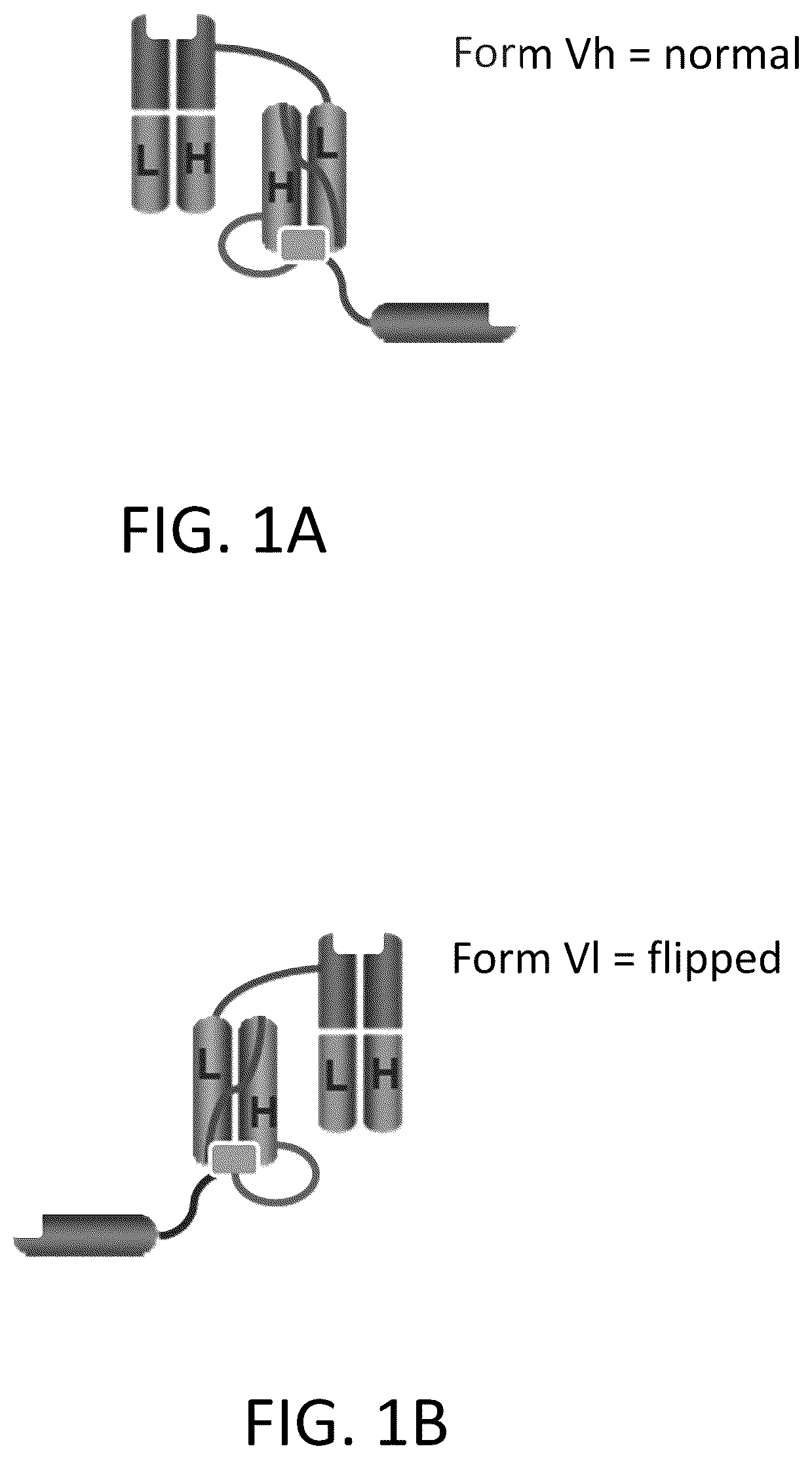
A- 1 R illustrate polypeptide complexes of this disclosure in a normal orientation ( A ), flipped orientation ( B ), and in several structural arrangements ( C- 1 R ).
A illustrates titration data for PSMA binding for several polypeptide complexes of this disclosure.
B illustrates titration data for PSMA binding for several polypeptide complexes of this disclosure.
C illustrates titration data for PSMA binding for several polypeptide complexes of this disclosure.
A illustrates titration data for CD3ε binding for several polypeptide complexes of this disclosure.
B illustrates titration data for CD3ε binding for several polypeptide complexes of this disclosure.
C illustrates titration data for CD3ε binding for several polypeptide complexes of this disclosure.
illustrates cell viability data for 22Rv1 tumor cells treated with PC1 or PC2.
A illustrates cell viability data for 22Rv1 tumor cells treated with PC1, PC5 or MTSP1 treated PC5.
B illustrates cell viability data for 22Rv1 tumor cells treated with PC2, or PC4 or PC6 with and without MTSP1 treatment.
illustrates cell viability data for LNCaP tumor cells treated with PC1 or PC2.
illustrates cell viability data for LNCaP tumor cells treated with PC2, PC4 or MTSP1 treated PC4.
A- 8 B illustrates polypeptide complex mediated 22Rv1 tumor cell killing in the presence of CD8+ T cells.
A illustrates polypeptide (PSMA TCEs) pharmacokinetics in cynomolgus monkeys after a single IV bolus injection.
B illustrates polypeptide (PSMA TRACTrs) pharmacokinetics in cynomolgus monkeys after a single IV bolus injection.
A illustrates cytokine release in cynomolgus monkeys after single IV bolus of PSMA TCE.
B illustrates cytokine release in cynomolgus monkeys after single IV bolus of PSMA polypeptide TRACTr complex.
C illustrates cytokine release in cynomolgus monkeys using PSMA TCE versus PSMA TRACTRs.
A illustrates serum liver enzymes in cynomolgus monkeys after single IV bolus of PSMA TCE.
B illustrates serum liver enzymes in cynomolgus monkeys after single IV bolus of PSMA polypeptide TRACTr complex.
A- 12 F illustrate anti-CD3 scFv binding by alanine scanning peptides of anti-CD3 scFv Peptide-A and Peptide-B as measured by ELISA.
A- 13 F illustrate inhibition of anti-CD3 scFv binding to CD3 by alanine scanning peptides of anti-CD3 scFv Peptide-A and Peptide-B as measured by ELISA.
A- 14 B illustrate anti-CD3 scFv binding by optimized anti-CD3 scFv Peptide-B sequences as measured by ELISA.
A- 15 B illustrate inhibition of anti-CD3 scFv binding to CD3 by optimized anti-CD3 scFv Peptide-B sequences as measured by ELISA.
illustrates the core sequence motif of optimized anti-CD3 scFv Peptide-B sequences generated using WebLogo 3.7.4.
DETAILED DESCRIPTION
Multispecific antibodies combine the benefits of different binding specificities derived from two or more antibodies into a single composition. Multispecific antibodies for redirecting T cells to cancers have shown promise in both pre-clinical and clinical studies. This approach relies on binding of one antigen interacting portion of the antibody to a tumor-associated antigen or marker, while a second antigen interacting portion can bind to an effector cell antigen on a T cell, such as CD3, which then triggers cytotoxic activity.
One such tumor-associated antigen is PSMA. Prostate-specific membrane antigen (PSMA), also known as glutamate carboxypeptidase II (GCPII), N-acetyl-L-aspartyl-L-glutamate peptidase I (NAALADase I), or NAAG peptidase is an enzyme that in humans is encoded by the FOLH1 (folate hydrolase 1) gene. PSMA is a zinc metalloenzyme that resides in membranes. Most of the enzyme resides in the extracellular space. Human PSMA is highly expressed in the prostate, roughly a hundred times greater than in most other tissues. In some prostate cancers, PSMA is the second-most upregulated gene product, with an 8- to 12-fold increase over levels in noncancerous prostate cells.
T cell engagers (TCEs) therapeutics have several benefits including they are not cell therapies and thus can be offered as off-the-shelf therapies as opposed to chimeric antigen receptor T cell (CAR T cell) therapies. While TCE therapeutics have displayed potent anti-tumor activity in hematological cancers, developing TCEs to treat solid tumors has faced challenges due to the limitations of prior TCE technologies, namely (i) overactivation of the immune system leading to cytokine release syndrome (CRS), (ii) on-target, healthy tissue toxicities and (iii) poor pharmacokinetics (PK) leading to short half-life. CRS arises from the systemic activation of T cells and can result in life-threatening elevations in inflammatory cytokines such as interleukin-6 (IL-6). Severe and acute CRS leading to dose limited toxicities and deaths have been observed upon the dosing of T cell engagers develop using other platforms to treat cancer patients in poor clinical studies. This toxicity restricts the maximum blood levels of T cell engagers that can be safely dosed. T cell engager effectiveness has also been limited because of on-target, healthy tissue toxicity. T cell engagers developed using a platform not designed for tumor-specification activation have resulted in clinicals holds and dose-limiting toxicities resulting from target expression in healthy tissues. T cell engagers have also been limited by short half-lives. T cell engagers quickly reach sub-therapeutic levels after being administered as they are quickly eliminated from the body due to their short exposure half-lives. For this reason, T cell engagers such as blinatumomab are typically administered by a low-dose, continuous infusion pump over a period of weeks to overcome the challenge of a short half-life and to maintain therapeutic levels of drug in the body. A continuous dosing regimen represents a significant burden for patients.
To overcome these challenges associated with the effectiveness of T cell engagers, described herein, are polypeptide or polypeptide complexes that comprise binding domains that selectively bind to an effector cell antigen and PSMA, in which one or more of the binding domains is selectively activated in the tumor microenvironment and the polypeptide or polypeptide complex comprises a half-life extending molecule. Such modifications reduce CRS and on-target healthy tissue toxicity risk, improves stability in the bloodstream and serum half-life prior to activation. The polypeptide or polypeptide complexes described herein have activity at low levels of target expression, and are easily manufactured.
In some embodiments, the polypeptides or polypeptide complexes described herein are used in a method of treating cancer. In some embodiments, the cancer has cells that express PSMA. In some embodiments, the polypeptides or polypeptide complexes described herein are used in a method of treating prostate cancer. In some embodiments, the prostate cancer is metastatic castrate resistant prostate cancer (mCRPC). Prostate cancer is the second most common cancer in men worldwide with over 3 million men living with prostate cancer in the United States alone. Early diagnoses and effective therapies mean that most prostate cancer patients have a prognosis with a mean five-year survival rate of approximately 98 percent. However, an estimated six percent of prostate cancer patients develop metastatic disease, which is associated with a five-year survival rate of approximately 30 percent. There were an estimated 33,000 deaths in the United States due to prostate cancer in 2020.
In some instances, the polypeptides or polypeptide complexes described herein are used to treat a solid tumor cancer. In some embodiments, the cancer is lung, breast (e.g. HER2+; ER/PR+; TNBC), cervical, ovarian, colorectal, pancreatic or gastric. In some embodiments, are methods of treating cancer comprising administering to a subject in need thereof an isolated polypeptide or polypeptide complex according to Formula I: A 2 -A 1 -L 1 -P 1 —H 1 (Formula I) wherein: A 1 comprises a first antigen recognizing molecule that binds to an effector cell antigen; P 1 comprises a peptide that binds to A 1 ; L 1 comprises a linking moiety that connects A 1 to P 1 and is a substrate for a tumor specific protease; H 1 comprises a half-life extending molecule; and A 2 comprises a second antigen recognizing molecule that binds to PSMA.
Disclosed herein, in some embodiments, are isolated polypeptides or polypeptide complexes according to Formula I: A 2 -A 1 -L 1 -P 1 —H 1 (Formula I) wherein: A 1 comprises a first antigen recognizing molecule that binds to an effector cell antigen; P 1 comprises a peptide that binds to A 1 ; L 1 comprises a linking moiety that connects A 1 to P 1 and is a substrate for a tumor specific protease; H 1 comprises a half-life extending molecule; and A 2 comprises a second antigen recognizing molecule that binds to prostate-specific membrane antigen (PSMA).
Disclosed herein, in some embodiments, are isolated polypeptides or polypeptide complexes according to Formula I: A 2 -A 1 -L 1 -P 1 —H 1 (Formula I) wherein: A 1 is a first antigen recognizing molecule that binds to an effector cell antigen; P 1 is a peptide that binds to A 1 ; L 1 is a linking moiety that connects A 1 to P 1 and is a substrate for a tumor specific protease; H 1 is a half-life extending molecule; and A 2 is a second antigen recognizing molecule that binds to prostate-specific membrane antigen (PSMA).
Disclosed herein, in some embodiments, are isolated polypeptides or polypeptide complexes comprising Formula I: A 2 -A 1 -L 1 -P 1 —H 1 (Formula I) wherein: A 1 comprises a first antigen recognizing molecule that binds to an effector cell antigen; P 1 comprises a peptide that binds to A 1 ; L 1 comprises a linking moiety that connects A 1 to P 1 and is a substrate for a tumor specific protease; H 1 comprises a half-life extending molecule; and A 2 comprises a second antigen recognizing molecule that binds to prostate-specific membrane antigen (PSMA).
Disclosed herein, in some embodiments, are isolated polypeptides or polypeptide complexes comprising Formula I: A 2 -A 1 -L 1 -P 1 —H 1 (Formula I) wherein: A 1 is a first antigen recognizing molecule that binds to an effector cell antigen; P 1 is a peptide that binds to A 1 ; L 1 is a linking moiety that connects A 1 to P 1 and is a substrate for a tumor specific protease; H 1 is a half-life extending molecule; and A 2 is a second antigen recognizing molecule that binds to prostate-specific membrane antigen (PSMA).
Disclosed herein, in some embodiments, are isolated polypeptides or polypeptide complexes according to Formula I: A 2 -A 1 -L 1 -P 1 —H 1 (Formula I) wherein: A 1 comprises a first antigen recognizing molecule that binds to prostate-specific membrane antigen (PSMA); P 1 comprises a peptide that binds to A 1 ; L 1 comprises a linking moiety that connects A 1 to P 1 and is a substrate for a tumor specific protease; H 1 comprises a half-life extending molecule; and A 2 comprises a second antigen recognizing molecule that binds to an effector cell antigen.
Disclosed herein, in some embodiments, are isolated polypeptides or polypeptide complexes according to Formula I: A 2 -A 1 -L 1 -P 1 —H 1 (Formula I) wherein: A 1 is a first antigen recognizing molecule that binds to prostate-specific membrane antigen (PSMA); P 1 is a peptide that binds to A 1 ; L 1 is a linking moiety that connects A 1 to P 1 and is a substrate for a tumor specific protease; H 1 is a half-life extending molecule; and A 2 is a second antigen recognizing molecule that binds to effector cell antigen.
Disclosed herein, in some embodiments, are isolated polypeptides or polypeptide complexes comprising Formula I: A 2 -A 1 -L 1 -P 1 —H 1 (Formula I) wherein: A 1 comprises a first antigen recognizing molecule that binds to prostate-specific membrane antigen (PSMA); P 1 comprises a peptide that binds to A 1 ; L 1 comprises a linking moiety that connects A 1 to P 1 and is a substrate for a tumor specific protease; H 1 comprises a half-life extending molecule; and A 2 comprises a second antigen recognizing molecule that binds to an effector cell antigen.
Disclosed herein, in some embodiments, are isolated polypeptides or polypeptide complexes comprising Formula I: A 2 -A 1 -L 1 -P 1 —H 1 (Formula I) wherein: A 1 is a first antigen recognizing molecule that binds to prostate-specific membrane antigen (PSMA); P 1 is a peptide that binds to A 1 ; L 1 is a linking moiety that connects A 1 to P 1 and is a substrate for a tumor specific protease; H 1 is a half-life extending molecule; and A 2 is a second antigen recognizing molecule that binds to an effector cell antigen.
Disclosed herein, in some embodiments, are isolated polypeptides or polypeptide complexes according to Formula Ia: P 2 -L 2 -A 2 -A 1 -L 1 -P 1 —H 1 (Formula Ia) wherein A 2 further comprises P 2 and L 2 , wherein P 2 comprises a peptide that binds to A 2 ; and L 2 comprises a linking moiety that connects A 2 to P 2 and is a substrate for a tumor specific protease.
Disclosed herein, in some embodiments, are isolated polypeptides or polypeptide complexes according to Formula Ia: P 2 -L 2 -A 2 -A 1 -L 1 -P 1 —H 1 (Formula Ia) wherein A 2 further comprises P 2 and L 2 , wherein P 2 is a peptide that binds to A 2 ; and L 2 is a linking moiety that connects A 2 to P 2 and is a substrate for a tumor specific protease.
Disclosed herein, in some embodiments, are isolated polypeptides or polypeptide complexes comprising Formula Ia: P 2 -L 2 -A 2 -A 1 -L 1 -P 1 —H 1 (Formula Ia) wherein A 2 further comprises P 2 and L 2 , wherein P 2 comprises a peptide that binds to A 2 ; and L 2 comprises a linking moiety that connects A 2 to P 2 and is a substrate for a tumor specific protease.
Disclosed herein, in some embodiments, are isolated polypeptides or polypeptide complexes comprising Formula Ia: P 2 -L 2 -A 2 -A 1 -L 1 -P 1 —H 1 (Formula Ia) wherein A 2 further comprises P 2 and L 2 , wherein P 2 is a peptide that binds to A 2 ; and L 2 is a linking moiety that connects A 2 to P 2 and is a substrate for a tumor specific protease.
Disclosed herein, in some embodiments, are isolated polypeptides or polypeptide complexes according to Formula TI: L 1a -P 1a —H 1a (Formula II) wherein: L 1a comprises a tumor specific protease-cleaved linking moiety that when uncleaved connects P 1a to a first antigen recognizing molecule that binds to an effector cell antigen and the first antigen recognizing molecule is connected to a second antigen recognizing molecule that binds to prostate-specific membrane antigen (PSMA); P 1a comprises a peptide that binds to the first antigen recognizing molecule when L 1a is uncleaved; and H 1a comprises a half-life extending molecule.
Disclosed herein, in some embodiments, are isolated polypeptides or polypeptide complexes comprising Formula II: L 1a -P 1a —H 1a (Formula II) wherein: L 1a comprises a tumor specific protease-cleaved linking moiety that when uncleaved connects P 1a to a first antigen recognizing molecule that binds to an effector cell antigen and the first antigen recognizing molecule is connected to a second antigen recognizing molecule that binds to prostate-specific membrane antigen (PSMA); P 1a comprises a peptide that binds to the first antigen recognizing molecule when L 1a is uncleaved; and H 1a comprises a half-life extending molecule.
Disclosed herein, in some embodiments, are isolated polypeptides or polypeptide complexes according to Formula II: L 1a -P 1a —H 1a (Formula II) wherein: L 1a is a tumor specific protease-cleaved linking moiety that when uncleaved connects P 1a to a first antigen recognizing molecule that binds to an effector cell antigen and the first antigen recognizing molecule is connected to a second antigen recognizing molecule that binds to prostate-specific membrane antigen (PSMA); P 1a is a peptide that binds to the first antigen recognizing molecule when L 1a is uncleaved; and H 1a is a half-life extending molecule.
Disclosed herein, in some embodiments, are isolated polypeptides or polypeptide complexes comprising Formula II: L 1a -P 1a —H 1a (Formula II) wherein: L 1a is a tumor specific protease-cleaved linking moiety that when uncleaved connects P 1a to a first antigen recognizing molecule that binds to an effector cell antigen and the first antigen recognizing molecule is connected to a second antigen recognizing molecule that binds to prostate-specific membrane antigen (PSMA); P 1a is a peptide that binds to the first antigen recognizing molecule when L 1a is uncleaved; and H 1a is a half-life extending molecule. First Antigen Recognizing Molecule (A 1 )
Disclosed herein, in some embodiments, are isolated polypeptides or polypeptide complexes, wherein the first antigen recognizing molecule binds to an effector cell antigen and the second antigen recognizing molecule binds to PSMA. In some embodiments, the effector cell antigen comprises CD3. In some embodiments, A 1 comprises a first antigen recognizing molecule that binds to an effector cell antigen.
In some embodiments, A 1 comprises an antibody or antibody fragment. In some embodiments, A 1 comprises an antibody or antibody fragment that is human or humanized. In some embodiments, L 1 is bound to a N-terminus of the antibody or antibody fragment. In some embodiments, L 1 is bound to a N-terminus of the antibody or antibody fragment and A 2 is bound to the other N-terminus of the antibody or antibody fragment. In some embodiments, A 2 is bound to a C-terminus of the antibody or antibody fragment. In some embodiments, L 1 is bound to a C-terminus of the antibody or antibody fragment. In some embodiments, A 2 is bound to a N-terminus of the antibody or antibody fragment. In some embodiments, the antibody or antibody fragment comprises a single chain variable fragment, a single domain antibody, or a Fab fragment. In some embodiments, A 1 is the single chain variable fragment (scFv). In some embodiments, the scFv comprises a scFv heavy chain polypeptide and a scFv light chain polypeptide. In some embodiments, A 1 is the single domain antibody. In some embodiments, A 1 comprises a variable light chain and variable heavy chain each of which is capable of specifically binding to human CD3. In some embodiments, the effector cell antigen comprises CD3. In some embodiments, A 1 comprises an anti-CD3e single chain variable fragment. In some embodiments, A 1 comprises an anti-CD3e single chain variable fragment that has a K D binding of 1 μM or less to CD3 on CD3 expressing cells. In some embodiments, A 1 comprises complementary determining regions (CDRs) selected from the group consisting of muromonab-CD3 (OKT3), otelixizumab (TRX4), teplizumab (MGA031), visilizumab (Nuvion), SP34, X35, VIT3, BMA030 (BW264/56), CLB-T3/3, CRIS7, YTH12.5, F111-409, CLB-T3.4.2, TR-66, WT32, SPv-T3b, 11D8, XIII-141, XIII-46, XIII-87, 12F6, T3/RW2-8C8, T3/RW2-4B6, OKT3D, M-T301, SMC2, F101.01, UCHT-1, WT-31, 15865, 15865v12, 15865v16, and 15865v19.
In some embodiments, A 1 comprises a first antigen recognizing molecule that binds PSMA. In some embodiments, A 1 comprises a variable light chain and variable heavy chain each of which is capable of specifically binding to human PSMA.
In some embodiments, the scFv that binds to CD3 comprises a scFv light chain variable domain and a scFv heavy chain variable domain. In some embodiments, the scFv heavy chain variable domain comprises at least one, two, or three complementarity determining regions (CDR)s disclosed in Table 1 or a sequence substantially identical thereto (e.g., a sequence that has at least 90%, 95%, 96%, 97%, 98%, or 99% sequence identity). In some embodiments, the scFv light chain variable domain comprises at least one, two, or three complementarity determining regions (CDR)s disclosed in Table 1 or a sequence substantially identical thereto (e.g., a sequence that has at least 90%, 95%, 96%, 97%, 98%, or 99% sequence identity).
In some embodiments, the scFv heavy chain variable domain comprises at least one, two, or three complementarity determining regions (CDR)s disclosed in Table 1 or a sequence substantially identical thereto (e.g., a sequence that has at least 90%, 95%, 96%, 97%, 98%, or 99% sequence identity); and the scFv light chain variable domain comprises at least one, two, or three complementarity determining regions (CDR)s disclosed in Table 1 or a sequence substantially identical thereto (e.g., a sequence that has at least 90%, 95%, 96%, 97%, 98%, or 99% sequence identity).
TABLE 1
anti-CD3 amino acid sequences
(CDRs as determined by IMGT numbering system)
SEQ
Amino Acid Sequence ID
Construct Description (N to C) NO:
SP34.185 CD3: HC: CDR1 GFTFNKYA 1
SP34.185 CD3: HC: CDR2 IRSKYNNYAT 2
SP34.185 CD3: HC: CDR3 VRHGNFGNSYISYWAY 3
SP34.185 CD3: LC: CDR1 TGAVTSGNY 4
SP34.185 CD3: LC: CDR2 GT 5
SP34.185 CD3: LC: CDR3 VLWYSNRWV 6
SP34.185 scFv EVQLVESGGGLVQPGGSLKLSCA 7
(VH - linker 1 - VL) AS GFTFNKYA MNWVRQAPGKG
LEWVAR IRSKYNNYAT YYADSV
KDRFTISRDDSKNTAYLQMNNLK
TEDTAVYYC VRHGNFGNSYISY
WAY WGQGTLVTVSSGGGGSGGG
GSGGGGSQTVVTQEPSLTVSPGG
TVTLTCGSS TGAVTSGNY PNWV
QQKPGQAPRGLIG GT KFLAPGTP
ARFSGSLLGGKAALTLSGVQPED
EAEYYC VLWYSNRWV FGGGTKL
TVL
In some embodiments, the scFv heavy chain variable domain comprises complementarity determining regions (CDRs): HC-CDR1, HC-CDR2, and HC-CDR3, wherein the HC-CDR1, the HC-CDR2, and the HC-CDR3 of the scFv heavy chain variable domain comprise: HC-CDR1: SEQ ID NO: 1; HC-CDR2: SEQ ID NO: 2; HC-CDR3: SEQ ID NO: 3, and wherein the CDRs comprise from 0-2 amino acid modifications in at least one of the HC-CDR1, HC-CDR2, or HC-CDR3. In some embodiments, the scFv light chain variable domain comprises complementarity determining regions (CDRs): LC-CDR1, LC-CDR2, and LC-CDR3, wherein the LC-CDR1, the LC-CDR2, and the LC-CDR3 of the scFv light chain variable domain comprise: LC-CDR1: SEQ ID NO: 4; LC-CDR2: SEQ ID NO: 5; and LC-CDR3: SEQ ID NO: 6, and wherein the CDRs comprise from 0-2 amino acid modifications in at least one of the LC-CDR1, LC-CDR2, or LC-CDR3.
In some embodiments, the polypeptide or polypeptide complex of Formula I binds to an effector cell when L 1 is cleaved by the tumor specific protease. In some embodiments, the polypeptide or polypeptide complex of Formula I binds to an effector cell when L 1 is cleaved by the tumor specific protease and A 1 binds to the effector cell. In some embodiments, the effector cell is a T cell. In some embodiments, A 1 binds to a polypeptide that is part of a TCR-CD3 complex on the effector cell. In some embodiments, the polypeptide that is part of the TCR-CD3 complex is human CD3E. In some embodiments, the effector cell antigen comprises CD3, wherein the scFv comprises complementarity determining regions (CDRs): HC-CDR1, HC-CDR2, and HC-CDR3, wherein the HC-CDR1, the HC-CDR2, and the HC-CDR3 of the scFv comprise: HC-CDR1: SEQ ID NO: 1, HC-CDR2: SEQ ID NO: 2, and HC-CDR3: SEQ ID NO: 3; and the scFv comprises CDRs: LC-CDR1, LC-CDR2, and LC-CDR3, wherein the LC-CDR1, the LC-CDR2, and the LC-CDR3 of the scFv comprise: LC-CDR1: SEQ ID NO: 4, LC-CDR2: SEQ ID NO:5, and LC-CDR3: SEQ ID NO: 6. In some embodiments, the effector cell antigen comprises CD3, and the scFv comprises an amino acid sequence according to SEQ ID NO: 7.
In some embodiments, the effector cell antigen comprises CD3, and wherein A 1 comprises complementarity determining regions (CDRs): HC-CDR1, HC-CDR2, and HC-CDR3, wherein the HC-CDR1, the HC-CDR2, and the HC-CDR3 of A 1 comprises: HC-CDR1: SEQ ID NO: 1, HC-CDR2: SEQ ID NO: 2, and HC-CDR3: SEQ ID NO: 3; and A 1 comprises CDRs: LC-CDR1, LC-CDR2, and LC-CDR3, wherein the LC-CDR1, the LC-CDR2, and the LC-CDR3 of A 1 comprise: LC-CDR1: SEQ ID NO: 4, LC-CDR2: SEQ ID NO:5, and LC-CDR3: SEQ ID NO: 6. In some embodiments, the effector cell antigen comprises CD3, and A 1 comprises an amino acid sequence according to SEQ ID NO: 7.
In some embodiments, A 1 comprises an amino acid sequence according to SEQ ID NO: 7. In some embodiments, A 1 comprises an amino acid sequence that has at least 80% sequence identity to SEQ ID NO: 7. In some embodiments, A 1 comprises an amino acid sequence that has at least 85% sequence identity to SEQ ID NO: 7. In some embodiments, A 1 comprises an amino acid sequence that has at least 90% sequence identity to SEQ ID NO: 7. In some embodiments, A 1 comprises an amino acid sequence that has at least 95% sequence identity to SEQ ID NO: 7. In some embodiments, A 1 comprises an amino acid sequence that has at least 99% sequence identity to SEQ ID NO: 7.
In some embodiments, the polypeptide or polypeptide complex has weaker binding affinity for the tumor cell antigen as compared to the binding affinity for the tumor cell antigen of an isolated polypeptide or polypeptide complex that does not have P 1 or L 1 . In some embodiments, the polypeptide or polypeptide complex has weaker binding affinity for the tumor cell antigen that is at least 5× higher than the binding affinity for the tumor cell antigen of a form of the polypeptide or polypeptide complex that does not have P 1 or L 1 . In some embodiments, the polypeptide or polypeptide complex has weaker binding affinity for the tumor cell antigen that is at least 8×higher than the binding affinity for the tumor cell antigen of a form of the polypeptide or polypeptide complex that does not have P 1 or L 1 . In some embodiments, the polypeptide or polypeptide complex has weaker binding affinity for the tumor cell antigen that is at least 10×higher than the binding affinity for the tumor cell antigen of a form of the polypeptide or polypeptide complex that does not have P 1 or L 1 . In some embodiments, the polypeptide or polypeptide complex has weaker binding affinity for the tumor cell antigen that is at least 15× higher than the binding affinity for the tumor cell antigen of a form of the polypeptide or polypeptide complex that does not have P 1 or L 1 . In some embodiments, the polypeptide or polypeptide complex has weaker binding affinity for the tumor cell antigen that is at least 20× higher than the binding affinity for the tumor cell antigen of a form of the polypeptide or polypeptide complex that does not have P 1 or L 1 . In some embodiments, the polypeptide or polypeptide complex has weaker binding affinity for the tumor cell antigen that is at least 25× higher than the binding affinity for the tumor cell antigen of a form of the polypeptide or polypeptide complex that does not have P 1 or L 1 . In some embodiments, the polypeptide or polypeptide complex has weaker binding affinity for the tumor cell antigen that is at least 30× higher than the binding affinity for the tumor cell antigen of a form of the polypeptide or polypeptide complex that does not have P 1 or L 1 . In some embodiments, the polypeptide or polypeptide complex has weaker binding affinity for the tumor cell antigen that is at least 35× higher than the binding affinity for the tumor cell antigen of a form of the polypeptide or polypeptide complex that does not have P 1 or L 1 . In some embodiments, the polypeptide or polypeptide complex has weaker binding affinity for the tumor cell antigen that is at least 40× higher than the binding affinity for the tumor cell antigen of a form of the polypeptide or polypeptide complex that does not have P 1 or L 1 . In some embodiments, the polypeptide or polypeptide complex has weaker binding affinity for the tumor cell antigen that is at least 45× higher than the binding affinity for the tumor cell antigen of a form of the polypeptide or polypeptide complex that does not have P 1 or L 1 . In some embodiments, the polypeptide or polypeptide complex has weaker binding affinity for the tumor cell antigen that is at least 50× higher than the binding affinity for the tumor cell antigen of a form of the polypeptide or polypeptide complex that does not have P 1 or L 1 . In some embodiments, the polypeptide or polypeptide complex has weaker binding affinity for the tumor cell antigen that is at least 55× higher than the binding affinity for the tumor cell antigen of a form of the polypeptide or polypeptide complex that does not have P 1 or L 1 . In some embodiments, the polypeptide or polypeptide complex has weaker binding affinity for the tumor cell antigen that is at least 60× higher than the binding affinity for the tumor cell antigen of a form of the polypeptide or polypeptide complex that does not have P 1 or L 1 . In some embodiments, the polypeptide or polypeptide complex has weaker binding affinity for the tumor cell antigen that is at least 65× higher than the binding affinity for the tumor cell antigen of a form of the polypeptide or polypeptide complex that does not have P 1 or L 1 . In some embodiments, the polypeptide or polypeptide complex has weaker binding affinity for the tumor cell antigen that is at least 70× higher than the binding affinity for the tumor cell antigen of a form of the polypeptide or polypeptide complex that does not have P 1 or L 1 . In some embodiments, the polypeptide or polypeptide complex has weaker binding affinity for the tumor cell antigen that is at least 75× higher than the binding affinity for the tumor cell antigen of a form of the polypeptide or polypeptide complex that does not have P 1 or L 1 . In some embodiments, the polypeptide or polypeptide complex has weaker binding affinity for the tumor cell antigen that is at least 80× higher than the binding affinity for the tumor cell antigen of a form of the polypeptide or polypeptide complex that does not have P 1 or L 1 . In some embodiments, the polypeptide or polypeptide complex has weaker binding affinity for the tumor cell antigen that is at least 85× higher than the binding affinity for the tumor cell antigen of a form of the polypeptide or polypeptide complex that does not have P 1 or L 1 . In some embodiments, the polypeptide or polypeptide complex has weaker binding affinity for the tumor cell antigen that is at least 90× higher than the binding affinity for the tumor cell antigen of a form of the polypeptide or polypeptide complex that does not have P 1 or L 1 . In some embodiments, the polypeptide or polypeptide complex has weaker binding affinity for the tumor cell antigen that is at least 95× higher than the binding affinity for the tumor cell antigen of a form of the polypeptide or polypeptide complex that does not have P 1 or L 1 . In some embodiments, the polypeptide or polypeptide complex has weaker binding affinity for the tumor cell antigen that is at least 100× higher than the binding affinity for the tumor cell antigen of a form of the polypeptide or polypeptide complex that does not have P 1 or L 1 . In some embodiments, the polypeptide or polypeptide complex has weaker binding affinity for the tumor cell antigen that is at least 120× higher than the binding affinity for the tumor cell antigen of a form of the polypeptide or polypeptide complex that does not have P 1 or L 1 . In some embodiments, the polypeptide or polypeptide complex has weaker binding affinity for the tumor cell antigen that is at least 1000× higher than the binding affinity for the tumor cell antigen of a form of the polypeptide or polypeptide complex that does not have P 1 or L 1 .
In some embodiments, the polypeptide or polypeptide complex has weaker binding affinity for the tumor cell antigen as compared to the binding affinity for the tumor cell antigen of the polypeptide or polypeptide complex in which L 1 has been cleaved by the tumor specific protease. In some embodiments, the polypeptide or polypeptide complex has weaker binding affinity for the tumor cell antigen that is at least 5× higher than the binding affinity for the tumor cell antigen of the polypeptide or polypeptide complex in which L 1 has been cleaved by the tumor specific protease. In some embodiments, the polypeptide or polypeptide complex has weaker binding affinity for the tumor cell antigen that is at least 8× higher than the binding affinity for the tumor cell antigen of the polypeptide or polypeptide complex in which L 1 has been cleaved by the tumor specific protease. In some embodiments, the polypeptide or polypeptide complex has weaker binding affinity for the tumor cell antigen that is at least 10× higher than the binding affinity for the tumor cell antigen of the polypeptide or polypeptide complex in which L 1 has been cleaved by the tumor specific protease. In some embodiments, the polypeptide or polypeptide complex has weaker binding affinity for the tumor cell antigen that is at least 15× higher than the binding affinity for the tumor cell antigen of the polypeptide or polypeptide complex in which L 1 has been cleaved by the tumor specific protease. In some embodiments, the polypeptide or polypeptide complex has weaker binding affinity for the tumor cell antigen that is at least 20× higher than the binding affinity for the tumor cell antigen of the polypeptide or polypeptide complex in which L 1 has been cleaved by the tumor specific protease. In some embodiments, the polypeptide or polypeptide complex has weaker binding affinity for the tumor cell antigen that is at least 25× higher than the binding affinity for the tumor cell antigen of the polypeptide or polypeptide complex in which L 1 has been cleaved by the tumor specific protease. In some embodiments, the polypeptide or polypeptide complex has weaker binding affinity for the tumor cell antigen that is at least 30× higher than the binding affinity for the tumor cell antigen of the polypeptide or polypeptide complex in which L 1 has been cleaved by the tumor specific protease. In some embodiments, the polypeptide or polypeptide complex has weaker binding affinity for the tumor cell antigen that is at least 35× higher than the binding affinity for the tumor cell antigen of the polypeptide or polypeptide complex in which L 1 has been cleaved by the tumor specific protease. In some embodiments, the polypeptide or polypeptide complex has weaker binding affinity for the tumor cell antigen that is at least 40× higher than the binding affinity for the tumor cell antigen of the polypeptide or polypeptide complex in which L 1 has been cleaved by the tumor specific protease. In some embodiments, the polypeptide or polypeptide complex has weaker binding affinity for the tumor cell antigen that is at least 45× higher than the binding affinity for the tumor cell antigen of the polypeptide or polypeptide complex in which L 1 has been cleaved by the tumor specific protease. In some embodiments, the polypeptide or polypeptide complex has weaker binding affinity for the tumor cell antigen that is at least 50× higher than the binding affinity for the tumor cell antigen of the polypeptide or polypeptide complex in which L 1 has been cleaved by the tumor specific protease. In some embodiments, the polypeptide or polypeptide complex has weaker binding affinity for the tumor cell antigen that is at least 55× higher than the binding affinity for the tumor cell antigen of the polypeptide or polypeptide complex in which L 1 has been cleaved by the tumor specific protease. In some embodiments, the polypeptide or polypeptide complex has weaker binding affinity for the tumor cell antigen that is at least 60×higher than the binding affinity for the tumor cell antigen of the polypeptide or polypeptide complex in which L 1 has been cleaved by the tumor specific protease. In some embodiments, the polypeptide or polypeptide complex has weaker binding affinity for the tumor cell antigen that is at least 65×higher than the binding affinity for the tumor cell antigen of the polypeptide or polypeptide complex in which L 1 has been cleaved by the tumor specific protease. In some embodiments, the polypeptide or polypeptide complex has weaker binding affinity for the tumor cell antigen that is at least 70×higher than the binding affinity for the tumor cell antigen of the polypeptide or polypeptide complex in which L 1 has been cleaved by the tumor specific protease. In some embodiments, the polypeptide or polypeptide complex has weaker binding affinity for the tumor cell antigen that is at least 75×higher than the binding affinity for the tumor cell antigen of the polypeptide or polypeptide complex in which L 1 has been cleaved by the tumor specific protease. In some embodiments, the polypeptide or polypeptide complex has weaker binding affinity for the tumor cell antigen that is at least 80×higher than the binding affinity for the tumor cell antigen of the polypeptide or polypeptide complex in which L 1 has been cleaved by the tumor specific protease. In some embodiments, the polypeptide or polypeptide complex has weaker binding affinity for the tumor cell antigen that is at least 85×higher than the binding affinity for the tumor cell antigen of the polypeptide or polypeptide complex in which L 1 has been cleaved by the tumor specific protease. In some embodiments, the polypeptide or polypeptide complex has weaker binding affinity for the tumor cell antigen that is at least 90×higher than the binding affinity for the tumor cell antigen of the polypeptide or polypeptide complex in which L 1 has been cleaved by the tumor specific protease. In some embodiments, the polypeptide or polypeptide complex has weaker binding affinity for the tumor cell antigen that is at least 95×higher than the binding affinity for the tumor cell antigen of the polypeptide or polypeptide complex in which L 1 has been cleaved by the tumor specific protease. In some embodiments, the polypeptide or polypeptide complex has weaker binding affinity for the tumor cell antigen that is at least 100×higher than the binding affinity for the tumor cell antigen of the polypeptide or polypeptide complex in which L 1 has been cleaved by the tumor specific protease. In some embodiments, the polypeptide or polypeptide complex has weaker binding affinity for the tumor cell antigen that is at least 120×higher than the binding affinity for the tumor cell antigen of the polypeptide or polypeptide complex in which L 1 has been cleaved by the tumor specific protease. In some embodiments, the polypeptide or polypeptide complex has weaker binding affinity for the tumor cell antigen that is at least 1000×higher than the binding affinity for the tumor cell antigen of the polypeptide or polypeptide complex in which L 1 has been cleaved by the tumor specific protease.
In some embodiments, the polypeptide or polypeptide complex has an increased EC 50 in an IFNγ release T-cell activation assay as compared to the EC 50 in an IFNγ release T-cell activation assay of an isolated polypeptide or polypeptide complex that does not have P 1 or L 1 . In some embodiments, the polypeptide or polypeptide complex has an increased EC 50 in an IFNγ release T-cell activation assay that is at least 10× higher than the EC 50 in an IFNγ release T-cell activation assay of a form of the polypeptide or polypeptide complex that does not have P 1 or L 1 . In some embodiments, the polypeptide or polypeptide complex has an increased EC 50 in an IFNγ release T-cell activation assay that is at least 20×higher than the EC 50 in an IFNγ release T-cell activation assay of a form of the polypeptide or polypeptide complex that does not have P 1 or L 1 . In some embodiments, the polypeptide or polypeptide complex has an increased EC 50 in an IFNγ release T-cell activation assay that is at least 30×higher than the EC 50 in an IFNγ release T-cell activation assay of a form of the polypeptide or polypeptide complex that does not have P 1 or L 1 . In some embodiments, the polypeptide or polypeptide complex has an increased EC 50 in an IFNγ release T-cell activation assay that is at least 40×higher than the EC 50 in an IFNγ release T-cell activation assay of a form of the polypeptide or polypeptide complex that does not have P 1 or L 1 . In some embodiments, the polypeptide or polypeptide complex has an increased EC 50 in an IFNγ release T-cell activation assay that is at least 50×higher than the EC 50 in an IFNγ release T-cell activation assay of a form of the polypeptide or polypeptide complex that does not have P 1 or L 1 . In some embodiments, the polypeptide or polypeptide complex has an increased EC 50 in an IFNγ release T-cell activation assay that is at least 60×higher than the EC 50 in an IFNγ release T-cell activation assay of a form of the polypeptide or polypeptide complex that does not have P 1 or L 1 . In some embodiments, the polypeptide or polypeptide complex has an increased EC 50 in an IFNγ release T-cell activation assay that is at least 70×higher than the EC 50 in an IFNγ release T-cell activation assay of a form of the polypeptide or polypeptide complex that does not have P 1 or L 1 . In some embodiments, the polypeptide or polypeptide complex has an increased EC 50 in an IFNγ release T-cell activation assay that is at least 80×higher than the EC 50 in an IFNγ release T-cell activation assay of a form of the polypeptide or polypeptide complex that does not have P 1 or L 1 . In some embodiments, the polypeptide or polypeptide complex has an increased EC 50 in an IFNγ release T-cell activation assay that is at least 90×higher than the EC 50 in an IFNγ release T-cell activation assay of a form of the polypeptide or polypeptide complex that does not have P 1 or L 1 . In some embodiments, the polypeptide or polypeptide complex has an increased EC 50 in an IFNγ release T-cell activation assay that is at least 100× higher than the EC 50 in an IFNγ release T-cell activation assay of a form of the polypeptide or polypeptide complex that does not have P 1 or L 1 . In some embodiments, the polypeptide or polypeptide complex has an increased EC 50 in an IFNγ release T-cell activation assay that is at least 1000× higher than the EC 50 in an IFNγ release T-cell activation assay of a form of the polypeptide or polypeptide complex that does not have P 1 or L 1 .
In some embodiments, the polypeptide or polypeptide complex has an increased EC 50 in an IFNγ release T-cell activation assay as compared to the EC 50 in an IFNγ release T-cell activation assay of the polypeptide or polypeptide complex in which L 1 has been cleaved by the tumor specific protease. In some embodiments, the polypeptide or polypeptide complex has an increased EC 50 in an IFNγ release T-cell activation assay that is at least 10× higher than the EC 50 in an IFNγ release T-cell activation assay of the polypeptide or polypeptide complex in which L 1 has been cleaved by the tumor specific protease. In some embodiments, the polypeptide or polypeptide complex has an increased EC 50 in an IFNγ release T-cell activation assay that is at least 20×higher than the EC 50 in an IFNγ release T-cell activation assay of the polypeptide or polypeptide complex in which L 1 has been cleaved by the tumor specific protease. In some embodiments, the polypeptide or polypeptide complex has an increased EC 50 in an IFNγ release T-cell activation assay that is at least 30×higher than the EC 50 in an IFNγ release T-cell activation assay of the polypeptide or polypeptide complex in which L 1 has been cleaved by the tumor specific protease. In some embodiments, the polypeptide or polypeptide complex has an increased EC 50 in an IFNγ release T-cell activation assay that is at least 40×higher than the EC 50 in an IFNγ release T-cell activation assay of the polypeptide or polypeptide complex in which L 1 has been cleaved by the tumor specific protease. In some embodiments, the polypeptide or polypeptide complex has an increased EC 50 in an IFNγ release T-cell activation assay that is at least 50×higher than the EC 50 in an IFNγ release T-cell activation assay of the polypeptide or polypeptide complex in which L 1 has been cleaved by the tumor specific protease. In some embodiments, the polypeptide or polypeptide complex has an increased EC 50 in an IFNγ release T-cell activation assay that is at least 60×higher than the EC 50 in an IFNγ release T-cell activation assay of the polypeptide or polypeptide complex in which L 1 has been cleaved by the tumor specific protease. In some embodiments, the polypeptide or polypeptide complex has an increased EC 50 in an IFNγ release T-cell activation assay that is at least 70×higher than the EC 50 in an IFNγ release T-cell activation assay of the polypeptide or polypeptide complex in which L 1 has been cleaved by the tumor specific protease. In some embodiments, the polypeptide or polypeptide complex has an increased EC 50 in an IFNγ release T-cell activation assay that is at least 80×higher than the EC 50 in an IFNγ release T-cell activation assay of the polypeptide or polypeptide complex in which L 1 has been cleaved by the tumor specific protease. In some embodiments, the polypeptide or polypeptide complex has an increased EC 50 in an IFNγ release T-cell activation assay that is at least 90×higher than the EC 50 in an IFNγ release T-cell activation assay of the polypeptide or polypeptide complex in which L 1 has been cleaved by the tumor specific protease. In some embodiments, the polypeptide or polypeptide complex has an increased EC 50 in an IFNγ release T-cell activation assay that is at least 100× higher than the EC 50 in an IFNγ release T-cell activation assay of the polypeptide or polypeptide complex in which L 1 has been cleaved by the tumor specific protease. In some embodiments, the polypeptide or polypeptide complex has an increased EC 50 in an IFNγ release T-cell activation assay that is at least 1000× higher than the EC 50 in an IFNγ release T-cell activation assay of the polypeptide or polypeptide complex in which L 1 has been cleaved by the tumor specific protease.
In some embodiments, the polypeptide or polypeptide complex has an increased EC 50 in a T-cell cytolysis assay as compared to the EC 50 in a T-cell cytolysis assay of an isolated polypeptide or polypeptide complex that does not have P 1 or L 1 . In some embodiments, the polypeptide or polypeptide complex has an increased EC 50 in a T-cell cytolysis assay that is at least 10× higher than the EC 50 in a T-cell cytolysis assay of a form of the polypeptide or polypeptide complex that does not have P 1 or L 1 . In some embodiments, the polypeptide or polypeptide complex has an increased EC 50 in a T-cell cytolysis assay that is at least 20×higher than the EC 50 in a T-cell cytolysis assay of a form of the polypeptide or polypeptide complex that does not have P 1 or L 1 . In some embodiments, the polypeptide or polypeptide complex has an increased EC 50 in a T-cell cytolysis assay that is at least 30×higher than the EC 50 in a T-cell cytolysis assay of a form of the polypeptide or polypeptide complex that does not have P 1 or L 1 . In some embodiments, the polypeptide or polypeptide complex has an increased EC 50 in a T-cell cytolysis assay that is at least 40×higher than the EC 50 in a T-cell cytolysis assay of a form of the polypeptide or polypeptide complex that does not have P 1 or L 1 . In some embodiments, the polypeptide or polypeptide complex has an increased EC 50 in a T-cell cytolysis assay that is at least 50×higher than the EC 50 in a T-cell cytolysis assay of a form of the polypeptide or polypeptide complex that does not have P 1 or L 1 . In some embodiments, the polypeptide or polypeptide complex has an increased EC 50 in a T-cell cytolysis assay that is at least 60×higher than the EC 50 in a T-cell cytolysis assay of a form of the polypeptide or polypeptide complex that does not have P 1 or L 1 . In some embodiments, the polypeptide or polypeptide complex has an increased EC 50 in a T-cell cytolysis assay that is at least 70×higher than the EC 50 in a T-cell cytolysis assay of a form of the polypeptide or polypeptide complex that does not have P 1 or L 1 . In some embodiments, the polypeptide or polypeptide complex has an increased EC 50 in a T-cell cytolysis assay that is at least 80×higher than the EC 50 in a T-cell cytolysis assay of a form of the polypeptide or polypeptide complex that does not have P 1 or L 1 . In some embodiments, the polypeptide or polypeptide complex has an increased EC 50 in a T-cell cytolysis assay that is at least 90×higher than the EC 50 in a T-cell cytolysis assay of a form of the polypeptide or polypeptide complex that does not have P 1 or L 1 . In some embodiments, the polypeptide or polypeptide complex has an increased EC 50 in a T-cell cytolysis assay that is at least 100× higher than the EC 50 in a T-cell cytolysis assay of an isolated polypeptide or polypeptide complex that does not have P 1 or L 1 . In some embodiments, the polypeptide or polypeptide complex has an increased EC 50 in a T-cell cytolysis assay that is at least 1000× higher than the EC 50 in a T-cell cytolysis assay of an isolated polypeptide or polypeptide complex that does not have P 1 or L 1 .
In some embodiments, the polypeptide or polypeptide complex has an increased EC 50 in a T-cell cytolysis assay as compared to the EC 50 in a T-cell cytolysis assay of the polypeptide or polypeptide complex in which L 1 has been cleaved by the tumor specific protease. In some embodiments, the polypeptide or polypeptide complex has an increased EC 50 in a T-cell cytolysis assay that is at least 10× higher than the EC 50 in a T-cell cytolysis assay of the polypeptide or polypeptide complex in which L 1 has been cleaved by the tumor specific protease. In some embodiments, the polypeptide or polypeptide complex has an increased EC 50 in a T-cell cytolysis assay that is at least 20×higher than the EC 50 in a T-cell cytolysis assay of the polypeptide or polypeptide complex in which L 1 has been cleaved by the tumor specific protease. In some embodiments, the polypeptide or polypeptide complex has an increased EC 50 in a T-cell cytolysis assay that is at least 30×higher than the EC 50 in a T-cell cytolysis assay of the polypeptide or polypeptide complex in which L 1 has been cleaved by the tumor specific protease. In some embodiments, the polypeptide or polypeptide complex has an increased EC 50 in a T-cell cytolysis assay that is at least 40×higher than the EC 50 in a T-cell cytolysis assay of the polypeptide or polypeptide complex in which L 1 has been cleaved by the tumor specific protease. In some embodiments, the polypeptide or polypeptide complex has an increased EC 0 in a T-cell cytolysis assay that is at least 50×higher than the EC 50 in a T-cell cytolysis assay of the polypeptide or polypeptide complex in which L 1 has been cleaved by the tumor specific protease. In some embodiments, the polypeptide or polypeptide complex has an increased EC 50 in a T-cell cytolysis assay that is at least 60×higher than the EC 50 in a T-cell cytolysis assay of the polypeptide or polypeptide complex in which L 1 has been cleaved by the tumor specific protease. In some embodiments, the polypeptide or polypeptide complex has an increased EC 50 in a T-cell cytolysis assay that is at least 70×higher than the EC 50 in a T-cell cytolysis assay of the polypeptide or polypeptide complex in which L 1 has been cleaved by the tumor specific protease. In some embodiments, the polypeptide or polypeptide complex has an increased EC 50 in a T-cell cytolysis assay that is at least 80×higher than the EC 50 in a T-cell cytolysis assay of the polypeptide or polypeptide complex in which L 1 has been cleaved by the tumor specific protease. In some embodiments, the polypeptide or polypeptide complex has an increased EC 50 in a T-cell cytolysis assay that is at least 90×higher than the EC 50 in a T-cell cytolysis assay of the polypeptide or polypeptide complex in which L 1 has been cleaved by the tumor specific protease. In some embodiments, the polypeptide or polypeptide complex has an increased EC 50 in a T-cell cytolysis assay that is at least 100× higher than the EC 50 in a T-cell cytolysis assay of the polypeptide or polypeptide complex in which L 1 has been cleaved by the tumor specific protease. In some embodiments, the polypeptide or polypeptide complex has an increased EC 50 in a T-cell cytolysis assay that is at least 1,000×higher than the EC 50 in a T-cell cytolysis assay of the polypeptide or polypeptide complex in which L 1 has been cleaved by the tumor specific protease.
In some embodiments, the polypeptide or polypeptide complex P 2 -L 2 -A 2 -A 1 -L 1 -P 1 —H 1 (Formula Ia) has weaker binding affinity for the tumor cell antigen as compared to the binding affinity for the tumor cell antigen of an isolated polypeptide or polypeptide complex of Formula Ia that does not have P 1 , L 1 , P 2 , or L 2 . In some embodiments, the polypeptide or polypeptide complex P 2 -L 2 -A 2 -A 1 -L 1 -P 1 —H 1 (Formula Ia) has weaker binding affinity for the tumor cell antigen that is at least 10× higher than the binding affinity for the tumor cell antigen of a form of the polypeptide or polypeptide complex of Formula Ia that does not have P 1 , L 1 , P 2 , or L 2 . In some embodiments, the polypeptide or polypeptide complex P 2 -L 2 -A 2 -A 1 -L 1 -P 1 —H 1 (Formula Ta) has weaker binding affinity for the tumor cell antigen that is at least 50×higher than the binding affinity for the tumor cell antigen of a form of the polypeptide or polypeptide complex of Formula Ia that does not have P 1 , L 1 , P 2 , or L 2 . In some embodiments, the polypeptide or polypeptide complex P 2 -L 2 -A 2 -A 1 -L 1 -P 1 —H 1 (Formula Ia) has weaker binding affinity for the tumor cell antigen that is at least 75×higher than the binding affinity for the tumor cell antigen of a form of the polypeptide or polypeptide complex of Formula Ta that does not have P 1 , L 1 , P 2 , or L 2 . In some embodiments, the polypeptide or polypeptide complex P 2 -L 2 -A 2 -A 1 -L 1 -P 1 —H 1 (Formula Ia) has weaker binding affinity for the tumor cell antigen that is at least 100×higher than the binding affinity for the tumor cell antigen of a form of the polypeptide or polypeptide complex of Formula Ia that does not have P 1 , L 1 , P 2 , or L 2 . In some embodiments, the polypeptide or polypeptide complex P 2 -L 2 -A 2 -A 1 -L 1 -P 1 —H 1 (Formula Ia) has weaker binding affinity for the tumor cell antigen that is at least 120×higher than the binding affinity for the tumor cell antigen of a form of the polypeptide or polypeptide complex of Formula Ia that does not have P 1 , L 1 , P 2 , or L 2 . In some embodiments, the polypeptide or polypeptide complex P 2 -L 2 -A 2 -A 1 -L 1 -P 1 —H 1 (Formula Ia) has weaker binding affinity for the tumor cell antigen that is at least 200×higher than the binding affinity for the tumor cell antigen of a form of the polypeptide or polypeptide complex of Formula Ia that does not have P 1 , L 1 , P 2 , or L 2 . In some embodiments, the polypeptide or polypeptide complex P 2 -L 2 -A 2 -A 1 -L 1 -P 1 —H 1 (Formula Ia) has weaker binding affinity for the tumor cell antigen that is at least 300×higher than the binding affinity for the tumor cell antigen of a form of the polypeptide or polypeptide complex of Formula Ia that does not have P 1 , L 1 , P 2 , or L 2 . In some embodiments, the polypeptide or polypeptide complex P 2 -L 2 -A 2 -A 1 -L 1 -P 1 —H 1 (Formula Ia) has weaker binding affinity for the tumor cell antigen that is at least 400×higher than the binding affinity for the tumor cell antigen of a form of the polypeptide or polypeptide complex of Formula Ia that does not have P 1 , L 1 , P 2 , or L 2 . In some embodiments, the polypeptide or polypeptide complex P 2 -L 2 -A 2 -A 1 -L 1 -P 1 —H 1 (Formula Ia) has weaker binding affinity for the tumor cell antigen that is at least 500×higher than the binding affinity for the tumor cell antigen of a form of the polypeptide or polypeptide complex of Formula Ia that does not have P 1 , L 1 , P 2 , or L 2 . In some embodiments, the polypeptide or polypeptide complex P 2 -L 2 -A 2 -A 1 -L 1 -P 1 —H 1 (Formula Ia) has weaker binding affinity for the tumor cell antigen that is at least 600×higher than the binding affinity for the tumor cell antigen of a form of the polypeptide or polypeptide complex of Formula Ia that does not have P 1 , L 1 , P 2 , or L 2 . In some embodiments, the polypeptide or polypeptide complex P 2 -L 2 -A 2 -A 1 -L 1 -P 1 —H 1 (Formula Ia) has weaker binding affinity for the tumor cell antigen that is at least 700×higher than the binding affinity for the tumor cell antigen of a form of the polypeptide or polypeptide complex of Formula Ia that does not have P 1 , L 1 , P 2 , or L 2 . In some embodiments, the polypeptide or polypeptide complex P 2 -L 2 -A 2 -A 1 -L 1 -P 1 —H 1 (Formula Ia) has weaker binding affinity for the tumor cell antigen that is at least 800×higher than the binding affinity for the tumor cell antigen of a form of the polypeptide or polypeptide complex of Formula Ia that does not have P 1 , L 1 , P 2 , or L 2 . In some embodiments, the polypeptide or polypeptide complex P 2 -L 2 -A 2 -A 1 -L 1 -P 1 —H 1 (Formula Ia) has weaker binding affinity for the tumor cell antigen that is at least 900×higher than the binding affinity for the tumor cell antigen of a form of the polypeptide or polypeptide complex of Formula Ia that does not have P 1 , L 1 , P 2 , or L 2 . In some embodiments, the polypeptide or polypeptide complex P 2 -L 2 -A 2 -A 1 -L 1 -P 1 —H 1 (Formula Ia) has weaker binding affinity for the tumor cell antigen that is at least 1000×higher than the binding affinity for the tumor cell antigen of a form of the polypeptide or polypeptide complex of Formula Ta that does not have P 1 , L 1 , P 2 , or L 2 . In some embodiments, the polypeptide or polypeptide complex P 2 -L 2 -A 2 -A 1 -L 1 -P 1 —H 1 (Formula Ia) has weaker binding affinity for the tumor cell antigen that is at least 10,000×higher than the binding affinity for the tumor cell antigen of a form of the polypeptide or polypeptide complex of Formula Ia that does not have P 1 , L 1 , P 2 , or L 2 .
In some embodiments, the polypeptide or polypeptide complex P 2 -L 2 -A 2 -A 1 -L 1 -P 1 —H 1 (Formula Ia) has weaker binding affinity for the tumor cell antigen as compared to the binding affinity for the tumor cell antigen of the polypeptide or polypeptide complex of Formula Ia in which L 1 and L 2 have been cleaved by the tumor specific proteases. In some embodiments, the polypeptide or polypeptide complex P 2 -L 2 -A 2 -A 1 -L 1 -P 1 —H 1 (Formula Ia) has weaker binding affinity for the tumor cell antigen that is at least 10× higher than the binding affinity for the tumor cell antigen of the polypeptide or polypeptide complex of Formula Ia in which L 1 and L 2 have been cleaved by the tumor specific proteases. In some embodiments, the polypeptide or polypeptide complex P 2 -L 2 -A 2 -A 1 -L 1 -P 1 —H 1 (Formula Ia) has weaker binding affinity for the tumor cell antigen that is at least 50×higher than the binding affinity for the tumor cell antigen of the polypeptide or polypeptide complex of Formula Ia in which L 1 and L 2 have been cleaved by the tumor specific proteases. In some embodiments, the polypeptide or polypeptide complex P 2 -L 2 -A 2 -A 1 -L 1 -P 1 —H 1 (Formula Ia) has weaker binding affinity for the tumor cell antigen that is at least 75×higher than the binding affinity for the tumor cell antigen of the polypeptide or polypeptide complex of Formula Ia in which L 1 and L 2 have been cleaved by the tumor specific proteases. In some embodiments, the polypeptide or polypeptide complex P 2 -L 2 -A 2 -A 1 -L 1 -P 1 —H 1 (Formula Ia) has weaker binding affinity for the tumor cell antigen that is at least 100×higher than the binding affinity for the tumor cell antigen of the polypeptide or polypeptide complex of Formula Ia in which L 1 and L 2 have been cleaved by the tumor specific proteases. In some embodiments, the polypeptide or polypeptide complex P 2 -L 2 -A 2 -A 1 -L 1 -P 1 —H 1 (Formula Ia) has weaker binding affinity for the tumor cell antigen that is at least 120×higher than the binding affinity for the tumor cell antigen of the polypeptide or polypeptide complex of Formula Ia in which L 1 and L 2 have been cleaved by the tumor specific proteases. In some embodiments, the polypeptide or polypeptide complex P 2 -L 2 -A 2 -A 1 -L 1 -P 1 —H 1 (Formula Ia) has weaker binding affinity for the tumor cell antigen that is at least 200×higher than the binding affinity for the tumor cell antigen of the polypeptide or polypeptide complex of Formula Ia in which L 1 and L 2 have been cleaved by the tumor specific proteases. In some embodiments, the polypeptide or polypeptide complex P 2 -L 2 -A 2 -A 1 -L 1 -P 1 —H 1 (Formula Ia) has weaker binding affinity for the tumor cell antigen that is at least 300×higher than the binding affinity for the tumor cell antigen of the polypeptide or polypeptide complex of Formula Ia in which L 1 and L 2 have been cleaved by the tumor specific proteases. In some embodiments, the polypeptide or polypeptide complex P 2 -L 2 -A 2 -A 1 -L 1 -P 1 —H 1 (Formula Ia) has weaker binding affinity for the tumor cell antigen that is at least 400×higher than the binding affinity for the tumor cell antigen of the polypeptide or polypeptide complex of Formula Ia in which L 1 and L 2 have been cleaved by the tumor specific proteases. In some embodiments, the polypeptide or polypeptide complex P 2 -L 2 -A 2 -A 1 -L 1 -P 1 —H 1 (Formula Ia) has weaker binding affinity for the tumor cell antigen that is at least 500×higher than the binding affinity for the tumor cell antigen of the polypeptide or polypeptide complex of Formula Ia in which L 1 and L 2 have been cleaved by the tumor specific proteases. In some embodiments, the polypeptide or polypeptide complex P 2 -L 2 -A 2 -A 1 -L 1 -P 1 —H 1 (Formula Ia) has weaker binding affinity for the tumor cell antigen that is at least 600×higher than the binding affinity for the tumor cell antigen of the polypeptide or polypeptide complex of Formula Ia in which L 1 and L 2 have been cleaved by the tumor specific proteases. In some embodiments, the polypeptide or polypeptide complex P 2 -L 2 -A 2 -A 1 -L 1 -P 1 —H 1 (Formula Ia) has weaker binding affinity for the tumor cell antigen that is at least 700×higher than the binding affinity for the tumor cell antigen of the polypeptide or polypeptide complex of Formula Ia in which L 1 and L 2 have been cleaved by the tumor specific proteases. In some embodiments, the polypeptide or polypeptide complex P 2 -L 2 -A 2 -A 1 -L 1 -P 1 —H 1 (Formula Ia) has weaker binding affinity for the tumor cell antigen that is at least 800×higher than the binding affinity for the tumor cell antigen of the polypeptide or polypeptide complex of Formula Ia in which L 1 and L 2 have been cleaved by the tumor specific proteases. In some embodiments, the polypeptide or polypeptide complex P 2 -L 2 -A 2 -A 1 -L 1 -P 1 —H 1 (Formula Ia) has weaker binding affinity for the tumor cell antigen that is at least 900×higher than the binding affinity for the tumor cell antigen of the polypeptide or polypeptide complex of Formula Ia in which L 1 and L 2 have been cleaved by the tumor specific proteases. In some embodiments, the polypeptide or polypeptide complex P 2 -L 2 -A 2 -A 1 -L 1 -P 1 —H 1 (Formula Ia) has weaker binding affinity for the tumor cell antigen that is at least 1000×higher than the binding affinity for the tumor cell antigen of the polypeptide or polypeptide complex of Formula Ia in which L 1 and L 2 have been cleaved by the tumor specific proteases. In some embodiments, the polypeptide or polypeptide complex P 2 -L 2 -A 2 -A 1 -L 1 -P 1 —H 1 (Formula Ia) has weaker binding affinity for the tumor cell antigen that is at least 10,000×higher than the binding affinity for the tumor cell antigen of the polypeptide or polypeptide complex of Formula Ia in which L 1 and L 2 have been cleaved by the tumor specific proteases.
In some embodiments, the polypeptide or polypeptide complex P 2 -L 2 -A 2 -A 1 -L 1 -P 1 —H 1 (Formula Ia) has an increased EC 50 in an IFNγ release T-cell activation assay as compared to the EC 50 in an IFNγ release T-cell activation assay of an isolated polypeptide or polypeptide complex of Formula Ia that does not have P 1 , L 1 , P 2 , or L 2 . In some embodiments, the polypeptide or polypeptide complex P 2 -L 2 -A 2 -A 1 -L 1 -P 1 —H 1 (Formula Ia) has an increased EC 50 in an IFNγ release T-cell activation assay that is at least 10× higher than the EC 50 in an IFNγ release T-cell activation assay of a form of the polypeptide or polypeptide complex of Formula Ia that does not have P 1 , L 1 , P 2 , or L 2 . In some embodiments, the polypeptide or polypeptide complex P 2 -L 2 -A 2 -A 1 -L 1 -P 1 —H 1 (Formula Ia) has an increased EC 50 in an IFNγ release T-cell activation assay that is at least 50×higher than the EC 50 in an IFNγ release T-cell activation assay of a form of the polypeptide or polypeptide complex of Formula Ia that does not have P 1 , L 1 , P 2 , or L 2 . In some embodiments, the polypeptide or polypeptide complex P 2 -L 2 -A 2 -A 1 -L 1 -P 1 —H 1 (Formula Ia) has an increased EC 50 in an IFNγ release T-cell activation assay that is at least 75×higher than the EC 50 in an IFNγ release T-cell activation assay of a form of the polypeptide or polypeptide complex of Formula Ia that does not have P 1 , L 1 , P 2 , or L 2 . In some embodiments, the polypeptide or polypeptide complex P 2 -L 2 -A 2 -A 1 -L 1 -P 1 —H 1 (Formula Ia) has an increased EC 50 in an IFNγ release T-cell activation assay that is at least 100× higher than the EC 50 in an IFNγ release T-cell activation assay of a form of the polypeptide or polypeptide complex of Formula Ia that does not have P 1 , L 1 , P 2 , or L 2 . In some embodiments, the polypeptide or polypeptide complex P 2 -L 2 -A 2 -A 1 -L 1 -P 1 —H 1 (Formula Ia) has an increased EC 50 in an IFNγ release T-cell activation assay that is at least 200×higher than the EC 50 in an IFNγ release T-cell activation assay of a form of the polypeptide or polypeptide complex of Formula Ia that does not have P 1 , L 1 , P 2 , or L 2 . In some embodiments, the polypeptide or polypeptide complex P 2 -L 2 -A 2 -A 1 -L 1 -P 1 —H 1 (Formula Ia) has an increased EC 50 in an IFNγ release T-cell activation assay that is at least 300×higher than the EC 50 in an IFNγ release T-cell activation assay of a form of the polypeptide or polypeptide complex of Formula Ia that does not have P 1 , L 1 , P 2 , or L 2 . In some embodiments, the polypeptide or polypeptide complex P 2 -L 2 -A 2 -A 1 -L 1 -P 1 —H 1 (Formula Ia) has an increased EC 0 in an IFNγ release T-cell activation assay that is at least 400×higher than the EC 50 in an IFNγ release T-cell activation assay of a form of the polypeptide or polypeptide complex of Formula Ia that does not have P 1 , L 1 , P 2 , or L 2 . In some embodiments, the polypeptide or polypeptide complex P 2 -L 2 -A 2 -A 1 -L 1 -P 1 —H 1 (Formula Ia) has an increased EC 0 in an IFNγ release T-cell activation assay that is at least 500×higher than the EC 50 in an IFNγ release T-cell activation assay of a form of the polypeptide or polypeptide complex of Formula Ia that does not have P 1 , L 1 , P 2 , or L 2 . In some embodiments, the polypeptide or polypeptide complex P 2 -L 2 -A 2 -A 1 -L 1 -P 1 —H 1 (Formula Ia) has an increased EC 50 in an IFNγ release T-cell activation assay that is at least 600×higher than the EC 50 in an IFNγ release T-cell activation assay of a form of the polypeptide or polypeptide complex of Formula Ia that does not have P 1 , L 1 , P 2 , or L 2 . In some embodiments, the polypeptide or polypeptide complex P 2 -L 2 -A 2 -A 1 -L 1 -P 1 —H 1 (Formula Ia) has an increased EC 50 in an IFNγ release T-cell activation assay that is at least 700×higher than the EC 50 in an IFNγ release T-cell activation assay of a form of the polypeptide or polypeptide complex of Formula Ia that does not P 1 , L 1 , P 2 , or L 2 . In some embodiments, the polypeptide or polypeptide complex P 2 -L 2 -A 2 -A 1 -L 1 -P 1 —H 1 (Formula Ia) has an increased EC 50 in an IFNγ release T-cell activation assay that is at least 800×higher than the EC 50 in an IFNγ release T-cell activation assay of a form of the polypeptide or polypeptide complex of Formula Ia that does not have P 1 , L 1 , P 2 , or L 2 . In some embodiments, the polypeptide or polypeptide complex P 2 -L 2 -A 2 -A 1 -L 1 -P 1 —H 1 (Formula Ia) has an increased EC 50 in an IFNγ release T-cell activation assay that is at least 900×higher than the EC 50 in an IFNγ release T-cell activation assay of a form of the polypeptide or polypeptide complex of Formula Ia that does not have P 1 , L 1 , P 2 , or L 2 . In some embodiments, the polypeptide or polypeptide complex P 2 -L 2 -A 2 -A 1 -L 1 -P 1 —H 1 (Formula Ia) has an increased EC 50 in an IFNγ release T-cell activation assay that is at least 1000× higher than the EC 50 in an IFNγ release T-cell activation assay of a form of the polypeptide or polypeptide complex of Formula Ia that does not have P 1 , L 1 , P 2 , or L 2 . In some embodiments, the polypeptide or polypeptide complex P 2 -L 2 -A 2 -A 1 -L 1 -P 1 —H 1 (Formula Ia) has an increased EC 50 in an IFNγ release T-cell activation assay that is at least 10,000×higher than the EC 50 in an IFNγ release T-cell activation assay of a form of the polypeptide or polypeptide complex of Formula Ia that does not have P 1 , L 1 , P 2 , or L 2 .
In some embodiments, the polypeptide or polypeptide complex P 2 -L 2 -A 2 -A 1 -L 1 -P 1 —H 1 (Formula Ia) has an increased EC 50 in a T-cell cytolysis assay as compared to the EC 50 in a T-cell cytolysis assay of the polypeptide or polypeptide complex of Formula Ia in which L 1 and L 2 have been cleaved by the tumor specific proteases. In some embodiments, the polypeptide or polypeptide complex P 2 -L 2 -A 2 -A 1 -L 1 -P 1 —H 1 (Formula Ia) has an increased EC 50 in a T-cell cytolysis assay that is at least 10× higher than the EC 50 in a T-cell cytolysis assay of the polypeptide or polypeptide complex of Formula Ia in which L 1 and L 2 have been cleaved by the tumor specific proteases. In some embodiments, the polypeptide or polypeptide complex P 2 -L 2 -A 2 -A 1 -L 1 -P 1 —H 1 (Formula Ia) has an increased EC 50 in a T-cell cytolysis assay that is at least 50×higher than the EC 50 in a T-cell cytolysis assay of the polypeptide or polypeptide complex of Formula Ta in which L 1 and L 2 have been cleaved by the tumor specific proteases. In some embodiments, the polypeptide or polypeptide complex P 2 -L 2 -A 2 -A 1 -L 1 -P 1 —H 1 (Formula Ia) has an increased EC 50 in a T-cell cytolysis assay that is at least 75×higher than the EC 50 in a T-cell cytolysis assay of the polypeptide or polypeptide complex of Formula Ia in which L 1 and L 2 have been cleaved by the tumor specific proteases. In some embodiments, the polypeptide or polypeptide complex P 2 -L 2 -A 2 -A 1 -L 1 -P 1 —H 1 (Formula Ia) has an increased EC 50 in a T-cell cytolysis assay that is at least 100× higher than the EC 50 in a T-cell cytolysis assay of the polypeptide or polypeptide complex of Formula Ia in which L 1 and L 2 have been cleaved by the tumor specific proteases. In some embodiments, the polypeptide or polypeptide complex P 2 -L 2 -A 2 -A 1 -L 1 -P 1 —H 1 (Formula Ia) has an increased EC 50 in a T-cell cytolysis assay that is at least 200×higher than the EC 50 in a T-cell cytolysis assay of the polypeptide or polypeptide complex of Formula Ia in which L 1 and L 2 have been cleaved by the tumor specific proteases. In some embodiments, the polypeptide or polypeptide complex P 2 -L 2 -A 2 -A 1 -L 1 -P 1 —H 1 (Formula Ia) has an increased EC 50 in a T-cell cytolysis assay that is at least 300×higher than the EC 50 in a T-cell cytolysis assay of the polypeptide or polypeptide complex of Formula Ta in which L 1 and L 2 have been cleaved by the tumor specific proteases. In some embodiments, the polypeptide or polypeptide complex P 2 -L 2 -A 2 -A 1 -L 1 -P 1 —H 1 (Formula Ia) has an increased EC 50 in a T-cell cytolysis assay that is at least 400×higher than the EC 50 in a T-cell cytolysis assay of the polypeptide or polypeptide complex of Formula Ia in which L 1 and L 2 have been cleaved by the tumor specific proteases. In some embodiments, the polypeptide or polypeptide complex P 2 -L 2 -A 2 -A 1 -L 1 -P 1 —H 1 (Formula Ia) has an increased EC 50 in a T-cell cytolysis assay that is at least 500×higher than the EC 50 in a T-cell cytolysis assay of the polypeptide or polypeptide complex of Formula Ia in which L 1 and L 2 have been cleaved by the tumor specific proteases. In some embodiments, the polypeptide or polypeptide complex P 2 -L 2 -A 2 -A 1 -L 1 -P 1 —H 1 (Formula Ia) has an increased EC 50 in a T-cell cytolysis assay that is at least 600×higher than the EC 50 in a T-cell cytolysis assay of the polypeptide or polypeptide complex of Formula Ia in which L 1 and L 2 have been cleaved by the tumor specific proteases. In some embodiments, the polypeptide or polypeptide complex P 2 -L 2 -A 2 -A 1 -L 1 -P 1 —H 1 (Formula Ia) has an increased EC 50 in a T-cell cytolysis assay that is at least 700×higher than the EC 50 in a T-cell cytolysis assay of the polypeptide or polypeptide complex of Formula Ta in which L 1 and L 2 have been cleaved by the tumor specific proteases. In some embodiments, the polypeptide or polypeptide complex P 2 -L 2 -A 2 -A 1 -L 1 -P 1 —H 1 (Formula Ia) has an increased EC 50 in a T-cell cytolysis assay that is at least 800×higher than the EC 50 in a T-cell cytolysis assay of the polypeptide or polypeptide complex of Formula Ia in which L 1 and L 2 have been cleaved by the tumor specific proteases. In some embodiments, the polypeptide or polypeptide complex P 2 -L 2 -A 2 -A 1 -L 1 -P 1 —H 1 (Formula Ia) has an increased EC 50 in a T-cell cytolysis assay that is at least 900×higher than the EC 50 in a T-cell cytolysis assay of the polypeptide or polypeptide complex of Formula Ia in which L 1 and L 2 have been cleaved by the tumor specific proteases. In some embodiments, the polypeptide or polypeptide complex P 2 -L 2 -A 2 -A 1 -L 1 -P 1 —H 1 (Formula Ia) has an increased EC 50 in a T-cell cytolysis assay that is at least 1000×higher than the EC 50 in a T-cell cytolysis assay of the polypeptide or polypeptide complex of Formula Ia in which L 1 and L 2 have been cleaved by the tumor specific proteases. In some embodiments, the polypeptide or polypeptide complex P 2 -L 2 -A 2 -A 1 -L 1 -P 1 —H 1 (Formula Ia) has an increased EC 50 in a T-cell cytolysis assay that is at least 10,000×higher than the EC 50 in a T-cell cytolysis assay of the polypeptide or polypeptide complex of Formula Ia in which L 1 and L 2 have been cleaved by the tumor specific proteases.
In some embodiments, the polypeptide or polypeptide complex P 2 -L 2 -A 2 -A 1 -L 1 -P 1 —H 1 (Formula Ia) has an increased EC 50 in a T-cell cytolysis assay as compared to the EC 50 in a T-cell cytolysis assay of an isolated polypeptide or polypeptide complex that does not have P 1 , L 1 , P 2 , or L 2 . In some embodiments, the polypeptide or polypeptide complex P 2 -L 2 -A 2 -A 1 -L 1 -P 1 —H 1 (Formula Ia) has an increased EC 50 in a T-cell cytolysis assay that is at least 10× higher than the EC 50 in a T-cell cytolysis assay of a form of the polypeptide or polypeptide complex of Formula Ia that does not have P 1 , L 1 , P 2 , or L 2 . In some embodiments, the polypeptide or polypeptide complex P 2 -L 2 -A 2 -A 1 -L 1 -P 1 —H 1 (Formula Ia) has an increased EC 50 in a T-cell cytolysis assay that is at least 50×higher than the EC 50 in a T-cell cytolysis assay of a form of the polypeptide or polypeptide complex of Formula Ia that does not have P 1 , L 1 , P 2 , or L 2 . In some embodiments, the polypeptide or polypeptide complex P 2 -L 2 -A 2 -A 1 -L 1 -P 1 —H 1 (Formula Ia) has an increased EC 50 in a T-cell cytolysis assay that is at least 75×higher than the EC 50 in a T-cell cytolysis assay of a form of the polypeptide or polypeptide complex of Formula Ia that does not have P 1 , L 1 , P 2 , or L 2 . In some embodiments, the polypeptide or polypeptide complex P 2 -L 2 -A 2 -A 1 -L 1 -P 1 —H 1 (Formula Ia) has an increased EC 50 in a T-cell cytolysis assay that is at least 100×higher than the EC 50 in a T-cell cytolysis assay of an isolated polypeptide or polypeptide complex that does not have P 1 , L 1 , P 2 , or L 2 . In some embodiments, the polypeptide or polypeptide complex P 2 -L 2 -A 2 -A 1 -L 1 -P 1 —H 1 (Formula Ia) has an increased EC 50 in a T-cell cytolysis assay that is at least 200×higher than the EC 50 in a T-cell cytolysis assay of an isolated polypeptide or polypeptide complex that does not have P 1 , L 1 , P 2 , or L 2 . In some embodiments, the polypeptide or polypeptide complex P 2 -L 2 -A 2 -A 1 -L 1 -P 1 —H 1 (Formula Ia) has an increased EC 50 in a T-cell cytolysis assay that is at least 300×higher than the EC 50 in a T-cell cytolysis assay of an isolated polypeptide or polypeptide complex that does not have P 1 , L 1 , P 2 , or L 2 .In some embodiments, the polypeptide or polypeptide complex P 2 -L 2 -A 2 -A 1 -L 1 -P 1 —H 1 (Formula Ia) has an increased EC 50 in a T-cell cytolysis assay that is at least 400×higher than the EC 50 in a T-cell cytolysis assay of an isolated polypeptide or polypeptide complex that does not have P 1 , L 1 , P 2 , or L 2 . In some embodiments, the polypeptide or polypeptide complex P 2 -L 2 -A 2 -A 1 -L 1 -P 1 —H 1 (Formula Ia) has an increased EC 50 in a T-cell cytolysis assay that is at least 500×higher than the EC 50 in a T-cell cytolysis assay of an isolated polypeptide or polypeptide complex that does not have P 1 , L 1 , P 2 , or L 2 . In some embodiments, the polypeptide or polypeptide complex P 2 -L 2 -A 2 -A 1 -L 1 -P 1 —H 1 (Formula Ia) has an increased EC 50 in a T-cell cytolysis assay that is at least 600×higher than the EC 50 in a T-cell cytolysis assay of an isolated polypeptide or polypeptide complex that does not have P 1 , L 1 , P 2 , or L 2 . In some embodiments, the polypeptide or polypeptide complex P 2 -L 2 -A 2 -A 1 -L 1 -P 1 —H 1 (Formula Ia) has an increased EC 50 in a T-cell cytolysis assay that is at least 700×higher than the EC 50 in a T-cell cytolysis assay of an isolated polypeptide or polypeptide complex that does not have P 1 , L 1 , P 2 , or L 2 . In some embodiments, the polypeptide or polypeptide complex P 2 -L 2 -A 2 -A 1 -L 1 -P 1 —H 1 (Formula Ia) has an increased EC 50 in a T-cell cytolysis assay that is at least 800×higher than the EC 50 in a T-cell cytolysis assay of an isolated polypeptide or polypeptide complex that does not have P 1 , L 1 , P 2 , or L 2 . In some embodiments, the polypeptide or polypeptide complex P 2 -L 2 -A 2 -A 1 -L 1 -P 1 —H 1 (Formula Ia) has an increased EC 50 in a T-cell cytolysis assay that is at least 900×higher than the EC 50 in a T-cell cytolysis assay of an isolated polypeptide or polypeptide complex that does not have P 1 , L 1 , P 2 , or L 2 . In some embodiments, the polypeptide or polypeptide complex P 2 -L 2 -A 2 -A 1 -L 1 -P 1 —H 1 (Formula Ia) has an increased EC 50 in a T-cell cytolysis assay that is at least 1000× higher than the EC 50 in a T-cell cytolysis assay of an isolated polypeptide or polypeptide complex that does not have P 1 , L 1 , P 2 , or L 2 . In some embodiments, the polypeptide or polypeptide complex P 2 -L 2 -A 2 -A 1 -L 1 -P 1 —H 1 (Formula Ia) has an increased EC 50 in a T-cell cytolysis assay that is at least 10,000× higher than the EC 50 in a T-cell cytolysis assay of an isolated polypeptide or polypeptide complex that does not have P 1 , L 1 , P 2 , or L 2 .
In some embodiments, the polypeptide or polypeptide complex P 2 -L 2 -A 2 -A 1 -L 1 -P 1 —H 1 (Formula Ia) has an increased EC 50 in a T-cell cytolysis assay as compared to the EC 50 in a T-cell cytolysis assay of the polypeptide or polypeptide complex of Formula Ia in which L 1 and L 2 have been cleaved by the tumor specific proteases. In some embodiments, the polypeptide or polypeptide complex P 2 -L 2 -A 2 -A 1 -L 1 -P 1 —H 1 (Formula Ia) has an increased EC 50 in a T-cell cytolysis assay that is at least 10× higher than the EC 50 in a T-cell cytolysis assay of the polypeptide or polypeptide complex of Formula Ia in which L 1 and L 2 have been cleaved by the tumor specific proteases. In some embodiments, the polypeptide or polypeptide complex P 2 -L 2 -A 2 -A 1 -L 1 -P 1 —H 1 (Formula Ia) has an increased EC 50 in a T-cell cytolysis assay that is at least 50×higher than the EC 50 in a T-cell cytolysis assay of the polypeptide or polypeptide complex of Formula Ta in which L 1 and L 2 have been cleaved by the tumor specific proteases. In some embodiments, the polypeptide or polypeptide complex P 2 -L 2 -A 2 -A 1 -L 1 -P 1 —H 1 (Formula Ia) has an increased EC 50 in a T-cell cytolysis assay that is at least 75×higher than the EC 50 in a T-cell cytolysis assay of the polypeptide or polypeptide complex of Formula Ia in which L 1 and L 2 have been cleaved by the tumor specific proteases. In some embodiments, the polypeptide or polypeptide complex P 2 -L 2 -A 2 -A 1 -L 1 -P 1 —H 1 (Formula Ia) has an increased EC 50 in a T-cell cytolysis assay that is at least 100×higher than the EC 50 in a T-cell cytolysis assay of the polypeptide or polypeptide complex of Formula Ia in which L 1 and L 2 have been cleaved by the tumor specific proteases. In some embodiments, the polypeptide or polypeptide complex P 2 -L 2 -A 2 -A 1 -L 1 -P 1 —H 1 (Formula Ia) has an increased EC 50 in a T-cell cytolysis assay that is at least 200×higher than the EC 50 in a T-cell cytolysis assay of the polypeptide or polypeptide complex of Formula Ia in which L 1 and L 2 have been cleaved by the tumor specific proteases. In some embodiments, the polypeptide or polypeptide complex P 2 -L 2 -A 2 -A 1 -L 1 -P 1 —H 1 (Formula Ia) has an increased EC 50 in a T-cell cytolysis assay that is at least 300×higher than the EC 50 in a T-cell cytolysis assay of the polypeptide or polypeptide complex of Formula Ta in which L 1 and L 2 have been cleaved by the tumor specific proteases. In some embodiments, the polypeptide or polypeptide complex P 2 -L 2 -A 2 -A 1 -L 1 -P 1 —H 1 (Formula Ia) has an increased EC 50 in a T-cell cytolysis assay that is at least 400×higher than the EC 50 in a T-cell cytolysis assay of the polypeptide or polypeptide complex of Formula Ia in which L 1 and L 2 have been cleaved by the tumor specific proteases. In some embodiments, the polypeptide or polypeptide complex P 2 -L 2 -A 2 -A 1 -L 1 -P 1 —H 1 (Formula Ia) has an increased EC 50 in a T-cell cytolysis assay that is at least 500×higher than the EC 50 in a T-cell cytolysis assay of the polypeptide or polypeptide complex of Formula Ia in which L 1 and L 2 have been cleaved by the tumor specific proteases. In some embodiments, the polypeptide or polypeptide complex P 2 -L 2 -A 2 -A 1 -L 1 -P 1 —H 1 (Formula Ia) has an increased EC 50 in a T-cell cytolysis assay that is at least 600×higher than the EC 50 in a T-cell cytolysis assay of the polypeptide or polypeptide complex of Formula Ia in which L 1 and L 2 have been cleaved by the tumor specific proteases. In some embodiments, the polypeptide or polypeptide complex P 2 -L 2 -A 2 -A 1 -L 1 -P 1 —H 1 (Formula Ia) has an increased EC 50 in a T-cell cytolysis assay that is at least 700×higher than the EC 50 in a T-cell cytolysis assay of the polypeptide or polypeptide complex of Formula Ia in which L 1 and L 2 have been cleaved by the tumor specific proteases. In some embodiments, the polypeptide or polypeptide complex P 2 -L 2 -A 2 -A 1 -L 1 -P 1 —H 1 (Formula Ia) has an increased EC 50 in a T-cell cytolysis assay that is at least 800×higher than the EC 50 in a T-cell cytolysis assay of the polypeptide or polypeptide complex of Formula Ia in which L 1 and L 2 have been cleaved by the tumor specific proteases. In some embodiments, the polypeptide or polypeptide complex P 2 -L 2 -A 2 -A 1 -L 1 -P 1 —H 1 (Formula Ia) has an increased EC 50 in a T-cell cytolysis assay that is at least 900×higher than the EC 50 in a T-cell cytolysis assay of the polypeptide or polypeptide complex of Formula Ia in which L 1 and L 2 have been cleaved by the tumor specific proteases. In some embodiments, the polypeptide or polypeptide complex P 2 -L 2 -A 2 -A 1 -L 1 -P 1 —H 1 (Formula Ia) has an increased EC 50 in a T-cell cytolysis assay that is at least 1000×higher than the EC 50 in a T-cell cytolysis assay of the polypeptide or polypeptide complex of Formula Ia in which L 1 and L 2 have been cleaved by the tumor specific proteases. In some embodiments, the polypeptide or polypeptide complex P 2 -L 2 -A 2 -A 1 -L 1 -P 1 —H 1 (Formula Ia) has an increased EC 50 in a T-cell cytolysis assay that is at least 10,000×higher than the EC 50 in a T-cell cytolysis assay of the polypeptide or polypeptide complex of Formula Ia in which L 1 and L 2 have been cleaved by the tumor specific proteases.
Second Antigen Recognizing Molecule (A 2 )
In some embodiments, A 2 comprises an antibody or antibody fragment. In some embodiments, the antibody or antibody fragment thereof comprises a single chain variable fragment, a single domain antibody, a Fab, or a Fab′. In some embodiments, the antibody or antibody fragment thereof comprises a single chain variable fragment (scFv), a heavy chain variable domain (VH domain), a light chain variable domain (VL domain), or a variable domain (VHH) of a camelid derived single domain antibody. In some embodiments, the antibody or antibody fragment thereof is humanized or human. In some embodiments, A 2 is the Fab or Fab′. In some embodiments, the Fab or Fab′ comprises (a) a Fab light chain polypeptide and (b) a Fab heavy chain polypeptide. In some embodiments, the antibody or antibody fragment thereof comprises a PSMA binding domain.
In some embodiments, the antigen binding fragment (Fab) or Fab′ that binds to PSMA comprises a Fab light chain polypeptide chain and a Fab heavy chain polypeptide. In some embodiments, the Fab light chain polypeptide comprises a Fab light chain variable domain. In some embodiments, the Fab heavy chain polypeptide comprises a Fab heavy chain variable domain. In some embodiments, the Fab heavy chain variable domain comprises at least one, two, or three complementarity determining regions (CDR)s disclosed in Table 2 or a sequence substantially identical thereto (e.g., a sequence that has at least 90%, 95%, 96%, 97%, 98%, or 99% sequence identity). In some embodiments, the Fab light chain variable domain comprises at least one, two, or three complementarity determining regions (CDR)s disclosed in Table 2 or a sequence substantially identical thereto (e.g., a sequence that has at least 90%, 95%, 96%, 97%, 98%, or 99% sequence identity).
In some embodiments, the Fab heavy chain variable domain comprises at least one, two, or three complementarity determining regions (CDR)s disclosed in Table 2 or a sequence substantially identical thereto (e.g., a sequence that has at least 90%, 95%, 96%, 97%, 98%, or 99% sequence identity); and the Fab light chain variable domain comprises at least one, two, or three complementarity determining regions (CDR)s disclosed in Table 2 or a sequence substantially identical thereto (e.g., a sequence that has at least 90%, 95%, 96%, 97%, 98%, or 99% sequence identity).
TABLE 2
anti-PSMA amino acid sequences
(CDRs as determined by IMGT numbering system)
Construct Amino Acid Sequence SEQ ID
Description (N to C) NO:
PSMA: HC: CDR1 GFAFSRYG 8
PSMA: HC: CDR2 IWYDGSNK 9
PSMA: HC: CDR3 ARGGDFLYYYYYGMDV 10
PSMA: LC: CDR1 QGISNY 11
PSMA: LC: CDR2 EA 12
PSMA: LC: CDR3 QNYNSAPFT 13
006 PSMA Fab LC DIQMTQSPSSLSASVGDRVTITCR 14
AS QGISNY LAWYQQKTGKVPKF
LIY EA STLQSGVPSRFSGGGSGTD
FTLTISSLQPEDVATYYC QNYNSA
PFT FGPGTKVDIKRTVAAPSVFIFP
PSDEQLKSGTASVVCLLNNFYPRE
AKVQWKVDNALQSGNSQESVTE
QDSKDSTYSLSSTLTLSKADYEKH
KVYACEVTHQGLSSPVTKSFNRG
EC
006 PSMA Fab HC QVQLVESGGGVVQPGRSLRLSCA 15
AS GFAFSRYG MHWVRQAPGKGL
EWVAV IWYDGSNK YYADSVKG
RFTISRDNSKNTQYLQMNSLRAE
DTAVYYC ARGGDFLYYYYYGM
DV WGQGTTVTVSSASTKGPSVFP
LAPSSKSTSGGTAALGCLVKDYFP
EPVTVSWNSGALTSGVHTFPAVL
QSSGLYSLSSVVTVPSSSLGTQTYI
CNVNHKPSNTKVDKKVEPKSC
In some embodiments, the Fab comprises complementarity determining regions (CDRs): HC-CDR1, HC-CDR2, and HC-CDR3, wherein the HC-CDR1, the HC-CDR2, and the HC-CDR3 of the Fab comprise: HC-CDR1: SEQ ID NO: 8, HC-CDR2: SEQ ID NO: 9, and HC-CDR3: SEQ ID NO: 10; and the Fab comprises CDRs: LC-CDR1, LC-CDR2, and LC-CDR3, wherein the LC-CDR1, the LC-CDR2, and the LC-CDR3 of the Fab comprise LC-CDR1: SEQ ID NO: 11, LC-CDR2: SEQ ID NO: 12, and LC-CDR3: SEQ ID NO: 13. In some embodiments, the Fab comprises complementarity determining regions (CDRs): HC-CDR1, HC-CDR2, and HC-CDR3, wherein the HC-CDR1, the HC-CDR2, and the HC-CDR3 of the Fab comprise: HC-CDR1: SEQ ID NO: 8, HC-CDR2: SEQ ID NO: 9, and HC-CDR3: SEQ ID NO: 10 and wherein the CDRs comprise from 0-2 amino acid modifications in at least one of the HC-CDR1, HC-CDR2, or HC-CDR3; and the Fab comprises CDRs: LC-CDR1, LC-CDR2, and LC-CDR3, wherein the LC-CDR1, the LC-CDR2, and the LC-CDR3 of the Fab comprise LC-CDR1: SEQ ID NO: 11, LC-CDR2: SEQ ID NO:12, and LC-CDR3: SEQ ID NO: 13 and wherein the CDRs comprise from 0-2 amino acid modifications in at least one of the LC-CDR1, LC-CDR2, or LC-CDR3.
In some embodiments, A 2 comprises complementarity determining regions (CDRs): HC-CDR1, HC-CDR2, and HC-CDR3, wherein the HC-CDR1, the HC-CDR2, and the HC-CDR3 of A 2 comprise: HC-CDR1: SEQ ID NO: 8, HC-CDR2: SEQ ID NO: 9, and HC-CDR3: SEQ ID NO: 10; and A 2 comprises CDRs: LC-CDR1, LC-CDR2, and LC-CDR3, wherein the LC-CDR1, the LC-CDR2, and the LC-CDR3 of A 2 comprise LC-CDR1: SEQ ID NO: 11, LC-CDR2: SEQ ID NO:12, and LC-CDR3: SEQ ID NO: 13. In some embodiments, A 2 comprises complementarity determining regions (CDRs): HC-CDR1, HC-CDR2, and HC-CDR3, wherein the HC-CDR1, the HC-CDR2, and the HC-CDR3 of A 2 comprise: HC-CDR1: SEQ ID NO: 8, HC-CDR2: SEQ ID NO: 9, and HC-CDR3: SEQ ID NO: 10 and wherein the CDRs comprise from 0-2 amino acid modifications in at least one of the HC-CDR1, HC-CDR2, or HC-CDR3; and A 2 comprises CDRs: LC-CDR1, LC-CDR2, and LC-CDR3, wherein the LC-CDR1, the LC-CDR2, and the LC-CDR3 of A 2 comprise LC-CDR1: SEQ ID NO: 11, LC-CDR2: SEQ ID NO:12, and LC-CDR3: SEQ ID NO: 13 and wherein the CDRs comprise from 0-2 amino acid modifications in at least one of the LC-CDR1, LC-CDR2, or LC-CDR3.
In some embodiments, the Fab light chain polypeptide comprises an amino acid sequence according to SEQ ID NO: 14. In some embodiments, the Fab light chain polypeptide comprises an amino acid sequence that has at least 80% sequence identity according to SEQ ID NO: 14. In some embodiments, the Fab light chain polypeptide comprises an amino acid sequence that has at least 85% sequence identity according to SEQ ID NO: 14. In some embodiments, the Fab light chain polypeptide comprises an amino acid sequence that has at least 90% sequence identity according to SEQ ID NO: 14. In some embodiments, the Fab light chain polypeptide comprises an amino acid sequence that has at least 95% sequence identity according to SEQ ID NO: 14. In some embodiments, the Fab light chain polypeptide comprises an amino acid sequence that has at least 99% sequence identity according to SEQ ID NO: 14.
In some embodiments, the Fab heavy chain polypeptide comprises an amino acid sequence according to SEQ ID NO: 15. In some embodiments, the Fab heavy chain polypeptide comprises an amino acid sequence that has at least 80% sequence identity according to SEQ ID NO: 15. In some embodiments, the Fab heavy chain polypeptide comprises an amino acid sequence that has at least 85% sequence identity according to SEQ ID NO: 15. In some embodiments, the Fab heavy chain polypeptide comprises an amino acid sequence that has at least 90% sequence identity according to SEQ ID NO: 15. In some embodiments, the Fab heavy chain polypeptide comprises an amino acid sequence that has at least 95% sequence identity according to SEQ ID NO: 15. In some embodiments, the Fab heavy chain polypeptide comprises an amino acid sequence that has at least 99% sequence identity according to SEQ ID NO: 15.
In some embodiments, the Fab light chain polypeptide of A 2 is bound to a C-terminus of the single chain variable fragment (scFv) of A 1 . In some embodiments, the Fab heavy chain polypeptide of A 2 is bound to a C-terminus of the single chain variable fragment (scFv) A 1 . In some embodiments, the Fab light chain polypeptide of A 2 is bound to a N-terminus of the single chain variable fragment (scFv) of A 1 . In some embodiments, the Fab heavy chain polypeptide of A 2 is bound to a N-terminus of the single chain variable fragment (scFv) A 1 . In some embodiments, the Fab heavy chain polypeptide of A 2 is bound to the scFv heavy chain polypeptide of A 1 . In some embodiments, the Fab light chain polypeptide of A 2 is bound to the scFv heavy chain polypeptide of A 1 . In some embodiments, the Fab heavy chain polypeptide of A 2 is bound to the scFv light chain polypeptide of A1. In some embodiments, the Fab light chain polypeptide of A 2 is bound to the scFv light chain polypeptide of A 1 .
In some embodiments, A 2 further comprises P 2 and L 2 , wherein P 2 comprises a peptide that binds to A 2 ; and L 2 comprises a linking moiety that connects A 2 to P 2 and is a substrate for a tumor specific protease. In some embodiments, the Fab heavy chain polypeptide of A 2 is bound to the scFv heavy chain polypeptide of A 1 and L 2 is bound to the Fab light chain polypeptide of A 2 . In some embodiments, the Fab light chain polypeptide of A 2 is bound to the scFv heavy chain polypeptide of A 1 and L 2 is bound to the Fab heavy chain polypeptide of A 2 . In some embodiments, the Fab heavy chain polypeptide of A 2 is bound to the scFv light chain polypeptide of A 1 and L 2 is bound to the Fab light chain polypeptide of A 2 . In some embodiments, the Fab light chain polypeptide of A 2 is bound to the scFv light chain polypeptide of A 1 and L 2 is bound to the Fab heavy chain polypeptide of A 2 .
In some embodiments, the Fab heavy chain polypeptide of A 2 is bound to the scFv heavy chain polypeptide of A 1 and L 2 is bound to the Fab light chain polypeptide of A 2 . In some embodiments, the Fab light chain polypeptide of A 2 is bound to the scFv heavy chain polypeptide of A 1 and L 2 is bound to the Fab heavy chain polypeptide of A 2 . In some embodiments, the Fab heavy chain polypeptide of A 2 is bound to the scFv light chain polypeptide of A 1 and L 2 is bound to the Fab light chain polypeptide of A 2 . In some embodiments, the Fab light chain polypeptide of A 2 is bound to the scFv light chain polypeptide of A 1 and L 2 is bound to the Fab heavy chain polypeptide of A 2 .
Peptide (P 1 and P 2 and P 1 )
In some embodiments, P 1 , P 2 , or P 1a comprises a sequence as disclosed in Table 3 or a sequence substantially identical thereto (e.g., a sequence that has 0, 1, or 2 amino acid modifications).
TABLE 3
P 1 and P 2 and P 1a Sequences
Construct Amino Acid Sequence SEQ ID
Description (N to C) NO:
SP34.185 scFv mask GGGSQCLGPEWEVCPY 16
SP34.185 scFv mask GGVYCGPEFDESVGCM 17
SP34.185 scFv mask GSQCLGPEWEVCPY 18
Peptide-A
SP34.185 scFv mask VYCGPEFDESVGCM 19
Peptide-B
SP34.194 scFv mask YLWGCEWNCAGITT 78
Peptide-AM
In some embodiments, P 1 impairs binding of A 1 to a first target antigen. In some embodiments, P 1 impairs binding of A 1 to the effector cell antigen. In some embodiments, P 1 is bound to A 1 through ionic interactions, electrostatic interactions, hydrophobic interactions, Pi-stacking interactions, and H-bonding interactions, or a combination thereof. In some embodiments, P 1 is bound to A 1 at or near an antigen binding site. In some embodiments, P 1 becomes unbound from A 1 when L 1 is cleaved by the tumor specific protease thereby exposing A 1 to the effector cell antigen. In some embodiments, the protease comprises a matrix metalloprotease (MMP) or a serine protease. In some embodiments, the matrix metalloprotease comprises MMP2, MMP7, MMP9, MMP13, or MMP14. In some embodiments, the serine protease comprises matriptase (MTSP1), urokinase, or hepsin. In some embodiments, P 1 has less than 70% sequence identity to the effector cell antigen. In some embodiments, P 1 has less than 75% sequence identity to the effector cell antigen. In some embodiments, P 1 has less than 80% sequence identity to the effector cell antigen. In some embodiments, P 1 has less than 85% sequence identity to the effector cell antigen. In some embodiments, P 1 has less than 90% sequence identity to the effector cell antigen. In some embodiments, P 1 has less than 95% sequence identity to the effector cell antigen. In some embodiments, P 1 has less than 98% sequence identity to the effector cell antigen. In some embodiments, P 1 has less than 99% sequence identity to the effector cell antigen. In some embodiments, P 1 comprises a de novo amino acid sequence that shares less than 10% sequence identity to the effector cell antigen. In some embodiments, P 1 comprises an amino acid sequence according to any one of SEQ ID NOs: 16-19. In some embodiments, P 1 comprises the amino acid sequence of SEQ ID NO: 16. In some embodiments, P 1 comprises the amino acid sequence of SEQ ID NO: 17. In some embodiments, P 1 comprises the amino acid sequence of SEQ ID NO: 18. In some embodiments, P 1 comprises the amino acid sequence of SEQ ID NO: 19. In some embodiments, P 1 comprises the amino acid sequence of SEQ ID NO: 78.
In some embodiments, P 1 comprises an amino acid sequence according to Z 1 -Z 2 —C— Z 4 —P—Z 6 -Z 7 —Z 8 —Z 9 -Z 10 -Z 11 -Z 12 —C—Z 14 and Z 1 is selected from D, Y, F, I, N, V, H, L, A, T, S, and P; Z 2 is selected from D, Y, L, F, I, N, A, V, H, T, and S; Z 4 is selected from G and W; Z 6 is selected from E, D, V, and P; Z 7 is selected from W, L, F, V, G, M, I, and Y; Z 8 is selected from E, D, P, and Q; Z 9 is selected from E, D, Y, V, F, W, P, L, and Q; Z 10 is selected from S, D, Y, T, I, F, V, N, A, P, L, and H; Z 11 is selected from I, Y, F, V, L, T, N, S, D, A, and H; Z 12 is selected from F, D, Y, L, I, V, A, N, T, P, S, and H; Z 14 is selected from D, Y, N, F, I, P, V, A, T, H, L and S. In some embodiments, Z 1 is selected from D, Y, F, I, and N; Z 2 is selected from D, Y, L, F, I, and N; Z 4 is selected from G and W; Z 6 is selected from E and D; Z 7 is selected from W, L, F, and V; Z 8 is selected from E and D; Z 9 is selected from E, D, Y, and V; Z 10 is selected from S, D, Y, T, and I; Z 11 is selected from I, Y, F, V, L, and T; Z 12 is selected from F, D, Y, L, I, V, A, and N; Z 14 is selected from D, Y, N, F, I, and P. In some embodiments, Z 1 is selected from D, Y, and F; Z 2 is selected from D, Y, L, and F; Z 4 is selected from G and W; Z 6 is selected from E and D; Z 7 is selected from W, L, and F; Z 8 is selected from E and D; Z 9 is selected from E and D; Z 10 is selected from S, D, and Y; Zn is selected from I, Y, and F; Z 12 is selected from F, D, Y, and L; and Z 14 is selected from D, Y, and N.
In some embodiments, P 1 comprises an amino acid sequence according to U 1 -U 2 —C-U 4 —P—U 6 -U 7 -U 8 -U 9 -U 10 -U 11 -U 12 —C—U 14 and U 1 is selected from D, Y, F, I, N, V, H, L, A, T, S, and P; U 2 is selected from D, Y, L, F, I, N, A, V, H, T, and S; U 4 is selected from G and W; U 6 is selected from E, D, V, and P; U 7 is selected from W, L, F, V, G, M, I, and Y; U 8 is selected from E, D, P, and Q; U 9 is selected from E, D, Y, V, F, W, P, L, and Q; U 10 is selected from S, D, Y, T, I, F, V, N, A, P, L, and H; U 11 is selected from I, Y, F, V, L, T, N, S, D, A, and H; U 12 is selected from F, D, Y, L, I, V, A, N, T, P, S, G, and H; and U 14 is selected from D, Y, N, F, I, P, V, A, T, H, L, M, and S. In some embodiments, U 1 is selected from D, Y, F, I, V, and N; U 2 is selected from D, Y, L, F, I, and N; U 4 is selected from G and W; U 6 is selected from E and D; U 7 is selected from W, L, F, G, and V; U 8 is selected from E and D; U 9 is selected from E, D, Y, and V; U 10 is selected from S, D, Y, T, and I; U 11 is selected from I, Y, F, V, L, and T; U 12 is selected from F, D, Y, L, I, V, A, G, and N; and U 14 is selected from D, Y, N, F, I, M, and P. In some embodiments, U 1 is selected from D, Y, V, and F; U 2 is selected from D, Y, L, and F; U 4 is selected from G and W; U 6 is selected from E and D; U 7 is selected from W, L, G, and F; U 8 is selected from E and D; U 9 is selected from E and D; U 10 is selected from S, D, T, and Y; U 11 is selected from I, Y, V, L, and F; U 12 is selected from F, D, Y, G, A, and L; and U 14 is selected from D, Y, M, and N.
In some embodiments, P 1 comprises the amino acid sequences according to any one of SEQ ID NOs: 79-105. In some embodiments, P 1 comprises an amino acid sequences according to any of the sequences of Table 20. In some embodiments, P 1 comprises the amino acid sequences according to any one of SEQ ID NOs: 106-117.
In some embodiments, P 1 comprises the amino acid sequence according to SEQ ID NO: 18 or a peptide sequence that has 1, 2, or 3, amino acid substitutions, additions, or deletions relative to the amino acid sequence of SEQ ID NO: 18.
In some embodiments, P 1 comprises the amino acid sequence according to SEQ ID NO: 19 or a peptide sequence that has 1, 2, or 3, amino acid substitutions, additions, or deletions relative to the amino acid sequence of SEQ ID NO: 19.
In some embodiments, P 1 comprises the amino acid sequence according to SEQ ID NO: 116 or a peptide sequence that has 1, 2, or 3, amino acid substitutions, additions, or deletions relative to the amino acid sequence of SEQ ID NO: 116.
In some embodiments, P 1 comprises the amino acid sequence according to SEQ ID NO: 18.
In some embodiments, P 1 comprises the amino acid sequence according to SEQ ID NO: 19.
In some embodiments, P 1 comprises the amino acid sequence according to SEQ ID NO: 116.
In some embodiments, P 2 impairs binding of A 2 to the second target antigen. In some embodiments, wherein P 2 impairs binding of A 2 to PSMA. In some embodiments, P 2 is bound to A 2 through ionic interactions, electrostatic interactions, hydrophobic interactions, Pi-stacking interactions, and H-bonding interactions, or a combination thereof. In some embodiments, P 2 is bound to A 2 at or near an antigen binding site. In some embodiments, P 2 becomes unbound from A 2 when L 2 is cleaved by the tumor specific protease thereby exposing A 2 to the PSMA. In some embodiments, the protease comprises a matrix metalloprotease (MMP) or a serine protease. In some embodiments, the matrix metalloprotease comprises MMP2, MMP7, MMP9, MMP13, or MMP14. In some embodiments, the serine protease comprises matriptase (MTSP1), urokinase, or hepsin. In some embodiments, P 2 has less than 70% sequence identity to the PSMA. In some embodiments, P 2 has less than 75% sequence identity to the PSMA. In some embodiments, P 2 has less than 80% sequence identity to the PSMA. In some embodiments, P 2 has less than 85% sequence identity to the PSMA. In some embodiments, P 2 has less than 90% sequence identity to the PSMA. In some embodiments, P 2 has less than 95% sequence identity to the PSMA. In some embodiments, P 2 has less than 98% sequence identity to the PSMA. In some embodiments, P 2 has less than 99% sequence identity to the PSMA. In some embodiments, P 2 comprises a de novo amino acid sequence that shares less than 10% sequence identity to the PSMA.
In some embodiments, P 1a when L 1a is uncleaved impairs binding of the antigen recognizing molecule to the target antigen. In some embodiments, the antigen recognizing molecule comprises an antibody or antibody fragment. In some embodiments, the target antigen is an anti-CD3 effector cell antigen. In some embodiments, the target antigen is prostate-specific membrane antigen (PSMA). In some embodiments, P 1a has less than 70% sequence identity to the target antigen. In some embodiments, P 1a has less than 75% sequence identity to the target antigen. In some embodiments, P 1a has less than 80% sequence identity to the target antigen. In some embodiments, P 1a has less than 85% sequence identity to the target antigen. In some embodiments, P 1a has less than 90% sequence identity to the target antigen. In some embodiments, P 1a has less than 95% sequence identity to the target antigen. In some embodiments, P 1a has less than 98% sequence identity to the target antigen. In some embodiments, P 1a has less than 99% sequence identity to the target antigen. In some embodiments, P 1a comprises a de novo amino acid sequence that shares less than 10% sequence identity to the second target antigen.
In some embodiments, P 1a comprises an amino acid sequence according to Z 1 -Z 2 —C—Z 4 —P—Z 6 -Z 7 —Z 8 —Z 9 -Z 10 —Z 11 —Z 12 —C—Z 14 and Z 1 is selected from D, Y, F, I, N, V, H, L, A, T, S, and P; Z 2 is selected from D, Y, L, F, I, N, A, V, H, T, and S; Z 4 is selected from G and W; Z 6 is selected from E, D, V, and P; Z 7 is selected from W, L, F, V, G, M, I, and Y; Zs is selected from E, D, P, and Q; Z 9 is selected from E, D, Y, V, F, W, P, L, and Q; Z 10 is selected from S, D, Y, T, I, F, V, N, A, P, L, and H; Zn is selected from I, Y, F, V, L, T, N, S, D, A, and H; Z 12 is selected from F, D, Y, L, I, V, A, N, T, P, S, and H; and Z 14 is selected from D, Y, N, F, I, P, V, A, T, H, L and S. In some embodiments, Z 1 is selected from D, Y, F, I, and N; Z 2 is selected from D, Y, L, F, I, and N; Z 4 is selected from G and W; Z 6 is selected from E and D; Z 7 is selected from W, L, F, and V; Zs is selected from E and D; Z 9 is selected from E, D, Y, and V; Z 10 is selected from S, D, Y, T, and I; Z n is selected from I, Y, F, V, L, and T; Z 12 is selected from F, D, Y, L, I, V, A, and N; and Z 14 is selected from D, Y, N, F, I, and P. In some embodiments, Z 1 is selected from D, Y, and F; Z 2 is selected from D, Y, L, and F; Z 4 is selected from G and W; Z 6 is selected from E and D; Z 7 is selected from W, L, and F; Z 8 is selected from E and D; Z 9 is selected from E and D; Z 10 is selected from S, D, and Y; Zn is selected from I, Y, and F; Zu is selected from F, D, Y, and L; and Z 14 is selected from D, Y, and N.
In some embodiments, P 1a comprises an amino acid sequence according to U 1 -U 2 —C—U 4 —P—U 6 -U 7 —U 8 —U 9 -U 10 —U 11 —U 12 —C—U 14 and U 1 is selected from D, Y, F, I, N, V, H, L, A, T, S, and P; U 2 is selected from D, Y, L, F, I, N, A, V, H, T, and S; U 4 is selected from G and W; U 6 is selected from E, D, V, and P; U 7 is selected from W, L, F, V, G, M, I, and Y; U 8 is selected from E, D, P, and Q; U 9 is selected from E, D, Y, V, F, W, P, L, and Q; U 10 is selected from S, D, Y, T, I, F, V, N, A, P, L, and H; U 11 is selected from I, Y, F, V, L, T, N, S, D, A, and H; U 12 is selected from F, D, Y, L, I, V, A, N, T, P, S, G, and H; and U 14 is selected from D, Y, N, F, I, P, V, A, T, H, L, M, and S. In some embodiments, U 1 is selected from D, Y, F, I, V, and N; U 2 is selected from D, Y, L, F, I, and N; U 4 is selected from G and W; U 6 is selected from E and D; U 7 is selected from W, L, F, G, and V; U 8 is selected from E and D; U 9 is selected from E, D, Y, and V; U 10 is selected from S, D, Y, T, and I; U 11 is selected from I, Y, F, V, L, and T; U 12 is selected from F, D, Y, L, I, V, A, G, and N; and U 14 is selected from D, Y, N, F, I, M, and P. In some embodiments, U 1 is selected from D, Y, V, and F; U 2 is selected from D, Y, L, and F; U 4 is selected from G and W; U 6 is selected from E and D; U 7 is selected from W, L, G, and F; U 8 is selected from E and D; U 9 is selected from E and D; U 10 is selected from S, D, T, and Y; Un is selected from I, Y, V, L, and F; U 12 is selected from F, D, Y, G, A, and L; and U 14 is selected from D, Y, M, and N.
In some embodiments, P 1a comprises the amino acid sequences according to any one of SEQ ID NOs: 79-105.
In some embodiments, P 1a comprises an amino acid sequences according to any of the sequences of Table 20.
In some embodiments, P 1a comprises the amino acid sequences according to any one of SEQ ID NOs: 106-117.
In some embodiments, P 1a comprises the amino acid sequence according to SEQ ID NO: 18 or a peptide sequence that has 1, 2, or 3, amino acid substitutions, additions, or deletions relative to the amino acid sequence of SEQ ID NO: 18.
In some embodiments, P 1a comprises the amino acid sequence according to SEQ ID NO: 19 or a peptide sequence that has 1, 2, or 3, amino acid substitutions, additions, or deletions relative to the amino acid sequence of SEQ ID NO: 19.
In some embodiments, P 1a comprises the amino acid sequence according to SEQ ID NO: 116 or a peptide sequence that has 1, 2, or 3, amino acid substitutions, additions, or deletions relative to the amino acid sequence of SEQ ID NO: 116.
In some embodiments, P 1a comprises the amino acid sequence according to SEQ ID NO: 18.
In some embodiments, P 1a comprises the amino acid sequence according to SEQ ID NO: 19.
In some embodiments, P 1a comprises the amino acid sequence according to SEQ ID NO: 116.
In some embodiments, P 1 , P 2 , or P 1a comprises a peptide sequence of at least 5 amino acids in length. In some embodiments, P 1 , P 2 , or P 1a comprises a peptide sequence of at least 6 amino acids in length. In some embodiments, P 1 , P 2 , or P 1a comprises a peptide sequence of at least 10 amino acids in length. In some embodiments, P 1 , P 2 , or P 1a comprises a peptide sequence of at least 10 amino acids in length and no more than 20 amino acids in length. In some embodiments, P 1 , P 2 , or P 1a comprises a peptide sequence of at least 16 amino acids in length. In some embodiments, P 1 , P 2 , or P 1a comprises a peptide sequence of no more than 40 amino acids in length. In some embodiments, P 1 , P 2 , or P 1a comprises at least two cysteine amino acid residues. In some embodiments, P 1 , P 2 , or P 1a comprises a cyclic peptide or a linear peptide. In some embodiments, P 1 , P 2 , or P 1a comprises a cyclic peptide. In some embodiments, P 1 , P 2 , or P 1a comprises a linear peptide.
In some embodiments, P 1 , P 2 , or P 1a or P 1 , P 2 , and P 1a comprise a modified amino acid or non-natural amino acid, or a modified non-natural amino acid, or a combination thereof. In some embodiments, the modified amino acid or a modified non-natural amino acid comprises a post-translational modification. In some embodiments P 1 , P 2 , or P 1a or P 1 , P 2 , and P 1a comprise a modification including, but not limited to acetylation, acylation, ADP-ribosylation, amidation, covalent attachment of flavin, covalent attachment of a heme moiety, covalent attachment of a nucleotide or nucleotide derivative, covalent attachment of a lipid or lipid derivative, covalent attachment of phosphatidylinositol, cross-linking, cyclization, disulfide bond formation, demethylation, formation of covalent crosslinks, formation of cystine, formation of pyroglutamate, formylation, gamma carboxylation, glycosylation, GPI anchor formation, hydroxylation, iodination, methylation, myristoylation, oxidation, proteolytic processing, phosphorylation, prenylation, racemization, selenoylation, sulfation, transfer-RNA mediated addition of amino acids to proteins such as arginylation, and ubiquitination. Modifications are made anywhere to P 1 , P 2 , or P 1a or P 1 , P 2 , and P 1a including the peptide backbone, the amino acid side chains, and the terminus.
In some embodiments, P 1 , P 2 , or P 1a does not comprise albumin or an albumin fragment. In some embodiments, P 1 , P 2 , or P 1a does not comprise an albumin binding domain.
Linking Moiety (L 1 , L 2 , L 3 , and L 1 )
In some embodiments, L 1 , L 2 , L 3 , or L 1a is a peptide sequence having at least 5 to no more than 50 amino acids. In some embodiments L 1 , L 2 , L 3 , or L 1a is a peptide sequence having at least 10 to no more than 30 amino acids. In some embodiments, L 1 , L 2 , L 3 , or L 1a is a peptide sequence having at least 10 amino acids. In some embodiments, L 1 , L 2 , L 3 , or L 1a is a peptide sequence having at least 18 amino acids. In some embodiments, L 1 , L 2 , L 3 , or L 1a is a peptide sequence having at least 26 amino acids. In some embodiments, L 1 , L 2 , L 3 , or L 1a has a formula comprising (G 2 S) n , wherein n is an integer from 1 to 3 (SEQ ID NO: 118). In some embodiments, L 1 , L 2 , L 3 , or L1a has a formula comprising (G 2 S) n , wherein n is an integer of at least 1. In some embodiments, L 1 , L 2 , L 3 , or L 1a has a formula selected from the group consisting of (G 2 S) n , (GS) n , (GSGGS) n (SEQ ID NO: 50), (GGGS) n (SEQ ID NO: 51), (GGGGS) n (SEQ ID NO: 52), and (GSSGGS) n (SEQ ID NO: 53), wherein n is an integer of at least 1. In some embodiments, the tumor specific protease is selected from the group consisting of metalloprotease, serine protease, cysteine protease, threonine protease, and aspartic protease. In some embodiments L 1 , L 2 , L 3 , or L 1a comprises a urokinase cleavable amino acid sequence, a matriptase cleavable amino acid sequence, a legumain cleavable amino acid sequence, or a matrix metalloprotease cleavable amino acid sequence. In some embodiments, the matrix metalloprotease comprises MMP2, MMP7, MMP9, MMP13, or MMP14. In some embodiments, the serine protease comprises matriptase (MTSP1), urokinase, or hepsin.
In some embodiments, L 1 , L 2 , L 3 , or L 1a comprises a sequence as disclosed in Table 4 or a sequence substantially identical thereto (e.g., a sequence that has 0, 1, or 2 amino acid modifications).
In some embodiments, L 1 , comprises the sequence of Linker-25 (SEQ ID NO: 45). In some embodiments, L 1 , comprises the sequence of Linker-26 (SEQ ID NO: 46). In some embodiments, L 1 , comprises the sequence of (Linker-27 (SEQ ID NO: 47). In some embodiments, L, comprises the sequence of Linker-28 (SEQ ID NO: 48).
In some embodiments, L 2 , comprises the sequence of Linker-25 (SEQ ID NO: 45). In some embodiments, L 2 , comprises the sequence of Linker-26 (SEQ ID NO: 46). In some embodiments, L 2 , comprises the sequence of Linker-27 (SEQ ID NO: 47). In some embodiments, L 2 , comprises the sequence of Linker-28 (SEQ ID NO: 48).
TABLE 4
L 1 , L 2 , L 3 , and L 1a Sequences
Construct Amino Acid Sequence SEQ ID
Description (N to C) NO:
Linker 1 GGGGSGGGGSGGGGS 20
Linker 2 GGGGS 21
Linker 3 GGGGSGGGS 22
Cleavable GGGGSGGGLSGRSDAGSPLGLAG 23
linker SGGGS
Linker 4 GGGGSLSGRSDNHGSSGT 24
Linker 5 GGGGSSGGSGGSGLSGRSDNHGS 25
SGT
Linker 6 ASGRSDNH 26
Linker 7 LAGRSDNH 27
Linker 8 ISSGLASGRSDNH 28
Linker 9 ISSGLLAGRSDNH 29
Linker 10 LSGRSDNH 30
Linker 11 ISSGLLSGRSDNP 31
Linker 12 ISSGLLSGRSDNH 32
Linker 13 LSGRSDNHSPLGLAGS 33
Linker 14 SPLGLAGSLSGRSDNH 34
Linker 15 SPLGLSGRSDNH 35
Linker 16 LAGRSDNHSPLGLAGS 36
Linker 17 LSGRSDNHVPLSLKMG 37
Linker 18 LSGRSDNHVPLSLSMG 38
Linker 19 GSSGGSGGSGGSGISSGLLSGRSD 39
NHGSSGT
Linker 20 GSSGGSGGSGGISSGLLSGRSDNH 40
GGGS
Linker 21 ASGRSDNH 41
Linker 22 LAGRSDNH 42
Linker 23 ISSGLASGRSDNH 43
Linker 24 LSGRSDAG 44
Linker 25 ISSGLLSGRSDAG 45
Linker 26 AAGLLAPPGGLSGRSDAG 46
Linker 27 SPLGLSGRSDAG 47
Linker 28 LSGRSDAGSPLGLAG 48
Non-cleavable GGGGSGGGSGGGGSGGASSGAG 49
linker GSGGGS
In some embodiments, L 1 is bound to a N-terminus of A 1 . In some embodiments, L 1 is bound to a C-terminus of A 1 . In some embodiments, L 2 is bound to a N-terminus of A 2 . In some embodiments, L 2 is bound to a C-terminus of A 2 . In some embodiments, P 1 becomes unbound from A 1 when L 1 is cleaved by the tumor specific protease thereby exposing A 1 to the effector cell antigen. In some embodiments, P 2 becomes unbound from A 2 when L 2 is cleaved by the tumor specific protease thereby exposing A 2 to PSMA.
In some embodiments, L 1 , L 2 , L 3 , or L 1a comprise a modified amino acid or non-natural amino acid, or a modified non-natural amino acid, or a combination thereof. In some embodiments, the modified amino acid or a modified non-natural amino acid comprises a post-translational modification. In some embodiments, L 1 , L 2 , L 3 , or L 1a comprise a modification including, but not limited, to acetylation, acylation, ADP-ribosylation, amidation, covalent attachment of flavin, covalent attachment of a heme moiety, covalent attachment of a nucleotide or nucleotide derivative, covalent attachment of a lipid or lipid derivative, covalent attachment of phosphatidylinositol, cross-linking, cyclization, disulfide bond formation, demethylation, formation of covalent crosslinks, formation of cystine, formation of pyroglutamate, formylation, gamma carboxylation, glycosylation, GPI anchor formation, hydroxylation, iodination, methylation, myristoylation, oxidation, proteolytic processing, phosphorylation, prenylation, racemization, selenoylation, sulfation, transfer-RNA mediated addition of amino acids to proteins such as arginylation, and ubiquitination. Modifications are made anywhere to L 1 , L 2 , L 3 , or L 1a including the peptide backbone, or the amino acid side chains.
In some embodiments, the cleavable linker is cleavable by a protease. In some embodiments, the protease is present in higher levels in a disease-state microenvironment relative to levels in healthy tissue or a microenvironment that is not the disease-state microenvironment. In some embodiments, the protease comprises a tumor specific protease. In some embodiments, the protease comprises a matrix metalloprotease (MMP) or a serine protease. In some embodiments, the matrix metalloprotease comprises MMP2, MMP7, MMP9, MMP13, or MMP14. In some embodiments, the matrix metalloprotease is selected from the group consisting of MMP2, MMP7, MMP9, MMP13, and MMP14. In some embodiments, the matrix metalloprotease comprises MMP2. In some embodiments, the matrix metalloprotease comprises MMP7. In some embodiments, the matrix metalloprotease comprises MMP9. In some embodiments, the matrix metalloprotease comprises MMP13. In some embodiments, the matrix metalloprotease comprises MMP14. In some embodiments, the serine protease comprises matriptase (MTSP1), urokinase, or hepsin. In some embodiments, the serine protease is selected from the group consisting of matriptase (MTSP1), urokinase, and hepsin. In some embodiments, the serine protease comprises matriptase (MTSP1). In some embodiments, the serine protease comprises urokinase. In some embodiments, the serine protease comprises hepsin. In some embodiments, the cleavable linker is cleaved by a variety of proteases. In some embodiments, the cleavable linker is cleaved by at least 1, 2, 3, 4, 5, 6, 7, 8, 9, 10, 15, 20, or more than 20 different proteases.
Half-Life Extending Molecule (H 1 and H 1a )
In some embodiments, H 1 does not block A 1 binding to the effector cell antigen. In some embodiments, H 1 comprises a linking moiety (L 3 ) that connects H 1 to P 1 . In some embodiments, H 1a does not block the first antigen recognizing molecule binding to the effector cell antigen. In some embodiments, H 1a comprises a linking moiety (L 3 ) that connects H 1a to P 1a . In some embodiments, the half-life extending molecule (H 1 or H 1a ) does not have binding affinity to antigen recognizing molecule. In some embodiments, the half-life extending molecule (H I or H 1a ) does not have binding affinity to the effector cell antigen. In some embodiments, the half-life extending molecule (H 1 or H 1a ) does not shield antigen recognizing molecule from the effector cell antigen. In some embodiments, the half-life extending molecule (H 1 or H 1a ) is not directly linked to antigen recognizing molecule.
In some embodiments, H 1 or H 1a comprises a sequence as disclosed in Table 5 or a sequence substantially identical thereto (e.g., a sequence that has at least 90%, 95%, 96%, 97%, 98%, or 99% sequence identity).
TABLE 5
H 1 and H 1a Sequences
Amino Acid Sequence
Construct Description (N to C) SEQ ID NO:
Anti-Albumin: CDR-H1 GSTFYTAV 54
Anti-Albumin: CDR-H2 IRWTALTT 55
Anti-Albumin: CDR-H3 AARGTLGLFTTADSYDY 56
Anti-albumin EVQLVESGGGLVQPGGSLRLSCAAS GSTF 57
YTAV MGWVRQAPGKGLEWVAA IRWTA
LTT SYADSVKGRFTISRDGAKTTLYLQM
NSLRPEDTAVYYC AARGTLGLFTTADSY
DY WGQGTLVTVSS
10G Anti-Albumin: CDR-H1 GFTFSKFG 58
10G Anti-Albumin: CDR-H2 ISGSGRDT 59
10G Anti-Albumin: CDR-H3 TIGGSLSV 60
10G Anti-albumin EVQLVESGGGLVQPGNSLRLSCAAS GFT 61
FSKFG MSWVRQAPGKGLEWVSS ISGSGR
DT LYADSVKGRFTISRDNAKTTLYLQMN
SLRPEDTAVYYC TIGGSLSV SSQGTLVTV
SS
In some embodiments, H 1 or H 1a comprise an amino acid sequence that has repetitive sequence motifs. In some embodiments, H 1 or H 1a comprises an amino acid sequence that has highly ordered secondary structure. “Highly ordered secondary structure,” as used in this context, means that at least about 50%, or about 70%, or about 80%, or about 90%, of amino acid residues of H 1 or H 1a contribute to secondary structure, as measured or determined by means, including, but not limited to, spectrophotometry (e.g. by circular dichroism spectroscopy in the “far-UV” spectral region (190-250 nm), and computer programs or algorithms, such as the Chou-Fasman algorithm and the Garnier-Osguthorpe-Robson (“GOR”) algorithm.
In some embodiments, H 1 or H 1a comprises a polymer. In some embodiments, the polymer is polyethylene glycol (PEG). In some embodiments, H 1 or H 1a comprises albumin. In some embodiments, H 1 or H 1a comprises an Fc domain. In some embodiments, the albumin is serum albumin. In some embodiments, the albumin is human serum albumin. In some embodiments, H 1 or H 1a comprises a polypeptide, a ligand, or a small molecule. In some embodiments, the polypeptide, the ligand or the small molecule binds serum protein or a fragment thereof, a circulating immunoglobulin or a fragment thereof, or CD35/CR1. In some embodiments, the serum protein comprises a thyroxine-binding protein, a transthyretin, a 1-acid glycoprotein, a transferrin, transferrin receptor or a transferrin-binding portion thereof, a fibrinogen, or an albumin. In some embodiments, the circulating immunoglobulin molecule comprises IgG1, IgG2, IgG3, IgG4, slgA, IgM or IgD. In some embodiments, the serum protein is albumin. In some embodiments, the polypeptide is an antibody. In some embodiments, the antibody comprises a single domain antibody, a single chain variable fragment or a Fab. In some embodiments, the single domain antibody comprises a single domain antibody that binds to albumin. In some embodiments, the single domain antibody is a human or humanized antibody. In some embodiments, the single domain antibody is selected from the group consisting of 645gH1gL1, 645dsgH5gL4, 23-13-A01-sc02, A10m3 or a fragment thereof, DOM7r-31, DOM7h-11-15, Alb-1, Alb-8, Alb-23, 10G, 10E and SA21. In some embodiments, the single domain antibody comprises complementarity determining regions (CDRs): HC-CDR1, HC-CDR2, and HC-CDR3, wherein the HC-CDR1, the HC-CDR2, and the HC-CDR3 of the single domain antibody comprise: HC-CDR1: SEQ ID NO: 54, HC-CDR2: SEQ ID NO: 55, and HC-CDR3: SEQ ID NO: 56. In some embodiments, the single domain antibody comprises complementarity determining regions (CDRs): HC-CDR1, HC-CDR2, and HC-CDR3, wherein the HC-CDR1, the HC-CDR2, and the HC-CDR3 of the single domain antibody comprise: HC-CDR1: SEQ ID NO: 54, HC-CDR2: SEQ ID NO: 55, and HC-CDR3: SEQ ID NO: 56; and wherein the CDRs comprise from 0-2 amino acid modifications in at least one of the HC-CDR1, HC-CDR2, or HC-CDR3. In some embodiments, the single domain antibody comprises complementarity determining regions (CDRs): HC-CDR1, HC-CDR2, and HC-CDR3, wherein the HC-CDR1, the HC-CDR2, and the HC-CDR3 of the single domain antibody comprise: HC-CDR1: SEQ ID NO: 58, HC-CDR2: SEQ ID NO: 59, and HC-CDR3: SEQ ID NO: 60. In some embodiments, the single domain antibody comprises complementarity determining regions (CDRs): HC-CDR1, HC-CDR2, and HC-CDR3, wherein the HC-CDR1, the HC-CDR2, and the HC-CDR3 of the single domain antibody comprise: HC-CDR1: SEQ ID NO: 58, HC-CDR2: SEQ ID NO: 59, and HC-CDR3: SEQ ID NO: 60; and wherein the CDRs comprise from 0-2 amino acid modifications in at least one of the HC-CDR1, HC-CDR2, or HC-CDR3.
In some embodiments, H 1 comprises an amino acid sequence according to SEQ ID NO: 57. In some embodiments, H 1 comprises an amino acid sequence that has at least 80% sequence identity to SEQ ID NO: 57. In some embodiments, H 1 comprises an amino acid sequence that has at least 85% sequence identity to SEQ ID NO: 57. In some embodiments, H 1 comprises an amino acid sequence that has at least 90% sequence identity to SEQ ID NO: 57. In some embodiments, H 1 comprises an amino acid sequence that has at least 95% sequence identity to SEQ ID NO: 57. In some embodiments, H 1 comprises an amino acid sequence that has at least 99% sequence identity to SEQ ID NO: 57.
In some embodiments, H 1a comprises an amino acid sequence according to SEQ ID NO: 57. In some embodiments, H 1a comprises an amino acid sequence that has at least 80% sequence identity to SEQ ID NO: 57. In some embodiments, H 1a comprises an amino acid sequence that has at least 85% sequence identity to SEQ ID NO: 57. In some embodiments, H 1a comprises an amino acid sequence that has at least 90% sequence identity to SEQ ID NO: 57. In some embodiments, H 1a comprises an amino acid sequence that has at least 95% sequence identity to SEQ ID NO: 57. In some embodiments, H 1a comprises an amino acid sequence that has at least 99% sequence identity to SEQ ID NO: 57.
In some embodiments, H 1 comprises an amino acid sequence according to SEQ ID NO: 61. In some embodiments, H 1 comprises an amino acid sequence that has at least 80% sequence identity to SEQ ID NO: 61. In some embodiments, H 1 comprises an amino acid sequence that has at least 85% sequence identity to SEQ ID NO: 61. In some embodiments, H 1 comprises an amino acid sequence that has at least 90% sequence identity to SEQ ID NO: 61. In some embodiments, H 1 comprises an amino acid sequence that has at least 95% sequence identity to SEQ ID NO: 61. In some embodiments, H 1 comprises an amino acid sequence that has at least 99% sequence identity to SEQ ID NO: 61.
In some embodiments, H 1a comprises an amino acid sequence according to SEQ ID NO: 61. In some embodiments, H 1a comprises an amino acid sequence that has at least 80% sequence identity to SEQ ID NO: 61. In some embodiments, H 1a comprises an amino acid sequence that has at least 85% sequence identity to SEQ ID NO: 61. In some embodiments, H 1a comprises an amino acid sequence that has at least 90% sequence identity to SEQ ID NO: 61. In some embodiments, H 1a comprises an amino acid sequence that has at least 95% sequence identity to SEQ ID NO: 61. In some embodiments, H 1a comprises an amino acid sequence that has at least 99% sequence identity to SEQ ID NO: 61.
In some embodiments, H 1 or H 1a or H 1 and H 1a comprise a modified amino acid or non-natural amino acid, or a modified non-natural amino acid, or a combination thereof. In some embodiments, the modified amino acid or a modified non-natural amino acid comprises a post-translational modification. In some embodiments H 1 or H 1a or H 1 and H 1a comprise a modification including, but not limited to acetylation, acylation, ADP-ribosylation, amidation, covalent attachment of flavin, covalent attachment of a heme moiety, covalent attachment of a nucleotide or nucleotide derivative, covalent attachment of a lipid or lipid derivative, covalent attachment of phosphatidylinositol, cross-linking, cyclization, disulfide bond formation, demethylation, formation of covalent crosslinks, formation of cystine, formation of pyroglutamate, formylation, gamma carboxylation, glycosylation, GPI anchor formation, hydroxylation, iodination, methylation, myristoylation, oxidation, proteolytic processing, phosphorylation, prenylation, racemization, selenoylation, sulfation, transfer-RNA mediated addition of amino acids to proteins such as arginylation, and ubiquitination. Modifications are made anywhere to H 1 or H 1a or H 1 and H 1a including the peptide backbone, the amino acid side chains, and the terminus.
In some embodiments, H 1 comprises a linking moiety (L 3 ) that connects H 1 to P 1 . In some embodiments, L 3 is a peptide sequence having at least 5 to no more than 50 amino acids. In some embodiments, L 3 is a peptide sequence having at least 10 to no more than 30 amino acids. In some embodiments, L 3 is a peptide sequence having at least 10 amino acids. In some embodiments, L 3 is a peptide sequence having at least 18 amino acids. In some embodiments, L 3 is a peptide sequence having at least 26 amino acids. In some embodiments, L 3 has a formula selected from the group consisting of (G 2 S) n , (GS) n , (GSGGS) n (SEQ ID NO: 50), (GGGS) n (SEQ ID NO: 51), (GGGGS) n (SEQ ID NO: 52), and (GSSGGS) n (SEQ ID NO: 53), wherein n is an integer of at least 1. In some embodiments, L 3 comprises an amino acid sequence according to SEQ ID NO: 22.
In some embodiments, H 1a comprises a linking moiety (L 1a ) that connects H 1a to P 1a . In some embodiments, L 1a is a peptide sequence having at least 5 to no more than 50 amino acids. In some embodiments, L 1a is a peptide sequence having at least 10 to no more than 30 amino acids. In some embodiments, Lia is a peptide sequence having at least 10 amino acids. In some embodiments, Lia is a peptide sequence having at least 18 amino acids. In some embodiments, Lia is a peptide sequence having at least 26 amino acids. In some embodiments, L 1a has a formula selected from the group consisting of (G 2 S) n , (GS) n , (GSGGS) n (SEQ ID NO: 50), (GGGS) n (SEQ ID NO: 51), (GGGGS) n (SEQ ID NO: 52), and (GSSGGS) n (SEQ ID NO: 53), wherein n is an integer of at least 1. In some embodiments, L 1a comprises an amino acid sequence according to SEQ ID NO: 22.
Antibodies that Bind to PSMA and CD3
In some embodiments, the polypeptide or polypeptide complex comprises an amino acid sequence disclosed in Table 6 or a sequence substantially identical thereto (e.g., a sequence that has at least 90%, 95%, 96%, 97%, 98%, or 99% sequence identity). In some embodiments, the polypeptide or polypeptide complex comprises an amino acid sequence with at least 95% sequence identity to any one of SEQ ID NOs: 62-77. In some embodiments, the polypeptide or polypeptide complex comprises an amino acid sequence with at least 95% sequence identity to SEQ ID NO: 72. In some embodiments, the polypeptide or polypeptide complex comprises an amino acid sequence with at least 95% sequence identity to SEQ ID NO: 73.
TABLE 6
Polypeptide complex sequences
Construct Amino Acid Sequence SEQ ID
Description (N to C) NO:
PC1: LC: DIQMTQSPSSLSASVGDRVTITCRAS QGISNY LAWYQ 62
006 PSMA Fab LC QKTGKVPKFLIY EA STLQSGVPSRFSGGGSGTDFTLTIS
SLQPEDVATYYC QNYNSAPFT FGPGTKVDIKRTVAAP
SVFIFPPSDEQLKSGTASVVCLLNNFYPREAKVQWKV
DNALQSGNSQESVTEQDSKDSTYSLSSTLTLSKADYE
KHKVYACEVTHQGLSSPVTKSFNRGEC
PC1: HC: EVQLVESGGGLVQPGGSLKLSCAAS GFTFNKYA MN 63
SP34.185 scFv WVRQAPGKGLEWVAR IRSKYNNYAT YYADSVKDRF
Linker 2 TISRDDSKNTAYLQMNNLKTEDTAVYYC VRHGNFGN
006 PSMA Fab HC SYISYWAY WGQGTLVTVSSGGGGSGGGGSGGGGSQT
VVTQEPSLTVSPGGTVTLTCGSS TGAVTSGNY PNWV
QQKPGQAPRGLIG GT KFLAPGTPARFSGSLLGGKAAL
TLSGVQPEDEAEYYC VLWYSNRWV FGGGTKLTVLG
GGGSQVQLVESGGGVVQPGRSLRLSCAAS GFAFSRY
G MHWVRQAPGKGLEWVAV IWYDGSNK YYADSVKG
RFTISRDNSKNTQYLQMNSLRAEDTAVYYC ARGGDF
LYYYYYGMDV WGQGTTVTVSSASTKGPSVFPLAPSS
KSTSGGTAALGCLVKDYFPEPVTVSWNSGALTSGVHT
FPAVLQSSGLYSLSSVVTVPSSSLGTQTYICNVNHKPS
NTKVDKKVEPKSC
PC: 2: LC EVQLVESGGGLVQPGGSLKLSCAAS GFTFNKYA MN 64
SP34.185 scFv WVRQAPGKGLEWVAR IRSKYNNYAT YYADSVKDRF
Linker 2 TISRDDSKNTAYLQMNNLKTEDTAVYYC VRHGNFGN
006 PSMA Fab LC SYISYWAY WGQGTLVTVSSGGGGSGGGGSGGGGSQT
VVTQEPSLTVSPGGTVTLTCGSS TGAVTSGNY PNWV
QQKPGQAPRGLIG GT KFLAPGTPARFSGSLLGGKAAL
TLSGVQPEDEAEYYC VLWYSNRWV FGGGTKLTVLG
GGGSDIQMTQSPSSLSASVGDRVTITCRAS QGISNY LA
WYQQKTGKVPKFLIY EA STLQSGVPSRFSGGGSGTDF
TLTISSLQPEDVATYYC QNYNSAPFT FGPGTKVDIKRT
VAAPSVFIFPPSDEQLKSGTASVVCLLNNFYPREAKVQ
WKVDNALQSGNSQESVTEQDSKDSTYSLSSTLTLSKA
DYEKHKVYACEVTHQGLSSPVTKSFNRGEC
PC2: HC QVQLVESGGGVVQPGRSLRLSCAAS GFAFSRYG MH 65
006 PSMA Fab HC WVRQAPGKGLEWVAV IWYDGSNK YYADSVKGRFTI
SRDNSKNTQYLQMNSLRAEDTAVYYC ARGGDFLYY
YYYGMDV WGQGTTVTVSSASTKGPSVFPLAPSSKSTS
GGTAALGCLVKDYFPEPVTVSWNSGALTSGVHTFPA
VLQSSGLYSLSSVVTVPSSSLGTQTYICNVNHKPSNTK
VDKKVEPKSC
PC3: LC DIQMTQSPSSLSASVGDRVTITCRAS QGISNY LAWYQ 66
006 PSMA Fab LC QKTGKVPKFLIY EA STLQSGVPSRFSGGGSGTDFTLTIS
SLQPEDVATYYC QNYNSAPFT FGPGTKVDIKRTVAAP
SVFIFPPSDEQLKSGTASVVCLLNNFYPREAKVQWKV
DNALQSGNSQESVTEQDSKDSTYSLSSTLTLSKADYE
KHKVYACEVTHQGLSSPVTKSFNRGEC
PC3: HC EVQLVESGGGLVQPGGSLRLSCAAS GSTFYTAV MGW 67
Anti-albumin (SEQ VRQAPGKGLEWVAA IRWTALTT SYADSVKGRFTISR
ID NO: 57) + Linker DGAKTTLYLQMNSLRPEDTAVYYC AARGTLGLFTT
3 + SP34.185 scFv ADSYDY WGQGTLVTVSSGGGGSGGGSGGGSQCLGPE
mask (SEQ ID NO: WEVCPYGGGGSGGGLSGRSDAGSPLGLAGSGGGSEV
16) + cleavable QLVESGGGLVQPGGSLKLSCAAS GFTFNKYA MNWV
linker + SP34.185 RQAPGKGLEWVAR IRSKYNNYAT YYADSVKDRFTIS
scFv (VH-linker 1- RDDSKNTAYLQMNNLKTEDTAVYYC VRHGNFGNSY
VL) + Linker 2 + ISYWAY WGQGTLVTVSSGGGGSGGGGSGGGGSQTV
006 PSMA Fab HC VTQEPSLTVSPGGTVTLTCGSS TGAVTSGNY PNWVQ
QKPGQAPRGLIG GT KFLAPGTPARFSGSLLGGKAALT
LSGVQPEDEAEYYC VLWYSNRWV FGGGTKLTVLGG
GGSQVQLVESGGGVVQPGRSLRLSCAAS GFAFSRYG
MHWVRQAPGKGLEWVAV IWYDGSNK YYADSVKGR
FTISRDNSKNTQYLQMNSLRAEDTAVYYC ARGGDFL
YYYYYGMDV WGQGTTVTVSSASTKGPSVFPLAPSSK
STSGGTAALGCLVKDYFPEPVTVSWNSGALTSGVHTF
PAVLQSSGLYSLSSVVTVPSSSLGTQTYICNVNHKPSN
TKVDKKVEPKSC
PC4: LC EVQLVESGGGLVQPGGSLRLSCAAS GSTFYTAV MGW 68
Anti-albumin (SEQ VRQAPGKGLEWVAA IRWTALTT SYADSVKGRFTISR
ID NO: 57) + Linker DGAKTTLYLQMNSLRPEDTAVYYC AARGTLGLFTT
3 + SP34.185 scFv ADSYDY WGQGTLVTVSSGGGGSGGGSGGGSQCLGPE
mask (SEQ ID NO: WEVCPYGGGGSGGGLSGRSDAGSPLGLAGSGGGSEV
16) + cleavable QLVESGGGLVQPGGSLKLSCAAS GFTFNKYA MNWV
linker + SP34.185 RQAPGKGLEWVAR IRSKYNNYAT YYADSVKDRFTIS
scFv (VH-linker 1- RDDSKNTAYLQMNNLKTEDTAVYYC VRHGNFGNSY
VL) + Linker 2 + ISYWAY WGQGTLVTVSSGGGGSGGGGSGGGGSQTV
006 PSMA Fab LC VTQEPSLTVSPGGTVTLTCGSS TGAVTSGNY PNWVQ
QKPGQAPRGLIG GT KFLAPGTPARFSGSLLGGKAALT
LSGVQPEDEAEYYC VLWYSNRWV FGGGTKLTVLGG
GGSDIQMTQSPSSLSASVGDRVTITCRAS QGISNY LAW
YQQKTGKVPKFLIY EA STLQSGVPSRFSGGGSGTDFTL
TISSLQPEDVATYYC QNYNSAPFT FGPGTKVDIKRTV
AAPSVFIFPPSDEQLKSGTASVVCLLNNFYPREAKVQ
WKVDNALQSGNSQESVTEQDSKDSTYSLSSTLTLSKA
DYEKHKVYACEVTHQGLSSPVTKSFNRGEC
PC4: HC QVQLVESGGGVVQPGRSLRLSCAAS GFAFSRYG MH 69
006 PSMA Fab HC WVRQAPGKGLEWVAV IWYDGSNK YYADSVKGRFTI
SRDNSKNTQYLQMNSLRAEDTAVYYC ARGGDFLYY
YYYGMDV WGQGTTVTVSSASTKGPSVFPLAPSSKSTS
GGTAALGCLVKDYFPEPVTVSWNSGALTSGVHTFPA
VLQSSGLYSLSSVVTVPSSSLGTQTYICNVNHKPSNTK
VDKKVEPKSC
PC5: LC DIQMTQSPSSLSASVGDRVTITCRAS QGISNY LAWYQ 70
006 PSMA Fab LC QKTGKVPKFLIY EA STLQSGVPSRFSGGGSGTDFTLTIS
SLQPEDVATYYC QNYNSAPFT FGPGTKVDIKRTVAAP
SVFIFPPSDEQLKSGTASVVCLLNNFYPREAKVQWKV
DNALQSGNSQESVTEQDSKDSTYSLSSTLTLSKADYE
KHKVYACEVTHQGLSSPVTKSFNRGEC
PC5: HC EVQLVESGGGLVQPGGSLRLSCAAS GSTFYTAV MGW 71
Anti-albumin (SEQ VRQAPGKGLEWVAA IRWTALTT SYADSVKGRFTISR
ID NO: 57) + Linker DGAKTTLYLQMNSLRPEDTAVYYC AARGTLGLFTT
3 + SP34.185 scFv ADSYDY WGQGTLVTVSSGGGGSGGGSGGVYCGPEFD
mask (SEQ ID NO: ESVGCMGGGGSGGGLSGRSDAGSPLGLAGSGGGSEV
17) + cleavable QLVESGGGLVQPGGSLKLSCAAS GFT F NKYA MNWV
linker + SP34.185 RQAPGKGLEWVAR IRSKYNNYAT YYADSVKDRFTIS
scFv (VH-linker 1- RDDSKNTAYLQMNNLKTEDTAVYYC VRHGNFGNSY
VL) + Linker 2 + ISYWAY WGQGTLVTVSSGGGGSGGGGSGGGGSQTV
006 PSMA Fab HC VTQEPSLTVSPGGTVTLTCGSS TGAVTSGNY PNWVQ
QKPGQAPRGLIG GT KFLAPGTPARFSGSLLGGKAALT
LSGVQPEDEAEYYC VLWYSNRWV FGGGTKLTVLGG
GGSQVQLVESGGGVVQPGRSLRLSCAAS GFAFSRYG
MHWVRQAPGKGLEWVAV IWYDGSNK YYADSVKGR
FTISRDNSKNTQYLQMNSLRAEDTAVYYC ARGGDFL
YYYYYGMDV WGQGTTVTVSSASTKGPSVFPLAPSSK
STSGGTAALGCLVKDYFPEPVTVSWNSGALTSGVHTF
PAVLQSSGLYSLSSVVTVPSSSLGTQTYICNVNHKPSN
TKVDKKVEPKSC
PC6: LC EVQLVESGGGLVQPGGSLRLSCAAS GSTFYTAV MGW 72
Anti-albumin (SEQ VRQAPGKGLEWVAA IRWTALTT SYADSVKGRFTISR
ID NO: 57) + Linker DGAKTTLYLQMNSLRPEDTAVYYC AARGTLGLFTT
3 + SP34.185 scFv ADSYDY WGQGTLVTVSSGGGGSGGGSGGVYCGPEFD
mask (SEQ ID NO: ESVGCMGGGGSGGGLSGRSDAGSPLGLAGSGGGSEV
17) + cleavable QLVESGGGLVQPGGSLKLSCAAS GFT F NKYA MNWV
linker + SP34.185 RQAPGKGLEWVAR IRSKYNNYAT YYADSVKDRFTIS
scFv (VH-linker 1- RDDSKNTAYLQMNNLKTEDTAVYYC VRHGNFGNSY
VL) + Linker 2 + ISYWAY WGQGTLVTVSSGGGGSGGGGSGGGGSQTV
006 PSMA Fab LC VTQEPSLTVSPGGTVTLTCGSS TGAVTSGNY PNWVQ
QKPGQAPRGLIG GT KFLAPGTPARFSGSLLGGKAALT
LSGVQPEDEAEYYC VLWYSNRWV FGGGTKLTVLGG
GGSDIQMTQSPSSLSASVGDRVTITCRAS QGISNY LAW
YQQKTGKVPKFLIY EA STLQSGVPSRFSGGGSGTDFTL
TISSLQPEDVATYYC QNYNSAPFT FGPGTKVDIKRTV
AAPSVFIFPPSDEQLKSGTASVVCLLNNFYPREAKVQ
WKVDNALQSGNSQESVTEQDSKDSTYSLSSTLTLSKA
DYEKHKVYACEVTHQGLSSPVTKSFNRGEC
PC6: HC QVQLVESGGGVVQPGRSLRLSCAAS GFAFSRYG MH 73
006 PSMA Fab HC WVRQAPGKGLEWVAV IWYDGSNK YYADSVKGRFTI
SRDNSKNTQYLQMNSLRAEDTAVYYC ARGGDFLYY
YYYGMDV WGQGTTVTVSSASTKGPSVFPLAPSSKSTS
GGTAALGCLVKDYFPEPVTVSWNSGALTSGVHTFPA
VLQSSGLYSLSSVVTVPSSSLGTQTYICNVNHKPSNTK
VDKKVEPKSC
PC7: LC EVQLVESGGGLVQPGNSLRLSCAAS GFTFSKFG MSW 74
VRQAPGKGLEWVSS ISGSGRDT LYADSVKGRFTISRD
NAKTTLYLQMNSLRPEDTAVYYC TIGGSLSV SSQGTL
VTVSSGGGGSGGGSGGVYCGPEFDESVGCMGGGGSG
GGLSGRSDAGSPLGLAGSGGGSEVQLVESGGGLVQPG
GSLKLSCAAS GFTFNKYA MNWVRQAPGKGLEWVAR
IRSKYNNYAT YYADSVKDRFTISRDDSKNTAYLQMN
NLKTEDTAVYYC VRHGNFGNSYISYWAY WGQGTLV
TVSSGGGGSGGGGSGGGGSQTVVTQEPSLTVSPGGTV
TLTCGSS TGAVTSGNY PNWVQQKPGQAPRGLIG GT K
FLAPGTPARFSGSLLGGKAALTLSGVQPEDEAEYYC V
LWYSNRWV FGGGTKLTVLGGGGSDIQMTQSPSSLSA
SVGDRVTITCRAS QGISNY LAWYQQKTGKVPKFLIY E
A STLQSGVPSRFSGGGSGTDFTLTISSLQPEDVATYYC
QNYNSAPFT FGPGTKVDIKRTVAAPSVFIFPPSDEQLK
SGTASVVCLLNNFYPREAKVQWKVDNALQSGNSQES
VTEQDSKDSTYSLSSTLTLSKADYEKHKVYACEVTHQ
GLSSPVTKSFNRGEC
PC7: HC QVQLVESGGGVVQPGRSLRLSCAAS GFAFSRYG MH 75
WVRQAPGKGLEWVAV IWYDGSNK YYADSVKGRFTI
SRDNSKNTQYLQMNSLRAEDTAVYYC ARGGDFLYY
YYYGMDV WGQGTTVTVSSASTKGPSVFPLAPSSKSTS
GGTAALGCLVKDYFPEPVTVSWNSGALTSGVHTFPA
VLQSSGLYSLSSVVTVPSSSLGTQTYICNVNHKPSNTK
VDKKVEPKSC
PC8: LC EVQLVESGGGLVQPGNSLRLSCAAS GFTFSKFG MSW 76
VRQAPGKGLEWVSS ISGSGRDT LYADSVKGRFTISRD
NAKTTLYLQMNSLRPEDTAVYYC TIGGSLSV SSQGTL
VTVSSGGGGSGGGSGGVYCGPEFDESVGCMGGGGSG
GGSGGGGSGGASSGAGGSGGGSEVQLVESGGGLVQP
GGSLKLSCAAS GFTFNKYA MNWVRQAPGKGLEWVA
R IRSKYNNYAT YYADSVKDRFTISRDDSKNTAYLQM
NNLKTEDTAVYYC VRHGNFGNSYISYWAY WGQGTL
VTVSSGGGGSGGGGSGGGGSQTVVTQEPSLTVSPGGT
VTLTCGSS TGAVTSGNY PNWVQQKPGQAPRGLIG GT
KFLAPGTPARFSGSLLGGKAALTLSGVQPEDEAEYYC
VLWYSNRWV FGGGTKLTVLGGGGSDIQMTQSPSSLS
ASVGDRVTITCRAS QGISNY LAWYQQKTGKVPKFLIY
EA STLQSGVPSRFSGGGSGTDFTLTISSLQPEDVATYY
C QNYNSAPFT FGPGTKVDIKRTVAAPSVFIFPPSDEQL
KSGTASVVCLLNNFYPREAKVQWKVDNALQSGNSQE
SVTEQDSKDSTYSLSSTLTLSKADYEKHKVYACEVTH
QGLSSPVTKSFNRGEC
PC8: HC QVQLVESGGGVVQPGRSLRLSCAAS GFAFSRYG MH 77
WVRQAPGKGLEWVAV IWYDGSNK YYADSVKGRFTI
SRDNSKNTQYLQMNSLRAEDTAVYYC ARGGDFLYY
YYYGMDV WGQGTTVTVSSASTKGPSVFPLAPSSKSTS
GGTAALGCLVKDYFPEPVTVSWNSGALTSGVHTFPA
VLQSSGLYSLSSVVTVPSSSLGTQTYICNVNHKPSNTK
VDKKVEPKSC
In some embodiments, the polypeptide or polypeptide complex comprises amino acid sequences according to SEQ ID NO: 62 and SEQ ID NO: 63. In some embodiments, the polypeptide or polypeptide complex comprises amino acid sequences with at least 90% sequence identity to SEQ ID NO: 62 and SEQ ID NO: 63. In some embodiments, the polypeptide or polypeptide complex comprises amino acid sequences with at least 95% sequence identity to SEQ ID NO: 62 and SEQ ID NO: 63. In some embodiments, the polypeptide or polypeptide complex comprises amino acid sequences with at least 99% sequence identity to SEQ ID NO: 62 and SEQ ID NO: 63.
In some embodiments, the polypeptide or polypeptide complex comprises amino acid sequences according to SEQ ID NO: 64 and SEQ ID NO: 65. In some embodiments, the polypeptide or polypeptide complex comprises amino acid sequences with at least 90% sequence identity to SEQ ID NO: 64 and SEQ ID NO: 65. In some embodiments, the polypeptide or polypeptide complex comprises amino acid sequences with at least 95% sequence identity to SEQ ID NO: 64 and SEQ ID NO: 65. In some embodiments, the polypeptide or polypeptide complex comprises amino acid sequences with at least 99% sequence identity to SEQ ID NO: 64 and SEQ ID NO: 65.
In some embodiments, the polypeptide or polypeptide complex comprises amino acid sequences according to SEQ ID NO: 66 and SEQ ID NO: 67. In some embodiments, the polypeptide or polypeptide complex comprises amino acid sequences with at least 90% sequence identity to SEQ ID NO: 66 and SEQ ID NO: 67. In some embodiments, the polypeptide or polypeptide complex comprises amino acid sequences with at least 95% sequence identity to SEQ ID NO: 66 and SEQ ID NO: 67. In some embodiments, the polypeptide or polypeptide complex comprises amino acid sequences with at least 99% sequence identity to SEQ ID NO: 66 and SEQ ID NO: 67.
In some embodiments, the polypeptide or polypeptide complex comprises amino acid sequences according to SEQ ID NO: 68 and SEQ ID NO: 69. In some embodiments, the polypeptide or polypeptide complex comprises amino acid sequences with at least 90% sequence identity to SEQ ID NO: 68 and SEQ ID NO: 69. In some embodiments, the polypeptide or polypeptide complex comprises amino acid sequences with at least 95% sequence identity to SEQ ID NO: 68 and SEQ ID NO: 69. In some embodiments, the polypeptide or polypeptide complex comprises amino acid sequences with at least 99% sequence identity to SEQ ID NO: 68 and SEQ ID NO: 69.
In some embodiments, the polypeptide or polypeptide complex comprises amino acid sequences according to SEQ ID NO: 70 and SEQ ID NO: 71. In some embodiments, the polypeptide or polypeptide complex comprises amino acid sequences with at least 90% sequence identity to SEQ ID NO: 70 and SEQ ID NO: 71. In some embodiments, the polypeptide or polypeptide complex comprises amino acid sequences with at least 95% sequence identity to SEQ ID NO: 70 and SEQ ID NO: 71. In some embodiments, the polypeptide or polypeptide complex comprises amino acid sequences with at least 99% sequence identity to SEQ ID NO: 70 and SEQ ID NO: 71.
In some embodiments, the polypeptide or polypeptide complex comprises amino acid sequences according to SEQ ID NO: 72 and SEQ ID NO: 73. In some embodiments, the polypeptide or polypeptide complex comprises amino acid sequences with at least 90% sequence identity to SEQ ID NO: 72 and SEQ ID NO: 73. In some embodiments, the polypeptide or polypeptide complex comprises amino acid sequences with at least 95% sequence identity to SEQ ID NO: 72 and SEQ ID NO: 73. In some embodiments, the polypeptide or polypeptide complex comprises amino acid sequences with at least 99% sequence identity to SEQ ID NO: 72 and SEQ ID NO: 73.
In some embodiments, the polypeptide or polypeptide complex comprises amino acid sequences according to SEQ ID NO: 74 and SEQ ID NO: 75. In some embodiments, the polypeptide or polypeptide complex comprises amino acid sequences with at least 90% sequence identity to SEQ ID NO: 74 and SEQ ID NO: 75. In some embodiments, the polypeptide or polypeptide complex comprises amino acid sequences with at least 95% sequence identity to SEQ ID NO: 74 and SEQ ID NO: 75. In some embodiments, the polypeptide or polypeptide complex comprises amino acid sequences with at least 99% sequence identity to SEQ ID NO: 74 and SEQ ID NO: 75.
In some embodiments, the polypeptide or polypeptide complex comprises amino acid sequences according to SEQ ID NO: 76 and SEQ ID NO: 77. In some embodiments, the polypeptide or polypeptide complex comprises amino acid sequences with at least 90% sequence identity to SEQ ID NO: 76 and SEQ ID NO: 77. In some embodiments, the polypeptide or polypeptide complex comprises amino acid sequences with at least 95% sequence identity to SEQ ID NO: 76 and SEQ ID NO: 77. In some embodiments, the polypeptide or polypeptide complex comprises amino acid sequences with at least 99% sequence identity to SEQ ID NO: 76 and SEQ ID NO: 77.
Polypeptides or polypeptide complexes, in some embodiments, comprise a sequence set forth in Table 6. In some embodiments, the sequence comprises at least or about 70%, 80%, 85%, 90%, 91%, 92%, 93%, 94%, 95%, 96%, 97%, 98%, 99%, or 100% sequence identity to any one of SEQ ID NOs: 62-77. In some instances, the sequence comprises at least or about 95% homology to any one of SEQ ID NOs: 62-77. In some instances, the sequence comprises at least or about 97% homology to any one of SEQ ID NOs: 62-77. In some instances, the sequence comprises at least or about 99% homology to any one of SEQ ID NOs: 62-77. In some instances, the sequence comprises at least or about 100% homology to any one of SEQ ID NOs: 62-77. In some instances, the sequence comprises at least a portion having at least or about 10, 20, 30, 40, 50, 60, 70, 80, 90, 100, 110, 120, 130, 140, 150, 160, 170, 180, 190, 200, 210, or more than 210 amino acids of any one of SEQ ID NOs: 62, 65, 66, 69, 70, 73, 75, or 77. In some instances, the sequence comprises at least a portion having at least or about 10, 20, 30, 40, 50, 60, 70, 80, 90, 100, 110, 120, 130, 140, 150, 160, 170, 180, 190, 200, 210, 220, 230, 240, 250, 260, 270, 280, 290, 300, 310, 320, 330, 340, 350, 360, 370, 380, 390, 400, 410, 420, 430, 440, 450, or more than 450 amino acids of any one of SEQ ID NOs: 63 or 64. In some instances, the sequence comprises at least a portion having at least or about 10, 20, 30, 40, 50, 60, 70, 80, 90, 100, 110, 120, 130, 140, 150, 160, 170, 180, 190, 200, 210, 220, 230, 240, 250, 260, 270, 280, 290, 300, 310, 320, 330, 340, 350, 360, 370, 380, 390, 400, 410, 420, 430, 440, 450, 460, 470, 480, 490, 500, 510, 520, 530, 540, 550, 560, 570, 580, 590, 600, 610, 620, 630, 640, or more than 640 amino acids of any one of SEQ ID NOs: 67, 68, 71, 72, 74, or 76.
As used herein, the term “percent (%) amino acid sequence identity” with respect to a sequence is defined as the percentage of amino acid residues in a candidate sequence that are identical with the amino acid residues in the specific sequence, after aligning the sequences and introducing gaps, if necessary, to achieve the maximum percent sequence identity, and not considering any conservative substitutions as part of the sequence identity. Alignment for purposes of determining percent amino acid sequence identity can be achieved in various ways that are within the skill in the art, for instance, using publicly available computer software such as EMBOSS MATCHER, EMBOSS WATER, EMBOSS STRETCHER, EMBOSS NEEDLE, EMBOSS LALIGN, BLAST, BLAST-2, ALIGN or Megalign (DNASTAR) software. Those skilled in the art can determine appropriate parameters for measuring alignment, including any algorithms needed to achieve maximal alignment over the full length of the sequences being compared. In situations where ALIGN-2 is employed for amino acid sequence comparisons, the % amino acid sequence identity of a given amino acid sequence A to, with, or against a given amino acid sequence B (which can alternatively be phrased as a given amino acid sequence A that has or comprises a certain % amino acid sequence identity to, with, or against a given amino acid sequence B) is calculated as follows: 100 times the fraction X/Y, where X is the number of amino acid residues scored as identical matches by the sequence alignment program ALIGN-2 in that program's alignment of A and B, and where Y is the total number of amino acid residues in B. It will be appreciated that where the length of amino acid sequence A is not equal to the length of amino acid sequence B, the % amino acid sequence identity of A to B will not equal the % amino acid sequence identity of B to A. Unless specifically stated otherwise, all % amino acid sequence identity values used herein are obtained as described in the immediately preceding paragraph using the ALIGN-2 computer program.
Disclosed herein, in some embodiments, are isolated polypeptides or polypeptide complexes comprising a structural arrangement according to the configuration shown in C , wherein the polypeptide complex comprises a single chain variable fragment (scFv) comprising a light chain variable domain and a heavy chain variable domain, wherein the scFv further comprises a peptide that impairs binding of the scFv to an effector cell antigen and the peptide is linked to the heavy chain variable domain of the scFv with a linking moiety that is a substrate for a tumor specific protease, and the peptide further comprises a half-life extending molecule; and a Fab or a Fab′ that binds to prostate-specific membrane antigen (PSMA), wherein the Fab or Fab′ comprises a Fab light chain polypeptide chain and a Fab heavy chain polypeptide chain, and wherein the Fab heavy chain polypeptide chain is linked to a C terminus of the light chain variable domain of the scFv.
Disclosed herein, in some embodiments, are isolated polypeptides or polypeptide complexes comprising a structural arrangement according to the configuration shown in D , wherein the polypeptide complex comprises a single chain variable fragment (scFv) comprising a light chain variable domain and a heavy chain variable domain, wherein the scFv further comprises a peptide that impairs binding of the scFv to an effector cell antigen and the peptide is linked to a N-terminus of the heavy chain variable domain of the scFv with a linking moiety that is a substrate for a tumor specific protease, and the peptide further comprises a half-life extending molecule; and a Fab or Fab′ that binds to prostate-specific membrane antigen (PSMA), wherein the Fab or Fab′ comprises a Fab light chain polypeptide and a Fab heavy chain polypeptide, wherein the Fab light chain polypeptide is linked to a C terminus of the light chain variable domain of the scFv.
Disclosed herein, in some embodiments, are isolated polypeptides or polypeptide complexes comprising a structural arrangement according to the configuration shown in E , wherein the polypeptide or polypeptide complex comprises a single chain variable fragment (scFv) comprising a light chain variable domain and a heavy chain variable domain, wherein the scFv is linked to a peptide (P 1 ) that impairs binding of the scFv to an effector cell antigen and P 1 is linked to a N-terminus of the light chain variable domain of the scFv with a linking moiety (L 1 ) that is a substrate for a tumor specific protease, and P 1 is further linked to a half-life extending molecule; and a Fab that binds to prostate-specific membrane antigen (PSMA), wherein the Fab comprises a Fab light chain polypeptide and a Fab heavy chain polypeptide, wherein the Fab heavy chain polypeptide is linked to a C terminus of the heavy chain variable domain of the scFv, and wherein the Fab is linked to P 2 and L 2 , wherein P 2 comprises a peptide that impairs binding of the Fab to PSMA; and L 2 comprises a linking moiety that connects the Fab light chain polypeptide to P 2 and is a substrate for a tumor specific protease.
Disclosed herein, in some embodiments, are isolated polypeptides or polypeptide complexes comprising a structural arrangement according to the configuration shown in F , wherein the polypeptide or polypeptide complex comprises a single chain variable fragment (scFv) comprising a light chain variable domain and a heavy chain variable domain, wherein the scFv is linked to a peptide that impairs binding of the scFv to an effector cell antigen and the peptide is linked to the light chain variable domain of the scFv with a linking moiety that is a substrate for a tumor specific protease, and the peptide is further linked to a half-life extending molecule; and a Fab that binds to prostate-specific membrane antigen (PSMA), wherein the Fab comprises a Fab light chain polypeptide chain and a Fab heavy chain polypeptide chain, and wherein the Fab heavy chain polypeptide chain is linked to a C terminus of the heavy chain variable domain of the scFv.
Disclosed herein, in some embodiments, are isolated polypeptides or polypeptide complexes comprising a structural arrangement according to the configuration shown in G , wherein the polypeptide or polypeptide complex comprises a single chain variable fragment (scFv) comprising a light chain variable domain and a heavy chain variable domain, wherein the scFv is linked to a peptide (P 1 ) that impairs binding of the scFv to an effector cell antigen and P 1 is linked to a N-terminus of the light chain variable domain of the scFv with a linking moiety that is a substrate for a tumor specific protease, and P 1 is further linked to a half-life extending molecule; and a Fab that binds to prostate-specific membrane antigen (PSMA), wherein the Fab comprises a Fab light chain polypeptide and a Fab heavy chain polypeptide, wherein the Fab light chain polypeptide is linked to a C terminus of the heavy chain variable domain of the scFv, and wherein the Fab is linked to P 2 and L 2 , wherein P 2 comprises a peptide that impairs binding to PSMA; and L 2 comprises a linking moiety that connects the Fab heavy chain polypeptide to P 2 and is a substrate for a tumor specific protease.
Disclosed herein, in some embodiments, are isolated polypeptides or polypeptide complexes comprising a structural arrangement according to the configuration shown in H , wherein the polypeptide or polypeptide complex comprises a single chain variable fragment (scFv) comprising a light chain variable domain and a heavy chain variable domain, wherein the scFv is further linked to a peptide that impairs binding of the scFv to an effector cell antigen and the peptide is linked to a N-terminus of the light chain variable domain of the scFv with a linking moiety that is a substrate for a tumor specific protease, and the peptide is further linked to a half-life extending molecule; and a Fab that binds to prostate-specific membrane antigen (PSMA), wherein the Fab comprises a Fab light chain polypeptide and a Fab heavy chain polypeptide, wherein the Fab light chain polypeptide is linked to a C terminus of the heavy chain variable domain of the scFv.
Disclosed herein, in some embodiments, are isolated polypeptides or polypeptide complexes comprising a structural arrangement according to the configuration shown in I , wherein the polypeptide or polypeptide complex comprises a single chain variable fragment (scFv) comprising a light chain variable domain and a heavy chain variable domain, wherein the scFv is linked to a peptide (P 1 ) that impairs binding of the scFv to an effector cell antigen and P 1 is linked to a N-terminus of the heavy chain variable domain of the scFv with a linking moiety (L 1 ) that is a substrate for a tumor specific protease, and P 1 is further linked to a half-life extending molecule; and a Fab that binds to prostate-specific membrane antigen (PSMA), wherein the Fab comprises a Fab light chain polypeptide and a Fab heavy chain polypeptide, wherein the Fab heavy chain polypeptide is linked to a C terminus of the light chain variable domain of the scFv, and wherein the Fab is linked to P 2 and L 2 , wherein P 2 comprises a peptide that impairs binding to PSMA; and L 2 comprises a linking moiety that connects the Fab light chain polypeptide to P 2 and is a substrate for a tumor specific protease.
Disclosed herein, in some embodiments, are isolated polypeptides or polypeptide complexes comprising a structural arrangement according to the configuration shown in J , wherein the polypeptide or polypeptide complex comprises a single chain variable fragment (scFv) comprising a light chain variable domain and a heavy chain variable domain, wherein the scFv is linked to a peptide (P 1 ) that impairs binding of the scFv to an effector cell antigen and P 1 is linked to a N-terminus of the heavy chain variable domain of the scFv with a linking moiety (L 1 ) that is a substrate for a tumor specific protease, and P 1 is further linked to a half-life extending molecule; and a Fab that binds to prostate-specific membrane antigen (PSMA), wherein the Fab comprises a Fab light chain polypeptide and a Fab heavy chain polypeptide, wherein the Fab light chain polypeptide is linked to a C terminus of the light chain variable domain of the scFv, and wherein the Fab is linked to P 2 and L 2 , wherein P 2 comprises a peptide that impairs binding to PSMA; and L 2 comprises a linking moiety that connects the Fab heavy chain polypeptide to P 2 and is a substrate for a tumor specific protease.
Disclosed herein, in some embodiments, are isolated polypeptides or polypeptide complexes comprising a structural arrangement according to the configuration shown in K , wherein the polypeptide or polypeptide complex comprises a Fab that binds to prostate-specific membrane antigen (PSMA), the Fab comprising a Fab light chain polypeptide and a Fab heavy chain polypeptide, wherein the Fab is linked to a peptide (P 1 ) that impairs binding of the Fab to PSMA and P 1 is linked to a N terminus of the Fab light chain polypeptide with a linking moiety (L 1 ) that is a substrate for a tumor specific protease, and the P 1 is further linked to a half-life extending molecule; and a single chain variable fragment (scFv) that binds to an effector cell antigen, the scFv comprising a light chain variable domain and a heavy chain variable domain, wherein the heavy chain variable domain of the scFv is linked to an N terminus of the Fab heavy chain polypeptide, wherein the scFv is linked to P 2 and L 2 , wherein P 2 comprises a peptide that impairs binding of the scFv to the effector cell antigen, and L 2 comprises a linking moiety that connects the light chain variable domain of the scFv to P 2 and is a substrate for a tumor specific protease.
Disclosed herein, in some embodiments, are isolated polypeptides or polypeptide complexes comprising a structural arrangement according to the configuration shown in L , wherein the polypeptide or polypeptide complex comprises a Fab that binds to prostate-specific membrane antigen (PSMA), the Fab comprising a Fab light chain polypeptide and a Fab heavy chain polypeptide, wherein the Fab is linked to a peptide that impairs binding of the Fab to PSMA and the peptide is linked to a N terminus of the Fab light chain polypeptide with a linking moiety that is a substrate for a tumor specific protease, and the peptide is further linked to half-life extending molecule; and a single chain variable fragment (scFv) that binds to an effector cell antigen, the scFv comprising a light chain variable domain and a heavy chain variable domain, wherein the heavy chain variable domain of the scFv is linked to an N terminus of the Fab heavy chain polypeptide.
Disclosed herein, in some embodiments, are isolated polypeptides or polypeptide complexes comprising a structural arrangement according to the configuration shown in M , wherein the polypeptide or polypeptide complex comprises a Fab that binds to prostate-specific membrane antigen (PSMA), the Fab comprising a Fab light chain polypeptide and a Fab heavy chain polypeptide, wherein the Fab is linked to a peptide (P 1 ) that impairs binding of the Fab to PSMA and P 1 is linked to a N terminus of the Fab heavy chain polypeptide with a linking moiety (L 1 ) that is a substrate for a tumor specific protease, and P 1 is further linked to a half-life extending molecule; and a single chain variable fragment (scFv) that binds to an effector cell antigen, the scFv comprising a light chain variable domain and a heavy chain variable domain, wherein the heavy chain variable domain of the scFv is linked to an N terminus of the Fab light chain polypeptide, wherein the scFv further is linked to P 2 and L 2 , wherein P 2 comprises a peptide that impairs binding of the scFv to the effector cell antigen, and L 2 comprises a linking moiety that connects the light chain variable domain of the scFv to P 2 and is a substrate for a tumor specific protease.
Disclosed herein, in some embodiments, are isolated polypeptides or polypeptide complexes comprising a structural arrangement according to the configuration shown in N , wherein the polypeptide or polypeptide complex comprises a Fab that binds to prostate-specific membrane antigen (PSMA), the Fab comprising a Fab light chain polypeptide and a Fab heavy chain polypeptide, wherein the Fab is linked to a peptide that impairs binding of the Fab to PSMA and the peptide is linked to a N terminus of the Fab heavy chain polypeptide with a linking moiety that is a substrate for a tumor specific protease, and the peptide is further linked to a half-life extending molecule; and a single chain variable fragment (scFv) that binds to an effector cell antigen, the scFv comprising a light chain variable domain and a heavy chain variable domain, wherein the heavy chain variable domain of the scFv is linked to an N terminus of the Fab light chain polypeptide.
Disclosed herein, in some embodiments, are isolated polypeptides or polypeptide complexes comprising a structural arrangement according to the configuration shown in O , wherein the polypeptide or polypeptide complex comprises a Fab that binds to prostate-specific membrane antigen (PSMA), the Fab comprising a Fab light chain polypeptide and a Fab heavy chain polypeptide, wherein the Fab is linked to a peptide (P 1 ) that impairs binding of the Fab to PSMA and P 1 is linked to a N terminus of the Fab light chain polypeptide with a linking moiety (L 1 ) that is a substrate for a tumor specific protease, and P 1 is further linked to a half-life extending molecule; and a single chain variable fragment (scFv) that binds to an effector cell antigen, the scFv comprising a light chain variable domain and a heavy chain variable domain, wherein the light chain variable domain of the scFv is linked to an N terminus of the Fab heavy chain polypeptide, wherein the scFv is linked to P 2 and L 2 , wherein P 2 comprises a peptide that impairs binding of the scFv to the effector cell antigen, and L 2 comprises a linking moiety that connects the heavy chain variable domain of the scFv to P 2 and is a substrate for a tumor specific protease.
Disclosed herein, in some embodiments, are isolated polypeptides or polypeptide complexes comprising a structural arrangement according to the configuration shown in P , wherein the polypeptide or polypeptide complex comprises a Fab that binds to prostate-specific membrane antigen (PSMA), the Fab comprising a Fab light chain polypeptide and a Fab heavy chain polypeptide, wherein the Fab is linked to a peptide that impairs binding of the Fab to PSMA and the peptide is linked to a N terminus of the Fab light chain polypeptide with a linking moiety that is a substrate for a tumor specific protease, and the peptide is further linked to a half-life extending molecule; and a single chain variable fragment (scFv) that binds to an effector cell antigen, the scFv comprising a light chain variable domain and a heavy chain variable domain, wherein the light chain variable domain of the scFv is linked to an N terminus of the Fab heavy chain polypeptide.
Disclosed herein, in some embodiments, are isolated polypeptides or polypeptide complexes comprising a structural arrangement according to the configuration shown in Q , wherein the polypeptide or polypeptide complex comprises a Fab that binds to prostate-specific membrane antigen (PSMA), the Fab comprising a Fab light chain polypeptide and a Fab heavy chain polypeptide, wherein the Fab is linked to a (P 1 ) that impairs binding of the Fab to PSMA and P 1 is linked to a N terminus of the Fab heavy chain polypeptide with a linking moiety (L 1 ) that is a substrate for a tumor specific protease, and P 1 is further linked to a half-life extending molecule; and a single chain variable fragment (scFv) that binds to an effector cell antigen, the scFv comprising a light chain variable domain and a heavy chain variable domain, wherein the light chain variable domain of the scFv is linked to an N terminus of the Fab light chain polypeptide, wherein the scFv is linked to P 2 and L 2 , wherein P 2 comprises a peptide that impairs binding of the scFv to the effector cell antigen, and L 2 comprises a linking moiety that connects the heavy chain variable domain of the scFv to P 2 and is a substrate for a tumor specific protease.
Disclosed herein, in some embodiments, are isolated polypeptides or polypeptide complexes comprising a structural arrangement according to the configuration shown in R , wherein the polypeptide or polypeptide complex comprises a Fab that binds to prostate-specific membrane antigen (PSMA), the Fab comprising a Fab light chain polypeptide and a Fab heavy chain polypeptide, wherein the Fab is linked to a peptide that impairs binding of the Fab to PSMA and the peptide is linked to a N terminus of the Fab heavy chain polypeptide with a linking moiety that is a substrate for a tumor specific protease, and the peptide is further linked to a half-life extending molecule; and a single chain variable fragment (scFv) that binds to an effector cell antigen, the scFv comprising a light chain variable domain and a heavy chain variable domain, wherein the light chain variable domain of the scFv is linked to an N terminus of the Fab light chain polypeptide.
Polynucleotides Encoding Polypeptides or Polypeptide Complexes
Disclosed herein, in some embodiments, are isolated recombinant nucleic acid molecules encoding polypeptides or polypeptide complexes as disclosed herein. In some embodiments, the polypeptides or polypeptide complexes comprise an antibody or an antibody fragment. In some embodiments, the polypeptides or polypeptide complexes comprise a Fab and a single chain variable fragment (scFv).
Disclosed herein, in some embodiments, are isolated recombinant nucleic acid molecules encoding polypeptides or polypeptide complexes according to Formula I: A 2 -A 1 -L 1 -P 1 —H 1 (Formula I) wherein: A 1 comprises a first antigen recognizing molecule that binds to an effector cell antigen; P 1 comprises a peptide that binds to A 1 ; L 1 comprises a linking moiety that connects A 1 to P 1 and is a substrate for a tumor specific protease; H 1 comprises a half-life extending molecule; and A 2 comprises a second antigen recognizing molecule that binds to prostate-specific membrane antigen (PSMA).
Disclosed herein, in some embodiments, are isolated recombinant nucleic acid molecules encoding polypeptides or polypeptide complexes according to Formula I: A 2 -A 1 -L 1 -P 1 —H 1 (Formula I) wherein: A 1 is a first antigen recognizing molecule that binds to an effector cell antigen; P 1 is a peptide that binds to A 1 ; L 1 is a linking moiety that connects A 1 to P 1 and is a substrate for a tumor specific protease; H 1 is a half-life extending molecule; and A 2 is a second antigen recognizing molecule that binds to prostate-specific membrane antigen (PSMA).
Disclosed herein, in some embodiments, are isolated recombinant nucleic acid molecules encoding polypeptides or polypeptide complexes comprising Formula I: A 2 -A 1 -L 1 -P 1 —H 1 (Formula I) wherein: A 1 comprises a first antigen recognizing molecule that binds to an effector cell antigen; P 1 comprises a peptide that binds to A 1 ; L 1 comprises a linking moiety that connects A 1 to P 1 and is a substrate for a tumor specific protease; H 1 comprises a half-life extending molecule; and A 2 comprises a second antigen recognizing molecule that binds to prostate-specific membrane antigen (PSMA).
Disclosed herein, in some embodiments, are isolated recombinant nucleic acid molecules encoding polypeptides or polypeptide complexes comprising Formula I: A 2 -A 1 -L 1 -P 1 —H 1 (Formula I) wherein: A 1 is a first antigen recognizing molecule that binds to an effector cell antigen; P 1 is a peptide that binds to A 1 ; L 1 is a linking moiety that connects A 1 to P 1 and is a substrate for a tumor specific protease; H 1 is a half-life extending molecule; and A 2 is a second antigen recognizing molecule that binds to prostate-specific membrane antigen (PSMA).
Disclosed herein, in some embodiments, are isolated recombinant nucleic acid molecules encoding polypeptides or polypeptide complexes according to Formula Ia: P 2 -L 2 -A 2 -A 1 -L 1 -P 1 —H 1 (Formula Ia).
Disclosed herein, in some embodiments, are isolated recombinant nucleic acid molecules encoding polypeptides or polypeptide complexes according to Formula I: L 1a -P 1a —H 1a (Formula II) wherein: L 1a comprises a tumor specific protease-cleaved linking moiety that when uncleaved connects P 1a to a first antigen recognizing molecule that binds to an effector cell antigen and the first antigen recognizing molecule is connected to a second antigen recognizing molecule that binds to prostate-specific membrane antigen (PSMA); P 1a comprises a peptide that binds to the first antigen recognizing molecule when L 1a is uncleaved; and H 1a comprises a half-life extending molecule.
Disclosed herein, in some embodiments, are isolated recombinant nucleic acid molecules encoding polypeptides or polypeptide complexes comprising Formula II: L 1a -P 1a —H 1a (Formula II) wherein: L 1a comprises a tumor specific protease-cleaved linking moiety that when uncleaved connects P 1a to a first antigen recognizing molecule that binds to an effector cell antigen and the first antigen recognizing molecule is connected to a second antigen recognizing molecule that binds to prostate-specific membrane antigen (PSMA); P 1a comprises a peptide that binds to the first antigen recognizing molecule when L 1a is uncleaved; and H 1a comprises a half-life extending molecule.
Disclosed herein, in some embodiments, are isolated recombinant nucleic acid molecules encoding polypeptides or polypeptide complexes according to Formula II: L 1a -P 1a —H 1a (Formula II) wherein: L 1a is a tumor specific protease-cleaved linking moiety that when uncleaved connects P 1a to a first antigen recognizing molecule that binds to an effector cell antigen and the first antigen recognizing molecule is connected to a second antigen recognizing molecule that binds to prostate-specific membrane antigen (PSMA); P 1a is a peptide that binds to the first antigen recognizing molecule when L 1a is uncleaved; and H 1a is a half-life extending molecule.
Disclosed herein, in some embodiments, are isolated recombinant nucleic acid molecules encoding polypeptides or polypeptide complexes comprising Formula II: L 1a -P 1a —H 1a (Formula II) wherein: L 1a is a tumor specific protease-cleaved linking moiety that when uncleaved connects P 1a to a first antigen recognizing molecule that binds to an effector cell antigen and the first antigen recognizing molecule is connected to a second antigen recognizing molecule that binds to prostate-specific membrane antigen (PSMA); P 1a is a peptide that binds to the first antigen recognizing molecule when L 1a is uncleaved; and H 1a is a half-life extending molecule.
Disclosed herein, in some embodiments, are isolated nucleic acid molecules encoding polypeptides or polypeptide complexes comprising a structural arrangement according to the configuration shown in C , wherein the polypeptide complex comprises a single chain variable fragment (scFv) comprising a light chain variable domain and a heavy chain variable domain, wherein the scFv further comprises a peptide that impairs binding of the scFv to an effector cell antigen and the peptide is linked to the heavy chain variable domain of the scFv with a linking moiety that is a substrate for a tumor specific protease, and the peptide further comprises a half-life extending molecule; and a Fab or a Fab′ that binds to prostate-specific membrane antigen (PSMA), wherein the Fab or Fab′ comprises a Fab light chain polypeptide chain and a Fab heavy chain polypeptide chain, and wherein the Fab heavy chain polypeptide chain is linked to a C terminus of the light chain variable domain of the scFv.
Disclosed herein, in some embodiments, are isolated nucleic acid molecules encoding polypeptides or polypeptide complexes comprising a structural arrangement according to the configuration shown in D , wherein the polypeptide complex comprises a single chain variable fragment (scFv) comprising a light chain variable domain and a heavy chain variable domain, wherein the scFv further comprises a peptide that impairs binding of the scFv to an effector cell antigen and the peptide is linked to a N-terminus of the heavy chain variable domain of the scFv with a linking moiety that is a substrate for a tumor specific protease, and the peptide further comprises a half-life extending molecule; and a Fab or Fab′ that binds to prostate-specific membrane antigen (PSMA), wherein the Fab or Fab′ comprises a Fab light chain polypeptide and a Fab heavy chain polypeptide, wherein the Fab light chain polypeptide is linked to a C terminus of the light chain variable domain of the scFv.
Pharmaceutical Compositions
Disclosed herein, in some embodiments, are pharmaceutical compositions comprising: (a) the polypeptides or polypeptide complexes as disclosed herein; and (b) a pharmaceutically acceptable excipient.
In some embodiments, the pharmaceutical composition comprises (a) polypeptides or polypeptide complexes according to Formula I: A 2 -A 1 -L 1 -P 1 —H 1 (Formula I) wherein: A 1 comprises a first antigen recognizing molecule that binds to an effector cell antigen; P 1 comprises a peptide that binds to A 1 ; L 1 comprises a linking moiety that connects A 1 to P 1 and is a substrate for a tumor specific protease; H 1 comprises a half-life extending molecule; and A 2 comprises a second antigen recognizing molecule that binds to prostate-specific membrane antigen (PSMA); and (b) a pharmaceutically acceptable excipient.
In some embodiments, the pharmaceutical composition comprises (a) polypeptides or polypeptide complexes according to Formula I: A 2 -A 1 -L 1 -P 1 —H 1 (Formula I) wherein: A 1 is a first antigen recognizing molecule that binds to an effector cell antigen; P 1 is a peptide that binds to A 1 ; L 1 is a linking moiety that connects A 1 to P 1 and is a substrate for a tumor specific protease; H 1 is a half-life extending molecule; and A 2 is a second antigen recognizing molecule that binds to prostate-specific membrane antigen (PSMA); and (b) a pharmaceutically acceptable excipient.
In some embodiments, the pharmaceutical composition comprises (a) polypeptides or polypeptide complexes comprising Formula I: A 2 -A 1 -L 1 -P 1 —H 1 (Formula I) wherein: A 1 comprises a first antigen recognizing molecule that binds to an effector cell antigen; P 1 comprises a peptide that binds to A 1 ; L 1 comprises a linking moiety that connects A 1 to P 1 and is a substrate for a tumor specific protease; H 1 comprises a half-life extending molecule; and A 2 comprises a second antigen recognizing molecule that binds to prostate-specific membrane antigen (PSMA); and (b) a pharmaceutically acceptable excipient.
In some embodiments, the pharmaceutical composition comprises (a) polypeptides or polypeptide complexes comprising Formula I: A 2 -A 1 -L 1 -P 1 —H 1 (Formula I) wherein: A 1 is a first antigen recognizing molecule that binds to an effector cell antigen; P 1 is a peptide that binds to A 1 ; L 1 is a linking moiety that connects A 1 to P 1 and is a substrate for a tumor specific protease; H 1 is a half-life extending molecule; and A 2 is a second antigen recognizing molecule that binds to prostate-specific membrane antigen (PSMA); and (b) a pharmaceutically acceptable excipient.
In some embodiments, the pharmaceutical composition comprises (a) polypeptides or polypeptide complexes according to Formula Ia: P 2 -L 2 -A 2 -A 1 -L 1 -P 1 —H 1 (Formula Ia); and (b) a pharmaceutically acceptable excipient.
In some embodiments, the pharmaceutical composition comprises (a) polypeptides or polypeptide complexes according to Formula II: L 1a -P 1a —H 1a (Formula II) wherein: L 1a comprises a tumor specific protease-cleaved linking moiety that when uncleaved connects P 1a to a first antigen recognizing molecule that binds to an effector cell antigen and the first antigen recognizing molecule is connected to a second antigen recognizing molecule that binds to prostate-specific membrane antigen (PSMA); P 1a comprises a peptide that binds to the first antigen recognizing molecule when L 1a is uncleaved; and H 1a comprises a half-life extending molecule; and (b) a pharmaceutically acceptable excipient.
In some embodiments, the pharmaceutical composition comprises (a) polypeptides or polypeptide complexes comprising Formula II: L 1a -P 1a —H 1a (Formula II) wherein: L 1a comprises a tumor specific protease-cleaved linking moiety that when uncleaved connects P 1a to a first antigen recognizing molecule that binds to an effector cell antigen and the first antigen recognizing molecule is connected to a second antigen recognizing molecule that binds to prostate-specific membrane antigen (PSMA); P 1a comprises a peptide that binds to the first antigen recognizing molecule when L 1a is uncleaved; and H 1a comprises a half-life extending molecule; and (b) a pharmaceutically acceptable excipient.
In some embodiments, the pharmaceutical composition comprises (a) polypeptides or polypeptide complexes according to Formula II: L 1a -P 1a —H 1a (Formula II) wherein: L 1a is a tumor specific protease-cleaved linking moiety that when uncleaved connects P 1a to a first antigen recognizing molecule that binds to an effector cell antigen and the first antigen recognizing molecule is connected to a second antigen recognizing molecule that binds to prostate-specific membrane antigen (PSMA); P 1a is a peptide that binds to the first antigen recognizing molecule when L 1a is uncleaved; and H 1a is a half-life extending molecule; and (b) a pharmaceutically acceptable excipient.
In some embodiments, the pharmaceutical composition comprises (a) polypeptides or polypeptide complexes comprising Formula II: L 1a -P 1a —H 1a (Formula II) wherein: L 1a is a tumor specific protease-cleaved linking moiety that when uncleaved connects P 1a to a first antigen recognizing molecule that binds to an effector cell antigen and the first antigen recognizing molecule is connected to a second antigen recognizing molecule that binds to prostate-specific membrane antigen (PSMA); P 1a is a peptide that binds to the first antigen recognizing molecule when L 1a is uncleaved; and H 1a is a half-life extending molecule; and (b) a pharmaceutically acceptable excipient.
Disclosed herein, in some embodiments, the pharmaceutical composition comprises (a) polypeptides or polypeptide complexes comprising a structural arrangement according to the configuration shown in C , wherein the polypeptide complex comprises a single chain variable fragment (scFv) comprising a light chain variable domain and a heavy chain variable domain, wherein the scFv further comprises a peptide that impairs binding of the scFv to an effector cell antigen and the peptide is linked to the heavy chain variable domain of the scFv with a linking moiety that is a substrate for a tumor specific protease, and the peptide further comprises a half-life extending molecule; and a Fab or a Fab′ that binds to prostate-specific membrane antigen (PSMA), wherein the Fab or Fab′ comprises a Fab light chain polypeptide chain and a Fab heavy chain polypeptide chain, and wherein the Fab heavy chain polypeptide chain is linked to a C terminus of the light chain variable domain of the scFv; and (b) a pharmaceutically acceptable excipient. Disclosed herein, in some embodiments, the pharmaceutical composition comprises (a) polypeptides or polypeptide complexes comprising a structural arrangement according to the configuration shown in D .
wherein the polypeptide complex comprises a single chain variable fragment (scFv) comprising a light chain variable domain and a heavy chain variable domain, wherein the scFv further comprises a peptide that impairs binding of the scFv to an effector cell antigen and the peptide is linked to a N-terminus of the heavy chain variable domain of the scFv with a linking moiety that is a substrate for a tumor specific protease, and the peptide further comprises a half-life extending molecule; and a Fab or Fab′ that binds to prostate-specific membrane antigen (PSMA), wherein the Fab or Fab′ comprises a Fab light chain polypeptide and a Fab heavy chain polypeptide, wherein the Fab light chain polypeptide is linked to a C terminus of the light chain variable domain of the scFv; and (b) a pharmaceutically acceptable excipient.
In some embodiments, the polypeptide or polypeptide complex further comprises a detectable label, a therapeutic agent, or a pharmacokinetic modifying moiety. In some embodiments, the detectable label comprises a fluorescent label, a radiolabel, an enzyme, a nucleic acid probe, or a contrast agent.
For administration to a subject, the polypeptide or polypeptide complex as disclosed herein, may be provided in a pharmaceutical composition together with one or more pharmaceutically acceptable carriers or excipients. The term “pharmaceutically acceptable carrier” includes, but is not limited to, any carrier that does not interfere with the effectiveness of the biological activity of the ingredients and that is not toxic to the patient to whom it is administered. Examples of suitable pharmaceutical carriers are well known in the art and include phosphate buffered saline solutions, water, emulsions, such as oil/water emulsions, various types of wetting agents, sterile solutions etc. Such carriers can be formulated by conventional methods and can be administered to the subject at a suitable dose. Preferably, the compositions are sterile. These compositions may also contain adjuvants such as preservative, emulsifying agents and dispersing agents. Prevention of the action of microorganisms may be ensured by the inclusion of various antibacterial and antifungal agents.
The pharmaceutical composition may be in any suitable form, (depending upon the desired method of administration). It may be provided in unit dosage form, may be provided in a sealed container and may be provided as part of a kit. Such a kit may include instructions for use. It may include a plurality of said unit dosage forms.
The pharmaceutical composition may be adapted for administration by any appropriate route, including a parenteral (e.g., subcutaneous, intramuscular, or intravenous) route. Such compositions may be prepared by any method known in the art of pharmacy, for example by mixing the active ingredient with the carrier(s) or excipient(s) under sterile conditions.
Dosages of the substances of the present disclosure can vary between wide limits, depending upon the disease or disorder to be treated, the age and condition of the individual to be treated, etc. and a physician will ultimately determine appropriate dosages to be used.
Methods of Treatment
In some embodiments, are methods of treating cancer in a subject need in need thereof comprising administering to the subject an isolated polypeptide or polypeptide complex as described herein. In some embodiments, the cancer has cells that express PSMA. In some instances, the cancer is a solid tumor cancer. In some embodiments, the cancer is lung, breast (e.g. HER2+; ER/PR+; TNBC), cervical, ovarian, colorectal, pancreatic or gastric.
In some embodiments, are methods of treating prostate cancer in a subject need in need thereof comprising administering to the subject an isolated polypeptide or polypeptide complex as described herein. In some embodiments, are methods of treating metastatic castrate-resistant prostate cancer (mCRPC) in a subject need in need thereof comprising administering to the subject an isolated polypeptide or polypeptide complex as described herein.
Described herein, in some embodiments, are isolated polypeptides or polypeptide complexes, wherein the polypeptides or polypeptide complexes comprise a long half-life. In some instances, the half-life of the polypeptides or polypeptide complexes is at least or about 12 hours, 24 hours 36 hours, 48 hours, 60 hours, 72 hours, 84 hours, 96 hours, 100 hours, 108 hours, 119 hours, 120 hours, 140 hours, 160 hours, 180 hours, 200 hours, or more than 200 hours. In some instances, the half-life of the polypeptides or polypeptide complexes is in a range of about 12 hours to about 300 hours, about 20 hours to about 280 hours, about 40 hours to about 240 hours, about 60 hours to about 200 hours, or about 80 hours to about 140 hours.
Described herein, in some embodiments, are polypeptide or polypeptide complexes administered as once weekly. In some embodiments, the polypeptide or polypeptide complexes are administered once weekly by intravenous, intramuscular, intralesional, topical, subcutaneous, infusion, or oral. In some embodiments, the polypeptide or polypeptide complexes are administered once weekly by bolus injection. In some embodiments, the polypeptide or polypeptide complexes are administered once weekly by continuous infusion. In some embodiments, the polypeptide or polypeptide complex is administered to the subject once a week as a continuous infusion over a period of no more than 60 minutes. In some embodiments, the polypeptide or polypeptide complex is administered to the subject once a week as a continuous intravenous infusion over a period of no more than 30 minutes. In some embodiments, the polypeptide or polypeptide complex is administered to the subject once a week as a continuous intravenous infusion over a period of at least 10 minutes.
In some embodiments, the polypeptide or polypeptide complex is administered to the subject once a week and the polypeptide or polypeptide complex has a half-life of at least 30 hours. In some embodiments, the polypeptide or polypeptide complex is administered to the subject once a week and the polypeptide or polypeptide complex has a half-life of at least 50 hours. In some embodiments, the polypeptide or polypeptide complex is administered to the subject once a week and the polypeptide or polypeptide complex has a half-life of at least 60 hours. In some embodiments, the polypeptide or polypeptide complex is administered to the subject once a week and the polypeptide or polypeptide complex has a half-life of at least 70 hours. In some embodiments, the polypeptide or polypeptide complex is administered to the subject once a week and the polypeptide or polypeptide complex has a half-life of at least 80 hours. In some embodiments, the polypeptide or polypeptide complex is administered to the subject once a week and the polypeptide or polypeptide complex has a half-life of at least 90 hours. In some embodiments, the polypeptide or polypeptide complex is administered to the subject once a week and the polypeptide or polypeptide complex has a half-life of at least 100 hours. In some embodiments, the polypeptide or polypeptide complex is administered to the subject once a week and the polypeptide or polypeptide complex has a half-life of at least 110 hours. In some embodiments, the polypeptide or polypeptide complex is administered to the subject once a week and the polypeptide or polypeptide complex has a half-life of at least 115 hours. In some embodiments, the polypeptide or polypeptide complex is administered to the subject once a week and the polypeptide or polypeptide complex has a half-life of at least 119 hours.
Production of Antibodies that Bind to PSMA and CD3
In some embodiments, polypeptides described herein (e.g., antibodies and its binding fragments) are produced using any method known in the art to be useful for the synthesis of polypeptides (e.g., antibodies), in particular, by chemical synthesis or by recombinant expression, and are preferably produced by recombinant expression techniques.
In some instances, an antibody or its binding fragment thereof is expressed recombinantly, and the nucleic acid encoding the antibody or its binding fragment is assembled from chemically synthesized oligonucleotides (e.g., as described in Kutmeier et al., 1994, BioTechniques 17:242), which involves the synthesis of overlapping oligonucleotides containing portions of the sequence encoding the antibody, annealing and ligation of those oligonucleotides, and then amplification of the ligated oligonucleotides by PCR.
Alternatively, a nucleic acid molecule encoding an antibody is optionally generated from a suitable source (e.g., an antibody cDNA library, or cDNA library generated from any tissue or cells expressing the immunoglobulin) by PCR amplification using synthetic primers hybridizable to the 3′ and 5′ ends of the sequence or by cloning using an oligonucleotide probe specific for the particular gene sequence.
In some instances, an antibody or its binding fragment is optionally generated by immunizing an animal, such as a mouse, to generate polyclonal antibodies or, more preferably, by generating monoclonal antibodies, e.g., as described by Kohler and Milstein (1975, Nature 256:495-497) or, as described by Kozbor et al. (1983, Immunology Today 4:72) or Cole et al. (1985 in Monoclonal Antibodies and Cancer Therapy, Alan R. Liss, Inc., pp. 77-96). Alternatively, a clone encoding at least the Fab portion of the antibody is optionally obtained by screening Fab expression libraries (e.g., as described in Huse et al., 1989, Science 246:1275-1281) for clones of Fab fragments that bind the specific antigen or by screening antibody libraries (See, e.g., Clackson et al., 1991, Nature 352:624; Hane et al., 1997 Proc. Natl. Acad. Sci. USA 94:4937).
In some embodiments, techniques developed for the production of “chimeric antibodies” (Morrison et al., 1984, Proc. Natl. Acad. Sci. 81:851-855; Neuberger et al., 1984, Nature 312:604-608; Takeda et al., 1985, Nature 314:452-454) by splicing genes from a mouse antibody molecule of appropriate antigen specificity together with genes from a human antibody molecule of appropriate biological activity are used. A chimeric antibody is a molecule in which different portions are derived from different animal species, such as those having a variable region derived from a murine monoclonal antibody and a human immunoglobulin constant region.
In some embodiments, techniques described for the production of single chain antibodies (U.S. Pat. No. 4,694,778; Bird, 1988, Science 242:423-42; Huston et al., 1988, Proc. Natl. Acad. Sci. USA 85:5879-5883; and Ward et al., 1989, Nature 334:544-54) are adapted to produce single chain antibodies. Single chain antibodies are formed by linking the heavy and light chain fragments of the Fv region via an amino acid bridge, resulting in a single chain polypeptide. Techniques for the assembly of functional Fv fragments in E. coli are also optionally used (Skerra et al., 1988, Science 242:1038-1041).
In some embodiments, an expression vector comprising the nucleotide sequence of an antibody or the nucleotide sequence of an antibody is transferred to a host cell by conventional techniques (e.g., electroporation, liposomal transfection, and calcium phosphate precipitation), and the transfected cells are then cultured by conventional techniques to produce the antibody. In specific embodiments, the expression of the antibody is regulated by a constitutive, an inducible or a tissue, specific promoter.
In some embodiments, a variety of host-expression vector systems is utilized to express an antibody, or its binding fragment described herein. Such host-expression systems represent vehicles by which the coding sequences of the antibody is produced and subsequently purified, but also represent cells that are, when transformed or transfected with the appropriate nucleotide coding sequences, express an antibody or its binding fragment in situ. These include, but are not limited to, microorganisms such as bacteria (e.g., E. coli and B. subtilis ) transformed with recombinant bacteriophage DNA, plasmid DNA or cosmid DNA expression vectors containing an antibody or its binding fragment coding sequences; yeast (e.g., Saccharomyces Pichia ) transformed with recombinant yeast expression vectors containing an antibody or its binding fragment coding sequences; insect cell systems infected with recombinant virus expression vectors (e.g., baculovirus) containing an antibody or its binding fragment coding sequences; plant cell systems infected with recombinant virus expression vectors (e.g., cauliflower mosaic virus (CaMV) and tobacco mosaic virus (TMV)) or transformed with recombinant plasmid expression vectors (e.g., Ti plasmid) containing an antibody or its binding fragment coding sequences; or mammalian cell systems (e.g., COS, CHO, BH, 293, 293T, 3T3 cells) harboring recombinant expression constructs containing promoters derived from the genome of mammalian cells (e.g., metallothionein promoter) or from mammalian viruses (e.g. the adenovirus late promoter; the vaccinia virus 7.5K promoter).
For long-term, high-yield production of recombinant proteins, stable expression is preferred. In some instances, cell lines that stably express an antibody are optionally engineered. Rather than using expression vectors that contain viral origins of replication, host cells are transformed with DNA controlled by appropriate expression control elements (e.g., promoter, enhancer, sequences, transcription terminators, polyadenylation sites, etc.), and a selectable marker. Following the introduction of the foreign DNA, engineered cells are then allowed to grow for 1-2 days in an enriched media, and then are switched to a selective media. The selectable marker in the recombinant plasmid confers resistance to the selection and allows cells to stably integrate the plasmid into their chromosomes and grow to form foci that in turn are cloned and expanded into cell lines. This method can advantageously be used to engineer cell lines which express the antibody or its binding fragments.
In some instances, a number of selection systems are used, including but not limited to the herpes simplex virus thymidine kinase (Wigler et al., 1977, Cell 11:223), hypoxanthine-guanine phosphoribosyltransferase (Szybalska & Szybalski, 192, Proc. Natl. Acad. Sci. USA 48:202), and adenine phosphoribosyltransferase (Lowy et al., 1980, Cell 22:817) genes are employed in tk-, hgprt- or aprt-cells, respectively. Also, antimetabolite resistance are used as the basis of selection for the following genes: dhfr, which confers resistance to methotrexate (Wigler et al., 1980, Proc. Natl. Acad. Sci. USA 77:357; O'Hare et al., 1981, Proc. Natl. Acad. Sci. USA 78:1527); gpt, which confers resistance to mycophenolic acid (Mulligan & Berg, 1981, Proc. Natl. Acad. Sci. USA 78:2072); neo, which confers resistance to the aminoglycoside G-418 (Clinical Pharmacy 12:488-505; Wu and Wu, 1991, Biotherapy 3:87-95; Tolstoshev, 1993, Ann. Rev. Pharmacol. Toxicol. 32:573-596; Mulligan, 1993, Science 260:926-932; and Morgan and Anderson, 1993, Ann. Rev. Biochem. 62:191-217; May 1993, TIB TECH 11(5):155-215) and hygro, which confers resistance to hygromycin (Santerre et al., 1984, Gene 30:147). Methods commonly known in the art of recombinant DNA technology which can be used are described in Ausubel et al. (eds., 1993, Current Protocols in Molecular Biology, John Wiley & Sons, NY; Kriegler, 1990, Gene Transfer and Expression, A Laboratory Manual, Stockton Press, NY; and in Chapters 12 and 13, Dracopoli et al. (eds), 1994, Current Protocols in Human Genetics, John Wiley & Sons, NY.; Colberre-Garapin et al., 1981, J. Mol. Biol. 150:1).
In some instances, the expression levels of an antibody are increased by vector amplification (for a review, see Bebbington and Hentschel, the use of vectors based on gene amplification for the expression of cloned genes in mammalian cells in DNA cloning, Vol. 3. (Academic Press, New York, 1987)). When a marker in the vector system expressing an antibody is amplifiable, an increase in the level of inhibitor present in the culture of the host cell will increase the number of copies of the marker gene. Since the amplified region is associated with the nucleotide sequence of the antibody, production of the antibody will also increase (Crouse et al., 1983, Mol. Cell Biol. 3:257).
In some instances, any method known in the art for purification of an antibody is used, for example, by chromatography (e.g., ion exchange, affinity, particularly by affinity for the specific antigen after Protein A, and sizing column chromatography), centrifugation, differential solubility, or by any other standard technique for the purification of proteins.
Expression Vectors
In some embodiments, vectors include any suitable vector derived from either a eukaryotic or prokaryotic sources. In some cases, vectors are obtained from bacteria (e.g. E. coli ), insects, yeast (e.g. Pichia pastoris ), algae, or mammalian sources. Exemplary bacterial vectors include pACYC177, pASK75, pBAD vector series, pBADM vector series, pET vector series, pETM vector series, pGEX vector series, pHAT, pHAT2, pMal-c2, pMal-p2, pQE vector series, pRSET A, pRSET B, pRSET C, pTrcHis2 series, pZA31-Luc, pZE21-MCS-1, pFLAG ATS, pFLAG CTS, pFLAG MAC, pFLAG Shift-12c, pTAC-MAT-1, pFLAG CTC, or pTAC-MAT-2.
Exemplary insect vectors include pFastBacl, pFastBac DUAL, pFastBac ET, pFastBac HTa, pFastBac HTb, pFastBac HTc, pFastBac M30a, pFastBact M30b, pFastBac, M30c, pVL1392, pVL1393, pVL1393 M10, pVL1393 M11, pVL1393 M12, FLAG vectors such as pPolh-FLAG1 or pPolh-MAT 2, or MAT vectors such as pPolh-MAT1, or pPolh-MAT2.
In some cases, yeast vectors include Gateway® pDEST™ 14 vector, Gateway® pDEST™ 15 vector, Gateway® pDEST™ 17 vector, Gateway® pDEST™ 24 vector, Gateway® pYES-DEST52 vector, pBAD-DEST49 Gateway® destination vector, pAO815 Pichia vector, pFLD1 Pichi pastoris vector, pGAPZA,B, & C Pichia pastoris vector, pPIC3.5K Pichia vector, pPIC6 A, B, & C Pichia vector, pPIC9K Pichia vector, pTEF1/Zeo, pYES2 yeast vector, pYES2/CT yeast vector, pYES2/NT A, B, & C yeast vector, or pYES3/CT yeast vector.
Exemplary algae vectors include pChlamy-4 vector or MCS vector.
Examples of mammalian vectors include transient expression vectors or stable expression vectors. Mammalian transient expression vectors may include pRK5, p3xFLAG-CMV 8, pFLAG-Myc-CMV 19, pFLAG-Myc-CMV 23, pFLAG-CMV 2, pFLAG-CMV 6a,b,c, pFLAG-CMV 5.1, pFLAG-CMV 5a,b,c, p3xFLAG-CMV 7.1, pFLAG-CMV 20, p3xFLAG-Myc-CMV 24, pCMV-FLAG-MAT1, pCMV-FLAG-MAT2, pBICEP-CMV 3, or pBICEP-CMV 4. Mammalian stable expression vector may include pFLAG-CMV 3, p3xFLAG-CMV 9, p3xFLAG-CMV 13, pFLAG-Myc-CMV 21, p3xFLAG-Myc-CMV 25, pFLAG-CMV 4, p3xFLAG-CMV 10, p3xFLAG-CMV 14, pFLAG-Myc-CMV 22, p3xFLAG-Myc-CMV 26, pBICEP-CMV 1, or pBICEP-CMV 2.
In some instances, a cell-free system is a mixture of cytoplasmic and/or nuclear components from a cell and is used for in vitro nucleic acid synthesis. In some cases, a cell-free system utilizes either prokaryotic cell components or eukaryotic cell components. Sometimes, a nucleic acid synthesis is obtained in a cell-free system based on for example Drosophila cell, Xenopus egg, or HeLa cells. Exemplary cell-free systems include, but are not limited to, E. coli S30 Extract system, E. coli T7 S30 system, or PURExpress®.
Host Cells
In some embodiments, a host cell includes any suitable cell such as a naturally derived cell or a genetically modified cell. In some instances, a host cell is a production host cell. In some instances, a host cell is a eukaryotic cell. In other instances, a host cell is a prokaryotic cell. In some cases, a eukaryotic cell includes fungi (e.g., yeast cells), animal cell or plant cell. In some cases, a prokaryotic cell is a bacterial cell. Examples of bacterial cells include gram-positive bacteria or gram-negative bacteria. Sometimes the gram-negative bacteria is anaerobic, rod-shaped, or both.
In some instances, gram-positive bacteria include Actinobacteria, Firmicutes or Tenericutes. In some cases, gram-negative bacteria include Aquificae, Deinococcus- Thermus , Fibrobacteres-Chlorobi/Bacteroidetes (FCB group), Fusobacteria, Gemmatimonadetes, Nitrospirae, Planctomycetes-Verrucomicrobia/Chlamydiae (PVC group), Proteobacteria, Spirochaetes or Synergistetes. Other bacteria can be Acidobacteria, Chloroflexi, Chrysiogenetes, Cyanobacteria, Deferribacteres, Dictyoglomi, Thermodesulfobacteria or Thermotogae. A bacterial cell can be Escherichia coli, Clostridium botulinum , or Coli bacilli.
Exemplary prokaryotic host cells include, but are not limited to, BL21, Mach1™, DH10B™, TOP10, DH5α, DH10Bac™, OmniMax™, MegaX™, DH12S™, INV110, TOP10F′, INVαF, TOP10/P3, ccdB Survival, PIR1, PIR2, Stbl2™, Stbl3™, or Stbl4™.
In some instances, animal cells include a cell from a vertebrate or from an invertebrate. In some cases, an animal cell includes a cell from a marine invertebrate, fish, insects, amphibian, reptile, or mammal. In some cases, a fungus cell includes a yeast cell, such as brewer's yeast, baker's yeast, or wine yeast.
Fungi include ascomycetes such as yeast, mold, filamentous fungi, basidiomycetes, or zygomycetes. In some instances, yeast includes Ascomycota or Basidiomycota. In some cases, Ascomycota includes Saccharomycotina (true yeasts, e.g. Saccharomyces cerevisiae (baker's yeast)) or Taphrinomycotina (e.g. Schizosaccharomycetes (fission yeasts)). In some cases, Basidiomycota includes Agaricomycotina (e.g. Tremellomycetes) or Pucciniomycotina (e.g. Microbotryomycetes).
Exemplary yeast or filamentous fungi include, for example, the genus: Saccharomyces, Schizosaccharomyces, Candida, Pichia, Hansenula, Kluyveromyces, Zygosaccharomyces, Yarrowia, Trichosporon, Rhodosporidi, Aspergillus, Fusarium , or Trichoderma . Exemplary yeast or filamentous fungi include, for example, the species: Saccharomyces cerevisiae, Schizosaccharomyces pombe, Candida utilis, Candida boidini, Candida albicans, Candida tropicalis, Candida stellatoidea, Candida glabrata, Candida krusei, Candida parapsilosis, Candida guilliermondii, Candida viswanathii, Candida lusitaniae, Rhodotorula mucilaginosa, Pichia metanolica, Pichia angusta, Pichia pastoris, Pichia anomala, Hansenula polymorpha, Kluyveromyces lactis, Zygosaccharomyces rouxii, Yarrowia lipolytica, Trichosporon pullulans , Rhodosporidium toru- Aspergillus niger, Aspergillus nidulans, Aspergillus awamori, Aspergillus oryzae, Trichoderma reesei, Yarrowia lipolytica, Brettanomyces bruxellensis, Candida stellata, Schizosaccharomyces pombe, Torulaspora delbrueckii, Zygosaccharomyces bailii, Cryptococcus neoformans, Cryptococcus gattii , or Saccharomyces boulardii.
Exemplary yeast host cells include, but are not limited to, Pichia pastoris yeast strains such as GS115, KM71H, SMD1168, SMD1168H, and X-33; and Saccharomyces cerevisiae yeast strain such as INVSc1.
In some instances, additional animal cells include cells obtained from a mollusk, arthropod, annelid or sponge. In some cases, an additional animal cell is a mammalian cell, e.g., from a primate, ape, equine, bovine, porcine, canine, feline or rodent. In some cases, a rodent includes mouse, rat, hamster, gerbil, hamster, chinchilla, fancy rat, or guinea pig.
Exemplary mammalian host cells include, but are not limited to, 293A cell line, 293FT cell line, 293F cells, 293 H cells, CHO DG44 cells, CHO—S cells, CHO-K1 cells, FUT8 KO CHOKI, Expi293FTM cells, Flp-In™ T-REx™ 293 cell line, Flp-In™-293 cell line, Flp-In™-3T3 cell line, Flp-In™—BHK cell line, Flp-In™—CHO cell line, Flp-In™—CV-1 cell line, Flp-In™-Jurkat cell line, FreeStyle™ 293-F cells, FreeStyle™ CHO—S cells, GripTite™ 293 MSR cell line, GS-CHO cell line, HepaRG™ cells, T-REx™ Jurkat cell line, Per.C6 cells, T-REx™-293 cell line, T-REx™—CHO cell line, and T-REx™—HeLa cell line.
In some instances, a mammalian host cell is a stable cell line, or a cell line that has incorporated a genetic material of interest into its own genome and has the capability to express the product of the genetic material after many generations of cell division. In some cases, a mammalian host cell is a transient cell line, or a cell line that has not incorporated a genetic material of interest into its own genome and does not have the capability to express the product of the genetic material after many generations of cell division.
Exemplary insect host cells include, but are not limited to, Drosophila S2 cells, Sf9 cells, Sf21 cells, High Five™ cells, and expresSF+® cells.
In some instances, plant cells include a cell from algae. Exemplary insect cell lines include, but are not limited to, strains from Chlamydomonas reinhardtii 137c, or Synechococcus elongatus PPC 7942.
Articles of Manufacture
In another aspect of the invention, an article of manufacture containing materials useful for the treatment, prevention and/or diagnosis of the disorders described above is provided. The article of manufacture comprises a container and a label or package insert on or associated with the container. Suitable containers include, for example, bottles, vials, syringes, IV solution bags, etc. The containers may be formed from a variety of materials such as glass or plastic. The container holds a composition which is by itself or combined with another composition effective for treating, preventing and/or diagnosing the condition and may have a sterile access port (for example the container may be an intravenous solution bag or a vial having a stopper that is pierceable by a hypodermic injection needle). At least one active agent in the composition is a bispecific antibody comprising a first antigen-binding site that specifically binds to CD3 and a second antigen-binding site that specifically binds to PSMA as defined herein before.
The label or package insert indicates that the composition is used for treating the condition of choice. Moreover, the article of manufacture may comprise (a) a first container with a composition contained therein, wherein the composition comprises the bispecific antibody of the invention; and (b) a second container with a composition contained therein, wherein the composition comprises a further cytotoxic or otherwise therapeutic agent. The article of manufacture in this embodiment of the invention may further comprise a package insert indicating that the compositions can be used to treat a particular condition.
Alternatively, or additionally, the article of manufacture may further comprise a second (or third) container comprising a pharmaceutically-acceptable buffer, such as bacteriostatic water for injection (BWFI), phosphate-buffered saline, Ringer's solution and dextrose solution. It may further include other materials desirable from a commercial and user standpoint, including other buffers, diluents, filters, needles, and syringes.
Certain Definitions
The terminology used herein is for the purpose of describing particular cases only and is not intended to be limiting. As used herein, the singular forms “a”, “an” and “the” are intended to include the plural forms as well, unless the context clearly indicates otherwise. Furthermore, to the extent that the terms “including”, “includes”, “having”, “has”, “with”, or variants thereof are used in either the detailed description and/or the claims, such terms are intended to be inclusive in a manner similar to the term “comprising.”
The term “antibody” is used in the broadest sense and covers fully assembled antibodies, antibody fragments that can bind antigen, for example, Fab, F(ab′)2, Fv, single chain antibodies (scFv), diabodies, antibody chimeras, hybrid antibodies, bispecific antibodies, and the like.
The term “complementarity determining region” or “CDR” is a segment of the variable region of an antibody that is complementary in structure to the epitope to which the antibody binds and is more variable than the rest of the variable region. Accordingly, a CDR is sometimes referred to as hypervariable region. A variable region comprises three CDRs. CDR peptides can be obtained by constructing genes encoding the CDR of an antibody of interest. Such genes are prepared, for example, by using the polymerase chain reaction to synthesize the variable region from RNA of antibody-producing cells. See, for example, Larrick et al., Methods: A Companion to Methods in Enzymology 2: 106 (1991); Courtenay-Luck, “Genetic Manipulation of Monoclonal Antibodies,” in Monoclonal Antibodies: Production, Engineering and Clinical Application , Ritter et al. (eds.), pages 166-179 (Cambridge University Press 1995); and Ward et al., “Genetic Manipulation and Expression of Antibodies,” in Monoclonal Antibodies: Principles and Applications , Birch et al., (eds.), pages 137-185 (Wiley-Liss, Inc. 1995).
The term “Fab” refers to a protein that contains the constant domain of the light chain and the first constant domain (CH1) of the heavy chain. Fab fragments differ from Fab′ fragments by the addition of a few residues at the carboxy terminus of the heavy chain CH1 domain including one or more cysteines from the antibody hinge region. Fab′-SH is the designation herein for Fab′ in which the cysteine residue(s) of the constant domains bear a free thiol group. Fab′ fragments are produced by reducing the F(ab′)2 fragment's heavy chain disulfide bridge. Other chemical couplings of antibody fragments are also known.
A “single-chain variable fragment (scFv)” is a fusion protein of the variable regions of the heavy (VH) and light chains (VL) of an antibody, connected with a short linker peptide of ten to about 25 amino acids. The linker is usually rich in glycine for flexibility, as well as serine or threonine for solubility, and can either connect the N-terminus of the VH with the C-terminus of the VL, or vice versa. This protein retains the specificity of the original antibody, despite removal of the constant regions and the introduction of the linker. scFv antibodies are, e.g. described in Houston, J. S., Methods in Enzymol. 203 (1991) 46-96). In addition, antibody fragments comprise single chain polypeptides having the characteristics of a VH domain, namely being able to assemble together with a VL domain, or of a VL domain, namely being able to assemble together with a VH domain to a functional antigen binding site and thereby providing the antigen binding property of full length antibodies.
While preferred embodiments of the present disclosure have been shown and described herein, it will be obvious to those skilled in the art that such embodiments are provided by way of example only. Numerous variations, changes, and substitutions will now occur to those skilled in the art without departing from the disclosure. It should be understood that various alternatives to the embodiments of the disclosure described herein may be employed in practicing the disclosure. It is intended that the following claims define the scope of the disclosure and that methods and structures within the scope of these claims and their equivalents be covered thereby.
EMBODIMENTS
•
• Embodiment 1 comprises an isolated polypeptide or polypeptide complex according to Formula I: A 2 -A 1 -L 1 -P 1 —H 1 wherein:A 1 comprises a first antigen recognizing molecule that binds to an effector cell antigen; P 1 comprises a peptide that binds to A 1 ; L 1 comprises a linking moiety that connects A 1 to P 1 and is a substrate for a tumor specific protease; H 1 comprises a half-life extending molecule; and A 2 comprises a second antigen recognizing molecule that binds to prostate-specific membrane antigen (PSMA). • Embodiment 2 comprises an isolated polypeptide or polypeptide complex of embodiment 1, wherein the first antigen recognizing molecule comprises an antibody or antibody fragment. • Embodiment 3 comprises an isolated polypeptide or polypeptide complex of embodiment 1, wherein first antigen recognizing molecule comprises an antibody or antibody fragment that is human or humanized. • Embodiment 4 comprises an isolated polypeptide or polypeptide complex of any one of embodiments 1-3, wherein L 1 is bound to N-terminus of the first antigen recognizing molecule. • Embodiment 5 comprises an isolated polypeptide or polypeptide complex of any one of embodiments 1-3, wherein A 2 is bound to C-terminus of the first antigen recognizing molecule. • Embodiment 6 comprises an isolated polypeptide or polypeptide complex of any one of embodiments 1-3, wherein L 1 is bound to C-terminus of the first antigen recognizing molecule. • Embodiment 7 comprises an isolated polypeptide or polypeptide complex of any one of embodiments 1-3, wherein A 2 is bound to N-terminus of the first antigen recognizing molecule. • Embodiment 8 comprises an isolated polypeptide or polypeptide complex of any one of embodiments 2-7, wherein the antibody or antibody fragment comprises a single chain variable fragment, a single domain antibody, or a Fab fragment. • Embodiment 9 comprises an isolated polypeptide or polypeptide complex of embodiment 8, wherein A 1 is the single chain variable fragment (scFv). • Embodiment 10 comprises an isolated polypeptide or polypeptide complex of embodiment 9, wherein the scFv comprises a scFv heavy chain polypeptide and a scFv light chain polypeptide. • Embodiment 11 comprises an isolated polypeptide or polypeptide complex of embodiment 8, wherein A 1 is the single domain antibody, • Embodiment 12 comprises an isolated polypeptide or polypeptide complex of embodiment 8, wherein the antibody or antibody fragment comprises a single chain variable fragment (scFv), a heavy chain variable domain (VH domain), a light chain variable domain (VL domain), or a variable domain (VHH) of a camelid derived single domain antibody. • Embodiment 13 comprises an isolated polypeptide or polypeptide complex of any one of embodiments 1-12, wherein A 1 comprises an anti-CD3e single chain variable fragment. • Embodiment 14 comprises an isolated polypeptide or polypeptide complex of any one of embodiments 1-12, wherein A 1 comprises an anti-CD3e single chain variable fragment that has a K D binding of 1 μM or less to CD3 on CD3 expressing cells. • Embodiment 15 comprises an isolated polypeptide or polypeptide complex of any one of embodiments 1-14, wherein the effector cell antigen comprises CD3. • Embodiment 16 comprises an isolated polypeptide or polypeptide complex of embodiment 1, wherein A 1 comprises a variable light chain and variable heavy chain each of which is capable of specifically binding to human CD3. • Embodiment 17 comprises an isolated polypeptide or polypeptide complex of embodiment 1, wherein A 1 comprises complementary determining regions (CDRs) selected from the group consisting of muromonab-CD3 (OKT3), otelixizumab (TRX4), teplizumab (MGA031), visilizumab (Nuvion), SP34, X35, VIT3, BMA030 (BW264/56), CLB-T3/3, CRIS7, YTH12.5, F111-409, CLB-T3.4.2, TR-66, WT32, SPv-T3b, 11D8, XIII-141, XIII-46, XIII-87, 12F6, T3/RW2-8C8, T3/RW2-4B6, OKT3D, M-T301, SMC2, F101.01, UCHT-1, WT-31, 15865, 15865v12, 15865v16, and 15865v19. • Embodiment 18 comprises an isolated polypeptide or polypeptide complex of embodiment 1, wherein the polypeptide or polypeptide complex of Formula I binds to an effector cell when L 1 is cleaved by the tumor specific protease. • Embodiment 19 comprises an isolated polypeptide or polypeptide complex of embodiment 1, wherein the polypeptide or polypeptide complex of Formula I binds to an effector cell when L 1 is cleaved by the tumor specific protease and A 1 binds to the effector cell. • Embodiment 20 comprises an isolated polypeptide or polypeptide complex of embodiment 19, wherein the effector cell is a T cell. • Embodiment 21 comprises an isolated polypeptide or polypeptide complex of embodiment 1, wherein A 1 binds to a polypeptide that is part of a TCR-CD3 complex on the effector cell. • Embodiment 22 comprises an isolated polypeptide or polypeptide complex of embodiment 21, wherein the polypeptide that is part of the TCR-CD3 complex is human CD3E. • Embodiment 23 comprises an isolated polypeptide or polypeptide complex of embodiment 1, wherein the effector cell antigen comprises CD3, wherein the scFv comprises complementarity determining regions (CDRs): HC-CDR1, HC-CDR2, and HC-CDR3, wherein the HC-CDR1, the HC-CDR2, and the HC-CDR3 of the scFv comprise: HC-CDR1: SEQ ID NO: 1, HC-CDR2: SEQ ID NO: 2, and HC-CDR3: SEQ ID NO: 3; and the scFv comprises CDRs: LC-CDR1, LC-CDR2, and LC-CDR3, wherein the LC-CDR1, the LC-CDR2, and the LC-CDR3 of the scFv comprise: LC-CDR1: SEQ ID NO: 4, LC-CDR2: SEQ ID NO:5, and LC-CDR3: SEQ ID NO: 6. • Embodiment 24 comprises an isolated polypeptide or polypeptide complex of embodiment 1, wherein the effector cell antigen comprises CD3, and the scFv comprises an amino acid sequence according to SEQ ID NO: 7. • Embodiment 25 comprises an isolated polypeptide or polypeptide complex of any one of embodiments 1-24, wherein second antigen recognizing molecule comprises an antibody or antibody fragment. • Embodiment 26 comprises an isolated polypeptide or polypeptide complex of embodiment 25, wherein the antibody or antibody fragment thereof comprises a single chain variable fragment, a single domain antibody, or a Fab. • Embodiment 27 comprises an isolated polypeptide or polypeptide complex of embodiment 25, wherein the antibody or antibody fragment thereof comprises a single chain variable fragment (scFv), a heavy chain variable domain (VH domain), a light chain variable domain (VL domain), a variable domain (VHH) of a camelid derived single domain antibody. • Embodiment 28 comprises an isolated polypeptide or polypeptide complex of embodiment 25, wherein the antibody or antibody fragment thereof is humanized or human. • Embodiment 29 comprises an isolated polypeptide or polypeptide complex of embodiment 26, wherein A 2 is the Fab. • Embodiment 30 comprises an isolated polypeptide or polypeptide complex of embodiment 29, wherein the Fab comprises (a) a Fab light chain polypeptide and (b) a Fab heavy chain polypeptide. • Embodiment 31 comprises an isolated polypeptide or polypeptide complex of embodiment 29, wherein the Fab comprises complementarity determining regions (CDRs): HC-CDR1, HC-CDR2, and HC-CDR3, wherein the HC-CDR1, the HC-CDR2, and the HC-CDR3 of the Fab comprise: HC-CDR1: SEQ ID NO: 8, HC-CDR2: SEQ ID NO: 9, and HC-CDR3: SEQ ID NO: 10; and the Fab comprises CDRs: LC-CDR1, LC-CDR2, and LC-CDR3, wherein the LC-CDR1, the LC-CDR2, and the LC-CDR3 of the Fab comprise: LC-CDR1: SEQ ID NO: 11, LC-CDR2: SEQ ID NO:12, and LC-CDR3: SEQ ID NO: 13. • Embodiment 32 comprises an isolated polypeptide or polypeptide complex of embodiment 30, wherein the Fab light chain polypeptide comprises an amino acid sequence according to SEQ ID NO: 14. • Embodiment 33 comprises an isolated polypeptide or polypeptide complex of embodiment 30, wherein Fab heavy chain polypeptide comprises an amino acid sequence according to SEQ ID NO: 15. • Embodiment 34 comprises an isolated polypeptide or polypeptide complex of embodiment 30, wherein the Fab light chain polypeptide of A 2 is bound to a C-terminus of the single chain variable fragment (scFv) of A 1 . • Embodiment 35 comprises an isolated polypeptide or polypeptide complex of embodiment 30, wherein the Fab heavy chain polypeptide of A 2 is bound to a C-terminus of the single chain variable fragment (scFv) A 1 . • Embodiment 36 comprises an isolated polypeptide or polypeptide complex of embodiment 30, wherein the Fab light chain polypeptide of A 2 is bound to a N-terminus of the single chain variable fragment (scFv) of A 1 . • Embodiment 37 comprises an isolated polypeptide or polypeptide complex of embodiment 30, wherein the Fab heavy chain polypeptide of A 2 is bound to a N-terminus of the single chain variable fragment (scFv) A 1 . • Embodiment 38 comprises a polypeptide or polypeptide complex of embodiment 30, wherein the Fab heavy chain polypeptide of A 2 is bound to the scFv heavy chain polypeptide of A 1 . • Embodiment 39 comprises a polypeptide or polypeptide complex of embodiment 30, wherein the Fab light chain polypeptide of A 2 is bound to the scFv heavy chain polypeptide of A 1 . • Embodiment 40 comprises a polypeptide or polypeptide complex of embodiment 30, wherein the Fab heavy chain polypeptide of A 2 is bound to the scFv light chain polypeptide of A 1 . • Embodiment 41 comprises a polypeptide or polypeptide complex of embodiment 30, wherein the Fab light chain polypeptide of A 2 is bound to the scFv light chain polypeptide of A 1 . • Embodiment 42 comprises a polypeptide or polypeptide complex of any one of embodiments 1-41, wherein A 2 further comprises P 2 and L 2 , wherein P 2 comprises a peptide that binds to A 2 ; and L 2 comprises a linking moiety that connects A 2 to P 2 and is a substrate for a tumor specific protease. • Embodiment 43 comprises a polypeptide or polypeptide complex of embodiment 42, wherein the polypeptide or polypeptide complex is according to Formula Ia: P 2 -L 2 -A 2 -A 1 -L 1 -P 1 —H 1 . • Embodiment 44 comprises a polypeptide or polypeptide complex of embodiment 43, wherein the Fab heavy chain polypeptide of A 2 is bound to the scFv heavy chain polypeptide of A 1 and L 2 is bound to the Fab light chain polypeptide of A 2 . • Embodiment 45 comprises a polypeptide or polypeptide complex of embodiment 43, wherein the Fab light chain polypeptide of A 2 is bound to the scFv heavy chain polypeptide of A 1 and L 2 is bound to the Fab heavy chain polypeptide of A 2 . • Embodiment 46 comprises a polypeptide or polypeptide complex of embodiment 43, wherein the Fab heavy chain polypeptide of A 2 is bound to the scFv light chain polypeptide of A 1 and L 2 is bound to the Fab light chain polypeptide of A 2 . • Embodiment 47 comprises a polypeptide or polypeptide complex of embodiment 43, wherein the Fab light chain polypeptide of A 2 is bound to the scFv light chain polypeptide of A 1 and L 2 is bound to the Fab heavy chain polypeptide of A 2 . • Embodiment 48 comprises a polypeptide or polypeptide complex of any one of embodiments 1-47, wherein P 1 impairs binding of A 1 to the effector cell antigen. • Embodiment 49 comprises a polypeptide or polypeptide complex of any one of embodiments 1-48, wherein P 1 is bound to A 1 through ionic interactions, electrostatic interactions, hydrophobic interactions, Pi-stacking interactions, or H-bonding interactions, or a combination thereof. • Embodiment 50 comprises a polypeptide or polypeptide complex of any one of embodiments 1-48, wherein P 1 has less than 70% sequence homology to the effector cell antigen. • Embodiment 51 comprises a polypeptide or polypeptide complex of any one of embodiments 1-50, wherein P 2 impairs binding of A 2 to PSMA. • Embodiment 52 comprises a polypeptide or polypeptide complex of any one of embodiments 1-50, wherein P 2 is bound to A 2 through ionic interactions, electrostatic interactions, hydrophobic interactions, Pi-stacking interactions, or H-bonding interactions, or a combination thereof. • Embodiment 53 comprises a polypeptide or polypeptide complex of any one of embodiments 1-50, wherein P 2 is bound to A 2 at or near an antigen binding site. • Embodiment 54 comprises a polypeptide or polypeptide complex of any one of embodiments 1-50, wherein P 2 has less than 70% sequence homology to PSMA. • Embodiment 55 comprises a polypeptide or polypeptide complex of any one of embodiments 1-54, wherein P 1 or P 2 comprises a peptide sequence of at least 10 amino acids in length. • Embodiment 56 comprises a polypeptide or polypeptide complex of any one of embodiments 1-54, wherein P 1 or P 2 comprises a peptide sequence of at least 10 amino acids in length and no more than 20 amino acids in length. • Embodiment 57 comprises a polypeptide or polypeptide complex of any one of embodiments 1-54, wherein P 1 or P 2 comprises a peptide sequence of at least 16 amino acids in length. • Embodiment 58 comprises a polypeptide or polypeptide complex of any one of embodiments 1-54, wherein P 1 or P 2 comprises a peptide sequence of no more than 40 amino acids in length. • Embodiment 59 comprises an isolated polypeptide or polypeptide complex of any one of embodiments 1-54, wherein P 1 or P 2 comprises at least two cysteine amino acid residues. • Embodiment 60 comprises an isolated polypeptide or polypeptide complex of any one of embodiments 1-54, wherein P 1 or P 2 comprises a cyclic peptide or a linear peptide. • Embodiment 61 comprises an isolated polypeptide or polypeptide complex of any one of embodiments 1-54, wherein P 1 or P 2 comprises a cyclic peptide. • Embodiment 62 comprises an isolated polypeptide or polypeptide complex of any one of embodiments 1-54, wherein P 1 or P 2 comprises a linear peptide • Embodiment 63 comprises an isolated polypeptide or polypeptide complex of any one of embodiments 1-54, wherein P 1 comprises at least two cysteine amino acid residues. • Embodiment 64 comprises a polypeptide or polypeptide complex of any one of embodiments 1-54, wherein P 1 comprises an amino acid sequence according to any one of SEQ ID NOs: 16-19 or 78. • Embodiment 65 comprises an isolated polypeptide or polypeptide complex of any one of embodiments 1-64, wherein L 1 is bound to N-terminus of A 1 . • Embodiment 66 comprises an isolated polypeptide or polypeptide complex of any one of embodiments 1-64, wherein L 1 is bound to C-terminus of A 1 . • Embodiment 67 comprises an isolated polypeptide or polypeptide complex of any one of embodiments 1-66, wherein L 2 is bound to N-terminus of A 2 . • Embodiment 68 comprises an isolated polypeptide or polypeptide complex of any one of embodiments 1-66, wherein L 2 is bound to C-terminus of A 2 . • Embodiment 69 comprises an isolated polypeptide or polypeptide complex of any one of embodiments 1-68, wherein L 1 or L 2 is a peptide sequence having at least 5 to no more than 50 amino acids. • Embodiment 70 comprises an isolated polypeptide or polypeptide complex of any one of embodiments 1-68, wherein L 1 or L 2 is a peptide sequence having at least 10 to no more than 30 amino acids. • Embodiment 71 comprises an isolated polypeptide or polypeptide complex of any one of embodiments 1-68, wherein L 1 or L 2 is a peptide sequence having at least 10 amino acids. • Embodiment 72 comprises an isolated polypeptide or polypeptide complex of any one of embodiments 1-68, wherein L 1 or L 2 is a peptide sequence having at least 18 amino acids. • Embodiment 73 comprises an isolated polypeptide or polypeptide complex of any one of embodiments 1-68, wherein L 1 or L 2 is a peptide sequence having at least 26 amino acids. • Embodiment 74 comprises an isolated polypeptide or polypeptide complex of any one of embodiments 1-68, wherein L 1 or L 2 has a formula comprising (G 2 S) n , wherein n is an integer from 1 to 3 (SEQ ID NO: 118). • Embodiment 75 comprises an isolated polypeptide or polypeptide complex of any one of embodiments 1-68, wherein L 1 has a formula selected from the group consisting of (G 2 S) n , (GS) n , (GSGGS) n (SEQ ID NO: 50), (GGGS) n (SEQ ID NO: 51), (GGGGS) n (SEQ ID NO: 52), and (GSSGGS) n (SEQ ID NO: 53), wherein n is an integer of at least 1. • Embodiment 76 comprises an isolated polypeptide or polypeptide complex of any one of embodiments 1-68, wherein P 1 becomes unbound from A 1 when L 1 is cleaved by the tumor specific protease thereby exposing A 1 to the effector cell antigen. • Embodiment 77 comprises an isolated polypeptide or polypeptide complex of any one of embodiments 1-68, wherein P 2 becomes unbound from A 2 when L 2 is cleaved by the tumor specific protease thereby exposing A 2 to PSMA. • Embodiment 78 comprises an isolated polypeptide or polypeptide complex of any one of embodiments 1-68, wherein the tumor specific protease is selected from the group consisting of a matrix metalloprotease (MMP), serine protease, cysteine protease, threonine protease, and aspartic protease. • Embodiment 79 comprises an isolated polypeptide or polypeptide complex of embodiment 78, wherein the matrix metalloprotease comprises MMP2, MMP7, MMP9, MMP13, or MMP14. • Embodiment 80 comprises an isolated polypeptide or polypeptide complex of embodiment 78, wherein the serine protease comprises matriptase (MTSP1), urokinase, or hepsin. • Embodiment 81 comprises an isolated polypeptide or polypeptide complex of any one of embodiments 1-68, wherein L 1 or L 2 comprises a urokinase cleavable amino acid sequence, a matriptase cleavable amino acid sequence, matrix metalloprotease cleavable amino acid sequence, or a legumain cleavable amino acid sequence. • Embodiment 82 comprises an isolated polypeptide or polypeptide complex of any one of embodiments 1-68, wherein L 1 or L 2 comprises an amino acid sequence according to SEQ ID NO: 23. • Embodiment 83 comprises an isolated polypeptide or polypeptide complex of any one of embodiments 1-68, wherein L 1 or L 2 comprises an amino acid sequence according to any one of SEQ ID NOs: 20-49. • Embodiment 84 comprises an isolated polypeptide or polypeptide complex of any one of embodiments 1-68, wherein L 1 or L 2 comprises an amino acid sequence of Linker 25 (ISSGLLSGRSDAG) (SEQ ID NO: 45), Linker 26 (AAGLLAPPGGLSGRSDAG) (SEQ ID NO: 46), Linker 27 (SPLGLSGRSDAG) (SEQ ID NO: 47), or Linker 28 (LSGRSDAGSPLGLAG) (SEQ ID NO: 48), or an amino acid sequence that has 1, 2, or 3 amino acid substitutions, additions, or deletions relative to the amino acid sequence of Linker 25, Linker 26, Linker 27, or Linker 28. • Embodiment 85 comprises an isolated polypeptide or polypeptide complex of any one of embodiments 1-83, wherein H 1 comprises a polymer. • Embodiment 86 comprises an isolated polypeptide or polypeptide complex of any one of embodiments 1-83, wherein the polymer is polyethylene glycol (PEG). • Embodiment 87 comprises an isolated polypeptide or polypeptide complex of any one of embodiments 1-83, wherein H 1 comprises albumin. • Embodiment 88 comprises an isolated polypeptide or polypeptide complex of any one of embodiments 1-83, wherein H 1 comprises an Fc domain. • Embodiment 89 comprises an isolated polypeptide or polypeptide complex of embodiment 87, wherein the albumin is serum albumin. • Embodiment 90 comprises an isolated polypeptide or polypeptide complex of embodiment 87, wherein the albumin is human serum albumin. • Embodiment 91 comprises an isolated polypeptide or polypeptide complex of any one of embodiments 1-83, wherein H 1 comprises a polypeptide, a ligand, or a small molecule. • Embodiment 92 comprises an isolated polypeptide or polypeptide complex of embodiment 91, wherein the polypeptide, the ligand or the small molecule binds serum protein or a fragment thereof, a circulating immunoglobulin or a fragment thereof, or CD35/CR1. • Embodiment 93 comprises an isolated polypeptide or polypeptide complex of embodiment 88, wherein the serum protein comprises a thyroxine-binding protein, a transthyretin, a 1-acid glycoprotein, a transferrin, transferrin receptor or a transferrin-binding portion thereof, a fibrinogen, or an albumin. • Embodiment 94 comprises an isolated polypeptide or polypeptide complex of embodiment 88, wherein the circulating immunoglobulin molecule comprises IgG1, IgG2, IgG3, IgG4, slgA, IgM or IgD. • Embodiment 95 comprises an isolated polypeptide or polypeptide complex of embodiment 92, wherein the serum protein is albumin. • Embodiment 96 comprises an isolated polypeptide or polypeptide complex of embodiment 91, wherein the polypeptide is an antibody. • Embodiment 97 comprises an isolated polypeptide or polypeptide complex of embodiment 96, wherein the antibody comprises a single domain antibody, a single chain variable fragment, or a Fab. • Embodiment 98 comprises an isolated polypeptide or polypeptide complex of embodiment 97, wherein the single domain antibody comprises a single domain antibody that binds to albumin. • Embodiment 99 comprises an isolated polypeptide or polypeptide complex of embodiment 97, wherein the single domain antibody is a human or humanized antibody. • Embodiment 100 comprises an isolated polypeptide or polypeptide complex of embodiment 97, wherein the single domain antibody is 645gH1gL1. • Embodiment 101 comprises an isolated polypeptide or polypeptide complex of embodiment 97, wherein the single domain antibody is 645dsgH5gL4. • Embodiment 102 comprises an isolated polypeptide or polypeptide complex of embodiment 97, wherein the single domain antibody is 23-13-A01-sc02. • Embodiment 103 comprises an isolated polypeptide or polypeptide complex of embodiment 97, wherein the single domain antibody is A10m3 or a fragment thereof. • Embodiment 104 comprises an isolated polypeptide or polypeptide complex of embodiment 97, wherein the single domain antibody is DOM7r-31. • Embodiment 105 comprises an isolated polypeptide or polypeptide complex of embodiment 97, wherein the single domain antibody is DOM7h-11-15. • Embodiment 106 comprises an isolated polypeptide or polypeptide complex of embodiment 97, wherein the single domain antibody is Alb-1, Alb-8, or Alb-23. • Embodiment 107 comprises an isolated polypeptide or polypeptide complex of embodiment 97, wherein the single domain antibody is 10E. • Embodiment 108 comprises an isolated polypeptide or polypeptide complex of embodiment 97, wherein the single domain antibody comprises complementarity determining regions (CDRs): HC-CDR1, HC-CDR2, and HC-CDR3, wherein the HC-CDR1, the HC-CDR2, and the HC-CDR3 of the single domain antibody comprise: HC-CDR1: SEQ ID NO: 54, HC-CDR2: SEQ ID NO: 55, and HC-CDR3: SEQ ID NO: 56. • Embodiment 109 comprises an isolated polypeptide or polypeptide complex of embodiment 97, wherein the single domain antibody comprises complementarity determining regions (CDRs): HC-CDR1, HC-CDR2, and HC-CDR3, wherein the HC-CDR1, the HC-CDR2, and the HC-CDR3 of the single domain antibody comprise: HC-CDR1: SEQ ID NO: 58, HC-CDR2: SEQ ID NO: 59, and HC-CDR3: SEQ ID NO: 60. • Embodiment 110 comprises an isolated polypeptide or polypeptide complex of embodiment 97, wherein the single domain antibody is SA21. • Embodiment 111 comprises an isolated polypeptide or polypeptide complex of any one of embodiments 1-110, wherein the polypeptide or polypeptide complex comprises a modified amino acid, a non-natural amino acid, a modified non-natural amino acid, or a combination thereof. • Embodiment 112 comprises an isolated polypeptide or polypeptide complex of embodiment 111, wherein the modified amino acid or modified non-natural amino acid comprises a post-translational modification. • Embodiment 113 comprises an isolated polypeptide or polypeptide complex of any one of embodiments 1-112, wherein H 1 comprises a linking moiety (L 3 ) that connects H 1 to P 1 . • Embodiment 114 comprises an isolated polypeptide or polypeptide complex of embodiment 113, wherein L 3 is a peptide sequence having at least 5 to no more than 50 amino acids. • Embodiment 115 comprises an isolated polypeptide or polypeptide complex of embodiment 113, wherein L 3 is a peptide sequence having at least 10 to no more than 30 amino acids. • Embodiment 116 comprises an isolated polypeptide or polypeptide complex of embodiment 113, wherein L 3 is a peptide sequence having at least 10 amino acids. • Embodiment 117 comprises an isolated polypeptide or polypeptide complex of embodiment 113, wherein L 3 is a peptide sequence having at least 18 amino acids. • Embodiment 118 comprises an isolated polypeptide or polypeptide complex of embodiment 113, wherein L 3 is a peptide sequence having at least 26 amino acids. • Embodiment 119 comprises an isolated polypeptide or polypeptide complex of embodiment 113, wherein L 3 has a formula selected from the group consisting of (G 2 S) n , (GS) n , (GSGGS) n (SEQ ID NO: 50), (GGGS) n (SEQ ID NO: 51), (GGGGS) n (SEQ ID NO: 52), and (GSSGGS) n (SEQ ID NO: 53), wherein n is an integer of at least 1. • Embodiment 120 comprises an isolated polypeptide or polypeptide complex of embodiment 113, wherein L 3 comprises an amino acid sequence according to SEQ ID NO: 22. • Embodiment 121 comprises an isolated polypeptide or polypeptide complex of embodiment 1, wherein the polypeptide or polypeptide complex comprises an amino acid sequence with at least 95% sequence identity to SEQ ID NOs: 62-77. • Embodiment 122 comprises an isolated polypeptide or polypeptide complex of embodiment 1, wherein the polypeptide or polypeptide complex comprises an amino acid sequence with at least 95% sequence identity to SEQ ID NO: 72. • Embodiment 123 comprises an isolated polypeptide or polypeptide complex of embodiment 1, wherein the polypeptide or polypeptide complex comprises an amino acid sequence with at least 95% sequence identity to SEQ ID NO: 73. • Embodiment 124 comprises an isolated polypeptide or polypeptide complex of embodiment 1, wherein the polypeptide or polypeptide complex comprises an amino acid sequence with at least 95% sequence identity to SEQ ID NO: 62 and SEQ ID NO: 63. • Embodiment 125 comprises an isolated polypeptide or polypeptide complex of embodiment 1, wherein the polypeptide or polypeptide complex comprises an amino acid sequence with at least 95% sequence identity to SEQ ID NO: 64 and SEQ ID NO: 65. • Embodiment 126 comprises an isolated polypeptide or polypeptide complex of embodiment 1, wherein the polypeptide or polypeptide complex comprises an amino acid sequence with at least 95% sequence identity to SEQ ID NO: 66 and SEQ ID NO: 67. • Embodiment 127 comprises an isolated polypeptide or polypeptide complex of embodiment 1, wherein the polypeptide or polypeptide complex comprises an amino acid sequence with at least 95% sequence identity to SEQ ID NO: 68 and SEQ ID NO: 69. • Embodiment 128 comprises an isolated polypeptide or polypeptide complex of embodiment 1, wherein the polypeptide or polypeptide complex comprises an amino acid sequence with at least 95% sequence identity to SEQ ID NO: 70 and SEQ ID NO: 71. • Embodiment 129 comprises an isolated polypeptide or polypeptide complex of embodiment 1, wherein the polypeptide or polypeptide complex comprises an amino acid sequence with at least 95% sequence identity to SEQ ID NO: 72 and SEQ ID NO: 73. • Embodiment 130 comprises an isolated polypeptide or polypeptide complex of embodiment 1, wherein the polypeptide or polypeptide complex comprises an amino acid sequence with at least 95% sequence identity to SEQ ID NO: 74 and SEQ ID NO: 75. • Embodiment 131 comprises an isolated polypeptide or polypeptide complex of embodiment 1, wherein the polypeptide or polypeptide complex comprises an amino acid sequence with at least 95% sequence identity to SEQ ID NO: 76 and SEQ ID NO: 77. • Embodiment 132 comprises a pharmaceutical composition comprising: (a) the polypeptide or polypeptide complex of any one of embodiments 1-131; and (b) a pharmaceutically acceptable excipient. • Embodiment 133 comprises an isolated recombinant nucleic acid molecule encoding the polypeptide or polypeptide complex of any one of embodiments 1-131. • Embodiment 134 comprises an isolated polypeptide or polypeptide complex according to Formula II: L 1a -P 1a —H 1a wherein: L 1a comprises a tumor specific protease-cleaved linking moiety that when uncleaved connects P 1a to a first antigen recognizing molecule that binds to an effector cell antigen and the first antigen recognizing molecule is connected to a second antigen recognizing molecule that binds to PSMA; P 1a comprises a peptide that binds to the first antigen recognizing molecule when L 1a is uncleaved; and H 1a comprises a half-life extending molecule. • Embodiment 135 comprises an isolated polypeptide or polypeptide complex of embodiment 134, wherein P 1a when L 1a is uncleaved impairs binding of the first antigen recognizing molecule to the effector cell antigen. • Embodiment 136 comprises an isolated polypeptide or polypeptide complex of embodiment 134, wherein the first antigen recognizing molecule comprises an antibody or antibody fragment. • Embodiment 137 comprises an isolated polypeptide or polypeptide complex of embodiment 134, wherein the effector cell antigen is an anti-CD3 effector cell antigen. • Embodiment 138 comprises an isolated polypeptide or polypeptide complex of embodiment 134, wherein P 1a has less than 70% sequence homology to the effector cell antigen. • Embodiment 139 comprises an isolated polypeptide or polypeptide complex of embodiment 134, wherein P 1a comprises a peptide sequence of at least 10 amino acids in length. • Embodiment 140 comprises an isolated polypeptide or polypeptide complex of embodiment 134, wherein P 1a comprises a peptide sequence of at least 10 amino acids in length and no more than 20 amino acids in length. • Embodiment 141 comprises an isolated polypeptide or polypeptide complex of embodiment 134, wherein P 1a comprises a peptide sequence of at least 16 amino acids in length. • Embodiment 142 comprises an isolated polypeptide or polypeptide complex of embodiment 134, wherein P 1a comprises a peptide sequence of no more than 40 amino acids in length. • Embodiment 143 comprises an isolated polypeptide or polypeptide complex of embodiment 134, wherein P 1a comprises at least two cysteine amino acid residues. • Embodiment 144 comprises an isolated polypeptide or polypeptide complex of embodiment 134, wherein P 1a comprises a cyclic peptide or a linear peptide. • Embodiment 145 comprises an isolated polypeptide or polypeptide complex of embodiment 134, wherein P 1a comprises a cyclic peptide. • Embodiment 146 comprises an isolated polypeptide or polypeptide complex of embodiment 134, wherein P 1a comprises a linear peptide. • Embodiment 147 comprises an isolated polypeptide or polypeptide complex of embodiment 134, wherein P 1a comprises an amino acid sequence selected from the group consisting of any one of SEQ ID NOs: 16-19. • Embodiment 148 comprises an isolated polypeptide or polypeptide complex of any one of embodiments 132-145, wherein Ha comprises a polymer. • Embodiment 149 comprises an isolated polypeptide or polypeptide complex of embodiment 148, wherein the polymer is polyethylene glycol (PEG). • Embodiment 150 comprises an isolated polypeptide or polypeptide complex of any one of embodiments 134-147, wherein Ha comprises albumin. • Embodiment 151 comprises an isolated polypeptide or polypeptide complex of any one of embodiments 134-147, wherein Ha comprises an Fc domain. • Embodiment 152 comprises an isolated polypeptide or polypeptide complex of embodiment 150, wherein the albumin is serum albumin. • Embodiment 153 comprises an isolated polypeptide or polypeptide complex of embodiment 152, wherein the albumin is human serum albumin. • Embodiment 154 comprises an isolated polypeptide or polypeptide complex of any one of embodiments 134-147, wherein H 1a comprises a polypeptide, a ligand, or a small molecule. • Embodiment 155 comprises an isolated polypeptide or polypeptide complex of embodiment 154, wherein the polypeptide, the ligand or the small molecule binds a serum protein or a fragment thereof, a circulating immunoglobulin or a fragment thereof, or CD35/CR1. • Embodiment 156 comprises an isolated polypeptide or polypeptide complex of embodiment 155, wherein the serum protein comprises a thyroxine-binding protein, a transthyretin, a 1-acid glycoprotein, a transferrin, transferrin receptor or a transferrin-binding portion thereof, a fibrinogen, or an albumin. • Embodiment 157 comprises an isolated polypeptide or polypeptide complex of embodiment 155, wherein the circulating immunoglobulin molecule comprises IgG1, IgG2, IgG3, IgG4, slgA, IgM or IgD. • Embodiment 158 comprises an isolated polypeptide or polypeptide complex of embodiment 153, wherein the serum protein is albumin. • Embodiment 159 comprises an isolated polypeptide or polypeptide complex of embodiment 154, wherein the polypeptide is an antibody. • Embodiment 160 comprises an isolated polypeptide or polypeptide complex of embodiment 159, wherein the antibody comprises a single domain antibody, a single chain variable fragment or a Fab. • Embodiment 161 comprises an isolated polypeptide or polypeptide complex of embodiment 159, wherein the antibody comprises a single domain antibody that binds to albumin. • Embodiment 162 comprises an isolated polypeptide or polypeptide complex of embodiment 159, wherein the antibody is a human or humanized antibody. • Embodiment 163 comprises an isolated polypeptide or polypeptide complex of embodiment 160, wherein the single domain antibody is 645gH1gL1. • Embodiment 164 comprises an isolated polypeptide or polypeptide complex of embodiment 160, wherein the single domain antibody is 645dsgH5gL4. • Embodiment 165 comprises an isolated polypeptide or polypeptide complex of embodiment 160, wherein the single domain antibody is 23-13-A01-sc02. • Embodiment 166 comprises an isolated polypeptide or polypeptide complex of embodiment 160, wherein the single domain antibody is A10m3 or a fragment thereof. • Embodiment 167 comprises an isolated polypeptide or polypeptide complex of embodiment 160, wherein the single domain antibody is DOM7r-31. • Embodiment 168 comprises an isolated polypeptide or polypeptide complex of embodiment 160, wherein the single domain antibody is DOM7h-11-15. • Embodiment 169 comprises an isolated polypeptide or polypeptide complex of embodiment 160, wherein the single domain antibody is Alb-1, Alb-8, or Alb-23. • Embodiment 170 comprises an isolated polypeptide or polypeptide complex of embodiment 160, wherein the single domain antibody is 10E. • Embodiment 171 comprises an isolated polypeptide or polypeptide complex of embodiment 160, wherein the single domain antibody comprises complementarity determining regions (CDRs): HC-CDR1, HC-CDR2, and HC-CDR3, wherein the HC-CDR1, the HC-CDR2, and the HC-CDR3 of the single domain antibody comprise: HC-CDR1: SEQ ID NO: 54, HC-CDR2: SEQ ID NO: 55, and HC-CDR3: SEQ ID NO: 56. • Embodiment 172 comprises an isolated polypeptide or polypeptide complex of embodiment 158, wherein the single domain antibody comprises complementarity determining regions (CDRs): HC-CDR1, HC-CDR2, and HC-CDR3, wherein the HC-CDR1, the HC-CDR2, and the HC-CDR3 of the single domain antibody comprise: HC-CDR1: SEQ ID NO: 58, HC-CDR2: SEQ ID NO: 59, and HC-CDR3: SEQ ID NO: 60. • Embodiment 173 comprises an isolated polypeptide or polypeptide complex of embodiment 160, wherein the single domain antibody is SA21. • Embodiment 174 comprises an isolated polypeptide or polypeptide complex of any one of embodiments 134-173, wherein H 1a comprises a linking moiety (L 1a ) that connects H 1a to P 1a . • Embodiment 175 comprises an isolated polypeptide or polypeptide complex of embodiment 174, wherein Lia is a peptide sequence having at least 5 to no more than 50 amino acids. • Embodiment 176 comprises an isolated polypeptide or polypeptide complex of embodiment 174, wherein Lia is a peptide sequence having at least 10 to no more than 30 amino acids. • Embodiment 177 comprises an isolated polypeptide or polypeptide complex of embodiment 174, wherein L 1a is a peptide sequence having at least 10 amino acids. • Embodiment 178 comprises an isolated polypeptide or polypeptide complex of embodiment 174, wherein Lia is a peptide sequence having at least 18 amino acids. • Embodiment 179 comprises an isolated polypeptide or polypeptide complex of embodiment 174, wherein L 1a is a peptide sequence having at least 26 amino acids. • Embodiment 180 comprises an isolated polypeptide or polypeptide complex of embodiment 174, wherein L 1a has a formula selected from the group consisting of (G 2 S) n , (GS) n , (GSGGS) n (SEQ ID NO: 50), (GGGS) n (SEQ ID NO: 51), (GGGGS) n (SEQ ID NO: 52), and (GSSGGS) n (SEQ ID NO: 53), wherein n is an integer of at least 1. • Embodiment 181 comprises an isolated polypeptide or polypeptide complex of embodiment 174, wherein L 1a comprises an amino acid sequence according to SEQ ID NO: 23. • Embodiment 182 comprises an isolated polypeptide or polypeptide complex of any one of embodiments 134-181, wherein P 1a comprises an amino acid sequence according to Z 1 -Z 2 —C—Z 4 —P—Z 6 -Z 7 -Zs-Z 9 -Z 10 —Z 11 —Z 12 —C—Z 14 and Z 1 is selected from D, Y, F, I, N, V, H, L, A, T, S, and P; Z 2 is selected from D, Y, L, F, I, N, A, V, H, T, and S; Z 4 is selected from G and W; Z 6 is selected from E, D, V, and P; Z 7 is selected from W, L, F, V, G, M, I, and Y; Zs is selected from E, D, P, and Q; Z 9 is selected from E, D, Y, V, F, W, P, L, and Q; Z 10 is selected from S, D, Y, T, I, F, V, N, A, P, L, and H; Zn is selected from I, Y, F, V, L, T, N, S, D, A, and H; Z 12 is selected from F, D, Y, L, I, V, A, N, T, P, S, and H; and Z 14 is selected from D, Y, N, F, I, P, V, A, T, H, L and S. • Embodiment 183 comprises an isolated polypeptide or polypeptide complex of embodiment 182, wherein Z 1 is selected from D, Y, F, I, and N; Z 2 is selected from D, Y, L, F, I, and N; Z 4 is selected from G and W; Z 6 is selected from E and D; Z 7 is selected from W, L, F, and V; Zs is selected from E and D; Z 9 is selected from E, D, Y, and V; Z 10 is selected from S, D, Y, T, and I; Zn is selected from I, Y, F, V, L, and T; Z 12 is selected from F, D, Y, L, I, V, A, and N; and Z 14 is selected from D, Y, N, F, I, and P; • Embodiment 184 comprises an isolated polypeptide or polypeptide complex of any one of embodiments 182-183, wherein Z 1 is selected from D, Y, and F; Z 2 is selected from D, Y, L, and F; Z 4 is selected from G and W; Z 6 is selected from E and D; Z 7 is selected from W, L, and F; Z 8 is selected from E and D; Z 9 is selected from E and D; Z 10 is selected from S, D, and Y; Zu is selected from I, Y, and F; Z 12 is selected from F, D, Y, and L; and Z 14 is selected from D, Y, and N. • Embodiment 185 comprises an isolated polypeptide or polypeptide complex of any one of embodiments 134-181, wherein P 1a comprises an amino acid sequence according to U 1 -U 2 —C—U 4 —P—U 6 -U 7 —U 8 —U 9 -U 10 —U 11 —U 12 —C—U 14 and U 1 is selected from D, Y, F, I, N, V, H, L, A, T, S, and P; U 2 is selected from D, Y, L, F, I, N, A, V, H, T, and S; U 4 is selected from G and W; U 6 is selected from E, D, V, and P; U 7 is selected from W, L, F, V, G, M, I, and Y; U 8 is selected from E, D, P, and Q; U 9 is selected from E, D, Y, V, F, W, P, L, and Q; U 10 is selected from S, D, Y, T, I, F, V, N, A, P, L, and H; U 11 is selected from I, Y, F, V, L, T, N, S, D, A, and H; U 12 is selected from F, D, Y, L, I, V, A, N, T, P, S, G, and H; and U 14 is selected from D, Y, N, F, I, P, V, A, T, H, L, M, and S. • Embodiment 186 comprises an isolated polypeptide or polypeptide complex of embodiment 185, wherein U 1 is selected from D, Y, F, I, V, and N; U 2 is selected from D, Y, L, F, I, and N; U 4 is selected from G and W; U 6 is selected from E and D; U 7 is selected from W, L, F, G, and V; U 8 is selected from E and D; U 9 is selected from E, D, Y, and V; U 10 is selected from S, D, Y, T, and I; U 11 is selected from I, Y, F, V, L, and T; U 12 is selected from F, D, Y, L, I, V, A, G, and N; and U 14 is selected from D, Y, N, F, I, M, and P. • Embodiment 187 comprises an isolated polypeptide or polypeptide complex of embodiment 186, wherein U 1 is selected from D, Y, V, and F; U 2 is selected from D, Y, L, and F; U 4 is selected from G and W; U 6 is selected from E and D; U 7 is selected from W, L, G, and F; U 8 is selected from E and D; U 9 is selected from E and D; U 10 is selected from S, D, T, and Y; Un is selected from I, Y, V, L, and F; U 12 is selected from F, D, Y, G, A, and L; and U 14 is selected from D, Y, M, and N. • Embodiment 188 comprises an isolated polypeptide or polypeptide complex of any one of embodiments 134-181 and 70-88, wherein P 1a comprises the amino acid sequences according to SEQ ID NOs: 79-105. • Embodiment 189 comprises an isolated polypeptide or polypeptide complex of any one of embodiments 134-181 and 70-88, wherein P 1a comprises an amino acid sequences according to any of the sequences of Table 20. • Embodiment 190 comprises an isolated polypeptide or polypeptide complex of any one of embodiments 134-181, or 189, wherein P 1a comprises the amino acid sequences according to any one of SEQ ID NOs: 106-117. • Embodiment 191 comprises an isolated polypeptide or polypeptide complex of any one of embodiments 134-181, wherein P 1a comprises the amino acid sequence according to SEQ ID NO: 18 or a peptide sequence that has 1, 2, or 3, amino acid substitutions, additions, or deletions relative to the amino acid sequence of SEQ ID NO: 18. • Embodiment 192 comprises an isolated polypeptide or polypeptide complex of any one of embodiments 134-187, wherein P 1a comprises the amino acid sequence according to SEQ ID NO: 19 or a peptide sequence that has 1, 2, or 3, amino acid substitutions, additions, or deletions relative to the amino acid sequence of SEQ ID NO: 19. • Embodiment 193 comprises an isolated polypeptide or polypeptide complex of any one of embodiments 134-187, wherein P 1a comprises the amino acid sequence according to SEQ ID NO: 116 or a peptide sequence that has 1, 2, or 3, amino acid substitutions, additions, or deletions relative to the amino acid sequence of SEQ ID NO: 116. • Embodiment 194 comprises an isolated polypeptide or polypeptide complex of embodiment 191, wherein P 1a comprises the amino acid sequence according to SEQ ID NO: 18. • Embodiment 195 comprises an isolated polypeptide or polypeptide complex of embodiment 192, wherein P 1a comprises the amino acid sequence according to SEQ ID NO: 19. • Embodiment 196 comprises an isolated polypeptide or polypeptide complex of embodiment 193, wherein P 1a comprises the amino acid sequence according to SEQ ID NO: 116. • Embodiment 197 comprises a polypeptide complex comprising a structural arrangement according to the configuration shown in C , wherein the polypeptide complex comprises a single chain variable fragment (scFv) comprising a light chain variable domain and a heavy chain variable domain, wherein the scFv further comprises a peptide that impairs binding of the scFv to an effector cell antigen and the peptide is linked to the heavy chain variable domain of the scFv with a linking moiety that is a substrate for a tumor specific protease, and the peptide further comprises a half-life extending molecule; and a Fab or a Fab′ that binds to prostate-specific membrane antigen (PSMA), wherein the Fab or Fab′ comprises a Fab light chain polypeptide chain and a Fab heavy chain polypeptide chain, and wherein the Fab heavy chain polypeptide chain is linked to a C terminus of the light chain variable domain of the scFv. • Embodiment 198 comprises a polypeptide complex comprising a structural arrangement according to the configuration shown in D , wherein the polypeptide complex comprises a single chain variable fragment (scFv) comprising a light chain variable domain and a heavy chain variable domain, wherein the scFv further comprises a peptide that impairs binding of the scFv to an effector cell antigen and the peptide is linked to a N-terminus of the heavy chain variable domain of the scFv with a linking moiety that is a substrate for a tumor specific protease, and the peptide further comprises a half-life extending molecule; and a Fab or Fab′ that binds to prostate-specific membrane antigen (PSMA), wherein the Fab or Fab′ comprises a Fab light chain polypeptide and a Fab heavy chain polypeptide, wherein the Fab light chain polypeptide is linked to a C terminus of the light chain variable domain of the scFv. • Embodiment 199 comprises an isolated polypeptide or polypeptide complex of any one of embodiments 1-133, wherein P 1 comprises an amino acid sequence according to Z 1 -Z 2 —C—Z 4 —P—Z 6 -Z 7 —Z 8 —Z 9 -Z 10 —Z 11 —Z 12 —C—Z 14 and Z 1 is selected from D, Y, F, I, N, V, H, L, A, T, S, and P; Z 2 is selected from D, Y, L, F, I, N, A, V, H, T, and S; Z 4 is selected from G and W; Z 6 is selected from E, D, V, and P; Z 7 is selected from W, L, F, V, G, M, I, and Y; Z 8 is selected from E, D, P, and Q; Z 9 is selected from E, D, Y, V, F, W, P, L, and Q; Z 10 is selected from S, D, Y, T, I, F, V, N, A, P, L, and H; Zn is selected from I, Y, F, V, L, T, N, S, D, A, and H; Z 12 is selected from F, D, Y, L, I, V, A, N, T, P, S, and H; and Z 14 is selected from D, Y, N, F, I, P, V, A, T, H, L and S. • Embodiment 200 comprises an isolated polypeptide or polypeptide complex of embodiment 199, wherein Z 1 is selected from D, Y, F, I, and N; Z 2 is selected from D, Y, L, F, I, and N; Z 4 is selected from G and W; Z 6 is selected from E and D; Z 7 is selected from W, L, F, and V; Zs is selected from E and D; Z 9 is selected from E, D, Y, and V; Z 10 is selected from S, D, Y, T, and I; Zn is selected from I, Y, F, V, L, and T; Z 12 is selected from F, D, Y, L, I, V, A, and N; and Z 14 is selected from D, Y, N, F, I, and P. • Embodiment 201 comprises an isolated polypeptide or polypeptide complex of any one of embodiments 199-200, wherein Z 1 is selected from D, Y, and F; Z 2 is selected from D, Y, L, and F; Z 4 is selected from G and W; Z 6 is selected from E and D; Z 7 is selected from W, L, and F; Z 8 is selected from E and D; Z 9 is selected from E and D; Z 10 is selected from S, D, and Y; Zu is selected from I, Y, and F; Z 12 is selected from F, D, Y, and L; and Z 14 is selected from D, Y, and N. • Embodiment 202 comprises an isolated polypeptide or polypeptide complex of any one of embodiments 1-133, wherein P 1 comprises an amino acid sequence according to U 1 -U 2 —C—U 4 —P—U 6 -U 7 —U 8 —U 9 -U 10 —U 11 —U 12 —C—U 14 and U 1 is selected from D, Y, F, I, N, V, H, L, A, T, S, and P; U 2 is selected from D, Y, L, F, I, N, A, V, H, T, and S; U 4 is selected from G and W; U 6 is selected from E, D, V, and P; U 7 is selected from W, L, F, V, G, M, I, and Y; U 8 is selected from E, D, P, and Q; U 9 is selected from E, D, Y, V, F, W, P, L, and Q; U 10 is selected from S, D, Y, T, I, F, V, N, A, P, L, and H; Un is selected from I, Y, F, V, L, T, N, S, D, A, and H; U 12 is selected from F, D, Y, L, I, V, A, N, T, P, S, G, and H; and U 14 is selected from D, Y, N, F, I, P, V, A, T, H, L, M, and S. • Embodiment 203 comprises an isolated polypeptide or polypeptide complex of embodiment 202, wherein U 1 is selected from D, Y, F, I, V, and N; U 2 is selected from D, Y, L, F, I, and N; U 4 is selected from G and W; U 6 is selected from E and D; U 7 is selected from W, L, F, G, and V; U 8 is selected from E and D; U 9 is selected from E, D, Y, and V; U 10 is selected from S, D, Y, T, and I; Un is selected from I, Y, F, V, L, and T; U 12 is selected from F, D, Y, L, I, V, A, G, and N; and U 14 is selected from D, Y, N, F, I, M, and P. • Embodiment 204 comprises an isolated polypeptide or polypeptide complex of embodiment 203, wherein U 1 is selected from D, Y, V, and F; U 2 is selected from D, Y, L, and F; U 4 is selected from G and W; U 6 is selected from E and D; U 7 is selected from W, L, G, and F; U 8 is selected from E and D; U 9 is selected from E and D; U 10 is selected from S, D, T, and Y; Un is selected from I, Y, V, L, and F; U 12 is selected from F, D, Y, G, A, and L; and U 14 is selected from D, Y, M, and N. • Embodiment 205 comprises an isolated polypeptide or polypeptide complex of any one of embodiments 1-133 and 200-204, wherein P 1 comprises the amino acid sequences according to any one of SEQ ID NOs: 79-105. • Embodiment 206 comprises an isolated polypeptide or polypeptide complex of any one of embodiments 1-133 and 200-204, wherein P 1 comprises an amino acid sequences according to any of the sequences of Table 20. • Embodiment 207 comprises an isolated polypeptide or polypeptide complex of any one of embodiments 1-133, or 206, wherein P 1 comprises the amino acid sequences according to SEQ ID NOs: 106-117. • Embodiment 208 comprises an isolated polypeptide or polypeptide complex of any one of embodiments 1-133, wherein P 1 comprises the amino acid sequence according to SEQ ID NO: 18 or a peptide sequence that has 1, 2, or 3, amino acid substitutions, additions, or deletions relative to the amino acid sequence of SEQ ID NO: 18. • Embodiment 209 comprises an isolated polypeptide or polypeptide complex of any one of embodiments 1-133, 200-204, wherein P 1 comprises the amino acid sequence according to SEQ ID NO: 19 or a peptide sequence that has 1, 2, or 3, amino acid substitutions, additions, or deletions relative to the amino acid sequence of SEQ ID NO: 19. • Embodiment 210 comprises an isolated polypeptide or polypeptide complex of any one of embodiments 1-133, 200-204, wherein P 1 comprises the amino acid sequence according to SEQ ID NO: 116 or a peptide sequence that has 1, 2, or 3, amino acid substitutions, additions, or deletions relative to the amino acid sequence of SEQ ID NO: 116. • Embodiment 211 comprises an isolated polypeptide or polypeptide complex of embodiment 208, wherein P 1 comprises the amino acid sequence according to SEQ ID NO: 18. • Embodiment 212 comprises an isolated polypeptide or polypeptide complex of embodiment 209, wherein P 1 comprises the amino acid sequence according to SEQ ID NO: 19. • Embodiment 213 comprises an isolated polypeptide or polypeptide complex of embodiment 210, wherein P 1 comprises the amino acid sequence according to SEQ ID NO: 116. • Embodiment 214 comprises a pharmaceutical composition comprising: (a) the polypeptide or polypeptide complex of any of embodiments 1-213; and (b) a pharmaceutically acceptable excipient. • Embodiment 215 comprises an isolated recombinant nucleic acid molecule encoding the polypeptide or polypeptide complex of any of embodiments 1-213. • Embodiment 216 comprises a method of treating lung cancer comprising administering to a subject in need thereof an isolated polypeptide or polypeptide complex according to Embodiments 1-213. • Embodiment 217 comprises a method of treating breast cancer comprising administering to a subject in need thereof an isolated polypeptide or polypeptide complex according to Embodiments 1-213. • Embodiment 218 comprises a method of treating cervical cancer comprising administering to a subject in need thereof an isolated polypeptide or polypeptide complex according to Embodiments 1-213. • Embodiment 219 comprises a method of treating ovarian cancer comprising administering to a subject in need thereof an isolated polypeptide or polypeptide complex according to Embodiments 1-213. • Embodiment 220 comprises a method of treating pancreatic cancer comprising administering to a subject in need thereof an isolated polypeptide or polypeptide complex according to Embodiments 1-213. • Embodiment 221 comprises a method of treating colorectal cancer comprising administering to a subject in need thereof an isolated polypeptide or polypeptide complex according to Embodiments 1-213. • Embodiment 222 comprises a method of treating gastric cancer comprising administering to a subject in need thereof an isolated polypeptide or polypeptide complex according to Embodiments 1-213. • Embodiment 223 comprises a method of treating pancreatic cancer comprising administering to a subject in need thereof an isolated polypeptide or polypeptide complex according to Embodiments 1-213. • Embodiment 224 comprises a method of treating metastatic castrate-resistant prostate cancer comprising administering to a subject in need thereof an isolated polypeptide or polypeptide complex according to Embodiments 1-213.
EXAMPLES
Example 1: PSMA Polypeptide Complex Binding
The PSMA-CD3 polypeptide complexes of Table 7 were evaluated for PSMA and CD3ε binding.
TABLE 7
Polypeptide complexes
Polypeptide Fab CD3 Cleavable
complex Form Mask CD3 Mask linker sdA
PC1 Vh
PC3 Vh — SEQ ID SEQ ID LSGRSD SEQ
NO. 7 NO. 16 AGSPLG ID NO.
LAG 57
(SEQ ID
NO: 48)
PC5 Vh — SEQ ID SEQ ID LSGRSD SEQ
NO. 7 NO. 17 AGSPLG ID NO.
LAG 57
(SEQ ID
NO: 48)
PC2 Vl
PC4 Vl — SEQ ID SEQ ID LSGRSD SEQ
NO. 7 NO. 16 AGSPLG ID NO.
LAG 57
(SEQ ID
NO: 48)
PC6 Vl — SEQ ID SEQ ID LSGRSD SEQ ID
NO. 7 NO. 17 AGSPLG NO. 57
LAG
(SEQ ID
NO: 48)
The polypeptide complex molecules of Table 7 were evaluated for their ability to bind PSMA as well as CD3 in a standard enzyme linked immunosorbent assay (ELISA) format. Polypeptide complex binding of PSMA or CD3 were measured before and after protease treatment. Briefly, biotinylated antigen was captured on neutravidin coated plates. Polypeptide complex molecules were treated with active matriptase (MTSP1) where indicated. Polypeptide complex molecules diluted in buffer were then added to the antigen coated plates. Bound polypeptide complex was detected using a standard horse radish peroxidase conjugate secondary antibody. The concentration of polypeptide complex required to achieve 50% maximal signal (EC50) was calculated in Graphpad Prism.
A, 2 B and 2 C show representative PSMA binding ELISAs. This data is summarized in Table 8. A, 3 B and 3 C show representative CD3 binding ELISAs. This data is summarized in Table 9. The masked polypeptide complex of PC3 has an EC50 about 8 fold higher than the protease treated PC3. The masked polypeptide complex of PC5 has an EC50 about 95 fold higher than the protease treated PC3. The masked polypeptide complexes of PC4 and PC6 had EC50s about 100 fold and about 230 fold higher than the respective protease treated polypeptide complexes.
TABLE 8
PSMA binding
EC50 nM Masked Cleaved
PC1 — 2.68
PC3 1.78 5.73
PC5 5.67 5.65
PC2 — 1.93
PC4 2.88 2.40
PC6 2.70 2.89
TABLE 9
CD3 binding
EC50 nM Masked Cleaved Fold shift
PC1 — 0.08
PC3 0.5923 0.07384 8x
PC5 12.05 0.1266 95.2x
PC2 — 0.10 —
PC4 13.96 0.1313 106.3x
PC6 36.49 0.1593 229.1x
Example 2: Polypeptide Complex Mediated Tumor Cytotoxicity and T Cell Activation
Polypeptide complexes were evaluated in a functional in vitro tumor cell killing assay using the PSMA positive tumor cell lines 22Rv1 and LNCaP. Tumor cell killing was measured using a real time cell analyzer from Acea Biosciences that relies on sensor impedance measurements (cell index) that increased as tumor cells adhere, spread, and expand on the surface of the sensor. Likewise, as the tumor cells were killed the impedance decreased. 25,000 tumor cells were added per well and allowed to adhere overnight. The following day polypeptide complexes titrated in human serum supplemented medium along with 75,000 CD8+ T cells were added to the wells. Cell index measurements were taken every 10 minutes for an additional 96 hours. The cell index times number of hours (tumor cell growth kinetics) was then plotted versus concentration of polypeptide complex where the concentration required to reduce the tumor growth 50% (IC50) was calculated using Graphpad Prism.
The 22Rv1 tumor cell line has a PSMA density of about 3000 copies per cell. shows representative viability data for 22Rv1 treated with PC1 or PC2. This data is summarized in Table 10, and shows that PC2 is about 1000 times more potent than PC1. A and 5 B , and Tables 11 and 12, show viability data for 22Rv1 cells treated with masked or cleaved polypeptide complexes. The masked polypeptide complex of PC5 has an IC50 greater than 50 fold higher than the unmasked polypeptide complex of PC1, protease treatment reduced the IC50 to less than the IC50 of PC1. Similarly, the masked polypeptide complexes of PC4 and PC6 had IC50s about 150 and 200 fold higher than PC2 respectively, and protease treatment rescues both to about 1.7 and 2.5 fold higher than PC2.
The LNCaP tumor cell line has a PSMA density of about 350,000 copies per cell. shows representative viability data for LNCaP. This data is summarized in Table 13 and shows that PC2 is about 100 times more potent than PC1. , and Table 14 show viability data for LNCaP cells treated with masked or cleaved polypeptide complexes. The masked polypeptide complex of PC4 has an IC50 about 30 fold higher than the unmasked polypeptide complex of PC2, protease treatment rescues the IC50 to about 2.5 fold higher than the unmasked polypeptide complex.
TABLE 10
22Rv1 cell viability
22Rv1 IC50 pM PC1.01 PC2.01
72 hr 4409 4.831
TABLE 11
22Rv1 cell viability
22Rv1 PC5+
72 hr PC1 PC5 MTSP1
IC50 pM 3,916 212810 1591
Fold shift 1x 54.3x 0.4x
TABLE 12
22Rv1 cell viability
22Rv1 PC4+ PC6+
72 hr PC2 PC4 MTSP1 PC6 MTSP1
IC50 pM 4.831 757.3 8.169 984.9 12.03
Fold shift 1x 156.8x 1.7x 203.9x 2.5x
TABLE 13
LNCaP cell viability
LNCaP IC50
pM PC1 PC2
72 hr 85.97 0.73
TABLE 14
LNCaP cell viability
LNCaP
IC50 PC4+
pM PC2 MTSP1 PC4
72 hr 0.73 (1x) 1.94 (2.65x) 22.1 (30.2x)
Example 3: Polypeptide Complex Mediated Tumor Cell Killing
Polypeptide complexes were evaluated in a functional in vitro tumor cell killing assay using the PSMA positive tumor cell lines 22Rv1. Tumor cell killing was measured using an xCelligence real time cell analyzer from Agilent that relies on sensor impedance measurements (cell index) that increased as tumor cells adhere, spread, and expand on the surface of the sensor. Likewise, as the tumor cells were killed the impedance decreased. 10,000 tumor cells were added per well and allowed to adhere overnight on a 96 well E-Plate. The following day polypeptide complexes titrated in human serum supplemented medium along with 30,000 CD8+ T cells were added to the wells. Cell index measurements were taken every 10 minutes for an additional 72 hours. The cell index times number of hours (tumor cell growth kinetics) was then plotted versus concentration of polypeptide complex where the concentration required to reduce the tumor growth 50% (IC50) was calculated using Graphpad Prism software. Data is seen in A- 8 B .
Example 4: Polypeptide Complex Pharmacokinetics in Cynomolgus Monkey
Pharmacokinetics and exploratory safety of polypeptide molecules were evaluated in cynomolgus monkeys. Briefly, cynomolgus monkeys of approximately 3 kg bodyweight were administered polypeptides as an IV bolus and observed daily for signs of adverse events. No in-life adverse events were observed. After dosing, blood was collected in K2 EDTA tubes at specific timepoints and processed to plasma. Plasma was stored frozen until analysis. Concentration of polypeptide molecules in plasma was measured via standard ELISA techniques relative to a reference standard diluted in control cyno plasma. Plasma concentration curves were fit to a standard two phase exponential equation representing distribution and elimination phases. Fitting of pharmacokinetics enabled the calculation of Cmax, half-life, volume of distribution, clearance, and 7 day area under the curve (AUC) shown in Table 15 for PSMA TCE polypeptide complexes and Table 16 for PSMA TRACTr polypeptide complexes. Data is seen in A- 9 B . Measured pharmacokinetics in cyno support once weekly dosing in humans.
TABLE 15
PSMA TCE
PC2 10 ug/kg Units
C MAX 1.69 nM
t 1/2 2.17 hr
Vd 0.23 L
VSS 0.67 L
CL 24.49 mL/hr/kg
BW 3.00 kg
7 day 141 nM · min
AUC
TABLE 16
PSMA TRACTr
PC6 87 ug/kg Units
C MAX 17.90 nM
t 1/2 118.99 hr
Vd 0.18 L
VSS 0.35 L
CL 0.34 mL/hr/kg
BW 3.00 kg
7 day 63,731 nM · min
AUC
Example 5: Polypeptide Complexes in Cynomolgus Cytokine Release
Cytokine release after polypeptide molecule administration by IV bolus was evaluated in cynomolgus monkeys. Briefly, cynomolgus monkeys of approximately 3 kg bodyweight were administered polypeptides as an IV bolus and observed daily for signs of adverse events. No in-life adverse events were observed. After dosing, blood was collected in K2 EDTA tubes at specific timepoints and processed to plasma. Plasma was stored frozen until analysis. Plasma samples were analyzed for cytokines using a non-human primate cytometric Th1/Th2 bead array kit from BD biosciences following the manufacturer's instructions. Interferon gamma, tumor necrosis factor alpha, interleukin 6, interleukin 5, interleukin 4, and interleukin 2 levels in plasma were calculated relative to reference standards provided with the bead array kit. Data is seen in A- 10 C .
Example 6: Polypeptide Complexes in Cynomolgus Toxicity
Systemic liver enzymes after polypeptide molecule administration by IV bolus was evaluated in cynomolgus monkeys. Briefly, cynomolgus monkeys of approximately 3 kg bodyweight were administered polypeptides as an IV bolus and observed daily for signs of adverse events. No in-life adverse events were observed. After dosing, blood was collected in K2 EDTA tubes at specific timepoints and processed to plasma. Plasma was stored frozen until analysis. Plasma samples were analyzed for the presence of liver enzymes aspartate transaminase (AST) and alanine aminotransferase (ALT) as signs of potential liver toxicity. AST and ALT levels remained within the normal ranges for all timepoints tested after dosing suggesting a lack of liver toxicity. AST and ALT were quantified following the instructions provided in a commercially available kit from Millipore. AST and ALT levels were calculated according to manufacturer's instructions relative to a positive control reference standard. Data is seen in A- 11 B .
Example 7: Optimized Phage Library Construction—CD3 scFv Peptides
Sequence activity relationships (SAR) were established for Peptide-A and Peptide-B by mutating each individual residue within the peptide to alanine and measuring binding and inhibition against SP34.185 scFv. Peptide residues whose alanine mutations significantly weakened binding and inhibition can be considered critical residues where mutations were not tolerated. Peptide residues whose alanine mutations performed similarly to the non-mutated sequence can be considered non-critical sites where mutations were indeed tolerated. Using the peptide SAR, DNA oligo libraries were constructed where codons encoding critical residues within each peptide sequence were minimally mutated and codons encoding non-critical residues were heavily mutated. The resulting oligos were cloned into bacteriophage vectors used to display the SAR guided peptides via fusion to the pIII filament of the bacteriophage. The relevant vectors were then used to produce the phage optimization libraries via amplification in bacteria using standard techniques in the field.
Peptides were evaluated for their ability to bind SP34.185 scFv by standard enzyme linked immunosorbent assays (ELISAs). Briefly, biotinylated peptides were captured on neutravidin coated plates, quenched with biocytin followed by a washing step. SP34.185 scFv was then titrated onto the peptide captured plates. Plates were then washed and bound SP34.185 scFv was detected using a secondary horse radish peroxidase antibody conjugate. After washing again, plates were developed using standard ELISA techniques and stopped using acid. The concentration of SP34.185 scFv required to achieve 50% maximal signal or EC50 was calculated using Graphpad prism. Data is shown in A- 12 F and summarized in Tables 17A-17D. Peptide Sequences of CD3 Ala Scan Peptides for Peptide A and Peptide-B are shown in Table 19.
TABLE 17A
Summary of
ELISA Peptide-A Peptide-C Peptide-D Peptide-E Peptide-F Peptide-G Peptide-H
EC50 nM 1.013 0.9429 1.018 0.9738 1.27 47.5 346.2
TABLE 17B
Summary of
ELISA Peptide-A Peptide-I Peptide-J Peptide-K Peptide-L Peptide-M Peptide-N
EC50 nM 0.986 310.8 3.134 1,960 4.363 2.76 1.546
TABLE 17C
Summary of
ELISA Peptide-O Peptide-P Peptide-Q Peptide-R Peptide-S Peptide-T
EC50 nM 1.356 2.359 30.04 47.50 457.1 4.762
TABLE 17D
Summary of
ELISA Peptide-U Peptide-V Peptide-W Peptide-X Peptide-Y Peptide-Z
EC50 nM 39.90 2168 1.916 1.948 2.012 1.833
Peptides were evaluated for their ability to inhibit SP34.185 scFv from binding CD3e by standard enzyme linked immunosorbent assays (ELISAs). Briefly, a fixed concentration of SP34.185 scFv was incubated with varying concentrations of peptides in solution. SP34.185scFv and peptide solutions were incubated for 1 hr prior to addition to CD3 coated plates. Binding was allowed to proceed for 30 min prior to washing. After washing, bound SP34.185 scFv using a secondary horse radish peroxidase antibody conjugate. After washing again, plates were developed using standard ELISA techniques and stopped using acid. The concentration of peptide required to inhibit 50% of the SP34.185 scFv CD3 binding signal (IC50) was calculated using Graphpad prism. Data is shown in A- 13 F and summarized in Tables 18A-18D.
TABLE 18A
Summary of
ELISA Peptide-A Peptide-C Peptide-D Peptide-E Peptide-F Peptide-G Peptide-H
IC50 uM 0.1926 0.1025 0.2318 0.1905 5.484 >100 >100
TABLE 18B
Summary of
ELISA Peptide-A Peptide-I Peptide-10 Peptide-K Peptide-L Peptide-M Peptide-N
IC50 uM 0.1138 >100 63.18 >100 86.78 36.66 3.009
TABLE 18C
Summary of
ELISA Peptide-O Peptide-P Peptide-Q Peptide-R Peptide-S Peptide-T
IC50 uM 0.1473 3.333 >100 >100 >100 41.46
TABLE 18D
Summary of
ELISA Peptide-U Peptide-V Peptide-W Peptide-X Peptide-Y Peptide-Z
IC50 uM >100 >100 1.912 0.6992 1.456 0.1180
TABLE 19
CD3 Ala Scan Sequences -
Peptide A and Peptide-B
anti-CD3 SEQ
Peptide- Panned ID
ID target Sequence NO:
Peptide-A SP34.185 GSQCLGPEWEVCPY 79
Peptide-C SP34.185 ASQCLGPEWEVCPY 80
Peptide-D SP34.185 GAQCLGPEWEVCPY 81
Peptide-E SP34.185 GSACLGPEWEVCPY 82
Peptide-F SP34.185 GSQCAGPEWEVCPY 83
Peptide-G SP34.185 GSQCLAPEWEVCPY 84
Peptide-H SP34.185 GSQCLGAEWEVCPY 85
Peptide-I SP34.185 GSQCLGPAWEVCPY 86
Peptide-J SP34.185 GSQCLGPEAEVCPY 87
Peptide-K SP34.185 GSQCLGPEWAVCPY 88
Peptide-L SP34.185 GSQCLGPEWEACPY 89
Peptide-M SP34.185 GSQCLGPEWEVCAY 90
Peptide-N SP34.185 GSQCLGPEWEVCPA 91
Peptide-A SP34.185 GSQCLGPEWEVCPY 92
Peptide-B SP34.185 VYCGPEFDESVGCM 93
Peptide-O SP34.185 AYCGPEFDESVGCM 94
Peptide-P SP34.185 VACGPEFDESVGCM 95
Peptide-Q SP34.185 VYCAPEFDESVGCM 96
Peptide-R SP34.185 VYCGAEFDESVGCM 97
Peptide-S SP34.185 VYCGPAFDESVGCM 98
Peptide-T SP34.185 VYCGPEADESVGCM 99
Peptide-U SP34.185 VYCGPEFAESVGCM 100
Peptide-V SP34.185 VYCGPEFDASVGCM 101
Peptide-W SP34.185 VYCGPEFDEAVGCM 102
Peptide-X SP34.185 VYCGPEFDESAGCM 103
Peptide-Y SP34.185 VYCGPEFDESVACM 104
Peptide-Z SP34.185 VYCGPEFDESVGCA 105
Example 8: Panning of the Optimized Phage Library Construction—CD3 scFv Peptides
Once the phage optimization libraries were completed, phage libraries were bio-panned using SP34.185 scFv loaded beads. Multiple rounds of panning were performed where bacteriophage was allowed to bind to SP34.185 scFv loaded beads, washed, eluted, and amplified. Additional selective pressure was included during each round of panning using a fixed concentration of CD3, Peptide-A, or Peptide-B. After panning, phage infected bacteria were plated out and colonies picked into 96 well blocks. Clonal phage was then amplified and separated from bacterial cells via centrifugation. Phage containing supernatants were tested in binding ELISAs against SP34.185 scFv coated plates in the presence or absence of saturating concentration of CD3. Phage able to bind SP34.185 scFv were selected for sequence analysis if the binding signal was reduced in the presence of CD3.
Example 9: Panning ELISAs—CD3 scFv Peptides
Clonal phages were harvested as crude supernatants and screened via standard enzyme linked immunsorbent assays (ELISAs). Briefly, biotinylated SP34.185 scFv was captured on neutravidin coated plates. Prior to the addition of clonal phage, wells were incubated with blocking buffer and CD3 or blocking buffer alone. Without washing or aspirating, clonal phage supernatants were then added to the wells and incubated for a short time. Wells were then washed followed by detection of bound phage using a horse radish peroxidase conjugated anti-M13 antibody. Clonal phage of interest was then sent for sequence analysis.
Phage panning results of CD3 scFv Peptide-A library sequences are shown in Table 20. The sequences of those peptides selected for synthesis are shown in Table 21, and further evaluated for binding to anti-CD3 scFv ( A- 14 B ) and inhibition of anti-CD3 scFv binding to CD3 ( A- 15 B ). The consensus sequence shown in was calculated from all the sequences shown in Table 20 and was generated using WebLogo 3.7.4.
TABLE 20
Clonal Phage Peptide Sequences from the Peptide-B Optimization Library Panning (-)
indicates same amino acid as in CD3 scFv Peptide-B corresponding position (e.g. Phage-1 position).
Phage binding ELISA
SP34.185
SP34.185 scFv signal SEQ
Phage Amino acid position sequence Backgroud scFv in presence ID
ID 1 2 3 4 5 6 7 8 9 10 11 12 13 14 signal signal of CD3 NO:
Phage-1/ V Y C G P E F D E S V G C M 0.06 2.79 0.09 19
Peptide B
Phage-2 D D — W — D W E F D F A — A 0.08 2.75 0.09 106
Phage-3 Y I — — L D — P D F L Y — D 0.08 2.88 0.10 107
Phage-4 F D — W — D W E — Y F V — D 0.08 2.79 0.09 108
Phage-5 Y I — W — D W E — Y F D — D 0.08 2.74 0.09 109
Phage-6 N I — W — D W E D D Y F — F 0.09 2.54 0.09 110
Phage-7 N F — W — D W E Y I Y P — I 0.07 2.77 0.09 111
Phage-8 — D — W — D W E — D F L — I 0.08 2.54 0.08 112
Phage-9 H A — W — D W E — Y F P — N 0.08 2.85 0.09 113
Phage-10 Y D — — — D V — — — Y V — V 0.09 2.63 0.10 114
Phage-11 I D — W — D W E D D T F — Y 0.09 2.73 0.08 115
Phage-12 Y L — — — D G — — T L A — Y 0.08 2.66 0.15 116
Phage-13 — D — — — D G — — — I L — Y 0.11 2.13 0.08 117
Phage-14 F I — W — D W E — D Y F — A 0.07 2.44 0.09 119
Phage-15 G D — W — D W E W D F Y — D 0.07 2.71 0.07 120
Phage-16 Y L — W — D W E Y I D L — D 0.12 2.67 0.08 121
Phage-17 S F — W — D W E — Y F D — D 0.10 2.60 0.07 122
Phage-18 D D — W — D W E — Y A S — D 0.09 2.57 0.07 123
Phage-19 N L — W — D W E Y P F F — D 0.09 2.52 0.09 124
Phage-20 F D — W — D W E — — F V — D 0.08 2.34 0.09 125
Phage-21 D I — — — D G — — T I I — D 0.13 2.30 0.10 126
Phage-22 D D — W — D W E Y Y A V — D 0.09 2.28 0.09 127
Phage-23 Y D — W — D W E — Y S N — D 0.10 2.17 0.08 128
Phage-24 I N — W — D W E D Y F F — D 0.07 2.16 0.07 129
Phage-25 N I — W — D W E D D T F — F 0.06 2.87 0.07 130
Phage-26 N I — W — D W E P N S F — F 0.09 2.87 0.08 131
Phage-27 Y D — — — — M — — — I D — F 0.09 2.39 0.08 132
Phage-28 D F — W — D W E F P F I — H 0.11 2.73 0.12 133
Phage-29 D F — — — — M — — — I T — I 0.07 2.36 0.08 134
Phage-30 Y D — — — — — — — — T V — I 0.10 2.32 0.08 135
Phage-31 H D — W — D W E W D I F — I 0.07 2.26 0.08 136
Phage-32 H A — W — D W E — Y N P — N 0.11 2.71 0.11 137
Phage-33 D V — W — D W E W D F F — N 0.08 2.65 0.08 138
Phage-34 N I — W — D W E Y Y I P — N 0.10 2.57 0.08 139
Phage-35 I I — W — D W E F I D Y — N 0.08 2.10 0.07 140
Phage-36 S L — W — D W E Y D I A — P 0.07 2.53 0.08 141
Phage-37 D L — — — — — — — — I F — P 0.08 2.49 0.09 142
Phage-38 T N — W — D W E W V L P — P 0.14 2.47 0.10 143
Phage-39 I E — W — D W E P N Y F — P 0.13 2.29 0.09 144
Phage-40 I F — W — D W E D Y — D — P 0.07 2.28 0.07 145
Phage-41 I D — W — D W E Y D F F — P 0.07 2.26 0.08 146
Phage-42 L F — W — D W E D — F F — P 0.18 2.11 0.13 147
Phage-43 — D — W — D W E D Y A D — T 0.11 2.20 0.10 148
Phage-44 — T — W — D W E Q Y F P — V 0.11 2.34 0.09 149
Phage-45 I E — W — D W E P I Y P — Y 0.09 2.85 0.09 150
Phage-46 I T — W — D W E V Y F P — Y 0.07 2.55 0.08 151
Phage-47 I D — W — D W E Y I H P — Y 0.06 2.51 0.09 152
Phage-48 I D — W — D W E Y I N P — Y 0.12 2.50 0.12 153
Phage-49 A D — W — D W E — A F P — Y 0.09 2.44 0.09 154
Phage-50 I D — W — D W E Y I Y P — Y 0.09 2.31 0.07 155
Phage-51 N I — W — D W E D D N F — F 0.09 2.08 0.09 156
Phage-52 Y D — W — D W E Y V D A — Y 0.09 2.06 0.09 157
Phage-53 F — — — — D G — — — Y V — D 0.09 2.03 0.11 158
Phage-54 D T — W — D W E Y I N I — S 0.11 2.02 0.11 159
Phage-55 F V — W — D W E D F N F — D 0.07 2.01 0.08 160
Phage-56 F A — W — D W E D Y — A — D 0.07 2.01 0.09 161
Phage-57 D N — W — D W E Y D F F — V 0.08 1.99 0.09 162
Phage-58 Y D — W — D W E — Y N D — A 0.09 1.96 0.11 163
Phage-59 D D — — — D G — — T I I — V 0.07 1.91 0.09 164
Phage-60 F P — W — D W E — Y A J — D 0.10 1.89 0.10 165
Phage-61 P D — — — D G V — V L F — T 0.12 1.86 0.07 166
Phage-62 D N — W — D W E Y D Y F — V 0.07 1.83 0.07 167
Phage-63 I F — W — D W E — F Y D — Y 0.12 1.82 0.08 168
Phage-64 A D — W — D W E — Y F P — N 0.08 1.82 0.08 169
Phage-65 H T — W — D W E D D I F — N 0.12 1.81 0.10 170
Phage-66 F A — W — D W E — A F L — L 0.09 1.80 0.09 171
Phage-67 Y D — — — — L — — — I A — D 0.08 1.77 0.08 172
Phage-68 N S — W — D W E Y D I I — D 0.08 1.77 0.10 173
Phage-69 F A — W — D W E — V A P — Y 0.07 1.75 0.07 174
Phage-70 L D — — — D G — — T L T — Y 0.10 1.75 0.12 175
Phage-71 — L — W — D W E — F Y D — P 0.07 1.74 0.09 176
Phage-72 H A — W — V W E — Y F P — N 0.07 1.72 0.08 177
Phage-73 N E — W — N G E P T F P — T 0.08 1.71 0.07 178
Phage-74 L T — — — D G — — T L Y — D 0.08 1.70 0.07 179
Phage-75 Y D — — — — Y — — — — P — I 0.13 1.67 0.09 180
Phage-76 I E — W — D W E P N S F — D 0.09 1.66 0.08 181
Phage-77 Y D — — — — L — — — I H — Y 0.12 1.66 0.09 182
Phage-78 I — — — — — — — — — T I — N 0.08 1.63 0.08 183
Phage-79 I — — — — — V E — A Y L — Y 0.09 1.62 0.10 184
Phage-80 F D — — — D G — — T — Y — D 0.09 1.61 0.08 185
Phage-81 I D — — — D G — — T I S — Y 0.08 1.57 0.11 186
Phage-82 N I — — — — — — — — S T — L 0.10 1.55 0.11 187
Phage-83 Y D — — — D G — — — Y F — D 0.08 1.53 0.08 188
Phage-84 N F — W — D W E Y F N D — N 0.09 1.53 0.09 189
Phage-85 — L — W — D W E A F F D — D 0.07 1.47 0.07 190
Phage-86 I — — — — — W E W P — A — N 0.16 1.47 0.10 191
Phage-87 — F — W — D W E D N F F — N 0.08 1.46 0.10 192
Phage-88 — V — W — D W E T F F P — D 0.08 1.46 0.08 193
Phage-89 D N — — — D G — — T Y I — N 0.10 1.45 0.09 194
Phage-90 D N — W — D W E Y N F F — V 0.07 1.45 0.08 195
Phage-91 F — — — — — V E — D Y L — I 0.10 1.43 0.10 196
Phage-92 D N — W — D W E Y D I F — V 0.07 1.43 0.07 197
Phage-93 T D — — — — — — — — I A — P 0.08 1.42 0.08 198
Phage-94 Y F — — — — V E — Y T L — F 0.10 1.42 0.10 199
Phage-95 F — — — — — — — — — A P — N 0.06 1.37 0.08 200
Phage-96 F D — — — — V E — Y F Y — A 0.11 1.36 0.08 201
Phage-97 D F — W — D W E D F F F — A 0.18 1.35 0.12 202
Phage-98 F F — — — D G — — T L S — N 0.08 1.35 0.09 203
Phage-99 F I — — — — — — — — — A — L 0.14 1.35 0.09 204
Phage- Y D — — — — — — — A I — — Y 0.09 1.32 0.10 205
100
Phage- Y I — W — D W E — Y L Y — P 0.10 1.32 0.15 206
101
Phage- F D — W — D W E — P T T — H 0.08 1.31 0.08 207
102
Phage- Y D — W — D W E D F P I — D 0.14 1.31 0.10 208
103
Phage- — V — W — D W E Y I D D — S 0.08 1.30 0.07 209
104
Phage- I N — W — D W E V I S F — D 0.12 1.30 0.08 210
105
Phage- L S — W — D W E — V T P — L 0.10 1.29 0.10 211
106
Phage- F A — W — D W E — V D I — Y 0.09 1.28 0.08 212
107
Phage- Y D — — — — M — — — I V — D 0.10 1.25 0.08 213
108
Phage- Y D — W — D W E V F I V — D 0.06 1.25 0.07 214
109
Phage- D N — W — D W E H N F F — V 0.10 1.25 0.08 215
110
Phage- Y D — — — D G — — — I Y — P 0.07 1.23 0.08 216
111
Phage- Y D — — — — — E F P Y Y — F 0.12 1.23 0.12 217
112
Phage- A D — — — — Y — — — — P — V 0.11 1.22 0.09 218
113
Phage- F L — — — — V E — V H Y — S 0.08 1.22 0.10 219
114
Phage- T D — W — D W E Y I T S — S 0.08 1.22 0.08 220
115
Phage- A F — — — — L — — — I T — D 0.09 1.21 0.09 221
116
Phage- N D — W — D W E — Y F S — Y 0.09 1.19 0.09 222
117
Phage- F D — — — — W E I V T D — Y 0.08 1.19 0.09 223
118
Phage- N L — — — — M — — — I I — P 0.13 1.19 0.11 224
119
Phage- D L — — — — M — — — I Y — D 0.10 1.19 0.14 225
120
Phage- F D — — — D G V — D Y I — D 0.09 1.18 0.09 226
121
Phage- Y A — W — D W E — D F A — Y 0.11 1.18 0.08 227
122
Phage- H D — — — — M — — — I V — V 0.10 1.17 0.10 228
123
Phage- — F — — — — — E F I F L — A 0.07 1.17 0.08 229
124
Phage- Y D — — — — L I — — I L — D 0.08 1.16 0.09 230
125
Phage- S V — W — D W E — F Y S — D 0.11 1.16 0.10 231
126
Phage- P — — — — D G — — T A I — T 0.13 1.16 0.10 232
127
Phage- D D — — — — L E W Y Y P — Y 0.09 1.16 0.08 233
128
Phage- F I — — — — — — — — L P — N 0.08 1.14 0.09 234
129
Phage- I D — — — — — — — — L P — D 0.11 1.14 0.33 235
130
Phage- F L — — — — — E — D A P — Y 0.08 1.13 0.08 236
131
Phage- I F — — — D G — — T H I — H 0.10 1.13 0.07 237
132
Phage- — F — W — D W E Y I D F — N 0.10 1.11 0.21 238
133
Phage- I F — — — — Y — — — L H — I 0.12 1.11 0.11 239
134
Phage- H L — W — D W E W Y — D — P 0.08 1.11 0.10 240
135
Phage- F I — — — — M — — — I A — N 0.08 1.11 0.09 241
136
Phage- I F — — — — V E M I F L — N 0.09 1.10 0.08 242
137
Phage- Y D — — — — W E F P — D — I 0.11 1.09 0.11 243
138
Phage- N L — — — — — — — I T — F 0.10 1.09 0.08 244
139
Phage- F — — — — — V E D F Y F — Y 0.08 1.09 0.08 245
140
Phage- D — — — — — — — — — L I — N 0.11 1.07 0.11 246
141
Phage- D — — — — — — — — — L P — D 0.08 1.07 0.08 247
142
Phage- A I — — — — L — — — I A — P 0.09 1.07 0.09 248
143
Phage- — I — — — — V E D Y N L — Y 0.08 1.07 0.09 249
144
Phage- H T — W — D W E D Y T V — P 0.10 1.06 0.09 250
145
Phage- S D — W — D W E Y F Y D — N 0.10 1.06 0.08 251
146
Phage- — F — — — D G — — T — H — D 0.09 1.05 0.08 252
147
Phage- D — — — — — Y — — — — H — I 0.09 1.05 0.08 253
148
Phage- A D — — — D G — — — I I — H 0.07 1.05 0.08 254
149
Phage- F — — — — — L — — — L T — V 0.10 1.05 0.08 255
150
Phage- I L — — — — V E — D Y Y — Y 0.11 1.04 0.09 256
151
Phage- H L — W — D W E — Y H S — D 0.09 1.04 0.09 257
152
Phage- I F — W — D W E D Y N F — T 0.08 1.04 0.11 258
153
Phage- I V — — — D G — — T L I — H 0.12 1.04 0.11 259
154
Phage- A D — W — D W E W D Y T — D 0.12 1.03 0.11 260
155
Phage- I T — — — — — — — — T T — N 0.20 1.02 0.21 261
156
Phage- Y H — W — D W E — Y T S — D 0.20 1.02 0.09 262
157
Phage- N — — — — — V E — Y A L — T 0.11 1.01 0.10 263
158
Phage- F I — — — — M — — — I H — D 0.15 1.00 0.19 264
159
Phage- D N — W — D W E — F A V — P 0.14 1.00 0.10 265
160
Phage- Y D — — — — L — — T — V — D 0.10 1.00 0.09 266
161
Phage- Y D — — — — — — — — I A — Y 0.08 0.99 0.08 267
162
Phage- I D — W — D W E Y T — H — D 0.07 0.97 0.09 268
163
Phage- D D — — — — L — — — I I — I 0.09 0.96 0.09 269
164
Phage- — — — — — — Y — — — S F — F 0.09 0.91 0.08 270
165
Phage- F N — W — D W E D P Y F — V 0.09 0.86 0.07 271
166
Phage- Y D — — — — Y — — — S Y — S 0.08 0.82 0.07 272
167
Phage- — A — W — D W E Y T D S — F 0.13 0.79 0.09 273
168
Phage- T D — — — — — — — — — A — Y 0.10 0.77 0.09 274
169
Phage- T D — W — D W E F Y A D — D 0.07 0.75 0.08 275
170
Phage- Y D — — — — L — — — — I — H 0.09 0.69 0.09 276
171
Phage- S D — — — D G — — — I I — T 0.07 0.69 0.07 277
172
Phage- Y — — — — — — — — — I D — D 0.08 0.67 0.09 278
173
Phage- F F — — — — I — — — I A — V 0.08 0.62 0.09 279
174
Phage- D — — — — — — — — — T F — D 0.16 0.60 0.10 280
175
Phage- Y D — — — — W E W P I D — V 0.10 0.59 0.10 281
176
Phage- F — — — — — T E L F S F — Y 0.13 0.59 0.11 282
177
Phage- Y — — — — — V — — — I T — P 0.15 0.42 0.11 283
178
Phage- I L — — — — — — — — I N — N 0.09 0.37 0.25 284
179
Phage- — V — — — A M G Q H Y L — D 0.08 0.09 0.08 285
180
Phage- — V — — T K M G — H Y L — S 0.08 0.08 0.08 286
181
Phage- Y D — W — D W E Y V Y A — Y 0.08 0.98 0.08 287
182
Phage- D L — — — — L — — — — N — D 0.09 0.98 0.08 288
183
Phage- Y — — — — — — — — — T V — Y 0.14 0.97 0.16 289
184
Phage- L D — W — D W E W P Y S — N 0.08 0.96 0.09 290
185
Phage- F I — W — D W E D D F F — Y 0.08 0.96 0.09 291
186
Phage- D L — — — — V E W Y F F — N 0.11 0.95 0.10 292
187
Phage- Y D — — — — L — — — I V — F 0.07 0.94 0.08 293
188
Phage- L N — W — V W E D D — F — Y 0.09 0.92 0.09 294
189
Phage- F N — W — D W E D P N F — V 0.09 0.91 0.09 295
190
Phage- — I — W — D W E D D Y F — P 0.10 0.91 0.13 296
191
Phage- F L — — — — — — — — S V — Y 0.10 0.91 0.08 297
192
Phage- Y D — — — — L — — — I F — Y 0.10 0.91 0.09 298
193
Phage- H L — — — D G — — — F T — F 0.11 0.90 0.10 299
194
Phage- Y F — — — — M — — — L Y — I 0.08 0.90 0.08 300
195
Phage- Y — — — — — V E — Y A N — Y 0.07 0.90 0.07 301
196
Phage- N T — — — — — — — — T A — Y 0.16 0.90 0.58 302
197
Phage- I D — W — D W E — A F N — Y 0.09 0.90 0.08 303
198
Phage- A — — — — — L E — F F L — T 0.09 0.89 0.08 304
199
Phage- I — — — — — V E — V H H — Y 0.08 0.89 0.08 305
200
Phage- F F — — — — — — — — — A — D 0.10 0.89 0.11 306
201
Phage- Y D — — — — L — — T I I — A 0.08 0.89 0.08 307
202
Phage- I L — — — — W E Y P L D — S 0.09 0.89 0.10 308
203
Phage- F I — — — — — — — — T T — N 0.09 0.88 0.10 309
204
Phage- F — — — — — L — — — — S — D 0.17 0.88 0.15 310
205
Phage- H L — — — — L — — — — T — F 0.10 0.87 0.10 311
206
Phage- L I — — — — V E D Y S L — H 0.09 0.87 0.09 312
207
Phage- Y F — — — — M — — — — Y — D 0.08 0.87 0.08 313
208
Phage- H — — — — — M — — — I Y — I 0.13 0.87 0.09 314
209
Phage- F D — — — — L — — — I N — D 0.08 0.87 0.09 315
210
Phage- Y — — — — — V E — Y T Y — T 0.07 0.87 0.08 316
211
Phage- L A — W — V R E — I N A — I 0.08 0.85 0.07 317
212
Phage- I D — W — D W E D I T F — D 0.08 0.85 0.08 318
213
Phage- T V — — — — L — — — I T — P 0.11 0.85 0.15 319
214
Phage- F — — — — — — E L P A D — D 0.08 0.85 0.09 320
215
Phage- F D — — — — — — — — N P — F 0.10 0.85 0.09 321
216
Phage- D A — W — D W E — Y S S — D 0.10 0.83 0.10 322
217
Phage- D H — W — D W E P N Y F — V 0.08 0.83 0.09 323
218
Phage- D — — W — D W E I N Y I — F 0.09 0.83 0.10 324
219
Phage- I — — W — D W E Y V Y A — N 0.10 0.82 0.09 325
220
Phage- D F — — — — V E — D Y L — D 0.07 0.82 0.08 326
221
Phage- H D — — — D G R — D Y D — A 0.11 0.82 0.09 327
222
Phage- L A — W — D W E D D Y F — V 0.08 0.82 0.09 328
223
Phage- D I — W — D W E D Y L P — V 0.10 0.82 0.10 329
224
Phage- I L — — — — I E V Y A L — P 0.08 0.81 0.10 330
225
Phage- I F — — — — W E F — — L — N 0.10 0.81 0.11 331
226
Phage- T — — — — — V E D F S L — V 0.07 0.80 0.08 332
227
Phage- F I — — — — W E F V D A — F 0.11 0.80 0.09 333
228
Phage- F A — W — D W E — D S P — D 0.06 0.80 0.07 334
229
Phage- I L — — — — V E — L I F — P 0.12 0.80 0.08 335
230
Phage- F — — — — — V E — Y I Y — Y 0.08 0.80 0.08 336
231
Phage- D S — — — — L — — — I I — D 0.10 0.79 0.09 337
232
Phage- F L — — — D G — — T S V — D 0.11 0.79 0.08 338
233
Phage- F N — W — N G E P T Y F — V 0.11 0.79 0.08 339
234
Phage- L A — W — V W E Y P — T — I 0.09 0.78 0.09 340
235
Phage- D — — — — — V E — D — Y — Y 0.09 0.78 0.09 341
236
Phage- I T — W — D W E — Y A N — T 0.08 0.77 0.07 342
237
Phage- F F — — — D G — — T Y S — I 0.15 0.77 0.13 343
238
Phage- T D — W — D W E Y A T S — D 0.09 0.76 0.09 344
239
Phage- F N — — — D G Y — D Y L — D 0.10 0.76 0.11 345
240
Phage- Y D — W — D W E V D F H — P 0.11 0.76 0.08 346
241
Phage- N I — W — D W E D D S F — F 0.08 0.76 0.08 347
242
Phage- A T — — — — — — — — I — — S 0.13 0.75 0.09 348
243
Phage- S — — — — — — — — — T F — D 0.10 0.74 0.09 349
244
Phage- P I — — — — Y — — — D V — A 0.08 0.74 0.08 350
245
Phage- Y — — — — D G — — Y N S — T 0.11 0.74 0.11 351
246
Phage- — D — W — D W E V F I A — D 0.11 0.74 0.10 352
247
Phage- D L — — — — V E — V N L — L 0.12 0.74 0.10 353
248
Phage- F D — — — — M — — — T T — F 0.09 0.74 0.09 354
249
Phage- N F — W — D W E P I Y F — T 0.13 0.74 0.14 355
250
Phage- — D — — — D G — — — F F — L 0.08 0.73 0.08 356
251
Phage- — D — — — D G — — T A F — I 0.10 0.73 0.09 357
252
Phage- N I — — — — M — — — L V — I 0.10 0.73 0.09 358
253
Phage- I I — — — — — — — — F F — F 0.08 0.73 0.09 359
254
Phage- N F — — — — Y — — — I S — I 0.10 0.73 0.38 360
255
Phage- H L — — — — I E — A D I — N 0.11 0.73 0.51 361
256
Phage- D — — — — — V E — D Y L — D 0.08 0.72 0.09 362
257
Phage- D — — — — — L — — — I N — D 0.11 0.72 0.10 363
258
Phage- F — — — — — L — — — L F — V 0.09 0.72 0.08 364
259
Phage- P D — — — — W E F Y — T — N 0.12 0.72 0.08 365
260
Phage- F D — — — — — E Y I Y A — T 0.09 0.72 0.08 366
261
Phage- D — — — — — — — — — S I — N 0.12 0.72 0.11 367
262
Phage- D F — — — — V E — Y I F — F 0.08 0.72 0.07 368
263
Phage- P V — W — D W E Y V S S — D 0.08 0.71 0.08 369
264
Phage- Y I — — — — R — — — N L — L 0.09 0.71 0.09 370
265
Phage- Y D — — — — L — — — I V — D 0.11 0.71 0.11 371
266
Phage- H D — W — D W E D F Y F — V 0.09 0.71 0.08 372
267
Phage- H — — — — — Y — — — I D — Y 0.12 0.71 0.10 373
268
Phage- L F — — — — M P — D I F — N 0.08 0.71 0.08 374
269
Phage- H D — — — — L E F H Y A — Y 0.10 0.71 0.12 375
270
Phage- D F — — — — L — — — I N — F 0.08 0.70 0.08 376
271
Phage- Y F — — — — L — — — I A — N 0.10 0.70 0.10 377
272
Phage- T D — W — D W E D D I I — D 0.10 0.70 0.08 378
273
Phage- Y D — — — — L — — — I Y — F 0.09 0.70 0.08 379
274
Phage- Y — — W — D W W — Y — T — D 0.10 0.70 0.11 380
275
Phage- P I — — — — L E — — Y L — N 0.13 0.69 0.52 381
276
Phage- F D — — — — — — — — I V — Y 0.12 0.69 0.11 382
277
Phage- — L — — — D G I — F F D — P 0.09 0.68 0.07 383
278
Phage- A — — — — — Y — — — L T — V 0.07 0.68 0.07 384
279
Phage- D F — — — — L — — — I I — A 0.14 0.68 0.14 385
280
Phage- Y D — — — — — — — — L D — N 0.08 0.68 0.08 386
281
Phage- A I — — — — — — — — — A — D 0.14 0.67 0.08 387
282
Phage- L L — — — D G V — D F F — D 0.10 0.67 0.10 388
283
Phage- N F — — — — L P — D I F — F 0.12 0.66 0.13 389
284
Phage- F — — — — — V E — V S L — N 0.08 0.66 0.08 390
285
Phage- Y D — — — D G Y — A F Y — H 0.12 0.66 0.10 391
286
Phage- N F — — — — I E F D Y L — D 0.08 0.65 0.08 392
287
Phage- D — — — — D G V — D F I — N 0.06 0.65 0.08 393
288
Phage- T D — W — D W E Y I Y S — S 0.08 0.65 0.07 394
289
Phage- F — — — — — — E — I T N — I 0.14 0.65 0.11 395
290
Phage- F D — W — D W E — — F F — H 0.07 0.64 0.08 396
291
Phage- D F — — — D G — — — — F — P 0.08 0.63 0.08 397
292
Phage- H N — — — — L — — — L V — D 0.13 0.63 0.09 398
293
Phage- I — — — — D G A — D Y T — D 0.07 0.63 0.07 399
294
Phage- F D — — — — — E F P — I — F 0.08 0.62 0.08 400
295
Phage- Y N — — — — L — — — — T — D 0.09 0.62 0.08 401
296
Phage- F D — — — — L — — — I H — A 0.07 0.62 0.08 402
297
Phage- D I — — — — V E — Y F L — F 0.15 0.61 0.10 403
298
Phage- F D — — — — V — — — L T — F 0.10 0.61 0.09 404
299
Phage- F D — — — — I E — F H L — F 0.08 0.61 0.08 405
300
Phage- A — — — — — L — — — I I — D 0.12 0.61 0.10 406
301
Phage- Y N — — — — L — — — I T — N 0.09 0.61 0.10 407
302
Phage- F D — W — D W E — P — D — L 0.08 0.61 0.07 408
303
Phage- D V — — — — L — — — — L — P 0.08 0.60 0.08 409
304
Phage- N — — — — — L — — — L P — P 0.09 0.60 0.08 410
305
Phage- Y — — W — D W E Y D I F — S 0.08 0.60 0.10 411
306
Phage- D D — — — — — — — — T Y — N 0.08 0.60 0.09 412
307
Phage- F — — — — — — E — V F H — Y 0.09 0.60 0.09 413
308
Phage- T D — W — D W E — Y F L — D 0.07 0.60 0.09 414
309
Phage- — — — — — — W E — — Y L — P 0.09 0.60 0.09 415
310
Phage- D D — — — N G Y A T F I — Y 0.06 0.59 0.08 416
311
Phage- F L — — — — I E D D T H — Y 0.16 0.59 0.38 417
312
Phage- F A — W — D W E — T I P — H 0.08 0.59 0.08 418
313
Phage- — L — — — — — — — — Y N — Y 0.10 0.58 0.08 419
314
Phage- Y D — — — — — — — — I S — I 0.09 0.58 0.09 420
315
Phage- Y D — — — — — — — — — N — Y 0.12 0.57 0.10 421
316
Phage- A I — W — D W E — F — D — Y 0.10 0.57 0.09 422
317
Phage- L T — W — V R E — I F A — D 0.07 0.57 0.08 423
318
Phage- — L — — — — — — — — Y Y — N 0.09 0.57 0.09 424
319
Phage- N V — — — — Y — — — A P — N 0.07 0.56 0.08 425
320
Phage- H D — — — — — — — — I S — V 0.11 0.55 0.09 426
321
Phage- F D — — — — L — — T — D — N 0.12 0.55 0.41 427
322
Phage- Y F — — — — V E — H F Y — Y 0.09 0.55 0.08 428
323
Phage- D — — — — — L — — — I I — H 0.09 0.54 0.09 429
324
Phage- D D — — — — V P — D I T — Y 0.11 0.54 0.08 430
325
Phage- D N — — — — L — — — — V — D 0.10 0.54 0.08 431
326
Phage- — H — W — D W E P N Y V — D 0.10 0.54 0.08 432
327
Phage- D — — — — — L — — — L F — L 0.09 0.53 0.09 433
328
Phage- D D — — — — L — — — — V — A 0.08 0.53 0.11 434
329
Phage- A A — — — — L — — — I V — D 0.13 0.53 0.09 435
330
Phage- D F — — — — — E — I N N — F 0.14 0.52 0.48 436
331
Phage- Y — — — — — — — — — N A — Y 0.08 0.52 0.07 437
332
Phage- — L — — — — — — — — N S — Y 0.10 0.52 0.11 438
333
Phage- Y D — — — — — — — I T D — D 0.09 0.52 0.09 439
334
Phage- D S — — — — — E F Y Y V — F 0.11 0.52 0.14 440
335
Phage- Y I — — — — L — — — L I — H 0.10 0.52 0.08 441
336
Phage- F D — — — — V E — D Y F — Y 0.11 0.52 0.10 442
337
Phage- F D — — — — Y — — — L Y — F 0.08 0.52 0.07 443
338
Phage- — L — — — D G — — Y S F — H 0.10 0.51 0.10 444
339
Phage- I P — — — — M — — — — V — N 0.12 0.51 0.09 445
340
Phage- I I — — — D G Y — D F T — D 0.12 0.51 0.09 446
341
Phage- I F — — — — L — — — I I — Y 0.11 0.51 0.08 447
342
Phage- — D — — — — — — — — Y D — Y 0.18 0.51 0.18 448
343
Phage- L S — — — — M — — — L Y — D 0.12 0.51 0.08 449
344
Phage- Y D — W — D W E Y N I D — H 0.08 0.51 0.09 450
345
Phage- N H — — — D G — — T I V — F 0.09 0.51 0.08 451
346
Phage- N F — — — — L — — — I P — H 0.11 0.50 0.12 452
347
Phage- F H — — — — I E — Y A L — D 0.08 0.50 0.09 453
348
Phage- — — — — — — V E D Y N L — Y 0.07 0.50 0.08 454
349
Phage- — — — — — D G — — L A N — Y 0.09 0.50 0.08 455
350
Phage- L I — — — V I A — D L P — N 0.17 0.50 0.26 456
351
Phage- D I — — — — I P — D — S — D 0.10 0.50 0.08 457
352
Phage- I — — — — — W E — A D Y — D 0.11 0.50 0.45 458
353
Phage- I D — W — D W E D D S I — Y 0.10 0.50 0.10 459
354
Phage- — L — — — — V E D F T L — D 0.09 0.50 0.11 460
355
Phage- L — — — — V I E — I Y Y — Y 0.09 0.49 0.09 461
356
Phage- F F — — — — — E V H S D — N 0.14 0.49 0.38 462
357
Phage- N D — — — — V E L V S D — N 0.10 0.49 0.08 463
358
Phage- D L — — — — L — — — T V — D 0.09 0.49 0.08 464
359
Phage- I P — — — — V E D Y N L — N 0.08 0.49 0.08 465
360
Phage- Y — — — — — L E W P — V — N 0.10 0.49 0.10 466
361
Phage- Y D — — — — L — — — — I — N 0.08 0.49 0.10 467
362
Phage- — — — — — D G — — — F D — A 0.08 0.49 0.08 468
363
Phage- N D — — — — W E D T Y F — L 0.08 0.49 0.10 469
364
Phage- P — — — — — M E — L S N — S 0.13 0.48 0.16 470
365
Phage- D D — — — — — E V I S D — Y 0.15 0.48 0.10 471
366
Phage- D L — — — — — P — D — P — D 0.08 0.48 0.08 472
367
Phage- I — — — — — — — — — F V — Y 0.11 0.48 0.10 473
368
Phage- A — — — — — Y E V F A D — N 0.10 0.48 0.11 474
369
Phage- I D — — — — Y — — — — D — L 0.09 0.48 0.09 475
370
Phage- H I — W — D W E — F H D — N 0.07 0.48 0.08 476
371
Phage- Y D — — — — L — — T I T — L 0.08 0.48 0.08 477
372
Phage- Y L — — — — L — — T I L — N 0.09 0.48 0.08 478
373
Phage- F F — — — — — E — A F L — F 0.10 0.48 0.14 479
374
Phage- I L — — — — L — — — F T — A 0.07 0.47 0.08 480
375
Phage- F H — — — — V E L Y T D — N 0.09 0.47 0.08 481
376
Phage- N L — — — — V E — Y N F — Y 0.08 0.47 0.08 482
377
Phage- F D — — — — V E — T Y Y — F 0.21 0.47 0.09 483
378
Phage- — F — — — — — E — D H Y — Y 0.12 0.47 0.37 484
379
Phage- A I — — — — W E V V A D — N 0.11 0.47 0.11 485
380
Phage- F I — W — D W E — D N Y — N 0.12 0.47 0.25 486
381
Phage- I — — — — — — — — — F I — D 0.08 0.47 0.10 487
382
Phage- N L — — — — V E D V Y D — H 0.12 0.47 0.43 488
383
Phage- H — — — — — V E — Y H N — N 0.09 0.47 0.09 489
384
Phage- D I — — — — Y — — — Y S — T 0.09 0.47 0.09 490
385
Phage- D — — — — V L — — T L I — A 0.13 0.46 0.10 491
386
Phage- I A — — — — M P — D I D — Y 0.12 0.46 0.09 492
387
Phage- I D — — — — L — — — I F — D 0.10 0.46 0.10 493
388
Phage- Y F — — — D V E — D F A — D 0.11 0.46 0.11 494
389
Phage- Y N — — — — W E Y A I L — D 0.12 0.46 0.34 495
390
Phage- I — — — — — V E D Y I V — N 0.14 0.46 0.22 496
391
Phage- Y D — — — — I — — — T P — A 0.07 0.46 0.07 497
392
Phage- D T — W — D W E H I Y A — D 0.09 0.46 0.09 498
393
Phage- D I — — — — M — — — — T — N 0.13 0.45 0.12 499
394
Phage- Y D — W — D W E R Y F P — I 0.10 0.45 0.09 500
395
Phage- H L — — — — L — — — — A — S 0.13 0.45 0.11 501
396
Phage- Y D — — — D G — — T T I — A 0.09 0.45 0.09 502
397
Phage- Y — — — — — Y E D V L D — F 0.07 0.45 0.08 503
398
Phage- D F — — — — M — — T I S — D 0.14 0.45 0.10 504
399
Phage- I L — — — — L — — — L V — D 0.08 0.44 0.07 505
400
Phage- L I — — — — W E V I T N — D 0.12 0.44 0.40 506
401
Phage- Y D — — — — — — — Y F — — P 0.09 0.44 0.09 507
402
Phage- A L — — — — V E V Y D V — V 0.08 0.44 0.08 508
403
Phage- Y H — W — D W E D V N F — Y 0.10 0.44 0.09 509
404
Phage- F L — — — M G G L T F Y — Y 0.09 0.44 0.08 510
405
Phage- I I — — — — — — — Y — — — F 0.09 0.43 0.19 511
406
Phage- F F — — — — M — — — — H — F 0.11 0.43 0.09 512
407
Phage- A F — — — — — — — — L F — A 0.09 0.43 0.09 513
408
Phage- N — — — — D G — — T N I — D 0.08 0.43 0.08 514
409
Phage- Y L — — — — W E W V H N — L 0.13 0.43 0.09 515
410
Phage- A T — — — D G — — — H I — A 0.08 0.43 0.09 516
411
Phage- — — — — — — V E V L D Y — D 0.07 0.42 0.08 517
412
Phage- I H — — — — W E F Y T D — D 0.08 0.42 0.08 518
413
Phage- D D — — — — L — — T — A — D 0.13 0.42 0.32 519
414
Phage- Y L — — — — — — — — I D — N 0.11 0.42 0.17 520
415
Phage- L L — — — — V E D V F A — Y 0.09 0.42 0.09 521
416
Phage- Y D — — — — L — — — L T — D 0.08 0.42 0.08 522
417
Phage- F D — — — — L — — T — N — Y 0.09 0.41 0.09 523
418
Phage- F A — W — D W E — I N D — H 0.08 0.41 0.09 524
419
Phage- Y — — — — — Y E — D I Y — N 0.09 0.41 0.09 525
420
Phage- N V — — — — V E D Y T F — Y 0.09 0.40 0.08 526
421
Phage- A — — — — — L E — Y D F — T 0.12 0.40 0.08 527
422
Phage- F D — — — — I — — — T I — T 0.08 0.40 0.09 528
423
Phage- N L — — — — L — — T L V — A 0.10 0.40 0.09 529
424
Phage- Y S — W — D W E — Y L A — N 0.08 0.40 0.08 530
425
Phage- G I — — — — V E D Y N Y — D 0.09 0.40 0.10 531
426
Phage- F F — — — — L — — — — N — H 0.07 0.40 0.07 532
427
Phage- Y — — — — — Y E — D F Y — F 0.11 0.40 0.09 533
428
Phage- L — — — — — Y — — — T D — Y 0.11 0.40 0.10 534
429
Phage- D — — — — — V E — D F L — Y 0.10 0.40 0.08 535
430
Phage- T L — — — — V E L Y I F — D 0.08 0.40 0.09 536
431
Phage- F — — — — — — E Q I A D — Y 0.11 0.40 0.09 537
432
Phage- D D — — — — V E — Y H L — D 0.11 0.40 0.18 538
433
Phage- D — — — — — L E D V T L — H 0.13 0.39 0.09 539
434
Phage- — L — — — — V E D V N L — Y 0.09 0.39 0.08 540
435
Phage- D T — — — — L — — T I D — Y 0.09 0.39 0.09 541
436
Phage- T — — — — — V E — D I N — Y 0.08 0.39 0.08 542
437
Phage- I V — W — D W E — Y P N — D 0.08 0.39 0.08 543
438
Phage- S D — — — — L — — — I I — T 0.11 0.39 0.10 544
439
Phage- Y D — — — — L P — D Y D — N 0.15 0.39 0.10 545
440
Phage- N L — W — D W E — Y Y A — D 0.12 0.39 0.17 546
441
Phage- D D — — — — L — — — L P — H 0.10 0.39 0.08 547
442
Phage- S L — — — D G Q — D Y T — F 0.08 0.39 0.08 548
443
Phage- L I — W — D W E — Y N F — T 0.13 0.39 0.11 549
444
Phage- F H — — — D G — — T — P — I 0.08 0.39 0.08 550
445
Phage- F D — — — — W E W I Y D — F 0.08 0.38 0.08 551
446
Phage- I — — — — — W I I — L D — D 0.08 0.38 0.09 552
447
Phage- L I — — — — I — — — A S — N 0.10 0.38 0.11 553
448
Phage- T S — W V D W E — F S D — I 0.11 0.38 0.34 554
449
Phage- Y — — — — — V E — D Y V — D 0.10 0.38 0.08 555
450
Phage- D D — — — — Q E F T Y A — T 0.09 0.38 0.08 556
451
Phage- A D — W — D W E — Y A D — Y 0.11 0.38 0.10 557
452
Phage- Y — — — — — — — — — I H — I 0.08 0.38 0.07 558
453
Phage- S E — W — D W E P F F D — N 0.08 0.37 0.09 559
454
Phage- Y H — — — — M — — — L I — T 0.07 0.37 0.07 560
455
Phage- S D — W — D W E D A Y F — I 0.09 0.37 0.07 561
456
Phage- — D — — — — V E — Y Y H — D 0.08 0.37 0.08 562
457
Phage- D N — — — — Y — — — I A — N 0.10 0.37 0.10 563
458
Phage- L — — — — V — E F Y D Y — Y 0.08 0.37 0.10 564
459
Phage- Y T — — — — M — — — — T — I 0.09 0.37 0.08 565
460
Phage- N F — W — D W E V N S F — D 0.09 0.37 0.08 566
461
Phage- N A — W — D W E Y I D F — N 0.12 0.36 0.09 567
462
Phage- Y N — — — — M — — — I F — S 0.09 0.36 0.07 568
463
Phage- L D — — — — L — — — I T — Y 0.08 0.36 0.09 569
464
Phage- H — — — — — — — — — I N — D 0.11 0.36 0.08 570
465
Phage- I I — — — — L P — D Y V — T 0.08 0.36 0.08 571
466
Phage- D I — — — — — — — — I D — S 0.08 0.36 0.08 572
467
Phage- P — — — — — — — — — — L — F 0.10 0.36 0.09 573
468
Phage- — F — — — — — — — — — D — Y 0.07 0.36 0.08 574
469
Phage- Y D — W — D W E — A L P — A 0.08 0.36 0.08 575
470
Phage- D D — W — D W E D Y — F — F 0.10 0.36 0.10 576
471
Phage- H F — — — — W E L F S D — Y 0.11 0.36 0.11 577
472
Phage- I T — W — D W E V N F P — Y 0.07 0.35 0.07 578
473
Phage- P D — — — — L — — — I T — N 0.20 0.35 0.16 579
474
Phage- N L — W — D W E A F F P — Y 0.08 0.35 0.07 580
475
Phage- F — — — — — — E Y I R D — Y 0.08 0.35 0.07 581
476
Phage- F F — — — — — — — — I I — D 0.09 0.35 0.10 582
477
Phage- — L — — — K G G P T Y N — S 0.08 0.35 0.10 583
478
Phage- L A — W — V W E — P G H — D 0.11 0.35 0.10 584
479
Phage- D — — — — — V E D V N D — Y 0.07 0.35 0.08 585
480
Phage- D — — — — — — E — A H Y — N 0.08 0.35 0.07 586
481
Phage- — L — — — — L — — T L T — I 0.08 0.35 0.07 587
482
Phage- Y — — — — — I E D Y N L — N 0.10 0.34 0.09 588
483
Phage- Y I — — — — V E — Y Y N — F 0.13 0.34 0.14 589
484
Phage- D I — — — — L — — — I F — F 0.08 0.34 0.09 590
485
Phage- D I — — — — V E — D Y L — Y 0.07 0.34 0.08 591
486
Phage- T L — — — — — E — D A P — I 0.10 0.34 0.08 592
487
Phage- N — — W — D W E Y I N S — V 0.14 0.34 0.09 593
488
Phage- N D — — — — V E — Y Y Y — T 0.07 0.34 0.09 594
489
Phage- I T — — — — M — — — I D — N 0.08 0.34 0.08 595
490
Phage- Y — — — — — M A — D L I — D 0.10 0.34 0.29 596
491
Phage- I D — — — — L — — — I V — T 0.11 0.33 0.09 597
492
Phage- H T — W — D W E W D — Y — D 0.08 0.33 0.07 598
493
Phage- I H — — — — W E L I D D — L 0.08 0.33 0.10 599
494
Phage- Y T — — — — L — — — T T — T 0.08 0.33 0.08 600
495
Phage- F H — — — — V E — T — Y — F 0.11 0.33 0.09 601
496
Phage- D — — — — — L — — — L I — N 0.07 0.33 0.08 602
497
Phage- I — — — — — — — — — D Y — I 0.08 0.33 0.10 603
498
Phage- D L — — — — I E — D L V — T 0.09 0.33 0.09 604
499
Phage- N I — — — — L Q — D I V — P 0.09 0.33 0.09 605
500
Phage- N N — — — — M — — — I T — Y 0.08 0.33 0.08 606
501
Phage- H T — — — — L — — — I V — V 0.08 0.33 0.08 607
502
Phage- Y — — — — — I E D I L V — T 0.12 0.33 0.23 608
503
Phage- N T — — — — — E F V H L — P 0.07 0.33 0.11 609
504
Phage- D I — — — — M — — — T V — D 0.10 0.33 0.09 610
505
Phage- A I — — — — V E I V N Y — Y 0.09 0.32 0.07 611
506
Phage- H L — — — — V E D P T A — V 0.10 0.32 0.28 612
507
Phage- A D — — — — L — — — I S — T 0.10 0.32 0.09 613
508
Phage- F D — — — — L — — — — I — D 0.07 0.32 0.09 614
509
Phage- D V — — — — — — — — I D — N 0.10 0.32 0.08 615
510
Phage- Y L — — — — V E — I S I — F 0.08 0.32 0.07 616
511
Phage- S A — — — — — — — — L H — V 0.10 0.31 0.30 617
512
Phage- H L — W — D W E — D S A — N 0.08 0.31 0.08 618
513
Phage- H T — W — D W E Y D Y D — F 0.10 0.31 0.08 619
514
Phage- Y D — — — — W E — V A L — N 0.10 0.31 0.10 620
515
Phage- T L — — — — I E — Y I V — Y 0.09 0.31 0.23 621
516
Phage- S — — — — — — — — — I F — T 0.09 0.31 0.09 622
517
Phage- D I — — — — — — — — L H — Y 0.08 0.31 0.08 623
518
Phage- L F — — — — — E — A Y L — I 0.08 0.31 0.08 624
519
Phage- I F — — — — I E — D F V — T 0.10 0.31 0.10 625
520
Phage- D D — — — — W E Y Y — A — V 0.08 0.31 0.08 626
521
Phage- D D — — — — L — — T T I — Y 0.10 0.31 0.09 627
522
Phage- A S — — — — L — — — T A — D 0.10 0.31 0.09 628
523
Phage- Y L — — — — V E D Y D Y — Y 0.08 0.31 0.09 629
524
Phage- D L — — — — W E — T I F — A 0.12 0.30 0.09 630
525
Phage- D F — — — D G E — F Y I — P 0.12 0.30 0.11 631
526
Phage- — — — — — — V E — N I L — H 0.15 0.30 0.17 632
527
Phage- D — — — — — V E — N Y F — F 0.12 0.30 0.21 633
528
Phage- N D — W — D W Y — F L S — D 0.10 0.30 0.10 634
529
Phage- R D — W — D W E V P Y F — D 0.08 0.30 0.09 635
530
Phage- N L — — — — V E — A — Y — Y 0.10 0.30 0.13 636
531
Phage- F D — W — D G E L N Y L — T 0.23 0.30 0.08 637
532
Phage- Y — — — — — V E D V N L — I 0.18 0.30 0.10 638
533
Phage- D N — — — — Y — — — I T — L 0.11 0.29 0.09 639
534
Phage- L N — W — D W E — D Y S — N 0.09 0.29 0.09 640
535
Phage- P T — — — — V E — L L S — N 0.12 0.29 0.26 641
536
Phage- D H — — — — V E L I F Y — H 0.11 0.29 0.08 642
537
Phage- F H — — — — L — — — I F — Y 0.08 0.29 0.08 643
538
Phage- F D — — — — L E — T — V — P 0.16 0.29 0.16 644
539
Phage- D F — — — — L — — — L P — A 0.08 0.29 0.08 645
540
Phage- D S — — — — L — — — I Y — D 0.09 0.29 0.09 646
541
Phage- A D — W — D W E — F L L — F 0.12 0.29 0.10 647
542
Phage- I L — — — — V E — L D F — N 0.10 0.28 0.08 648
543
Phage- F F — — — — — E — I F L — Y 0.09 0.28 0.07 649
544
Phage- Y N — — — D G — — — Y D — H 0.07 0.28 0.07 650
545
Phage- D N — — — — L — — T I T — F 0.11 0.28 0.11 651
546
Phage- H N — — — D G — — A F I — N 0.09 0.28 0.23 652
547
Phage- D — — — — — V E — D L V — P 0.10 0.28 0.23 653
548
Phage- D — — — — — L — — — L N — F 0.08 0.28 0.07 654
549
Phage- D — — — — — — Q — D F H — H 0.11 0.28 0.27 655
550
Phage- Y D — — — — W E F T D D — I 0.10 0.28 0.18 656
551
Phage- D I — — — — Y E — D I I — Y 0.14 0.28 0.19 657
552
Phage- F D — — — — L — — T — P — P 0.11 0.28 0.08 658
553
Phage- N — — — — — L — — T S V — D 0.09 0.28 0.26 659
554
Phage- Y — — — — — W E F — F D — D 0.17 0.28 0.11 660
555
Phage- Y A — — — — L — — — — T — D 0.09 0.28 0.08 661
556
Phage- F L — — — — V E Q D Y F — V 0.08 0.28 0.10 662
557
Phage- D N — — — — — — — — — R — D 0.09 0.27 0.26 663
558
Phage- N D — — — D G I — T — D — Y 0.10 0.27 0.24 664
559
Phage- Y F — — — — V E D Y N D — F 0.08 0.27 0.09 665
560
Phage- N L — — — — — — — — I F — Y 0.10 0.27 0.07 666
561
Phage- I D — W — D W E — Y I P — T 0.10 0.27 0.08 667
562
Phage- I — — — — D G — — — F I — A 0.07 0.27 0.08 668
563
Phage- D — — — — — — — — — — V — Y 0.08 0.27 0.07 669
564
Phage- — F — — — — W E D I T D — D 0.13 0.27 0.09 670
565
Phage- L D — — — — V — — T F T — H 0.08 0.26 0.08 671
566
Phage- D D — — — — Y — — — F A — H 0.13 0.26 0.10 672
567
Phage- I — — — — — Y Q — D L P — N 0.12 0.26 0.11 673
568
Phage- L D — — — — V E — Y N Y — V 0.09 0.26 0.08 674
569
Phage- Y V — — — — — — — — S A — N 0.14 0.26 0.08 675
570
Phage- T P — — — — L E — A I — — Y 0.10 0.26 0.10 676
571
Phage- Y F — — — — — — — — A D — N 0.08 0.26 0.08 677
572
Phage- D D — — — — — E — D I I — D 0.12 0.26 0.25 678
573
Phage- L — — — — V V E — L N H — N 0.08 0.26 0.09 679
574
Phage- — I — — — D G E — L I A — A 0.09 0.26 0.27 680
575
Phage- F A — W — D W Q — T Y V — N 0.09 0.25 0.08 681
576
Phage- Y I — — — — V E F L F F — N 0.08 0.25 0.08 682
577
Phage- T Q — — — K G E P T Y H — Y 0.12 0.25 0.12 683
578
Phage- N — — — — — V E — Y H N — D 0.10 0.25 0.17 684
579
Phage- — — — — — — W E F F S D — A 0.08 0.25 0.07 685
580
Phage- F — — — — — L E — — F F — Y 0.10 0.25 0.22 686
581
Phage- D — — — — — I E — N F Y — Y 0.13 0.25 0.09 687
582
Phage- Y A — — — — V E — Y — Y — A 0.08 0.25 0.09 688
583
Phage- — D — — — — — L — — — I — D 0.08 0.25 0.07 689
584
Phage- N D — — — — M — — — I A — Y 0.07 0.25 0.07 690
585
Phage- — — — — — — — — — Y L A — A 0.09 0.25 0.21 691
586
Phage- — I — — — — — — — — A N — D 0.08 0.25 0.09 692
587
Phage- L T — W — D W E — D F F — N 0.07 0.24 0.07 693
588
Phage- F — — — — — Q E — I N Y — Y 0.10 0.24 0.23 694
589
Phage- T — — — — — L E — F F L — Y 0.13 0.24 0.08 695
590
Phage- P D — — — — L — — — — A — H 0.12 0.24 0.09 696
591
Phage- N D — — — — — E — I I F — V 0.09 0.24 0.24 697
592
Phage- Y I — — — — — — — — F Y — N 0.25 0.24 0.08 698
593
Phage- H A — — — — L — — — L L — N 0.20 0.24 0.07 699
594
Phage- Y — — — — — W E — A — L — A 0.09 0.24 0.21 700
595
Phage- A F — — — — V E — Y D L — N 0.10 0.24 0.16 701
596
Phage- Y N — — — — — — — — — A — S 0.15 0.23 0.09 702
597
Phage- Y L — — — — V E D A T L — A 0.08 0.23 0.09 703
598
Phage- A V — — — — — — — — — N — D 0.08 0.23 0.08 704
599
Phage- N — — — — — W E V Y S L — P 0.13 0.23 0.08 705
600
Phage- D F — — — — V E — D T Y — H 0.07 0.23 0.07 706
601
Phage- I S — — — — Y E W D Y A — N 0.08 0.23 0.10 707
602
Phage- — N — — — — L — — — I I — Y 0.08 0.23 0.08 708
603
Phage- Y D — — — — — — — T A P — Y 0.07 0.23 0.08 709
604
Phage- Y L — — — — — E — N F L — T 0.09 0.23 0.22 710
605
Phage- F D — — — — V — — — — D — A 0.08 0.22 0.09 711
606
Phage- Y D — — — — Q E — I S F — N 0.09 0.22 0.09 712
607
Phage- I D — — — — T E L Y D D — F 0.09 0.22 0.09 713
608
Phage- T F — — — — L — — — — Y — Y 0.08 0.22 0.07 714
609
Phage- F F — — — — I — — — N A — V 0.09 0.22 0.07 715
610
Phage- Y H — W — D W E P I Y I — I 0.12 0.22 0.10 716
611
Phage- A I — — — — Y E — D H Y — Y 0.08 0.22 0.08 717
612
Phage- P L — — — D G F — N Y N — F 0.12 0.22 0.08 718
613
Phage- F P — W — D W E W D N N — H 0.09 0.22 0.09 719
614
Phage- — D — — — D G — — L A A — H 0.10 0.22 0.11 720
615
Phage- — D — W — D W E — Y Y S — D 0.08 0.22 0.07 721
616
Phage- — — — — — — Y — — — Y D — T 0.07 0.21 0.10 722
617
Phage- N L — — — — W E N F A D — F 0.08 0.21 0.08 723
618
Phage- Y L — — — — L E V F F V — D 0.12 0.21 0.10 724
619
Phage- I F — — — — L E D Y S I — F 0.09 0.21 0.08 725
620
Phage- D — — — — — L E Q Y D L — F 0.09 0.21 0.08 726
621
Phage- L L — — — V N E D P L D — Y 0.11 0.21 0.13 727
622
Phage- I D — — — — — — — — — F — Y 0.08 0.21 0.08 728
623
Phage- I I — — — — V E — I D I — S 0.08 0.21 0.08 729
624
Phage- I A — W — D W E D Y S S — P 0.08 0.21 0.11 730
625
Phage- Y — — — — — V E D I N D — I 0.09 0.21 0.07 731
626
Phage- N I — — — — M — — — I D — I 0.08 0.21 0.07 732
627
Phage- F D — W — D W E — L — S — Y 0.07 0.21 0.08 733
628
Phage- Y F — — — — W E D H F F — D 0.09 0.21 0.19 734
629
Phage- T — — — — — — E — D S Y — D 0.12 0.20 0.09 735
630
Phage- N L — — — — V E L I D I — S 0.11 0.20 0.09 736
631
Phage- D N — — — — W E — V Y L — N 0.08 0.20 0.08 737
632
Phage- F L — — — — — — — — D L — F 0.08 0.20 0.09 738
633
Phage- H I — — — — Q — — — I — — T 0.09 0.20 0.19 739
634
Phage- F D — W — D W E D N S Y — D 0.10 0.20 0.09 740
635
Phage- T A — — — — W E F D F N — D 0.08 0.20 0.07 741
636
Phage- H H — W — D W E D Y S T — P 0.10 0.20 0.11 742
637
Phage- Y — — — — — — — — — — N — F 0.07 0.20 0.08 743
638
Phage- L H — W — D W E — I D I — D 0.08 0.20 0.09 744
639
Phage- D I — — — D G Q — D F V — S 0.08 0.20 0.09 745
640
Phage- D V — W — D W E V N Y F — D 0.09 0.20 0.07 746
641
Phage- — N — — — — M — — — I D — A 0.12 0.20 0.10 747
642
Phage- D N — — — — — — — A T V — N 0.11 0.19 0.19 748
643
Phage- D L — — — — — E — V H N — N 0.08 0.19 0.08 749
644
Phage- — N — — — — — — — — S Y — F 0.13 0.19 0.09 750
645
Phage- N I — W — D W E — D N F — S 0.08 0.19 0.08 751
646
Phage- F V — — — — W E V Y D D — D 0.08 0.19 0.08 752
647
Phage- A — — — — — L E V V H L — V 0.10 0.19 0.17 753
648
Phage- P F — — — — M — — T I D — Y 0.07 0.19 0.09 754
649
Phage- L L — — — V M E D V F A — Y 0.08 0.19 0.08 755
650
Phage- D L — — — — — — — — T N — Y 0.07 0.19 0.08 756
651
Phage- H D — — — — M E — Y Y L — P 0.10 0.18 0.10 757
652
Phage- T D — — — — Y — — — I I — P 0.08 0.18 0.09 758
653
Phage- — L — W — D W E D Y A D — N 0.09 0.18 0.08 759
654
Phage- N D — — — — L — — — L T — D 0.07 0.18 0.09 760
655
Phage- I — — — — — L — — — I A — Y 0.11 0.18 0.08 761
656
Phage- N — — — — — V E — F N F — H 0.11 0.18 0.14 762
657
Phage- D V — — — — I E — Y S F — I 0.08 0.18 0.09 763
658
Phage- D L — — — — V E — I T D — A 0.10 0.18 0.12 764
659
Phage- H D — — — — — — — — — F — I 0.12 0.18 0.12 765
660
Phage- P L — — — V L E — D I Y — Y 0.10 0.18 0.13 766
661
Phage- D L — — — — — E D I I D — N 0.10 0.18 0.11 767
662
Phage- D — — — — — V E V P S N — N 0.10 0.18 0.18 768
663
Phage- I I — — — — L — — — T A — D 0.10 0.18 0.09 769
664
Phage- D H — — — — — — — — — N — D 0.10 0.18 0.14 770
665
Phage- F D — — — — — — — — L Y — S 0.07 0.18 0.07 771
666
Phage- F A — W — D W E — V Y I — Y 0.08 0.18 0.08 772
667
Phage- L — — — — — — — — — L D — S 0.08 0.18 0.09 773
668
Phage- D L — — — — L E — A F L — A 0.09 0.18 0.08 774
669
Phage- F A — — — — L — — T L T — L 0.10 0.18 0.08 775
670
Phage- F D — — — — V E — I S N — D 0.17 0.18 0.10 776
671
Phage- — H — — — — L E Y P F D — N 0.09 0.17 0.16 777
672
Phage- A — — — — — — E — H T T — N 0.10 0.17 0.15 778
673
Phage- L — — — — V S E W F T F — I 0.08 0.17 0.08 779
674
Phage- D — — — — — L — — — Y D — N 0.10 0.17 0.09 780
675
Phage- F — — — — — W E — F D V — I 0.13 0.17 0.15 781
676
Phage- F T — — — — V E — Y D H — I 0.08 0.17 0.09 782
677
Phage- Y N — — — — — — — — — T — F 0.12 0.17 0.11 783
678
Phage- A V — — — — N — — — N S — A 0.08 0.17 0.08 784
679
Phage- I — — W — D W E V P N D — A 0.10 0.17 0.09 785
680
Phage- Y F — — — — — E — F F H — Y 0.12 0.17 0.12 786
681
Phage- Y V — — — D G — — — S F — D 0.12 0.17 0.12 787
682
Phage- I S — — — — V E — F F Y — Y 0.10 0.17 0.08 788
683
Phage- L I — — — V — E — D — Y — D 0.17 0.17 0.15 789
684
Phage- — — — — — — V E D H N Y — A 0.14 0.17 0.16 790
685
Phage- L D — — — — — E F V Y I — A 0.08 0.17 0.10 791
686
Phage- Y D — — — — — E — D L P — I 0.17 0.17 0.11 792
687
Phage- D V — — — — V E — D Y Y — D 0.10 0.17 0.14 793
688
Phage- N D — W — D W E Y D N V — V 0.08 0.17 0.10 794
689
Phage- D L — — — — — E V A N D — N 0.10 0.16 0.16 795
690
Phage- H D — — — — L — — — I S — N 0.09 0.16 0.07 796
691
Phage- L D — W — D W E — T T H — D 0.08 0.16 0.08 797
692
Phage- I I — — — — V E — D D Y — L 0.09 0.16 0.09 798
693
Phage- Y — — W — D W E — V I I — D 0.09 0.16 0.09 799
694
Phage- F D — — — — I — — Y T N — N 0.12 0.16 0.09 800
695
Phage- I T — — — — L — — T I N — D 0.08 0.16 0.11 801
696
Phage- D S — — — — V E — D I Y — I 0.07 0.16 0.08 802
697
Phage- Y L — — — — — — — — G N — H 0.07 0.16 0.08 803
698
Phage- D N — — — — L P — D Y F — D 0.08 0.16 0.10 804
699
Phage- — L — — — — — E — V S N — N 0.11 0.16 0.08 805
700
Phage- — D — W — D W E — D I V — D 0.10 0.16 0.09 806
701
Phage- — — — W — D W E D N F P — Y 0.07 0.16 0.07 807
702
Phage- D — — — — — V E — H F N — H 0.08 0.16 0.08 808
703
Phage- A D — — — — I E — D A Y — Y 0.12 0.16 0.09 809
704
Phage- I L — W — D W E D A T F — Y 0.09 0.16 0.07 810
705
Phage- I H — W — D W E D F N I — P 0.09 0.16 0.08 811
706
Phage- T I — — — — V E D Y N D — I 0.07 0.16 0.07 812
707
Phage- D D — — — — L — — — — A — I 0.08 0.16 0.08 813
708
Phage- D D — W — D W E D H I F — F 0.13 0.16 0.08 814
709
Phage- — N — — — — V E — I I F — D 0.12 0.15 0.12 815
710
Phage- I F — W — D W E D D T V — I 0.08 0.15 0.09 816
711
Phage- I I — — — — — E — I S D — L 0.12 0.15 0.15 817
712
Phage- F D — — — — V E — Y N D — D 0.11 0.15 0.09 818
713
Phage- N D — — — — L — — T L Y — I 0.08 0.15 0.10 819
714
Phage- A I — — — — L E — D I S — N 0.12 0.15 0.17 820
715
Phage- H L — — — — — — — — T N — Y 0.07 0.15 0.07 821
716
Phage- S — — — — — L — — — — A — I 0.10 0.15 0.11 822
717
Phage- L — — — — — — E Q L A D — T 0.08 0.15 0.08 823
718
Phage- I D — — — — L — — — I A — N 0.07 0.15 0.08 824
719
Phage- F D — — — D G Q — D L V — N 0.10 0.15 0.08 825
720
Phage- N L — — — — — E — F F D — Y 0.09 0.15 0.15 826
721
Phage- S I — — — — L Q — D I V — P 0.09 0.14 0.14 827
722
Phage- N P — — — — Y — — — A H — D 0.08 0.14 0.08 828
723
Phage- Y D — — — — L — — Y Y N — N 0.12 0.14 0.11 829
724
Phage- — D — — — — L — — T I F — D 0.07 0.14 0.08 830
725
Phage- D N — — — — L — — — — T — T 0.09 0.14 0.10 831
726
Phage- — D — — — — L — — — S Y — D 0.10 0.14 0.13 832
727
Phage- Y — — — — — — E F I D F — F 0.07 0.14 0.07 833
728
Phage- Y D — W — D W E V I T Y — N 0.08 0.14 0.09 834
729
Phage- F D — — — — I E — D F F — V 0.06 0.14 0.07 835
730
Phage- I F — W — D W — D I N F — D 0.10 0.14 0.14 836
731
Phage- N F — — — — L P — D I T — Y 0.37 0.14 0.09 837
732
Phage- S L — — — — — E — Y Y H — L 0.09 0.14 0.07 838
733
Phage- A S — — — — L — — — L D — L 0.12 0.14 0.13 839
734
Phage- S F — — — — R E W D L A — Y 0.09 0.14 0.08 840
735
Phage- H L — — — — — E D V L D — I 0.08 0.14 0.12 841
736
Phage- L D — — — D G — — F Y Y — L 0.20 0.14 0.09 842
737
Phage- D N — W — D W E — D I A — T 0.16 0.14 0.11 843
738
Phage- S D — — — — L — — T I H — I 0.09 0.14 0.08 844
739
Phage- N S — — — D G — — — — D — L 0.08 0.14 0.08 845
740
Phage- D L — — — — L — — — T L — I 0.07 0.14 0.08 846
741
Phage- F D — — — — S — — — F N — Y 0.09 0.14 0.11 847
742
Phage- D L — — — — — E — D D I — Y 0.12 0.14 0.13 848
743
Phage- H A — — — — — E — D T Y — F 0.10 0.14 0.14 849
744
Phage- S D — — — — L — — — — A — I 0.11 0.14 0.08 850
745
Phage- I V — — — — L P — D Y N — Y 0.09 0.13 0.11 851
746
Phage- D L — — — — — — — — F I — F 0.09 0.13 0.08 852
747
Phage- Y D — — — — — — — T L T — N 0.13 0.13 0.08 853
748
Phage- Y D — — — — V E — I — N — D 0.11 0.13 0.12 854
749
Phage- — F — — — — I E D D H V — I 0.07 0.13 0.07 855
750
Phage- F I — — — — W E D D Y A — S 0.12 0.13 0.12 856
751
Phage- N F — — — — — — — — — — — N 0.10 0.13 0.09 857
752
Phage- N L — — — — V E — I L I — D 0.07 0.13 0.07 858
753
Phage- D S — — — — V E — Y D L — N 0.11 0.13 0.08 859
754
Phage- T L — — — — — E — I T D — N 0.09 0.13 0.08 860
755
Phage- T V — — — K M E M N S T — D 0.09 0.13 0.09 861
756
Phage- — H — W — D W E D A — S — N 0.10 0.12 0.11 862
757
Phage- D L — — — D G N — L D F — F 0.08 0.12 0.08 863
758
Phage- D L — — — D G E — H Y Y — D 0.09 0.12 0.07 864
759
Phage- F N — — — — V E — I L L — T 0.11 0.12 0.12 865
760
Phage- H — — — — — V E N I N D — I 0.09 0.12 0.07 866
761
Phage- I D — — — — L — — — — I — D 0.09 0.12 0.08 867
762
Phage- I F — — — — I E Q P A L — Y 0.08 0.12 0.09 868
763
Phage- Y D — — — — — Q — D L V — P 0.10 0.12 0.08 869
764
Phage- H A — W — D W E — P N Y — D 0.13 0.12 0.09 870
765
Phage- N V — W — D W E — D Y N — Y 0.11 0.12 0.10 871
766
Phage- S F — — Q — L G D N Y D — I 0.09 0.12 0.12 872
767
Phage- D D — — — — L — — T T V — Y 0.08 0.12 0.09 873
768
Phage- N F — — — — W E V A T L — L 0.09 0.12 0.14 874
769
Phage- D L — — — — V E — D T Y — N 0.09 0.11 0.07 875
770
Phage- A L — — — — V E Q V D L — T 0.08 0.11 0.08 876
771
Phage- D D — — — — L — — — — N — N 0.08 0.11 0.08 877
772
Phage- I F — — — — — E Q I I Y — D 0.09 0.11 0.11 878
773
Phage- S D — W — D W E — V Y Y — S 0.09 0.11 0.10 879
774
Phage- F F — — — D G — — V A I — D 0.09 0.11 0.07 880
775
Phage- D D — W — D W E D D — Y — Y 0.11 0.11 0.07 881
776
Phage- Y D — — — — — — — T — V — P 0.08 0.11 0.08 882
777
Phage- S — — — — — L — — — — N — V 0.10 0.11 0.08 883
778
Phage- A F — V S F Q Q S L P H — D 0.09 0.11 0.10 884
779
Phage- — N — — — — V E — Y F V — F 0.09 0.11 0.09 885
780
Phage- T N — W — D W E — D F A — V 0.07 0.11 0.08 886
781
Phage- D D — — — — — E — I I L — F 0.08 0.10 0.08 887
782
Phage- N S — — — — L E D Y H L — P 0.08 0.10 0.10 888
783
Phage- I H — — — D S — G F D F — D 0.09 0.10 0.08 889
784
Phage- F D — — — — L E — D H L — F 0.08 0.10 0.08 890
785
Phage- T V — W — D — E — Y A D — D 0.10 0.10 0.08 891
786
Phage- Y F — W — D W E — A A D — L 0.09 0.10 0.09 892
787
Phage- — S — — — — — — — — — D — I 0.08 0.10 0.07 893
788
Phage- A V — — — — L P — D I V — Y 0.08 0.10 0.08 894
789
Phage- — L — — — — V E — Y H L — A 0.08 0.10 0.30 895
790
Phage- S L — W — D W E — V D N — F 0.12 0.10 0.11 896
791
Phage- T I — — — D G Q — D Y N — H 0.07 0.10 0.07 897
792
Phage- F L — — — — G E P T Y L — T 0.12 0.10 0.09 898
793
Phage- D D — W L — Q H D I Y V — A 0.10 0.10 0.08 899
794
Phage- I F — — — — V E — V A F — F 0.07 0.10 0.08 900
795
Phage- A L — — — — V E D D Y D — L 0.09 0.10 0.09 901
796
Phage- D D — — — — I E L Y L T — A 0.08 0.10 0.08 902
797
Phage- T D — W — D W E D D S I — D 0.07 0.10 0.07 903
798
Phage- S I — — — — L E — I F L — N 0.08 0.10 0.08 904
799
Phage- N D — — — — L E — D I L — F 0.07 0.10 0.09 905
800
Phage- D D — — — — L — — T Y S — Y 0.09 0.09 0.08 906
801
Phage- F V — — — — W E — I D L — I 0.10 0.09 0.09 907
802
Phage- Y D — — — — L — — — L S — P 0.07 0.09 0.07 908
803
Phage- N L — — — — L — — — I I — P 0.08 0.09 0.08 909
804
Phage- I D — W — D W E — F N N — F 0.08 0.09 0.09 910
805
Phage- A — — — — — L E — H D Y — Y 0.08 0.09 0.09 911
806
Phage- D D — S — Q — — Q I D L — D 0.14 0.09 0.09 912
807
Phage- S — — — — — S — — — I Y — Y 0.08 0.09 0.07 913
808
Phage- S L — — — — — Q — D A P — N 0.07 0.09 0.07 914
809
Phage- D A — — — — L — — T T H — D 0.09 0.09 0.08 915
810
Phage- N D — — — — V E — V A D — F 0.07 0.09 0.08 916
811
Phage- Y I — — — — — E Q D Y F — F 0.08 0.09 0.08 917
812
Phage- T D — — — D G — — T N Y — F 0.11 0.09 0.08 918
813
Phage- Y D — — — — V — — — — L — P 0.08 0.09 0.08 919
814
Phage- I D — — — — — — — — A Y — T 0.08 0.09 0.08 920
815
Phage- F D — — — — — E — F F H — Y 0.09 0.09 0.09 921
816
Phage- F P — — — — I E — Y D Y — V 0.09 0.09 0.08 922
817
Phage- A D — — — I — E S I D I — V 0.09 0.09 0.07 923
818
Phage- I S — — — D L W P T D I — T 0.10 0.09 0.10 924
819
Phage- D D — — — D G — — V H T — N 0.09 0.09 0.07 925
820
Phage- I D — W — D W E G — F A — N 0.09 0.09 0.08 926
821
Phage- L N — — — D G — — T F Y — D 0.08 0.08 0.07 927
822
Phage- I H — — — — L G A Y I S — S 0.08 0.08 0.09 928
823
Phage- T I — W — D W E — D Y F — Y 0.08 0.08 0.08 929
824
Phage- H S — L A Q — — Q D L V — I 0.07 0.08 0.07 930
825
Phage- N N — A S D L S — D N S — I 0.07 0.08 0.08 931
826
Phage- — N — W — D W E — D — A — N 0.09 0.08 0.07 932
827
Phage- — — — — — — L — — — F Y — F 0.08 0.08 0.07 933
828
Phage- L F — — T V L — — F F D — D 0.07 0.08 0.07 934
829
Phage- F D — — — — L — — — — S — A 0.08 0.08 0.07 935
830
Phage- Y — — — — — V E — N — Y — I 0.07 0.08 0.08 936
831
Phage- D — — — — — L — D — T I — H 0.12 0.08 0.10 937
832
Phage- — F — — — Q W A — A N A — F 0.09 0.08 0.07 938
833
Phage- F T — — — — Y — — — I T — P 0.09 0.08 0.09 939
834
Phage- L N — — — V N — — — S V — I 0.07 0.08 0.08 940
835
Phage- A I — W — D W E — F S D — H 0.07 0.08 0.07 941
836
Phage- Y — — — V D L G A N — Y — Y 0.10 0.08 0.09 942
837
Phage- H — — — — — V E — D Y H — D 0.07 0.08 0.07 943
838
Phage- N D — — S L Q Y D I P T — V 0.08 0.08 0.07 944
839
Phage- Y V — R — Q L — V Y H Y — N 0.15 0.08 0.07 945
840
Phage- H D — — — D G — — — I I — S 0.08 0.08 0.07 946
841
Phage- F D — — — — L — — T I I — P 0.08 0.08 0.08 947
842
Phage- — D — — S D R G — N A A — H 0.07 0.08 0.07 948
843
Phage- N I — L A Q — N — D P T — N 0.07 0.08 0.08 949
844
Phage- T N — — S K S Q V — D H — I 0.10 0.08 0.09 950
845
Phage- N H — H — Q — W — L T N — N 0.09 0.07 0.07 951
846
Phage- L L — H — Q G — L Y H L — H 0.09 0.07 0.08 952
847
Phage- T N — D S K L E G D D N — F 0.09 0.07 0.07 953
848
Phage- N D — — — — M — — — L L — D 0.08 0.07 0.07 954
849
Phage- F H — — — — V — — — I N — N 0.07 0.07 0.07 955
850
Phage- D F — — — D G — — T Y V — S 0.07 0.07 0.08 956
851
Phage- — S — — — Q — — — N N T — N 0.07 0.07 0.08 957
852
Phage- — — — H L — S E Q F D I — T 0.08 0.07 0.08 958
853
Phage- D D — — — — W E F V F F — D 0.08 0.07 0.08 959
854
Phage- Y N — E Q Q Q — — D P S — I 0.07 0.07 0.07 960
855
Phage- N T — — T — Q H — F N — — L 0.08 0.07 0.08 961
856
Phage- H P — Q — G — E — V D Y — V 0.08 0.07 0.08 962
857
Phage- — A — S R Q L G — D A Y — N 0.07 0.07 0.07 963
858
Phage- D I — — A Q E V H V Y T — P 0.07 0.07 0.07 964
859
Phage- F F — E G N L — A Y L L — L 0.08 0.07 0.08 965
860
Phage- Y — — — — D G E — N I V — D 0.07 0.07 0.07 966
861
TABLE 21
Sequences of those peptides
selected for synthesis
(CD3 scFv Peptide-B Optimization)
SEQ
ID
Peptide-ID Sequence NO:
Peptide-AA DDCWPDWEFDFACA 106
Peptide-AB YICGLDFPDFLYCD 107
Peptide-AC FDCWPDWEEYFVCD 108
Peptide-AD YICWPDWEEYFDCD 109
Peptide-AE NICWPDWEDDYFCF 110
Peptide-AF NFCWPDWEYIYPCI 111
Peptide-AG VDCWPDWEEDFLCI 112
Peptide-AH HACWPDWEEYFPCN 113
Peptide-AI YDCGPDVDESYVCV 114
Peptide-AJ IDCWPDWEDDTFCY 115
Peptide-AK YLCGPDGDETLACY 116
Peptide-AL VDCGPDGDESILCY 117
While preferred embodiments of the present disclosure have been shown and described herein, it will be obvious to those skilled in the art that such embodiments are provided by way of example only. Numerous variations, changes, and substitutions will now occur to those skilled in the art without departing from the disclosure. It should be understood that various alternatives to the embodiments of the disclosure described herein may be employed in practicing the disclosure. It is intended that the following claims define the scope of the disclosure and that methods and structures within the scope of these claims and their equivalents be covered thereby.
Figures (20)
Citations
This patent cites (121)
- US5747654
- US7850971
- US8114965
- US8470330
- US8784821
- US9249211
- US9453078
- US9562073
- US9650445
- US9695248
- US9708412
- US9822180
- US9856314
- US9889211
- US9976166
- US10066016
- US10106621
- US10118961
- US10138272
- US10544221
- US11028126
- US11512113
- US11555078
- US12060654
- US2001/0031264
- US2004/0175756
- US2010/0150918
- US2010/0189718
- US2011/0293619
- US2014/0154253
- US2015/0335706
- US2016/0122436
- US2016/0193332
- US2016/0194399
- US2016/0264671
- US2016/0355599
- US2017/0051074
- US2017/0196996
- US2017/0247476
- US2017/0349668
- US2017/0369563
- US2018/0125988
- US2018/0162949
- US2019/0040133
- US2019/0070248
- US2019/0153115
- US2019/0169295
- US2019/0169310
- US2019/0315863
- US2019/0359714
- US2019/0381183
- US2020/0040099
- US2020/0181249
- US2021/0002343
- US2021/0020264
- US2021/0040212
- US2021/0054077
- US2021/0403595
- US2023/0147782
- US2023/0220105
- US2023/0220109
- US2024/0034814
- US2024/0043536
- US2024/0043565
- US2024/0059790
- US2024/0376226
- US2025/0019403
- US2155783
- US3197916
- US2820047
- US2819701
- US3174901
- US2970449
- USWO-2007147001
- USWO-2008119567
- USWO-2009026303
- USWO-2009040134
- USWO-2009068649
- USWO-2010037836
- USWO-2010037837
- USWO-2011121110
- USWO-2013128194
- USWO-2014079000
- USWO-2016014974
- USWO-2016046778
- USWO-2016077505
- USWO-2016118629
- USWO-2017023761
- USWO-2017040344
- USWO-2017134158
- USWO-2017156178
- USWO-2017184619
- USWO-2018209304
- USWO-2019051102
- USWO-2019075405
- USWO-2019096121
- USWO-2019126576
- USWO-2019183218
- USWO-2019222278
- USWO-2019222282
- USWO-2019222283
- USWO-2020033837
- USWO-2020048525
- USWO-2020058762
- USWO-2020069398
- USWO-2020118109
- USWO-2020150702
- USWO-2020181140
- USWO-2020181145
- USWO-2020225805
- USWO-2020247867
- USWO-2020247871
- USWO-2022035866
- USWO-2022060878
- USWO-2022067224
- USWO-2022081822
- USWO-2022098909
- USWO-2022125562
- USWO-2022125566
- USWO-2022125576
- USWO-2023194807