Activatable Cytokine Polypeptides and Methods of Use Thereof
Abstract
The disclosure features fusion proteins that are conditionally active variants of a cytokine of interest. In one aspect, the full-length polypeptides of the invention have reduced or minimal cytokine-receptor activating activity even though they contain a functional cytokine polypeptide. Upon activation, e.g., by cleavage of a linker that joins a blocking moiety, e.g. a steric blocking polypeptide, in sequence to the active cytokine, the cytokine can bind its receptor and effect signaling. Typically, the fusion proteins further comprise an in vivo half-life extension element, which may be cleaved from the cytokine in the tumor microenvironment.
Claims (13)
1 . A conditionally active IL-18 comprising a fusion polypeptide comprising at least one of each of: a) A human IL-18 polypeptide [A]; b) an IL-18 blocking moiety [D], wherein the IL-18 blocking moiety [D] comprises an antibody or antigen-binding fragment that binds the IL-18 polypeptide, a ligand-binding domain or fragment of a cognate receptor for the IL-18 polypeptide; c) a half-life extension element [H], wherein the half-life extension element [H] is a human serum albumin, an antigen-binding polypeptide that binds serum albumin, or an immunoglobulin Fc; and d) a protease cleavable polypeptide linker [L]; wherein the conditionally active cytokine has attenuated IL-18 receptor activating activity that is at least about 10-fold less than the IL-18 receptor activating activity of the polypeptide that contains the IL-18 polypeptide that is produced by cleavage of the protease cleavable linker.
Show 12 dependent claims
2 . The conditionally active cytokine of claim 1 , wherein the IL-18 blocking moiety [D] is an antibody fragment that binds to the IL-18 polypeptide and the antibody fragment is a single domain antibody, a Fab or scFv that binds the IL-18 polypeptide.
3 . The conditionally active cytokine of claim 1 , wherein the IL-18 blocking moiety inhibits the cytokine polypeptide from activating its cognate receptor.
4 . The conditionally active cytokine comprising of claim 1 , wherein the protease cleavable linker comprises a sequence that is capable of being cleaved by a protease selected from the group consisting of a kallikrein, thrombin, chymase, carboxypeptidase A, an elastase, PR-3, granzyme M, a calpain, a matrix metalloproteinase (MMP), an ADAM, a FAP, a plasminogen activator, a cathepsin, a caspase, a tryptase, and a tumor cell surface protease.
5 . The conditionally active cytokine of claim 1 , wherein the protease cleavable polypeptide linker independently comprises two or more cleavage sites for the same protease, or two or more cleavage sites that are cleaved by different proteases or at least one of the protease-cleavable polypeptides comprises a cleavage site for two or more different proteases.
6 . The conditionally active cytokine of claim 1 , wherein the protease cleavable polypeptide linker comprises a sequence that is cleaved by cathepsin selected from the group consisting of cathepsin B, cathepsin C, cathepsin D, cathepsin E, cathepsin K, cathepsin L, and cathepsin G.
7 . The conditionally active cytokine of claim 1 , wherein the protease cleavable polypeptide linker comprises a sequence that is cleaved by a matrix metalloprotease (MMP) selected from the group consisting of MMP1, MMP2, MMP3, MMP8, MMP9, MMP10, MMP11, MMP12, MMP13, and MMP14.
8 . The conditionally active cytokine of claim 1 , comprising a fusion polypeptide having the Formula: [A]-[L1]-[H]-[L2]-[D] or [A]-[L1]-[D]-[L2]-[H] or [D]-[L2]-[H]-[L1]-[A] or [H]-[L2]-[D]-[L1]-[A] or [D]-[L1]-[A]-[L1]-[H] or [H]-[L1]-[A]-[L1]-[D], wherein, L1 is a protease cleavable polypeptide linker, and L2 is a polypeptide linker that is optionally protease cleavable.
9 . The conditionally active cytokine of claim 1 , wherein the serum half-life of the IL-18 polypeptide that is produced by cleavage of the protease-cleavable linker is comparable to the half-life of naturally occurring IL-18.
10 . A nucleic acid encoding the conditionally active cytokine of claim 1 .
11 . A pharmaceutical composition comprising a non-viral delivery system comprising the nucleic acid of claim 10 .
12 . A pharmaceutical composition comprising a mammalian cell comprising the conditionally active cytokine of claim 1 .
13 . A pharmaceutical composition comprising a mammalian cell comprising the nucleic acid of claim 10 .
Full Description
Show full text →
RELATED APPLICATIONS
This application is a continuation of Ser. No. 18/312,245, filed May 4, 2023, which is a continuation of Ser. No. 17/208,643, filed Sep. 22, 2020, which is a continuation-in-part of PCT/US2019/032320, filed on May 14, 2019, which claims the benefit of U.S. Provisional Application 62/671,225, filed on May 14, 2018, U.S. Provisional Application No. 62/756,504, filed on Nov. 6, 2018, U.S. Provisional Application No. 62/756,507, filed on Nov. 6, 2018, and U.S. Provisional Application No. 62/756,515, filed on Nov. 6, 2018; and claims the benefit of U.S. Provisional Application No. 62/935,605, filed on Nov. 14, 2019, each of which are incorporated herein by reference in their entireties.
SEQUENCE LISTING
The instant application contains a Sequence Listing which has been submitted electronically in XML format and is hereby incorporated by reference in its entirety. Said XML file, created on May 4, 2023, is named 761146.200011_SL.xml and is 618,247 bytes in size.
BACKGROUND
The development of mature immunocompetent lymphoid cells from less-committed precursors, their subsequent antigen-driven immune responses, and the suppression of these and unwanted autoreactive responses are highly dependent and regulated by cytokines (including interleukin-2 [IL-2], IL-4, IL-7, IL-9, IL-15, and IL-21) that utilize receptors in the common γ-chain (γc) family (Rochman et al., 2009) and family members including IL-12, 18 and 23. IL-2 is essential for thymic development of Treg cells and critically regulates several key aspects of mature peripheral Treg and antigen-activated conventional T cells. Because of its potent T cell growth factor activity in vitro, IL-2 has been extensively studied in part because this activity offered a potential means to directly boost immunity, e.g., in cancer and AIDS-HIV patients, or a target to antagonize unwanted responses, e.g., transplantation rejection and autoimmune diseases. Although in vitro studies with IL-2 provided a strong rationale for these studies, the function of IL-2 in vivo is clearly much more complex as first illustrated in IL-2-deficient mice, where a rapid lethal autoimmune syndrome, not lack of immunity, was observed (Sadlack et al., 1993, 1995). Similar observations were later made when the gene encoding IL-2Rα (Il2ra) and IL-2Rβ (Il2rb) were individually ablated (Suzuki et al., 1995; Willerford et al., 1995).
The present invention refers to conditionally active and/or targeted cytokines for use in the treatment of cancer and other diseases dependent on immune up or down regulation. For example, the antitumoral activity of some cytokines is well known and described and some cytokines have already been used therapeutically in humans. Cytokines such as interleukin-2 (IL-2) and interferon α (IFNα) have shown positive antitumoral activity in patients with different types of tumors, such as kidney metastatic carcinoma, hairy cell leukemia, Kaposi sarcoma, melanoma, multiple myeloma, and the like. Other cytokines like IFNβ, the Tumor Necrosis Factor (TNF) α, TNFβ, IL-1, 4, 6, 12, 15 and the CSFs have shown a certain antitumoral activity on some types of tumors and therefore are the object of further studies.
SUMMARY
Provided herein are therapeutic proteins, nucleic acids that encode the proteins, and compositions and methods of using the proteins and nucleic acids for the treatment of a disease or disorder, such as proliferative disease, a tumorous disease, an inflammatory disease, an immunological disorder, an autoimmune disease, an infectious disease, a viral disease, an allergic reaction, a parasitic reaction, graft-versus-host disease and the like. In certain embodiments, the protein is one or more of, including any combinations, SEQ ID NOs.: 193-271 and the protein referred to herein as:
ACP200
ACP201
ACP202
ACP203
ACP204
ACP205
ACP206
ACP207
ACP208
ACP211
ACP213
ACP214
ACP215
ACP240
ACP241
ACP242
ACP243
ACP244
ACP245
ACP247
ACP284
ACP285
ACP286
ACP287
ACP288
ACP289
ACP290
ACP291
ACP292
ACP296
ACP297
ACP298
ACP299
ACP300
ACP302
ACP303
ACP304
ACP305
ACP306
ACP309
ACP310
ACP311
ACP312
ACP313
ACP314
ACP336
ACP337
ACP338
ACP339
ACP340
ACP341
ACP342
ACP343
ACP344
ACP345
ACP346
ACP347
ACP348
ACP349
ACP350
ACP351
ACP352
ACP353
ACP354
ACP355
ACP356
ACP357
ACP358
ACP359
ACP371
ACP372
ACP373
ACP374
ACP375
ACP376
ACP377
ACP378
ACP379
ACP383
ACP384
ACP385
ACP386
ACP387
ACP388
ACP389
ACP390
ACP391
ACP392
ACP393
ACP394
ACP395
ACP396
ACP397
ACP398
ACP399
ACP400
ACP401
ACP402
ACP403
ACP404
ACP405
ACP406
ACP407
ACP408
ACP409
ACP410
ACP411
ACP412
ACP413
ACP414
ACP415
ACP416
ACP417
ACP418
ACP419
ACP420
ACP421
ACP422
ACP423
ACP424
ACP425
ACP426
ACP427
ACP428
ACP429
ACP430
ACP431
ACP432
ACP433
ACP434
ACP439
ACP440
ACP441
ACP442
ACP443
ACP444
ACP445
ACP446
ACP447
ACP451
ACP452
ACP453
ACP454
ACP455
ACP456
ACP457
ACP458
ACP459
ACP460
ACP461
ACP462
ACP463
ACP464
ACP465
ACP466
ACP467
ACP468
ACP469
ACP470
ACP471
The invention features fusion proteins that are conditionally active variants of a cytokine of interest. In one aspect, the full-length polypeptides of the invention have reduced or minimal cytokine-receptor activating activity even though they contain a functional cytokine polypeptide. Upon activation, e.g., by cleavage of a linker that joins a blocking moiety, e.g. a steric blocking polypeptide, in sequence to the active cytokine, the cytokine, e.g., IL-2, IL-7, IL-12, IL-15, IL-18, IL-21, IL-23, IFNalpha, IFNbeta, IFNgamma, TNFalpha, lymphotoxin, TGF-beta1, TGFbeta2, TGFbeta3, GM-CSF, CXCL10, CCL19, CCL20, CCL21 or functional fragment or mutein of any of the foregoing, can bind its receptor and effect signaling. If desired, the full-length polypeptides can include a blocking polypeptide moiety that also provides additional advantageous properties. For example, the full-length polypeptide can contain a blocking polypeptide moiety that also extends the serum half-life and/or targets the full-length polypeptide to a desired site of cytokine activity. Alternatively, the full-length fusion polypeptides can contain a serum half-life extension element and/or targeting domain that are distinct from the blocking polypeptide moiety. Preferably, the fusion protein contains at least one element or domain capable of extending in vivo circulating half-life. Preferably, this element is removed enzymatically in the desired body location (e.g. protease cleavage in the tumor microenvironment), restoring pharmacokinetic properties to the payload molecule (e.g. IL2 or IFNa) substantially similar to the naturally occurring payload molecule. The fusion proteins may be targeted to a desired cell or tissue. As described herein targeting is accomplished through the action of a blocking polypeptide moiety that also binds to a desired target, or through a targeting domain. The domain that recognizes a target antigen on a preferred target (for example a tumor-specific antigen), may be attached to the cytokine via a cleavable or non-cleavable linker. If attached by a non-cleavable linker, the targeting domain may further aid in retaining the cytokine in the tumor, and it may be considered a retention domain. The targeting domain does not necessarily need to be directly linked to the payload molecule, and it may be linked directly to another element of the fusion protein. This is especially true if the targeting domain is attached via a cleavable linker.
In one aspect is provided a fusion polypeptide comprising a cytokine polypeptide, or functional fragment or mutein thereof, and a blocking moiety, e.g. a steric blocking domain. The blocking moiety is fused to the cytokine polypeptide, directly or through a linker, and can be separated from the cytokine polypeptide by cleavage (e.g, protease mediated cleavage) of the fusion polypeptide at or near the fusion site or linker or in the blocking moiety. For example, when the cytokine polypeptide is fused to a blocking moiety through a linker that contains a protease cleavage site, the cytokine polypeptide is released from the blocking moiety and can bind its receptor, upon protease mediated cleavage of the linker. The linker is designed to be cleaved at the site of desired cytokine activity, for example in the tumor microenvironment, avoiding off-target cytokine activity and reducing overall toxicity of cytokine therapy.
The blocking moiety can also function as a serum half-life extension element. In some embodiments, the fusion polypeptide further comprises a separate serum half-life extension element. In some embodiments, the fusion polypeptide further comprises a targeting domain. In various embodiments, the serum half-life extension element is a water-soluble polypeptide such as optionally branched or multi-armed polyethylene glycol (PEG), full length human serum albumin (HSA) or a fragment that preserves binding to FcRn, an Fc fragment, or a nanobody that binds to FcRn directly or to human serum albumin.
In addition to serum half-life extension elements, the pharmaceutical compositions described herein preferably comprise at least one, or more targeting domains that bind to one or more target antigens or one or more regions on a single target antigen. It is contemplated herein that a polypeptide construct of the invention is cleaved, for example, in a disease-specific microenvironment or in the blood of a subject at the protease cleavage site and that the targeting domain(s) will bind to a target antigen on a target cell. At least one target antigen is involved in and/or associated with a disease, disorder or condition. Exemplary target antigens include those associated with a proliferative disease, a tumorous disease, an inflammatory disease, an immunological disorder, an autoimmune disease, an infectious disease, a viral disease, an allergic reaction, a parasitic reaction, a graft-versus-host disease or a host-versus-graft disease.
In some embodiments, a target antigen is a cell surface molecule such as a protein, lipid or polysaccharide. In some embodiments, a target antigen is a on a tumor cell, virally infected cell, bacterially infected cell, damaged red blood cell, arterial plaque cell, or fibrotic tissue cell.
Target antigens, in some cases, are expressed on the surface of a diseased cell or tissue, for example a tumor or a cancer cell. Target antigens for tumors include but are not limited to Fibroblast activation protein alpha (FAPa), Trophoblast glycoprotein (5T4), Tumor-associated calcium signal transducer 2 (Trop2), Fibronectin EDB (EDB-FN), fibronectin EIIIB domain, CGS-2, EpCAM, EGFR, HER-2, HER-3, c-Met, FOLR1, FAP, and CEA. Pharmaceutical compositions disclosed herein, also include proteins comprising two antigen binding domains that bind to two different target antigens known to be expressed on a diseased cell or tissue. Exemplary pairs of antigen binding domains include but are not limited to EGFR/CEA, EpCAM/CEA, and HER-2/HER-3.
In some embodiments, the targeting polypeptides independently comprise a scFv, a VH domain, a VL domain, a non-Ig domain, or a ligand that specifically binds to the target antigen. In some embodiments, the targeting polypeptides specifically bind to a cell surface molecule. In some embodiments, the targeting polypeptides specifically bind to a tumor antigen. In some embodiments, the targeting polypeptides specifically and independently bind to a tumor antigen selected from at least one of EpCAM, EGFR, HER-2, HER-3, cMet, CEA, and FOLR1. In some embodiments, the targeting polypeptides specifically and independently bind to two different antigens, wherein at least one of the antigens is a tumor antigen selected from EpCAM, EGFR, HER-2, HER-3, cMet, CEA, and FOLR1. In some embodiments, the targeting polypeptide serves as a retention domain and is attached to the cytokine via a non-cleavable linker.
As described herein, the cytokine blocking moiety can bind to the cytokine and thereby block activation of the cognate receptor of the cytokine.
This disclosure also related to nucleic acids, e.g., DNA, RNA, mRNA, that encode the conditionally active proteins described herein, as well as vectors and host cells that contain such nucleic acids.
This disclosure also relates to pharmaceutical compositions that contain a conditionally active protein, nucleic acid that encodes the conditionally active protein, and vectors and host cells that contain such nucleic acids. Typically, the pharmaceutical composition contains one or more physiologically acceptable carriers and/or excipients.
The disclosure also relates to therapeutic methods that include administering to a subject in need thereof an effective amount of a conditionally active protein, nucleic acid that encodes the conditionally active protein, vector or host cells that contain such a nucleic acid, and pharmaceutical compositions of any of the foregoing. Typically, the subject has, or is at risk of developing, a proliferative disease, a tumorous disease, an inflammatory disease, an immunological disorder, an autoimmune disease, an infectious disease, a viral disease, an allergic reaction, a parasitic reaction, a graft-versus-host disease or a host-versus-graft disease.
The disclosure also relates to the use of a conditionally active protein, nucleic acid that encodes the conditionally active protein, vector or host cells that contain such a nucleic acid, and pharmaceutical compositions of any of the foregoing, for treating a subject in need thereof. Typically the subject has, or is at risk of developing, a proliferative disease, a tumorous disease, an inflammatory disease, an immunological disorder, an autoimmune disease, an infectious disease, a viral disease, an allergic reaction, a parasitic reaction, a graft-versus-host disease or a host-versus-graft disease.
The disclosure also relates to the use of a conditionally active protein, nucleic acid that encodes the conditionally active protein, vector or host cells that contain such a nucleic acid for the manufacture of a medicament for treating a disease, such as a proliferative disease, a tumorous disease, an inflammatory disease, an immunological disorder, an autoimmune disease, an infectious disease, a viral disease, an allergic reaction, a parasitic reaction, a graft-versus-host disease or a host-versus-graft disease.
BRIEF DESCRIPTION OF THE DRAWINGS
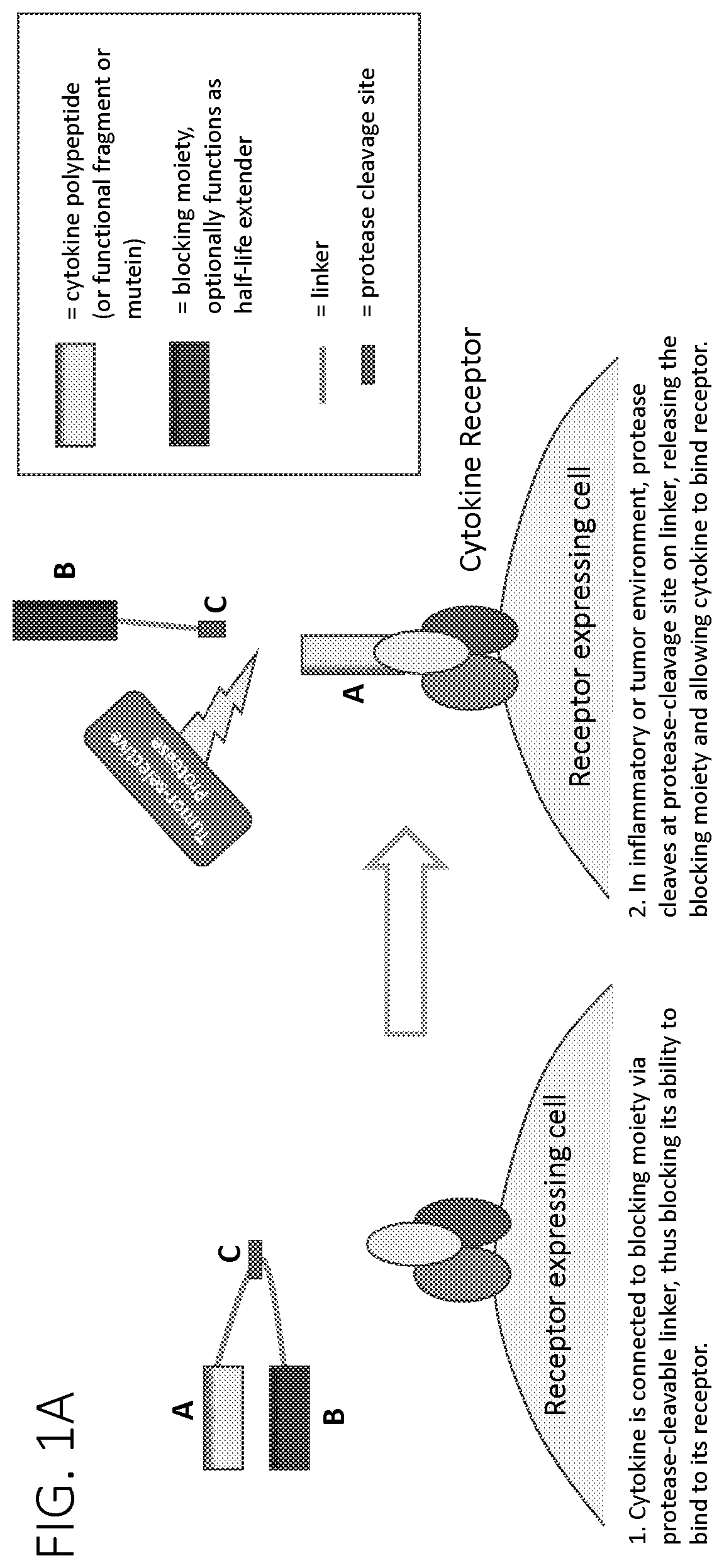
A is a schematic illustrating a protease-activated cytokine or chemokine that includes a blocking moiety. The blocking moiety may optionally function as a serum half-life extending domain. To the left of the arrow the drawing shows that a cytokine is connected to a blocking moiety via a protease-cleavable linker, thus blocking its ability to bind to its receptor. To the right of the arrow the drawing shows that in an inflammatory or tumor environment a protease cleaves at a protease-cleavage site on the linker, releasing the blocking moiety and allowing the cytokine to bind to its receptor.
B is a schematic illustrating a protease-activated cytokine or chemokine wherein HSA (blocking moiety) is directly bound to the cytokine or chemokine of interest, with a protease cleavage site between the HSA and a cytokine or chemokine of interest. To the left of the arrow the drawing shows that a cytokine is connected to a blocking moiety via a protease-cleavable linker, thus blocking its ability to bind to its receptor. To the right of the arrow the drawing shows that in an inflammatory or tumor environment, the protease cleaves at a protease-cleavage site on linker, releasing the blocking moiety and allowing the cytokine to bind to its receptor.
C is a schematic illustrating a protease-activated cytokine or chemokine wherein more than one HSA (blocking moiety) is bound directly to the molecule of interest. If desired, one or more of the HSA can be bonded to the cytokine or chemokine through a linker, such as a linker that contains a protease cleavage site. To the left of the arrow the drawing shows that a cytokine is connected to a blocking moiety via a protease-cleavable linker, thus blocking its ability to bind to its receptor. To the right of the arrow the drawing shows that in an inflammatory or tumor environment, protease cleaves at protease-cleavage site on linker, releasing the blocking moiety and allowing cytokine to bind receptor. The cytokine now has similar pK properties as compared to the native cytokine (e.g., has a short half-life).
D is a schematic illustrating a protease-activated cytokine or chemokine comprising more than one cytokine, of the same type or different type, each of which is bonded to a binding domain through a protease-cleavable linker. To the left of the arrow the drawing shows that a cytokine is connected to a blocking moiety via a protease-cleavable linker, thus blocking its ability to bind to its receptor. To the right of the arrow the drawing shows that in an inflammatory or tumor environment a protease cleaves at a protease cleavage site on linker, releasing the blocking moiety and allowing the cytokine to bind to its receptor.
is a schematic illustrating a protease-activated cytokine or chemokine comprising a cytokine or chemokine polypeptide, a blocking moiety, and a serum half-life extending domain connected by at least one protease-cleavable linker. To the left of the arrow the drawing shows that a cytokine is connected to a blocking moiety via protease-cleavable linkers, thus blocking its ability to bind to its receptor. It is also bound to a separate half-life extension element, which extends half-life in serum. To the right of the arrow the drawing shows that in an inflammatory or tumor environment a protease cleaves at a protease-cleavage site on linker, thus releasing the serum half-life extension element and the blocking moiety and allowing the cytokine to bind to its receptor. The cytokine now has similar pK properties as compared to the native cytokine (e.g., a short half-life).
is a schematic illustrating a protease-activated cytokine or chemokine comprising a cytokine or chemokine polypeptide, a blocking moiety, and a targeting domain connected by at least one protease-cleavable linker. To the left of the arrow the drawing shows that a cytokine is connected to a blocking moiety and a targeting domain via a protease-cleavable linker, thus blocking its ability to bind to its receptor. To the right of the arrow the drawing shows that in an inflammatory or tumor microenvironment a protease cleaves at the protease cleavage site in the linker, releasing the targeting domain and the blocking moiety and allowing the cytokine to bind to its receptor.
A is a schematic illustrating a protease-activated cytokine or chemokine comprising a cytokine or chemokine polypeptide, a blocking moiety, a targeting domain, and a serum half-life extending domain connected by at least one protease-cleavable linker, wherein the cytokine polypeptide and the targeting domain are connected by a protease-cleavable linker. To the left of the arrow, the drawing shows that a cytokine polypeptide is connected to targeting domain, blocking moiety, and half-life extension element via protease-cleavable linker(s), thus blocking its ability to bind to its receptor. To the right of the arrow the drawing shows that in an inflammatory or tumor environment, the protease cleaves at a protease-cleavage site on linker(s), releasing the half-life extension element, the targeting domain, and the blocking moiety, and allowing the cytokine to bind to its receptor. The cytokine now has similar pK properties as compared to the native cytokine (e.g., short half-life).
B is a schematic illustrating a protease-activated cytokine or chemokine comprising a cytokine or chemokine polypeptide, a blocking moiety, a targeting domain, and a serum half-life extending domain connected by at least one protease-cleavable linker. To the left of the arrow, the drawing shows that a cytokine is connected to targeting domain, a blocking moiety, and a half-life extension element via protease-cleavable linker(s), thus blocking its ability to bind to its receptor. To the right of the arrow the drawing shows that in an inflammatory or tumor environment, the protease cleaves at a protease-cleavage site on linker(s), releasing the half-life extension element and the blocking moiety and allowing the cytokine to bind to the receptor. The targeting moiety remains bound, keeping the cytokine in the tumor microenvironment. The cytokine now has similar pK properties as compared to the native cytokine (e.g., a short half-life).
is a schematic illustrating the structure of a variable domain of an immunoglobulin molecule. The variable domains of both light and heavy immunoglobulin chains contain three hypervariable loops, or complementarity-determining regions (CDRs). The three CDRs of a V domain (CDR1, CDR2, CDR3) cluster at one end of the beta barrel. The CDRs are the loops that connect beta strands B-C, C′-C″, and F-G of the immunoglobulin fold, whereas the bottom loops that connect beta strands AB, CC′, C″-D and E-F of the immunoglobulin fold, and the top loop that connects the D-E strands of the immunoglobulin fold are the non-CDR loops.
. Place holder
A- 7 H are a series of graphs showing activity of exemplary IL-2 fusion proteins in IL-2 dependent cytotoxic T lymphocyte cell line CTLL-2. Each graph shows results of the IL-2 proliferation assay as quantified by CellTiter-Glo® (Promega) luminescence-based cell viability assay. Each proliferation assay was performed with HSA ( B, 7 D, 7 F, 7 H ) or without ( A, 7 C, 7 E, 7 G ). Each fusion protein comprises an anti-HSA binder, and both uncleaved and MMP9 protease cleaved versions of the fusion protein were used in each assay.
A- 8 F are a series of graphs showing activity of exemplary IL-2 fusion proteins in IL-2 dependent cytotoxic T lymphocyte cell line CTLL-2. Each graph shows results of the IL-2 proliferation assay as quantified by CellTiter-Glo (Promega) luminescence-based cell viability assay. Both uncleaved and MMP9 protease cleaved versions of the fusion protein were used in each assay.
A- 9 Z are a series of graphs showing activity of exemplary IL-2 fusion proteins in IL-2 dependent cytotoxic T lymphocyte cell line CTLL-2. Each graph shows results of the IL-2 proliferation assay as quantified by CellTiter-Glo (Promega) luminescence-based cell viability assay. Both uncleaved and MMP9 protease cleaved versions of the fusion protein were used in each assay.
shows results of protein cleavage assay. Fusion protein ACP16 was run on an SDS-PAGE gel in both cleaved and uncleaved form. As can be seen in the gel, cleavage was complete.
A- 11 B are graphs depicting results from a HEK-Blue IL-12 reporter assay performed on human p40/murine p35 IL12 fusion proteins before and after protease cleavage. Constructs ACP35 ( A ) and ACP34 ( B ) were tested. Analysis was performed based on quantification of Secreted Alkaline Phosphatase (SEAP) activity using the reagent QUANTI-Blue® (InvivoGen). Results confirm that IL12 protein fusion proteins are active.
A- 12 F show a series of graphs depicting the results of HEK-blue assay of four IL-12 fusion proteins, before and after cleavage by MMP9. Analysis was performed based on quantification of Secreted Alkaline Phosphatase (SEAP) activity using the reagent QUANTI-Blue (InvivoGen). The data show greater activity in the cleaved IL12 than in the full fusion protein. Constructs tested were ACP06 ( A ), ACP07 ( C ), ACP08 ( B ), ACP09 ( D ), ACP10 ( E ), ACP11 ( F ).
shows results of protein cleavage assay. Fusion protein ACP11 was run on an SDS-PAGE gel in both cleaved and uncleaved form. As can be seen in the gel, cleavage was complete.
is a schematic which depicts a non-limiting example of an inducible cytokine protein, wherein the construct is activated upon protease cleavage of a linker attached between two subunits of the cytokine.
A- 15 D are graphs depicting results from a HEK-Blue assay performed on human p40/murine p35 IL12 fusion proteins before and after protease cleavage. Results confirm that IL12 protein fusion proteins are active. Each proliferation assay was performed with HSA or without HSA.
A- 16 F are a series of graphs showing activity of exemplary IFNγ fusion proteins compared to activity of mouse IFNγ control using WEHI 279 cell survival assay. Each assay was performed with medium containing HSA (+HSA) or not containing HSA (−HSA). Each fusion protein comprises an anti-HSA binder, and both uncleaved and MMP9 protease cleaved versions of the fusion protein were used in each assay.
A- 17 F are a series of graphs showing activity of exemplary IFNγ fusion proteins compared to activity of mouse IFNγ control using B16 reporter assay. Each assay was performed with medium containing HSA (+HSA) or not containing HSA (−HSA). Each fusion protein comprises an anti-HSA binder, and both uncleaved and MMP9 protease cleaved versions of the fusion protein were used in each assay.
A- 18 B show results of protein cleavage assay, as described in Example 2. Two constructs, ACP31 (IFN-α fusion protein; A ) and ACP55 (IFN-γ fusion protein; 18 B), were run on an SDS-PAGE gel in both cleaved and uncleaved form. As can be seen in the gel, cleavage was complete.
A- 19 B are a series of graphs ( A and 19 B ) showing activity of exemplary IFNγ fusion proteins before and after protease cleavage using B16 reporter assay. Each assay was performed with culture medium containing HSA, and each fusion protein comprises an anti-HSA binder. Both uncleaved and MMP9 protease cleaved versions of the fusion protein were used in each assay.
A- 20 B are a series of graphs ( A and B ) showing activity of exemplary IFNα fusion proteins before and after cleavage using a B16 reporter assay. Each assay was performed with medium containing HSA, and each fusion protein comprises an anti-HSA binder. Both uncleaved and MMP9 protease cleaved versions of the fusion protein were used in each assay.
A- 21 D are a series of graphs depicting the results of tumor growth studies using the MC38 cell line. A-C show the effect of IFNγ and IFNγ fusion proteins on tumor growth when injected intraperitoneally (IP) using different dosing levels and schedules (ug=micrograms, BID=twice daily, BIW=twice weekly, QW=weekly). D shows the effect of intratumoral (IT) injection of IFNγ and IL-2 on tumor growth.
A- 22 B are a series of graphs showing activity of exemplary IFNγ fusion proteins (ACP51 ( A ), and ACP52 ( B )) cleaved by MMP9 protease compared to activity of uncleaved fusion proteins using B16 reporter assay. Each fusion protein comprises an anti-HSA binder and a tumor targeting domain.
A- 23 B are a series of graphs showing activity of exemplary IFNγ fusion proteins (ACP53 and ACP54) cleaved by MMP9 protease compared to activity of uncleaved fusion proteins using B16 reporter assay. Each fusion protein comprises IFNγ directly fused to albumin.
A- 24 D are graphs depicting results from a HEK-Blue IL-2 reporter assay performed on IL-2 fusion proteins and recombinant human IL2 (Rec hIL-2). Analysis was performed based on quantification of Secreted Alkaline Phosphatase (SEAP) activity using the reagent QUANTI-Blue (InvivoGen). A shows results of IL-2 constructs ACP132 and ACP 133 with and without albumin. B shows results of IL-2 construct ACP16 cleaved and uncleaved. Results of a protein cleavage assay of ACP16 in cleaved and uncleaved forms is also depicted. C shows results of IL-2 construct ACP153 in cleaved and uncleaved forms. Results of a protein cleavage assay are also depicted. D illustrates the results from a HEK-Blue IL-2 assay using wild-type cytokine, intact fusion protein, and protease-cleaved fusion protein.
A and 25 B are two graphs showing analysis of ACP16 ( A ) and ACP124 ( B ) in a HEKBlue IL-2 reporter assay in the presence of HSA. Circles depict the activity of the uncut polypeptide, squares depict activity of the cut polypeptide. C is a graph showing results of a CTLL-2 proliferation assay. CTLL2 cells (ATCC) were plated in suspension at a concentration of 500,000 cells/well in culture media with or without 40 mg/ml human serum albumin (HSA) and stimulated with a dilution series of activatable hIL2 for 72 hours at 37° C. and 5% CO 2 . Activity of uncleaved and cleaved activatable ACP16 was tested. Cleaved activatable hIL2 was generated by incubation with active MMP9. Cell activity was assessed using a CellTiter-Glo (Promega) luminescence-based cell viability assay. Circles depict intact fusion protein, and squares depict protease-cleaved fusion protein.
A- 26 C are a series of graphs showing activity of fusion proteins in an HEKBlue IL-12 reporter assay. A depicts IL-12/STAT4 activation in a comparison of ACP11 (a human p40/murine p35 IL12 fusion protein) to ACP04 (negative control). B is a graph showing analysis of ACP91 (a chimeric IL-12 fusion protein). Squares depict activity of the uncut ACP91 polypeptide, and triangles depict the activity of the cut polypeptide (ACP91+MMP9). EC50 values for each are shown in the table. C is a graph showing analysis of ACP136 (a chimeric IL-12 fusion protein). Squares depict activity of the uncut ACP136 polypeptide, and triangles depict the activity of the cut polypeptide (ACP136+MMP9). EC50 values for each are shown in the table insert.
A- 27 F are a series of graphs showing that cleaved mouse IFNα1 polypeptides ACP31 ( A ), ACP125 ( B ), ACP126 ( C ) are active in an B16-Blue IFN-α/β reporter assay.
A- 28 N are a series of graphs depicting the activity of ACP56 ( A ), ACP57 ( B ) ACP58 ( C ), ACP59 ( D ), ACP60 ( E ), ACP61+HSA ( F ), ACP30+HSA ( G ), ACP73 ( H ), ACP70+HSA ( I ), ACP71 ( J ), ACP72 ( K ), ACP 73 ( L ), ACP74 ( M ), and ACP75 ( N ) in a B16 IFNγ reporter assay. Each fusion was tested for its activity when cut (squares) and uncut (circles).
A- 29 B are two graphs showing results of analyzing ACP31 (mouse IFNα1 fusion protein) and ACP11 (a human p40/murine p35 IL12 fusion protein) in a tumor xenograft model. A shows tumor volume over time in mice treated with 33 μg ACP31 (circles), 110 μg ACP31 (triangles), 330 μg ACP31 (diamonds), and as controls 1 μg murine wild type IFNα1 (dashed line, squares) and 10 μg mIFNα1 (dashed line, small circles). Vehicle alone is indicated by large open circles. The data show tumor volume decreasing over time in a dose-dependent manner in mice treated with ACP31. B shows tumor volume over time in mice treated with 17.5 μg ACP11 (squares), 175 μg ACP31 (triangles), 525 μg ACP31 (circles), and as controls 2 μg ACP04 (dashed line, triangles) and 10 μg ACP04 (dashed line, diamonds). Vehicle alone is indicated by large open circles. The data show tumor volume decreasing over time in a dose-dependent manner in mice treated with both ACP11 and ACP04 (a human p40/murine p35 IL12 fusion protein).
A- 30 F are a series of spaghetti plots showing tumor volume over time in a mouse xenograft tumor model in mice each treated with vehicle alone ( A ), 2 μg ACP04 ( B ), 10 μg ACP04 ( C , 17.5 μg ACP11 ( D ), 175 μg ACP11 ( E ), and 525 μg ACP11 ( F ). Each line represents a single mouse.
A- 31 C are three graphs showing results of analyzing ACP16 and ACP124 in a tumor xenograft model. A shows tumor volume over time in mice treated with 4.4 μg ACP16 (squares), 17 μg ACP16 (triangles), 70 μg ACP16 (downward triangles), 232 μg ACP16 (dark circles), and as a comparator 12 μg wild type IL-2 (dashed line, triangles) and 36 μg wild type IL-2 (dashed line, diamonds. Vehicle alone is indicated by large open circles. The data show tumor volume decreasing over time in a dose-dependent manner in mice treated with ACP16 at higher concentrations. B shows tumor volume over time in mice treated with 17 μg ACP124 (squares), 70 μg ACP124 (triangles), 230 μg ACP124 (downward triangles), and 700 μg ACP124. Vehicle alone is indicated by large open circles. C shows tumor volume over time in mice treated with 17 μg ACP16 (triangles), 70 μg ACP16 (circles), 232 μg ACP16 (dark circles), and as a comparator 17 μg ACP124 (dashed line, triangles) 70 μg ACP124 (dashed line, diamonds), 230 μg ACP124 (dashed line, diamonds). Vehicle alone is indicated by dark downward triangles. The data show tumor volume decreasing over time in a dose-dependent manner in mice treated with ACP16, but not ACP124.
A Place holder
B- 32 C are a series of spaghetti plots showing activity of fusion proteins in an MC38 mouse xenograft model corresponding to the data shown in . Each line in the plots is a single mouse.
is a graph showing tumor volume over time in a mouse xenograft model showing tumor growth in control mice (open circles) and AP16-treated mice (squares).
A- 34 D are a series of survival plots showing survival of mice over time after treatment with cleavable fusion proteins. A shows data for mice treated with vehicle alone (gray line), 17 μg ACP16 (dark line), and 17 μg ACP124 (dashed line). B shows data for mice treated with vehicle alone (gray line), 70 μg ACP16 (dark line), and 70 μg ACP124 (dashed line). C shows data for mice treated with vehicle alone (gray line), 232 μg ACP16 (dark line), and 230 μg ACP124 (dashed line). D shows data for mice treated with vehicle alone (gray line), 232 μg ACP16 (dark line), and 700 μg ACP124 (dashed line).
A- 35 B a series of spaghetti plots showing activity of fusion proteins in an MC38 mouse xenograft model. All mouse groups were given four doses total except for the highest three doses of APC132, wherein fatal toxicity was detected after 1 week/2 doses. Shown are vehicle alone, 17, 55, 70, and 230 μg ACP16, 9, 28, 36, and 119 μg ACP132, and 13, 42, 54, and 177 μg ACP21. Each line in the plots represents an individual animal.
Place holder
A- 42 E shows the results of B16 IFN reporter assays. Inducible interferon constructs of interest were tested before and after cleavage. The relevant wildtype IFN was tested as a control.
shows binding data of ACP16, ACP10, ACP11
A- 44 D depict the activity of cytokine fusion proteins constructs ACP243, ACP244, ACP243, ACP244, and ACP247.
A- 45 B shows a series of spider plots showing tumor volume over time during treatment with vehicle, IL-12, ACP11 or ACP10.
A- 46 D, 47 A- 47 D, 48 A- 48 B, 49 A- 49 I, 50 A- 50 B and 51 A- 51 C shows data (tumor volume and/or body weight) for mice treated with cytokine fusion proteins constructs.
A- 52 N, 53 A, 53 B depict the activity of cytokine fusion proteins constructs.
A- 54 N shows the results of proliferation assays comparing cut protein, uncut protein, and IL2 as a control.
A- 55 N shows the results of HekBlue IL2 reporter assays comparing activity of constructs with and without protease cleavage; IL-2 is included as a control.
. 57 A- 57 D, 58 , 59 A- 59 C, 59 E- 59 Z and 59 AA depict the activity of cytokine fusion proteins constructs.
DETAILED DESCRIPTION
Disclosed herein are methods and compositions to engineer and use constructs comprising inducible cytokines. Cytokines are potent immune agonists, which lead to them being considered promising therapeutic agents for oncology. However, cytokines proved to have a very narrow therapeutic window. Cytokines have short serum half-lives and are also considered to be highly potent. Consequently, therapeutic administration of cytokines produced undesirable systemic effects and toxicities. These were exacerbated by the need to administer large quantities of cytokine in order to achieve the desired levels of cytokine at the intended site of cytokine action (e.g., a tumor). Unfortunately, due to the biology of cytokines and inability to effectively target and control their activity, cytokines did not achieve the hoped-for clinical advantages in the treatment of tumors.
Disclosed herein are fusion proteins that overcome the toxicity and short half-life problems that have severely limited the clinical use of cytokines in oncology. The fusion proteins contain cytokine polypeptides that have receptor agonist activity. But in the context of the fusion protein, the cytokine receptor agonist activity is attenuated and the circulating half-life is extended. The fusion proteins include protease cleave sites, which are cleaved by proteases that are associated with a desired site of cytokine activity (e.g., a tumor), and are typically enriched or selectively present at the site of desired activity. Thus, the fusion proteins are preferentially (or selectively) and efficiently cleaved at the desired site of activity to limit cytokine activity substantially to the desired site of activity, such as the tumor microenvironment. Protease cleavage at the desired site of activity, such as in a tumor microenvironment, releases a form of the cytokine from the fusion protein that is much more active as a cytokine receptor agonist than the fusion protein (typically at least about 100× more active than the fusion protein). The form of the cytokine that is released upon cleavage of the fusion protein typically has a short half-life, which is often substantially similar to the half-life of the naturally occurring cytokine, further restricting cytokine activity to the tumor microenvironment. Even though the half-life of the fusion protein is extended, toxicity is dramatically reduced or eliminated because the circulating fusion protein is attenuated and active cytokine is targeted to the tumor microenvironment. The fusion proteins described herein, for the first time, enable the administration of an effective therapeutic dose of a cytokine to treat tumors with the activity of the cytokine substantially limited to the tumor microenvironment, and dramatically reduces or eliminates unwanted systemic effects and toxicity of the cytokine.
Unless otherwise defined, all terms of art, notations and other scientific terminology used herein are intended to have the meanings commonly understood by those of skill in the art to which this invention pertains. In some cases, terms with commonly understood meanings are defined herein for clarity and/or for ready reference, and the inclusion of such definitions herein should not necessarily be construed to represent a difference over what is generally understood in the art. The techniques and procedures described or referenced herein are generally well understood and commonly employed using conventional methodologies by those skilled in the art, such as, for example, the widely utilized molecular cloning methodologies described in Sambrook et al., Molecular Cloning: A Laboratory Manual 4th ed. (2012) Cold Spring Harbor Laboratory Press, Cold Spring Harbor, NY. As appropriate, procedures involving the use of commercially available kits and reagents are generally carried out in accordance with manufacturer-defined protocols and conditions unless otherwise noted.
“Cytokine” is a well-known term of art that refers to any of a class of immunoregulatory proteins (such as interleukin or interferon) that are secreted by cells especially of the immune system and that are modulators of the immune system. Cytokine polypeptides that can be used in the fusion proteins disclosed herein include, but are not limited to transforming growth factors, such as TGF-α and TGF-β (e.g., TGFbeta1, TGFbeta2, TGFbeta3); interferons, such as interferon-α, interferon-β, interferon-γ, interferon-kappa and interferon-omega; interleukins, such as IL-1, IL-1α, IL-2, IL-3, IL-4, IL-5, IL-6, IL-7, IL-8, IL-9, IL-10, IL-11, IL-12, IL-13, IL-14, IL-15, IL-16, IL-17, IL-18, IL-21 and IL-25; tumor necrosis factors, such as tumor necrosis factor alpha and lymphotoxin; chemokines (e.g., C-X-C motif chemokine 10 (CXCL10), CCL19, CCL20, CCL21), and granulocyte macrophage-colony stimulating factor (GM-CS), as well as fragments of such polypeptides that active the cognate receptors for the cytokine (i.e., functional fragments of the foregoing). “Chemokine” is a term of art that refers to any of a family of small cytokines with the ability to induce directed chemotaxis in nearby responsive cells.
Cytokines are well-known to have short serum half-lives that frequently are only a few minutes or hours. Even forms of cytokines that have altered amino acid sequences intended to extend the serum half-life yet retain receptor agonist activity typically also have short serum half-lives. As used herein, a “short-half-life cytokine” refers to a cytokine that has a substantially brief half-life circulating in the serum of a subject, such as a serum half-life that is less than 10, less than 15, less than 30, less than 60, less than 90, less than 120, less than 240, or less than 480 minutes. As used herein, a short half-life cytokine includes cytokines which have not been modified in their sequence to achieve a longer than usual half-life in the body of a subject and polypeptides that have altered amino acid sequences intended to extend the serum half-life yet retain receptor agonist activity. This latter case is not meant to include the addition of heterologous protein domains, such as a bona fide half-life extension element, such as serum albumin.
“Sortases” are transpeptidases that modify proteins by recognizing and cleaving a carboxyl-terminal sorting signal embedded in or terminally attached to a target protein or peptide. Sortase A catalyzes the cleavage of the LPXTG motif (SEQ ID NO.: 442) (where X is any standard amino acid) between the Thr and Gly residue on the target protein, with transient attachment of the Thr residue to the active site Cys residue on the enzyme, forming an enzyme-thioacyl intermediate. To complete transpeptidation and create the peptide-monomer conjugate, a biomolecule with an N-terminal nucleophilic group, typically an oligoglycine motif, attacks the intermediate, displacing Sortase A and joining the two molecules.
As used herein, the term “steric blocker” refers to a polypeptide or polypeptide moiety that can be covalently bonded to a cytokine polypeptide directly or indirectly through other moieties such as linkers, for example in the form of a chimeric polypeptide (fusion protein), but otherwise does not covalently bond to the cytokine polypeptide. A steric blocker can non-covalently bond to the cytokine polypeptide, for example though electrostatic, hydrophobic, ionic or hydrogen bonding. A steric blocker typically inhibits or blocks the activity of the cytokine moiety due to its proximity to the cytokine moiety and comparative size. A steric blocker may also block by virtue of recruitment of a large protein binding partner. An example of this is an antibody which binds to serum albumin; while the antibody itself may or may not be large enough to block activation or binding on its own, recruitment of albumin allows for sufficient steric blocking.
As used and described herein, a “half-life extension element” is a part of the chimeric polypeptide that increases the serum half-life and improve pK, for example, by altering its size (e.g., to be above the kidney filtration cutoff), shape, hydrodynamic radius, charge, or parameters of absorption, biodistribution, metabolism, and elimination.
As used herein, the terms “activatable,” “activate,” “induce,” and “inducible” refer to the ability of a protein, i.e. a cytokine, that is part of a fusion protein, to bind its receptor and effectuate activity upon cleavage of additional elements from the fusion protein.
As used herein, “plasmids” or “viral vectors” are agents that transport the disclosed nucleic acids into the cell without degradation and include a promoter yielding expression of the nucleic acid molecule and/or polypeptide in the cells into which it is delivered.
As used herein, the terms “peptide”, “polypeptide”, or “protein” are used broadly to mean two or more amino acids linked by a peptide bond. Protein, peptide, and polypeptide are also used herein interchangeably to refer to amino acid sequences. It should be recognized that the term polypeptide is not used herein to suggest a particular size or number of amino acids comprising the molecule and that a peptide of the invention can contain up to several amino acid residues or more.
As used throughout, “subject” can be a vertebrate, more specifically a mammal (e.g. a human, horse, cat, dog, cow, pig, sheep, goat, mouse, rabbit, rat, and guinea pig), birds, reptiles, amphibians, fish, and any other animal. The term does not denote a particular age or sex. Thus, adult and newborn subjects, whether male or female, are intended to be covered.
As used herein, “patient” or “subject” may be used interchangeably and can refer to a subject with a disease or disorder (e.g. cancer). The term patient or subject includes human and veterinary subjects.
As used herein the terms “treatment”, “treat”, or “treating” refers to a method of reducing the effects of a disease or condition or symptom of the disease or condition. Thus, in the disclosed method, treatment can refer to at least about 10%, at least about 20%, at least about 30%, at least about 40%, at least about 50%, at least about 60%, at least about 70%, at least about 80%, at least about 90%, or substantially complete reduction in the severity of an established disease or condition or symptom of the disease or condition. For example, a method for treating a disease is considered to be a treatment if there is a 10% reduction in one or more symptoms of the disease in a subject as compared to a control. Thus, the reduction can be a 10%, 20%, 30%, 40%, 50%, 60%, 70%, 80%, 90%, 100%, or any percent reduction in between 10% and 100% as compared to native or control levels. It is understood that treatment does not necessarily refer to a cure or complete ablation of the disease, condition, or symptoms of the disease or condition.
As used herein, the terms “prevent”, “preventing”, and “prevention” of a disease or disorder refers to an action, for example, administration of the chimeric polypeptide or nucleic acid sequence encoding the chimeric polypeptide, that occurs before or at about the same time a subject begins to show one or more symptoms of the disease or disorder, which inhibits or delays onset or exacerbation of one or more symptoms of the disease or disorder.
As used herein, references to “decreasing”, “reducing”, or “inhibiting” include a change of at least about 10%, of at least about 20%, of at least about 30%, of at least about 40%, of at least about 50%, of at least about 60%, of at least about 70%, of at least about 80%, of at least about 90% or greater as compared to a suitable control level. Such terms can include but do not necessarily include complete elimination of a function or property, such as agonist activity.
An “attenuated cytokine receptor agonist” is a cytokine receptor agonist that has decreased receptor agonist activity as compared to the cytokine receptor's naturally occurring agonist. An attenuated cytokine agonist may have at least about 10×, at least about 50×, at least about 100×, at least about 250×, at least about 500×, at least about 1000× or less agonist activity as compared to the receptor's naturally occurring agonist. When a fusion protein that contains a cytokine polypeptide as described herein is described as “attenuated” or having “attenuated activity”, it is meant that the fusion protein is an attenuated cytokine receptor agonist.
An “intact fusion protein” is a fusion protein in which no domain has been removed, for example by protease cleavage. A domain may be removable by protease cleavage or other enzymatic activity, but when the fusion protein is “intact”, this has not occurred.
As used herein “moiety” refers to a portion of a molecule that has a distinct function within that molecule, and that function may be performed by that moiety in the context of another molecule. A moiety may be a chemical entity with a particular function, or a portion of a biological molecule with a particular function. For example, a “blocking moiety” within a fusion protein is a portion of the fusion protein which is capable of blocking the activity of some or all of the fusion polypeptide. This may be a protein domain, such as serum albumin. Blocking may be accomplished by a steric blocker or a specific blocker. A steric blocker blocks by virtue of size and position and not based upon specific binding; an examples is serum albumin. A specific blocker blocks by virtue of specific interactions with the moiety to be blocked. A specific blocker must be tailored to the particular cytokine or active domain; a steric blocker can be used regardless of the payload, as long as it is large enough.
In general, the therapeutic use of cytokines is strongly limited by their systemic toxicity. TNF, for example, was originally discovered for its capacity of inducing the hemorrhagic necrosis of some tumors, and for its in vitro cytotoxic effect on different tumoral lines, but it subsequently proved to have strong pro-inflammatory activity, which can, in case of overproduction conditions, dangerously affect the human body. As the systemic toxicity is a fundamental problem with the use of pharmacologically active amounts of cytokines in humans, novel derivatives and therapeutic strategies are now under evaluation, aimed at reducing the toxic effects of this class of biological effectors while keeping their therapeutic efficacy.
IL-2 exerts both stimulatory and regulatory functions in the immune system and is, along with other members of the common γ chain (γc) cytokine family, central to immune homeostasis. IL-2 mediates its action by binding to IL-2 receptors (IL-2R), consisting of either trimeric receptors made of IL-2Rα (CD25), IL-2Rβ (CD122), and IL-2Rγ (γc, CD132) chains or dimeric βγ IL-2Rs (1, 3). Both IL-2R variants are able to transmit signal upon IL-2 binding. However, trimeric αβγ IL-2Rs have a roughly 10-100 times higher affinity for IL-2 than dimeric βγ IL-2Rs (3), implicating that CD25 confers high-affinity binding of IL-2 to its receptor but is not crucial for signal transduction. Trimeric IL-2Rs are found on activated T cells and CD4+ forkhead box P3 (FoxP3)+ T regulatory cells (Treg), which are sensitive to IL-2 in vitro and in vivo. Conversely, antigen-experienced (memory) CD8+, CD44 high memory-phenotype (MP) CD8+, and natural killer (NK) cells are endowed with high levels of dimeric βγ IL-2Rs, and these cells also respond vigorously to IL-2 in vitro and in vivo.
Expression of the high-affinity IL-2R is critical for endowing T cells to respond to low concentrations of IL-2 that is transiently available in vivo. IL-2Rα expression is absent on naive and memory T cells but is induced after antigen activation. IL-2Rβ is constitutively expressed by NK, NKT, and memory CD8+ T cells but is also induced on naive T cells after antigen activation. γc is much less stringently regulated and is constitutively expressed by all lymphoid cells. Once the high-affinity IL-2R is induced by antigen, IL-2R signaling upregulates the expression of IL-2Rα in part through Stat5-dependent regulation of Il2ra transcription (Kim et al., 2001). This process represents a mechanism to maintain expression of the high-affinity IL-2R and sustain IL-2 signaling while there remains a source of IL-2.
IL-2 is captured by IL-2Rα through a large hydrophobic binding surface surrounded by a polar periphery that results in a relatively weak interaction (Kd 10-8 M) with rapid on-off binding kinetics. However, the IL-2Rα-IL-2 binary complex leads to a very small conformational change in IL-2 that promotes association with IL-2Rβ through a distinct polar interaction between IL-2 and IL-2Rβ. The pseudo-high affinity of the IL2/α/β trimeric complex (i.e. Kd˜300 pM) clearly indicates that the trimeric complex is more stable than either IL2 bound to the α chain alone (Kd=10 nM) or to the β chain alone (Kd=450 nM) as shown by Ciardelli's data. In any event, the IL2/α/β trimer then recruits the γ chain into the quaternary complex capable of signaling, which is facilitated by the large composite binding site on the IL2-bound β chain for the γ chain.
In other words, the ternary IL-2Rα-IL-2Rβ-IL-2 complex then recruits γc through a weak interaction with IL-2 and a stronger interaction with IL-2Rβ to produce a stable quaternary high-affinity IL-2R (Kd 10-11 M which is 10 pM). The formation of the high-affinity quaternary IL-2-IL-2R complex leads to signal transduction through the tyrosine kinases Jak1 and Jak3, which are associated with IL-2Rβ and γc, respectively (Nelson and Willerford, 1998). The quaternary IL-2-IL-2R complex is rapidly internalized, where IL-2, IL-2Rβ, and γc are rapidly degraded, but IL-2Rα is recycled to the cell surface (Hémar et al., 1995; Yu and Malek, 2001). Thus, those functional activities that require sustained IL-2R signaling require a continued source of IL-2 to engage IL-2Rα and form additional IL-2-IL-2R signaling complexes.
Interleukin-15 (IL-15), another member of the 4-alpha-helix bundle family of cytokines, has also emerged as an immunomodulator for the treatment of cancer. IL-15 is initially captured via IL-15Rα, which is expressed on antigen-presenting dendritic cells, monocytes and macrophages. IL-15 exhibits broad activity and induces the differentiation and proliferation of T, B and natural killer (NK) cells via signaling through the IL-15/IL-2-R-β (CD122) and the common γ chain (CD132). It also enhances cytolytic activity of CD8+ T cells and induces long-lasting antigen-experienced CD8+CD44 memory T cells. IL-15 stimulates differentiation and immunoglobulin synthesis by B cells and induces maturation of dendritic cells. It does not stimulate immunosuppressive T regulatory cells (Tregs). Thus, boosting IL-15 activity selectively in the tumor micro-environment could enhance innate and specific immunity and fight tumors (Waldmann et al., 2012). IL-15 was initially identified for its ability to stimulate T cell proliferation in an IL-2-like manner through common receptor components (IL-2R/15Rβ-γc) and signaling through JAK1/JAK3 and STAT3/STAT5. Like IL-2, IL-15 has been shown to stimulate proliferation of activated CD4−CD8−, CD4+CD8+, CD4+ and CD8+ T cells as well as facilitate the induction of cytotoxic T-lymphocytes, and the generation, proliferation and activation of NK cells (Waldmann et al., 1999). However, unlike IL-2 which is required to maintain forkhead box P3 (FOXP3)-expressing CD4+CD25+ Treg cells and for the retention of these cells in the periphery, IL-15 has little effect on Tregs (Berger et al., 2009). This is important as FOXP3-expressing CD4+CD25+ Tregs inhibit effector T cells, thereby inhibiting immune responses including those directed against the tumor. IL-2 also has a crucial role in initiating activation induced cell death (AICD), a process that leads to the elimination of self-reactive T cells, whereas IL-15 is an anti-apoptotic factor for T cells (Marks-Konczalik et al., 2000). IL-15 co-delivered with HIV peptide vaccines has been shown to overcome CD4+ T cell deficiency by promoting longevity of antigen-specific CD8+ T cells and blocking TRAIL-mediated apoptosis (Oh et al., 2008). Furthermore, IL-15 promotes the long-term maintenance of CD8+CD44hi memory T cells (Kanegane et al., 1996).
The importance of IL-15 and IL-15Rα to T and NK cell development is further highlighted by the phenotype of IL-15Rα −/− and IL-15 −/− mice. Knockout mice demonstrate decreased numbers of total CD8+ T cells, and are deficient in memory-phenotype CD8+ T cells, NK cells, NK/T cells and some subsets of intestinal intraepithelial lymphocytes, indicating that IL-15 provides essential positive homeostatic functions for these subsets of cells (Lodolce et al., 1996; Kennedy et al., 1998). The similarities in the phenotypes of these two strains of knockout mice suggest the importance of IL-15Rα in maintaining physiologically relevant IL-15 signals.
IL-15 is presented in trans by the IL-15 receptor alpha-chain to the IL-15Rβγc complex displayed on the surface of T cells and natural killer (NK) cells (Han et al., 2011). The IL-15Rα-chain plays a role of chaperone protein, stabilizes, and increases IL-15 activity (Desbois et al., 2016). It has been shown that exogenous IL-15 may have a limited impact on patients with cancer due to its dependency on IL-15Rα frequently downregulated in cancer patients. Therefore, the fusion protein RLI, composed of the sushi+ domain of IL15Rα coupled via a linker to IL-15, has been suggested as an alternative approach to IL15 therapy (Bessard et al., 2009). It was found that administration of soluble IL-15/IL-15Rα complexes greatly enhanced IL-15 serum half-life and bioavailability in vivo (Stoklasek et al., 2010).
In addition to the effects on T and NK cells, IL-15 also has several effects on other components of the immune system. IL-15 protects neutrophils from apoptosis, modulates phagocytosis and stimulates the secretion of IL-8 and IL-1R antagonist. It functions through the activation of JAK2, p38 and ERK1/2 MAPK, Syk kinase and the NF-kB transcriptional factor (Pelletier et al., 2002). In mast cells, IL-15 can act as a growth factor and an inhibitor of apoptosis. In these cells IL-15 activates the JAK2/STAT5 pathway without the requirement of γc binding (Tagaya et al., 1996). IL-15 also induces B lymphocyte proliferation and differentiation, and increases immunoglobulin secretion (Armitage et al., 1995). It also prevents Fas-mediated apoptosis and allows induction of antibody responses partially independent of CD4-help (Demerci et al., 2004; Steel et al., 2010). Monocytes, macrophages and dendritic cells effectively transcribe and translate IL-15. They also respond to IL-15 stimulation. Macrophages respond by increasing phagocytosis, inducing IL-8, IL-12 and MCP-1 expression, and secreting IL-6, IL-8 and TNF α (Budagian et al., 2006). Dendritic cells incubated with IL-15 demonstrate maturation with increased CD83, CD86, CD40, and MHC class II expression, are also resistant to apoptosis, and show enhanced interferon-γ secretion (Anguille et al., 2009).
IL-15 has also been shown to have effects on non-hematological cells including myocytes, adipocytes, endothelial and neural cells. IL-15 has an anabolic effect on muscle and may support muscle cell differentiation (Quinn et al., 1995). It stimulates myocytes and muscle fibers to accumulate contractile protein and is able to slow muscle wasting in rats with cancer-related cachexia (Figueras et al., 2004). IL-15 has also been shown to stimulate angiogenesis (Angiolillo et al., 1997) and induce microglial growth and survival (Hanisch et al., 1997).
Interleukin-7 (IL-7), also of the IL-2/IL-15 family, is a well-characterized pleiotropic cytokine, and is expressed by stromal cells, epithelial cells, endothelial cells, fibroblasts, smooth muscle cells and keratinocytes, and following activation, by dendritic cells (Alpdogan et al., 2005). Although it was originally described as a growth and differentiation factor for precursor B lymphocytes, subsequent studies have shown that IL-7 is critically involved in T-lymphocyte development and differentiation. Interleukin-7 signaling is essential for optimal CD8 T-cell function, homeostasis and establishment of memory (Schluns et al., 2000); it is required for the survival of most T-cell subsets, and its expression has been proposed to be important for regulating T-cell numbers.
IL-7 binds to a dimeric receptor, including IL-7Rα and γc to form a ternary complex that plays fundamental roles in extracellular matrix remodeling, development, and homeostasis of T and B cells (Mazzucchelli and Durum, 2007). IL-7Rα also cross-reacts to form a ternary complex with thymic stromal lymphopoietin (TSLP) and its receptor (TSLPR), and activates the TSLP pathway, resulting in T and dendritic cell proliferation in humans and further B cell development in mice (Leonard, 2002). Tight regulation of the signaling cascades activated by the complexes are therefore crucial to normal cellular function. Under-stimulation of the IL-7 pathway caused by mutations in the IL-7Rα ectodomain inhibits T and B cell development, resulting in patients with a form of severe combined immunodeficiency (SCID) (Giliani et al., 2005; Puel et al., 1998).
IL-7 has a potential role in enhancing immune reconstitution in cancer patients following cytotoxic chemotherapy. IL-7 therapy enhances immune reconstitution and can augment even limited thymic function by facilitating peripheral expansion of even small numbers of recent thymic emigrants. Therefore, IL-7 therapy could potentially repair the immune system of patients who have been depleted by cytotoxic chemotherapy (Capitini et al., 2010).
Interleukin-12 (IL-12) is a disulfide-linked heterodimer of two separately encoded subunits (p35 and p40), which are linked covalently to give rise to the so-called bioactive heterodimeric (p70) molecule (Lieschke et al., 1997; Jana et al., 2014). Apart from forming heterodimers (IL-12 and IL-23), the p40 subunit is also secreted as a monomer (p40) and a homodimer (p40 2 ). It is known in the art that synthesis of the heterodimer as a single chain with a linker connecting the p35 to the p40 subunit preserves the full biological activity of the heterodimer. IL-12 plays a critical role in the early inflammatory response to infection and in the generation of Th1 cells, which favor cell-mediated immunity. It has been found that overproduction of IL-12 can be dangerous to the host because it is involved in the pathogenesis of a number of autoimmune inflammatory diseases (e.g. MS, arthritis, type 1 diabetes).
The IL-12 receptor (IL-12R) is a heterodimeric complex consisting of IL-12Rβ1 and IL-12Rβ2 chains expressed on the surface of activated T-cells and natural killer cells (Trinchieri et al., 2003). The IL-12Rβ1 chain binds to the IL-12p40 subunit, whereas IL-12p35 in association with IL-12Rβ2 confers an intracellular signaling ability (Benson et al., 2011). Signal transduction through IL-12R induces phosphorylation of Janus kinase (Jak2) and tyrosine kinase (Tyk2), that phosphorylate and activate signal transducer and activator of transcription (STAT)1, STAT3, STAT4, and STAT5. The specific cellular effects of IL-12 are due mainly to activation of STAT4. IL-12 induces natural killer and T-cells to produce cytokines, in particular interferon (IFN)γ, that mediate many of the proinflammatory activities of IL-12, including CD4+ T-cell differentiation toward the Th1 phenotype (Montepaone et al., 2014).
Regulatory T cells actively suppress activation of the immune system and prevent pathological self-reactivity and consequent autoimmune disease. Developing drugs and methods to selectively activate regulatory T cells for the treatment of autoimmune disease is the subject of intense research and, until the development of the present invention, which can selectively deliver active interleukins at the site of inflammation, has been largely unsuccessful. Regulatory T cells (Treg) are a class of CD4+CD25+ T cells that suppress the activity of other immune cells. Treg are central to immune system homeostasis, and play a major role in maintaining tolerance to self-antigens and in modulating the immune response to foreign antigens. Multiple autoimmune and inflammatory diseases, including Type 1 Diabetes (T1D), Systemic Lupus Erythematosus (SLE), and Graft-versus-Host Disease (GVHD) have been shown to have a deficiency of Treg cell numbers or Treg function.
Consequently, there is great interest in the development of therapies that boost the numbers and/or function of Treg cells. One treatment approach for autoimmune diseases being investigated is the transplantation of autologous, ex vivo-expanded Treg cells (Tang, Q., et al, 2013, Cold Spring Harb. Perspect. Med., 3:1-15). While this approach has shown promise in treating animal models of disease and in several early stage human clinical trials, it requires personalized treatment with the patient's own T cells, is invasive, and is technically complex. Another approach is treatment with low dose Interleukin-2 (IL-2). Treg cells characteristically express high constitutive levels of the high affinity IL-2 receptor, IL2Rαβγ, which is composed of the subunits IL2Rα (CD25), IL2Rβ (CD122), and IL2Rγ (CD132), and Treg cell growth has been shown to be dependent on IL-2 (Malek, T. R., et al., 2010, Immunity, 33:153-65).
Conversely, immune activation has also been achieved using IL-2, and recombinant IL-2 (Proleukin®) has been approved to treat certain cancers. High-dose IL-2 is used for the treatment of patients with metastatic melanoma and metastatic renal cell carcinoma with a long-term impact on overall survival.
Clinical trials of low-dose IL-2 treatment of chronic GVHD (Koreth, J., et al., 2011, N Engl J Med., 365:2055-66) and HCV-associated autoimmune vasculitis patients (Saadoun, D., et al., 2011, N Engl J Med., 365:2067-77) have demonstrated increased Treg levels and signs of clinical efficacy. New clinical trials investigating the efficacy of IL-2 in multiple other autoimmune and inflammatory diseases have been initiated. The rationale for using so-called low dose IL-2 was to exploit the high IL-2 affinity of the trimeric IL-2 receptor which is constitutively expressed on Tregs while leaving other T cells which do not express the high affinity receptor in the inactivated state. Aldesleukin (marketed as Proleukin® by Prometheus Laboratories, San Diego, CA), the recombinant form of IL-2 used in these trials, is associated with high toxicity. Aldesleukin, at high doses, is approved for the treatment of metastatic melanoma and metastatic renal cancer, but its side effects are so severe that its use is only recommended in a hospital setting with access to intensive care (Web address: www.proleukin.com/assets/pdf/proleukin.pdf).
The clinical trials of IL-2 in autoimmune diseases have employed lower doses of IL-2 in order to target Treg cells, because Treg cells respond to lower concentrations of IL-2 than many other immune cell types due to their expression of IL2R alpha (Klatzmann D, 2015 Nat Rev Immunol. 15:283-94). However, even these lower doses resulted in safety and tolerability issues, and the treatments used have employed daily subcutaneous injections, either chronically or in intermittent 5-day treatment courses. Therefore, there is a need for an autoimmune disease therapy that potentiates Treg cell numbers and function, that targets Treg cells more specifically than IL-2, that is safer and more tolerable, and that is administered less frequently.
One approach that has been suggested for improving the therapeutic index of IL-2-based therapy for autoimmune diseases is to use variants of IL-2 that are selective for Treg cells relative to other immune cells. IL-2 receptors are expressed on a variety of different immune cell types, including T cells, NK cells, eosinophils, and monocytes, and this broad expression pattern likely contributes to its pleiotropic effect on the immune system and high systemic toxicity. In particular, activated T effector cells express IL2Rαβγ, as do pulmonary epithelial cells. But, activating T effector cells runs directly counter to the goal of down-modulating and controlling an immune response, and activating pulmonary epithelial cells leads to known dose-limiting side effects of IL-2 including pulmonary edema. In fact, the major side effect of high-dose IL-2 immunotherapy is vascular leak syndrome (VLS), which leads to accumulation of intravascular fluid in organs such as lungs and liver with subsequent pulmonary edema and liver cell damage. There is no treatment of VLS other than withdrawal of IL-2. Low-dose IL-2 regimens have been tested in patients to avoid VLS, however, at the expense of suboptimal therapeutic results.
According to the literature, VLS is believed to be caused by the release of proinflammatory cytokines from IL-2-activated NK cells. However, there is some evidence that pulmonary edema results from direct binding of IL-2 to lung endothelial cells, which expressed low to intermediate levels of functional αβγ IL-2Rs. And, the pulmonary edema associated with interaction of IL-2 with lung endothelial cells was abrogated by blocking binding to CD25 with an anti-CD25 monoclonal antibody (mAb), in CD25-deficient host mice, or by the use of CD122-specific IL-2/anti-IL-2 mAb (IL-2/mAb) complexes, thus preventing VLS.
Treatment with interleukin cytokines other than IL-2 has been more limited. IL-15 displays immune cell stimulatory activity similar to that of IL-2 but without the same inhibitory effects, thus making it a promising immunotherapeutic candidate. Clinical trials of recombinant human IL-15 for the treatment of metastatic malignant melanoma or renal cell cancer demonstrated appreciable changes in immune cell distribution, proliferation, and activation and suggested potential antitumor activity (Conlon et. al., 2014). IL-15 is currently in clinical trials to treat various forms of cancer. However, IL-15 therapy is known to be associated with undesired and toxic effects, such as exacerbating certain leukemias, graft-versus-host disease, hypotension, thrombocytopenia, and liver injury. (Mishra A., et al., Cancer Cell, 2012, 22(5):645-55; Alpdogan O. et al., Blood, 2005, 105(2):866-73; Conlon K C et al., J Clin Oncol, 2015, 33(1):74-82.)
IL-7 promotes lymphocyte development in the thymus and maintains survival of naive and memory T cell homeostasis in the periphery. Moreover, it is important for the organogenesis of lymph nodes (LN) and for the maintenance of activated T cells recruited into the secondary lymphoid organs (SLOs) (Gao et. al., 2015). In clinical trials of IL-7, patients receiving IL-7 showed increases in both CD4+ and CD8+ T cells, with no significant increase in regulatory T cell numbers as monitored by FoxP3 expression (Sportes et al., 2008). In clinical trials reported in 2006, 2008 and 2010, patients with different kinds of cancers such as metastatic melanoma or sarcoma were injected subcutaneously with different doses of IL-7. Little toxicity was seen except for transient fevers and mild erythema. Circulating levels of both CD4+ and CD8+ T cells increased significantly and the number of Treg reduced. TCR repertoire diversity increased after IL-7 therapy. However, the anti-tumor activity of IL-7 was not well evaluated (Gao et. al., 2015). Results suggest that IL-7 therapy could enhance and broaden immune responses.
IL-12 is a pleiotropic cytokine, the actions of which create an interconnection between the innate and adaptive immunity. IL-12 was first described as a factor secreted from PMA-induced EBV-transformed B-cell lines. Based on its actions, IL-12 has been designated as cytotoxic lymphocyte maturation factor and natural killer cell stimulatory factor. Due to bridging the innate and adaptive immunity and potently stimulating the production of IFNγ, a cytokine coordinating natural mechanisms of anticancer defense, IL-12 seemed ideal candidate for tumor immunotherapy in humans. However, severe side effects associated with systemic administration of IL-12 in clinical investigations and the very narrow therapeutic index of this cytokine markedly tempered enthusiasm for the use of this cytokine in cancer patients (Lasek et. al., 2014). Approaches to IL-12 therapy in which delivery of the cytokine is tumor-targeted, which may diminish some of the previous issues with IL-12 therapy, are currently in clinical trials for cancers.
The direct use of IL-2 as an agonist to bind the IL-2R and modulate immune responses therapeutically has been problematic due its well-documented therapeutic risks, e.g., its short serum half-life and high toxicity. These risks have also limited the therapeutic development and use of other cytokines. New forms of cytokines that reduce these risks are needed. Disclosed herein are compositions and methods comprising IL-2 and IL-15 and other cytokines, functional fragments and muteins of cytokines as well as conditionally active cytokines designed to address these risks and provide needed immunomodulatory therapeutics.
The present invention is designed to address the shortcomings of direct IL-2 therapy and therapy using other cytokines, for example using cytokine blocking moieties, e.g. steric blocking polypeptides, serum half-life extending polypeptides, targeting polypeptides, linking polypeptides, including protease cleavable linkers, and combinations thereof. Cytokines, including interleukins (e.g., IL-2, IL-7, IL-12, IL-15, IL-18, IL-21 IL-23), interferons (IFNs, including IFNalpha, IFNbeta and IFNgamma), tumor necrosis factors (e.g., TNFalpha, lymphotoxin), transforming growth factors (e.g., TGFbeta1, TGFbeta2, TGFbeta3), chemokines (C-X-C motif chemokine 10 (CXCL10), CCL19, CCL20, CCL21), and granulocyte macrophage-colony stimulating factor (GM-CS) are highly potent when administered to patients. As used herein, “chemokine” means a family of small cytokines with the ability to induce directed chemotaxis in nearby responsive cells Cytokines can provide powerful therapy, but are accompanied by undesired effects that are difficult to control clinically and which have limited the clinical use of cytokines. This disclosure relates to new forms of cytokines that can be used in patients with reduced or eliminated undesired effects. In particular, this disclosure relates to pharmaceutical compositions including chimeric polypeptides (fusion proteins), nucleic acids encoding fusion proteins and pharmaceutical formulations of the foregoing that contain cytokines or active fragments or muteins of cytokines that have decreased cytokine receptor activating activity in comparison to the corresponding cytokine. However, under selected conditions or in a selected biological environment the chimeric polypeptides activate their cognate receptors, often with the same or higher potency as the corresponding naturally occurring cytokine. As described herein, this is typically achieved using a cytokine blocking moiety that blocks or inhibits the receptor activating function of the cytokine, active fragment or mutein thereof under general conditions but not under selected conditions, such as those present at the desired site of cytokine activity (e.g., an inflammatory site or a tumor).
The chimeric polypeptides and nucleic acids encoding the chimeric polypeptides can be made using any suitable method. For example, nucleic acids encoding a chimeric polypeptide can be made using recombinant DNA techniques, synthetic chemistry or combinations of these techniques, and expressed in a suitable expression system, such as in CHO cells. Chimeric polypeptides can similarly be made, for example by expression of a suitable nucleic acid, using synthetic or semi-synthetic chemical techniques, and the like. In some embodiments, the blocking moiety can be attached to the cytokine polypeptide via sortase-mediated conjugation. “Sortases” are transpeptidases that modify proteins by recognizing and cleaving a carboxyl-terminal sorting signal embedded in or terminally attached to a target protein or peptide. Sortase A catalyzes the cleavage of the LPXTG motif (SEQ ID No.: 442) (where X is any standard amino acid) between the Thr and Gly residue on the target protein, with transient attachment of the Thr residue to the active site Cys residue on the enzyme, forming an enzyme-thioacyl intermediate. To complete transpeptidation and create the peptide-monomer conjugate, a biomolecule with an N-terminal nucleophilic group, typically an oligoglycine motif, attacks the intermediate, displacing Sortase A and joining the two molecules.
To form the cytokine-blocking moiety fusion protein, the cytokine polypeptide is first tagged at the N-terminus with a polyglycine sequence, or alternatively, with at the C-terminus with a LPXTG motif (SEQ ID NO.: 442). The blocking moiety or other element has respective peptides attached that serve as acceptor sites for the tagged polypeptides. For conjugation to domains carrying a LPXTG (SEQ ID NO.: 442) acceptor peptide attached via its N-terminus, the polypeptide will be tagged with an N-terminal poly-glycine stretch. For conjugation to domain carrying a poly-glycine peptide attached via its C-terminus, the polypeptide will be tagged at its C-terminus with a LPXTG (SEQ ID NO.: 442) sortase recognition sequence. Recognizing poly-glycine and LPXTG (SEQ ID NO.: 442) sequences, sortase will form a peptide bond between polymer-peptide and tagged polypeptides. The sortase reaction cleaves off glycine residues as intermediates and occurs at room temperature.
A variety of mechanisms can be exploited to remove or reduce the inhibition caused by the blocking moiety. For example, the pharmaceutical compositions can include a cytokine moiety and a blocking moiety, e.g. a steric blocking moiety, with a protease cleavable linker comprising a protease cleavage site located between the cytokine and cytokine blocking moiety or within the cytokine blocking moiety. When the protease cleavage site is cleaved, the blocking moiety can dissociate from cytokine, and the cytokine can then activate cytokine receptor. A cytokine moiety can also be blocked by a specific blocking moiety, such as an antibody, which binds an epitope found on the relevant cytokine.
Any suitable linker can be used. For example, the linker can comprise glycine-glycine, a sortase-recognition motif, or a sortase-recognition motif and a peptide sequence (Gly 4 Ser) n (SEQ ID NO.: 443) or (Gly 3 Ser) n , (SEQ ID NO.: 444) wherein n is 1, 2, 3, 4 or 5. Typically, the sortase-recognition motif comprises a peptide sequence LPXTG (SEQ ID NO.: 442), where X is any amino acid. In some embodiments, the covalent linkage is between a reactive lysine residue attached to the C-terminal of the cytokine polypeptide and a reactive aspartic acid attached to the N-terminal of the blocker or other domain. In other embodiments, the covalent linkage is between a reactive aspartic acid residue attached to the N-terminal of the cytokine polypeptide and a reactive lysine residue attached to the C-terminal of said blocker or other domain.
Accordingly, as described in detail herein, the cytokine blocking moieties used can be steric blockers. As used herein, a “steric blocker” refers to a polypeptide or polypeptide moiety that can be covalently bonded to a cytokine polypeptide directly or indirectly through other moieties such as linkers, for example in the form of a chimeric polypeptide (fusion protein), but otherwise does not covalently bond to the cytokine polypeptide. A steric blocker can non-covalently bond to the cytokine polypeptide, for example though electrostatic, hydrophobic, ionic or hydrogen bonding. A steric blocker typically inhibits or blocks the activity of the cytokine moiety due to its proximity to the cytokine moiety and comparative size. The steric inhibition of the cytokine moiety can be removed by spatially separating the cytokine moiety from the steric blocker, such as by enzymatically cleaving a fusion protein that contains a steric blocker and a cytokine polypeptide at a site between the steric blocker and the cytokine polypeptide.
As described in greater detail herein, the blocking function can be combined with or due to the presence of additional functional components in the pharmaceutical composition, such as a targeting domain, a serum half-life extension element, and protease-cleavable linking polypeptides. For example, a serum half-life extending polypeptide can also be a steric blocker.
In the interest of presenting a concise disclosure of the full scope of the invention, aspects of the invention are described in detail using the cytokine IL-2 as an exemplary cytokine. However, the invention and this disclosure are not limited to IL-2. It will be clear to a person of skill in the art that this disclosure, including the disclosed methods, polypeptides and nucleic acids, adequately describes and enables the use of other cytokines, fragments and muteins, such as IL-2, IL-7, IL-12, IL-15, IL-18, IL-21 IL-23, IFNalpha, IFNbeta, IFNgamma, TNFalpha, lymphotoxin, TGF-beta1, TGFbeta2, TGFbeta3, GM-CSF, CXCL10, CCL19, CCL20, CCL21 and functional fragments or muteins of any of the foregoing.
Various elements ensure the delivery and activity of IL-2 preferentially at the site of desired IL-2 activity and to severely limit systemic exposure to the interleukin via a blocking and/or a targeting strategy preferentially linked to a serum half-life extension strategy. In this serum half-life extension strategy, the blocked version of interleukin circulates for extended times (preferentially 1-2 or more weeks) but the activated version has the typical serum half-life of the interleukin.
By comparison to a serum half-life extended version, the serum half-life of IL-2 administered intravenously is only ˜10 minutes due to distribution into the total body extracellular space, which is large, ˜15 L in an average sized adult. Subsequently, IL-2 is metabolized by the kidneys with a half-life of ˜2.5 hours. (Smith, K. “Interleukin 2 immunotherapy.” Therapeutic Immunology 240 (2001)). By other measurements, IL-2 has a very short plasma half-life of 85 minutes for intravenous administration and 3.3 hours subcutaneous administration (Kirchner, G. I., et al., 1998, Br J Clin Pharmacol. 46:5-10). In some embodiments of this invention, the half-life extension element is linked to the interleukin via a linker which is cleaved at the site of action (e.g. by inflammation-specific or tumor-specific proteases) releasing the interleukin's full activity at the desired site and also separating it from the half-life extension of the uncleaved version. In such embodiments, the fully active and free interleukin would have very different pharmacokinetic (pK) properties—a half-life of hours instead of weeks. In addition, exposure to active cytokine is limited to the site of desired cytokine activity (e.g., an inflammatory site or tumor) and systemic exposure to active cytokine, and associated toxicity and side effects, are reduced.
Other cytokines envisioned in this invention have similar pharmacology (e.g. IL-15 as reported by Blood 2011 117:4787-4795; doi: doi.org/10.1182/blood-2010-10-311456) as IL-2 and accordingly, the designs of this invention address the shortcomings of using these agents directly, and provide chimeric polypeptides that can have extended half-life and/or be targeted to a site of desired activity (e.g., a site of inflammation or a tumor).
If desired, IL-2 can be engineered to bind the IL-2R complex generally or one of the three IL-2R subunits specifically with an affinity that differs from that of the corresponding wild-type IL-2, for example toto selectively activate Tregs or Teff. For example, IL-2 polypeptides that are said to have higher affinity for the trimeric form of the IL-2 receptor relative to the dimeric beta/gamma form of the 11-2 receptor in comparison to wild type IL-2 can have an amino acid sequence that includes one of the following sets of mutations with respect to SEQ ID NO:1 (a mature IL-2 protein comprising amino acids 21-153 of human IL-2 having the Uniprot Accession No. P60568-1): (a) K64R, V69A, and Q74P; (b) V69A, Q74P, and T101A; (c) V69A, Q74P, and I128T; (d) N30D, V69A, Q74P, and F103S; (e) K49E, V69A, A73V, and K76E; (f) V69A, Q74P, T101A, and T133N; (g) N30S, V69A, Q74P, and I128A; (h) V69A, Q74P, N88D, and S99P; (i) N30S, V69A, Q74P, and I128T; ( ) K9T, Q11R, K35R, V69A, and Q74P; (k) A1T, M46L, K49R, E61D, V69A, and H79R; (1) K48E, E68D, N71T, N90H, F103S, and I114V; (m) S4P, T10A, Q11R, V69A, Q74P, N88D, and T133A; (n) E15K, N30S Y31H, K35R, K48E, V69A, Q74P, and I92T; (o) N30S, E68D, V69A, N71A, Q74P, S75P, K76R, and N90H; (p) N30S, Y31C, T37A, V69A, A73V, Q74P, H79R, and I128T; (q) N26D, N29S, N30S, K54R, E67G, V69A, Q74P, and I92T; (r) K8R, Q13R, N26D, N30T, K35R, T37R, V69A, Q74P, and I92T; and (s) N29S, Y31H, K35R, T37A, K48E, V69A, N71R, Q74P, N88D, and 189V. This approach can also be applied to prepare muteins of other cytokines including interleukins (e.g., IL-2, IL-7, IL-12, IL-15, IL-18, IL-23), interferons (IFNs, including IFNalpha, IFNbeta and IFNgamma), tumor necrosis factors (e.g., TNFalpha, lymphotoxin), transforming growth factors (e.g., TGFbeta1, TGFbeta2, TGFbeta3) and granulocyte macrophage-colony stimulating factor (GM-CS). For example, muteins can be prepared that have desired binding affinity for a cognate receptor.
As noted above, any of the mutant IL-2 polypeptides disclosed herein can include the sequences described; they can also be limited to the sequences described and otherwise identical to SEQ ID NO:1. Moreover, any of the mutant IL-2 polypeptides disclosed herein can optionally include a substitution of the cysteine residue at position 125 with another residue (e.g., serine) and/or can optionally include a deletion of the alanine residue at position 1 of SEQ ID NO:1.
Another approach to improving the therapeutic index of an IL-2 based therapy is to optimize the pharmacokinetics of the molecule to maximally activate Treg cells. Early studies of IL-2 action demonstrated that IL-2 stimulation of human T cell proliferation in vitro required a minimum of 5-6 hours exposure to effective concentrations of IL-2 (Cantrell, D. A., et. al., 1984, Science, 224: 1312-1316). When administered to human patients, IL-2 has a very short plasma half-life of 85 minutes for intravenous administration and 3.3 hours subcutaneous administration (Kirchner, G. I., et al., 1998, Br J Clin Pharmacol. 46:5-10). Because of its short half-life, maintaining circulating IL-2 at or above the level necessary to stimulate T cell proliferation for the necessary duration necessitates high doses that result in peak IL-2 levels significantly above the EC50 for Treg cells or will require frequent administration. These high IL-2 peak levels can activate IL2Rβγ receptors and have other unintended or adverse effects, for example VLS as noted above. An IL-2 analog, or a multifunctional protein with IL-2 attached to a domain that enables binding to the FcRn receptor, with a longer circulating half-life than IL-2 can achieve a target drug concentration for a specified period of time at a lower dose than IL-2, and with lower peak levels. Such an IL-2 analog will therefore require either lower doses or less frequent administration than IL-2 to effectively stimulate Treg cells. Less frequent subcutaneous administration of an IL-2 drug will also be more tolerable for patients. A therapeutic with these characteristics will translate clinically into improved pharmacological efficacy, reduced toxicity, and improved patient compliance with therapy. Alternatively, IL-2 or muteins of IL-2 (herein, “IL-2*”) can be selectively targeted to the intended site of action (e.g. sites of inflammation or a tumor). This targeting can be achieved by one of several strategies, including the addition of domains to the administered agent that comprise blockers of the IL-2 (or muteins) that are cleaved away or by targeting domains or a combination of the two.
In some embodiments, IL-2* partial agonists can be tailored to bind with higher or lower affinity depending on the desired target; for example, an IL-2* can be engineered to bind with enhanced affinity to one of the receptor subunits and not the others. These types of partial agonists, unlike full agonists or complete antagonists, offer the ability to tune the signaling properties to an amplitude that elicits desired functional properties while not meeting thresholds for undesired properties. Given the differential activities of the partial agonists, a repertoire of IL-2 variants could be engineered to exhibit an even finer degree of distinctive signaling activities, ranging from almost full to partial agonism to complete antagonism.
In some embodiments, the IL-2* has altered affinity for IL-2Rα. In some embodiments, the IL-2* has a higher affinity for IL-2Rα than wild-type IL-2. In other embodiments, the IL-2* has altered affinity for IL-2Rβ. In one embodiment, IL-2* has enhanced binding affinity for IL-2Rβ, e.g., the N-terminus of IL-2Rβ, that eliminates the functional requirement for IL-2Rα. In another embodiment, an IL-2* is generated that has increased binding affinity for IL-2Rβ but that exhibited decreased binding to IL-2Rγ, and thereby is defective IL-2Rβγ heterodimerization and signaling.
Blocking moieties, described in further detail below, can also be used to favor binding to or activation of one or more receptors. In one embodiment, blocking moieties are added such that IL-2Rβγ binding or activation is blocked but IL-2Rα binding or activation is not changed. In another embodiment, blocking moieties are added such that IL-2Rα binding or activation is diminished. In another embodiment, blocking moieties are added such that binding to and or activation of all three receptors is inhibited. This blocking may be relievable by removal of the blocking moieties in a particular environment, for example by proteolytic cleavage of a linker linking one or more blocking moieties to the cytokine.
A similar approach can be applied to improve other cytokines, particularly for use as immunostimulatory agents, for example for treating cancer. For example, in this aspect, the pharmacokinetics and/or pharmacodynamics of the cytokine (e.g., IL-2, IL-7, IL-12, IL-15, IL-18, IL-21 IL-23, IFNalpha, IFNbeta and IFNgamma, TNFalpha, lymphotoxin, TGFbeta1, TGFbeta2, TGFbeta3 GM-CSF, CXCL10, CCL19, CCL20, and CCL21 can be tailored to maximally activate effector cells (e.g., effect T cells, NK cells) and/or cytotoxic immune response promoting cells (e.g., induce dendritic cell maturation) at a site of desired activity, such as in a tumor, but preferably not systemically.
Thus, provided herein are pharmaceutical compositions comprising at least one cytokine polypeptide, such as interleukins (e.g., IL-2, IL-7, IL-12, IL-15, IL-18, IL-21, IL-23), interferons (IFNs, including IFNalpha, IFNbeta and IFNgamma), tumor necrosis factors (e.g., TNFalpha, lymphotoxin), transforming growth factors (e.g., TGFbeta1, TGFbeta2, TGFbeta3), chemokines (e.g. CXCL10, CCL19, CCL20, CCL21) and granulocyte macrophage-colony stimulating factor (GM-CS) or a functional fragment or mutein of any of the foregoing. The polypeptide typically also includes at least one linker amino acid sequence, wherein the amino acid sequence is in certain embodiments capable of being cleaved by an endogenous protease. In one embodiment, the linker comprises an amino acid sequence comprising HSSKLQ (SEQ ID NO.: 25), GPLGVRG (SEQ ID NO.: 445), IPVSLRSG (SEQ ID NO.: 446), VPLSLYSG (SEQ ID NO. 447), or SGESPAYYTA (SEQ ID NO. 448). In other embodiments, the chimeric polypeptide further contains a blocking moiety, e.g. a steric blocking polypeptide moiety, capable of blocking the activity of the interleukin polypeptide. The blocking moiety, for example, can comprise a human serum albumin (HSA) binding domain or an optionally branched or multi-armed polyethylene glycol (PEG). Alternatively, the pharmaceutical composition comprises a first cytokine polypeptide or a fragment thereof, and blocking moiety, e.g. a steric blocking polypeptide moiety, wherein the blocking moiety blocks the activity of the cytokine polypeptide on the cytokine receptor, and wherein the blocking moiety in certain embodiments comprises a protease cleavable domain. In some embodiments, blockade and reduction of cytokine activity is achieved simply by attaching additional domains with very short linkers to the N or C terminus of the interleukin domain. In such embodiments, it is anticipated the blockade is relieved by protease digestion of the blocking moiety or of the short linker that tethers the blocker to the interleukin. Once the domain is clipped or is released, it will no longer be able to achieve blockade of cytokine activity.
The pharmaceutical composition e.g., chimeric polypeptide can comprise two or more cytokines, which can be the same cytokine polypeptide or different cytokine polypeptides. For example, the two or more different types of cytokines have complementary functions. In some examples, a first cytokine is IL-2 and a second cytokine is IL-12. In some embodiments, each of the two or more different types of cytokine polypeptides have activities that modulate the activity of the other cytokine polypeptides. In some examples of chimeric polypeptides that contain two cytokine polypeptides, a first cytokine polypeptide is T-cell activating, and a second cytokine polypeptide is non-T-cell-activating. In some examples of chimeric polypeptides that contain two cytokine polypeptides, a first cytokine is a chemoattractant, e.g. CXCL10, and a second cytokine is an immune cell activator.
Preferably, the cytokine polypeptides (including functional fragments) that are included in the fusion proteins disclosed herein are not mutated or engineered to alter the properties of the naturally occurring cytokine, including receptor binding affinity and specificity or serum half-life. However, changes in amino acid sequence from naturally occurring (including wild type) cytokine are acceptable to facilitate cloning and to achieve desired expression levels, for example.
Blocking Moiety
The blocking moiety can be any moiety that inhibits the ability of the cytokine to bind and/or activate its receptor. The blocking moiety can inhibit the ability of the cytokine to bind and/or activate its receptor sterically blocking and/or by noncovalently binding to the cytokine. Examples of suitable blocking moieties include the full length or a cytokine-binding fragment or mutein of the cognate receptor of the cytokine. Antibodies and fragments thereof including, a polyclonal antibody, a recombinant antibody, a human antibody, a humanized antibody a single chain variable fragment (scFv), single-domain antibody such as a heavy chain variable domain (VH), a light chain variable domain (VL) and a variable domain of camelid-type nanobody (VHH), a dAb and the like that bind the cytokine can also be used. Other suitable antigen-binding domain that bind the cytokine can also be used, include non-immunoglobulin proteins that mimic antibody binding and/or structure such as, anticalins, affilins, affibody molecules, affimers, affitins, alphabodies, avimers, DARPins, fynomers, kunitz domain peptides, monobodies, and binding domains based on other engineered scaffolds such as SpA, GroEL, fibronectin, lipocalin and CTLA4 scaffolds. Further examples of suitable blocking polypeptides include polypeptides that sterically inhibit or block binding of the cytokine to its cognate receptor. Advantageously, such moieties can also function as half-life extending elements. For example, a peptide that is modified by conjugation to a water-soluble polymer, such as PEG, can sterically inhibit or prevent binding of the cytokine to its receptor. Polypeptides, or fragments thereof, that have long serum half-lives can also be used, such as serum albumin (human serum albumin), immunoglobulin Fc, transferrin and the like, as well as fragments and muteins of such polypeptides. Antibodies and antigen-binding domains that bind to, for example, a protein with a long serum half-life such as HSA, immunoglobulin or transferrin, or to a receptor that is recycled to the plasma membrane, such as FcRn or transferrin receptor, can also inhibit the cytokine, particularly when bound to their antigen. Examples of such antigen-binding polypeptides include a single chain variable fragment (scFv), single-domain antibody such as a heavy chain variable domain (VH), a light chain variable domain (VL) and a variable domain of camelid-type nanobody (VHH), a dAb and the like. Other suitable antigen-binding domain that bind the cytokine can also be used, include non-immunoglobulin proteins that mimic antibody binding and/or structure such as, anticalins, affilins, affibody molecules, affimers, affitins, alphabodies, avimers, DARPins, fynomers, kunitz domain peptides, monobodies, and binding domains based on other engineered scaffolds such as SpA, GroEL, fibronectin, lipocalin and CTLA4 scaffolds.
In illustrative examples, when IL-2 is the cytokine in the chimeric polypeptide, the blocking moiety can be the full length or fragment or mutein of the alpha chain of IL-2 receptor (IL-2Rα) or beta (IL-2Rβ) or gamma chain of IL-2 receptor (IL-2Rγ), an anti-IL-2 single-domain antibody (dAb) or scFv, a Fab, an anti-CD25 antibody or fragment thereof, and anti-HAS dAb or scFv, and the like.
In Vivo Half-Life Extension Elements
Preferably, the chimeric polypeptides comprise an in vivo half-life extension element. Increasing the in vivo half-life of therapeutic molecules with naturally short half-lives allows for a more acceptable and manageable dosing regimen without sacrificing effectiveness. As used herein, a “half-life extension element” is a part of the chimeric polypeptide that increases the in vivo half-life and improve pK, for example, by altering its size (e.g., to be above the kidney filtration cutoff), shape, hydrodynamic radius, charge, or parameters of absorption, biodistribution, metabolism, and elimination. An exemplary way to improve the pK of a polypeptide is by expression of an element in the polypeptide chain that binds to receptors that are recycled to the plasma membrane of cells rather than degraded in the lysosomes, such as the FcRn receptor on endothelial cells and transferrin receptor. Three types of proteins, e.g., human IgGs, HSA (or fragments), and transferrin, persist for much longer in human serum than would be predicted just by their size, which is a function of their ability to bind to receptors that are recycled rather than degraded in the lysosome. These proteins, or fragments of them that retain the FcRn binding are routinely linked to other polypeptides to extend their serum half-life. In one embodiment, the half-life extension element is a human serum albumin (HSA) binding domain. HSA (SEQ ID NO: 2) may also be directly bound to the pharmaceutical compositions or bound via a short linker. Fragments of HSA may also be used. HSA and fragments thereof can function as both a blocking moiety and a half-life extension element. Human IgGs and Fc fragments can also carry out a similar function.
The serum half-life extension element can also be antigen-binding polypeptide that binds to a protein with a long serum half-life such as serum albumin, transferrin and the like. Examples of such polypeptides include antibodies and fragments thereof including, a polyclonal antibody, a recombinant antibody, a human antibody, a humanized antibody a single chain variable fragment (scFv), single-domain antibody such as a heavy chain variable domain (VH), a light chain variable domain (VL) and a variable domain of camelid-type nanobody (VHH), a dAb and the like. Other suitable antigen-binding domain include non-immunoglobulin proteins that mimic antibody binding and/or structure such as, anticalins, affilins, affibody molecules, affimers, affitins, alphabodies, avimers, DARPins, fynomers, kunitz domain peptides, monobodies, and binding domains based on other engineered scaffolds such as SpA, GroEL, fibronectin, lipocalin and CTLA4 scaffolds. Further examples of antigen-binding polypeptides include a ligand for a desired receptor, a ligand-binding portion of a receptor, a lectin, and peptides that binds to or associates with one or more target antigens.
Some preferred serum half-life extension elements are polypeptides that comprise complementarity determining regions (CDRs), and optionally non-CDR loops. Advantageously, such serum half-life extension elements can extend the serum half-life of the cytokine, and also function as inhibitors of the cytokine (e.g., via steric blocking, non-covalent interaction or combination thereof) and/or as targeting domains. In some instances, the serum half-life extension elements are domains derived from an immunoglobulin molecule (Ig molecule) or engineered protein scaffolds that mimic antibody structure and/or binding activity. The Ig may be of any class or subclass (IgG1, IgG2, IgG3, IgG4, IgA, IgE, IgM etc). A polypeptide chain of an Ig molecule folds into a series of parallel beta strands linked by loops. In the variable region, three of the loops constitute the “complementarity determining regions” (CDRs) which determine the antigen binding specificity of the molecule. An IgG molecule comprises at least two heavy (H) chains and two light (L) chains inter-connected by disulfide bonds, or an antigen binding fragment thereof. Each heavy chain is comprised of a heavy chain variable region (abbreviated herein as VH) and a heavy chain constant region. The heavy chain constant region is comprised of three domains, CH1, CH2 and CH3. Each light chain is comprised of a light chain variable region (abbreviated herein as VL) and a light chain constant region. The light chain constant region is comprised of one domain, CL. The VH and VL regions can be further subdivided into regions of hypervariability, termed complementarity determining regions (CDRs) with are hypervariable in sequence and/or involved in antigen recognition and/or usually form structurally defined loops, interspersed with regions that are more conserved, termed framework regions (FR). Each VH and VL is composed of three CDRs and four FRs, arranged from amino-terminus to carboxy-terminus in the following order: FR1, CDR1, FR2, CDR2, FR3, CDR3, FR4. In some embodiments of this disclosure, at least some or all of the amino acid sequences of FR1, FR2, FR3, and FR4 are part of the “non-CDR loop” of the binding moieties described herein. As shown in , a variable domain of an immunoglobulin molecule has several beta strands that are arranged in two sheets. The variable domains of both light and heavy immunoglobulin chains contain three hypervariable loops, or complementarity-determining regions (CDRs). The three CDRs of a V domain (CDR1, CDR2, CDR3) cluster at one end of the beta barrel. The CDRs are the loops that connect beta strands B-C, C′-C″, and F-G of the immunoglobulin fold, whereas the bottom loops that connect beta strands AB, CC′, C″-D and E-F of the immunoglobulin fold, and the top loop that connects the D-E strands of the immunoglobulin fold are the non-CDR loops. In some embodiments of this disclosure, at least some amino acid residues of a constant domain, CH1, CH2, or CH3, are part of the “non-CDR loop” of the binding moieties described herein. Non-CDR loops comprise, in some embodiments, one or more of AB, CD, EF, and DE loops of a C1-set domain of an Ig or an Ig-like molecule; AB, CC′, EF, FG, BC, and EC′ loops of a C2-set domain of an Ig or an Ig-like molecule; DE, BD, GF, A(A1A2)B, and EF loops of I(Intermediate)-set domain of an Ig or Ig-like molecule.
Within the variable domain, the CDRs are believed to be responsible for antigen recognition and binding, while the FR residues are considered a scaffold for the CDRs. However, in certain cases, some of the FR residues play an important role in antigen recognition and binding. Framework region residues that affect Ag binding are divided into two categories. The first are FR residues that contact the antigen, thus are part of the binding-site, and some of these residues are close in sequence to the CDRs. Other residues are those that are far from the CDRs in sequence, but are in close proximity to it in the 3-D structure of the molecule, e.g., a loop in heavy chain.
The binding moieties are any kinds of polypeptides. For example, in certain instances the binding moieties are natural peptides, synthetic peptides, or fibronectin scaffolds, or engineered bulk serum proteins. The bulk serum protein comprises, for example, albumin, fibrinogen, or a globulin. In some embodiments, the binding moieties are engineered scaffolds. Engineered scaffolds comprise, for example, sdAb, a scFv, a Fab, a VHH, a fibronectin type III domain, immunoglobulin-like scaffold (as suggested in Halaby et al., 1999. Prot Eng 12(7):563-571), DARPin, cystine knot peptide, lipocalin, three-helix bundle scaffold, protein G-related albumin-binding module, or a DNA or RNA aptamer scaffold.
In some cases, the serum half-life extending element comprises a binding site for a bulk serum protein. In some embodiments, the CDRs provide the binding site for the bulk serum protein. The bulk serum protein is, in some examples, a globulin, albumin, transferrin, IgG1, IgG2, IgG4, IgG3, IgA monomer, Factor XIII, Fibrinogen, IgE, or pentameric IgM. In some embodiments, the CDR form a binding site for an immunoglobulin light chain, such as an Igκ free light chain or an Ig, free light chain.
The serum half-life extension element can be any type of binding domain, including but not limited to, domains from a monoclonal antibody, a polyclonal antibody, a recombinant antibody, a human antibody, a humanized antibody. In some embodiments, the binding moiety is a single chain variable fragment (scFv), single-domain antibody such as a heavy chain variable domain (VH), a light chain variable domain (VL) and a variable domain (VHH) of camelid derived nanobody. In other embodiments, the binding moieties are non-Ig binding domains, i.e., antibody mimetic, such as anticalins, affilins, affibody molecules, affimers, affitins, alphabodies, avimers, DARPins, fynomers, kunitz domain peptides, and monobodies.
In other embodiments, the serum half-life extension element can be a water-soluble polymer or a peptide that is conjugated to a water-soluble polymer, such as PEG. “PEG,” “polyethylene glycol” and “poly(ethylene glycol)” as used herein, are interchangeable and encompass any nonpeptidic water-soluble poly(ethylene oxide). The term “PEG” also means a polymer that contains a majority, that is to say, greater than 50%, of —OCH 2 CH 2 — repeating subunits. With respect to specific forms, the PEG can take any number of a variety of molecular weights, as well as structures or geometries such as “branched,” “linear,” “forked,” “multifunctional,” and the like, to be described in greater detail below. The PEG is not limited to a particular structure and can be linear (e.g., an end capped, e.g., alkoxy PEG or a bifunctional PEG), branched or multi-armed (e.g., forked PEG or PEG attached to a polyol core), a dendritic (or star) architecture, each with or without one or more degradable linkages. Moreover, the internal structure of the PEG can be organized in any number of different repeat patterns and can be selected from the group consisting of homopolymer, alternating copolymer, random copolymer, block copolymer, alternating tripolymer, random tripolymer, and block tripolymer. PEGs can be conjugated to polypeptide and peptides through any suitable method. Typically a reactive PEG derivative, such as N-hydroxysuccinamidyl ester PEG, is reacted with a peptide or polypeptide that includes amino acids with a side chain that contains an amine, sulfhydryl, carboxylic acid or hydroxyl functional group, such as cysteine, lysine, asparagine, glutamine, theonine, tyrosine, serine, aspartic acid, and glutamic acid.
Targeting and Retention Domains
For certain applications, it may be desirable to maximize the amount of time the construct is present in its desired location in the body. This can be achieved by including one further domain in the chimeric polypeptide (fusion protein) to influence its movements within the body. For example, the chimeric nucleic acids can encode a domain that directs the polypeptide to a location in the body, e.g., tumor cells or a site of inflammation; this domain is termed a “targeting domain” and/or encode a domain that retains the polypeptide in a location in the body, e.g., tumor cells or a site of inflammation; this domain is termed a “retention domain”. In some embodiments a domain can function as both a targeting and a retention domain. In some embodiments, the targeting domain and/or retention domain are specific to a protease-rich environment. In some embodiments, the encoded targeting domain and/or retention domain are specific for regulatory T cells (Tregs), for example targeting the CCR4 or CD39 receptors. Other suitable targeting and/or retention domains comprise those that have a cognate ligand that is overexpressed in inflamed tissues, e.g., the IL-1 receptor, or the IL-6 receptor. In other embodiments, the suitable targeting and/or retention domains comprise those who have a cognate ligand that is overexpressed in tumor tissue, e.g., Epcam, CEA or mesothelin. In some embodiments, the targeting domain is linked to the interleukin via a linker which is cleaved at the site of action (e.g. by inflammation or cancer specific proteases) releasing the interleukin full activity at the desired site. In some embodiments, the targeting and/or retention domain is linked to the interleukin via a linker which is not cleaved at the site of action (e.g. by inflammation or cancer specific proteases), causing the cytokine to remain at the desired site.
Antigens of choice, in some cases, are expressed on the surface of a diseased cell or tissue, for example a tumor or a cancer cell. Antigens useful for tumor targeting and retention include but are not limited to EpCAM, EGFR, HER-2, HER-3, c-Met, FOLR1, and CEA. Pharmaceutical compositions disclosed herein, also include proteins comprising two targeting and/or retention domains that bind to two different target antigens known to be expressed on a diseased cell or tissue. Exemplary pairs of antigen binding domains include but are not limited to EGFR/CEA, EpCAM/CEA, and HER-2/HER-3.
Suitable targeting and/or retention domains include antigen-binding domains, such as antibodies and fragments thereof including, a polyclonal antibody, a recombinant antibody, a human antibody, a humanized antibody a single chain variable fragment (scFv), single-domain antibody such as a heavy chain variable domain (VH), a light chain variable domain (VL) and a variable domain of camelid-type nanobody (VHH), a dAb and the like. Other suitable antigen-binding domain include non-immunoglobulin proteins that mimic antibody binding and/or structure such as, anticalins, affilins, affibody molecules, affimers, affitins, alphabodies, avimers, DARPins, fynomers, kunitz domain peptides, monobodies, and binding domains based on other engineered scaffolds such as SpA, GroEL, fibronectin, lipocalin and CTLA4 scaffolds. Further examples of antigen-binding polypeptides include a ligand for a desired receptor, a ligand-binding portion of a receptor, a lectin, and peptides that binds to or associates with one or more target antigens.
In some embodiments, the targeting and/or retention domains specifically bind to a cell surface molecule. In some embodiments, the targeting and/or retention domains specifically bind to a tumor antigen. In some embodiments, the targeting polypeptides specifically and independently bind to a tumor antigen selected from at least one of Fibroblast activation protein alpha (FAPa), Trophoblast glycoprotein (5T4), Tumor-associated calcium signal transducer 2 (Trop2), Fibronectin EDB (EDB-FN), fibronectin EIIIB domain, CGS-2, EpCAM, EGFR, HER-2, HER-3, cMet, CEA, and FOLR1. In some embodiments, the targeting polypeptides specifically and independently bind to two different antigens, wherein at least one of the antigens is a tumor antigen selected from EpCAM, EGFR, HER-2, HER-3, cMet, CEA, and FOLR1.
The targeting and/or retention antigen can be a tumor antigen expressed on a tumor cell. Tumor antigens are well known in the art and include, for example, EpCAM, EGFR, HER-2, HER-3, c-Met, FOLR1, PSMA, CD38, BCMA, and CEA. 5T4, AFP, B7-H3, Cadherin-6, CAIX, CD117, CD123, CD138, CD166, CD19, CD20, CD205, CD22, CD30, CD33, CD352, CD37, CD44, CD52, CD56, CD70, CD71, CD74, CD79b, DLL3, EphA2, FAP, FGFR2, FGFR3, GPC3, gpA33, FLT-3, gpNMB, HPV-16 E6, HPV-16 E7, ITGA2, ITGA3, SLC39A6, MAGE, mesothelin, Muc1, Muc16, NaPi2b, Nectin-4, β-cadherin, NY-ESO-1, PRLR, PSCA, PTK7, ROR1, SLC44A4, SLTRK5, SLTRK6, STEAP1, TIM1, Trop2, WT1.
The targeting and/or retention antigen can be an immune checkpoint protein. Examples of immune checkpoint proteins include but are not limited to CD27, CD137, 2B4, TIGIT, CD155, ICOS, HVEM, CD40L, LIGHT, TIM-1, OX40, DNAM-1, PD-L1, PD1, PD-L2, CTLA-4, CD8, CD40, CEACAM1, CD48, CD70, A2AR, CD39, CD73, B7-H3, B7-H4, BTLA, IDO1, IDO2, TDO, KIR, LAG-3, TIM-3, or VISTA.
The targeting and/or retention antigen can be a cell surface molecule such as a protein, lipid or polysaccharide. In some embodiments, a targeting and/or retention antigen is a on a tumor cell, virally infected cell, bacterially infected cell, damaged red blood cell, arterial plaque cell, inflamed or fibrotic tissue cell. The targeting and/or retention antigen can comprise an immune response modulator. Examples of immune response modulator include but are not limited to granulocyte-macrophage colony stimulating factor (GM-CSF), macrophage colony stimulating factor (M-CSF), granulocyte colony stimulating factor (G-CSF), interleukin 2 (IL-2), interleukin 3 (IL-3), interleukin 12 (IL-12), interleukin 15 (IL-15), B7-1 (CD80), B7-2 (CD86), GITRL, CD3, or GITR.
The targeting and/or retention antigen can be a cytokine receptor. Examples, of cytokine receptors include but are not limited to Type I cytokine receptors, such as GM-CSF receptor, G-CSF receptor, Type I IL receptors, Epo receptor, LIF receptor, CNTF receptor, TPO receptor; Type II Cytokine receptors, such as IFN-alpha receptor (IFNAR1, IFNAR2), IFB-beta receptor, IFN-gamma receptor (IFNGR1, IFNGR2), Type II IL receptors; chemokine receptors, such as CC chemokine receptors, CXC chemokine receptors, CX3C chemokine receptors, XC chemokine receptors; tumor necrosis receptor superfamily receptors, such as TNFRSF5/CD40, TNFRSF8/CD30, TNFRSF7/CD27, TNFRSF1A/TNFR1/CD120a, TNFRSF1B/TNFR2/CD120b; TGF-beta receptors, such as TGF-beta receptor 1, TGF-beta receptor 2; Ig super family receptors, such as IL-1 receptors, CSF-1R, PDGFR (PDGFRA, PDGFRB), SCFR.
Linkers
As stated above, the pharmaceutical compositions comprise one or more linker sequences. A linker sequence serves to provide flexibility between polypeptides, such that, for example, the blocking moiety is capable of inhibiting the activity of the cytokine polypeptide. The linker sequence can be located between any or all of the cytokine polypeptide, the serum half-life extension element, and/or the blocking moiety. As described herein at least one of the linkers is protease cleavable, and contains a (one or more) cleavage site for a (one or more) desired protease. Preferably, the desired protease is enriched or selectively expressed at the desired site of cytokine activity (e.g., the tumor microenvironment). Thus, the fusion protein is preferentially or selectively cleaved at the site of desired cytokine activity.
Suitable linkers can be of different lengths, such as from 1 amino acid (e.g., Gly) to 20 amino acids, from 2 amino acids to 15 amino acids, from 3 amino acids to 12 amino acids, including 4 amino acids to 10 amino acids, amino acids to 9 amino acids, 6 amino acids to 8 amino acids, or 7 amino acids to 8 amino acids, and may be 1, 2, 3, 4, 5, 6, 7, 8, 9, 10, 11, 12, 13, 14, 15, 16, 17, 18, 19, 20, 21, 22, 23, 24, 25, 26, 27, 28, 29, 30, 31, 32, 33, 34, 35, 36, 37, 38, 39, 40, 41, 42, 43, 44, 45, 46, 47, 48, 49, 50, 51, 52, 53, 54, 55, 56, 57, 58, 59, or 60 amino acids.
The orientation of the components of the pharmaceutical composition, are largely a matter of design choice and it is recognized that multiple orientations are possible and all are intended to be encompassed by this disclosure. For example, a blocking moiety can be located C-terminally or N-terminally to a cytokine polypeptide.
Proteases known to be associated with diseased cells or tissues include but are not limited to serine proteases, cysteine proteases, aspartate proteases, threonine proteases, glutamic acid proteases, metalloproteases, asparagine peptide lyases, serum proteases, cathepsins, Cathepsin B, Cathepsin C, Cathepsin D, Cathepsin E, Cathepsin K, Cathepsin L, kallikreins, hK1, hK10, hK15, plasmin, collagenase, Type IV collagenase, stromelysin, Factor Xa, chymotrypsin-like protease, trypsin-like protease, elastase-like protease, subtilisin-like protease, actinidain, bromelain, calpain, caspases, caspase-3, Mirl-CP, papain, HIV-1 protease, HSV protease, CMV protease, chymosin, renin, pepsin, matriptase, legumain, plasmepsin, nepenthesin, metalloexopeptidases, metalloendopeptidases, matrix metalloproteases (MMP), MMP1, MMP2, MMP3, MMP8, MMP9, MMP13, MMP11, MMP14, urokinase plasminogen activator (uPA), enterokinase, prostate-specific antigen (PSA, hK3), interleukin-1β converting enzyme, thrombin, FAP (FAP-a), dipeptidyl peptidase, meprins, granzymes and dipeptidyl peptidase IV (DPPIV/CD26). Proteases capable of cleaving amino acid sequences encoded by the chimeric nucleic acid sequences provided herein can, for example, be selected from the group consisting of a prostate specific antigen (PSA), a matrix metalloproteinase (MMP), an A Disintigrin and a Metalloproteinase (ADAM), a plasminogen activator, a cathepsin, a caspase, a tumor cell surface protease, and an elastase. The MMP can, for example, be matrix metalloproteinase 2 (MMP2) or matrix metalloproteinase 9 (MMP9).
Proteases useful in the methods disclosed herein are presented in Table 1, and exemplary proteases and their cleavage site are presented in Table 1a:
TABLE 1
Proteases relevant to inflammation and cancer
Protease Specificity Other aspects
Secreted by killer T cells:
Granzyme B (grB) Cleaves after Asp Type of serine protease; strongly
residues (asp-ase) implicated in inducing perforin-dependent
target cell apoptosis
Granzyme A (grA) trypsin-like, cleaves after Type of serine protease;
basic residues
Granzyme H (grH) Unknown substrate Type of serine protease;
specificity Other granzymes are also secreted by
killer T cells, but not all are present in
humans
Caspase-8 Cleaves after Asp Type of cysteine protease; plays essential
residues role in TCR-induced cellular expansion-
exact molecular role unclear
Mucosa-associated Cleaves after arginine Type of cysteine protease; likely acts both
lymphoid tissue residues as a scaffold and proteolytically active
(MALT1) enzyme in the CBM-dependent signaling
pathway
Tryptase Targets: angiotensin I, Type of mast cell-specific serine protease;
fibrinogen, prourokinase, trypsin-like; resistant to inhibition by
TGFβ; preferentially macromolecular protease inhibitors
cleaves proteins after expressed in mammals due to their
lysine or arginine tetrameric structure, with all sites facing
residues narrow central pore; also associated with
inflammation
Associated with inflammation:
Thrombin Targets: FGF-2, Type of serine protease; modulates
HB-EGF, Osteo-pontin, activity of vascular growth factors,
PDGF, VEGF chemokines and extracellular proteins;
strengthens VEGF-induced proliferation;
induces cell migration; angiogenic factor;
regulates hemostasis
Chymase Exhibit chymotrypsin- Type of mast cell-specific serine protease
like specificity, cleaving
proteins after aromatic
amino acid residues
Carboxypeptidase A Cleaves amino acid Type of zinc-dependent metalloproteinase
(MC-CPA) residues from C-terminal
end of peptides and
proteins
Kallikreins Targets: high molecular Type of serine protease; modulate
weight relaxation response; contribute to
kininogen, pro-urokinase inflammatory response; fibrin degradation
Elastase Targets: E-cadherin, GM- Type of neutrophil serine protease;
CSF, IL-1, IL-2, IL-6, degrades ECM components; regulates
IL8, p38 MAPK , TNFα, VE- inflammatory response; activates pro-
cadherin apoptotic signaling
Cathepsin G Targets: EGF, ENA-78, Type of serine protease; degrades ECM
IL-8, MCP-1, MMP-2, components; chemo-attractant of
MT1-MMP, leukocytes; regulates inflammatory
PAI-1, RANTES, TGFβ, response; promotes apoptosis
TNFα
PR-3 Targets: ENA-78, IL-8, Type of serine protease; promotes
IL-18, JNK, p38 MAPK , inflammatory response; activates pro-
TNFα apoptotic signaling
Granzyme M (grM) Cleaves after Met and Type of serine protease; only expressed in
other long, unbranched NK cells
hydrophobic residues
Calpains Cleave between Arg and Family of cysteine proteases; calcium-
Gly dependent; activation is involved in the
process of numerous inflammation-
associated diseases
TABLE 1a
Exemplary Proteases and Protease Recognition
Sequences
Cleavage SEQ
Domain ID
Protease Sequence NO:
MMP7 KRALGLPG 3
MMP7 (DE) 8 RPLALWRS(DR) 8 4
MMP9 PR(S/T)(L/I)(S/T) 5
MMP9 LEATA 6
MMP11 GGAANLVRGG 7
MMP14 SGRIGFLRTA 8
MMP PLGLAG 9
MMP PLGLAX 10
MMP PLGC(me)AG 11
MMP ESPAYYTA 12
MMP RLQLKL 13
MMP RLQLKAC 14
MMP2, MMP9, MMP14 EP(Cit)G(Hof)YL 15
Urokinase plasminogen SGRSA 16
activator (uPA)
Urokinase plasminogen DAFK 17
activator (uPA)
Urokinase plasminogen GGGRR 18
activator (uPA)
Lysosomal Enzyme GFLG 19
Lysosomal Enzyme ALAL 20
Lysosomal Enzyme FK 21
Cathepsin B NLL 22
Cathepsin D PIC(Et)FF 23
Cathepsin K GGPRGLPG 24
Prostate Specific HSSKLQ 25
Antigen
Prostate Specific HSSKLQL 26
Antigen
Prostate Specific HSSKLQEDA 27
Antigen
Herpes Simplex Virus LVLASSSFGY 28
Protease
HIV Protease GVSQNYPIVG 29
CMV Protease GVVQASCRLA 30
Thrombin F(Pip)RS 31
Thrombin DPRSFL 32
Thrombin PPRSFL 33
Caspase-3 DEVD 34
Caspase-3 DEVDP 35
Caspase-3 KGSGDVEG 36
Interleukin 1β GWEHDG 37
converting enzyme
Enterokinase EDDDDKA 38
FAP KQEQNPGST 39
Kallikrein 2 GKAFRR 40
Plasmin DAFK 41
Plasmin DVLK 42
Plasmin DAFK 43
TOP ALLLALL 44
Provided herein are pharmaceutical compositions comprising polypeptide sequences. As with all peptides, polypeptides, and proteins, including fragments thereof, it is understood that additional modifications in the amino acid sequence of the chimeric polypeptides (amino acid sequence variants) can occur that do not alter the nature or function of the peptides, polypeptides, or proteins. Such modifications include conservative amino acid substitutions and are discussed in greater detail below.
The compositions provided herein have a desired function. The compositions are comprised of at least a cytokine polypeptide, such as IL-2, IL-7, IL-12, IL-15, IL-18, IL-21, IFNa, or IFNγ, or a chemokine, such as CXCL10, CCL19, CCL20, CCL21, a blocking moiety, e. g. a steric blocking polypeptide, and an optional serum half-life extension element, and an optional targeting polypeptide, with one or more linkers connecting each polypeptide in the composition. The first polypeptide, e.g., an IL-2 mutein, is provided to be an active agent. The blocking moiety is provided to block the activity of the interleukin. The linker polypeptide, e.g., a protease cleavable polypeptide, is provided to be cleaved by a protease that is specifically expressed at the intended target of the active agent. Optionally, the blocking moiety blocks the activity of the first polypeptide by binding the interleukin polypeptide. In some embodiments, the blocking moiety, e.g. a steric blocking peptide, is linked to the interleukin via a protease-cleavable linker which is cleaved at the site of action (e.g. by inflammation-specific or tumor-specific proteases) releasing the cytokine full activity at the desired site.
The protease cleavage site may be a naturally occurring protease cleavage site or an artificially engineered protease cleavage site. The artificially engineered protease cleavage site can be cleaved by more than one protease specific to the desired environment in which cleavage will occur, e.g. a tumor. The protease cleavage site may be cleavable by at least one protease, at least two proteases, at least three proteases, or at least four proteases.
In some embodiments, the linker comprises glycine-glycine, a sortase-recognition motif, or a sortase-recognition motif and a peptide sequence (Gly 4 Ser) n (SEQ ID NO.: 443) or (Gly 3 Ser) n , (SEQ ID NO.: 444), wherein n is 1, 2, 3, 4 or 5. In one embodiment, the sortase-recognition motif comprises a peptide sequence LPXTG (SEQ ID NO.: 442), where X is any amino acid. In one embodiment, the covalent linkage is between a reactive lysine residue attached to the C-terminal of the cytokine polypeptide and a reactive aspartic acid attached to the N-terminal of the blocking or other moiety. In one embodiment, the covalent linkage is between a reactive aspartic acid residue attached to the N-terminal of the cytokine polypeptide and a reactive lysine residue attached to the C-terminal of the blocking or other moiety.
Cleavage and Inducibility
As described herein, the activity of the cytokine polypeptide the context of the fusion protein is attenuated, and protease cleavage at the desired site of activity, such as in a tumor microenvironment, releases a form of the cytokine from the fusion protein that is much more active as a cytokine receptor agonist than the fusion protein. For example, the cytokine-receptor activating (agonist) activity of the fusion polypeptide can be at least about 10×, at least about 50×, at least about 100×, at least about 250×, at least about 500×, or at least about 1000× less than the cytokine receptor activating activity of the cytokine polypeptide as a separate molecular entity. The cytokine polypeptide that is part of the fusion protein exists as a separate molecular entity when it contains an amino acid that is substantially identical to the cytokine polypeptide and does not substantially include additional amino acids and is not associated (by covalent or non-covalent bonds) with other molecules. If necessary, a cytokine polypeptide as a separate molecular entity may include some additional amino acid sequences, such as a tag or short sequence to aid in expression and/or purification.
In other examples, the cytokine-receptor activating (agonist) activity of the fusion polypeptide is at least about 10×, at least about 50×, at least about 100×, at least about 250×, at least about 500×, or about 1000× less than the cytokine receptor activating activity of the polypeptide that contains the cytokine polypeptide that is produced by cleavage of the protease cleavable linker in the fusion protein. In other words, the cytokine receptor activating (agonist) activity of the polypeptide that contains the cytokine polypeptide that is produced by cleavage of the protease cleavable linker in the fusion protein is at least about 10×, at least about 50×, at least about 100×, at least about 250×, at least about 500×, or at least about 1000× greater than the cytokine receptor activating activity of the fusion protein.
Polypeptide Substitutions
The polypeptides described herein can include components (e.g., the cytokine, the blocking moiety) that have the same amino acid sequence of the corresponding naturally occurring protein (e.g., IL-2, IL-15, HSA) or can have an amino acid sequence that differs from the naturally occurring protein so long as the desired function is maintained. It is understood that one way to define any known modifications and derivatives or those that might arise, of the disclosed proteins and nucleic acids that encode them is through defining the sequence variants in terms of identity to specific known reference sequences. Specifically disclosed are polypeptides and nucleic acids which have at least, 70, 71, 72, 73, 74, 75, 76, 77, 78, 79, 80, 81, 82, 83, 84, 85, 86, 87, 88, 89, 90, 91, 92, 93, 94, 95, 96, 97, 98, 99 percent identity to the chimeric polypeptides provided herein. For example, provided are polypeptides or nucleic acids that have at least, 70, 71, 72, 73, 74, 75, 76, 77, 78, 79, 80, 81, 82, 83, 84, 85, 86, 87, 88, 89, 90, 91, 92, 93, 94, 95, 96, 97, 98, 99 percent identity to the sequence of any of the nucleic acids or polypeptides described herein. Those of skill in the art readily understand how to determine the identity of two polypeptides or two nucleic acids. For example, the identity can be calculated after aligning the two sequences so that the identity is at its highest level.
Another way of calculating identity can be performed by published algorithms. Optimal alignment of sequences for comparison may be conducted by the local identity algorithm of Smith and Waterman Adv. Appl. Math. 2:482 (1981), by the identity alignment algorithm of Needleman and Wunsch, J. Mol. Biol. 48:443 (1970), by the search for similarity method of Pearson and Lipman, Proc. Natl. Acad. Sci. USA 85:2444 (1988), by computerized implementations of these algorithms (GAP, BESTFIT, FASTA, and TFASTA in the Wisconsin Genetics Software Package, Genetics Computer Group, 575 Science Dr., Madison, Wis.), or by inspection.
The same types of identity can be obtained for nucleic acids by, for example, the algorithms disclosed in Zuker, Science 244:48-52 (1989); Jaeger et al., Proc. Natl. Acad. Sci. USA 86:7706-7710 (1989); Jaeger et al., Methods Enzymol. 183:281-306 (1989), which are herein incorporated by reference for at least material related to nucleic acid alignment. It is understood that any of the methods typically can be used and that in certain instances the results of these various methods may differ, but the skilled artisan understands if identity is found with at least one of these methods, the sequences would be said to have the stated identity, and be disclosed herein.
Protein modifications include amino acid sequence modifications. Modifications in amino acid sequence may arise naturally as allelic variations (e.g., due to genetic polymorphism), may arise due to environmental influence (e.g., by exposure to ultraviolet light), or may be produced by human intervention (e.g., by mutagenesis of cloned DNA sequences), such as induced point, deletion, insertion and substitution mutants. These modifications can result in changes in the amino acid sequence, provide silent mutations, modify a restriction site, or provide other specific mutations. Amino acid sequence modifications typically fall into one or more of three classes: substitutional, insertional or deletional modifications. Insertions include amino and/or carboxyl terminal fusions as well as intrasequence insertions of single or multiple amino acid residues. Insertions ordinarily will be smaller insertions than those of amino or carboxyl terminal fusions, for example, on the order of one to four residues. Deletions are characterized by the removal of one or more amino acid residues from the protein sequence. Typically, no more than about from 2 to 6 residues are deleted at any one site within the protein molecule. Amino acid substitutions are typically of single residues, but can occur at a number of different locations at once; insertions usually will be on the order of about from 1 to 10 amino acid residues; and deletions will range about from 1 to 30 residues. Deletions or insertions preferably are made in adjacent pairs, i.e. a deletion of 2 residues or insertion of 2 residues. Substitutions, deletions, insertions or any combination thereof may be combined to arrive at a final construct. The mutations must not place the sequence out of reading frame and preferably will not create complementary regions that could produce secondary mRNA structure. Substitutional modifications are those in which at least one residue has been removed and a different residue inserted in its place. Such substitutions generally are made in accordance with the following Table 2 and are referred to as conservative substitutions.
TABLE 2
Exemplary amino acid substitutions
Amino Acid Exemplary Substitutions
Ala Ser, Gly, Cys
Arg Lys, Gln, Met, Ile
Asn Gln, His, Glu, Asp
Asp Glu, Asn, Gln
Cys Ser, Met, Thr
Gln Asn, Lys, Glu, Asp
Glu Asp, Asn, Gln
Gly Pro, Ala
His Asn, Gln
Ile Leu, Val, Met
Leu Ile, Val, Met
Lys Arg, Gln, Met, Ile
Met Leu, Ile, Val
Phe Met, Leu, Tyr, Trp, His
Ser Thr, Met, Cys
Thr Ser, Met, Val
Trp Tyr, Phe
Tyr Trp, Phe, His
Val Ile, Leu, Met
Modifications, including the specific amino acid substitutions, are made by known methods. For example, modifications are made by site specific mutagenesis of nucleotides in the DNA encoding the polypeptide, thereby producing DNA encoding the modification, and thereafter expressing the DNA in recombinant cell culture. Techniques for making substitution mutations at predetermined sites in DNA having a known sequence are well known, for example M13 primer mutagenesis and PCR mutagenesis.
Modifications can be selected to optimize binding. For example, affinity maturation techniques can be used to alter binding of the scFv by introducing random mutations inside the complementarity determining regions (CDRs). Such random mutations can be introduced using a variety of techniques, including radiation, chemical mutagens or error-prone PCR. Multiple rounds of mutation and selection can be performed using, for example, phage display.
The disclosure also relates to nucleic acids that encode the chimeric polypeptides described herein, and to the use of such nucleic acids to produce the chimeric polypeptides and for therapeutic purposes. For example, the invention includes DNA and RNA molecules (e.g., mRNA, self-replicating RNA) that encode a chimeric polypeptide and to the therapeutic use of such DNA and RNA molecules.
Exemplary Compositions
Exemplary fusion proteins of the invention combine the above described elements in a variety of orientations. The orientations described in this section are meant as examples and are not to be considered limiting.
In some embodiments, the fusion protein comprises a cytokine, a blocking moiety and a half-life extension element. In some embodiments, the cytokine is positioned between the half-life extension element and the blocking moiety. In some embodiments, the cytokine is N-terminal to the blocking moiety and the half-life extension element. In some such embodiments, the cytokine is proximal to the blocking moiety; in some such embodiments, the cytokine is proximal to the half-life extension element. At least one protease-cleavable linker must be included in all embodiments, such that the cytokine may be active upon cleavage. In some embodiments, the cytokine is C-terminal to the blocking moiety and the half-life extension element. Additional elements may be attached to one another by a cleavable linker, a non-cleavable linker, or by direct fusion.
In some embodiments, the blocking domains used are capable of extending half-life, and the cytokine is positioned between two such blocking domains. In some embodiments, the cytokine is positioned between two blocking domains, one of which is capable of extending half-life.
In some embodiments, two cytokines are included in the same construct. In some embodiments, the cytokines are connected to two blocking domains each (three in total in one molecule), with a blocking domain between the two cytokine domains. In some embodiments, one or more additional half-life extension domains may be included to optimize pharmacokinetic properties. In some cases, it is beneficial to include two of the same cytokine to facilitate dimerization. An example of a cytokine that works as a dimer is IFN.
In some embodiments, three cytokines are included in the same construct. In some embodiments, the third cytokine may function to block the other two in place of a blocking domain between the two cytokines.
Preferred half-life extension elements for use in the fusion proteins are human serum albumin (HSA), an antibody or antibody fragment (e.g., scFV, dAb) which binds serum albumin, a human or humanized IgG, or a fragment of any of the foregoing. In some preferred embodiments, the blocking moiety is human serum albumin (HSA), or an antibody or antibody fragment which binds serum albumin, an antibody which binds the cytokine and prevents activation of binding or activation of the cytokine receptor, another cytokine, or a fragment of any of the foregoing. In preferred embodiments comprising an additional targeting domain, the targeting domain is an antibody which binds a cell surface protein which is enriched on the surface of cancer cells, such as EpCAM, FOLR1, and Fibronectin.
Methods of Treatment and Pharmaceutical Compositions
Further provided are methods of treating a subject with or at risk of developing an of a disease or disorder, such as proliferative disease, a tumorous disease, an inflammatory disease, an immunological disorder, an autoimmune disease, an infectious disease, a viral disease, an allergic reaction, a parasitic reaction, or graft-versus-host disease. The methods administering to a subject in need thereof an effective amount of a fusion protein as disclosed herein that is typically administered as a pharmaceutical composition. In some embodiments, the method further comprises selecting a subject with or at risk of developing such a disease or disorder. The pharmaceutical composition preferably comprises a blocked cytokine, fragment or mutein thereof that is activated at a site of inflammation or a tumor. In one embodiment, the chimeric polypeptide comprises a cytokine polypeptide, fragment or mutein thereof and a serum half-life extension element. In another embodiment, the chimeric polypeptide comprises a cytokine polypeptide, fragment or mutein thereof and a blocking moiety, e.g. a steric blocking polypeptide, wherein the steric blocking polypeptide is capable of sterically blocking the activity of the cytokine polypeptide, fragment or mutein thereof. In another embodiment, the chimeric polypeptide comprises a cytokine polypeptide, fragment or mutein thereof, a blocking moiety, and a serum half-life extension element.
Inflammation is part of the complex biological response of body tissues to harmful stimuli, such as pathogens, damaged cells, or irritants, and is a protective response involving immune cells, blood vessels, and molecular mediators. The function of inflammation is to eliminate the initial cause of cell injury, clear out necrotic cells and tissues damaged from the original insult and the inflammatory process, and to initiate tissue repair. Inflammation can occur from infection, as a symptom or a disease, e.g., cancer, atherosclerosis, allergies, myopathies, HIV, obesity, or an autoimmune disease. An autoimmune disease is a chronic condition arising from an abnormal immune response to a self-antigen. Autoimmune diseases that may be treated with the polypeptides disclosed herein include but are not limited to lupus, celiac disease, diabetes mellitus type 1, Graves disease, inflammatory bowel disease, multiple sclerosis, psoriasis, rheumatoid arthritis, and systemic lupus erythematosus.
The pharmaceutical composition can comprise one or more protease-cleavable linker sequences. The linker sequence serves to provide flexibility between polypeptides, such that each polypeptide is capable of inhibiting the activity of the first polypeptide. The linker sequence can be located between any or all of the cytokine polypeptide, fragment or mutein thereof, the blocking moiety, and serum half-life extension element. Optionally, the composition comprises, two, three, four, or five linker sequences. The linker sequence, two, three, or four linker sequences can be the same or different linker sequences. In one embodiment, the linker sequence comprises GGGGS (SEQ ID NO.: 449), GSGSGS (SEQ ID NO.: 450), or G(SGGG) 2 SGGT (SEQ ID NO.: 451). In another embodiment, the linker comprises a protease-cleavable sequence selected from group consisting of HSSKLQ (SEQ ID NO.: 25), GPLGVRG (SEQ ID NO.: 445), IPVSLRSG (SEQ ID NO.: 446), VPLSLYSG (SEQ ID NO.: 447, and SGESPAYYTA (SEQ ID NO.: 448).
In some embodiments, the linker is cleaved by a protease selected from the group consisting of a kallikrein, thrombin, chymase, carboxypeptidase A, cathepsin G, an elastase, PR-3, granzyme M, a calpain, a matrix metalloproteinase (MMP), a plasminogen activator, a cathepsin, a caspase, a tryptase, or a tumor cell surface protease.
Suitable linkers can be of different lengths, such as from 1 amino acid (e.g., Gly) to 20 amino acids, from 2 amino acids to 15 amino acids, from 3 amino acids to 12 amino acids, including 4 amino acids to 10 amino acids, amino acids to 9 amino acids, 6 amino acids to 8 amino acids, or 7 amino acids to 8 amino acids, and may be 1, 2, 3, 4, 5, 6, 7, 8, 9, 10, 11, 12, 13, 14, 15, 16, 17, 18, 19, 20, 21, 22, 23, 24, 25, 26, 27, 28, 29, 30, 31, 32, 33, 34, 35, 36, 37, 38, 39, 40, 41, 42, 43, 44, 45, 46, 47, 48, 49, 50, 51, 52, 53, 54, 55, 56, 57, 58, 59, or 60 amino acids.
Further provided are methods of treating a subject with or at risk of developing cancer. The methods comprise administering to the subject in need thereof an effective amount of a chimeric polypeptide (a fusion protein) as disclosed herein that is typically administered as a pharmaceutical composition. In some embodiments, the method further comprises selecting a subject with or at risk of developing cancer. The pharmaceutical composition preferably comprises a blocked cytokine, fragment or mutein thereof that is activated at a tumor site. Preferably, the tumor is a solid tumor. The cancer may be, but not limited to, a colon cancer, a lung cancer, a melanoma, a sarcoma, a renal cell carcinoma, and a breast cancer.
The method can further involve the administration of one or more additional agents to treat cancer, such as chemotherapeutic agents (e.g., Adriamycin, Cerubidine, Bleomycin, Alkeran, Velban, Oncovin, Fluorouracil, Thiotepa, Methotrexate, Bisantrene, Noantrone, Thiguanine, Cytaribine, Procarabizine), immuno-oncology agents (e.g., anti-PD-L1, anti-CTLA4, anti-PD-1, anti-CD47, anti-GD2), cellular therapies (e.g, CAR-T, T-cell therapy), oncolytic viruses and the like.
Provided herein are pharmaceutical formulations or compositions containing the chimeric polypeptides and a pharmaceutically acceptable carrier. The herein provided compositions are suitable for administration in vitro or in vivo. By pharmaceutically acceptable carrier is meant a material that is not biologically or otherwise undesirable, i.e., the material is administered to a subject without causing undesirable biological effects or interacting in a deleterious manner with the other components of the pharmaceutical formulation or composition in which it is contained. The carrier is selected to minimize degradation of the active ingredient and to minimize adverse side effects in the subject.
Suitable carriers and their formulations are described in Remington: The Science and Practice of Pharmacy, 21 st Edition, David B. Troy, ed., Lippicott Williams & Wilkins (2005). Typically, an appropriate amount of a pharmaceutically-acceptable salt is used in the formulation to render the formulation isotonic, although the formulate can be hypertonic or hypotonic if desired. Examples of the pharmaceutically-acceptable carriers include, but are not limited to, sterile water, saline, buffered solutions like Ringer's solution, and dextrose solution. The pH of the solution is generally about 5 to about 8 or from about 7 to 7.5. Other carriers include sustained release preparations such as semipermeable matrices of solid hydrophobic polymers containing the immunogenic polypeptides. Matrices are in the form of shaped articles, e.g., films, liposomes, or microparticles. Certain carriers may be more preferable depending upon, for instance, the route of administration and concentration of composition being administered. Carriers are those suitable for administration of the chimeric polypeptides or nucleic acid sequences encoding the chimeric polypeptides to humans or other subjects.
The pharmaceutical formulations or compositions are administered in a number of ways depending on whether local or systemic treatment is desired and on the area to be treated. The compositions are administered via any of several routes of administration, including topically, orally, parenterally, intravenously, intra-articularly, intraperitoneally, intramuscularly, subcutaneously, intracavity, transdermally, intrahepatically, intracranially, nebulization/inhalation, or by installation via bronchoscopy. In some embodiments, the compositions are administered locally (non-systemically), including intratumorally, intra-articularly, intrathecally, etc.
Preparations for parenteral administration include sterile aqueous or non-aqueous solutions, suspensions, and emulsions. Examples of non-aqueous solvents are propylene glycol, polyethylene glycol, vegetable oils such as olive oil, and injectable organic esters such as ethyl oleate. Aqueous carriers include water, alcoholic/aqueous solutions, emulsions or suspensions, including saline and buffered media. Parenteral vehicles include sodium chloride solution, Ringer's dextrose, dextrose and sodium chloride, lactated Ringer's, or fixed oils. Intravenous vehicles include fluid and nutrient replenishers, electrolyte replenishers (such as those based on Ringer's dextrose), and the like. Preservatives and other additives are optionally present such as, for example, antimicrobials, anti-oxidants, chelating agents, and inert gases and the like.
Formulations for topical administration include ointments, lotions, creams, gels, drops, suppositories, sprays, liquids, and powders. Conventional pharmaceutical carriers, aqueous, powder, or oily bases, thickeners and the like are optionally necessary or desirable.
Compositions for oral administration include powders or granules, suspension or solutions in water or non-aqueous media, capsules, sachets, or tables. Thickeners, flavorings, diluents, emulsifiers, dispersing aids or binders are optionally desirable.
Optionally, the chimeric polypeptides or nucleic acid sequences encoding the chimeric polypeptides are administered by a vector. There are a number of compositions and methods which can be used to deliver the nucleic acid molecules and/or polypeptides to cells, either in vitro or in vivo via, for example, expression vectors. These methods and compositions can largely be broken down into two classes: viral based delivery systems and non-viral based delivery systems. Such methods are well known in the art and readily adaptable for use with the compositions and methods described herein. Such compositions and methods can be used to transfect or transduce cells in vitro or in vivo, for example, to produce cell lines that express and preferably secrete the encoded chimeric polypeptide or to therapeutically deliver nucleic acids to a subject. The components of the chimeric nucleic acids disclosed herein typically are operably linked in frame to encode a fusion protein.
As used herein, plasmid or viral vectors are agents that transport the disclosed nucleic acids into the cell without degradation and include a promoter yielding expression of the nucleic acid molecule and/or polypeptide in the cells into which it is delivered. Viral vectors are, for example, Adenovirus, Adeno-associated virus, herpes virus, Vaccinia virus, Polio virus, Sindbis, and other RNA viruses, including these viruses with the HIV backbone. Also preferred are any viral families which share the properties of these viruses which make them suitable for use as vectors. Retroviral vectors, in general are described by Coffin et al., Retroviruses, Cold Spring Harbor Laboratory Press (1997), which is incorporated by reference herein for the vectors and methods of making them. The construction of replication-defective adenoviruses has been described (Berkner et al., J. Virol. 61:1213-20 (1987); Massie et al., Mol. Cell. Biol. 6:2872-83 (1986); Haj-Ahmad et al., J. Virol. 57:267-74 (1986); Davidson et al., J. Virol. 61:1226-39 (1987); Zhang et al., BioTechniques 15:868-72 (1993)). The benefit and the use of these viruses as vectors is that they are limited in the extent to which they can spread to other cell types, since they can replicate within an initial infected cell, but are unable to form new infectious viral particles. Recombinant adenoviruses have been shown to achieve high efficiency after direct, in vivo delivery to airway epithelium, hepatocytes, vascular endothelium, CNS parenchyma, and a number of other tissue sites. Other useful systems include, for example, replicating and host-restricted non-replicating vaccinia virus vectors.
The provided polypeptides and/or nucleic acid molecules can be delivered via virus like particles. Virus like particles (VLPs) consist of viral protein(s) derived from the structural proteins of a virus. Methods for making and using virus like particles are described in, for example, Garcea and Gissmann, Current Opinion in Biotechnology 15:513-7 (2004).
The provided polypeptides can be delivered by subviral dense bodies (DBs). DBs transport proteins into target cells by membrane fusion. Methods for making and using DBs are described in, for example, Pepperl-Klindworth et al., Gene Therapy 10:278-84 (2003).
The provided polypeptides can be delivered by tegument aggregates. Methods for making and using tegument aggregates are described in International Publication No. WO 2006/110728.
Non-viral based delivery methods, can include expression vectors comprising nucleic acid molecules and nucleic acid sequences encoding polypeptides, wherein the nucleic acids are operably linked to an expression control sequence. Suitable vector backbones include, for example, those routinely used in the art such as plasmids, artificial chromosomes, BACs, YACs, or PACs. Numerous vectors and expression systems are commercially available from such corporations as Novagen (Madison, Wis.), Clonetech (Pal Alto, Calif), Stratagene (La Jolla, Calif.), and Invitrogen/Life Technologies (Carlsbad, Calif.). Vectors typically contain one or more regulatory regions. Regulatory regions include, without limitation, promoter sequences, enhancer sequences, response elements, protein recognition sites, inducible elements, protein binding sequences, 5′ and 3′ untranslated regions (UTRs), transcriptional start sites, termination sequences, polyadenylation sequences, and introns. Such vectors can also be used to make the chimeric polypeptides by expression is a suitable host cell, such as CHO cells.
Preferred promoters controlling transcription from vectors in mammalian host cells may be obtained from various sources, for example, the genomes of viruses such as polyoma, Simian Virus 40 (SV40), adenovirus, retroviruses, hepatitis B virus, and most preferably cytomegalovirus (CMV), or from heterologous mammalian promoters, e.g. β-actin promoter or EF1α promoter, or from hybrid or chimeric promoters (e.g., CMV promoter fused to the β-actin promoter). Of course, promoters from the host cell or related species are also useful herein.
Enhancer generally refers to a sequence of DNA that functions at no fixed distance from the transcription start site and can be either 5′ or 3′ to the transcription unit. Furthermore, enhancers can be within an intron as well as within the coding sequence itself. They are usually between 10 and 300 base pairs (bp) in length, and they function in cis. Enhancers usually function to increase transcription from nearby promoters. Enhancers can also contain response elements that mediate the regulation of transcription. While many enhancer sequences are known from mammalian genes (globin, elastase, albumin, fetoprotein, and insulin), typically one will use an enhancer from a eukaryotic cell virus for general expression. Preferred examples are the SV40 enhancer on the late side of the replication origin, the cytomegalovirus early promoter enhancer, the polyoma enhancer on the late side of the replication origin, and adenovirus enhancers.
The promoter and/or the enhancer can be inducible (e.g. chemically or physically regulated). A chemically regulated promoter and/or enhancer can, for example, be regulated by the presence of alcohol, tetracycline, a steroid, or a metal. A physically regulated promoter and/or enhancer can, for example, be regulated by environmental factors, such as temperature and light. Optionally, the promoter and/or enhancer region can act as a constitutive promoter and/or enhancer to maximize the expression of the region of the transcription unit to be transcribed. In certain vectors, the promoter and/or enhancer region can be active in a cell type specific manner. Optionally, in certain vectors, the promoter and/or enhancer region can be active in all eukaryotic cells, independent of cell type. Preferred promoters of this type are the CMV promoter, the SV40 promoter, the β-actin promoter, the EF1α promoter, and the retroviral long terminal repeat (LTR).
The vectors also can include, for example, origins of replication and/or markers. A marker gene can confer a selectable phenotype, e.g., antibiotic resistance, on a cell. The marker product is used to determine if the vector has been delivered to the cell and once delivered is being expressed. Examples of selectable markers for mammalian cells are dihydrofolate reductase (DHFR), thymidine kinase, neomycin, neomycin analog G418, hygromycin, puromycin, and blasticidin. When such selectable markers are successfully transferred into a mammalian host cell, the transformed mammalian host cell can survive if placed under selective pressure. Examples of other markers include, for example, the E. coli lacZ gene, green fluorescent protein (GFP), and luciferase. In addition, an expression vector can include a tag sequence designed to facilitate manipulation or detection (e.g., purification or localization) of the expressed polypeptide. Tag sequences, such as GFP, glutathione S-transferase (GST), polyhistidine, c-myc, hemagglutinin, or FLAG™ tag (Kodak; New Haven, Conn.) sequences typically are expressed as a fusion with the encoded polypeptide. Such tags can be inserted anywhere within the polypeptide including at either the carboxyl or amino terminus.
As used herein, the terms peptide, polypeptide, or protein are used broadly to mean two or more amino acids linked by a peptide bond. Protein, peptide, and polypeptide are also used herein interchangeably to refer to amino acid sequences. It should be recognized that the term polypeptide is not used herein to suggest a particular size or number of amino acids comprising the molecule and that a peptide of the invention can contain up to several amino acid residues or more. As used throughout, subject can be a vertebrate, more specifically a mammal (e.g. a human, horse, cat, dog, cow, pig, sheep, goat, mouse, rabbit, rat, and guinea pig), birds, reptiles, amphibians, fish, and any other animal. The term does not denote a particular age or sex. Thus, adult and newborn subjects, whether male or female, are intended to be covered. As used herein, patient or subject may be used interchangeably and can refer to a subject with a disease or disorder (e.g. cancer). The term patient or subject includes human and veterinary subjects.
A subject at risk of developing a disease or disorder can be genetically predisposed to the disease or disorder, e.g., have a family history or have a mutation in a gene that causes the disease or disorder, or show early signs or symptoms of the disease or disorder. A subject currently with a disease or disorder has one or more than one symptom of the disease or disorder and may have been diagnosed with the disease or disorder.
The methods and agents as described herein are useful for both prophylactic and therapeutic treatment. For prophylactic use, a therapeutically effective amount of the chimeric polypeptides or chimeric nucleic acid sequences encoding the chimeric polypeptides described herein are administered to a subject prior to onset (e.g., before obvious signs of cancer or inflammation) or during early onset (e.g., upon initial signs and symptoms of cancer or inflammation). Prophylactic administration can occur for several days to years prior to the manifestation of symptoms of cancer or inflammation. Prophylactic administration can be used, for example, in the preventative treatment of subjects diagnosed with a genetic predisposition to cancer. Therapeutic treatment involves administering to a subject a therapeutically effective amount of the chimeric polypeptides or nucleic acid sequences encoding the chimeric polypeptides described herein after diagnosis or development of cancer or inflammation (e.g., an autoimmune disease). Prophylactic use may also apply when a patient is undergoing a treatment, e.g., a chemotherapy, in which inflammation is expected.
According to the methods taught herein, the subject is administered an effective amount of the agent (e.g., a chimeric polypeptide). The terms effective amount and effective dosage are used interchangeably. The term effective amount is defined as any amount necessary to produce a desired physiologic response. Effective amounts and schedules for administering the agent may be determined empirically, and making such determinations is within the skill in the art. The dosage ranges for administration are those large enough to produce the desired effect in which one or more symptoms of the disease or disorder are affected (e.g., reduced or delayed). The dosage should not be so large as to cause substantial adverse side effects, such as unwanted cross-reactions, anaphylactic reactions, and the like. Generally, the dosage will vary with the age, condition, sex, type of disease, the extent of the disease or disorder, route of administration, or whether other drugs are included in the regimen, and can be determined by one of skill in the art. The dosage can be adjusted by the individual physician in the event of any contraindications. Dosages can vary and can be administered in one or more dose administrations daily, for one or several days. Guidance can be found in the literature for appropriate dosages for given classes of pharmaceutical products.
As used herein the terms treatment, treat, or treating refers to a method of reducing the effects of a disease or condition or symptom of the disease or condition. Thus, in the disclosed method, treatment can refer to a 10%, 20%, 30%, 40%, 50%, 60%, 70%, 80%, 90%, or 100% reduction in the severity of an established disease or condition or symptom of the disease or condition. For example, a method for treating a disease is considered to be a treatment if there is a 10% reduction in one or more symptoms of the disease in a subject as compared to a control. Thus, the reduction can be a 10%, 20%, 30%, 40%, 50%, 60%, 70%, 80%, 90%, 100%, or any percent reduction in between 10% and 100% as compared to native or control levels. It is understood that treatment does not necessarily refer to a cure or complete ablation of the disease, condition, or symptoms of the disease or condition.
As used herein, the terms prevent, preventing, and prevention of a disease or disorder refers to an action, for example, administration of the chimeric polypeptide or nucleic acid sequence encoding the chimeric polypeptide, that occurs before or at about the same time a subject begins to show one or more symptoms of the disease or disorder, which inhibits or delays onset or exacerbation of one or more symptoms of the disease or disorder. As used herein, references to decreasing, reducing, or inhibiting include a change of 10%, 20%, 30%, 40%, 50%, 60%, 70%, 80%, 90% or greater as compared to a control level. Such terms can include but do not necessarily include complete elimination.
IL-2 variants have been developed that are selective for IL2Rαβγ relative to IL2Rβγ (Shanafelt, A. B., et al., 2000, Nat Biotechnol. 18:1197-202; Cassell, D. J., et. al., 2002, Curr Pharm Des., 8:2171-83). These variants have amino acid substitutions which reduce their affinity for IL2RB. Because IL-2 has undetectable affinity for IL2RG, these variants consequently have reduced affinity for the IL2Rβγ receptor complex and reduced ability to activate IL2Rβγ-expressing cells, but retain the ability to bind IL2RA and the ability to bind and activate the IL2Rαβγ receptor complex.
One of these variants, IL2/N88R (Bay 50-4798), was clinically tested as a low-toxicity version of IL-2 as an immune system stimulator, based on the hypothesis that IL2Rβγ-expressing NK cells are a major contributor to toxicity. Bay 50-4798 was shown to selectively stimulate the proliferation of activated T cells relative to NK cells, and was evaluated in phase I/II clinical trials in cancer patients (Margolin, K., et. al., 2007, Clin Cancer Res., 13:3312-9) and HIV patients (Davey, R. T., et. al., 2008, J Interferon Cytokine Res., 28:89-100). These clinical trials showed that Bay 50-4798 was considerably safer and more tolerable than aldesleukin, and also showed that it increased the levels of CD4+CD25+ T cells, a cell population enriched in Treg cells. Subsequent to these trials, research in the field more fully established the identity of Treg cells and demonstrated that Treg cells selectively express IL2Rαβγ (reviewed in Malek, T. R., et al., 2010, Immunity, 33:153-65).
In addition, mutants can be made that selectively alter the affinity for the CD25 chain relative to native 11-2.
IL-2 can be engineered to produce mutants that bind the IL-2R complex generally or the IL-2Rα subunit specifically with an affinity that differs from that of the corresponding wild-type IL-2 or of a presently available mutant (referred to as C125S, as the cysteine residue at position 125 is replaced with a serine residue).
Accordingly, the present invention features mutant interleukin-2 (IL-2*) polypeptides that include an amino acid sequence that is at least 80% identical to wild-type IL-2 (e.g., 85, 87, 90, 95, 97, 98, or 99% identical) and that bind, as compared to WT IL-2, with higher to the IL-2 trimeric receptor relative to the dimeric IL-2 receptor. Typically, the muteins will also bind an IL-2 receptor a subunit (IL-2Rα) with an affinity that is greater than the affinity with which wild type IL-2 binds the IL-2Rα. The amino acid sequence within mutant IL-2 polypeptides can vary from SEQ ID NO:1 (UniProtKB accession number P60568) by virtue of containing (or only containing) one or more amino acid substitutions, which may be considered conservative or non-conservative substitutions. Non-naturally occurring amino acids can also be incorporated. Alternatively, or in addition, the amino acid sequence can vary from SEQ ID NO:1 (which may be considered the “reference” sequence) by virtue of containing and addition and/or deletion of one or more amino acid residues. More specifically, the amino acid sequence can differ from that of SEQ ID NO:1 by virtue of a mutation at least one of the following positions of SEQ ID NO:1: 1, 4, 8, 9, 10, 11, 13, 15, 26, 29, 30, 31, 35, 37, 46, 48, 49, 54, 61, 64, 67, 68, 69, 71, 73, 74, 75, 76, 79, 88, 89, 90, 92, 99, 101, 103, 114, 125, 128, or 133 (or combinations thereof). As noted, as few as one of these positions may be altered, as may two, three, four, five, six, seven, eight, nine, ten, or 11 or more (including up to all) of the positions. For example, the amino acid sequence can differ from SEQ ID NO:1 at positions 69 and 74 and further at one or more of positions 30, 35, and 128. The amino acid sequence can also differ from SEQ ID NO:2 (as disclosed in U.S. Pat. No. 7,569,215, incorporated herein by reference) at one of the following sets of positions: (a) positions 64, 69, and 74; (b) positions 69, 74, and 101; (c) positions 69, 74, and 128; (d) positions 30, 69, 74, and 103; (e) positions 49, 69, 73, and 76; (f) positions 69, 74, 101, and 133; (g) positions 30, 69, 74, and 128; (h) positions 69, 74, 88, and 99; (i) positions 30, 69, 74, and 128; (j) positions 9, 11, 35, 69, and 74; (k) positions 1, 46, 49, 61, 69, and 79; (1) positions 48, 68, 71, 90, 103, and 114; (m) positions 4, 10, 11, 69, 74, 88, and 133; (n) positions 15, 30 31, 35, 48, 69, 74, and 92; (O) positions 30, 68, 69, 71, 74, 75, 76, and 90; (p) positions 30, 31, 37, 69, 73, 74, 79, and 128; (q) positions 26, 29, 30, 54, 67, 69, 74, and 92; (r) positions 8, 13, 26, 30, 35, 37, 69, 74, and 92; and (s) positions 29, 31, 35, 37, 48, 69, 71, 74, 88, and 89. Aside from mutations at these positions, the amino acid sequence of the mutant IL-2 polypeptide can otherwise be identical to SEQ ID NO:1. With respect to specific substitutions, the amino acid sequence can differ from SEQ ID NO:1 by virtue of having one or more of the following mutations: A1T, S4P, K8R, K9T, T10A, Q11R, Q13R, E15K, N26D, N29S, N30S, N30D, N30T, Y31H, Y31C, K35R, T37A, T37R, M46L, K48E, K49R, K49E, K54R, E61D, K64R, E67G, E68D, V69A, N71T, N71A, N71R, A73V, Q74P, S75P, K76E, K76R, H79R, N88D, I89V, N90H, I92T, S99P, T101A, F103S, I114V, I128T, I128A, T133A, or T133N. Our nomenclature is consistent with that of the scientific literature, where the single letter code of the amino acid in the wild-type or reference sequence is followed by its position within the sequence and then by the single letter code of the amino acid with which it is replaced. Thus, A1T designates a substitution of the alanine residue a position 1 with threonine. Other mutant polypeptides within the scope of the invention include those that include a mutant of SEQ ID NO:2 having substitutions at V69 (e.g. A) and Q74 (e.g., P). For example, the amino acid sequence can include one of the following sets of mutations with respect to SEQ ID NO:2: (a) K64R, V69A, and Q74P; (b) V69A, Q74P, and T101A; (c) V69A, Q74P, and I128T; (d) N30D, V69A, Q74P, and F103S; (e) K49E, V69A, A73V, and K76E; (f) V69A, Q74P, T101A, and T133N; (g) N30S, V69A, Q74P, and I128A; (h) V69A, Q74P, N88D, and S99P; (i) N30S, V69A, Q74P, and 1128T; (j) K9T, Q11R, K35R, V69A, and Q74P; (k) A1T, M46L, K49R, E61D, V69A, and H79R; (1) K48E, E68D, N71T, N90H, F103S, and I114V; (m) S4P, T10A, Q11R, V69A, Q74P, N88D, and T133A; (n) E15K, N30S Y31H, K35R, K48E, V69A, Q74P, and I92T; (o) N30S, E68D, V69A, N71A, Q74P, S75P, K76R, and N90H; (p) N30S, Y31C, T37A, V69A, A73V, Q74P, H79R, and I128T; (q) N26D, N29S, N30S, K54R, E67G, V69A, Q74P, and I92T; (r) K8R, Q13R, N26D, N30T, K35R, T37R, V69A, Q74P, and 192T; and (s) N29S, Y31H, K35R, T37A, K48E, V69A, N71R, Q74P, N88D, and I89V. SEQ ID NO:2 is disclosed in U.S. Pat. No. 7,569,215, which is incorporated herein by reference as an exemplary IL-2 polypeptide sequence that can be used in the invention.
As noted above, any of the mutant IL-2 polypeptides disclosed herein can include the sequences described; they can also be limited to the sequences described and otherwise identical to SEQ ID NO: 1. Moreover, any of the mutant IL-2 polypeptides described herein can optionally include a substitution of the cysteine residue at position 125 with another residue (e.g., serine) and/or can optionally include a deletion of the alanine residue at position 1 of SEQ ID NO:1.
The mutant IL-2 polypeptides disclosed herein can bind to the IL-2Rα subunit with a K d of less than about 28 nM (e.g., less than about 25 nM; less than about 5 nM; about 1 nM; less than about 500 pM; or less than about 100 pM). More specifically, a mutant IL-2 polypeptide can have an affinity equilibrium constant less than 1.0 nM (e.g., about 0.8, 0.6, 0.4, or 0.2 nM). Affinity can also be expressed as a relative rate of dissociation from an IL-2Rα subunit or from an IL-2 receptor complex (e.g., a complex expressed on the surface of a cell or otherwise membrane bound). For example, the mutant IL-2 polypeptides can dissociate from, e.g., IL-2Rα, at a decreased rate relative to a wild-type polypeptide or to an IL-2 based therapeutic, e.g., IL-2*. Alternatively, affinity can be characterized as the time, or average time, an IL-2* polypeptide persists on, for example, the surface of a cell expressing an IL-2R. For example, an IL-2*polypeptide can persist on the receptor for at least about 2, 5, 10, 50, 100, or 250 times (or more).
Disclosed are materials, compositions, and components that can be used for, can be used in conjunction with, can be used in preparation for, or are products of the disclosed methods and compositions. These and other materials are disclosed herein, and it is understood that when combinations, subsets, interactions, groups, etc. of these materials are disclosed that while specific reference of each various individual and collective combinations and permutations of these compounds may not be explicitly disclosed, each is specifically contemplated and described herein. For example, if a method is disclosed and discussed and a number of modifications that can be made to a number of molecules including the method are discussed, each and every combination and permutation of the method, and the modifications that are possible are specifically contemplated unless specifically indicated to the contrary. Likewise, any subset or combination of these is also specifically contemplated and disclosed. This concept applies to all aspects of this disclosure including, but not limited to, steps in methods using the disclosed compositions. Thus, if there are a variety of additional steps that can be performed, it is understood that each of these additional steps can be performed with any specific method steps or combination of method steps of the disclosed methods, and that each such combination or subset of combinations is specifically contemplated and should be considered disclosed.
Publications cited herein and the material for which they are cited are hereby specifically incorporated by reference in their entireties.
EXAMPLES
The following are examples of methods and compositions of the invention. It is understood that various other embodiments may be practiced, given the general description provided herein.
Example 1: Detection of IL-2, IL-2 Mutein, IL-2Rα and IL-2Rγ in Fusion Proteins by ELISA
IL-2 mutein is detected with a commercially available antibody, e.g., the anti-IL-2 monoclonal (JES6-1A12) (BD Pharmingen; San Jose, Calif.). A positive control is used to show whether the monoclonal antibody recognizes the cytokine or mutein. Antibodies against IL-2Rα and IL-2Rγ chain are also used. Wells of a 96-well plate are coated with an antibody (2.5 μg/ml) in PBS. Wells are blocked with 5% non-fat milk in PBS with 0.2% Tween®20 (PBS-M-Tw) and fusion proteins are added for 1-2 hours at 37° C. After washing, an anti-IL-2 biotin-labeled antibody, e.g., JES5H4 (BD Pharmingen) is added and binding is detected using Strepavidin HRP (Southern Biotechnology Associates; Birmingham, Ala.). The ELISA plate is developed by adding 50 μl O-phenylenediamine (OPD) (Sigma-Aldrich) in 0.1M Citrate pH 4.5 and 0.04% H 2 O 2 , stopped by adding 50 μl/well 2N H 2 SO 4 and the absorbance was read at 490 nm.
Example 2: Protease Cleavage of Fusion Protein by MMP9 Protease
One of skill in the art would be familiar with methods of setting up protein cleavage assay. 100 ug of protein in 1×PBS pH 7.4 were cleaved with 1 μg active MMP9 (Sigma catalog #SAE0078-50 or Enzo catalog BML-SE360) and incubated at room temperature for up to 16 hours. Digested protein is subsequently used in functional assays or stored at −80° C. prior to testing. Extent of cleavage was monitored by SDS PAGE using methods well known in the art. As shown in , 13 , 18 A, 18 B, 24 B, 24 C, and 27 A full cleavage of the fusion proteins by MMP9 protease is seen.
Example 3: CTLL-2 Assay
CTLL2 cells (ATCC) were plated in suspension at a concentration of 500,000 cells/well in culture media with or without 40 mg/ml human serum albumin (HSA) and stimulated with a dilution series of recombinant hIL2 or activatable hIL2 for 72 hours at 37° C. and 5% CO 2 . Activity of uncleaved and cleaved activatable hIL2 was tested. Cleaved activatable hIL2 was generated by incubation with active MMP9. Cell activity was assessed using a CellTiter-Glo (Promega) luminescence-based cell viability assay. Results are shown in , 9 , and 25 .
Example 4: Protease Cleavage of the IL-2/IL-2Rα/IL-2Rγ Chimeric Polypeptide Results in Increased Accessibility to Antibodies and Biologically Active IL-2 Mutein
The IL-2 mutein fusion proteins are biochemically characterized before and after cleavage with a protease, e.g., PSA. Immunoblot analyses will show that the fusion proteins can be cleaved by PSA and that there is an increase in intensity of the predicted low molecular weight cleavage product of approximately 20 kDa reactive with an anti-IL-2 antibody after treatment of the samples with PSA. The degree of cleavage is dependent upon the amount of PSA as well as the time of incubation. Interestingly, when the fusion protein is analyzed before and after PSA treatment by ELISA, it was found that the apparent amount of IL-2 is increased after PSA cleavage. In this experiment, there is an approximately 2 or 4-fold increase in the apparent amount of IL-2 detected using this sandwich ELISA depending on the construct, suggesting that the antibody binding is partially hindered in the intact fusion protein. Aliquots of the same samples are also analyzed after PSA treatment using the CTLL-2 cell line that requires IL-2 for growth and survival and the viability of cells can be ascertained using the colorimetric MTT assay. In this assay, the more a supernatant can be diluted, the more biologically active IL-2 it contains, and there is an increase in the amount of biologically active IL-2 after PSA cleavage. The amount of IL-2 mutein increase will suggest that after PSA cleavage there is an increase in the predicted low molecular weight cleavage fragment of approximately 20 kDa reactive with an anti-IL-2 antibody, an increase in antibody accessibility, and most importantly, an increase in the amount of biologically active IL-2 mutein.
Example 5. In Vivo Delivery of a Protease Activated Fusion Protein Results in Decreased Tumor Growth
The chimeric polypeptide is examined to determine if it could have biological effects in vivo. For these experiments a system is used in which tumor cells injected intraperitoneally rapidly and preferentially attach and grow initially on the milky spots, a series of organized immune aggregates found on the omentum (Gerber et al., Am. J. Pathol. 169:1739-52 (2006)). This system offers a convenient way to examine the effects of fusion protein treatment on tumor growth since fusion proteins can be delivered intraperitoneally multiple times and tumor growth can be analyzed by examining the dissociated omental cells. For these experiments, the Colon 38 cell line, a rapidly growing tumor cell line that expresses both MMP2 and MMP9 in vitro, may be used. The omental tissue normally expresses a relatively small amount of MMP2 and MMP9, but, when Colon 38 tumor is present on the omentum, MMP levels increase. Using this tumor model, the ability of IL-2 mutein fusion proteins to affect tumor growth is examined. Colon 38 cells are injected intraperitoneally, allowed to attach and grow for 1 day, and then treated daily with fusion protein interaperitoneally. At day 7, the animals are sacrificed and the omenta examined for tumor growth using flow cytometry and by a colony-forming assay.
Example 6: Construction of an Exemplary Activatable IL2 Protein Targeting CD20 Generation of an Activatable IL2 Domain
An IL-2 polypeptide capable of binding to CD20 polypeptide present in a tumor or on a tumor cell is produced as follows. A nucleic acid is produced that contains nucleic acid sequences: (1) encoding an IFNγ polypeptide sequence and (2) one or more polypeptide linkers. Activatable interleukin plasmid constructs can have optional Flag, His or other affinity tags, and are electroporated into HEK293 or other suitable human or mammalian cell lines and purified. Validation assays include T cell activation assays using T cells responsive to IFNγ stimulation in the presence of a protease.
Generation of a scFv CD20 Binding Domain
CD20 is one of the cell surface proteins present on B-lymphocytes. CD20 antigen is found in normal and malignant pre-B and mature B lymphocytes, including those in over 90% of B-cell non-Hodgkin's lymphomas (NHL). The antigen is absent in hematopoietic stem cells, activated B lymphocytes (plasma cells) and normal tissue. As such, several antibodies mostly of murine origin have been described: 1F5, 2B8/C2B8, 2H7, and 1H4.
Human or humanized anti-CD20 antibodies are therefore used to generate scFv sequences for CD20 binding domains of an activatable interleukin protein. DNA sequences coding for human or humanized VL and VH domains are obtained, and the codons for the constructs are, optionally, optimized for expression in cells from Homo sapiens . The order in which the VL and VH domains appear in the scFv is varied (i.e., VL-VH, or VH-VL orientation), and three copies of the “G4S” (SEQ ID NO.: 449) or “G 4 S” (SEQ ID NO.: 449) subunit (G 4 S) 3 (SEQ ID NO.: 452) connect the variable domains to create the scFv domain. Anti-CD20 scFv plasmid constructs can have optional Flag, His or other affinity tags, and are electroporated into HEK293 or other suitable human or mammalian cell lines and purified. Validation assays include binding analysis by FACS, kinetic analysis using Proteon, and staining of CD20-expressing cells.
Cloning of DNA Expression Constructs Encoding the Activatable IL2 Protein
The activatable IL2 construct with protease cleavage site domains are used to construct an activatable interleukin protein in combination with an anti-CD20 scFv domain and a serum half-life extension element (e.g., a HSA binding peptide or VH domain). For expression of an activatable interleukin protein in CHO cells, coding sequences of all protein domains are cloned into a mammalian expression vector system. In brief, gene sequences encoding the activatable interleukin domain, serum half-life extension element, and CD20 binding domain along with peptide linkers L1 and L2 are separately synthesized and subcloned. The resulting constructs are then ligated together in the order of CD20 binding domain-L1-IL2 subunit 1-L2-protease cleavage domain-L3-IL2 subunit 2-L4-anti-CD20 scFv-L5-serum half-life extension element to yield a final construct. All expression constructs are designed to contain coding sequences for an N-terminal signal peptide and a C-terminal hexahistidine (6×His)-tag (SEQ ID NO. 354) to facilitate protein secretion and purification, respectively.
Expression of Activatable IL2 Proteins in Stably Transfected CHO Cells
A CHO cell expression system (Flp-In®, Life Technologies), a derivative of CHO-K1 Chinese Hamster ovary cells (ATCC, CCL-61) (Kao and Puck, Proc. Natl. Acad Sci USA 1968; 60(4):1275-81), is used. Adherent cells are subcultured according to standard cell culture protocols provided by Life Technologies.
For adaption to growth in suspension, cells are detached from tissue culture flasks and placed in serum-free medium. Suspension-adapted cells are cryopreserved in medium with 10% DMSO.
Recombinant CHO cell lines stably expressing secreted activatable interleukin proteins are generated by transfection of suspension-adapted cells. During selection with the antibiotic Hygromycin B viable cell densities are measured twice a week, and cells are centrifuged and resuspended in fresh selection medium at a maximal density of 0.1×10 6 viable cells/mL. Cell pools stably expressing activatable interleukin proteins are recovered after 2-3 weeks of selection at which point cells are transferred to standard culture medium in shake flasks. Expression of recombinant secreted proteins is confirmed by performing protein gel electrophoresis or flow cytometry. Stable cell pools are cryopreserved in DMSO containing medium.
Activatable IL2 proteins are produced in 10-day fed-batch cultures of stably transfected CHO cell lines by secretion into the cell culture supernatant. Cell culture supernatants are harvested after 10 days at culture viabilities of typically >75%. Samples are collected from the production cultures every other day and cell density and viability are assessed. On day of harvest, cell culture supernatants are cleared by centrifugation and vacuum filtration before further use.
Protein expression titers and product integrity in cell culture supernatants are analyzed by SDS-PAGE.
Purification of Activatable IL2 Proteins
Activatable IL2 proteins are purified from CHO cell culture supernatants in a two-step procedure. The constructs are subjected to affinity chromatography in a first step followed by preparative size exclusion chromatography (SEC) on Superdex 200 in a second step. Samples are buffer-exchanged and concentrated by ultrafiltration to a typical concentration of >1 mg/mL. Purity and homogeneity (typically >90%) of final samples are assessed by SDS PAGE under reducing and non-reducing conditions, followed by immunoblotting using an anti-HSA or anti idiotype antibody as well as by analytical SEC, respectively. Purified proteins are stored at aliquots at −80° C. until use.
Example 7: Determination of Antigen Affinity by Flow Cytometry
The activatable interleukin proteins of Example 6 are tested for their binding affinities to human CD20 + cells and cynomolgus CD20 + cells.
CD20 + cells are incubated with 100 μL of serial dilutions of the activatable interleukin proteins of Example 1 and at least one protease. After washing three times with FACS buffer the cells are incubated with 0.1 mL of 10 μg/mL mouse monoclonal anti-idiotype antibody in the same buffer for 45 min on ice. After a second washing cycle, the cells are incubated with 0.1 mL of 15 μg/mL FITC-conjugated goat anti-mouse IgG antibodies under the same conditions as before. As a control, cells are incubated with the anti-His IgG followed by the FITC-conjugated goat anti-mouse IgG antibodies without the activatable IL2 proteins. The cells were then washed again and resuspended in 0.2 mL of FACS buffer containing 2 μg/mL propidium iodide (PI) in order to exclude dead cells. The fluorescence of 1×10 4 living cells is measured using a Beckman-Coulter FC500 MPL flow cytometer using the MXP software (Beckman-Coulter, Krefeld, Germany) or a Millipore Guava EasyCyte flow cytometer using the Incyte software (Merck Millipore, Schwalbach, Germany). Mean fluorescence intensities of the cell samples are calculated using CXP software (Beckman-Coulter, Krefeld, Germany) or Incyte software (Merck Millipore, Schwalbach, Germany). After subtracting the fluorescence intensity values of the cells stained with the secondary and tertiary reagents alone the values are then used for calculation of the K D values with the equation for one-site binding (hyperbola) of the GraphPad Prism (version 6.00 for Windows, GraphPad Software, La Jolla California USA).
CD20 binding and crossreactivity are assessed on the human CD20 + tumor cell lines. The K D ratio of crossreactivity is calculated using the K D values determined on the CHO cell lines expressing either recombinant human or recombinant cynomolgus antigens.
Example 8: Cytotoxicity Assay
The activatable interleukin protein of Example 6 is evaluated in vitro on its mediation of immune response to CD20 + target cells.
Fluorescence labeled CD20 + REC-1 cells (a Mantle cell lymphoma cell line, ATCC CRL-3004) are incubated with isolated PBMC of random donors or CB15 T-cells (standardized T-cell line) as effector cells in the presence of the activatable IL2 protein of Example 5 and at least one protease. After incubation for 4 h at 37° C. in a humidified incubator, the release of the fluorescent dye from the target cells into the supernatant is determined in a spectrofluorimeter. Target cells incubated without the activatable IL2 protein of Example land target cells totally lysed by the addition of saponin at the end of the incubation serve as negative and positive controls, respectively.
Based on the measured remaining living target cells, the percentage of specific cell lysis is calculated according to the following formula: [1-(number of living targets (sample) /number of living targets (spontaneous) ]×100%. Sigmoidal dose response curves and EC 50 values are calculated by non-linear regression/4-parameter logistic fit using the GraphPad Software. The lysis values obtained for a given antibody concentration are used to calculate sigmoidal dose-response curves by 4 parameter logistic fit analysis using the Prism software.
Example 9: Pharmacokinetics of Activatable Interleukin Proteins
The activatable interleukin protein of Example 6 is evaluated for half-time elimination in animal studies.
The activatable IL2 protein is administered to cynomolgus monkeys as a 0.5 mg/kg bolus injection into the saphenous vein. Another cynomolgus monkey group receives a comparable IL2 construct in size, but lacking a serum half-life extension element. A third and fourth group receive an IL2 construct with serum half-life extension element and a cytokine with CD20 and serum half-life extension elements respectively, and both comparable in size to the activatable interleukin protein. Each test group consists of 5 monkeys. Serum samples are taken at indicated time points, serially diluted, and the concentration of the proteins is determined using a binding ELISA to CD20.
Pharmacokinetic analysis is performed using the test article plasma concentrations. Group mean plasma data for each test article conforms to a multi-exponential profile when plotted against the time post-dosing. The data are fit by a standard two-compartment model with bolus input and first-order rate constants for distribution and elimination phases. The general equation for the best fit of the data for i.v. administration is: c(t)=Ae −αt +Be −βt , where c(t) is the plasma concentration at time t, A and B are intercepts on the Y-axis, and a and 3 are the apparent first-order rate constants for the distribution and elimination phases, respectively. The α-phase is the initial phase of the clearance and reflects distribution of the protein into all extracellular fluid of the animal, whereas the second or β-phase portion of the decay curve represents true plasma clearance. Methods for fitting such equations are well known in the art. For example, A=D/V(α−k21)/(α−β), B=D/V(β−k21)/(α−β), and α and β (for α>β) are roots of the quadratic equation: r 2 +(k12+k21+k10)r+k21k10=0 using estimated parameters of V=volume of distribution, k10=elimination rate, k12=transfer rate from compartment 1 to compartment 2 and k21=transfer rate from compartment 2 to compartment 1, and D=the administered dose.
Data analysis: Graphs of concentration versus time profiles are made using KaleidaGraph (KaleidaGraph™ V. 3.09 Copyright 1986-1997. Synergy Software. Reading, Pa.). Values reported as less than reportable (LTR) are not included in the PK analysis and are not represented graphically. Pharmacokinetic parameters are determined by compartmental analysis using WinNonlin software (WinNonlin® Professional V. 3.1 WinNonlin™ Copyright 1998-1999. Pharsight Corporation. Mountain View, Calif.). Pharmacokinetic parameters are computed as described in Ritschel W A and Kearns G L, 1999, IN: Handbook Of Basic Pharmacokinetics Including Clinical Applications, 5th edition, American Pharmaceutical Assoc., Washington, D.C.
It is expected that the activatable interleukin protein of Example 5 has improved pharmacokinetic parameters such as an increase in elimination half-time as compared to proteins lacking a serum half-life extension element.
Example 10: Xenograft Tumor Model
The activatable IL2 protein of Example 6 is evaluated in a xenograft model.
Female immune-deficient NOD/scid mice are sub-lethally irradiated (2 Gy) and subcutaneously inoculated with 4×10 6 Ramos RA1 cells into the right dorsal flank. When tumors reach 100 to 200 mm 3 , animals are allocated into 3 treatment groups. Groups 2 and 3 (8 animals each) are intraperitoneally injected with 1.5×10 7 activated human T-cells. Three days later, animals from Group 3 are subsequently treated with a total of 9 intravenous doses of 50 μg activatable interleukin protein of Example 1 (qd×9d). Groups 1 and 2 are only treated with vehicle. Body weight and tumor volume are determined for 30 days.
It is expected that animals treated with the activatable interleukin protein of Example 5 have a statistically significant delay in tumor growth in comparison to the respective vehicle-treated control group.
While preferred embodiments of the present invention have been shown and described herein, it will be obvious to those skilled in the art that such embodiments are provided by way of example only. Numerous variations, changes, and substitutions will now occur to those skilled in the art without departing from the invention. It should be understood that various alternatives to the embodiments of the invention described herein may be employed in practicing the invention. It is intended that the following claims define the scope of the invention and that methods and structures within the scope of these claims and their equivalents be covered thereby.
Example 11: Mouse IFNγ WEHI Cell Survival Assay
WEHI279 cells (ATCC) were plated in suspension at a concentration of 25,000 cells/well in culture media with or without 1.5% human serum albumin (HSA) and stimulated with a dilution series of recombinant mIFNγ or inducible mIFNγ for 72 hours at 37° C. and 5% CO 2 . Activity of uncleaved and cleaved inducible mIFNγ was tested. Cleaved inducible mIFNg was generated by incubation with active MMP9. Cell survival was assessed using a CellTiter-Glo (Promega) luminescence-based cell viability assay. The EC50 values for cleaved inducible mIFNg molecules were at least 100× more potent than un-cleaved inducible mIFNg molecules. As shown in A- 16 F , greater inducibility was seen in assays wherein the culture media contained human serum albumin.
Example 12: Mouse IFNγ B16 Reporter and Mouse IFNα/β B16 Reporter Cell Assays
B16-Blue IFNγ cells (InvivoGen) were plated at a concentration of 75,000 cells/well in culture media with or without 1.5% human serum albumin (HSA) and stimulated with a dilution series of recombinant mIFNγ or inducible mIFNγ for 24 hours at 37° C. and 5% CO 2 . Activity of uncleaved and cleaved inducible mIFNγ was tested. Cleaved inducible mIFNγ was generated by incubation with active MMP9. Supernatants were harvested, and SEAP activation was assessed by adding QUANTI-Blue Reagent (InvivoGen), incubating at 37° C. for 2 hours, and measuring absorbance at 620 nm. Results are shown in , 19 , 22 , 23 , and 28 . This experiment was repeated with for IFNα fusion proteins using B16-Blue IFNα/β cells. The EC50 values for cleaved inducible mIFNα molecules were at least 100× more potent than un-cleaved inducible mIFNα molecules.
Example 13. In Vivo Delivery of a Protease Activated Fusion Protein Results in Decreased Tumor Growth
The chimeric polypeptide is examined to determine if it could have biological effects in vivo. For these experiments a system is used in which tumor cells injected intraperitoneally rapidly and preferentially attach and grow initially on the milky spots, a series of organized immune aggregates found on the omentum (Gerber et al., Am. J. Pathol. 169:1739-52 (2006)). This system offers a convenient way to examine the effects of fusion protein treatment on tumor growth since fusion proteins can be delivered intraperitoneally multiple times and tumor growth can be analyzed by examining the dissociated omental cells. For these experiments, the Colon 38 cell line, a rapidly growing tumor cell line that expresses both MMP2 and MMP9 in vitro, may be used. The omental tissue normally expresses a relatively small amount of MMP2 and MMP9, but, when Colon 38 tumor is present on the omentum, MMP levels increase. Using this tumor model, the ability of IFN fusion proteins to affect tumor growth is examined. Colon 38 cells are injected intraperitoneally, allowed to attach and grow for 1 day, and then treated daily with fusion protein interaperitoneally. At day 7, the animals are sacrificed and the omenta examined for tumor growth using flow cytometry and by a colony-forming assay.
Example 13b: The Chimeric Polypeptide was Examined to Determine its Biological Effects In Vivo
The MC38 cell line, a rapidly growing colon adenocarcinoma cell line that expresses MMP9 in vitro, was used. Using this tumor model, the ability of IFNγ fusion proteins to affect tumor growth was examined. MC38 cells were injected subcutaneously, allowed to grow for 10-14 days, and then treated with fusion protein twice weekly intraperitoneally for a total of four doses, at the levels shown in A- 21 D . As a comparator, wild-type mIFNγ was administered at the dose levels indicated, twice daily for 2 weeks on a 5 day on/2 day off schedule (10 total doses). Tumor growth and body weight were monitored approximately twice per week for two weeks.
Example 14: Construction of an Exemplary IFNγ Protein Targeting CD20
Generation of an Activatable Cytokine Domain
An IFNγ polypeptide capable of binding to CD20 polypeptide present in a tumor or on a tumor cell is produced as follows. A nucleic acid is produced that contains nucleic acid sequences: (1) encoding an IFNγ polypeptide sequence and (2) one or more polypeptide linkers. Activatable IFNγ plasmid constructs can have optional Flag, His or other affinity tags, and are electroporated into HEK293 or other suitable human or mammalian cell lines and purified. Validation assays include T cell activation assays using T cells responsive to IFNγ stimulation in the presence of a protease.
Generation of a scFv CD20 Binding Domain
CD20 is one of the cell surface proteins present on B-lymphocytes. CD20 antigen is found in normal and malignant pre-B and mature B lymphocytes, including those in over 90% of B-cell non-Hodgkin's lymphomas (NHL). The antigen is absent in hematopoietic stem cells, activated B lymphocytes (plasma cells) and normal tissue. As such, several antibodies mostly of murine origin have been described: 1F5, 2B8/C2B8, 2H7, and 1H4.
Human or humanized anti-CD20 antibodies are therefore used to generate scFv sequences for CD20 binding domains of an activatable IFNγ protein. DNA sequences coding for human or humanized VL and VH domains are obtained, and the codons for the constructs are, optionally, optimized for expression in cells from Homo sapiens . The order in which the VL and VH domains appear in the scFv is varied (i.e., VL-VH, or VH-VL orientation), and three copies of the “G4S” (SEQ ID NO.: 449) or “G 4 S” (SEQ ID NO.: 449) subunit (G 4 S) 3 (SEQ ID NO.: 452) connect the variable domains to create the scFv domain. Anti-CD20 scFv plasmid constructs can have optional Flag, His or other affinity tags, and are electroporated into HEK293 or other suitable human or mammalian cell lines and purified. Validation assays include binding analysis by FACS, kinetic analysis using Proteon, and staining of CD20-expressing cells.
Cloning of DNA Expression Constructs Encoding the Activatable IFNγ Protein
The activatable IFNγ construct with protease cleavage site domains are used to construct an activatable IFNγ protein in combination with an anti-CD20 scFv domain and a serum half-life extension element (e.g., a HSA binding peptide or VH domain), with the domains organized as shown in . For expression of an activatable IFNγ protein in CHO cells, coding sequences of all protein domains are cloned into a mammalian expression vector system. In brief, gene sequences encoding the activatable IFNγ domain, serum half-life extension element, and CD20 binding domain along with peptide linkers L1 and L2 are separately synthesized and subcloned. The resulting constructs are then ligated together in the order of CD20 binding domain-L1-IFNγ subunit 1-L2-protease cleavage domain-L3-IFNγ subunit2-L4-anti-CD20 scFv-L5-serum half-life extension element to yield a final construct. All expression constructs are designed to contain coding sequences for an N-terminal signal peptide and a C-terminal hexahistidine (6×His)-tag (SEQ ID NO.: 354) to facilitate protein secretion and purification, respectively.
Expression of Activatable IFNγ Proteins in Stably Transfected CHO Cells
A CHO cell expression system (Flp-In®, Life Technologies), a derivative of CHO-K1 Chinese Hamster ovary cells (ATCC, CCL-61) (Kao and Puck, Proc. Natl. Acad Sci USA 1968; 60(4):1275-81), is used. Adherent cells are subcultured according to standard cell culture protocols provided by Life Technologies.
For adaption to growth in suspension, cells are detached from tissue culture flasks and placed in serum-free medium. Suspension-adapted cells are cryopreserved in medium with 10% DMSO.
Recombinant CHO cell lines stably expressing secreted activatable IFNγ proteins are generated by transfection of suspension-adapted cells. During selection with the antibiotic Hygromycin B viable cell densities are measured twice a week, and cells are centrifuged and resuspended in fresh selection medium at a maximal density of 0.1×10 6 viable cells/mL. Cell pools stably expressing activatable IFNγ proteins are recovered after 2-3 weeks of selection at which point cells are transferred to standard culture medium in shake flasks. Expression of recombinant secreted proteins is confirmed by performing protein gel electrophoresis or flow cytometry. Stable cell pools are cryopreserved in DMSO containing medium.
Activatable IFNγ proteins are produced in 10-day fed-batch cultures of stably transfected CHO cell lines by secretion into the cell culture supernatant. Cell culture supernatants are harvested after 10 days at culture viabilities of typically >75%. Samples are collected from the production cultures every other day and cell density and viability are assessed. On day of harvest, cell culture supernatants are cleared by centrifugation and vacuum filtration before further use.
Protein expression titers and product integrity in cell culture supernatants are analyzed by SDS-PAGE.
Purification of Activatable IFNγ Proteins
Activatable IFNγ proteins are purified from CHO cell culture supernatants in a two-step procedure. The constructs are subjected to affinity chromatography in a first step followed by preparative size exclusion chromatography (SEC) on Superdex 200 in a second step. Samples are buffer-exchanged and concentrated by ultrafiltration to a typical concentration of >1 mg/mL. Purity and homogeneity (typically >90%) of final samples are assessed by SDS PAGE under reducing and non-reducing conditions, followed by immunoblotting using an anti-HSA or anti idiotype antibody as well as by analytical SEC, respectively. Purified proteins are stored at aliquots at −80° C. until use.
Example 15: Determination of Antigen Affinity by Flow Cytometry
The activatable IFNγ proteins of Example 1 are tested for their binding affinities to human CD20 + cells and cynomolgus CD20 + cells.
CD20 + cells are incubated with 100 μL of serial dilutions of the activatable IFNγ proteins of Example 1 and at least one protease. After washing three times with FACS buffer the cells are incubated with 0.1 mL of 10 μg/mL mouse monoclonal anti-idiotype antibody in the same buffer for 45 min on ice. After a second washing cycle, the cells are incubated with 0.1 mL of 15 μg/mL FITC-conjugated goat anti-mouse IgG antibodies under the same conditions as before. As a control, cells are incubated with the anti-His IgG followed by the FITC-conjugated goat anti-mouse IgG antibodies without the activatable IFNγ proteins. The cells were then washed again and resuspended in 0.2 mL of FACS buffer containing 2 μg/mL propidium iodide (PI) in order to exclude dead cells. The fluorescence of 1×10 4 living cells is measured using a Beckman-Coulter FC500 MPL flow cytometer using the MXP software (Beckman-Coulter, Krefeld, Germany) or a Millipore Guava EasyCyte flow cytometer using the Incyte software (Merck Millipore, Schwalbach, Germany). Mean fluorescence intensities of the cell samples are calculated using CXP software (Beckman-Coulter, Krefeld, Germany) or Incyte software (Merck Millipore, Schwalbach, Germany). After subtracting the fluorescence intensity values of the cells stained with the secondary and tertiary reagents alone the values are then used for calculation of the K D values with the equation for one-site binding (hyperbola) of the GraphPad Prism (version 6.00 for Windows, GraphPad Software, La Jolla California USA).
CD20 binding and crossreactivity are assessed on the human CD20 + tumor cell lines. The K D ratio of crossreactivity is calculated using the K D values determined on the CHO cell lines expressing either recombinant human or recombinant cynomolgus antigens.
Example 16: Cytotoxicity Assay
The activatable IFNγ protein of Example 5 is evaluated in vitro on its mediation of immune response to CD20 + target cells.
Fluorescence labeled CD20 + REC-1 cells (a Mantle cell lymphoma cell line, ATCC CRL-3004) are incubated with isolated PBMC of random donors or CB15 T-cells (standardized T-cell line) as effector cells in the presence of the activatable IFNγ protein of Example 5 and at least one protease. After incubation for 4 h at 37° C. in a humidified incubator, the release of the fluorescent dye from the target cells into the supernatant is determined in a spectrofluorimeter. Target cells incubated without the activatable IFNγ protein of Example 5 and target cells totally lysed by the addition of saponin at the end of the incubation serve as negative and positive controls, respectively.
Based on the measured remaining living target cells, the percentage of specific cell lysis is calculated according to the following formula: [1-(number of living targets (sample) /number of living targets (spontaneous) ]×100%. Sigmoidal dose response curves and EC 50 values are calculated by non-linear regression/4-parameter logistic fit using the GraphPad Software. The lysis values obtained for a given antibody concentration are used to calculate sigmoidal dose-response curves by 4 parameter logistic fit analysis using the Prism software.
Example 17: Pharmacokinetics of Activatable IFNγ Proteins
The activatable IFNγ protein of Example 5 is evaluated for half-time elimination in animal studies.
The activatable IFNγ protein is administered to cynomolgus monkeys as a 0.5 mg/kg bolus injection into the saphenous vein. Another cynomolgus monkey group receives a comparable cytokine in size, but lacking a serum half-life extension element. A third and fourth group receive a cytokine with serum half-life extension elements and a cytokine with CD20 and serum half-life extension elements respectively, and both comparable in size to the activatable IFNγ protein. Each test group consists of 5 monkeys. Serum samples are taken at indicated time points, serially diluted, and the concentration of the proteins is determined using a binding ELISA to CD20.
Pharmacokinetic analysis is performed using the test article plasma concentrations. Group mean plasma data for each test article conforms to a multi-exponential profile when plotted against the time post-dosing. The data are fit by a standard two-compartment model with bolus input and first-order rate constants for distribution and elimination phases. The general equation for the best fit of the data for i.v. administration is: c(t)=Ae −αt +Be −βt , where c(t) is the plasma concentration at time t, A and B are intercepts on the Y-axis, and a and 3 are the apparent first-order rate constants for the distribution and elimination phases, respectively. The α-phase is the initial phase of the clearance and reflects distribution of the protein into all extracellular fluid of the animal, whereas the second or β-phase portion of the decay curve represents true plasma clearance. Methods for fitting such equations are well known in the art. For example, A=D/V(α−k21)/(α−β), B=D/V(β−k21)/(α−β), and α and β (for α>β) are roots of the quadratic equation: r 2 +(k12+k21+k10)r+k21k10=0 using estimated parameters of V=volume of distribution, k10=elimination rate, k12=transfer rate from compartment 1 to compartment 2 and k21=transfer rate from compartment 2 to compartment 1, and D=the administered dose.
Data analysis: Graphs of concentration versus time profiles are made using KaleidaGraph (KaleidaGraph™ V. 3.09 Copyright 1986-1997. Synergy Software. Reading, Pa.). Values reported as less than reportable (LTR) are not included in the PK analysis and are not represented graphically. Pharmacokinetic parameters are determined by compartmental analysis using WinNonlin software (WinNonlin® Professional V. 3.1 WinNonlin™ Copyright 1998-1999. Pharsight Corporation. Mountain View, Calif.). Pharmacokinetic parameters are computed as described in Ritschel W A and Kearns G L, 1999, IN: Handbook Of Basic Pharmacokinetics Including Clinical Applications, 5th edition, American Pharmaceutical Assoc., Washington, D.C.
It is expected that the activatable IFNγ protein of Example 5 has improved pharmacokinetic parameters such as an increase in elimination half-time as compared to proteins lacking a serum half-life extension element.
Example 18: Xenograft Tumor Model
The activatable IFNγ protein of Example 5 is evaluated in a xenograft model.
Female immune-deficient NOD/scid mice are sub-lethally irradiated (2 Gy) and subcutaneously inoculated with 4×10 6 Ramos RA1 cells into the right dorsal flank. When tumors reach 100 to 200 mm 3 , animals are allocated into 3 treatment groups. Groups 2 and 3 (8 animals each) are intraperitoneally injected with 1.5×10 7 activated human T-cells. Three days later, animals from Group 3 are subsequently treated with a total of 9 intravenous doses of 50 μg activatable IFNγ protein of Example 5 (qd×9d). Groups 1 and 2 are only treated with vehicle. Body weight and tumor volume are determined for 30 days.
It is expected that animals treated with the activatable IFNγ protein of Example 5 have a statistically significant delay in tumor growth in comparison to the respective vehicle-treated control group.
While preferred embodiments of the present invention have been shown and described herein, it will be obvious to those skilled in the art that such embodiments are provided by way of example only. Numerous variations, changes, and substitutions will now occur to those skilled in the art without departing from the invention. It should be understood that various alternatives to the embodiments of the invention described herein may be employed in practicing the invention. It is intended that the following claims define the scope of the invention and that methods and structures within the scope of these claims and their equivalents be covered thereby.
Example 19: HEK-Blue Assay
HEK-Blue IL12 cells (InvivoGen) were plated in suspension at a concentration of 250,000 cells/well in culture media with or without 40 mg/ml human serum albumin (HSA) and stimulated with a dilution series of recombinant hIL12, chimeric IL12 (mouse p35/human p40) or activatable hIL12 for 24 hours at 37° C. and 5% CO 2 . Activity of uncleaved and cleaved activatable hIL12 was tested. Cleaved inducible hIL12 was generated by incubation with active MMP9. IL12 activity was assessed by quantification of Secreted Alkaline Phosphatase (SEAP) activity using the reagent QUANTI-Blue (InvivoGen), a colorimetric based assay. Results are shown in , 12 , 15 , and 26 .
HEK-Blue IL2 cells (InvivoGen) were plated in suspension at a concentration of 50,000 cells/well in culture media with or without 15-40 mg/ml human serum albumin (HSA) and stimulated with a dilution series of recombinant hIL2 or activatable hIL2 for 24 hours at 37 C and 5% CO 2 . Activity of uncleaved and cleaved activatable hIL2 was tested. Cleaved inducible hIL2 was generated by incubation with active MMP9. IL12 activity was assessed by quantification of Secreted Alkaline Phosphatase (SEAP) activity using the reagent QUANTI-Blue (InvivoGen), a colorimetric based assay. Results are shown in A- 24 D .
Example 20: Splenocyte T-Blast Assay
T-Blasts were induced from murine splenocytes with a 6-day incubation with PHA and a 24 hr incubation with recombinant hIL12. Tblasts were then plated in suspension at a concentration of 200,000 cells/well in culture media with or without 40 mg/ml human serum albumin (HSA) and stimulated with a dilution series of recombinant hIL12 or chimeric IL12 (mouse p35/human p40) or mouse IL12 for 72 hours at 37° C. and 5% CO 2 . Activity of uncleaved and cleaved IL12 fusion proteins was tested. Cleaved inducible hIL12 was generated by incubation with active MMP9. IL12 activity was assessed by downstream quantification of IFNγ production using a mIFNγ alpha ELISA.
Example 21: In Vivo Delivery of a Protease Activated Fusion Protein Results in Decreased Tumor Growth
The chimeric polypeptide is examined to determine if it could have biological effects in vivo. For these experiments a system is used in which tumor cells injected intraperitoneally rapidly and preferentially attach and grow initially on the milky spots, a series of organized immune aggregates found on the omentum (Gerber et al., Am. J. Pathol. 169:1739-52 (2006)). This system offers a convenient way to examine the effects of fusion protein treatment on tumor growth since fusion proteins can be delivered intraperitoneally multiple times and tumor growth can be analyzed by examining the dissociated omental cells. For these experiments, the Colon 38 cell line, a rapidly growing tumor cell line that expresses both MMP2 and MMP9 in vitro, may be used. The omental tissue normally expresses a relatively small amount of MMP2 and MMP9, but, when Colon 38 tumor is present on the omentum, MMP levels increase. Using this tumor model, the ability of IL-2 mutein fusion proteins to affect tumor growth is examined. Colon 38 cells are injected intraperitoneally, allowed to attach and grow for 1 day, and then treated daily with fusion protein interaperitoneally. At day 7, the animals are sacrificed and the omenta examined for tumor growth using flow cytometry and by a colony-forming assay.
Example 22: Construction of an Exemplary Activatable Interleukin Protein Targeting CD20
Generation of an Activatable Interleukin Domain
The human IL-12p35 chain canonical sequence is Uniprot Accession No. P29459. The human IL-12p40 chain canonical sequence is Uniprot Accession No. P29460. IL-12p35 and IL-12p40 are cloned into an expression construct. A protease cleavage site is included between the IL-12p35 and IL-12p40 domains. An IL-12 polypeptide capable of binding to CD20 polypeptide present in a tumor or on a tumor cell is produced as follows. A nucleic acid is produced that contains nucleic acid sequences: (1) encoding an IFNγ polypeptide sequence and (2) one or more polypeptide linkers. Activatable interleukin plasmid constructs can have optional Flag, His or other affinity tags, and are electroporated into HEK293 or other suitable human or mammalian cell lines and purified. Validation assays include T cell activation assays using T cells responsive to IL-12 stimulation in the presence of a protease.
Generation of a scFv CD20 Binding Domain
CD20 is one of the cell surface proteins present on B-lymphocytes. CD20 antigen is found in normal and malignant pre-B and mature B lymphocytes, including those in over 90% of B-cell non-Hodgkin's lymphomas (NHL). The antigen is absent in hematopoietic stem cells, activated B lymphocytes (plasma cells) and normal tissue. As such, several antibodies mostly of murine origin have been described: 1F5, 2B8/C2B8, 2H7, and 1H4.
Human or humanized anti-CD20 antibodies are therefore used to generate scFv sequences for CD20 binding domains of an activatable interleukin protein. DNA sequences coding for human or humanized VL and VH domains are obtained, and the codons for the constructs are, optionally, optimized for expression in cells from Homo sapiens . The order in which the VL and VH domains appear in the scFv is varied (i.e., VL-VH, or VH-VL orientation), and three copies of the “G4S” (SEQ ID NO.: 449) or “G 4 S” (SEQ ID NO.: 449) subunit (G 4 S) 3 (SEQ ID NO.: 452) connect the variable domains to create the scFv domain. Anti-CD20 scFv plasmid constructs can have optional Flag, His or other affinity tags, and are electroporated into HEK293 or other suitable human or mammalian cell lines and purified. Validation assays include binding analysis by FACS, kinetic analysis using Proteon, and staining of CD20-expressing cells.
Cloning of DNA Expression Constructs Encoding the Activatable Interleukin Protein
The activatable interleukin construct with protease cleavage site domains are used to construct an activatable interleukin protein in combination with an anti-CD20 scFv domain and a serum half-life extension element (e.g., a HSA binding peptide or VH domain). For expression of an activatable interleukin protein in CHO cells, coding sequences of all protein domains are cloned into a mammalian expression vector system. In brief, gene sequences encoding the activatable interleukin domain, serum half-life extension element, and CD20 binding domain along with peptide linkers L1 and L2 are separately synthesized and subcloned. The resulting constructs are then ligated together in the order of CD20 binding domain-L1-IL-12p35-L2-protease cleavage domain-L3-IL-12p40-L4-anti-CD20 scFv-L5-serum half-life extension element to yield a final construct. All expression constructs are designed to contain coding sequences for an N-terminal signal peptide and a C-terminal hexahistidine (6×His)-tag (SEQ ID NO.: 354) to facilitate protein secretion and purification, respectively.
Expression of Activatable Interleukin Proteins in Stably Transfected CHO Cells
A CHO cell expression system (Flp-In®, Life Technologies), a derivative of CHO-K1 Chinese Hamster ovary cells (ATCC, CCL-61) (Kao and Puck, Proc. Natl. Acad Sci USA 1968; 60(4):1275-81), is used. Adherent cells are subcultured according to standard cell culture protocols provided by Life Technologies.
For adaption to growth in suspension, cells are detached from tissue culture flasks and placed in serum-free medium. Suspension-adapted cells are cryopreserved in medium with 10% DMSO.
Recombinant CHO cell lines stably expressing secreted activatable interleukin proteins are generated by transfection of suspension-adapted cells. During selection with the antibiotic Hygromycin B viable cell densities are measured twice a week, and cells are centrifuged and resuspended in fresh selection medium at a maximal density of 0.1×10 6 viable cells/mL. Cell pools stably expressing activatable interleukin proteins are recovered after 2-3 weeks of selection at which point cells are transferred to standard culture medium in shake flasks. Expression of recombinant secreted proteins is confirmed by performing protein gel electrophoresis or flow cytometry. Stable cell pools are cryopreserved in DMSO containing medium.
Activatable interleukin proteins are produced in 10-day fed-batch cultures of stably transfected CHO cell lines by secretion into the cell culture supernatant. Cell culture supernatants are harvested after 10 days at culture viabilities of typically >75%. Samples are collected from the production cultures every other day and cell density and viability are assessed. On day of harvest, cell culture supernatants are cleared by centrifugation and vacuum filtration before further use.
Protein expression titers and product integrity in cell culture supernatants are analyzed by SDS-PAGE.
Purification of Activatable Interleukin Proteins
Activatable interleukin proteins are purified from CHO cell culture supernatants in a two-step procedure. The constructs are subjected to affinity chromatography in a first step followed by preparative size exclusion chromatography (SEC) on Superdex 200 in a second step. Samples are buffer-exchanged and concentrated by ultrafiltration to a typical concentration of >1 mg/mL. Purity and homogeneity (typically >90%) of final samples are assessed by SDS PAGE under reducing and non-reducing conditions, followed by immunoblotting using an anti-HSA or anti idiotype antibody as well as by analytical SEC, respectively. Purified proteins are stored at aliquots at −80° C. until use.
Example 23: Determination of Antigen Affinity by Flow Cytometry
The activatable interleukin proteins of Example 5 are tested for their binding affinities to human CD20 + cells and cynomolgus CD20 + cells.
CD20 + cells are incubated with 100 μL of serial dilutions of the activatable interleukin proteins of Example 5 and at least one protease. After washing three times with FACS buffer the cells are incubated with 0.1 mL of 10 μg/mL mouse monoclonal anti-idiotype antibody in the same buffer for 45 min on ice. After a second washing cycle, the cells are incubated with 0.1 mL of 15 μg/mL FITC-conjugated goat anti-mouse IgG antibodies under the same conditions as before. As a control, cells are incubated with the anti-His IgG followed by the FITC-conjugated goat anti-mouse IgG antibodies without the activatable interleukin proteins. The cells were then washed again and resuspended in 0.2 mL of FACS buffer containing 2 μg/mL propidium iodide (PI) in order to exclude dead cells. The fluorescence of 1×10 4 living cells is measured using a Beckman-Coulter FC500 MPL flow cytometer using the MXP software (Beckman-Coulter, Krefeld, Germany) or a Millipore Guava EasyCyte flow cytometer using the Incyte software (Merck Millipore, Schwalbach, Germany). Mean fluorescence intensities of the cell samples are calculated using CXP software (Beckman-Coulter, Krefeld, Germany) or Incyte software (Merck Millipore, Schwalbach, Germany). After subtracting the fluorescence intensity values of the cells stained with the secondary and tertiary reagents alone the values are then used for calculation of the K D values with the equation for one-site binding (hyperbola) of the GraphPad Prism (version 6.00 for Windows, GraphPad Software, La Jolla California USA).
CD20 binding and crossreactivity are assessed on the human CD20 + tumor cell lines. The K D ratio of crossreactivity is calculated using the K D values determined on the CHO cell lines expressing either recombinant human or recombinant cynomolgus antigens.
Example 24: Cytotoxicity Assay
The activatable interleukin protein of Example 5 is evaluated in vitro on its mediation of immune response to CD20 + target cells.
Fluorescence labeled CD20 + REC-1 cells (a Mantle cell lymphoma cell line, ATCC CRL-3004) are incubated with isolated PBMC of random donors or CB15 T-cells (standardized T-cell line) as effector cells in the presence of the activatable interleukin protein of Example 5 and at least one protease. After incubation for 4 h at 37° C. in a humidified incubator, the release of the fluorescent dye from the target cells into the supernatant is determined in a spectrofluorimeter. Target cells incubated without the activatable interleukin protein of Example 5 and target cells totally lysed by the addition of saponin at the end of the incubation serve as negative and positive controls, respectively.
Based on the measured remaining living target cells, the percentage of specific cell lysis is calculated according to the following formula: [1-(number of living targets (sample) /number of living targets (spontaneous) )]×100%. Sigmoidal dose response curves and EC 50 values are calculated by non-linear regression/4-parameter logistic fit using the GraphPad Software. The lysis values obtained for a given antibody concentration are used to calculate sigmoidal dose-response curves by 4 parameter logistic fit analysis using the Prism software.
Example 25: Pharmacokinetics of Activatable Interleukin Proteins
The activatable interleukin protein of Example 5 is evaluated for half-time elimination in animal studies.
The activatable interleukin protein is administered to cynomolgus monkeys as a 0.5 mg/kg bolus injection into the saphenous vein. Another cynomolgus monkey group receives a comparable cytokine in size, but lacking a serum half-life extension element. A third and fourth group receive a cytokine with serum half-life extension elements and a cytokine with CD20 and serum half-life extension elements respectively, and both comparable in size to the activatable interleukin protein. Each test group consists of 5 monkeys. Serum samples are taken at indicated time points, serially diluted, and the concentration of the proteins is determined using a binding ELISA to CD20.
Pharmacokinetic analysis is performed using the test article plasma concentrations. Group mean plasma data for each test article conforms to a multi-exponential profile when plotted against the time post-dosing. The data are fit by a standard two-compartment model with bolus input and first-order rate constants for distribution and elimination phases. The general equation for the best fit of the data for i.v. administration is: c(t)=Ae −αt +Be −βt , where c(t) is the plasma concentration at time t, A and B are intercepts on the Y-axis, and a and 3 are the apparent first-order rate constants for the distribution and elimination phases, respectively. The α-phase is the initial phase of the clearance and reflects distribution of the protein into all extracellular fluid of the animal, whereas the second or β-phase portion of the decay curve represents true plasma clearance. Methods for fitting such equations are well known in the art. For example, A=D/V(α−k21)/(α−β), B=D/V(β−k21)/(α−β), and α and β (for α>β) are roots of the quadratic equation: r 2 +(k12+k21+k10)r+k21k10=0 using estimated parameters of V=volume of distribution, k10=elimination rate, k12=transfer rate from compartment 1 to compartment 2 and k21=transfer rate from compartment 2 to compartment 1, and D=the administered dose.
Data analysis: Graphs of concentration versus time profiles are made using KaleidaGraph (KaleidaGraph™ V. 3.09 Copyright 1986-1997. Synergy Software. Reading, Pa.). Values reported as less than reportable (LTR) are not included in the PK analysis and are not represented graphically. Pharmacokinetic parameters are determined by compartmental analysis using WinNonlin software (WinNonlin® Professional V. 3.1 WinNonlin™ Copyright 1998-1999. Pharsight Corporation. Mountain View, Calif.). Pharmacokinetic parameters are computed as described in Ritschel W A and Kearns G L, 1999, IN: Handbook Of Basic Pharmacokinetics Including Clinical Applications, 5th edition, American Pharmaceutical Assoc., Washington, D.C.
It is expected that the activatable interleukin protein of Example 5 has improved pharmacokinetic parameters such as an increase in elimination half-time as compared to proteins lacking a serum half-life extension element.
Example 26: Xenograft Tumor Model
The activatable interleukin protein of Example 5 is evaluated in a xenograft model.
Female immune-deficient NOD/scid mice are sub-lethally irradiated (2 Gy) and subcutaneously inoculated with 4×10 6 Ramos RA1 cells into the right dorsal flank. When tumors reach 100 to 200 mm 3 , animals are allocated into 3 treatment groups. Groups 2 and 3 (8 animals each) are intraperitoneally injected with 1.5×10 7 activated human T-cells. Three days later, animals from Group 3 are subsequently treated with a total of 9 intravenous doses of 50 μg activatable interleukin protein of Example 5 (qd×9d). Groups 1 and 2 are only treated with vehicle. Body weight and tumor volume are determined for 30 days.
It is expected that animals treated with the activatable interleukin protein of Example 5 have a statistically significant delay in tumor growth in comparison to the respective vehicle-treated control group.
While preferred embodiments of the present invention have been shown and described herein, it will be obvious to those skilled in the art that such embodiments are provided by way of example only. Numerous variations, changes, and substitutions will now occur to those skilled in the art without departing from the invention. It should be understood that various alternatives to the embodiments of the invention described herein may be employed in practicing the invention. It is intended that the following claims define the scope of the invention and that methods and structures within the scope of these claims and their equivalents be covered thereby.
Example 27: MC38 Experiments
The MC38 cell line, a rapidly growing colon adenocarcinoma cell line that expresses MMP9 in vitro, was used. Using this tumor model, the ability of fusion proteins to affect tumor growth was examined.
Example 27a: MC38 IL-2POC
Agents and Treatment:
Formulation
Gr. N Agent dose Route Schedule
1 # 10 Vehicle — ip biwk x 3
2 7 ACP16 700 μg/animal ip biwk x 3
3 7 ACP16 230 μg/animal ip biwk x 3
4 7 ACP16 70 μg/animal ip biwk x 3
5 7 ACP16 55 ug/animal ip biwk x 3
6 7 ACP16 17 μg/animal ip biwk x 3
7 7 ACP132 361 μg/animal ip biwk x 3
8 7 ACP132 119 μg/animal ip biwk x 3
9 7 ACP132 36 μg/animal ip biwk x 3
10 7 ACP132 28 μg/animal ip biwk x 3
11 7 ACP132 9 μg/animal ip biwk x 3
12 7 ACP21 540 μg/animal ip biwk x 3
13 7 ACP21 177 μg/animal ip biwk x 3
14 7 ACP21 54 μg/animal ip biwk x 3
15 7 ACP21 42 μg/animal ip biwk x 3
16 7 ACP21 13 μg/animal ip biwk x 3
# −ControlGroup
Procedures:
Mice were anaesthetized with isoflurane for implant of cells to reduce the ulcerations. 308 CR female C57BL/6 mice were set up with 5×10 5 MC38 tumor cells in 0% Matrigel sc in flank. Cell Injection Volume was 0.1 mL/mouse. Mouse age at start date was 8 to 12 weeks. Pair matches were performed when tumors reach an average size of 100-150 mm 3 and begin treatment. Body weights were taken at initiation and then biweekly to the end. Caliper measurements were taken biweekly to the end. Any adverse reactions were to be reported immediately. Any individual animal with a single observation of >than 30% body weight loss or three consecutive measurements of >25% body weight loss was euthanized. Any group with a mean body weight loss of >20% or >0% mortality stopped dosing; the group was not euthanized and recovery is allowed. Within a group with >20% weight loss, individuals hitting the individual body weight loss endpoint were euthanized. If the group treatment related body weight loss is recovered to within 10% of the original weights, dosing resumed at a lower dose or less frequent dosing schedule. Exceptions to non-treatment body weight % recovery were allowed on a case-by-case basis. Endpoint was tumor growth delay (TGD). Animals were monitored individually. The endpoint of the experiment was a tumor volume of 1500 mm 3 or 45 days, whichever comes first. Responders were followed longer. When the endpoint was reached, the animals are to be euthanized.
Results are shown in .
Example 27b: MC38 IL-2 POC. Treatment with ACP16, ACP124 and ACP132
Agents and Treatment:
Formulation
Gr. N Agent dose Route Schedule
1 # 12 Vehicle — ip biwk x 2
2 8 ACP16 4.4 μg/animal ip biwk x 2
3 8 ACP16 17 μg/animal ip biwk x 2
4 8 ACP16 70 μg/animal ip biwk x 2
5 8 ACP16 232 μg/animal ip biwk x 2
6 8 ACP130 19 μg/animal ip biwk x 2
7 8 ACP130 45 μg/animal ip biwk x 2
8 8 ACP130 180 μg/animal ip biwk x 2
9 8 ACP130 600 μg/animal ip biwk x 1
12 8 ACP124 17 μg/animal ip biwk x 2
13 8 ACP124 70 μg/animal ip biwk x 2
14 8 ACP124 230 μg/animal ip biwk x 2
15 8 ACP124 700 μg/animal ip biwk x 2
16 8 IL-2- 12 μg/animal ip bid x 5 then 2-day pause then
WTI bid x 5 then 2-day pause
17 8 IL-2- 36 μg/animal ip bid x 5 then 2-day pause then
WTI bid x 5 then 2-day pause
# −Control
Group
Procedures:
Mice were anaesthetized with isoflurane for implant of cells to reduce the ulcerations. 308 CR female C57BL/6 mice were set up with 5×10 5 MC38 tumor cells in 0% Matrigel sc in flank. Cell Injection Volume was 0.1 mL/mouse. Mouse age at start date was 8 to 12 weeks. Pair matches were performed when tumors reach an average size of 100-150 mm 3 and begin treatment. Body weights were taken at initiation and then biweekly to the end. Caliper measurements were taken biweekly to the end. Any adverse reactions were to be reported immediately. Any individual animal with a single observation of >than 30% body weight loss or three consecutive measurements of >25% body weight loss was euthanized. Any group with a mean body weight loss of >20% or >10% mortality stopped dosing; the group was not euthanized and recovery is allowed. Within a group with >20% weight loss, individuals hitting the individual body weight loss endpoint were euthanized. If the group treatment related body weight loss is recovered to within 10% of the original weights, dosing resumed at a lower dose or less frequent dosing schedule. Exceptions to non-treatment body weight % recovery were allowed on a case-by-case basis. Endpoint was tumor growth delay (TGD). Animals were monitored individually. The endpoint of the experiment was a tumor volume of 1500 mm 3 or 45 days, whichever comes first. Responders were followed longer. When the endpoint was reached, the animals are to be euthanized.
Results are shown in A- 31 C and B- 32 C . Survival curves are shown in A- 34 D .
Example 27c: MC38 IFNα and IL-12
Agents and Treatment:
Formulation
Gr. N Agent dose Route Schedule
1 # 12 Vehicle — ip biwk x 3
2 8 ACP11 17.5 μg/animal ip biwk x 3
3 8 ACP11 175 μg/animal ip biwk x 3
4 8 ACP11 525 μg/animal ip biwk x 3
5 8 ACP31 33 μg/animal ip biwk x 3
6 8 ACP31 110 μg/animal ip biwk x 3
7 8 ACP31 330 μg/animal ip biwk x 3
8 8 ACP131 1 μg/animal ip bid x 5 then 2-day pause then bid x 5 then 2-
day pause
9 8 ACP131 10 μg/animal ip bid x 5 then 2-day pause then bid x 5 then 2-
day pause
10 8 ACP131 30 μg/animal ip bid x 5 then 2-day pause then bid x 5 then 2-
day pause
11 8 mIFNa1-WTI 1 μg/animal ip bid x 5 then 2-day pause then bid x 5 then 2-
day pause
12 8 mIFNa1-WTI 10 μg/animal ip bid x 5 then 2-day pause then bid x 5 then 2-
day pause
13 8 IL-12-HM-WTI 2 μg/animal ip bid x 5 then 2-day pause then bid x 5 then 2-
day pause
14 8 IL-12-HM-WTI 10 μg/animal ip bid x 5 then 2-day pause then bid x 5 then 2-
day pause
15 8 ACP131 5 μg/animal itu bid x 5 then 2-day pause then bid x 5 then 2-
day pause
# −Control
Group
Procedures:
Mice were anaesthetized with isoflurane for implant of cells to reduce the ulcerations. 308 CR female C57BL/6 mice were set up with 5×10 5 MC38 tumor cells in 0% Matrigel sc in flank. Cell Injection Volume was 0.1 mL/mouse. Mouse age at start date was 8 to 12 weeks. Pair matches were performed when tumors reach an average size of 100-150 mm 3 and begin treatment. Body weights were taken at initiation and then biweekly to the end. Caliper measurements were taken biweekly to the end. Any adverse reactions were to be reported immediately. Any individual animal with a single observation of >than 30% body weight loss or three consecutive measurements of >25% body weight loss was euthanized. Any group with a mean body weight loss of >20% or >10% mortality stopped dosing; the group was not euthanized and recovery is allowed. Within a group with >20% weight loss, individuals hitting the individual body weight loss endpoint were euthanized. If the group treatment related body weight loss is recovered to within 10% of the original weights, dosing resumed at a lower dose or less frequent dosing schedule. Exceptions to non-treatment body weight % recovery were allowed on a case-by-case basis. Endpoint was tumor growth delay (TGD). Animals were monitored individually. The endpoint of the experiment was a tumor volume of 1500 mm 3 or 45 days, whichever comes first. Responders were followed longer. When the endpoint was reached, the animals are to be euthanized. Results are show in in A- 29 B, and 30 A- 30 F .
Example 27d: Treatment with ACP16, ACP132, and ACP21
Agents and Treatment:
Formulation
Gr. N Agent dose Route Schedule
1 # 10 Vehicle — ip biwk x 2
2 7 ACP16 17 μg/animal ip biwk x 2
3 7 ACP16 55 μg/animal ip biwk x 2
4 7 ACP16 70 μg/animal ip biwk x 2
5 7 ACP16 230 μg/animal ip biwk x 2
6 7 ACP132 9 μg/animal ip biwk x 2
7 7 ACP132 28 μg/animal ip biwk x 1
8 7 ACP132 36 μg/animal ip biwk x 1
9 7 ACP132 119 μg/animal ip biwk x 1
10 7 ACP21 13 μg/animal ip biwk x 2
11 7 ACP21 42 μg/animal ip biwk x 2
12 7 ACP21 54 μg/animal ip biwk x 2
13 7 ACP21 177 μg/animal ip biwk x 2
Procedures:
Mice were anaesthetized with isoflurane for implant of cells to reduce the ulcerations. CR female C57BL/6 mice were set up with 5×10 5 MC38 tumor cells in 0% Matrigel sc in flank. Cell Injection Volume was 0.1 mL/mouse. Mouse age at start date was 8 to 12 weeks. Pair matches were performed when tumors reach an average size of 100-150 mm 3 and begin treatment. ACP16 was dosed at 17, 55, 70, or 230 μg/animal; ACP132 was dosed at 9, 28, 36, or 119 ug/animal; ACP21 was dosed at 13, 42, 54, or 177 μg/animal. Body weights were taken at initiation and then biweekly to the end. Caliper measurements were taken biweekly to the end. Any adverse reactions were to be reported immediately. Any individual animal with a single observation of >than 30% body weight loss or three consecutive measurements of >25% body weight loss was euthanized. Any group with a mean body weight loss of >20% or >10% mortality stopped dosing; the group was not euthanized and recovery is allowed. Within a group with >20% weight loss, individuals hitting the individual body weight loss endpoint were euthanized. If the group treatment related body weight loss is recovered to within 10% of the original weights, dosing resumed at a lower dose or less frequent dosing schedule. Exceptions to non-treatment body weight % recovery were allowed on a case-by-case basis. Endpoint was tumor growth delay (TGD). Animals were monitored individually. The endpoint of the experiment was a tumor volume of 1500 mm 3 or 45 days, whichever comes first. Responders were followed longer. When the endpoint was reached, the animals are to be euthanized. Results are shown in .
Example 27e: MC38 Rechallenge
Cured mice (ACP16-treated) from Example 27b were rechallenged with tumor implantation to determine whether anti-tumor memory had been established from the initial treatments.
Agents and Treatment:
Formulation
Gr. N Agent dose Route Schedule
1 # 33 No — — —
Treatment
2 7 ACP16 70 μg/animal ip (ACP16 biwkx2)
3 8 ACP16 232 μg/animal ip (ACP16 biwkx2)
5 5 IL-2-WTI 12 μg/animal ip (IL-2-WTI bid x 5 then
2-day pause then bid x
5 then 2-day pause)
6 7 IL-2-WTI 36 μg/animal ip (IL-2-WTI bid x 5 then
2-day pause then bid x
5 then 2-day pause)
# −Control
Group
Procedures:
Mice were anaesthetized with isoflurane for implant of cells to reduce the ulcerations. This portion of the study began on the day of implant (Day 1). Group 1 consisted of 33 CR female C57BL/6 mice set up with 5×10 5 MC38 tumor cells in 0% Matrigel subcutaneously in the flank. Groups 2-6 consisted of 33 CR female C57BL/6 mice set up with 5×10 5 MC38 tumor cells in 0% Matrigel sc in the left flank. The tumors from the previous MC38 experiment (Example 27b) were implanted in the right flank of each animal. Cell Injection Volume was 0.1 mL/mouse. Age of control mice at initiation was 14 to 17 weeks. These mice were age matched to mice from the previous MC38 experiment (Example 27b). No dosing of active agent occurred during rechallenge. Body Weights were take biweekly until end, as were caliper measurements. Any adverse reactions or death were reported immediately. Any individual animal with a single observation of >than 30% body weight loss or three consecutive measurements of >25% body weight loss was euthanized. Endpoint was tumor growth delay (TGD). Animals were monitored individually. The endpoint of the experiment was a tumor volume of 1000 mm 3 or 45 days, whichever comes first. Responders were followed longer when possible. When the endpoint is reached, the animals were euthanized. Results are shown in .
Example 27f: Treatment with ACP10, ACP11
Agents and Treatment:
Formulation
Gr. N Agent dose Route Schedule
1 # 12 Vehicle — ip biwk x 2
2 8 ACP11 175 μg/animal ip biwk x 2
3 8 ACP11 300 μg/animal ip biwk x 2
4 8 ACP10 5 μg/animal ip biwk x 2
5 8 ACP10 10 μg/animal ip biwk x 2
6 8 ACP10 43 μg/animal ip biwk x 2
7 8 ACP10 43 μg/animal ip qwk x 2
8 8 ACP10 172 μg/animal ip biwk x 2
9 8 IL-I2- 5 μg/animal ip bid for 5 days first day 1 dose then
HM-WTI 2-day pause then bid for 5 days first
day 1 dose then 2-day pause
10 8 IL-12- 20 μg/animal ip bid for 5 days first day 1 dose then
HM-WTI 2-day pause then bid for 5 days first
day 1 dose then 2-day pause
Procedures:
Mice were anaesthetized with isoflurane for implant of cells to reduce the ulcerations. CR female C57BL/6 mice were set up with 5×10 5 MC38 tumor cells in 0% Matrigel sc in flank. Cell Injection Volume was 0.1 mL/mouse. Mouse age at start date was 8 to 12 weeks. Pair matches were performed when tumors reach an average size of 100-150 mm 3 and begin treatment. ACP11 was dosed at 175 or 300 jig/animal; ACP10 was dosed at 5, 10, 43, or 172 ug/animal; IL-12-HM-WTI was dosed at 5 or 20 ug/animal. Body weights were taken at initiation and then biweekly to the end. Caliper measurements were taken biweekly to the end. Any adverse reactions were to be reported immediately. Any individual animal with a single observation of >than 30% body weight loss or three consecutive measurements of >25% body weight loss was euthanized. Any group with a mean body weight loss of >20% or >10% mortality stopped dosing; the group was not euthanized and recovery is allowed. Within a group with >20% weight loss, individuals hitting the individual body weight loss endpoint were euthanized. If the group treatment related body weight loss is recovered to within 10% of the original weights, dosing resumed at a lower dose or less frequent dosing schedule. Exceptions to non-treatment body weight % recovery were allowed on a case-by-case basis. Endpoint was tumor growth delay (TGD). Animals were monitored individually. The endpoint of the experiment was a tumor volume of 1500 mm 3 or 45 days, whichever comes first. Responders were followed longer. When the endpoint was reached, the animals are to be euthanized. Results are shown in and A- 46 D .
Example 27g: Treatment with ACP16, APC153, ACP155, ACP156 and ACP292
Agents and Treatment:
Formulation
Gr. N Agent dose Route Schedule
1 # 12 Vehicle — ip biwk x 2
2 8 ACP16 17 μg/animal ip biwk x 2
3 8 ACP16 55 μg/animal ip biwk x 2
4 8 ACP16 230 μg/animal ip biwk x 2
5 8 ACP155 55 μg/animal ip biwk x 2
6 8 ACP155 230 μg/animal ip biwk x 2
7 8 ACP153 55 μg/animal ip biwk x 2
8 8 ACP153 230 μg/animal ip biwk x 2
9 8 ACP156 55 μg/animal ip biwk x 2
10 8 ACP156 230 μg/animal ip biwk x 2
11 8 ACP292 45 μg/animal ip biwk x 2
12 8 ACP292 186 μg/animal ip biwk x 2
Procedures:
Mice were anaesthetized with isoflurane for implant of cells to reduce the ulcerations. CR female C57BL/6 mice were set up with 5×10 5 MC38 tumor cells in 0% Matrigel sc in flank. Cell Injection Volume was 0.1 mL/mouse. Mouse age at start date was 8 to 12 weeks. Pair matches were performed when tumors reach an average size of 100-150 mm 3 and begin treatment. ACP16 was dosed at 17, 55 or 230 μg/animal; ACP153, ACP155 and ACP156 were dosed at 55 or 230 μg/animal; ACP292 was dosed at 45 or 186 μg/animal. Body weights were taken at initiation and then biweekly to the end. Caliper measurements were taken biweekly to the end. Any adverse reactions were to be reported immediately. Any individual animal with a single observation of >than 30% body weight loss or three consecutive measurements of >25% body weight loss was euthanized. Any group with a mean body weight loss of >20% or >10% mortality stopped dosing; the group was not euthanized and recovery is allowed. Within a group with >20% weight loss, individuals hitting the individual body weight loss endpoint were euthanized. If the group treatment related body weight loss is recovered to within 10% of the original weights, dosing resumed at a lower dose or less frequent dosing schedule. Exceptions to non-treatment body weight % recovery were allowed on a case-by-case basis. Endpoint was tumor growth delay (TGD). Animals were monitored individually. The endpoint of the experiment was a tumor volume of 1500 mm 3 or 45 days, whichever comes first. Responders were followed longer. When the endpoint was reached, the animals are to be euthanized. Results are shown in A- 49 I .
Example 27h: Treatment with ACP16, APC302 and ACP314
Agents and Treatment:
Formulation
Gr. N Agent dose Route Schedule
1 # 12 Vehicle — ip biwk x 2
2 9 ACP16 55 μg/animal ip biwk x 2
3 9 ACP16 230 μg/animal ip biwk x 2
4 9 ACP302 33 μg/animal ip biwk x 2
5 9 ACP302 106 μg/animal ip biwk x 2
6 9 ACP302 442 μg/animal ip biwk x 2
7 9 ACP302 1,344 μg/animal ip biwk x 2
8 9 ACP314 21 μg/animal ip biwk x 2
9 9 ACP314 68 μg/animal ip biwk x 2
10 9 ACP314 283 μg/animal ip biwk x 2
11 9 ACP314 861 μg/animal ip biwk x 2
Procedures:
Mice were anaesthetized with isoflurane for implant of cells to reduce the ulcerations. CR female C57BL/6 mice were set up with 5×10 5 MC38 tumor cells in 0% Matrigel sc in flank. Cell Injection Volume was 0.1 mL/mouse. Mouse age at start date was 8 to 12 weeks. Pair matches were performed when tumors reach an average size of 100-150 mm 3 and begin treatment. ACP16 was dosed at 55 or 230 μg/animal; ACP302 was dosed at 33, 106, 442 or 1344 ug/animal; ACP314 was dosed at 21, 68, 283 or 861 μg/animal. Body weights were taken at initiation and then biweekly to the end. Caliper measurements were taken biweekly to the end. Any adverse reactions were to be reported immediately. Any individual animal with a single observation of >than 30% body weight loss or three consecutive measurements of >25% body weight loss was euthanized. Any group with a mean body weight loss of >20% or >10% mortality stopped dosing; the group was not euthanized and recovery is allowed. Within a group with >20% weight loss, individuals hitting the individual body weight loss endpoint were euthanized. If the group treatment related body weight loss is recovered to within 10% of the original weights, dosing resumed at a lower dose or less frequent dosing schedule. Exceptions to non-treatment body weight % recovery were allowed on a case-by-case basis. Endpoint was tumor growth delay (TGD). Animals were monitored individually. The endpoint of the experiment was a tumor volume of 1500 mm 3 or 45 days, whichever comes first. Responders were followed longer. When the endpoint was reached, the animals are to be euthanized. Results are shown in A and B .
Example 27i: Treatment with ACP339
Agents and Treatment:
Gr. N Agent Formulation dose Route Schedule
1 # 12 Vehicle — ip biwk x 2
2 9 ACP339 55 μg/animal ip biwk x 2
3 9 ACP339 230 μg/animal ip biwk x 2
4 9 ACP339 700 μg/animal ip biwk x 2
Procedures:
Mice were anaesthetized with isoflurane for implant of cells to reduce the ulcerations. CR female C57BL/6 mice were set up with 5×10 5 MC38 tumor cells in 0% Matrigel sc in flank. Cell Injection Volume was 0.1 mL/mouse. Mouse age at start date was 8 to 12 weeks. Pair matches were performed when tumors reach an average size of 100-150 mm 3 and begin treatment. ACP339 was dosed at 55, 230 or 700 μg/animal. Body weights were taken at initiation and then biweekly to the end. Caliper measurements were taken biweekly to the end. Any adverse reactions were to be reported immediately. Any individual animal with a single observation of >than 30% body weight loss or three consecutive measurements of >25% body weight loss was euthanized. Any group with a mean body weight loss of >20% or >10% mortality stopped dosing; the group was not euthanized and recovery is allowed. Within a group with >20% weight loss, individuals hitting the individual body weight loss endpoint were euthanized. If the group treatment related body weight loss is recovered to within 10% of the original weights, dosing resumed at a lower dose or less frequent dosing schedule. Exceptions to non-treatment body weight % recovery were allowed on a case-by-case basis. Endpoint was tumor growth delay (TGD). Animals were monitored individually. The endpoint of the experiment was a tumor volume of 1500 mm 3 or 45 days, whichever comes first. Responders were followed longer. When the endpoint was reached, the animals are to be euthanized. Results are shown in A- 51 C .
Example 28: CT26 Experiments
The CT26 cell line, a rapidly growing colon adenocarcinoma cell line that expresses MMP9 in vitro, was used. Using this tumor model, the ability of fusion proteins to affect tumor growth was examined.
Example 28a: Treatment with ACP16 Alone or in Combination with Anti-PD1 Antibody
Agents and Treatment:
Formulation
Gr. N Agent dose Route Schedule
1 # 12 vehicle 1// na// ip//ip days 1, 4, 8, 11//
vehicle 2 na days 3, 6, 10, 13
2 10 vehicle 1// na// ip//ip days 1, 4, 8, 11//
ACP16 70 μg/animal days 3, 6, 10, 13
3 10 vehicle 1// na// ip//ip days 1, 4, 8, 11//
ACP16 232 μg/animal days 3, 6, 10, 13
4 10 vehicle 1// na// ip//ip days 1, 4, 8, 11//
ACP16 500 μg/animal days 3, 6, 10, 13
5 10 anti-PD-1 RMP1-14// 200 μg/animal// ip//ip days 1, 4, 8, 11//
vehicle 2 na days 3, 6, 10, 13
6 10 anti-PD-1 RMP1-14// 200 μg/animal// ip//ip days 1, 4, 8, 11//
ACP16 70 μg/animal days 3, 6, 10, 13
7 10 anti-PD-1 RMP1-14// 200 μg/animal// ip//ip days 1, 4, 8, 11//
ACP16 232 μg/animal days 3, 6, 10, 13
8 10 anti-PD-1 RMP1-14// 200 μg/animal// ip//ip days 1, 4, 8, 11//
ACP 16 500 μg/animal days 3, 6, 10, 13
9 10 vehicle 1// na// ip//ip days 1, 4, 8, 11//
IL-2 12 μg/animal bid x 5 first day 1
dose per week x 2
10 10 anti-PD-1 RMP1-14// 200 μg/animal// ip//ip days 1, 4, 8, 11//
IL-2 12 μg/animal bid x 5 first day 1
dose per week x 2
Procedures:
Mice were anaesthetized with isoflurane for implant of cells to reduce the ulcerations. CR female BALB/c mice were set up with 3×10 5 CT26 tumor cells in 0% Matrigel sc in flank. Cell Injection Volume was 0.1 mL/mouse. Mouse age at start date was 8 to 12 weeks. Pair matches were performed when tumors reach an average size of 100-150 mm 3 and begin treatment. ACP16 was dosed at 70, 230 or 500 jig/animal with or without anti-PD-1 antibody (RMP1-14) at 200 jig/animal. Body weights were taken at initiation and then biweekly to the end. Caliper measurements were taken biweekly to the end. Any adverse reactions were to be reported immediately. Any individual animal with a single observation of >than 30% body weight loss or three consecutive measurements of >25% body weight loss was euthanized. Any group with a mean body weight loss of >20% or >10% mortality stopped dosing; the group was not euthanized and recovery is allowed. Within a group with >20% weight loss, individuals hitting the individual body weight loss endpoint were euthanized. If the group treatment related body weight loss is recovered to within 10% of the original weights, dosing resumed at a lower dose or less frequent dosing schedule. Exceptions to non-treatment body weight % recovery were allowed on a case-by-case basis. Endpoint was tumor growth delay (TGD). Animals were monitored individually. The endpoint of the experiment was a tumor volume of 1500 mm 3 or 45 days, whichever comes first. Responders were followed longer. When the endpoint was reached, the animals are to be euthanized. Results are shown in A- 47 D and A- 48 B .
Example 29. Human Tblast ASSAY
Pre-stimulated T cells (T-blasts) were used to assess the activity of inducible IL-2 fusion proteins. T-Blasts were induced from human PBMCs with a 3-day incubation with PHA. Tblasts were then plated in suspension at a concentration of 50,000 or 75,000 cells/well in X-VIVO culture media (containing human serum albumin) and stimulated with a dilution series of recombinant IL-2 fusion proteins or human IL-2 for 72 hours at 37° C. and 5% CO 2 . Activity of uncleaved and cleaved IL-2 fusion proteins was tested. Cleaved inducible IL-2 was generated by incubation with active MMP9. IL-2 activity was assessed measuring proliferation with CellTiter-Glo.
Sample fusion protein constructs are detailed in Table 3. In table 3, “L” is an abbreviation of “linker”, and “cleav. link.” is an abbreviation of “cleavable linker”. Other abbreviations “mIFNg” indicates mouse interferon gamma (IFNg); “hAlbumin” indicates human serum albumin (HSA); “mAlbumin” indicates mouse serum albumin.
TABLE 3
CONSTRUCT PERMUTATION TABLE (“6xHis” disclosed as SEQ ID NO: 354)
Construct
Name Construct Description
ACP01 (anti-HSA)-(cleav. link.)-mouse IFNg-(cleav. link.)-(anti-HSA)-6xHis
ACP02 (anti-HSA)-(cleav. link.)-mouse IFNg-(cleav. link.)-mouse IFNg-(cleav. link.)-(anti-
HSA)-6xHis
ACP03 (anti-HSA)-(cleav. link.)-mouse IFNg-mouse IFNg-(cleav. link.)-(anti-HSA)-6xHis
ACP50 (anti-EpCAM)-(anti-HSA)-(cleav. link.)-mouse IFNg-mouse IFNg-(cleav. link.)-(anti-
HSA)-6xHis
ACP51 (anti-EpCAM)-Linker-(anti-HSA)-(cleav. link.)-mIFNg-(cleav. link.)-(anti-HSA)-
6xHis
ACP52 (anti-HSA)-(cleav. link.)-mIFNg-(cleav. link.)-(anti-HSA)-Linker-(anti-EpCAM)-
6xHis
ACP53 mAlbumin-(cleav. link.)-mIFNg-(cleav. link.)-mAlbumin-6xHis
ACP54 mAlbumin-(cleav. link.)-mIFNg-Linker-mIFNg-(cleav. link.)-mAlbumin-6xHis
ACP30 (anti-HSA)-(cleav. link.)-mouse IFNg-(cleav. link.)-(anti-HSA)-(cleav. link.)-mouse
IFNg-(cleav. link.)-(anti-HSA)-6xHis
ACP55 (anti-HSA)-(cleav. link.)-mouse IFNg-(cleav. link.)-(anti-HSA)-(cleav. link.)-mouse
IFNg-(cleav. link.)-(anti-HSA)-6xHis-C-tag
ACP56 (anti-FOLR1)-Linker-(anti-HSA)-(cleav. link.)-mIFNg-(cleav. link.)-(anti-HSA)-6xHis
ACP57 (anti-HSA)-(cleav. link.)-mIFNg-(cleav. link.)-(anti-HSA)-Linker-(anti-FOLR1)-6xHis
ACP58 (anti-HSA)-(cleav. link.)-mIFNg-(cleav. link.)-mIFNg-(cleav. link.)-(anti-HSA)-
Linker-(anti-EpCAM)-6xHis
ACP59 (anti-FOLR1)-Linker-(anti-HSA)-(cleav. link.)-mIFNg-(cleav. link.)-mIFNg-(cleav.
link.)-(anti-HSA)-6xHis
ACP60 (anti-HSA)-(cleav. link.)-mIFNg-(cleav. link.)-mIFNg-(cleav. link.)-(anti-HSA)-
Linker-(anti-FOLR1)-6xHis
ACP61 (anti-HSA)-(cleav. link.)-mIFNg-(cleav. link.)-mIFNg-(cleav. link.)-(anti-HSA)-
Linker-FN(CGS-2)-6xHis
ACP63 anti-FN CGS-2 scFv (Vh/Vl)-6xHis
ACP69 (anti-HSA)-(cleav. link.)-mouse IFNg-(cleav. link.)-(anti-HSA)-(cleav. link.)-mouse
IFNg
ACP70 mouse IFNg-(cleav. link.)-(anti-HSA)-(cleav. link.)-mouse IFNg-(cleav. link.)-(anti-
HSA)
ACP71 mouse IFNg-(cleav. link.)-mAlbumin-(cleav. link.)-mouse IFNg-(cleav. link.)-
mAlbumin
ACP72 mAlbumin-(cleav. link.)-mouse IFNg-(cleav. link.)-mAlbumin-(cleav. link.)-mouse
IFNg
ACP73 mAlbumin-(cleav. link.)-mouse IFNg-(cleav. link.)-mAlbumin-(cleav. link.)-mouse
IFNg-(cleav. link.)-mAlbumin
ACP74 mAlbumin-(cleav. link.)-mouse IFNg-(cleav. link.)-5mer linker-mAlbumin-5mer
linker-(cleav. link.)-mouse IFNg-(cleav. link.)-mAlbumin
ACP75 mAlbumin-(cleav. link.)-mouse IFNg-(cleav. link.)-10mer linker-mAlbumin-10mer
linker-(cleav. link.)-mouse IFNg-(cleav. link.)-mAlbumin
ACP78 (anti-HSA)-Linker-mouse_IFNg-Linker-(anti-HSA)-Linker-mouse_IFNg-Linker-(anti-
HSA)_(non-cleavable_control)
ACP134 Anti-HSA-(cleav. link.)-mouse_IFNg-(cleav. link.)-anti-HSA-(cleav. link.)-
mouse_IFNg-(cleav. link.)-anti-HSA-L-anti-FOLR1
ACP135 Anti-FOLR1-L-HSA-(cleav. link.)-mouse_IFNg-(cleav. link.)-HSA-(cleav. link.)-
mouse_IFNg-(cleav. link.)-HSA
ACP04 human p40-murine p35-6xHis
ACP05 human p40-human p35-6xHis
ACP34 mouse p35-(cleav. link.)-mouse p40-6xHis
ACP35 mouse p35-GS-(cleav. link.)-GS-mouse p40-6xHis
ACP36 (anti-HSA)-(Cleav. Linker)-mouse p40-mouse p35-(Cleav. Linker)-(anti-HSA)-6xHis
ACP37 (anti-EpCAM)-(anti-HSA)-(Cleav. Linker)-mouse p40-mouse p35-(Cleav. Linker)-
(anti-HSA)-6xHis
ACP79 (anti-EpCAM)-Linker-(anti-HSA)-(cleav. link.)-mIL12-(cleav. link.)-(Anti-HSA)-
6xHis
ACP80 (anti-HSA)-(cleav. link.)-mIL12-(cleav. link.)-(anti-HSA)-Linker-(anti-EpCAM)-
6xHis
ACP06 Blocker12-Linker-(cleav. link.)-human p40-Linker-mouse p35-(cleav. link.)-(anti-
HSA)-6xHis
ACP07 Blocker12-Linker-(cleav. link.)-human p40-Linker-mouse p35-(cleav. link.)-(anti-
HSA)-Linker-(anti-FOLR1)-6xHis
ACP08 (anti-FOLR1)-Linker-Blocker12-Linker-(cleav. link.)-human p40-Linker-mouse p35-
(cleav. link.)-(anti-HSA)-6xHis
ACP09 (anti-HSA)-Linker-Blocker12-Linker-(cleav. link.)-human p40-Linker-mouse p35-
6xHis
ACP10 (anti-HSA)-(cleav. link.)-human p40-L-mouse p35-(cleav. link.)-Linker-Blocker12-6xHis
ACP11 Human_p40-Linker-mouse_p35-(cleav. link.)-Linker-Blocker12-Linker-(anti-HSA)-6xHis
ACP91 human_p40-Linker-mouse_p35-Linker-Linker-Blocker-Linker-(anti-HSA)_(non-
cleavable control)
ACP136 human p40-L-mouse p35-(cleav. link.)-Blocker
ACP138 human_p40-L-mouse_p35-(cleav. link.)-Blocker-L-(anti-HSA)-L-FOLR1
ACP139 Anti-FOLR1-L-human_p40-L-mouse_p35-(cleav. link.)-Blocker12-L-(anti-HSA)
ACP140 Anti-FOLR1-(cleav. link.)-human_p40-L-mouse_p35-(cleav. link.)-Blocker12-L-(anti-HSA)
ACP12 (anti-EpCAM)-IL2-(cleav. link.)-(anti-HSA)-blocker2-6xHis
ACP13 (anti-EpCAM)-Blocker2-(anti-HSA)-(cleav. link.)-IL2-6xHis
ACP14 Blocker2-Linker-(cleav. link.)-IL2- (cleav. link.)-(anti-HSA)-6xHis
ACP15 Blocker2-Linker-(anti-HSA)-Linker-(cleav. link.)- IL2 -6xHis
ACP16 IL2-(cleav. link.)-(anti-HSA)-Linker-(cleav. link.)-Blocker2-6xHis
ACP17 (anti-EpCAM)-Linker-IL2-(cleav. link.)-(anti-HSA)-Linker-(cleav. link.)-Blocker2-6xHis
ACP18 (anti-EpCAM)-Linker-IL2-(clcav. link.)-(anti-HSA)-Linker-vh(cleav. link.)vl-6xHis
ACP19 IL2-(cleav. link.)-Linker-Blocker2-Linker-(anti-HSA)-Linker-(anti-EpCAM) -6xHis
ACP20 IL2-(cleav. link.)-Blocker2-6xHis
ACP21 IL2-(cleav. link.)-Linker-Blocker2-6xHis
ACP22 IL2-(cleav. link.)-Linker-blocker-(cleav. link.)-(anti-HSA)-Linker-(anti-EpCAM)-6xHis
ACP23 (anti-FOLR1)-(cleav. link.)-Blocker2-Linker-(cleav. link.)-(anti-HSA)-(cleav. link.)-IL2-6xHis
ACP24 (Blocker2)-(cleav. link.)-(IL2)-6xHis
ACP25 Blocker2-Linker-(cleav. link.)-IL2-6xHis
ACP26 (anti-EpCAM)-Linker-IL2-(cleav. link.)-(anti-HSA)-Linker-blocker(NARA1 Vh/Vl)
ACP27 (anti-EpCAM)-Linker-IL2-(cleav. link.)-(anti-HSA)-Linker-blocker(NARA1 Vl/Vh)
ACP28 IL2-(cleav. link.)-Linker-Blocker2-(NARA1 Vh/Vl)-Linker-(anti-HSA)-Linker-(anti-EpCAM)
ACP29 IL2-(cleav. link.)-Linker-Blocker2-(NARA1 Vl/Vh)-Linker-(anti-HSA)-Linker-(anti-EpCAM)
ACP38 IL2-(cleav. link.)-blocker-(anti-HSA)-(anti-EpCAM)-6xHis
ACP39 (anti-EpCAM)-(cleav. link.)-(anti-HSA)-(cleav. link.)-Blocker2-(cleav. link.)-IL-2-6xHis
ACP40 CD25ecd-Linker-(cleav. link.)-IL2-6xHis
ACP41 IL2-(cleav. link.)-Linker-CD25ecd-6xHis
ACP42 (anti-HSA)-Linker-CD25ecd-Linker-(cleav. link.)-IL2-6xHis
ACP43 IL2-(cleav. link.)-Linker-CD25ecd-Linker-(anti-HSA)-6xHis
ACP44 IL2-(cleav. link.)-Linker-CD25ecd-(cleav. link.)-(anti-HSA)-6xHis
ACP45 (anti-HSA)-(cleav. link.)-Blocker2-Linker-(cleav. link.)-IL2-6xHis
ACP46 IL2-(cleav. link.)-linkerL-vh(cleav. link.)vl-Linker-(anti-HSA)-L-(anti-EpCAM)-6xHis
ACP47 (anti-EpCAM)-Linker-IL2-(Cleavable Linker)-(anti-HSA)-Linker-Blocker2-6xHis
ACP48 IL2-(cleav. link.)-Blocker2-Linker-(anti-HSA)-6xHis
ACP49 IL2-(cleav. link.)-Linker-Blocker2-Linker-(anti-HSA)-6xHis
ACP92 (anti-HSA)-(16mer Cleav. Link.)-IL2-(16mer Cleav. Link.)-(anti-HSA)-6XHis
ACP93 (anti-EpCAM)-(anti-HSA)-(anti-EpCAM)-Blocker2-(cleav. link.)-IL2-6xHis
ACP94 (anti-EpCAM)-(anti-HSA)-Blocker2-(cleav. link.)-IL2-6xHis
ACP95 (anti-EpCAM)-(anti-HSA)-(cleav. link.)-IL2-6xHis
ACP96 (anti-EpCAM)-(16mer cleav. link.)-IL2-(16mer cleav. link.)-(anti-HSA)
ACP97 (anti-EpCAM)-(anti-HSA)-(cleav. link.)-IL2-(cleav. link.)-(anti-HSA)-6xHis
ACP99 (anti-EpCAM)-Linker-IL2-(cleav. link.)-(anti-HSA)-6xHis
ACP100 (anti-EpCAM)-Linker-IL2-6xHis
ACP101 IL2-(cleav. link.)-(anti-HSA)-6xHis
ACP102 (anti-EpCAM)-(cleav. link.)-IL2-(cleav. link.)-(anti-HSA)-Linker-blocker-6xHis
ACP103 IL2-(cleav. link.)-Linker-Blocker2-Linker-(anti-HSA)-Linker-(antiI-FOLR1)-6xHis
ACP104 (anti-FOLR1)-IL2-(cleav. link.)-(anti-HSA)-Linker-Blocker2-6xHis
ACP105 Blocker2-Linker-(cleav. link.)-IL2-(cleav. link.)-(anti-HSA)-Linker-(anti-FOLR1)-6xHis
ACP106 (anti-FOLR1)-Linker-(anti-HSA)-(cleav. link.)-blocker-Linker-(cleav. link.)-IL2 -6xHis
ACP107 Blocker2-Linker-(anti-HSA)-(cleav. link.)-IL2-Linker-(anti-FOLR1)-6xHis
ACP108 (anti-EpCAM)-IL2-(Dually cleav. link.)-(anti-HSA)-Linker-blocker-6xHis
ACP117 anti-FN CGS-2 scFv (Vh/Vl)-6xHis
ACP118 NARA1 Vh/Vl non-cleavable
ACP119 NARA1 Vh/Vl cleavable
ACP120 NARA1 Vl/Vh non-cleavable
ACP121 NARA1 Vl/Vh cleavable
ACP124 IL2-Linker-(anti-HSA)-Linker-Linker-blocker_(non-cleavable_control)
ACP132 IL2-L-HSA
ACP141 IL2-L-human_Albumin
ACP142 IL2-(cleav. link.)-human_Albumin
ACP144 IL2-(cleav. link.)-HSA-(cleav.-link.)blocker-L-(anti-FOLR1)
ACP145 Anti-FOLR1-L-IL2-(cleav. link.)-HSA-Linker-(cleav. link.)-blocker2
ACP146 Anti-FOLR1-(cleav. link)-IL2-(cleav. link.)-HSA-Linker-(cleav. link.)-blocker2
ACP133 IL2-6x His
ACP147 IL2-(cleav. Linker)-(anti-HSA)-Linker-(cleav. link.)-blocker2-L-(anti-EpCAM)
ACP148 (anti-EpCAM)-L-IL2-(cleav. link.)-(anti-HSA)-L-(cleav. Linker)-blocker2
ACP149 (anti-EpCAM)-(cleav. link.)-IL2-(cleav. Linker)-(anti-HSA)-L-(cleav. Linker)-blocker2
ACP31 (anti-HSA)-(cleav. link.)-mIFNa1-(cleav. link.)-(anti-HSA)
ACP32 (anti-HSA)-(cleav. link.)-mIFNa1(N + C trunc)-(cleav. link.)-(anti-HSA)
ACP33 (anti-HSA)-(cleav. link.)-mIFNa1(C trunc)-(cleav. link.)-(anti-HSA)
ACP131 mIFNa1
ACP125 Anti-HSA-(cleav. link.)-mIFNa1
ACP126 mIFNa1-(cleav. link.)-(anti-HSA)
ACP127 Mouse_Albumin-(cleav. Link.)-mIFNa1-(cleav link)-mouse_Albumin
ACP128 Mouse_Albumin-(cleav. link.)-mIFNa1
ACP129 mIFNa1-(cleav. link.)-mAlb
ACP150 (Anti-FOLR1)-L-(anti-HSA)-(cleav. Link.)-mIFNa1-(cleav. Link.)-(anti-HSA)
ACP151 Anti-FOLR1-L-(anti-HSA)-(cleav. Link.)-mIFNa1-(cleav. Link.)-(anti-HSA)-L-(anti-FLOR1)
ACP152 (anti-HSA)-L-mIFNa1-L-(anti-HSA)_(non-cleavable_control)
ACP153 IL2-(cleav. link.)-(anti-HSA)-linker(cleav. link.)-blocker2
ACP154 IL2-(cleav. link.)-(anti-HSA)-linker(cleav. link.)-blocker2
ACP155 IL2-(cleav. link.)-(anti-HSA)-linker(cleav. link.)-blocker2
ACP156 IL2-(cleav. link.)-(anti-HSA)-linker(cleav. link.)-blocker2
ACP157 IL2-(cleav. link.)-(anti-HSA)-linker(cleav. link.)-blocker2
ACP200 mAlb(D3)-X-mouse-IFNa-X-mAlb(D3)_(X = MMP9-M)
ACP201 mAlb(D1-L-D3)-X-mouse-IFNa-X-mAlb(D1-L-D3)_(X = MMP9-M)
ACP202 HSA-X-mIFNa1-X-HSA_(X = MMP9-M + 17aa)
ACP203 HSA-X-mIFNa1-X-HSA_(X = MMP14-1)
ACP204 HSA-X-mIFNa1-X-HSA_(X = CTSL1-1)
ACP205 HSA-X-mIFNa1-X-HSA_(X = ADAM17-2)
ACP206 HSA-X-Human_IFNA2b-X-HSA_(X = MMP14-1)
ACP207 HSA-X-Human_IFNA2b-X-HSA_(X = CTSL1-1)
ACP208 HSA-X-Human_IFNA2b-X-HSA_(X = ADAM17-2)
ACP211 HSA-X-mouse-IFNg-X-IFNa-X-mouse-IFNg-X-HSA_(X = MMP9-M)
ACP213 mAlb(D3)-X-mouse-IFNg-X-mAlb(D3)-X-mouse-IFNg-X-mAlb(D3)_(X = MMP9-M)
ACP214 mAlb(D1-L-D3)-X-mouse-IFNg-X-mAlb(D1-L-D3)-X-mouse-IFNg-X-mAlb(D1-L-D3)_(X = MMP9-M)
ACP215 HSA-X-mouse-IFNg-X-HSA-X-mouse-IFNg-X-HSA_(X = MMP9-M + 17aa)
ACP240 HSA-L-human_p40-L-mouse_p35-LL-Blocker_(non-cleavable;
Blocker = briakinumab_Vl/Vh)
ACP241 mAlb-X-human_p40-L-mouse_p35-XL-Blocker_(X = MMP9-M;
Blocker = briakinumab_Vl/Vh)
ACP242 human_p40-L-mouse_p35-XL-Blocker-X-mAlb_(X = MMP9-M;
Blocker = briakinumab_Vl/Vh)
ACP243 mIgG1_Fc-X-human_p40-L-mouse_p35-XL-Blocker_(X = MMP9-M;
Blocker = briakinumab_Vl/Vh)
ACP244 human_p40-L-mouse_p35-XL-Blocker-X-mIgGl_Fc_(X = MMP9-M;
Blocker = briakinumab_Vl/Vh)
ACP245 HSA-X-human_p40-L-mouse_p35-XL-Blocker(cleavable)_(X = MMP9-M;
Blocker = briakinumab_Vl-X-Vh)
ACP247 HSA-X-human_p40-L-mouse_p35-XL-Blocker_(Blocker = 3CYT5;
X = MMP9-M)
ACP284 HSA-X-mouse_p35-XL-Blocker_(Blocker = briakinumab_Vl/Vh;
X = MMP9-M)
ACP285 HSA-X-human_p40_C199S-L-mouse_p35 C92S-XL-Blocker_(Blocker =
briakinumab_Vl/Vh; X = MMP9-M)
ACP286 HSA-X-human p40-L(4xG4S (SEQ ID NO: 453))-mouse p35-XL-Blocker_(Blocker =
briakinumab_Vl/Vh; X = MMP9-M)
ACP287 HSA-X-human_p40_mouse_p35-XL-Blocker_(Blocker =
briakinumab_Vl/Vh_VH44-VL100_disulfide; X = MMP9-M)
ACP288 HSA-X-human_p40_mouse_p35-XL-Blocker_(Blocker =
briakinumab_Vl/Vh_VH105-VL43_disulfide; X = MMP9-M)
ACP289 Geneart_WW0048_IL2-X-HSA-LX-blocker_Fusion_protein-6xHis
ACP290 IL2-X-HSA-LX-blocker_(X = MMP9-M; Blocker = 3TOW69)
ACP291 IL2-X-HSA-LX-blocker_(X = MMP9-M; Blocker = 3TOW85)
ACP292 IL2-X-HSA-LX-blocker_(X = MMP9-M; Blocker = 2TOW91)
ACP296 IL2-X-HSA-LX-blocker(cleavable)_(X = MMP9-M; Blocker = MT204_Vh-X-Vl)
ACP297 IL2-X-HSA-LX-blocker(A46L)_(X = MMP9-M; Blocker = MT204_Vh/Vl)
ACP298 IL2-X-HSA-LX-blocker(A46G)_(X = MMP9-M; Blocker = MT204_Vh/Vl)
ACP299 IL2(Cysl45Ser)-X-HSA-LX-blocker_(X = MMP9-M; Blocker = MT204_Vh/Vl)
ACP300 IL2-X-hAlb-LX-blocker_(X = MMP9-M; Blocker = MT204_Vh/Vl)
ACP302 IL2-X-mAlb-LX-blocker_(X = MMP9-M; Blocker = MT204_Vh/Vl)
ACP303 mAlb-X-IL2(Nterm-41)-X-mALB_(X = MMP9-M)
ACP304 IL2-X-HSA-LX-blocker-XL-CD25ecd_(X = MMP9-M; Blocker = MT204_Vh/Vl)
ACP305 CD25ecd-LX-IL2-X-HSA-LX-blocker_(X = MMP9-M; Blocker = MT204_Vh/Vl)
ACP306 IL2-XL-CD25ecd-X-HSA-LX-blocker_(X = MMP9-M; Blocker = MT204_Vh/Vl)
ACP309 IL2-X-HSA-LX-blocker(A46S)_(X = MMP9-M; Blocker = MT204_Vh/Vl)
ACP310 IL2-X-HSA-LX-blocker(QAPRL_FR2)_(X = MMP9-M; Blocker = MT204_Vh/Vl)
ACP311 IL2-X-IgG4_Fc(S228P)-LX-Blocker_(X = MMP9-M; Blocker = MT204_Vh/Vl)
ACP312 IgG4_Fc(S228P)-X-IL2-LX-Blocker_(X = MMP9-M; Blocker = MT204_Vh/Vl)
ACP313 IL2-XL-Blocker-X-IgG4_Fc(S228P)_(X = MMP9-M; Blocker = MT204_Vh/Vl)
ACP314 mIgG1_Fc-X-IL2-LX-Blocker_(X = MMP9-M; Blocker = MT204_Vh/Vl)
ACP336 IL2-X-anti-HSA-LX-blocker_(Blocker =
VHVL.F2.high.A02_Vh-X-Vl_A46S; X = MMP14-1)
ACP337 IL2-X-anti-HSA-LX-blocker_(Blocker =
VHVL.F2.high.A02_Vh/Vl_A46S; X = MMP14-1)
ACP338 IL2-X-anti-HSA-LX-blocker_(Blocker = VHVL.F2.high.F03_Vh-X-Vl; X = MMP14-1)
ACP339 IL2-X-anti-HSA-LX-blocker_(Blocker = VHVL.F2.high.F03_Vh/Vl; X = MMP14-1)
ACP340 IL2-X-anti-HSA-LX-blocker_(Blocker = Hu2TOW91_B; X = MMP14-1)
ACP341 IL2-X-anti-HSA-LX-blocker_(Blocker = Hu3TOW85_A; X = MMP14-1)
ACP342 CD25ecd_C213S-LX-IL2-X-anti-HSA-LX-blocker_(Blocker =
VHVL.F2.high.A02_Vh-X-Vl_A46S; X = MMP14-1)
ACP343 CD25ecd_C213S-LX-IL2-X-anti-HSA-LX-blocker_(Blocker =
VHVL.F2.high.A02_Vh/Vl_A46S; X = MMP14-1)
ACP344 CD25ecd_C213S-LX-IL2-X-anti-HSA-LX-blocker_(Blocker =
VHVL.F2.high.F03_Vh-X-Vl; X = MMP14-1)
ACP345 CD25ecd_C213S-LX-IL2-X-anti-HSA-LX-blocker_(Blocker =
VHVL.F2.high.F03_Vh/Vl; X = MMP14-1)
ACP346 CD25ecd_C213S-LX-IL2-X-anti-HSA-LX-blocker_(Blocker =
Hu2TOW91_B; X = MMP14-1)
ACP347 CD25ecd_C213S-LX-IL2-X-anti-HSA-LX-blocker_(Blocker =
Hu3TOW85_A; X = MMP14-1)
ACP348 IgG4_Fc(S228P)-X-IL2-LX-Blocker_(Blocker =
VHVL.F2.high.A02_Vh-X-Vl_A46S; X = MMP14-1)
ACP349 IgG4_Fc(S228P)-X-IL2-LX-Blocker_(Blocker =
VHVL.F2.high.A02_Vh\Vl_A46S; X = MMP14-1)
ACP350 IgG4_Fc(S228P)-X-IL2-LX-Blocker_(Blocker =
VHVL.F2.high.F03_Vh-X-Vl; X = MMP14-1)
ACP351 IgG4_Fc(S228P)-X-IL2-LX-Blocker (Blocker =
VHVL.F2.high.F03_Vh\Vl; X = MMP14-1)
ACP352 IgG4_Fc(S228P)-X-IL2-LX-Blocker_(Blocker = Hu2TOW91_B; X = MMP14-1)
ACP353 IgG4_Fc(S228P)-X-IL2-LX-Blocker_(Blocker = Hu3TOW85_A; X = MMP14-1)
ACP354 IgG4_Fc(S228P)-X-CD25ecd_C213S-LX-IL2-LX-Blocker_(Blocker =
VHVL.F2.high.A02_Vh-X-Vl_A46S; X = MMP14-1)
ACP355 IgG4_Fc(S228P)-X-CD25ecd_C213S-LX-IL2-LX-Blocker_(Blocker =
VHVL.F2.high.A02_Vh\Vl_A46S; X = MMP14-1)
ACP356 IgG4_Fc(S228P)-X-CD25ecd_C213S-LX-IL2-LX-Blocker_(Blocker =
VHVL.F2.high.F03_Vh-X-V1; X = MMP14-1)
ACP357 IgG4_Fc(S228P)-X-CD25ecd_C213S-LX-IL2-LX-Blocker_(Blocker =
VHVL.F2.high.F03_Vh\Vl; X = MMP14-1)
ACP358 IgG4_Fc(S228P)-X-CD25ecd_C213S-LX-IL2-LX-Blocker_(Blocker =
Hu2TOW91_B; X = MMP14-1)
ACP359 IgG4_Fc(S228P)-X-CD25ecd_C213S-LX-IL2-LX-Blocker_(Blocker =
Hu3TOW85_A; X = MMP14-1)
ACP371 IL2-X-anti-HSA-LX-blocker_(Blocker =
MT204_Vh/Vl_VH44-VL100_disulfide; X = MMP14-1)
ACP372 IL2-X-anti-HSA-LX-blocker_(Blocker =
MT204_Vh/Vl_VH105-VL43_disulfide; X = MMP14-1)
ACP373 IL2-X-anti-HSA-LX-blocker_(Blocker =
VHVL.F2.high.A02_Vh/Vl_VH44-VL100_disulfide; X = MMP14-1)
ACP374 IL2-X-anti-HSA-LX-blocker_(Blocker =
VHVL.F2.high.A02_Vh/Vl_VH105-VL43_disulfide; X = MMP14-1)
ACP375 IL2-X-anti-HSA-LX-blocker_(Blocker =
VHVL.F2.high.F03_Vh/Vl_VH44-VL100_disulfide; X = MMP14-1)
ACP376 IL2-X-anti-HSA-LX-blocker_(Blocker =
VHVL.F2.high.F03_Vh/Vl_VH105-VL43_disulfideX = MMP14-1)
ACP377 IL2-X-anti-HSA-LX-blocker_(Blocker = Hu2TOW91_A; X = MMP14-1)
ACP378 IL2-X-anti-HSA-LX-Heavy_blocker_Fab_(Blocker = MT204_VH-CH1; X = MMP14-1)
ACP379 IgG4_Fc(S228P)-X-IL2-LX-Heavy_blocker_Fab_(Blocker =
MT204_VH-CH1; X = MMP14-1)
ACP383 IgG4_Fc(S228P)-X-IL2-LX-blocker_(Blocker =
MT204_Vh/Vl_VH44-VL100_disulfide; X = MMP14-1)
ACP384 IgG4_Fc(S228P)-X-IL2-LX-blocker_(Blocker =
MT204_Vh/Vl_VH105-VL43_disulfide; X = MMP14-1)
ACP385 IgG4_Fc(S228P)-X-IL2-LX-blocker_(Blocker = VHVL.F2.high.A02_Vh/Vl_VH44-VL100_disulfide; X = MMP14-1)
ACP386 IgG4_Fc(S228P)-X-IL2-LX-blocker_(Blocker = VHVL.F2.high.A02_Vh/Vl_VH105-VL43_disulfide; X = MMP14-1)
ACP387 IgG4_Fc(S228P)-X-IL2-LX-blocker_(Blocker = VHVL.F2.high.F03_Vh/Vl_VH44-VL100_disulfide; X = MMP14-1)
ACP388 IgG4_Fc(S228P)-X-IL2-LX-blocker_(Blocker = VHVL.F2.high.F03_Vh/Vl_VH105-VL43_disulfide; X = MMP14-1)
ACP389 IgG4_Fc(S228P)-X-IL2-LX-blocker_(Blocker = Hu2TOW91_A; X = MMP14-1)
ACP390 IL2-X-anti-HSA-LX-blocker_(Blocker = VHVL.F2.high.A02_Vh/Vl_A46S_VH44-VL100_disulfide; X = MMP14-1)
ACP391 IgG4_Fc(S228P)-X-IL2-LX-blocker_(Blocker =
VHVL.F2.high.A02_Vh/Vl_A46S_VH44-VL100_disulfide; X = MMP14-1)
ACP392 IL2-XL-CD25ecd_C213S-X-HSA-LX-blocker_(Blocker =
VHVL.F2.high.A02_Vh_G44C_Vl_A46S_G100C; X = MMP14-1)
ACP393 IL2-XL-CD25ecd_C213S-X-HSA-LX-blocker_(Blocker =
VHVL.F2.high.A02_Vh_Q105C_Vl_A43C; X = MMP14-1)
ACP394 IL2-XL-CD25ecd_C213S-X-HSA-LX-blocker_(Blocker =
VHVL.F2.high.F03_Vh_G44C_Vl_G100C; X = MMP14-1)
ACP395 IL2-XL-CD25ecd_C213S-X-HSA-LX-blocker_(Blocker =
VHVL.F2.high.F03_Vh_Q105C_Vl_A43C; X = MMP14-1)
ACP396 IL2-XL-CD25ecd_C213S-X-HSA-LX-blocker_(Blocker =
Hu2TOW91_A; X = MMP14-1)
ACP397 IL2-XL-CD25ecd_C213S-X-HSA-LX-blocker_(Blocker =
Hu2TOW91_B; X = MMP14-1)
ACP398 IL2-XL-CD25ecd_C213S-X-HSA-LX-Heavy_blocker_Fab_(Blocker =
MT204_VH-CH1; X = MMP14-1)
ACP399 Blocker-XL-HSA-X-IL2(Nterm-41)-X-HSA)_(Blocker =
VHVL.F2.high.A02_Vh_G44C_Vl_A46S_G100C; X = MMP14-1)
ACP400 Blocker-XL-HSA-X-IL2(Nterm-41)-X-HSA_(Blocker =
VHVL.F2.high.A02_Vh_Q105C_Vl_A43C; X = MMP14-1)
ACP401 Blocker-XL-HSA-X-IL2(Nterm-41)-X-HSA_(Blocker =
VHVL.F2.high.F03_Vh_G44C_Vl_G100C; X = MMP14-1)
ACP402 Blocker-XL-HSA-X-IL2(Nterm-41)-X-HSA_(Blocker =
VHVL.F2.high.F03_Vh_Q105C_Vl_A43C; X = MMP14-1)
ACP403 Blocker-XL-HSA-X-IL2(Nterm-41)-X-HSA_(Blocker = Hu2TOW91_A; X = MMP14-1)
ACP404 Blocker-XL-HSA-X-IL2(Nterm-41)-X-HSA_(Blocker = Hu2TOW91_B; X = MMP14-1)
ACP405 Heavy_Blocker_Fab-XL-HSA-X-IL2(Nterm-41)-X-HSA_(Blocker =
MT204_VH-CH1; X = MMP14-1)
ACP406 mIgG1_Fc(S228P)-X-IL2-LX-Heavy_blocker_Fab_(Blocker =
MT204_VH-CH1; X = MMP14-1)
ACP407 mIgG1_Fc(S228P)-X-IL2-LX-blocker_(Blocker =
VHVL.F2.high.A02_Vh/Vl_VH44-VL100_disulfide; X = MMP14-1)
ACP408 mIgG1_Fc(S228P)-X-IL2-LX-blocker_(Blocker =
VHVL.F2.high.A02_Vh/Vl_A46S_VH44-VL100_disulfide; X = MMP14-1)
ACP409 mIgG1_Fc(S228P)-X-IL2-LX-blocker_(Blocker =
VHVL.F2.high.A02_Vh/Vl_VH105-VL43_disulfidel; X = MMP14-1)
ACP410 mIgG1_Fc(S228P)-X-IL2-LX-blocker_(Blocker =
VHVL.F2.high.F03_Vh/Vl_VH44-VL100_disulfidel; X = MMP14-1)
ACP411 mIgG1_Fc(S228P)-X-IL2-LX-blocker_(Blocker =
VHVL.F2.high.F03_Vh/Vl_VH105-VL43_disulfidel; X = MMP14-1)
ACP412 mIgG1_Fc(S228P)-X-IL2-LX-blocker_(Blocker = Hu2TOW91_A; X = MMP14-1)
ACP413 CD25_213S-L-Kappa_blocker_Fab_(Blocker = VHVL.F2.high.A02_A46S_Kappa)
ACP414 CD25_213S-L-Kappa_blocker_Fab_(Blocker = VHVL.F2.high.F03_Kappa)
ACP415 IL2-XL-blocker-L-CD25_213S-X-HSA_Blocker =
VHVL.F2.high.A02_Vh_G44C_Vl_A46S_G100C; X = MMP14-1)
ACP416 IL2-XL-blocker-L-CD25_213S-X-HSA_(Blocker =
VHVL.F2.high.A02_Vh_Q105C_Vl_A43C; X = MMP14-1)
ACP417 IL2-XL-blocker-L-CD25_213S-X-HSA_(Blocker =
VHVL.F2.high.F03_Vh_G44C_Vl_G100C; X = MMP14-1)
ACP418 IL2-XL-blocker-L-CD25_213S-X-HSA_(Blocker =
VHVL.F2.high.F03_Vh_Q105C_Vl_A43C; X = MMP14-1)
ACP419 IL2-XL-blocker-L-CD25_213S-X-HSA_(Blocker = Hu2TOW91_A; X = MMP14-1)
ACP420 IL2-XL-blocker-L-CD25_213S-X-HSA_(Blocker = Hu2TOW91_B; X = MMP14-1)
ACP421 HSA-X-blocker-L-CD25_213S-LX-IL2_(Blocker =
VHVL.F2.high.A02_Vh_G44C_Vl_A46S_G100C; X = MMP14-1)
ACP422 HSA-X-blocker-L-CD25_213S-LX-IL2_(Blocker =
VHVL.F2.high.A02_Vh_Q105C_Vl_A43C; X = MMP14-1)
ACP423 HSA-X-blocker-L-CD25_213S-LX-IL2_(Blocker =
VHVL.F2.high.F03_Vh_G44C_Vl_G100C; X = MMP14-1)
ACP424 HSA-X-blocker-L-CD25_213S-LX-IL2_(Blocker =
VHVL.F2.high.F03_Vh_Q105C_Vl_A43C; X = MMP14-1)
ACP425 HSA-X-blocker-L-CD25_213S-LX-IL2_(Blocker = Hu2TOW91_A; X = MMP14-1)
ACP426 HSA-X-blocker-L-CD25_213S-LX-IL2_(Blocker = Hu2TOW91_B; X = MMP14-1)
ACP427 IL2-X-anti-HSA-LX-Blocker1-L-Blocker2_(Blocker1 =
VHVL.F2.high.A02_Vh_G44C_Vl_A46S_G100C,
Blocker2 = Hu2TOW91_A; X = MMP14-1)
ACP428 IL2-X-anti-HSA-LX-Blocker1-L-Blocker2_(Blocker1 =
VHVL.F2.high.A02_Vh_Q105C_Vl_A43C,
Blocker2 = Hu2TOW91_A; X = MMP14-1)
ACP429 IL2-X-anti-HSA-LX-Blocker1-L-Blocker2_(Blocker1 =
VHVL.F2.high.F03_Vh_G44C_Vl_G100C,
Blocker2 = Hu2TOW91_A; X = MMP14-1)
ACP430 IL2-X-anti-HSA-LX-Blocker1-L-Blocker2_(Blocker1 =
VHVL.F2.high.F03_Vh_Q105C_Vl_A43C,
Blocker2 = Hu2TOW91_A; X = MMP14-1)
ACP431 IL2-X-anti-HSA-LX-Blocker1-L-Blocker2_(Blocker1 =
VHVL.F2.high.A02_Vh_G44C_Vl_A46S_G100C,
Blocker2 = Hu2TOW91_B; X = MMP14-1)
ACP432 IL2-X-anti-HSA-LX-Blocker1-L-Blocker2_(Blocker1 =
VHVL.F2.high.A02_Vh_Q105C_Vl_A43C,
Blocker2 = Hu2TOW91_B; X = MMP14-1)
ACP433 IL2-X-anti-HSA-LX-Blocker1-L-Blocker2_(Blocker1 =
VHVL.F2.high.F03_Vh_G44C_Vl_G100C,
Blocker2 = Hu2TOW91_B; X = MMP14-1)
ACP434 IL2-X-anti-HSA-LX-Blocker1-L-Blocker2_(Blocker1 =
VHVL.F2.high.F03_Vh_Q105C_Vl_A43C,
Blocker2 = Hu2TOW91_B; X = MMP14-1)
ACP439 IL2-X-anti-HSA-LX-blocker_(Blocker =
VHVL.F2.high.C07_Vh/Vl; X = MMP14-1)
ACP440 IL2-X-anti-HSA-LX-blocker_(Blocker =
VHVL.F2.high.C07_Vh/Vl_A46S; X = MMP14-1)
ACP441 IL2-X-anti-HSA-LX-blocker_(Blocker =
VHVL.F2.high.C07_Vh/Vl_A46L; X = MMP14-1)
ACP442 IL2-X-anti-HSA-LX-blocker_(Blocker =
VHVL.F2.high.C07_Vh/Vl_A46S_VH44-VL100_disulfide; X = MMP14-1)
ACP443 IL2-X-anti-HSA-LX-blocker_(Blocker =
VHVL.F2.high.C07_Vh/Vl_A46L_VH44-VL100_disulfide; X = MMP14-1)
ACP444 IL2-X-anti-HSA-LX-blocker_(Blocker =
VHVL.F2.high.C07_Vh/Vl_VH105-VL43_disulfide; X = MMP14-1)
ACP445 IL2-X-anti-HSA-LX-blocker_(Blocker = VHVL.F2.high.A02_Vh-X-Vl_A46L;
X = MMP14-1)
ACP446 IL2-X-anti-HSA-LX-blocker_(Blocker = VHVL.F2.high.A02_Vh/Vl_A46L; X = MMP14-1)
ACP447 IL2-X-anti-HSA-LX-blocker_(Blocker =
VHVL.F2.high.A02_Vh/Vl_A46L_VH44-VL100_disulfide; X = MMP14-1)
ACP451 IL2-X-anti-HSA-LX-blocker_(Blocker = VHVL.F2.high.A02_Vh/Vl_A46S; X = CTSL1-1)
ACP452 IL2-X-anti-HSA-LX-blocker_(Blocker = VHVL.F2.high.F03_Vh/Vl; X = CTSL1-1)
ACP453 IL2-X-anti-HSA-LX-blocker_(Blocker =
VHVL.F2.high.A02_Vh/Vl_A46S_VH44-VL100_disulfide; X = CTSL1-1)
ACP454 IL2-X-anti-HSA-LX-blocker_(Blocker =
VHVL.F2.high.A02_Vh/Vl_VH105-VL43_disulfidel; X = CTSL1-1)
ACP455 IL2-X-anti-HSA-LX-blocker_(Blocker =
VHVL.F2.high.F03_Vh/Vl_VH44-VL100_disulfide; X = CTSL1-1)
ACP456 IL2-X-anti-HSA-LX-blocker_(Blocker =
VHVL.F2.high.F03_Vh/Vl_VH105-VL43_disulfideX = CTSL 1-1)
ACP457 IL2-X-anti-HSA-LX-Heavy_blocker_Fab_(Blocker = MT204_VH-CH1; X = CTSL1-1)
ACP458 IgG4_Fc(S228P)-X-IL2-LX-Heavy_blocker_Fab_(Blocker =
MT204_VH-CH1; X = CTSL1-1)
ACP459 IgG4_Fc(S228P)-X-IL2-LX-Blocker_(Blocker =
VHVL.F2.high.A02_Vh\Vl_A46S; X = CTSL1-1)
ACP460 IgG4_Fc(S228P)-X-IL2-LX-Blocker_(Blocker =
VHVL.F2.high.F03_Vh\Vl; X = CTSL1-1)
ACP461 IgG4_Fc(S228P)-X-IL2-LX-blocker_(Blocker =
VHVL.F2.high.A02_Vh/Vl_A46S_VH44-VL100_disulfide; X = CTSL1-1)
ACP462 IgG4_Fc(S228P)-X-IL2-LX-blocker_(Blocker =
VHVL.F2.high.A02_Vh/Vl_VH105-VL43_disulfidel; X = CTSL1-1)
ACP463 IgG4_Fc(S228P)-X-IL2-LX-blocker_(Blocker =
VHVL.F2.high.F03_Vh/Vl_VH44-VL100_disulfidel; X = CTSL1-1)
ACP464 IgG4_Fc(S228P)-X-IL2-LX-blocker_(Blocker =
VHVL.F2.high.F03_Vh/Vl_VH105-VL43_disulfidel; X = CTSL1-1)
ACP465 mIgG1_Fc-X-IL2-LX-Blocker_(Blocker = VHVL.F2.high.A02_Vh\Vl_A46S;
X = CTSL1-1)
ACP466 mIgG1_Fc-X-IL2-LX-Blocker_(Blocker = VHVL.F2.high.F03_Vh\Vl; X = CTSL1-1)
ACP467 mIgG1_Fc-X-IL2-LX-blocker_(Blocker =
VHVL.F2.high.A02_Vh/Vl_A46S_VH44-VL100_disulfide; X = CTSL1-1)
ACP468 mIgG1_Fc-X-IL2-LX-blocker_(Blocker =
VHVL.F2.high.A02_Vh/Vl_VH105-VL43_disulfidel; X = CTSL1-1)
ACP469 mIgG1_Fc-X-IL2-LX-blocker_(Blocker =
VHVL.F2.high.F03_Vh/Vl_VH44-VL100_disulfidel; X = CTSL1-1)
ACP470 mIgG1_Fc-X-IL2-LX-blocker_(Blocker =
VHVL.F2.high.F03_Vh/Vl_VH105-VL43_disulfidel; X = CTSL1-1)
ACP471 mIgG1_Fc-X-IL2-LX-Heavy_blocker_Fab_(Blocker = MT204_VH-CH1; X = CTSL1-1)
SEQUENCE TABLE
SEQ ID
NO. Name Sequence
1 Human MYRMQLLSCI ALSLALVTNS APTSSSTKKT QLQLEHLLLD LQMILNGINN
IL-2 YKNPKLTRML TFKFYMPKKA TELKHLQCLE EELKPLEEVL NLAQSKNFHL
RPRDLISNIN VIVLELKGSE TTFMCEYADE TATIVEFLNR WITFCQSIISTLT
2 Human MKWVTFISLL FLFSSAYSRG VFRRDAHKSE VAHRFKDLGE ENFKALVLIA
serum FAQYLQQCPF EDHVKLVNEV TEFAKTCVAD ESAENCDKSL HTLFGDKLCT
albumin VATLRETYGE MADCCAKQEP ERNECFLQHK DDNPNLPRLV RPEVDVMCTA
FHDNEETFLK KYLYEIARRH PYFYAPELLF FAKRYKAAFT ECCQAADKAA
CLLPKLDELR DEGKASSAKQ GLKCASLQKF GERAFKAWAV ARLSQRFPKA
EFAEVSKLVT DLTKVHTECC HGDLLECADD RADLAKYICE NQDSISSKLK
ECCEKPLLEK SHCIAEVEND EMPADLPSLA ADFVGSKDVC KNYAEAKDVF
LGMFLYEYAR RHPDYSVVLL LRLAKTYETT LEKCCAAADP HECYAKVFDE
FKPLVEEPQN LIKQNCELFE QLGEYKFQNA LLVRYTKKVP QVSTPTLVEV
SRNLGKVGSK CCKHPEAKRM PCAEDCLSVF LNQLCVLHEK TPVSDRVTKC
CTESLVNGRPCFSALEVDETYVPKEFNAETFTFHADICTLSEKERQIKKQTALV
ELVKHK PKATKEQLKAVMDDFAAFVEKCCKADDKET
CFAEEGKKLVAASQAALGL
45 ACP12 QVQLQESGGGLVQAGGSLRLSCAASGRIFSIDIMSWYRQAPGKQRELVARITRG
(IL2 GTISYDDSVKGRFTISRDNAKNTVYLQMNSLKPEDTGVYYCNALYGTDYWGKG
fusion TQVTVSSggggsggggsggggsaptssstkktqlqlehllldlqmilnginnyknpkltrmltfkfympkkatelkhlq
protein) cleeelkpleevlnlaqsknfhlrprdlisninvivlelkgsettfmceyadetativeflnrwitfcqsiistltSGGPGPAG
MKGLPGSEVQLVESGGGLVQPGNSLRLSCAASGFTFSKFGMSWVRQAPGKGLE
WVSSISGSGRDTLYAESVKGRFTISRDNAKTTLYLQMNSLRPEDTAVYYCTIGGS
LSVSSQGTLVTVSSggggsggggsggggsEVQLVESGGGLVQPGGSLRLSCAASGFTFS
SYTLAWVRQAPGKGLEWVAAIDSSSYTYSPDTVRGRFTISRDNAKNSLYLQMNS
LRAEDTAVYYCARDSNWDALDYWGQGTTVTVSSGGGGSGGGGSGGGGSDIQM
TQSPSSLSASVGDRVTITCKASQNVGTNVGWYQQKPGKAPKALIYSASFRYSGV
PSRFSGSGSGTDFTLTISSLQPEDFATYYCQQYYTYPYTFGGGTKVEIKHHHHHH
46 ACP13 QVQLQESGGGLVQAGGSLRLSCAASGRIFSIDIMSWYRQAPGKQRELVARITRG
(IL2 GTISYDDSVKGRFTISRDNAKNTVYLQMNSLKPEDTGVYYCNALYGTDYWGKG
fusion TQVTVSSggggsggggsggggsEVQLVESGGGLVQPGGSLRLSCAASGFTFSSYTLAW
protein) VRQAPGKGLEWVAAIDSSSYTYSPDTVRGRFTISRDNAKNSLYLQMNSLRAEDT
AVYYCARDSNWDALDYWGQGTTVTVSSGGGGSGGGGSGGGGSDIQMTQSPSS
LSASVGDRVTITCKASQNVGTNVGWYQQKPGKAPKALIYSASFRYSGVPSRFSG
SGSGTDFTLTISSLQPEDFATYYCQQYYTYPYTFGGGTKVEIKggggsggggsggggsE
VQLVESGGGLVQPGNSLRLSCAASGFTFSKFGMSWVRQAPGKGLEWVSSISGSG
RDTLYAESVKGRFTISRDNAKTTLYLQMNSLRPEDTAVYYCTIGGSLSVSSQGTL
VTVSSSGGPGPAGMKGLPGSaptssstkktqlqlehllldlqmilnginnyknpkltrmltfkfympkkatel
khlqcleeelkpleevlnlaqsknfhlrprdlisninvivlelkgsettfmceyadetativeflnrwitfcqsiistltHHHHH
H
47 ACP14 EVQLVESGGGLVQPGGSLRLSCAASGFTFSSYTLAWVRQAPGKGLEWVAAIDSS
(IL2 SYTYSPDTVRGRFTISRDNAKNSLYLQMNSLRAEDTAVYYCARDSNWDALDYW
fusion GQGTTVTVSSGGGGSGGGGSGGGGSDIQMTQSPSSLSASVGDRVTITCKASQNV
protein) GTNVGWYQQKPGKAPKALIYSASFRYSGVPSRFSGSGSGTDFTLTISSLQPEDFA
TYYCQQYYTYPYTFGGGTKVEIKggggsggggsggggsggggsggggsggggsSGGPGPAGM
KGLPGSaptssstkktqlqlehllldlqmilnginnyknpkltrmltfkfympkkatelkhlqcleeelkpleevlnlaqsk
nfhlrprdlisninvivlelkgsettfmceyadetativeflnrwitfcqsiistltSGGPGPAGMKGLPGSEVQL
VESGGGLVQPGNSLRLSCAASGFTFSKFGMSWVRQAPGKGLEWVSSISGSGRDT
LYAESVKGRFTISRDNAKTTLYLQMNSLRPEDTAVYYCTIGGSLSVSSQGTLVTV
SSHHHHHH
48 ACP15 EVQLVESGGGLVQPGGSLRLSCAASGFTFSSYTLAWVRQAPGKGLEWVAAIDSS
(IL2 SYTYSPDTVRGRFTISRDNAKNSLYLQMNSLRAEDTAVYYCARDSNWDALDYW
fusion GQGTTVTVSSGGGGSGGGGSGGGGSDIQMTQSPSSLSASVGDRVTITCKASQNV
protein) GTNVGWYQQKPGKAPKALIYSASFRYSGVPSRFSGSGSGTDFTLTISSLQPEDFA
TYYCQQYYTYPYTFGGGTKVEIKggggsggggsggggsggggsggggsggggsEVQLVESGG
GLVQPGNSLRLSCAASGFTFSKFGMSWVRQAPGKGLEWVSSISGSGRDTLYAES
VKGRFTISRDNAKTTLYLQMNSLRPEDTAVYYCTIGGSLSVSSQGTLVTVSSgggg
sggggsggggsSGGPGPAGMKGLPGSaptssstkktqlqlehllldlqmilnginnyknpkltrmltfkfympk
katelkhlqcleeelkpleevlnlaqsknfhlrprdlisninvivlelkgsettfmceyadetativeflnrwitfcqsiistltHH
HHHH
49 ACP16 aptssstkktqlqlehllldlqmilnginnyknpkltrmltfkfympkkatelkhlqcleeelkpleevlnlaqsknfhlrprdli
(IL2 sninvivlelkgsettfmceyadetativeflnrwitfcqsiistltSGGPGPAGMKGLPGSEVQLVESGGG
fusion LVQPGNSLRLSCAASGFTFSKFGMSWVRQAPGKGLEWVSSISGSGRDTLYAESV
protein) KGRFTISRDNAKTTLYLQMNSLRPEDTAVYYCTIGGSLSVSSQGTLVTVSSggggsg
gggsggggsggggsggggsggggsSGGPGPAGMKGLPGSEVQLVESGGGLVQPGGSLRLS
CAASGFTFSSYTLAWVRQAPGKGLEWVAAIDSSSYTYSPDTVRGRFTISRDNAK
NSLYLQMNSLRAEDTAVYYCARDSNWDALDYWGQGTTVTVSSGGGGSGGGGS
GGGGSDIQMTQSPSSLSASVGDRVTITCKASQNVGTNVGWYQQKPGKAPKALIY
SASFRYSGVPSRFSGSGSGTDFTLTISSLQPEDFATYYCQQYYTYPYTFGGGTKV
EIKHHHHHH
50 ACP17 QVQLQESGGGLVQAGGSLRLSCAASGRIFSIDIMSWYRQAPGKQRELVARITRG
(IL2 GTISYDDSVKGRFTISRDNAKNTVYLQMNSLKPEDTGVYYCNALYGTDYWGKG
fusion TQVTVSSggggsggggsggggsaptssstkktqlqlehllldlqmilnginnyknpkltrmltfkfympkkatelkhlq
protein) cleeelkpleevlnlaqsknfhlrprdlisninvivlelkgsettfmceyadetativeflnrwitfcqsiistltSGGPGPAG
MKGLPGSEVQLVESGGGLVQPGNSLRLSCAASGFTFSKFGMSWVRQAPGKGLE
WVSSISGSGRDTLYAESVKGRFTISRDNAKTTLYLQMNSLRPEDTAVYYCTIGGS
LSVSSQGTLVTVSSggggsggggsggggsggggsggggsggggsSGGPGPAGMKGLPGSEVQ
LVESGGGLVQPGGSLRLSCAASGFTFSSYTLAWVRQAPGKGLEWVAAIDSSSYT
YSPDTVRGRFTISRDNAKNSLYLQMNSLRAEDTAVYYCARDSNWDALDYWGQ
GTTVTVSSGGGGSGGGGSGGGGSDIQMTQSPSSLSASVGDRVTITCKASQNVGT
NVGWYQQKPGKAPKALIYSASFRYSGVPSRFSGSGSGTDFTLTISSLQPEDFATY
YCQQYYTYPYTFGGGTKVEIKHHHHHH
51 ACP18 QVQLQESGGGLVQAGGSLRLSCAASGRIFSIDIMSWYRQAPGKQRELVARITRG
(IL2 GTISYDDSVKGRFTISRDNAKNTVYLQMNSLKPEDTGVYYCNALYGTDYWGKG
fusion TQVTVSSggggsggggsggggsaptssstkktqlqlehllldlqmilnginnyknpkltrmltfkfympkkatelkhlq
protein) cleeelkpleevlnlaqsknfhlrprdlisninvivlelkgsettfmceyadetativeflnrwitfcqsiistltSGGPGPAG
MKGLPGSEVQLVESGGGLVQPGNSLRLSCAASGFTFSKFGMSWVRQAPGKGLE
WVSSISGSGRDTLYAESVKGRFTISRDNAKTTLYLQMNSLRPEDTAVYYCTIGGS
LSVSSQGTLVTVSSggggsggggsggggsggggsggggsggggsEVQLVESGGGLVQPGGSLR
LSCAASGFTFSSYTLAWVRQAPGKGLEWVAAIDSSSYTYSPDTVRGRFTISRDNA
KNSLYLQMNSLRAEDTAVYYCARDSNWDALDYWGQGTTVTVSSsggpgpagmkgl
pgsDIQMTQSPSSLSASVGDRVTITCKASQNVGTNVGWYQQKPGKAPKALIYSAS
FRYSGVPSRFSGSGSGTDFTLTISSLQPEDFATYYCQQYYTYPYTFGGGTKVEIKH
HHHHH
52 ACP19 aptssstkktqlqlehllldlqmilnginnyknpkltrmltfkfympkkatelkhlqcleeelkpleevlnlaqsknfhlrprdli
(IL2 sninvivlelkgsettfmceyadetativeflnrwitfcqsiistltSGGPGPAGMKGLPGSggggsggggsggggs
fusion ggggsggggsggggsEVQLVESGGGLVQPGGSLRLSCAASGFTFSSYTLAWVRQAPGK
protein) GLEWVAAIDSSSYTYSPDTVRGRFTISRDNAKNSLYLQMNSLRAEDTAVYYCAR
DSNWDALDYWGQGTTVTVSSGGGGSGGGGSGGGGSDIQMTQSPSSLSASVGDR
VTITCKASQNVGTNVGWYQQKPGKAPKALIYSASFRYSGVPSRFSGSGSGTDFT
LTISSLQPEDFATYYCQQYYTYPYTFGGGTKVEIKggggsggggsggggsEVQLVESGG
GLVQPGNSLRLSCAASGFTFSKFGMSWVRQAPGKGLEWVSSISGSGRDTLYAES
VKGRFTISRDNAKTTLYLQMNSLRPEDTAVYYCTIGGSLSVSSQGTLVTVSSgggg
sggggsggggsQVQLQESGGGLVQAGGSLRLSCAASGRIFSIDIMSWYRQAPGKQRE
LVARITRGGTISYDDSVKGRFTISRDNAKNTVYLQMNSLKPEDTGVYYCNALYG
TDYWGKGTQVTVSSHHHHHH**
53 ACP20 aptssstkktqlqlehllldlqmilnginnyknpkltrmltfkfympkkatelkhlqcleeelkpleevlnlaqsknfhlrprdli
(IL2 sninvivlelkgsettfmceyadetativeflnrwitfcqsiistltSGGPGPAGMKGLPGSEVQLVESGGG
fusion LVQPGGSLRLSCAASGFTFSSYTLAWVRQAPGKGLEWVAAIDSSSYTYSPDTVR
protein) GRFTISRDNAKNSLYLQMNSLRAEDTAVYYCARDSNWDALDYWGQGTTVTVS
SGGGGSGGGGSGGGGSDIQMTQSPSSLSASVGDRVTITCKASQNVGTNVGWYQ
QKPGKAPKALIYSASFRYSGVPSRFSGSGSGTDFTLTISSLQPEDFATYYCQQYYT
YPYTFGGGTKVEIKHHHHHH
54 ACP21 aptssstkktqlqlehllldlqmilnginnyknpkltrmltfkfympkkatelkhlqcleeelkpleevlnlaqsknfhlrprdli
(IL2 sninvivlelkgsettfmceyadetativeflnrwitfcqsiistltSGGPGPAGMKGLPGSggggsggggsggggs
fusion ggggsggggsggggsEVQLVESGGGLVQPGGSLRLSCAASGFTFSSYTLAWVRQAPGK
protein) GLEWVAAIDSSSYTYSPDTVRGRFTISRDNAKNSLYLQMNSLRAEDTAVYYCAR
DSNWDALDYWGQGTTVTVSSGGGGSGGGGSGGGGSDIQMTQSPSSLSASVGDR
VTITCKASQNVGTNVGWYQQKPGKAPKALIYSASFRYSGVPSRFSGSGSGTDFT
LTISSLQPEDFATYYCQQYYTYPYTFGGGTKVEIKHHHHHH
55 ACP22 aptssstkktqlqlehllldlqmilnginnyknpkltrmltfkfympkkatelkhlqcleeelkpleevlnlaqsknfhlrprdli
(IL2 sninvivlelkgsettfmceyadetativeflnrwitfcqsiistltSGGPGPAGMKGLPGSggggsggggsggggs
fusion ggggsggggsggggsEVQLVESGGGLVQPGGSLRLSCAASGFTFSSYTLAWVRQAPGK
protein) GLEWVAAIDSSSYTYSPDTVRGRFTISRDNAKNSLYLQMNSLRAEDTAVYYCAR
DSNWDALDYWGQGTTVTVSSGGGGSGGGGSGGGGSDIQMTQSPSSLSASVGDR
VTITCKASQNVGTNVGWYQQKPGKAPKALIYSASFRYSGVPSRFSGSGSGTDFT
LTISSLQPEDFATYYCQQYYTYPYTFGGGTKVEIKSGGPGPAGMKGLPGSEVQL
VESGGGLVQPGNSLRLSCAASGFTFSKFGMSWVRQAPGKGLEWVSSISGSGRDT
LYAESVKGRFTISRDNAKTTLYLQMNSLRPEDTAVYYCTIGGSLSVSSQGTLVTV
SSggggsggggsggggsQVQLQESGGGLVQAGGSLRLSCAASGRIFSIDIMSWYRQAPG
KQRELVARITRGGTISYDDSVKGRFTISRDNAKNTVYLQMNSLKPEDTGVYYCN
ALYGTDYWGKGTQVTVSSHHHHHH
56 ACP23 QVQLQESGGGLAQAGGSLSLSCAASGFTVSNSVMAWYRQTPGKQREFVAIINSV
(IL2 GSTNYADSVKGRFTISRDNAKNTVYLQMNNLKPEDTAVYVCNRNFDRIYWGQG
fusion TQVTVSSSGGPGPAGMKGLPGSEVQLVESGGGLVQPGGSLRLSCAASGFTFSSY
protein) TLAWVRQAPGKGLEWVAAIDSSSYTYSPDTVRGRFTISRDNAKNSLYLQMNSLR
AEDTAVYYCARDSNWDALDYWGQGTTVTVSSGGGGSGGGGSGGGGSDIQMT
QSPSSLSASVGDRVTITCKASQNVGTNVGWYQQKPGKAPKALIYSASFRYSGVP
SRFSGSGSGTDFTLTISSLQPEDFATYYCQQYYTYPYTFGGGTKVEIKggggsggggs
ggggsggggsggggsggggsSGGPGPAGMKGLPGSEVQLVESGGGLVQPGNSLRLSCAA
SGFTFSKFGMSWVRQAPGKGLEWVSSISGSGRDTLYAESVKGRFTISRDNAKTT
LYLQMNSLRPEDTAVYYCTIGGSLSVSSQGTLVTVSSSGGPGPAGMKGLPGSapts
sstkktqlqlehllldlqmilnginnyknpkltrmltfkfympkkatelkhlqcleeelkpleevlnlaqsknfhlrprdlisnin
vivlelkgsettfmceyadetativeflnrwitfcqsiistltHHHHHH
57 ACP24 EVQLVESGGGLVQPGGSLRLSCAASGFTFSSYTLAWVRQAPGKGLEWVAAIDSS
(IL2 SYTYSPDTVRGRFTISRDNAKNSLYLQMNSLRAEDTAVYYCARDSNWDALDYW
fusion GQGTTVTVSSGGGGSGGGGSGGGGSDIQMTQSPSSLSASVGDRVTITCKASQNV
protein) GTNVGWYQQKPGKAPKALIYSASFRYSGVPSRFSGSGSGTDFTLTISSLQPEDFA
TYYCQQYYTYPYTFGGGTKVEIKSGGPGPAGMKGLPGSaptssstkktqlqlehllldlqmiln
ginnyknpkltrmltfkfympkkatelkhlqcleeelkpleevlnlaqsknfhlrprdlisninvivlelkgsettfmceyade
tativeflnrwitfcqsiistltHHHHHH
58 ACP25 EVQLVESGGGLVQPGGSLRLSCAASGFTFSSYTLAWVRQAPGKGLEWVAAIDSS
(IL2 SYTYSPDTVRGRFTISRDNAKNSLYLQMNSLRAEDTAVYYCARDSNWDALDYW
fusion GQGTTVTVSSGGGGSGGGGSGGGGSDIQMTQSPSSLSASVGDRVTITCKASQNV
protein) GTNVGWYQQKPGKAPKALIYSASFRYSGVPSRFSGSGSGTDFTLTISSLQPEDFA
TYYCQQYYTYPYTFGGGTKVEIKggggsggggsggggsggggsggggsggggsSGGPGPAGM
KGLPGSaptssstkktqlqlehllldlqmilnginnyknpkltrmltfkfympkkatelkhlqcleeelkpleevlnlaqsk
nfhlrprdlisninvivlelkgsettfmceyadetativeflnrwitfcqsiistltHHHHHH
59 ACP26 QVQLQESGGGLVQAGGSLRLSCAASGRIFSIDIMSWYRQAPGKQRELVARITRG
(IL2 GTISYDDSVKGRFTISRDNAKNTVYLQMNSLKPEDTGVYYCNALYGTDYWGKG
fusion TQVTVSSggggsggggsggggsaptssstkktqlqlehllldlqmilnginnyknpkltrmltfkfympkkatelkhlq
protein) cleeelkpleevlnlaqsknfhlrprdlisninvivlelkgsettfmceyadetativeflnrwitfcqsiistltSGGPGPAG
MKGLPGSEVQLVESGGGLVQPGNSLRLSCAASGFTFSKFGMSWVRQAPGKGLE
WVSSISGSGRDTLYAESVKGRFTISRDNAKTTLYLQMNSLRPEDTAVYYCTIGGS
LSVSSQGTLVTVSSggggsggggsggggsggggsQVQLQQSGAELVRPGTSVKVSCKASG
YAFTNYLIEWVKQRPGQGLEWIGVINPGSGGTNYNEKFKGKATLTADKSSSTAY
MQLSSLTSDDSAVYFCARWRGDGYYAYFDVWGAGTTVTVSSggggsggggsggggs
DIVLTQSPASLAVSLGQRATISCKASQSVDYDGDSYMNWYQQKPGQPPKLLIYA
ASNLESGIPARFSGSGSGTDFTLNIHPVEEEDAATYYCQQSNEDPYTFGGGTKLEI
KHHHHHHEPEA
60 ACP27 QVQLQESGGGLVQAGGSLRLSCAASGRIFSIDIMSWYRQAPGKQRELVARITRG
(IL2 GTISYDDSVKGRFTISRDNAKNTVYLQMNSLKPEDTGVYYCNALYGTDYWGKG
fusion TQVTVSSggggsggggsggggsaptssstkktqlqlehllldlqmilnginnyknpkltrmltfkfympkkatelkhlq
protein) cleeelkpleevlnlaqsknfhlrprdlisninvivlelkgsettfmceyadetativeflnrwitfcqsiistltSGGPGPAG
MKGLPGSEVQLVESGGGLVQPGNSLRLSCAASGFTFSKFGMSWVRQAPGKGLE
WVSSISGSGRDTLYAESVKGRFTISRDNAKTTLYLQMNSLRPEDTAVYYCTIGGS
LSVSSQGTLVTVSSggggsggggsggggsggggsDIVLTQSPASLAVSLGQRATISCKASQ
SVDYDGDSYMNWYQQKPGQPPKLLIYAASNLESGIPARFSGSGSGTDFTLNIHPV
EEEDAATYYCQQSNEDPYTFGGGTKLEIKggggsggggsggggsQVQLQQSGAELVRP
GTSVKVSCKASGYAFTNYLIEWVKQRPGQGLEWIGVINPGSGGTNYNEKFKGK
ATLTADKSSSTAYMQLSSLTSDDSAVYFCARWRGDGYYAYFDVWGAGTTVTV
SSHHHHHHEPEA
61 ACP28 aptssstkktqlqlehllldlqmilnginnyknpkltrmltfkfympkkatelkhlqcleeelkpleevlnlaqsknfhlrprdli
(IL2 sninvivlelkgsettfmceyadetativeflnrwitfcqsiistltSGGPGPAGMKGLPGSggggsggggsggggs
fusion ggggsggggsQVQLQQSGAELVRPGTSVKVSCKASGYAFTNYLIEWVKQRPGQGLE
protein) WIGVINPGSGGTNYNEKFKGKATLTADKSSSTAYMQLSSLTSDDSAVYFCARWR
GDGYYAYFDVWGAGTTVTVSSggggsggggsggggsDIVLTQSPASLAVSLGQRATIS
CKASQSVDYDGDSYMNWYQQKPGQPPKLLIYAASNLESGIPARFSGSGSGTDFT
LNIHPVEEEDAATYYCQQSNEDPYTFGGGTKLEIKggggsggggsggggsEVQLVESGG
GLVQPGNSLRLSCAASGFTFSKFGMSWVRQAPGKGLEWVSSISGSGRDTLYAES
VKGRFTISRDNAKTTLYLQMNSLRPEDTAVYYCTIGGSLSVSSQGTLVTVSSgggg
sggggsggggsQVQLQESGGGLVQAGGSLRLSCAASGRIFSIDIMSWYRQAPGKQRE
LVARITRGGTISYDDSVKGRFTISRDNAKNTVYLQMNSLKPEDTGVYYCNALYG
TDYWGKGTQVTVSSHHHHHHEPEA
62 ACP29 aptssstkktqlqlehllldlqmilnginnyknpkltrmltfkfympkkatelkhlqcleeelkpleevlnlaqsknfhlrprdli
(IL2 sninvivlelkgsettfmceyadetativeflnrwitfcqsiistltSGGPGPAGMKGLPGSggggsggggsggggs
fusion ggggsggggsDIVLTQSPASLAVSLGQRATISCKASQSVDYDGDSYMNWYQQKPGQ
protein) PPKLLIYAASNLESGIPARFSGSGSGTDFTLNIHPVEEEDAATYYCQQSNEDPYTF
GGGTKLEIKggggsggggsggggsQVQLQQSGAELVRPGTSVKVSCKASGYAFTNYLI
EWVKQRPGQGLEWIGVINPGSGGTNYNEKFKGKATLTADKSSSTAYMQLSSLTS
DDSAVYFCARWRGDGYYAYFDVWGAGTTVTVSSggggsggggsggggsEVQLVESG
GGLVQPGNSLRLSCAASGFTFSKFGMSWVRQAPGKGLEWVSSISGSGRDTLYAE
SVKGRFTISRDNAKTTLYLQMNSLRPEDTAVYYCTIGGSLSVSSQGTLVTVSSggg
gsggggsggggsQVQLQESGGGLVQAGGSLRLSCAASGRIFSIDIMSWYRQAPGKQR
ELVARITRGGTISYDDSVKGRFTISRDNAKNTVYLQMNSLKPEDTGVYYCNALY
GTDYWGKGTQVTVSSHHHHHHEPEA
63 IL2Ra 10 20 30 40 50
MDSYLLMWGL LTFIMVPGCQ AELCDDDPPE IPHATFKAMA YKEGTMLNCE
60 70 80 90 100
CKRGFRRIKS GSLYMLCTGN SSHSSWDNQC QCTSSATRNT TKQVTPQPEE
110 120 130 140 150
QKERKTTEMQ SPMQPVDQAS LPGHCREPPP WENEATERIY HFVVGQMVYY
160 170 180 190 200
QCVQGYRALH RGPAESVCKM THGKTRWTQP QLICTGEMET SQFPGEEKPQ
210 220 230 240 250
ASPEGRPESE TSCLVTTTDF QIQTEMAATM ETSIFTTEYQ VAVAGCVFLL
260 270
ISVLLLSGLT WQRRQRKSRR TI
64 IL2Rb 10 20 30 40 50
MAAPALSWRL PLLILLLPLA TSWASAAVNG TSQFTCFYNS RANISCVWSQ
60 70 80 90 100
DGALQDTSCQ VHAWPDRRRW NQTCELLPVS QASWACNLIL GAPDSQKLTT
110 120 130 140 150
VDIVTLRVLC REGVRWRVMA IQDFKPFENL RLMAPISLQV VHVETHRCNI
160 170 180 190 200
SWEISQASHY FERHLEFEAR TLSPGHTWEE APLLTLKQKQ EWICLETLTP
210 220 230 240 250
DTQYEFQVRV KPLQGEFTTW SPWSQPLAFR TKPAALGKDT IPWLGHLLVG
260 270 280 290 300
LSGAFGFIIL VYLLINCRNT GPWLKKVLKC NTPDPSKFFS QLSSEHGGDV
310 320 330 340 350
QKWLSSPFPS SSFSPGGLAP EISPLEVLER DKVTQLLLQQ DKVPEPASLS
360 370 380 390 400
SNHSLTSCFT NQGYFFFHLP DALEIEACQV YFTYDPYSEE DPDEGVAGAP
410 420 430 440 450
TGSSPQPLQP LSGEDDAYCT FPSRDDLLLF SPSLLGGPSP PSTAPGGSGA
460 470 480 490 500
GEERMPPSLQ ERVPRDWDPQ PLGPPTPGVP DLVDFQPPPE LVLREAGEEV
510 520 530 540 550
PDAGPREGVS FPWSRPPGQG EFRALNARLP LNTDAYLSLQ ELQGQDPTHL
V
65 IL2Rg 10 20 30 40 50
MLKPSLPFTS LLFLQLPLLG VGLNTTILTP NGNEDTTADF FLTTMPTDSL
60 70 80 90 100
SVSTLPLPEV QCFVFNVEYM NCTWNSSSEP QPTNLTLHYW YKNSDNDKVQ
110 120 130 140 150
KCSHYLFSEE ITSGCQLQKK EIHLYQTFVV QLQDPREPRR QATQMLKLQN
160 170 180 190 200
LVIPWAPENL TLHKLSESQL ELNWNNRFLN HCLEHLVQYR TDWDHSWTEQ
210 220 230 240 250
SVDYRHKFSL PSVDGQKRYT FRVRSRFNPL CGSAQHWSEW SHPIHWGSNT
260 270 280 290 300
SKENPFLFAL EAVVISVGSM GLIISLLCVY FWLERTMPRI PTLKNLEDLV
310 320 330 340 350
TEYHGNFSAW SGVSKGLAES LQPDYSERLC LVSEIPPKGG ALGEGPGASP
360
CNQHSPYWAP PCYTLKPET
66 ACP04 iwelkkdvyvveldwypdapgemvvltcdtpeedgitwtldqssevlgsgktliqvkefgdagqytchkggevlshslll
(human lhkkedgiwstdilkdqkepknktflrceaknysgrftcwwlttistdltfsvkssrgssdpqgvtcgaatlsaervrgdnkey
p40/murine eysvecqedsacpaaeeslpievmvdavhklkyenytssffirdiikpdppknlqlkplknsrqvevsweypdtwstphs
p35 yfsltfcvqvqgkskrekkdrvftdktsatvicrknasisvraqdryyssswsewasvpcsggggsggggsggggsrvipv
IL12 sgparclsqsrnllkttddmvktareklkhysctaedidheditrdqtstlktclplelhknesclatretssttrgsclppqktslm
fusion mtlclgsiyedlkmyqtefqainaalqnhnhqqiildkgmlvaidelmqslnhngetlrqkppvgeadpyrvkmklcillh
protein) afstrvvtinrymgylssaHHHHHH
67 ACP05 iwelkkdvyvveldwypdapgemvvltcdtpeedgitwtldqssevlgsgktltiqvkefgdagqytchkggevlshslll
(human lhkkedgiwstdilkdqkepknktflrceaknysgrftcwwlttistdltsvkssrgssdpqgvtcgaatlsaervrgdnkey
p40/murine eysvecqedsacpaaeeslpievmvdavhklkyenytssffirdiikpdppknlqlkplknsrqvevsweypdtwstphs
p35 yfsltfcvqvqgkskrekkdrvftdktsatvicrknasisvraqdryyssswsewasvpcsggggsggggsggggsrnlpv
IL12 atpdpgmfpclhhsqnllravsnmlqkarqtlefypctseeidheditkdktstveaclpleltknesclnsretsfitngsclas
fusion rktsfmmalclssiyedlkmyqvefktmnakllmdpkrqifldqnmlavidelmqalnfnsetypqkssleepdfyktki
protein) klcillhafriravtidrvmsylnasHHHHHH
68 ACP06 QSVLTQPPSVSGAPGQRVTISCSGSRSNIGSNTVKWYQQLPGTAPKLLIYYNDQR
(human PSGVPDRFSGSKSGTSASLAITGLQAEDEADYYCQSYDRYTHPALLFGTGTKVT
p40/murine VLggggsggggsggggsQVQLVESGGGVVQPGRSLRLSCAASGFTFSSYGMHWVRQA
p35 PGKGLEWVAFIRYDGSNKYYADSVKGRFTISRDNSKNTLYLQMNSLRAEDTAV
IL12 YYCKTHGSHDNWGQGTMVTVSSggggsggggsggggsggggsggggsggggsSGGPGPAG
fusion MKGLPGSiwelkkdvyvveldwypdapgemvvltcdtpeedgitwtldqssevlgsgktltiqvkefgdagqytch
protein) kggevlshsllllhkkedgiwstdilkdqkepknktflrceaknysgrftcwwlttistdltfsvkssrgssdpqgvtcgaatls
aervrgdnkeyeysvecqedsacpaaeeslpievmvdavhklkyenytssffirdiikpdppknlqlkplknsrqvevsw
eypdtwstphsyfsltfcvqvqgkskrekkdrvftdktsatvicrknasisvraqdryyssswsewasvpcsggggsgggg
sggggsrvipvsgparclsqsmllkttddmvktareklkhysctaedidheditrdqtstlktclplelhknesclatretssttr
gsclppqktslmmtlclgsiyedlkmyqtefqainaalqnhnhqqiildkgmlvaidelmqslnhngetlrqkppvgead
pyrvkmklcillhafstrvvtinrvmgylssaSGGPGPAGMKGLPGSEVQLVESGGGLVQPGNSL
RLSCAASGFTFSKFGMSWVRQAPGKGLEWVSSISGSGRDTLYAESVKGRFTISR
DNAKTTLYLQMNSLRPEDTAVYYCTIGGSLSVSSQGTLVTVSSHHHHHHEPEA
69 ACP07 QSVLTQPPSVSGAPGQRVTISCSGSRSNIGSNTVKWYQQLPGTAPKLLIYYNDQR
(human PSGVPDRFSGSKSGTSASLAITGLQAEDEADYYCQSYDRYTHPALLFGTGTKVT
p40/murine VLggggsggggsggggsQVQLVESGGGVVQPGRSLRLSCAASGFTFSSYGMHWVRQA
p35 PGKGLEWVAFIRYDGSNKYYADSVKGRFTISRDNSKNTLYLQMNSLRAEDTAV
IL12 YYCKTHGSHDNWGQGTMVTVSSggggsggggsggggsggggsggggsggggsSGGPGPAG
fusion MKGLPGSiwelkkdvyvveldwypdapgemvvltcdtpeedgitwtldqssevlgsgktltiqvkefgdagqytch
protein) kggevlshsllllhkkedgiwstdilkdqkepknktflrceaknysgrftcwwlttistdltfsvkssrgssdpqgvtcgaatls
aervrgdnkeyeysvecqedsacpaaeeslpievmvdavhklkyenytssffirdiikpdppknlqlkplknsrqvevsw
eypdtwstphsyfsltfcvqvqgkskrekkdrvftdktsatvicrknasisvraqdryyssswsewasvpcsggggsgggg
sggggsrvipvsgparclsqsrnllkttddmvktareklkhysctaedidheditrdqtstlktclplelhknesclatretssttr
gsclppqktslmmtlclgsiyedlkmyqtefqainaalqnhnhqqiildkgmlvaidelmqslnhngetlrqkppvgead
pyrvkmklcillhafstrvvtinrvmgylssaSGGPGPAGMKGLPGSEVQLVESGGGLVQPGNSL
RLSCAASGFTFSKFGMSWVRQAPGKGLEWVSSISGSGRDTLYAESVKGRFTISR
DNAKTTLYLQMNSLRPEDTAVYYCTIGGSLSVSSQGTLVTVSSggggsggggsggggs
QVQLQESGGGLAQAGGSLSLSCAASGFTVSNSVMAWYRQTPGKQREFVAIINSV
GSTNYADSVKGRFTISRDNAKNTVYLQMNNLKPEDTAVYVCNRNFDRIYWGQG
TQVTVSSHHHHHHEPEA
70 ACP08 QVQLQESGGGLAQAGGSLSLSCAASGFTVSNSVMAWYRQTPGKQREFVAIINSV
(human GSTNYADSVKGRFTISRDNAKNTVYLQMNNLKPEDTAVYVCNRNFDRIYWGQG
p40/murine TQVTVSSggggsggggsggggsQSVLTQPPSVSGAPGQRVTISCSGSRSNIGSNTVKWY
p35 QQLPGTAPKLLIYYNDQRPSGVPDRFSGSKSGTSASLAITGLQAEDEADYYCQSY
IL12 DRYTHPALLFGTGTKVTVLggggsggggsggggsQVQLVESGGGVVQPGRSLRLSCAA
fusion SGFTFSSYGMHWVRQAPGKGLEWVAFIRYDGSNKYYADSVKGRFTISRDNSKN
protein) TLYLQMNSLRAEDTAVYYCKTHGSHDNWGQGTMVTVSSggggsggggsggggsggggs
ggggsggggsSGGPGPAGMKGLPGSiwelkkdvyvveldwypdapgemvvltcdtpeedgitwtldqsse
vlgsgktltiqvkefgdagqytchkggevlshsllllhkkedgiwstdilkdqkepknktflrceaknysgrftcwwlttistdl
tfsvkssrgssdpqgvtcgaatlsaervrgdnkeyeysvecqedsacpaaeeslpievmvdavhklkyenytssffirdiik
pdppknlqlkplknsrqvevsweypdtwstphsyfsltfcvqvqgkskrekkdrvftdktsatvicrknasisvraqdryys
sswsewasvpcsggggsggggsggggsrvipvsgparclsqsrnllkttddmvktareklkhysctaedidheditrdqtst
lktclplelhknesclatretssttrgsclppqktslmmtlclgsiyedlkmyqtefqainaalqnhnhqqiildkgmlvaidel
mqslnhngetlrqkppvgeadpyrvkmklcillhafstrvvtinrvmgylssaSGGPGPAGMKGLPGSEVQ
LVESGGGLVQPGNSLRLSCAASGFTFSKFGMSWVRQAPGKGLEWVSSISGSGRD
TLYAESVKGRFTISRDNAKTTLYLQMNSLRPEDTAVYYCTIGGSLSVSSQGTLVT
VSSHHHHHHEPEA
71 ACP09 EVQLVESGGGLVQPGNSLRLSCAASGFTFSKFGMSWVRQAPGKGLEWVSSISGS
(human GRDTLYAESVKGRFTISRDNAKTTLYLQMNSLRPEDTAVYYCTIGGSLSVSSQGT
p40/murine LVTVSSggggsggggsggggsQSVLTQPPSVSGAPGQRVTISCSGSRSNIGSNTVKWYQ
p35 QLPGTAPKLLIYYNDQRPSGVPDRFSGSKSGTSASLAITGLQAEDEADYYCQSYD
IL12 RYTHPALLFGTGTKVTVLggggsggggsggggsQVQLVESGGGVVQPGRSLRLSCAAS
fusion GFTFSSYGMHWVRQAPGKGLEWVAFIRYDGSNKYYADSVKGRFTISRDNSKNT
protein) LYLQMNSLRAEDTAVYYCKTHGSHDNWGQGTMVTVSSggggsggggsggggsggggsg
gggsggggsSGGPGPAGMKGLPGSiwelkkdvyvveldwypdapgemvvltcdtpeedgitwtldqssevl
gsgktltiqvkefgdagqytchkggevlshsllllhkkedgiwstdilkdqkepknktflrceaknysgrftcwwlttistdltf
svkssrgssdpqgvtcgaatlsaervrgdnkeyeysvecqedsacpaaeeslpievmvdavhklkyenytssffirdiikpd
ppknlqlkplknsrqvevsweypdtwstphsyfsltfcvqvqgkskrekkdrvftdktsatvicrknasisvraqdryysss
wsewasvpcsggggsggggsggggsrvipvsgparclsqsrnllkttddmvktareklkhysctaedidheditrdqtstlk
tclplelhknesclatretssttrgsclppqktslmmtlclgsiyedlkmyqtefqainaalqnhnhqqiildkgmlvaidelm
qslnhngetlrqkppvgeadpyrvkmklcillhafstrvvtinrvmgylssaHHHHHHEPEA
72 ACP10 EVQLVESGGGLVQPGNSLRLSCAASGFTFSKFGMSWVRQAPGKGLEWVSSISGS
(human GRDTLYAESVKGRFTISRDNAKTTLYLQMNSLRPEDTAVYYCTIGGSLSVSSQGT
p40/murine LVTVSSSGGPGPAGMKGLPGSiwelkkdvyvveldwypdapgemvvltcdtpeedgitwtldqssevlg
p35 sgktltiqvkefgdagqytchkggevlshsllllhkkedgiwstdilkdqkepknktflrceaknysgrftcwwlttistdltfs
IL12 vkssrgssdpqgvtcgaatlsaervrgdnkeyeysvecqedsacpaaeeslpievmvdavhklkyenytssffirdiikpd
fusion ppknlqlkplknsrqvevsweypdtwstphsyfsltfcvqvqgkskrekkdrvftdktsatvicrknasisvraqdryysss
protein) wsewasvpcsggggsggggsggggsrvipvsgparclsqsrnllkttddmvktareklkhysctaedidheditrdqtstlk
tclplelhknesclatretssttrgsclppqktslmmtlclgsiyedlkmyqtefqainaalqnhnhqqiildkgmlvaidelm
qslnhngetlrqkppvgeadpyrvkmklcillhafstrvvtinrvmgylssaSGGPGPAGMKGLPGSggggsg
gggsggggsggggsggggsggggsQSVLTQPPSVSGAPGQRVTISCSGSRSNIGSNTVKWY
QQLPGTAPKLLIYYNDQRPSGVPDRFSGSKSGTSASLAITGLQAEDEADYYCQSY
DRYTHPALLFGTGTKVTVLggggsggggsggggsQVQLVESGGGVVQPGRSLRLSCAA
SGFTFSSYGMHWVRQAPGKGLEWVAFIRYDGSNKYYADSVKGRFTISRDNSKN
TLYLQMNSLRAEDTAVYYCKTHGSHDNWGQGTMVTVSSHHHHHHEPEA
73 ACP11 iwelkkdvyvveldwypdapgemvvltcdtpeedgitwtldqssevlgsgktltiqvkefgdagqytchkggevlshslll
(human lhkkedgiwstdilkdqkepknktftlrceaknysgrftcwwlttistdltfsvkssrgssdpqgvtcgaatlsaervrgdnkey
p40/murine eysvecqedsacpaaeeslpievmvdavhklkyenytssffirdiikpdppknlqlkplknsrqvevsweypdtwstphs
p35 yfsltfcvqvqgkskrekkdrvftdktsatvicrknasisvraqdryyssswsewasvpcsggggsggggsggggsrvipv
IL12 sgparclsqsrnllkttddmvktareklkhysctaedidheditrdqtstlktclplelhknesclatretssttrgsclppqktslm
fusion mtlclgsiyedlkmyqtefqainaalqnhnhqqiildkgmlvaidelmqslnhngetlrqkppvgeadpyrvkmklcillh
protein) afstryvtinrvmgylssaSGGPGPAGMKGLPGSggggsggggsggggsggggsggggsggggsQSVLT
QPPSVSGAPGQRVTISCSGSRSNIGSNTVKWYQQLPGTAPKWYYNDQRPSGVP
DRFSGSKSGTSASLAITGLQAEDEADYYCQSYDRYTHPALLFGTGTKVTVLggggs
ggggsggggsQVQLVESGGGVVQPGRSLRLSCAASGFTFSSYGMHWVRQAPGKGLE
WVAFIRYDGSNKYYADSVKGRFTISRDNSKNTLYLQMNSLRAEDTAVYYCKTH
GSHDNWGQGTMVTVSSggggsggggsggggsEVQLVESGGGLVQPGNSLRLSCAASG
FTFSKFGMSWVRQAPGKGLEWVSSISGSGRDTLYAESVKGRFTISRDNAKTTLY
LQMNSLRPEDTAVYYCTIGGSLSVSSQGTLVTVSSHEIREIHHEPEA
74 IL12 p40 10 20 30 40 50
human MCHQQLVISW FSLVFLASPL VAIWELKKDY YVVELDWYPD APGEMVVLTC
(Uniprot 60 70 80 90 100
Accession DTPEEDGITW TLDQSSEVLG SGKTLTIQVK EFGDAGQYTC HKGGEVLSHS
No. 110 120 130 140 150
P29460) LLLLHKKEDG IWSTDILKDQ KEPKNKTFLR CEAKNYSGRF TCWWLTTIST
160 170 180 190 200
DLTFSVKSSR GSSDPQGVTC GAATLSAERV RGDNKEYEYS VECQEDSACP
210 220 230 240 250
AAEESLPIEV MVDAVHKLKY ENYTSSFFIR DIIKPDPPKN LQLKPLKNSR
260 270 280 290 300
QVEVSWEYPD TWSTPHSYFS LTFCVQVQGK SKREKKDRVF TDKTSATVIC
310 320
RKNASISVRA QDRYYSSSWS EWASVPCS
75 IL12 p35 10 20 30 40 50
mouse MCQSRYLLFL ATLALLNHLS LARVIPVSGP ARCLSQSRNL LKTTDDMVKT
(Uniprot 60 70 80 90 100
Accession AREKLKHYSC TAEDIDHEDI TRDQTSTLKT CLPLELHKNE SCLATRETSS
No. 110 120 130 140 150
P43431) TTRGSCLPPQ KTSLMMTLCL GSIYEDLKMY QTEFQAINAA LQNHNHQQII
160 170 180 190 200
LDKGMLVAID ELMQSLNHNG ETLRQKPPVG EADPYRVKMK LCILLHAFST
210
RVVTINRVMG YLSSA
76 IL12Rb- 10 20 30 40 50
2 MAHTFRGCSL AFMFIITELL IKAKIDACKR GDVTVKPSHY ILLGSIYNIT
60 70 80 90 100
CSLFPROGCF HYSRRNKLIL YKFDRRINEH HGHSLNSQVT GLPLGTTLFV
110 120 130 140 150
CKLACINSDE IQICGAFIFV GVAREQRQNL SCIQKGEQGT VACTQERGRD
160 170 180 190 200
IHLYTEYTOQ LSGPKNLTWQ KQCKDIYCDY LDFGINLTPE SPESQFTAKY
210 220 230 240 250
TAYMELGSES SLPSTFTFLD IVRPLPFWDI RIKFQKASVS RCTLYWRDEG
260 270 280 290 300
LVLLNRLRYR PSNSRLWNMV NVTKAKGRHD LLDLKPFTEY EFQISSKLHL
310 320 330 340 350
YKGSWSDWSE SLPAQTPEEE PTGMLDVWYM KRHIDYSRQQ ISLFWWQLSV
360 370 380 390 400
SEARGKILHY QVTLQELTGG KAMTQNITGH ISWTIVIRRT GNWAVAVSAA
410 420 430 440 450
NSKGSSLPTR INIMNLCEAG LLAPRQVSAN SEGMDNILVI KQPPRKDRSA
460 470 480 490 500
VQEYVVENRE LHPGGDIQYR LNWLRSRPYN VSALISENIK SYICYEIRVY
510 520 530 540 550
ALSGDQGGCS SILGNSKHKA PLSGPHINAI IEEKGSILIS WNSIRVQEQM
560 570 580 590 600
GCLLHYRIYW KERDSNSQPQ LCEIPYRYSQ NSHPINSLQP RVIYVLWMTA
610 620 630 640 650
LTAAGESSHG NEREECLQGK ANWMAFVARS ICIAIIMVGI FSTHYFQQKV
660 670 680 690 700
FVLLAALRPQ WCSREIPDPA NSICAKKYPI AEEKTQLPLQ RLLIDWPTPE
710 720 730 740 750
DPEPLVISEV LHQVIPVFRH PPCSNWPQRE KGIQGHQASE KDMMHSASSR
760 770 780 790 800
PPPRALQAES PQLVDLYKVL ESRGSDPKRE NPACPWTVLR AGDLPTHDGY
810 820 830 840 850
LPSNIDDLPS HEAPLADSLE ELEPQHISLS VFPSSSLHPL TFSCGDKLTL
860
DQLKMRCDSL ML
77 IL12Rb- 10 20 30 40 50
1 MEPLVTWVVP LLFLFLLSRQ GAACRISECC FQDPPYPDAD SGSASGPRDL
60 70 80 90 100
RCYRISSDRY ECSWQYEGPT AGVSHFLRCC LSSGRCCYFA AGSATRLQFS
110 120 130 140 150
DQAGVSVLYT VTLWVESWAR NQTEKSPEVT LQLYNSVKYE PPLGDIKVSK
160 170 180 190 200
LAGQLRMEWE TPDNQVGAEV QFRHRIPSSP WKLGDCGPQD DDTESCLCPL
210 220 230 240 250
EMNVAQEFQL RRRQLGSQGS SWSKWSSPVC VPPENPPQPQ VRFSVEQLGQ
260 270 280 290 300
DGRRRLILKE QPTQLELPEG CQGLAPGTEV TYRLQLHMLS CPCKAKATRT
310 320 330 340 350
LHLGKMPYLS GAAYNVAVIS SNQFGPGLNQ TWHTPADTHT EPVALNISVG
360 370 380 390 400
INGTTMYWPA RAQSMTYCIE WQPVGQDGGL ATCSLTAPQD PDPAGMATYS
410 420 430 440 450
WSRESGAMGQ EKCYYITIFA SAHPEKLTLW STVLSTYHFG GNASAAGTPH
460 470 480 490 500
HVSVKNHSLD SVSVDWAPSL LSTCPGVLKE YVVRCRDEDS KQVSEHPVQP
510 520 530 540 550
TETQVTLSGL RAGVAYTVQV RADTAWLRGV WSQPQRFSIE VQVSDWLIFF
560 570 580 590 600
ASLGSFLSIL LVGVLGYLGL NRAARHLCPP LPTPCASSAI EFPGGKETWQ
610 620 630 640 650
WINPVDFQEE ASLQEALVVE MSWDKGERTE PLEKTELPEG APELALDTEL
660
SLEDGDRCKA KM
78 IL-12 10 20 30 40 50
p35 MCHQQLVISW FSLVFLASPL VAIWELKKDV YVVELDWYPD APGEMVVLTC
human 60 70 80 90 100
(Uniprot DTPEEDGITW TLDQSSEVLG SGKTLTIQVK EFGDAGQYTC HKGGEVLSHS
accession 110 120 130 140 150
no. LLLLHKKEDG IWSTDILKDQ KEPKNKTFLR CEAKNYSGRF TCWWLTTIST
P29459) 160 170 180 190 200
DLTFSVKSSR GSSDPQGVTC GAATLSAERV RGDNKEYEYS VECQEDSACP
210 220 230 240 250
AAEESLPIEV MVDAVHKLKY ENYTSSFFIR DIIKPDPPKN LQLKPLKNSR
260 270 280 290 300
QVEVSWEYPD TWSTPHSYFS LTFCVQVQGK SKREKKDRVF TDKTSATVIC
310 320
RKNASISVRA QDRYYSSSWS EWASVPCS
79 IL-12 10 20 30 40 50
p40 MCPQKLTISW FAIVLLVSPL MAMWELEKDV YVVEVDWTPD APGETVNLTC
mouse 60 70 80 90 100
(Uniprot DTPEEDGITW TSDQRHGVIG SGKTLTITVK EFLDAGQYTC HKGGETLSHS
accession 110 120 130 140 150
no. HLLLHKKENG IWSTEILKNF KNKTFLKCEA PNYSGRFTCS WLVQRNMDLK
P43432) 160 170 180 190 200
FNIKSSSSSP DSRAVTCGMA SLSAEKVTLD QRDYEKYSVS CQEDVTCPTA
210 220 230 240 250
EETLPIELAL EARQQNKYEN YSTSFFIRDI IKPDPPKNLQ MKPLKNSQVE
260 270 280 290 300
VSWEYPDSWS TPHSYFSLKF FVRIQRKKEK MKETEEGCNQ KGAFLVEKTS
310 320 330
TEVQCKGGNV CVQAQDRYYN SSCSKWACVP CRVRS
80 ACP01 EVQLVESGGGLVQPGNSLRLSCAASGFTFSKFGMSWVRQAPGKGLEWVSSISGS
(mouse GRDTLYAESVKGRFTISRDNAKTTLYLQMNSLRPEDTAVYYCTIGGSLSVSSQGT
IFNg LVTVSSSGGPGPAGMKGLPGShgtviesleslnnyfnssgidveekslfldiwrnwqkdgdmkilqsqiisf
fusion ylrlfevlkdnqaisnnisvieshlittffsnskakkdafmsiakfevnnpqvqrqafnelirvvhqllpesslrkrkrsrcSG
protein) GPGPAGMKGLPGSEVQLVESGGGLVQPGNSLRLSCAASGFTFSKFGMSWVRQA
PGKGLEWVSSISGSGRDTLYAESVKGRFTISRDNAKTTLYLQMNSLRPEDTAVY
YCTIGGSLSVSSQGTLVTVSSHHHHHH
81 ACP02 EVQLVESGGGLVQPGNSLRLSCAASGFTFSKFGMSWVRQAPGKGLEWVSSISGS
(mouse GRDTLYAESVKGRFTISRDNAKTTLYLQMNSLRPEDTAVYYCTIGGSLSVSSQGT
IFNg LVTVSSSGGPGPAGMKGLPGShgtviesleslnnyfnssgidveekslfldiwrnwqkdgdmkilqsqiisf
fusion ylrlfevlkdnqaisnnisvieshlittffsnskakkdafmsiakfevnnpqvqrqafnelirvvhqllpesslrkrkrsrcSG
protein) GPGPAGMKGLPGShgtviesleslnnyfnssgidveekslfldiwrnwqkdgdmkilqsqiisfylrlfevlkdnq
aisnnisvieshlittffsnskakkdafmsiakfevnnpqvqrqafnelirvvhqllpesslrkrkrsrcSGGPGPAGM
KGLPGSEVQLVESGGGLVQPGNSLRLSCAASGFTFSKFGMSWVRQAPGKGLEW
VSSISGSGRDTLYAESVKGRFTISRDNAKTTLYLQMNSLRPEDTAVYYCTIGGSL
SVSSQGTLVTVSSHHHHHH
82 ACP03 EVQLVESGGGLVQPGNSLRLSCAASGFTFSKFGMSWVRQAPGKGLEWVSSISGS
(mouse GRDTLYAESVKGRFTISRDNAKTTLYLQMNSLRPEDTAVYYCTIGGSLSVSSQGT
IFNg LVTVSSSGGPGPAGMKGLPGShgtviesleslnnyfnssgidveekslfldiwrnwqkdgdmkilqsqiisf
fusion ylrlfevlkdnqaisnnisvieshlittffsnskakkdafmsiakfevnnpqvqrqafnelirvvhqllpesslrkrkrsrcggg
protein) gsggggsggggshgtviesleslnnyfnssgidveekslfidiwrnwqkdgdmkilqsqiisfylrlfevlkdnqaisnnisv
ieshlittffsnskakkdafmsiakfevnnpqvqrqafnelirvvhqllpesslrkrkrsrcSGGPGPAGMKGLPGS
EVQLVESGGGLVQPGNSLRLSCAASGFTFSKFGMSWVRQAPGKGLEWVSSISGS
GRDTLYAESVKGRFTISRDNAKTTLYLQMNSLRPEDTAVYYCTIGGSLSVSSQGT
LVTVSSHHHHHH
83 Human 10 20 30 40 50
IFN-g MKYTSYILAF QLCIVLGSLG CYCQDPYVKE AENLKKYFNA GHSDVADNGT
(Uniprot 60 70 80 90 100
Accession LFLGILKNWK EESDRKIMQS QIVSFYFKLF KNFKDDQSIQ KSVETIKEDM
No. 110 120 130 140 150
P01579) NVKFFNSNKK KRDDFEKLTN YSVTDLNVQR KAIHELIQVM AELSPAAKTG
160
KRKRSQMLFR GRRASQ
84 Mouse 10 20 30 40 50
IFN-g MNATHCILAL QLFLMAVSGC YCHGTVIESL ESLNNYFNSS GIDVEEKSLF
(Uniprot 60 70 80 90 100
Accession LDIWRNWQKD GDMKILQSQI ISFYLRLFEV LKDNQAISNN ISVIESHLIT
No. 110 120 130 140 150
P01580) TFFSNSKAKK DAFMSIAKFE VNNPQVQRQA FNELIRVVHQ LLPESSLRKR
KRSRC
85 ACP30 mdmrvpaqllgllllwlrgarcEVQLVESGGGLVQPGNSLRLSCAASGFTFSKFGMSWVRQ
(mouse APGKGLEWVSSISGSGRDTLYAESVKGRFTISRDNAKTTLYLQMNSLRPEDTAV
IFNg YYCTIGGSLSVSSQGTLVTVSSSGGPGPAGMKGLPGShgtviesleslnnyfnssgidveekslfl
fusion diwrnwqkdgdmkilqsqiisfylrlfevlkdnqaisnnisvieshlittffsnskakkdafmsiakfevnnpqvqrqafnel
protein) irvvhqllpesslrkrkrsrcSGGPGPAGMKGLPGSEVQLVESGGGLVQPGNSLRLSCAASG
FTFSKFGMSWVRQAPGKGLEWVSSISGSGRDTLYAESVKGRFTISRDNAKTTLY
LQMNSLRPEDTAVYYCTIGGSLSVSSQGTLVTVSSSGGPGPAGMKGLPGShgtvies
leslnnyfnssgidveekslfldiwrnwqkdgdmkilqsqiisfylrlfevlkdnqaisnnisvieshlittffsnskakkdaf
msiakfevnnpqvqrqafnelirvvhqllpesslrkrkrsrcSGGPGPAGMKGLPGSEVQLVESGGGL
VQPGNSLRLSCAASGFTFSKFGMSWVRQAPGKGLEWVSSISGSGRDTLYAESVK
GRFTISRDNAKTTLYLQMNSLRPEDTAVYYCTIGGSLSVSSQGTLVTVSSHHHHH
H
86 ACP31 EVQLVESGGGLVQPGNSLRLSCAASGFTFSKFGMSWVRQAPGKGLEWVSSISGS
(mouse GRDTLYAESVKGRFTISRDNAKTTLYLQMNSLRPEDTAVYYCTIGGSLSVSSQGT
IFNa1 LVTVSSSGGPGPAGMKGLPGScdlpqthnlrnkraltllvqmrrlsplsclkdrkdfgfpqekvdaqqikka
fusion qaipvlseltqqilniftskdssaawnttlldsfcndlhqqlndlqgclmqqvgvqefpltqedallavrkyfhritvylrekkh
protein) spcawevvraevwralsssanvlgrlreekSGGPGPAGMKGLPGSEVQLVESGGGLVQPGNSLR
LSCAASGFTFSKFGMSWVRQAPGKGLEWVSSISGSGRDTLYAESVKGRFTISRD
NAKTTLYLQMNSLRPEDTAVYYCTIGGSLSVSSQGTLVTVSSHHHHHHEPEA
87 ACP32 EVQLVESGGGLVQPGNSLRLSCAASGFTFSKFGMSWVRQAPGKGLEWVSSISGS
(mouse GRDTLYAESVKGRFTISRDNAKTTLYLQMNSLRPEDTAVYYCTIGGSLSVSSQGT
IFNa1 LVTVSSSGGPGPAGMKGLPGScdlpqthnlrnkraltllvqmttlsplsclkdrkdfgfpqekvdaqqikka
fusion qaipvlseltqqilniftskdssaawnttlldsfcndlhqqlndlqgclmqqvgvqefpltqedallavrkyfhritvylrekkh
protein) spcawevvraevwralsssanvSGGPGPAGMKGLPGSEVQLVESGGGLVQPGNSLRLSCA
ASGFTFSKFGMSWVRQAPGKGLEWVSSISGSGRDTLYAESVKGRFTISRDNAKT
TLYLQMNSLRPEDTAVYYCTIGGSLSVSSQGTLVTVSSHHHHHHEPEA
88 IFNgR1 10 20 30 40 50
MALLFLLPLV MQGVSRAEMG TADLGPSSVP TPINVTIESY NMNPIVYWEY
60 70 80 90 100
QIMPQVPVFT VEVKNYGVKN SEWIDACINI SHHYCNISDH VGDPSNSLWV
110 120 130 140 150
RVKARVGQKE SAYAKSEEFA YCRDGKIGPP KLDIRKEEKQ IMIDIFHPSV
160 170 180 190 200
FVNGDEQEVD YDPEITCYIR VYNVYVRMNG SEIQYKILTQ KEDDCDEIQC
210 220 230 240 250
QLAIPVSSLN SQYCVSAEGV LHVWGVTTEK SKEVCITIFN SSIKGSLWIP
260 270 280 290 300
VVAALLLFLV LSLVFICFYI EKINPLKEKS IILPKSLISV VRSATLETKP
310 320 330 340 350
ESKYVSLITS YQPFSLEKEV VCEEPLSPAT VPGMHIEDNP GKVEHTEELS
360 370 380 390 400
SIIEVVTIEE NIPDVVPGSH LTPIERESSS PLSSNQSEPG SIALNSYHSR
410 420 430 440 450
NCSESDHSRN GPDTDSSCLE SHSSLSDSEP PPNNKGEIKT EGQELITVIK
460 470 480
APTSFGYDKP HVLVDLLVDD SGKESLIGYR PTEDSKEFS
89 IFNgR2 10 20 30 40 50
MRPTLLWSLL LLLGVFAAAA AAPPDPLSQL PAPQHPKIRL YNAEQVLSWE
60 70 80 90 100
PVALSNSTRP VVYQVQFKYT DSKWFIADIM SIGVNCTQIT ATECDETAAS
110 120 130 140 150
PSAGFPMDFN VTLRLRAELG ALHSAWVTMP WFQHYRNVTV GPPENIEVTP
160 170 180 190 200
GEGSLIIRFS SPFDIADTST AFFCYYVHYW EKGGIQQVKG PFRSNSISLD
210 220 230 240 250
NLKPSRVYCL QVQAQLLNNK SNIFRVGHLS NISCYETMAD ASTELQQVIT
260 270 280 290 300
ISVGTFSLLS WLAGACFFLV LKYRGLIKYW FHTPPSIPLQ IEEYLKDPTQ
310 320 330
PILEALDKDS SPKDDVWDSV SIISFPEKEQ EDVLQTL
90 ACP51 QVQLQESGGGLVQAGGSLRLSCAASGRIFSIDIMSWYRQAPGKQRELVARITRG
Mouse GTISYDDSVKGRFTISRDNAKNTVYLQMNSLKPEDTGVYYCNALYGTDYWGKG
IFG TQVTVSSggggsggggsggggsEVQLVESGGGLVQPGNSLRLSCAASGFTFSKFGMSW
fusion VRQAPGKGLEWVSSISGSGRDTLYAESVKGRFTISRDNAKTTLYLQMNSLRPED
protein TAVYYCTIGGSLSVSSQGTLVTVSSSGGPGPAGMKGLPGShgtviesleslnnyfnssgidve
ekslfldiwrnwqkdgdmkilqsqiisfylrlfevlkdnqaisnnisvieshlittffsnskakkdafmsiakfevnnpqvqr
qafnelirvvhqllpesslrkrkrsrcSGGPGPAGMKGLPGSEVQLVESGGGLVQPGNSLRLSC
AASGFTFSKFGMSWVRQAPGKGLEWVSSISGSGRDTLYAESVKGRFTISRDNAK
TTLYLQMNSLRPEDTAVYYCTIGGSLSVSSQGTLVTVSSHHHHHH
91 ACP52 EVQLVESGGGLVQPGNSLRLSCAASGFTFSKFGMSWVRQAPGKGLEWVSSISGS
Mouse GRDTLYAESVKGRFTISRDNAKTTLYLQMNSLRPEDTAVYYCTIGGSLSVSSQGT
IFG LVTVSSSGGPGPAGMKGLPGShgtviesleslnnyfnssgidveekslfldiwrnwqkdgdmkilqsqiisf
fusion ylrlfevlkdnqaisnnisvieshlittffsnskakkdafmsiakfevnnpqvqrqafnelirvvhqllpesslrkrkrsrcSG
protein GPGPAGMKGLPGSEVQLVESGGGLVQPGNSLRLSCAASGFTFSKFGMSWVRQA
PGKGLEWVSSISGSGRDTLYAESVKGRFTISRDNAKTTLYLQMNSLRPEDTAVY
YCTIGGSLSVSSQGTLVTVSSSGGPGPAGMKGLPGSEVQLVESGGGLVQPGNSL
RLSCAASGFTFSKFGMSWVRQAPGKGLEWVSSISGSGRDTLYAESVKGRFTISR
DNAKTTLYLQMNSLRPEDTAVYYCTIGGSLSVSSQGTLVTVSSggggsggggsggggs
QVQLQESGGGLVQAGGSLRLSCAASGRIFSIDIMSWYRQAPGKQRELVARITRG
GTISYDDSVKGRFTISRDNAKNTVYLQMNSLKPEDTGVYYCNALYGTDYWGKG
TQVTVSSHHHHHH
92 ACP53 eahkseiahryndlgeqhfkglvliafsqylqkcsydehaklvqevtdfaktcvadesaancdkslhtlfgdklcaipnlren
Mouse ygeladcctkqepemecflqhkddnpslppferpeaeamctsfkenpttfmghylhevarrhpyfyapellyyaeqynei
IFG ltqccaeadkescltpkldgvkekalvssvrqrmkcssmqkfgerafkawavarlsqtfpnadfaeitklatdltkvnkecc
fusion hgdllecaddraelakymcenqatissklqtccdkpllkkahclsevehdtmpadlpaiaadfvedqevcknyaeakdvfl
protein gtflyeysrrhpdysyslllrlakkyeatlekccaeanppacygtvlaefqplveepknlvktncdlyeklgeygfqnailvry
tqkapqvstptiveaarnlgrvgtkcctlpedqrlpcvedylsailnrvcllhektpvsehvtkccsgslverrpcfsaltvdety
vpkefkaetftfhsdictlpekekqikkqtalaelvkhkpkataeqlktvmddfaqfldtcckaadkdtcfstegpnlvtrckd
alaSGGPGPAGMKGLPGShgtviesleslnnyfnssgidveekslfldiwrnwqkdgdmkilqsqiisfylrlfev
lkdnqaisnnisvieshlittffsnskakkdafmsiakfevnnpqvqrqafnelirvvhqllpesslrkrkrsrcSGGPGPA
GMKGLPGSeahkseiahryndlgeqhfkglvliafsqylqkcsydehaklvqevtdfaktcvadesaancdkslhtlf
gdklcaipnlrenygeladcctkqepernecflqhkddnpslppferpeaeamctsfkenpttfmghylhevarrhpyfya
pellyyaeqyneiltqccaeadkescltpkldgvkekalvssvrqrmkcssmqkfgerafkawavarlsqtfpnadfaeitk
latdltkvnkecchgdllecaddraelakymcenqatissklqtccdkpllkkahclsevehdtmpadlpaiaadfvedqev
cknyaeakdvflgtflyeysrrhpdysyslllrlakkyeatlekccaeanppacygtvlaefqplveepknlvktncdlyekl
geygfqnailvrytqkapqvstptlveaarnlgrvgtkcctlpedqrlpcvedylsailnrycllhektpvsehvtkccsgslve
rrpcfsaltvdetyvpkefkaetftfhsdictlpekekqikkqtalaelvkhkpkataeqlktvmddfaqfldtcckaadkdtc
fstegpnlvtrckdalaHHHHHH
93 ACP54 eahkseiahryndlgeqhfkglvliafsqylqkcsydehaklvqevtdfaktcvadesaancdkslhtlfgdklcaipnlren
Mouse ygeladcctkqepemecflqhkddnpslppferpeaeamctsfkenpttfmghylhevarrhpyfyapellyyaeqynei
IFG ltqccaeadkescltpkldgvkekalvssvrqrmkcssmqkfgerafkawavarlsqtfpnadfaeitklatdltkvnkecc
fusion hgdllecaddraelakymcenqatissklqtccdkpllkkahclsevehdtmpadlpaiaadfvedqevcknyaeakdvfl
protein gtflyeysrrhpdysvslllrlakkyeatlekccaeanppacygtvlaefqplveepknlvktncdlyeklgeygfqnailvry
tqkapqvstptlveaarnlgrvgtkcctlpedqrlpcvedylsailnrvcllhektpvsehvtkccsgslverrpcfsaltvdety
vpkefkaetftfhsdictlpekekqikkqtalaelvkhkpkataeqlktvmddfaqfldtcckaadkdtcfstegpnlvtrckd
alaSGGPGPAGMKGLPGShgtviesleslnnyfnssgidveekslfldiwrnwqkdgdmkilqsqiisfylrlfev
lkdnqaisnnisvieshlittffsnskakkdafmsiakfevnnpqvqrqafnelirvvhqllpesslrkrkrsrcggggsgggg
sggggshgtviesleslnnyfnssgidveekslfldiwrnwqkdgdmkilqsqiisfylrlfevlkdnqaisnnisvieshlitt
ffsnskakkdafmsiakfevnnpqvqrqafnelirvvhqllpesslrkrkrsrcSGGPGPAGMKGLPGSeahkse
iahryndlgeqhfkglvliafsqylqkcsydehaklvqevtdfaktcvadesaancdkslhtlfgdklcaipnlrenygelad
cctkqepernecflqhkddnpslppferpeaeamctsfkenpttfmghylhevarrhpyfyapellyyaeqyneiltqccae
adkescltpkldgvkekalvssvrqrmkcssmqkfgerafkawavarlsqtfpnadfaeitklatdltkvnkecchgdllec
addraelakymcenqatissklqtccdkpllkkahclsevehdtmpadlpaiaadfvedqevcknyaeakdvflgtflyey
srrhpdysyslllrlakkyeatlekccaeanppacygtvlaefqplveepknlvktncdlyeklgeygfqnailvrytqkapq
vstptlveaarnlgrvgtkcctlpedqrlpcvedylsailnrycllhektpvsehvtkccsgslverrpcfsaltvdetyvpkefk
aetftfhsdictlpekekqikkqtalaelvkhkpkataeqlktvmddfaqfldtcckaadkdtcfstegpnlvtrckdalaHH
HHHH
94 ACP50 mdmrvpaqllgllllwlrgarcQVQLQESGGGLVQAGGSLRLSCAASGRIFSIDIMSWYRQA
Mouse PGKQRELVARITRGGTISYDDSVKGRFTISRDNAKNTVYLQMNSLKPEDTGVYY
IFG CNALYGTDYWGKGTQVTVSSggggsggggsggggsEVQLVESGGGLVQPGNSLRLSC
fusion AASGFTFSKFGMSWVRQAPGKGLEWVSSISGSGRDTLYAESVKGRFTISRDNAK
protein TTLYLQMNSLRPEDTAVYYCTIGGSLSVSSQGTLVTVSSSGGPGPAGMKGLPGSh
gtviesleslnnyfnssgidveekslfldiwrnwqkdgdmkilqsqiisfylrlfevlkdnqaisnnisvieshlittffsnskak
kdafmsiakfevnnpqvqrqafnelirvvhqllpesslrkrkrsrcggggsggggsggggshgtviesleslnnyfnssgid
veekslfldiwrnwqkdgdmkilqsqiisfylrlfevlkdnqaisnnisvieshlittffsnskakkdafmsiakfevnnpqv
qrqafnelirvvhqllpesslrkrkrsrcSGGPGPAGMKGLPGSEVQLVESGGGLVQPGNSLRLS
CAASGFTFSKFGMSWVRQAPGKGLEWVSSISGSGRDTLYAESVKGRFTISRDNA
KTTLYLQMNSLRPEDTAVYYCTIGGSLSVSSQGTLVTVSSHHHHHH
95 ACP55 mdmrvpaqllgllllwlrgarcEVQLVESGGGLVQPGNSLRLSCAASGFTFSKFGMSWVRQ
Mouse APGKGLEWVSSISGSGRDTLYAESVKGRFTISRDNAKTTLYLQMNSLRPEDTAV
IFG YYCTIGGSLSVSSQGTLVTVSSSGGPGPAGMKGLPGShgtviesleslnnyfnssgidveekslfl
fusion diwrnwqkdgdmkilqsqiisfylrlfevlkdnqaisnnisvieshlittffsnskakkdafmsiakfevnnpqvqrqafnel
protein irvvhqllpesslrkrkrsrcSGGPGPAGMKGLPGSEVQLVESGGGLVQPGNSLRLSCAASG
FTFSKFGMSWVRQAPGKGLEWVSSISGSGRDTLYAESVKGRFTISRDNAKTTLY
LQMNSLRPEDTAVYYCTIGGSLSVSSQGTLVTVSSSGGPGPAGMKGLPGShgtvies
leslnnyfnssgidveekslfldiwrnwqkdgdmkilqsqiisfylrlfevlkdnqaisnnisvieshlittffsnskakkdaf
msiakfevnnpqvqrqafnelirvvhqllpesslrkrkrsrcSGGPGPAGMKGLPGSEVQLVESGGGL
VQPGNSLRLSCAASGFTFSKFGMSWVRQAPGKGLEWVSSISGSGRDTLYAESVK
GRFTISRDNAKTTLYLQMNSLRPEDTAVYYCTIGGSLSVSSQGTLVTVSSHHHHH
H
96 ACP56 mdmrvpaqllgllllwlrgarcQVQLQESGGGLAQAGGSLSLSCAASGFTVSNSVMAWYR
Mouse QTPGKQREFVAIINSVGSTNYADSVKGRFTISRDNAKNTVYLQMNNLKPEDTAV
IFG YVCNRNFDRIYWGQGTQVTVSSggggsggggsggggsEVQLVESGGGLVQPGNSLRLS
fusion CAASGFTFSKFGMSWVRQAPGKGLEWVSSISGSGRDTLYAESVKGRFTISRDNA
protein KTTLYLQMNSLRPEDTAVYYCTIGGSLSVSSQGTLVTVSSSGGPGPAGMKGLPG
Shgtviesleslnnyfnssgidveekslfldiwrnwqkdgdmkilqsqiisfylrlfevlkdnqaisnnisvieshlittffsnsk
akkdafmsiakfevnnpqvqrqafnelirvvhqllpesslrkrkrsrcSGGPGPAGMKGLPGSEVQLVES
GGGLVQPGNSLRLSCAASGFTFSKFGMSWVRQAPGKGLEWVSSISGSGRDTLYA
ESVKGRFTISRDNAKTTLYLQMNSLRPEDTAVYYCTIGGSLSVSSQGTLVTVSSH
HHHHHEPEA
97 ACP57 mdmrvpaqllgllllwlrgarcEVQLVESGGGLVQPGNSLRLSCAASGFTFSKFGMSWVRQ
Mouse APGKGLEWVSSISGSGRDTLYAESVKGRFTISRDNAKTTLYLQMNSLRPEDTAV
IFG YYCTIGGSLSVSSQGTLVTVSSSGGPGPAGMKGLPGShgtviesleslnnyfnssgidveekslfl
fusion diwrnwqkdgdmkilqsqiisfylrlfevlkdnqaisnnisvieshlittffsnskakkdafmsiakfevnnpqvqrqafnel
protein irvvhqllpesslrkrkrsrcSGGPGPAGMKGLPGSEVQLVESGGGLVQPGNSLRLSCAASG
FTFSKFGMSWVRQAPGKGLEWVSSISGSGRDTLYAESVKGRFTISRDNAKTTLY
LQMNSLRPEDTAVYYCTIGGSLSVSSQGTLVTVSSggggsggggsggggsQVQLQESG
GGLAQAGGSLSLSCAASGFTVSNSVMAWYRQTPGKQREFVAIINSVGSTNYADS
VKGRFTISRDNAKNTVYLQMNNLKPEDTAVYVCNRNFDRIYWGQGTQVTVSSH
HHHHHEPEA
98 ACP58 mdmrvpaqllgllllwlrgarcEVQLVESGGGLVQPGNSLRLSCAASGFTFSKFGMSWVRQ
Mouse APGKGLEWVSSISGSGRDTLYAESVKGRFTISRDNAKTTLYLQMNSLRPEDTAV
IFG YYCTIGGSLSVSSQGTLVTVSSSGGPGPAGMKGLPGShgtviesleslnnyfnssgidveekslfl
fusion diwrnwqkdgdmkilqsqiisfylrlfevlkdnqaisnnisvieshlittffsnskakkdafmsiakfevnnpqvqrqafnel
protein irvvhqllpesslrkrkrsrcSGGPGPAGMKGLPGShgtviesleslnnyfnssgidveekslfldiwrnwqkdgd
mkilqsqiisfylrlfevlkdnqaisnnisvieshlittffsnskakkdafmsiakfevnnpqvqrqafnelirvvhqllpesslr
krkrsrcSGGPGPAGMKGLPGSEVQLVESGGGLVQPGNSLRLSCAASGFTFSKFGMS
WVRQAPGKGLEWVSSISGSGRDTLYAESVKGRFTISRDNAKTTLYLQMNSLRPE
DTAVYYCTIGGSLSVSSQGTLVTVSSggggsggggsggggsQVQLQESGGGLVQAGGS
LRLSCAASGRIFSIDIMSWYRQAPGKQRELVARITRGGTISYDDSVKGRFTISRDN
AKNTVYLQMNSLKPEDTGVYYCNALYGTDYWGKGTQVTVSSHHHHHHEPEA
99 ACP59 mdmrvpaqllgllllwlrgarcQVQLQESGGGLAQAGGSLSLSCAASGFTVSNSVMAWYR
Mouse QTPGKQREFVAIINSVGSTNYADSVKGRFTISRDNAKNTVYLQMNNLKPEDTAV
IFG YVCNRNFDRIYWGQGTQVTVSSggggsggggsggggsEVQLVESGGGLVQPGNSLRLS
fusion CAASGFTFSKFGMSWVRQAPGKGLEWVSSISGSGRDTLYAESVKGRFTISRDNA
protein KTTLYLQMNSLRPEDTAVYYCTIGGSLSVSSQGTLVTVSSSGGPGPAGMKGLPG
Shgtviesleslnnyfnssgidveekslfldiwrnwqkdgdmkilqsqiisfylrlfevlkdnqaisnnisvieshlittffsnsk
akkdafmsiakfevnnpqvqrqafnelirvvhqllpesslrkrkrsrcSGGPGPAGMKGLPGShgtvieslesln
nyfnssgidveekslfldiwrnwqkdgdmkilqsqiisfylrlfevlkdnqaisnnisvieshlittffsnskakkdafmsiak
fevnnpqvqrqafnelirvvhqllpesslrkrkrsrcSGGPGPAGMKGLPGSEVQLVESGGGLVQPG
NSLRLSCAASGFTFSKFGMSWVRQAPGKGLEWVSSISGSGRDTLYAESVKGRFTI
SRDNAKTTLYLQMNSLRPEDTAVYYCTIGGSLSVSSQGTLVTVSSHHHHHHEPE
A
100 ACP60 mdmrvpaqllgllllwlrgarcEVQLVESGGGLVQPGNSLRLSCAASGFTFSKFGMSWVRQ
Mouse APGKGLEWVSSISGSGRDTLYAESVKGRFTISRDNAKTTLYLQMNSLRPEDTAV
IFG YYCTIGGSLSVSSQGTLVTVSSSGGPGPAGMKGLPGShgtviesleslnnyfnssgidveekslfl
fusion diwrnwqkdgdmkilqsqiisfylrlfevlkdnqaisnnisvieshlittffsnskakkdafmsiakfevnnpqvqrqafnel
protein irvvhqllpesslrkrkrsrcSGGPGPAGMKGLPGShgtviesleslnnyfnssgidveekslfldiwrnwqkdgd
mkilqsqiisfylrlfevlkdnqaisnnisvieshlittffsnskakkdafmsiakfevnnpqvqrqafnelirvvhqllpesslr
krkrsrcSGGPGPAGMKGLPGSEVQLVESGGGLVQPGNSLRLSCAASGFTFSKFGMS
WVRQAPGKGLEWVSSISGSGRDTLYAESVKGRFTISRDNAKTTLYLQMNSLRPE
DTAVYYCTIGGSLSVSSQGTLVTVSSggggsggggsggggsQVQLQESGGGLAQAGGS
LSLSCAASGFTVSNSVMAWYRQTPGKQREFVAIINSVGSTNYADSVKGRFTISRD
NAKNTVYLQMNNLKPEDTAVYVCNRNFDRIYWGQGTQVTVSSHHHHHHEPEA
101 ACP61 mdmrvpaqllgllllwlrgarcEVQLVESGGGLVQPGNSLRLSCAASGFTFSKFGMSWVRQ
Mouse APGKGLEWVSSISGSGRDTLYAESVKGRFTISRDNAKTTLYLQMNSLRPEDTAV
IFG YYCTIGGSLSVSSQGTLVTVSSSGGPGPAGMKGLPGShgtviesleslnnyfnssgidveekslfl
fusion diwrnwqkdgdmkilqsqiisfylrlfevlkdnqaisnnisvieshlittffsnskakkdafmsiakfevnnpqvqrqafnel
protein irvvhqllpesslrkrkrsrcSGGPGPAGMKGLPGShgtviesleslnnyfnssgidveekslfldiwrnwqkdgd
mkilqsqiisfylrlfevlkdnqaisnnisvieshlittffsnskakkdafmsiakfevnnpqvqrqafnelirvvhqllpesslr
krkrsrcSGGPGPAGMKGLPGSEVQLVESGGGLVQPGNSLRLSCAASGFTFSKFGMS
WVRQAPGKGLEWVSSISGSGRDTLYAESVKGRFTISRDNAKTTLYLQMNSLRPE
DTAVYYCTIGGSLSVSSQGTLVTVSSggggsggggsggggsEVQLVESGGGLVQPGGSL
RLSCAASGFTFSSYAMSWVRQAPGKGLEWVSAISGSGGSTYYADSVKGRFTISR
DNSKNTLYLQMNSLRAEDTAVYYCARGVGAFRPYRKHEWGQGTLVTVSRgggg
sggggsggggsSSELTQDPAVSVALGQTVRITCQGDSLRSYYASWYQQKPGQAPVLV
IYGKNNRPSGIPDRFSGSSSGNTASLTTTGAQAEDEADYYCNSSPFEHNLVVFGG
GTKLTVLHHHHHHEPEA
102 ACP63 mdmrvpaqllgllllwlrgarcEVQLVESGGGLVQPGGSLRLSCAASGFTFSSYAMSWVRQ
Anti-FN APGKGLEWVSAISGSGGSTYYADSVKGRFTISRDNSKNTLYLQMNSLRAEDTAV
CGS-2 YYCARGVGAFRPYRKHEWGQGTLVTVSRggggsggggsggggsSSELTQDPAVSVAL
scFv GQTVRITCQGDSLRSYYASWYQQKPGQAPVLVIYGKNNRPSGIPDRFSGSSSGNT
ASLTTTGAQAEDEADYYCNSSPFEHNLVVFGGGTKLTVLHHHHHHEPEA
103 ACP69 mdmrvpaqllgllllwlrgarcEVQLVESGGGLVQPGNSLRLSCAASGFTFSKFGMSWVRQ
Mouse APGKGLEWVSSISGSGRDTLYAESVKGRFTISRDNAKTTLYLQMNSLRPEDTAV
IFG YYCTIGGSLSVSSQGTLVTVSSSGGPGPAGMKGLPGShgtviesleslnnyfnssgidveekslfl
fusion diwrnwqkdgdmkilqsqiisfylrlfevlkdnqaisnnisvieshlittffsnskakkdafmsiakfevnnpqvqrqafnel
protein irvvhqllpesslrkrkrsrcSGGPGPAGMKGLPGSEVQLVESGGGLVQPGNSLRLSCAASG
FTFSKFGMSWVRQAPGKGLEWVSSISGSGRDTLYAESVKGRFTISRDNAKTTLY
LQMNSLRPEDTAVYYCTIGGSLSVSSQGTLVTVSSSGGPGPAGMKGLPGShgtvies
leslnnyfnssgidveekslfldiwrnwqkdgdmkilqsqiisfylrlfevlkdnqaisnnisvieshlittffsnskakkdaf
msiakfevnnpqvqrqafnelirvvhqllpesslrkrkrsrcHHHHHHEPEA
104 ACP70 mdmrvpaqllgllllwlrgarchgtviesleslnnyfnssgidveekslfldiwrnwqkdgdmkilqsqiisfylrlfevlkd
Mouse nqaisnnisvieshlittffsnskakkdafmsiakfevnnpqvqrqafnelirvvhqllpesslrkrkrsrcSGGPGPAG
IFG MKGLPGSEVQLVESGGGLVQPGNSLRLSCAASGFTFSKFGMSWVRQAPGKGLE
fusion WVSSISGSGRDTLYAESVKGRFTISRDNAKTTLYLQMNSLRPEDTAVYYCTIGGS
protein LSVSSQGTLVTVSSSGGPGPAGMKGLPGShgtviesleslnnyfnssgidveekslfldiwrnwqkdg
dmkilqsqiisfylrlfevlkdnqaisnnisvieshlittffsnskakkdafmsiakfevnnpqvqrqafnelirvvhqllpessl
rkrkrsrcSGGPGPAGMKGLPGSEVQLVESGGGLVQPGNSLRLSCAASGFTFSKFGM
SWVRQAPGKGLEWVSSISGSGRDTLYAESVKGRFTISRDNAKTTLYLQMNSLRP
EDTAVYYCTIGGSLSVSSQGTLVTVSSHHHHHHEPEA
105 ACP71 mdmrvpaqllgllllwlrgarchgtviesleslnnyfnssgidveekslfldiwrnwqkdgdmkilqsqiisfylrlfevlkd
Mouse nqaisnnisvieshlittffsnskakkdafmsiakfevnnpqvqrqafnelirvvhqllpesslrkrkrsrcSGGPGPAG
IFG MKGLPGSEAHKSEIAHRYNDLGEQHFKGLVLIAFSQYLQKCSYDEHAKLVQEVT
fusion DFAKTCVADESAANCDKSLHTLFGDKLCAIPNLRENYGELADCCTKQEPERNEC
protein FLQHKDDNPSLPPFERPEAEAMCTSFKENPTTFMGHYLHEVARRHPYFYAPELL
YYAEQYNEILTQCCAEADKESCLTPKLDGVKEKALVSSVRQRMKCSSMQKFGE
RAFKAWAVARLSQTFPNADFAEITKLATDLTKVNKECCHGDLLECADDRAELA
KYMCENQATISSKLQTCCDKPLLKKAHCLSEVEHDTMPADLPAIAADFVEDQEV
CKNYAEAKDVFLGTFLYEYSRRHPDYSVSLLLRLAKKYEATLEKCCAEANPPAC
YGTVLAEFQPLVEEPKNLVKTNCDLYEKLGEYGFQNAILVRYTQKAPQVSTPTL
VEAARNLGRVGTKCCTLPEDQRLPCVEDYLSAILNRVCLLHEKTPVSEHVTKCC
SGSLVERRPCFSALTVDETYVPKEFKAETFTFHSDICTLPEKEKQIKKQTALAELV
KHKPKATAEQLKTVMDDFAQFLDTCCKAADKDTCFSTEGPNLVTRCKDALASG
GPGPAGMKGLPGShgtviesleslnnyfnssgidveekslfldiwrnwqkdgdmkilqsqiisfylrlfevlkdnq
aisnnisvieshlittffsnskakkdafmsiakfevnnpqvqrqafnelirvvhqllpesslrkrkrsrcSGGPGPAGM
KGLPGSEAHKSEIAHRYNDLGEQHFKGLVLIAFSQYLQKCSYDEHAKLVQEVTD
FAKTCVADESAANCDKSLHTLFGDKLCAIPNLRENYGELADCCTKQEPERNECF
LQHKDDNPSLPPFERPEAEAMCTSFKENPTTFMGHYLHEVARRHPYFYAPELLY
YAEQYNEILTQCCAEADKESCLTPKLDGVKEKALVSSVRQRMKCSSMQKFGER
AFKAWAVARLSQTFPNADFAEITKLATDLTKVNKECCHGDLLECADDRAELAK
YMCENQATISSKLQTCCDKPLLKKAHCLSEVEHDTMPADLPAIAADFVEDQEVC
KNYAEAKDVFLGTFLYEYSRRHPDYSVSLLLRLAKKYEATLEKCCAEANPPACY
GTVLAEFQPLVEEPKNLVKTNCDLYEKLGEYGFQNAILVRYTQKAPQVSTPTLV
EAARNLGRVGTKCCTLPEDQRLPCVEDYLSAILNRVCLLHEKTPVSEHVTKCCS
GSLVERRPCFSALTVDETYVPKEFKAETFTFHSDICTLPEKEKQIKKQTALAELVK
HKPKATAEQLKTVMDDFAQFLDTCCKAADKDTCFSTEGPNLVTRCKDALAHHH
HHHEPEA
106 ACP72 mdmrvpaqllgllllwlrgarcEAHKSEIAHRYNDLGEQHFKGLVLIAFSQYLQKCSYDEHA
Mouse KLVQEVTDFAKTCVADESAANCDKSLHTLFGDKLCAIPNLRENYGELADCCTK
IFG QEPERNECFLQHKDDNPSLPPFERPEAEAMCTSFKENPTTFMGHYLHEVARRHP
fusion YFYAPELLYYAEQYNEILTQCCAEADKESCLTPKLDGVKEKALVSSVRQRMKCS
protein SMQKFGERAFKAWAVARLSQTFPNADFAEITKLATDLTKVNKECCHGDLLECA
DDRAELAKYMCENQATISSKLQTCCDKPLLKKAHCLSEVEHDTMPADLPAIAAD
FVEDQEVCKNYAEAKDVFLGTFLYEYSRRHPDYSVSLLLRLAKKYEATLEKCCA
EANPPACYGTVLAEFQPLVEEPKNLVKTNCDLYEKLGEYGFQNAILVRYTQKAP
QVSTPTLVEAARNLGRVGTKCCTLPEDQRLPCVEDYLSAILNRVCLLHEKTPVSE
HVTKCCSGSLVERRPCFSALTVDETYVPKEFKAETFTFHSDICTLPEKEKQIKKQT
ALAELVKHKPKATAEQLKTVMDDFAQFLDTCCKAADKDTCFSTEGPNLVTRCK
DALASGGPGPAGMKGLPGShgtviesleslnnyfnssgidveekslfldiwrnwqkdgdmkilqsqiisfylr
lfevlkdnqaisnnisvieshlittffsnskakkdafmsiakfevnnpqvqrqafnelirvvhqllpesslrkrkrsrcSGGP
GPAGMKGLPGSEAHKSEIAHRYNDLGEQHFKGLVLIAFSQYLQKCSYDEHAKLV
QEVTDFAKTCVADESAANCDKSLHTLFGDKLCAIPNLRENYGELADCCTKQEPE
RNECFLQHKDDNPSLPPFERPEAEAMCTSFKENPTTFMGHYLHEVARRHPYFYA
PELLYYAEQYNEILTQCCAEADKESCLTPKLDGVKEKALVSSVRQRMKCSSMQ
KFGERAFKAWAVARLSQTFPNADFAEITKLATDLTKVNKECCHGDLLECADDR
AELAKYMCENQATISSKLQTCCDKPLLKKAHCLSEVEHDTMPADLPAIAADFVE
DQEVCKNYAEAKDVFLGTFLYEYSRRHPDYSVSLLLRLAKKYEATLEKCCAEA
NPPACYGTVLAEFQPLVEEPKNLVKTNCDLYEKLGEYGFQNAILVRYTQKAPQV
STPTLVEAARNLGRVGTKCCTLPEDQRLPCVEDYLSAILNRVCLLHEKTPVSEHV
TKCCSGSLVERRPCFSALTVDETYVPKEFKAETFTFHSDICTLPEKEKQIKKQTAL
AELVKHKPKATAEQLKTVMDDFAQFLDTCCKAADKDTCFSTEGPNLVTRCKDA
LASGGPGPAGMKGLPGShgtviesleslnnyfnssgidveekslfldiwrnwqkdgdmkilqsqiisfylrlfe
vlkdnqaisnnisvieshlittffsnskakkdafmsiakfevnnpqvqrqafnelirvvhqllpesslrkrkrsrcHHHHH
HEPEA
107 ACP73 mdmrvpaqllgllllwlrgarcEAHKSEIAHRYNDLGEQHFKGLVLIAFSQYLQKCSYDEHA
Mouse KLVQEVTDFAKTCVADESAANCDKSLHTLFGDKLCAIPNLRENYGELADCCTK
IFG QEPERNECFLQHKDDNPSLPPFERPEAEAMCTSFKENPTTFMGHYLHEVARRHP
fusion YFYAPELLYYAEQYNEILTQCCAEADKESCLTPKLDGVKEKALVSSVRQRMKCS
protein SMQKFGERAFKAWAVARLSQTFPNADFAEITKLATDLTKVNKECCHGDLLECA
DDRAELAKYMCENQATISSKLQTCCDKPLLKKAHCLSEVEHDTMPADLPAIAAD
FVEDQEVCKNYAEAKDVFLGTFLYEYSRRHPDYSVSLLLRLAKKYEATLEKCCA
EANPPACYGTVLAEFQPLVEEPKNLVKTNCDLYEKLGEYGFQNAILVRYTQKAP
QVSTPTLVEAARNLGRVGTKCCTLPEDQRLPCVEDYLSAILNRVCLLHEKTPVSE
HVTKCCSGSLVERRPCFSALTVDETYVPKEFKAETFTFHSDICTLPEKEKQIKKQT
ALAELVKHKPKATAEQLKTVMDDFAQFLDTCCKAADKDTCFSTEGPNLVTRCK
DALASGGPGPAGMKGLPGShgtviesleslnnyfnssgidveekslfldiwrnwqkdgdmkilqsqiisfylr
lfevlkdnqaisnnisvieshlittffsnskakkdafmsiakfevnnpqvqrqafnelirvvhqllpesslrkrkrsrcSGGP
GPAGMKGLPGSEAHKSEIAHRYNDLGEQHFKGLVLIAFSQYLQKCSYDEHAKLV
QEVTDFAKTCVADESAANCDKSLHTLFGDKLCAIPNLRENYGELADCCTKQEPE
RNECFLQHKDDNPSLPPFERPEAEAMCTSFKENPTTFMGHYLHEVARRHPYFYA
PELLYYAEQYNEILTQCCAEADKESCLTPKLDGVKEKALVSSVRQRMKCSSMQ
KFGERAFKAWAVARLSQTFPNADFAEITKLATDLTKVNKECCHGDLLECADDR
AELAKYMCENQATISSKLQTCCDKPLLKKAHCLSEVEHDTMPADLPAIAADFVE
DQEVCKNYAEAKDVFLGTFLYEYSRRHPDYSVSLLLRLAKKYEATLEKCCAEA
NPPACYGTVLAEFQPLVEEPKNLVKTNCDLYEKLGEYGFQNAILVRYTQKAPQV
STPTLVEAARNLGRVGTKCCTLPEDQRLPCVEDYLSAILNRVCLLHEKTPVSEHV
TKCCSGSLVERRPCFSALTVDETYVPKEFKAETFTFHSDICTLPEKEKQIKKQTAL
AELVKHKPKATAEQLKTVMDDFAQFLDTCCKAADKDTCFSTEGPNLVTRCKDA
LASGGPGPAGMKGLPGShgtviesleslnnyfnssgidveekslfldiwrnwqkdgdmkilqsqiisfylrlfe
vlkdnqaisnnisvieshlittffsnskakkdafmsiakfevnnpqvqrqafnelirvvhqllpesslrkrkrsrcSGGPGP
AGMKGLPGSEAHKSEIAHRYNDLGEQHFKGLVLIAFSQYLQKCSYDEHAKLVQ
EVTDFAKTCVADESAANCDKSLHTLFGDKLCAIPNLRENYGELADCCTKQEPER
NECFLQHKDDNPSLPPFERPEAEAMCTSFKENPTTFMGHYLHEVARRHPYFYAP
ELLYYAEQYNEILTQCCAEADKESCLTPKLDGVKEKALVSSVRQRMKCSSMQK
FGERAFKAWAVARLSQTFPNADFAEITKLATDLTKVNKECCHGDLLECADDRA
ELAKYMCENQATISSKLQTCCDKPLLKKAHCLSEVEHDTMPADLPAIAADFVED
QEVCKNYAEAKDVFLGTFLYEYSRRHPDYSVSLLLRLAKKYEATLEKCCAEANP
PACYGTVLAEFQPLVEEPKNLVKTNCDLYEKLGEYGFQNAILVRYTQKAPQVST
PTLVEAARNLGRVGTKCCTLPEDQRLPCVEDYLSAILNRVCLLHEKTPVSEHVT
KCCSGSLVERRPCFSALTVDETYVPKEFKAETFTFHSDICTLPEKEKQIKKQTALA
ELVKHKPKATAEQLKTVMDDFAQFLDTCCKAADKDTCFSTEGPNLVTRCKDAL
AHHHHHHEPEA
108 ACP74 mdmrvpaqllgllllwlrgarcEAHKSEIAHRYNDLGEQHFKGLVLIAFSQYLQKCSYDEHA
Mouse KLVQEVTDFAKTCVADESAANCDKSLHTLFGDKLCAIPNLRENYGELADCCTK
IFG QEPERNECFLQHKDDNPSLPPFERPEAEAMCTSFKENPTTFMGHYLHEVARRHP
fusion YFYAPELLYYAEQYNEILTQCCAEADKESCLTPKLDGVKEKALVSSVRQRMKCS
protein SMQKFGERAFKAWAVARLSQTFPNADFAEITKLATDLTKVNKECCHGDLLECA
DDRAELAKYMCENQATISSKLQTCCDKPLLKKAHCLSEVEHDTMPADLPAIAAD
FVEDQEVCKNYAEAKDVFLGTFLYEYSRRHPDYSVSLLLRLAKKYEATLEKCCA
EANPPACYGTVLAEFQPLVEEPKNLVKTNCDLYEKLGEYGFQNAILVRYTQKAP
QVSTPTLVEAARNLGRVGTKCCTLPEDQRLPCVEDYLSAILNRVCLLHEKTPVSE
HVTKCCSGSLVERRPCFSALTVDETYVPKEFKAETFTFHSDICTLPEKEKQIKKQT
ALAELVKHKPKATAEQLKTVMDDFAQFLDTCCKAADKDTCFSTEGPNLVTRCK
DALASGGPGPAGMKGLPGShgtviesleslnnyfnssgidveekslfldiwrnwqkdgdmkilqsqiisfylr
lfevlkdnqaisnnisvieshlittffsnskakkdafmsiakfevnnpqvqrqafnelirvvhqllpesslrkrkrsrcSGGP
GPAGMKGLPGSggggsEAHKSEIAHRYNDLGEQHFKGLVLIAFSQYLQKCSYDEH
AKLVQEVTDFAKTCVADESAANCDKSLHTLFGDKLCAIPNLRENYGELADCCT
KQEPERNECFLQHKDDNPSLPPFERPEAEAMCTSFKENPTTFMGHYLHEVARRH
PYFYAPELLYYAEQYNEILTQCCAEADKESCLTPKLDGVKEKALVSSVRQRMKC
SSMQKFGERAFKAWAVARLSQTFPNADFAEITKLATDLTKVNKECCHGDLLEC
ADDRAELAKYMCENQATISSKLQTCCDKPLLKKAHCLSEVEHDTMPADLPAIAA
DFVEDQEVCKNYAEAKDVFLGTFLYEYSRRHPDYSVSLLLRLAKKYEATLEKCC
AEANPPACYGTVLAEFQPLVEEPKNLVKTNCDLYEKLGEYGFQNAILVRYTQKA
PQVSTPTLVEAARNLGRVGTKCCTLPEDQRLPCVEDYLSAILNRVCLLHEKTPVS
EHVTKCCSGSLVERRPCFSALTVDETYVPKEFKAETFTFHSDICTLPEKEKQIKKQ
TALAELVKHKPKATAEQLKTVMDDFAQFLDTCCKAADKDTCFSTEGPNLVTRC
KDALAggggsSGGPGPAGMKGLPGShgtviesleslnnyfnssgidveekslfldiwrnwqkdgdmkilq
sqiisfylrlfevlkdnqaisnnisvieshlittffsnskakkdafmsiakfevnnpqvqrqafnelirvvhqllpesslrkrkrsr
cSGGPGPAGMKGLPGSEAHKSEIAHRYNDLGEQHFKGLVLIAFSQYLQKCSYDE
HAKLVQEVTDFAKTCVADESAANCDKSLHTLFGDKLCAIPNLRENYGELADCC
TKQEPERNECFLQHKDDNPSLPPFERPEAEAMCTSFKENPTTFMGHYLHEVARR
HPYFYAPELLYYAEQYNEILTQCCAEADKESCLTPKLDGVKEKALVSSVRQRMK
CSSMQKFGERAFKAWAVARLSQTFPNADFAEITKLATDLTKVNKECCHGDLLE
CADDRAELAKYMCENQATISSKLQTCCDKPLLKKAHCLSEVEHDTMPADLPAIA
ADFVEDQEVCKNYAEAKDVFLGTFLYEYSRRHPDYSVSLLLRLAKKYEATLEK
CCAEANPPACYGTVLAEFQPLVEEPKNLVKTNCDLYEKLGEYGFQNAILVRYTQ
KAPQVSTPTLVEAARNLGRVGTKCCTLPEDQRLPCVEDYLSAILNRVCLLHEKTP
VSEHVTKCCSGSLVERRPCFSALTVDETYVPKEFKAETFTFHSDICTLPEKEKQIK
KQTALAELVKHKPKATAEQLKTVMDDFAQFLDTCCKAADKDTCFSTEGPNLVT
RCKDALAHHHHHHEPEA
109 ACP75 mdmrvpaqllgllllwlrgarcEAHKSEIAHRYNDLGEQHFKGLVLIAFSQYLQKCSYDEHA
Mouse KLVQEVTDFAKTCVADESAANCDKSLHTLFGDKLCAIPNLRENYGELADCCTK
IFG QEPERNECFLQHKDDNPSLPPFERPEAEAMCTSFKENPTTFMGHYLHEVARRHP
fusion YFYAPELLYYAEQYNEILTQCCAEADKESCLTPKLDGVKEKALVSSVRQRMKCS
protein SMQKFGERAFKAWAVARLSQTFPNADFAEITKLATDLTKVNKECCHGDLLECA
DDRAELAKYMCENQATISSKLQTCCDKPLLKKAHCLSEVEHDTMPADLPAIAAD
FVEDQEVCKNYAEAKDVFLGTFLYEYSRRHPDYSVSLLLRLAKKYEATLEKCCA
EANPPACYGTVLAEFQPLVEEPKNLVKTNCDLYEKLGEYGFQNAILVRYTQKAP
QVSTPTLVEAARNLGRVGTKCCTLPEDQRLPCVEDYLSAILNRVCLLHEKTPVSE
HVTKCCSGSLVERRPCFSALTVDETYVPKEFKAETFTFHSDICTLPEKEKQIKKQT
ALAELVKHKPKATAEQLKTVMDDFAQFLDTCCKAADKDTCFSTEGPNLVTRCK
DALASGGPGPAGMKGLPGShgtviesleslnnyfnssgidveekslfldiwrnwqkdgdmkilqsqiisfylr
lfevlkdnqaisnnisvieshlittffsnskakkdafmsiakfevnnpqvqrqafnelirvvhqllpesslrkrkrsrcSGGP
GPAGMKGLPGSggggsggggsEAHKSEIAHRYNDLGEQHFKGLVLIAFSQYLQKCSY
DEHAKLVQEVTDFAKTCVADESAANCDKSLHTLFGDKLCAIPNLRENYGELAD
CCTKQEPERNECFLQHKDDNPSLPPFERPEAEAMCTSFKENPTTFMGHYLHEVA
RRHPYFYAPELLYYAEQYNEILTQCCAEADKESCLTPKLDGVKEKALVSSVRQR
MKCSSMQKFGERAFKAWAVARLSQTFPNADFAEITKLATDLTKVNKECCHGDL
LECADDRAELAKYMCENQATISSKLQTCCDKPLLKKAHCLSEVEHDTMPADLP
AIAADFVEDQEVCKNYAEAKDVFLGTFLYEYSRRHPDYSVSLLLRLAKKYEATL
EKCCAEANPPACYGTVLAEFQPLVEEPKNLVKTNCDLYEKLGEYGFQNAILVRY
TQKAPQVSTPTLVEAARNLGRVGTKCCTLPEDQRLPCVEDYLSAILNRVCLLHE
KTPVSEHVTKCCSGSLVERRPCFSALTVDETYVPKEFKAETFTFHSDICTLPEKEK
QIKKQTALAELVKHKPKATAEQLKTVMDDFAQFLDTCCKAADKDTCFSTEGPN
LVTRCKDALAggggsggggsSGGPGPAGMKGLPGShgtviesleslnnyfnssgidveekslfldiwrn
wqkdgdmkilqsqiisfylrlfevlkdnqaisnnisvieshlittffsnskakkdafmsiakfevnnpqvqrqafnelirvvh
qllpesslrkrkrsrcSGGPGPAGMKGLPGSEAHKSEIAHRYNDLGEQHFKGLVLIAFSQY
LQKCSYDEHAKLVQEVTDFAKTCVADESAANCDKSLHTLFGDKLCAIPNLREN
YGELADCCTKQEPERNECFLQHKDDNPSLPPFERPEAEAMCTSFKENPTTFMGH
YLHEVARRHPYFYAPELLYYAEQYNEILTQCCAEADKESCLTPKLDGVKEKALV
SSVRQRMKCSSMQKFGERAFKAWAVARLSQTFPNADFAEITKLATDLTKVNKE
CCHGDLLECADDRAELAKYMCENQATISSKLQTCCDKPLLKKAHCLSEVEHDT
MPADLPAIAADFVEDQEVCKNYAEAKDVFLGTFLYEYSRRHPDYSVSLLLRLAK
KYEATLEKCCAEANPPACYGTVLAEFQPLVEEPKNLVKTNCDLYEKLGEYGFQ
NAILVRYTQKAPQVSTPTLVEAARNLGRVGTKCCTLPEDQRLPCVEDYLSAILNR
VCLLHEKTPVSEHVTKCCSGSLVERRPCFSALTVDETYVPKEFKAETFTFHSDICT
LPEKEKQIKKQTALAELVKHKPKATAEQLKTVMDDFAQFLDTCCKAADKDTCF
STEGPNLVTRCKDALAHHHHHHEPEA
110 ACP78 mdmrvpaqllgllllwlrgarcEVQLVESGGGLVQPGNSLRLSCAASGFTFSKFGMSWVRQ
Mouse APGKGLEWVSSISGSGRDTLYAESVKGRFTISRDNAKTTLYLQMNSLRPEDTAV
IFG YYCTIGGSLSVSSQGTLVTVSSggggsggggsggggshgtviesleslnnyfnssgidveekslfldiwrn
fusion wqkdgdmkilqsqiisfylrlfevlkdnqaisnnisvieshlittffsnskakkdafmsiakfevnnpqvqrqafnelirvvh
protein qllpesslrkrkrsrcggggsggggsggggsEVQLVESGGGLVQPGNSLRLSCAASGFTFSKFGM
SWVRQAPGKGLEWVSSISGSGRDTLYAESVKGRFTISRDNAKTTLYLQMNSLRP
EDTAVYYCTIGGSLSVSSQGTLVTVSSggggsggggsggggshgtviesleslnnyfnssgidveeksl
fldiwrnwqkdgdmkilqsqiisfylrlfevlkdnqaisnnisvieshlittffsnskakkdafmsiakfevnnpqvqrqafn
elirvvhqllpesslrkrkrsrcggggsggggsggggsEVQLVESGGGLVQPGNSLRLSCAASGFTFS
KFGMSWVRQAPGKGLEWVSSISGSGRDTLYAESVKGRFTISRDNAKTTLYLQM
NSLRPEDTAVYYCTIGGSLSVSSQGTLVTVSSHHEIHRHEPEA
111 ACP134 mdmrvpaqllgllllwlrgarcEVQLVESGGGLVQPGNSLRLSCAASGFTFSKFGMSWVRQ
Mouse APGKGLEWVSSISGSGRDTLYAESVKGRFTISRDNAKTTLYLQMNSLRPEDTAV
IFG YYCTIGGSLSVSSQGTLVTVSSSGGPGPAGMKGLPGShgtviesleslnnyfnssgidveekslfl
fuision diwrnwqkdgdmkilqsqiisfylrlfevlkdnqaisnnisvieshlittffsnskakkdafmsiakfevnnpqvqrqafnel
protein irvvhqllpesslrkrkrsrcSGGPGPAGMKGLPGSEVQLVESGGGLVQPGNSLRLSCAASG
FTFSKFGMSWVRQAPGKGLEWVSSISGSGRDTLYAESVKGRFTISRDNAKTTLY
LQMNSLRPEDTAVYYCTIGGSLSVSSQGTLVTVSSSGGPGPAGMKGLPGShgtvies
leslnnyfnssgidveekslfldiwrnwqkdgdmkilqsqiisfylrlfevlkdnqaisnnisvieshlittffsnskakkdaf
msiakfevnnpqvqrqafnelirvvhqllpesslrkrkrsrcSGGPGPAGMKGLPGSEVQLVESGGGL
VQPGNSLRLSCAASGFTFSKFGMSWVRQAPGKGLEWVSSISGSGRDTLYAESVK
GRFTISRDNAKTTLYLQMNSLRPEDTAVYYCTIGGSLSVSSQGTLVTVSSggggsgg
ggsggggsQVQLQESGGGLAQAGGSLSLSCAASGFTVSNSVMAWYRQTPGKQREF
VAIINSVGSTNYADSVKGRFTISRDNAKNTVYLQMNNLKPEDTAVYVCNRNFDR
IYWGQGTQVTVSSHHHHHHEPEA
112 ACP135 mdmrvpaqllgllllwlrgarcQVQLQESGGGLAQAGGSLSLSCAASGFTVSNSVMAWYR
Mouse QTPGKQREFVAIINSVGSTNYADSVKGRFTISRDNAKNTVYLQMNNLKPEDTAV
IFG YVCNRNFDRIYWGQGTQVTVSSggggsggggsggggsEVQLVESGGGLVQPGNSLRLS
fusion CAASGFTFSKFGMSWVRQAPGKGLEWVSSISGSGRDTLYAESVKGRFTISRDNA
protein KTTLYLQMNSLRPEDTAVYYCTIGGSLSVSSQGTLVTVSSSGGPGPAGMKGLPG
Shgtviesleslnnyfnssgidveekslfldiwrnwqkdgdmkilqsqiisfylrlfevlkdnqaisnnisvieshlittffsnsk
akkdafmsiakfevnnpqvqrqafnelirvvhqllpesslrkrkrsrcSGGPGPAGMKGLPGSEVQLVES
GGGLVQPGNSLRLSCAASGFTFSKFGMSWVRQAPGKGLEWVSSISGSGRDTLYA
ESVKGRFTISRDNAKTTLYLQMNSLRPEDTAVYYCTIGGSLSVSSQGTLVTVSSS
GGPGPAGMKGLPGShgtviesleslnnyfnssgidveekslfldiwrnwqkdgdmkilqsqiisfylrlfevlkdn
qaisnnisvieshlittffsnskakkdafmsiakfevnnpqvqrqafnelirvvhqllpesslrkrkrsrcSGGPGPAGM
KGLPGSEVQLVESGGGLVQPGNSLRLSCAASGFTFSKFGMSWVRQAPGKGLEW
VSSISGSGRDTLYAESVKGRFTISRDNAKTTLYLQMNSLRPEDTAVYYCTIGGSL
SVSSQGTLVTVSSHHHHHHEPEA
113 ACP34 mdmrvpaqllgllllwlrgarcrvipvsgparclsqsrnllkttddmvktareklkhysctaedidheditrdqtstlktclplel
Mouse hknesclatretssttrgsclppqktslmmtlclgsiyedlkmyqtefqainaalqnhnhqqiildkgmlvaidelmqslnhn
IL-12 getlrqkppvgeadpyrvkmklcillhafstrvvtinrvmgylssaSGGPGPAGMKGLPGSmwelekdvyvv
fusion evdwtpdapgetvnltcdtpeedditwtsdqrhgvigsgktltitvkefldagqytchkggetlshshlllhkkengiwsteil
protein knfknktflkceapnysgrftcswlvqrnmdlkfnikssssspdsravtcgmaslsaekvtldqrdyekysvscqedvtcpt
aeetlpielalearqqnkyenystsffirdiikpdppknlqmkplknsqvevsweypdswstphsyfslkffvriqrkkek
mketeegcnqkgaflvektstevqckggnvcvqaqdryynsscskwacvpcrvrsHHHHHH
114 ACP35 mdmrvpaqllgllllwlrgarcrvipvsgparclsqsrnllkttddmvktareklkhysctaedidheditrdqtstlktclplel
Mouse hknesclatretssttrgsclppqktslmmtlclgsiyedlkmyqtefqainaalqnhnhqqiildkgmlvaidelmqslnhn
IL-12 getlrqkppvgeadpyrvkmklcillhafstrvvtinrvmgylssaggggsggggsggggsSGGPGPAGMKGLP
fusion GSggggsggggsggggsmwelekdvyvvevdwtpdapgetvnltcdtpeedditwtsdqrhgvigsgktltitvkefld
protein agqytchkggetlshshlllhkkengiwsteilknfknktflkceapnysgrftcswlvqrnmdlkfnikssssspdsravtc
gmaslsaekvtldqrdyekysvscqedvtcptaeetlpielalearqqnkyenystsffirdiikpdppknlqmkplknsqv
evsweypdswstphsyfslkffvriqrkkekmketeegcnqkgaflvektstevqckggnvcvqaqdryynsscskwac
vpcrvrsHHHHHH
115 ACP36 mdmrvpaqllgllllwlrgarcEVQLVESGGGLVQPGNSLRLSCAASGFTFSKFGMSWVRQ
Mouse APGKGLEWVSSISGSGRDTLYAESVKGRFTISRDNAKTTLYLQMNSLRPEDTAV
IL-12 YYCTIGGSLSVSSQGTLVTVSSSGGPGPAGMKGLPGSmwelekdvyvvevdwtpdapgetv
fusion nltcdtpeedditwtsdqrhgvigsgktltitvkefldagqytchkggetlshshlllhkkengiwsteilknfknktflkceap
protein nysgrftcswlvqrnmdlkfnikssssspdsravtcgmaslsaekvtldqrdyekysvscqedvtcptaeetlpielalearq
qnkyenystsffirdiikpdppknlqmkplknsqvevsweypdswstphsyfslkffvriqrkkekmketeegcnqkga
flvektstevqckggnvcvqaqdryynsscskwacypcrvrsggggsggggsggggsrvipvsgparclsqsrnllkttdd
mvktareklkhysctaedidheditrdqtstlktclplelhknesclatretssttrgsclppqktslmmtlclgsiyedlkmyqt
efqainaalqnhnhqqiildkgmlvaidelmqslnhngetlrqkppvgeadpyrvkmklcillhafstrvvtinrvmgylss
aSGGPGPAGMKGLPGSEVQLVESGGGLVQPGNSLRLSCAASGFTFSKFGMSWVR
QAPGKGLEWVSSISGSGRDTLYAESVKGRFTISRDNAKTTLYLQMNSLRPEDTA
VYYCTIGGSLSVSSQGTLVTVSSHHHHHH
116 ACP37 mdmrvpaqllgllllwlrgarcQVQLQESGGGLVQAGGSLRLSCAASGRIFSIDIMSWYRQA
Mouse PGKQRELVARITRGGTISYDDSVKGRFTISRDNAKNTVYLQMNSLKPEDTGVYY
IL-12 CNALYGTDYWGKGTQVTVSSggggsggggsggggsEVQLVESGGGLVQPGNSLRLSC
fusion AASGFTFSKFGMSWVRQAPGKGLEWVSSISGSGRDTLYAESVKGRFTISRDNAK
protein TTLYLQMNSLRPEDTAVYYCTIGGSLSVSSQGTLVTVSSSGGPGPAGMKGLPGS
mwelekdvyvvevdwtpdapgetvnltcdtpeedditwtsdqrhgvigsgktltitvkefldagqytchkggetlshshlll
hkkengiwsteilknfknktflkceapnysgrftcswlyqrnmdlkfnikssssspdsravtcgmaslsaekvtldqrdyek
ysvscqedvtcptaeetlpielalearqqnkyenystsffirdiikpdppknlqmkplknsqveysweypdswstphsyfsl
kffvriqrkkekmketeegcnqkgaflvektstevqckggnvcvqaqdryynsscskwacvpcrvrsggggsggggsg
gggsrvipvsgparclsqsrnllkttddmvktareklkhysctaedidheditrdqtstlktclplelhknesclatretssttrgsc
lppqktslmmtlclgsiyedlkmyqtefqainaalqnhnhqqiildkgmlvaidelmqslnhngetlrqkppvgeadpyr
vkmklcillhafstrvvtinrvmgylssaSGGPGPAGMKGLPGSEVQLVESGGGLVQPGNSLRL
SCAASGFTFSKFGMSWVRQAPGKGLEWVSSISGSGRDTLYAESVKGRFTISRDN
AKTTLYLQMNSLRPEDTAVYYCTIGGSLSVSSQGTLVTVSSHHHHHH
117 ACP79 mdmrvpaqllgllllwlrgarcQVQLQESGGGLVQAGGSLRLSCAASGRIFSIDIMSWYRQA
Mouse PGKQRELVARITRGGTISYDDSVKGRFTISRDNAKNTVYLQMNSLKPEDTGVYY
IL-12 CNALYGTDYWGKGTQVTVSSggggsggggsggggsEVQLVESGGGLVQPGNSLRLSC
fusion AASGFTFSKFGMSWVRQAPGKGLEWVSSISGSGRDTLYAESVKGRFTISRDNAK
protein TTLYLQMNSLRPEDTAVYYCTIGGSLSVSSQGTLVTVSSSGGPGPAGMKGLPGS
mwelekdvyvvevdwtpdapgetvnltcdtpeedditwtsdqrhgvigsgktltitykefldagqytchkggetlshshlll
hkkengiwsteilknfknktflkceapnysgrftcswlvqrnmdlkfnikssssspdsravtcgmaslsaekvtldqrdyek
ysvscqedvtcptaeetlpielalearqqnkyenystsffirdiikpdppknlqmkplknsqvevsweypdswstphsyfsl
kffvriqrkkekmketeegcnqkgaflvektstevqckggnvcvqaqdryynsscskwacvpcrvrsggggsggggsg
gggsrvipvsgparclsqsrnllkttddmvktareklkhysctaedidheditrdqtstlktclplelhknesclatretssttrgsc
lppqktslmmtlclgsiyedlkmyqtefqainaalqnhnhqqiildkgmlvaidelmqslnhngetlrqkppvgeadpyr
vkmklcillhafstrvvtinrvmgylssaSGGPGPAGMKGLPGSEVQLVESGGGLVQPGNSLRL
SCAASGFTFSKFGMSWVRQAPGKGLEWVSSISGSGRDTLYAESVKGRFTISRDN
AKTTLYLQMNSLRPEDTAVYYCTIGGSLSVSSQGTLVTVSSHHHHHH
118 ACP80 mdmrvpaqllgllllwlrgarcEVQLVESGGGLVQPGNSLRLSCAASGFTFSKFGMSWVRQ
Mouse APGKGLEWVSSISGSGRDTLYAESVKGRFTISRDNAKTTLYLQMNSLRPEDTAV
IL-12 YYCTIGGSLSVSSQGTLVTVSSSGGPGPAGMKGLPGSmwelekdvyvvevdwtpdapgetv
fusion nltcdtpeedditwtsdqrhgvigsgktltitvkefldagqytchkggetlshshlllhkkengiwsteilknfknktflkceap
protein nysgrftcswlvqrnmdlkfnikssssspdsravtcgmaslsaekvtldqrdyekysvscqedvtcptaeetlpielalearq
qnkyenystsffirdiikpdppknlqmkplknsqvevsweypdswstphsyfslkffvriqrkkekmketeegcnqkga
flvektstevqckggnvcvqaqdryynsscskwacvpcrvrsggggsggggsggggsrvipvsgparclsqsrnllkttdd
myktareklkhysctaedidheditrdqtstlktclplelhknesclatretssttrgsclppqktslmmtlclgsiyedlkmyqt
efqainaalqnhnhqqiildkgmlvaidelmqslnhngetlrqkppvgeadpyrvkmklcillhafstrvvtinrvmgylss
aSGGPGPAGMKGLPGSEVQLVESGGGLVQPGNSLRLSCAASGFTFSKFGMSWVR
QAPGKGLEWVSSISGSGRDTLYAESVKGRFTISRDNAKTTLYLQMNSLRPEDTA
VYYCTIGGSLSVSSQGTLVTVSSggggsggggsggggsQVQLQESGGGLVQAGGSLRLS
CAASGRIFSIDIMSWYRQAPGKQRELVARITRGGTISYDDSVKGRFTISRDNAKN
TVYLQMNSLKPEDTGVYYCNALYGTDYWGKGTQVTVSSHHHHHH
119 ACP91 mdmrvpaqllgllllwlrgarciwelkkdvyvveldwypdapgemvvltcdtpeedgitwtldqssevlgsgktltiqvke
Chimeric fgdagqytchkggevlshsllllhkkedgiwstdilkdqkepknktflrceaknysgrftcwwlttistdltfsvkssrgssdp
IL-12 qgvtcgaatlsaervrgdnkeyeysvecqedsacpaaeeslpievmvdavhklkyenytssffirdiikpdppknlqlkplk
fusion nsrqvevsweypdtwstphsyfsltfcvqvqgkskrekkdrvftdktsatvicrknasisvraqdryyssswsewasvpcs
protein ggggsggggsggggsrvipvsgparclsqsrnllkttddmvktareklkhysctaedidheditrdqtstlktclplelhknes
clatretssttrgsclppqktslmmtlclgsiyedlkmyqtefqainaalqnhnhqqiildkgmlvaidelmqslnhngetltrq
kppvgeadpyrvkmklcillhafstrvvtinrvmgylssaggggsggggsggggsggggsggggsggggsggggsggg
gsggggsQSVLTQPPSVSGAPGQRVTISCSGSRSNIGSNTVKWYQQLPGTAPKLLIY
YNDQRPSGVPDRFSGSKSGTSASLAITGLQAEDEADYYCQSYDRYTHPALLFGT
GTKVTVLggggsggggsggggsQVQLVESGGGVVQPGRSLRLSCAASGFTFSSYGMH
WVRQAPGKGLEWVAFIRYDGSNKYYADSVKGRFTISRDNSKNTLYLQMNSLRA
EDTAVYYCKTHGSHDNWGQGTMVTVSSggggsggggsggggsEVQLVESGGGLVQP
GNSLRLSCAASGFTFSKFGMSWVRQAPGKGLEWVSSISGSGRDTLYAESVKGRF
TISRDNAKTTLYLQMNSLRPEDTAVYYCTIGGSLSVSSQGTLVTVSSHHHHHHEP
EA
120 ACP136 mdmrvpaqllgllllwlrgarciwelkkdvyvveldwypdapgemvvltcdtpeedgitwtldqssevlgsgktltiqvke
Chimeric fgdagqytchkggevlshsllllhkkedgiwstdilkdqkepknktflrceaknysgrftcwwlttistdltfsvkssrgssdp
IL-12 qgvtcgaatlsaervrgdnkeyeysvecqedsacpaaeeslpievmvdavhklkyenytssffirdiikpdppknlqlkplk
fusion nsrqvevsweypdtwstphsyfsltfcvqvqgkskrekkdrvftdktsatvicrknasisvraqdryyssswsewasvpcs
protein ggggsggggsggggsrvipvsgparclsqsrnllkttddmvktareklkhysctaedidheditrdqtstlktclplelhknes
clatretssttrgsclppqktslmmticlgsiyedlkmyqtefqainaalqnhnhqqiildkgmlvaidelmqslnhngetlrq
kppvgeadpyrvkmklcillhafstrvvtinrvmgylssaSGGPGPAGMKGLPGSggggsggggsggggsgg
ggsggggsggggsQSVLTQPPSVSGAPGQRVTISCSGSRSNIGSNTVKWYQQLPGTAP
KLLIYYNDQRPSGVPDRFSGSKSGTSASLAITGLQAEDEADYYCQSYDRYTHPAL
LFGTGTKVTVLggggsggggsggggsQVQLVESGGGVVQPGRSLRLSCAASGFTFSSY
GMHWVRQAPGKGLEWVAFIRYDGSNKYYADSVKGRFTISRDNSKNTLYLQMN
SLRAEDTAVYYCKTHGSHDNWGQGTMVTVSSHREIREIHEPEA
121 ACP138 mdmrvpaqllgllllwlrgarciwelkkdvyvveldwypdapgemvvltcdtpeedgitwtldqssevlgsgktltiqvke
Chimeric fgdagqytchkggevlshsllllhkkedgiwstdilkdqkepknktflrceaknysgrftcwwlttistdltfsvkssrgssdp
IL-12 qgvtcgaatlsaervrgdnkeyeysvecqedsacpaaeeslpievmvdavhklkyenytssffirdiikpdppknlqlkplk
fusion nsrqvevsweypdtwstphsyfsltfcvqvqgkskrekkdrvftdktsatvicrknasisvraqdryyssswsewasvpcs
protein ggggsggggsggggsrvipvsgparclsqsrnllkttddmvktareklkhysctaedidheditrdqtstlktclplelhknes
clatretssttrgsclppqktslmmtlclgsiyedlkmyqtefqainaalqnhnhqqiildkgmlvaidelmqslnhngetlrq
kppvgeadpyrvkmklcillhafstrvvtinrvmgylssaSGGPGPAGMKGLPGSggggsggggsggggsgg
ggsggggsggggsQSVLTQPPSVSGAPGQRVTISCSGSRSNIGSNTVKWYQQLPGTAP
KLLIYYNDQRPSGVPDRFSGSKSGTSASLAITGLQAEDEADYYCQSYDRYTHPAL
LFGTGTKVTVLggggsggggsggggsQVQLVESGGGVVQPGRSLRLSCAASGFTFSSY
GMHWVRQAPGKGLEWVAFIRYDGSNKYYADSVKGRFTISRDNSKNTLYLQMN
SLRAEDTAVYYCKTHGSHDNWGQGTMVTVSSggggsggggsggggsEVQLVESGGGL
VQPGNSLRLSCAASGFTFSKFGMSWVRQAPGKGLEWVSSISGSGRDTLYAESVK
GRFTISRDNAKTTLYLQMNSLRPEDTAVYYCTIGGSLSVSSQGTLVTVSSggggsgg
ggsggggsQVQLQESGGGLAQAGGSLSLSCAASGFTVSNSVMAWYRQTPGKQREF
VAIINSVGSTNYADSVKGRFTISRDNAKNTVYLQMNNLKPEDTAVYVCNRNFDR
IYWGQGTQVTVSSHEIREIHHEPEA
122 ACP139 mdmrvpaqllgllllwlrgarcQVQLQESGGGLAQAGGSLSLSCAASGFTVSNSVMAWYR
Chimeric QTPGKQREFVAIINSVGSTNYADSVKGRFTISRDNAKNTVYLQMNNLKPEDTAV
IL-12 YVCNRNFDRIYWGQGTQVTVSSggggsggggsggggsiwelkkdvyvveldwypdapgemvvltcd
fusion tpeedgitwtldqssevlgsgktltiqvkefgdagqytchkggevlshsllllhkkedgiwstdilkdqkepknktflrceakn
protein ysgrftcwwlttistdltfsvkssrgssdpqgvtcgaatlsaervrgdnkeyeysvecqedsacpaaeeslpievmvdavhkl
kyenytssffirdiikpdppknlqlkplknsrqvevsweypdtwstphsyfsltfcvqvqgkskrekkdrvftdktsatvicr
knasisvraqdryyssswsewasvpcsggggsggggsggggsrvipvsgparclsqsrnllkttddmvktareklkhysct
aedidheditrdqtstlktclplelhknesclatretssttrgsclppqktslmmtlclgsiyedlkmyqtefqainaalqnhnhq
qiildkgmlvaidelmqslnhngetlrqkppvgeadpyrvkmklcillhafstrvvtinrvmgylssaSGGPGPAGM
KGLPGSggggsggggsggggsggggsggggsggggsQSVLTQPPSVSGAPGQRVTISCSGSRS
NIGSNTVKWYQQLPGTAPKLLIYYNDQRPSGVPDRFSGSKSGTSASLAITGLQAE
DEADYYCQSYDRYTHPALLFGTGTKVTVLggggsggggsggggsQVQLVESGGGVVQ
PGRSLRLSCAASGFTFSSYGMHWVRQAPGKGLEWVAFIRYDGSNKYYADSVKG
RFTISRDNSKNTLYLQMNSLRAEDTAVYYCKTHGSHDNWGQGTMVTVSSggggs
ggggsggggsEVQLVESGGGLVQPGNSLRLSCAASGFTFSKFGMSWVRQAPGKGLE
WVSSISGSGRDTLYAESVKGRFTISRDNAKTTLYLQMNSLRPEDTAVYYCTIGGS
LSVSSQGTLVTVSSHHHHHHEPEA
123 ACP140 mdmrvpaqllgllllwlrgarcQVQLQESGGGLAQAGGSLSLSCAASGFTVSNSVMAWYR
Chimeric QTPGKQREFVAIINSVGSTNYADSVKGRFTISRDNAKNTVYLQMNNLKPEDTAV
IL-12 YVCNRNFDRIYWGQGTQVTVSSSGGPGPAGMKGLPGSiwelkkdvyvveldwypdapge
fusion mvvltcdtpeedgitwtldqssevlgsgktltiqvkefgdagqytchkggevlshsllllhkkedgiwstdilkdqkepknkt
protein flrceaknysgrftcwwlttistdltfsvkssrgssdpqgvtcgaatlsaervrgdnkeyeysvecqedsacpaaeeslpiev
mvdavhklkyenytssffirdiikpdppknlqlkplknsrqvevsweypdtwstphsyfsltfcvqvqgkskrekkdrvft
dktsatvicrknasisvraqdryyssswsewasvpcsggggsggggsggggsrvipvsgparclsqsrnllkttddmvkta
reklkhysctaedidheditrdqtstlktclplelhknesclatretssttrgsclppqktslmmtlclgsiyedlkmyqtefqain
aalqnhnhqqiildkgmlvaidelmqslnhngetlrqkppvgeadpyrvkmklcillhafstrvvtinrvmgylssaSGG
PGPAGMKGLPGSggggsggggsggggsggggsggggsggggsQSVLTQPPSVSGAPGQRVTIS
CSGSRSNIGSNTVKWYQQLPGTAPKLLIYYNDQRPSGVPDRFSGSKSGTSASLAI
TGLQAEDEADYYCQSYDRYTHPALLFGTGTKVTVLggggsggggsggggsQVQLVES
GGGVVQPGRSLRLSCAASGFTFSSYGMHWVRQAPGKGLEWVAFIRYDGSNKY
YADSVKGRFTISRDNSKNTLYLQMNSLRAEDTAVYYCKTHGSHDNWGQGTMV
TVSSggggsggggsggggsEVQLVESGGGLVQPGNSLRLSCAASGFTFSKFGMSWVRQ
APGKGLEWVSSISGSGRDTLYAESVKGRFTISRDNAKTTLYLQMNSLRPEDTAV
YYCTIGGSLSVSSQGTLVTVSSHHHHHHEPEA
124 ACP38 mdmrvpaqllgllllwlrgarcaptssstkktqlqlehllldlqmilnginnyknpkltrmltfkfympkkatelkhlqcleee
IL-2 lkpleevlnlaqsknfhlrprdlisninvivlelkgsettfmceyadetativeflnrwitfcqsiistltSGGPGPAGMK
fusion GLPGSEVQLVESGGGLVQPGGSLRLSCAASGFTFSSYTLAWVRQAPGKGLEWV
protein AAIDSSSYTYSPDTVRGRFTISRDNAKNSLYLQMNSLRAEDTAVYYCARDSNWD
ALDYWGQGTTVTVSSGGGGSGGGGSGGGGSDIQMTQSPSSLSASVGDRVTITCK
ASQNVGTNVGWYQQKPGKAPKALIYSASFRYSGVPSRFSGSGSGTDFTLTISSLQ
PEDFATYYCQQYYTYPYTFGGGTKVEIKggggsggggsggggsEVQLVESGGGLVQPG
NSLRLSCAASGFTFSKFGMSWVRQAPGKGLEWVSSISGSGRDTLYAESVKGRFTI
SRDNAKTTLYLQMNSLRPEDTAVYYCTIGGSLSVSSQGTLVTVSSggggsggggsggg
gsQVQLQESGGGLVQAGGSLRLSCAASGRIFSIDIMSWYRQAPGKQRELVARITR
GGTISYDDSVKGRFTISRDNAKNTVYLQMNSLKPEDTGVYYCNALYGTDYWGK
GTQVTVSSHHHHHH
125 ACP39 mdmrvpaqllgllllwlrgarcQVQLQESGGGLVQAGGSLRLSCAASGRIFSIDIMSWYRQA
IL-2 PGKQRELVARITRGGTISYDDSVKGRFTISRDNAKNTVYLQMNSLKPEDTGVYY
fusion CNALYGTDYWGKGTQVTVSSSGGPGPAGMKGLPGSEVQLVESGGGLVQPGNSL
protein RLSCAASGFTFSKFGMSWVRQAPGKGLEWVSSISGSGRDTLYAESVKGRFTISR
DNAKTTLYLQMNSLRPEDTAVYYCTIGGSLSVSSQGTLVTVSSSGGPGPAGMKG
LPGSEVQLVESGGGLVQPGGSLRLSCAASGFTFSSYTLAWVRQAPGKGLEWVA
AIDSSSYTYSPDTVRGRFTISRDNAKNSLYLQMNSLRAEDTAVYYCARDSNWDA
LDYWGQGTTVTVSSGGGGSGGGGSGGGGSDIQMTQSPSSLSASVGDRVTITCKA
SQNVGTNVGWYQQKPGKAPKALIYSASFRYSGVPSRFSGSGSGTDFTLTISSLQP
EDFATYYCQQYYTYPYTFGGGTKVEIKSGGPGPAGMKGLPGSaptssstkktqlqlehllld
lqmilnginnyknpkltrmltffympkkatelkhlqcleeelkpleevlnlaqsknfhlrprdlisninvivlelkgsettfm
ceyadetativeflnrwitfcqsiistltHHHHHH**
126 ACP40 mdmrvpaqllgllllwlrgarcelcdddppeiphatfkamaykegtmlnceckrgfrriksgslymlctgnsshsswdnq
IL-2 cqctssatrnttkqvtpqpeeqkerkttemqspmqpvdqaslpghcrepppweneateriyhfvvgqmvyyqcvqgyr
fusion alhrgpaesvckmthgktrwtqpqlictgemetsqfpgeekpqaspegrpesetsclvtttdfqiqtemaatmetsiftteyq
protein ggggsggggsggggsggggsggggsggggsSGGPGPAGMKGLPGSaptssstkktqlqlehllldlqmilngi
nnyknpkltrmltfkfympkkatelkhlqcleeelkpleevlnlaqsknfhlrprdlisninvivlelkgsettfmceyadetat
iveflnrwitfcqsiistltHHHHHH
127 ACP41 mdmrvpaqllgllllwlrgarcaptssstkktqlqlehllldlqmilnginnyknpkltrmltfkfympkkatelkhlqcleee
IL-2 lkpleevlnlaqsknfhlrprdlisninvivlelkgsettfmceyadetativeflnrwitfcqsiistltSGGPGPAGMK
fusion GLPGSggggsggggsggggsggggsggggsggggselcdddppeiphatfkamaykegtmlnceckrgfrriksgs
protein lymlctgnsshsswdnqcqctssatrnttkqvtpqpeeqkerkttemqspmqpvdqaslpghcrepppweneateriyhf
vvgqmvyyqcvqgyralhrgpaesvckmthgktrwtqpqlictgemetsqfpgeekpqaspegrpesetsclvtttdfqi
qtemaatmetsiftteyqHHHHHH
128 ACP42 mdmrvpaqllgllllwlrgarcEVQLVESGGGLVQPGNSLRLSCAASGFTFSKFGMSWVRQ
IL-2 APGKGLEWVSSISGSGRDTLYAESVKGRFTISRDNAKTTLYLQMNSLRPEDTAV
fusion YYCTIGGSLSVSSQGTLVTVSSggggsggggsggggselcdddppeiphatfkamaykegtmlnceckr
protein gfrriksgslymlctgnsshsswdnqcqctssatrnttkqvtpqpeeqkerkttemqspmqpvdqaslpghcrepppwen
eateriyhfvvgqmvyyqcvqgyralhrgpaesvckmthgktrwtqpqlictgemetsqfpgeekpqaspegrpesets
clvtttdfqiqtemaatmetsiftteyqggggsggggsggggsggggsggggsggggsSGGPGPAGMKGLPGS
aptssstkktqlqlehllldlqmilnginnyknpkltrmltfkfympkkatelkhlqcleeelkpleevlnlaqsknfhlrprdli
sninvivlelkgsettfmceyadetativeflnrwitfcqsiistltHHHHHH
129 ACP43 mdmrvpaqllgllllwlrgarcaptssstkktqlqlehllldlqmilnginnyknpkltrmltfkfympkkatelkhlqcleee
IL-2 lkpleevlnlaqsknfhlrprdlisninvivlelkgsettfmceyadetativeflnrwitfcqsiistltSGGPGPAGMK
fusion GLPGSggggsggggsggggsggggsggggsggggselcdddppeiphatfkamaykegtmlnceckrgfrriksgs
protein lymlctgnsshsswdnqcqctssatrnttkqvtpqpeeqkerkttemqspmqpvdqaslpghcrepppweneateriyhf
vvgqmvyyqcvqgyralhrgpaesvckmthgktrwtqpqlictgemetsqfpgeekpqaspegrpesetsclvtttdfqi
qtemaatmetsiftteyqggggsggggsggggsEVQLVESGGGLVQPGNSLRLSCAASGFTFSKF
GMSWVRQAPGKGLEWVSSISGSGRDTLYAESVKGRFTISRDNAKTTLYLQMNS
LRPEDTAVYYCTIGGSLSVSSQGTLVTVSSHHHHHH
130 ACP44 mdmrvpaqllgllllwlrgarcaptssstkktqlqlehllldlqmilnginnyknpkltrmltfkfympkkatelkhlqcleee
IL-2 lkpleevlnlaqsknfhlrprdlisninvivlelkgsettfmceyadetativeflnrwitfcqsiistltSGGPGPAGMK
fusion GLPGSggggsggggsggggsggggsggggsggggselcdddppeiphatfkamaykegtmlnceckrgfrriksgs
protein lymlctgnsshsswdnqcqctssatrnttkqvtpqpeeqkerkttemqspmqpvdqaslpghcrepppweneateriyhf
vvgqmvyyqcvqgyralhrgpaesvckmthgktrwtqpqlictgemetsqfpgeekpqaspegrpesetsclvtttdfqi
qtemaatmetsiftteyqSGGPGPAGMKGLPGSEVQLVESGGGLVQPGNSLRLSCAASGF
TFSKFGMSWVRQAPGKGLEWVSSISGSGRDTLYAESVKGRFTISRDNAKTTLYL
QMNSLRPEDTAVYYCTIGGSLSVSSQGTLVTVSSFIRREIREI
131 ACP45 mdmrvpaqllgllllwlrgarcEVQLVESGGGLVQPGNSLRLSCAASGFTFSKFGMSWVRQ
IL-2 APGKGLEWVSSISGSGRDTLYAESVKGRFTISRDNAKTTLYLQMNSLRPEDTAV
fusion YYCTIGGSLSVSSQGTLVTVSSSGGPGPAGMKGLPGSEVQLVESGGGLVQPGGS
protein LRLSCAASGFTFSSYTLAWVRQAPGKGLEWVAAIDSSSYTYSPDTVRGRFTISRD
NAKNSLYLQMNSLRAEDTAVYYCARDSNWDALDYWGQGTTVTVSSGGGGSG
GGGSGGGGSDIQMTQSPSSLSASVGDRVTITCKASQNVGTNVGWYQQKPGKAP
KALIYSASFRYSGVPSRFSGSGSGTDFTLTISSLQPEDFATYYCQQYYTYPYTFGG
GTKVEIKggggsggggsggggsggggsggggsggggsSGGPGPAGMKGLPGSaptssstkktqlqlehl
lldlqmilnginnyknpkltrmltfkfympkkatelkhlqcleeelkpleevlnlaqsknfhlrprdlisninvivlelkgsettf
mceyadetativeflnrwitfcqsiistltHHHHHH
132 ACP46 mdmrvpaqllgllllwlrgarcaptssstkktqlqlehllldlqmilnginnyknpkltrmltfkfympkkatelkhlqcleee
IL-2 lkpleevlnlaqsknfhlrprdlisninvivlelkgsettfmceyadetativeflnrwitfcqsiistltSGGPGPAGMK
fusion GLPGSggggsggggsggggsggggsggggsggggsEVQLVESGGGLVQPGGSLRLSCAASGF
protein TFSSYTLAWVRQAPGKGLEWVAAIDSSSYTYSPDTVRGRFTISRDNAKNSLYLQ
MNSLRAEDTAVYYCARDSNWDALDYWGQGTTVTVSSsggpgpagmkglpgsDIQMT
QSPSSLSASVGDRVTITCKASQNVGTNVGWYQQKPGKAPKALIYSASFRYSGVP
SRFSGSGSGTDFTLTISSLQPEDFATYYCQQYYTYPYTFGGGTKVEIKggggsggggs
ggggsEVQLVESGGGLVQPGNSLRLSCAASGFTFSKFGMSWVRQAPGKGLEWVSS
ISGSGRDTLYAESVKGRFTISRDNAKTTLYLQMNSLRPEDTAVYYCTIGGSLSVS
SQGTLVTVSSggggsggggsggggsQVQLQESGGGLVQAGGSLRLSCAASGRIFSIDIM
SWYRQAPGKQRELVARITRGGTISYDDSVKGRFTISRDNAKNTVYLQMNSLKPE
DTGVYYCNALYGTDYWGKGTQVTVSSHHHHHH
133 ACP47 mdmrvpaqllgllllwlrgarcQVQLQESGGGLVQAGGSLRLSCAASGRIFSIDIMSWYRQA
IL-2 PGKQRELVARITRGGTISYDDSVKGRFTISRDNAKNTVYLQMNSLKPEDTGVYY
fusion CNALYGTDYWGKGTQVTVSSggggsggggsggggsaptssstkktqlqlehllldlqmilnginnyknpk
protein ltrmltfkfympkkatelkhlqcleeelkpleevlnlaqsknfhlrprdlisninvivlelkgsettfmceyadetativeflnrw
itfcqsiistltSGGPGPAGMKGLPGSEVQLVESGGGLVQPGNSLRLSCAASGFTFSKFG
MSWVRQAPGKGLEWVSSISGSGRDTLYAESVKGRFTISRDNAKTTLYLQMNSLR
PEDTAVYYCTIGGSLSVSSQGTLVTVSSggggsggggsggggsggggsggggsggggsEVQLV
ESGGGLVQPGGSLRLSCAASGFTFSSYTLAWVRQAPGKGLEWVAAIDSSSYTYS
PDTVRGRFTISRDNAKNSLYLQMNSLRAEDTAVYYCARDSNWDALDYWGQGT
TVTVSSGGGGSGGGGSGGGGSDIQMTQSPSSLSASVGDRVTITCKASQNVGTNV
GWYQQKPGKAPKALIYSASFRYSGVPSRFSGSGSGTDFTLTISSLQPEDFATYYC
QQYYTYPYTFGGGTKVEIKHHHHHH
134 ACP48 mdmrvpaqllgllllwlrgarcaptssstkktqlqlehllldlqmilnginnyknpkltrmltfkfympkkatelkhlqcleee
IL-2 lkpleevlnlaqsknfhlrprdlisninvivlelkgsettfmceyadetativeflnrwitfcqsiistltSGGPGPAGMK
fusion GLPGSEVQLVESGGGLVQPGGSLRLSCAASGFTFSSYTLAWVRQAPGKGLEWV
protein AAIDSSSYTYSPDTVRGRFTISRDNAKNSLYLQMNSLRAEDTAVYYCARDSNWD
ALDYWGQGTTVTVSSGGGGSGGGGSGGGGSDIQMTQSPSSLSASVGDRVTITCK
ASQNVGTNVGWYQQKPGKAPKALIYSASFRYSGVPSRFSGSGSGTDFTLTISSLQ
PEDFATYYCQQYYTYPYTFGGGTKVEIKggggsggggsggggsEVQLVESGGGLVQPG
NSLRLSCAASGFTFSKFGMSWVRQAPGKGLEWVSSISGSGRDTLYAESVKGRFTI
SRDNAKTTLYLQMNSLRPEDTAVYYCTIGGSLSVSSQGTLVTVSSHHHHHH
135 ACP49 mdmrvpaqllgllllwlrgarcaptssstkktqlqlehllldlqmilnginnyknpkltrmltfkfympkkatelkhlqcleee
IL-2 lkpleevlnlaqsknfhlrprdlisninvivlelkgsettfmceyadetativeflnrwitfcqsiistltSGGPGPAGMK
fusion GLPGSggggsggggsggggsggggsggggsggggsEVQLVESGGGLVQPGGSLRLSCAASGF
protein TFSSYTLAWVRQAPGKGLEWVAAIDSSSYTYSPDTVRGRFTISRDNAKNSLYLQ
MNSLRAEDTAVYYCARDSNWDALDYWGQGTTVTVSSGGGGSGGGGSGGGGS
DIQMTQSPSSLSASVGDRVTITCKASQNVGTNVGWYQQKPGKAPKALIYSASFR
YSGVPSRFSGSGSGTDFTLTISSLQPEDFATYYCQQYYTYPYTFGGGTKVEIKggg
gsggggsggggsEVQLVESGGGLVQPGNSLRLSCAASGFTFSKFGMSWVRQAPGKGL
EWVSSISGSGRDTLYAESVKGRFTISRDNAKTTLYLQMNSLRPEDTAVYYCTIGG
SLSVSSQGTLVTVSSHHHHHH
136 ACP92 mdmrvpaqllgllllwlrgarcEVQLVESGGGLVQPGNSLRLSCAASGFTFSKFGMSWVRQ
IL-2 APGKGLEWVSSISGSGRDTLYAESVKGRFTISRDNAKTTLYLQMNSLRPEDTAV
fusion YYCTIGGSLSVSSQGTLVTVSSSGGPGPAGMKGLPGSaptssstkktqlqlehllldlqmilngin
protein nyknpkltrmltfkfympkkatelkhlqcleeelkpleevlnlaqsknfhlrprdlisninvivlelkgsettfmceyadetati
veflnrwitfcqsiistltSGGPGPAGMKGLPGSEVQLVESGGGLVQPGNSLRLSCAASGFT
FSKFGMSWVRQAPGKGLEWVSSISGSGRDTLYAESVKGRFTISRDNAKTTLYLQ
MNSLRPEDTAVYYCTIGGSLSVSSQGTLVTVSSHHHHHH
137 ACP93 mdmrvpaqllgllllwlrgarcQVQLQESGGGLVQAGGSLRLSCAASGRIFSIDIMSWYRQA
IL-2 PGKQRELVARITRGGTISYDDSVKGRFTISRDNAKNTVYLQMNSLKPEDTGVYY
fusion CNALYGTDYWGKGTQVTVSSgsgsgsgsgsgsgsgsEVQLVESGGGLVQPGNSLRLSC
protein AASGFTFSKFGMSWVRQAPGKGLEWVSSISGSGRDTLYAESVKGRFTISRDNAK
TTLYLQMNSLRPEDTAVYYCTIGGSLSVSSQGTLVTVSSgsgsgsgsgsgsgsgsQVQLQ
ESGGGLVQAGGSLRLSCAASGRIFSIDIMSWYRQAPGKQRELVARITRGGTISYD
DSVKGRFTISRDNAKNTVYLQMNSLKPEDTGVYYCNALYGTDYWGKGTQVTV
SSgsgsgsgsgsgsgsgsEVQLVESGGGLVQPGGSLRLSCAASGFTFSSYTLAWVRQAP
GKGLEWVAAIDSSSYTYSPDTVRGRFTISRDNAKNSLYLQMNSLRAEDTAVYYC
ARDSNWDALDYWGQGTTVTVSSGGGGSGGGGSGGGGSDIQMTQSPSSLSASVG
DRVTITCKASQNVGTNVGWYQQKPGKAPKALIYSASFRYSGVPSRFSGSGSGTD
FTLTISSLQPEDFATYYCQQYYTYPYTFGGGTKVEIKSGGPGPAGMKGLPGSaptss
stkktqlqlehllldlqmilnginnyknpkltrmltfkfympkkatelkhlqcleeelkpleevlnlaqsknfhlrprdlisnin
vivlelkgsettfmceyadetativeflnrwitfcqsiistltHHHHHH
138 ACP94 mdmrvpaqllgllllwlrgarcQVQLQESGGGLVQAGGSLRLSCAASGRIFSIDIMSWYRQA
IL-2 PGKQRELVARITRGGTISYDDSVKGRFTISRDNAKNTVYLQMNSLKPEDTGVYY
fusion CNALYGTDYWGKGTQVTVSSgsgsgsgsgsgsgsgsEVQLVESGGGLVQPGNSLRLSC
protein AASGFTFSKFGMSWVRQAPGKGLEWVSSISGSGRDTLYAESVKGRFTISRDNAK
TTLYLQMNSLRPEDTAVYYCTIGGSLSVSSQGTLVTVSSgsgsgsgsgsgsgsgsEVQLV
ESGGGLVQPGGSLRLSCAASGFTFSSYTLAWVRQAPGKGLEWVAAIDSSSYTYS
PDTVRGRFTISRDNAKNSLYLQMNSLRAEDTAVYYCARDSNWDALDYWGQGT
TVTVSSGGGGSGGGGSGGGGSDIQMTQSPSSLSASVGDRVTITCKASQNVGTNV
GWYQQKPGKAPKALIYSASFRYSGVPSRFSGSGSGTDFTLTISSLQPEDFATYYC
QQYYTYPYTFGGGTKVEIKSGGPGPAGMKGLPGSaptssstkktqlqlehllldlqmilnginnyk
npkltrmlafympkkatelkhlqcleeelkpleevlnlaqsknfhlrprdlisninvivlelkgsettfmceyadetativefl
nrwitfcqsiistltHHHHHH
139 ACP95 mdmrvpaqllgllllwlrgarcQVQLQESGGGLVQAGGSLRLSCAASGRIFSIDIMSWYRQA
IL-2 PGKQRELVARITRGGTISYDDSVKGRFTISRDNAKNTVYLQMNSLKPEDTGVYY
fusion CNALYGTDYWGKGTQVTVSSgsgsgsgsgsgsgsgsEVQLVESGGGLVQPGNSLRLSC
protein AASGFTFSKFGMSWVRQAPGKGLEWVSSISGSGRDTLYAESVKGRFTISRDNAK
TTLYLQMNSLRPEDTAVYYCTIGGSLSVSSQGTLVTVSSSGGPGPAGMKGLPGSa
ptssstkktqlqlehllldlqmilnginnyknpkltrmltfkfympkkatelkhlqcleeelkpleevlnlaqsknfhlrprdlis
ninvivlelkgsettfmceyadetativeflnrwitfcqsiistltHHHHHH
140 ACP96 mdmrvpaqllgllllwlrgarcQVQLQESGGGLVQAGGSLRLSCAASGRIFSIDIMSWYRQA
IL-2 PGKQRELVARITRGGTISYDDSVKGRFTISRDNAKNTVYLQMNSLKPEDTGVYY
fusion CNALYGTDYWGKGTQVTVSSSGGPGPAGMKGLPGSaptssstkktqlqlehllldlqmilngin
protein nyknpkltrmltfkfympkkatelkhlqcleeelkpleevlnlaqsknfhlrprdlisninvivlelkgsettfmceyadetati
veflnrwitfcqsiistltSGGPGPAGMKGLPGSEVQLVESGGGLVQPGNSLRLSCAASGFT
FSKFGMSWVRQAPGKGLEWVSSISGSGRDTLYAESVKGRFTISRDNAKTTLYLQ
MNSLRPEDTAVYYCTIGGSLSVSSQGTLVTVSSHHHHHH
141 ACP97 mdmrvpaqllgllllwlrgarcQVQLQESGGGLVQAGGSLRLSCAASGRIFSIDIMSWYRQA
IL-2 PGKQRELVARITRGGTISYDDSVKGRFTISRDNAKNTVYLQMNSLKPEDTGVYY
fusion CNALYGTDYWGKGTQVTVSSggggsggggsggggsEVQLVESGGGLVQPGNSLRLSC
protein AASGFTFSKFGMSWVRQAPGKGLEWVSSISGSGRDTLYAESVKGRFTISRDNAK
TTLYLQMNSLRPEDTAVYYCTIGGSLSVSSQGTLVTVSSSGGPGPAGMKGLPGSa
ptssstkktqlqlehllldlqmilnginnyknpkltrmltfkfympkkatelkhlqcleeelkpleevlnlaqsknfhlrprdlis
ninvivlelkgsettmceyadetativeflnrwitfcqsiistltSGGPGPAGMKGLPGSEVQLVESGGGL
VQPGNSLRLSCAASGFTFSKFGMSWVRQAPGKGLEWVSSISGSGRDTLYAESVK
GRFTISRDNAKTTLYLQMNSLRPEDTAVYYCTIGGSLSVSSQGTLVTVSSHHHHH
H
142 ACP99 mdmrvpaqllgllllwlrgarcQVQLQESGGGLVQAGGSLRLSCAASGRIFSIDIMSWYRQA
IL-2 PGKQRELVARITRGGTISYDDSVKGRFTISRDNAKNTVYLQMNSLKPEDTGVYY
fusion CNALYGTDYWGKGTQVTVSSggggsggggsggggsaptssstkktqlqlehllldlqmilnginnyknpk
protein ltrmltfkfympkkatelkhlqcleeelkpleevlnlaqsknfhlrprdlisninvivlelkgsettfmceyadetativeflnrw
itfcqsiistltSGGPGPAGMKGLPGSEVQLVESGGGLVQPGNSLRLSCAASGFTFSKFG
MSWVRQAPGKGLEWVSSISGSGRDTLYAESVKGRFTISRDNAKTTLYLQMNSLR
PEDTAVYYCTIGGSLSVSSQGTLVTVSSHHHHHH
143 ACP100 mdmrvpaqllgllllwlrgarcQVQLQESGGGLVQAGGSLRLSCAASGRIFSIDIMSWYRQA
IL-2 PGKQRELVARITRGGTISYDDSVKGRFTISRDNAKNTVYLQMNSLKPEDTGVYY
fusion CNALYGTDYWGKGTQVTVSSggggsggggsggggsaptssstkktqlqlehllldlqmilnginnyknpk
protein ltrmltfkfympkkatelkhlqcleeelkpleevlnlaqsknfhlrprdlisninvivlelkgsettfmceyadetativeflnrw
tfcqsiistltHHHHHH
144 ACP101 mdmrvpaqllgllllwlrgarcaptssstkktqlqlehllldlqmilnginnyknpkltrmltfkfympkkatelkhlqcleee
IL-2 lkpleevlnlaqsknfhlrprdlisninvivlelkgsettfmceyadetativeflnrwitfcqsiistltSGGPGPAGMK
fusion GLPGSEVQLVESGGGLVQPGNSLRLSCAASGFTFSKFGMSWVRQAPGKGLEWV
protein SSISGSGRDTLYAESVKGRFTISRDNAKTTLYLQMNSLRPEDTAVYYCTIGGSLS
VSSQGTLVTVSSHHHHHH
145 ACP102 mdmrvpaqllgllllwlrgarcQVQLQESGGGLVQAGGSLRLSCAASGRIFSIDIMSWYRQA
IL-2 PGKQRELVARITRGGTISYDDSVKGRFTISRDNAKNTVYLQMNSLKPEDTGVYY
fusion CNALYGTDYWGKGTQVTVSSSGGPGPAGMKGLPGSaptssstkktqlqlehllldlqmilngin
protein nyknpkltrmltfkfympkkatelkhlqcleeelkpleevlnlaqsknfhlrprdlisninvivlelkgsettfmceyadetati
veflnrwitfcqsiistltSGGPGPAGMKGLPGSEVQLVESGGGLVQPGNSLRLSCAASGFT
FSKFGMSWVRQAPGKGLEWVSSISGSGRDTLYAESVKGRFTISRDNAKTTLYLQ
MNSLRPEDTAVYYCTIGGSLSVSSQGTLVTVSSggggsggggsggggsggggsggggsggggs
EVQLVESGGGLVQPGGSLRLSCAASGFTFSSYTLAWVRQAPGKGLEWVAAIDSS
SYTYSPDTVRGRFTISRDNAKNSLYLQMNSLRAEDTAVYYCARDSNWDALDYW
GQGTTVTVSSGGGGSGGGGSGGGGSDIQMTQSPSSLSASVGDRVTITCKASQNV
GTNVGWYQQKPGKAPKALIYSASFRYSGVPSRFSGSGSGTDFTLTISSLQPEDFA
TYYCQQYYTYPYTFGGGTKVEIKHHHHHH
146 ACP103 mdmrvpaqllgllllwlrgarcaptssstkktqlqlehllldlqmilnginnyknpkltrmltfkfympkkatelkhlqcleee
IL-2 lkpleevlnlaqsknfhlrprdlisninvivlelkgsettfmceyadetativeflnrwitfcqsiistltSGGPGPAGMK
fusion GLPGSggggsggggsggggsggggsggggsggggsEVQLVESGGGLVQPGGSLRLSCAASGF
protein TFSSYTLAWVRQAPGKGLEWVAAIDSSSYTYSPDTVRGRFTISRDNAKNSLYLQ
MNSLRAEDTAVYYCARDSNWDALDYWGQGTTVTVSSGGGGSGGGGSGGGGS
DIQMTQSPSSLSASVGDRVTITCKASQNVGTNVGWYQQKPGKAPKALIYSASFR
YSGVPSRFSGSGSGTDFTLTISSLQPEDFATYYCQQYYTYPYTFGGGTKVEIKggg
gsggggsggggsEVQLVESGGGLVQPGNSLRLSCAASGFTFSKFGMSWVRQAPGKGL
EWVSSISGSGRDTLYAESVKGRFTISRDNAKTTLYLQMNSLRPEDTAVYYCTIGG
SLSVSSQGTLVTVSSggggsggggsggggsQVQLQESGGGLAQAGGSLSLSCAASGFTV
SNSVMAWYRQTPGKQREFVAIINSVGSTNYADSVKGRFTISRDNAKNTVYLQM
NNLKPEDTAVYVCNRNFDRIYWGQGTQVTVSSHHHHHH
147 ACP104 mdmrvpaqllgllllwlrgarcQVQLQESGGGLAQAGGSLSLSCAASGFTVSNSVMAWYR
IL-2 QTPGKQREFVAIINSVGSTNYADSVKGRFTISRDNAKNTVYLQMNNLKPEDTAV
fusion YVCNRNFDRIYWGQGTQVTVSSaptssstkktqlqlehllldlqmilnginnyknpkltrmltfkfympkk
protein atelkhlqcleeelkpleevlnlaqsknfhlrprdlisninvivlelkgsettfmceyadetativeflnrwitfcqsiistltSGG
PGPAGMKGLPGSEVQLVESGGGLVQPGNSLRLSCAASGFTFSKFGMSWVRQAP
GKGLEWVSSISGSGRDTLYAESVKGRFTISRDNAKTTLYLQMNSLRPEDTAVYY
CTIGGSLSVSSQGTLVTVSSggggsggggsggggsggggsggggsggggsEVQLVESGGGLVQ
PGGSLRLSCAASGFTFSSYTLAWVRQAPGKGLEWVAAIDSSSYTYSPDTVRGRF
TISRDNAKNSLYLQMNSLRAEDTAVYYCARDSNWDALDYWGQGTTVTVSSGG
GGSGGGGSGGGGSDIQMTQSPSSLSASVGDRVTITCKASQNVGTNVGWYQQKP
GKAPKALIYSASFRYSGVPSRFSGSGSGTDFTLTISSLQPEDFATYYCQQYYTYPY
TFGGGTKVEIKHHHHHH
148 ACP105 mdmrvpaqllgllllwlrgarcEVQLVESGGGLVQPGGSLRLSCAASGFTFSSYTLAWVRQ
IL-2 APGKGLEWVAAIDSSSYTYSPDTVRGRFTISRDNAKNSLYLQMNSLRAEDTAVY
fusion YCARDSNWDALDYWGQGTTVTVSSGGGGSGGGGSGGGGSDIQMTQSPSSLSAS
protein VGDRVTITCKASQNVGTNVGWYQQKPGKAPKALIYSASFRYSGVPSRFSGSGSG
TDFTLTISSLQPEDFATYYCQQYYTYPYTFGGGTKVEIKggggsggggsggggsggggsgg
ggsggggsSGGPGPAGMKGLPGSaptssstkktqlqlehllldlqmilnginnyknpkltrmltfkfympkkate
lkhlqcleeelkpleevlnlaqsknfhlrprdlisninvivlelkgsettfmceyadetativeflnrwitfcqsiistltSGGPG
PAGMKGLPGSEVQLVESGGGLVQPGNSLRLSCAASGFTFSKFGMSWVRQAPGK
GLEWVSSISGSGRDTLYAESVKGRFTISRDNAKTTLYLQMNSLRPEDTAVYYCTI
GGSLSVSSQGTLVTVSSggggsggggsggggsQVQLQESGGGLAQAGGSLSLSCAASG
FTVSNSVMAWYRQTPGKQREFVAIINSVGSTNYADSVKGRFTISRDNAKNTVYL
QMNNLKPEDTAVYVCNRNFDRIYWGQGTQVTVSSHHHHHH
149 ACP106 mdmrvpaqllgllllwlrgarcQVQLQESGGGLAQAGGSLSLSCAASGFTVSNSVMAWYR
IL-2 QTPGKQREFVAIINSVGSTNYADSVKGRFTISRDNAKNTVYLQMNNLKPEDTAV
fusion YVCNRNFDRIYWGQGTQVTVSSggggsggggsggggsEVQLVESGGGLVQPGNSLRLS
protein CAASGFTFSKFGMSWVRQAPGKGLEWVSSISGSGRDTLYAESVKGRFTISRDNA
KTTLYLQMNSLRPEDTAVYYCTIGGSLSVSSQGTLVTVSSSGGPGPAGMKGLPG
SEVQLVESGGGLVQPGGSLRLSCAASGFTFSSYTLAWVRQAPGKGLEWVAAIDS
SSYTYSPDTVRGRFTISRDNAKNSLYLQMNSLRAEDTAVYYCARDSNWDALDY
WGQGTTVTVSSGGGGSGGGGSGGGGSDIQMTQSPSSLSASVGDRVTITCKASQN
VGTNVGWYQQKPGKAPKALIYSASFRYSGVPSRFSGSGSGTDFTLTISSLQPEDF
ATYYCQQYYTYPYTFGGGTKVEIKggggsggggsggggsggggsggggsggggsSGGPGPAG
MKGLPGSaptssstkktqlqlehllldlqmilnginnyknpkltrmltfkfympkkatelkhlqcleeelkpleevlnlaq
sknfhlrprdlisninvivlelkgsettfmceyadetativeflnrwitfcqsiistltHHHHHH
150 ACP107 mdmrvpaqllgllllwlrgarcEVQLVESGGGLVQPGGSLRLSCAASGFTFSSYTLAWVRQ
IL-2 APGKGLEWVAAIDSSSYTYSPDTVRGRFTISRDNAKNSLYLQMNSLRAEDTAVY
fusion YCARDSNWDALDYWGQGTTVTVSSGGGGSGGGGSGGGGSDIQMTQSPSSLSAS
protein VGDRVTITCKASQNVGTNVGWYQQKPGKAPKALIYSASFRYSGVPSRFSGSGSG
TDFTLTISSLQPEDFATYYCQQYYTYPYTFGGGTKVEIKggggsggggsggggsggggsgg
ggsggggsEVQLVESGGGLVQPGNSLRLSCAASGFTFSKFGMSWVRQAPGKGLEW
VSSISGSGRDTLYAESVKGRFTISRDNAKTTLYLQMNSLRPEDTAVYYCTIGGSL
SVSSQGTLVTVSSSGGPGPAGMKGLPGSaptssstkktqlqlehllldlqmilnginnyknpkltrmltf
kfympkkatelkhlqcleeelkpleevlnlaqsknfhlrprdlisninvivlelkgsettfmceyadetativeflnrwitfcqsi
istltggggsggggsggggsQVQLQESGGGLAQAGGSLSLSCAASGFTVSNSVMAWYRQT
PGKQREFVAIINSVGSTNYADSVKGRFTISRDNAKNTVYLQMNNLKPEDTAVYV
CNRNFDRIYWGQGTQVTVSSHHHHHH
151 ACP108 mdmrvpaqllgllllwlrgarcQVQLQESGGGLVQAGGSLRLSCAASGRIFSIDIMSWYRQA
IL-2 PGKQRELVARITRGGTISYDDSVKGRFTISRDNAKNTVYLQMNSLKPEDTGVYY
fusion CNALYGTDYWGKGTQVTVSSggggsggggsggggsaptssstkktqlqlehllldlqmilnginnyknpk
protein ltrmltfkfympkkatelkhlqcleeelkpleevlnlaqsknfhlrprdlisninvivlelkgsettfmceyadetativeflnrw
itfcqsiistltSGGPGPAGMKGLPGSrgetgpaaPGSEVQLVESGGGLVQPGNSLRLSCAAS
GFTFSKFGMSWVRQAPGKGLEWVSSISGSGRDTLYAESVKGRFTISRDNAKTTL
YLQMNSLRPEDTAVYYCTIGGSLSVSSQGTLVTVSSggggsggggsggggsggggsggggsg
gggsEVQLVESGGGLVQPGGSLRLSCAASGFTFSSYTLAWVRQAPGKGLEWVAAI
DSSSYTYSPDTVRGRFTISRDNAKNSLYLQMNSLRAEDTAVYYCARDSNWDAL
DYWGQGTTVTVSSGGGGSGGGGSGGGGSDIQMTQSPSSLSASVGDRVTITCKAS
QNVGTNVGWYQQKPGKAPKALIYSASFRYSGVPSRFSGSGSGTDFTLTISSLQPE
DFATYYCQQYYTYPYTFGGGTKVEIKHHHHHH
152 ACP117 mdmrvpaqllgllllwlrgarcEVQLVESGGGLVQPGGSLRLSCAASGFTFSSYAMSWVRQ
Anti-FN APGKGLEWVSAISGSGGSTYYADSVKGRFTISRDNSKNTLYLQMNSLRAEDTAV
CGS-2 YYCARGVGAFRPYRKHEWGQGTLVTVSRggggsggggsggggsSSELTQDPAVSVAL
scFv GQTVRITCQGDSLRSYYASWYQQKPGQAPVLVIYGKNNRPSGIPDRFSGSSSGNT
ASLTTTGAQAEDEADYYCNSSPFEHNLVVFGGGTKLTVLHHHHHHEPEA
153 ACP118 mdmrvpaqllgllllwlrgarcQVQLQQSGAELVRPGTSVKVSCKASGYAFTNYLIEWVKQ
NARA1 RPGQGLEWIGVINPGSGGTNYNEKFKGKATLTADKSSSTAYMQLSSLTSDDSAV
Vh/V1 YFCARWRGDGYYAYFDVWGAGTTVTVSSggggsggggsggggsDIVLTQSPASLAVS
non- LGQRATISCKASQSVDYDGDSYMNWYQQKPGQPPKLLIYAASNLESGIPARFSG
cleavable SGSGTDFTLNIHPVEEEDAATYYCQQSNEDPYTFGGGTKLEIKHHHHHHEPEA
154 ACP119 mdmrvpaqllgllllwlrgarcQVQLQQSGAELVRPGTSVKVSCKASGYAFTNYLIEWVKQ
NARA1 RPGQGLEWIGVINPGSGGTNYNEKFKGKATLTADKSSSTAYMQLSSLTSDDSAV
Vh/V1 YFCARWRGDGYYAYFDVWGAGTTVTVSSSGGPGPAGMKGLPGSDIVLTQSPAS
cleavable LAVSLGQRATISCKASQSVDYDGDSYMNWYQQKPGQPPKLLIYAASNLESGIPA
RFSGSGSGTDFTLNIHPVEEEDAATYYCQQSNEDPYTFGGGTKLEIKHHHHHHEP
EA
155 ACP120 mdmrvpaqllgllllwlrgarcDIVLTQSPASLAVSLGQRATISCKASQSVDYDGDSYMNW
NARA1 YQQKPGQPPKLLIYAASNLESGIPARFSGSGSGTDFTLNIHPVEEEDAATYYCQQS
V1/Vh NEDPYTFGGGTKLEIKggggsggggsggggsQVQLQQSGAELVRPGTSVKVSCKASGY
non- AFTNYLIEWVKQRPGQGLEWIGVINPGSGGTNYNEKFKGKATLTADKSSSTAYM
cleavable QLSSLTSDDSAVYFCARWRGDGYYAYFDVWGAGTTVTVSSHHHHHHEPEA
156 ACP121 mdmrvpaqllgllllwlrgarcDIVLTQSPASLAVSLGQRATISCKASQSVDYDGDSYMNW
NARA1 YQQKPGQPPKLLIYAASNLESGIPARFSGSGSGTDFTLNIHPVEEEDAATYYCQQS
V1/Vh NEDPYTFGGGTKLEIKSGGPGPAGMKGLPGSQVQLQQSGAELVRPGTSVKVSCK
cleavable ASGYAFTNYLIEWVKQRPGQGLEWIGVINPGSGGTNYNEKFKGKATLTADKSSS
TAYMQLSSLTSDDSAVYFCARWRGDGYYAYFDVWGAGTTVTVSSHHHHHHEP
EA
157 ACP124 mdmrvpaqllgllllwlrgarcaptssstkktqlqlehllldlqmilnginnyknpkltrmltfkfympkkatelkhlqcleee
IL-2 lkpleevlnlaqsknfhlrprdlisninvivlelkgsettfmceyadetativeflnrwitfcqsiistltggggsggggsggggs
fusion EVQLVESGGGLVQPGNSLRLSCAASGFTFSKFGMSWVRQAPGKGLEWVSSISGS
protein GRDTLYAESVKGRFTISRDNAKTTLYLQMNSLRPEDTAVYYCTIGGSLSVSSQGT
LVTVSSHHHHHHEPEA
158 ACP132 mdmrvpaqllgllllwlrgarcaptssstkktqlqlehllldlqmilnginnyknpkltrmltfkfympkkatelkhlqcleee
IL-2 lkpleevlnlaqsknfhlrprdlisninvivlelkgsettfmceyadetativeflnrwitfcqsiistltggggsggggsggggs
fusion dahksevahrfkdlgeenfkalvliafaqylqqcpfedhvklvnevtefaktcvadesaencdkslhtlfgdklctvatlrety
protein gemadccakqepernecflqhkddnpnlprlvrpevdvmctafhdneetflkkylyeiarrhpyfyapellffakrykaaft
eccqaadkaacllpkldelrdegkassakqrlkcaslqkfgerafkawavarlsqrfpkaefaevsklvtdltkvhtecchgdl
lecaddradlakyicenqdsissklkeccekpllekshciaevendempadlpslaadfveskdvcknyaeakdvflgmfl
yeyarrhpdysvvlllrlaktyettlekccaaadphecyakvfdefkplveepqnlikqncelfeqlgeykfqnallvrytkkv
pqvstptlvevsrnlgkvgskcckhpeakrmpcaedylsvvlnqlcvlhektpvsdrvtkccteslvnrrpcfsalevdety
vpkefnaetftfhadictlsekerqikkqtalvelvkhkpkatkeqlkavmddfaafvekcckaddketcfaeegkklvaas
qaalglHHHHHHEPEA
159 ACP141 mdmrvpaqllgllllwlrgarcaptssstkktqlqlehllldlqmilnginnyknpkltrmltfkfympkkatelkhlqcleee
IL-2 lkpleevlnlaqsknfhlrprdlisninvivlelkgsettfmceyadetativeflnrwitfcqsiistltggggsggggsggggs
fusion dahksevahrfkdlgeenfkalvliafaqylqqcpfedhvklvnevtefaktcvadesaencdkslhtlfgdklctvatlrety
protein gemadccakqepernecflqhkddnpnlprlvrpevdvmctafhdneetflkkylyeiarrhpyfyapellffakrykaaft
eccqaadkaacllpkldelrdegkassakqrlkcaslqkfgerafkawavarlsqrfpkaefaevsklvtdltkvhtecchgdl
lecaddradlakyicenqdsissklkeccekpllekshciaevendempadlpslaadfveskdvcknyaeakdvflgmfl
yeyarrhpdysvvlllrlaktyettlekccaaadphecyakvfdefkplveepqnlikqncelfeqlgeykfqnallvrytkkv
pqvstptlvevsrnlgkvgskcckhpeakrmpcaedylsvvlnqlcvlhektpvsdrvtkccteslvnrrpcfsalevdety
vpkefnaetftfhadictlsekerqikkqtalvelvkhkpkatkeqlkavmddfaafvekcckaddketcfaeegkklvaas
qaalglHHHHHHEPEA
160 ACP142 mdmrvpaqllgllllwlrgarcaptssstkktqlqlehllldlqmilnginnyknpkltrmltfkfympkkatelkhlqcleee
IL-2 lkpleevlnlaqsknfhlrprdlisninvivlelkgsettfmceyadetativeflnrwitfcqsiistltSGGPGPAGMK
fusion GLPGSdahksevahrfkdlgeenfkalvliafaqylqqcpfedhvklvnevtefaktcvadesaencdkslhtlfgdklct
protein vatlretygemadccakqepernecflqhkddnpnlprlvrpevdvmctafhdneetflkkylyeiarrhpyfyapellffa
krykaafteccqaadkaacllpkldelrdegkassakqrlkcaslqkfgerafkawavarlsqrfpkaefaevsklvtdltkvh
tecchgdllecaddradlakyicenqdsissklkeccekpllekshciaevendempadlpslaadfveskdvcknyaeak
dvflgmflyeyarrhpdysvvlllrlaktyettlekccaaadphecyakvfdefkplveepqnlikqncelfeqlgeykfqna
llvrytkkvpqvstptlvevsrnlgkvgskcckhpeakrmpcaedylsvvlnqlcvlhektpvsdrvtkccteslvnrrpcfs
alevdetyvpkefnaetftfhadictlsekerqikkqtalvelvkhkpkatkeqlkavmddfaafvekcckaddketcfaee
gkklvaasqaalglHHHHHHEPEA
161 ACP144 mdmrvpaqllgllllwlrgarcaptssstkktqlqlehllldlqmilnginnyknpkltrmltfkfympkkatelkhlqcleee
IL-2 lkpleevlnlaqsknfhlrprdlisninvivlelkgsettfmceyadetativeflnrwitfcqsiistltSGGPGPAGMK
fusion GLPGSEVQLVESGGGLVQPGNSLRLSCAASGFTFSKFGMSWVRQAPGKGLEWV
protein SSISGSGRDTLYAESVKGRFTISRDNAKTTLYLQMNSLRPEDTAVYYCTIGGSLS
VSSQGTLVTVSSggggsggggsggggsggggsggggsggggsSGGPGPAGMKGLPGSEVQLV
ESGGGLVQPGGSLRLSCAASGFTFSSYTLAWVRQAPGKGLEWVAAIDSSSYTYS
PDTVRGRFTISRDNAKNSLYLQMNSLRAEDTAVYYCARDSNWDALDYWGQGT
TVTVSSGGGGSGGGGSGGGGSDIQMTQSPSSLSASVGDRVTITCKASQNVGTNV
GWYQQKPGKAPKALIYSASFRYSGVPSRFSGSGSGTDFTLTISSLQPEDFATYYC
QQYYTYPYTFGGGTKVEIKggggsggggsggggsQVQLQESGGGLAQAGGSLSLSCAA
SGFTVSNSVMAWYRQTPGKQREFVAIINSVGSTNYADSVKGRFTISRDNAKNTV
YLQMNNLKPEDTAVYVCNRNFDRIYWGQGTQVTVSSHHHHHHEPEA
162 ACP145 mdmrvpaqllgllllwlrgarcQVQLQESGGGLAQAGGSLSLSCAASGFTVSNSVMAWYR
IL-2 QTPGKQREFVAIINSVGSTNYADSVKGRFTISRDNAKNTVYLQMNNLKPEDTAV
fusion YVCNRNFDRIYWGQGTQVTVSSggggsggggsggggsaptssstkktqlqlehllldlqmilnginnykn
protein pkltrmltfkfympkkatelkhlqcleeelkpleevlnlaqsknfhlrprdlisninvivlelkgsettfmceyadetativefln
rwitfcqsiistltSGGPGPAGMKGLPGSEVQLVESGGGLVQPGNSLRLSCAASGFTFSK
FGMSWVRQAPGKGLEWVSSISGSGRDTLYAESVKGRFTISRDNAKTTLYLQMNS
LRPEDTAVYYCTIGGSLSVSSQGTLVTVSSggggsggggsggggsggggsggggsggggsSGG
PGPAGMKGLPGSEVQLVESGGGLVQPGGSLRLSCAASGFTFSSYTLAWVRQAPG
KGLEWVAAIDSSSYTYSPDTVRGRFTISRDNAKNSLYLQMNSLRAEDTAVYYCA
RDSNWDALDYWGQGTTVTVSSGGGGSGGGGSGGGGSDIQMTQSPSSLSASVGD
RVTITCKASQNVGTNVGWYQQKPGKAPKALIYSASFRYSGVPSRFSGSGSGTDF
TLTISSLQPEDFATYYCQQYYTYPYTFGGGTKVEIKHHHHHHEPEA
163 ACP146 mdmrvpaqllgllllwlrgarcQVQLQESGGGLAQAGGSLSLSCAASGFTVSNSVMAWYR
IL-2 QTPGKQREFVAIINSVGSTNYADSVKGRFTISRDNAKNTVYLQMNNLKPEDTAV
fusion YVCNRNFDRIYWGQGTQVTVSSSGGPGPAGMKGLPGSaptssstkktqlqlehllldlqmilng
protein innyknpkltrmltfkfympkkatelkhlqcleeelkpleevlnlaqsknfhlrprdlisninvivlelkgsettfmceyadeta
tiveflnrwitfcqsiistltSGGPGPAGMKGLPGSEVQLVESGGGLVQPGNSLRLSCAASGF
TFSKFGMSWVRQAPGKGLEWVSSISGSGRDTLYAESVKGRFTISRDNAKTTLYL
QMNSLRPEDTAVYYCTIGGSLSVSSQGTLVTVSSggggsggggsggggsggggsggggsggg
gsSGGPGPAGMKGLPGSEVQLVESGGGLVQPGGSLRLSCAASGFTFSSYTLAWV
RQAPGKGLEWVAAIDSSSYTYSPDTVRGRFTISRDNAKNSLYLQMNSLRAEDTA
VYYCARDSNWDALDYWGQGTTVTVSSGGGGSGGGGSGGGGSDIQMTQSPSSL
SASVGDRVTITCKASQNVGTNVGWYQQKPGKAPKALIYSASFRYSGVPSRFSGS
GSGTDFTLTISSLQPEDFATYYCQQYYTYPYTFGGGTKVEIKHHHHHHEPEA
164 ACP133 mdmrvpaqllgllllwlrgarcaptssstkktqlqlehllldlqmilnginnyknpkltrmltfkfympkkatelkhlqcleee
IL-2- lkpleevlnlaqsknfhlrprdlisninvivlelkgsettfmceyadetativeflnrwitfcqsiistltHHHHHH
6xHis
(“6xHis”
disclosed
as SEQ
ID NO.:
354)
165 ACP147 mdmrvpaqllgllllwlrgarcaptssstkktqlqlehllldlqmilnginnyknpkltrmltfkfympkkatelkhlqcleee
IL-2 lkpleevlnlaqsknfhlrprdlisninvivlelkgsettfmceyadetativeflnrwitfcqsiistltSGGPGPAGMK
fusion GLPGSEVQLVESGGGLVQPGNSLRLSCAASGFTFSKFGMSWVRQAPGKGLEWV
protein SSISGSGRDTLYAESVKGRFTISRDNAKTTLYLQMNSLRPEDTAVYYCTIGGSLS
VSSQGTLVTVSSggggsggggsggggsggggsggggsggggsSGGPGPAGMKGLPGSEVQLV
ESGGGLVQPGGSLRLSCAASGFTFSSYTLAWVRQAPGKGLEWVAAIDSSSYTYS
PDTVRGRFTISRDNAKNSLYLQMNSLRAEDTAVYYCARDSNWDALDYWGQGT
TVTVSSGGGGSGGGGSGGGGSDIQMTQSPSSLSASVGDRVTITCKASQNVGTNV
GWYQQKPGKAPKALIYSASFRYSGVPSRFSGSGSGTDFTLTISSLQPEDFATYYC
QQYYTYPYTFGGGTKVEIKggggsggggsggggsQVQLQESGGGLVQAGGSLRLSCA
ASGRIFSIDIMSWYRQAPGKQRELVARITRGGTISYDDSVKGRFTISRDNAKNTV
YLQMNSLKPEDTGVYYCNALYGTDYWGKGTQVTVSSHHHHHHEPEA
166 ACP148 mdmrvpaqllgllllwlrgarcQVQLQESGGGLVQAGGSLRLSCAASGRIFSIDIMSWYRQA
IL-2 PGKQRELVARITRGGTISYDDSVKGRFTISRDNAKNTVYLQMNSLKPEDTGVYY
fusion CNALYGTDYWGKGTQVTVSSggggsggggsggggsaptssstkktqlqlehllldlqmilnginnyknpk
protein ltrmltfkfympkkatelkhlqcleeelkpleevlnlaqsknfhlrprdlisninvivlelkgsettfmceyadetativeflnrw
itfcqsiistltSGGPGPAGMKGLPGSEVQLVESGGGLVQPGNSLRLSCAASGFTFSKFG
MSWVRQAPGKGLEWVSSISGSGRDTLYAESVKGRFTISRDNAKTTLYLQMNSLR
PEDTAVYYCTIGGSLSVSSQGTLVTVSSggggsggggsggggsggggsggggsggggsSGGPG
PAGMKGLPGSEVQLVESGGGLVQPGGSLRLSCAASGFTFSSYTLAWVRQAPGK
GLEWVAAIDSSSYTYSPDTVRGRFTISRDNAKNSLYLQMNSLRAEDTAVYYCAR
DSNWDALDYWGQGTTVTVSSGGGGSGGGGSGGGGSDIQMTQSPSSLSASVGDR
VTITCKASQNVGTNVGWYQQKPGKAPKALIYSASFRYSGVPSRFSGSGSGTDFT
LTISSLQPEDFATYYCQQYYTYPYTFGGGTKVEIKHHHHHHEPEA
167 ACP149 mdmrvpaqllgllllwlrgarcQVQLQESGGGLVQAGGSLRLSCAASGRIFSIDIMSWYRQA
IL-2 PGKQRELVARITRGGTISYDDSVKGRFTISRDNAKNTVYLQMNSLKPEDTGVYY
fusion CNALYGTDYWGKGTQVTVSSSGGPGPAGMKGLPGSaptssstkktqlqlehllldlqmilngin
protein nyknpkltrmltfkfympkkatelkhlqcleeelkpleevlnlaqsknfhlrprdlisninvivlelkgsettfmceyadetati
veflnrwitfcqsiistltSGGPGPAGMKGLPGSEVQLVESGGGLVQPGNSLRLSCAASGFT
FSKFGMSWVRQAPGKGLEWVSSISGSGRDTLYAESVKGRFTISRDNAKTTLYLQ
MNSLRPEDTAVYYCTIGGSLSVSSQGTLVTVSSggggsggggsggggsggggsggggsggggs
SGGPGPAGMKGLPGSEVQLVESGGGLVQPGGSLRLSCAASGFTFSSYTLAWVRQ
APGKGLEWVAAIDSSSYTYSPDTVRGRFTISRDNAKNSLYLQMNSLRAEDTAVY
YCARDSNWDALDYWGQGTTVTVSSGGGGSGGGGSGGGGSDIQMTQSPSSLSAS
VGDRVTITCKASQNVGTNVGWYQQKPGKAPKALIYSASFRYSGVPSRFSGSGSG
TDFTLTISSLQPEDFATYYCQQYYTYPYTFGGGTKVEIKHHHHHHEPEA
168 ACP33 mdmrvpaqllgllllwlrgarcEVQLVESGGGLVQPGNSLRLSCAASGFTFSKFGMSWVRQ
Mouse APGKGLEWVSSISGSGRDTLYAESVKGRFTISRDNAKTTLYLQMNSLRPEDTAV
IFNa- YYCTIGGSLSVSSQGTLVTVSSSGGPGPAGMKGLPGScdlpqthnlrnkraltllvqmrrlsplsc
fusion lkdrkdfgfpqekvdaqqikkapipvlseltqqilniftskdssaawnttlldsfcndlhqqlndlqgclmqqvgvqefplt
protein qedallavrkyfhritvylrekkhspcawevvraevwralsssanvSGGPGPAGMKGLPGSEVQLVESG
GGLVQPGNSLRLSCAASGFTFSKFGMSWVRQAPGKGLEWVSSISGSGRDTLYAE
SVKGRFTISRDNAKTTLYLQMNSLRPEDTAVYYCTIGGSLSVSSQGTLVTVSSHH
HHHHEPEA
169 ACP131 mdmrvpaqllgllllwlrgarccdlpqthnlrnkraltllvqmrrlsplsclkdrkdfgfpqekvdaqqikkaqaipvlseltq
Mouse qilniftskdssaawnttlldsfcndlhqqlndlqgclmqqvgvqefpltqedallavrkyfhritvylrekkhspcawevvr
IFNa aevwralsssanvlgrlreekHHHHHHEPEA
170 ACP125 mdmrvpaqllgllllwlrgarcEVQLVESGGGLVQPGNSLRLSCAASGFTFSKFGMSWVRQ
Mouse APGKGLEWVSSISGSGRDTLYAESVKGRFTISRDNAKTTLYLQMNSLRPEDTAV
IFNa- YYCTIGGSLSVSSQGTLVTVSSSGGPGPAGMKGLPGScdlpqthnlrnkraltllvqmrrlsplsc
fusion lkdrkdfgfpqekvdaqqikkaqaipvlseltqqilniftskdssaawnttlldsfcndlhqqlndlqgclmqqvgvqefplt
protein qedallavrkyfhritvylrekkhspcawevvraevwralsssanvlgrlreekHHHHHHEPEA
171 ACP126 mdmrvpaqllgllllwlrgarccdlpqthnlrnkraltllvqmrrlsplsclkdrkdfgfpqekvdaqqikkaqaipvlseltq
Mouse qilniftskdssaawnttlldsfcndlhqqlndlqgclmqqvgvqefpltqedallavrkyfhritvylrekkhspcawevvr
IFNa- aevwralsssanvlgrlreekSGGPGPAGMKGLPGSEVQLVESGGGLVQPGNSLRLSCAAS
fusion GFTFSKFGMSWVRQAPGKGLEWVSSISGSGRDTLYAESVKGRFTISRDNAKTTL
protein YLQMNSLRPEDTAVYYCTIGGSLSVSSQGTLVTVSSHHHHHHEPEA
172 ACP127 mdmrvpaqllgllllwlrgarcEAHKSEIAHRYNDLGEQHFKGLVLIAFSQYLQKCSYDEHA
Mouse KLVQEVTDFAKTCVADESAANCDKSLHTLFGDKLCAIPNLRENYGELADCCTK
IFNa- QEPERNECFLQHKDDNPSLPPFERPEAEAMCTSFKENPTTFMGHYLHEVARRHP
fusion YFYAPELLYYAEQYNEILTQCCAEADKESCLTPKLDGVKEKALVSSVRQRMKCS
protein SMQKFGERAFKAWAVARLSQTFPNADFAEITKLATDLTKVNKECCHGDLLECA
DDRAELAKYMCENQATISSKLQTCCDKPLLKKAHCLSEVEHDTMPADLPAIAAD
FVEDQEVCKNYAEAKDVFLGTFLYEYSRRHPDYSVSLLLRLAKKYEATLEKCCA
EANPPACYGTVLAEFQPLVEEPKNLVKTNCDLYEKLGEYGFQNAILVRYTQKAP
QVSTPTLVEAARNLGRVGTKCCTLPEDQRLPCVEDYLSAILNRVCLLHEKTPVSE
HVTKCCSGSLVERRPCFSALTVDETYVPKEFKAETFTFHSDICTLPEKEKQIKKQT
ALAELVKHKPKATAEQLKTVMDDFAQFLDTCCKAADKDTCFSTEGPNLVTRCK
DALASGGPGPAGMKGLPGScdlpqthnlrnkraltllvqmrrlsplsclkdrkdfgfpqekvdaqqikkaqai
pvlseltqqilniftskdssaawnttlldsfcndlhqqlndlqgclmqqvgvqefpltqedallavrkyfhritvylrekkhspc
awevvraevwralsssanvlgrlreekSGGPGPAGMKGLPGSEAHKSEIAHRYNDLGEQHFKG
LVLIAFSQYLQKCSYDEHAKLVQEVTDFAKTCVADESAANCDKSLHTLFGDKLC
AIPNLRENYGELADCCTKQEPERNECFLQHKDDNPSLPPFERPEAEAMCTSFKEN
PTTFMGHYLHEVARRHPYFYAPELLYYAEQYNEILTQCCAEADKESCLTPKLDG
VKEKALVSSVRQRMKCSSMQKFGERAFKAWAVARLSQTFPNADFAEITKLATD
LTKVNKECCHGDLLECADDRAELAKYMCENQATISSKLQTCCDKPLLKKAHCL
SEVEHDTMPADLPAIAADFVEDQEVCKNYAEAKDVFLGTFLYEYSRRHPDYSVS
LLLRLAKKYEATLEKCCAEANPPACYGTVLAEFQPLVEEPKNLVKTNCDLYEKL
GEYGFQNAILVRYTQKAPQVSTPTLVEAARNLGRVGTKCCTLPEDQRLPCVEDY
LSAILNRVCLLHEKTPVSEHVTKCCSGSLVERRPCFSALTVDETYVPKEFKAETFT
FHSDICTLPEKEKQIKKQTALAELVKHKPKATAEQLKTVMDDFAQFLDTCCKAA
DKDTCFSTEGPNLVTRCKDALAHHHHHHEPEA
173 ACP128 mdmrvpaqllgllllwlrgarcEAHKSEIAHRYNDLGEQHFKGLVLIAFSQYLQKCSYDEHA
Mouse KLVQEVTDFAKTCVADESAANCDKSLHTLFGDKLCAIPNLRENYGELADCCTK
IFNa- QEPERNECFLQHKDDNPSLPPFERPEAEAMCTSFKENPTTFMGHYLHEVARRHP
fusion YFYAPELLYYAEQYNEILTQCCAEADKESCLTPKLDGVKEKALVSSVRQRMKCS
protein SMQKFGERAFKAWAVARLSQTFPNADFAEITKLATDLTKVNKECCHGDLLECA
DDRAELAKYMCENQATISSKLQTCCDKPLLKKAHCLSEVEHDTMPADLPAIAAD
FVEDQEVCKNYAEAKDVFLGTFLYEYSRRHPDYSVSLLLRLAKKYEATLEKCCA
EANPPACYGTVLAEFQPLVEEPKNLVKTNCDLYEKLGEYGFQNAILVRYTQKAP
QVSTPTLVEAARNLGRVGTKCCTLPEDQRLPCVEDYLSAILNRVCLLHEKTPVSE
HVTKCCSGSLVERRPCFSALTVDETYVPKEFKAETFTFHSDICTLPEKEKQIKKQT
ALAELVKHKPKATAEQLKTVMDDFAQFLDTCCKAADKDTCFSTEGPNLVTRCK
DALASGGPGPAGMKGLPGScdlpqthnlrnkraltllvqmrrlsplsclkdrkdfgfpqekvdaqqikkaqai
pvlseltqqilniftskdssaawnttlldsfcndlhqqlndlqgclmqqvgvqefpltqedallavrkyfhritvylrekkhspc
awevvraevwralsssanvlgrlreekHHHHHHEPEA
174 ACP129 mdmrvpaqllgllllwlrgarccdlpqthnlrnkraltllvqmrrlsplsclkdrkdfgfpqekvdaqqikkaqaipvlseltq
Mouse qilniftskdssaawnttlldsfcndlhqqlndlqgclmqqvgvqefpltqedallavrkyfhritvylrekkhspcawevvr
IFNa- aevwralsssanvlgrlreekSGGPGPAGMKGLPGSEAHKSEIAHRYNDLGEQHFKGLVLI
fusion AFSQYLQKCSYDEHAKLVQEVTDFAKTCVADESAANCDKSLHTLFGDKLCAIPN
protein LRENYGELADCCTKQEPERNECFLQHKDDNPSLPPFERPEAEAMCTSFKENPTTF
MGHYLHEVARRHPYFYAPELLYYAEQYNEILTQCCAEADKESCLTPKLDGVKE
KALVSSVRQRMKCSSMQKFGERAFKAWAVARLSQTFPNADFAEITKLATDLTK
VNKECCHGDLLECADDRAELAKYMCENQATISSKLQTCCDKPLLKKAHCLSEV
EHDTMPADLPAIAADFVEDQEVCKNYAEAKDVFLGTFLYEYSRRHPDYSVSLLL
RLAKKYEATLEKCCAEANPPACYGTVLAEFQPLVEEPKNLVKTNCDLYEKLGE
YGFQNAILVRYTQKAPQVSTPTLVEAARNLGRVGTKCCTLPEDQRLPCVEDYLS
AILNRVCLLHEKTPVSEHVTKCCSGSLVERRPCFSALTVDETYVPKEFKAETFTF
HSDICTLPEKEKQIKKQTALAELVKHKPKATAEQLKTVMDDFAQFLDTCCKAAD
KDTCFSTEGPNLVTRCKDALAHHHHHHEPEA
175 ACP150 mdmrvpaqllgllllwlrgarcQVQLQESGGGLAQAGGSLSLSCAASGFTVSNSVMAWYR
Mouse QTPGKQREFVAIINSVGSTNYADSVKGRFTISRDNAKNTVYLQMNNLKPEDTAV
IFNa- YVCNRNFDRIYWGQGTQVTVSSggggsggggsggggsEVQLVESGGGLVQPGNSLRLS
fusion CAASGFTFSKFGMSWVRQAPGKGLEWVSSISGSGRDTLYAESVKGRFTISRDNA
protein KTTLYLQMNSLRPEDTAVYYCTIGGSLSVSSQGTLVTVSSSGGPGPAGMKGLPG
Scdlpqthnlrnkraltllvqmrrlsplsclkdrkdfgfpqekvdaqqikkapipvlseltqqilniftskdssaawnttlldsf
cndlhqqlndlqgclmqqvgvqefpltqedallavrkyfhritvylrekkhspcawevvraevwralsssanvlgrlreekS
GGPGPAGMKGLPGSEVQLVESGGGLVQPGNSLRLSCAASGFTFSKFGMSWVRQ
APGKGLEWVSSISGSGRDTLYAESVKGRFTISRDNAKTTLYLQMNSLRPEDTAV
YYCTIGGSLSVSSQGTLVTVSSHHHHHHEPEA
176 ACP151 mdmrvpaqllgllllwlrgarcEVQLVESGGGLVQPGNSLRLSCAASGFTFSKFGMSWVRQ
Mouse APGKGLEWVSSISGSGRDTLYAESVKGRFTISRDNAKTTLYLQMNSLRPEDTAV
IFNa- YYCTIGGSLSVSSQGTLVTVSSSGGPGPAGMKGLPGScdlpqthnlrnkraltllvqmrrlsplsc
fusion lkdrkdfgfpqekvdaqqikkapipvlseltqqilniftskdssaawnttlldsfcndlhqqlndlqgclmqqvgvqefplt
protein qedallavrkyfhritvylrekkhspcawevvraevwralsssanvlgrlreekSGGPGPAGMKGLPGSEVQ
LVESGGGLVQPGNSLRLSCAASGFTFSKFGMSWVRQAPGKGLEWVSSISGSGRD
TLYAESVKGRFTISRDNAKTTLYLQMNSLRPEDTAVYYCTIGGSLSVSSQGTLVT
VSSggggsggggsggggsQVQLQESGGGLAQAGGSLSLSCAASGFTVSNSVMAWYRQ
TPGKQREFVAIINSVGSTNYADSVKGRFTISRDNAKNTVYLQMNNLKPEDTAVY
VCNRNFDRIYWGQGTQVTVSSHHHHHHEPEA
177 ACP152 mdmrvpaqllgllllwlrgarcEVQLVESGGGLVQPGNSLRLSCAASGFTFSKFGMSWVRQ
Mouse APGKGLEWVSSISGSGRDTLYAESVKGRFTISRDNAKTTLYLQMNSLRPEDTAV
IFNa- YYCTIGGSLSVSSQGTLVTVSSggggsggggsggggscdlpqthnlrnkraltllvqmrrlsplsclkdrkdf
fusion gfpqekvdaqqikkapipvlseltqqilniftskdssaawnttlldsfcndlhqqlndlqgclmqqvgvqefpltqedalla
protein vrkyfhritvylrekkhspcawevvraevwralsssanvlgrlreekggggsggggsggggsEVQLVESGGGLV
QPGNSLRLSCAASGFTFSKFGMSWVRQAPGKGLEWVSSISGSGRDTLYAESVKG
RFTISRDNAKTTLYLQMNSLRPEDTAVYYCTIGGSLSVSSQGTLVTVSSHHHHHH
EPEA
178 ACP153 mdmrvpaqllgllllwlrgarcaptssstkktqlqlehllldlqmilnginnyknpkltrmltfkfympkkatelkhlqcleee
(IL-2 lkpleevlnlaqsknfhlrprdlisninvivlelkgsettfmceyadetativeflnrwitfcqsiistltsggpGPAGLYAQ
Conju- pgsEVQLVESGGGLVQPGNSLRLSCAASGFTFSKFGMSWVRQAPGKGLEWVSSIS
gate) GSGRDTLYAESVKGRFTISRDNAKTTLYLQMNSLRPEDTAVYYCTIGGSLSVSSQ
GTLVTVSSggggsggggsggggsggggsggggsggggssggpGPAGLYAQpgsEVQLVESGGGL
VQPGGSLRLSCAASGFTFSSYTLAWVRQAPGKGLEWVAAIDSSSYTYSPDTVRG
RFTISRDNAKNSLYLQMNSLRAEDTAVYYCARDSNWDALDYWGQGTTVTVSS
GGGGSGGGGSGGGGSDIQMTQSPSSLSASVGDRVTITCKASQNVGTNVGWYQQ
KPGKAPKALIYSASFRYSGVPSRFSGSGSGTDFTLTISSLQPEDFATYYCQQYYTY
PYTFGGGTKVEIKHHHHHHEPEA
179 ACP154 mdmrvpaqllgllllwlrgarcaptssstkktqlqlehllldlqmilnginnyknpkltrmltfkfympkkatelkhlqcleee
(IL-2 lkpleevlnlaqsknfhlrprdlisninvivlelkgsettfmceyadetativeflnrwitfcqsiistltsggpPGGPAGIGp
Conju- gsEVQLVESGGGLVQPGNSLRLSCAASGFTFSKFGMSWVRQAPGKGLEWVSSIS
gate) GSGRDTLYAESVKGRFTISRDNAKTTLYLQMNSLRPEDTAVYYCTIGGSLSVSSQ
GTLVTVSSggggsggggsggggsggggsggggsggggssggpPGGPAGIGpgsEVQLVESGGGLV
QPGGSLRLSCAASGFTFSSYTLAWVRQAPGKGLEWVAAIDSSSYTYSPDTVRGR
FTISRDNAKNSLYLQMNSLRAEDTAVYYCARDSNWDALDYWGQGTTVTVSSG
GGGSGGGGSGGGGSDIQMTQSPSSLSASVGDRVTITCKASQNVGTNVGWYQQK
PGKAPKALIYSASFRYSGVPSRFSGSGSGTDFTLTISSLQPEDFATYYCQQYYTYP
YTFGGGTKVEIKHHHHHHEPEA
180 ACP155 mdmrvpaqllgllllwlrgarcaptssstkktqlqlehllldlqmilnginnyknpkltrmltfkfympkkatelkhlqcleee
(IL-2 lkpleevlnlaqsknfhlrprdlisninvivlelkgsettfmceyadetativeflnrwitfcqsiistltsggpALFKSSFPp
Conju- gsEVQLVESGGGLVQPGNSLRLSCAASGFTFSKFGMSWVRQAPGKGLEWVSSIS
gate) GSGRDTLYAESVKGRFTISRDNAKTTLYLQMNSLRPEDTAVYYCTIGGSLSVSSQ
GTLVTVSSggggsggggsggggsggggsggggsggggssggpALFKSSFPpgsEVQLVESGGGLV
QPGGSLRLSCAASGFTFSSYTLAWVRQAPGKGLEWVAAIDSSSYTYSPDTVRGR
FTISRDNAKNSLYLQMNSLRAEDTAVYYCARDSNWDALDYWGQGTTVTVSSG
GGGSGGGGSGGGGSDIQMTQSPSSLSASVGDRVTITCKASQNVGTNVGWYQQK
PGKAPKALIYSASFRYSGVPSRFSGSGSGTDFTLTISSLQPEDFATYYCQQYYTYP
YTFGGGTKVEIKHHHHHHEPEA
181 ACP156 mdmrvpaqllgllllwlrgarcaptssstkktqlqlehllldlqmilnginnyknpkltrmltfkfympkkatelkhlqcleee
(IL-2 lkpleevlnlaqsknfhlrprdlisninvivlelkgsettfmceyadetativeflnrwitfcqsiistltsggpPLAQKLKS
Conju- SpgsEVQLVESGGGLVQPGNSLRLSCAASGFTFSKFGMSWVRQAPGKGLEWVSSI
gate) SGSGRDTLYAESVKGRFTISRDNAKTTLYLQMNSLRPEDTAVYYCTIGGSLSVSS
QGTLVTVSSggggsggggsggggsggggsggggsggggssggpPLAQKLKSSpgsEVQLVESGG
GLVQPGGSLRLSCAASGFTFSSYTLAWVRQAPGKGLEWVAAIDSSSYTYSPDTV
RGRFTISRDNAKNSLYLQMNSLRAEDTAVYYCARDSNWDALDYWGQGTTVTV
SSGGGGSGGGGSGGGGSDIQMTQSPSSLSASVGDRVTITCKASQNVGTNVGWY
QQKPGKAPKALIYSASFRYSGVPSRFSGSGSGTDFTLTISSLQPEDFATYYCQQYY
TYPYTFGGGTKVEIKHHHHHHEPEA
182 ACP157 mdmrvpaqllgllllwlrgarcaptssstkktqlqlehllldlqmilnginnyknpkltrmltfkfympkkatelkhlqcleee
(IL-2 lkpleevlnlaqsknfhlrprdlisninvivlelkgsettfmceyadetativeflnrwitfcqsiistltsggpPGGPAGIGa
Conju- lfkssfpPLAQKLKSSpgsEVQLVESGGGLVQPGNSLRLSCAASGFTFSKFGMSWVR
gate) QAPGKGLEWVSSISGSGRDTLYAESVKGRFTISRDNAKTTLYLQMNSLRPEDTA
VYYCTIGGSLSVSSQGTLVTVSSggggsggggsggggsggggsggggsggggssggpPGGPAGI
GalfkssfpPLAQKLKSSpgsEVQLVESGGGLVQPGGSLRLSCAASGFTFSSYTLAWV
RQAPGKGLEWVAAIDSSSYTYSPDTVRGRFTISRDNAKNSLYLQMNSLRAEDTA
VYYCARDSNWDALDYWGQGTTVTVSSGGGGSGGGGSGGGGSDIQMTQSPSSL
SASVGDRVTITCKASQNVGTNVGWYQQKPGKAPKALIYSASFRYSGVPSRFSGS
GSGTDFTLTISSLQPEDFATYYCQQYYTYPYTFGGGTKVEIKHHHHHHEPEA
183 Place Hold
184 Place Hold
185 Place Hold
186 Place Hold
187 Place Hold
188 Place Hold
189 Place Hold
190 Place Hold
191 Blocker 2 mdmrvpaqllgllllwlrgarcEVQLVESGGGLVQPGGSLRLSCAASGFTFSSYTLAWVRQ
(IL2 APGKGLEWVAAIDSSSYTYSPDTVRGRFTISRDNAKNSLYLQMNSLRAEDTAVY
blocker) YCARDSNWDALDYWGQGTTVTVSSggggsggggsggggsDIQMTQSPSSLSASVGDR
VTITCKASQNVGTNVGWYQQKPGKAPKALIYSASFRYSGVPSRFSGSGSGTDFT
LTISSLQPEDFATYYCQQYYTYPYTFGGGTKVEIKHHHHHH
192 Blocker mdmrvpaqllgllllwlrgarcQSVLTQPPSVSGAPGQRVTISCSGSRSNIGSNTVKWYQQL
12 (IL-12 PGTAPKWYYNDQRPSGVPDRFSGSKSGTSASLAITGLQAEDEADYYCQSYDRY
blocker) THPALLFGTGTKVTVLggggsggggsggggsQVQLVESGGGVVQPGRSLRLSCAASGF
TFSSYGMHWVRQAPGKGLEWVAFIRYDGSNKYYADSVKGRFTISRDNSKNTLY
LQMNSLRAEDTAVYYCKTHGSHDNWGQGTMVTVSSHHHHHH
193 Human_ cdlpqthslgsrrtlmllaqmrrislfsclkdrhdfgfpqeefgnqfqkaetipvlhemiqqifnlfstkdssaawdetlldkfy
FNA2b telyqqlndleacviqgvgvtetplmkedsilavrkyfqritlylkekkyspcawevvraeimrsfslstnlqeslrskeHHH
I HHH**
194 ACP239- iwelkkdvyvveldwypdapgemvvltcdtpeedgitwtldqssevlgsgktltiqvkefgdagqytchkggevlshsllll
geneart hkkedgiwstdilkdqkepknktflrceaknysgrftcwwlttistdltfsvkssrgssdpqgvtcgaatlsaervrgdnkey
eysvecqedsacpaaeeslpievmvdavhklkyenytssffirdiikpdppknlqlkplknsrqvevsweypdtwstphs
yfsltfcvqvqgkskrekkdrvftdktsatvicrknasisvraqdryyssswsewasvpcsggggsggggsggggsrvipvsg
parclsqsrnllkttddmvktareklkhysctaedidheditrdqtstlktclplelhknesclatretssttrgsclppqktslm
mtlclgsiyedlkmyqtefqainaalqnhnhqqiildkgmlvaidelmqslnhngetlrqkppvgeadpyrvkmklcillh
afstrvvtinrvmgylssahhhhhh
195 3CYT5_sdAb QVQLQESGGGLVQAGGSLRLSCAASGRTFSSVYDMGWFRQAPGKDREFVARITESARNTRYADSV
RGRFTISRDNAKNTVYLQMNNLELEDAAVYYCAADPQTVVVGTPDYWGQGTQVTVSSAAAYPYD
VPDYGSHHHHHH
196 ACP248 QSVLTQPPSVSGAPGQRVTISCtGSsSNIGSNTVKWYQQLPGTAPKLLIYgN
DQRPSGVPDRFSGSKSGTSASLAITGLQAEDEADYYCQSYDRYTHPAyvF
GTGTKVTVLggggsggggsggggsQVQLVESGGGVVQPGRSLRLSCAASGFTFS
SYGMHWVRQAPGKGLEWVAFIRYDGSNKYYADSVKGRFTISRDNSKNT
LYLQMNSLRAEDTAVYYCKTHGSHDNWGQGTMVTVSSHHHHHHR
197 ACP249 QSVLTQPPSVSGAPGQRVTISCtGSsSNIGSNTVKWYQQLPGTAPKLLIYYNDQRP
SGVPDRFSGSKSGTSASLAITGLQAEDEADYYCQSYDRYTHPAyvFGTGTKVTVL
ggggsggggsggggsQVQLVESGGGVVQPGRSLRLSCAASGFTFSSYGMHWVRQAPG
KGLEWVAFIRYDGSNKYYADSVKGRFTISRDNSKNTLYLQMNSLRAEDTAVYY
CKTHGSHDNWGQGTMVTVSSHHHHHH
198 ACP250 QSVLTQPPSVSGAPGQRVTISCSGSRSNIGSNTVKWYQQLPGTAPKLLIYYNDQR
PSGVPDRFSGSKSGTSASLAITGLQAEDEADYYCQSYDRYTHPALLFGTGTKVT
VLggggsggggsggggsQVQLVESGGGVVQPGRSLRLSCAASGFTFSSYaMHWVRQAP
GKGLEWVAvIsYDGSNKYYADSVKGRFTISRDNSKNTLYLQMNSLRAEDTAVY
YCarHGSHDNWGQGTMVTVSSHHHHHH
199 ACP251 QSVLTQPPSVSGAPGQRVTISCSGSRSNIGSNTVKWYQQLPGTAPKLLIYYNDQR
PSGVPDRFSGSKSGTSASLAITGLQAEDEADYYCQSYDRYTHPALLFGTGTKVT
VLggggsggggsggggsQVQLVESGGGVVQPGRSLRLSCAASGFTFSSYGMHWVRQA
PGKGLEWVAFIRYeGSNKYYADSVKGRFTISRDNSKNTLYLQMNSLRAEDTAVY
YCKTHGSHDNWGQGTMVTVSSHHHHHH
200 ACP252 QSVLTQPPSVSGAPGQRVTISCSGSRSNIGSNTVKWYQQLPGTAPKLLIYYNDQR
PSGVPDRFSGSKSGTSASLAITGLQAEDEADYYCQSYDRYTHPALLFGTGTKVT
VLggggsggggsggggsQVQLVESGGGVVQPGRSLRLSCAASGFTFSSYGMHWVRQA
PGKGLEWVAFIRYDGSNKYYAeSVKGRFTISRDNSKNTLYLQMNSLRAEDTAVY
YCKTHGSHDNWGQGTMVTVSSHHHHHH
201 ACP253 QSVLTQPPSVSGAPGQRVTISCSGSRSNIGSqTVKWYQQLPGTAPKLLIYYNDQR
PSGVPDRFSGSKSGTSASLAITGLQAEDEADYYCQSYeRYTHPALLFGTGTKVTV
LggggsggggsggggsQVQLVESGGGVVQPGRSLRLSCAASGFTFSSYGMHWVRQAP
GKGLEWVAFIRYDGSNKYYADSVKGRFTISRDNSKNTLYLQMNSLRAEDTAVY
YCKTHGSHDNWGQGTMVTVSSHHHHHH
202 ACP254 QSVLTQPPSVSGAPGQRVTISCSGSRSNIGSqTVKWYQQLPGTAPKLLIYYNDQR
PSGVPDRFSGSKSGTSASLAITGLQAEDEADYYCQSYsRYTHPALLFGTGTKVTV
LggggsggggsggggsQVQLVESGGGVVQPGRSLRLSCAASGFTFSSYGMHWVRQAP
GKGLEWVAFIRYDGSNKYYADSVKGRFTISRDNSKNTLYLQMNSLRAEDTAVY
YCKTHGSHDNWGQGTMVTVSSHHHHHH
203 ACP255 QSVLTQPPSVSGAPGQRVTISCSGSeSNIGSNTVKWYQQLPGTAPKLLIYYNDQR
PSGVPDRFSGSKSGTSASLAITGLQAEDEADYYCQSYDRYTHPALLFGTGTKVT
VLggggsggggsggggsQVQLVESGGGVVQPGRSLRLSCAASGFTFSSYGMHWVRQA
PGKGLEWVAFIRYDGSNKYYADSVKGRFTISRDNSKNTLYLQMNSLRAEDTAV
YYCKTHGSHDNWGQGTMVTVSSHHHHHH
204 ACP256 QSVLTQPPSVSGAPGQRVTISCSGSsSNIGSNTVKWYQQLPGTAPKLLIYYNDQRP
SGVPDRFSGSKSGTSASLAITGLQAEDEADYYCQSYDRYTHPALLFGTGTKVTV
LggggsggggsggggsQVQLVESGGGVVQPGRSLRLSCAASGFTFSSYGMHWVRQAP
GKGLEWVAFIRYDGSNKYYADSVKGRFTISRDNSKNTLYLQMNSLRAEDTAVY
YCKTHGSHDNWGQGTMVTVSSHHHHHH
205 ACP257 QSVLTQPPSVSGAPGQRVTISCSGSRSNIGdNTVKWYQQLPGTAPKLLIYYNDQR
PSGVPDRFSGSKSGTSASLAITGLQAEDEADYYCQSYDRYTHPALLFGTGTKVT
VLggggsggggsggggsQVQLVESGGGVVQPGRSLRLSCAASGFTFSSYGMHWVRQA
PGKGLEWVAFIRYDGSNKYYADSVKGRFTISRDNSKNTLYLQMNSLRAEDTAV
YYCKTHGSHDNWGQGTMVTVSSHHHHHH
206 ACP258 QSVLTQPPSVSGAPGQRVTISCSGSRSNIGeNTVKWYQQLPGTAPKLLIYYNDQR
PSGVPDRFSGSKSGTSASLAITGLQAEDEADYYCQSYDRYTHPALLFGTGTKVT
VLggggsggggsggggsQVQLVESGGGVVQPGRSLRLSCAASGFTFSSYGMHWVRQA
PGKGLEWVAFIRYDGSNKYYADSVKGRFTISRDNSKNTLYLQMNSLRAEDTAV
YYCKTHGSHDNWGQGTMVTVSSHHHHHH
207 ACP259 QSVLTQPPSVSGAPGQRVTISCSGSRSNIGSdTVKWYQQLPGTAPKLLIYYNDQR
PSGVPDRFSGSKSGTSASLAITGLQAEDEADYYCQSYDRYTHPALLFGTGTKVT
VLggggsggggsggggsQVQLVESGGGVVQPGRSLRLSCAASGFTFSSYGMHWVRQA
PGKGLEWVAFIRYDGSNKYYADSVKGRFTISRDNSKNTLYLQMNSLRAEDTAV
YYCKTHGSHDNWGQGTMVTVSSHHHHHH
208 ACP260 QSVLTQPPSVSGAPGQRVTISCSGSRSNIGSeTVKWYQQLPGTAPKLLIYYNDQRP
SGVPDRFSGSKSGTSASLAITGLQAEDEADYYCQSYDRYTHPALLFGTGTKVTV
LggggsggggsggggsQVQLVESGGGVVQPGRSLRLSCAASGFTFSSYGMHWVRQAP
GKGLEWVAFIRYDGSNKYYADSVKGRFTISRDNSKNTLYLQMNSLRAEDTAVY
YCKTHGSHDNWGQGTMVTVSSHHHHHH
209 ACP261 QSVLTQPPSVSGAPGQRVTISCSGSRSNIGSNdVKWYQQLPGTAPKLLIYYNDQR
PSGVPDRFSGSKSGTSASLAITGLQAEDEADYYCQSYDRYTHPALLFGTGTKVT
VLggggsggggsggggsQVQLVESGGGVVQPGRSLRLSCAASGFTFSSYGMHWVRQA
PGKGLEWVAFIRYDGSNKYYADSVKGRFTISRDNSKNTLYLQMNSLRAEDTAV
YYCKTHGSHDNWGQGTMVTVSSHHHHHH
210 ACP262 QSVLTQPPSVSGAPGQRVTISCSGSRSNIGSNTVdWYQQLPGTAPKLLIYYNDQR
PSGVPDRFSGSKSGTSASLAITGLQAEDEADYYCQSYDRYTHPALLFGTGTKVT
VLggggsggggsggggsQVQLVESGGGVVQPGRSLRLSCAASGFTFSSYGMHWVRQA
PGKGLEWVAFIRYDGSNKYYADSVKGRFTISRDNSKNTLYLQMNSLRAEDTAV
YYCKTHGSHDNWGQGTMVTVSSHHHHHH
211 ACP263 QSVLTQPPSVSGAPGQRVTISCSGSRSNIGSNTVeWYQQLPGTAPKLLIYYNDQRP
SGVPDRFSGSKSGTSASLAITGLQAEDEADYYCQSYDRYTHPALLFGTGTKVTV
LggggsggggsggggsQVQLVESGGGVVQPGRSLRLSCAASGFTFSSYGMHWVRQAP
GKGLEWVAFIRYDGSNKYYADSVKGRFTISRDNSKNTLYLQMNSLRAEDTAVY
YCKTHGSHDNWGQGTMVTVSSHHHHHH
212 ACP264 QSVLTQPPSVSGAPGQRVTISCSGSRSNIGSNTVKWYQQLPGTAPKLLIYYNDQd
PSGVPDRFSGSKSGTSASLAITGLQAEDEADYYCQSYDRYTHPALLFGTGTKVT
VLggggsggggsggggsQVQLVESGGGVVQPGRSLRLSCAASGFTFSSYGMHWVRQA
PGKGLEWVAFIRYDGSNKYYADSVKGRFTISRDNSKNTLYLQMNSLRAEDTAV
YYCKTHGSHDNWGQGTMVTVSSHHHHHH
213 ACP265 QSVLTQPPSVSGAPGQRVTISCSGSRSNIGSNTVKWYQQLPGTAPKLLIYYNDQe
PSGVPDRFSGSKSGTSASLAITGLQAEDEADYYCQSYDRYTHPALLFGTGTKVT
VLggggsggggsggggsQVQLVESGGGVVQPGRSLRLSCAASGFTFSSYGMHWVRQA
PGKGLEWVAFIRYDGSNKYYADSVKGRFTISRDNSKNTLYLQMNSLRAEDTAV
YYCKTHGSHDNWGQGTMVTVSSHHHHHH
214 ACP266 QSVLTQPPSVSGAPGQRVTISCSGSRSNIGSNTVKWYQQLPGTAPKLLIYYNDQR
PdGVPDRFSGSKSGTSASLAITGLQAEDEADYYCQSYDRYTHPALLFGTGTKVTV
LggggsggggsggggsQVQLVESGGGVVQPGRSLRLSCAASGFTFSSYGMHWVRQAP
GKGLEWVAFIRYDGSNKYYADSVKGRFTISRDNSKNTLYLQMNSLRAEDTAVY
YCKTHGSHDNWGQGTMVTVSSHHHHHH
215 ACP267 QSVLTQPPSVSGAPGQRVTISCSGSRSNIGSNTVKWYQQLPGTAPKLLIYYNDQR
PSGVPDRFSGSKSGTSASLAITGLQAEDEADYYCQSYDeYTHPALLFGTGTKVTV
LggggsggggsggggsQVQLVESGGGVVQPGRSLRLSCAASGFTFSSYGMHWVRQAP
GKGLEWVAFIRYDGSNKYYADSVKGRFTISRDNSKNTLYLQMNSLRAEDTAVY
YCKTHGSHDNWGQGTMVTVSSHHHHHH
216 ACP268 QSVLTQPPSVSGAPGQRVTISCSGSRSNIGSNTVKWYQQLPGTAPKLLIYYNDQR
PSGVPDRFSGSKSGTSASLAITGLQAEDEADYYCQSYDRYTdPALLFGTGTKVTV
LggggsggggsggggsQVQLVESGGGVVQPGRSLRLSCAASGFTFSSYGMHWVRQAP
GKGLEWVAFIRYDGSNKYYADSVKGRFTISRDNSKNTLYLQMNSLRAEDTAVY
YCKTHGSHDNWGQGTMVTVSSHHHHHH
217 ACP269 QSVLTQPPSVSGAPGQRVTISCSGSeSNIGSNTVKWYQQLPGTAPKLLIYYNDQeP
SGVPDRFSGSKSGTSASLAITGLQAEDEADYYCQSYDeYTHPALLFGTGTKVTVL
ggggsggggsggggsQVQLVESGGGVVQPGRSLRLSCAASGFTFSSYGMHWVRQAPG
KGLEWVAFIRYDGSNKYYADSVKGRFTISRDNSKNTLYLQMNSLRAEDTAVYY
CKTHGSHDNWGQGTMVTVSSHHHHHH
218 ACP270 QSVLTQPPSVSGAPGQRVTISCSGSeSNIGSNdVKWYQQLPGTAPKLLIYYNDQRP
SGVPDRFSGSKSGTSASLAITGLQAEDEADYYCQSYDRYTHPALLFGTGTKVTV
LggggsggggsggggsQVQLVESGGGVVQPGRSLRLSCAASGFTFSSYGMHWVRQAP
GKGLEWVAFIRYDGSNKYYADSVKGRFTISRDNSKNTLYLQMNSLRAEDTAVY
YCKTHGSHDNWGQGTMVTVSSHHHHHH
219 ACP271 QSVLTQPPSVSGAPGQRVTISCSGSRSNIGSNTVKWYQQLPGTAPKLLIYYNDQR
PSGVPDRFSGSKSGTSASLAITGLQAEDEADYYCQSYDRYTHPALLFGTGTKVT
VLggggsggggsggggsQVQLVESGGGVVQPGRSLRLSCAASGFTFeSYGMHWVRQA
PGKGLEWVAFIRYDGSNKYYADSVKGRFTISRDNSKNTLYLQMNSLRAEDTAV
YYCKTHGSHDNWGQGTMVTVSSHHHHHH
220 ACP272 QSVLTQPPSVSGAPGQRVTISCSGSRSNIGSNTVKWYQQLPGTAPKLLIYYNDQR
PSGVPDRFSGSKSGTSASLAITGLQAEDEADYYCQSYDRYTHPALLFGTGTKVT
VLggggsggggsggggsQVQLVESGGGVVQPGRSLRLSCAASGFTFSeYGMHWVRQA
PGKGLEWVAFIRYDGSNKYYADSVKGRFTISRDNSKNTLYLQMNSLRAEDTAV
YYCKTHGSHDNWGQGTMVTVSSHHHHHH
221 ACP273 QSVLTQPPSVSGAPGQRVTISCSGSRSNIGSNTVKWYQQLPGTAPKLLIYYNDQR
PSGVPDRFSGSKSGTSASLAITGLQAEDEADYYCQSYDRYTHPALLFGTGTKVT
VLggggsggggsggggsQVQLVESGGGVVQPGRSLRLSCAASGFTFSdYGMHWVRQA
PGKGLEWVAFIRYDGSNKYYADSVKGRFTISRDNSKNTLYLQMNSLRAEDTAV
YYCKTHGSHDNWGQGTMVTVSSHHHHHH
222 ACP274 QSVLTQPPSVSGAPGQRVTISCSGSRSNIGSNTVKWYQQLPGTAPKLLIYYNDQR
PSGVPDRFSGSKSGTSASLAITGLQAEDEADYYCQSYDRYTHPALLFGTGTKVT
VLggggsggggsggggsQVQLVESGGGVVQPGRSLRLSCAASGFTFSSYGMHWVRQA
PGKGLEWVAFIeYDGSNKYYADSVKGRFTISRDNSKNTLYLQMNSLRAEDTAVY
YCKTHGSHDNWGQGTMVTVSSHHHHHH
223 ACP275 QSVLTQPPSVSGAPGQRVTISCSGSRSNIGSNTVKWYQQLPGTAPKLLIYYNDQR
PSGVPDRFSGSKSGTSASLAITGLQAEDEADYYCQSYDRYTHPALLFGTGTKVT
VLggggsggggsggggsQVQLVESGGGVVQPGRSLRLSCAASGFTFSSYGMHWVRQA
PGKGLEWVAFIdYDGSNKYYADSVKGRFTISRDNSKNTLYLQMNSLRAEDTAV
YYCKTHGSHDNWGQGTMVTVSSHHHHHH
224 ACP276 QSVLTQPPSVSGAPGQRVTISCSGSRSNIGSNTVKWYQQLPGTAPKLLIYYNDQR
PSGVPDRFSGSKSGTSASLAITGLQAEDEADYYCQSYDRYTHPALLFGTGTKVT
VLggggsggggsggggsQVQLVESGGGVVQPGRSLRLSCAASGFTFSSYGMHWVRQA
PGKGLEWVAFIRYDGSNdYYADSVKGRFTISRDNSKNTLYLQMNSLRAEDTAVY
YCKTHGSHDNWGQGTMVTVSSHHHHHH
225 ACP277 QSVLTQPPSVSGAPGQRVTISCSGSRSNIGSNTVKWYQQLPGTAPKLLIYYNDQR
PSGVPDRFSGSKSGTSASLAITGLQAEDEADYYCQSYDRYTHPALLFGTGTKVT
VLggggsggggsggggsQVQLVESGGGVVQPGRSLRLSCAASGFTFSSYGMHWVRQA
PGKGLEWVAFIRYDGSNeYYADSVKGRFTISRDNSKNTLYLQMNSLRAEDTAVY
YCKTHGSHDNWGQGTMVTVSSHEIHHHH
226 ACP278 QSVLTQPPSVSGAPGQRVTISCSGSRSNIGSNTVKWYQQLPGTAPKLLIYYNDQR
PSGVPDRFSGSKSGTSASLAITGLQAEDEADYYCQSYDRYTHPALLFGTGTKVT
VLggggsggggsggggsQVQLVESGGGVVQPGRSLRLSCAASGFTFSSYGMHWVRQA
PGKGLEWVAFIRYDGSNKYYADSVeGRFTISRDNSKNTLYLQMNSLRAEDTAVY
YCKTHGSHDNWGQGTMVTVSSHHHHHH
227 ACP279 QSVLTQPPSVSGAPGQRVTISCSGSRSNIGSNTVKWYQQLPGTAPKLLIYYNDQR
PSGVPDRFSGSKSGTSASLAITGLQAEDEADYYCQSYDRYTHPALLFGTGTKVT
VLggggsggggsggggsQVQLVESGGGVVQPGRSLRLSCAASGFTFSSYGMHWVRQA
PGKGLEWVAFIRYDGSNKYYADSVKGRFTISRDNSKNTLYLQMNSLRAEDTAV
YYCKTHGSeDNWGQGTMVTVSSHHHHHH
228 ACP280 QSVLTQPPSVSGAPGQRVTISCSGSRSNIGSNTVKWYQQLPGTAPKLLIYYNDQR
PSGVPDRFSGSKSGTSASLAITGLQAEDEADYYCQSYDRYTHPALLFGTGTKVT
VLggggsggggsggggsQVQLVESGGGVVQPGRSLRLSCAASGFTFSSYGMHWVRQA
PGKGLEWVAFIeYDGSNKYYADSVeGRFTISRDNSKNTLYLQMNSLRAEDTAVY
YCKTHGSHDNWGQGTMVTVSSHHHHHH
229 ACP281 QSVLTQPPSVSGAPGQRVTISCSGSRSNIGSNTVKWYQQLPGTAPKLLIYYNDQR
PSGVPDRFSGSKSGTSASLAITGLQAEDEADYYCQSYDRYTHPALLFGTGTKVT
VLggggsggggsggggsQVQLVESGGGVVQPGRSLRLSCAASGFTFSSYGMHWVRQA
PGKGLEWVAFIeYDGSNKYYADSVeGRFTISRDNSKNTLYLQMNSLRAEDTAVY
YCKTHGSeDNWGQGTMVTVSSHHHHHH
230 ACP282 QSVLTQPPSVSGAPGQRVTISCSGSRSNIGSNTVKWYQQLPGTAPKLLIYYNDQR
PSGVPDRFSGSKSGTSASLAITGLQAEDEADYYCQSYDRYTHPALLFGTGTKVT
VLggggsggggsggggsQVQLVESGGGVVQPGRSLRLSCAASGFTFSSYGMHWVRQA
PGKGLEWVAFIRYDGSNKYYADSVKGRFTISRDNSKNTLYLQMNSLRAEDTAV
YYCKTHGSHDNWGQGTMVTVSSHEIREIHH
231 ACP283 iwelkkdvyvveldwypdapgemvvltcdtpeedgitwtldqssevlgsgtltiqvkefgdagqytchkggevlshslll
lhkkedgiwstdilkdqkepknktflrceaknysgrftcwwlttistdltfsvkssrgssdpqgvtcgaatlsaervrgdnkey
eysvecqedsacpaaeeslpievmvdavhklkyenytssffirdiikpdppknlqlkplknsrqvevsweypdtwstphs
yfsltfcvqvqgkskrekkdrvftdktsatvicrknasisvraqdryyssswsewasvpcs
232 3TOW6 QVQLQESGGGLVQTGGSLRLSCTTSGTIFSGYTMGWYRQAPGEQRELVA
9sdAb VISGGGDTNYADSVKGRFTISRDNTKDTMYLQMNSLKPEDTAVYYCYSR
EVTPPWKLYWGQGTQVTVSSAAAYPYDVPDYGSHHHHHH
233 3TOW85 QVQLQESGGGLVQEGGSLRLSCAASERIFSTDVMGWYRQAAEKQRELVAVVSA
sdAb RGTTNYLDAVKGRFTISRDNARNTLTLQMNDLKPEDTASYYCYVRETTSPWRIY
WGQGTQVTVSSAAAYPYDVPDYGSHHHHHH
234 2TOW91 QVQLQESGGGLVQAGGSLRLSCAASGSIFSANAMGWYRQAPGKQRELVAVISS
sdAb GGSTNYADSVKGRFTISRDNAKNTVYLQMNSLKPEDTAVYYCMYSGSYYYTPN
DYWGQGTQVTVSSAAAYPYDVPDYGSHHHHHH
235 ACP301 evqlvesggglvqpggslrlscaasgftfssytlawvrqapgkglewvaaidsssvtvspdtvrgrftisrdnakns
lylqmnslraedtavyycardsnwdaldywgqgttvtvssggggsggggsggggsdiqmtqspsslsasvgdr
vtitckasqnvgtnvgwyqqkpgkapkaliysasfrysgvpsrfsgsgsgtdftltisslqpedfatyycqqyvtv
pytfgggtkveikhhhhhh
236 Hu2TOW91_ evqllesggglvqpggslrlscaasGSIFSANAMGwYrqapgkQReLvAVISSGGSTNYAD
A SVKGrftisrdnskntVylqmnslraedtavyycMYSGSYYYTPNDYwgqgtlvtvssAAAY
PYDVPDYGSHHHHHH**
237 Hu2TOW91_ evqllesggglvqpggslrlscaasGSIFSANAMGwYrqapgkgleLvAVISSGGSTNYADSVKGrft
B isrdnskntVylqmnslraedtavyycMYSGSYYYTPNDYwgqgtlvtvssAAAYPYDVPDYGSH
HHHHH**
238 Hu2TOW91_ evqllesggglvqpggslrlscaasGSIFSANAMGwvrqapgkglewvsVISSGGSTNYADSVKGrftis
C rdnskntlylqmnslraedtavyycMYSGSYYYTPNDYwgqgtlvtvssAAAYPYDVPDYGSHHH
HHH**
239 Hu2TOW91_ QvqllesggglyqpggslrlscaasGSIFSANAMGwYrqapgkQReLvAVISSGGSTNYADSVKG
D rftisrdnskntVylqmnslraedtavyycMYSGSYYYTPNDYwgqgtlVtVssAAAYPYDVPDYGS
HHHHHH**
240 HE_LM_ evqLlesggglVqpggslrlscaasgSIfsANamGwYrqapgkgReLvAVissggstNyadsvkgrftisrdnsknt
2TOW91 VylqmnslraedtavyycMYSGSYYYTPNDYWgqgtlvtvssAAAYPYDVPDYGSHHHHHH
**
241 HE_L_ QvqllesggglvqAggslrlscaasgSIfsANamGwYrqapgkQReLvAVissggstNyadsvkgrftisrdnsk
2TOW91 ntVylqmnslraedtavyycMYSGSYYYTPNDYwgqgtlvtvssAAAYPYDVPDYGSHHHHH
H**
242 Hu3TOW85_ evqllesggglvqpggslrlscaasERIFSTDVMGwYrqapgkQReLvAVVSARGTTNYLDAVKG
A rftisrdnskntlylqmnslraedtavyycYVRETTSPWRIYwgqgtlvtvssAAAYPYDVPDYGSHH
HHHH**
243 Hu3TOW85_ evqllesggglvqpggslrlscaasERIFSTDVMGwYrqapgkgleLvAVVSARGTTNYLDAVKGrf
B tisrdnskntlylqmnslraedtavyycYVRETTSPWRIYwgqgtlvtvssAAAYPYDVPDYGSHHH
HHH**
244 Hu3TOW85_ evqllesggglvqpggslrlscaasERIFSTDVMGwvrqapgkglewvsVVSARGTTNYLDAVKGrft
C isrdnskntlylqmnslraedtavyycYVRETTSPWRIYwgqgtlvtvssAAAYPYDVPDYGSHHH
HHH**
245 Hu3TOW85_ QvqllesggglvqpggslrlscaasERIFSTDVMGwYrqapgkQReLvAVVSARGTTNYLDAVK
D GrftisrdnskntlylqmnslraedtavyycYVRETTSPWRIYwgqgtlvtvssAAAYPYDVPDYGSH
HHHHH**
246 HE_LM_ evqllesggglvqpggslrlscaasERIfsTDVmGwYrqapgkgReLvAVVsARgTtNyLdsvkgrftisrdn
3TOW85 skntlylqmnslraedtavyycYVRETTSPWRIywgqgtlvtvssAAAYPYDVPDYGSHHHHHH*
*
247 HE_L_ QvqllesggglvqEggslrlscaasERIfsTDVmGwYrqaAgkQReLvAVVsARgTtNyLdAvkgrftis
3TOW85 rdnskntlylqmnslraedtaSyycYVRETTSPWRIywgqgtlvtvssAAAYPYDVPDYGSHHHHH
H**
248 HE_LM_ evqllesggglvqpggslrlscaasERIfsTDVmGwYrqapgkgleLvAVVsARgTtNyLdsvkgrftisrdns
R45_L3TOW85 kntlylqmnslraedtavyycYVRETTSPWRIywgqgtlvtvssAAAYPYDVPDYGSHHHHHH**
249 Hu3TOW69_ evqllesggglvqpggslrlscaTsGTIFSGYTMGwYrqapgkQReLvAVISGGGDTNYADSVKG
A rftisrdnskDtMylqmnslraedtavyycYSREVTPPWKLYwgqgtlvtvssAAAYPYDVPDYGSH
HHHHH**
250 Hu3TOW69_ evqllesggglvqpggslrlscaTsGTIFSGYTMGwYrqapgkgleLvAVISGGGDTNYADSVKGrf
B tisrdnskDtMylqmnslraedtavyycYSREVTPPWKLYwgqgtlvtvssAAAYPYDVPDYGSHH
HHHH**
251 Hu3TOW69_ evqllesggglvqpggslrlscaasGTIFSGYTMGwvrqapgkglewvsVISGGGDTNYADSVKGrfti
C srdnskntlylqmnslraedtavyycYSREVTPPWKLYwgqgtlvtvssAAAYPYDVPDYGSHHH
HHH**
252 Hu3TOW69_ QvqllesggglvqpggslrlscaTsGTIFSGYTMGwYrqapgkQReLvAVISGGGDTNYADSVK
D GrftisrdnskDtMylqmnslraedtavyycYSREVTPPWKLYwgqgtlvtvssAAAYPYDVPDYGS
HHHHHH**
253 Hu3TOW69_ evqllesggglvqpggslrlscaTsGTIFSGYTMGwYrqapgkQReLvAVISGGGDTNYADSVKG
E rftisrdnskntMylqmnslraedtavyycYSREVTPPWKLYwgqgtlvtvssAAAYPYDVPDYGSH
HHHHH**
254 HE_LM_ evqllesggglvqpggslrlscaTsgTIfsGyTmGwYrqapgkgReLvAVisGggDtNyadsvkgrftisrdnsk
3TOW69 ntMylqmnslraedtavyycYSREVTPPWKLywgqgtlvtvssAAAYPYDVPDYGSHHHHHH*
*
255 HE_L_ QvqllesggglvqTggslrlscaTsgTIfsGyTmGwYrqapgkQReLvAVisGggDtNyadsvkgrftisrdn
3TOW69 skDtMylqmnslraedtavyycYSREVTPPWKLywgqgtlvtvssAAAYPYDVPDYGSHHHHH
H**
256 HE_LM_ evqllesggglvqpggslrlscaTsgTIfsGyTmGwYrqapgkgleLvAVisGggDtNyadsvkgrftisrdnsk
R45L_ ntMylqmnslraedtavyycYSREVTPPWKLywgqgtlvtvssAAAYPYDVPDYGSHHHHHH*
3TOW69 *
257 ACP363 EVQLVESGGGLVQPGGSLRLSCAASGFTFSSYTLAWVRQAPGKGLEWVA
AIDSSSYTYSPDTVRGRFTISRDNAKNSLYLQMNSLRAEDTAVYYCARDS
NWDALDYWGQGTTVTVSSggggsggggsggggsDIQMTQSPSSLSASVGDRVT
ITCKAREKLWSAVAWYQQKPGKAPKALIYSASFRYSGVPSRFSGSGSGTD
FTLTISSLQPEDFATYYCQQYYTYPYTFGGGTKVEIKHHHHHH
258 ACP364 EVQLVESGGGLVQPGGSLRLSCAASGFTFSSYTLAWVRQAPGKGLEWVAAIDSS
SYTYSPDTVRGRFTISRDNAKNSLYLQMNSLRAEDTAVYYCARDSNWDALDYW
GQGTTVTVSSggggsggggsggggsDIQMTQSPSSLSASVGDRVTITCKAREKLWSAV
AWYQQKPGKAPKsLIYSASFRYSGVPSRFSGSGSGTDFTLTISSLQPEDFATYYCQ
QYYTYPYTFGGGTKVEIKHHHHHH
259 ACP367 EVQLVESGGGLVQPGGSLRLSCAASGFTFSSYTLAWVRQAPGKGLEWVA
AIDSSSYTYSPDTVRGRFTISRDNAKNSLYLQMNSLRAEDTAVYYCARDS
NWDALDYWGQGTTVTVSSggggsggggsggggsDIQMTQSPSSLSASVGDRVT
ITCKVTEKVWGNVAWYQQKPGKAPISLIYSPSLRKSGVPSRFSGSGSGTD
FTLTISSLQPEDFATYYCQQYYTYPYTFGGGTKVEIKHHHHHH
260 ACP369 EVQLVESGGGLVQPGGSLRLSCAASGFTFSSYTLAWVRQAPGKGLEWVA
AIDSSSYTYSPDTVRGRFTISRDNAKNSLYLQMNSLRAEDTAVYYCARDS
NWDALDYWGQGTTVTVSSggggsggggsggggsDIQMTQSPSSLSASVGDRVT
ITCKSSEKLWANVAWYQQKPGKAPKALIYSASFRYSGVPSRFSGSGSGTD
FTLTISSLQPEDFATYYCQQYYTYPYTFGGGTKVEIKHHHHHH
261 ACP370 EVQLVESGGGLVQPGGSLRLSCAASGFTFSSYTLAWVRQAPGKGLEWVAAIDSS
SYTYSPDTVRGRFTISRDNAKNSLYLQMNSLRAEDTAVYYCARDSNWDALDYW
GQGTTVTVSSggggsggggsggggsDIQMTQSPSSLSASVGDRVTITCKSSEKLWANVA
WYQQKPGKAPKsLIYSASFRYSGVPSRFSGSGSGTDFTLTISSLQPEDFATYYCQQ
YYTYPYTFGGGTKVEIKHHHHHH
262 ACP380 DIQMTQSPSSLSASVGDRVTITCKASQNVGTNVGWYQQKPGKAPKALIY
SASFRYSGVPSRFSGSGSGTDFTLTISSLQPEDFATYYCQQYYTYPYTFGG
GTKVEIKrtvaapsvfifppsdeqlksgtasvvellnnfypreakvqwkvdnalqsgnsqesvteqdskdst
yslsstitlskadyekhkvyacevthqglsspvtksfnrgec
263 ACP381 DIQMTQSPSSLSASVGDRVTITCKAREKLWSAVAWYQQKPGKAPKsLIYSASFR
YSGVPSRFSGSGSGTDFTLTISSLQPEDFATYYCQQYYTYPYTFGGGTKVEIKrtvaa
psvfifppsdeqlksgtasvvcllnnfypreakvqwkvdnalqsgnsqesvteqdskdstyslsstltlskadyekhkvyac
evthqglsspvtksfnrgec
264 ACP382 DIQMTQSPSSLSASVGDRVTITCKVTEKVWGNVAWYQQKPGKAPISLIYSPSLRK
SGVPSRFSGSGSGTDFTLTISSLQPEDFATYYCQQYYTYPYTFGGGTKVEIKrtvaap
svfifppsdeqlksgtasvvcllnnfypreakvqwkvdnalqsgnsqesvteqdskdstyslssthlskadyekhkvyace
vthqglsspvtksfnrgec
265 ACP435 DIQMTQSPSSLSASVGDRVTITCKAREKLWSAVAWYQQKPGKAPKsLIYS
ASFRYSGVPSRFSGSGSGTDFTLTISSLQPEDFATYYCQQYYTYPYTFGGG
TKVEIKrtvaapsvfifppsdeqlksgtasvvcllnnfypreakvqwkvdnalqsgnsqesvteqdskdsty
slsstltlskadyekhkvyacevthqglsspvtksfnrgecggggsggggsggggsggggsggggsggggsev
qllesggglvqpggslrlscaasgsifsanamgwyrqapgkqrelvavissggstnyadsvkgrftisrdnskntv
ylqmnslraedtavyycmysgsyyytpndywgqgtlvtvss**
266 ACP436 DIQMTQSPSSLSASVGDRVTITCKAREKLWSAVAWYQQKPGKAPKsLIYSASFR
YSGVPSRFSGSGSGTDFTLTISSLQPEDFATYYCQQYYTYPYTFGGGTKVEIKrtvaa
psvfifppsdeqlksgtasvvcllnnfypreakvqwkvdnalqsgnsqesvteqdskdstyslsstltlskadyekhkvyac
evthqglsspvtksfnrgecggggsggggsggggsggggsggggsggggsevqllesggglvqpggslrlscaasgsifsa
namgwyrqapgkglelvavissggstnyadsvkgrftisrdnskntvylqmnslraedtavyycmysgsyyytpndyw
gqgtlvtvss**
267 ACP437 DIQMTQSPSSLSASVGDRVTITCKVTEKVWGNVAWYQQKPGKAPISLIYSPSLRK
SGVPSRFSGSGSGTDFTLTISSLQPEDFATYYCQQYYTYPYTFGGGTKVEIKrtvaap
svfifppsdeqlksgtasvvcllnnfypreakvqwkvdnalqsgnsqesvteqdskdstyslssthlskadyekhkvyace
vthqglsspvtksfnrgecggggsggggsggggsggggsggggsggggsevqllesggglvqpggslrlscaasgsifsan
amgwyrqapgkqrelvavissggstnyadsvkgrftisrdnskntvylqmnslraedtavyycmysgsyyytpndywg
qgtlvtvss**
268 ACP438 DIQMTQSPSSLSASVGDRVTITCKVTEKVWGNVAWYQQKPGKAPISLIYSPSLRK
SGVPSRFSGSGSGTDFTLTISSLQPEDFATYYCQQYYTYPYTFGGGTKVEIKrtvaap
svfifppsdeqlksgtasvvcllnnfypreakvqwkvdnalqsgnsqesvteqdskdstyslsstltskadyekhkvyace
vthqglsspvtksfnrgecggggsggggsggggsggggsggggsggggsevqllesggglvqpggslrlscaasgsifsan
amgwyrqapgkglelvavissggstnyadsvkgrftisrdnskntvylqmnslraedtavyycmysgsyyytpndywg
qgtlvtvss**
269 ACP448 DIQMTQSPSSLSASVGDRVTITCKSSEKLWANVAWYQQKPGKAPKsLIYS
ASFRYSGVPSRFSGSGSGTDFTLTISSLQPEDFATYYCQQYYTYPYTFGGG
TKVEIKrtvaapsvfifppsdeqlksgtasvvcllnnfypreakvqwkvdnalqsgnsqesvteqdskdsty
slsstltlskadyekhkvyaceythqglsspytksfnrgec**
270 ACP449 DIQMTQSPSSLSASVGDRVTITCKSSEKLWANVAWYQQKPGKAPKLLIYSASFR
YSGVPSRFSGSGSGTDFTLTISSLQPEDFATYYCQQYYTYPYTFGGGTKVEIKrtvaa
psvfifppsdeqlksgtasvvcllnnfypreakvqwkvdnalqsgnsqesvteqdskdstyslsstltlskadyekhkvyac
evthqglsspvtksfnrgec**
271 ACP450 DIQMTQSPSSLSASVGDRVTITCKAREKLWSAVAWYQQKPGKAPKLLIYSASFR
YSGVPSRFSGSGSGTDFTLTISSLQPEDFATYYCQQYYTYPYTFGGGTKVEIKrtvaa
psvfifppsdeqlksgtasvvcllnnfypreakvqwkvdnalqsgnsqesvteqdskdstyslsstltlskadyekhkvyac
evthqglsspvtksfnrgec**
272 ACP439 aptssstkktqlqlehllldlqmilnginnyknpkltrmltfkfympkkatelkhlgcleeelkpleevlnlaqsknf
hlrprdlisninvivlelkgsettfmceyadetativeflnrwitfcqsiistltsggpGPAGLYAQpgsEVQ
LVESGGGLVQPGNSLRLSCAASGFTFSKFGMSWVRQAPGKGLEWVSSIS
GSGRDTLYAESVKGRFTISRDNAKTTLYLQMNSLRPEDTAVYYCTIGGSL
SVSSQGTLVTVSSggggsggggsggggsggggsggggsggggssggpGPAGLYAQpgsEV
QLVESGGGLVQPGGSLRLSCAASGFTFSSYTLAWVRQAPGKGLEWVAAI
DSSSYTYSPDTVRGRFTISRDNAKNSLYLQMNSLRAEDTAVYYCARDSN
WDALDYWGQGTTVTVSSGGGGSGGGGSGGGGSDIQMTQSPSSLSASVG
DRVTITCKSSEKLWANVAWYQQKPGKAPKALIYSASFRYSGVPSRFSGSG
SGTDFTLTISSLQPEDFATYYCQQYYTYPYTFGGGTKVEIK
273 ACP440 aptssstkktqlqlehllldlqmilnginnyknpkltrmltfkfympkkatelkhlqcleeelkpleevlnlaqsknfhlrprdli
sninvivlelkgsettfmceyadetativeflnrwitfcqsiistltsggpGPAGLYAQpgsEVQLVESGGGLV
QPGNSLRLSCAASGFTFSKFGMSWVRQAPGKGLEWVSSISGSGRDTLYAESVKG
RFTISRDNAKTTLYLQMNSLRPEDTAVYYCTIGGSLSVSSQGTLVTVSSggggsgggg
sggggsggggsggggsggggssggpGPAGLYAQpgsEVQLVESGGGLVQPGGSLRLSCAAS
GFTFSSYTLAWVRQAPGKGLEWVAAIDSSSYTYSPDTVRGRFTISRDNAKNSLY
LQMNSLRAEDTAVYYCARDSNWDALDYWGQGTTVTVSSGGGGSGGGGSGGG
GSDIQMTQSPSSLSASVGDRVTITCKSSEKLWANVAWYQQKPGKAPKsLIYSASF
RYSGVPSRFSGSGSGTDFTLTISSLQPEDFATYYCQQYYTYPYTFGGGTKVEIK
274 ACP441 aptssstkktqlqlehllldlqmilnginnyknpkltrmltfkfympkkatelkhlqcleeelkpleevlnlaqsknfhlrprdli
sninvivlelkgsettfmceyadetativeflnrwitfcqsiistltsggpGPAGLYAQpgsEVQLVESGGGLV
QPGNSLRLSCAASGFTFSKFGMSWVRQAPGKGLEWVSSISGSGRDTLYAESVKG
RFTISRDNAKTTLYLQMNSLRPEDTAVYYCTIGGSLSVSSQGTLVTVSSggggsgggg
sggggsggggsggggsggggssggpGPAGLYAQpgsEVQLVESGGGLVQPGGSLRLSCAAS
GFTFSSYTLAWVRQAPGKGLEWVAAIDSSSYTYSPDTVRGRFTISRDNAKNSLY
LQMNSLRAEDTAVYYCARDSNWDALDYWGQGTTVTVSSGGGGSGGGGSGGG
GSDIQMTQSPSSLSASVGDRVTITCKSSEKLWANVAWYQQKPGKAPKLLIYSAS
FRYSGVPSRFSGSGSGTDFTLTISSLQPEDFATYYCQQYYTYPYTFGGGTKVEIK
275 ACP442 aptssstkktqlqlehllldlqmilnginnyknpkltrmltfkfympkkatelkhlqcleeelkpleevlnlaqsknfhlrprdli
sninvivlelkgsettfmceyadetativeflnrwitfcqsiistltsggpGPAGLYAQpgsEVQLVESGGGLV
QPGNSLRLSCAASGFTFSKFGMSWVRQAPGKGLEWVSSISGSGRDTLYAESVKG
RFTISRDNAKTTLYLQMNSLRPEDTAVYYCTIGGSLSVSSQGTLVTVSSggggsgggg
sggggsggggsggggsggggssggpGPAGLYAQpgsEVQLVESGGGLVQPGGSLRLSCAAS
GFTFSSYTLAWVRQAPGKcLEWVAAIDSSSYTYSPDTVRGRFTISRDNAKNSLYL
QMNSLRAEDTAVYYCARDSNWDALDYWGQGTTVTVSSGGGGSGGGGSGGGG
SDIQMTQSPSSLSASVGDRVTITCKSSEKLWANVAWYQQKPGKAPKsLIYSASFR
YSGVPSRFSGSGSGTDFTLTISSLQPEDFATYYCQQYYTYPYTFGcGTKVEIK
276 ACP443 aptssstkktqlqlehllldlqmilnginnyknpkltrmltfkfympkkatelkhlqcleeelkpleevlnlaqsknfhlrprdli
sninvivlelkgsettfmceyadetativeflnrwitfcqsiistltsggpGPAGLYAQpgsEVQLVESGGGLV
QPGNSLRLSCAASGFTFSKFGMSWVRQAPGKGLEWVSSISGSGRDTLYAESVKG
RFTISRDNAKTTLYLQMNSLRPEDTAVYYCTIGGSLSVSSQGTLVTVSSggggsgggg
sggggsggggsggggsggggssggpGPAGLYAQpgsEVQLVESGGGLVQPGGSLRLSCAAS
GFTFSSYTLAWVRQAPGKcLEWVAAIDSSSYTYSPDTVRGRFTISRDNAKNSLYL
QMNSLRAEDTAVYYCARDSNWDALDYWGQGTTVTVSSGGGGSGGGGSGGGG
SDIQMTQSPSSLSASVGDRVTITCKSSEKLWANVAWYQQKPGKAPKLLIYSASFR
YSGVPSRFSGSGSGTDFTLTISSLQPEDFATYYCQQYYTYPYTFGcGTKVEIK
277 ACP444 aptssstkktqlqlehllldlqmilnginnyknpkltrmltfkfympkkatelkhlqcleeelkpleevlnlaqsknfhlrprdli
sninvivlelkgsettfmceyadetativeflnrwitfcqsiistltsggpGPAGLYAQpgsEVQLVESGGGLV
QPGNSLRLSCAASGFTFSKFGMSWVRQAPGKGLEWVSSISGSGRDTLYAESVKG
RFTISRDNAKTTLYLQMNSLRPEDTAVYYCTIGGSLSVSSQGTLVTVSSggggsgggg
sggggsggggsggggsggggssggpGPAGLYAQpgsEVQLVESGGGLVQPGGSLRLSCAAS
GFTFSSYTLAWVRQAPGKGLEWVAAIDSSSYTYSPDTVRGRFTISRDNAKNSLY
LQMNSLRAEDTAVYYCARDSNWDALDYWGcGTTVTVSSGGGGSGGGGSGGGG
SDIQMTQSPSSLSASVGDRVTITCKSSEKLWANVAWYQQKPGKcPKALIYSASFR
YSGVPSRFSGSGSGTDFTLTISSLQPEDFATYYCQQYYTYPYTFGGGTKVEIK
278 ACP445 aptssstkktqlqlehllldlqmilnginnyknpkltrmltfkfympkkatelkhlqcleeelkpleevlnlaqsknfhlrprdli
sninvivlelkgsettfmceyadetativeflnrwitfcqsiistltsggpGPAGLYAQpgsEVQLVESGGGLV
QPGNSLRLSCAASGFTFSKFGMSWVRQAPGKGLEWVSSISGSGRDTLYAESVKG
RFTISRDNAKTTLYLQMNSLRPEDTAVYYCTIGGSLSVSSQGTLVTVSSggggsgggg
sggggsggggsggggsggggssggpGPAGLYAQpgsEVQLVESGGGLVQPGGSLRLSCAAS
GFTFSSYTLAWVRQAPGKGLEWVAAIDSSSYTYSPDTVRGRFTISRDNAKNSLY
LQMNSLRAEDTAVYYCARDSNWDALDYWGQGTTVTVSSsggpGPAGLYAQpgsD
IQMTQSPSSLSASVGDRVTITCKAREKLWSAVAWYQQKPGKAPKWYSASFRY
SGVPSRFSGSGSGTDFTLTISSLQPEDFATYYCQQYYTYPYTFGGGTKVEIK
279 ACP446 aptssstkktqlqlehllldlqmilnginnyknpkltrmltfkfympkkatelkhlqcleeelkpleevlnlaqsknfhlrprdli
sninvivlelkgsettfmceyadetativeflnrwitfcqsiistltsggpGPAGLYAQpgsEVQLVESGGGLV
QPGNSLRLSCAASGFTFSKFGMSWVRQAPGKGLEWVSSISGSGRDTLYAESVKG
RFTISRDNAKTTLYLQMNSLRPEDTAVYYCTIGGSLSVSSQGTLVTVSSggggsgggg
sggggsggggsggggsggggssggpGPAGLYAQpgsEVQLVESGGGLVQPGGSLRLSCAAS
GFTFSSYTLAWVRQAPGKGLEWVAAIDSSSYTYSPDTVRGRFTISRDNAKNSLY
LQMNSLRAEDTAVYYCARDSNWDALDYWGQGTTVTVSSGGGGSGGGGSGGG
GSDIQMTQSPSSLSASVGDRVTITCKAREKLWSAVAWYQQKPGKAPKWYSAS
FRYSGVPSRFSGSGSGTDFTLTISSLQPEDFATYYCQQYYTYPYTFGGGTKVEIK
280 ACP447 aptssstkktqlqlehllldlqmilnginnyknpkltrmltfkfympkkatelkhlqcleeelkpleevlnlaqsknfhlrprdli
sninvivlelkgsettfmceyadetativeflnrwitfcqsiistltsggpGPAGLYAQpgsEVQLVESGGGLV
QPGNSLRLSCAASGFTFSKFGMSWVRQAPGKGLEWVSSISGSGRDTLYAESVKG
RFTISRDNAKTTLYLQMNSLRPEDTAVYYCTIGGSLSVSSQGTLVTVSSggggsgggg
sggggsggggsggggsggggssggpGPAGLYAQpgsEVQLVESGGGLVQPGGSLRLSCAAS
GFTFSSYTLAWVRQAPGKcLEWVAAIDSSSYTYSPDTVRGRFTISRDNAKNSLYL
QMNSLRAEDTAVYYCARDSNWDALDYWGQGTTVTVSSGGGGSGGGGSGGGG
SDIQMTQSPSSLSASVGDRVTITCKAREKLWSAVAWYQQKPGKAPKLLIYSASF
RYSGVPSRFSGSGSGTDFTLTISSLQPEDFATYYCQQYYTYPYTFGcGTKVEIK
281 ACP451 aptssstkktqlqlehllldlqmilnginnyknpkltrmltfldympkkatelkhlqcleeelkpleevlnlaqsknf
hlrprdlisninvivlelkgsettfmceyadetativeflnrwitfcqsiistltsggpALFKSSFPpgsEVQL
VESGGGLVQPGNSLRLSCAASGFTFSKFGMSWVRQAPGKGLEWVSSISG
SGRDTLYAESVKGRFTISRDNAKTTLYLQMNSLRPEDTAVYYCTIGGSLS
VSSQGTLVTVSSggggsggggsggggsggggsggggsggggssggpALFKSSFPpgsEVQL
VESGGGLVQPGGSLRLSCAASGFTFSSYTLAWVRQAPGKGLEWVAAIDS
SSYTYSPDTVRGRFTISRDNAKNSLYLQMNSLRAEDTAVYYCARDSNWD
ALDYWGQGTTVTVSSGGGGSGGGGSGGGGSDIQMTQSPSSLSASVGDRV
TITCKAREKLWSAVAWYQQKPGKAPKsLIYSASFRYSGVPSRFSGSGSGT
DFTLTISSLQPEDFATYYCQQYYTYPYTFGGGTKVEIK**
282 ACP452 aptssstkktqlqlehllldlqmilnginnyknpkltrmltfkfympkkatelkhlqcleeelkpleevlnlaqsknfhlrprdli
sninvivlelkgsettfmceyadetativeflnrwitfcqsiistltsggpALFKSSFPpgsEVQLVESGGGLVQ
PGNSLRLSCAASGFTFSKFGMSWVRQAPGKGLEWVSSISGSGRDTLYAESVKGR
FTISRDNAKTTLYLQMNSLRPEDTAVYYCTIGGSLSVSSQGTLVTVSSggggsggggs
ggggsggggsggggsggggssggpALFKSSFPpgsEVQLVESGGGLVQPGGSLRLSCAASGF
TFSSYTLAWVRQAPGKGLEWVAAIDSSSYTYSPDTVRGRFTISRDNAKNSLYLQ
MNSLRAEDTAVYYCARDSNWDALDYWGQGTTVTVSSGGGGSGGGGSGGGGS
DIQMTQSPSSLSASVGDRVTITCKVTEKVWGNVAWYQQKPGKAPISLIYSPSLRK
SGVPSRFSGSGSGTDFTLTISSLQPEDFATYYCQQYYTYPYTFGGGTKVEIK**
283 ACP453 aptssstkktqlqlehllldlqmilnginnyknpkltrmltfkfympkkatelkhlqcleeelkpleevlnlaqsknfhlrprdli
sninvivlelkgsettfmceyadetativeflnrwitfcqsiistltsggpALFKSSFPpgsEVQLVESGGGLVQ
PGNSLRLSCAASGFTFSKFGMSWVRQAPGKGLEWVSSISGSGRDTLYAESVKGR
FTISRDNAKTTLYLQMNSLRPEDTAVYYCTIGGSLSVSSQGTLVTVSSggggsggggs
ggggsggggsggggsggggssggpALFKSSFPpgsEVQLVESGGGLVQPGGSLRLSCAASGF
TFSSYTLAWVRQAPGKcLEWVAAIDSSSYTYSPDTVRGRFTISRDNAKNSLYLQ
MNSLRAEDTAVYYCARDSNWDALDYWGQGTTVTVSSGGGGSGGGGSGGGGS
DIQMTQSPSSLSASVGDRVTITCKAREKLWSAVAWYQQKPGKAPKsLIYSASFR
YSGVPSRFSGSGSGTDFTLTISSLQPEDFATYYCQQYYTYPYTFGcGTKVEIK**
284 ACP454 aptssstkktqlqlehllldlqmilnginnyknpkltrmltfkfympkkatelkhlqcleeelkpleevlnlaqsknfhlrprdli
sninvivlelkgsettfmceyadetativeflnrwitfcqsiistltsggpALFKSSFPpgsEVQLVESGGGLVQ
PGNSLRLSCAASGFTFSKFGMSWVRQAPGKGLEWVSSISGSGRDTLYAESVKGR
FTISRDNAKTTLYLQMNSLRPEDTAVYYCTIGGSLSVSSQGTLVTVSSggggsggggs
ggggsggggsggggsggggssggpALFKSSFPpgsEVQLVESGGGLVQPGGSLRLSCAASGF
TFSSYTLAWVRQAPGKGLEWVAAIDSSSYTYSPDTVRGRFTISRDNAKNSLYLQ
MNSLRAEDTAVYYCARDSNWDALDYWGcGTTVTVSSGGGGSGGGGSGGGGSD
IQMTQSPSSLSASVGDRVTITCKAREKLWSAVAWYQQKPGKcPKALIYSASFRYS
GVPSRFSGSGSGTDFTLTISSLQPEDFATYYCQQYYTYPYTFGGGTKVEIK**
285 ACP455 aptssstkktqlqlehllldlqmilnginnyknpkltrmltfkfympkkatelkhlqcleeelkpleevlnlaqsknfhlrprdli
sninvivlelkgsettfmceyadetativeflnrwitfcqsiistltsggpALFKSSFPpgsEVQLVESGGGLVQ
PGNSLRLSCAASGFTFSKFGMSWVRQAPGKGLEWVSSISGSGRDTLYAESVKGR
FTISRDNAKTTLYLQMNSLRPEDTAVYYCTIGGSLSVSSQGTLVTVSSggggsggggs
ggggsggggsggggsggggssggpALFKSSFPpgsEVQLVESGGGLVQPGGSLRLSCAASGF
TFSSYTLAWVRQAPGKcLEWVAAIDSSSYTYSPDTVRGRFTISRDNAKNSLYLQ
MNSLRAEDTAVYYCARDSNWDALDYWGQGTTVTVSSGGGGSGGGGSGGGGS
DIQMTQSPSSLSASVGDRVTITCKVTEKVWGNVAWYQQKPGKAPISLIYSPSLRK
SGVPSRFSGSGSGTDFTLTISSLQPEDFATYYCQQYYTYPYTFGcGTKVEIK**
441 ACP456 aptssstkktqlqlehllldlqmilnginnyknpkltrmltfkfympkkatelkhlqcleeelkpleevlnlaqsknfhlrprdli
sninvivlelkgsettfmceyadetativeflnrwitfcqsiistltsggpALFKSSFPpgsEVQLVESGGGLVQ
PGNSLRLSCAASGFTFSKFGMSWVRQAPGKGLEWVSSISGSGRDTLYAESVKGR
FTISRDNAKTTLYLQMNSLRPEDTAVYYCTIGGSLSVSSQGTLVTVSSggggsggggs
ggggsggggsggggsggggssggpALFKSSFPpgsEVQLVESGGGLVQPGGSLRLSCAASGF
TFSSYTLAWVRQAPGKGLEWVAAIDSSSYTYSPDTVRGRFTISRDNAKNSLYLQ
MNSLRAEDTAVYYCARDSNWDALDYWGcGTTVTVSSGGGGSGGGGSGGGGSD
IQMTQSPSSLSASVGDRVTITCKVTEKVWGNVAWYQQKPGKcPISLIYSPSLRKS
GVPSRFSGSGSGTDFTLTISSLQPEDFATYYCQQYYTYPYTFGGGTKVEIK**
286 ACP457 aptssstkktqlqlehllldlqmilnginnyknpkltrmltfkfympkkatelkhlqcleeelkpleevlnlaqsknfhlrprdli
sninvivlelkgsettfmceyadetativeflnrwitfcqsiistltsggpALFKSSFPpgsEVQLVESGGGLVQ
PGNSLRLSCAASGFTFSKFGMSWVRQAPGKGLEWVSSISGSGRDTLYAESVKGR
FTISRDNAKTTLYLQMNSLRPEDTAVYYCTIGGSLSVSSQGTLVTVSSggggsggggs
ggggsggggsggggsggggssggpALFKSSFPpgsEVQLVESGGGLVQPGGSLRLSCAASGF
TFSSYTLAWVRQAPGKGLEWVAAIDSSSYTYSPDTVRGRFTISRDNAKNSLYLQ
MNSLRAEDTAVYYCARDSNWDALDYWGQGTTVTVSSastkgpsvfplapsskstsggtaalg
clvkdyfpepvtvswnsgaltsgvhtfpavlqssglyslssvvtvpssslgtqtyicnvnhkpsntkvdkrvepksc**
287 ACP458 eskygppcppcpapeflggpsvflfppkpkdtlmisrtpevtcvvvdvsqedpevqfnwyvdgvevhnaktkpreeqf
nstyrvvsvltvlhqdwlngkeykckvsnkglpssiektiskakgqprepqvytlppsqeemtknqvsltclvkgfypsdi
avewesngqpennykttppvldsdgsfflysrltvdksrwqegnvfscsvmhealhnhytqkslslslgksggpALFK
SSFPpgsaptssstkktqlqlehllldlqmilnginnyknpkltrmltfkfympkkatelkhlqcleeelkpleevlnlaqsk
nfhlrprdlisninvivlelkgsettfmceyadetativeflnrwitfcqsiistltggggsggggsggggsggggsggggsgg
ggssggpALFK SSFPpgsEVQLVESGGGLVQPGGSLRLSCAASGFTFSSYTLAWVRQ
APGKGLEWVAAIDSSSYTYSPDTVRGRFTISRDNAKNSLYLQMNSLRAEDTAVY
YCARDSNWDALDYWGQGTTVTVSSastkgpsvfplapsskstsggtaalgclvkdyfpepvtvswnsg
altsgvhtfpavlqssglyslssvvtvpssslgtqtyicnvnhkpsntkvdkrvepksc**
288 ACP459 eskygppcppcpapeflggpsvflfppkpkdtlmisrtpevtcvvvdvsqedpevqfnwyvdgvevhnaktkpreeqf
nstyrvvsvltvlhqdwlngkeykckvsnkglpssiektiskakgqprepqvytlppsqeemtknqvsltclvkgfypsdi
avewesngqpennykttppvldsdgsfflysrltvdksrwqegnvfscsvmhealhnhytqkslslslgksggpALFK
SSFPpgsaptssstkktqlqlehllldlqmilnginnyknpkltrmltfkfympkkatelkhlqcleeelkpleevlnlaqsk
nfhlrprdlisninvivlelkgsettfmceyadetativeflnrwitfcqsiistltggggsggggsggggsggggsggggsgg
ggssggpALFKSSFPpgsEVQLVESGGGLVQPGGSLRLSCAASGFTFSSYTLAWVRQ
APGKGLEWVAAIDSSSYTYSPDTVRGRFTISRDNAKNSLYLQMNSLRAEDTAVY
YCARDSNWDALDYWGQGTTVTVSSGGGGSGGGGSGGGGSDIQMTQSPSSLSAS
VGDRVTITCKAREKLWSAVAWYQQKPGKAPKsLIYSASFRYSGVPSRFSGSGSG
TDFTLTISSLQPEDFATYYCQQYYTYPYTFGGGTKVEIK**
289 ACP460 eskygppcppcpapeflggpsvflfppkpkdtlmisrtpevtcvvvdvsqedpevqfnwyvdgvevhnaktkpreeqf
nstyrvvsvltvlhqdwlngkeykckvsnkglpssiektiskakgqprepqvytlppsqeemtknqvsltclvkgfypsdi
avewesngqpennykttppvldsdgsfflysrltvdksrwqegnvfscsvmhealhnhytqkslslslgksggpALFK
SSFPpgsaptssstkktqlqlehllldlqmilnginnyknpkltrmltfkfympkkatelkhlqcleeelkpleevlnlaqsk
nfhlrprdlisninvivlelkgsettfmceyadetativeflnrwitfcqsiistltggggsggggsggggsggggsggggsgg
ggssggpALFKSSFPpgsEVQLVESGGGLVQPGGSLRLSCAASGFTFSSYTLAWVRQ
APGKGLEWVAAIDSSSYTYSPDTVRGRFTISRDNAKNSLYLQMNSLRAEDTAVY
YCARDSNWDALDYWGQGTTVTVSSGGGGSGGGGSGGGGSDIQMTQSPSSLSAS
VGDRVTITCKVTEKVWGNVAWYQQKPGKAPISLIYSPSLRKSGVPSRFSGSGSG
TDFTLTISSLQPEDFATYYCQQYYTYPYTFGGGTKVEIK**
290 ACP461 eskygppcppcpapeflggpsvflfppkpkdtlmisrtpevtcvvvdvsqedpevqfnwyvdgvevhnaktkpreeqf
nstyrvvsvltvlhqdwlngkeykckvsnkglpssiektiskakgqprepqvytlppsqeemtknqvsltclvkgfypsdi
avewesngqpennykttppvldsdgsfflysrltvdksrwqegnvfscsvmhealhnhytqkslslslgksggpALFK
SSFPpgsaptssstkktqlqlehllldlqmilnginnyknpkltrmltfkfympkkatelkhlqcleeelkpleevlnlaqsk
nfhlrprdlisninvivlelkgsettfmceyadetativeflnrwitfcqsiistltggggsggggsggggsggggsggggsgg
ggssggpALFKSSFPpgsEVQLVESGGGLVQPGGSLRLSCAASGFTFSSYTLAWVRQ
APGKcLEWVAAIDSSSYTYSPDTVRGRFTISRDNAKNSLYLQMNSLRAEDTAVY
YCARDSNWDALDYWGQGTTVTVSSGGGGSGGGGSGGGGSDIQMTQSPSSLSAS
VGDRVTITCKAREKLWSAVAWYQQKPGKAPKsLIYSASFRYSGVPSRFSGSGSG
TDFTLTISSLQPEDFATYYCQQYYTYPYTFGcGTKVEIK**
291 ACP462 eskygppcppcpapeflggpsvflfppkpkdtlmisrtpevtcvvvdvsqedpevqfnwyvdgvevhnaktkpreeqf
nstyrvvsvltvlhqdwlngkeykckvsnkglpssiektiskakgqprepqvytlppsqeemtknqvsltclvkgfypsdi
avewesngqpennykttppvldsdgsfflysrltvdksrwqegnvfscsvmhealhnhytqkslslslgksggpALFK
SSFPpgsaptssstkktqlqlehllldlqmilnginnyknpkltrmltfkfympkkatelkhlqcleeelkpleevlnlaqsk
nfhlrprdlisninvivlelkgsettfmceyadetativeflnrwitfcqsiistltggggsggggsggggsggggsggggsgg
ggssggpALFKSSFPpgsEVQLVESGGGLVQPGGSLRLSCAASGFTFSSYTLAWVRQ
APGKGLEWVAAIDSSSYTYSPDTVRGRFTISRDNAKNSLYLQMNSLRAEDTAVY
YCARDSNWDALDYWGcGTTVTVSSGGGGSGGGGSGGGGSDIQMTQSPSSLSAS
VGDRVTITCKAREKLWSAVAWYQQKPGKcPKALIYSASFRYSGVPSRFSGSGSG
TDFTLTISSLQPEDFATYYCQQYYTYPYTFGGGTKVEIK**
292 ACP463 eskygppcppcpapeflggpsvflfppkpkdtlmisrtpevtcvvvdvsqedpevqfnwyvdgvevhnaktkpreeqf
nstyrvvsvltvlhqdwlngkeykckvsnkglpssiektiskakgqprepqvytlppsqeemtknqvsltclvkgfypsdi
avewesngqpennykttppvldsdgsfflysrltvdksrwqegnvfscsvmhealhnhytqkslslslgksggpALFK
SSFPpgsaptssstkktqlqlehllldlqmilnginnyknpkltrmltfkfympkkatelkhlqcleeelkpleevlnlaqsk
nfhlrprdlisninvivlelkgsettfmceyadetativeflnrwitfcqsiistltggggsggggsggggsggggsggggsgg
ggssggpALFKSSFPpgsEVQLVESGGGLVQPGGSLRLSCAASGFTFSSYTLAWVRQ
APGKcLEWVAAIDSSSYTYSPDTVRGRFTISRDNAKNSLYLQMNSLRAEDTAVY
YCARDSNWDALDYWGQGTTVTVSSGGGGSGGGGSGGGGSDIQMTQSPSSLSAS
VGDRVTITCKVTEKVWGNVAWYQQKPGKAPISLIYSPSLRKSGVPSRFSGSGSG
TDFTLTISSLQPEDFATYYCQQYYTYPYTFGcGTKVEIK**
293 ACP464 eskygppcppcpapeflggpsvflfppkpkdtlmisrtpevtcvvvdvsqedpevqfnwyvdgvevhnaktkpreeqf
nstyrvvsvltvlhqdwlngkeykckvsnkglpssiektiskakgqprepqvytlppsqeemtknqvsltclvkgfypsdi
avewesngqpennykttppvldsdgsfflysrltvdksrwqegnvfscsvmhealhnhytqkslslslgksggpALFK
SSFPpgsaptssstkktqlqlehllldlqmilnginnyknpkltrmltfkfympkkatelkhlqcleeelkpleevlnlaqsk
nfhlrprdlisninvivlelkgsettfmceyadetativeflnrwitfcqsiistltggggsggggsggggsggggsggggsgg
ggssggpALFKSSFPpgsEVQLVESGGGLVQPGGSLRLSCAASGFTFSSYTLAWVRQ
APGKGLEWVAAIDSSSYTYSPDTVRGRFTISRDNAKNSLYLQMNSLRAEDTAVY
YCARDSNWDALDYWGcGTTVTVSSGGGGSGGGGSGGGGSDIQMTQSPSSLSAS
VGDRVTITCKVTEKVWGNVAWYQQKPGKcPISLIYSPSLRKSGVPSRFSGSGSGT
DFTLTISSLQPEDFATYYCQQYYTYPYTFGGGTKVEIK**
294 ACP465 vprdcgckpcictypevssvfifppkpkdvltitltpkvtcvvvdiskddpevqfswfvddvevhtaqtqpreeqfnstfrsv
selpimhqdwlngkefkcrvnsaafpapiektisktkgrpkapqvytipppkeqmakdkvsltcmitdffpeditvewq
wngqpaenykntqpimdtdgsyfvysklnvqksnweagntftcsvlheglhnhhtekslshspgksggpALFKSSF
Ppgsaptssstkktqlqlehllldlqmilnginnyknpkltrmltfkfympkkatelkhlqcleeelkpleevlnlaqsknfhlr
prdlisninvivlelkgsettfmceyadetativeflnrwitfcqsiistltggggsggggsggggsggggsggggsggggssg
gpALFKSSFPpgsEVQLVESGGGLVQPGGSLRLSCAASGFTFSSYTLAWVRQAPGK
GLEWVAAIDSSSYTYSPDTVRGRFTISRDNAKNSLYLQMNSLRAEDTAVYYCAR
DSNWDALDYWGQGTTVTVSSGGGGSGGGGSGGGGSDIQMTQSPSSLSASVGDR
VTITCKAREKLWSAVAWYQQKPGKAPKsLIYSASFRYSGVPSRFSGSGSGTDFTL
TISSLQPEDFATYYCQQYYTYPYTFGGGTKVEIK**
295 ACP466 vprdcgckpcictypevssvfifppkpkdvltitltpkvtcvvvdiskddpevqfswfvddvevhtaqtqpreeqfnstfrsv
selpimhqdwlngkefkcrvnsaafpapiektisktkgrpkapqvytipppkeqmakdkvsltcmitdffpeditvewq
wngqpaenykntqpimdtdgsyfyysklnvqksnweagntftcsvlheglhnhhtekslshspgksggpALFKSSF
Ppgsaptssstkktqlqlehllldlqmilnginnyknpkltrmltfkfympkkatelkhlqcleeelkpleevlnlaqsknfhlr
prdlisninvivlelkgsettfmceyadetativeflnrwitfcqsiistltggggsggggsggggsggggsggggsggggssg
gpALFKSSFPpgsEVQLVESGGGLVQPGGSLRLSCAASGFTFSSYTLAWVRQAPGK
GLEWVAAIDSSSYTYSPDTVRGRFTISRDNAKNSLYLQMNSLRAEDTAVYYCAR
DSNWDALDYWGQGTTVTVSSGGGGSGGGGSGGGGSDIQMTQSPSSLSASVGDR
VTITCKVTEKVWGNVAWYQQKPGKAPISLIYSPSLRKSGVPSRFSGSGSGTDFTL
TISSLQPEDFATYYCQQYYTYPYTFGGGTKVEIK**
296 ACP467 vprdcgckpcictypevssvfifppkpkdvltitltpkvtcvvvdiskddpevqfswfvddvevhtaqtqpreeqfnstfrsv
selpimhqdwlngkefkcrvnsaafpapiektisktkgrpkapqvytipppkeqmakdkvsltcmitdffpeditvewq
wngqpaenykntqpimdtdgsyfvysklnvqksnweagntftcsvlheglhnhhtekslshspgksggpALFKSSF
Ppgsaptssstkktqlqlehllldlqmilnginnyknpkltrmltfkfympkkatelkhlqcleeelkpleevlnlaqsknfhlr
prdlisninvivlelkgsettfmceyadetativeflnrwitfcqsiistltggggsggggsggggsggggsggggsggggssg
gpALFKSSFPpgsEVQLVESGGGLVQPGGSLRLSCAASGFTFSSYTLAWVRQAPGK
cLEWVAAIDSSSYTYSPDTVRGRFTISRDNAKNSLYLQMNSLRAEDTAVYYCAR
DSNWDALDYWGQGTTVTVSSGGGGSGGGGSGGGGSDIQMTQSPSSLSASVGDR
VTITCKAREKLW SAVAWYQQKPGKAPKsLIYSASFRYSGVPSRFSGSGSGTDFTL
TISSLQPEDFATYYCQQYYTYPYTFGcGTKVEIK**
297 ACP468 vprdcgckpcictvpevssvfifppkpkdvltitltpkvtcvvvdiskddpevqfswfvddvevhtaqtqpreeqfnstfrsv
selpimhqdwlngkefkcrvnsaafpapiektisktkgrpkapqvytipppkeqmakdkvsltcmitdffpeditvewq
wngqpaenykntqpimdtdgsyfvysklnvqksnweagntftcsvlheglhnhhtekslshspgksggpALFKSSF
Ppgsaptssstkktqlqlehllldlqmilnginnyknpkltrmltfkfympkkatelkhlqcleeelkpleevlnlaqsknfhlr
prdlisninvivlelkgsettfmceyadetativeflnrwitfcqsiistltggggsggggsggggsggggsggggsggggssg
gpALFKSSFPpgsEVQLVESGGGLVQPGGSLRLSCAASGFTFSSYTLAWVRQAPGK
GLEWVAAIDSSSYTYSPDTVRGRFTISRDNAKNSLYLQMNSLRAEDTAVYYCAR
DSNWDALDYWGcGTTVTVSSGGGGSGGGGSGGGGSDIQMTQSPSSLSASVGDR
VTITCKAREKLW SAVAWYQQKPGKcPKALIYSASFRYSGVPSRFSGSGSGTDFTL
TISSLQPEDFATYYCQQYYTYPYTFGGGTKVEIK**
298 ACP469 vprdcgckpcictvpevssvfifppkpkdvltitltpkvtcvvvdiskddpevqfswfvddvevhtaqtqpreeqfnstfrsv
selpimhqdwlngkefkcrvnsaafpapiektisktkgrpkapqvytipppkeqmakdkvsltcmitdffpeditvewq
wngqpaenykntqpimdtdgsyfvysklnvqksnweagntftcsvlheglhnhhtekslshspgksggpALFKSSF
Ppgsaptssstkktqlqlehllldlqmilnginnyknpkltrmltfkfympkkatelkhlqcleeelkpleevlnlaqsknfhlr
prdlisninvivlelkgsettfmceyadetativeflnrwitfcqsiistltggggsggggsggggsggggsggggsggggssg
gpALFKSSFPpgsEVQLVESGGGLVQPGGSLRLSCAASGFTFSSYTLAWVRQAPGK
cLEWVAAIDSSSYTYSPDTVRGRFTISRDNAKNSLYLQMNSLRAEDTAVYYCAR
DSNWDALDYWGQGTTVTVSSGGGGSGGGGSGGGGSDIQMTQSPSSLSASVGDR
VTITCKVTEKVWGNVAWYQQKPGKAPISLIYSPSLRKSGVPSRFSGSGSGTDFTL
TISSLQPEDFATYYCQQYYTYPYTFGcGTKVEIK**
299 ACP470 vprdcgckpcictvpevssvfifppkpkdvltitltpkvtcvvvdiskddpevqfswfvddvevhtaqtqpreeqfnstfrsv
selpimhqdwlngkefkcrvnsaafpapiektisktkgrpkapqvytipppkeqmakdkvsltcmitdffpeditvewq
wngqpaenykntqpimdtdgsyfvysklnvqksnweagntftcsvlheglhnhhtekslshspgksggpALFKSSF
Ppgsaptssstkktqlqlehllldlqmilnginnyknpkltrmltfkfympkkatelkhlqcleeelkpleevlnlaqsknfhlr
prdlisninvivlelkgsettfmceyadetativeflnrwitfcqsiistltggggsggggsggggsggggsggggsggggssg
gpALFKSSFPpgsEVQLVESGGGLVQPGGSLRLSCAASGFTFSSYTLAWVRQAPGK
GLEWVAAIDSSSYTYSPDTVRGRFTISRDNAKNSLYLQMNSLRAEDTAVYYCAR
DSNWDALDYWGcGTTVTVSSGGGGSGGGGSGGGGSDIQMTQSPSSLSASVGDR
VTITCKVTEKVWGNVAWYQQKPGKcPISLIYSPSLRKSGVPSRFSGSGSGTDFTLT
ISSLQPEDFATYYCQQYYTYPYTFGGGTKVEIK**
300 ACP471 mdmrvpaqllgllllwlrgarcvprdcgckpcictvpevssvfifppkpkdvltitltpkvtcvvvdiskddpevqfswfvd
dvevhtaqtqpreeqfnstfrsyselpimhqdwlngkefkcrvnsaafpapiektisktkgrpkapqvytipppkeqmak
dkvsltcmitdffpeditvewqwngqpaenykntqpimdtdgsyfvysklnvqksnweagntftcsvlheglhnhhtek
slshspgksggpALFKSSFPpgsaptssstkktqlqlehllldlqmilnginnyknpkltrmltfkfympkkatelkhlq
cleeelkpleevlnlaqsknfhlrprdlisninvivlelkgsettfmceyadetativeflnrwitfcqsiistltggggsggggsg
gggsggggsggggsggggssggpALFKSSFPpgsEVQLVESGGGLVQPGGSLRLSCAASGFT
FSSYTLAWVRQAPGKGLEWVAAIDSSSYTYSPDTVRGRFTISRDNAKNSLYLQM
NSLRAEDTAVYYCARDSNWDALDYWGQGTTVTVSSastkgpsvfplapsskstsggtaalgcl
vkdyfpepvtvswnsgaltsgvhtfpavlqssglyslssvvtvpssslgtqtyicnvnhkpsntkvdkrvepksc**
301 ACP382 DIQMTQSPSSLSASVGDRVTITCKVTEKVWGNVAWYQQKPGKAPISLIYS
PSLRKSGVPSRFSGSGSGTDFTLTISSLQPEDFATYYCQQYYTYPYTFGGG
TKVEIKrtvaapsvfifppsdeqlksgtasvvcllnnfypreakvqwkvdnalqsgnsqesvteqdskdsty
slssthlskadyekhkvyacevthqglsspvtksfnrgec**
302 ACP383 eskygppcppcpapeflggpsvflfppkpkdtlmisrtpevtcvvvdvsqedpevqfnwyvdgvevhnaktkpreeqf
nstyrvvsvltvlhqdwlngkeykckvsnkglpssiektiskakgqprepqvytlppsqeemtknqvsltclvkgfypsdi
avewesngqpennykttppvldsdgsfflysrltvdksrwqegnvfscsvmhealhnhytqkslslslgksggpGPAG
LYAQpgsaptssstkktqlqlehllldlqmilnginnyknpkltrmltfkfympkkatelkhlqcleeelkpleevlnlaqs
knfhlrprdlisninvivlelkgsettfmceyadetativeflnrwitfcqsiistltggggsggggsggggsggggsggggsg
gggssggpGPAGLYAQpgsEVQLVESGGGLVQPGGSLRLSCAASGFTFSSYTLAWVR
QAPGKcLEWVAAIDSSSYTYSPDTVRGRFTISRDNAKNSLYLQMNSLRAEDTAV
YYCARDSNWDALDYWGQGTTVTVSSGGGGSGGGGSGGGGSDIQMTQSPSSLS
ASVGDRVTITCKASQNVGTNVGWYQQKPGKAPKALIYSASFRYSGVPSRFSGSG
SGTDFTLTISSLQPEDFATYYCQQYYTYPYTFGcGTKVEIK**
303 ACP384 eskygppcppcpapeflggpsvflfppkpkdtlmisrtpevtcvvvdvsqedpevqfnwyvdgvevhnaktkpreeqf
nstyrvvsvltvlhqdwlngkeykckvsnkglpssiektiskakgqprepqvytlppsqeemtknqvsltclvkgfypsdi
avewesngqpennykttppvldsdgsfflysrltvdksrwqegnvfscsvmhealhnhytqkslslslgksggpGPAG
LYAQpgsaptssstkktqlqlehllldlqmilnginnyknpkltrmltfkfympkkatelkhlqcleeelkpleevlnlaqs
knfhlrprdlisninvivlelkgsettfmceyadetativeflnrwitfcqsiistltggggsggggsggggsggggsggggsg
gggssggpGPAGLYAQpgsEVQLVESGGGLVQPGGSLRLSCAASGFTFSSYTLAWVR
QAPGKGLEWVAAIDSSSYTYSPDTVRGRFTISRDNAKNSLYLQMNSLRAEDTAV
YYCARDSNWDALDYWGcGTTVTVSSGGGGSGGGGSGGGGSDIQMTQSPSSLSA
SVGDRVTITCKASQNVGTNVGWYQQKPGKcPKALIYSASFRYSGVPSRFSGSGS
GTDFTLTISSLQPEDFATYYCQQYYTYPYTFGGGTKVEIK**
304 ACP385 eskygppcppcpapeflggpsvflfppkpkdtlmisrtpevtcvvvdvsqedpevqfnwyvdgvevhnaktkpreeqf
nstyrvvsvltvlhqdwlngkeykckvsnkglpssiektiskakgqprepqvytlppsqeemtknqvsltclvkgfypsdi
avewesngqpennykttppvldsdgsfflysrltvdksrwqegnvfscsvmhealhnhytqkslslslgksggpGPAG
LYAQpgsaptssstkktqlqlehllldlqmilnginnyknpkltrmltfkfympkkatelkhlqcleeelkpleevlnlaqs
knfhlrprdlisninvivlelkgsettfmceyadetativeflnrwitfcqsiistltggggsggggsggggsggggsggggsg
gggssggpGPAGLYAQpgsEVQLVESGGGLVQPGGSLRLSCAASGFTFSSYTLAWVR
QAPGKcLEWVAAIDSSSYTYSPDTVRGRFTISRDNAKNSLYLQMNSLRAEDTAV
YYCARDSNWDALDYWGQGTTVTVSSGGGGSGGGGSGGGGSDIQMTQSPSSLS
ASVGDRVTITCKAREKLW SAVAWYQQKPGKAPKALIYSASFRYSGVPSRFSGSG
SGTDFTLTISSLQPEDFATYYCQQYYTYPYTFGcGTKVEIK**
305 ACP386 eskygppcppcpapeflggpsvflfppkpkdtlmisrtpevtcvvvdvsqedpevqfnwyvdgvevhnaktkpreeqf
nstyrvvsvltvlhqdwlngkeykckvsnkglpssiektiskakgqprepqvytlppsqeemtknqvsltclvkgfypsdi
avewesngqpennykttppvldsdgsfflysrltvdksrwqegnvfscsvmhealhnhytqkslslslgksggpGPAG
LYAQpgsaptssstkktqlqlehllldlqmilnginnyknpkltrmltfkfympkkatelkhlqcleeelkpleevlnlaqs
knfhlrprdlisninvivlelkgsettfmceyadetativeflnrwitfcqsiistltggggsggggsggggsggggsggggsg
gggssggpGPAGLYAQpgsEVQLVESGGGLVQPGGSLRLSCAASGFTFSSYTLAWVR
QAPGKGLEWVAAIDSSSYTYSPDTVRGRFTISRDNAKNSLYLQMNSLRAEDTAV
YYCARDSNWDALDYWGcGTTVTVSSGGGGSGGGGSGGGGSDIQMTQSPSSLSA
SVGDRVTITCKAREKLWSAVAWYQQKPGKcPKALIYSASFRYSGVPSRFSGSGS
GTDFTLTISSLQPEDFATYYCQQYYTYPYTFGGGTKVEIK**
306 ACP387 eskygppcppcpapeflggpsvflfppkpkdtlmisrtpevtcvvvdvsqedpevqfnwyvdgvevhnaktkpreeqf
nstyrvvsvltvlhqdwlngkeykckvsnkglpssiektiskakgqprepqvytlppsqeemtknqvsltclvkgfypsdi
avewesngqpennykttppvldsdgsfflysrltvdksrwqegnvfscsvmhealhnhytqkslslslgksggpGPAG
LYAQpgsaptssstkktqlqlehllldlqmilnginnyknpkltrmltfkfympkkatelkhlqcleeelkpleevlnlaqs
knfhlrprdlisninvivlelkgsettfmceyadetativeflnrwitfcqsiistltggggsggggsggggsggggsggggsg
gggssggpGPAGLYAQpgsEVQLVESGGGLVQPGGSLRLSCAASGFTFSSYTLAWVR
QAPGKcLEWVAAIDSSSYTYSPDTVRGRFTISRDNAKNSLYLQMNSLRAEDTAV
YYCARDSNWDALDYWGQGTTVTVSSGGGGSGGGGSGGGGSDIQMTQSPSSLS
ASVGDRVTITCKVTEKVWGNVAWYQQKPGKAPISLIYSPSLRKSGVPSRFSGSGS
GTDFTLTISSLQPEDFATYYCQQYYTYPYTFGcGTKVEIK**
307 ACP388 eskygppcppcpapeflggpsvflfppkpkdtlmisrtpevtcvvvdvsqedpevqfnwyvdgvevhnaktkpreeqf
nstyrvvsvltvlhqdwlngkeykckvsnkglpssiektiskakgqprepqvytlppsqeemtknqvsltclvkgfypsdi
avewesngqpennykttppvldsdgsfflysrltvdksrwqegnvfscsvmhealhnhytqkslslslgksggpGPAG
LYAQpgsaptssstkktqlqlehllldlqmilnginnyknpkltrmltfkfympkkatelkhlqcleeelkpleevlnlaqs
knfhlrprdlisninvivlelkgsettfmceyadetativeflnrwitfcqsiistltggggsggggsggggsggggsggggsg
gggssggpGPAGLYAQpgsEVQLVESGGGLVQPGGSLRLSCAASGFTFSSYTLAWVR
QAPGKGLEWVAAIDSSSYTYSPDTVRGRFTISRDNAKNSLYLQMNSLRAEDTAV
YYCARDSNWDALDYWGcGTTVTVSSGGGGSGGGGSGGGGSDIQMTQSPSSLSA
SVGDRVTITCKVTEKVWGNVAWYQQKPGKcPISLIYSPSLRKSGVPSRFSGSGSG
TDFTLTISSLQPEDFATYYCQQYYTYPYTFGGGTKVEIK**
308 ACP389 eskygppcppcpapeflggpsvflfppkpkdtlmisrtpevtcyvvdvsqedpevqfnwyvdgvevhnaktkpreeqf
nstyrvvsvltvlhqdwlngkeykckvsnkglpssiektiskakgqprepqvytlppsqeemtknqvsltclvkgfypsdi
avewesngqpennykttppvldsdgsfflysrltvdksrwqegnvfscsvmhealhnhytqkslslslgksggpGPAG
LYAQpgsaptssstkktqlqlehllldlqmilnginnyknpkltrmltfkfympkkatelkhlqcleeelkpleevlnlaqs
knfhlrprdlisninvivlelkgsettfmceyadetativeflnrwitfcqsiistltggggsggggsggggsggggsggggsg
gggssggpGPAGLYAQpgsevqllesggglvqpggslrlscaasgsifsanamgwyrqapgkqrelvavissggst
nyadsvkgrftisrdnskntvylqmnslraedtavyycmysgsyyytpndywgqgtlvtvss**
309 ACP390 aptssstkktqlqlehllldlqmilnginnyknpkltrmltfkfympkkatelkhlqcleeelkpleevlnlaqsknfhlrprdli
sninvivlelkgsettfmceyadetativeflnrwitfcqsiistltsggpGPAGLYAQpgsEVQLVESGGGLV
QPGNSLRLSCAASGFTFSKFGMSWVRQAPGKGLEWVSSISGSGRDTLYAESVKG
RFTISRDNAKTTLYLQMNSLRPEDTAVYYCTIGGSLSVSSQGTLVTVSSggggsgggg
sggggsggggsggggsggggssggpGPAGLYAQpgsEVQLVESGGGLVQPGGSLRLSCAAS
GFTFSSYTLAWVRQAPGKcLEWVAAIDSSSYTYSPDTVRGRFTISRDNAKNSLYL
QMNSLRAEDTAVYYCARDSNWDALDYWGQGTTVTVSSGGGGSGGGGSGGGG
SDIQMTQSPSSLSASVGDRVTITCKAREKLWSAVAWYQQKPGKAPKsLIYSASFR
YSGVPSRFSGSGSGTDFTLTISSLQPEDFATYYCQQYYTYPYTFGcGTKVEIK**
310 ACP391 eskygppcppcpapeflggpsvflfppkpkdtlmisrtpevtcvvvdvsqedpevqfnwyvdgvevhnaktkpreeqf
nstyrvvsvltvlhqdwlngkeykckvsnkglpssiektiskakgqprepqvytlppsqeemtknqvsltclvkgfypsdi
avewesngqpennykttppvldsdgsfflysrltvdksrwqegnvfscsvmhealhnhytqkslslslgksggpGPAG
LYAQpgsaptssstkktqlqlehllldlqmilnginnyknpkltrmltfkfympkkatelkhlqcleeelkpleevlnlaqs
knfhlrprdlisninvivlelkgsettfmceyadetativeflnrwitfcqsiistltggggsggggsggggsggggsggggsg
gggssggpGPAGLYAQpgsEVQLVESGGGLVQPGGSLRLSCAASGFTFSSYTLAWVR
QAPGKcLEWVAAIDSSSYTYSPDTVRGRFTISRDNAKNSLYLQMNSLRAEDTAV
YYCARDSNWDALDYWGQGTTVTVSSGGGGSGGGGSGGGGSDIQMTQSPSSLS
ASVGDRVTITCKAREKLWSAVAWYQQKPGKAPKsLIYSASFRYSGVPSRFSGSG
SGTDFTLTISSLQPEDFATYYCQQYYTYPYTFGcGTKVEIK**
311 ACP392 aptssstkktqlqlehllldlqmilnginnyknpkltrmltfkfympkkatelkhlqcleeelkpleevlnlaqsknfhlrprdli
sninvivlelkgsettfmceyadetativeflnrwitfcqsiistltsggpGPAGLYAQpgsggggsggggsggggsgg
ggsggggsggggselcdddppeiphatfkamaykegtmlnceckrgfrriksgslymlctgnsshsswdnqcqctssatr
nttkqvtpqpeeqkerkttemqspmqpvdqaslpghcrepppweneateriyhfvvgqmvyyqcvqgyralhrgpae
svckmthgktrwtqpqlictgemetsqfpgeekpqaspegrpesetsSlvtttdfqiqtemaatmetsiftteyqsggpGP
AGLYAQpgsEVQLVESGGGLVQPGNSLRLSCAASGFTFSKFGMSWVRQAPGKGL
EWVSSISGSGRDTLYAESVKGRFTISRDNAKTTLYLQMNSLRPEDTAVYYCTIGG
SLSVSSQGTLVTVSSggggsggggsggggsggggsggggsggggssggpGPAGLYAQpgsEVQL
VESGGGLVQPGGSLRLSCAASGFTFSSYTLAWVRQAPGKcLEWVAAIDSSSYTY
SPDTVRGRFTISRDNAKNSLYLQMNSLRAEDTAVYYCARDSNWDALDYWGQG
TTVTVSSGGGGSGGGGSGGGGSDIQMTQSPSSLSASVGDRVTITCKAREKLWSA
VAWYQQKPGKAPKsLIYSASFRYSGVPSRFSGSGSGTDFTLTISSLQPEDFATYYC
QQYYTYPYTFGcGTKVEIK**
312 ACP393 aptssstkktqlqlehllldlqmilnginnyknpkltrmltfkfympkkatelkhlqcleeelkpleevlnlaqsknfhlrprdli
sninvivlelkgsettfmceyadetativeflnrwitfcqsiistltsggpGPAGLYAQpgsggggsggggsggggsgg
ggsggggsggggselcdddppeiphatfkamaykegtmlnceckrgfrriksgslymlctgnsshsswdnqcqctssatr
nttkqvtpqpeeqkerkttemqspmqpvdqaslpghcrepppweneateriyhfvvgqmvyyqcvqgyralhrgpae
svckmthgktrwtqpqlictgemetsqfpgeekpqaspegrpesetsSlvtttdfqiqtemaatmetsiftteyqsggpGP
AGLYAQpgsEVQLVESGGGLVQPGNSLRLSCAASGFTFSKFGMSWVRQAPGKGL
EWVSSISGSGRDTLYAESVKGRFTISRDNAKTTLYLQMNSLRPEDTAVYYCTIGG
SLSVSSQGTLVTVSSggggsggggsggggsggggsggggsggggssggpGPAGLYAQpgsEVQL
VESGGGLVQPGGSLRLSCAASGFTFSSYTLAWVRQAPGKGLEWVAAIDSSSYTY
SPDTVRGRFTISRDNAKNSLYLQMNSLRAEDTAVYYCARDSNWDALDYWGcGT
TVTVSSGGGGSGGGGSGGGGSDIQMTQSPSSLSASVGDRVTITCKAREKLWSAV
AWYQQKPGKcPKALIYSASFRYSGVPSRFSGSGSGTDFTLTISSLQPEDFATYYCQ
QYYTYPYTFGGGTKVEIK**
313 ACP394 aptssstkktqlqlehllldlqmilnginnyknpkltrmltfkfympkkatelkhlqcleeelkpleevlnlaqsknfhlrprdli
sninvivlelkgsettfmceyadetativeflnrwitfcqsiistltsggpGPAGLYAQpgsggggsggggsggggsgg
ggsggggsggggselcdddppeiphatfkamaykegtmlnceckrgfrriksgslymlctgnsshsswdnqcqctssatr
nttkqvtpqpeeqkerkttemqspmqpvdqaslpghcrepppweneateriyhfvvgqmvyyqcvqgyralhrgpae
svckmthgktrwtqpqlictgemetsqfpgeekpqaspegrpesetsSlvtttdfqiqtemaatmetsiftteyqsggpGP
AGLYAQpgsEVQLVESGGGLVQPGNSLRLSCAASGFTFSKFGMSWVRQAPGKGL
EWVSSISGSGRDTLYAESVKGRFTISRDNAKTTLYLQMNSLRPEDTAVYYCTIGG
SLSVSSQGTLVTVSSggggsggggsggggsggggsggggsggggssggpGPAGLYAQpgsEVQL
VESGGGLVQPGGSLRLSCAASGFTFSSYTLAWVRQAPGKcLEWVAAIDSSSYTY
SPDTVRGRFTISRDNAKNSLYLQMNSLRAEDTAVYYCARDSNWDALDYWGQG
TTVTVSSGGGGSGGGGSGGGGSDIQMTQSPSSLSASVGDRVTITCKVTEKVWGN
VAWYQQKPGKAPISLIYSPSLRKSGVPSRFSGSGSGTDFTLTISSLQPEDFATYYC
QQYYTYPYTFGcGTKVEIK**
314 ACP395 aptssstkktqlqlehllldlqmilnginnyknpkltrmltfkfympkkatelkhlqcleeelkpleevlnlaqsknfhlrprdli
sninvivlelkgsettfmceyadetativeflnrwitfcqsiistltsggpGPAGLYAQpgsggggsggggsggggsgg
ggsggggsggggselcdddppeiphatfkamaykegtmlnceckrgfrriksgslymlctgnsshsswdnqcqctssatr
nttkqvtpqpeeqkerkttemqspmqpvdqaslpghcrepppweneateriyhfvvgqmvyyqcvqgyralhrgpae
svckmthgktrwtqpqlictgemetsqfpgeekpqaspegrpesetsSlvtttdfqiqtemaatmetsiftteyqsggpGP
AGLYAQpgsEVQLVESGGGLVQPGNSLRLSCAASGFTFSKFGMSWVRQAPGKGL
EWVSSISGSGRDTLYAESVKGRFTISRDNAKTTLYLQMNSLRPEDTAVYYCTIGG
SLSVSSQGTLVTVSSggggsggggsggggsggggsggggsggggssggpGPAGLYAQpgsEVQL
VESGGGLVQPGGSLRLSCAASGFTFSSYTLAWVRQAPGKGLEWVAAIDSSSYTY
SPDTVRGRFTISRDNAKNSLYLQMNSLRAEDTAVYYCARDSNWDALDYWGcGT
TVTVSSGGGGSGGGGSGGGGSDIQMTQSPSSLSASVGDRVTITCKVTEKVWGNV
AWYQQKPGKcPISLIYSPSLRKSGVPSRFSGSGSGTDFTLTISSLQPEDFATYYCQQ
YYTYPYTFGGGTKVEIK**
315 ACP396 aptssstkktqlqlehllldlqmilnginnyknpkltrmltfkfympkkatelkhlqcleeelkpleevlnlaqsknfhlrprdli
sninvivlelkgsettfmceyadetativeflnrwitfcqsiistltsggpGPAGLYAQpgsggggsggggsggggsgg
ggsggggsggggselcdddppeiphatfkamaykegtmlnceckrgfrriksgslymlctgnsshsswdnqcqctssatr
nttkqvtpqpeeqkerkttemqspmqpvdqaslpghcrepppweneateriyhfvvgqmvyyqcvqgyralhrgpae
svckmthgktrwtqpqlictgemetsqfpgeekpqaspegrpesetsSlvtttdfqiqtemaatmetsiftteyqsggpGP
AGLYAQpgsEVQLVESGGGLVQPGNSLRLSCAASGFTFSKFGMSWVRQAPGKGL
EWVSSISGSGRDTLYAESVKGRFTISRDNAKTTLYLQMNSLRPEDTAVYYCTIGG
SLSVSSQGTLVTVSSggggsggggsggggsggggsggggsggggssggpGPAGLYAQpgsevqlles
ggglvqpggslrlscaasgsifsanamgwyrqapgkqrelvavissggstnyadsvkgrftisrdnskntvylqmnslraed
tavyycmysgsyyytpndywgqgtlvtvss**
316 ACP397 aptssstkktqlqlehllldlqmilnginnyknpkltrmltfkfympkkatelkhlqcleeelkpleevlnlaqsknfhlrprdli
sninvivlelkgsettfmceyadetativeflnrwitfcqsiistltsggpGPAGLYAQpgsggggsggggsggggsgg
ggsggggsggggselcdddppeiphatfkamaykegtmlnceckrgfrriksgslymlctgnsshsswdnqcqctssatr
nttkqvtpqpeeqkerkttemqspmqpvdqaslpghcrepppweneateriyhfvvgqmvyyqcvqgyralhrgpae
svckmthgktrwtqpqlictgemetsqfpgeekpqaspegrpesetsSlvtttdfqiqtemaatmetsiftteyqsggpGP
AGLYAQpgsEVQLVESGGGLVQPGNSLRLSCAASGFTFSKFGMSWVRQAPGKGL
EWVSSISGSGRDTLYAESVKGRFTISRDNAKTTLYLQMNSLRPEDTAVYYCTIGG
SLSVSSQGTLVTVSSggggsggggsggggsggggsggggsggggssggpGPAGLYAQpgsevqlles
ggglvqpggslrlscaasgsifsanamgwyrqapgkglelvavissggstnyadsvkgrftisrdnskntvylqmnslraed
tavyycmysgsyyytpndywgqgtlvtvss**
317 ACP398 aptssstkktqlqlehllldlqmilnginnyknpkltrmltfkfympkkatelkhlqcleeelkpleevlnlaqsknfhlrprdli
sninvivlelkgsettfmceyadetativeflnrwitfcqsiistltsggpGPAGLYAQpgsggggsggggsggggsgg
ggsggggsggggselcdddppeiphatfkamaykegtmlnceckrgfrriksgslymlctgnsshsswdnqcqctssatr
nttkqvtpqpeeqkerkttemqspmqpvdqaslpghcrepppweneateriyhfvvgqmvyyqcvqgyralhrgpae
svckmthgktrwtqpqlictgemetsqfpgeekpqaspegrpesetsSlvtttdfqiqtemaatmetsiftteyqsggpGP
AGLYAQpgsEVQLVESGGGLVQPGNSLRLSCAASGFTFSKFGMSWVRQAPGKGL
EWVSSISGSGRDTLYAESVKGRFTISRDNAKTTLYLQMNSLRPEDTAVYYCTIGG
SLSVSSQGTLVTVSSggggsggggsggggsggggsggggsggggssggpGPAGLYAQpgsEVQL
VESGGGLVQPGGSLRLSCAASGFTFSSYTLAWVRQAPGKGLEWVAAIDSSSYTY
SPDTVRGRFTISRDNAKNSLYLQMNSLRAEDTAVYYCARDSNWDALDYWGQG
TTVTVSSastkgpsvfplapsskstsggtaalgclvkdyfpepvtvswnsgaltsgvhtfpavlqssglyslssvvtvpss
slgtqtyicnvnhkpsntkvdkrvepksc**
318 ACP399 EVQLVESGGGLVQPGGSLRLSCAASGFTFSSYTLAWVRQAPGKcLEWVAAIDSS
SYTYSPDTVRGRFTISRDNAKNSLYLQMNSLRAEDTAVYYCARDSNWDALDYW
GQGTTVTVSSGGGGSGGGGSGGGGSDIQMTQSPSSLSASVGDRVTITCKAREKL
WSAVAWYQQKPGKAPKsLIYSASFRYSGVPSRFSGSGSGTDFTLTISSLQPEDFAT
YYCQQYYTYPYTFGcGTKVEIKsggpGPAGLYAQpgsggggsggggsggggsggggsggggsg
gggsEVQLVESGGGLVQPGNSLRLSCAASGFTFSKFGMSWVRQAPGKGLEWVSSI
SGSGRDTLYAESVKGRFTISRDNAKTTLYLQMNSLRPEDTAVYYCTIGGSLSVSS
QGTLVTVSSsggpGPAGLYAQpgstfkfympkkatelkhlqcleeelkpleevlnlaqsknfhlrprdlisnin
vivlelkgsettfmceyadetativeflnrwitfcqsiistltGGssstkktqlqlehllldlqmilnginnyknpkltrmlsggp
GPAGLYAQpgsEVQLVESGGGLVQPGNSLRLSCAASGFTFSKFGMSWVRQAPGK
GLEWVSSISGSGRDTLYAESVKGRFTISRDNAKTTLYLQMNSLRPEDTAVYYCTI
GGSLSVSSQGTLVTVSS**
319 ACP400 EVQLVESGGGLVQPGGSLRLSCAASGFTFSSYTLAWVRQAPGKGLEWVAAIDSS
SYTYSPDTVRGRFTISRDNAKNSLYLQMNSLRAEDTAVYYCARDSNWDALDYW
GcGTTVTVSSGGGGSGGGGSGGGGSDIQMTQSPSSLSASVGDRVTITCKAREKL
WSAVAWYQQKPGKcPKALIYSASFRYSGVPSRFSGSGSGTDFTLTISSLQPEDFA
TYYCQQYYTYPYTFGGGTKVEIKsggpGPAGLYAQpgsggggsggggsggggsggggsgggg
sggggsEVQLVESGGGLVQPGNSLRLSCAASGFTFSKFGMSWVRQAPGKGLEWVS
SISGSGRDTLYAESVKGRFTISRDNAKTTLYLQMNSLRPEDTAVYYCTIGGSLSV
SSQGTLVTVSSsggpGPAGLYAQpgstfkfympkkatelkhlqcleeelkpleevlnlaqsknfhlrprdlisn
invivlelkgsettfmceyadetativeflnrwitfcqsiistltGGssstkktqlqlehllldlqmilnginnyknpkltrmlsg
gpGPAGLYAQpgsEVQLVESGGGLVQPGNSLRLSCAASGFTFSKFGMSWVRQAP
GKGLEWVSSISGSGRDTLYAESVKGRFTISRDNAKTTLYLQMNSLRPEDTAVYY
CTIGGSLSVSSQGTLVTVSS**
320 ACP401 EVQLVESGGGLVQPGGSLRLSCAASGFTFSSYTLAWVRQAPGKcLEWVAAIDSS
SYTYSPDTVRGRFTISRDNAKNSLYLQMNSLRAEDTAVYYCARDSNWDALDYW
GQGTTVTVSSGGGGSGGGGSGGGGSDIQMTQSPSSLSASVGDRVTITCKVTEKV
WGNVAWYQQKPGKAPISLIYSPSLRKSGVPSRFSGSGSGTDFTLTISSLQPEDFAT
YYCQQYYTYPYTFGcGTKVEIKsggpGPAGLYAQpgsggggsggggsggggsggggsggggsg
gggsEVQLVESGGGLVQPGNSLRLSCAASGFTFSKFGMSWVRQAPGKGLEWVSSI
SGSGRDTLYAESVKGRFTISRDNAKTTLYLQMNSLRPEDTAVYYCTIGGSLSVSS
QGTLVTVSSsggpGPAGLYAQpgstfkfympkkatelkhlqcleeelkpleevlnlaqsknfhlrprdlisnin
vivlelkgsettfmceyadetativeflnrwitfcqsiistltGGssstkktqlqlehllldlqmilnginnyknpkhrmlsggp
GPAGLYAQpgsEVQLVESGGGLVQPGNSLRLSCAASGFTFSKFGMSWVRQAPGK
GLEWVSSISGSGRDTLYAESVKGRFTISRDNAKTTLYLQMNSLRPEDTAVYYCTI
GGSLSVSSQGTLVTVSS**
321 ACP402 EVQLVESGGGLVQPGGSLRLSCAASGFTFSSYTLAWVRQAPGKGLEWVAAIDSS
SYTYSPDTVRGRFTISRDNAKNSLYLQMNSLRAEDTAVYYCARDSNWDALDYW
GcGTTVTVSSGGGGSGGGGSGGGGSDIQMTQSPSSLSASVGDRVTITCKVTEKV
WGNVAWYQQKPGKcPISLIYSPSLRKSGVPSRFSGSGSGTDFTLTISSLQPEDFAT
YYCQQYYTYPYTFGGGTKVEIKsggpGPAGLYAQpgsggggsggggsggggsggggsggggs
ggggsEVQLVESGGGLVQPGNSLRLSCAASGFTFSKFGMSWVRQAPGKGLEWVSS
ISGSGRDTLYAESVKGRFTISRDNAKTTLYLQMNSLRPEDTAVYYCTIGGSLSVS
SQGTLVTVSSsggpGPAGLYAQpgstfkfympkkatelkhlqcleeelkpleevlnlaqsknfhlrprdlisni
nvivlelkgsettfmceyadetativeflnrwitfcqsiistltGGssstkktqlqlehllldlqmilnginnyknpkltrmlsgg
pGPAGLYAQpgsEVQLVESGGGLVQPGNSLRLSCAASGFTFSKFGMSWVRQAPG
KGLEWVSSISGSGRDTLYAESVKGRFTISRDNAKTTLYLQMNSLRPEDTAVYYC
TIGGSLSVSSQGTLVTVSS**
322 ACP403 evqllesggglvqpggslrlscaasgsifsanamgwyrqapgkqrelvavissggstnyadsvkgrftisrdnskntvylqm
nslraedtavyycmysgsyyytpndywgqgtlvtvsssggpGPAGLYAQpgsggggsggggsggggsggggsg
gggsggggsEVQLVESGGGLVQPGNSLRLSCAASGFTFSKFGMSWVRQAPGKGLE
WVSSISGSGRDTLYAESVKGRFTISRDNAKTTLYLQMNSLRPEDTAVYYCTIGGS
LSVSSQGTLVTVSSsggpGPAGLYAQpgstfkfympkkatelkhlqcleeelkpleevlnlaqsknfhlrpr
dlisninvivlelkgsettfmceyadetativeflnrwitfcqsiistltGGssstkktqlqlehllldlqmilnginnyknpkltr
mlsggpGPAGLYAQpgsEVQLVESGGGLVQPGNSLRLSCAASGFTFSKFGMSWVRQ
APGKGLEWVSSISGSGRDTLYAESVKGRFTISRDNAKTTLYLQMNSLRPEDTAV
YYCTIGGSLSVSSQGTLVTVSS**
323 ACP404 evqllesggglvqpggslrlscaasgsifsanamgwyrqapgkglelvavissggstnyadsvkgrftisrdnskntvylqm
nslraedtavyycmysgsyyytpndywgqgtlvtvsssggpGPAGLYAQpgsggggsggggsggggsggggsg
gggsggggsEVQLVESGGGLVQPGNSLRLSCAASGFTFSKFGMSWVRQAPGKGLE
WVSSISGSGRDTLYAESVKGRFTISRDNAKTTLYLQMNSLRPEDTAVYYCTIGGS
LSVSSQGTLVTVSSsggpGPAGLYAQpgstfkfympkkatelkhlqcleeelkpleevlnlaqsknfhlrpr
dlisninvivlelkgsettfmceyadetativeflnrwitfcqsiistltGGssstkktqlqlehllldlqmilnginnyknpkltr
mlsggpGPAGLYAQpgsEVQLVESGGGLVQPGNSLRLSCAASGFTFSKFGMSWVRQ
APGKGLEWVSSISGSGRDTLYAESVKGRFTISRDNAKTTLYLQMNSLRPEDTAV
YYCTIGGSLSVSSQGTLVTVSS**
324 ACP405 EVQLVESGGGLVQPGGSLRLSCAASGFTFSSYTLAWVRQAPGKGLEWVAAIDSS
SYTYSPDTVRGRFTISRDNAKNSLYLQMNSLRAEDTAVYYCARDSNWDALDYW
GQGTTVTVSSastkgpsvfplapsskstsggtaalgclvkdyfpepvtvswnsgaltsgvhtfpavlqssglyslssv
vtvpssslgtqtyicnvnhkpsntkvdkrvepkscsggpGPAGLYAQpgsggggsggggsggggsggggsgggg
sggggsEVQLVESGGGLVQPGNSLRLSCAASGFTFSKFGMSWVRQAPGKGLEWVS
SISGSGRDTLYAESVKGRFTISRDNAKTTLYLQMNSLRPEDTAVYYCTIGGSLSV
SSQGTLVTVSSsggpGPAGLYAQpgstfkfympkkatelkhlqcleeelkpleevlnlaqsknfhlrprdlisn
invivlelkgsettfmceyadetativeflnrwitfcqsiistltGGssstkktqlqlehllldlqmilnginnyknpkltrmlsg
gpGPAGLYAQpgsEVQLVESGGGLVQPGNSLRLSCAASGFTFSKFGMSWVRQAP
GKGLEWVSSISGSGRDTLYAESVKGRFTISRDNAKTTLYLQMNSLRPEDTAVYY
CTIGGSLSVSSQGTLVTVSS**
325 ACP406 vprdcgckpcictvpevssvfifppkpkdvltitltpkvtcvvvdiskddpevqfswfvddvevhtaqtqpreeqfnstfrsv
selpimhqdwlngkefkcrvnsaafpapiektisktkgrpkapqvytipppkeqmakdkvsltcmitdffpeditvewq
wngqpaenykntqpimdtdgsyfvysklnvqksnweagntftcsvlheglhnhhtekslshspgksggpGPAGLY
AQpgsaptssstkktqlqlehllldlqmilnginnyknpkltrmltfkfympkkatelkhlqcleeelkpleevlnlaqsknf
hlrprdlisninvivlelkgsettfmceyadetativeflnrwitfcqsiistltggggsggggsggggsggggsggggsgggg
ssggpGPAGLYAQpgsEVQLVESGGGLVQPGGSLRLSCAASGFTFSSYTLAWVRQA
PGKGLEWVAAIDSSSYTYSPDTVRGRFTISRDNAKNSLYLQMNSLRAEDTAVYY
CARDSNWDALDYWGQGTTVTVSSastkgpsvfplapsskstsggtaalgclvkdyfpepvtvswnsgal
tsgvhtfpavlqssglyslssvvtvpssslgtqtyicnvnhkpsntkvdkrvepksc**
326 ACP407 vprdcgckpcictvpevssvfifppkpkdvltitltpkvtcvvvdiskddpevqfswfvddvevhtaqtqpreeqfnstfrsv
selpimhqdwlngkefkcrvnsaafpapiektisktkgrpkapqvytipppkeqmakdkvsltcmitdffpeditvewq
wngqpaenykntqpimdtdgsyfvysklnvqksnweagntftcsvlheglhnhhtekslshspgksggpGPAGLY
AQpgsaptssstkktqlqlehllldlqmilnginnyknpkltrmltfkfympkkatelkhlqcleeelkpleevlnlaqsknf
hlrprdlisninvivlelkgsettfmceyadetativeflnrwitfcqsiistltggggsggggsggggsggggsggggsgggg
ssggpGPAGLYAQpgsEVQLVESGGGLVQPGGSLRLSCAASGFTFSSYTLAWVRQA
PGKcLEWVAAIDSSSYTYSPDTVRGRFTISRDNAKNSLYLQMNSLRAEDTAVYY
CARDSNWDALDYWGQGTTVTVSSGGGGSGGGGSGGGGSDIQMTQSPSSLSASV
GDRVTITCKAREKLWSAVAWYQQKPGKAPKALIYSASFRYSGVPSRFSGSGSGT
DFTLTISSLQPEDFATYYCQQYYTYPYTFGcGTKVEIK**
327 ACP408 vprdcgckpcictvpevssvfifppkpkdvltitltpkvtcvvvdiskddpevqfswfvddvevhtaqtqpreeqfnstfrsv
selpimhqdwlngkefkcrvnsaafpapiektisktkgrpkapqvytipppkeqmakdkvsltcmitdffpeditvewq
wngqpaenykntqpimdtdgsyfvysklnvqksnweagntftcsvlheglhnhhtekslshspgksggpGPAGLY
AQpgsaptssstkktqlqlehllldlqmilnginnyknpkltrmltfkfympkkatelkhlqcleeelkpleevlnlaqsknf
hlrprdlisninvivlelkgsettfmceyadetativeflnrwitfcqsiistltggggsggggsggggsggggsggggsgggg
ssggpGPAGLYAQpgsEVQLVESGGGLVQPGGSLRLSCAASGFTFSSYTLAWVRQA
PGKcLEWVAAIDSSSYTYSPDTVRGRFTISRDNAKNSLYLQMNSLRAEDTAVYY
CARDSNWDALDYWGQGTTVTVSSGGGGSGGGGSGGGGSDIQMTQSPSSLSASV
GDRVTITCKAREKLWSAVAWYQQKPGKAPKsLIYSASFRYSGVPSRFSGSGSGT
DFTLTISSLQPEDFATYYCQQYYTYPYTFGcGTKVEIK**
328 ACP409 vprdcgckpcictvpevssvfifppkpkdvltitltpkvtcvvvdiskddpevqfswfvddvevhtaqtqpreeqfnstfrsv
selpimhqdwlngkefkcrvnsaafpapiektisktkgrpkapqvytipppkeqmakdkvsltcmitdffpeditvewq
wngqpaenykntqpimdtdgsyfvysklnyqksnweagntftcsvlheglhnhhtekslshspgksggpGPAGLY
AQpgsaptssstkktqlqlehllldlqmilnginnyknpkltrmltfkfympkkatelkhlqcleeelkpleevlnlaqsknf
hlrprdlisninvivlelkgsettfmceyadetativeflnrwitfcqsiistltggggsggggsggggsggggsggggsgggg
ssggpGPAGLYAQpgsEVQLVESGGGLVQPGGSLRLSCAASGFTFSSYTLAWVRQA
PGKGLEWVAAIDSSSYTYSPDTVRGRFTISRDNAKNSLYLQMNSLRAEDTAVYY
CARDSNWDALDYWGcGTTVTVSSGGGGSGGGGSGGGGSDIQMTQSPSSLSASV
GDRVTITCKAREKLWSAVAWYQQKPGKcPKALIYSASFRYSGVPSRFSGSGSGT
DFTLTISSLQPEDFATYYCQQYYTYPYTFGGGTKVEIK**
329 ACP410 vprdcgckpcictvpevssvfifppkpkdvltitltpkvtcvvvdiskddpevqfswfvddvevhtaqtqpreeqfnstfrsv
selpimhqdwlngkefkcrvnsaafpapiektisktkgrpkapqvytipppkeqmakdkvsltcmitdffpeditvewq
wngqpaenykntqpimdtdgsyfvysklnvqksnweagntftcsvlheglhnhhtekslshspgksggpGPAGLY
AQpgsaptssstkktqlqlehllldlqmilnginnyknpkltrmltfkfympkkatelkhlqcleeelkpleevlnlaqsknf
hlrprdlisninvivlelkgsettfmceyadetativeflnrwitfcqsiistltggggsggggsggggsggggsggggsgggg
ssggpGPAGLYAQpgsEVQLVESGGGLVQPGGSLRLSCAASGFTFSSYTLAWVRQA
PGKcLEWVAAIDSSSYTYSPDTVRGRFTISRDNAKNSLYLQMNSLRAEDTAVYY
CARDSNWDALDYWGQGTTVTVSSGGGGSGGGGSGGGGSDIQMTQSPSSLSASV
GDRVTITCKVTEKVWGNVAWYQQKPGKAPISLIYSPSLRKSGVPSRFSGSGSGT
DFTLTISSLQPEDFATYYCQQYYTYPYTFGcGTKVEIK**
330 ACP411 vprdcgckpcictvpevssvfifppkpkdvltitltpkvtcvvvdiskddpevqfswfvddvevhtaqtqpreeqfnstfrsv
selpimhqdwlngkefkcrvnsaafpapiektisktkgrpkapqvytipppkeqmakdkvsltcmitdffpeditvewq
wngqpaenykntqpimdtdgsyfvysklnvqksnweagntftcsvlheglhnhhtekslshspgksggpGPAGLY
AQpgsaptssstkktqlqlehllldlqmilnginnyknpkltrmltfkfympkkatelkhlqcleeelkpleevlnlaqsknf
hlrprdlisninvivlelkgsettfmceyadetativeflnrwitfcqsiistltggggsggggsggggsggggsggggsgggg
ssggpGPAGLYAQpgsEVQLVESGGGLVQPGGSLRLSCAASGFTFSSYTLAWVRQA
PGKGLEWVAAIDSSSYTYSPDTVRGRFTISRDNAKNSLYLQMNSLRAEDTAVYY
CARDSNWDALDYWGcGTTVTVSSGGGGSGGGGSGGGGSDIQMTQSPSSLSASV
GDRVTITCKVTEKVWGNVAWYQQKPGKcPISLIYSPSLRKSGVPSRFSGSGSGTD
FTLTISSLQPEDFATYYCQQYYTYPYTFGGGTKVEIK**
331 ACP412 vprdcgckpcictvpevssvfifppkpkdvltitltpkvtcvvvdiskddpevqfswfvddvevhtaqtqpreeqfnstfrsv
selpimhqdwlngkefkcrvnsaafpapiektisktkgrpkapqvytipppkeqmakdkvsltcmitdffpeditvewq
wngqpaenykntqpimdtdgsyfvysklnyqksnweagntftcsvlheglhnhhtekslshspgksggpGPAGLY
AQpgsaptssstkktqlqlehllldlqmilnginnyknpkltrmltfkfympkkatelkhlqcleeelkpleevlnlaqsknf
hlrprdlisninvivlelkgsettfmceyadetativeflnrwitfcqsiistltggggsggggsggggsggggsggggsgggg
ssggpGPAGLYAQpgsevqllesggglvqpggslrlscaasgsifsanamgwyrqapgkqrelvavissggstnya
dsvkgrftisrdnskntvylqmnslraedtavyycmysgsyyytpndywgqgtlvtvss**
332 ACP413 elcdddppeiphatfkamaykegtmlnceckrgfrriksgslymlctgnsshsswdnqcqctssatrnttkqvtpqpeeqk
erkttemqspmqpvdqaslpghcrepppweneateriyhfvvgqmvyyqcvqgyralhrgpaesvckmthgktrwtq
pqlictgemetsqfpgeekpqaspegrpesetsSlvtttdfqiqtemaatmetsiftteyqggggsggggsggggsggggs
ggggsggggsDIQMTQSPSSLSASVGDRVTITCKAREKLWSAVAWYQQKPGKAPKsL
IYSASFRYSGVPSRFSGSGSGTDFTLTISSLQPEDFATYYCQQYYTYPYTFGGGTK
VEIKrtvaapsyfifppsdeqlksgtasvvcllnnfypreakvqwkydnalqsgnsqesvteqdskdstyslsstltlskad
yekhkvyacevthqglsspvtksfnrgec**
333 ACP414 elcdddppeiphatfkamaykegtmlnceckrgfrriksgslymlctgnsshsswdnqcqctssatmttkqvtpqpeeqk
erkttemqspmqpvdqaslpghcrepppweneateriyhfvvgqmvyyqcvqgyralhrgpaesyckmthgktrwtq
pqlictgemetsqfpgeekpqaspegrpesetsSlvtttdfqiqtemaatmetsiftteyqggggsggggsggggsggggs
ggggsggggsDIQMTQSPSSLSASVGDRVTITCKVTEKVWGNVAWYQQKPGKAPISL
IYSPSLRKSGVPSRFSGSGSGTDFTLTISSLQPEDFATYYCQQYYTYPYTFGGGTK
VEIKrtvaapsyfifppsdeqlksgtasvvcllnnfypreakvqwkydnalqsgnsqesvteqdskdstyslsstltlskad
yekhkvyacevthqglsspvtksfnrgec**
334 ACP415 aptssstkktqlqlehllldlqmilnginnyknpkltrmltfkfympkkatelkhlqcleeelkpleevlnlaqsknfhlrprdli
sninvivlelkgsettfmceyadetativeflnrwitfcqsiistltsggpGPAGLYAQpgsggggsggggsggggsgg
ggsggggsggggsEVQLVESGGGLVQPGGSLRLSCAASGFTFSSYTLAWVRQAPGKcL
EWVAAIDSSSYTYSPDTVRGRFTISRDNAKNSLYLQMNSLRAEDTAVYYCARDS
NWDALDYWGQGTTVTVSSGGGGSGGGGSGGGGSDIQMTQSPSSLSASVGDRVT
ITCKAREKLWSAVAWYQQKPGKAPKsLIYSASFRYSGVPSRFSGSGSGTDFTLTIS
SLQPEDFATYYCQQYYTYPYTFGcGTKVEIKggggsggggsggggsggggsggggsggggsgg
ggsggggsggggselcdddppeiphatfkamaykegtmlnceckrgfrriksgslymlctgnsshsswdnqcqctssatr
nttkqvtpqpeeqkerkttemqspmqpvdqaslpghcrepppweneateriyhfvvgqmvyyqcvqgyralhrgpae
svckmthgktrwtqpqlictgemetsqfpgeekpqaspegrpesetsSlvtttdfqiqtemaatmetsiftteyqsggpGP
AGLYAQpgsEVQLVESGGGLVQPGNSLRLSCAASGFTFSKFGMSWVRQAPGKGL
EWVSSISGSGRDTLYAESVKGRFTISRDNAKTTLYLQMNSLRPEDTAVYYCTIGG
SLSVSSQGTLVTVSS**
335 ACP416 aptssstkktqlqlehllldlqmilnginnyknpkltrmltfkfympkkatelkhlqcleeelkpleevlnlaqsknfhlrprdli
sninvivlelkgsettfmceyadetativeflnrwitfcqsiistltsggpGPAGLYAQpgsggggsggggsggggsgg
ggsggggsggggsEVQLVESGGGLVQPGGSLRLSCAASGFTFSSYTLAWVRQAPGKG
LEWVAAIDSSSYTYSPDTVRGRFTISRDNAKNSLYLQMNSLRAEDTAVYYCARD
SNWDALDYWGcGTTVTVSSGGGGSGGGGSGGGGSDIQMTQSPSSLSASVGDRV
TITCKAREKLWSAVAWYQQKPGKcPKALIYSASFRYSGVPSRFSGSGSGTDFTLT
ISSLQPEDFATYYCQQYYTYPYTFGGGTKVEIKggggsggggsggggsggggsggggsggggs
ggggsggggsggggselcdddppeiphatfkamaykegtmlnceckrgfrriksgslymlctgnsshsswdnqcqctss
atrnttkqvtpqpeeqkerkttemqspmqpvdqaslpghcrepppweneateriyhfvvgqmvyyqcvqgyralhrgp
aesvckmthgktrwtqpqlictgemetsqfpgeekpqaspegrpesetsSlvtttdfqiqtemaatmetsiftteyqsggpG
PAGLYAQpgsEVQLVESGGGLVQPGNSLRLSCAASGFTFSKFGMSWVRQAPGKG
LEWVSSISGSGRDTLYAESVKGRFTISRDNAKTTLYLQMNSLRPEDTAVYYCTIG
GSLSVSSQGTLVTVSS**
336 ACP417 aptssstkktqlqlehllldlqmilnginnyknpkltrmltfkfympkkatelkhlqcleeelkpleevlnlaqsknfhlrprdli
sninvivlelkgsettfmceyadetativeflnrwitfcqsiistltsggpGPAGLYAQpgsggggsggggsggggsgg
ggsggggsggggsEVQLVESGGGLVQPGGSLRLSCAASGFTFSSYTLAWVRQAPGKcL
EWVAAIDSSSYTYSPDTVRGRFTISRDNAKNSLYLQMNSLRAEDTAVYYCARDS
NWDALDYWGQGTTVTVSSGGGGSGGGGSGGGGSDIQMTQSPSSLSASVGDRVT
ITCKVTEKVWGNVAWYQQKPGKAPISLIYSPSLRKSGVPSRFSGSGSGTDFTLTIS
SLQPEDFATYYCQQYYTYPYTFGcGTKVEIKggggsggggsggggsggggsggggsggggsgg
ggsggggsggggselcdddppeiphatfkamaykegtmlnceckrgfrriksgslymlctgnsshsswdnqcqctssatr
nttkqvtpqpeeqkerkttemqspmqpvdqaslpghcrepppweneateriyhfvvgqmvyyqcvqgyralhrgpae
svckmthgktrwtqpqlictgemetsqfpgeekpqaspegrpesetsSlvtttdfqiqtemaatmetsiftteyqsggpGP
AGLYAQpgsEVQLVESGGGLVQPGNSLRLSCAASGFTFSKFGMSWVRQAPGKGL
EWVSSISGSGRDTLYAESVKGRFTISRDNAKTTLYLQMNSLRPEDTAVYYCTIGG
SLSVSSQGTLVTVSS**
337 ACP418 aptssstkktqlqlehllldlqmilnginnyknpkltrmltfkfympkkatelkhlqcleeelkpleevlnlaqsknfhlrprdli
sninvivlelkgsettfmceyadetativeflnrwitfcqsiistltsggpGPAGLYAQpgsggggsggggsggggsgg
ggsggggsggggsEVQLVESGGGLVQPGGSLRLSCAASGFTFSSYTLAWVRQAPGKG
LEWVAAIDSSSYTYSPDTVRGRFTISRDNAKNSLYLQMNSLRAEDTAVYYCARD
SNWDALDYWGcGTTVTVSSGGGGSGGGGSGGGGSDIQMTQSPSSLSASVGDRV
TITCKVTEKVWGNVAWYQQKPGKcPISLIYSPSLRKSGVPSRFSGSGSGTDFTLTI
SSLQPEDFATYYCQQYYTYPYTFGGGTKVEIKggggsggggsggggsggggsggggsggggsg
gggsggggsggggselcdddppeiphatfkamaykegtmlnceckrgfrriksgslymlctgnsshsswdnqcqctssat
rnttkqvtpqpeeqkerkttemqspmqpvdqaslpghcrepppweneateriyhfvvgqmvyyqcvqgyralhrgpae
svckmthgktrwtqpqlictgemetsqfpgeekpqaspegrpesetsSlvtttdfqiqtemaatmetsiftteyqsggpGP
AGLYAQpgsEVQLVESGGGLVQPGNSLRLSCAASGFTFSKFGMSWVRQAPGKGL
EWVSSISGSGRDTLYAESVKGRFTISRDNAKTTLYLQMNSLRPEDTAVYYCTIGG
SLSVSSQGTLVTVSS**
338 ACP419 aptssstkktqlqlehllldlqmilnginnyknpkltrmltfkfympkkatelkhlqcleeelkpleevlnlaqsknfhlrprdli
sninvivlelkgsettfmceyadetativeflnrwitfcqsiistltsggpGPAGLYAQpgsggggsggggsggggsgg
ggsggggsggggsevqllesggglvqpggslrlscaasgsifsanamgwyrqapgkqrelvavissggstnyadsvkgrft
isrdnskntvylqmnslraedtavyycmysgsyyytpndywgqgtlvtvssggggsggggsggggsggggsggggsg
gggsggggsggggsggggselcdddppeiphatfkamaykegtmlnceckrgfrriksgslymlctgnsshsswdnqc
qctssatrnttkqvtpqpeeqkerkttemqspmqpvdqaslpghcrepppweneateriyhfvvgqmvyyqcvqgyral
hrgpaesvckmthgktrwtqpqlictgemetsqfpgeekpqaspegrpesetsSlvtttdfqiqtemaatmetsiftteyqs
ggpGPAGLYAQpgsEVQLVESGGGLVQPGNSLRLSCAASGFTFSKFGMSWVRQAP
GKGLEWVSSISGSGRDTLYAESVKGRFTISRDNAKTTLYLQMNSLRPEDTAVYY
CTIGGSLSVSSQGTLVTVSS**
339 ACP420 aptssstkktqlqlehllldlqmilnginnyknpkltrmltfkfympkkatelkhlqcleeelkpleevlnlaqsknfhlrprdli
sninvivlelkgsettfmceyadetativeflnrwitfcqsiistltsggpGPAGLYAQpgsggggsggggsggggsgg
ggsggggsggggsevqllesggglvqpggslrlscaasgsifsanamgwyrqapgkglelvavissggstnyadsvkgrft
isrdnskntvylqmnslraedtavyycmysgsyyytpndywgqgtlvtvssggggsggggsggggsggggsggggsg
gggsggggsggggsggggselcdddppeiphatfkamaykegtmlnceckrgfrriksgslymlctgnsshsswdnqc
qctssatrnttkqvtpqpeeqkerkttemqspmqpvdqaslpghcrepppweneateriyhfvvgqmvyyqcvqgyral
hrgpaesvckmthgktrwtqpqlictgemetsqfpgeekpqaspegrpesetsSlvtttdfqiqtemaatmetsiftteyqs
ggpGPAGLYAQpgsEVQLVESGGGLVQPGNSLRLSCAASGFTFSKFGMSWVRQAP
GKGLEWVSSISGSGRDTLYAESVKGRFTISRDNAKTTLYLQMNSLRPEDTAVYY
CTIGGSLSVSSQGTLVTVSS**
340 ACP421 EVQLVESGGGLVQPGNSLRLSCAASGFTFSKFGMSWVRQAPGKGLEWVSSISGS
GRDTLYAESVKGRFTISRDNAKTTLYLQMNSLRPEDTAVYYCTIGGSLSVSSQGT
LVTVSSsggpGPAGLYAQpgsEVQLVESGGGLVQPGGSLRLSCAASGFTFSSYTLA
WVRQAPGKcLEWVAAIDSSSYTYSPDTVRGRFTISRDNAKNSLYLQMNSLRAED
TAVYYCARDSNWDALDYWGQGTTVTVSSGGGGSGGGGSGGGGSDIQMTQSPS
SLSASVGDRVTITCKAREKLWSAVAWYQQKPGKAPKsLIYSASFRYSGVPSRFSG
SGSGTDFTLTISSLQPEDFATYYCQQYYTYPYTFGcGTKVEIKggggsggggsggggsgg
ggsggggsggggsggggsggggsggggselcdddppeiphatfkamaykegtmlnceckrgfrriksgslymlctgnss
hsswdnqcqctssatrnttkqvtpqpeeqkerkttemqspmqpvdqaslpghcrepppweneateriyhfvvgqmvyy
qcvqgyralhrgpaesvckmthgktrwtqpqlictgemetsqfpgeekpqaspegrpesetsSlvtttdfqiqtemaatme
tsiftteyqggggsggggsggggsggggsggggsggggssggpGPAGLYAQpgsaptssstkktqlqlehllldlqm
ilnginnyknpkltrmltfkfympkkatelkhlqcleeelkpleevlnlaqsknfhlrprdlisninvivlelkgsettfmceya
detativeflnrwitfcqsiistlt**
341 ACP422 EVQLVESGGGLVQPGNSLRLSCAASGFTFSKFGMSWVRQAPGKGLEWVSSISGS
GRDTLYAESVKGRFTISRDNAKTTLYLQMNSLRPEDTAVYYCTIGGSLSVSSQGT
LVTVSSsggpGPAGLYAQpgsEVQLVESGGGLVQPGGSLRLSCAASGFTFSSYTLA
WVRQAPGKGLEWVAAIDSSSYTYSPDTVRGRFTISRDNAKNSLYLQMNSLRAE
DTAVYYCARDSNWDALDYWGcGTTVTVSSGGGGSGGGGSGGGGSDIQMTQSP
SSLSASVGDRVTITCKAREKLW SAVAWYQQKPGKcPKALIYSASFRYSGVPSRFS
GSGSGTDFTLTISSLQPEDFATYYCQQYYTYPYTFGGGTKVEIKggggsggggsggggs
ggggsggggsggggsggggsggggsggggselcdddppeiphatfkamaykegtmlnceckrgfrriksgslymlctg
nsshsswdnqcqctssatrnttkqvtpqpeeqkerkttemqspmqpvdqaslpghcrepppweneateriyhfvvgqm
vyyqcvqgyralhrgpaesvckmthgktrwtqpqlictgemetsqfpgeekpqaspegrpesetsSlvtttdfqiqtemaa
tmetsiftteyqggggsggggsggggsggggsggggsggggssggpGPAGLYAQpgsaptssstkktqlqlehllld
lqmilnginnyknpkltrmlafympkkatelkhlqcleeelkpleevlnlaqsknfhlrprdlisninvivlelkgsettfm
ceyadetativeflnrwitfcqsiistlt**
342 ACP423 EVQLVESGGGLVQPGNSLRLSCAASGFTFSKFGMSWVRQAPGKGLEWVSSISGS
GRDTLYAESVKGRFTISRDNAKTTLYLQMNSLRPEDTAVYYCTIGGSLSVSSQGT
LVTVSSsggpGPAGLYAQpgsEVQLVESGGGLVQPGGSLRLSCAASGFTFSSYTLA
WVRQAPGKcLEWVAAIDSSSYTYSPDTVRGRFTISRDNAKNSLYLQMNSLRAED
TAVYYCARDSNWDALDYWGQGTTVTVSSGGGGSGGGGSGGGGSDIQMTQSPS
SLSASVGDRVTITCKVTEKVWGNVAWYQQKPGKAPISLIYSPSLRKSGVPSRFSG
SGSGTDFTLTISSLQPEDFATYYCQQYYTYPYTFGcGTKVEIKggggsggggsggggsgg
ggsggggsggggsggggsggggsggggselcdddppeiphatfkamaykegtmlnceckrgfrriksgslymlctgnss
hsswdnqcqctssatrnttkqvtpqpeeqkerkttemqspmqpvdqaslpghcrepppweneateriyhfvvgqmvyy
qcvqgyralhrgpaesvckmthgktrwtqpqlictgemetsqfpgeekpqaspegrpesetsSlvtttdfqiqtemaatme
tsiftteyqggggsggggsggggsggggsggggsggggssggpGPAGLYAQpgsaptssstkktqlqlehllldlqm
ilnginnyknpkltrmltfkfympkkatelkhlqcleeelkpleevlnlaqsknfhlrprdlisninvivlelkgsettfmceya
detativeflnrwitfcqsiistlt**
343 ACP424 EVQLVESGGGLVQPGNSLRLSCAASGFTFSKFGMSWVRQAPGKGLEWVSSISGS
GRDTLYAESVKGRFTISRDNAKTTLYLQMNSLRPEDTAVYYCTIGGSLSVSSQGT
LVTVSSsggpGPAGLYAQpgsEVQLVESGGGLVQPGGSLRLSCAASGFTFSSYTLA
WVRQAPGKGLEWVAAIDSSSYTYSPDTVRGRFTISRDNAKNSLYLQMNSLRAE
DTAVYYCARDSNWDALDYWGcGTTVTVSSGGGGSGGGGSGGGGSDIQMTQSP
SSLSASVGDRVTITCKVTEKVWGNVAWYQQKPGKcPISLIYSPSLRKSGVPSRFS
GSGSGTDFTLTISSLQPEDFATYYCQQYYTYPYTFGGGTKVEIKggggsggggsggggs
ggggsggggsggggsggggsggggsggggselcdddppeiphatfkamaykegtmlnceckrgfrriksgslymlctg
nsshsswdnqcqctssatrnttkqvtpqpeeqkerkttemqspmqpvdqaslpghcrepppweneateriyhfvvgqm
vyyqcvqgyralhrgpaesvckmthgktrwtqpqlictgemetsqfpgeekpqaspegrpesetsSlvtttdfqiqtemaa
tmetsiftteyqggggsggggsggggsggggsggggsggggssggpGPAGLYAQpgsaptssstkktqlqlehllld
lqmilnginnyknpkltrmlafympkkatelkhlqcleeelkpleevlnlaqsknfhlrprdlisninvivlelkgsettfm
ceyadetativeflnrwitfcqsiistlt**
344 Acp425 EVQLVESGGGLVQPGNSLRLSCAASGFTFSKFGMSWVRQAPGKGLEWVSSISGS
GRDTLYAESVKGRFTISRDNAKTTLYLQMNSLRPEDTAVYYCTIGGSLSVSSQGT
LVTVSSsggpGPAGLYAQpgsevqllesggglvqpggslrlscaasgsifsanamgwyrqapgkqrelvaviss
ggstnyadsvkgrftisrdnskntvylqmnslraedtavyycmysgsyyytpndywgqgtlvtvssggggsggggsggg
gsggggsggggsggggsggggsggggsggggselcdddppeiphatfkamaykegtmlnceckrgfrriksgslymlc
tgnsshsswdnqcqctssatrnttkqvtpqpeeqkerkttemqspmqpvdqaslpghcrepppweneateriyhfvvgq
mvyyqcvqgyralhrgpaesvckmthgktrwtqpqlictgemetsqfpgeekpqaspegrpesetsSlvtttdfqiqtem
aatmetsiftteyqggggsggggsggggsggggsggggsggggssggpGPAGLYAQpgsaptssstkktqlqlehll
ldlqmilnginnyknpkltrmltfkfympkkatelkhlqcleeelkpleevlnlaqsknfhlrprdlisninvivlelkgsettf
mceyadetativeflnrwitfcqsiistlt**
345 ACP426 EVQLVESGGGLVQPGNSLRLSCAASGFTFSKFGMSWVRQAPGKGLEWVSSISGS
GRDTLYAESVKGRFTISRDNAKTTLYLQMNSLRPEDTAVYYCTIGGSLSVSSQGT
LVTVSSsggpGPAGLYAQpgsevqllesggglvqpggslrlscaasgsifsanamgwyrqapgkglelvaviss
ggstnyadsvkgrftisrdnskntvylqmnslraedtavyycmysgsyyytpndywgqgtlvtvssggggsggggsggg
gsggggsggggsggggsggggsggggsggggselcdddppeiphatfkamaykegtmlnceckrgfrriksgslymlc
tgnsshsswdnqcqctssatrnttkqvtpqpeeqkerkttemqspmqpvdqaslpghcrepppweneateriyhfvvgq
mvyyqcvqgyralhrgpaesvckmthgktrwtqpqlictgemetsqfpgeekpqaspegrpesetsSlvtttdfqiqtem
aatmetsiftteyqggggsggggsggggsggggsggggsggggssggpGPAGLYAQpgsaptssstkktqlqlehll
ldlqmilnginnyknpkltrmltfkfympkkatelkhlqcleeelkpleevlnlaqsknfhlrprdlisninvivlelkgsettf
mceyadetativeflnrwitfcqsiistlt**
346 ACP427 aptssstkktqlqlehllldlqmilnginnyknpkltrmltfkfympkkatelkhlqcleeelkpleevlnlaqsknfhlrprdli
sninvivlelkgsettfmceyadetativeflnrwitfcqsiistltsggpGPAGLYAQpgsEVQLVESGGGLV
QPGNSLRLSCAASGFTFSKFGMSWVRQAPGKGLEWVSSISGSGRDTLYAESVKG
RFTISRDNAKTTLYLQMNSLRPEDTAVYYCTIGGSLSVSSQGTLVTVSSggggsgggg
sggggsggggsggggsggggssggpGPAGLYAQpgsEVQLVESGGGLVQPGGSLRLSCAAS
GFTFSSYTLAWVRQAPGKcLEWVAAIDSSSYTYSPDTVRGRFTISRDNAKNSLYL
QMNSLRAEDTAVYYCARDSNWDALDYWGQGTTVTVSSGGGGSGGGGSGGGG
SDIQMTQSPSSLSASVGDRVTITCKAREKLWSAVAWYQQKPGKAPKsLIYSASFR
YSGVPSRFSGSGSGTDFTLTISSLQPEDFATYYCQQYYTYPYTFGcGTKVEIKgggg
sggggsggggsggggsggggsggggsevqllesggglvqpggslrlscaasgsifsanamgwyrqapgkqrelvaviss
ggstnyadsvkgrftisrdnskntvylqmnslraedtavyycmysgsyyytpndywgqgtlvtvss**
347 ACP428 aptssstkktqlqlehllldlqmilnginnyknpkltrmltfkfympkkatelkhlqcleeelkpleevlnlaqsknfhlrprdli
sninvivlelkgsettfmceyadetativeflnrwitfcqsiistltsggpGPAGLYAQpgsEVQLVESGGGLV
QPGNSLRLSCAASGFTFSKFGMSWVRQAPGKGLEWVSSISGSGRDTLYAESVKG
RFTISRDNAKTTLYLQMNSLRPEDTAVYYCTIGGSLSVSSQGTLVTVSSggggsgggg
sggggsggggsggggsggggssggpGPAGLYAQpgsEVQLVESGGGLVQPGGSLRLSCAAS
GFTFSSYTLAWVRQAPGKGLEWVAAIDSSSYTYSPDTVRGRFTISRDNAKNSLY
LQMNSLRAEDTAVYYCARDSNWDALDYWGcGTTVTVSSGGGGSGGGGSGGGG
SDIQMTQSPSSLSASVGDRVTITCKAREKLWSAVAWYQQKPGKcPKALIYSASFR
YSGVPSRFSGSGSGTDFTLTISSLQPEDFATYYCQQYYTYPYTFGGGTKVEIKggg
gsggggsggggsggggsggggsggggsevqllesggglvqpggslrlscaasgsifsanamgwyrqapgkqrelvavis
sggstnyadsvkgrftisrdnskntvylqmnslraedtavyycmysgsyyytpndywgqgtlvtvss**
348 ACP429 aptssstkktqlqlehllldlqmilnginnyknpkltrmltfkfympkkatelkhlqcleeelkpleevlnlaqsknfhlrprdli
sninvivlelkgsettfmceyadetativeflnrwitfcqsiistltsggpGPAGLYAQpgsEVQLVESGGGLV
QPGNSLRLSCAASGFTFSKFGMSWVRQAPGKGLEWVSSISGSGRDTLYAESVKG
RFTISRDNAKTTLYLQMNSLRPEDTAVYYCTIGGSLSVSSQGTLVTVSSggggsgggg
sggggsggggsggggsggggssggpGPAGLYAQpgsEVQLVESGGGLVQPGGSLRLSCAAS
GFTFSSYTLAWVRQAPGKcLEWVAAIDSSSYTYSPDTVRGRFTISRDNAKNSLYL
QMNSLRAEDTAVYYCARDSNWDALDYWGQGTTVTVSSGGGGSGGGGSGGGG
SDIQMTQSPSSLSASVGDRVTITCKVTEKVWGNVAWYQQKPGKAPISLIYSPSLR
KSGVPSRFSGSGSGTDFTLTISSLQPEDFATYYCQQYYTYPYTFGcGTKVEIKgggg
sggggsggggsggggsggggsggggsevqllesggglvqpggslrlscaasgsifsanamgwyrqapgkqrelvaviss
ggstnyadsvkgrftisrdnskntvylqmnslraedtavyycmysgsyyytpndywgqgtlvtvss**
349 ACP430 aptssstkktqlqlehllldlqmilnginnyknpkltrmltfkfympkkatelkhlqcleeelkpleevlnlaqsknfhlrprdli
sninvivlelkgsettfmceyadetativeflnrwitfcqsiistltsggpGPAGLYAQpgsEVQLVESGGGLV
QPGNSLRLSCAASGFTFSKFGMSWVRQAPGKGLEWVSSISGSGRDTLYAESVKG
RFTISRDNAKTTLYLQMNSLRPEDTAVYYCTIGGSLSVSSQGTLVTVSSggggsgggg
sggggsggggsggggsggggssggpGPAGLYAQpgsEVQLVESGGGLVQPGGSLRLSCAAS
GFTFSSYTLAWVRQAPGKGLEWVAAIDSSSYTYSPDTVRGRFTISRDNAKNSLY
LQMNSLRAEDTAVYYCARDSNWDALDYWGcGTTVTVSSGGGGSGGGGSGGGG
SDIQMTQSPSSLSASVGDRVTITCKVTEKVWGNVAWYQQKPGKcPISLIYSPSLR
KSGVPSRFSGSGSGTDFTLTISSLQPEDFATYYCQQYYTYPYTFGGGTKVEIKggg
gsggggsggggsggggsggggsggggsevqllesggglvqpggslrlscaasgsifsanamgwyrqapgkqrelvavis
sggstnyadsvkgrftisrdnskntvylqmnslraedtavyycmysgsyyytpndywgqgtlvtvss**
350 ACP431 aptssstkktqlqlehllldlqmilnginnyknpkltrmltfkfympkkatelkhlqcleeelkpleevlnlaqsknfhlrprdli
sninvivlelkgsettfmceyadetativeflnrwitfcqsiistltsggpGPAGLYAQpgsEVQLVESGGGLV
QPGNSLRLSCAASGFTFSKFGMSWVRQAPGKGLEWVSSISGSGRDTLYAESVKG
RFTISRDNAKTTLYLQMNSLRPEDTAVYYCTIGGSLSVSSQGTLVTVSSggggsgggg
sggggsggggsggggsggggssggpGPAGLYAQpgsEVQLVESGGGLVQPGGSLRLSCAAS
GFTFSSYTLAWVRQAPGKcLEWVAAIDSSSYTYSPDTVRGRFTISRDNAKNSLYL
QMNSLRAEDTAVYYCARDSNWDALDYWGQGTTVTVSSGGGGSGGGGSGGGG
SDIQMTQSPSSLSASVGDRVTITCKAREKLWSAVAWYQQKPGKAPKsLIYSASFR
YSGVPSRFSGSGSGTDFTLTISSLQPEDFATYYCQQYYTYPYTFGcGTKVEIKgggg
sggggsggggsggggsggggsggggsevqllesggglvqpggslrlscaasgsifsanamgwyrqapgkglelvaviss
ggstnyadsvkgrftisrdnskntvylqmnslraedtavyycmysgsyyytpndywgqgtlvtvss**
351 ACP432 aptssstkktqlqlehllldlqmilnginnyknpkltrmltfkfympkkatelkhlqcleeelkpleevlnlaqsknfhlrprdli
sninvivlelkgsettfmceyadetativeflnrwitfcqsiistltsggpGPAGLYAQpgsEVQLVESGGGLV
QPGNSLRLSCAASGFTFSKFGMSWVRQAPGKGLEWVSSISGSGRDTLYAESVKG
RFTISRDNAKTTLYLQMNSLRPEDTAVYYCTIGGSLSVSSQGTLVTVSSggggsgggg
sggggsggggsggggsggggssggpGPAGLYAQpgsEVQLVESGGGLVQPGGSLRLSCAAS
GFTFSSYTLAWVRQAPGKGLEWVAAIDSSSYTYSPDTVRGRFTISRDNAKNSLY
LQMNSLRAEDTAVYYCARDSNWDALDYWGcGTTVTVSSGGGGSGGGGSGGGG
SDIQMTQSPSSLSASVGDRVTITCKAREKLWSAVAWYQQKPGKcPKALIYSASFR
YSGVPSRFSGSGSGTDFTLTISSLQPEDFATYYCQQYYTYPYTFGGGTKVEIKggg
gsggggsggggsggggsggggsggggsevqllesggglvqpggslrlscaasgsifsanamgwyrqapgkglelvavis
sggstnyadsvkgrftisrdnskntvylqmnslraedtavyycmysgsyyytpndywgqgtlvtvss**
352 ACP433 aptssstkktqlqlehllldlqmilnginnyknpkltrmltfkfympkkatelkhlqcleeelkpleevlnlaqsknfhlrprdli
sninvivlelkgsettfmceyadetativeflnrwitfcqsiistltsggpGPAGLYAQpgsEVQLVESGGGLV
QPGNSLRLSCAASGFTFSKFGMSWVRQAPGKGLEWVSSISGSGRDTLYAESVKG
RFTISRDNAKTTLYLQMNSLRPEDTAVYYCTIGGSLSVSSQGTLVTVSSggggsgggg
sggggsggggsggggsggggssggpGPAGLYAQpgsEVQLVESGGGLVQPGGSLRLSCAAS
GFTFSSYTLAWVRQAPGKcLEWVAAIDSSSYTYSPDTVRGRFTISRDNAKNSLYL
QMNSLRAEDTAVYYCARDSNWDALDYWGQGTTVTVSSGGGGSGGGGSGGGG
SDIQMTQSPSSLSASVGDRVTITCKVTEKVWGNVAWYQQKPGKAPISLIYSPSLR
KSGVPSRFSGSGSGTDFTLTISSLQPEDFATYYCQQYYTYPYTFGcGTKVEIKgggg
sggggsggggsggggsggggsggggsevqllesggglvqpggslrlscaasgsifsanamgwyrqapgkglelvaviss
ggstnyadsvkgrftisrdnskntvylqmnslraedtavyycmysgsyyytpndywgqgtlvtvss**
353 ACP434 aptssstkktqlqlehllldlqmilnginnyknpkltrmltfkfympkkatelkhlqcleeelkpleevlnlaqsknfhlrprdli
sninvivlelkgsettfmceyadetativeflnrwitfcqsiistltsggpGPAGLYAQpgsEVQLVESGGGLV
QPGNSLRLSCAASGFTFSKFGMSWVRQAPGKGLEWVSSISGSGRDTLYAESVKG
RFTISRDNAKTTLYLQMNSLRPEDTAVYYCTIGGSLSVSSQGTLVTVSSggggsgggg
sggggsggggsggggsggggssggpGPAGLYAQpgsEVQLVESGGGLVQPGGSLRLSCAAS
GFTFSSYTLAWVRQAPGKGLEWVAAIDSSSYTYSPDTVRGRFTISRDNAKNSLY
LQMNSLRAEDTAVYYCARDSNWDALDYWGcGTTVTVSSGGGGSGGGGSGGGG
SDIQMTQSPSSLSASVGDRVTITCKVTEKVWGNVAWYQQKPGKcPISLIYSPSLR
KSGVPSRFSGSGSGTDFTLTISSLQPEDFATYYCQQYYTYPYTFGGGTKVEIKggg
gsggggsggggsggggsggggsggggsevqllesggglvqpggslrlscaasgsifsanamgwyrqapgkglelvavis
sggstnyadsvkgrftisrdnskntvylqmnslraedtavyycmysgsyyytpndywgqgtlvtvss**
265 ACP435 DIQMTQSPSSLSASVGDRVTITCKAREKLWSAVAWYQQKPGKAPKsLIYSASFR
YSGVPSRFSGSGSGTDFTLTISSLQPEDFATYYCQQYYTYPYTFGGGTKVEIKrtvaa
psvfifppsdeqlksgtasvvcllnnfypreakvqwkvdnalqsgnsqesvteqdskdstyslsstltlskadyekhkvyac
evthqglsspvtksfnrgecggggsggggsggggsggggsggggsggggsevqllesggglvqpggslrlscaasgsifsa
namgwyrqapgkqrelvavissggstnyadsvkgrftisrdnskntvylqmnslraedtavyycmysgsyyytpndyw
gqgtlvtvss**
355 ACP371 aptssstkktqlqlehllldlqmilnginnyknpkltrmltfldympkkatelkhlqcleeelkpleevlnlaqsknf
hlrprdlisninvivlelkgsettfmceyadetativeflnrwitfcqsiistltsggpGPAGLYAQpgsEVQ
LVESGGGLVQPGNSLRLSCAASGFTFSKFGMSWVRQAPGKGLEWVSSIS
GSGRDTLYAESVKGRFTISRDNAKTTLYLQMNSLRPEDTAVYYCTIGGSL
SVSSQGTLVTVSSggggsggggsggggsggggsggggsggggssggpGPAGLYAQpgsEV
QLVESGGGLVQPGGSLRLSCAASGFTFSSYTLAWVRQAPGKcLEWVAAI
DSSSYTYSPDTVRGRFTISRDNAKNSLYLQMNSLRAEDTAVYYCARDSN
WDALDYWGQGTTVTVSSGGGGSGGGGSGGGGSDIQMTQSPSSLSASVG
DRVTITCKASQNVGTNVGWYQQKPGKAPKALIYSASFRYSGVPSRFSGS
GSGTDFTLTISSLQPEDFATYYCQQYYTYPYTFGcGTKVEIK**
356 ACP372 aptssstkktqlqlehllldlqmilnginnyknpkltrmltfkfympkkatelkhlqcleeelkpleevlnlaqsknfhlrprdli
sninvivlelkgsettfmceyadetativeflnrwitfcqsiistltsggpGPAGLYAQpgsEVQLVESGGGLV
QPGNSLRLSCAASGFTFSKFGMSWVRQAPGKGLEWVSSISGSGRDTLYAESVKG
RFTISRDNAKTTLYLQMNSLRPEDTAVYYCTIGGSLSVSSQGTLVTVSSggggsgggg
sggggsggggsggggsggggssggpGPAGLYAQpgsEVQLVESGGGLVQPGGSLRLSCAAS
GFTFSSYTLAWVRQAPGKGLEWVAAIDSSSYTYSPDTVRGRFTISRDNAKNSLY
LQMNSLRAEDTAVYYCARDSNWDALDYWGcGTTVTVSSGGGGSGGGGSGGGG
SDIQMTQSPSSLSASVGDRVTITCKASQNVGTNVGWYQQKPGKcPKALIYSASFR
YSGVPSRFSGSGSGTDFTLTISSLQPEDFATYYCQQYYTYPYTFGGGTKVEIK**
357 ACP373 aptssstkktqlqlehllldlqmilnginnyknpkltrmltfkfympkkatelkhlqcleeelkpleevlnlaqsknfhlrprdli
sninvivlelkgsettfmceyadetativeflnrwitfcqsiistltsggpGPAGLYAQpgsEVQLVESGGGLV
QPGNSLRLSCAASGFTFSKFGMSWVRQAPGKGLEWVSSISGSGRDTLYAESVKG
RFTISRDNAKTTLYLQMNSLRPEDTAVYYCTIGGSLSVSSQGTLVTVSSggggsgggg
sggggsggggsggggsggggssggpGPAGLYAQpgsEVQLVESGGGLVQPGGSLRLSCAAS
GFTFSSYTLAWVRQAPGKcLEWVAAIDSSSYTYSPDTVRGRFTISRDNAKNSLYL
QMNSLRAEDTAVYYCARDSNWDALDYWGQGTTVTVSSGGGGSGGGGSGGGG
SDIQMTQSPSSLSASVGDRVTITCKAREKLWSAVAWYQQKPGKAPKALIYSASF
RYSGVPSRFSGSGSGTDFTLTISSLQPEDFATYYCQQYYTYPYTFGcGTKVEIK**
358 ACP374 aptssstkktqlqlehllldlqmilnginnyknpkltrmltfkfympkkatelkhlqcleeelkpleevlnlaqsknfhlrprdli
sninvivlelkgsettfmceyadetativeflnrwitfcqsiistltsggpGPAGLYAQpgsEVQLVESGGGLV
QPGNSLRLSCAASGFTFSKFGMSWVRQAPGKGLEWVSSISGSGRDTLYAESVKG
RFTISRDNAKTTLYLQMNSLRPEDTAVYYCTIGGSLSVSSQGTLVTVSSggggsgggg
sggggsggggsggggsggggssggpGPAGLYAQpgsEVQLVESGGGLVQPGGSLRLSCAAS
GFTFSSYTLAWVRQAPGKGLEWVAAIDSSSYTYSPDTVRGRFTISRDNAKNSLY
LQMNSLRAEDTAVYYCARDSNWDALDYWGcGTTVTVSSGGGGSGGGGSGGGG
SDIQMTQSPSSLSASVGDRVTITCKAREKLWSAVAWYQQKPGKcPKALIYSASFR
YSGVPSRFSGSGSGTDFTLTISSLQPEDFATYYCQQYYTYPYTFGGGTKVEIK**
359 ACP375 aptssstkktqlqlehllldlqmilnginnyknpkltrmltfkfympkkatelkhlqcleeelkpleevlnlaqsknfhlrprdli
sninvivlelkgsettfmceyadetativeflnrwitfcqsiistltsggpGPAGLYAQpgsEVQLVESGGGLV
QPGNSLRLSCAASGFTFSKFGMSWVRQAPGKGLEWVSSISGSGRDTLYAESVKG
RFTISRDNAKTTLYLQMNSLRPEDTAVYYCTIGGSLSVSSQGTLVTVSSggggsgggg
sggggsggggsggggsggggssggpGPAGLYAQpgsEVQLVESGGGLVQPGGSLRLSCAAS
GFTFSSYTLAWVRQAPGKcLEWVAAIDSSSYTYSPDTVRGRFTISRDNAKNSLYL
QMNSLRAEDTAVYYCARDSNWDALDYWGQGTTVTVSSGGGGSGGGGSGGGG
SDIQMTQSPSSLSASVGDRVTITCKVTEKVWGNVAWYQQKPGKAPISLIYSPSLR
KSGVPSRFSGSGSGTDFTLTISSLQPEDFATYYCQQYYTYPYTFGcGTKVEIK**
360 ACP376 aptssstkktqlqlehllldlqmilnginnyknpkltrmltfkfympkkatelkhlqcleeelkpleevlnlaqsknfhlrprdli
sninvivlelkgsettfmceyadetativeflnrwitfcqsiistltsggpGPAGLYAQpgsEVQLVESGGGLV
QPGNSLRLSCAASGFTFSKFGMSWVRQAPGKGLEWVSSISGSGRDTLYAESVKG
RFTISRDNAKTTLYLQMNSLRPEDTAVYYCTIGGSLSVSSQGTLVTVSSggggsgggg
sggggsggggsggggsggggssggpGPAGLYAQpgsEVQLVESGGGLVQPGGSLRLSCAAS
GFTFSSYTLAWVRQAPGKGLEWVAAIDSSSYTYSPDTVRGRFTISRDNAKNSLY
LQMNSLRAEDTAVYYCARDSNWDALDYWGcGTTVTVSSGGGGSGGGGSGGGG
SDIQMTQSPSSLSASVGDRVTITCKVTEKVWGNVAWYQQKPGKcPISLIYSPSLR
KSGVPSRFSGSGSGTDFTLTISSLQPEDFATYYCQQYYTYPYTFGGGTKVEIK**
361 ACP377 aptssstkktqlqlehllldlqmilnginnyknpkltrmltfkfympkkatelkhlqcleeelkpleevlnlaqsknfhlrprdli
sninvivlelkgsettfmceyadetativeflnrwitfcqsiistltsggpGPAGLYAQpgsEVQLVESGGGLV
QPGNSLRLSCAASGFTFSKFGMSWVRQAPGKGLEWVSSISGSGRDTLYAESVKG
RFTISRDNAKTTLYLQMNSLRPEDTAVYYCTIGGSLSVSSQGTLVTVSSggggsgggg
sggggsggggsggggsggggssggpGPAGLYAQpgsevqllesggglvqpggslrlscaasgsifsanamgwyrq
apgkqrelvavissggstnyadsvkgrftisrdnskntvylqmnslraedtavyycmysgsyyytpndywgqgtlvtvss
**
362 ACP378 aptssstkktqlqlehllldlqmilnginnyknpkltrmltfkfympkkatelkhlqcleeelkpleevlnlaqsknfhlrprdli
sninvivlelkgsettfmceyadetativeflnrwitfcqsiistltsggpGPAGLYAQpgsEVQLVESGGGLV
QPGNSLRLSCAASGFTFSKFGMSWVRQAPGKGLEWVSSISGSGRDTLYAESVKG
RFTISRDNAKTTLYLQMNSLRPEDTAVYYCTIGGSLSVSSQGTLVTVSSggggsgggg
sggggsggggsggggsggggssggpGPAGLYAQpgsEVQLVESGGGLVQPGGSLRLSCAAS
GFTFSSYTLAWVRQAPGKGLEWVAAIDSSSYTYSPDTVRGRFTISRDNAKNSLY
LQMNSLRAEDTAVYYCARDSNWDALDYWGQGTTVTVSSastkgpsvfplapsskstsggt
aalgclvkdyfpepvtvswnsgaltsgvhtfpavlqssglyslssvvtvpssslgtqtyicnvnhkpsntkvdkrvepksc*
*
363 ACP379 eskygppcppcpapeflggpsvflfppkpkdtlmisrtpevtcvvvdvsqedpevqfnwyvdgvevhnaktkpreeqf
nstyrvvsvltvlhqdwlngkeykckvsnkglpssiektiskakgqprepqvytlppsqeemtknqvsltclvkgfypsdi
avewesngqpennykttppvldsdgsfflysrltvdksrwqegnvfscsvmhealhnhytqkslslslgksggpGPAG
LYAQpgsaptssstkktqlqlehllldlqmilnginnyknpkltrmltfkfympkkatelkhlqcleeelkpleevlnlaqs
knfhlrprdlisninvivlelkgsettfmceyadetativeflnrwitfcqsiistltggggsggggsggggsggggsggggsg
gggssggpGPAGLYAQpgsEVQLVESGGGLVQPGGSLRLSCAASGFTFSSYTLAWVR
QAPGKGLEWVAAIDSSSYTYSPDTVRGRFTISRDNAKNSLYLQMNSLRAEDTAV
YYCARDSNWDALDYWGQGTTVTVSSastkgpsvfplapsskstsggtaalgclvkdyfpepvtvswn
sgaltsgvhtfpavlqssglyslssvvtvpssslgtqtyicnvnhkpsntkvdkrvepksc**
364 ACP368 EVQLVESGGGLVQPGGSLRLSCAASGFTFSSYTLAWVRQAPGKGLEWVA
AIDSSSYTYSPDTVRGRFTISRDNAKNSLYLQMNSLRAEDTAVYYCARDS
NWDALDYWGQGTTVTVSSsggpGPAGLYAQpgsDIQMTQSPSSLSASVGD
RVTITCKVTEKVWGNVAWYQQKPGKAPISLIYSPSLRKSGVPSRFSGSGS
GTDFTLTISSLQPEDFATYYCQQYYTYPYTFGGGTKVEIKHHHHHH
365 ACP365 EVQLVESGGGLVQPGGSLRLSCAASGFTFSSYTLAWVRQAPGKGLEWVA
AIDSSSYTYSPDTVRGRFTISRDNAKNSLYLQMNSLRAEDTAVYYCARDS
NWDALDYWGQGTTVTVSSsggpGPAGLYAQpgsDIQMTQSPSSLSASVGD
RVTITCKAREKLWSAVAWYQQKPGKAPKALIYSASFRYSGVPSRFSGSGS
GTDFTLTISSLQPEDFATYYCQQYYTYPYTFGGGTKVEIKHHHHHH
366 ACP366 EVQLVESGGGLVQPGGSLRLSCAASGFTFSSYTLAWVRQAPGKGLEWVAAIDSS
SYTYSPDTVRGRFTISRDNAKNSLYLQMNSLRAEDTAVYYCARDSNWDALDYW
GQGTTVTVSSsggpGPAGLYAQpgsDIQMTQSPSSLSASVGDRVTITCKAREKLWS
AVAWYQQKPGKAPKsLIYSASFRYSGVPSRFSGSGSGTDFTLTISSLQPEDFATYY
CQQYYTYPYTFGGGTKVEIKHHHHHH
367 ACP284 EVQLVESGGGLVQPGNSLRLSCAASGFTFSKFGMSWVRQAPGKGLEWVS
SISGSGRDTLYAESVKGRFTISRDNAKTTLYLQMNSLRPEDTAVYYCTIG
GSLSVSSQGTLVTVSSSGGPGPAGMKGLPGSrvipvsgparclsqsrnllkttddmvktar
eklkhysctaedidheditrdqtstlktclplelhknesclatretssttrgsclppqktslmmtlclgsiyedlkmyq
tefqainaalqnhnhqqiildkgmlvaidelmqslnhngetlrqkppvgeadpyrvkmklcillhafstrvvtinr
vmgylssaSGGPGPAGMKGLPGSggggsggggsggggsggggsggggsggggsQSVLTQP
PSVSGAPGQRVTISCSGSRSNIGSNTVKWYQQLPGTAPKLLIYYNDQRPSG
VPDRFSGSKSGTSASLAITGLQAEDEADYYCQSYDRYTHPALLFGTGTKV
TVLggggsggggsggggsQVQLVESGGGVVQPGRSLRLSCAASGFTFSSYGMH
WVRQAPGKGLEWVAFIRYDGSNKYYADSVKGRFTISRDNSKNTLYLQM
NSLRAEDTAVYYCKTHGSHDNWGQGTMVTVSS
368 ACP285 EVQLVESGGGLVQPGNSLRLSCAASGFTFSKFGMSWVRQAPGKGLEWVSSISGS
GRDTLYAESVKGRFTISRDNAKTTLYLQMNSLRPEDTAVYYCTIGGSLSVSSQGT
LVTVSSSGGPGPAGMKGLPGSiwelkkdvyvveldwypdapgemvvltcdtpeedgitwtldqssevlg
sgktltiqvkefgdagqytchkggevlshsllllhkkedgiwstdilkdqkepknktflrceaknysgrftcwwlttistdltfs
vkssrgssdpqgvtcgaatlsaervrgdnkeyeysvecqedsaSpaaeeslpievmvdavhklkyenytssffirdiikpd
ppknlqlkplknsrqvevsweypdtwstphsyfsltfcvqvqgkskrekkdrvftdktsatvicrknasisvraqdryysss
wsewasvpcsggggsggggsggggsrvipvsgparclsqsrnllkttddmvktareklkhysctaedidheditrdqtstlk
tclplelhknesSlatretssttrgsclppqktslmmtlclgsiyedlkmyqtefqainaalqnhnhqqiildkgmlvaidelm
qslnhngetlrqkppygeadpyrvkmklcillhafstrvvtinrvmgylssaSGGPGPAGMKGLPGSggggsg
gggsggggsggggsggggsggggsQSVLTQPPSVSGAPGQRVTISCSGSRSNIGSNTVKWY
QQLPGTAPKLLIYYNDQRPSGVPDRFSGSKSGTSASLAITGLQAEDEADYYCQSY
DRYTHPALLFGTGTKVTVLggggsggggsggggsQVQLVESGGGVVQPGRSLRLSCAA
SGFTFSSYGMHWVRQAPGKGLEWVAFIRYDGSNKYYADSVKGRFTISRDNSKN
TLYLQMNSLRAEDTAVYYCKTHGSHDNWGQGTMVTVSS
369 ACP286 EVQLVESGGGLVQPGNSLRLSCAASGFTFSKFGMSWVRQAPGKGLEWVSSISGS
GRDTLYAESVKGRFTISRDNAKTTLYLQMNSLRPEDTAVYYCTIGGSLSVSSQGT
LVTVSSSGGPGPAGMKGLPGSiwelkkdvyvveldwypdapgemvvltcdtpeedgitwtldqssevlg
sgktltiqvkefgdagqytchkggevlshsllllhkkedgiwstdilkdqkepknktflrceaknysgrftcwwlttistdltfs
vkssrgssdpqgvtcgaatlsaervrgdnkeyeysvecqedsacpaaeeslpievmvdavhklkyenytssffirdiikpd
ppknlqlkplknsrqvevsweypdtwstphsyfsltfcvqvqgkskrekkdrvftdktsatvicrknasisvraqdryysss
wsewasvpcsggggsggggsggggsggggsrvipvsgparclsqsrnllkaddmvktareklkhysctaedidheditr
dqtstlktclplelhknesclatretssttrgsclppqktslmmtlclgsiyedlkmyqtefqainaalqnhnhqqiildkgmlv
aidelmqslnhngetlrqkppvgeadpyrvkmklcillhafstrvvtinrvmgylssaSGGPGPAGMKGLPGSg
gggsggggsggggsggggsggggsggggsQSVLTQPPSVSGAPGQRVTISCSGSRSNIGSNTV
KWYQQLPGTAPKLLIYYNDQRPSGVPDRFSGSKSGTSASLAITGLQAEDEADYY
CQSYDRYTHPALLFGTGTKVTVLggggsggggsggggsQVQLVESGGGVVQPGRSLRL
SCAASGFTFSSYGMHWVRQAPGKGLEWVAFIRYDGSNKYYADSVKGRFTISRD
NSKNTLYLQMNSLRAEDTAVYYCKTHGSHDNWGQGTMVTVSS
370 ACP287 EVQLVESGGGLVQPGNSLRLSCAASGFTFSKFGMSWVRQAPGKGLEWVSSISGS
GRDTLYAESVKGRFTISRDNAKTTLYLQMNSLRPEDTAVYYCTIGGSLSVSSQGT
LVTVSSSGGPGPAGMKGLPGSiwelkkdvyvveldwypdapgemvvltcdtpeedgitwtldqssevlg
sgktltiqvkefgdagqytchkggevlshsllllhkkedgiwstdilkdqkepknktflrceaknysgrftcwwlttistdltfs
vkssrgssdpqgvtcgaatlsaervrgdnkeyeysvecqedsacpaaeeslpievmvdavhklkyenytssffirdiikpd
ppknlqlkplknsrqvevsweypdtwstphsyfsltfcvqvqgkskrekkdrvftdktsatvicrknasisvraqdryysss
wsewasvpcsggggsggggsggggsrvipvsgparclsqsrnllkttddmvktareklkhysctaedidheditrdqtstlk
tclplelhknesclatretssttrgsclppqktslmmtlclgsiyedlkmyqtefqainaalqnhnhqqiildkgmlvaidelm
qslnhngetlrqkppvgeadpyrvkmklcillhafstrvvtinrvmgylssaSGGPGPAGMKGLPGSggggsg
gggsggggsggggsggggsggggsQSVLTQPPSVSGAPGQRVTISCSGSRSNIGSNTVKWY
QQLPGTAPKLLIYYNDQRPSGVPDRFSGSKSGTSASLAITGLQAEDEADYYCQSY
DRYTHPALLFGcGTKVTVLggggsggggsggggsQVQLVESGGGVVQPGRSLRLSCAA
SGFTFSSYGMHWVRQAPGKcLEWVAFIRYDGSNKYYADSVKGRFTISRDNSKNT
LYLQMNSLRAEDTAVYYCKTHGSHDNWGQGTMVTVSS
371 ACP288 EVQLVESGGGLVQPGNSLRLSCAASGFTFSKFGMSWVRQAPGKGLEWVSSISGS
GRDTLYAESVKGRFTISRDNAKTTLYLQMNSLRPEDTAVYYCTIGGSLSVSSQGT
LVTVSSSGGPGPAGMKGLPGSiwelkkdvyvveldwypdapgemvvltcdtpeedgitwtldqssevlg
sgktltiqvkefgdagqytchkggevlshsllllhkkedgiwstdilkdqkepknktflrceaknysgrftcwwlttistdltfs
vkssrgssdpqgvtcgaatlsaervrgdnkeyeysvecqedsacpaaeeslpievmvdavhklkyenytssffirdiikpd
ppknlqlkplknsrqveysweypdtwstphsyfsltfcvqvqgkskrekkdrvftdktsatvicrknasisvraqdryysss
wsewasvpcsggggsggggsggggsrvipvsgparclsqsrnllkttddmvktareklkhysctaedidheditrdqtstlk
tclplelhknesclatretssttrgsclppqktslmmtlclgsiyedlkmyqtefqainaalqnhnhqqiildkgmlvaidelm
qslnhngetlrqkppvgeadpyrvkmklcillhafstrvvtinrvmgylssaSGGPGPAGMKGLPGSggggsg
gggsggggsggggsggggsggggsQSVLTQPPSVSGAPGQRVTISCSGSRSNIGSNTVKWY
QQLPGTcPKLLIYYNDQRPSGVPDRFSGSKSGTSASLAITGLQAEDEADYYCQSY
DRYTHPALLFGTGTKVTVLggggsggggsggggsQVQLVESGGGVVQPGRSLRLSCAA
SGFTFSSYGMHWVRQAPGKGLEWVAFIRYDGSNKYYADSVKGRFTISRDNSKN
TLYLQMNSLRAEDTAVYYCKTHGSHDNWGcGTMVTVSS
372 ACP289 aptssstkktqlqlehllldlqmilnginnyknpkltrmltfldympkkatelkhlqcleeelkpleevlnlaqsknf
hlrprdlisninvivlelkgsettfmceyadetativeflnrwitfcqsiistltsggpgpagmkglpgsevqlvesg
gglvqpgnslrlscaasgftfskfgmswvrqapgkglewvssisgsgrdtlyaesvkgrftisrdnakttlylqmn
slrpedtavyyctiggslsvssqgtlvtvssggggsggggsggggsggggsggggsggggssggpgpagmkgl
pgsevqlvesggglvqpggslrlscaasgftfssytlawvrqapgkglewvaaidsssvtvspdtvrgrftisrdna
knslylqmnslraedtavyycardsnwdaldywgqgttvtvssggggsggggsggggsdiqmtqspsslsas
vgdrvtitckasqnvgtnvgwyqqkpgkapkaliysasfrysgvpsrfsgsgsgtdftltisslqpedfatyycqq
yytypytfgggtkveikhhhhhh
373 ACP290 aptssstkktqlqlehllldlqmilnginnyknpkltrmltfkfympkkatelkhlqcleeelkpleevlnlaqsknfhlrprdli
sninvivlelkgsettfmceyadetativeflnrwitfcqsiistltsggpgpagmkglpgsevqlvesggglvqpgnslrlsca
asgftfskfgmswvrqapgkglewvssisgsgrdtlyaesvkgrftisrdnakttlylqmnslrpedtavyyctiggslsvss
qgtlvtvssggggsggggsggggsggggsggggsggggssggpgpagmkglpgQVQLQESGGGLVQTGG
SLRLSCTTSGTIFSGYTMGWYRQAPGEQRELVAVISGGGDTNYADSVKGRFTISR
DNTKDTMYLQMNSLKPEDTAVYYCYSREVTPPWKLYWGQGTQVTVSSAAAYP
YDVPDYGSHHHHHH
374 ACP291 aptssstkktqlqlehllldlqmilnginnyknpkltrmltfkfympkkatelkhlqcleeelkpleevlnlaqsknfhlrprdli
sninvivlelkgsettfmceyadetativeflnrwitfcqsiistltsggpgpagmkglpgsevqlvesggglvqpgnslrlsca
asgftfskfgmswvrqapgkglewvssisgsgrdtlyaesvkgrftisrdnakttlylqmnslrpedtavyyctiggslsvss
qgtlvtvssggggsggggsggggsggggsggggsggggssggpgpagmkglpgQVQLQESGGGLVQEGG
SLRLSCAASERIFSTDVMGWYRQAAEKQRELVAVVSARGTTNYLDAVKGRFTIS
RDNARNTLTLQMNDLKPEDTASYYCYVRETTSPWRIYWGQGTQVTVSSAAAYP
YDVPDYGSHHHHHH
375 ACP292 aptssstkktqlqlehllldlqmilnginnyknpkltrmltfkfympkkatelkhlqcleeelkpleevlnlaqsknfhlrprdli
sninvivlelkgsettfmceyadetativeflnrwitfcqsiistltsggpgpagmkglpgsevqlvesggglvqpgnslrlsca
asgftfskfgmswvrqapgkglewvssisgsgrdtlyaesvkgrftisrdnakttlylqmnslrpedtavyyctiggslsyss
qgtlvtvssggggsggggsggggsggggsggggsggggssggpgpagmkglpgQVQLQESGGGLVQAG
GSLRLSCAASGSIFSANAMGWYRQAPGKQRELVAVISSGGSTNYADSVKGRFTI
SRDNAKNTVYLQMNSLKPEDTAVYYCMYSGSYYYTPNDYWGQGTQVTVSSAA
AYPYDVPDYGSHHHHHH
376 ACP296 aptssstkktqlqlehllldlqmilnginnyknpkltrmltfldympkkatelkhlqcleeelkpleevlnlaqsknf
hlrprdlisninvivlelkgsettfmceyadetativeflnrwitfcqsiistltSGGPGPAGMKGLPGSE
VQLVESGGGLVQPGNSLRLSCAASGFTFSKFGMSWVRQAPGKGLEWVSS
ISGSGRDTLYAESVKGRFTISRDNAKTTLYLQMNSLRPEDTAVYYCTIGG
SLSVSSQGTLVTVSSggggsggggsggggsggggsggggsggggsSGGPGPAGMKGLP
GSEVQLVESGGGLVQPGGSLRLSCAASGFTFSSYTLAWVRQAPGKGLEW
VAAIDSSSYTYSPDTVRGRFTISRDNAKNSLYLQMNSLRAEDTAVYYCAR
DSNWDALDYWGQGTTVTVSSSGGPGPAGMKGLPGSDIQMTQSPSSLSAS
VGDRVTITCKASQNVGTNVGWYQQKPGKAPKALIYSASFRYSGVPSRFS
GSGSGTDFTLTISSLQPEDFATYYCQQYYTYPYTFGGGTKVEIKEIREIRREI
EPEA**
377 Acp297 aptssstkktqlqlehllldlqmilnginnyknpkltrmltfkfympkkatelkhlqcleeelkpleevlnlaqsknfhlrprdli
sninvivlelkgsettfmceyadetativeflnrwitfcqsiistltSGGPGPAGMKGLPGSEVQLVESGGG
LVQPGNSLRLSCAASGFTFSKFGMSWVRQAPGKGLEWVSSISGSGRDTLYAESV
KGRFTISRDNAKTTLYLQMNSLRPEDTAVYYCTIGGSLSVSSQGTLVTVSSggggsg
gggsggggsggggsggggsggggsSGGPGPAGMKGLPGSEVQLVESGGGLVQPGGSLRLS
CAASGFTFSSYTLAWVRQAPGKGLEWVAAIDSSSYTYSPDTVRGRFTISRDNAK
NSLYLQMNSLRAEDTAVYYCARDSNWDALDYWGQGTTVTVSSGGGGSGGGGS
GGGGSDIQMTQSPSSLSASVGDRVTITCKASQNVGTNVGWYQQKPGKAPKLLIY
SASFRYSGVPSRFSGSGSGTDFTLTISSLQPEDFATYYCQQYYTYPYTFGGGTKV
EIKHHHHHHEPEA**
378 ACP298 aptssstkktqlqlehllldlqmilnginnyknpkltrmltfkfympkkatelkhlqcleeelkpleevlnlaqsknfhlrprdli
sninvivlelkgsettfmceyadetativeflnrwitfcqsiistltSGGPGPAGMKGLPGSEVQLVESGGG
LVQPGNSLRLSCAASGFTFSKFGMSWVRQAPGKGLEWVSSISGSGRDTLYAESV
KGRFTISRDNAKTTLYLQMNSLRPEDTAVYYCTIGGSLSVSSQGTLVTVSSggggsg
gggsggggsggggsggggsggggsSGGPGPAGMKGLPGSEVQLVESGGGLVQPGGSLRLS
CAASGFTFSSYTLAWVRQAPGKGLEWVAAIDSSSYTYSPDTVRGRFTISRDNAK
NSLYLQMNSLRAEDTAVYYCARDSNWDALDYWGQGTTVTVSSGGGGSGGGGS
GGGGSDIQMTQSPSSLSASVGDRVTITCKASQNVGTNVGWYQQKPGKAPKGLIY
SASFRYSGVPSRFSGSGSGTDFTLTISSLQPEDFATYYCQQYYTYPYTFGGGTKV
EIKHHHHHHEPEA**
379 ACP299 aptssstkktqlqlehllldlqmilnginnyknpkltrmltfidympkkatelkhlqcleeelkpleevlnlaqsknfhlrprdli
sninvivlelkgsettfmceyadetativeflnrwitfSqsiistltSGGPGPAGMKGLPGSEVQLVESGGG
LVQPGNSLRLSCAASGFTFSKFGMSWVRQAPGKGLEWVSSISGSGRDTLYAESV
KGRFTISRDNAKTTLYLQMNSLRPEDTAVYYCTIGGSLSVSSQGTLVTVSSggggsg
gggsggggsggggsggggsggggsSGGPGPAGMKGLPGSEVQLVESGGGLVQPGGSLRLS
CAASGFTFSSYTLAWVRQAPGKGLEWVAAIDSSSYTYSPDTVRGRFTISRDNAK
NSLYLQMNSLRAEDTAVYYCARDSNWDALDYWGQGTTVTVSSGGGGSGGGGS
GGGGSDIQMTQSPSSLSASVGDRVTITCKASQNVGTNVGWYQQKPGKAPKALIY
SASFRYSGVPSRFSGSGSGTDFTLTISSLQPEDFATYYCQQYYTYPYTFGGGTKV
EIKHHHHHHEPEA**
380 ACP300 aptssstkktqlqlehllldlqmilnginnyknpkltrmltfidympkkatelkhlqcleeelkpleevlnlaqsknf
hlrprdlisninvivlelkgsettfmceyadetativeflnrwitfcqsiistltSGGPGPAGMKGLPGSda
hksevahrfkdlgeenfkalvliafaqylqqcpfedhvklvnevtefaktcvadesaencdkslhtlfgdklctvat
lretygemadccakqepernecflqhkddnpnlprlvrpevdvmctafhdneetflkkylyeiarrhpyfyape
llffakrykaafteccqaadkaacllpkldelrdegkassakqrlkcaslqkfgerafkawavarlsqrfpkaefae
vsklvtdltkvhtecchgdllecaddradlakyicenqdsissklkeccekpllekshciaevendempadlpsla
adfveskdvcknyaeakdvflgmflyeyarrhpdysvvlllrlaktyettlekccaaadphecyakvfdefkplv
eepqnlikqncelfeqlgeykfqnallvrytkkvpqvstptlvevsrnlgkvgskcckhpeakrmpcaedylsv
vlnqlcvlhektpvsdrvtkccteslvnrrpcfsalevdetyvpkefnaetftfhadictlsekerqikkqtalvelvk
hkpkatkeqlkavmddfaafvekcckaddketcfaeegkklvaasqaalglggggsggggsggggsggggs
ggggsggggsSGGPGPAGMKGLPGSEVQLVESGGGLVQPGGSLRLSCAASGF
TFSSYTLAWVRQAPGKGLEWVAAIDSSSYTYSPDTVRGRFTISRDNAKNS
LYLQMNSLRAEDTAVYYCARDSNWDALDYWGQGTTVTVSSGGGGSGG
GGSGGGGSDIQMTQSPSSLSASVGDRVTITCKASQNVGTNVGWYQQKPG
KAPKALIYSASFRYSGVPSRFSGSGSGTDFTLTISSLQPEDFATYYCQQYY
TYPYTFGGGTKVEIKHHHHHHEPEA**
381 ACP302 aptssstkktqlqlehllldlqmilnginnyknpkltrmltfkfympkkatelkhlqcleeelkpleevlnlaqsknf
hlrprdlisninvivlelkgsettfmceyadetativeflnrwitfcqsiistltSGGPGPAGMKGLPGSE
AHKSEIAHRYNDLGEQHFKGLVLIAFSQYLQKCSYDEHAKLVQEVTDFA
KTCVADESAANCDKSLHTLFGDKLCAIPNLRENYGELADCCTKQEPERN
ECFLQHKDDNPSLPPFERPEAEAMCTSFKENPTTFMGHYLHEVARRHPYF
YAPELLYYAEQYNEILTQCCAEADKESCLTPKLDGVKEKALVSSVRQRM
KCSSMQKFGERAFKAWAVARLSQTFPNADFAEITKLATDLTKVNKECCH
GDLLECADDRAELAKYMCENQATISSKLQTCCDKPLLKKAHCLSEVEHD
TMPADLPAIAADFVEDQEVCKNYAEAKDVFLGTFLYEYSRRHPDYSVSL
LLRLAKKYEATLEKCCAEANPPACYGTVLAEFQPLVEEPKNLVKTNCDL
YEKLGEYGFQNAILVRYTQKAPQVSTPTLVEAARNLGRVGTKCCTLPED
QRLPCVEDYLSAILNRVCLLHEKTPVSEHVTKCCSGSLVERRPCFSALTV
DETYVPKEFKAETFTFHSDICTLPEKEKQIKKQTALAELVKHKPKATAEQ
LKTVMDDFAQFLDTCCKAADKDTCFSTEGPNLVTRCKDALAggggsggggsg
gggsggggsggggsggggsSGGPGPAGMKGLPGSEVQLVESGGGLVQPGGSLRL
SCAASGFTFSSYTLAWVRQAPGKGLEWVAAIDSSSYTYSPDTVRGRFTIS
RDNAKNSLYLQMNSLRAEDTAVYYCARDSNWDALDYWGQGTTVTVSS
GGGGSGGGGSGGGGSDIQMTQSPSSLSASVGDRVTITCKASQNVGTNVG
WYQQKPGKAPKALIYSASFRYSGVPSRFSGSGSGTDFTLTISSLQPEDFAT
YYCQQYYTYPYTFGGGTKVEIKHHHHHH**
382 ACP303 EAHKSEIAHRYNDLGEQHFKGLVLIAFSQYLQKCSYDEHAKLVQEVTDFAKTCV
ADESAANCDKSLHTLFGDKLCAIPNLRENYGELADCCTKQEPERNECFLQHKDD
NPSLPPFERPEAEAMCTSFKENPTTFMGHYLHEVARRHPYFYAPELLYYAEQYN
EILTQCCAEADKESCLTPKLDGVKEKALVSSVRQRMKCSSMQKFGERAFKAWA
VARLSQTFPNADFAEITKLATDLTKVNKECCHGDLLECADDRAELAKYMCENQ
ATISSKLQTCCDKPLLKKAHCLSEVEHDTMPADLPAIAADFVEDQEVCKNYAEA
KDVFLGTFLYEYSRRHPDYSVSLLLRLAKKYEATLEKCCAEANPPACYGTVLAE
FQPLVEEPKNLVKTNCDLYEKLGEYGFQNAILVRYTQKAPQVSTPTLVEAARNL
GRVGTKCCTLPEDQRLPCVEDYLSAILNRVCLLHEKTPVSEHVTKCCSGSLVERR
PCFSALTVDETYVPKEFKAETFTFHSDICTLPEKEKQIKKQTALAELVKHKPKAT
AEQLKTVMDDFAQFLDTCCKAADKDTCFSTEGPNLVTRCKDALASGGPGPAGM
KGLPGStfkfympkkatelkhlqcleeelkpleevlnlaqsknfhlrprdlisninvivlelkgsettfmceyadetativef
lnrwitfcqsiistltGGssstkktqlqlehllldlqmilnginnyknpkltrmlSGGPGPAGMKGLPGSEAHK
SEIAHRYNDLGEQHFKGLVLIAFSQYLQKCSYDEHAKLVQEVTDFAKTCVADES
AANCDKSLHTLFGDKLCAIPNLRENYGELADCCTKQEPERNECFLQHKDDNPSL
PPFERPEAEAMCTSFKENPTTFMGHYLHEVARRHPYFYAPELLYYAEQYNEILTQ
CCAEADKESCLTPKLDGVKEKALVSSVRQRMKCSSMQKFGERAFKAWAVARL
SQTFPNADFAEITKLATDLTKVNKECCHGDLLECADDRAELAKYMCENQATISS
KLQTCCDKPLLKKAHCLSEVEHDTMPADLPAIAADFVEDQEVCKNYAEAKDVF
LGTFLYEYSRRHPDYSVSLLLRLAKKYEATLEKCCAEANPPACYGTVLAEFQPL
VEEPKNLVKTNCDLYEKLGEYGFQNAILVRYTQKAPQVSTPTLVEAARNLGRV
GTKCCTLPEDQRLPCVEDYLSAILNRVCLLHEKTPVSEHVTKCCSGSLVERRPCF
SALTVDETYVPKEFKAETFTFHSDICTLPEKEKQIKKQTALAELVKHKPKATAEQ
LKTVMDDFAQFLDTCCKAADKDTCFSTEGPNLVTRCKDALAHHHHHH**
383 ACP304 aptssstkktqlqlehllldlqmilnginnyknpkltrmltfldympkkatelkhlqcleeelkpleevlnlaqsknf
hlrprdlisninvivlelkgsettfmceyadetativeflnrwitfcqsiistltSGGPGPAGMKGLPGSE
VQLVESGGGLVQPGNSLRLSCAASGFTFSKFGMSWVRQAPGKGLEWVSS
ISGSGRDTLYAESVKGRFTISRDNAKTTLYLQMNSLRPEDTAVYYCTIGG
SLSVSSQGTLVTVSSggggsggggsggggsggggsggggsggggsSGGPGPAGMKGLP
GSEVQLVESGGGLVQPGGSLRLSCAASGFTFSSYTLAWVRQAPGKGLEW
VAAIDSSSYTYSPDTVRGRFTISRDNAKNSLYLQMNSLRAEDTAVYYCAR
DSNWDALDYWGQGTTVTVSSGGGGSGGGGSGGGGSDIQMTQSPSSLSA
SVGDRVTITCKASQNVGTNVGWYQQKPGKAPKALIYSASFRYSGVPSRF
SGSGSGTDFTLTISSLQPEDFATYYCQQYYTYPYTFGGGTKVEIKSGGPGP
AGMKGLPGSggggsggggsggggsggggsggggsggggselcdddppeiphatfkamaykegtml
nceckrgfrriksgslymlctgnsshsswdnqcqctssatrnttkqvtpqpeeqkerkttemqspmqpvdqasl
pghcrepppweneateriyhfvvgqmvyyqcvqgyralhrgpaesvckmthgktrwtqpqlictgemetsq
fpgeekpgaspegrpesetsclvtttdfqiqtemaatmetsiftteyqHHHHHH**
384 ACP305 elcdddppeiphatfkamaykegtmlnceckrgfrriksgslymlctgnsshsswdnqcqctssatrnttkqvtpqpeeqk
erkttemqspmqpvdqaslpghcrepppweneateriyhfvvgqmvyyqcvqgyralhrgpaesvckmthgktrwtq
pqlictgemetsqfpgeekpqaspegrpesetsclvtttdfqiqtemaatmetsiftteyqggggsggggsggggsggggsg
gggsggggsSGGPGPAGMKGLPGSaptssstkktqlqlehllldlqmilnginnyknpkltrmltfkfympkka
telkhlqcleeelkpleevlnlaqsknfhlrprdlisninvivlelkgsettfmceyadetativeflnrwitfcqsiistltSGGP
GPAGMKGLPGSEVQLVESGGGLVQPGNSLRLSCAASGFTFSKFGMSWVRQAPG
KGLEWVSSISGSGRDTLYAESVKGRFTISRDNAKTTLYLQMNSLRPEDTAVYYC
TIGGSLSVSSQGTLVTVSSggggsggggsggggsggggsggggsggggsSGGPGPAGMKGLPG
SEVQLVESGGGLVQPGGSLRLSCAASGFTFSSYTLAWVRQAPGKGLEWVAAIDS
SSYTYSPDTVRGRFTISRDNAKNSLYLQMNSLRAEDTAVYYCARDSNWDALDY
WGQGTTVTVSSGGGGSGGGGSGGGGSDIQMTQSPSSLSASVGDRVTITCKASQN
VGTNVGWYQQKPGKAPKALIYSASFRYSGVPSRFSGSGSGTDFTLTISSLQPEDF
ATYYCQQYYTYPYTFGGGTKVEIKHHHHHH**
385 ACP306 aptssstkktqlqlehllldlqmilnginnyknpkltrmltfkfympkkatelkhlqcleeelkpleevlnlaqsknfhlrprdli
sninvivlelkgsettfmceyadetativeflnrwitfcqsiistltSGGPGPAGMKGLPGSggggsggggsggggs
ggggsggggsggggselcdddppeiphatfkamaykegtmlnceckrgfrriksgslymlctgnsshsswdnqcqctss
atrnttkqvtpqpeeqkerkttemqspmqpvdqaslpghcrepppweneateriyhfvvgqmvyyqcvqgyralhrgp
aesvckmthgktrwtqpqlictgemetsqfpgeekpqaspegrpesetsclvtttdfqiqtemaatmetsiftteyqSGGP
GPAGMKGLPGSEVQLVESGGGLVQPGNSLRLSCAASGFTFSKFGMSWVRQAPG
KGLEWVSSISGSGRDTLYAESVKGRFTISRDNAKTTLYLQMNSLRPEDTAVYYC
TIGGSLSVSSQGTLVTVSSggggsggggsggggsggggsggggsggggsSGGPGPAGMKGLPG
SEVQLVESGGGLVQPGGSLRLSCAASGFTFSSYTLAWVRQAPGKGLEWVAAIDS
SSYTYSPDTVRGRFTISRDNAKNSLYLQMNSLRAEDTAVYYCARDSNWDALDY
WGQGTTVTVSSGGGGSGGGGSGGGGSDIQMTQSPSSLSASVGDRVTITCKASQN
VGTNVGWYQQKPGKAPKALIYSASFRYSGVPSRFSGSGSGTDFTLTISSLQPEDF
ATYYCQQYYTYPYTFGGGTKVEIKHHHHHH**
386 ACP307 EVQLVESGGGLVQPGNSLRLSCAASGFTFSKFGMSWVRQAPGKGLEWVSSISGS
GRDTLYAESVKGRFTISRDNAKTTLYLQMNSLRPEDTAVYYCTIGGSLSVSSQGT
LVTVSSSGGPGPAGMKGLPGStfkfympkkatelkhlqcleeelkpleevlnlaqsknfhlrprdlisninvi
vlelkgsettfmceyadetativeflnrwitfcqsiistltGGssstkktqlqlehllldlqmilnginnyknpkltrmlSGGP
GPAGMKGLPGSEVQLVESGGGLVQPGNSLRLSCAASGFTFSKFGMSWVRQAPG
KGLEWVSSISGSGRDTLYAESVKGRFTISRDNAKTTLYLQMNSLRPEDTAVYYC
TIGGSLSVSSQGTLVTVSSggggsggggsggggsggggsggggsggggsSGGPGPAGMKGLPG
SEVQLVESGGGLVQPGGSLRLSCAASGFTFSSYTLAWVRQAPGKGLEWVAAIDS
SSYTYSPDTVRGRFTISRDNAKNSLYLQMNSLRAEDTAVYYCARDSNWDALDY
WGQGTTVTVSSGGGGSGGGGSGGGGSDIQMTQSPSSLSASVGDRVTITCKASQN
VGTNVGWYQQKPGKAPKALIYSASFRYSGVPSRFSGSGSGTDFTLTISSLQPEDF
ATYYCQQYYTYPYTFGGGTKVEIKHHHHHH**
387 ACP308 EVQLVESGGGLVQPGGSLRLSCAASGFTFSSYTLAWVRQAPGKGLEWVAAIDSS
SYTYSPDTVRGRFTISRDNAKNSLYLQMNSLRAEDTAVYYCARDSNWDALDYW
GQGTTVTVSSGGGGSGGGGSGGGGSDIQMTQSPSSLSASVGDRVTITCKASQNV
GTNVGWYQQKPGKAPKALIYSASFRYSGVPSRFSGSGSGTDFTLTISSLQPEDFA
TYYCQQYYTYPYTFGGGTKVEIKSGGPGPAGMKGLPGSggggsggggsggggsggggsg
gggsggggsEVQLVESGGGLVQPGNSLRLSCAASGFTFSKFGMSWVRQAPGKGLE
WVSSISGSGRDTLYAESVKGRFTISRDNAKTTLYLQMNSLRPEDTAVYYCTIGGS
LSVSSQGTLVTVSSSGGPGPAGMKGLPGStfkfympkkatelkhlqcleeelkpleevlnlaqsknfhl
rprdlisninvivlelkgsettfmceyadetativeflnrwitfcqsiistltGGssstkktqlqlehllldlqmilnginnyknpk
ltrmlSGGPGPAGMKGLPGSEVQLVESGGGLVQPGNSLRLSCAASGFTFSKFGMS
WVRQAPGKGLEWVSSISGSGRDTLYAESVKGRFTISRDNAKTTLYLQMNSLRPE
DTAVYYCTIGGSLSVSSQGTLVTVSSHHHHHH**
388 ACP309 aptssstkktqlqlehllldlqmilnginnyknpkltrmltfkfympkkatelkhlqcleeelkpleevlnlaqsknfhlrprdli
sninvivlelkgsettfmceyadetativeflnrwitfcqsiistltSGGPGPAGMKGLPGSEVQLVESGGG
LVQPGNSLRLSCAASGFTFSKFGMSWVRQAPGKGLEWVSSISGSGRDTLYAESV
KGRFTISRDNAKTTLYLQMNSLRPEDTAVYYCTIGGSLSVSSQGTLVTVSSggggsg
gggsggggsggggsggggsggggsSGGPGPAGMKGLPGSEVQLVESGGGLVQPGGSLRLS
CAASGFTFSSYTLAWVRQAPGKGLEWVAAIDSSSYTYSPDTVRGRFTISRDNAK
NSLYLQMNSLRAEDTAVYYCARDSNWDALDYWGQGTTVTVSSGGGGSGGGGS
GGGGSDIQMTQSPSSLSASVGDRVTITCKASQNVGTNVGWYQQKPGKAPKSLIY
SASFRYSGVPSRFSGSGSGTDFTLTISSLQPEDFATYYCQQYYTYPYTFGGGTKV
EIKHHHHHH**
389 ACP310 aptssstkktqlqlehllldlqmilnginnyknpkltrmltfkfympkkatelkhlqcleeelkpleevlnlaqsknfhlrprdli
sninvivlelkgsettfmceyadetativeflnrwitfcqsiistltSGGPGPAGMKGLPGSEVQLVESGGG
LVQPGNSLRLSCAASGFTFSKFGMSWVRQAPGKGLEWVSSISGSGRDTLYAESV
KGRFTISRDNAKTTLYLQMNSLRPEDTAVYYCTIGGSLSVSSQGTLVTVSSggggsg
gggsggggsggggsggggsggggsSGGPGPAGMKGLPGSEVQLVESGGGLVQPGGSLRLS
CAASGFTFSSYTLAWVRQAPGKGLEWVAAIDSSSYTYSPDTVRGRFTISRDNAK
NSLYLQMNSLRAEDTAVYYCARDSNWDALDYWGQGTTVTVSSGGGGSGGGGS
GGGGSDIQMTQSPSSLSASVGDRVTITCKASQNVGTNVGWYQQKPGQAPRLLIY
SASFRYSGVPSRFSGSGSGTDFTLTISSLQPEDFATYYCQQYYTYPYTFGGGTKV
EIKHHHHHH**
390 ACP311 aptssstkktqlqlehllldlqmilnginnyknpkltrmltfldympkkatelkhlqcleeelkpleevlnlaqsknf
hlrprdlisninvivlelkgsettfmceyadetativeflnrwitfcqsiistltSGGPGPAGMKGLPGSes
kygppcppcpapeflggpsvflfppkpkdtlmisrtpevtcvvvdvsqedpevqfnwyvdgvevhnaktkpr
eeqfnstyrvvsvltvlhqdwlngkeykckvsnkglpssiektiskakgqprepqvytlppsqeemtknqvslt
clvkgfypsdiavewesngqpennykttppvldsdgsfflysrltvdksrwqegnvfscsvmhealhnhytqk
slslslgkggggsggggsggggsggggsggggsggggsSGGPGPAGMKGLPGSEVQLVESG
GGLVQPGGSLRLSCAASGFTFSSYTLAWVRQAPGKGLEWVAAIDSSSYT
YSPDTVRGRFTISRDNAKNSLYLQMNSLRAEDTAVYYCARDSNWDALD
YWGQGTTVTVSSGGGGSGGGGSGGGGSDIQMTQSPSSLSASVGDRVTIT
CKASQNVGTNVGWYQQKPGKAPKALIYSASFRYSGVPSRFSGSGSGTDF
TLTISSLQPEDFATYYCQQYYTYPYTFGGGTKVEIKHHHHHHH**
391 ACP312 eskygppcppcpapeflggpsvflfppkpkdtlmisrtpevtcvvvdvsqedpevqfnwyvdgvevhnaktkpreeqf
nstyrvvsvltvlhqdwlngkeykckvsnkglpssiektiskakgqprepqvytlppsqeemtknqvsltclvkgfypsdi
avewesngqpennykttppvldsdgsfflysrltvdksrwqegnvfscsvmhealhnhytqkslslslgkSGGPGPA
GMKGLPGSaptssstkktqlqlehllldlqmilnginnyknpkltrmlafympkkatelkhlqcleeelkpleevlnl
aqsknfhlrprdlisninvivlelkgsettfmceyadetativeflnrwitfcqsiistltggggsggggsggggsggggsgggg
sggggsSGGPGPAGMKGLPGSEVQLVESGGGLVQPGGSLRLSCAASGFTFSSYTLA
WVRQAPGKGLEWVAAIDSSSYTYSPDTVRGRFTISRDNAKNSLYLQMNSLRAE
DTAVYYCARDSNWDALDYWGQGTTVTVSSGGGGSGGGGSGGGGSDIQMTQSP
SSLSASVGDRVTITCKASQNVGTNVGWYQQKPGKAPKALIYSASFRYSGVPSRF
SGSGSGTDFTLTISSLQPEDFATYYCQQYYTYPYTFGGGTKVEIKHHHHHH**
392 ACP313 aptssstkktqlqlehllldlqmilnginnyknpkltrmltfkfympkkatelkhlqcleeelkpleevlnlaqsknfhlrprdli
sninvivlelkgsettfmceyadetativeflnrwitfcqsiistltSGGPGPAGMKGLPGSggggsggggsggggs
ggggsggggsggggsEVQLVESGGGLVQPGGSLRLSCAASGFTFSSYTLAWVRQAPGK
GLEWVAAIDSSSYTYSPDTVRGRFTISRDNAKNSLYLQMNSLRAEDTAVYYCAR
DSNWDALDYWGQGTTVTVSSGGGGSGGGGSGGGGSDIQMTQSPSSLSASVGDR
VTITCKASQNVGTNVGWYQQKPGKAPKALIYSASFRYSGVPSRFSGSGSGTDFT
LTISSLQPEDFATYYCQQYYTYPYTFGGGTKVEIKSGGPGPAGMKGLPGSeskygpp
cppcpapeflggpsvflfppkpkdtlmisrtpevtcvvvdvsqedpevqfnwyvdgvevhnaktkpreeqfnstyrvvs
vltvlhqdwlngkeykckvsnkglpssiektiskakgqprepqvytlppsqeemtknqvsltclvkgfypsdiavewesn
gqpennykappvldsdgsfflysrltvdksrwqegnvfscsvmhealhnhytqkslslslgkHHHHHH**
393 ACP314 vprdcgckpcictvpevssvfifppkpkdvltitltpkvtcvvvdiskddpevqfswfvddvevhtaqtqpreeq
fnstfrsvselpimhqdwlngkefkcrvnsaafpapiektisktkgrpkapqvytipppkeqmakdkvsltcmi
tdffpeditvewqwngqpaenykntqpimdtdgsyfvysklnvqksnweagntftcsvlheglhnhhteksls
hspgkSGGPGPAGMKGLPGSaptssstkktqlqlehllldlqmilnginnyknpkltrmltfldympk
katelkhlqcleeelkpleevlnlaqsknfhlrprdlisninvivlelkgsettfmceyadetativeflnrwitfcqsii
stltggggsggggsggggsggggsggggsggggsSGGPGPAGMKGLPGSEVQLVESGGG
LVQPGGSLRLSCAASGFTFSSYTLAWVRQAPGKGLEWVAAIDSSSYTYSP
DTVRGRFTISRDNAKNSLYLQMNSLRAEDTAVYYCARDSNWDALDYWG
QGTTVTVSSGGGGSGGGGSGGGGSDIQMTQSPSSLSASVGDRVTITCKAS
QNVGTNVGWYQQKPGKAPKALIYSASFRYSGVPSRFSGSGSGTDFTLTIS
SLQPEDFATYYCQQYYTYPYTFGGGTKVEIKHHHHHH**
394 ACP336 aptssstkktqlqlehllldlqmilnginnyknpkltrmltfidympkkatelkhlqcleeelkpleevlnlaqsknf
hlrprdlisninvivlelkgsettfmceyadetativeflnrwitfcqsiistltsggpGPAGLYAQpgsEVQ
LVESGGGLVQPGNSLRLSCAASGFTFSKFGMSWVRQAPGKGLEWVSSIS
GSGRDTLYAESVKGRFTISRDNAKTTLYLQMNSLRPEDTAVYYCTIGGSL
SVSSQGTLVTVSSggggsggggsggggsggggsggggsggggssggpGPAGLYAQpgsEV
QLVESGGGLVQPGGSLRLSCAASGFTFSSYTLAWVRQAPGKGLEWVAAI
DSSSYTYSPDTVRGRFTISRDNAKNSLYLQMNSLRAEDTAVYYCARDSN
WDALDYWGQGTTVTVSSsggpGPAGLYAQpgsDIQMTQSPSSLSASVGDR
VTITCKAREKLWSAVAWYQQKPGKAPKsLIYSASFRYSGVPSRFSGSGSG
TDFTLTISSLQPEDFATYYCQQYYTYPYTFGGGTKVEIK**
395 ACP337 aptssstkktqlqlehllldlqmilnginnyknpkltrmltfkfympkkatelkhlqcleeelkpleevlnlaqsknfhlrprdli
sninvivlelkgsettfmceyadetativeflnrwitfcqsiistltsggpGPAGLYAQpgsEVQLVESGGGLV
QPGNSLRLSCAASGFTFSKFGMSWVRQAPGKGLEWVSSISGSGRDTLYAESVKG
RFTISRDNAKTTLYLQMNSLRPEDTAVYYCTIGGSLSVSSQGTLVTVSSggggsgggg
sggggsggggsggggsggggssggpGPAGLYAQpgsEVQLVESGGGLVQPGGSLRLSCAAS
GFTFSSYTLAWVRQAPGKGLEWVAAIDSSSYTYSPDTVRGRFTISRDNAKNSLY
LQMNSLRAEDTAVYYCARDSNWDALDYWGQGTTVTVSSGGGGSGGGGSGGG
GSDIQMTQSPSSLSASVGDRVTITCKAREKLWSAVAWYQQKPGKAPKsLIYSASF
RYSGVPSRFSGSGSGTDFTLTISSLQPEDFATYYCQQYYTYPYTFGGGTKVEIK**
396 ACP338 aptssstkktqlqlehllldlqmilnginnyknpkltrmltfkfympkkatelkhlqcleeelkpleevlnlaqsknfhlrprdli
sninvivlelkgsettfmceyadetativeflnrwitfcqsiistltsggpGPAGLYAQpgsEVQLVESGGGLV
QPGNSLRLSCAASGFTFSKFGMSWVRQAPGKGLEWVSSISGSGRDTLYAESVKG
RFTISRDNAKTTLYLQMNSLRPEDTAVYYCTIGGSLSVSSQGTLVTVSSggggsgggg
sggggsggggsggggsggggssggpGPAGLYAQpgsEVQLVESGGGLVQPGGSLRLSCAAS
GFTFSSYTLAWVRQAPGKGLEWVAAIDSSSYTYSPDTVRGRFTISRDNAKNSLY
LQMNSLRAEDTAVYYCARDSNWDALDYWGQGTTVTVSSsggpGPAGLYAQpgsD
IQMTQSPSSLSASVGDRVTITCKVTEKVWGNVAWYQQKPGKAPISLIYSPSLRKS
GVPSRFSGSGSGTDFTLTISSLQPEDFATYYCQQYYTYPYTFGGGTKVEIK**
397 ACP339 aptssstkktqlqlehllldlqmilnginnyknpkltrmltfkfympkkatelkhlqcleeelkpleevlnlaqsknfhlrprdli
sninvivlelkgsettfmceyadetativeflnrwitfcqsiistltsggpGPAGLYAQpgsEVQLVESGGGLV
QPGNSLRLSCAASGFTFSKFGMSWVRQAPGKGLEWVSSISGSGRDTLYAESVKG
RFTISRDNAKTTLYLQMNSLRPEDTAVYYCTIGGSLSVSSQGTLVTVSSggggsgggg
sggggsggggsggggsggggssggpGPAGLYAQpgsEVQLVESGGGLVQPGGSLRLSCAAS
GFTFSSYTLAWVRQAPGKGLEWVAAIDSSSYTYSPDTVRGRFTISRDNAKNSLY
LQMNSLRAEDTAVYYCARDSNWDALDYWGQGTTVTVSSGGGGSGGGGSGGG
GSDIQMTQSPSSLSASVGDRVTITCKVTEKVWGNVAWYQQKPGKAPISLIYSPSL
RKSGVPSRFSGSGSGTDFTLTISSLQPEDFATYYCQQYYTYPYTFGGGTKVEIK**
398 ACP340 aptssstkktqlqlehllldlqmilnginnyknpkltrmltfkfympkkatelkhlqcleeelkpleevlnlaqsknfhlrprdli
sninvivlelkgsettfmceyadetativeflnrwitfcqsiistltsggpGPAGLYAQpgsEVQLVESGGGLV
QPGNSLRLSCAASGFTFSKFGMSWVRQAPGKGLEWVSSISGSGRDTLYAESVKG
RFTISRDNAKTTLYLQMNSLRPEDTAVYYCTIGGSLSVSSQGTLVTVSSggggsgggg
sggggsggggsggggsggggssggpGPAGLYAQpgsevqllesggglvqpggslrlscaasgsifsanamgwyrq
apgkglelvavissggstnyadsvkgrftisrdnskntvylqmnslraedtavyycmysgsyyytpndywgqgtlvtvss*
*
399 ACP341 aptssstkktqlqlehllldlqmilnginnyknpkltrmltfkfympkkatelkhlqcleeelkpleevlnlaqsknfhlrprdli
sninvivlelkgsettfmceyadetativeflnrwitfcqsiistltsggpGPAGLYAQpgsEVQLVESGGGLV
QPGNSLRLSCAASGFTFSKFGMSWVRQAPGKGLEWVSSISGSGRDTLYAESVKG
RFTISRDNAKTTLYLQMNSLRPEDTAVYYCTIGGSLSVSSQGTLVTVSSggggsgggg
sggggsggggsggggsggggssggpGPAGLYAQpgsevqllesggglvqpggslrlscaaserifstdvmgwyrq
apgkqrelvavvsargttnyldavkgrftisrdnskntlylqmnslraedtavyycyvrettspwriywgqgtlvtvss**
400 ACP342 elcdddppeiphatfkamaykegtmlnceckrgfrriksgslymlctgnsshsswdnqcqctssatrnttkqvtpqpeeqk
erkttemqspmqpvdqaslpghcrepppweneateriyhfvvgqmvyyqcvqgyralhrgpaesvckmthgktrwtq
pqlictgemetsqfpgeekpqaspegrpesetsSlvtttdfqiqtemaatmetsiftteyqggggsggggsggggsggggs
ggggsggggssggpGPAGLYAQpgsaptssstkktqlqlehllldlqmilnginnyknpkltrmltfkfympkkatel
khlqcleeelkpleevlnlaqsknfhlrprdlisninvivlelkgsettfmceyadetativeflnrwitfcqsiistltsggpGP
AGLYAQpgsEVQLVESGGGLVQPGNSLRLSCAASGFTFSKFGMSWVRQAPGKGL
EWVSSISGSGRDTLYAESVKGRFTISRDNAKTTLYLQMNSLRPEDTAVYYCTIGG
SLSVSSQGTLVTVSSggggsggggsggggsggggsggggsggggssggpGPAGLYAQpgsEVQL
VESGGGLVQPGGSLRLSCAASGFTFSSYTLAWVRQAPGKGLEWVAAIDSSSYTY
SPDTVRGRFTISRDNAKNSLYLQMNSLRAEDTAVYYCARDSNWDALDYWGQG
TTVTVSSsggpGPAGLYAQpgsDIQMTQSPSSLSASVGDRVTITCKAREKLWSAVA
WYQQKPGKAPKsLIYSASFRYSGVPSRFSGSGSGTDFTLTISSLQPEDFATYYCQQ
YYTYPYTFGGGTKVEIK**
401 ACP343 elcdddppeiphatfkamaykegtmlnceckrgfrriksgslymlctgnsshsswdnqcqctssatrnttkqvtpqpeeqk
erkttemqspmqpvdqaslpghcrepppweneateriyhfvvgqmvyyqcvqgyralhrgpaesvckmthgktrwtq
pqlictgemetsqfpgeekpqaspegrpesetsSlvtttdfqiqtemaatmetsiftteyqggggsggggsggggsggggs
ggggsggggssggpGPAGLYAQpgsaptssstkktqlqlehllldlqmilnginnyknpkltrmltfkfympkkatel
khlqcleeelkpleevlnlaqsknfhlrprdlisninvivlelkgsettfmceyadetativeflnrwitfcqsiistltsggpGP
AGLYAQpgsEVQLVESGGGLVQPGNSLRLSCAASGFTFSKFGMSWVRQAPGKGL
EWVSSISGSGRDTLYAESVKGRFTISRDNAKTTLYLQMNSLRPEDTAVYYCTIGG
SLSVSSQGTLVTVSSggggsggggsggggsggggsggggsggggssggpGPAGLYAQpgsEVQL
VESGGGLVQPGGSLRLSCAASGFTFSSYTLAWVRQAPGKGLEWVAAIDSSSYTY
SPDTVRGRFTISRDNAKNSLYLQMNSLRAEDTAVYYCARDSNWDALDYWGQG
TTVTVSSGGGGSGGGGSGGGGSDIQMTQSPSSLSASVGDRVTITCKAREKLWSA
VAWYQQKPGKAPKsLIYSASFRYSGVPSRFSGSGSGTDFTLTISSLQPEDFATYYC
QQYYTYPYTFGGGTKVEIK**
402 ACP344 elcdddppeiphatfkamaykegtmlnceckrgfrriksgslymlctgnsshsswdnqcqctssatrnttkqvtpqpeeqk
erkttemqspmqpvdqaslpghcrepppweneateriyhfvvgqmvyyqcvqgyralhrgpaesvckmthgktrwtq
pqlictgemetsqfpgeekpqaspegrpesetsSlvtttdfqiqtemaatmetsiftteyqggggsggggsggggsggggs
ggggsggggssggpGPAGLYAQpgsaptssstkktqlqlehllldlqmilnginnyknpkltrmltfkfympkkatel
khlqcleeelkpleevlnlaqsknfhlrprdlisninvivlelkgsettfmceyadetativeflnrwitfcqsiistltsggpGP
AGLYAQpgsEVQLVESGGGLVQPGNSLRLSCAASGFTFSKFGMSWVRQAPGKGL
EWVSSISGSGRDTLYAESVKGRFTISRDNAKTTLYLQMNSLRPEDTAVYYCTIGG
SLSVSSQGTLVTVSSggggsggggsggggsggggsggggsggggssggpGPAGLYAQpgsEVQL
VESGGGLVQPGGSLRLSCAASGFTFSSYTLAWVRQAPGKGLEWVAAIDSSSYTY
SPDTVRGRFTISRDNAKNSLYLQMNSLRAEDTAVYYCARDSNWDALDYWGQG
TTVTVSSsggpGPAGLYAQpgsDIQMTQSPSSLSASVGDRVTITCKVTEKVWGNVA
WYQQKPGKAPISLIYSPSLRKSGVPSRFSGSGSGTDFTLTISSLQPEDFATYYCQQ
YYTYPYTFGGGTKVEIK**
403 ACP345 elcdddppeiphatfkamaykegtmlnceckrgfrriksgslymlctgnsshsswdnqcqctssatrnttkqvtpqpeeqk
erkttemqspmqpvdqaslpghcrepppweneateriyhfvvgqmvyyqcvqgyralhrgpaesvckmthgktrwtq
pqlictgemetsqfpgeekpqaspegrpesetsSlvtttdfqiqtemaatmetsiftteyqggggsggggsggggsggggs
ggggsggggssggpGPAGLYAQpgsaptssstkktqlqlehllldlqmilnginnyknpkltrmltfkfympkkatel
khlqcleeelkpleevlnlaqsknfhlrprdlisninvivlelkgsettfmceyadetativeflnrwitfcqsiistltsggpGP
AGLYAQpgsEVQLVESGGGLVQPGNSLRLSCAASGFTFSKFGMSWVRQAPGKGL
EWVSSISGSGRDTLYAESVKGRFTISRDNAKTTLYLQMNSLRPEDTAVYYCTIGG
SLSVSSQGTLVTVSSggggsggggsggggsggggsggggsggggssggpGPAGLYAQpgsEVQL
VESGGGLVQPGGSLRLSCAASGFTFSSYTLAWVRQAPGKGLEWVAAIDSSSYTY
SPDTVRGRFTISRDNAKNSLYLQMNSLRAEDTAVYYCARDSNWDALDYWGQG
TTVTVSSGGGGSGGGGSGGGGSDIQMTQSPSSLSASVGDRVTITCKVTEKVWGN
VAWYQQKPGKAPISLIYSPSLRKSGVPSRFSGSGSGTDFTLTISSLQPEDFATYYC
QQYYTYPYTFGGGTKVEIK**
404 ACP346 elcdddppeiphatfkamaykegtmlnceckrgfrriksgslymlctgnsshsswdnqcqctssatrnttkqvtpqpeeqk
erkttemqspmqpvdqaslpghcrepppweneateriyhfvvgqmvyyqcvqgyralhrgpaesvckmthgktrwtq
pqlictgemetsqfpgeekpqaspegrpesetsSlvtttdfqiqtemaatmetsiftteyqggggsggggsggggsggggs
ggggsggggssggpGPAGLYAQpgsaptssstkktqlqlehllldlqmilnginnyknpkltrmltfkfympkkatel
khlqcleeelkpleevlnlaqsknfhlrprdlisninvivlelkgsettfmceyadetativeflnrwitfcqsiistltsggpGP
AGLYAQpgsEVQLVESGGGLVQPGNSLRLSCAASGFTFSKFGMSWVRQAPGKGL
EWVSSISGSGRDTLYAESVKGRFTISRDNAKTTLYLQMNSLRPEDTAVYYCTIGG
SLSVSSQGTLVTVSSggggsggggsggggsggggsggggsggggssggpGPAGLYAQpgsevqlles
ggglvqpggslrlscaasgsifsanamgwyrqapgkglelvavissggstnyadsvkgrftisrdnskntvylqmnslraed
tavyycmysgsyyytpndywgqgtlvtvss**
405 ACP347 elcdddppeiphatfkamaykegtmlnceckrgfrriksgslymlctgnsshsswdnqcqctssatrnttkqvtpqpeeqk
erkttemqspmqpvdqaslpghcrepppweneateriyhfvvgqmvyyqcvqgyralhrgpaesvckmthgktrwtq
pqlictgemetsqfpgeekpqaspegrpesetsSlvtttdfqiqtemaatmetsiftteyqggggsggggsggggsggggs
ggggsggggssggpGPAGLYAQpgsaptssstkktqlqlehllldlqmilnginnyknpkltrmltfkfympkkatel
khlqcleeelkpleevlnlaqsknfhlrprdlisninvivlelkgsettfmceyadetativeflnrwitfcqsiistltsggpGP
AGLYAQpgsEVQLVESGGGLVQPGNSLRLSCAASGFTFSKFGMSWVRQAPGKGL
EWVSSISGSGRDTLYAESVKGRFTISRDNAKTTLYLQMNSLRPEDTAVYYCTIGG
SLSVSSQGTLVTVSSggggsggggsggggsggggsggggsggggssggpGPAGLYAQpgsevqlles
ggglyqpggslrlscaaserifstdvmgwyrqapgkqrelvavvsargttnyldavkgrftisrdnskntlylqmnslraedt
avyycyvrettspwriywgqgtlvtvss**
406 ACP348 eskygppcppcpapeflggpsvflfppkpkdtlmisrtpevtcvvvdvsqedpevqfnwyvdgvevhnaktkpreeqf
nstyrvvsvltvlhqdwlngkeykckvsnkglpssiektiskakgqprepqvytlppsqeemtknqvsltclvkgfypsdi
avewesngqpennykttppvldsdgsfflysrltvdksrwqegnvfscsvmhealhnhytqkslslslgksggpGPAG
LYAQpgsaptssstkktqlqlehllldlqmilnginnyknpkltrmltfkfympkkatelkhlqcleeelkpleevlnlaqs
knfhlrprdlisninvivlelkgsettfmceyadetativeflnrwitfcqsiistltggggsggggsggggsggggsggggsg
gggssggpGPAGLYAQpgsEVQLVESGGGLVQPGGSLRLSCAASGFTFSSYTLAWVR
QAPGKGLEWVAAIDSSSYTYSPDTVRGRFTISRDNAKNSLYLQMNSLRAEDTAV
YYCARDSNWDALDYWGQGTTVTVSSsggpGPAGLYAQpgsDIQMTQSPSSLSASV
GDRVTITCKAREKLWSAVAWYQQKPGKAPKsLIYSASFRYSGVPSRFSGSGSGT
DFTLTISSLQPEDFATYYCQQYYTYPYTFGGGTKVEIK**
407 ACP349 eskygppcppcpapeflggpsvflfppkpkdtlmisrtpevtcvvvdvsqedpevqfnwyvdgvevhnaktkpreeqf
nstyrvvsvltvlhqdwlngkeykckvsnkglpssiektiskakgqprepqvytlppsqeemtknqvsltclykgfypsdi
avewesngqpennykttppvldsdgsfflysrltvdksrwqegnvfscsvmhealhnhytqkslslslgksggpGPAG
LYAQpgsaptssstkktqlqlehllldlqmilnginnyknpkltrmltfkfympkkatelkhlqcleeelkpleevlnlaqs
knfhlrprdlisninvivlelkgsettfmceyadetativeflnrwitfcqsiistltggggsggggsggggsggggsggggsg
gggssggpGPAGLYAQpgsEVQLVESGGGLVQPGGSLRLSCAASGFTFSSYTLAWVR
QAPGKGLEWVAAIDSSSYTYSPDTVRGRFTISRDNAKNSLYLQMNSLRAEDTAV
YYCARDSNWDALDYWGQGTTVTVSSGGGGSGGGGSGGGGSDIQMTQSPSSLS
ASVGDRVTITCKAREKLWSAVAWYQQKPGKAPKsLIYSASFRYSGVPSRFSGSG
SGTDFTLTISSLQPEDFATYYCQQYYTYPYTFGGGTKVEIK**
408 ACP350 eskygppcppcpapeflggpsvflfppkpkdtlmisrtpevtcvvvdvsqedpevqfnwyvdgvevhnaktkpreeqf
nstyrvvsvltvlhqdwlngkeykckvsnkglpssiektiskakgqprepqvytlppsqeemtknqvsltclvkgfypsdi
avewesngqpennykttppvldsdgsfflysrltvdksrwqegnvfscsvmhealhnhytqkslslslgksggpGPAG
LYAQpgsaptssstkktqlqlehllldlqmilnginnyknpkltrmltfkfympkkatelkhlqcleeelkpleevlnlaqs
knfhlrprdlisninvivlelkgsettfmceyadetativeflnrwitfcqsiistltggggsggggsggggsggggsggggsg
gggssggpGPAGLYAQpgsEVQLVESGGGLVQPGGSLRLSCAASGFTFSSYTLAWVR
QAPGKGLEWVAAIDSSSYTYSPDTVRGRFTISRDNAKNSLYLQMNSLRAEDTAV
YYCARDSNWDALDYWGQGTTVTVSSsggpGPAGLYAQpgsDIQMTQSPSSLSASV
GDRVTITCKVTEKVWGNVAWYQQKPGKAPISLIYSPSLRKSGVPSRFSGSGSGT
DFTLTISSLQPEDFATYYCQQYYTYPYTFGGGTKVEIK**
409 ACP351 eskygppcppcpapeflggpsvflfppkpkdtlmisrtpevtcvvvdvsqedpevqfnwyvdgvevhnaktkpreeqf
nstyrvvsvltvlhqdwlngkeykckvsnkglpssiektiskakgqprepqvytlppsqeemtknqvsltclvkgfypsdi
avewesngqpennykttppvldsdgsfflysrltvdksrwqegnvfscsvmhealhnhytqkslslslgksggpGPAG
LYAQpgsaptssstkktqlqlehllldlqmilnginnyknpkltrmltfkfympkkatelkhlqcleeelkpleevlnlaqs
knfhlrprdlisninvivlelkgsettfmceyadetativeflnrwitfcqsiistltggggsggggsggggsggggsggggsg
gggssggpGPAGLYAQpgsEVQLVESGGGLVQPGGSLRLSCAASGFTFSSYTLAWVR
QAPGKGLEWVAAIDSSSYTYSPDTVRGRFTISRDNAKNSLYLQMNSLRAEDTAV
YYCARDSNWDALDYWGQGTTVTVSSGGGGSGGGGSGGGGSDIQMTQSPSSLS
ASVGDRVTITCKVTEKVWGNVAWYQQKPGKAPISLIYSPSLRKSGVPSRFSGSGS
GTDFTLTISSLQPEDFATYYCQQYYTYPYTFGGGTKVEIK**
410 ACP352 eskygppcppcpapeflggpsvflfppkpkdtlmisrtpevtcvvvdvsqedpevqfnwyvdgvevhnaktkpreeqf
nstyrvvsvltvlhqdwlngkeykckvsnkglpssiektiskakgqprepqvytlppsqeemtknqvsltclvkgfypsdi
avewesngqpennykttppvldsdgsfflysrltvdksrwqegnvfscsvmhealhnhytqkslslslgksggpGPAG
LYAQpgsaptssstkktqlqlehllldlqmilnginnyknpkltrmltfkfympkkatelkhlqcleeelkpleevlnlaqs
knfhlrprdlisninvivlelkgsettfmceyadetativeflnrwitfcqsiistltggggsggggsggggsggggsggggsg
gggssggpGPAGLYAQpgsevqllesggglvqpggslrlscaasgsifsanamgwyrqapgkglelvavissggst
nyadsvkgrftisrdnskntvylqmnslraedtavyycmysgsyyytpndywgqgtlvtvss**
411 ACP353 eskygppcppcpapeflggpsvflfppkpkdtlmisrtpevtcvvvdvsqedpevqfnwyvdgvevhnaktkpreeqf
nstyrvvsvltvlhqdwlngkeykckvsnkglpssiektiskakgqprepqvytlppsqeemtknqvsltclvkgfypsdi
avewesngqpennykttppvldsdgsfflysrltvdksrwqegnvfscsvmhealhnhytqkslslslgksggpGPAG
LYAQpgsaptssstkktqlqlehllldlqmilnginnyknpkltrmltfkfympkkatelkhlqcleeelkpleevlnlaqs
knfhlrprdlisninvivlelkgsettfmceyadetativeflnrwitfcqsiistltggggsggggsggggsggggsggggsg
gggssggpGPAGLYAQpgsevqllesggglvqpggslrlscaaserifstdvmgwyrqapgkqrelvavvsargttn
yldavkgrftisrdnskntlylqmnslraedtavyycyvrettspwriywgqgtlvtvss**
412 ACP354 eskygppcppcpapeflggpsvflfppkpkdtlmisrtpevtcvvvdvsqedpevqfnwyvdgvevhnaktkpreeqf
nstyrvvsvltvlhqdwlngkeykckvsnkglpssiektiskakgqprepqvytlppsqeemtknqvsltclvkgfypsdi
avewesngqpennykttppvldsdgsfflysrltvdksrwqegnvfscsvmhealhnhytqkslslslgksggpGPAG
LYAQpgselcdddppeiphatfkamaykegtmlnceckrgfrriksgslymlctgnsshsswdnqcqctssatrnttkq
vtpqpeeqkerkttemqspmqpvdqaslpghcrepppweneateriyhfvvgqmvyyqcvqgyralhrgpaesvck
mthgktrwtqpqlictgemetsqfpgeekpqaspegrpesetsSlvtttdfqiqtemaatmetsiftteyqggggsggggsg
gggsggggsggggsggggssggpGPAGLYAQpgsaptssstkktqlqlehllldlqmilnginnyknpkltrmltfk
fympkkatelkhlqcleeelkpleevlnlaqsknfhlrprdlisninvivlelkgsettfmceyadetativeflnrwitfcqsiis
tltggggsggggsggggsggggsggggsggggssggpGPAGLYAQpgsEVQLVESGGGLVQPGGS
LRLSCAASGFTFSSYTLAWVRQAPGKGLEWVAAIDSSSYTYSPDTVRGRFTISRD
NAKNSLYLQMNSLRAEDTAVYYCARDSNWDALDYWGQGTTVTVSSsggpGPAG
LYAQpgsDIQMTQSPSSLSASVGDRVTITCKAREKLWSAVAWYQQKPGKAPKsLI
YSASFRYSGVPSRFSGSGSGTDFTLTISSLQPEDFATYYCQQYYTYPYTFGGGTK
VEIK**
413 ACP355 eskygppcppcpapeflggpsvflfppkpkdtlmisrtpevtcvvvdvsqedpevqfnwyvdgvevhnaktkpreeqf
nstyrvvsvltvlhqdwlngkeykckvsnkglpssiektiskakgqprepqvytlppsqeemtknqvsltclvkgfypsdi
avewesngqpennykttppvldsdgsfflysrltvdksrwqegnvfscsvmhealhnhytqkslslslgksggpGPAG
LYAQpgselcdddppeiphatfkamaykegtmlnceckrgfrriksgslymlctgnsshsswdnqcqctssatmttkq
vtpqpeeqkerkttemqspmqpvdqaslpghcrepppweneateriyhfvvgqmvyyqcvqgyralhrgpaesvck
mthgktrwtqpqlictgemetsqfpgeekpqaspegrpesetsSlvtttdfqiqtemaatmetsiftteyqggggsggggsg
gggsggggsggggsggggssggpGPAGLYAQpgsaptssstkktqlqlehllldlqmilnginnyknpkltrmltfk
fympkkatelkhlqcleeelkpleevlnlaqsknfhlrprdlisninvivlelkgsettfmceyadetativeflnrwitfcqsiis
tltggggsggggsggggsggggsggggsggggssggpGPAGLYAQpgsEVQLVESGGGLVQPGGS
LRLSCAASGFTFSSYTLAWVRQAPGKGLEWVAAIDSSSYTYSPDTVRGRFTISRD
NAKNSLYLQMNSLRAEDTAVYYCARDSNWDALDYWGQGTTVTVSSGGGGSG
GGGSGGGGSDIQMTQSPSSLSASVGDRVTITCKAREKLWSAVAWYQQKPGKAP
KsLIYSASFRYSGVPSRFSGSGSGTDFTLTISSLQPEDFATYYCQQYYTYPYTFGG
GTKVEIK**
414 ACP356 eskygppcppcpapeflggpsvflfppkpkdtlmisrtpevtcvvvdvsqedpevqfnwyvdgvevhnaktkpreeqf
nstyrvvsvltvlhqdwlngkeykckvsnkglpssiektiskakgqprepqvytlppsqeemtknqvsltclvkgfypsdi
avewesngqpennykttppvldsdgsfflysrltvdksrwqegnvfscsvmhealhnhytqkslslslgksggpGPAG
LYAQpgselcdddppeiphatfkamaykegtmlnceckrgfrriksgslymlctgnsshsswdnqcqctssatrnttkq
vtpqpeeqkerkttemqspmqpvdqaslpghcrepppweneateriyhfvvgqmvyyqcvqgyralhrgpaesyck
mthgktrwtqpqlictgemetsqfpgeekpqaspegrpesetsSlvtttdfqiqtemaatmetsiftteyqggggsggggsg
gggsggggsggggsggggssggpGPAGLYAQpgsaptssstkktqlqlehllldlqmilnginnyknpkltrmltfk
fympkkatelkhlqcleeelkpleevlnlaqsknfhlrprdlisninvivlelkgsettfmceyadetativeflnrwitfcqsiis
tltggggsggggsggggsggggsggggsggggssggpGPAGLYAQpgsEVQLVESGGGLVQPGGS
LRLSCAASGFTFSSYTLAWVRQAPGKGLEWVAAIDSSSYTYSPDTVRGRFTISRD
NAKNSLYLQMNSLRAEDTAVYYCARDSNWDALDYWGQGTTVTVSSsggpGPAG
LYAQpgsDIQMTQSPSSLSASVGDRVTITCKVTEKVWGNVAWYQQKPGKAPISLI
YSPSLRKSGVPSRFSGSGSGTDFTLTISSLQPEDFATYYCQQYYTYPYTFGGGTK
VEIK**
415 ACP357 eskygppcppcpapeflggpsvflfppkpkdtlmisrtpevtcvvvdvsqedpevqfnwyvdgvevhnaktkpreeqf
nstyrvvsvltvlhqdwlngkeykckvsnkglpssiektiskakgqprepqvytlppsqeemtknqvsltclykgfypsdi
avewesngqpennykttppyldsdgsfflysrltvdksrwqegnyfscsvmhealhnhytqkslslslgksggpGPAG
LYAQpgselcdddppeiphatfkamaykegtmlnceckrgfrriksgslymlctgnsshsswdnqcqctssatrnttkq
vtpqpeeqkerkttemqspmqpvdqaslpghcrepppweneateriyhfvvgqmvyyqcvqgyralhrgpaesvck
mthgktrwtqpqlictgemetsqfpgeekpqaspegrpesetsSlvtttdfqiqtemaatmetsiftteyqggggsggggsg
gggsggggsggggsggggssggpGPAGLYAQpgsaptssstkktqlqlehllldlqmilnginnyknpkltrmltfk
fympkkatelkhlqcleeelkpleevlnlaqsknfhlrprdlisninvivlelkgsettfmceyadetativeflnrwitfcqsiis
tltggggsggggsggggsggggsggggsggggssggpGPAGLYAQpgsEVQLVESGGGLVQPGGS
LRLSCAASGFTFSSYTLAWVRQAPGKGLEWVAAIDSSSYTYSPDTVRGRFTISRD
NAKNSLYLQMNSLRAEDTAVYYCARDSNWDALDYWGQGTTVTVSSGGGGSG
GGGSGGGGSDIQMTQSPSSLSASVGDRVTITCKVTEKVWGNVAWYQQKPGKAP
ISLIYSPSLRKSGVPSRFSGSGSGTDFTLTISSLQPEDFATYYCQQYYTYPYTFGGG
TKVEIK**
416 ACP358 eskygppcppcpapeflggpsvflfppkpkdtlmisrtpevtcvvvdvsqedpevqfnwyvdgvevhnaktkpreeqf
nstyrvvsvltvlhqdwlngkeykckvsnkglpssiektiskakgqprepqvytlppsqeemtknqvsltclvkgfypsdi
avewesngqpennykttppvldsdgsfflysrltvdksrwqegnvfscsvmhealhnhytqkslslslgksggpGPAG
LYAQpgselcdddppeiphatfkamaykegtmlnceckrgfrriksgslymlctgnsshsswdnqcqctssatrnttkq
vtpqpeeqkerkttemqspmqpvdqaslpghcrepppweneateriyhfvvgqmvyyqcvqgyralhrgpaesvck
mthgktrwtqpqlictgemetsqfpgeekpqaspegrpesetsSlvtttdfqiqtemaatmetsiftteyqggggsggggsg
gggsggggsggggsggggssggpGPAGLYAQpgsaptssstkktqlqlehllldlqmilnginnyknpkltrmltfk
fympkkatelkhlqcleeelkpleevlnlaqsknfhlrprdlisninvivlelkgsettfmceyadetativeflnrwitfcqsiis
tltggggsggggsggggsggggsggggsggggssggpGPAGLYAQpgsevqllesggglvqpggslrlscaasgsi
fsanamgwyrqapgkglelvavissggstnyadsvkgrftisrdnskntvylqmnslraedtavyycmysgsyyytpnd
ywgqgtlvtvss**
417 ACP359 eskygppcppcpapeflggpsvflfppkpkdtlmisrtpevtcvvvdvsqedpevqfnwyvdgvevhnaktkpreeqf
nstyrvvsvltvlhqdwlngkeykckvsnkglpssiektiskakgqprepqvytlppsqeemtknqvsltclvkgfypsdi
avewesngqpennykttppvldsdgsfflysrltvdksrwqegnvfscsvmhealhnhytqkslslslgksggpGPAG
LYAQpgselcdddppeiphatfkamaykegtmlnceckrgfrriksgslymlctgnsshsswdnqcqctssatrnttkq
vtpqpeeqkerkttemqspmqpvdqaslpghcrepppweneateriyhfvvgqmvyyqcvqgyralhrgpaesvck
mthgktrwtqpqlictgemetsqfpgeekpqaspegrpesetsSlvtttdfqiqtemaatmetsiftteyqggggsggggsg
gggsggggsggggsggggssggpGPAGLYAQpgsaptssstkktqlqlehllldlqmilnginnyknpkltrmltfk
fympkkatelkhlqcleeelkpleevlnlaqsknfhlrprdlisninvivlelkgsettfmceyadetativeflnrwitfcqsiis
tltggggsggggsggggsggggsggggsggggssggpGPAGLYAQpgsevqllesggglyqpggslrlscaaserif
stdvmgwyrqapgkqrelvavvsargttnyldavkgrftisrdnskntlylqmnslraedtavyycyvrettspwriywgq
gtlvtvss**
418 ACP360 EVQLVESGGGLVQPGGSLRLSCAASGFTFSSYTLAWVRQAPGKGLEWVAAIDSS
SYTYSPDTVRGRFTISRDNAKNSLYLQMNSLRAEDTAVYYCARDSNWDALDYW
GQGTTVTVSSggggsggggsggggsDIQMTQSPSSLSASVGDRVTITCKASQNVGTNV
GWYQQKPGKAPKsLIYSASFRYSGVPSRFSGSGSGTDFTLTISSLQPEDFATYYCQ
QYYTYPYTFGGGTKVEIKHHHHHH**
419 ACP361 EVQLVESGGGLVQPGGSLRLSCAASGFTFSSYTLAWVRQAPGKGLEWVAAIDSS
SYTYSPDTVRGRFTISRDNAKNSLYLQMNSLRAEDTAVYYCARDSNWDALDYW
GQGTTVTVSSsggpGPAGLYAQpgsDIQMTQSPSSLSASVGDRVTITCKASQNVGT
NVGWYQQKPGKAPKALIYSASFRYSGVPSRFSGSGSGTDFTLTISSLQPEDFATY
YCQQYYTYPYTFGGGTKVEIKHHHHHH**
420 ACP362 EVQLVESGGGLVQPGGSLRLSCAASGFTFSSYTLAWVRQAPGKGLEWVAAIDSS
SYTYSPDTVRGRFTISRDNAKNSLYLQMNSLRAEDTAVYYCARDSNWDALDYW
GQGTTVTVSSsggpGPAGLYAQpgsDIQMTQSPSSLSASVGDRVTITCKASQNVGT
NVGWYQQKPGKAPKsLIYSASFRYSGVPSRFSGSGSGTDFTLTISSLQPEDFATYY
CQQYYTYPYTFGGGTKVEIKHHHHHH**
421 ACP200 lveepknlvktncdlyeklgeygfqnailvrytqkapqvstptlveaarnlgrvgtkcctlpedqrlpcvedylsail
nrvcllhektpvsehvtkccsgslverrpcfsaltvdetyvpkefkaetftfhsdictlpekekqikkqtalaelvkh
kpkataeqlktvmddfaqfldtcckaadkdtcfstegpnlvtrckdalaSGGPGPAGMKGLPGScdlp
qthnlrnkraltllvqmrrlsplsclkdrkdfgfpqekvdaqqikkapipvlseltqqilniftskdssaawnttlld
sfcndlhqqlndlqgclmqqvgvqefpltqedallavrkyfhritvylrekkhspcawevvraevwralsssan
vlgrlreekSGGPGPAGMKGLPGSlveepknlvktncdlyeklgeygfqnailvrytqkapqvstptl
veaarnlgrvgtkcctlpedqrlpcvedylsailnrvcllhektpvsehytkccsgslverrpcfsaltvdetyvpke
fkaetftfhsdictlpekekqikkqtalaelvkhkpkataeqlktvmddfaqfldtcckaadkdtcfstegpnlvtrc
kdalaHHHHHH**
422 ACP201 eahkseiahryndlgeqhfkglvliafsqylqkcsydehaklvqevtdfaktcvadesaancdkslhtlfgdklcaipnlren
ygeladcctkqepernecflqhkddnpslppferpeaeamctsfkenpttfmghylhevarrhpyfyapellyyaeqynei
ltqccaeadkescltpkldgykekalvssyrqGGGGSGGGGSGGSlveepknlvktncdlyeklgeygfqnailvr
ytqkapqvstptlveaarnlgrvgtkcctlpedqrlpcvedylsailnrycllhektpvsehvtkccsgslverrpcfsaltvdet
yypkefkaetftfhsdictlpekekqikkqtalaelvkhkpkataeqlktvmddfaqfldtcckaadkdtcfstegpnlvtrck
dalaSGGPGPAGMKGLPGScdlpqthnlmkraltllvqmrrlsplsclkdrkdfgfpqekvdaqqikkapipvl
seltqqilniftskdssaawnttlldsfcndlhqqlndlqgclmqqvgvqefpltqedallavrkyfhritvylrekkhspcaw
evvraevwralsssanvlgrlreekSGGPGPAGMKGLPGSeahkseiahryndlgeqhfkglvliafsqylqkcs
ydehaklvqevtdfaktcvadesaancdkslhtlfgdklcaipnlrenygeladcctkqepernecflqhkddnpslppfer
peaeamctsfkenpttfmghylhevarrhpyfyapellyyaeqyneiltqccaeadkescltpkldgykekalvssyrqG
GGGSGGGGSGGSlveepknlvktncdlyeklgeygfqnailvrytqkapqvstptlveaarnlgrvgtkcctlpedq
rlpcvedylsailnrvcllhektpvsehvtkccsgslverrpcfsaltvdetyvpkefkaetftfhsdictlpekekqikkqtala
elvkhkpkataeqlktvmddfaqfldtcckaadkdtcfstegpnlytrckdalaHHHHHH**
423 ACP202 EVQLVESGGGLVQPGNSLRLSCAASGFTFSKFGMSWVRQAPGKGLEWVSSISGS
GRDTLYAESVKGRFTISRDNAKTTLYLQMNSLRPEDTAVYYCTIGGSLSVSSQGT
LVTVSSggggsgggSGGPGPAGMKGLPGSggggsgggscdlpqthnlrnkraltllvqmrrlsplsclkdrk
dfgfpqekvdaqqikkapipvlseltqqilniftskdssaawnttlldsfcndlhqqlndlqgclmqqvgvqefpltqedall
avrkyfhritvylrekkhspcawevvraevwralsssanvlgrlreekggggsgggSGGPGPAGMKGLPGSgg
ggsgggsEVQLVESGGGLVQPGNSLRLSCAASGFTFSKFGMSWVRQAPGKGLEWV
SSISGSGRDTLYAESVKGRFTISRDNAKTTLYLQMNSLRPEDTAVYYCTIGGSLS
VSSQGTLVTVSSHHHHHH**
424 ACP203 EVQLVESGGGLVQPGNSLRLSCAASGFTFSKFGMSWVRQAPGKGLEWVSSISGS
GRDTLYAESVKGRFTISRDNAKTTLYLQMNSLRPEDTAVYYCTIGGSLSVSSQGT
LVTVSSsggpGPAGLYAQpgscdlpqthnlrnkraltllvqmrrlsplsclkdrkdfgfpqekvdaqqikkaqai
pvlseltqqilniftskdssaawnttlldsfcndlhqqlndlqgclmqqvgvqefpltqedallavrkyfhritvylrekkhspc
awevvraevwralsssanvlgrlreeksggpGPAGLYAQpgsEVQLVESGGGLVQPGNSLRLSCA
ASGFTFSKFGMSWVRQAPGKGLEWVSSISGSGRDTLYAESVKGRFTISRDNAKT
TLYLQMNSLRPEDTAVYYCTIGGSLSVSSQGTLVTVSS**
425 ACP204 EVQLVESGGGLVQPGNSLRLSCAASGFTFSKFGMSWVRQAPGKGLEWVSSISGS
GRDTLYAESVKGRFTISRDNAKTTLYLQMNSLRPEDTAVYYCTIGGSLSVSSQGT
LVTVSSsggpALFKSSFPpgscdlpqthnlrnkraltllvqmrrlsplsclkdrkdfgfpqekvdaqqikkaqaipv
lseltqqilniftskdssaawnttlldsfcndlhqqlndlqgclmqqvgvqefpltqedallavrkyfhritvylrekkhspcaw
evvraevwralsssanvlgrlreeksggpALFKSSFPpgsEVQLVESGGGLVQPGNSLRLSCAAS
GFTFSKFGMSWVRQAPGKGLEWVSSISGSGRDTLYAESVKGRFTISRDNAKTTL
YLQMNSLRPEDTAVYYCTIGGSLSVSSQGTLVTVSS**
426 ACP205 EVQLVESGGGLVQPGNSLRLSCAASGFTFSKFGMSWVRQAPGKGLEWVSSISGS
GRDTLYAESVKGRFTISRDNAKTTLYLQMNSLRPEDTAVYYCTIGGSLSVSSQGT
LVTVSSsggpPLAQKLKSSpgscdlpqthnlrnkraltllvqmrrlsplsclkdrkdfgfpqekvdaqqikkaqai
pvlseltqqilniftskdssaawnttlldsfcndlhqqlndlqgclmqqvgvqefpltqedallavrkyfhritvylrekkhspc
awevvraevwralsssanvlgrlreeksggpPLAQKLKSSpgsEVQLVESGGGLVQPGNSLRLSC
AASGFTFSKFGMSWVRQAPGKGLEWVSSISGSGRDTLYAESVKGRFTISRDNAK
TTLYLQMNSLRPEDTAVYYCTIGGSLSVSSQGTLVTVSS**
427 ACP206 EVQLVESGGGLVQPGNSLRLSCAASGFTFSKFGMSWVRQAPGKGLEWVSSISGS
GRDTLYAESVKGRFTISRDNAKTTLYLQMNSLRPEDTAVYYCTIGGSLSVSSQGT
LVTVSSsggpGPAGLYAQpgscdlpqthslgsrrtlmllaqmrrislfsclkdrhdfgfpqeefgnqfqkaetipvl
hemiqqifnlfstkdssaawdetlldkfytelyqqlndleacviqgvgvtetplmkedsilavrkyfqritlylkekkyspca
wevvraeimrsfslstnlqeslrskesggpGPAGLYAQpgsEVQLVESGGGLVQPGNSLRLSCAA
SGFTFSKFGMSWVRQAPGKGLEWVSSISGSGRDTLYAESVKGRFTISRDNAKTT
LYLQMNSLRPEDTAVYYCTIGGSLSVSSQGTLVTVSS**
428 ACP207 EVQLVESGGGLVQPGNSLRLSCAASGFTFSKFGMSWVRQAPGKGLEWVSSISGS
GRDTLYAESVKGRFTISRDNAKTTLYLQMNSLRPEDTAVYYCTIGGSLSVSSQGT
LVTVSSsggpALFKSSFPpgscdlpqthslgsrrtlmllaqmrrislfsclkdrhdfgfpqeefgnqfqkaetipvlh
emiqqifnlfstkdssaawdetlldkfytelyqqlndleacviqgvgvtetplmkedsilavrkyfqritlylkekkyspcaw
evvraeimrsfslstnlqeslrskesggpALFKSSFPpgsEVQLVESGGGLVQPGNSLRLSCAASG
FTFSKFGMSWVRQAPGKGLEWVSSISGSGRDTLYAESVKGRFTISRDNAKTTLY
LQMNSLRPEDTAVYYCTIGGSLSVSSQGTLVTVSS**
429 ACP208 EVQLVESGGGLVQPGNSLRLSCAASGFTFSKFGMSWVRQAPGKGLEWVSSISGS
GRDTLYAESVKGRFTISRDNAKTTLYLQMNSLRPEDTAVYYCTIGGSLSVSSQGT
LVTVSSsggpPLAQKLKSSpgscdlpqthslgsrrtlmllaqmrrislfsclkdrhdfgfpqeefgnqfqkaetipv
lhemiqqifnlfstkdssaawdetlldkfytelyqqlndleacviqgvgvtetplmkedsilavrkyfqritlylkekkyspca
wevvraeimrsfslstnlqeslrskesggpPLAQKLKSSpgsEVQLVESGGGLVQPGNSLRLSCAA
SGFTFSKFGMSWVRQAPGKGLEWVSSISGSGRDTLYAESVKGRFTISRDNAKTT
LYLQMNSLRPEDTAVYYCTIGGSLSVSSQGTLVTVSS**
430 ACP211 EVQLVESGGGLVQPGNSLRLSCAASGFTFSKFGMSWVRQAPGKGLEWVS
SISGSGRDTLYAESVKGRFTISRDNAKTTLYLQMNSLRPEDTAVYYCTIG
GSLSVSSQGTLVTVSSSGGPGPAGMKGLPGShgtviesleslnnyfnssgidveekslfldi
wrnwqkdgdmkilqsqiisfylrlfevlkdnqaisnnisvieshlittffsnskakkdafmsiakfevnnpqvqr
qafnelirvvhqllpesslrkrkrsrcSGGPGPAGMKGLPGScdlpqthnlrnkraltllvqmrrlsplsc
lkdrkdfgfpqekvdaqqikkapipvlseltqqilniftskdssaawnttlldsfcndlhqqlndlqgclmqqvg
vqefpltqedallavrkyfhritvylrekkhspcawevvraevwralsssanvlgrlreekSGGPGPAGM
KGLPGShgtviesleslnnyfnssgidveekslfldiwrnwqkdgdmkilqsqiisfylrlfevlkdnqaisnn
isvieshlittffsnskakkdafmsiakfevnnpqvqrqafnelirvvhqllpesslrkrkrsrcSGGPGPAG
MKGLPGSEVQLVESGGGLVQPGNSLRLSCAASGFTFSKFGMSWVRQAPG
KGLEWVSSISGSGRDTLYAESVKGRFTISRDNAKTTLYLQMNSLRPEDTA
VYYCTIGGSLSVSSQGTLVTVSSHEIREIREI
431 ACP213 lveepknlvktncdlyeklgeygfqnailvrytqkapqvstptlveaarnlgrvgtkcctlpedqrlpcvedylsail
nrvcllhektpvsehvtkccsgslverrpcfsaltvdetyvpkefkaetftfhsdictlpekekqikkqtalaelvkh
kpkataeqlktvmddfaqfldtcckaadkdtcfstegpnlvtrckdalaSGGPGPAGMKGLPGShgt
viesleslnnyfnssgidveekslfldiwrnwqkdgdmkilqsqiisfylrlfevlkdnqaisnnisvieshlittffs
nskakkdafmsiakfevnnpqvqrqafnelirvvhqllpesslrkrkrsrcSGGPGPAGMKGLPGSlv
eepknlvktncdlyeklgeygfqnailvrytqkapqvstptlveaarnlgrvgtkcctlpedqrlpcvedylsailn
rvcllhektpvsehvtkccsgslverrpcfsaltvdetyvpkefkaetftfhsdictlpekekqikkqtalaelvkhk
pkataeqlktvmddfaqfldtcckaadkdtcfstegpnlvtrckdalaSGGPGPAGMKGLPGShgtvi
esleslnnyfnssgidveekslfldiwrnwqkdgdmkilqsqiisfylrlfevlkdnqaisnnisvieshlittffsns
kakkdafmsiakfevnnpqvqrqafnelirvvhqllpesslrkrkrsrcSGGPGPAGMKGLPGSlvee
pknlvktncdlyeklgeygfqnailvrytqkapqvstptlveaarnlgrvgtkcctlpedqrlpcvedylsailnrv
cllhektpvsehvtkccsgslverrpcfsaltvdetyvpkeflcaetftfhsdictlpekekqikkqtalaelvkhkpk
ataeqlktvmddfaqfldtcckaadkdtcfstegpnlvtrckdalaHHHHHH**
432 ACP214 eahkseiahryndlgeqhfkglvliafsqylqkcsydehaklyqevtdfaktcvadesaancdkslhtlfgdklcaipnlren
ygeladcctkqepernecflqhkddnpslppferpeaeamctsfkenpttfmghylhevarrhpyfyapellyyaeqynei
ltqccaeadkescltpkldgykekalvssyrqGGGGSGGGGSGGSlveepknlvktncdlyeklgeygfqnailvr
ytqkapqvstptlveaarnlgrvgtkcctlpedqrlpcvedylsailnrvcllhektpysehvtkccsgslverrpcfsaltvdet
yypkefkaetftfhsdictlpekekqikkqtalaelvkhkpkataeqlktvmddfaqfldtcckaadkdtcfstegpnlvtrck
dalaSGGPGPAGMKGLPGShgtviesleslnnyfnssgidveekslfldiwrnwqkdgdmkilqsqiisfylrlfe
vlkdnqaisnnisvieshlittffsnskakkdafmsiakfevnnpqvqrqafnelirvvhqllpesslrkrkrsrcSGGPGP
AGMKGLPGSeahkseiahryndlgeqhfkglvliafsqylqkcsydehaklyqevtdfaktcvadesaancdkslht
lfgdklcaipnlrenygeladcctkqepernecflqhkddnpslppferpeaeamctsfkenpttfmghylhevarrhpyfy
apellyyaeqyneiltqccaeadkescltpkldgvkekalvssvrqGGGGSGGGGSGGSlveepknlvktncdly
eklgeygfqnailvrytqkapqvstptlveaarnlgrvgtkcctlpedqrlpcvedylsailnrvcllhektpvsehvtkccsgs
lverrpcfsaltvdetyypkefkaetftfhsdictlpekekqikkqtalaelvkhkpkataeqlktvmddfaqfldtcckaadk
dtcfstegpnlvtrckdalaSGGPGPAGMKGLPGShgtviesleslnnyfnssgidveekslfldiwrnwqkdgd
mkilqsqiisfylrlfeylkdnqaisnnisvieshlittffsnskakkdafnsiakfevnnpqvqrqafnelirvvhqllpesslr
krkrsrcSGGPGPAGMKGLPGSeahkseiahryndlgeqhfkglvliafsqylqkcsydehaklyqevtdfaktc
vadesaancdkslhtlfgdklcaipnlrenygeladcctkqepernecflqhkddnpslppferpeaeamctsfkenpttfm
ghylhevarrhpyfyapellyyaeqyneiltqccaeadkescltpkldgvkekalvssvrqGGGGSGGGGSGGS1
veepknlvktncdlyeklgeygfqnailvrytqkapqvstptlveaarnlgrvgtkcctlpedqrlpcvedylsailnrvcllhe
ktpvsehvtkccsgslverrpcfsaltvdetyvpkefkaetftfhsdictlpekekqikkqtalaelvkhkpkataeqlktvmd
dfaqfldtcckaadkdtcfstegpnlvtrckdalaHHHHHH**
433 ACP215 EVQLVESGGGLVQPGNSLRLSCAASGFTFSKFGMSWVRQAPGKGLEWVSSISGS
GRDTLYAESVKGRFTISRDNAKTTLYLQMNSLRPEDTAVYYCTIGGSLSVSSQGT
LVTVSSggggsgggSGGPGPAGMKGLPGSggggsgggshgtviesleslnnyfnssgidveekslfldiwr
nwqkdgdmkilqsqiisfylrlfevlkdnqaisnnisvieshlittffsnskakkdafmsiakfevnnpqvqrqafnelirvv
hqllpesslrkrkrsrcggggsgggSGGPGPAGMKGLPGSggggsgggsEVQLVESGGGLVQPGN
SLRLSCAASGFTFSKFGMSWVRQAPGKGLEWVSSISGSGRDTLYAESVKGRFTIS
RDNAKTTLYLQMNSLRPEDTAVYYCTIGGSLSVSSQGTLVTVSSggggsgggSGGP
GPAGMKGLPGSggggsgggshgtviesleslnnyfnssgidveekslfldiwrnwqkdgdmkilqsqiisfylrlfe
vlkdnqaisnnisvieshlittffsnskakkdafmsiakfevnnpqvqrqafnelirvvhqllpesslrkrkrsrcggggsggg
SGGPGPAGMKGLPGSggggsgggsEVQLVESGGGLVQPGNSLRLSCAASGFTFSKFG
MSWVRQAPGKGLEWVSSISGSGRDTLYAESVKGRFTISRDNAKTTLYLQMNSLR
PEDTAVYYCTIGGSLSVSSQGTLVTVSSHHHHHH**
434 ACP240 EVQLVESGGGLVQPGNSLRLSCAASGFTFSKFGMSWVRQAPGKGLEWVS
SISGSGRDTLYAESVKGRFTISRDNAKTTLYLQMNSLRPEDTAVYYCTIG
GSLSVSSQGTLVTVSSggggsggggsggggsiwelkkdvyvveldwypdapgemvvltcdtpee
dgitwtldqssevlgsgktltiqvkefgdagqytchkggevlshsllllhkkedgiwstdilkdqkepknktflrce
aknysgrftcwwlttistdltfsvkssrgssdpqgvtcgaatlsaervrgdnkeyeysvecqedsacpaaeeslpie
vmvdavhklkyenytssffirdiikpdppknlqlkplknsrqvevsweypdtwstphsyfsltfcvqvqgkskr
ekkdrvftdktsatvicrknasisvraqdryyssswsewasvpcsggggsggggsggggsrvipvsgparclsq
srnllkttddmvktareklkhysctaedidheditrdqtstlktclplelhknesclatretssttrgsclppqktslmm
tlclgsiyedlkmyqtefqainaalqnhnhqqiildkgmlvaidelmqslnhngetlrqkppvgeadpyrvkm
klcillhafstrvvtinrvmgylssaggggsggggsggggsggggsggggsggggsggggsggggsggggsQ
SVLTQPPSVSGAPGQRVTISCSGSRSNIGSNTVKWYQQLPGTAPKLLIYYN
DQRPSGVPDRFSGSKSGTSASLAITGLQAEDEADYYCQSYDRYTHPALLF
GTGTKVTVLggggsggggsggggsQVQLVESGGGVVQPGRSLRLSCAASGFTFS
SYGMHWVRQAPGKGLEWVAFIRYDGSNKYYADSVKGRFTISRDNSKNT
LYLQMNSLRAEDTAVYYCKTHGSHDNWGQGTMVTVSSHRHHHH
435 ACP241 EAHKSEIAHRYNDLGEQHFKGLVLIAFSQYLQKCSYDEHAKLVQEVTDF
AKTCVADESAANCDKSLHTLFGDKLCAIPNLRENYGELADCCTKQEPER
NECFLQHKDDNPSLPPFERPEAEAMCTSFKENPTTFMGHYLHEVARRHPY
FYAPELLYYAEQYNEILTQCCAEADKESCLTPKLDGVKEKALVSSVRQR
MKCSSMQKFGERAFKAWAVARLSQTFPNADFAEITKLATDLTKVNKECC
HGDLLECADDRAELAKYMCENQATISSKLQTCCDKPLLKKAHCLSEVEH
DT1VIPADLPAIAADFVEDQEVCKNYAEAKDVFLGTFLYEYSRRHPDYSVS
LLLRLAKKYEATLEKCCAEANPPACYGTVLAEFQPLVEEPKNLVKTNCD
LYEKLGEYGFQNAILVRYTQKAPQVSTPTLVEAARNLGRVGTKCCTLPE
DQRLPCVEDYLSAILNRVCLLHEKTPVSEHVTKCCSGSLVERRPCFSALT
VDETYVPKEFKAETFTFHSDICTLPEKEKQIKKQTALAELVKHKPKATAE
QLKTVMDDFAQFLDTCCKAADKDTCFSTEGPNLVTRCKDALASGGPGPA
GMKGLPGSiwelkkdvyvveldwypdapgemvvltcdtpeedgitwtldqssevlgsgktltiqvkefg
dagqytchkggevlshsllllhkkedgiwstdilkdqkepknktflrceaknysgrftcwwlttistdltfsvkssrg
ssdpqgvtcgaatlsaervrgdnkeyeysvecqedsacpaaeeslpievmvdavhklkyenytssffirdiikpd
ppknlqlkplknsrqvevsweypdtwstphsyfsltfcvqvqgkskrekkdrvftdktsatvicrknasisvraq
dryyssswsewasvpcsggggsggggsggggsrvipvsgparclsqsrnllkttddmvktareklkhysctae
didheditrdqtstlktclplelhknesclatretssttrgsclppqktslmmtlclgsiyedlkmyqtefqainaalqn
hnhqqiildkgmlvaidelmqslnhngetlrqkppvgeadpyrvkmklcillhafstrvvtinrvmgylssaS
GGPGPAGMKGLPGSggggsggggsggggsggggsggggsggggsQSVLTQPPSVSGAP
GQRVTISCSGSRSNIGSNTVKWYQQLPGTAPKLLIYYNDQRPSGVPDRFS
GSKSGTSASLAITGLQAEDEADYYCQSYDRYTHPALLFGTGTKVTVLgggg
sggggsggggsQVQLVESGGGVVQPGRSLRLSCAASGFTFSSYGMHWVRQAP
GKGLEWVAFIRYDGSNKYYADSVKGRFTISRDNSKNTLYLQMNSLRAED
TAVYYCKTHGSHDNWGQGTMVTVSSHHHHHH**
436 ACP242 iwelkkdvyvveldwypdapgemvvltcdtpeedgitwtldqssevlgsgktltiqvkefgdagqytchkggevlshslll
lhkkedgiwstdilkdqkepknktflrceaknysgrftcwwlttistdltfsvkssrgssdpqgvtcgaatlsaervrgdnkey
eysvecqedsacpaaeeslpievmvdavhklkyenytssffirdiikpdppknlqlkplknsrqvevsweypdtwstphs
yfsltfcvqvqgkskrekkdrvftdktsatvicrknasisvraqdryyssswsewasvpcsggggsggggsggggsrvipv
sgparclsqsrnllkttddmvktareklkhysctaedidheditrdqtstlktclplelhknesclatretssttrgsclppqktslm
mtlclgsiyedlkmyqtefqainaalqnhnhqqiildkgmlvaidelmqslnhngetlrqkppvgeadpyrvkmklcillh
afstrvvtinrvmgylssaSGGPGPAGMKGLPGSggggsggggsggggsggggsggggsggggsQSVLT
QPPSVSGAPGQRVTISCSGSRSNIGSNTVKWYQQLPGTAPKLLIYYNDQRPSGVP
DRFSGSKSGTSASLAITGLQAEDEADYYCQSYDRYTHPALLFGTGTKVTVLggggs
ggggsggggsQVQLVESGGGVVQPGRSLRLSCAASGFTFSSYGMHWVRQAPGKGLE
WVAFIRYDGSNKYYADSVKGRFTISRDNSKNTLYLQMNSLRAEDTAVYYCKTH
GSHDNWGQGTMVTVSSSGGPGPAGMKGLPGSEAHKSEIAHRYNDLGEQHFKGL
VLIAFSQYLQKCSYDEHAKLVQEVTDFAKTCVADESAANCDKSLHTLFGDKLC
AIPNLRENYGELADCCTKQEPERNECFLQHKDDNPSLPPFERPEAEAMCTSFKEN
PTTFMGHYLHEVARRHPYFYAPELLYYAEQYNEILTQCCAEADKESCLTPKLDG
VKEKALVSSVRQRMKCSSMQKFGERAFKAWAVARLSQTFPNADFAEITKLATD
LTKVNKECCHGDLLECADDRAELAKYMCENQATISSKLQTCCDKPLLKKAHCL
SEVEHDTMPADLPAIAADFVEDQEVCKNYAEAKDVFLGTFLYEYSRRHPDYSVS
LLLRLAKKYEATLEKCCAEANPPACYGTVLAEFQPLVEEPKNLVKTNCDLYEKL
GEYGFQNAILVRYTQKAPQVSTPTLVEAARNLGRVGTKCCTLPEDQRLPCVEDY
LSAILNRVCLLHEKTPVSEHVTKCCSGSLVERRPCFSALTVDETYVPKEFKAETFT
FHSDICTLPEKEKQIKKQTALAELVKHKPKATAEQLKTVMDDFAQFLDTCCKAA
DKDTCFSTEGPNLVTRCKDALAHHHHHH**
437 ACP243 vprdcgckpcictvpevssvfifppkpkdvltitltpkvtcvvvdiskddpevqfswfvddvevhtaqtqpreeqfnstfrsv
selpimhqdwlngkefkcrvnsaafpapiektisktkgrpkapqvytipppkeqmakdkvsltcmitdffpeditvewq
wngqpaenykntqpimdtdgsyfvysklnvqksnweagntftcsvlheglhnhhtekslshspgkSGGPGPAGM
KGLPGSiwelkkdvyvveldwypdapgemvvltcdtpeedgitwtldqssevlgsgktltitiqvkefgdagqytchkg
gevlshsllllhkkedgiwstdilkdqkepknktflrceaknysgrftcwwlttistdltfsvkssrgssdpqgvtcgaatlsaer
vrgdnkeyeysvecqedsacpaaeeslpievmvdavhklkyenytssffirdiikpdppknlqlkplknsrqvevsweyp
dtwstphsyfsltfcvqvqgkskrekkdrvftdktsatvicrknasisvraqdryyssswsewasvpcsggggsggggsgg
ggsrvipvsgparclsqsrnllkttddmvktareklkhysctaedidheditrdqtstlktclplelhknesclatretssttrgscl
ppqktslmmtlclgsiyedlkmyqtefqainaalqnhnhqqiildkgmlvaidelmqslnhngetlrqkppygeadpyrv
kmklcillhafstrvvtinrvmgylssaSGGPGPAGMKGLPGSggggsggggsggggsggggsggggsgggg
sQSVLTQPPSVSGAPGQRVTISCSGSRSNIGSNTVKWYQQLPGTAPKLLIYYNDQ
RPSGVPDRFSGSKSGTSASLAITGLQAEDEADYYCQSYDRYTHPALLFGTGTKVT
VLggggsggggsggggsQVQLVESGGGVVQPGRSLRLSCAASGFTFSSYGMHWVRQA
PGKGLEWVAFIRYDGSNKYYADSVKGRFTISRDNSKNTLYLQMNSLRAEDTAV
YYCKTHGSHDNWGQGTMVTVSSHHHHHH**
438 ACP244 iwelkkdvyvveldwypdapgemvvltcdtpeedgitwtldqssevlgsgktlitiqvkefgdagqytchkggevlshslll
lhkkedgiwstdilkdqkepknktflrceaknysgrftcwwlttistdltfsvkssrgssdpqgvtcgaatlsaervrgdnkey
eysvecqedsacpaaeeslpievmvdavhklkyenytssffirdiikpdppknlqlkplknsrqvevsweypdtwstphs
yfsltcvqvqgkskrekkdrvftdktsatvicrknasisvraqdryyssswsewasvpcsggggsggggsggggsrvipv
sgparclsqsrnllkttddmvktareklkhysctaedidheditrdqtstlktclplelhknesclatretssttrgsclppqktslm
mtlclgsiyedlkmyqtefqainaalqnhnhqqiildkgmlvaidelmqslnhngetlrqkppygeadpyrvkmklcillh
afstrvvtinrvmgylssaSGGPGPAGMKGLPGSggggsggggsggggsggggsggggsggggsQSVLT
QPPSVSGAPGQRVTISCSGSRSNIGSNTVKWYQQLPGTAPKLLIYYNDQRPSGVP
DRFSGSKSGTSASLAITGLQAEDEADYYCQSYDRYTHPALLFGTGTKVTVLggggs
ggggsggggsQVQLVESGGGVVQPGRSLRLSCAASGFTFSSYGMHWVRQAPGKGLE
WVAFIRYDGSNKYYADSVKGRFTISRDNSKNTLYLQMNSLRAEDTAVYYCKTH
GSHDNWGQGTMVTVSSSGGPGPAGMKGLPGSvprdcgckpcictypevssvfifppkpkdvltit
ltpkvtcvvvdiskddpevqfswfvddvevhtaqtqpreeqfnstfrsvselpimhqdwlngkefkcrvnsaafpapiekt
isktkgrpkapqvytipppkeqmakdkvsltcmitdffpeditvewqwngqpaenykntqpimdtdgsyfyysklnvq
ksnweagnthcsylheglhnhhtekslshspgkHHHHHH**
439 ACP245 EVQLVESGGGLVQPGNSLRLSCAASGFTFSKFGMSWVRQAPGKGLEWVS
SISGSGRDTLYAESVKGRFTISRDNAKTTLYLQMNSLRPEDTAVYYCTIG
GSLSVSSQGTLVTVSSSGGPGPAGMKGLPGSiwelkkdvyvveldwypdapgemvvl
tcdtpeedgitwtldqssevlgsgktltiqvkefgdagqytchkggevlshsllllhkkedgiwstdilkdqkepk
nktflrceaknysgrftcwwlttistdltfsvkssrgssdpqgvtcgaatlsaervrgdnkeyeysvecqedsacpa
aeeslpievmvdavhklkyenytssffirdiikpdppknlqlkplknsrqvevsweypdtwstphsyfsltfcvq
vqgkskrekkdrvftdktsatvicrknasisvraqdryyssswsewasvpcsggggsggggsggggsrvipvs
gparclsqsrnllkttddmvktareklkhysctaedidheditrdqtstlktclplelhknesclatretssttrgsclpp
qktslmmtlclgsiyedlkmyqtefqainaalqnhnhqqiildkgmlvaidelmqslnhngetlrqkppvgea
dpyrvkmklcillhafstrvvtinrvmgylssaSGGPGPAGMKGLPGSggggsggggsggggsggg
gsggggsggggsQSVLTQPPSVSGAPGQRVTISCSGSRSNIGSNTVKWYQQLPG
TAPKLLIYYNDQRPSGVPDRFSGSKSGTSASLAITGLQAEDEADYYCQSY
DRYTHPALLFGTGTKVTVLSGGPGPAGMKGLPGSQVQLVESGGGVVQP
GRSLRLSCAASGFTFSSYGMHWVRQAPGKGLEWVAFIRYDGSNKYYAD
SVKGRFTISRDNSKNTLYLQMNSLRAEDTAVYYCKTHGSHDNWGQGTM
VTVSSHHHHHH
440 ACP247 EVQLVESGGGLVQPGNSLRLSCAASGFTFSKFGMSWVRQAPGKGLEWVS
SISGSGRDTLYAESVKGRFTISRDNAKTTLYLQMNSLRPEDTAVYYCTIG
GSLSVSSQGTLVTVSSSGGPGPAGMKGLPGSiwelkkdvyvveldwypdapgemvvl
tcdtpeedgitwtldqssevlgsgktltiqvkefgdagqytchkggevlshsllllhkkedgiwstdilkdqkepk
nktflrceaknysgrftcwwlttistdltfsvkssrgssdpqgvtcgaatlsaervrgdnkeyeysvecqedsacpa
aeeslpievmvdavhklkyenytssffirdiikpdppknlqlkplknsrqvevsweypdtwstphsyfsltfcvq
vqgkskrekkdrvftdktsatvicrknasisvraqdryyssswsewasvpcsggggsggggsggggsrvipvs
gparclsqsrnllkttddmvktareklkhysctaedidheditrdqtstlktclplelhknesclatretssttrgsclpp
qktslmmtlclgsiyedlkmyqtefqainaalqnhnhqqiildkgmlvaidelmqslnhngetlrqkppvgea
dpyrvkmklcillhafstrvvtinrvmgylssaSGGPGPAGMKGLPGSggggsggggsggggsggg
gsggggsggggsQVQLQESGGGLVQAGGSLRLSCAASGRTFSSVYDMGWFRQ
APGKDREFVARITESARNTRYADSVRGRFTISRDNAKNTVYLQMNNLEL
EDAAVYYCAADPQTVVVGTPDYWGQGTQVTVSSHHHHHH
INCORPORATION BY REFERENCE
The entire disclosures of all patent and non-patent publications cited herein are each incorporated by reference in their entireties for all purposes.
OTHER EMBODIMENTS
The disclosure set forth above may encompass multiple distinct inventions with independent utility. Although each of these inventions has been disclosed in its preferred form(s), the specific embodiments thereof as disclosed and illustrated herein are not to be considered in a limiting sense, because numerous variations are possible. The subject matter of the inventions includes all novel and nonobvious combinations and subcombinations of the various elements, features, functions, and/or properties disclosed herein. The following claims particularly point out certain combinations and subcombinations regarded as novel and nonobvious. Inventions embodied in other combinations and subcombinations of features, functions, elements, and/or properties may be claimed in this application, in applications claiming priority from this application, or in related applications. Such claims, whether directed to a different invention or to the same invention, and whether broader, narrower, equal, or different in scope in comparison to the original claims, also are regarded as included within the subject matter of the inventions of the present disclosure.
Figures (20)
Citations
This patent cites (209)
- US2008167
- US4419446
- US4560655
- US4601978
- US4657866
- US4676980
- US4767704
- US4816567
- US4927762
- US4965199
- US5089261
- US5122464
- US5122469
- US5208020
- US5264365
- US5416064
- US5508192
- US5571894
- US5587458
- US5624821
- US5635483
- US5639635
- US5641870
- US5648237
- US5648260
- US5712374
- US5714586
- US5739277
- US5767285
- US5770701
- US5770710
- US5773001
- US5780588
- US5834597
- US5869046
- US5877296
- US5891693
- US5939598
- US6027888
- US6075181
- US6083715
- US6114598
- US6150584
- US6162963
- US6165745
- US6248516
- US6602684
- US6630579
- US6670147
- US6821505
- US6942853
- US7498298
- US7514073
- US8399219
- US8563269
- US8734774
- US8809504
- US8969538
- US8993266
- US9206243
- US9309510
- US9453078
- US9487590
- US9517276
- US9540440
- US9644016
- US9708412
- US9737623
- US9775913
- US9856314
- US9861705
- US9889211
- US10059762
- US10077300
- US10100106
- US10138272
- US10179817
- US10233244
- US10261083
- US10301380
- US10513549
- US2002/0164328
- US2003/0106381
- US2003/0157108
- US2003/0190311
- US2004/0014652
- US2004/0093621
- US2004/0109865
- US2004/0110282
- US2004/0110682
- US2004/0132140
- US2004/0136952
- US2005/0014934
- US2006/0205926
- US2006/0236411
- US2007/0048282
- US2007/0269422
- US2010/0254944
- US2011/0190209
- US2013/0064788
- US2013/0089516
- US2015/0079088
- US2015/0087810
- US2015/0113676
- US2016/0152686
- US2016/0194399
- US2016/0289324
- US2016/0311903
- US2016/0354472
- US2016/0355587
- US2017/0044259
- US2017/0096472
- US2017/0240608
- US2018/0016316
- US2018/0119128
- US2018/0134789
- US2018/0200346
- US2018/0303952
- US2018/0344810
- US2019/0008978
- US2019/0016814
- US2019/0117789
- US2019/0135943
- US2019/0222296
- US2019/0225702
- US2020/0040052
- US2020/0123227
- US2020/0207846
- US2021/0130430
- US10775997
- US19701141
- US547163
- US1867660
- US2639241
- US3134102
- US3792277
- US198700195
- US199003430
- US199101743
- US199308829
- US199316185
- US199411026
- US199429351
- US1996027011
- US199730087
- US199858964
- US199922764
- US199951642
- US200061739
- US200130460
- US2001079271
- US2002022833
- US200243478
- US2002055098
- US2002076489
- US2003011878
- US200359934
- US20030139575
- US2003084570
- US2003085119
- US2003106381
- US2004041865
- US2004056312
- US2005035586
- US2005035778
- US2005053742
- US20060166329
- US2006110728
- US2008147530
- US2009025846
- US2009103965
- US2010020766
- US2011011797
- US2011123683
- US2011124718
- US2012059486
- US2013163631
- US2013177187
- US2014100014
- US2014120555
- US2015066279
- US2016200645
- US2017156178
- US2018071777
- US2018071918
- US2018136725
- US2018160754
- US2018160877
- US2018085555
- US2018204528
- US2018236701
- US2019014586
- US2019018828
- US2019036031
- US2019051122
- US2019094396
- US2019173832
- US2019214757
- US2019222294
- US2019222295
- US2020069398
- US2020232305
- US2020252264
- US2021016599
- US2021030483
- US2021062406
- US2021202673
- US2021202675
- US2021202678