Traveling Control Device, Traveling Control Method, and Non-transitory Recording Medium
Abstract
A traveling control device determines whether a travel direction of an own lane in which a host vehicle is traveling and the travel direction of an adjoining lane adjoining the own lane are the same, determines whether structure of a road on which the host vehicle is traveling changes, and restricts movement of the host vehicle from the own lane to the adjoining lane when it is determined that the structure of the road on which the host vehicle is traveling changes after it is determined that the travel direction of the own lane and the travel direction of the adjoining lane are the same.
Claims (9)
1 . A traveling control device comprising a processor configured to: determine whether a travel direction of an own lane in which a host vehicle is traveling and the travel direction of an adjoining lane adjoining the own lane are the same; determine whether structure of a road on which the host vehicle is traveling changes; and restrict movement of the host vehicle from the own lane to the adjoining lane when it is determined that the structure of the road on which the host vehicle is traveling changes after it is determined that the travel direction of the own lane and the travel direction of the adjoining lane are the same.
8 . A traveling control method comprising: determining whether a travel direction of an own lane in which a host vehicle is traveling and the travel direction of an adjoining lane adjoining the own lane are the same; determining whether structure of a road on which the host vehicle is traveling changes; and restricting movement of the host vehicle from the own lane to the adjoining lane when it is determined that the structure of the road on which the host vehicle is traveling changes after it is determined that the travel direction of the own lane and the travel direction of the adjoining lane are the same.
9 . A non-transitory recording medium having recorded thereon a computer program for causing a processor to perform a process comprising: determining whether a travel direction of an own lane in which a host vehicle is traveling and the travel direction of an adjoining lane adjoining the own lane are the same; determining whether structure of a road on which the host vehicle is traveling changes; and restricting movement of the host vehicle from the own lane to the adjoining lane when it is determined that the structure of the road on which the host vehicle is traveling changes after it is determined that the travel direction of the own lane and the travel direction of the adjoining lane are the same.
Show 6 dependent claims
2 . The traveling control device according to claim 1 , wherein the processor is configured to clear the determination result that the travel direction of the own lane and the travel direction of the adjoining lane are the same when it is determined that the structure of the road on which the host vehicle is traveling changes after it is determined that the travel direction of the own lane and the travel direction of the adjoining lane are the same.
3 . The traveling control device according to claim 2 , wherein the processor is configured to again determine whether the travel direction of the own lane and the travel direction of the adjoining lane are the same based on the information obtained after it is determined that the structure of the road on which the host vehicle is traveling changes when it is determined that the structure of the road on which the host vehicle is traveling changes after it is determined that the travel direction of the own lane and the travel direction of the adjoining lane are the same.
4 . The traveling control device according to claim 3 , wherein the processor is configured to allow the movement of the host vehicle from the own lane to the adjoining lane when it is determined that the structure of the road on which the host vehicle is traveling does not change after it is again determined that the travel direction of the own lane and the travel direction of the adjoining lane are the same.
5 . The traveling control device according to claim 1 , wherein the processor is configured to determine that the structure of the road on which the host vehicle is traveling changes when the number of lanes included in the road on which the host vehicle is traveling increases.
6 . The traveling control device according to claim 1 , wherein the processor is configured to determine that the structure of the road on which the host vehicle is traveling changes when the number of lanes included in the road on which the host vehicle is traveling decreases.
7 . The traveling control device according to claim 1 , wherein the processor is configured to determine that the structure of the road on which the host vehicle is traveling changes when an intersecting road intersecting the road on which the host vehicle is traveling exists.
Full Description
Show full text →
CROSS-REFERENCE TO RELATED APPLICATIONS
This application claims priority to Japanese Patent Application No. 2023-214070 filed Dec. 19, 2023, the entire contents of which are herein incorporated by reference.
FIELD
The present disclosure relates to traveling control device, traveling control method, and non-transitory recording medium.
BACKGROUND
PTL 1 (Japanese Unexamined Patent Publication No. 2019-015690) describes art in which lane changes are made as little as possible after passing through an intersection.
In the art described in PTL 1, navigation is performed so that the lane changes are made as little as possible after passing through the intersection in order to lighten the burden on the driver. That is, in the art described in PTL 1, it is not confirmed whether a travel direction of an own lane in which a host vehicle is traveling and the travel direction of an adjoining lane adjoining the own lane are the same. For this reason, in the art described in PTL 1, the host vehicle is liable to end up moving from the own lane to the adjoining lane whose travel direction is opposite to the travel direction of the own lane and traveling in reverse.
SUMMARY
In consideration of the above-mentioned point, it is an object of the present disclosure to provide traveling control device, traveling control method, and non-transitory recording medium which can suppress reverse traveling of an own vehicle after road structure changes.
•
• (1) One aspect of the present disclosure is a traveling control device including a processor configured to: determine whether a travel direction of an own lane in which a host vehicle is traveling and the travel direction of an adjoining lane adjoining the own lane are the same; determine whether structure of a road on which the host vehicle is traveling changes; and restrict movement of the host vehicle from the own lane to the adjoining lane when it is determined that the structure of the road on which the host vehicle is traveling changes after it is determined that the travel direction of the own lane and the travel direction of the adjoining lane are the same. • (2) In the traveling control device of the aspect (1), the processor may be configured to clear the determination result that the travel direction of the own lane and the travel direction of the adjoining lane are the same when it is determined that the structure of the road on which the host vehicle is traveling changes after it is determined that the travel direction of the own lane and the travel direction of the adjoining lane are the same. • (3) In the traveling control device of the aspect (1) or (2), the processor may be configured to again determine whether the travel direction of the own lane and the travel direction of the adjoining lane are the same based on the information obtained after it is determined that the structure of the road on which the host vehicle is traveling changes when it is determined that the structure of the road on which the host vehicle is traveling changes after it is determined that the travel direction of the own lane and the travel direction of the adjoining lane are the same. • (4) In the traveling control device of any one of the aspects (1) to (3), the processor may be configured to allow the movement of the host vehicle from the own lane to the adjoining lane when it is determined that the structure of the road on which the host vehicle is traveling does not change after it is again determined that the travel direction of the own lane and the travel direction of the adjoining lane are the same. • (5) In the traveling control device of any one of the aspects (1) to (4), the processor may be configured to determine that the structure of the road on which the host vehicle is traveling changes when the number of lanes included in the road on which the host vehicle is traveling increases. • (6) In the traveling control device of any one of the aspects (1) to (5), the processor may be configured to determine that the structure of the road on which the host vehicle is traveling changes when the number of lanes included in the road on which the host vehicle is traveling decreases. • (7) In the traveling control device of any one of the aspects (1) to (6), the processor may be configured to determine that the structure of the road on which the host vehicle is traveling changes when an intersecting road intersecting the road on which the host vehicle is traveling exists. • (8) Another aspect of the present disclosure is a traveling control method including: determining whether a travel direction of an own lane in which a host vehicle is traveling and the travel direction of an adjoining lane adjoining the own lane are the same; determining whether structure of a road on which the host vehicle is traveling changes; and restricting movement of the host vehicle from the own lane to the adjoining lane when it is determined that the structure of the road on which the host vehicle is traveling changes after it is determined that the travel direction of the own lane and the travel direction of the adjoining lane are the same. • (9) Another aspect of the present disclosure is a non-transitory recording medium having recorded thereon a computer program for causing a processor to perform a process including: determining whether a travel direction of an own lane in which a host vehicle is traveling and the travel direction of an adjoining lane adjoining the own lane are the same; determining whether structure of a road on which the host vehicle is traveling changes; and restricting movement of the host vehicle from the own lane to the adjoining lane when it is determined that the structure of the road on which the host vehicle is traveling changes after it is determined that the travel direction of the own lane and the travel direction of the adjoining lane are the same.
According to the present disclosure, it is possible to suppress the reverse traveling of the own vehicle after the road structure changes.
BRIEF DESCRIPTION OF DRAWINGS
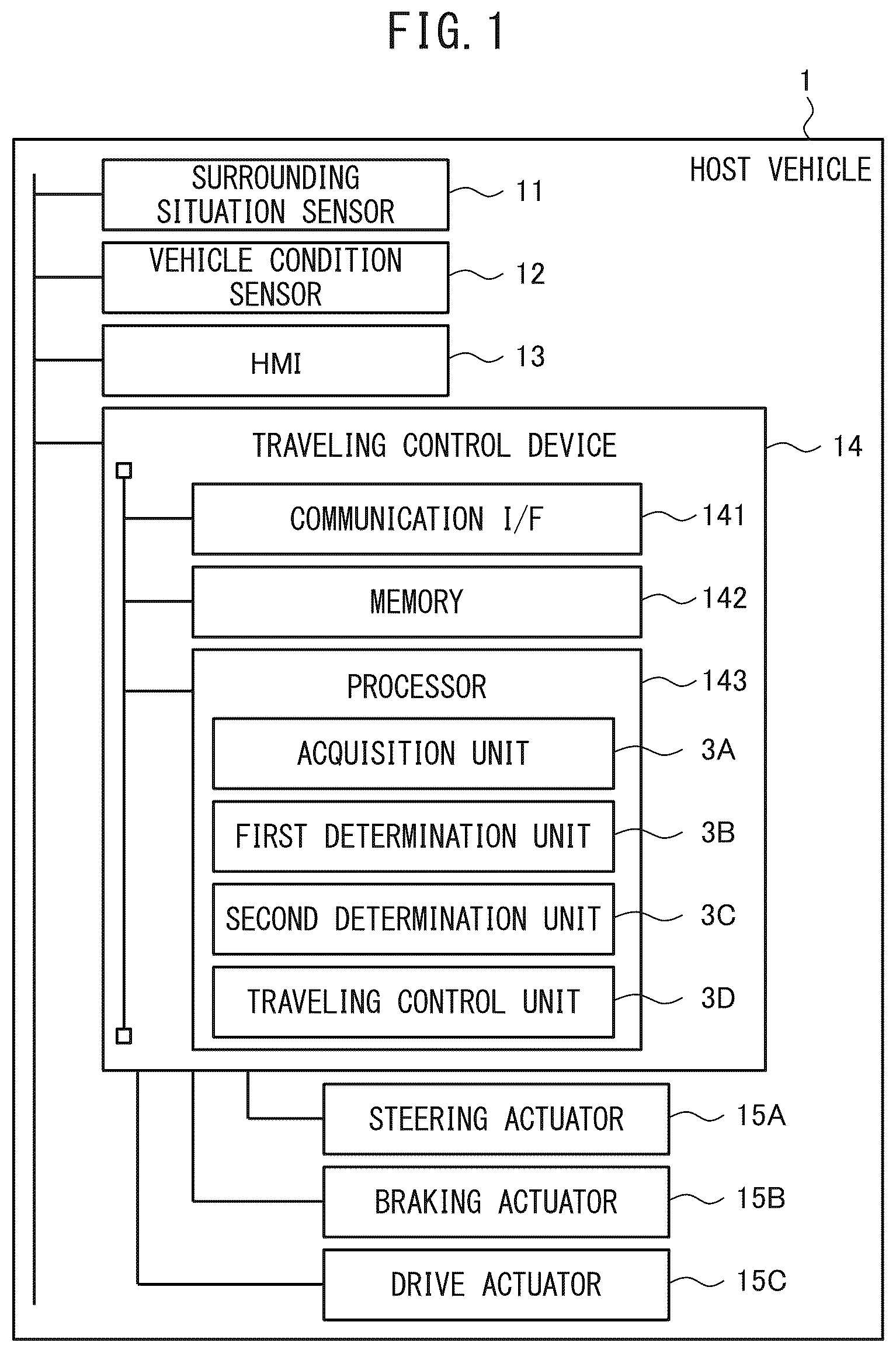
is a view showing one example of a host vehicle 1 to which a traveling control device 14 of a first embodiment is applied.
is a view showing one example in which a first determination unit 3 B determines that a travel direction of an own lane L 11 in which the host vehicle 1 is traveling and the travel direction of an adjoining lane L 21 adjoining the own lane L 11 are not the same.
is a view showing one example in which the first determination unit 3 B determines that the travel direction of the own lane L 12 in which the host vehicle 1 is traveling and the travel direction of the adjoining lane L 22 adjoining the own lane L 12 are the same.
is a view showing one example in which a second determination unit 3 C determines that structure of a road RD 3 on which the host vehicle 1 is traveling changes.
is a view showing another example in which the second determination unit 3 C determines that the structure of the road RD 4 on which the host vehicle 1 is traveling changes.
is a view showing another example in which the second determination unit 3 C determines that the structure of the road RD 5 on which the host vehicle 1 is traveling changes.
is a view showing one example in which a traveling control unit 3 D allows movement (lane change) of the host vehicle 1 from the own lane L 16 to the adjoining lane L 26 .
is a flow chart for explaining one example of a process performed by a processor 143 of the traveling control device 14 of the first embodiment.
DESCRIPTION OF EMBODIMENTS
Below, referring to the drawings, embodiments of traveling control device, traveling control method, and non-transitory recording medium of the present disclosure will be explained.
First Embodiment
is a view showing one example of a host vehicle 1 to which a traveling control device 14 of a first embodiment is applied.
In the example shown in , the host vehicle 1 is provided with surrounding situation sensor 11 , vehicle condition sensor 12 , HMI (human machine interface) 13 , traveling control device 14 , steering actuator 15 A, braking actuator 15 B, and drive actuator 15 C.
The surrounding situation sensor 11 detects objects (for example, traffic signs, surrounding vehicles, structure, etc.) existing in the surroundings of the host vehicle 1 and sends the detection result to the traveling control device 14 . The surrounding situation sensor 11 includes, for example, camera shooting the front, side, rear, etc. of the host vehicle 1 , LiDAR (Light Detection And Ranging), radar, sonar, or the like.
The vehicle condition sensor 12 detects condition of the host vehicle 1 and sends the detection result to the traveling control device 14 . The vehicle condition sensor 12 , for example, includes speed sensor, acceleration sensor, or the like.
The HMI 13 has the function of receiving various operations by the driver of the host vehicle 1 , the function of outputting information by display, voice, etc. to the driver of the host vehicle 1 , etc. and sends signals showing the operations of the driver of the host vehicle 1 to the traveling control device 14 .
The traveling control device 14 controls a traveling of the host vehicle 1 . In more detail, the traveling control device 14 is configured by a driving assistance ECU (electronic control unit) and, for example, controls the steering actuator 15 A, the braking actuator 15 B, and the drive actuator 15 C based on the information (data, signals) sent from the surrounding situation sensor 11 , the vehicle condition sensor 12 , and the HMI 13 .
The traveling control device 14 is configured by a microcomputer provided with communication interface (I/F) 141 , memory 142 , and processor 143 . The communication interface 141 has an interface circuit for connecting the traveling control device 14 to the surrounding situation sensor 11 , the vehicle condition sensor 12 , the HMI 13 , the steering actuator 15 A, the braking actuator 15 B, and the drive actuator 15 C. The memory 142 stores a program used in a process performed by the processor 143 and various data. The processor 143 has the function as an acquisition unit 3 A, the function as a first determination unit 3 B, the function as a second determination unit 3 C, and the function as a traveling control unit 3 D.
The acquisition unit 3 A acquires the detection result of the surrounding situation sensor 11 , the detection result of the vehicle condition sensor 12 , the signals showing the operations of the driver of the host vehicle 1 received by the HMI 13 , etc.
The first determination unit 3 B determines whether the travel direction of the own lane L 11 /L 12 (see and ) in which the host vehicle 1 is traveling and the travel direction of the adjoining lane L 21 /L 22 (see and ) adjoining the own lane L 11 /L 12 are the same based on the detection result of the surrounding situation sensor 11 acquired by the acquisition unit 3 A. The first determination unit 3 B, for example, uses a model obtained by learning using teacher data which is a dataset of the detection result of the surrounding situation sensor mounted in a learning vehicle and a label showing whether the travel direction of the own lane in which the learning vehicle is traveling and the travel direction of the adjoining lane adjoining the own lane are the same so as to determine whether the travel direction of the own lane L 11 /L 12 in which the host vehicle 1 is traveling and the travel direction of the adjoining lane L 21 /L 22 adjoining the own lane L 11 /L 12 are the same based on the detection result of the surrounding situation sensor 11 .
In an example where the surrounding situation sensor 11 includes the camera for shooting the front of the host vehicle 1 , the acquisition unit 3 A acquires a camera image as the detection result of the surrounding situation sensor 11 , when the traffic signs for the own lane face the host vehicle 1 and the traffic signs for the adjoining lane appear backwards from the host vehicle 1 , the first determination unit 3 B determines that the travel direction of the own lane and the travel direction of the adjoining lane are not the same. When the traffic signs for the own lane face the host vehicle 1 and the traffic signs for the adjoining lane face the host vehicle 1 , the first determination unit 3 B determines that the travel direction of the own lane and the travel direction of the adjoining lane are the same.
In another example (example where the acquisition unit 3 A acquires the detection result of the LiDAR, the radar, the sonar or the like as the detection result of the surrounding situation sensor 11 ), the first determination unit 3 B may determine whether the travel direction of the own lane L 11 /L 12 and the travel direction of the adjoining lane L 21 /L 22 are the same based on the relative speed of a preceding vehicle and the host vehicle 1 traveling in the own lane L 11 /L 12 and the relative speed of a surrounding vehicle traveling in the adjoining lane L 21 /L 22 and the host vehicle 1 . In this example, when the (absolute value of) relative speed of the surrounding vehicle traveling in the adjoining lane L 21 /L 22 and the host vehicle 1 is considerably larger compared with the (absolute value of) relative speed of the preceding vehicle and the host vehicle 1 traveling in the own lane L 11 /L 12 (for example, when the relative speed of the surrounding vehicle traveling in the adjoining lane L 21 /L 22 and the host vehicle 1 is about two times the speed limit of the own lane L 11 /L 12 etc.), the first determination unit 3 B determines that the travel direction of the own lane L 11 /L 12 and the travel direction of the adjoining lane L 21 /L 22 are not the same.
is a view showing an example where the first determination unit 3 B determines that the travel direction of the own lane L 11 in which the host vehicle 1 is traveling and the travel direction of the adjoining lane L 21 adjoining the own lane L 11 are not the same. In the example shown in , the own lane L 11 and the adjoining lane L 21 (opposite lane) whose travel direction is opposite to the travel direction of the own lane L 11 are included in a road RD 1 on which the host vehicle 1 is traveling.
is a view showing one example in which the first determination unit 3 B determines that the travel direction of the own lane L 12 in which the host vehicle 1 is traveling and the travel direction of the adjoining lane L 22 adjoining the own lane L 12 are the same. In the example shown in , the own lane L 12 , the adjoining lane L 22 whose travel direction the same as the travel direction of the own lane L 11 , and the opposite lanes L 32 , L 42 whose travel direction is opposite to the travel direction of the own lane L 12 are included in the road RD 2 on which the host vehicle 1 is traveling.
In the example shown in , the second determination unit 3 C determines whether the structure of the roads RD 3 to RD 5 (see to ) on which the host vehicle 1 is traveling changes based on the detection result of the surrounding situation sensor 11 acquired by the acquisition unit 3 A. The second determination unit 3 C, for example, uses a model obtained by learning using teacher data which is a dataset of the detection result of the surrounding situation sensors mounted in the learning vehicle and a label showing whether the structure of the road on which the learning vehicle is traveling changes so as to determine whether the structure of the roads RD 3 to RD 5 on which the host vehicle 1 is traveling changes based on the direction result of the surrounding situation sensor 11 .
The second determination unit 3 C, for example, determines that the structure of the road RD 3 (see ) on which the host vehicle 1 is traveling changes when the number of lanes included in the road RD 3 on which the host vehicle 1 is traveling increases.
is a view showing one example in which the second determination unit 3 C determines that the structure of the road RD 3 on which the host vehicle 1 is traveling changes.
In the example shown in , in an area AR 1 , the own lane L 13 , the adjoining lane L 23 whose travel direction and the travel direction of the own lane L 13 are the same, and the opposite lanes L 43 , L 53 whose travel direction is opposite to the travel direction of the own lane L 13 are included in the road RD 3 on which the host vehicle 1 is traveling. For this reason, while the host vehicle 1 is traveling in the area AR 1 , the first determination unit 3 B determines that the travel direction of the own lane L 13 in which the host vehicle 1 is traveling and the travel direction of the adjoining lane L 23 adjoining the own lane L 13 are the same. In the area AR 2 , the own lane L 13 , the adjoining lanes L 23 , L 33 whose travel direction and the travel direction of the own lane L 13 are the same, and the opposite lanes L 43 , L 53 , L 63 whose travel direction is opposite to the travel direction of the own lane L 13 are included in the road RD 3 on which the host vehicle 1 is traveling. That is, in the area AR 2 , the number of lanes included in the road RD 3 on which the host vehicle 1 is traveling increases over the area AR 1 . For this reason, while the host vehicle 1 is traveling in the area AR 2 , the second determination unit 3 C determines that the structure of the road RD 3 on which the host vehicle 1 is traveling changes.
In the example shown in , even when, for example, the number of lanes included in the road RD 4 (see ) on which the host vehicle 1 is traveling decreases, the second determination unit 3 C determines that the structure of the road RD 4 on which the host vehicle 1 is traveling changes.
is a view showing another example in which the second determination unit 3 C determines that the structure of the road RD 4 on which the host vehicle 1 is traveling changes.
In the example shown in , in the area AR 3 , the own lane L 14 , the adjoining lanes L 24 , L 34 whose travel direction and the travel direction of the own lane L 14 are the same, and the opposite lanes L 44 , L 54 , L 64 whose travel direction is opposite to the travel direction of the own lane L 14 are included in the road RD 4 on which the host vehicle 1 is traveling. For this reason, while the host vehicle 1 is traveling in the area AR 3 , the first determination unit 3 B determines that the travel direction of the own lane L 14 in which the host vehicle 1 is traveling and the travel direction of the adjoining lanes L 24 , L 34 adjoining the own lane L 14 are the same. In the area AR 4 , the own lane L 14 , the adjoining lane L 24 whose travel direction and the travel direction of the own lane L 14 are the same, and the opposite lanes L 44 , L 54 whose travel direction is opposite to the travel direction of the own lane L 14 are included in the road RD 4 on which the host vehicle 1 is traveling. That is, in the area AR 4 , the number of lanes included in the road RD 4 on which the host vehicle 1 is traveling decreases from the area AR 3 . For this reason, while the host vehicle 1 is traveling in the area AR 4 , the second determination unit 3 C determines that the structure of the road RD 4 on which the host vehicle 1 is traveling changes.
In the example shown in , when, for example, an intersecting road RD 5 A (see ) intersecting the road RD 5 (see ) on which the host vehicle 1 is traveling exists, the second determination unit 3 C determines that the structure of the road RD 5 on which the host vehicle 1 is traveling changes.
is a view showing another example in which the second determination unit 3 C determines that the structure of the road RD 5 on which the host vehicle 1 is traveling changes.
In the example shown in , in the area AR 5 , the own lane L 15 , the adjoining lane L 25 whose travel direction and the travel direction of the own lane L 15 are the same, and the opposite lanes L 35 , L 45 whose travel direction is opposite to the travel direction of the own lane L 15 are included in the road RD 5 on which the host vehicle 1 is traveling. For this reason, while the host vehicle 1 is traveling in the area AR 5 , the first determination unit 3 B determines that the travel direction of the own lane L 15 in which the host vehicle 1 is traveling and the travel direction of the adjoining lane L 25 adjoining the own lane L 15 are the same. In the area AR 6 , the intersecting road RD 5 A intersecting the road RD 5 on which the host vehicle 1 is traveling exists. For this reason, while the host vehicle 1 is traveling in the area AR 6 , the second determination unit 3 C determines that the structure of the road RD 5 on which the host vehicle 1 is traveling changes compared with the area AR 5 .
In the example shown in , the traveling control unit 3 D restricts movement (in more detail, a lane change) of the host vehicle 1 from the own lane to the adjoining lane when the second determination unit 3 C determines that the structure of the road on which the host vehicle 1 is traveling changes after the first determination unit 3 B determines that the travel direction of the own lane and the travel direction of the adjoining lane are the same. Further, the first determination unit 3 B clears the determination result that the travel direction of the own lane and the travel direction of the adjoining lane are the same when the second determination unit 3 C determines that the structure of the road on which the host vehicle 1 is traveling changes after the first determination unit 3 B determines that the travel direction of the own lane and the travel direction of the adjoining lane are the same.
Specifically, in the example shown in , the second determination unit 3 C determines that the structure of the road RD 3 on which the host vehicle 1 is traveling changes while the host vehicle 1 is traveling in the area AR 2 after the first determination unit 3 B determines that the travel direction of the own lane L 13 and the travel direction of the adjoining lane L 23 are the same while the host vehicle 1 is traveling in the area AR 1 . For this reason, the traveling control unit 3 D restricts the movement (lane change) of the host vehicle 1 from the own lane L 13 to the adjoining lanes L 23 , L 33 in the area AR 2 . Further, the first determination unit 3 B clears the determination result that the travel direction of the own lane L 13 and the travel direction of the adjoining lane L 23 are the same, the determination is made while the host vehicle 1 is traveling in the area AR 1 .
In the example shown in , the second determination unit 3 C determines that the structure of the road RD 4 on which the host vehicle 1 is traveling changes while the host vehicle 1 is traveling in the area AR 4 after the first determination unit 3 B determines that the travel direction of the own lane L 14 and the travel direction of the adjoining lanes L 24 , L 34 are the same while the host vehicle 1 is traveling in the area AR 3 . For this reason, the traveling control unit 3 D restricts the movement (lane change) of the host vehicle 1 from the own lane L 14 to the adjoining lane L 24 in the area AR 4 . Further, the first determination unit 3 B clears the determination result that the travel direction of the own lane L 14 and the travel direction of the adjoining lanes L 24 , L 34 are the same, the determination is made while the host vehicle 1 is traveling in the area AR 3 .
In the example shown in , the second determination unit 3 C determines that the structure of the road RD 5 on which the host vehicle 1 is traveling changes while the host vehicle 1 is traveling in the area AR 6 after the first determination unit 3 B determines that the travel direction of the own lane L 15 and the travel direction of the adjoining lane L 25 are the same while the host vehicle 1 is traveling in the area AR 5 . For this reason, the traveling control unit 3 D restricts the movement (lane change) of the host vehicle 1 from the own lane L 15 to the adjoining lane L 25 in the area AR 6 . Further, the first determination unit 3 B clears the determination result that the travel direction of the own lane L 15 and the travel direction of the adjoining lane L 25 are the same, the determination is made while the host vehicle 1 is traveling in the area AR 5 .
In the example shown in , the first determination unit 3 B again determines whether the travel direction of the own lane L 16 (see ) and the travel direction of the adjoining lane L 26 (see ) are the same based on the information (in more detail, the detection result of the surrounding situation sensor 11 ) obtained after the second determination unit 3 C determines that the structure of the road RD 6 (see ) on which the host vehicle 1 is traveling changes when the second determination unit 3 C determines that the structure of the road RD 6 on which the host vehicle 1 is traveling changes after the first determination unit 3 B determines that the travel direction of the own lane L 16 and the travel direction of the adjoining lane L 26 are the same. An intersecting road RD 6 A intersects the road RD 6 .
The traveling control unit 3 D allows the movement (lane change) of the host vehicle 1 from the own lane L 16 to the adjoining lane L 26 when the second determination unit 3 C determines that the structure of the road RD 6 on which the host vehicle 1 is traveling does not change after the first determination unit 3 B again determines that the travel direction of the own lane L 16 and the travel direction of the adjoining lane L 26 are the same.
is a view showing one example in which the traveling control unit 3 D allows the movement (lane change) of the host vehicle 1 from the own lane L 16 to the adjoining lane L 26 .
In the example shown in , the second determination unit 3 C determines that the structure of the road RD 6 on which the host vehicle 1 is traveling changes while the host vehicle 1 is traveling in the area AR 8 after the first determination unit 3 B determines that the travel direction of the own lane L 16 and the travel direction of the adjoining lane L 26 are the same while the host vehicle 1 is traveling in the area AR 7 . For this reason, the first determination unit 3 B again determines whether the travel direction of the own lane L 16 and the travel direction of the adjoining lane L 26 are the same while the host vehicle 1 is traveling in the area AR 9 based on the information (in more detail, the detection result of the surrounding situation sensor 11 ) obtained after the second determination unit 3 C determines that the structure of the road RD 6 on which the host vehicle 1 is traveling changes (in more detail, while the host vehicle 1 is traveling in the area AR 9 ).
In the example shown in , the travel direction of the own lane L 16 and the travel direction of the adjoining lane L 26 are the same in the area AR 9 as well. Accordingly, the second determination unit 3 C determines whether the structure of the road RD 6 on which the host vehicle 1 is traveling changes while the host vehicle 1 is traveling in the area AR 10 .
In the example shown in , the structure of the road RD 6 on which the host vehicle 1 is traveling does not change in the area AR 10 . Accordingly, the traveling control unit 3 D allows the movement (lane change) of the host vehicle 1 from the own lane L 16 to the adjoining lane L 26 while the host vehicle 1 is traveling in the area AR 11 .
In the example shown in , when the traveling control unit 3 D restricts the movement (lane change) of the host vehicle 1 from the own lane L 16 to the adjoining lane L 26 (for example, while the host vehicle 1 is traveling in the areas AR 7 to AR 10 ), and when the host vehicle 1 is about to move from the own lane L 16 to the adjoining lane L 26 or the like (when the host vehicle 1 departs from the own lane L 16 ), the traveling control device 14 (driving assistance ECU) makes the HMI 13 output an alert. For this reason, in the example shown in , for example, it is possible to suppress that the own vehicle 1 travels on the opposite lanes L 36 , L 46 in reverse after the structure of the road changes (while the host vehicle 1 is traveling in the areas AR 8 to AR 10 ) or the like.
In another example, when the traveling control unit 3 D restricts the movement (lane change) of the host vehicle 1 from the own lane L 16 to the adjoining lane L 26 (for example, while the host vehicle 1 is traveling in the areas AR 7 to AR 10 ), and when the host vehicle 1 is about to move from the own lane L 16 to the adjoining lane L 26 or the like (when the host vehicle 1 departs from the own lane L 16 ), the traveling control device 14 (driving assistance ECU) may control the steering actuator 15 A so as to perform steering assist for suppressing the departure of the host vehicle 1 from the own lane L 16 .
In the example shown in , when the traveling control unit 3 D allows the movement (lane change) of the host vehicle 1 from the own lane L 16 to the adjoining lane L 26 (for example, while the host vehicle 1 is traveling in the area AR 11 ), and when the host vehicle 1 changes lanes from the own lane L 16 to the adjoining lane L 26 , the traveling control device 14 (driving assistance ECU) does not allow the HMI 13 to output the alert.
is a flow chart for explaining one example of the process performed by the processor 143 of the traveling control device 14 of the first embodiment.
In the example shown in , at step S 10 , the first determination unit 3 B determines whether the travel direction of the own lane in which the host vehicle 1 is traveling and the travel direction of the adjoining lane adjoining the own lane are the same based on the detection result of the surrounding situation sensor 11 acquired at step not shown. When YES, it proceeds to step S 11 and when NO, it proceeds to step S 13 .
At step S 11 , the second determination unit 3 C determines whether the structure of the road on which the host vehicle 1 is traveling changes based on the detection result of the surrounding situation sensor 11 acquired at step not shown. When YES, it proceeds to step S 12 , while when NO, it proceeds to step S 14 .
At step S 12 , the first determination unit 3 B clears the determination result that the travel direction of the own lane and the travel direction of the adjoining lane are the same (determination result of step S 10 ). Next, it proceeds to step S 13 .
At step S 13 , the traveling control unit 3 D restricts the movement (lane change) of the host vehicle 1 from the own lane to the adjoining lane. Next, it proceeds to step S 15 .
At step S 14 , the traveling control unit 3 D allows the movement (lane change) of the host vehicle 1 from the own lane to the adjoining lane. Next, it proceeds to step S 15 .
At step S 15 , for example, the first determination unit 3 B determines whether to end the process shown in . When YES, it ends the process shown in and when NO, it returns to step S 10 .
In the example shown in explained above, while the host vehicle 1 is traveling in the area AR 7 , at step S 10 shown in , the first determination unit 3 B determines that the travel direction of the own lane L 16 and the travel direction of the adjoining lane L 26 are the same.
While the host vehicle 1 is traveling in the area AR 8 , at step S 11 shown in , the second determination unit 3 C determines that the structure of the road RD 6 on which the host vehicle 1 is traveling changes, at step S 12 shown in , the first determination unit 3 B clears the determination result that the travel direction of the own lane L 16 and the travel direction of the adjoining lane L 26 are the same (determination result of step S 10 ), at step S 13 shown in , the traveling control unit 3 D restricts the movement (lane change) of the host vehicle 1 from the own lane L 16 to the adjoining lane L 26 .
While the host vehicle 1 is traveling in the area AR 9 , for example, at step S 10 performed for the second time, the first determination unit 3 B determines that the travel direction of the own lane L 16 and the travel direction of the adjoining lane L 26 are the same.
While the host vehicle 1 is traveling in the area AR 10 , for example, at step S 11 performed for the second time, the second determination unit 3 C determines that the structure of the road RD 6 on which the host vehicle 1 is traveling does not change.
While the host vehicle 1 is traveling in the area AR 11 , at step S 14 shown in , the traveling control unit 3 D allows the movement (lane change) of the host vehicle 1 from the own lane L 16 to the adjoining lane L 26 .
Second Embodiment
The host vehicle 1 to which the traveling control device 14 of a second embodiment is applied is configured in the same way as the host vehicle 1 to which the traveling control device 14 of the first embodiment is applied except for the points explained later.
As explained above, in the example of the host vehicle 1 to which the traveling control device 14 of the first embodiment is applied (example shown in ), the traveling control device 14 is configured by the driving assistance ECU.
On the other hand, in one example of the host vehicle 1 to which the traveling control device 14 of the second embodiment is applied, the traveling control device 14 is configured by an autonomous driving ECU. The traveling control device 14 , for example, generates a driving plan of the host vehicle 1 based on the information (data, signals) sent from the surrounding situation sensor 11 , the vehicle condition sensor 12 , and the HMI 13 , a GPS (Global Positioning System) signal, map information, etc. Further, the traveling control device 14 controls the steering actuator 15 A, the braking actuator 15 B, and the drive actuator 15 C based on the driving plan.
In the example of the host vehicle 1 to which the traveling control device 14 of the second embodiment is applied, for example, while the host vehicle 1 is traveling in the areas AR 7 to AR 10 , the traveling control device 14 (autonomous driving ECU) generates the driving plan restricting the movement (lane change) of the host vehicle 1 from the own lane L 16 to the adjoining lanes L 26 (that is, the driving plan where the host vehicle 1 does not perform the lane change) and controls the steering actuator 15 A, the braking actuator 15 B, and the drive actuator 15 C based on the driving plan. For this reason, in the example of the host vehicle 1 to which the traveling control device 14 of the second embodiment is applied, for example, it is possible to suppress that the own vehicle 1 travels on the opposite lanes L 36 , L 46 in reverse after the structure of the road changes after the road structure changes (while the host vehicle 1 is traveling in the areas AR 8 to AR 10 ) or the like.
For example, while the host vehicle 1 is traveling in the area AR 11 , the traveling control device 14 generates the driving plan allowing the movement (lane change) of the host vehicle 1 from the own lane L 16 to the adjoining lanes L 26 and controls the steering actuator 15 A, the braking actuator 15 B, and the drive actuator 15 C based on the driving plan.
As explained above, the embodiments of the traveling control device, the traveling control method, and the non-transitory recording medium of the present disclosure was explained with reference to the drawings, but the traveling control device, the traveling control method, and the non-transitory recording medium of the present disclosure are not limited to the above-mentioned embodiments and can be suitably changed within an extent not departing from the gist of the present disclosure. The constitutions of the examples of the embodiments explained above may also be suitably combined. In the examples of the embodiments explained above, the process performed in the traveling control device 14 was explained as software process performed by running the program, but the process performed in the traveling control device 14 may also be process performed by hardware. Alternatively, the process performed in the traveling control device 14 may be process combining both software and hardware. Further, the program stored in the memory 142 of the traveling control device 14 (program for realizing the function of the processor 143 of the traveling control device 14 ) may, for example, be recorded and supplied, distributed, etc. in a computer readable storage medium (non-transitory recording medium) such as semiconductor memory, magnetic recording medium, optical recording medium, or the like.
Figures (6)
Citations
This patent cites (7)
- US2021/0357663
- US2022/0306116
- US2023/0150508
- US2023/0230390
- US2019-015690
- US2022-043996
- US2023-104348