Super Absorbent Polymer Based on Polyacrylic Acid or Its Salts
Abstract
A super absorbent polymer may have a capillary constant of 0.4 mm 5 or more as derived using n-hexane. The super absorbent polymer may be a polyacrylic acid (salt)-based super absorbent polymer. The super absorbent polymer may have a fast absorption rate and an improved absorption capacity, resulting in improved performance.
Claims (11)
1 . A polyacrylic acid (salt)-based super absorbent polymer, wherein the polyacrylic acid (salt)-based super absorbent polymer has a capillary constant of 0.4 mm 5 or more as derived using n-hexane, and wherein when the polyacrylic acid (salt)-based super absorbent polymer is swelled in water having an electrical conductivity value of 100 to 130 μS/cm for 1 minute, a maximum capacity of water that the polyacrylic acid (salt)-based super absorbent polymer is able to hold (free swelling capacity) is 130 g/g or more.
Show 10 dependent claims
2 . The polyacrylic acid (salt)-based super absorbent polymer of claim 1 , wherein the capillary constant is 1.5 mm 5 or less.
3 . The polyacrylic acid (salt)-based super absorbent polymer of claim 1 , wherein a surface area to volume ratio of the super absorbent polymer is 43 mm −1 or more.
4 . The polyacrylic acid (salt)-based super absorbent polymer of claim 1 , wherein a surface area to volume ratio of the super absorbent polymer is 65 mm −1 or less.
5 . The polyacrylic acid (salt)-based super absorbent polymer of claim 1 , wherein the polyacrylic acid (salt)-based super absorbent polymer has an average convexity value of 0.94 or less for all particles, calculated using Equation 1:
6 . The polyacrylic acid (salt)-based super absorbent polymer of claim 1 , wherein the polyacrylic acid (salt)-based super absorbent polymer has an average circle equivalent (CE) diameter of 220 μm to 400 μm.
7 . The polyacrylic acid (salt)-based super absorbent polymer of claim 1 , wherein the polyacrylic acid (salt)-based super absorbent polymer has an extractable component content of 10 wt % or less based on a total weight of the polyacrylic acid (salt)-based super absorbent polymer, measured after free swelling in water having an electrical conductivity of 100 to 130 μS/cm for 30 minutes.
8 . The polyacrylic acid (salt)-based super absorbent polymer of claim 1 , wherein the polyacrylic acid (salt)-based super absorbent polymer has an extractable component content of 17 wt % or less based on a total weight of the super absorbent polymer, measured after free swelling in water having an electrical conductivity of 100 to 130 μS/cm for 3 hours.
9 . The polyacrylic acid (salt)-based super absorbent polymer of claim 1 , wherein the polyacrylic acid (salt)-based super absorbent polymer has an absorbency under pressure (AUP) of 28 g/g or more measured under 0.3 psi according to EDANA method WSP 242.3.
10 . The polyacrylic acid (salt)-based super absorbent polymer of claim 1 , wherein the polyacrylic acid (salt)-based super absorbent polymer has a centrifuge retention capacity (CRC) of 33 g/g or more measured according to EDANA method WSP 241.3.
11 . The polyacrylic acid (salt)-based super absorbent polymer of claim 1 , wherein the polyacrylic acid (salt)-based super absorbent polymer has an effective absorption capacity (EFFC) of 30 g/g or more, calculated by Equation 2:
Full Description
Show full text →
CROSS-REFERENCE TO RELATED APPLICATION
This application claims priority to Korean Patent Application No. 10-2024-0064067, filed on May 16, 2024, the disclosure of which is incorporated herein by reference in its entirety.
TECHNICAL FIELD
The present disclosure relates to a super absorbent polymer exhibiting an improved absorption rate and improved absorption performance.
BACKGROUND
A super absorbent polymer (SAP) is a synthetic polymer material that can absorb 500 to 1,000 times its own weight in moisture, and is named differently by each developer, such as super absorbent material (SAM) and absorbent gel material (AGM). The super absorbent polymers described above began to be put to practical use as sanitary products, and are now widely used as soil water retainers for horticulture, water-retaining materials for civil engineering and construction, sheets for raising seedlings, and freshness-preserving agents and materials for steaming in the food distribution industry.
In particular, since super absorbent polymers are widely used in the field of sanitary products such as diapers and sanitary pads, they need to exhibit not only high absorption performance but also a fast absorption rate.
In addition, the development of so-called pulpless products, in which the pulp content is reduced or even no pulp is used at all, is being actively pursued in order to provide thinner products. As a result, the product includes a relatively high proportion of a super absorbent polymer, and super absorbent polymer particles are inevitably included in multiple layers within the product. Accordingly, the importance of the absorption rate of super absorbent polymers is increasing.
To this end, a method is commonly used in which a foaming agent is included in the monomer composition to form a porous structure within the base resin powder as crosslinking polymerization progresses, thereby increasing the surface area of the super absorbent polymer.
However, a problem occurred in which overall properties of the super absorbent polymer, such as surface tension, liquid permeability, or bulk density, were reduced depending on the use of the foaming agent.
Conversely, when the crosslinking density of the super absorbent polymer is controlled to be high in order to improve the overall properties of the super absorbent polymer, there is a problem in that the centrifuge retention capacity, which is a basic property of the super absorbent polymer, is reduced because it is difficult to absorb moisture between the dense crosslinked structures.
Accordingly, there is a continuous demand for the development of super absorbent polymers that improve the absorption rate of super absorbent polymers while maintaining the basic properties of super absorbent polymers.
SUMMARY
The present disclosure is directed to providing a super absorbent polymer (SAP) having excellent fluid absorption capacity due to capillary action, thereby having a fast absorption rate and excellent absorption capacity.
The present disclosure relates to a polyacrylic acid (salt)-based super absorbent polymer,
•
• wherein the super absorbent polymer has a capillary constant of 0.4 mm 5 or more as derived using n-hexane.
BRIEF DESCRIPTION OF THE DRAWINGS
The above and other objects, features and advantages of the present disclosure will become more apparent to those of ordinary skill in the art by describing exemplary aspects thereof in detail with reference to the accompanying drawings, in which:
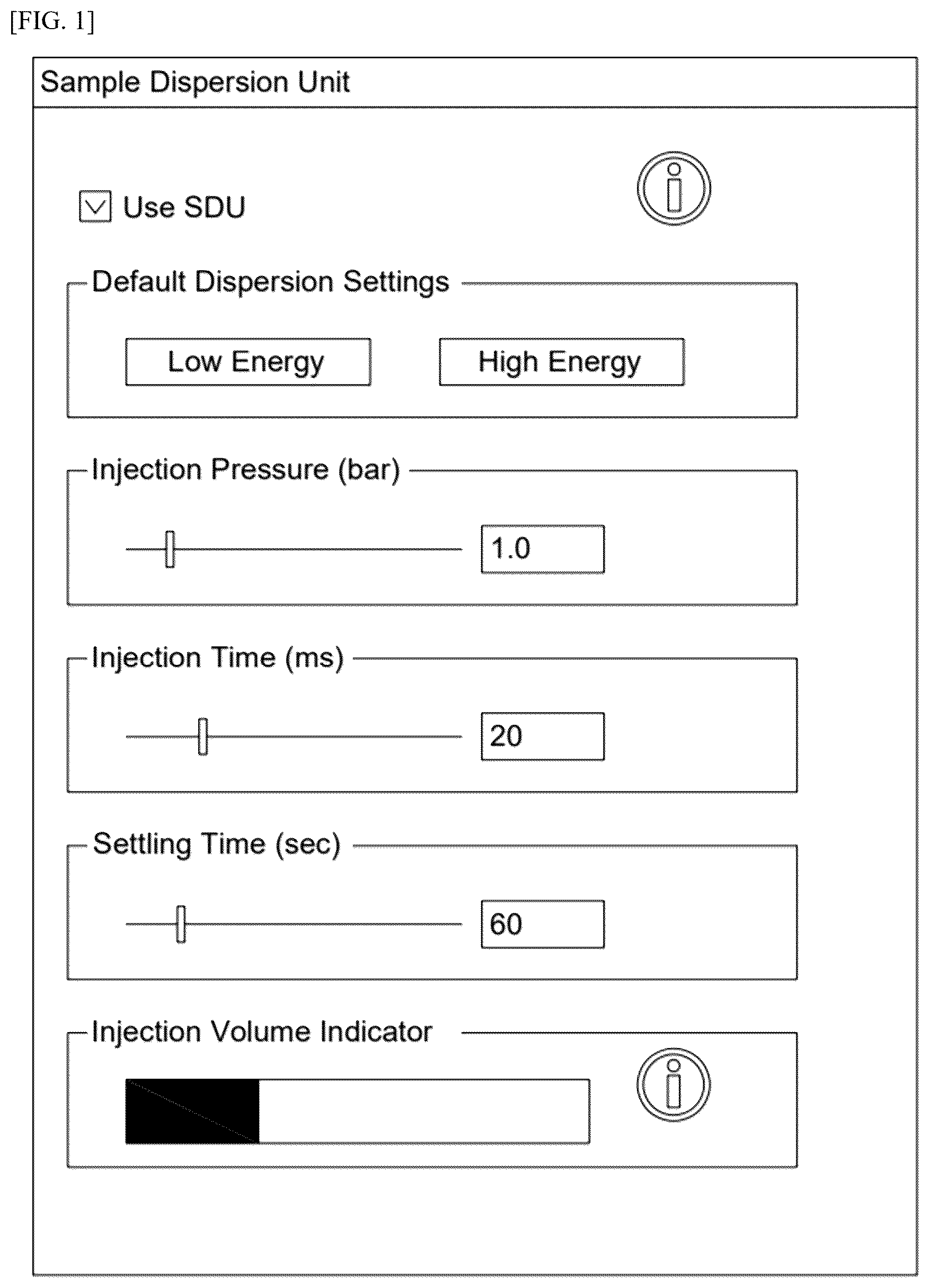
shows the setting values of a sample dispersion unit in Morphologi 4 from Malvern Panalytical;
shows the illumination setting values in Morphologi 4 from Malvern Panalytical;
shows the optics selection setting values in Morphologi 4 from Malvern Panalytical; and
shows the scan area setting values in Morphologi 4 from Malvern Panalytical.
DETAILED DESCRIPTION
Unless otherwise defined herein, all technical and scientific terms used herein are used for the purpose of describing exemplary aspects only and are not intended to be limiting on the disclosure. Singular expressions include plural expressions unless the context clearly dictates otherwise. In this disclosure, the terms “comprises,” “includes,” or “has” and the like are intended to designate the presence of the features, numbers, steps, components, or combinations thereof that are implemented, and are not to be understood as precluding the possibility of the presence or addition of one or more other features or numbers, steps, components or combinations thereof.
While aspects of the disclosure are susceptible to various modifications and forms, specific aspects thereof will be exemplified and described in detail below. However, this is not intended to limit the present disclosure to specific aspects, and it should be understood to include all modifications, equivalents and substitutes included in the spirit and scope of the present disclosure.
The terminology used herein is for the purpose of describing particular aspects only and is not intended to limit the disclosure. Also, the singular forms used here include the plural forms unless the phrases clearly indicate a contrary meaning.
The term “polymer” or “high molecular weight molecule” as used here refers to a polymerized state of a water-soluble ethylenically unsaturated monomer, and can encompass any moisture content range or particle diameter range.
In addition, the term “super absorbent polymer” is used to mean, depending on the context, a base resin in powder form consisting of a crosslinked polymer or super absorbent polymer particles obtained by pulverizing the crosslinked polymer, or to encompass all products made suitable for commercialization by additional processes, such as drying, pulverizing, classifying, and surface crosslinking, for the crosslinked polymer or the base resin.
In addition, the term “chopping” is used to refer to cutting the hydrogel polymer into small pieces in millimeter units to increase drying efficiency, as opposed to pulverizing to a micrometer or normal particle size.
In addition, the term “micronizing” or “micronization” is used to differentiate it from “chopping” and refers to pulverizing a hydrogel polymer into particle sizes of tens to hundreds of micrometers.
In this disclosure, the element symbols are those described in the periodic table.
Hereinafter, a super absorbent polymer and a method of preparing the same according to specific aspects of the disclosure will be described in more detail.
I. Polyacrylic Acid (Salt)-Based Super Absorbent Polymer
The super absorbent polymer of the present disclosure is a polyacrylic acid (salt)-based super absorbent polymer, and is characterized by having a capillary constant of 0.4 mm 5 or more as derived using n-hexane.
The capillary constant is a factor that may be used to determine how active the capillary action is, and a large capillary constant means that the capillary action is active and the fluid absorption capacity by capillaries is excellent. The super absorbent polymer according to the present disclosure exhibits a more active capillary action than conventional super absorbent polymers, and as a result, the super absorbent polymer of the present disclosure has a fast absorption rate and excellent absorption capacity.
The capillary action is a phenomenon that occurs due to the surface tension of a liquid. More specifically, capillary action is a phenomenon that occurs due to the surface tension of a liquid and the adhesive force between a liquid and a solid. When the surface tension of a liquid is greater than the adhesive force between a liquid and a solid, a capillary force acts along the tube, and the liquid can move along it. Examples of this capillary action include the natural seeping of water into absorbent paper or cloth, or the absorption of water by the roots of plants.
This capillary action is related to the phenomenon in which the super absorbent polymer absorbs liquid. That is, the super absorbent polymer has paths formed through which fluid can move between particles and within particles, and liquid absorption can proceed through the capillary action through these paths formed in the super absorbent polymer.
The capillary action determines the direction and speed of movement of a liquid depending on the surface tension of the liquid and the size of the adhesive force between the liquid and solid. In addition, the capillary action is affected by the concentration and temperature of the liquid, but even when these conditions are the same, it can be affected by various factors such as the size, pore ratio, curvature, structure, and shape of the empty space between the super absorbent polymer particles; the shape or roughness of the particle surface; or a particle size or surface area to actual volume, convexity, and CE diameter. In addition, it may be affected by the internal crosslinking structure or pore structure of the super absorbent polymer.
That is, when the structure or shape of the empty space between the super absorbent polymer particles; the shape or roughness of the particle surface; or a particle size or surface area to actual volume, and the internal crosslinking structure or pore structure of the super absorbent polymer are appropriately controlled, the capillary action appears more actively and a super absorbent polymer with a large capillary constant may be obtained.
The capillary constant may be calculated using the Washburn adsorption method in a surface tension-measuring device. The Washburn adsorption method is a method in which a value obtained by measuring the weight of the liquid absorbed by capillary action by bringing a cylinder filled with a solid material into contact with a liquid is applied to the Washburn equation.
In the present disclosure, the capillary constant was derived using a force-tensiometer, which is a surface tension-measuring device consisting of a vessel capable of containing a liquid and a porous cylinder capable of allowing a sample to be filled therein.
The porous cylinder may move in the direction of the container and in the opposite direction of the container. Specifically, the capillary constant may be derived by the following method.
<Method of Deriving Capillary Constant>
Step 1) Drying of Super Absorbent Polymer
The super absorbent polymer is dried at about 100° C. for about 12 hours.
Step 2) Measurement of Mass of Solvent Absorbed by Super Absorbent Polymer
•
• {circle around (1)} The dried super absorbent polymer is packed into the inlet of the porous cylinder (outer diameter: 17 mm, inner diameter: 15 mm, length: 60 mm, and weight of empty cylinder: 33 g) so that 30% of the volume of the porous cylinder is filled. The weight of the super absorbent polymer is 1.0±0.1 g. • {circle around (2)} 30 ml of n-hexane is input to a container that can contain liquid. Next, the porous cylinder packed with the super absorbent polymer is moved toward the container containing n-hexane so that the super absorbent polymer is submerged in the hexane to a depth of 1 cm, thereby causing a capillary action. • {circle around (3)} Next, the extent to which hexane is absorbed into the super absorbent polymer by capillary action is measured as the mass (m) of hexane absorbed over time (t) using a force-tensiometer (Sigma 700 manufactured by Biolin Scientific). From the results, an m 2 vs. t graph is derived, where the x-axis represents time and the y-axis represents the square of the solvent mass (m 2 ). For reference, when it suits the purpose of the present disclosure, equipment from other manufacturers may be used as a force-tensiometer. Step 3) Derivation of Capillary Constant of Super Absorbent Polymer • {circle around (1)} The slope of the linear interval asymptote is calculated from the derived m 2 vs. t graph. Specifically, a straight line is drawn from the point corresponding to 25% of the maximum value of m 2 to the point corresponding to 75% of the maximum value of m 2 , and the slope of the straight line is defined as the slope of the linear interval asymptote. • {circle around (2)} The capillary constant value is calculated using Equation A corresponding to the Washburn method.
m 2 = C ρ 2 γ l cos θ 2 η t [ Equation A ]
In Equation A, η represents the viscosity of the solvent, ρ represents the density of the solvent, γl represents the surface tension of the solvent, θ represents the contact angle between the material and the solvent, C represents the capillary constant of the material, m represents the mass of solvent absorbed by the material, and t represents the time for the solvent to be absorbed by the material.
In the present disclosure, the material may refer to a super absorbent polymer, and the solvent may refer to n-hexane.
In Equation A, the slope may refer to
C ρ 2 γ l cos θ 2 η , and this value may correspond to the slope of the linear interval asymptote derived from the m 2 vs. t graph measured by the super absorbent polymer and n-hexane experiment. At this time, since the viscosity, density, surface tension, and contact angle of n-hexane are already known constants, the capillary constant (C) value may be calculated using the slope of the linear interval asymptote derived from the m 2 vs. t graph. In particular, since the contact angle, which is the angle at the contact boundary between the solid and the liquid, with the super absorbent polymer is 0° in the case of n-hexane, when n-hexane is used, the slope in Equation A becomes
C ρ 2 γ l 2 η , and in this case, when the slope of the linear interval asymptote of the m 2 vs. t graph is obtained, the capillary constant may be derived more easily.
•
• {circle around (3)} The same process is repeated twice more, and the average value of the capillary constant values measured three times is defined as the capillary constant of the super absorbent polymer.
In one aspect of the present disclosure, the capillary constant may be 0.4 mm 5 or more, 0.45 mm 5 or more, or 0.5 mm 5 or more. In addition, the capillary constant may be 1.5 mm 5 or less, 1.3 mm 5 or less, or 1.2 mm 5 or less.
In one aspect of the present disclosure, the surface area to actual volume of the super absorbent polymer may be 43 mm −1 or more, 44 mm −1 or more, or 45 mm −1 or more. In addition, the surface area to actual volume may be 65 mm −1 or less, 62 mm −1 or less, or 60 mm −1 or less.
In this disclosure, the surface area to actual volume means a value obtained by dividing the total surface area of the super absorbent polymer by the total volume of the super absorbent polymer within a specific reference volume.
The surface area to actual volume of the present disclosure is a value obtained by dividing the total surface area of the super absorbent polymer by the total volume of the super absorbent polymer within a specific reference volume, and in the present disclosure, a large surface area to actual volume of the super absorbent polymer means that the surface of the super absorbent polymer has many curves and thus has a large surface area.
That is, the super absorbent polymer of the present disclosure has a large surface area compared to conventional super absorbent polymers, and thus has a large surface area to actual volume value, and by having this structure, it forms an absorption path for various fluids, thereby helping to actively exhibit a capillary action.
The surface area to actual volume ratio may be derived using a 3D X-ray microscope (XRM).
In the case of the XRM, a cross-sectional image can be obtained by irradiating the sample with X-rays while rotating, and three-dimensional data can be obtained based on this. This is called 3D reconstruction. Conversely, a two-dimensional (2D) cross-sectional image can be extracted from the obtained three-dimensional (3D) data, noise can be removed, the measurement target can be separated, and this can be converted back into three-dimensional (3D) volume data. When the measurement target is separated from the XRM 2D cross-sectional image and converted back into a 3D volume, the measurement target can be precisely observed in its 3D form. In this way, when using the XRM, super absorbent polymers can be analyzed in three-dimensional or two-dimensional forms.
Specifically, the surface area to actual volume may be derived by the following method.
<Method for Deriving Surface Area to Actual Volume>
Step 1) Drying and Sampling of Super Absorbent Polymer
The super absorbent polymer is dried at about 100° C. for about 12 hours, and the dried super absorbent polymer is sampled in a size of 1.5 cm×1.5 cm×1.5 cm (width×length×height).
Step 2) Image Derivation
The sampled super absorbent polymer is analyzed using XRM (Xradia 620 Versa manufactured by ZEISS) under the following conditions to derive a 3D image of the super absorbent polymer (3D reconstruction).
<Conditions>
•
• X-ray energy: 70 kV • Detector: Flat pane • Voxel size: 5 μm • Measurement time: 0.05 s/frame • Total images: 4501 sheets Step 3) Derivation of Surface Area to Actual Volume (S SAP /V C ) • {circle around (1)} The region of interest (measurement region) is set and cut out of the 2D XRM cross-sectional image of the super absorbent polymer that is 3D reconstructed. • {circle around (2)} Gaussian blur is applied to the cut 2D cross-sectional image to remove noise. Next, the 2D cross-sectional image is converted into a binarized image using Otsu's thresholding method to distinguish the background image and the super absorbent polymer particle image. This is repeatedly applied to all 2D images of the measurement targets to obtain 2D cross-sectional images in which the super absorbent polymer particles are separated. • {circle around (3)} The multiple 2D cross-sectional images are stacked and 3D rendering is performed. • {circle around (4)} The volume (V C ) of the entire particles of the super absorbent polymer is measured from the 3D rendered volume data. In addition, considering the connectivity of the 3D rendered volume data, the surface area (S SAP ) of the super absorbent polymer particle excluding the surface area of the closed pore region is measured. At this time, the area of the outer surface (cut section) of the 3D rendered data is excluded. The surface area (S SAP ) of the super absorbent polymer particle is divided by the volume (V C ) of the entire super absorbent polymer particles to derive the surface area to actual volume of the super absorbent polymer.
In the process of measuring the capillary constant and the surface area to actual volume, the pretreatment of drying the super absorbent polymer at about 100° C. for about 12 hours is performed to measure the capillary constant and the surface area to actual volume of the super absorbent polymer without being affected by the moisture content.
In one aspect of the present disclosure, the super absorbent polymer may have an average convexity value of 0.94 or less for all particles, as calculated using the following Equation 1.
M c = L s / L [ Equation 1 ]
In Equation 1, M c represents convexity, L s represents a length of an elastic band assuming that an image capturing, as a 2D image, a 3D image of a 3D particle to be measured is surrounded by an imaginary elastic band that stretches around the contour, and L represents an actual circumferential length of an image captured as a 2D image of a 3D image of the 3D particle to be measured.
The convexity is a parameter for measuring the particle outline and particle surface roughness with values from 0 to 1, and the closer the convexity is to 1, the more the particle may be considered to have a very smooth outline, and the closer the convexity is to 0, the more the particle may be considered to have a rough or uneven outline.
The super absorbent polymer according to the present disclosure has a convexity of 0.94 or less, and thus has particles that are somewhat rougher or have a more uneven outline than conventional super absorbent polymers. This may result in more microscopic paths being formed between the super absorbent polymer particles, thus allowing more active capillary action.
At this time, the average convexity value is measured after particles are randomly scattered over the stage by vacuum within the measuring device, and statistical results are derived by obtaining n of 200 or more and averaging them.
In one aspect of the present disclosure, the average value of the convexity of all particles of the super absorbent polymer may be 0.80 or more, 0.83 or more, 0.85 or more, 0.87 or more, and 0.94 or less, 0.93 or less, or 0.92 or less.
In one aspect of the present disclosure, the super absorbent polymer may have an average circle equivalent (CE) diameter of 220 μm to 400 μm.
The CE diameter refers to the diameter of a circle having the same area as a 2D image of a particle to be measured, and the size of the particle may be expressed through the CE diameter. The average CE diameter value of the super absorbent polymer may be 220 μm or more, 230 μm or more, or 240 μm or more, and 400 μm or less, 350 μm or less, 330 μm or less, 320 μm or less, or 310 μm or less.
When the super absorbent polymer according to the present disclosure has a convexity and particle size while satisfying the capillary constant range, the super absorbent polymer may have a more excellent absorption rate and absorption capacity.
In addition, convexity and CE diameter may be measured using several commercial instruments that quantify and analyze particle morphology based on image analysis of the particles. For example, the parameters may be measured by Morphologi 4 from Malvern Panalytical, and specifically, may be measured by the following four steps, which are described in more detail in the experimental examples described below.
•
• 1) Sample preparation: A particle sample of the super absorbent polymer to be measured is prepared. At this time, when convexity is to be measured for particles with a specific particle diameter range, a sample is prepared by classifying particles with a specific particle diameter using a classifier from Retsch at a 1.0 amplitude for 10 minutes.
At this time, the particle diameter of the super absorbent polymer particles may be measured according to the European Disposables and Nonwovens Association (EDANA) standard EDANA WSP 220.3 method.
•
• 2) Image acquisition: After setting the prepared sample on the stage inside the equipment, images of individual particles are obtained by scanning at 2.5× magnification. • 3) Image processing: For the acquired images, a 2D image of each 3D particle, and parameter values such as CE diameter, shortest diameter, longest diameter, actual particle circumference, and convex hull perimeter are measured. • 4) Based on the data analyzed for each particle, a distribution map for the parameters for all particles included in the sample is derived.
In order to obtain a super absorbent polymer satisfying the capillary constant, surface area to actual volume, and convexity according to the present disclosure, the inventors of the present disclosure adjusted the manufacturing process conditions of the super absorbent polymer. For example, the type or content of additives in the surface crosslinking process or polymerization and pulverization process conditions is adjusted so that the super absorbent polymer of the present disclosure satisfies the capillary constant and the surface area to actual volume.
For example, the type and content of the monomer composition and the type and content of an internal crosslinking agent in a polymerization process; the type, input amount, and input timing of a surfactant, the type, input amount, and input timing of a neutralizing agent, and the type, rotational speed, hole size, number of micronionizations of a micronization device in the neutralization and micronization steps; and the like may be adjusted so as to satisfy the capillary constant, surface area to actual volume, and convexity.
In one aspect of the present disclosure, the super absorbent polymer may have an extractable component content of 10 wt % or less, 9.5 wt % or less, or 9 wt % or less, based on the total weight of the super absorbent polymer, as measured after free swelling in water having an electrical conductivity of 100 to 130 μS/cm for 30 minutes.
In addition, in one aspect of the present disclosure, the super absorbent polymer may have an extractable component content of 5 wt % or less, 4.8 wt % or less, 4.5 wt % or less, 4.3 wt % or less, 4 wt % or less, or 3.9 wt % or less, as measured after swelling for 1 hour according to EDANA method WSP 270.3. The lower the extractable component content value, the better it is, and the lower limit is theoretically 0 wt %, but may be, for example, 0.1 wt % or more or 1 wt % or more.
In addition, in one aspect of the present disclosure, the super absorbent polymer may have an extractable component content of 17 wt % or less, 16 wt % or less, or 15 wt % or less, based on the total weight of the super absorbent polymer, as measured after free swelling in water having an electrical conductivity of 100 to 130 μS/cm for 3 hours.
The term “extractable component” refers to a compound in the form of a polymer that is not crosslinked during the preparation process of a super absorbent polymer, and the components may be produced when crosslinking is incomplete during polymerization of the super absorbent polymer, resulting in non-crosslinking, or when the crosslinking agent is decomposed or the main polymer chain is broken during the chopping or drying process.
The extractable components may be eluted when the super absorbent polymer is exposed to a liquid, and most of the eluted extractable components remain on the surface of the super absorbent polymer. Due to this, the surface of the super absorbent polymer may become sticky and the liquid permeability may be reduced. This may cause discomfort when the super absorbent polymer is used in actual products.
That is, problems related to crosslinking of the super absorbent polymer may be identified by measuring the content of extractable components eluted from the super absorbent polymer solution. That is, since the content of extractable components is closely related to the inter-chain crosslinked structure within the super absorbent polymer, a large content of eluted extractable components means that the inter-chain crosslinked structure within the super absorbent polymer is incomplete.
Super absorbent polymers are commonly used in sanitary products such as diapers, so the amount of eluted extractable components is evaluated using 0.9% saline, which has similar ion concentration and electrical conductivity to urine discharged from the body.
However, in addition to sanitary products, the super absorbent polymers are now widely used as soil water retainers for horticulture, water-retaining materials for civil engineering and construction, sheets for raising seedlings, and freshness-preserving agents and materials for steaming in the food distribution industry. In this case, the absorption behavior of the extractable components in water having an electrical conductivity of 100 to 130 μS/cm needs be excellent.
That is, even when the same super absorbent polymer is used, the absorption behavior in water having an electrical conductivity of 100 to 130 μS/cm and the absorption behavior in 0.9% brine with an electrical conductivity of about 16,100 μS/cm are bound to be different.
The content of extractable components is closely related to the inter-chain crosslinked structure within the super absorbent polymer, and when using 0.9% saline, the volume of expansion of the super absorbent polymer is small, so the amount of eluted extractable components is small, but when using water with an electrical conductivity of 100 to 130 μS/cm, the super absorbent polymer expands more, so the amount of eluted extractable components increases due to the separation of the chains within the super absorbent polymer, and through this, the correlation between the inter-chain crosslinked structure within the super absorbent polymer and the absorption behavior can be more accurately identified.
For example, even when two different super absorbent polymers have the same content of extractable components in 0.9% saline, the content of extractable components in water having an electrical conductivity of 100 to 130 μS/cm may vary significantly depending on the crosslinking characteristics because the degree of crosslinking within the super absorbent polymer affects the content of extractable components.
For this reason, the experimental results on the elution amount and absorption characteristics of extractable components after free swelling using 0.9% saline having an electrical conductivity of about 16,100 μS/cm cannot be directly compared with the experimental results after free swelling using water having an electrical conductivity of 100 to 130 μS/cm as in the present disclosure.
That is, when the same super absorbent polymer is used, the absorption behavior in water having an electrical conductivity of 100 to 130 μS/cm and the absorption behavior in 0.9% brine having an electrical conductivity of about 16,100 μS/cm are bound to be different, and thus the content of extractable components after free swelling for 1 hour in water having an electrical conductivity of 100 to 130 μS/cm cannot be used to predict the content of extractable components after free swelling in 0.9% brine having an electrical conductivity of about 16,100 μS/cm, and vice versa.
Therefore, in order to implement a super absorbent polymer having an excellent property balance by simultaneously improving absorption characteristics and liquid permeability, it may be said that determining the elution amount, absorption performance and absorption rate of extractable components in water having an electrical conductivity of 100 to 130 μS/cm is independent of using 0.9% saline having an electrical conductivity of about 16,100 μS/cm.
The method for measuring the content (weight %) of extractable components in water having an electrical conductivity value of 100 to 130 μS/cm will be described in more detail in the experimental example section described below.
In one aspect of the present disclosure, the super absorbent polymer may have a centrifuge retention capacity (CRC) of 33 g/g or more, 34 g/g or more, or 35 g/g or more, as measured according to the EDANA method WSP 241.3. In addition, the centrifuge retention capacity measured by the same method may be 50 g/g or less, 45 g/g or less, or 40 g/g or less.
In addition, in one aspect of the present disclosure, the super absorbent polymer may have an absorbency under pressure (AUP) of 28 g/g or more, 29 g/g or more, or 30 g/g or more, as measured under 0.3 psi according to EDANA method WSP 242.3. In addition, the absorbency under pressure measured by the same method may be 45 g/g or less, 42 g/g or less, or 40 g/g or less.
In addition, in one aspect of the present disclosure, the super absorbent polymer may have an effective absorption capacity (EFFC) calculated by Equation 2 below of 30 g/g or more, 31 g/g or more, 32 g/g or more, or 33 g/g or more. In addition, the effective absorption capacity (EFFC) calculated by Equation 2 may be 40 g/g or less, 39 g/g or less, 38 g/g or less, 37 g/g or less, or 36 g/g or less.
EFFC = ( C R C + A UP ) / 2 [ Equation 2 ]
In Equation 2, CRC represents a centrifuge retention capacity (units: g/g) as measured according to EDANA method WSP 241.3, and AUP represents an absorbency under pressure (units: g/g) as measured under 0.3 psi according to EDANA method WSP 242.3.
In one aspect of the present disclosure, the super absorbent polymer may have an absorption rate (vortex time) of 40 seconds or less as measured by a vortex measurement method at 24.0° C.
More specifically, the absorption rate (vortex time) may be 40 seconds or less, 35 seconds or less, 33 seconds or less, or 30 seconds or less. In addition, the smaller the value of the absorption rate, the better it is, and the lower limit of the absorption rate is theoretically 0 seconds, but may be, for example, 10 seconds or more, 15 seconds or more, or 20 seconds or more.
The methods for measuring the centrifuge retention capacity, absorbency under pressure, and absorption rate of the super absorbent polymer will be described in more detail in the experimental examples described below.
In addition, when the super absorbent polymer is swelled in water having an electrical conductivity value of 100 to 130 μS/cm for 1 minute, a maximum capacity of water that the super absorbent polymer may hold (free swelling capacity) may be 130 g/g or more, 140 g/g or more, 170 g/g or more, 175 g/g or more, 180 g/g or more, or 185 g/g or more, and 230 g/g or less, 225 g/g or less, or 220 g/g or less. This is a numerical value showing the absorption capacity of the super absorbent polymer.
As described above, even when the same super absorbent polymer is used, the absorption behavior in water having an electrical conductivity of 100 to 130 μS/cm and the absorption behavior in 0.9% brine with an electrical conductivity of about 16,100 μS/cm are bound to be different.
That is, not only the content of extractable components, but also the absorption capacity, such as the maximum capacity of water, has an independent meaning when using water having an electrical conductivity of 100 to 130 μS/cm and when using 0.9% brine having an electrical conductivity of about 16,100 μS/cm.
The present inventors have determined the maximum capacity of water that a super absorbent polymer can hold by using water having an electrical conductivity of 100 to 130 μS/cm at 24° C., which has a lower ion concentration than 0.9% saline and an electrical conductivity about 1/100 lower than the electrical conductivity (about 16,100 μS/cm) of 0.9% saline at 24° C., and in one aspect, water having an electrical conductivity of 110 μS/cm at 24° C. was used. For water having an electrical conductivity in the range of 100 to 130 μS/cm, there is no significant difference in absorption characteristics according to electrical conductivity.
Accordingly, the present inventors sought to develop a super absorbent polymer having an excellent absorption rate and absorption capacity for water having an electrical conductivity of 100 to 130 μS/cm, which has a lower ion concentration and electrical conductivity than 0.9% saline, that is, an electrical conductivity about 1/100 lower than that of 0.9% saline, and this was implemented by manufacturing the super absorbent polymer so as to satisfy the capillary constant.
The method of measuring absorption capacity in water having an electrical conductivity value of 100 to 130 μS/cm will be described in more detail in the experimental example section described below.
Hereinafter, each component that makes up the super absorbent polymer will be described in more detail.
A polyacrylic acid (salt)-based super absorbent polymer according to one aspect of the disclosure includes a base resin including a crosslinked polymer of a water-soluble ethylenically unsaturated monomer having an acidic group and an internal crosslinking agent. The crosslinked polymer may be formed by polymerizing a monomer composition including components such as a monomer, an internal crosslinking agent, and a polymerization initiator.
Here, the water-soluble ethylenically unsaturated monomer may be any monomer commonly used in the preparation of a super absorbent polymer. As a non-limiting example, the water-soluble ethylenically unsaturated monomer may be a compound represented by the following Chemical Formula 1:
In Chemical Formula 1, R is a C2 to C5 alkyl group including an unsaturated bond, and M′ is a hydrogen atom, a monovalent or divalent metal, an ammonium group, or an organic amine salt.
The monomer may be one or more selected from the group consisting of a (meth)acrylic acid, and a monovalent (alkali) metal salt, a divalent metal salt, an ammonium salt, and an organic amine salt of this acid.
As such, when the (meth)acrylic acid and/or its salt is used as a water-soluble ethylenically unsaturated monomer, a super absorbent polymer with improved absorbency may be obtained, which is advantageous. In addition, as the monomers mentioned above, maleic anhydride, fumaric acid, crotonic acid, itaconic acid, 2-acryloylethane sulfonic acid, 2-methacryloylethane sulfonic acid, 2-(meth)acryloylpropanesulfonic acid, 2-(meth)acrylamide-2-methyl propane sulfonic acid, (meth)acrylamide, N-substituted (meth)acrylates, 2-hydroxyethyl (meth)acrylate, 2-hydroxypropyl (meth)acrylate, methoxypolyethylene glycol (meth)acrylate, polyethylene glycol (meth)acrylate, (N,N)-dimethylaminoethyl (meth)acrylate, (N,N)-dimethylaminopropyl (meth)acrylamide, and the like may be used.
The water-soluble ethylenically unsaturated monomer has an acidic group. Meanwhile, in the preparation of a super absorbent polymer, a polymer is formed by crosslinking and polymerizing a monomer in which at least some of the acidic groups are neutralized by a neutralizing agent, but in the present disclosure, the acidic groups may not be neutralized during polymerization, but may be neutralized after the polymer is formed. More specific details on this will be explained in the section “Preparation method of super absorbent polymer.”
The concentration of the water-soluble ethylenically unsaturated monomer in the monomer composition may be appropriately adjusted in consideration of the polymerization time, reaction conditions, and the like, and may be about 20 to about 60 wt % or about 20 to about 40 wt %.
The term “internal crosslinking agent” used in this disclosure is a term used to distinguish it from a surface crosslinking agent for crosslinking the surface of a super absorbent polymer particles described below, and it serves to form a polymer including a crosslinked structure by introducing crosslinking bonds between the unsaturated bonds of the water-soluble ethylenically unsaturated monomers described above.
The crosslinking in the above step is performed without distinction between the surface and the interior, but when the surface crosslinking process of the super absorbent polymer particles described below is performed, the surface of the finally prepared super absorbent polymer particles may include a structure newly crosslinked by the surface crosslinking agent, and the interior of the super absorbent polymer particles may maintain the structure crosslinked by the internal crosslinking agent.
According to one aspect of the present disclosure, the internal crosslinking agent may include one or more of a polyfunctional acrylate compound, a polyfunctional allylic compound, or a polyfunctional vinyl compound.
Non-limiting examples of polyfunctional acrylate-based compounds include ethylene glycol di(meth)acrylate, diethylene glycol di(meth)acrylate, triethylene glycol di(meth)acrylate, tetraethylene glycol di(meth)acrylate, polyethylene glycol di(meth)acrylate, propylene glycol di(meth)acrylate, tripropylene glycol di(meth)acrylate, polypropylene glycol di(meth)acrylate, butanediol di(meth)acrylate, butylene glycol di(meth)acrylate, hexanediol di(meth)acrylate, pentaerythritol di(meth)acrylate, pentaerythritol tri(meth)acrylate, pentaerythritol tetra(meth)acrylate, dipentaerythritol di(meth)acrylate, dipentaerythritol tri(meth)acrylate, dipentaerythritol, tetra(meth)acrylate, dipentaerythritol penta(meth)acrylate, trimethylolpropane di(meth)acrylate, trimethylolpropane tri(meth)acrylate, glycerin di(meth)acrylate, or glycerin tri(meth)acrylate, and these may be used alone or in combination of two or more.
Non-limiting examples of polyfunctional allylic compounds include ethylene glycol diallyl ether, diethylene glycol diallyl ether, triethylene glycol diallyl ether, tetraethylene glycol diallyl ether, polyethylene glycol diallyl ether, propylene glycol diallyl ether, tripropylene glycol diallyl ether, polypropylene glycol diallyl ether, butanediol diallyl ether, butylene glycol diallyl ether, hexanediol diallyl ether, pentaerythritol diallyl ether, pentaerythritol triallyl ether, pentaerythritol tetraallyl ether, dipentaerythritol diallyl ether, dipentaerythritol triallyl ether, dipentaerythritol tetraallyl ether, dipentaerythritol pentaallyl ether, trimethylolpropane diallyl ether, trimethylolpropane triallyl ether, glycerin diallyl ether, or glycerin triallyl ether, and these may be used alone or in combination of two or more.
Non-limiting examples of polyfunctional vinyl-based compounds include ethylene glycol divinyl ether, diethylene glycol divinyl ether, triethylene glycol divinyl ether, tetraethylene glycol divinyl ether, polyethylene glycol divinyl ether, propylene glycol divinyl ether, tripropylene glycol divinyl ether, polypropylene glycol divinyl ether, butanediol divinyl ether, butylene glycol divinyl ether, hexanediol divinyl ether, pentaerythritol divinyl ether, pentaerythritol trivinyl ether, pentaerythritol tetravinyl ether, dipentaerythritol divinyl ether, dipentaerythritol trivinyl ether, dipentaerythritol tetravinyl ether, dipentaerythritol pentavinyl ether, trimethylolpropane divinyl ether, trimethylolpropane trivinyl ether, glycerin divinyl ether, or glycerin trivinyl ether, and these may be used alone or in combination of two or more. For example, pentaerythritol triallyl ether may be used.
The polyfunctional allylic compound or polyfunctional vinyl-based compound may form a crosslinked structure during the polymerization process by allowing two or more unsaturated groups included in the molecule to bond with unsaturated bonds of water-soluble ethylenically unsaturated monomers or unsaturated bonds of other internal crosslinking agents, and unlike acrylate-based compounds including an ester bond (—(C═O)O—) in the molecule, the crosslinked bond may be more stably maintained even during the neutralization process after the polymerization reaction described below.
Accordingly, the gel strength of the prepared super absorbent polymer may be increased, process stability may be improved during the discharge process after polymerization, and the amount of extractable components may be minimized.
As described above, the extractable components are mainly eluted when the super absorbent polymer absorbs liquid and swells, and a large content of the eluted extractable components may be said to mean that the crosslinking characteristics within the super absorbent polymer are not excellent. In addition, since most of the eluted extractable components remain on the surface of the super absorbent polymer, when the super absorbent polymer is applied to actual products, the liquid permeability may decrease, causing discomfort.
Therefore, as described above, it is necessary to minimize the amount of extractable components of the super absorbent polymer.
Crosslinking polymerization of the water-soluble ethylenically unsaturated monomer in the presence of such an internal crosslinking agent may be performed in the presence of a polymerization initiator and, as needed, a thickener, a plasticizer, a preservation stabilizer, an antioxidant, and the like.
In the monomer composition, such an internal crosslinking agent may be used in an amount of 0.01 to 5 parts by weight based on 100 parts by weight of the water-soluble ethylenically unsaturated monomer. For example, the internal crosslinking agent may be used in an amount of 0.01 parts by weight or more, 0.05 parts by weight or more, or 0.1 parts by weight or more, and 5 parts by weight or less, 3 parts by weight or less, or 2 parts by weight or less, 1 part by weight or less, or 0.7 parts by weight or less, based on 100 parts by weight of the water-soluble ethylenically unsaturated monomer. When the content of the internal crosslinking agent is too low, crosslinking may not occur sufficiently, making it difficult to achieve strength above an appropriate level, and when the content of the internal crosslinking agent is too high, the internal crosslinking density may increase, making it difficult to achieve the desired centrifuge retention capacity.
Meanwhile, when the content of the internal crosslinking agent is small to ensure that the base resin has high centrifuge retention capacity (CRC), the gel strength of the formed polymer may be low, and the operation of a chopper, and the like may be difficult when cutting the hydrogel polymer due to the low gel strength. In this case, by mixing and using two or more internal crosslinking agents for operation of a high-speed rotary chopper, and the like, the gel strength may be increased, thereby improving the operating stability of the chopper, and the like.
The formed hydrogel polymer may change the shape of the particles depending on the degree of internal crosslinking, and the polymer formed using such an internal crosslinking agent can have a three-dimensional network structure in which main chains formed by polymerizing the water-soluble ethylenically unsaturated monomer are crosslinked by the internal crosslinking agent.
As such, when the polymer has a three-dimensional network structure, the overall physical properties of the super absorbent polymer, such as centrifuge retention capacity and absorbency under pressure, may be remarkably improved compared to when the polymer has a two-dimensional linear structure in which additional crosslinking is not performed by an internal crosslinking agent.
The polymer is made by polymerizing a monomer and an internal crosslinking agent in the presence of a polymerization initiator, and the type of polymerization initiator is not particularly limited, but the polymerization may be performed using a thermal polymerization method in a batch-type reactor, and thus a thermal polymerization initiator may be used as the polymerization initiator.
As the thermal polymerization initiator, one or more selected from the group of initiators consisting of a persulfate-based initiator, an azo-based initiator, hydrogen peroxide, and ascorbic acid may be used. Specifically, examples of persulfate-based initiators include sodium persulfate (Na 2 S 2 O 8 ), potassium persulfate (K 2 S 2 O 8 ), or ammonium persulfate ((NH 4 ) 2 S 2 O 8 ), and examples of azo-based initiators include 2,2-azobis(2-amidinopropane) dihydrochloride, 2,2-azobis-(N,N-dimethylene)isobutyramidine dihydrochloride, 2-(carbamoylazo)isobutylonitrile, 2,2-azobis[2-(2-imidazolin-2-yl)propane]dihydrochloride, or 4,4-azobis-(4-cyanovaleric acid). More diverse thermal polymerization initiators are provided in Odian's book, ‘Principle of Polymerization (Wiley, 1981), p 203, and are not limited to the examples described above.
Such polymerization initiators may be used in an amount of 2 parts by weight or less based on 100 parts by weight of the water-soluble ethylenically unsaturated monomer. That is, when the concentration of the polymerization initiator is too low, the polymerization rate may be slow and a large amount of residual monomer may be extracted in the final product, which is not desirable. Conversely, when the concentration of the polymerization initiator is higher than the above range, the polymer chains forming the network become shorter, which is undesirable because the properties of the resin may deteriorate, such as increasing the content of extractable components and decreasing the absorbency under pressure.
Meanwhile, in one aspect of the present disclosure, polymerization may be initiated by inputting a reducing agent forming a redox couple with the polymerization initiator to the monomer composition.
Specifically, the initiator and reducing agent react with each other to form radicals when input to a polymer solution.
The formed radicals react with the monomer, and since the oxidation-reduction reaction between the initiator and the reducing agent is highly reactive, polymerization is initiated even when only a small amount of the initiator and reducing agent is input, so there is no need to increase the process temperature, thereby enabling low-temperature polymerization and minimizing changes in the physical properties of the polymer solution.
The polymerization reaction using the oxidation-reduction reaction can occur smoothly even at a temperature near or lower room temperature (25° C.). For example, the polymerization reaction may be performed at a temperature of 5° C. or higher and 25° C. or lower, or 5° C. or higher and 20° C. or lower.
In one aspect of the present disclosure, when a persulfate-based initiator is used as the initiator, the reducing agent may be one or more selected from the group consisting of sodium metabisulfite (Na 2 S 2 O 5 ); tetramethyl ethylenediamine (TMEDA); a mixture of iron (II) sulfate and EDTA (FeSO 4 /EDTA); sodium formaldehyde sulfoxylate; and disodium 2-hydroxy-2-sulfinoacetate.
For example, potassium persulfate may be used as the initiator and disodium 2-hydroxy-2-sulfinoacetate may be used as the reducing agent; ammonium persulfate may be used as the initiator and tetramethylethylenediamine may be used as the reducing agent; or sodium persulfate may be used as the initiator and sodium formaldehyde sulfoxylate may be used as the reducing agent.
In another aspect of the present disclosure, when a hydrogen peroxide-based initiator is used as the initiator, the reducing agent may be one or more selected from the group consisting of ascorbic acid; sucrose; sodium sulfite (Na 2 SO 3 ); sodium metabisulfite (Na 2 S 2 O 5 ); tetramethyl ethylenediamine (TMEDA); a mixture of iron (II) sulfate and EDTA (FeSO 4 /EDTA); sodium formaldehyde sulfoxylate; disodium 2-hydroxy-2-sulfinoacteate; and disodium 2-hydroxy-2-sulfoacetate.
The monomer composition may additionally include additives such as a thickener, a plasticizer, a preservation stabilizer, and an antioxidant, as needed.
In addition, the monomer composition including the monomer may be, for example, in a solution state dissolved in a solvent such as water, and the solid content in the monomer composition in the solution state, i.e., the concentration of a monomer, an internal crosslinking agent and a polymerization initiator, may be appropriately controlled in consideration of the polymerization time and reaction conditions. For example, the solid content in the monomer composition may be 10 to 80 wt %, 15 to 60 wt %, or 30 to 50 wt %.
The solvent that may be used at this time is not limited in its composition as long as it can dissolve the components, and for example, one or more selected from water, ethanol, ethylene glycol, diethylene glycol, triethylene glycol, 1,4-butanediol, propylene glycol, ethylene glycol monobutyl ether, propylene glycol monomethyl ether, propylene glycol monomethyl ether acetate, methyl ethyl ketone, acetone, methyl amyl ketone, cyclohexanone, cyclopentanone, diethylene glycol monomethyl ether, diethylene glycol ethyl ether, toluene, xylene, butyrolactone, carbitol, methyl cellosolve acetate, or N,N-dimethylacetamide may be used in combination.
The polymer obtained in this way may be a polymer having a high molecular weight and a uniform molecular weight distribution by polymerizing using an ethylenically unsaturated monomer in an unneutralized state.
In addition, the polymer may have a moisture content of 30 to 80 wt %. For example, the moisture content of the polymer may be 30 wt % or more, 45 wt % or more, or 50 wt % or more, and 80 wt % or less, 70 wt % or less, or 60 wt % or less.
When the moisture content of the polymer is too low, it may be difficult to secure an appropriate surface area in the subsequent pulverization step, and thus the polymer may not be pulverized effectively, and when the moisture content of the polymer is too high, the pressure applied in the subsequent pulverization step may increase, making it difficult to pulverize the polymer to the desired particle size.
Meanwhile, throughout this disclosure, the term “moisture content” means the content of moisture relative to the total polymer weight, which is the value obtained by subtracting the weight of the polymer in a dry state from the weight of the polymer. Specifically, it is defined as a value calculated by measuring the weight reduction due to moisture evaporation in the polymer during the drying process by raising the temperature of the polymer in a crumb state through infrared heating. At this time, the moisture content is measured under the drying conditions set such that the temperature is increased from room temperature to about 180° C. and then maintained at 180° C. for the total drying time set to 40 minutes including a 5-minute temperature increase step.
The super absorbent polymer according to one aspect of the disclosure includes a base resin powder including a crosslinked polymer of a water-soluble ethylenically unsaturated monomer having an acidic group and an internal crosslinking agent; and a surface crosslinked layer formed on the base resin powder by further crosslinking the crosslinked polymer via a surface crosslinking agent.
The surface crosslinked layer is formed on at least a portion of the surface of the base resin powder, and may be formed by additional crosslinking of the crosslinked polymer included in the base resin powder via a surface crosslinking agent.
As the surface crosslinking agent, any surface crosslinking agent that has been used in the preparation of a super absorbent polymer may be used without particular limitation. For example, the surface crosslinking agent may include one or more polyols selected from the group consisting of ethylene glycol, propylene glycol, 1,3-propanediol, 1,4-butanediol, 1,6-hexanediol, 1,2-hexanediol, 1,3-hexanediol, 2-methyl-1,3-propanediol, 2,5-hexanediol, 2-methyl-1,3-pentanediol, 2-methyl-2,4-pentanediol, tripropylene glycol, and glycerol; one or more carbonate-based compounds selected from the group consisting of ethylene carbonate, propylene carbonate, and glycerol carbonate; an epoxy compound such as ethylene glycol diglycidyl ether; an oxazoline compound such as oxazolidinone; a polyamine compound; an oxazoline compound; a mono-, di- or polyoxazolidinone compound; or a cyclic urea compound.
Specifically, one or more, two or more, or three or more of the surface crosslinking agents described above may be used as the surface crosslinking agent, and for example, two of propylene glycol and ethylene glycol diglycidyl ether may be used, or ethylene carbonate-propylene carbonate (ECPC), propylene glycol, and/or glycerol carbonate may be used.
Such surface crosslinking agents may be used in an amount of 0.001 to 0.5 parts by weight based on 100 parts by weight of the super absorbent polymer particles. At this time, 100 parts by weight of the super absorbent polymer particles are based on a dried state. In addition, the content refers to the total amount of the surface crosslinking agent used.
For example, the surface crosslinking agent may be used in an amount of 0.005 parts by weight or more, 0.01 parts by weight or more, or 0.05 parts by weight or more, based on 100 parts by weight of the super absorbent polymer particles. In addition, the surface crosslinking agent may be used in an amount of 3.0 parts by weight or less, 2.5 parts by weight or less, 2.0 parts by weight or less, 1.5 parts by weight or less, 1.0 parts by weight or less, 0.5 parts by weight or less, 0.4 parts by weight or less, or 0.2 parts by weight or less, based on 100 parts by weight of the super absorbent polymer particles. By adjusting the content range of the surface crosslinking agent within the above range, a super absorbent polymer exhibiting excellent overall physical properties may be prepared.
In addition, the surface crosslinked layer may be formed by adding an inorganic material in addition to the surface crosslinking agent. That is, in the presence of the surface crosslinking agent and the inorganic material, the surface of the base resin powder may be additionally crosslinked to form a surface crosslinked layer.
As such inorganic materials, one or more inorganic materials selected from the group consisting of silica, clay, alumina, a silica-alumina composite material, titania, zinc oxide, and aluminum sulfate may be used. The inorganic material may be used in powder or liquid form. In addition, the inorganic material may be used in an amount of 0.001 to 1 part by weight based on 100 parts by weight of the super absorbent polymer particles. At this time, 100 parts by weight of the super absorbent polymer particles are based on a dried state. In addition, the content refers to the total amount of the inorganic material used.
For example, the inorganic material may be used in an amount of 0.005 parts by weight or more, 0.01 parts by weight or more, 0.05 parts by weight or more, or more than 0.15 parts by weight, based on 100 parts by weight of the super absorbent polymer particles. In addition, the inorganic material may be used in an amount of 0.5 parts by weight or less, 0.4 parts by weight or less, 0.2 parts by weight or less, or less than 0.2 parts by weight, based on 100 parts by weight of the super absorbent polymer particles. By adjusting the content range of the surface crosslinking agent within the above range, a super absorbent polymer exhibiting excellent overall physical properties may be prepared.
When mixing the surface crosslinking agent and base resin powder, water and methanol may be additionally mixed and added. When adding water and methanol, there is an advantage in that the surface crosslinking agent may be evenly dispersed in the resin composition. At this time, the content of water and methanol added may be appropriately adjusted to induce even dispersion of the surface crosslinking agent, prevent clumping of the resin composition, and optimize the surface penetration depth of the crosslinking agent.
In addition, when mixing the surface crosslinking agent and the base resin powder, a surfactant may be additionally mixed and added, and examples of the surfactant include sucrose stearate. The surfactant may also perform the function of inducing even dispersion of the surface crosslinking agent and preventing clumping of the resin composition.
As described above, a super absorbent polymer including the base resin powder and the surface crosslinked layer formed on the base resin powder may absorb body fluid or water at a fast rate, and may also absorb a relatively large amount initially, thereby preventing problems such as body fluid or water not being absorbed but accumulating or leaking out.
II. Preparation Method of Super Absorbent Polymer
Conventional super absorbent polymers are prepared by crosslinking and polymerizing a water-soluble ethylenically unsaturated monomer having acidic groups, at least some of which is neutralized, in the presence of an internal crosslinking agent and a polymerization initiator to form a hydrogel polymer, drying the hydrogel polymer thus formed, and then pulverizing it to a desired particle size, and at this time, a chopping process of cutting the hydrogel polymer into particles of several millimeters in size is usually performed before the drying process to facilitate drying of the hydrogel polymer and increase the efficiency of the pulverization process. However, in this chopping process, due to the adhesiveness of the hydrogel polymer, the hydrogel polymer is not pulverized to a micro-sized particle level and becomes an aggregated gel. When such an aggregated gel-type hydrogel polymer is dried, a plate-shaped dried product is formed, and in order to pulverize this down to a micro-sized particle level, it must go through a multi-step pulverizing process that reduces the adhesiveness of the polymer, and accordingly, there has been a problem that a lot of fine particles are generated during this process.
To solve this problem, a method was used in which the separated fine particles were mixed with an appropriate amount of water, reassembled into fine particles, and then reused in the chopping step or pre-drying step. However, in the process of reusing the fine particles in this way, problems such as increased device load and/or energy usage have occurred. In addition, the properties of the super absorbent polymer were deteriorated due to the fine particles remaining unclassified even after reuse.
As a result of repeated research to solve this problem, it was confirmed that unlike the conventional method of preparing super absorbent polymers in which polymerization is performed in a state where the acidic group of a water-soluble ethylenically unsaturated monomer is neutralized, when polymerization is first performed in a state where the acidic group is not neutralized to form a polymer, the hydrogel polymer is micronized in the presence of a surfactant, and then the acidic group of the polymer is neutralized, or the acidic group of the polymer is neutralized to form a hydrogel polymer and then the hydrogel polymer is micronized in the presence of a surfactant, or the acidic group present in the polymer is neutralized at the same time as the micronization, the surfactant is present in a large amount on the surface of the polymer, and can sufficiently play a role in lowering the high adhesiveness of the polymer, preventing the polymer from excessively agglomerating, and controlling the agglomeration state to a desired level.
Meanwhile, the super absorbent polymer according to the present disclosure may be implemented by controlling the resin components and content, polymerization conditions, or pulverizing process conditions. For example, the type and content of the monomer composition and the type and content of an internal crosslinking agent in a polymerization process; the type, input amount, and input timing of a surfactant, the type, input amount, and input timing of a neutralizing agent, and the type, rotational speed, hole size, number of micronionizations of a micronization device in the neutralization and micronization steps; the component and content of the surface crosslinking solution; and the like may be adjusted to control the ratio of functional groups present on the surface of the super absorbent polymer as in the present disclosure.
In particular, the amount of neutralizing agent input in the neutralization step, applying an ultrafine pulverization process as a micronization method, or controlling the components and content of the surface crosslinking solution in the surface crosslinking step may be adjusted to control the ratio of functional groups present on the surface of the super absorbent polymer as in the present disclosure. The ultrafine pulverization process and the control of the components and contents of the surface crosslinking solution will be described below.
Hereinafter, each step of the method of preparing a super absorbent polymer according to an aspect of the present disclosure will be described in more detail.
Step 1: Polymerization Step
First, polymerization is performed on a monomer composition including a water-soluble ethylenically unsaturated monomer having an acidic group and an internal crosslinking agent to prepare a base resin powder including a polymer in which the water-soluble ethylenically unsaturated monomer having the acidic group and the internal crosslinking agent are crosslinked.
This step may consist of a step of preparing a monomer composition by mixing a water-soluble ethylenically unsaturated monomer having an acidic group, an internal crosslinking agent, and a polymerization initiator, and a step of polymerizing the monomer composition to form a polymer.
Here, the contents of each component may be the same as the contents described in the super absorbent polymer of the above-described section I.
According to one aspect of the present disclosure, polymerization is first performed in a state where the acidic group of the water-soluble ethylenically unsaturated monomer is not neutralized to form a polymer.
The water-soluble ethylenically unsaturated monomer (e.g., acrylic acid) in which the acidic group is not neutralized is liquid at room temperature and has high miscibility with a solvent (water), so it is present in the state of a mixed solution in the monomer composition. However, a water-soluble ethylenically unsaturated monomer with neutralized acidic groups is solid at room temperature and has different solubility depending on the temperature of the solvent (water), and the solubility decreases at lower temperatures.
As such, a water-soluble ethylenically unsaturated monomer whose acidic group is not neutralized has higher solubility or miscibility in a solvent (water) than a monomer with neutralized acidic groups, so it does not precipitate even at low temperatures, which is advantageous for long-term polymerization at low temperatures. Accordingly, a water-soluble ethylenically unsaturated monomer in which the acidic group is not neutralized may be used for long-term polymerization to stably form a polymer having a higher molecular weight and a uniform molecular weight distribution.
In addition, since the formation of a polymer having a longer chain is possible, the effect of reducing the content of extractable components that are present in a non-crosslinked state due to incomplete polymerization or crosslinking may be achieved, and thus it is suitable for implementing the content of extractable components measured after free swelling in water having an electrical conductivity of 100 to 130 μS/cm for 1 hour according to the present disclosure in the target range.
In addition, in this way, when polymerization is first performed in a state where the acidic groups of the monomer are not neutralized to form a polymer, and the polymer is micronized in the presence of a surfactant after neutralization, neutralization is performed after micronization in the presence of a surfactant, or the acidic groups present in the polymer are neutralized at the same time as micronization, the surfactant may sufficiently play a role in reducing the adhesiveness of the polymer by being present in a large quantity on the surface of the polymer.
According to one aspect of the present disclosure, the step of performing polymerization on the monomer composition to form a polymer may be performed for 1 hour or more in a batch-type reactor.
In the conventional method of preparing a super absorbent polymer, the polymerization method is largely divided into thermal polymerization and photopolymerization depending on the polymerization energy source, and conventional thermal polymerization can be performed in a reactor with a stirring shaft such as a kneader, and photopolymerization can be performed in a flat-bottomed container.
Meanwhile, when the polymerization is performed as continuous polymerization, for example, when the polymerization is performed in a reactor having a reactor stirring shaft equipped with a conveyor belt, a new monomer composition is supplied to the reactor as the polymerization product moves, so that the polymerization is performed continuously, and thus polymers having different polymerization rates are mixed, and accordingly, it is difficult to achieve even polymerization throughout the monomer composition, which may result in the deterioration of the overall physical properties.
However, according to one aspect of the present disclosure, since polymerization is performed in a fixed-bed manner in a batch-type reactor, there is less concern that polymers with different polymerization rates will be mixed, and thus a polymer with consistent quality may be obtained.
In addition, the polymerization step is performed in a batch-type reactor having a predetermined volume, and the polymerization reaction is performed for a longer period of time, for example, 1 hour or more, 3 hours or more, or 6 hours or more, than when the polymerization is performed continuously in a reactor equipped with a conveyor belt. Despite the long polymerization reaction time as described above, since polymerization is performed on a water-soluble ethylenically unsaturated monomer in an unneutralized state, the monomer is not easily precipitated even when polymerization is performed for a long time, and thus it is advantageous for long-term polymerization.
Meanwhile, since polymerization in the batch-type reactor of the present disclosure uses a thermal polymerization method, a thermal polymerization initiator may be used as the polymerization initiator, and the description of the corresponding component is as described above.
Steps 2 and 3: Micronization and Neutralization Steps
Next, the method includes a step (step 2) of preparing a mixture including a micronized hydrogel polymer by micronizing the hydrogel polymer in the presence of a surfactant.
The micronization step is a step of micronizing the polymer in the presence of a surfactant, and is a step in which micronization and agglomeration into a size of tens to hundreds of micrometers occur simultaneously, rather than chopping the polymer into a size of millimeters.
That is, it is a step for manufacturing secondary aggregated particles in the form in which primary particles that are micronized into a size of tens to hundreds of micrometers are aggregated by imparting appropriate adhesiveness to the polymer. The hydrous super absorbent polymer particles, which are secondary aggregated particles manufactured through this step, have a normal particle size distribution and a greatly increased surface area, so that the absorption rate may be remarkably improved.
Meanwhile, when a high mechanical shear force is applied in the micronization step to perform ultra-fine pulverization at a rotational speed of 500 rpm to 4,000 rpm, agglomerated hydrogel particles having finer pores may be formed.
At this time, when ultra-fine pulverization is performed at a rotational speed of 500 rpm to 4,000 rpm, a high mechanical shear force is applied, so that fine pores of 100 μm or less are easily formed in the polymer, thereby increasing the surface roughness, and the total surface area of the polymer is significantly increased by the pores formed inside and outside the polymer particles. Since the fine pores are formed in a stable form compared to pores formed using a foaming agent in the polymerization step, the degree of fine particles generation by the pores may be remarkably reduced in a subsequent process. The super absorbent polymer particles manufactured in this step can have a remarkably increased surface area and a significantly improved absorption rate, and thus it is suitable for implementing the content of extractable components measured after free swelling in water having an electrical conductivity of 100 to 130 μS/cm for 1 hour according to the present disclosure in the target range.
The ultra-fine pulverization process is performed at a rotational speed of 500 rpm to 4,000 rpm, and when the rotational speed of the process is less than 500 rpm, it is difficult to form sufficient pores to the desired degree, and thus it is difficult to expect a fast absorption rate and secure the desired level of productivity. In addition, when the rotational speed exceeds 4,000 rpm, the polymer chains may be damaged due to excessive shear force, and thus the extractable components may increase, and the overall physical properties of the prepared super absorbent polymer may be somewhat deteriorated. For example, the ultra-fine pulverization process may be performed at 1,000 rpm to 3,500 rpm or 2,000 rpm to 3,000 rpm. In this range, it is easy to form the desired fine pores without the above-described problems.
According to one aspect of the present disclosure, the micronization step is performed by a micronization device, the micronization device may include a body part including a transport space in which a polymer is transported therein; a screw member rotatably installed inside the transport space to allow the polymer to move; a driving motor providing a rotational driving force to the screw member; a cutter member installed in the body part to pulverize the polymer; and a porous plate having a plurality of holes formed therein, which discharges the polymer pulverized by the cutter member to the outside of the body part.
At this time, the hole size provided in the porous plate of the micronization device may be 1 mm to 25 mm, 5 mm to 20 mm, or 5 mm to 15 mm.
As such, when the polymer mixed with the surfactant is micronized while controlling agglomeration using a micronization device, a smaller particle size distribution is implemented, and thus the subsequent drying and pulverizing processes may be performed under milder conditions, thereby preventing fine particle generation and improving the properties of the super absorbent polymer, and when ultra-fine pulverization is performed, appropriate fine pores may be simultaneously formed on the surface of the polymer to improve the absorption rate.
The micronization step may be performed one or more times, for example, one to six times, one to four times, or one to three times. This may be performed using a plurality of microionization devices, or a single microionization device including a plurality of porous plates and/or a plurality of cutter members, or among the plurality of microionization devices, some of the devices may include a plurality of porous plates and/or a plurality of cutter members.
According to one aspect of the present disclosure, a surfactant may be additionally used in the micronization step, and thus agglomeration between polymer particles is effectively controlled, thereby reducing the load on the equipment used in the pulverization process and further improving productivity.
The surfactant may be selected from compounds represented by the following Chemical Formulas 2-1 to 2-14, but is not limited thereto:
According to one aspect of the present disclosure, the surfactant may be, but is not limited to, glycerol monolaurate (GML).
Meanwhile, the amount of the surfactant used is not particularly limited, but the surfactant may be used in an amount of 0.06 g to 0.48 g per 1,000 g of the hydrogel polymer depending on the productivity required or the device load condition.
When the surfactant is used in an excessively small amount, the surfactant may not be evenly adsorbed on the polymer surface, causing re-agglomeration of particles after pulverizing, or the absorption performance, such as centrifuge retention capacity and absorbency under pressure, may be reduced due to a large part of the surfactant being sharing with the polymer. Meanwhile, when the surfactant is used in an excessive amount, the overall properties of the finally prepared super absorbent polymer may deteriorate due to a decrease in surface tension.
Therefore, for example, the surfactant may be used in an amount of 0.06 g or more, 0.1 g or more, or 0.2 g or more, and 0.48 g or less, 0.45 g or less, or 0.4 g or less per 1,000 g of the hydrogel polymer, and thus it is easy to control the content of extractable components measured after free swelling in water having an electrical conductivity of 100 to 130 μS/cm for 1 hour to the target range according to the present disclosure.
The method for mixing the surfactant with the polymer is not particularly limited, and any method that may evenly mix it with the polymer may be appropriately adopted and used. Specifically, the surfactant may be mixed in a dry manner, mixed in a solution state after being dissolved in a solvent, or mixed after being melted.
For example, the surfactant may be mixed in a solution state dissolved in a solvent. At this time, any type of solvent may be used without limitation, including inorganic and organic solvents, but water is most appropriate when considering the ease of the drying process and the cost of the solvent recovery system. In addition, the solution may be prepared by mixing the surfactant and the polymer in a reaction tank, by putting the polymer in a mixer and spraying the solution, or by continuously supplying the polymer and the solution to a continuously operating mixer.
Meanwhile, when the surfactant is mixed in a solution state in which it is dissolved in water, it may be used after being diluted to form an aqueous solution having a concentration of about 0.01% to 10%.
For example, when the surfactant is to be used in an amount of 0.1 g per 1,000 g of the hydrogel polymer, 100 g of an aqueous solution having a concentration of 0.1%, in which 0.1 g of the surfactant is dissolved in 99.9 g of water, may be used. Alternatively, 10 g of an aqueous solution having a concentration of 1%, in which 0.1 g of surfactant is dissolved in 9.9 g of water, may be used.
That is, when using the same amount of surfactant, the water content may be increased or decreased to use the surfactant in an aqueous solution having a desired concentration, and the concentration may be appropriately adjusted in consideration of the properties of the super absorbent polymer to be finally prepared.
Meanwhile, when the surfactant is hydrophobic and has very low solubility in water, the surfactant may be mixed with the polymer in a dry manner, or the surfactant may be used in a form in which the surfactant is dispersed in water by inputting the surfactant into water. For example, when the surfactant is dry mixed in powder form and dispersed in a polymer, the degree of dispersion is very weak, so the surfactant may be used by dispersing it in water so that it is evenly applied to the surface.
According to one aspect of the present disclosure, a step of neutralizing at least some of the acidic groups of the polymer (step 3) is performed, and the micronization step of step 2 described above and the neutralization step of step 3 may be performed sequentially, alternately, or simultaneously.
That is, a neutralizing agent may be input to the polymer to first neutralize the acidic group, and then a surfactant may be input to the neutralized polymer to micronize the polymer mixed with the surfactant (performed in the order of step 3→step 2), or a neutralizing agent and a surfactant may be input to the polymer at the same time to neutralize and micronize the polymer (perform steps 2 and 3 at the same time). Alternatively, the surfactant may be input first and then the neutralizing agent may be input (performed in the order of step 2→step 3). Alternatively, the neutralizing agent and the surfactant may be input alternately. Alternatively, the surfactant may be input first to form fine particles, then a neutralizing agent may be input to neutralize the fine particles, and then an additional surfactant may be input to the neutralized hydrogel polymer to further perform the micronization process.
In this case, when the neutralization step is performed independently from the micronization step of step 2, it may be performed in a manner in which the additive is input simultaneously with the pulverization of the polymer. More specifically, a screw-type extruder including a porous plate having a plurality of holes formed therein may be used. The screw-type extruder is a device that performs pulverization under mild conditions compared to the above-described micronization device used in the micronization step, and the rotational speed may be about 150 rpm to 500 rpm, and the holes of the porous plate may have a size of about 3 mm to 25 mm, but are not limited thereto.
The rotational speed of the screw-type extruder and the hole size of the porous plate affect the discharge state of the super absorbent polymer discharged from the extruder, and the particle shape of the super absorbent polymer may change depending on the discharge state.
In particular, by controlling the rotational speed of the screw-type extruder to 150 rpm to 500 rpm, the content of extractable components measured after free swelling for 1 hour in water having an electrical conductivity of 100 to 130 μS/cm according to the present disclosure may be controlled within a desired range.
At this time, basic materials such as sodium hydroxide, potassium hydroxide, or ammonium hydroxide that can neutralize acidic groups may be used as neutralizing agents.
In addition, the degree of neutralization, which refers to the degree at which acidic groups included in the polymer are neutralized by the neutralizing agent, may be 50 to 90 mol %, 60 to 85 mol %, 65 to 85 mol %, or 65 to 80 mol %. The range of the degree of neutralization may vary depending on the final properties, and the absorption rate and absorption performance may be controlled by adjusting the degree of neutralization.
At this time, when the degree of neutralization is too high, the absorption capacity of the super absorbent polymer may decrease, and the concentration of carboxyl groups on the particle surface is too low, and thus it may be difficult to properly perform surface crosslinking in a subsequent process, which may result in a decrease in absorbency under pressure or liquid permeability. On the other hand, when the degree of neutralization is too low, not only will the absorbency of the polymer greatly decrease, but it may also exhibit properties similar to elastic rubber that are difficult to handle.
Meanwhile, it may be desirable to have a certain time gap between the inputting of the neutralizing agent and the micronization process to ensure even neutralization of the entire polymer.
Step 4: Drying Step
Next, a step (step 4) of drying the micronized and neutralized polymer to prepare a base resin powder is performed.
This step is a step of drying the moisture in the base resin powder, which is a polymer obtained by neutralizing at least some of the acidic groups of the polymer and microionizing the polymer.
In a conventional method of preparing a super absorbent polymer, the drying step is performed so that the moisture content of the base resin powder becomes about 4 to 20 wt %, about 4 to about 15 wt %, or about 6 to about 13 wt %. However, the present disclosure is not limited thereto.
Step 4 may be performed by fixed-bed type drying, moving type drying, or a combination thereof.
According to one aspect of the disclosure, step 4 may be performed by fixed-bed type drying.
The fixed-bed type drying refers to a method in which the material to be dried is placed on a porous iron plate through which air can pass, and the material is dried by passing hot air from the bottom to the top.
Since the fixed-bed type drying dries in a plate-like shape without particle movement, it is difficult to achieve uniform drying simply by the flow of hot air. Therefore, fixed-bed type drying requires delicate control of hot air and temperature to obtain a dried product having a uniform high-moisture content. In the present disclosure, by changing the direction of hot air from the bottom to the top, the plate-shaped dried product is prevented from bending during drying, thereby preventing the hot air from leaking. In addition, the drying temperature was changed by section so that the upper, middle, and lower layers inside the dried product could be dried evenly with a moisture content difference of less than 5%.
Devices capable of drying using the fixed-bed type drying method include, but are not limited to, belt-type dryers.
For the fixed-bed type drying step, the drying process may be performed at a temperature of about 80° C. to 200° C., 90° C. to 190° C., or 100° C. to 180° C. When the drying temperature is lower than 80° C., the drying time may become too long, and when the drying temperature is higher than 200° C. and too high, a super absorbent polymer having a moisture content lower than the desired moisture content may be obtained. Meanwhile, the term “drying temperature” may mean the temperature of the hot air used or the internal temperature of the instrument during the drying process.
According to one aspect of the disclosure, step 4 may be performed by moving type drying.
The term “moving type drying” refers to a drying method in which the dried product is mechanically stirred during drying. At this time, the direction in which the hot air passes through the material may be the same as or different from the direction in which the material circulates. Alternatively, the material may be dried by circulating it inside the dryer and passing a heat-mediating fluid (heat-mediating oil) through a separate pipe outside the dryer.
Devices that may be used for drying using this moving type drying method may include a horizontal-type mixer, a rotary kiln, a paddle dryer, a steam tube dryer, or a commonly used moving type dryer.
For the moving type drying step, the drying process may be performed at a temperature of about 100° C. to 300° C., 120° C. to 280° C., or 150° C. to 250° C. When the drying temperature is too low, such as below 100° C., the drying time may become too long, and when the drying temperature is too high, such as above 300° C., the polymer chain of a super absorbent polymer may be damaged, resulting in a decline in overall physical properties, and a super absorbent polymer having a lower moisture content than the desired moisture content may be obtained.
Step 5: Pulverization Step
Next, a step of pulverizing the dried base resin powder is performed.
Specifically, the pulverization step may be performed by pulverizing the dried base resin powder to have a particle size of a normal particle level, i.e., a particle size of 150 μm to 850 μm.
The pulverizer used for this purpose may be specifically a vertical grinder, a turbo cutter, a turbo grinder, a rotary cutter mill, a cutter mill, a disc mill, a shred crusher, a crusher, a chopper, or a disc cutter, but is not limited to these examples.
Alternatively, a pulverizer such as a pin mill, a hammer mill, a screw mill, a roll mill, a disc mill or a jog mill may be used, but is not limited to these examples.
Meanwhile, in the preparation method of the present disclosure, in the micronization step, super absorbent polymer particles having a smaller particle size distribution than in the conventional chopping step may be implemented, and since the moisture content after drying is maintained relatively high, even when the pulverizing is performed under mild conditions with a smaller pulverizing force, a super absorbent polymer having a very high content of particles with a normal particle size of 150 μm to 850 μm can be formed, and the fine particle generation ratio may be greatly reduced.
The super absorbent polymer particles manufactured as described above may include super absorbent polymer particles having a particle diameter of 150 μm to 850 μm, i.e., normal particles in an amount of 80 wt % or more, 85 wt % or more, 89 wt % or more, 90 wt % or more, 92 wt % or more, 93 wt % or more, 94 wt % or more, or 95 wt % or more, based on the total weight. The particle diameter of these super absorbent polymer particles may be measured according to the European Disposables and Nonwovens Association (EDANA) standard EDANA WSP 220.3 method.
In addition, the super absorbent polymer particles may include fine particles having a particle diameter of less than 150 μm in an amount of about 20 wt % or less, about 18 wt % or less, about 15 wt % or less, about 13 wt % or less, about 12 wt % or less, about 11 wt % or less, about 10 wt % or less, about 9 wt % or less, about 8 wt % or less, or about 5 wt % or less, based on the total weight. This is in contrast to the case where the super absorbent polymer prepared using a conventional manufacturing method has a fine particle content of about 20 wt % to about 30 wt %.
Additive Input Step
Meanwhile, according to one aspect of the disclosure, a step of inputting an additive to the micronized and neutralized polymer may be further included before the drying step (step 4).
The additive input process is a process for improving properties by using additional additives within a range that does not hinder the desired effect, and the types of additives are not particularly limited, and examples thereof include, but are not limited to, a polymerization initiator for removing residual monomers, a liquid permeability improver for improving absorption properties, a fine particle recycling agent for recycling the fine particles generated, an anti-caking agent, a fluidity improver, an antioxidant, a neutralizing agent, a surfactant, and the like.
The additive input step may be performed simultaneously with step 2, simultaneously with step 3, after steps 2 and 3, or in one or more of these steps. The additive input step may be performed multiple times as needed, and may also be performed more than once in each step.
When the additive input step is performed independently from steps 2 and 3, i.e., after step 2 and step 3 but before step 4, the additives may be input simultaneously with the polymer being pulverized.
The pulverization may be the same as the pulverization step of step 5 described above, and the additive may be input once or multiple times during the pulverization step and mixed with the polymer.
Classification Step
Next, after the step of pulverizing the base resin powder (step 5), a step of classifying the pulverized super absorbent polymer particles according to particle diameter may be further included.
Step 6: Surface Crosslinking Step
In addition, the method may further include a step of forming a surface crosslinked layer on at least a portion of the surface of the base resin particles in the presence of a surface crosslinking agent after pulverizing (step 5) and/or classifying the base resin powder. By this step, the crosslinked polymer included in the base resin powder may be additionally crosslinked via a surface crosslinking agent, and thus a surface crosslinked layer may be formed on at least a portion of the surface of the base resin powder.
The description of the surface crosslinking agent may all be applied as described above. In addition, the description of water, methanol, and surfactant added when mixing the surface crosslinking agent and base resin powder may all be applied as described above.
In addition, there is no limitation on the configuration of the method of mixing the surface crosslinking agent with the base resin powder. For example, a method in which a composition including a surface crosslinking agent and a base resin powder is input into a reaction tank and mixed, a method in which a surface crosslinking agent is sprayed onto the composition, and a method in which the resin composition and the surface crosslinking agent are continuously supplied to a continuously operated mixer and mixed may be used.
The surface crosslinking process may be performed at a temperature of about 80° C. to about 250° C. More specifically, the surface crosslinking process may be performed at a temperature of about 100° C. to about 220° C., or about 120° C. to about 200° C., for about 20 minutes to about 2 hours, or about 40 minutes to about 80 minutes. When the above-described conditions for the surface crosslinking process are met, the surface of the super absorbent polymer particles may be sufficiently crosslinked, thereby increasing the absorbency under pressure.
The temperature-increasing means for the surface crosslinking reaction is not particularly limited.
Heating may be accomplished by supplying a heat medium or directly supplying a heat source. At this time, the types of heating medium that may be used include, but are not limited to, heated fluids such as steam, hot air, and hot oil, and the temperature of the supplied heating medium may be appropriately selected considering the means of the heating medium, the heating rate, and the target temperature for heating. Meanwhile, as a directly supplied heat source, methods including heating through electricity and heating through gas may be used, but are not limited to these examples.
Post-Treatment Step
According to one aspect of the present disclosure, after forming a surface crosslinked layer on at least a portion of the surface of the base resin powder, the method may further include at least one of a cooling step of cooling the super absorbent polymer particles on which the surface crosslinked layer is formed, a watering step of inputting water to the super absorbent polymer particles on which the surface crosslinked layer is formed, and a post-treatment step of inputting an additive to the super absorbent polymer particles on which the surface crosslinked layer is formed. At this time, the cooling step, the watering step, and the post-treatment step may be performed sequentially or simultaneously.
Water or brine may be used in the watering step, thereby controlling the generation amount of riddlings, and the like. The amount of water used may be appropriately adjusted considering the moisture content of a desired final product, and the like, and may be 0.1 to 10 wt %, 0.5 to 8 wt %, or 1 to 5 wt % of water relative to the absorbent polymer, but is not limited thereto.
In addition, a maturation step may be further performed after the watering step.
When using brine in the watering step, the solution absorption rate is relatively low due to the conductivity of the brine, so that the brine evenly spreads in the maturation step, enabling even absorption for the absorbent polymer. The maturation step may be performed by a commonly used method without any special limitation, for example, at a temperature of 100° C. or lower, 80° C. or lower, or 50° C. or lower for 10 minutes to 1 hour using a rotary stirring device.
The additives input in the post-treatment step may include surfactants, inorganic salts, liquid permeability improvers, anti-caking agents, fluidity improvers, and antioxidants, but the present disclosure is not limited thereto.
By selectively performing the cooling step, watering step, and post-treatment step, the moisture content of the final super absorbent polymer may be improved by controlling the occurrence of riddlings, and the like, and a higher quality super absorbent polymer product may be manufactured.
Hereinafter, the operation and effect of aspects of the disclosure will be described in more detail through specific examples of aspects of the disclosure. However, the following examples are only presented as examples of aspects of the disclosure, and the scope of the disclosure is not determined thereby.
EXAMPLES
1) Example 1
(Step 1: Polymerization Step-Hydrogel Polymer Preparation Step)
In a 2 L glass container equipped with a stirrer and a thermometer, 1,000 g of acrylic acid, 2.5 g of pentaerythritol triallyl ether (PETTAE) as an internal crosslinking agent, and 2,260 g of water were mixed while stirring. At this time, a reaction temperature was maintained at 5° C. Nitrogen was input at a rate of 1,000 cc/min into the glass container including the mixture for 1 hour to replace the inside of the glass container with nitrogen. Thereafter, 13.0 g of a 0.3% hydrogen peroxide aqueous solution, 15.0 g of a 1% ascorbic acid aqueous solution, and 30.0 g of a 2% 2,2′-azobis amidinopropane dihydrochloride aqueous solution were input as polymerization initiators. At the same time, 15.0 g of a 0.01% iron sulfate aqueous solution as a reducing agent was added and mixed to initiate polymerization. A polymerization reaction was initiated in the mixture, and after the temperature of the polymer reached 85° C., the polymerization was performed in an oven at 90±2° C. for about 6 hours to prepare a hydrogel polymer.
(Steps 2 and 3: Micronization and Neutralization Steps)
1,000 g of the hydrogel polymer obtained in step 1 and 0.1 g of glycerol monolaurate (GML) were dissolved in water at 60° C. or higher and input into a cylindrical grinder in the form of an aqueous solution. Thereafter, a high-speed rotary chopper (F-150/Karl Schnell) equipped inside the cylindrical grinder was used to push the hydrogel polymer aqueous solution through a porous plate with multiple 10 mm holes at a rotational speed of 1,650 rpm. Subsequently, the polymer was further pushed through a porous plate with multiple 10 mm holes at a rotational speed of 1,800 rpm to obtain a pulverized gel-type hydrogel polymer. Thereafter, the pulverized gel-type hydrogel polymer was pushed three times through a porous plate with multiple 6 mm holes at a rotational speed of 250 rpm using a screw-type extruder equipped inside the cylindrical grinder to obtain hydrous super absorbent polymer particles.
At this time, in the first pass through the porous plate, 450 g of a 32% NaOH aqueous solution was input, and in the second pass, 42.8 g of a 0.5% Na 2 S 2 O 8 aqueous solution (SPS aqueous solution) was input and pushed through the porous plate. In the third pass, it was passed through a porous plate without adding any additives.
(Step 4: Drying Step)
The hydrous super absorbent polymer particles obtained as a result of the pulverization were placed on a porous plate capable of vertically transferring air flow, and dried at 120° C. for 40 minutes using an air-flow oven.
200° C. hot air and 100° C. hot air were sequentially flowed from the top to the bottom for 5 minutes and 10 minutes, respectively, so that the moisture content of the dried super absorbent polymer became about 10%, and then 100° C. hot air was flowed from the bottom to the top for 15 minutes to uniformly dry the hydrous super absorbent polymer particles, thereby obtaining a dried product.
(Step 5: Pulverization and Classification Steps)
The dried product was ground with a grinder (GRAN-U-LIZERM, MPE) and then classified through a standard mesh sieve of ASTM standards to obtain a base resin powder having a size of 150 to 850 μm.
(Step 6: Surface Crosslinking Step)
Next, as described in Table 1 below, 100 g of the base resin powder was mixed with a surface crosslinking agent aqueous solution including 4 g of water, 6 g of methanol, 0.08 g of ethylene glycol diglycidyl ether (EJ-1030S), 0.1 g of propylene glycol, 0.2 g of aluminum sulfate, and 0.1 g of silica particles (Aerosil 200). At this time, the surface crosslinking agent aqueous solution was mixed so as to be evenly distributed on the super absorbent polymer powder.
Subsequently, the base resin powder mixed with the surface crosslinking solution was placed in a surface crosslinking reactor, and a surface crosslinking reaction was performed to obtain a surface-crosslinked super absorbent polymer.
Specifically, in the surface crosslinking reactor, the base resin powder was subjected to a surface crosslinking reaction at 140° C. for 50 minutes.
After the surface crosslinking step, a super absorbent polymer having a particle size of 150 μm to 850 μm was prepared by classification through a standard mesh sieve according to ASTM standards.
2) Example 2
(Step 1: Polymerization Step-Hydrogel Polymer Preparation Step)
A hydrogel polymer was prepared in the same manner as in Example 1.
(Steps 2 and 3: Micronization and Neutralization Steps)
Hydrous super absorbent polymer particles were obtained in the same manner as in Example 1, except that 410 g of a 32% NaOH aqueous solution was input instead of 450 g of a 32% NaOH aqueous solution in the first pass through the porous plate in Example 1.
(Step 4: Drying Step)
The hydrous super absorbent polymer particles were uniformly dried in the same manner as in Example 1 to obtain a dried product.
(Step 5: Pulverization and Classification Step)
The dried product was ground with a grinder (GRAN-U-LIZERM, MPE) and then classified through a standard mesh sieve of ASTM standards to obtain a base resin powder having a size of 150 to 850 μm.
(Step 6: Surface Crosslinking Step)
A super absorbent polymer of Example 2 was prepared by performing the surface crosslinking step in the same manner as in Example 1, except that the components and contents of the surface crosslinking agent aqueous solution were used as described in Table 1 below.
3) Example 3
(Step 1: Polymerization Step-Hydrogel Polymer Preparation Step)
A hydrogel polymer was prepared in the same manner as in Example 1.
(Steps 2 and 3: Micronization and Neutralization Steps)
1,000 g of the hydrogel polymer obtained in step 1 and 0.1 g of glycerol monolaurate (GML) were dissolved in water at 60° C. or higher and input into a cylindrical grinder in the form of an aqueous solution. Thereafter, a high-speed rotary chopper (F-150/Karl Schnell) equipped inside the cylindrical grinder was used to push the hydrogel polymer aqueous solution through a porous plate with multiple 10 mm holes at a rotational speed of 1,600 rpm. Subsequently, the polymer was further pushed through a porous plate with multiple 12 mm holes at a rotational speed of 2,500 rpm to obtain a pulverized gel-type hydrogel polymer. Thereafter, the pulverized gel-type hydrogel polymer was pushed three times through a porous plate with multiple 6 mm holes at a rotational speed of 250 rpm using a screw-type extruder equipped inside the cylindrical grinder to obtain hydrous super absorbent polymer particles.
At this time, in the first pass through the porous plate, 400 g of a 32% NaOH aqueous solution was input, and in the second pass, 42.8 g of a 0.5% Na 2 S 2 O 8 aqueous solution (SPS aqueous solution) was input and pushed through the porous plate. In the third pass, it was passed through a porous plate without adding any additives.
(Step 4: Drying Step)
The hydrous super absorbent polymer particles were uniformly dried in the same manner as in Example 1 to obtain a dried product.
(Step 5: Pulverization and Classification Step)
The dried product was ground with a grinder (GRAN-U-LIZERM, MPE) and then classified through a standard mesh sieve of ASTM standards to obtain a base resin powder having a size of 150 to 850 μm.
(Step 6: Surface Crosslinking Step)
A super absorbent polymer of Example 3 was prepared by performing the surface crosslinking step in the same manner as in Example 1, except that the components and contents of the surface crosslinking agent aqueous solution were used as described in Table 1 below.
4) Example 4
(Step 1: Polymerization Step-Hydrogel Polymer Preparation Step)
A hydrogel polymer was prepared in the same manner as in Example 1.
(Steps 2 and 3: Micronization and Neutralization Steps)
1,000 g of the hydrogel polymer obtained in step 1 and 0.1 g of glycerol monolaurate (GML) were dissolved in water at 60° C. or higher and input into a cylindrical grinder in the form of an aqueous solution. Thereafter, a high-speed rotary chopper (F-150/Karl Schnell) equipped inside the cylindrical grinder was used to push the hydrogel polymer aqueous solution through a porous plate with multiple 8 mm holes at a rotational speed of 1,300 rpm. Subsequently, the polymer was further pushed through a porous plate with multiple 10 mm holes at a rotational speed of 2,600 rpm to obtain a pulverized gel-type hydrogel polymer. Thereafter, the pulverized gel-type hydrogel polymer was pushed three times through a porous plate with multiple 6 mm holes at a rotational speed of 250 rpm using a screw-type extruder equipped inside the cylindrical grinder to obtain hydrous super absorbent polymer particles.
At this time, in the first pass through the porous plate, 385 g of a 32% NaOH aqueous solution was input, and in the second pass, 42.8 g of a 0.5% Na 2 S 2 O 8 aqueous solution (SPS aqueous solution) was input and pushed through the porous plate. In the third pass, it was passed through a porous plate without adding any additives.
(Step 4: Drying Step)
The hydrous super absorbent polymer particles were uniformly dried in the same manner as in Example 1 to obtain a dried product.
(Step 5: Pulverization and Classification Step)
The dried product was ground with a grinder (GRAN-U-LIZERM, MPE) and then classified through a standard mesh sieve of ASTM standards to obtain a base resin powder having a size of 150 to 850 μm.
(Step 6: Surface Crosslinking Step)
A super absorbent polymer of Example 4 was prepared by performing the surface crosslinking step in the same manner as in Example 1, except that the components and contents of the surface crosslinking agent aqueous solution were used as described in Table 1 below.
5) Comparative Example 1
(Step 1: Polymerization Step-Hydrogel Polymer Preparation Step)
A hydrogel polymer was prepared in the same manner as in Example 1.
(Steps 2 and 3: Micronization and Neutralization Steps)
Hydrous super absorbent polymer particles were obtained in the same manner as in Example 1, except that 315 g of a 32% NaOH aqueous solution was input instead of 450 g of a 32% NaOH aqueous solution in the first pass through the porous plate in Example 1.
(Step 4: Drying Step)
The hydrous super absorbent polymer particles were uniformly dried in the same manner as in Example 1 to obtain a dried product.
(Step 5: Pulverization and Classification Step)
The dried product was ground with a grinder (GRAN-U-LIZERM, MPE) and then classified through a standard mesh sieve of ASTM standards to obtain a base resin powder having a size of 150 to 850 μm.
(Step 6: Surface Crosslinking Step)
A super absorbent polymer of Comparative Example 1 was prepared by performing the surface crosslinking step in the same manner as in Example 1, except that the components and contents of the surface crosslinking agent aqueous solution were used as described in Table 1 below.
6) Comparative Example 2
(Step 1: Polymerization Step-Hydrogel Polymer Preparation Step)
A hydrogel polymer was prepared in the same manner as in Example 1.
(Steps 2 and 3: Micronization and Neutralization Steps)
1,000 g of the hydrogel polymer obtained in step 1 and 0.1 g of glycerol monolaurate (GML) were dissolved in water at 60° C. or higher and input into a cylindrical grinder in the form of an aqueous solution. Thereafter, a high-speed rotary chopper (F-150/Karl Schnell) equipped inside the cylindrical grinder was used to push the hydrogel polymer aqueous solution through a porous plate with multiple 10 mm holes at a rotational speed of 1,450 rpm. Subsequently, the polymer was further pushed through a porous plate with multiple 8 mm holes at a rotational speed of 2,750 rpm to obtain a pulverized gel-type hydrogel polymer. Thereafter, the pulverized gel-type hydrogel polymer was pushed three times through a porous plate with multiple 6 mm holes at a rotational speed of 250 rpm using a screw-type extruder equipped inside the cylindrical grinder to obtain hydrous super absorbent polymer particles.
At this time, in the first pass through the porous plate, 325 g of a 32% NaOH aqueous solution was input, and in the second pass, 42.8 g of a 0.5% Na 2 S 2 O 8 aqueous solution (SPS aqueous solution) was input and pushed through the porous plate. In the third pass, it was passed through a porous plate without adding any additives.
(Step 4: Drying Step)
The hydrous super absorbent polymer particles were uniformly dried in the same manner as in Example 1 to obtain a dried product.
(Step 5: Pulverization and Classification Step)
The dried product was ground with a grinder (GRAN-U-LIZERM, MPE) and then classified through a standard mesh sieve of ASTM standards to obtain a base resin powder having a size of 150 to 850 μm.
(Step 6: Surface Crosslinking Step)
A super absorbent polymer of Comparative Example 2 was prepared by performing the surface crosslinking step in the same manner as in Example 1, except that the components and contents of the surface crosslinking agent aqueous solution were used as described in Table 1 below.
7) Comparative Example 3
(Step 1: Polymerization Step-Hydrogel Polymer Preparation Step)
A hydrogel polymer was prepared in the same manner as in Example 1.
(Steps 2 and 3: Micronization and Neutralization Steps)
1,000 g of the hydrogel polymer obtained in step 1 and 0.1 g of glycerol monolaurate (GML) were dissolved in water at 60° C. or higher and input into a cylindrical grinder in the form of an aqueous solution. Thereafter, a high-speed rotary chopper (F-150/Karl Schnell) equipped inside the cylindrical grinder was used to push the hydrogel polymer aqueous solution through a porous plate with multiple 10 mm holes at a rotational speed of 1,800 rpm. Subsequently, the polymer was further pushed through a porous plate with multiple 10 mm holes at a rotational speed of 2,300 rpm to obtain a pulverized gel-type hydrogel polymer. Thereafter, the pulverized gel-type hydrogel polymer was pushed three times through a porous plate with multiple 6 mm holes at a rotational speed of 250 rpm using a screw-type extruder equipped inside the cylindrical grinder to obtain hydrous super absorbent polymer particles.
At this time, in the first pass through the porous plate, 330 g of a 32% NaOH aqueous solution was input, and in the second pass, 42.8 g of a 0.5% Na 2 S 2 O 8 aqueous solution (SPS aqueous solution) was input and pushed through the porous plate. In the third pass, it was passed through a porous plate without adding any additives.
(Step 4: Drying Step)
The hydrous super absorbent polymer particles were uniformly dried in the same manner as in Example 1 to obtain a dried product.
(Step 5: Pulverization and Classification Step)
The dried product was ground with a grinder (GRAN-U-LIZERM, MPE) and then classified through a standard mesh sieve of ASTM standards to obtain a base resin powder having a size of 150 to 850 μm.
(Step 6: Surface Crosslinking Step)
A super absorbent polymer of Comparative Example 3 was prepared by performing the surface crosslinking step in the same manner as in Example 1, except that the components and contents of the surface crosslinking agent aqueous solution were used as described in Table 1 below.
8) Comparative Example 4
Comparative Example 4 is prepared by a method of preparing a super absorbent polymer, including: neutralizing at least some of the acidic groups of a water-soluble ethylenically unsaturated monomer (neutralization); crosslinking and polymerizing a water-soluble ethylenically unsaturated monomer having at least some of the acidic groups neutralized in the presence of an internal crosslinking agent and a polymerization initiator to form a hydrogel polymer (polymerization); chopping the hydrogel polymer (chopping); drying the chopped hydrogel polymer (drying); pulverizing the dried polymer and then classifying it into normal particles and fine particles (pulverization/classification); and forming a surface crosslinked layer on at least a portion of the surface of the normal particles in the presence of a surface crosslinking agent (surface crosslinking).
Specifically, the preparation process of Comparative Example 4 was as follows.
(Neutralization and Polymerization)
A monomer composition was prepared by mixing 495 g of acrylic acid, 0.4 g of ethylene glycol diglycidyl ether as an internal crosslinking agent, 19.2 g of 1% IGAGURE 819 as a photopolymerization initiator, 0.6 g of capsule-type foaming agent F-36D as a foaming agent, 0.1 g of sodium dodecyl sulfate as a foaming stabilizer, and 292.6 g of water in a 3 L glass container equipped with a stirrer and a thermometer. Subsequently, while the monomer solution was continuously supplied using a quantitative pump, 611.1 g of a 32% NaOH aqueous solution was continuously mixed through the line to prepare a monomer aqueous solution. At this time, after confirming that the temperature of the monomer aqueous solution had risen to approximately 72° C. or higher due to the heat of neutralization, waiting was performed for the temperature to decrease to 40° C. When the temperature decreased to 40° C., 41.2 g of a 2 wt % sodium persulfate aqueous solution and 21.2 g of a mixed solution of 0.6 g of sodium bicarbonate dissolved in a 1 wt % sodium dodecyl sulfate aqueous solution were added. The mixed solution was placed in a stainless steel vessel measuring 250 mm in width, 250 mm in length, and 30 mm in height, which was installed in a square polymerization reactor equipped with a light irradiation device on the top and preheated to 80° C. inside, and light irradiation was performed to initiate photopolymerization. It was confirmed that after about 15 seconds of light irradiation, a gel was generated from the surface, and after approximately 30 seconds, a polymerization reaction occurred simultaneously with foaming, and a sheet-type hydrogel polymer was obtained by additionally reacting for 3 minutes.
(Chopping)
The hydrogel polymer was cut into 5 cm wide and 5 cm long pieces, and pulverized using a screw-type chopper (meat chopper) equipped with a porous plate including numerous holes. At this time, the rotational speed of the screw-type chopper was 250 rpm, and the hole size of the porous plate was 10 mm.
(Drying)
1,000 g of the pulverized polymer was input to a ventilated belt-type dryer including a porous plate capable of vertically transferring air flow. 180° C. hot air was flowed from the bottom to the top for 15 minutes so that the moisture content of the dried product became approximately 2%, and then was flowed from the top to the bottom for another 15 minutes to uniformly dry the polymer, thereby preparing a dried base resin powder.
(Pulverization/Classification)
The dried base resin powder was ground with a grinder (GRAN-U-LIZERM, MPE) and then classified through a standard mesh sieve of ASTM standards to obtain a super absorbent polymer powder having a size of 150 to 850 μm.
(Surface Crosslinking Step)
A super absorbent polymer of Comparative Example 4 was prepared by performing the surface crosslinking step in the same manner as in Example 1 using the surface crosslinking agent aqueous solution of Example 1.
TABLE 1
A B C D E F G
Example 1 4 6 0.08 0.1 0.2 — 0.1
Example 2 4 6 0.08 0.1 — 0.1 0.15
Example 3 4 6 0.1 0.1 — 0.07 0.1
Example 4 5 6 0.08 0.1 0.2 0.03 0.25
Comparative Example 1 5 6 0.1 0.1 0.4 0.03 0.1
Comparative Example 2 5 6 0.1 0.1 0.1 0.2 0.05
Comparative Example 3 6 6 0.1 0.1 — — 0.25
Comparative Example 4 4 6 0.08 0.1 0.2 — 0.1
The materials A to G in Table 1 above are as follows, and in Table 1 above, ‘-’ means a component not included in the surface crosslinking agent aqueous solution, and the units of each number are g. That is, Table 1 shows the amount of material used per 100 g of the base resin powder.
•
• A: Water • B: Methanol • C: Ethylene glycol diglycidyl ether • D: Propylene glycol • E: Aluminum sulfate • F: Sucrose stearate • G: Silica
<Experimental Example 1>—Measurement of Capillary Constant of Super Absorbent Polymer
The capillary constant of the super absorbent polymer of Example 1 was calculated according to steps 1 to 3 below.
Step 1) Drying of Super Absorbent Polymer
The super absorbent polymer of Example 1 was dried at about 100° C. for about 12 hours.
Step 2) Mass Measurement of Solvent Absorbed by Super Absorbent Polymer
•
• {circle around (1)} The dried super absorbent polymer of Example 1 was packed into the inlet of the porous cylinder (outer diameter: 17 mm, inner diameter: 15 mm, length: 60 mm, and weight of empty cylinder: 33 g), so that 30% of the volume of the porous cylinder was filled. The weight of the super absorbent polymer was 1.0±0.1 g. • {circle around (2)} 30 ml of n-hexane was input to a container that can contain liquid. Next, the porous cylinder packed with the super absorbent polymer of Example 1 was moved toward the container containing n-hexane so that the super absorbent polymer was submerged in the hexane to a depth of 1 cm, thereby causing a capillary action. • {circle around (3)} Next, the extent to which hexane was absorbed into the super absorbent polymer by capillary action was measured as the mass (m) of hexane absorbed over time (t) using a force-tensiometer (Sigma 700 manufactured by Biolin Scientific). From the results, an m 2 vs. t graph was derived, where the x-axis represents time and the y-axis represents the square of the solvent mass (m 2 ). Step 3) Derivation of Capillary Constant of Super Absorbent Polymer • {circle around (1)} The slope of the linear interval asymptote was calculated from the derived m 2 vs. t graph. Specifically, a straight line was drawn from the point corresponding to 25% of the maximum value of m 2 to the point corresponding to 75% of the maximum value of m 2 , and the slope of the straight line was defined as the slope of the linear interval asymptote. • {circle around (2)} The capillary constant value was calculated using Equation A corresponding to the Washburn method.
m 2 = C ρ 2 γ l cos θ 2 η t [ Equation A ]
In Equation A, η represents the viscosity of the solvent, ρ represents the density of the solvent, γl represents the surface tension of the solvent, θ represents the contact angle between the material and the solvent, C represents the capillary constant of the material, and m represents the mass of solvent absorbed by the material, and t represents the time for the solvent to be absorbed by the material. That is, in this experimental example, the material may refer to a super absorbent polymer, and the solvent may refer to n-hexane.
As described above, the slope in Equation A may refer to
C ρ 2 γ l cos θ 2 η , and in the case of n-hexane, since the contact angle with the super absorbent polymer is 0°, the slope in Equation A becomes
C ρ 2 γ l 2 η . That is, the slope in Equation A corresponds to the slope of the linear interval asymptote derived from the m2 vs. t graph, and since the viscosity, density, surface tension, and the like of n-hexane are already known constants, the capillary constant (C) was calculated using the constants.
•
• {circle around (3)} The same process was repeated twice more, and the average value of the capillary constant values measured three times was defined as the capillary constant of the super absorbent polymer.
The results are shown in Table 2 below.
In addition, the capillary constant was calculated for Examples 2 to 4 and Comparative Examples 1 to 4 in the same manner as in Example 1.
The results are also shown in Table 2 below.
<Experimental Example 2>—Measurement of Surface Area to Actual Volume of Super Absorbent Polymer
The surface area to actual volume of the super absorbent polymer of Example 1 was calculated according to steps 1 to 3 below.
Step 1) Drying and Sampling of Super Absorbent Polymer
The super absorbent polymer of Example 1 was dried at about 100° C. for about 12 hours, and the dried super absorbent polymer was sampled in a size of 1.5 cm×1.5 cm×1.5 cm (width×length×height).
Step 2) Image Derivation
The sampled super absorbent polymer of Example 1 was analyzed using XRM (Xradia 620 Versa manufactured by ZEISS) under the following conditions to derive a 3D image of the super absorbent polymer.
<Conditions>
•
• X-ray energy: 70 kV • Detector: Flat Pane • Voxel size: 5 μm • Measurement time: 0.05 s/frame • Total images: 4501 sheets Step 3) Derivation of Surface Area to Actual Volume (S SAP /V C ) • {circle around (1)} The region of interest (measurement region) was set and cut out of the 2D XRM cross-sectional image of the super absorbent polymer of Example 1 that was 3D reconstructed. • {circle around (2)} Gaussian blur was applied to the cut 2D cross-sectional image to remove noise. Next, the 2D cross-sectional image was converted into a binarized image using Otsu's thresholding method to distinguish the background image and the super absorbent polymer particle image. This was applied to all 2D cross-sectional images of the measurement targets to obtain 2D cross-sectional images in which the super absorbent polymer particles were separated. • {circle around (3)} The multiple 2D cross-sectional images were stacked and 3D rendering was performed. • {circle around (4)} The volume (V C ) of the entire particles of the super absorbent polymer of Example 1 was measured from the 3D rendered volume data. In addition, considering the connectivity of the 3D rendered image, the surface area (S SAP ) of the entire super absorbent polymer particles of Example 1 excluding the surface area of the closed pore region was measured. The surface area (S SAP ) of the super absorbent polymer particle of Example 1 was divided by the volume (V C ) of the entire super absorbent polymer particles of Example 1 to derive the surface area to actual volume of the super absorbent polymer of Example 1.
The results are shown in Table 2 below.
In addition, the surface area to actual volume was calculated for Examples 2 to 4 and Comparative Examples 1 to 4 in the same manner as in Example 1.
The results are also shown in Table 2 below.
TABLE 2
Capillary Surface area to
constant (mm 5 ) actual volume (mm −1 )
Example 1 1.13 54.1
Example 2 0.49 55.4
Example 3 0.62 46.9
Example 4 0.68 50.2
Comparative Example 1 0.13 41.1
Comparative Example 2 0.33 34.1
Comparative Example 3 0.26 34.8
Comparative Example 4 0.28 40.2
<Experimental Example 3> Measurement of Convexity and CE Diameter
In addition, the convexity and CE diameter of the super absorbent polymer particles manufactured in the examples and comparative examples were measured using the following methods, and are shown in Table 3 below.
Unless otherwise specified, all of the following property evaluations were performed under constant temperature and humidity (23±1° C., relative humidity 50±10%), and saline or brine refers to a 0.9 wt % sodium chloride (NaCl) aqueous solution.
After the sample to be measured was left under constant temperature and humidity conditions for 24 hours, each property was evaluated.
For the super absorbent polymers of the examples and comparative examples, the convexity and CE diameter were measured using Morphologi 4 from Malvern Panalytical by the following method.
•
• 1) Sample preparation: 1 g of a particle sample of the super absorbent polymer to be measured was prepared. At this time, 1 g of a sample was prepared by classifying the super absorbent polymer using a particle classifier from Retsch at a 1.0 amplitude for 10 minutes to separate individual particles with a particle diameter of 300 μm to 600 μm without damaging the particles. The setting values of the sample dispersion unit at this time are as shown in . • 2) Image acquisition: After setting the prepared sample on the stage inside the equipment, images of individual particles were obtained by scanning at 2.5× magnification. At this time, the illumination setting value and the optics selection setting value were as shown in , respectively. • 3) Image processing: For the acquired images, an image captured as a 2D image of a 3D image of each particle, and parameter values such as CE diameter, shortest diameter, longest diameter, actual particle circumference, and convex hull perimeter were measured. At this time, the scan area setting value was as shown in , and measured without setting the filtering value for the particle.
Among these, the average convexity value calculated by Equation 1 and CE diameter are shown in Table 3 below.
TABLE 3
Average Average CE
convexity diameter (μm)
Example 1 0.87 413
Example 2 0.92 400
Example 3 0.90 418
Example 4 0.89 429
Comparative Example 1 0.93 327
Comparative Example 2 0.92 424
Comparative Example 3 0.91 319
Comparative Example 4 0.89 320
<Experimental Example 4> Property Evaluation
In addition, the properties of the super absorbent polymers prepared in the examples and comparative examples were evaluated using the following methods and are shown in Tables 4 to 6 below.
Unless otherwise specified, all of the following property evaluations were performed under constant temperature and humidity (23±1° C., relative humidity 50±10%), and saline or brine refers to a 0.9 wt % sodium chloride (NaCl) aqueous solution.
After the sample to be measured was left under constant temperature and humidity conditions for 24 hours, each property was evaluated.
(1) Centrifuge Retention Capacity (CRC, g/g)
The centrifuge retention capacity of the super absorbent polymers of the examples and comparative examples by the absorption rate under no-load was measured according to the European Disposables and Nonwovens Association (EDANA) standard EDANA WSP 241.3.
Measurements were performed at a temperature of 23±2° C. and a relative humidity of 45±15% as described in EDANA WSP 241.0.
Specifically, the super absorbent polymer W 0 (g) (about 0.2 g) obtained through each of the examples and comparative examples was uniformly placed in a nonwoven bag, sealed, and then immersed in saline (0.9 wt %) at room temperature. After 30 minutes, water was removed from the bag using a centrifuge at 250 G for 3 minutes, and the mass W 2 (g) of the bag was measured. In addition, the same operation was performed without using the resin, and the mass W 1 (g) at that time was measured.
Using each mass obtained, CRC (g/g) was calculated according to the following Mathematical Formula 1.
CRC ( g / g ) = { [ W 2 ( g ) - W 1 ( g ) ] / W 0 ( g ) } - 1 [ Mathematical formula 1 ]
The measurement was repeated five times, and the average and standard deviation were calculated.
The results are shown in Table 4 below.
(2) Absorbency Under Pressure (AUP, g/g)
The absorbency under pressure of the super absorbent polymers of the examples and comparative examples at 0.3 psi was measured according to the EDANA method WSP 242.3.
Measurements were performed at a temperature of 23±2° C. and a relative humidity of 45±15% as described in EDANA WSP 242.0.
Specifically, a 400 mesh stainless steel wire mesh was installed on the bottom of a plastic cylinder with an inner diameter of 25 mm. Under the conditions of room temperature and 50% humidity, W 0 (g) (0.9 g) of the super absorbent polymer was uniformly sprayed on the wire mesh, and a piston capable of uniformly applying a load of 0.3 psi thereon was formed so that it had an outer diameter slightly smaller than 25 mm, and there were no gap with the inner wall of the cylinder and no obstructed up-and-down movement. At this time, the weight W 3 (g) of the device was measured.
A glass filter with a diameter of 90 mm and a thickness of 5 mm was placed on the inside of a Petri dish with a diameter of 150 mm, and saline composed of 0.9 wt % sodium chloride was poured so that it was at the same level as the upper surface of the glass filter. A sheet of filter paper with a diameter of 90 mm was placed thereon. The measuring device was placed on the filter paper and the liquid was absorbed under a load for 1 hour. After 1 hour, the measuring device was lifted and its weight W 4 (g) was measured.
Using each mass obtained, the absorbency under pressure (g/g) was calculated according to the following Mathematical Formula 2.
AUP ( g / g ) = [ W 4 ( g ) - W 3 ( g ) ] / W 0 ( g ) [ Mathematical formula 2 ]
The measurement was repeated five times, and the average and standard deviation were calculated.
The results are shown in Table 4 below.
(3) Effective Absorption Capacity (EFFC)
The measured retention capacity and absorbency under pressure were applied to Equation 2 below to calculate the effective absorption capacity (EFFC).
EFFC = ( C R C + A UP ) / 2 [ Equation 2 ]
In Equation 2, CRC represents a centrifuge retention capacity (units: g/g) as measured according to EDANA method WSP 241.3, and AUP represents an absorbency under pressure (units: g/g) as measured under 0.3 psi according to EDANA method WSP 242.3.
The results are shown in Table 4 below.
(4) Absorption Rate (Vortex Time)
The absorption rate (vortex time) of the super absorbent polymer of the examples and comparative examples was measured by the following method.
•
• {circle around (1)} First, 50 mL of 0.9% saline was input to a 100 ml beaker with a flat bottom using a 100 mL mass cylinder. • {circle around (2)} Next, the beaker was placed in the center of the magnetic stirrer, and a circular magnetic bar (diameter 30 mm) was placed inside the beaker. • {circle around (3)} Thereafter, the stirrer was operated so that the magnetic bar stirred at 600 rpm, and the lowest part of the vortex created by the stirring was made to touch the top of the magnetic bar. • {circle around (4)} After confirming that the temperature of the saline in the beaker was 24.0° C., 2±0.01 g of the super absorbent polymer sample was input while simultaneously operating a stopwatch, and the time until the vortex disappeared and the liquid surface became completely horizontal was measured in seconds, which was taken as the absorption rate.
The results are shown in Table 4 below.
(5) Free Swelling Capacity (FSC 110 ) and 1-Minute Absorption Capacity (WFA 110 ) in Water Having Electrical Conductivity Value of 110 μS/cm
For the super absorbent polymer of Example 1, the free swelling capacity (FSC 110 ) and 1-minute absorption capacity (WFA 110 ) in water having an electrical conductivity value of 110 μS/cm at 24° C. were measured using the following method. The specific measurement process was as follows.
•
• {circle around (1)} A 18 cm×28 cm broth tea bag was input into each of eight 2 L beakers. • {circle around (2)} After pouring 1 L of water having an electrical conductivity value of 110 μS/cm at 24° C. into the beaker, the tea bag was left in a submerged state in each beaker for 10 sec/20 sec/30 sec/60 sec/120 sec/300 sec/600 sec/1800 sec. • {circle around (3)} After 10 sec/20 sec/30 sec/60 sec/120 sec/300 sec/600 sec/1800 sec, the tea bag was removed from each beaker, and the weight (W a ) of the broth tea bag was recorded when water no longer dripped from the broth tea bag. Among these, the weight measured when no water dripped from the broth tea bag taken out after 60 seconds (1 minute) was defined as W 1 (Blank value). • {circle around (4)} A 18 cm×28 cm broth tea bag was input into each of another eight 2 L beakers. • {circle around (5)} 1 g of the super absorbent polymer (SAP) of Example 1 was accurately weighed and evenly sprayed on the bottom of each broth tea bag. • {circle around (6)} After pouring 1 L of water having an electrical conductivity value of 110 μS/cm at 24° C. into the each beaker, the tea bag was left in a submerged state in each beaker for 10 sec/20 sec/30 sec/60 sec/120 sec/300 sec/600 sec/1800 sec. • {circle around (7)} After 10 sec/20 sec/30 sec/60 sec/120 sec/300 sec/600 sec/1800 sec, the broth tea bag sprayed with the super absorbent polymer was taken out of each beaker, and when the water having an electrical conductivity value of 110 μS/cm no longer dripped, the weight (W s ) of the broth tea bag sprayed with the super absorbent polymer was recorded. Among these, the weight measured when no water dripped from the broth tea bag sprayed with the super absorbent polymer taken out after 60 seconds (1 minute) was defined as W 2 . • {circle around (8)} The weight of the broth tea bag in each beaker was applied to the following Mathematical Equation 3 to calculate the free swelling capacity (FSC 110 ) in water having an electrical conductivity value of 110 μS/cm at 24° C.
F S C 110 ( g / g ) = W a - W s [ Mathematical Formula 3 ]
•
• {circle around (9)} The 1-minute absorption capacity (WFA 110 ) in water having an electrical conductivity value of 110 μS/cm was calculated using the following Mathematical Formula 4. That is, the 1-minute absorption capacity (WFA 110 ) in water having an electrical conductivity of 110 μS/cm represents the free swelling capacity (FSC 110 ) in water having an electrical conductivity of 110 μS/cm at 24° C., which is calculated using a broth tea bag input to a beaker for 1 minute.
WFA 110 ( g / g ) = W 2 - W 1 [ Mathematical Formula 4 ]
In addition, for the super absorbent polymers of Examples 2 to 4 and Comparative Examples 1 to 4, the same experiments as for the super absorbent polymer of Example 1 were additionally performed.
The results are shown in Tables 4 and 5 below.
TABLE 4
CRC 0.3AUP Vortex WFA 110
(g/g) (g/g) EFFC time (sec) (g/g)
Example 1 38.4 32.2 35.3 15 188
Example 2 35.1 32.7 33.9 36 192
Example 3 33.2 28.7 31.0 27 136
Example 4 30.9 29.6 30.3 23 142
Comparative Example 1 39.3 27.3 33.3 40 104
Comparative Example 2 38.2 27.6 32.9 41 117
Comparative Example 3 40.7 22.3 34.0 45 106
Comparative Example 4 40 26.5 33.5 38 90
TABLE 5
Free swelling capacity (FSC 110 ) over time
in water with electrical conductivity
of 110 μS/cm at 24° C., (g/g)
Swelling time, t (s)
10 20 30 60 120 300 600 1800
Example 1 54 85 121 188 261 339 359 384
Example 2 30 50 82 192 303 319 319 328
Example 3 28 50 73 136 203 287 310 307
Example 4 36 59 88 142 209 265 288 313
Comparative 16 29 47 104 168 284 346 376
Example 1
Comparative 35 56 79 117 187 264 306 336
Example 2
Comparative 33 49 70 106 182 268 314 371
Example 3
Comparative 25 35 56 90 189 260 308 337
Example 4
As can be confirmed in Table 3 to 5 above, when the super absorbent resin satisfies the capillary constant and surface area to actual volume according to the present disclosure, it was confirmed that it is possible to exhibit an excellent balance between physical properties by improving absorption performance such as centrifugal retention capacity and absorbency under pressure while improving the absorption rate.
The super absorbent polymer of the present disclosure has excellent fluid absorption capacity due to capillary action, thereby having a fast absorption rate and excellent absorption capacity. That is, the super absorbent polymer of the present disclosure has an excellent balance between physical properties.
Figures (4)
Citations
This patent cites (148)
- US5338766
- US6319558
- US10994260
- US2005/0003191
- US2005/0239942
- US2006/0020053
- US2007/0264489
- US2008/0021150
- US2008/0075937
- US2008/0140037
- US2010/0216938
- US2012/0220452
- US2013/0026412
- US2013/0102750
- US2013/0136713
- US2013/0175473
- US2014/0031203
- US2014/0031473
- US2015/0299404
- US2015/0307681
- US2015/0322180
- US2016/0208035
- US2017/0014801
- US2017/0073478
- US2017/0189575
- US2017/0216817
- US2017/0233534
- US2017/0312148
- US2018/0021437
- US2018/0037686
- US2018/0243464
- US2019/0099739
- US2019/0308171
- US2019/0344243
- US2020/0085716
- US2020/0139344
- US2020/0247958
- US2021/0033516
- US2021/0040271
- US2021/0100684
- US2021/0113989
- US2021/0121852
- US2021/0154637
- US2021/0244844
- US2021/0309777
- US2021/0362126
- US2022/0088568
- US2022/0184579
- US2023/0102961
- US2023/0330629
- US2023/0338925
- US2023/0347317
- US2023/0374232
- US2023/0381744
- US2024/0238759
- US2024/0253012
- US2024/0261762
- US2024/0278210
- US2024/0278211
- US2024/0351003
- US2319786
- US001136355
- US1024176
- US3270857
- US4137534
- US4206244
- US4253451
- US4321559
- US4321561
- USH8122284
- US2001106728
- US2002504568
- US2005097569
- US3745539
- US2006527641
- US2007512405
- US2009057496
- US4261853
- US4284767
- US4908545
- US2012097273
- USWO2012144564
- US5616437
- US5692844
- US2015120933
- US5913423
- US2017185485
- US2017531531
- US2018510041
- US2021510320
- US6890190
- US6950158
- US6959030
- US7181948
- US7270828
- US7362653
- US100317398
- US20050036974
- US20070039050
- US20070048226
- US20070083761
- US2013-0097771
- US20140063116
- US2015-0062959
- US2015-0087368
- US20150142636
- US20150143181
- US2016-0127742
- US101700354
- US20170020113
- US20170033634
- US20170063818
- US2017-0111295
- US101812895
- US101848470
- US20180073334
- US20180074384
- US101908142
- US101918647
- US20190012809
- US20190016534
- US101989142
- US20190072406
- US102094453
- US20200051565
- US20200062012
- US20200073044
- US20200123127
- US102322774
- US20220046497
- US20220049961
- US20220068184
- US2022-0088351
- US20220169431
- US20220169437
- US20220169444
- US102568226
- US20230120110
- US102578740
- US102584470
- US20240014710
- US2022108430
- US2022131838
- US2022265459
- US2022265466
- US2022265473
- US2022265477
- USWO-2022265472