Storage Medium, Game System, and Game Processing Method
Abstract
At least one of material IDs is changed to a different material ID for each of voxels corresponding to a voxel update range, and a display mesh is updated in association with updated voxel data. In addition, generating an in-game behavior based on collision determination between a determination mesh in which a material is determined based on at least a plurality of materials ID included in voxel data, and a determination shape corresponding to a determination target, and a virtual space including a display mesh is rendered based on vertex coordinates of the display mesh and a texture corresponding to a material for the display mesh.
Claims (24)
1 . A non-transitory computer-readable storage medium having stored therein a game program that when executed, causes one or more processors of an information processing apparatus to execute operations comprising: generating, based on voxel data defined in a virtual space, a display mesh rendered based on a virtual camera, wherein each of a plurality of voxels in the voxel data includes a density indicating a degree of virtual occupation of a content in a space defined by the voxel, and a plurality of material IDs that each indicate a type of the content in the space defined by the voxel, and wherein vertex coordinates of the display mesh are determined based on at least the density included in the voxel data, and wherein a material for the display mesh is determined based on multiple material IDs included in the voxel data; generating a voxel update range in the virtual space based on game processing; in response to the generation of the voxel update range, changing, for each corresponding voxel of multiple voxels in the voxel data that is within the voxel update range in the virtual space, at least one of the material IDs of the corresponding voxel to a different one of the material IDs; updating the display mesh in association with the voxel data that has been changed to the different one of the material IDs; generating an in-game behavior based on collision determination between 1) a determination mesh used in collision determination in the virtual space, and 2) a determination shape corresponding to a determination target based on game processing, wherein vertex coordinates of the determination mesh are determined based on at least the density included in the voxel data, wherein a material for the determination mesh is determined based on multiple material IDs included in the voxel data, and wherein the in-game behavior corresponds to a material for the determination mesh at a collision position; and rendering the virtual space including the display mesh based on the vertex coordinates of the display mesh and a texture corresponding to the material for the display mesh.
11 . A game system comprising: one or more processors; and one or more memories storing a program that when executed, causes the game system to perform operations including: generating based on voxel data defined in a virtual space, a display mesh rendered based on a virtual camera, wherein each of a plurality of voxels in the voxel data includes a density indicating a degree of virtual occupation of a content in a space defined by the voxel, and a plurality of material IDs that each indicate a type of the content in the space defined by the voxel, wherein vertex coordinates of the display mesh are determined based on at least the density included in the voxel data, and wherein a material for the display mesh is determined based on multiple material IDs included in the voxel data; generating a voxel update range in the virtual space based on game processing; in response to the generation of the voxel update range, changing, for each corresponding voxel of multiple voxels in the voxel data that is within the voxel update range in the virtual space, at least one of the material IDs of the corresponding voxel to a different one of the material IDs; updating the display mesh in association with the voxel data that has been changed to the different one of the material IDs; generating an in-game behavior based on collision determination between 1) a determination mesh used in collision determination in the virtual space, and 2) a determination shape corresponding to a determination target based on game processing, wherein vertex coordinates of the determination mesh are determined based on at least the density included in the voxel data, wherein a material for the determination mesh is determined based on the multiple material IDs included in the voxel data, and wherein the in-game behavior corresponds to a material for the determination mesh at a collision position; and rendering the virtual space including the display mesh based on the vertex coordinates of the display mesh and a texture corresponding to the material for the display mesh.
21 . A game processing method performed on an information processing system, the game processing method comprising: generating, based on voxel data defined in a virtual space, a display mesh rendered based on a virtual camera, wherein each of a plurality of voxels in the voxel data includes, a density indicating a degree of virtual occupation of a content in a space defined by the voxel, and a plurality of material IDs that each indicate a type of content in the space defined by the voxel, wherein vertex coordinates of the display mesh are determined based on at least the density included in the voxel data, and wherein a material for the display mesh is determined based on multiple material IDs included in the voxel data; generating a voxel update range in the virtual space based on game processing; in response to the generation of the voxel update range, changing, for each corresponding voxel of multiple voxels in the voxel data that is within the voxel update range in the virtual space, at least one of the material IDs of the corresponding voxel to a different one of the material IDs; updating the display mesh in association with the voxel data that has been changed to the different one of the material IDs; generating an in-game behavior based on collision determination between 1) a determination mesh used in collision determination in the virtual space, and 2) a determination shape corresponding to a determination target based on game processing, wherein vertex coordinates of the determination mesh are determined based on at least the density included in the voxel data, wherein a material for the determination mesh is determined based on the multiple material IDs included in the voxel data, and wherein the in-game behavior corresponds to a material for the determination mesh at a collision position; and rendering the virtual space including the display mesh based on the vertex coordinates of the display mesh and a texture corresponding to the material for the display mesh.
Show 21 dependent claims
2 . The non-transitory computer-readable storage medium according to claim 1 , wherein the operations further comprise: when a first event occurs in a game, generating a first voxel update range of a plurality of voxel update ranges, and for each voxel having a first material ID of voxels corresponding to the first voxel update range, changing the first material ID to a second material ID.
3 . The non-transitory computer-readable storage medium according to claim 2 , wherein the operations further comprise: generating the first voxel update range at a collision position based on collision determination between a first object having a third material ID and the determination mesh.
4 . The non-transitory computer-readable storage medium according to claim 3 , wherein the first object is associated with specific voxel data independent of the voxel data, a position in the virtual space of a specific voxel space defined by the specific voxel data, and a specific display mesh and specific determination mesh based on the specific voxel data, and the operations further comprise: reducing the density in the specific voxel data of the first object based on collision determination between the first object and the determination mesh.
5 . The non-transitory computer-readable storage medium according to claim 4 , wherein the operations further comprise: controlling a player character in the virtual space based on an operation input; and moving the first object in a direction based on a first action of the player character corresponding to an operation input.
6 . The non-transitory computer-readable storage medium according to claim 2 , wherein the operations further comprise: controlling a player character in the virtual space based on an operation input; and reducing a physical strength set for the player character based on a collision between the player character and the determination mesh, when a material for the determination mesh at a collision position has the first material ID.
7 . The non-transitory computer-readable storage medium according to claim 1 , wherein in the voxel data, for each voxel, an in-voxel ratio indicating a material ratio of the plurality of material IDs in the voxel is further set.
8 . The non-transitory computer-readable storage medium according to claim 7 , wherein the operations further comprise: when a second event occurs in a game, generating a second voxel update range of a plurality of the voxel update ranges; and changing one of the material IDs of voxels that do not have a fourth material ID of voxels corresponding to the second voxel update range, the one having a smallest ratio, to the fourth material ID, based on the material ratio.
9 . The non-transitory computer-readable storage medium according to claim 7 , wherein the operations further comprise: controlling a player character based on an operation input; causing the player character to perform a second action based on an operation input; when the second action is performed, generating a third voxel update range and a fourth voxel update range greater than the third voxel update range of a plurality of the voxel update ranges, in a direction from the player character; reducing the density of at least a portion of voxels corresponding to the third voxel update range; and changing the material IDs of all voxels corresponding to the fourth voxel update range to a fifth material ID, or changing a material ID of one of the voxels to the fifth material ID and setting the material ratio to such a ratio that an entirety of the one voxel is a material indicated by the fifth material ID.
10 . The non-transitory computer-readable storage medium according to claim 9 , wherein the operations further comprise: when the second action is performed, generating a fifth voxel update range greater than the fourth voxel update range; and changing one of the material IDs of voxels that do not have the fifth material ID of voxels corresponding to the fifth voxel update range, the one having a smallest ratio, to the fifth material ID, based on the material ratio.
12 . The game system according to claim 11 , wherein the operations further comprise: when a first event occurs in a game, generating a first voxel update range of a plurality of the voxel update ranges, and for each voxel having a first material ID of voxels corresponding to the first voxel update range, changing the first material ID to a second material ID.
13 . The game system according to claim 12 , wherein the operations further comprise: generating the first voxel update range at a collision position based on collision determination between a first object having a third material ID and the determination mesh.
14 . The game system according to claim 13 , wherein the first object is associated with specific voxel data independent of the voxel data, a position in the virtual space of a specific voxel space defined by the specific voxel data, and a specific display mesh and specific determination mesh based on the specific voxel data, and the operations further comprise: reducing the density in the specific voxel data of the first object based on collision determination between the first object and the determination mesh.
15 . The game system according to claim 14 , wherein the operations further comprise: controlling a player character in the virtual space based on an operation input; and moving the first object in a direction based on a first action of the player character corresponding to an operation input.
16 . The game system according to claim 12 , wherein controlling a player character in the virtual space based on an operation input; and reducing a physical strength set for the player character based on a collision between the player character and the determination mesh, when a material for the determination mesh at a collision position has the first material ID.
17 . The game system according to claim 11 , wherein in the voxel data, for each voxel, an in-voxel ratio indicating a ratio of a material indicated by the material ID in the voxel is further set.
18 . The game system according to claim 17 , wherein the operations further comprise: when a second event occurs in a game, generating a second voxel update range of a plurality of the voxel update ranges; and changing one of the material IDs of voxels that do not have a fourth material ID of voxels corresponding to the second voxel update range, the one having a smallest ratio, to the fourth material ID, based on the in-voxel ratio.
19 . The game system according to claim 17 , wherein the operations further comprise: controlling a player character based on an operation input; causing the player character to perform a second action based on an operation input; when the second action is performed, generating a third voxel update range and a fourth voxel update range greater than the third voxel update range of a plurality of the voxel update ranges, in a direction from the player character; reducing the density of at least a portion of voxels corresponding to the third voxel update range; and changing the material IDs of all voxels corresponding to the fourth voxel update range to a fifth material ID, or changing the material ID of one of the voxels to the fifth material ID and setting the in-voxel ratio to such a ratio that an entirety of the one voxel is a material indicated by the fifth material ID.
20 . The game system according to claim 19 , wherein the operations further comprise: when the second action is performed, generating a fifth voxel update range greater than the fourth voxel update range; and changing one of the material IDs of voxels that do not have the fifth material ID of voxels corresponding to the fifth voxel update range, the one having a smallest ratio, to the fifth material ID, based on the in-voxel ratio.
22 . The game processing method according to claim 21 , further comprising: when a first event occurs in a game, generating a first voxel update range of a plurality of voxel update ranges, and for each voxel having a first material ID of voxels corresponding to the first voxel update range, changing the first material ID to a second material ID.
23 . The game processing method according to claim 21 , wherein in the voxel data, for each voxel, an in-voxel ratio indicating a ratio of a material indicated by the material ID in the voxel is further set.
24 . The game processing method according to claim 23 , further comprising: when a second event occurs in a game, generating a second voxel update range of a plurality of the voxel update ranges; and changing one of the material IDs of voxels that do not have a fourth material ID of voxels corresponding to the second voxel update range, the one having a smallest ratio, to the fourth material ID, based on the in-voxel ratio.
Full Description
Show full text →
CROSS REFERENCE TO RELATED APPLICATION
This application claims priority to Japanese Patent Application No. 2024-115678, filed on Jul. 19, 2024, the entire contents of which are incorporated herein by reference.
FIELD
The technology disclosed herein relates to storage media, game systems, and game processing methods that generate an object in a virtual space using voxel data.
BACKGROUND AND SUMMARY
The technology of generating a mesh based on voxels has conventionally been proposed.
It is desirable that in games, a material be incorporated into (e.g., reflected on) the appearance of objects or behaviors occurring in the game.
The present example discloses a storage medium, game system, and game processing method capable of executing a game in which a material is incorporated into (e.g., reflected on) the appearance of voxel data-based objects or behaviors occurring on the objects in the game.
The present example may have the following features (1) to (10), for example.
(1) An example configuration of a non-transitory computer-readable storage medium according to the present example is a non-transitory computer-readable storage medium having stored therein a game program that when executed, causes one or more processors of an information processing apparatus to execute operations comprising: generating a display mesh rendered based on a virtual camera, based on and corresponding to voxel data defined in a virtual space, wherein, for each of a plurality of voxels in the voxel data, at least a density indicating the degree of virtual occupation of a content in a space defined by the voxel, and a material ID indicating the type of the content, are set, up to a first number of material IDs are allowed to be set, and the first number is plural, and wherein vertex coordinates of the display mesh are determined based on at least the density included in the voxel data, and a material for the display mesh is determined based on at least a plurality of the material IDs included in the voxel data; generating a voxel update range in the virtual space based on game processing; changing at least one of the material IDs to a different one of the material IDs in response to the generation of the voxel update range, for each voxel of the voxel data corresponding to the voxel update range in the virtual space; updating the display mesh in association with the updated voxel data; generating an in-game behavior based on collision determination between a determination mesh used in collision determination in the virtual space, and a determination shape corresponding to a determination target based on game processing, wherein vertex coordinates of the determination mesh are determined based on at least the density included in the voxel data, a material for the determination mesh is determined based on at least a plurality of the materials ID included in the voxel data, and the in-game behavior corresponds to a material for the determination mesh at a collision position; and rendering the virtual space including the display mesh based on the vertex coordinates of the display mesh and a texture corresponding to the material for the display mesh.
With the configuration of (1), while a material(s) for voxels is updated during a game, the game can be executed with the updating incorporated into (e.g., reflected on) appearance or behavior.
(2) In the configuration of (1), the operations may further comprise: when a first event occurs in a game, generating a first voxel update range of a plurality of the voxel update ranges, and for each voxel having a first material ID of voxels corresponding to the first voxel update range, changing the first material ID to a second material ID.
With the configuration of (2), when the first event occurs, a game can be executed with the appearance based on the first material ID changed into the appearance based on the second material ID, and the behavior based on the first material ID changed into the behavior based on the second material ID.
(3) In the configuration of (2), the operations may further comprise: generating the first voxel update range at a collision position based on collision determination between a first object having a third material ID and the determination mesh.
With the configuration of (3), when collision with the first object having the third material ID occurs, the material for the voxel can be updated, and the updating can be incorporated into (e.g., reflected on) appearance or behavior.
(4) In the configuration of (3), the first object may be associated with specific voxel data independent of the voxel data, a position in the virtual space of a specific voxel space defined by the specific voxel data, and a specific display mesh and specific determination mesh based on the specific voxel data. The operations may further comprise: reducing the density in the specific voxel data of the first object based on collision determination between the first object and the determination mesh.
With the configuration of (4), the size of the colliding first object can be reduced.
(5) In the configuration of (4), the operations may further comprise: controlling a player character in the virtual space based on an operation input; and moving the first object in a direction based on a first action of the player character corresponding to an operation input.
With the configuration of (5), by performing an operation of causing a player character to perform an action of moving the first object in a predetermined direction, a first event in which collision with the first object occurs can be generated.
(6) In the configuration of (2), the operations may further comprise: controlling a player character in the virtual space based on an operation input; and reducing a physical strength set for the player character based on a collision between the player character and the determination mesh, when a material for the determination mesh at a collision position has the first material ID.
With the configuration of (6), a material that causes damage to player characters can be changed into a material that does not cause damage to player characters.
(7) In the configuration of any one of (1) to (6), in the voxel data, for each voxel, an in-voxel ratio indicating the ratio of a material indicated by the material ID in the voxel may be further set.
With the configuration of (7), a plurality of materials set for a single voxel can be determined with the ratio of the materials incorporated thereinto (e.g., reflected thereon).
(8) In the configuration of (7), the operations may further comprise: when a second event occurs in a game, generating a second voxel update range of a plurality of the voxel update ranges; and changing one of the material IDs of voxels that do not have a fourth material ID of voxels corresponding to the second voxel update range, the one having a smallest ratio, to the fourth material ID, based on the in-voxel ratio.
With the configuration of (8), when a material for a voxel for which a plurality of materials are set can be changed using an appropriate method in response to occurrence of the second event.
(9) In the configuration of any one of (1) to (8), the operations may further comprise: controlling a player character based on an operation input; causing the player character to perform a second action based on an operation input; when the second action is performed, generating a third voxel update range and a fourth voxel update range greater than the third voxel update range of a plurality of the voxel update ranges, in a direction from the player character; reducing the density of at least a portion of voxels corresponding to the third voxel update range; and changing the material IDs of all voxels corresponding to the fourth voxel update range to a fifth material ID, or changing the material ID of one of the voxels to the fifth material ID and setting the in-voxel ratio to such a ratio that the entirety of the one voxel is a material indicated by the fifth material ID.
With the configuration of (9), when a player character performs the second action, the update range based on the orientation of the player character can be changed into the material corresponding to the fifth material ID.
(10) In the configuration of (9), the operations may further comprise: when the second action is performed, generating a fifth voxel update range greater than the fourth voxel update range; and changing one of the material IDs of voxels that do not have the fifth material ID of voxels corresponding to the fifth voxel update range, the one having a smallest ratio, to the fifth material ID, based on the in-voxel ratio.
With the configuration of (10), a portion of a material in a range around a range where the material corresponding to the fifth material ID has been changed can be changed into the material corresponding to the fifth material ID.
The present example may also be carried out in the forms of a game system and a game processing method.
According to the present example, while a material(s) for voxels is updated during a game, the game can be executed with the updating incorporated into (e.g., reflected on) appearance or behavior.
These and other features, aspects and advantages of the subject matter described herein will become more apparent from the following detailed description of the present exemplary embodiment when taken in conjunction with the accompanying drawings.
BRIEF DESCRIPTION OF THE DRAWINGS
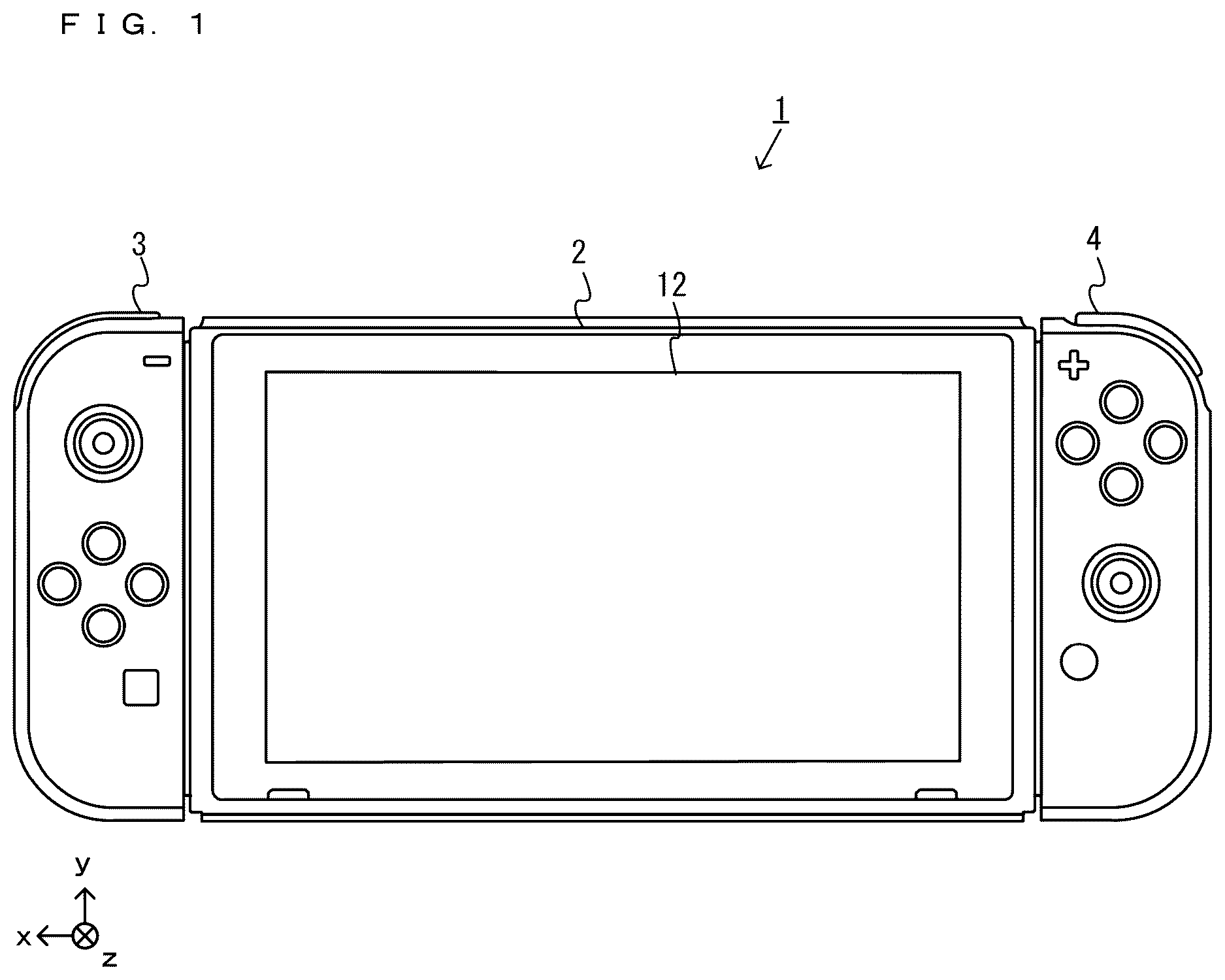
is a view showing a non-limiting example where a left controller and a right controller are attached to a main body apparatus;
is a view showing a non-limiting example where a left controller and a right controller are removed from a main body apparatus;
is a six-sided view showing a non-limiting example of a main body apparatus;
is a six-sided view showing a non-limiting example of a left controller;
is a six-sided view showing a non-limiting example of a right controller;
is a block diagram showing a non-limiting example of an internal configuration of a main body apparatus;
is a block diagram showing a non-limiting example of an internal configuration of a main body apparatus, a left controller and a right controller;
is a view showing a non-limiting example of a terrain object, which is a voxel object;
is a view showing a non-limiting example of a state before and after the deletion of a portion of the terrain object shown in ;
is a view showing a non-limiting example of states before and after the deletion of a portion of the terrain object shown in ;
is a view showing a non-limiting example of voxel data;
is a view showing a non-limiting example of material data;
is a view showing a non-limiting example of a game space when an update event has occurred;
is a view showing a non-limiting example of an update range;
is a view showing a non-limiting example of a method for setting vertices;
is a view showing a non-limiting example of a method for determining a material of a vertex;
is a view showing a non-limiting example of vertex simplification;
is a view showing a non-limiting example of conditions regarding materials;
is a view showing a non-limiting example of a mesh generated based on vertices;
is a view showing a non-limiting example of division of a quadrangle forming a mesh into two triangles;
is a view showing a non-limiting example of a method for determining materials of polygons forming a display mesh;
is a view showing a non-limiting example of materials set for vertices of adjacent two polygons;
is a view showing a non-limiting example of application of textures to polygons;
is a view showing a non-limiting example of a method for determining materials of polygons forming a determination mesh;
is a view showing a non-limiting example of a game image representing a state in which a player character moves on a terrain object;
is a view showing a non-limiting example of a game image representing a state in which a player character 201 throws an ice object 261 into a region 251 in a terrain object;
is a view showing a non-limiting example of a game image after the terrain object of is changed due to contact of the ice object 261 with the region 251 in the terrain object;
is a view showing a non-limiting example of a game image after the terrain object of is changed due to contact of the ice object 261 with the region 251 in the terrain object;
is a view showing a non-limiting example of a game image representing a state in which a player character 201 destroys a terrain object 255 ;
is a view showing a non-limiting example of a cross-section of a terrain object 255 after a player character 201 has destroyed the terrain object 255 ;
is a diagram showing a non-limiting example of an update range that is generated by a player character 201 performing a punching action;
is a view showing a non-limiting example of various data used for information processing in a game system; and
is a flowchart showing a non-limiting example of a flow of game processing executed by a game system.
DETAILED DESCRIPTION OF NON-LIMITING EXAMPLE EMBODIMENTS
[1. Configuration of Game System]
A game system according to the present example is described below. An example of a game system 1 according to the present example includes a main body apparatus (an information processing apparatus; which functions as a game apparatus main body in the present example) 2 , a left controller 3 , and a right controller 4 . Each of the left controller 3 and the right controller 4 is attachable to and detachable from the main body apparatus 2 . That is, the game system 1 can be used as a unified apparatus obtained by attaching each of the left controller 3 and the right controller 4 to the main body apparatus 2 . Further, in the game system 1 , the main body apparatus 2 , the left controller 3 , and the right controller 4 can also be used as separate bodies (see ). Hereinafter, first, the hardware configuration of the game system 1 according to the present example is described, and then, the control of the game system 1 according to the present example is described.
is a diagram showing an example of the state in which the left controller 3 and the right controller 4 are attached to the main body apparatus 2 . As shown in , each of the left controller 3 and the right controller 4 is attached to and unified with the main body apparatus 2 . The main body apparatus 2 is an apparatus for performing various processes (e.g., game processing) in the game system 1 . The main body apparatus 2 includes a display 12 . Each of the left controller 3 and the right controller 4 is an apparatus including operation sections with which a user provides inputs.
is a diagram showing an example of the state in which each of the left controller 3 and the right controller 4 is detached from the main body apparatus 2 . As shown in , the left controller 3 and the right controller 4 are attachable to and detachable from the main body apparatus 2 . It should be noted that hereinafter, the left controller 3 and the right controller 4 will occasionally be referred to collectively as a “controller”.
is six orthogonal views showing an example of the main body apparatus 2 . As shown in , the main body apparatus 2 includes an approximately plate-shaped housing 11 . In the present example, a main surface (for example, a surface on a front side, such as a surface on which the display 12 is provided) of the housing 11 has a generally rectangular shape.
It should be noted that the shape and the size of the housing 11 are optional. As an example, the housing 11 may be of a portable size. Further, the main body apparatus 2 alone or the unified apparatus obtained by attaching the left controller 3 and the right controller 4 to the main body apparatus 2 may function as a mobile apparatus. The main body apparatus 2 or the unified apparatus may function as a handheld apparatus or a portable apparatus.
As shown in , the main body apparatus 2 includes the display 12 , which is provided on the main surface of the housing 11 . The display 12 displays an image generated by the main body apparatus 2 . In the present example, the display 12 is a liquid crystal display device (LCD). The display 12 , however, may be a display device of any type.
Further, the main body apparatus 2 includes a touch panel 13 on a screen of the display 12 . In the present example, the touch panel 13 is of a type that allows a multi-touch input (e.g., a capacitive type). The touch panel 13 , however, may be of any type. For example, the touch panel 13 may be of a type that allows a single-touch input (e.g., a resistive type).
The main body apparatus 2 includes speakers (e.g., speakers 88 shown in ) within the housing 11 . As shown in , speaker holes 11 a and 11 b are formed on the main surface of the housing 11 . Then, sounds output from the speakers 88 are output through the speaker holes 11 a and 11 b.
Further, the main body apparatus 2 includes a left terminal 17 , which is a terminal for the main body apparatus 2 to perform wired communication with the left controller 3 , and a right terminal 21 , which is a terminal for the main body apparatus 2 to perform wired communication with the right controller 4 .
As shown in , the main body apparatus 2 includes a slot 23 . The slot 23 is provided on an upper side surface of the housing 11 . The slot 23 is so shaped as to allow a predetermined type of storage medium to be attached to the slot 23 . The predetermined type of storage medium is, for example, a dedicated storage medium (e.g., a dedicated memory card) for the game system 1 and an information processing apparatus of the same type as the game system 1 . The predetermined type of storage medium is used to store, for example, data (e.g., saved data of an application or the like) used by the main body apparatus 2 and/or a program (e.g., a program for an application or the like) executed by the main body apparatus 2 . Further, the main body apparatus 2 includes a power button 28 .
The main body apparatus 2 includes a lower terminal 27 . The lower terminal 27 is a terminal for the main body apparatus 2 to communicate with a cradle. In the present example, the lower terminal 27 is a USB connector (more specifically, a female connector). Further, when the unified apparatus or the main body apparatus 2 alone is mounted on the cradle, the game system 1 can display on a monitor an image generated by and output from the main body apparatus 2 . The monitor may be stationary or may be movable. Further, in the present example, the cradle has the function of charging the unified apparatus or the main body apparatus 2 alone mounted on the cradle. Further, the cradle has the function of a hub device (specifically, a USB hub).
is six orthogonal views showing an example of the left controller 3 . As shown in , the left controller 3 includes a housing 31 . In the present example, the housing 31 has a vertically long shape. The housing 31 may be shaped to be long in an up-down direction. For example, along the y-axis direction shown in . In the state where the left controller 3 is detached from the main body apparatus 2 , the left controller 3 can also be held in the orientation in which the left controller 3 is vertically long. The housing 31 has such a shape and a size that when held in the orientation in which the housing 31 is vertically long, the housing 31 can be held with one hand, particularly the left hand. Further, the left controller 3 can also be held in the orientation in which the left controller 3 is horizontally long. When held in the orientation in which the left controller 3 is horizontally long, the left controller 3 may be held with both hands.
The left controller 3 includes an analog stick 32 . As shown in , the analog stick 32 is provided on a main surface of the housing 31 . The analog stick 32 can be used as a direction input section with which a direction can be input. The user tilts the analog stick 32 and thereby can input a direction corresponding to the direction of the tilt (and input a magnitude corresponding to the angle of the tilt). It should be noted that the left controller 3 may include a directional pad, a slide stick that allows a slide input, or the like as the direction input section, instead of the analog stick. Further, in the present example, it is possible to provide an input by pressing the analog stick 32 .
The left controller 3 includes various operation buttons. The left controller 3 includes four operation buttons 33 to 36 (specifically, a right direction button 33 , a down direction button 34 , an up direction button 35 , and a left direction button 36 ) on the main surface of the housing 31 . Further, the left controller 3 includes a record button 37 and a “−” (minus) button 47 . The left controller 3 includes a first L-button 38 and a ZL-button 39 in an upper left portion of a side surface of the housing 31 . Further, the left controller 3 includes a second L-button 43 and a second R-button 44 , on the side surface of the housing 31 on which the left controller 3 is attached to the main body apparatus 2 . These operation buttons are used to give instructions depending on various programs (e.g., an operating system (OS) program and an application program) executed by the main body apparatus 2 .
Further, the left controller 3 includes a terminal 42 for the left controller 3 to perform wired communication with the main body apparatus 2 .
is six orthogonal views showing an example of the right controller 4 . As shown in , the right controller 4 includes a housing 51 . In the present example, the housing 51 has a vertically long shape. For example, it may be shaped to be long in the up-down direction. In the state where the right controller 4 is detached from the main body apparatus 2 , the right controller 4 can also be held in the orientation in which the right controller 4 is vertically long. The housing 51 has such a shape and a size that when held in the orientation in which the housing 51 is vertically long, the housing 51 can be held with one hand, particularly the right hand. Further, the right controller 4 can also be held in the orientation in which the right controller 4 is horizontally long. When held in the orientation in which the right controller 4 is horizontally long, the right controller 4 may be held with both hands.
Similarly to the left controller 3 , the right controller 4 includes an analog stick 52 as a direction input section. In the present example, the analog stick 52 has the same configuration as that of the analog stick 32 of the left controller 3 . Further, the right controller 4 may include a directional pad, a slide stick that allows a slide input, or the like, instead of the analog stick. Further, similarly to the left controller 3 , the right controller 4 includes four operation buttons 53 to 56 (specifically, an A-button 53 , a B-button 54 , an X-button 55 , and a Y-button 56 ) on a main surface of the housing 51 . Further, the right controller 4 includes a “+” (plus) button 57 and a home button 58 . Further, the right controller 4 includes a first R-button 60 and a ZR-button 61 in an upper right portion of a side surface of the housing 51 . Further, similarly to the left controller 3 , the right controller 4 includes a second L-button 65 and a second R-button 66 .
Further, the right controller 4 includes a terminal 64 for the right controller 4 to perform wired communication with the main body apparatus 2 .
is a block diagram showing an example of the internal configuration of the main body apparatus 2 . The main body apparatus 2 includes components 81 to 85 , 87 , 88 , 91 , 97 , and 98 shown in in addition to the components shown in . Some of the components 81 to 85 , 87 , 88 , 91 , 97 , and 98 may be mounted as electronic components on an electronic circuit board and accommodated in the housing 11 .
The main body apparatus 2 includes a processor 81 . The processor 81 is an information processing section for executing various types of information processing to be executed by the main body apparatus 2 . For example, the processor 81 may be composed only of a CPU (Central Processing Unit), or may be composed of a SoC (System-on-a-chip) having a plurality of functions such as a CPU function and a GPU (Graphics Processing Unit) function. The processor 81 executes an information processing program (e.g., a game program) or other instructions that are stored in storage. For example, in an internal non-transitory storage medium such as a flash memory 84 , an external storage non-transitory medium attached to the slot 23 , or the like), thereby performing the various types of information processing.
The main body apparatus 2 includes a flash memory 84 and a DRAM (Dynamic Random Access Memory) 85 as examples of internal storage media built into the main body apparatus 2 . The flash memory 84 and the DRAM 85 are connected to the processor 81 . The flash memory 84 is a memory mainly used to store various data (or programs) to be saved in the main body apparatus 2 . The DRAM 85 is a memory used to temporarily store various data used for information processing. DRAM 85 and flash memory 84 are illustrative non-limiting examples of non-transitory computer-readable media.
The main body apparatus 2 includes a slot interface (hereinafter abbreviated as “I/F”) 91 . The slot I/F 91 is connected to the processor 81 . The slot I/F 91 is connected to the slot 23 , and in accordance with an instruction from the processor 81 , reads and writes data from and to the predetermined type of storage medium (e.g., a dedicated memory card) attached to the slot 23 .
The processor 81 appropriately reads and writes data from and to the flash memory 84 , the DRAM 85 , and each of the above storage media, thereby performing the above information processing.
The main body apparatus 2 includes a network communication section 82 . The network communication section 82 is connected to the processor 81 . The network communication section 82 communicates (specifically, through wireless communication) with an external apparatus via a network. In the present example, as a first communication form, the network communication section 82 connects to a wireless LAN and communicates with an external apparatus, using a method compliant with the Wi-Fi standard. Further, as a second communication form, the network communication section 82 wirelessly communicates with another main body apparatus 2 of the same type, using a predetermined communication method (e.g., communication based on a unique protocol or infrared light communication). It should be noted that the wireless communication in the above second communication form achieves the function of enabling so-called “local communication” in which the main body apparatus 2 can wirelessly communicate with another main body apparatus 2 placed in a closed local network area, and the plurality of main body apparatuses 2 directly communicate with each other to transmit and receive data.
The main body apparatus 2 includes a controller communication section 83 . The controller communication section 83 is connected to the processor 81 . The controller communication section 83 wirelessly communicates with the left controller 3 and/or the right controller 4 . The communication method between the main body apparatus 2 and the left controller 3 and the right controller 4 is optional. In the present example, the controller communication section 83 performs communication compliant with the Bluetooth (registered trademark) standard with the left controller 3 and with the right controller 4 .
The processor 81 is connected to the left terminal 17 , the right terminal 21 , and the lower terminal 27 . When performing wired communication with the left controller 3 , the processor 81 transmits data to the left controller 3 via the left terminal 17 and also receives operation data from the left controller 3 via the left terminal 17 . Further, when performing wired communication with the right controller 4 , the processor 81 transmits data to the right controller 4 via the right terminal 21 and also receives operation data from the right controller 4 via the right terminal 21 . Further, when communicating with the cradle, the processor 81 transmits data to the cradle via the lower terminal 27 . As described above, in the present example, the main body apparatus 2 can perform both wired communication and wireless communication with each of the left controller 3 and the right controller 4 . Further, when the unified apparatus obtained by attaching the left controller 3 and the right controller 4 to the main body apparatus 2 or the main body apparatus 2 alone is attached to the cradle, the main body apparatus 2 can output data (e.g., image data or sound data) to the stationary monitor or the like via the cradle.
Here, the main body apparatus 2 can communicate with a plurality of left controllers 3 simultaneously (in other words, in parallel). Further, the main body apparatus 2 can communicate with a plurality of right controllers 4 simultaneously (in other words, in parallel). Thus, a plurality of users can simultaneously provide inputs to the main body apparatus 2 , each using a set of the left controller 3 and the right controller 4 . As an example, a first user can provide an input to the main body apparatus 2 using a first set of the left controller 3 and the right controller 4 , and simultaneously, a second user can provide an input to the main body apparatus 2 using a second set of the left controller 3 and the right controller 4 .
Further, the display 12 is connected to the processor 81 . The processor 81 displays a generated image (e.g., an image generated by executing the above information processing) and/or an externally acquired image on the display 12 .
The main body apparatus 2 includes a codec circuit 87 and speakers (specifically, a left speaker and a right speaker) 88 . The codec circuit 87 is connected to the speakers 88 and a sound input/output terminal 25 and also connected to the processor 81 . The codec circuit 87 is a circuit for controlling the input and output of sound data to and from the speakers 88 and the sound input/output terminal 25 .
The main body apparatus 2 includes a power control section 97 and a battery 98 . The power control section 97 is connected to the battery 98 and the processor 81 . Further, although not shown in , the power control section 97 is connected to components of the main body apparatus 2 (specifically, components that receive power supplied from the battery 98 , the left terminal 17 , and the right terminal 21 ). Based on a command from the processor 81 , the power control section 97 controls the supply of power from the battery 98 to the above components.
Further, the battery 98 is connected to the lower terminal 27 . When an external charging device (e.g., the cradle) is connected to the lower terminal 27 , and power is supplied to the main body apparatus 2 via the lower terminal 27 , the battery 98 is charged with the supplied power.
is a block diagram showing examples of the internal configurations of the main body apparatus 2 , the left controller 3 , and the right controller 4 . It should be noted that the details of the internal configuration of the main body apparatus 2 are shown in and therefore are omitted in .
The left controller 3 includes a communication control section 101 , which communicates with the main body apparatus 2 . As shown in , the communication control section 101 is connected to components including the terminal 42 . In the present example, the communication control section 101 can communicate with the main body apparatus 2 through both wired communication via the terminal 42 and wireless communication not via the terminal 42 . The communication control section 101 controls the method for communication performed by the left controller 3 with the main body apparatus 2 . That is, when the left controller 3 is attached to the main body apparatus 2 , the communication control section 101 communicates with the main body apparatus 2 via the terminal 42 . Further, when the left controller 3 is detached from the main body apparatus 2 , the communication control section 101 wirelessly communicates with the main body apparatus 2 (specifically, the controller communication section 83 ). The wireless communication between the communication control section 101 and the controller communication section 83 is performed in accordance with the Bluetooth (registered trademark) standard, for example.
Further, the left controller 3 includes a memory 102 such as a flash memory. The communication control section 101 includes, for example, a microcomputer (or a microprocessor) and executes firmware stored in the memory 102 , thereby performing various processes.
The left controller 3 includes buttons 103 (specifically, the buttons 33 to 39 , 43 , 44 , and 47 ). Further, the left controller 3 includes the analog stick (“stick” in ) 32 . Each of the buttons 103 and the analog stick 32 outputs information regarding an operation performed on itself to the communication control section 101 repeatedly at appropriate timing.
The communication control section 101 acquires information regarding an input (specifically, information regarding an operation or the detection result of the sensor) from each of input sections (specifically, the buttons 103 and the analog stick 32 ). The communication control section 101 transmits operation data including the acquired information (or information obtained by performing predetermined processing on the acquired information) to the main body apparatus 2 . It should be noted that the operation data is transmitted repeatedly, once every predetermined time. It should be noted that the interval at which the information regarding an input is transmitted from each of the input sections to the main body apparatus 2 may or may not be the same.
The above operation data is transmitted to the main body apparatus 2 , whereby the main body apparatus 2 can obtain inputs provided to the left controller 3 . That is, the main body apparatus 2 can determine operations on the buttons 103 and the analog stick 32 based on the operation data.
The left controller 3 includes a power supply section 108 . In the present example, the power supply section 108 includes a battery and a power control circuit. Although not shown in , the power control circuit is connected to the battery and also connected to components of the left controller 3 (specifically, components that receive power supplied from the battery).
As shown in , the right controller 4 includes a communication control section 111 , which communicates with the main body apparatus 2 . Further, the right controller 4 includes a memory 112 , which is connected to the communication control section 111 . The communication control section 111 is connected to components including the terminal 64 . The communication control section 111 and the memory 112 have functions similar to those of the communication control section 101 and the memory 102 , respectively, of the left controller 3 . Thus, the communication control section 111 can communicate with the main body apparatus 2 through both wired communication via the terminal 64 and wireless communication not via the terminal 64 (specifically, communication compliant with the Bluetooth (registered trademark) standard). The communication control section 111 controls the method for communication performed by the right controller 4 with the main body apparatus 2 .
The right controller 4 includes input sections similar to the input sections of the left controller 3 . Specifically, the right controller 4 includes buttons 113 and the analog stick 52 . These input sections have functions similar to those of the input sections of the left controller 3 and operate similarly to the input sections of the left controller 3 .
The right controller 4 includes a power supply section 118 . The power supply section 118 has a function similar to that of the power supply section 108 of the left controller 3 and operates similarly to the power supply section 108 .
[2. Outline of Process on Game System]
Next, referring to to , an outline of the process performed on the game system 1 will be described. In the present example, the game system 1 generates a game image in which terrain objects and characters (e.g., the player character controlled by the player) are arranged in a game space, which is a three-dimensional virtual space, and displays the game image on a display device. Note that in the present example, the display device on which the game image is displayed may be the display 12 described above, or may be a stationary monitor.
[2-1. Voxel]
In the present example, for some objects in the game space, the shape is defined by voxel data. Here, voxels are rectangular parallelepiped (more specifically, cubic) regions arranged in a grid pattern in the game space, and voxel data is data indicating information regarding the voxels. Hereinafter, an object whose shape is defined by voxel data will be referred to as a “voxel object”. In the present example, the game system 1 stores voxel data for a plurality of voxels that are set in the game space as data for generating voxel objects in the game space.
is a view showing an example of a terrain object, which is a voxel object. As shown in , in the present example, a terrain object representing a terrain such as a ground surface has its shape defined by voxel data. The cubes shown in represent a terrain object. Note that in , edges of the terrain object are indicated by thick lines. However, these thick lines are added for the purpose of making the drawings easier to understand, and there is no need for edges of the terrain object to be drawn thick.
For example, the terrain object shown in is generated by the following rule: “a cube is placed at the position of a voxel if a parameter included in the voxel data set for the voxel is greater than a predetermined value, and nothing is placed at the position of the voxel if the parameter is less than or equal to the predetermined value”. A terrain object in is shown for the purpose of illustrating the relationship between voxels and voxel objects in an easy-to-understand manner. Note that in the present example, in practice, a voxel object is generated (e.g., based on voxel data) by such a rule that results in a terrain object having a complicated shape, such as a terrain object shown in to be described below, for example. Note that there is no limitation on the rule for determining the shape of the voxel object based on the voxel data. In other examples, the game system 1 may generate a voxel object as shown in based on the object data or may generate a voxel object as shown in based on the object data.
It is possible to change the shape of a voxel object by changing voxel data of voxels. and are views showing before and after the removal of a portion of the terrain object shown in . That is, when the hatched portion of the terrain object shown in is broken, the terrain object changes to a shape as shown in . In such a case, the game system 1 can easily delete the terrain object by rewriting the voxel data described below so as to indicate that the terrain object is absent for voxels in the hatched portion. Note that also when making an addition to the terrain object, as when deleting the terrain object, the game system 1 can easily change the shape of the terrain object by changing the voxel data of voxels.
Thus, the game system 1 can freely change the shape of a voxel object by rewriting the voxel data. For example, the shape of a terrain object may be changed as a result of the terrain object in a game being broken for some reason (e.g., the player object striking the terrain object). In such a case, the game system 1 can freely change the shape of the terrain object by changing the voxel data used to generate the terrain object, rather than directly changing data representing the outer shape of the terrain object (e.g., the mesh to be described below).
In the present example, voxels are defined in the entire game space (e.g., a voxel space in which voxels are set corresponds to the entire game space). However, the voxel space may not necessarily be set over the entire game space, and may be set in a certain area in the game space. If the voxel space is set in a certain area in the game space, the shape of the voxel object is defined by voxel data regarding voxels in the voxel space, and the position of the voxel object in the game space is defined by the position of the voxel space in the game space. The game space may include a main voxel space that is set over the entire game space, and a sub voxel space that is set in a certain area in the game space. In this case, the game system 1 stores therein the voxel data for each voxel space.
shows an example of voxel data. The voxel data includes density data, a first material ID, a second material ID, material mixing ratio data, and state data, for each voxel defined in the game space. In the voxel data according to the present example, these pieces of data are set for each voxel.
The density data indicates a density that is an index used for defining the shape of a voxel object based on the voxel (specifically, the shape defined by a mesh described below). As will be described in detail below, the position and shape of the surface of the voxel object (e.g., the mesh described below) are determined based on the density.
In the present example, the density can take an integer value in a range from a lower limit value (e.g., 0) to an upper limit value (e.g., 255). In the present example, the game system 1 determines a surface shape of the voxel object, based on the density such that the proportion of the volume that the area in the voxel object occupies in the voxel tends to be greater when the density value set for the voxel is higher, and the proportion tends to be smaller when the density value is lower. Thus, the density is an index that has an influence on the proportion of the volume that the area in the voxel object occupies in the voxel. The density can also be regarded as an index that indicates the degree of virtual occupation of the content (e.g., the virtual content of the voxel object) in the space of the voxel. For example, when the density is 0, the voxel is empty. When the density is 255, the entire space in the voxel is the content of the voxel object. When the density is a value between 0 and 255, the content of the voxel object occupies the space in the voxel based on (e.g., in a proportion according to) the value. The shape of the mesh, e.g., the surface shape of the voxel object, can be determined based on the density. The mesh can be regarded as the surface of a part, of a voxel, in which the content exists, or as a boundary between a part, of a voxel, in which the content exists and a part, of the voxel, in which the content does not exist. The volume that the area in the voxel object generated based on the density occupies may not necessarily be the volume that exactly matches the proportion indicated by the density. For example, the volume of the voxel object may differ between the method for generating a voxel object as shown in and the method for generating a voxel object as shown in even if these methods are based on the same density.
In other examples, the density may indicate either a state in which the volume of the area in the voxel object occupies the entire area in the voxel or a state in which the volume of the area in the voxel object is not included in the area in the voxel. For example, the density data may be data that can take only 0 or 1.
The first material ID and the second material ID are information indicating materials of the corresponding voxel. In the present example, a material such as sand, rock, or soil is set for a voxel. In the game system 1 , multiple types of materials are prepared as materials that can be set for voxels (see material data shown in ). In the present example, at most two materials out of the prepared multiple types of materials can be set for one voxel. The first material ID is an ID indicating a first material set for the voxel, and the second material ID is an ID indicating a second material set for the voxel. As will be described in detail below, a material of a voxel object (e.g., a material to be set for a polygon of the voxel object) is determined based on the materials set for voxels.
As described above, in the present example, the voxel data includes the ID indicating the material. However, in other examples, the voxel data may have a data structure that includes data directly indicating the details of the material (e.g., information on the name, property, and rendering setting described below).
The material mixing ratio data is an example of data indicating a ratio of materials in the voxel. In the present example, since at most two material IDs are set for one voxel, the material mixing ratio data, which indicates the ratio of one of the material indicated by the first material ID and the material indicated by the second material ID, can also indicate the ratio of the other material. In the present example, it is assumed that the material mixing ratio is a value indicating the ratio of the second material to the entire material consisting of the first material and the second material. The value is 0 or more and 1 or less. For example, if the material mixing ratio set for a certain voxel is 0.4, this indicates that the voxel is composed of the first material and the second material in the ratio of 0.6:0.4. As will be described in detail below, the appearance and property of the voxel object are determined based on the materials. The material mixing ratio is used to determine the appearance and property of the voxel object. In other examples, the material mixing ratio may be a value indicating the proportion of the first material. The ratio of the materials in the voxel may be indicated by the values of the proportions of the materials. In particular, in other examples, if the number of settable types of materials is not limited to two at most and three or more types of materials can be set, the ratio of the materials in the voxel is indicated by a plurality of values respectively indicating the proportions of the materials.
In the present example, two types of materials may not necessarily be set for a voxel, and one type of material may be set. For example, if one type of material is set for a certain voxel, the first material ID indicates this material, and the material mixing ratio is set at 0.
The state data indicates a state that is set for the corresponding voxel. The specific content of state data and the number of types thereof are discretionary. In the present example, the state data includes data indicating the amount of damage set on the voxel. In other examples, the state data may include data indicating whether or not the voxel is wet (and its extent), for example.
As described above, in the present example, since the voxel data includes the material ID, the game system 1 stores therein material data that defines the content of the material indicated by the material ID. shows an example of the material data. As shown in , in the material data according to the present example, for each material, a material ID is associated with information on a name, a property, and rendering setting that are set for the material.
The name included in the material data is a name (e.g., soil, sand, grass, etc.) set for the material. It should be noted that during the game, the name of the material of the voxel object may be displayed. In order to perform such a display, the material data includes information on the name of the material.
The property included in the material data is a property set for the material. The property of the material is a property that the voxel object, on which the material is set, possesses in the game. The specific content of the property of the material, and the number of types of properties are discretionary. For example, at least one of the following pieces of information may be set as properties of a material.
•
• Hardness • Weight • Slipperiness • Damage setting in the case where the player character comes into contact with the voxel object • Temperature • Whether another object can be bonded to the voxel object • Amount of hit points to be regained by the player character when the player character destroys or acquires the voxel object • Amount of in-game currency to be gained by the player character when the player character destroys or acquires a voxel object
In other examples, information different from those listed above may be set as information indicating a property of a material.
In the present example, the material data includes, as information that identifies a property of a material, an ID indicating the property (see ). Although not shown in , the game system 1 stores, for each property to be prepared, property information in which the property ID is associated with the content of the property (e.g., a value indicating the aforementioned weight or slipperiness). By referring to the property information, the game system 1 can specify the specific content of the property set for the material.
The rendering setting included in the material data is information that indicates setting regarding rendering, such as a texture used for rendering of the voxel object for which the material is set. In the present example, the material data includes, as information on rendering setting, an ID of a texture to be used for rendering the voxel object for which the material is set (see ). Although not shown in , the game system 1 stores, for each texture prepared, texture information in which the texture ID is associated with the texture indicated by the texture ID. By referring to the texture information, the game system 1 can specify the specific content of the texture set for the material. In other examples, as information on rendering setting, any information regarding setting of shading may be set in addition to the texture information. For example, information regarding reflectivity, normal, or the like may be set.
The material data may include data other than the data shown in . For example, the material data may include data regarding sound setting. For example, the data regarding the sound setting may be data that defines the sound of footsteps that is outputted when the player character walks on the voxel object based on the voxel.
The material data may be data of any form capable of specifying the property and/or rendering setting of the material. For example, in other examples, the material data may have a data structure including data that directly indicates the property and/or rendering setting of the material, instead of the data structure including the material ID and the texture ID.
[2-2. Update of Voxel Data]
During the game, the voxel object is deformed when the voxel data is updated. In the present example, when a game event for updating the voxel object (hereinafter referred to as “update event”) has occurred, the game system 1 updates the voxel data. The update event may have any content. For example, the update event may be that a character that appears in the game has performed an action to deform the voxel object (e.g., the player character has punched the voxel object), or may be that an event that deforms the voxel object has occurred (e.g., contact of an object thrown by a character with the voxel object, or explosion of a bomb).
shows an example of a game space when an update event has occurred. In the situation shown in , a player character 201 has performed a punching action to a terrain object 202 that is a voxel object. As will be described in detail below, in the example shown in , the voxel data is updated such that the terrain object 202 at and around a position hit by the punching action of the player character 201 is deleted. This represents how the terrain object 202 is destroyed by the punching action of the player character 201 .
In the present example, when such an update event has occurred, the game system 1 sets, in the game space, an update range in which the voxel object is updated (in the example shown in , an update range 203 ). The position, shape, and size of the update range are discretionary. The position of the update range may be determined based on, for example, a position at which an object regarding the generated update event (e.g., the player character that has punched) comes into contact with the voxel object. In the example shown in , the position of the update range 203 may be determined based on a position that is hit by the punch of the player character 201 . For example, the hit position, or a position a predetermined distance ahead of the hit position may be a center position of the update range 203 . The shape and size of the update range may be determined in advance according to the type of the update event. For example, when an update event due to a punch of the player character 201 has occurred, the shape and size of the update range may be determined to be a sphere having a predetermined size as shown in . The size of the update range may be determined based on a value indicating the degree of influence of the generated update event (e.g., the intensity of the punch, or the magnitude of the explosion).
The game system 1 changes the density of a voxel corresponding to the set update range. The voxel corresponding to the update range is, for example, a voxel within the update range or a voxel overlapping the update range. As a result of the change in the density, the mesh of the voxel object is changed by a process described below, thereby changing the shape of the voxel object (the shape by appearance, and the shape used for contact determination). In other examples, in addition to changing the density of the voxel included in the update range, the game system 1 may change the material in the voxel (e.g., the first material, the second material, and the material mixing ratio), or may change the state in the voxel.
In the present example, the game system 1 determines whether or not a voxel is included in the update range, by using an SDF (Signed Distance Field). The game system 1 sets an SDF indicating an update range set in the game space, and performs the aforementioned determination based on the value of the SDF. The SDF represents distances, with signs, of any positions from a shape that the SDF defines. shows an example of the update range. In the example shown in , a spherical update range is set in the game space. For example, in the example shown in , an SDF is set such that, among positions in the game space, positions inside the shape represented by the SDF have negative SDF values, and positions outside the shape represented by the SDF have positive SDF values. In this example, whether or not each position is included in the update range can be determined depending on whether or not the SDF value is positive or negative. In addition, using the SDF values allows not only simple inside/outside determination but also a process such as correction or interpolation.
In the example described above, a change in which the voxel object in the update range is deformed as if it is deleted, is applied to the voxel object. However, a change to be applied to the voxel object by using the update range is not limited thereto. For example, a change in which a voxel object is newly added in the update range (e.g., the volume that an area in the voxel object occupies is increased by the update range) may be applied to the voxel object. A change in which only the voxel material in the update range is changed while the voxel density is not changed, may be applied to the voxel object. A change in the voxel density and a change in the voxel material may be integrally applied.
[2-3. Calculation of Vertices]
When the voxel density has been updated as described above, the game system 1 sets vertices based on the updated voxel data. The vertices can be vertices of a mesh of a voxel object. As will be described in detail below, in the present example, the vertices are simplified, and the simplified vertices become the vertices of the mesh of the voxel object.
shows an example of a method for setting vertices. In to 24 , voxels, vertices, meshes, etc., are represented in two dimensions for the purpose of making the drawings easily viewable, and the description easily understandable. However, in actuality, vertices and meshes are set in a three-dimensional space, based on voxels in the three-dimensional space. In the present example, the game system 1 executes a method in which, for a portion where a voxel having a density that is set to a value indicating “existence” (e.g., a density equal to or greater than a reference value described below) is adjacent to a voxel having a density that is set to a value indicating “nonexistence” (e.g., a density less than the reference value described below), a vertex is set at coordinates based on the positions and densities of a plurality of neighboring voxels around the portion. Hereinafter, this method will be described in detail.
As described above, in the present example, the density set for a voxel is in the range of 0 to 255. A voxel having a density of 0 is completely empty, and a voxel having a density of 255 is completely filled up. Densities between 0 and 255 are complementarily treated, and are used for determining a vertex. In the present example, voxels are virtually treated such that voxels whose densities are equal to or greater than a reference value are inside a voxel object, and voxels whose densities are less than the reference value are outside the voxel object. It is also possible to virtually treat voxels such that voxels whose densities are equal to or greater than the reference value are voxels indicating “existence”, and voxels whose densities are less than the reference value are voxels indicating “nonexistence”. It is not necessary to define only voxels having a density of 0 as being outside the voxel object (e.g., reference value=1), and the reference value may be set to, for example, 128. In the example shown in , a voxel 211 and the other outer voxels have a density of 0, a voxel 212 has a density of 100 which is less than the reference value (e.g., 128), and voxels 213 , 214 respectively have densities of 150, 210 which are greater than the reference value. In the present example, the game system 1 generates vertices between the voxels whose densities are equal to or greater than the reference value and the voxels whose densities are less than the reference value. Specifically, for each region (region delimited by dotted lines) that straddles eight (four in the figure) adjacent voxels, it is determined whether or not to generate a vertex. That is, a vertex is generated in each region that straddles both a voxel whose density is equal to or greater than the reference value and a voxel whose density is less than the reference value. The coordinates of each vertex are determined by comparing the densities of adjacent voxels and performing interpolation based on the difference in density for each of the XYZ axes. Normal information that defines positions and directions of straight lines connecting the vertices may be set in advance, whereby the coordinates of each vertex can be calculated based on the normal information. The normal information may be stored in advance for at least some of the voxels, or if not stored, the normal information may also be calculated based on the densities between adjacent voxels. In , since the density of the voxel 212 is less than the reference value, the voxel 212 is treated as being outside the voxel object in the determination of presence/absence of a vertex, but the density value itself of the voxel 212 is used to calculate the coordinates of the vertices to be generated. If the reference value is set to a value lower than the density of the voxel 212 , it would result in an increase in the vertices on the upper right side and the upper left side in the voxel 212 shown in .
By setting the vertices as described above, it is possible to generate a shape whose volume is based on (e.g., reflects) the density of each voxel to some extent, in generating a mesh connecting the set vertices (or vertices obtained by subjecting the set vertices to a simplification process described below). However, depending on the relationship with the neighboring voxels, a voxel having a density of 0 may partially include a region inside the voxel object, or a voxel having a density of 255 may partially include a region outside the voxel object. In the present example, since voxels having densities less than the reference value are treated as being outside the voxel object, there are fewer vertices as compared with a case where those voxels are treated as being inside the voxel object, and the volume will be smaller accordingly. That is, there is no need to calculate the polygon mesh so that the volume strictly corresponds to the density value.
[2-4. Determination of Material of Vertex]
The game system 1 determines a material for each of the vertices set as described above. The material of the vertex is determined based on materials regarding voxels around this vertex. The voxels around the vertex are, for example, voxels used for determining whether or not to generate the vertex (e.g., voxels overlapping the aforementioned region that straddles voxels). In other examples, the voxels used for determining the material of the vertex and the voxels used for determining generation of the vertex may not necessarily be the same, and may be different from each other.
shows an example of a method for determining a material of a vertex. In the example shown in , a vertex 219 is set with respect to four voxels 215 to 218 , and the four voxels 215 to 218 correspond to the aforementioned “voxels around the vertex”. In an actual three-dimensional space, the number of voxels around the vertex is eight. In the example shown in , as for the voxel 215 , a density of 255, a first material of “sand”, and a material mixing ratio of 0 (e.g., first material:second material=1:0, or the second material may not necessarily be set) are set. As for the voxel 216 , a density of 0 is set (the first and second materials may not necessarily be set). As for the voxel 217 , a density of 204, a first material of “sand”, a second material of “grass”, and a material mixing ratio of 0.3 (e.g., first material:second material=0.7:0.3) are set. As for the voxel 218 , a density of 153, a first material of “soil”, a second material of “grass”, and a material mixing ratio of 0.4 (e.g., first material:second material=0.6:0.4) are set. In addition, the coordinates indicating the position of the vertex 219 are (X, Y)=(0.8, 0.6). A coordinate system for the coordinates has an X coordinate in the left-right direction and a Y coordinate in the up-down direction, in . In the coordinate system, among center positions of the voxels 215 to 218 (positions of white circles in ), the center position of the lower-left voxel 217 is (0, 0).
In determining a material of the vertex, the game system 1 calculates an evaluation value for each of the materials of the neighboring voxels, based on the density of the material, and a weight value based on the distance from the voxel to the vertex. First, the weight value is calculated for each voxel. The shorter the distance from the center position of the voxel to the vertex is, the greater the weight value is. In the present example, assuming that the center position of a certain voxel is (x1, y1) and the coordinates of the vertex are (x2, y2), a weight value for the voxel is calculated according to the following formula (1). (weight value)=|(1− x 1)− x 2|·|(1− y 1)− y 2| (1)
In the example shown in , the weight values of the voxels 215 to 218 calculated according to the formula (1) are as follows. (weight value of voxel 215)=|(1−0)−0.8|·|(1−1)−0.6|=0.12 (weight value of voxel 216)=|(1−1)−0.8|·|(1−1)−0.6|=0.48 (weight value of voxel 217)=|(1−0)−0.8|·|(1−0)−0.6|=0.08 (weight value of voxel 218)=|(1−1)−0.8|·|(1−0)−0.6|=0.32
The game system 1 calculates a density of a material for each voxel. Here, the density of the material is a value obtained by multiplying the proportion of this material, among materials set for the voxel, by the density of the voxel. In the present example, for the densities of the voxels, values obtained by normalizing the aforementioned values from 0 to 255 to values from 0 to 1 are used. In the example shown in , as for the voxel 215 , since the material set for this voxel is only sand, the proportion regarding the sand material is 1, and the density of the voxel is 1, and therefore, the density of the sand material is 1. As for the voxel 216 , since the density is 0 and no material is set, a material density is not calculated. If any material is set, the density of this material is 0. As for the voxel 217 , the proportions of the sand material and the grass material being set are 0.7 and 0.3, respectively, and the density of the voxel is 204/255=0.8. Therefore, the density of the sand material is 0.7.0.8=0.56, and the density of the grass material is 0.3.0.8=0.24. As for the voxel 218 , the proportions of the soil material and the grass material being set are 0.6 and 0.4, respectively, and the density of the voxel is 153/255=0.6. Therefore, the density of the soil material is 0.6.0.6=0.36, and the density of the grass material is 0.4.0.6=0.24.
Then, the game system 1 calculates the evaluation value for each material, based on the weight value and the density of the material. In the present example, the evaluation value of the material is a value obtained by weighting the density of the material calculated for each voxel, according to the weight value of the voxel, and summing up the weighted densities of the neighboring voxels. In the example shown in , the evaluation value of the sand material is 1·0.12+0.56·0.08=0.1648 because the density of the material is 1 and the weight value is 0.12 for the voxel 215 , and the density of the material is 0.56 and the weight value is 0.08 for the voxel 217 . The evaluation value of the grass material is 0.24·0.08+0.24·0.32=0.096 because the density of the material is 0.24 and the weight value is 0.08 for the voxel 217 , and the density of the material is 0.24 and the weight value is 0.32 for the voxel 218 . The evaluation value of the soil material is 0.36·0.32=0.1152 because the density of the material is 0.36 and the weight value is 0.32 for the voxel 218 .
The game system 1 determines a material of the vertex, based on the evaluation values of the respective materials. Specifically, a predetermined number of materials in order from one having the greater evaluation value are determined as materials of the vertex. In the present example, two materials having the first and second greatest evaluation values are determined as materials of the vertex. In the example shown in , since the evaluation values of the sand, grass, and soil materials are 0.1648, 0.096, and 0.1152, respectively, the sand material and the soil material are determined as the materials of the vertex. Furthermore, the game system 1 calculates the ratio of the determined two materials, based on the evaluation values described above. In the present example, the ratio of the two materials may be represented as a second material ratio that is a ratio of the second material to the whole, like the aforementioned material mixing ratio. In the example shown in , for example, if the first material and the second material are set to soil and sand, respectively, the second material ratio is represented as 0.1648/(0.1648+0.1152)≈0.59. In other examples, as a value representing the ratio of the two materials, a value representing the proportion of the first material may be used. Alternatively, values representing the proportions of the respective materials may be used.
In the present example, the game system 1 generates and stores therein vertex data indicating the position of a vertex, material IDs of the first and second materials set for the vertex, and the ratio of the materials. However, the method for managing materials set for a vertex is discretionary. In other examples, the vertex data may have a data structure including data that directly indicates the contents of the first and second materials.
As described above, in the present example, regarding material IDs included in voxel data of a plurality of neighboring voxels around each vertex, the game system 1 calculates a priority parameter (e.g., evaluation value) for each material ID, based on the voxel data. Then, based on the priority parameters, the game system 1 selects a predetermined number of (here, two) material IDs having the higher priorities, and determines the selected materials IDs as material IDs for the vertex. The specific parameter to be used as the priority parameter is not limited to the evaluation value. For example, in other examples, an evaluation value that is calculated using the density of the material without using the weight value may be used as a priority parameter.
In the present example, the evaluation value as an example of the priority parameter is calculated based on the densities of the plurality of neighboring voxels around the vertex such that the material set for the voxel having the higher density has the higher priority (e.g., the evaluation value of the material is increased and thereby the material is highly likely to be selected). Thus, the material of the vertex can be determined while also incorporating (e.g., reflecting) the magnitude of the density set for the voxel.
In the present example, the evaluation value as an example of the priority parameter is calculated based on the distances from reference positions (specifically, center positions) of a plurality of neighboring voxels around the vertex, to the vertex such that the material set for the voxel closer to the vertex has the higher priority. Thus, the material of the vertex can be determined while also incorporating (e.g., reflecting) the distances between the voxels and the vertex.
In the present example, it can also be said that the evaluation value as an example of the priority parameter is calculated based on the material mixing ratios of a plurality of neighboring voxels around the vertex such that the material having the higher material mixing ratio has the higher priority. Thus, in the case where a plurality of materials are set for one voxel, the material of the vertex can be determined while also incorporating (e.g., reflecting) the ratio of the materials.
[2-5. Simplification of Vertices]
In the present example, the game system 1 simplifies the vertices calculated as described above. That is, the game system 1 replaces some of the vertices calculated as described above with one vertex to decrease the number of vertices. As will be described in detail below, the coordinates (e.g., position) and the material of the replacing vertex are set based on a plurality of vertices before replacement. Such simplification can reduce the numbers of vertices and polygons that form a mesh of a voxel object, thereby reducing the amount of memory used for processing, and reducing the processing load.
In the present example, the game system 1 performs simplification by representing vertices using SVO (Sparse Voxel Octree). shows an example of vertex simplification. In , one square delimited by solid lines in (a) represents one vertex division region. Here, the vertex division region is a square region with a center position of a voxel being a vertex (in an actual three-dimensional space, the vertex division region is a cube or a rectangular parallelepiped), and corresponds to a region with the dotted lines being sides shown in and . In , each vertex division region having a character “v” inside is a vertex division region in which a vertex is set.
In the present example, the game system 1 determines whether or not simplification can be performed with respect to the vertices in a predetermined number of (four in , and eight in an actual three-dimensional space) vertex division regions adjacent to each other. If the determination result is that simplification can be performed, simplification is performed for the vertices in the predetermined number of vertex division regions.
In , (a) shows the state before simplification is performed. In the example shown in , it is determined that simplification can be performed for vertex division regions within a range surrounded by dotted lines. In this case, the game system 1 performs simplification such that the vertices in the predetermined number of vertex division regions determined to be simplified are replaced with one vertex (see (b) shown in ). Thus, the vertices in the predetermined number of vertex division regions are simplified to one vertex.
In the present example, the game system 1 performs simplification in a plurality of stages. The number of the stages is discretionary. In , first and second stages are shown and described. In , (b) shows the state in which the first-stage simplification has been performed, and (c) shows the state in which the second-stage simplification has been performed. In the second-stage simplification, whether or not simplification can be performed is determined for vertices that are generated by the first-stage simplification. In the example shown in , when the determination result is that the vertex division regions within a range surrounded by dotted lines in (b) shown in can be subjected to simplification, the vertices in the vertex division regions are simplified, resulting in the state shown in (c) of . The condition for determining whether or not the first-stage simplification can be performed and the condition for determining whether or not the second-stage simplification can be performed may be the same or different from each other.
The specific method for determining whether or not simplification can be performed is discretionary. In the present example, as conditions for the above determination, a condition regarding the shape of the voxel object and a condition regarding the material of the voxel object are used. In the present example, if both the condition regarding the shape of the voxel object and the condition regarding the material of the voxel object are satisfied, it is determined that simplification can be performed. If at least one of the condition regarding the shape of the voxel object and the condition regarding the material of the voxel object is not satisfied, it is determined that simplification cannot be performed.
The condition regarding the shape is, for example, that there is no significant change between the shape due to the vertices before the simplification and the shape due to the vertices after the simplification. For example, determination as to whether or not there is a significant change in the shape due to the vertices before and after the simplification may be performed by calculating an index indicating an error between the mesh before the simplification and the mesh after the simplification, and determining whether or not the index is equal to or smaller than a predetermined allowable value. Furthermore, for example, if the shape due to the vertices after the simplification is not a hollow shape while the shape due to the vertices before the simplification is a hollow shape (e.g., the simplification causes missing of information that the shape is hollow), it is determined that the condition regarding the shape is not satisfied. Whether or not the aforementioned case will occur can be determined based on, for example, the densities of voxels corresponding to the vertex division regions to be subjected to the determination. Moreover, for example, if the shape due to the vertices before the simplification can be represented only by two or more vertices, e.g. it cannot be represented by one vertex, it is determined that the condition regarding the shape is not satisfied. As the condition regarding the shape of the voxel object, the same condition as that used for the conventional method with the SVO may be used.
In the present example, as the condition regarding the material, a condition regarding the number of types of materials to be set for the vertices in the predetermined number of vertex division regions to be subjected to simplification, is used. shows an example of the condition regarding the material. In , (a) shows a case where the materials of vertices 221 to 224 are “grass”, “grass”, “grass and soil”, and “grass and soil”, respectively, and (b) shows a case where the materials of the vertices 221 to 224 are “grass and sand”, “grass”, “grass and soil”, and “grass and soil”, respectively. In the present example, the condition regarding the material is that the total number of the types of materials set for the vertices to be subjected to simplification is equal to or less than a predetermined number. For example, the condition regarding the material is that the total number is equal to or less than the number of materials that can be set for one vertex. In the present example, the predetermined number is 2. For example, in the case of (a) shown in , since the total number of the types of materials set for the vertices 221 to 224 to be subjected to simplification is 2 (e.g., grass and soil), the condition regarding the material is satisfied. In this case, it is determined that the vertices 221 to 224 can be subjected to simplification on the condition that the aforementioned condition regarding the shape of the object is satisfied. On the other hand, in the case of (b) shown in , since the total number of the types of materials set for the vertices 221 to 224 to be subjected to simplification is 3 (e.g., grass, soil, and sand), the condition regarding the material is not satisfied. In this case, it is determined that the vertices 221 to 224 cannot be subjected to simplification regardless of whether or not the condition regarding the shape of the object is satisfied.
In the game system 1 , multiple types of materials to which the same property is set and which are different in appearance may be prepared even though these materials should strictly be classified into different types. Some of the multiple types of materials may be regarded as being of the same type in determining whether the condition regarding the material is satisfied. For example, multiple types of soil materials having the same property and similar appearances (e.g., texture colors or patterns) may be prepared. In this case, the game system 1 may determine whether the condition regarding the material is satisfied while regarding the multiple types of soils as being of the same type.
In the present example, at most two types of materials can be set for a vertex as in the case of a voxel. Meanwhile, in the present example, if the total number of the types of materials set for the vertices to be subjected to simplification is three or more, simplification is not performed. That is, if the total number of the types of materials exceeds the number of materials that can be set for one vertex, simplification is not performed. Therefore, even when the number of vertices is reduced through simplification, the simplification does not cause missing of information on the materials set for the vertices, thereby maintaining the information on the materials.
In the present example, a material of the vertex after the simplification is determined based on the materials of the vertices before the simplification. Specifically, the game system 1 sets the one or two types of materials set on the vertices before the simplification, as the first material and the second material of the vertex after the simplification. This allows the information on the materials to be maintained. The ratio of the materials after the simplification is determined based on the ratio of the materials of the vertices before the simplification. In the present example, the radio of the materials after the simplification is calculated similarly to the aforementioned method for calculating the ratio of materials of vertices by using the evaluation values. That is, the game system 1 calculates weight values based on the distances between the vertex after the simplification and the vertices before the simplification, and calculates an evaluation value for each material, based on the weight values and the densities of the materials of the vertices before the simplification (the evaluation values of the materials described in the above [2-4. Determination of material of vertex] can be used as the densities of the materials here). Then, the ratio of the materials is calculated based on the calculated evaluation values of the materials.
[2-6. Generation of Mesh]
In the present example, a mesh of a voxel object is generated based on vertices having been simplified as described above. shows an example of a mesh generated based on such vertices. Each of squares shown in represents a vertex division region as described above, or a vertex division region obtained by integrating a plurality of vertex division regions through simplification. As shown in , the game system 1 generates a mesh that is composed of polygonal shapes each having, as one side, a straight line connecting vertices of adjacent vertex division regions. Each of the polygonal shapes forming the mesh is a triangle or a quadrangle.
In the present example, the game system 1 generates two types of meshes—e.g., a display mesh and a determination mesh. The display mesh is a mesh used for displaying a voxel object. The determination mesh is a mesh used for collision determination for a voxel object. As will be described in detail below, by using the two types of meshes, the game system 1 can perform processing with the meshes suitable for display of the voxel object and collision determination, respectively.
In the present example, the game system 1 generates the display mesh and the determination mesh, based on data of the SVO described above (e.g., based on the simplified vertices). Thus, sharing vertex data in generating the two types of meshes improves efficiency of processing. In other examples, the game system 1 may not necessarily perform simplification of vertices, and may generate a display mesh and/or a determination mesh, based on vertices that are not simplified.
In the present example, the game system 1 generates the determination mesh so as to be simpler in shape than the display mesh. Specifically, the game system 1 makes the number of vertices of the determination mesh less than the number of vertices of the display mesh. Here, in the present example, the data of the SVO holds, in an octree data structure, data of vertices before simplification and data of simplified vertices, and also includes data used for determining whether or not simplification can be performed. This data includes, for example, data of vertices (referred to as “provisional vertices”) calculated as candidates for a vertex after simplification, and data of the aforementioned index indicating an error between the vertices before simplification and the provisional vertices. For example, the game system 1 may use, among the provisional vertices, a vertex the index of which is equal to or less than a predetermined threshold value (this threshold value is greater than the aforementioned allowable value), for generation of the determination mesh. This allows the number of vertices of the determination mesh to be less than the number of vertices of the display mesh. The number of vertices of the determination mesh being less than the number of vertices of the display mesh allows a reduction in processing load for collision determination. Moreover, since the number of vertices of the display mesh is not excessively reduced, the appearance of the voxel object can be represented in detail.
In other examples, the display mesh and the determination mesh may be generated based on the same data, or may be generated based on different data. The display mesh and the determination mesh may have the same shape (even in this case, materials set for these meshes may be different from each other). The number of vertices of the determination mesh may be equal to the number of vertices of the display mesh, or may be greater than the number of vertices of the display mesh.
[2-6-1. Determination of Material of Display Mesh]
Next, an example of a method for determining materials and an appearance of a display mesh will be described. In the present example, the game system 1 determines a material for each of the polygonal shapes forming the display mesh. As will be described in detail below, in the present example, a polygon corresponding to each polygonal shape is rendered using at most two types of textures corresponding to at most two types of materials. Therefore, the game system 1 determines materials for the polygonal shapes forming the mesh such that two or less types of materials are finally set for one polygonal shape. In other examples, three or more materials may be set. For example, in an example in which three or more types of voxel materials and three or more types of vertex materials are set, the same number of materials may be set for the polygonal shapes.
In the present example, quadrangles may be formed as polygonal shapes forming the display mesh (see ). In determining materials of the display mesh, the game system 1 firstly divides each of the quadrangles forming the display mesh into two triangles under certain conditions. Hereinafter, a process of dividing a quadrangle into two triangles will be described with reference to .
shows an example of dividing a quadrangle forming a mesh into two triangles. In , (a) shows a quadrangle before division, formed by vertices 231 to 234 included in the vertices of the mesh. In , (b) shows two triangles into which the quadrangle is divided. In the example shown in , “grass”, “soil”, “sand and grass”, and “grass” are set as materials of the respective vertices 231 to 234 .
In the present example, if the number of types of materials set for the vertices of the quadrangle is three or more in total, the game system 1 determines whether or not a division condition is satisfied. In the present example, the division condition is that dividing the quadrangle into two triangles allows the number of types of materials set for the vertices of each triangle to be two or less in total. If the division condition is satisfied, the game system 1 divides the quadrangle into two triangles each having two or less types of materials set for the vertices. In the example shown in , three types of example materials, grass, soil, and sand, are set for the vertices 231 to 234 forming the quadrangle. If the quadrangle is divided into a triangle formed by the vertices 231 , 232 , 234 and a triangle formed by the vertices 231 , 233 , 234 , two types of materials, sand and grass, are set for the vertices of the former triangle, and two types of materials, grass and soil, are set for the vertices of the latter triangle (see (b) shown in ). Since the division condition is satisfied for the quadrangle, the game system 1 divides the quadrangle into two triangles.
Since there are two methods for dividing a quadrangle into two triangles, if the division condition is satisfied for the triangles into which the quadrangle is divided by at least one of the two methods, the game system 1 performs the division by the method satisfying the division condition. Meanwhile, if the division condition is not satisfied for the triangles into which the quadrangle is divided by either of the two methods, the game system 1 performs the division by either method.
By performing the division as described above, the game system 1 can generate two triangles each having two or less types of materials set for the vertices, without missing information on three or more types of materials set for the vertices of the quadrangle as much as possible. Here, as described above, each of the polygons forming the mesh is rendered using at most two types of textures. Therefore, by performing the division, the game system 1 can render each polygon by using two types of textures without missing information on the materials set for the vertices as much as possible.
In the present example, the game system 1 sets polygons corresponding to the polygonal shapes obtained through the aforementioned division. That is, the vertices of the polygonal shapes obtained through the division become the vertices of the polygons of the display mesh.
In the present example, as for the polygons forming the display mesh, if the number of types of materials set for the vertices of one polygon is three or more in total, the game system 1 selects two types of materials to determine materials of this polygon. shows an example of a method for determining materials of a polygon forming the display mesh. In the example shown in , as for a vertex 241 of a triangular polygon forming the display mesh, the first material is “grass”, the second material is “soil”, and the material ratio of the first material to the second material is 0.8:0.2. As for a vertex 242 of the polygon, the first material is “grass”, the second material is “sand”, and the material ratio of the first material to the second material is 0.5:0.5. As for a vertex 243 of the polygon, the first material is “sand”, the second material is “soil”, and the material ratio of the first material to the second material is 0.7:0.3.
If the number of types of materials set for the vertices of the polygon is three or more in total, the game system 1 calculates a determination value for each material. The determination value is calculated as a sum of the proportions of the material at the vertices on which the material is set. Then, the game system 1 selects two materials in order from one having the greatest determination value, as materials of the polygon. In the example shown in , the determination value of the grass material is 0.8+0.5=1.3, the determination value of the sand material is 0.5+0.7=1.2, and the determination value of the soil material is 0.2+0.3=0.5. Therefore, the grass material and the sand material are selected as materials of the polygon shown in (see (a) shown in ).
The specific method for selecting a material of a polygon of the display mesh is discretionary. In other examples, a material of a polygon of the display mesh may be selected by any method based on information set for the vertices of the polygon. For example, a material of a polygon of the display mesh may be selected as follows. That is, a material having the greatest proportion at one vertex is specified for each vertex, and a material that is most frequently specified for each vertex is selected as a material of the polygon.
In the present example, the selected materials of the polygon are indicated as materials set for the vertices of the polygon. That is, when the materials of the polygon have been selected, the game system 1 changes the materials being set for the vertices of the polygon (e.g., the material IDs included in the vertex data) to the selected materials. In the example shown in , as for the vertex 241 and the vertex 243 , “grass and soil” and “sand and soil” are respectively set before the selection of materials of the polygon (see (a) shown in ). When grass and sand have been selected as materials of the polygon as described above, the materials set for the vertex 241 and the vertex 243 are changed to “grass and sand” (see (b) shown in ). Since the materials set for the vertex 242 before the selection are the same as the selected materials of the polygon, the materials are not changed. In the case where two types of materials are selected as materials of the polygon as described above, information on the third and subsequent types of materials set for the vertices of the polygon are deleted.
According to the change of the materials set for each vertex, the game system 1 changes the ratio of the materials set for the vertex. For example, as for the vertex 241 , the content indicating that the first material is grass and the second material is soil is changed to the content indicating that the first material is grass and the second material is sand. Here, since the proportion of the sand material is 0, the material ratio of the first material to the second material becomes 1:0. Thus, the above change is formally changing the materials of the vertices of the polygon in order to represent the materials of the polygon by the materials of the vertices of the polygon.
According to the above, since the materials set for the vertices of one polygon are only the materials corresponding to the textures used for rendering described below, a rendering process using the textures can be easily performed.
There may be a case where the aforementioned change causes all the materials at a certain vertex to be changed (e.g., none of the materials after the change correspond to the materials before the change). For example, there is a case where the material set for the vertex before the change is soil, and the materials selected as materials of the polygon are grass and sand. In this case, the ratio of the materials at the certain vertex may be set based on the material ratios at the other vertices of the polygon. For example, in the above example, in the case where the first material set for one of the remaining two vertices of a triangular polygon is grass and the material ratio of grass to sand is 1:0 while the material set for the other vertex is sand and the material ratio of sand to grass is 1:0, the material ratio at the certain vertex may be set to grass:sand=0.5:0.5. The game system 1 may determine the material ratio at the certain vertex in consideration of the distance between this vertex and the other vertex (e.g., based on a weight value that increases as the distance is shorter).
As described above, in the present example, the game system 1 selects, for each polygon, at most a predetermined number of (here, two) material IDs from among the material IDs set for the vertices included in the polygon (e.g., material IDs set for the vertices of the polygonal shape corresponding to the polygon), and determines the selected material IDs as material IDs of the polygon. Thus, the game system 1 can perform the rendering process with the number of textures to be used being reduced, while incorporating (e.g., reflecting) the materials set for the vertices into the appearance of the polygon.
In the present example, regarding the materials of all the vertices forming a polygon, if the number of the materials is equal to or less than the predetermined number, the game system 1 determines the materials as materials of the polygon. Meanwhile, if the number of the materials exceeds the predetermined number, the game system 1 selects a predetermined number of materials having higher priorities, based on the priority parameters of the vertices (specifically, based on the determination values calculated based on the aforementioned evaluation values), and determines the selected materials as materials of the polygon. Thus, even if the number of the materials set for the vertices exceeds, in total, the predetermined number, the number of the materials of the polygon can be made equal to or less than the predetermined number in consideration of the priority.
As described above, in the present example, the first and second materials set for each of the vertices of one polygon are changed to the two types of materials to be set for the polygon. In performing such a change, as for a vertex shared by adjacent two polygons, there is a possibility of inconsistency in the first and second materials to be set.
shows an example of materials set for vertices of adjacent two polygons. shows a state in which two polygons are formed by the vertices 231 to 234 shown in ((b) shown in ). In the example shown in , since grass and sand are determined as materials of a first polygon formed by the vertices 231 , 233 , and 234 , the first and second materials of these vertices should be set to grass and sand, respectively. Meanwhile, since grass and soil are determined as materials of a second polygon formed by the vertices 231 , 232 , and 234 , the first and second materials of these vertices should be set to grass and soil, respectively. Therefore, in the example shown in , as for the vertices 231 and 234 shared by the two polygons, inconsistency occurs in the materials to be set.
In the present example, when inconsistency occurs in material to be set for a vertex shared by two polygons, the game system 1 adds another vertex at the position of the vertex. In , (b) shows an example of a state in which a vertex 231 ′ is added for the vertex 231 and a vertex 234 ′ is added for the vertex 234 . In the example shown in , the game system 1 sets, for the vertices 231 and 234 , grass and sand as the first and second materials according to the materials of the first polygon. In addition, the game system 1 sets, for the vertices 231 ′ and 234 ′, grass and soil as the first and second materials according to the materials of the second polygon. By formally setting two vertices as vertices to be shared by two polygons (e.g., by generating data of two vertices located at the same position and having different materials), it is possible to inhibit occurrence of inconsistency in materials to be set for the vertices.
The game system 1 generates a display mesh composed of the polygons whose vertices and materials are determined as described above. In addition, the game system 1 renders the polygons, based on information on the materials set for the vertices (e.g., the first material and the second material), thereby rendering a voxel object.
shows an example of applying a texture to a polygon. shows a triangular polygon formed by the vertices 241 to 243 shown in . The materials set for the vertices 241 to 243 are those shown in (b) shown in .
As for the position of a vertex of a polygon, rendering is performed by a mapping in which a texture of a first material set for the vertex and a texture of a second material set for the vertex are blended at a ratio of the materials set for the vertex (e.g., using this ratio as a blending ratio). The textures of the first and second materials used for the rendering are textures indicated by information on rendering setting associated with the material ID that is associated with data of the vertex in the aforementioned material data (see ). In the example shown in , as for the position of the vertex 241 , since the material ratio of grass to sand is 1:0, rendering is performed by using only the texture of grass. As for the position of the vertex 243 , since the first material is sand and the material ratio of sand to grass is 1:0, rendering is performed by using only the texture of sand. As for the position of the vertex 242 , since the first material is grass, the second material is sand, and the material ratio of grass to sand is 0.5:0.5, rendering is performed such that the texture of grass and the texture of sand are blended at a blending ratio of 0.5:0.5.
As for positions other than the vertices of the polygon, the game system 1 determines a blending ratio by interpolating the blending ratios at the vertices. Then, rendering is performed by a mapping in which the textures of two materials set for each vertex are blended at the interpolated blending ratio. The specific method for interpolation is discretionary. As an example, a blending ratio between vertices is subjected to linear interpolation. In , a position at which the texture of grass material is applied at a high ratio is shown in white, and a position at which the texture of sand material is applied at a high ratio is shown in black. In the example shown in , the texture of grass is applied to the vertex 241 , and the blending ratio of the texture of sand increases toward the vertex 243 . At the position of the vertex 242 , the blending ratio of grass to sand becomes 1:1, and only the texture of sand is applied at the position of the vertex 243 . Thus, rendering is performed with the two textures set for the polygon (e.g., set for the vertices of the polygon) being blended with the blending ratio according to the material ratio, whereby the appearance at the boundary between different materials can be made natural in the display mesh. This makes the appearance of the display mesh, in which a plurality of types of materials are set, natural.
[2-6-2. Determination of Material of Determination Mesh]
Next, an example of a method for determining materials of a determination mesh will be described. As will be described in detail below, in the present example, there may be a case where collision determination is performed for a voxel object by using a determination mesh, and processing is performed according to a material of a voxel object for which a collision has been determined. Therefore, in the present example, materials are determined also for the determination mesh.
In the present example, the game system 1 sets polygons corresponding to the polygonal shapes forming the determination mesh such that one type of material is set for one polygon. Specifically, the game system 1 determines a material to be set for a polygon of the determination mesh, based on information on materials set for vertices of this polygon (e.g., information on first and second materials, and a material ratio).
shows an example of a method for determining a material of a polygon forming the determination mesh. shows an example of determining a material for a triangular polygon formed by the vertices 241 to 243 shown in . The materials set for the vertices 241 to 243 are those shown in (a) shown in .
In determining a material of a polygon, the game system 1 calculates a determination value for each of materials set for the vertices of the polygon. In the present example, a calculation method for the determination value is identical to the calculation method for the determination value that is used for selection of the materials to be set for the polygonal shapes of the display mesh. The specific calculation method for the determination value is discretionary. In other examples, the determination value may be calculated in any method based on information set for the vertices of the polygon of the determination mesh.
In the example shown in , the determination value for each material is 1.3 for the grass material, 1.2 for the sand material, and 0.5 for the soil material as in the case shown in . Therefore, the grass material is selected as a material of the polygon shown in .
As described above, in the present example, the game system 1 selects, for each polygon, at most a predetermined number of (here, one) material IDs from among the material IDs set for the vertices included in the polygon (e.g., material IDs set for the vertices of the polygonal shape corresponding to the polygon), and determines the selected material ID as a material ID of the polygon. This allows the game system 1 to reduce the number of materials to be set for the determination mesh to the predetermined number or less. Thus, processing based on the material type, which is performed according to the result of collision determination using the determination mesh, is prevented from being complicated. The method for determining a material of a polygon of the determination mesh is discretionary, and is not limited to the above method. In other examples, a material of a polygon of the determination mesh may be determined by any method based on information set for the vertices of the polygon.
In the present example, one type of material is set for a polygon of the determination mesh while at most two types of materials are set for a polygon of the display mesh. Therefore, natural appearance can be achieved for the polygon of the display mesh by using two types of textures. In addition, as for the determination mesh, a process to be performed according to the result of collision determination using the determination mesh can be prevented from being complicated. In other examples, the types of materials settable for polygons of the display mesh and the determination mesh are discretionary. The number of materials settable for a polygon of the display mesh and the number of materials settable for a polygon of the determination mesh each may be plural, and may be the same or different from each other.
In the present example, the number of types of materials to be set for one voxel is two at most, and the number of types of materials to be set for one polygon in the display mesh is two at most. Thus, information on materials set in the voxel data can be used for (e.g., reflected in) the materials of the display mesh while reducing the data amount of the voxel data. Moreover, in the present example, the number of types of materials to be set for vertices based on the voxel data is also two at most (see ). In this case, since two types of materials can be set also for vertices that are generated during the process to obtain the display mesh from the voxel data, the information on materials set in the voxel data used for (e.g., reflected in) the display mesh, without missing the information on materials during the process.
In other examples, the game system 1 may set materials such that, regarding vertices to be set based on the voxel data, materials set for vertices to be used for generation of the display mesh are different from materials set for vertices to be used for generation of the determination mesh. For example, the game system 1 may set at most two types of materials as described above for the vertices to be used for generation of the display mesh, and may set one type of material for the vertices to be used for generation of the determination mesh. Then, the game system 1 may set two types of materials as materials of a polygon of the display mesh, and may set one type of material as a material of a polygon of the determination mesh, based on one type of material that is set for each vertex of this polygon. In setting one type of material for the vertices to be used for generation of the determination mesh, a material having the greatest determination value, among the determination values calculated for each material, may be set as a material of the vertices. Also in this case, as in the present example, the number of types of materials to be set for one polygon in the display mesh may be two at most, and the number of types of materials to be set for one polygon in the determination mesh may be one. Therefore, the information on materials set in the voxel data can be used for (e.g., reflected in) the display mesh, and the process to be performed according to the result of collision determination using the determination mesh is prevented from being complicated.
As described above, in the present example, a display mesh and a determination mesh are set for one voxel object. However, depending on the game situation, both the display mesh and the determination mesh may not necessarily be set for one voxel object at the same time (e.g., both the meshes may not necessarily be set in processing one frame). For example, in the game space, the determination mesh may be generated in a range where collision determination is performed, and may not necessarily be generated in a range where collision determination is not performed. As an example, the game system 1 may generate the determination mesh for voxel objects within a predetermined range around the player character. For voxel objects outside the predetermined range, the game system 1 may generate only the display mesh without generating the determination mesh.
As for the display mesh, the game system 1 may store data regarding the generated mesh in a memory. In frames after generation of the mesh, the game system 1 may use the stored data without executing the mesh generating process again, except for a range where an update is performed. This can decrease the processing load for generating the display mesh. Meanwhile, as for the determination mesh, the game system 1 may not necessarily store data regarding the generated mesh in the memory, and may generate a mesh on an as-needed basis (e.g., each time collision determination is required). This saves memory use for generation of the mesh.
The method for, when voxel data has been changed from its initial state, generating meshes (e.g., a display mesh and a determination mesh) based on the changed voxel data, has been described above. This method can also be used for a case where the meshes are generated based on the voxel data in the initial state when a game is started, for example. However, the meshes based on the voxel data in the initial state may not necessarily be generated based on the voxel data in the initial state when the game is started, and may be prepared in advance of starting the game.
[2-7. Processing for Changing Material]
Next, an example of processing for changing a material for a voxel object will be described with reference to to 31 . Hereinafter, a description will be given of a case where a terrain object such as the ground or a wall is a voxel object, a player character performs an action, and an in-game behavior is generated as a result of collision determination.
The “in-game behavior” can include any change that occurs in the game. For example, the in-game behavior is a change that occurs due to a “process of reflecting a result of contact between objects”. The “in-game behavior” may be any behavior as long as it is based on collision determination between the determination mesh and a determination shape corresponding to a determination target based on the game processing (e.g., a determination region set for an object such as the player character). The behavior may also occur in an object corresponding to the determination mesh. The content of the “in-game behavior” may be associated with a material set for a polygon on which a collision has been determined in collision determination that causes occurrence of the behavior (e.g., the content of the behavior may be determined based on the material).
shows an example of a game image representing a state in which a player character moves on a terrain object. In the example shown in , a material of polygons in partial regions 251 in a determination mesh of the terrain object being the ground is set to “lava”. Meanwhile, a material of polygons in regions 252 other than those in the regions 251 in the determination mesh of the terrain object is set to “rock”. For the voxels corresponding to the region 251 , the first material ID is set to “lava” and the material mixing ratio is set to zero (e.g., only one kind of material that is “lava” is set for the voxels), except for a region 251 a around the region 251 . In addition, for the voxels corresponding to the region 251 a , the first material ID is set to “lava” and the second material ID is set to “rock”, and the material mixing ratio is set to 0.4 (e.g., the ratio of “lava” and “rock” that are a material set for the voxels is 0.6:0.4).
In the example shown in , the game system 1 performs collision determination between the terrain object and the player character 201 by using the determination mesh. That is, the game system 1 performs collision determination as to whether or not the determination mesh of the terrain object comes into contact with a determination region set for the player character (e.g., a region having a predetermined shape that is set based on the position of the player character). When a collision between the polygon whose material is lava and the player character 201 has been determined, a process of reducing the hit points of the player character 201 is performed as a process of generating an in-game behavior. Moreover, in the above case, a process of causing the player character 201 to perform a predetermined reaction is performed.
In the present example, regarding the lava material, a property of reducing the hit points of the player character that has come into contact with the material (e.g., a property of having a temperature equal to or higher than a predetermined value) is set as property information included in the aforementioned material data. The game system 1 generates an in-game behavior (in the above example, reduction in the hit points of the player character) based on the property information corresponding to the material set for the polygon in the determination mesh for which a collision has been determined through the collision determination.
When a collision between a polygon whose material is rock and the player character 201 has been determined, the process of reducing the hit points of the player character is not performed. Based on the collision, the player character 201 is controlled so as not to be able to enter the polygon. Therefore, the player character can stand and walk on the polygon. Thus, in the present example, by setting a material for each polygon, the game system 1 can perform different processes depending on which part of the voxel object another object has come into contact with. In addition, the content of a process to be performed can be matched to the type of the material. In the present example, the player character can change the terrain object (e.g., deform the terrain object, or change the material of the terrain object), and therefore, for example, can change the lava to another material or delete the lava part of the terrain object, as described below. Therefore, by changing the terrain object, the player can avoid a reduction in the hit points of the player character due to contact with the lava.
The content of the process to be performed when a collision between the voxel object and another object has been determined, is discretionary. For example, if the other object is a moving object such as the player character or an enemy character, the process may be a process of outputting the sound of footsteps of the object, or displaying an effect (e.g., effect of representing dust or splash of water) on the contact part. In this case, the game system 1 can change the sound of footsteps or the effect according to the type of the material set for the polygon, in the contact part, of the voxel object.
is a view showing an example of a game image representing a state in which the player character 201 throws an ice object 261 into the region 251 in the terrain object. In the game system 1 , the ice object 261 is arranged in the game space. In the present example, the user can perform a predetermined operation input to cause the player character 201 to perform the action of holding, lifting, and throwing the ice object 261 arranged in the game space (referred to as a “throwing action”). As a result, the ice object 261 is moved in the game space based on a direction in which the player character 201 has performed the throwing action.
The ice object 261 may or may not be a voxel object. In the case in which the ice object 261 is a voxel object, a specific voxel space that is independent of the voxel space of voxels corresponding to a terrain object and the like is defined for the ice object 261 . In the specific voxel space, specific voxel data corresponding to the ice object 261 is defined, and a specific display mesh and specific determination mesh based on the specific voxel data are defined. The specific voxel space can be moved/rotated in the game space for each defined ice object 261 . The position, direction (orientation), and the like in the game space of the specific voxel space are controlled. It should be noted that voxels defined in the specific voxel space may have a size different from that of voxels constituting a terrain object, and may have a smaller voxel size. In the following description, an example in which the ice object 261 is a voxel object is described.
For the material(s) for polygons in the ice object 261 , the first material ID is set to “ice” and the material mixing ratio is set to zero (e.g., only one kind of material that is “ice” is set for the voxels). Regarding the ice material, it is assumed that the property of reducing the temperature of an object that ice has come into contact with is set as property information included in the aforementioned material data (e.g., the property of having a temperature equal to or lower than a predetermined value (e.g., a temperature equal to or lower than the ice point). The material for the specific display mesh and specific determination mesh of the ice object 261 based on the voxel material is determined using the aforementioned method for determining the material for a display mesh and a determination mesh.
In the present example, when the result of collision determination indicates that the ice object 261 thrown by the throwing action has come into contact with a voxel object, the game system 1 changes the voxel object as an in-game behavior. and are views showing an example of a game image after the terrain object of is changed due to contact of the ice object 261 with the region 251 in the terrain object.
In the example of , the region 251 in the terrain object is changed such that the material at and near the position of the region 251 in the terrain object at which the ice object 261 has come into contact with the region 251 for the first time is cooled by the ice object 261 to be changed. In addition, the ice object 261 is deformed such which a portion of the ice object 261 at and near the contact position is melted due to the contact with the region 251 in the terrain object. Specifically, the game system 1 generates an update range including the aforementioned contact position is generated, and changes the material for voxels of the terrain object in the update range, to change a portion of the region 251 in the terrain object. The game system 1 also reduces the densities of voxels in the ice object 261 in the aforementioned update range to change a portion of the ice object 261 into the aforementioned shape.
For example, the aforementioned update range is set to a shape corresponding to a shape in which the ice object 261 is in contact with the terrain object, and the lava material for voxels of the terrain object in the update range is set to the obsidian material. Specifically, for the voxels in the aforementioned update range corresponding to the region 251 , except for the region 251 a , in the terrain object, the first material ID is changed from “lava” to “obsidian”, and the material mixing ratio continues to be set to zero (e.g., only one kind of material that is “obsidian” is set for the voxels). For the voxels in the aforementioned update range corresponding to the region 251 a in the terrain object, the first material ID is changed from “lava” to “obsidian” and the second material ID continues to be set to “rock”, and the material mixing ratio continues to be set to 0.4 (e.g., the ratio of “obsidian” and “rock” that are a material set for the voxels is 0.6:0.4). Thereafter, the material for a display mesh and a determination mesh of the terrain object is determined based on the changed material for the voxels. In , a portion of the region 251 that has been changed to the single kind of material that is “obsidian” is set as a region 262 , and a portion of the region 251 a that has been changed to the material containing “obsidian” and “rock” is set as a region 263 . Thus, of the region 251 in the terrain object that had the lava material, the regions 262 and 263 , in which the material has been changed to the obsidian material, have appearance different from that of the region 251 that has the lava material. Therefore, the user is more likely to get an impression that the ice object 261 has cooled and degenerated the lava material of the region 251 in the terrain object. This can represent the situation that a lava object is changed to obsidian by being cooled by an ice object.
In addition, the ice object 261 at and near the aforementioned contact position is reduced and deformed by reducing the voxel densities of voxels of the ice object 261 in the aforementioned update range. Thereafter, based on the changed voxels, a specific display mesh and specific determination mesh of the ice object 261 are determined. Thus, the ice object 261 is changed to a reduced shape with reference to the aforementioned contact position, which is more likely to give the user an impression that the ice object 261 is melted by the lava material in the region 251 of the terrain object.
In the example of , the ice object 261 has been further moved on the terrain object while being in contact with the region 251 in the terrain object from the position shown in . The region 251 in the terrain object is changed such that the material at and near additional contact positions due to the movement is cooled and changed by the ice object 261 . In addition, the ice object 261 is deformed such that a portion of the ice object 261 at and near the contact position is further melted due to additional contact with the region 251 in the terrain object. Specifically, by a method similar to the aforementioned method for changing a material, the game system 1 generates a new update range that includes additional contact positions, and further changes the material for voxels in the terrain object in the new update range, thereby further changing a portion of the region 251 in the terrain object. In addition, by a method similar to the aforementioned method for reducing the density, the game system 1 further reduces the densities of voxels in the ice object 261 in the aforementioned new update range, thereby further changing a portion of the ice object 261 into the aforementioned shape. As a result, the regions 262 and 263 in the terrain object, in which the lava material has been changed into the obsidian material, can be further increased, which is more likely to give the user an impression that the ice object 261 has further cooled and degenerated the lava material in the region 251 of the terrain object, so that the degenerated region is increased. In addition, the ice object 261 is changed into a further reduced shape with reference to the aforementioned new contact position, which is more likely to give the user an impression that the ice object 261 has been further melted by the lava material in the region 251 of the terrain object.
Thus, in the example game shown in to 28 , for each voxel of voxel data corresponding to an update range in the virtual space, at least one of material IDs is changed into a different material ID so as to change the lava material to the obsidian material. Therefore, while the material(s) for voxels is updated during a game, the game can be executed with the updating incorporated into (e.g., reflected on) appearance or behavior. Specifically, when an event occurs in which an ice object collides with a terrain object having the lava material in a game, an update range is generated at a collision position based on collision determination, and the material ID of “lava” of voxels having the material ID of “lava” of the voxels of a terrain object corresponding to the update range is changed into the material ID of “obsidian”. Here, a terrain object having the lava material reduces the physical strength of a player character when the player character comes into contact therewith. Therefore, the aforementioned changing of a material changes a material that causes damage to a player character into a material that does not cause damage to a player character.
The aforementioned ice object is also associated with the specific voxel data, the position of the specific voxel space in the game space, the specific display mesh, and the specific determination mesh. The size of the ice object is reduced by reducing the density in the specific voxel data based on collision determination between the specific determination mesh and the determination mesh of the terrain object. Therefore, for each voxel of the voxel data corresponding to the update range in the virtual space, while the densities of voxels are updated during a game, the game can be executed with the update incorporated into (e.g., reflected on) appearance or behavior.
It should be noted that the details of the aforementioned material change may be determined based on the material for a contacted terrain object, the material for a contacted ice object, or based on the combination of the material for a contacted terrain object and the material for a contacted ice object. This allows various changes in voxel objects constituting a terrain object or an ice object.
In addition, the game system 1 may determine whether or not to perform the aforementioned change, based on the material for a contacted terrain object, based on the material for a contacted ice object, or based on the combination of the material for a contacted terrain object and the material for a contacted ice object. For example, when the ice object 261 comes into contact with a portion of the region 252 , whose material is rock, of the terrain object, the game system 1 may change and reduce the densities of the voxels constituting the ice object 261 , and may not perform material change such as that shown in on a portion of the region 252 , whose material is rock, of the terrain object.
In addition, in the example of , the change made in a voxel object due to contact of another object (e.g., the ice object 261 ) with the voxel object is a change in the material for the voxel object, and is not limited to this. The aforementioned change may be deformation in which another object that has come into contact with a voxel object is added as an additional portion to the voxel object, or in which the densities of voxels in a voxel object is changed. For example, when the ice object 261 comes into contact with the region 251 , whose material is “lava”, of the terrain object, a change in which the densities of voxels in the lava material is reduced may be performed. This can represent the situation that the size of a portion whose material is “lava” of a terrain object is reduced due to cooling caused by contact with an ice object.
is a view showing an example of a game image representing a state in which a player character 201 destroys a terrain object 255 . is a view showing an example of a cross-section of the terrain object 255 after the player character 201 has destroyed the terrain object 255 . As shown in , in the present example, the user can perform a predetermined operation input to cause the player character 201 to perform a punching action. In addition, the game system 1 destroys and deletes a portion of the terrain object 255 as an in-game behavior that is caused by the punching action. Specifically, the terrain object 255 is deformed such that a portion thereof is deleted. It should be noted that when a punching action has been performed, a fragment object corresponding to the deleted terrain object may be arranged around the position where the punching action has been performed, after the punching action. In addition, no fragment object may occur when the terrain object 255 is destroyed. It should be noted that in , no fragment object that has occurred is shown for the purpose of making the drawings easily viewable, and the description easily understandable.
When the user performs an operation input for causing the player character 201 to perform the aforementioned punching action, the game system 1 causes the player character 201 to perform the action of throwing a punch forward, and performs collision determination. When a collision has been determined between the player character 201 , which has performed the punching action, and the terrain object 255 , an update range is generated based on the position and orientation of the player character 201 .
is a diagram showing an example of an update range that is generated by the player character 201 performing a punching action. It should be noted that the left figure of shows a front surface (to be destroyed) of a terrain object 255 as viewed from a player character 201 that destroys the terrain object 255 . The right figure of shows a vertical cross-sectional view of the terrain object 255 of the left figure as viewed from the right side.
As shown in , in the present example, a first to a third update range are generated as an example. For example, the first update range is a destruction range of the terrain object 255 destroyed by a punching action performed by the player character 201 . The first update range is generated based on the position, intensity, and capacity of destruction of the terrain object 255 by the player character 201 , the strength (e.g., the material) of the terrain object 255 , and the like. For example, the first update range is generated in a predetermined direction (e.g., forward) with reference to the player character 201 . In the example of , a bell-shaped first update range having a semi-spherical shape at a deepest portion is formed around a collision position determined by the player character 201 performing a punching action. It should be noted that the shape of the first update range may be other shapes such as a sphere, ellipsoid, cube, cylinder, wedge, shapes generated by 3D software, and in addition, these shapes a portion of which has been removed, and the like. In addition, the position of the first update range may be located around a position where the player character 201 has performed a punching action (e.g., a position where the player character 201 's punching first has reached) in the game space, or around a position at a predetermined distance in front of said position as viewed from the player character 201 .
The game system 1 reduces the densities of voxels corresponding to the first update range. As a result, the terrain object 255 is deformed such that a portion thereof corresponding to the first update range is deleted. For example, in the present example, the deletion of each voxel of the terrain object 255 is controlled by rewriting the density of the voxel based on the SDF of the voxel. Specifically, by rewriting the densities of at least voxels whose SDF has a negative distance with a lower value, at least a portion of the portion of the terrain object 255 corresponding to the first update range is deleted. As a first example, the terrain object 255 included in the first update range is deleted by rewriting the densities of voxels whose SDF has a negative distance with a lower limit value, and the terrain object 255 outside the first update range is not deleted, by maintaining the densities of voxels whose SDF has a positive value unchanged. As a second example, a portion of the terrain object 255 in the first update range is deleted by rewriting the densities of voxels whose SDF has a negative distance with a value that decreases with an increase in the magnitude of the absolute value of that distance, and rewriting the densities of voxels the magnitudes of the absolute values of which is greater than a predetermined value with a lower limit value, and the terrain object 255 outside the first update range is not deleted, by maintaining the densities of voxels whose SDF has a positive distance are maintained unchanged. As a third example, the terrain object 255 in the first update range is deleted by rewriting the densities of voxels whose SDF has a negative distance with a lower limit value, and a portion of the terrain object 255 outside the first update range is deleted by rewriting the densities of voxels whose SDF has a positive distance with a value that decreases with an increase in the magnitude of the absolute value of that distance.
It should be noted that instead of unconditionally deforming a voxel object corresponding to the first update range, the game system 1 may increase the amount of damage set for voxels corresponding to the first update range according to the punching action, and when the damage amount exceeds a predetermined value, decrease the densities of the voxels.
In addition, in the present example, a special punching action is prepared with which the material for a portion of a terrain object destroyed by the aforementioned punching action is changed into a particular material. Here, the particular material has a material property that has a value that is acquired during a game and that is set relatively high, depending on, for example, the amount of in-game currency acquired by a player character when the player character destroys or acquires a voxel object. Examples of the particular material include precious metals, such as gold, silver, copper, and platinum, and precious stones, such as diamond, ruby, sapphire, and emerald.
The game system 1 changes the material for voxels corresponding to the second update range into a particular material. Specifically, the material IDs of all voxels corresponding to the second update range are changed to the ID of the aforementioned particular material. Alternatively, the material mixing ratio is set such that one material ID is changed to the ID of the aforementioned particular material, and the entireties of the voxels are of the particular material (e.g., when the first material ID is changed to the ID of the particular material, the material mixing ratio is set to zero). As a result, a portion of the terrain object 255 corresponding to the second update range is changed into the particular material (a portion 271 in ).
For example, as shown in , the second update range is greater than the aforementioned first update range. Specifically, the second update range is in the shape of a layer having a predetermined thickness and surrounding the aforementioned first update range. For example, in the case in which the aforementioned first update range is a bell-shaped range, the second update range is a bell-shaped range whose SDF has a relatively great predetermined positive distance. As a result, a special action can be provided with which a material at and near the surface of a terrain object that has been destroyed by the aforementioned punching action (e.g., a surface newly exposed to the outside due to destruction) is changed into a particular material.
In addition, the game system 1 changes a portion of the materials for voxels corresponding to the third update range into a particular material. Specifically, the material ID of a material having the smallest ratio of the IDs of the materials for voxels that do not have the particular material of the voxels corresponding to the third update range is changed to the ID of the particular material. For example, for voxels whose first material ID is set to “rock”, whose second material ID is set to “soil”, and whose material mixing ratio is set to 0.4 (e.g., the ratio of the materials “rock” and “soil” set for voxels is 0.6:0.4), the second material ID, which has the smallest ratio, of “soil” is changed to the ID of the particular material. Therefore, the aforementioned voxels are changed into a material in which the ratio of the rock material and the “particular material” is 0.6:0.4. As a result, a portion of the terrain object 255 corresponding to the third update range is changed into materials including the particular material (a portion 272 in ).
For example, as shown in , the third update range is greater than the aforementioned first update range and the aforementioned second update range. Specifically, the third update range is in the shape of a layer having a predetermined thickness and surrounding the aforementioned second update range. For example, in the case in which the aforementioned first update range and the aforementioned second update range are a bell-shaped range, the third update range is a bell-shaped range whose SDF has a predetermined positive distance greater than the positive distance to which the aforementioned second update range is set. As a result, a special action can be provided with which a portion of the material of a layer deeper than the layer of the particular material formed in the surface of the terrain object destroyed by the aforementioned punching action is also changed into the particular material.
In the aforementioned game example, the densities of at least a portion of voxels corresponding to the first update range are reduced, the materials for voxels corresponding to the second update range are changed into the particular material, and a portion of the materials for voxels corresponding to the third update range are changed into the particular material. As a result, by a punching action performed by the player character 201 , a portion of the terrain object at and around the destruction portion can be changed into the particular material, and a portion of the materials at and around that portion can be changed into the particular material, and therefore, the user can acquire a privilege due to the particular material.
It should be noted that in the present example, at least three material IDs may be set for a single voxel (e.g., at least three materials can be set for a single voxel). In addition, in the present example, the materials for a voxel may be changed, depending on other events occurring during a game. In that case, at least one update range may be generated, and the materials for voxels corresponding to the update range may be changed. As a first example, when a predetermined event occurs in a game, an update range (e.g., the aforementioned first update range) is generated, and a material having the smallest ratio in voxels that do not have the particular material of the voxels corresponding to the update range may be changed into the particular material. As a second example, when a predetermined event occurs in a game, an update range may be generated, and all materials for voxels corresponding to the update range may be changed into the particular material. As a third example, when a predetermined event occurs in a game, an update range may be generated, a material having the greatest ratio in voxels that do not have the particular material of the voxels corresponding to the update range may be changed into the particular material. As a result, in the case in which a voxel for which two or three or more materials are set are further rewritten with another material, the voxel can be changed into a voxel containing the another material using an appropriate method. The aforementioned predetermined event may occur due to the aforementioned punching action performed by the player character 201 , or due to other actions performed by the player character 201 . In addition, the aforementioned predetermined event may occur due to an action performed by another character, or based on the user's operation input that is not involved with the motion control of the player character 201 , or may be triggered by a phenomenon in a game that is not directly involved with the motion of characters.
In addition, when a fragment object corresponding to a portion of the terrain object 255 that has been deleted is generated, at least a portion of the materials for the fragment object may be changed into the particular material. In that case, the fragment object may be generated in a shape depending on the portion of the terrain object 255 that has been deleted, or in a predetermined shape. The fragment object may or may not be a voxel object.
[3. Specific Example of Processing in Game System]
Next, a specific example of information processing in the game system 1 will be described with reference to and .
shows an example of various data used for information processing in the game system 1 . The data shown in are stored in a memory (e.g., the flash memory 84 , the DRAM 85 , and/or a memory card attached to the slot 23 ) that is accessible by the main body apparatus 2 . As shown in , the game system 1 stores a game program therein. The game program is a program for executing game processing (e.g., game processing shown in ) in the present example. The game program includes the aforementioned material data (see ). In the memory, the aforementioned voxel data (see ), update range data, mesh data, object data, and the like (see ).
The update range data is data indicating the aforementioned update range. In the present example, the update range is represented by the aforementioned SDF.
The mesh data includes various data regarding meshes of a voxel object. As shown in , in the present example, the mesh data includes SVO data, display mesh data, and determination mesh data. The SVO data is data in which vertices calculated from the voxel data are held by the aforementioned SVO structure. In the present example, the SVO data includes data indicating materials set for the vertices (e.g., data indicating IDs of the materials) in addition to data indicating the positions of the vertices. The display mesh data includes various data regarding a display mesh. Specifically, the display mesh data includes data indicating vertices of the display mesh, and data indicating materials set for the vertices (e.g., data indicating IDs of the materials). The determination mesh data includes various data regarding a determination mesh. Specifically, the determination mesh data includes data indicating vertices of the determination mesh, and data indicating materials set for the vertices (data indicating IDs of the materials).
The object data includes various data regarding objects (e.g., the player character, the virtual object, etc.) other than the voxel object. The object data is stored for each object that appears in the game space. The object data includes data indicating, for example, the position, speed, state, etc., of the object.
is a flowchart showing an example of a flow of game processing executed by the game system 1 . Execution of the game processing is started in response to the game having been started according to an instruction of the player, during execution of the game program, for example. A processing loop composed of a series of processes in steps S 1 to S 14 is performed in a cycle of once for each frame.
In the present example, the processor 81 of the main body apparatus 2 executes the game program stored in the game system 1 to execute processes in steps shown in . However, in other examples, a part of the processes in the steps may be executed by a processor (e.g., a dedicated circuit or the like) other than the processor 81 . Further, if the game system 1 is communicable with another information processing apparatus (e.g., a server), a part of the processes in the steps shown in may be executed by the other information processing apparatus. The processes in the steps shown in are merely examples, and the processing order of the steps may be changed, or another process may be executed in addition to (or instead of) the processes in the steps as long as similar results can be obtained.
The processor 81 executes the processes in the steps shown in by using a memory (e.g., the DRAM 85 ). That is, the processor 81 stores information (in other words, data) obtained in each process step, into the memory, and reads out the information from the memory when using the information for the subsequent process steps.
In , the processor 81 acquires the operation data indicating an operation input performed by the player (step S 81 ), and proceeds to the next step. For example, the processor 81 acquires the operation data output from the respective controllers via the controller communication section 83 and/or the terminals 17 and 21 or the operation data output from the main body apparatus 2 (e.g., the touch panel 13 ).
Next, the processor 81 designates, as a processing target, an object for which processing has not yet been completed (including a voxel object defined in the specific voxel space) among objects to be processed in the game space, and executes, for the designated object, a process of calculating a speed, and a process of providing (e.g., reflecting) a result of contact between objects in a previous frame (step S 2 ), and proceeds to the next step. The speed of the object is used for calculating the position of the object in the current frame, in the process of step S 12 described below. For example, if the designated object is a player character, the speed of the player character is calculated based on the operation data acquired in step S 1 . If the designated object is an object (e.g., an ice object) that is not operated by the user, the speed of the object is calculated based on a rule prescribed in the game program. For example, the speed of the ice object is set to zero if the ice object is disposed on the terrain object and does not move, is set to the same speed as the player character if the ice object is held by the player character, and is set to a speed at which the ice object moves in a direction based on the direction of the player character with a size determined in the rule if the ice object has been thrown by a throwing action of the player character. Specifically, the speed of the object is calculated based on a virtual physical calculation including interaction between objects. For example, repulsion due to a collision between objects, interaction such as friction due to contact, falling due to virtual gravity, deceleration due to virtual air resistance, or the like is provided in determination of the speed.
The process of providing the result of contact between objects in the previous frame includes a process of, upon determining in the collision determination (step S 11 described below) that objects have come into contact with each other, giving an influence due to the contact, to the objects. Examples of this process are as follows.
•
• A process of reducing the hit points of the player character upon determining that the player character has come into contact with the terrain object of lava in the previous frame. • A process of generating a fragment object upon determining that the player character has come into contact with the terrain object due to a punching action or the like in the previous frame.
When the state regarding an object has been changed in the process in step S 2 , the processor 81 updates the corresponding object data stored in the memory regarding the object such that the object data indicates the changed content.
Next, the processor 81 determines whether or not an update event that updates the voxel object has been caused by the object designated in step S 2 (step S 3 ). For example, the determination in step S 3 is performed based on the result of collision determination (step S 11 described below) in the previous frame. As an example, when the result of the collision determination is that the player character has come into contact with the terrain object due to a punching action or the like in the previous frame, it is determined that an update event that deletes a part of the terrain object to change the material (see to 31 ) has occurred. As another example, when the result of the collision determination is that the ice object has come into contact with the terrain object of lava in the previous frame, it is determined that an update event that changes the material of the terrain object to reduce the size of the ice object (see to 28 ) has occurred. When the update event has occurred, the processor 81 proceeds to step S 4 . When the update event has not occurred, the processor 81 proceeds to step S 6 .
In step S 4 , the processor 81 sets, in the game space, an update range in which update of the voxel object is performed, and proceeds to the next step. For example, the specific content (e.g., position, shape, and size) of the update range is associated with each of the types of update events in the game program. In step S 4 , the update range is set so as to have the content associated with the type of the update event that has been determined in step S 3 to occur. In step S 4 , the processor 81 stores data indicating the set update range, as update range data in the memory.
Next, the processor 81 changes the voxels corresponding to the update range set in step S 4 , according to the update event (step S 5 ), and proceeds to step S 6 . For example, in performing deformation such that a voxel object in the update range is deleted or downsized or a voxel object is added in the update range, the processor 81 updates the voxel data stored in the memory so as to change the densities of the voxels corresponding to the update range (see the above [2-2. Update of voxel data]). In addition, in changing the material of the voxel object in the update range, the processor 81 updates the voxel data stored in the memory so as to update at least one of the first material ID, the second material ID, and the material mixing ratio of the voxels corresponding to the update range (see the above [2-7. Processing for changing material]).
In step S 6 , the processor 81 determines whether or not all the objects to be processed (including a voxel object defined in the specific voxel space) have been subjected to the processes in step S 2 to S 5 . When all the objects have been processed, the processor 81 proceeds to step S 7 . When not all the objects have been processed, the processor returns to and repeats step S 2 .
In step S 7 , the processor 81 updates the vertices of the voxel object in the game space, and proceeds to the next step. For example, when the voxel data has been updated in the process in step S 5 , the processor 81 calculates new vertices based on the updated voxel data. The positions of the new vertices are calculated according to the method described in the above [2-3. Calculation of vertices]. In addition, materials of the new vertices are calculated according to the method described in the above [2-4. Determination of material of vertex].
Next, the processor 81 performs simplification for the vertices (step S 8 ), and proceeds to the next step. For example, the processor 81 performs simplification for the vertices updated in the process in step S 7 , according to the method described in the above [2-5. Simplification of vertices]. Thereafter, the processor 81 updates the SVO data stored in the memory is updated so as to indicate the vertices obtained through the processes in steps S 7 and S 8 . The processes in steps S 7 and S 8 may not necessarily calculate new vertices for the entirety of the voxel data, and may be performed only for the part in which the content of the voxels has been changed in the process in step S 5 .
Next, the processor 81 updates the display mesh of the voxel object, based on the SVO data stored in the memory (step S 9 ), and proceeds to the next step. The positions of the vertices of the display mesh and the materials of the polygons in the display mesh (e.g., the materials set for the vertices of the polygons) are calculated according to the method described in the above [2-6. Generation of mesh] and [2-6-1. Determination of material of display mesh]. In step S 9 , the processor 81 updates the display mesh data stored in the memory so as to indicate the positions and materials of the vertices of the updated display mesh. The processor 81 may start the process in step S 10 and subsequent steps described below without waiting for completion of step S 9 to execute these steps in parallel with step S 9 . In that case, step S 9 needs to be completed before start of step S 13 described below.
Next, the processor 81 updates the determination mesh of the voxel object, based on the SVO data stored in the memory (step S 10 ), and proceeds to the next step. The positions of the vertices of the determination mesh and the materials of the polygons in the determination mesh (e.g., the materials set for the vertices of the polygons) are calculated according to the method described in the above [2-6. Generation of mesh] and [2-6-2. Determination of material of determination mesh]. In step S 10 , the processor 81 updates the determination mesh data stored in the memory so as to indicate the positions and materials of the vertices of the updated determination mesh.
In the example shown in , the determination mesh generation process in step S 10 is executed for each frame, but the determination mesh generation process may not necessarily be executed for each frame. For example, in the case where the collision determination process in step S 11 described below is executed only for a frame that satisfies a predetermined condition, the processor 81 may execute the determination mesh generation process in the frame in which the collision determination is performed. In addition, the processor 81 may execute the determination mesh generation process for voxels in a region, in the game space, where the collision determination in step S 11 is performed. For example, in a situation where, in the game space, an object to be subjected to collision determination does not exist around the player character, except for a voxel object (e.g., a situation where only collision determination between the player character and the neighboring voxel object needs to be performed), the processor 81 may execute the determination mesh generation process for voxels within a predetermined range based on the player character.
Next, the processor 81 performs collision determination for each object in the game space, based on the determination mesh data and the object data stored in the memory (step S 11 ), and proceeds to the next step. For example, the processor 81 performs collision determination by using a determination mesh for a voxel object, and using, for an object that is not a voxel object, a determination region having a predetermined shape, which is set for the object. In the present example, the collision determination in step S 11 is performed in consideration of the speed calculated in step S 2 . That is, the processor 81 performs collision determination by using, as the position of each object, the position to which the object moves at the speed.
In the present example, presence/absence of the following contacts is determined by the collision determination in step S 11 .
•
• Contact of the player character that moves or performs a punching action or the like, with the terrain object. • Contact of a character that perform an action of lifting (an ice object) with the ice object. • Contact of an ice object thrown by a throwing action of the player character, with the terrain object.
When the result of the collision determination in step S 11 is that the objects have come into contact with each other, a process of determining (e.g., generating) the result of the contact of the objects is performed in step S 2 in the next frame, or it is determined in step S 3 in the next frame that an update event has occurred.
Next, the processor 81 controls the motion of each object in the game space (step S 12 ), and proceeds to the next step. For example, as for the player character, the processor 81 performs a control that causes the player character to move or perform various actions, based on the operation data acquired in step S 1 . Thereafter, when a predetermined action has occurred, the processor 81 generates a region for collision determination according to the action in the game space. The processor 81 also performs control so that, in response to the player character's action of throwing an ice object, the ice object moves in a direction in which the ice object is thrown. In a single process in step S 12 , as for a motion (e.g., an action of the player character) that is performed over a plurality of frames, the processor 81 controls each object so as to progress the motion for one frame. As a result, by the process in step S 12 being repeatedly executed over a plurality of frames, each object performs a series of motions regarding movement and various actions. The position of each object is basically determined to be the position after the object has moved with the speed calculated in step S 2 . However, in the case where an object is determined to come into contact with another object by the collision determination in step S 11 and movement of this object is prevented by the other object, the position of the object may be determined not to be changed. In step S 12 , the processor 81 updates the object data stored in the memory so as to have the content indicating the object after the control in step S 12 .
Next, the processor 81 generates a game image (step S 13 ), and proceeds to the next step. For example, the processor 81 generates a game image by performing rendering, based on the virtual camera, for the polygons of the display mesh of the voxel object, and the polygons of objects other than the voxel object. The polygons of the display mesh are rendered by using rendering setting such as textures corresponding to materials set for the polygons, according to the method described in the above [2-6-1. Determination of material of display mesh]. The game image generated in step S 13 is outputted to the display device and displayed in a cycle of once for each frame.
Next, the processor 81 determines whether or not to end the game (step S 14 ). For example, when a predetermined operation input to end the game has been performed by the user or when a condition for ending the game is satisfied, the determination result in step S 14 is positive. When the processor 81 determines to end the game, the processor 81 ends the flowchart. When the processor 81 does not determine to end the game, the processor returns to and repeats step S 1 . Thereafter, a series of processes in steps S 1 to S 14 is repeatedly executed until the processor 81 determines to end the game in step S 14 .
Thus, in the present example, the appearance of an object based on voxels can be based the material for the voxels updated during a game, and a behavior based on the material can be caused to occur in the game. Therefore, a game can be executed with a material incorporated into (e.g., reflected on) the appearance and behavior occurring in the game of voxel data-based objects.
Although in the foregoing description, an example has been described in which a voxel object is specified by generating a three-dimensional mesh based on voxel data set for voxels in a three-dimensional space, a voxel object may be specified based on voxel data set for two-dimensional voxels.
It should be noted that the information processing apparatus 1 may be any suitable apparatus, including handheld game apparatuses, personal digital assistants (PDAs), mobile telephones, smartphones, personal computers, cameras, tablet computers, and the like. In that case, an input apparatus for performing a user operation of moving a player character or the like may not be the left controller 3 , the right controller 4 , the touch panel 13 , or the like, and may be other controllers, a mouse, a touch pad, a touch panel, a trackball, a keyboard, a directional pad, a slide pad, or the like.
In the foregoing, each information process (game process) is performed in the game system 1 by way of example. Alternatively, at least a portion of the process steps may be performed in another apparatus. For example, when the information processing apparatus 1 can also communicate with another apparatus (e.g., a server, another information processing apparatus, another image display apparatus, another game apparatus, another mobile terminal, etc.), the process steps may be executed in cooperation with the second apparatus. By thus causing another apparatus to perform a portion of the process steps, a process similar to the above process can be performed. The above information process may be executed by a single processor or a plurality of cooperating processors included in an information processing system including at least one information processing apparatus. In the above example, the information processes can be performed by the processor 81 of the information processing apparatus 1 executing predetermined programs. Alternatively, all or a portion of the above processes may be performed by a dedicated circuit included in the information processing apparatus 1 .
Here, according to the above variation, the present example can be implanted in a so-called cloud computing system form or distributed wide-area and local-area network system forms. For example, in a distributed local-area network system, the above process can be executed by cooperation between a stationary information processing apparatus (a stationary game apparatus) and a mobile information processing apparatus (handheld game apparatus). It should be noted that, in these system forms, each of the steps may be performed by substantially any of the apparatuses, and the present example may be implemented by assigning the steps to the apparatuses in substantially any manner.
The order of steps, setting values, conditions for determination, etc., used in the above information process are merely illustrative, and of course, other order of steps, setting values, conditions for determination, etc., may be used to implement the present example.
The above programs may be supplied to the game system 1 not only through an external storage medium, such as an external memory, but also through a wired or wireless communication line. The program may be previously stored in a non-volatile storage device in the information processing apparatus 1 . Examples of an information storage medium storing the program include non-volatile memories, and in addition, CD-ROMs, DVDs, optical disc-like storage media similar thereto, and flexible disks, hard disks, magneto-optical disks, and magnetic tapes. The information storage medium storing the program may be a volatile memory storing the program. Such a storage medium may be said as a storage medium that can be read by a computer, etc. (computer-readable storage medium, etc.). For example, the above various functions can be provided by causing a computer, etc., to read and execute programs from these storage media.
While several example systems, methods, devices, and apparatuses have been described above in detail, the foregoing description is in all aspects illustrative and not restrictive. It should be understood that numerous other modifications and variations can be devised without departing from the spirit and scope of the appended claims. It is, therefore, intended that the scope of the present technology is limited only by the appended claims and equivalents thereof. It should be understood that those skilled in the art could carry out the literal and equivalent scope of the appended claims based on the description of the present example and common technical knowledge. It should be understood throughout the present specification that expression of a singular form includes the concept of its plurality unless otherwise mentioned. Specifically, articles or adjectives for a singular form (e.g., “a”, “an”, “the”, etc., in English) include the concept of their plurality unless otherwise mentioned. It should also be understood that the terms as used herein have definitions typically used in the art unless otherwise mentioned. Thus, unless otherwise defined, all scientific and technical terms have the same meanings as those generally used by those skilled in the art to which the present example pertain. If there is any inconsistency or conflict, the present specification (including the definitions) shall prevail.
Thus, the present example is applicable as a game program, game system, game apparatus, game processing method, and the like that are capable of executing a game with a material incorporated into (e.g., reflected on) the appearance or behavior occurring in the game of voxel data-based objects.
Figures (20)
Citations
This patent cites (12)
- US10300382
- US2004/0023717
- US2017/0161909
- US2021/0307714
- US2023/0071824
- US2024/0212284
- US2004-062666
- US2017-099744
- US2020-086803
- US2021-534950
- US2023-547720
- US2024-521128