Chimeric Antigen Receptor Specifically Binding to Cd 300C Antigen or Receptor Thereof
Abstract
A chimeric antigen receptor that specifically binds to a CD300c antigen or a receptor thereof, immune cells expressing the same, and uses thereof are disclosed. The chimeric antigen receptor that specifically binds to a CD300c antigen or a receptor thereof is able to specifically recognize cancer cells expressing the CD300c antigen or the CD300c receptor so that growth, metastasis, development, and the like of cancer can be suppressed in a direct and effective manner. Thus, it is expected that the chimeric antigen receptor can be effectively used as an immunotherapeutic agent for various cancers.
Claims (18)
1 . A chimeric antigen receptor comprising a binding domain specifically binding to a CD300c antigen or a receptor thereof, wherein the binding domain comprises: a heavy chain variable region comprising CDR1 to CDR3 comprising amino acid sequences represented by of Formulas (1) to (3), respectively, and a light chain variable region comprising CDR1 to CDR3 comprising amino acid sequences represented by Formulas (4) to (6), respectively:
Show 17 dependent claims
2 . The chimeric antigen receptor of claim 1 , further comprising a transmembrane domain and an intracellular signaling domain.
3 . The chimeric antigen receptor of claim 1 , wherein the binding domain comprises: (i) a heavy chain variable region, comprising: CDR1 comprising an amino acid sequence selected from the group consisting of SEQ ID NO: 7, SEQ ID NO: 19, SEQ ID NO: 31, SEQ ID NO: 43, SEQ ID NO: 55, SEQ ID NO: 67, SEQ ID NO: 79, SEQ ID NO: 91, SEQ ID NO: 103, SEQ ID NO: 115, SEQ ID NO: 127, SEQ ID NO: 139, SEQ ID NO: 151, SEQ ID NO: 163, SEQ ID NO: 175, SEQ ID NO: 187, SEQ ID NO: 199, SEQ ID NO: 211, SEQ ID NO: 223, SEQ ID NO: 235, SEQ ID NO: 247, SEQ ID NO: 259, SEQ ID NO: 271, SEQ ID NO: 283, and SEQ ID NO: 295; CDR2 comprising an amino acid sequence selected from the group consisting of SEQ ID NO: 8, SEQ ID NO: 20, SEQ ID NO: 32, SEQ ID NO: 44, SEQ ID NO: 56, SEQ ID NO: 68, SEQ ID NO: 80, SEQ ID NO: 92, SEQ ID NO: 104, SEQ ID NO: 116, SEQ ID NO: 128, SEQ ID NO: 140, SEQ ID NO: 152, SEQ ID NO: 164, SEQ ID NO: 176, SEQ ID NO: 188, SEQ ID NO: 200, SEQ ID NO: 212, SEQ ID NO: 224, SEQ ID NO: 236, SEQ ID NO: 248, SEQ ID NO: 260, SEQ ID NO: 272, SEQ ID NO: 284, and SEQ ID NO: 296; and CDR3 comprising an amino acid sequence selected from the group consisting of SEQ ID NO: 9, SEQ ID NO: 21, SEQ ID NO: 33, SEQ ID NO: 45, SEQ ID NO: 57, SEQ ID NO: 69, SEQ ID NO: 81, SEQ ID NO: 93, SEQ ID NO: 105, SEQ ID NO: 117, SEQ ID NO: 129, SEQ ID NO: 141, SEQ ID NO: 153, SEQ ID NO: 165, SEQ ID NO: 177, SEQ ID NO: 189, SEQ ID NO: 201, SEQ ID NO: 213, SEQ ID NO: 225, SEQ ID NO: 237, SEQ ID NO: 249, SEQ ID NO: 261, SEQ ID NO: 273, SEQ ID NO: 285, and SEQ ID NO: 297; and (ii) a light chain variable region, comprising: CDR1 comprising an amino acid sequence selected from the group consisting of SEQ ID NO: 10, SEQ ID NO: 22, SEQ ID NO: 34, SEQ ID NO: 46, SEQ ID NO: 58, SEQ ID NO: 70, SEQ ID NO: 82, SEQ ID NO: 94, SEQ ID NO: 106, SEQ ID NO: 118, SEQ ID NO: 130, SEQ ID NO: 142, SEQ ID NO: 154, SEQ ID NO: 166, SEQ ID NO: 178, SEQ ID NO: 190, SEQ ID NO: 202, SEQ ID NO: 214, SEQ ID NO: 226, SEQ ID NO: 238, SEQ ID NO: 250, SEQ ID NO: 262, SEQ ID NO: 274, SEQ ID NO: 286, and SEQ ID NO: 298; CDR2 comprising an amino acid sequence selected from the group consisting of SEQ ID NO: 11, SEQ ID NO: 23, SEQ ID NO: 35, SEQ ID NO: 47, SEQ ID NO: 59, SEQ ID NO: 71, SEQ ID NO: 83, SEQ ID NO: 95, SEQ ID NO: 107, SEQ ID NO: 119, SEQ ID NO: 131, SEQ ID NO: 143, SEQ ID NO: 155, SEQ ID NO: 167, SEQ ID NO: 179, SEQ ID NO: 191, SEQ ID NO: 203, SEQ ID NO: 215, SEQ ID NO: 227, SEQ ID NO: 239, SEQ ID NO: 251, SEQ ID NO: 263, SEQ ID NO: 275, SEQ ID NO: 287, and SEQ ID NO: 299; and CDR3 comprising an amino acid sequence selected from the group consisting of SEQ ID NO: 12, SEQ ID NO: 24, SEQ ID NO: 36, SEQ ID NO: 48, SEQ ID NO: 60, SEQ ID NO: 72, SEQ ID NO: 84, SEQ ID NO: 96, SEQ ID NO: 108, SEQ ID NO: 120, SEQ ID NO: 132, SEQ ID NO: 144, SEQ ID NO: 156, SEQ ID NO: 168, SEQ ID NO: 180, SEQ ID NO: 192, SEQ ID NO: 204, SEQ ID NO: 216, SEQ ID NO: 228, SEQ ID NO: 240, SEQ ID NO: 252, SEQ ID NO: 264, SEQ ID NO: 276, SEQ ID NO: 288, and SEQ ID NO: 300, or wherein the binding domain comprises the amino acid sequence represented by SEQ ID NO: 402.
4 . The chimeric antigen receptor of claim 3 , wherein (i) the heavy chain variable region comprises: CDR1 comprising or consisting of the amino acid sequence of SEQ ID NO: 7, SEQ ID NO: 67, SEQ ID NO: 79, SEQ ID NO: 115, or SEQ ID NO: 211; CDR2 comprising or consisting of the amino acid sequence of SEQ ID NO: 8, SEQ ID NO: 68, SEQ ID NO: 80, SEQ ID NO: 116, or SEQ ID NO: 212; and CDR3 comprising or consisting of the amino acid sequence of SEQ ID NO: 9, SEQ ID NO: 69, SEQ ID NO: 81, SEQ ID NO: 117, or SEQ ID NO: 213, and (ii) the light chain variable region comprises: CDR1 comprising or consisting of the amino acid sequence of SEQ ID NO: 10, SEQ ID NO: 70, SEQ ID NO: 82, SEQ ID NO: 118, or SEQ ID NO: 214; CDR2 comprising or consisting of the amino acid sequence of SEQ ID NO: 11, SEQ ID NO: 71, SEQ ID NO: 83, SEQ ID NO: 119, or SEQ ID NO: 215; and CDR3 comprising or consisting of the amino acid sequence of SEQ ID NO: 12, SEQ ID NO: 72, SEQ ID NO: 84, SEQ ID NO: 120, or SEQ ID NO: ID NO: 216.
5 . The chimeric antigen receptor of claim 1 , further comprising a signal peptide, a GS linker, a transmembrane domain, and an intracytoplasmic domain.
6 . The chimeric antigen receptor of claim 5 , wherein the signal peptide comprises a CD8a signal peptide.
7 . The chimeric antigen receptor of claim 5 , wherein the transmembrane domain comprises a CD8 hinge (hinge of cluster of differentiation 8) and a CD28 transmembrane domain.
8 . The chimeric antigen receptor of claim 5 , wherein the intracytoplasmic domain comprises a CD28 intracellular domain and a CD32 intracellular domain.
9 . A polynucleotide comprising a nucleic acid sequence encoding the chimeric antigen receptor of claim 1 .
10 . An expression vector comprising the polynucleotide of claim 9 .
11 . An immune cell comprising the chimeric antigen receptor of claim 1 , a polynucleotide encoding the chimeric antigen receptor, or an expression vector comprising the polynucleotide.
12 . The immune cell of claim 11 , wherein the immune cell includes any one or more selected from the group consisting of a monocyte, a macrophage, a T cell, a natural killer cell (NK cell), and a dendritic cell.
13 . A pharmaceutical composition for treatment of cancer expressing a CD300c antigen or a CD300c receptor, said pharmaceutical composition comprising the immune cell of claim 11 as an active ingredient.
14 . The pharmaceutical composition of claim 13 , wherein the cancer includes any one or more selected from the group consisting of colorectal cancer, rectal cancer, colon cancer, thyroid cancer, oral cancer, pharyngeal cancer, laryngeal cancer, cervical cancer, brain cancer, lung cancer, ovarian cancer, bladder cancer, kidney cancer, liver cancer, pancreatic cancer, prostate cancer, skin cancer, tongue cancer, breast cancer, uterine cancer, stomach cancer, bone cancer, and blood cancer.
15 . The pharmaceutical composition of claim 13 , further comprising another anticancer agent.
16 . The pharmaceutical composition of claim 13 , wherein the pharmaceutical composition inhibits the proliferation, survival, metastasis, recurrence, or anticancer agent resistance of cancer.
17 . A method for treating cancer expressing a CD300c antigen or a CD300c receptor, the method comprising administering to a subject a composition comprising the immune cell of claim 11 as an active ingredient.
18 . The method of claim 17 , wherein the cancer includes any one or more selected from the group consisting of colorectal cancer, rectal cancer, colon cancer, thyroid cancer, oral cancer, pharyngeal cancer, laryngeal cancer, cervical cancer, brain cancer, lung cancer, ovarian cancer, bladder cancer, kidney cancer, liver cancer, pancreatic cancer, prostate cancer, skin cancer, tongue cancer, breast cancer, uterine cancer, stomach cancer, bone cancer, and blood cancer.
Full Description
Show full text →
CROSS REFERENCE
This application is a bypass continuation-in-part application and claims benefits of PCT/KR2020/017230 filed Nov. 30, 2020, which claims priority based on Korean Patent Application Nos. 10-2019-0155027 filed Nov. 28, 2019 and 10-2020-0162200 filed on Nov. 27, 2020, and this application is a bypass continuation of PCT/KR2022/007384 filed May 24, 2022, which claims priority based on Korean Patent Application No. 10-2021-0066547 filed May 24, 2021, of which the contents are incorporated by reference in their entireties.
SEQUENCE LISTING
The content of the electronically submitted sequence listing, file name: Q276211_ST25; size: 220,190 bytes; and date of creation: May 16, 2022, filed herewith, is incorporated herein by reference in its entirety.
TECHNICAL FIELD
The present disclosure relates to a chimeric antigen receptor that specifically binds to a CD300c antigen or a receptor thereof, immune cells expressing the same, uses thereof, and the like.
BACKGROUND ART
Cancer is one of the diseases that account for the largest share of the causes of death in modern people. This disease is caused by changes in normal cells due to genetic mutations that result from various causes and refers to a malignant tumor that does not follow differentiation, proliferation, growth pattern, or the like of normal cells. Cancer is characterized by “uncontrolled cell growth.” This abnormal cell growth causes formation of a mass of cells called a tumor, which infiltrates the surrounding tissues and, in severe cases, may metastasize to other organs of the body. Cancer is an intractable chronic disease that is not fundamentally cured in many cases even if it is treated with surgery, radiotherapy, chemotherapy, and the like, causes pain to patients, and ultimately leads to death. In particular, in recent years, the global cancer incidence rate is increasing by 5% or higher every year due to increased elderly population, environmental deterioration, or the like. According to the WHO report, it is estimated that within the next 25 years the number of cancer patients will increase to 30 million, of which 20 million will die from cancer.
Cancer drug treatments, that is, cancer chemotherapies are generally cytotoxic compounds, and treat cancer by attacking and killing cancer cells. However, these chemotherapies exhibit high adverse effects since they damage not only cancer cells but also normal cells. Thus, targeted cancer chemotherapies have been developed to decrease adverse effects. These targeted cancer chemotherapies were able to exhibit decreased adverse effects, but had a limitation in that resistance occurs with a high probability. Therefore, in recent years, interest in cancer immunotherapies, which use the body's immune system to decrease problems due to toxicity and resistance, is rapidly increasing. As an example of such cancer immunotherapies, immune checkpoint inhibitors have been developed which specifically bind to PD-L1 on the surface of cancer cells and inhibit its binding to PD-1 on T cells so that T cells are activated and attack cancer cells. However, even these immune checkpoint inhibitors are not effective in various types of cancer. Therefore, there is a need to develop novel cancer immune therapeutics that exhibit an equivalent therapeutic effect in various cancers.
Meanwhile, chimeric antigen receptors (CARs) are artificial receptors designed to deliver antigen specificity to T cells, and comprise an antigen-specific domain that activates T cells and provides specific immunity, a transmembrane domain, an intracellular domain, and the like. Recently, studies are actively conducted on cancer immunotherapy using cells into which a gene encoding such a chimeric antigen receptor has been introduced, that is, a method for treating cancer through a therapy in which T cells are collected from a patient, a gene encoding a chimeric antigen receptor is introduced into these T cells and amplified, and transferred back into the patient.
RELEVANT ART LITERATURE
Patent Literature
•
• (Patent Literature 1) Korean Patent Laid-Open Publication No. 10-2016-0016725 A.
DISCLOSURE
Technical Problem
An object of the present disclosure is to solve all of the above-mentioned problems.
One object of the present disclosure is to provide a chimeric antigen receptor for preventing or treating cancer, comprising a binding domain that specifically binds to a CD300c antigen or a receptor thereof.
Another object of the present disclosure is to provide an immune cell expressing the chimeric antigen receptor.
Yet another object of the present disclosure is to provide an isolated nucleic acid molecule encoding the chimeric antigen receptor.
Still yet another object of the present disclosure is to provide a vector comprising the nucleic acid molecule that encodes the chimeric antigen receptor.
Still yet another object of the present disclosure is to provide an anticancer therapy using the chimeric antigen receptor or the immune cells comprising the same.
Still yet another object of the present disclosure is to provide a method for preventing or treating cancer which uses the chimeric antigen receptor or the immune cells comprising the same.
Still yet another object of the present disclosure is to provide a use of the chimeric antigen receptor or the immune cells comprising the same for the prevention or treatment of cancer.
Still yet another object of the present disclosure is to provide a use of the chimeric antigen receptor or the immune cells comprising the same for the manufacture of a medicament for preventing or treating cancer.
The object of the present disclosure is not limited to the objects as mentioned above. The object of the present disclosure will become clearer from the following description, and will be realized by the means as described in the claims and combinations thereof.
Solution to Problem
Representative configurations of the present disclosure for achieving the above-mentioned objects are as follows.
According to an aspect of the present disclosure, there is provided a chimeric antigen receptor comprising a binding domain that specifically binds to a CD300c antigen or a receptor thereof.
According to another aspect of the present disclosure, there is provided an immune cell comprising the chimeric antigen receptor.
According to yet another aspect of the present disclosure, there is provided a nucleic acid encoding the chimeric antigen receptor.
According to still yet another aspect of the present disclosure, there is provided a vector expressing the chimeric antigen receptor.
According to still yet another aspect of the present disclosure, there is provided a pharmaceutical composition comprising the chimeric antigen receptor or the immune cells comprising the same.
According to still yet another aspect of the present disclosure, there is provided a method for preventing or treating cancer, comprising administering to a subject the chimeric antigen receptor or the immune cells comprising the same.
According to still yet another aspect of the present disclosure, there is provided an anticancer therapy using the chimeric antigen receptor or the immune cells comprising the same.
According to still yet another aspect of the present disclosure, there is provided a use of the chimeric antigen receptor or the immune cells comprising the same for the prevention or treatment of cancer
According to still yet another aspect of the present disclosure, there is provided a use of the chimeric antigen receptor or the immune cells comprising the same for the manufacture of a medicament for preventing or treating cancer.
Advantageous Effects of Invention
The chimeric antigen receptor that specifically binds to a CD300c antigen or a receptor thereof, according to the present disclosure, is able to specifically recognize cancer cells expressing the CD300c antigen or the CD300c receptor so that growth, metastasis, development, and the like of cancer can be suppressed in a direct and effective manner. Thus, the chimeric antigen receptor can be effectively used for the treatment of various cancers expressing the CD300c antigen or the CD300c receptor on the surface.
BRIEF DESCRIPTION OF DRAWINGS
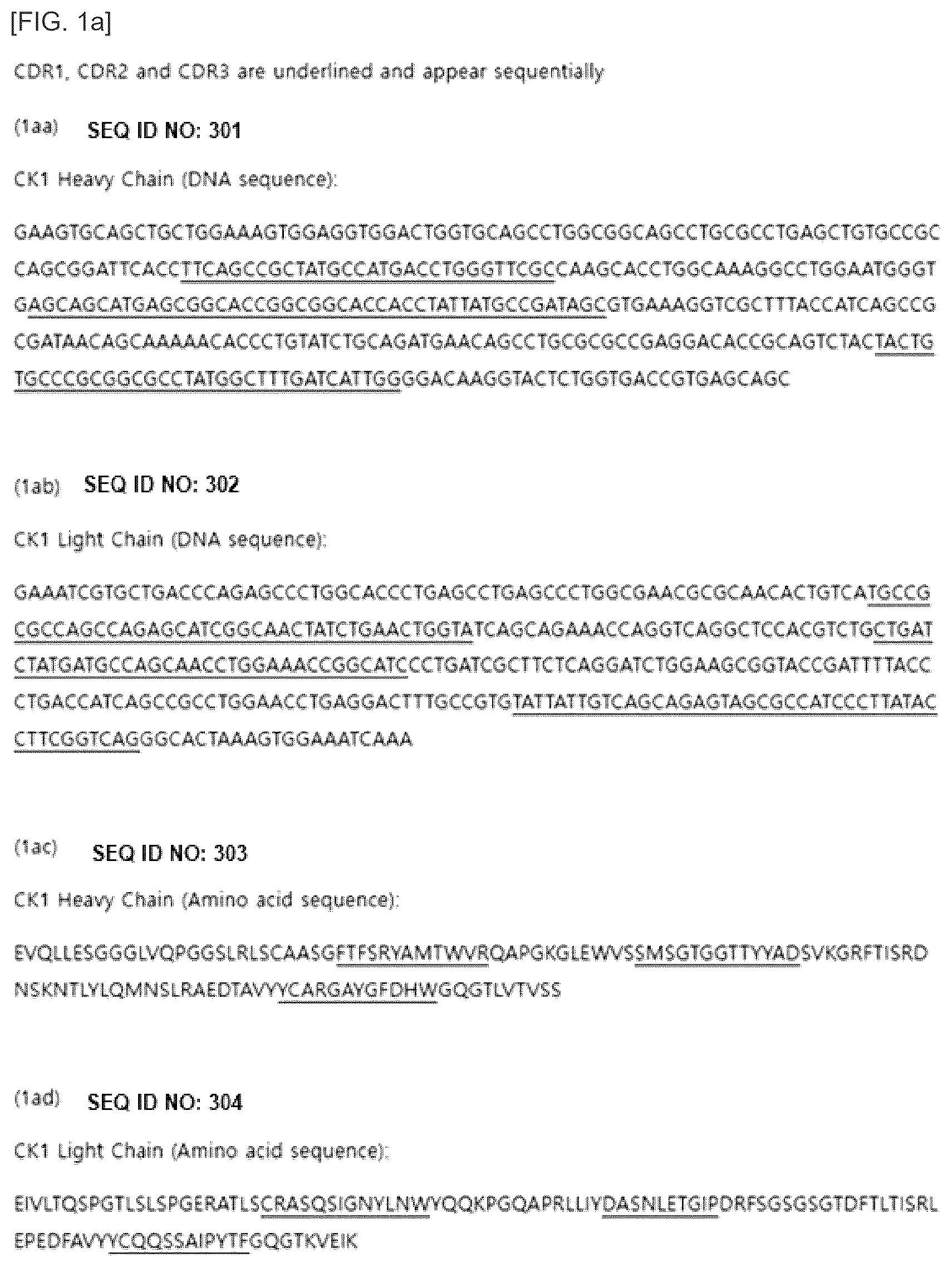
a to 1 y respectively illustrate heavy chain and light chain variable region sequences (nucleotide and amino acid sequences) of 25 anti-CD300c monoclonal antibodies according to the present disclosure. In each drawing, the CDR regions (CDR1, CDR2, and CDR3) are sequentially indicated. The sequence identifiers of the sequences 1aa through 1yd are shown in Table 2 and Table 3.
illustrates a schematic diagram, briefly showing the mechanism by which the anti-CD300c monoclonal antibody and/or CD300c siRNA of the present disclosure exhibits an anticancer effect.
illustrates a schematic diagram, briefly showing the mechanism by which the anti-CD300c monoclonal antibody of the present disclosure acts on monocytes, T cells, and cancer cells, respectively.
illustrates results obtained by performing SDS-PAGE on the anti-CD300c monoclonal antibodies under a non-reducing condition, according to an embodiment of the present disclosure.
illustrates results obtained by performing SDS-PAGE on the anti-CD300c monoclonal antibodies under a reducing condition, according to an embodiment of the present disclosure.
illustrates results obtained by comparing the expression of CD300c in normal cells, immune cells, and a cancer cell line, according to an embodiment of the present disclosure.
illustrates results obtained by identifying the binding affinity, to a CD300c antigen, of the anti-CD300c monoclonal antibody, according to an embodiment of the present disclosure.
illustrates results obtained by identifying an anticancer effect of the anti-CD300c monoclonal antibody through T cell activation, according to an embodiment of the present disclosure.
illustrate results obtained by identifying the effect of the anti-CD300c monoclonal antibody on differentiation into M1 macrophages, according to an embodiment of the present disclosure.
illustrate results obtained by identifying the concentration-dependent effect of the anti-CD300c monoclonal antibody on differentiation into M1 macrophages, according to an embodiment of the present disclosure.
illustrates results obtained by identifying the effect of the anti-CD300c monoclonal antibody on differentiation into M1 macrophages, according to an embodiment of the present disclosure.
illustrates results obtained by identifying again whether the anti-CD300c monoclonal antibody promotes differentiation of human monocytes into M1 macrophages, according to an embodiment of the present disclosure.
to 18 illustrate results obtained by comparing capacity for causing differentiation into M1 macrophages between the anti-CD300c monoclonal antibody and conventional immunotherapies, using ELISA, according to an embodiment of the present disclosure.
illustrates results obtained by comparing capacity for causing differentiation from M0 macrophages into M1 macrophages between the anti-CD300c monoclonal antibody and a conventional immunotherapy, using ELISA, according to an embodiment of the present disclosure.
illustrates results obtained by comparing capacity for causing differentiation into M1 macrophages between the anti-CD300c monoclonal antibody and a conventional immunotherapy using ELISA, according to an embodiment of the present disclosure.
to 23 illustrate results obtained by identifying whether the anti-CD300c monoclonal antibody is able to induce redifferentiation from M2 macrophages into M1 macrophages, using ELISA, according to an embodiment of the present disclosure.
illustrates results obtained by identifying capacity of the anti-CD300c monoclonal antibody for causing differentiation and redifferentiation into M1 macrophages, according to an embodiment of the present disclosure.
to 27 illustrate results obtained by identifying signal transduction of MAPK ( ), NF-κB ( ), and IkB ( ), which are signals of M1 macrophage differentiation, caused by co-treatment with the anti-CD300c monoclonal antibody and a cancer immunotherapy, according to an embodiment of the present disclosure.
illustrates results obtained by identifying cancer cell growth inhibitory effects of the anti-CD300c monoclonal antibody at a 0% FBS condition, according to an embodiment of the present disclosure.
illustrates results obtained by identifying cancer cell growth inhibitory effects of the anti-CD300c monoclonal antibody at a 0.1% FBS condition, according to an embodiment of the present disclosure.
illustrates results obtained by comparing cancer cell (lung cancer) growth inhibitory effects between the anti-CD300c monoclonal antibodies and a conventional immunotherapy, according to an embodiment of the present disclosure.
illustrates results obtained by comparing cancer cell (breast cancer) growth inhibitory effects between the anti-CD300c monoclonal antibodies and a conventional immunotherapy, according to an embodiment of the present disclosure.
illustrates results obtained by identifying cancer cell growth inhibitory effects of the anti-CD300c monoclonal antibody depending on its concentrations, according to an embodiment of the present disclosure.
illustrates results obtained by identifying changes in apoptosis signal caused by co-treatment with the anti-CD300c monoclonal antibody and a cancer immunotherapy, according to an embodiment of the present disclosure.
illustrate results obtained by identifying cancer cell growth inhibitory effects caused by co-treatment with the anti-CD300c monoclonal antibody and a cancer immunotherapy, according to an embodiment of the present disclosure.
illustrates results of the binding ELISA, according to an embodiment of the present disclosure.
illustrates results obtained by identifying results obtained by identifying whether the anti-CD300c monoclonal antibody is able to promote differentiation from mouse macrophages into M1 macrophages, according to an embodiment of the present disclosure.
illustrates results obtained by identifying whether the anti-CD300c monoclonal antibody exhibits an anticancer effect in a mouse cancer cell line, according to an embodiment of the present disclosure.
schematically illustrates the experimental method used in an embodiment of the present disclosure.
illustrates cancer growth inhibitory effects in vivo observed in a case where mice transplanted with a colorectal cancer cell line were administered with the anti-CD300c monoclonal antibody and an anti-PD-1 antibody alone or in combination, according to an embodiment of the present disclosure.
illustrates results obtained by identifying whether the anti-CD300c monoclonal antibody promotes CD8+ T cell immunity in a mouse tumor model, according to an embodiment of the present disclosure.
illustrates results obtained by identifying whether the anti-CD300c monoclonal antibody increases M1 macrophages in cancer tissues of a mouse model, according to an embodiment of the present disclosure.
schematically illustrates gene arrangement for constructing a chimeric antigen receptor that specifically binds to a CD300c antigen or a receptor thereof, according to an embodiment of the present disclosure.
illustrates a vector map for constructing a chimeric antigen receptor that specifically binds to a CD300c antigen or a receptor thereof, according to an embodiment of the present disclosure.
illustrates results obtained by identifying, through Western blotting, the Jurkat cell line expressing a chimeric antigen receptor that specifically binds to a CD300c antigen or a receptor thereof, according to an embodiment of the present disclosure.
illustrates results obtained by identifying anticancer effects of the Jurkat cell line expressing the chimeric antigen receptor that specifically binds to the CD300c antigen or a receptor thereof, according to an embodiment of the present disclosure.
BEST MODE
The following detailed description of the present disclosure will be described, with reference to specific drawings, for specific embodiments in which the present disclosure may be practiced. However, the present disclosure is not limited thereto, and the scope of the present disclosure is defined only by the appended claims, appropriately interpreted, along with the full range of equivalents to which the claims are entitled. It is to be understood that the various embodiments of the present disclosure, although different from each other, are not necessarily mutually exclusive. For example, a particular feature, structure, or characteristic described herein may vary from one embodiment to another or be implemented as a combination of embodiments without departing from the spirit and scope of the present disclosure. Technical and scientific terms used herein have the same meanings as commonly used in the art to which the present disclosure belongs, unless otherwise defined. . . . For the purpose of interpreting this specification, the following definitions will apply, and the singular forms “a,” “an,” and “the” include plural referents and vice versa unless the context clearly dictates otherwise.
Definition
As used herein, the term “about” means within an acceptable error range for the particular value which is known to one of ordinary skill in the art.
The term “(antigen-) binding domain” refers to a portion of a protein which binds to an antigen. The antigen-binding domain may be a synthetic polypeptide, an enzymatically obtainable polypeptide, or a genetically engineered polypeptide, and may be an immunoglobulin (for example, an antibody) or a portion thereof (for example, an antigen-binding fragment) which binds to an antigen.
The term “antibody” is used broadly and includes monoclonal antibodies (including full length antibodies) of any isotype such as IgG, IgM, IgA, IgD, and IgE, polyclonal antibodies, multispecific antibodies (for example, bispecific antibodies), antibody fusions (for example, a fusion of an antibody with a (poly) peptide or a fusion of an antibody with a compound), and antibody fragments (including antigen-binding fragments). As used herein, the prefix “anti-”, when in conjunction with an antigen, indicates that the given antibody is reactive with the given antigen. An antibody reactive with a specific antigen can be generated, without limitation, by synthetic and/or recombinant methods such as selection of libraries of recombinant antibodies in phage or similar vectors, or by immunizing an animal with the antigen or an antigen-encoding nucleic acid. A typical IgG antibody is comprised of two identical heavy chains and two identical light chains that are joined by disulfide bonds. Each heavy and light chain contains a constant region and a variable region. Heavy chain variable regions (HVRs) and light chain variable regions (LVRs) contain three segments, referred to as “complementarity determining regions” (“CDRs”) or “hypervariable regions”, respectively, which are primarily responsible for binding an epitope of an antigen. They are usually referred to as CDR1, CDR2, and CDR3, numbered sequentially from the N-terminus. The more highly conserved portions of the variable regions outside of the CDRs are called the “framework regions” (“FRs”). An antibody herein may be, for example, an animal antibody, a chimeric antibody, a humanized antibody, or a human antibody.
The term “single domain antibody” is an antibody specific for the CD300c antigen, in which a CDR is a portion of a single domain polypeptide, and may be generally produced using only two heavy chains and an antigen-binding site. However, the single domain antibody may include all of antibodies naturally devoid of light chains, single-domain antibodies derived from conventional 4-chain antibodies, engineered antibodies, and single domain scaffolds other than those derived from antibodies.
The term “single-chain variable fragment (scFv)” refers to a protein in which light chain and heavy chain variable regions of an antibody are linked to each other via a linker consisting of a peptide sequence having about 15 amino acid residues. The scFv may be in an order of light chain variable domain-linker-heavy chain variable region, or an order of heavy chain variable region-linker-light chain variable region, and has the same or similar antigen specificity as its original antibody. The linking site is a hydrophilic flexible peptide chain mainly composed of glycine and serine. The 15-amino acid sequence of “(Gly-Gly-Gly-Gly-Ser) 3 ” or a sequence similar thereto is mainly used. The antibody refers to an immunoglobulin molecule that is immunologically reactive with a specific antigen, and includes all of polyclonal antibodies, monoclonal antibodies, and functional fragments thereof. In addition, the term may include forms produced by genetic engineering, such as chimeric antibodies (for example, humanized murine antibodies) and heterologous antibodies (for example, bispecific antibodies). Among these, the monoclonal antibodies are antibodies that exhibit single binding specificity and affinity against a single antigenic site (epitope). Unlike polyclonal antibodies including antibodies that exhibit specificity against different epitopes, the monoclonal antibodies exhibit binding specificity and affinity against a single epitope on an antigen, which allows for easy quality control as a therapeutic agent. In particular, the anti-CD300c monoclonal antibody of the present disclosure not only exhibits anticancer activity by itself by specifically binding to CD300c-expressing cancer cells, but also stimulates immune cells, thereby exhibiting maximized cancer cell-dependent anticancer activity. The antibody includes variable region(s) of a heavy chain and/or a light chain in terms of the constitution, wherein the variable region includes, as a primary structure thereof, a portion that forms an antigen-binding site of the antibody molecule. The antibody of the present disclosure may be composed of a partial fragment containing the variable region.
The term “humanization (also called reshaping or CDR-grafting) includes a well-established technique for reducing the immunogenicity of monoclonal antibodies from xenogeneic sources (commonly rodent) and for improving their affinity or effector function (ADCC, complement activation, C1q binding).
The term “monoclonal antibody” as used herein refers to an antibody obtained from a population of substantially homogeneous antibodies, that is, the individual antibodies comprising the population are identical except for possible naturally occurring mutations and/or post-translation modifications (for example, isomerizations, amidations) that may be present in minor amounts. Monoclonal antibodies are highly specific, being directed against a single antigenic site. The monoclonal antibody is obtained from a substantially homogeneous population of antibodies, displays the nature of an antibody, and is not to be construed as requiring production of the antibody by any particular method. For example, monoclonal antibodies to be used in accordance with the present disclosure may be made by a variety of techniques, including but not limited to the hybridoma method, recombinant DNA methods, phage-display methods, and methods utilizing transgenic animals containing all or part of the human immunoglobulin loci.
The term “antigen-binding fragment” refers to a portion of an antibody having specific binding ability to an antigen or a polypeptide comprising the same. The terms “antibody” and “antigen-binding fragment” may be used interchangeably except for a case where it is understood in the context that the “antibody” specifically excludes the “antigen-binding fragment,” and the “antibody” may be interpreted as including the “antigen-binding fragment.” Examples of the antigen-binding fragment include, but are not limited to, Fv, Fab, Fab′, Fab′-SH, F(ab′)2, diabodies, triabodies, tetrabodies, cross-Fab fragments, linear antibodies, single chain antibody molecules (for example, scFv), and multispecific antibodies formed of antibody fragments and single domain antibodies.
The term “chimeric antigen receptor” or “CAR” is defined as a cell surface receptor that comprises an extracellular target-binding domain, a transmembrane domain, and an intracellular signaling domain. The chimeric antigen receptor of the present disclosure is intended primarily for use with lymphocytes such as T cells and natural killer (NK) cells.
The term “cancer therapy” collectively refers to known agents used in conventional cancer treatment which act on various metabolic pathways of cells and exhibit cytotoxic or cytostatic effects on cancer cells. The cancer therapy includes chemotherapies, targeted chemotherapies, and immunotherapies.
The term “immunotherapy” (also referred to as “cancer immunotherapy”) refers to a cancer therapy or an anticancer agent which activates immune cells to kill cancer cells.
The term “subject” is used interchangeably with “patient” and may be a mammal who is in need of prevention or treatment of cancer, such as primates (for example, humans), companion animals (for example, dogs and cats), livestock (for example, cows, pigs, horses, sheep, and goats), and laboratory animals (for example, rats, mice, and guinea pigs). In an embodiment of the present disclosure, the subject is a human.
The term “treatment” generally means obtaining a desired pharmacological and/or physiological effect. The effect may be therapeutic in terms of partially or completely curing a disease and/or adverse effect attributed to the disease. Desirable therapeutic effects include, but are not limited to, prevention of onset or recurrence of disease, alleviation of symptoms, diminishment of any direct or indirect pathological consequences of the disease, prevention of metastasis, decreasing the rate of disease progression, amelioration or slowing of the disease state, and remission or improved prognosis. Preferably, the “treatment” may refer to medical intervention of a disease or disorder that has already developed.
The term “prevention” relates to a prophylactic treatment, that is, to a measure or procedure, the purpose of which is to prevent, rather than to cure a disease. “Prevention” means that a desired pharmacological and/or physiological effect is obtained which is prophylactic in terms of completely or partially preventing a disease or symptom thereof.
The term “administration” means providing a substance (for example, an anti-CD300c antibody or an antigen-binding fragment thereof and another cancer therapy) to a subject to achieve a prophylactic or therapeutic purpose (for example, prevention or treatment of cancer).
The term “biological sample” encompasses a variety of sample types obtained from a subject and may be used in diagnostic or monitoring assays. The biological sample includes, but is not limited to, blood and other liquid samples of biological origin, and solid tissue samples such as a biopsy specimen or tissue cultures or cells derived therefrom and the progeny thereof. Thus, the biological sample encompasses a clinical sample, and also includes cells in culture, cell supernatants, cell lysates, serum, plasma, biological fluid, and tissue samples, in particular, tumor samples. The term “biological data” refers to any analytical data obtained using the biological sample.
Chimeric Antigen Receptor
According to an aspect of the present disclosure, there is provided a chimeric antigen receptor comprising a binding domain that specifically binds to a CD300c antigen or a receptor thereof. The chimeric antigen receptor (CAR) is an artificially constructed hybrid protein or polypeptide which contains an antigen-binding domain of an antibody (for example, scFv) linked to a T-cell signaling domain. The chimeric antigen receptor is able to induce T-cell specificity and reactivity towards a selected target in a non-MHC-restricted manner by exploiting the antigen-binding ability of a monoclonal antibody. The chimeric antigen receptor may comprise an (extracellular) antigen-binding domain, a transmembrane domain, and an intracellular signaling domain. In addition, the chimeric antigen receptor may further comprise a GS linker. In addition, the chimeric antigen receptor may further comprise a signal peptide. In an embodiment, the chimeric antigen receptor may comprise an (extracellular) antigen-binding domain, a GS linker, a transmembrane domain, and an intracellular signaling domain. In another embodiment, the chimeric antigen receptor may comprise an (extracellular) antigen-binding domain, a signal peptide, a GS linker, a transmembrane domain, and an intracellular signaling domain. In addition to the components listed above, the chimeric antigen receptor of the present disclosure may comprise any component of chimeric antigen receptors commonly known in the art.
In an embodiment, the binding domain may comprise any one or more selected from the group consisting of an antibody, a single domain antibody, and a single chain variable fragment, each of which specifically binds to the CD300c antigen or a receptor thereof, and an antigen.
Specifically, the binding domain may be a CD300c antigen. The CD300c antigen may comprise the entire CD300c antigen sequence or only an extracellular domain (ECD) of the CD300c antigen sequence, for binding to a receptor thereof. The extracellular domain sequence of the CD300c antigen may comprise or consist of the amino acid sequence represented by SEQ ID NO: 402. In addition, the extracellular domain sequence may comprise an amino acid sequence that has 70% or more, 80% or more, 85% or more, 90% or more, 95% or more, or 98% or more sequence identity to SEQ ID NO: 402.
In addition, the binding domain may be an anti-CD300c antibody (preferably an anti-CD300c monoclonal antibody) or an antigen-binding fragment thereof. However, the binding domain may include any substance as long as it is able to specifically bind to the CD300c antigen or a receptor thereof. In this regard, in a case where the binding domain is an antibody or an antigen binding fragment thereof, such binding domain may be prepared by any antibody production technique known in the art.
In an embodiment, the binding domain may comprise:
•
• (i) a heavy chain variable region that comprises CDR1 comprising or consisting of an amino acid sequence selected from the group consisting of SEQ ID NO: 7, SEQ ID NO: 19, SEQ ID NO: 31, SEQ ID NO: 43, SEQ ID NO: 55, SEQ ID NO: 67, SEQ ID NO: 79, SEQ ID NO: 91, SEQ ID NO: 103, SEQ ID NO: 115, SEQ ID NO: 127, SEQ ID NO: 139, SEQ ID NO: 151, SEQ ID NO: 163, SEQ ID NO: 175, SEQ ID NO: 187, SEQ ID NO: 199, SEQ ID NO: 211, SEQ ID NO: 223, SEQ ID NO: 235, SEQ ID NO: 247, SEQ ID NO: 259, SEQ ID NO: 271, SEQ ID NO: 283, and SEQ ID NO: 295; • CDR2 comprising or consisting of an amino acid sequence selected from the group consisting of SEQ ID NO: 8, SEQ ID NO: 20, SEQ ID NO: 32, SEQ ID NO: 44, SEQ ID NO: 56, SEQ ID NO: 68, SEQ ID NO: 80, SEQ ID NO: 92, SEQ ID NO: 104, SEQ ID NO: 116, SEQ ID NO: 128, SEQ ID NO: 140, SEQ ID NO: 152, SEQ ID NO: 164, SEQ ID NO: 176, SEQ ID NO: 188, SEQ ID NO: 200, SEQ ID NO: 212, SEQ ID NO: 224, SEQ ID NO: 236, SEQ ID NO: 248, SEQ ID NO: 260, SEQ ID NO: 272, SEQ ID NO: 284, and SEQ ID NO: 296; and • CDR3 comprising or consisting of an amino acid sequence selected from the group consisting of SEQ ID NO: 9, SEQ ID NO: 21, SEQ ID NO: 33, SEQ ID NO: 45, SEQ ID NO: 57, SEQ ID NO: 69, SEQ ID NO: 81, SEQ ID NO: 93, SEQ ID NO: 105, SEQ ID NO: 117, SEQ ID NO: 129, SEQ ID NO: 141, SEQ ID NO: 153, SEQ ID NO: 165, SEQ ID NO: 177, SEQ ID NO: 189, SEQ ID NO: 201, SEQ ID NO: 213, SEQ ID NO: 225, SEQ ID NO: 237, SEQ ID NO: 249, SEQ ID NO: 261, SEQ ID NO: 273, SEQ ID NO: 285, and SEQ ID NO: 297; and • (ii) a light chain variable region that comprises CDR1 comprising or consisting of an amino acid sequence selected from the group consisting of SEQ ID NO: 10, SEQ ID NO: 22, SEQ ID NO: 34, SEQ ID NO: 46, SEQ ID NO: 58, SEQ ID NO: 70, SEQ ID NO: 82, SEQ ID NO: 94, SEQ ID NO: 106, SEQ ID NO: 118, SEQ ID NO: 130, SEQ ID NO: 142, SEQ ID NO: 154, SEQ ID NO: 166, SEQ ID NO: 178, SEQ ID NO: 190, SEQ ID NO: 202, SEQ ID NO: 214, SEQ ID NO: 226, SEQ ID NO: 238, SEQ ID NO: 250, SEQ ID NO: 262, SEQ ID NO: 274, SEQ ID NO: 286, and SEQ ID NO: 298; • CDR2 comprising or consisting of an amino acid sequence selected from the group consisting of SEQ ID NO: 11, SEQ ID NO: 23, SEQ ID NO: 35, SEQ ID NO: 47, SEQ ID NO: 59, SEQ ID NO: 71, SEQ ID NO: 83, SEQ ID NO: 95, SEQ ID NO: 107, SEQ ID NO: 119, SEQ ID NO: 131, SEQ ID NO: 143, SEQ ID NO: 155, SEQ ID NO: 167, SEQ ID NO: 179, SEQ ID NO: 191, SEQ ID NO: 203, SEQ ID NO: 215, SEQ ID NO: 227, SEQ ID NO: 239, SEQ ID NO: 251, SEQ ID NO: 263, SEQ ID NO: 275, SEQ ID NO: 287, and SEQ ID NO: 299; and • CDR3 comprising or consisting of an amino acid sequence selected from the group consisting of SEQ ID NO: 12, SEQ ID NO: 24, SEQ ID NO: 36, SEQ ID NO: 48, SEQ ID NO: 60, SEQ ID NO: 72, SEQ ID NO: 84, SEQ ID NO: 96, SEQ ID NO: 108, SEQ ID NO: 120, SEQ ID NO: 132, SEQ ID NO: 144, SEQ ID NO: 156, SEQ ID NO: 168, SEQ ID NO: 180, SEQ ID NO: 192, SEQ ID NO: 204, SEQ ID NO: 216, SEQ ID NO: 228, SEQ ID NO: 240, SEQ ID NO: 252, SEQ ID NO: 264, SEQ ID NO: 276, SEQ ID NO: 288, and SEQ ID NO: 300.
In another embodiment, (i) the heavy chain variable region may comprise
•
• CDR1 comprising or consisting of the amino acid sequence represented by SEQ ID NO: 7, SEQ ID NO: 67, SEQ ID NO: 79, SEQ ID NO: 115, or SEQ ID NO: 211; • CDR2 comprising or consisting of the amino acid sequence represented by SEQ ID NO: 8, SEQ ID NO: 68, SEQ ID NO: 80, SEQ ID NO: 116, or SEQ ID NO: 212; and • CDR3 comprising or consisting of the amino acid sequence represented by SEQ ID NO: 9, SEQ ID NO: 69, SEQ ID NO: 81, SEQ ID NO: 117, or SEQ ID NO: 213; and • (ii) the light chain variable region may comprise • CDR1 comprising or consisting of the amino acid sequence represented by SEQ ID NO: 10, SEQ ID NO: 70, SEQ ID NO: 82, SEQ ID NO: 118, or SEQ ID NO: 214; • CDR2 comprising or consisting of the amino acid sequence represented by SEQ ID NO: 11, SEQ ID NO: 71, SEQ ID NO: 83, SEQ ID NO: 119, or SEQ ID NO: 215; and • CDR3 comprising or consisting of the amino acid sequence represented by SEQ ID NO: 12, SEQ ID NO: 72, SEQ ID NO: 84, SEQ ID NO: 120, or SEQ ID NO: 216.
In yet another embodiment, the heavy chain variable region may comprise the amino acid sequence represented by SEQ ID NO: 303, SEQ ID NO: 323, SEQ ID NO: 327, SEQ ID NO: 339 or SEQ ID NO: 371, and the light chain variable region may comprise the amino acid sequence represented by SEQ ID NO: 304, SEQ ID NO: 324, SEQ ID NO: 328, SEQ ID NO: 340, or SEQ ID NO: 372. Preferably, the heavy chain variable region may comprise the amino acid sequence represented by SEQ ID NO: 303 and the light chain variable region may comprise the amino acid sequence represented by SEQ ID NO: 304; the heavy chain variable region may comprise the amino acid sequence represented by SEQ ID NO: 323 and the light chain variable region may comprise the amino acid sequence represented by SEQ ID NO: 324; the heavy chain variable region may comprise the amino acid sequence represented by SEQ ID NO: 327 and the light chain variable region may comprise the amino acid sequence represented by SEQ ID NO: 328; the heavy chain variable region may comprise the amino acid sequence represented by SEQ ID NO: 339 and the light chain variable region may comprise the amino acid sequence represented by SEQ ID NO: 340; the heavy chain variable region may comprise the amino acid sequence represented by SEQ ID NO: 371 and the heavy chain variable region may comprise the amino acid sequence represented by SEQ ID NO: 372.
In still yet another embodiment, the binding domain of the chimeric antigen receptor may comprise a heavy chain variable region that comprises CDR1 to CDR3 comprising or consisting of amino acid sequences, respectively, represented by Formulas (1) to (3), and a light chain variable region that comprises CDR1 to CDR3 comprising or consisting of amino acid sequences, respectively, represented by Formulas (4) to (6) (each amino acid sequence is shown in N→C direction):
(1)
(SEQ ID NO: 403)
FTFSX1YX2MX3WVR
In the above formula,
•
• X1=R, S, or D • X2=A, G, or H • X3=T, H, or S
(2)
(SEQ ID NO: 404)
X1X2SX3X4GGX5TYYAX6
In the above formula,
•
• X1=S, A, or T • X2=M or I • X3=G or S • X4=T or S • X5=T, S, or Y • X6=D or E
(3)
(SEQ ID NO: 405)
YCAX1X2X3X4X5X6X7X8X9X10X11W
In the above formula,
•
• X1=R, V, or S • X2=G or S • X3=A, G, S, Y, or I • X4=Y, A, Q, G, or R • X5=G or L • X6=F, R, I, M, or P. • X7=D, G, F, or L • X8=H, F, D, or V • X9=F, L, Y, or not present • X10=D or not present • X11=Y or not present
(4)
(SEQ ID NO: 406)
CX1X2X3X4X5X6X7X8X9X10X11X12X13W
In the above formula,
•
• X1=R, S, or T • X2=A, G, or R. • X3=S or N • X4=Q. S or N • X5=S, I or G • X6=I, N or G • X7=G, L, T, or S. • X8=N, G, R, A, or K • X9=Y, S, R, or G • X10=N or not present • X11=Y or not present • X12=L or V • X13=N, Y, H, or Q
(5)
(SEQ ID NO: 407)
X1X2X3X4X5X6X7GX8X9
In the above formula,
•
• X1=D, E, S, or R • X2=A, D, K, or N • X3=S or N • X4=N, K, or Q • X5=L or R • X6=E or P • X7=T or S • X8=I or V • X9=P or R
(6)
(SEQ ID NO: 408)
YCX1X2X3X4X5X6X7X8X9X10X11F
In the above formula,
•
• X1=Q, S, or A • X2=Q, S, or A • X3=S, Y, or W • X4=S, T, D, or A • X5=A, S, D, or G • X6=I, S, N, or T • X7=P, S, L, N, or K • X8=Y, T, S, N, or G • X9=V, G, L, or not present • X10=P or not present • X11=T, I, or V.
In certain embodiments, the binding domain may be a single chain variable segment (scFv) and may comprise or consist of an amino acid sequence selected from the group consisting of SEQ ID NOs: 412, 414, 416, 418, 420, 422, 424, 426, 428, 430, 432, 434, 436, 438, and 440. Preferably, the binding domain may comprise or consist of SEQ ID NO: 412, 414, 416, 418, or 440.
The binding domain may comprise a sequence having 80% or more, preferably 90% or more, more preferably 95% or more, and most preferably 98% or more sequence identity to any of the above-described amino acid sequences.
In certain embodiments, amino acid sequence variants of the antibodies of the present disclosure are contemplated. For example, it may be desirable to improve the binding affinity and/or other biological properties of the antibody. Amino acid sequence variants of the antibody may be prepared by introducing appropriate modifications into the nucleotide sequence encoding the molecules, or by peptide synthesis. Such modifications include, for example, deletions from, and/or insertions into and/or substitutions of residues within the amino acid sequence of the antibody. Any combination of deletion, insertion, and substitution can be made to arrive at the final construct, provided that the final construct possesses the desired characteristics, for example, antigen-binding. Sites of interest for substitutional mutagenesis include heavy chain variable regions (HVRs) and framework regions (FRs). Conservative substitutions are provided in Table 1 under the heading “Preferred Substitutions” and further described below in reference to amino acid side chain classes (1) to (6). Amino acid substitutions may be introduced into the molecule of interest and the products screened for a desired activity, for example, retained/improved antigen binding, decreased immunogenicity, or improved ADCC or CDC.
TABLE 1
Original
residue Exemplary substitutions Preferred substitutions
Ala (A) Val; Leu; Ile Val
Arg (R) Lys; Gln; Asn Lys
Asn (N) Gln; His; Asp; Lys; Arg Gln
Asp (D) Glu; Asn Glu
Cys (C) Ser; Ala Ser
Gln (Q) Asn; Glu Asn
Glu (E) Asp; Gln Asp
Gly (G) Ala Ala
His (H) Asn; Gln; Lys; Arg Arg
Ile (I) Leu; Val; Met; Ala; Phe; Norleucine Leu
Leu (L) Norleucine; Ile; Val; Met; Ala; Phe Ile
Lys (K) Arg; Gln; Asn Arg
Met (M) Leu; Phe; Ile Ile
Phe (F) Trp; Leu; Val; Ile; Ala; Tyr Tyr
Pro (P) Ala Ala
Ser (S) Thr Thr
Thr (T) Va;; Ser Ser
Trp (W) Tyr; Phe Tyr
Tyr (Y) Trp; Phe; Thr; Ser Phe
Val (V) Ile; Leu; Met; Phe; Ala; norleucine Leu
Amino acids may be grouped according to common side-chain properties:
•
• (1) hydrophobic: norleucine, Met, Ala, Val, Leu, Ile; • (2) neutral hydrophilic: Cys, Ser, Thr, Asn, Gln; • (3) acidic: Asp, Glu; • (4) basic: His, Lys, Arg; • (5) residues that influence chain orientation: Gly, Pro; • (6) aromatic: Trp, Tyr, Phe.
Non-conservative substitutions will entail exchanging a member of one of these classes for another class.
As used herein, the term “amino acid sequence variant” includes substantial variants wherein there are amino acid substitutions in one or more hypervariable region residues of a parent antigen binding molecule (for example, a humanized or human antibody). In general, the resulting variant(s) selected for further study will have modifications (for example, improvements) in certain biological properties (for example, increased affinity, reduced immunogenicity) relative to the parent antigen binding molecule and/or will have substantially retained certain biological properties of the parent antigen binding molecule. An exemplary substitutional variant is an affinity matured antibody, which may be conveniently generated, for example, using phage display-based affinity maturation techniques known in the art. Briefly, one or more HVR residues are mutated and the variant antigen binding molecules displayed on phage and screened for a particular biological activity (for example, binding affinity). In certain embodiments, substitutions, insertions, or deletions may occur within one or more HVRs so long as such alterations do not substantially reduce the ability of the antigen binding molecule to bind antigen. For example, conservative alterations (for example, conservative substitutions as provided herein) that do not substantially reduce binding affinity may be made in HVRs.
In addition, there are provided variants of the antibody or an antigen-binding fragment thereof of the present disclosure which have improved affinity for the CD300c antigen or a receptor thereof. Such variants can be obtained by a number of affinity maturation protocols including mutating the CDRs (Yang et al., J. Mol. Biol., 254, 392-403, 1995), chain shuffling (Marks et al., Bio/Technology, 10, 779-783, 1992), use of mutator strains of E. coli (Low et al., J. Mol. Biol., 250, 359-368, 1996), DNA shuffling (Patten et al., Curr. Opin. Biotechnol., 8, 724-733, 1997), phage display (Thompson et al., J. Mol. Biol., 256, 77-88, 1996), and sexual PCR (Crameri et al., Nature, 391, 288-291, 1998). Vaughan et al. (Science, 239, 1534-1536, 1988) discuss these methods of affinity maturation.
The anti-CD300c monoclonal antibody or an antigen-binding fragment thereof may have inter-species cross-reactivity. Specifically, the anti-CD300c monoclonal antibody or an antigen-binding fragment thereof may exhibit cross-reactivity between human and mouse CD300c antigens. Such cross-reactivity is identified in Experimental Examples 6.3 and 6.4.
In certain embodiments, the signal peptide may be or comprise a CD8a signal peptide.
In certain embodiments, the GS linker may be a 5- to 15-peptide consisting of glycine and serine. Specifically, the GS linker may comprise or consist of the amino acid sequence represented by SEQ ID NO: 422.
In certain embodiments, the transmembrane domain may be or comprise a CD8 hinge (hinge of cluster of differentiation 8) and/or a CD28 transmembrane domain. The CD8 hinge may comprise or consist of the amino acid sequence represented by SEQ ID NO: 424. The CD28 transmembrane domain may comprise or consist of the amino acid sequence represented by SEQ ID NO: 426.
In certain embodiments, the intracellular signaling domain may be or comprise a CD28 intracellular domain and/or a CD35 intracellular domain. The CD28 intracellular domain may comprise or consist of the amino acid sequence represented by SEQ ID NO: 428. The CD35 intracellular domain may comprise or consist of the amino acid sequence represented by SEQ ID NO: 430.
Polynucleotide, Vector, and Immune Cell
According to another aspect of the present disclosure, there are provided a polynucleotide comprising a nucleic acid sequence encoding the chimeric antigen receptor, a vector (for example, expression vector) comprising the polynucleotide, and an immune cell expressing the chimeric antigen receptor.
The polynucleotide of the present disclosure may comprise any nucleic acid sequence encoding an amino acid sequence that constitutes or is included in the chimeric antigen receptor, and may also comprise a nucleic acid sequence having 80% or more, preferably 90% or more, more preferably 95% or more, and most preferably 98% or more identity thereto.
The “vector” refers to a nucleic acid molecule capable of transporting another nucleic acid to which it has been linked. One type of vector is a “plasmid,” which refers to a circular double stranded DNA loop into which additional DNA segments can be inserted. Another type of vector is a viral vector, wherein virally-derived DNA or RNA sequences are present in the vector for packaging into a virus. Certain vectors are capable of autonomous replication in a host cell into which they are introduced (for example, bacterial vectors having a bacterial origin of replication and episomal mammalian vectors). Other vectors (for example, non-episomal mammalian vectors) are integrated into the genome of a host cell upon introduction into the host cell, and thereby are replicated along with the host genome. Moreover, certain vectors are capable of directing the expression of genes to which they are operatively-linked. Such vectors are referred to herein as “expression vectors.” Common expression vectors of utility in recombinant DNA techniques are often in the form of plasmids. In the present specification, “plasmid” and “vector” may be used interchangeably as the plasmid is the most commonly used form of vector. However, the present disclosure is intended to include such other forms of expression vectors, such as viral vectors (for example, lentiviruses, replication defective retroviruses, adenoviruses, and adeno-associated viruses), which serve equivalent functions.
The immune cells expressing the chimeric antigen receptor of the present disclosure may be produced by transforming immune cells with the vector. For example, the immune cells may be produced by introducing into immune cells a lentiviral vector comprising a nucleic acid sequence that encodes a desired chimeric antigen receptor.
In an embodiment, the immune cells may be any one or more selected from the group consisting of monocytes, macrophages, T cells, natural killer cells (NK cells), and dendritic cells. In addition, any immune cells may be included therein as long as they can be used for the prevention or treatment of cancer. Preferably, the immune cells of the present disclosure may be T cells. For purposes of the present disclosure, the T cell may be any T cell, such as a cultured T cell, for example, a primary T cell, or a T cell from a cultured T cell line, for example, Jurkat, SupT1, or the like, or a T cell obtained from a mammal. In a case of being obtained from a mammal, the T cell can be obtained from a number of sources including, but not limited to, bone marrow, blood, lymph nodes, thymus, or other tissues or body fluids. The T cell may also be enriched or purified. The T cell may be a human T cell. The T cell may be a T cell isolated from a human. The T cell can be any type of T cell and can be of any developmental stage, including but not limited to, CD4+/CD8+ double positive T cells, CD8+ T cells (for example, cytotoxic T cells), CD4+ helper T cells, for example, Th1 and Th2 cells, peripheral blood mononuclear cells (PBMCs), peripheral blood leukocytes (PBLs), tumor infiltrating lymphocytes (TILs), memory T cells, naive T cells, and the like. The T cell may be a CD8+ T cell or a CD4+ T cell.
Method for Prevention or Treatment of Cancer
According to yet another aspect of the present disclosure, there is provided a method for preventing or treating cancer, improving or decreasing severity of at least one symptom or sign of cancer, inhibiting metastasis, or inhibiting growth of cancer, the method comprising using the immune cells of the present disclosure. As used herein, “preventing or treating cancer” may include inhibiting proliferation, survival, metastasis, recurrence, or therapy resistance of cancer. Such a method may comprise a step of administering the immune cells of the present disclosure to a subject in need of prevention or treatment of cancer. Accordingly, there is provided a use of a composition that comprises the immune cells as an active ingredient, for preventing or treating cancer
As used herein, the term “cancer” refers to a physiological condition that is typically characterized by unregulated cell growth in mammals. The cancer to be prevented or treated in the present disclosure may include, depending on the site of occurrence, colorectal cancer, small intestine cancer, rectal cancer, colon cancer, thyroid cancer, endocrine adenocarcinoma, oral cancer, tongue cancer, pharyngeal cancer, laryngeal cancer, esophageal cancer, cervical cancer, uterine cancer, fallopian tube cancer, ovarian cancer, brain cancer, head and neck cancer, lung cancer, lymph gland cancer, gallbladder cancer, bladder cancer, kidney cancer, liver cancer, pancreatic cancer, prostate cancer, skin cancer (or melanoma), breast cancer, stomach cancer, bone cancer, blood cancer, and the like. However, any cancer can be included therein as long as it expresses a CD300c protein on the surface of cancer cells. In an embodiment, the cancer may include at least any one selected from the group consisting of colorectal cancer, rectal cancer, colon cancer, thyroid cancer, oral cancer, pharyngeal cancer, laryngeal cancer, cervical cancer, brain cancer, lung cancer, ovarian cancer, bladder cancer, kidney cancer, liver cancer, pancreatic cancer, prostate cancer, skin cancer, tongue cancer, breast cancer, uterine cancer, stomach cancer, bone cancer, and blood cancer. In another embodiment, the cancer may be a solid cancer.
In an embodiment, the method may further comprise a step of administering one or more cancer therapies (for example, immunotherapies). In a case where (i) the immune cells of the present disclosure are used in combination with (ii) one or more immunotherapies, (i) and (ii) may be administered simultaneously or sequentially.
“Administered sequentially” means that one ingredient is first administered and the other ingredient is administered immediately or at a predetermined interval after the first administration, wherein the ingredients may be administered in any order. That is, the immune cells may be first administered and one or more immunotherapies may be administered immediately or at a predetermined interval after the first administration, or vice versa. In addition, any of the one or more immunotherapies may be first administered first, followed by the immune cells, and then the other of the one or more immunotherapies.
Cancer immunotherapies have a novel mechanism by which immune cells in the body are activated to kill cancer cells, and thus are advantageous in that they can be widely used for most cancers without specific genetic mutations. In addition, the immunotherapies have fewer adverse effects in that they treat cancer by strengthening the patient's own immune system, and have effects of improving the patient's quality of life and significantly extending the survival. These immunotherapies include immune checkpoint inhibitors, and may be manufactured by known methods or commercially available products. Examples of the immunotherapy include, but are not limited to, anti-PD-1, anti-PD-L1, anti-CTLA-4, anti-CD47, anti-KIR, anti-LAG3, anti-CD137, anti-OX40, anti-CD276, anti-CD27, anti-GITR, anti-TIM3, anti-41BB, anti-CD226, anti-CD40, anti-CD70, anti-ICOS, anti-CD40L, anti-BTLA, anti-TCR, and anti-TIGIT antibodies. In addition, examples of the immunotherapy include, but are not limited to, durvalumab (IMFINZI®), atezolizumab (TECENTRIQ®), avelumab (BAVENCIO®), pembrolizumab (KEYTRUDA®), nivolumab (OPDIVO®), αCD47, cemiplimab (LIBTAYO®), magrolimab (Hu5F9-G4), and ipilimumab (YERVOY®).
In an embodiment, the immunotherapy may include at least any one selected from the group consisting of anti-PD-1, anti-PD-L1, anti-CTLA-4, anti-CD47, anti-KIR, anti-LAG3, anti-CD137, anti-OX40, anti-CD276, anti-CD27, anti-GITR, anti-TIM3, anti-41BB, anti-CD226, anti-CD40, anti-CD70, anti-ICOS, anti-CD40L, anti-BTLA, anti-TCR, and anti-TIGIT antibodies. In one example, the immunotherapy may include at least any one selected from the group consisting of anti-PD-1, anti-PD-L1, anti-CTLA-4, and anti-CD47 antibodies.
In another embodiment, the immunotherapy may include at least any one selected from the group consisting of durvalumab (IMFINZI®), atezolizumab (TECENTRIQ®), pembrolizumab (KEYTRUDA®), nivolumab (OPDIVO®), αCD47, and ipilimumab (YERVOY®).
Each of the immune cells according to the present disclosure and optionally one or more additional cancer therapies may be administered in several ways depending on whether local or systemic treatment is desired and the area to be treated. Methods of administering these ingredients to a subject may vary depending on the purpose of administration, the site of the disease, the subject's condition, and the like. The route of administration may be oral, parenteral, inhalation, local or topical (for example, intralesional administration). For example, parenteral administration may include, but is not limited to, intravenous, subcutaneous, intraperitoneal, intrapulmonary, intraarterial, intramuscular, rectal, vaginal, intraarticular, intraprostatic, intranasal, intraocular, intravesical, intrathecal, or intraventricular administration (for example, intracerebroventricular administration). In addition, in a case of being used in combination, the immune cells and the additional cancer therapy may be administered by the same route or may be administered by different routes.
In the method, the number of the immune cells according to the present disclosure may vary depending on the age, sex, and body weight of an individual (patient). The immune cells may be included at about 1 to about 10 times the number of tumor cells in the individual. In addition, an effective amount of one or more additional cancer therapies may vary depending on the age, sex, and body weight of an individual (patient). In general, administration may be performed in an amount of about 0.01 mg to 100 mg, or 5 mg to about 50 mg, per kg of body. The amount may be administrated once a day or several times a day in divided doses. However, the effective amount may be increased or decreased depending on route and period of administration, severity of disease, sex, body weight, age, and the like. Thus, the scope of the present disclosure is not limited thereto.
Pharmaceutical Composition
According to still yet another aspect of the present disclosure, there is provided a pharmaceutical composition for preventing or treating cancer, comprising the immune cells according to the present disclosure as an active ingredient. In addition, there is provided a use of the immune cells according to the present disclosure for the manufacture of a medicament for preventing or treating cancer.
The immune cells may be included in the composition in a prophylactically or therapeutically effective amount. The pharmaceutical composition may be administered to a subject to inhibit proliferation, survival, metastasis, recurrence, or therapy resistance of cancer.
In an embodiment, the pharmaceutical composition may further comprise at least one additional cancer therapy (for example, immunotherapy). Specifically, the immune cells and optionally the additional immunotherapy may be included in the same composition or may be included in separate compositions. In a case of being included in separate compositions, the immune cells and the additional immunotherapy may be formulated respectively, and may be administered simultaneously or sequentially.
To prepare the pharmaceutical composition of the present disclosure, the immune cells and optionally the additional immunotherapy may be mixed with a pharmaceutically acceptable carrier and/or excipient. The pharmaceutical composition may be prepared in the form of a lyophilized preparation or an aqueous solution. For example, see Remington's Pharmaceutical Sciences and US Pharmacopeia: National Formulary, Mack Publishing Company, Easton, PA (1984).
Acceptable carriers and/or excipients (including stabilizers) are nontoxic to recipients at the dosages and concentrations employed, and include, but are not limited to, buffers (such as phosphate, citrate, and other organic acids); antioxidants (such as ascorbic acid and methionine); preservatives (such as octadecyldimethylbenzyl ammonium chloride; hexamethonium chloride; benzalkonium chloride, benzethonium chloride; phenol, butyl or benzyl alcohol; alkyl parabens such as methyl or propyl paraben; catechol; resorcinol; cyclohexanol; 3-pentanol; and m-cresol); low molecular weight (less than about 10 residues) polypeptides; proteins (such as serum albumin, gelatin, or immunoglobulins); hydrophilic polymers (such as polyvinylpyrrolidone); amino acids (such as glycine, glutamine, asparagine, histidine, arginine, or lysine); monosaccharides, disaccharides, and other carbohydrates such as glucose, mannose, or dextrins; chelating agents (such as EDTA); sugars (such as sucrose, mannitol, trehalose or sorbitol); salt-forming counter-ions (such as sodium); metal complexes (such as Zn-protein complexes); and/or non-ionic surfactants (such as TWEEN™, PLURONICS™ or polyethylene glycol (PEG)).
The pharmaceutical composition of the present disclosure may be formulated in a suitable form known in the art depending on the route of administration.
As used herein, the term “prophylactically or therapeutically effective amount” or “effective amount” refers to an amount of an active ingredient in a composition which is effective for preventing or treating cancer in a subject. Also, this amount is sufficient for preventing or treating cancer at a reasonable benefit/risk ratio applicable to medical treatment and does not cause adverse effects. A level of the effective amount may be determined depending on the patient's health status, type of disease, severity of disease, activity of the drug, sensitivity to the drug, method of administration, frequency of administration, route of administration and rate of excretion, duration of treatment, drugs used in combination or coincidentally therewith, and other factors well known in the medical field. Here, it is important to administer a minimum amount that allows the maximum effect to be achieved with minimal or no adverse effects in consideration of all of the above factors, which can be easily determined by those skilled in the art.
For the effective amount of each of the active ingredients in the pharmaceutical composition of the present disclosure, refer to the description in the section on the method for preventing or treating cancer.
In another embodiment, the pharmaceutical composition is able to inhibit proliferation, survival, metastasis, recurrence, or therapy resistance of cancer.
Hereinafter, the present disclosure will be described in more detail by way of examples. However, the following examples are only for illustrating the present disclosure, and the scope of the present disclosure is not limited thereto.
EXAMPLES
I. Production of Anti-CD300c Monoclonal Antibody
Example 1. Production of Anti-CD300c Monoclonal Antibody
Example 1.1. Construction of Anti-CD300c Monoclonal Antibody Library
In order to select anti-CD300c monoclonal antibodies, biopanning was performed using a lambda phage library, a kappa phage library, a VH3VL1 phage library, and an OPALTL phage library. Specifically, a CD300c antigen was added at a concentration of 5 μg/mL to an immunotube, and reaction was allowed to proceed for 1 hour so that the antigen was adsorbed on the surface of the immunotube. 3% skim milk was added to suppress non-specific reactions. Then, 1012 PFU of the antibody phage library dispersed in 3% skim milk was added to each immunotube for antigen binding. Washing was performed 3 times using Tris buffered saline-Tween 20 (TBST) solution to remove non-specifically bound phages, and then single-chain variable fragment (scFv) phage antibodies, which are specifically bound to the CD300c antigen, were eluted using 100 mM triethylamine solution. The eluted phages were neutralized using 1.0 M Tris-HCl buffer (pH 7.8). Then, the resultant was subjected to E. coli ER2537 and infection was allowed to proceed at 37° C. for 1 hour. The infected E. coli was applied onto LB agar medium containing carbenicillin, and cultured at 37° C. for 16 hours. Then, the formed E. coli colonies were suspended using 3 mL of super broth (SB)-carbenicillin culture. Some of the suspension was stored at −80° C. until use with the addition of 15% glycerol, and the remaining portion was reinoculated into SB-carbenicillin-2% glucose solution and cultured at 37° C. Then, the obtained culture was centrifuged, and biopanning was repeated 3 times again using the supernatant containing phage particles to obtain and concentrate antigen-specific antibodies.
After repeating the biopanning 3 times, E. coli containing the antibody gene was applied onto LB agar medium containing carbenicillin and cultured at 37° C. for 16 hours. The formed E. coli colonies were inoculated again into SB-carbenicillin-2% glucose solution and cultured at 37° C. until the absorbance (at OD 600 nm) reached 0.5. Then, IPTG was added and further cultured at 30° C. for 16 hours. Thereafter, periplasmic extraction was performed. From the results, a library pool of antibodies, which specifically bind to the CD300c antigen, was primarily obtained.
Example 1.2. Selection of Anti-CD300c Monoclonal Antibody
In order to select anti-CD300c monoclonal antibodies that specifically bind, with high binding affinity, to a CD300c antigen, ELISA was performed using the library pool obtained in the same manner as in Example 1.1. More specifically, each of a CD300c antigen and a CD300a antigen in a coating buffer (0.1 M sodium carbonate, pH 9.0) was dispensed onto an ELISA plate at a concentration of 5 μg/mL per well, and then reaction was allowed to proceed at room temperature for 3 hours so that the antigen was bound to the plate. Washing was performed 3 times using phosphate buffered saline-Tween 20 (PBST) to remove unbound antigen, and then 350 μL of PBST supplemented with 2% bovine serum albumin (BSA) was added to each well. Reaction was allowed to proceed at room temperature for 1 hour, and washing was performed again using PBST. Then, 25 μg of periplasmic extract containing scFv obtained in the same manner as in Example 1.1 was added thereto, and reaction was allowed to proceed for 1 hour at room temperature for antigen binding. After 1 hour, washing was performed 3 times using PBST to remove unbound scFv, and then 4 μg/mL of an antibody for detection was added. Reaction was allowed to proceed again at room temperature for 1 hour. Subsequently, the unbound antibody for detection was removed using PBST. Then, anti-rabbit IgG to which HRP was bound was added and reaction was allowed to proceed at room temperature for 1 hour. The unbound antibody was removed again using PBST. Subsequently, 3,3′,5,5′-tetramethylbenzidine (TMB) solution was added and reaction was allowed to proceed for 10 minutes for development. Then, 2 N sulfuric acid solution was added to terminate the development, and the absorbance was measured at 450 nm to identify the antibodies that specifically bind to the CD300c antigen.
Example 1.3. Identification of Anti-CD300c Monoclonal Antibody Sequences
The nucleotide sequences of the anti-CD300c monoclonal antibodies, which were selected using the same method as in Example 1.2, were identified. More specifically, for each of the selected antibody clones, plasmid DNA was extracted therefrom using a plasmid miniprep kit. Then, DNA sequencing was performed to analyze complementarity-determining region (CDR) sequences. As a result, 25 types of anti-CD300c monoclonal antibodies having different amino acid sequences were obtained.
The heavy chain and light chain variable regions of these 25 anti-CD300c monoclonal antibodies are shown in Tables 2 and 3.
TABLE 2
Source Heavy chain Light chain Heavy chain Light chain
(phage variable region variable region variable region variable region
Antibody name library) (nucleotide) (nucleotide) (amino acid) (amino acid)
CK1 Kappa a b c d
(SEQ ID NO: (SEQ ID NO: (SEQ ID NO: (SEQ ID NO:
301) 302) 303) 304)
CK2 Kappa a b c d
(SEQ ID NO: (SEQ ID NO: (SEQ ID NO: (SEQ ID NO:
305) 306) 307) 308)
CK3 Kappa a b c d
(SEQ ID NO: (SEQ ID NO: (SEQ ID NO: (SEQ ID NO:
309) 310) 311) 312)
CL4 Lambda a b c d
(SEQ ID NO: (SEQ ID NO: (SEQ ID NO: (SEQ ID NO:
313) 314) 315) 316)
CL5 Lambda a b c d
(SEQ ID NO: (SEQ ID NO: (SEQ ID NO: (SEQ ID NO:
317) 318) 319) 320)
CL6 VH3VL1 a b c d
(SEQ ID NO: (SEQ ID NO: (SEQ ID NO: (SEQ ID NO:
321) 322) 323) 324)
CL7 VH3VL1 a b c d
(SEQ ID NO: (SEQ ID NO: (SEQ ID NO: (SEQ ID NO:
325) 326) 327) 328)
CL8 VH3VL1 a b c d
(SEQ ID NO: (SEQ ID NO: (SEQ ID NO: (SEQ ID NO:
329) 330) 331) 332)
CL9 VH3VL1 a b c d
(SEQ ID NO: (SEQ ID NO: (SEQ ID NO: (SEQ ID NO:
333) 334) 335) 336)
CL10 VH3VL1 a b c d
(SEQ ID NO: (SEQ ID NO: (SEQ ID NO: (SEQ ID NO:
337) 338) 339) 340)
SK11 Kappa a b c d
(SEQ ID NO: (SEQ ID NO: (SEQ ID NO: (SEQ ID NO:
341) 342) 343) 344)
SK12 Kappa a b c d
(SEQ ID NO: (SEQ ID NO: (SEQ ID NO: (SEQ ID NO:
345) 346) 347) 348)
SK13 Kappa a b c d
(SEQ ID NO: (SEQ ID NO: (SEQ ID NO: (SEQ ID NO:
349) 350) 351) 352)
SK14 Kappa a b c d
(SEQ ID NO: (SEQ ID NO: (SEQ ID NO: (SEQ ID NO:
353) 354) 355) 356)
SK15 Kappa a b c d
(SEQ ID NO: (SEQ ID NO: (SEQ ID NO: (SEQ ID NO:
357) 358) 359) 360)
SK16 Kappa a b c d
(SEQ ID NO: (SEQ ID NO: (SEQ ID NO: (SEQ ID NO:
361) 362) 363) 364)
SK17 Kappa a b c d
(SEQ ID NO: (SEQ ID NO: (SEQ ID NO: (SEQ ID NO:
365) 366) 367) 368)
TABLE 3
Source Heavy chain Light chain Heavy chain Light chain
(phage variable region variable region variable region variable region
Antibody name library) (nucleotide) (nucleotide) (amino acid) (amino acid)
SL18 Lambda a b c d
(SEQ ID NO: (SEQ ID NO: (SEQ ID NO: (SEQ ID NO:
369) 370) 371) 372)
CB301_H3L1_A10 VH3VL1 a b c d
(SEQ ID NO: (SEQ ID NO: (SEQ ID NO: (SEQ ID NO:
373) 374) 375) 376)
CB301_H3L1_A12 VH3VL1 a b c d
(SEQ ID NO: (SEQ ID NO: (SEQ ID NO: (SEQ ID NO:
377) 378) 379) 380)
CB301_H3L1_E6 VH3VL1 a b c d
(SEQ ID NO: (SEQ ID NO: (SEQ ID NO: (SEQ ID NO:
381) 382) 383) 384)
CB301_H3L1_F4 VH3VL1 a b c d
(SEQ ID NO: (SEQ ID NO: (SEQ ID NO: (SEQ ID NO:
385) 386) 387) 388)
CB301_H3L1_G11 VH3VL1 a b c d
(SEQ ID NO: (SEQ ID NO: (SEQ ID NO: (SEQ ID NO:
389) 390) 391) 392)
CB301_OPALTL_B5 OPALTL a b c d
(SEQ ID NO: (SEQ ID NO: (SEQ ID NO: (SEQ ID NO:
393) 394) 395) 396)
CB301_OPALTL_E6 OPALTL a b c d
(SEQ ID NO: (SEQ ID NO: (SEQ ID NO: (SEQ ID NO:
397) 398) 399) 400)
In each of the drawings mentioned in Tables 2 and 3, the CDR regions (CDR1, CDR2, and CDR3) are underlined and appear sequentially (that is, CDR1 appears, followed by CDR2, and then CDR3). In addition, the CDR regions included in each drawing are represented by SEQ ID NOs as shown in Table 4:
TABLE 4
Related Heavy chain/ Aminoacid/
drawing Antibody Light chain nucleotide CDR1 CDR2 CDR3
a CK1 Heavy chain Nucleotide SEQ ID SEQ ID SEQ ID
NO: 1 NO: 2 NO: 3
b Light chain Nucleotide SEQ ID SEQ ID SEQ ID
NO: 4 NO: 5 NO: 6
c Heavy chain Amino acid SEQ ID SEQ ID SEQ ID
NO: 7 NO: 8 NO: 9
d Light chain Amino acid SEQ ID SEQ ID SEQ ID
NO: 10 NO: 11 NO: 12
a CK2 Heavy chain Nucleotide SEQ ID SEQ ID SEQ ID
NO: 13 NO: 14 NO: 15
b Light chain Nucleotide SEQ ID SEQ ID SEQ ID
NO: 16 NO: 17 NO: 18
c Heavy chain Amino acid SEQ ID SEQ ID SEQ ID
NO: 19 NO: 20 NO: 21
d Light chain Amino acid SEQ ID SEQ ID SEQ ID
NO: 22 NO: 23 NO: 24
a CK3 Heavy chain Nucleotide SEQ ID SEQ ID SEQ ID
NO: 25 NO: 26 NO: 27
b Light chain Nucleotide SEQ ID SEQ ID SEQ ID
NO: 28 NO: 29 NO: 30
c Heavy chain Amino acid SEQ ID SEQ ID SEQ ID
NO: 31 NO: 32 NO: 33
d Light chain Amino acid SEQ ID SEQ ID SEQ ID
NO: 34 NO: 35 NO: 36
a CL4 Heavy chain Nucleotide SEQ ID SEQ ID SEQ ID
NO: 37 NO: 38 NO: 39
b Light chain Nucleotide SEQ ID SEQ ID SEQ ID
NO: 40 NO: 41 NO: 42
c Heavy chain Amino acid SEQ ID SEQ ID SEQ ID
NO: 43 NO: 44 NO: 45
d Light chain Amino acid SEQ ID SEQ ID SEQ ID
NO: 46 NO: 47 NO: 48
a CL5 Heavy chain Nucleotide SEQ ID SEQ ID SEQ ID
NO: 49 NO: 50 NO: 51
b Light chain Nucleotide SEQ ID SEQ ID SEQ ID
NO: 52 NO: 53 NO: 54
c Heavy chain Amino acid SEQ ID SEQ ID SEQ ID
NO: 55 NO: 56 NO: 57
d Light chain Amino acid SEQ ID SEQ ID SEQ ID
NO: 58 NO: 59 NO: 60
a CL6 Heavy chain Nucleotide SEQ ID SEQ ID SEQ ID
NO: 61 NO: 62 NO: 63
b Light chain Nucleotide SEQ ID SEQ ID SEQ ID
NO: 64 NO: 65 NO: 66
c Heavy chain Amino acid SEQ ID SEQ ID SEQ ID
NO: 67 NO: 68 NO: 69
d Light chain Amino acid SEQ ID SEQ ID SEQ ID
NO: 70 NO: 71 NO: 72
a CL7 Heavy chain Nucleotide SEQ ID SEQ ID SEQ ID
NO: 73 NO: 74 NO: 75
b Light chain Nucleotide SEQ ID SEQ ID SEQ ID
NO: 76 NO: 77 NO: 78
c Heavy chain Amino acid SEQ ID SEQ ID SEQ ID
NO: 79 NO: 80 NO: 81
d Light chain Amino acid SEQ ID SEQ ID SEQ ID
NO: 82 NO: 83 NO: 84
a CL8 Heavy chain Nucleotide SEQ ID SEQ ID SEQ ID
NO: 85 NO: 86 NO: 87
b Light chain Nucleotide SEQ ID SEQ ID SEQ ID
NO: 88 NO: 89 NO: 90
c Heavy chain Amino acid SEQ ID SEQ ID SEQ ID
NO: 91 NO: 92 NO: 93
d Light chain Amino acid SEQ ID SEQ ID SEQ ID
NO: 94 NO: 95 NO: 96
a CL9 Heavy chain Nucleotide SEQ ID SEQ ID SEQ ID
NO: 97 NO: 98 NO: 99
b Light chain Nucleotide SEQ ID SEQ ID SEQ ID
NO: 100 NO: 101 NO: 102
c Heavy chain Amino acid SEQ ID SEQ ID SEQ ID
NO: 103 NO: 104 NO: 105
d Light chain Amino acid SEQ ID SEQ ID SEQ ID
NO: 106 NO: 107 NO: 108
a CL10 Heavy chain Nucleotide SEQ ID SEQ ID SEQ ID
NO: 109 NO: 110 NO: 111
b Light chain Nucleotide SEQ ID SEQ ID SEQ ID
NO: 112 NO: 113 NO: 114
c Heavy chain Amino acid SEQ ID SEQ ID SEQ ID
NO: 115 NO: 116 NO: 117
d Light chain Amino acid SEQ ID SEQ ID SEQ ID
NO: 118 NO: 119 NO: 120
a SK11 Heavy chain Nucleotide SEQ ID SEQ ID SEQ ID
NO: 121 NO: 122 NO: 123
b Light chain Nucleotide SEQ ID SEQ ID SEQ ID
NO: 124 NO: 125 NO: 126
c Heavy chain Amino acid SEQ ID SEQ ID SEQ ID
NO: 127 NO: 128 NO: 129
d Light chain Amino acid SEQ ID SEQ ID SEQ ID
NO: 130 NO: 131 NO: 132
a SK12 Heavy chain Nucleotide SEQ ID SEQ ID SEQ ID
NO: 133 NO: 134 NO: 135
b Light chain Nucleotide SEQ ID SEQ ID SEQ ID
NO: 136 NO: 137 NO: 138
c Heavy chain Amino acid SEQ ID SEQ ID SEQ ID
NO: 139 NO: 140 NO: 141
d Light chain Amino acid SEQ ID SEQ ID SEQ ID
NO: 142 NO: 143 NO: 144
a SK13 Heavy chain Nucleotide SEQ ID SEQ ID SEQ ID
NO: 145 NO: 146 NO: 147
b Light chain Nucleotide SEQ ID SEQ ID SEQ ID
NO: 148 NO: 149 NO: 150
c Heavy chain Amino acid SEQ ID SEQ ID SEQ ID
NO: 151 NO: 152 NO: 153
d Light chain Amino acid SEQ ID SEQ ID SEQ ID
NO: 154 NO: 155 NO: 156
a SK14 Heavy chain Nucleotide SEQ ID SEQ ID SEQ ID
NO: 157 NO: 158 NO: 159
b Light chain Nucleotide SEQ ID SEQ ID SEQ ID
NO: 160 NO: 161 NO: 162
c Heavy chain Amino acid SEQ ID SEQ ID SEQ ID
NO: 163 NO: 164 NO: 165
d Light chain Amino acid SEQ ID SEQ ID SEQ ID
NO: 166 NO: 167 NO: 168
a SK15 Heavy chain Nucleotide SEQ ID SEQ ID SEQ ID
NO: 169 NO: 170 NO: 171
b Light chain Nucleotide SEQ ID SEQ ID SEQ ID
NO: 172 NO: 173 NO: 174
c Heavy chain Amino acid SEQ ID SEQ ID SEQ ID
NO: 175 NO: 176 NO: 177
d Light chain Amino acid SEQ ID SEQ ID SEQ ID
NO: 178 NO: 179 NO: 180
a SK16 Heavy chain Nucleotide SEQ ID SEQ ID SEQ ID
NO: 181 NO: 182 NO: 183
b Light chain Nucleotide SEQ ID SEQ ID SEQ ID
NO: 184 NO: 185 NO: 186
c Heavy chain Amino acid SEQ ID SEQ ID SEQ ID
NO: 187 NO: 188 NO: 189
d Light chain Amino acid SEQ ID SEQ ID SEQ ID
NO: 190 NO: 191 NO: 192
a SK17 Heavy chain Nucleotide SEQ ID SEQ ID SEQ ID
NO: 193 NO: 194 NO: 195
b Light chain Nucleotide SEQ ID SEQ ID SEQ ID
NO: 196 NO: 197 NO: 198
c Heavy chain Amino acid SEQ ID SEQ ID SEQ ID
NO: 199 NO: 200 NO: 201
d Light chain Amino acid SEQ ID SEQ ID SEQ ID
NO: 202 NO: 203 NO: 204
a SL18 Heavy chain Nucleotide SEQ ID SEQ ID SEQ ID
NO: 205 NO: 206 NO: 207
b Light chain Nucleotide SEQ ID SEQ ID SEQ ID
NO: 208 NO: 209 NO: 210
c Heavy chain Amino acid SEQ ID SEQ ID SEQ ID
NO: 211 NO: 212 NO: 213
d Light chain Amino acid SEQ ID SEQ ID SEQ ID
NO: 214 NO: 215 NO: 216
a CB301_H3L1_A10 Heavy chain Nucleotide SEQ ID SEQ ID SEQ ID
NO: 217 NO: 218 NO: 219
b Light chain Nucleotide SEQ ID SEQ ID SEQ ID
NO: 220 NO: 221 NO: 222
c Heavy chain Amino acid SEQ ID SEQ ID SEQ ID
NO: 223 NO: 224 NO: 225
d Light chain Amino acid SEQ ID SEQ ID SEQ ID
NO: 226 NO: 227 NO: 228
a CB301_H3L1_A12 Heavy chain Nucleotide SEQ ID SEQ ID SEQ ID
NO: 229 NO: 230 NO: 231
b Light chain Nucleotide SEQ ID SEQ ID SEQ ID
NO: 232 NO: 233 NO: 234
c Heavy chain Amino acid SEQ ID SEQ ID SEQ ID
NO: 235 NO: 236 NO: 237
d Light chain Amino acid SEQ ID SEQ ID SEQ ID
NO: 238 NO: 239 NO: 240
a CB301_H3L1_E6 Heavy chain Nucleotide SEQ ID SEQ ID SEQ ID
NO: 241 NO: 242 NO: 243
b Light chain Nucleotide SEQ ID SEQ ID SEQ ID
NO: 244 NO: 245 NO: 246
c Heavy chain Amino acid SEQ ID SEQ ID SEQ ID
NO: 247 NO: 248 NO: 249
d Light chain Amino acid SEQ ID SEQ ID SEQ ID
NO: 250 NO: 251 NO: 252
a CB301_H3L1_F4 Heavy chain Nucleotide SEQ ID SEQ ID SEQ ID
NO: 253 NO: 254 NO: 255
b Light chain Nucleotide SEQ ID SEQ ID SEQ ID
NO: 256 NO: 257 NO: 258
c Heavy chain Amino acid SEQ ID SEQ ID SEQ ID
NO: 259 NO: 260 NO: 261
d Light chain Amino acid SEQ ID SEQ ID SEQ ID
NO: 262 NO: 263 NO: 264
a CB301_H3L1_G11 Heavy chain Nucleotide SEQ ID SEQ ID SEQ ID
NO: 265 NO: 266 NO: 267
b Light chain Nucleotide SEQ ID SEQ ID SEQ ID
NO: 268 NO: 269 NO: 270
c Heavy chain Amino acid SEQ ID SEQ ID SEQ ID
NO: 271 NO: 272 NO: 273
d Light chain Amino acid SEQ ID SEQ ID SEQ ID
NO: 274 NO: 275 NO: 276
a CB301_OPALTL_B5 Heavy chain Nucleotide SEQ ID SEQ ID SEQ ID
NO: 277 NO: 278 NO: 279
b Light chain Nucleotide SEQ ID SEQ ID SEQ ID
NO: 280 NO: 281 NO: 282
c Heavy chain Amino acid SEQ ID SEQ ID SEQ ID
NO: 283 NO: 284 NO: 285
d Light chain Amino acid SEQ ID SEQ ID SEQ ID
NO: 286 NO: 287 NO: 288
a CB301_OPALTL_E6 Heavy chain Nucleotide SEQ ID SEQ ID SEQ ID
NO: 289 NO: 290 NO: 291
b Light chain Nucleotide SEQ ID SEQ ID SEQ ID
NO: 292 NO: 293 NO: 294
c Heavy chain Amino acid SEQ ID SEQ ID SEQ ID
NO: 295 NO: 296 NO: 297
d Light chain Amino acid SEQ ID SEQ ID SEQ ID
NO: 298 NO: 299 NO: 300
As described above, 25 types of anti-CD300c monoclonal antibodies were identified which specifically bind, with high binding affinity, to the CD300c antigen and can be used for the prevention or treatment of cancer.
Example 1.4. Production and Purification of Anti-CD300c Monoclonal Antibody
Using each of the nucleotide sequences of the anti-CD300c monoclonal antibodies identified in Example 1.3, expression vectors capable of expressing each antibody were prepared into which the heavy chain and the light chain are separately inserted. More specifically, the expression vectors were prepared by inserting genes into the pCIW3.3 vectors using the analyzed CDR sequences so that the vectors can express the heavy and light chains, respectively. The prepared expression vectors for heavy and light chains were mixed with polyethylenimine (PEI) in a mass ratio of 1:1 and transfected into 293T cells to induce antibody expression. Then, on day 8, the culture was centrifuged to remove the cells. The resulting culture was obtained. The obtained culture was filtered, and then resuspended using a mixed solution of 0.1 M NaH 2 PO 4 and 0.1 M Na 2 HPO 4 (pH 7.0). The resuspended solution was purified through affinity chromatography using protein A beads (GE Healthcare), and finally eluted using an elution buffer (Thermofisher).
In order to identify the produced antibody, each of reducing sample buffer and non-reducing sample buffer was added to 5 μg of purified antibody, and electrophoresis was performed using pre-made SDS-PAGE (Invitrogen). Then, the proteins were stained using Coomassie Blue. The respective results under a non-reducing condition are illustrated in , and the respective results under a reducing condition are illustrated in .
As illustrated in , it was identified that the anti-CD300c monoclonal antibodies having a high purity were produced and purified.
II. Expression of CD300c in Cancer Cells and Binding of Anti-CD300c Monoclonal Antibody to CD300c Antigen
Experimental Example 1. Identification of Expression of CD300c in Cancer Cell Line
To evaluate whether CD300c is expressed in various cancer cells, various cancer cell lines such as MKN45 (human gastric cancer cell line), IM95 (human gastric cancer cell line), HT-29 (human colorectal cancer cell line), A549 (human lung cancer cell line), HCT116 (human colorectal cancer cell line), MDA-MB-231 (human breast cancer cell line), and HepG2 (human liver cancer cell line) were cultured and expression of CD300c was evaluated at mRNA and protein levels. In addition, evaluation was also performed on THP-1 cells (human monocyte cell line) which are immune cells. Here, HEK293T (normal cell line) was used as a control.
Meanwhile, expression of the protein was identified by Western blot and flow cytometry (FACS) of fluorescently labeled cells. Specifically, each cultured cell line was fixed with 4% formaldehyde, and then blocked using 5% normal bovine serum albumin. Then, staining was performed with 0.5 μg of eFluor660-labeled anti-CD300c antibody (Invitrogen). Subsequently, the fluorescently labeled cells were identified using flow cytometry (FACS).
As a result, it was identified that the CD300c antigen was expressed at the mRNA and protein levels in various cancer cells such as colorectal cancer, lung cancer, and breast cancer. In addition, as illustrated in , according to analysis using flow cytometry (FACS), it was identified that significantly high expression of CD300c was observed in the human lung cancer cell line (A549) and the human monocyte cell line (THP-1) as compared with the normal cell line (HEK293T).
Experimental Example 2. Identification of Antigen-Binding Affinity of Anti-CD300c Monoclonal Antibody
To identify the antigen-binding ability of the anti-CD300c monoclonal antibody produced in Example 1, binding ELISA was performed. Specifically, each of the CD300c antigen (11832-H08H, Sino Biological) or CD300a antigen (12449-H08H, Sino Biological) in a coating buffer (0.1 M sodium carbonate, pH 9.0) was dispensed onto an ELISA plate at a concentration of 8 μg/mL per well, and then reaction was allowed to proceed at room temperature for 3 hours so that the antigen was bound to the plate. Washing was performed 3 times using phosphate buffered saline-Tween 20 (PBST) to remove unbound antigen, and then 300 μL of PBST supplemented with 5% bovine serum albumin (BSA) was added to each well. Reaction was allowed to proceed at room temperature for 1 hour, and washing was performed again using PBST. Then, the anti-CD300c monoclonal antibody was diluted in quadruplicate and added thereto. Reaction was allowed to proceed for 1 hour at room temperature for antigen binding. After 1 hour, washing was performed 3 times using PBST to remove unbound anti-CD300c monoclonal antibody, and then 4 μg/mL of an antibody for detection (HRP conjugated anti-Fc IgG) was added. Reaction was allowed to proceed again at room temperature for 1 hour. Subsequently, the unbound antibody for detection was removed using PBST, and then TMB solution was added. Reaction was allowed to proceed for 10 minutes for development. Then, 2 N sulfuric acid solution was added to terminate the development, and the absorbance was measured at 450 nm to identify the antibodies that specifically bind to the CD300c antigen. The results are shown in Table 5 and .
TABLE 5
CB301 antibody EC50 (μg/mL)
CK1 0.056
CK2 0.033
CK3 0.793
CL4 0.031
CL5 0.032
CL6 0.148
CL7 0.047
CL8 49.7
CL9 0.094
CL10 0.039
SK11 0.052
SK12 0.067
SK13 0.044
SK14 0.065
SK15 14.74
SK16 2.42
SK17 0.054
SL18 0.17
As shown in Table 5, as a result of measuring the EC50 (effective concentration of drug that causes 50% of the maximum response) values of the anti-CD300c monoclonal antibodies, it was identified that the remaining all 14 clones except for 4 clones (CK3, CL8, SK15, SK16) exhibited high binding affinity of 0.2 μg/mL or lower. In addition, as illustrated in , it was found that the anti-CD300c monoclonal antibodies of the present disclosure bound to the CD300c antigen with high binding affinity even in the sigmoid curves for the results of the binding ELISA.
Experimental Example 3. Identification of Binding Specificity of Anti-CD300c Monoclonal Antibody to CD300c Antigen
To identify specificity of the anti-CD300c monoclonal antibody CL7 for the CD300c antigen, it was further checked whether CL7 exhibits cross-reactivity to the CD300a antigen that has been known to antagonize the CD300c antigen and has a similar protein sequence thereto. More specifically, treatment with the CD300a antigen (from Sino Biological) was performed at concentrations of 0.039, 0.63, and 10 μg/mL, and binding ELISA was performed in the same manner as in Experimental Example 2. The results are illustrated in .
As a result, as illustrated in , it was found that the anti-CD300c monoclonal antibody did not bind to antigens other than CD300c and showed high binding specificity only to the CD300c antigen.
III. Production of Cells Expressing Chimeric Antigen Receptor that Specifically Binds to CD300c Antigen or Receptor Thereof and Identification of Anticancer Effects Thereof
Example 2. Construction of Expression Vector for Chimeric Antigen Receptor that Specifically Binds to CD300c Antigen or Receptor Thereof
To produce a chimeric antigen receptor comprising a binding domain that specifically binds to a CD300c antigen or a receptor thereof, the following sequences were sequentially inserted into the pLVX-Puro vector (Addgene) to construct an expression vector for the chimeric antigen receptor (pLVX-Puro/αCD300c scFv or pLVX-Puro/CD300c ECD-CAR) that specifically binds to the CD300c antigen or a receptor thereof: a CD8a signal peptide (whose DNA sequence is represented by SEQ ID NO: 301) comprising the amino acid sequence represented by SEQ ID NO: 302 which allows the synthesized protein to pass through the cell membrane and move to the correct position; each of CK1, CL6, CL7, CL10, and SL18 comprising the amino acid sequences represented by SEQ ID NOs: 412, 414, 416, 418, and 420, respectively, which specifically bind to a CD300c antigen or a receptor thereof and are anti-CD300c single chain variable fragments (αCD300c scFvs; whose DNA sequences are represented by SEQ ID NO: 411, 413, 415, 417, and 419, respectively), or a CD300c extracellular domain (ECD) antigen comprising the amino acid sequence represented by SEQ ID NO: 402 (whose DNA sequence is represented by SEQ ID NO: 401); a GS linker comprising the amino acid sequence represented by SEQ ID NO: 422 (whose DNA sequence is represented by SEQ ID NO: 421); a CD8 hinge comprising the amino acid sequence represented by SEQ ID NO: 424 (whose DNA sequence is represented by SEQ ID NO: 423) and a CD28 transmembrane domain comprising the amino acid sequence represented by SEQ ID NO: 426 (whose DNA sequence is represented by SEQ ID NO: 425) as a transmembrane domain; a CD28 intracellular domain comprising the amino acid sequence represented by SEQ ID NO: 428 (whose DNA sequence is represented by SEQ ID NO: 427) as an intracytoplasmic domain involved in signal transduction for macrophage activation; and a CD3ζ intracellular domain comprising the amino acid sequence represented by SEQ ID NO: 430 (whose DNA sequence is represented by SEQ ID NO: 429). The gene and protein sequence combinations for the prepared respective vectors are shown in Table 6. A schematic diagram of the gene arrangement is illustrated in , and an example of the constructed vector map is illustrated in .
TABLE 6
CAR SEQ ID
name DNA sequence combination Protein sequence combination NOs
CK1 Combination of SEQ ID NOs 409, Combination of SEQ ID NOs 410, 431 and
CAR 411, 421, 423, 425, 427, 429 412, 422, 424, 426, 428, 430 432
CL6 Combination of SEQ ID NOs 409, Combination of SEQ ID NOs 410, 433 and
CAR 413, 421, 423, 425, 427, 429 414, 422, 424, 426, 428, 430 434
CL7 Combination of SEQ ID NOs 409, Combination of SEQ ID NOs 410, 435 and
CAR 307, 421, 423, 425, 427, 429 416, 422, 424, 426, 428, 430 436
CL10 Combination of SEQ ID NOs 409, Combination of SEQ ID NOs 410, 437 and
CAR 309, 421, 423, 425, 427, 429 418, 422, 424, 426, 428, 430 438
SL18 Combination of SEQ ID NOs 409, Combination of SEQ ID NOs 410, 439 and
CAR 311, 421, 423, 425, 427, 429 420, 422, 424, 426, 428, 430 440
CD300c Combination of SEQ ID NOs 409, Combination of SEQ ID NOs 410, 441 and
ECD CAR 401, 421, 423, 425, 427, 429 402, 422, 424, 426, 428, 430 442
Example 3. Preparation of Recombinant Lentivirus for Expression of Chimeric Antigen Receptor that Specifically Binds to CD300c Antigen or Receptor Thereof
HEK293T cell line (ATCC) required for preparation of a recombinant lentivirus for expression of the chimeric antigen receptor that specifically binds to a CD300c antigen or a receptor thereof was prepared as follows. A complete medium used for cell culture was prepared by adding heat-treated fetal bovine serum (FBS) to fresh DMEM (Gibco) to a concentration of 10%, adding 1× Penicillin-Streptomycin (Gibco) thereto, and performing uniform mixing by inverting the resultant up and down. The resulting complete medium was preheated to 37° C. and used. The HEK293T cell line was rapidly thawed for 2 to 3 minutes before use by quick transfer of its cryopreserved cell stock to a constant-temperature water bath at 37° C., inoculated into 30 mL of the complete medium, and cultured in a 5% CO 2 incubator at 37° C. When the cell confluency reached 80% or higher, the HEK293T cell line was maintained by subculture. For lentiviral transfection, the HEK293T cell line was inoculated into 10 mL of the complete medium at a concentration of 1 to 2×10 6 cells, cultured for 16 hours, and then subjected to lentiviral transfection.
LENTI-X™ Expression System (Takara) kit was used for lentiviral transfection for expression of the chimeric antigen receptor that specifically binds to a CD300c antigen or a receptor thereof. To 7 μg of the expression vector pLVX-Puro/αCD300C scFv or pLVX-Puro/CD300c ECD-CAR constructed in the same manner as in Example 2 was added sterile water (Invitrogen) to make 600 μL. Then, the resultant was placed in a tube of Lenti-X Packaging Single Shots in LENTI-X™ Expression System and mixing was performed to prepare a nanoparticle complex solution. The nanoparticle complex solution was allowed to react at room temperature for 10 minutes, added dropwise to the previously prepared HEK293T cells, and then mixing was performed by shaking the resultant left and right. Culture was performed for 4 hours in an incubator, 6 mL of the fresh complete medium was further added, and cultured for 48 hours. After the culture, the supernatant was collected, centrifuged to remove cell debris, filtered through a 0.45 μm filter, and stored at −80° C. until use.
20 μL of the obtained lentivirus supernatant was added to the sample well(S) of the GoStix cassette in LENTI-X™ Expression System, 3 drops of Chase solution were added to the sample well, and then reaction was allowed to occur at room temperature for 10 minutes. Subsequently, it was identified by presence or absence of a band whether a recombinant lentivirus at an effective dose of 5×10 5 IFU/mL or higher was obtained.
As a result, it was identified that a recombinant lentivirus expressing the chimeric antigen receptor that specifically binds to a CD300c antigen or a receptor thereof was prepared. It was found that the prepared lentiviruses expressed chimeric antigen receptors, each of which comprises the amino acid sequence of each of the single chain variable fragments CK1, CL6, CL7, CL10, and SL18.
Example 4. Production of Jurkat Cells Expressing Chimeric Antigen Receptor that Specifically Binds to CD300c Antigen or Receptor Thereof
To produce Jurkat cells expressing the chimeric antigen receptor that specifically binds to a CD300c antigen or a receptor thereof, the recombinant lentivirus prepared in the same manner as in Example 2 was transfected into a Jurkat cell line. More specifically, the recombinant lentivirus at 0.1 to 10 MOI was inoculated in the complete medium supplemented with polybrene (Merk) of 8 μg/mL, and uniform mixing was performed by inverting the resultant up and down. 1 mL of the mixture was respectively added to the Jurkat cell line prepared in a 6-well plate, centrifuged at 1,800 rpm for 45 to 90 minutes, and cultured at a 5% CO 2 incubator at 37° C. for 24 hours. 24 hours later, subculture was performed at a concentration of 5×10 5 cells/mL.
To check whether the chimeric antigen receptor that specifically binds to a CD300c antigen or a receptor thereof is normally expressed in the transfected Jurkat cell line, total proteins of the cultured Jurkat cells were obtained using PRO-PREP® protein extraction solution (iNtRON). Concentrations of the obtained proteins were measured using a microBCA® protein assay kit (Thermo Fisher Scientific), and then Western blotting was performed using an equal amount of proteins. More specifically, the equal amount of proteins was subjected to electrophoresis by SDS-PAGE (Invitrogen), and the electrophoresed proteins were transferred to a nitrocellulose membrane (Invitrogen). The protein-bound nitrocellulose membrane was blocked using a 5% skim milk (BD) solution to block non-specific antibody reactions. An anti-CD3 antibody and an anti-GAPDH antibody (Cell Signaling Technologies, USA) as primary antibodies were respectively diluted to a concentration of 1:1,000 using 5% skim milk, and used to treat the nitrocellulose membrane. Reaction was allowed to occur, and then unbound antibodies were removed. A horseradish peroxidase (HRP)-conjugated secondary antibody (Cell Signaling Technologies) as a secondary antibody was diluted to a concentration of 1:2,000 and used to treat the nitrocellulose membrane. Then, treatment with ECL solution (Thermo Fisher Scientific) was performed to induce color development, and then the protein amount was quantified using an IBRIGHT™ 1500 luminescent image analyzer (Invitrogen). The results obtained by performing Western blotting are illustrated in .
As illustrated in , it was possible to identify the CD3ζ intracellular domain, to which the anti-CD3 antibody was bound. From these results, it was identified that a Jurkat cell line expressing the chimeric antigen receptor that specifically binds a CD300c antigen or a receptor thereof was produced.
Additionally, an expression level of the chimeric antigen receptor that specifically binds to a CD300c antigen or a receptor thereof was checked using a flow cytometer (FACS). More specifically, the Jurkat cell line was treated with a PE-fusion anti-IgG antibody (Jackson ImmunoResearch) and incubated at 4° C. for 30 minutes to allow reaction to occur. Then, identification was performed using a flow cytometer.
As a result of flow cytometry, it was identified that a Jurkat cell line expressing the chimeric antigen receptor that specifically binds a CD300c antigen or a receptor thereof was produced.
Experimental Example 4. Anticancer Effects of Jurkat Cells Expressing Chimeric Antigen Receptor that Specifically Binds to CD300c Antigen or Receptor Thereof
To identify anticancer effects of Jurkat cells expressing the chimeric antigen receptor that specifically binds to a CD300c antigen or a receptor thereof, their cancer cell killing effects were checked using A549 cell line. More specifically, the A549 cell line was inoculated into a 96-well plate at a concentration of 1×10 5 cells/mL. Then, the Jurkat cells expressing the chimeric antigen receptor that specifically binds to a CD300c antigen or a receptor thereof, as produced in the same manner as in Example 4, were applied to the cancer cells to a concentration of 20:1 and co-culture was performed. Jurkat cells receiving no lentivirus transfection were used as a control. After co-culture for 24 hours, the co-cultured Jurkat cell line was removed from each well, and reaction was allowed to proceed for 1 hour using CCK-8 (DOJINDO™). Then, the absorbance was measured at OD 450 nm to identify the degree of cancer cell death. The results are illustrated in .
As illustrated in , it was identified that the Jurkat cell line expressing the chimeric antigen receptor that specifically binds to a CD300c antigen or a receptor thereof exhibited anticancer effects against the A549 cell line, and these anticancer effects were higher than those of the Jurkat cell line receiving no lentivirus transfection.
From these results, it was found that use of the immune cell line expressing the chimeric antigen receptor that specifically binds to a CD300c antigen or a receptor thereof results in increased cancer therapeutic effects so that cancer can be effectively treated. In addition, it was found that the immune cell line specifically responds only to cancer cells expressing the CD300c antigen on the surface, and thus is able to exhibit maximized therapeutic effects with decreased adverse effects.
IV. Anticancer Effect of Anti-CD300c Monoclonal Antibody
Experimental Example 5. Identification of Anticancer Effect Caused by Administration of Anti-CD300c Monoclonal Antibody
Experimental Example 5.1. Identification of T Cell Activation Effect
To identify whether the anti-CD300c monoclonal antibody produced in Example 1 can exhibit an anticancer effect by activating T cells, the production level of interleukin-2 (IL-2) was identified in a case where human T cells are subjected to treatment with the anti-CD300c monoclonal antibody. IL-2 is an immune factor that helps growth, proliferation, and differentiation of T cells. Increased production level of IL-2 means activation of T cells due to an increase in stimulation that induces increased differentiation, proliferation, and growth of T cells. Specifically, each of the anti-CD3 monoclonal antibody and the anti-CD28 monoclonal antibody was added to a 96-well plate at a concentration of 2 μg/well and fixed for 24 hours. Then, co-treatment with 1×10 5 cells/well of Jurkat T cells (human T lymphocyte cell line) and 10 μg/well of the anti-CD300c monoclonal antibody were performed. Subsequently, the production level of IL-2 was measured using an ELISA kit (IL-2 QUANTIKINE™ kit, R&D Systems), and then compared with the control group that had not been treated with the anti-CD300c monoclonal antibody. The results are illustrated in .
As illustrated in , it was identified that the production level of IL-2 increased in a case where Jurkat T cells activated by treatment with the anti-CD3 monoclonal antibody and the anti-CD28 monoclonal antibody were treated with the anti-CD300c monoclonal antibody. From these results, it was found that the anti-CD300c monoclonal antibody was able to activate T cells, indicating that the anti-CD300c monoclonal antibody is able to induce anticancer immune action to inhibit growth of cancer tissue.
Experimental Example 5.2. Identification of Promotion of Differentiation into M1 Macrophages (I): Measurement of Production Level of Differentiation Marker (TNF-α)
In order to identify that the anti-CD300c monoclonal antibody selected in Example 1 is able to promote differentiation of monocytes into M1 macrophages, THP-1 (human monocyte cell line) at 1.5×10 4 cells/well was dispensed onto a 96-well plate, and treatment with 10 μg/mL of the anti-CD300c monoclonal antibody and/or 100 ng/mL of LPS was performed. Reaction was allowed to proceed for 48 hours, and then the production level of tumor necrosis factor-α (TNF-α), which is a differentiation marker of M1 macrophages, was measured using an ELISA kit (Human TNF-α QUANTIKINE™ kit, R&D Systems). The results are illustrated in .
As illustrated in , it was identified that the anti-CD300c monoclonal antibodies, CL4, CL7, CL10, and SL18, exhibited an increase in production level of TNF-α which is about 2 or more times higher than the control group (Con) treated with LPS alone.
In addition, as illustrated in , it was identified that all the experimental groups treated with the anti-CD300c monoclonal antibody alone without LPS treatment exhibited an increase in production level of TNF-α as compared with the control group (Con) treated with LPS alone.
Experimental Example 5.3. Identification of Increased Capacity for Causing Differentiation into M1 Macrophages Depending on Concentrations of Anti-CD300c Monoclonal Antibody
In order to identify that induction of differentiation into M1 macrophages by the anti-CD300c monoclonal antibody increases with concentrations of the anti-CD300c monoclonal antibody, the production level of TNF-α was identified in the same manner as in Experimental Example 5.2. Treatment with the anti-CD300c monoclonal antibody was performed at concentrations of 10, 1, and 0.1 μg/mL. The results are illustrated in .
As illustrated in , it was identified that the production level of TNF-α increased as the treatment concentration of the anti-CD300c monoclonal antibody (CL7, CL10, or SL18) increased.
In order to identify results with further divided concentrations, treatment with the anti-CD300c monoclonal antibody CL7 was performed at concentrations of 10, 5, 2.5, 1.25, 0.625, 0.313, 0.157, and 0.079 μg/mL, and the production level of TNF-α was identified. The results are illustrated in .
As illustrated in , it was identified that the production level of TNF-α increased in a concentration-dependent manner with respect to the anti-CD300c monoclonal antibody.
Experimental Example 5.4. Identification of Promotion of Differentiation into M1 Macrophages (II): Observation of Cell Shape
In order to identify, through cell shape, differentiation pattern into M1 macrophages in a case where monocytes are treated with the anti-CD300c monoclonal antibody, THP-1 was treated with 10 μg/mL of the anti-CD300c monoclonal antibody, cultured for 48 hours, and then the shape of the cells was observed under a microscope. The results are illustrated in .
As illustrated in , it was identified that for the experimental group (CL7) treated with the anti-CD300c monoclonal antibody, the shape of THP-1 cells was changed from suspension cells to circular adherent cells that are in the form of M1 macrophages. From these results, it was identified that differentiation of monocytes into M1 macrophages was promoted by treatment with the anti-CD300c monoclonal antibody.
Experimental Example 5.5. Reidentification of Promotion of Differentiation into M1 Macrophages
In order to identify again whether the anti-CD300c monoclonal antibody CL7 promotes differentiation of human monocytes into M1 macrophages, the secretion levels of TNF-α, interleukin-1β (IL-1β), and interleukin-8 (IL-8) were measured using an ELISA kit. More specifically, THP-1 at 1.5×10 4 cells/well was dispensed onto a 96-well plate, and treatment with 10 μg/mL of the anti-CD300c monoclonal antibody was performed. Reaction was allowed to proceed for 48 hours, and then the production levels of TNF-α, IL-1β, and IL-8, which are markers for differentiation into M1 macrophages, were measured using an ELISA kit (Human TNF-α QUANTIKINE™ kit, R&D Systems). The results are illustrated in .
As illustrated in , it was identified that all three types of markers for differentiation into M1 macrophages increased in the experimental group (CL7) treated with the anti-CD300c monoclonal antibody, as compared with the control group (Con) not treated with the anti-CD300c monoclonal antibody.
Experimental Example 5.6. Identification of Capacity for Causing Redifferentiation of M2 Macrophages into M1 Macrophages
In order to identify that the anti-CD300c monoclonal antibody is able to redifferentiate M2 macrophages into M1 macrophages, THP-1 at 1.5×10 4 cells/well was dispensed onto a 96-well plate, and pre-treated for 6 hours by treatment with 320 nM of PMA. Then, treatment with 20 ng/ml of interleukin-4 (IL-4) and interleukin-13 (IL-13), and with 10 μg/mL of the anti-CD300c monoclonal antibody was performed, and reaction was allowed to proceed for 18 hours. The production levels of TNF-α, IL-1β, and IL-8 were identified using an ELISA kit. The results are illustrated in to 23 .
As illustrated in to 23 , it was identified that among the experimental groups not pre-treated with PMA, the experimental group co-treated with IL-4 & IL-13 and the anti-CD300c monoclonal antibody exhibited increased production levels of TNF-α, IL-1β, and IL-8; and among the experimental groups pre-treated with PMA, the experimental group co-treated with IL-4 & IL-13 and the anti-CD300c monoclonal antibody similarly exhibited increased production levels of TNF-α, IL-1β, and IL-8. From these results, it was found that the anti-CD300c monoclonal antibody was able to effectively redifferentiate M2 macrophages into M1 macrophages.
Experimental Example 5.7. Identification of Capacity for Causing Differentiation and Redifferentiation into M1 Macrophages
In order to identify the anti-CD300c monoclonal antibody's capacity for causing differentiation and redifferentiation into M1 macrophages, THP-1 at 1.5×10 4 cells/well was dispensed onto a 96-well plate, pre-treated with 10 μg/mL of the anti-CD300c monoclonal antibody for 48 hours, and treated with 100 ng/ml of PMA, 100 ng/mL of LPS, and 20 ng/ml of IL-4 and IL-13. Reaction was allowed to proceed for 24 hours. The production level of TNF-α was identified using an ELISA kit. The results are illustrated in .
As illustrated in , it was identified that all experimental groups pre-treated with the anti-CD300c monoclonal antibody exhibited a significant increase in production level of TNF-α, as compared with the M0 macrophage control group treated with PMA alone, the M1 macrophage control group treated with LPS alone, and the M2 macrophage control group treated with IL-4 and IL-13 alone. From these results, it was found that the anti-CD300c monoclonal antibody had excellent capacity to differentiate M0 macrophages into M1 macrophages, to differentiate THP-1 into M1 macrophages, and to redifferentiate M2 macrophages into M1 macrophages.
Experimental Example 6. Identification of Inter-Species Cross-Reactivity of Anti-CD300c Monoclonal Antibody by Observation of Anticancer Effect
Experimental Example 6.1. Identification of Human Cancer Cell Growth Inhibitory Effect
In order to identify an effect of the CD300c-targeting monoclonal antibody on growth of cancer cells, cell proliferation assay was performed using A549 (human lung cancer cell line). More specifically, the cells were dispensed onto a 96-well plate at 2×10 4 cells under a condition of 0% fetal bovine serum (FBS), and at 6×10 3 cells under a condition of 0.1% fetal bovine serum. Then, treatment with 10 μg/mL of anti-CD300c monoclonal antibody was performed and incubation was performed for 5 days. Treatment with CCK-8 (DOJINDO™) was performed and the absorbance was measured at OD450 nm to identify a cancer cell growth inhibitory effect of the anti-CD300c monoclonal antibody. The results are illustrated in .
As illustrated in , it was identified that all anti-CD300c monoclonal antibodies except for SK11 and SK17 had an effect of inhibiting proliferation of cancer cells at a 0% FBS condition.
As illustrated in , it was identified that all anti-CD300c monoclonal antibodies used in the experiment had an effect of inhibiting proliferation of cancer cells at a 0.1% FBS condition.
Experimental Example 6.2. Identification of Cancer Cell Growth Inhibitory Effects of Anti-CD300c Monoclonal Antibody Depending on its Concentrations
In order to identify cancer cell growth inhibitory effects of the anti-CD300c monoclonal antibody depending on its concentrations, A549 cells were dispensed onto a 96-well plate at 2×10 4 cells at a 0% fetal bovine serum (FBS) condition. Treatment with 10 μg/mL of the anti-CD300c monoclonal antibody was performed and incubation was performed for 5 days. Subsequently, treatment with CCK-8 (DOJINDO™) was performed and reaction was allowed to proceed for 3 hours. Then, the absorbance was measured at OD450 nm to identify cancer cell growth inhibitory effects of the anti-CD300c monoclonal antibody. The results are illustrated in .
As illustrated in , it was identified that growth of cancer cells was inhibited as the concentration of the anti-CD300c monoclonal antibody increased.
Experimental Example 6.3. Identification of Increased Capacity for Causing Differentiation into M1 Macrophages in Mice
In order to identify whether the anti-CD300c monoclonal antibody is able to promote differentiation from mouse macrophages to M1 macrophages, mouse macrophages (Raw264.7) were dispensed onto a 96-well plate at a concentration of 1×10 4 cells/well, treatment with 10 μg/mL of the anti-CD300c monoclonal antibody was performed, and incubation was performed. The production level of TNF-α was checked with an ELISA kit. The results are illustrated in !
As illustrated in , it was identified that the production level of TNF-α increased in the experimental groups treated with the anti-CD300c monoclonal antibody. From these results, it can be seen that the anti-CD300c monoclonal antibody acts equally in humans as well as mice, indicating the cross-reactivity of the anti-CD300c monoclonal antibody which promotes differentiation into M1 macrophages.
Experimental Example 6.4. Identification of Cancer Cell Growth Inhibitory Effects in Mice
In order to identify whether the anti-CD300c monoclonal antibodies CL7, CL10, and SL18 exhibit anticancer effects, CT26 (mouse colorectal cancer cell line) was dispensed onto a 96-well plate at a concentration of 1×10 4 cells/well, treatment with 10 μg/mL of each monoclonal antibody was performed, and incubation was performed for 5 days. Then, cell proliferation assay was performed by detection of CCK-8.
As illustrated in , the anti-CD300c monoclonal antibodies exerted cancer cell proliferation inhibitory effects which were 66% (CL7), 15% (CL10), and 38% (SL18), respectively, higher than the control group. From these results, it was identified that the anti-CD300c monoclonal antibodies exhibited cancer therapeutic effects in mice. Thus, it can be seen that the anti-CD300c monoclonal antibody acts equally in humans as well as mice, indicating the cross-reactivity of the anti-CD300c monoclonal antibody which results in an anticancer effect.
Experimental Example 7. Comparison of Anticancer Effects In Vitro Between Anti-CD300c Monoclonal Antibody and Conventional Cancer Immunotherapy
The manufacturers of the respective immunotherapies used in the experimental examples below are as follows: IMFINZI® (AstraZeneca) and KEYTRUDA® (Merck Sharp & Dohme).
Experimental Example 7.1. Comparison of Capacity for Causing Differentiation into M1 Macrophages Between Anti-CD300c Monoclonal Antibody and Conventional Cancer Immunotherapy: Measurement of Production Levels of Three Differentiation Markers (TNF-α, IL-1β, and IL-8)
In order to compare capacity for causing differentiation into M1 macrophages between the anti-CD300c monoclonal antibodies and a conventional cancer immunotherapy, the production level of TNF-α was identified using an ELISA kit in the same manner as in Experimental Example 5.2. As the conventional cancer therapy, IMFINZI® was used at a concentration of 10 μg/mL. The results are illustrated in .
As illustrated in , it was identified that the anti-CD300c monoclonal antibody resulted in a remarkably increased production level of TNF-α as compared with the control group treated with IMFINZI® (Imf), which is known as a cancer immunotherapy, alone. From these results, it was found that the anti-CD300c monoclonal antibody resulted in remarkably increased capacity for causing differentiation into M1 macrophages as compared with the conventionally known cancer immunotherapy.
For comparison with other cancer immunotherapies, each of IMFINZI® which is an anti-PD-L1 immunotherapy, KEYTRUDA®, which is an anti-PD-1 immunotherapy, and an isotype control (immunoglobulin G) antibody was used at a concentration of 10 μg/mL, and the production levels of TNF-α, IL-1β, and IL-8 were identified using an ELISA kit. The results are illustrated in to 18 .
As illustrated in to 18 , it was identified that the anti-CD300c monoclonal antibody resulted in remarkably increased production levels of TNF-α, IL-1β, and IL-8 as compared with IMFINZI®, KEYTRUDA®, and the IgG antibody. From these results, it was found that the anti-CD300c monoclonal antibody was able to result in remarkably increased promotion of differentiation into M1 macrophages as compared with the conventional cancer immunotherapies.
Experimental Example 7.2. Comparison of Capacity for Causing Differentiation from M0 Macrophages into M1 Macrophages Between Anti-CD300c Monoclonal Antibody and Conventional Cancer Immunotherapy
In order to compare capacity for causing differentiation from M0 macrophages into M1 macrophages between the anti-CD300c monoclonal antibodies and a cancer immunotherapy, THP-1 at 1.5×10 4 cells/well was dispensed onto a 96-well plate, and treatment with 10 μg/mL of the anti-CD300c monoclonal antibody, 10 μg/mL of IMFINZI®, and/or 200 nM of phorbol-12-myristate-13-acetate (PMA) was performed. Reaction was allowed to proceed for 48 hours, and then the production levels of TNF-α were measured using an ELISA kit. The results are illustrated in .
As illustrated in , it was identified that TNF-α was not produced in the comparative group treated with IMFINZI®, which is a cancer immunotherapy, alone, and the production level of TNF-α increased in the experimental group treated with the anti-CD300c monoclonal antibody alone. In addition, it was identified that even in a case where THP-1 cells differentiated into M0 macrophages by treatment with PMA, the experimental group treated with the anti-CD300c monoclonal antibody exhibited a remarkably increased production level of TNF-α as compared with the experimental group treated with IMFINZI®. From these results, it was found that the anti-CD300c monoclonal antibody promoted differentiation from M0 macrophages into M1 macrophages as compared with a conventional cancer immunotherapy.
Experimental Example 7.3. Comparison of Capacity for Causing Differentiation into M1 Macrophages Between Anti-CD300c Monoclonal Antibody and Conventional Cancer Immunotherapy
In order to compare capacity for causing differentiation into M1 macrophages between the anti-CD300c monoclonal antibodies and cancer immunotherapies, the production level of TNF-α was identified in the same manner as in Experimental Example 5.2. The results are illustrated in .
As illustrated in , it was identified that in a case where monocytes differentiated into M1 macrophages by treatment with LPS, the experimental group co-treated with IMFINZI® and LPS did not exhibit a significant difference in production level of TNF-α, and the experimental group co-treated with the anti-CD300c monoclonal antibody and LPS exhibited a significant increase in production level of TNF-α as compared with the experimental group treated with the anti-CD300c monoclonal antibody alone.
Experimental Example 7.4. Comparison of Cancer Cell Growth Inhibitory Effects Between Anti-CD300c Monoclonal Antibody and Conventional Cancer Immunotherapy
In order to compare cancer cell growth inhibitory effects of the anti-CD300c monoclonal antibody and a cancer immunotherapy, cell growth inhibitory effects were identified using A549 (human lung cancer cell line) and MDA-MB-231 (human breast cancer cell line). More specifically, the respective cells were dispensed onto a 96-well plate at 2×10 4 cells under a condition of 0% fetal bovine serum (FBS), and at 6×10 3 cells under a condition of 0.1% fetal bovine serum. Subsequently, treatment with 10 μg/mL of the anti-CD300c monoclonal antibody was performed and incubation was performed for 5 days. Then, observation was made under an optical microscope. The results are illustrated in .
As illustrated in , it was identified that the anti-CD300c monoclonal antibody more effectively inhibited proliferation of cancer cells than IMFINZI®, which is an immunotherapy, in the A549 cell line.
As illustrated in , it was identified that the anti-CD300c monoclonal antibody more effectively inhibited proliferation of cancer cells than IMFINZI®, which is an immunotherapy, in the MDA-MB-231 cell line.
V. Combination of Anti-CD300c Monoclonal Antibody and Immunotherapy
Example 5. Co-Administration of Anti-CD300c Monoclonal Antibody (CL7) and Immunotherapy
The anti-CD300c monoclonal antibody (CL7) produced in Example 1 was used in combination with other immunotherapies, for example, the anti-PD-L1 antibodies IMFINZI® and OPDIVO®, and the anti-PD-1 antibody KEYTRUDA®, an anti-CD47 antibody (αCD47), and an anti-CTLA-4 antibody. Then, the results were obtained.
The manufacturers of the respective immunotherapies are as follows: IMFINZI® (AstraZeneca); OPDIVO® and the anti-CTLA-4 antibody (Bristol Myers Squibb Company); KEYTRUDA® (Merck Sharp & Dohme); and the anti-CD47 antibody (Abcam).
Experimental Example 8. Identification of (Synergistically) Increased Macrophage Activity Caused by Combination
Experimental Example 8.1. Identification of Increased Capacity for Causing Differentiation into M1 Macrophages
In order to identify whether differentiation of monocytes into M1 macrophages increases in a case where the monocytes are co-treated with the anti-CD300c monoclonal antibody CL7 and an immunotherapy such as an anti-PD-1 antibody, an anti-PD-L1 antibody, an anti-CTLA-4 antibody, and an anti-CD47 antibody, signal transduction of mitogen-activated protein kinase (MAPK), IκB, and NF-kB, which are representative signals of M1 macrophage differentiation, was checked. Specifically, THP-1 was dispensed onto a 6-well plate at 8.8×10 5 cells/well, and treated with 10 μg/mL of the anti-CD300c monoclonal antibody, 10 μg/mL of IMFINZI®, and/or 10 μg/mL of KEYTRUDA®. For a control group, treatment with the same amount of phosphate buffer solution (PBS) was performed. Incubation was performed for 48 hours. Then, Western blotting was conducted to identify phosphorylated SAPK/JNK, phosphorylated ERK, phosphorylated p38 for MAPK signal, phosphorylated NF-kB for NF-kB signal, and phosphorylated IkB for IkB signal. The results are illustrated in to 27 .
, 26 , and 27 illustrate the results obtained by identifying signal transduction of MAPK, NF-Kb, and IkB, respectively. It was identified that the levels of phosphorylated MAPK, IkB, and NF-kB increased in a case where THP-1 was co-treated with the anti-CD300c monoclonal antibody and an immunotherapy such as an anti-PD-1 antibody, an anti-PD-L1 antibody, an anti-CTLA-4 antibody, and an anti-CD47 antibody as compared with a case where THP-1 was treated with the anti-CD300c monoclonal antibody alone. From these results, it was identified that cell signaling representing differentiation into M1 macrophages increased in a case where THP-1 was co-treated with the anti-CD300c monoclonal antibody and an immunotherapy such as an anti-PD-1 antibody, an anti-PD-L1 antibody, an anti-CTLA-4 antibody, and an anti-CD47 antibody as compared with a case where THP-1 was treated with the anti-CD300c monoclonal antibody alone.
Experimental Example 9. Identification of (Synergistically) Increased Cancer Cell Growth Inhibitory Effects Caused by Combination (In Vitro)
Experimental Example 9.1. Identification of Apoptosis Signals
It was identified whether apoptosis signals increase in a case where co-treatment with the anti-CD300c monoclonal antibody CL7 and an immunotherapy such as an anti-PD-1 antibody, an anti-PD-L1 antibody, an anti-CTLA-4 antibody, and an anti-CD47 antibody is performed. Specifically, A549 was dispensed onto a 6-well plate at 8×10 5 cells/well, and treated with 10 μg/mL of the anti-CD300c monoclonal antibody, and 10 μg/mL of IMFINZI®, KEYTRUDA®, OPDIVO®, and an anti-CD47 antibody alone or in combination. Incubation was performed for 48 hours, and then Western blotting was conducted to identify apoptosis signals or cell cycle signals. Cleaved caspase-9, caspase-3, caspase-2, and caspase-8 were identified as markers for the apoptosis signals, and cyclin D1, CDK2, p27kip1, CDK6, cyclin D3, P21 Waf1, Cip1, and the like were identified as markers for the cell cycle signals.
As illustrated in , the apoptosis signals increased in a case where co-treatment with the anti-CD300c monoclonal antibody and IMFINZI® that is an anti-PD-1 antibody was performed as compared with a case where treatment with the anti-CD300c monoclonal antibody alone was performed; and the levels of cleaved-caspase9 and p21 increased and the level of cyclin D1 decreased in a case where co-treatment with the anti-CD300c monoclonal antibody and an immunotherapy such as anti-PD-1 antibody, anti-PD-L1 antibody, anti-CTLA-4 antibody, and anti-CD47 antibody was performed. From these results, it was identified that apoptosis of cancer cells was better induced in a case where co-treatment with the anti-CD300c monoclonal antibody and an immunotherapy such as anti-PD-1 antibody, anti-PD-L1 antibody, anti-CTLA-4 antibody, and anti-CD47 antibody was performed than a case where treatment with the anti-CD300c monoclonal antibody alone was performed.
Experimental Example 9.2. Identification of Growth Inhibitory Effects on Cancer Cell Lines
In order to identify cancer cell growth inhibitory effects caused by co-administration of the anti-CD300c monoclonal antibody CL7 and an immunotherapy, comparison of cancer cell growth inhibitory effects was performed using A549 (human lung cancer cell line) and MDA-MB-231 (human breast cancer cell line). Specifically, the cells were dispensed onto a 96-well plate at 2×10 4 cells (A549) or 3×10 4 cells (MDA-MB-231) under a condition of 0% fetal bovine serum (FBS), and at 6×10 3 cells (A549) or 1×10 4 cells (MDA-MB-231) under a condition of 0.1% fetal bovine serum. Subsequently, the cells were treated with the anti-CD300c monoclonal antibody and IMFINZI® at 10 μg/mL alone or in combination, and incubation was performed for 5 days. For a control group, treatment with the same amount of phosphate buffer solution (PBS) was performed. Then, treatment with CCK-8 (DOJINDO™) was performed, and the absorbance was measured at OD 450 nm. The results are illustrated in (A549) and 35 (MDA-MB-231).
As illustrated in , it was identified for the A549 cell line that under a condition of 0% FBS, as compared with the control, a 17% higher cell growth inhibitory effect was observed in a case where treatment with the anti-CD300c monoclonal antibody alone was performed, and a 34% higher cell growth inhibitory effect was observed in a case where co-treatment with the anti-CD300c monoclonal antibody and IMFINZI® was performed.
As illustrated in , it was identified for the MDA-MB-231 cell line that under a condition of 0% FBS, as compared with the control, a 19% higher cell growth inhibitory effect was observed in a case where treatment with the anti-CD300c monoclonal antibody alone was performed; a 45% higher cell growth inhibitory effect was observed in a case where co-treatment with the anti-CD300c monoclonal antibody and the anti-CD47 antibody was performed; and a 51% higher cell growth inhibitory effect was observed in a case where co-treatment with the anti-CD300c monoclonal antibody, the anti-CD47 antibody, and IMFINZI® was performed. Under a condition of 0.1% FBS, as compared with the control, a 19% higher cell growth inhibitory effect was observed in a case where treatment with the anti-CD300c monoclonal antibody alone was performed; a 22% higher cell growth inhibitory effect was observed in a case where co-treatment with the anti-CD300c monoclonal antibody and the anti-CD47 antibody was performed; and a 32% higher cell growth inhibitory effect was observed in a case where co-treatment with the anti-CD300c monoclonal antibody, the anti-CD47 antibody, and IMFINZI® was performed.
From these results, it was identified that growth of the cancer cells was further inhibited in a case where co-treatment with the anti-CD300c monoclonal antibody and an immunotherapy such as anti-PD-1 antibody, anti-PD-L1 antibody, anti-CTLA-4 antibody, and anti-CD47 antibody was performed as compared with a case where treatment with the anti-CD300c monoclonal antibody alone was performed.
Experimental Example 10. Identification of (Synergistically) Increased Anticancer Effects In Vivo Caused by Combination
Experimental Example 10.1. Identification of Cancer Growth Inhibitory Effects In Vivo
In order to identify anticancer effects in vivo of the anti-CD300c monoclonal antibody CL7, a colorectal cancer cell line (CT26) at 2×10 5 cells was transplanted by subcutaneous injection into 8-week-old BALB/c mice to prepare a syngeneic mouse tumor model. Breeding and experiments for animals were all conducted in a SPF facility. On day 12 (D12) after transplantation of the colon cancer cell line, the mice with tumor size of 50 to 100 mm 3 were administered with the anti-CD300c monoclonal antibody and an anti-PD-1 antibody purchased from BioXcell alone or in combination, and administered with an equal amount of phosphate buffered saline (PBS) as a control group. A schematic experimental method is illustrated in . Specifically, the mice were intraperitoneally injected with the respective antibodies (CL7: 10 mg/kg; and anti-PD-1 antibody: 10 mg/kg) alone or in combination, twice a week for two weeks (a total of 4 times on D12, D15, D19, and D22). The tumor volume was measured for 25 days. The results are illustrated in .
As can be seen from , it was identified that although cancer growth was inhibited relative to the control group even in the experimental group administered with the anti-CD300c monoclonal antibody alone, cancer growth was more effectively inhibited in a case where co-treatment with the anti-CD300c monoclonal antibody and an immunotherapy such as an anti-PD-1 antibody was performed than a case where treatment with the anti-CD300c monoclonal antibody alone was performed.
Experimental Example 10.2. Identification of Effect of Increasing M1 Macrophages In Vivo
In order to identify whether the anti-CD300c monoclonal antibody increases M1 macrophages in cancer tissue of a mouse model, on day 25 of the experiment performed in the same manner as in Experimental Example 10.1, the mice were euthanized, injected intravascularly with 1% paraformaldehyde (PFA), and then perfusion was performed to obtain cancer tissue. The obtained cancer tissue was fixed using 1% PFA, and sequentially dehydrated using 10%, 20%, and 30% sucrose solution. The dehydrated cancer tissue was frozen in OCT compound (optimal cutting temperature compound), and then the cancer tissue was sectioned to a thickness of 50 μm using a cryotome. The tissue was incubated for 1 hour at 37° C. in a mixed solution of collagenase D (20 mg/ml) and DNase I (2 mg/ml). Then, the resultant was filtered through a 70 μm cell strainer, subjected to lysis of red blood cells, and then filtered again through a nylon mesh to make them single cells. To suppress non-specific reactions in the single cell suspension, reaction with a CD16/32 antibody (Invitrogen) was allowed to proceed for 1 hour, and cell viability was checked. The resultant was stained with antibodies to the M1 macrophage marker iNOS and the M2 macrophage marker CD206, and checked by FACS.
As a result, as illustrated in , it was identified that as compared with the control group, M1 macrophages partially increased in the experimental group treated with the anti-PD-1 antibody, and M1 macrophages remarkably increased and M2 macrophages were hardly observed in the experimental group treated with the anti-CD300c monoclonal antibody. In addition, it was identified that M1 macrophages further increased in the experimental group co-administered with the anti-CD300c monoclonal antibody and the anti-PD-1 antibody. From these results, it was identified that differentiation into M1 macrophages could be effectively promoted in a case where co-treatment with the anti-CD300c monoclonal antibody and an immunotherapy, such as an anti-PD-1 antibody, an anti-PD-L1 antibody, an anti-CTLA-4 antibody, or an anti-CD47 antibody, was performed, than a case where treatment with the anti-CD300c monoclonal antibody alone was performed.
Experimental Example 10.3. Identification of Effect of Promoting CD8+ T Cell Immunity In Vivo
In order to identify whether the anti-CD300c monoclonal antibody CL7 promotes CD8+ T cell immunity in a mouse tumor model, on day 25 of the experiment performed in the same manner as in Experimental Example 10.1, the mice were euthanized, injected intravascularly with 1% paraformaldehyde (PFA), and then perfusion was performed to obtain cancer tissue. The obtained cancer tissue was fixed using 1% PFA, and sequentially dehydrated using 10%, 20%, and 30% sucrose solution. The dehydrated cancer tissue was frozen in OCT compound (optimal cutting temperature compound), and then the cancer tissue was sectioned to a thickness of 50 μm using a cryotome. Then, staining was performed on CD8+ and iNOS.
As illustrated in , it was identified that as compared with the control group, CD8+ T cells partially increased in the experimental group treated with the anti-PD-1 antibody, and CD8+ T cells remarkably increased in the experimental group treated with the anti-CD300c monoclonal antibody. In addition, it was identified that as compared with the group administered with the anti-PD-1 antibody alone, CD8+ T cells further increased in the experimental group co-administered with the anti-CD300c monoclonal antibody and the anti-PD-1 antibody. From these results, it was found that the anti-CD300c monoclonal antibody more effectively increased the number of CD8+ T cells in a case of being used in combination with a conventional cancer immunotherapy.
Through the above results, it was identified that the anti-CD300c monoclonal antibody of the present disclosure was able to bind with high specificity to the CD300c antigen and exhibited inter-species cross-reactivity such as for mice, indicating that it can be applied to various subjects. In addition, it was identified both in vitro and in vivo that the anti-CD300c monoclonal antibody was able to act as a cancer immunotherapy by activating T cells and promoting differentiation into M1 macrophages, thereby effectively inhibiting proliferation, metastasis, and the like of cancer cells, and it was identified that the anti-CD300c monoclonal antibody had a further increased therapeutic effect through co-administration with a conventional immunotherapy. Accordingly, it was found that the anti-CD300c monoclonal antibody could be effectively used for anticancer immunotherapy against various cancers expressing the CD300c antigen.
The description of the present disclosure as described above is provided for illustration, and those of ordinary skill in the art to which the present disclosure pertains will be able to understand that the embodiments disclosed herein can be easily modified into other specific forms without changing the technical spirit or essential features of the present disclosure. Therefore, it should be understood that the embodiments as described above are illustrative and not restrictive in all respects.
Figures (20)
Citations
This patent cites (16)
- US2016/0194631
- US2017/0326179
- US2017/0335281
- US2018/0334490
- US2017-506636
- US2017-513818
- US2018-531260
- US7578869
- US10-2016-0138404
- US10-2019-0072639
- US10-2019-0136949
- US2018/094460
- US2019/231188
- US2020/014097
- US2020/065406
- US2021/107726