Abstract
A display device includes a transistor including an active layer and a gate electrode which overlaps a channel region of the active layer and includes at least one layer, a storage capacitor which includes a first capacitor electrode which is electrically connected to the transistor and disposed below the active layer and a second capacitor electrode over the first capacitor electrode, a connection layer connecting the second capacitor electrode and the active layer to each other, and a conductive pattern disposed between the storage capacitor and the transistor and including a material identical to a material of the at least one layer of the gate electrode.
Claims (20)
1 . A display device comprising: a transistor comprising: an active layer; and a gate electrode which overlaps a channel region of the active layer and comprises at least one layer; a storage capacitor comprising: a first capacitor electrode which is electrically connected to the transistor and disposed below the active layer; and a second capacitor electrode over the first capacitor electrode; a connection layer connecting the second capacitor electrode and the active layer to each other; and a conductive pattern disposed between the storage capacitor and the transistor and comprising a same material as a material of the at least one layer of the gate electrode.
18 . A display device comprising: a transistor comprising: an active layer; and a gate electrode which overlaps a channel region of the active layer; a storage capacitor comprising: a first capacitor electrode which is electrically connected to the transistor and disposed below the active layer; and a second capacitor electrode over the first capacitor electrode, a connection layer unitary with the second capacitor electrode and the active layer and connecting the second capacitor electrode and the active layer to each other; a conductive pattern disposed between the storage capacitor and the transistor and having a same stacked structure as a stacked structure of the gate electrode; and a passivation layer disposed on the gate electrode and the conductive pattern.
20 . A display device comprising: a first driving voltage line and a first common voltage line extending in a first direction on a substrate; a scan line extending in a second direction crossing the first driving voltage line and the first common voltage line; a switching transistor comprising an active layer and a gate electrode which overlaps a channel region of the active layer and is connected to the scan line; a storage capacitor electrically connected to the switching transistor and comprising a first capacitor electrode and a second capacitor electrode; and a conductive pattern disposed between the switching transistor and the storage capacitor.
Show 17 dependent claims
2 . The display device of claim 1 , wherein the connection layer comprises a first portion between the second capacitor electrode and the conductive pattern and a second portion between the conductive pattern and the transistor, wherein a hydrogen content of the first portion is greater than a hydrogen content of the second portion.
3 . The display device of claim 1 , wherein the second capacitor electrode, the connection layer, and the active layer are unitary with one another.
4 . The display device of claim 1 , further comprising an insulating pattern between the connection layer and the conductive pattern.
5 . The display device of claim 4 , wherein an opening is defined in the insulating pattern between the storage capacitor and the transistor and exposes at least a portion of the connection layer, wherein the conductive pattern contacts the at least the portion of the connection layer exposed by the opening.
6 . The display device of claim 5 , wherein at least a portion of the conductive pattern is disposed in the opening.
7 . The display device of claim 5 , wherein the at least the portion of the connection layer in contact with the conductive pattern has a vertical thickness less than a vertical thickness of the second capacitor electrode.
8 . The display device of claim 1 , wherein at least a portion of the conductive pattern is disposed at a vertical level lower than that of the gate electrode.
9 . The display device of claim 4 , wherein the conductive pattern is spaced apart from the connection layer by the insulating pattern.
10 . The display device of claim 1 , wherein at least a portion of the conductive pattern is disposed at a same vertical level as a vertical level of the gate electrode.
11 . The display device of claim 1 , wherein the conductive pattern has a same stacked structure as a stacked structure of the gate electrode.
12 . The display device of claim 1 , wherein the gate electrode comprises a first gate electrode layer, a second gate electrode layer on the first gate electrode layer, and a third gate electrode layer on the second gate electrode layer.
13 . The display device of claim 12 , wherein the conductive pattern comprises a first layer, a second layer on the first layer, and a third layer on the second layer, wherein the first layer of the conductive pattern comprises a same material as a material of the first gate electrode layer.
14 . The display device of claim 13 , wherein the second gate electrode layer comprises a same material as a material of the second layer of the conductive pattern, and the third gate electrode layer comprises a same material as a material of the third layer of the conductive pattern.
15 . The display device of claim 1 , wherein the conductive pattern comprises titanium (Ti).
16 . The display device of claim 1 , further comprising a passivation layer disposed on the gate electrode and the conductive pattern and comprising silicon nitride or silicon oxynitride.
17 . The display device of claim 1 , wherein the gate electrode receives a scan signal.
19 . The display device of claim 18 , wherein the connection layer comprises a first portion between the second capacitor electrode and the conductive pattern and a second portion between the conductive pattern and the transistor, wherein a hydrogen content of the first portion is greater than a hydrogen content of the second portion.
Full Description
Show full text →
This application claims priority to Korean Patent Application No. 10-2022-0129753, filed on Oct. 11, 2022, and all the benefits accruing therefrom under 35 U.S.C. § 119, the content of which in its entirety is herein incorporated by reference.
BACKGROUND
1. Field
Embodiments relate to a display device.
2. Description of the Related Art
As a field of displays visually representing various types of electrical signal information is being rapidly developed, various display devices having excellent characteristics, such as thinness, light weight, and low power consumption, are being introduced.
A display device may include a liquid crystal display device using light of a backlight without emitting light by itself, or a light-emitting display device including a display element capable of emitting light. The light-emitting display device may include display elements including an emission layer.
SUMMARY
Embodiments include a display device, and more particularly, a structure of a light-emitting display device.
Additional features will be set forth in part in the description which follows and, in part, will be apparent from the description, or may be learned by practice of the presented embodiments of the disclosure.
In an embodiment of the disclosure, a display device includes a transistor including an active layer and a gate electrode which overlaps a channel region of the active layer and includes at least one layer, a storage capacitor including a first capacitor electrode which is electrically connected to the transistor and disposed below the active layer and a second capacitor electrode over the first capacitor electrode, a connection layer connecting the second capacitor electrode and the active layer to each other, and a conductive pattern disposed between the storage capacitor and the transistor and including the same material as that of the at least one layer of the gate electrode.
In an embodiment, the connection layer may include a first portion between the second capacitor electrode and the conductive pattern and a second portion between the conductive pattern and the transistor. A hydrogen content of the first portion may be greater than a hydrogen content of the second portion.
In an embodiment, the second capacitor electrode, the connection layer, and the active layer may be unitary with one another.
In an embodiment, the display device may further include an insulating pattern between the connection layer and the conductive pattern.
In an embodiment, an opening may be defined in the insulating pattern between the storage capacitor and the transistor and expose at least a portion of the connection layer. The conductive pattern may contact the at least the portion of the connection layer exposed by the opening.
In an embodiment, at least a portion of the conductive pattern may be disposed in the opening.
In an embodiment, the at least the portion of the connection layer in contact with the conductive pattern may have a vertical thickness less than a vertical thickness of the second capacitor electrode.
In an embodiment, at least a portion of the conductive pattern may be disposed at a vertical level lower than that of the gate electrode.
In an embodiment, the conductive pattern may be spaced apart from the connection layer by the insulating pattern.
In an embodiment, at least a portion of the conductive pattern may be disposed at a same vertical level as that of the gate electrode. The conductive pattern may have the same stacked structure as the gate electrode.
In an embodiment, the gate electrode may include a first gate electrode layer, a second gate electrode layer on the first gate electrode layer, and a third gate electrode layer on the second gate electrode layer.
In an embodiment, the conductive pattern may include a first layer, a second layer on the first layer, and a third layer on the second layer. The first layer of the conductive pattern may include the same material as that of the first gate electrode layer.
In an embodiment, the second gate electrode layer may include the same material as that of the second layer of the conductive pattern, and the third gate electrode layer may include the same material as that of the third layer of the conductive pattern.
In an embodiment, the conductive pattern may include titanium (Ti).
In an embodiment, the display device may further include a passivation layer disposed on the gate electrode and the conductive pattern and including silicon nitride or silicon oxynitride.
In an embodiment, the gate electrode may receive a scan signal.
In an embodiment of the disclosure, a display device includes a transistor including an active layer and a gate electrode which overlaps a channel region of the active layer, a storage capacitor including a first capacitor electrode which is electrically connected to the transistor and disposed below the active layer and a second capacitor electrode over the first capacitor electrode, a connection layer unitary with the second capacitor electrode and the active layer and connecting the second capacitor electrode and the active layer to each other, a conductive pattern disposed between the storage capacitor and the transistor and having the same stacked structure as the gate electrode, and a passivation layer disposed on the gate electrode and the conductive pattern.
In an embodiment, the connection layer may include a first portion between the second capacitor electrode and the conductive pattern and a second portion between the conductive pattern and the transistor. A hydrogen content of the first portion may be greater than a hydrogen content of the second portion.
In an embodiment of the disclosure, a display device includes a first driving voltage line and a first common voltage line extending in a first direction on a substrate, a scan line extending in a second direction crossing the first driving voltage line and the first common voltage line, a switching transistor including an active layer and a gate electrode. The gate electrode overlaps a channel region of the active layer and is connected to the scan line, a storage capacitor electrically connected to the switching transistor and including a first capacitor electrode and a second capacitor electrode, and a conductive pattern disposed between the switching transistor and the storage capacitor.
BRIEF DESCRIPTION OF THE DRAWINGS
The above and other features and advantages of illustrative embodiments of the disclosure will be more apparent from the following description taken in conjunction with the accompanying drawings, in which:
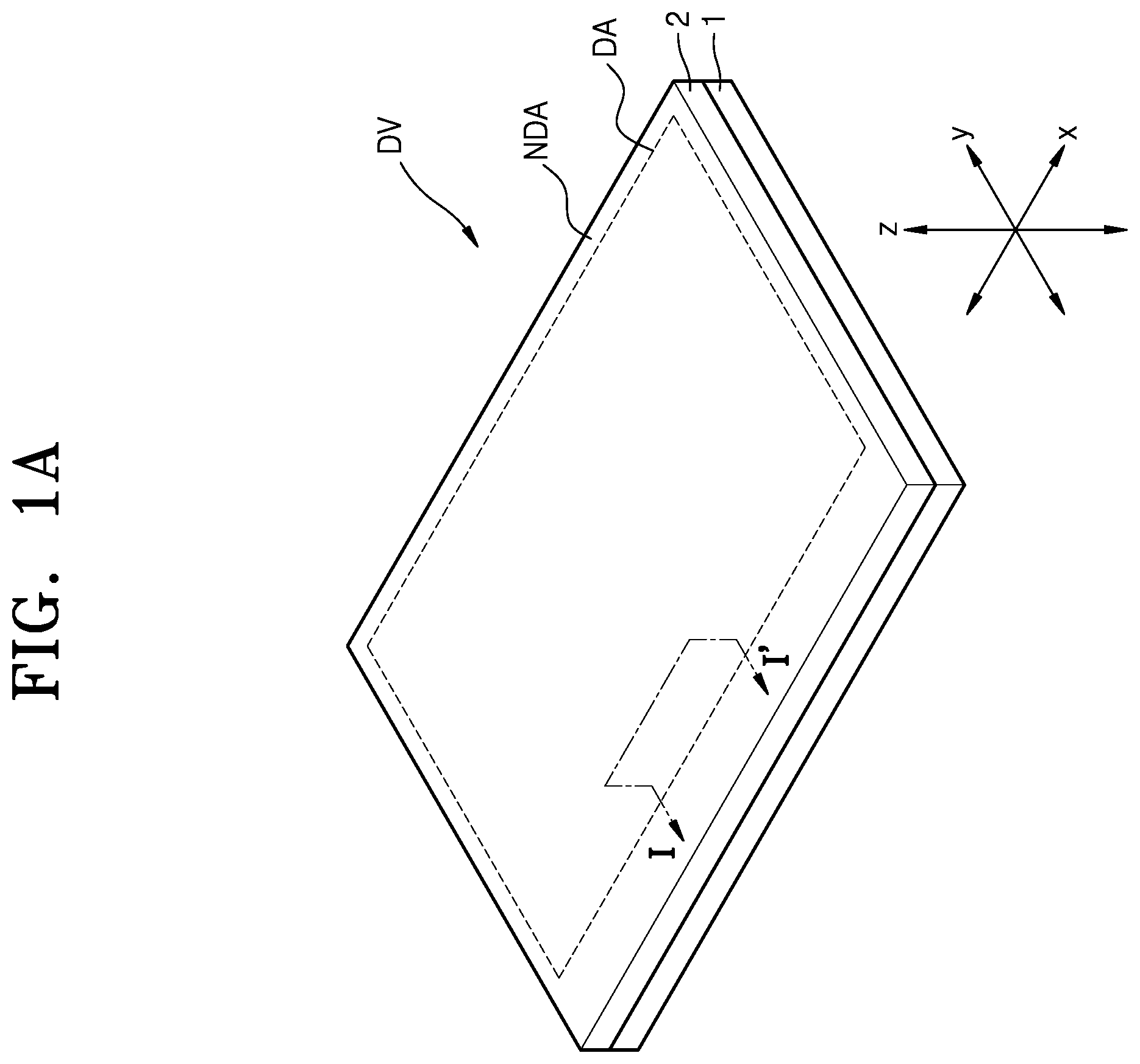
A is a schematic perspective view of an embodiment of a display device;
B is a cross-sectional view of an embodiment of a display device, taken along line I-I′ of A ;
C shows each portion of a color conversion-transmission layer of B ;
is an equivalent circuit diagram showing an embodiment of a light-emitting diode and a pixel circuit electrically connected to the light-emitting diode, which are included in a light-emitting panel of a display device;
is a plan view showing an embodiment of pixel circuits of a light-emitting panel;
is a plan view showing light-emitting diodes disposed on the pixel circuits of ;
is an enlarged view of an embodiment of region A of ;
A is a cross-sectional view of region A, taken along line II-II′ of ;
B is a cross-sectional view of region A, taken along line III-III′ of ;
C is a cross-sectional view of region A, taken along line IV-IV′ of ;
D is a cross-sectional view showing a modified embodiment in a region corresponding to the cross-sectional view of region A, taken along line III-III′ of ;
is an enlarged view of another embodiment of region A of ; and
is a cross-sectional view of region A, taken along line V-V′ of .
DETAILED DESCRIPTION
Reference will now be made in detail to embodiments, illustrative embodiments of which are illustrated in the accompanying drawings, where like reference numerals refer to like elements throughout. In this regard, the illustrated embodiments may have different forms and should not be construed as being limited to the descriptions set forth herein. Accordingly, the embodiments are merely described below, by referring to the drawing figures, to explain features of the description. As used herein, the term “and/or” includes any and all combinations of one or more of the associated listed items. Throughout the disclosure, the expression “at least one of a, b and c” indicates only a, only b, only c, both a and b, both a and c, both b and c, all of a, b, and c, or variations thereof.
As the description allows for various changes and numerous embodiments, illustrative embodiments will be illustrated in the drawings and described in the written description. Effects and features of embodiments and methods of accomplishing the same will become apparent from the following detailed description of the embodiments, taken in conjunction with the accompanying drawings. However, the illustrated embodiments may have different forms and should not be construed as being limited to the descriptions set forth herein.
Embodiments will be described below in more detail with reference to the accompanying drawings. Those elements that are the same or are in correspondence with each other are rendered the same reference numeral regardless of the figure number, and redundant descriptions thereof are omitted.
While such terms as “first” and “second” may be used to describe various elements, such elements must not be limited to the above terms. The above terms are used only to distinguish one element from another.
The singular forms “a,” “an,” and “the” as used herein are intended to include the plural forms as well unless the context clearly indicates otherwise.
It will be understood that the terms “include,” “comprise,” and “have” as used herein specify the presence of stated features or elements but do not preclude the addition of one or more other features or elements.
It will be further understood that, when a layer, region, or element is referred to as being on another layer, region, or element, it may be directly or indirectly on the other layer, region, or element. That is, intervening layers, regions, or elements, for example, may be present.
Sizes of elements in the drawings may be exaggerated or reduced for convenience of explanation. For example, since sizes and thicknesses of elements in the drawings are arbitrarily illustrated for convenience of explanation, the following embodiments are not limited thereto.
When an embodiment may be implemented differently, a predetermined process order may be performed differently from the described order. For example, two consecutively described processes may be performed substantially at the same time or performed in an order opposite to the described order.
It will be further understood that, when layers, regions, or elements are referred to as being connected to each other, they may be directly connected to each other or may be indirectly connected to each other with intervening layers, regions, or elements therebetween. For example, when layers, regions, or elements are referred to as being electrically connected to each other, they may be directly electrically connected to each other or may be indirectly electrically connected to each other with intervening layers, regions, or elements therebetween.
“About” or “approximately” as used herein is inclusive of the stated value and means within an acceptable range of deviation for the particular value as determined by one of ordinary skill in the art, considering the measurement in question and the error associated with measurement of the particular quantity (i.e., the limitations of the measurement system). The term “about” can mean within one or more standard deviations, or within ±30%, 20%, 10%, 5% of the stated value, for example.
Unless otherwise defined, all terms (including technical and scientific terms) used herein have the same meaning as commonly understood by one of ordinary skill in the art to which this disclosure belongs. It will be further understood that terms, such as those defined in commonly used dictionaries, should be interpreted as having a meaning that is consistent with their meaning in the context of the relevant art and the present disclosure, and will not be interpreted in an idealized or overly formal sense unless expressly so defined herein.
A is a schematic perspective view of an embodiment of a display device DV. B is a cross-sectional view of an embodiment of the display device DV, taken along line I-I′ of A . C shows each portion of a color conversion-transmission layer of B .
Each pixel of the display device DV is an area where light of a predetermined color may be emitted, and the display device DV may provide an image by light emitted from pixels. In an embodiment, each pixel may emit red, green, or blue light.
A non-display area NDA is an area where no image is provided, and may surround an entirety of the display area DA. A driver or a main power line for providing electrical signals or power to pixel circuits may be disposed in the non-display area NDA. The non-display area NDA may include a pad, which is an area to which an electronic device or a printed circuit board may be electrically connected.
As shown in A , the display area DA may have a polygonal shape including a quadrilateral shape. In an embodiment, the display area DA may have a rectangular shape having a horizontal length greater than a vertical length, a rectangular shape having a horizontal length less than a vertical length, or a square shape. In an alternative embodiment, the display area DA may have various shapes, such as an oval shape or a circular shape.
Referring to B , in some embodiments, the display device may include a light-emitting panel 1 (or a light-emitting unit) and a color panel 2 (or a color unit) stacked in a thickness direction (a direction z) of the display device. The light-emitting panel 1 may include first to third pixel circuits PC 1 to PC 3 on a first substrate 10 , and first to third light-emitting diodes LED 1 to LED 3 respectively connected thereto.
While passing through the color panel 2 , light (e.g., blue light Lb) emitted from the first to third light-emitting diodes LED 1 to LED 3 may be converted into red light Lr, green light Lg, and blue light Lb or may be transmitted. An area where the red light Lr is emitted may correspond to a red pixel Pr, an area where the green light Lg is emitted may correspond to a green pixel Pg, and an area where the blue light Lb is emitted may correspond to a blue pixel Pb.
The color panel 2 may include a color conversion-transmission layer including a first color conversion portion 40 a , a second color conversion portion 40 b , and a transmission portion 40 c , and a color layer including a first color filter 30 a , a second color filter 30 b , and a third color filter 30 c.
A first color area of the color panel 2 may include the first color conversion portion 40 a and the first color filter 30 a overlapping each other, a second color area may include the second color conversion portion 40 b and the second color filter 30 b overlapping each other, and a third color area may include the transmission portion 40 c and the third color filter 30 c overlapping each other.
The color panel 2 may include a non-pixel area NPA surrounding each of the first to third color areas. The non-pixel area NPA may be a light-blocking area. The light-blocking area may include a first light-blocking layer 21 on a second substrate 20 . The first light-blocking layer 21 may include a plurality of holes defined by removing portions corresponding to the red pixel Pr, the green pixel Pg, and the blue pixel Pb. The first light-blocking layer 21 may be in the non-pixel area NPA, and may include various materials capable of absorbing light.
The light-blocking area may include a second light-blocking layer 22 over the first light-blocking layer 21 . The second light-blocking layer 22 may also be in the non-pixel area NPA. The second light-blocking layer 22 may include various materials capable of absorbing light. The second light-blocking layer 22 may include the same material as that of the first light-blocking layer 21 described above, or may include a different material from the first light-blocking layer 21 . The first light-blocking layer 21 and/or the second light-blocking layer 22 may include an opaque inorganic insulating material, such as chromium oxide or molybdenum oxide, or an opaque organic insulating material, such as black resin.
Blue light Lb emitted from the first light-emitting diode LED 1 of the light-emitting panel 1 may pass through the first color area of the color panel 2 . While passing through the color panel 2 , the blue light Lb may be converted into red light Lr and filtered. The first color conversion portion 40 a and the first color filter 30 a included in the first color area overlap the first light-emitting diode LED 1 . The blue light Lb emitted from the first light-emitting diode LED 1 may be converted in the first color conversion portion 40 a and then may pass through the first color filter 30 a.
The first color conversion portion 40 a may convert incident blue light Lb into red light Lr. As shown in C , the first color conversion portion 40 a may include a first photosensitive polymer 1151 , and first quantum dots 1152 and first scattering particles 1153 dispersed in the first photosensitive polymer 1151 .
The first quantum dots 1152 may be excited by the blue light Lb to isotropically emit the red light Lr having a wavelength longer than a wavelength of the blue light Lb. The first photosensitive polymer 1151 may be a light-transmissive organic material. The first scattering particles 1153 may scatter any portion of the blue light Lb that is not initially absorbed by the first quantum dots 1152 and thus may allow more first quantum dots 1152 to be excited, thereby increasing color conversion efficiency. The first scattering particles 1153 may include titanium oxide (TiO 2 ) or metal particles, for example. The first quantum dots 1152 may include a group II-VI compound, a group III-V compound, a group IV-VI compound, a group IV element, a group IV compound, or any combinations thereof.
More specifically, in the description, quantum dots (e.g., the first quantum dots 1152 , second quantum dots 1162 ) refer to crystals of a semiconductor compound, and may include any material capable of emitting light of various emission wavelengths according to sizes of crystals.
The quantum dots may have a diameter of, e.g., about 1 nanometer (nm) to about 10 nm.
The quantum dots may be synthesized by a wet chemical process, a metal organic chemical vapor deposition (“MOCVD”) process, a molecular beam epitaxy (“MBE”) process, or a similar process. The wet chemical process is a method of growing quantum dot particle crystals after mixing an organic solvent with a precursor material. When the crystals are grown, the organic solvent naturally serves as a dispersant coordinated on the surface of quantum dot crystals and controls the growth of the crystals, and thus, the growth of quantum dot particles may be controlled through an easy and low-cost process compared to a vapor deposition method, such as MOCVD or MBE.
The quantum dots may include a group II-VI semiconductor compound, a group III-V semiconductor compound, a group III-VI semiconductor compound, a group semiconductor compound, a group IV-VI semiconductor compound, a group IV element or compound, or any combinations thereof.
In embodiments, the group II-VI semiconductor compound may include a binary compound, such as CdS, CdSe, CdTe, ZnS, ZnSe, ZnTe, ZnO, HgS, HgSe, HgTe, MgSe, or MgS, a ternary compound, such as CdSeS, CdSeTe, CdSTe, ZnSeS, ZnSeTe, ZnSTe, HgSeS, HgSeTe, HgSTe, CdZnS, CdZnSe, CdZnTe, CdHgS, CdHgSe, CdHgTe, HgZnS, HgZnSe, HgZnTe, MgZnSe, or MgZnS, a quaternary compound, such as CdZnSeS, CdZnSeTe, CdZnSTe, CdHgSeS, CdHgSeTe, CdHgSTe, HgZnSeS, HgZnSeTe, or HgZnSTe, or any combinations thereof.
In embodiments, the group III-V semiconductor compound may include a binary compound, such as GaN, GaP, GaAs, GaSb, AlN, AlP, AlAs, AlSb, InN, InP, InAs, or InSb, a ternary compound, such as GaNP, GaNAs, GaNSb, GaPAs, GaPSb, AlNP, AlNAs, AlNSb, AlPAs, AlPSb, InGaP, InNP, InAlP, InNAs, InNSb, InPAs, or InPSb, a quaternary compound, such as GaAlNP, GaAlNAs, GaAlNSb, GaAlPAs, GaAlPSb, GaInNP, GaInNAs, GaInNSb, GaInPAs, GaInPSb, InAlNP, InAlNAs, InAlNSb, InAlPAs, or InAlPSb, or any combinations thereof. The group III-V semiconductor compound may further include a group II element. In embodiments, the group III-V semiconductor compound further including a group II element may include InZnP, InGaZnP, or InAlZnP.
In embodiments, the group III-VI semiconductor compound may include a binary compound, such as GaS, GaSe, Ga2Se3, GaTe, InS, In2S3, InSe, In2Se3, or InTe, a ternary compound, such as AgInS, AgInS2, CuInS, CuInS2, InGaS3, or InGaSe3, or any combinations thereof.
In embodiments, the group semiconductor compound may include a ternary compound, such as AgInS, AgInS2, CuInS, CuInS2, CuGaO2, AgGaO2, or AgAlO2, or any combinations thereof.
In embodiments, the group IV-VI semiconductor compound may include a binary compound, such as SnS, SnSe, SnTe, PbS, PbSe, or PbTe, a ternary compound, such as SnSeS, SnSeTe, SnSTe, PbSeS, PbSeTe, PbSTe, SnPbS, SnPbSe, or SnPbTe, a quaternary compound, such as SnPbSSe, SnPbSeTe, or SnPbSTe, or any combinations thereof.
In embodiments, the group IV element or compound may include a single-element compound, such as Si or Ge, a binary compound, such as SiC or SiGe, or any combinations thereof.
Each element included in a multi-element compound, such as the binary compound, the ternary compound, or the quaternary compound, may be in particles at a uniform concentration or a non-uniform concentration.
The quantum dots may have a single structure or a core-shell dual structure, in which the concentration of each element included in the corresponding quantum dot is uniform. In an embodiment, a material included in the core and a material included in the shell may be different from each other, for example. The shell of the quantum dots may serve as a protective layer for maintaining semiconductor properties by preventing chemical degeneration of the core and/or a charging layer for imparting electrophoretic properties to the quantum dots. The shell may have a single-layer or multi-layer structure. An interface between the core and the shell may have a concentration gradient in which the concentration of elements present in the shell decreases toward the center of core.
In embodiments, the shell of the quantum dots may include metal or non-metal oxide, a semiconductor compound, or any combinations thereof. In embodiments, the metal or non-metal oxide may include a binary compound, such as SiO2, Al2O3, TiO2, ZnO, MnO, Mn2O3, Mn3O4, CuO, FeO, Fe2O3, Fe3O4, CoO, Co3O4, or NiO, a ternary compound, such as MgAl2O4, CoFe2O4, NiFe2O4, or CoMn2O4, or any combinations thereof. In embodiments, the semiconductor compound may include a group II-VI semiconductor compound, a group III-V semiconductor compound, a group III-VI semiconductor compound, a group I-III-VI semiconductor compound, a group IV-VI semiconductor compound, or any combinations thereof, as described above. In an embodiment, the semiconductor compound may include CdS, CdSe, CdTe, ZnS, ZnSe, ZnTe, ZnSeS, ZnTeS, GaAs, GaP, GaSb, HgS, HgSe, HgTe, InAs, InP, InGaP, InSb, AlAs, AlP, AlSb, or any combinations thereof.
The quantum dots may have a full width of half maximum (“FWHM”) of an emission wavelength spectrum in a range of about 45 nm or less, specifically about 40 nm or less, and more specifically about 30 nm or less, and color purity or color reproducibility may be improved in the above-described range. In addition, a wide viewing angle may be improved because light emitted through the quantum dots is emitted in all directions.
The shape of the quantum dots may be spherical, pyramidal, multi-arm, or cubic nanoparticles, nanotubes, nanowires, nanofibers, or nanoplatelet particles, for example.
An energy band gap may be adjusted by adjusting sizes of the quantum dots, and thus, light in various wavelength bands may be obtained through a quantum dot emission layer. Accordingly, a light-emitting element emitting light of various wavelengths may be implemented by the quantum dots having different sizes from each other. Specifically, sizes of the quantum dots may be selected to emit red light, green light and/or blue light. In addition, sizes of the quantum dots may emit white light by combining light of various colors.
The red light Lr converted by the first color conversion portion 40 a may have color purity improved while passing through the first color filter 30 a . The first color filter 30 a may include a pigment or dye of a first color (e.g., red).
Blue light Lb emitted from the second light-emitting diode LED 2 of the light-emitting panel 1 may pass through the second color area of the color panel 2 . While passing through the color panel 2 , the blue light Lb may be converted into green light Lg and filtered. The second color conversion portion 40 b and the second color filter 30 b included in the second color area overlap the second light-emitting diode LED 2 . The blue light Lb emitted from the second light-emitting diode LED 2 may be converted in the second color conversion portion 40 b and then may pass through the second color filter 30 b.
The second color conversion portion 40 b may convert incident blue light Lb into green light Lg. The second color conversion portion 40 b may overlap the second color filter 30 b . As shown in C , the second color conversion portion 40 b may include a second photosensitive polymer 1161 , and the second quantum dots 1162 and second scattering particles 1163 dispersed in the second photosensitive polymer 1161 .
The second quantum dots 1162 may be excited by the blue light Lb to isotropically emit the green light Lg having a wavelength longer than a wavelength of the blue light Lb. The second photosensitive polymer 1161 may be a light-transmissive organic material.
The second scattering particles 1163 may scatter any portion of the blue light Lb that is not initially absorbed by the second quantum dots 1162 and thus may allow more second quantum dots 1162 to be excited, thereby increasing color conversion efficiency. The second scattering particles 1163 may include titanium oxide (TiO2) or metal particles, for example. The second quantum dots 1162 may include a group II-VI compound, a group III-V compound, a group IV-VI compound, a group IV element, a group IV compound, or any combinations thereof.
In some embodiments, the first quantum dots 1152 and the second quantum dots 1162 may include the same material as each other. In this case, the first quantum dots 1152 may be greater than the second quantum dots 1162 in size.
The green light Lg converted by the second color conversion portion 40 b may have color purity improved while passing through the second color filter 30 b . The second color filter 30 b may include a pigment or dye of a second color (e.g., green).
Blue light Lb emitted from the third light-emitting diode LED 3 of the light-emitting panel 1 may pass through the third color area of the color panel 2 . The transmission portion 40 c and the third color filter 30 c included in the third color area overlap the third light-emitting diode LED 3 . The blue light Lb emitted from the third light-emitting diode LED 3 may pass through the transmission portion 40 c without color conversion and then may be emitted to the outside through the third color filter 30 c.
Without converting blue light Lb incident on the transmission portion 40 c , the transmission portion 40 c may transmit the blue light Lb. As shown in C , the transmission portion 40 c may include a third photosensitive polymer 1171 in which third scattering particles 1173 are dispersed. The third photosensitive polymer 1171 may be a light-transmissive organic material, such as silicone resin, epoxy resin, etc., and may include the same material as that of the first and second photosensitive polymers 1151 and 1161 . The third scattering particles 1173 may scatter and emit the blue light Lb and may include the same material as that of the first and second scattering particles 1153 and 1163 .
The blue light Lb having passed through the transmission portion 40 c may have color purity improved while passing through the third color filter 30 c.
Each of the first to third light-emitting diodes LED 1 to LED 3 may include an organic light-emitting diode including an organic material. In another embodiment, each of the first to third light-emitting diodes LED 1 to LED 3 may be an inorganic light-emitting diode including an inorganic material. The inorganic light-emitting diode may include a PN junction diode including inorganic semiconductor-based materials. When a voltage is applied to the PN junction diode in a forward direction, holes and electrons are injected, and light of a predetermined color may be emitted by converting energy generated by recombination of holes and electrons into light energy. The above-described inorganic light-emitting diode may have a width of several micrometers to hundreds of micrometers or several nanometers to hundreds of nanometers. In some embodiments, each of the first to third light-emitting diodes LED 1 to LED 3 may be a light-emitting diode including quantum dots. As described above, an emission layer of each of the first to third light-emitting diodes LED 1 to LED 3 may include an organic material, an inorganic material, quantum dots, an organic material and quantum dots, or an inorganic material and quantum dots.
A display device DV having the above-described structure may include a mobile phone, a television, a billboard, a monitor, a tablet personal computer, a notebook computer, etc.
is an equivalent circuit diagram showing an embodiment of a light-emitting diode LED and a pixel circuit PC electrically connected to the light-emitting diode LED, which are included in a light-emitting panel of a display device.
Referring to , a first electrode (e.g., an anode) of a light-emitting diode, e.g., the light-emitting diode LED, may be connected to the pixel circuit PC, and a second electrode (e.g., a cathode) of the light-emitting diode LED may be connected to a common voltage line VSL which provides a common power voltage ELVSS. The light-emitting diode LED may emit light at a luminance corresponding to a current supplied from the pixel circuit PC.
The light-emitting diode LED of may correspond to each of the first to third light-emitting diodes LED 1 to LED 3 shown in B , and the pixel circuit PC of may correspond to each of the first to third pixel circuits PC 1 to PC 3 shown in B .
The pixel circuit PC may control an amount of current flowing from a driving power voltage ELVDD to the common power voltage ELVSS via the light-emitting diode LED in response to a data signal. The pixel circuit PC may include a first transistor M 1 , a second transistor M 2 , a third transistor M 3 , and a storage capacitor Cst.
Each of the first transistor M 1 , the second transistor M 2 , and the third transistor M 3 may be an oxide semiconductor thin-film transistor including a semiconductor layer composed of an oxide semiconductor, or a silicon semiconductor thin-film transistor including a semiconductor layer composed of polysilicon. Depending on the type of a transistor, a first electrode may be one of a source electrode and a drain electrode, and a second electrode may be the other of the source electrode and the drain electrode.
The first transistor M 1 may be a driving transistor. A first electrode of the first transistor M 1 may be connected to a driving voltage line VDL which supplies the driving power voltage ELVDD, and a second electrode of the first transistor M 1 may be connected to a first electrode of the light-emitting diode LED. A gate electrode of the first transistor M 1 may be connected to a first node N 1 . The first transistor M 1 may control an amount of current flowing through the light-emitting diode LED from the driving power voltage ELVDD in response to a voltage of the first node N 1 .
The second transistor M 2 may be a switching transistor. A first electrode of the second transistor M 2 may be connected to a data line DL, and a second electrode of the second transistor M 2 may be connected to the first node N 1 . A gate electrode of the second transistor M 2 may be connected to a scan line SL. When a scan signal is supplied to the second transistor M 2 via the scan line SL, the second transistor M 2 may be turned on to electrically connect the data line DL and the first node N 1 to each other.
The third transistor M 3 may be an initialization transistor and/or a sensing transistor. A first electrode of the third transistor M 3 may be connected to a second node N 2 , and a second electrode of the third transistor M 3 may be connected to a sensing line ISL. A gate electrode of the third transistor M 3 may be connected to a control line CL.
When a control signal is supplied to the third transistor M 3 via the control line CL, the third transistor M 3 may be turned on to electrically connect the sensing line ISL and the second node N 2 to each other. In some embodiments, the third transistor M 3 may be turned on according to a signal received through the control line CL to transfer an initialization voltage from the sensing line ISL to the first electrode of the light-emitting diode LED and initialize the first electrode of the light-emitting diode LED. In some embodiments, when a control signal is supplied to the third transistor M 3 via the control line CL, the third transistor M 3 may be turned on to sense characteristic information of the light-emitting diode LED. The third transistor M 3 may have both of the above-described functions as an initialization transistor and a sensing transistor or may have either function.
In some embodiments, an initialization operation and a sensing operation of the third transistor M 3 may each be performed individually or may be performed simultaneously. Hereinafter, a case in which a third transistor has both the functions of an initialization transistor and a sensing transistor will be described for convenience.
The storage capacitor Cst may be connected between the first node N 1 and the second node N 2 . In an embodiment, a first capacitor electrode of the storage capacitor Cst may be connected to the gate electrode of the first transistor M 1 , and a second capacitor electrode of the storage capacitor Cst may be connected to the first electrode of the light-emitting diode LED, for example.
Although the first transistor M 1 , the second transistor M 2 , and the third transistor M 3 are shown as N-type metal-oxide-semiconductor (“NMOS”) in , the disclosure is not limited thereto. In an embodiment, at least one of the first transistor M 1 , the second transistor M 2 , and the third transistor M 3 may be P-type metal-oxide-semiconductor (“PMOS”), for example. In addition, although three transistors are shown in , the disclosure is not limited thereto. The pixel circuit PC may include four or more transistors.
is a plan view showing an embodiment of pixel circuits of the light-emitting panel 1 . is a plan view showing light-emitting diodes disposed on the pixel circuits of . illustrates an embodiment in which the light-emitting diodes are organic light-emitting diodes.
Referring to , the scan line SL and the control line CL may extend in a direction x, and first to third data lines DL 1 to DL 3 may extend in a direction y crossing the direction x. In addition, the sensing line ISL, a first driving voltage line VDLa, and a first common voltage line VSLa may extend in the direction y, and a second driving voltage line VDLb and a second common voltage line VSLb may extend in the direction x.
Two adjacent first common voltage lines VSLa may be apart from each other, and the first to third data lines DL 1 to DL 3 , the sensing line ISL, and the first driving voltage line VDLa may be arranged between the above-described two adjacent first common voltage lines VSLa. The sensing line ISL and the first driving voltage line VDLa may be adjacent to one first common voltage line VSLa while neighboring each other. The first to third data lines DL 1 to DL 3 may be adjacent to the other first common voltage line VSLa while neighboring one another. In an embodiment, the sensing line ISL and the first driving voltage line VDLa may be arranged on one side (e.g., the left side) of first to third storage capacitors Cst 1 to Cst 3 described below, and the first to third data lines DL 1 to DL 3 may be arranged on the other side (e.g., the right side), for example. Through this structure, space of a light-emitting panel 1 may be efficiently used.
The second driving voltage line VDLb may cross the first driving voltage line VDLa and extend in the direction x. The second common voltage line VSLb may cross the first driving voltage line VDLa and extend in the direction x. The second driving voltage line VDLb and the second common voltage line VSLb may be apart from each other with the first to third storage capacitors Cst 1 to Cst 3 therebetween.
The second driving voltage line VDLb may be adjacent to the scan line SL, and the second common voltage line VSLb may be adjacent to the control line CL. The second driving voltage line VDLb may be connected to the first driving voltage line VDLa through a contact hole CT 21 , and the second common voltage line VSLb may be connected to the first common voltage line VSLa through a contact hole CT 22 .
The light-emitting panel 1 may include a structure in which the structure shown in is repeated in the direction x and the direction y, and accordingly, a plurality of first driving voltage lines VDLa and a plurality of second driving voltage lines VDLb included in the light-emitting panel 1 may have a mesh structure in a plan view. Likewise, a plurality of first common voltage lines VSLa and a plurality of second common voltage lines VSLb may have a mesh structure in a plan view.
The first common voltage line VSLa may overlap a sub-common voltage line s-VSL. The first common voltage line VSLa may be electrically connected to the sub-common voltage line s-VSL. In an embodiment, the first common voltage line VSLa may be connected to the sub-common voltage line s-VSL through a contact hole CT 23 , for example.
The sub-common voltage line s-VSL may be disposed between the scan line SL and the control line CL and may have a length less than a distance (a distance in the direction y) between the scan line SL and the control line CL. The sub-common voltage line s-VSL is formed to reduce self-resistance of the first common voltage line VSLa and may be disposed in the same layer as gate electrodes of transistors or the scan line SL.
In a plan view, transistors and storage capacitors may be arranged in an approximately quadrangular space surrounded by the neighboring first common voltage lines VSLa, the second driving voltage line VDLb, and the second common voltage line VSLb. The transistors and the storage capacitors may be electrically connected to corresponding light-emitting diodes, respectively. In this regard, it is shown in that first electrodes 211 , 212 , and 213 of first to third organic light-emitting diodes OLED 1 to OLED 3 are electrically connected to corresponding pixel circuits, respectively.
As shown in , the first electrode 211 of the first organic light-emitting diode OLED 1 may be electrically connected to the first pixel circuit PC 1 . As shown in , the first pixel circuit PC 1 may include a first driving transistor M 11 , a first switching transistor M 12 , a first sensing transistor M 13 , and the first storage capacitor Cst 1 . In an embodiment, the first electrode 211 of the first organic light-emitting diode OLED 1 may be electrically connected to the first pixel circuit PC 1 through a first via hole VH 1 , but the disclosure is not limited thereto.
The first electrode 212 of the second organic light-emitting diode OLED 2 may be electrically connected to the second pixel circuit PC 2 , and the second pixel circuit PC 2 may include a second driving transistor M 21 , a second switching transistor M 22 , a second sensing transistor M 23 , and the second storage capacitor Cst 2 . In an embodiment, the first electrode 212 of the second organic light-emitting diode OLED 2 may be electrically connected to the second pixel circuit PC 2 through a second via hole VH 2 , but the disclosure is not limited thereto.
The first electrode 213 of the third organic light-emitting diode OLED 3 may be electrically connected to the third pixel circuit PC 3 , and the third pixel circuit PC 3 may include a third driving transistor M 31 , a third switching transistor M 32 , a third sensing transistor M 33 , and the third storage capacitor Cst 3 . In an embodiment, the first electrode 213 of the third organic light-emitting diode OLED 3 may be electrically connected to the third pixel circuit PC 3 through a third via hole VH 3 , but the disclosure is not limited thereto.
The first to third storage capacitors Cst 1 to Cst 3 may be arranged in the direction y. The first storage capacitor Cst 1 may be relatively closest to the control line CL, the third storage capacitor Cst 3 may be relatively closest to the scan line SL, and the second storage capacitor Cst 2 may be disposed between the first storage capacitor Cst 1 and the third storage capacitor Cst 3 .
Each of the first to third driving transistors M 11 to M 31 , the first to third switching transistors M 12 to M 32 , and the first to third sensing transistors M 13 to M 33 may include an active layer and a gate electrode.
The first driving transistor M 11 may include a first active layer ACT 1 and a first gate electrode G 1 . The first active layer ACT 1 may include an oxide semiconductor or a silicon-based semiconductor. The first active layer ACT 1 may include a first low-resistance region B 1 and a second low-resistance region C 1 , and a channel region may be disposed between the first low-resistance region B 1 and the second low-resistance region C 1 . The first low-resistance region B 1 and the second low-resistance region C 1 are regions having a resistance less than that of the channel region and may be formed through an impurity doping process or a conductive process. The first gate electrode G 1 may overlap the channel region of the first active layer ACT 1 . One of the first low-resistance region B 1 and the second low-resistance region C 1 may correspond to a source region, and the other may correspond to a drain region.
The first gate electrode G 1 of the first driving transistor M 11 may be electrically connected to the first storage capacitor Cst 1 . The first low-resistance region B 1 of the first active layer ACT 1 may be electrically connected to the first driving voltage line VDLa. The second low-resistance region C 1 of the first active layer ACT 1 may be electrically connected to the first electrode 211 of the first organic light-emitting diode OLED 1 .
The first switching transistor M 12 may include a second active layer ACT 2 and a second gate electrode G 2 . The second active layer ACT 2 may include an oxide semiconductor or a silicon-based semiconductor. The second active layer ACT 2 may include a first low-resistance region B 2 and a second low-resistance region C 2 , and a channel region may be disposed between the first low-resistance region B 2 and the second low-resistance region C 2 . The first low-resistance region B 2 and the second low-resistance region C 2 are regions having a resistance less than that of the channel region and may be formed through an impurity doping process or a conductive process. In an embodiment, because the first low-resistance region B 2 and the second low-resistance region C 2 do not overlap a second insulating pattern 105 b , the first low-resistance region B 2 and the second low-resistance region C 2 may be made conductive by a subsequent process after a process operation of forming a connection layer CNL, a second capacitor electrode CE 2 , and the second gate electrode G 2 . The second gate electrode G 2 may overlap the channel region of the second active layer ACT 2 . The second gate electrode G 2 of the first switching transistor M 12 may correspond to a portion of a branch (hereinafter also referred to as a first branch SL-B) extending in a direction crossing the scan line SL. The second gate electrode G 2 of the first switching transistor M 12 may receive a scan signal through the scan line SL.
The scan line SL may be electrically connected to gate electrodes of the first to third switching transistors M 12 to M 32 . The first branch SL-B may extend in the direction y. Portions of the first branch SL-B may correspond to gate electrodes of the first to third switching transistors M 12 to M 32 . The first branch SL-B may extend between a group of the first to third storage capacitors Cst 1 to Cst 3 and a group of the first to third data lines DL 1 to DL 3 . The first branch SL-B may be electrically connected to the scan line SL by a connection pattern CNPa. In an embodiment, the scan line SL may be connected to the connection pattern CNPa through a contact hole CT 24 , and the connection pattern CNPa may be connected to the first branch SL-B through a contact hole CT 25 , for example.
One of the first low-resistance region B 2 and the second low-resistance region C 2 of the first switching transistor M 12 may be electrically connected to the second data line DL 2 , and the other may be electrically connected to the first storage capacitor Cst 1 . In an embodiment, the first low-resistance region B 2 of the second active layer ACT 2 may be connected to the second capacitor electrode CE 2 of the first storage capacitor Cst 1 in the same layer, for example. In an embodiment, the second low-resistance region C 2 of the second active layer ACT 2 may be connected to a connection pattern CNP 1 through a contact hole CT 1 , and the connection pattern CNP 1 may be connected to the second data line DL 2 through a contact hole CT 2 , for example. Accordingly, the second low-resistance region C 2 of the second active layer ACT 2 may be electrically connected to the second data line DL 2 by the connection pattern CNP 1 .
The first sensing transistor M 13 may include a third active layer ACT 3 and a third gate electrode G 3 . The third active layer ACT 3 may include an oxide semiconductor or a silicon-based semiconductor. The third active layer ACT 3 may include a first low-resistance region B 3 and a second low-resistance region C 3 , and a channel region may be disposed between the first low-resistance region B 3 and the second low-resistance region C 3 . The first low-resistance region B 3 and the second low-resistance region C 3 are regions having a resistance less than that of the channel region and may be formed through an impurity doping process or a conductive process. The third gate electrode G 3 may overlap the channel region of the third active layer ACT 3 .
The control line CL may be electrically connected to gate electrodes of the first to third sensing transistors M 13 to M 33 . A second branch CL-B may extend in the direction y. Portions of the second branch CL-B may correspond to gate electrodes of the first to third sensing transistors M 13 to M 33 . The second branch CL-B may extend between the first driving voltage line VDLa and the sensing line ISL. The second branch CL-B may be electrically connected to the control line CL by a connection pattern CNPb. In an embodiment, the control line CL may be connected to the connection pattern CNPb through a contact hole CT 26 , and the connection pattern CNPb may be connected to the second branch CL-B through a contact hole CT 27 , for example.
One of the first low-resistance region B 3 and the second low-resistance region C 3 of the third active layer ACT 3 may be electrically connected to the sensing line ISL, and the other may be electrically connected to the first storage capacitor Cst 1 . In an embodiment, the first low-resistance region B 3 of the third active layer ACT 3 may be connected to an auxiliary sensing line a-ISL through a contact hole CT 28 , and the auxiliary sensing line a-ISL may be connected to the sensing line ISL through a contact hole CT 29 , for example. Accordingly, the first low-resistance region B 3 may be electrically connected to the sensing line ISL through the auxiliary sensing line a-ISL. The auxiliary sensing line a-ISL may extend in an extension direction (the direction y) of the sensing line ISL while overlapping the sensing line ISL. In a plan view, the auxiliary sensing line a-ISL may be disposed between the scan line SL and the control line CL and may have a length less than a distance (a distance in the direction y) between the scan line SL and the control line CL. The second low-resistance region C 3 of the third active layer ACT 3 may be electrically connected to the first electrode 211 of the first organic light-emitting diode OLED 1 .
The first storage capacitor Cst 1 may include at least two electrodes. In an embodiment, the first storage capacitor Cst 1 may include a first capacitor electrode CE 1 and the second capacitor electrode CE 2 .
The first capacitor electrode CE 1 may be disposed in the same layer as the first to third data lines DL 1 to DL 3 . The first capacitor electrode CE 1 may be disposed in the same layer as the first and second driving voltage lines VDLa and VDLb. The first capacitor electrode CE 1 may be disposed in the same layer as the first and second common voltage lines VSLa and VSLb.
The second capacitor electrode CE 2 may be disposed over the first capacitor electrode CE 1 and may overlap the first capacitor electrode CE 1 .
Detailed structures and materials of the second driving transistor M 21 and the third driving transistor M 31 are the same as the structure of the first driving transistor M 11 described above. The second switching transistor M 22 and the third switching transistor M 32 are the same as the first switching transistor M 12 described above, except that they are connected to the first data line DL 1 and the third data line DL 3 , respectively. Detailed structures and materials of the second sensing transistor M 23 and the third sensing transistor M 33 are the same as the structure of the first sensing transistor M 13 described above. Structures of the second storage capacitor Cst 2 and the third storage capacitor Cst 3 are the same as the structure of the first storage capacitor Cst 1 described above.
A first conductive pattern CP 1 may be disposed between the first storage capacitor Cst 1 and the first switching transistor M 12 . A second conductive pattern CP 2 may be disposed between the second storage capacitor Cst 2 and the second switching transistor M 22 . A third conductive pattern CP 3 may be disposed between the third storage capacitor Cst 3 and the third switching transistor M 32 . The structure and arrangement of the first conductive pattern CP 1 described below may apply to the second conductive pattern CP 2 and the third conductive pattern CP 3 in the same way.
is an enlarged view of an embodiment of region A of . A is a cross-sectional view of an embodiment of region A, taken along line II-II′ of . B is a cross-sectional view of an embodiment of region A, taken along line III-III′ of . C is a cross-sectional view of region A, taken along line IV-IV′ of .
Referring to to 6 C , the light-emitting panel 1 may include the first substrate 10 , the first storage capacitor Cst 1 , a lower insulating layer 101 , first to third insulating patterns 105 a to 105 c , the first switching transistor M 12 , the first conductive pattern CP 1 , a passivation layer 106 , an upper insulating layer 107 , and a pixel-defining layer 109 . The light-emitting panel 1 may further include the first electrode 211 , an emission layer 221 , and a second electrode 231 .
The first substrate 10 may include a glass material or a resin material. The glass material may include transparent glass mainly including SiO2 The resin material may include polymer resin, such as polyethersulfone, polyacrylate, polyetherimide, polyethylene naphthalate, polyethylene terephthalate, polyphenylene sulfide, polyarylate, polyimide, polycarbonate, cellulose triacetate, cellulose acetate propionate, or any combinations thereof, etc. When the first substrate 10 includes the above-described polymer resin, the first substrate 10 may be flexible, rollable, and bendable. The first substrate 10 may have a single-layer or multi-layer structure including the above material, and the first capacitor electrode CE 1 , the first to third data lines DL 1 to DL 3 , and the lower insulating layer 101 may be disposed on the first substrate 10 . The first capacitor electrode CE 1 and the first to third data lines DL 1 to DL 3 may be disposed below the second active layer ACT 2 .
The first capacitor electrode CE 1 and the first to third data lines DL 1 to DL 3 may include metal, such as molybdenum (Mo), copper (Cu), titanium (Ti), or any combinations thereof, etc. The first capacitor electrode CE 1 and the first to third data lines DL 1 to DL 3 may be disposed right on the first substrate 10 and may directly contact the first substrate 10 , but the disclosure is not limited thereto. In an embodiment, an insulating layer may be disposed between the first capacitor electrode CE 1 and the first to third data lines DL 1 to DL 3 and the first substrate 10 , for example.
The lower insulating layer 101 may be disposed on the first substrate 10 , and the lower insulating layer 101 may be disposed on the first capacitor electrode CE 1 and the first to third data lines DL 1 to DL 3 . The lower insulating layer 101 may include an inorganic insulating material.
An insulating layer 105 including the first insulating pattern 105 a , the second insulating pattern 105 b , and the third insulating pattern 105 c may be disposed over the lower insulating layer 101 . The first insulating pattern 105 a may be disposed on the connection layer CNL. The second insulating pattern 105 b may be disposed on the second active layer ACT 2 . The second insulating pattern 105 b may be disposed between the second active layer ACT 2 and the second gate electrode G 2 . The second insulating pattern 105 b may be disposed in a region overlapping the second active layer ACT 2 . The third insulating pattern 105 c may be disposed between the connection pattern CNP 1 and the lower insulating layer 101 . The insulating layer 105 may include an inorganic insulating material.
As shown in C , an opening OP exposing at least a portion of the connection layer CNL may be defined in the first insulating pattern 105 a . The opening OP may be a region defined by removing a portion of the insulating layer 105 in an operation before forming the first conductive pattern CP 1 , the second gate electrode G 2 , and the connection pattern CNP 1 . Accordingly, the connection layer CNL disposed in the opening OP may have a portion removed in an operation of forming the first conductive pattern CP 1 and thus may have a vertical thickness less than those of the second capacitor electrode CE 2 and the second active layer ACT 2 . That is, at least a portion of the connection layer CNL contacting the first conductive pattern CP 1 may have a vertical thickness less than those of the second capacitor electrode CE 2 and the second active layer ACT 2 . The first insulating pattern 105 a may overlap a portion of the first conductive pattern CP 1 . However, in another embodiment, the entirety of the connection layer CNL disposed in the opening OP may be removed. In this case, a portion of the first conductive pattern CP 1 may contact the lower insulating layer 101 .
The second capacitor electrode CE 2 , the connection layer CNL, and the second active layer ACT 2 of the first switching transistor M 12 may be disposed on the lower insulating layer 101 . The second capacitor electrode CE 2 , the second active layer ACT 2 , and the connection layer CNL may be arranged in the same layer as one another. The second capacitor electrode CE 2 , the second active layer ACT 2 , and the connection layer CNL may be unitary with one another. In this regard, the second capacitor electrode CE 2 , the second active layer ACT 2 , and the connection layer CNL being unitary with one another may mean that one pattern includes a portion corresponding to the second capacitor electrode CE 2 , a portion corresponding to the second active layer ACT 2 , and a portion corresponding to the connection layer CNL.
The second active layer ACT 2 may include an oxide semiconductor material. Although A to 6 C show the second active layer ACT 2 including an oxide semiconductor, in some embodiments, the second active layer ACT 2 may include amorphous silicon or polysilicon. Hereinafter, an embodiment in which the second active layer ACT 2 includes an oxide semiconductor will be described.
The second active layer ACT 2 may include oxide of at least one material of indium (In), gallium (Ga), stannum (Sn), zirconium (Zr), vanadium (V), hafnium (Hf), cadmium (Cd), germanium (Ge), chromium (Cr), titanium (Ti), aluminum (Al), cesium (Cs), cerium (Ce), and zinc (Zn), for example. In an embodiment, the second active layer ACT 2 may be an indium tin zinc oxide (“ITZO”) (InSnZnO) semiconductor layer or an indium gallium zinc oxide (“IGZO”) (InGaZnO) semiconductor layer, for example.
The second active layer ACT 2 may include the first low-resistance region B 2 and the second low-resistance region C 2 , and a channel region may be disposed between the first low-resistance region B 2 and the second low-resistance region C 2 .
The second capacitor electrode CE 2 may include the same material as that of the second active layer ACT 2 . The passivation layer 106 may be disposed on the second capacitor electrode CE 2 . The insulating layer 105 may not be disposed on the second capacitor electrode CE 2 . The second capacitor electrode CE 2 may be disposed between the lower insulating layer 101 and the passivation layer 106 . The second capacitor electrode CE 2 may be formed by the same process operation as the second active layer ACT 2 . The second capacitor electrode CE 2 may be made conductive by a subsequent process because the insulating layer 105 is not disposed thereon.
The light-emitting panel 1 may further include the connection layer CNL connecting the second capacitor electrode CE 2 and the second active layer ACT 2 to each other. The connection layer CNL may be disposed on the lower insulating layer 101 .
As shown in A and 6 B , the connection layer CNL may be disposed between the second capacitor electrode CE 2 and the second active layer ACT 2 . The connection layer CNL may include a first portion CNLa between the second capacitor electrode CE 2 and the first conductive pattern CP 1 and a second portion CNLb between the first conductive pattern CP 1 and the first switching transistor M 12 . The connection layer CNL may include a third portion CNLc between the first portion CNLa and the second portion CNLb, and the third portion CNLc may overlap the first conductive pattern CP 1 . A portion of the connection layer CNL not overlapping the first insulating pattern 105 a may be made conductive by a subsequent process after a process operation of forming the connection layer CNL, the second capacitor electrode CE 2 , and the second gate electrode G 2 . In an embodiment, as shown in A and 6 C , the connection layer CNL disposed in the opening OP may be made conductive, for example. In addition, as shown in B , the first portion CNLa and the second portion CNLb of the connection layer CNL arranged in a region outside the opening OP may be made conductive.
The second gate electrode G 2 may include at least one of conductive materials including molybdenum (Mo), aluminum (Al), copper (Cu), titanium (Ti), etc., and may have a single-layer or multi-layer structure including the above-described material. The second gate electrode G 2 may include a transparent conductive material. The transparent conductive material may include conductive oxide, such as indium tin oxide (“ITO”), indium zinc oxide (“IZO”), zinc oxide (ZnO), indium oxide (In2O3), indium gallium oxide (“IGO”), or aluminum zinc oxide (“AZO”).
As shown in A and 6 B , the second gate electrode G 2 may have a three-layer structure including a first gate electrode layer Ga, a second gate electrode layer Gb on the first gate electrode layer Ga, and a third gate electrode layer Gc on the second gate electrode layer Gb. In an embodiment, the first gate electrode layer Ga and the second gate electrode layer Gb may include at least one of conductive materials including molybdenum (Mo), aluminum (Al), copper (Cu), titanium (Ti), etc., and the third gate electrode layer Gc may include a transparent conductive material. In an embodiment, the first gate electrode layer Ga may include titanium (Ti), the second gate electrode layer Gb may include copper (Cu), and the third gate electrode layer Gc may include indium tin oxide (“ITO”), for example.
The first conductive pattern CP 1 may be disposed between the first storage capacitor Cst 1 and the first switching transistor M 12 . The first conductive pattern CP 1 may be disposed between the second capacitor electrode CE 2 and the second active layer ACT 2 . The first conductive pattern CP 1 may be disposed between the first storage capacitor Cst 1 and the second gate electrode G 2 . At least a portion of the first conductive pattern CP 1 may overlap the connection layer CNL in a direction vertical to a top surface of the first substrate 10 , e.g., in the direction z. At least a portion of the first conductive pattern CP 1 may be disposed at a vertical level lower than that of the second gate electrode G 2 . In the description, the vertical level may be defined as a distance from a top surface of the first substrate 10 to a bottom surface of an element. In an embodiment, at least a portion of the first conductive pattern CP 1 may be disposed in the opening OP, but the disclosure is not limited thereto. In an embodiment, as shown in C , the first conductive pattern CP 1 may have a structure in which a portion thereof is disposed in the opening OP and extends to a region outside the opening OP, for example. In an embodiment, as shown in A and 6 C , a portion of the first conductive pattern CP 1 may be connected to the connection layer CNL. A portion of the first conductive pattern CP 1 may be disposed between the connection layer CNL and the passivation layer 106 . The first conductive pattern CP 1 may at least partially contact the first insulating pattern 105 a . At least a portion of the first conductive pattern CP 1 may be disposed between the first insulating pattern 105 a and the passivation layer 106 .
The first conductive pattern CP 1 may include a conductive material that collects hydrogen. In an embodiment, the first conductive pattern CP 1 may include titanium (Ti), etc., for example. The first conductive pattern CP 1 may have a single-layer or multi-layer structure. The first conductive pattern CP 1 may include the same material as that of at least one layer of the second gate electrode G 2 . In an embodiment, the first conductive pattern CP 1 may have the same stacked structure as the second gate electrode G 2 . In an embodiment, the first conductive pattern CP 1 may include a first layer CPa, a second layer CPb on the first layer CPa, and a third layer CPc on the second layer CPb, for example. The first layer CPa of the first conductive pattern CP 1 may include the same material as that of the first gate electrode layer Ga of the second gate electrode G 2 . In an embodiment, the first layer CPa of the first conductive pattern CP 1 and the first gate electrode layer Ga may include titanium (Ti), for example. The second layer CPb of the first conductive pattern CP 1 may include the same material as that of the second gate electrode layer Gb of the second gate electrode G 2 , and the third layer CPc of the first conductive pattern CP 1 may include the same material as that of the third gate electrode layer Gc of the second gate electrode G 2 . The first conductive pattern CP 1 may be formed in the same process operation as the second gate electrode G 2 .
Because the first conductive pattern CP 1 includes a conductive material that collects hydrogen, diffusion of hydrogen in a direction from the second capacitor electrode CE 2 toward the second gate electrode G 2 may be prevented. Accordingly, the hydrogen content of the first portion CNLa of the connection layer CNL may be greater than that of the second portion CNLb. According to embodiments, diffusion of hydrogen into the second gate electrode G 2 may be prevented, and thus, electrical reliability may be improved by preventing the second gate electrode G 2 from becoming conductive.
Although to 6 C illustrate the first conductive pattern CP 1 , the second conductive pattern CP 2 of the second pixel circuit PC 2 (refer to ) and the third conductive pattern CP 3 of the third pixel circuit PC 3 (refer to ) may be arranged in the same layer as and may include the same material as that of the first conductive pattern CP 1 .
The connection pattern CNP 1 may be further disposed on the insulating layer 105 . The connection pattern CNP 1 may connect the second active layer ACT 2 and the second data line DL 2 to each other. The connection pattern CNP 1 may be connected to the second active layer ACT 2 through the first contact hole CT 1 in the insulating layer 105 and may be connected to the second data line DL 2 through the second contact hole CT 2 in the insulating layer 105 . The first contact hole CT 1 and the second contact hole CT 2 may be regions defined by removing a portion of the insulating layer 105 in an operation before forming the first conductive pattern CP 1 , the second gate electrode G 2 , and the connection pattern CNP 1 .
The passivation layer 106 may be disposed over the insulating layer 105 to cover the first conductive pattern CP 1 , the second gate electrode G 2 , and the connection pattern CNP 1 . The passivation layer 106 may be disposed on the first conductive pattern CP 1 , the second gate electrode G 2 , and the connection pattern CNP 1 . The passivation layer 106 may include an inorganic insulating material, such as silicon nitride (SiN X ), silicon oxynitride (SION X ), any combinations thereof, etc. Hydrogen due to the material included in the passivation layer 106 may diffuse toward the second gate electrode G 2 through the second capacitor electrode CE 2 .
The upper insulating layer 107 may be disposed on the passivation layer 106 . The upper insulating layer 107 may include an organic insulating material. In an embodiment, the upper insulating layer 107 may include a general commercial polymer, such as polymethylmethacrylate (“PMMA”) or polystyrene (“PS”), a polymer derivative having a phenol-based group, an acryl-based polymer, an imide-based polymer, an aryl ether-based polymer, an amide-based polymer, a fluorine-based polymer, a p-xylene-based polymer, a vinyl alcohol-based polymer, or any combinations thereof, for example.
The first organic light-emitting diode OLED 1 may include the first electrode 211 , the emission layer 221 , and the second electrode 231 . The first electrode 211 of the first organic light-emitting diode OLED 1 may be disposed on the upper insulating layer 107 . The pixel-defining layer 109 in which an opening exposing a portion of the first electrode 211 is defined may be disposed on the first electrode 211 , and the emission layer 221 and the second electrode 231 may overlap the first electrode 211 via the opening in the pixel-defining layer 109 .
The first electrode 211 may include transparent conductive oxide, such as indium tin oxide (“ITO”), indium zinc oxide (“IZO”), zinc oxide (ZnO), indium oxide (In 2 O 3 ), indium gallium oxide (“IGO”), or aluminum zinc oxide (“AZO”). In another embodiment, the first electrode 211 may include a reflective layer including magnesium (Mg), silver (Ag), aluminum (Al), platinum (Pt), palladium (Pd), gold (Au), nickel (Ni), neodymium (Nd), iridium (Ir), chromium (Cr), or any combinations thereof. In another embodiment, the first electrode 211 may further include a layer on/under the above-described reflective layer and including or consisting of ITO, IZO, ZnO, or In2O3. In some embodiments, the first electrode 211 may have a three-layer structure of an ITO layer, an Ag layer, and an ITO layer.
Although A to 6 C illustrate the first electrode 211 of the first organic light-emitting diode OLED 1 , the first electrodes 212 and 213 of the second and third organic light-emitting diodes OLED 2 and OLED 3 may be arranged in the same layer as and may include the same material as that of the first electrode 211 of the first organic light-emitting diode OLED 1 .
The emission layer 221 may include a polymer organic material or low-molecular weight organic material emitting blue light. The emission layer 221 may cover the entirety of the first substrate 10 . In an embodiment, the emission layer 221 may be formed as one body to cover an entirety of the first to third organic light-emitting diodes OLED 1 to OLED 3 (of ) described with reference to , for example. The second electrode 231 may also cover the entirety of the first substrate 10 .
The second electrode 231 may be a semi-transmissive or transmissive electrode. The second electrode 231 may be a semi-transmissive electrode including ultra-thin metal including magnesium (Mg), silver (Ag), aluminum (Al), platinum (Pt), palladium (Pd), gold (Au), nickel (Ni), neodymium (Nd), iridium (Ir), chromium (Cr), or any combinations thereof. In an embodiment, the second electrode 231 may be a semi-transmissive layer having such a structure as an MgAg layer, an AgYb layer, an Yb layer/MgAg layer, or a Li layer/MgAg layer, for example. The second electrode 231 may include transparent conductive oxide, such as indium tin oxide (“ITO”), indium zinc oxide (“IZO”), zinc oxide (ZnO), indium oxide (In 2 O 3 ), indium gallium oxide (“IGO”), or aluminum zinc oxide (“AZO”).
The pixel-defining layer 109 may include an organic insulating material, such as benzocyclobutene (“BCB”), polyimide, or hexamethyldisiloxane (“HMDSO”). In an alternative embodiment, the pixel-defining layer 109 may include an inorganic insulating material, such as silicon nitride (SiN X ), silicon oxynitride (SiO x N y ) and/or silicon oxide (SiO x ). In an alternative embodiment, the pixel-defining layer 109 may include an organic insulating material and an inorganic insulating material. In an embodiment, the pixel-defining layer 109 may include a light-blocking material and may be in black. The light-blocking material may include carbon black, carbon nanotubes, resin or paste including black dye, metal particles (e.g., nickel, aluminum, molybdenum, and alloys thereof), metal oxide particles (e.g., chromium oxide), or metal nitride particles (e.g., chromium nitride). When the pixel-defining layer 109 includes a light-blocking material, reflection of external light by metal structures disposed under the pixel-defining layer 109 may be reduced.
Among reference numerals in the description given below with reference to the drawings, the same reference numerals as those of to 6 C denote the same or corresponding elements, and accordingly, a description thereof is omitted for convenience, and only the changes therein are described.
D is a cross-sectional view showing a modified embodiment in a region corresponding to the cross-sectional view of region A, taken along line III-III′ of .
Referring to D , the first insulating pattern 105 a may not be disposed under the first conductive pattern CP 1 . The first insulating pattern 105 a may not overlap the first conductive pattern CP 1 . The illustrated embodiment may be applied when a width of the opening OP of in a direction Y is greater than a width of the connection layer CNL in the direction Y.
The connection layer CNL may be disposed between the second capacitor electrode CE 2 and the second active layer ACT 2 . The connection layer CNL may be disposed on the lower insulating layer 101 . The connection layer CNL may be disposed between the first conductive pattern CP 1 and the lower insulating layer 101 . The connection layer CNL may not overlap the first insulating pattern 105 a . The first conductive pattern CP 1 may be disposed on the connection layer CNL. In the entirety of the region where the connection layer CNL and the first conductive pattern CP 1 overlap each other, the connection layer CNL may contact the first conductive pattern CP 1 .
is an enlarged view of an embodiment of region A of . is a cross-sectional view of region A, taken along line V-V′ of .
Referring to , the insulating layer 105 may be disposed on the second active layer ACT 2 and the connection layer CNL. The insulating layer 105 may include the first insulating pattern 105 a , the second insulating pattern 105 b , and the third insulating pattern 105 c . The first insulating pattern 105 a may be disposed between the first conductive pattern CP 1 and the connection layer CNL. In the illustrated embodiment, unlike the embodiments of to 6 C , the opening OP (refer to ) may not be defined in the connection layer CNL. In the illustrated embodiment, the connection layer CNL and the first insulating pattern 105 a may entirely overlap each other.
The second capacitor electrode CE 2 , the connection layer CNL, and the second active layer ACT 2 of the first switching transistor M 12 may be disposed on the lower insulating layer 101 . The second capacitor electrode CE 2 , the second active layer ACT 2 , and the connection layer CNL may be arranged in the same layer as one another. The second capacitor electrode CE 2 , the second active layer ACT 2 , and the connection layer CNL may be unitary with one another.
The connection layer CNL may include the same material as that of the second active layer ACT 2 . The connection layer CNL may be formed in the same process operation as the second active layer ACT 2 . In the illustrated embodiment, the connection layer CNL may be made conductive in the first portion CNLa and the second portion CNLb not overlapping the first insulating pattern 105 a , and the third portion CNLc overlapping the first insulating pattern 105 a may not be made conductive. However, the disclosure is not limited thereto.
The first conductive pattern CP 1 may be disposed between the first storage capacitor Cst 1 and the first switching transistor M 12 to overlap the connection layer CNL. The first conductive pattern CP 1 may overlap the connection layer CNL and the first insulating pattern 105 a . In an embodiment, the first conductive pattern CP 1 may be spaced apart from the connection layer CNL by the first insulating pattern 105 a . In an embodiment, the first conductive pattern CP 1 may be electrically floating, but the disclosure is not limited thereto. The first conductive pattern CP 1 may be disposed at substantially the same vertical level as that of the second gate electrode G 2 . The first conductive pattern CP 1 may contact the first insulating pattern 105 a . The first conductive pattern CP 1 may be disposed between the first insulating pattern 105 a and the passivation layer 106 .
Even when the first conductive pattern CP 1 is disposed on the first insulating pattern 105 a and thus is apart from the connection layer CNL, the hydrogen content of the first portion CNLa may be greater than that of the second portion CNLb due to a conductive material that collects hydrogen, included in the first conductive pattern CP 1 .
According to one or more of the embodiments described above, a display device may further include a conductive pattern between a storage capacitor and a thin-film transistor, and thus, electrical reliability of the display device may increase. However, the disclosure is not limited by such an effect.
It should be understood that embodiments described herein should be considered in a descriptive sense only and not for purposes of limitation. Descriptions of features or advantages within each embodiment should typically be considered as available for other similar features or advantages in other embodiments. While embodiments have been described with reference to the drawing figures, it will be understood by those of ordinary skill in the art that various changes in form and details may be made therein without departing from the spirit and scope as defined by the following claims.
Figures (13)
Citations
This patent cites (13)
- US9324740
- US10481690
- US2020/0027900
- US2021/0202659
- US2021/0408441
- US2022/0085134
- US2022/0199037
- US113363283
- US102124025
- US1020210086441
- US1020210158617
- US1020220034330
- US1020220087665