Uninterruptible Power Supply Apparatus
Abstract
An uninterruptible power supply apparatus includes an AC/DC converter that converts AC power supplied from a commercial AC power supply into DC power and supplies the DC power to a DC line, a DC/AC converter that converts the DC power received from the DC line into AC power and supplies the AC power to a load, a DC/DC converter that provides and receives DC power between the DC line and a battery, and a bidirectional converter that, in high-speed charging of the battery, operates in cooperation with the AC/DC converter, converts the AC power supplied from the commercial AC power supply into DC power, and supplies the DC power to the DC line. This can prevent a shortage of DC power during a high-speed charging operation and enables high-speed charging of the battery while supplying rated power to the load.
Claims (5)
1 . An uninterruptible power supply apparatus comprising: a first power converter that in a normal state of an AC power supply, converts AC power supplied from the AC power supply into DC power and supplies the DC power to a DC line, and in a power failure of the AC power supply, stops an operation of the first power converter; a second power converter that converts the DC power received from the DC line into AC power and supplies the AC power to a load; a third power converter that in the normal state of the AC power supply, stores the DC power received from the DC line in a power storage device, and in the power failure of the AC power supply, supplies the DC power of the power storage device to the DC line; and a fourth power converter that, in a first case where high-speed charging of the power storage device is performed, operates in cooperation with the first power converter, converts the AC power supplied from the AC power supply into DC power, and supplies the DC power to the DC line, wherein in a second case where an overload operation is performed, the third power converter supplies the DC power of the power storage device to the DC line even in the normal state of the AC power supply, and in the second case, the fourth power converter operates in cooperation with the second power converter, converts the DC power received from the DC line into AC power, and supplies the AC power to the load, and wherein the fourth power converter includes a switching circuit that in the first case, connects an AC node to the AC power supply, and in the second case, connects the AC node to the load, and a fifth power converter that in the first case, converts the AC power supplied from the AC power supply through the AC node into DC power and supplies the DC power to the DC line, and in the second case, converts the DC power received from the DC line into AC power and supplies the AC power to the load through the AC node.
Show 4 dependent claims
2 . The uninterruptible power supply apparatus according to claim 1 , wherein the switching circuit electrically isolates the AC node from the AC power supply and the load in the power failure of the AC power supply.
3 . The uninterruptible power supply apparatus according to claim 1 , wherein the first power converter, the second power converter, and the fifth power converter are identical in circuit configuration, the first power converter and the second power converter are identical in capacity, and the fifth power converter has a capacity smaller than a capacity of each of the first power converter and the second power converter.
4 . The uninterruptible power supply apparatus according to claim 3 , wherein a ratio between an output of the fifth power converter and an output of the first power converter in the first case is controlled to be equal to a ratio between the capacity of the fifth power converter and the capacity of the first power converter, and a ratio of an output of the fifth power converter and an output of the second power converter in the second case is controlled to be equal to a ratio between the capacity of the fifth power converter and the capacity of the second power converter.
5 . The uninterruptible power supply apparatus according to claim 1 , wherein the power storage device is a lithium-ion battery.
Full Description
Show full text →
TECHNICAL FIELD
The present disclosure relates to uninterruptible power supply apparatuses, and particularly, to an uninterruptible power supply apparatus that converts alternate-current (AC) power supplied from an AC power supply to direct-current (DC) power, converts the DC power into AC power, and then supplies the AC power to a load.
BACKGROUND ART
For example, Japanese Patent No. 7073590 (PTL 1) discloses an uninterruptible power supply apparatus including first, second, and third power converters. In a normal state of an AC power supply, the first power converter converts AC power supplied from the AC power supply into DC power and supplies the DC power to a DC line. In a power failure of the AC power supply, an operation of the first power converter is stopped. The second power converter converts the DC power supplied from the DC line into AC power and supplies the AC power to a load. The third power converter stores the DC power received from the DC line in a power storage device in the normal state of the AC power supply and supplies the DC power of the power storage device to the DC line in the power failure of the AC power supply. Thus, even when a power failure has occurred in the AC power supply, an operation of the load can be continued during a period in which the DC power is stored in the power storage device.
CITATION LIST
Patent Literature
PTL 1: Japanese Patent No. 7073590
SUMMARY OF INVENTION
Technical Problem
Conventionally, lead batteries have been mainly used as power storage devices, but in recent years, lithium-ion batteries have begun to be used as power storage devices. The lithium-ion battery is characterized in that it has a larger capacity per unit volume than the lead battery and it is capable of high-speed charging. Thus, high-speed charging (high-power charging) of a power storage device may be required for a recent uninterruptible power supply apparatus.
The uninterruptible power supply apparatus is normally designed to have an input capacity (a capacity of a first power converter) and an output capacity (a capacity of a second power converter) that are equal to each other. This may lead to a shortage of DC power generated by the first power converter when high-speed charging of the power storage device is performed while the load is being operated.
As a measure against such a problem, a method of selecting a high-capacity uninterruptible power supply apparatus is conceivable, but an excess capacity increases, leading to higher cost. A method of charging a lithium-ion battery using an external charger is also conceivable, but even this method leads to higher cost by an amount of the external charger.
Therefore, a main object of the present disclosure is to provide an uninterruptible power supply apparatus that can perform high-speed charging of a power storage device while operating a load and that is low in cost.
Solution to Problem
An uninterruptible power supply apparatus according to the present disclosure includes first, second, third, and fourth power converters. In a normal state of an AC power supply, the first power converter converts AC power supplied from the AC power supply into DC power and supplies the DC power to a DC line. In a power failure of the AC power supply, an operation of the first power converter is stopped. The second power converter converts the DC power received from the DC line into AC power and supplies the AC power to a load. The third power converter stores the DC power received from the DC line in a power storage device in the normal state of the AC power supply, and supplies the DC power of the power storage device to the DC line in the power failure of the AC power supply. In a first case where high-speed charging of the power storage device is performed, the fourth power converter operates in cooperation with the first power converter, converts the AC power supplied from the AC power supply into DC power, and supplies the DC power to the DC line.
Advantageous Effects of Invention
In the uninterruptible power supply apparatus according to the present disclosure, the fourth power converter is provided that, when high-speed charging of the power storage device is performed, operates in cooperation with the first power converter, converts the AC power supplied from the AC power supply into DC power, and supplies the DC power to the DC line. Thus, DC power can be generated by the first and fourth power converters during a high-speed charging operation, preventing a shortage of the DC power and enabling high-speed charging of the power storage device while operating the load. Also, cost can be lower than when a high-capacity uninterruptible power supply apparatus is used or an external charger is added.
BRIEF DESCRIPTION OF DRAWINGS
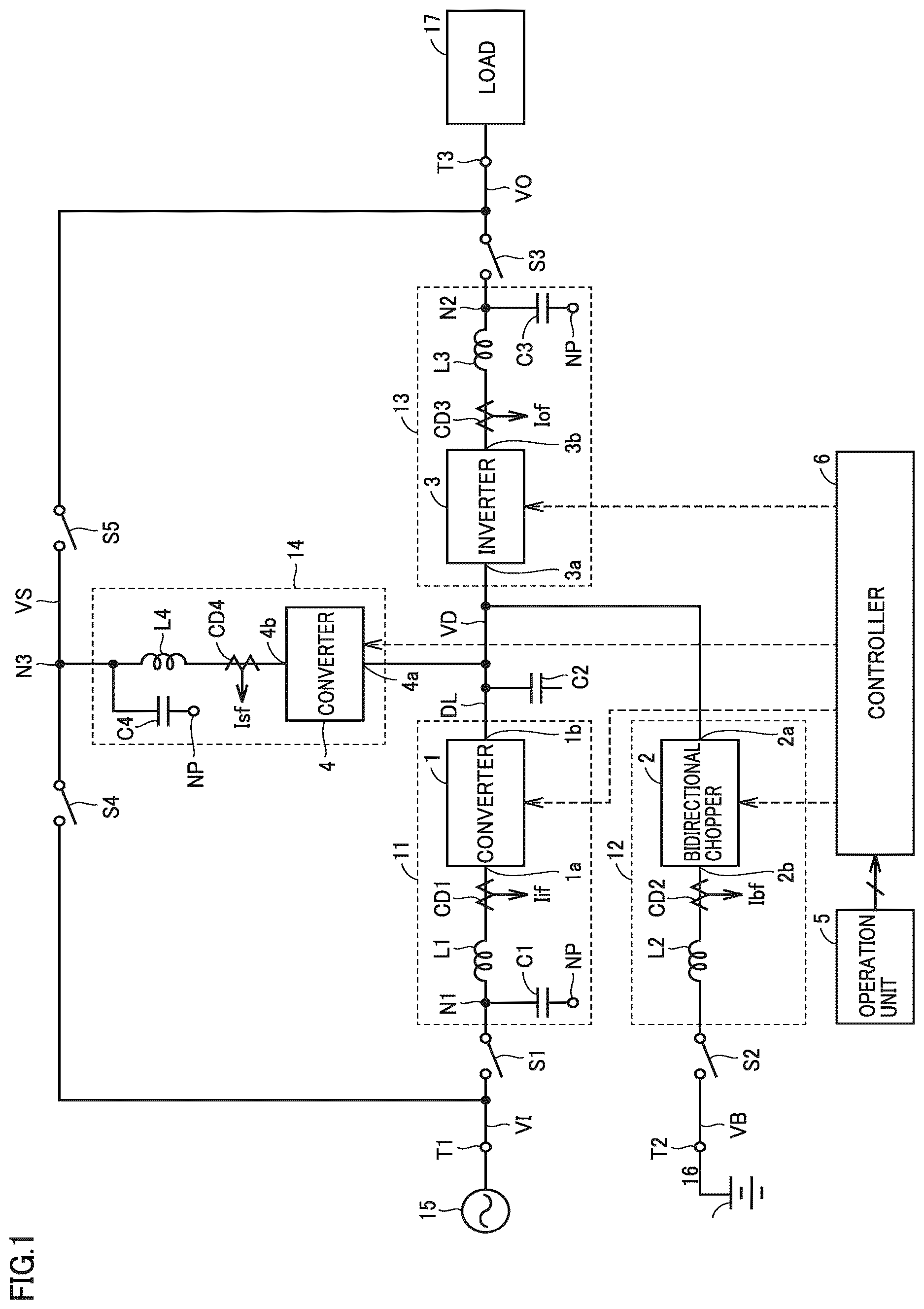
is a circuit block diagram showing a configuration of an uninterruptible power supply apparatus according to an embodiment of the present disclosure.
is a circuit diagram showing configurations of a converter 1 and an inverter 3 shown in .
is a circuit diagram showing a configuration of a converter 4 included in a bidirectional converter shown in .
is a block diagram showing a configuration of a controller shown in .
is a block diagram showing a configuration of a control circuit shown in .
is a circuit block diagram for describing an operation of the uninterruptible power supply apparatus at startup.
is a circuit block diagram for describing an operation of the uninterruptible power supply apparatus during a high-speed charging operation.
is a circuit block diagram for describing an operation of the uninterruptible power supply apparatus during a normal operation.
is a circuit block diagram for describing an operation of the uninterruptible power supply apparatus during an overload operation.
is a circuit block diagram for describing an operation of the uninterruptible power supply apparatus in a power failure of a commercial AC power supply.
is a circuit block diagram showing a comparative example of the embodiment.
is a circuit block diagram showing another comparative example of the embodiment.
is a circuit block diagram showing still another comparative example of the embodiment.
DESCRIPTION OF EMBODIMENTS
is a circuit block diagram showing a configuration of an uninterruptible power supply apparatus according to an embodiment of the present disclosure. In , the uninterruptible power supply apparatus includes an AC input terminal T 1 , a battery terminal T 2 , and an AC output terminal T 3 . AC input terminal T 1 receives AC power of a commercial frequency from a commercial AC power supply 15 .
Battery terminal T 2 is connected to a battery 16 (power storage device). Battery 16 stores DC power. A lithium-ion battery is used as battery 16 . Alternatively, a lead storage battery may be used in place of the lithium-ion battery, or an electric double layer capacitor or a flywheel may be connected in place of battery 16 . AC output terminal T 3 is connected to a load 17 . Load 17 is driven by the AC power supplied from the uninterruptible power supply apparatus.
Although this uninterruptible power supply apparatus receives three-phase AC voltages from commercial AC power supply 15 and supplies the three-phase AC voltages to load 17 in practice, for simplicity of the drawings and description, shows only a portion related to a one-phase AC voltage.
This uninterruptible power supply apparatus further includes switches S 1 to S 5 , capacitors C 1 to C 4 , reactors L 1 to L 4 , current detectors CD 1 to CD 4 , converters 1 , 4 , a DC line DL, a bidirectional chopper 2 , an inverter 3 , an operation unit 5 , and a controller 6 .
Switch S 1 and reactor L 1 are connected in series between AC input terminal T 1 and an AC node 1 a of converter 1 . Switch S 1 is controlled by controller 6 . When AC power is normally supplied from commercial AC power supply 15 (in a normal state of commercial AC power supply 15 ), switch S 1 is turned on. When the AC power from commercial AC power supply 15 is no longer supplied normally (in a power failure of commercial AC power supply 15 ), switch S 1 is turned off. Current detector CD 1 detects a current Ii flowing between commercial AC power supply 15 and converter 1 and outputs a signal Iif, which indicates a detection value thereof, to controller 6 .
An instantaneous value of an AC input voltage VI that appears at AC input terminal T 1 is detected by controller 6 . Controller 6 determines whether a power failure has occurred based on a detection value of AC input voltage VI. Also, controller 6 controls converter 1 or the like in synchronization with AC input voltage VI.
Capacitor C 1 is connected between a neutral point NP and a node N 1 located between switch S 1 and reactor L 1 . Capacitor C 1 and reactor L 1 constitute an AC filter. The AC filter, which is a low-pass filter, passes AC power of a commercial frequency from commercial AC power supply 15 to converter 1 and prevents a signal of a switching frequency generated in converter 1 from passing to commercial AC power supply 15 .
Converter 1 is a well-known one including a plurality of transistors and a plurality of diodes and is controlled by controller 6 . In the normal state of commercial AC power supply 15 , converter 1 converts AC power into DC power and outputs the DC power to a DC node 1 d . DC node 1 d is connected to DC line DL. A voltage output from converter 1 can be controlled to a desired value. In a power failure of commercial AC power supply 15 , an operation of converter 1 is stopped.
Capacitor C 1 , reactor L 1 , and converter 1 constitute an AC/DC converter 11 (first power converter), which converts AC power into DC power. Capacitor C 2 is connected to DC line DL and smooths a voltage of DC line DL. An instantaneous value of a DC voltage VD that appears in DC line DL is detected by controller 6 .
Controller 6 controls converter 1 such that DC voltage VD of DC line DL becomes equal to a reference voltage VDR in the normal state of commercial AC power supply 15 and stops an operation of converter 1 in the power failure of commercial AC power supply 15 .
DC line DL is connected to a high-voltage-side node 2 a of bidirectional chopper 2 , and a low-voltage-side node 2 b of bidirectional chopper 2 is connected to battery terminal T 2 via a reactor L 2 and a switch S 2 . Switch S 2 is turned on during use of the uninterruptible power supply apparatus and is turned off during maintenance of, for example, the uninterruptible power supply apparatus and battery 16 . Reactor L 2 smooths a current Ib flowing between bidirectional chopper 2 and battery 16 .
Bidirectional chopper 2 is a well-known one including a plurality of transistors and a plurality of diodes and is controlled by controller 6 . The capacity of bidirectional chopper 2 is set to the same value as that of the capacity of converter 1 .
Basically, bidirectional chopper 2 stores the DC power received from DC line DL in battery 16 in the normal state of commercial AC power supply 15 and supplies the DC power of battery 16 to DC line DL in the power failure of commercial AC power supply 15 . Note that during an overload operation even in the normal state of commercial AC power supply 15 , bidirectional chopper 2 supplies the DC power of battery 16 to inverter 3 through DC line DL.
When storing DC power in battery 16 , bidirectional chopper 2 steps down DC voltage VD of DC line DL and supplies DC voltage VD to battery 16 . Also, when supplying the DC power of battery 16 to inverter 3 , bidirectional chopper 2 steps up a terminal-to-terminal voltage VB of battery 16 and supplies terminal-to-terminal voltage VB to DC line DL.
Bidirectional chopper 2 and reactor L 2 constitute a DC/DC converter 12 (third power converter), which provides and receives DC power between DC line DL and battery 16 .
Current detector CD 2 detects current Ib flowing between bidirectional chopper 2 and battery 16 and outputs a signal Ibf, which indicates a detection value thereof, to controller 6 . An instantaneous value of terminal-to-terminal voltage VB of battery 16 that appears at battery terminal T 2 is detected by controller 6 .
Basically, controller 6 controls bidirectional chopper 2 in the normal state of commercial AC power supply 15 such that battery voltage VB becomes equal to a reference voltage VBR, and controls bidirectional chopper 2 in the power failure of commercial AC power supply 15 such that DC voltage VD of DC line DL becomes equal to reference voltage VDR.
Note that during the overload operation even in the normal state of commercial AC power supply 15 , controller 6 controls bidirectional chopper 2 such that DC voltage VD of DC line DL becomes equal to reference voltage VDR.
Also, controller 6 controls bidirectional chopper 2 to charge battery 16 at a normal speed when battery voltage VB is not less than a lower-limit voltage VBL (VB≥VBL), and controls bidirectional chopper 2 to charge battery 16 at a speed higher than the normal speed when battery voltage VB is lower than lower-limit voltage VBL (VB<VBL). DC line DL is connected to a DC node 3 a of inverter 3 .
Inverter 3 is a well-known one including a plurality of transistors and a plurality of diodes and is controlled by controller 6 . The circuit configuration of inverter 3 is identical to the circuit configuration of converter 1 , and the capacity (i.e., size) of inverter 3 is identical to the capacity (i.e., size) of converter 1 . Inverter 3 converts DC power received from DC line DL through DC node 3 a into AC power of a commercial frequency and outputs the AC power to an AC node 3 b . An output voltage of inverter 3 can be controlled to a desired value.
AC node 3 b of inverter 3 is connected to one terminal (node N 2 ) of switch S 3 via reactor L 3 , and the other terminal of switch S 3 is connected to AC output terminal T 3 . Capacitor C 3 is connected between node N 2 and neutral point NP.
Reactor L 3 and capacitor C 3 constitute an AC filter. This AC filter, which is a low-pass filter, passes the AC power of a commercial frequency generated in inverter 3 to AC output terminal T 3 and prevents a signal of a switching frequency generated in inverter 3 from passing to AC output terminal T 3 .
Inverter 3 , reactor L 3 , and capacitor C 3 constitute a DC/AC converter 13 (second power converter), which converts DC power into AC power. The circuit configuration of DC/AC converter 13 is identical to the circuit configuration of AC/DC converter 11 , and the capacity (i.e., size) of DC/AC converter 13 is identical to the capacity (i.e., size) of AC/DC converter 11 .
Switch S 3 is controlled by controller 6 , is turned on, for example, while the uninterruptible power supply apparatus is operating, and is turned off, for example, while an operation of the uninterruptible power supply apparatus is stopped. An instantaneous value of an AC output voltage VO that appears at AC output terminal T 3 is detected by controller 6 .
Current detector CD 3 detects a current Io flowing between inverter 3 and load 17 and provides a signal Iof, which indicates a detection value thereof, to controller 6 . Controller 6 controls inverter 3 such that AC output voltage VO becomes equal to a sinusoidal reference voltage VOR.
Switch S 4 is connected between AC input terminal T 1 and an AC node N 3 and is controlled by controller 6 . Switch S 4 is turned on during a high-speed charging operation for charging battery 16 at high speed while operating load 17 , and is turned off during the other period.
Switch S 5 is connected between AC node N 3 and AC output terminal T 3 and is controlled by controller 6 . Switch S 5 is turned on during a normal operation and during the overload operation. During the normal operation, rated power Pc of load 17 is supplied to load 17 , and power higher than rated power Pc is supplied to load 17 during the overload operation. Switches S 4 , S 5 are both turned off in a power failure of commercial AC power supply 15 . Switches S 4 , S 5 constitute an example of a switching circuit that connects AC node N 3 to commercial AC power supply 15 or load 17 .
DC line DL is also connected to a DC node 4 a of converter 4 . Converter 4 is a well-known one including a plurality of transistors and a plurality of diodes and is controlled by controller 6 .
The circuit configuration of converter 4 is identical to the circuit configuration of each of converter 1 and inverter 3 , and the capacity (i.e., size) of converter 4 is smaller than the capacity (i.e., size) of each of converter 1 and inverter 3 . For example, assuming that the capacity of each of converter 1 and inverter 3 is 100%, the capacity of converter 4 is 50%.
An AC node 4 b of converter 4 is connected to AC node N 3 via reactor L 4 . Capacitor C 4 is connected between AC node N 3 and neutral point NP. Reactor L 4 and capacitor C 4 constitute an AC filter. The AC filter, which is a low-pass filter, passes AC power of a commercial frequency supplied from commercial AC power supply 15 or converter 4 and prevents a signal of a switching frequency generated in converter 4 from passing to AC node N 3 .
Converter 4 , reactor L 4 , and capacitor C 4 constitute a bidirectional converter 14 (fifth power converter), which selectively performs any conversion mode of an AC/DC mode of converting AC power supplied from commercial AC power supply 15 through AC node N 3 into DC power and supplying the DC power to DC line DL, and a DC/AC conversion mode of converting DC power received from DC line DL into AC power and supplying the AC power through AC node N 3 to load 17 .
The circuit configuration of bidirectional converter 14 is identical to the circuit configuration of each of AC/DC converter 11 and DC/AC converter 13 , and the capacity (i.e., size) of bidirectional converter 14 is smaller than the capacity (i.e., size) of each of AC/DC converter 11 and DC/AC converter 13 . For example, assuming that the capacity of each of AC/DC converter 11 and DC/AC converter 13 is 100%, the capacity of bidirectional converter 14 is 50%. Switches S 4 , S 5 and bidirectional converter 14 constitute an example fourth power converter.
An instantaneous value of an AC voltage VS that appears at AC node N 3 is detected by controller 6 . Current detector CD 4 detects a current Is flowing through reactor L 4 and provides a signal Isf, which indicates a detection value thereof, to controller 6 .
During the high-speed charging operation, controller 6 controls converters 1 , 4 such that DC voltage VD of DC line DL becomes equal to reference voltage VDR. At this time, the ratio between the output of converter 4 and the output of converter 1 is controlled to be equal to a ratio (e.g., 1/2) between the capacity of converter 4 and the capacity of converter 1 .
During the overload operation, controller 6 controls converter 4 such that AC voltage VS that appears at AC node N 3 becomes equal to sinusoidal reference voltage VOR. At this time, the ratio between the output of converter 4 and the output of inverter 3 is controlled to be equal to the ratio (e.g., 1/2) between the capacity of converter 4 and the capacity of inverter 3 .
Operation unit 5 includes a plurality of buttons operated by the user of the uninterruptible power supply apparatus, an image display for displaying various types of information, and the like. As the user operates operation unit 5 , for example, various voltages VDR, VBR, VOR, VBL can be set, the power supply of the uninterruptible power supply apparatus can be turned on and off, and the uninterruptible power supply apparatus can be operated automatically or operated manually.
Controller 6 also controls the entire uninterruptible power supply apparatus based on AC input voltage VI, AC input current Ii, DC voltage VD, battery voltage VB, battery current Ib, AC output voltage VO, AC output current Io, AC voltage VS, AC current Is, reference voltages VDR, VBR, VOR, lower-limit voltage VBL, a signal from operation unit 5 , and the like.
is a circuit diagram showing configurations of converter 1 and inverter 3 . Although shows only a portion of the three-phase AC voltages which is related to a one-phase AC voltage, shows a portion related to the three-phase AC voltages. Also, though shows only DC line DL on the positive side, shows a DC line DLn on the negative side as well.
In , converter 1 includes insulated gate bipolar transistors (IGBTs) Q 1 to Q 6 and diodes D 1 to D 6 . The IGBT configures a switching element. IGBTs Q 1 to Q 3 have collectors connected together to DC line DL on the positive side via a DC node 1 b , and emitters connected to AC nodes 1 a , 1 c , 1 d , respectively.
AC nodes 1 a , 1 c , 1 d are provided in correspondence with the respective three-phase AC voltages supplied from commercial AC power supply 15 . IGBTs Q 4 to Q 6 have collectors connected to AC nodes 1 a , 1 c , 1 d , respectively, and emitters connected together to DC line DLn on the negative side. Diodes D 1 to D 6 are connected in anti-parallel with IGBTs Q 1 to Q 6 , respectively. Capacitor C 2 is connected between DC lines DL, DLn.
IGBTs Q 1 , Q 4 are controlled by gate signals A 1 , B 1 , respectively, IGBTs Q 2 , Q 5 are controlled by gate signals A 2 , B 2 , respectively, and IGBTs Q 3 , Q 6 are controlled by gate signals A 3 , B 3 , respectively. Gate signals B 1 , B 2 , B 3 are inverted signals of gate signals A 1 , A 2 , A 3 , respectively.
IGBTs Q 1 to Q 3 are turned on when gate signals A 1 , A 2 , A 3 are brought into the “H” level, respectively, and turned off when gate signals A 1 , A 2 , A 3 are brought into the “L” level, respectively. IGBTs Q 4 to Q 6 are turned on when gate signals B 1 , B 2 , B 3 are brought into the “H” level, respectively, and turned off when gate signals B 1 , B 2 , B 3 are brought into the “L” level, respectively.
Each of gate signals A 1 , B 1 , A 2 , B 2 , A 3 , B 3 is a pulse signal sequence, which is a pulse width modulation (PWM) signal. Gate signals A 1 , B 1 , gate signals A 2 , B 2 , and gate signals A 3 , B 3 are basically 120° out of phase with each other. Gate signals A 1 , B 1 , A 2 , B 2 , A 3 , B 3 are generated by controller 6 .
As IGBTs Q 1 to Q 6 are turned on and off at predetermined timings by gate signals A 1 , B 1 , A 2 , B 2 , A 3 , B 3 , respectively, and the respective ON times of IGBTs Q 1 to Q 6 are adjusted, three-phase AC voltages provided to AC nodes 1 a , 1 c , 1 d can be converted into a desired DC voltage VD (a terminal-to-terminal voltage of capacitor C 2 ).
Inverter 3 includes IGBTs Q 11 to Q 16 and diodes D 11 to D 16 . The IGBT configures a switching element. IGBTs Q 11 to Q 13 have collectors connected together to DC line DL on the positive side via DC node 3 a , and emitters connected to AC nodes 3 b , 3 c , 3 d , respectively.
AC nodes 3 b , 3 c , 3 d are provided in correspondence with the respective three-phase AC voltages supplied to load 17 . IGBTs Q 14 to Q 16 have collectors connected to AC nodes 3 b , 3 c , 3 d , respectively, and emitters connected together to DC line DLn on the negative side. Diodes D 11 to D 16 are connected in anti-parallel with IGBTs Q 11 to Q 16 , respectively.
IGBTs Q 11 , Q 14 are controlled by gate signals X 1 , Y 1 , respectively, IGBTs Q 12 , Q 15 are controlled by gate signals X 2 , Y 2 , respectively, and IGBTs Q 13 , Q 16 are controlled by gate signals X 3 , Y 3 , respectively. Gate signals Y 1 , Y 2 , Y 3 are inverted signals of gate signals X 1 , X 2 , X 3 , respectively.
IGBTs Q 11 to Q 13 are turned on when gate signals X 1 , X 2 , X 3 are brought into the “H” level, respectively, and turned off when gate signals X 1 , X 2 , X 3 are brought into the “L” level, respectively. IGBTs Q 14 to Q 16 are turned on when gate signals Y 1 , Y 2 , Y 3 are brought into the “H” level, respectively, and are turned off when gate signals Y 1 , Y 2 , Y 3 are brought into the “L” level, respectively.
Each of gate signals X 1 , Y 1 , X 2 , Y 2 , X 3 , Y 3 is a pulse signal sequence, which is a PWM signal. Gate signals X 1 , Y 1 , gate signals X 2 , Y 2 , and gate signals X 3 , Y 3 are basically 120° out of phase with each other. Gate signals X 1 , Y 1 , X 2 , Y 2 , X 3 , Y 3 are generated by controller 6 .
For example, when IGBTs Q 11 , Q 15 are turned on, DC line DL is connected to AC node 3 b via IGBT Q 11 , and AC node 3 c is connected to DC line DLn via IGBT Q 15 , so that a positive voltage is output between AC nodes 3 b , 3 c.
When IGBTs Q 12 , Q 14 are turned on, DC line DL is connected to AC node 3 c via IGBT Q 12 , and AC node 3 b is connected to DC line DLn via IGBT Q 14 , so that a negative voltage is output between output nodes 3 b , 3 c.
As IGBTs Q 11 to Q 16 are turned on and off at predetermined timings by gate signals X 1 , Y 1 , X 2 , Y 2 , X 3 , Y 3 , respectively, and the respective ON times of IGBTs Q 11 to Q 16 are adjusted, DC voltage VD between DC lines DL, DLn can be converted into three-phase AC voltages.
is a circuit diagram showing a configuration of converter 4 included in bidirectional converter 14 . Although shows only a portion of the three-phase AC voltages which is related to a one-phase AC voltage, shows a portion related to three-phase AC voltages. Also, though shows only DC line DL on the positive side, shows DC line DLn on the negative side as well.
In , converter 4 includes IGBTs Q 21 to Q 26 and diodes D 21 to D 26 . The IGBT configures a switching element. IGBTs Q 21 to Q 23 have collectors connected together to DC line DL on the positive side via DC node 4 a , and emitters connected to AC nodes 4 b , 4 c , 4 d , respectively.
AC nodes 4 b , 4 c , 4 d are provided in correspondence with the respective three-phase AC voltages. IGBTs Q 24 Q 26 have collectors connected to AC nodes 4 b , 4 c , 4 d , respectively, and emitters connected together to DC line DLn on the negative side. Diodes D 21 to D 26 are connected in anti-parallel with IGBTs Q 21 to Q 26 , respectively. Capacitor C 2 is connected between DC lines DL, DLn.
IGBTs Q 21 , Q 24 are controlled by gate signals E 1 , F 1 , respectively, IGBTs Q 22 , Q 25 are controlled by gate signals E 2 , F 2 , respectively, and IGBTs Q 23 , Q 26 are controlled by gate signals E 3 , F 3 , respectively. Gate signals F 1 , F 2 , F 3 are inverted signals of gate signals E 1 , E 2 , E 3 , respectively.
IGBTs Q 21 to Q 23 are turned on when gate signals E 1 , E 2 , E 3 are brought into the “H” level, respectively, and are turned off when gate signals E 1 , E 2 , E 3 are brought into the “L” level, respectively. IGBTs Q 24 to Q 26 are turned on when gate signals F 1 , F 2 , F 3 are brought into the “H” level and are turned off when gate signals F 1 , F 2 , F 3 are brought into the “L” level, respectively.
Each of gate signals E 1 , F 1 , E 2 , F 2 , E 3 , F 3 is a pulse signal sequence, which is a PWM signal. Gate signals E 1 , F 1 , gate signals E 2 , F 2 , and gate signals E 3 , F 3 are basically 120° out of phase with each other. Gate signals E 1 , F 1 , E 2 , F 2 , E 3 , F 3 are generated by controller 6 .
During the high-speed charging operation, as IGBTs Q 21 to Q 26 are turned on and off at predetermined timings by gate signals E 1 , F 1 , E 2 , F 2 , E 3 , F 3 , respectively, and the respective ON times of IGBTs Q 21 to Q 26 are adjusted, three-phase AC voltages provided from commercial AC power supply 15 to AC nodes 4 b , 4 c , 4 d can be converted into a desired DC voltage VD (a terminal-to-terminal voltage of capacitor C 2 ).
During the overload operation, as IGBTs Q 21 to Q 26 are turned on and off at predetermined timings by gate signals E 1 , F 1 , E 2 , F 2 , E 3 , F 3 , respectively, and the respective ON times of IGBTs Q 21 to Q 26 are adjusted, DC voltage VD between DC lines DL, DLn can be converted into three-phase AC voltages.
As shown in , the circuit configuration of converter 1 , the circuit configuration of inverter 3 , and the circuit configuration of converter 4 are identical to each other. Also, the capacity (i.e., size) of converter 1 is designed to be equal to the capacity (i.e., size) of inverter 3 as in a conventional uninterruptible power supply apparatus.
Also, the capacity (i.e., size) of converter 4 is smaller than the capacity (i.e., size) of each of converter 1 and inverter 3 . For example, assuming that the capacity (i.e., size) of each of converter 1 and inverter 3 is 100%, the capacity (i.e., size) of converter 4 is 50%.
As described above, as converters 1 , 4 have the same circuit configuration and the capacity of converter 4 is 50% of the capacity of converter 1 , during the high-speed charging operation, converters 1 , 4 can operate in cooperation with each other, and converters 1 , 4 can be controlled easily such that the output of converter 4 becomes 50% of the output of converter.
Also, as converter 4 and inverter 3 have the same circuit configuration and the capacity of converter 4 is 50% of the capacity of inverter 3 , during the overload operation, converter 4 and inverter 3 can operate in cooperation with each other, and converter 4 and inverter 3 can be controlled easily such that the output of converter 4 becomes 50% of the output of inverter 3 .
is a block diagram showing main portions of controller 6 . In , controller 6 includes voltage detectors 21 to 25 , a power failure detector 26 , comparators 27 , 28 , and a control circuit 29 .
Voltage detector 21 detects an instantaneous value of AC input voltage VI that is supplied from commercial AC power supply 15 and outputs a signal VIf, which indicates a detection value thereof, to power failure detector 26 and control circuit 29 . Voltage detector 22 detects an instantaneous value of AC output voltage VO supplied to load 17 and outputs a signal VOf, which indicates a detection value thereof, to control circuit 29 . Voltage detector 23 detects an instantaneous value of AC voltage VS that appears at AC node N 3 and outputs a signal VSf, which indicates a detection value thereof, to control circuit 29 .
Voltage detector 24 detects an instantaneous value of DC voltage VD of DC line DL and outputs a signal VDf, which indicates a detection value thereof, to control circuit 29 . Voltage detector 25 detects an instantaneous value of terminal-to-terminal voltage VB of battery 16 and outputs a signal VBf, which indicates a detection value thereof, to control circuit 29 . Output signals Iif, Ibf, Iof, Isf of current detectors CD 1 to CD 4 ( ) are provided to control circuit 29 .
Power failure detector 26 detects whether a power failure has occurred in commercial AC power supply 15 based on signal VIf output from voltage detector 21 and outputs a signal φ 26 , which indicates a detection result thereof, to control circuit 29 . When commercial AC power supply 15 is in the normal state, signal φ 26 is brought into the “H” level. When a power failure has occurred in commercial AC power supply 15 , signal φ 26 is brought into the “L” level.
For example, when AC input voltage VI is higher than a lower limit, power failure detector 26 determines that commercial AC power supply 15 is in the normal state, and brings signal φ 26 into the “H” level. When AC input voltage VI is lower than the lower limit, power failure detector 26 determines that a power failure has occurred in commercial AC power supply 15 , and brings signal φ 26 into the “L” level.
Comparator 27 compares the magnitude between battery voltage VB indicated by signal VBf and lower-limit voltage VBL, and provides a signal φ 27 , which indicates a comparison result, to control circuit 29 . When battery voltage VB is not less than lower-limit voltage VBL (VB≥VBL), signal φ 27 is brought into the “H” level.
When DC voltage VB is lower than lower-limit voltage VBL (VBL>VB), signal φ 27 is brought into the “L” level. Signal φ 27 being at the “L” level is a condition for performing a high-speed charging operation of battery 16 . When signal φ 27 is at the “H” level, the high-speed charging operation of battery 16 is not performed.
Comparator 28 compares the magnitude between AC output current Is of converter 4 which is indicated by signal Isf and an upper-limit current IsH, and provides a signal φ 28 , which indicates a comparison result, to control circuit 29 . When AC output current Is of converter 4 is not greater than upper-limit current IsH (Is≤IsH), signal φ 28 is brought into the “L” level.
When AC output current Is of converter 4 exceeds upper-limit current IsH (Is>IsH), signal φ 28 is brought into the “H” level. Signal φ 28 being at the “H” level is a condition for performing the overload operation. When signal φ 28 is at the “L” level, the overload operation is not performed.
For example, when the ratio between the capacity of converter 4 and the capacity of inverter 3 is 1/2 and AC output current Is of converter 4 is controlled to be 1/2 of AC output current Io of inverter 3 , upper-limit current IsH is set to a value that is one third of a rated current Ic of load 17 .
When AC output current Is of converter 4 becomes equal to upper-limit current IsH=Ic/3, AC output current Iof of inverter 3 is two-thirds of rated current Ic of load 17 , and rated current Ic is supplied from converter 4 and inverter 3 to load 17 . In this case, signal φ 28 is brought into the “L” level, and the overload operation is not performed.
When AC output current Is of converter 4 exceeds upper-limit current IsH=Ic/3, AC output current Iof of inverter 3 becomes greater than two-thirds of rated current Ic of load 17 , and a current larger than rated current Ic is supplied from converter 4 and inverter 3 to load 17 . In this case, signal φ 28 is brought into the “H” level, and the overload operation is performed.
is a block diagram showing main portions of control circuit 29 . In , control circuit 29 includes control units 31 to 35 and a communication line 36 . Control units 31 to 35 and operation unit 5 are connected to one another by communication line 36 . Control units 31 to 35 provide and receive various signals through communication line 36 and control the entire uninterruptible power supply apparatus in cooperation with one another.
Control unit 31 controls switches S 1 to S 3 based on signal φ 26 output from power failure detector 26 and the signal from operation unit 5 . When signal φ 26 is at the “H” level (in the normal state of commercial AC power supply 15 ), control unit 31 turns on switches S 1 to S 3 .
When signal φ 26 is at the “L” level (in a power failure of commercial AC power supply 15 ), control unit 31 turns off switch S 1 and maintains switches S 2 , S 3 in the ON state. Also, control unit 31 individually turns on and off switches S 1 to S 3 during a manual operation according to the signal from operation unit 5 .
Control unit 32 generates gate signals A 1 to A 3 , B 1 to B 3 ( ) based on signals VIf, VDf output from voltage detectors 21 , 24 , signals Iif, Isf output from current detectors CD 1 , CD 4 , signals φ 26 , φ 27 output from power failure detector 26 and comparator 27 , and the signal from operation unit 5 , and controls converter 1 .
When signals φ 26 , φ 27 are both at the “H” level (during the normal operation and during the overload operation), control unit 32 controls converter 1 based on signals VIf, VDf, Iif such that DC voltage VD of DC line DL becomes equal to reference voltage VDR.
When signal φ 26 is at the “L” level (in a power failure of commercial AC power supply 15 ), control unit 32 stops an operation of converter 1 . At this time, gate signals A 1 to A 3 , B 1 to B 3 are brought into the “L” level together to turn off IGBTs Q 1 to Q 6 ( ) of converter 1 .
When signals φ 26 , φ 27 are at the “H” level and the “L” level, respectively (during the high-speed charging operation), control unit 32 operates in cooperation with control unit 35 and controls converter 1 based on signals VIf, VDf, Iif, Isf such that DC voltage VD of DC line DL becomes equal to reference voltage VDR.
At this time, converter 1 is controlled such that the ratio (Is/Ii) between current Is flowing through converter 4 and current Ii flowing through converter 1 becomes equal to the ratio (e.g., 1/2) between the capacity of converter 4 and the capacity of converter 1 . Control unit 32 starts or stops converter 1 during the manual operation according to the signal from operation unit 5 .
Control unit 33 controls bidirectional chopper 2 based on signals VDf, VBf output from voltage detectors 24 , 25 , signal Ibf output from current detector CD 2 , signals φ 26 , φ 27 , φ 28 output from power failure detector 26 and comparators 27 , 28 , and the signal from operation unit 5 .
When signals φ 26 , φ 27 , φ 28 are at the “H” level, “H” level, and “L” level, respectively (during the normal operation), control unit 33 controls bidirectional chopper 2 based on signals VBf, Ibf such that battery voltage VB becomes equal to reference voltage VBR.
When signals φ 26 , φ 27 , φ 28 are at the “H” level, “L” level, and “L” level, respectively (during the high-speed charging operation), control unit 33 controls bidirectional chopper 2 based on signals VBf, Ibf such that battery voltage VB becomes equal to reference voltage VBR.
Herein, control unit 33 controls bidirectional chopper 2 to charge battery 16 at a normal speed during the normal operation and controls bidirectional chopper 2 to charge battery 16 at a speed higher than the normal speed during the high-speed charging operation.
For example, during the normal operation, control unit 33 controls bidirectional chopper 2 such that a current Ib=K 1 ×(VBR−VB) having a value, which is obtained by multiplying a difference ΔVB=VBR−VB between reference voltage VBR and battery voltage VB by a gain K 1 , flows from DC line DL to battery 16 , where K 1 is a positive real number.
Also, control unit 33 controls bidirectional chopper 2 such that during the high-speed charging operation, a current Ib=K 2 ×(VBR−VB) having a value, which is obtained by multiplying a difference ΔVB=VBR−VB between reference voltage VBR and battery voltage VB by a gain K 2 , flows from DC line DL to battery 16 , where K 2 is a positive real number greater than K 1 .
Thus, during the high-speed charging operation, a large charging current can be flowed through battery 16 to charge battery 16 at a speed higher than during the normal operation.
When signals φ 26 , φ 27 , φ 28 are at the “H” level (during the overload operation), control unit 33 controls bidirectional chopper 2 based on signals VDf, Ibf such that DC voltage VD of DC line DL becomes equal to reference voltage VDR.
When signal φ 26 is at the “L” level (in a power failure of commercial AC power supply 15 ), control unit 33 controls bidirectional chopper 2 based on signals VBf, Ibf such that DC voltage VD of DC line DL becomes equal to reference voltage VDR. Also, control unit 33 starts or stops bidirectional chopper 2 during the manual operation according to the signal from operation unit 5 .
Based on signals VIf, VOf output from voltage detectors 21 , 22 , signal Iof output from current detector CD 3 , signal φ 26 output from power failure detector 26 , and the signal from operation unit 5 , control unit 34 generates gate signals X 1 to X 3 , Y 1 to Y 3 ( ) and controls inverter 3 .
When signal φ 26 is at the “H” level (in the normal state of commercial AC power supply 15 ), control unit 34 operates in cooperation with control unit 35 , operates in synchronization with signal VIf, and controls inverter 3 based on signals VOf, Iof such that AC output voltage VO becomes equal to sinusoidal reference voltage VOR.
At this time, inverter 3 is controlled such that the ratio (Is/Io) between current Is flowing through converter 4 and current Io flowing through inverter 3 becomes equal to the ratio (e.g., 1/2) between the capacity of converter 4 and the capacity of inverter 3 .
When signal φ 26 is at the “L” level (in a power failure of commercial AC power supply 15 ), control unit 34 operates in synchronization with signal VIf and controls inverter 3 based on signals VOf, Iof such that AC output voltage VO becomes equal to sinusoidal reference voltage VOR.
Based on signals VIf, VOf, VSf, VDf output from voltage detectors 21 to 24 , signals Iif, Iof, Isf output from current detectors CD 1 , CD 3 , CD 4 , signals φ 26 , φ 27 , φ 28 output from power failure detector 26 and comparators 27 , 28 , and the signal from operation unit 5 , control unit 35 controls switches S 4 , S 5 , and also, generates gate signals E 1 to E 3 , F 1 to F 3 ( ) and controls converter 4 .
When signals φ 26 , φ 27 , φ 28 are at the “H” level, “L” level, and “L” level, respectively (during the high-speed charging operation), control unit 35 turns on switch S 4 and turns off switch S 5 to connect bidirectional converter 14 to AC/DC converter 11 in parallel. Control unit 35 also operates in cooperation with control unit 22 and controls converter 4 such that DC voltage VD of DC line DL becomes equal to reference voltage VDR.
At this time, converter 4 is controlled such that the ratio (Is/Ii) between current Is flowing through converter 4 and current Ii flowing through converter 1 becomes equal to the ratio (e.g., 1/2) between the capacity of converter 4 and the capacity of converter 1 .
When signals φ 26 , φ 27 are at the “H” level (during the normal operation and during the overload operation), irrespective of the logic level of signal φ 28 , control unit 35 turns off switches S 4 , S 5 , controls converter 4 to cause AC voltage VS to be equal to AC output voltage VO and then turns on switch S 5 to connect bidirectional converter 14 to DC/AC converter 13 in parallel. Control unit 35 also operates in cooperation with control unit 24 , and controls converter 4 such that AC voltage VS becomes equal to sinusoidal reference voltage VOR.
At this time, converter 4 is controlled such that the ratio (Is/Io) between current Is flowing through converter 4 and current Io flowing through inverter 3 becomes equal to the ratio (e.g., 1/2) between the capacity of converter 4 and the capacity of inverter 3 .
When signal φ 26 is at the “L” level (in a power failure of commercial AC power supply 15 ), control unit 35 turns off switches S 4 , S 5 to electrically isolate AC node N 3 from commercial AC power supply 15 and load 17 .
Control unit 35 also turns on and off each of switches S 4 , S 5 according to the signal from operation unit 5 to operate or stop converter 4 . For example, the user of the uninterruptible power supply apparatus can operate operation unit 5 to perform any one of the high-speed charging operation and the overload operation.
When high-speed charging is performed but the overload operation is not performed, switch S 5 is fixed in the OFF state, and converter 4 performs only the AC/DC conversion operation. In contrast, when the overload operation is performed but high-speed charging is not performed, switch S 4 is fixed in the OFF state, and converter 4 performs only the DC/AC conversion operation.
The user of the uninterruptible power supply apparatus operates operation unit 5 to stop the operation of converter 4 to turn off switch S 3 and turn on switches S 4 , S 5 , thereby supplying AC power from commercial AC power supply 15 through switches S 4 , S 5 to load 17 .
Next, an operation of the uninterruptible power supply apparatus will be described. is a circuit block diagram for describing an operation of the uninterruptible power supply apparatus at startup. In , terminals T 1 to T 3 , capacitors C 1 , C 3 , C 4 , reactors L 1 to L 4 , current detectors CD 1 to CD 4 , operation unit 5 , and controller 6 ( ) are not shown for simplicity of the drawings and description.
The capacity of converter 1 , the capacity of bidirectional chopper 2 , and the capacity of inverter 3 are set to the same value, and the ratio between the capacity of converter 4 , and the capacity of each of converter 1 , bidirectional chopper 2 , and inverter 3 is set to 1/2. Thus, converter 1 , bidirectional chopper 2 , and inverter 3 are indicated by blocks of the same size, and converter 4 is indicated by a block smaller than these blocks.
Before startup, terminal-to-terminal voltage VB of battery 16 falls below lower-limit voltage VBL, and signal φ 27 output from comparator 27 ( ) is brought into the “L” level. Also, at startup, commercial AC power supply 15 is in the normal state, and signal φ 26 output from power failure detector 26 is brought into the “H” level.
When start of the uninterruptible power supply apparatus is instructed using operation unit 5 ( ), capacitor C 2 is preliminarily charged to a predetermined voltage by a preliminary charging circuit (not shown), and then, switch S 1 is turned on by control unit 31 ( ), and an operation of converter 1 is started by control unit 32 ( ). Converter 1 converts AC power supplied from commercial AC power supply 15 through switch S 1 into DC power and supplies the DC power to DC line DL.
Subsequently, switch S 4 is turned on by control unit 35 ( ), and an operation of converter 4 is started. At this time, in order to prevent an inrush current from flowing from commercial AC power supply 15 to converters 1 , 4 , switch S 4 is turned on after a lapse of a predetermined time from turning-on of switch S 1 . Converter 4 operates in cooperation with converter 1 , and converts the AC power supplied from commercial AC power supply 15 through switch S 4 into DC power and supplies the DC power to DC line DL.
Subsequently, an operation of inverter 3 is started by control unit 34 ( ), and switch S 3 is turned on by control unit 31 . Inverter 3 converts the DC power received from DC line DL into AC power and supplies the AC power to load 17 through switch S 3 .
Subsequently, switch S 2 is turned on by control unit 31 , and an operation of bidirectional chopper 2 is started by control unit 33 ( ). Thus, a current is flowed from DC line DL through bidirectional chopper 2 and switch S 2 to battery 16 , so that high-speed charging of battery 16 is started.
is a circuit block diagram for describing an operation of the uninterruptible power supply apparatus during the high-speed charging operation. In , the arrows indicate a path through which power is supplied. AC power supplied from commercial AC power supply 15 is converted into DC power by converters 1 , 4 , and the DC power is supplied to DC line DL. The DC power supplied to DC line DL is stored in battery 16 through bidirectional chopper 2 and is converted into AC power by inverter 3 , and the AC power is supplied to load 17 .
During the high-speed charging operation, control units 32 , 35 operate in cooperation with each other and control converters 1 , 4 such that the ratio (Is/Ii) between current Is flowing through converter 4 and current Ii flowing through converter 1 becomes equal to the ratio (herein, 1/2) between the capacity of converter 4 and the capacity of converter 1 .
Thus, assuming that rated power Pc of load 17 is 100%, as shown in , 150% DC power can be generated by converters 1 , 4 , and 50% DC power can be supplied to battery 16 while 100% AC power is being supplied to load 17 by inverter 3 .
When battery voltage VB rises and exceeds lower-limit voltage VBL, signal φ 27 output from comparator 27 ( ) is brought into the “H” level. When signal φ 27 is brought into the “H” level, an operation of converter 4 is temporarily stopped by control unit 35 to turn off switch S 4 .
Then, an operation of converter 4 is started by control unit 35 , and converter 4 is controlled such that AC voltage VS of AC node N 3 becomes equal to AC output voltage VO. When AC voltage VS becomes equal to AC output voltage VO, switch S 5 is turned on by control unit 35 , and inverter 3 and converter 4 are operated in parallel by control units 32 , 35 .
At this time, converter 4 operates in cooperation with inverter 3 , converts the DC power received from DC line DL into AC power, and supplies the AC power through switch S 5 to load 17 . Control units 34 , 35 operate in cooperation with each other, and control inverter 3 and converter 4 such that the ratio (Is/Io) between current Is output from converter 4 and current Io output from inverter 3 becomes equal to the ratio (herein, 1/2) between the capacity of converter 4 and the capacity of inverter 3 .
During the normal operation in which load 17 is operated with rated power Pc, bidirectional chopper 2 is controlled by control unit 33 such that battery voltage VB becomes equal to reference voltage VBR. is a circuit block diagram for describing an operation of the uninterruptible power supply apparatus during the normal operation.
In , the AC power supplied from commercial AC power supply 15 is converted into DC power by converter 1 , and the DC power is supplied to DC line DL. The DC power supplied to DC line DL is stored in battery 16 through bidirectional chopper 2 and is converted into AC power by inverter 3 and converter 4 , and the AC power is supplied to load 17 .
Assuming that rated power Pc of load 17 is 100%, as shown in , 100% AC power is supplied from commercial AC power supply 15 to converter 1 , 100% DC power is supplied from converter 1 to DC line DL, (2/3)×100% AC power is supplied from inverter 3 to load 17 , and (1/3)×100% AC power is supplied from converter 4 to load 17 . Note that battery voltage VB has reached reference voltage VBR and DC power supplied from bidirectional chopper 2 to battery 16 is sufficiently small.
Also, during the overload operation in which load 17 is operated with power larger than rated power Pc, bidirectional chopper 2 is controlled by control unit 33 such that DC voltage VD of DC line DL becomes equal to reference voltage VDR. is a circuit block diagram for describing an operation of the uninterruptible power supply apparatus during the overload operation.
In , the AC power supplied from commercial AC power supply 15 is converted into DC power by converter 1 , and the DC power is supplied to DC line DL. DC power of battery 16 is supplied to DC line DL through bidirectional chopper 2 . The DC power supplied from converter 1 and bidirectional chopper 2 to DC line DL is converted into AC power by inverter 3 and converter 4 , and the AC power is supplied to load 17 .
Assuming that 150% AC power of rated power Pc is supplied to load 17 , as shown in , 100% AC power is supplied from commercial AC power supply 15 to converter 1 , 50% DC power is supplied from battery 16 to bidirectional chopper 2 , 100% AC power is supplied from inverter 3 to load 17 , and 50% AC power is supplied from converter 4 to load 17 .
When a power failure occurs in commercial AC power supply 15 during the normal operation or during the overload operation, switch S 1 is turned off by control unit 31 , and the operation of converter 1 is stopped by control unit 32 . Switch S 5 is turned off, and an operation of converter 4 is stopped, by control unit 35 . Also, bidirectional chopper 2 is controlled by control unit 33 such that DC voltage VD of DC line DL becomes equal to reference voltage VDR.
is a circuit block diagram for describing an operation of the uninterruptible power supply apparatus in a power failure of commercial AC power supply 15 . In , DC power of battery 16 is supplied to DC line DL through bidirectional chopper 2 . The DC power supplied from bidirectional chopper 2 to DC line DL is converted into AC power by inverter 3 , and the AC power is supplied to load 17 .
Assuming that rated power Pc of load 17 is 100%, as shown in , 100% DC power is supplied from battery 16 to inverter 3 through bidirectional chopper 2 , and 100% AC power is supplied from inverter 3 to load 17 . Thus, even when a power failure has occurred in commercial AC power supply 15 , rated power Pc can be supplied to load 17 during a period in which DC power is stored in battery 16 .
As described above, in the present embodiment, bidirectional converter 14 is provided that during the high-speed charging operation, operates in cooperation with AC/DC converter 11 , converts AC power supplied from commercial AC power supply 15 into DC power, and supplies the DC power to DC line DL. This can prevent a shortage of DC power during the high-speed charging operation and enables high-speed charging of battery 16 while operating load 17 . Also, cost can be lower than when a high-capacity uninterruptible power supply apparatus is used or when an external charger is added.
During the overload operation, bidirectional converter 14 operates in cooperation with DC/AC converter 13 , converts DC power received from DC line DL into AC power, and supplies the AC power to load 17 . Thus, power larger than rated power Pc can be supplied to load 17 during a period in which DC power is stored in battery 16 .
is a circuit block diagram showing Comparative Example 1 of the embodiment, which is a diagram compared with . Referring to , Comparative Example 1 is different from the embodiment in that converter 4 and switches S 4 , S 5 are not provided. In other words, Comparative Example 1 is a conventional uninterruptible power supply apparatus.
In Comparative Example 1, the capacity of converter 1 , the capacity of bidirectional chopper 2 , the capacity of inverter 3 , and rated capacity Pc of load 17 are set to the same value. It is assumed that rated capacity Pc of load 17 is 100%. During the high-speed charging operation, 100% AC power is supplied from commercial AC power supply 15 to converter 1 , 100% DC power is generated by converter 1 , 50% DC power is supplied from bidirectional chopper 2 to battery 16 , and 50% AC power is supplied from inverter 3 to load 17 .
During the high-speed charging operation, thus, only 50% AC power of rated power Pc can be supplied to load 17 , and accordingly, load 17 can be no longer operated normally. Consequently, Comparative Example 1 fails to charge battery 16 at high speed while operating load 17 .
is a circuit block diagram showing Comparative Example 2 of the embodiment, which is a diagram compared with . Referring to , Comparative Example 2 is different from Comparative Example 1 in that converter 1 , bidirectional chopper 2 , and inverter 3 are replaced with a converter 1 A, a bidirectional chopper 2 A, and an inverter 3 A, respectively. The capacities of converter 1 A, bidirectional chopper 2 A, and inverter 3 A are set to be 1.5 times the capacities of converter 1 , bidirectional chopper 2 , and inverter 3 , respectively.
During the high-speed charging operation, 150% AC power is supplied from commercial AC power supply 15 to converter 1 A, 150% DC power is generated by converter 1 A, 50% DC power is supplied from bidirectional chopper 2 A to battery 16 , and 100% AC power is supplied from inverter 3 A to load 17 .
During the high-speed charging operation, thus, 100% AC power, which is rated power Pc, can be supplied to load 17 , enabling high-speed charging of battery 16 while operating load 17 . Comparative Example 2, however, may hold an excess capacity, leading to a larger apparatus size and a higher cost.
is a circuit block diagram showing Comparative Example 3 of the embodiment, which is a diagram compared with . Referring to , Comparative Example 3 is different from Comparative Example 1 in that an external charger 41 is added. The capacity of charger 41 is set to 50% of rated capacity Pc of load 17 .
During the high-speed charging operation, 50% AC power is supplied from commercial AC power supply 15 to charger 41 , and 50% DC power is supplied from charger 41 to battery 16 . Also, 100% AC power is supplied from commercial AC power supply 15 to converter 1 , 100% DC power is generated by converter 1 , and 100% AC power is supplied from inverter 3 to load 17 .
Thus, battery 16 can be charged at high speed while load 17 is being operated. However, externally providing charger 41 leads to a higher cost and reduced maintainability of the system. In addition, charger 41 cannot be used other than for high-speed charging of battery 16 .
It should be understood that the embodiments disclosed herein are illustrative and non-restrictive in every respect. The scope of the present invention is defined by the scope of the claims, rather than the embodiments described above, and is intended to include any modifications within the scope and meaning equivalent to the scope of the claims.
REFERENCE SIGNS LIST
T 1 AC input terminal; T 2 battery terminal; T 3 AC output terminal; S 1 to S 5 switch; C 1 to C 4 capacitor; L 1 to L 4 reactor; CD 1 to CD 4 current detector; 1 , 1 A, 4 converter; DL DC line; 2 , 2 A bidirectional chopper; 3 , 3 A inverter; 5 operation unit; 6 controller; 15 commercial AC power supply; 16 battery; 17 load; Q 1 to Q 6 , Q 11 to Q 16 , Q 21 to Q 26 IGBT; D 1 to D 6 , D 11 to D 16 , D 21 to D 26 diode; 21 to 25 voltage detector; 26 power failure detector; 27 , 28 comparator; 29 control circuit; 31 to 35 control unit; 36 communication line; 41 charger.
Figures (13)
Citations
This patent cites (10)
- US11489362
- US2024/0120769
- US2009044794
- US2011-188706
- US2016-59240
- US2016059240
- US2017-50953
- US2018-11487
- US7073590
- USWO 2014/057298