Display Panel and a Display Device Including the Same
Abstract
A display device includes: a display panel including a display area for displaying an image, a non-display area disposed at an edge of the display area, and an antenna area protruding from a part of the non-display area in a first direction; an antenna module disposed on a boundary between the antenna area and a dead space area of the non-display area, wherein the dead space area is adjacent to the antenna area, and wherein the antenna module includes a first antenna and a second antenna; and an antenna driving circuit electrically connected to the antenna module through an antenna pad disposed on the antenna area, wherein the first antenna is configured to generate an X-axis polarization parallel to the first direction, and the second antenna is configured to generate a Y-axis polarization in a second direction perpendicular to the first direction.
Claims (20)
1 . A display device comprising: a display panel comprising a display area for displaying an image, a non-display area disposed at an edge of the display area, and an antenna area protruding from a part of the non-display area in a first direction; an antenna module disposed on a boundary between the antenna area and a dead space area of the non-display area, wherein the dead space area is adjacent to the antenna area, and wherein the antenna module comprises a first antenna and a second antenna; and an antenna driving circuit electrically connected to the antenna module through an antenna pad disposed on the antenna area, wherein the first antenna is configured to generate an X-axis polarization parallel to the first direction, wherein the second antenna is configured to generate a Y-axis polarization in a second direction perpendicular to the first direction, and wherein first antenna is connected to a first feed line and the second antenna is connected to a second feed line and the first and second feed lines extend parallel to each other within the display area.
2 . A display device comprising: a display panel comprising a display area for displaying an image, a non-display area disposed at an edge of the display area, and an antenna area protruding from a part of the non-display area in a first direction; an antenna module disposed on a boundary between the antenna area and a dead space area of the non-display area, wherein the dead space area is adjacent to the antenna area, and wherein the antenna module comprises a first antenna and a second antenna; and an antenna driving circuit electrically connected to the antenna module through an antenna pad disposed on the antenna area, wherein the first antenna is configured to generate an X-axis polarization parallel to the first direction, wherein the second antenna is configured to generate a Y-axis polarization in a second direction perpendicular to the first direction, wherein the first antenna comprises: a first antenna electrode connected to a first feed line; a second antenna electrode comprising a first slot branched in one direction from a first end of the first antenna electrode, wherein the second antenna electrode is connected to a first ground line, and has a length extending in the first direction; and a third antenna electrode comprising a second slot branched from the first end of the first antenna electrode in another direction opposite to the one direction, wherein the third antenna is connected to a second ground line, and has a length extending in the first direction, and wherein the first slot and the second slot are symmetrical with respect to the first antenna electrode.
20 . An electronic device, comprising: a display panel, comprising: a display area for displaying an image; a non-display area disposed at an edge of the display area; and an antenna area protruding from the non-display area in a first direction, the display panel further comprising: an antenna module disposed on a boundary between the antenna area and a dead space area of the non-display area, wherein the dead space area is adjacent to the antenna area, and wherein the antenna module includes a first antenna and two second antenna; and an antenna driving circuit electrically connected to the antenna module through an antenna pad disposed on the antenna area, wherein the first antenna is configured to generate an X-axis polarization parallel to the first direction, wherein each of the two second antenna is configured to generate a Y-axis polarization in a second direction perpendicular to the first direction, and wherein the display area has a plurality of sides and the first antenna is disposed between the two second antenna on a same side of the display area.
Show 17 dependent claims
3 . The display device of claim 2 , wherein the second antenna electrode of the first antenna comprises another first slot, and a connection slot extending in the second direction to connect the first slots to each other, and the third antenna electrode of the first antenna comprises another second slot, and a connection slot extending in the second direction to connect the second slots to each other.
4 . The display device of claim 2 , wherein the first antenna electrode is spaced apart from the first feed line.
5 . The display device of claim 2 , wherein the first antenna electrode has a tapered shape such that is has a first width in a region closest to the first feed line and a second width greater than the first width in a region farthest from the first feed line.
6 . The display device of claim 2 , wherein the first antenna further comprises at least one slit disposed in parallel with the first slot and extending in the first direction.
7 . The display device of claim 2 , wherein the first feed line, the first ground line, and the second ground line are disposed on one surface of the antenna area, and the first feed line is disposed between the first ground line and the second ground line.
8 . The display device of claim 2 , wherein the second antenna comprises: a fourth antenna electrode connected to a second feed line; a fifth antenna electrode comprising a third slot branched in one direction from a first end of the fourth antenna electrode, wherein the fifth antenna electrode is connected to a third ground line, and has a length extending in the second direction; and a sixth antenna electrode comprising a fourth slot branched from the first end of the fourth antenna electrode in another direction opposite to the one direction, wherein the sixth antenna electrode is connected to a fourth ground line, and has a length extending in the second direction, wherein a length of the fifth antenna electrode in the second direction is longer than a length of the sixth antenna electrode in the second direction; a length of the third slot in the second direction is longer than a length of the fourth slot in the second direction.
9 . The display device of claim 8 , wherein the second feed line, the third ground line, and the fourth ground line are disposed on one surface of the antenna area, and the second feed line is disposed between the third ground line and the fourth ground line.
10 . The display device of claim 8 , wherein the first antenna and the second antenna are spaced apart from each other in the second direction.
11 . The display device of claim 8 , wherein the antenna module comprises a pair of second antennas and a single first antenna, and the first antenna is disposed between the pair of second antennas.
12 . The display device of claim 8 , wherein the antenna module comprises a pair of first antennas and a single second antenna, and the second antenna is disposed between the pair of first antennas.
13 . The display device of claim 8 , wherein the antenna module comprises a first antenna group comprising a plurality of first antennas and a second antenna group comprising a plurality of second antennas, and the first antenna group and the second antenna group are spaced apart from each other.
14 . The display device of claim 1 , wherein the first antenna is disposed in a part of the dead space area and a part of the antenna area, and the second antenna is disposed parallel to the first antenna in the dead space area.
15 . The display device of claim 1 , wherein the first antenna is disposed in a part of the dead space area, and the second antenna is disposed parallel to the first antenna in the dead space area.
16 . The display device of claim 1 , wherein at least a part of the antenna area is bent and disposed under the display panel.
17 . The display device of claim 1 , wherein the first antenna and the second antenna are formed by the same process as at least some metals contained in a thin film transistor layer of the display panel.
18 . The display device of claim 1 , wherein the first antenna and the second antenna are formed by the same process as at least some metals contained in a sensor electrode layer of the display panel.
19 . The display device of claim 1 , wherein the antenna module comprises a stacked structure formed by a flexible printed circuit board (FPCB) manufacturing process, the stacked structure of the antenna module comprises: a transparent dielectric layer attached to the display panel; an antenna layer disposed on a top surface of the transparent dielectric layer; and a ground layer disposed on a bottom surface of the transparent dielectric layer, wherein the antenna layer comprises an antenna electrode of each of the first antenna and the second antenna, and the ground layer comprises a ground line.
Full Description
Show full text →
CROSS-REFERENCE TO RELATED APPLICATION
This application claims priority under 35 U.S.C. 119 to Korean Patent Application No. 10-2023-0024426 filed on Feb. 23, 2023 in the Korean Intellectual Property Office, the disclosure of which is incorporated by reference herein in its entirety.
1. TECHNICAL FIELD
The present disclosure relates to a display panel and a display device including the same.
2. DESCRIPTION OF THE RELATED ART
As we progress to an information-oriented society, the demand for display devices continues to grow. For example, display devices are now integral components in numerous electronic devices such as smartphones, digital cameras, laptop computers, navigation devices, and smart televisions.
The display device may include an antenna to facilitate wireless communication via electromagnetic waves. For example, the display device may include an antenna suited for both fourth generation (4G) mobile communication such as long term evolution (LTE) and fifth generation (5G) mobile communication. The frequency band of these electromagnetic waves changes based on the communication technology in use, and the shape or the length of the antenna may vary according to the frequency band of the electromagnetic wave.
SUMMARY
Embodiments of the present disclosure provide a display panel that facilitates wireless communication by incorporating an antenna electrode in a non-display area, and a display device including the same.
Embodiments of the present disclosure also provide a display panel that increases the efficiency of wireless communication transmission and reception by forming an antenna electrode having a dual polarization structure in the non-display area, and a display device including the same.
According to an embodiment of the present disclosure, a display device including: a display panel including a display area for displaying an image, a non-display area disposed at an edge of the display area, and an antenna area protruding from a part of the non-display area in a first direction; an antenna module disposed on a boundary between the antenna area and a dead space area of the non-display area, wherein the dead space area is adjacent to the antenna area, and wherein the antenna module comprises a first antenna and a second antenna; and an antenna driving circuit electrically connected to the antenna module through an antenna pad disposed on the antenna area, wherein the first antenna is configured to generate an X-axis polarization parallel to the first direction, and the second antenna is configured to generate a Y-axis polarization in a second direction perpendicular to the first direction.
The first antenna includes: a first antenna electrode connected to a first feed line; a second antenna electrode comprising a first slot branched in one direction from a first end of the first antenna electrode, wherein the second antenna electrode is connected to a first ground line, and has a length extending in the first direction; and a third antenna electrode comprising a second slot branched from the first end of the first antenna electrode in another direction opposite to the one direction, wherein the third antenna is connected to a second ground line, and has a length extending in the first direction, wherein the first slot and the second slot are symmetrical with respect to the first antenna electrode.
The second antenna electrode of the first antenna includes another first slot, and a connection slot extending in the second direction to connect the first slots to each other, and the third antenna electrode of the first antenna comprises another second slot, and a connection slot extending in the second direction to connect the second slots to each other.
The first antenna electrode is spaced apart from the first feed line.
The first antenna electrode has a tapered shape such that is has a first width in a region closest to the first feed line and a second width greater than the first width in a region farthest from the first feed line.
The first antenna further includes at least one slit disposed in parallel with the first slot and extending in the first direction.
The first feed line, the first ground line, and the second ground line are disposed on one surface of the antenna area, and the first feed line is disposed between the first ground line and the second ground line.
The second antenna includes: a fourth antenna electrode connected to a second feed line; a fifth antenna electrode including a third slot branched in one direction from a first end of the fourth antenna electrode, wherein the fifth antenna electrode is connected to a third ground line, and has a length extending in the second direction; and a sixth antenna electrode comprising a fourth slot branched from the first end of the fourth antenna electrode in another direction opposite to the one direction, wherein the sixth antenna electrode is connected to a fourth ground line, and has a length extending in the second direction, wherein a length of the fifth antenna electrode in the second direction is longer than a length of the sixth antenna electrode in the second direction; a length of the third slot in the second direction is longer than a length of the fourth slot in the second direction.
The second feed line, the third ground line, and the fourth ground line are disposed on one surface of the antenna area, and the second feed line is disposed between the third ground line and the fourth ground line.
The first antenna and the second antenna are spaced apart from each other in the second direction.
The antenna module includes a pair of second antennas and a single first antenna, and the first antenna is disposed between the pair of second antennas.
The antenna module includes a pair of first antennas and a single second antenna, and the second antenna is disposed between the pair of first antennas.
The antenna module includes a first antenna group including a plurality of first antennas and a second antenna group including a plurality of second antennas, and the first antenna group and the second antenna group are spaced apart from each other.
The first antenna is disposed in a part of the dead space area and a part of the antenna area, and the second antenna is disposed parallel to the first antenna in the dead space area.
The first antenna is disposed in a part of the dead space area, and the second antenna is disposed parallel to the first antenna in the dead space area.
At least a part of the antenna area is bent and disposed under the display panel.
The first antenna and the second antenna are formed by the same process as at least some metals contained in a thin film transistor layer of the display panel.
The first antenna and the second antenna are formed by the same process as at least some metals contained in a sensor electrode layer of the display panel.
The antenna module includes a stacked structure formed by a flexible printed circuit board (FPCB) manufacturing process, the stacked structure of the antenna module includes: a transparent dielectric layer attached to the display panel; an antenna layer disposed on a top surface of the transparent dielectric layer; and a ground layer disposed on a bottom surface of the transparent dielectric layer, wherein the antenna layer includes an antenna electrode of each of the first antenna and the second antenna, and the ground layer includes a ground line.
According to an embodiment of the present disclosure, a display panel includes: a display area for displaying an image; a non-display area disposed at an edge of the display area, and an antenna area protruding from the non-display area in a first direction, the display panel further including: an antenna module disposed on a boundary between the antenna area and a dead space area of the non-display area, wherein the dead space area is adjacent to the antenna area, and wherein the antenna module includes a first antenna and a second antenna; and an antenna driving circuit electrically connected to the antenna module through an antenna pad disposed on the antenna area, wherein the first antenna is configured to generate an X-axis polarization parallel to the first direction, and the second antenna is configured to generate a Y-axis polarization in a second direction perpendicular to the first direction.
In the display panel and the display device including the display panel according to embodiments of the present disclosure, wireless communication is supported by forming the antenna electrode in the non-display area.
In addition, in the display panel and the display device including the display panel according to the embodiments, wireless communication transmission and reception efficiency is increased by forming the antenna electrodes having a dual polarization structure in the non-display area.
BRIEF DESCRIPTION OF THE DRAWINGS
The above and other features of the present disclosure will become more apparent by describing in detail embodiments thereof with reference to the attached drawings, in which:
are plan views illustrating a display device according to one embodiment;
are side views illustrating a display device according to one embodiment;
are plan views illustrating a display device according to another embodiment;
is a plan view illustrating an example of the antenna area of ;
is a plan view illustrating another example of the antenna area of ;
is a plan view illustrating an example of the antenna area of ;
is a plan view illustrating the antenna area including a 1X2Y antenna unit according to one embodiment;
is a plan view illustrating the antenna area including a 2X1Y antenna unit according to one embodiment;
is a plan view illustrating the antenna area including a 2X2Y antenna unit according to one embodiment;
is a plan view illustrating the first antenna according to one embodiment;
is a diagram illustrating a characteristic graph of the first antenna according to one embodiment;
is a diagram illustrating a radiation pattern of the first antenna according to one embodiment;
is a plan view showing the second antenna according to one embodiment;
is a diagram illustrating a characteristic graph of the second antenna according to one embodiment;
is a diagram illustrating a radiation pattern of the second antenna according to one embodiment;
is a plan view showing the first antenna according to another embodiment;
is a plan view showing the first antenna according to still another embodiment;
is a plan view showing the first antenna according to still another embodiment;
is a cross-sectional view of a part of the display area of the display device according to one embodiment;
is a cross-sectional view of a boundary between the antenna area and the non-display area adjacent thereto in the display device according to one embodiment;
is a cross-sectional view illustrating a method of forming an antenna according to one embodiment on a transparent dielectric layer using a flexible printed circuit board (FPCB) manufacturing process;
is a cross-sectional view illustrating an example in which an electronic component is mounted above the transparent dielectric layer;
is a cross-sectional view illustrating an example in which the electronic component is mounted below the transparent dielectric layer;
is a cross-sectional view illustrating an example of the display device in which the transparent dielectric layer including an antenna is attached on the display panel;
is a cross-sectional view illustrating another example of the display device in which the transparent dielectric layer including an antenna is attached on the display panel;
is a cross-sectional view illustrating an example of the display device in which the transparent dielectric layer including an antenna is disposed under the display panel;
is a cross-sectional view illustrating another example of the display device in which the transparent dielectric layer including an antenna is attached under the display panel; and
is a cross-sectional view illustrating an example in which the transparent dielectric layer including an antenna is attached to the edge of the display panel to correspond to a bezel area of a cover window.
DETAILED DESCRIPTION OF THE EMBODIMENTS
The present disclosure will now be described more fully hereinafter with reference to the accompanying drawings. This disclosure may, however, be embodied in different forms and should not be construed as limited to the embodiments set forth herein.
It will also be understood that when a layer is referred to as being “on” another layer or substrate, it can be directly on the other layer or substrate, or intervening layers may also be present. The same reference numbers may indicate the same components throughout the specification.
It will be understood that, although the terms “first,” “second,” etc. may be used herein to describe various elements, these elements should not be limited by these terms. These terms are merely used to distinguish one element from another element. For instance, a first element discussed below could be termed a second element. Similarly, the second element could also be termed the first element.
The features of various embodiments of the present disclosure may be combined, either partially or entirely, and can technically interact with each other in different ways. Additionally, these embodiments may be implemented independently or in association with each other.
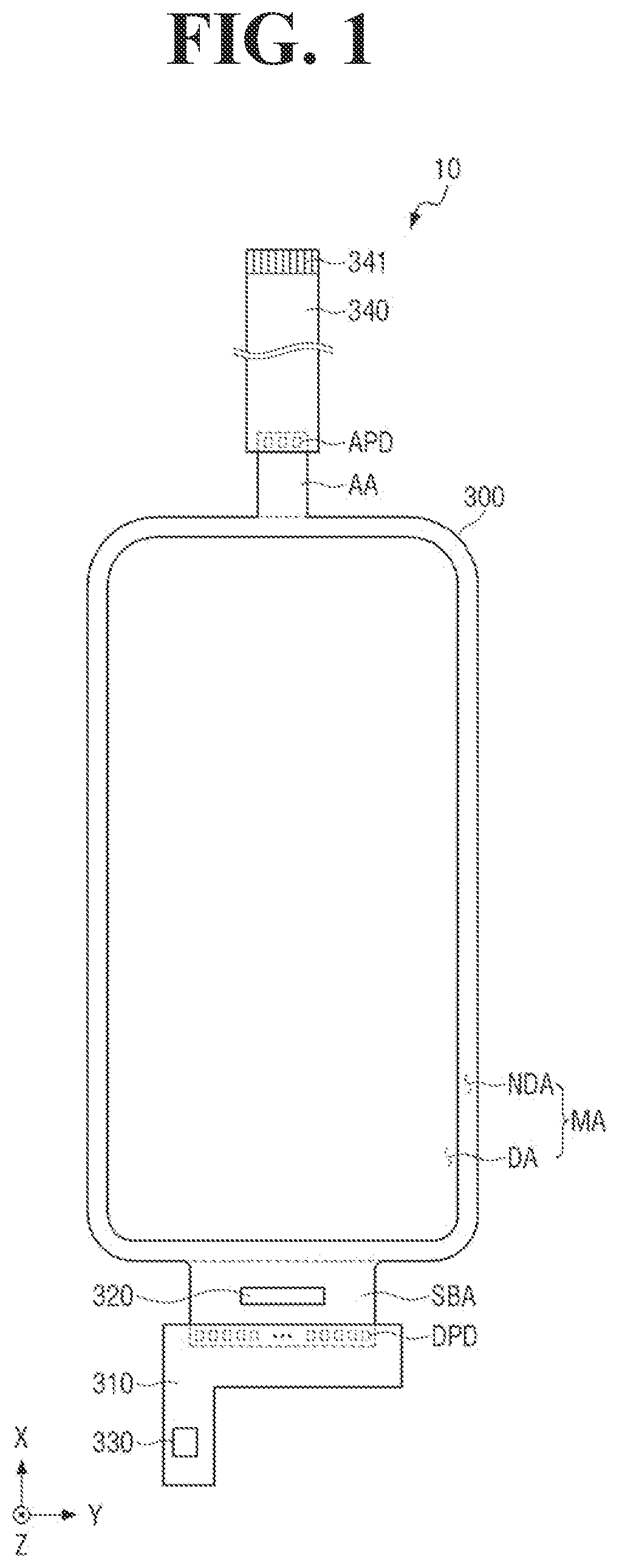
are plan views illustrating a display device according to one embodiment.
Referring to , a display device 10 according to one embodiment may be applied to portable electronic devices such as a mobile phone, a smartphone, a tablet personal computer, a mobile communication terminal, an electronic organizer, an electronic book, a portable multimedia player (PMP), a navigation system, an ultra mobile personal computer (UMPC) or the like. Alternatively, the display device 10 according to one embodiment may be applied as a display unit of a television, a laptop, a monitor, a billboard, or an Internet-of-Things (IoT) terminal. Alternatively, the display device 10 according to one embodiment may be applied to wearable devices such as a smart watch, a watch phone, a glasses type display, or a head mounted display (HMD). Alternatively, the display device 10 according to one embodiment may be applied to a dashboard of a vehicle, a center fascia of a vehicle, a center information display (CID) disposed on a dashboard of a vehicle, a room mirror display in place of side mirrors of a vehicle, or a display disposed on a rear surface of a front seat for rear seat entertainment of a vehicle.
In the present disclosure, a first direction (X-axis direction) may be a long side direction of the display device 10 , for example, a vertical direction of the display device 10 . A second direction (Y-axis direction) may be a short side direction of the display device 10 , for example, a horizontal direction of the display device 10 . A third direction (Z-axis direction) may be a thickness direction of the display device 10 . The corner where the long side in the first direction (X-axis direction) and the short side in the second direction (Y-axis direction) meet may be rounded to have a predetermined curvature or may be right-angled.
The display device 10 according to one embodiment includes a display panel 300 , a display circuit board 310 , a display driving circuit 320 , a touch driving circuit 330 , and an antenna circuit board 340 . A connector 341 may be formed on one side of the antenna circuit board 340 . For example, the connector 341 may be located on a second side of the antenna circuit board 340 which is opposite a first side of the antenna circuit board 340 , the first side being adjacent to the display panel 300 .
The display panel 300 may be a light emitting display panel including a light emitting element. For example, the display panel 300 may be an organic light emitting display panel using an organic light emitting diode including an organic light emitting layer, a micro light emitting diode display panel using a micro light emitting diode, a quantum dot light emitting display panel using a quantum dot light emitting diode including a quantum dot light emitting layer, or an inorganic light emitting display panel using an inorganic light emitting element including an inorganic semiconductor.
The display panel 300 may be a flexible display panel that is flexible and may be easily bent, folded, or rolled. For example, the display panel 300 may be a foldable display panel which can be folded and unfolded, a curved display panel having a curved display surface, a bendable display panel having a bent area other than the display surface, a rollable display panel which can be rolled up and rolled out, or a stretchable display panel which can be stretched. The display panel 300 may include a main area MA, a sub-area SBA protruding from one side of the main area MA, and an antenna area AA protruding from the other side of the main area MA. For example, the sub-area SBA may protrude from a first side of the main area MA and the antenna area AA may protrude from a second side of the main area MA.
The main area MA may include a display area DA for displaying an image and a non-display area NDA that is a peripheral area of the display area DA. The display area DA may occupy most of the main area MA. The display area DA may be disposed at the center of the main area MA. The non-display area NDA may be an area outside the display area DA. The non-display area NDA may be an edge area of the display panel 300 . The non-display area NDA may be referred to as a dead space area DS.
The sub-area SBA may protrude in the first direction (X-axis direction) from one side of the main area MA. For example, one side of the main area MA may be a lower side of the main area MA. As illustrated in , the length of the sub-area SBA in the first direction (X-axis direction) may be smaller than the length of the main area MA in the first direction (X-axis direction), and the length of the sub-area SBA in the second direction (Y-axis direction) may be smaller than the length of the main area MA in the second direction (Y-axis direction), but the embodiment of the present disclosure is not limited thereto.
Referring to , the sub-area SBA may be bent, and at least a part of the bent sub-area SBA may be disposed under the display panel 300 . In this case, at least a part of the sub-area SBA may overlap the main area MA of the display panel 300 in the third direction (Z-axis direction).
Display pads DPD may be disposed at one side edge of the sub-area SBA. One side edge of the sub-area SBA may be a lower side edge of the sub-area SBA. The display circuit board 310 may be attached to the display pads DPD of the sub-area SBA. The display circuit board 310 may be attached to the display pads DPD of the sub-area SBA by using a conductive adhesive member such as an anisotropic conductive film or an anisotropic conductive paste. The display circuit board 310 may be a flexible printed circuit board (FPCB) which is bendable, a rigid printed circuit board (PCB) which is solid and can be hardly bent, or a composite printed circuit board having both of the rigid printed circuit board and the flexible printed circuit board.
The display driving circuit 320 may be disposed on the sub-area SBA of the display panel 300 . The display driving circuit 320 may receive control signals and power voltages, and generate and output signals and voltages for driving the display panel 300 . The display driving circuit 320 may be formed as an integrated circuit (IC).
The touch driving circuit 330 may be disposed on the display circuit board 310 . The touch driving circuit 330 may be formed as an integrated circuit. The touch driving circuit 330 may be attached to the display circuit board 310 .
The touch driving circuit 330 may be electrically connected to sensor electrodes of a sensor electrode layer of the display panel 300 through the display circuit board 310 . The touch driving circuit 330 may output a touch driving signal to each of the sensor electrodes, and may sense a voltage change according to mutual capacitance of the sensor electrodes.
The sensor electrode layer of the display panel 300 may sense a proximity touch and/or a contact touch. The contact touch refers to the case where the object such as the human finger or pen makes a direct contact with the cover window disposed above the sensor electrode layer. The proximity touch refers to the case where the object such as the human finger or pen is positioned above the cover window to be proximately apart therefrom, such as hovering.
A power supply unit for supplying driving voltages for driving the display pixels of the display panel 300 and the display driving circuit 320 may be additionally disposed on the display circuit board 310 . Alternatively, the power supply unit may be integrated with the display driving circuit 320 , and in this case, the display driving circuit 320 and the power supply unit may be formed as a single integrated circuit.
The antenna area AA may be an area including at least one component among an antenna electrode, a feed line, and a ground line of an antenna module for wireless communication. The antenna area AA may protrude from the other side of the main area MA in the first direction (X-axis direction). For example, the other side of the main area MA may be an upper side of the main area MA. As illustrated in , the length of the antenna area AA in the first direction (X-axis direction) may be smaller than the length of the main area MA in the first direction (X-axis direction), and the length of the antenna area AA in the second direction (Y-axis direction) may be smaller than the length of the main area MA in the second direction (Y-axis direction), but the embodiment of the present disclosure is not limited thereto.
As illustrated in , at least a part of the antenna area AA may be bent, and at least a part of the bent antenna area AA may be disposed below the display panel 300 . In this case, at least a part of the antenna area AA may overlap the main area MA of the display panel 300 in the third direction (Z-axis direction).
Antenna pads APD may be disposed at one side edge of the antenna area AA. The antenna circuit board 340 may be attached to the antenna pads APD of the antenna area AA. For example, the antenna pads APD may be overlapped by the first side of the antenna circuit board 340 . The antenna circuit board 340 may be attached to the antenna pads APD of the antenna area AA by using a conductive adhesive member such as an anisotropic conductive film and an anisotropic conductive adhesive. One side of the antenna circuit board 340 may include the connector 341 that is connected to a main circuit board 400 on which an antenna driving circuit 350 (see ) is mounted. The antenna circuit board 340 may be a flexible printed circuit board (FPCB) that may be bent.
are side views illustrating a display device according to one embodiment.
Referring to , the display device 10 according to one embodiment may include the display panel 300 , a polarizing film PF, a cover window CW, and a panel lower cover PB. The display panel 300 may include a substrate SUB, a display layer DISL, an encapsulation layer ENC, and a sensor electrode layer SENL.
The substrate SUB may be formed of an insulating material such as polymer resin. The substrate SUB may be a flexible substrate which can be bent, folded or rolled.
The display layer DISL may be disposed on the main area MA of the substrate SUB.
The display layer DISL may be a layer that displays an image by including emission areas. The display layer DISL may include a thin film transistor layer in which thin film transistors are formed, and a light emitting element layer in which light emitting elements for emitting light are disposed in emission areas.
In the display area DA of the display layer DISL, not only emission areas but also scan lines, data lines, power lines, and the like for driving light emitting elements in the emission areas may be disposed. In the non-display area NDA of the display layer DISL, a scan driver for outputting scan signals to the scan lines, fan-out lines connecting the data lines and the display driving circuit 320 , and the like may be disposed.
The encapsulation layer ENC may be disposed on the display layer DISL. The encapsulation layer ENC may be a layer for encapsulating the light emitting element layer of the display layer DISL to prevent permeation of oxygen or moisture into the light emitting element layer of the display layer DISL. The encapsulation layer ENC may be disposed on the top surfaces and the side surfaces of the display layer DISL.
The sensor electrode layer SENL may be disposed on the display layer DISL. The sensor electrode layer SENL may include sensor electrodes. The sensor electrode layer SENL may sense a touch using sensor electrodes.
The polarizing film PF may be disposed on the sensor electrode layer SENL. The polarizing film PF may include a first base member, a linear polarization plate, a phase retardation film such as a quarter-wave plate (λ/4 plate), and a second base member. The first base member, the phase retardation film, the linear polarization plate, and the second base member may be sequentially stacked on the sensor electrode layer SENL.
The cover window CW may be disposed on the polarizing film PF. The cover window CW may be attached on the polarizing film PF by a transparent adhesive member such as an optically clear adhesive (OCA) film. Edges of the cover window CW may extend beyond edges of the display panel 300 .
The panel lower cover PB may be disposed under the display panel 300 . The panel lower cover PB may be attached to the bottom surface of the display panel 300 through an adhesive member. The adhesive member may be a pressure sensitive adhesive (PSA). The panel lower cover PB may include at least one of a light blocking member for absorbing light incident from the outside, a buffer member for absorbing an impact from the outside, or a heat dissipation member for efficiently dissipating heat from the display panel 300 .
The light blocking member may be disposed under the display panel 300 . The light blocking member blocks light transmission, thereby preventing components (e.g., the display circuit board 310 and the like) disposed under the light blocking member from being viewed from the top of the display panel 300 . The light blocking member may include a light absorbing material such as a black pigment, black dyes or the like.
The buffer member may be disposed under the light blocking member. The buffer member absorbs an external impact to prevent the display panel 300 from being damaged. The buffer member may be formed of a single layer or multiple layers. For example, the buffer member may be formed of a polymer resin such as polyurethane (PU), polycarbonate (PC), polypropylene (PP), or polyethylene (PE) or may include an elastic material such as a foamed sponge obtained from rubber, a urethane-based material, or an acrylic material.
The heat dissipation member may be disposed under the buffer member. The heat dissipation member may include a first heat dissipation layer containing graphite, carbon nanotubes or the like, and a second heat dissipation layer formed of a metal thin film containing, for example, copper, nickel, ferrite, or silver which can shield electromagnetic waves and has excellent thermal conductivity.
As illustrated in , the sub-area SBA of the substrate SUB may be bent and disposed below the display panel 300 . The sub-area SBA of the substrate SUB may be attached to the bottom surface of the panel lower cover PB by a first adhesive member 391 . The first adhesive member 391 may be a pressure sensitive adhesive.
As illustrated in , the antenna area AA of the substrate SUB may be bent and disposed below the display panel 300 . The antenna area AA of the substrate SUB may be attached to the bottom surface of the panel lower cover PB by a second adhesive member 392 . The second adhesive member 392 may be a pressure sensitive adhesive.
The display circuit board 310 may be attached to the display pads DPD of the sub-area SBA of the substrate SUB by using a conductive adhesive member such as an anisotropic conductive film or an anisotropic conductive adhesive. The display circuit board 310 may include a connector 311 connected to a flexible printed circuit board 312 . The display circuit board 310 may be connected to a connector 352 of the main circuit board 400 through the flexible printed circuit board 312 . For example, the flexible printed circuit board 312 may be disposed between the connectors 311 and 352 .
The touch driving circuit 330 may be disposed on the display circuit board 310 . The touch driving circuit 330 may generate touch data according to changes in electrical signals sensed by each of the sensor electrodes of the sensor electrode layer of the display panel 300 and transmit the touch data to a main processor 410 of the main circuit board 400 , and the main processor 410 may calculate a touch coordinate in which a touch occurs by analyzing the touch data.
The antenna circuit board 340 may be attached to the antenna pads APD of the antenna area AA of the substrate SUB by using a conductive adhesive member such as an anisotropic conductive film or an anisotropic conductive adhesive. A connector 341 of the antenna circuit board 340 may be connected to the connector 352 of the main circuit board 400 . The antenna area AA may be connected to the main circuit board 400 by the antenna circuit board 340 .
The main circuit board 400 may be a rigid printed circuit board (PCB) that is hard and does not easily bend. The main processor 410 and the antenna driving circuit 350 may be disposed on the main circuit board 400 .
The antenna driving circuit 350 may be electrically connected to antennas ANT 1 and ANT 2 (see ) of the display panel 300 through the antenna circuit board 340 . Accordingly, the antenna driving circuit 350 may receive electromagnetic wave signals through the antennas and output electromagnetic wave signals to be transmitted through the antenna. The antenna circuit board 340 may be formed of an integrated circuit (IC).
The antenna driving circuit 350 may process electromagnetic wave signals transmitted and received through antennas. For example, the antenna driving circuit 350 may change the amplitude of an electromagnetic wave signal received by antennas. Alternatively, the antenna driving circuit 350 may change the phase as well as the amplitude of the electromagnetic wave signal received by the antenna electrodes. The antenna driving circuit 350 may transmit the processed electromagnetic wave signal to a mobile communication module. The mobile communication module may be disposed on the main circuit board 400 .
The antenna driving circuit 350 may change the amplitude of the electromagnetic wave signal transmitted from the mobile communication module. Alternatively, the antenna driving circuit 350 may change the phase as well as the amplitude of the electromagnetic wave signal transmitted from the mobile communication module. The antenna driving circuit 350 may transmit the processed electromagnetic wave signal to antennas.
is a plan view illustrating a display device according to another embodiment. is a plan view illustrating a display device according to still another embodiment.
The embodiment of is different from the embodiments of in that the antenna area AA protrudes from the left side of the main area MA in the second direction (Y-axis direction). The embodiment of is different from the embodiments of in that the antenna area AA protrudes from the right side of the main area MA in the second direction (Y-axis direction). In , redundant description of parts already described in the embodiment of will be omitted.
As illustrated in , the antenna area AA may protrude from one side of the main area MA, and one side of the main area MA may be one of the upper side, the lower side, the left side, and the right side of the main area MA.
Additionally, the antenna area AA may protrude from the lower side of the main area MA in the second direction (Y-axis direction), and the antenna area AA may be disposed to be spaced apart from the sub-area SBA in the second direction (Y-axis direction). In this case, the length of the antenna area AA in the first direction (X-axis direction) may be smaller than the length of the sub-area SBA in the first direction (X-axis direction), and the length of the antenna area AA in the second direction (Y-axis direction) may be smaller than the length of the sub-area SBA in the second direction (Y-axis direction), but the embodiment of the present specification is not limited thereto.
In the following description, the antenna formed in the antenna area AA and the non-display area NDA adjacent thereto will be described focusing on the embodiments of , but characteristics of the antenna described below may also be applied to the embodiments of .
is a plan view illustrating an example of the antenna area AA of . is a plan view illustrating another example of the antenna area AA of .
In , a dotted line 700 is a virtual boundary line dividing the antenna area AA and the dead space area DS that is the non-display area NDA. In the illustrated example, an area positioned on the upper side of the dotted line 700 represents a part of the antenna area AA, and an area positioned on the lower side of the dotted line 700 represents a part of the dead space area DS that is the non-display area NDA.
According to one embodiment, the display device 10 includes the first antenna ANT 1 and the second antenna ANT 2 as antennas of an antenna module.
The first antenna ANT 1 may be disposed on the boundary between the antenna area AA and the dead space area DS. For example, the first antenna ANT 1 may include a first part disposed in the antenna area AA and a second part disposed in the dead space area DS. The first antenna ANT 1 may be connected to a first feed line FL 1 , a first ground line GND 1 , and a second ground line GND 2 formed in the antenna area AA. The first feed line FL 1 may be disposed between the first ground line GND 1 and the second ground line GND 2 , and thus may have a ground coplanar waveguide (GCPW) structure. Alternatively, the first feed line FL 1 may have a coplanar waveguide (CPW) structure.
The extension direction of each of the first feed line FL 1 , the first ground line GND 1 , and the second ground line GND 2 may be the same as the extension direction of the antenna area AA. Each of the first feed line FL 1 , the first ground line GND 1 , and the second ground line GND 2 may be electrically connected to the antenna pads APD (see ). For example, each of the first feed line FL 1 , the first ground line GND 1 , and the second ground line GND 2 may extend in the first direction (X-axis direction), and each end thereof may be connected to the first antenna ANT 1 .
Referring to , the first antenna ANT 1 may be disposed from a part of the dead space area DS to a part of the antenna area AA. For example, the first part of the first antenna ANT 1 may be disposed in the antenna area AA adjacent to the dead space area DS, and the second part of the first antenna ANT 1 may be disposed in the dead space area DS adjacent to the antenna area AA. However, the area in which the first antenna ANT 1 is disposed is not limited to the example of . For example, as illustrated in , the first antenna ANT 1 may be solely disposed in the dead space area DS adjacent to the antenna area AA. In addition, the first antenna ANT 1 may be solely disposed in a part of the antenna area AA adjacent to the dead space area DS.
The width of the first antenna ANT 1 may be equal to or less than a half-wavelength length for about 28 GHZ (e.g., equal to or less than about 4.8 mm), and optimization of the resonance point of the structure for about 28 GHz may be adjusted through tuning of the width or the length of antenna electrodes AE 1 , AE 2 , and AE 3 (see ) of the first antenna ANT 1 . The first antenna ANT 1 may have a structure of a half-wavelength slot antenna, and may generate a field parallel to the first direction (X-axis direction) through an LC parallel type structure or a loop type structure at both ends thereof in the second direction (Y-axis direction). The first antenna ANT 1 may include an antenna structure symmetrical with respect to the first feed line FL 1 . For example, the first antenna ANT 1 may include an antenna structure that is left-right symmetric with respect to the first feed line FL 1 . Here, the antenna structure may be a structure including the antenna electrodes AE 1 , AE 2 , and AE 3 (see ) forming the first antenna ANT 1 , at least one of slots S 1 , S 2 , and CS (see ) formed inside the antenna electrodes AE 1 , AE 2 , and AE 3 (see ), or at least one slit. In addition, the slot or the slit may be an area in which metal forming the antenna electrodes AE 1 , AE 2 , and AE 3 (see ) is not formed. The antenna structure constituting the first antenna ANT 1 will be described later specifically in conjunction with to 15 .
The second antenna ANT 2 may be disposed in the dead space area DS adjacent to the antenna area AA, and may be connected to a second feed line FL 2 , a third ground line GND 3 , and a fourth ground line GND 4 formed in the antenna area AA. The second feed line FL 2 may be disposed between the third ground line GND 3 and the fourth ground line GND 4 , and thus may have a ground coplanar waveguide (GCPW) structure. Alternatively, the second feed line FL 2 may have a coplanar waveguide (CPW) structure.
The extension direction of each of the second feed line FL 2 , the third ground line GND 3 , and the fourth ground line GND 4 may be the same as the extension direction of the antenna area AA. Each of the second feed line FL 2 , the third ground line GND 3 , and the fourth ground line GND 4 may be electrically connected to the antenna pads APD (see ). For example, each of the second feed line FL 2 , the third ground line GND 3 , and the fourth ground line GND 4 may extend in the first direction (X-axis direction), and each end thereof may be connected to the second antenna ANT 2 .
Referring to , the second antenna ANT 2 may be disposed solely in the dead space area DS adjacent to the antenna area AA, but the area in which the second antenna ANT 2 is disposed is not limited to the illustrated example. For example, the second antenna ANT 2 may be disposed solely in a part of the antenna area AA adjacent to the dead space area DS, or in both parts of the antenna area AA and the dead space area DS.
The second antenna ANT 2 may include a structure obtained by tuning the shape of a dipole antenna, which is folded within the same length as the polarization structure of the first antenna ANT 1 . The second antenna ANT 2 may include an asymmetrical antenna structure with respect to the second feed line FL 2 to generate a field in the second direction (Y-axis direction) perpendicular to the first direction (X-axis direction). Here, the antenna structure may be a structure including the antenna electrodes AE 4 , AE 5 , and AE 6 (see ) forming the second antenna ANT 2 , at least one of slots S 3 and S 4 (see ) formed inside the antenna electrodes AE 4 , AE 5 , and AE 6 (see ), or at least one slit. In addition, the slot or the slit may be an area in which metal forming the antenna electrodes AE 4 , AE 5 , and AE 6 (see ) is not formed. The antenna structure constituting the second antenna ANT 2 will be described later specifically in conjunction with to 18 .
The first antenna ANT 1 and the second antenna ANT 2 may be disposed adjacent to each other in the second direction (Y-axis direction). The interval between the first antenna ANT 1 and the second antenna ANT 2 , in other words, the interval between the port of the first antenna ANT 1 and the port of the second antenna ANT 2 may be about 0.52 (e.g., half wavelength, about 5.3 mm or less) at about 28 GHz, and a minimum of about 0.252 (e.g., half wavelength, about 2.65 mm) at about 28 GHz.
is a plan view illustrating an example of the antenna area AA of .
The embodiment of is different from the embodiments of in that the antenna area AA protrudes in the second direction (Y-axis direction) from the left side of the main area MA. The embodiment of is different from the embodiments of in that the antenna area AA protrudes in the second direction (Y-axis direction) from the left side of the main area MA. In , redundant description of parts already described in the embodiment of will be omitted.
Referring to , a dotted line 900 is a virtual boundary line dividing the antenna area AA and the dead space area DS that is the non-display area NDA. In the illustrated example, an area positioned on the left side of the dotted line 900 represents a part of the antenna area AA, and an area positioned on the right side of the dotted line 900 represents a part of the dead space area DS that is the non-display area NDA.
As illustrated in , the extension direction of each of the first feed line FL 1 , the first ground line GND 1 , and the second ground line GND 2 may be the same as the extension direction of the antenna area AA. Each of the first feed line FL 1 , the first ground line GND 1 , and the second ground line GND 2 may be electrically connected to the antenna pads APD (see ). For example, each of the first feed line FL 1 , the first ground line GND 1 , and the second ground line GND 2 may extend in the second direction (Y-axis direction), and each end thereof may be connected to the first antenna ANT 1 .
In addition, the extension direction of each of the second feed line FL 2 , the third ground line GND 3 , and the fourth ground line GND 4 may be the same as the extension direction of the antenna area AA. Each of the second feed line FL 2 , the third ground line GND 3 , and the fourth ground line GND 4 may be electrically connected to the antenna pads APD (see ). For example, each of the second feed line FL 2 , the third ground line GND 3 , and the fourth ground line GND 4 may extend in the second direction (Y-axis direction), and each end thereof may be connected to the second antenna ANT 2 .
The first antenna ANT 1 and the second antenna ANT 2 may be disposed adjacent to each other in the first direction (X-axis direction). The interval between the first antenna ANT 1 and the second antenna ANT 2 , in other words, the interval between the port of the first antenna ANT 1 and the port of the second antenna ANT 2 may be about 0.5λ (e.g., half wavelength, about 5.3 mm or less) at about 28 GHz, and a minimum of about 0.25λ (e.g., half wavelength, about 2.65 mm) at about 28 GHz. An interval between a port of the first antenna ANT 1 and a port of the second antenna ANT 2 may be an interval between the first feed line FL 1 and the second feed line FL 2 .
According to the present disclosure, the number of arrangements of the first antenna ANT 1 and the second antenna ANT 2 may be variously changed. In addition, the shape of the arrangement of the first antenna ANT 1 and the second antenna ANT 2 may be variously changed. This will be described in detail with reference to to 12 .
is a plan view illustrating the antenna area AA including a 1X2Y antenna unit according to one embodiment.
The embodiment of may be at least partially similar to the embodiment of . Hereinafter, only the configuration of the embodiment of that is different from that of the embodiment of will be described.
Referring to , the display device 10 according to one embodiment may include a 1X2Y antenna unit including one X-axis polarization antenna and two Y-axis polarization antennas. For example, the display device 10 according to one embodiment may include the first antenna ANT 1 as an X-axis polarization antenna, and may further include the second antenna ANT 2 as a Y-axis polarization antenna. In this case, the second antenna ANT 2 may be disposed on both sides of the first antenna ANT 1 . For example, the second antenna ANT 2 may be disposed on each of the left side and the right side of the first antenna ANT 1 .
In the embodiment of , as an interval between different kinds of antennas, e.g., the interval between the first antenna ANT 1 and the second antenna ANT 2 , the interval between the port of the first antenna ANT 1 and the port of the second antenna ANT 2 may be about 0.5λ (e.g., half wavelength, about 5.3 mm or less) at about 28 GHz, and a minimum of about 0.25λ (e.g., half wavelength, about 2.65 mm) at about 28 GHz. An interval between a port of the first antenna ANT 1 and a port of the second antenna ANT 2 may be an interval between the first feed line FL 1 and the second feed line FL 2 .
Additionally, the interval between the antennas of the same type, e.g., the interval between the second antennas ANT 2 disposed on both sides of the first antenna ANT 1 is about 7 mm or less at about 28 GHz. The interval between the second antennas ANT 2 may be the interval between the second feed lines FL 2 connected to each of the second antennas ANT 2 .
is a plan view illustrating the antenna area AA including a 2X1Y antenna unit according to one embodiment.
The embodiment of may be at least partially similar to the embodiments of . Hereinafter, only the configuration of the embodiment of that is different from those of the embodiments of will be described.
Referring to , the display device 10 according to one embodiment may include a 2X1Y antenna unit including two X-axis polarization antennas and one Y-axis polarization antenna. For example, the display device 10 according to one embodiment may include the first antenna ANT 1 as an X-axis polarization antenna, and may further include the second antenna ANT 2 as a Y-axis polarization antenna. In this case, the first antenna ANT 1 may be disposed on both sides of the second antenna ANT 2 . For example, the first antenna ANT 1 may be disposed on each of the left side and the right side of the second antenna ANT 2 .
In the embodiment of , as an interval between different kinds of antennas, e.g., the interval between the first antenna ANT 1 and the second antenna ANT 2 , the interval between the port of the first antenna ANT 1 and the port of the second antenna ANT 2 may be about 0.5λ (e.g., half wavelength, about 5.3 mm or less) at about 28 GHz, and a minimum of about 0.25λ (e.g., half wavelength, about 2.65 mm) at about 28 GHz. An interval between a port of the first antenna ANT 1 and a port of the second antenna ANT 2 may be an interval between the first feed line FL 1 and the second feed line FL 2 .
Additionally, the interval between the antennas of the same type, e.g., the interval between the first antennas ANT 1 disposed on both sides of the second antenna ANT 2 is about 7 mm or less at about 28 GHz. The interval between the first antennas ANT 1 may be the interval between the first feed lines FL 1 connected to each of the first antennas ANT 1 .
is a plan view illustrating the antenna area AA including a 2X2Y antenna unit according to one embodiment.
The embodiment of may be at least partially similar to the embodiments of . Hereinafter, only the configuration of the embodiment of that is different from those of the embodiments of will be described.
Referring to , the display device 10 according to one embodiment may include a 2X2Y antenna unit including two X-axis polarization antennas and two Y-axis polarization antennas. For example, the display device 10 according to one embodiment may include the first antenna ANT 1 as an X-axis polarization antenna, and may further include the second antenna ANT 2 as a Y-axis polarization antenna. In this case, the first antennas ANT 1 may form one first antenna group and be disposed adjacent to each other, and the second antennas ANT 2 may form one second antenna group and be disposed adjacent to each other A first antenna group constituted with the first antennas ANT 1 and a second antenna group constituted with the second antennas ANT 2 may be disposed adjacent to each other, and the interval between the groups may be designed to be various values in consideration of impedance matching.
A simulation result of the characteristics of the first antenna group constituted with the first antennas ANT 1 is as follows. When the first antenna ANT 1 was designed as a 1×2 array antenna, it was confirmed to have a peak gain of about 4.1 dBi at about 28 GHz. In addition, when the first antenna ANT 1 was designed as a 1×4 array antenna, it was confirmed to have a peak gain of about 7.01 dBi at about 28 GHz. In this case, the first antennas ANT 1 of the first antenna group may have an interval of about 5 mm (28 GHz half-wavelength) at equal intervals, and the gain may decrease by about 1 dB as the interval increases. In addition, the first antenna group may operate at about 25 GHz to about 28.7 GHZ and about 3.7 GHZ, and a cross-polarization discrimination XPD may be up to 45 dB at maximum.
Additionally, as illustrated in , when the first antenna group constituted with the first antennas ANT 1 and the second antenna group constituted with the second antennas ANT 2 are disposed adjacent to each other, it was confirmed that, at about 27 GHZ, the X-axis-polarization had a peak gain of 4.4 dBi and the Y-axis-polarization had a peak gain of about 1.9 dBi.
is a plan view illustrating the first antenna ANT 1 according to one embodiment. is a diagram illustrating a characteristic graph of the first antenna ANT 1 according to one embodiment. is a diagram illustrating a radiation pattern of the first antenna ANT 1 according to one embodiment.
Referring to , the first antenna ANT 1 according to one embodiment may include the first antenna electrode AE 1 , the second antenna electrode AE 2 , and the third antenna electrode AE 3 . The first antenna electrode AE 1 may be disposed between the second antenna electrode AE 2 and the third antenna electrode AE 3 . The second antenna electrode AE 2 is branched from one end of the first antenna electrode AE 1 in one direction (e.g., −Y direction) and is connected to the first ground line GND 1 . The third antenna electrode AE 3 is branched from one end of the first antenna electrode AE 1 in the other direction (e.g., Y direction) and is connected to the second ground line GND 2 . For example, the second antenna electrode AE 2 may be branched from a first end of the first antenna electrode AE 1 and the third antenna electrode AE 3 may be branched from a second end of the first antenna electrode AE 1 . The second antenna electrode AE 2 and the third antenna electrode AE 3 may have symmetrical shapes with respect to the first antenna electrode AE 1 .
The second antenna electrode AE 2 and the third antenna electrode AE 3 may include at least one slot S 1 and at least one slot S 2 , respectively, and the slot S 1 of the second antenna electrode AE 2 and the slot S 2 of the third antenna electrode AE 3 may be disposed symmetrically with respect to the first antenna electrode AE 1 .
The slots S 1 and S 2 respectively included in the second antenna electrode AE 2 and the third antenna electrode AE 3 may have lengths extending in the first direction (X-axis direction), and the length and width thereof may be variously changed in consideration of impedance matching. According to the illustrated example, the second antenna electrode AE 2 may include a plurality of first slots S 1 having a length extending in the first direction (X-axis direction), and the third antenna electrode AE 3 may include a plurality of second slots S 2 having a length extending in the first direction (X-axis direction) and disposed symmetrically with the plurality of first slots S 1 .
The width of each of the plurality of first slots S 1 included in the first antenna electrode AE 1 may be the same as or different from each other. The plurality of first slots S 1 included in the first antenna electrode AE 1 may be connected to each other by the connection slot CS extending in the second direction (Y-axis direction). Similarly, the width of each of the plurality of second slots S 2 included in the second antenna electrode AE 2 may be the same as or different from each other, and the plurality of second slots S 2 may be connected to each other by the connection slot CS extending in the second direction (Y-axis direction). Portions of the first and second slots S 1 and S 2 may extend to the first feed line FL 1 and run adjacent to the first feed line FL 1 in the first direction.
Referring to , the first antenna ANT 1 , which is an X-axis polarization antenna, may have a peak gain of a maximum of 1.4 dBi at about 28 GHz, and an operating frequency of about 25.8 GHz to about 29 GHz or about 3 GHz. When the first antenna ANT 1 is designed as a single antenna, the cross-polarization discrimination XPD may have a maximum of about 35 dB in a direction perpendicular to the display surface of the display device 10 .
is a plan view showing the second antenna ANT 2 according to one embodiment. is a diagram illustrating a characteristic graph of the second antenna ANT 2 according to one embodiment. is a diagram illustrating a radiation pattern of the second antenna ANT 2 according to one embodiment.
Referring to , the second antenna ANT 2 according to one embodiment may include the fourth antenna electrode AE 4 , the fifth antenna electrode AE 5 , and the sixth antenna electrode AE 6 . The fourth antenna electrode AE 4 may be disposed between the fifth antenna electrode AE 5 and the sixth antenna electrode AE 6 . The fifth antenna electrode AES is branched from one end of the fourth antenna electrode AE 4 in one direction (e.g., −Y direction) and is connected to the third ground line GND 3 . The sixth antenna electrode AE 6 is branched from one end of the fourth antenna electrode AE 4 in the other direction (e.g., Y direction) and is connected to the fourth ground line GND 4 . For example, the fifth antenna electrode AES is branched from a first end of the fourth antenna electrode AE 4 and the sixth antenna electrode AE 6 is branched from a second end of the fourth antenna electrode AE 4 . The fifth antenna electrode AE 5 and the sixth antenna electrode AE 6 may have an asymmetric shape with respect to the fourth antenna electrode AE 4 . For example, the length of the fifth antenna electrode AES in the second direction (Y-axis direction) may be longer than the length of the sixth antenna electrode AE 6 in the second direction (Y-axis direction). Conversely, the length of the fifth antenna electrode AES in the second direction (Y-axis direction) may be shorter than the length of the sixth antenna electrode AE 6 in the second direction (Y-axis direction).
The fifth antenna electrode AES and the sixth antenna electrode AE 6 may respectively include the slots S 3 and S 4 having lengths extending in the second direction (Y-axis direction), and the slot S 3 of the fifth antenna electrode AE 5 and the slot S 4 of the sixth antenna electrode AE 6 may be disposed asymmetrically with respect to the fourth antenna electrode AE 4 . For example, the fifth antenna electrode AES may include the third slot S 3 , and the sixth antenna electrode AE 6 may include the fourth slot S 4 having a shorter length than the third slot S 3 .
The slots S 3 and S 4 respectively included in the fifth antenna electrode AE 5 and the sixth antenna electrode AE 6 may have lengths extending in the second direction (Y-axis direction), and the length and width thereof may be variously changed in consideration of impedance matching. Portions of the third and fourth slots S 3 and S 4 may extend to the second feed line FL 2 and run adjacent to the second feed line FL 2 in the first direction.
Referring to , the second antenna ANT 2 , which is a Y-axis polarization antenna, may have the following characteristics within the same length as the first antenna ANT 1 . In other words, the second antenna ANT 2 may have a peak gain of a maximum of 3.1 dBi at about 29 GHz, and may have an operating frequency of about 25.8 GHz to about 29 GHz or about 2.5 GHz. When the second antenna ANT 2 is designed as a single antenna, in the case of a single antenna, the cross-polarization discrimination XPD may have a maximum of 18 dB in a direction perpendicular to the display surface.
According to the present disclosure, the structure and shape of the first antenna ANT 1 may be variously changed. For example, unlike the embodiment of , in the first antenna ANT 1 , an X-axis polarization may be formed in a loop structure, a slot or a slit may be added, or a part of an antenna electrode may be tapered for impedance matching to supply power. This will be described in detail with reference to to 21 .
is a plan view showing the first antenna ANT 1 according to another embodiment.
The embodiment of may be at least partially similar to the embodiment of . Hereinafter, only the configuration of the embodiment of that is different from that of the embodiment of will be described.
Referring to , in the first antenna ANT 1 , each of the second antenna electrode AE 2 and the third antenna electrode AE 3 may further include an additional slot AS. For example, the additional slot AS may have a length extending in the first direction (X-axis direction), and the length and width thereof may be variously changed in consideration of impedance matching.
In addition, the first feed line FL 1 and the first antenna electrode AE 1 are spaced apart from each other at a predetermined interval, so that the first antenna ANT 1 may have a capacitive-fed form. For example, the interval between the first feed line FL 1 and the first antenna electrode AE 1 may be designed to be an interval of about 10 μm, about 20 μm, or about 50 μm, but the present disclosure is not limited thereto.
is a plan view showing the first antenna ANT 1 according to still another embodiment.
The embodiment of may be at least partially similar to the embodiment of . Hereinafter, only the configuration of the embodiment of that is different from that of the embodiment of will be described.
The embodiment of is different from the embodiment of in that the connection slot CS (see ) is omitted from each of the second antenna electrode AE 2 and the third antenna electrode AE 3 and the number of the slots S 1 having a length extending in the first direction (X-axis direction) is increased. For example, each of the second antenna electrode AE 2 and the third antenna electrode AE 3 may include the three slots S 1 having lengths extending in the first direction (X-axis direction), and the three slots S 1 may be disposed side by side in the first direction (X-axis direction).
is a plan view showing the first antenna ANT 1 according to still another embodiment.
The embodiment of may be at least partially similar to the embodiment of . Hereinafter, only the configuration of the embodiment of that is different from that of the embodiment of will be described.
The embodiment of is different from the embodiment of in that the first antenna electrode AE 1 may be formed to be inclined (e.g., have a tapered shape) to supply power. For example, the first antenna electrode AE 1 has a first width L 1 in a region closest to the first feed line FL 1 and has a second width L 2 greater than the first width L 1 in a region (or in a region in which the second antenna electrode AE 2 and the third antenna electrode AE 3 are branched) farthest from the first feed line FL 1 . In this case, the difference between the first width L 1 and the second width L 2 may be designed to be within about 0.5 mm.
It is to be understood that the embodiments of and to 21 are combinable with each other.
is a cross-sectional view of a part of the display area of the display device 10 according to one embodiment.
Referring to , the display layer DISL including a thin film transistor layer TFTL and a light emitting element layer EML may be disposed on one surface of the substrate SUB, and the sensor electrode layer SENL including sensor electrodes SE may be disposed on the encapsulation layer ENC. The polarizing film PF may be disposed on the sensor electrode layer SENL, and the cover window CW may be disposed on the polarizing film PF.
The substrate SUB may include a support substrate SSUB, a first substrate SUB 1 , a first buffer layer BF 1 , a second substrate SUB 2 , and a second buffer layer BF 2 . The first substrate SUB 1 may be disposed on the support substrate SSUB, the first buffer layer BF 1 may be disposed on the first substrate SUB 1 , the second substrate SUB 2 may be disposed on the first buffer layer BF 1 , and the second buffer layer BF 2 may be disposed on the second substrate SUB 2 .
The support substrate SSUB may be a rigid substrate for supporting the first substrate SUB 1 and the second substrate SUB 2 that are flexible. The support substrate SSUB may be formed of glass or a plastic material such as polycarbonate (PC) and polyethylene terephthalate (PET).
The first substrate SUB 1 and the second substrate SUB 2 may be formed of an organic material such as acryl resin, epoxy resin, phenolic resin, polyamide resin, polyimide resin and the like. The first substrate SUB 1 and the second substrate SUB 2 may be formed of the same organic material or different organic materials.
Each of the first buffer layer BF 1 and the second buffer layer BF 2 may be formed of an inorganic material such as a silicon nitride layer, a silicon oxynitride layer, a silicon oxide layer, a titanium oxide layer and an aluminum oxide layer. Alternatively, each of the first buffer layer BF 1 and the second buffer layer BF 2 may be formed of a multilayer in which a plurality of layers of a silicon nitride layer, a silicon oxynitride layer, a silicon oxide layer, a titanium oxide layer and an aluminum oxide layer are alternately stacked. The first buffer layer BF 1 and the second buffer layer BF 2 may be formed of the same inorganic material or different inorganic materials.
An active layer including a channel region TCH, a source region TS, and a drain region TD of a thin film transistor TFT may be disposed on the second buffer layer BF 2 . The active layer may include polycrystalline silicon, monocrystalline silicon, low-temperature polycrystalline silicon, amorphous silicon, or an oxide semiconductor material. When the active layer includes polycrystalline silicon or an oxide semiconductor material, the source region TS and the drain region TD of the active layer may be conductive regions doped with ions and having conductivity.
A gate insulating layer 130 may be formed on the active layer of the thin film transistor TFT. The gate insulating layer 130 may be formed of an inorganic layer, for example, a silicon nitride layer, a silicon oxynitride layer, a silicon oxide layer, a titanium oxide layer, or an aluminum oxide layer.
A gate electrode TG of the thin film transistor TFT and a first capacitor electrode CAE 1 may be disposed on the gate insulating layer 130 . The gate electrode TG of the thin film transistor TFT may overlap the channel region TCH in the third direction (Z-axis direction). The gate electrode TG and the first capacitor electrode CAE 1 may be formed of a single layer or multiple layers made of any one of molybdenum (Mo), aluminum (Al), chromium (Cr), gold (Au), titanium (Ti), nickel (Ni), neodymium (Nd) and copper (Cu) or an alloy thereof.
A first interlayer insulating layer 141 may be disposed on the gate electrode TG and the first capacitor electrode CAE 1 . The first interlayer insulating layer 141 may be formed of an inorganic layer, for example, a silicon nitride layer, a silicon oxynitride layer, a silicon oxide layer, a titanium oxide layer, or an aluminum oxide layer. The first interlayer insulating layer 141 may include a plurality of inorganic layers.
A second capacitor electrode CAE 2 may be disposed on the first interlayer insulating layer 141 . The second capacitor electrode CAE 2 may overlap the first capacitor electrode CAE 1 in the third direction (Z-axis direction). Therefore, a capacitor Cst may be formed by the first capacitor electrode CAE 1 and the second capacitor electrode CAE 2 and an inorganic insulating dielectric layer disposed therebetween to serve as a dielectric layer. The second capacitor electrode CAE 2 may be formed of a single layer or multiple layers made of any one of molybdenum (Mo), aluminum (Al), chromium (Cr), gold (Au), titanium (Ti), nickel (Ni), neodymium (Nd) and copper (Cu), or an alloy thereof.
A second interlayer insulating layer 142 may be disposed on the second capacitor electrode CAE 2 . The second interlayer insulating layer 142 may be formed of an inorganic layer, for example, a silicon nitride layer, a silicon oxynitride layer, a silicon oxide layer, a titanium oxide layer, or an aluminum oxide layer. The second interlayer insulating layer 142 may include a plurality of inorganic layers.
A first connection electrode CE 1 may be disposed on the second interlayer insulating layer 142 . The first connection electrode CE 1 may be connected to the drain region TD through a first contact hole CT 1 penetrating the gate insulating layer 130 , the first interlayer insulating layer 141 , and the second interlayer insulating layer 142 . The first connection electrode CE 1 may be in direct contact with the drain region TD through the first contact hole CT 1 . The first connection electrode CE 1 may be formed of a single layer or multiple layers made of any one of molybdenum (Mo), aluminum (Al), chromium (Cr), gold (Au), titanium (Ti), nickel (Ni), neodymium (Nd) and copper (Cu), or an alloy thereof.
A first organic layer 160 may be disposed on the first connection electrode CE 1 to flatten a stepped portion formed by the thin film transistors TFT. The first organic layer 160 may be formed of an organic layer such as acryl resin, epoxy resin, phenolic resin, polyamide resin, polyimide resin and the like.
A second connection electrode CE 2 may be disposed on the first organic layer 160 . The second connection electrode CE 2 may be connected to the first connection electrode CE 1 through a second contact hole CT 2 penetrating the first organic layer 160 . The second connection electrode CE 2 may be in direct contact with the first connection electrode CE 1 through the second contact hole CT 2 . The second connection electrode CE 2 may be formed of a single layer or multiple layers made of any one of molybdenum (Mo), aluminum (Al), chromium (Cr), gold (Au), titanium (Ti), nickel (Ni), neodymium (Nd) and copper (Cu), or an alloy thereof.
A second organic layer 180 may be disposed on the second connection electrode CE 2 . The second organic layer 180 may be formed of an organic layer such as acryl resin, epoxy resin, phenolic resin, polyamide resin, polyimide resin and the like.
The light emitting element layer EML is disposed on the thin film transistor layer TFTL. The light emitting element layer EML may include light emitting elements LEL and a bank 190 .
Each of the light emitting elements LEL may include a pixel electrode 171 , a light emitting layer 172 , and a common electrode 173 . Each of a plurality of emission areas represents an area in which the pixel electrode 171 , the light emitting layer 172 , and the common electrode 173 are sequentially stacked, and holes from the pixel electrode 171 and electrons from the common electrode 173 are combined with each other in the light emitting layer 172 to emit light. In this case, the pixel electrode 171 may be an anode electrode, and the common electrode 173 may be a cathode electrode.
The pixel electrode 171 may be formed on the second organic layer 180 . The pixel electrode 171 may be connected to the first connection electrode CE 1 through a third contact hole CT 3 penetrating the second organic layer 180 . In this case, the pixel electrode 171 may be in direct contact with the second connection electrode CE 2 through the third contact hole CT 3 .
In a top emission structure that emits light toward the common electrode 173 with respect to the light emitting layer 172 , the pixel electrode 171 may be formed of a single layer of molybdenum (Mo), titanium (Ti), copper (Cu), or aluminum (Al), or may be formed to have a stacked structure (Ti/Al/Ti) of aluminum and titanium, a stacked structure (ITO/AI/ITO) of aluminum and ITO, an APC alloy, or a stacked structure (ITO/APC/ITO) of APC alloy and ITO to increase the reflectivity. The APC alloy is an alloy of silver (Ag), palladium (Pd) and copper (Cu).
The bank 190 serves to define the emission areas of the display pixels. To accomplish this, the bank 190 may be formed to expose a partial region of the pixel electrode 171 on the second organic layer 180 . The bank 190 may cover the edge of the pixel electrode 171 . The bank 190 may be disposed in a contact hole penetrating the second organic layer 180 . Therefore, the third contact hole CT 3 penetrating the second organic layer 180 may be filled with the bank 190 . The bank 190 may be formed of an organic layer such as acryl resin, epoxy resin, phenolic resin, polyamide resin, polyimide resin and the like.
A spacer 191 may be disposed on the bank 190 . The spacer 191 may serve to support a mask during a process of manufacturing the light emitting layer 172 . The spacer 191 may be formed of an organic layer such as acryl resin, epoxy resin, phenolic resin, polyamide resin, polyimide resin and the like.
The light emitting layer 172 is formed on the pixel electrode 171 . The light emitting layer 172 may include an organic material to emit light in a predetermined color. For example, the light emitting layer 172 may include a hole transporting layer, an organic material layer, and an electron transporting layer. The organic material layer may include a host and a dopant. The organic material layer may include a material that emits predetermined light, and may be formed using a phosphorescent material or a fluorescent material.
For example, the organic material layer of the light emitting layer 172 in a first emission area for emitting light of a first color may be a phosphorescent material including a host material including carbazole biphenyl (CBP) or mCP (1,3-bis(carbazol-9-yl), and a dopant including at least one selected from the group consisting of PIQIr(acac)(bis(1-phenylisoquinoline)acetylacetonate iridium), PQIr(acac)(bis(1-phenylquinoline)acetylacetonate iridium), PQIr(tris(1-phenylquinoline)iridium)) and PtOEP (octaethylporphyrin platinum). Alternatively, the organic material layer of the light emitting layer 172 of the first emission area may be a fluorescent material including PBD:Eu(DBM)3(Phen) or Perylene, but the present disclosure is not limited thereto.
The organic material layer of the light emitting layer 172 in a fourth emission area and a second emission area for emitting light of a second color may be a phosphorescent material including a host material including CBP or mCP, and a dopant material including Ir(ppy)3(fac tris(2-phenylpyridine)iridium. Alternatively, the organic material layer of the light emitting layer 172 in the fourth emission area and the second emission area for emitting the light of the second color may be a fluorescent material including tris(8-hydroxyquinolino)aluminum (Alq3), but the present disclosure is not limited thereto.
The organic material layer of the light emitting layer 172 in a third emission area for emitting the light of a third color may be a phosphorescent material including a host material including CBP or mCP, and a dopant material including (4,6-F2ppy)2Irpic or L2BD111, but the present disclosure is not limited thereto.
The common electrode 173 is formed on the light emitting layer 172 . The common electrode 173 may be formed to cover the light emitting layer 172 . The common electrode 173 may be a common layer which is commonly formed in the emission areas. A capping layer may be formed on the common electrode 173 .
In the top emission structure, the common electrode 173 may be formed of a transparent conductive material (TCO) such as ITO or IZO capable of transmitting light or a semi-transmissive conductive material such as magnesium (Mg), silver (Ag), or an alloy of magnesium (Mg) and silver (Ag). When the common electrode 173 is formed of a semi-transmissive conductive material, the light emission efficiency can be increased due to a micro-cavity effect.
The encapsulation layer ENC may be formed on the light emitting element layer EML. The encapsulation layer ENC may include at least one inorganic layer TFE 1 and TFE 2 to prevent oxygen or moisture from permeating into the light emitting element layer EML. In addition, the encapsulation layer ENC may include at least one organic layer to protect the light emitting element layer EML from foreign substances such as dust. For example, the encapsulation layer ENC may include a first inorganic encapsulation layer TFE 1 , an organic encapsulation layer TFE 2 , and a second inorganic encapsulation layer TFE 3 .
The first inorganic encapsulation layer TFE 1 may be disposed on the common electrode 173 , the organic encapsulation layer TFE 2 may be disposed on the first inorganic encapsulation layer TFE 1 , and the second inorganic encapsulation layer TFE 3 may be disposed on the organic encapsulation layer TFE 2 . The first inorganic encapsulation layer TFE 1 and the second inorganic encapsulation layer TFE 3 may be formed of a multilayer in which one or more inorganic layers of a silicon nitride layer, a silicon oxynitride layer, a silicon oxide layer, a titanium oxide layer and an aluminum oxide layer are alternately stacked. The encapsulation organic layer TFE 2 may be an organic layer such as acryl resin, epoxy resin, phenolic resin, polyamide resin, polyimide resin or the like.
The sensor electrode layer SENL is disposed on the encapsulation layer ENC. The sensor electrode layer SENL may include the sensor electrodes.
A third buffer layer BF 3 may be disposed on the encapsulation layer ENC. For example, the third buffer layer BF 3 may be conformally formed on the encapsulation layer ENC. The third buffer layer BF 3 may be a layer having insulating and optical functions. The third buffer layer BF 3 may include at least one inorganic layer. For example, the third buffer layer BF 3 may be formed of a multilayer in which one or more inorganic layers of a silicon nitride layer, a silicon oxynitride layer, a silicon oxide layer, a titanium oxide layer and an aluminum oxide layer are alternately stacked. The third buffer layer BF 3 may be formed by a lamination process using a flexible material, a spin coating process using a solution-type material, a slit die coating process, or a deposition process. The third buffer layer BF 3 may be omitted.
First connection portions BE 1 may be disposed on the third buffer layer BF 3 . The first connection portions BE 1 may be in direct contact with the third buffer layer BF 3 . The first connection portions BE 1 may be formed of a single layer containing molybdenum (Mo), titanium (Ti), copper (Cu), or aluminum (Al), or may be formed to have a stacked structure (Ti/Al/Ti) of aluminum and titanium, a stacked structure (ITO/Al/ITO) of aluminum and indium tin oxide (ITO), an Ag—Pd—Cu (APC) alloy, or a stacked structure (ITO/APC/ITO) of APC alloy and ITO.
A first sensor insulating layer TINS 1 may be disposed on the first connection portions BE 1 . The first sensor insulating layer TINS 1 may be a layer having insulating and optical functions. The first sensor insulating layer TINS 1 may be formed of an inorganic layer, for example, a silicon nitride layer, a silicon oxynitride layer, a silicon oxide layer, a titanium oxide layer, or an aluminum oxide layer. The first sensor insulating layer TINS 1 may be formed by a lamination process using a flexible material, a spin coating process using a solution-type material, a slit die coating process, or a deposition process.
The sensor electrodes, e.g., driving electrodes TE and sensing electrodes RE may be disposed on the first sensor insulating layer TNIS 1 . In addition, dummy patterns may be disposed on the first sensor insulating layer TNIS 1 . The driving electrodes TE, the sensing electrodes RE, and the dummy patterns do not overlap the emission areas. The driving electrodes TE, the sensing electrodes RE, and the dummy patterns may be formed of a single layer containing molybdenum (Mo), titanium (Ti), copper (Cu), or aluminum (Al), or may be formed to have a stacked structure (Ti/Al/Ti) of aluminum and titanium, a stacked structure (ITO/AI/ITO) of aluminum and indium tin oxide (ITO), an Ag—Pd—Cu (APC) alloy, or a stacked structure (ITO/APC/ITO) of APC alloy and ITO.
A second sensor insulating layer TINS 2 may be disposed on the driving electrodes TE, the sensing electrodes RE, and the dummy patterns. The second sensor insulating layer TINS 2 may be a layer having an insulating function and an optical function. The second sensor insulating layer TINS 2 may include at least one of an inorganic layer or an organic layer. The inorganic layer may be a silicon nitride layer, a silicon oxynitride layer, a silicon oxide layer, a titanium oxide layer, or an aluminum oxide layer. The organic layer may include acryl resin, epoxy resin, phenolic resin, polyamide resin, or polyimide resin. The second sensor insulating layer TINS 2 may be formed by a lamination process using a flexible material, a spin coating process using a solution-type material, a slit die coating process, or a deposition process.
A heat dissipation layer HSL of the panel lower cover PB may be disposed on the bottom surface of the support substrate SSUB of the substrate SUB. The heat dissipation layer HSL may be formed of a metal thin film such as copper, nickel, ferrite, or silver that can shield electromagnetic waves and has excellent thermal conductivity.
is a cross-sectional view of a boundary between the antenna area AA and the non-display area NDA adjacent thereto in the display device 10 according to one embodiment.
Referring to , a dam DAM surrounding the display area DA may be disposed in the non-display area NDA of the display panel 300 . The dam DAM may include a first dam DAM 1 of the encapsulation layer ENC and a second dam DAM 2 disposed more outward than the first dam DAM 1 . The first dam DAM 1 and the second dam DAM 2 may be disposed on the second interlayer insulating layer 142 .
The first dam DAM 1 may include a first sub-dam SDAM 1 , a second sub-dam SDAM 2 , and a third sub-dam SDAM 3 which are sequentially stacked. The first sub-dam SDAM 1 may be formed of the same material as the first organic layer 160 , the second sub-dam SDAM 2 may be formed of the same material as the second organic layer 180 , and the third sub-dam SDAM 3 may be formed of the same material as the bank 190 .
The second dam DAM 2 may include a first sub-dam SDAM 1 , a second sub-dam SDAM 2 , a third sub-dam SDAM 3 , and a fourth sub-dam SDAM 4 which are sequentially stacked. The first sub-dam SDMA 1 may be formed of the same material as the first organic layer 160 , and the second sub-dam SDAM 2 may be formed of the same material as the second organic layer 180 . The third sub-dam SDAM 3 may be formed of the same material as the bank 190 , and the fourth sub-dam SDAM 4 may be formed of the same material as the spacer 191 (see ).
In , an antenna electrode AE may refer to the antenna electrodes AE 1 , AE 2 , and AE 3 (see ) of the first antenna ANT 1 or the antenna electrodes AE 4 , AE 5 , and AE 6 (see ) of the second antenna ANT 2 which have been described with reference to to 21 . For example, the antenna electrode AE of may represent at least one of the first antenna electrode AE 1 , the second antenna electrode AE 2 , and the third antenna electrode AE 3 of the first antenna ANT 1 . Alternatively, the antenna electrode AE of may represent at least one of the fourth antenna electrode AE 4 , the fifth antenna electrode AE 5 , and the sixth antenna electrode AE 6 of the second antenna ANT 2 .
Referring to , the antenna electrode AE may include first, second, third, fourth, fifth, sixth, seventh and eighth antenna electrode layers AEL 1 , AEL 2 , AEL 3 , AEL 4 , AEL 5 , AEL 6 , ARL 7 and AEL 8 . However, the embodiment of the present disclosure is not limited thereto, and the antenna electrode AE may include only some antenna electrode layers among the first to eighth antenna electrode layers AEL 1 to AEL 8 . For example, the antenna electrodes of the first antenna ANT 1 or the antenna electrodes of the second antenna ANT 2 described with reference to to 21 may be formed by at least one antenna electrode layer selected from the first to eighth antenna electrode layers AEL 1 to AEL 8 .
The first antenna electrode layer AEL 1 may be made of the same material and be formed by the same process as the gate electrode TG (see ) of the thin film transistor TFT (see ) and the first capacitor electrode CAE 1 (see ).
The second antenna electrode layer AEL 2 may be disposed on the first antenna electrode layer AEL 1 exposed without being covered with the first interlayer insulating layer 141 (see ). The second antenna electrode layer AEL 2 may be made of the same material and be formed by the same process as the second capacitor electrode CAE 2 (see ).
The third antenna electrode layer AEL 3 may be disposed on the second antenna electrode layer AEL 2 exposed without being covered with the second interlayer insulating layer 142 (see ). The third antenna electrode layer AEL 3 may be made of the same material and be formed by the same process as the first connection electrode CE 1 (see ).
The fourth antenna electrode layer AEL 4 may be disposed on the third antenna electrode layer AEL 3 . The fourth antenna electrode layer AEL 4 may be made of the same material and be formed by the same process as the second connection electrode CE 2 (see ).
The fifth antenna electrode layer AEL 5 may be disposed on the fourth antenna electrode layer AEL 4 . The fifth antenna electrode layer AEL 5 may be made of the same material and be formed by the same process as the pixel electrode 171 (see ).
The sixth antenna electrode layer AEL 6 may be disposed on the fifth antenna electrode layer AEL 5 . The sixth antenna electrode layer AEL 6 may be made of the same material and be formed by the same process as the common electrode 173 (see ).
The seventh antenna electrode layer AEL 7 may be disposed on the sixth antenna electrode layer AEL 6 . The seventh antenna electrode layer AEL 7 may be made of the same material and be formed by the same process as the first connection portion BE 1 (see ) of the sensor electrode layer SENL.
The eighth antenna electrode layer AEL 8 may be disposed on the seventh antenna electrode layer AEL 7 . The eighth antenna electrode layer AEL 8 may be made of the same material and be formed by the same process as the driving electrode TE (see ), the sensing electrode RE (see ), and/or the dummy pattern of the sensor electrode layer SENL. As shown in , the first to eighth antenna electrode layers AEL 1 to AEL 8 may be sequentially stacked.
A through hole CT may pass through the first substrate SUB 1 , the first buffer layer BF 1 , the second substrate SUB 2 , and the second buffer layer BF 2 of the substrate SUB. In addition, the through hole CT may pass through the gate insulating layer 130 . The through hole CT may be in direct contact with the first antenna electrode layer AEL 1 .
The antenna electrode AE may be in contact with a power feed line FL through the through hole CT. Here, the power feed line FL may be the first power feed line FL 1 or the second power feed line FL 2 described with reference to to 21 .
The antenna pad APD electrically connected to the power feed line FL may be disposed at the end of the power feed line FL. The power feed line FL and the antenna pad APD may be disposed on the bottom surface of the first substrate SUB 1 of the substrate SUB. Since the antenna area AA is bent and disposed below the main area MA, the support substrate SSUB of the substrate SUB may be removed from the antenna area AA where the power feed line FL is disposed.
The antenna pad APD may be connected to the antenna circuit board 340 using an anisotropic conductive film (ACF) including a conductive ball CB and a conductive adhesive member CAM such as an anisotropic conductive adhesive.
is a cross-sectional view illustrating a method of forming an antenna according to one embodiment on a transparent dielectric layer 2400 using an FPCB manufacturing process. is a cross-sectional view illustrating an example in which an electronic component 2410 is mounted above the transparent dielectric layer 2400 . is a cross-sectional view illustrating an example in which the electronic component 2410 is mounted below the transparent dielectric layer 2400 .
Referring to to 26 , the display device 10 according to one embodiment may include an antenna module for wireless communication formed using the FPCB manufacturing process. The antenna module may be manufactured by forming an antenna layer ANTL including the antenna electrodes (e.g., AE 1 , AE 2 , and AE 3 of , and/or AE 4 , AES, and AE 6 of ) on the top surface of the transparent dielectric layer 2400 , and forming a ground layer GNDL including the ground lines (e.g., GND 1 and GND 2 of , and/or GND 3 and GND 4 of ) on the bottom surface of the transparent dielectric layer 2400 , using the FPCB manufacturing process. The antenna layer ANTL may overlap the ground layer GNDL with the transparent dielectric layer 2400 therebetween. The transparent dielectric layer 2400 may include a plastic material such as polycarbonate (PC) or polyethylene terephthalate (PET).
The antenna module of the present disclosure has an integrated structure of an antenna film and FPCB that does not require bonding using an anisotropic conductive film (ACF), and thus may have the following advantages. The antenna module of the present disclosure does not require a space for pad design and bonding, so design margins may be reduced, compared to a method of attaching an antenna film provided with an antenna electrode and an FPCB provided separately therefrom using an anisotropic conductive film (ACF). In addition, in the antenna module of the present disclosure, a height difference due to the stacked structure of the double films between the antenna film and the FPCB may not occur, and issues such as air bubbles that may occur during the deposition process may be prevented.
Referring to , the antenna module of the display device 10 according to one embodiment may include the transparent dielectric layer 2400 serving as a base film, the antenna layer ANTL disposed on the top surface of the transparent dielectric layer 2400 , and the ground layer GNDL disposed on the bottom surface of the transparent dielectric layer 2400 . Here, the antenna layer ANTL may include the antenna electrode, the power feed lines FL 1 and FL 2 (see ), and/or the antenna pad APD (see ). In addition, the ground layer GNDL may include the ground line disposed to correspond to the power feed line of the antenna layer ANTL.
Referring to , the antenna module of the display device 10 according to one embodiment may include the electronic component 2410 disposed on the top surface of the transparent dielectric layer 2400 . For example, the electronic component 2410 may be an antenna driving circuit, and the role of the antenna driving circuit may be substantially the same as that of the antenna driving circuit 350 described with reference to . The electronic component 2410 may be attached to antenna pads disposed on the top surface of the transparent dielectric layer 2400 . For example, the electronic component 2140 may be located on the antenna layer ANTL.
Referring to , the antenna module of the display device 10 according to one embodiment may include the electronic component 2410 disposed on the bottom surface of the transparent dielectric layer 2400 . For example, the electronic component 2410 may be an antenna driving circuit, and the role of the antenna driving circuit may be substantially the same as that of the antenna driving circuit described with reference to . The electronic component 2410 may be attached to antenna pads disposed on the bottom surface of the transparent dielectric layer 2400 . In this case, the antenna pads disposed on the bottom surface of the transparent dielectric layer 2400 may be provided on a metal layer ML formed on the same layer as the ground layer GNDL. The antenna pads APD of the metal layer ML may be electrically connected to a part of the power feed line FL formed in the antenna layer ANTL through the contact hole CT penetrating the transparent dielectric layer 2400 .
is a cross-sectional view illustrating an example of the display device 10 in which the transparent dielectric layer 2400 including an antenna is attached on the display panel 300 .
The display device 10 shown in may include an embodiment that is at least partially similar to or different from the display device 10 shown in . The embodiment of differs from the embodiment of in that the transparent dielectric layer 2400 including the antenna is formed on the display panel 300 . In , the display panel 300 may include the substrate SUB, the display layer DISL, the encapsulation layer ENC, and the sensor electrode layer SENL described with reference to . In , redundant parts of the description made with reference to will be omitted.
Referring to , in the display device 10 according to one embodiment, the transparent dielectric layer 2400 including the antenna may be attached onto the display panel 300 by a transparent adhesive member such as an optically clear adhesive (OCA) film.
The antenna layer ANTL including the antenna electrode and/or the power feed line is disposed on the top surface of the transparent dielectric layer 2400 . The ground layer GNDL including the ground line disposed to correspond to the power feed line of the antenna layer ANTL is disposed on the bottom surface of the transparent dielectric layer 2400 . Here, the antenna electrode may be disposed to correspond to a part of the dead space area DS, which is the non-display area NDA of the display panel 300 .
The end of the transparent dielectric layer 2400 may be disposed to extend outside the display panel 300 . For example, the transparent dielectric layer 2400 may include a first portion that overlaps the display panel 300 , and a second portion that extends from the boundary of the first portion toward the outside (e.g., leftward in the illustrated example) of the display panel 300 and does not overlap the display panel 300 . The second portion of the transparent dielectric layer 2400 may be overlapped by the cover window CW. The antenna electrode may be disposed on the first portion of the transparent dielectric layer 2400 to correspond to the dead space area DS of the display panel 300 . The power feed line electrically connected to the antenna electrode, and the ground layer GNDL overlapping the power feed line may be disposed on the second portion of the transparent dielectric layer 2400 .
The second portion of the transparent dielectric layer 2400 , e.g., a part of the transparent dielectric layer 2400 on which the power feed line of the antenna layer ANTL and the ground layer GNDL are formed may be bent, and the bent second portion of the transparent dielectric layer 2400 may be disposed under the display panel 300 .
is a cross-sectional view illustrating another example of the display device 10 in which the transparent dielectric layer 2400 including an antenna is attached on the display panel 300 .
The display device 10 shown in may include an embodiment that is at least partially similar to or different from the display device 10 shown in . The embodiment of differs from the embodiment of in that a part of the polarizing film corresponding to the dead space area DS is removed and the transparent dielectric layer 2400 including the antenna is formed on the display panel 300 from which the polarizing film has been removed. In , redundant parts of the description made with reference to will be omitted.
Referring to , in the display device 10 according to one embodiment, the polarizing film is removed from an area corresponding to the dead space area DS, and the transparent dielectric layer 2400 including the antenna is disposed in the area from which the polarizing film has been removed. The antenna electrode may be disposed on the first portion of the transparent dielectric layer 2400 to correspond to the dead space area DS of the display panel 300 . The power feed line electrically connected to the antenna electrode, and the ground layer GNDL overlapping the power feed line may be disposed on the second portion of the transparent dielectric layer 2400 . According to one embodiment, a power feed portion (e.g., a power feed pad) electrically connected to the power feed line is disposed outside the display panel 300 , but may be disposed on the top surface of the transparent dielectric layer 2400 or on the bottom surface of the transparent dielectric layer 2400 . The embodiment of may reduce the thickness of the display device 10 compared to the embodiment of .
is a cross-sectional view illustrating an example of the display device 10 in which the transparent dielectric layer 2400 including an antenna is disposed under the display panel 300 .
The display device 10 shown in may include an embodiment that is at least partially similar to or different from the display device 10 shown in . The embodiment of differs from the embodiment of in that the transparent dielectric layer 2400 including the antenna is disposed under the display panel 300 . In , redundant parts of the description made with reference to will be omitted.
Referring to , in the display device 10 according to one embodiment, the transparent dielectric layer 2400 including the antenna is disposed on the bottom surface of the heat dissipation layer HSL. Here, the heat dissipation layer HSL may be disposed under the display panel 300 and may be formed of a metal thin film such as copper, nickel, ferrite, or silver that can shield electromagnetic waves and has excellent thermal conductivity.
In the present disclosure, the metal layer ML such as copper may be disposed on the bottom surface of the transparent dielectric layer 2400 , and the antenna layer ANTL may be formed on the top surface of the transparent dielectric layer 2400 , using the FPCB manufacturing process.
The transparent dielectric layer 2400 may include a first portion that overlaps the display panel 300 , and a second portion that extends from the boundary of the first portion toward the outside (e.g., leftward in the illustrated example) of the display panel 300 and does not overlap the display panel 300 . The antenna electrode may be disposed on the first portion of the transparent dielectric layer 2400 to correspond to the dead space area DS of the display panel 300 . The antenna layer ANTL may be disposed between the transparent dielectric layer 2400 and the heat dissipation layer HSL where the antenna electrode corresponds to the dead space area DS of the display panel 300 . The power feed line electrically connected to the antenna electrode and the metal layer ML (e.g., the ground layer GNDL) overlapping the power feed line may be disposed on the second portion of the transparent dielectric layer 2400 .
The second portion of the transparent dielectric layer 2400 , e.g., a part of the transparent dielectric layer 2400 on which the power feed line of the antenna layer ANTL and the ground layer GNDL are formed may be bent, and the bent second portion of the transparent dielectric layer 2400 may be disposed under the display panel 300 .
is a cross-sectional view illustrating another example of the display device 10 in which the transparent dielectric layer 2400 including an antenna is attached under the display panel 300 .
The display device 10 shown in may include an embodiment that is at least partially similar to or different from the display device 10 shown in . The embodiment of differs from the embodiment of in that the power feed portion of the transparent dielectric layer 2400 including the antenna is disposed to correspond to a part of the display area DA that is inside the dead space area DS. In , redundant parts of the description made with reference to will be omitted.
Referring to , in the display device 10 according to one embodiment, a radio frequency (RF) signal may be radiated to the outside through an area corresponding to the dead space area DS by disposing the antenna electrode to correspond to the dead space area DS. In addition, in the display device 10 , the power feed portion of the antenna may be disposed to correspond to a part of the display area DA that is inside the dead space area DS. The power feed portion of the antenna may be electrically connected to the metal layer ML (e.g., copper layer) disposed on the bottom surface of the transparent dielectric layer 2400 through the contact hole CT.
In addition, in the display device 10 according to one embodiment, the electronic component 2410 may be disposed on the metal layer ML (e.g., a copper layer) disposed on the bottom surface of the transparent dielectric layer 2400 . The electronic component 2140 may overlap the antenna layer ANTL. For example, the electronic component 2410 may be an antenna driving circuit, and the role of the antenna driving circuit may be substantially the same as that of the antenna driving circuit described with reference to .
The metal layer ML (e.g., a copper layer) disposed on the bottom surface of the transparent dielectric layer 2400 may be disposed in a solid form as a whole. In other words, the metal layer ML may completely cover the bottom surface of the transparent dielectric layer 2400 . Alternatively, the metal layer ML (e.g., a copper layer) disposed on the bottom surface of the transparent dielectric layer 2400 may include a plurality of contact holes CT in the form of predetermined patterns. In addition, at least a part of the metal layer ML (e.g., a copper layer) disposed on the bottom surface of the transparent dielectric layer 2400 may include wiring patterns at regular intervals.
is a cross-sectional view illustrating an example in which the transparent dielectric layer 2400 including an antenna is attached to the edge of the display panel 300 to correspond to a bezel area BM of the cover window CW.
The display device 10 shown in may include an embodiment that is at least partially similar to or different from the display device 10 shown in . The embodiment of differs from the embodiment of in that the transparent dielectric layer 2400 including the antenna is attached to the edge of the display panel 300 to correspond to the bezel area BM of the cover window CW. In , redundant parts of the description made with reference to will be omitted.
Referring to , the display device 10 according to one embodiment may include an antenna module having the transparent dielectric layer 2400 including an antenna separate from the display panel 300 . For example, the transparent dielectric layer 2400 including the antenna may be disposed outside the display panel 300 and the polarizing film, and may be attached onto the bottom surface of the cover window CW to correspond to the bezel area BM of the cover window CW.
The transparent dielectric layer 2400 may include a first portion attached to the bezel area BM of the cover window CW, and a second portion that extends from the boundary of the first portion toward the outside (e.g., leftward in the illustrated example) of the cover window CW and is not attached to the bezel area BM of the cover window CW. The antenna electrode of the display panel 300 may be disposed on the first portion of the transparent dielectric layer 2400 . The power feed line electrically connected to the antenna electrode and the metal layer ML (e.g., a copper layer) overlapping the power feed line may be disposed on the second portion of the transparent dielectric layer 2400 .
The second portion of the transparent dielectric layer 2400 , e.g., a part of the transparent dielectric layer 2400 on which the power feed line of the antenna layer ANTL and the ground layer GNDL are formed may be bent, and the bent second portion of the transparent dielectric layer 2400 may be disposed under the display panel 300 .
In concluding the detailed description, those skilled in the art will appreciate that many variations and modifications can be made to the embodiments set forth herein without substantially departing from the scope of the present disclosure. Therefore, the disclosed embodiments are used in descriptive sense and not for purposes of limitation.
Figures (20)
Citations
This patent cites (12)
- US11296401
- US2020/0259245
- US2022/0131279
- US2023/0223708
- US19729664
- US10-2019-0019802
- US10-2020-0039311
- US10-2021-0079684
- US10-2022-0063129
- US10-2022-0069557
- US10-2023-0101675
- USWO2022055205