Abstract
The present application provides a display device, which includes a display panel, a gate driver, and an emission driver. In a first duration corresponding to a writing frame and each holding frame, a ratio of number of periods of a light-emitting control signal to a first duration is greater than a critical flicker frequency. A valid pulse of the first scan signal corresponds to an invalid pulse of the light-emitting control signal, and a valid pulse of the second scan signal is located within a duration of the invalid pulse in the first period of the light-emitting control signal corresponding to the writing frame.
Claims (11)
1 . A display device, comprising: a display panel, comprising multiple sub-pixels; a gate driver, comprising a first gate driving unit and a second gate driving unit, the first gate driving unit being configured to output a first scan signal to the sub-pixels, the second gate driving unit being configured to output a second scan signal to the sub-pixels; and an emission driver, configured to output a light-emitting control signal to the sub-pixels; wherein the display panel has multiple display periods, at least one of the display periods comprises a writing frame and multiple holding frames, the writing frame and each of the multiple holding frames both have a first duration; within the writing frame and each of the multiple holding frames, the light-emitting control signal has multiple periods, a ratio of number of the periods of the light-emitting control signal to the first duration is greater than a critical flicker frequency; and the light-emitting control signal has a valid pulse and an invalid pulse in each period, the first scan signal has a valid pulse during a duration of the invalid pulse of the light-emitting control signal in the writing frame and the multiple holding frames, the second scan signal has a valid pulse during a duration of the invalid pulse in a first one of the periods of the light-emitting control signal in the writing frame; wherein, total number of frames comprised in one display period is less than or equal to a skip frame limit; wherein the total number of frames is a sum of numbers of the writing frame and the multiple holding frames within one of the display periods, the skip frame limit is 2∧x, where x is number of bits corresponding to a register controlling number of skipped frames.
Show 10 dependent claims
2 . The display device according to claim 1 , wherein within a total duration corresponding to the writing frame and the multiple holding frames, a target frequency of the second scan signal is less than 1 Hz.
3 . The display device according to claim 2 , wherein within the writing frame, a product of a base frequency of the second scan signal and the number of the periods of the light-emitting control signal is equal to an intermediate frequency of the light-emitting control signal.
4 . The display device according to claim 3 , wherein a ratio of the base frequency to the target frequency is equal to a sum of numbers of the writing frame and the multiple holding frames.
5 . The display device according to claim 3 , wherein the base frequency is 16 Hz, the intermediate frequency is 64 Hz and the target frequency is 0.016 Hz.
6 . The display device according to claim 1 , wherein each sub-pixel comprises: a light-emitting device; a driving transistor, configured to generate a driving current based on a data signal to drive the light-emitting device to emit light; a first reset transistor, configured to reset a potential of an anode of the light-emitting device based on the first scan signal, a second reset transistor, configured to reset potentials of an input electrode and an output electrode of the driving transistor based on the first scan signal; a data transistor, configured to transmit the data signal to the driving transistor through a first node based on the second scan signal; a light-emitting control transistor, configured to control on and off of a conduction path of the driving current based on the light-emitting control signal.
7 . The display device according to claim 6 , wherein, the driving transistor comprises the input electrode connected to the first node, the output electrode connected to a second node, and a control electrode connected to a third node; the data transistor comprises a control electrode configured to receive the second scan signal, an input electrode configured to receive the data signal, and an output electrode connected to the first node; the light-emitting control transistor comprises a first switch transistor and a second switch transistor; the first switch transistor comprises a control electrode configured to receive the light-emitting control signal, an input electrode connected to a first power supply terminal, and an output electrode connected to the first node; the second switch transistor comprises a control electrode configured to receive the light-emitting control signal, an input electrode connected to the second node, and an output electrode connected to a fourth node; the first reset transistor comprises a control electrode configured to receive the first scan signal, an input electrode configured to receive a first reset signal, and an output electrode connected to the fourth node; the second reset transistor comprises a control electrode configured to receive the first scan signal, an input electrode configured to receive a second reset signal, and an output electrode connected to the first node; and the light-emitting device comprises an anode connected to the fourth node and a cathode connected to a second power supply terminal; wherein during durations of all the invalid pulses of the light-emitting control signal, a potential of the first node remains equal, a potential of the second node remains equal, a potential of the third node remains equal, and a potential of the fourth node remains equal.
8 . The display device according to claim 7 , wherein the driving transistor is a P-type transistor, and during the duration of each valid pulse of the first scan signal, a potential difference between the third node and the second reset signal is less than a threshold voltage of the driving transistor.
9 . The display device according to claim 7 , wherein, the gate driver further comprises a third gate driving unit, the third gate driving unit being configured to output a third scan signal and a fourth scan signal to the sub-pixels; each sub-pixel further comprises a compensation transistor, a third reset transistor, and a storage capacitor; the compensation transistor comprises a control electrode configured to receive the third scan signal, an input electrode connected to the third node, and an output electrode connected to the second node; the third reset transistor comprises a control electrode configured to receive the fourth scan signal, an input electrode configured to receive a third reset signal, and an output electrode connected to the third node; the storage capacitor comprises a first electrode connected to the first power supply terminal and a second electrode connected to the third node; wherein both the third scan signal and the fourth scan signal have a valid pulse during the duration of the invalid pulse in the first period of the light-emitting control signal in the writing frame.
10 . The display device according to claim 1 , wherein the multiple sub-pixels form multiple pixel units arranged in an array, each pixel unit comprises three of the sub-pixels; the display device further comprises a driving controller configured to generate a control signal to control the gate driver and the emission driver to achieve control of a display state of the multiple pixel units; wherein a ratio of the first duration to a duration required for the driving controller to control one of the pixel units to display is greater than number of pixel units of the display device.
11 . The display device according to claim 10 , wherein the ratio is equal to a product of N H-line and N V-porch ; wherein N H-line is greater than number of columns of the pixel units, and N V-porch is greater than number of rows of the pixel units.
Full Description
Show full text →
CROSS-REFERENCE TO RELATED APPLICATIONS
This application is a National Stage of International Application No. PCT/CN2023/103980, filed on Jun. 29, 2023, which claims priority to Chinese Patent Application No. 202211280723.2, filed on Oct. 19, 2022, the content of which are incorporated herein by reference in their entireties.
TECHNICAL FIELD
This application relates to display technology, particularly to a display device.
BACKGROUND
With continuous updates and iterations of display devices such as smartphones and smartwatches, users have increasingly higher requirements for display performance and endurance performance of display devices. However, in practical use, an enabled high display performance of a display device tends to increase its power consumption, thereby reducing its endurance. To improve endurance, display performance often has to be compromised. As a result, display devices cannot satisfy both the display performance requirements and the endurance performance requirements.
SUMMARY
The embodiments of this application provide a display device that can balance display performance requirements with endurance performance requirements.
The embodiments of this application provide a display device, including a display panel, a gate driver, and an emission driver. The display panel includes multiple sub-pixels; the gate driver includes a first gate driving unit and a second gate driving unit, the first gate driving unit is configured to output a first scan signal to the sub-pixels, the second gate driving unit is configured to output a second scan signal to the sub-pixels; the emission driver is configured to output a light-emitting control signal to the sub-pixels.
Wherein the display panel has multiple display periods, at least one of the display periods includes a writing frame and multiple holding frames, the writing frame and each of the multiple holding frames both have a first duration; within the writing frame and each of the multiple holding frames, the light-emitting control signal has multiple periods, a ratio of number of the periods of the light-emitting control signal to the first duration is greater than a critical flicker frequency.
The light-emitting control signal has a valid pulse and an invalid pulse in each period, the first scan signal has a valid pulse during a duration of the invalid pulse of the light-emitting control signal in the writing frame and the multiple holding frames, the second scan signal has a valid pulse during a duration of the invalid pulse duration in the first period of the light-emitting control signal in the writing frame.
Beneficial Effects
This application provides a display device that includes a display panel, a gate driver, and an emission driver. The gate driver includes a first gate driving unit and a second gate driving unit that output the first scan signal and the second scan signal to the sub-pixels of the display panel, and the emission driver outputs the light-emitting control signal to the sub-pixels. The display panel includes multiple display periods, with at least one display period having a writing frame and multiple holding frames. By making the ratio of the number of periods of the light-emitting control signal to the first duration greater than the critical flicker frequency within the first duration of the writing frame and each holding frame, it is possible to have the sub-pixels switched between display states and non-display states under the control of the light-emitting control signal, thereby reducing the viewer's perception of flickers of the display panel, resulting in better display performance. By making the valid pulse of the first scan signal correspond one-to-one with the invalid pulse of the light-emitting control signal, and making the valid pulse of the second scan signal only present during the duration of the invalid pulse in the first period of the light-emitting control signal in the writing frame, it is possible to have the sub-pixels switched between display states and non-display states many times in the writing frame and the multiple holding frames according to the same display content under the control of the light-emitting control signal, the first scan signal, and the second scan signal within the total duration of one display period. This results in multiple sub-pixels displaying the same information within the total duration corresponding to the writing frame and multiple holding frames, thereby achieving the purpose of satisfying requirements on both the display performance and the endurance performance.
BRIEF DESCRIPTION OF THE DRAWINGS
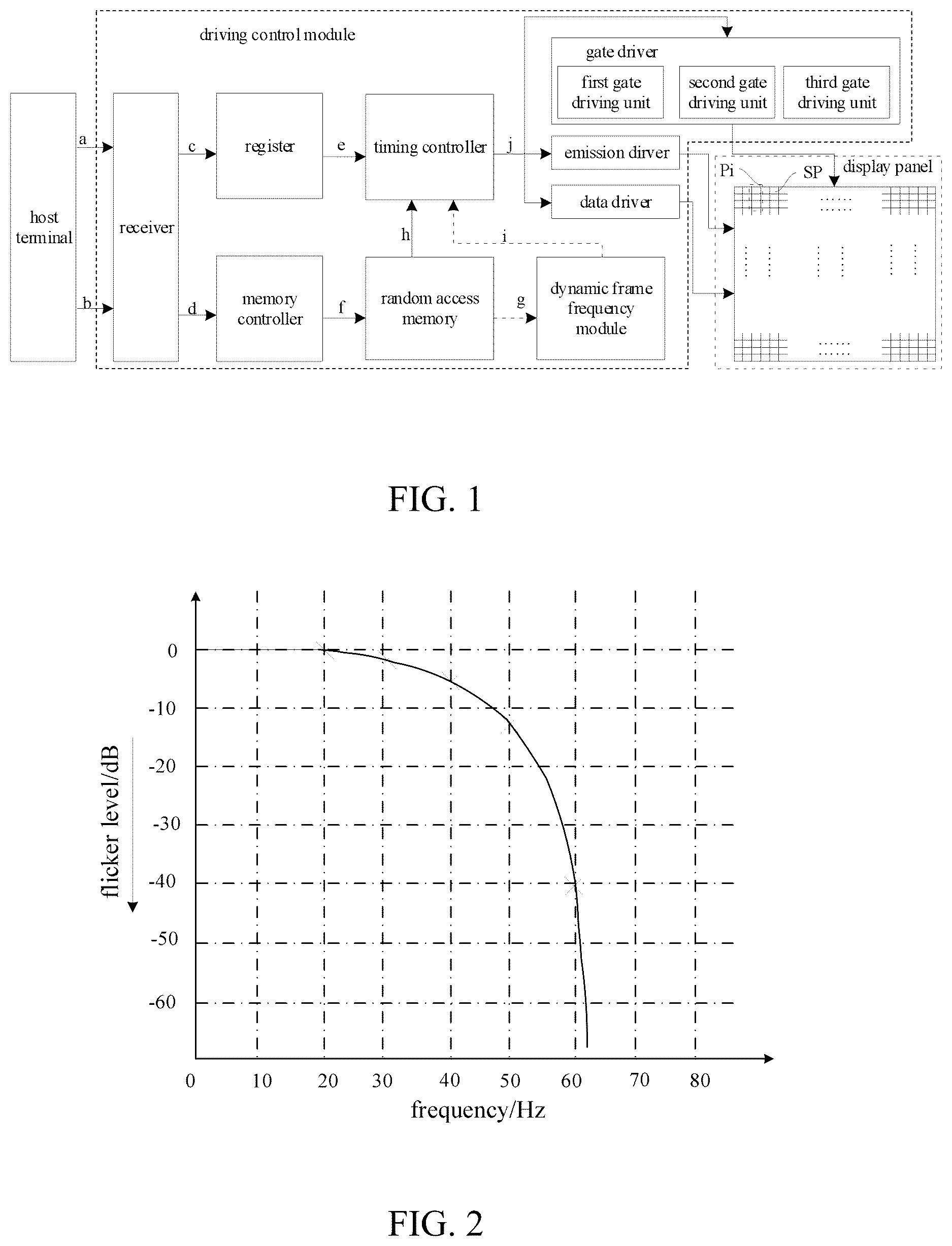
is a structural schematic diagram of the display device provided in one or more embodiments of this application;
is a human eye perception diagram of flickers provided in one or more embodiments of this application;
is a structural schematic diagram of the sub-pixel provided in one or more embodiments of this application;
is a timing diagram under the high-frequency driving mode provided in one or more embodiments of this application;
is a principle diagram of increasing the duration corresponding to each frame provided in one or more embodiments of this application;
is a timing diagram of the writing frame in the ultra-low-frequency driving mode provided in one or more embodiments of this application;
is a schematic diagram of the measured light-emitting waveform at 50 nits provided in one or more embodiments of this application;
is a timing diagram of one display period in the ultra-low-frequency driving mode provided in one or more embodiments of this application;
is a schematic diagram of power consumption test results provided in one or more embodiments of this application.
DETAILED DESCRIPTION
It should be understood that the embodiments described herein are only for the purpose of explaining the present application and do not limit the present application.
Specifically, is the structural schematic diagram of the display device provided in one or more embodiments of this application. The display device includes the display panel and the driving control module.
Optionally, the display panel includes an self-emitting display panel. Optionally, the self-emitting display panel includes an organic light-emitting diode display panel, an sub-millimeter light-emitting diode display panel, an micro light-emitting diode display panel, a quantum dot display panel, etc.
The display panel includes multiple sub-pixels SP, multiple scan lines, multiple data lines, and multiple light-emitting control lines. The multiple sub-pixels SP form multiple pixel units Pi arranged in an array. The multiple scan lines, the multiple data lines, and the multiple light-emitting control lines are electrically connected to the multiple sub-pixels SP to enable the multiple sub-pixels SP to achieve display functions according to corresponding scan signals, data signals Data, and light-emitting control signals EM.
Optionally, each pixel unit Pi includes three sub-pixels SP. Optionally, the three sub-pixels SP included in each pixel unit Pi have different colors of light emission. Wherein, the colors of light emission of the sub-pixels SP include red, green, blue, yellow, white, etc.
Optionally, the driving control module includes a gate driver, an emission driver, and a data driver.
The gate driver is configured to output scan signals to the display panel. Optionally, the gate driver is electrically connected to multiple scan lines to transmit scan signals to multiple sub-pixels SP through multiple scan lines.
Optionally, the gate driver includes a first gate driving unit and a second gate driving unit. The first gate driving unit is configured to output the first scan signals Pscan 1 to the display panel. The second gate driving unit is configured to output the second scan signals Pscan 2 to the display panel.
The emission driver is configured to output the light-emitting control signals EM to the display panel. Optionally, the emission driver is electrically connected to multiple light-emitting control lines to output the light-emitting control signals EM to multiple sub-pixels SP through multiple light-emitting control lines.
The data driver is configured to output the data signals Data to the display panel. Optionally, the data driver is electrically connected to multiple data lines to output the data signals Data to multiple sub-pixels SP through multiple data lines.
Optionally, the driving controller includes a receiver, a register, a timing controller, a memory controller, a random access memory and a dynamic frame frequency module. The principle of the driving controller controlling the gate driver, the data driver, and the emission driver to achieve control of the display states of multiple pixel units Pi is as follows.
First stage: the receiver outputs an instruction c to the register according to the register instruction a input from the host, and the register is configured according to the instruction c.
Second stage: the host inputs an image data signal b to the receiver at certain time intervals (for example, the time intervals of one minute), and the receiver outputs an image data signal d to the memory controller according to the image data signal b input from the host, and the memory controller outputs an image data signal f to the random access memory according to the image data signal d.
Third stage: the register outputs an instruction e for the corresponding timing control setting to the timing controller, and the random access memory outputs an image data signal h to the timing controller according to the image data signal f, and the dynamic frame frequency module outputs the high-frequency switch instruction i to the timing controller after detecting that the random access memory has updated data signal g.
Fourth stage: the timing controller outputs the corresponding high-frequency switch instruction j to the gate driver, the emission driver, and the data driver, to control the display panel to achieve display with the high-frequency driving mode through the gate driver, the emission driver, and the data driver, causing multiple sub-pixels SP to display.
Fifth stage: the host stops outputting image data signals to the receiver, and the dynamic frame frequency module outputs the low-frequency switch instruction i to the timing controller after detecting that the random access memory has no updated data signal g.
Sixth stage: the timing controller outputs the corresponding low-frequency switch instruction j to the gate driver, the emission driver, and the data driver, to control the display panel to achieve display with an ultra-low-frequency driving mode through the gate driver, the emission driver, and the data driver, causing multiple sub-pixels SP to display.
To achieve display functions, the display panel can have multiple display periods. To achieve frequency conversion technology, the duration corresponding to each display period of the display panel can be different. When the display panel displays with the high-frequency driving mode, the display period can include only one writing frame WF. When the display panel displays with the frequency lower than the high-frequency driving mode, the display panel can include one writing frame WF and at least one holding frame HF. The data signal Data is written into the sub-pixel SP during the duration of the valid pulse of the second scan signal Pscan 2 written in the writing frame WF, and the data signal Data written into the sub-pixel SP during the writing frame WF is maintained in the holding frame HF, so that the display panel displays the same information within the total duration tsu of one display period when the display panel displays with the frequency lower than the high-frequency driving mode.
The lower the frequency at which the display panel displays, the more it is conducive to improving the endurance performance of the display device. In particular, to improve the endurance performance of the display device, the display panel can display with an ultra-low frequency. The ultra-low frequency refers to the frequency less than 1 Hz. However, when the display panel displays with the ultra-low frequency, it will cause the more serious flicker problem.
To enable the display panel to apply the ultra-low frequency to achieve display while ameliorating the flicker problem, to achieve the purpose of balancing display performance and endurance performance, this application makes each of the writing frame WF and multiple holding frames HF have the first duration tfr, and the ratio of the number of periods Noft of the light-emitting control signal EM to the first duration tfr within each of the writing frame WF and multiple holding frames HF is greater than the critical flicker frequency CFF, that is, Ncft/tfr>CFF, so that the sub-pixels SP achieve multiple switches between display states and non-display states under the control of the light-emitting control signal EM, respectively, within the writing frame WF and multiple holding frames HF, thereby reducing the viewer's perception of flickers of the display panel within the total duration tsu corresponding to the writing frame WF and multiple holding frames HF, resulting in better display performance of the display panel.
By making the light-emitting control signal EM have the valid pulse and an invalid pulse in each period, the first scan signal Pscan 1 may have the valid pulse during the duration of each invalid pulse of the light-emitting control signal EM written in the writing frame WF and multiple holding frames HF, and the second scan signal Pscan 2 may have the valid pulse during the duration of the invalid pulse of the first period of the light-emitting control signal EM in the writing frame WF, so that within the total duration tsu corresponding to one display period, the sub-pixels SP achieve multiple switches between display states and non-display states according to the same display content under the control of the light-emitting control signal EM, the first scan signal Pscan 1 , and the second scan signal Pscan 2 , respectively, within the writing frame WF and multiple holding frames HF, thereby making the information displayed by multiple sub-pixels SP the same within the total duration tsu corresponding to the writing frame WF and multiple holding frames HF, to achieve the purpose of balancing display performance and endurance performance.
Wherein, the critical flicker frequency CFF is the minimum frequency of the flickering light that the human eye can perceive as stable light. Optionally, the critical flicker frequency CFF is greater than or equal to 45 Hz.
As shown in , which is the human eye perception diagram of flickers provided in the embodiment of this application, since the critical flicker frequency CFF is closely related to display brightness, ambient brightness, viewing distance, and many other factors and is not the constant, and according to , it can be known that when the frequency is greater than or equal to 60 Hz, the human eye can no longer perceive the flicker. Therefore, the ratio of the number of periods Noft of the light-emitting control signal EM to the first duration tfr can be greater than or equal to 60 Hz in each of the writing frame WF and multiple holding frames HF, that is, Ncft/tfr>60 Hz, to ensure that the human eye may not perceive any flicker occurring in the display screen during actual use.
It can be understood that the total duration tsu of one display period is the sum of the multiple first durations tfr corresponding to the writing frame WF and multiple holding frames HF included in one display period. That is, sut=m*tfr. Where m is the total number of frames, and the total number of frames m is the sum of the numbers of the writing frame WF and of the multiple holding frames HF included in one display period.
Optionally, to enable the display panel to achieve display with the ultra-low frequency, the total number of frames m included in one display period needs to be less than or equal to the skip frame limit SKL provided by the driving control module, that is, m≤SKL. Correspondingly, the ratio of the total duration tsu of one display period to the first duration tfr is less than or equal to the skip frame limit SKL provided by the driving control module, that is, tsu/tfr≤SKL. Optionally, the skip frame limit SKL provided by the driving control module is determined by the number of bits of the register included in the driving control module that controls the number of skip frames. Specifically, if the register that controls the number of skip frames is x-bit, then the skip frame limit equals 2{circumflex over ( )}x. For example, if the register that controls the number of skip frames is 8 bits, then the skip frame limit SKL equals 2{circumflex over ( )}8=256; if the register that controls the number of skip frames is 10 bits, then the skip frame limit SKL equals 2{circumflex over ( )}10=1024. Wherein, the register shown in represents all the registers included in the display device, and is not only used to represent the register that controls the number of skip frames.
Optionally, since the data signal Data is written into the sub-pixel SP during the duration of the valid pulse of the second scan signal Pscan 2 in the writing frame WF, and the display panel displays the same information within the total duration tsu of one display period, the target frequency f 1 of the second scan signal Pscan 2 within the total duration tsu of one display period (that is, the sum of the multiple first durations corresponding to the writing frame WF and multiple holding frames HF) can be less than 1 Hz, that is, f 1 <1 Hz. Thereby it is possible for the sub-pixel SP to update the display information according to each display period, thereby achieving ultra-low frequency display of the display panel. Correspondingly, the total duration tsu of one display period is the reciprocal of the target frequency f 1 of the second scan signal Pscan 2 within one display period, that is, tsu=1/f 1 .
Optionally, the target frequency f 1 is the frequency used when the display panel displays with an ultra-low frequency driving mode. That is, the target frequency f 1 can be equal to 0.99 Hz, 0.98 Hz, . . . , 0.9 Hz, 0.89 Hz, . . . , 0.75 Hz, . . . , 0.5 Hz, . . . , 0.11 Hz, 0.1 Hz, 0.099 Hz, 0.098 Hz, . . . , 0.09 Hz, 0.089 Hz, . . . , 0.08 Hz, 0.079 Hz, . . . , 0.07 Hz, 0.069 Hz, . . . , 0.064 Hz, . . . , 0.06 Hz, . . . , 0.05 Hz, . . . , 0.04 Hz, . . . , 0.032 Hz, . . . , 0.03 Hz, . . . , 0.02 Hz, . . . , 0.016 Hz, 0.015 Hz, . . . , 0.01 Hz, 0.009 Hz, 0.008 Hz, . . . , 0.006 Hz, 0.005 Hz, 0.004 Hz, . . . , and so on.
Optionally, within the writing frame WF, a product of the base frequency f 3 of the second scan signal Pscan 2 and the number of periods Noft of the light-emitting control signal EM is equal to the intermediate frequency f 2 of the light-emitting control signal EM, to meet the requirements of the number of periods Noft of the light-emitting control signal EM within each of the writing frame WF and multiple holding frames HF, so that the display screen of the display panel meets the display performance requirements.
Since the data signal Data is written into the sub-pixel SP during the duration of the valid pulse of the second scan signal Pscan 2 in the writing frame WF, and the display panel displays the same information within the total duration tsu of one display period, the first duration tfr of the writing frame WF and each holding frame HF corresponds to the reciprocal of the base frequency f 3 of the second scan signal Pscan 2 , that is, tfr=1/f 3 , to make the sub-pixel SP display the same information within one display period, thereby achieving ultra-low frequency display of the display panel.
Optionally, the frame total number m can be obtained based on the base frequency f 3 and the target frequency f 1 , that is, the ratio of the base frequency f 3 to the target frequency f 1 is equal to the total number of frames m (that is, the ratio of the base frequency f 3 to the target frequency f 1 is equal to the sum of the numbers of writing frames WF and multiple holding frames HF), that is, f 3 /f 1 =m.
The following will explain the working principle corresponding to the high-frequency driving mode and the low-frequency driving mode when the display panel displays, combined with the specific form of the sub-pixel SP. Optionally, is the structural schematic diagram of the sub-pixel provided in one or more embodiments of this application. It can be understood that the structure of the sub-pixel SP is not limited to the form shown in .
Each sub-pixel SP includes a driving transistor Tdr, the first reset transistor Ti 1 , the second reset transistor Ti 2 , the data transistor Tda, the light-emitting control transistor, and the light-emitting device D.
The driving transistor Tdr is configured to generate the driving current according to the data signal Data to drive the light-emitting device D to emit light. Optionally, the driving transistor Tdr includes an input electrode connected to the first node N 1 , an output electrode connected to the second node N 2 , and a control electrode connected to the third node N 3 . Wherein, the control electrode is the gate, the input electrode is one of the source and the drain, and the output electrode is the other of the source and the drain.
The first reset transistor Ti 1 is configured to reset the anode voltage of the light-emitting device D according to the first scan signal Pscan 1 . Optionally, the first reset transistor Ti 1 includes a control electrode configured to receive the first scan signal Pscan 1 , an input electrode configured to receive the first reset signal VI 1 , and an output electrode connected to the fourth node N 4 .
The second reset transistor Ti 2 is configured to reset the input electrode voltage and the output electrode voltage of the driving transistor Tdr according to the first scan signal Pscan 1 . Optionally, the second reset transistor Ti 2 includes a control electrode configured to receive the first scan signal Pscan 1 , an input electrode configured to receive the second reset signal VI 2 , and an output electrode connected to the first node N 1 . The first reset transistor Ti 1 and the second reset transistor Ti 2 are turned on under the level state corresponding to the valid pulse of the first scan signal Pscan 1 , and are cut off under the level state corresponding to the invalid pulse of the first scan signal Pscan 1 .
The data transistor Tda is configured to transmit the data signal Data to the driving transistor Tdr through the first node N 1 according to the second scan signal Pscan 2 . Optionally, the data transistor Tda includes a control electrode configured to receive the second scan signal Pscan 2 , an input electrode configured to receive the data signal Data, and an output electrode connected to the first node N 1 . The data transistor Tda is turned on under the level state corresponding to the valid pulse of the second scan signal Pscan 2 , and is cut off under the level state corresponding to the invalid pulse of the second scan signal Pscan 2 .
The light-emitting control transistor is configured to control the conduction path of the driving current according to the light-emitting control signal EM, allowing or cutting off the current flow. Optionally, the light-emitting control transistor includes a first switch transistor Ts 1 and the second switch transistor Ts 2 . The first switch transistor Ts 1 includes a control electrode configured to receive the light-emitting control signal EM, an input electrode connected to a first power terminal VDD, and an output electrode connected to the first node N 1 . The second switch transistor Ts 2 includes a control electrode configured to receive the light-emitting control signal EM, an input electrode connected to the second node N 2 , and an output electrode connected to the fourth node N 4 . The first switch transistor Ts 1 and the second switch transistor Ts 2 are turned on under the level state corresponding to the valid pulse of the light-emitting control signal EM, and are cut off under the level state corresponding to the invalid pulse of the light-emitting control signal EM.
The light-emitting device D includes an anode connected to the fourth node N 4 and the cathode configured to be connected to the second power terminal VSS. Optionally, the light-emitting device D includes an organic light-emitting diode, the sub-millimeter light-emitting diode, the micro light-emitting diode, etc.
Optionally, please continue to refer to to , the gate driver also includes a third gate driving unit. The third gate driving unit is configured to output the third scan signal Nscan 1 and the fourth scan signal Nscan 2 to the sub-pixel SP.
Optionally, the third scan signal Nscan 1 and the fourth scan signal Nscan 2 both have one valid pulse during the duration of the invalid pulse in the first period of the light-emitting control signal EM in the writing frame WF, to initialize the potential of the third node N 3 in the writing frame WF, and to transmit the data signal Data to the gate of the driving transistor Tdr in the writing frame WF, so that the sub-pixel SP maintains the display in the holding frame HF according to the data signal Data written into the sub-pixel SP within the writing frame WF.
The sub-pixel SP also includes a compensation transistor Tc, the third reset transistor Ti 3 , and the storage capacitor Cst.
The compensation transistor Tc includes a control electrode configured to receive the third scan signal Nscan 1 , an input electrode connected to the third node N 3 , and an output electrode connected to the second node N 2 .
The third reset transistor Ti 3 includes a control electrode configured to receive the fourth scan signal Nscan 2 , an input electrode configured to receive the third reset signal VI 3 , and an output electrode connected to the third node N 3 .
The storage capacitor Cst includes a first electrode connected to the first power terminal VDD and a second electrode connected to the third node N 3 .
Optionally, the active layer of the compensation transistor Tc and the active layer of the third reset transistor Ti 3 both include oxide semiconductors. The active layers of the driving transistor Tdr, the first reset transistor Ti 1 , the second reset transistor Ti 2 , the data transistor Tda, and the light-emitting control transistor all include silicon semiconductors. Optionally, silicon semiconductors include single crystal silicon, polycrystalline silicon, amorphous silicon, and other materials, and oxide semiconductors include at least one of zinc oxide, zinc tin oxide, zinc indium oxide, indium oxide, titanium oxide, indium gallium zinc oxide, indium zinc tin oxide, etc. Optionally, the driving transistor Tdr, the first reset transistor Ti 1 , the second reset transistor Ti 2 , the data transistor Tda, and the light-emitting control transistor are made by low-temperature polycrystalline silicon process.
To ameliorate the flicker problem, the first node N 1 , the second node N 2 , the third node N 3 , and the fourth node N 4 of the sub-pixel SP are made to maintain equal potentials at durations corresponding to the multiple non-display states or display states of the sub-pixel SP within the writing frame WF and each holding frame HF.
Optionally, during the duration of multiple invalid pulses of the light-emitting control signal EM, the potential of the first node N 1 remains equal, the potential of the second node N 2 remains equal, the potential of the third node N 3 remains equal, and the potential of the fourth node N 4 remains equal, to ameliorate the flicker problem.
Optionally, the voltage value of the second reset signal VI 2 can be controlled to achieve equal potentials of the first node N 1 and the second node N 2 during the duration of multiple invalid pulses of the light-emitting control signal EM. Optionally, the driving transistor Tdr is the P-type transistor. During duration of each valid pulse period of the first scan signal Pscan 1 , the potential difference between the third node N 3 and the second reset signal VI 2 is less than the threshold voltage of the driving transistor Tdr. This configuration ensures that when the second reset transistor Ti 2 is turned on, the driving transistor Tdr is also turned on. Consequently, the second reset transistor Ti 2 resets the input electrode potential (i.e., the potential of the first node N 1 ) and the output electrode potential (i.e., the potential of the second node N 2 ) of the driving transistor Tdr according to the first scan signal Pscan 1 .
is the timing diagram under the high-frequency driving mode provided in the embodiment of this application. Taking the case where the frequency corresponding to the high-frequency driving mode is 60 Hz, the driving transistor Tdr, the first reset transistor Ti 1 , the second reset transistor Ti 2 , the data transistor Tda, the first switch transistor Ts 1 , and the second switch transistor Ts 2 are all P-type transistors, and the compensation transistor Tc and the third reset transistor Ti 3 are all N-type transistors as an example, the working principle of the sub-pixel SP shown in is explained. One display period includes only the writing frame WF, and the writing frame WF includes an initialization stage P 1 , a data writing stage P 2 , a node reset stage P 3 , and a light-emitting stage P 4 .
Initialization stage P 1 : the light-emitting control signal EM, the first scan signal Pscan 1 , the second scan signal Pscan 2 , the third scan signal Nscan 1 , and the fourth scan signal Nscan 2 all correspond to the high-level state. The third reset transistor Ti 3 is turned on in response to the fourth scan signal Nscan 2 , the compensation transistor Tc is turned on in response to the third scan signal Nscan 1 , causing the driving transistor Tdr to be connected in diode mode. And the driving transistor Tdr is turned on, and the third reset signal resets the potentials of the third node N 3 , the second node N 2 , and the first node N 1 . The first reset transistor Ti 1 and the second reset transistor Ti 2 are both cut off in response to the first scan signal Pscan 1 , the data transistor Tda is cut off in response to the second scan signal Pscan 2 , and the first switch transistor Ts 1 and the second switch transistor Ts 2 are both cut off in response to the light-emitting control signal EM.
Data writing stage P 2 : the light-emitting control signal EM, the first scan signal Pscan 1 , and the third scan signal Nscan 1 all correspond to the high-level state, and the second scan signal Pscan 2 and the fourth scan signal Nscan 2 both correspond to the low-level state. The data transistor Tda is turned on in response to the second scan signal Pscan 2 , and the compensation transistor Tc is turned on in response to the third scan signal Nscan 1 , causing the driving transistor Tdr to be connected in diode mode and turned on. The data signal Data is transmitted to the third node N 3 through the data transistor Tda, the first node N 1 , the driving transistor Tdr, the second node N 2 , and the compensation transistor Tc, to achieve writing of the data signal Data and capturing of the threshold voltage of the driving transistor Tdr. The first reset transistor Ti 1 and the second reset transistor Ti 2 are both cut off in response to the first scan signal Pscan 1 , the first switch transistor Ts 1 and the second switch transistor Ts 2 are both cut off in response to the light-emitting control signal EM, and the third reset transistor Ti 3 is cut off in response to the fourth scan signal Nscan 2 .
Node reset stage P 3 : the light-emitting control signal EM and the second scan signal Pscan 2 both correspond to the high-level state, and the first scan signal Pscan 1 , the third scan signal Nscan 1 , and the fourth scan signal Nscan 2 all correspond to the low-level state. The first reset transistor Ti 1 and the second reset transistor Ti 2 are both turned on in response to the first scan signal Pscan 1 , and the first reset signal VI 1 resets the potential of the fourth node N 4 . The second reset signal VI 2 has the higher voltage value, and the voltage difference between the gate and the source of the driving transistor Tdr is the voltage difference between the third node N 3 and the first node N 1 . Therefore, as long as the voltage difference between the third node N 3 and the first node N 1 is less than the threshold voltage of the driving transistor Tdr, the driving transistor Tdr can be turned on, thereby causing the second reset signal VI 2 to reset the potentials of the first node N 1 and the second node N 2 . The data transistor Tda is cut off in response to the second scan signal Pscan 2 , the compensation transistor Tc is cut off in response to the third scan signal Nscan 1 , the third reset transistor Ti 3 is cut off in response to the fourth scan signal Nscan 2 , and the first switch transistor Ts 1 and the second switch transistor Ts 2 are both cut off in response to the light-emitting control signal EM.
Light-emitting stage P 4 : the light-emitting control signal EM, the third scan signal Nscan 1 , and the fourth scan signal Nscan 2 all correspond to the low-level state, and the first scan signal Pscan 1 and the second scan signal Pscan 2 both correspond to the high-level state. The first switch transistor Ts 1 and the second switch transistor Ts 2 are both turned on in response to the light-emitting control signal EM, and the driving transistor Tdr maintains conduction under the action of the storage capacitor Cst, and the driving current generated by the driving transistor Tdr according to the data signal Data flows between the first power terminal VDD and the second power terminal VSS, causing the light-emitting device D to emit light. The first reset transistor Ti 1 and the second reset transistor Ti 2 are both cut off in response to the first scan signal Pscan 1 , the data transistor Tda is cut off in response to the second scan signal Pscan 2 , the compensation transistor Tc is cut off in response to the third scan signal Nscan 1 , and the third reset transistor Ti 3 is cut off in response to the fourth scan signal Nscan 2 .
Wherein, the potential changes of the first node N 1 , the second node N 2 , the third node N 3 , and the fourth node N 4 of the sub-pixel SP in the corresponding high-frequency driving mode are as shown in Table 1. The Vth in Table 1 is the threshold voltage of the driving transistor Tdr, and Lum. vo represents the potential that actually has the certain range of fluctuation due to the change of the charging and discharging state of the circuit.
TABLE 1
Stage
Node N1 N2 N3 N4
P1 VI2+|Vth| VI2 Lum.vo VI2
P2 Data Data−|Vth| Lum.vo Data−|Vth|
P3 VI3 VI3 VI1 Data−|Vth|
P4 VDD Lum.vo Lum.vo Data−|Vth|
To achieve the display function of the ultra-low frequency driving mode while ameliorating the flicker problem caused by the ultra-low frequency driving mode, the duration corresponding to each frame (1 Frame) in one display period of the ultra-low frequency driving mode is increased, and then the display function of the ultra-low frequency driving mode is achieved in conjunction with the skip frame method.
is the principle diagram of increasing the duration corresponding to each frame provided in the embodiment of this application. Wherein, VBP in represents the vertical back porch, VFP represents the vertical front porch, HBP represents the horizontal back porch, HFP represents the horizontal front porch, y 1 , y 3 , and y 5 all represent the number of rows of pixel units Pi, and y 2 , y 4 , and y 6 all represent the number of columns of pixel units Pi, y 1 ≠y 3 ≠y 5 , y 2 ≠y 4 ≠y 6 .
Due to the fact that the resolution of the display panel is fixed after fabrication, if one wishes to increase the duration corresponding to each frame, the driving control module can be made to believe that the number N V-porch of scan lines it needs to control is greater than the number of rows of pixel units Pi, and/or the number N H-line of pixel units Pi it needs to control per row is greater than the number of columns of pixel units Pi. That is, it is possible to increase the number N V-porch of scan lines to be controlled without changing the number N H-line of pixel units Pi to be controlled per row, so that the number of lines to be scanned per frame increases, thereby achieving an increase in the duration corresponding to each frame. It is also possible to increase the scan time N H-line /f osc of each pixel unit Pi per row without changing the number N V-porch of scan lines to be controlled, thereby achieving an increase in the duration corresponding to each frame. It is also possible to increase the number N V-porch of scan lines to be controlled and the scan time N H-line /f osc of each pixel unit Pi per row, thereby achieving an increase in the duration corresponding to each frame. Wherein, f osc represents the oscillation frequency of the driving control module, and 1/f osc represents the time required for the driving control module to control the pixel unit Pi to display.
The duration T frame =N V-porch *N H-line /f osc corresponding to each frame, and due to the functional limitations of the driving control module, the values of N H-line and N V-porch both have an upper limit. For example, if the register that controls the number of skip frames is 10 bits, N H-line can be up to 1024, and N V-porch can be up to VAA+1028, where VAA is the minimum value that N V-porch can take.
After increasing the duration corresponding to each frame, the ratio (that is, t1*f osc =N V-porch *N H-line ) of the first duration tfr corresponding to the writing frame WF and each holding frame HF included in one display period to the duration required for the driving controller to control one pixel unit Pi to display is greater than the number of pixel units Pi of the display device.
Since flicker will occur when each frame is displayed at the frequency lower than the critical flicker frequency CFF, the timing is optimized. Specifically, in the initialization stage P 1 , the data writing stage P 2 , and the node reset stage P 3 of the writing frame WF, the working principle of the display panel achieving display with the high-frequency driving mode and the ultra-low frequency driving mode is similar. However, when achieving display with the ultra-low driving mode, the light-emitting stage P 4 includes multiple light-emitting sub-stages and multiple non-light-emitting sub-stages. In each light-emitting sub-stage, the light-emitting control signal EM has the valid pulse, and the first scan signal Pscan 1 , the second scan signal Pscan 2 , the third scan signal Nscan 1 , and the fourth scan signal Nscan 2 all have invalid pulses, so that the first switch transistor Ts 1 and the second switch transistor Ts 2 are both turned on in response to the light-emitting control signal EM. The driving transistor Tdr controls the illumination of the light-emitting device D by allowing the driving current generated from the data signal Data to flow between the first power supply terminal VDD and the second power supply terminal VSS. In each non-light-emitting sub-stage, the light-emitting control signal EM, the third scan signal Nscan 1 and the fourth scan signal Nscan 2 all have invalid pulses. The first scan signal Pscan 1 has the valid pulse during the duration when the light-emitting control signal EM has the invalid pulse, and the duration of the valid pulse of the first scan signal Pscan 1 is less than or equal to the duration of the invalid pulse maintained by the light-emitting control signal EM, so that the first reset transistor Ti 1 and the second reset transistor Ti 2 are both turned on in response to the first scan signal Pscan 1 , and the first reset signal VI 1 resets the potential of the fourth node N 4 . The second reset signal VI 2 has the higher voltage value, which causes the driving transistor Tdr to be turned on, thereby causing the second reset signal VI 2 to reset the potentials of the first node N 1 and the second node N 2 . By switching between display states and non-display states in the sub-pixel SP within the light-emitting stage, the display frequency is increased, thereby ameliorating the flicker problem.
Specifically, the timing diagram of the writing frame WF in the ultra-low frequency driving mode is explained first. is the timing diagram of the writing frame WF in the ultra-low frequency driving mode provided in the embodiment of this application. Taking a case where in the first duration tfr corresponding to the writing frame WF, the base frequency f 3 of the second scan signal Pscan 2 is 16 Hz, the driving transistor Tdr, the first reset transistor Ti 1 , the second reset transistor Ti 2 , the data transistor Tda, the first switch transistor Ts 1 , and the second switch transistor Ts 2 are all P-type transistors, and the compensation transistor Tc and the third reset transistor Ti 3 are N-type transistors as an example, the working principle of the sub-pixel SP in the light-emitting stage P 4 of the ultra-low frequency driving mode is explained. The light-emitting stage P 4 includes the first light-emitting sub-stage P 41 , the first non-light-emitting sub-stage P 42 , the second light-emitting sub-stage P 43 , the second non-light-emitting sub-stage P 44 , the third light-emitting sub-stage P 45 , the third non-light-emitting sub-stage P 46 , and the fourth light-emitting sub-stage P 47 .
In the first light-emitting sub-stage P 41 , the second light-emitting sub-stage P 43 , the third light-emitting sub-stage P 45 , and the fourth light-emitting sub-stage P 47 : the light-emitting control signal EM, the third scan signal Nscan 1 , and the fourth scan signal Nscan 2 all correspond to the low-level state, and the first scan signal Pscan 1 and the second scan signal Pscan 2 both correspond to the high-level state. The first switch transistor Ts 1 and the second switch transistor Ts 2 are both turned on in response to the light-emitting control signal EM, and the driving transistor Tdr maintains conduction under the action of the storage capacitor Cst, and the driving current generated by the driving transistor Tdr according to the data signal Data flows between the first power terminal VDD and the second power terminal VSS, causing the light-emitting device D to emit light.
In the first non-light-emitting sub-stage P 42 , the second non-light-emitting sub-stage P 44 , and the third non-light-emitting sub-stage P 46 : the light-emitting control signal EM and the second scan signal Pscan 2 both correspond to the high-level state, the third scan signal Nscan 1 and the fourth scan signal Nscan 2 both correspond to the low-level state, and the first scan signal Pscan 1 has the low-level state for a certain duration within the duration when the light-emitting control signal EM corresponds to the high-level state. The first reset transistor Ti 1 and the second reset transistor Ti 2 are both turned on in response to the first scan signal Pscan 1 , and the first reset signal VI 1 resets the potential of the fourth node N 4 . The second reset signal VI 2 has a higher voltage value, which causes the driving transistor Tdr to be turned on, and the second reset signal VI 2 resets the potentials of the first node N 1 and the second node N 2 .
Wherein, the potential changes of the first node N 1 , the second node N 2 , the third node N 3 , and the fourth node N 4 of the sub-pixel SP in the corresponding high-frequency driving mode are as shown in Table 2.
It can be known from Table 2 that in the multiple non-light-emitting sub-stages, the potentials of the first node N 1 , the second node N 2 , the third node N 3 , and the fourth node N 4 remain equal. In the multiple light-emitting sub-stages, the potentials of the first node N 1 , the second node N 2 , the third node N 3 , and the fourth node N 4 remain equal, so that the display brightness of the sub-pixel SP can be kept consistent in each light-emitting sub-stage.
TABLE 2
Stage
Node N1 N2 N3 N4
P1 VI2+|Vth| VI2 Lum.vo VI2
P2 Data Data−|Vth| Lum. vo Data−|Vth|
P3 VI3 VI3 VI1 Data−|Vth|
P41 VDD Lum.vo Lum.vo Data−|Vth|
P42 VI3 VI3 VI1 Data−|Vth|
P43 VDD Lum.vo Lum.vo Data−|Vth|
P44 VI3 VI3 VI1 Data−|Vth|
P45 VDD Lum.vo Lum.vo Data−|Vth|
P46 VI3 VI3 VI1 Data−|Vth|
P47 VDD Lum.vo Lum.vo Data−|Vth|
is the schematic diagram of the measured light-emitting waveform at 50 nits provided in the embodiment of this application. By making the light-emitting stage include multiple light-emitting sub-stages and multiple non-light-emitting sub-stages, the display brightness of the sub-pixel SP can be kept consistent in each light-emitting sub-stage, and the flicker problem can also be ameliorated.
In the embodiment shown in , the base frequency f 3 of the second scan signal Pscan 2 is 16 Hz in the first duration tfr corresponding to the writing frame WF, and the number of periods Noft of the light-emitting control signal EM is 4, so the intermediate frequency f 2 of the light-emitting control signal EM is 64 Hz. Wherein, the number of periods Ncft of the light-emitting control signal EM can be determined based on the sum of the numbers of light-emitting sub-stages and non-light-emitting sub-stages included in the writing frame WF. That is, the stage corresponding to the initialization stage P 1 , the data writing stage P 2 , and the node reset stage P 3 of the writing frame WF is also a non-light-emitting sub-stage, and the sum of the numbers of the non-light-emitting sub-stage composed of the initialization stage P 1 , the data writing stage P 2 , and the node reset stage P 3 , and the light-emitting sub-stages included in the light-emitting stage, is equal to twice the number of periods Ncft of the light-emitting control signal EM. That is, each period T of the light-emitting control signal EM actually corresponds to a non-light-emitting sub-stage and a light-emitting sub-stage.
Optionally, the number of periods Ncft of the light-emitting control signal EM is an integer, so that the number of light-emitting sub-stages and non-light-emitting sub-stages included in each frame can be kept equal in the subsequent skip frame to achieve the ultra-low frequency display mode.
To achieve the display function of the ultra-low frequency driving mode, the light-emitting stage also correspondingly includes multiple light-emitting sub-stages and multiple non-light-emitting sub-stages in each holding frame HF. Optionally, the number of light-emitting sub-stages included in each holding frame HF is equal to the number of light-emitting sub-stages included in the writing frame WF, and the number of non-light-emitting sub-stages included in each holding frame HF is equal to the number of non-light-emitting sub-stages included in the writing frame WF, so that the writing frame WF and each holding frame HF correspondingly have the first duration tfr.
After increasing the duration corresponding to each frame, the number of skip frame corresponding to one display period in the ultra-low frequency driving mode is explained. is the timing diagram of one display period in the ultra-low frequency driving mode provided in the embodiment of this application. For example, within the total duration tsu of a display period, the target frequency f 1 of the second scan signal Pscan 2 is 0.016 Hz; within the first duration tfr corresponding to the write-in frame WF, the base frequency f 3 of the second scan signal Pscan 2 is 16 Hz. Combining the sub-pixels shown in , an explanation is provided for the number of skip frame corresponding to one display period when using the ultra-low frequency drive mode.
In each holding frame HF, the sub-pixel SP switches between display states and non-display states under the control of the light-emitting control signal EM. The total number of frames m=16/0.016=1000 (that is, the sum of the number of writing frames WF and the multiple holding frames HF included in one display period is equal to 16/0.016=1000), that is, one display period includes one writing frame WF (that is, corresponding to the 1 st 16 Hz in ) and 999 holding frames HF (that is, corresponding to the 2 nd to 999 th 16 Hz and the 1000 th 16 Hz in ). And the number of skip frame SKF is equal to the number of the multiple holding frames HF included in one display period, that is, the number of skip frame SKF is equal to 999.
Optionally, the number of skip frame SKF is an integer, so that each display period includes an integer number of writing frames WF and holding frames HF. Optionally, the number of skip frame SKF is less than the skip frame limit SKL, so that the display device can achieve the desired target frequency.
By including one writing frame WF and multiple holding frames HF in one display period, the display panel displays the same display content within the total duration tsu of one display period. And since the sub-pixel SP has made multiple switches between display states and non-display states in the first duration tfr corresponding to the writing frame WF and each holding frame HF, it is possible to make the human eye unable to perceive the flicker of the display panel within the total duration tsu of one display period.
It can be understood that in addition to achieving the display at the target frequency f 1 of 0.016 Hz, more corresponding ultra-low frequency displays can be obtained based on the relationships between the target frequency f 1 , the intermediate frequency f 2 , the base frequency f 3 , the number of periods Noft of the light-emitting control signal EM, the total number of frames m, the first duration tfr, and the total duration tsu. Only some examples corresponding to the skip frame limit SKL equal to 2∧10=1024 are shown in Table 3, and the scope of this application is not limited thereto.
It can be known from Table 3 that there can be multiple basic frequencies f 3 to achieve the target frequency f 1 , and there can also be multiple intermediate frequencies f 2 to achieve the target frequency f 1 . There is a maximum base frequency fmax among the multiple basic frequencies f 3 , and there is a minimum intermediate frequency fmin among the multiple intermediate frequencies f 2 . Wherein, in the first duration tfr corresponding to the writing frame WF and each holding frame HF included in one display period, the number of periods Ncft of the light-emitting control signal EM is greater than or equal to the ratio of the minimum intermediate frequency to the maximum base frequency, that is, Ncft>fmin/fmax.
TABLE 3
Number Total
Target Intermediate Base of number of
frequency frequency frequency First duration periods frame Total duration
f1 f2 f3 tfr Ncft m tsu
0.008 64 4 0.25 16 500 125
0.008 128 4 0.25 32 500 125
0.008 64 8 0.125 8 1000 125
0.008 128 8 0.125 16 1000 125
0.015 60 3 0.3333333 20 200 66.666667
0.015 90 6 0.1666667 15 400 66.666667
0.015 120 12 0.0833333 10 800 66.666667
0.015 150 15 0.0666667 10 1000 66.666667
0.016 64 8 0.125 8 500 62.5
0.016 128 8 0.125 16 500 62.5
0.016 64 16 0.0625 4 1000 62.5
0.016 128 16 0.0625 8 1000 62.5
0.032 64 16 0.0625 4 500 31.25
0.032 128 16 0.0625 8 500 31.25
0.032 64 32 0.03125 2 1000 31.25
0.032 128 32 0.03125 4 1000 31.25
0.05 60 15 0.0666667 4 300 20
0.05 120 30 0.0333333 4 600 20
0.05 60 10 0.1 6 200 20
0.1 60 10 0.1 6 100 10
0.1 60 30 0.0333333 2 300 10
0.5 60 30 0.0333333 2 60 2
Wherein, tfr = 1/f3;
Ncft = f2/f3;
m = f3/f1 = tsu/tfr;
tsu = 1/f1 = tfr*m;
SKF = m-1;
The maximum base frequency fmax can be determined based on the skip frame limit SKL and the target frequency f 1 . For example, by calculating the differences between the ratios of the multiple basic frequencies f 3 to the target frequency f 1 and the skip frame limit SKL, multiple first differences can be obtained. The base frequency f 3 corresponding to the smallest difference among the multiple first differences is the maximum base frequency fmax. Wherein, the ratios of the multiple basic frequencies f 3 and the target frequency f 1 are all less than the skip frame limit SKL.
The minimum intermediate frequency fmin can be determined based on a product of the critical flicker frequency CFF and the number of periods Ncft. For example, by calculating the differences between the multiple intermediate frequencies f 2 and the critical flicker frequency CFF, multiple second differences can be obtained. The intermediate frequency f 2 corresponding to the smallest difference among the multiple second differences is the minimum intermediate frequency fmin. Wherein, the multiple intermediate frequencies f 2 are all greater than the critical flicker frequency CFF.
That is, if the skip frame limit SKL is equal to 2∧10=1024 and the target frequency f 1 is 0.016 Hz, then the minimum intermediate frequency fmin is 64 Hz, the maximum base frequency fmax is 16 Hz, so in the first duration tfr corresponding to the writing frame WF and each holding frame HF included in one display period, the number of periods Ncft of the light-emitting control signal EM is greater than or equal to 4.
It can be understood that in the ultra-low frequency driving display mode, depending on the different target frequencies f 1 to be achieved, the timing of the writing frame WF and the timing of one display period will also be different from those corresponding to and . Those skilled in the art can obtain the timing of the writing frame WF and the timing of one display period corresponding to the target frequency f 1 to be achieved based on this application, and for the sake of saving words, other embodiments are not described in detail in this application.
Table 4 is the flicker test result table obtained when the base frequency f 3 is 16 Hz, the intermediate frequency f 2 is 64 Hz, and the target frequency f 1 is 0.016 Hz.
TABLE 4
Mode AOD(Always On Display) SPEC.
Frame rate 60 30 15 10 5 1 0.1 0.06 0.016 —
flicker/dB −62.9 −62.9 −62.9 −63 −63 −63 −63.5 −64.2 −45.9 <−30
By Table 4, it can be known that when the display panel displays with the target frequency f 1 of 0.016 Hz in the ultra-low frequency driving mode, the flicker degree of the display panel is still less than the specification value. Therefore, the display panel can achieve ultra-low frequency display while ensuring that the human eye cannot perceive the flickers, resulting in better display performance.
is the schematic diagram of power consumption test results provided in the embodiment of this application. Wherein, 25% OPR refers to 25% of the display area of the screen emitting light, and 10% OPR refers to 10% of the display area of the screen emitting light. As can be seen from , compared to the existing display implementation using a low-frequency drive mode, the display implementation using an ultra-low frequency drive mode according to this application results in a power consumption reduction of 14.1% at 25% OPR and a reduction of 18.4% at 10% OPR. Therefore, the purpose of reducing power consumption can be achieved, which can give the display device better endurance.
It can be understood that the display device includes portable display devices (such as notebook computers, mobile phones, etc.), fixed terminals (such as desktop computers, televisions, etc.), and measuring devices (such as sports bracelets, thermometers, etc.).
For those skilled in the art, based on the idea of this application, there will be changes in specific implementation methods and application ranges. The content of this description should not be understood as limiting the scope of this application.
Figures (6)
Citations
This patent cites (20)
- US2017/0004766
- US2018/0218678
- US2018/0315374
- US2019/0122612
- US2020/0082768
- US2020/0394961
- US2021/0125559
- US2021/0264857
- US2022/0366830
- US2024/0021142
- US2024/0078972
- US111968574
- US112086062
- US113906495
- US114038383
- US114078445
- US115662328
- US20170003849
- US20210107934
- US102453259