Systems and Methods for Decreasing Counterparty Settlement Risk
Abstract
Apparatus, systems and methods improve efficiency in transacting a swap or other futures based financial instrument, by using time-weighted index averages to decrease counterparty settlement risk. In preferred embodiments related to Bitcoin and several other cryptocurrencies, the swaps are based upon a time-weighted index average (D wa ) of multiple instances of difficulty (D x to D y ) of mining the cryptocurrency over multiple time periods (P x to P y ) where both Ds and Ps are available from the decentralized public blockchain. Traders can use these time-weighted index averages in conjunction with the anticipated values of Ds and Ps for the remainder of the duration of the index, to calculate the index value at any given time.
Claims (11)
1 . A method of improving efficiency of a computing machine mining digital assets on a blockchain, comprising operating the computing machine with computer-executable instructions that when executed cause the computing machine to execute the following steps: producing an index based in part on tracking, via blockchain data, a time between multiple instances of a difficulty change (D x to D y ) of mining a first digital asset recorded on the blockchain over multiple time periods (P x to P y ), where x is at least 1 and y is at least 2, and wherein the difficulty change of mining the first digital asset is related to a global hashrate of the first digital asset stored on the blockchain; providing an operator of the computing machine blockchain-verified access to the index; and the operator changing allocation of the computing machine mining the first digital asset thereby improving the efficiency, based at least in part on the blockchain-derived index.
Show 10 dependent claims
2 . The method of claim 1 , wherein at least one of the time periods (P x to P y ) is a consecutive block of 24 hours.
3 . The method of claim 1 , wherein P x is a time period beginning at a commencement of buying or selling a financial instrument.
4 . The method of claim 1 , wherein P x is a time period beginning at least one day after a commencement of buying or selling a financial instrument.
5 . The method of claim 1 , wherein changing allocation of the computing machine comprises at least one of (i) switching the computing machine from mining the first digital asset to mining a second digital asset or (ii) reducing the computing machine mining the first digital asset.
6 . The method of claim 1 , wherein the index provides a heavier weight to higher values of x.
7 . The method of claim 1 , wherein a financial instrument refers to the index, and the financial instrument comprises a futures contract.
8 . The method of claim 1 , wherein a financial instrument refers to the index, and the financial instrument comprises a cash settled futures contract.
9 . The method of claim 1 , wherein the first digital asset comprises a cryptocurrency.
10 . The method of claim 9 , wherein the index is further based in part on a period function of a global hashrate of the cryptocurrency.
11 . The method of claim 1 , wherein the computing machine is in communication with a clearinghouse processor that executes orders for a financial instrument.
Full Description
Show full text →
FIELD OF THE INVENTION
The field of the invention is computing systems for handling financial transactions.
BACKGROUND
This background description includes information that may be useful in understanding the present invention. It is not an admission that any of the information provided herein is prior art or relevant to the presently claimed invention, or that any publication specifically or implicitly referenced is prior art.
Indices and Swaps
An index is a measure of anything. Indices have a pre-defined formula so that anyone can calculate and verify it independently at any time. Indices usually track a metric that is meaningful economically but is not readily available without doing a bunch of calculations. e.g. S&P 500 tracks average prices of large cap stocks which conveys the health of economy and VIX tracks the volatility of stocks which conveys perceived risk in the economy.
Exchange traded financial instruments such as swaps are used by commodity producers and speculators to hedge and speculate on the variable economics of commodity prices. Swaps have been in existence for nearly 140 years. Each swap is anchored to an index.
A swap is a trade between two parties (called counterparties), a buyer and a seller, where the buyer is betting that an index will increase and the seller is betting that it will decrease. Therefore, they enter a swap, a contractual agreement through which they agree to exchange payments based on an index over a fixed period of time.
At the heart of a swap is an exchange of variable or risky cash flow (that tracks the index) for a fixed predictable cash flow. The receiver of the fixed cash flow is called the seller of the swap.
The exchange of cash is called settlement. Settlements can happen at regular intervals during the lifetime (duration) of the swap. Settlement value is the difference between the current value of the index to the value of the index at previous settlement. Therefore, the sum of all settlements is equal to difference between the final index price and the initial index price. The former represents the variable cash flow and the latter represents the fixed cash flow.
Settlement frequency is typically anywhere from 1 day to 1 year and duration is typically anywhere from 1 month to few years.
Settlement is based on some index, the value of which is publicly available and an least in theory cannot be manipulated e.g. LIBOR, or crude oil index, or global commodity prices etc. As a result, the price of the swap (the price at which the Seller will sell the swap to the buyer on day 1) will be equal to the anticipated value of the index at the expiration of the swap.
If an index has a beginning value of 4.5 and the end of day prices are as follows, then the daily buyer to seller or seller to buyer payouts will be as follows:
Index End Of
Day Day Price (Mark) Net Settlement
1 4.8 $0.3 seller to buyer
2 4.7 $0.1 buyer to seller
3 4.5 $0.2 buyer to seller
. . . . . . . . .
29 4.2 . . .
30 4.6 $0.4 seller to buyer
Daily variable payment from seller to buyer=Index value on a given day—Index value on previous day. The end of day value is also called ‘mark’ and this type of settlement as ‘mark-to-market’ settlement.
Daily settlement reduces default risk: The Index values will change every day from the Day 1 value and the buyer and seller will exchange cash daily to reflect that change. As a result, although the Day 30 value may be significantly different from Day 1 value, the cash exchange on Day 30 only reflects the change from Day 29.
In an illustrative example, a broker launches a −3 yr interest rate swap that exchanges Prime+1% for a Fixed rate of 2%, with weekly settlement. This swap allows the seller to swap a variable interest rate for a fixed rate. If Trader A sells $10,000 worth of these swaps to Trader B, then every week for the next three years, A will owe to B, $10,000*(whatever the current Prime rate is +1%)/52, and B will owe to A, $10,000*2%/52=$3.8462. The settlement will be a ‘net settlement’ which means if A's amount owed to B is greater than what B owes to A, then A will just pay the difference; and vice versa. In such swaps the notional is not exchanged between the counterparties. The notional is only used to determine the multiplier for the cash flows.
Swaps and Digital Assets
It is possible to extend swaps to indices that track aspects of digital assets, including for example, difficulty in mining Bitcoin or other cryptocurrency.
In the example above, the swap was based on the current (spot) prime rate, therefore, it tracks the prime rate index. Abandoned US patent application number 2017/0103458 to Pierce (the '358 application) describes a similar invention-a swap or a future based on an index that tracks the spot ‘difficulty’ of mining cryptocurrencies. The '358 application is incorporated by reference herein in its entirety. Where a definition or usage of a term in the '358 application is inconsistent or contrary to how that term is used herein, the usage of that term herein applies to interpretation of teachings herein, and the definition or usage of that term in the reference does not apply.
The solution taught in the '358 application does not, however, solve several complexities idiosyncratic to crypto, and especially Bitcoin mining. As described below, the math of the solution disclosed in the '358 application has large gaps that would lead to large tracking errors.
Bitcoin mining is a ‘congestion game’. Miners deploy computing resources to solve a cryptographic puzzle and the first miner to solve the puzzle wins the reward (block reward). As a result, the probability of a miner winning the reward E is equal to the percentage of their compute relative to the compute deployed by all miners engaged in solving this puzzle a.k.a.
•
• Global hashrate=G • Miner's hashrate=M • Rate at which block are being generated=R • Probability of the miner winning a reward, Prob=M/G • Probability of a unit hashrate winning a reward, Prob∝1/G, where ∝ represents proportionality • The total expected reward earned by a unit hashrate in a given time, E∝R/G
The reward E is embedded in the new block that is added to the chain, therefore, R also represents the rate of growth of the chain. The Bitcoin software automatically adjusts the difficulty of the puzzle such that R=6 blocks/hour a.k.a. the combined compute resources of all the miners can solve the puzzle and add a new block on the chain on average in 10 minutes. If the puzzle is being solved in less than 10 minutes, then the Bitcoin software will make the puzzle more difficult and if the puzzle is being solved in more than 10 minutes then the difficulty will be reduced.
The software makes this adjustment periodically but since there is no concept of universal time in most early chains such as Bitcoin, the block height a.k.a. the length of the chain serves as a proxy for time. The software, therefore, makes the adjustment after every 2016 blocks. That has an unintended consequence—there is no assurance how much real time will elapse before 2016 blocks are added e.g. if G declines by 50% it could be a full month before the difficulty is adjusted, or if G increases by 100% the difficulty will get adjusted within a week. As we will demonstrate below, it is critical to track the time elapsed between difficulty changes for a perfect hedging instrument. Prior inventions have completely ignored this aspect.
•
• Global hashrate prior to difficulty adjustment=G prev • Difficulty after adjustment=D • D∝G prev • R∝G/D • E∝R/(G×D)=>E∝1/D
As shown above, E does not depend on current G; it only depends G prev a.k.a. D. One way to resolve this problem is to use an index that tracks D, and a future that settles on the final value of D. The '358 application teaches that solution, which unfortunately leads to several problems.
First, the solution taught by '358 application produces an average tracking error of ˜5%, in addition to high rebalancing cost.
Second, since a miner's reward E is proportional to inverse of D, buying an instrument that settles to D will require constant rebalancing for the hedge to be maintained as D changes. e.g. a 30% increase in D corresponds to 23% (i.e. 1-1/1.3) decline in mining revenue whereas a 30% decrease in D will correspond to 43% increase in mining revenue.
Thus, there is still a need for systems and methods that improve efficiency in transacting swaps or other futures based financial instruments, by decreasing counterparty settlement risk.
SUMMARY OF THE INVENTION
The subject matter disclosed and claimed herein provides apparatus, systems and methods that improve efficiency in transacting a swap or other futures based financial instrument, by using time-weighted index averages to decrease counterparty settlement risk. A significant benefit is that implementation of the claimed subject matter can produce a tracking error of <0.1%, with no rebalance required from start to expiration.
In preferred embodiments related to Bitcoin, several other cryptocurrencies, and potentially other digital assets, the swaps are based upon a time-weighted index average (D wa ) of multiple instances of difficulty (D x to D y ) of mining the asset over multiple time periods (P x to P y ). Traders can use these time-weighted index averages in conjunction with the anticipated values of Ds and Ps for the remainder of the duration of the index, to calculate the index value at any given time.
The multiple time periods (P x to P y ) can have any suitable lengths from days to weeks to months, can be the same or different, and can be static or variable. The first time period P x preferably begins at commencement of a term of the swap, but can commence later during the term. Weighting can be equally proportional through the term, or in some other manner, as for example weighting more heavily towards the end of the term.
More generally, using time-weighted index averages to decrease counterparty settlement risk is contemplated where the index is based upon one or more values other than mining difficulties. For example, an index can be based upon a time-varying value of an equity or a collection of equities, or a bond or collection of bonds.
Various objects, features, aspects and advantages of the inventive subject matter will become more apparent from the following detailed description of preferred embodiments, along with the accompanying drawing figures in which like numerals represent like components.
BRIEF DESCRIPTION OF THE DRAWINGS
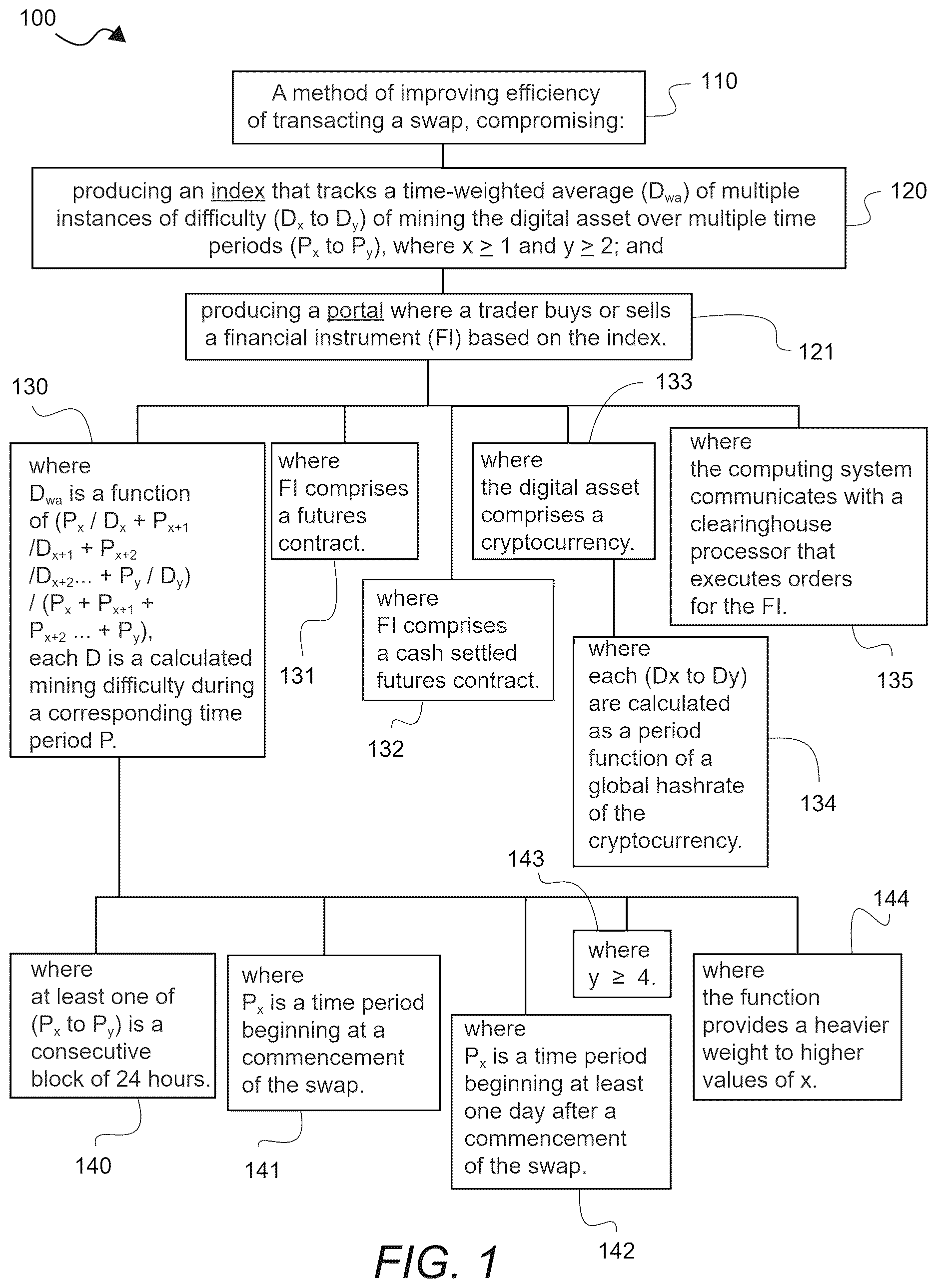
is a flowchart of steps in preferred embodiments according to the inventive subject matter, including various alternatives.
is a schematic depicting nodes interacting with a block explorer to collect and store difficulty and time period data.
is a schematic depicting flow of information using of difficulty and time period data to facilitate swap trading.
shows the average value of the calculated index in week-1 in an example of index calculation and periodic settlement.
shows the average value of the calculated index of week-2 in an example of index calculation and periodic settlement.
shows the average value of the calculated index of week-3 in an example of index calculation and periodic settlement.
shows the average value of the calculated index of week-4 in an example of index calculation and periodic settlement.
shows the average value of the calculated index of week-5 in an example of index calculation and periodic settlement.
shows the average value of the calculated index of week-6 in an example of index calculation and periodic settlement.
shows the average value of the calculated index of week-7 in an example of index calculation and periodic settlement.
DETAILED DESCRIPTION
Improvements in transacting a swap or other futures based financial instrument are accomplished using time-weighted index averages to decrease counterparty settlement risk.
Example—Index Calculation and Periodic Settlement
Assume that an index tracks the next 7 weeks of anticipated earnings, and the average value of the index is calculated as (P 1 /D 1 +P 2 /D 2 . . . +P n /D n )/(P 1 +P 2 . . . +P n ).
In Week-1, all future daily values of Ds and Ps are anticipated. E=anticipated Bitcoin to be mined by 1EH in 7 weeks=Index value=98.1. A seller of this swap will receive 98.1 from the buyer (either all upfront or in equal installments). The buyer will receive whatever is the final value of the Index.
In Week-2, P 1 /D 1 ends up being lower than anticipated, 96 vs 97. As a result, not only did 1EH produce less Bitcoin than anticipated, but the future expectation of production has been lowered by the market (100 vs 101, in Week-7). Therefore, the new index stands at 97.8. Net settlement will be from buyer to seller for current index value-previous index value=0.3 Corresponding calculations occur for Week-3 through Week-6.
In Week-7, all the values are actuals D 1 to D n and P 1 to P n , and the index stands at 97. Previous value of index was 97.1, therefore, the last settlement will be from the buyer to the seller for 0.1. The index changed from 98.1 at the start to 97 at expiration. The seller received a fixed 98.1 and the buyer the final 97, which was also the realized value of E with <0.1% error.
As seen above, the index closely tracks the actual mining output of a unit hashrate over a given period, either anticipated or realized. Therefore, bitcoin miners selling this swap are long sellers because they hold an asset (hashrate) which generates a cash flow that is exactly the same as the index.
The seller in a trade can either be a short seller or a long seller. Both are betting on the value of traded instrument to decline but the short seller is doing it for pure speculation whereas the long seller is usually doing it as a hedge. A ‘long seller’ holds an asset that has the same payout as the index. They sell the index (swap) to hedge the volatility of returns of that asset. Therefore, their net payout is always close to 0. A ‘short seller’ on the other hand earns a net profit when the Index declines and pays from their pocket when the Index rises.
For cryptocurrency miners, the systems and methods disclosed herein reduce the risk of future deployments because they can use the index to gain insight into how congested the game is going to be. Also, if the miner has machines that generate the hashrate that he is selling, he may not need to post cash margin, as his machines can be the collateral.
In this Example the first time period P 1 starts at the beginning of the term of the contract. However, it is contemplated that the first time period P 1 for this exemplary contract, or for a different financial instrument, could start later in the term. It is also contemplated that instead of a week long time period, time periods P used in the time-averaging calculations could be some other length, likely at least a consecutive block of 24 hours, and including bi-weekly, monthly, bi-monthly, quarterly, etc.
It is still further contemplated that the time-averaging calculations could give greater weight to different periods during the term. For example, a different one might use a function that provides a heavier weight to later periods.
It is still further contemplated that settlements can be made in any suitable manner, including for example settlement by cash or cash-equivalents, and settlement by other cryptocurrencies or other digital assets.
It is still further contemplated that a computing system will handle calculation and storage of the difficulty D, period length P and index averaging calculations. The same computing system, or a clearinghouse processor in communication with the computing system, can execute orders for the financial instrument.
Futures Contracts in General
The concepts discussed above in the Example can be applied to futures contracts in general, including indices based upon values V of one or more equities, and/or one or more bonds. In such cases, the following more generic formula can apply: V wa =f (( P x /V x +P x+1 /V x+1 +P x+2 /V x+2 . . . +P y /V y )/( P x +P x+1 +P x+2 . . . +P y )).
Embodiments of the inventive subject matter described in the preceding paragraphs are exemplified if the following figures.
In , schematic 100 depicts a method 110 of improving efficiency of transacting a swap, comprising two basic steps:
•
• Step 120 —producing an index that tracks a time-weighted average (D wa ) of multiple instances of difficulty (D x to D y ) of mining the digital asset over multiple time periods (P x to P y ), where x≥1 and y≥2; and • Step 121 —providing a portal where a trader buys or sells a financial instrument (FI) based on the index.
D wa can be calculated in any suitable manner, one possibility of which is shown in Box 130 , where D wa is a function of (P x /D x +P x+1 /D x+1 +P x+2 /D x+2 . . . +P y /D y )/(P x +P x+1 +P x+2 . . . +P y ), and each D is a calculated mining difficulty during a corresponding time period P. Some of the contemplated options for such calculation are described below:
•
• Box 140 —where at least one of (P x to P y ) is a consecutive block of 24 hours; • Box 141 —where P x is a time period beginning at a commencement of the swap; • Box 142 —where P x is a time period beginning at least one day after a commencement of the swap; • Box 143 —where y≥4; and • Box 144 —where the function provides a heavier weight to higher values of x.
Some contemplated options are described below:
•
• Box 131 —where financial instrument FI comprises a futures contract; • Box 132 —where FI comprises a cash settled futures contract; • Box 133 —where the digital asset comprises a cryptocurrency • Box 133 —where each (D x to D y ) are calculated as a period function of a global hashrate of the cryptocurrency; and • Box 134 —the computing system communicates with a clearinghouse processor that executes orders for the FI.
In , system 200 depicts nodes 220 a - 220 e are nodes of a Decentralized Blockchain Network 210 that service a Bitcoin, cryptocurrency, or other digital asset blockchain. Difficulty and time period information is extracted from the blockchain, and sent to Data Collection Server 240 , by one or more of any one of more of the Nodes, including e.g. Node 220 e and pathway a in this example, and Block Explorer 230 and pathway b. Difficulty and time period information is then stored in Storage Ds, Ps 250 .
In , schematic 300 depicts depicting flow of information using of difficulty and time period data to facilitate swap trading. Difficulty and time period data (discussed above) is stored in Ds, Ps Storage 310 ( 250 in ) is provided to Index Calculation Engine 320 , which provides index information to Swap Trading Marketplace 330 and Account/Position Management System 340 . Swap orders flow from Swap Trading Marketplace 330 to Account/Position Management System 340 , which then calculates mark-to-market position values, settlement amount and margin calls 350 . The mark-to-market position values, settlement amount and margin calls information 350 is then passed back to the Swap Trading Marketplace 330 .
As used in the description herein, and throughout the claims that follow, the meaning of “a,” “an,” and “the” includes plural reference unless the context clearly dictates otherwise. Also, as used in the description herein, the meaning of “in” includes “in” and “on” unless the context clearly dictates otherwise.
Unless the context dictates the contrary, all ranges set forth herein should be interpreted as being inclusive of their endpoints, and open-ended ranges should be interpreted to include only commercially practical values. Similarly, all lists of values should be considered as inclusive of intermediate values unless the context indicates the contrary.
All methods described herein can be performed in any suitable order unless otherwise indicated herein or otherwise clearly contradicted by context. The use of any and all examples, or exemplary language (e.g. “such as”) provided with respect to certain embodiments herein is intended merely to better illuminate the invention and does not pose a limitation on the scope of the invention otherwise claimed. No language in the specification should be construed as indicating any non-claimed element essential to the practice of the invention.
Groupings of alternative elements or embodiments of the invention disclosed herein are not to be construed as limitations. Each group member can be referred to and claimed individually or in any combination with other members of the group or other elements found herein. One or more members of a group can be included in, or deleted from, a group for reasons of convenience and/or patentability. When any such inclusion or deletion occurs, the specification is herein deemed to contain the group as modified thus fulfilling the written description of all Markush groups used in the appended claims.
It should be appreciated that all calculations contemplated herein, including calculations of index and weighted average values, can be performed by generic or special purpose servers, services, interfaces, portals, platforms, or other systems formed from computing devices. It should be appreciated that the use of such terms is deemed to represent one or more computing devices having at least one processor configured to execute software instructions stored on a computer readable tangible, non-transitory medium. For example, a server can include one or more computers operating as a web server, database server, or other type of computer server in a manner to fulfill described roles, responsibilities, or functions
It should be apparent to those skilled in the art that many more modifications besides those already described are possible without departing from the inventive concepts herein. The inventive subject matter, therefore, is not to be restricted except in the spirit of the appended claims. Moreover, in interpreting both the specification and the claims, all terms should be interpreted in the broadest possible manner consistent with the context. In particular, the terms “comprises” and “comprising” should be interpreted as referring to elements, components, or steps in a non-exclusive manner, indicating that the referenced elements, components, or steps may be present, or utilized, or combined with other elements, components, or steps that are not expressly referenced.
Figures (10)
Citations
This patent cites (16)
- US7746343
- US10311515
- US10546277
- US10748210
- US10949922
- US2013/0024340
- US2016/0330031
- US2017/0046689
- US2017/0085545
- US2017/0103458
- US2017/0187535
- US2017/0243289
- US2017/0372278
- US2018/0005318
- US2019/0080411
- US2021/0174442