Sirna Compound That Inhibits Expression of APOC3
Abstract
Nucleic acid products and compositions and their uses are provided. In particular, nucleic acid products are provided that modulate, interfere with, or inhibit APOC3 gene expression. The products can be oligomeric compounds that comprise at least a first region of linked nucleosides having at least a first nucleobase sequence that is at least partially complementary to at least a portion of RNA transcribed from a APOC3 gene, wherein said first nucleobase sequence is selected from the following sequences, or a portion thereof: SEQ ID NOs 1 to 39
Claims (18)
1 . An siRNA compound that inhibits expression of APOC3, comprising a single strand of 33 or 34 nucleobases that is modified or unmodified, wherein said single strand comprises: (i) a first nucleobase sequence directly linked to (ii) a second nucleobase sequence, wherein said first and second nucleobase sequences form a hairpin loop consisting of a duplex region of 14 or 15 base pairs, and a loop consisting of 4 or 5 nucleosides, wherein said first and second nucleobase sequences in unmodified form are, respectively, SEQ ID NOs: 23 and 423; 24 and 424; 28 and 428; 29 and 429; 31 and 431; 89 and 489; 90 and 490; 94 and 494; 117 and 517; 121 and 521; 128 and 528; 137 and 537; 138 and 538; 148 and 548; 149 and 549; 167 and 567; 171 and 571; 175 and 575; 185 and 585; 191 and 591; 193 and 593; 206 and 606; 209 and 609; 212 and 612; 213 and 613; 217 and 617; 218 and 618; 219 and 619; 220 and 620; 221 and 621; 223 and 623; 225 and 625; 254 and 654; 262 and 662; 271 and 671; 272 and 672; 274 and 674; 275 and 675; 276 and 676; 277 and 677; 278 and 678; 280 and 680; 281 and 681; 282 and 682; 283 and 683; 285 and 685; 286 and 686; 291 and 691; 293 and 693; 296 and 696; 297 and 697; 299 and 699; 300 and 700; 303 and 703; 324 and 724; 328 and 728; 331 and 731; 332 and 732; 334 and 734; 336 and 736; 337 and 737; 338 and 738; 339 and 739; 340 and 740; 341 and 741; 342 and 742; 343 and 743; 345 and 745; 346 and 746; 347 and 747; 366 and 766; 367 and 767; 369 and 769; 370 and 770; 368 and 768; 372 and 772; 373 and 773.
13 . An siRNA compound that inhibits expression of APOC3, comprising a single strand that is modified or unmodified, wherein the nucleobase sequence of said single strand consists of, in unmodified form, a nucleobase sequence selected from the group consisting of SEQ ID NOs: 796-798, and 801-803 and wherein the nucleobase sequence of said single strand consists of, in modified form, a nucleobase sequence selected from the group consisting of SEQ ID NOs: 1590-1592 and SEQ ID NOs: 1595-1597.
Show 16 dependent claims
2 . The compound according to claim 1 , wherein said first nucleobase sequence and said second sequence are selected from: SEQ ID NOs: 28 and 428; 137 and 537; 149 and 549; 167 and 567; 175 and 575; 185 and 585; 191 and 591; 193 and 593; 221 and 621; 225 and 625; 254 and 654; 262 and 662; 271 and 671; 274 and 674; 277 and 677; 280 and 680; 286 and 686; 293 and 693; 297 and 697; 328 and 728; 332 and 732; 334 and 734; 336 and 736; 337 and 737; 343 and 743; 366 and 766; 367 and 767; 369 and 769; and 373 and 773.
3 . The compound according to claim 2 , wherein said first nucleobase sequence and said second nucleobase sequence are selected from the group consisting of: SEQ ID NOs: 28 and 428, 277 and 677, 336 and 736, 337 and 737, 366 and 766, 367 and 767, and 369 and 769.
4 . The compound according to claim 1 , further comprising one or more ligands, wherein said one or more ligands comprise one or more N-Acetyl-Galactosamine moieties.
5 . The compound according to claim 1 , wherein said single strand has a nucleobase sequence selected from the group consisting of SEQ ID NOs: 792-795 and SEQ ID NOs: 799-800.
6 . The compound according to claim 5 , wherein said single strand is modified and is selected from the group consisting of SEQ ID NOs: 1586-1589 and SEQ ID NOs: 1593-1594.
7 . The compound according to claim 1 , which comprises internucleoside linkages and wherein at least one internucleoside linkage is a modified internucleoside linkage wherein said modified internucleoside linkage optionally is a phosphorothioate or phosphorodithioate internucleoside linkage.
8 . The compound according to claim 1 , wherein at least one nucleoside comprises a modified sugar, wherein said modified sugar optionally is a 2′O-methyl or 2′-F modified sugar.
9 . A pharmaceutical composition comprising a compound according to claim 1 , and a physiologically acceptable excipient.
10 . The pharmaceutical composition of claim 9 , wherein said pharmaceutical composition further comprises one or more additional pharmaceutically active agents.
11 . The pharmaceutical composition of claim 10 , wherein said additional pharmaceutically active agent(s) is/are selected from the group consisting of: icosapent ethyl; an N-acetyl glucosamine-conjugated antisense oligonucleotide targeting ANGPTL3; statins; fibrates; ezetimibe; and a further oligomeric compound which is directed to a target different from APOC3, wherein said different target optionally is PCSK9.
12 . A method of treating a disease or disorder comprising administering a compound according to claim 1 to an individual in need of treatment, wherein said disease or disorder is a disease or disorder requiring reduction of APOC3 expression levels.
14 . The compound according to claim 13 , further comprising one or more ligands, wherein said one or more ligands comprise one or more N-Acetyl-Galactosamine moieties.
15 . A pharmaceutical composition comprising a compound according to claim 13 , and a physiologically acceptable excipient.
16 . A pharmaceutical composition comprising a compound according to claim 14 , and a physiologically acceptable excipient.
17 . The pharmaceutical composition of claim 16 , wherein said pharmaceutical composition further comprises one or more additional pharmaceutically active agents.
18 . A method of treating a disease or disorder comprising administering a compound according to claim 13 to an individual in need of treatment, wherein said disease or disorder is a disease or disorder requiring reduction of APOC3 expression levels.
Full Description
Show full text →
CROSS REFERENCE TO RELATED PATENT APPLICATIONS
This application claims the benefit of and priority to two U.S. Provisional Patent Applications, Nos. 63/214,608, filed Jun. 24, 2021, and 63/318,287, filed Mar. 9, 2022, the contents of which are incorporated herein by reference in their entirety.
SEQUENCE LISTING
The instant application contains a Sequence Listing which has been submitted electronically in ASCII format and is hereby incorporated by reference in its entirety. Said ASCII copy, created on Nov. 7, 2022, is named 4690_0050C_SL_ST.25.txt and is 373 kilobytes in size.
FIELD
Nucleic acid products and compositions, and their uses, that modulate, in particular interfere with, or inhibit, apolipoprotein C3 (APOC3) gene expression are provided. Specific embodiments provide methods, compounds, and compositions for reducing expression of APOC3 mRNA and protein in an animal. Such methods, compounds, and compositions are useful to treat, prevent, or ameliorate APOC3-associated disorders such as dyslipidemia, hypertriglyceridemia, hyperchylomicronemia, and atherosclerotic cardiovascular disease (ASCVD).
BACKGROUND
Triglycerides are esters of glycerol with three fatty acids. They serve as storage of fat and energy and are transported via the bloodstream. Excess level of blood triglycerides have been recognized early on as causative agents or bystanders of a range of disorders. More recent evidence suggests a causative role, partly in conjunction with elevated levels of cholesterol (in particular LDL cholesterol) in ASCVD and disorders subsumed under this term or associated therewith. A more comprehensive list of disorders associated with elevated levels of triglycerides is given in the embodiments disclosed further below. Apolipoprotein C3 is secreted by the liver and the small intestine. It can be found on triglyceride-rich lipoproteins including very low density lipoproteins (VLDL) and chylomicrons. It is involved in the negative regulation of lipid catabolism, especially triglyceride catabolism, and of the clearance of VLDL, LDL and HDL lipoproteins. A molecular function of APOC3 is the inhibition of lipoprotein lipase and of hepatic lipase.
Disease
Abnormal amounts of circulating triglycerides, also referred to as hypertriglyceridemia, is a recognized disorder in itself which is inter alia owed to the fact that such abnormal amounts, in particular if they persist over extended periods of time, may entail disorders of the cardiovascular system and/or inflammation.
Treatment
Established treatments include the administration of statins such as Rosuvastatin and Simvastatin as well as of fibrates such as fenofibrate. However, statins may cause side effects, and certain patients are statin-intolerant.
There therefore remains a need for therapies to treat APOC3-associated diseases. We, therefore, aim to provide compounds, methods, and pharmaceutical compositions for the treatment of such diseases. Double-stranded RNA (dsRNA) able to complementarily bind expressed mRNA has been shown to be able to block gene expression (Fire et al., 1998, Nature. 1998 Feb. 19; 391 (6669):806-1 1 and Elbashir et at., 2001, Nature. 2001 May 24; 41 1 (6836):494-8) by a mechanism that has been termed RNA interference (RNAi). Short dsRNAs direct gene-specific, post-transcriptional silencing in many organisms, including vertebrates, and have become a useful tool for studying gene function. RNAi is mediated by the RNA-induced silencing complex (RISC), a sequence-specific, multi-component nuclease that destroys messenger RNAs homologous to the silencing trigger loaded into the RISC complex. Interfering RNA (iRNA) such as siRNAs, antisense RNA, and micro-RNA are oligonucleotides that prevent the formation of proteins by gene-silencing i.e. inhibiting gene translation of the protein through degradation of mRNA molecules. Gene-silencing agents are becoming increasingly important for therapeutic applications in medicine.
According to Watts and Corey in the Journal of Pathology (2012; Vol 226, p 365-379) there are algorithms that can be used to design nucleic acid silencing triggers, but all of these have severe limitations. It may take various experimental methods to identify potent siRNAs, as algorithms do not take into account factors such as tertiary structure of the target mRNA or the involvement of RNA binding proteins. Therefore the discovery of a potent nucleic acid silencing trigger with minimal off-target effects is a complex process. For the pharmaceutical development of these highly charged molecules it is necessary that they can be synthesised economically, distributed to target tissues, enter cells and function within acceptable limits of toxicity. An aim is to, therefore, provide compounds, methods, and pharmaceutical compositions for the treatment of thromboembolic diseases as described herein, which comprise oligomeric compounds that modulate, in particular inhibit, gene expression by RNAi.
SUMMARY
Nucleic acid products are provided that modulate, in particular, interfere with or inhibit, apolipoprotein C3 (APOC3) gene expression, and associated therapeutic uses. Specific oligomeric compounds and sequences are described herein. This summary provides a simplified form that is further described below in the detailed description. This summary is not intended to identify key features or essential features of the claimed subject matter, nor is it intended to be used to determine the scope of the claimed subject matter.
BRIEF DESCRIPTION OF THE DRAWINGS
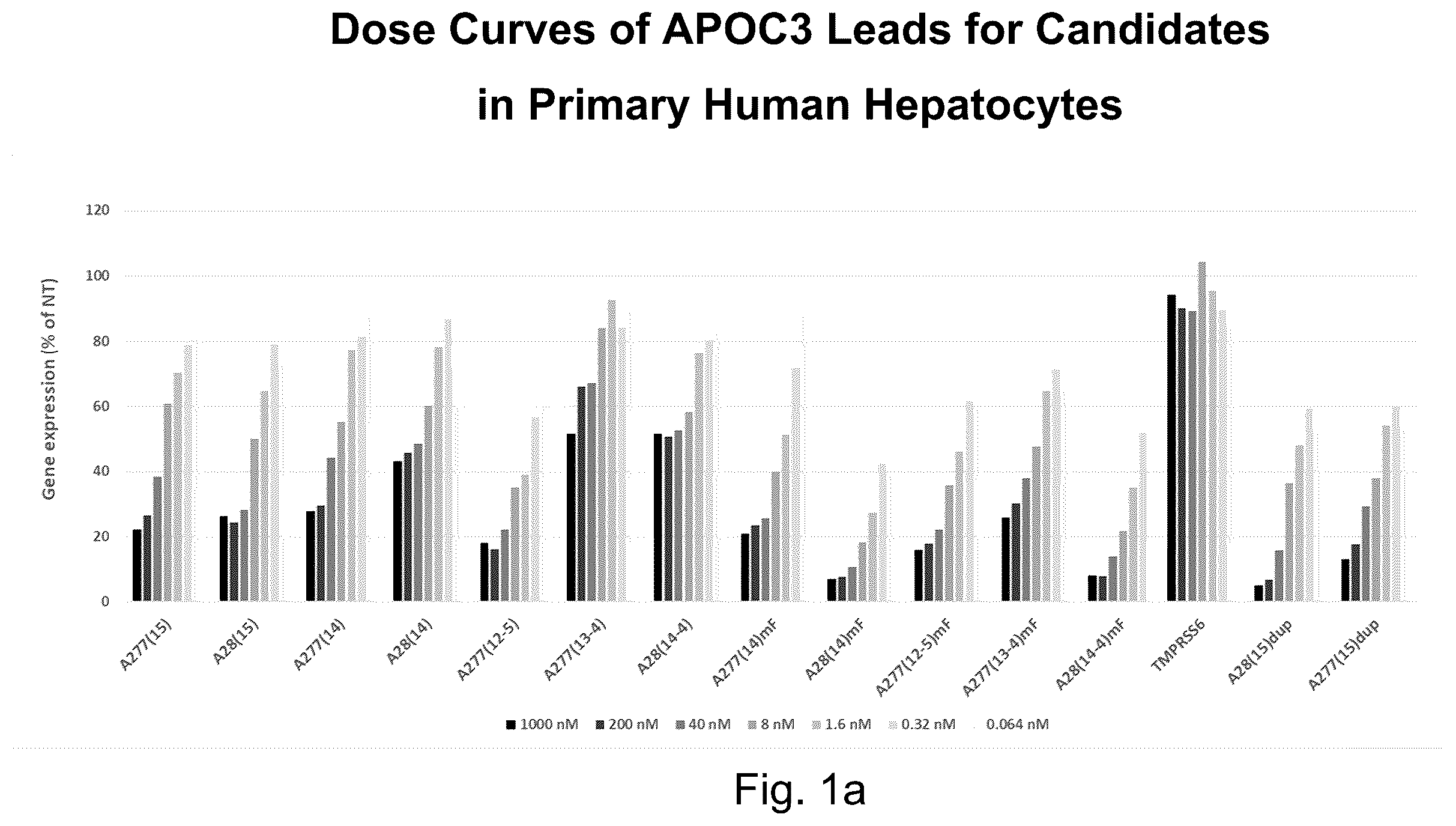
a shows dose curves of APOC3 leads for candidates in primary human hepatocytes;
b shows dose curves of APOC3 leads for Humanized mouse study in primary human hepatocytes;
shows a timeline including the time point of applying the dose to the mice and time points for taking samples;
shows remaining liver APOC3 mRNA and plasma APOC3 protein levels for the animals treated with APOC3-targeting mxRNA constructs as compared to the control animals;
shows serum triglycerides and total cholesterol in the serum of the animals treated with APOC3-targeting mxRNA constructs as compared to the control (PBS);
a shows a Mean Percent of remaining APOC3 mRNA in liver tissues in plasma measured using ELISA for the animals treated with APOC3-targeting mxRNA constructs (10 mg/kg) as compared to the control animals;
b shows APOC3 protein levels in plasma measured using ELISA for the animals treated with APOC3-targeting mxRNA constructs (10 mg/kg) as compared to the control animals;
a shows the mean percent of triglycerides (TG) in the serum of the animals treated with APOC3 targeting mxRNA constructs as compared to the control animals at weeks 2 and 6;
b shows the total cholesterol (TC) level in serum of animals treated with APOC3 targeting mxRNA constructs as compared to the control animals at weeks 2 and 6;
prevents a schematic overview of the duration study performed with compound A28(14-4)mF (also designated STP125G) in mice with a humanized liver;
a shows APOC3 mRNA as a function of time as observed in the duration study between control and treatment groups;
b shows APOC3 protein knockdown as a function of time as observed in the duration study between control and treatment groups;
a show serum triglyceride levels as a function of time between control and treatment groups;
b show serum total cholesterol levels as a function of time between control and treatment groups; and
illustrates the humanized liver of the mice used for the duration study.
DETAILED DESCRIPTION AND EMBODIMENTS
The following are non-limiting aspects:
Aspect 1. An oligomeric compound capable of inhibiting expression of APOC3, wherein said compound comprises at least a first region of linked nucleosides having at least a first nucleobase sequence that is at least partially complementary to at least a portion of RNA transcribed from a APOC3 gene, wherein said first nucleobase sequence is selected from the following sequences, or a portion thereof: sequences of SEQ ID NOs 1 to 391, wherein said portion preferably has a length of at least 18 nucleotides.
Particularly preferred embodiments relate to mxRNAs: for further details see the embodiments and their discussion further below.
In addition, the antisense and sense regions disclosed herein may serve as building blocks for compounds which are directed to multiple targets. The general architecture of such compound ds is described in WO2020/065602.
Furthermore, and as disclosed further below, the disclosed embodiments also relate to double-stranded RNAs (dsRNAs). In contrast to an mxRNA, which has a hairpin-like structure connecting the sense and antisense RNA strands, a dsRNA lacks the hairpin loop and, therefore, dsRNA comprises two strands.
Aspect 2. A composition comprising an oligomeric compound according to aspect 1, and a physiologically acceptable excipient.
Aspect 3. A pharmaceutical composition comprising an oligomeric compound according to aspect 1.
Aspect 4. An oligomeric compound according to aspect 1, for use in human or veterinary medicine or therapy.
Aspect 5. An oligomeric compound according to aspect 1, for use in a method of treating a disease or disorder.
Aspect 6. A method of treating a disease or disorder comprising administration of an oligomeric compound according to aspect 1, to an individual in need of treatment.
Aspect 7. Use of an oligomeric compound according to aspect 1, for use in research as a gene function analysis tool.
Aspect 8. Use of an oligomeric compound according to aspect 1 in the manufacture of a medicament for a treatment of a disease or disorder.
Further embodiments are described below by way of example only. These examples represent the best ways of putting the disclosed embodiments into practice that are currently known to the applicant, although they are not the only ways in which this could be achieved.
It will be understood that the benefits and advantages described herein may relate to one embodiment or may relate to several embodiments. The embodiments are not limited to those that solve any or all of the stated problems or those that have any or all of the stated benefits and advantages.
Features of different aspects and embodiments as described herein may be combined as appropriate, as would be apparent to a skilled person, and may be combined with any other aspects.
Definitions
The following definitions pertain to the disclosed embodiments throughout. In many instances, the definitions, in addition to the respective definition as such, provide non-exhaustive listings of possible implementations, which amount to preferred embodiments.
Unless specific definitions are provided, the nomenclature used in connection with, and the procedures and techniques of, analytical chemistry, synthetic organic chemistry, and medicinal and pharmaceutical chemistry described herein are those well known and commonly used in the art. Standard techniques may be used for chemical synthesis, and chemical analysis. Certain such techniques and procedures may be found for example in “Carbohydrate Modifications in Antisense Research” Edited by Sangvi and Cook, American Chemical Society, Washington D.C., 1994; “Remington's Pharmaceutical Sciences,” Mack Publishing Co., Easton, Pa., 21st edition, 2005; and “Antisense Drug Technology, Principles, Strategies, and Applications” Edited by Stanley T. Crooke, CRC Press, Boca Raton, Fla.; and Sambrook et al., “Molecular Cloning, A laboratory Manual,” 2 nd Edition, Cold Spring Harbor Laboratory Press, 1989, which are hereby incorporated by reference for any purpose. Where permitted, all patents, applications, published applications and other publications and other data referred to throughout in the disclosure are incorporated by reference herein in their entirety.
Unless otherwise indicated, the following terms have the following meanings:
As used herein, “excipient” means any compound or mixture of compounds that is added to a composition as provided herein that is suitable for delivery of an oligomeric compound.
As used herein, “nucleoside” means a compound comprising a nucleobase moiety and a sugar moiety. Nucleosides include, but are not limited to, naturally occurring nucleosides (as found in DNA and RNA) and modified nucleosides. Nucleosides may be linked to a phosphate moiety, phosphate-linked nucleosides also being referred to as “nucleotides”.
As used herein, “chemical modification” or “chemically modified” means a chemical difference in a compound when compared to a naturally occurring counterpart. Chemical modifications of oligonucleotides include nucleoside modifications (including sugar moiety modifications and nucleobase modifications) and internucleoside linkage modifications. In reference to an oligonucleotide, chemical modification does not include differences only in nucleobase sequence.
As used herein, “furanosyl” means a structure comprising a 5-membered ring comprising four carbon atoms and one oxygen atom.
As used herein, “naturally occurring sugar moiety” means a ribofuranosyl as found in naturally occurring RNA or a deoxyribofuranosyl as found in naturally occurring DNA. A “naturally occurring sugar moiety” as referred to herein is also termed as an “unmodified sugar moiety”. In particular, such a “naturally occurring sugar moiety” or an “unmodified sugar moiety” as referred to herein has a —H (DNA sugar moiety) or —OH(RNA sugar moiety) at the 2′-position of the sugar moiety, especially a —H (DNA sugar moiety) at the 2′-position of the sugar moiety.
As used herein, “sugar moiety” means a naturally occurring sugar moiety or a modified sugar moiety of a nucleoside. As used herein, “modified sugar moiety” means a substituted sugar moiety or a sugar surrogate.
As used herein, “substituted sugar moiety” means a furanosyl that has been substituted. Substituted sugar moieties include, but are not limited to furanosyls comprising substituents at the 2′-position, the 3′-position, the 5′-position and/or the 4′-position. Certain substituted sugar moieties are bicyclic sugar moieties.
As used herein, “2′-substituted sugar moiety” means a furanosyl comprising a substituent at the 2′-position other than H or OH. Unless otherwise indicated, a 2′-substituted sugar moiety is not a bicyclic sugar moiety (i.e., the 2′-substituent of a 2′-substituted sugar moiety does not form a bridge to another atom of the furanosyl ring).
As used herein, “MOE” means —OCH 2 CH 2 OCH 3 .
As used herein, “2′-F nucleoside” refers to a nucleoside comprising a sugar comprising fluorine at the 2′ position. Unless otherwise indicated, the fluorine in a 2′-F nucleoside is in the ribo position (replacing the OH of a natural ribose). Duplexes of uniformly modified 2′-fluorinated (ribo) oligonucleotides hybridized to RNA strands are not RNase H substrates while the ara analogs retain RNase H activity.
As used herein the term “sugar surrogate” means a structure that does not comprise a furanosyl and that is capable of replacing the naturally occurring sugar moiety of a nucleoside, such that the resulting nucleoside sub-units are capable of linking together and/or linking to other nucleosides to form an oligomeric compound which is capable of hybridizing to a complementary oligomeric compound. Such structures include rings comprising a different number of atoms than furanosyl (e.g., 4, 6, or 7-membered rings); replacement of the oxygen of a furanosyl with a non-oxygen atom (e.g., carbon, sulfur, or nitrogen); or both a change in the number of atoms and a replacement of the oxygen. Such structures may also comprise substitutions corresponding to those described for substituted sugar moieties (e.g., 6-membered carbocyclic bicyclic sugar surrogates optionally comprising additional substituents). Sugar surrogates also include more complex sugar replacements (e.g., the non-ring systems of peptide nucleic acid). Sugar surrogates include without limitation morpholinos, cyclohexenyls and cyclohexitols.
As used herein, “bicyclic sugar moiety” means a modified sugar moiety comprising a 4 to 7 membered ring (including but not limited to a furanosyl) comprising a bridge connecting two atoms of the 4 to 7 membered ring to form a second ring, resulting in a bicyclic structure. In certain embodiments, the 4 to 7 membered ring is a sugar ring. In certain embodiments the 4 to 7 membered ring is a furanosyl. In certain such embodiments, the bridge connects the 2 ‘-carbon and the 4’-carbon of the furanosyl.
As used herein, “nucleotide” means a nucleoside further comprising a phosphate linking group. As used herein, “linked nucleosides” may or may not be linked by phosphate linkages and thus includes, but is not limited to “linked nucleotides.” As used herein, “linked nucleosides” are nucleosides that are connected in a continuous sequence (i.e. no additional nucleosides are present between those that are linked).
As used herein, “nucleobase” means a group of atoms that can be linked to a sugar moiety to create a nucleoside that is capable of incorporation into an oligonucleotide, and wherein the group of atoms is capable of bonding, more specifically hydrogen bonding, with a complementary naturally occurring nucleobase of another oligonucleotide or nucleic acid. Nucleobases may be naturally occurring or may be modified.
As used herein the terms, “unmodified nucleobase” or “naturally occurring nucleobase” means the naturally occurring heterocyclic nucleobases of RNA or DNA: the purine bases adenine (A) and guanine (G), and the pyrimidine bases thymine (T), cytosine (C) (including 5-methyl C), and uracil (U).
As used herein, “modified nucleobase” means any nucleobase that is not a naturally occurring nucleobase.
As used herein, “modified nucleoside” means a nucleoside comprising at least one chemical modification compared to naturally occurring RNA or DNA nucleosides. Modified nucleosides can comprise a modified sugar moiety and/or a modified nucleobase.
As used herein, “bicyclic nucleoside” or “BNA” means a nucleoside comprising a bicyclic sugar moiety. As used herein, “locked nucleic acid nucleoside” or “LNA” means a nucleoside comprising a bicyclic sugar moiety comprising a 4′—CH 2 —O-2′bridge.
As used herein, “2 ‘-substituted nucleoside” means a nucleoside comprising a substituent at the 2’-position of the sugar moiety other than H or OH. Unless otherwise indicated, a 2 ′-substituted nucleoside is not a bicyclic nucleoside.
As used herein, “deoxynucleoside” means a nucleoside comprising 2′—H furanosyl sugar moiety, as found in naturally occurring deoxyribonucleosides (DNA). In certain embodiments, a 2′-deoxynucleoside may comprise a modified nucleobase or may comprise an RNA nucleobase (e.g., uracil).
As used herein, “oligonucleotide” means a compound comprising a plurality of linked nucleosides. In certain embodiments, an oligonucleotide comprises one or more unmodified ribonucleosides (RNA) and/or unmodified deoxyribonucleosides (DNA) and/or one or more modified nucleosides.
As used herein, “modified oligonucleotide” means an oligonucleotide comprising at least one modified nucleoside and/or at least one modified internucleoside linkage.
Preferred modified internucleoside linkages are those which confer increased stability as compared to the naturally occurring phosphodiesters. “Stability” means, in particular, the stability against hydrolysis including enzyme-catalyzed hydrolysis, enzymes including exonucleases and endonucleases.
Preferred positions for such modified internucleoside linkages include the termini and the hairpin loop of single-stranded oligomeric compounds. For example, the internucleoside linkages connecting first and second nucleoside and second and third nucleoside counting from the 5′ terminus, and/or the internucleoside linkages connecting first and second nucleoside and second and third nucleoside counting from the 3′ terminus are modified. In addition, a linkage connecting the terminal nucleoside of the 3′ terminus with a ligand, such as GaINAc, may be modified.
As discussed above, preferred positions are in the hairpin loop of said single-stranded oligomeric compounds. In particular, all linkages, all but one linkages or the majority of linkages in the hairpin loop are modified. As used herein, “linkages in the hairpin loop” designates the linkages between nucleosides which are not engaged in base pairing. For example, in a hairpin loop consisting of five nucleosides, there are four linkages between nucleosides which are not engaged in base pairing. Preferably, the term “linkages in the hairpin loop” also extends to the linkages connecting the stem to the loop, i.e., those linkages which connect a base-paired nucleoside to a non-based paired nucleoside. Generally, there are two such positions in hairpins and mxRNAs as described herein.
Most preferred is that modified internucleoside linkages are at both termini and in the hairpin loop. As used herein, “linkage” or “linking group” means a group of atoms that link together two or more other groups of atoms.
As used herein “internucleoside linkage” means a covalent linkage between adjacent nucleosides in an oligonucleotide.
As used herein “naturally occurring internucleoside linkage” means a 3′ to 5′ phosphodiester linkage. As used herein, “modified internucleoside linkage” means any internucleoside linkage other than a naturally occurring internucleoside linkage. In particular, a “modified internucleoside linkage” as referred to herein can include a modified phosphorous linking group such as a phosphorothioate or phosphorodithioate internucleoside linkage.
As used herein, “terminal internucleoside linkage” means the linkage between the last two nucleosides of an oligonucleotide or defined region thereof.
As used herein, “phosphorus linking group” means a linking group comprising a phosphorus atom and can include naturally occurring phosphorous linking groups as present in naturally occurring RNA or DNA, such as phosphodiester linking groups, or modified phosphorous linking groups that are not generally present in naturally occurring RNA or DNA, such as phosphorothioate or phosphorodithioate linking groups. Phosphorus linking groups can therefore include without limitation, phosphodiester, phosphorothioate, phosphorodithioate, phosphonate, methylphosphonate, phosphoramidate, phosphorothioamidate, thionoalkylphosphonate, phosphotriesters, thionoalkylphosphotriester and boranophosphate.
As used herein, “internucleoside phosphorus linking group” means a phosphorus linking group that directly links two nucleosides.
As used herein, “oligomeric compound” means a polymeric structure comprising two or more substructures. In certain embodiments, an oligomeric compound comprises an oligonucleotide, such as a modified oligonucletide. In certain embodiments, an oligomeric compound further comprises one or more conjugate groups and/or terminal groups and/or ligands. In certain embodiments, an oligomeric compound consists of an oligonucleotide. In certain embodiments, an oligomeric compound comprises a backbone of one or more linked monomeric sugar moieties, where each linked monomeric sugar moiety is directly or indirectly attached to a heterocyclic base moiety. In certain embodiments, oligomeric compounds may also include monomeric sugar moieties that are not linked to a heterocyclic base moiety, thereby providing abasic sites. Oligomeric compounds may be defined in terms of a nucleobase sequence only, i.e., by specifying the sequence of A, G, C, U (or T). In such a case, the structure of the sugar-phosphate backbone is not particularly limited and may or may not comprise modified sugars and/or modified phosphates. On the other hand, oligomeric compounds may be more comprehensively defined, i.e, by specifying not only the nucleobase sequence, but also the structure of the backbone, in particular the modification status of the sugars (unmodified, 2′-0Me modified, 2′-F modified etc.) and/or of the phosphates.
As used herein, “terminal group” means one or more atom attached to either, or both, the 3′ end or the 5′ end of an oligonucleotide. In certain embodiments, a terminal group comprises one or more terminal group nucleosides.
As used herein, “conjugate” or “conjugate group” means an atom or group of atoms bound to an oligonucleotide or oligomeric compound. In certain embodiments, a conjugate group links a ligand to a modified oligonucleotide or oligomeric compound. In general, conjugate groups can modify one or more properties of the compound to which they are attached, including, but not limited to pharmacodynamic, pharmacokinetic, binding, absorption, cellular distribution, cellular uptake, charge and/or clearance properties.
As used herein, “conjugate linker” or “linker” in the context of a conjugate group means a portion of a conjugate group comprising any atom or group of atoms and which covalently link an oligonucleotide to another portion of the conjugate group. In certain embodiments, the point of attachment on the oligomeric compound is the 3 ′-oxygen atom of the 3′-hydroxyl group of the 3′ terminal nucleoside of the oligonucleotide. In certain embodiments the point of attachment on the oligomeric compound is the 5′-oxygen atom of the 5′-hydroxyl group of the 5′ terminal nucleoside of the oligonucleotide. In certain embodiments, the bond for forming attachment to the oligomeric compound is a cleavable bond. In certain such embodiments, such cleavable bond constitutes all or part of a cleavable moiety.
In certain embodiments, conjugate groups comprise a cleavable moiety (e.g., a cleavable bond or cleavable nucleoside) and ligand portion that can comprise one or more ligands, such as a carbohydrate cluster portion, such as an N-Acetyl-Galactosamine, also referred to as “GaINAc”, cluster portion. In certain embodiments, the carbohydrate cluster portion is identified by the number and identity of the ligand. For example, in certain embodiments, the carbohydrate cluster portion comprises 2 GaINAc groups. For example, in certain embodiments, the carbohydrate cluster portion comprises 3 GaINAc groups and this is particularly preferred. In certain embodiments, the carbohydrate cluster portion comprises 4 GaINAc groups. Such ligand portions are attached to an oligomeric compound via a cleavable moiety, such as a cleavable bond or cleavable nucleoside. The ligands can be arranged in a linear or branched configuration, such as a biantennary or triantennary configurations. A preferred carbohydrate cluster, also referred to as “toothbrush,” has the following formula:
wherein in said structural formula one, two, or three phosphodiester linkages can also be substituted by phosphothionate linkages.
As used herein, “cleavable moiety” means a bond or group that is capable of being cleaved under physiological conditions. In certain embodiments, a cleavable moiety is cleaved inside a cell or sub-cellular compartments, such as an endosome or lysosome. In certain embodiments, a cleavable moiety is cleaved by endogenous enzymes, such as nucleases. In certain embodiments, a cleavable moiety comprises a group of atoms having one, two, three, four, or more than four cleavable bonds. In certain embodiments, a cleavable moiety is a phosphodiester linkage.
As used herein, “cleavable bond” means any chemical bond capable of being broken.
As used herein, “carbohydrate cluster” means a compound having one or more carbohydrate residues attached to a linker group.
As used herein, “modified carbohydrate” means any carbohydrate having one or more chemical modifications relative to naturally occurring carbohydrates.
As used herein, “carbohydrate derivative” means any compound which may be synthesized using a carbohydrate as a starting material or intermediate.
As used herein, “carbohydrate” means a naturally occurring carbohydrate, a modified carbohydrate, or a carbohydrate derivative. A carbohydrate is a biomolecule including carbon (C), hydrogen (H) and oxygen (O) atoms. Carbohydrates can include monosaccharide, disaccharides, trisaccharides, tetrasaccharides, oligosaccharides or polysaccharides, such as one or more galactose moieties, one or more lactose moieties, one or more N-Acetyl-Galactosamine moieties, and/or one or more mannose moieties. A particularly preferred carbohydrate is N-Acetyl-Galactosamine.
As used herein, “strand” means an oligomeric compound comprising linked nucleosides.
As used herein, “single strand” or “single-stranded” means an oligomeric compound comprising linked nucleosides that are connected in a continuous sequence without a break therebetween. Such single strands may include regions of sufficient self-complementarity so as to be capable of forming a stable self-duplex in a hairpin structure.
As used herein, “hairpin” means a single stranded oligomeric compound that includes a duplex formed by base pairing between sequences in the strand that are self-complementary and opposite in directionality.
As used herein, “hairpin loop” means an unpaired loop of linked nucleosides in a hairpin that is created as a result of hybridization of the self-complementary sequences. The resulting structure looks like a loop or a U-shape.
In particular, short hairpin RNA, also denoted as shRNA, comprises a duplex region and a loop connecting the regions forming the duplex. The end of the duplex region which does not carry the loop may be blunt-ended or carry (a) 3′ and/or (a) 5′ overhang(s). Preference is given to blunt-ended constructs.
As used herein, “directionality” means the end-to-end chemical orientation of an oligonucleotide based on the chemical convention of numbering of carbon atoms in the sugar moiety meaning that there will be a 5′-end defined by the 5′ carbon of the sugar moiety, and a 3′-end defined by the 3′ carbon of the sugar moiety. In a duplex or double stranded oligonucleotide, the respective strands run in opposite 5′ to 3′ directions to permit base pairing between them.
As used herein, “duplex” or also abbreviated as “dup” means two or more complementary strand regions, or strands, of an oligonucleotide or oligonucleotides, hybridized together by way of non-covalent, sequence-specific interaction therebetween. Most commonly, the hybridization in the duplex will be between nucleobases adenine (A) and thymine (T), and/or (A) adenine and uracil (U), and/or guanine (G) and cytosine (C). The duplex may be part of a single stranded structure, wherein self-complementarity leads to hybridization, or as a result of hybridization between respective strands in a double stranded construct.
As used herein, “double strand” or “double stranded” means a pair of oligomeric compounds that are hybridized to one another. In certain embodiments, a double-stranded oligomeric compound comprises a first and a second oligomeric compound.
As used herein, “expression” means the process by which a gene ultimately results in a protein. Expression includes, but is not limited to, transcription, post-transcriptional modification (e.g., splicing, polyadenlyation, addition of 5′-cap), and translation.
As used herein, “transcription” or “transcribed” means the first of several steps of DNA based gene expression in which a target sequence of DNA is copied into RNA (especially mRNA) by the enzyme RNA polymerase. During transcription, a DNA sequence is read by an RNA polymerase, which produces a complementary, antiparallel RNA sequence called a primary transcript.
As used herein, “target sequence” means a sequence to which an oligomeric compound is intended to hybridize to result in a desired activity with respect to APOC3 expression. Oligonucleotides have sufficient complementarity to their target sequences to allow hybridization under physiological conditions.
As used herein, “nucleobase complementarity” or “complementarity” when in reference to nucleobases means a nucleobase that is capable of base pairing with another nucleobase. For example, in DNA, adenine (A) is complementary to thymine (T). For example, in RNA, adenine (A) is complementary to uracil (U). In both DNA and RNA, guanine (G) is complementary to cytosine (C). In certain embodiments, complementary nucleobase means a nucleobase of an oligomeric compound that is capable of base pairing with a nucleobase of its target sequence. For example, if a nucleobase at a certain position of an oligomeric compound is capable of hydrogen bonding with a nucleobase at a certain position of a target sequence, then the position of hydrogen bonding between the oligomeric compound and the target sequence is considered to be complementary at that nucleobase pair. Nucleobases comprising certain modifications may maintain the ability to pair with a counterpart nucleobase and thus, are still capable of nucleobase complementarity.
As used herein, “non-complementary” in reference to nucleobases means a pair of nucleobases that do not form hydrogen bonds with one another.
As used herein, “complementary” in reference to oligomeric compounds (e.g., linked nucleosides, oligonucleotides) means the capacity of such oligomeric compounds or regions thereof to hybridize to a target sequence, or to a region of the oligomeric compound itself, through nucleobase complementarity. Complementary oligomeric compounds need not have nucleobase complementarity at each nucleoside.
Rather, some mismatches are tolerated. In certain embodiments, complementary oligomeric compounds or regions are complementary at 70% of the nucleobases (70% complementary). In certain embodiments, complementary oligomeric compounds or regions are 80%>complementary. In certain embodiments, complementary oligomeric compounds or regions are 90%>complementary. In certain embodiments, complementary oligomeric compounds or regions are at least 95% complementary. In certain embodiments, complementary oligomeric compounds or regions are 100% complementary. As used herein, “self-complementarity” in reference to oligomeric compounds means a compound that may fold back on itself, creating a duplex as a result of nucleobase hybridization of internal complementary strand regions. Depending on how close together and/or how long the strand regions are, then the compound may form hairpin loops, junctions, bulges or internal loops.
As used herein, “mismatch” means a nucleobase of an oligomeric compound that is not capable of pairing with a nucleobase at a corresponding position of a target sequence, or at a corresponding position of the oligomeric compound itself when the oligomeric compound hybridizes as a result of self-complementarity, when the oligomeric compound and the target sequence and/or self-complementary regions of the oligomeric compound, are aligned.
As used herein, “hybridization” means the pairing of complementary oligomeric compounds (e.g., an oligomeric compound and its target sequence). While not limited to a particular mechanism, the most common mechanism of pairing involves hydrogen bonding, which may be Watson-Crick, Hoogsteen or reversed Hoogsteen hydrogen bonding, between complementary nucleobases.
As used herein, “specifically hybridizes” means the ability of an oligomeric compound to hybridize to one nucleic acid site with greater affinity than it hybridizes to another nucleic acid site.
As used herein, “fully complementary” in reference to an oligomeric compound or region thereof means that each nucleobase of the oligomeric compound or region thereof is capable of pairing with a nucleobase of a complementary nucleic acid target sequence or a self-complementary region of the oligomeric compound. Thus, a fully complementary oligomeric compound or region thereof comprises no mismatches or unhybridized nucleobases with respect to its target sequence or a self-complementary region of the oligomeric compound.
As used herein, “percent complementarity” means the percentage of nucleobases of an oligomeric compound that are complementary to an equal-length portion of a target nucleic acid. Percent complementarity is calculated by dividing the number of nucleobases of the oligomeric compound that are complementary to nucleobases at corresponding positions in the target nucleic acid by the total length of the oligomeric compound.
As used herein, “percent identity” means the number of nucleobases in a first nucleic acid that are the same type (independent of chemical modification) as nucleobases at corresponding positions in a second nucleic acid, divided by the total number of nucleobases in the first nucleic acid.
As used herein, “modulation” means a change of amount or quality of a molecule, function, or activity when compared to the amount or quality of a molecule, function, or activity prior to modulation. For example, modulation includes the change, either an increase (stimulation or induction) or a decrease (inhibition or reduction) in gene expression.
As used herein, “type of modification” in reference to a nucleoside or a nucleoside of a “type” means the chemical modification of a nucleoside and includes modified and unmodified nucleosides. Accordingly, unless otherwise indicated, a “nucleoside having a modification of a first type” may be an unmodified nucleoside.
As used herein, “differently modified” means chemical modifications or chemical substituents that are different from one another, including absence of modifications. Thus, for example, a MOE nucleoside and an unmodified naturally occurring RNA nucleoside are “differently modified,” even though the naturally occurring nucleoside is unmodified. Likewise, DNA and RNA oligonucleotides are “differently modified,” even though both are naturally-occurring unmodified nucleosides. Nucleosides that are the same but for comprising different nucleobases are not differently modified. For example, a nucleoside comprising a 2′—OMe modified sugar moiety and an unmodified adenine nucleobase and a nucleoside comprising a 2′—OMe modified sugar moiety and an unmodified thymine nucleobase are not differently modified.
As used herein, “the same type of modifications” refers to modifications that are the same as one another, including absence of modifications. Thus, for example, two unmodified RNA nucleosides have “the same type of modification,” even though the RNA nucleosides are unmodified. Such nucleosides having the same type modification may comprise different nucleobases.
As used herein, “region” or “regions”, or “portion” or “portions”, mean a plurality of linked nucleosides that have a function or character as defined herein, in particular with reference to the claims and definitions as provided herein. Typically such regions or portions comprise at least 10, at least 11, at least 12 or at least 13 linked nucleosides. For example, such regions can comprise 13 to 20 linked nucleosides, such as 13 to 16 or 18 to 20 linked nucleosides. Typically a first region as defined herein consists essentially of 18 to 20 nucleosides and a second region as defined herein consists essentially of 13 to 16 linked nucleosides.
As used herein, “pharmaceutically acceptable carrier or diluent” means any substance suitable for use in administering to an animal. In certain embodiments, a pharmaceutically acceptable carrier or diluent is sterile saline. In certain embodiments, such sterile saline is pharmaceutical grade saline.
As used herein, “substituent” and “substituent group,” means an atom or group that replaces the atom or group of a named parent compound. For example a substituent of a modified nucleoside is any atom or group that differs from the atom or group found in a naturally occurring nucleoside (e.g., a modified 2′-substituent is any atom or group at the 2′-position of a nucleoside other than H or OH). Substituent groups can be protected or unprotected. In certain embodiments, compounds of the present disclosure have substituents at one or at more than one position of the parent compound. Substituents may also be further substituted with other substituent groups and may be attached directly or via a linking group such as oxygen or an alkyl or hydrocarbyl group to a parent compound.
Such substituents can be present as the modification on the sugar moiety, in particular a substituent present at the 2′-position of the sugar moiety. Unless otherwise indicated, groups amenable for use as substituents include without limitation, one or more of halo, hydroxyl, alkyl, alkenyl, alkynyl, acyl, carboxyl, alkoxy, alkoxyalkylene and amino substituents. Certain substituents as described herein can represent modifications directly attached to a ring of a sugar moiety (such as a halo, such as fluoro, directly attached to a sugar ring), or a modification indirectly linked to a ring of a sugar moiety by way of an oxygen linking atom that itself is directly linked to the sugar moiety (such as an alkoxyalkylene, such as methoxyethylene, linked to an oxygen atom, overall providing an MOE substituent as described herein attached to the 2′-position of the sugar moiety).
As used herein, “alkyl,” as used herein, means a saturated straight or branched monovalent C 1-6 hydrocarbon radical, with methyl being a most preferred alkyl as a substituent at the 2′-position of the sugar moiety. The alkyl group typically attaches to an oxygen linking atom at the 2′position of the sugar, therefore, overall providing a—Oalkyl substituent, such as an —OCH 3 substituent, on a sugar moiety of an oligomeric compound as described herein. This will be well understood be a person skilled in the art.
As used herein, “alkylene” means a saturated straight or branched divalent hydrocarbon radical of the general formula —C n H 2n — where n is 1-6. Methylene or ethylene are preferred alkylenes.
As used herein, “alkenyl” means a straight or branched unsaturated monovalent C 2-6 hydrocarbon radical, with ethenyl or propenyl being most preferred alkenyls as a substituent at the 2′-position of the sugar moiety. As will be well understood in the art, the degree of unsaturation that is present in an alkenyl radical is the presence of at least one carbon to carbon double bond. The alkenyl group typically attaches to an oxygen linking atom at the 2′-position of the sugar, therefore, overall providing a—Oalkenyl substituent, such as an —OCH 2 CH═CH 2 substituent, on a sugar moiety of an oligomeric compound as described herein. This will be well understood be a person skilled in the art.
As used herein, “alkynyl” means a straight or branched unsaturated C 2-6 hydrocarbon radical, with ethynyl being a most preferred alkynyl as a substituent at the 2′-position of the sugar moiety. As will be well understood in the art, the degree of unsaturation that is present in an alkynyl radical is the presence of at least one carbon to carbon triple bond. The alkynyl group typically attaches to an oxygen linking atom at the 2′-position of the sugar, therefore, overall providing a—Oalkynyl substituent on a sugar moiety of an oligomeric compound as described herein. This will be well understood be a person skilled in the art.
As used herein, “carboxyl” is a radical having a general formula —CO 2 H.
As used herein, “acyl” means a radical formed by removal of a hydroxyl group from a carboxyl radical as defined herein and has the general Formula —C(O)—X where X is typically Cis alkyl.
As used herein, “alkoxy” means a radical formed between an alkyl group, such as a C 1-6 alkyl group, and an oxygen atom wherein the oxygen atom is used to attach the alkoxy group either to a parent molecule (such as at the 2′-position of a sugar moiety), or to another group such as an alkylene group as defined herein. Examples of alkoxy groups include without limitation, methoxy, ethoxy, propoxy, isopropoxy, n-butoxy, sec-butoxy and tert-butoxy. Alkoxy groups as used herein may optionally include further substituent groups.
As used herein, alkoxyalkylene means an alkoxy group as defined herein that is attached to an alkylene group also as defined herein, and wherein the oxygen atom of the alkoxy group attaches to the alkylene group and the alkylene attaches to a parent molecule. The alkylene group typically attaches to an oxygen linking atom at the 2′-position of the sugar, therefore, overall providing a—Oalkylenealkoxy substituent, such as an —OCH 2 CH 2 OCH 3 substituent, on a sugar moiety of an oligomeric compound as described herein. This will be well understood by a person skilled in the art and is generally referred to as an MOE substituent as defined herein and as known in the art.
As used herein, “amino” includes primary, secondary and tertiary amino groups.
As used herein, “halo” and “halogen,” mean an atom selected from fluorine, chlorine, bromine and iodine.
As used herein, the term “mxRNA” is in particular understood as defined in WO 2020/044186 A2 which is incorporated by reference herein in its entirety.
It will also be understood that oligomeric compounds as described herein may have one or more non-hybridizing nucleosides at one or both ends of one or both strands (overhangs) and/or one or more internal non-hybridizing nucleosides (mismatches) provided there is sufficient complementarity to maintain hybridization under physiologically relevant conditions. Alternatively, oligomeric compounds as described herein may be blunt ended at at least one end.
The term “comprising” is used herein to mean including the method steps or elements identified, but that such steps or elements do not comprise an exclusive list and as such there may be present additional steps or elements.
Further, to the extent that the term “includes” is used in either the detailed description or the claims, such term is intended to be inclusive in a manner similar to the term “comprising” as “comprising” is interpreted when employed as a transitional word in a claim.
The following exemplary embodiments (items) are provided:
•
• 1. An oligomeric compound capable of inhibiting expression of APOC3, wherein the compound comprises at least a first region of linked nucleosides having at least a first nucleobase sequence that is at least partially complementary to at least a portion of RNA transcribed from an APOC3 gene, wherein the first nucleobase sequence is selected from the following sequences, or a portion thereof: sequences of Tables 1a and 2a (SEQ ID NOs: 1 to 391), wherein the portion preferably has a length of at least 18 nucleotides.
Said first region is also referred to as the antisense region, and said second region is also referred to as the sense region. As disclosed in preferred embodiments below, said two regions may be located on the same strand, preferably in an adjacent manner. This gives rise to hairpin molecules, also referred to as mxRNAs. On the other hand, said two regions may be located on separate strands which gives rise to double-stranded RNAs (dsRNAs), wherein preferably each strand consists of the respective region. Moreover, said regions may serve as building blocks for muRNAs (see above at Aspect 1). In other words, said first and said second region as defined herein may be used, in accordance with the following definition of muRNAs as first and third regions, respectively:
A nucleic acid construct (muRNA) comprising at least:
•
• (a) a first nucleic acid portion that is at least partially complementary to at least a first portion of an RNA which is transcribed from a APOC3 gene; • (b) a second nucleic acid portion that is at least partially complementary to at least a second portion of an RNA which is transcribed from another gene; • (c) a third nucleic acid portion that is at least partially complementary to said first nucleic acid portion of (a), so as to form a first nucleic acid duplex region therewith; and • (d) a fourth nucleic acid portion that is at least partially complementary to said second nucleic acid portion of (b), so as to form a second nucleic acid duplex region therewith.
Preferred embodiments of and further aspects relating to muRNAs are disclosed in WO2020/065602.
•
• 2. The oligomeric compound according to item 1, which further comprises at least a second region of linked nucleosides having at least a second nucleobase sequence that is at least partially complementary to the first nucleobase sequence and is selected from the following sequences, or a portion thereof: sequences of Tables 1c and 2c (SEQ ID NOs: 401 to 791), wherein the portion preferably has a length of at least 11 nucleotides, or wherein the portion preferably has a length of at least 8, 9, 10 or 11 nucleotides, more preferably at least 10 nucleotides. • 3. The oligomeric compound according to item 1 or 2, wherein the first nucleobase sequence is selected from the following sequences, or a portion thereof: SEQ ID NOs: 175, 293, 262, 297, 277, 366, 337, 254, 274, 286, 137, 149, 280, 343, 225, 221, 185, 373, 121, 281, 331, 367, 296, 28, 345, 328, 339, 278, 271, 212, 223, 369, 276, 332, 300, 341, 334, 138, 193, 340, 31, 167, 275, 191, 336, 90, 346, 219, 283, 213, 23, 24, 285, 347, 370, 206, 282, 342, 272, 303, 220, 209, 29, 89, 291, 117, 372, 218, 368, 148, 217, 128, 338, 171, 94, 324, and 299. • 4. The oligomeric compound according to item 3, wherein the second nucleobase sequence is selected from the following sequences, or a portion thereof: SEQ ID NOs: 575, 693, 662, 697, 677, 766, 737, 654, 674, 686, 537, 549, 680, 743, 625, 621, 585, 773, 521, 681, 731, 767, 696, 428, 745, 728, 739, 678, 671, 612, 623, 769, 676, 732, 700, 741, 734, 538, 593, 740, 431, 567, 675, 591, 736, 490, 746, 619, 683, 613, 423, 424, 685, 747, 770, 606, 682, 742, 672, 703, 620, 609, 429, 489, 691, 517, 772, 618, 768, 548, 617, 528, 738, 571, 494, 724, and 699. • 5. The oligomeric compound according to any of items 1 to 4, wherein the first nucleobase sequence is selected from the following sequences, or a portion thereof: SEQ ID NOs: 277, 337, 28, 343, 369, 366, 274, 367, 336, 332, 293, 373, 280, 221, 334, 286, 149, 193, 328, 175, 262, 254, 185, 328, 271, 137, 225, 167, 297, and 191. • 6. The oligomeric compound according to item 5, wherein the second nucleobase sequence is selected from the following sequences, or a portion thereof: SEQ ID NOs: 677, 737, 428, 743, 769, 766, 674, 767, 736, 732, 693, 773, 680, 621, 734, 686, 549, 593, 728, 575, 662, 654, 585, 728, 671, 537, 625, 567, 697, and 591. • 7. The oligomeric compound according to any of items 1 to 6, wherein the first nucleobase sequence is selected from the following sequences, or a portion thereof: SEQ ID NOs: 28, 277, 336, 337, 366, 367, and 369, preferably SEQ ID NO: 28 or 277, more preferably SEQ ID NO: 28.
These embodiments define antisense nucleobase sequences which provide for surprisingly outstanding performance. For evidence, reference is made to the Examples.
•
• 8. The oligomeric compound according to item 7, wherein the second nucleobase sequence is selected from the following sequences, or a portion thereof: SEQ ID NOs: 428, 677, 736, 737, 766, 767, and 769, preferably SEQ ID NO: 428 or 677, more preferably SEQ ID NO: 428. • 9. The oligomeric compound according to any of items 1 to 8, wherein the first region of linked nucleosides consists essentially of 18 to 35, preferably 18 to 20, more preferably 18 or 19, and yet more preferably 19 linked nucleosides. • 10. The oligomeric compound according to any of items 2 to 9, wherein the second region of linked nucleosides consists essentially of 11 to 35, preferably 11 to 20, more preferably 13 to 16, and yet more preferably 14 or 15, most preferably 14 linked nucleosides; or wherein the second region of linked nucleosides consists essentially of 10 to 35, preferably 10 to 20, more preferably 10 to 16, and yet more preferably 10 to 15 linked nucleosides. • 11. The oligomeric compound according to any of items 2 to 10, which comprises at least one complementary duplex region that comprises at least a portion of the first nucleoside region directly or indirectly linked to at least a portion of the second nucleoside region, wherein preferably the duplex region has a length of 11 to 19, more preferably 14 to 19, and yet more preferably 14 or 15 base pairs, most preferably 14 base pairs, wherein optionally there is one mismatch within the duplex region; or which comprises at least one complementary duplex region that comprises at least a portion of the first nucleoside region directly or indirectly linked to at least a portion of the second nucleoside region, wherein preferably the duplex region has a length of 10 to 19, more preferably 12 to 19, and yet more preferably 12 to 15 base pairs, wherein optionally there is one mismatch within the duplex region. • 12. The oligomeric compound according to item 11, wherein each of the first and second nucleoside regions has a 5′ to 3′ directionality thereby defining 5′ and 3′ regions respectively thereof. • 13. The oligomeric compound according to item 12, wherein the 5′ region of the first nucleoside region is directly or indirectly linked to the 3′ region of the second nucleoside region, for example by complementary base pairing, and/or wherein the 3′ region of the first nucleoside region is directly or indirectly linked to the 5′ region of the second nucleoside region, wherein preferably the 5′ terminal nucleoside of the first nucleoside region base pairs with the 3′ terminal nucleoside of the second nucleoside region; or wherein the 5′ region of the first nucleoside region is directly or indirectly linked to the 3′ region of the second nucleoside region, for example by complementary base pairing, wherein preferably the 5′ terminal nucleoside of the first nucleoside region base pairs with the 3′ terminal nucleoside of the second nucleoside region. • 14. The oligomeric compound according to item 12 or 13, wherein the 3′ region of the first nucleoside region is directly or indirectly linked to the 5′ region of the second nucleoside region, wherein preferably the first nucleoside region is directly and covalently linked to the second nucleoside region such as by a phosphate, a phosphorothioate, or a phosphorodithoate. • 15. The oligomeric compound according to any of items 1 to 14, which further comprises one or more ligands. • 16. The oligomeric compound according to item 15, wherein the one or more ligands are conjugated to the second nucleoside region and/or the first nucleoside region. • 17. The oligomeric compound according to item 16, as dependent on claim 12 , wherein the one or more ligands are conjugated at the 3′ region, preferably to the 3′ end of the second nucleoside region and/or of the first nucleoside region, and/or to the 5′ end of the second nucleoside region. • 18. The oligomeric compound according to any of item 15 to 17, wherein the one or more ligands are any cell directing moiety, such as lipids, carbohydrates, aptamers, vitamins and/or peptides that bind cellular membrane or a specific target on cellular surface. • 19. The oligomeric compound according to item 18, wherein the one or more ligands comprise one or more carbohydrates. • 20. The oligomeric compound according to item 19, wherein the one or more carbohydrates can be a monosaccharide, disaccharide, trisaccharide, tetrasaccharide, oligosaccharide or polysaccharide. • 21. The oligomeric compound according to item 20, wherein the one or more carbohydrates comprise or consist of one or more hexose moieties. • 22. The oligomeric compound according to item 21, wherein the one or more hexose moieties are one or more galactose moieties, one or more lactose moieties, one or more N-Acetyl-Galactosamine moieties, and/or one or more mannose moieties. • 23. The oligomeric compound according to item 22, wherein the one or more carbohydrates comprise one or more N-Acetyl-Galactosamine moieties. • 24. The oligomeric compound according to item 23, which comprises two or three N-Acetyl-Galactosamine moieties, preferably three. • 25. The oligomeric compound according to any of items 15 to 24, wherein the one or more ligands are attached to the oligomeric compound, preferably to the second nucleoside region thereof, in a linear configuration, or in a branched configuration. • 26. The oligomeric compound according to item 25, wherein the one or more ligands are attached to the oligomeric compound as a biantennary or triantennary configuration. • 27. The oligomeric compound according to any one of items 1 to 26, wherein the compound consists of the first region of linked nucleosides and the second region of linked nucleosides.
Each of said regions may constitute a separate strand, thereby giving rise to a double-stranded RNA (dsRNA). Particularly preferred dsRNAs are those with a length of the first strand of 19 nucleosides and a length of the second region of 14 or 15, preferably 14 nucleosides. When used for defining the length of a region or strand, the terms “nucleoside” and “nucleotide” (sometimes abbreviated “nt”) are used equivalently.
•
• 28. The oligomeric compound according to item 12, wherein the oligomeric compound comprises a single strand comprising the first and second nucleoside regions, wherein the single strand dimerises whereby at least a portion of the first nucleoside region is directly or indirectly linked to at least a portion of the second nucleoside region so as to form the at least partially complementary duplex region.
In other words, the oligomeric compound comprises a single strand comprising the first and second nucleoside regions, wherein at least a portion of the first nucleoside region is directly or indirectly linked to at least a portion of the second nucleoside region so as to form the at least partially complementary duplex region.
•
• 29. The oligomeric compound according to item 28, wherein the first nucleoside region has a greater number of linked nucleosides compared to the second nucleoside region, whereby the additional number of linked nucleosides of the first nucleoside region form a hairpin loop linking the first and second nucleoside regions.
Such compounds are also referred to as hairpins or mxRNAs herein.
•
• 30. The oligomeric compound according to item 29, as dependent on claim 12 , whereby the hairpin loop is present at the 3′ region of the first nucleoside region. • 31. The oligomeric compound according to item 29 or 30, wherein the hairpin loop comprises 4 or 5 linked nucleosides.
Particularly advantageous is a length of the first region of 19 nucleosides, of the second region of 14 nucleotides, and of the hairpin loop of five nucleotides, wherein the five nucleotides in the hairpin are the five 3′-terminal nucleosides of the first region. Such molecular architecture of a hairpin or mxRNA is also designated “14-5-14” herein.
•
• 32. The oligomeric compound according to any one of items 28 to 31, wherein the single strand has a nucleobase sequence selected from SEQ ID NOs: 792 to 803, preferably from SEQ ID NOs: 792, 793, 796, 800 and 803, most preferably from SEQ ID NOs: 796 and 803 particularly SEQ ID NO: 803. • 33. The oligomeric compound according to item 32, wherein the single strand is selected from Table 3b, in particular from constructs A28(14-4)mF and A277(12-5_, A28(14-4)mF being especially advantageous. • 34. The oligomeric compound according to any of items 1 to 33, which comprises internucleoside linkages and wherein at least one internucleoside linkage is a modified internucleoside linkage.
Specific modified internucleoside linkages are the subject of the embodiments which follow. Certain modified internucleoside linkages are known in the art and described in, for example, Hu et al., Signal Transduction and Targeted Therapy (2020)5:101.
•
• 35. The oligomeric compound according to item 34, wherein the modified internucleoside linkage is a phosphorothioate or phosphorodithioate internucleoside linkage. • 36. The oligomeric compound according to item 35, which comprises 1 to 15 phosphorothioate or phosphorodithioate internucleoside linkages. • 37. The oligomeric compound according to item 36, which comprises 7, 8, 9 or 10 phosphorothioate or phosphorodithioate internucleoside linkages. • 38. The oligomeric compound according to any of items 35 to 37, as dependent on item 12, which comprises one or more phosphorothioate or phosphorodithioate internucleoside linkages at the 5′ region of the first nucleoside region. • 39. The oligomeric compound according to any of items 35 to 38, as dependent on item 12, which comprises one or more phosphorothioate or phosphorodithioate internucleoside linkages at the 5′ region of the second nucleoside region. • 40. The oligomeric compound according to any of items 35 to 39, as dependent on item 28, which comprises phosphorothioate or phosphorodithioate internucleoside linkages between at least two, preferably at least three, preferably at least four, preferably at least five, adjacent nucleosides of the hairpin loop, dependent on the number of nucleotides present in the hairpin loop. • 41. The oligomeric compound according to item 40, which comprises a phosphorothioate or phosphorodithioate internucleoside linkage between each adjacent nucleoside that is present in the hairpin loop. • 42. The oligomeric compound according to any of items 1 to 41, wherein at least one nucleoside comprises a modified sugar.
Preferred modified sugars are subject of the embodiments which follow. Certain modified sugars are known in the art and described in, for example, Hu et al., Signal Transduction and Targeted Therapy (2020)5:101.
•
• 43. The oligomeric compound according to item 42, wherein the modified sugar is selected from 2′ modified sugars, locked nucleic acid (LNA) sugar, (S)—constrained ethyl bicyclic nucleic acid sugar, tricyclo-DNA sugar, morpholino, unlocked nucleic acid (UNA) sugar, and glycol nucleic acid (GNA) sugar. • 44. The oligomeric compound according to item 43, wherein the 2′ modified sugar is selected from 2′-O-methyl modified sugar, 2′-O-methoxyethyl modified sugar, 2′-F modified sugar, 2′-arabino-fluoro modified sugar, 2′-O-benzyl modified sugar, and 2′-O-methyl-4-pyridine modified sugar. • 45. The oligomeric compound according to item 44, wherein at least one modified sugar is a 2′-O-methyl modified sugar. • 46. The oligomeric compound according to item 44 or 45, wherein at least one modified sugar is a 2′-F modified sugar. • 47. The oligomeric compound of item 45 or 46, wherein the sugar is ribose. • 48. The oligomeric compound according to any of items 45 to 48, as dependent on item 12, wherein sugars of the nucleosides at any of positions 2 and 14 downstream from the first nucleoside of the 5′ region of the first nucleoside region, do not contain 2′-O-methyl modifications. • 49. The oligomeric compound according to any of items 45 to 48, as dependent on item 12, wherein sugars of the nucleosides of the second nucleoside region, that correspond in position to any of the nucleosides of the first nucleoside region at any of positions 9 to 11 downstream from the first nucleotide of the 5′ region of the first nucleoside region, in particular from sequence A277(12-5) and A28(14-4)mF do not contain 2′-O-methyl modifications. • 50. The oligomeric compound of any one of items 45 to 49, wherein the 3′ terminal position of the second nucleoside region does not contain a 2′-O-methyl modification. • 51. The oligomeric compound according to item 49 or 50, wherein sugars of the nucleosides at any of positions 2 and 14 downstream from the first nucleoside of the 5′ region of the first nucleoside region, contain 2′-F modifications. • 52. The oligomeric compound according to any of items 49 to 51, wherein sugars of the nucleosides of the second nucleoside region, that correspond in position to any of the nucleosides of the first nucleoside region at any of positions 9 to 11 downstream from the first nucleoside of the 5′ region of the first nucleoside region, contain 2′-F modifications. • 53. The oligomeric compound of item 51 or 52, wherein the 3′ terminal position of the second nucleoside region contains a 2′-F modification. • 54. The oligomeric compound according to any of items 47 to 53, as dependent on item 12, wherein one or more of the odd numbered nucleosides starting from the 5′ region of the first nucleoside region are modified, and/or wherein one or more of the even numbered nucleotides starting from the 5′ region of the first nucleoside region are modified, wherein typically the modification of the even numbered nucleotides is a second modification that is different from the modification of odd numbered nucleotides. • 55. The oligomeric compound according to item 54, wherein one or more of the odd numbered nucleosides starting from the 3′ region of the second nucleoside region are modified by a modification that is different from the modification of odd numbered nucleosides of the first nucleoside region. • 56. The oligomeric compound according to item 54 or 55, wherein one or more of the even numbered nucleosides starting from the 3′ region of the second nucleoside region are modified by a modification that is different from the modification of even numbered nucleosides of the first nucleoside region according to item 55. • 57. The oligomeric compound according to any of items 54 to 56, wherein at least one or more of the modified even numbered nucleosides of the first nucleoside region is adjacent to at least one or more of the differently modified odd numbered nucleosides of the first nucleoside region. • 58. The oligomeric compound according to any of items 54 to 57, wherein at least one or more of the modified even numbered nucleosides of the second nucleoside region is adjacent to at least one or more of the differently modified odd numbered nucleosides of the second nucleoside region. • 59. The oligomeric compound according to any of items 54 to 58, wherein sugars of one or more of the odd numbered nucleosides starting from the 5′ region of the first nucleoside region are 2′-O-methyl modified sugars. • 60. The oligomeric compound according to any of items 54 to 59, wherein one or more of the even numbered nucleosides starting from the 5′ region of the first nucleoside region are 2′-F modified sugars. • 61. The oligomeric compound according to any of items 54 to 60, wherein sugars of one or more of the odd numbered nucleosides starting from the 3′ region of the second nucleoside region are 2′-F modified sugars. • 62. The oligomeric compound according to any of items 54 to 61, wherein one or more of the even numbered nucleosides starting from the 3′ region of the second nucleoside region are 2′-O-methyl modified sugars. • 63. The oligomeric compound according to any of items 42 to 62, wherein sugars of a plurality of adjacent nucleosides of the first nucleoside region are modified by a common modification. • 64. The oligomeric compound according to any of items 42 to 63, wherein sugars of a plurality of adjacent nucleosides of the second nucleoside region are modified by a common modification. • 65. The oligomeric compound according to any of items 54 to 64, as dependent on item 31, wherein sugars of a plurality of adjacent nucleosides of the hairpin loop are modified by a common modification. • 66. The oligomeric compound according to any of items 63 to 65, wherein the common modification is a 2′-F modified sugar. • 67. The oligomeric compound according to any of items 63 to 65, wherein the common modification is a 2′-O-methyl modified sugar. • 68. The oligomeric compound according to item 67, wherein the plurality of adjacent 2′-O-methyl modified sugars are present in at least eight adjacent nucleosides of the first and/or second nucleoside regions. • 69. The oligomeric compound according to item 67, wherein the plurality of adjacent 2′-O-methyl modified sugars are present in three or four adjacent nucleosides of the hairpin loop. • 70. The oligomeric compound according to item 42, as dependent on item 29, wherein the hairpin loop comprises at least one nucleoside having a modified sugar. • 71. The oligomeric compound according to item 70, wherein the at least one nucleoside is adjacent a nucleoside with a differently modified sugar. • 72. The oligomeric compound according to item 71, wherein the modified sugar is a 2′-O-methyl modified sugar, and the differently modifies sugar is a 2′-F modified sugar. • 73. The oligomeric compound according to any of items 1 to 72, which comprises one or more nucleosides having an un-modified sugar moiety. • 74. The oligomeric compound according to item 73, wherein the unmodified sugar is present in the 5′ region of the second nucleoside region. • 75. The oligomeric compound according to item 73 or 74, as dependent on item 29, wherein the unmodified sugar is present in the hairpin loop. • 76. The oligomeric compound according to any of items 1 to 75, wherein one or more nucleosides of the first nucleoside region and/or the second nucleoside region is an inverted nucleoside and is attached to an adjacent nucleoside via the 3′ carbon of its sugar and the 3′ carbon of the sugar of the adjacent nucleoside, and/or one or more nucleosides of the first nucleoside region and/or the second nucleoside region is an inverted nucleoside and is attached to an adjacent nucleoside via the 5′ carbon of its sugar and the 5′ carbon of the sugar of the adjacent nucleoside. • 77. The oligomeric compound according to any of items 1 to 76, which is blunt ended. • 78. The oligomeric compound according to any of items 1 to 76, wherein either the first or second nucleoside region has an overhang. • 79. The oligomeric compound according to any one of the preceding items, wherein the first region of linked nucleotides is selected from Table 1 b or Table 2b, preferably from the entries in Table 1 b which have a nucleobase sequence as defined in any one of item 3, 5 or 7. • 80. The oligomeric compound according to any one of the preceding items, wherein the second region of linked nucleotides is selected from Table 1d or Table 2d, preferably from the entries in Table 1b which have a nucleobase sequence as defined in any one of items 4, 6 or 8. • 81. A composition comprising an oligomeric compound according to any of items 1 to 80, and a physiologically acceptable excipient. • 82. A pharmaceutical composition comprising an oligomeric compound according to any of items 1 to 80. • 83. The pharmaceutical composition of item 82, further comprising a pharmaceutically acceptable excipient, diluent, antioxidant, and/or preservative. • 84. The pharmaceutical composition of item 82 or 83, wherein the oligomeric compound is the only pharmaceutically active agent. • 85. The pharmaceutical composition of item 84, wherein the pharmaceutical composition is to be administered to patients or individuals which are statin-intolerant and/or for whom statins are contraindicated. • 86. The pharmaceutical composition of item 82 or 83, wherein the pharmaceutical composition furthermore comprises one or more further pharmaceutically active agents.
87. The pharmaceutical composition of item 86, wherein the further pharmaceutically active agent(s) is/are a further oligomeric compound which is directed to a target different from APOC3, preferably PCSK9; Vascepa; Vupanorsen; statins such as Rosuvastatin and Simvastatin; fibrates such fenofibrate; and/or LDL-cholesterol lowering compounds such as statins and ezetimibe.
•
• 88. The pharmaceutical composition of item 86 or 87, wherein the oligomeric compound and the further pharmaceutically active agent(s) are to be administered concomitantly or in any order. • 89. An oligomeric compound according to any of item 1 to 80, for use in human or veterinary medicine or therapy. • 90. An oligomeric compound according to any of items 1 to 80, for use in a method of treating, ameliorating and/or preventing a disease or disorder. • 91. The compound for use of item 90, wherein the disease or disorder is an APOC3-associated disease or disorder, or a disease or disorder requiring reduction of APOC3 expression levels, the disease or disorder preferably being selected from dyslipidemia including mixed dyslipidemia; hyperchylomicronemia including familial hyperchylomicronemia; hypertriglyceridemia, preferably severe hypertriglyceridemia and/or hypertriglyceridemia with blood triglyceride levels above 500 mg/dl;
inflammation including low-grade inflammation; atherosclerosis; atherosclerotic cardiovascular diseases (ASCVD) including major adverse cardiovascular events (MACE) such as myocardial infarction, stroke and peripheral arterial disease; and pancreatitis including acute pancreatitis.
•
• 92. A method of treating a disease or disorder comprising administration of an oligomeric compound according to any of item 1 to 80, to an individual in need of treatment. • 93. The method according to item 92, wherein the oligomeric compound is administered subcutaneously or intravenously to the individual. • 93. Use of an oligomeric compound according to any of item 1 to 80, for use in research as a gene function analysis tool. • 94. Use of an oligomeric compound according to any of items 1 to 80 in the manufacture of a medicament for a treatment of a disease or disorder. The diseases and disorders are preferably the same as set forth under item 91 above. Effects Achieved by the Oligomeric Compounds
Due to the use of the oligomeric compounds as described herein, a significant reduction of APOC3 mRNA, especially in vitro or in liver tissues consisting essentially of human hepatocytes, can be achieved as e.g. shown in the examples disclosed herein. In addition, a significant reduction of APCO3 proteins in the plasma level, e.g. of mice having a liver consisting essentially of human hepatocytes, can be achieved by using the oligomeric constructs as described herein. In particular these effects can last over an extended time period such as six weeks, e.g. in mice having a liver consisting essentially of human hepatocytes.
In addition, by using oligomeric compounds as described herein, significant degrees of reduction of triglyceride levels in the serum, in particular of mice having a liver essentially consisting of human hepatocytes, can be achieved, also over an extended period of time, such as six weeks. An unexpected and surprising finding is that, in addition to the reduction of triglycerides in the serum, in particular of the same mice, a significant reduction in the level of cholesterol in the serum is achieved at the same time over an extended time period, such as six weeks.
It has also been surprisingly found that, in certain embodiments, the aforementioned beneficial effects can be achieved by using oligomeric compounds as described herein in the form of shRNA constructs having a reduced number of fluorine substitutions, such as five fluorine substitutions in total, on the respective 2′ positions of their ribose units compared to conventional shRNA molecules having an alternating series of 2′-fluoro and 2′-O-methyl modifications.
Furthermore, it was surprisingly found that, in certain embodiments, the mentioned effects are achieved by using oligomeric compounds as described herein in the form of shRNA constructs as described herein having a reduced length of e.g. 29 linked nucleosides compared to conventional shRNA molecules. The same effects can also surprisingly be achieved for such constructs having a length of the sense strand of about 10 nucleosides.
The aforementioned effects can be achieved by using a dosage of about 10 mg/kg body weight to 30 mg/kg body weight, in particular with respect to mice.
Constructs of the Oligomeric Compounds
The following Tables show nucleobase sequences of antisense and sense strands of oligomeric compounds as described herein, and definitions of antisense and sense strands of modified oligomeric compounds (the notation including nucleobase sequence, sugar modifications, and, where applicable, modified phosphates).
The notation used is common in the art and as the following meaning:
•
• A represents adenine; • U represents uracil; • C represents cytosine; • G represents guanine. • P represents a terminal phosphate group which is preferred but not indispensable; • m represents a methyl modification at the 2′ position of the sugar of the underlying nucleoside; • f represents a fluoro modification at the 2′ position of the sugar of the underlying nucleoside. • r indicates an unmodified (2′-OH) ribonucleotide; • (ps) or #represents a phosphorothioate inter-nucleoside linkage; • i represents an inverted inter-nucleoside linkage, which can be either 3′-3′, or 5′-5′; • vp represents vinyl phosphonate; • mvp represents methyl vinyl phosphonate; • 3xGaINAc represents a trivalent GaINAc.
Sometimes, nucleosides are shown in square brackets for ease of reading. This notation does not indicate structural elements or modifications.
To the extent displayed, the presence of a 5′-terminal phosphate (“P”) is optional. Conversely, to the extent a 5′-terminal phosphate is not displayed, its presence is optional as well. Generally, there is no requirement for a 5′-terminal phosphate in compounds to be administered to mammalian cells, since a mammalian kinase adds a 5′-terminal phosphate in the case of its absence.
Furthermore when a notation like “A277(12-5)mF” is used, the term “A277” designates the sequence suitable for RNAi with APOC3, wherein the first number in the round brackets, i.e. 12 in the present case, designates the number of base pairs within a duplex region within a shRNA, and the second number in the round brackets, in this case 5, designates the number of nucleotides present in the hairpin loop of the shRNA. If there is no designation after the hyphen in the round brackets, it means that the loop consists of 5 nucleotides.
Tables 1a to 1d below show nucleobase sequences and sugar-phosphate backbone modifications of antisense and sense strands of the 376 constructs selected in accordance with the Examples. The above disclosed 30 preferred oligomeric compounds have been selected from these 376 constructs. The numbering in Table 1a coincides with the number of the corresponding entry in the sequence listing. For Table 1c the following applies: entry number in the sequence listing=entry number in the Table+400.
TABLE 1a
Nucleobase sequences of the antisense
strands of 376 exemplary constructs
SEQ ID
NO: Nucleobase sequence
1 UUCUAGGGAUGAACUGAGC
2 UCUCUAGGGAUGAACUGAG
3 UCCUCUAGGGAUGAACUGA
4 UGCCUCUAGGGAUGAACUG
5 UUGCCUCUAGGGAUGAACU
6 UCUGCCUCUAGGGAUGAAC
7 UGCUGCCUCUAGGGAUGAA
8 UAGCUGCCUCUAGGGAUGA
9 UGCAGCUGCCUCUAGGGAU
10 UAGCAGCUGCCUCUAGGGA
11 UGAGCAGCUGCCUCUAGGG
12 UGGAGCAGCUGCCUCUAGG
13 UUGUUCCUGGAGCAGCUGC
14 UCUGUUCCUGGAGCAGCUG
15 UCCUCUGUUCCUGGAGCAG
16 UACCUCUGUUCCUGGAGCA
17 UCACCUCUGUUCCUGGAGC
18 UGCACCUCUGUUCCUGGAG
19 UGGCACCUCUGUUCCUGGA
20 UUGGCACCUCUGUUCCUGG
21 UAUGGCACCUCUGUUCCUG
22 UCAUGGCACCUCUGUUCCU
23 UUGCAUGGCACCUCUGUUC
24 UCUGCAUGGCACCUCUGUU
25 UGCUGCAUGGCACCUCUGU
26 UGGCUGCAUGGCACCUCUG
27 UGGGCUGCAUGGCACCUCU
28 UCAACAAGGAGUACCCGGG
29 UACAACAAGGAGUACCCGG
30 UAACAACAAGGAGUACCCG
31 UCAACAACAAGGAGUACCC
32 UGCAACAACAAGGAGUACC
33 UGGCAACAACAAGGAGUAC
34 UGGGCAACAACAAGGAGUA
35 UAGGGCAACAACAAGGAGU
36 UGAGGGCAACAACAAGGAG
37 UGGAGGGCAACAACAAGGA
38 UAGGAGGGCAACAACAAGG
39 UCAGGAGGGCAACAACAAG
40 UCCAGGAGGGCAACAACAA
41 UGCCAGGAGGGCAACAACA
42 UCGCCAGGAGGGCAACAAC
43 UGCGCCAGGAGGGCAACAA
44 UAGCGCCAGGAGGGCAACA
45 UGAGCGCCAGGAGGGCAAC
46 UGGAGCGCCAGGAGGGCAA
47 UAGGAGCGCCAGGAGGGCA
48 UGCCAGGAGCGCCAGGAGG
49 UAGAGGCCAGGAGCGCCAG
50 UCAGAGGCCAGGAGCGCCA
51 UGCAGAGGCCAGGAGCGCC
52 UGGCAGAGGCCAGGAGCGC
53 UGGGCAGAGGCCAGGAGCG
54 UUCGGGCAGAGGCCAGGAG
55 UCUCGGGCAGAGGCCAGGA
56 UGCUCGGGCAGAGGCCAGG
57 UAGCUCGGGCAGAGGCCAG
58 UAAGCUCGGGCAGAGGCCA
59 UGAAGCUCGGGCAGAGGCC
60 UUGAAGCUCGGGCAGAGGC
61 UCUGAAGCUCGGGCAGAGG
62 UUCUGAAGCUCGGGCAGAG
63 UCUCUGAAGCUCGGGCAGA
64 UCCUCUGAAGCUCGGGCAG
65 UGCCUCUGAAGCUCGGGCA
66 UGGCCUCUGAAGCUCGGGC
67 UCGGCCUCUGAAGCUCGGG
68 UUCGGCCUCUGAAGCUCGG
69 UCUCGGCCUCUGAAGCUCG
70 UCCUCGGCCUCUGAAGCUC
71 UUCCUCGGCCUCUGAAGCU
72 UAUCCUCGGCCUCUGAAGC
73 UCAUCCUCGGCCUCUGAAG
74 UGCAUCCUCGGCCUCUGAA
75 UGGCAUCCUCGGCCUCUGA
76 UAGGCAUCCUCGGCCUCUG
77 UGAGGCAUCCUCGGCCUCU
78 UGGAGGCAUCCUCGGCCUC
79 UGGGAGGCAUCCUCGGCCU
80 UAGGGAGGCAUCCUCGGCC
81 UAAGGGAGGCAUCCUCGGC
82 UGAAGGGAGGCAUCCUCGG
83 UAGAAGGGAGGCAUCCUCG
84 UGAGAAGGGAGGCAUCCUC
85 UUGAGAAGGGAGGCAUCCU
86 UCUGAGAAGGGAGGCAUCC
87 UGCUGAGAAGGGAGGCAUC
88 UAGCUGAGAAGGGAGGCAU
89 UUGAAGCUGAGAAGGGAGG
90 UAUGAAGCUGAGAAGGGAG
91 UCAUGAAGCUGAGAAGGGA
92 UGCAUGAAGCUGAGAAGGG
93 UUGCAUGAAGCUGAGAAGG
94 UCUGCAUGAAGCUGAGAAG
95 UCCUGCAUGAAGCUGAGAA
96 UCCCUGCAUGAAGCUGAGA
97 UACCCUGCAUGAAGCUGAG
98 UAACCCUGCAUGAAGCUGA
99 UUAACCCUGCAUGAAGCUG
100 UGUAACCCUGCAUGAAGCU
101 UUGUAACCCUGCAUGAAGC
102 UAUGUAACCCUGCAUGAAG
103 UCAUGUAACCCUGCAUGAA
104 UUCAUGUAACCCUGCAUGA
105 UUUCAUGUAACCCUGCAUG
106 UCUUCAUGUAACCCUGCAU
107 UGCUUCAUGUAACCCUGCA
108 UUGCUUCAUGUAACCCUGC
109 UGUGCUUCAUGUAACCCUG
110 UCGUGCUUCAUGUAACCCU
111 UGCGUGCUUCAUGUAACCC
112 UGGCGUGCUUCAUGUAACC
113 UUGGCGUGCUUCAUGUAAC
114 UGUGGCGUGCUUCAUGUAA
115 UGGUGGCGUGCUUCAUGUA
116 UUGGUGGCGUGCUUCAUGU
117 UUUGGUGGCGUGCUUCAUG
118 UCUUGGUGGCGUGCUUCAU
119 UUCUUGGUGGCGUGCUUCA
120 UGUCUUGGUGGCGUGCUUC
121 UGGUCUUGGUGGCGUGCUU
122 UCGGUCUUGGUGGCGUGCU
123 UGCGGUCUUGGUGGCGUGC
124 UGGCGGUCUUGGUGGCGUG
125 UUGGCGGUCUUGGUGGCGU
126 UUUGGCGGUCUUGGUGGCG
127 UCUUGGCGGUCUUGGUGGC
128 UCCUUGGCGGUCUUGGUGG
129 UUCCUUGGCGGUCUUGGUG
130 UAUCCUUGGCGGUCUUGGU
131 UCAUCCUUGGCGGUCUUGG
132 UGCAUCCUUGGCGGUCUUG
133 UUGCAUCCUUGGCGGUCUU
134 UGUGCAUCCUUGGCGGUCU
135 UAGUGCAUCCUUGGCGGUC
136 UCAGUGCAUCCUUGGCGGU
137 UUCAGUGCAUCCUUGGCGG
138 UCUCAGUGCAUCCUUGGCG
139 UGCUCAGUGCAUCCUUGGC
140 UUGCUCAGUGCAUCCUUGG
141 UCUGCUCAGUGCAUCCUUG
142 UGCUGCUCAGUGCAUCCUU
143 UCGCUGCUCAGUGCAUCCU
144 UACGCUGCUCAGUGCAUCC
145 UCACGCUGCUCAGUGCAUC
146 UGCACGCUGCUCAGUGCAU
147 UUGCACGCUGCUCAGUGCA
148 UCUGCACGCUGCUCAGUGC
149 UCCUGCACGCUGCUCAGUG
150 UUCCUGCACGCUGCUCAGU
151 UACUCCUGCACGCUGCUCA
152 UGGGACUCCUGCACGCUGC
153 UUGGGACUCCUGCACGCUG
154 UCUGGGACUCCUGCACGCU
155 UCCUGGGACUCCUGCACGC
156 UACCUGGGACUCCUGCACG
157 UCACCUGGGACUCCUGCAC
158 UCCACCUGGGACUCCUGCA
159 UGGGCCACCUGGGACUCCU
160 UUGGGCCACCUGGGACUCC
161 UUGCUGGGCCACCUGGGAC
162 UCUGCUGGGCCACCUGGGA
163 UGGCCUGCUGGGCCACCUG
164 UCCUGGCCUGCUGGGCCAC
165 UCCAUCGGUCACCCAGCCC
166 UGCCAUCGGUCACCCAGCC
167 UAGCCAUCGGUCACCCAGC
168 UAAGCCAUCGGUCACCCAG
169 UGAAGCCAUCGGUCACCCA
170 UUGAAGCCAUCGGUCACCC
171 UCUGAAGCCAUCGGUCACC
172 UACUGAAGCCAUCGGUCAC
173 UAACUGAAGCCAUCGGUCA
174 UGAACUGAAGCCAUCGGUC
175 UGGAACUGAAGCCAUCGGU
176 UGGGAACUGAAGCCAUCGG
177 UAGGGAACUGAAGCCAUCG
178 UCAGGGAACUGAAGCCAUC
179 UUCAGGGAACUGAAGCCAU
180 UUUCAGGGAACUGAAGCCA
181 UUUUCAGGGAACUGAAGCC
182 UCUUUCAGGGAACUGAAGC
183 UUCUUUCAGGGAACUGAAG
184 UGUCUUUCAGGGAACUGAA
185 UAGUCUUUCAGGGAACUGA
186 UUAGUCUUUCAGGGAACUG
187 UGUAGUCUUUCAGGGAACU
188 UAGUAGUCUUUCAGGGAAC
189 UCAGUAGUCUUUCAGGGAA
190 UCCAGUAGUCUUUCAGGGA
191 UUCCAGUAGUCUUUCAGGG
192 UCUCCAGUAGUCUUUCAGG
193 UGCUCCAGUAGUCUUUCAG
194 UUGCUCCAGUAGUCUUUCA
195 UGUGCUCCAGUAGUCUUUC
196 UGGUGCUCCAGUAGUCUUU
197 UCGGUGCUCCAGUAGUCUU
198 UACGGUGCUCCAGUAGUCU
199 UAACGGUGCUCCAGUAGUC
200 UUAACGGUGCUCCAGUAGU
201 UUUAACGGUGCUCCAGUAG
202 UCUUAACGGUGCUCCAGUA
203 UCCUUAACGGUGCUCCAGU
204 UUCCUUAACGGUGCUCCAG
205 UGUCCUUAACGGUGCUCCA
206 UUGUCCUUAACGGUGCUCC
207 UUUGUCCUUAACGGUGCUC
208 UCUUGUCCUUAACGGUGCU
209 UACUUGUCCUUAACGGUGC
210 UAACUUGUCCUUAACGGUG
211 UGAACUUGUCCUUAACGGU
212 UAGAACUUGUCCUUAACGG
213 UGAGAACUUGUCCUUAACG
214 UAGAGAACUUGUCCUUAAC
215 UCAGAGAACUUGUCCUUAA
216 UUCAGAGAACUUGUCCUUA
217 UCUCAGAGAACUUGUCCUU
218 UACUCAGAGAACUUGUCCU
219 UAACUCAGAGAACUUGUCC
220 UGAACUCAGAGAACUUGUC
221 UCAGAACUCAGAGAACUUG
222 UCCAGAACUCAGAGAACUU
223 UCCCAGAACUCAGAGAACU
224 UUCCCAGAACUCAGAGAAC
225 UAUCCCAGAACUCAGAGAA
226 UAAUCCCAGAACUCAGAGA
227 UAAAUCCCAGAACUCAGAG
228 UCAAAUCCCAGAACUCAGA
229 UCCAAAUCCCAGAACUCAG
230 UUCCAAAUCCCAGAACUCA
231 UGUCCAAAUCCCAGAACUC
232 UGGUCCAAAUCCCAGAACU
233 UGGGUCCAAAUCCCAGAAC
234 UAGGGUCCAAAUCCCAGAA
235 UCAGGGUCCAAAUCCCAGA
236 UUCAGGGUCCAAAUCCCAG
237 UGACCUCAGGGUCCAAAUC
238 UUGACCUCAGGGUCCAAAU
239 UCUGACCUCAGGGUCCAAA
240 UUCUGACCUCAGGGUCCAA
241 UGUCUGACCUCAGGGUCCA
242 UGGUCUGACCUCAGGGUCC
243 UUGGUCUGACCUCAGGGUC
244 UUUGGUCUGACCUCAGGGU
245 UGUUGGUCUGACCUCAGGG
246 UAGUUGGUCUGACCUCAGG
247 UAAGUUGGUCUGACCUCAG
248 UGAAGUUGGUCUGACCUCA
249 UUGAAGUUGGUCUGACCUC
250 UCUGAAGUUGGUCUGACCU
251 UGGCUGAAGUUGGUCUGAC
252 UCGGCUGAAGUUGGUCUGA
253 UACGGCUGAAGUUGGUCUG
254 UCACGGCUGAAGUUGGUCU
255 UCCACGGCUGAAGUUGGUC
256 UGCCACGGCUGAAGUUGGU
257 UCAGCCACGGCUGAAGUUG
258 UGCAGCCACGGCUGAAGUU
259 UGGCAGCCACGGCUGAAGU
260 UAGGCAGCCACGGCUGAAG
261 UCAGGCAGCCACGGCUGAA
262 UUCUCAGGCAGCCACGGCU
263 UGUCUCAGGCAGCCACGGC
264 UGGUCUCAGGCAGCCACGG
265 UAGGUCUCAGGCAGCCACG
266 UUGAGGUCUCAGGCAGCCA
267 UUUGAGGUCUCAGGCAGCC
268 UAUUGAGGUCUCAGGCAGC
269 UUAUUGAGGUCUCAGGCAG
270 UGUAUUGAGGUCUCAGGCA
271 UGGUAUUGAGGUCUCAGGC
272 UGGGUAUUGAGGUCUCAGG
273 UUAGGCAGGUGGACUUGGG
274 UAUAGGCAGGUGGACUUGG
275 UGAUAGGCAGGUGGACUUG
276 UGGAUAGGCAGGUGGACUU
277 UUGGAUAGGCAGGUGGACU
278 UAUGGAUAGGCAGGUGGAC
279 UGAUGGAUAGGCAGGUGGA
280 UGGAUGGAUAGGCAGGUGG
281 UAGGAUGGAUAGGCAGGUG
282 UCAGGAUGGAUAGGCAGGU
283 UGCAGGAUGGAUAGGCAGG
284 UCGCAGGAUGGAUAGGCAG
285 UUCGCAGGAUGGAUAGGCA
286 UCUCGCAGGAUGGAUAGGC
287 UGCUCGCAGGAUGGAUAGG
288 UAGCUCGCAGGAUGGAUAG
289 UGAGCUCGCAGGAUGGAUA
290 UGGAGCUCGCAGGAUGGAU
291 UAGGAGCUCGCAGGAUGGA
292 UAAGGAGCUCGCAGGAUGG
293 UCAAGGAGCUCGCAGGAUG
294 UCCAAGGAGCUCGCAGGAU
295 UCCCAAGGAGCUCGCAGGA
296 UACCCAAGGAGCUCGCAGG
297 UGACCCAAGGAGCUCGCAG
298 UGGACCCAAGGAGCUCGCA
299 UAGGACCCAAGGAGCUCGC
300 UCAGGACCCAAGGAGCUCG
301 UGCAGGACCCAAGGAGCUC
302 UUGCAGGACCCAAGGAGCU
303 UUUGCAGGACCCAAGGAGC
304 UAUUGCAGGACCCAAGGAG
305 UGAUUGCAGGACCCAAGGA
306 UAGAUUGCAGGACCCAAGG
307 UGAGAUUGCAGGACCCAAG
308 UGGAGAUUGCAGGACCCAA
309 UUGGAGAUUGCAGGACCCA
310 UCUGGAGAUUGCAGGACCC
311 UCCUGGAGAUUGCAGGACC
312 UCCCUGGAGAUUGCAGGAC
313 UGCCCUGGAGAUUGCAGGA
314 UAGCCCUGGAGAUUGCAGG
315 UCAGCCCUGGAGAUUGCAG
316 UGCAGCCCUGGAGAUUGCA
317 UGGCAGCCCUGGAGAUUGC
318 UGGGCAGCCCUGGAGAUUG
319 UUUUAAGCAACCUACAGGG
320 UUUUUAAGCAACCUACAGG
321 UCUUUUAAGCAACCUACAG
322 UCCUUUUAAGCAACCUACA
323 UCCCUUUUAAGCAACCUAC
324 UUCCCUUUUAAGCAACCUA
325 UGUCCCUUUUAAGCAACCU
326 UACUGUCCCUUUUAAGCAA
327 UUACUGUCCCUUUUAAGCA
328 UAUACUGUCCCUUUUAAGC
329 UAAUACUGUCCCUUUUAAG
330 UGAAUACUGUCCCUUUUAA
331 UAGAAUACUGUCCCUUUUA
332 UGAGAAUACUGUCCCUUUU
333 UUGAGAAUACUGUCCCUUU
334 UCUGAGAAUACUGUCCCUU
335 UACUGAGAAUACUGUCCCU
336 UCACUGAGAAUACUGUCCC
337 UGCACUGAGAAUACUGUCC
338 UAGCACUGAGAAUACUGUC
339 UGAGCACUGAGAAUACUGU
340 UAGAGCACUGAGAAUACUG
341 UGAGAGCACUGAGAAUACU
342 UGGAGAGCACUGAGAAUAC
343 UAGGAGAGCACUGAGAAUA
344 UUAGGAGAGCACUGAGAAU
345 UGUAGGAGAGCACUGAGAA
346 UGGUAGGAGAGCACUGAGA
347 UGGGUAGGAGAGCACUGAG
348 UGGCCAGGCAUGAGGUGGG
349 UGGGCCAGGCAUGAGGUGG
350 UGCCAGCAUGCCUGGAGGG
351 UGGCCAGCAUGCCUGGAGG
352 UAGGCCAGCAUGCCUGGAG
353 UGAGGCCAGCAUGCCUGGA
354 UGGAGGCCAGCAUGCCUGG
355 UGGGAGGCCAGCAUGCCUG
356 UUGGGAGGCCAGCAUGCCU
357 UAUUGGGAGGCCAGCAUGC
358 UUAUUGGGAGGCCAGCAUG
359 UUUAUUGGGAGGCCAGCAU
360 UUUUAUUGGGAGGCCAGCA
361 UCUUUAUUGGGAGGCCAGC
362 UGCUUUAUUGGGAGGCCAG
363 UAGCUUUAUUGGGAGGCCA
364 UCAGCUUUAUUGGGAGGCC
365 UCCAGCUUUAUUGGGAGGC
366 UUCCAGCUUUAUUGGGAGG
367 UGUCCAGCUUUAUUGGGAG
368 UUUGUCCAGCUUUAUUGGG
369 UCUUGUCCAGCUUUAUUGG
370 UUCUUGUCCAGCUUUAUUG
371 UUUCUUGUCCAGCUUUAUU
372 UCUUCUUGUCCAGCUUUAU
373 UGCUUCUUGUCCAGCUUUA
374 UGCAGCUUCUUGUCCAGCU
375 UUAGCAGCUUCUUGUCCAG
376 UAUAGCAGCUUCUUGUCCA
TABLE 1b
Nucleobase sequences and sugar-phosphate backbone
modifications of the antisense strands of 376 exemplary constructs:
SEQ
ID
# NO: Oligo Sequence (5′ to 3′) and backbone modifications
1 804 PmU•fU•mC•fU•mA•fG•mG•fG•mA•fU•mG•fA•mA•fC•mU•fG•mA•fG•mC
2 805 PmU•fC•mU•fC•mU•fA•mG•fG•mG•fA•mU•fG•mA•fA•mC•fU•mG•fA•mG
3 806 PmU•fC•mC•fU•mC•fU•mA•fG•mG•fG•mA•fU•mG•fA•mA•fC•mU•fG•mA
4 807 PmU•fG•mC•fC•mU•fC•mU•fA•mG•fG•mG•fA•mU•fG•mA•fA•mC•fU•mG
5 808 PmU•fU•mG•fC•mC•fU•mC•fU•mA•fG•mG•fG•mA•fU•mG•fA•mA•fC•mU
6 809 PmU•fC•mU•fG•mC•fC•mU•fC•mU•fA•mG•fG•mG•fA•mU•fG•mA•fA•mC
7 810 PmU•fG•mC•fU•mG•fC•mC•fU•mC•fU•mA•fG•mG•fG•mA•fU•mG•fA•mA
8 811 PmU•fA•mG•fC•mU•fG•mC•fC•mU•fC•mU•fA•mG•fG•mG•fA•mU•fG•mA
9 812 PmU•fG•mC•fA•mG•fC•mU•fG•mC•fC•mU•fC•mU•fA•mG•fG•mG•fA•mU
10 813 PmU•fA•mG•fC•mA•fG•mC•fU•mG•fC•mC•fU•mC•fU•mA•fG•mG•fG•mA
11 814 PmU•fG•mA•fG•mC•fA•mG•fC•mU•fG•mC•fC•mU•fC•mU•fA•mG•fG•mG
12 815 PmU•fG•mG•fA•mG•fC•mA•fG•mC•fU•mG•fC•mC•fU•mC•fU•mA•fG•mG
13 816 PmU•fU•mG•fU•mU•fC•mC•fU•mG•fG•mA•fG•mC•fA•mG•fC•mU•fG•mC
14 817 PmU•fC•mU•fG•mU•fU•mC•fC•mU•fG•mG•fA•mG•fC•mA•fG•mC•fU•mG
15 818 PmU•fC•mC•fU•mC•fU•mG•fU•mU•fC•mC•fU•mG•fG•mA•fG•mC•fA•mG
16 819 PmU•fA•mC•fC•mU•fC•mU•fG•mU•fU•mC•fC•mU•fG•mG•fA•mG•fC•mA
17 820 PmU•fC•mA•fC•mC•fU•mC•fU•mG•fU•mU•fC•mC•fU•mG•fG•mA•fG•mC
18 821 PmU•fG•mC•fA•mC•fC•mU•fC•mU•fG•mU•fU•mC•fC•mU•fG•mG•fA•mG
19 822 PmU•fG•mG•fC•mA•fC•mC•fU•mC•fU•mG•fU•mU•fC•mC•fU•mG•fG•mA
20 823 PmU•fU•mG•fG•mC•fA•mC•fC•mU•fC•mU•fG•mU•fU•mC•fC•mU•fG•mG
21 824 PmU•fA•mU•fG•mG•fC•mA•fC•mC•fU•mC•fU•mG•fU•mU•fC•mC•fU•mG
22 825 PmU•fC•mA•fU•mG•fG•mC•fA•mC•fC•mU•fC•mU•fG•mU•fU•mC•fC•mU
23 826 PmU•fU•mG•fC•mA•fU•mG•fG•mC•fA•mC•fC•mU•fC•mU•fG•mU•fU•mC
24 827 PmU•fC•mU•fG•mC•fA•mU•fG•mG•fC•mA•fC•mC•fU•mC•fU•mG•fU•mU
25 828 PmU•fG•mC•fU•mG•fC•mA•fU•mG•fG•mC•fA•mC•fC•mU•fC•mU•fG•mU
26 829 PmU•fG•mG•fC•mU•fG•mC•fA•mU•fG•mG•fC•mA•fC•mC•fU•mC•fU•mG
27 830 PmU•fG•mG•fG•mC•fU•mG•fC•mA•fU•mG•fG•mC•fA•mC•fC•mU•fC•mU
28 831 PmU•fC•mA•fA•mC•fA•mA•fG•mG•fA•mG•fU•mA•fC•mC•fC•mG•fG•mG
29 832 PmU•fA•mC•fA•mA•fC•mA•fA•mG•fG•mA•fG•mU•fA•mC•fC•mC•fG•mG
30 833 PmU•fA•mA•fC•mA•fA•mC•fA•mA•fG•mG•fA•mG•fU•mA•fC•mC•fC•mG
31 834 PmU•fC•mA•fA•mC•fA•mA•fC•mA•fA•mG•fG•mA•fG•mU•fA•mC•fC•mC
32 835 PmU•fG•mC•fA•mA•fC•mA•fA•mC•fA•mA•fG•mG•fA•mG•fU•mA•fC•mC
33 836 PmU•fG•mG•fC•mA•fA•mC•fA•mA•fC•mA•fA•mG•fG•mA•fG•mU•fA•mC
34 837 PmU•fG•mG•fG•mC•fA•mA•fC•mA•fA•mC•fA•mA•fG•mG•fA•mG•fU•mA
35 838 PmU•fA•mG•fG•mG•fC•mA•fA•mC•fA•mA•fC•mA•fA•mG•fG•mA•fG•mU
36 839 PmU•fG•mA•fG•mG•fG•mC•fA•mA•fC•mA•fA•mC•fA•mA•fG•mG•fA•mG
37 840 PmU•fG•mG•fA•mG•fG•mG•fC•mA•fA•mC•fA•mA•fC•mA•fA•mG•fG•mA
38 841 PmU•fA•mG•fG•mA•fG•mG•fG•mC•fA•mA•fC•mA•fA•mC•fA•mA•fG•mG
39 842 PmU•fC•mA•fG•mG•fA•mG•fG•mG•fC•mA•fA•mC•fA•mA•fC•mA•fA•mG
40 843 PmU•fC•mC•fA•mG•fG•mA•fG•mG•fG•mC•fA•mA•fC•mA•fA•mC•fA•mA
41 844 PmU•fG•mC•fC•mA•fG•mG•fA•mG•fG•mG•fC•mA•fA•mC•fA•mA•fC•mA
42 845 PmU•fC•mG•fC•mC•fA•mG•fG•mA•fG•mG•fG•mC•fA•mA•fC•mA•fA•mC
43 846 PmU•fG•mC•fG•mC•fC•mA•fG•mG•fA•mG•fG•mG•fC•mA•fA•mC•fA•mA
44 847 PmU•fA•mG•fC•mG•fC•mC•fA•mG•fG•mA•fG•mG•fG•mC•fA•mA•fC•mA
45 848 PmU•fG•mA•fG•mC•fG•mC•fC•mA•fG•mG•fA•mG•fG•mG•fC•mA•fA•mC
46 849 PmU•fG•mG•fA•mG•fC•mG•fC•mC•fA•mG•fG•mA•fG•mG•fG•mC•fA•mA
47 850 PmU•fA•mG•fG•mA•fG•mC•fG•mC•fC•mA•fG•mG•fA•mG•fG•mG•fC•mA
48 851 PmU•fG•mC•fC•mA•fG•mG•fA•mG•fC•mG•fC•mC•fA•mG•fG•mA•fG•mG
49 852 PmU•fA•mG•fA•mG•fG•mC•fC•mA•fG•mG•fA•mG•fC•mG•fC•mC•fA•mG
50 853 PmU•fC•mA•fG•mA•fG•mG•fC•mC•fA•mG•fG•mA•fG•mC•fG•mC•fC•mA
51 854 PmU•fG•mC•fA•mG•fA•mG•fG•mC•fC•mA•fG•mG•fA•mG•fC•mG•fC•mC
52 855 PmU•fG•mG•fC•mA•fG•mA•fG•mG•fC•mC•fA•mG•fG•mA•fG•mC•fG•mC
53 856 PmU•fG•mG•fG•mC•fA•mG•fA•mG•fG•mC•fC•mA•fG•mG•fA•mG•fC•mG
54 857 PmU•fU•mC•fG•mG•fG•mC•fA•mG•fA•mG•fG•mC•fC•mA•fG•mG•fA•mG
55 858 PmU•fC•mU•fC•mG•fG•mG•fC•mA•fG•mA•fG•mG•fC•mC•fA•mG•fG•mA
56 859 PmU•fG•mC•fU•mC•fG•mG•fG•mC•fA•mG•fA•mG•fG•mC•fC•mA•fG•mG
57 860 PmU•fA•mG•fC•mU•fC•mG•fG•mG•fC•mA•fG•mA•fG•mG•fC•mC•fA•mG
58 861 PmU•fA•mA•fG•mC•fU•mC•fG•mG•fG•mC•fA•mG•fA•mG•fG•mC•fC•mA
59 862 PmU•fG•mA•fA•mG•fC•mU•fC•mG•fG•mG•fC•mA•fG•mA•fG•mG•fC•mC
60 863 PmU•fU•mG•fA•mA•fG•mC•fU•mC•fG•mG•fG•mC•fA•mG•fA•mG•fG•mC
61 864 PmU•fC•mU•fG•mA•fA•mG•fC•mU•fC•mG•fG•mG•fC•mA•fG•mA•fG•mG
62 865 PmU•fU•mC•fU•mG•fA•mA•fG•mC•fU•mC•fG•mG•fG•mC•fA•mG•fA•mG
63 866 PmU•fC•mU•fC•mU•fG•mA•fA•mG•fC•mU•fC•mG•fG•mG•fC•mA•fG•mA
64 867 PmU•fC•mC•fU•mC•fU•mG•fA•mA•fG•mC•fU•mC•fG•mG•fG•mC•fA•mG
65 868 PmU•fG•mC•fC•mU•fC•mU•fG•mA•fA•mG•fC•mU•fC•mG•fG•mG•fC•mA
66 869 PmU•fG•mG•fC•mC•fU•mC•fU•mG•fA•mA•fG•mC•fU•mC•fG•mG•fG•mC
67 870 PmU•fC•mG•fG•mC•fC•mU•fC•mU•fG•mA•fA•mG•fC•mU•fC•mG•fG•mG
68 871 PmU•fU•mC•fG•mG•fC•mC•fU•mC•fU•mG•fA•mA•fG•mC•fU•mC•fG•mG
69 872 PmU•fC•mU•fC•mG•fG•mC•fC•mU•fC•mU•fG•mA•fA•mG•fC•mU•fC•mG
70 873 PmU•fC•mC•fU•mC•fG•mG•fC•mC•fU•mC•fU•mG•fA•mA•fG•mC•fU•mC
71 874 PmU•fU•mC•fC•mU•fC•mG•fG•mC•fC•mU•fC•mU•fG•mA•fA•mG•fC•mU
72 875 PmU•fA•mU•fC•mC•fU•mC•fG•mG•fC•mC•fU•mC•fU•mG•fA•mA•fG•mC
73 876 PmU•fC•mA•fU•mC•fC•mU•fC•mG•fG•mC•fC•mU•fC•mU•fG•mA•fA•mG
74 877 PmU•fG•mC•fA•mU•fC•mC•fU•mC•fG•mG•fC•mC•fU•mC•fU•mG•fA•mA
75 878 PmU•fG•mG•fC•mA•fU•mC•fC•mU•fC•mG•fG•mC•fC•mU•fC•mU•fG•mA
76 879 PmU•fA•mG•fG•mC•fA•mU•fC•mC•fU•mC•fG•mG•fC•mC•fU•mC•fU•mG
77 880 PmU•fG•mA•fG•mG•fC•mA•fU•mC•fC•mU•fC•mG•fG•mC•fC•mU•fC•mU
78 881 PmU•fG•mG•fA•mG•fG•mC•fA•mU•fC•mC•fU•mC•fG•mG•fC•mC•fU•mC
79 882 PmU•fG•mG•fG•mA•fG•mG•fC•mA•fU•mC•fC•mU•fC•mG•fG•mC•fC•mU
80 883 PmU•fA•mG•fG•mG•fA•mG•fG•mC•fA•mU•fC•mC•fU•mC•fG•mG•fC•mC
81 884 PmU•fA•mA•fG•mG•fG•mA•fG•mG•fC•mA•fU•mC•fC•mU•fC•mG•fG•mC
82 885 PmU•fG•mA•fA•mG•fG•mG•fA•mG•fG•mC•fA•mU•fC•mC•fU•mC•fG•mG
83 886 PmU•fA•mG•fA•mA•fG•mG•fG•mA•fG•mG•fC•mA•fU•mC•fC•mU•fC•mG
84 887 PmU•fG•mA•fG•mA•fA•mG•fG•mG•fA•mG•fG•mC•fA•mU•fC•mC•fU•mC
85 888 PmU•fU•mG•fA•mG•fA•mA•fG•mG•fG•mA•fG•mG•fC•mA•fU•mC•fC•mU
86 889 PmU•fC•mU•fG•mA•fG•mA•fA•mG•fG•mG•fA•mG•fG•mC•fA•mU•fC•mC
87 890 PmU•fG•mC•fU•mG•fA•mG•fA•mA•fG•mG•fG•mA•fG•mG•fC•mA•fU•mC
88 891 PmU•fA•mG•fC•mU•fG•mA•fG•mA•fA•mG•fG•mG•fA•mG•fG•mC•fA•mU
89 892 PmU•fU•mG•fA•mA•fG•mC•fU•mG•fA•mG•fA•mA•fG•mG•fG•mA•fG•mG
90 893 PmU•fA•mU•fG•mA•fA•mG•fC•mU•fG•mA•fG•mA•fA•mG•fG•mG•fA•mG
91 894 PmU•fC•mA•fU•mG•fA•mA•fG•mC•fU•mG•fA•mG•fA•mA•fG•mG•fG•mA
92 895 PmU•fG•mC•fA•mU•fG•mA•fA•mG•fC•mU•fG•mA•fG•mA•fA•mG•fG•mG
93 896 PmU•fU•mG•fC•mA•fU•mG•fA•mA•fG•mC•fU•mG•fA•mG•fA•mA•fG•mG
94 897 PmU•fC•mU•fG•mC•fA•mU•fG•mA•fA•mG•fC•mU•fG•mA•fG•mA•fA•mG
95 898 PmU•fC•mC•fU•mG•fC•mA•fU•mG•fA•mA•fG•mC•fU•mG•fA•mG•fA•mA
96 899 PmU•fC•mC•fC•mU•fG•mC•fA•mU•fG•mA•fA•mG•fC•mU•fG•mA•fG•mA
97 900 PmU•fA•mC•fC•mC•fU•mG•fC•mA•fU•mG•fA•mA•fG•mC•fU•mG•fA•mG
98 901 PmU•fA•mA•fC•mC•fC•mU•fG•mC•fA•mU•fG•mA•fA•mG•fC•mU•fG•mA
99 902 PmU•fU•mA•fA•mC•fC•mC•fU•mG•fC•mA•fU•mG•fA•mA•fG•mC•fU•mG
100 903 PmU•fG•mU•fA•mA•fC•mC•fC•mU•fG•mC•fA•mU•fG•mA•fA•mG•fC•mU
101 904 PmU•fU•mG•fU•mA•fA•mC•fC•mC•fU•mG•fC•mA•fU•mG•fA•mA•fG•mC
102 905 PmU•fA•mU•fG•mU•fA•mA•fC•mC•fC•mU•fG•mC•fA•mU•fG•mA•fA•mG
103 906 PmU•fC•mA•fU•mG•fU•mA•fA•mC•fC•mC•fU•mG•fC•mA•fU•mG•fA•mA
104 907 PmU•fU•mC•fA•mU•fG•mU•fA•mA•fC•mC•fC•mU•fG•mC•fA•mU•fG•mA
105 908 PmU•fU•mU•fC•mA•fU•mG•fU•mA•fA•mC•fC•mC•fU•mG•fC•mA•fU•mG
106 909 PmU•fC•mU•fU•mC•fA•mU•fG•mU•fA•mA•fC•mC•fC•mU•G•mC•fA•mU
107 910 PmU•fG•mC•fU•mU•fC•mA•fU•mG•fU•mA•fA•mC•fC•mC•fU•mG•fC•mA
108 911 PmU•fU•mG•fC•mU•fU•mC•fA•mU•fG•mU•fA•mA•fC•mC•fC•mU•fG•mC
109 912 PmU•fG•mU•fG•mC•fU•mU•fC•mA•fU•mG•fU•mA•fA•mC•fC•mC•fU•mG
110 913 PmU•fC•mG•fU•mG•fC•mU•fU•mC•fA•mU•fG•mU•fA•mA•fC•mC•fC•mU
111 914 PmU•fG•mC•fG•mU•fG•mC•fU•mU•fC•mA•fU•mG•fU•mA•fA•mC•fC•mC
112 915 PmU•fG•mG•fC•mG•fU•mG•fC•mU•fU•mC•fA•mU•fG•mU•fA•mA•fC•mC
113 916 PmU•fU•mG•fG•mC•fG•mU•fG•mC•fU•mU•fC•mA•fU•mG•fU•mA•fA•mC
114 917 PmU•fG•mU•fG•mG•fC•mG•fU•mG•fC•mU•fU•mC•fA•mU•fG•mU•fA•mA
115 918 PmU•fG•mG•fU•mG•fG•mC•fG•mU•fG•mC•fU•mU•fC•mA•fU•mG•fU•mA
116 919 PmU•fU•mG•fG•mU•fG•mG•fC•mG•fU•mG•fC•mU•fU•mC•fA•mU•fG•mU
117 920 PmU•fU•mU•fG•mG•fU•mG•fG•mC•fG•mU•fG•mC•fU•mU•fC•mA•fU•mG
118 921 PmU•fC•mU•fU•mG•fG•mU•fG•mG•fC•mG•fU•mG•fC•mU•fU•mC•fA•mU
119 922 PmU•fU•mC•fU•mU•fG•mG•fU•mG•fG•mC•fG•mU•fG•mC•fU•mU•fC•mA
120 923 PmU•fG•mU•fC•mU•fU•mG•fG•mU•fG•mG•fC•mG•fU•mG•fC•mU•fU•mC
121 924 PmU•fG•mG•fU•mC•fU•mU•fG•mG•fU•mG•fG•mC•fG•mU•fG•mC•fU•mU
122 925 PmU•fC•mG•fG•mU•fC•mU•fU•mG•fG•mU•fG•mG•fC•mG•fU•mG•fC•mU
123 926 PmU•fG•mC•fG•mG•fU•mC•fU•mU•fG•mG•fU•mG•fG•mC•fG•mU•fG•mC
124 927 PmU•fG•mG•fC•mG•fG•mU•fC•mU•fU•mG•fG•mU•fG•mG•fC•mG•fU•mG
125 928 PmU•fU•mG•fG•mC•fG•mG•fU•mC•fU•mU•fG•mG•fU•mG•fG•mC•fG•mU
126 929 PmU•fU•mU•fG•mG•fC•mG•fG•mU•fC•mU•fU•mG•fG•mU•fG•mG•fC•mG
127 930 PmU•fC•mU•fU•mG•fG•mC•fG•mG•fU•mC•fU•mU•fG•mG•fU•mG•fG•mC
128 931 PmU•fC•mC•fU•mU•fG•mG•fC•mG•fG•mU•fC•mU•fU•mG•fG•mU•fG•mG
129 932 PmU•fU•mC•fC•mU•fU•mG•fG•mC•fG•mG•fU•mC•fU•mU•fG•mG•fU•mG
130 933 PmU•fA•mU•fC•mC•fU•mU•fG•mG•fC•mG•fG•mU•fC•mU•fU•mG•fG•mU
131 934 PmU•fC•mA•fU•mC•fC•mU•fU•mG•fG•mC•fG•mG•fU•mC•fU•mU•fG•mG
132 935 PmU•fG•mC•fA•mU•fC•mC•fU•mU•fG•mG•fC•mG•fG•mU•fC•mU•fU•mG
133 936 PmU•fU•mG•fC•mA•fU•mC•fC•mU•fU•mG•fG•mC•fG•mG•fU•mC•fU•mU
134 937 PmU•fG•mU•fG•mC•fA•mU•fC•mC•fU•mU•fG•mG•fC•mG•fG•mU•fC•mU
135 938 PmU•fA•mG•fU•mG•fC•mA•fU•mC•fC•mU•fU•mG•fG•mC•fG•mG•fU•mC
136 939 PmU•fC•mA•fG•mU•fG•mC•fA•mU•fC•mC•fU•mU•fG•mG•fC•mG•fG•mU
137 940 PmU•fU•mC•fA•mG•fU•mG•fC•mA•fU•mC•fC•mU•fU•mG•fG•mC•fG•mG
138 941 PmU•fC•mU•fC•mA•fG•mU•fG•mC•fA•mU•fC•mC•fU•mU•fG•mG•fC•mG
139 942 PmU•fG•mC•fU•mC•fA•mG•fU•mG•fC•mA•fU•mC•fC•mU•fU•mG•fG•mC
140 943 PmU•fU•mG•fC•mU•fC•mA•fG•mU•fG•mC•fA•mU•fC•mC•fU•mU•fG•mG
141 944 PmU•fC•mU•fG•mC•fU•mC•fA•mG•fU•mG•fC•mA•fU•mC•fC•mU•fU•mG
142 945 PmU•fG•mC•fU•mG•fC•mU•fC•mA•fG•mU•fG•mC•fA•mU•fC•mC•fU•mU
143 946 PmU•fC•mG•fC•mU•fG•mC•fU•mC•fA•mG•fU•mG•fC•mA•fU•mC•fC•mU
144 947 PmU•fA•mC•fG•mC•fU•mG•fC•mU•fC•mA•fG•mU•fG•mC•fA•mU•fC•mC
145 948 PmU•fC•mA•fC•mG•fC•mU•fG•mC•fU•mC•fA•mG•fU•mG•fC•mA•fU•mC
146 949 PmU•fG•mC•fA•mC•fG•mC•fU•mG•fC•mU•fC•mA•fG•mU•fG•mC•fA•mU
147 950 PmU•fU•mG•fC•mA•fC•mG•fC•mU•fG•mC•fU•mC•fA•mG•fU•mG•fC•mA
148 951 PmU•fC•mU•fG•mC•fA•mC•fG•mC•fU•mG•fC•mU•fC•mA•fG•mU•fG•mC
149 952 PmU•fC•mC•fU•mG•fC•mA•fC•mG•fC•mU•fG•mC•fU•mC•fA•mG•fU•mG
150 953 PmU•fU•mC•fC•mU•fG•mC•fA•mC•fG•mC•fU•mG•fC•mU•fC•mA•fG•mU
151 954 PmU•fA•mC•fU•mC•fC•mU•fG•mC•fA•mC•fG•mC•fU•mG•fC•mU•fC•mA
152 955 PmU•fG•mG•fG•mA•fC•mU•fC•mC•fU•mG•fC•mA•fC•mG•fC•mU•fG•mC
153 956 PmU•fU•mG•fG•mG•fA•mC•fU•mC•fC•mU•fG•mC•fA•mC•fG•mC•fU•mG
154 957 PmU•fC•mU•fG•mG•fG•mA•fC•mU•fC•mC•fU•mG•fC•mA•fC•mG•fC•mU
155 958 PmU•fC•mC•fU•mG•fG•mG•fA•mC•fU•mC•fC•mU•fG•mC•fA•mC•fG•mC
156 959 PmU•fA•mC•fC•mU•fG•mG•fG•mA•fC•mU•fC•mC•fU•mG•fC•mA•fC•mG
157 960 PmU•fC•mA•fC•mC•fU•mG•fG•mG•fA•mC•fU•mC•fC•mU•fG•mC•fA•mC
158 961 PmU•fC•mC•fA•mC•fC•mU•fG•mG•fG•mA•fC•mU•fC•mC•fU•mG•fC•mA
159 962 PmU•fG•mG•fG•mC•fC•mA•fC•mC•fU•mG•fG•mG•fA•mC•fU•mC•fC•mU
160 963 PmU•fU•mG•fG•mG•fC•mC•fA•mC•fC•mU•fG•mG•fG•mA•fC•mU•fC•mC
161 964 PmU•fU•mG•fC•mU•fG•mG•fG•mC•fC•mA•fC•mC•fU•mG•fG•mG•fA•mC
162 965 PmU•fC•mU•fG•mC•fU•mG•fG•mG•fC•mC•fA•mC•fC•mU•fG•mG•fG•mA
163 966 PmU•fG•mG•fC•mC•fU•mG•fC•mU•fG•mG•fG•mC•fC•mA•fC•mC•fU•mG
164 967 PmU•fC•mC•fU•mG•fG•mC•fC•mU•fG•mC•fU•mG•fG•mG•fC•mC•fA•mC
165 968 PmU•fC•mC•fA•mU•fC•mG•fG•mU•fC•mA•fC•mC•fC•mA•fG•mC•fC•mC
166 969 PmU•fG•mC•fC•mA•fU•mC•fG•mG•fU•mC•fA•mC•fC•mC•fA•mG•fC•mC
167 970 PmU•fA•mG•fC•mC•fA•mU•fC•mG•fG•mU•fC•mA•fC•mC•fC•mA•fG•mC
168 971 PmU•fA•mA•fG•mC•fC•mA•fU•mC•fG•mG•fU•mC•fA•mC•fC•mC•fA•mG
169 972 PmU•fG•mA•fA•mG•fC•mC•fA•mU•fC•mG•fG•mU•fC•mA•fC•mC•fC•mA
170 973 PmU•fU•mG•fA•mA•fG•mC•fC•mA•fU•mC•fG•mG•fU•mC•fA•mC•fC•mC
171 974 PmU•fC•mU•fG•mA•fA•mG•fC•mC•fA•mU•fC•mG•fG•mU•fC•mA•fC•mC
172 975 PmU•fA•mC•fU•mG•fA•mA•fG•mC•fC•mA•fU•mC•fG•mG•fU•mC•fA•mC
173 976 PmU•fA•mA•fC•mU•fG•mA•fA•mG•fC•mC•fA•mU•fC•mG•fG•mU•fC•mA
174 977 PmU•fG•mA•fA•mC•fU•mG•fA•mA•fG•mC•fC•mA•fU•mC•fG•mG•fU•mC
175 978 PmU•fG•mG•fA•mA•fC•mU•fG•mA•fA•mG•fC•mC•fA•mU•fC•mG•fG•mU
176 979 PmU•fG•mG•fG•mA•fA•mC•fU•mG•fA•mA•fG•mC•fC•mA•fU•mC•fG•mG
177 980 PmU•fA•mG•fG•mG•fA•mA•fC•mU•fG•mA•fA•mG•fC•mC•fA•mU•fC•mG
178 981 PmU•fC•mA•fG•mG•fG•mA•fA•mC•fU•mG•fA•mA•fG•mC•fC•mA•fU•mC
179 982 PmU•fU•mC•fA•mG•fG•mG•fA•mA•fC•mU•fG•mA•fA•mG•fC•mC•fA•mU
180 983 PmU•fU•mU•fC•mA•fG•mG•fG•mA•fA•mC•fU•mG•fA•mA•fG•mC•fC•mA
181 984 PmU•fU•mU•fU•mC•fA•mG•fG•mG•fA•mA•fC•mU•fG•mA•fA•mG•fC•mC
182 985 PmU•fC•mU•fU•mU•fC•mA•fG•mG•fG•mA•fA•mC•fU•mG•fA•mA•fG•mC
183 986 PmU•fU•mC•fU•mU•fU•mC•fA•mG•fG•mG•fA•mA•fC•mU•fG•mA•fA•mG
184 987 PmU•fG•mU•fC•mU•fU•mU•fC•mA•fG•mG•fG•mA•fA•mC•fU•mG•fA•mA
185 988 PmU•fA•mG•fU•mC•fU•mU•fU•mC•fA•mG•fG•mG•fA•mA•fC•mU•fG•mA
186 989 PmU•fU•mA•fG•mU•fC•mU•fU•mU•fC•mA•fG•mG•fG•mA•fA•mC•fU•mG
187 990 PmU•fG•mU•fA•mG•fU•mC•fU•mU•fU•mC•fA•mG•fG•mG•fA•mA•fC•mU
188 991 PmU•fA•mG•fU•mA•fG•mU•fC•mU•fU•mU•fC•mA•fG•mG•fG•mA•fA•mC
189 992 PmU•fC•mA•fG•mU•fA•mG•fU•mC•fU•mU•fU•mC•fA•mG•fG•mG•fA•mA
190 993 PmU•fC•mC•fA•mG•fU•mA•fG•mU•fC•mU•fU•mU•fC•mA•fG•mG•fG•mA
191 994 PmU•fU•mC•fC•mA•fG•mU•fA•mG•fU•mC•fU•mU•fU•mC•fA•mG•fG•mG
192 995 PmU•fC•mU•fC•mC•fA•mG•fU•mA•fG•mU•fC•mU•fU•mU•fC•mA•fG•mG
193 996 PmU•fG•mC•fU•mC•fC•mA•fG•mU•fA•mG•fU•mC•fU•mU•fU•mC•fA•mG
194 997 PmU•fU•mG•fC•mU•fC•mC•fA•mG•fU•mA•fG•mU•fC•mU•fU•mU•fC•mA
195 998 PmU•fG•mU•fG•mC•fU•mC•fC•mA•fG•mU•fA•mG•fU•mC•fU•mU•fU•mC
196 999 PmU•fG•mG•fU•mG•fC•mU•fC•mC•fA•mG•fU•mA•fG•mU•fC•mU•fU•mU
197 1000 PmU•fC•mG•fG•mU•fG•mC•fU•mC•fC•mA•fG•mU•fA•mG•fU•mC•fU•mU
198 1001 PmU•fA•mC•fG•mG•fU•mG•fC•mU•fC•mC•fA•mG•fU•mA•fG•mU•fC•mU
199 1002 PmU•fA•mA•fC•mG•fG•mU•fG•mC•fU•mC•fC•mA•fG•mU•fA•mG•fU•mC
200 1003 PmU•fU•mA•fA•mC•fG•mG•fU•mG•fC•mU•fC•mC•fA•mG•fU•mA•fG•mU
201 1004 PmU•fU•mU•fA•mA•fC•mG•fG•mU•fG•mC•fU•mC•fC•mA•fG•mU•fA•mG
202 1005 PmU•fC•mU•fU•mA•fA•mC•fG•mG•fU•mG•fC•mU•fC•mC•fA•mG•fU•mA
203 1006 PmU•fC•mC•fU•mU•fA•mA•fC•mG•fG•mU•fG•mC•fU•mC•fC•mA•fG•mU
204 1007 PmU•fU•mC•fC•mU•fU•mA•fA•mC•fG•mG•fU•mG•fC•mU•fC•mC•fA•mG
205 1008 PmU•fG•mU•fC•mC•fU•mU•fA•mA•fC•mG•fG•mU•fG•mC•fU•mC•fC•mA
206 1009 PmU•fU•mG•fU•mC•fC•mU•fU•mA•fA•mC•fG•mG•fU•mG•fC•mU•fC•mC
207 1010 PmU•fU•mU•fG•mU•fC•mC•fU•mU•fA•mA•fC•mG•fG•mU•fG•mC•fU•mC
208 1011 PmU•fC•mU•fU•mG•fU•mC•fC•mU•fU•mA•fA•mC•fG•mG•fU•mG•fC•mU
209 1012 PmU•fA•mC•fU•mU•fG•mU•fC•mC•fU•mU•fA•mA•fC•mG•fG•mU•fG•mC
210 1013 PmU•fA•mA•fC•mU•fU•mG•fU•mC•fC•mU•fU•mA•fA•mC•fG•mG•fU•mG
211 1014 PmU•fG•mA•fA•mC•fU•mU•fG•mU•fC•mC•fU•mU•fA•mA•fC•mG•fG•mU
212 1015 PmU•fA•mG•fA•mA•fC•mU•fU•mG•fU•mC•fC•mU•fU•mA•fA•mC•fG•mG
213 1016 PmU•fG•mA•fG•mA•fA•mC•fU•mU•fG•mU•fC•mC•fU•mU•fA•mA•fC•mG
214 1017 PmU•fA•mG•fA•mG•fA•mA•fC•mU•fU•mG•fU•mC•fC•mU•fU•mA•fA•mC
215 1018 PmU•fC•mA•fG•mA•fG•mA•fA•mC•fU•mU•fG•mU•fC•mC•fU•mU•fA•mA
216 1019 PmU•fU•mC•fA•mG•fA•mG•fA•mA•fC•mU•fU•mG•fU•mC•fC•mU•fU•mA
217 1020 PmU•fC•mU•fC•mA•fG•mA•fG•mA•fA•mC•fU•mU•fG•mU•fC•mC•fU•mU
218 1021 PmU•fA•mC•fU•mC•fA•mG•fA•mG•fA•mA•fC•mU•fU•mG•fU•mC•fC•mU
219 1022 PmU•fA•mA•fC•mU•fC•mA•fG•mA•fG•mA•fA•mC•fU•mU•fG•mU•fC•mC
220 1023 PmU•fG•mA•fA•mC•fU•mC•fA•mG•fA•mG•fA•mA•fC•mU•fU•mG•fU•mC
221 1024 PmU•fC•mA•fG•mA•fA•mC•fU•mC•fA•mG•fA•mG•fA•mA•fC•mU•fU•mG
222 1025 PmU•fC•mC•fA•mG•fA•mA•fC•mU•fC•mA•fG•mA•fG•mA•fA•mC•fU•mU
223 1026 PmU•fC•mC•fC•mA•fG•mA•fA•mC•fU•mC•fA•mG•fA•mG•fA•mA•fC•mU
224 1027 PmU•fU•mC•fC•mC•fA•mG•fA•mA•fC•mU•fC•mA•fG•mA•fG•mA•fA•mC
225 1028 PmU•fA•mU•fC•mC•fC•mA•fG•mA•fA•mC•fU•mC•fA•mG•fA•mG•fA•mA
226 1029 PmU•fA•mA•fU•mC•fC•mC•fA•mG•fA•mA•fC•mU•fC•mA•fG•mA•fG•mA
227 1030 PmU•fA•mA•fA•mU•fC•mC•fC•mA•fG•mA•fA•mC•fU•mC•fA•mG•fA•mG
228 1031 PmU•fC•mA•fA•mA•fU•mC•fC•mC•fA•mG•fA•mA•fC•mU•fC•mA•fG•mA
229 1032 PmU•fC•mC•fA•mA•fA•mU•fC•mC•fC•mA•fG•mA•fA•mC•fU•mC•fA•mG
230 1033 PmU•fU•mC•fC•mA•fA•mA•fU•mC•fC•mC•fA•mG•fA•mA•fC•mU•fC•mA
231 1034 PmU•fG•mU•fC•mC•fA•mA•fA•mU•fC•mC•fC•mA•fG•mA•fA•mC•fU•mC
232 1035 PmU•fG•mG•fU•mC•fC•mA•fA•mA•fU•mC•fC•mC•fA•mG•fA•mA•fC•mU
233 1036 PmU•fG•mG•fG•mU•fC•mC•fA•mA•fA•mU•fC•mC•fC•mA•fG•mA•fA•mC
234 1037 PmU•fA•mG•fG•mG•fU•mC•fC•mA•fA•mA•fU•mC•fC•mC•fA•mG•fA•mA
235 1038 PmU•fC•mA•fG•mG•fG•mU•fC•mC•fA•mA•fA•mU•fC•mC•fC•mA•fG•mA
236 1039 PmU•fU•mC•fA•mG•fG•mG•fU•mC•fC•mA•fA•mA•fU•mC•fC•mC•fA•mG
237 1040 PmU•fG•mA•fC•mC•fU•mC•fA•mG•fG•mG•fU•mC•fC•mA•fA•mA•fU•mC
238 1041 PmU•fU•mG•fA•mC•fC•mU•fC•mA•fG•mG•fG•mU•fC•mC•fA•mA•fA•mU
239 1042 PmU•fC•mU•fG•mA•fC•mC•fU•mC•fA•mG•fG•mG•fU•mC•fC•mA•fA•mA
240 1043 PmU•fU•mC•fU•mG•fA•mC•fC•mU•fC•mA•fG•mG•fG•mU•fC•mC•fA•mA
241 1044 PmU•fG•mU•fC•mU•fG•mA•fC•mC•fU•mC•fA•mG•fG•mG•fU•mC•fC•mA
242 1045 PmU•fG•mG•fU•mC•fU•mG•fA•mC•fC•mU•fC•mA•fG•mG•fG•mU•fC•mC
243 1046 PmU•fU•mG•fG•mU•fC•mU•fG•mA•fC•mC•fU•mC•fA•mG•fG•mG•fU•mC
244 1047 PmU•fU•mU•fG•mG•fU•mC•fU•mG•fA•mC•fC•mU•fC•mA•fG•mG•fG•mU
245 1048 PmU•fG•mU•fU•mG•fG•mU•fC•mU•fG•mA•fC•mC•fU•mC•fA•mG•fG•mG
246 1049 PmU•fA•mG•fU•mU•fG•mG•fU•mC•fU•mG•fA•mC•fC•mU•fC•mA•fG•mG
247 1050 PmU•fA•mA•fG•mU•fU•mG•fG•mU•fC•mU•fG•mA•fC•mC•fU•mC•fA•mG
248 1051 PmU•fG•mA•fA•mG•fU•mU•fG•mG•fU•mC•fU•mG•fA•mC•fC•mU•fC•mA
249 1052 PmU•fU•mG•fA•mA•fG•mU•fU•mG•fG•mU•fC•mU•fG•mA•fC•mC•fU•mC
250 1053 PmU•fC•mU•fG•mA•fA•mG•fU•mU•fG•mG•fU•mC•fU•mG•fA•mC•fC•mU
251 1054 PmU•fG•mG•fC•mU•fG•mA•fA•mG•fU•mU•fG•mG•fU•mC•fU•mG•fA•mC
252 1055 PmU•fC•mG•fG•mC•fU•mG•fA•mA•fG•mU•fU•mG•fG•mU•fC•mU•fG•mA
253 1056 PmU•fA•mC•fG•mG•fC•mU•fG•mA•fA•mG•fU•mU•fG•mG•fU•mC•fU•mG
254 1057 PmU•fC•mA•fC•mG•fG•mC•fU•mG•fA•mA•fG•mU•fU•mG•fG•mU•fC•mU
255 1058 PmU•fC•mC•fA•mC•fG•mG•fC•mU•fG•mA•fA•mG•fU•mU•fG•mG•fU•mC
256 1059 PmU•fG•mC•fC•mA•fC•mG•fG•mC•fU•mG•fA•mA•fG•mU•fU•mG•fG•mU
257 1060 PmU•fC•mA•fG•mC•fC•mA•fC•mG•fG•mC•fU•mG•fA•mA•fG•mU•fU•mG
258 1061 PmU•fG•mC•fA•mG•fC•mC•fA•mC•fG•mG•fC•mU•fG•mA•fA•mG•fU•mU
259 1062 PmU•fG•mG•fC•mA•fG•mC•fC•mA•fC•mG•fG•mC•fU•mG•fA•mA•fG•mU
260 1063 PmU•fA•mG•fG•mC•fA•mG•fC•mC•fA•mC•fG•mG•fC•mU•fG•mA•fA•mG
261 1064 PmU•fC•mA•fG•mG•fC•mA•fG•mC•fC•mA•fC•mG•fG•mC•fU•mG•fA•mA
262 1065 PmU•fU•mC•fU•mC•fA•mG•fG•mC•fA•mG•fC•mC•fA•mC•fG•mG•fC•mU
263 1066 PmU•fG•mU•fC•mU•fC•mA•fG•mG•fC•mA•fG•mC•fC•mA•fC•mG•fG•mC
264 1067 PmU•fG•mG•fU•mC•fU•mC•fA•mG•fG•mC•fA•mG•fC•mC•fA•mC•fG•mG
265 1068 PmU•fA•mG•fG•mU•fC•mU•fC•mA•fG•mG•fC•mA•fG•mC•fC•mA•fC•mG
266 1069 PmU•fU•mG•fA•mG•fG•mU•fC•mU•fC•mA•fG•mG•fC•mA•fG•mC•fC•mA
267 1070 PmU•fU•mU•fG•mA•fG•mG•fU•mC•fU•mC•fA•mG•fG•mC•fA•mG•fC•mC
268 1071 PmU•fA•mU•fU•mG•fA•mG•fG•mU•fC•mU•fC•mA•fG•mG•fC•mA•fG•mC
269 1072 PmU•fU•mA•fU•mU•fG•mA•fG•mG•fU•mC•fU•mC•fA•mG•fG•mC•fA•mG
270 1073 PmU•fG•mU•fA•mU•fU•mG•fA•mG•fG•mU•fC•mU•fC•mA•fG•mG•fC•mA
271 1074 PmU•fG•mG•fU•mA•fU•mU•fG•mA•fG•mG•fU•mC•fU•mC•fA•mG•fG•mC
272 1075 PmU•fG•mG•fG•mU•fA•mU•fU•mG•fA•mG•fG•mU•fC•mU•fC•mA•fG•mG
273 1076 PmU•fU•mA•fG•mG•fC•mA•fG•mG•fU•mG•fG•mA•fC•mU•fU•mG•fG•mG
274 1077 PmU•fA•mU•fA•mG•fG•mC•fA•mG•fG•mU•fG•mG•fA•mC•fU•mU•fG•mG
275 1078 PmU•fG•mA•fU•mA•fG•mG•fC•mA•fG•mG•fU•mG•fG•mA•fC•mU•fU•mG
276 1079 PmU•fG•mG•fA•mU•fA•mG•fG•mC•fA•mG•fG•mU•fG•mG•fA•mC•fU•mU
277 1080 PmU•fU•mG•fG•mA•fU•mA•fG•mG•fC•mA•fG•mG•fU•mG•fG•mA•fC•mU
278 1081 PmU•fA•mU•fG•mG•fA•mU•fA•mG•fG•mC•fA•mG•fG•mU•fG•mG•fA•mC
279 1082 PmU•fG•mA•fU•mG•fG•mA•fU•mA•fG•mG•fC•mA•fG•mG•fU•mG•fG•mA
280 1083 PmU•fG•mG•fA•mU•fG•mG•fA•mU•fA•mG•fG•mC•fA•mG•fG•mU•fG•mG
281 1084 PmU•fA•mG•fG•mA•fU•mG•fG•mA•fU•mA•fG•mG•fC•mA•fG•mG•fU•mG
282 1085 PmU•fC•mA•fG•mG•fA•mU•fG•mG•fA•mU•fA•mG•fG•mC•fA•mG•fG•mU
283 1086 PmU•fG•mC•fA•mG•fG•mA•fU•mG•fG•mA•fU•mA•fG•mG•fC•mA•fG•mG
284 1087 PmU•fC•mG•fC•mA•fG•mG•fA•mU•fG•mG•fA•mU•fA•mG•fG•mC•fA•mG
285 1088 PmU•fU•mC•fG•mC•fA•mG•fG•mA•fU•mG•fG•mA•fU•mA•fG•mG•fC•mA
286 1089 PmU•fC•mU•fC•mG•fC•mA•fG•mG•fA•mU•fG•mG•fA•mU•fA•mG•fG•mC
287 1090 PmU•fG•mC•fU•mC•fG•mC•fA•mG•fG•mA•fU•mG•fG•mA•fU•mA•fG•mG
288 1091 PmU•fA•mG•fC•mU•fC•mG•fC•mA•fG•mG•fA•mU•fG•mG•fA•mU•fA•mG
289 1092 PmU•fG•mA•fG•mC•fU•mC•fG•mC•fA•mG•fG•mA•fU•mG•fG•mA•fU•mA
290 1093 PmU•fG•mG•fA•mG•fC•mU•fC•mG•fC•mA•fG•mG•fA•mU•fG•mG•fA•mU
291 1094 PmU•fA•mG•fG•mA•fG•mC•fU•mC•fG•mC•fA•mG•fG•mA•fU•mG•fG•mA
292 1095 PmU•fA•mA•fG•mG•fA•mG•fC•mU•fC•mG•fC•mA•fG•mG•fA•mU•fG•mG
293 1096 PmU•fC•mA•fA•mG•fG•mA•fG•mC•fU•mC•fG•mC•fA•mG•fG•mA•fU•mG
294 1097 PmU•fC•mC•fA•mA•fG•mG•fA•mG•fC•mU•fC•mG•fC•mA•fG•mG•fA•mU
295 1098 PmU•fC•mC•fC•mA•fA•mG•fG•mA•fG•mC•fU•mC•fG•mC•fA•mG•fG•mA
296 1099 PmU•fA•mC•fC•mC•fA•mA•fG•mG•fA•mG•fC•mU•fC•mG•fC•mA•fG•mG
297 1100 PmU•fG•mA•fC•mC•fC•mA•fA•mG•fG•mA•fG•mC•fU•mC•fG•mC•fA•mG
298 1101 PmU•fG•mG•fA•mC•fC•mC•fA•mA•fG•mG•fA•mG•fC•mU•fC•mG•fC•mA
299 1102 PmU•fA•mG•fG•mA•fC•mC•fC•mA•fA•mG•fG•mA•fG•mC•fU•mC•fG•mC
300 1103 PmU•fC•mA•fG•mG•fA•mC•fC•mC•fA•mA•fG•mG•fA•mG•fC•mU•fC•mG
301 1104 PmU•fG•mC•fA•mG•fG•mA•fC•mC•fC•mA•fA•mG•fG•mA•fG•mC•fU•mC
302 1105 PmU•fU•mG•fC•mA•fG•mG•fA•mC•fC•mC•fA•mA•fG•mG•fA•mG•fC•mU
303 1106 PmU•fU•mU•fG•mC•fA•mG•fG•mA•fC•mC•fC•mA•fA•mG•fG•mA•fG•mC
304 1107 PmU•fA•mU•fU•mG•fC•mA•fG•mG•fA•mC•fC•mC•fA•mA•fG•mG•fA•mG
305 1108 PmU•fG•mA•fU•mU•fG•mC•fA•mG•fG•mA•fC•mC•fC•mA•fA•mG•fG•mA
306 1109 PmU•fA•mG•fA•mU•fU•mG•fC•mA•fG•mG•fA•mC•fC•mC•fA•mA•fG•mG
307 1110 PmU•fG•mA•fG•mA•fU•mU•fG•mC•fA•mG•fG•mA•fC•mC•fC•mA•fA•mG
308 1111 PmU•fG•mG•fA•mG•fA•mU•fU•mG•fC•mA•fG•mG•fA•mC•fC•mC•fA•mA
309 1112 PmU•fU•mG•fG•mA•fG•mA•fU•mU•fG•mC•fA•mG•fG•mA•fC•mC•fC•mA
310 1113 PmU•fC•mU•fG•mG•fA•mG•fA•mU•fU•mG•fC•mA•fG•mG•fA•mC•fC•mC
311 1114 PmU•fC•mC•fU•mG•fG•mA•fG•mA•fU•mU•fG•mC•fA•mG•fG•mA•fC•mC
312 1115 PmU•fC•mC•fC•mU•fG•mG•fA•mG•fA•mU•fU•mG•fC•mA•fG•mG•fA•mC
313 1116 PmU•fG•mC•fC•mC•fU•mG•fG•mA•fG•mA•fU•mU•fG•mC•fA•mG•fG•mA
314 1117 PmU•fA•mG•fC•mC•fC•mU•fG•mG•fA•mG•fA•mU•fU•mG•fC•mA•fG•mG
315 1118 PmU•fC•mA•fG•mC•fC•mC•fU•mG•fG•mA•fG•mA•fU•mU•fG•mC•fA•mG
316 1119 PmU•fG•mC•fA•mG•fC•mC•fC•mU•fG•mG•fA•mG•fA•mU•fU•mG•fC•mA
317 1120 PmU•fG•mG•fC•mA•fG•mC•fC•mC•fU•mG•fG•mA•fG•mA•fU•mU•fG•mC
318 1121 PmU•fG•mG•fG•mC•fA•mG•fC•mC•fC•mU•fG•mG•fA•mG•fA•mU•fU•mG
319 1122 PmU•fU•mU•fU•mA•fA•mG•fC•mA•fA•mC•fC•mU•fA•mC•fA•mG•fG•mG
320 1123 PmU•fU•mU•fU•mU•fA•mA•fG•mC•fA•mA•fC•mC•fU•mA•fC•mA•fG•mG
321 1124 PmU•fC•mU•fU•mU•fU•mA•fA•mG•fC•mA•fA•mC•fC•mU•fA•mC•fA•mG
322 1125 PmU•fC•mC•fU•mU•fU•mU•fA•mA•fG•mC•fA•mA•fC•mC•fU•mA•fC•mA
323 1126 PmU•fC•mC•fC•mU•fU•mU•fU•mA•fA•mG•fC•mA•fA•mC•fC•mU•fA•mC
324 1127 PmU•fU•mC•fC•mC•fU•mU•fU•mU•fA•mA•fG•mC•fA•mA•fC•mC•fU•mA
325 1128 PmU•fG•mU•fC•mC•fC•mU•fU•mU•fU•mA•fA•mG•fC•mA•fA•mC•fC•mU
326 1129 PmU•fA•mC•fU•mG•fU•mC•fC•mC•fU•mU•fU•mU•fA•mA•fG•mC•fA•mA
327 1130 PmU•fU•mA•fC•mU•fG•mU•fC•mC•fC•mU•fU•mU•fU•mA•fA•mG•fC•mA
328 1131 PmU•fA•mU•fA•mC•fU•mG•fU•mC•fC•mC•fU•mU•fU•mU•fA•mA•fG•mC
329 1132 PmU•fA•mA•fU•mA•fC•mU•fG•mU•fC•mC•fC•mU•fU•mU•fU•mA•fA•mG
330 1133 PmU•fG•mA•fA•mU•fA•mC•fU•mG•fU•mC•fC•mC•fU•mU•fU•mU•fA•mA
331 1134 PmU•fA•mG•fA•mA•fU•mA•fC•mU•fG•mU•fC•mC•fC•mU•fU•mU•fU•mA
332 1135 PmU•fG•mA•fG•mA•fA•mU•fA•mC•fU•mG•fU•mC•fC•mC•fU•mU•fU•mU
333 1136 PmU•fU•mG•fA•mG•fA•mA•fU•mA•fC•mU•fG•mU•fC•mC•fC•mU•fU•mU
334 1137 PmU•fC•mU•fG•mA•fG•mA•fA•mU•fA•mC•fU•mG•fU•mC•fC•mC•fU•mU
335 1138 PmU•fA•mC•fU•mG•fA•mG•fA•mA•fU•mA•fC•mU•fG•mU•fC•mC•fC•mU
336 1139 PmU•fC•mA•fC•mU•fG•mA•fG•mA•fA•mU•fA•mC•fU•mG•fU•mC•fC•mC
337 1140 PmU•fG•mC•fA•mC•fU•mG•fA•mG•fA•mA•fU•mA•fC•mU•fG•mU•fC•mC
338 1141 PmU•fA•mG•fC•mA•fC•mU•fG•mA•fG•mA•fA•mU•fA•mC•fU•mG•fU•mC
339 1142 PmU•fG•mA•fG•mC•fA•mC•fU•mG•fA•mG•fA•mA•fU•mA•fC•mU•fG•mU
340 1143 PmU•fA•mG•fA•mG•fC•mA•fC•mU•fG•mA•fG•mA•fA•mU•fA•mC•fU•mG
341 1144 PmU•fG•mA•fG•mA•fG•mC•fA•mC•fU•mG•fA•mG•fA•mA•fU•mA•fC•mU
342 1145 PmU•fG•mG•fA•mG•fA•mG•fC•mA•fC•mU•fG•mA•fG•mA•fA•mU•fA•mC
343 1146 PmU•fA•mG•fG•mA•fG•mA•fG•mC•fA•mC•fU•mG•fA•mG•fA•mA•fU•mA
344 1147 PmU•fU•mA•fG•mG•fA•mG•fA•mG•fC•mA•fC•mU•fG•mA•fG•mA•fA•mU
345 1148 PmU•fG•mU•fA•mG•fG•mA•fG•mA•fG•mC•fA•mC•fU•mG•fA•mG•fA•mA
346 1149 PmU•fG•mG•fU•mA•fG•mG•fA•mG•fA•mG•fC•mA•fC•mU•fG•mA•fG•mA
347 1150 PmU•fG•mG•fG•mU•fA•mG•fG•mA•fG•mA•fG•mC•fA•mC•fU•mG•fA•mG
348 1151 PmU•fG•mG•fC•mC•fA•mG•fG•mC•fA•mU•fG•mA•fG•mG•fU•mG•fG•mG
349 1152 PmU•fG•mG•fG•mC•fC•mA•fG•mG•fC•mA•fU•mG•fA•mG•fG•mU•fG•mG
350 1153 PmU•fG•mC•fC•mA•fG•mC•fA•mU•fG•mC•fC•mU•fG•mG•fA•mG•fG•mG
351 1154 PmU•fG•mG•fC•mC•fA•mG•fC•mA•fU•mG•fC•mC•fU•mG•fG•mA•fG•mG
352 1155 PmU•fA•mG•fG•mC•fC•mA•fG•mC•fA•mU•fG•mC•fC•mU•fG•mG•fA•mG
353 1156 PmU•fG•mA•fG•mG•fC•mC•fA•mG•fC•mA•fU•mG•fC•mC•fU•mG•fG•mA
354 1157 PmU•fG•mG•fA•mG•fG•mC•fC•mA•fG•mC•fA•mU•fG•mC•fC•mU•fG•mG
355 1158 PmU•fG•mG•fG•mA•fG•mG•fC•mC•fA•mG•fC•mA•fU•mG•fC•mC•fU•mG
356 1159 PmU•fU•mG•fG•mG•fA•mG•fG•mC•fC•mA•fG•mC•fA•mU•fG•mC•fC•mU
357 1160 PmU•fA•mU•fU•mG•fG•mG•fA•mG•fG•mC•fC•mA•fG•mC•fA•mU•fG•mC
358 1161 PmU•fU•mA•fU•mU•fG•mG•fG•mA•fG•mG•fC•mC•fA•mG•fC•mA•fU•mG
359 1162 PmU•fU•mU•fA•mU•fU•mG•fG•mG•fA•mG•fG•mC•fC•mA•fG•mC•fA•mU
360 1163 PmU•fU•mU•fU•mA•fU•mU•fG•mG•fG•mA•fG•mG•fC•mC•fA•mG•fC•mA
361 1164 PmU•fC•mU•fU•mU•fA•mU•fU•mG•fG•mG•fA•mG•fG•mC•fC•mA•fG•mC
362 1165 PmU•fG•mC•fU•mU•fU•mA•fU•mU•fG•mG•fG•mA•fG•mG•fC•mC•fA•mG
363 1166 PmU•fA•mG•fC•mU•fU•mU•fA•mU•fU•mG•fG•mG•fA•mG•fG•mC•fC•mA
364 1167 PmU•fC•mA•fG•mC•fU•mU•fU•mA•fU•mU•fG•mG•fG•mA•fG•mG•fC•mC
365 1168 PmU•fC•mC•fA•mG•fC•mU•fU•mU•fA•mU•fU•mG•fG•mG•fA•mG•fG•mC
366 1169 PmU•fU•mC•fC•mA•fG•mC•fU•mU•fU•mA•fU•mU•fG•mG•fG•mA•fG•mG
367 1170 PmU•fG•mU•fC•mC•fA•mG•fC•mU•fU•mU•fA•mU•fU•mG•fG•mG•fA•mG
368 1171 PmU•fU•mU•fG•mU•fC•mC•fA•mG•fC•mU•fU•mU•fA•mU•fU•mG•fG•mG
369 1172 PmU•fC•mU•fU•mG•fU•mC•fC•mA•fG•mC•fU•mU•fU•mA•fU•mU•fG•mG
370 1173 PmU•fU•mC•fU•mU•fG•mU•fC•mC•fA•mG•fC•mU•fU•mU•fA•mU•fU•mG
371 1174 PmU•fU•mU•fC•mU•fU•mG•fU•mC•fC•mA•fG•mC•fU•mU•fU•mA•fU•mU
372 1175 PmU•fC•mU•fU•mC•fU•mU•fG•mU•fC•mC•fA•mG•fC•mU•fU•mU•fA•mU
373 1176 PmU•fG•mC•fU•mU•fC•mU•fU•mG•fU•mC•fC•mA•fG•mC•fU•mU•fU•mA
374 1177 PmU•fG•mC•fA•mG•fC•mU•fU•mC•fU•mU•fG•mU•fC•mC•fA•mG•fC•mU
375 1178 PmU•fU•mA•fG•mC•fA•mG•fC•mU•fU•mC•fU•mU•fG•mU•fC•mC•fA•mG
376 1179 PmU•fA•mU•fA•mG•fC•mA•fG•mC•fU•mU•fC•mU•fU•mG•fU•mC•fC•mA
TABLE 1c
Nucleobase sequences of the sense
strands of 376 exemplary constructs
SEQ ID
# NO: Nucleobase sequence
1 401 AGUUCAUCCCUAGAA
2 402 GUUCAUCCCUAGAGA
3 403 UUCAUCCCUAGAGGA
4 404 UCAUCCCUAGAGGCA
5 405 CAUCCCUAGAGGCAA
6 406 AUCCCUAGAGGCAGA
7 407 UCCCUAGAGGCAGCA
8 408 CCCUAGAGGCAGCUA
9 409 CUAGAGGCAGCUGCA
10 410 UAGAGGCAGCUGCUA
11 411 AGAGGCAGCUGCUCA
12 412 GAGGCAGCUGCUCCA
13 413 CUGCUCCAGGAACAA
14 414 UGCUCCAGGAACAGA
15 415 UCCAGGAACAGAGGA
16 416 CCAGGAACAGAGGUA
17 417 CAGGAACAGAGGUGA
18 418 AGGAACAGAGGUGCA
19 419 GGAACAGAGGUGCCA
20 420 GAACAGAGGUGCCAA
21 421 AACAGAGGUGCCAUA
22 422 ACAGAGGUGCCAUGA
23 423 AGAGGUGCCAUGCAA
24 424 GAGGUGCCAUGCAGA
25 425 AGGUGCCAUGCAGCA
26 426 GGUGCCAUGCAGCCA
27 427 GUGCCAUGCAGCCCA
28 428 GGUACUCCUUGUUGA
29 429 GUACUCCUUGUUGUA
30 430 UACUCCUUGUUGUUA
31 431 ACUCCUUGUUGUUGA
32 432 CUCCUUGUUGUUGCA
33 433 UCCUUGUUGUUGCCA
34 434 CCUUGUUGUUGCCCA
35 435 CUUGUUGUUGCCCUA
36 436 UUGUUGUUGCCCUCA
37 437 UGUUGUUGCCCUCCA
38 438 GUUGUUGCCCUCCUA
39 439 UUGUUGCCCUCCUGA
40 440 UGUUGCCCUCCUGGA
41 441 GUUGCCCUCCUGGCA
42 442 UUGCCCUCCUGGCGA
43 443 UGCCCUCCUGGCGCA
44 444 GCCCUCCUGGCGCUA
45 445 CCCUCCUGGCGCUCA
46 446 CCUCCUGGCGCUCCA
47 447 CUCCUGGCGCUCCUA
48 448 CUGGCGCUCCUGGCA
49 449 CGCUCCUGGCCUCUA
50 450 GCUCCUGGCCUCUGA
51 451 CUCCUGGCCUCUGCA
52 452 UCCUGGCCUCUGCCA
53 453 CCUGGCCUCUGCCCA
54 454 UGGCCUCUGCCCGAA
55 455 GGCCUCUGCCCGAGA
56 456 GCCUCUGCCCGAGCA
57 457 CCUCUGCCCGAGCUA
58 458 CUCUGCCCGAGCUUA
59 459 UCUGCCCGAGCUUCA
60 460 CUGCCCGAGCUUCAA
61 461 UGCCCGAGCUUCAGA
62 462 GCCCGAGCUUCAGAA
63 463 CCCGAGCUUCAGAGA
64 464 CCGAGCUUCAGAGGA
65 465 CGAGCUUCAGAGGCA
66 466 GAGCUUCAGAGGCCA
67 467 AGCUUCAGAGGCCGA
68 468 GCUUCAGAGGCCGAA
69 469 CUUCAGAGGCCGAGA
70 470 UUCAGAGGCCGAGGA
71 471 UCAGAGGCCGAGGAA
72 472 CAGAGGCCGAGGAUA
73 473 AGAGGCCGAGGAUGA
74 474 GAGGCCGAGGAUGCA
75 475 AGGCCGAGGAUGCCA
76 476 GGCCGAGGAUGCCUA
77 477 GCCGAGGAUGCCUCA
78 478 CCGAGGAUGCCUCCA
79 479 CGAGGAUGCCUCCCA
80 480 GAGGAUGCCUCCCUA
81 481 AGGAUGCCUCCCUUA
82 482 GGAUGCCUCCCUUCA
83 483 GAUGCCUCCCUUCUA
84 484 AUGCCUCCCUUCUCA
85 485 UGCCUCCCUUCUCAA
86 486 GCCUCCCUUCUCAGA
87 487 CCUCCCUUCUCAGCA
88 488 CUCCCUUCUCAGCUA
89 489 CCUUCUCAGCUUCAA
90 490 CUUCUCAGCUUCAUA
91 491 UUCUCAGCUUCAUGA
92 492 UCUCAGCUUCAUGCA
93 493 CUCAGCUUCAUGCAA
94 494 UCAGCUUCAUGCAGA
95 495 CAGCUUCAUGCAGGA
96 496 AGCUUCAUGCAGGGA
97 497 GCUUCAUGCAGGGUA
98 498 CUUCAUGCAGGGUUA
99 499 UUCAUGCAGGGUUAA
100 500 UCAUGCAGGGUUACA
101 501 CAUGCAGGGUUACAA
102 502 AUGCAGGGUUACAUA
103 503 UGCAGGGUUACAUGA
104 504 GCAGGGUUACAUGAA
105 505 CAGGGUUACAUGAAA
106 506 AGGGUUACAUGAAGA
107 507 GGGUUACAUGAAGCA
108 508 GGUUACAUGAAGCAA
109 509 GUUACAUGAAGCACA
110 510 UUACAUGAAGCACGA
111 511 UACAUGAAGCACGCA
112 512 ACAUGAAGCACGCCA
113 513 CAUGAAGCACGCCAA
114 514 AUGAAGCACGCCACA
115 515 UGAAGCACGCCACCA
116 516 GAAGCACGCCACCAA
117 517 AAGCACGCCACCAAA
118 518 AGCACGCCACCAAGA
119 519 GCACGCCACCAAGAA
120 520 CACGCCACCAAGACA
121 521 ACGCCACCAAGACCA
122 522 CGCCACCAAGACCGA
123 523 GCCACCAAGACCGCA
124 524 CCACCAAGACCGCCA
125 525 CACCAAGACCGCCAA
126 526 ACCAAGACCGCCAAA
127 527 CCAAGACCGCCAAGA
128 528 CAAGACCGCCAAGGA
129 529 AAGACCGCCAAGGAA
130 530 AGACCGCCAAGGAUA
131 531 GACCGCCAAGGAUGA
132 532 ACCGCCAAGGAUGCA
133 533 CCGCCAAGGAUGCAA
134 534 CGCCAAGGAUGCACA
135 535 GCCAAGGAUGCACUA
136 536 CCAAGGAUGCACUGA
137 537 CAAGGAUGCACUGAA
138 538 AAGGAUGCACUGAGA
139 539 AGGAUGCACUGAGCA
140 540 GGAUGCACUGAGCAA
141 541 GAUGCACUGAGCAGA
142 542 AUGCACUGAGCAGCA
143 543 UGCACUGAGCAGCGA
144 544 GCACUGAGCAGCGUA
145 545 CACUGAGCAGCGUGA
146 546 ACUGAGCAGCGUGCA
147 547 CUGAGCAGCGUGCAA
148 548 UGAGCAGCGUGCAGA
149 549 GAGCAGCGUGCAGGA
150 550 AGCAGCGUGCAGGAA
151 551 CAGCGUGCAGGAGUA
152 552 CGUGCAGGAGUCCCA
153 553 GUGCAGGAGUCCCAA
154 554 UGCAGGAGUCCCAGA
155 555 GCAGGAGUCCCAGGA
156 556 CAGGAGUCCCAGGUA
157 557 AGGAGUCCCAGGUGA
158 558 GGAGUCCCAGGUGGA
159 559 GUCCCAGGUGGCCCA
160 560 UCCCAGGUGGCCCAA
161 561 CAGGUGGCCCAGCAA
162 562 AGGUGGCCCAGCAGA
163 563 UGGCCCAGCAGGCCA
164 564 CCCAGCAGGCCAGGA
165 565 UGGGUGACCGAUGGA
166 566 GGGUGACCGAUGGCA
167 567 GGUGACCGAUGGCUA
168 568 GUGACCGAUGGCUUA
169 569 UGACCGAUGGCUUCA
170 570 GACCGAUGGCUUCAA
171 571 ACCGAUGGCUUCAGA
172 572 CCGAUGGCUUCAGUA
173 573 CGAUGGCUUCAGUUA
174 574 GAUGGCUUCAGUUCA
175 575 AUGGCUUCAGUUCCA
176 576 UGGCUUCAGUUCCCA
177 577 GGCUUCAGUUCCCUA
178 578 GCUUCAGUUCCCUGA
179 579 CUUCAGUUCCCUGAA
180 580 UUCAGUUCCCUGAAA
181 581 UCAGUUCCCUGAAAA
182 582 CAGUUCCCUGAAAGA
183 583 AGUUCCCUGAAAGAA
184 584 GUUCCCUGAAAGACA
185 585 UUCCCUGAAAGACUA
186 586 UCCCUGAAAGACUAA
187 587 CCCUGAAAGACUACA
188 588 CCUGAAAGACUACUA
189 589 CUGAAAGACUACUGA
190 590 UGAAAGACUACUGGA
191 591 GAAAGACUACUGGAA
192 592 AAAGACUACUGGAGA
193 593 AAGACUACUGGAGCA
194 594 AGACUACUGGAGCAA
195 595 GACUACUGGAGCACA
196 596 ACUACUGGAGCACCA
197 597 CUACUGGAGCACCGA
198 598 UACUGGAGCACCGUA
199 599 ACUGGAGCACCGUUA
200 600 CUGGAGCACCGUUAA
201 601 UGGAGCACCGUUAAA
202 602 GGAGCACCGUUAAGA
203 603 GAGCACCGUUAAGGA
204 604 AGCACCGUUAAGGAA
205 605 GCACCGUUAAGGACA
206 606 CACCGUUAAGGACAA
207 607 ACCGUUAAGGACAAA
208 608 CCGUUAAGGACAAGA
209 609 CGUUAAGGACAAGUA
210 610 GUUAAGGACAAGUUA
211 611 UUAAGGACAAGUUCA
212 612 UAAGGACAAGUUCUA
213 613 AAGGACAAGUUCUCA
214 614 AGGACAAGUUCUCUA
215 615 GGACAAGUUCUCUGA
216 616 GACAAGUUCUCUGAA
217 617 ACAAGUUCUCUGAGA
218 618 CAAGUUCUCUGAGUA
219 619 AAGUUCUCUGAGUUA
220 620 AGUUCUCUGAGUUCA
221 621 UUCUCUGAGUUCUGA
222 622 UCUCUGAGUUCUGGA
223 623 CUCUGAGUUCUGGGA
224 624 UCUGAGUUCUGGGAA
225 625 CUGAGUUCUGGGAUA
226 626 UGAGUUCUGGGAUUA
227 627 GAGUUCUGGGAUUUA
228 628 AGUUCUGGGAUUUGA
229 629 GUUCUGGGAUUUGGA
230 630 UUCUGGGAUUUGGAA
231 631 UCUGGGAUUUGGACA
232 632 CUGGGAUUUGGACCA
233 633 UGGGAUUUGGACCCA
234 634 GGGAUUUGGACCCUA
235 635 GGAUUUGGACCCUGA
236 636 GAUUUGGACCCUGAA
237 637 UGGACCCUGAGGUCA
238 638 GGACCCUGAGGUCAA
239 639 GACCCUGAGGUCAGA
240 640 ACCCUGAGGUCAGAA
241 641 CCCUGAGGUCAGACA
242 642 CCUGAGGUCAGACCA
243 643 CUGAGGUCAGACCAA
244 644 UGAGGUCAGACCAAA
245 645 GAGGUCAGACCAACA
246 646 AGGUCAGACCAACUA
247 647 GGUCAGACCAACUUA
248 648 GUCAGACCAACUUCA
249 649 UCAGACCAACUUCAA
250 650 CAGACCAACUUCAGA
251 651 GACCAACUUCAGCCA
252 652 ACCAACUUCAGCCGA
253 653 CCAACUUCAGCCGUA
254 654 CAACUUCAGCCGUGA
255 655 AACUUCAGCCGUGGA
256 656 ACUUCAGCCGUGGCA
257 657 UUCAGCCGUGGCUGA
258 658 UCAGCCGUGGCUGCA
259 659 CAGCCGUGGCUGCCA
260 660 AGCCGUGGCUGCCUA
261 661 GCCGUGGCUGCCUGA
262 662 GUGGCUGCCUGAGAA
263 663 UGGCUGCCUGAGACA
264 664 GGCUGCCUGAGACCA
265 665 GCUGCCUGAGACCUA
266 666 UGCCUGAGACCUCAA
267 667 GCCUGAGACCUCAAA
268 668 CCUGAGACCUCAAUA
269 669 CUGAGACCUCAAUAA
270 670 UGAGACCUCAAUACA
271 671 GAGACCUCAAUACCA
272 672 AGACCUCAAUACCCA
273 673 AGUCCACCUGCCUAA
274 674 GUCCACCUGCCUAUA
275 675 UCCACCUGCCUAUCA
276 676 CCACCUGCCUAUCCA
277 677 CACCUGCCUAUCCAA
278 678 ACCUGCCUAUCCAUA
279 679 CCUGCCUAUCCAUCA
280 680 CUGCCUAUCCAUCCA
281 681 UGCCUAUCCAUCCUA
282 682 GCCUAUCCAUCCUGA
283 683 CCUAUCCAUCCUGCA
284 684 CUAUCCAUCCUGCGA
285 685 UAUCCAUCCUGCGAA
286 686 AUCCAUCCUGCGAGA
287 687 UCCAUCCUGCGAGCA
288 688 CCAUCCUGCGAGCUA
289 689 CAUCCUGCGAGCUCA
290 690 AUCCUGCGAGCUCCA
291 691 UCCUGCGAGCUCCUA
292 692 CCUGCGAGCUCCUUA
293 693 CUGCGAGCUCCUUGA
294 694 UGCGAGCUCCUUGGA
295 695 GCGAGCUCCUUGGGA
296 696 CGAGCUCCUUGGGUA
297 697 GAGCUCCUUGGGUCA
298 698 AGCUCCUUGGGUCCA
299 699 GCUCCUUGGGUCCUA
300 700 CUCCUUGGGUCCUGA
301 701 UCCUUGGGUCCUGCA
302 702 CCUUGGGUCCUGCAA
303 703 CUUGGGUCCUGCAAA
304 704 UUGGGUCCUGCAAUA
305 705 UGGGUCCUGCAAUCA
306 706 GGGUCCUGCAAUCUA
307 707 GGUCCUGCAAUCUCA
308 708 GUCCUGCAAUCUCCA
309 709 UCCUGCAAUCUCCAA
310 710 CCUGCAAUCUCCAGA
311 711 CUGCAAUCUCCAGGA
312 712 UGCAAUCUCCAGGGA
313 713 GCAAUCUCCAGGGCA
314 714 CAAUCUCCAGGGCUA
315 715 AAUCUCCAGGGCUGA
316 716 AUCUCCAGGGCUGCA
317 717 UCUCCAGGGCUGCCA
318 718 CUCCAGGGCUGCCCA
319 719 GUAGGUUGCUUAAAA
320 720 UAGGUUGCUUAAAAA
321 721 AGGUUGCUUAAAAGA
322 722 GGUUGCUUAAAAGGA
323 723 GUUGCUUAAAAGGGA
324 724 UUGCUUAAAAGGGAA
325 725 UGCUUAAAAGGGACA
326 726 UUAAAAGGGACAGUA
327 727 UAAAAGGGACAGUAA
328 728 AAAAGGGACAGUAUA
329 729 AAAGGGACAGUAUUA
330 730 AAGGGACAGUAUUCA
331 731 AGGGACAGUAUUCUA
332 732 GGGACAGUAUUCUCA
333 733 GGACAGUAUUCUCAA
334 734 GACAGUAUUCUCAGA
335 735 ACAGUAUUCUCAGUA
336 736 CAGUAUUCUCAGUGA
337 737 AGUAUUCUCAGUGCA
338 738 GUAUUCUCAGUGCUA
339 739 UAUUCUCAGUGCUCA
340 740 AUUCUCAGUGCUCUA
341 741 UUCUCAGUGCUCUCA
342 742 UCUCAGUGCUCUCCA
343 743 CUCAGUGCUCUCCUA
344 744 UCAGUGCUCUCCUAA
345 745 CAGUGCUCUCCUACA
346 746 AGUGCUCUCCUACCA
347 747 GUGCUCUCCUACCCA
348 748 CCUCAUGCCUGGCCA
349 749 CUCAUGCCUGGCCCA
350 750 CCAGGCAUGCUGGCA
351 751 CAGGCAUGCUGGCCA
352 752 AGGCAUGCUGGCCUA
353 753 GGCAUGCUGGCCUCA
354 754 GCAUGCUGGCCUCCA
355 755 CAUGCUGGCCUCCCA
356 756 AUGCUGGCCUCCCAA
357 757 GCUGGCCUCCCAAUA
358 758 CUGGCCUCCCAAUAA
359 759 UGGCCUCCCAAUAAA
360 760 GGCCUCCCAAUAAAA
361 761 GCCUCCCAAUAAAGA
362 762 CCUCCCAAUAAAGCA
363 763 CUCCCAAUAAAGCUA
364 764 UCCCAAUAAAGCUGA
365 765 CCCAAUAAAGCUGGA
366 766 CCAAUAAAGCUGGAA
367 767 CAAUAAAGCUGGACA
368 768 AUAAAGCUGGACAAA
369 769 UAAAGCUGGACAAGA
370 770 AAAGCUGGACAAGAA
371 771 AAGCUGGACAAGAAA
372 772 AGCUGGACAAGAAGA
373 773 GCUGGACAAGAAGCA
374 774 GGACAAGAAGCUGCA
375 775 ACAAGAAGCUGCUAA
376 776 CAAGAAGCUGCUAUA
TABLE 1d
Nucleobase sequences and sugar-phosphate backbone
modifications of the sense strands of 376 exemplary constructs:
SEQ
ID
# NO: Nucleobase sequence and backbone modification
1 1180 fA•mG•fU•mU•fC•mA•fU•mC•fC•mC•fU•mA•fG•mA•fA
2 1181 fG•mU•fU•mC•fA•mU•fC•mC•fC•mU•fA•mG•fA•mG•fA
3 1182 fU•mU•fC•mA•fU•mC•fC•mC•fU•mA•fG•mA•fG•mG•fA
4 1183 fU•mC•fA•mU•fC•mC•fC•mU•fA•mG•fA•mG•fG•mC•fA
5 1184 fC•mA•fU•mC•fC•mC•fU•mA•fG•mA•fG•mG•fC•mA•fA
6 1185 fA•mU•fC•mC•fC•mU•fA•mG•fA•mG•fG•mC•fA•mG•fA
7 1186 fU•mC•fC•mC•fU•mA•fG•mA•fG•mG•fC•mA•fG•mC•fA
8 1187 fC•mC•fC•mU•fA•mG•fA•mG•fG•mC•fA•mG•fC•mU•fA
9 1188 fC•mU•fA•mG•fA•mG•fG•mC•fA•mG•fC•mU•fG•mC•fA
10 1189 fU•mA•fG•mA•fG•mG•fC•mA•fG•mC•fU•mG•fC•mU•fA
11 1190 fA•mG•fA•mG•fG•mC•fA•mG•fC•mU•fG•mC•fU•mC•fA
12 1191 fG•mA•fG•mG•fC•mA•fG•mC•fU•mG•fC•mU•fC•mC•fA
13 1192 fC•mU•fG•mC•fU•mC•fC•mA•fG•mG•fA•mA•fC•mA•fA
14 1193 fU•mG•fC•mU•fC•mC•fA•mG•fG•mA•fA•mC•fA•mG•fA
15 1194 fU•mC•fC•mA•fG•mG•fA•mA•fC•mA•fG•mA•fG•mG•fA
16 1195 fC•mC•fA•mG•fG•mA•fA•mC•fA•mG•fA•mG•fG•mU•fA
17 1196 fC•mA•fG•mG•fA•mA•fC•mA•fG•mA•fG•mG•fU•mG•fA
18 1197 fA•mG•fG•mA•fA•mC•fA•mG•fA•mG•fG•mU•fG•mC•fA
19 1198 fG•mG•fA•mA•fC•mA•fG•mA•fG•mG•fU•mG•fC•mC•fA
20 1199 fG•mA•fA•mC•fA•mG•fA•mG•fG•mU•fG•mC•fC•mA•fA
21 1200 fA•mA•fC•mA•fG•mA•fG•mG•fU•mG•fC•mC•fA•mU•fA
22 1201 fA•mC•fA•mG•fA•mG•fG•mU•fG•mC•fC•mA•fU•mG•fA
23 1202 fA•mG•fA•mG•fG•mU•fG•mC•fC•mA•fU•mG•fC•mA•fA
24 1203 fG•mA•fG•mG•fU•mG•fC•mC•fA•mU•fG•mC•fA•mG•fA
25 1204 fA•mG•fG•mU•fG•mC•fC•mA•fU•mG•fC•mA•fG•mC•fA
26 1205 fG•mG•fU•mG•fC•mC•fA•mU•fG•mC•fA•mG•fC•mC•fA
27 1206 fG•mU•fG•mC•fC•mA•fU•mG•fC•mA•fG•mC•fC•mC•fA
28 1207 fG•mG•fU•mA•fC•mU•fC•mC•fU•mU•fG•mU•fU•mG•fA
29 1208 fG•mU•fA•mC•fU•mC•fC•mU•fU•mG•fU•mU•fG•mU•fA
30 1209 fU•mA•fC•mU•fC•mC•fU•mU•fG•mU•fU•mG•fU•mU•fA
31 1210 fA•mC•fU•mC•fC•mU•fU•mG•fU•mU•fG•mU•fU•mG•fA
32 1211 fC•mU•fC•mC•fU•mU•fG•mU•fU•mG•fU•mU•fG•mC•fA
33 1212 fU•mC•fC•mU•fU•mG•fU•mU•fG•mU•fU•mG•fC•mC•fA
34 1213 fC•mC•fU•mU•fG•mU•fU•mG•fU•mU•fG•mC•fC•mC•fA
35 1214 fC•mU•fU•mG•fU•mU•fG•mU•fU•mG•fC•mC•fC•mU•fA
36 1215 fU•mU•fG•mU•fU•mG•fU•mU•fG•mC•fC•mC•fU•mC•fA
37 1216 fU•mG•fU•mU•fG•mU•fU•mG•fC•mC•fC•mU•fC•mC•fA
38 1217 fG•mU•fU•mG•fU•mU•fG•mC•fC•mC•fU•mC•fC•mU•fA
39 1218 fU•mU•fG•mU•fU•mG•fC•mC•fC•mU•fC•mC•fU•mG•fA
40 1219 fU•mG•fU•mU•fG•mC•fC•mC•fU•mC•fC•mU•fG•mG•fA
41 1220 fG•mU•fU•mG•fC•mC•fC•mU•fC•mC•fU•mG•fG•mC•fA
42 1221 fU•mU•fG•mC•fC•mC•fU•mC•fC•mU•fG•mG•fC•mG•fA
43 1222 fU•mG•fC•mC•fC•mU•fC•mC•fU•mG•fG•mC•fG•mC•fA
44 1223 fG•mC•fC•mC•fU•mC•fC•mU•fG•mG•fC•mG•fC•mU•fA
45 1224 fC•mC•fC•mU•fC•mC•fU•mG•fG•mC•fG•mC•fU•mC•fA
46 1225 fC•mC•fU•mC•fC•mU•fG•mG•fC•mG•fC•mU•fC•mC•fA
47 1226 fC•mU•fC•mC•fU•mG•fG•mC•fG•mC•fU•mC•fC•mU•fA
48 1227 fC•mU•fG•mG•fC•mG•fC•mU•fC•mC•fU•mG•fG•mC•fA
49 1228 fC•mG•fC•mU•fC•mC•fU•mG•fG•mC•fC•mU•fC•mU•fA
50 1229 fG•mC•fU•mC•fC•mU•fG•mG•fC•mC•fU•mC•fU•mG•fA
51 1230 fC•mU•fC•mC•fU•mG•fG•mC•fC•mU•fC•mU•fG•mC•fA
52 1231 fU•mC•fC•mU•fG•mG•fC•mC•fU•mC•fU•mG•fC•mC•fA
53 1232 fC•mC•fU•mG•fG•mC•fC•mU•fC•mU•fG•mC•fC•mC•fA
54 1233 fU•mG•fG•mC•fC•mU•fC•mU•fG•mC•fC•mC•fG•mA•fA
55 1234 fG•mG•fC•mC•fU•mC•fU•mG•fC•mC•fC•mG•fA•mG•fA
56 1235 fG•mC•fC•mU•fC•mU•fG•mC•fC•mC•fG•mA•fG•mC•fA
57 1236 fC•mC•fU•mC•fU•mG•fC•mC•fC•mG•fA•mG•fC•mU•fA
58 1237 fC•mU•fC•mU•fG•mC•fC•mC•fG•mA•fG•mC•fU•mU•fA
59 1238 fU•mC•fU•mG•fC•mC•fC•mG•fA•mG•fC•mU•fU•mC•fA
60 1239 fC•mU•fG•mC•fC•mC•fG•mA•fG•mC•fU•mU•fC•mA•fA
61 1240 fU•mG•fC•mC•fC•mG•fA•mG•fC•mU•fU•mC•fA•mG•fA
62 1241 fG•mC•fC•mC•fG•mA•fG•mC•fU•mU•fC•mA•fG•mA•fA
63 1242 fC•mC•fC•mG•fA•mG•fC•mU•fU•mC•fA•mG•fA•mG•fA
64 1243 fC•mC•fG•mA•fG•mC•fU•mU•fC•mA•fG•mA•fG•mG•fA
65 1244 fC•mG•fA•mG•fC•mU•fU•mC•fA•mG•fA•mG•fG•mC•fA
66 1245 fG•mA•fG•mC•fU•mU•fC•mA•fG•mA•fG•mG•fC•mC•fA
67 1246 fA•mG•fC•mU•fU•mC•fA•mG•fA•mG•fG•mC•fC•mG•fA
68 1247 fG•mC•fU•mU•fC•mA•fG•mA•fG•mG•fC•mC•fG•mA•fA
69 1248 fC•mU•fU•mC•fA•mG•fA•mG•fG•mC•fC•mG•fA•mG•fA
70 1249 fU•mU•fC•mA•fG•mA•fG•mG•fC•mC•fG•mA•fG•mG•fA
71 1250 fU•mC•fA•mG•fA•mG•fG•mC•fC•mG•fA•mG•fG•mA•fA
72 1251 fC•mA•fG•mA•fG•mG•fC•mC•fG•mA•fG•mG•fA•mU•fA
73 1252 fA•mG•fA•mG•fG•mC•fC•mG•fA•mG•fG•mA•fU•mG•fA
74 1253 fG•mA•fG•mG•fC•mC•fG•mA•fG•mG•fA•mU•fG•mC•fA
75 1254 fA•mG•fG•mC•fC•mG•fA•mG•fG•mA•fU•mG•fC•mC•fA
76 1255 fG•mG•fC•mC•fG•mA•fG•mG•fA•mU•fG•mC•fC•mU•fA
77 1256 fG•mC•fC•mG•fA•mG•fG•mA•fU•mG•fC•mC•fU•mC•fA
78 1257 fC•mC•fG•mA•fG•mG•fA•mU•fG•mC•fC•mU•fC•mC•fA
79 1258 fC•mG•fA•mG•fG•mA•fU•mG•fC•mC•fU•mC•fC•mC•fA
80 1259 fG•mA•fG•mG•fA•mU•fG•mC•fC•mU•fC•mC•fC•mU•fA
81 1260 fA•mG•fG•mA•fU•mG•fC•mC•fU•mC•fC•mC•fU•mU•fA
82 1261 fG•mG•fA•mU•fG•mC•fC•mU•fC•mC•fC•mU•fU•mC•fA
83 1262 fG•mA•fU•mG•fC•mC•fU•mC•fC•mC•fU•mU•fC•mU•fA
84 1263 fA•mU•fG•mC•fC•mU•fC•mC•fC•mU•fU•mC•fU•mC•fA
85 1264 fU•mG•fC•mC•fU•mC•fC•mC•fU•mU•fC•mU•fC•mA•fA
86 1265 fG•mC•fC•mU•fC•mC•fC•mU•fU•mC•fU•mC•fA•mG•fA
87 1266 fC•mC•fU•mC•fC•mC•fU•mU•fC•mU•fC•mA•fG•mC•fA
88 1267 fC•mU•fC•mC•fC•mU•fU•mC•fU•mC•fA•mG•fC•mU•fA
89 1268 fC•mC•fU•mU•fC•mU•fC•mA•fG•mC•fU•mU•fC•mA•fA
90 1269 fC•mU•fU•mC•fU•mC•fA•mG•fC•mU•fU•mC•fA•mU•fA
91 1270 fU•mU•fC•mU•fC•mA•fG•mC•fU•mU•fC•mA•fU•mG•fA
92 1271 fU•mC•fU•mC•fA•mG•fC•mU•fU•mC•fA•mU•fG•mC•fA
93 1272 fC•mU•fC•mA•fG•mC•fU•mU•fC•mA•fU•mG•fC•mA•fA
94 1273 fU•mC•fA•mG•fC•mU•fU•mC•fA•mU•fG•mC•fA•mG•fA
95 1274 fC•mA•fG•mC•fU•mU•fC•mA•fU•mG•fC•mA•fG•mG•fA
96 1275 fA•mG•fC•mU•fU•mC•fA•mU•fG•mC•fA•mG•fG•mG•fA
97 1276 fG•mC•fU•mU•fC•mA•fU•mG•fC•mA•fG•mG•fG•mU•fA
98 1277 fC•mU•fU•mC•fA•mU•fG•mC•fA•mG•fG•mG•fU•mU•fA
99 1278 fU•mU•fC•mA•fU•mG•fC•mA•fG•mG•fG•mU•fU•mA•fA
100 1279 fU•mC•fA•mU•fG•mC•fA•mG•fG•mG•fU•mU•fA•mC•fA
101 1280 fC•mA•fU•mG•fC•mA•fG•mG•fG•mU•fU•mA•fC•mA•fA
102 1281 fA•mU•fG•mC•fA•mG•fG•mG•fU•mU•fA•mC•fA•mU•fA
103 1282 fU•mG•fC•mA•fG•mG•fG•mU•fU•mA•fC•mA•fU•mG•fA
104 1283 fG•mC•fA•mG•fG•mG•fU•mU•fA•mC•fA•mU•fG•mA•fA
105 1284 fC•mA•fG•mG•fG•mU•fU•mA•fC•mA•fU•mG•fA•mA•fA
106 1285 fA•mG•fG•mG•fU•mU•fA•mC•fA•mU•fG•mA•fA•mG•fA
107 1286 fG•mG•fG•mU•fU•mA•fC•mA•fU•mG•fA•mA•fG•mC•fA
108 1287 fG•mG•fU•mU•fA•mC•fA•mU•fG•mA•fA•mG•fC•mA•fA
109 1288 fG•mU•fU•mA•fC•mA•fU•mG•fA•mA•fG•mC•fA•mC•fA
110 1289 fU•mU•fA•mC•fA•mU•fG•mA•fA•mG•fC•mA•fC•mG•fA
111 1290 fU•mA•fC•mA•fU•mG•fA•mA•fG•mC•fA•mC•fG•mC•fA
112 1291 fA•mC•fA•mU•fG•mA•fA•mG•fC•mA•fC•mG•fC•mC•fA
113 1292 fC•mA•fU•mG•fA•mA•fG•mC•fA•mC•fG•mC•fC•mA•fA
114 1293 fA•mU•fG•mA•fA•mG•fC•mA•fC•mG•fC•mC•fA•mC•fA
115 1294 fU•mG•fA•mA•fG•mC•fA•mC•fG•mC•fC•mA•fC•mC•fA
116 1295 fG•mA•fA•mG•fC•mA•fC•mG•fC•mC•fA•mC•fC•mA•fA
117 1296 fA•mA•fG•mC•fA•mC•fG•mC•fC•mA•fC•mC•fA•mA•fA
118 1297 fA•mG•fC•mA•fC•mG•fC•mC•fA•mC•fC•mA•fA•mG•fA
119 1298 fG•mC•fA•mC•fG•mC•fC•mA•fC•mC•fA•mA•fG•mA•fA
120 1299 fC•mA•fC•mG•fC•mC•fA•mC•fC•mA•fA•mG•fA•mC•fA
121 1300 fA•mC•fG•mC•fC•mA•fC•mC•fA•mA•fG•mA•fC•mC•fA
122 1301 fC•mG•fC•mC•fA•mC•fC•mA•fA•mG•fA•mC•fC•mG•fA
123 1302 fG•mC•fC•mA•fC•mC•fA•mA•fG•mA•fC•mC•fG•mC•fA
124 1303 fC•mC•fA•mC•fC•mA•fA•mG•fA•mC•fC•mG•fC•mC•fA
125 1304 fC•mA•fC•mC•fA•mA•fG•mA•fC•mC•fG•mC•fC•mA•fA
126 1305 fA•mC•fC•mA•fA•mG•fA•mC•fC•mG•fC•mC•fA•mA•fA
127 1306 fC•mC•fA•mA•fG•mA•fC•mC•fG•mC•fC•mA•fA•mG•fA
128 1307 fC•mA•fA•mG•fA•mC•fC•mG•fC•mC•fA•mA•fG•mG•fA
129 1308 fA•mA•fG•mA•fC•mC•fG•mC•fC•mA•fA•mG•fG•mA•fA
130 1309 fA•mG•fA•mC•fC•mG•fC•mC•fA•mA•fG•mG•fA•mU•fA
131 1310 fG•mA•fC•mC•fG•mC•fC•mA•fA•mG•fG•mA•fU•mG•fA
132 1311 fA•mC•fC•mG•fC•mC•fA•mA•fG•mG•fA•mU•fG•mC•fA
133 1312 fC•mC•fG•mC•fC•mA•fA•mG•fG•mA•fU•mG•fC•mA•fA
134 1313 fC•mG•fC•mC•fA•mA•fG•mG•fA•mU•fG•mC•fA•mC•fA
135 1314 fG•mC•fC•mA•fA•mG•fG•mA•fU•mG•fC•mA•fC•mU•fA
136 1315 fC•mC•fA•mA•fG•mG•fA•mU•fG•mC•fA•mC•fU•mG•fA
137 1316 fC•mA•fA•mG•fG•mA•fU•mG•fC•mA•fC•mU•fG•mA•fA
138 1317 fA•mA•fG•mG•fA•mU•fG•mC•fA•mC•fU•mG•fA•mG•fA
139 1318 fA•mG•fG•mA•fU•mG•fC•mA•fC•mU•fG•mA•fG•mC•fA
140 1319 fG•mG•fA•mU•fG•mC•fA•mC•fU•mG•fA•mG•fC•mA•fA
141 1320 fG•mA•fU•mG•fC•mA•fC•mU•fG•mA•fG•mC•fA•mG•fA
142 1321 fA•mU•fG•mC•fA•mC•fU•mG•fA•mG•fC•mA•fG•mC•fA
143 1322 fU•mG•fC•mA•fC•mU•fG•mA•fG•mC•fA•mG•fC•mG•fA
144 1323 fG•mC•fA•mC•fU•mG•fA•mG•fC•mA•fG•mC•fG•mU•fA
145 1324 fC•mA•fC•mU•fG•mA•fG•mC•fA•mG•fC•mG•fU•mG•fA
146 1325 fA•mC•fU•mG•fA•mG•fC•mA•fG•mC•fG•mU•fG•mC•fA
147 1326 fC•mU•fG•mA•fG•mC•fA•mG•fC•mG•fU•mG•fC•mA•fA
148 1327 fU•mG•fA•mG•fC•mA•fG•mC•fG•mU•fG•mC•fA•mG•fA
149 1328 fG•mA•fG•mC•fA•mG•fC•mG•fU•mG•fC•mA•fG•mG•fA
150 1329 fA•mG•fC•mA•fG•mC•fG•mU•fG•mC•fA•mG•fG•mA•fA
151 1330 fC•mA•fG•mC•fG•mU•fG•mC•fA•mG•fG•mA•fG•mU•fA
152 1331 fC•mG•fU•mG•fC•mA•fG•mG•fA•mG•fU•mC•fC•mC•fA
153 1332 fG•mU•fG•mC•fA•mG•fG•mA•fG•mU•fC•mC•fC•mA•fA
154 1333 fU•mG•fC•mA•fG•mG•fA•mG•fU•mC•fC•mC•fA•mG•fA
155 1334 fG•mC•fA•mG•fG•mA•fG•mU•fC•mC•fC•mA•fG•mG•fA
156 1335 fC•mA•fG•mG•fA•mG•fU•mC•fC•mC•fA•mG•fG•mU•fA
157 1336 fA•mG•fG•mA•fG•mU•fC•mC•fC•mA•fG•mG•fU•mG•fA
158 1337 fG•mG•fA•mG•fU•mC•fC•mC•fA•mG•fG•mU•fG•mG•fA
159 1338 fG•mU•fC•mC•fC•mA•fG•mG•fU•mG•fG•mC•fC•mC•fA
160 1339 fU•mC•fC•mC•fA•mG•fG•mU•fG•mG•fC•mC•fC•mA•fA
161 1340 fC•mA•fG•mG•fU•mG•fG•mC•fC•mC•fA•mG•fC•mA•fA
162 1341 fA•mG•fG•mU•fG•mG•fC•mC•fC•mA•fG•mC•fA•mG•fA
163 1342 fU•mG•fG•mC•fC•mC•fA•mG•fC•mA•fG•mG•fC•mC•fA
164 1343 fC•mC•fC•mA•fG•mC•fA•mG•fG•mC•fC•mA•fG•mG•fA
165 1344 fU•mG•fG•mG•fU•mG•fA•mC•fC•mG•fA•mU•fG•mG•fA
166 1345 fG•mG•fG•mU•fG•mA•fC•mC•fG•mA•fU•mG•fG•mC•fA
167 1346 fG•mG•fU•mG•fA•mC•fC•mG•fA•mU•fG•mG•fC•mU•fA
168 1347 fG•mU•fG•mA•fC•mC•fG•mA•fU•mG•fG•mC•fU•mU•fA
169 1348 fU•mG•fA•mC•fC•mG•fA•mU•fG•mG•fC•mU•fU•mC•fA
170 1349 fG•mA•fC•mC•fG•mA•fU•mG•fG•mC•fU•mU•fC•mA•fA
171 1350 fA•mC•fC•mG•fA•mU•fG•mG•fC•mU•fU•mC•fA•mG•fA
172 1351 fC•mC•fG•mA•fU•mG•fG•mC•fU•mU•fC•mA•fG•mU•fA
173 1352 fC•mG•fA•mU•fG•mG•fC•mU•fU•mC•fA•mG•fU•mU•fA
174 1353 fG•mA•fU•mG•fG•mC•fU•mU•fC•mA•fG•mU•fU•mC•fA
175 1354 fA•mU•fG•mG•fC•mU•fU•mC•fA•mG•fU•mU•fC•mC•fA
176 1355 fU•mG•fG•mC•fU•mU•fC•mA•fG•mU•fU•mC•fC•mC•fA
177 1356 fG•mG•fC•mU•fU•mC•fA•mG•fU•mU•fC•mC•fC•mU•fA
178 1357 fG•mC•fU•mU•fC•mA•fG•mU•fU•mC•fC•mC•fU•mG•fA
179 1358 fC•mU•fU•mC•fA•mG•fU•mU•fC•mC•fC•mU•fG•mA•fA
180 1359 fU•mU•fC•mA•fG•mU•fU•mC•fC•mC•fU•mG•fA•mA•fA
181 1360 fU•mC•fA•mG•fU•mU•fC•mC•fC•mU•fG•mA•fA•mA•fA
182 1361 fC•mA•fG•mU•fU•mC•fC•mC•fU•mG•fA•mA•fA•mG•fA
183 1362 fA•mG•fU•mU•fC•mC•fC•mU•fG•mA•fA•mA•fG•mA•fA
184 1363 fG•mU•fU•mC•fC•mC•fU•mG•fA•mA•fA•mG•fA•mC•fA
185 1364 fU•mU•fC•mC•fC•mU•fG•mA•fA•mA•fG•mA•fC•mU•fA
186 1365 fU•mC•fC•mC•fU•mG•fA•mA•fA•mG•fA•mC•fU•mA•fA
187 1366 fC•mC•fC•mU•fG•mA•fA•mA•fG•mA•fC•mU•fA•mC•fA
188 1367 fC•mC•fU•mG•fA•mA•fA•mG•fA•mC•fU•mA•fC•mU•fA
189 1368 fC•mU•fG•mA•fA•mA•fG•mA•fC•mU•fA•mC•fU•mG•fA
190 1369 fU•mG•fA•mA•fA•mG•fA•mC•fU•mA•fC•mU•fG•mG•fA
191 1370 fG•mA•fA•mA•fG•mA•fC•mU•fA•mC•fU•mG•fG•mA•fA
192 1371 fA•mA•fA•mG•fA•mC•fU•mA•fC•mU•fG•mG•fA•mG•fA
193 1372 fA•mA•fG•mA•fC•mU•fA•mC•fU•mG•fG•mA•fG•mC•fA
194 1373 fA•mG•fA•mC•fU•mA•fC•mU•fG•mG•fA•mG•fC•mA•fA
195 1374 fG•mA•fC•mU•fA•mC•fU•mG•fG•mA•fG•mC•fA•mC•fA
196 1375 fA•mC•fU•mA•fC•mU•fG•mG•fA•mG•fC•mA•fC•mC•fA
197 1376 fC•mU•fA•mC•fU•mG•fG•mA•fG•mC•fA•mC•fC•mG•fA
198 1377 fU•mA•fC•mU•fG•mG•fA•mG•fC•mA•fC•mC•fG•mU•fA
199 1378 fA•mC•fU•mG•fG•mA•fG•mC•fA•mC•fC•mG•fU•mU•fA
200 1379 fC•mU•fG•mG•fA•mG•fC•mA•fC•mC•fG•mU•fU•mA•fA
201 1380 fU•mG•fG•mA•fG•mC•fA•mC•fC•mG•fU•mU•fA•mA•fA
202 1381 fG•mG•fA•mG•fC•mA•fC•mC•fG•mU•fU•mA•fA•mG•fA
203 1382 fG•mA•fG•mC•fA•mC•fC•mG•fU•mU•fA•mA•fG•mG•fA
204 1383 fA•mG•fC•mA•fC•mC•fG•mU•fU•mA•fA•mG•fG•mA•fA
205 1384 fG•mC•fA•mC•fC•mG•fU•mU•fA•mA•fG•mG•fA•mC•fA
206 1385 fC•mA•fC•mC•fG•mU•fU•mA•fA•mG•fG•mA•fC•mA•fA
207 1386 fA•mC•fC•mG•fU•mU•fA•mA•fG•mG•fA•mC•fA•mA•fA
208 1387 fC•mC•fG•mU•fU•mA•fA•mG•fG•mA•fC•mA•fA•mG•fA
209 1388 fC•mG•fU•mU•fA•mA•fG•mG•fA•mC•fA•mA•fG•mU•fA
210 1389 fG•mU•fU•mA•fA•mG•fG•mA•fC•mA•fA•mG•fU•mU•fA
211 1390 fU•mU•fA•mA•fG•mG•fA•mC•fA•mA•fG•mU•fU•mC•fA
212 1391 fU•mA•fA•mG•fG•mA•fC•mA•fA•mG•fU•mU•fC•mU•fA
213 1392 fA•mA•fG•mG•fA•mC•fA•mA•fG•mU•fU•mC•fU•mC•fA
214 1393 fA•mG•fG•mA•fC•mA•fA•mG•fU•mU•fC•mU•fC•mU•fA
215 1394 fG•mG•fA•mC•fA•mA•fG•mU•fU•mC•fU•mC•fU•mG•fA
216 1395 fG•mA•fC•mA•fA•mG•fU•mU•fC•mU•fC•mU•fG•mA•fA
217 1396 fA•mC•fA•mA•fG•mU•fU•mC•fU•mC•fU•mG•fA•mG•fA
218 1397 fC•mA•fA•mG•fU•mU•fC•mU•fC•mU•fG•mA•fG•mU•fA
219 1398 fA•mA•fG•mU•fU•mC•fU•mC•fU•mG•fA•mG•fU•mU•fA
220 1399 fA•mG•fU•mU•fC•mU•fC•mU•fG•mA•fG•mU•fU•mC•fA
221 1400 fU•mU•fC•mU•fC•mU•fG•mA•fG•mU•fU•mC•fU•mG•fA
222 1401 fU•mC•fU•mC•fU•mG•fA•mG•fU•mU•fC•mU•fG•mG•fA
223 1402 fC•mU•fC•mU•fG•mA•fG•mU•fU•mC•fU•mG•fG•mG•fA
224 1403 fU•mC•fU•mG•fA•mG•fU•mU•fC•mU•fG•mG•fG•mA•fA
225 1404 fC•mU•fG•mA•fG•mU•fU•mC•fU•mG•fG•mG•fA•mU•fA
226 1405 fU•mG•fA•mG•fU•mU•fC•mU•fG•mG•fG•mA•fU•mU•fA
227 1406 fG•mA•fG•mU•fU•mC•fU•mG•fG•mG•fA•mU•fU•mU•fA
228 1407 fA•mG•fU•mU•fC•mU•fG•mG•fG•mA•fU•mU•fU•mG•fA
229 1408 fG•mU•fU•mC•fU•mG•fG•mG•fA•mU•fU•mU•fG•mG•fA
230 1409 fU•mU•fC•mU•fG•mG•fG•mA•fU•mU•fU•mG•fG•mA•fA
231 1410 fU•mC•fU•mG•fG•mG•fA•mU•fU•mU•fG•mG•fA•mC•fA
232 1411 fC•mU•fG•mG•fG•mA•fU•mU•fU•mG•fG•mA•fC•mC•fA
233 1412 fU•mG•fG•mG•fA•mU•fU•mU•fG•mG•fA•mC•fC•mC•fA
234 1413 fG•mG•fG•mA•fU•mU•fU•mG•fG•mA•fC•mC•fC•mU•fA
235 1414 fG•mG•fA•mU•fU•mU•fG•mG•fA•mC•fC•mC•fU•mG•fA
236 1415 fG•mA•fU•mU•fU•mG•fG•mA•fC•mC•fC•mU•fG•mA•fA
237 1416 fU•mG•fG•mA•fC•mC•fC•mU•fG•mA•fG•mG•fU•mC•fA
238 1417 fG•mG•fA•mC•fC•mC•fU•mG•fA•mG•fG•mU•fC•mA•fA
239 1418 fG•mA•fC•mC•fC•mU•fG•mA•fG•mG•fU•mC•fA•mG•fA
240 1419 fA•mC•fC•mC•fU•mG•fA•mG•fG•mU•fC•mA•fG•mA•fA
241 1420 fC•mC•fC•mU•fG•mA•fG•mG•fU•mC•fA•mG•fA•mC•fA
242 1421 fC•mC•fU•mG•fA•mG•fG•mU•fC•mA•fG•mA•fC•mC•fA
243 1422 fC•mU•fG•mA•fG•mG•fU•mC•fA•mG•fA•mC•fC•mA•fA
244 1423 fU•mG•fA•mG•fG•mU•fC•mA•fG•mA•fC•mC•fA•mA•fA
245 1424 fG•mA•fG•mG•fU•mC•fA•mG•fA•mC•fC•mA•fA•mC•fA
246 1425 fA•mG•fG•mU•fC•mA•fG•mA•fC•mC•fA•mA•fC•mU•fA
247 1426 fG•mG•fU•mC•fA•mG•fA•mC•fC•mA•fA•mC•fU•mU•fA
248 1427 fG•mU•fC•mA•fG•mA•fC•mC•fA•mA•fC•mU•fU•mC•fA
249 1428 fU•mC•fA•mG•fA•mC•fC•mA•fA•mC•fU•mU•fC•mA•fA
250 1429 fC•mA•fG•mA•fC•mC•fA•mA•fC•mU•fU•mC•fA•mG•fA
251 1430 fG•mA•fC•mC•fA•mA•fC•mU•fU•mC•fA•mG•fC•mC•fA
252 1431 fA•mC•fC•mA•fA•mC•fU•mU•fC•mA•fG•mC•fC•mG•fA
253 1432 fC•mC•fA•mA•fC•mU•fU•mC•fA•mG•fC•mC•fG•mU•fA
254 1433 fC•mA•fA•mC•fU•mU•fC•mA•fG•mC•fC•mG•fU•mG•fA
255 1434 fA•mA•fC•mU•fU•mC•fA•mG•fC•mC•fG•mU•fG•mG•fA
256 1435 fA•mC•fU•mU•fC•mA•fG•mC•fC•mG•fU•mG•fG•mC•fA
257 1436 fU•mU•fC•mA•fG•mC•fC•mG•fU•mG•fG•mC•fU•mG•fA
258 1437 fU•mC•fA•mG•fC•mC•fG•mU•fG•mG•fC•mU•fG•mC•fA
259 1438 fC•mA•fG•mC•fC•mG•fU•mG•fG•mC•fU•mG•fC•mC•fA
260 1439 fA•mG•fC•mC•fG•mU•fG•mG•fC•mU•fG•mC•fC•mU•fA
261 1440 fG•mC•fC•mG•fU•mG•fG•mC•fU•mG•fC•mC•fU•mG•fA
262 1441 fG•mU•fG•mG•fC•mU•fG•mC•fC•mU•fG•mA•fG•mA•fA
263 1442 fU•mG•fG•mC•fU•mG•fC•mC•fU•mG•fA•mG•fA•mC•fA
264 1443 fG•mG•fC•mU•fG•mC•fC•mU•fG•mA•fG•mA•fC•mC•fA
265 1444 fG•mC•fU•mG•fC•mC•fU•mG•fA•mG•fA•mC•fC•mU•fA
266 1445 fU•mG•fC•mC•fU•mG•fA•mG•fA•mC•fC•mU•fC•mA•fA
267 1446 fG•mC•fC•mU•fG•mA•fG•mA•fC•mC•fU•mC•fA•mA•fA
268 1447 fC•mC•fU•mG•fA•mG•fA•mC•fC•mU•fC•mA•fA•mU•fA
269 1448 fC•mU•fG•mA•fG•mA•fC•mC•fU•mC•fA•mA•fU•mA•fA
270 1449 fU•mG•fA•mG•fA•mC•fC•mU•fC•mA•fA•mU•fA•mC•fA
271 1450 fG•mA•fG•mA•fC•mC•fU•mC•fA•mA•fU•mA•fC•mC•fA
272 1451 fA•mG•fA•mC•fC•mU•fC•mA•fA•mU•fA•mC•fC•mC•fA
273 1452 fA•mG•fU•mC•fC•mA•fC•mC•fU•mG•fC•mC•fU•mA•fA
274 1453 fG•mU•fC•mC•fA•mC•fC•mU•fG•mC•fC•mU•fA•mU•fA
275 1454 fU•mC•fC•mA•fC•mC•fU•mG•fC•mC•fU•mA•fU•mC•fA
276 1455 fC•mC•fA•mC•fC•mU•fG•mC•fC•mU•fA•mU•fC•mC•fA
277 1456 fC•mA•fC•mC•fU•mG•fC•mC•fU•mA•fU•mC•fC•mA•fA
278 1457 fA•mC•fC•mU•fG•mC•fC•mU•fA•mU•fC•mC•fA•mU•fA
279 1458 fC•mC•fU•mG•fC•mC•fU•mA•fU•mC•fC•mA•fU•mC•fA
280 1459 fC•mU•fG•mC•fC•mU•fA•mU•fC•mC•fA•mU•fC•mC•fA
281 1460 fU•mG•fC•mC•fU•mA•fU•mC•fC•mA•fU•mC•fC•mU•fA
282 1461 fG•mC•fC•mU•fA•mU•fC•mC•fA•mU•fC•mC•fU•mG•fA
283 1462 fC•mC•fU•mA•fU•mC•fC•mA•fU•mC•fC•mU•fG•mC•fA
284 1463 fC•mU•fA•mU•fC•mC•fA•mU•fC•mC•fU•mG•fC•mG•fA
285 1464 fU•mA•fU•mC•fC•mA•fU•mC•fC•mU•fG•mC•fG•mA•fA
286 1465 fA•mU•fC•mC•fA•mU•fC•mC•fU•mG•fC•mG•fA•mG•fA
287 1466 fU•mC•fC•mA•fU•mC•fC•mU•fG•mC•fG•mA•fG•mC•fA
288 1467 fC•mC•fA•mU•fC•mC•fU•mG•fC•mG•fA•mG•fC•mU•fA
289 1468 fC•mA•fU•mC•fC•mU•fG•mC•fG•mA•fG•mC•fU•mC•fA
290 1469 fA•mU•fC•mC•fU•mG•fC•mG•fA•mG•fC•mU•fC•mC•fA
291 1470 fU•mC•fC•mU•fG•mC•fG•mA•fG•mC•fU•mC•fC•mU•fA
292 1471 fC•mC•fU•mG•fC•mG•fA•mG•fC•mU•fC•mC•fU•mU•fA
293 1472 fC•mU•fG•mC•fG•mA•fG•mC•fU•mC•fC•mU•fU•mG•fA
294 1473 fU•mG•fC•mG•fA•mG•fC•mU•fC•mC•fU•mU•fG•mG•fA
295 1474 fG•mC•fG•mA•fG•mC•fU•mC•fC•mU•fU•mG•fG•mG•fA
296 1475 fC•mG•fA•mG•fC•mU•fC•mC•fU•mU•fG•mG•fG•mU•fA
297 1476 fG•mA•fG•mC•fU•mC•fC•mU•fU•mG•fG•mG•fU•mC•fA
298 1477 fA•mG•fC•mU•fC•mC•fU•mU•fG•mG•fG•mU•fC•mC•fA
299 1478 fG•mC•fU•mC•fC•mU•fU•mG•fG•mG•fU•mC•fC•mU•fA
300 1479 fC•mU•fC•mC•fU•mU•fG•mG•fG•mU•fC•mC•fU•mG•fA
301 1480 fU•mC•fC•mU•fU•mG•fG•mG•fU•mC•fC•mU•fG•mC•fA
302 1481 fC•mC•fU•mU•fG•mG•fG•mU•fC•mC•fU•mG•fC•mA•fA
303 1482 fC•mU•fU•mG•fG•mG•fU•mC•fC•mU•fG•mC•fA•mA•fA
304 1483 fU•mU•fG•mG•fG•mU•fC•mC•fU•mG•fC•mA•fA•mU•fA
305 1484 fU•mG•fG•mG•fU•mC•fC•mU•fG•mC•fA•mA•fU•mC•fA
306 1485 fG•mG•fG•mU•fC•mC•fU•mG•fC•mA•fA•mU•fC•mU•fA
307 1486 fG•mG•fU•mC•fC•mU•fG•mC•fA•mA•fU•mC•fU•mC•fA
308 1487 fG•mU•fC•mC•fU•mG•fC•mA•fA•mU•fC•mU•fC•mC•fA
309 1488 fU•mC•fC•mU•fG•mC•fA•mA•fU•mC•fU•mC•fC•mA•fA
310 1489 fC•mC•fU•mG•fC•mA•fA•mU•fC•mU•fC•mC•fA•mG•fA
311 1490 fC•mU•fG•mC•fA•mA•fU•mC•fU•mC•fC•mA•fG•mG•fA
312 1491 fU•mG•fC•mA•fA•mU•fC•mU•fC•mC•fA•mG•fG•mG•fA
313 1492 fG•mC•fA•mA•fU•mC•fU•mC•fC•mA•fG•mG•fG•mC•fA
314 1493 fC•mA•fA•mU•fC•mU•fC•mC•fA•mG•fG•mG•fC•mU•fA
315 1494 fA•mA•fU•mC•fU•mC•fC•mA•fG•mG•fG•mC•fU•mG•fA
316 1495 fA•mU•fC•mU•fC•mC•fA•mG•fG•mG•fC•mU•fG•mC•fA
317 1496 fU•mC•fU•mC•fC•mA•fG•mG•fG•mC•fU•mG•fC•mC•fA
318 1497 fC•mU•fC•mC•fA•mG•fG•mG•fC•mU•fG•mC•fC•mC•fA
319 1498 fG•mU•fA•mG•fG•mU•fU•mG•fC•mU•fU•mA•fA•mA•fA
320 1499 fU•mA•fG•mG•fU•mU•fG•mC•fU•mU•fA•mA•fA•mA•fA
321 1500 fA•mG•fG•mU•fU•mG•fC•mU•fU•mA•fA•mA•fA•mG•fA
322 1501 fG•mG•fU•mU•fG•mC•fU•mU•fA•mA•fA•mA•fG•mG•fA
323 1502 fG•mU•fU•mG•fC•mU•fU•mA•fA•mA•fA•mG•fG•mG•fA
324 1503 fU•mU•fG•mC•fU•mU•fA•mA•fA•mA•fG•mG•fG•mA•fA
325 1504 fU•mG•fC•mU•fU•mA•fA•mA•fA•mG•fG•mG•fA•mC•fA
326 1505 fU•mU•fA•mA•fA•mA•fG•mG•fG•mA•fC•mA•fG•mU•fA
327 1506 fU•mA•fA•mA•fA•mG•fG•mG•fA•mC•fA•mG•fU•mA•fA
328 1507 fA•mA•fA•mA•fG•mG•fG•mA•fC•mA•fG•mU•fA•mU•fA
329 1508 fA•mA•fA•mG•fG•mG•fA•mC•fA•mG•fU•mA•fU•mU•fA
330 1509 fA•mA•fG•mG•fG•mA•fC•mA•fG•mU•fA•mU•fU•mC•fA
331 1510 fA•mG•fG•mG•fA•mC•fA•mG•fU•mA•fU•mU•fC•mU•fA
332 1511 fG•mG•fG•mA•fC•mA•fG•mU•fA•mU•fU•mC•fU•mC•fA
333 1512 fG•mG•fA•mC•fA•mG•fU•mA•fU•mU•fC•mU•fC•mA•fA
334 1513 fG•mA•fC•mA•fG•mU•fA•mU•fU•mC•fU•mC•fA•mG•fA
335 1514 fA•mC•fA•mG•fU•mA•fU•mU•fC•mU•fC•mA•fG•mU•fA
336 1515 fC•mA•fG•mU•fA•mU•fU•mC•fU•mC•fA•mG•fU•mG•fA
337 1516 fA•mG•fU•mA•fU•mU•fC•mU•fC•mA•fG•mU•fG•mC•fA
338 1517 fG•mU•fA•mU•fU•mC•fU•mC•fA•mG•fU•mG•fC•mU•fA
339 1518 fU•mA•fU•mU•fC•mU•fC•mA•fG•mU•fG•mC•fU•mC•fA
340 1519 fA•mU•fU•mC•fU•mC•fA•mG•fU•mG•fC•mU•fC•mU•fA
341 1520 fU•mU•fC•mU•fC•mA•fG•mU•fG•mC•fU•mC•fU•mC•fA
342 1521 fU•mC•fU•mC•fA•mG•fU•mG•fC•mU•fC•mU•fC•mC•fA
343 1522 fC•mU•fC•mA•fG•mU•fG•mC•fU•mC•fU•mC•fC•mU•fA
344 1523 fU•mC•fA•mG•fU•mG•fC•mU•fC•mU•fC•mC•fU•mA•fA
345 1524 fC•mA•fG•mU•fG•mC•fU•mC•fU•mC•fC•mU•fA•mC•fA
346 1525 fA•mG•fU•mG•fC•mU•fC•mU•fC•mC•fU•mA•fC•mC•fA
347 1526 fG•mU•fG•mC•fU•mC•fU•mC•fC•mU•fA•mC•fC•mC•fA
348 1527 fC•mC•fU•mC•fA•mU•fG•mC•fC•mU•fG•mG•fC•mC•fA
349 1528 fC•mU•fC•mA•fU•mG•fC•mC•fU•mG•fG•mC•fC•mC•fA
350 1529 fC•mC•fA•mG•fG•mC•fA•mU•fG•mC•fU•mG•fG•mC•fA
351 1530 fC•mA•fG•mG•fC•mA•fU•mG•fC•mU•fG•mG•fC•mC•fA
352 1531 fA•mG•fG•mC•fA•mU•fG•mC•fU•mG•fG•mC•fC•mU•fA
353 1532 fG•mG•fC•mA•fU•mG•fC•mU•fG•mG•fC•mC•fU•mC•fA
354 1533 fG•mC•fA•mU•fG•mC•fU•mG•fG•mC•fC•mU•fC•mC•fA
355 1534 fC•mA•fU•mG•fC•mU•fG•mG•fC•mC•fU•mC•fC•mC•fA
356 1535 fA•mU•fG•mC•fU•mG•fG•mC•fC•mU•fC•mC•fC•mA•fA
357 1536 fG•mC•fU•mG•fG•mC•fC•mU•fC•mC•fC•mA•fA•mU•fA
358 1537 fC•mU•fG•mG•fC•mC•fU•mC•fC•mC•fA•mA•fU•mA•fA
359 1538 fU•mG•fG•mC•fC•mU•fC•mC•fC•mA•fA•mU•fA•mA•fA
360 1539 fG•mG•fC•mC•fU•mC•fC•mC•fA•mA•fU•mA•fA•mA•fA
361 1540 fG•mC•fC•mU•fC•mC•fC•mA•fA•mU•fA•mA•fA•mG•fA
362 1541 fC•mC•fU•mC•fC•mC•fA•mA•fU•mA•fA•mA•fG•mC•fA
363 1542 fC•mU•fC•mC•fC•mA•fA•mU•fA•mA•fA•mG•fC•mU•fA
364 1543 fU•mC•fC•mC•fA•mA•fU•mA•fA•mA•fG•mC•fU•mG•fA
365 1544 fC•mC•fC•mA•fA•mU•fA•mA•fA•mG•fC•mU•fG•mG•fA
366 1545 fC•mC•fA•mA•fU•mA•fA•mA•fG•mC•fU•mG•fG•mA•fA
367 1546 fC•mA•fA•mU•fA•mA•fA•mG•fC•mU•fG•mG•fA•mC•fA
368 1547 fA•mU•fA•mA•fA•mG•fC•mU•fG•mG•fA•mC•fA•mA•fA
369 1548 fU•mA•fA•mA•fG•mC•fU•mG•fG•mA•fC•mA•fA•mG•fA
370 1549 fA•mA•fA•mG•fC•mU•fG•mG•fA•mC•fA•mA•fG•mA•fA
371 1550 fA•mA•fG•mC•fU•mG•fG•mA•fC•mA•fA•mG•fA•mA•fA
372 1551 fA•mG•fC•mU•fG•mG•fA•mC•fA•mA•fG•mA•fA•mG•fA
373 1552 fG•mC•fU•mG•fG•mA•fC•mA•fA•mG•fA•mA•fG•mC•fA
374 1553 fG•mG•fA•mC•fA•mA•fG•mA•fA•mG•fC•mU•fG•mC•fA
375 1554 fA•mC•fA•mA•fG•mA•fA•mG•fC•mU•fG•mC•fU•mA•fA
376 1555 fC•mA•fA•mG•fA•mA•fG•mC•fU•mG•fC•mU•fA•mU•fA
Tables 2a to 2d below show nucleobase sequences and sugar-phosphate backbone modifications of antisense and sense strands of a further 15 exemplary constructs. For corresponding entries in the sequence listing, the following applies: entry number in Table 2a+376=entry number in the sequence listing; entry number in Table 2c+776=entry number in the sequence listing.
TABLE 2a
Nucleobase sequences of the antisense strands
of 15 further exemplary constructs
SEQ
ID
# NO: AS unmodified
1 377 UAACUCAGAGAACUUGUCC
2 378 UUGUCCUUAACGGUGCUCC
3 379 UAAUCCCAGAACUCAGAGA
4 380 UCCUUGGCGGUCUUGGUGG
5 381 UCUGAAGCCAUCGGUCACC
6 382 UCAGAGAACUUGUCCUUAA
7 383 UACUCAGAGAACUUGUCCU
8 384 UGAACUCAGAGAACUUGUC
9 385 UACUUGUCCUUAACGGUGC
10 386 UCUCAGAGAACUUGUCCUU
11 387 UUUGUCCUUAACGGUGCUC
12 388 UUCCUUGGCGGUCUUGGUG
13 389 UGCUCCAGUAGUCUUUCAG
14 390 UCAUCCUCGGCCUCUGAAG
15 391 UUGGUGGCGUGCUUCAUGU
TABLE 2b
Nucleobase sequences and sugar-phosphate backbone modifications
of the antisense strands of 15 further exemplary constructs:
SEQ
ID
# NO: Antisense strand modified
1 1556 [mU][#][fA][#][mA][#][fC][mU][fC][mA][fG][mA][fG][mA][fA][mC][fU][#][mU][#][fG][#][mU][#][fC][#]rC
2 1557 [mU][#][fU][#][mG][#][fU][mC][fC][mU][fU][mA][fA][mC][fG][mG][fU][#][mG][#][fC][#][mU][#][fC][#]rC
3 1558 [mU][#][fA][#][mA][#][fU][mC][fC][mC][fA][mG][fA][mA][fC][mU][fC][#][mA][#][fG][#][mA][#][fG][#]rA
4 1559 [mU][#][fC][#][mC][#][fU][mU][fG][mG][fC][mG][fG][mU][fC][mU][fU][#][mG][#][fG][#][mU][#][fG][#]rG
5 1560 [mU][#][fC][#][mU][#][fG][mA][fA][mG][fC][mC][fA][mU][fC][mG][fG][#][mU][#][fC][#][mA][#][fC][#]rC
6 1561 [mU][#][fC][#][mA][#][fG][mA][fG][mA][fA][mC][fU][mU][fG][mU][fC][#][mC][#][fU][#][mU][#][fA][#]rA
7 1562 [mU][#][fA][#][mC][#][fU][mC][fA][mG][fA][mG][fA][mA][fC][mU][fU][#][mG][#][fU][#][mC][#][fC][#]rU
8 1563 [mU][#][fG][#][mA][#][fA][mC][fU][mC][fA][mG][fA][mG][fA][mA][fC][#][mU][#][fU][#][mG][#][fU][#]rC
9 1564 [mU][#][fA][#][mC][#][fU][mU][fG][mU][fC][mC][fU][mU][fA][mA][fC][#][mG][#][fG][#][mU][#][fG][#]rC
10 1565 [mU][#][fC][#][mU][#][fC][mA][fG][mA][fG][mA][fA][mC][fU][mU][fG][#][mU][#][fC][#][mC][#][fU][#]rU
11 1566 [mU][#][fU][#][mU][#][fG][mU][fC][mC][fU][mU][fA][mA][fC][mG][fG][#][mU][#][fG][#][mC][#][fU][#]rC
12 1567 [mU][#][fU][#][mC][#][fC][mU][fU][mG][fG][mC][fG][mG][fU][mC][fU][#][mU][#][fG][#][mG][#][fU][#]rG
13 1568 [mU][#][fG][#][mC][#][fU][mC][fC][mA][fG][mU][fA][mG][fU][mC][fU][#][mU][#][fU][#][mC][#][fA][#]rG
14 1569 [mU][#][fC][#][mA][#][fU][mC][fC][mU][fC][mG][fG][mC][fC][mU][fC][#][mU][#][fG][#][mA][#][fA][#]rG
15 1570 [mU][#][fU][#][mG][#][fG][mU][fG][mG][fC][mG][fU][mG][fC][mU][fU][#][mC][#][fA][#][mU][#][fG][#]rU
TABLE 2c
Nucleobase sequences of the sense strands
of 15 further exemplary constructs
SEQ
ID
# NO: SS unmodified
1 777 AGUUCUCUGAGUUA
2 778 ACCGUUAAGGACAA
3 779 GAGUUCUGGGAUUA
4 780 AAGACCGCCAAGGA
5 781 CCGAUGGCUUCAGA
6 782 GACAAGUUCUCUGA
7 783 AAGUUCUCUGAGUA
8 784 GUUCUCUGAGUUCA
9 785 GUUAAGGACAAGUA
10 786 CAAGUUCUCUGAGA
11 787 CCGUUAAGGACAAA
12 788 AGACCGCCAAGGAA
13 789 AGACUACUGGAGCA
14 790 GAGGCCGAGGAUGA
15 791 AAGCACGCCACCAA
TABLE 2d
Nucleobase sequences and sugar-phosphate backbone modifications
of the sense strands of 15 further exemplary constructs:
SEQ
ID
# NO: Sense strand modified
1 1571 [mA][#][fG][#][mU][fU][mC][fU][mC][fU][mG][fA][mG][fU][#][mU][#][fA][#][3 ×
GalNac]
2 1572 [mA][#][fC][#][mC][fG][mU][fU][mA][fA][mG][fG][mA][fC][#][mA][#][fA][#][3 ×
GalNac]
3 1573 [mG][#][fA][#][mG][fU][mU][fC][mU][fG][mG][fG][mA][fU][#][mU][#][fA][#][3 ×
GalNac]
4 1574 [mA][#][fA][#][mG][fA][mC][fC][mG][fC][mC][fA][mA][fG][#][mG][#][fA][#][3 ×
GalNac]
5 1575 [mC][#][fC][#][mG][fA][mU][fG][mG][fC][mU][fU][mC][fA][#][mG][#][fA][#][3 ×
GalNac]
6 1576 [mG][#][fA][#][mC][fA][mA][fG][mU][fU][mC][fU][mC][fU][#][mG][#][fA][#][3 ×
GalNac]
7 1577 [mA][#][fA][#][mG][fU][mU][fC][mU][fC][mU][fG][mA][fG][#][mU][#][fA][#][3 ×
GalNac]
8 1578 [mG][#][fU][#][mU][fC][mU][fC][mU][fG][mA][fG][mU][fU][#][mC][#][fA][#][3 ×
GalNac]
9 1579 [mG][#][fU][#][mU][fA][mA][fG][mG][fA][mC][fA][mA][fG][#][mU][#][fA][#][3 ×
GalNac]
10 1580 [mC][#][fA][#][mA][fG][mU][fU][mC][fU][mC][fU][mG][fA][#][mG][#][fA][#][3 ×
GalNac]
11 1581 [mC][#][fC][#][mG][fU][mU][fA][mA][fG][mG][fA][mC][fA][#][mA][#][fA][#][3 ×
GalNac]
12 1582 [mA][#][fG][#][mA][fC][mC][fG][mC][fC][mA][fA][mG][fG][#][mA][#][fA][#][3 ×
GalNac]
13 1583 [mA][#][fG][#][mA][fC][mU][fA][mC][fU][mG][fG][mA][fG][#][mC][#][fA][#][3 ×
GalNac]
14 1584 [mG][#][fA][#][mG][fG][mC][fC][mG][fA][mG][fG][mA][fU][#][mG][#][fA][#][3 ×
GalNac]
15 1585 [mA][#][fA][#][mG][fC][mA][fC][mG][fC][mC][fA][mC][fC][#][mA][#][fA][#][3 ×
GalNac]
TABLE 3a
Nucleobase sequences of the strands
of 12 further exemplary constructs.
SEQ
ID
# NO: Strands unmodified
A277(15) 792 uuggauaggc agguggacuc accugccuau
ccaa
A28(15) 793 ucaacaagga guacccgggg guacuccuug
uuga
A277(14) 794 uuggauaggc agguggacua ccugccuauc
caa
A28(14) 795 ucaacaagga guacccgggg uacuccuugu
uga
A277(12-5) 796 uuggauaggc agguggacug ccuauccaa
A277(13-4) 797 uuggauaggc agguggacuu gccuauccaa
A28(14-4) 798 ucaacaagga guacccgggu acuccuuguu ga
A277(14)mF 799 uuggauaggc agguggacua ccugccuauc
caa
A28(14)mF 800 ucaacaagga guacccgggg uacuccuugu
uga
A277(12-5)mF 801 uuggauaggc agguggacug ccuauccaa
A277(13-4)mF 802 uuggauaggc agguggacuu gccuauccaa
A28(14-4)mF 803 ucaacaagga guacccgggu acuccuuguu ga
Tables 3a to 3b below show nucleobase sequences and sugar-phosphate backbone modifications of 12 further exemplary constructs.
TABLE 3b
Nucleobase sequences and sugar-phosphate backbone modifications
of the strands of 12 further exemplary constructs:
# SEQ ID NO: Strands modified
A277(15) 1586 [mU][#][fU][#][mG][fG][mA][fU][mA][fG][mG][fC][mA][fG][mG][fU][mG][#][fG]
[#][mA][#][fC][#][mU][#][fC][mA][fC][mC][fU][mG][fC][mC][fU][mA][fU][mC]
[mC][#][mA][#][mA][#][3 × GalNAc]
A28(15) 1587 [mU][#][fC][#][mA][fA][mC][fA][mA][fG][mG][fA][mG][fU][mA][fC][mC][#][fC][#]
[mG][#][fG][#][mG][#][fG][mG][fU][mA][fC][mU][fC][mC][fU][mU][fG][mU][mU]
[#][mG][#][mA][#][3 × GalNAc]
A277(14) 1588 [mU][#][fU][#][mG][fG][mA][fU][mA][fG][mG][fC][mA][fG][mG][fU][#][mG][#]
[fG][#][mA][#][fC][#][mU][#][mA][fC][mC][fU][mG][fC][mC][fU][mA][fU][mC][mC]
[#][mA][#][mA][#][3 × GalNAc]
A28(14) 1589 [mU][#][fC][#][mA][fA][mC][fA][mA][fG][mG][fA][mG][fU][mA][fC][#][mC][#][fC]
[#][mG][#][fG][#][mG][#][mG][fU][mA][fC][mU][fC][mC][fU][mU][fG][mU][mU]
[#][mG][#][mA][#][3 × GalNAc]
A277(12-5) 1590 [mU][#][fU][#][mG][fG][mA][fU][mA][fG][mG][fC][mA][fG][#][mG][#][fU][mG][#]
[fG][#][mA][#][fC][fU][mG][fC][mC][fU][mA][fU][mC][mC][#][mA][#][mA][#][3 ×
GalNAc]
A277(13-4) 1591 [mU][#][fU][#][mG][fG][mA][fU][mA][fG][mG][fC][mA][fG][mG][#][fU][#][mG][#]
[fG][#][mA][#][fC][mU][fU][mG][fC][mC][fU][mA][fU][mC][mC][#][mA][#][mA]
[#][3 × GalNac]
A28(14-4) 1592 [mU][#][fC][#][mA][fA][mC][fA][mA][fG][mG][fA][mG][fU][mA][fC][#][mC][#][fC]
[#][mG][#][fG][#][mG][fU][mA][fC][mU][fC][mC][fU][mU][fG][mU][mU][#][mG]
[#][mA][#][3 × GalNAc]
A277(14)mF 1593 [mU][#][fU][#][mG][mG][mA][mU][mA][mG][mG][mC][mA][mG][mG][fU][#][mG]
[#][mG][#][mA][#][mC][#][mU][#][mA][fC][fC][fU][mG][mC][mC][mU][mA][mU]
[mC][mC][#][mA][#][mA][#][3 × GalNac]
A28(14)mF 1594 [mU][#][fC][#][mA][mA][mC][mA][mA][mG][mG][mA][mG][mU][mA][fC][#][mC]
[#][mC][#][mG][#][mG][#][mG][#][mG][fU][fA][fC][mU][mC][mC][mU][mU][mG]
[mU][mU][#][mG][#][mA][#][3 × GalNAc]
A277(12- 1595 [mU][#][fU][#][mG][mG][mA][mU][mA][mG][mG][mC][mA][mG][#][mG][#][fU]
5) mF [mG][#][mG][#][fA][#][fC][fU][mG][mC][mC][mU][mA][mU][mC][mC][#][mA][#]
[mA][#][3 × GalNAc]
A277(13- 1596 [mU][#][fU][#][mG][mG][mA][mU][mA][mG][mG][mC][mA][mG][mG][#][fU][#]
4) mF [mG][#][mG][#][mA][#][fC][fU][fU][mG][mC][mC][mU][mA][mU][mC][mC][#]
[mA][#][mA][#][3 × GalNAc]
A28(14-4)mF 1597 [mU][#][fC][#][mA][mA][mC][mA][mA][mG][mG][mA][mG][mU][mA][fC][#][mC]
[#][mC][#][mG][#][mG][#][mG][fU][fA][fC][mU][mC][mC][mU][mU][mG][mU]
[mU][#][mG][#][mA][#][3 × GalNAc]
It should also be noted that the scope of the compositions and methods described herein extends to sequences that correspond to those in the Tables above, and wherein the 5′ nucleoside of the antisense (guide) strand (first region as defined in the items herein) can include any nucleobase that can be present in an RNA molecule, in other words can be any of adenine (A), uracil (U), guanine (G) or cytosine (C). Additionally, the scope of the present compositions and methods extends to sequences that correspond to those in Table 1a or Table 1 b, and wherein the 3′ nucleoside of the sense (passenger) strand (second region as defined in the items herein) can include any nucleobase that can be present in an RNA molecule, in other words can be any of adenine (A), uracil (U), guanine (G) or cytosine (C), preferably however a nucleobase that is complementary to the 5′ nucleobase of the antisense (guide) strand (first region as defined in the items herein).
While the methods are shown and described as being a series of acts that are performed in a particular sequence, it is to be understood and appreciated that the methods are not limited by the order of the sequence. For example, some acts can occur in a different order than what is described herein. In addition, an act can occur concurrently with another act. Further, in some instances, not all acts may be required to implement a method described herein.
The order of the steps of the methods described herein is exemplary, but the steps may be carried out in any suitable order, or simultaneously where appropriate. Additionally, steps may be added or substituted in, or individual steps may be deleted from any of the methods without departing from the scope of the subject matter described herein. Aspects of any of the Examples described above may be combined with aspects of any of the other Examples described to form further Examples.
It will be understood that the above description of a preferred embodiment is given by way of example only and that various modifications may be made by those skilled in the art. What has been described above includes Examples of one or more embodiments. It is, of course, not possible to describe every conceivable modification and alteration of the above compounds, compositions or methods for purposes of describing the aforementioned aspects, but one of ordinary skill in the art can recognize that many further modifications and permutations of various aspects are possible. Accordingly, the described aspects are intended to embrace all such alterations, modifications, and variations that fall within the scope of the appended claims.
EXAMPLES
The following Examples illustrate certain embodiments of the present disclosure and are not limiting. Moreover, where specific embodiments are provided, the generic application of those specific embodiments is contemplated. For example, disclosure of an oligonucleotide having a particular motif or modification patterns provides reasonable support for additional oligonucleotides having the same or similar motif or modification patterns.
The syntheses of the RNAi constructs as disclosed herein have been carried out using synthesis methods known to the person skilled in the art, such as synthesis methods disclosed in https://en.wikipedia.org/wiki/Oligonucleotide_synthesis {retrieved on 16 Feb. 2022}, wherein the methods disclosed on this website are incorporated by reference herein in their entirety. The only difference to the synthesis method disclosed in this reference is that GalNac phosphoramidite immobilized on a support is used in the synthesis method during the first synthesis step.
Example 1
Materials and Methods
Cell Culture:
HepG2 (ATCC cat. 85011430) cells were maintained by biweekly passing in EMEM supplemented with 10% FBS, 20 mM L-glutamine, 10 mM HEPES pH 7.2, 1 mM sodium pyruvate, 1×MEM non-essential amino acids, and 1×Pen/Strep (EMEM complete).
APOC3 Target identification and duplex preparation:
Targets to APOC3 were identified by bioinformatic analysis on human APOC3 mRNA sequence as given in RefSeq sequence ID NM_000040, wherein inter alia it has been taken into consideration that constructs as described herein should target APOC3 mRNA irrespective of splice variants and isoforms. 376 targets were selected for synthesis as asymmetric duplexes (14 nucleotide sense strand, 19 nucleotide antisense strand). Compounds were dissolved to 50 uM in molecular biology grade water and annealed by heating at 95 C for 5 minutes followed by gradual cooling to room temperature.
APOC3-Primary Screen:
On the day of transfection, HepG2 cells were collected by trypsinization, counted, and seeded in 96 well tissue culture treated plates at 10,000 cells per well in 50 uL complete EMEM with 20% FBS. Cells were allowed to rest for 4 hours before transfection with 2 pmoles of each respective APOC3 duplex in triplicate via RNAiMax (ThermoFisher). In brief, 8 pmoles of each duplex were diluted in 100 uL OptiMEM and mixed gently with 0.8 uL of RNAiMax in 100 uL OptiMEM to make 200 uL total complex. 50 uL of each RNAiMax complexed duplex was added to each respective triplicate well of HepG2 cells for a final mixture of 20 nM duplex in a volume of 100 uL, 50/50 EMEM/OptiMEM at 10% FBS.
72 hours post transfection, cells were harvested and RNA isolated using the PureLink Pro 96 total RNA Purification Kit (ThermoFisher, 12173011A) according to the manufacturer protocol. Harvested RNA was assayed for APOC3 expression via Taqman qPCR using the Luna Universal Probe One-Step RT-qPCR Kit (NEB, E3006). Two separate qPCR assays were performed for each sample using two separate APOC3 Taqman probe sets multiplexed with a common GAPDH VIC probe (ThermoFisher, 4326317E). Thermocycling and data acquisition was performed with an Applied Biosystems QuantStudio 3 Real-Time PCR System. Based on the results of the primary screen, a subset of 77 oligomeric compounds was selected which exhibit at least 70% target knockdown when assessed with either probe. These 77 compounds are defined by above items 3 and 4.
APOC3-Secondary Screen:
Based on data from the primary screen, a yet narrower set of the best performing 30 APOC3 duplexes were tested in dose curves. As before, HepG2 cells were collected by trypsinization and seeded in 96 well tissue culture plates at 10,000 cells per well in 50 uL complete EMEM with 20% FBS and allowed to rest for 4 hours. Transfection complexes were formed by gently mixing 36 pmoles of each duplex in 180 uL OptiMEM with 2.16 uL RNAiMax in 180 uL OptiMEM to make 360 uL total complex. A two fold dilution series was then performed with basal OptiMEM. 50 uL of each dilution was added to respective triplicates of HepG2 cells to make a final dilution series of 50 nM down to 0.32 nM in a volume of 100 uL, 50/50 EMEM/OptiMEM at 10% FBS.
72 hours post transfection, cells were harvested and RNA isolated using the PureLink Pro 96 total RNA Purification Kit (ThermoFisher, 12173011A) according to the manufacturer protocol. Harvested RNA was assayed for APOC3 expression via Taqman qPCR using the Luna Universal Probe One-Step RT-qPCR Kit (NEB, E3006). A single qPCR assay was performed for each sample using APOC3 Taqman probe set multiplexed with a common GAPDH VIC probe (ThermoFisher, 4326317E). Thermocycling and data acquisition was performed with an Applied Biosystems QuantStudio 3 Real-Time PCR System.
Example 2
Results
Table 4 below shows IC50 values (in nM) for the 30 constructs selected in accordance with the Examples.
Sequence ID % k/d at the highest conc. IC50
AP277 93.44 3.29
AP337 93.10 4.10
AP028 90.64 4.53
AP343 93.10 4.70
AP369 90.15 4.86
AP366 95.63 5.56
AP274 89.43 5.89
AP367 88.85 5.99
AP336 92.76 6.13
AP332 90.23 6.35
AP293 84.99 6.44
AP373 89.76 6.46
AP280 78.85 6.71
AP221 92.66 6.84
AP334 90.35 6.85
AP286 83.77 6.89
AP149 90.36 7.77
AP193 91.30 7.83
AP328 87.02 7.85
AP175 94.58 8.28
AP262 84.65 8.72
AP254 90.79 9.11
AP185 88.83 9.20
AP328 88.99 9.44
AP271 78.49 9.49
AP137 86.09 9.79
AP225 81.11 10.74
AP167 84.77 11.13
AP297 84.99 13.28
AP191 84.23 14.27
The IC50 data in the single- to double-digit nanomolar range demonstrate outstanding performance of numerous constructs as described herein.
Example 3
Materials and Methods
Cell Culture:
Human primary hepatocytes (5 donor pooled—Sekisui XenoTech, HPCH05+) were thawed immediately prior to experimentation and cultured in 1×complete Williams medium (Gibco, A1217601) supplemented with Hepatocytes plating supplement pack (Gibco, CM3000). FBS concentration was modified from manufacture recipe to a final 2.5% (as opposed to 5%) for compound stability. 1×Complete WEM: 2.5% FBS, 1 μM Dexamethasone, Pen/Strep (100 U/mL/100 μg/mL), 4 μg/ml Human Insulin, 2 mM GlutaMAX, 15 mM HEPES, pH 7.4).
Hepatocytes were plated on Collagen I (rat tail) coated 96 well tissue culture plates (Gibco, A1142803).
APOC3 Compound Preparation:
Compounds were dissolved to 10 mg/mL in PBS and annealed by heating at 95 C for 5 minutes followed by rapid cooling on ice.
APOC3 Compound Transfections:
On the day of transfection, primary human hepatocytes were thawed in 45 mL of human OptiThaw (Sekisui Xenotech, K8000) and centrifuged down at 200 g for 5 minutes. Cells were resuspended in 2×complete WEM and counted. Cell were then plated in 50 uL of 2×complete WEM at 25,000 cells per well on 96 well type 1 rat tail Collagen plates and allowed to rest and attach for four hours before transfection.
Compounds were diluted further to 2 uM in basal WEM. A seven step, five fold dilution series was prepared in basal WEM from 2 uM to 0.000128 uM. 50 uL of each dilution was added to respective triplicates of the plated hepatocytes for a final dilution series of 1 uM down to 0.000064 uM in a volume of 100 uL 1×complete WEM.
72 hours post transfection, cells were harvested and RNA isolated using the PureLink Pro 96 total RNA Purification Kit (ThermoFisher, 12173011A) according to the manufacturer protocol. Harvested RNA was assayed for APOC3 expression via Taqman qPCR using the Luna Universal Probe One-Step RT-qPCR Kit (NEB, E3006). A single qPCR assay was performed for each sample using an APOC3 Taqman probe set (Hs00906501_g1-FAM) multiplexed with a common GAPDH VIC probe
(ThermoFisher, 4326317E). Thermocycling and data acquisition was performed with an Applied Biosystems QuantStudio 3/5 Real-Time PCR System.
TABLE 5
Constructs used as positive control
A277(15)dup 5′
[mU][#][fU][#][mG][fG][mA][fU][mA][fG][mG][fC][mA][fG][mG][fU][mG][#][fG][#][mA][#][fC][#][rU]
(SEQ ID NO: 1598)
5′ [fC][#][mA][#][fC][mC][fU][mG][fC][mC][fU][mA][fU][mC][mC][#][mA][#][mA][#][3 × GalNAc]
(SEQ ID NO: 1599)
A28(15)dup 5′
[mU][#][fC][#][mA][fA][mC][fA][mA][fG][mG][fA][mG][fU][mA][fC][mC][#][fC][#][mG][#][fG][#][rG]
(SEQ ID NO: 1600)
5′ [fG][#][mG][#][fU][mA][fC][mU][fC][mC][fU][mU][fG][mU][mU][#][mG][#][mA][#][3 × GalNAc]
(SEQ ID NO: 1601)
P29-A28 5′ [mU][#][fG][#][mC][fA][mA][fA][mA][fC][mA][fG][mG][fU][mC][fU][#][mA][#][fG][#][mA][#]
[fA][#][rA][mG][#][fU][#][mA][fC][mU][fC][mC][fU][mU][fG][mU][mU][#][mG][#][mA][#][3 × galNAc]
(SEQ ID NO: 1602)
5′ [mU][#][fC][#][mA][fA][mC][fA][mA][fG][mG][fA][mG][fU][mA][fC][#][mC][#][fC][#][mG][#][fG][#]
[rG][mA][#][fG][#][mA][fC][mC][fU][mG][fU][mU][fU][mU][mG][#][mC][#][mA][#][3 × GalNAc]
(SEQ ID NO: 1603)
P29-A277 5′ [mU][#][fG][#][mC][fA][mA][fA][mA][fC][mA][fG][mG][fU][mC][fU][#][mA][#][fG][#][mA][#][fA][#]
[rA][mA][#][fC][#][mC][fU][mG][fC][mC][fU][mA][fU][mC][mC][#][mA][#][mA][#][3 × GalNac] (SEQ
ID NO: 1604)
5′ [mU][#][fU][#][mG][fG][mA][fU][mA][fG][mG][fC][mA][fG][mG][fU][#][mG][#][fG][#][mA][#]
[fC][#][rU][mA][#][fG][#][mA][fC][mC][fU][mG][fU][mU][fU][mU][mG][#][mC][#][mA][#][3 ×
GalNAc] (SEQ ID NO: 1605)
TMPRSS6 5′ vP[mA][fA][mC][fC][mA][fG][mA][fA][mG][fA][mA][fG][mC][fA][mG][fG][mU][fG][iN][fC][mU]
[fG][fC][fU][mU][fC][mU][fU][mC][fU][mG][fG][mU][fU]#[3 × GalNAc] (SEQ ID NO: 1606)
Note:
vP = vinyl-phosphonate;
iN = inverted with 2′OH Results
As can be seen from a , several variations of both A28 and A277 structures demonstrated excellent activities.
As can be seen from b , all molecules produced excellent activities.
Example 4
Study Protocol
The following study protocol for the study entitled “mxRNA Leads for Candidate Screening Study in Male human liver-uPA-SCID mice, non-GLP” has been drafted before the animal experiments and studies have been completed and therefore uses the future tense. However, as said study has already been completely carried out, each usage of “future tense” should be considered as the “past tense” in the following description of the study protocol.
Study Objective(s)
The objective of this non-GLP study was to evaluate the dose and duration response effect of two selected mxRNA leads for candidate GaINAc-siRNA constructs targeting APOC3 using the human liver-uPA-SCID mice models. The compounds were administered subcutaneously and the mice survived for 14-days and 42-days.
Prior to necropsy, plasma and serum were collected. At necropsy, 3 liver biopsies (2 mm) per animal were preserved in separate vials in RNAlater, flash frozen, and stored at −80° C. Three more liver biopsies (2 mm) were taken, flash frozen in the same vial, and stored at −80° C.
Regulatory Compliance
This non-GLP study will not be conducted in accordance with the Food and Drug Administration's Good Laboratory Practice (GLP) regulations (21 CFR Part 58).
Animal Welfare Compliance
The procedures described and performed below will be conducted in accordance with the Guide for the Care and Use of Laboratory Animals, USDA APHIS , Animal Welfare Act and/or in accordance with the Standard Operating Procedures.
This protocol has been reviewed and approved by the Test Facility IACUC Committee.
Study Schedule
•
• Acclimatization/Quarantine End Date: ≥5 days • Baseline Procedure Date: No baseline procedures Procedure Start Day 0 Date: Tentative: December Waiting on test material. • Necropsy Start: On Day 14- and 42-days post treatment. • In-Life Study Completion: 6 weeks post treatment • Preliminary Report: None required by Sponsor, Data only • Final Report Issued: None required Test System Information • Animal Test • Common Name: Mouse • Breed/Class: Rodent—human liver-uPA-SCID mouse • Number of Animals (by gender): 36 Male, all naïve • Age Range: 14-19 weeks • Weight Range: Approx. 20 grams
The mice used in this study were human liver-uPA-SCID mice. About 80% of the hepatocytes of each mouse have been replaced by human hepatocytes. The skilled person is aware of ways of producing such mice; wherein at least some of these ways are shown and referenced in P. Meuleman and G. Leroux-Roels in Antiviral Res. 2008 December; 80(3):231-8 which is incorporated herein by reference in its entirety.
•
• Acclimation Period: • Duration:
All animals will be acclimated for a minimum period of five (5) days prior to release by the Attending veterinarian, at which time the overall health of the animals will be evaluated. Animals which are not released from acclimation will be treated accordingly and further evaluation will be performed prior to release. All records from the acclimation period will remain in the study file.
Animal Identification Method and Location:
Animals will be assigned sequential numbers. The animals will be ear notched to permanently identify each animal. This method involves punching holes or notches in the ear pinna while anesthetized.
Alternatively, the animals may have a tattoo placed on their tail. A cage card will also be affixed to each animal cage denoting the animal number, gender, vendor, strain, study director, and study number
Study Design
Design Details
This study will have one type of mice, 36 human liver-uPA-SCID mice. Animals will be grouped by treatment type, dosage, and survival period. Each animal will be treated by subcutaneous injection of test material. Groups 1A and 1B will have four animals receive a control dose of PBS. Groups 2A, 2B, 2C, 3A, 3B, and 3C will receive one dose (10 or 30 mg/kg) with four animals for each dose amount. All animals will be kept alive for 14 or 42 days. See study Table 6 below for details.
TABLE 6
Study Table
Number
of
human
liver-uPA-
SCID Treatment
mice Subcutaneous Injection Survival Pre-Euthanasia and
Group animals Day 0 Days Blood Necropsy
1A 4 Control (PBS) 14 Plasma and Pre-Euthanasia:
1B 4 Control (PBS) 42 serum will Plasma and serum
be collection.
2A 4 A28 mxRNA (10 mg/kg) 14 collected Necropsy:
2B 4 A28 mxRNA (30 mg/kg) 14 for all 2 mm biopsy of left,
2C 4 A28 mxRNA (10 mg/kg) 42 animals on middle and right liver
3A 4 A277 mxRNA (10 mg/kg) 14 necropsy lobes in separate vials,
3B 4 A277 mxRNA (30 mg/kg) 14 days 14 in RNAlater for 15 min,
3C 4 A277 mxRNA (10 mg/kg) 42 and 42. flash freeze then
Spares 4 Send stored at −80° C.
Total 36 Plasma and 2 mm biopsy of left,
serum to middle and right liver
Sponsor. all in one vial, flash
freeze then stored
at −80° C.
Rest of liver, flash
freeze then stored
at −80° C.
Prior to necropsy, the animals will be deeply anesthetized and a terminal blood draw will be performed through the vena cava. The target blood volume to be collected per animal is as much blood as possible with a minimum of 1.2 mL which will be split equally between a serum and plasma separation tube. After separation (see section 14.10) the serum will be split equally in two separate vials and plasma also will be separated in two separate vials (see example below).
•
• 1.2 mL of blood=0.6 mL for serum and 0.6 mL for plasma separation tubes • Serum (0.3 mL after separation)=0.15 mL×2 vials • Plasma (0.3 mL after separation)=0.15 mL×2 vials.
Above serum and plasma samples will be labelled, flash frozen and stored at −80° C.
Additional blood collected over the minimum 1.2 mL volume will be placed in a serum separation tube, processed, serum transferred to a labelled vile, refrigerated at 4° C. for rodent lipid analysis.
Note: serum and plasma will be used to measure protein, caution should be taken to avoid hemolysis or clot formation.
At necropsy, three 2 mm biopsy punches will be taken from the left, middle and right liver lobes, placed in separate vials, soaked in RNAlater for 15 minutes, flash frozen and stored at −80° C. Another three 2 mm liver biopsies from the left, middle and right liver lobes will be placed into one vial, flash frozen and stored at −80° C. The rest of the liver will be flash frozen and stored in 10 mL conical tubes at −80° C.
Alteration of Study Design
Alterations of this protocol may be made as the study progresses. Changes (to the protocol) that have the potential to negatively impact the study or the safety of the study subjects would require IACUC approval.
Animal Inclusion and Exclusion Criteria
Any animals that are deemed unhealthy during veterinary pre-screen will be excluded from the study and replaced with a spare animal if available. For survival animals found dead or moribund after treatment may be replaced via study protocol amendment by a spare animal if available.
Animal Disposition
At the end of the study, the animals will be euthanized.
Route of Administration
Subcutaneous injection in the scruff. An injection volume of 200 uL.
Results
highlights the dose-response effect on the percent reduction of APOC3 mRNA in the liver tissues and APOC3 protein levels in the plasma of the animals treated with the different mxRNA constructs at Day 14 as compared to the control animals.
In addition, the following notes apply to :
•
• A28(14-4)mF-10=A28(14-4)mF 10 mg/kg dose group • A28(14-4)mF-30=A28(14-4)mF 30 mg/kg dose group • A277(12-5)-10=A277(12-5) 10 mg/kg dose group • A277(12-5)-30=A277(12-5) 30 mg/kg dose group highlights the dose-response effect on the mean percent reduction of Triglycerides and Total Cholesterol in the serum of the animals treated with the different APOC-3 targeting mxRNA constructs at Day 14 as compared to the control animals.
a and 5 b highlight the duration effect on the mean percent reduction of APOC3 mRNA in liver tissues and APOC3 protein levels in the plasma of the animals treated with the different APOC3-targeting mxRNA (10 mg/kg) constructs at Day 14 (Week 2) and at Week 6 as compared to the control animals. Moreover, it is noted with respect to these Figures that an outlier from the A277(12-5) group is excluded.
a and 6 b highlight the duration effect on the mean percent reduction of triglycerides (TGs) and total cholesterol (TC) in the serum of the animals treated with the different APOC3-targeting mxRNA (10 mg/kg) constructs at Day 14 (Week 2) and at Week 6 as compared to the control animals. With respect to these Figures it is noted, that an outlier from the A277(12-5) group is excluded.
Summary of Results
A28(14-4)mF APOC3-targeting mxRNA construct:
•
• 88% suppression of APOC3 mRNA as compared to control group at week 2 that was maintained at 78% on Week 6. • 90% reduction in plasma APOC3 levels as compared to control group at week 6 that was sustained at 85% on Week 6. • 32% reduction in serum triglycerides levels as compared to control group at week 2 that increased to 41% reduction on Week 6. • 43% reduction in serum total cholesterol levels as compared to control group at week 2 that was maintained at 33% on Week 6.
A277(12-5) APOC3-targeting mxRNA construct:
•
• 56% suppression of APOC3 mRNA as compared to control group at week 2 that was maintained at 42% on Week 6. • 83% reduction in plasma APOC3 levels as compared to control group at week 6 that was sustained at 84% on Week 6. • 8% reduction in serum triglycerides levels as compared to control group at week 2 that increased to 52% reduction on Week 6. • 36% reduction in serum total cholesterol levels as compared to control group at week 2 that was lost on Week 6.
CONCLUSIONS
Construct A28(14-4)mF produced outstanding activity, with 98% of the targeted protein downregulation at 2-week timepoint at 30 mg/kg dosing. Furthermore, construct A28(14-4)mF sustained excellent (protein knockdown) activity at 10 mg/kg dosing both on week 2 and week 6.
Example 5
Following the protocol described in detail in Example 4, the effects of compound A28(14-4)mF (also designated STP125G) have been observed over a longer period of time. See for an overview of this extended study. The corresponding results are displayed in a and 8 b (APOC3 mRNA and protein knockdown, respectively), and a and 9 b (triglyceride and total cholesterol levels).
Several Aspects are Notable:
•
• A single dose of 10 mg/kg is sufficient for knockdown of mRNA and protein for a period of six weeks with a rebound becoming slowly apparent toward the end of the study. • Not only triglycerides (fat levels in blood primarily considered to be associated with APOC3) but also total cholesterol are downregulated. • In the assessment of the latter findings, the properties of the mice used for the study must be considered. shows that an estimated fraction of 20 to 25 percent of the cells of the humanized liver remain murine (mouse) cells. A28A(14-4)mF does not target murine APOC3. As a consequence, the non-silenced murine APOC3 contributes to the observed triglyceride and total cholesterol levels. Thus, the downregulation of these two blood fats in a purely human system is expected to exceed the results observed in this study.
Figures (15)
Citations
This patent cites (11)
- US9023820
- US9957517
- US2015/0315584
- US2017/0283816
- US2019/0078088
- US2020/0263176
- US2020/0303037
- US3719127
- US2012/177947
- USWO-2016028649
- US2019/051402