Methods for Exon Skipping and Gene Knockout Using Base Editors
Abstract
The disclosure provides a versatile method termed CRISPR-SKIP that utilizes cytidine and/or adenine deaminase base editors to program exon skipping by mutating target DNA bases within splice acceptor sites and/or splice enhancer sites. Given its simplicity and precision, CRISPR-SKIP will be broadly applicable in gene therapy and synthetic biology.
Claims (14)
1 . A method for inducing selective exon skipping comprising: contacting one or more DNA target sequences with (i) a single guide RNA (sgRNA) molecule having complementarity to the one or more DNA target sequences; and (ii) a fusion protein comprising (i) at least two tRNA-specific adenosine deaminases (TadA) domains (ii) a linker; and (iii) an RNA-guided DNA endonuclease having nickase activity capable of causing single stranded breaks in the one or more DNA target sequences, such that an exon is selectively skipped.
Show 13 dependent claims
2 . The method of claim 1 , wherein the sgRNA molecule is complementary to a splice acceptor or a splice enhancer of the one or more DNA target sequences.
3 . The method of claim 1 , wherein the one or more DNA target sequences are adjacent to a protospacer adjacent motif (PAM).
4 . The method of claim 1 , wherein the linker comprises (AP) 5 (SEQ ID NO:2), GGGGS (SEQ ID NO:3), (GGGGS) 2 (SEQ ID NO:4), (GGGGS) 3 (SEQ ID NO:5), (GGGGS) 4 (SEQ ID NO:6), (GGGGS) 5 (SEQ ID NO:7), (GGGGS) 6 (SEQ ID NO:8), (GGGGS) 7 (SEQ ID NO:9), GGGGSSGGSSGGSSGSETPGTSESATPESSGGSSGGS (SEQ ID NO:10), or (EAAA) 5 (SEQ ID NO:11).
5 . The method of claim 1 , wherein the fusion protein further comprises a uracil glycosylase inhibitor (UGI) protein.
6 . The method of claim 1 , wherein the linker comprises (GGGGS) 5 (SEQ ID NO:7).
7 . The method of claim 1 , wherein the fusion protein is encoded by (a) a first construct comprising (i) a polynucleotide encoding the at least two tRNA-specific adenosine deaminases (TadA) (ii) a polynucleotide encoding the linker (iii) a first part of a polynucleotide encoding the RNA-guided DNA endonuclease having nickase activity and (iv) a polynucleotide encoding an N-terminal intein; and (b) a second construct comprising (i) a polynucleotide encoding a C-terminal intein and (ii) a second part of the polynucleotide encoding the RNA-guided DNA endonuclease having nickase activity.
8 . The method of claim 7 , wherein the second construct further comprises a polynucleotide encoding an uracil glycosylase inhibitor (UGI) protein.
9 . The method of claim 7 , wherein the linker comprises (GGGGS) 5 (SEQ ID NO:7).
10 . The method of claim 7 , wherein at least one of the first construct and the second construct further comprise a sgRNA expression cassette.
11 . The method of claim 7 , wherein at least one of the first construct and the second construct are flanked by inverted terminal repeats (ITRs).
12 . The method of claim 7 , wherein the first and second constructs are packaged into a first and second adeno-associated virus (AAV).
13 . The method of claim 1 , wherein the at least two TadA domains are obtained from Escherichia coli, Bacillus subtilis , or Staphylococcus aureus.
14 . The method of claim 1 , wherein the one or more DNA target sequences are selected from a splice acceptor of exon 3 of an alpha-synuclein protein, a splice acceptor of exon 45 of a dystrophin gene, or a splice enhancer of exon 12 of a Huntington gene.
Full Description
Show full text →
PRIORITY
This application is a 371 International of PCT Application Number PCT/US19/42627, filed Jul. 19, 2019, which claims the benefit of U.S. provisional application Ser. No. 62/700,365, filed Jul. 19, 2018, which are incorporated by reference herein in their entirety.
STATEMENT REGARDING FEDERALLY SPONSORED RESEARCH OR DEVELOPMENT
This invention was made with government support under R01CA163336, R03EB026064, R01GM127497 awarded by the National Institutes of Health. This invention was made with government support under 17SDG33650087 awarded by the American Heart Association. This invention was made with government support under DGE-1746047 awarded by the National Science Foundation. The government has certain rights in the invention.
BACKGROUND
Programmable nucleases have been used to introduce targeted modifications within a native genomic DNA context (Gaj T, et al, Trends Biotechnol 2013, 31:397-405). While multiple nuclease architectures have been successfully utilized for genome editing, the clustered regularly interspaced short palindromic repeats (CRISPR)-CRISPR-associated (Cas) system (Cong L, et al, Science 2013, 339:819-823; Jinek M, et al, Elife 2013, 2:e00471; Mali P, et al., Science 2013, 339:823-826) has rapidly become the most popular approach because of its flexibility, versatility and efficacy. CRISPR-Cas9 gene editing is typically accomplished by introducing double-strand breaks (DSBs) at target sites in genomic DNA, which are most commonly repaired by non-homologous end-joining (NHEJ), a mutagenic pathway that creates random insertions and deletions that can be used to knockout genes (Gaj T, et al, Trends Biotechnol 2013, 31:397-405). However, concerns over off-target mutations and stochastic outcomes of NHEJ-based editing methods (Nelson C E, et al, Nat Biotechnol 2016, 34:298-299) have elicited the development of Cas9 isoforms that introduce DSBs with improved specificity (Kleinstiver B P, et al, Nature 2016, 529:490-495; Liang X, et al, J Biotechnol 2015, 208:44-53; Slaymaker I M, et al, Science 2016, 351:84-88) or other technologies that do not rely on the stochastic repair of DSBs.
Previously, targeted exon skipping has been accomplished by directing antisense oligonucleotides (AONs) to splice acceptor sites in order to block the native splice machinery and prevent incorporation of the exon into the mature transcript. However, the transient nature of these therapies necessitates repeated injections to achieve any lasting effects. More recently, permanent genome editing strategies such as CRISPR-Cas9 has been shown to induce exon skipping (Mou, H. et al, Genome Biol 18, 108, doi:10.1186/s13059-017-1237-8 (2017)) which can be harnessed for therapeutic potential. While methods involving double stranded breaks are able to skip the targeted exon, the DNA repair mechanisms associated with them can result in unpredictable phenotypic outcomes. Additionally, there is a concern for unintended nuclease activity at off-target sites which emphasizes the importance of using gene editing methods that are less damaging to genomic DNA.
SUMMARY
Provided herein is a fusion protein comprising (i) at least two tRNA-specific adenosine deaminases (TadA) domains (ii) a linker; and (iii) a RNA-guided DNA endonuclease having nickase activity protein.
Further provided herein is a method for inducing selective exon skipping comprising: contacting one or more DNA target sequences with (i) a single guide RNA (sgRNA) molecule having complementarity to the one or more DNA target sequences; and (ii) a fusion protein comprising at least two tRNA-specific adenosine deaminases (TadA) domains a linker; and a RNA-guided DNA endonuclease having nickase activity protein.
Further provided herein is a recombinant system comprising: a first construct comprising (i) a polynucleotide encoding tRNA-specific adenosine deaminase (TadA) (ii) a polynucleotide encoding a linker (iii) a first part of a polynucleotide encoding a RNA-guided DNA endonuclease having nickase activity domain and (iv) a polynucleotide encoding an N-terminal intein; and a second construct comprising (i) a polynucleotide encoding a C-terminal intein and (ii) a second part of a polynucleotide encoding the RNA-guided DNA endonuclease having nickase activity domain.
Further provided herein is a recombinant system comprising: a first construct comprising (i) a polynucleotide encoding a cytidine deaminase domain (ii) a polynucleotide encoding a linker (iii) a first part of a polynucleotide encoding nickase SpCas9 and (iv) a polynucleotide encoding an N-terminal intein; and a second construct comprising (i) a polynucleotide encoding a C-terminal intein (ii) a second part of a polynucleotide encoding nickase SpCas9 and (iii) a polynucleotide encoding a uracil glycosylase inhibitor.
Further provided herein is a method for inducing selective exon skipping comprising: contacting a DNA target sequence with (i) a single guide RNA (sgRNA) molecule having complementarity to the DNA target sequence and (ii) a cytidine deaminase base editor.
Further provided herein is a method of treating Huntington disease in a subject comprising contacting a cell in the subject with (i) a single guide RNA (sgRNA) molecule having complementarity to a target sequence in the Huntington gene and (ii) a cytidine deaminase base editor.
Further provided herein is a method of treating Duchenne Muscular Dystrophy in a subject comprising contacting a cell in the subject with (i) a single guide RNA (sgRNA) molecule having complementarity to a target sequence in the dystrophin gene and (ii) a cytidine deaminase base editor.
BRIEF DESCRIPTION OF TIE DRAWINGS
The features, objects and advantages other than those set forth above will become more readily apparent when consideration is given to the detailed description below. Such detailed description makes reference to the following drawings, wherein:
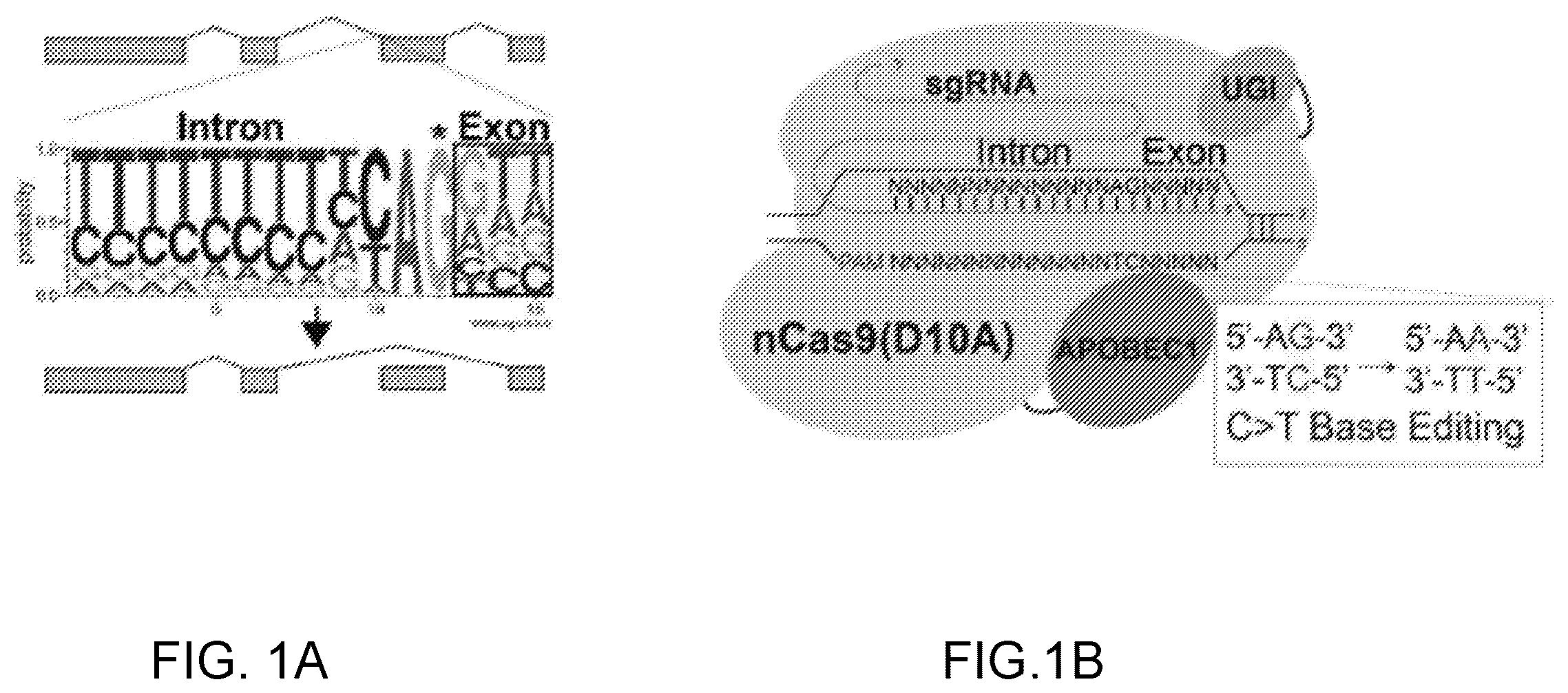
A- 1 B illustrate CRISPR-SKIP targeting strategy. A is a schematic representation of the consensus sequence of splice acceptors. B is a schematic illustrating that in the presence of an appropriate PAM sequence, base editors can be utilized to deaminate the cytidine in the antisense strand, which is complementary of the conserved guanosine in the splice acceptor, thus resulting in the disruption of the splice acceptor and exon skipping.
A- 2 E illustrate that single base editing of splice acceptor consensus sequences enabled programmable exon skipping. A illustrates that 293T cells were transfected with C>T base editors and sgRNAs targeting the splice acceptor of exon 7 in RELA. RT-PCR was used to detect exon skipping over 10 days. The top sequence is SEQ ID NO:339; the bottom sequence is SEQ ID NO:340. B illustrates that skipping of RELA exon 7 and PIK3CA exon 5 was induced by C>T base editors, but not by the sgRNA alone or in combination with dead Cas9 or D10A nickase Cas9. C illustrates that Sanger sequencing of the exon-skipped amplicon was used to demonstrate successful exon skipping of RELA exon 7 and PIK3CA exon 5. The top sequence is SEQ ID NO:340, the bottom sequence is SEQ ID NO:341. D illustrates that deep sequencing of genomic DNA in wt cells and cells treated with C>T base editors targeting RELA exon 7 and PIK3CA exon 5 was used to calculate the modification rate. E illustrates quantification of the rate of exon skipping of RELA exon 7 and PIK3CA exon 5 by deep sequencing of mature mRNA, which was amplified by RT-PCR.
illustrates that CRISPR-SKIP was effective across a panel of cell lines. CRISPR-SKIP induced skipping of RELA exon 7 and PIK3CA exon 5 in the cell lines HCT116, HEPG2, and MCF7.
illustrates the comparison of CRISPR-SKIP with active SpCas9 for inducing exon skipping. CRISPR-SKIP was utilized to target the splice acceptors of RELA exon 7, PIK3CA exon 5, and JAG1 exon 9. In parallel, sgRNAs targeting the same exons were co-transfected with active Cas9 to induce exon skipping. Analysis by PCR demonstrated that CRISPR-SKIP induced exon skipping at equal or greater rate than active SpCas9 in each of three exons tested.
A- 5 F illustrate that different Cas9 scaffolds increased the number of CRISPR-SKIP target exons. A illustrates that RT-PCR analysis demonstrated that SpCas9-VQR-BE3 and SaCas9-KKH-BE3 ( B ) can induce exon skipping of BRCA2 exon 26 and RELA exon 10, respectively. C illustrates that deep sequencing of genomic DNA revealed that targeted mutations introduced by SpCas9-VQR-BE3 were found in 0.93% of reads at the BRCA2 exon 26 splice acceptor, while SaCas9-KKH-BE3 induced targeted mutations in 46.61% of reads at RELA exon 10 splice acceptor. D illustrates that deep sequencing was performed in biological duplicates, and the results were combined. E illustrates quantification of the rate of exon skipping of BRCA2 exon 26 and ( F ) RELA exon 10 by deep sequencing of mature mRNA, which was amplified by RT-PCR. RNAseq was performed on biological duplicates and a single estimate of the proportion and confidence intervals were obtained.
illustrates that CRISPR-SKIP can be used to simultaneously skip multiple exons within the same transcript. SaCas9-KKH-BE3 was used to target PIK3CA exons 11 and 12. RT-PCR demonstrated that both sgRNAs induced skipping of the targeted exon and, when used together, induced skipping of both exons simultaneously. The top left sequence is SEQ ID NO:343; the top right sequence is SEQ ID NO:345; the bottom left sequence is SEQ ID NO:344, the bottom right sequence is SEQ ID NO: 346.
A- 7 B illustrate genome-wide computational estimation of targetability by CRISPR-SKIP. A illustrates the estimation of the number of exons that can be targeted by each base editor with estimated efficiency of editing flanking intronic G at or above the corresponding value on the x-axis. Only exons with maximum off-target score below 10 were considered. B illustrates the estimation of the number of exons that can be targeted by each base editor with maximum off-target score at or below the corresponding value on the x axis. Only exons for which the estimated efficiency of editing the flanking G nucleotide was above 20% were considered.
illustrates the expanded view of NGS analysis shown in D . Deep sequencing performed on biological duplicates and averaged.
illustrates that Neuro2A cells were transfected with either SpCas9 or SaCas9-KKH C>T base editors targeting the splice acceptor of Rela exon 8. Analysis of exon skipping by RT-PCR demonstrated that both base editors effectively induced splicing.
illustrates the comparison of CRISPR-SKIP and active SpCas9 using the same sgRNAs targeting the splice acceptor of BRCA2 exon 10, IL1RAP exon 10, JAG1 exon 9, PIK3CA exon 5 and RELA exon 7.
illustrates the expanded view of NGS analysis shown in C and 5 D . Deep sequencing performed on biological duplicates and averaged.
illustrates the estimation of the number of exons that can be targeted by each base editor with subplots filtered by the maximum allowed off-target score. The y-axis denotes the number of exons that can be targeted with estimated efficiency of modifying intronic flanking G at or above the corresponding value on the x-axis.
illustrates the estimation of the number of exons that can be targeted by each base editor with subplots filtered by estimated efficiency of editing the flanking G nucleotide. The y-axis denotes the number of exons that can be targeted with maximum off-target score at or below the corresponding value on the x-axis.
illustrates the comparison of CRISPR-SKIP using the C>T base editors BE3 or BE4 for inducing skipping of PIK3CA exon 5, RELA exon 7, and JAG1 exon 9 by RT-PCR analysis.
A- 15 B illustrate the CRISPR-SKIP targeting strategy targeting the conserved adenosine and the schematic representation of the consensus sequence of splice acceptors.
A- 16 C illustrate skipping rates of CTNNA1 exon 7. A shows HEK293T cells were transfected with wt ABE and a sgRNA targeting the splice acceptor site of CTNNA1 exon 7. The sequence is SEQ ID NO:347. Targeted exon skipping was observed after performing RT-PCR that could not be induced by the sgRNA alone, or in combination with dead Cas9 or D10A nickase Cas9. B shows sanger sequencing of the shorter transcript confirmed exclusion of exon 7. The sequence is SEQ ID NO:348. C shows high throughput sequencing confirmed targeted A>G mutations within the CTNNA1 exon 7 splice acceptor site.
A shows exon skipping in 293T cells transfected with ABE7.10 and CTNNA1 exon 7 sgRNA over a 10-day period. B shows the comparison of exon skipping of CTNNA1 exon 7 with varying doses of ABE7.10 and sgRNA. C shows RT-PCR products demonstrating targeted exon skipping of CTNNA1 exon 7 in HEPG2 cells, AHCY exon 9 in HCT116 cells, and CTNNB1 in mouse Neruro2A and mouse Hepa1-6 cells.
A illustrates a schematic representation of several of the ABE variants that were constructed by either modifying the linker tethering nCas9 and the deaminase domain or by fusing a UGI. B shows that high throughput sequencing of cDNA demonstrated significantly increased levels of exon skipping by several of the ABE variants as compared to wt ABE. * and ** correspond to P<0.05 and P<0.01 respectively by two-tailed unpaired Student's t-test (n=3).
A shows that high throughput sequencing of genomic DNA and cDNA was used to quantify rates of A>G genomic DNA mutation and rates of exon skipping across multiple targets using several ABE variants. *, and ** correspond to P<0.05 and P<0.01 respectively by two-tailed unpaired Students t-test (n=2). B illustrates rates of exon skipping showed a linear co-relation with rates of A>G mutations within splice acceptor sites for most targets tested.
shows that high throughput sequencing of cDNA was used to quantify rates of exon skipping across multiple targets using several ABE variants. *, and ** correspond to P<0.05 and P<0.01 respectively by two-tailed unpaired Students t-test across 2 biological replicates.
A shows a schematic representation of the ABE variants constructed by either modifying the linker tethering nCas9 and the deaminase domain, by fusing ABE with a UGI or both. GGGGS 5 is SEQ ID NO:7. B shows that combining the GGGGS 5 (SEQ ID NO:7) linker and UGI domain within the same ABE construct led to higher rates of exon skipping than the ABEs containing each component individually, suggesting an increased A>G mutation rates in genomic DNA when both domains are used. C shows that high throughput sequencing analysis of RT-PCR products demonstrated significantly increased levels of exon skipping by several of the ABE variants compared with wt ABE. (* and ** correspond to P<0.05 and P<0.01 respectively by two-tailed unpaired Student's t-test, n=3). GGGGS 5 is SEQ ID NO:7. D shows estimates of positional A>G modification efficiencies at each of the target A's within the protospacer of A-Rich Target 1 and A-Rich Target 2 using EditR software (n=3). Position 1 represents the base farthest from the start of the PAM using a 20 bp sgRNA. ABE-GGGGS constructs enabled editing of position 4, which was not observed with wt ABE. Additionally, shorter linker lengths corresponded to higher editing rates for positions 4 and 5, with ABE-GGGGS1 achieving the highest rates of base editing.
A illustrates the schematics of the split-ABE AAV system. N-terminal and C-terminal intein sequences reconstitute the full-length protein when co-expressed within the cell. B shows sanger sequencing traces from genomic DNA prepared from HEK293T cells transduced with either GFP-AAV or both N-ABE AAV and C-ABE AAV. A>G mutations were only observed when both N-ABE AAV and C-ABE AAV particles were delivered. GCGTGTAGGTGGACCGGTATCGG is SEQ ID NO:349. C shows that RT-PCR products confirmed that exon skipping only occurred when both N-ABE AAV and C-ABE AAV were co-delivered. D shows the quantification of A>G mutation rates in the samples described in 7b using EditR (n=3) and E shows exon skipping rates by densitometry analysis of RT-PCR products (n=3). F shows a schematic representation of the split-ABE plasmid system. N-terminal and C-terminal intein sequences reconstitute the full-length protein when co-expressed within the cell. G shows HEK293T cells were transfected with either GFP or a combination of sgRNA targeting AHCY exon 9 and N-ABE, C-ABE or both and their RNA was used in RT-PCR to detect targeted exon skipping of HSF1 exon 11. Only when both split ABE plasmids were present was exon skipping detected. H shows high throughput sequencing analysis of RT-PCR products demonstrated significantly increased levels of exon skipping by the split ABE system at 32.0% compared to 26.2% with the full length wt ABE (P=0.002 by two-tailed unpaired Students t-test (n=3).
A shows the genome-wide computational estimate of the number of inner exons that can be targeted by ABE and BE3 with predicted editing efficiency of the target base at or above the value on the x-axis. Only sgRNAs with an off-target score below 10 were considered. B shows the estimation of the number of inner exons that can be targeted by ABE and BE3 using sgRNAs with off-target scores at or below the value on the x-axis. Only sgRNAs with an on-target base editing efficiency above 30% were considered. Exons that could be targeted with either ABE or BE3 were compared to determine which base editor would have an sgRNA with ( C ) the highest predicted base editing efficiency or ( D ) the lowest off-target score. All sgRNAs with off-target scores at or below 10 were considered for C and D .
illustrates the plasmid map C-term Split ABE.
illustrates the plasmid map C-term Split BE3.
illustrates the plasmid map full length ABE.
illustrates the plasmid map full length BE3.
illustrates the plasmid map N-term Split ABE.
illustrates the plasmid map N-term Split BE3.
illustrates the plasmid map P2-gRNA.
illustrates shows sgRNA targeting in the synuclein (SNCA) gene. SM12 is SEQ ID NO:350; SM13 is SEQ ID NO:351; SM11 is SEQ ID NO:352; TGAATTTGTTTTTGTAGGCTCCAAAACCAAGGAGGGAGTGGTGCATGGTGTGGCA ACAGGT is SEQ ID NO:353; ACCTGTTGCCACACCATGCACCACTCCCTC CTTGGTTTTGGAGCCTACAAAAACAATTCA is SEQ ID NO:354; SM9 is SEQ ID NO:355; SM10 is SEQ ID NO:356; GSKTKEGVVHGVAT is SEQ ID NO:357.
shows RT-PCR data from the transfections. The numbers correspond to different transfections in Table 8. Data showed that only the Adenine Base Editor (ABE) was successful in skipping Exon 3 of the SNCA gene (lanes 5 and 6).
shows RT-PCR data for exon 3 skip using different combinations of ABE components.
shows quantification of base editing efficiency with split and full length ABE.
shows RT-PCR data from AAV transduction.
A- 36 B illustrate that exon 12 in the HTT gene can be skipped using single-base editors. A shows a schematic representation of the approach for reducing HTT cytotoxicity by exon skipping. HD is caused by genetic amplification of CAG codons within exon 1. Intracellular accumulation of the N-terminal fragments of mutant HTT is cytotoxic after proteolytic cleavage by caspase-6, whose target site is located between exons 12 and 13. Exclusion of exon 12 from mature HTT transcripts created a HTT isoform resistant to proteolysis by caspase-6 that is not cytotoxic. MATLEKLMKAFESLKSF[Q] N is SEQ ID NO:357, DILSHSSSQVSAVPSADPAMDLNDGQASSPISDSQTTEGPDSAVTAVPSDSSEIVLDGT D is SEQ ID NO:358, DILSHSSSQ is SEQ ID NO:359, VLDGTD is SEQ ID NO:360. B shows that HTT exon 12 can be skipped using CRISPR-Cas9 single-base editors. HTT exon 12 has 4 splice enhancers, which were targeted using 10 different sgRNAs in combination with either a SpCas9 C>T editor recognizing NGG PAMs (BE3), SpCas9 C>T editor recognizing NGA PAMs (VQR), SaCas9 C>T editor (KKH), or SpCas9 A>G editor (ABE).
shows modulation of splicing by disruption of exon splice enhancers (ESEs) using CRISPR-Cas9 split single-base editors. The top panel shows the sequence of the 3′ of HTT exon 12. Within this sequence 4 different ESEs were identified, which are highlighted. The top sequence is SEQ ID NO:361, the bottom sequence is SEQ ID NO:362. 2 sgRNAs were designed, which, when used in conjunction with a SaCas9 base editor, target the cytidines highlighted. Analysis of HTT exon 12 splicing by PCR demonstrated that editing the ESE individually was sufficient to induce low levels of exon skipping. Importantly, simultaneous editing of both ESEs function synergistically to generate higher rates of exon skipping.
A- 38 C show split base editor architecture for in vivo delivery. A shows the N-terminus of SpCas9 SBE was fused with an N-terminal intein, whereas the C-terminal intein is fused with the C-terminus of SpCas9. Upon translation, both inteins dimerize and reconstitute the full-length SBE. B shows split base editors were targeted to the splice acceptor of JAG1 exon 9, which when mutated, induced skipping of exon 9 from mature mRNA transcripts. When co-transfected, N-BE and C-BE induced exon skipping more efficiently that native SBEs. C shows mice were injected with Angptl3-targeting N-BE and C-BE vectors, Angptl3 protein decreased significantly after 3 weeks.
shows chromatograms and editing percentages achieved with the split versions of each base editor. The top two sequences are SEQ ID NO:363, the bottom sequence is SEQ ID NO:364.
shows a reverse-transcriptase PCR demonstrating exon 45 skipping in myoblasts (a disease-relevant cell type) after transfection with full-length SpBE3.
A- 41 B show raw base composition data and calculated % indels for HTS results for untreated HEK293T cells as well as cells transfected with WT ABE, ABE-UGI, and ABE-GGGGS5 (SEQ ID NO:7). Reported percentages are the mean values from two replicates.
A- 42 B show base composition and % indels of predicted off-target sites (Yuan, J. et al. Mol Cell 72, 380-394 e387, doi:10.1016/j.molcel.2018.09.002 (2018)) from HTS of genomic DNA from untreated HEK293T cells as well as cells transfected with plasmids encoding WT ABE and the corresponding sgRNA.
While the present invention is susceptible to various modifications and alternative forms, exemplary embodiments thereof are shown by way of example in the drawings and are herein described in detail. It should be understood, however, that the description of exemplary embodiments is not intended to limit the invention to the particular forms disclosed, but on the contrary, the intention is to cover all modifications, equivalents and alternatives falling within the spirit and scope of the invention as defined by the embodiments above and the claims below. Reference should therefore be made to the embodiments above and claims below for interpreting the scope of the invention.
DETAILED DESCRIPTION
The compositions and methods now will be described more fully hereinafter with reference to the accompanying drawings, in which some, but not all embodiments of the invention are shown. Indeed, the invention may be embodied in many different forms and should not be construed as limited to the embodiments set forth herein; rather, these embodiments are provided so that this disclosure will satisfy applicable legal requirements.
Likewise, many modifications and other embodiments of the compositions and methods described herein will come to mind to one of skill in the art to which the invention pertains having the benefit of the teachings presented in the foregoing descriptions and the associated drawings. Therefore, it is to be understood that the invention is not to be limited to the specific embodiments disclosed and that modifications and other embodiments are intended to be included within the scope of the appended claims. Although specific terms are employed herein, they are used in a generic and descriptive sense only and not for purposes of limitation.
Unless defined otherwise, all technical and scientific terms used herein have the same meaning as commonly understood by one of skill in the art to which the invention pertains. Although any methods and materials similar to or equivalent to those described herein can be used in the practice or testing of the present invention, the preferred methods and materials are described herein.
The disclosure relates to methods and compositions for inducing selective exon skipping using CRISPR-SKIP that uses base editors. To date, techniques for targeted exon skipping are either transient, such as injection of antisense oligonucleotides (Crooke S T: Biochim Biophys Acta 1999, 1489:31-44) or require introduction of DSBs into coding and/or non-coding regions of the genome, which could lead to deleterious off-target effects (Mou H, et al: Genome Biol 2017, 18:108; Long C, et al: Sci Adv 2018, 4:eaap9004). The disclosure is based, at least in part, on the discovery that CRISPR-SKIP, a technology that induces permanent modifications in the genome without DSBs, thus provides a significant advantage over other exon skipping techniques. Since the changes introduced by CRISPR-SKIP are hardwired in the genome after a single treatment, it provides a potential therapeutic tool for a wide variety of human diseases.
A Clustered Regularly Interspersed Short Palindromic Repeats/CRISPR-associated (CRISPR/Cas) system comprises components of a prokaryotic adaptive immune system that is functionally analogous to eukaryotic RNA interference, and that uses RNA base pairing to direct DNA or RNA cleavage. Directing DNA double stranded breaks requires an RNA-guided DNA endonuclease (e.g., Cas9 protein or the equivalent) and CRISPR RNA (crRNA) and tracr RNA (tracrRNA) sequences that aid in directing the RNA-guided DNA endonuclease/RNA complex to target nucleic acid sequence. The modification of a single targeting RNA can be sufficient to alter the nucleotide target of an RNA-guided DNA endonuclease protein. crRNA and tracrRNA can be engineered as a single cr/tracrRNA hybrid to direct the RNA-guided DNA endonuclease cleavage activity. A CRISPR/Cas system, including a CRISPR-SKIP system, can be used in vivo in yeast, fungi, plants, animals, mammals, humans, and in in vitro systems.
A CRISPR system, including a CRISPR-SKIP system, can comprise transcripts and other elements involved in the expression of or directing the activity of CRISPR-associated (“Cas”) genes, including sequences encoding an RNA-guided DNA endonuclease gene (i.e. Cas), a tracr (trans-activating CRISPR) sequence (e.g. tracrRNA or an active partial tracrRNA), a tracr-mate sequence (encompassing a “direct repeat” and a tracrRNA-processed partial direct repeat), a guide sequence, or other sequences and transcripts from a CRISPR locus. One or more elements of a CRISPR system can be derived from a type I, type II, type III, type IV, and type V CRISPR system. A CRISPR system comprises elements that promote the formation of a CRISPR complex at the site of a target sequence (also called a protospacer).
The elements of CRISPR systems (e.g., direct repeats, homologous recombination editing templates, guide sequences, tracrRNA sequences, target sequences, priming sites, regulatory elements, and RNA-guided DNA endonucleases) are well known to those of skill in the art. That is, given a target sequence one of skill in the art can design functional CRISPR elements specific for a particular target sequence. The methods described herein are not limited to the use of specific CRISPR elements, but rather are intended to provide unique arrangements, compilations, and uses of the CRISPR elements.
In one embodiment, the disclosure provides a fusion protein comprising (i) at least two tRNA-specific adenosine deaminases (TadA) domains (ii) a linker; and (iii) a RNA-guided DNA endonuclease having nickase activity protein. In one embodiment, the disclosure provides a method for inducing selective exon skipping comprising: contacting one or more DNA target sequences with (i) a single guide RNA (sgRNA) molecule having complementarity to the DNA target sequence; and (ii) the fusion protein comprising (i) at least two tRNA-specific adenosine deaminases (TadA) domains (e.g., 2, 3, 4, 5, or more domains) (ii) a linker; and (iii) a RNA-guided DNA endonuclease having nickase activity protein.
In particular embodiments, the fusion protein can be used to skip multiple exons. For example, multiple constructs can be used to skip 2, 3, 4, 5, 6 or more exons.
The term “deaminase” refers to an enzyme that catalyzes a deamination reaction. In some embodiments, the deaminase is a base editor converting adenine to guanine (e.g., Adenine Base Editor also referred to as ABE). In particular embodiments, the deaminase is a tRNA-specific adenosine deaminase (TadA). In some embodiments, the deaminase is a base editor converting cytidine to thymidine. A TadA can be an E. coli TadA, for example, UniProtKB-P68398 A TadA can be a Bacillus subtilis TadA, for example UniProtKB 21335. A TadA can be a Staphylococcus aureus TadA, for example UniProtKB Q99W51. Other adenosine deaminases and cytosine deaminases can also be used.
In some embodiments, a uracil glycosylase inhibitor (UGI) is used to minimize the natural repair process and increases the generation of the desired T-A base pair. Suitable UGIs include for example, a Bacillus subtilis bacteriophage PBS2 inhibitor (Wang et al, J. Biol. Chem. 1989 Jan. 15; 264(2):1163-71), an Escherichia coli inhibitor (Lundquist et al, J. Biol. Chem. 272:21408-21419(1997); Ravishankar et al, Nucleic Acids Res. 26:4880-4887(1998); and Putnam et al, J. Mol. Biol. 287:331-346(1999)), a Staphylococcus aureus inhibitor (Serrano-Heras G, et al, Proc Natl Acad Sci USA. 2008; 105:19044-19049). Other suitable UGI's can also be used. In one embodiment, the UGI sequence is as follows: TNLSDIIEKETGKQLVIQESILMLPEEVEEVIGNKPESDILVHTAYDESTDENVM LLTSDAPEYKPWALVIQDSNGENKIKML (SEQ ID NO:1; Uniprot: P14739). The UGI can be positioned at the N-terminus, at the C-terminus, or internally within the fusion protein.
Linkers are short polypeptide sequences that can be used to operably link protein domains. Linkers can comprise flexible amino acid residues (e.g., glycine or serine) to permit adjacent protein domains to move freely related to one another. In some embodiments, a linker joins the nickase, including the Cas9-D10A, and the deaminase. In some embodiments, the linker comprises (AP) 5 (SEQ ID NO:2), GGGGS (SEQ ID NO:3), (GGGGS) 2 (SEQ ID NO:4), (GGGGS) 3 (SEQ ID NO:5), (GGGGS) 4 (SEQ ID NO:6), (GGGGS) 5 (SEQ ID NO:7), (GGGGS) 6 (SEQ ID NO:8), (GGGGS) 7 (SEQ ID NO:9), GGGGSSGGSSGGSSGSETPGTSESATPESSGGSSGGS (SEQ ID NO:10), or (EAAA) 5 (SEQ ID NO:11). In particular embodiments, the linker comprises (GGGGS) 5 (SEQ ID NO:7), however any suitable linker can be used. In an embodiment, a linker can be present between two TadA domains. In an embodiment a linker can be present between the TadA domain and RNA-guided DNA endonuclease having nickase activity domain. In an embodiment, the spans the C terminus and the N terminus. In an embodiment, a linker can be about 4, 5, 6, 7, 8, 9, 10, 15, 20, 25, 30, or more nucleotides in length.
Wild-type Cas9 possesses two protein domains, RuvC and HNH, each responsible for cutting a strand of DNA. In particular embodiments, a RNA-guided DNA endonuclease having nickase activity is provided. In particular embodiment the RNA-guided DNA endonuclease having nickase activity is any Cas9, including spCas9, SaCas9 or FnCas9, or Cas12a. In particular embodiment the RNA-guided DNA endonuclease having nickase activity is a Cas9 enzyme wherein the RuvC domain has been modified with a DOA (Aspartic Acid to Alanine) mutation to make the Cas9 protein function as a nickase (cleaves a single strand) rather than as a nuclease. Other examples of mutations that render Cas9 a nickase include, without limitation, H840A, N854A, and N863A. In other embodiments, the SaCas9 includes the mutation D10A or N580A and functionally similar mutations in other Cas orthologs.
As used herein, “single guide RNA,” “guide RNA (gRNA),” “guide sequence” and “sgRNA” can be used interchangeably herein. A guide RNA is a specific RNA sequence that recognizes a target DNA region of interest and directs an RNA-guided molecule there for editing. A gRNA has at least two regions. First, a CRISPR RNA (crRNA) or spacer sequence, which is a nucleotide sequence complementary to the target nucleic acid, and second a tracr RNA, which serves as a binding scaffold for the RNA-guided molecule. The target sequence that is complementary to the guide sequence is known as the protospacer. The crRNA and tracr RNA can exist as one molecule or as two separate molecules. gRNA and sgRNA as used herein refer to a single molecule comprising at least a crRNA region and a tracr RNA region or two separate molecules wherein the first comprises the crRNA region and the second comprises a tracr RNA region. The crRNA region of the gRNA is a customizable component that enables specificity in every CRISPR reaction.
A guide RNA used in the systems and methods described herein are short, single-stranded polynucleotide molecules about 20 nucleotides to about 300 nucleotides in length. The spacer sequence (targeting sequence) that hybridizes to a complementary region of the target DNA of interest can be about 14, 15, 16, 17, 18, 19, 20, 25, 30, 35 or more nucleotides in length.
sgRNAs can be synthetically generated or by making the sgRNA in vivo or in vitro, starting from a DNA template.
A sgRNA can target a regulatory element (e.g., a promoter, enhancer, or other regulatory element) in the target genome. A sgRNA can also target a protein coding sequence in the target genome.
In particular embodiments, the sgRNA molecule is complementarity to a splice acceptor of a DNA target sequence. A splice acceptor site is present at the end of an intron and terminates the intron. Mutations which abolish or weaken recognition of natural splice acceptor or donor sites produce transcripts lacking corresponding exons or activate adjacent cryptic splice sites of the same phase. A splice acceptor site can be about 10, 12, 15, 20 or more nucleotides. In general a splice acceptor site has (5′ to 3′) a pyrimidine rich segment that is about 6, 8, or 10 nucleotides in length followed by NCAG (SEQ ID NO:12), NTAG (SEQ ID NO: 13), or NAAG (SEQ ID NO:14). See A . One or more sgRNA molecules (e.g., about 1, 2, 3, 4, 5 or more) have complementarity to one or more splice acceptor sites (e.g., about 1, 2, 3, 4, 5, or more). A sgRNA molecule can be about 15, 16, 17, 18, 19, 20, 21, 22, 23, 24, 25 or more nucleotides in length, wherein the target base occurs at about position 2, 3, 4, 5, 6, 7, 8, 9, or 10 of the sgRNA molecule. See, for example Table 1.
In particular embodiments, the sgRNA molecule is complementarity to a splice enhancer of a DNA target sequence. A splice enhancer is a DNA sequence motif consisting of 6 bases within an exon and adjacent to an intron that directs, or enhances, accurate splicing.
In the context of formation of a CRISPR complex, a target sequence or target nucleic acid molecule is a sequence to which a guide sequence is designed to have complementarity, where hybridization between a target sequence and a guide sequence promotes the formation of a CRISPR complex. Full complementarity is not necessarily required, provided there is sufficient complementarity to cause hybridization and promote formation of a CRISPR complex. A target sequence can comprise any polynucleotide, such as DNA or RNA polynucleotides. In some embodiments, a target sequence is located in the nucleus or cytoplasm of a cell. In some embodiments, the target sequence can be within an organelle of a eukaryotic cell, for example, mitochondrion or chloroplast.
In particular embodiments, the target sequence is located at the splice acceptor for exon 3 of the alpha-synuclein protein. In particular embodiments, the target sequence is located at the splice acceptor for exon 45 of the dystrophin gene. In particular embodiments, the target sequence is located at the splice enhancer of exon 12 of the Huntington gene.
The target sequence can be associated with a PAM (protospacer adjacent motif); that is, a short sequence recognized by the CRISPR complex. The precise sequence and length requirements for the PAM differ depending on the RNA-guided DNA endonuclease having nickase activity used, but PAMs are typically 2-5 base pair sequences adjacent to the protospacer (that is, the target sequence). In particular embodiments, a component of the RNA-guided DNA endonuclease having nickase activity domain can be split into two domains using inteins, thus enabling the packaging into vectors, such as viral vectors like AAV vectors with multiple applications for in vivo gene therapy.
An intein is an amino acid sequence that can excise itself from a protein and can rejoin the remaining protein segments (the exteins) via a peptide bond via protein splicing. Inteins are analogous to the introns found in mRNA. Many naturally occurring and engineered inteins and hybrid proteins comprising such inteins are known. As a result, methods for the generation of hybrid proteins from naturally occurring and engineered inteins are known to the skilled artisan. See e.g., For an Gross, Belfort, Derbyshire, Stoddard, & Wood (Eds.) Homing Endonucleases and Inteins Springer Verlag Heidelberg, 2005; ISBN 9783540251064. An intein can catalyze protein splicing in a variety of extein contexts. Therefore, an intein can be introduced into virtually any target protein sequence to create a desired hybrid protein. An intein can be, for example, mTth, Pho_RadA, Tko_RadA, Sce_VMA, mVMA, and Pab_Lon. Intein sequences can be found in InBase, an intein database. See, Perler et al. 1992 Proc Natl Acad Sci USA 89: 5577); Eryilmaz et al., J Biol Chem. 2014 May 23; 289(21): 14506-14511. An extein is the amino acid sequence that is flanked by an intein and is ligated to another extein during the process of protein splicing to form a mature, spliced protein. Typically, an intein is flanked by two extein sequences that are ligated together when the intein catalyzes its own excision. Exteins, accordingly, are the protein analog to exons found in mRNA. Split intein systems may include two polypeptides, wherein one may be of the structure extein(N)-intein(N) and the other may be of the structure intein(C)-extein(C). After dimerization and excision of the two intein fragments and splicing of the two exteins, the resulting structures are extein(N)-extein(C) and intein(N)-intein(C).
In one embodiment, provided herein is a recombinant system comprising a first construct comprising (i) a polynucleotide encoding tRNA-specific adenosine deaminase (TadA) (ii) a polynucleotide encoding a linker (iii) a first part of a polynucleotide encoding a RNA-guided DNA endonuclease having nickase activity domain and (v) a polynucleotide encoding an N-terminal intein and a second construct comprising (iv) a polynucleotide encoding a C-terminal intein and (ii) a second part of a polynucleotide encoding the RNA-guided DNA endonuclease having nickase activity domain.
In some embodiments, the first construct comprises the TadA domains, the linker, 712 amino acids
(SEQ ID NO: 15):
(DKKYSIGLAIGTNSVGWAVITDEYKVPSKKFKVLGNTDRHSIKKNLIG
ALLFDSGETAEATRLKRTARRRYTRRKNRICYLQEIFSNEMAKVDDSFF
HRLEESFLVEEDKKHERHPIFGNIVDEVAYHEKYPTIYHLRKKLVDSTD
KADLRLIYLALAHMIKFRGHFLIEGDLNPDNSDVDKLFIQLVQTYNQLF
EENPINASGVDAKAILSARLSKSRRLENLIAQLPGEKKNGLFGNLIALS
LGLTPNFKSNFDLAEDAKLQLSKDTYDDDLDNLLAQIGDQYADLFLAAK
NLSDAILLSDILRVNTEITKAPLSASMIKRYDEHHQDLTLLKALVRQQL
PEKYKEIFFDQSKNGYAGYIDGGASQEEFYKFIKPILEKMDGTEELLVK
LNREDLLRKQRTFDNGSIPHQIHLGELHAILRRQEDFYPFLKDNREKIE
KILTFRIPYYVGPLARGNSRFAWMTRKSEETITPWNFEEVVDKGASAQS
FIERMTNFDKNLPNEKVLPKHSLLYEYFTVYNELTKVKYVTEGMRKPAF
LSGEQKKAIVDLLFKTNRKVTVKQLKEDYFKKIECFDSVEISGVEDRFN
ASLGTYHDLLKIIKDKDFLDNEENEDILEDIVLTLTLFEDREMIEERLK
TYAHLFDDKVMKQLKRRRYTGWGRLSRKLINGIRDKQSGKTILDFLKSD
GFANRNFMQLIHDDSLTFKEDIQKAQV) of the polynucleotide encoding the RNA-guided DNA endonuclease having nickase activity and the N-terminal intein: (CLAGDTLITLADGRRVPIRELVSQQNFSVWALNPQTYRLERARVSRAFCTGIKPVYR LTTRLGRSIRATANHRFLTPQGWKRVDELQPGDYLALPRRIPTAS) (SEQ ID NO:16). In some embodiments, the second construct comprises 713-1371 amino acids of the polynucleotide encoding the RNA-guided DNA endonuclease having nickase activity and the C-terminal intein.
In one embodiment, provided herein is a recombinant system comprising a first construct comprising (i) a polynucleotide encoding a cytidine deaminase domain (ii) a polynucleotide encoding a linker (iii) a first part of a polynucleotide encoding nickase SpCas9 and (iv) a polynucleotide encoding an N-terminal intein; a second construct comprising (i) a polynucleotide encoding a C-terminal intein (ii) a second part of a polynucleotide encoding nickase SpCas9 and (iii) a polynucleotide encoding a uracil glycosylase inhibitor.
The terms “polynucleotide”, “nucleotide”, “nucleotide sequence”, “nucleic acid”, and “oligonucleotide” are used interchangeably. They refer to a polymeric form of nucleotides of any length, either deoxyribonucleotides or ribonucleotides, or analogs thereof. Polynucleotides can have any three dimensional structure, and can perform any function, known or unknown. Examples of polynucleotides include DNA molecules, coding or non-coding regions of a gene or gene fragment, loci (locus) defined from linkage analysis, exons, introns, messenger RNA (mRNA), transfer RNA, ribosomal RNA, short interfering RNA (siRNA), short-hairpin RNA (shRNA), micro-RNA (miRNA), ribozymes, cDNA, recombinant polynucleotides, branched polynucleotides, plasmids, vectors, isolated DNA of any sequence, isolated RNA of any sequence, nucleic acid probes, and primers. A polynucleotide can comprise one or more modified nucleotides, such as methylated nucleotides and nucleotide analogs. If present, modifications to the nucleotide structure can be imparted before or after assembly of the polymer. The sequence of nucleotides can be interrupted by non-nucleotide components. A polynucleotide can be further modified after polymerization, such as by conjugation with a labeling component.
A gene is any polynucleotide molecule that encodes a polypeptide, protein, or fragments thereof, optionally including one or more regulatory elements preceding (5′ non-coding sequences) and following (3′ non-coding sequences) the coding sequence. In one embodiment, a gene does not include regulatory elements preceding and following the coding sequence. A native or wild-type gene refers to a gene as found in nature, optionally with its own regulatory elements preceding and following the coding sequence. A chimeric or recombinant gene refers to any gene that is not a native or wild-type gene, optionally comprising regulatory elements preceding and following the coding sequence, wherein the coding sequences and/or the regulatory elements, in whole or in part, are not found together in nature. Thus, a chimeric gene or recombinant gene comprise regulatory elements and coding sequences that are derived from different sources, or regulatory elements and coding sequences that are derived from the same source, but arranged differently than is found in nature. A gene can encompass full-length gene sequences (e.g., as found in nature and/or a gene sequence encoding a full-length polypeptide or protein) and can also encompass partial gene sequences (e.g., a fragment of the gene sequence found in nature and/or a gene sequence encoding a protein or fragment of a polypeptide or protein). A gene can include modified gene sequences (e.g., modified as compared to the sequence found in nature). Thus, a gene is not limited to the natural or full-length gene sequence found in nature.
Polynucleotides can be purified free of other components, such as proteins, lipids and other polynucleotides. For example, the polynucleotide can be 50%, 75%, 90%, 95%, 96%, 97%, 98%, 99%, or 100% purified. A polynucleotide existing among hundreds to millions of other polynucleotide molecules within, for example, cDNA or genomic libraries, or gel slices containing a genomic DNA restriction digest are not to be considered a purified polynucleotide.
Polynucleotides can comprise additional heterologous nucleotides that do not naturally occur contiguously with the polynucleotides. As used herein the term “heterologous” refers to a combination of elements that are not naturally occurring or that are obtained from different sources.
Degenerate polynucleotide sequences encoding polypeptides described herein, as well as homologous nucleotide sequences that are at least about 80, or about 85, 90, 91, 92, 93, 94, 95, 96, 97, 98, or 99% identical to polynucleotides described herein and the complements thereof are also polynucleotides. Degenerate nucleotide sequences are polynucleotides that encode a polypeptide described herein or fragments thereof, but differ in nucleic acid sequence from the wild-type polynucleotide sequence, due to the degeneracy of the genetic code. Complementary DNA (cDNA) molecules, species homologs, and variants of polynucleotides that encode biologically functional polypeptides also are polynucleotides.
Polynucleotides can be obtained from nucleic acid sequences present in, for example, a microorganism such as a yeast or bacterium. Polynucleotides can also be synthesized in the laboratory, for example, using an automatic synthesizer. An amplification method such as PCR can be used to amplify polynucleotides from either genomic DNA or cDNA encoding the polypeptides.
Polynucleotides can comprise coding sequences for naturally occurring polypeptides or can encode altered sequences that do not occur in nature.
Unless otherwise indicated, the term polynucleotide or gene includes reference to the specified sequence as well as the complementary sequence thereof.
The expression products of genes or polynucleotides are often proteins, or polypeptides, but in non-protein coding genes such as rRNA genes or tRNA genes, the product is a functional RNA. The process of gene expression is used by all known life forms, i.e., eukaryotes (including multicellular organisms), prokaryotes (bacteria and archaea), and viruses, to generate the macromolecular machinery for life. Several steps in the gene expression process can be modulated, including the transcription, up-regulation, RNA splicing, translation, and post-translational modification of a protein.
Homology refers to the similarity between two nucleic acid sequences. Homology among DNA, RNA, or proteins is typically inferred from their nucleotide or amino acid sequence similarity. Significant similarity is strong evidence that two sequences are related by evolutionary changes from a common ancestral sequence. Alignments of multiple sequences are used to indicate which regions of each sequence are homologous. The term “percent homology” is used herein to mean “sequence similarity.” The percentage of identical nucleic acids or residues (percent identity) or the percentage of nucleic acids residues conserved with similar physicochemical properties (percent similarity), e.g. leucine and isoleucine, is used to quantify the homology.
Complement or complementary sequence means a sequence of nucleotides which forms a hydrogen-bonded duplex with another sequence of nucleotides according to Watson-Crick base-pairing rules. For example, the complementary base sequence for 5′-AAGGCT-3′ is 3′-TTCCGA-5′. Downstream refers to a relative position in DNA or RNA and is the region towards the 3′ end of a strand. Upstream means on the 5′ side of any site in DNA or RNA.
As described herein, “sequence identity” is related to sequence homology. Homology comparisons can be conducted by eye or using sequence comparison programs. These commercially available computer programs can calculate percent (%) homology between two or more sequences and can also calculate the sequence identity shared by two or more amino acid or nucleic acid sequences. Sequence homologies may be generated by any of a number of computer programs known in the art, for example BLAST or FASTA.
Percentage (%) sequence identity can be calculated over contiguous sequences, i.e., one sequence is aligned with the other sequence and each amino acid or nucleotide in one sequence is directly compared with the corresponding amino acid or nucleotide in the other sequence, one residue at a time. This is called an “ungapped” alignment. Ungapped alignments are performed only over a relatively short number of residues. Although this is a very simple and consistent method, it fails to take into consideration that, for example, in an otherwise identical pair of sequences, one insertion or deletion can cause the following amino acid residues to be put out of alignment, thus potentially resulting in a large reduction in percent homology when a global alignment is performed. Therefore, most sequence comparison methods are designed to produce optimal alignments that take into consideration possible insertions and deletions without unduly penalizing the overall homology or identity score. This is achieved by inserting “gaps” in the sequence alignment to try to maximize local homology or identity.
In some embodiments, at least one of the first construct and the second construct further comprises a sgRNA expression cassette providing simultaneous delivery of the sgRNA to a cell. In some embodiments, the expression cassette is positioned between the ITR sequences of the constructs. A sgRNA expression cassette can be under the control of a U6, 7Sk, or other RNA-polymerase III promoters.
The term “construct”, as used herein refers to an artificially assembled or isolated nucleic acid molecule which can include one or more nucleic acid sequences, wherein the nucleic acid sequences can include coding sequences, regulatory sequences, non-coding sequences, or any combination thereof. The term construct includes, for example, vectors.
Several aspects of the disclosure relate to vector systems comprising one or more vectors. A vector or “expression vector” is a replicon, such as a plasmid, virus, phage, or cosmid, to which another nucleic acid segment can be attached so as to bring about the replication of the attached segment. A vector is capable of transferring polynucleotides (e.g. gene sequences) to target cells.
Expression refers to the process by which a polynucleotide is transcribed from a nucleic acid template (such as into a sgRNA, tRNA or mRNA) and/or the process by which a transcribed mRNA is subsequently translated into peptides, polypeptides, or proteins. Transcripts and encoded polypeptides can be collectively referred to as “gene product.”
Many suitable vectors and features thereof are known in the art. Vectors can contain, without limitation, a centromeric (CEN) sequence, an autonomous replication sequence (ARS), a promoter, an origin of replication, and a marker gene (e.g., auxotrophic, antibiotic, or other selectable markers). Examples of expression vectors include plasmids, yeast artificial chromosomes, 2μπι plasmids, yeast integrative plasmids, yeast replicative plasmids, shuttle vectors, episomal plasmids, and viral vectors.
In some embodiments, the first construct and the second construct is flanked by inverted terminal repeats (ITRs). In some embodiments, the ITRs are isolated or derived from an AAV vector of serotype AAV1, AAV2, AAV3, AAV4, AAV5, AAV6, AAV7, AAV 8, AAV9, AAV 10, AAV 11 AAVrh74, AAVrh10 or any combination thereof. In some embodiments, the ITRs comprise or consist of full-length and/or wildtype sequences for an AAV serotype. In some embodiments, the ITRs comprise or consist of truncated sequences for an AAV serotype. In some embodiments, the ITRs comprise or consist of elongated sequences for an AAV serotype. In some embodiments, the ITRs comprise or consist of sequences comprising a sequence variation compared to a wildtype sequence for the same AAV serotype. Other ITRs from different species can be used in the constructs disclosed herein. In some embodiments, the first and second constructs are packaged into a first and second adeno-associated virus (AAV).
The constructs and vectors can comprise promoters. The promoters can be the same or different promoters. A promoter is any nucleic acid sequence that regulates the initiation of transcription for a particular polypeptide-encoding nucleic acid under its control. A promoter minimally includes the genetic elements necessary for the initiation of transcription (e.g., RNA polymerase Ill-mediated transcription), and can further include one or more genetic regulatory elements that serve to specify the prerequisite conditions for transcriptional initiation. A promoter can be inducible or non-inducible A promoter can be a cis-acting DNA sequence, about 10, 20, 30, 40, 50, 60, 70, 80, 90, 100, 110, 120, or more base pairs long and located upstream of the initiation site of a gene, to which RNA polymerase can bind and initiate correct transcription. There can be associated additional transcription regulatory sequences that provide on/off regulation of transcription and/or which enhance (increase) expression of the downstream coding sequence. A coding sequence is the part of a gene or cDNA that codes for the amino acid sequence of a protein, or for a functional RNA such as a tRNA or rRNA.
A promoter can be encoded by an endogenous genome of a cell, or it can be introduced as part of a recombinantly engineered polynucleotide. A promoter sequence can be taken from one species and used to drive expression of a gene in a cell of a different species. A promoter sequence can also be artificially designed for a particular mode of expression in a particular species, through random mutation or rational design. In recombinant engineering applications, specific promoters are used to express a recombinant gene under a desired set of physiological or temporal conditions or to modulate the amount of expression of a recombinant nucleic acid.
Other regulatory elements include enhancers, internal ribosomal entry sites (IRES), and other expression control elements (e.g. transcription termination signals (i.e., terminators), such as polyadenylation signals and poly-U sequences). Vectors described herein can additionally comprise one or more regulatory elements. Regulatory elements include those that direct constitutive expression of a nucleotide sequence in many types of host cell and those that direct expression of the nucleotide sequence only in certain host cells (e.g., tissue-specific regulatory sequences). Regulatory elements can also direct expression in a temporal-dependent manner, such as in a cell-cycle dependent or developmental stage-dependent manner, which may or may not also be tissue or cell-type specific.
Regulatory elements include enhancer elements, such as WPRE; CMV enhancers; the R-U5′ segment in LTR of HTLV-I (Mol. Cell. Biol., Vol. 8(1), p. 466-472, 1988); SV40 enhancer; and the intron sequence between exons 2 and 3 of rabbit β-globin (Proc. Natl. Acad. Sci. USA., Vol. 78(3), p. 1527-31, 1981).
The disclosure further provides a method comprising CRISPR-SKIP that utilizes cytidine deaminase base editors to program exon skipping by mutating target DNA bases within splice acceptor sites. Given its simplicity and precision, CRISPR-SKIP will be broadly applicable in gene therapy and synthetic biology.
In some embodiments, provided herein is a method for inducing selective exon skipping comprising contacting a DNA target sequence with (i) a single guide RNA (sgRNA) molecule having complementarity to the DNA target sequence and (ii) a cytidine deaminase base editor. In particular embodiments, the cytidine deaminase base editor comprises a cytidine deaminase, an uracil glycosylase inhibitor and a RNA-guided DNA endonuclease having nickase activity domain.
As used herein, “cytidine deaminase” refers to any enzyme that is capable of catalyzing the irreversible hydrolytic deamination of cytidine and deoxycytidine to uridine and deoxyuridine, respectively (cytidine deaminase activity). For example, a cytidine deaminase is a member of enzymes in the cytidine deaminase superfamily, and in particular, enzymes of the AID/APOB EC family. Members of the AID/APOBEC enzyme family include activation-induced deaminase (AID) and APOBEC1, APOBEC2, APOBEC4, and APOBEC3 subgroups of enzymes (Conticello et al. Mol. Biol. Evol. 22:367-77, 2005; Conticello. Genome Biol. 9:229, 2008). The cytidine deaminase superfamily additionally includes cytidine deaminases and CMP deaminases (Muranatsu et al, J. Biol, Chem 274: 18470-6, 1999). A cytidine deaminase can be a mammalian cytidine deaminase, such as rat or human, however, any suitable cytidine deaminase can be used. In particular embodiments, the cytidine deaminase base editor is SpCas9-BE3.
Advantageously the methods and compositions disclosed herein result in less than 1%, 2%, 3%, 4%, 5%, 6%, 7%, 8%, 9%, 10%, 11%, 12%, 13%, 14%, or 15% of off-target binding. In other words, the methods and compositions disclosed have a high degree of binding to the to an “on-target” site which refers to a site to which a practitioner desires binding and/or cleavage to occur, while “off-target” refers to a site to which a practitioner does not desire binding and/or cleavage to occur.
In particular embodiments, the methods and compositions disclosed herein advantageously result in 20%, 25%, 30%, 35%, 40%, 45%, 50%, 55%, 60%, 5%, 70%, 75%, 80%, 85%, 90%, or 95% of exon skipping.
Further disclosed herein is a method of treating an alpha synuclein protein defect in a subject comprising contacting a cell in the subject with the systems disclosed herein. Further disclosed herein is a method of treating a dystrophin protein defect in a subject comprising contacting a cell in the subject with the systems disclosed herein. Further disclosed herein is a method of treating Huntington disease in a subject comprising contacting a cell in the subject with (i) a single guide RNA (sgRNA) molecule having complementarity to a target sequence in the Huntington gene and (ii) a cytidine deaminase base editor. In particular embodiments, the sgRNA molecule is complementary to a target sequence in exon 12 of the Huntington gene. Further disclosed herein is a method of treating Duchenne Muscular Dystrophy in a subject comprising contacting a cell in the subject with (i) a single guide RNA (sgRNA) molecule having complementarity to a target sequence in the dystrophin gene and (ii) a cytidine deaminase base editor. In particular embodiments, the sgRNA molecule is complementary to a target sequence in exon 45 of the dystrophin gene.
The term “subject” is intended to include human and non-human animals, particularly mammals. In certain embodiments, the subject is a human patient.
As used herein, “treatment” and “treating” and the like generally mean obtaining a desired pharmacological and physiological effect. The effect may be prophylactic in terms of preventing or partially preventing a disease, symptom or condition thereof and/or may be therapeutic in terms of a partial or complete cure of a disease, condition, symptom or adverse effect attributed to the disease. The term “treatment” as used herein covers any treatment of a disease in a mammal, particularly a human, and includes: (a) preventing the disease from occurring in a subject which may be predisposed to the disease but has not yet been diagnosed as having it such as a preventive early asymptomatic intervention; (b) inhibiting the disease, e.g., arresting its development; or relieving the disease, e.g., causing regression of the disease and/or its symptoms or conditions such as improvement or remediation of damage, for example in a subject who has been diagnosed as having the disease.
The dose of for treatment will vary based on several factors including, but not limited to: route of administration, the nucleic acid expression required to achieve a therapeutic effect, the specific disease treated, any host immune response to the vector, and the stability of the protein expressed. One skilled in the art can determine a rAAV/vector genome dose range to treat a patient having a particular disease or disorder based on the aforementioned factors, as well as other factors.
Methods of administration or delivery include any mode compatible with a subject. Methods and uses of the invention include delivery and administration systemically, regionally or locally, or by any route, for example, by injection or infusion. Such delivery and administration include parenterally, e.g. intraocularly, intravascularly, intravenously, intramuscularly, intraperitoneally, intradermally, subcutaneously, or transmucosal. Exemplary administration and delivery routes include intravenous (i.v.), intraperitoneal (i.p.), intra-arterial, subcutaneous, intra-pleural, intubation, intrapulmonary, intracavity, iontophoretic, intraorgan, intralymphatic. In particular embodiments, a vector, such as an AAV vector is administered or delivered parenterally, such as intravenously, intraarterially, intraocularly, intramuscularly, subcutaneously, or via catheter or intubation.
In certain embodiments, the mode of delivery comprises a DNA based expression system. In certain embodiments, the mode of delivery comprises a RNA or protein/RNA complex system. In certain embodiments, the mode of delivery further comprises selecting a delivery vehicle and/or expression systems from the group consisting of liposomes, lipid particles, nanoparticles, biolistics, or viral-based expression/delivery systems. In certain embodiments, expression is spatiotemporal expression is optimized by choice of conditional and/or inducible expression systems, including controllable CRISPR effector activity optionally a destabilized CRISPR effector and/or a split CRISPR effector, and/or cell- or tissue-specific expression system.
In some embodiments, the systems disclosed herein can be administered directly or they can be used to treat cells in vitro, and the modified cells can optionally be administered (ex vivo).
The compositions disclosed herein can be incorporated into pharmaceutical compositions, e.g., a pharmaceutically acceptable carrier or excipient.
As used herein the term “pharmaceutically acceptable” and “physiologically acceptable” mean a biologically acceptable formulation, gaseous, liquid or solid, or mixture thereof, which is suitable for one or more routes of administration, in vivo delivery or contact. A “pharmaceutically acceptable” or “physiologically acceptable” composition is a material that is not biologically or otherwise undesirable, e.g., the material may be administered to a subject without causing substantial undesirable biological effects. Thus, such a pharmaceutical composition may be used, for example in administering a viral vector or viral particle to a subject.
Without limiting the disclosure, a number of embodiments of the disclosure are described herein for purpose of illustration.
EXAMPLES
The Examples that follow are illustrative of specific embodiments of the disclosure, and various uses thereof. They are set forth for explanatory purposes only and should not be construed as limiting the scope of the disclosure in any way.
Methods
Cell Culture and Transfection
The cell lines HCT116, 293T, MCF7, HEPG2 and Neuro-2A were obtained from the American Tissue Collection Center (ATCC). HCT116, 293T, Hepa 1-6 and Neuro-2A cells were maintained in DMEM supplemented with 10% fetal bovine serum and 1% penicillin/streptomycin at 37° C. with 5% CO 2 . HEPG2 cells were maintained in DMEM supplemented with 10% fetal bovine serum, 1% penicillin/streptomycin, and 1% L-glutamine at 37° C. with 5% CO 2 . MCF7 cells were grown in EMEM supplemented with 10% fetal bovine serum, 1% penicillin/streptomycin, 0.1 mM non-essential amino acids, 1 mM sodium pyruvate and 10 nM β-estradiol. All cell lines were transfected in 24-well plates with Lipofectamine 2000 (Invitrogen) following manufacturer's instructions. The amount of DNA used for lipofection was 1 μg per well. Transfection efficiency was routinely higher than 80% for 293T cells as determined by fluorescent microscopy following delivery of a control GFP expression plasmid. Transfection efficiency of other cell lines was lower (10-50%) and, therefore, puromycin selection was used for 48 hours to enrich successfully transfected cells. Puromycin was used at a concentration of 1 μg/mL (HCT116, MCF7), 1 μg/mL (HeLa), 2 μg/mL (HepG2), or 3 μg/mL (Neuro2A).
Plasmids and Cloning
The plasmids used for SpCas9 sgRNA expression and expression of SpCas9, dCas9 and Cas9-D10A were gifts from Charles Gersbach. The plasmids encoding SpCas9-BE3 (pCMV-BE3), SpCas9-VQR-BE3 (pBK-VQR-BE3), and SaCas9-KKH-BE3 (pJL-SaKKH-BE3) were gifts from David Liu (Addgene plasmid #73021, 85171, and 85170). The plasmid used for SaCas9-KKH-BE3 sgRNA expression (BPK2660) was a gift from Keith Joung (Addgene plasmid #70709).
The ABE7.10 plasmid was generated through Gibson assembly of a gBlock Gene Fragment (Integrated DNA Technologies) containing the TadA domains and ABE7.10 linker, as described by Gaudelli et al Nature 551, 464-471, (2017) into the Cas9-D10A backbone. The ABE plasmids containing the various linkers were created through Gibson assembly of gBlock Gene Fragments into the ABE7.1 plasmid. The ABE-UGI plasmid was generated through Gibson assembly of the TadA deaminase domains into an spCas9-BE3 plasmid (pCMV-BE3) that was a gift from David Liu (Addgene plasmid #73021). Split ABE constructs were generated through Gibson assembly of gBlock Gene Fragments. Amino acid sequences are provided in Supplemental Sequences. All base editor constructs were under the control of the CMV promoter, except for N-ABE-AAV which was under the control of an EFS promoter (Tabebordbar, M. et al, Science 351, 407-411 (2016)). To facilitate enrichment of successfully transfected cells, a cassette for expression of puromycin N-acetyl-transferase and GFP tethered with T2A peptide from a PGK promoter was cloned into each of the three BE3 plasmids. All oligonucleotides used in this work were obtained from IDT Technologies. The oligonucleotides for sgRNA generation were hybridized, phosphorylated and cloned into the appropriate sgRNA vector using BbsI sites for pSPgRNA, and BsmBI sites for BPK2660 (Khoo, B., et al, BMC Mol Biol 8, 3, doi: 10.1186/1471-2199-8-3 (2007). Guide sequences are provided in Table 1.
TABLE 1
Results of CRISPR-SKIP targeting at 18 human sites with 20 sgRNAs.
Target base is shown in bold and italics.
Ensembl ID. Exon
Target Number and Target Exon BE3 Target Sequence Exon
Gene Number (after colon) Version and PAM Skipped?*
BRCA2 ENST00000380152.7: SpBE3 AATC C TGTTAAAGTATAAAA Y
10 SEQ ID NO: 34 CAG
BRCA2 ENST00030380152.7: SpBE3 GAGCC C TGAACAAATAAAAG N
17 SEQ ID NO: 35 TAG
BRCA2 ENST00000380152.7: SaBE3- GAGCC C TGAACAAATAAAAG N
17 KKH SEQ ID NO: 36 TAGAAT
BRCA2 ENST00000380152.7: SpBE3- AATATT C TAAGAAAATAAGT Y
26 VOR SEQ ID NO: 37 GGA
CCNB1 ENST00000256442.9: SaBE3- CTCTTC C TGCAAAAGAAAAT N
5 KKH SEQ ID NO: 38 GCTGAT
CCNB1 ENST000002564429: SaBE3- AATTATT C TGCAATGGGAAT N
6 KKH SEQ ID NO: 39 TTCAAT
EGFR ENST00000275493.6: SpBE3- ACCC C TGAGAGGATGAAGCA N
23 VOR SEQ ID NO: 40 AGA
IL1RAP ENST0003044 7382.5: SpBE3- GGCA C TGGAATGAACAACAA Y
10 VOR SEQ ID NO: 41 AGA
IL1RAP ENST00000447382.5: SpBE3 TGGCA C TGGAATGAACAACA N
10 SEQ ID NO: 42 MG
JAG1 ENST00000254958.9: SpBE3 AATGT C TGGTCAACAAGAAA Y
9 SEQ ID NO: 43 AGG
JAG1 ENST00000254958.9: SpBE3 AAATC C TAGAAGAGGAGAAG N
12 SEQ ID NO: 44 GGG
LMNA ENST00000448611.6: SpBE3 GAGCC C TGGGAAGGGAGACA N
11 SEQ ID NO: 45 AGG
PI4KA ENST0000025588210: SpBE3- TCTTCAC C TACCAAGGAAAC N
9 VOR SEQ ID NO: 46 AGA
PIK3CA ENST00000263967.3: SpBE3 TATA C TGTAAGAGATTAAGG Y
5 SEQ ID NO: 47 GGG
PIK3CA ENST00000263967.3: SaBE3- TAGTGT C TGTGTGGGAGAAA Y
11 KKH SEQ ID NO: 48 CAAAAT
PIK3CA ENST00000263967.3: SaBE3- ATACAT C TGTGTATGAGAAA Y
12 KKH SEQ ID NO: 49 GACAAT
RELA ENST0000040€246.7: SpBE3- GGAA C TGCCAAGAAAACAGG N
6 VOR SEQ ID NO: 50 CGA
RELA ENST00000406246.7: SpBE3 AC C TGAGGCAGTGAAAACAA Y
7 SEQ ID NO: 51 GGG
RELA ENST00000406246.7: SaBF_3- TGGGTC C TGTAGGGCAAGGG Y
10 KKH SEQ ID NO: 52 CTAGGT
SCARB1 ENST00000339570.9: SpBE3 GTTGAG C TACAGACACAGCA Y
5 SEQ ID NO: 53 GGG
*As determined by gel electrophoreses AAV Vector Production
HEK293T cells were seeded in 15 cm dishes and transfected at 80-90% confluence. GFP-AAV plasmid, N-ABE-AAV or C-ABE-AAV were transfected along with pHelper and pAAV-DJ from the AAV-DJ Packaging System from Cell Biolabs in a 1:1:1 ratio using calcium phosphate and a total of 60 μg per plate. Media was replaced 24 hours post-transfection. Cell pellets were harvested at 72 hours post-transfection through manual cell scraping and centrifuged at 1,500×g for 12 minutes. After aspirating the supernatant, the cell pellet was resuspended in 1 mL AAV lysis buffer (50 mM Tris-HCl pH=8.5, 150 mM NaCl and 2 mM MgCl 2 ). Resuspended pellets were subjected to three freeze-thaw cycles between an ethanol/dry ice bath and a 37° C. water bath. Lysed cell pellets were then spun at 10,000×g for 10 minutes and the supernatant was collected as crude lysate. Lysates were then treated with 50 U benzonase per mL and incubated at 37° C. for 30 minutes to digest unpackaged plasmid. Crude lysates were added directly to cells or flash frozen with liquid nitrogen and stored at −80° C. for future use.
AAV Infection
HEK293T cells were infected in suspension in the wells of a 24 well plate by mixing 100 μL of crude lysate with 20,000 cells in 150 μL of cell culture medium. In the case of the samples containing both N-ABE AAV and C-ABE AAV, 50 μL of each lysate was added. Protamine sulfate was added to the lysate-cell mix at a final concentration of 5 μg/mL to enhance infection efficiency. Cells were incubated for 24 hours at which point the media was aspirated and replaced with 500 μL of fresh medium. Infected cells were incubated for a total of 6 days before harvesting genomic DNA and RNA for analysis.
RT-PCR
RNA was harvested from cell pellets using the RNEASY® (RNA purification) Plus Mini Kit (Qiagen) according to manufacturer's instructions. cDNA synthesis was performed using the QSCRIPT® cDNA Synthesis Kit (Quanta Biosciences) from 400-1000 ng of RNA with the cycling conditions recommended by the supplier. PCR was performed using KAPA2G Robust PCR kits from Kapa Biosystems. The 25 μL reactions used 50 ng of cDNA, Buffer A (5 μL), Enhancer (5 μL), dNTPs (0.5 μL), 10 μM forward primer (1.25 μL), 10 μM reverse primer (1.25 μL), KAPA2G Robust DNA Polymerase (0.5 U) and water (up to 25 μL). Cycling parameters as recommended by the manufacturer were used. The PCR products were visualized in 2% agarose gels and images were captured using a CHEMIDOC-IT® imager (UVP). The DNA sequences of the primers for each target are provided in Table 2. PCR may favor shorter amplicons and introduce bias in the quantification of ratios of two transcripts of different lengths.
TABLE 2
Nucleotide sequences of primers used for all PCRs.
Target Target RT PCR
Designation Gene Exon Primer Sequence or gDNA
BRCA2int9 F BRCA2 10 AACAGGAGAAGGGGTGACTGAC SEQ ID NO: 54 gDNA
BRCA2ex10 R BRCA2 10 TTCCAATGTGGTCTTTGCAGCT SEQ ID NO: 55 gDNA
BRCA2ex7 F BRCA2 10 GCTACACCACCCACCCTTAGTT SEQ ID NO: 56 RT
BRCA2ex11 R BRCA2 10 TTCCTGCAGGCATGACAGAGAA SEQ ID NO: 57 RT
BRCA2int16 F BRCA2 17 Agatgtgggggtctcactatgttg SEQ ID NO: 58 gDNA
BRCA2ex17 R BRCA2 17 AGCTGCCAGTTTCCATATGATCCA SEQ ID NO: 59 gDNA
BRCA2ex15 F BRCA2 17 CACAGCCAGGCAGTCTGTATCT SEQ ID NO: 60 RT
BRCA2ex18 R BRCA2 17 TGGGGCTTCAAGAGGTGTACAG SEQ ID NO: 61 RT
BRCA2int25 F BRCA2 26 Aggacttgagccccaatcttcc SEQ ID NO: 62 gDNA
BRCA2ex26 R BRCA2 26 GTGTACGGCCCTGAAGTACAGT SEQ ID NO: 63 gDNA
BRCA2ex25 F BRCA2 26 TCTGCTAGTCCAAAAGAGGGCC SEQ ID NO: 64 RT
BRCA2ex27 R BRCA2 26 CTGTGCAGCCGGAGAAACAAAT SEQ ID NO: 65 RT
CCNB1int4 F CCNB1 5 Aagcaatctgccaacttcagcc SEQ ID NO: 66 gDNA
CCNB1ex5 R CCNB1 5 CAGTGACTTCCCGACCCAGTAG SEQ ID NO: 67 gDNA
CCNB1int5 F CCNB1 6 CCCTTCCAGGATTCTAGCCGAG SEQ ID NO: 68 gDNA
CCNB1ex6 R CCNB1 6 AAACATGGCAGTGACACCAACC SEQ ID NO: 69 gDNA
CCNB1ex3 F CCNB1 5 and 6 GagccagaacctgagccTGTTA SEQ ID NO: 70 RT
CCNB1ex7 R CCNB1 5 and 6 AGGAGGAAAGTGCACCATGTCA SEQ ID NO: 71 RT
EGFRint22 F EGFR 23 Gaggtagactgaggcttccagc SEQ ID NO: 72 gDNA
EGFRint23 R EGFR 23 GATGCAAAGGCCTCAGCTGTTT SEQ ID NO: 73 gDNA
EGFRex20 F EGFR 23 GCTCAACTGGTGTGTGCAGATC SEQ ID NO: 74 RT
EGFRex24 R EGFR 23 TCACGGAACTTTGGGCGACTAT SEQ ID NO: 75 RT
IL1RAPint9 F IL1RAP 10 Accgtggacttcttcaggtage SEQ ID NO: 76 gDNA
IL1RAPex10 R IL1RAP 10 GCTCCAAAACCACAAGCCAGTT SEQ ID NO: 77 gDNA
IL1RAPex8 F IL1RAP 10 CTCGCAATGAGGTTTGGTGGAC SEQ ID NO: 78 RT
IL1RAPex11.12 R IL1RAP 10 GTATTTCCCCCAGGCAGACTGT SEQ ID NO: 79 RT
JAG1int8 F JAG1 9 CTTGTAGCAGGTGTCTGGCTCT SEQ ID NO: 80 gDNA
JAG1ex9 R JAG1 9 GGGGCACACACACTTAAATCCG SEQ ID NO: 81 gDNA
JAG1ex8 F JAG1 9 GAGGCAGCTGTAAGGAGACCTC SEQ ID NO: 82 RT
JAG1ex12 R JAG1 9 CTGCATAGCCAGGTGGACAGAT SEQ ID NO: 83 RT
JAG1ex7 F JAG1 9 long GAACTTGTAGCAACACAGGCCC SEQ ID NO: 84 RT
range
JAG1ex15 R JAG1 9 long AGGAGTTGACACCATCGATGCA SEQ ID NO: 85 RT
range
JAG1int11 F JAG1 12 AGCTAAACCGCAACAGTCATGC SEQ ID NO: 86 gDNA
JAG1int12 R JAG1 12 CCATCTGAGGTTTTGCCACCAC SEQ ID NO: 87 gDNA
JAG1ex9 F JAG1 12 CGGATTTAAGTGTGTGTGCCCC SEQ ID NO: 88 RT
JAG1ex13 R JAG1 12 TTCTGGCAGGGATTAGGCTCAC SEQ ID NO: 89 RT
LMNAint10 F LMNA 11 AAGCTTGCTCCCGTTCTCTCTT SEQ ID NO: 90 gDNA
LMNAint11 R LMNA 11 CAGAAGAGCCAGAGGAGATGGG SEQ ID NO: 91 gDNA
LMNAex10 F LMNA 11 GACGACGAGGATGAGGATGGAG SEQ ID NO: 92 RT
LMNAex12 R LMNA 11 CACCCCTTTCCCTTGGCTTCTA SEQ ID NO: 93 RT
PI4KAint8 F PI4KA 9 CTGAGGTCTGCACATCCTGGAA SEQ ID NO: 94 gDNA
PI4KAint9 R PI4KA 9 CACTGCAAAACCCCTTCCACTC SEQ ID NO: 95 gDNA
PI4KAex8 F PI4KA 9 ACTGCCCTAGAGCCTGAGTACT SEQ ID NO: 96 RT
PI4KAex10 R PI4KA 9 CACGCAGCATCTTGAACATGGT SEQ ID NO: 97 RT
PI4KAex31 F PI4KA 33 CCATGTTCAAGCTGACCGCAAT SEQ ID NO: 98 RT
PI4KAex36 R PI4KA 33 GCTGGCGGTCAGGTACTTCTTA SEQ ID NO: 99 RT
PIK3CAint4 F PIK3CA 5 Ggggtttcaccgttttagccag SEQ ID NO: 100 gDNA
PIK3CAex5 R PIK3CA 5 ACATCAAATTGGGCATCCTCCC SEQ ID NO: 101 gDNA
PIK3CAex3 F PIK3CA 5 TCTTCACCAGAATTGCCAAAGC SEQ ID NO: 102 RT
PIK3CAex6 R PIK3CA 5 TCCACCTGGGATTGGAACAAGG SEQ ID NO: 103 RT
PIK3CAex2 F PIK3CA 5 long ACCAGTAGGCAACCGTGAAGAA SEQ ID NO: 104 RT
PIK3CAex9 R PIK3CA 5 long TCGGGATACAGACCAATTGGCA SEQ ID NO: 105 RT
PIK3CAex9 F PIK3CA 11 and TAGCTATTCCCACGCAGGACTG SEQ ID NO: 106 RT
PIK3CAex14 R PIK3CA 11 and TTCCATTGCCTCGACTTGCCTA SEQ ID NO: 107 RT
RELAint5 F RELA 6 TTTCCTGCATCTCCCTCACTGG SEQ ID NO: 108 gDNA
RELAex6 R RELA 6 ACAGCATTCAGGTCGTAGTCCC SEQ ID NO: 109 gDNA
RELAint6 F RELA 7 CAGATTGGCAcccactggacta SEQ ID NO: 110 gDNA
RELAex7 R RELA 7 AGATCTTGAGCTCGGCAGTGTT SEQ ID NO: 111 gDNA
RELAex8 R RELA 6 and 7 CCTGGTCCCGTGAAATACACCT SEQ ID NO: 112 RT
RELAex4 F RELA 6 and 7, CCCACGAGCTTGTAGGAAAGGA SEQ ID NO: 113 RT
RELAex11 R RELA 7 long TGCTCAGGGATGACGTAAAGGG SEQ ID NO: 114 RT
RELAint8 F RELA 10 CAACAGAGGCCTCCAAAAGCTG SEQ ID NO: 115 gDNA
RELAex10 R RELA 10 AATCCTTACCTGGCTTGGGGAC SEQ ID NO: 116 gDNA
RELAex7 F RELA 10 AACACTGCCGAGCTCAAGATCT SEQ ID NO: 117 RT
RELAex11 R RELA 10 TGCTCAGGGATGACGTAAAGGG SEQ ID NO: 118 RT
SCARB1int4 F SCARB1 5 GgaggaaagccagaCTCTCCTG SEQ ID NO: 119 gDNA
SCARB1int5 R SCARB1 5 AGAGTGTTCATCCTCCCAGCAC SEQ ID NO: 120 gDNA
SCARB1ex4 F SCARB1 5 ACTGTGGGTGAGATCATGTGGG SEQ ID NO: 121 RT
SCARB1ex7 R SCARB1 5 TTCGTTGGGTGGGTAGATGGAC SEQ ID NO: 122 RT
BRCA2ex10off1F BRCA2 exon 10 GCTGCCTACTCTGCCTACTCAG SEQ ID NO: 123 gDNA
BRCA2ex10off1R BRCA2 exon 10 Gtccataggcctcaccagactg SEQ ID NO: 124 gDNA
BRCA2ex10off2F BRCA2 exon 10 TTCTGAAGGAAGACGCCTGGAG SEQ ID NO: 125 gDNA
BRCA2ex10off2R BRCA2 exon 10 Gctgcaataaacatgggtgtgc SEQ ID NO: 126 gDNA
BRCA2ex10off3F BRCA2 exon 10 AATTCCCTGGCATTTAGGTTGAGC SEQ ID NO: 127 gDNA
BRCA2ex10off3R BRCA2 exon 10 GCAGAATGCAGACTTTCCCTTTCA SEQ ID NO: 128 gDNA
BRCA2ex10off4F BRCA2 exon 10 GgtgcctatcCCTGCCTTGTAT SEQ ID NO: 129 gDNA
BRCA2ex10off4R BRCA2 exon 10 TTTTACTTCGCCTTGGCACACC SEQ ID NO: 130 gDNA
BRCA2ex17 Sp BRCA2 exon 17 Cacgcccctgtaatcccaacta SEQ ID NO: 131 gDNA
BRCA2ex17 Sp BRCA2 exon 17 GTGGTCTTCTTCCCACCTCCTC SEQ ID NO: 132 gDNA
BRCA2ex17 Sp BRCA2 exon 17 Gaaatcacgccactgcattcca SEQ ID NO: 133 gDNA
BRCA2ex17 Sp BRCA2 exon 17 Gattcacccacttttcccagcg SEQ ID NO: 134 gDNA
BRCA2ex17 Sp BRCA2 exon 17 Tgcaaattcacagcaaagcagga SEQ ID NO: 135 gDNA
Sp OT3
BRCA2ex17 Sp BRCA2 exon 17 ACATTGACCCCAGTTGCTCTCT SEQ ID NO: 136 gDNA
BRCA2ex17 Sp BRCA2 exon 17 TGCTGCTACTCTTTTCTGGACACT SEQ ID NO: 137 gDNA
BRCA2ex17 Sp BRCA2 exon 17 GGAGCAATTCCACTGATGCATCTC SEQ ID NO: 138 gDNA
BRCA2ex17 KKH BRCA2 exon 17 GcactcccactgccTGTATTGA SEQ ID NO: 139 gDNA
BRCA2ex17 KKH BRCA2 exon 17 GAGTAGGGGAAAAGAGGGGAGC SEQ ID NO: 140 gDNA
BRCA2ex17 KKH BRCA2 exon 17 TCAGAGACTCCATGATGCCATGTt SEQ ID NO: 141 gDNA
BRCA2ex17 KKH BRCA2 exon 17 Gctatgttgtcctggctagagtgt SEQ ID NO: 142 gDNA
BRCA2ex17 KKH BRCA2 exon 17 GGGTGGTAGACAAGAAGCCTCA SEQ ID NO: 143 gDNA
BRCA2ex17 KKH BRCA2 exon 17 GGCACAGACAGACCACAAAAGG SEQ ID NO: 144 gDNA
off3R OT KKH OT3
JAG1ex9off4F JAG1 OT exon 9 OT4 TGTATGTGAATGAGCGGGTGGT SEQ ID NO: 145 gDNA
JAG1ex9off4R JAG1 OT exon 9 OT4 AGCATGGCTTGATTCCCTGACT SEQ ID NO: 146 gDNA
JAG1ex12off1F JAG1 OT exon 12 OT1 AGTACTGCAGtctggcccaaat SEQ ID NO: 147 gDNA
JAG1ex12off1R JAG1 OT exon 12 OT1 AAGTCAAGCTGTGCTCAGGGAT SEQ ID NO: 148 gDNA
JAG1ex12off2F JAG1 OT exon 12 OT2 Aggagaaaattcttgggcagca SEQ ID NO: 149 gDNA
JAG1ex12off2R JAG1 OT exon 12 OT2 Cctgactctcctgaagacctgc SEQ ID NO: 150 gDNA
JAG1ex12off3F JAG1 OT exon 12 OT3 TGTGTAGCTTGCAAAAGACAGCA SEQ ID NO: 151 gDNA
JAG1ex12off3R JAG1 OT exon 12 OT3 CCCAATTTCCCAATGGCTGCTT SEQ ID NO: 152 gDNA
JAG1ex12off4F JAG1 OT exon 12 OT4 Ttcgagcaattctcctgcctca SEQ ID NO: 153 gDNA
JAG1ex12off4R JAG1 OT exon 12 OT4 GTTCCTGCTTTCCCGTCACTTG SEQ ID NO: 154 gDNA
LMNAex11off1 LMNA OT exon 11 OT1 Tggatccagcagctcaatgaca SEQ ID NO: 155 gDNA
LMNAex11off1 LMNA OT exon 11 OT1 ATACCGGCTGTGTGCTTAGTGT SEQ ID NO: 156 gDNA
LMNAex11off2 LMNA OT exon 11 OT2 GACCCTGTTGTATTGCCCCTCT SEQ ID NO: 157 gDNA
LMNAex11off2 LMNA OT exon 11 OT2 CGTGACAGTCTCAGGGACCAAT SEQ ID NO: 158 gDNA
LMNAex11off3 LMNA OT exon 11 OT3 TAAGGCACTGTGCTGAGAGCTC SEQ ID NO: 159 gDNA
LMNAex11off3 LMNA OT exon 11 OT3 CAGAACAAAGCAGCTGATGGCA SEQ ID NO: 160 gDNA
LMNAex11off4 LMNA OT exon 11 OT4 GtcccttgcctaaCACCTCAGT SEQ ID NO: 161 gDNA
LMNAex11off4 LMNA OT exon 11 OT4 GCCTTGGAACAGAGGATGGGAT SEQ ID NO: 162 gDNA
PI4KAex9off1F PI4KA OT exon 9 OT1 Gaagttcaagaccagcatggcc SEQ ID NO: 163 gDNA
PI4KAex9off1R PI4KA OT exon 9 OT1 AGGGCGAGGTTTGCTACTGAAT SEQ ID NO: 164 gDNA
PI4KAex9off2F PI4KA OT exon 9 OT2 GAAACACCATGGAACGTGCACT SEQ ID NO: 165 gDNA
PI4KAex9off2R PI4KA OT exon 9 OT2 TATACGACCACAGGTTCTGGCC SEQ ID NO: 166 gDNA
PI4KAex9off3F PI4KA OT exon 9 OT3 CAGGCCTTCTTGACTGGAGGAA SEQ ID NO: 167 gDNA
PI4KAex9off3R PI4KA OT exon 9 OT3 GTGAGGGGAATGGAGCAGTAGT SEQ ID NO: 168 gDNA
PI4KAex9off4F PI4KA OT exon 9 OT4 Cagaggttgcggtaagtggaga SEQ ID NO: 169 gDNA
PI4KAex9off4R PI4KA OT exon 9 OT4 ATCCTCTGTGTGCTCCAAGGTC SEQ ID NO: 170 gDNA
PIK3CAex5off1 PIK3CA OT exon 5 OT1 AGGGCTAGTTGTCTGAGGACTT SEQ ID NO: 171 gDNA
PIK3CAex5off1 PIK3CA OT exon 5 OT1 TATGAGTGGTCACTGGGCAGAG SEQ ID NO: 172 gDNA
PIK3CAex5off2 PIK3CA OT exon 5 OT2 Ttgcgccaggtaagatttccag SEQ ID NO: 173 gDNA
PIK3CAex5off2 PIK3CA OT exon 5 OT2 Tgcgggtaggggaaaatgttct SEQ ID NO: 174 gDNA
PIK3CAex5off3 PIK3CA OT exon 5 OT3 CATGCCCTGTCTCCAGCTCTTA SEQ ID NO: 175 gDNA
PIK3CAex5off3 PIK3CA OT exon 5 OT3 Cctcaaaccatcctcccacctt SEQ ID NO: 176 gDNA
PIK3CAex5off4 PIK3CA OT exon 5 OT4 ACGTGTATCCATGTCTGTTAGCCT SEQ ID NO: 177 gDNA
PIK3CAex5off4 PIK3CA OT exon 5 OT4 GGTTGATCTCATGTTGCCTTGCTT SEQ ID NO: 178 gDNA
RELAex6off1F RELA OT exon 6 OT1 Catagcccaggaacacaggtca SEQ ID NO: 179 gDNA
RELAex6off1R RELA OT exon 6 OT1 Tgcagctgaaggtaagagaggt SEQ ID NO: 180 gDNA
RELAex6off2F RELA OT exon 6 OT2 AACTCAGGCTCTCAGCTTCAGG SEQ ID NO: 181 gDNA
RELAex6off2R RELA OT exon 6 OT2 Gtgctatggtttcctggtgcac SEQ ID NO: 182 gDNA
RELAex6off3F RELA OT exon 6 OT3 GGCCTGACCCTTTGCTTTCATC SEQ ID NO: 183 gDNA
RELAex6off3R RELA OT exon 6 OT3 GTCTGCTCTGGTTTTGGCTTCC SEQ ID NO: 184 gDNA
RELAex6off4F RELA OT exon 6 OT4 AAGTATATTGAGCGGCCCCTCC SEQ ID NO: 185 gDNA
RELAex6off4R RELA OT exon 6 OT4 CTGTTGGATGCAAGGACAGCTG SEQ ID NO: 186 gDNA
RELAex7off1F RELA OT exon 7 OT1 TgagtgaaCAAAGTGCGGATTCTG SEQ ID NO: 187 gDNA
RELAex7off1R RELA OT exon 7 OT1 Tgacagctgccactcattatctgt SEQ ID NO: 188 gDNA
RELAex7off2F RELA OT exon 7 OT2 GGCACCACAGTACAAATCAGGTG SEQ ID NO: 189 gDNA
RELAex7off2R RELA OT exon 7 OT2 CTTGCTCATGAAAGGCTCTGAGC SEQ ID NO: 190 gDNA
RELAex7off3F RELA OT exon 7 OT3 TGTAATCTCCACCCCTTCTGCAG SEQ ID NO: 191 gDNA
RELAex7off3R RELA OT exon 7 OT3 TTCACCACCTCATTGCACACATG SEQ ID NO: 192 gDNA
BRCA2ex26off1 BRCA2 OT exon 26 OT1 AAGCCACGTTAGCATTTTCCCTTC SEQ ID NO: 193 gDNA
BRCA2ex26off1 BRCA2 OT exon 26 OT1 Aggcacttaatcttagagatgggct SEQ ID NO: 194 gDNA
BRCA2ex26off2 BRCA2 OT exon 26 OT2 Tcagagatatgtcccctgccct SEQ ID NO: 195 gDNA
BRCA2ex26off2 BRCA2 OT exon 26 OT2 Tgctttgaggatgcctttgctg SEQ ID NO: 196 gDNA
BRCA2ex26off3 BRCA2 OT exon 26 OT3 TTCTGCATCAGAGCTGTAAGAGGT SEQ ID NO: 197 gDNA
BRCA2ex26off3 BRCA2 OT exon 26 OT3 CACCAGTAGCTACAAAAAGCAGGA SEQ ID NO: 198 gDNA
BRCA2ex26off4 BRCA2 OT exon 26 OT4 CAGTGGGTGGTATGGGTCCTTT SEQ ID NO: 199 gDNA
BRCA2ex26off4 BRCA2 OT exon 26 OT4 GGTGAATGGGGTTGCAAGGATG SEQ ID NO: 200 gDNA
CCNB1ex5off1F CCNB1 OT exon 5 OT1 TGGGGACGGGGTTAGAAATCAC SEQ ID NO: 201 gDNA
CCNB1ex5off1R CCNB1 OT exon 5 OT1 TAAGCAAACAGGGAGCTGAGCT SEQ ID NO: 202 gDNA
CCNB1ex5off2F CCNB1 OT exon 5 OT2 CAGAACAGACGCTGGTAACACAATT SEQ ID NO: 203 gDNA
CCNB1ex5off2R CCNB1 OT exon 5 OT2 GCAGATAATTTTAATGCTCAGCCGC SEQ ID NO: 204 gDNA
CCNB1ex5off3F CCNB1 OT exon 5 OT3 GAGTCAAAGCCAATCGTCGCAA SEQ ID NO: 205 gDNA
CCNB1ex5off3R CCNB1 OT exon 5 OT3 TGTGGTTACTGTAGGCAAGGCA SEQ ID NO: 206 gDNA
CCNB1ex5off4F CCNB1 OT exon 5 OT4 TGCCATTCCCTAAACAACAGTTG SEQ ID NO: 207 gDNA
CCNB1ex5off4R CCNB1 OT exon 5 OT4 Ggaggtgctgttaggaacccat SEQ ID NO: 208 gDNA
CCNB1ex6off1F CCNB1 OT exon 6 OT1 Acccgcctgtaatcccagttac SEQ ID NO: 209 gDNA
CCNB1ex6off1R CCNB1 OT exon 6 OT1 CATTTGAGTTTTGCATGCGCGT SEQ ID NO: 210 gDNA
CCNB1ex6off2F CCNB1 OT exon 6 OT2 ACTGGCCTAGATGTACGTGTCT SEQ ID NO: 211 gDNA
CCNB1ex6off2R CCNB1 OT exon 6 OT2 AtgctctactgCCTTGCTGTCA SEQ ID NO: 212 gDNA
CCNB1ex6off3F CCNB1 OT exon 6 OT3 ACAAGAAAGCTGTACTGGCCCT SEQ ID NO: 213 gDNA
CCNB1ex6off3R CCNB1 OT exon 6 OT3 TTTGTGCAAGGATGAGAGGGGA SEQ ID NO: 214 gDNA
CCNB1ex6off4F CCNB1 OT exon 6 OT4 Cttcactgctggagggaatgga SEQ ID NO: 215 gDNA
CCNB1ex6off4R CCNB1 OT exon 6 OT4 Tggcctccgggtttattcatgt SEQ ID NO: 216 gDNA
EGFRex23off1F EGFR OT exon 23 OT1 Tttgatcacgccactgcattcc SEQ ID NO: 217 gDNA
EGFRex23off1R EGFR OT exon 23 OT1 Ttagctggatatggtggtgggc SEQ ID NO: 218 gDNA
EGFRex23off2F EGFR OT exon 23 OT2 AGGAGGATGCTGGAGTGAGAGA SEQ ID NO: 219 gDNA
EGFRex23off2R EGFR OT exon 23 OT2 Aaggcccctgaatctgcattct SEQ ID NO: 220 gDNA
EGFRex23off3F EGFR OT exon 23 OT3 ACTTTAGTCTGCGCCAGAGGAG SEQ ID NO: 221 gDNA
EGFRex23off3R EGFR OT exon 23 OT3 CGGCGTCAGGTAAAACAGGTTC SEQ ID NO: 222 gDNA
EGFRex23off4F EGFR OT exon 23 OT4 CcttgggcccttctGTAATCCA SEQ ID NO: 223 gDNA
EGFRex23off4R EGFR OT exon 23 OT4 CAACCCAGATGGCTCCACTACA SEQ ID NO: 224 gDNA
IL1RAPex10 Sp IL1RAP OT exon 10 Sp and ccagtggagcctctgaagagag SEQ ID NO: 225 gDNA
IL1RAPex10 Sp IL1RAP OT exon 10 Sp and Tcagtagttcaagaccagcccg SEQ ID NO: 226 gDNA
IL1RAPex10 Sp IL1RAP OT exon 10 Sp OT2 ATCTGGGTTGCCACAGAAGTCT SEQ ID NO: 227 gDNA
IL1RAPex10 Sp IL1RAP OT exon 10 Sp OT2 TGGGCTGGTTAGGTAGAGGAGT SEQ ID NO: 228 gDNA
IL1RAPex10 Sp IL1 RAP OT exon 10 Sp and TCAACTCGAGTCCAATTCCCCC SEQ ID NO: 229 gDNA
IL1RAPex10 Sp IL1 RAP OT exon 10 Sp and AGAAGGGCTTTTCAGGAGAGGG SEQ ID NO: 230 gDNA
IL1RAPex10 IL1RAP OT exon 10 VQR Tttagtagagacggggtttcaccg SEQ ID NO: 231 gDNA
IL1RAPex10 IL1RAP OT exon 10 VQR TGATGGGGGCACTGAAGTCAAT SEQ ID NO: 232 gDNA
JAG1ex9off1F JAG1 OT exon 9 OT1 TGACTAGAAGGGTGGCAATGCA SEQ ID NO: 233 gDNA
JAG1ex9off1R JAG1 OT exon 9 OT1 CGGCCTTTTACGTTTAAGCCGT SEQ ID NO: 234 gDNA
JAG1ex9off2F JAG1 OT exon 9 OT2 CTCTTCCTCCCCAGCTTGTCTC SEQ ID NO: 235 gDNA
JAG1ex9off2R JAG1 OT exon 9 OT2 AGTACAGAAAGCGGGCCTTAGG SEQ ID NO: 236 gDNA
JAG1ex9off3F JAG1 OT exon 9 OT3 Aggagggtggatcatctgaggt SEQ ID NO: 237 gDNA
JAG1ex9off3R JAG1 OT exon 9 OT3 TTAAGCCCTGTGAGCCACCTTT SEQ ID NO: 238 gDNA
RELAex7off4F RELAOT exon 7 OT4 CCATCTGTGACAGAGCCTTGGA SEQ ID NO: 239 gDNA
RELAex7off4R RELA OT exon 7 OT4 CTGGGAGGGGTGGAGCTTTAAA SEQ ID NO: 240 gDNA
RELAex10off1F RELA OT exon 10 OT1 CCACTTCTCTACCCACTCAGCC SEQ ID NO: 241 gDNA
RELAex10off1R RELA OT exon 10 OT1 Atggtggcttggatcttggtga SEQ ID NO: 242 gDNA
RELAex10off2F RELA OT exon 10 OT2 Tgttctcacagagtggagagcg SEQ ID NO: 243 gDNA
RELAex10off2R RELA OT exon 10 OT2 CCGAGAAATGCAGACCCAGGTA SEQ ID NO: 244 gDNA
RELAex10off3F RELA OT exon 10 OT3 Ctgcggtctctctgtcttcaca SEQ ID NO: 245 gDNA
RELAex10off3R RELA OT exon 10 OT3 CCTGCGTGAATTCATAGACGCC SEQ ID NO: 246 gDNA
RELAex10off4F RELA OT exon 10 OT4 Agacaggttctcgctctgtcac SEQ ID NO: 247 gDNA
RELAex10off4R RELA OT exon 10 OT4 AATTGCAAGCCGTCAGTGAAGG SEQ ID NO: 248 gDNA
SCARB1ex5off1 SCARB1 exon 5 OT1 Atctggtgtgaatggggaaggg SEQ ID NO: 249 gDNA
SCARB1ex5off1 SCARB1 exon 5 OT1 ATACCCACACCTGACCCACAtg SEQ ID NO: 250 gDNA
SCARB1ex5off2 SCARB1 exon 5 OT2 GACACCATCCTCAACGCCATTG SEQ ID NO: 251 gDNA
SCARB1ex5off2 SCARB1 exon 5 OT2 CAGCCACCAAAGTATCGGGAGA SEQ ID NO: 252 gDNA
SCARB1ex5off3 SCARB1 exon 5 OT3 ACCTGCAGCTACCGAGAAACTT SEQ ID NO: 253 gDNA
SCARB1ex5off3 SCARB1 exon 5 OT3 Tctcaaacagacagcgggcata SEQ ID NO: 254 gDNA
SCARB1ex5off4 SCARB1 exon 5 OT4 Aatcatcccccattccccatcc SEQ ID NO: 255 gDNA
SCARB1ex5off4 SCARB1 exon 5 OT4 Aactcccattccctccttctgc SEQ ID NO: 256 gDNA
Densitometry Analysis
Skipping efficiencies were determined by densitometry analysis of the PCR products obtained from RT-PCR and analyzed by agarose gel electrophoresis using ImageJ software. After subtracting background noise, band intensity was compared using the following formula:
% = exon skipping = skipped band intensity wt . Band Intensity + Skipped Band Intensity
each pixel grayscale value within the selected area of the band.
Amplification of Genomic DNA
Genomic DNA was isolated using DNEASY® Blood and Tissue Kit (Qiagen) or the Animal Genomic DNA Purification Mini Kit (EarthOx). PCR was performed using KAPA2G Robust PCR kits (KAPA Biosystems) as described above, using 20-100 ng of template DNA.
Editing Window Analysis Using Sanger Sequencing and EditR Software
Genomic DNA from samples treated with an ABE-GGGGS (SEQ ID NO:3) variant and an A-rich sgRNA was amplified using the PCR primers listed in Table 3. Sanger sequencing of the PCR amplicons was performed by the W. M. Keck Center for Comparative and Functional Genomics at the University of Illinois at Urbana-Champaign using the primers listed in Table 4. Base editing efficiencies were estimated by analyzing the sanger sequencing traces using EditR 43.
TABLE 3
shows Nucleotide sequences of primers used for RT-PCR.
Primer Sequence (5′ to T) WT Size (bp) Skip Size (bp)
CTNNA1 Ex7 FW CACCCTGATGTCGCAGCCTATA SEQ ID NO: 257 484 280
CTNNAI Ex7 REV CTGAAACGTGGTCCATGACAGC SEQ ID NO: 258 484 280
HSF1 Ex11 FW TGCCTGGACAAGAATGAGCTCA SEQ ID NO: 259 374 308
HSF1 Ex11REV CTCTAGGAGACAGTGGGGTCCT SEQ ID NO: 260 374 308
JUP Ex10 FW TCTGTGCGTCTCAACTATGGCA SEQ ID NO: 261 565 445
JUP Ex10 REV GCTTCCGGTAGTCTGGGTTCTT SEQ ID NO: 262 565 445
AHCY Ex9 FW GTCAAGTGGCTCAACGAGAACG SEQ ID NO: 263 441 246
AHCY Ex9 REV TCCAAGACCACTGAGCTCATGG SEQ ID NO: 264 441 246
mCTNNB1 Ex 11 FW TGTGGTTAAACTCCTGCACCCA SEQ ID NO: 265 371 25
mCTNNB1 Ex 11 REV CCCCTGCAGCTACTCTTTGGAT SEQ ID NO: 266 371 251
A-Rich Target 1 FW ACACTGTCTCTCTCCCTAGGCA SEQ ID NO: 267 N/A N/A
A-Rich Target 1 REV GCAGGACACTAGGGAGTCAAGG SEQ ID NO: 268 N/A N/A
A-Rich Target 2 FW GCTTTCTTTCCTTTCGCGCTCT SEQ ID NO: 269 N/A N/A
A-Rich Target 2 REV GTGGGAGATCTGGTTTCCGGAA SEQ ID NO: 270 N/A N/A
TABLE 4
shows Nucleotide sequences of
primers used for Sanger sequencing
of A-Rich Target PCR amplicons.
Primer Sequence (5′ to 3′)
A-Rich Target TCCCGAGCCTCCTTCCTCTC
1 Seq SEQ ID NO: 271
A-Rich Target ATCCCTGTCCGGATGCTG
2 Seq SEQ ID NO: 272
Deep Sequencing
Deep sequencing was performed on PCR amplicons from genomic DNA or RNA harvested from duplicate transfections of 293T cells. After validating the quality of PCR product by gel electrophoresis, the PCR products were isolated by gel extraction using the ZYMOCLEAN™ Gel DNA Recovery Kit (Zymo Research). Shotgun libraries were prepared with the Hyper Library construction kit from Kapa Biosystems without shearing. The library was quantitated by qPCR and sequenced on one MISEQ™ Nano flowcell for 251 cycles from each end of the fragments using a MISEQ™ 500-cycle sequencing kit version 2. Fastq files were generated and demultiplexed with the bcl2fastq v2.17.1.14 Conversion Software (Illumina). All sequencing was performed by the W.M. Keck Center for Comparative and Functional Genomics at the University of Illinois at Urbana-Champaign.
High Throughput Sequencing
HTS was performed on PCR amplicons from genomic DNA or RNA harvested from duplicate transfections of 293T cells. After validating the quality of PCR product by gel electrophoresis, the PCR products were isolated by gel extraction using the ZYMOCLEAN™ Gel DNA Recovery Kit (Zymo Research). Shotgun libraries were prepared with the Hyper Library construction kit from Kapa Biosystems without shearing. Indexed HTS amplicon libraries for samples described in were prepared using a NEXTERA® XT DNA Library Prep Kit (Illumina).The library was quantitated by qPCR and sequenced on one MISEQ™ Nano flowcell for 251 cycles from each end of the fragments using a MISEQ™ 500-cycle sequencing kit version 2. Fastq files were generated and demultiplexed with the bcl2fastq v2.17.1.14 Conversion Software (Illumina). All sequencing was performed by the W. M. Keck Center for Comparative and Functional Genomics at the University of Illinois at Urbana-Champaign.
TABLE 5
shows nucleotide sequences of PCR primers used to generate amplicons for
HTS. The number of cycles and type of template DNA used in the PCR is indicated.
Primer Sequence (5′ to 3′) Template PCR Cycles
CTNNA1 Ex7 ON FW GTAGGCCATCTTCTGTGGGACA SEQ ID NO: 273 gDNA 30
CTNNA1 Ex7 ON REV TGTACTCCGAAAGCAGGTCCTG SEQ ID NO: 274 gDNA 30
CTNNA1 Ex7 OFF1 FW ATGTGCCCGATCTGCGATCTTA SEQ ID NO: 275 gDNA 30
CTNNA1 Ex7 OFF1 REV GCCAGTCTAACAGCATGCAGTG SEQ ID NO: 276 gDNA 30
CTNNA1 Ex7 OFF2 FW GCGAAAGGTGTGAACAGATGCT SEQ ID NO: 277 gDNA 30
CTNNA1 Ex7 OFF2 REV ACATATCCCGTGTTTGCTGCAC SEQ ID NO: 278 gDNA 30
CTNNA1 Ex7 OFF3 FW AGGAGACTGCACGTTCTTTGGA SEQ ID NO: 279 gDNA 30
CTNNA1 Ex7 OFF3 REV TTCCTCACCTCCAGGCTTCATG SEQ ID NO: 280 gDNA 30
CTNNA1 Ex7 OFF4 FW TTTCAATGCAAAGCTCCCCCAC SEQ ID NO: 281 gDNA 30
CTNNA1 Ex7 OFF4 REV TAAAGCCTGGCCTCGACATGAA SEQ ID NO: 282 gDNA 30
CTNNA1 Ex7 cDNA FW CACCCTGATGTCGCAGCCTATA SEQ ID NO: 283 cDNA 30
CTNNA1 Ex7 cDNA REV GCAAGTCCCTGGTCTTCTTGGT SEQ ID NO: 284 cDNA 30
HSF1 Ex11 ON FW CTGTTCTGACTTCCCTCCCTCC SEQ ID NO: 285 gDNA 32
HSF1 Ex11 ON REV TGGGACTTGGCTCACCTGAATC SEQ ID NO: 286 gDNA 32
HSF1 Ex11 OFF1 FW CTGTCAATAGGGCCTAGCACCA SEQ ID NO: 287 gDNA 30
HSF1 Ex11 OFF1 REV CTGCCAAGTGACCTCCTCTCAA SEQ ID NO: 288 gDNA 30
HSF1 Ex11 OFF2 FW CATCCACCACCAAGAGCTGAGA SEQ ID NO: 289 gDNA 30
HSF1 Ex11 OFF2 REV CCCACCCTCTCACTCTGTCTTG SEQ ID NO: 290 gDNA 30
HSF1 Ex11 OFF3 FW ACCACTCATTCTGGCATCGTGA SEQ ID NO: 291 gDNA 30
HSF1 Ex11 OFF3 REV CCTGCCACTCTCCACTTCTCTC SEQ ID NO: 292 gDNA 30
HSF1 Ex11 OFF4 FW TGTGCCGGATCTTAGCCTCAAA SEQ ID NO: 293 gDNA 30
HSF1 Ex11 OFF4 REV AAAGGAGGAGAGCTGCGTTCAT SEQ ID NO: 294 gDNA 30
HSF1 Ex11 cDNA FW TGCCTGGACAAGAATGAGCTCA SEQ ID NO: 295 cDNA 30
HSF1 Ex11 cDNA REV TCGGAGAAGTAGGAGCCCTCTC SEQ ID NO: 296 cDNA 30
JUP Ex10 ON FW CTGTGGGTGTGTGTGTGAATGG SEQ ID NO: 297 gDNA 30
JUP Ex10 ON REV GCAGGGGGTTGCTAAGTAGTCA SEQ ID NO: 298 gDNA 30
JUP Ex10 OFF1 FW TGCCTCCTGCTTGTACTCTTCC SEQ ID NO: 299 gDNA 30
JUP Ex10 OFF1 REV GCTTACTGGGCCATCTCAGTGA SEQ ID NO: 300 gDNA 30
JUP Ex10 OFF2 FW GTAGGGTTTGGCCTTTTGCTCC SEQ ID NO: 301 gDNA 30
JUP Ex10 OFF2 REV CCCCAGGTAAAAGCACCAGGTA SEQ ID NO: 302 gDNA 30
JUP Ex10 OFF3 FW TGTCTGTCCTGGTCACGGATTC SEQ ID NO: 303 gDNA 30
JUP Ex10 OFF3 REV CCTGTGGTTCTGGGAGTCTCTG SEQ ID NO: 304 gDNA 30
JUP Ex10 OFF4 FW AAAGGGACTGTGGCATCTCCTC SEQ ID NO: 305 gDNA 30
JUP Ex10 OFF4 REV TCACAGGCATCAAGGTGGTAGG SEQ ID NO: 306 gDNA 30
JUP Ex10 cDNA FW TCTGTGCGTCTCAACTATGGCA SEQ ID NO: 307 cDNA 30
JUP Ex10 cDNA REV TGTTCTCCACCGACGAGTACAG SEQ ID NO: 308 cDNA 30
AHCY Ex9 gON FW GAGACGGGCTTTCACTGTGTTG SEQ ID NO: 309 gDNA 30
AHCY Ex9 gON REV AACGGGGTACTTGTCTGGATGG SEQ ID NO: 310 gDNA 30
AHCY Ex9 OFF1 FW TGCTTTTGAACATGCCAGCCAT SEQ ID NO: 311 gDNA 30
AHCY Ex9 OFF1 REV CCAGGAAGGCTTTGCTTCCAAG SEQ ID NO: 312 gDNA 30
AHCY Ex9 OFF2 FW AACCCCTGAACGAGTGGGAATT SEQ ID NO: 313 gDNA 30
AHCY Ex9 OFF2 REV TCCCACAAATCCTCCACTGGTG SEQ ID NO: 314 gDNA 30
AHCY Ex9 OFF3 FW ATCCGGTTCAGTGGACTCTGTG SEQ ID NO: 315 gDNA 30
AHCY Ex9 OFF3 REV AATGTCTGCGGGTCTCTGTCTC SEQ ID NO: 316 gDNA 30
AHCY Ex9 OFF4 FW GGAACACAGGGTTGATGCCATG SEQ ID NO: 317 gDNA 30
AHCY Ex9 OFF4 REV TCCTGAAGTGCGAGTACTGTGG SEQ ID NO: 318 gDNA 30
AHCY Ex9 cDNA FW CATCTTTGTCACCACCACAGGC SEQ ID NO: 319 cDNA 30
AHCY Ex9 cDNA REV AGGTACTGGGCTTGCTTCTCAG SEQ ID NO: 320 cDNA 30
Sequence Analysis for Single Base Editors
Following sequence demultiplexing, genomic DNA reads were aligned with Bowtie2 (Langmead B, Salzberg S L: Nat Methods 2012, 9:357-359). To estimate base editing efficiency, base distribution was first calculated from the alignment, and duplicates were averaged. To determine statistically significant modification of intronic flanking G at the splice acceptor, P-values were calculated using a two-tailed Wald test assuming equal binomial proportions of G to non-G bases between control and base-edited samples. For the off-target analysis, a maximum likelihood estimate of 0.383% was obtained for the sequencing error rate of MISEQ™ by averaging the fraction of alternate allele depths calculated by samtools mpileup over all 90 on- and off-target sites in the control sample; significant G>A or C>T modifications at on- and off-target sites were then determined using the binomial test at a p-value cutoff of 10 −5 , using the estimated sequencing error as the background probability of nucleotide conversions.
Reads from paired-end RNA-seq were mapped to the human genome version GRCh38 with Tophat2 (Kim D, et al, Genome Biol 2013, 14:R36) to determine the proportions of canonical and exon-skipped isoforms. Corresponding forward and reverse reads were then combined as one unit for counting analysis. Specifically, reads displaying an occurrence of the exon-skipped junction were counted towards the exon-skipped isoform, and reads displaying the canonical splice junction at the 5′ end of the exon to be skipped were contributed toward the canonical isoform. Reads that did not display either the exon-skipped junction or 5′ canonical splice junction of the exon to be skipped were discarded from quantification. A single estimate of the proportion and 95% confidence interval were obtained from the duplicates using the function “metaprop” from the R package “meta” with the inverse variance method to combine proportions and the Clopper-Pearson method to calculate the confidence interval. P-values for the RNA isoform quantification were also calculated using the two-tailed Wald test for equal binomial proportions between control and base-edited samples.
Sequence Analysis for Adenine Base Editors
DNA and RNA sequencing reads were demultiplexed by PCR primer sequences and quality trimmed to Phred quality score 20 at the 3′ end using cutadapt. Read pairs with at least one mate trimmed to 50 bp or less were discarded. DNA reads were then aligned to the human genome version GRCh38 using Bowtie2. To determine on-target and off-target base editing rates, alternative allele depths were calculated by Samtools mpileup over 120 bp windows centered around the protospacer sequences for on and off targets. A global estimate of sequencing error was made by averaging the fraction of alternative allele depths across all positions. A position-dependent estimate of sequencing error was determined by fraction of alternative allele depth at each genomic position. Significant A>G or T>C conversion was determined by using the one-sided binomial test at ap-value cutoff of 10 −5 , using the higher of the global or position-dependent sequencing error estimates as the background probability of nucleotide conversions. Indel rates were calculated using Mutect2. Reads from paired-end RNA-seq were mapped to the human genome version GRCh38 with TopHat2 for isoform quantification. Forward and reverse reads were combined as a single read for analysis. Reads displaying the exon-skipped junction were counted towards the exon skipped transcript and reads displaying either the 5′ or 3′ canonical splice junction were counted towards the canonical isoform. Reads that did not display any of the previously mentioned splice junctions were excluded from quantification. The exon skipping rate for each biological duplicate was calculated by dividing the number of exon-skipped transcript reads by the sum of the number of exon-skipped and canonical transcript reads. Estimates of the overall exon-skipping rates were made by averaging duplicates.
Website Design and Genome-Wide Targetability Analysis
The website scans all splice acceptor sites of the inner exons (those that are not the first or last exon of a transcript) of protein coding transcripts (genomic assembly GRCh38, GENCODE release 26) for PAMs in the appropriate range. The base editors supported are SaCas9-KKH-BE3, SpCas9-BE3, SpCas9-VRER-BE3, and SpCas9-VQR-BE3; and, only their primary PAMs (NNNRRT, NGG, NGCG, and NGA, respectively) were considered. The base editing efficiencies were estimated from the figures contained in Kim et al, Nat Biotechnol. 2017 April; 35(4):371-376. doi: 10.1038/nbt.3803.) The results of different experiments that reported editing efficiencies for the same position and base editor were averaged together. In order to minimize the number of false positives, a conservative estimate of the base editing efficiency at each position was made by reporting a non-zero efficiency at a particular position only if the null hypothesis that the mean efficiency is negative was rejected with ap-value<0.1 according to the t-test. To remove sgRNAs with potential off-targets, for each candidate sgRNA design, the genome for all sequences were scanned with at most two mismatches and calculated their off-target score (Hsu et al, Nat Biotechnol 2013, 31:827-832). Any sgRNA that has a top off-target score greater than 10 was removed.
The predicted position-dependent base editing efficiencies for BE3 are identical to those used in Gapinske, M. et al. Genome Biol 19, 107, doi:10.1186/s13059-018-1482-5 (2018)). The corresponding efficiency values for ABE were estimated from ABE7.8 efficiency values from Gaudelli, N. et al. Nature 551, 464-471, doi:10.1038/nature24644 (2017)). c and Extended Data b by the following method: first, the maximum base editing efficiency was estimated by taking the highest observed editing efficiency across all ABE variants and sites from c ; then, the relative base editing efficiencies of ABE7.8 from Extended Data b positions 4-9 were multiplied by the estimated maximum base editing efficiency to obtain the estimated position-dependent base editing efficiencies for ABE. For each candidate sgRNA, the entire genome was scanned for all sequences with at most two mismatches and an off-target score was calculated (Kwak, H., et al, Science 339, 950-953, doi:10.1126/science.1229386 (2013)). Any sgRNA with an off-target score above 10 was removed.
Example 1: Single Base Editing of Splice Acceptor Consensus Sequence Enables Programmable Exon Skipping
An essential step during exon splicing is the recognition by the spliceosome machinery of the highly conserved sequences that define exons and introns. More specifically, nearly every intron ends with a guanosine ( A ). Importantly, this guanosine can be effectively mutated by converting the complementary cytidine to thymidine using CRISPR-Cas9 C>T single-base editors, resulting in mutation of the target guanosine to adenosine and disruption of the highly conserved splice acceptor consensus sequence ( B ).
This experiment induced skipping of the 105 base pair (bp)-long exon 7 of RELA, a critical component of the NF-κB pathway implicated in inflammation and multiple types of cancer. An exon whose length is a multiple of 3 was selected to ensure that exon skipping would not create a frameshift, which could lead to nonsense-mediated decay and complicate the detection of novel splicing events. In these experiments, a time-course study was performed in the embryonic kidney cell line 293T using the SpCas9-BE3 base editor (Komor A C, et al., Nature 2016, 533:420-424), which is a combination of the rat APOBEC1 cytidine deaminase, the uracil glycosylase inhibitor of Bacillus subtilis bacteriophage PBS1, and the SpCas9-D10A nickase. As a derivative of SpCas9, this base editor recognizes target sites with an NGG protospacer adjacent motif (PAM), such as that existing upstream of RELA exon 7 ( A ). After transfecting SpCas9-BE3 and a sgRNA targeting the RELA exon 7 splice acceptor, RNA was isolated at different time points over a 10-day period, from which cDNA was prepared and analyzed exon skipping by PCR amplification. By gel electrophoresis, exon skipping was detectable for the first time 4 days after transfection, but the skipping frequency increased significantly on days 6, 8 and 10 ( A ). Based on these data all subsequent experiments used 6 days after transfection for analysis.
Next, base editing of the splice acceptor was demonstrated to be the mechanism underlying skipping of RELA exon 7 or PIK3CA exon 5, which could not be accomplished by transfection of the sgRNA alone or in combination with catalytically dead SpCas9 or SpCas9-D10A nickase ( B ). Importantly, Sanger sequencing confirmed the presence of transcripts with exon 6 followed by exon 8 in RELA and transcripts with exon 4 followed by exon 6 in PIK3CA ( C ). The efficiency of base-editing exon skipping was quantified in genomic DNA and cDNA using deep sequencing, which demonstrated that the G>A modification rates were 6.26% (p<10 −323 ) for RELA and 26.38% (p<10 −323 ) for PIK3CA ( D ), leading to exon skipping rates in mRNA of 15.46% (p<10 −323 ) for RELA and 37.54% (p=7.38×10 −37 ) for PIK3CA ( E ). Interestingly, G>C (1.66%, p<10-323) and G>T (2.58%, p=2.27×10 −197 ) editing events at PIK3CA were detected. Furthermore, PIK3CA also exhibited an unexpected G>A modification (10.34%, p<10 −323 ) outside the 20 nucleotide target sequence of the SpCas9-BE3 ( ).
To determine whether the programmable exon skipping tools are cell line specific, the same two exons in the human cell lines HCT116, HepG2, and MCF7 were targeted, as well as RELA exon 8 in the mouse cell line Neuro-2A ( , ). Since the transfection efficiency in these cell lines is typically lower than that in 293T cells, transfected cells were enriched prior to analysis, which revealed successful skipping of the targeted exon in all cell lines tested.
Example 2: Comparison of CRISPR-SKIP with Active SpCas9 for Inducing Exon Skipping
This experiment compared CRISPR-SKIP to current state-of-the-art exon skipping using gene editing, which relies on introduction of DSBs to generate random repair outcomes, some of which cause exon skipping (Mou H, et al, Genome Biol 2017, 18:108). CRISPR-SKIP was employed and, separately, targeted active SpCas9 to the exons of RELA exon 7, PIK3CA exon 5, and JAG1 exon 9. In each case, an equal or greater degree of exon skipping was achieved with CRISPR-SKIP than with active SpCas9 ( ). Since introduction of DSBs in the exon required sgRNAs different from those used to target the splice acceptor with CRISPR-SKIP, the comparison of these two techniques might be biased towards that using the more efficient sgRNAs. For this reason, a comparison of exon skipping by active Cas9 and CRISPR-SKIP using identical sgRNAs targeting the splice acceptor across 5 different targets was employed. In these conditions, active Cas9 induced higher rate of exon skipping at 3 targets, while CRISPR-SKIP was more effective at 2 targets. Active Cas9 induced exon skipping at all targets tested, while CRISPR-SKIP was effective at 4 out of 5 targets ( ).
Example 3: Different Cas9 Scaffolds Increase the Number of CRISPR-SKIP Target Exons
One limitation of CRISPR-SKIP using SpCas9-BE3 is its dependence on the presence of a PAM site located 12-17 bp from the target cytidine. SpCas9-BE3 canonically recognizes NGG PAMs, but can also recognize NAG with lower efficiency and both can be used for skipping target exons (Table 1). However, not all exons have one of the SpCas9-BE3 PAMs within the desired range. To expand the number of targetable exons, single-base editors constructed using different Cas9 scaffolds (Kim et al, Nat Biotechnol. 2017 April; 35(4):371-376. doi: 10.1038/nbt.3803) were used, which recognize different PAM motifs, can be used in CRISPR-SKIP. Specifically, the SpCas9-VQR-BE3, which recognizes NGA PAMs was used, to skip exon 26 in the BRCA2 gene ( A ) and the SaCas9-KKH-BE3 editor, which recognizes NNNRRT PAMs, to skip exon 10 in RELA ( B ). Deep sequencing of SpCas9-VQR-BE3 and SaCas9-KKH-BE3 edited cells revealed targeted G>A modification rates of 0.93% (p=4.74×10 −47 ) by SpCas9-VQR-BE3 at BRCA2 exon 26 ( C ) and 46.61% (p<10 −323 ) by SaCas9-KKH-BE3 at RELA exon 10 ( D ). Interestingly, the first base in RELA exon 10, a guanosine within the optimal target range for SaCas9-KKH-BE3, was modified in 48.95% (p<10 −323 ) of the DNA strands ( D , ). At this target, the exonic base was modified without modifying the intronic base in only 2.9% of the reads, whereas the intronic base was modified without modifying the exonic base in only 0.7% of the reads. Targeted deep sequencing of cDNA was performed on CRISPR-SKIP treated cells to quantify exon skipping events. CRISPR-SKIP resulted in 2.48% (p=1.33×10 −172 ) skipping rate in BRCA2 exon 26 ( E ) and % (p<10 −323 ) skipping rate in RELA exon 10 ( F ).
Example 4: Off-Target Modification Using CRISPR-SKIP
Cas9 can bind DNA even when the sgRNA is not perfectly matched, which can result in undesired modifications in the genome. To assess the extent of off-target effects, CRISPR-SKIP was targeted to 16 exons using 18 sgRNAs and sequenced the genomic DNA at on-target sites as well as four high scoring (Hsu P D, et al, Nat Biotechnol 2013, 31:827-832) off-target sites for each sgRNA. 14 out of 18 (77.78%) sgRNAs successfully modified their respective on-target sites, while only 10 out of 72 (13.89%) predicted off-target sites showed evidence of modification.
These results indicate that CRISPR-SKIP efficiency at inducing exon skipping is higher than gene editing methods that introduce DSBs in coding sequences and similar to methods that introduce DSBs near the splice acceptor (Hu J H, et al., Nature 2018, 556:57-63). However, in terms of specificity, it is important to note that the stochasticity of DSB repair, as well as the potential for translocations and other chromosomal aberrations that are not typically detected by current methods for analyzing off-target modifications, renders active Cas9 less predictable and potentially less safe than CRISPR-SKIP.
Example 5: CRISPR-SKIP can be Used to Simultaneously Skip Multiple Exons within the Same Transcript
Therapeutic exon skipping often requires inducing splicing of multiple exons simultaneously within the same transcript to recover a reading frame (Crooke S T: Biochim Biophys Acta 1999, 1489:31-44). Since CRISPR base editing tools are theoretically capable of multiplexing, but this property has not been conclusively demonstrated previously in human cells, it was tested whether CRISPR-SKIP could induce simultaneous skipping of 2 exons by targeting PIK3CA exons 11 and 12. Analysis by RT-PCR revealed that SpCas9-BE3 editing tools can successfully induce skipping of PIK3CA exons 11 or 12 when used individually; and, when combined, they induce skipping of exon 11, exon 12 and both exons 11 and 12 ( ).
Example 6: Genome-Wide Computational Estimation of Targetability by CRISPR-SKIP
To facilitate the identification of exons that can be skipped with the various base editors, a web-based software tool was developed that enables rapid identification of potential CRISPR-SKIP sgRNAs given a desired target gene or exon (song.igb.illinois.edu/crispr-skip/). The software incorporates the known base-editing efficiency profiles of the base editors SpCas9-BE3, SaCas9-KKH-BE3, SpCas9-VQR-BE3, and SpCas9-VRER-BE3 (Kim et al, Nat Biotechnol. 2017 April; 35(4):371-376. doi: 10.1038/nbt.3803.) It is estimated that these four base editors together enable targeting of 118,089 out of 187,636 inner exons in protein coding transcripts (genome assembly version GRCh38 and GENCODE release 26) at the off-target score (Hsu P D, et al, Nat Biotechnol 2013, 31:827-832) cutoff of 10, where 100 corresponds to perfect matching on targets ( , , ).
Example 7: Adenine Deaminase Base Editors Enable Programmable Exon Skipping
High throughput sequencing studies have revealed that nearly all splice acceptor sites also have a conserved adenine at the second to last base before each exon begins ( ). The splice acceptor site of exon 7 within the CTNNA1 gene was targeted. Plasmids encoding ABE7.10, which consists of two engineered E. coli TadA adenine deaminase domains fused to a Cas9-D10A nickase11 and an sgRNA targeting the splice acceptor, were transfected into 293T cells. After six days, the RNA was isolated and retrotranscribed to cDNA, which was used in PCRs to detect skipping of exon 7. In samples treated simultaneously with the ABE and the sgRNA, two PCR amplicons were observed, corresponding to the expected size of the full-length mature mRNA and mRNA lacking exon 7. The transcript lacking exon 7 was not observed in samples treated with the sgRNA alone or the sgRNA in combination with dead Cas9 or Cas9-D10A ( A ). Sanger sequencing of the shorter PCR product confirmed that CTNNA1 exon 6 was followed immediately by exon 8, confirming that exon 7 was skipped ( B ). High-throughput sequencing (HTS) of genomic DNA samples transfected with ABE and the sgRNA confirmed successful A>G mutation of the CTNNA1 exon 7 splice acceptor site in 6.52% of the strands ( C ).
To determine the minimum amount of time needed to observe maximal rates of exon skipping a time-course was performed by transfecting 293T cells with plasmids encoding ABE7.10 and the CTNNA1 exon 7 sgRNA, while isolating RNA for analysis at various time points over a 10-day period. Exon skipping was readily detectable at day 2, though the skipping rate continued to steadily increase until reaching a plateau after day 6 ( A ). For all subsequent experiments, samples were analyzed 6-days post transfection. Additionally, the amounts and ratios of the base editor plasmid and the sgRNA plasmid were varied to determine the optimal transfection conditions. Using 500 ng of sgRNA plasmid in combination with 500 ng of base editor plasmid or 250 ng of base editor plasmid in combination with 750 ng of sgRNA plasmid resulted in the highest rates of exon skipping in HEK293T cells transfected in 24-well plates ( B ).
Additionally, to demonstrate that the observed exon skipping was not cell line specific, HEPG2 and HCT116, cells with ABE, the CTNNA1 exon 7 sgRNA or an sgRNA targeting AHCY exon 9 respectively. Additionally, to determine if the technique worked in other species, mouse Neuro2A and Hepa1-6 cells were transfected with ABE and a sgRNA targeting CTNNB1exon 11. The target exon was skipped in all cell lines and only in the ABE-treated samples. ( C ).
Example 8: Modification of Linker Between Adenosine Deaminase Domain and Cas9 Nickase
To improve the activity of ABE7.10, the composition of the linker domain between the TadA deaminase domains and the Cas9-D10A was modified. ABE constructs were created with linkers of either five repeats of alanine followed by proline (ABE-AP 5 ), five repeats of four glycine residues and a serine (ABE-GGGGS 5 ) (SEQ ID NO:7), the original ABE7.10 linker fused to GGGGS (SEQ ID NO:3) (ABE-Dual), or 5 repeats of glutamic acid followed by three alanine residues (ABE-EAAAA 5 ) (SEQ ID NO:11). ( A ). Another construct was generated by adding a uracil glycosylase inhibitor (UGI) domain to the C-terminus of the ABE 7.10 (ABE-UGI) ( A ). These constructs were transfected into HEK293T cells along with the CTNNA1 exon 7 sgRNA and rates of exon skipping were measured ( B ). The results demonstrated that ABE with a GGGGS 5 (SEQ ID NO:3) linker (7.73%, P=0.002) and the EAAA 5 linker (4.73%, P=0.082) induced exon skipping more efficiently than ABE 7.10 (3.73%). Furthermore, ABE-UGI also outperformed the ABE 7.10 with a skipping efficiency of 7.73% (P=0.002).
In order to compare the editing efficiencies of these improved ABE variants across multiple targets, as well as to correlate rates of modification in genomic DNA with rates of exclusion of the targeted exon from mRNA transcripts, HTS was performed on both genomic DNA ( ) and cDNA ( ) at multiple target sites in cells transfected with ABE 7.10, ABE-GGGGS 5 (SEQ ID NO:7), and ABE-UGI ( A- 41 B ). These results confirmed that use of the ABE-GGGGS 5 (SEQ ID NO:7) and ABE-UGI led to significant increases in both A>G base editing rates and exon skipping rates over ABE 7.10 for many of the targets that were tested. In these experiments, the highest observed A>G mutation rates for each target were 9.70% by ABE-GGGGS 5 (SEQ ID NO:7) at CTNNA1 exon 7, 52.33% by ABE-GGGGS 5 (SEQ ID NO:7) at HSF1 exon 11, 2.90% by ABE-GGGGS 5 (SEQ ID NO:7)_at JUP exon 10, and 29.23% by ABE-UGI at AHCY exon 9 ( ). The highest observed exon skipping rates as determined by RNA-seq for each target were 7.30% by ABE-UGI at CTNNA1 exon 7, 15.310% by ABE-UGI at HSF1 exon 11, 0.45% by ABE-GGGGS 5 (SEQ ID NO:7) at JUP exon 10 and 40.45% by ABE-UGI at AHCY exon 9 ( ; Table 6).
TABLE 6
shows the predicted on-target activity for each sgRNA and
observed %indels from HTS of genomic DNA following transfection
with plasmids encoding wt Cas9 and the corresponding sgRNA.
On-Target
Target Sequence (5′ to 3′) PAM Score % Indels
CTNNA1 Exon 7 CTGCAGAAACAAATCATTG TGG 65.5 8.49
SEQ ID NO: 321
HSF1 Exon 11 TCCGCAGCTGTTCAGCCCCT TGG 44.1 16.48
SEQ ID NO: 322
JUP Exon 10 ACACAGGATGGTGTGAGGA CGG 52.5 33.85
SEQ ID NO: 323
AHCY Exon 9 GCGTGTAGGTGGACCGGTAT CGG 43.9 11.47
SEQ ID NO: 324
To further increase the editing efficiency of the ABE, an additional ABE construct containing both the GGGGS 5 (SEQ ID NO:7) linker and the UGI domain (ABE-GGGGS 5 -UGI) (SEQ ID NO:7) was created ( A ). Plasmids encoding each ABE were transfected separately into HEK293T cells along with the CTNNA1 exon 7 sgRNA. Rates of exon skipping were measured by RT-PCR ( B ) and compared using HTS ( C ). In this set of experiments, ABE-GGGGS 5 -UGI (SEQ ID NO:7) induced a higher rate of exon skipping than all other constructs tested with 7.73% compared to 3.13% for ABE 7.10 (P=0.013), 4.96% for ABE-GGGGS 5 (SEQ ID NO:7) (P=0.061), and 5.53% for ABE-UGI (P=0.139).
To determine if the length of the linker between the deaminase domain and Cas9-D10A had any effect on the base editing window within the protospacer, ABE constructs with 1 to 7 repeats of the amino acid sequence GGGGS (SEQ ID NO:3) were generated. These constructs were then transfected into HEK293T cells along with one of two A-rich sgRNAs targeting the GAPDH locus ((Table 7)). After three days, genomic DNA was harvested and the editing rates of each of the As within the protospacer were evaluated for each construct ( D ). Interestingly, the editing window expanded towards the 5′ direction of the protospacer for each of the GGGGS (SEQ ID NO:3) constructs compared to ABE 7.10 and resulted in editing of the adenine in position 4, which was not observed with ABE 7.10. Furthermore, the editing efficiencies for positions 4 and 5 increased as the linker length decreased, with ABE GGGGS 1 (SEQ ID NO:3) yielding the highest rates of base editing for these positions.
TABLE 7
shows the oligonucleotide sequences used to generate sgRNAs as
well as predicted on-target scores (Mercatante, D. R., et
al, J Biol Chem 277, 49374- 49382, doi:10.1074/jbc.M209236200
(2002). and off-target scores (Yuan, J. et al. Mol Cell 72,
380-394 e387, doi:10.1016/j.molcel.2018.09.002 (2018).
On- Off-
Target Target
Designation Target Sequence (5′ to 3′) PAM Score Score
CTNNA1 Ex7 ABE S CTNNA1 Exon 7 CACCGCTGCAGAAACAAATCATTG TGG 65.5 50.7
SEQ ID NO: 325
CTNNA1 Ex7 ABE AS CTNNA1 Exon 7 AAACCAATGATTTGTTTCTGCAGC TGG 65.5 50.7
SEQ ID NO: 326
HSF1 Ex11 ABE S HSF1 Exon 11 CACCGTCCGCAGCTGTTCAGCCCCT CGG 44. 63.7
SEQ ID NO: 327
HSF1 Ex11 ABE AS HSF1 Exon 11 AAACAGGGGCTGAACAGCTGCGGAC CGG 44.1 63.7
SEQ ID NO: 328
JUP Ex10 ABE S JUP Exon 10 CACCGACACAGGATGGTGTGAGGA TGG 52.5 28.1
SEQ ID NO: 329
JUP Ex10 ABE AS JUP Exon 10 AAACTCCTCACACCATCCTGTGTC TGG 52.5 28.1
SEQ ID NO: 330
AHCY Ex9 ABE S AHCY Exon 9 CACCGGCGTGTAGGTGGACCGGTAT CGG 43.9 49.0
SEQ ID NO: 331
AHCY Ex9 ABE AS AHCY Exon 9 AAACATACCGGTCCACCTACACGCC CGG 43.9 49.0
SEQ ID NO: 332
mCTNNB1 Ex11 S Mouse CTNNB1 CACCGCTCCTAGGAGGGCGTGCGCA TGG 40.4 83.7
Exon 11 SEQ ID NO: 333
mCTNNB1 Ex11 AS Mouse CTNNB1 AAACTGCGCACGCCCTCCTAGGAGC TGG 40.4 83.7
Exon 11 SEQ ID NO: 334
A-Rich Target 1 S GAPDH Exon 1 CACCGTGAAAGAAAGAAAGGGGAGG GGG 54.9 20.9
SEQ ID NO: 335
A-Rich Target 1 AS GAPDH Exon 1 AAACCCTCCCCTTTCTTTCTTTCAC GGG 54.9 20.9
SEQ ID NO: 336
A-Rich Target 2 S GAPDH Intron 3 CACCGAATCTAGGAAAAGCATCACC CGG 64.4 37.0
SEQ ID NO: 337
A-Rich Target 2 AS GAPDH Intron 3 AAACGGTGATGCTTTTCCTAGATTC CGG 64.4 37.0
SEQ ID NO: 338
Example 9: Split ABE System for Packaging in Virus
While these improvements to the ABE allow for increased editing efficiency, the large size of these gene editing tools have presented a significant roadblock to in vivo base editing studies. For many diseases that can be treated with exon skipping, therapeutic effect is dependent on successful delivery of the system to the affected cells. Adeno-associated viral (AAV) vectors offer a promising and safe delivery vehicle for gene therapy due to their high titer and their ability to infect a broad range of cells, including non-dividing cells, without eliciting more than a mild immune response. Additionally, because they do not integrate into the host genome, and instead persist in the nucleus as concatemers, the risk of disrupting native gene function is low. A major drawback of using AAVs is that the size of the transgene is limited to 4.7 kb for efficient expression, which prevents the packaging of an ABE.
Here, whether ABEs split in two separate expression cassettes using inteins are active in cultured cells was tested. First, the ABE 7.10 open reading frame was split at the aspartic acid residue at amino acid position 1,109 into two plasmids. The N-terminal plasmid contained the TadA domains, the ABE 7.10 linker, and the first 712 amino acids of Cas9-D10A, followed immediately by an N-terminal intein sequence (N-ABE). The second construct contained a C-terminal intein sequence followed by the remaining 666 amino acids of ABE 7.10 (C-ABE) ( F ). After transfecting HEK293T cells with the HSF1 exon 11 sgRNA with the N-ABE plasmid and C-ABE plasmid, exon skipping was observed only in the samples containing both N- and C-terminus split base editor plasmids or the full-length ABE plasmid, which was transfected as control. Exon skipping levels was not observed above background in cells transfected with just the N-terminus or the C terminus split ABE ( G ). Surprisingly, RNA-seq revealed that the rate of exon skipping induced by split ABE (31.98%) was higher that the skipping rate measured in samples transfected with ABE 7.10 (26.23%) (P=0.0019), despite a potentially unfavorable reaction kinetic ( H ). The ability to disrupt splice acceptor sites using adenine base editors further expands the available tools for inducing therapeutic exon skipping. It proves especially useful for exon targets that are not accessible by BE3 due to PAM restrictions and further increases the total amount of exons that can be skipped using single base editors.
It was then tested whether these constructs can be packaged into separate AAV particles and codelivered to achieve base editing and subsequent exon skipping. The open reading frame of ABE-GGGGS 5 -UGI (SEQ ID NO:7) was split at the same residue in Cas9-D10A as before and cloned the separate constructs between AAV inverted terminal repeats (ITRs) ( A ). An sgRNA expression cassette under the control of a U6 promoter was also cloned between the ITRs of each construct to enable simultaneous delivery of the sgRNA. After cloning a sgRNA targeting AHCY exon 9 into these plasmids, they were packaged into AAV and used to transduce HEK293T cells. Cells were transduced with the N-ABE AAV, the C-ABE AAV, or both. After 6 days the cells were harvested and confirmed A>G mutations in genomic DNA and exon skipping only in the samples that were treated with both the N-ABE AAV and the C-ABE AAV ( B- 22 C ). Analysis of genomic DNA from three independent experiments revealed A>G modification rates of 13.33% ( D ), while densitometry analysis of RT-PCR products of the same samples revealed exon skipping rates of 14.85% ( E ).
Example 10: Genome-Wide Computational Estimation of Targetability of ABE Editors by CRISPR-SKIP
To determine the contribution of ABE editors to the CRISPR-SKIP toolbox, the number of inner exons that could be targeted by ABE using genome-wide computational analysis of PAMs compatible with exon skipping through mutation of the adenosine in the splice acceptor was measured. In this analysis, when only highly specific sgRNAs with off-target scores 32 at or below 10 were considered, the number of exons targetable by ABE is higher than the number of exons targeted by BE3 for all base editing efficiency thresholds over 30 ( A ). Furthermore, the numbers of exons that can targeted by ABE with an off-target threshold lower than 7.5 is larger than the number that can be targeted with BE3 for on-target base editing efficiency above 30% ( B ). There are 19,953 inner exons in the human genome that can be targeted by both ABE and BE3. ABE provides higher predicted efficiency for targeting 10,803 of these exons (54.1%) ( C ) and higher specificity in 12,649 inner exons (63.4%) ( D ). These results support that ABE not only expand the number of exons that can be targeted by CRISPR-SKIP but also enable increasing the efficiency and specificity of CRISPR-SKIP.
Example 11: Off-Target Modification Using CRISPR-SKIP
To investigate the incidence of off-target mutations genomic DNA was analyzed at four predicted off target locations (Hsu, P. D. et al, Nat Biotechnol 31, 827-832, doi:10.1038/nbt.2647 (2013) for each sgRNA tested by HTS to detect possible mutations ( A- 42 B ). Off-target A>G mutations were observed at one site within a non-coding region, which was introduced by the JUP exon 10 sgRNA. Notably, this sgRNA had the highest predicted off-target score of all sgRNA tested in this work and the mutation rate was low (˜0.5%).
Example 12: Skipping Exons in Synuclein Gene
Parkinson's Disease (PD) is characterized by progressive degeneration of the dopaminergic neurons in the substantia nigra of the brain. There are two kinds of PD-sporadic and familial. Both of these kinds have shown a common trait of toxic alpha-synuclein (a-SNCA) protein aggregation in the affected dopaminergic neurons. This protein is encoded by the synuclein (SNCA) gene. Studies have shown that some forms of familial PD is caused by the mutations in this gene. There are six exons in SNCA gene where exon 1 is non-coding and the last five are coding. Five missense mutations have been identified so far and four out of five of these mutations are located in exon 3. Naturally, different isoforms of SNCA gene exist. A study has shown that isoforms lacking exon 3 and exon 5 showed reduced a-SNCA aggregation when compared to the wild type form, which could be a treatment for sporadic PD.
To determine the best base editors to skip exon 3, 293T cells were transfected with different base editors to identify the best condition as shown in Table 8. The results showed that ABE was successful to skip exon 3 ( ).
TABLE 8
Transfection list
Transfections PAM
1 GFP
2 SM9 + CMV-BE3 NAG
3 SM9 + AID-BE3 NAG
4 SM9 + CDA1-BE3 NAG
5 SM11 + ABE NGG
6 SM12 + ABE NGG
7 SM13 + ABE NAG
8 GFP
9 SM10 + VQR BE3 NGA
10 SM10 + xCas9 NGA
After confirming that exon 3 skipping was achieved using full length ABE, experiments were conducted to confirm that split ABE was also functional. As seen in , transfecting the cells with one component did not result to exon skip but when both the N and C terminus components were delivered with the sgRNA, exon 3 was skipped confirming that the split ABE system worked.
Statistical analysis was done to quantify the base editing efficiency of the full length and split ABE using EditR. While Split ABE had lower base editing efficiency than full length, it was still significantly higher than the GFP control ( ).
The split base editors were packaged into two different AAV vectors and delivered to the cells by transduction. AAV for GFP, N-terminus and C-terminus were prepared and 293T cells were transduced. As seen in , RT-PCR showed exon skipping in all replicates.
Example 13: Skipping Exons in Huntingtin (HTT) Gene
Huntington's disease (HD) is a currently incurable, autosomal dominant disorder characterized by a progressive decline in cognitive, motor and psychiatric function. HD affects ˜1 in 10,000 individuals and is caused by the expansion of a polyglutamine-encoding CAG repeat within exon 1 of the huntingtin (HTT) gene, which leads to the formation of mutant protein aggregates that destroy medium spiny neurons and cortical neurons that project to the striatum.
Accumulation of full-length mHTT protein is not the sole driver of HD pathogenicity; instead, neurotoxicity is believed to also result from the formation of intracellular inclusions consisting of the N-terminal domain of the mHTT protein generated via proteolytic digestion of the full-length protein. In fact, animal models of the disorder expressing a modified version of mHTT that is resistant to cleavage by caspase-6 maintain normal neuronal function and do not develop striatal neurodegeneration. AONs can be designed to stimulate exon 12 skipping in the HTT pre-mRNA and reduce the formation of the N-terminal HTT protein fragment implicated in HD.
In this example, SBE technology was used to modify splicing to disrupt the caspase-6 cleavage site (located in exons 12 and 13) within the HTT gene to reduce the formation of toxic N-terminal protein fragments ( & 37 ).
Example 14: Skipping Exons in Dystrophin (DMD) Gene
Duchenne Muscular Dystrophy is a lethal genetic disease caused by any of several different mutations in the dystrophin (DMD) gene. Approximately 9% of these mutations result in frameshifts that can be addressed by the skipping of DMD exon 45 (Nakamura, Journal of Human Genetics 2017). The splice acceptor of exon 45 was successfully edited with ABE GGGGS 5 +UGI (SEQ ID NO:7), Split ABE GGGGS 5 +UGI (SEQ ID NO:7), SpBE3, and Split SpBE3. Specifically, the rate of exon skipping induced by Split SpBE3 was 20.6% and 25.8% for Split ABE GGGGS 5 +UGI (SEQ ID NO:7) ( ). Full-length SpBE3 also demonstrated exon 45 skipping in myoblasts (a disease-relevant cell type) as illustrated in .
Supplementary Sequences 1: Amino Acid Sequences of the Disclosure.
Adenine Deaminase Domain
Linker Region
Cas9-D10A
UGI Domain
N-Terminal Intein
C-Terminal Intein
NLS
3×HA Tag
wt ABE
(SEQ ID NO: 17)
MSEVEFSHEYWMRHALTLAKRAWDEREVPVGAVLVHNNRVIGEGWNRPIGRHDP
TAHAEIMALRQGGLVMQNYRLIDATLYVTLEPCVMCAGAMIHSRIGRVVFGARDAK
TGAAGSLMDVLHHPGMNHRVEITEGILADECAALLSDFFRMRRQEIKAQKKAQSST
D SGGSSGGSSGSETPGTSESATPESSGGSSGGS SEVEFSHEYWMRHALTLAKRA
RDEREVPVGAVLVLNNRVIGEGWNRAIGLHDPTAHAEIMALRQGGLVMQNYRLIDA
TLYVTFEPCVMCAGAMIHSRIGRVVFGVRNAKTGAAGSLMDVLHYPGMNHRVEITE
GILADECAALLCYFFRMPRQVFNAQKKAQSSTD SGGSSSGGSSGSETPGTSESATP
ESSGGSSGGS DKKYSIGLAIGTNSVGWAVITDEYKVPSKKFKVLGNTDRHSIKKNLI
GALLFDSGETAEATRLKRTARRRYTRRKNRICYLQEIFSNEMAKVDDSFFHRLEESF
LVEEDKKHERHPIFGNIVDEVAYHEKYPTIYHLRKKLVDSTDKADLRLIYLALAHMIKF
RGHFLIEGDLNPDNSDVDKLFIQLVQTYNQLFEENPINASGVDAKAILSARLSKSRRL
ENLIAQLPGEKKNGLFGNLIALSLGLTPNFKSNFDLAEDAKLQLSKDTYDDDLDNLLA
QIGDQYADLFLAAKNLSDAILLSDILRVNTEITKAPLSASMIKRYDEHHQDLTLLKALV
RQQLPEKYKEIFFDQSKNGYAGYIDGGASQEEFYKFIKPILEKMDGTEELLVKLNRE
DLLRKQRTFDNGSIPHQIHLGELHAILRRQEDFYPFLKDNREKIEKILTFRIPYYVGPL
ARGNSRFAWMTRKSEETITPWNFEEVVDKGASAQSFIERMTNFDKNLPNEKVLPK
HSLLYEYFTVYNELTKVKYVTEGMRKPAFLSGEQKKAIVDLLFKTNRKVTVKQLKED
YFKKIECFDSVEISGVEDRFNASLGTYHDLLKIIKDKDFLDNEENEDILEDIVLTLTLFE
DREMIEERLKTYAHLFDDKVMKQLKRRRYTGWGRLSRKLINGIRDKQSGKTILDFLK
SDGFANRNFMQLIHDDSLTFKEDIQKAQVSGQGDSLHEHIANLAGSPAIKKGILQTV
KVVDELVKVMGRHKPENIVIEMARENQTTQKGQKNSRERMKRIEEGIKELGSQILKE
HPVENTQLQNEKLYLYYLQNGRDMYVDQELDINRLSDYDVDHIVPQSFLKDDSIDN
KVLTRSDKNRGKSDNVPSEEVVKKMKNYWRQLLNAKLITQRKFDNLTKAERGGLS
ELDKAGFIKRQLVETRQITKHVAQILDSRMNTKYDENDKLIREVKVITLKSKLVSDFR
KDFQFYKVREINNYHHAHDAYLNAVVGTALIKKYPKLESEFVYGDYKVYDVRKMIAK
SEQEIGKATAKYFFYSNIMNFFKTEITLANGEIRKRPLIETNGETGEIVWDKGRDFAT
VRKVLSMPQVNIVKKTEVQTGGFSKESILPKRNSDKLIARKKDWDPKKYGGFDSPT
VAYSVLVVAKVEKGKSKKLKSVKELLGITIMERSSFEKNPIDFLEAKGYKEVKKDLIIK
LPKYSLFELENGRKRMLASAGELQKGNELALPSKYVNFLYLASHYEKLKGSPEDNE
QKQLFVEQHKHYLDEIIEQISEFSKRVILADANLDKVLSAYNKHRDKPIREQAENIIHL
FTLTNLGAPAAFKYFDTTIDRKRYTSTKEVLDATLIHQSITGLYETRIDLSQLGGDSR
AD PKKKRKV *
ABE-AP 5
(SEQ ID NO: 18)
MSEVEFSHEYWMRHALTLAKRAWDEREVPVGAVLVHNNRVIGEGWNRPIGRHDP
TAHAEIMALRQGGLVMQNYRLIDATLYVTLEPCVMCAGAMIHSRIGRVVFGARDAK
TGAAGSLMDVLHHPGMNHRVEITEGILADECAALLSDFFRMRRQEIKAQKKAQSST
D SGGSSGGSSGSETPGTSESATPESSGGSSGGS SEVEFSHEYWMRHALTLAKRA
REDREVPVGAVLVLNNRVIGEGWNRAIGLHDPTAHAEIMALRQGGLVMQNYRLIDA
TLYVTFEPCVMCAGAMIHSRIGRVVFGVRNAKTGAAGSLMDVLHYPGMNHREITE
GILADECAALLCYFFRMPRQVFNAQKKAQSSTD A SAPAPAPAPAPGT DKKYSIGLAI
GTNSVGWAVITDEYKVPSKKFKVLGNTDRHSIKKNLIGALLFDSGETAEATRLKRTA
RRRYTRRKNRICYLQEIFSNEMAKVDDSFFHRLEESFLVEEDKKHERHPIFGNIVDE
VAYHEKYPTIYHLRKKLVDSTDKADLRLIYLALAHMIKFRGHFLIEGDLNPDNSDVDK
LFIQLVQTYNQLFEENPINASGVDAKAILSARLSKSRRLENLIAQLPGEKKNGLFGNLI
ALSLGLTPNFKSNFDLAEDAKLQLSKDTYDDDLDNLLAQIGDQYADLFLAAKNLSDA
ILLSDILRVNTEITKAPLSASMIKRYDEHHQDLTLLKALVRQQLPEKYKEIFFDQSKNG
YAGYIDGGASQEEFYKFIKPILEKMDGTEELLVKLNREDLLRKQRTFDNGSIPHQIHL
GELHAILRRQEDFYPFLKDNREKIEKILTFRIPYYVGPLARGNSRFAWMTRKSEETIT
PWNFEEVVDKGASAQSFIERMTNFDKNLPNEKVLPKHSLLYEYFTVYNELTKVKYV
TEGMRKPAFLSGEQKKAIVDLLFKTNRKVTVKQLKEDYFKKIECFDSVEISGVEDRF
NASLGTYHDLLKIIKDKDFLDNEENEDILEDIVLTLTLFEDREMIEERLKTYAHLFDDK
VMKQLKRRRYTGWGRLSRKLINGIRDKQSGKTILDFLKSDGFANRNFMQLIHDDSL
TFKEDIQKAQVSGQGDSLHEHIANLAGSPAIKKGILQTVKVVDELVKVMGRHKPENI
VIEMARENQTTQKGQKNSRERMKRIEEGIKELGSQILKEHPVENTQLQNEKLYLYYL
QNGRDMYVDQELDINRLSDYDVDHIVPQSFLKDDSIDNKVLTRSDKNRGKSDNVPS
EEVVKKMKNYWRQLLNAKLITQRKFDNLTKAERGGLSELDKAGFIKRQLVETRQITK
HVAQILDSRMNTKYDENDKLIREVKVITLKSKLVSDFRKDFQFYKVREINNYHHAHD
AYLNAVVGTALIKKYPKLESEFVYGDYKVYDVRKMIAKSEQEIGKATAKYFFYSNIM
NFFKTEITLANGEIRKRPLIETNGETGEIVWDKGRDFATVRKVLSMPQVNIVKKTEVQ
TGGFSKESILPKRNSDKLIARKKDWDPKKYGGFDSPTVAYSVLVVAKVEKGKSKKL
KSVKELLGITIMERSSFEKNPIDFLEAKGYKEVKKDLIIKLPKYSLFELENGRKRMLAS
AGELQKGNELALPSKYVNFLYLASHYEKLKGSPEDNEQKQLFVEQHKHYLDEIIEQI
SEFSKRVILADANLDKVLSAYNKHRDKPIREQAENIIHLFTLTNLGAPAAFKYFDTTID
RKRYTSTKEVLDATLIHQSITGLYETRIDLSQLGGDSRAD PKKKRKV *
ABE-GGGGS 5
(SEQ ID NO: 19)
MSEVEFSHEYWMRHALTLAKRAWDEREVPVGAVLVHNNRVIGEGWNRPIGRHDP
TAHAEIMALRQGGLVMQNYRLIDATLYVTLEPCVMCAGAMIHSRIGRVVFGARDAK
TGAAGSLMDVLHHPGMNHRVEITEGILADECAALLSDFFRMRRQEIKAQKKAQSST
D SGGSSGGSSGSETPGTSESATPESSGGSSGGS SEVEFSHEYWMRHALTLTLAKRA
RDEREVPVGAVLVLNNRVIGEGWNRAIGLHDPTAHAEIMALRQGGLVMQNYRLIDA
TLYVTFEPCVMCAGAMIHSRIGRVVFGVRNAKTGAAGSLMDVLHYPGMNHRVEITE
GILADECAALLCYFFRMPRQVENAQKKAQSSTD ASGGGGSGGGGSGGGGSGGG
GSGGGGSGT DKKYSIGLAIGTNSVGWAVITDEYKVPSKKFKVLGNTDRHSIKKNLIG
ALLFDSGETAEATRLKRTARRRYTRRKNRICYLQEIFSNEMAKVDDSFFHRLEESFL
VEEDKKHERHPIFGNIVDEVAYHEKYPTIYHLRKKLVDSTDKADLRLIYLALAHMIKF
RGHFLIEGDLNPDNSDVDKLFIQLVQTYNQLFEENPINASGVDAKAILSARLSKSRRL
ENLIAQLPGEKKNGLFGNLIALSLGLTPNFKSNFDLAEDAKLQLSKDTYDDDLDNLLA
QIGDQYADLFLAAKNLSDAILLSDILRVNTEITKAPLSASMIKRYDEHHQDLTLLKALV
RQQLPEKYKEIFFDQSKNGYAGYIDGGASQEEFYKFIKPILEKMDGTEELLVKLNRE
DLLRKQRTFDNGSIPHQIHLGELHAILRRQEDFYPFLKDNREKIEKILTFRIPYYVGPL
ARGNSRFAWMTRKSEETITPWNFEEVVDKGASAQSFIERMTNFDKNLPNEKVLPK
HSLLYEYFTVYNELTKVKYVTEGMRKPAFLSGEQKKAIVDLLFKTNRKVTVKQLKED
YFKKIECFDSVEISGVEDRFNASLGTYHDLLKIIKDKDFLDNEENEDILEDIVLTLTLFE
DREMIEERLKTYAHLFDDKVMKQLKRRRYTGWGRLSRKLINGIRDKQSGKTILDFLK
SDGFANRNFMQLIHDDSLTFKEDIQKAQVSGQGDSLHEHIANLAGSPAIKKGILQTV
KVVDELVKVMGRHKPENIVIEMARENQTTQKGQKNSRERMKRIEEGIKELGSQILKE
HPVENTQLQNEKLYLYYLQNGRDMYVDQELDINRLSDYDVDHIVPQSFLKDDSIDN
KVLTRSDKNRGKSDNVPSEEVVKKMKNYWRQLLNAKLITQRKFDNLTKAERGGLS
ELDKAGFIKRQLVETRQITKHVAQILDSRMNTKYDENDKLIREVKVITLKSKLVSDFR
KDFQFYKVREINNYHHAHDAYLNAVVGTALIKKYPKLESEFVYGDYKVYDVRKMIAK
SEQEIGKATAKYFFYSNIMNFFKTEITLANGEIRKRPLIETNGETGEIVWDKGRDFAT
VRKVLSMPQVNIVKKTEVQTGGFSKESILPKRNSDKLIARKKDWDPKKYGGFDSPT
VAYSVLVVAKVEKGKSKKLKSVKELLGITIMERSSFEKNPIDFLEAKGYKEVKKDLIIK
LPKYSLFELENGRKRMLASAGELQKGNELALPSKYVNFLYLASHYEKLKGSPEDNE
QKQLFVEQHKHYLDEIIEQISEFSKRVILADANLDKVLSAYNKHRDKPIREQAENIIHL
FTLTNLGAPAAFKYFDTTIDRKRYTSTKEVLDATLIHQSITGLYETRIDLSQLGGDSR
AD PKKKRKV *
ABE-Dual
(SEQ ID NO: 20)
MSEVEFSHEYWMRHALTLAKRAWDEREVPVGAVLVHNNRVIGEGWNRPIGRHDP
TAHAEIMALRQGGLVMQNYRLIDATLYVTLEPCVMCAGAMIHSRIGRVVFGARDAK
TGAAGSLMDVLHHPGMNHRVEITEGILADECAALLSDFFRMRRQEIKAQKKAQSST
D SGGSSGGSSGSETPGTSESATPESSGGSSGGS SEVEFSHEYWMRHALTLAKRA
RDEREVPVGAVLVLNNRVIGEGWNRAIGLHDPTAHAEIMALRQGGLVMQNYRLIDA
TLYVTFEPCVMCAGAMIHSRIGRVVFGVRNAKTGAAGSLMDVLHYPGMNHRVEITE
GILADECAALLCYFFRMPRQVFNAQKKAQSSTD ASSGGSSGGSSGSETPGTSESA
TPESSGGSSGGSGGGGSGGGGSGGGGSGGGGSGGGGSGT DKKYSIGLAIGTNS
VGWAVITDEYKVPSKKFKVLGNTDRHSIKKNLIGALLFDSGETAEATRLKRTARRRY
TRRKNRICYLQEIFSNEMAKVDDSFFHRLEESFLVEEDKKHERHPIFGNIVDEVAYH
EKYPTIYHLRKKLVDSTDKADLRLIYLALAHMIKFRGHFLIEGDLNPDNSDVDKLFIQL
VQTYNQLFEENPINASGVDAKAILSARLSKSRRLENLIAQLPGEKKNGLFGNLIALSL
GLTPNFKSNFDLAEDAKLQLSKDTYDDDLDNLLAQIGDQYADLFLAAKNLSDAILLS
DILRVNTEITKAPLSASMIKRYDEHHQDLTLLKALVRQQLPEKYKEIFFDQSKNGYAG
YIDGGASQEEFYKFIKPILEKMDGTEELLVKLNREDLLRKQRTFDNGSIPHQIHLGEL
HAILRRQEDFYPFLKDNREKIEKILTFRIPYYVGPLARGNSRFAWMTRKSEETITPW
NFEEVVDKGASAQSFIERMTNFDKNLPNEKVLPKHSLLYEYFTVYNELTKVKYVTE
GMRKPAFLSGEQKKAIVDLLFKTNRKVTVKQLKEDYFKKIECFDSVEISGVEDRFNA
SLGTYHDLLKIIKDKDFLDNEENEDILEDIVLTLTLFEDREMIEERLKTYAHLFDDKVM
KQLKRRRYTGWGRLSRKLINGIRDKQSGKTILDFLKSDGFANRNFMQLIHDDSLTFK
EDIQKAQVSGQGDSLHEHIANLAGSPAIKKGILQTVKVVDELVKVMGRHKPENIVIE
MARENQTTQKGQKNSRERMKRIEEGIKELGSQILKEHPVENTQLQNEKLYLYYLQN
GRDMYVDQELDINRLSDYDVDHIVPQSFLKDDSIDNKVLTRSDKNRGKSDNVPSEE
WVKKMKNYWRQLLNAKLITQRKFDNLTKAERGGLSELDKAGFIKRQLVETRQITKHV
AQILDSRMNTKYDENDKLIREVKVITLKSKLVSDFRKDFQFYKVREINNYHHAHDAY
LNAVVGTALIKKYPKLESEFVYGDYKVYDVRKMIAKSEQEIGKATAKYFFYSNIMNFF
KTEITLANGEIRKRPLIETNGETGEIVWDKGRDFATVRKVLSMPQVNIVKKTEVQTG
GFSKESILPKRNSDKLIARKKDWDPKKYGGFDSPTVAYSVLVVAKVEKGKSKKLKS
VKELLGITIMERSSFEKNPIDFLEAKGYKEVKKDLIIKLPKYSLFELENGRKRMLASAG
ELQKGNELALPSKYVNFLYLASHYEKLKGSPEDNEQKQLFVEQHKHYLDEIIEQISE
FSKRVILADANLDKVLSAYNKHRDKPIREQAENIIHLFTLTNLGAPAAFKYFDTTIDRK
RYTSTKEVLDATLIHQSITGLYETRIDLSQLGGDSRAD PKKKRKV *
ABE-EAAA 5
(SEQ ID NO: 21)
MSEVEFSHEYWMRHALTLAKRAWDEREVPVGAVLVHNNRVIGEGWNRPIGRHDP
TAHAEIMALRQGGLVMQNYRLIDATLYVTLEPCVMCAGAMIHSRIGRVVEGARDAK
TGAAGSLMDVLHHPGMNHRVETTEGILADECAALLSDFFRMRRQEIKAQKKAQSST
D SGGSSGGSSGSETPGTAESATPESSGGSSGGS SEVEFSHEYWMRHALTLAKRA
RDEREVPVGAVLVLNNRVIGEGWNRAIGLHDPTAHAEIMALRQGGLVMQNYRLIDA
TLYVTFEPCVMCAGAMIHSRIGRVVFGVRNAKTGAAGSLMDVLHYPGMNHRVEITE
GILADECAALLCYFFRMPRQVFNAQKKAQSSTD ASEAAAEAAAEAAAEAAAEAAAG
T DKKYSIGLAIGTNSVGWAVITDEYKVPSKKFKVLGNTDRHSIKKNLIGALLFDSGET
AEATRLKRTARRRYTRRKNRICYLQEIFSNEMAKVDDSFFHRLEESFLVEEDKKHE
RHPIFGNIVDEVAYHEKYPTIYHLRKKLVDSTDKADLRLIYLALAHMIKFRGHFLIEGD
LNPDNSDVDKLFIQLVQTYNQLFEENPINASGVDAKAILSARLSKSRRLENLIAQLPG
EKKNGLFGNLIALSLGLTPNFKSNFDLAEDAKLQLSKDTYDDDLDNLLAQIGDQYAD
LFLAAKNLSDAILLSDILRVNTEITKAPLSASMIKRYDEHHQDLTLLKALVRQQLPEKY
KEIFFDQSKNGYAGYIDGGASQEEFYKFIKPILEKMDGTEELLVKLNREDLLRKQRT
FDNGSIPHQIHLGELHAILRRQEDFYPFLKDNREKIEKILTFRIPYYVGPLARGNSRFA
WMTRKSEETITPWNFEEVVDKGASAQSFIERMTNFDKNLPNEKVLPKHSLLYEYFT
VYNELTKVKYVTEGMRKPAFLSGEQKKAIVDLLFKTNRKVTVKQLKEDYFKKIECFD
SVEISGVEDRFNASLGTYHDLLKIIKDKDFLDNEENEDILEDIVLTLTLFEDREMIEERL
KTYAHLFDDKVMKQLKRRRYTGWGRLSRKLINGIRDKQSGKTILDFLKSDGFANRN
FMQLIHDDSLTFKEDIQKAQVSGQGDSLHEHIANLAGSPAIKKGILQTVKVVDELVKV
MGRHKPENIVIEMARENQTTQKGQKNSRERMKRIEEGIKELGSQILKEHPVENTQL
QNEKLYLYYLQNGRDMYVDQELDINRLSDYDVDHIVPQSFLKDDSIDNKVLTRSDK
NRGKSDNVPSEEVVKKMKNYWRQLLNAKLITQRKFDNLTKAERGGLSELDKAGFIK
RQLVETRQITKHVAQILDSRMNTKYDENDKLIREVKVITLKSKLVSDFRKDFQFYKVR
EINNYHHAHDAYLNAVVGTALIKKYPKLESEFVYGDYKVYDVRKMIAKSEQEIGKAT
AKYFFYSNIMNFFKTEITLANGEIRKRPLIETNGETGEIVWDKGRDFATVRKVLSMPQ
VNIVKKTEVQTGGFSKESILPKRNSDKLIARKKDWDPKKYGGFDSPTVAYSVLVVAK
VEKGKSKKLKSVKELLGITIMERSSFEKNPIDFLEAKGYKEVKKDLIIKLPKYSLFELE
NGRKRMLASAGELQKGNELALPSKYVNFLYLASHYEKLKGSPEDNEQKQLFVEQH
KHYLDEIIEQISEFSKRVILADANLDKVLSAYNKHRDKPIREQAENIIHLFTLTNLGAPA
AFKYFDTTIDRKRYTSTKEVLDATLIHQSITGLYETRIDLSQLGGDSRAD PKKKRKV *
ABE-UGI
(SEQ ID NO: 22)
MSEVEFSHEYWMRHALTLAKRAWDEREVPVGAVLVHNNRVIGEGWNRPIGRHDP
TAHAEIMALRQGGLVMQNYRLIDATLYVTLEPCVMCAGAMIHSRIGRVVFGARDAK
TGAAGSLMDVLHHPGMNHRVEITEGILADECAALLSDFFRMRRQEIKAQKKAQSST
D SGGSSGGSSGSETPGTSESATPESSGGSSGGS SEVEFSHEYWMRHALTLAKRA
RDEREVPVGAVLVLNNRVIGEGWNRAIGLHDPTAHAEIMALRQGGLVMQNYRLIDA
TLYVTFEPCVMCAGAMIHSRIGRVVFGVRNAKTGAAGSLMDVLHYPGMNHRVEITE
GILADECAALLCYFFRMPRQVENAQKKAQSSTD SGGSSGGSSGSETPGTSESATP
ESSGGSSGGS DKKYSIGLAIGTNSVGWAVITDEYKVPSKKFKVLGNTDRHSIKKNLI
GALLFDSGETAEATRLKRTARRRYTRRKNRICYLQEIFSNEMAKVDDSFFHRLEESF
LVEEDKKHERHPIFGNIVDEVAYHEKYPTIYHLRKKLVDSTDKADLRLIYLALAHMIKF
RGHFLIEGDLNPDNSDVDKLFIQLVQTYNQLFEENPINASGVDAKAILSARLSKSRRL
ENLIAQLPGEKKNGLFGNLIALSLGLTPNFKSNFDLAEDAKLQLSKDTYDDDLDNLLA
QIGDQYADLFLAAKNLSDAILLSDILRVNTEITKAPLSASMIKRYDEHHQDLTLLKALV
RQQLPEKYKEIFFDQSKNGYAGYIDGGASQEEFYKFIKPILEKMDGTEELLVKLNRE
DLLRKQRTFDNGSIPHQIHLGELHAILRRQEDFYPFLKDNREKIEKILTFRIPYYVGPL
ARGNSRFAWMTRKSEETITPWNFEEVVDKGASAQSFIERMTNFDKNLPNEKVLPK
HSLLYEYFTVYNELTKVKYVTEGMRKPAFLSGEQKKAIVDLLFKTNRKVTVKQLKED
YFKKIECFDSVEISGVEDRFNASLGTYHDLLKIIKDKDFLDNEENEDILEDIVLTLTLFE
DREMIEERLKTYAHLFDDKVMKQLKRRRYTGWGRLSRKLINGIRDKQSGKTILDFLK
SDGFANRNFMQLIHDDSLTFKEDIQKAQVSGQGDSLHEHIANLAGSPAIKKGILQTV
KVVDELVKVMGRHKPENIVIEMARENQTTQKGQKNSRERMKRIEEGIKELGSQILKE
HPVENTQLQNEKLYLYYLQNGRDMYVDQELDINRLSDYDVDHIVPQSFLKDDSIDN
KVLTRSDKNRGKSDNVPSEEVVKKMKNYWRQLLNAKLITQRKFDNLTKAERGGLS
ELDKAGFIKRQLVETRQITKHVAQILDSRMNTKYDENDKLIREVKVITLKSKLVSDFR
KDFQFYKVREINNYHHAHDAYLNAVVGTALIKKYPKLESEFVYGDYKVYDVRKMIAK
SEQEIGKATAKYFFYSNIMNFFKTEITLANGEIRKRPLIETNGETGEIVWDKGRDFAT
VRKVLSMPQVNIVKKTEVQTGGFSKESILPKRNSDKLIARKKDWDPKKYGGFDSPT
VAYSVLVVAKVEKGKSKKLKSVKELLGITIMERSSFEKNPIDFLEAKGYKEVKKDLIIK
LPKYSLFELENGRKRMLASAGELQKGNELALPSKYVNFLYLASHYEKLKGSPEDNE
QKQLFVEQHKHYLDEIIEQISEFSKRVILADANLDKVLSAYNKHRDKPIREQAENIIHL
FTLTNLGAPAAFKYFDTTIDRKRYTSTKEVLDATLIHQSITGLYETRIDLSQLGGDSR
AD SGGS TNLSDIIEKETGKQLVIQESILMLPEEVEEVIGNKPESDILVHTAYDESTDE
NVMLLTSDAPEYKPWALVIQDSNGENKIKML SGGS PKKKRKV *
ABE-GGGGS1-UGI (SEQ ID NO:23)
MSEVEFSHEYWMRHALTLAKRAWDEREVPVGAVLVHNNRVIGEGWNRPIGRHDP
TAHAEIMALRQGGGLVMQNYRLIDATLYVTLEPCVMCAGAMIHSRIGRVVFGARDAK
TGAAGSLMDVLHHPGMNHRVEITEGILADECAALLSDFERMRRQEIKAQKKAQSST
D SGGSSGGSSGSETPGTSESATPESSGGSSGGS SEVEFSHEYWMRHALTLAKRA
RDEREVPVGAVLVLNNRVIGEGWNRAIGLHDPTAHAEIMALRQGGLVMQNYRLIDA
TLYVTFEPCVMCAGAMIHSRIGRVVFGVRNAKTGAAGSLMDVLHYPGMNHRVEITE
GILADECAALLCYFFRMPRQVFNAQKKAQSSTD ASGGGGSGT DKKYSIGLAIGTNS
VGWAVITDEYKVPSKKFKVLGNTDRHSIKKNLIGALLFDSGETAEATRLKRTARRRY
TRRKNRICYLQEIFSNEMAKVDDSFFHRLEESFLVEEDKKHERHPIFGNIVDEVAYH
EKYPTIYHLRKKLVDSTDKADLRLIYLALAHMIKFRGHFLIEGDLNPDNSDVDKLFIQL
VQTYNQLFEENPINASGVDAKAILSARLSKSRRLENLIAQLPGEKKNGLFGNLIALSL
GLTPNFKSNFDLAEDAKLQLSKDTYDDDLDNLLAQIGDQYADLFLAAKNLSDAILLS
DILRVNTEITKAPLSASMIKRYDEHHQDLTLLKALVRQQLPEKYKEIFFDQSKNGYAG
YIDGGASQEEFYKFIKPILEKMDGTEELLVKLNREDLLRKQRTFDNGSIPHQIHLGEL
HAILRRQEDFYPFLKDNREKIEKILTFRIPYYVGPLARGNSRFAWMTRKSEETITPW
NFEEVVDKGASAQSFIERMTNFDKNLPNEKVLPKHSLLYEYFTVYNELTKVKYVTE
GMRKPAFLSGEQKKAIVDLLFKTNRKVTVKQLKEDYFKKIECFDSVEISGVEDRFNA
SLGTYHDLLKIIKDKDFLDNEENEDILEDIVLTLTLFEDREMIEERLKTYAHLFDDKVM
KQLKRRRYTGWGRLSRKLINGIRDKQSGKTILDFLKSDGFANRNFMQLIHDDSLTFK
EDIQKAQVSGQGDSLHEHIANLAGSPAIKKGILQTVKVVDELVKVMGRHKPENIVIE
MARENQTTQKGQKNSRERMKRIEEGIKELGSQILKEHPVENTQLQNEKLYLYYLQN
GRDMYVDQELDINRLSDYDVDHIVPQSFLKDDSIDNKVLTRSDKNRGKSDNVPSEE
WVKKMKNYWRQLLNAKLITQRKFDNLTKAERGGLSELDKAGFIKRQLVETRQITKHV
AQILDSRMNTKYDENDKLIREVKVITLKSKLVSDFRKDFQFYKVREINNYHHAHDAY
LNAVVGTALIKKYPKLESEFVYGDYKVYDVRKMIAKSEQEIGKATAKYFFYSNIMNFF
KTEITLANGEIRKRPLIETNGETGEIVWDKGRDFATVRKVLSMPQVNIVKKTEVQTG
GFSKESILPKRNSDKLIARKKDWDPKKYGGFDSPTVAYSVLVVAKVEKGKSKKLKS
VKELLGITIMERSSFEKNPIDFLEAKGYKEVKKDLIIKLPKYSLFELENGRKRMLASAG
ELQKGNELALPSKYVNFLYLASHYEKLKGSPEDNEQKQLFVEQHKHYLDEIIEQISE
FSKRVILADANLDKVLSAYNKHRDKPIREQAENIIHLFTLTNLGAPAAFKYFDTTIDRK
RYTSTKEVLDATLIHQSITGLYETRIDLSQLGGDSRAD SGGS TNLSDIIEKETGKQLV
IQESILMLPEEVEEVIGNKPESDILVHTAYDESTDENVMLLTSDAPEYKPWALVIQD
VIQDSNGENKIKML SGGS PKKKRKV *
ABE-GGGGS2-UGI
(SEQ ID NO: 24)
MSEVEFSHEYWMRHALTLAKRAWDEREVPVGAVLVHNNRVIGEGWNRPIGRHDP
TAHAEIMALRQGGLVMQNYRLIDATLYVTLEPCVMCAGAMIHSRIGRVVFGARDAK
TGAAGSLMDVLHHPGMNHRVEITEGILADECAALLSDFFRMRRQIEKAQKKAQSST
D SGGSSGGSSGSETPGTSESATPESSGGSSGGS SEVEFSHEYWMRHALTLAKRA
RDEREVPVGAVLVLNNRVIGEGWNRAIGLHDPTAHAEIMALRQGGLVMQNYRLIDA
TLYVTFEPCVMCAGAMIHSRIGRVVFGVRNAKTGAAGSLMDVLHYPGMNHRVETTE
GILADECAALLCYFFRMPRQVFNAQKKAQSSTD ASGGGGSGGGGSGT DKKYSIGL
AIGTNSVGWAVITDEYKVPSKKFKVLGNTDRHSIKKNLIGALLFDSGETAEATRLKRT
ARRRYTRRKNRICYLQEIFSNEMAKVDDSFFHRLEESFLVEEDKKHERHPIFGNIVD
EVAYHEKYPTIYHLRKKLVDSTDKADLRLIYLALAHMIKFRGHFLIEGDLNPDNSDVD
KLFIQLVQTYNQLFEENPINASGVDAKAILSARLSKSRRLENLIAQLPGEKKNGLFGN
LIALSLGLTPNFKSNFDLAEDAKLQLSKDTYDDDLDNLLAQIGDQYADLFLAAKNLSD
AILLSDILRVNTEITKAPLSASMIKRYDEHHQDLTLLKALVRQQLPEKYKEIFFDQSKN
GYAGYIDGGASQEEFYKFIKPILEKMDGTEELLVKLNREDLLRKQRTFDNGSIPHQIH
LGELHAILRRQEDFYPFLKDNREKIEKILTFRIPYYVGPLARGNSRFAWMTRKSEETI
TPWNFEEVVDKGASAQSFIERMTNFDKNLPNEKVLPKHSLLYEYFTVYNELTKVKY
VTEGMRKPAFLSGEQKKAIVDLLFKTNRKVTVKQLKEDYFKKIECFDSVEISGVEDR
FNASLGTYHDLLKIIKDKDFLDNEENEDILEDIVLTLTLFEDREMIEERLKTYAHLFDD
KVMKQLKRRRYTGWGRLSRKLINGIRDKQSGKTILDFLKSDGFANRNFMQLIHDDS
LTFKEDIQKAQVSGQGDSLHEHIANLAGSPAIKKGILQTVKVVDELVKVMGRHKPEN
IVIEMARENQTTQKGQKNSRERMKRIEEGIKELGSQILKEHPVENTQLQNEKLYLYY
LQNGRDMYVDQELDINRLSDYDVDHIVPQSFLKDDSIDNKVLTRSDKNRGKSDNVP
SEEVVKKMKNYWRQLLNAKLITQRKFDNLTKAERGGLSELDKAGFIKRQLVETRQIT
KHVAQILDSRMNTKYDENDKLIREVKVITLKSKLVSDFRKDFQFYKVREINNYHHAH
DAYLNAVVGTALIKKYPKLESEFVYGDYKVYDVRKMIAKSEQEIGKATAKYFFYSNI
MNFFKTEITLANGEIRKRPLIETNGETGEIVWDKGRDFATVRKVLSMPQVNIVKKTE
VQTGGFSKESILPKRNSDKLIARKKDWDPKKYGGFDSPTVAYSVLVVAKVEKGKSK
KLKSVKELLGITIMERSSFEKNPIDFLEAKGYKEVKKDLIIKLPKYSLFELENGRKRML
ASAGELQKGNELALPSKYVNFLYLASHYEKLKGSPEDNEQKQLFVEQHKHYLDEIIE
QISEFSKRVILADANLDKVLSAYNKHRDKPIREQAENIIHLFTLTNLGAPAAFKYFDTT
IDRKRYTSTKEVLDATLIHQSITGLYETRIDLSQLGGDSRAD SGGS TNLSDIIEKETG
KQLVIQESILMLPEEVEEVIGNKPESDILVHTAYDESTDENVMLLTSDAPEYKPWAL
VIQDSNGENKIKML SGGS PKKKRKV *
ABE-GGGGS 3 -UGI
(SEQ ID NO: 25)
MSEVEFSHEYWMRHALTLAKRAWDEREVPVGAVLVHNNRVIGEGWNRPIGRHDP
TAHAEIMALRQGGLVMQNYRLIDATLYVTLEPCVMCAGAMIHSRIGRVVFGARDAK
TGAAGSLMDVLHHPGMNHRVEITEGILADECAALLSDFFRMRRQEIKAQKKAQSST
D SGGSSGGSSGSETPGTSESATPESSGGSSGGS SEVEFSHEYWMRHALTLAKRA
RDEREVPVGAVLVLNNRVIGEGWNRAIGLHDPTAHAEIMALRQGGLVMQNYRLIDA
TLYVTFEPCVMCAGAMIHSRIGRVVFGVRNAKTGAAGSLMDVLHYPGMNRVEITE
GILADECAALLCYFFRMPRQVFNAQKKAQSSTDA ASGGGGSGGGGSGGGGSGTD K
KYSIGLAIGTNSVGWAVITDEYKVPSKKFKVLGNTDRHSIKKNLIGALLFDSGETAEA
TRLKRTARRRYTRRKNRICYLQEIFSNEMAKVDDSFFHRLEESFLVEEDKKHERHPI
FGNIVDEVAYHEKYPTIYHLRKKLVDSTDKADLRLIYLALAHMIKFRGHFLIEGDLNPD
NSDVDKLFIQLVQTYNQLFEENPINASGVDAKAILSARLSKSRRLENLIAQLPGEKKN
GLFGNLIALSLGLTPNFKSNFDLAEDAKLQLSKDTYDDDLDNLLAQIGDQYADLFLA
AKNLSDAILLSDILRVNTEITKAPLSASMIKRYDEHHQDLTLLKALVRQQLPEKYKEIF
FDQSKNGYAGYIDGGASQEEFYKFIKPILEKMDGTEELLVKLNREDLLRKQRTFDN
GSIPHQIHLGELHAILRRQEDFYPFLKDNREKIEKILTFRIPYYVGPLARGNSRFAWM
TRKSEETITPWNFEEVVDKGASAQSFIERMTNFDKNLPNEKVLPKHSLLYEYFTVYN
ELTKVKYVTEGMRKPAFLSGEQKKAIVDLLFKTNRKVTVKQLKEDYFKKIECFDSVEI
SGVEDRFNASLGTYHDLLKIIKDKDFLDNEENEDILEDIVLTLTLFEDREMIEERLKTY
AHLFDDKVMKQLKRRRYTGWGRLSRKLINGIRDKQSGKTILDFLKSDGFANRNFMQ
LIHDDSLTFKEDIQKAQVSGQGDSLHEHIANLAGSPAIKKGILQTVKVVDELVKVMG
RHKPENIVIEMARENQTTQKGQKNSRERMKRIEEGIKELGSQILKEHPVENTQLQNE
KLYLYYLQNGRDMYVDQELDINRLSDYDVDHIVPQSFLKDDSIDNKVLTRSDKNRG
KSDNVPSEEVVKKMKNYWRQLLNAKLITQRKFDNLTKAERGGLSELDKAGFIKRQL
VETRQITKHVAQILDSRMNTKYDENDKLIREVKVITLKSKLVSDFRKDFQFYKVREIN
NYHHAHDAYLNAVVGTALIKKYPKLESEFVYGDYKVYDVRKMIAKSEQEIGKATAKY
FFYSNIMNFFKTEITLANGEIRKRPLIETNGETGEIVWDKGRDFATVRKVLSMPQVNI
VKKTEVQTGGFSKESILPKRNSDKLIARKKDWDPKKYGGFDSPTVAYSVLVVAKVE
KGKSKKLKSVKELLGITIMERSSFEKNPIDFLEAKGYKEVKKDLIIKLPKYSLFELENG
RKRMLASAGELQKGNELALPSKYVNFLYLASHYEKLKGSPEDNEQKQLFVEQHKH
YLDEIIEQISEFSKRVILADANLDKVLSAYNKHRDKPIREQAENIIHLFTLTNLGAPAAF
KYFDTTIDRKRYTSTKEVLDATLIHQSITGLYETRIDLSQLGGDSRAD SGGS TNLSDII
EKETGKQLVIQESILMLPEEVEEVIGNKPESDILVHTAYDESTDENVMLLTSDAPEY
KPWALVIQDSNGENKIKML SGGS PKKKRKV *
ABE-GGGGS 4 -UGI
(SEQ ID NO: 26)
MSEVEFSHEYWMRHALTLAKRAWDEREVPVGAVLVHNNRVIGEGWNRPIGRHDP
TAHAEIMALRQGGLVMQNYRLIDATLYVTLEPCVMCAGAMIHSRIGRVVFGARDAK
TGAAGSLMDVLHHPGMNHRVETTEGILADECAALLSDFFRMRRQEIKAQKKAQSST
D SGGSSGGSSGSETPGTSESATPESSGGSSGGS SEVEFSHEYWMRHALTLAKRA
RDEREVPVGAVLVLNNRVIGEGWNRAIGLHDPTAHAEIMALRQGGLVMQNYRLIDA
TLYVTFEPCVMCAGAMIHSRIGRVVFGVRNAKTGAAGSLMDVLHYPGMNHRVEITE
GILADECAALLCYFFRMPRQVENAQKKAQSSTD ASGGGGSGGGGSGGGGSGGG
GSGT DKKYSIGLAIGTNSVGWAVITDEYKVPSKKFKVLGNTDRHSIKKNLIGALLFDS
GETAEATRLKRTARRRYTRRKNRICYLQEIFSNEMAKVDDSFFHRLEESFLVEEDK
KHERHPIFGNIVDEVAYHEKYPTIYHLRKKLVDSTDKADLRLIYLALAHMIKFRGHFLI
EGDLNPDNSDVDKLFIQLVQTYNQLFEENPINASGVDAKAILSARLSKSRRLENLIAQ
LPGEKKNGLFGNLIALSLGLTPNFKSNFDLAEDAKLQLSKDTYDDDLDNLLAQIGDQ
YADLFLAAKNLSDAILLSDILRVNTEITKAPLSASMIKRYDEHHQDLTLLKALVRQQLP
EKYKEIFFDQSKNGYAGYIDGGASQEEFYKFIKPILEKMDGTEELLVKLNREDLLRK
QRTFDNGSIPHQIHLGELHAILRRQEDFYPFLKDNREKIEKILTFRIPYYVGPLARGN
SRFAWMTRKSEETITPWNFEEVVDKGASAQSFIERMTNFDKNLPNEKVLPKHSLLY
EYFTVYNELTKVKYVTEGMRKPAFLSGEQKKAIVDLLFKTNRKVTVKQLKEDYFKKI
ECFDSVEISGVEDRFNASLGTYHDLLKIIKDKDFLDNEENEDILEDIVLTLTLFEDREM
IEERLKTYAHLFDDKVMKQLKRRRYTGWGRLSRKLINGIRDKQSGKTILDFLKSDGF
ANRNFMQLIHDDSLTFKEDIQKAQVSGQGDSLHEHIANLAGSPAIKKGILQTVKVVD
ELVKVMGRHKPENIVIEMARENQTTQKGQKNSRERMKRIEEGIKELGSQILKEHPVE
NTQLQNEKLYLYYLQNGRDMYVDQELDINRLSDYDVDHIVPQSFLKDDSIDNKVLT
RSDKNRGKSDNVPSEEVVKKMKNYWRQLLNAKLITQRKFDNLTKAERGGLSELDK
AGFIKRQLVETRQITKHVAQILDSRMNTKYDENDKLIREVKVITLKSKLVSDFRKDFQ
FYKVREINNYHHAHDAYLNAVVGTALIKKYPKLESEFVYGDYKVYDVRKMIAKSEQE
IGKATAKYFFYSNIMNFFKTEITLANGEIRKRPLIETNGETGEIVWDKGRDFATVRKV
LSMPQVNIVKKTEVQTGGFSKESILPKRNSDKLIARKKDWDPKKYGGFDSPTVAYS
VLWVAKVEKGKSKKLKSVKELLGITIMERSSFEKNPIDFLEAKGYKEVKKDLIIKLPKY
SLFELENGRKRMLASAGELQKGNELALPSKYVNFLYLASHYEKLKGSPEDNEQKQL
FVEQHKHYLDEIIEQISEFSKRVILADANLDKVLSAYNKHRDKPIREQAENIIHLFTLTN
LGAPAAFKYFDTTIDRKRYTSTKEVLDATLIHQSITGLYETRIDLSQLGGDSRAD SGG
S TNLSDIIEKETGKQLVIQESILMLPEEVEEVIGNKPESDILVHTAYDESTDENVMLL
TSDAPEYKPWALVIQDSNGENKIKML SGGS PKKKRKV *
ABE-GGGGS 5 -UGI
(SEQ ID NO: 27)
MSEVEFSHEYWMRHALTLAKRAWDEREVPVGAVLVHNNRVIGEGWNRPIGRHDP
TAHAEIMALRQGGLVMQNYRLIDATLYVTLEPCVMCAGAMIHSRIGRVVFGARDAK
TGAAGSLMDVLHHPGMNHRVEITEGILADECAALLSDFFRMRRQEIKAQKKAQSST
DSGGSSGGSSGSETPGTSESATPESSGGSSGGSSEVEFSHEYWMRHALTLAKRA
RDEREVPVGAVLVLNNRVIGEGWNRAIGLHDPTAHAEIMALRQGGLVMQNYRLIDA
TLYVTFEPCVMCAGAMIHSRIGRVVFGVRNAKTGAAGSLMDVLHYPGMNHRVEITE
GILADECAALLCYFFRMPRQVENAQKKAQSSTDASGGGGSGGGGSGGGGSGGG
GSGGGGSGT DKKYSIGLAIGTNSVGWAVITDEYKVPSKKFKVLGNTDRHSIKKNLIG
ALLFDSGETAEATRLKRTARRRYTRRKNRICYLQEIFSNEMAKVDDSFFHRLEESFL
VEEDKKHERHPIFGNIVDEVAYHEKYPTIYHLRKKLVDSTDKADLRLIYLALAHMIKF
RGHFLIEGDLNPDNSDVDKLFIQLVQTYNQLFEENPINASGVDAKAILSARLSKSRRL
ENLIAQLPGEKKNGLFGNLIALSLGLTPNFKSNFDLAEDAKLQLSKDTYDDDLDNLLA
QIGDQYADLFLAAKNLSDAILLSDILRVNTEITKAPLSASMIKRYDEHHQDLTLLKALV
RQQLPEKYKEIFFDQSKNGYAGYIDGGASQEEFYKFIKPILEKMDGTEELLVKLNRE
DLLRKQRTFDNGSIPHQIHLGELHAILRRQEDFYPFLKDNREKIEKILTFRIPYYVGPL
ARGNSRFAWMTRKSEETITPWNFEEVVDKGASAQSFIERMTNFDKNLPNEKVLPK
HSLLYEYFTVYNELTKVKYVTEGMRKPAFLSGEQKKAIVDLLFKTNRKVTVKQLKED
YFKKIECFDSVEISGVEDRFNASLGTYHDLLKIIKDKDFLDNEENEDILEDIVLTLTLFE
DREMIEERLKTYAHLFDDKVMKQLKRRRYTGWGRLSRKLINGIRDKQSGKTILDFLK
SDGFANRNFMQLIHDDSLTFKEDIQKAQVSGQGDSLHEHIANLAGSPAIKKGILQTV
KVVDELVKVMGRHKPENIVIEMARENQTTQKGQKNSRERMKRIEEGIKELGSQILKE
HPVENTQLQNEKLYLYYLQNGRDMYVDQELDINRLSDYDVDHIVPQSFLKDDSIDN
KVLTRSDKNRGKSDNVPSEEVVKKMKNYWRQLLNAKLITQRKFDNLTKAERGGLS
ELDKAGFIKRQLVETRQITKHVAQILDSRMNTKYDENDKLIREVKVITLKSKLVSDFR
KDFQFYKVREINNYHHAHDAYLNAVVGTALIKKYPKLESEFVYGDYKVYDVRKMIAK
SEQEIGKATAKYFFYSNIMNFFKTEITLANGEIRKRPLIETNGETGEIVWDKGRDFAT
VRKVLSMPQVNIVKKTEVQTGGFSKESILPKRNSDKLIARKKDWDPKKYGGFDSPT
VAYSVLVVAKVEKGKSKKLKSVKELLGITIMERSSFEKNPIDFLEAKGYKEVKKDLIIK
LPKYSLFELENGRKRMLASAGELQKGNELALPSKYVNFLYLASHYEKLKGSPEDNE
QKQLFVEQHKHYLDEIIEQISEFSKRVILADANLDKVLSAYNKHRDKPIREQAENIIHL
FTLTNLGAPAAFKYFDTTIDRKRYTSTKEVLDATLIHQSITGLYETRIDLSQLGGDSR
AD SGGS TNLSDIIEKETGKQLVIQESILMLPEEVEEVIGNKPESDILVHTAYDESTDE
NVMLLTSDAPEYKPWALVIQDSNGENKIKML SGGS PKKKRKV *
ABE-GGGGS 6 -UGI
(SEQ ID NO: 28)
MSEVEFSHEYWMRHALTLAKRAWDEREVPVGAVLVHNNRVIGEGWNRPIGRHDP
TAHAEIMALRQGGLVMQNYRLIDATLYVTLEPCVMCAGAMIHSRIGRVVFGARDAK
TGAAGSLMDVLHHPGMNHRVEITEGILADECAALLSDFFRMRRQEIKAQKKAQSST
D SGGSSGGSSGSETPGTSESATPESSGGSSGGS SEVEFSHEYWMRHALTLAKRA
RDEREVPVGAVLVLNNRVIGEGWNRAIGLHDPTAHAEIMALRQGGLVMQNYRLIDA
TLYVTFEPCVMCAGAMIHSRIGRVVFGVRNAKTGAAGSLMDVLHYPGMNHRVEITE
GILADECAALLCYFFRMPRQVENAQKKAQSSTD ASGGGGSGGGGSGGGGSGGG
GSGGGGSGGGGSGT DKKYSIGLAIGTNSVGWAVITDEYKVPSKKFKVLGNTDRHSI
KKNLIGALLFDSGETAEATRLKRTARRRYTRRKNRICYLQEIFSNEMAKVDDSFFHR
LEESFLVEEDKKHERHPIFGNIVDEVAYHEKYPTIYHLRKKLVDSTDKADLRLIYLALA
HMIKFRGHFLIEGDLNPDNSDVDKLFIQLVQTYNQLFEENPINASGVDAKAILSARLS
KSRRLENLIAQLPGEKKNGLFGNLIALSLGLTPNFKSNFDLAEDAKLQLSKDTYDDD
LDNLLAQIGDQYADLFLAAKNLSDAILLSDILRVNTEITKAPLSASMIKRYDEHHQDLT
LLKALVRQQLPEKYKEIFFDQSKNGYAGYIDGGASQEEFYKFIKPILEKMDGTEELLV
KLNREDLLRKQRTFDNGSIPHQIHLGELHAILRRQEDFYPFLKDNREKIEKILTFRIPY
YVGPLARGNSRFAWMTRKSEETITPWNFEEVVDKGASAQSFIERMTNFDKNLPNE
KVLPKHSLLYEYFTVYNELTKVKYVTEGMRKPAFLSGEQKKAIVDLLFKTNRKVTVK
QLKEDYFKKIECFDSVEISGVEDRFNASLGTYHDLLKIIKDKDFLDNEENEDILEDIVL
TLTLFEDREMIEERLKTYAHLFDDKVMKQLKRRRYTGWGRLSRKLINGIRDKQSGK
TILDFLKSDGFANRNFMQLIHDDSLTFKEDIQKAQVSGQGDSLHEHIANLAGSPAIKK
GILQTVKVVDELVKVMGRHKPENIVIEMARENQTTQKGQKNSRERMKRIEEGIKEL
GSQILKEHPVENTQLQNEKLYLYYLQNGRDMYVDQELDINRLSDYDVDHIVPQSFL
KDDSIDNKVLTRSDKNRGKSDNVPSEEVVKKMKNYWRQLLNAKLITQRKFDNLTKA
ERGGLSELDKAGFIKRQLVETRQITKHVAQILDSRMNTKYDENDKLIREVKVITLKSK
LVSDFRKDFQFYKVREINNYHHAHDAYLNAVVGTALIKKYPKLESEFVYGDYKVYDV
RKMIAKSEQEIGKATAKYFFYSNIMNFFKTEITLANGEIRKRPLIETNGETGEIVWDK
GRDFATVRKVLSMPQVNIVKKTEVQTGGFSKESILPKRNSDKLIARKKDWDPKKYG
GFDSPTVAYSVLVVAKVEKGKSKKLKSVKELLGITIMERSSFEKNPIDFLEAKGYKEV
KKDLIIKLPKYSLFELENGRKRMLASAGELQKGNELALPSKYVNFLYLASHYEKLKG
SPEDNEQKQLFVEQHKHYLDEIIEQISEFSKRVILADANLDKVLSAYNKHRDKPIREQ
AENIIHLFTLTNLGAPAAFKYFDTTIDRKRYTSTKEVLDATLIHQSITGLYETRIDLSQL
GGDSRAD SGGS TNLSDIIEKETGKQLVIQESILMLPEEVEEVIGNKPESDILVHTAY
DESTDENVMLLTSDAPEYKPWALVIQDSNGENKIKML SGGS PKKKRKV *
ABE-GGGGS 7 -UGI (SEQ ID NO:29)
MSEVEFSHEYWMRHALTLAKRAWDEREVPVGAVLVHNNRVIGEGWNRPIGRHDP
TAHAEIMALRQGGLVMQNYRLIDATLYVTLEPCVMCAGAMIHSRIGRVVFGARDAK
TGAAGSLMDVLHHPGMNHRVETTEGILADECAALLSDFFRMRRQEIKAQKKAQSST
DSGGSSGGSSGSETPGTSESTPESSGGSSGGS SEVEFSHEYWMRHALTLAKRA
RDEREVPVGALVLVLNNRVIGEGWNRAIGLHDPTAHAEIMALRQGGLVMQNYRLIDA
TLYVTFEPCVMCAGAMIHSRIGRVVFGVRNAKTGAAGSLMDVLHYPGMNHRVEITE
GILADECAALLCYFFRMPRQVFNAQKKAQSSTD ASGGGGSGGGGSGGGGSGGG
GSGGGGSGGGGSGGGGSGT DKKYSIGLAIGTNSVGWAVITDEYKVPSKKFKVLGN
TDRHSIKKNLIGALLFDSGETAEATRLKRTARRRYTRRKNRICYLQEIFSNEMAKVD
DSFFHRLEESFLVEEDKKHERHPIFGNIVDEVAYHEKYPTIYHLRKKLVDSTDKADL
RLIYLALAHMIKFRGHFLIEGDLNPDNSDVDKLFIQLVQTYNQLFEENPINASGVDAK
AILSARLSKSRRLENLIAQLPGEKKNGLFGNLIALSLGLTPNFKSNFDLAEDAKLQLS
KDTYDDDLDNLLAQIGDQYADLFLAAKNLSDAILLSDILRVNTEITKAPLSASMIKRYD
EHHQDLTLLKALVRQQLPEKYKEIFFDQSKNGYAGYIDGGASQEEFYKFIKPILEKM
DGTEELLVKLNREDLLRKQRTFDNGSIPHQIHLGELHAILRRQEDFYPFLKDNREKIE
KILTFRIPYYVGPLARGNSRFAWMTRKSEETITPWNFEEVVDKGASAQSFIERMTNF
DKNLPNEKVLPKHSLLYEYFTVYNELTKVKYVTEGMRKPAFLSGEQKKAIVDLLFKT
NRKVTVKQLKEDYFKKIECFDSVEISGVEDRFNASLGTYHDLLKIIKDKDFLDNEENE
DILEDIVLTLTLFEDREMIEERLKTYAHLFDDKVMKQLKRRRYTGWGRLSRKLINGIR
DKQSGKTILDFLKSDGFANRNFMQLIHDDSLTFKEDIQKAQVSGQGDSLHEHIANLA
GSPAIKKGILQTVKVVDELVKVMGRHKPENIVIEMARENQTTQKGQKNSRERMKRI
EEGIKELGSQILKEHPVENTQLQNEKLYLYYLQNGRDMYVDQELDINRLSDYDVDHI
VPQSFLKDDSIDNKVLTRSDKNRGKSDNVPSEEVVKKMKNYWRQLLNAKLITQRKF
DNLTKAERGGLSELDKAGFIKRQLVETRQITKHVAQILDSRMNTKYDENDKLIREVK
VITLKSKLVSDFRKDFQFYKVREINNYHHAHDAYLNAVVGTALIKKYPKLESEFVYG
DYKVYDVRKMIAKSEQEIGKATAKYFFYSNIMNFFKTEITLANGEIRKRPLIETNGET
GEIVWDKGRDFATVRKVLSMPQVNIVKKTEVQTGGFSKESILPKRNSDKLIARKKD
WDPKKYGGFDSPTVAYSVLVVAKVEKGKSKKLKSVKELLGITIMERSSFEKNPIDFL
EAKGYKEVKKDLIIKLPKYSLFELENGRKRMLASAGELQKGNELALPSKYVNFLYLA
SHYEKLKGSPEDNEQKQLFVEQHKHYLDEIIEQISEFSKRVILADANLDKVLSAYNKH
RDKPIREQAENIIHLFTLTNLGAPAAFKYFDTTIDRKRYTSTKEVLDATLIHQSITGLYE
TRIDLSQLGGDSRAD SGGS TNLSDIIEKETGKQLVIQESILMLPEEVEEVIGNKPESD
ILVHTAYDESTDENVMLLTSDAPEYKPWALVIQDSNGENKIKML SGGS PKKKRKV *
N-ABE
(SEQ ID NO: 30)
MSEVEFSHEYWMRHALTLAKRAWDEREVPVGAVLVHNNRVIGEGWNRPIGRHDP
TAHAEIMALRQGGLVMQNYRLIDATLYVTLEPCVMCAGAMIHSRIGRVVFGARDAK
TGAAGSLMDVLHHPGMNHRVEITEGILADECAALLSDFFRMRRQEIKAQKKAQSST
D SGGSSGGSSGSETPGTSESATPESSGGSSGGS SEVEFSHEYWMRHALTLAKRA
RDEREVPVGAVLVLNNRVIGEGWNRAIGLHDPTAHAEIMALRQGGLVMQNYRLIDA
TLYVTFEPCVMCAGAMIHSRIGRVVFGVRNAKTGAAGSLMDVLHYPGMNHRVEITE
GILADECAALLCYFFRMPRQVENAQKKAQSSTD SGGSSGGSSGSETPGTSESATP
ESSGGSSGGS DKKYSIGLAIGTNSVGWAVITDEYKVPSKKFKVLGNTDRHSIKKNLI
GALLFDSGETAEATRLKRTARRRYTRRKNRICYLQEIFSNEMAKVDDSFFHRLEESF
LVEEDKKHERHPIFGNIVDEVAYHEKYPTIYHLRKKLVDSTDKADLRLIYLALAHMIKF
RGHFLIEGDLNPDNSDVDKLFIQLVQTYNQLFEENPINASGVDAKAILSARLSKSRRL
ENLIAQLPGEKKNGLFGNLIALSLGLTPNFKSNFDLAEDAKLQLSKDTYDDDLDNLLA
QIGDQYADLFLAAKNLSDAILLSDILRVNTEITKAPLSASMIKRYDEHHQDLTLLKALV
RQQLPEKYKEIFFDQSKNGYAGYIDGGASQEEFYKFIKPILEKMDGTEELLVKLNRE
DLLRKQRTFDNGSIPHQIHLGELHAILRRQEDFYPFLKDNREKIEKILTFRIPYYVGPL
ARGNSRFAWMTRKSEETITPWNFEEVVDKGASAQSFIERMTNFDKNLPNEKVLPK
HSLLYEYFTVYNELTKVKYVTEGMRKPAFLSGEQKKAIVDLLFKTNRKVTVKQLKED
YFKKIECFDSVEISGVEDRFNASLGTYHDLLKIIKDKDFLDNEENEDILEDIVLTLTLFE
DREMIEERLKTYAHLFDDKVMKQLKRRRYTGWGRLSRKLINGIRDKQSGKTILDFLK
SDGFANRNFMQLIHDDSLTFKEDIQKAQV CLAGDTLITLADGRRVPIRELVSQQNF
SVWALNPQTYRLERARVSRAFCTGIKPVYRLTTRLGRSIRATANHRFLTPQGWKR
VDELQPGDYLALPRRIPTAS*
C-ABE
(SEQ ID NO: 31)
MAAACPELRQLAQSDVYWDPIVSIEPDGVEEVEDLIVPGPHNEVANDIIAHN SGQG
DSLHEHIANLAGSPAIKKGILQTVKVVDELVKVMGRHKPENIVIEMARENQTTQKGQ
KNSRERMKRIEEGIKELGSQILKEHPVENTQLQNEKLYLYYLQNGRDMYVDQELDIN
RLSDYDVDHIVPQSFLKDDSIDNKVLTRSDKNRGKSDNVPSEEVVKKMKNYWRQL
LNAKLITQRKFDNLTKAERGGLSELDKAGFIKRQLVETRQITKHVAQILDSRMNTKY
DENDKLIREVKVITLKSKLVSDFRKDFQFYKVREINNYHHAHDAYLNAVVGTALIKKY
PKLESEFVYGDYKVYDVRKMIAKSEQEIGKATAKYFFYSNIMNFFKTEITLANGEIRK
RPLIETNGETGEIVWDKGRDFATVRKVLSMPQVNIVKKTEVQTGGFSKESILPKRNS
DKLIARKKDWDPKKYGGFDSPTVAYSVLVVAKVEKGKSKKLKSVKELLGITIMERSS
FEKNPIDFLEAKGYKEVKKDLIIKLPKYSLFELENGRKRMLASAGELQKGNELALPSK
YVNFLYLASHYEKLKGSPEDNEQKQLFVEQHKHYLDEIIEQISEFSKRVILADANLDK
VLSAYNKHRDKPIREQAENIIHLFTLTNLGAPAAFKYFDTTIDRKRYTSTKEVLDATLI
HQSITGLYETRIDLSQLGGDSRAD PKKKRKV *
N-ABE-AAV
(SEQ ID NO: 32)
MSEVEFSHEYWMRHALTLAKRAWDEREVPVGAVLVHNNRVIGEGWNRPIGRHDP
TAHAEIMALRQGGLVMQNYRLIDATLYVTLEPCVMCAGAMIHSRIGRVVFGARDAK
TGAAGSLMDVLHHPGMNHRVEITEGILADECAALLSDFFRMRRQEIKAQKKAQSST
DSGGSSGGSSGSETPGTSESATPESSGGSSGGS SEVEFSHEYWMRHALTLAKRA
RDEREVPVGAVLVLNNRVIGEGWNRAIGLHDPTAHAEIMALRQGGLVMQNYRLIDA
TL YVTFEPCVMCAGAMIHSRIGRVVFGVRNAKTGAAGSLMDVLHYPGMNHRVEITE
GILADECAALLCYFFRMPRQVFNAQKKAQSSTD ASGGGGSGGGGSGGGGSGGG
GSGGGGSGT DKKYSIGLAIGTNSVGWAVITDEYKVPSKKFKVLGNTDRHSIKKNLIG
ALLFDSGETAEATRLKRTARRRYTRRKNRICYLQEIFSNEMAKVDDSFFHRLEESFL
VEEDKKHERHPIFGNIVDEVAYHEKYPTIYHLRKKLVDSTDKADLRLIYLALAHMIKF
RGHFLIEGDLNPDNSDVDKLFIQLVQTYNQLFEENPINASGVDAKAILSARLSKSRRL
ENLIAQLPGEKKNGLFGNLIALSLGLTPNFKSNFDLAEDAKLQLSKDTYDDDLDNLLA
QIGDQYADLFLAAKNLSDAILLSDILRVNTEITKAPLSASMIKRYDEHHQDLTLLKALV
RQQLPEKYKEIFFDQSKNGYAGYIDGGASQEEFYKFIKPILEKMDGTEELLVKLNRE
DLLRKQRTFDNGSIPHQIHLGELHAILRRQEDFYPFLKDNREKIEKILTFRIPYYVGPL
ARGNSRFAWMTRKSEETITPWNFEEVVDKGASAQSFIERMTNFDKNLPNEKVLPK
HSLLYEYFTVYNELTKVKYVTEGMRKPAFLSGEQKKAIVDLLFKTNRKVTVKQLKED
YFKKIECFDSVEISGVEDRFNASLGTYHDLLKIIKDKDFLDNEENEDILEDIVLTLTLFE
DREMIEERLKTYAHLFDDKVMKQLKRRRYTGWGRLSRKLINGIRDKQSGKTILDFLK
SDGFANRNFMQLIHDDSLTFKEDIQKAQV CLAGDTLITLADGRRVPIRELVSQQNF
SVWALNPQTYRLERARVSRAFCIGIKPVYRLITRLGRSIRATANHRFLTPQGWKR
VDELQPGDYLALPRRIPTAS*
C-ABE-AAV
(SEQ ID NO: 33)
MAAACPELRQLAQSDVYWDPIVSIEPDGVEEVFDTVPGPHFVANDIIAHN SGQG
DSLHEHIANLAGSPAIKKGILQTVKVVDELVKVMGRHKPENIVIEMARENQTTQKGQ
KNSRERMKRIEEGIKELGSQILKEHPVENTQLQNEKLYLYYLQNGRDMYVDQELDIN
RLSDYDVDHIVPQSFLKDDSIDNKVLTRSDKNRGKSDNVPSEEVVKKMKNYWRQL
LNAKLITQRKFDNLTKAERGGLSELDKAGFIKRQLVETRQITKHVAQILDSRMNTKY
DENDKLIREVKVITLKSKLVSDFRKDFQFYKVREINNYHHAHDAYLNAVVGTALIKKY
PKLESEFVYGDYKVYDVRKMIAKSEQEIGKATAKYFFYSNIMNFFKTEITLANGEIRK
RPLIETNGETGEIVWDKGRDFATVRKVLSMPQVNIVKKTEVQTGGFSKESILPKRNS
DKLIARKKDWDPKKYGGFDSPTVAYSVLVVAKVEKGKSKKLKSVKELLGITIMERSS
FEKNPIDFLEAKGYKEVKKDLIIKLPKYSLFELENGRKRMLASAGELQKGNELALPSK
YVNFLYLASHYEKLKGSPEDNEQKQLFVEQHKHYLDEIIEQISEFSKRVILADANLDK
VLSAYNKHRDKPIREQAENIIHLFTLTNLGAPAAFKYFDTTIDRKRYTSTKEVLDATLI
HQSITGLYETRIDLSQLGGD SGGS TNLSDIIEKETGKQLVIQESILMLPEEVEEVIGN
KPESDILVHTAYDESTDENVMLLTSDAPEYKPWALVIQDSNGENKIKMLS YPYDVP
DYAYPYDVPDYAYPYDVPDYA SGGS PKKKRKV *
Figures (20)
Citations
This patent cites (9)
- US8697359
- US9840699
- US2003/0166160
- US2014/0068797
- US2016/0201089
- US2017/0204144
- US2018/0127780
- US106714845
- US2017193029