Cell Culture Container and Cell Culture System
Abstract
A cell culture container includes: a container body; a cell culture insert having a tubular portion and an oxygen-permeable membrane; and a lid member. The container body is provided with an opening that communicates with an interior of the container body. The tubular portion includes an upper end and a lower end, and is inserted in the opening such that the lower end is located inside the container body. The lower end side of the tubular portion is closed by the membrane. The upper end side of the tubular portion is closed by the lid member. The lid member includes a lower surface that faces toward an interior of the tubular portion. The lid member is provided with an electrode insertion port and a culture medium outlet port that each communicate with the interior of the tubular portion at the lower surface.
Claims (4)
1 . A cell culture container comprising: a container body; a second electrode; a cell culture insert having a tubular portion and an oxygen-permeable membrane; and a lid member, wherein the container body is provided with an opening that communicates with an interior of the container body, the second electrode is embedded in the container body so as to be electrically connected to a second culture medium stored in the interior of the container body, the tubular portion includes an upper end and a lower end, and is inserted in the opening such that the lower end is located inside the container body, the lower end of the tubular portion is closed by the membrane, the upper end of the tubular portion is closed by the lid member, the lid member includes a lower surface that faces toward an interior of the tubular portion, the lid member is provided with a culture medium inlet port through which a first culture medium is supplied into the tubular portion, an electrode insertion port into which a first electrode is inserted so as to electrically connect the first culture medium, and a culture medium outlet port, each of the electrode insertion port, the culture medium inlet port and the culture medium outlet port communicates with the interior of the tubular portion at the lower surface, and a distance between the membrane and the lower surface monotonically increases from a lower surface side end of the electrode insertion port toward a lower surface side end of the culture medium outlet port.
Show 3 dependent claims
2 . The cell culture container according to claim 1 , wherein the lid member includes an upper surface opposite to the lower surface, the lower surface is a curved surface protruding toward the upper surface, the lower surface is provided with a recess, the lower surface is more recessed toward the upper surface at the recess than at a portion of the lower surface around the recess, and the lower surface side end of the culture medium outlet port is located in the recess.
3 . The cell culture container according to claim 1 , wherein the culture medium inlet port communicates with the interior of the tubular portion at the lower surface, and the distance between the membrane and the lower surface monotonically increases from a lower surface side end of the culture medium inlet port toward the lower surface side end of the culture medium outlet port.
4 . A cell culture system comprising: the cell culture container according to claim 3 ; a first tube connected to the culture medium inlet port; a second tube connected to the culture medium outlet port; a pump that introduces the first culture medium into the tubular portion via the first tube, and discharges the first culture medium from the interior of the tubular portion via the second tube; and a transepithelial electrical resistance measurement device that measures an electrical resistance value between the first electrode and the second electrode.
Full Description
Show full text →
TECHNICAL FIELD
The present invention relates to a cell culture container and a cell culture system.
BACKGROUND ART
A cell culture container described in PTL 1 (WO 2018/079793) includes a culture tank and a cell culture insert. The culture tank is provided with an opening that communicates with the interior of the culture tank. The cell culture insert has a tubular portion and a porous membrane (hereinafter called “membrane”) that closes a lower end of the tubular portion. The tubular portion is inserted in the opening such that the membrane is located inside the culture tank. A first culture medium is stored in the tubular portion, and a second culture medium is stored in the culture tank. Cells are cultured on the membrane.
CITATION LIST
Patent Literature
• PTL 1: WO 2018/079793
SUMMARY OF INVENTION
Technical Problem
The cell culture container described in PTL 1 is not intended for replacement of the first culture medium and monitoring of the condition of the cells being cultured on the membrane during an experiment.
The present invention provides a cell culture container by which the condition of cells on a membrane can be accurately monitored while a culture medium is replaced.
Solution to Problem
A cell culture container of the present invention includes: a container body; a cell culture insert having a tubular portion and an oxygen-permeable membrane; and a lid member. The container body is provided with an opening that communicates with an interior of the container body. The tubular portion includes an upper end and a lower end, and is inserted in the opening such that the lower end is located inside the container body. The lower end side of the tubular portion is closed by the membrane.
The upper end side of the tubular portion is closed by the lid member. The lid member includes a lower surface that faces toward an interior of the tubular portion. The lid member is provided with an electrode insertion port and a culture medium outlet port that each communicate with the interior of the tubular portion at the lower surface. A distance between the membrane and the lower surface monotonically increases from a lower surface side end of the electrode insertion port toward a lower surface side end of the culture medium outlet port.
Advantageous Effects Of Invention
According to the cell culture container of the present invention, the condition of cells on the membrane can be accurately monitored while a culture medium is replaced.
BRIEF DESCRIPTION OF DRAWINGS
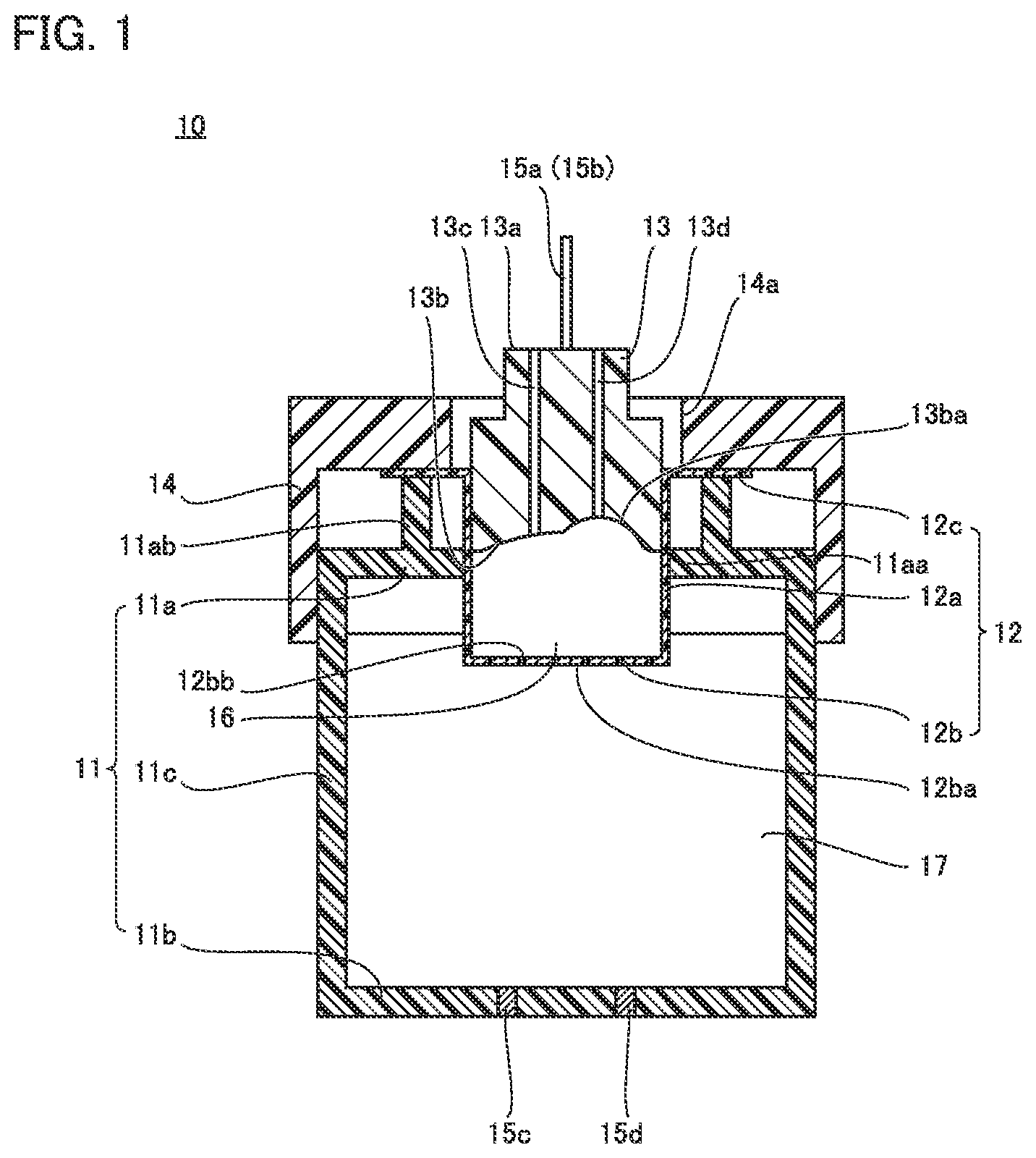
is a cross-sectional view of a cell culture container 10 .
is a plan view of a lid member 13 .
is a bottom view of lid member 13 .
is a cross-sectional view taken along a line IV-IV in .
is a schematic diagram of a cell culture system 100 .
DESCRIPTION OF EMBODIMENTS
An embodiment will be described in detail with reference to the drawings. In the following, the same or corresponding parts are designated by the same reference characters, and the same description will not be repeated.
(Configuration of Cell Culture Container According to Embodiment)
A configuration of a cell culture container (hereinafter called “cell culture container 10 ”) according to the embodiment is described below.
is a cross-sectional view of cell culture container 10 . As shown in , cell culture container 10 includes a container body 11 , a cell culture insert 12 , a lid member 13 , a lid member 14 , an electrode 15 a and an electrode 15 b , and an electrode 15 c and an electrode 15 d.
Container body 11 has an upper wall 11 a , a bottom wall 11 b , and a side wall 11 c . Upper wall 11 a and bottom wall 11 b are spaced from and face each other. Side wall 11 c is contiguous at its upper end to upper wall 11 a and at its lower end to bottom wall 11 b . Upper wall 11 a , bottom wall 11 b and side wall 11 c define an internal space of container body 11 . Container body 11 is made of a resin material, for example.
Upper wall 11 a is provided with an opening 11 aa . Opening 11 aa passes through upper wall 11 a in a thickness direction. Put another way, opening 11 aa communicates with the interior of container body 11 . Upper wall 11 a has an erect portion flab. Erect portion 11 ab extends to the side opposite to bottom wall 11 b (upward). Erect portion 11 ab is located around opening 11 aa.
Cell culture insert 12 has a tubular portion 12 a , a membrane 12 b , and a flange portion 12 c.
Tubular portion 12 a has a tubular shape. In a cross-sectional view orthogonal to a direction from an upper end of tubular portion 12 a toward a lower end of tubular portion 12 a , tubular portion 12 a has an annular shape, for example. The upper end of tubular portion 12 a is open. The lower end of tubular portion 12 a is closed by membrane 12 b.
Tubular portion 12 a is inserted in opening 11 aa such that its lower end is located inside container body 11 (such that membrane 12 b is located inside container body 11 ). The space between tubular portion 12 a and opening 11 aa is hermetically sealed by an appropriate method.
Membrane 12 b is oxygen-permeable. Membrane 12 b is, for example, a track etched membrane made of polycarbonate. Membrane 12 b has a first main surface 12 ba and a second main surface 12 bb . Second main surface 12 bb is opposite to first main surface 12 ba.
First main surface 12 ba is a surface that faces toward the interior of container body 11 . Second main surface 12 bb is a surface that faces toward the interior of tubular portion 12 a . Put another way, the internal space of container body 11 is partially defined by first main surface 12 ba , and the internal space of tubular portion 12 a is partially defined by second main surface 12 bb.
Cells are cultured on second main surface 12 bb . The cells are, for example, intestinal epithelial cells that form tight junctions on second main surface 12 bb . Caco-2 cells are a specific example of the cells.
A first culture medium 16 is stored in tubular portion 12 a . First culture medium 16 contains bacteria. The bacteria are anaerobic bacteria, for example. A second culture medium 17 is stored in container body 11 . First culture medium 16 has a lower dissolved oxygen concentration than that of second culture medium 17 . Put another way, first culture medium 16 is an anaerobic culture medium, and second culture medium 17 is an aerobic culture medium.
As described above, membrane 12 b is oxygen-permeable. Therefore, oxygen in second culture medium 17 permeates through membrane 12 b and is supplied to the cells being cultured on second main surface 12 bb . The cells can thus be cultured on second main surface 12 bb.
Flange portion 12 c is at the upper end side of tubular portion 12 a . Flange portion 12 c extends from an outer circumferential surface of tubular portion 12 a in a direction crossing the direction from the upper end of tubular portion 12 a toward the lower end of tubular portion 12 a . Cell culture insert 12 is restricted from moving in a direction from upper wall 11 a toward bottom wall 11 b by flange portion 12 c being supported by erect portion 11 ab.
Lid member 13 is made of a resin material, for example. This resin material is a silicone resin, for example. Lid member 13 is inserted into tubular portion 12 a from the upper end side of tubular portion 12 a . As a result, the upper end side of tubular portion 12 a is closed by lid member 13 .
Lid member 13 has an upper surface 13 a and a lower surface 13 b . Lower surface 13 b is opposite to upper surface 13 a . Lower surface 13 b faces toward the interior of tubular portion 12 a.
is a plan view of lid member 13 . is a bottom view of lid member 13 . is a cross-sectional view taken along a line IV-IV in . As shown in to 4 , lower surface 13 b is preferably a curved surface protruding toward upper surface 13 a . Lower surface 13 b is preferably provided with a recess 13 ba . Lower surface 13 b is more recessed toward upper surface 13 a at recess 13 ba than at a portion around recess 13 ba . Recess 13 ba is, for example, a curved surface protruding toward upper surface 13 a.
Lid member 13 is provided with a culture medium inlet port 13 c , a culture medium outlet port 13 d , an electrode insertion port 13 e , and an electrode insertion port 13 f . Culture medium inlet port 13 c , culture medium outlet port 13 d , electrode insertion port 13 e and electrode insertion port 13 f pass through lid member 13 from upper surface 13 a toward lower surface 13 b , for example. Put another way, culture medium inlet port 13 c , culture medium outlet port 13 d , electrode insertion port 13 e and electrode insertion port 13 f communicate with the interior of tubular portion 12 a at their ends on the lower surface 13 b side.
First culture medium 16 is introduced into tubular portion 12 a through culture medium inlet port 13 c . First culture medium 16 stored in tubular portion 12 a is discharged through culture medium outlet port 13 d.
The distance between lower surface 13 b and membrane 12 b monotonically increases from the end of electrode insertion port 13 e on the lower surface 13 b side toward the end of culture medium outlet port 13 d on the lower surface 13 b side. Put another way, the distance between lower surface 13 b and upper surface 13 a monotonically decreases from the end of electrode insertion port 13 e on the lower surface 13 b side toward the end of culture medium outlet port 13 d on the lower surface 13 b side.
Although not shown, the distance between lower surface 13 b and membrane 12 b monotonically increases (the distance between lower surface 13 b and upper surface 13 a monotonically decreases) from the end of electrode insertion port 13 f on the lower surface 13 b side toward the end of culture medium outlet port 13 d on the lower surface 13 b side.
The distance between lower surface 13 b and membrane 12 b monotonically decreases (the distance between lower surface 13 b and upper surface 13 a monotonically decreases) from the end of culture medium inlet port 13 c on the lower surface 13 b side toward the end of culture medium outlet port 13 d on the lower surface 13 b side.
The end of culture medium outlet port 13 d on the lower surface 13 b side is disposed in recess 13 ba . The end of culture medium outlet port 13 d on the lower surface 13 b side is preferably disposed at the apex of the curved surface forming recess 13 ba . The apex of the curved surface forming recess 13 ba is the position of recess 13 ba where the distance from upper surface 13 a is the smallest.
Lid member 14 is removably attached to container body 11 . More specifically, lid member 14 is attached to container body 11 so as to sandwich flange portion 12 c between lid member 14 and erect portion 11 ab . This prevents cell culture insert 12 from falling out of container body 11 . Lid member 14 is provided with an opening 14 a . Upper surface 13 a is exposed at opening 14 a.
Electrode 15 a is inserted in electrode insertion port 13 e . As a result, electrode 15 a has one end electrically connected to first culture medium 16 stored in tubular portion 12 a . Electrode 15 a has the other end located outside of lid member 13 .
Electrode 15 b is inserted in electrode insertion port 13 f . As a result, electrode 15 b has one end electrically connected to first culture medium 16 stored in tubular portion 12 a . Electrode 15 b has the other end located outside of lid member 13 .
Electrode 15 c and electrode 15 d are embedded in container body 11 . More specifically, electrode 15 c and electrode 15 d are embedded in bottom wall 11 b.
Electrode 15 c and electrode 15 d are electrically connected to second culture medium 17 stored in container body 11 . Electrode 15 c and electrode 15 d are exposed outside of container body 11 .
(Configuration of Cell Culture System According to Embodiment)
A configuration of a cell culture system (hereinafter called “cell culture system 100 ”) according to the embodiment is described below.
is a schematic diagram of cell culture system 100 . As shown in , cell culture system 100 includes cell culture container 10 , a culture medium container 20 , a culture medium container 30 , a tube 40 , a tube 50 , a pump 60 , and a transepithelial electrical resistance measurement device 80 . Cell culture container 10 , culture medium container 20 , culture medium container 30 , tube 40 , tube 50 , pump 60 and transepithelial electrical resistance measurement device 80 are housed in an anaerobic chamber 90 .
First culture medium 16 is stored in culture medium container 20 . Tube 40 is connected at one end to culture medium container 20 and at the other end to culture medium inlet port 13 c . As a result, the interior of tubular portion 12 a and culture medium container 20 are connected via tube 40 . Pump 60 is attached to tube 40 . Pump 60 is a tube pump, for example. By driving pump 60 , first culture medium 16 stored in culture medium container 20 is introduced into tubular portion 12 a through culture medium inlet port 13 c via tube 40 .
Tube 50 is connected at one end to culture medium container 30 and at the other end to culture medium outlet port 13 d . As a result, the interior of tubular portion 12 a and culture medium container 30 are connected via tube 50 . By driving pump 60 , first culture medium 16 stored in tubular portion 12 a is discharged into culture medium container 30 through culture medium outlet port 13 d via tube 50 . In other words, the supply of first culture medium 16 to culture medium container 30 and the collection of first culture medium 16 from culture medium container 30 are performed by pump 60 .
Transepithelial electrical resistance measurement device 80 has a first terminal and a second terminal. The first terminal of transepithelial electrical resistance measurement device 80 is connected to electrode 15 a and electrode 15 b . The second terminal of transepithelial electrical resistance measurement device 80 is connected to electrode 15 c and electrode 15 d . Transepithelial electrical resistance measurement device 80 measures an electrical resistance value between electrode 15 a , electrode 15 b and electrode 15 c , electrode 15 d by a four-terminal method, for example.
The electrical resistance value between electrode 15 a , electrode 15 b and electrode 15 c , electrode 15 d varies depending on whether or not the cells being cultured on second main surface 12 bb are forming tight junctions. By measuring the above electrical resistance value using transepithelial electrical resistance measurement device 80 , therefore, it can be determined whether or not the cells being cultured on second main surface 12 bb are forming tight junctions.
(Effects of Cell Culture Container According to Embodiment)
Effects of cell culture container 10 are described below.
In cell culture container 10 , first culture medium 16 can be introduced into tubular portion 12 a through culture medium inlet port 13 c , and first culture medium 16 can be discharged out of tubular portion 12 a through culture medium outlet port 13 d . Thus, according to cell culture container 10 , first culture medium 16 can be replaced during an experiment to thereby suppress excessive growth of bacteria inside tubular portion 12 a , thus allowing the experiment to continue for a long period of time.
As a result of the replacement of first culture medium 16 , air bubbles may be introduced into tubular portion 12 a together with first culture medium 16 . In addition, the bacteria contained in first culture medium 16 may produce air bubbles inside tubular portion 12 a . These air bubbles adhere to electrode 15 a and electrode 15 b , causing fluctuations in the electrical resistance value measured by transepithelial electrical resistance measurement device 80 . In other words, the adhesion of these air bubbles to electrode 15 a and electrode 15 b makes it difficult to accurately monitor the condition of the cells being cultured on membrane 12 b.
In cell culture container 10 , however, the distance between lower surface 13 b and membrane 12 b monotonically increases from the end of electrode insertion port 13 e (electrode insertion port 13 f ) on the lower surface 13 b side toward the end of culture medium outlet port 13 d on the lower surface 13 b side.
As a result, even if the above air bubbles adhere to electrode 15 a (electrode 15 b ), they tend to move along lower surface 13 b toward culture medium outlet port 13 d due to buoyancy, to be discharged through culture medium outlet port 13 d . Thus, according to cell culture container 10 , the condition of the cells on membrane 12 b can be accurately monitored while first culture medium 16 is replaced.
In cell culture container 10 , if lower surface 13 b is provided with recess 13 ba , the above air bubbles tend to collect in the recess. In this case, therefore, the above air bubbles are more readily discharged through culture medium outlet port 13 d.
In addition, in cell culture container 10 , if the distance between lower surface 13 b and membrane 12 b monotonically increases from the end of culture medium inlet port 13 c on the lower surface 13 b side toward the end of culture medium outlet port 13 d on the lower surface 13 b side, the air bubbles introduced through culture medium inlet port 13 c together with first culture medium 16 are readily discharged through culture medium outlet port 13 d along lower surface 13 b due to buoyancy.
While the embodiment of the present invention has been described above, the embodiment described above can be modified in various manners. In addition, the scope of the present invention is not limited to the embodiment described above. It is intended that the scope of the present invention is defined by claims and encompasses all modifications equivalent in meaning and scope to the claims.
REFERENCE SIGNS LIST
100 cell culture system; 10 cell culture container; 11 container body; 11 a upper wall; 11 aa opening; flab erect portion; 11 b bottom wall; 11 c side wall; 12 cell culture insert; 12 a tubular portion; 12 b membrane; 12 ba first main surface; 12 bb second main surface; 12 c flange portion; 13 lid member; 13 a upper surface; 13 b lower surface; 13 ba recess; 13 c culture medium inlet port; 13 d culture medium outlet port; 13 e , 13 f electrode insertion port; 14 lid member; 14 a opening; 15 a , 15 b , 15 c , 15 d electrode; 16 first culture medium; 17 second culture medium; 20 , 30 culture medium container; 40 , 50 tube; 60 pump; 80 transepithelial electrical resistance measurement device.
Figures (5)
Citations
This patent cites (18)
- US6794184
- US2008/0145922
- US2014/0045252
- US2015/0247112
- US2016/0340632
- US2017/0067006
- US2019/0031994
- US2019/0382703
- US2022/0340859
- US106103692
- US108699500
- US110072988
- US3 546 561
- US10-1910118
- USM240450
- US2018/079793
- US2019/222333
- USWO-2019222333