Tobacco Axillary Bud Growth Inhibitors and Methods of Inhibiting Growth of Tobacco Axillary Buds
Abstract
Compositions and methods are disclosed for inhibiting axillary bud growth of a tobacco plant. For example, a composition comprising a naturally occurring C10 alcohol Is applied on a tobacco plant to inhibit axillary bud growth of the plant.
Claims (18)
1 . A method of inhibiting axillary bud growth of a tobacco plant, comprising: applying a composition comprising a citronellol as an active ingredient, and optionally further comprising another active ingredient chosen from one or more of decanol, pelargonic acid, pendimethalin, maleic hydrazide, butralin, and flumetralin, wherein the citronellol is organic and from a natural source, on the tobacco plant, and wherein the citronellol and optionally the another active ingredient are the only active ingredients in the composition for inhibiting axillary bud growth.
Show 17 dependent claims
2 . The method of claim 1 , wherein the composition is chosen from an emulsion, a solution, and a mixture.
3 . The method of claim 1 , wherein the citronellol is present in a concentration up to about 10% (v/v) of the composition.
4 . The method of claim 3 , wherein the concentration of citronellol is from about 4% to about 6% (v/v) of the composition.
5 . The method of claim 1 , wherein the composition further comprises decanol.
6 . The method of claim 1 , wherein applying comprises contacting the composition to leaf axils of the tobacco plant by spraying the composition, using a drop line, or directing the composition on a stalk of the tobacco plant.
7 . The method of claim 6 , wherein spraying comprises using a pressure of about 0.5 bar to about 2.5 bar.
8 . The method of claim 1 , wherein the tobacco plant is in an elongated button stage of development.
9 . The method of claim 1 , wherein the tobacco plant comprises at least one axillary bud shoot with a length less than about 3 cm.
10 . The method of claim 1 , wherein the tobacco plant has a height from about 1.4 m to about 1.7 m.
11 . The method of claim 1 , further comprising topping the tobacco plant.
12 . The method of claim 11 , wherein the steps of applying and topping occur within a time period of 48 hours.
13 . The method of claim 1 , wherein the composition is applied in an amount from about 13 to 60 mL.
14 . The method of claim 1 , further comprising reapplying the composition to the tobacco plant about 4 to 7 days after the applying step.
15 . The method of claim 1 , further comprising reapplying the composition to the tobacco plant about 42 to 56 days after the applying step.
16 . The method of claim 1 , wherein, after applying the composition, new axillary bud growth is effectively inhibited for a suppression period of at least 5 days.
17 . The method of claim 16 , wherein the suppression period is at least 7 days, at least 14, or at least 21 days.
18 . The method of claim 1 , wherein the composition is an extraction product.
Full Description
Show full text →
This application claims priority to U.S. Provisional Application No. 63/000,291, filed Mar. 26, 2020; the content of this application is incorporated herein by reference in its entirety.
Tobacco axillary bud growth inhibition is critical to farmers as it can affect the quality and yield of the tobacco harvested. A marketable part of a tobacco plant is the leaves. Farmers desire large high-quality leaves in order to achieve higher yields and value. The size and number of leaves on a tobacco plant may be controlled in order to promote the growth of large leaves for harvesting and sale. During the development of a tobacco plant, buds tend to form near leaf axils. These axillary buds (often referred to in the industry as “suckers”) may have the potential to form either vegetative or reproductive shoots. Such buds and shoots divert nutrients from the other parts of the plant, including the leaves, often resulting in smaller and/or lower quality leaves. Therefore, a goal of farmers is to inhibit, retard, suppress or stop the growth of axillary buds (referred to in the industry as “suckering”) in order to achieve larger and higher quality leaves for harvesting and sale.
Several methods for inhibiting the growth of axillary buds have been developed. For example, farmers may manually remove the axillary buds or apply one or more chemicals (referred to in the industry as “suckercides”) in order to kill and/or prevent the formation and/or growth of axillary buds. Manual removal is generally undesirable as a primary means of sucker control as it is extremely labor intensive. For this reason, most modern farmers turn to suckercides to control the growth of axillary buds. These suckercides are typically divided into three categories: contacts, contact systemics, and systemics. The effective use of chemical axillary bud inhibitors is desirable in order to increase product quality and yield.
The contact axillary bud inhibitors are typically synthetic fatty alcohols such as n-decanol. Those fatty alcohols effectively turn the sucker buds brown and then they fall of the tobacco plant. With the use of synthetic chemicals, there are certain drawbacks to the environment and consuming public. As such, there is a need to develop a naturally occurring (e.g., organic) basic or general axillary bud inhibitor.
Accordingly, the present disclosure provides for, among other things, compositions of an organic axillary bud inhibitor and methods that may result in one or more of the following: death of axillary buds or shoots, removal of axillary buds or shoots, and inhibition of axillary bud or shoot growth or development.
Disclosed herein are compositions and methods for inhibiting axillary bud growth based on the inventor's discovery that a composition comprising a naturally occurring C10 alcohol, when applied on a tobacco plant, may increase crop quality and yield, for example, by inhibiting the growth of axillary buds and shoots of the tobacco plant.
BRIEF DESCRIPTION OF THE DRAWINGS
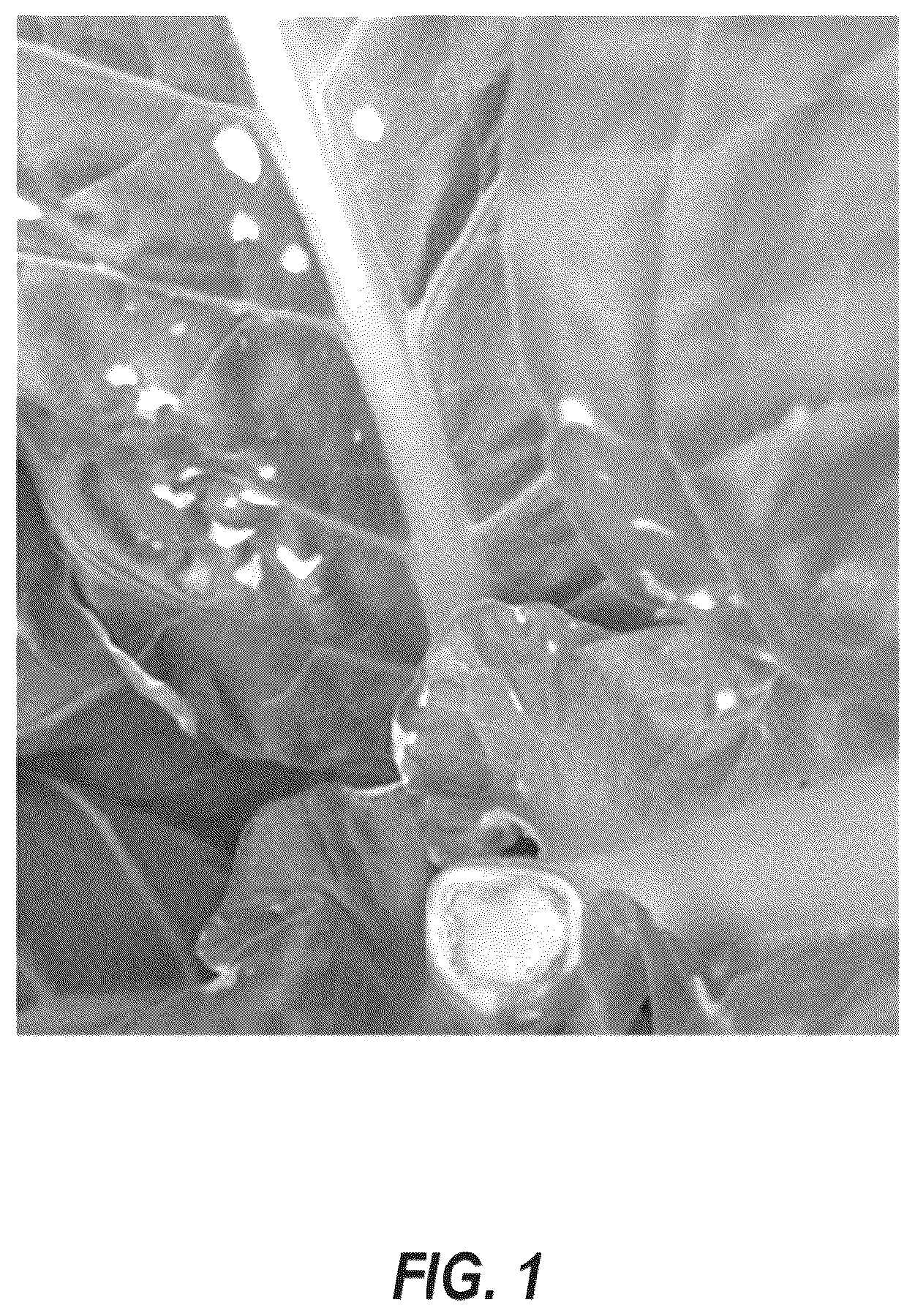
shows leaves treated with fatty alcohol+pelargonic acid (treatment 5 at Farm B in Example 4 discussed below) with phytotoxicity stains.
shows an untreated control plant (from Farm A in Example 4 discussed below) with multiple shoots within 7 days from when the first axillary bud were observed (i.e., “sprouting”).
shows a plant treated with fatty alcohol (treatment 6 at Farm A in Example 4 below) with budding shoots after first application, prompting a second application within 15 days of sprouting.
shows a plant treated with BIOSUCKER (at Farm A in Example 4 below) without budding shoots, 27 days after sprouting.
shows a plant treated with BIOANTAK (at Farm A in Example 4 below) without budding shoots, 27 days after sprouting.
shows a plant treated with the standard treatment of fatty alcohol+pendimethalin (at Farm B in Example 4 below).
shows the results of a study at Farm A (Example 4) comparing the effectiveness of various treatments.
shows the results of a study at Farm B (Example 4) comparing the effectiveness of various treatments.
DESCRIPTION
As used herein, the singular forms “a,” “an,” and “the” include plural reference.
The terms “approximately” and “about” mean to be nearly the same as a referenced number or value including an acceptable degree of error for the quantity measured given the nature or precision of the measurements. As used herein, the terms “approximately” and “about” should be generally understood to encompass ±20% of a specified amount, frequency or value. Numerical quantities given herein are approximate unless stated otherwise, meaning that the terms “about” or “approximately” can be inferred when not expressly stated.
The term “axillary bud” refers to a bud that grows from a leaf axil of the plant. The term “leaf axil” refers to the location on the plant where a leaf grows out of the stalk, axis, or out of a shoot or branch of the plant. The terms “axis” or “stalk” refer to the main stem of the plant, from which shoots or branches and leaves may grow.
Embodiments
Without limitation, some embodiments of the disclosure include:
1. A method of inhibiting axillary bud growth of a tobacco plant, comprising: applying a composition comprising a naturally occurring C10 alcohol on the tobacco plant.
2. The method of embodiment 1, wherein the composition is in a form chosen from an emulsion, a composition, and a mixture.
3. The method of any one of embodiments 1-3, wherein the naturally occurring C10 alcohol is citronellol.
4. The method of embodiment 3, wherein the citronellol comprises (+) citronellol and (−) citronellol.
5. The method of embodiment 3, wherein the citronellol is present in a concentration up to about 10% (v/v) of the composition.
6. The method of embodiment 5, wherein the concentration of citronellol is from about 4% to about 6% (v/v) of the composition.
7. The method of any one of embodiments 1-6, wherein the composition further comprises water.
8. The method of any one of embodiments 1-7, wherein the composition further comprises n-decanol.
9. The method of any one of embodiments 1-8, wherein applying comprises spraying the composition.
10. The method of embodiment 9, wherein spraying comprises using a nozzle boom.
11. The method of embodiment 9, wherein spraying comprises using a pressure of about 0.5 bar to about 2.5 bar.
12. The method of any one of embodiments 1-11, wherein applying comprises using a drop line.
13. The method of any one of embodiments 1-12, wherein applying comprises directing the composition on a stalk of the tobacco plant.
14. The method of any one of embodiments 1-13, wherein applying comprises contacting the composition to leaf axils of the tobacco plant.
15. The method of any one of embodiments 1-14, wherein the tobacco plant is in an elongated button stage of development.
16. The method of any one of embodiments 1-15, wherein the tobacco plant comprises open flowers.
17. The method of any one of embodiments 1-16, wherein the tobacco plant comprises at least one axillary bud shoot.
18. The method of embodiment 17, wherein the at least one axillary bud shoot has a length of less than about 8 cm.
19. The method of embodiment 18, wherein the length of the at least one axillary bud shoot is less than about 3 cm.
20. The method of any one of embodiments 1-19, wherein the tobacco plant has a height from about 1.4 m to about 1.7 m.
21. The method of any one of embodiments 1-20, further comprising topping the tobacco plant.
22. The method of embodiment 21, wherein the steps of applying and topping occur within a time period of 48 hours.
23. The method of embodiment 21, wherein the applying step occurs after the topping step.
24. The method of any one of embodiments 1-23, wherein the composition is applied in an amount from about 13 to 60 mL.
25. The method of any one of embodiments 1-24, further comprising reapplying the composition to the tobacco plant.
26. The method of embodiment 25, wherein the reapplying step is performed about 4 to 7 days after the applying step.
27. The method of embodiment 25, wherein the reapplying step is performed about 42 to 56 days after the applying step.
28. The method of embodiment 25, wherein the reapplying step is performed after the formation of at least one new axillary bud on the tobacco plant.
29. The method of any one of embodiments 1-28, wherein, after applying the composition, new axillary bud growth is effectively inhibited for a suppression period of at least 5 days.
30. The method of embodiment 29, wherein the suppression period is at least 7 days.
31. The method of embodiment 30, wherein the suppression period is at least 14 days.
32. The method of embodiment 31, wherein the suppression period is at least 21 days.
33. The method of any one of embodiments 1-32, wherein the naturally occurring C10 alcohol is methanol.
34. The method of any one of embodiments 1-33, wherein the composition is organic.
Compositions and Methods
According to the present disclosure, a method of inhibiting axillary bud growth of a tobacco plant comprises applying a composition comprising a naturally occurring C10 alcohol on the tobacco plant. In certain embodiments, the composition may be in a form chosen from, for example, an emulsion, a solution, or a mixture. In certain embodiments the naturally occurring C10 alcohol may be citronellol. The term “citronellol” refers to any stereoisomer of 3,7-Dimethyloct-6-en-1-ol, sometimes referred to as (+)-β-Citronellol or a natural monoterpenoid. In certain embodiments, the citronellol may comprise both (+) citronellol and (−) citronellol. The terms (+) citronellol and (−) citronellol refer to the two enantiomers of citronellol:
In certain embodiments, the naturally occurring C10 alcohol may be menthol. The term “menthol” refers to any stereoisomer of 5-methyl-2-(propan-2-yl)cyclohexan-1-ol. In certain embodiments, the menthol may comprise a mixture of at least two stereoisomers of menthol. In a preferred embodiment, the menthol comprises (−) menthol. The term (−) menthol refers to the (1R,2S,5R) configuration of menthol:
As provided herein, a composition of the present disclosure is a composition comprising a naturally occurring C10 alcohol. In certain embodiments, the composition may further comprise water. In certain embodiments, the naturally occurring C10 alcohol may be present in a concentration up to about 10% (v/v) of the composition. In certain embodiments, the naturally occurring C10 alcohol may be present in a concentration from about 4% to about 6% (v/v) of the composition. In some further embodiments, the naturally occurring C10 alcohol is citronellol.
In one or more embodiments, the naturally occurring C10 alcohol may be “organic”; the term “organic” refers to C10 alcohol sourced or produced by, e.g., plants, complying with the standards of organic farming. Those standards vary worldwide, but generally, organic farming seeks to cycle resources, produce ecological balance, and conserve biodiversity by restricting certain pesticides and fertilizers and typically does not use irradiation, industrial solvents, and/or certain synthetic additives. In certain embodiments, the naturally occurring C10 alcohol is an extraction product. For example, citronellol may be sourced from geranium, rose, and other plants or plant oils and menthol may be sourced from corn mint, peppermint, or other mints. The U.S. Food and Drug Administration construes both citronellol and menthol as generally recognized as safe (GRAS) for food use. In some embodiments, the composition comprising the naturally occurring C10 alcohol may also be organic.
The composition of the present disclosure may further comprise additional ingredients commonly used in agricultural products such as surfactants (e.g., ionic, nonionic, cationic, anionic, and/or zwitterionic). For example, in certain embodiments, the composition may further comprise one or more non-ionic surfactants such as Polysorbate 80 (“PS80”, “Tween 80”).
The composition may further comprise at least one additional axillary bud inhibitor such as a contact, a contact systemic, or a systemic. The term “contact” refers to chemicals comprising fatty alcohols that may physically burn an axillary bud. In some embodiments, the composition may further comprise at least one contact chemical such as decanol or pelargonic acid. The term “contact systemic” refers to chemicals that may be absorbed into the plant at the leaf axil and inhibit cell division in axil buds locally. In certain embodiments, the composition may further comprise at least one contact systemic, for example, pendimethalin or a substance chosen from the group dinitroaniline, such as butralin or flumetralin. The term “systemic” refers to chemicals that may be absorbed by the plant at locations not limited to leaf axils and that, nevertheless, may inhibit cell division in axil buds systemically. In certain embodiments, the composition may further comprise at least one systemic such as maleic hydrazide.
In some embodiments, applying the composition may comprise spraying the composition. For example, spraying may be accomplished by, but not limited to, using powered spray equipment; using a hand sprayer, such as a backpack and wand; using a straight-boom or a multi-nozzle boom, for example, a three-nozzle boom; using a coarse nozzle; using a fine nozzle; using a conveyer hood; and any combinations thereof. In some embodiments spraying may comprise using a pressure of about 0.5 bar to about 2.5 bar.
In some embodiments, applying the composition may comprise using a drop line. In some embodiments, applying the composition may comprise using a jug.
In some embodiments, applying the composition may comprise contacting the composition to the stalk of the tobacco plant. In some embodiments, applying the composition may comprise contacting the composition to leaf axils of the tobacco plant. In some embodiments, applying the composition may comprise the composition running down the stalk of the tobacco plant in order to contact leaf axils.
Application of the composition can occur at various stages of tobacco plant development. For example, the tobacco plant may be in a button stage of development or an elongated button stage of development. In some embodiments, the tobacco plant may comprise open flowers. In some embodiments, the tobacco plant may comprise at least one axillary bud or shoot. In some embodiments, the at least one axillary bud or shoot may have a length of less than about 8 cm. In some embodiments, the at least one axillary bud shoot may have a length of less than about 3 cm. In some embodiments, the tobacco plant may have a height from about 1.4 to 1.7 m.
Methods of the present disclosure may further comprise topping the tobacco plant. In some embodiments, the steps of applying the composition and topping may occur within a time period of 48 hours. In some embodiments, the applying step may occur before the topping step. In other embodiments, the applying step may occur after the topping step.
The method of the present disclosure applies an effective amount of the composition to the tobacco plant. The phrase “effective amount” refers to an amount sufficient to improve the inhibition of axillary bud growth as compared to a control. In some embodiments, the composition applied to the tobacco plant may be in an amount from about 13 to about 60 mL per plant.
The method of the present disclosure may further comprise reapplying the composition to the tobacco plant. In some embodiments, the reapplying step may be performed about 4 to about 7 days after the applying step. In some embodiments, the reapplying step may be performed about 7 to about 14 days after the applying step. In some embodiments, the reapplying step may be performed about 14 to about 21 days after the applying step. In some embodiments, the reapplying step may be performed about 21 to about 35 days after the applying step. In some embodiments, the reapplying step may be performed about 35 to about 43 days after the applying step. In some embodiments, the reapplying step may be performed about 42 to about 56 days after the applying step. In some embodiments, the reapplying step may be performed after the formation of at least one new axillary bud or shoot on the tobacco plant.
In some embodiments, after applying the composition, the formation of axillary buds or shoots may be effectively inhibited for a suppression period of, for example, about 5 days, about 7 days, about 14 days, about 21 days, or any time period in between. In some embodiments, after the applying the composition, the growth of axillary buds may be inhibited for a suppression period of, for example, 5 days, 7 days, 14, days, 21 days, or any time period in between.
As evidenced from the Examples and without being bound by a particular theory, the application of citronellol to the tobacco plant does not remove the sucker bud or shoot and instead, the sucker bud remains green on the pant but does not grow and remains on the leaf axil. Typically, when tobacco is treated with fatty alcohols such as decanol, the sucker bud turns brown and falls off, leading the tobacco plant to replace the fallen-off bud.
All publications and patents mentioned herein are hereby incorporated by reference in their entirety as if each individual publication or patent was specifically and individually indicated to be incorporated by reference.
Claims or descriptions that include “or” or “and/or” between at least one member of a group are considered satisfied if one, more than one, or all of the group members are present in, employed in, or otherwise relevant to a given product or process unless indicated to the contrary or otherwise evident from the context. The disclosure includes embodiments in which exactly one member of the group is present in, employed in, or otherwise relevant to a given product or process. The disclosure includes embodiments in which more than one, or all the group members are present in, employed in, or otherwise relevant to a given product or process.
Furthermore, the disclosure encompasses all variations, combinations, and permutations in which at least one limitation, element, clause, and descriptive term from at least one of the listed claims is introduced into another claim. For example, any claim that is dependent on another claim can be modified to include at least one limitation found in any other claim that is dependent on the same base claim. Where elements are presented as lists, e.g., in Markush group format, each subgroup of the elements is also disclosed, and any element(s) can be removed from the group. It should be understood that, in general, where the disclosure, or aspects of the disclosure, is/are referred to as comprising particular elements and/or features, embodiments of the disclosure or aspects of the disclosure consist, or consist essentially of, such elements and/or features. For purposes of simplicity, those embodiments have not been specifically set forth in haec verba herein. Where ranges are given, endpoints are included. Furthermore, unless otherwise indicated or otherwise evident from the context and understanding of one of ordinary skill in the art, values that are expressed as ranges can assume any specific value or sub-range within the stated ranges in different embodiments of the disclosure, to the tenth of the unit of the lower limit of the range, unless the context clearly dictates otherwise.
Those of ordinary skill in the art will recognize or be able to ascertain using no more than routine experimentation, many equivalents to the specific embodiments of the disclosure described herein. Such equivalents are intended to be encompassed by the following claims.
EXAMPLES
The following examples are intended to be illustrative and are not meant in any way to limit the scope of the disclosure.
Example 1: Effects of Various Axillary Bud Inhibitors Using Similar Conditions
A single site field trial was conducted at the Oxford Tobacco Research Station in Oxford, NC to evaluate the effects of various axillary bud inhibitors (5MHOT, 5MHCT, 37DOT, and 37DCT, as noted in Table 1 below). Each product was diluted in water and applied with a 3-nozzle boom at 1.5, 3.0, and 6.0% concentration (v/v) a total of seven times. A subset of treatments containing each material at the 3.0% concentration was applied using a dropline. Organic fatty alcohol (O-Tac) was included as a positive control (4.0% concentration applied with 3-nozzle boom and dropline). The undiluted composition of each inhibitor is provided in Table 1, below.
TABLE 1
Inhibitor Compositions
Inhibitor Component % (w/w)
5MHOT Menthol 59.5
Hexanol 25.5
Tween 80 15.0
5MHCT Menthol 59.5
Hexanol 15.5
Decanol 10.0
Tween 80 15.0
37DOT Citronellol 85.0
(Bioantak) Tween 80 15.0
37DCT Citronellol 75.0
Decanol 10.0
Tween 80 15.0
O-Tac Octanol 36.2
Decanol 48.2
Related Compounds (Dodecanol) 0.3
Inactive Ingredients 15.3
A topped but not physically or chemically suckered treatment was used as a negative control but was not included in the data analyses. Treatments were arranged in a randomized complete block design and replicated four times.
Each treatment was applied a total of seven times on a five-day spray rotation. Treatments were initiated at the 50% elongated button stage of growth (July 16) and were repeated on July 22, July 26, July 31, August 8, August 13, and August 19. At the conclusion of harvest, five plants per plot were assessed for sucker number and sucker mass. Visual injury assessments were carried out prior to application numbers 2, 4, and 6 in order to determine injury potential from each treatment. Cured leaf yield, quality, and value were likewise quantified.
TABLE 2
Tobacco injury, sucker growth, cured leaf quality, and crop value as influenced
by the main effects of suckercide product (5MHOT, 5MHCT, 37DOT,
and 37DCT) and application concentration (1.5, 3.0, and 6.0%). a
Injury- Injury- Sucker Sucker
Main July 22 July 31 Mass Count Control Value
Effect ---------- % b ---------- g/plant num./plant % Quality $/acre
Product
5MHOT 0.04 a 0.13 a 696.5 a 3.73 a 19.7 b 77 a 2,956 b
5MHCT 0.04 a 0.17 a 539.2 b 3.28 ab 31.8 b 80 a 3,434 ab
37DOT 0.08 a 0.50 a 325.2 c 2.52 b 64.0 a 83 a 3,792 a
37DCT 0.17 a 0.25 a 271.7 c 2.80 b 58.7 a 82 a 3,625 a
Conc.
1.5% 0.00 A 0.00 B 705.9 A 3.80 A 17.6 C 81 a 2,474 c
3.0% 0.09 A 0.06 B 479.3 B 2.94 B 39.6 B 79 a 3,497 b
6.0% 0.16 A 0.72 A 189.4 C 2.51 B 73.4 A 81 a 4,385 a
a Treatment means followed by the same letter within the same column and main effect are not significantly different at the α = 0.05 level.
b Visual injury assessed on a scale of 0-100, with 100 representing complete plant death.
TABLE 3
Tobacco injury, sucker mass, and yield, as influenced by the
interaction of sucker control product (5MHOT, 5MHCT, 37DOT,
and 37DCT) and application concentration (1.5, 3.0, and 6.0%). a
Injury - Aug. 13 Sucker Mass Yield
Treatment % b grams/sucker lbs/acre
5MHOT @ 1.5% 0.00 d 187.35 bc 1,351 d
5MHOT @ 3.0% 0.13 d 307.9 a 1,789 c
5MHOT @ 6.0% 0.50 cd 126.5 cd 2,507 ab
5MHCT @ 1.5% 0.25 d 186.6 bc 1,603 cd
5MHCT @ 3.0% 0.38 cd 261.5 ab 1,785 c
5MHCT @ 6.0% 1.25 bc 61.8 d 2,820 a
37DOT @ 1.5% 0.00 d 201.8 bc 1,678 cd
37DOT @ 3.0% 0.50 cd 99.7 cd 2,352 b
37DOT @ 6.0% 1.88 b 35.1 d 2,517 ab
37DCT @ 1.5% 0.25 d 191.3 bc 1,380 cd
37DCT @ 3.0% 0.38 cd 81.2 d 2,559 ab
37DCT @ 6.0% 3.25 a 42.7 d 2,474 ab
a Treatment means followed by the same letter within the same column and main effect are not significantly different at the α = 0.05 level.
b Visual injury assessed on a scale of 0-100, with 100 representing complete plant death.
In Table 2, only pairwise treatments were analyzed in order to test the main effects of the respective suckercide products (5MHOT, 5MHCT, 37DOT, and 37DCT) and application concentration (1.5, 3.0, and 6.0%). Both O-Tac and all dropline treatments were excluded from the analysis. Injury was generally very minimal in this trial and was largely insignificant following application number one (Table 2). At the second injury rating, injury was similar among suckercides, but was promoted as concentration increased from 3.0 to 6.0% (Table 2). At injury rating number three, the greatest injury was documented in the 37DCT-6.0% application (3.25%); however, injury generally increased as each product concentration increased (Table 3). At the conclusion of the season, sucker mass and sucker number per plant was greatest in the 5MHOT treatments and were followed by 5MHCT (Table 2). The application of 37DOT and 37DCT resulted in less sucker growth and promoted total sucker control (Table 2). Likewise, application concentration influenced sucker growth, with the 1.5% concentration generally having less efficacy than the 3.0 and 6.0% concentration (Table 2). Cured leaf yield was generally maximized when each compound was applied at the 6.0% concentration (Table 3) although leaf quality was not impacted (Table 2). Finally, cured leaf value was greatest in treatments receiving 37DOT or 37DCT and was lowest following applications of 5MHOT (Table 2). The value of 5MHCT was in between these groups of treatments (Table 2).
TABLE 4
Tobacco injury following the application
of various sucker control programs. a
Injury-July 22 Injury-July 31 Injury-Aug. 13
Treatment ---------------------------------------- % ----------------------------------------
5MHOT @ 0.00 a 0.00 d 0.00 e
1.5% - OT
5MHOT @ 0.13 a 0.00 d 0.13 e
3.0% - OT
5MHOT @ 0.00 a 0.38 b-d 0.50 c-e
6.0% - OT
5MHCT @ 0.00 a 0.00 d 0.25 de
1.5% - OT
5MHCT @ 0.13 a 0.00 d 0.38 de
3.0% - OT
5MHCT @ 0.00 a 0.50 bc 1.25 bc
6.0% - OT
37DOT @ 0.00 a 0.00 d 0.00 e
1.5% - OT
37DOT @ 0.00 a 0.13 cd 0.50 c-e
3.0% - OT
37DOT @ 0.25 a 1.38 a 1.88 b
6.0% - OT
37DCT @ 0.00 a 0.00 d 0.25 de
1.5% - OT
37DCT @ 0.13 a 0.13 cd 0.38 de
3.0% - OT
37DCT @ 0.38 a 0.63 b 3.25 a
6.0% - OT
5MHOT @ 0.00 a 0.00 d 0.13 e
3.0% - DL
5MHCT @ 0.00 a 0.00 d 0.13 e
3.0% - DL
37DOT @ 0.00 a 0.00 d 0.50 c-e
3.0% - DL
37DCT @ 0.00 a 0.00 d 0.38 de
3.0% - DL
O-Tac @ 0.13 a 0.25 b-d 1.00 cd
4% - OT
O-Tac @ 0.13 a 0.00 d 0.50 c-e
4% - DL
a Treatment means followed by the same letter within the same column are not significantly different at the α = 0.05 level.
TABLE 5
Tobacco sucker control following the application
of various sucker control programs. a
Sucker Mass Sucker Count Sucker Mass Control
Treatment grams/plant num./plant grams/sucker %
5MHOT @ 961.4 a 5.25 a 187.3 b-d 0.0 g
1.5% - OT
5MHOT @ 787.1 ab 2.70 b-e 307.9 a 9.3 fg
3.0% - OT
5MHOT @ 341.1 d-f 3.25 b-d 126.5 c-f 49.8 b-d
6.0% - OT
5MHCT @ 688.1 bc 3.60 bc 186.6 b-d 16.1 e-g
1.5% - OT
5MHCT @ 714.8 a-c 2.70 b-e 261.5 ab 8.0 fg
3.0% - OT
5MHCT @ 214.7 f 3.55 bc 61.8 ef 71.4 ab
6.0% - OT
37DOT @ 482.0 c-e 2.60 c-e 201.8 bc 38.9 c-e
1.5% - OT
37DOT @ 238.9 ef 2.45 c-e 99.7 d-f 66.1 a-c
3.0% - OT
37DOT @ 94.3 f 2.50 c-e 35.1 f 86.9 a
6.0% - OT
37DCT @ 692.0 bc 3.75 bc 191.3 b-d 15.3 e-g
1.5% - OT
37DCT @ 176.3 f 2.20 de 81.2 ef 75.1 ab
3.0% - OT
37DCT @ 107.5 f 2.45 c-e 42.7 f 85.7 a
6.0% - OT
5MHOT @ 507.3 cd 3.25 b-d 160.9 b-e 35.4 d-f
3.0% - DL
5MHCT @ 604.0 bc 2.80 b-e 222.1 a-c 22.5 d-g
3.0% - DL
37DOT @ 199.25 f 3.00 b-e 72.7 ef 73.4 ab
3.0% - DL
37DCT @ 222.3 f 1.80 e 121.4 c-f 71.7 ab
3.0% - DL
O-Tac @ 130.3 f 3.05 b-e 43.3 f 82.3 a
4% - OT
O-Tac @ 205.2 f 3.95 ab 55.3 f 71.7 ab
4% - DL
a Treatment means followed by the same letter within the same column are not significantly different at the α = 0.05 level.
TABLE 6
Tobacco yield, quality, and value following the
application of various sucker control programs. a
Yield Value
Treatment lbs/acre Quality $/acre
5MHOT @ 1.5%-OT 1,351 e 81 a 2,169 f
5MHOT @ 3.0%-OT 1,789 d 73 a 2,638 e-f
5MHOT @ 6.0%-OT 2,507 a-c 78 a 4,061 a-c
5MHCT @ 1.5%-OT 1,603 de 80 a 2,645 d-f
5MHCT @ 3.0%-OT 1,785 d 80 a 2,962 d-f
5MHCT @ 6.0%-OT 2,820 ab 80 a 4,697 a
37DOT @ 1.5%-OT 1,678 de 81 a 2,774 d-f
37DOT @ 3.0%-OT 2,352 c 84 a 4,167 a-c
37DOT @ 6.0%-OT 2,517 a-c 84 a 4,436 a
37DCT @ 1.5%-OT 1,380 e 83 a 2,310 ef
37DCT @ 3.0%-OT 2,559 a-c 79 a 4,220 ab
37DCT @ 6.0%-OT 2,474 a-c 83 a 4,347 a
5MHOT @ 3.0%-DL 1,927 d 81 a 3,236 c-e
5MHCT @ 3.0%-DL 1,937 d 85 a 3,404 b-d
37DOT @ 3.0%-DL 2,474 a-c 78 a 4,082 a-c
37DCT @ 3.0%-DL 2,439 bc 87 a 4,436 a
O-Tac @ 4%-OT 2,853 a 79 a 4,816 a
O-Tac @ 4%-DL 2,730 ab 85 a 4,910 a
a Treatment means followed by the same letter within the same column are not significantly different at the α = 0.05 level.
Following application number one, leaf injury was similar among treatments and ranged from 0.0 to 0.5% (Table 4). Within the second injury rating, 37DOT—6% produced the highest injury (1.38%) (Table 4). All other injury ratings were <1.0% within this interval (Table 4). 37DCT—6% had the highest injury rating within the third interval (3.25%); however, other 6.0% concentrations produced injury >1.0% (Table 4). Dropline applications and O-Tac applications generally resulted in reduced injury (Table 4). As with the first data analysis, sucker control efficacy appears to have influenced cured leaf yield and value (Table 6). O-Tac treatments consistently produced the highest yielding and highest value treatments, although 6.0% concentrations were generally similar (Table 6).
Results were consistent in that as application concentration declined, yield and value were negatively impacted as well. This is consistent with declines in sucker control in those treatments (Table 5). Cured leaf quality was not affected (Table 6).
Based on this study, 37DOT and 37DCT are generally superior to 5MHOT and 5MHCT in terms of sucker control efficacy (Table 5). In addition, the 6.0% concentrations of each material are more promising than the 3.0 and 1.5% concentrations (Table 5). Despite the high concentration relative to other commercial products, the injury potential appears to be minimal.
Example 2: Effectiveness of Various Axillary Bud Inhibitors
An additional study was conducted comparing the effects of five treatments against an untreated control group. The five treatments were 5% 37DOT, 6% 37 DOT, 7% 37DOT, and 4% ANTAK-68.5. The undiluted composition of 37DOT is as provided in Table 1. The active ingredient in ANTAK-68.5 is 68.5% 1-Decanol. All treatments were applied to assigned plots of Virginian C 4M tobacco in a typical tobacco zone in Barqilla de Pinares (South-west Spain). The first application was performed just after manual topping. A second application was performed 42 days later. Overall weather conditions during the study were normal. Following the first application, two days passed before the plants received moisture. Following the second application, 14 days passed before the plants received moisture. Each treatment composition employed water as the carrier, and in each application a spray volume of 300 L/ha was applied at pressure of 1 atm or 1 bar. The first application was performed after manual topping, when the plants were in the button stage of growth. The compositions were applied directly on the apical part of the plant with a fine stream to allow the compositions to run down the stalk and wet the leaf axils. The study employed a randomized complete block design comparing five treatments and one control.
The condition of the plants was observed and recorded on the day of the first application and 7, 14, and 21 days thereafter. The condition of the plants was also observed and recorded on the day of the second application and 7, 13, and 21 days thereafter. The efficacy of the several treatments was measured by counting the number of axillary shoots within each of four shoot-length ranges. Level 1 was assigned to shoots 0-3 cm in length. Level 2 was assigned to shoots 4-8 cm in length. Level 3 was assigned to shoots 9-15 cm in length. Level 4 was assigned to shoots greater than 15 cm in length. The plants were investigated for signs of phytotoxicity at 7, 14, 21 and 42 days after the first application and 7, 13, and 21 days after the second application.
TABLE 7
Results of Study 2
Crop Type, Code C NIOTA C NIOTA C NIOTA C NIOTA C NIOTA
BBCH Scale BDIC BDIC BDIC BDIC BDIC
Crop Scientific Name Nicotiana Nicotiana Nicotiana Nicotiana Nicotiana
taba> taba> taba> taba> taba>
Crop Name Virginian Virginian Virginian Virginian Virginian
toba> toba> toba> toba> toba>
Crop Variety C4M C4M C4M C4M C4M
Description PHYGEN PHYGEN PHYGEN PHYGEN PHYGEN
Rating Date 26 Jul. 2019 2 Aug. 2019 9 Aug. 2019 30 Aug. 2019 6 Sep. 2019
SE Group No. 1 64 65 66 67
Part Rated PLANT C PLANT C PLANT C PLANT C PLANT C
Rating Type PHYGEN PHYGEN PHYGEN PHYGEN PHYGEN
Rating Unit % % % % %
Sample Size 1 PLOT 1 PLOT 1 PLOT 1 PLOT 1 PLOT
Collection Basis 1 PLOT 1 PLOT 1 PLOT 1 PLOT 1 PLOT
Reporting Basis 1 PLOT 1 PLOT 1 PLOT 1 PLOT 1 PLOT
Number of 1 1 1 1 1
Subsamples
Crop Stage Scale BBCH BBCH BBCH BBCH BBCH
Crop Stage Majority 62 65 93 93 95
Crop Stage 61 63 64 67 85 95 85 95 93 95
Minimum/Maximum
Crop Density 35 PLANT 35 PLANT 35 PLANT 35 PLANT 35 PLANT
Footnote Number
Assessed By Moreno, J. Moreno, J. Moreno, J. Moreno, J. Moreno, J.
Days After First/Last 7 7 14 14 21 21 42 42 49 7
Applic.
Trt-Eval Interval 7 DA-A 14 DA-A 21 DA-A 42 DA-A 7 DA-B
ARM Action Codes
Number of Decimals 2 2 2 2 2
Trt Treatment Appl
No. Name Code 1* 2* 3* 4* 5*
1 Untreated
Check
2 37DOT AB 0.00 0.00 0.00 0.00 0.00
3 37DOT AB 0.00 0.00 0.00 0.00 0.00
4 37DOT AB 0.00 0.00 0.00 0.00 0.00
5 ANTAK AB 0.00 0.00 0.00 0.00 0.00
68.5
LSD P = Various . . . . .
Standard Deviation 0.000 0.000 0.000 0.000 0.000
CV 0.0 0.0 0.0 0.0 0.0
Levene's F 0.00 0.00 0.00 0.00 0.00
Levene's Prob(F) . . . . .
Skewness . . . . .
Kurtosis . . . . .
Mean Sep. Test
Replicate F 0.000 0.000 0.000 0.000 0.000
Replicate Prob(F) 1.0000 1.0000 1.0000 1.0000 1.0000
Treatment F 0.000 0.000 0.000 0.000 0.000
Treatment Prob(F) 1.0000 1.0000 1.0000 1.0000 1.0000
Means followed by same letter or symbol do not significantly differ
Mean comparisons performed only when AOV Treatment P(F) is significant at mean comparison OSL.
* Adjusted means
Could not calculate LSD (% mean diff) for columns
1, 2, 3, 4, 5, 6, 7, 9, 10, 11, 12, 16, 17, 22, 35, 40, 41, 46, 57, 58, 59, 60, 61, 62, 63 because error mean square = 0.
Crop Type, Code C NIOTA C NIOTA C NIOTA C NIOTA C NIOTA
BBCH Scale BDIC BDIC BDIC BDIC BDIC
Crop Scientific Name Nicotiana Nicotiana Nicotiana Nicotiana Nicotiana
taba> taba> taba> taba> taba>
Crop Name Virginian Virginian Virginian Virginian Virginian
toba> toba> toba> toba> toba>
Crop Variety C4M C4M C4M C4M C4M
Description PHYGEN PHYGEN number of level 1 level 2
regr>
Rating Date 12 Sep. 2019 20 Sep. 2019 19 Jul. 2019 19 Jul. 2019 19 Jul. 2019
SE Group No. 68 69 70 71 72
Part Rated PLANT C PLANT C PLANT C PLANT C PLANT C
Rating Type PHYGEN PHYGEN COPLPA REGROW REGROW
Rating Unit % % NUMBER NUMBER NUMBER
Sample Size 1 PLOT 1 PLOT 1 PLOT 1 PLOT 1 PLOT
Collection Basis 1 PLOT 1 PLOT 1 PLOT 1 PLOT 1 PLOT
Reporting Basis 1 PLOT 1 PLOT 1 PLOT 1 PLOT 1 PLOT
Number of 1 1 1 1 1
Subsamples
Crop Stage Scale BBCH BBCH BBCH BBCH BBCH
Crop Stage Majority 95 95 61 61 61
Crop Stage 93 95 93 95 61 62 61 62 61 62
Minimum/Maximum
Crop Density 35 PLANT 35 PLANT 35 PLANT 35 PLANT 35 PLANT
Footnote Number 1 2 3
Assessed By Moreno, J. Moreno, J. Moreno, J. Moreno, J. Moreno, J.
Days After First/Last 55 13 63 21 0 0 0 0 0 0
Applic.
Trt-Eval Interval 13 DA-B 21 DA-B 0 DA-A 0 DA-A 0 DA-A
ARM Action Codes S05 S05 S05
Number of Decimals 2 2 2 2 2
Trt Treatment Appl
No. Name Code 6* 7* 8* 9* 10*
1 Untreated 108.75- 108.75- 0.00-
Check
2 37DOT AB 0.00 0.00 108.75- 108.75- 0.00-
3 37DOT AB 0.00 0.00 108.75- 108.75- 0.00-
4 37DOT AB 0.00 0.00 108.75- 108.75- 0.00-
5 ANTAK AB 0.00 0.00 109.00- 109.00- 0.00-
68.5
LSD P = Various . . 2.345 2.345 .
Standard Deviation 0.000 0.000 1.522 1.522 0.000
CV 0.0 0.0 1.4 1.4 0.0
Levene's F 0.00 0.00 2.114 2.114 0.00
Levene's Prob(F) . . 0.13 0.13 .
Skewness . . −0.2027 −0.2027 .
Kurtosis . . 1.0681 1.0681 .
Mean Sep. Test SNK.05 SNK.05 SNK.05
Replicate F 0.000 0.000 2.475 2.475 0.000
Replicate Prob(F) 1.0000 1.0000 0.1115 0.1115 1.0000
Treatment F 0.000 10.000 0.022 0.022 0.000
Treatment Prob(F) 1.0000 1.0000 0.9990 0.9990 1.0000
Means followed by same letter or symbol do not significantly differ
Mean comparisons performed only when AOV Treatment P(F) is significant at mean comparison OSL.
*Adjusted means
Could not calculate LSD (% mean diff) for columns
1, 2, 3, 4, 5, 6, 7, 9, 10, 11, 12, 16, 17, 22, 35, 40, 41, 46, 57, 58, 59, 60, 61, 62, 63 because error mean square = 0.
Crop Type, Code C NIOTA C NIOTA C NIOTA C NIOTA C NIOTA
BBCH Scale BDIC BDIC BDIC BDIC BDIC
Crop Nicotiana Nicotiana Nicotiana Nicotiana Nicotiana
Scientific Name taba> taba> taba> taba> taba>
Crop Name Virginian Virginian Virginian Virginian Virginian
toba> toba> toba> toba> toba>
Crop Variety C4M C4M C4M C4M C4M
Description level 3 level 4 number of level 1 level 2
regr>
Rating Date 19 Jul. 2019 19 Jul. 2019 26 Jul. 2019 26 Jul. 2019 26 Jul. 2019
SE Group No. 73 74 75 76 77
Part Rated PLANT C PLANT C PLANT C PLANT C PLANT C
Rating Type REGROW REGROW COPLPA REGROW REGROW
Rating Unit NUMBER NUMBER NUMBER NUMBER NUMBER
Sample Size 1 PLOT 1 PLOT 1 PLOT 1 PLOT 1 PLOT
Collection Basis 1 PLOT 1 PLOT 1 PLOT 1 PLOT 1 PLOT
Reporting Basis 1 PLOT 1 PLOT 1 PLOT 1 PLOT 1 PLOT
Number of 1 1 1 1 1
Subsamples
Crop Stage Scale BBCH BBCH BBCH BBCH BBCH
Crop Stage Majority 61 61 62 62 62
Crop Stage 61 62 61 62 61 63 61 63 61 63
Minimum/Maximum
Crop Density 35 PLANT 35 PLANT 35 PLANT 35 PLANT 35 PLANT
Footnote Number 4 5 1 2 3
Assessed By Moreno, J. Moreno, J. Moreno, J. Moreno, J. Moreno, J.
Days After First/Last 0 0 0 0 7 7 7 7 7 7
Applic.
Trt-Eval Interval 0 DA-A 0 DA-A 7 DA-A 7 DA-A 7 DA-A
ARM Action Codes S05 S05 S05 S05 S05
Number of Decimals 2 2 2 2 2
Trt Treatment Appl
No. Name Code 11* 12* 13* 14* 15*
1 Untreated 0.00- 0.00- 108.25a 92.25a 16.00a
Check
2 37DOT AB 0.00- 0.00- 0.00b 0.00b 0.00b
3 37DOT AB 0.00- 0.00- 0.00b 0.00b 0.00b
4 37DOT AB 0.00- 0.00- 0.00b 0.00b 0.00b
5 ANTAK AB 0.00- 0.00- 0.00b 0.00b 0.00b
68.5
LSD P = Various . . 1.979 2.601 0.796
Standard Deviation 0.000 0.000 1.285 1.688 0.516
CV 0.0 0.0 5.93 9.15 16.14
Levene's F 0.00 0.00 2.882 7.118 0.00
Levene's Prob(F) . . 0.059 0.002* .
Means followed by same letter or symbol do not significantly differ Mean comparisons performed only when AOV Treatment P(F) is significant at mean comparison OSL. * Adjusted means Could not calculate LSD (% mean diff) for columns 1,2,3,4,5,6,7,9,10,11,12,16,17,22,35,40,41,46,57,58,59,60,61,62,63 because error mean square=0.
Crop Type, Code C NIOTA C NIOTA C NIOTA C NIOTA C NIOTA
BBCH Scale BDIC BDIC BDIC BDIC BDIC
Crop Scientific Name Nicotiana Nicotiana Nicotiana Nicotiana Nicotiana
taba> taba> taba> taba> taba>
Crop Name Virginian Virginian Virginian Virginian Virginian
toba> toba> toba> toba> toba>
Crop Variety C4M C4M C4M C4M C4M
Description level 3 level 4 number of level 1 level 2
regr>
Rating Date 26 Jul. 2019 26 Jul. 2019 2 Aug. 2019 2 Aug. 2019 2 Aug. 2019
SE Group No. 78 79 80 81 82
Part Rated PLANT C PLANT C PLANT C PLANT C PLANT C
Rating Type REGROW REGROW COPLPA REGROW REGROW
Rating Unit NUMBER NUMBER NUMBER NUMBER NUMBER
Sample Size 1 PLOT 1 PLOT 1 PLOT 1 PLOT 1 PLOT
Collection Basis 1 PLOT 1 PLOT 1 PLOT 1 PLOT 1 PLOT
Reporting Basis 1 PLOT 1 PLOT 1 PLOT 1 PLOT 1 PLOT
Number of 1 1 1 1 1
Subsamples
Crop Stage Scale BBCH BBCH BBCH BBCH BBCH
Crop Stage Majority 62 62 65 65 65
Crop Stage 61 63 61 63 64 67 64 67 64 67
Minimum/Maximum
Crop Density 35 PLANT 35 PLANT 35 PLANT 35 PLANT 35 PLANT
Footnote Number 4 5 1 2 3
Assessed By Moreno, J. Moreno, J. Moreno, J. Moreno, J. Moreno, J.
Days After First/Last 7 7 7 7 14 14 14 14 14 14
Applic.
Trt-Eval Interval 7 DA-A 7 DA-A 14 DA-A 14 DA-A 14 DA-A
ARM Action Codes S05 S05 S05 S05 S05
Number of Decimals 2 2 2 2 2
Trt Treatment Appl
No. Name Code 16* 17* 18* 19* 20*
1 Untreated 0.00- 0.00- 108.75a 87.25a 2.50a
Check
3 7DOT
2 37DOT AB 0.00- 0.00- 1.25b 1.25b 0.00b
3 37DOT AB 0.00- 0.00- 0.00b 0.00b 0.00b
4 37DOT AB 0.00- 0.00- 0.00b 0.00b 0.00b
5 ANTAK AB 0.00- 0.00- 0.00b 0.00b 0.00b
68.5
LSD P = Various . . 2.100 2.980 0.398
Standard Deviation 0.000 0.000 1.363 1.934 0.258
CV 0.0 0.0 6.2 10.93 51.64
Levene's F 0.00 0.00 7.75 9.083 0.00
Levene's Prob(F) . . 0.001* 0.001* .
Skewness . . 1.6268* 1.6327* 1.8118*
Kurtosis . . 0.7137 0.7481 1.7386
Mean Sep. Test SNK.05 SNK.05 SNK.05 SNK.05 SNK.05
Replicate F 0.000 0.000 0.933 0.944 1.000
Replicate Prob(F) 1.0000 1.0000 0.4549 0.4498 0.4262
Treatment F 0.000 0.000 5062.669 1616.305 75.000
Treatment Prob(F) 1.0000 1.0000 0.0001 0.0001 0.0001
Means followed by same letter or symbol do not significantly differ
Mean comparisons performed only when AOV Treatment P(F) is significant at mean comparison OSL.
*Adjusted means
Could not calculate LSD (% mean diff) for columns 1, 2, 3, 4, 5, 6, 7, 9, 10, 11, 12, 16, 17, 22, 35, 40, 41, 46, 57, 58, 59, 60, 61, 62, 63 because error mean square = 0.
Crop Type, Code C NIOTA C NIOTA C NIOTA C NIOTA C NIOTA
BBCH Scale BDIC BDIC BDIC BDIC BDIC
Crop Scientific Name Nicotiana Nicotiana Nicotiana Nicotiana Nicotiana
taba> taba> taba> taba> taba>
Crop Name Virginian Virginian Virginian Virginian Virginian
toba> toba> toba> toba> toba>
Crop Variety C4M C4M C4M C4M C4M
Description level 3 level 4 number of level 1 level 2
regr>
Rating Date 2 Aug. 2019 2 Aug. 2019 9 Aug. 2019 9 Aug. 2019 9 Aug. 2019
SE Group No. 83 84 85 85 85
Part Rated PLANT C PLANT C PLANT C PLANT C PLANT C
Rating Type REGROW REGROW COPLPA REGROW REGROW
Rating Unit NUMBER NUMBER NUMBER NUMBER NUMBER
Sample Size 1 PLOT 1 PLOT 1 PLOT 1 PLOT 1 PLOT
Collection Basis 1 PLOT 1 PLOT 1 PLOT 1 PLOT 1 PLOT
Reporting Basis 1 PLOT 1 PLOT 1 PLOT 1 PLOT 1 PLOT
Number of 1 1 1 1 1
Subsamples
Crop Stage Scale BBCH BBCH BBCH BBCH BBCH
Crop Stage Majority 65 65 93 93 93
Crop Stage 64 67 64 67 85 95 85 95 85 95
Minimum/Maximum
Crop Density 35 PLANT 35 PLANT 35 PLANT 35 PLANT 35 PLANT
Footnote Number 4 5 1 2 3
Assessed By Moreno, J. Moreno, J. Moreno, J. Moreno, J. Moreno, J.
Days After First/Last 14 14 14 14 21 21 21 21 21 21
Applic.
Trt-Eval Interval 14 DA-A 14 DA-A 21 DA-A 21 DA-A 21 DA-A
ARM Action Codes S05 S05 S05 S05 S05
Number of Decimals 2 2 2 2 2
Trt Treatment Appl
No. Name Code 21* 22* 23* 24* 25*
1 Untreated 19.00a 0.00- 108.75a 86.00a 2.00a
Check
2 37DOT AB 0.00b 0.00- 1.25b 0.00b 1.25ab
3 37DOT AB 0.00b 0.00- 0.00b 0.00b 0.00b
4 37DOT AB 0.00b 0.00- 0.00b 0.00b 0.00b
5 ANTAK AB 0.00b 0.00- 0.50b 0.50b 0.00b
68.5
LSD P = Various 0.563 2.210 2.977 1.071
Standard Deviation 0.365 0.000 1.435 1.932 0.695
CV 9.61 0.0 6.49 11.17 106.96
Levene's F 3.00 0.00 7.15 6.375 3.00
Levene's Prob(F) 0.053 . 0.002* 0.003* 0.053
Skewness 1.6315* . 1.6267* 1.6331* 2.0502*
Kurtosis 0.7379 . 0.7136 0.7481 4.7854*
Mean Sep. Test SNK.05 SNK.05 SNK.05 SNK.05 SNK.05
Replicate F 1.000 0.000 0.615 0.732 0.655
Replicate Prob(F) 0.4262 1.0000 0.6181 0.5525 0.5950
Treatment F 2166.000 0.000 4560.158 1580.304 7.138
Treatment Prob(F) 0.0001 1.0000 0.0001 0.0001 0.0035
Means followed by same letter or symbol do not significantly differ
Mean comparisons performed only when AOV Treatment P(F) is significant at mean comparison OSL.
*Adjusted means
Could not calculate LSD (% mean diff) for columns 1, 2, 3, 4, 5, 6, 7, 9, 10, 11, 12, 16, 17, 22, 35, 40, 41, 46, 57, 58, 59, 60, 61, 62, 63 because error mean square = 0.
Crop Type, Code C NIOTA C NIOTA C NIOTA C NIOTA C NIOTA
BBCH Scale BDIC BDIC BDIC BDIC BDIC
Crop Scientific Name Nicotiana Nicotiana Nicotiana Nicotiana Nicotiana
taba> taba> taba> taba> taba>
Crop Name Virginian Virginian Virginian Virginian Virginian
toba> toba> toba> toba> toba>
Crop Variety C4M C4M C4M C4M C4M
Description level 3 level 4 number of level 1 level 2
regr>
Rating Date 9 Aug. 2019 9 Aug. 2019 30 Aug. 2019 30 Aug. 2019 30 Aug. 2019
SE Group No. 85 85 86 86 86
Part Rated PLANT C PLANT C PLANT C PLANT C PLANT C
Rating Type REGROW REGROW COPLPA REGROW REGROW
Rating Unit NUMBER NUMBER NUMBER NUMBER NUMBER
Sample Size 1 PLOT 1 PLOT 1 PLOT 1 PLOT 1 PLOT
Collection Basis 1 PLOT 1 PLOT 1 PLOT 1 PLOT 1 PLOT
Reporting Basis 1 PLOT 1 PLOT 1 PLOT 1 PLOT 1 PLOT
Number of 1 1 1 1 1
Subsamples
Crop Stage Scale BBCH BBCH BBCH BBCH BBCH
Crop Stage Majority 93 193 93 93 93
Crop Stage 85 95 85 95 85 95 85 95 85 95
Minimum/Maximum
Crop Density 35 PLANT 35 PLANT 35 PLANT 35 PLANT 35 PLANT
Footnote Number 4 5 1 2 3
Assessed By Moreno, J. Moreno, J. Moreno, J. Moreno, J. Moreno, J.
Days After First/Last 21 21 21 21 42 42 42 42 42 42
Applic.
Trt-Eval Interval 21 DA-A 21 DA-A 42 DA-A 42 DA-A 42 DA-A
ARMAction Codes S05 S05 S05 S05 S05
Number of Decimals 2 2 2 2 2
Trt Treatment Appl
No. Name Code 26* 27* 28* 29* 30*
1 Untreated 2.50a 18.25a 108.75a 86.00a 0.00c
Check
2 37DOT AB 0.00b 0.00b 4.00b 2.75b 0.00c
3 37DOT AB 0.00b 0.00b 3.00b 2.00b 0.75ab
4 37DOT AB 0.00b 0.00b 2.50b 2.00b 0.25bc
5 ANTAK AB 0.00b 0.00b 3.00b 2.00b 1.00a
68.5
LSD P = Various 0.689 1.420 2.698 3.322 0.545
Standard Deviation 0.447 0.922 1.751 2.156 0.354
CV 89.44 25.26 7.22 11.38 88.39
Levene's F 1.00 49.00 2.936 3.646 0.75
Levene's Prob(F) 0.438 0.001* 0.056 0.029* 0.573
Skewness 2.2393* 1.6717* 1.6257* 1.6319* 0.4421
Kurtosis 4.6565* 0.9621 0.7126 0.748 −2.018*
Mean Sep. Test SNK.05 SNK.05 SNK.05 SNK.05 SNK.05
Replicate F 1.000 1.000 0.103 0.355 0.000
Replicate Prob(F) 0.4262 0.4262 0.9566 0.7866 1.0000
Treatment F 25.000 313.471 2910.816 1208.613 6.600
Treatment Prob(F) 0.0001 0.0001 0.0001 0.0001 0.0048
Means followed by same letter or symbol do not significantly differ
Mean comparisons performed only when AOV Treatment P(F) is significant at mean comparison OSL.
*Adjusted means
Could not calculate LSD (% mean diff) for columns 1, 2, 3, 4, 5, 6, 7, 9, 10, 11, 12, 16, 17, 22, 35, 40, 41, 46, 57, 58, 59, 60, 61, 62, 63 because error mean square = 0.
Crop Type, Code C NIOTA C NIOTA C NIOTA C NIOTA C NIOTA
BBCH Scale BDIC BDIC BDIC BDIC BDIC
Crop Scientific Name Nicotiana Nicotiana Nicotiana Nicotiana Nicotiana
taba> taba> taba> taba> taba>
Crop Name Virginian Virginian Virginian Virginian Virginian
toba> toba> toba> toba> toba>
Crop Variety C4M C4M C4M C4M C4M
Description level 3 level 4 number of level 1 level 2
regr>
Rating Date 30 Aug. 2019 30 Aug. 2019 6 Sep. 2019 6 Sep. 2019 6 Sep. 2019
SE Group No. 86 86 87 87 87
Part Rated PLANT C PLANT C PLANT C PLANT C PLANT C
Rating Type REGROW REGROW COPLPA REGROW REGROW
Rating Unit NUMBER NUMBER NUMBER NUMBER NUMBER
Sample Size 1 PLOT 1 PLOT 1 PLOT 1 PLOT 1 PLOT
Collection Basis 1 PLOT 1 PLOT 1 PLOT 1 PLOT 1 PLOT
Reporting Basis 1 PLOT 1 PLOT 1 PLOT 1 PLOT 1 PLOT
Number of 1 1 1 1 1
Subsamples
Crop Stage Scale BBCH BBCH BBCH BBCH BBCH
Crop Stage Majority 93 93 95 95 95
Crop Stage 85 95 85 95 93 95 93 95 93 95
Minimum/Maximum
Crop Density 35 PLANT 35 PLANT 35 PLANT 35 PLANT 35 PLANT
Footnote Number 4 5 1 2 3
Assessed By Moreno, J. Moreno, J. Moreno, J. Moreno, J. Moreno, J.
Days After First/Last 42 42 42 42 49 7 49 7 49 7
Applic.
Trt-Eval Interval 42 DA-A 42 DA-A 7 DA-B 7 DA-B 7 DA-B
ARM Action Codes S05 S05 S05 S05 S05
Number of Decimals 2 2 2 2 2
Trt Treatment Appl
No. Name Code 31* 32* 33* 34* 35*
1 Untreated 2.00a 20.75a 108.75a 86.00a 0.00-
Check
2 37DOT AB 1.25ab 0.00b 1.25b 0.00b 0.00-
3 37DOT AB 0.25b 0.00b 1.00b 0.00b 0.00-
4 37DOT AB 0.25b 0.00b 0.50b 0.00b 0.00-
5 ANTAK AB 0.00b 0.00b 1.00b 0.00b 0.00-
68.5
LSD P = Various 1.234 1.034 2.174 2.869 .
Standard Deviation 0.801 0.671 1.411 1.862 0.000
CV 106.81 16.16 6.27 10.82 0.0
Levene's F 1.643 25.00 5.603 6.75 0.00
Levene's Prob(F) 0.215 0.001* 0.006* 0.003* .
Skewness 1.883* 1.644* 1.6268* 1.6334* .
Kurtosis 4.4596* 0.8076 0.7139 0.7485 .
Mean Sep. Test SNK.05 SNK.05 SNK.05 SNK.05 SNK.05
Replicate F 0.286 1.000 1.105 1.000 0.000
Replicate Prob(F) 0.8348 0.4262 0.3853 0.4262 1.0000
Treatment F 4.481 765.445 4669.017 1706.769 0.000
Treatment Prob(F) 0.0191 0.0001 0.0001 0.0001 1.0000
Means followed by same letter or symbol do not significantly differ
Mean comparisons performed only when AOV Treatment P(F) is significant at mean comparison OSL.
*Adjusted means
Could not calculate LSD (% mean diff) for columns 1, 2, 3, 4, 5, 6, 7, 9, 10, 11, 12, 16, 17, 22, 35, 40, 41, 46, 57, 58, 59, 60, 61, 62, 63 because error mean square = 0.
Crop Type, Code C NIOTA C NIOTA C NIOTA C NIOTA C NIOTA
BBCH Scale BDIC BDIC BDIC BDIC BDIC
Crop Scientific Name Nicotiana Nicotiana Nicotiana Nicotiana Nicotiana
taba> taba> taba> taba> taba>
Crop Name Virginian Virginian Virginian Virginian Virginian
toba> toba> toba> toba> toba>
Crop Variety C4M C4M C4M C4M C4M
Description level 3 level 4 number of level 1 level 2
regr>
Rating Date 6 Sep. 2019 6 Sep. 2019 12 Sep. 2019 12 Sep. 2019 12 Sep. 2019
SE Group No. 87 87 88 88 88
Part Rated PLANT C PLANT C PLANT C PLANT C PLANT C
Rating Type REGROW REGROW COPLPA REGROW REGROW
Rating Unit NUMBER NUMBER NUMBER NUMBER NUMBER
Sample Size 1 PLOT 1 PLOT 1 PLOT 1 PLOT 1 PLOT
Collection Basis 1 PLOT 1 PLOT 1 PLOT 1 PLOT 1 PLOT
Reporting Basis 1 PLOT 1 PLOT 1 PLOT 1 PLOT 1 PLOT
Number of 1 1 1 1 1
Subsamples
Crop Stage Scale BBCH BBCH BBCH BBCH BBCH
Crop Stage Majority 195 195 95 95 95
Crop Stage 93 95 93 95 93 95 93 95 93 95
Minimum/Maximum
Crop Density 35 PLANT 35 PLANT 35 PLANT 35 PLANT 35 PLANT
Footnote Number 4 5 1 2 3
Assessed By Moreno, J. Moreno, J. Moreno, J. Moreno, J. Moreno, J.
Days After First/Last 49 7 49 7 55 13 55 13 55 13
Trt-Eval Interval 7 DA-B 7 DA-B 13 DA-B 13 DA-B 13 DA-B
ARM Action Codes S05 S05 S05 S05 S05
Number of Decimals 2 2 2 2 2
Trt Treatment Appl
No Name Code 36* 37* 38 39* 40*
1 Untreated 0.00c 22.75a 108.75a 86.00a 0.00-
Check
2 37DOT AB 1.25a 0.00b 4.00b 2.75b 0.00-
3 37DOT AB 0.75abc 0.25b 2.75b 1.75b 0.00-
4 37DOT AB 0.25bc 0.25b 1.75b 1.25b 0.00-
5 ANTAK AB 1.00ab 0.00b 2.25b 1.25b 0.00-
68.5
LSD P = Various 0.645 0.943 2.813 3.451 .
Standard Deviation 0.418 0.612 1.826 2.240 0.000
CV 64.36 13.17 7.64 12.04 0.0
Levene's F 0.50 1.324 4.50 3.714 0.00
Levene's Prob(F) 0.736 0.306 0.014* 0.027* .
Skewness 0.2124 1.6317* 1.6246* 1.6304* .
Kurtosis −0.5518 0.7547 0.7107 0.7449 .
Mean Sep. Test SNK.05 SNK.05 SNK.05 SNK.05 SNK.05
Replicate F 0.286 1.556 0.100 0.319 0.000
Replicate Prob(F) 0.8348 0.2512 0.9585 0.8116 1.0000
Treatment F 6.143 1092.200 2700.660 1132.216 0.000
Treatment Prob(F) 0.0063 0.0001 0.0001 0.0001 1.0000
Means followed by same letter or symbol do not significantly differ
Mean comparisons performed only when AOV Treatment P(F) is significant at mean comparison OSL.
*Adjusted means
Could not calculate LSD (% mean diff) for columns 1, 2, 3, 4, 5, 6, 7, 9, 10, 11, 12, 16, 17, 22, 35, 40, 41, 46, 57, 58, 59, 60, 61, 62, 63 because error mean square = 0.
Crop Type, Code C NIOTA C NIOTA C NIOTA C NIOTA C NIOTA
BBCH Scale BDIC BDIC BDIC BDIC BDIC
Crop Scientific Name Nicotiana Nicotiana Nicotiana Nicotiana Nicotiana
taba> taba> taba> taba> taba>
Crop Name Virginian Virginian Virginian Virginian Virginian
toba> toba> toba> toba> toba>
Crop Variety C4M C4M C4M C4M C4M
Description level 3 level 4 number of level 1 level 2
regr>
Rating Date 12 Sep. 2019 12 Sep. 2019 20 Sep. 2019 20 Sep. 2019 20 Sep. 2019
SE Group No. 88 88 89 89 89
Part Rated PLANT C PLANT C PLANT C PLANT C PLANT C
Rating Type REGROW REGROW COPLPA REGROW REGROW
Rating Unit NUMBER NUMBER NUMBER NUMBER NUMBER
Sample Size 1 PLOT 1 PLOT 1 PLOT 1 PLOT 1 PLOT
Collection Basis 1 PLOT 1 PLOT 1 PLOT 1 PLOT 1 PLOT
Reporting Basis 1 PLOT 1 PLOT 1 PLOT 1 PLOT 1 PLOT
Number of 1 1 1 1 1
Subsamples
Crop Stage Scale BBCH BBCH BBCH BBCH BBCH
Crop Stage Majority 95 95 95 95 95
Crop Stage 93 95 93 95 93 95 93 95 93 95
Minimum/Maximum
Crop Density 35 PLANT 35 PLANT 35 PLANT 35 PLANT 35 PLANT
Footnote Number 4 5 1 2 3
Assessed By Moreno, J. Moreno, J. Moreno, J. Moreno, J. Moreno, J.
Days After First/Last 55 13 55 13 63 21 63 21 63 21
Applic.
Trt-Eval Interval 13 DA-B 13 DA-B 21 DA-B 21 DA-B 21 DA-B
ARM Action Codes S05 S05 S05 S05 S05
Number of Decimals 2 2 2 2 2
Trt Treatment Appl
No. Name Code 41* 42* 43* 44* 45*
1 Untreated 0.00- 22.75a 108.75a 86.00a 0.00b
Check
2 37DOT AB 0.00- 1.25b 11.75b 7.75b 2.75a
3 37DOT AB 0.00- 1.00b 9.75b 7.00b 1.75ab
4 37DOT AB 0.00- 0.50b 7.00b 5.25b 1.25ab
5 ANTAK AB 0.00- 1.00b 9.50b 6.75b 1.75ab
68.5
LSD P = Various . 1.151 4.074 3.797 1.488
Standard Deviation 0.000 0.747 2.644 2.465 0.966
CV 0.0 14.1 9.01 10.93 64.41
Levene's F 0.00 1.083 0.479 1.738 2.85
Levene's Prob(F) . 0.40 0.751 0.194 0.061
Skewness . 1.6237* 1.6135* 1.6258* 1.0944*
Kurtosis . 0.7454 0.6937 0.7422 1.515
Mean Sep. Test SNK.05 SNK.05 SNK.05 SNK.05 SNK.05
Replicate F 0.000 1.075 0.541 0.623 1.357
Replicate Prob(F) 1.0000 0.3966 0.6632 0.6137 0.3026
Treatment F 0.000 682.254 1128.747 828.918 4.286
Treatment Prob(F) 1.0000 0.0001 0.0001 0.0001 0.0221
Means followed by same letter or symbol do not significantly differ
Mean comparisons performed only when AOV Treatment P(F) is significant at mean comparison OSL.
*Adjusted means
Could not calculate LSD (% mean diff) for columns 1, 2, 3, 4, 5, 6, 7, 9, 10, 11, 12, 16, 17, 22, 35, 40, 41, 46, 57, 58, 59, 60, 61, 62, 63 because error mean square = 0.
Crop Type, Code C NIOTA C NIOTA C NIOTA C NIOTA C NIOTA
BBCH Scale BDIC BDIC BDIC BDIC BDIC
Crop Scientific Name Nicotiana Nicotiana Nicotiana Nicotiana Nicotiana
taba> taba> taba> taba> taba>
Crop Name Virginian Virginian Virginian Virginian Virginian
toba> toba> toba> toba> toba>
Crop Variety C4M C4M C4M C4M C4M
Description level 3 level 4
Rating Date 20 Sep. 2019 20 Sep. 2019 19 Aug. 2019 6 Sep. 2019 24 Sep. 2019
SE Group No. 89 89 90 91 92
Part Rated PLANT C PLANT C PLANT C PLANT C PLANT C
Rating Type REGROW REGROW YIELD YIELD YIELD
Rating Unit NUMBER NUMBER kg/ha kg/ha kg/ha
Sample Size 1 PLOT 1 PLOT 1 PLOT 1 PLOT 1 PLOT
Collection Basis 1 PLOT 1 PLOT 1 PLOT 1 PLOT 1 PLOT
Reporting Basis 1 PLOT 1 PLOT 1 PLOT 1 PLOT 1 PLOT
Number of 1 1 1 1 1
Subsamples
Crop Stage Scale BBCH BBCH BBCH BBCH BBCH
Crop Stage Majority 95 95 95 95 95
Crop Stage 93 95 93 95 93 95 93 95 93 95
Minimum/Maximum
Crop Density 35 PLANT 35 PLANT 35 PLANT 35 PLANT 35 PLANT
Footnote Number 4 5 6 7 8
Assessed By Moreno, J. Moreno, J. Moreno, J. Moreno, J. Moreno, J.
Days After First/Last 63 21 63 21 31 31 49 7 67 25
Applic.
Trt-Eval Interval 21 DA-B 21 DA-B 31 DA-A 7 DA-B 25 DA-B
ARM Action Codes S05 S05 S05 S05 S05
Number of Decimals 2 2 2 2 2
No Name Appl
Trt Treatment Code 46* 47* 48* 49* 50*
1 Untreated 0.00- 22.75a 5357.07b 3354.15c 5584.83c
Check
2 37DOT AB 0.00- 1.25b 6785.62a 5123.63b 7511.87b
3 37DOT AB 0.00- 1.00b 7113.00a 6498.65a 10936.85a
4 37DOT AB 0.00- 0.50b 7232.05a 6786.98a 12593.72a
5 ANTAK AB 0.00- 1.00b 6914.59a 6278.20a 12250.84a
68.5
LSD P = Various . 1.151 455.078 694.320 1915.717
Standard Deviation 0.000 0.747 295.380 450.666 1243.445
CV 0.0 14.1 4.42 8.04 12.72
Levene's F 0.00 1.083 0.19 0.707 1.302
Levene's Prob(F) . 0.40 0.94 0.599 0.314
Skewness . 1.6237* −1.1835* −0.9597 −0.196
Kurtosis . 0.7454 0.2574 −0.4385 1.1658
Mean Sep. Test SNK.05 SNK.05 SNK.05 SNK.05 SNK.05
Replicate F 0.000 1.075 0.044 0.240 2.179
Replicate Prob(F) 1.0000 0.3966 0.9870 0.8668 0.1434
Treatment F 0.000 682.254 26.459 39.128 24.644
Treatment Prob(F) 1.0000 0.0001 0.0001 0.0001 0.0001
Means followed by same letter or symbol do not significantly differ
Mean comparisons performed only when AOV Treatment P(F) is significant at mean comparison OSL.
*Adjusted means
Could not calculate LSD (% mean diff) for columns 1, 2, 3, 4, 5, 6, 7, 9, 10, 11, 12, 16, 17, 22, 35, 40, 41, 46, 57, 58, 59, 60, 61, 62, 63 because error mean square = 0.
Crop Type, Code C NIOTA C NIOTA C NIOTA C NIOTA C NIOTA
BBCH Scale BDIC BDIC BDIC BDIC BDIC
Crop Scientific Name Nicotiana Nicotiana Nicotiana Nicotiana Nicotiana
taba> taba> taba> taba> taba>
Crop Name Virginian Virginian Virginian Virginian Virginian
toba> toba> toba> toba> toba>
Crop Variety C4M C4M C4M C4M C4M
Description ACCUMULATED ACCUMULATED
Rating Date 24 Sep. 2019 2 Sep. 2019 16 Sep. 2019 4 Oct. 2019 4 Oct. 2019
SE Group No. 92 90 91 92 92
Part Rated PLANT C PLANT C PLANT C PLANT C PLANT C
Rating Type YIELD YIELD YIELD YIELD YIELD
Rating Unit kg/ha kg/ha kg/ha kg/ha kg/ha
Sample Size 1 PLOT 1 PLOT 1 PLOT 1 PLOT 1 PLOT
Collection Basis 1 PLOT 1 PLOT 1 PLOT 1 PLOT 1 PLOT
Reporting Basis 1 PLOT 1 PLOT 1 PLOT 1 PLOT 1 PLOT
Number of 1 1 1 1 1
Subsamples
Crop Stage Scale BBCH BBCH BBCH BBCH BBCH
Crop Stage Majority 195 95 95 95 95
Crop Stage 93 95 93 95 93 95 93 95 93 95
Minimum/Maximum
Crop Density 35 PLANT 35 PLANT 35 PLANT 35 PLANT 35 PLANT
Footnote Number 9 10 11
Assessed By Moreno, J. Moreno, J. Moreno, J. Moreno, J. Moreno, J.
Days After First/Last 67 25 45 3 59 17 77 35 77 35
Applic.
Trt-Eval Interval 25 DA-B 3 DA-B 17 DA-B 35 DA-B 35 DA-B
ARM Action Codes T1 S05 S05 S05 S05 T2 S05
Number of Decimals 2 2 2 2 2
Trt Treatment Appl
No. Name Code 51* 52* 53* 54* 55*
1 Untreated 14296.05c 630.10b 468.80c 979.84c 2078.74c
Check
2 37DOT AB 19421.12b 800.51a 752.38b 1443.95b 2996.83b
3 37DOT AB 24548.50a 795.62a 899.18ab 1986.21a 3681.01a
4 37DOT AB 26612.74a 876.06a 959.19a 2233.80a 4069.05a
5 ANTAK AB 25443.63a 810.74a 877.68ab 2158.11a 3846.52a
68.5
LSD P = Various 2469.394 100.128 128.237 405.151 479.743
Standard Deviation 1602.822 64.991 83.236 262.974 311.389
CV 7.26 8.3 10.52 14.94 9.34
Levene's F 0.997 0.528 0.635 0.111 0.247
Levene's Prob(F) 0.439 0.717 0.645 0.977 0.907
Skewness −0.6672 −0.6329 −0.9188 −0.1355 −0.5915
Kurtosis −0.7814 −0.8727 −0.4847 −0.5868 −0.4249
Mean Sep. Test SNK.05 SNK.05 SNK.05 SNK.05 SNK.05
Replicate F 1.641 0.834 0.377 2.189 1.488
Replicate Prob(F) 0.2321 0.5009 0.7715 0.1422 0.2676
Treatment F 41.109 7.877 22.056 16.523 26.946
Treatment Prob(F) 0.0001 0.0024 0.0001 0.0001 0.0001
Means followed by same letter or symbol do not significantly differ
Mean comparisons performed only when AOV Treatment P(F) is significant at mean comparison OSL.
*Adjusted means
Could not calculate LSD (% mean diff) for columns 1, 2, 3, 4, 5, 6, 7, 9, 10, 11, 12, 16, 17, 22, 35, 40, 41, 46, 57, 58, 59, 60, 61, 62, 63 because error mean square = 0.
Crop Type, Code C NIOTA C NIOTA C NIOTA C NIOTA C NIOTA
BBCH Scale BDIC BDIC BDIC BDIC BDIC
Crop Scientific Name Nicotiana Nicotiana Nicotiana Nicotiana Nicotiana
taba> taba> taba> taba> taba>
Crop Name Virginian Virginian Virginian Virginian Virginian
toba> toba> toba> toba> toba>
Crop Variety C4M C4M C4M C4M C4M
Description number of number of number of number of
regr> regr> regr> regr>
Rating Date 9 Oct. 2019 26 Jul. 2019 2 Aug. 2019 9 Aug. 2019 30 Aug. 2019
SE Group No. 92 93 94 95 96
Part Rated PLANT C PLANT C PLANT C PLANT C PLANT C
Rating Type QTIENT CONTRO CONTRO CONTRO CONTRO
Rating Unit % % % % %
Sample Size 1 PLOT 1 PLOT 1 PLOT 1 PLOT 1 PLOT
Collection Basis 1 PLOT 1 PLOT 1 PLOT 1 PLOT 1 PLOT
Reporting Basis 1 PLOT 1 PLOT 1 PLOT 1 PLOT 1 PLOT
Number of 1 1 1 1 1
Subsamples
Crop Stage Scale BBCH BBCH BBCH BBCH BBCH
Crop Stage Majority 95 62 65 93 93
Crop Stage 93 95 61 63 64 67 85 95 85 95
Minimum/Maximum
Crop Density 35 PLANT 35 PLANT 35 PLANT 35 PLANT 35 PLANT
Footnote Number 12
Assessed By Moreno, J. Moreno, J. Moreno, J. Moreno, J. Moreno, J.
Days After First/Last 82 40 7 7 14 14 21 21 42 42
Applic.
Trt-Eval Interval 40 DA-B 7 DA-A 14 DA-A 21 DA-A 42 DA-A
ARM Action Codes T3 S05 @TTAB[13] @TTAB[18] @TTAB[23] @TTAB[28]
Number of Decimals 2 2 2 2 2
Trt Treatment Appl
No. Name Code 56* 57 58 59 60
1 Untreated 14.54- 0.00 0.00 0.00 0.00
Check
2 37DOT AB 15.38- 100.00 98.85 98.85 96.32
3 37DOT AB 15.03- 100.00 100.00 100.00 97.24
4 37DOT AB 15.26- 100.00 100.00 100.00 97.70
5 ANTAK AB 15.13- 100.00 100.00 99.54 97.24
68.5
LSD P = Various 1.079 . . . .
Standard Deviation 0.701 . . . .
CV 4.65 . . . .
Levene's F 0.937 . . . .
Levene's Prob(F) 0.469 . . . .
Skewness 1.3282* . . . .
Kurtosis 1.4785 . . . .
Mean Sep. Test SNK.05
Replicate F 1.208
Replicate Prob(F) 0.3490
Treatment F 0.849
Treatment Prob(F) 0.5208
Means followed by same letter or symbol do not significantly differ
Mean comparisons performed only when AOV Treatment P(F) is significant at mean comparison OSL.
*Adjusted means
Could not calculate LSD (% mean diff) for columns
1, 2, 3, 4, 5, 6, 7, 9, 10, 11, 12, 16, 17, 22, 35, 40, 41, 46, 57, 58, 59, 60, 61, 62, 63 because error mean square = 0.
Crop Type, Code C NIOTA C NIOTA C NIOTA
BBCH Scale BDIC BDIC BDIC
Crop Scientific Name Nicotiana Nicotiana Nicotiana
taba> taba> taba>
Crop Name Virginian Virginian Virginian
toba> toba> toba>
Crop Variety C4M C4M C4M
Description number of number of number of
regr> regr> regr>
Rating Date 6 Sep. 2019 12 Sep. 2019 20 Sep. 2019
SE Group No. 97 98 99
Part Rated PLANT C PLANT C PLANT C
Rating Type CONTRO CONTRO CONTRO
Rating Unit % % %
Sample Size 1 PLOT 1 PLOT 1 PLOT
Collection Basis 1 PLOT 1 PLOT 1 PLOT
Reporting Basis 1 PLOT 1 PLOT 1 PLOT
Number of 1 1 1
Subsamples
Crop Stage Scale BBCH BBCH BBCH
Crop Stage Majority 95 95 95
Crop Stage 93 95 93 95 93 95
Minimum/Maximum
Crop Density 35 PLANT 35 PLANT 35 PLANT
Footnote Number
Assessed By Moreno, J. Moreno, J. Moreno, J.
Days After First/Last 49 7 55 13 63 21
Applic.
Trt-Eval Interval 7 DA-B 13 DA-B 21 DA-B
ARM Action Codes @TTAB[33] @TTAB[38] @TTAB[43]
Number of Decimals 2 2 2
Trt No. Treatment Name Appl Code 61 62 63
1 Untreated 0.00 0.00 0.00
Check
2 37DOT AB 98.85 96.32 89.20
3 37DOT AB 199.08 97.47 91.03
4 37DOT AB 99.54 98.39 93.56
5 ANTAK AB 99.08 97.93 91.26
68.5
LSD P = Various
Standard Deviation
CV
Levene's F
Levene's Prob(F)
Skewness
Kurtosis
Mean Sep. Test
Replicate F
Replicate Prob(F)
Treatment F
Treatment Prob(F)
Means followed by same letter or symbol do not significantly differ
Mean comparisons performed only when AOV Treatment P(F) is significant at mean comparison OSL.
* Adjusted means
Could not calculate LSD (% mean diff) for columns 1, 2, 3, 4, 5, 6, 7, 9, 10, 11, 12, 16, 17, 22, 35, 40, 41, 46, 57, 58, 59, 60, 61, 62, 63 because error mean square = 0.
No phytotoxicity was observed during the length of the study. At the time of the first application, all plots showed level 1 axillary shoots. Seven days after the first application no axillary shoots were observed on treated plants, that is, inhibition was total with all treatments. Fourteen days after the first application, only the plants treated with 5% 37DOT had axillary shoots, which were all level 1. Twenty-one days after the first application, the plants treated with 6% and 7% 37DOT still had no axillary shoots, while new (level 1) shoots were observed on plants treated with 4% ANTAK 68.5. Level 2 shoots were observed on plants treated with 5% 37DOT due to continued growth of the previously observed shoots, but no new shoots appeared.
On the day of the second application, all of the previously treated plants were observed to have axillary shoots of levels 1 to 3. Seven days after the second application, none of the treated plants were observed to have shoots of levels 1 or 2, that is inhibition was total, but all treated plants were observed to have shoots of levels 3 and 4. However, by thirteen days after the second application, all treated plants were observed to have axillary shoots of levels 1 and 4, but not levels 2 or 3. At twenty-one days after the second application, all treated plants were observed to have axillary shoots of levels 1, 2, and 4, but not level 3. Therefore, the efficacy of the treatments appeared to decrease, as new axillary shoots were observed with all treatments at both 13 and 21 days after the second application.
Thirty-one days after the first application, the yield was highest from the plants treated with 6% and 7% 37DOT. Thirty-five days after the second application plants treated with 7% 37DOT had the highest yield, followed by (in order of decreasing yield) plants treated with 4% ANTAK 68.5, 6% 37DOT, 5% 37DOT, and untreated plants. All plots treated with 37DOT and ANTAK 68.5 reached higher yield of fresh and dry tobacco than untreated plots, obtaining significant statistical differences.
Example 3: Additional Effectiveness of Various Axillary Bud Inhibitors
A third study was conducted comparing the effects of various treatment compositions on TH241 tobacco. The study was designed in random blocks. Each test plot was formed by two rows of ten tobacco plants. Each treatment was applied to three separate plots. Test plots received irrigation at regular intervals throughout the study period. The first application was performed when the first axillary shoots were observed. Additional applications were performed when new axillary shoots were observed. Shoots longer than 3 cm were manually removed at the time of each application. The applications were performed using a manual backpack sprayer, spraying at a low pressure above the plant toward the stalk so that the composition ran down the stalk, contacting the leaf axils. Approximately 13 to 26 milliliters of composition were applied to each plant. The phytotoxicity of the treatment compositions was assessed and recorded on a scale of 0 to 5 based on visible symptoms. The number and size of the axil shoots was recorded every 7 to 14 days following the initial treatment application. Axillary shoots were assigned a level according to their length. Shoots less than 3 cm in length were assigned to level 1. Shoots between 3 and 15 cm were assigned to level 2. Shoots between 15 and 30 cm were assigned to level 3. Shoots between 30 and 45 cm were assigned to level 4. Shoots between 45 and 60 cm were assigned to level 5. And shoots greater than 60 cm were assigned to level 6. An estimated average length of shoots in each plot could then be calculated according to the number of shoots assigned to each level.
A record of the treatments tested and their respective application schedules is shown in Table 8 below.
TABLE 8
Application Summary
Trt. Appl. Treatment Dosage
No. No. Active matter product (%) Application time
1 1st Pelargonic acid BELOUKHA 1.5 Sprouting
68% EC
2nd Pelargonic acid BELOUKHA 1.5 When buds come
68% EC out (off-9 days)
3rd Pelargonic acid BELOUKHA 1.5 When buds come
68% EC out (off-26 days)
2 1st No data BIOSUCKER 5 Sprouting
2nd No data BIOSUCKER 5 When buds come
out (offtick + 43
days)
3 1st Sunflower oil Generic 20 Sprouting
1st Pine extract RETENOL 3 Sprouting
1st Soy lecithin LISOPHOS 3 Sprouting
2nd Sunflower oil Generic 20 When buds come
out (off-9 days)
2nd Pine extract RETENOL 3 When buds come
out (off-9 days)
2nd Soy lecithin LISOPHOS 3 When buds come
out (off-9 days)
3rd Sunflower oil Generic 20 When buds come
out (highlight + 19
days)
3rd Pine extract RETENOL 3 When buds come
out (highlight + 19
days)
3rd Soy lecithin LISOPHOS 3 When buds come
out (highlight + 19
days)
4 1st No data 5MHOT 6 Sprouting
2nd No data 5MHOT 6 When buds come
out (off-9 days)
3rd No data 5MHOT 6 When buds come
out (highlight + 19
days)
5 1st No data 5MHCT 6 Sprouting
2nd No data 5MHCT 6 When buds come
out (highlight + 19
days)
3rd No data 5MHOT 6 When buds come
out (off-35 days)
6 1st No data 37DCT 5 Sprouting
2nd No data 37DCT 5 When buds come
out (offtick + 43
days)
7 1st No data 37DOT 5 Sprouting
2nd No data 37DOT 5 When buds come
out (offtick + 43
days)
8 1st Fatty alcohol ANTAK-68.5 4% Sprouting
68.5% EC
9 1st Fatty alcohol ANTAK-68.5 4% Sprouting
68.5% EC
1st Pendimethalin SHARPEN 0.85% Sprouting
33% EC 33%
10 Untreated control
Phytotoxicity was assessed 9 days and 26 days after the first application of each treatment. At 9 days, the highest levels of burns and deformation were observed in leaves and axillary areas on the plants that received treatment 1, pelargonic acid, followed by those that received treatment 3, sunflower oil+pine extract+soy lecithin. Only mild symptoms of phytotoxicity were observed on the remaining plants. At day 26, only the plants treated with pelargonic acid were observed to have burns or deformations. The phytotoxicity was likely more apparent due to the fact that by day 26, two pelargonic acid treatments had already been performed. The remaining treatments showed no symptoms of phytotoxicity. On August 21, after a third application of pelargonic acid, symptoms of phytotoxicity were still more pronounced, with many axils exhibiting burns and leaves easily detached from the plant. No further evaluations were carried out. The results of the phytotoxicity assessments are shown in Table 9 below.
TABLE 9
Phytotoxicity Results
July 26 August 12
Trt. No. Treatment/Date D + 9 days D + 26 days
1 Pelargonic acid 1.6 C 2.0 B
2 Biosucker 0.4 Ab 0.0 To
3 Sunflower oil+ pine 0.9 Bc 0.0 To
extract + soy lecithin
4 5MHOT 0.3 Ab 0.0 To
5 5MHCT 0.1 To 0.0 To
6 37DCT 0.1 Ab 0.0 To
7 37DOT 0.2 Ab 0.0 To
8 Fatty alcohol 0.1 Ab 0.0 To
9 Fatty alcohol + pendimethalin 0.0 To 0.0 To
10 Untreated control 0.0 To 0.0 To
Significance level A. Sig. A. Sig.
Treatments that differ in all their assigned letters are significantly different from the level of 5% or less
The results of the length of axillary shoots measured are shown in Table 10 below. Throughout the study, whenever new axillary buds were observed in a plot, the treatment for that plot was applied again and shoots greater than 3 cm in length were manually removed. For this reason, treatments 1, 3, 4, and 5 were applied three times; treatments 2, 6, and 7 were applied twice; and treatments 8 and 9 were applied only once.
TABLE 10
Axillary Shoot Length Results
26-Jul 5-Aug 12-Aug 21-Aug 29-Aug
Trt. Treatment/ D + 9 D + 19 D + 26 D + 35 D + 43
No. Date days days days days days
1 Pelargonic 1.2 C 1.3 Cd 2.6 C 1.2 Abc 2.3 bcde
acid
2 Biosucker 0.1 To 0.3 To 0.6 Ab 1.8 Bc 3.4 Ef
3 Sunflower oil + 1.2 Bc 1.5 D 0.8 Ab 1.9 Bc 3.8 F
pine extract +
soy lecithin
4 5MHOT 0.8 B 1.1 Cd 0.4 Ab 1.3 Abc 2.7 cdef
5 5MHCT 0.2 To 0.7 Abc 0.1 To 0.9 Ab 0.2 To
6 37DCT 0.1 To 0.4 To 0.5 0.1 1 Abc 2.0 Bcd
7 37DOT 0.0 To 0.1 To 0.1 To 0.6 To 1.7 Bc
8 Fatty alcohol 0.2 To 0.6 Ab 1.1 B 2.1 C 3.1 Def
9 Fatty alcohol + 0.3 To 0.5 Ab 0.6 Ab 0.7 Ab 1.5 B
pendimethalin
10 Untreated 2.0 D 3.3 E 4.1 D 6.0 D 6.0 G
control
Significance level A. Sig. A. Sig. A. Sig. A. Sig. A. Sig.
Sept. Sept. Sept. Oct.
11 24 30 10
Trt. Treatment/ D + 56 D + 69 D + 75 D + 85
No. Date days days days days
1 Pelargonic 3.9 C 5.1 C 5.4 B 5.5 B
acid
2 Biosucker 0.9 To 2.6 Ab 2.9 To 4.9 Ab
3 Sunflower oil + 5.1 of 5.6 C 5.8 B 5.9 B
pine extract +
soy lecithin
4 5MHOT 4.1 Cd 4.9 C 5.0 B 5.3 B
5 5MHCT 1.1 Ab 2.1 Ab 2.4 To 3.8 Ab
6 37DCT 0.3 To 1.8 To 1.9 To 2.7 To
7 37DOT 0.6 To 2.0 Ab 2.4 To 3.6 Ab
8 Fatty alcohol 4.4 Cd 5.5 C 5.7 B 5.8 B
9 Fatty alcohol + 2.2 B 3.2 B 3.3 To 4.1 Ab
pendimethalin
10 Untreated 6.0 E 6.0 C 6.0 B 6.0 B
control
Significance level A. Sig. A. Sig. A. Sig. A. Sig.
Treatments that differ in all their assigned letters are significantly different from the level of 5% or less
The plants in the untreated control group consistently produced larger shoots than the treated plants. At 9 days, the untreated plants had shoots of 3 to 15 cm in length. The shoots developed quickly, reaching an average length of 60 cm by day 35 of the study. This difference in shoot length of all treated and untreated plants was statistically significant at least through day 56 of the study. By day 69, the higher shoot length of untreated plants was no longer statistically significant when compared to plants that received treatments 1, 3, 4, and 8.
The fatty alcohol treatment and fatty alcohol+pendimethalin treatment performed similarly up to day 26 of the study, with shoots below 3 cm on average. Subsequently, the shoots of the fatty alcohol plots grew rapidly while those of the fatty alcohol+pendimethalin plots remained below 15 cm until day 56.
The best results were observed using the 37DCT and 37DOT treatments. After a single application of either 37DCT or 37DOT, shoots did not grow beyond 3 cm in length for at least 35 days. Similar results could only be obtained by treatment with fatty alcohol+pendimethalin. The Biosucker treatment kept shoots below 3 cm in length until at least 26 days after the shoots were first observed. Treatment with 5MHCT kept shoots below 3 cm in length until 19 days after the first application. The pelargonic acid, sunflower oil+pine extract+soy lecithin, and 5MHOT treatments resulted in shoots at or near 3 cm in length after only 9 days.
Even with multiple applications, most treatments underperformed the fatty alcohol+pendimethalin treatment by the end of the study. The 37DCT, 37DOT, and 5MHCT treatments, on the other hand, each resulted in smaller shoots than the alcohol+pendimethalin treatment on the last day of the study (although it should be noted that 37DCT and 37DOT were applied twice and 5MHCT was applied three times).
The effectiveness of each treatment method was calculated as compared to the non-treated control group. Table 11 below shows the results of the effectiveness calculation.
TABLE 11
Effectiveness Results
July 26 Aug 5 Aug 12 Aug 21 Aug 29 Sept. 11 Sept. 24
D + 9 D + 19 D + 26 D + 35 D + 43 D + 56 D + 69
Trt. No. Treatment/Date days days days days days days days
1 Pelargonic 39 61 37 80 61 35 16
acid
2 Biosucker 97 91 86 70 44 86 57
3 Sunflower oil + pine 43 53 81 68 37 15 7
extract + soy lecithin
4 5MHOT 59 67 91 78 55 31 19
5 5MHCT 93 80 97 86 96 82 66
6 37DCT 94 89 88 83 67 95 70
7 37DOT 100 98 98 90 72 90 67
8 Fatty alcohol 91 83 74 65 48 26 8
9 FA + pendimethalin 88 86 85 88 75 63 47
10 Untreated 0 0 0 0 0 0 0
control
Sept. Oct.
30 10
Trt. Treatment/ D + 75 D + 85
No. Date days days
1 Pelargonic 9 8
acid
2 Biosucker 52 19
3 Sunflower 3 1
oil + pine
extract + soy
lecithin
4 5MHOT 17 12
5 5MHCT 60 36
6 37DCT 69 55
7 37DOT 60 40
8 Fatty alcohol 5 3
9 FA + 45 32
pendimethalin
10 Untreated 0 0
control
The effectiveness of the pelargonic acid, sunflower oil+pine extract+soy lecithin, and 5MHOT treatments was consistently below 80%, despite three applications being performed. The effectiveness of the Biosucker treatment was greater than 80% until day 26 of the study. After the second application, the effectiveness increased again but was not maintained.
The 5MHCT treatment demonstrated effectiveness of the three applications performed above 80% up to day 56 of the study. The initial application of the 37DCT and 37DOT treatments had an effectiveness greater than 80%, maintained through day 35. By performing the second application, effectiveness was increased and remained at or above 60% through day 75 of the study. The fatty alcohol treatment only maintained an effectiveness of more than 80% until day 19, while the fatty alcohol+pendimethalin treatment maintained an effectiveness above 80% until day 35.
Example 4: Additional Effectiveness of Various Axillary Bud Inhibitors
A fourth study was conducted simultaneously by two separate farms (designated Farm A and Farm B) to further assess the effectiveness of the various treatments including under varying conditions. The study conditions on the two farms are summarized in Table 12 below.
TABLE 12
Study Conditions Summary
Farm A Farm B
Location Rosalejo El Matón/Collado de la Vera
Transplant date May 18 May 5
Variety PVH2310 C-641
Fertilizer 99-49-270 100-80-135
(NPK UF)
Irrigation Spraying, from June 20 to Spraying, from June 10 to
September 30, every 5 days October 5, every 4-5 days
Phytosanitary dichloropropene in April, dichloropropene in April
treatments s-metolachlor before s-metolachlor 96% before
transplanting transplanting
deltamethrin at transplant suckercides at sprouting
suckercides at sprouting
oxyfluorfen after packing
Ancillary bud July 30 July 31
spouting dates
Collection From August 26 to From August 21 to
dates September 29, on 3 passes October 23, on 3 passes
The overall study was designed in random blocks. The treatments utilized were Biosucker, Bioantak (37 DOT), Antak-68.5, Beloukha, Sharpen 33%, and a control treatment that was untreated. On each farm, each test plot was formed by a single line of 20 plants. Each treatment was applied to three separate plots on each farm. Test plots received irrigation at regular intervals throughout the study period. The first application was applied when the first axillary shoots were observed. Additional applications were applied when the new axillary shoots were observed. Shoots longer than 3 cm were manually removed at the time of each application. The applications were performed using a manual backpack sprayer, spraying at a low pressure above the plant toward the stalk so that the composition ran down the stalk, contacting the leaf axils. Approximately 20 milliliters of composition were applied to each plant. The phytotoxicity of the treatment compositions was assessed and recorded on a scale of 0 to 5 based on visible symptoms. The number and size of the axil shoots was recorded every 6 to 8 days following the initial treatment application. As in example 3, axillary shoots were assigned a level according to their length. Shoots less than 3 cm in length were assigned to level 1. Shoots between 3 and 15 cm were assigned to level 2. Shoots between 15 and 30 cm were assigned to level 3. Shoots between 30 and 45 cm were assigned to level 4. Shoots between 45 and 60 cm were assigned to level 5. And shoots greater than 60 cm were assigned to level 6. An estimated average length of shoots in each plot could then be calculated according to the number of shoots assigned to each level.
A record of the treatments tested and their respective application schedules on both farms is shown in Table 13 below.
TABLE 13
Application Summary
Dos- Appl. Appl.
Trt. Appl. Active Treatment age time- time-
No. No. matter product (%) Farm A Farm B
1 1st No data BIOSUCKER 5 3 Aug, at 3 Aug, at
sprouting sprouting
2nd No data BIOSUCKER 5 7 Sept, 35 7 Sept, 35
days after days after
sprouting sprouting
2 1st No data BIOSUCKER 5 Aug 3rd, Aug 3rd,
sprouting sprouting
2nd No data BIOSUCKER 5 7 Sept, 35 7 Sept, 35
days after days after
sprouting sprouting
3rd No data BIOSUCKER 5 Not applied Not applied
3 1st 85% BIOANTAK 7 At At
citronellol (37DOT) sprouting sprouting
15%
Tween 80
2nd 85% BIOANTAK 7 2 Sept, 34 2 Sept, 33
citronellol (37DOT) days after days after
15% sprouting sprouting
Tween 80
4 1st 85% BIOANTAK 7 At At
citronellol (37DOT) sprouting sprouting
15%
Tween 180
2nd 85% BIOANTAK 7 2 Sept, 34 2 Sept, 33
citronellol (37DOT) days after days after
15% sprouting sprouting
Tween 80
3rd 85% BIOANTAK 7 23 Sept, 55 Not applied
citronellol (37DOT) days after
15% sprouting
Tween 80
5 1st Fatty ANTAK-68.5 3 At At
alcohol sprouting sprouting
68.5% EC
1st Pelargonic BELOUKHA 1.75 At At
acid 68% sprouting sprouting
EC
2nd Fatty ANTAK-68.5 3 2 Sept, 34 Aug 20, 20
alcohol days after days after
68.5% EC sprouting sprouting
2nd Pelargonic BELOUKHA 1.75 2 Sept, 34 Aug 20, 20
acid 68% days after days after
EC sprouting sprouting
6 1st Fatty ANTAK-68.5 4 At At
alcohol sprouting sprouting
68.5% EC
2nd Fatty ANTAK-68.5 4 Aug 15, 15 Aug 14, 14
alcohol days after days after
68.5% EC sprouting sprouting
3rd Fatty ANTAK-68.5 4 2 Sept, 34 2 Sept, 33
alcohol days after days after
68.5% EC sprouting sprouting
7 1st Fatty ANTAK-68.5 4 At At
alcohol sprouting sprouting
68.5% EC
2nd Pendi- SHARPEN 0.85 At At
methalin 33% sprouting sprouting
33% EC
8 Untreated control
Phytotoxicity was assessed 7 days after the first application of each treatment at Farm A and 6 days after the first application of each treatment at Farm B. At both farms, the highest levels of burns and deformation were observed in leaves and axillary areas on the plants that received treatment 5, pelargonic acid. No symptoms of phytotoxicity were observed on the remaining plants. Symptoms on the plants that received pelargonic acid became more severe later on in the study after further application of the treatment. The results of the phytotoxicity assessments are shown in Table 14 below.
TABLE 14
Phytotoxicity Results
Treat- Farm A Farm B
ment D + 7 D + 6
No. Treatment/Date days days
1 BIOSUCKER 0 To 0 To
sprouting and 35 days
2 BIOSUCKER 0 To 0 To
sprouting and 35 days
3 BIOANTAK 0 To 0 To
sprouting and 33-34 days
4 BIOANTAK 0 To 0 To
sprouting, 33-34, and 55 days
5 FA + PELARGONIC 1 To 1 To
sprouting and 20-34 days
6 FATTY ALCOHOL 0 To 0 To
sprouting, 14-15, and 33-34 days
7 FA + PENDIMETHALIN 0 To 0 To
sprouting
8 Untreated control 0 To 0 To
Significance level A. Sig. A. Sig.
Treatments that differ in all their assigned letters are significantly different from the level of 5% or less
The results of the length of axillary shoots measured at Farm A and Farm B are shown in Table 15 and Table 16, respectively. Throughout the study, whenever new axillary buds were observed in a plot, the treatment for that plot was applied again and shoots greater than 3 cm in length were manually removed. For this reason, at Farm A, treatments 4, and 6 were applied three times; treatments 1, 2, 3, and 5 were applied twice; and treatment 7 was applied only once. And at Farm B, treatment 6 was applied three times; treatments 1, 2, 3, 4, and 5 were applied twice; and treatment 7 was applied only once.
TABLE 15
Axillary Shoot Length Results at Farm A
Aug Aug Aug Aug Sept. Sept.
6 14 20 26 2 10
D + D + D + D + D + D +
Trt. Treatment/ 7 15 21 27 34 42
No. Date Days Days Days Days Days Days
1 Biosucker 0.1 0.2 To 0.3 To 0.4 Ab 0.8 Ab 0.1 To
sprouting and To
35 days
2 Biosucker 0.0 0.1 To 0.1 To 0.2 To 0.3 Ab 0.0 To
sprouting and To
35 days
3 Bioantak 0.1 0.1 To 0.2 To 0.2 To 0.6 Ab 0.1 To
sprouting and To
33-34 days
4 Bioantak 0.0 0.0 To 0.0 To 0.1 To 0.4 Ab 0.1 To
sprouting, 33- To
34, and 55
days
5 FA + 0.1 0.3 Ab 0.5 To 1.1 B 2.5 C 0.2 To
Pelargonic To
sprouting and
20-34 days
6 Fatty Alcohol 0.2 0.7 B 0.2 To 0.5 Ab 1.2 B 0.4 B
sprouting, 14- To
15, and 33-34
days
7 FA + 0.0 0.0 To 0.0 To 0.0 To 0.0 To 0.0 To
Pendimethalin To
sprouting
8 Untreated 1.6 3.4 C 4.7 B 5.9 C 6.0 D 6.0 C
control B
Significance A. A. A. A. A. A.
level Sig. Sig. Sig. Sig. Sig. Sig.
Sept. Sept. Sept.
16 23 29
Trt. Treatment/ D + 48 D + 55 D + 61
No. Date Days Days Days
1 Biosucker 0.3 Ab 0.7 Ab 1.0 B
sprouting and
35 days
2 Biosucker 0.1 To 0.9 B 1.1 Bc
sprouting and
35 days
3 Bioantak 0.5 B 1.1 Bc 1.7 C
sprouting and
33-34 days
4 Bioantak 0.4 Ab 0.8 Ab 0.1 To
sprouting, 33-
34, and 55
days
5 FA + Pelargonic 0.5 Bc 1.1 Bc 1.7 Cd
sprouting and
20-34 days
6 Fatty Alcohol 0.9 C 1.7 C 2.2 D
sprouting, 14-
15, and 33-34
days
7 FA + 0.1 To 0.1 To 0.3 To
Pendimethalin
sprouting
8 Untreated 6.0 D 6.0 D 6.0 E
control
Significance level A. Sig. A. Sig. A. Sig.
Treatments that differ in all their assigned letters are significantly different from the level of 5% or less
The plants in the untreated control group at Farm A consistently produced larger shoots than the treated plants. At 7 days, the untreated plants had shoots of 3 to 15 cm in length. The shoots developed quickly, reaching an average length of 60 cm by day 35 of the study. This difference in shoot length of all treated and untreated plants was statistically significant through the length of the study. All treatments performed similarly up through day 21 of the study.
After day 34, the fatty alcohol treatment began to significantly underperform the standard treatment of fatty alcohol+pendimethalin. The pelargonic acid treatment maintained the same shoot length as the standard treatment until day 27. From day 27 to day 34 the standard treatment exceeded the pelargonic acid treatment. After applying the pelargonic acid a second time, the two performed similarly for short period before the standard treatment again began to outperform the pelargonic acid. With two applications, the Biosucker treatment performed statistically similar to the standard treatment until day 61. With two applications of the Bioantak treatment (treatment 3), shoot length was statistically similar to the standard treatment until day 48. With three applications (treatment 4), shoot length was statistically similar to the standard treatment through the length of the study.
TABLE 16
Axillary Shoot Length Results at Farm B
Aug 6 Aug 14 Aug 20 Aug 26 Sept. 2 Sept. 10 Sept. 16
D + 6 D + 14 D + 20 D + 26 D + 33 D + 41 D + 47
Trt. No. Treatment/Date Days Days Days Days Days Days Days
1 Biosucker 0.0 To 0.1 To 0.2 Ab 0.4 To 0.8 Ab 0.1 To 0.9 To
sprouting and
35 days
2 Biosucker 0.1 To 0.4 Ab 0.6 Ab 0.8 To 1.5 B 0.1 To 0.2 To
sprouting and
35 days
3 Bioantak 0.1 To 0.1 To 0.1 Ab 0.4 To 0.8 Ab 0.0 To 0.7 To
sprouting and
33 days
4 Bioantak 0.0 To 0.0 To 0.0 To 0.1 To 0.5 Ab 0.2 Ab 0.6 To
sprouting and
33 days
5 FA + Pelargonic 0.1 To 0.4 Ab 0.7 B 0.1 To 0.4 To 1.3 D 2.5 B
sprouting and
20 days
6 Fatty Alcohol 0.0 To 0.7 B 0.0 To 0.7 To 1.4 Ab 0.6 Bc 1.1 Ab
sprouting, 14,
and 33 days
7 FA + 0.0 To 0.0 To 0.1 Ab 0.1 To 0.5 To 1.0 Cd 1.2 Ab
Pendimethalin
sprouting
8 Untreated 1.2 B 2.7 C 3.0 C 4.4 B 5.8 C 6.0 E 6.0 C
control
Significance level A. Sig. A. Sig. A. Sig. A. Sig. A. Sig. A. Sig. A. Sig.
Treatments that differ in all their assigned letters are significantly different from the level of 5% or less
The plants in the untreated control group at Farm B consistently produced larger shoots than the treated plants. At 7 days, the untreated plants had shoots of 3 to 15 cm in length. The shoots developed quickly, reaching an average length of 60 cm by day 41 of the study. This difference in shoot length of all treated and untreated plants was statistically significant through the length of the study. All treatments performed similarly up through day 33 of the study.
On day 41, the Biosucker and Bioantak treatments (treatments 1-4) resulted in significantly fewer shoots than the fatty alcohol treatment (treatment 6), the standard treatment (treatment 7) and the pelargonic acid treatment (treatment 5). On day 47, all treatments performed similarly to the standard, but the pelargonic acid treatment showed significantly longer shoots than the Biosucker and Bioantak treatments (treatments 1-4).
The standard treatment of fatty alcohol+pendimethalin kept the shoots under 3 cm in length throughout the study at Farm A and up until day 41 at Farm B. The results of the Biosucker treatments were similar between the two farms in that a third application was not needed and the Biosucker successfully kept the shoots under 3 cm in length almost without exception. At both farms, the Bioantak treatment successfully kept shoots under 3 cm until day 48 of the study using two treatments, and until the end of the study when three treatments were used.
Regarding treatment with fatty alcohol and pelargonic acid (treatment 5) at Farm B, the second treatment was given correctly and the shoots did not exceed 3 cm in length until day 41. At Farm A, the shoots that received treatment 5 did not exceed 3 cm until day 55, but this is likely because the second treatment was given one week late. Therefore, based solely on Farm B, two applications of treatment 5 are understood to keep the shoots below 3 cm in length until between day 33 and 42.
As for fatty alcohol treatments, a second treatment was required at day 14-15 and a third at day 33-34 after sprouting in order to keep outbreaks below 3 cm until between day 41 and day 48.
The effectiveness of each treatment method and each farm was calculated as compared to the non-treated control group. Table 17 below shows the results of the effectiveness calculation for Farm A and Table 18 shows the results for Farm B.
TABLE 17
Farm A: Effectiveness Results
Aug. Aug. Aug. Aug. Sept. Sept. Sept. Sept. Sept.
6 14 20 26 2 10 16 23 29
D + D + D + D + D + D + D + D + D +
7 15 21 27 34 42 48 55 61
Trt. No. Treatment/Date Days Days Days Days Days Days Days Days Days
1 Biosucker 97 93 94 93 88 99 96 88 83
at sprouting and 35
days
2 Biosucker 99 98 99 97 95 99 98 85 81
at sprouting and 35
days
3 Bioantak 97 97 96 96 90 99 92 82 73
at sprouting and 34
days
4 Bioantak 99 100 99 99 94 99 94 88 99
at sprouting, 34, and
55 days
5 FA + Pelargonic 91 92 90 82 59 97 91 81 72
at sprouting and 34
days
6 Fatty Alcohol 86 80 96 92 80 93 85 73 63
at sprouting, 15, and
34 days
7 FA + Pendimethalin 100 100 100 100 100 99 99 98 96
at sprouting
TABLE 18
Farm B: Effectiveness Results
Aug. Aug. Aug. Aug. Sept. Sept. Sept.
6 14 20 26 2 10 16
Trt. D + 6 D + 14 D + 20 D + 26 D + 33 D + 41 D + 47
No. Treatment/Date Days Days Days Days Days Days Days
1 Biosucker 97 96 93 92 86 99 85
at sprouting and 35 days
2 Biosucker 89 84 80 8 74 99 96
at sprouting and 35 days
3 Bioantak 96 95 97 91 86 99 89
at sprouting and 33 days
4 Bioantak 100 100 100 99 91 97 91
at sprouting and 33 days
5 FA + Pelargonic 89 84 77 98 93 79 58
at sprouting and 20 days
6 Fatty Alcohol 99 75 99 85 75 90 81
at sprouting, 14 and 33 days
7 FA + Pendimethalin 99 99 98 98 92 83 80
The effectiveness of the Biosucker treatment was above 90% until between day 41 and day 48 of the study with two applications. For the Bioantak treatment, effectiveness was above 90% until day 47-48 with two applications and until day 61 with three applications. At Farm B, the fatty alcohol+pelargonic acid treatments were less effective initially, but their effectiveness rose after the second application and remained above 90% until day 33. At Farm A, accounting from the delay in the second treatment, effectiveness could have been about 90% until day 34. Fatty alcohol treatments were above 90% effective until between day 20 and day 27 with two applications and until between day 41 and day 48 with three applications. The standard treatment (fatty alcohol+pendimethalin) resulted in an effectiveness above 90% until day 61 at Farm A and day 33 at Farm B. The difference in effectiveness between Farms A and B may be because, at Farm A the treatment was first applied when buds were observed and at Farm B the treatment was first applied at the flowering stage.
Only pelargonic acid caused phytotoxicity damage by burning leaves and axillary areas. In general, the damage was not as severe as in the study described in Example 3. Regarding outbreak control, all treatments had significantly higher control than the untreated control group.
A summary of the duration of the study each treatment effectively maintained shoot length below 3 cm in provided in Table 19 below.
TABLE 19
Summer of Effective Period
Trt. Number of Farm Farm
No. Treatment Applications A B
1 and BIOSUCKER 2 applications 55 47
2 at sprouting and 35 days
3 BIOANTAK 2 applications 48 47
at sprouting and 33-34 days
4 BIOANTAK 3 applications End 47
at sprouting, 33-34 and 55 days
5 FA + PELARGONIC 2 applications 42 33
at sprouting and 20-34 days with 2 products
6 FATTY ALCOHOL 3 applications 48 41
at sprouting, 14-15,
and 33-34 days
7 FA + PENDIMETHALIN 1 applications End 33
at sprouting with 2 products
Figures (8)
Citations
This patent cites (6)
- US8865624
- US9028856
- US9029293
- US9686983
- US2019/0166831
- USWO-2013098934