Adaptive Voltage Modulation Circuit
Abstract
An adaptive voltage modulation circuit is provided. The adaptive voltage modulation circuit includes a plurality of driver circuits and a voltage control circuit. A first one of the driver circuits outputs a feedback signal to a next one of the driver circuits according to data of a load connected thereto. Each of the driver circuits, except for the first one and a last one of the driver circuits, according to the data of the load connected thereto and the feedback signal from a previous one of the driver circuits, outputs a next feedback signal to a next one of the driver circuits. The last one of the driver circuits, according to the data of the load connected thereto and the feedback signal from a previous one of the driver circuits, instructs the voltage control circuit to supply a common modulation power signal to each of the loads.
Claims (20)
1 . An adaptive voltage modulation circuit, comprising: a plurality of driver circuits that are arranged and connected with each other in series, and that are respectively connected to a plurality of loads; and a voltage controlling circuit connected to the plurality of driver circuits and the plurality of loads; wherein a first one of the plurality of driver circuits, according to data of the load connected thereto, outputs one of a plurality of feedback signals to a next one of the plurality of driver circuits; wherein each of the plurality of driver circuits, except for the first one and a last one of the plurality of driver circuits, according to the data of the load connected thereto and a previous one of the plurality of feedback signals from a previous one of the plurality of driver circuits, outputs a next one of the plurality of feedback signals to a next one of the plurality of driver circuits; wherein the last one of the plurality of driver circuits, according to the data of the load connected thereto and the feedback signal from a previous one of the plurality of driver circuits, outputs a power supply instructing signal; wherein the voltage controlling circuit, according to the power supply instructing signal, sets a common modulation power signal and outputs the common modulation power signal to each of the plurality of loads.
13 . An adaptive voltage modulation circuit, comprising: a plurality of driver circuits that are arranged and connected with each other in series, and that are respectively connected to a plurality of loads; and a main control circuit connected to the plurality of driver circuits and the plurality of loads; wherein a first one of the plurality of driver circuits, according to data of the load connected thereto, outputs one of a plurality of feedback signals to a next one of the plurality of driver circuits; wherein each of the plurality of driver circuits, except for the first one and a last one of the plurality of driver circuits, according to the data of the load connected thereto and a previous one of the plurality of feedback signals from a previous one of the plurality of driver circuits, outputs a next one of the plurality of feedback signals to a next one of the plurality of driver circuits; wherein the last one of the plurality of driver circuits, according to the data of the load connected thereto and the feedback signal from a previous one of the plurality of driver circuits, outputs a power supply instructing signal; wherein the main control circuit outputs a main control signal to the first one of the plurality of driver circuits; wherein each of the plurality of driver circuits, except for the last one of the plurality of driver circuits, transmits the main control signal from the previous one of the plurality of driver circuits to the next one of the plurality of driver circuits; wherein the main control circuit, according to the power supply instructing signal, outputs a common modulation power signal to each of the plurality of loads.
Show 18 dependent claims
2 . The adaptive voltage modulation circuit according to claim 1 , wherein the common modulation power signal includes a voltage signal.
3 . The adaptive voltage modulation circuit according to claim 1 , wherein a signal input terminal of each of the plurality of driver circuits except for the first one of the plurality of driver circuits is connected to a signal output terminal of the previous one of the plurality of driver circuits, a driving output terminal of each of the plurality of driver circuits is connected to the load, the signal output terminal of the last one of the plurality of driver circuits is connected to a signal input terminal of the voltage controlling circuit, and a power output terminal of the voltage controlling circuit is connected to each of the plurality of loads.
4 . The adaptive voltage modulation circuit according to claim 1 , wherein each of the plurality of driver circuits compares the data of the load connected thereto with a reference data to generate a comparison result; wherein the first one of the plurality of driver circuits outputs the one of the plurality of feedback signals to the next one of the plurality of driver circuits according to the comparison result wherein each of the plurality of driver circuits, except for the first one and the last one of the plurality of driver circuits, according to the comparison result and the previous one of the plurality of feedback signals from the previous one of the plurality of driver circuits, outputs the next one of the plurality of feedback signals to the next one of the plurality of driver circuits.
5 . The adaptive voltage modulation circuit according to claim 4 , wherein the data of each of the plurality of loads includes a voltage, the reference data includes a voltage threshold, and each of the plurality of driver circuits determines whether the voltage of the load connected thereto is higher than the voltage threshold and accordingly sets the feedback signal.
6 . The adaptive voltage modulation circuit according to claim 5 , wherein the last one of the plurality of driver circuits, according to the data of the load connected thereto and the feedback signal from the previous one of the plurality of driver circuits, counts a number of the loads each having the voltage being higher than the voltage threshold to output the power supply instructing signal.
7 . The adaptive voltage modulation circuit according to claim 6 , wherein the last one of the plurality of driver circuits counts the number of the loads each having the voltage being higher than the voltage threshold within each of a plurality of modulation times to output the power supply instructing signal.
8 . The adaptive voltage modulation circuit according to claim 7 , wherein the last one of the plurality of driver circuits multiplies the numbers that are counted within the plurality of modulation times respectively by a plurality of weight values, and outputs the power supply instructing signal according to the numbers that are respectively multiplied by the plurality of weight values.
9 . The adaptive voltage modulation circuit according to claim 1 , comprising: a main control circuit connected to the first one of the plurality of driver circuits; wherein the main control circuit outputs a main control signal to the first one of the plurality of driver circuits, the first one of the plurality of driver circuits transmits the main control signal from the main control circuit to the next one of the plurality of driver circuits, each of the plurality of driver circuits except for the first one and the last one of the plurality of driver circuits transmits the main control signal from the previous one of the plurality of driver circuits to the next one of the plurality of driver circuits, and each of the plurality of driver circuits operates according to the main control signal.
10 . The adaptive voltage modulation circuit according to claim 9 , wherein the main control circuit outputs a synchronization signal to each of the plurality of driver circuits.
11 . The adaptive voltage modulation circuit according to claim 1 , wherein one or more of the plurality of driver circuits supplies an individual modulation signal to the load connected thereto according to the data of the load connected thereto.
12 . The adaptive voltage modulation circuit according to claim 11 , wherein the individual modulation signal includes a current signal.
14 . The adaptive voltage modulation circuit according to claim 13 , wherein the common modulation power signal includes a voltage signal.
15 . The adaptive voltage modulation circuit according to claim 13 , wherein each of the plurality of driver circuits compares the data of the load connected thereto with a reference data to generate a comparison result; wherein the first one of the plurality of driver circuits outputs the one of the plurality of feedback signals to the next one of the plurality of driver circuits according to the comparison result; wherein each of the plurality of driver circuits, except for the first one and a last one of the plurality of driver circuits, according to the comparison result and the previous one of the plurality of feedback signals from the previous one of the plurality of driver circuits, outputs the next one of the plurality of feedback signals to the next one of the plurality of driver circuits.
16 . The adaptive voltage modulation circuit according to claim 15 , wherein the data of each of the plurality of loads includes a voltage and the reference data includes a voltage threshold, and each of the plurality of driver circuits determines whether the voltage of the load connected thereto is higher than the voltage threshold and accordingly sets the feedback signal.
17 . The adaptive voltage modulation circuit according to claim 16 , wherein the last one of the plurality of driver circuits, according to the data of the load connected thereto and the feedback signal from the previous one of the plurality of driver circuits, counts a number of the loads each having the voltage being higher than the voltage threshold to output the power supply instructing signal.
18 . The adaptive voltage modulation circuit according to claim 17 , wherein the last one of the plurality of driver circuits counts the number of the loads each having the voltage being higher than the voltage threshold within each of a plurality of modulation times to output the power supply instructing signal.
19 . The adaptive voltage modulation circuit according to claim 18 , wherein the last one of the plurality of driver circuits multiplies the numbers that are counted within the plurality of modulation times respectively by a plurality of weight values, and outputs the power supply instructing signal according to the numbers that are multiplied respectively by the plurality of weight values.
20 . The adaptive voltage modulation circuit according to claim 13 , wherein one or more of the plurality of driver circuits supplies an individual modulation signal to the load connected thereto according to the data of the load connected thereto.
Full Description
Show full text →
CROSS-REFERENCE TO RELATED PATENT APPLICATION
This application claims the benefit of priority to Taiwan Patent Application No. 113130237, filed on Aug. 13, 2024. The entire content of the above identified application is incorporated herein by reference.
Some references, which may include patents, patent applications and various publications, may be cited and discussed in the description of this disclosure. The citation and/or discussion of such references is provided merely to clarify the description of the present disclosure and is not an admission that any such reference is “prior art” to the disclosure described herein. All references cited and discussed in this specification are incorporated herein by reference in their entireties and to the same extent as if each reference was individually incorporated by reference.
FIELD OF THE DISCLOSURE
The present disclosure relates to a voltage modulation circuit, and more particularly to an adaptive voltage modulation circuit.
BACKGROUND OF THE DISCLOSURE
In people's daily life, light-emitting components such as light-emitting diodes (LED) are widely applied in various products such as traffic lights, taillights, headlights, street lights, computer indicators, flashlights, backlights of display devices, and so on.
In some applications, a plurality of light strings are disposed in a light-emitting circuit, and each of the plurality of light strings includes the light-emitting components such as the light-emitting diodes (LED) that are connected with each other in series. The plurality of light strings are detected and driven respectively by a plurality of driver circuits, and a single power supply circuit supplies common power to the plurality of light strings.
When the common power received by the plurality of light strings is insufficient for operation of one or more of the plurality of light strings, the single power supply circuit additionally supplies more common power to the plurality of light strings. However, an amount of the common power often exceeds what is required for one or more of the plurality of light strings or is less than that required by one or more of the plurality of light strings. As a result, it is possible that not all of the light strings emit light as desired, and the light-emitting components that only withstand low voltages may be damaged due to overheating.
SUMMARY OF THE DISCLOSURE
In response to the above-referenced technical inadequacies, the present disclosure provides an adaptive voltage modulation circuit including a plurality of driver circuits and a voltage controlling circuit. The driver circuits are arranged and connected with each other in series. The driver circuits are respectively connected to a plurality of loads. The voltage controlling circuit is connected to the plurality of driver circuits and the plurality of loads. A first one of the plurality of driver circuits, according to data of the load connected thereto, outputs one of a plurality of feedback signals to a next one of the plurality of driver circuits. Each of the plurality of driver circuits, except for the first one and a last one of the plurality of driver circuits, according to the data of the load connected thereto and a previous one of the plurality of feedback signals from a previous one of the plurality of driver circuits, outputs a next one of the plurality of feedback signals to a next one of the plurality of driver circuits. The last one of the plurality of driver circuits, according to the data of the load connected thereto and the feedback signal from a previous one of the plurality of driver circuits, outputs a power supply instructing signal. The voltage controlling circuit, according to the power supply instructing signal, sets a common modulation power signal and outputs the common modulation power signal to each of the plurality of loads.
In order to solve the above-mentioned problems, one of the technical aspects adopted by the present disclosure is to provide an adaptive voltage modulation circuit including a plurality of driver circuits and a main control circuit. The driver circuits are arranged and connected with each other in series. The driver circuits are respectively connected to a plurality of loads. The main control circuit is connected to the plurality of driver circuits and the plurality of loads. A first one of the plurality of driver circuits, according to data of the load connected thereto, outputs one of a plurality of feedback signals to a next one of the plurality of driver circuits. Each of the plurality of driver circuits, except for the first one and a last one of the plurality of driver circuits, according to the data of the load connected thereto and a previous one of the plurality of feedback signals from a previous one of the plurality of driver circuits, outputs a next one of the plurality of feedback signals to a next one of the plurality of driver circuits. The last one of the plurality of driver circuits, according to the data of the load connected thereto and the feedback signal from a previous one of the plurality of driver circuits, outputs a power supply instructing signal. The main control circuit outputs a main control signal to the first one of the plurality of driver circuits. Each of the plurality of driver circuits, except for the last one of the plurality of driver circuits, transmits the main control signal from the previous one of the plurality of driver circuits to the next one of the plurality of driver circuits. The main control circuit, according to the power supply instructing signal, outputs a common modulation power signal to each of the plurality of loads.
As described above, the present disclosure provides the adaptive voltage modulation circuit. In the adaptive voltage modulation circuit of the present disclosure, each of the plurality of driver circuits except for the last one of the plurality of driver circuits outputs the feedback signal to the next one of the plurality of driver circuits according to the data (including a voltage) of the load (such as a light string) connected thereto. In particular, the last one of the plurality of driver circuits instructs the voltage controlling circuit to supply an appropriate amount of power to the plurality of loads, according to the data of the load connected thereto and the data of others of the plurality of loads driven by other ones of the plurality of driver circuits from the previous one of the plurality of driver circuits. Therefore, the adaptive voltage modulation circuit of the present disclosure is capable of supplying an optimal amount of power to the plurality of loads.
These and other aspects of the present disclosure will become apparent from the following description of the embodiment taken in conjunction with the following drawings and their captions, although variations and modifications therein may be affected without departing from the spirit and scope of the novel concepts of the disclosure.
BRIEF DESCRIPTION OF THE DRAWINGS
The described embodiments may be better understood by reference to the following description and the accompanying drawings, in which:
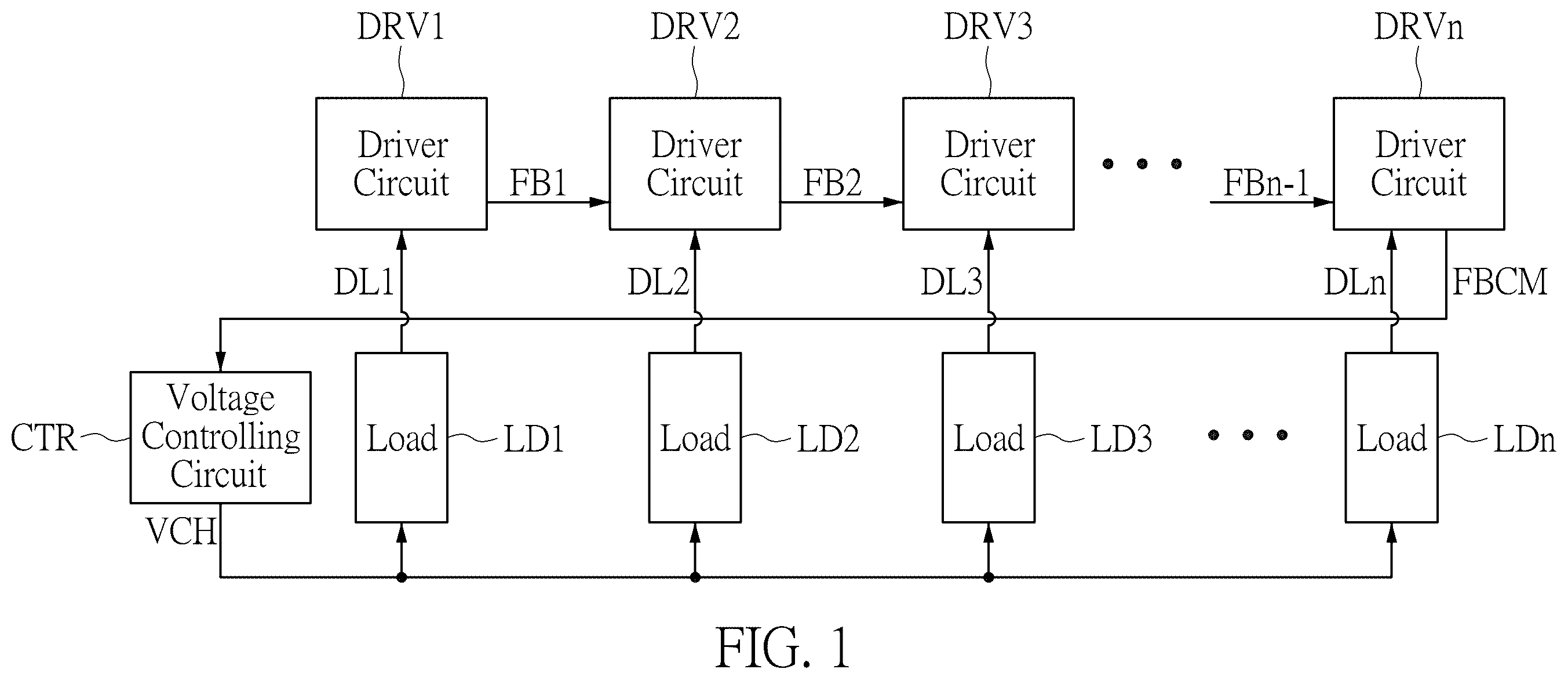
is a block diagram of an adaptive voltage modulation circuit according to a first embodiment of the present disclosure;
is a block diagram of an adaptive voltage modulation circuit according to a second embodiment of the present disclosure;
is a block diagram of an adaptive voltage modulation circuit according to a third embodiment of the present disclosure;
is a block diagram of an adaptive voltage modulation circuit according to a fourth embodiment of the present disclosure; and
is a schematic diagram of values calculated by a last one of the plurality of driver circuits included in the adaptive voltage modulation circuit according to a fifth embodiment of the present disclosure.
DETAILED DESCRIPTION OF THE EXEMPLARY EMBODIMENTS
The present disclosure is more particularly described in the following examples that are intended as illustrative only since numerous modifications and variations therein will be apparent to those skilled in the art. Like numbers in the drawings indicate like components throughout the views. As used in the description herein and throughout the claims that follow, unless the context clearly dictates otherwise, the meaning of “a”, “an”, and “the” includes plural reference, and the meaning of “in” includes “in” and “on”. Titles or subtitles can be used herein for the convenience of a reader, which shall have no influence on the scope of the present disclosure.
The terms used herein generally have their ordinary meanings in the art. In the case of conflict, the present document, including any definitions given herein, will prevail. The same thing can be expressed in more than one way. Alternative language and synonyms can be used for any term(s) discussed herein, and no special significance is to be placed upon whether a term is elaborated or discussed herein. A recital of one or more synonyms does not exclude the use of other synonyms. The use of examples anywhere in this specification including examples of any terms is illustrative only, and in no way limits the scope and meaning of the present disclosure or of any exemplified term. Likewise, the present disclosure is not limited to various embodiments given herein. Numbering terms such as “first”, “second” or “third” can be used to describe various components, signals or the like, which are for distinguishing one component/signal from another one only, and are not intended to, nor should be construed to impose any substantive limitations on the components, signals or the like.
Reference is made to , which is a block diagram of an adaptive voltage modulation circuit according to a first embodiment of the present disclosure.
As shown in , in the first embodiment, the adaptive voltage modulation circuit of the present disclosure includes a plurality of driver circuits DRV 1 to DRVn and a voltage controlling circuit CTR.
The plurality of driver circuits DRV 1 to DRVn are arranged and connected with each other in series. The number and an order of the plurality of driver circuits DRV 1 to DRVn may be determined according to actual requirements, but the present disclosure is not limited thereto.
Each of the plurality of driver circuits DRV 1 to DRVn may have a signal output terminal. Each of the plurality of driver circuits DRV 1 to DRVn except for the driver circuit DRV 1 that is a first one of the plurality of driver circuits DRV 1 to DRVn may have a signal input terminal. The signal input terminal of each of the driver circuits DRV 2 to DRVn is connected to a signal output terminal of a previous one of the plurality of driver circuits DRV 1 to DRVn. For example, the signal input terminal of the driver circuit DRV 2 that is a second one of the plurality of driver circuits DRV 1 to DRVn is connected to the signal output terminal of the driver circuit DRV 1 . The signal input terminal of the driver circuit DRV 3 that is a third one of the plurality of driver circuits DRV 1 to DRVn is connected to the signal output terminal of the driver circuit DRV 2 .
Each of the plurality of driver circuits DRV 1 to DRVn may further have a driving output terminal. The driving output terminals of the plurality of driver circuits DRV 1 to DRVn are respectively connected to (a plurality of driving terminals or control terminals of) a plurality of loads LD 1 to LDn.
It is worth noting that, only the driver circuit DRV 1 n that is a last one of the plurality of driver circuits DRV 1 to DRVn is connected to a signal input terminal of the voltage controlling circuit CTR. A power output terminal of the voltage controlling circuit CTR is connected to the plurality of loads LD 1 to LDn. For example, the power output terminal of the voltage controlling circuit CTR is connected to a plurality of first terminals or power input terminals respectively of the plurality of loads LD 1 to LDn, or a common node of the plurality of loads LD 1 to LDn.
The driver circuit DRV 1 that is the first one of the plurality of driver circuits DRV 1 to DRVn, according to data DL 1 of the load LD 1 connected thereto, outputs a feedback signal FB 1 to the driver circuit DRV 2 arranged next to the driver circuit DRV 1 .
The plurality of driver circuits DRV 1 to DRVn, except for the driver circuit DRV 1 and the driver circuit DRV 1 n , respectively output a plurality of feedback signals FB 2 to FBn- 1 to the next ones of the plurality of driver circuits DRV 3 to DRVn that are respectively arranged next to the driver circuits DRV 2 to DRVn- 1 , according to data DL 2 to DLn- 1 of the loads LD 2 to LDn- 1 connected thereto and the feedback signals FB 1 to FBn- 2 from the previous ones of the plurality of driver circuits DRV 1 to DRVn- 2 . The driver circuit DRV 1 n is arranged next to the driver circuit DRVn- 1 .
That is, the driver circuit DRV 2 outputs the feedback signal FB 2 to the driver circuit DRV 3 that is arranged next to the driver circuit DRV 2 according to the data DL 2 of the load DL 2 connected thereto and the feedback signal FB 1 from the driver circuit DRV 1 . The driver circuit DRV 2 is arranged next to the driver circuit DRV 1 . The driver circuit DRV 3 outputs the feedback signal FB 3 to the driver circuit DRV 4 that is arranged next to the driver circuit DRV 3 according to the data DL 3 of the load DL 3 connected thereto and the feedback signal FB 2 from the driver circuit DRV 2 .
The plurality of driver circuits DRV 1 to DRVn may respectively set or obtain a plurality of reference data, and may respectively compare the plurality of data DL 1 to DLn of the plurality of loads LD 1 to LDn with the plurality of reference data to respectively generate a plurality of comparison results. For example, each of the plurality of data DL 1 to DLn of the plurality of loads LD 1 to LDn may include a voltage, and each of the plurality of reference data may include a voltage threshold, but the present disclosure is not limited thereto.
The driver circuit DRV 1 that is the first one of the plurality of driver circuits DRV 1 to DRVn may output the feedback signal FB 1 to the driver circuit DRV 2 arranged next to the driver circuit DRV 1 according to the comparison result.
The plurality of driver circuits DRV 1 to DRVn, except for the driver circuits DRV 1 , DRVn, may respectively output feedback signals FB 2 to FBn- 1 to the next ones of the plurality of driver circuits DRV 3 to DRVn according to the comparison results and the feedback signals FB 1 to FBn- 2 from the previous ones of the plurality of driver circuits DRV 1 to DRVn- 2 . For example, the driver circuit DRV 2 outputs the feedback signal FB 2 to the driver circuit DRV 3 that is arranged next to the driver circuit DRV 2 according to the comparison result generated by the driver circuit DRV 2 and the feedback signal FB 1 from the driver circuit DRV 1 .
It is worth noting that, only the signal output terminal of the driver circuit DRVn that is the last one of the plurality of driver circuits DRV 1 to DRVn is connected to the signal input terminal of the voltage controlling circuit CTR, and others of the plurality of driver circuits DRV 1 to DRVn are not connected to the voltage controlling circuit CTR. Furthermore, the power output terminal of the voltage controlling circuit CT of the adaptive voltage modulation circuit of the present disclosure is connected to the plurality of loads LD 1 to LDn.
It is worth noting that, only the driver circuit DRVn that is the last one of the plurality of driver circuits DRV 1 to DRVn outputs a power supply instructing signal FBCM according to the data DLn of the load LDn connected thereto and the feedback signal FBn- 1 from the driver circuit DRVn- 1 . The driver circuit DRVn is arranged next to the driver circuit DRVn- 1 .
The feedback signal FBn- 1 that is received from the driver circuit DRVn- 1 by the driver circuit DRVn includes the plurality of data DL 1 to DLn- 1 respectively of the plurality of loads LD 1 to LDn- 1 (or the plurality of comparison results of the plurality of data DL 1 to DLn and the plurality of reference data).
That is, the driver circuit DRVn that is the last one of the plurality of driver circuits DRV 1 to DRVn, according to the plurality of data DL 1 to DLn respectively of the plurality of loads LD 1 to LDn, evaluates a common modulation power (that is a common modulation voltage) which is commonly required for the plurality of data DL 1 to DLn to output the power supply instructing signal FBCM.
For example, the driver circuit DRVn may, according to the data DLn of the load LDn and the feedback signal FB 1 - 1 from the driver circuit DRVn- 1 , count the number of the loads whose the data (that is the voltage) is larger than the reference data (including the voltage threshold) among the plurality of data DL 1 to DLn respectively of the plurality of loads LD 1 to LDn as a count value to output the power supply instructing signal FBCM.
When the driver circuit DRVn determines that any one of the plurality of data DL 1 to DLn (that are the voltages) respectively of the plurality of loads LD 1 to LDn is not larger than the reference data (including the voltage threshold), the driver circuit DRVn does not count the count value and maintains the count value.
Conversely, when the driver circuit DRVn determines that any one of the plurality of data DL 1 to DLn (that are the voltages) respectively of the plurality of loads LD 1 to LDn is larger than the reference data (including the voltage threshold), the driver circuit DRVn counts up the count value for increasing the count value. That is, the driver circuit DRVn adds a value such as “1” to the count value. The number of times that the count value is counted up depends on how many of the loads have the data being larger than the reference data.
The driver circuit DRVn that is the last one of the plurality of driver circuits DRV 1 to DRVn may output the power supply instructing signal FBCM according to the count value that is counted finally.
The voltage controlling circuit CTR may set a common modulation power signal VCH according to the power supply instructing signal FBCM from the driver circuit DRVn, and output the common modulation power signal VCH to each of the plurality of loads LD 1 to LDn. The common modulation power signal VCH described herein may include a voltage signal as a common modulation voltage signal.
For example, the voltage controlling circuit CTR may store a plurality of reference count values and a plurality of reference common modulation power (such as reference common modulation voltages) on a lookup table. The plurality of reference common modulation power respectively correspond to the plurality of reference count values. The voltage controlling circuit CTR may look up, from the lookup table, the reference common modulation power that corresponds to the reference count value being equal to the count value instructed by the power supply instructing signal FBCM. The voltage controlling circuit CTR may output the common modulation power signal VCH to each of the plurality of loads LD 1 to LDn according to the reference common modulation power that is looked up.
After each of the plurality of loads LD 1 to LDn receives the common modulation power signal VCH from the voltage controlling circuit CTR, a voltage of each of the plurality of loads LD 1 to LDn is adjusted to a target voltage value. As a result, differences between the voltages respectively of the plurality of loads LD 1 to LDn are reduced, thereby preventing temperatures of the plurality of loads LD 1 to LDn from increasing to cause damage to the plurality of loads LD 1 to LDn.
Reference is made to , which is a block diagram of an adaptive voltage modulation circuit according to a second embodiment of the present disclosure.
As shown in , in the second embodiment, the adaptive voltage modulation circuit of the present disclosure includes the plurality of driver circuits DRV 1 to DRVn and the voltage controlling circuit CTR.
The descriptions of the second embodiment of the present disclosure that are the same as the descriptions of the first embodiment of the present disclosure are not repeated herein. Differences between the second and first embodiments are described in detail as follows.
As shown in , in the second embodiment, each of the plurality of loads LD 1 to LDn may include two light-emitting components such as light-emitting diodes, the load LD 1 includes light-emitting components LA 11 , LA 12 , the load LD 2 includes light-emitting components LA 21 , LA 22 , the load LD 3 includes light-emitting components LA 31 , LA 32 , and the load LDn includes light-emitting components LAn 1 , LAn 2 . In practice, the number of light-emitting components included in each of the plurality of loads LD 1 to LDn may be determined according to actual requirements, and the light-emitting components included in each or any one of the plurality of loads LD 1 to LDn may be replaced with other circuit components, but the present disclosure is not limited thereto. Each of the plurality of loads LD 1 to LDn shown in may include one or more circuit components such as light-emitting components.
The driver circuit DRVn that is the last one of the plurality of driver circuits DRV 1 to DRVn may, according to the data DL 1 to DLn of the plurality of loads LD 1 to LDn, determine amounts of a plurality of modulation power that are respectively required for each of the plurality of loads LD 1 to LDn. For example, the driver circuit DRVn may select one of the plurality of modulation powers as a minimum common modulation power (such as a minimum common modulation voltage) to output the power supply instructing signal FBCM to each of the plurality of loads LD 1 to LDn.
After the power supply instructing signal FBCM is outputted to each of the plurality of loads LD 1 to LDn, the plurality of loads LD 1 to LDn may reach a desired state, or may not reach the desired state due to various different materials composed of the plurality of loads LD 1 to LDn, the number and configurations of the plurality of loads LD 1 to LDn, and other factors. When one or more of the plurality of loads LD 1 to LDn does not reach the desired state, the one or more of the plurality of loads LD 1 to LDn need to be modulated, which is described in detail as follows.
After the power supply instructing signal FBCM is outputted to each of the plurality of loads LD 1 to LDn, one or more of the plurality of driver circuits DRV 1 to DRVn may supply one or more of individual modulation signals CR 1 to CRn to one or more of the plurality of loads LD 1 to LDn according to the data DL 1 to DLn of the plurality of loads LD 1 to LDn connected thereto.
For example, after the plurality of data LD 1 to LDn of the plurality of loads LD 1 to LDn are changed by the power supply instructing signal FBCM, the driver circuit DRV 1 supplies the individual modulation signal to the load LD 1 according to the changed data DL 1 of the load LD 1 such that an operation state of the load LD 1 (such as brightness of light emitted by the load LD 1 ) reaches the desired state. The individual modulation signal described herein may include a current signal as an individual modulation current signal.
Reference is made to , which is a block diagram of an adaptive voltage modulation circuit according to a third embodiment of the present disclosure.
As shown in , in the third embodiment, the adaptive voltage modulation circuit of the present disclosure not only includes the plurality of driver circuits DRV 1 to DRVn and the voltage controlling circuit CTR, but also includes a main control circuit MAT.
The descriptions of the third embodiment of the present disclosure that are the same as the descriptions of the first and second embodiments of the present disclosure are not repeated herein. Differences between the third and second embodiments of the present disclosure are described in detail as follows.
The main control circuit MAT has a main control output terminal. The main control output terminal of the main control circuit MAT is connected to the signal input terminal of the driver circuit DRV 1 that is the first one of the plurality of driver circuits DRV 1 to DRVn. The signal input terminal of each of the plurality of driver circuits DRV 2 to DRVn is connected to the signal output terminal of the previous one of the plurality of driver circuits DRV 1 to DRVn- 1 .
Each of the plurality of driver circuits DRV 1 to DRVn, except for the driver circuit DRVn that is the last one of the plurality of driver circuits DRV 1 to DRVn, has a main control input terminal and a main control output terminal. The main control input terminal of the driver circuit DRV 1 receives a main control signal MS from the main control output terminal of the main control circuit MAT. The main control input terminal of each of the plurality of driver circuits DRV 1 to DRVn except for the driver circuit DRVn receives the main control signal MS from the previous one of the plurality of driver circuits DRV 1 to DRVn. The main control output terminal of each of the plurality of driver circuits DRV 1 to DRVn except for the driver circuit DRVn outputs the received main control signal MS to the next one of the plurality of driver circuits DRV 1 to DRVn.
That is, the main control signal MS outputted by the main control circuit MAT is transmitted sequentially to the plurality of driver circuits DRV 1 to DRVn in an arrangement order of the plurality of driver circuits DRV 1 to DRVn. Each of the plurality of driver circuits DRV 1 to DRVn operates according to the main control signal MS.
If necessary, the main control circuit MAT may have a synchronization output terminal. The synchronization output terminal of the main control circuit MAT may output a synchronization signal Sync to a synchronization receiving terminal of each of the plurality of driver circuits DRV 1 to DRVn for synchronizing a plurality of operational times respectively of the plurality of driver circuits DRV 1 to DRVn.
It should be understood that, the number and configurations of output terminals and input terminals of the main control circuit MAT, the plurality of driver circuits DRV 1 to DRVn and the voltage controlling circuit CTR are only exemplified above and may be adjusted according to actual requirements, and the present disclosure is not limited thereto.
Reference is made to , which is a block diagram of an adaptive voltage modulation circuit according to a fourth embodiment of the present disclosure.
As shown in , in the fourth embodiment, the adaptive voltage modulation circuit of the present disclosure only includes the plurality of driver circuits DRV 1 to DRVn and the main control circuit MAT, but does not include the voltage controlling circuit CTR as shown in .
The descriptions of the fourth embodiment that are the same as the descriptions of the first to third embodiments are not repeated herein. Differences between the fourth embodiment and the first to third embodiments are described as follows.
The operations that are performed by the voltage controlling circuit CTR shown in in the third embodiment are performed by the main control circuit MAT in the fourth embodiment.
In the fourth embodiment, the signal output terminal of the driver circuit DRVn that is the last one of the plurality of driver circuits DRV 1 to DRVn is connected to the signal input terminal of the main control circuit MAT.
The signal input terminal of the main control circuit MAT receives the power supply instructing signal FBCM from the signal output terminal of the driver circuit DRVn. The main control circuit MAT, according to the power supply instructing signal FBCM from the driver circuit DRVn, outputs the common modulation power signal VCH to each of the plurality of loads LD 1 to LDn.
Reference is made to , which is a schematic diagram of values calculated by a last one of the plurality of driver circuits included in the adaptive voltage modulation circuit according to a fifth embodiment of the present disclosure.
The driver circuit DRVn that is the last one of the plurality of driver circuits DRV 1 to DRVn shown in to may, according to the data DLn of the load LDn connected thereto and the feedback signal FB 1 - 1 from the driver circuit DRVn- 1 , count the number of the loads having the voltage being higher than the voltage threshold among the plurality of loads LD 1 to LDn within each of a plurality of modulation times. The driver circuit DRVn outputs the power supply instructing signal FBCM according to the numbers that are respectively counted in the plurality of modulation times.
For example, as shown in , within each of ten modulation times T 1 to T 10 divided from a modulation time interval Tcy, the driver circuit DRVn counts the number of the loads each having the voltage being higher than the voltage threshold among the ten loads LD 1 to LD 10 .
As shown in , within the modulation times T 1 to T 3 , the voltage of each of the ten loads LD 1 to LD 10 is not higher than the voltage threshold. Therefore, the count value counted within each of the modulation times T 1 to T 3 is 0.
Then, within the modulation time T 4 , the voltage of each of the ten loads LD 1 to LD 10 is higher than the voltage threshold. Therefore, the count value counted within the modulation time T 4 is 10.
Then, within the modulation time T 5 , the voltages of eight ones of the ten loads LD 1 to LD 10 are higher than the voltage threshold. Therefore, the count value counted within the modulation time T 5 is 8.
Then, within the modulation time T 6 , the voltages of five ones of the ten loads LD 1 to LD 10 are higher than the voltage threshold. Therefore, the count value counted within the modulation time T 6 is 5.
Then, within the modulation time T 7 , the voltages of two ones of the ten loads LD 1 to LD 10 are higher than the voltage threshold. Therefore, the count value counted within the modulation time T 7 is 2.
Then, within the modulation time T 8 , the voltage of each of the ten loads LD 1 to LD 10 is not higher than the voltage threshold. Therefore, the count value counted within the modulation time T 8 is 0.
If necessary, the driver circuit DRV 1 may set a plurality of weight values respectively for the plurality of count values that are counted respectively within the plurality of modulation times.
For example, the smaller the time difference between the modulation time and a current time point is, the higher the importance of the count value counted within the modulation time is, the larger the weight value is set by the driver circuit DRVn. The larger the time difference between the modulation time and the current time point is, the lower the importance of the count value counted within the modulation time is, and the smaller the weight value set by the driver circuit DRVn is.
The driver circuit DRVn may multiply the plurality of weight value respectively by the plurality of count values that are respectively counted within ones of the plurality of modulation time, to obtain a plurality of arithmetic values. The ones of plurality of modulation time includes the modulation time within which the current time point falls, and the modulation times being earlier than the modulation time within which the current time point falls. The driver circuit DRVn may sum up the plurality of arithmetic values to obtain a total weighted count value.
For example, as shown in , when the current time point enters the modulation time T 4 , the driver circuit DRVn sets a weight value WT 4 of the modulation time T 4 to 0.7, a weight value WT 3 of the modulation time T 3 to 0.2, and a weight value WT 2 of the modulation time T 2 to 0.1. A difference between the modulation time T 4 and the current time point is smaller than a difference between the modulation time T 3 and the current time point. Accordingly, the weight value WT 4 of the modulation time T 4 is larger than the weight value WT 3 of the modulation time T 3 . The difference between the modulation time T 3 and the current time point is smaller than a difference between the modulation time T 2 and the current time point. Accordingly, the weight value WT 3 of the modulation time T 3 is larger than the weight value WT 2 of the modulation time T 2 .
When the current time point enters the modulation time T 4 , the driver circuit DRVn samples the count value “0” counted within the modulation time T 4 , the count value “10” counted within the modulation time T 3 that is earlier than the modulation time T 4 and the count value “0” counted within the modulation time T 2 that is earlier than the modulation time T 3 .
Within the modulation time T 4 , the driver circuit DRVn multiplies the count value “0” counted within the modulation time T 2 by the weight value WT 2 “0.1” of the modulation time T 2 to obtain the arithmetic value “0”.
Within the modulation time T 4 , the driver circuit DRVn multiplies the count value “0” counted within the modulation time T 3 by the weight value WT 3 “0.2” of the modulation time T 3 to obtain the arithmetic value “0”.
Within the modulation time T 4 , the driver circuit DRVn multiplies the count value “10” counted within the modulation time T 4 by the weight value WT 4 “0.7” of the modulation time T 4 to obtain the arithmetic value “7”.
Within the modulation time T 4 , the driver circuit DRVn sums up the arithmetic values “0”, “0” and “7” of the modulation time T 4 to obtain a total weighted count value CNS 2 “7”, and outputs the common modulation power signal VCH to each of the plurality of loads LD 1 to LDn according to the total weighted count value CNS 2 “7”.
When the current time point enters the modulation time T 5 , the driver circuit DRVn samples the count value “8” counted within the modulation time T 5 , the count value “10” counted within the modulation time T 4 that is earlier than the modulation time T 5 and the count value “0” counted within the modulation time T 3 that is earlier than the modulation time T 4 .
Within the modulation time T 5 , the driver circuit DRVn multiplies the count value “0” counted within the modulation time T 3 by the weight value WT 3 “0.1” of the modulation time T 3 to obtain the arithmetic value “0”.
Within the modulation time T 5 , the driver circuit DRVn multiplies the count value “10” counted within the modulation time T 4 by the weight value WT 4 “0.2” of the modulation time T 4 to obtain the arithmetic value “2”.
Within the modulation time T 5 , the driver circuit DRVn multiplies the count value “8” counted within the modulation time T 5 by the weight value WT 5 “0.7” of the modulation time T 5 to obtain the arithmetic value “5.6”.
Within the modulation time T 5 , the driver circuit DRVn sums up the arithmetic values “0”, “2” and “5.6” of the modulation time T 5 to obtain a total weighted count value CNS 3 “7.6”, and outputs the common modulation power signal VCH to each of the plurality of loads LD 1 to LDn according to the total weighted count value CNS 3 “7.6”.
When the current time point enters the modulation time T 6 , the driver circuit DRVn samples the count value “5” counted within the modulation time T 6 , the count value “8” counted within the modulation time T 5 that is earlier than the modulation time T 6 and the count value “10” counted within the modulation time T 4 that is earlier than the modulation time T 5 .
Within the modulation time T 6 , the driver circuit DRVn multiplies the count value “10” counted within the modulation time T 4 by the weight value WT 4 “0.1” of the modulation time T 4 to obtain the arithmetic value “1”.
Within the modulation time T 6 , the driver circuit DRVn multiplies the count value “8” counted within the modulation time T 4 by the weight value WT 4 “0.2” of the modulation time T 4 to obtain the arithmetic value “1.6”.
Within the modulation time T 6 , the driver circuit DRVn multiplies the count value “5” counted within the modulation time T 5 by the weight value WT 5 “0.7” of the modulation time T 5 to obtain the arithmetic value “3.5”.
Within the modulation time T 6 , the driver circuit DRVn sums up the arithmetic values “1”, “1.6” and “3.5” of the modulation time T 6 to obtain a total weighted count value CNS 4 “6.1”, and outputs the common modulation power signal VCH to each of the plurality of loads LD 1 to LDn according to the total weighted count value CNS 4 “6.1”.
When the current time point enters the modulation time T 7 , the driver circuit DRVn samples the count value “2” counted within the modulation time T 7 , the count value “5” counted within the modulation time T 6 that is earlier than the modulation time T 7 and the count value “8” counted within the modulation time T 5 that is earlier than the modulation time T 6 .
Within the modulation time T 7 , the driver circuit DRVn multiplies the count value “8” counted within the modulation time T 5 by the weight value WT 5 “0.1” of the modulation time T 5 to obtain the arithmetic value “0.8”.
Within the modulation time T 7 , the driver circuit DRVn multiplies the count value “5” counted within the modulation time T 6 by the weight value WT 6 “0.2” of the modulation time T 6 to obtain the arithmetic value “1”.
Within the modulation time T 7 , the driver circuit DRVn multiplies the count value “2” counted within the modulation time T 7 by the weight value WT 7 “0.7” of the modulation time T 7 to obtain the arithmetic value “1.4”.
Within the modulation time T 7 , the driver circuit DRVn sums up the arithmetic values “0.8”, “1” and “1.4” of the modulation time T 6 to obtain a total weighted count value CNS 5 “3.2”, and outputs the common modulation power signal VCH to each of the plurality of loads LD 1 to LDn according to the total weighted count value CNS 5 “3.2”.
As described above, the count values counted within the three modulation times are multiplied respectively by the weight values to respectively obtain to the three arithmetic values, and then the three arithmetic values are summed up to calculate the total weighted count value, but the present disclosure is not limited thereto. In practice, the count values may be counted within more or less modulation times and may be sampled for calculation of the total weighted count value.
The driver circuit DRVn that is the last one of the plurality of driver circuits DRV 1 to DRVn shown in to may calculate the plurality of total weighted count values CNS 1 to CNS 6 respectively within the modulation time T 1 to T 6 shown in , and output the power supply instructing signal FBCM according to each of the plurality of total weighted count values CNS 1 to CNS 6 .
It should be understood that, the driver circuit DRVn obtains the three count values in the fifth embodiment, but in practice, the number of the sampled count values may be increased or decreased according to actual requirements.
The power (such as the voltage) of the common modulation power signal VCH outputted to each of the plurality of loads LD 1 to LDn is determined according to the total weighted count value. As a result, more appropriate common power is supplied to the plurality of loads LD 1 to LDn to synchronously modulate voltages of the plurality of loads LD 1 to LDn, such that differences between the voltages respectively of the plurality of loads LD 1 to LDn are smaller than a voltage threshold such as a zero value.
In conclusion, the present disclosure provides the adaptive voltage modulation circuit. In the adaptive voltage modulation circuit of the present disclosure, each of the plurality of driver circuits except for the last one of the plurality of driver circuits outputs the feedback signal to the next one of the plurality of driver circuits according to the data (including the voltage) of the load (such as the light string) connected thereto. In particular, the last one of the plurality of driver circuits instructs the voltage controlling circuit to supply an appropriate amount of power to the plurality of loads according to the data of the load connected thereto and the data of others of the plurality of loads driven by other ones of the plurality of driver circuits from the previous one of the plurality of driver circuits. Therefore, the adaptive voltage modulation circuit of the present disclosure is capable of supplying an optimal amount of power to the plurality of loads.
The foregoing description of the exemplary embodiments of the disclosure has been presented only for the purposes of illustration and description and is not intended to be exhaustive or to limit the disclosure to the precise forms disclosed. Many modifications and variations are possible in light of the above teaching.
The embodiments were chosen and described in order to explain the principles of the disclosure and their practical application so as to enable others skilled in the art to utilize the disclosure and various embodiments and with various modifications as are suited to the particular use contemplated. Alternative embodiments will become apparent to those skilled in the art to which the present disclosure pertains without departing from its spirit and scope.
Figures (5)
Citations
This patent cites (26)
- US6541933
- US8749163
- US10158299
- US10909911
- US11276345
- US11436970
- US12057080
- US12369240
- US12444343
- US12494158
- US2016/0172965
- US2017/0256303
- US2018/0184491
- US2019/0387588
- US2020/0205254
- US2021/0120642
- US2021/0366391
- US2022/0020310
- US2025/0007750
- US2025/0324499
- US2025/0324502
- US2025/0330034
- US115348699
- US4475630
- USWO-2025019045
- USWO-2025114046