Defect Inspection System and Defect Inspection Method
Abstract
Images of a face surface and a back surface of a plywood 10 that is conveyed on belt conveyors 5 U and 5 D are captured by imaging devices of first illumination and imaging units 1 F and 1 B to generate depth information, a shape of the plywood 10 is measured by shape measurement units 3 F and 3 B, which are provided at locations different from a location of a gap 51 where the image capturing is performed, to generate shape information, and the depth information is corrected based on the shape information, and then a defect in the plywood 10 is detected based on the depth information. By detecting a defect in the plywood 10 based on the depth information corrected using the shape information that is measured without being affected by vibrations that occur when the plywood 10 is conveyed over the gap 51 , a defect such as warpage or bending can be accurately detected without deformation occurring in the plywood 10 being flattened by the correction of the depth information.
Claims (11)
1 . A defect inspection system, characterized by comprising: imaging devices that are disposed at positions vertically above and vertically below a gap between conveyors disposed spaced apart from each other in a conveying direction, that capture images of a face surface and a back surface of a plywood, which is sequentially conveyed by the conveyors, in the gap between the conveyors, and that generate depth information in a board thickness direction based on the captured images of the face surface and the back surface of the plywood; a shape measurement device that generates shape information by measuring a shape in the board thickness direction at a location different from a location of the gap between the conveyors; and an analysis device that detects a defect of deformation in the plywood due to warpage or bending by analyzing the depth information acquired by the imaging devices and the shape information acquired by the shape measurement device, wherein the analysis device includes a correction processing unit that corrects the depth information based on the shape information, and a defect detection unit that detects a defect in the plywood due to deformation based on the depth information.
9 . A defect inspection method, characterized by comprising: a step of capturing images of a face surface and a back surface of a plywood, which is sequentially conveyed by conveyors disposed spaced apart from each other in a conveying direction, in a gap between the conveyors, using imaging devices disposed at positions vertically above and vertically below the gap between the conveyors, and generating depth information in a board thickness direction based on the captured images of the face surface and the back surface of the plywood; a step of generating, by a shape measurement device, shape information by measuring a shape in the board thickness direction at a location different from a location of the gap between the conveyors; and a step of detecting, by an analysis device, a defect of deformation in the plywood due to warpage or bending by analyzing the depth information acquired by the imaging devices and the shape information acquired by the shape measurement device, wherein the step of detecting, by the analysis device, a defect in the plywood includes a first step of correcting, by a correction processing unit of the analysis device, the depth information based on the shape information, and a second step of detecting, by a defect detection unit of the analysis device, a defect in the plywood due to deformation based on the depth information corrected by the correction processing unit.
Show 9 dependent claims
2 . The defect inspection system according to claim 1 , characterized in that the depth information and the shape information are information indicating a distance from a reference position to the face surface or the back surface of the plywood in the board thickness direction, and the correction processing unit calculates a difference value between the depth information and the shape information, and corrects the depth information by using the difference value as a correction value for the depth information.
3 . The defect inspection system according to claim 1 , characterized in that when a shape in the board thickness direction indicated by the depth information acquired by the imaging devices is different from the shape in the board thickness direction indicated by the shape information acquired by the shape measurement device at the same position as a position where the depth information is acquired, the correction processing unit corrects the depth information based on the shape information.
4 . The defect inspection system according to claim 1 , characterized in that the imaging devices are installed vertically above and vertically below the gap between the conveyors at positions that are vertically aligned in a straight line, and simultaneously capture the images of the face surface and the back surface of the plywood.
5 . The defect inspection system according to claim 1 , characterized by further comprising: a first illumination that irradiates the face surface and the back surface of the plywood with a first illumination light for capturing a color image; and a second illumination that irradiates the face surface and the back surface of the plywood with a second illumination light for acquiring depth information, wherein the imaging devices generate planar color images and the depth information by capturing the images of the face surface and the back surface of the plywood in the gap between the conveyors in a state where the face surface and the back surface are irradiated with the first illumination light and the second illumination light, and the analysis device detects a plurality of types of defects in the plywood based on the planar color image, and detects a defect in the plywood due to deformation based on the depth information.
6 . The defect inspection system according to claim 5 , characterized in that the second illumination light is illumination light for light sectioning measurement.
7 . The defect inspection system according to claim 1 , characterized in that the shape measurement device includes a side surface imaging device that generates a side surface color image by capturing an image of a side surface of the plywood, and a side surface shape recognition unit included in the analysis device, and the side surface shape recognition unit generates shape information of the plywood in the board thickness direction by analyzing the side surface color image acquired by the side surface imaging device.
8 . The defect inspection system according to claim 7 , characterized in that the analysis device further detects a defect existing on the side surface of the plywood based on the side surface color image.
10 . The defect inspection system according to claim 4 , characterized by further comprising: a first illumination that irradiates the face surface and the back surface of the plywood with a first illumination light for capturing a color image; and a second illumination that irradiates the face surface and the back surface of the plywood with a second illumination light for acquiring depth information, wherein the imaging devices generate planar color images and the depth information by capturing the images of the face surface and the back surface of the plywood in the gap between the conveyors in a state where the face surface and the back surface are irradiated with the first illumination light and the second illumination light, and the analysis device detects a plurality of types of defects in the plywood based on the planar color image, and detects a defect in the plywood due to deformation based on the depth information.
11 . The defect inspection system according to claim 4 , characterized in that the shape measurement device includes a side surface imaging device that generates a side surface color image by capturing an image of a side surface of the plywood, and a side surface shape recognition unit included in the analysis device, and the side surface shape recognition unit generates shape information of the plywood in the board thickness direction by analyzing the side surface color image acquired by the side surface imaging device.
Full Description
Show full text →
CROSS REFERENCE TO RELATED APPLICATIONS
This application is a National Phase filing under 35 U.S.C. § 371 of PCT/JP2024/031552 filed on Sep. 3, 2024; which application in turn claims priority to Application No. 2023-176670 filed in Japan on Oct. 12, 2023. The entire contents of each application are hereby incorporated by reference.
TECHNICAL FIELD
The present invention relates to a defect inspection system and a defect inspection method, and is particularly suitable for use in a system that detects defects existing in a plywood formed by laminating a plurality of veneers cut from a log.
BACKGROUND ART
Generally, a plywood is manufactured by superimposing a plurality of veneers, which are produced by cutting a log, which is a natural material, using a veneer lathe, and bonding the veneers together with an adhesive. A plywood produced from a log contains a variety of defects. Each plywood is sorted into one of a plurality of quality ranks depending on the type, size, number, or the like of the defects. Conventionally, a defect inspection apparatus that detects defects existing in a plywood is used to perform the sorting. Defects in the plywood that are detected by the defect inspection apparatus include discoloration (mold, dirt, bark inclusion, and the like), holes, contaminant, unevenness, warpage, bending, and the like of a face surface and a back surface.
Conventionally, an inspection apparatus that irradiates a face surface of a wood laminate with vertical irradiation light and oblique irradiation light and irradiates a back surface of the wood laminate with vertical irradiation light and oblique irradiation light and that determines the properties of each of the face surface and the back surface by analyzing image data obtained by capturing images of the face surface and the back surface of the wood laminate using line sensor cameras has been known (for example, refer to PTL 1).
In addition, among apparatuses that inspect the thickness of an object to be inspected such as a decorative board manufactured by affixing a plywood and a sheet-shaped decorative material together, an apparatus that inspects the thickness of the object to be inspected based on a difference between a plurality of first displacement data representing a distance from a position on one surface of the object to be inspected to a reference point set in advance, which is measured by one of a pair of displacement sensors disposed with the object to be inspected interposed therebetween, and a plurality of second displacement data representing a distance from a position on the other surface of the object to be inspected to the reference point, which is measured by the other displacement sensor, has also been known (for example, refer to PTL 2).
By the way, when capturing images of or measuring the face surface and the back surface of the plywood is simultaneously performed as in PTLs 1 and 2, it is necessary to separate conveying devices (conveyors) for conveying the plywood into an upstream side and a downstream side and to dispose the two conveyors with a spatial gap therebetween. Therefore, when the plywood is transferred from the upstream conveyor to the downstream conveyor, namely, when capturing images of or measuring the plywood is performed, the plywood may bounce and the influence of the bouncing may appear as an error in the captured or measured data. Particularly, when the plywood is warped or bent, the plywood is likely to bounce due to the warpage or bending.
Note that, in this regard, PTL 2 describes that a stripe pattern appears in a captured image due to vibrations of the object to be inspected that occur when the object to be inspected passes over an inspection surface of the displacement sensor, but an image in which a change in surface height caused by the vibrations of the object to be inspected is cancelled out can be acquired by taking the difference between the first displacement data and the second displacement data.
However, the technology described in PTL 2 is not for detecting defects in the plywood, but for measuring the thickness of the plywood. Therefore, when the technology described in PTL 2 is applied to a defect inspection apparatus for a plywood, in a case where a plywood has a defect such as warpage or bending, the defect is simultaneously removed by taking the difference between the first displacement data and the second displacement data, and a defect such as warpage or bending cannot be detected, which is a problem.
CITATION LIST
Patent Literature
•
• PTL 1: JP2023-29260A • PTL 2: JP2014-222156A
SUMMARY OF INVENTION
Technical Problem
The invention has been made to solve such problems, and an object of the invention is to be able to accurately detect defects such as warpage or bending existing in a plywood.
Solution to Problem
In order to solve the above-described problems, in the invention, images of a face surface and a back surface of a plywood that is conveyed on conveyors are captured by imaging devices to generate depth information of both the surfaces of the plywood, a shape of the plywood in a board thickness direction is measured by a shape measurement device, which is provided at a location different from a location of the gap between the conveyors where the image capturing is performed, to generate shape information, and a defect in the plywood is detected by analyzing the depth information and the shape information. Here, the depth information is corrected based on the shape information, and then a defect in the plywood due to deformation is detected based on the depth information.
Advantageous Effects of Invention
In the invention configured as described above, the shape of the plywood in the board thickness direction that is measured at a location different from the location of the gap between the conveyors is a shape that is measured without being affected by vibrations that occur when the plywood is conveyed over the gap, and a defect in the plywood due to deformation is detected based on the depth information corrected based on the shape information. Accordingly, only errors in the depth information caused by the influence of vibrations that occur when the plywood is conveyed over the gap can be removed by correction based on the shape information, and a defect due to deformation such as warpage or bending occurring in the plywood can be accurately detected without the deformation such as warpage or bending being flattened by the correction of the depth information.
BRIEF DESCRIPTION OF DRAWINGS
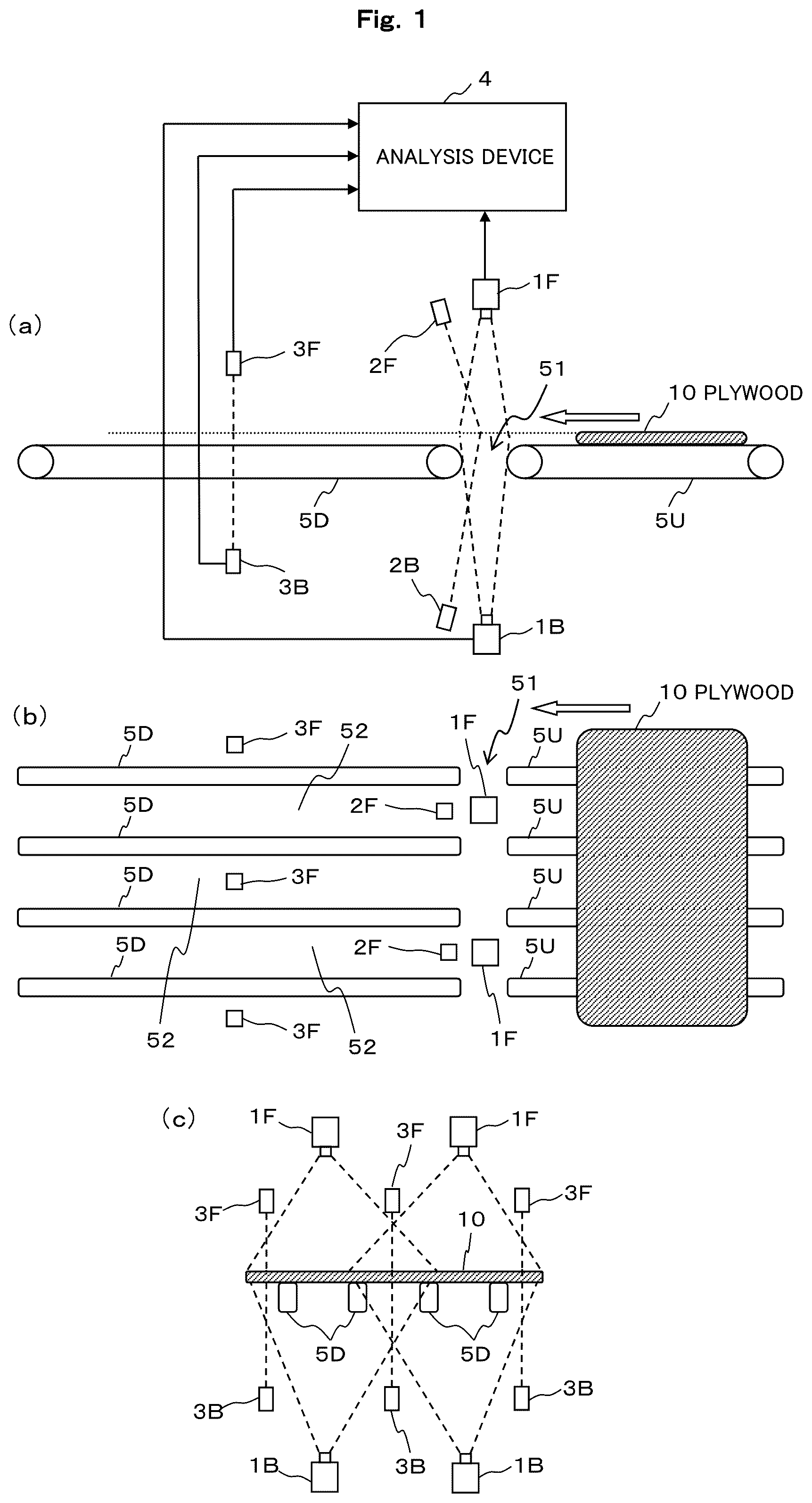
is a view showing an overall configuration example of a defect inspection system according to the present embodiment.
is a block diagram showing a functional configuration example of an analysis device according to the present embodiment.
A is a view schematically showing one example of depth information of a plywood acquired by a depth information acquisition unit.
B is a view schematically showing one example of depth information of the plywood acquired by the depth information acquisition unit.
C is a view schematically showing one example of depth information of the plywood acquired by the depth information acquisition unit.
D is a view schematically showing one example of depth information of the plywood acquired by the depth information acquisition unit.
E is a view schematically showing one example of depth information of the plywood acquired by the depth information acquisition unit.
F is a view schematically showing one example of depth information of the plywood acquired by the depth information acquisition unit.
G is a view schematically showing one example of depth information of the plywood acquired by the depth information acquisition unit.
H is a view schematically showing one example of depth information of the plywood acquired by the depth information acquisition unit.
is a view schematically showing one example of shape information of a plywood acquired by a shape information acquisition unit.
is a view for describing processing contents of a correction processing unit.
is a flowchart showing an operation example of the analysis device according to the present embodiment.
is a view showing an overall configuration example of a defect inspection system according to a modification example.
is a block diagram showing a functional configuration example of an analysis device according to the modification example.
DESCRIPTION OF EMBODIMENTS
Hereinafter, one embodiment of the invention will be described with reference to the drawings. is a view showing an overall configuration example of a defect inspection system according to the present embodiment. ( a ) shows a state of the defect inspection system when viewed from the side, ( b ) shows a state of the defect inspection system when viewed from above, and ( c ) shows a state of the defect inspection system when viewed from a downstream side in a conveying direction. In ( a ) and 1 ( b ), the right side is an upstream side in the conveying direction, and the left side is the downstream side in the conveying direction.
As shown in , the defect inspection system of the present embodiment includes first illumination and imaging units 1 F and 1 B (may collectively be referred to as a first illumination and imaging unit 1 ), second illumination units 2 F and 2 B (may collectively be referred to as a second illumination unit 2 ), shape measurement units 3 F and 3 B (may collectively be referred to as a shape measurement unit 3 ), and an analysis device 4 , and detects a plurality of types of defects existing in a plywood 10 that is conveyed by belt conveyors 5 U and 5 D (may collectively be referred to as a belt conveyor 5 ).
The belt conveyor 5 includes an upstream belt conveyor 5 U and a downstream belt conveyor 5 D, and the upstream belt conveyor 5 U and the downstream belt conveyor 5 D are disposed spaced apart from each other in the conveying direction. Therefore, a gap 51 exists between the two belt conveyors 5 U and 5 D in the conveying direction. In addition, as shown in ( b ) , the belt conveyor 5 is configured by arranging a plurality of elongated belts in a width direction perpendicular to the conveying direction. Therefore, a plurality of gaps 52 also exist in the width direction. The plywood 10 is sequentially conveyed from the upstream belt conveyor 5 U configured in such a manner to the downstream belt conveyor 5 D.
Each of the first illumination and imaging units 1 F and 1 B includes a first illumination and an imaging device. The first illumination performs irradiation with a first illumination light for capturing a color image. The first illumination light can be composed of, for example, visible light such as white, blue, or green light. The first illumination and imaging units 1 F and 1 B are installed at positions vertically above and vertically below the gap 51 between the belt conveyors 5 U and 5 D, and vertically irradiates a face surface and a back surface of the plywood 10 , which is located in the gap 51 , with the first illumination light. Namely, the first illumination and imaging unit 1 F installed above the gap 51 irradiates the face surface of the plywood 10 , which is located in the gap 51 , with the first illumination light. In addition, the first illumination and imaging unit 1 B installed below the gap 51 irradiates the back surface of the plywood 10 , which is located in the gap 51 , with the first illumination light.
Each of the second illumination units 2 F and 2 B includes a second illumination. The second illumination performs irradiation with a second illumination light for acquiring depth information. The second illumination light can be composed of, for example, line-shaped laser light for light sectioning measurement, which has a color different from that of the first illumination light. The second illumination units 2 F and 2 B are installed downstream (may be upstream) of a center position of the gap 51 between the belt conveyors 5 U and 5 D in the conveying direction, and obliquely irradiate the face surface and the back surface of the plywood 10 , which is located in the gap 51 , with second illumination light. Namely, the second illumination unit 2 F installed above the gap 51 obliquely irradiates the face surface of the plywood 10 , which is located in the gap 51 , with the second illumination light. In addition, the second illumination unit 2 B installed below the gap 51 obliquely irradiates the back surface of the plywood 10 , which is located in the gap 51 , with the second illumination light.
As shown in ( b ) and 1 ( c ) , the first illumination and imaging units 1 F and 1 B and the second illumination units 2 F and 2 B are installed in two sets in the width direction perpendicular to the conveying direction (the second illumination units 2 F and 2 B are not shown in ( c ) ). Note that the number shown here is one example and may be one set or three or more sets. Accordingly, the entire region of the plywood 10 in the width direction can be irradiated with the first illumination light and the second illumination light without omission. Here, the plywood 10 is irradiated with the first illumination light for capturing a color image in a planar shape. Meanwhile, the plywood 10 is irradiated with the second illumination light for acquiring depth information in a line shape.
The imaging device included in the first illumination and imaging unit 1 F on a face surface side of the plywood 10 and the imaging device included in the first illumination and imaging unit 1 B on a back surface side of the plywood 10 are installed at positions that are vertically aligned in a straight line, and generate planar color images and depth information of the face surface and the back surface of the plywood 10 by simultaneously capturing images of the face surface and the back surface of the plywood 10 , which is sequentially conveyed by the belt conveyors 5 U and 5 D, in the gap 51 . Namely, the imaging devices generate planar color images and depth information by capturing images of the face surface and the back surface of the plywood 10 in the gap 51 in a state where the face surface and the back surface are irradiated with the first illumination light and the second illumination light. The depth information is information indicating a distance from a reference position to the face surface of the plywood 10 in a board thickness direction and a distance from the reference position to the back surface in the board thickness direction.
Namely, the imaging devices generate planar color image by receiving reflected light of the first illumination light and the second illumination light with which the plywood 10 is irradiated, and performing photoelectric conversion on the received light. The generated planar color images include a trajectory of the second illumination light with which irradiation is performed in a line shape. The imaging devices generate depth information by performing image processing on the line-shaped trajectory of the second illumination light included in the planar color images using a known light sectioning method. The imaging devices capture images of the plywood 10 at predetermined sampling times when the plywood 10 is conveyed on the belt conveyor 5 , and sequentially output the planar color images and depth information, which are acquired thereby, to the analysis device 4 .
Note that, here, a configuration example of the first illumination and imaging units 1 F and 1 B, in each of which the first illumination and the imaging device are integrally provided has been shown; however, the first illumination and the imaging device may be configured as separate members.
The shape measurement units 3 F and 3 B correspond to a shape measurement device in the claims, are installed at locations different from that of the gap 51 between the belt conveyors 5 U and 5 D in the conveying direction, and generate shape information by measuring the shape of the plywood 10 in the board thickness direction. In the example of , the shape measurement units 3 F and 3 B are installed at positions vertically above and vertically below the downstream belt conveyor 5 D at a distance sufficiently away from the gap 51 toward a downstream belt conveyor 5 D side. A position on the downstream belt conveyor 5 D that is sufficiently away from the gap 51 is a position where the plywood 10 can be stably conveyed without being affected by bouncing in the gap 51 .
The shape measurement units 3 F and 3 B include, for example, laser displacement sensors. The laser displacement sensors acquire, as shape information of the plywood 10 , information indicating a distance from the same reference position as the depth information described above to the face surface of the plywood 10 in the board thickness direction and a distance from the same reference position to the back surface. Here, the shape measurement unit 3 F installed above the downstream belt conveyor 5 D measures the shape of the face surface of the plywood 10 . In addition, the shape measurement unit 3 B installed below the downstream belt conveyor 5 D measures the shape of the back surface of the plywood 10 .
As shown in ( b ) and 1 ( c ) , the shape measurement units 3 F and 3 B are installed in a total of three sets, namely, one set at a position on each of both outer sides of the downstream belt conveyor 5 D in the width direction and one set at the position of the gap 52 located at the center. Accordingly, the shape of the plywood 10 in the board thickness direction can be measured at a plurality of locations in the vicinities of both end portions and in a central portion of the plywood 10 . Since the shape of the plywood 10 is measured at a position where the plywood 10 can be stably conveyed, the shape of the plywood 10 can be accurately measured at three locations where the shape measurement units 3 F and 3 B are installed, without being affected by the bouncing of the plywood 10 in the gap 51 . Note that the number of the shape measurement units 3 F and 3 B shown here is one example and is not limited to three sets. For example, a total of five sets of the shape measurement units 3 F and 3 B may be installed by installing the shape measurement units 3 F and 3 B for each gap 52 .
The analysis device 4 detects defects in the plywood 10 by analyzing the planar color images and depth information of the plywood 10 acquired by the imaging devices of the first illumination and imaging units 1 F and 1 B and the shape information of the plywood 10 acquired by the shape measurement units 3 F and 3 B. Here, the analysis device 4 detects a plurality of types of defects in the plywood 10 , such as discoloration, holes, or unevenness, based on the planar color images, and detects defects in the plywood 10 due to deformation such as warpage or bending based on the depth information. At this time, the analysis device 4 corrects the depth information based on the depth information and the shape information.
is a block diagram showing a functional configuration example of the analysis device 4 according to the present embodiment. As shown in , the analysis device 4 of the present embodiment includes, as functional configurations, a color image acquisition unit 41 , a depth information acquisition unit 42 , a shape information acquisition unit 43 , a correction processing unit 44 , and a defect detection unit 45 .
The functional blocks 41 to 45 execute processes to be described below through cooperation between hardware and software. For example, the processing of the functional blocks 41 to 45 is executed by operating a program stored in a RAM, a ROM, or a storage medium such as a hard disk or a semiconductor memory under the control of a microcomputer including a CPU, the RAM, the ROM, and the like. A digital signal processor (DSP) or the like may be provided in addition to the microcomputer.
The color image acquisition unit 41 acquires planar color images of the face surface and the back surface of the plywood 10 generated by the imaging devices of the first illumination and imaging units 1 F and 1 B. The depth information acquisition unit 42 acquires depth information of the face surface and the back surface of the plywood 10 generated by the imaging devices of the first illumination and imaging units 1 F and 1 B. As described above, the planar color images acquired by the color image acquisition unit 41 and the depth information acquired by the depth information acquisition unit 42 are generated by the imaging devices capturing images of the plywood 10 in the gap 51 in the conveying direction between the belt conveyors 5 U and 5 D.
( A to 3 H ) is a view schematically showing one example of depth information of the plywood 10 acquired by the depth information acquisition unit 42 (depth information generated by the imaging devices). Here, an example of depth information acquired during the process in which the plywood 10 that is warped is sequentially conveyed from the upstream belt conveyor 5 U through the gap 51 to the downstream belt conveyor 5 D is shown. The warpage refers to a state where the cross-sectional shape of the plywood 10 in the conveying direction is arched (arc shape) across the entirety of the plywood 10 in the width direction.
In , D 1 is depth information of the face surface of the plywood 10 , D 2 is depth information of the back surface of the plywood 10 , and both D 1 and D 2 indicate depth information at a specific location in the width direction of the plywood 10 . Here, for the sake of description, the reference position for the depth information of the face surface and the back surface is assumed to be a position on the face surface when the plywood 10 is assumed to be flat over its entire surface (a position located above a face surface of the belt conveyor 5 by the thickness of the plywood 10 ).
A shows a state where a leading end vicinity portion of the plywood 10 on the downstream side in the conveying direction is located in the gap 51 and the leading end vicinity portion is located lower than the reference position. For this reason, the depth information of the plywood 10 is acquired as information indicating a shape that is recessed downward from the reference position. The leading end vicinity portion of the plywood 10 continues to descend until a leading end of the plywood 10 lands on the downstream belt conveyor 5 D as shown in B . For this reason, the depth information also continues to be recessed downward.
As shown in C , at the moment at which the leading end of the plywood 10 touches the downstream belt conveyor 5 D, the plywood 10 bounces upward due to impact. Therefore, the depth information is also acquired as a shape protruding upward from the reference position. As shown in D , the plywood 10 may bound and bounce up multiple times. E shows depth information acquired at a position where the face surface of the plywood 10 is higher than the reference position due to warpage of the plywood 10 after the bounding has settled.
The plywood 10 is stably conveyed until a trailing end portion of the plywood 10 on the upstream side in the conveying direction falls into the gap 51 , and depth information acquired during this period is as shown in F . G shows a state where a trailing end vicinity portion of the plywood 10 is located in the gap 51 and the trailing end vicinity portion is located lower than the reference position. For this reason, the depth information of the plywood 10 is acquired as information indicating a shape that is recessed downward from the reference position. At this point, the plywood 10 may also bounce slightly. Thereafter, the plywood 10 is conveyed while the trailing end vicinity portion is gradually raised upward along the overall warpage, thereby acquiring depth information as shown in H .
The shape information acquisition unit 43 acquires shape information of the face surface and the back surface of the plywood 10 generated by the shape measurement units 3 F and 3 B. As described above, the shape information acquired by the shape information acquisition unit 43 is measured by the laser displacement sensors irradiating the plywood 10 with laser light at a position sufficiently away from the gap 51 between the belt conveyors 5 U and 5 D in the conveying direction.
is a view schematically showing one example of shape information of the plywood 10 acquired by the shape information acquisition unit 43 (shape information generated by the shape measurement units 3 F and 3 B). Here, an example of shape information acquired for the plywood 10 shown in is shown. In , F 1 is shape information of the face surface of the plywood 10 , and F 2 is shape information of the back surface of the plywood 10 . The reference position for the shape information of the face surface and the back surface is assumed to be the same as the reference position for the depth information D 1 and D 2 .
As described above, the shape measurement units 3 F and 3 B can accurately measure the shape of the plywood 10 . Therefore, as shown in , the shape information acquired by the shape information acquisition unit 43 matches the actual shape of the plywood 10 .
The correction processing unit 44 corrects the depth information acquired by the depth information acquisition unit 42 , based on the shape information acquired by the shape information acquisition unit 43 . For example, when the shape of the plywood 10 in the board thickness direction indicated by the depth information acquired by the imaging devices of the first illumination and imaging units 1 F and 1 B is different from the shape of the plywood 10 in the board thickness direction indicated by the shape information acquired by the laser displacement sensors of the shape measurement units 3 F and 3 B at the same position as the position where the depth information is acquired, the correction processing unit 44 corrects the depth information based on the shape information.
The fact that the position where the depth information is acquired is the same as the position where the shape information is acquired means that the position of the plywood 10 where an image is captured by the imaging devices in the gap 51 between the belt conveyors 5 U and 5 D is the same as the position of the plywood 10 measured after the plywood 10 is conveyed therefrom to the position of the shape measurement units 3 F and 3 B. The same position on the plywood 10 can be identified, for example, based on a conveyance distance from when an end portion of the plywood 10 is detected by the captured image. Alternatively, the same position can be identified from the conveyance distance from the first illumination and imaging units 1 F and 1 B to the shape measurement units 3 F and 3 B and the conveying speed of the belt conveyor 5 .
The correction processing unit 44 calculates a difference value between the depth information and the shape information at the same position described above, and corrects the depth information by using the difference value as a correction value for the depth information. is a view for describing processing contents of the correction processing unit 44 . shows a state where the depth information D 1 and D 2 generated by the first illumination and imaging units 1 F and 1 B as shown in and the shape information F 1 and F 2 generated by the shape measurement units 3 F and 3 B as shown in are superimposed such that the same positions correspond to each other.
In , a portion indicated by sign 501 indicates a period during which the leading end vicinity portion of the plywood 10 falls into the gap 51 and a period during which the plywood 10 bounces. In addition, a portion indicated by sign 502 indicates a period during which the trailing end vicinity portion of the plywood 10 falls into the gap 51 . In the periods 501 and 502 , the shape of the plywood 10 indicated by the depth information D 1 and D 2 does not match the exact shape of the plywood 10 indicated by the shape information F 1 and F 2 . The correction processing unit 44 calculates, as a correction value, a difference value between the depth information D 1 and D 2 and the shape information F 1 and F 2 at a location where the shapes do not match, and corrects the depth information by adding the correction value to the depth information D 1 and D 2 .
When correction is performed using such a method, the depth information D 1 and D 2 are corrected in such a manner that only the differences from the actual shape of the plywood 10 are removed without removing defects of the plywood 10 , such as warpage or bending, through the correction. Accordingly, the corrected depth information accurately represents the shape of the plywood 10 similarly to the shape information F 1 and F 2 in .
Note that, here, when the shape of the plywood 10 indicated by the depth information D 1 and D 2 is different from the shape of the plywood 10 indicated by the shape information F 1 and F 2 , the depth information D 1 and D 2 are corrected; however, the depth information D 1 and D 2 may be corrected without determining whether the shapes are different. In this case, for portions where the shape of the plywood 10 indicated by the depth information D 1 and D 2 is the same as the shape of the plywood 10 indicated by the shape information F 1 and F 2 , correction is performed by setting the difference value between the depth information D 1 and D 2 and the shape information F 1 and F 2 to zero, which is substantially equivalent to correcting the depth information D 1 and D 2 only for portions where the shapes are different.
The defect detection unit 45 detects a plurality of types of defects in the plywood 10 based on the planar color images acquired by the color image acquisition unit 41 . The plurality of types of defects detected based on the planar color images include discoloration (mold, dirt, bark inclusion, and the like), blind holes, loopholes, worm holes and beetle holes, contaminant inclusion, contaminant accumulation, and the like on the face surface and the back surface of the plywood 10 . Note that these defects can be detected by applying a known technique, and detailed descriptions will be omitted.
Note that detecting a relatively gradual deformation in the shape of the plywood 10 such as warpage or bending by analyzing only the planar color images is difficult. A method for detecting warpage, bending, or the like by utilizing the shading of shadows cast by a plurality of illuminations can also be considered; however, since the difference in pixel values corresponding to the shadows may become small depending on the degree of unevenness and the angles of the illuminations, and shadows may not be generated at all depending on the angle of the unevenness, it is difficult to detect defects. Therefore, defects due to such deformation are detected based on the depth information.
The defect detection unit 45 detects defects in the plywood 10 due to deformation such as warpage or bending based on the depth information acquired by the depth information acquisition unit 42 . Here, when the depth information is corrected by the correction processing unit 44 , defects in the plywood 10 such as warpage or bending are detected based on the corrected depth information. As described above, the depth information is corrected by the correction processing unit 44 , so that the corrected depth information accurately represents the shape of the plywood 10 . Therefore, defects such as warpage or bending can be accurately detected.
is a flowchart showing an operation example of the analysis device 4 configured as described above. shows an operation example when the analysis device 4 detects the defects in one piece of the plywood 10 .
In the loop process of steps S 1 and S 2 , the color image acquisition unit 41 , the depth information acquisition unit 42 , and the shape information acquisition unit 43 acquire planar color images, depth information, and shape information for the entirety of the plywood 10 from the leading end to the trailing end. Namely, in step S 1 , the color image acquisition unit 41 and the depth information acquisition unit 42 sequentially acquire planar color images and depth information sequentially generated from the leading end toward the trailing end by the first illumination and imaging units 1 F and 1 B as the plywood 10 is conveyed, and the shape information acquisition unit 43 sequentially acquires shape information sequentially generated from the leading end toward the trailing end by the shape measurement units 3 F and 3 B as the plywood 10 is conveyed.
In step S 2 , it is determined whether the acquisition of the planar color images, the depth information, and the shape information of the entirety of the plywood 10 is completed, and when the acquisition is not completed, the process returns to step S 1 and continues. Meanwhile, when it is determined that the acquisition of information on the entirety of the plywood 10 is completed, the correction processing unit 44 corrects the depth information based on the shape information (step S 3 ). Then, the defect detection unit 45 detects a plurality of types of defects in the plywood 10 based on the color images, and detects defects in the plywood 10 due to deformations such as warpage or bending based on the corrected depth information (step S 4 ). Accordingly, the process of the flowchart shown in ends.
Note that, here, the flow in which the processing of the correction processing unit 44 and the defect detection unit 45 is executed after the processing of the first illumination and imaging units 1 F and 1 B and the shape measurement units 3 F and 3 B is completed for the entirety of the plywood 10 has been described; however, the invention is not limited thereto. For example, the processing of the correction processing unit 44 may also be sequentially executed while performing the processing of the first illumination and imaging units 1 F and 1 B and the shape measurement units 3 F and 3 B from the leading end toward the trailing end of the plywood 10 , and after the processing is completed for the entirety of the plywood 10 , the processing of the defect detection unit 45 may be performed.
As described in detail above, in the present embodiment, images of the face surface and the back surface of the plywood 10 that is conveyed on the belt conveyor 5 are captured by the first illumination and imaging units 1 F and 1 B to generate depth information of both the surfaces of the plywood, and the shape of the plywood 10 is measured by the shape measurement units 3 F and 3 B, which are installed at locations different from that of the gap 51 between the belt conveyors 5 U and 5 D where the image capturing is performed, to generate shape information. Furthermore, the depth information is corrected based on the shape information, and then defects in the plywood 10 due to deformation are detected based on the depth information.
The shape of the plywood 10 in the board thickness direction that is measured at a location different from that of the gap 51 between the belt conveyors 5 U and 5 D is a shape that is measured without being affected by vibrations that occur when the plywood 10 is conveyed over the gap 51 , and defects in the plywood 10 due to deformation such as warpage or bending are detected based on the depth information corrected based on the shape information. Accordingly, only errors in the depth information caused by the influence of vibrations that occur when the plywood 10 is conveyed over the gap 51 can be removed by correction based on the shape information, and defects occurring in the plywood 10 due to deformation such as warpage or bending can be accurately defected without the deformation such as warpage or bending being flattened by the correction of the depth information.
Note that, in the embodiment, an example in which the laser displacement sensors installed above and below the belt conveyors 5 U and 5 D are used as one example of the shape measurement device that measures the shape of the plywood 10 at a location different from that of the gap 51 between the belt conveyors 5 U and 5 D has been described; however, the invention is not limited thereto. For example, instead of or in addition to the laser displacement sensors, a configuration including a side surface imaging device that generates image information of a side surface of the plywood 10 by capturing an image of the side surface may be implemented.
is a view showing an overall configuration example of a defect inspection system according to a modification example. In addition, is a block diagram showing a functional configuration example of an analysis device 4 ′ in the defect inspection system according to the modification example. Note that, in , components having the same functions as those of the components shown in are denoted by the same signs.
As shown in , the defect inspection system according to the modification example includes side surface imaging devices 6 L and 6 R on the left and right sides at a distance sufficiently away from the gap 51 toward the downstream belt conveyor 5 D side. A distance from the gap 51 to the position where the side surface imaging devices 6 L and 6 R are installed is the same as a distance from the gap 51 to the position where the shape measurement units 3 F and 3 B are installed. As shown in ( b ) and 7 ( c ) , in the defect inspection system according to the modification example, only one set of the shape measurement units 3 F and 3 B are provided at a center position of the downstream belt conveyor 5 D in the width direction. Note that three or more sets may be provided similarly to .
As shown in , the analysis device 4 ′ according to the modification example further includes a side surface image acquisition unit 46 and a side surface shape recognition unit 47 as functional configurations. In addition, the analysis device 4 ′ includes a defect detection unit 45 ′ instead of the defect detection unit 45 . The side surface image acquisition unit 46 acquires side surface color images generated by the side surface imaging devices 6 L and 6 R. The side surface image acquisition unit 46 supplies the acquired side surface color images to the defect detection unit 45 ′ and the side surface shape recognition unit 47 .
The defect detection unit 45 ′ detects defects existing on side surfaces of the plywood 10 , based on the side surface color images acquired by the side surface image acquisition unit 46 , in addition to detecting a plurality of types of defects existing on the face surface and the back surface of the plywood 10 , based on the planar color images acquired by the color image acquisition unit 41 .
The side surface shape recognition unit 47 generates shape information of the plywood 10 in the board thickness direction by analyzing the side surface color images acquired by the side surface image acquisition unit 46 . The analysis performed here can be performed by applying a known image recognition process that detects the shape of an object from a captured image.
Shape information of left and right end portions of the plywood 10 in the board thickness direction can be obtained by analyzing the side surface color images captured by the left and right side surface imaging devices 6 L and 6 R, and shape information of a central portion of the plywood 10 in the board thickness direction can be obtained by the shape measurement units 3 F and 3 B. In addition, the left and right side surface imaging devices 6 L and 6 R can be used as both means for obtaining shape information of the left and right end portions of the plywood 10 in the board thickness direction and means for detecting defects existing on the side surfaces of the plywood 10 .
Note that shows an example in which the shape measurement units 3 F and 3 B and the side surface imaging devices 6 L and 6 R are installed at positions equidistant from the gap 51 ; however, installing the shape measurement units 3 F and 3 B and the side surface imaging devices 6 L and 6 R at the equidistant positions is not necessarily required.
In addition, in , an example in which the side surface imaging devices 6 L and 6 R and the side surface shape recognition unit 47 of the analysis device 4 ′ are provided as another example of the shape measurement device has been shown; however, the invention is not limited thereto. Namely, any means can be used as the shape measurement device as long as the means can measure the shape of the plywood 10 in the board thickness direction. For example, shape measurement by a light sectioning method may be used. Alternatively, a method in which the shape of the plywood 10 is measured using a contact type physical sensor may be used.
In addition, in the embodiment and the modification example, an example in which both the shape measurement units 3 F and 3 B and the side surface imaging devices 6 L and 6 R are installed on the downstream belt conveyor 5 D side has been shown; however, one or both may be installed on an upstream belt conveyor 5 U side.
In addition, the embodiment is merely one specific example of the implementation of the invention, and the technical scope of the invention should not be interpreted as being limited by the embodiment. Namely, the invention can be implemented in various forms without departing from the concept of the invention or main characteristics of the invention.
REFERENCE SIGNS LIST
•
• 1 F, 1 B: first illumination and imaging unit (imaging device) • 2 F, 2 B: second illumination unit • 3 F, 3 B: shape measurement unit (shape measurement device) • 4 , 4 ′: analysis device • 5 U, 5 D: belt conveyor • 6 L, 6 R: side surface imaging device • 41 : color image acquisition unit • 42 : depth information acquisition unit • 43 : shape information acquisition unit • 44 : correction processing unit • 45 , 45 ′: defect detection unit • 46 : side surface image acquisition unit • 47 : side surface shape recognition unit • 51 : gap
Figures (8)
Citations
This patent cites (7)
- US2022/0051392
- USH08145914
- US2007040913
- US2010008239
- US2012032271
- US2014222156
- US2023029260